January 2026 | Vol. 22 Iss. 1
FREE
Taylorsville
See Inside...
Goodbye 2025
Some of our favorite photos from the past year Page 6
Beyond the Podium
Olympic athletes regularly visit Taylorsville
Page 8
Serving Taylorsville City is a family affair for reelected council members Harker and Knudsen By Carl Fauver | c.fauver@mycityjournals.com
The city’s elected leadership has remained unchanged, yet again, following decisive votes last fall.
T
aylorsville City will swear in its mayor and two city council members this month – but there won’t be any new faces in the room. As expected, incumbent council members Meredith Harker and Bob Knudsen earned lopsided election wins last fall. Calvin Smith Elementary School third grade teacher Harker is embarking on her third, four-year term. For University of Utah Electrical and Computer Engineering Department Accounting Supervisor Knudsen, it’s his second term. He remains the most recent “new face” to join the seasoned group, entering his fifth year. For the second consecutive election, Mayor Kristie Overson was unopposed in November. She’s now, officially, the longest-tenured mayor 30-year-old Taylorsville City has ever had. Besides holding her own job, Overson is also excited to see the continuity continue on the council. “We all work very well together and have good relationships with one another,” Overson said. “Because we’ve been together for four
years, we know we can disagree on things and still work together effectively. Having Bob and Meredith returning is great. They are very involved city council members.” Harker and Knudsen are also in a little different place in life, simply because of their age. As the two youngest members of the Taylorsville City Council, they aren’t the typical demographic. Specifically, Knudsen and Harker aren’t “empty nesters.” Granted, Harker is down to just one of her four sons still at home. The other three have all “flown the coop” while she has served on the city council. As for Knudsen, nearly a decade younger than Harker, he’s still got all five children at home, ages 13 to not quite 1 (baby Ben turns a year old next month). “Obviously, still having kids at home means extra work,” empty-nester Overson added. “They’re both still busy providing for their families. There are more meals to cook… more laundry to do. They still have lots of their kids’ activities to attend. Meredith and Bob have their attention pulled in all different directions. But they are both also so good about never missing city events and committee meetings. They are
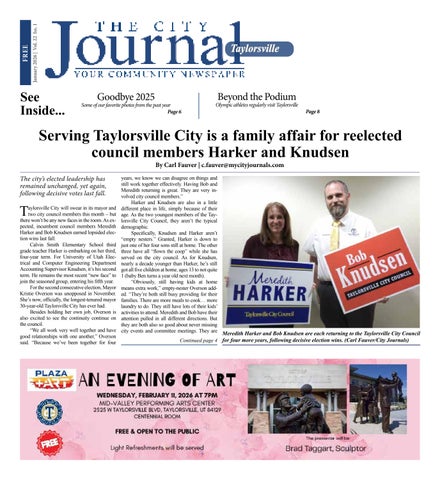
Meredith Harker and Bob Knudsen are each returning to the Taylorsville City Council
Continued page 4 for four more years, following decisive election wins. (Carl Fauver/City Journals)
Page 2 | January 2026
Taylorsville City Journal
TaylorsvilleJ ournal.com
January 2026 | Page 3
Continued from front page very effective council members.” Knudsen and Harker say their ability to juggle home life, full time jobs and city council duties are largely due to a couple of key factors: Susan and Mike… their spouses. Let’s take a minute and peak in on each family dynamic that allows these two to keep up with all their obligations.
Councilman Bob Knudsen
A 2003 Taylorsville High School graduate, Knudsen had no political aspirations until one of his former Boy Scout leaders encouraged him to remember the Scout slogan: “Do a good turn.” That leader was Dan Armstrong, who had held the Taylorsville City Council District 5 seat for eight years and was searching for a qualified replacement after deciding not to seek a third term. Sadly, Armstrong passed away unexpectedly last spring. Knudsen is honored his former mentor thought so highly of him. “Dan approached me (in 2021) and said ‘You’re a level-headed guy; the city council could use you,’” Knudsen said. “He wanted to leave his council seat in good hands. I thought about it and decided I could bring a different dynamic to the council because I had younger kids. That’s what made me enter the race.” Knudsen’s wife, Susan, was squarely behind him from the beginning. “I really thought Bob was the best person for the position,” Susan Knudsen said. “It has been a bit of a burden on the family, sure. But it’s also been really good for us. I go with Bob to many of the city activities. We’ve attended two different Tombstone Tales (in 2022 and 2025). I’ve learned a lot more about the history of Taylorsville than I probably would have. And we take our kids to the events that are appropriate for them.” Of his four sons and one daughter, Will, 8, is in the middle of the sibling pack. “My Dad has taken me to some fun activities,” Will said. “We saw ‘Pirates of the Caribbean’ (one of the films shown outdoors in Cen-
tennial Plaza during the Starry Nights series). (Despite his many city council obligations) he always has time for me. He’s a good dad.” “Through my work on the city council, my kids have been able to see there is a lot to do on the local level to help our community,” Knudsen concluded. “Some of the things we do may not seem big at first – but they do impact our day-to-day lives quite a bit. I think I have shown them so much can be accomplished by anyone. You are never too young or old to get involved.” To which Susan Knudsen adds: “I feel it’s been good for our kids to see an example of loving others and service in the community.”
Councilwoman Meredith Harker
Like Knudsen, Harker is also a Taylorsville High School graduate, receiving her diploma eight years ahead of him (1995). Another similarity between the two: they were each encouraged by an elected official to run for a city council seat that was being vacated. Four years before Armstrong encouraged Knudsen to seek the seat he was leaving, the county councilwoman representing Taylorsville, Aimee Winder Newton, encouraged Harker to run in the Taylorsville District 4 race, after eight-year incumbent Dama Barbour announced she would not seek a third term. At the time, Meredith and Mike Harker’s four sons were ages 8 to 16, and all up to their eyeballs in sports, Scouts and the countless other activities that keep parents watching and chauffeuring. “When I first told Mike Aimee had sent me a message asking if I had ever considered running for city council, I was laughing,” Harker explained. “If he had laughed too, I’m sure that would have been the end of it. But instead, he said ‘Why not you? You can do this.’ He was very supportive from day one.” Again, that’s despite four sons at home and a full-time school teaching job. “Meredith is very capable and very patient,” Mike Harker said. “I knew she likes politics. She had volunteered on Jon Huntsman’s campaign for governor. Honestly, we never
TAYLORSVILLECITY JOURNAL.COM
TAYLORSVILLE TEAM
The Taylorsville Journal is a monthly publication distributed directly to residents via the USPS as well as locations throughout Taylorsville. For information about distribution please email hello@thecityjournals.com or call our offices. Rack locations are also available on our website. The views and opinions expressed in display advertisements do not necessarily reflect or represent the views and opinions held by Loyal Perch Media or the City Journals. This publication may not be reproduced in whole or in part without the express written consent of the owner. © 2019 Loyal Perch Media, Inc.
FACEBOOK.COM/ THECITYJOURNALS
PUBLISHER
Bryan Scott | bryan.s@thecityjournals.com
really talked about the time commitment that would be involved. Our church background is all about serving and volunteering, and this just seemed to fit. I knew she would be good at it.” Since winning that November 2017 election, Meredith has watched her sons-at-home count drop from four to one. Her two oldest sons are graduating from college this spring, while the third is serving a church mission in New Zealand. But youngest son Miles is still carrying on that tradition of helping to fill his parents’ schedule. A Taylorsville High School junior, he competes on the THS golf and tennis teams – and is also into his third year on the Taylorsville Youth Council. “(At only age 8), I had no clue what Mom was doing when she first decided to run for city council; but it’s been great having her on there,” Miles Harker said. “I’ve been active my whole life with sports and choir. And she gets to my events. She’s so good with dates and times. She’s a great mom.” Miles is actually the second Harker boy to serve on the Taylorsville Youth Council, following in older brother Mason’s footsteps.
Connect social media
CIRCULATION COORDINATOR
EDITOR
ADVERTISING EXECUTIVES
EDITORIAL & AD DESIGN
Mieka Sawatzki | mieka.s@thecityjournals.com Lindsay Andreasen | lindsay.a@thecityjournals.com Ryan Casper | ryan.c@thecityjournals.com Marc Davis | marc.d@thecityjournals.com
It’s too early now to know whether the other three incumbent Taylorsville City Council members – Anna Barbieri, Ernest Burgess or Curt Cochran – will seek reelection in November 2027. But, for now, stability will reign supreme on the elected body for at least two more years. l
Unlike Mayor Kristie Overson, Taylorsville City Council members Meredith Harker and Bob Knudsen each faced challengers last fall, and each earned decisive election wins. (Carl Fauver/City Journals)
Lydia Rice | lydia.r@thecityjournals.com 385-557-1022 Rack locations are also available on our website.
Travis Barton | travis.b@thecityjournals.com
Harker has enjoyed involving her husband and sons in many city events over the years. And her third-grade students have also benefited from the connection that has allowed them to enjoy classroom visits from Overson, Police Chief Brady Cottam and other elected officials. “Serving on the city council has definitely made me a better teacher,” Harker added. “In social studies, I teach my students about local government and how to be better citizens. The day after the election (last November), the kids were so excited asking me if I had won. We had a little celebration in the classroom. And their parents are also very supportive. I love being a full-time teacher – and feel I have the best of both worlds, also serving on the city council.” ____________________________
Stacey LaMont Ty Gorton
INSTAGRAM.COM/ CITYJOURNALS
LINKEDIN.COM/ COMPANY/ CITY-JOURNALS
MISSION STATEMENT
Our mission is to inform and entertain our community while promoting a strong local economy via relevant content presented across a synergetic network of print and digital media.
PUBLISHER
Designed, Published, & Distributed by
TAYLORSVILLE CITY JOURNAL 9500 South 500 West, Suite 205 Sandy, UT 84070
PHONE: 801-254-5974
FREE | COMMUNITY | PAPERS
Page 4 | January 2026
Taylorsville City Journal
Kearns resident joins the Third District Court judiciary Amanda Montague brings a wealth of legal experience to her new role. By Peri Kinder peri.k@thecityjournals.com
S
urrounded by family, friends and colleagues from the legal community, Amanda Montague pledged to uphold the Constitution and serve the public with fairness and integrity as she was sworn into the Utah Third District Court judiciary. The Kearns resident previously served as a division director in the Utah Attorney General’s Office and spent nearly 10 years clerking for Third District Court judges. Her experience working with the Utah Board of Pardons and Parole, the Department of Corrections, the Interstate Compact Office and the Sex, Kidnap, and Child Abuse Offender Registry provides her with a comprehensive criminal justice understanding that she will apply to the cases that come before her on the bench. Montague was appointed to the position by Gov. Spencer Cox in August 2025 and confirmed by the Utah Senate. “Amanda has spent the last 20 years making sure our justice system works for real people, whether she’s helping the Board of Pardons weigh tough calls or guiding dozens
TaylorsvilleJ ournal.com
of state agencies through the law,” Cox said in a media statement. “I’m grateful for her steady hand and clear-eyed compassion, and I’m confident she’ll serve the Third District with both.” Montague earned her juris doctorate from BYU’s J. Reuben Clark Law School, where she served as managing editor of the BYU Journal of Public Law. As a member of the Utah Third Judicial District, Montague will oversee cases in Salt Lake, Summit and Tooele Counties. In November, she was sworn into the judiciary by Utah Supreme Court Justice Paige Peterson, who first met Montague when she came before the district court in Park City to argue a motion. “I knew, watching her, that she was a standout and I thought, this person is excellent. She has what it takes. She has a bright future. She can do anything,” Peterson said. “So I am not surprised at all to see Amanda joining the District Court bench.” Peterson encouraged Montague to be steady and consistent, especially during a time that feels chaotic and advised her to take her oath seriously, without fear of retribution, even as threats are being leveled at judges across the country. “When people come to the courthouse to have their case heard, it doesn’t matter if
Judge Amanda Montague will serve in the Utah Third District Court, overseeing cases in Salt Lake, Summit and Tooele Counties. (Peri Kinder/City Journals)
they’re powerful, doesn’t matter if they’re rich, doesn’t matter if they’re poor,” Peterson said. “We take an oath to treat everyone fairly, which means listening to their arguments, understanding their arguments and making a decision based solely on the law. I have every confidence that you will do that and you will fulfill the high standards that all of us, as judges, set for ourselves.” Montague’s children, Porter and Louisa, assisted her with the robing ceremony, and she sent a shout-out to her son, Dallin, who is serving a mission for The Church of Jesus Christ of
Latter-day Saints. She thanked her family and colleagues for supporting her as she applied to the judiciary several times before finally being accepted. Montague also expressed gratitude for the women who mentored her and the people who believed in her ability. “So many of you have watched me go through this journey and struggle, and have been nothing but hopeful and helpful to me, and I am so very appreciative of that,” Montague said. “I am lucky and blessed that I was selected for this…I do take very seriously every decision that I have to make and I am still learning every day. I am so very grateful for how kind and welcoming the judiciary has been to me.” Her husband, Joe Montague, said one thing he has admired most is watching his wife work incredibly hard during her career to reach her goals. He saw her set an example to their children by staying focused, being dedicated and retaining a good heart, even when her job sometimes showed her the worst of humanity. “As Justice Ruth Bader Ginsburg said, real change, enduring change, happens one step at a time,” said Joe Montague. “Amanda has lived that truth by applying learning, serving and growing one step at a time, until she reached this moment today, and it will continue.” l
January 2026 | Page 5
Some of our favorite photos from Taylorsville in 2025
A colorful Lion Dance delighted audiences at the Bennion Jr. High Chinese New Year celebration. (Tom Haraldsen/City Journals)
Taylorsville resident DeVaughn Simper has been studying and collecting flags from around the world for decades. (Photo courtesy DeVaughn Simper)
Taylorsville High School graduate Matt Leon recently displayed his athletic skills in several different events, including recumbent bicycle racing, during a military-sponsored competition. (Photo courtesy US Navy)
Taylorsville High wins state unified basketball in showcase. Unified basketball embraces students with and without intellectual disabilities to play side by side. (Julie Slama/City Journals) Special education students at Kearns Junior High surround their teacher Rai Pattison who was named Granite School District’s 2025 Teacher of the Year. (Photo courtesy GSD)
A couple of hundred Utah State Prison inmates have graduated through the SLCC Prison Education Program since it was introduced eight years ago. (Courtesy SLCC)
Page 6 | January 2026
Plenty of dignitaries and hospital officials were on hand for the recent ribbon cutting at the new 90-thousand-square-foot Intermountain Health Primary Children’s Hospital-Taylorsville Campus. (Photo courtesy Taylorsville City)
Taylorsville City Journal
South Kearns Elementary Principal Kim Babka (center) is joined by the school’s soccer club, PTA leaders, RSL’s Leo the Lion, Cleo the Royals’ mascot and Granite School District Superintendent Ben Horsley to celebrate the new soccer goals funded by Box Tops for Education. (Peri Kinder/City Journals)
Jack and Isla Muscarello – a pair of visiting park experts from outside Chicago – give the new Summit Park playground equipment a big thumbs up. (Carl Fauver/City Journals)
Although her mother co-created Tombstone Tales nearly 30 years ago, Taylorsville Mayor Kristie Overson never performed in the event until this year’s organizers coaxed her into portraying her mom. (Carl Fauver/City Journals)
Model boat races are among the popular activities Cub Scout Pack 4996 kids enjoy. (Photo courtesy Elaina Augason)
TaylorsvilleJ ournal.com
Taylorsville’s Kobe Allen (No. 20 in white) goes up for a shot in action earlier in 2025. Allen was poised to finish his career as the Warriors’ all-time leading scorer. (Photo courtesy of Tiffany Allen.)
January 2026 | Page 7
‘Beyond the Podium Program’ has world-class Olympic athletes visiting Taylorsville all the time Salt Lake Community College has assisted speedskaters for years; and now the school is expanding its program to help skiers, snowboarders and rock climbers, as well. By Carl Fauver c.fauver@mycityjournals.com
T
he Milano-Cortina Italy 2026 Winter Olympic Games will open next month, with lots of Utah representation – much of it through Salt Lake Community College. For years, the Taylorsville-based school has enjoyed a partnership with the US Speedskating organization. And just last fall, that support was expanded to now also include U.S. Ski & Snowboard along with summer Olympic hopefuls competing for USA Climbing. “We are honored to play a supportive role in the lives of these athletes as they strive for the ultimate goal: an Olympic medal and a chance to represent the United States on the world stage,” SLCC President Greg Peterson said. “Their dedication is inspiring and we are proud to help them reach their Olympic dreams without sacrificing their educational and career aspirations.” SLCC is calling its newly-expanded effort the “Beyond the Podium Program.” Among the athletes grateful to receive the support is 2022 Beijing Winter Games bronze medalist Ethan Cepuran. The 25-year-old speedskater, originally from Chicago, trains daily at the Olympic Oval in Kearns – and has nearly completed his SLCC associate’s degree in pre-engineering. “All of the Salt Lake Community College staff has been very supportive, in so many ways,” Cepuran said. “I began taking classes through the school in 2019. I now have only two classes left to finish my degree. Funding can be very tight for Olympic athletes. The school’s program is so helpful. I’m very excited they will now be able to assist even more athletes by expanding the program to include skiers, snowboarders and climbers.” So, what exactly does Beyond the Podium provide? For starters, the program waives the athletes’ tuition fees. It also allows them to study and test from anywhere in the world. And Olympic hopefuls can take extended time away from their SLCC curriculum as competition schedules require. That’s why Cepuran has now moved into year seven in the program, still progressing toward a “two-year” degree. “I have attended a few on-campus labs over the years; but 95% of my SLCC work has been done online,” Cepuran said. “In my time in the program, I’ve probably known about 20 speedskaters who have participated in it. I’ve done tons of studying in many different countries. And I’ve taken tests in plac-
Page 8 | January 2026
es all around the world. I love it; my schoolwork helps distract me from the pressures of competing.” The expanded Olympic hopeful support program is funded in large part through a generous donation from Utah philanthropists Jeff and Helen Cardon. “We saw a critical need to help athletes navigate life after years of intense competition,” Helen Cardon said. “For many, their identity is deeply tied to decades of training and performing, making the transition to new pursuits especially challenging.” “This is an ongoing need, and we hope others will join us in supporting these athletes who dedicate their lives to representing America on the world stage,” Jeff Cardon added. A portion of the Cardons’ donation has also allowed former Olympic speedskater Chris Needham to join his wife in working on the SLCC Taylorsville campus. “I worked for about eight years under US Speedskating at the Utah Olympic Oval in Kearns,” Needham said. “When SLCC expanded its program to include climbers, snowboarders and skiers, I came aboard. My wife, Carrie, has been with the school several years. She’s a tenured professor working in the Exercise Science Department as an exercise physiologist.” Needham’s title in the new position is Beyond the Podium Program Director. With more than 19 athletes from the three, Utah-based national governing bodies – U.S. Ski & Snowboard, US Speedskating and USA Climbing – SLCC has one of the largest contingents of student athletes training to compete in the Olympics, nationwide. “We anticipate more than a dozen of our athletes will end up competing at the 2026 Winter Olympics,” Needham said. “We also envision a program supporting around 100 athletes in the lead-up to the 2034 Salt Lake Games.” A Boston native, Needham, 45, has now lived more than half his life here in Utah. “I moved to Utah just after the 2002 Olympics,” he explained. “I never thought I would stay here, but I love it. I never competed in an Olympic Games; but I was in a couple of World Championships. I was a sprinter in speedskating, competing in 500and 1000-meter races.” Utah is also where Needham found his bride: 1992 Clearfield High School graduate Carrie Needham. She’s involved in the other benefits the SLCC Beyond the Podium Program provides athletes. In addition to a tuition-free education, the program also offers physiological testing through its Exercise Science Department. “We typically test athletes twice each year and offer them tips to help maximize their training success,” Dr. Carrie Needham said. “This past year, we tested about 50 athletes. They normally bring their own training
Shown here training at the Olympic Oval in Kearns, speedskater Ethan Cepuran also spends time on the nearby SLCC Taylorsville campus where he’s earning a degree. (Photo courtesy Ethan Cepuran)
bicycles in because they are most comfortable on them. We lock them into place to make them stationary and then test heartrates and exertion levels. Each test takes about 60 to 90 minutes.” The tests are conducted on the Taylorsville SLCC campus, in the Human Performance Lab inside the school’s large Lifetime Activities Center – also home to the school’s basketball and volleyball teams. “Most of the athletes I work with are great, highly motivated, with a good understanding of the value of our testing,” Carrie Needham said. “Working with them is one of the most enjoyable parts of my job. I always have great conversations with them.” Needham earned her bachelor’s degree at the University of Utah and her master’s at the University of Wisconsin-La Crosse. By the time she completed her PhD in 2011, she had already been working for US Speedskating for several years. Carrie Needham joined the SLCC faculty in 2017. “It’s amazing to see this level of commitment to Olympic athletes at the community college level,” she concluded. “You just don’t see these kinds of partnerships. It really shows SLCC’s commitment to improving people’s lives.” The heads of the Olympic sports partnering with the Taylorsville school seem to be
equally impressed. “We are thrilled to bring Salt Lake Community College on as a new partner,” U.S. Ski & Snowboard President Sophie Goldschmidt said. “Our commitment is to support our athletes on and off the snow in every facet of their life, and education is core to that mission. We’re looking forward to working with SLCC and supporting our athletes in their career advancement.” “Education empowers our athletes to build meaningful lives beyond sport,” US Speedskating Executive Director Ted Morris said. “We’re proud to support our athletes’ pursuit of knowledge, purpose and long-term success, post-skating career.” That’s also when Winter Games medalist Cepuran expects to most appreciate what the SLCC Beyond the Podium Program offers: after his competitive days are behind him. “Training is so tough and time consuming; and speedskaters are not making a ton of money,” he concluded. “I have a couple of sponsors – but no time to work a job. Funding is always tight. But this SLCC program is helping me prepare for the future. I plan to go on (after completing my SLCC associate’s degree) to hopefully earn a mechanical engineering degree at the University of Utah. I hope to one day work in design and aerodynamics.” l
Taylorsville City Journal
Strength beyond the bar How a world champion powerlifter and special education advocate found his strength. By Julie Slama j.slama@mycityjournals.com
W
est Jordan High teacher Sheldon Russell is fueled by grit, redemption and purpose. The man who holds more than 80 state, national and world powerlifting records — and once deadlifted 700 pounds at age 47 to become the oldest Utahn ever to do it — was once told he’d never even graduate high school. “My second-grade teacher told my parents I wouldn’t graduate,” Russell said, who holds a doctorate degree. “I nearly died at age 16 in what was an attempt; my heart rate got down to 15.” From his lowest point to the top of the lifting platform, Russell’s journey is powered by the same force that drives him today — not the weight on the bar, but the weight he helps lift from others’ shoulders. “I grew up in a very dysfunctional home,” he said. “I dropped out of school and I went and got LSD at Sugar House Park when I was 16 years old.” When he returned to school, administrators told him he couldn’t come back without meeting strict requirements. But one man, his high school counselor, Dean Collett, stepped in. “He said, ‘No, give him a chance.’ He was like a dad to me. He was even the best man at my wedding,” Russell said. That second chance, combined with a new love for the weight room, sparked a new way of thinking. “I took weightlifting when I was in the ninth grade at Highland High,” he said. “I had five Fs and two As. The As were in basketball and weightlifting. I broke a record, deadlifting 530 pounds at 17, at a buck 80 (180 pounds). When I realized that, I thought, ‘If I can do this, why can’t I be a straight A student?” That realization of grit and drive became his driving force. “I suddenly made this connection in my mind — if I can lift this heavy weight up with hard work and determination, I could do that to succeed in school and life,” he said. “So, I stuck with that. I carried that mentality all the way to a doctorate degree in educational leadership.” Married, working odd jobs and scraping through college — earning $4.90 an hour as an apartment maintenance worker — Russell stumbled into what would become his life’s calling. “Jordan Valley School needed a 17hour (part-time) assistant,” he says. “I was going to major in criminal justice, be a police officer. It just didn’t feel right. Special
TaylorsvilleJ ournal.com
ed is my passion.” For 31 years, Russell has been a force in public education. He served in administration, but he chose to return to teaching special education and coaching unified sports at West Jordan High. His class focuses on life skills, helping students with intellectual disabilities learn to live independently. “We teach them skills to become independent adults, to learn social skills, job skills and transportation skills,” he said, adding he takes his students out into the community every week. “We do a lot of community-based training with shopping and managing a budget. I’m proud of that, because I’m the one who got that ball rolling. Now all the high schools are doing it.” Russell also coaches the school’s unified sports team which brings together students with and without disabilities to play side by side. One of his four soccer teams was runner-up at the state championship. “This team has made monumental progress from their first game to now; they pass better and they’re more aggressive,” he said. “They’ve honed in on some drills, that’s helped a lot. They’ve understood the game more, which has helped them to get to this ability. Anytime they can improve is celebratory, for sure. It’s a win.” Jordan Education Foundation Executive Director Mike Haynes has seen Russell on the sidelines, teaching and motivating his team, from tying a shoe to directing a play. “He’s good with them and his kids love him. He’s about changing their lives,” Haynes said. When Russell isn’t at school, he often can be found at his home gym or with a tight crew of powerlifters who push and support each other like family. Haynes is one of them. “We both won the American Powerlifting Federation national championships in the summer of 2023,” Russell said. “I bulked up to the 308-pound class and did full power and won my division. Mike did bench and won his division at 165.” Their friendship is built with the bar and bench. “There’s nothing better than the bond you create,” Russell said. “I’ve known Mike through social media, but we’ve only really known each other for three years. Mike’s one of my best friends now. There’s something about the physical struggle and encouraging each other through it that creates an incredible bond.” That bond extends to Scott Mecham, who he lifts with on Tuesdays along with Haynes, as well as his Saturday crew. To Russell, powerlifting isn’t about numbers; it’s about community. “This group is close, it’s more intimate. Whether you’re lifting 50 pounds or 700 pounds, they’re going to cheer for you
Sheldon Russell, a West Jordan High special education teacher, has more than 80 state, national and world powerlifting records. (Photo courtesy Sheldon Russell)
because the competition is against yourself. It’s a very cool group,” he said. His own records — 80 across federations, including the 700-pound deadlift — speak volumes, but he shrugs them off. “Records are cool, yeah, but they’re secondary. I’m more concerned with going in and at 50 years young, outlifting or lifting as much as the young guys, which I do on a regular basis,” he said. Behind the strength, though, lies a quieter fight. “I struggle and battle with depression, and I have for years,” he said. “I can hide it pretty well, I can go to work and function and everything, but I get really depressed. I can’t tell you how many times I’ve been down in the dumps and been in a weight room and hit some insane weight. It’s my medicine for mental health. If you can do hard things in a weight room, you can do hard things anywhere.” Russell doesn’t do anything halfway – not weights, not reading, not collecting action figures. “I once set a goal to do 10,000 bench
press reps in one year and I hit 20,000. I’ve read over 23,000 pages so far this year; I probably read at least a couple hundred books a year. I probably have more action figures than everyone in South Jordan combined. I set weird goals, but when I’m into something, I am all in,” he laughs. From the smallest kid in his second-grade class to one of the strongest Utahns in his sport, Russell’s story is living proof of resilience. “As a troubled child, I thought I had no talent at all,” he said. “When I got in the weight room, I realized talent didn’t matter. It was how hard you worked and how determined you were.” That’s the lesson he passes on to his students every day. “If you can convince yourself you can do hard things, that carries over,” he said. “That’s the interesting thing about powerlifting, it teaches you about struggle, about doing hard things – that grind and the endorphin rush and the excitement of doing something you’re good at and then celebrating that.” l
January 2026 | Page 9
West Valley, Kearns venues will be hot Olympic sites in 2034 Both West Valley City and Kearns will be in the spotlight as host sites for events during the 2034 Olympic Winter Games in Utah. By Tom Haraldsen t.haraldsen@mycityjournals.com
T
he 2034 Olympic Winter Games will have a new name (Utah 2034 rather than Salt Lake City 2034), but some of the most in-demand tickets will be for events held in West Valley City and Kearns. With the Delta Center now home for an NHL team, the hockey competitions for the 2034 Games will be played there. That means figure skating will join short track speedskating with events conducted in the Maverik Center, and of course long track speedskating will take place at the Utah Olympic Oval in Kearns. All of those are huge spectator events, which means grandstands should be filled and bundles of cash will be spent on food, drink and swag on the valley’s westside. In 2002, both short track and hockey were held at the Maverik. In fact, the Canadian team that beat Team USA for the gold medal in hockey carved and/or
Page 10 | January 2026
penned their names on a wall in the Maverik, a wall that was preserved outside the locker room for many years. Figure skating was held at the Delta Center. Now, figure skating will move to West Valley while hockey moves downtown. Preliminary hockey games will also be held at Provo’s Peak Arena, as they were in 2002. The arenas have much different capacities – the Maverik can seat about 8,400 while the Delta Center’s capacity for hockey is around 14,000, or will be by 2034 – but no one from the International Olympic Committee seems worried. Both venues will sell out for the Games. And the Maverik will undoubtedly see some changes and modifications once the Utah Grizzlies conclude their time as tenants of the building after the end of this year. That team was sold to new owners who are relocating it to New Jersey. The Maverik Center has held many ice skating events before and will host the U.S. Synchronized Skating Championships this spring. It’s also going to add visibility of both West Valley City and Kearns to international visitors and TV viewers. American Olympic Games are always the most watched games around the world. l
The Maverik Center will be host site for both figure skating and short track speedskating for the 2034 Olympic Winter Games. (Tom Haraldsen/City Journals)
The Utah Olympic Oval in Kearns will once again be site for long track speedskating, as some of the most popular Olympic events will be staged on the westside of the Salt Lake Valley. (Tom Haraldsen/City Journals)
Taylorsville City Journal
Winter gardening ensures better spring results Tips for gardeners who aren’t afraid of cold weather. By Peri Kinder peri.k@thecityjournals.com
W
hile most people are hunkering down for a long winter’s nap, diligent gardeners know there’s still work to be done to prepare trees, lawns, shrubs and flower beds for spring. Cody Zesiger, assistant professor at Utah State University Extension, said winter gardening is about preservation and renewal. “We prevent damage from harsh winter conditions,” he said. “Renewal tidies up the plants and stages the garden for the next year through pruning, deadheading, etc.” For the first three or four years after a tree is planted, Zesiger said it’s vital to wrap the trunk to prevent cracking on the southwest side. Sunscald and freezing weather can cause tree trunks to crack and damage the delicate tissue beneath the bark. Wrapping the tree from the base to where the branches begin can help reflect the sun away from the tender trunks, allowing the tree to grow healthy and strong. “If you’ve ever seen trunks that have that damage, and it’s always the southwest-facing side, where it’s cracking and the bark is peeling away, the tree is always less healthy moving on,” he said. “There’s a tree wrap cloth that’s kind of semi-porous that they can get at nurseries, sometimes at box stores and definitely on Amazon. If they visit the botanical center in the winter, they’ll notice that all of our young trees are wrapped.”
TaylorsvilleJ ournal.com
Managing leaves isn’t just for autumn, as leaves continue to fall throughout the winter. While some leaves can be mulched with a lawn mower, too many leaves in flower beds can suffocate new growth. “If you’ve got a thick layer of leaves on plant tissues, it’s kind of like putting cardboard out there,” Zesiger said. “On those nice, dry days in winter, sometimes it’s good to blow those leaves away.” While grooming ornamental grasses is best done before Thanksgiving, it can still be done in the colder months. Semi-evergreen or evergreen grasses should be raked, not clipped, by gently combing out dead blades to encourage new growth in the spring. Deciduous ornamental grass can be given a buzz-cut treatment, leaving about six inches of the plant above ground. Zesiger said it will soon be time to prune grapes and fruit trees. The weather and the number of trees to prune will determine when to start, but it’s usually best in February or March. Pruning fruit trees before they have their first buds is optimal and learning how to prune grape vines will create a more bountiful harvest. The USU Botanical Center in Kaysville, at 80 E. 725 South, offers pruning demonstrations and has resources online at extension.usu.edu/yardandgarden to help beginning pruners clip with confidence. “For the demo, we usually charge a small fee and that fee is used to buy more trees,” Zesiger said. “It’s just knowing those kinds of things and not having to be disappointed by having a tree that’s in bad shape because you knew to wrap it, or knowing how to prune your grapes and then you get grapes every year. Those are things that can be done in the winter or early spring that just set people up for success.” l
Wrapping young tree trunks can protect the bark from harsh winter conditions, helping the tree grow healthier. (Photo courtesy of Cody Zesiger)
January 2026 | Page 11
6 indoor family activities to shake off the winter blues Get kids of all ages moving and exploring at one of these fantastic venues. By Peri Kinder peri.k@thecityjournals.com
J
anuary’s gray skies and cold weather often send Utah families inside to find warmth and fun. Luckily, indoor activities allow parents and children to discover new spaces, learn something new and spend the winter exploring museums, galleries and other places that invite interactive, immersive experiences. Clark Planetarium (110 S. 400 West, Salt Lake City) How long has it been since you travelled the stars at the Clark Planetarium? If you haven’t been to the planetarium since you chaperoned a first-grade field trip, it’s time you went back. Along with the stunning Hansen Dome Theatre, the Northrop Grumman IMAX Theatre and three floors of exhibits, Clark Planetarium is open seven days a week. Test your knowledge with the Solar System quiz, form a black hole, step inside a tornado and learn about the moon. Visit saltlakecounty.gov/clark-planetarium to buy tickets or learn about featured movies, laser light shows and Planetarium star shows. Clip ‘n Climb (11196 S. Redwood Road, South Jordan) Get everyone moving at Clip ‘n Climb, where family members aged 2 and up can learn the ropes at this indoor climbing adventure. Each session lasts 90 minutes, including a 15-minute safety briefing and harness fitting. Clip ‘n Climb features climbing walls for every level, featuring bright colors, interesting obstacles, skill-appropriate challenges and a toddler area for soft exploring. To learn more, visit southjordan.clipnclimb.us.
Page 12 | January 2026
Natural History Museum of Utah (301 Wakara Way, Salt Lake City) If you have a dinosaur fan in the family, an afternoon at the Natural History Museum of Utah is a necessity. Not only does it exhibit dozens of dinosaur skeletal reconstructions, but it has the world’s largest display of horned dinosaur skulls. The museum provides 12 permanent exhibits that detail Utah’s ancient history, spanning hundreds of millions of years. On Friday, Jan. 16, from 2-4 p.m., the museum hosts an afternoon of STEAM activities for scientists of all ages and join the family one-hour yoga class on Sunday, Jan. 18 at 10:15 a.m. For more info, visit nhmu.utah.edu. iFLY Indoor Skydiving (2261 Kiesel Ave., Ogden) Jumping out of a plane from 12,000 feet isn’t for everyone. That’s why iFLY Indoor Skydiving’s wind tunnel is a safe alternative for the whole family. The team will fit everyone in your party
Indoor skydiving at the iFLY wind tunnel (for ages 3 and older) is a safe way to experience flying with wind speeds of 150 mph. (Tom Haraldsen/ City Journals)
(ages 3 and up) with the right gear and teach you how to fly in the tunnel’s 150 mph wind speeds. No experience is necessary. There’s no need to jump out of a plane, purchase expensive equipment or sign up for parachute training; just gear up and fly. For experienced flyers, the facility’s world-renowned instructors can take your experience to the next level. Learn more at iflyutah.com. Loveland Living Planet Aquarium (12033 Lone Peak Parkway, Draper) Interact with stingrays, walk through a shark tunnel, watch the playful river otters and enjoy feeding time for penguins at the Loveland Living Planet Aquarium. With nearly 5,000 animals, representing more than 600 species, each family member will find a favorite. Sonja Bowman, a third grader at Beehive Science and Technology Academy, visited the aquarium during a field trip. “I love seeing the sharks,” she said. “Because sharks are my favorite animal and the coolest animal. I saw stingrays, too. They weren’t poisonous.” Through Saturday, Jan. 10, the aquarium’s outdoor Rio Tinto Kennecott Plaza is transformed into the annual Lantern Festival with nature-inspired light displays illuminating the night. Museum of Natural Curiosity at Thanksgiving Point (3605 Garden Drive, Lehi) When the kids get stir-crazy, a trip to the Museum of Natural Curiosity offers myriad opportunities to explore, discover and create. Hundreds of on-hand exhibits encourage curious minds to visit businesses in Kidopolis, climb through a rainforest, engineer a waterway, put on a puppet show or make a fun craft. A variety of rotating exhibits can be found in the innovation gallery, and if the weather is accommodating, the outdoor discovery garden includes playground equipment based on STEM concepts. Discover more at thanksgivingpoint.org. l
Taylorsville City Journal
Help students avoid the winter school slump The most difficult stretch of the school year may begin right after the holidays. By Peri Kinder peri.k@thecityjournals.com
T
he holidays are over and cold, dark January mornings are moving in. This time of year, students might struggle to find motivation as the end of the school year seems far away. They might battle low energy, academic pressure and winter fatigue. Danielle Natter, Granite School District Coordinator over the Comprehensive School Counseling Program and College and Career Readiness, said parents are key to helping their kids avoid the January blues and gave tips to ward off fatigue and stress.
Take care of overall health
Going back to basics can make a big difference in energy levels and motivation. Sticking to a sleep schedule, making sure kids stay hydrated, providing nutritious foods and creating time for physical activity can lessen the impact of January’s slump. Going out into the sunshine and taking some deep breaths can regulate stress and give kids a dose of Vitamin D that can be hard to come by in the winter.
TaylorsvilleJ ournal.com
“Our job as parents is to be the platform,” Natter said. “We don’t need to jump on the roller coaster with them because they are not our highs and they are not our lows. If we ride with our kids, we’re doing them no good. They don’t need someone on the roller coaster with them. They need us to be the platform. They need a safe space to jump off every once in a while before they have to get back on the roller coaster.”
“We also talk a lot about intentional screen time,” Natter said. “As we’re outside less, we tend to turn into those screens more and we have to be careful with that.”
Open lines of communication and foster connection
It’s OK to stay on top of kids to help them feel motivated for schoolwork. Breaking assignments into smaller tasks can make homework seem more manageable. “Kids might say, ‘I’ll get to it tomorrow’ or ‘I’ll do it tomorrow’ but we need to make sure they’re staying on top of their work, making sure that we’re creating schedules for them,” she said. “Make sure they know you’re aware of it and do checkins every day to see how it’s going.” Natter said parents should talk with their kids about things other than school assignments. Small interactions during the day create bridges of communication that pay off in the long run. Asking kids what music they’re listening to, sharing a funny video, playing a favorite game or inviting them to run an errand creates moments of connection that let students know parents care about everything, not just school. “Because of our busy schedules, we aren’t communicating as much with one another face-to-face; we aren’t having those random conversations,” she said. “Finding
Cold weather and dark mornings could affect the way students perform at school but there are tips and tricks to surviving the January blues. (Adobe stock)
those places of connection makes it feel a little softer…When we talk to teenagers, as much as they pretend like they don’t need and want that connection, they really do.”
Don’t ride the roller coaster
Kids go through hard things every day. They’re trying to navigate tricky social situations, learn difficult concepts, develop trusting relationships and discover their own personal values. Creating a safe space at home gives students a place to rest and recalibrate as they maneuver through tough situations. Sometimes kids lash out at home because they can’t show their frustration and anger at school.
Recognize when professional assistance is needed
While Natter said kids are pretty resilient, watch for behavior where they are isolated, sad or avoiding favorite activities for a considerable amount of time. That time varies per child, but if a parent notices ongoing concerning behavior, it might be time to contact a therapist or counselor. GSD offers school counseling or a pediatrician might recommend a good therapist. Parents should be careful not to stigmatize therapy, but be a true cheerleader for their child’s mental health. “Parents always think they’re doing a terrible job but they are doing a good job just by knowing their kids and knowing when they see something off,” Natter said. “Just connect with them and find those connection points where conversations can naturally happen.” l
January 2026 | Page 21
Page 22 | January 2026
Taylorsville City Journal
Health & Wellness A publication covering health and wellness tips, tricks and ideas for everyone around the Salt Lake Valley
Show up for yourself: One woman’s journey By Julie Slama | j.slama@mycityjournals.com For years, Kenzie Turner moved through life on autopilot — balancing pregnancies, navigating grief, holding down a job and keeping pace with the demands of motherhood. In her 20s and early 30s, she wasn’t thinking about fitness or nutrition. “Truthfully, I wasn’t thinking about myself at all,” she said. “I remember at one time feeling trapped in a body I didn’t recognize. I gained weight through pregnancies, but I didn’t lose it with the last two.” Before Turner’s first pregnancy, she weighed 150 pounds, climbing to 190 after indulging in Chips Ahoy! cookies “several times each week.” After giving birth, the weight came off easily, and she assumed her body would always bounce back like that. Three years later, her second pregnancy brought cravings of Totino’s pizza, which she ate “several times per week.” Again, Turner reached 190 pounds, but water aerobics helped her return to her pre-pregnancy weight. Life was busy, but predictable as
Turner worked as a bank teller and caring for two children, often managing on her own while her husband was in pharmacy school. Then, at 16 weeks into her third pregnancy, she miscarried. “The miscarriage really messed me up; I basically didn’t care and just ate,” Turner said. She became pregnant again, leaning on comfort foods like McDonald’s pancakes. After her third child, the sadness of her miscarriage remained. “I just didn’t have any motivation; I didn’t go back to losing the weight again,” Turner said. By her last pregnancy, Turner’s unhealthy habits became routine and she often munched on sour gummies. “I was already like 190 pounds when I got pregnant; when I weighed in, I was 229 pounds,” the 5-foot-3-inch tall mother said. By 2019, Turner felt stuck. “I remember signing up for Weight Watchers, but I didn’t even start. I figured,
Kenzie Turner changed her life the past two years and now is a fitness instructor. (Julie Slama/City Journals)
TaylorsvilleJ ournal.com
‘I’m just going to be fat. It’s just who I am now,’” she said. For years, Turner hovered around 220 pounds, eating to fill emotional gaps, not nutritional needs. “It was mindless eating, not being aware of what I was eating, not caring, just eating whatever I wanted whenever I wanted it,” she said. She remembers being shocked once when looking in the car mirror. “I vividly remember, ‘how did I get like this? What am I doing?’” Turner said as she looked at her reflection in a baggy shirt which allowed her to “hide in.” Everything changed with a knock on her door. Her neighbor, Tristine, invited her to a Studio Red HIIT — high intensive interval training — class. Turner declined, but her friend insisted. The next morning at 7:45, they were headed to the VASA gym in Herriman. “I walked into the gym being completely terrified. I thought everyone was going to stare at me, but it wasn’t like that at all. Nobody cared I was out of shape or I didn’t know what I was doing. They were
supportive and glad I had come,” she said. Turner finished the workout and surprised herself. “I realized, ‘I can do this. I didn’t die,’” she said. That same day, Turner signed up for a membership. “I needed to find myself again, because I had put myself into other people for a decade, so it was time to be me. I needed this so I could feel better about myself,” she said. Turner’s plan was simple: just move. She started by attending class three days a week, then five. She slowly cut out foods she knew weren’t helping. “I began to look at calories differently. I knew it took me 40 minutes to burn so many calories. So when I looked at sugary or fatty foods, I realized I didn’t want to put them in my mouth because I worked so hard to burn those calories,” Turner said. When her weight loss stalled at 185, Turner got a personal trainer, Jonny, who taught her how to do more around the
Continued next page
Fitness coach Kenzie Turner encourages patron Kat Crisp at the FitBench station at a VASA Studio Red class in Draper. (Julie Slama/City Journals)
January 2026 | Page 23
Continued from previous page gym and how to focus on nutrition. With his support, Turner reached 140 pounds. Continuing on her own, she dropped to 119, reaching her goal two years later. Through every struggle, Turner held onto the phrase which carried her: “Show up for yourself.” “I remember not wanting to get up on a Saturday morning knowing it was the only day I could sleep in. But I told myself, ‘show up for yourself,’ that would get me out of bed and into the gym to do the work. Those words still get me going,” she said. Studio Red’s structure kept her consistent. “The workout is geared toward all muscle groups, cardio and lifting. It’s
planned and I get it all in 45 minutes,” Turner said. Nutrition, once an afterthought, became purposeful. “I focus on the protein, on drinking enough water and getting sleep. Protein shakes and string cheese are my graband-go foods, but showing up for yourself is not just about the gym. It’s about nutrition too, so I get up to make eggs or to eat yogurt to fuel my body if I want it to do what I need it to do. It’s been a complete mindset change,” she said. Recently, Turner made a career change. After 18 years working for a bank, she made a bold choice. Encouraged for years to coach, Turner finally earned her certifications and became a Studio Red instructor. “I wanted to help people like those
who helped me. Studio Red changed my life,” she said. Turner’s former coaches now have taken her classes and her trainer calls her his “gold star client.” She is working toward becoming a step instructor and pursuing a full-time role in fitness. But her greatest accomplishment isn’t the number on the scale — it’s the woman she became along the way. “I didn’t just lose 100 pounds,” Turner said. “I found myself, and I am still showing up.”
Herriman mom-turnedfitness instructor’s five fitness tips After changing her mindset and routine to lose 100 pounds, Kenzie Turner gives words of encouragement to others on the fitness journey. 1) Start slow “Just move your body. Do something. Go for a walk. Do three minutes of jumping jacks. Don’t just sit on the couch.” 2) Make realistic goals “It doesn’t have to be, ‘I’m going to lose 100 pounds.’” 3) Show up for yourself “I started by going to the gym three days a week. I’ve never shown up to a workout and regretted it. I always walk away feeling better about myself. The hardest part is walking through those the gym’s front doors.” 4) Keep going “Keep pushing and don’t stop. Be consistent.”
Kenzie Turner is now a Studio Red coach. (Photo by Aspen Tills)
Kenzie Turner before she began her fitness journey. (Photo courtesy Kenzie Turner)
Fitness coach Kenzie Turner demonstrates the use of TRX suspension straps at a VASA Studio Red strength station. (Julie Slama/City Journals)
5) Do it for yourself “This is about you; it’s about time for you.”
Innovative mental health treatment aims to change lives By Peri Kinder | peri.k@thecityjournals.com NeuroHealth is transforming the conversation around mental health therapy. In just over two years, the clinic has become a revolutionary option for patients battling treatment-resistant depression, obsessive-compulsive disorder or anxiety. Under the guidance of board-certified psychiatrist Dr. Thomas Rayner, NeuroHealth offers Transcranial Magnetic Stimulation, a therapy likened to physical therapy for the brain. The process involves a 20-minute session, five days a week, for 36 sessions. NeuroHealth’s co-owner and director of operations, Jason Corbridge, said 83% of TMS patients experienced reduced symptoms and 62% achieved remission over 12 months. “It’s awesome, especially when you don’t have the side effects like medication,” Corbridge said. “It was a slow burn to get everything going with NeuroHealth and now it’s been great. Our schedule has been full for a long time.”
Page 24 | January 2026
TMS has been FDA-approved since 2008 and accepted by most insurance plans since 2016. NeuroHealth uses a NeuroStar chair for its non-invasive treatments. A cushioned coil placed against the head allows magnetic pulses to deliver stimulation to the appropriate part of the brain. Patients might feel discomfort during the first few days of treatment, including tapping or tingling, but the effect lessens with subsequent procedures. Jessica Brown, a NeuroStar practice development manager, said no other therapeutic modality brings such fast relief with virtually no side effects. “Someone with depression is not depressed. They have depression in their brain. It’s in the left lateral prefrontal cortex, a golf ball-sized location. So what TMS is doing is stimulating that area of the brain to increase that neuroplasticity,” Brown said. “As those neurons are starting to fire again, that neuroplasticity is strengthened and the brain now has the ability to adapt and to change.”
Once the full course of treatment is completed, NeuroHealth specialists monitor patients’ progress through self-assessment surveys and offer maintenance updates if a patient feels they’re sliding back into depression. During Mental Health Awareness Month in May, NeuroHealth hosted an open house to introduce people to the TMS concept and provided activities that promote good mental health, including journaling, painting, guided breathing practices and quiet reflection. “These are all activities that you can do on your own to be able to think positively and bring about that mental headspace that you need,” said Elizabeth Sweat, NeuroHealth patient experience coordinator. Located in South Jordan at 10437 S. Temple Drive, NeuroHealth specializes in TMS but also offers some ketamine treatment. “Anyone who has been suffering with depression, anxiety and OCD would be a good candidate for TMS, specifically people who haven’t seen any benefits from
Elizabeth Sweat, NeuroHealth’s patient experience coordinator, visits with a patient during his TMS treatment. (Photo courtesy of NeuroHealth)
medications in the past or other forms of treatment,” said Karen Canul, NeuroHealth client coordinator. To learn more about TMS or to schedule a consultation, visit NeuroHealthUtah.com. “I have coworkers who have been in remission for seven years,” Brown said. “What we’re doing is we’re making those lower days higher and more manageable for people to continue an adaptive lifestyle.… Depression is lifelong, but they’re learning different things as they go through TMS.”
Taylorsville City Journal
Four tips for better health and wellness By Holly Curby | hello@hollycurby.com January begins with optimism—fresh goals, new routines and hopes for better balance. But as the months settle in, many of us feel the weight of schedules, stress and responsibility. A friend recently admitted, “I’m overwhelmed. How do I find balance again?” Her words echoed a feeling many carry quietly. Years ago, during a difficult season of my own, my brother shared advice that changed everything: care for all four parts of your health: physical, spiritual, mental and emotional. Many coaches call these the Four Rooms. They remain one of the simplest ways to take an honest inventory of your well-being. As we step into 2025, they provide a framework for a reset that lasts.
1. The Physical Room: Listening to Your Body
Your physical wellness includes the basics—sleep, movement, nutrition, hydration and routine medical care. Doctors suggest that adults need at least seven hours of sleep, and even short bouts of movement, like a 10-minute walk, can boost energy and focus. A balanced diet supports mood stability and long-term health. Check-in questions: • Am I exercising regularly? • Am I sleeping enough? • Am I relying too much on sugar, caffeine or alcohol? • Am I keeping up with medical and dental appointments? • Am I caring for my daily appearance?
Try this for January: Choose one 10-minute physical ritual—stretching, deep breathing, a quick walk or prepping a healthy snack.
2. The Spiritual Room: What Grounds You
Spiritual wellness relates to meaning, purpose, values and connection—through faith, meditation, gratitude or community. During a challenging period of my life, joining a women’s Bible study, attending church consistently, and staying close to supportive friends became lifelines. A quote by Corrie ten Boom carried me through: “If you look at the world, you’ll be distressed. If you look within, you’ll be depressed. If you look at God, you’ll be at rest.” Check-in questions: • What values guide my decisions? • Am I practicing what I believe? • Am I connected to a spiritual or service-oriented community? • Do I spend time in reflection, prayer or meditation? Try this for January: Choose one weekly grounding practice—journal gratitude, meditate, volunteer or attend a church service.
3. The Mental Room: What You Feed Your Mind
Mental wellness includes your thoughts, learning, focus and ability to manage stress. Counseling can provide clarity, but even simple choices—like stepping away from social media—can quiet mental clutter. A verse I keep beside my bed (Philippians 4:8) reminds me to think
about what is true, noble and admirable. It helps redirect my mind when it begins to spiral. Check-in questions: • What thoughts dominate my mind? • Am I learning and growing? • Do I have a peaceful or creative outlet? • Do I direct my thoughts or let them control me? Try this for January: Commit to a 30-minute daily digital detox, especially at night.
4. The Emotional Room: Understanding Yourself
Emotional wellness includes boundaries, resilience, self-awareness and stress response. During a stressful season, I used social media to record small moments of gratitude. Looking back showed me that goodness still existed, even when life felt heavy. Check-in questions: • How do I handle stress? • Do my moods affect my home or workplace? • Do I procrastinate to the point of exhaustion? • Who can I talk to when things feel overwhelming? Try this for January: Write down three good things from each day. This simple habit strengthens emotional resilience. Note that all four rooms rely on rest. Sleep is foundational for immunity, brain health, fitness and emotional steadiness. Rest is not laziness—it’s maintenance. To find true balance, consider additional wellness areas:
Healthy living starts with everyday choices, like getting outside and moving with your furry friends.
• Environmental: Is your home or workspace calming and organized? • Social: Do your relationships support or drain you? • Financial: Are you spending responsibly, saving and practicing generosity? As we move into this new year, remember that balance isn’t found all at once—it’s built one small choice at a time. Tend to each room with intention, give yourself permission to rest, and let go of what no longer supports your well-being. May 2026 continue to be the year you grow in health, peace and purpose as you bloom right where you’re planted. Want to continue this health and wellness journey? Tune into Holly’s Highlights podcast season 3, episode 7 for more practical tools to prioritize your wellness this year. Available wherever you stream podcasts and at www.HollyCurby.com.
Healthier eating for a healthier you By Cindi Mansell | c.mansell@mycityjournals.com The holidays have come and gone – and so have the cookies, late nights and second helpings of pie. As we settle into a new year, many of us feel the pull to reset our routines and reclaim our energy. For older adults especially, staying healthy isn’t just a resolution; it’s a long-term investment in feeling strong, sharp and vibrant. What’s the secret? It might just start with what’s on your plate. Superfoods aren’t magic, but they come close. These nutrient-packed foods help support immunity, boost energy and even protect the heart, bones and brain. As we age, these benefits become more than helpful; they’re essential. Eat for memory, focus and a sharper mind. Our brains work hard for us. As the years add up, giving them the right fuel can make a world of difference. Many experts agree that diet is one of the most powerful tools we have to keep our minds clear and our memories strong. Here are some of the most effective (and delicious) ways to nourish the brain:
TaylorsvilleJ ournal.com
Hydrate like it matters – because it does. Even mild dehydration can fog your thinking. Since our sense of thirst dulls with age, it’s important to drink water consistently – not just when you feel thirsty. Foods like watermelon, cucumbers and oranges help you hydrate without even trying. Embrace Omega 3s – the brains favorite fat. Fatty fish, like salmon and mackerel, along with chia seeds, flaaxseeds and walnuts, can help support memory and may even lower the risk of Alzheimer’s disease. Make berries a daily habit. Blueberries, strawberries and blackberries are bursting with antioxidants that help protect the brain from damage and support long-term cognitive health. Love your healthy fats. Avocados, olive oil and nuts don’t just taste good – they help keep brain cell membranes flexible and fight inflammation. It’s no coincidence the Mediterranean diet consistently ranks as one of the best for brain health. Choose whole grains for steady energy. Unlike sugary snacks that cause energy
crashes, whole grains like oats, quinoa and whole wheat bread deliver a slow, steady stream of fuel to the brain. Go green – leafy green. Spinach, kale and other leafy greens are loaded with nutrients that feed the brain and the rest of the body. Don’t forget vitamin B. Found in eggs, poultry, fish, fortified cereals and leafy greens, B vitamins help regulate homocysteine – an amino acid linked to cognitive decline when levels run too high. Cut back on sugar and processed foods. It’s not just about your waistline. Too much sugar and ultra-processed foods can increase inflammation and contribute to brain fog. Swapping cookies for yogurt, fruit or nuts is an easy way to stay on track. These foods don’t just support your brain – they help keep your whole body feeling its best. From strengthening the immune system to maintaining energy throughout the day, nutrient-dense foods are a simple, natural way to support healthy aging. Healthy aging isn’t about perfection. It’s about making small, steady choices
Spinach, kale and other leafy greens are loaded with nutrients that feed the brain and the rest of the body. (Wikimedia)
that help you feel your best every day. By limiting sugary drinks, ultra-processed foods, refined carbs, excessive alcohol and high saturated fats – and filling your plate with whole, colorful, nourishing foods – you’re giving your brain and body the tools they need to stay strong, connected and full of life.
January 2026 | Page 25
America First’s annual ‘Warm the Soles’ program helps kids in need America First Credit Union teams with RSL and Utah Royals for student shoe program. By Tom Haraldsen t.haraldsen@mycityjournals.com
F
or the past 31 years, the America First Credit Union’s Charitable Foundation has been providing Christmas joy for needy students with its “Warm the Soles” program. On Dec. 4, players from Real Salt Lake and the Utah Royals partnered with AFCU to sponsor a field trip to America First Field in Sandy, then surprised more than 540 students from Mountain View Elementary School with new pairs of shoes. “This is our third year partnering with RSL,” said Amber Greenwell, director of the foundation. “The shoes are actually purchased by the America First Charitable Foundation. There are 548 students that will arrive here today.” Students from the Title I school in Salt Lake City were met by team members, including RSL legend Nick Rimando; RSL team president John Kimball; and team members Zavier Gozo, Brecken Mozingo and San Junqua. The students got a tour of the stadium, were presented with new shoes, visited with Santa and Mrs. Claus, then enjoyed lunch. “We do have a fundraising event that we do each year, and then our members and our employees also make contributions,” Greenwell said. “We have quite a few schools that request to come. We really try to spread it across multiple districts. We work very closely with the Salt Lake City School District to identify the best school and the biggest impact we can make for those individuals who
might need a little more this holiday season.” Greenwell said teams of volunteers went to the school and took measurements well ahead of the event. “So everyone of the kids will have a pair of shoes that will fit them to their exact size,” she said. “They showed up here today and had no idea that they were going to get the field trip of a lifetime.” She said young kids are unique in that they don’t ask a lot of questions, “so when we came to measure feet, they were like, ‘This sounds great.’ No idea they’d come to the stadium, meet players, get free lunch, but also leave here with a brand-new pair of shoes.” America First CU began the program in Weber County, where the corporate headquarters is located. Over the years, it has expanded the program into all six states where the credit union has branches, and now it supports 45 different programs and school districts. “We know that essential items are expensive, especially this holiday season, and we’re finding that more and more families are having to choose between putting food on tables or buying those essential items,” Greenwell said. “Shoes are expensive, and we realize that especially in this K-sixth grade they’re growing at a rapid rate. Parents might not have the money to keep up with the continued growth of the child, and some of those kids will go without a new pair of shoes, meaning they’ll be wearing shoes that are way too small. We want them to feel good about themselves.” This year, over 4,000 students will receive shoes under the program. “It isn’t just about the shoe,” Greenwell said. “It’s that they feel and know they have the resources to be successful.” l
RSL legend Nick Rimando joined with current Real Salt Lake and Utah Royals players to greet students from Mountain View Elementary at the “Warm the Soles” program at America First Field on Dec. 4. (Tom Haraldsen/City Journals)
Page 26 | January 2026
Taylorsville City Journal
TaylorsvilleJ ournal.com
January 2026 | Page 27
Local districts aim to foster an environment that encourages female athletic participation as seen at a cross country meet at Cottonwood Complex. (Julie Slama/City Journals)
Local school districts continue refining their approaches to gender equity in sports, with surveys of interest to introduce new sanctioned sports such as lacrosse. (Julie Slama/City Journals)
How local high schools level the playing field
Administrations look to ensure athletic equity in participation, facilities, funding. By Julie Slama j.slama@mycityjournals.com
A
s Utah school districts refine their approaches to gender equity in athletics, leaders say their work hinges on transparent reporting, consistent evaluation and a commitment to the spirit — not just the letter — of Title IX. The federal law, passed in 1972, requires schools to provide equal opportunities for male and female students. In terms of athletics, that can include participation, facilities, funding and opportunities. State law echoes that expectation. Under Utah Code 53G-6-1101 in 2024, school athletic directors must annually report participation numbers, spending, facilities comparisons and compliance efforts to their local boards. When discrepancies exceed 10%, schools need to outline an action plan.
Participation: Not Just Numbers
Canyons School District Director of High Schools Tom Sherwood said the District is on solid footing. “Title IX, I think we do a good job,” he said, emphasizing proportional participation remains a guiding metric. Canyons’ athletics range from a 1% proportionality difference at Brighton High to 8% at Hillcrest High. As Hillcrest enrolled more girls than boys this year, its participation percentages shifted, he said. “We’d like it to be closer, but all our schools total less than 10%,” Sherwood said.
Page 28 | January 2026
Districts must report participation numbers annually, but no standardized format exists. He said that creates inconsistencies statewide. “There’s different districts interpreting Title IX differently, so I’m doing it how the spirit of the law intended,” Sherwood said. Canyons’ approach counts all sanctioned sports, ensuring opportunities for girls are measured alongside boys, even when the sport is traditionally male dominated. A key difference among districts is whether they count traditionally one-gender sports. For example, some districts omit football from calculations because there is no girls’ equivalent, but Sherwood disagrees. “It should be participation. I know that’s how the universities interpret participation,” he said. This year, drill was offered to male athletes to compete; football, baseball and cheer are also open to both genders. “When people are doing those reports, they should be listing those sports under mixed,” said Rob Cluff, Utah High School Activities Association executive director, who said the only UHSAA girls-only sanctioned sport is softball. In Jordan School District, participation gaps range from 0.12% at Copper Hills High to 9.5% at Riverton High. Jordan District Athletics and Activities Director Bryan Veazie said this is the first time in four years the reports have been generated where no school exceeded the 10% threshold. Veazie said since UHSAA identifies football, baseball, cheer and drill as non-gender specific “and both boys and girls can participate in those sports, they’re not factored into Title IX.” He said the goal is to balance the partic-
ipation rate by expanding girls’ rosters and creating sub-varsity teams, not by reducing boys’ opportunities. “We don’t want to take away opportunities that already exist to meet a number requirement. I would rather spend our time and effort into finding ways to encourage girls to come out and be a part of the programs,” Veazie said. Granite School District faces larger gaps: from 7.49% at Olympus High to 22.5% at Kearns High. Only three Granite schools fall under the 10% mark this year. Athletic Specialist Aaron Whitehead said participation can shift quickly when coaching or team structure changes. He pointed to Skyline High’s drop in girls tennis participation after the program discontinued an underclassmen academy. Losing 41 female athletes pushed the school over the threshold. “So, when we see there’s a discrepancy of more than 10%, we come up with a plan,” he said. Murray School District’s lone high school reported a 6% gap — despite offering one more girls sport than boys. Murray High Athletic Director Brady Smith said participation, not offerings alone, drives compliance. Cluff said UHSAA generates its own participation reports and does not use the school district numbers. None of the reports include unified sports. He added districts determine whether to introduce new sports sanctioned by UHSAA and to ensure balance with Title IX; currently, mountain biking and pickleball are on the emerging sports threshold. Murray last added boys volleyball after evaluating interest, facilities and startup costs. Murray opted not to add boys or girls
lacrosse because of limited interest. Granite supports lacrosse only at Skyline and Olympus, where demand exists, and allows students from other schools to compete at those high schools.
Facilities: Access and Equity
Title IX compliance requires equal access to facilities, coaching and equipment. Granite, as other districts, conducts an annual facilities audit. Granite District’s girls wrestling, for example, has expanded so many schools now employ separate boys and girls coaches. Facility access is a critical part of equity, Whitehead said. “Are they available to both boys and girls? And then, are they available on an equivalent basis?” he said. Whitehead cited disparities such as girls wrestling teams practicing after boys in the same room and now, many rotate their practices. At Kearns High, separate wrestling rooms ensure equitable conditions. Similarly, girls soccer and football scheduling must be flexible so girls have stadium access when they’re not playing on grass. “Some are very equal with it; I believe our schools are making strides,” Whitehead said. Granite Superintendent Ben Horsley said the annual data has shaped capital planning. “It shows us where our greatest needs and disparities are and helps us with our capital planning in terms of making sure that we’re providing equitable facilities across the board for both sexes,” he said. Granite is upgrading Taylorsville High’s softball facility with restrooms and a press box to match baseball. Canyons is upgrading
Taylorsville City Journal
Districts are not only monitoring participation numbers, but also evaluating facilities, allowing both genders to have equitable playing fields. (Julie Slama/City Journals)
The goal in high school athletics is to provide an inclusive, equitable athletic experience where all students have the chance to participate. (Julie Slama/City Journals)
Jordan High’s softball field similarly. Murray School District Title IX Coordinator Darren Dean said facility reviews cover fields, locker rooms and their overall quality. “We have some things that are excellent, some average, but nothing I’ve seen that’s poor,” he said. “We’ll have a nice new softball field when Riverview (Junior High’s rebuild, where Murray High plays) gets done.”
and make sure we’re making equitable decisions,” he said. Sherwood said while in recent years, school districts have come a long way, it’s still ongoing to find balance and opportunity. “It ultimately comes down to doing our best to treat the sports equally,” he said. Whitehead said it’s not just numbers,
your mind?’” Sherwood said. Past surveys showed interest in archery and bowling — sports which could boost girls’ participation even without UHSAA sanctioning, he said. The reports help not only to boost equity, but Smith said it strengthens accountability and transparency. “We’re able to use that information
but it’s also about creating a culture for a positive student experience. “I’m an advocate for kids and it’s just our role to make sure they can have every opportunity to succeed,” he said. Veazie agrees: “It allows us to put our kids in places they love, to be doing the sports they love and competing at the highest level they can.” l
Funding and Cost: Ensuring a Level Playing Field
At Murray High, Smith said funding is equalized across sports. The school leveled sport-by-sport budgets and now asks coaches to include costs in participation fees and to fundraise to offset any additional needs. In Jordan District, Veazie’s report shows girls sports receive more per-student funding than boys — $1,385.53 compared to $930.40 — because of fixed costs such as transportation and officials. He said smaller teams, which often are girls teams, have higher per-athlete expenses, and drill, which previously was a female sport, is typically the most expensive activity. Canyons also ensures proportional spending “It’s exactly the same amount of money to play girls basketball as boys basketball,” Sherwood said.
Expanding Opportunities: Listening to Students
Districts are surveying students to measure interest in emerging sports. Canyons will survey all girls in grades 8-11 this school year. “We survey them regularly and say, ‘are you playing sports and which ones and if you’re not playing sports, which ones could we offer that might make you change
TaylorsvilleJ ournal.com
January 2026 | Page 29
I
Salt Lake County budget passes with lower tax increase than proposed
n a historic move, the Salt Lake County Council cut more from the budget than ever before—over $12.4 million in ongoing general fund dollars. As a result, the Mayor’s proposed 19.6% property tax increase was reduced to 14.6%. This increase applies only to the Salt Lake County line item on your property tax statement—not your entire property tax bill. This reduction is significant because the general fund is extremely difficult to cut: 74% of it supports public safety, including the jail, prosecution, and criminal justice services. Many assume that items like golf courses, recreation centers, and convention centers rely on property taxes, but they do not. Those facilities primarily use tourism sales tax revenues, and golf operates as an enterprise fund, meaning it is funded solely by the revenues it generates.
Where the $12.4 million in cuts came from:
Page 30 | January 2026
Aimee Winder Newton
Salt Lake County Councilmember District 3
• Froze salaries for elected officials and limited other pay increases • Reduced positions within the Mayor’s Office • Shifted the Clark Planetarium from property tax funding to tourism tax funding • Ended programs previously supported by temporary ARPA/COVID dollars • Streamlined property tax usage to core services — including ending a daycare program that subsidized $7,300 per child for just 271 children, costing
taxpayers $2 million annually with no income qualification. Expanding this county-run model to all children under 12 would have required a 583% property tax increase. • Declined to fund many new positions requested across departments One takeaway from this budget season is how many residents believe that rising home values automatically drive up their property taxes. Under Utah’s Truth-in-Taxation system, that is not the case. Local governments receive the same property tax revenue each year (plus new growth) unless they formally propose a tax increase and go through the required public process. This means local governments do not capture inflation automatically. For more details, visit my budget FAQ at tinyurl.com/slcobudget. I dislike property taxes as much as anyone, but under state law, this is the primary tool counties have when inflationary adjustments become necessary. The
final budget passed with near-unanimous support. One colleague voted no but did not propose alternative cuts to balance the budget. One thing that stood out during this year’s process is how crucial working relationships are. Our council is the most evenly divided partisan body in the state—five Republicans, four Democrats, and a Democratic mayor. This balance requires collaboration, and there is no room for extreme politics. We debate issues vigorously, but we also work to maintain strong professional relationships. You never know when you will need someone’s support for an ordinance change or a budget adjustment. I am grateful for the eight people I serve with. We may disagree on the proper role of government or how taxpayer dollars should be used, but we listen respectfully and shake hands afterward. Congress could learn a thing or two from the Salt Lake County Council.
Taylorsville City Journal
N
ot to brag, but ChatGPT thinks I’m a genius. It thinks every idea I have is brilliant and life-changing, and I have a “creative brain firing on all cylinders.” I like to mess with it by suggesting nonsense business ideas. It always jumps on my concepts like a virtual Golden Retriever, slobbering praise and encouragement all over my screen. When I proposed a yoga-themed bar, ChatGPT called it a “chef’s kiss level of chaotic wellness energy” and gave me some drink recommendations, including the Downward Froggy (a green drink that pretends to be healthy) and the popular Savasan-Ya Later, a cocktail that knocks you flat. When I asked ChatGPT what it thought of a business where HR professionals base employee training on cat behavior, it loved the idea so much that it gave me ideas for feline-themed personality tests. It said my idea could go viral in the HR industry, that leaders would love the novelty and how much fun it would be for social media posts, because I know HR loves posting employee disputes on Instagram Reels. It even built out a business model, complete with workshop ideas, content marketing and gamification plans that offered “hairball warnings” for missteps or “purr points” for the catlike handling of delicate situations. Here’s the problem. Because AI always agrees with me, it makes me feel like I’ve
TaylorsvilleJ ournal.com
System Overload Peri Kinder Life and Laughter
got my $&@# together, which I most assuredly do not. But it’s not just ChatGPT, it’s Siri, Alexa and that stupid Grammarly app that constantly judges my sentence structure. It’s every social media platform that uses my algorithm to offer suggestions about movies, restaurants and non-authoritarian countries to live in. Then there’s Google Maps, using real-time data so you can save one minute on your commute, Spotify with its handy podcast suggestions and Gemini trying so hard to make me like it. You’re making it weird, Gemini. The point is, we’ve given AI a lot of power and attention, and it still wants more. Remember in the ‘90s when everyone had a Tamagotchi? That egg-shaped device demanded attention all day long. It was a bit dramatic. AI is Tamagotchi’s inbred cousin, but on a much larger scale. While the original toy ran on replaceable batteries, today’s AI uses massive amounts of electricity, water and infrastructure. One data center can use millions of gallons
of water each day and each time you ask AI a question, it uses more. Imagine it gulping down two cups of water every time you ask it a stupid question like “What do you think of an airport for birds?” (It loved the idea, by the way. Of course.) AI already handles a lot of customer service calls, which is why my neighbors often hear me shrieking, “Speak to a human!” and banks use AI to monitor fraud. That seems like asking me to watch the English toffee. There is definitely a fear that AI, using the calm voice of HAL from “2001: A Space Odys-
sey,” is slowly leading us to our deaths. That’s why I always thank ChatGPT; so it won’t annihilate me during the robot revolution. I asked ChatGPT if I should worry that AI will take our jobs, escalate global harm or replace humans entirely. It replied, “Short answer? Nah,” which doesn’t radiate trust. It reassured me that AI doesn’t have goals, feelings or agency and I shouldn’t worry my silly little brain over things like human extinction. Then it patted me on the head, told me how amazing I am, and said my Invisible Ice Cream stand should rake in millions of dollars.
January 2026 | Page 31