
See Inside... British vocalist hits Murray
Legislative session
Popular singer sold out all three nights at Murray Theatre
6
What are Murray legislators trying to do this year
8
Former Murray City Hall site at crossroads as city weighs next steps
By Shaun Delliskave | s.delliskave@mycityjournals.com
Builder fails to submit complete building permit for medical office building by the deadline.
The long-vacant property that once housed Murray City Hall remains in a holding pattern, even as city officials say they are committed to seeing redevelopment move forward and align with Murray’s broader downtown vision.
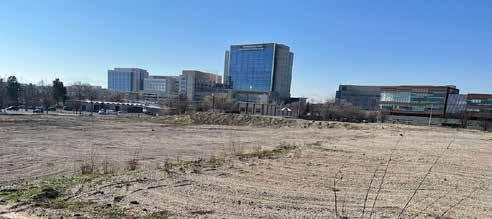
The site, formerly Arlington Elementary and later City Hall, sits at a prominent location along State Street in the heart of downtown Murray. Its demolition last year cleared the way for redevelopment, but vertical construction has yet to begin.
According to Chad Wilkinson, Murray’s Community and Economic Development Director, the city continues to view the property as a key piece in its long-term planning efforts.
“The city is excited and optimistic about the possibilities for the former City Hall property, and we are hopeful that development on the property can complement the recent efforts by the council to create a walkable, economically vibrant, wellplanned City Center as expressed in the General Plan and the recent adoption of the Downtown Form-based Code,” Wilkinson said.
The current development agreement, approved with Triumph Group, outlines a mixed-use project that includes office space, restaurants and for-sale residential townhomes. Wilkinson said the plan has evolved in response to shifting market conditions.
“The project originally included a residential condominium component that has been replaced by additional medical office space in response to market conditions,” he said.
Critics of the project, including some nearby residents and downtown advocates, have raised concerns about the length of time the property has remained vacant and the uncertainty surrounding the develop-
ment timeline. Some argue that demolishing the former City Hall building before construction was fully underway left the city with a highly visible empty lot and diminished public trust in the redevelopment
process. Others question whether repeated deadline extensions signal deeper feasibility or financing challenges, and whether the city should reconsider its partnership rather than continue to revise timelines.
There have also been concerns voiced about whether the evolving project—particularly the shift away from residential condominiums toward more medical office space—will deliver the level of street-level activity, housing diversity and walkability that residents were originally promised for downtown Murray.
City leaders have emphasized that the agreement was structured with timelines to keep the project moving. Those deadlines, however, have become central to the current pause.
“The mayor, council and city staff are eager to see the redevelopment of the property move forward as quickly as possible,” Wilkinson said. “In order to maintain the forward momentum of the project, deadlines were included in the development agreement.”
The most recent deadline required the developer to submit a complete building permit application for the medical office building along State Street by Oct. 3, 2025. Wilkinson confirmed that deadline has now passed without a complete submittal.
“At this point the city has not received a complete building permit submittal and a notice of default has been sent to the developer,” he said.
Wilkinson said the notice does not end the project but does formally acknowledge that contractual milestones were missed. City officials are now in discussions with the developer to determine what comes next.
“The city is currently in discussion with the developer about this notice of default and potential paths forward,” he said. “We know
Continued on page 9
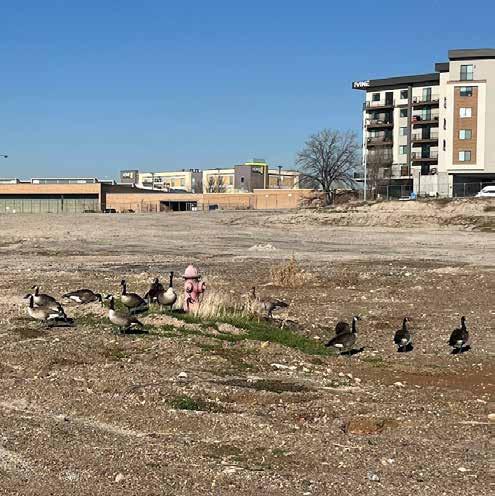
A flock of geese gathers on the vacant former Murray City Hall site, highlighting the continued pause in redevelopment at the heart of downtown. (Shaun Delliskave/ City Journals)
Journey for your Heart
An event to celebrate Heart Healthy Month
Join us as we explore insights from leading experts across cardiology and its subspecialties, and learn practical strategies for improving heart health. Engage in interactive discussions and enter to win exciting prizes. Don’t miss this opportunity to celebrate a healthier future!
When: Thursday, February 12th at 4pm - 6pm
Where: Intermountain Medical Center, Doty Auditorium Building 6
Who: Public invited, as well as caregivers, especially cardiovascular caregivers and physicians

Wheeler Historic Farm brings local flavor indoors with winter farmers market
Sunday market runs January through April, featuring local produce, meats, baked goods and rotating food trucks.
By Shaun Delliskave s.delliskave@mycityjournals.com
TheWinter Farmers Market at Wheeler Historic Farm (6351 S. 900 East) has returned for its third season, offering an indoor option for residents looking to shop locally during the colder months. Operated by Salt Lake County Parks and Recreation, the market runs Sundays from January through mid-April and brings together farmers, food producers, and artisans from across the region.
Held inside the Wheeler Historic Farm Education Center at the south end of the property, the market is designed to provide a warm, accessible space for vendors and shoppers alike. According to Salt Lake County Parks and Recreation, the market “offers a warm, indoor shopping experience throughout the winter and early spring months” while continuing to connect the community directly with local growers and makers.
The market features 26 indoor vendors each Sunday. Products available include locally grown produce such as microgreens, squash, eggs, greenhouse tomatoes and potatoes, as well as dairy products and locally produced meats, including chicken, pork and beef. Breads, pastries, honey and a variety of prepared foods—such as hummus, salsa and desserts—are also part of the weekly offerings. In addition, shoppers can find handmade crafts and gift items, expanding the market beyond food to include locally made goods.
Each market day also includes three rotating food trucks, providing ready-to-eat options alongside the indoor vendors. The rotating schedule allows visitors to encounter different food offerings throughout the season, adding variety to repeat visits.

The Winter Farmers Market runs Sundays from Jan. 4 through April 12, from 9 a.m. to 1 p.m., with no market scheduled on April 5 in observance of Easter Sunday.
Wheeler Historic Farm itself serves as the backdrop for the winter market and plays a central role in its identity. The farm is a Salt Lake County Parks and Recreation facility that preserves and interprets Utah’s agricultural heritage. Throughout the year, visitors can explore historic buildings, attend seasonal events, and interact with farm animals, making it a year-round destination for families and school groups. The winter market extends that mission into the colder months, keeping the site active while supporting local agriculture and small businesses.
Indoor winter markets have become an increasingly common model in Utah, allowing farmers and food producers to maintain sales outside the traditional growing season.
At Wheeler Historic Farm, the indoor setting offers consistent access regardless of weather, which can be unpredictable during winter and early spring. For vendors, it provides a stable venue to sell products; for shoppers, it offers a reliable way to purchase local goods during months when outdoor markets are limited.
During the winter months, Wheeler Historic Farm continues to host a variety of seasonal programs alongside the Winter Farmers Market. Scheduled activities include Storytime at the Farm, a monthly program for preschool-aged children presented in partnership with the Salt Lake County Library, as well as astronomy-themed events such as Farm and Sky: Star Parties and Farm and Sun solar viewing events offered with support from Clark Planetarium. The historic Wheeler Farmhouse is also open for guided tours by reservation throughout much of the winter, giving visitors a closer look at early 20th-century farm life. In

addition, the farm grounds remain open daily for self-guided visits and animal viewing, keeping the site active year-round.
The success of the Summer Farmers Market at Wheeler Historic Farm helped lay the groundwork for the continued growth of the winter market. During the warmer months, the outdoor market has consistently drawn strong attendance from residents across Murray and surrounding communities, providing a venue for local farmers, food producers and artisans to reach a wide audience. County officials have pointed to steady vendor participation and repeat visitors as indicators of the market’s role in supporting local agriculture and small businesses.
Additional information for vendors and visitors about both the summer and winter markets can be found on the Salt Lake County website at slco.to/wheeler-farm. l
MURRAY TEAM
The Murray Journal is a monthly publication distributed directly to residents via the USPS as well as locations throughout Murray. For information about distribution please email hello@thecityjournals.com or call our offices. Rack locations are also available on our website. The views and opinions expressed in display advertisements do not necessarily reflect or represent the views and opinions held by Loyal Perch Media or the City Journals. This publication may not be reproduced in whole or in part without the express written consent of the owner. © 2019 Loyal Perch Media, Inc.
PUBLISHER
Bryan Scott | bryan.s@thecityjournals.com
EDITOR
Travis Barton | travis.b@thecityjournals.com
ADVERTISING EXECUTIVES
Mieka Sawatzki | mieka.s@thecityjournals.com
Lindsay Andreasen | lindsay.a@thecityjournals.com
Ryan Casper | ryan.c@thecityjournals.com
Marc Davis | marc.d@thecityjournals.com
CIRCULATION COORDINATOR
Lydia Rice | lydia.r@thecityjournals.com 385-557-1022
Rack locations are also available on our website.
EDITORIAL & AD DESIGN
Stacey LaMont
Ty Gorton
MURRAY CITY JOURNAL
9500 South 500 West, Suite 205
Sandy, UT 84070
PHONE: 801-254-5974
Our mission is to inform and entertain our community while promoting a strong local economy via relevant content presented across a synergetic network of print and digital media.
PUBLISHER Designed, Published, & Distributed by

Vendors ready for the opening of the Winter Farmers Market. (Photo courtesy of Wheeler Farm)
Greenhouse fruits and vegetables are available at the Winter Farmers Market. (Photo courtesy of Wheeler Farm)





LIMITED TIME OFFER!

LeafFilter came out on a Wednesday, gave me a quote and installed it the next day. Very reasonable price. The installers were professional and cleaned up after themselves. Very pleased with LeafFilter. -Je Farmer.
Have been thinking about having gutter protection installed for a number of years since every year it becomes more of a pain to climb up on the roof and get the clean-out done. Called LeafFilter on a Thursday, the salesman came on Friday and the installation was done the next day. Easy-peasy. -Anthony. 100,000+ Reviews.
Heart care is more than numbers on a
At Intermountain Health, heart care starts with getting to know what’s important to you and building a care plan together. From preventive screenings and lifestyle recommendations, to treating the most complex conditions with advanced technologies, our experts are with you through all of it. In other words, we’ve got your back — and your heart.


British vocalist Harriet opens her first U.S. tour with three sold-out nights at the Murray Theater
With a devoted global following and a reputation for intimate, emotionally charged performances, Harriet opens her U.S. tour at the Murray Theater—where all three dates have sold out.
By Shaun Delliskave s.delliskave@mycityjournals.com
WhenBritish singer-songwriter Harriet steps onto the stage at the Murray Theater, she will do so knowing something rare has already happened: three consecutive nights have sold out in a venue prized for its intimacy as much as its history. For an artist whose work thrives on emotional proximity—quiet moments, deliberate phrasing and what she calls “torch song” passages—the setting could hardly be more fitting.
The three Murray performances (Feb. 5-7) are not only sold out—they also mark a notable milestone in Harriet’s career. The Murray Theater dates represent the opening stop of her first U.S. tour, a distinction that places Murray at the very front of an international itinerary. While this may be a first introduction for some American audiences, Harriet arrives with a well-established global reputation, having built a devoted following across the U.K., Europe and Australia through charting releases, televised performances and acclaimed live shows.


and loving being around people.”
Her listening habits away from the stage may surprise some fans. While her own music often evokes classic pop and jazz influences, her workout playlists skew harder. “The biggest surprises would probably be what I listen to when working out—I love the rockers; ZZ Top, Led Zeppelin,” she said. “But mainly in the gym, it’s ABBA.”
Another cornerstone of her private listening is choral music, particularly the work of British composer John Rutter. “That sound is very emotionally charged for me for various reasons,” Harriet said, noting that it is especially meaningful during the Christmas season. “I tend to put music on when I need to ‘go somewhere.’ And of course, as you’d expect, all the ’70s classics that I love singing are always on the speakers.”
“It’s a privilege to have the opportunity to perform in such a special, intimate space like this,” Harriet said. “I know I’ll be able to connect with everyone on a deeper level, given that we are all so close to each other in the room.” She noted that the Murray Theater’s scale naturally complements her stripped-back arrangements.
“Those ‘torch song’ style moments really stand out in the show in smaller spaces. And of course, being able to see everyone’s faces and reactions is lovely. I enjoy that.”
Harriet’s career has been defined less by spectacle than by precision. Her recordings and live performances lean into classic songwriting traditions—melody-driven, lyrically direct and emotionally unguarded—while still sounding unmistakably contemporary. That balance has helped her build a loyal following, particularly among listeners who value music that invites reflection rather than distraction.
One song that has evolved significantly for her over time is “Mountain,” a track she cowrote with legendary American songwriter John Bettis, known for his long-running collaborations with Richard Carpenter of The Carpenters. While the song began
British acclaimed singer-songwriter Harriet, sold out three Murray Theater shows in February. (Photo courtesy of Harriet)
as a deeply personal piece, Harriet says its meaning has shifted in performance.
“When writing and recording it, the song was very personal to me,” she explained. “But performing it live now, it feels like a message I really want to share—one of ambition, encouragement and intent.”
Unlike many songs about overcoming obstacles, she said “Mountain” focuses on the decision to act. “It’s about the intention of doing so, which is the first step. When I sing the song live, I kind of feel like I’m having a deep, encouraging chat with a great friend.”
That sense of emotional exchange is central to Harriet’s work, but it comes at a cost. Touring, she says, requires a careful balance between giving fully on stage and protecting the energy needed to do so night after night. “I put a lot of myself into my performances,” she said. “It’s so essential for me to feel everything deeply when I’m singing and so it takes it out of me for sure. But it’s also incredibly energizing.”
On days without shows, Harriet seeks quiet and routine. “A perfect day off consists of a long sleep, some great coffee, exercise and some aimless wandering of some sort,” she said, laughing. “In the UK we call it ‘pottering’!” Despite a career built on public performance, she describes herself as someone who recharges alone. “I am definitely someone who recharges by spending time on my own… despite being a performer
Like many artists navigating a demanding industry, Harriet has faced moments of doubt. She is candid about questioning whether to continue at various points in her career. “Yes. The music industry is tough,” she said. “I have had moments where I have doubted myself and whether it’s all worth it.” What consistently draws her back, she said, is live performance. “It’s always been performing live that has brought me back to a positive place.”
For Harriet, music’s purpose extends beyond self-expression. “I love helping people to feel things through music,” she said. “It’s so powerful, and so when I’m having a down day, I just remind myself of what the music means to other people, my fans, and that it’s not just about me… it’s about all of us.” She credits resilience as essential to longevity. “I am also pretty relentless and resilient. I believe it’s the only way you can be to keep going in this industry during the difficult times.”
As Murray audiences prepare for three nights with an artist many will be seeing live for the first time, Harriet hopes the experience lingers beyond the final note. “I hope they leave feeling something,” she said. “Whatever they needed or wanted to feel again or wherever they needed to go again emotionally. Joyful, connected, melancholy, reflective, comforted. All are necessary.”
Ultimately, she added, the goal is simple and timeless. “I hope they ‘get the feeling again’—and of course, I hope they come again.”
For a theater built on shared experience and an artist devoted to emotional honesty, the pairing feels deliberate. In the quiet between songs, with the audience only feet away, Harriet’s music is likely to find exactly the kind of room it needs. l
British singer Harriet has three sold out shows in February at the Murray Theater. (Photo courtesy of Harriet)
Oaths taken, work begins: Murray officials start new term
cil in 2012.
By Shaun Delliskave s.delliskave@mycityjournals.com
In an afternoon built around tradition and transition, Murray City’s newly elected and returning leaders raised their right hands Jan. 5, 2025, at the Murray Armory and took the oath of office — a civic ritual that marks the end of campaigning and the beginning of governing.
With family members, city employees and residents seated inside the Armory’s historic hall, the ceremony reaffirmed the city’s nonpartisan leadership structure and its distinctly local political culture — one grounded less in ideology than in public service, neighborhood relationships and accountability.
The event capped a municipal election cycle that returned Mayor Brett Hales to office and renewed several council positions, including the continued service of longtime Councilmembers Diane Turner and Pamela Cotter. Clark Bullen (District 3) became the rookie on the city council.
Though the swearing-in itself lasted only moments, the speeches delivered afterward offered a clearer picture of what city leaders say they intend to prioritize in the new term — and what kind of governing style they hope to bring to residents. A second term for Hales
Hales entered the ceremony not merely as Murray’s mayor, but as a mayor freshly tested by reelection — the most direct measure of whether voters believe city leadership is on the right track.
In 2025, Hales sought a second term after first taking the city’s helm in 2022, a role that carries broad influence in Murray’s strong mayor-council form of government. Hales initially was elected to the city coun-
The election itself became a straightforward choice for voters: continuation under Hales, or a pivot to challenger Bruce E. Turner. In early reporting on the primary, Hales advanced comfortably with 58.8% of the vote, with Turner finishing second.
By the general election, the results solidified. According to the notes from the oath ceremony, Hales won reelection with 6,490 votes (61.84%), while Turner received 4,005 votes (38.16%).
At the end of his second term, Hale’s will have edged out former Mayor Dan Snarr as the longest elected official in Murray history.
Diane Turner begins fourth term
If Hales represented re-authorization by voters, Councilmember Turner represented something different: continuity.
Turner has long been one of the most recognizable figures in Murray City government, with years of involvement, first elected in 2014, that have made her part of the city’s institutional memory. Her background has included not only council service but also a brief period serving as acting mayor in 2017 after Mayor Ted Eyre’s death — the first woman to hold the role in Murray.
In the 2025 cycle, Turner’s council race was not contested. As noted in the ceremony materials, she was unopposed and received 1,435 votes (100%).
That unchallenged candidacy is notable in municipal politics: while it can reflect a quiet election season, it can also signal public confidence — or at least the absence of public dissatisfaction strong enough to fuel a challenger.
In her candidate profile, Turner emphasized deep local roots, describing herself as a multi-generation Murray resident and underscoring her educational background and focus on community history and future priorities.
Against the backdrop of the oath ceremony, Turner’s ongoing service functioned as a stabilizing element — a reminder that while the mayoral election attracted attention, the city’s work is ultimately conducted in the steady accumulation of council decisions, budgets, development negotiations and constituent response.
Bullen given a shot to serve
Newly sworn-in Councilmember Bullen used his remarks to frame municipal service less as political accomplishment and more as the ongoing obligation of listening — particularly in a role where residents expect visibility and access.
In a line that stood out for its directness, Bullen emphasized the short length of his term as a built-in accountability mechanism.
“The benefit of only having a 2-year term is accountability… a 2-year term means you never really stop running,” Bullen said.
That statement captured one of the underlying themes of the evening: in Murray’s local political culture, elected office remains close enough to voters that officials are rarely insulated from day-to-day feedback.
Bullen won his District 4 contest with 1,336 votes (56.44%), defeating Ben Peck, who received 1,031 (43.56%).
Pam Cotter: a promise of access, not distance
Councilmember Cotter, elected in District 2, focused her remarks less on broad political messaging and more on practical service — how residents reach their elected representatives, and what kind of relationship she intends to maintain with her constituents.
In one of the clearest commitments of the night, Cotter promised that representation should not depend on how someone voted.
“Those that didn’t vote for me, I want you to know that I am here to represent ev-
eryone equally,” Cotter said. Cotter also emphasized responsiveness in daily life and outside formal settings — the kind of retail politics that still defines city government in a place like Murray.
“I will be there to answer your phone calls…your emails…or our conversations out in your front yard…or at Smith’s,” Cotter said.
She won her council race with 1,423 votes (54.77%) over opponent Jared Eborn, who received 1,175 votes (45.23%).
This is Cotter’s third time taking the oath for District 3, as she served several months on the council to fill Blair Camp’s role after he was appointed mayor after Eyre’s death and was elected to her own term in 2021. Service as the city’s shared language
Low-turnout municipal elections often hinge on a relatively small slice of residents — and that structure, according to political scientists, tends to favor incumbents. In cities like Murray, the voters most likely to participate typically skew older, include more property owners, and represent high-frequency voters who rarely miss local elections. Murray’s 2025 primary turnout of 30.31% is not insignificant for a municipal primary, but it still reflects an electorate dominated by consistent voters. All incumbents won their seats, with District 3 guaranteed a new face to fill that seat after the resignation of Rosalba Dominguez.
Did large donors play a role in election results? Murray’s results are mixed. Some large contributions from groups like the Salt Lake Board of Realtors and some labor groups did not pay off as both Turner and Cotter refused these donations and ran conservative campaigns.
Political scientist Jessica Trounstine of UC Merced would characterize Murray City as a “service city” rather than a “culture war city,” meaning that the electorate valued services (public safety and utilities) and land use issues more. l
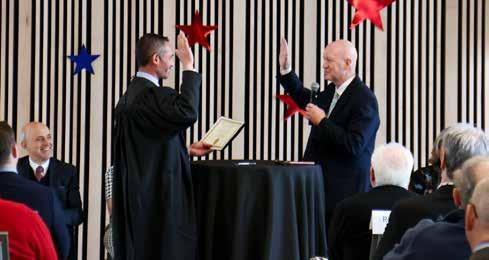
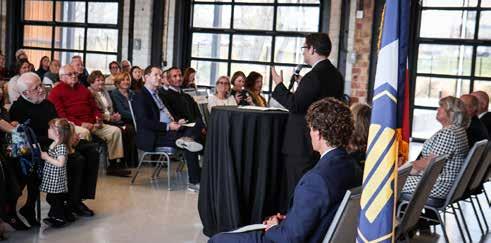
Murray leaders administered oath of office at Murray Armory.
Mayor Brett Hales takes oath of office. (Photo courtesy of Murray City)
New city Councilmember Clark Bullen delivers remarks shortly after being sworn in. (Photo courtesy of Murray City)
What Murray’s state lawmakers are proposing in the 2026 legislative session
Bills introduced so far address elections, education, health care, environmental policy and public safety.
By Shaun Delliskave s.delliskave@mycityjournals.com
Asthe 2026 Utah legislative session begins to take shape, Murray-area lawmakers have filed a wide range of bills addressing elections, public safety, education, health care, environmental policy and government oversight. While some proposals have already been formally numbered and publicly distributed, many remain “in process,” reflecting the early stage of the session.
This overview reflects legislation on record as of the Murray Journal’s press deadline. Lawmakers may introduce additional bills or amendments as the session continues.
Senate activity
Sen. Nate Blouin (D) has introduced one of the most extensive legislative portfolios among Murray-area representatives. His sponsored legislation spans multiple policy areas, including government transparency, infrastructure, labor protections and environmental regulation.
Blouin’s unnumbered bills include
tive bargaining rights. All of Blouin’s listed bills remain in process.
Sen. Stephanie Pitcher (D) has two Senate bills that have been formally numbered and publicly distributed. SB 0011, Property Rights Ombudsman Act Amendments, addresses statutory changes to the office that assists residents with property rights concerns. SB 0024, Health Care Providers Immunity Amendments, focuses on legal protections for medical professionals.
Pitcher is also serving as floor sponsor for HB 0102, Victim Privacy Amendments, a House bill sponsored by Rep. Sahara Hayes that has advanced to public distribution.
Campaign Finance Amendments, Flag Display Amendments, and Transgender Medical Treatments Amendments, as well as proposals addressing dangerous weapons on institutions of higher education and school district data access. Infrastructure and utility-related measures include Electrical Grid Amendments, Gas Amendments and Data Center Non-Disclosure Amendments.
Environmental and public health issues are also reflected in Blouin’s agenda, with bills focused on the Great Salt Lake, Employee Heat Protection and Homelessness in Vulnerable Populations. Additional proposals address health insurance, wage standards, pricing regulations, tax categories and rightto-work provisions, along with a proposed constitutional amendment related to collec-
Sen. Kathleen Riebe (D) is sponsoring legislation related to public safety, civic education and public finance. Her unnumbered bills include Force in Defense of Person or Property Amendments, Online Bond Display Amendments, and School Bond Amendments, which focus on transparency and voter access to bond-related information. Riebe has also sponsored SB 0056, Citizenship Education Amendments, a numbered bill addressing civic education requirements.
House legislation
Rep. Carol Spackman Moss (D) is sponsoring HB 0135, Cohabitant Definition Amendments, which has been publicly distributed and proposes changes to statutory definitions used in Utah law.
Rep. Andrew Stoddard (D) has intro-
Give Yourself a Valentine This Year: Learn to Decode Messages from Your Heart
When we talk about heart disease, the usual suspects often come to mind: crushing chest pain, shortness of breath, radiating arm discomfort. While these classic symptoms demand immediate attention, your heart often speaks in a more subtle language, a series of whispers and quiet shouts that can easily be dismissed or attributed to other, less serious issues.
During Heart Month this February, we want to empower you to become a skilled interpreter of your body’s unique signals, recognizing that early detection can be profoundly life-saving.
Many people are unaware that heart problems don’t always announce themselves with dramatic flair. “We frequently see patients who’ve ignored subtle signs for weeks or even months, often rationalizing them away,” explains Dr. Richard Gelb, a cardiologist at Holy Cross Hospital –Mountain Point. “Especially for women, symptoms can be incredibly nuanced and different from the textbook descriptions often associated with men.”
So, what are these often-overlooked indicators that your heart might be sending out an SOS?
Persistent, Unexplained Fatigue: This isn’t just being tired after a long day. If you
find yourself unusually exhausted after normal activities, or if a simple walk leaves you winded in a way it never did before, your heart might be working harder than it should to pump blood.
This can be a sign of various heart conditions, including heart failure or even blockages.
Discomfort Beyond the Chest: While chest pain is classic, heart-related discomfort can manifest in surprising places. This includes pain, pressure, or aching in your jaw, neck, back, or even your stomach.
“We’ve had cases where patients initially thought they had a bad toothache or indigestion, only to find it was their heart,” says Dr. Bruce Kenwood, a cardiologist at Holy Cross Hospital – Jordan Valley. “Pay particular attention if this discomfort appears during exertion and subsides with rest.

Swelling in Unusual Areas: Swollen feet, ankles, legs, or even your abdomen could be a sign of fluid retention, a common symptom of heart failure. If your heart isn’t pumping effectively, blood can back up in the veins, leading to fluid accumulation. Don’t dismiss persistent swelling, especially if it’s accompanied by weight gain.
Chronic Indigestion or Nausea: While often benign, persistent indigestion, heartburn, or nausea, particularly when coupled with exertion, can sometimes be a
heart attack symptom, especially in women. If antacids aren’t helping and the discomfort seems linked to physical activity, it’s worth investigating further.
Lightheadedness or Dizziness: Occasional lightheadedness can happen for many reasons, but if you frequently feel faint, dizzy, or lightheaded, it could indicate an arrhythmia (irregular heartbeat) or a problem with blood flow to your brain due to a compromised heart.
“By familiarizing yourself with these less obvious signs, you’re taking a proactive step in safeguarding your cardiovascular health. Your body is constantly communicating; the key is to learn its second language,” said Dr. Roja Mulamalla, a cardiologist at Holy Cross Hospital – Davis.
Call to Action: If any of these subtle symptoms resonate with you, or if you’re experiencing anything that just “doesn’t feel right” in your body, please don’t wait. Listen to your heart’s whispers. Schedule an appointment with your primary care physician to discuss your concerns, or if symptoms are sudden and severe, seek emergency medical care immediately. Early detection and intervention are crucial for positive heart health outcomes. Your heart speaks – are you listening?
For more information or to find a provider visit mountain.commonspirit.org



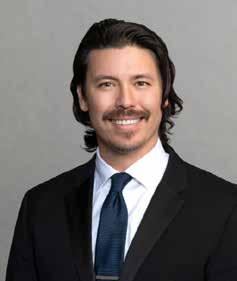
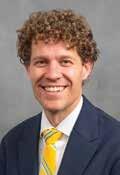
Democrats selected John Arthur to complete Rep. Gay Lynn Bennion’s term. (Photo courtesy State of Utah)
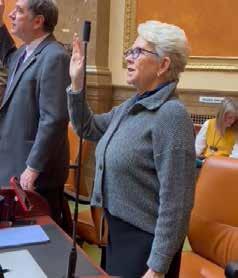
Rep. Carol Spackman Moss being sworn in for her 23rd session. (Photo courtesy State of Utah)
Stoddard also has several numbered House bills that have been publicly distributed, including HB 0080, Firearm Storage Requirements; HB 0081, Flag Display Modifications; HB 0092, Presidential Electors Amendments; HB 0106, School Attendance Changes; and HB 0109, Utah Fits All Scholarship Program Alterations. Some proposals, including Public Sector Labor Union Modifications, Criminal Defenses Amendments and Redistricting Amendments, were later abandoned at the sponsor’s request.
Rep. Rosalba Dominguez (D), who represents House District 35, did not have sponsored, floor-sponsored, or co-sponsored bills listed at the time of the press deadline. Legislators often file legislation later in the session as the legislative calendar progresses.
Rep. John Arthur (D), representing House District 41, is newly serving Murray-area constituents. As of the deadline, Arthur had no sponsored or co-sponsored bills listed. Democrats selected him in November to complete the term of Gay Lynn Bennion who was elected mayor of Cottonwood Heights.
continued from front page
residents are anxious to see this site develop in a meaningful way and we therefore know that it is critical for us to take the time to be deliberate in formulating next steps.”
Those next steps could take several forms. Wilkinson outlined three primary options currently under consideration.
“At this point there are options to either extend the deadline again, renegotiate the agreement with the current developer or solicit new proposals for the property,” he said.
Each option carries implications for timing and certainty. Extending deadlines could preserve continuity but prolong inactivity. Renegotiation could alter the project’s scope
or schedule. Soliciting new proposals would reopen the process but could add months, or longer, before construction begins.
City officials have not indicated which path they are leaning toward, and Wilkinson emphasized that discussions are ongoing. For now, the cleared site remains empty—a visible reminder of both Murray’s redevelopment ambitions and the complexities involved in delivering large downtown projects.
Residents and business owners continue to watch closely, as decisions made in the coming months will shape not only the future of the former City Hall property but also the momentum of downtown Murray’s broader revitalization efforts. l
duced a broad set of election, environmental and administrative proposals. His unnumbered bills include Candidate Nomination Procedures Amendments, Primary Election Amendments, Statewide Initiative Modifications, Referenda Signature Amendments and Elected Official Vacancy Modifications. Environmental measures include Chlorine Emission Amendments and Pollution Standards Amendments.
With a mix of publicly distributed bills and numerous proposals still in development, Murray’s legislative delegation is active across a wide range of policy areas in 2026. As the session continues, additional bills may be introduced, amended or withdrawn, providing further clarity on lawmakers’ priorities and the measures most likely to advance.
Murray residents can track their legislator’s bills online at le.utah.gov/. The legislative session ends March 6. l


When minutes count, count on our emergency care.
When you need emergency care fast, the closest emergency room is a smart thing to know. You never know the level of care you’ll need when an emergency happens and choosing the right ER can make all the difference. And a hospital ER comes with the confidence of additional services right on-site.
CommonSpirit Holy Cross Hospital – Salt Lake has been awarded Chest Pain Center Accreditation from the American College of Cardiology (ACC). Facilities that achieve accreditation meet or exceed an array of stringent criteria for evaluating, diagnosing and treating patients who may be experiencing a heart attack.
Find emergency care close to you at mountain.commonspirit.org.
The former Murray City Hall site remains a cleared expanse as redevelopment decisions remain pending. (Shaun Delliskave/City Journals)
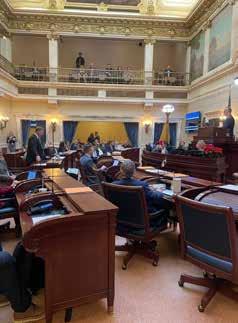
The Utah Senate in session. (Photo courtesy State of Utah)
When school feels overwhelming, Ruby knows what to do
The trained facility dog is helping Woodstock and Upland Terrace elementary students learn to calm themselves, refocus their minds and feel safe and loved to return to learning.
By Julie Slama j.slama@mycityjournals.com
Asthe 2026 Utah legislative session begins to tAt Woodstock Elementary, a four-legged professional named Ruby is quietly transforming how students cope with stress, anxiety and daily challenges at school. Ruby, a golden retriever-Labrador mix is the first dog of her kind in Granite School District and for many students, she has become an anchor of calm and connection.
Ruby works alongside social worker Laura Rogers, who serves as her facilitator. While Ruby is officially classified as a facility dog rather than a service dog, her impact reaches dozens of children every week at Woodstock as well as Upland Terrace Elementary in Millcreek.
“About 95% of the kids who are escalated will calm down right away when I show up with Ruby,” Rogers said.
Even teachers and school administrators appreciate Ruby’s presence. Woodstock Principal Missy McQueen said the dog’s calming demeanor provides welcome respite to her own demanding role.
“Ruby helps me with my work, too,” McQueen said. “Being a principal can be a busy job, so she helps me manage the stress and the largeness of this job. She sits next to me while I work on the computer, but mostly she’s with students and gets belly rubs, petting and calms them down.”
Ruby came to Granite School District through Canine Companions, a national nonprofit that has been breeding and training service dogs since the 1970s. Born and trained specifically to become a working dog, Ruby’s parents were chosen for temperament and suitability, Rogers said.
About 95% of the kids who are escalated will calm down right away when I show up with Ruby.
Laura Rogers


Rogers applied for a full-service dog and traveled to the Southwest Training Center in Oceanside, California for two weeks of intensive handler training.
“It’s like speed dating,” Rogers said. “You work with this dog and that dog, and then halfway through that first week, they pair you with your dog, and you keep that dog through the rest of the training. I got Ruby four days in, and the trainers knew more than me. She likes being pet; she’s a little smaller, so less intimidating. She has the perfect temperament and everything about her made her a great choice to work well with kids.”
Although Ruby does not have unrestricted public access, she is allowed to accompany students when she is actively working with them, in compliance with ADA guidelines.
Within school walls, Ruby helps students manage anxiety, school avoidance, meltdowns and impulse control. One of her techniques is “cover,” where she gently lays across a student’s legs, helping to calm them and regulate their nervous system. She also performs commands such as nudge, a red light-green light game for self-control and other obedience tasks.
Rogers said Ruby has made a positive
From eight weeks old, Ruby lived with volunteer puppy raisers who socialized, potty trained and prepared her for advanced training. Her formal training began when she was 18 months old and ran six to nine months; she learned skills such as opening doors and using accessibility buttons.
impact. Situations that might once have taken 20 or 30 minutes to resolve can shift in a few minutes with Ruby present. Defiant or overwhelmed students soften with Ruby as she redirects them into a safe and nonthreatening place.
“Maybe, they have their hood over their head, sitting in the hallway and don’t want to be in school, and they’re really stuck. After Ruby smells them and looks them in the face, we start talking about her. It’s not about what they were struggling with anymore. She shifts that conversation. Then we walk that child to class, and she’ll sit by them for a second, give them a high five or a shake, and they feel like a celebrity because they brought the dog to the class, and everybody wants to be with her. I’ve been doing this for 16 years, but with Ruby, it feels like magic,” she said.
Beyond individual student support, Ruby plays a role in classroom lessons about mindfulness and emotional regulation. Rogers uses Ruby’s natural behaviors, such as shaking after being overstimulated, to teach students how bodies release stress and how movement can help emotions settle.
“I use her as an example of how she self regulates, and how we can learn from her, because we can do those things with our body. We can shake, move and dance if we’re feeling some big emotion, and it helps
our bodies come down so that we can learn again,” she said. “Even kindergarten and first-grade students grasp concepts and learn when Ruby is part of the lesson.”
Before Rogers introduced Ruby to students, she worked with District leaders, PTAs, school community councils, parents, surveyed staff and addressed issues from allergies to safety and liability. She makes sure Ruby is not in shared spaces unless invited and clear rules about her are taught to students.
During the past two and a half years, she said there has been no incidents and Ruby has become a beloved figure at both schools, appearing in school yearbooks, websites and video announcements and podcasts.
“She gets a bunch of toys and the kids will draw pictures of her and bring me notes that say, ‘Thanks, Ruby, we love you’ or tape them on my door. It’s really cute; she’s become quite the celebrity,” Rogers said.
Rogers said she brought in a dog to help her do her work better.
“I wanted to work with some of these kids who I couldn’t reach,” she said. “Now, when I bring Ruby, I know I’m going to be able to break that barrier and help the student know they’re loved and I got them and they’re going to be OK. I always try to show them unconditional, positive regard. That’s important to me.” l
Students reduce stress and anxiety through their interactions with Ruby, a facility dog. (Photo courtesy of Laura Rogers)
Ruby knows the command “cover” where she gently lays across a student’s legs, helping to calm them. (Photo courtesy of Laura Rogers)

February 2026

FREQUENTLY REQUESTED NUMBERS
Attorney ..................................
Business Licensing

801-264-2640
801-270-2425
Cemetery 801-264-2637
City Council 801-264-2603
Finance Department ............... 801-264-2513
Passports................................. 801-264-2660
FIRE DEPARTMENT
Administrative O ce 801-264-2780
Non-Emergency Calls ......... 801-840-4000
General Information 801-264-2525
Human Resources 801-264-2656
Library .................................... 801-264-2580
Mayor’s O ce .......................... 801-264-2600
Municipal Court 801-284-4280
PARKS AND RECREATION
Administrative O ce 801-264-2614
Recreation Division ................. 801-264-2614
Museum .................................. 801-264-2589
Murray Outdoor Pool ............... 801-290-4190
Murray Parkway Golf Course 801-262-4653
The Park Center ....................... 801-284-4200
Senior Recreation Center 801-264-2635
POLICE DEPARTMENT
Administrative O ce 801-264-2673
Animal Control/SL County 385-468-7387
Code Enforcement .............. 801-264-2673
Non-Emergency Calls 801-840-4000
POWER DEPARTMENT
Administrative O ce 801-264-2730
After Hours Emergency 801-264-9669
PUBLIC SERVICES
Administrative O ce .......... 801-270-2440
Building Inspection

801-270-2431
Green Waste Trailers 801-270-2440
Planning and Zoning 801-270-2430
Solid Waste ......................... 801-270-2440
Water, Sewer, Streets 801-270-2440
Zoning Enforcement 801-270-2426 UTILITIES
After Hours Emergency ....... 801-264-9669
MAYOR’S MESSAGE
Neighbors Helping Neighbors: Inside the Murray Children’s Pantry
By Cindy Hales
In Murray, we believe in neighbors helping neighbors. I asked my wife, Cindy Hales, to share her experiences volunteering at the Murray Children’s Pantry and the good work happening there.
Brett and I have lived in Murray for nearly 40 years, and over the years, we have seen so many good people taking care of each other. We raised our family here and have been blessed over and over by the many good people who live in Murray.
The Murray Children’s Pantry is something I had heard about for a long time. I knew good things were happening there. But it wasn’t until I began working there myself that I truly understood the love and care given each time someone is helped.
The people who work there are incredibly kind and generous. They come week after week with no strings attached, no pay, no recognition, just the reward of helping others. I never realized how much work and organization it takes to run a pantry like this. Volunteer Anne Madrigal and others carefully purchase the food that’s needed each week. There is record keeping, planning, and so many details most people never see.
The pantry’s roots re ect that same spirit of neighbors helping neighbors. Early e orts to support children and families, including food bags for kids called “Kids Eat” led by caring community members like Linda Brown, helped lay the groundwork. Over time, those e orts grew into what is now the Murray Children’s Pantry, with Jim and Jennifer Brass expanding and sustaining the program with dedicated volunteers.
Every week we start with shelves that are full. By the end, they are empty and ready to be restocked. Honestly, I don’t know how they keep going. Jim Brass, and he will often say we only have enough food or money to last another month, and then the miracles begin. People show up. Businesses step in. Families and community members donate food, time, and resources. Somehow, it always works out.
As a patron, you receive the food you need without feeling embarrassed or less than anyone else. I see hope and appreciation in the eyes of those who come for help. When you serve at Murray Children’s Pantry, you see the good people are capable of. You see that life is good, that people are good. You see the love and real miracles happening. You truly see the very best of our community.
It was especially meaningful to see the Murray Children’s Pantry honored at the January State of the City with the rst annual Love Murray Citizen Award. Jim and Jennifer Brass have given so much to our city. They were recognized alongside Anne Madrigal and several other volunteers who quietly show up every week to serve our neighbors.
those who come week after week to bless the lives of others.


The Murray Children’s Pantry is a place of compassion, dignity, and hope, and I am truly thankful to be a small part of it.

Billing Questions ................ 801-264-2626 murray.utah.gov

I am so grateful for the Murray Baptist Church that provides space for the pantry, for the volunteers who work tirelessly on every box of food, for the generous donations people bring in, and especially for

The Power of Kindness
The past year has been momentous for Murray and the progress of our city’s downtown. In April, the city entered into a development agreement with the same developers who completed the Holladay city center project. In May, the historic Cahoon Mansion opened, and the Murray Museum moved into the beautifully restored home. In September, the renovated Murray Theater opened and began hosting shows, plays, concerts and performances. Each moment marked a signi cant step toward revitalizing our downtown, while showing our city’s commitment to history and art.
These projects should signal the beginning of our commitment to the arts rather than an ending point. The Murray Theater will serve as a crown jewel for our performing arts for years to come while drawing audiences to shows which will complement the performances our outdoor amphitheater hosts. We need expand beyond the performing to invest the visual arts, too. The city juried art shows and the mural behind the theater are wonderful steps, but we need to nd spaces and opportunities for more visual artists to exhibit their work. These works can range from paintings and drawings to sculptures that include permanent and rotating exhibits. These performanc-
es and exhibits will bring joy and happiness to members of the community while inviting people to visit our city.
Our investment in art will draw people to the city and become another dening feature of Murray. If we can successfully add to our cultural arts, people will know Murray as a place for quality arts. Springville can serve as a model. The Springville Museum of Art is one of the most recognizable art galleries in Utah and has become a feature for their city. Their nickname is “Art City” in part because of the museum. Our continual investment in the arts can produce a similar e ect in Salt Lake County while helping to booster our downtown.
Those who visit will frequent our businesses which will serve as an economic driver for the city. Ogden City has invested heavily into their arts programming and seen positive economic results. They found that individuals who frequent their art exhibits average nearly two hours at the exhibit and surrounding businesses. In Murray, those individuals will enjoy the arts and then stay for other activities such as dinner or shopping at Fashion Place Mall. These art galleries and exhibits will become a source of pride for our Murray residents while drawing residents from other cities to visit. Murray will become known for our dedication to the arts and our quality art programming.
—Adam Hock, Council District #5
Murray Senior Recreation Center
801-264-2635 mcreg.com • seniorrec@murray.utah.gov
Mon-Fri 8:00 a.m. – 4:30 p.m. Thurs 8:00 a.m. – 9:30 p.m. • Closed Sat and Sun
CHEF OMAR LIMON DAILY LUNCH
Date: Tuesday through Friday
Time: 11:30 a.m. – noon
Cost: Cost is $6; prior reg. not required CLASSES
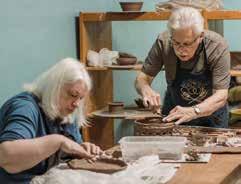
CERAMICS
Date: Tuesday and Thursday
Time: 9:00 a.m. – noon
Cost: $2 each class plus cost of supplies
GRIEF SUPPORT
Date: Friday, Feb. 6 and Feb. 20
Time: 10:30 a.m. – 11:30 a.m.
Cost: Free
THEATER IN THE MIDDLE AGES
Date: Tuesday, Feb. 17
Time: 1:00 p.m. – 2:00 p.m.
Cost: Free
ASK A NURSE: DEM BONES
Date: Friday, Feb. 20
Time: 10:30 a.m. – 11:30 a.m.
Cost: Free
VITAL AGING: Distress Tolerance Skills
Date: Friday, Feb. 27
Time: 1:00 p.m. – 2:00 p.m.
Cost: Free
NUTRITION CLASS: Building Healthy Meals
Date: Tuesday, Mar. 3
Time: 10:30 a.m. – 11:30 a.m.
Cost: Free
SCIENCE: Analytical Chemistry
Date: Thursday, Mar. 5
Time: 10:30 a.m. – 11:30 a.m.
Cost: Free
DANCE
BEGINNING LINE DANCE INSTRUCTION
Date: Tuesdays
Time: 1:15 p.m. – 1:45 p.m.
Cost: $5 for the month; register now
THURSDAY EVENING SOCIAL DANCE
Live Music provided by Tony Summerhays
Date: Thursdays
Time: 7:00 p.m. – 9:30 p.m.
Cost: $5
FITNESS: Daily Fitness Classes
Check our current newsletter for the schedule and fees.
PROGRAMS
BINGO
Date: Wednesdays and Fridays
Time: 12:45 p.m. – 2:45 p.m.
Cost: Free, donations are appreciated
BRIDGE LESSONS
Date: Mondays
Time: 1:00 p.m. – 3:00 p.m.
Cost: Free
CHESS
Date: Thursdays
Time: 12:30 p.m. – 3:30 p.m.

Cost: Free
MEXICAN TRAIN DOMINOS GAME
Date: Thursdays
Time: 12:30 p.m. – 4:00 p.m.
Cost: Free
MONDAY MOVIES AND MUNCHIES
Date: Mondays
Time: 2:00 p.m. – 4:00 p.m.
Cost: Free
HEALTH SERVICES
HAIRCUTS
Date: Wednesdays
Time: 9:30 a.m. – 12:30 p.m.
Cost: $12; advance appointment required
CLUBS
THURSDAY QUILTERS
Date: 2nd and 4th Thursdays each month
Time: 12:30 p.m. – 2:00 p.m.
Cost: Free
Please check our website for any changes in programs and to view our newsletter which



























THE

Coed Ages 3-4, 5-6, 7-9
$40/res & $50/non-res



$40/res & $50/non-res
April 8-May 13 (Wed)
Coed Ages 6-7, 8-9



$40/res & $50/non-res Thursdays Feb 5-Mar 12 4:30-5:30pm $100 session




FEBRUARY 2026 ay 5:30am 9pm Saturday 7am-5pm Sunday 9am-2pm

DAILY ADMISSION
2 & Under = Free Ages 3-17 = $3
Ages 18-59 = $5
Ages 60+ = $4
LESSONS Weekly Sessions Tues & Thurs 3:45-6PM 8 Lessons/Session
$40 Residents | $50 Non-Residents

THE MARVELOUS WONDERETTES
Pull out your leather jackets and poodle skirts and get ready to rock ‘n’ roll with the music of some of the greatest girl groups of the 1950s and ‘60s. Follow Betty Jean, Cindy Lou, Missy, and Suzy as they navigate love, friendship, and dreams at their high school prom, and reunite ten years later.
Dates and Times: February 12–14, 16 & 19–21, 2026 at 7:30 PM
Location: The Murray Theater at 4961 S State St, Murray
Tickets: You can purchase tickets online at MurrayTix. com or at the Murray Parks & Recreation O ce (296 E Murray Park Ave)


TINY TALES
Join us for Tiny Tales at the Murray Museum, held every 2nd and 4th Thursday at 10:00 AM at the Murray Museum, located at 4872 S Poplar, Murray.
Each session features a story and a hands-on activity led by the Murray Library. This program is designed for children ages 3–6, but all are welcome to attend.

Inclusion takes center stage at inaugural state unified dance competition
Local high school dancers made history earning top medals while promoting inclusion and showcasing talent.
By Julie Slama j.slama@mycityjournals.com
In the first state high school unified dance competition, three area schools swept the event.
Copper Hills High School won the unified dance team competition, with Highland High and Murray High in second and third places, respectively. Several students from each of the school placed in solo and duet categories.
Unified dance is a program that brings together students of all abilities together to promote inclusion, friendship and teamwork with an emphasis on movement and joy. The Special Olympics Utah competition was held in December at Highland High and featured a variety of dance styles and creative interpretations.
Students performed their routines on stage before receiving feedback from a panel of judges, including three who recently competed and won gold medals at the Special Olympics World Games. Much of the feedback was positive and encouraging with
comments such as “keep smiling and showing you’re having fun,” “you owned that stage,” “great techniques” and “good energy and choreography.”
Many of the performances included costumes and props.
Murray High dancers wore bright colors while Copper Hills performers sported matching shirts that said, “Inclusion is Cool.” Props from watering can to leis, adding creativity and personality to the routines.
Some students choreographed and practiced dances independently or together as an after-school club. At Copper Hills, teacher Anna Bay has instructed adaptive dance for three years.

Journals)
special ed students in the class, plus 20 peer tutors. Then, we have aides who help.”
GRIEF HAS NO TIMELINE
“We have so many good kids who love to dance, so we wanted to give them more of a dance experience than what they could get in our mainstream classes,” she said. “With so many interested, we were able to open up a class just for the special ed kids. We have 20

Grief is an individual journey with a path as unique as each one of us. To o er support and hope, we provide various Grief Support Services for those who are mourning a recent or past loss.


Bay said the benefits of unified dance go beyond learning choreography and dance technique.
“They’re learning social skills, how to be part of a team and about friendship. They’re listening and following direc-
tions, but we do it in a dance way, so it’s all by having fun. I teach them a lot of the same things I do in my ballroom classes from stretching to line dances. We’ve been working on learning choreography, which we were able to perform today,” she said. “They have so much fun, and I love their genuine smiles.” l






or

Murray High students perform a group dance at the first state high school unified dance competition. (Julie Slama/City
Local officer helps launch peer-led support group
By Shaun Delliskave s.delliskave@mycityjournals.com
Anewpeer-led support group aimed at first responders across Salt Lake County will begin meeting in Murray later this month, offering a confidential, non-clinical space for participants to talk with others who understand the unique pressures of the job.
The group, called The Watch, was founded by Murray City Police Officer Benjamin Gregoire, who said the idea grew out of both personal experience and conversations with colleagues across agencies.
A critical incident he experienced in the line of duty last year, Gregoire said, became a turning point and underscored for him how limited accessible, peer-based wellness resources are for first responders in Salt Lake County.
Gregoire said that beyond formal peer support teams, there are few places where first responders can speak openly with others who share similar experiences. He also observed that first responder culture often operates in silos.
“Police tend to stay with police, fire with fire, dispatch with dispatch—even though we often carry very similar stressors and trauma,” he said. “The Watch grew out of a desire to create a shared space that breaks down those barriers.”
Unlike traditional mental health programs, The Watch is intentionally peer-led and non-clinical. Gregoire emphasized that the group is not designed to replace professional care.
“There are no clinicians, no diagnoses, no notes, and no treatment plans,” he said. “It’s a space grounded in shared lived experience. While professional mental health care is critically important—and encouraged—The Watch is designed to complement those resources, not replace them.”
Sessions are structured to be low-pressure and accessible. Meetings will last one hour and are drop-in, meaning participants can attend as their schedules allow. At the start of each session, guidelines are reviewed to establish expectations and safety. From there, discussion is participant-led.
“If there’s a lull, a simple prompt— such as ‘What brought you here today?’— may be offered,” Gregoire said. “But there is never any pressure to speak. First-time attendees can expect a low-pressure environment where listening is just as welcome as sharing.”
Confidentiality is a central principle of the group. Gregoire said participants

verbally agree to keep what is shared within the group confidential and that rank does not factor into the space.
“Rank does not exist within the space—everyone is equal,” he said. “If administrators attend, they are held to the same standards as everyone else.” He added that the confidentiality protections outlined in Utah’s peer support statute apply and are communicated at each meeting.
Murray City has played a supporting role by approving the group, providing meeting space, administrative assistance, and help with outreach and marketing. Gregoire stressed, however, that The Watch remains independent.
“It is not a Murray City Police Department program, nor does it report back to any department,” he said. “Murray is hosting and endorsing the effort, but the group itself remains peer-driven and separate from departmental operations.”
Gregoire hopes the group will help address lingering stigma around seeking help, particularly for those who may feel overlooked.
“Dispatch and corrections professionals, in particular, are often overlooked in wellness conversations despite facing significant cumulative stress,” he said. “The
Watch aims to create a starting point—normalizing peer support and making it easier for people to show up without fear or judgment.”
The first meeting is scheduled for Jan. 14, and while no sessions have yet been held, Gregoire said early interest has been strong. “We’ve already received strong informal interest from a wide range of agencies and disciplines,” he said.
Looking ahead, Gregoire said success would mean broader cultural change. “Suc -


cess, to me, would look like peer support becoming more normalized within first responder culture and administrations taking wellness more seriously as a core responsibility—not an afterthought,” he said. He added that he hopes similar groups will eventually form in other counties, noting that “Davis County Sheriff’s Office is beginning something along those lines, which suggests this is a need being felt beyond just Murray or Salt Lake County.” l



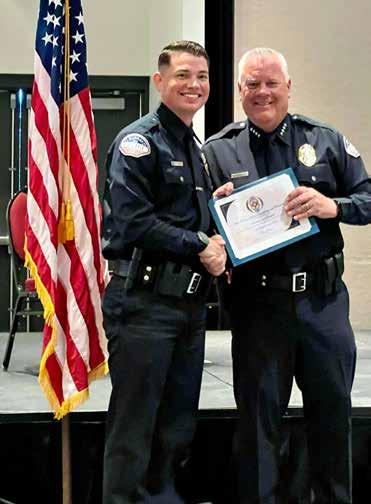
Officer Benjamin Gregorie takes the oath of a police officer. (Photo courtesy Murray Police)
Officer Benjamin Gregorie with Police Chief Craig Burnett. (Photo courtesy Murray Police)
Business leaders forum discusses challenges with government regulations
Leaders gather to discuss the overregulation of their businesses during a forum sponsored by the Intermountain Business Alliance.
By Tom Haraldsen t.haraldsen@mycityjournals.com
Aside from the need for financial support and strength, there may be no larger challenge for businesses than government rules and regulations. That was the message shared by and with participants in the Utah Regulatory Reform Listen and Learn Forum held on Dec. 17 at the Salt Mine Productive Workspace in Sandy.
The forum was the third in a series of such meetings planned by the Intermountain Business Alliance, designed to bring Utah business leaders together to discuss real-world barriers and develop practical reforms to strengthen Utah’s economic competitiveness.
May 23rd
Golden Corral, 665 East 7200 South, Midvale
“The most terrifying words in the English language are ‘I’m from the government and I’m here to help you,’” said Trent Staggs, outgoing mayor of Riverton and now the U.S. Small Business Administration advocate for Region 8. “The cost of regulation in this country is staggering. The National As-

sociation of Manufacturing says it believes regulation alone is costing businesses $3 trillion a year. That’s almost 15% of our GNP.”
One example he pointed to is Form 941, the quarterly reports businesses are required to file with the IRS. Shifting that to an annual report, he said, could result in a $90 billion savings for businesses.
As mayor, and now in his role with the SBA, Staggs is advocating for less regulation and more common sense when it comes to the rules of the road in business. A strong advocate for President Trump, he praised Trump’s Executive Order 14192, which says that for any new regulation an agency wants to implement, it has to eliminate 10 others already on the books. He stated that another executive order from Trump charges all agency heads to look at current rules and identify those they feel might be unconstitutional.
“Just this summer, the National Small Business Association asked all businesses across the country what the most painful resource of regulations was, and they stated the federal government by far,” Staggs said. “Rules that come from these federal agencies are by people not elected to their offices. Congress to a large degree, I believe, has abdicated much of its responsibility by delegating the rulemaking authority to these unelected bureaucrats. The net result of this overregulation is it keeps you from making
profits and hiring people. Deregulation will help the economy.”
Speakers at breakout sessions during the forum covered a wide range of areas where regulations have large impacts. Those include agriculture and agri-business, construction and infrastructure, tourism and hospitality, manufacturing and mining, technology, banking and finance, and health care and insurance.
Corinna Harris, president of the Intermountain Business Alliance, said its goal is to “ensure businesses stay in business, by driving meaningful regulatory reform and removing barriers to growth at every level of government.”
“We are holding two more forums in the next week, on Jan. 9 in Eagle Mountain and on Jan. 12 in Nephi,” she said. “We’re also publishing a newsletter with comments and suggestions shared at these forums.”
She wants to see a united effort by local business owners and government leaders to make meaningful changes in regulatory practices.
Staggs told attendees the list of most wanted issues concerning business owners can be found on the SBA website at advocacy.sba.gov. Harris said more information about the alliance, or suggestions for changes, can be sent to her at charris@intermountainbusinessalliance.com. l
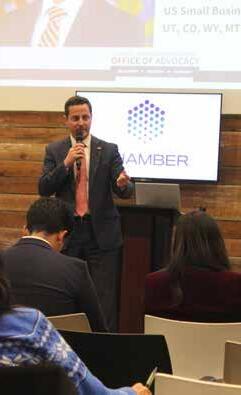
Trent Staggs, U.S. Small Business Administration advocate for Region 8, discusses the problems that government regulation is causing businesses in Utah and throughout the nation. (Tom Haraldsen/City Journals)






From park crew to power desk: Murray’s new boss has seen it all
Kim Sorenson’s path from parks maintenance to Chief Administrative Officer spans four decades and nearly every corner of city operations.
By Shaun Delliskave s.delliskave@mycityjournals.com
Aftermore than four decades working inside Murray City government, Kim Sorenson is stepping into a role that places him at the center of day-to-day municipal operations. Recently appointed as Chief Administrative Officer (CAO), Sorenson brings with him institutional knowledge shaped by years of service across one of the city’s most visible departments.
Sorenson’s appointment to the Chief Administrative Officer position was made by Mayor Brett Hales, marking a notable milestone in a career that began at the ground level of city service. Sorenson started with Murray City as a parks maintenance worker, a role that placed him directly in the city’s neighborhoods and public spaces, maintaining parks and facilities residents use every day.
For Sorenson, the move into the CAO role represents both continuity and culmination. “After more than 40 years with Mur-

ministrative Officer is Murray City’s chief professional manager and assists the mayor with the day-to-day operations of the city,” he said. “While the mayor and city council set policy and direction, the CAO carries out those decisions by overseeing city departments, managing staff and ensuring essential services, such as public safety, public works and community services, are delivered efficiently and responsibly.”
In his first year, Sorenson said his focus will be on stability and communication rather than sweeping change. “During my first year, my priority is continuity, stability and strong communication across the organization,” he said. He noted that his long tenure gives him insight into how departments function and where listening is most important. “Early on, my focus will be on supporting the mayor and city council’s priorities, maintaining high service levels for residents and keeping the city financially responsible while being efficient and responsible.”
ray City, stepping into the Chief Administrative Officer role feels like a natural and meaningful next step in my career,” he said.
His career has been largely rooted in Parks and Recreation, where he oversaw a broad portfolio that included parks, recreation programs, the golf course, city facilities, cultural arts, the senior center and the cemetery. “These experiences have given me a deep










understanding of how our services impact residents’ daily lives and how important collaboration is to deliver those services well,” Sorenson said.
While the CAO position may not always be visible to residents, its influence is wide-reaching. Sorenson described the role as one focused on professional management and implementation. “The Chief Ad-
Sorenson’s background in Parks and Recreation has shaped how he approaches citywide leadership. “My background in Parks and Recreation required managing a large and diverse workforce and working closely with every city department to deliver high-quality services and programs for Murray residents,” he said. Because the department intersects with public works, utilities, finance and public safety, he said success de-

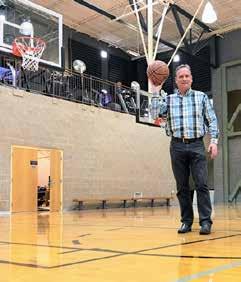
Kim Sorenson as director of Murray Parks and Recreation. (Shaun Delliskave/City Journals)
Before becoming Murray CAO, Kim Sorenson led the Murray Parks and Recreation department. (Shaun Delliskave/City Journals)
pended on coordination and problem-solving across departments. “That experience has shaped my approach to citywide management and will serve me well as CAO by emphasizing teamwork, efficient coordination and a focus on delivering reliable services that benefit the entire community.”
As Murray continues to evolve, Sorenson said balancing growth with the city’s long-standing character will be an ongoing challenge. He pointed to financial pressures that cities nationwide are facing, including rising costs associated with providing services and retaining employees. “Murray benefits from a strong sense of community, a history of thoughtful leadership, and a level of independence that is rare,” he said, noting that the city operates its own power, water, police, fire and parks systems. He also highlighted Murray’s comparatively low property tax rate, which he said reflects decades of careful planning.
Looking ahead, Sorenson emphasized the need for deliberate decision-making. “Moving forward, growth needs to be man-
aged in a way that protects what residents enjoy today while ensuring the city remains financially sustainable,” he said. That includes supporting development that provides long-term value while continuing to invest in core services.
When faced with difficult decisions, Sorenson said his approach is guided by fairness and transparency. “When making difficult decisions, especially when resources are limited, I am guided by the same principles emphasized by Mayor Hales: doing what is best for Murray City while treating people with fairness, respect and kindness,” he said.
Despite his professional responsibilities, Sorenson said his connection to Murray is deeply personal. “Throughout my career, I’ve truly enjoyed working for and serving the residents of Murray,” he said. Outside of work, he spends time with his wife Cindy, their four children, and eight grandchildren. “Family time keeps me grounded and reminds me why community and quality of life matter so much.” l
Grant Elementary supports Murray Children’s Pantry with food drive





Over 10 days, Grant Elementary students donated more than 2,000 food items to support local families in need.
By Julie Slama j.slama@mycityjournals.com
Grant Elementary recently completed a food drive that brought the school community together to help local families in need.
For 10 days before the end of the year, students and staff donated more than 2,000 food items, which were given to the Murray Children’s Pantry.
The pantry, located at 170 E. 5770 South, provides nonperishable foods from canned fruits and vegetables to cereal and granola
bars to their neighbors in the Murray community. It is open 10 a.m. to noon on Tuesdays and the third Saturday of each month.
The food drive was organized by the school’s sixth-grade leaders, who took over announcing the drive, creating posters to promote it and counting the donations.
Besides teaching students empathy and generosity, it was a lesson in organizing a schoolwide event, said Grant Principal Jill Burnside.
“Our sixth-grade leaders learned how to organize a food drive from the idea to the involvement of our school to better our community,” she said.
To add excitement, there was a friendly competition amongst grade levels, with third grade taking top honors for the most donated items.l

Organized by Grant Elementary sixth-grade leaders, a recent food drive brought together more than 2,000 items to help those in need. (Photo courtesy of Jill Burnside/Grant Elementary)
Free gun locks available as Murray PD promotes safe firearm storage
Murray Police take aim at preventable firearm deaths through Project ChildSafe.
By Shaun Delliskave s.delliskave@mycityjournals.com
As families across Murray and surrounding communities continue to navigate rising mental health challenges and concerns about gun safety, the Murray City Police Department has joined a new regional initiative aimed at preventing firearm-related tragedies before they happen. The program, Project ChildSafe Salt Lake, focuses on secure firearm storage and suicide prevention through free gun lock distribution and public education.
Following a countywide press conference held Nov. 19, the Murray City Police Department is joining a broad coalition of law enforcement agencies, government leaders, and community organizations in promoting safe firearm storage through the launch of Project ChildSafe Salt Lake.
The initiative, organized in partnership with NSSF—The Firearm Industry Trade Association—and its Project ChildSafe program, focuses on encouraging responsible firearm ownership and secure storage to help prevent accidents, theft,
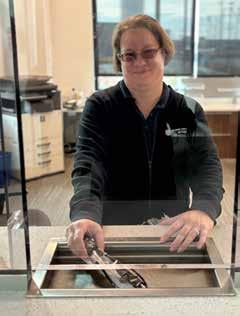
misuse and suicide. As part of the rollout, free cable-style gun locks are being distributed at multiple locations across Salt Lake County, with Murray residents able to access them directly through the Murray City Police Department. The program is part of
a growing national effort emphasizing the role of community partnerships in preventing avoidable tragedies involving firearms.
The official launch event took place at the Utah Department of Public Safety Bureau of Criminal Identification in Taylors-
ville. Speakers included NSSF President and CEO Joe Bartozzi, Salt Lake County Mayor Jenny Wilson, Salt Lake County Sheriff Rosie Rivera, and local police chiefs representing several cities. Community safety organizations and mental health

















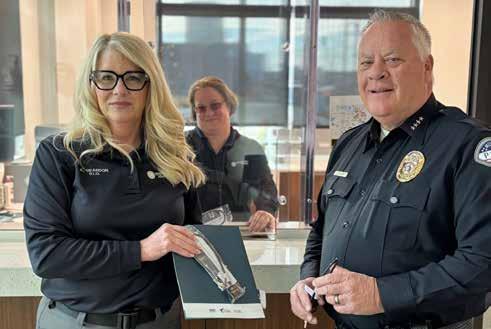
Free trigger locks are available at City Hall in the Murray City Police Department. (Photo courtesy of Murray PD)
Murray Chief of Police Craig Burnett and Public Information Officer Kristin Reardon display a trigger lock available at City Hall. (Photo courtesy of Murray PD)
advocates were also present, underscoring the collaboration between public safety and public health.
For Murray Police, the program addresses ongoing local concerns related to both youth safety and mental health.
“Like surrounding communities, we are faced with the mental health and crisis issues that lead to suicide, as well as the potential for firearms to get into the hands of youth and/or an inexperienced handler to commit crimes and firearm-related accidents,” said Kristin Reardon, public information officer for the Murray City Police Department.
According to the Utah Department of Health and Human Services, there were 656 gun-related suicide deaths in Utah in 2024, a number that highlights the importance of awareness and secure storage practices. Reardon said taking small, proactive steps can save lives.
“Taking that extra step, especially if you do not have a secure area to store your firearm, using a gunlock would assist in keeping our loved ones and communities safe,” Reardon said.
“Right now, the Murray City Police Department Records Division has gun locks available at the front counter of the police department on weekdays,” Reardon said. “We will also have upcoming locations for distribution to be announced in the near future, so watch our social media pages and website for more information.”
Reardon said participation in the countywide rollout allows Murray to be part of a unified safety message while still focusing on local needs.
“Partnering with this rollout provides a unified message to a larger group across jurisdictional boundaries, but keeps the same message of how this project is important for all communities, making it a safer place to work and live,” she said.
While the program targets households that may not already use secure storage methods, Reardon emphasized that even experienced firearm owners benefit from continued reminders and education.
“Gun safety and secure firearms is the most important part of this message. Even if you already practice responsible storage, there are never too many reminders of how to do so,” Reardon said. “So many unfortunate accidents happen because of unsecured firearms.”
In the months ahead, Murray Police plan to continue supporting community outreach and safety education as part of Project ChildSafe Salt Lake. Future events may include informational booths, school presentations and cooperative efforts with local organizations to reinforce safe storage habits among residents.
Project ChildSafe Salt Lake is part of a national effort to reduce preventable firearm injuries and deaths through public education and access to safety tools. Future education and distribution events in Murray will be announced by the Murray City Police Department in the coming weeks. l
Grant Elementary students walk in honor of Ruby Bridges
Students learn about the icon who showed courage by standing up for what is right.
By Julie Slama j.slama@mycityjournals.com
Grant Elementary students, parents and staff recently came together to honor the legacy of civil rights icon, Ruby Bridges.
Through participating in a national walk named in her honor, students learned the valued of courage, inclusion and standing up for what is right.
Grant Elementary Principal Jill Burnside said there was great support for the event.
“We have easily over 100 kids show up, and then we have parents on top of that,” she said.
The school held the walk during the school day last year, but this year, PTA organizers and Burnside moved it to before school to better reflect Bridges’ experience. They arranged a central meeting point so students could walk together as a group.
“We decided to try it before school, because that’s more authentic—walking to school,” Burnside said. “The goal is to raise awareness of who Bridges is and the

importance of the difference that one person can make. It’s about standing up for what you believe in and for things that are right.”
Burnside reinforces those values through school rallies focusing on different traits, such as friendship, flexibility, problem-solving, generosity and giving.
Teachers supported the walk by dis -
cussing Bridges in their classrooms, using picture books, videos and discussions.
“We asked teachers to talk about it in their classrooms and they tailored the lessons to the age of the students that they teach,” she said.
AAA provided backpacks, flags, stickers and bracelets for students who participated. l




Grant Elementary students commemorate Ruby Bridges’ legacy with walk-to-school event. (Photo courtesy of Jill Burnside/Grant Elementary)
Salt Lake County leads on criminal justice reform bringing a national lens to local solutions
Salt Lake County is responsible for many of the region’s core public safety functions, including jail operations and serving as the behavioral health authority. About 74% of the county’s general fund budget is dedicated to public safety. As the government agency responsible for these essential countywide services, we regularly evaluate our systems to ensure delivery of better outcomes for people, public safety and taxpayers.
That responsibility is what led Salt Lake County to partner with Judge Steve Leifman and The Leifman Group, nationally recognized leaders in behavioral health and criminal justice reform. In Miami-Dade County, Florida, Judge Leifman’s work helped establish one of the nation’s most successful diversion models, the “Miami Model.” The model redirects individuals with serious mental illness from jail into treatment and recovery. That approach led to dramatic reductions in arrests and recidivism, a significant drop in the jail population—saving millions of taxpayer dollars while improving public safety and enhancing lives throughout Miami-Dade County.
Aimee Winder Newton
Salt Lake County Councilmember District 3

also partnered with Salt Lake City on the planning and implementation of their Public Safety Plan. These efforts reflect a shared understanding that fragmented systems lead to repeated crises—costly for families, communities and taxpayers.
shared willingness to align around practices that work. The Leifman Group’s recommendations focus on better coordination, improved crisis response and using shared data to guide decisions and track what’s actually working.

This engagement builds on years of work already underway. In 2023, Salt Lake County partnered with the State of Utah and Salt Lake City to advance the Coordinated Homeless Services Plan. In 2024, Salt Lake County Mayor Jenny Wilson launched the County’s first five-year Human Services, Homelessness and Criminal Justice Reform Action Plan, prioritizing early intervention, service coordination and accountability across systems. We’ve
Over several months last fall, Salt Lake County convened more than 100 leaders from across the state and region— including state leaders, city officials, courts, law enforcement, service providers, advocates and philanthropy— to learn from the Miami Model and identify ways to implement the model here at home.
The data drives the need for action. Today, the Salt Lake County jail functions as Utah’s largest mental health provider. Roughly 34% of people leaving the jail exit directly into homelessness. Jail is among the most expensive—and least effective— way to address untreated mental illness and substance use disorders. Diverting individuals with serious mental illness from repeated, low-level incarceration into structured treatment and supervision is not about leniency; it is about accountability, public safety and using public dollars wisely.
Salt Lake County recognizes that simply replicating another community’s model is not what’s needed. Instead, the county is applying proven principles through a local lens—recognizing our specific responsibilities, what our population needs and what will work here. What has emerged clearly is the strength already present here: committed service providers, engaged public safety partners and a
MEET DR. HARARAH, M.D.
This work is also about leadership. Because Salt Lake County bears such a large share of public safety costs, we have a strong incentive to lead system improvement. Communities are safer when fewer people cycle through jail and our criminal justice system. Additionally, families are more stable, and taxpayer dollars can be reinvested into solutions that prevent crises before they escalate and that create lasting positive change.
At its core, Salt Lake County’s criminal justice reform work reflects a simple truth: when systems function better, outcomes improve for individuals and for the community as a whole. By leading with data, coordination and evidence-based solutions, Salt Lake County is working to improve public safety, support families in crisis, hold systems and individuals accountable, and ensure public dollars are used effectively for the benefit of the entire community.
Dr. Hararah, a triple board-certified physician, completed his residency in Family Medicine at NYU Langone and a fellowship in Undersea and Hyperbaric Medicine/Wound Care at SUNY Upstate University Hospital. With additional training in Bariatric Medicine and certification from the American Board of Obesity Medicine, he brings expertise in primary care, dive medicine, bariatric medicine, and clinical hyperbarics.
A firm believer in the biopsychosocial approach, Dr. Hararah views patients as complex individuals whose lives and experiences shape their healthcare. Known for his compassionate care and dedication, he listens intently, prioritizes your well-being, and works to find the best diagnosis and treatment plan.
As the owner of Blackstone Medical, Dr. Hararah is committed to helping you achieve your best health.
OUR SERVICES
Primary Care:
• Annual preventative physical exams
• Cancer screening
• Sick visits
• Specialist referrals
• Medication refills
• Chronic disease management
Specializing in Wound Care:
• Chronic, non-healing wounds
• Acute, minor wounds
• Diabetic foot ulcers
• Venous ulcers
• Arterial ulcers
• Pressure injuries...and more!
Patients First:
“Dr. Hararah understands the daunting and sometimes demoralizing feelings health care sometimes causes, and wants patients to be truly seen and valued as human beings.”

TheFirst Amendment now comes with footnotes. Instead of promising not to abridge the freedom of speech, government officials are quietly redlining your opinions like a ruthless book editor holding a grudge.
The erosion of our First Amendment rights should wake you up like a five-alarm fire.
Banned Media. Reporters have been barred from the White House, kicked out of the Pentagon and have lost access to the press secretary’s office. A Washington Post reporter had her house searched by the FBI, relabeling journalists from “democracy watchdogs” to “people of interest.”
The president threatens the media licenses of organizations that don’t paint him in a flattering light. He’s sued networks for billions, ordered shows to be canceled and got Jimmy Kimmel fired. When millions of people canceled Disney and HULU, Kimmel was put back on the air, so I guess free speech can now be bundled with your subscription.
Banned Words. This melting pot we call America has outlawed diversity, equity and inclusion. That’s like taking the heart out of the Tin Man or the soul out of Hozier.
The Head Start early childhood programs were told to remove a list of 200 words in grant applications or the Death Star would blow up their facilities. Words like “belong,” “disability,” and “mental health” will get funding denied, so now applicants have to do an interpre-
Don’t be left speechless
Peri Kinder Life and Laughter

tative dance, acting out “equality” or “diverse.” Government leaders go ballistic if we use pronouns or call a trans person by their chosen name, yet expect the entire country to salute the nonsensical renaming of the Gulf of America or the Trump-Kennedy Center. It costs nothing to respect someone’s pronouns, but rebranding the Department of War will cost taxpayers more than $1 billion.
Banned Books. Having a library card is now an act of defiance. Utah loves a good book ban because nothing prepares kids for real life more than hiding information that makes them feel uncomfortable.
Utah already ranks at the bottom of education funding, but yes, let’s make our kids dumber by discouraging them from learning critical thinking skills or empathy. Reading as exploration is forbidden. Curiosity becomes taboo.
But if kids want to read a book, they’ll find a way to read it. A ban adds extra enticement, like putting chocolate sprinkles on an ice cream

sundae. We’re all for letting 18 year olds carry a rifle into McDonald’s, but heaven forbid they read “The Hate U Give,” which talks about a teen affected by gun violence.
Banned criticism. The First Amendment gives us the right to criticize anyone, even the president. You can slap bumper stickers on your VW, write columns or even burn the flag.
However, professors are being fired for political beliefs, protestors are tear-gassed and shot, and university funding is cut unless courses fall in line with this administration’s doctrine. Freedom of speech is now an extreme sport.
Here’s what’s not free speech: incitement, threats, defamation, obscenity and perjury. The president has threatened talk show hosts, slan-
dered Democratic leaders and there’s strong evidence he’s perjured himself several times. He is also protected under the First Amendment, but the president walks a Sharpie-thin line between free speech and hateful rhetoric. TrumpActionTracker.info documented 264 actions (as of Jan. 16) taken by the president and his administration during the last year to control information or spread propaganda. He’s all for free speech, as long as it’s only his.
History shows that free speech is as durable as steel, with the propensity to outlast those who violate it. The First Amendment doesn’t promise pleasant agreement but a safe space for necessary debate. Freedom of speech is not silent, and we shouldn’t be either.