

See Inside... Sydney’s many hats
Differing votes

Everything’s coming up roses for Valentine’s Day at Draper Flower Pros
By Katherine Weinstein | k.weinstein@mycityjournals.com
Draper Flower Pros, one of the oldest florist shops in Draper, gets through the Valentine’s Day rush thanks to a team of hard-working, dedicated staff members—and thousands of roses.
The staff at Draper Flower Pros is getting ready for the Valentine’s Day rush.
“Valentine’s Day is definitely one of the busiest times of the year,” shop owner James Belcher said, adding that things can get a little hectic at Mother’s Day and Memorial Day as well. The shop gets through the busy times of the year thanks to a tight-knit, dedicated team of workers putting in a lot of hours.
Draper Flower Pros is located at the intersection of 700 East and 12300 South in Draper. “There has been a flower shop at this location for about 20 years,” Belcher said. “I’ve only owned it for about 10.” He opened his first flower shop in Lehi in 2003.
While he has taken some classes in floral design, Belcher explained that he learned his trade just by doing it, “like an apprentice,” he said. “I came to work at a florist shop and just learned.”
Having grown up in Sandy, he was happy to take ownership of the shop in Draper. “I’ve watched this whole area change,” he said, recalling some of the old businesses that used to be nearby such as Frank’s Food Town, Draper Drug and Draper Bank and Trust.
Belcher clearly loves his work. “I enjoy the creative outlet, it’s super fun and interesting,” he said. The social element is important too. “We’re all good friends here,” he added. “It’s like a family.”
“We have a core group of employees that’s been with us for a while,” Belcher said. As Valentine’s Day approaches, Draper Flower Pros has five floral designers putting

together arrangements in addition to five or six additional staff members taking orders and answering the phone. He usually hires a few new people at this time of year. “It’s a lot trickier, training new people and dealing with volume that you’re not used to in a couple of days,” he said.
In addition to people seeking bouquets and floral arrangements for Valentine’s Day, high school students are placing orders for corsages and boutonnieres for the “sweetheart” dances held at this time of year. There is also ongoing demand for flowers for occasions such as weddings and funerals. Belcher explained that the key to man-
aging all of this comes down to good communication and having a system in place to process orders.
Having enough flowers, especially roses, is also essential. According to the Society of American Florists, roses make up 83% of all flowers sold on Valentine’s Day. “For a typical Valentine’s Day, I’ll order in 10,000 roses between both stores,” Belcher said.
He added that sales might be down slightly this year because Valentine’s Day falls on a Saturday during Presidents’ Day weekend. “People will be out of town,” he explained. “They also like to send flowers to
their loved one at work.”
Approximately 250 million roses are produced annually for Valentine’s Day. The bulk of them are grown in South America. “Our flowers come from all over the world,” Belcher said. “A lot come from Ecuador and Colombia, also Holland and some from California.”
Red roses are by far the most popular, but Draper Flower Pros sells a variety of colors. Different colors of roses have different symbolic meanings. Red, for example, symbolizes romantic love while yellow symbolizes friendship and joy and white can represent purity. Belcher noted that many people nowadays aren’t aware of the symbolism and choose colors based on personal taste. “A dozen peach roses can just be a beautiful gift,” he said.
While a dozen red roses is the most common Valentine’s Day request, arrangements featuring a variety of flowers are popular too. Floral designer Calli Veenendaal first went to work at Draper Flower Pros when she was in high school. “James taught me quite a bit, and I turned it into a job. I managed a shop in Idaho for a while,” she said.
Veenendaal enjoys the creativity of her job most of all. “My favorite is doing weddings,” she said, explaining that a client might give her a color palette or descriptive word like “elegant” or “whimsical” to inspire the floral arrangements for the wedding. “Sometimes they have a specific vision,” Veenendaal said. “We can do just about everything creatively.”
She mentioned that during the Valentine’s Day crunch, she gets to work at 7 a.m. and stays until 6 or 7 p.m. “It’s physically taxing, you’re on your feet all day,” Veenendaal said, adding that working with
Continued page 8
James Belcher, seen here with one of his floral arrangements, has owned Draper Flower Pros for 10 years. (Photo courtesy of Kennith Best)








Marsha Vawdrey’s second and presumed final retirement from city council
Marsha Vawdrey has been chosen for the city council twice, elected twice and retired twice.
By Mimi Darley Dutton m.dutton@mycityjournals.com
Two must have become a meaningful number for Marsha Vawdrey. After all, the longtime Draper resident has been chosen for the Draper City Council twice, elected twice for four-year terms, and in an unusual set of circumstances, she’s retired twice from the council. Her most recent retirement happened in December.
Vawdrey was chosen for her first twoyear term on the council in 2014 when Troy Walker vacated his council position

Following the 2026 oath of office ceremony at City Hall, recently retired councilmember Marsha Vawdrey spoke with Councilmember Tasha Lowery who was sworn in for her third four-year term on the city council. (Mimi Darley Dutton/City Journals)

DRAPER TEAM
The Draper Journal is a monthly publication distributed directly to residents via the USPS as well as locations throughout Draper.
For information about distribution please email hello@thecityjournals.com or call our offices. Rack locations are also available on our website. The views and opinions expressed in display advertisements do not necessarily reflect or represent the views and opinions held by Loyal Perch Media or the City Journals. This publication may not be reproduced in whole or in part without the express written consent of the owner. © 2019 Loyal Perch Media, Inc.
after being elected mayor. She was one of about 18 people who interviewed for the position (following state election code) and she came out the winner. She was reelected twice and served on the council for 10 years before first retiring in December 2023 to join her husband in retirement. Prior to her time on the council, she served on the Planning Commission.
At the time of her first retirement, Walker said, “All the years I’ve known you, you’ve been fantastic…always prepared, you’ve given your heart and soul to the community…and tremendous time.”
But that wasn’t the end of her service. Another vacancy occurred on the council when Cal Roberts was elected to the Utah House of Representatives in 2024. Per state code procedure, the city advertised the vacancy and Vawdrey decided to put her name in the hat. Forty individuals interviewed in November 2024. One of the applicants was Angie Quinlan who said she was honored to be considered against Vawdrey whose fame in Draper was akin to that of Taylor Swift. Once again, Vawdrey came out the winner. The mayor and councilmembers explained they felt most comfortable choosing her because she was well-versed in city history and procedures and she could hit the ground running.
“There’s no learning curve with Marsha… she understands what we’re trying to do with smart growth and regulatory constraints…I think it will be the right decision for this short period of time and then we’ll let the community decide going forward,” Councilmember Mike Green said at the time.
This time it seems as if it’s final. Once again, Walker publicly thanked Vawdrey at the conclusion of the Dec. 16 council meeting. “This is Marsha Vawdrey’s really, really last council meeting. I want to

express my heartfelt appreciation to Marsha for her many years of service to this community including helping establish the historic park, preserving Corner Canyon, running the rodeo and Draper Days…you were going into the sunset but we drug you back and it created a great situation for us to have a person that already had training. You’re one of my dearest friends, and I’ve enjoyed serving with you,” Walker said.
“It’s been my honor,” Vawdrey said.
In an interview at the time of her first retirement, Vawdrey especially encour-
Connect social media
aged women to get involved in their communities. “I think there’s a special place for women because we have a different perspective. I’ve seen that, and it really takes all of us. I love to see people do it for the right reason, because you care about the community. Step up and make a difference,” she said.
As of Jan. 5, another woman has joined the council. Recently elected Councilmember Kathryn Dahlin will fill the two-year term left vacant after Roberts’ and Vawdrey’s departures. l
PUBLISHER
Bryan Scott | bryan.s@thecityjournals.com
EDITOR
Travis Barton | travis.b@thecityjournals.com
ADVERTISING EXECUTIVES
Mieka Sawatzki | mieka.s@thecityjournals.com
Lindsay Andreasen | lindsay.a@thecityjournals.com
Ryan Casper | ryan.c@thecityjournals.com
Marc Davis | marc.d@thecityjournals.com
Rack
Lydia Rice | lydia.r@thecityjournals.com 385-557-1022
Stacey LaMont
Ty Gorton
DRAPER CITY JOURNAL
9500 South 500 West, Suite 205 Sandy, UT 84070 PHONE: 801-254-5974

Marsha Vawdrey (center) was presented with flowers at her final Draper City Council meeting in December. She originally retired from the council in December 2023, but when the city needed someone to fill an interim position left vacant by Cal Roberts’ election to the Legislature, Vawdrey was once again chosen to serve. “It’s been my honor,” Vawdrey said. (Mimi Darley Dutton/City Journals)











Draper fashion model Sydney Svitak builds an international career
Draper teen Sydney Svitak balances her budding career as an international fashion model with high school, work and extracurricular activities.
By Katherine Weinstein k.weinstein@mycityjournals.com
Draper
fashion model Sydney Svitak wears many different hats both on and off the runway. Svitak, a junior at Corner Canyon High School, has appeared on runways during Fashion Week in New York, Paris, Los Angeles and Milan. To help fund her travel expenses and raise money for charity, she makes and sells her own jewelry and has started pet-sitting in Draper. This month she is looking ahead to Fashion Week in Paris while preparing for her college entrance exams in March.
Sydney developed an interest in modeling in her early teens. “I was actually a super shy kid,” she said. “In my early teens I did dance and acting along with modeling workshops and even pageants to get out of my shell and build confidence.”
In 2022, she entered a local modeling competition for an opportunity to walk in New York Fashion Week. Sydney didn’t win the contest, but she made a strong impression on a Utah-based fashion designer who invited her to the show. “After my debut in New York, I received offers to join Los Angeles Fashion Week, then returned to New York followed by Paris and Milan. It’s been a couple of years now—six Fashion Week seasons—that I’ve been cast to walk in New York and Paris. Last September was my first time modeling in Milan.”
Photographs of Sydney taken in Milan have been featured in magazines such as Vogue, Harper’s Bazaar, L’Officiel and Elle. “Every city and show is a new experience with new opportunities and I’ve loved working with different designers and productions along the way,” Sydney said.
The past few years have been a whirlwind of activity for Sydney and she expressed her appreciation for her parents who support her endeavors. “They have been amazing. They’re constantly teaching me how to be organized, practice self-discipline and keep a good balance between school, modeling, tennis and my other hustles.” She jokingly referred to her mother, Patricia Svitak as her “momager.”
“I take care of her schedule when we’re traveling,” Patricia explained. “Her coaches help me find opportunities for her, and she is currently seeking sponsorship and representation. However, modeling is unpredictable so we also want her to stay focused on college. We’re taking opportunities step by step.”
Kiara Belen, a finalist from America’s Next Top Model, coached Sydney as she


dances and sports. “I was on the Corner Canyon academy tennis team,” Sydney said. She is practicing so she can make the team again next year and hopefully play tennis in college.
Patricia noted that when Sydney started modeling, that there were few opportunities for fashion models in Utah. “We’ve noticed over the past few years that fashion is coming to Utah,” she said. “There are several designers in Utah getting together and organizing fashion shows—more opportunities for models.”
Sydney would love to pursue modeling as a career but wants to be prepared for whatever the future brings. “I’m planning to go to college for business administration and continue modeling on the side,” she said. “Modeling is unpredictable, so I like keeping my options open and balancing it with other goals.”
was starting her modeling career. Last year, Sydney participated in CocoRocha’s Model Camp in upstate New York. “It was my first intensive modeling workshop,” she said. “It was amazing!”
As she has gained more experience, Sydney has held her own modeling workshops for local aspiring models. “She has trained a couple of models who have gone on to do shows in LA, Vegas and even Paris,” Patricia said.
The creative aspect of runway modeling is one of Sydney’s passions. “I love stepping into new personas bringing each outfit to life, owning the moment,” she said. “You’re projecting emotions on the runway with movements, your face and body to embody the designer’s vision.”
“The model’s job is to deliver a feeling and personalize every single outfit,” Patricia added. “It’s almost like a form of acting—every movement, every pose in intentional.”
Being a fashion model requires a lot of hard work. “It takes months to prepare for a show,” Sydney explained. She practices runway walks and poses for photo shoots in addition to posture exercises. “I record myself, review past shows, and get guidance from mentors to improve. I just try to stay focused on my goals. It requires a lot of self-discipline from what I eat daily to getting a good night’s sleep. Dreams don’t work unless I do.”
Both Sydney and Patricia mentioned the model casting calls, which are similar to auditions for actors, in which models walk in front of the fashion designers who are participating in a particular show. Sydney said, “The hardest part is not comparing myself to other models at castings—I’ve had to learn to trust my own abilities and stay confident no matter what. Stay focused and just enjoy the moment.”
At the same time, Sydney has homework and grades to maintain. “I’m lucky that my teachers help me stay on track,” she said. “When I travel for shows, I bring my computer and do homework during downtime. It can get pretty busy, so I just push myself to get things done, and sleeping well is really important too. Balancing everything is a lot, but I enjoy it because I love both modeling and school.”
“I don’t want her to miss out on her high school experiences,” Patricia said, explaining that Sydney carves out time for school
She is already an entrepreneur selling her handcrafted beach-themed jewelry at local craft markets in addition to pet-sitting and teaching modeling workshops. Sydney uses the money she makes to cover her modeling travel expenses and also gives to charities. She expressed her gratitude to the people who have purchased her jewelry and hire her for pet-sitting. “I really couldn’t do this without them,” she said.
Sydney’s parents are very proud of her achievements. “With hundreds of models in line for a casting, she gets chosen and gets published,” Patricia said.
For Sydney, modeling has been an adventure filled with unforgettable experiences. “Working with designers and different people from around the world is so exciting,” she said. l

Sydney Svitak sold her jewelry last month at a craft fair at South Towne Mall to help cover the costs of her travel for modeling. (Photo courtesy of Patricia Svitak)
Draper fashion model Sydney Svitak walked the runway last September at Fashion Week in Milan, Italy. (Photo by Loic Mauvoisin)
Draper fashion model Sydney Svitak was photographed at CocoRocha Model Camp last year. (Photo by Jeanie Stehr)


Despite Draper’s growth in recent decades, nearly 20 acres at the corner of Bangerter Parkway and 13800 South have remained undeveloped despite past attempts by the landowners. A rezone from 1-acre residential to regional commercial for a large shopping center including a 100,000-square-foot building is now being considered by the Draper City Council. (Mimi Darley Dutton/City Journals)
Planning Commission and City Council vote differently on prominent property’s future
The future of nearly 20 acres at 13800 South and Bangerter has residents concerned about potential retail development in area already plagued with traffic problems.
By Mimi Darley Dutton m.dutton@mycityjournals.com
Thefuture of a prominent piece of property in Draper has a lot of people talking, not only because it’s a main ingress and egress of the city that already has traffic problems, but also because a portion of the property abuts neighborhoods that would be affected if it’s rezoned from RA1 (1-acre residential) to regional commercial.
Known as “Bangerter Crossroads,” the property sits on the corner of 13800 South and Bangerter Parkway and extends to 300 East. It is comprised of nearly 20 acres, approximately 18 of which are owned by Lloyd’s TLC Ltd. while 1.44 acres on the south side are owned by the Openshaws (first names not given). A 100,000-square-foot retail building has been proposed for the larger parcel.
In November online posts, Councilmember Tasha Lowery noted sales tax revenue makes up half of the city’s budget, and she’s been told the property could be developed for a new Smith’s. “Having a strong sales tax base is what keeps Draper property taxes second lowest in the county. Apparently, they do not like their current location and will either pull their store entirely from Draper or make this move,” Lowery said. Newly elected Councilmember Kathryn Dahlin also weighed in online, mentioning plans UDOT and the city have including new lanes on Bangerter Parkway between 13800 South and I-15, a new lane configuration on 150 East headed toward Bangerter, and a traffic signal at 13800 South
and 300 East.
Protocol for land use and zoning changes starts with the Planning Commission. The Commission holds a public hearing and forwards a recommendation to the City Council who also holds a public hearing before rendering a final decision. Typically, but not always, the Council votes in accordance with the Commission’s recommendation. “The Planning Commission serves as an advisory group to the council. Planning Commission is the very first step of vetting the project and a critical time for residents to get involved,” Lowery said.
On Nov. 20, the Planning Commission heard requests for rezone from RA1 to regional commercial for the properties. Area resident James Connor spoke to the Planning Commission and called the plan “a revolting mismatch” while commercial real estate agent Steve Barker spoke in support of the project, calling it “a fabulous retail piece of property.”
Duaine Rasmussen of Castlewood Development, speaking on behalf of Lloyd’s TLC Ltd., said there are plans for changes to traffic patterns including the addition of a traffic light and several right turn only lanes to keep traffic flowing. Rasmussen admitted traffic studies done in the area in recent years have sometimes resulted in failing grades.
City employee Todd Draper clarified a land use map change followed by a zoning change then a development agreement is the typical order of things.
“I don’t believe city codes…will mitigate appropriately for the people directly adjacent to this property…without a development agreement first before a zoning change. This is a big deal and it will have a big impact,” Planning Commission member Mary Squire said.
Adding to their anxiety over increased traffic, area residents indicated they’ve heard if a big retail center is built at the site, the des-
ignated area for large trucks to unload freight would likely enter and exit from 300 East.
“This property was purchased as 1-acre residential and maximization of sales tax revenue is not what residents want,” said Carolyn Phippen.
At the conclusion of the hearing, the Planning Commission forwarded a negative recommendation to the council who then had public hearings for the 17.88 and 1.44 acre parcels at their Dec. 16 meeting. Rosemary Thomas, who has lived in the area for 23 years, addressed the council. “I believe you’ve already made up your minds before hearing your constituents’ comments. We understand growth…but what is being proposed doesn’t fit. We are asking for a development that honors commitments and respects neighborhoods,” Thomas said.
Residents of Rockwell Square, the condominiums on the south side of 13800 South near its intersection with 300 East, indicated they see traffic congestion from their vantage point and experience it themselves. Rasmussen told the council traffic difficulties will really impact Rockwell Square residents as indicated by traffic studies. “I don’t think we can meet every concern the neighbors have, but we’re going to do the best we can,” he said. Rasmussen indicated the owner of the larger parcel, Mr. Lloyd (first name not given), approached the state legislature last year to ask for more than $3 million for road improvements which he secured. Rasmussen said those improvements will begin in spring 2026, weather permitting.
Community Development Director Jennifer Jastremsky told the council an application for a development agreement had to be received by Dec. 29 with a goal the city would adopt and record a development agreement by May.
“This property has been the difficult one in the time I’ve been on the council. There
was a townhome project that was adamantly not wanted and an office complex also adamantly not wanted. I recognize this is difficult for those that live in this area. I do appreciate that we have a developer that’s willing to listen. If we do rezone, we’ll do our best to limit the impact for residents around this property. Traffic is a problem everywhere, though,” Councilmember Fred Lowry said.
Councilmember Marsha Vawdrey moved to approve the ordinance amending the land use map on the nearly 18 acres. “I think the Planning Commission was correct that we get a development agreement, but it’s also our responsibility as a governing body to consider what benefits our city as a whole,” she said. The council voted 4-0 in favor of amending the land use map for the property. Lowry moved to approve the same rezone of the 1.44 acre parcel which the council also voted unanimously to approve. “We’ll consider the same things in a development agreement with this applicant,” Lowry said.
City Manager Mike Barker clarified the votes conditionally approved a zoning change but won’t take effect until a development agreement is in place. Meanwhile, the zoning of the property remains RA1.
According to Jastremsky, the city received a development agreement before the December deadline. “It is now being reviewed by staff. No hearing dates have been set. Staff will review the application and get any comments over to the applicant to address. Once staff and the applicant have adjusted the draft agreement to ensure concerns have been addressed, it will be scheduled for a hearing. The agreement will go before the Planning Commission for review and recommendation, and then to the City Council for review and decision. Both meetings will be public hearings where the public will have an opportunity to voice their concerns,” she said. l
Rosemary Thomas has lived in the Brown Farm neighborhood off 300 East for more than two decades. Thomas voiced her concerns over the proposed zoning change at both the Planning Commission and Draper City Council meetings. (Mimi Darley Dutton/City Journals)








continued from front page
flowers is hard on the hands and fingernails. “But I wouldn’t change jobs for anything,” she said.
Draper Flower Pros is known to many in the Draper community for its sign inviting people with a specific name to come in for a free flower. Belcher explained that he saw a similar sign at a florist shop in Utah County years ago. “I always wanted to do that,” he said. “It’s a great way to get people into the store. Sometimes they buy something else. Little children get so excited— it’s a lot of fun.”
Belcher said that the names put up on the sign come from customers. “They can write a name down and put it in a jar,” he said. Some of the more unusual names posted on the sign come from customers request-

ing the name of a loved one for a specific date. “If you want your daughter’s name on the sign for her birthday, you can do that,” he said.
In addition to flowers and floral arrangements, Draper Flower Pros sells houseplants and gifts, including Jelly Cats plush animals. The shop is located at 12288 S. 700 East. For more information and to place an order, visit utahdraperflowerpro.com. l


The cooler at Draper Flower Pros holds hundreds of fresh flowers. (Katherine Weinstein/ City Journals)
Red roses are the most popular flower for Valentine’s Day. (Katherine Weinstein/ City Journals)
Calli Veenendaal at Draper Flower Pros designed this arrangement of flowers with a succulent. (Photo by Calli Veenendaal)
Call for entries for Draper Visual Arts Foundation’s 2026 Art Scholar Competition
Student art will be displayed at City Hall April 21-27.
By Katherine Weinstein k.weinstein@mycityjournals.com
Twomust have become a meaningful number for Marsha Vawdrey. After all, the longtime Draper resident has been chosen for the Draper City Council twice, elected twice for four-year terms, and in an unusual set of circumstances, she’s retired twice from the council. Her most recent retirement happened in December.
Vawdrey was chosen for her first twoyear term on the council in 2014 when Troy Walker vacated his council position after being elected mayor. She was one of about 18 people who interviewed for the position (following state election code) and she came out the winner. She was re-elected twice and served on the council for 10 years before first retiring in December 2023 to join her husband in retirement. Prior to her time on the council, she served on the Planning Commission.
At the time of her first retirement, Walker said, “All the years I’ve known you, you’ve been fantastic…always prepared, you’ve given your heart and soul to the community…and tremendous time.”
But that wasn’t the end of her service. Another vacancy occurred on the council when Cal Roberts was elected to the Utah House of Representatives in 2024. Per state code procedure, the city advertised the vacancy and Vawdrey decided to put her name in the hat. Forty individuals interviewed in November 2024. One of the applicants was Angie Quinlan who said she was honored to be considered against Vawdrey whose fame in Draper was akin to that of Taylor Swift. Once again, Vawdrey came out the winner. The mayor and councilmembers explained they felt most comfortable choosing her because she was well-versed in city history and procedures and she could hit the ground running. “There’s no learning curve with Marsha…she understands what we’re trying to do with smart growth and regulatory constraints…I think it will be the right decision for this short period of time and then we’ll let the community decide going forward,” Councilmember Mike Green said at the time.
This time it seems as if it’s final. Once again, Walker publicly thanked Vawdrey at the conclusion of the Dec. 16 council meeting. “This is Marsha Vawdrey’s really, really last council meeting. I want to express my heartfelt appreciation to Marsha for her many years of service to this community including helping establish the historic park,
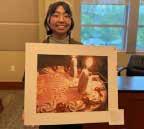
Aeris Lau, shown here with her painting, “Sixty,” received an Honorable Mention prize at Draper Visual Arts Foundation’s 2025 Art Scholar Competition. (Photo by Kamette Harmer)
preserving Corner Canyon, running the rodeo and Draper Days…you were going into the sunset but we drug you back and it created a great situation for us to have a person that already had training. You’re one of my dearest friends, and I’ve enjoyed serving with you,” Walker said.
“It’s been my honor,” Vawdrey said.
In an interview at the time of her first retirement, Vawdrey especially encouraged women to get involved in their communi-

Grand prize winner Tinsley Smith was photographed with her painting, “Waiting for Tomorrow” at Draper Visual Arts Foundation’s 2025 Art Scholar Competition. (Photo by Kamette Harmer)
ties. “I think there’s a special place for women because we have a different perspective. I’ve seen that, and it really takes all of us. I love to see people do it for the right reason, because you care about the community. Step up and make a difference,” she said.
As of Jan. 5, another woman has joined the council. Recently elected Councilmember Kathryn Dahlin will fill the two-year term left vacant after Roberts’ and Vawdrey’s departures. l
New contractor for Draper Park’s one million lights and first-ever Menorah lighting at City Hall
The city hired a new contractor to put up the estimated one million lights at Draper Park and hosted a first-ever Menorah lighting.
By Mimi Darley Dutton m.dutton@mycityjournals.com
Onceagain, Draper City was all aglow for the holidays, but for the first time in a dozen years, the city used a different contractor for the lights at Draper Park. “I thought the lights looked as good or better than last year,” said Rhett Ogden, Parks and Recreation director. Rather than the city owning and storing the lights as in years past, this contractor leases the lights so the city isn’t burdened with maintaining and storing them. According to Ogden, it costs the city more initially, but in the long run, the city should save money because they often had to buy replacements for broken lights. “They bring them, set them up and take them down. If they’re broken, the contractor repairs or replaces them, so they’ll be new and bright each year,” Ogden said. And because the city still owns a lot of lights from years past, they put those to use to brighten even

Starting a new holiday tradition, Sandy Mayor Monica Zoltanski and Rabbi Avremi Zippel joined Draper Mayor Troy Walker and Councilmembers Kathryn Dahlin, Tasha Lowery, Bryn Johnson and Marsha Vawdrey for a Menorah lighting at City Hall Dec. 17. (Courtesy Draper City)
more locations throughout the city, including five additional roundabouts as well as South Mountain bridge, City Hall, Draper Historic Park and various street lights. Ogden estimates there were approximately 1.5 million lights throughout Draper.
In another holiday first, Draper hosted a Menorah lighting Dec. 17 at City Hall in conjunction with Chabad Lubavitch of Utah’s “Chanukah Across the Wasatch

The holidays kicked off with the traditional Tree Lighting Ceremony Dec. 1. For the first time in a dozen years, the city used a new contractor for the estimated one million lights at Draper Park which drew crowds of people all month long. (Mimi Darley Dutton/ City Journals)
Front.” Rabbi Avremi Zippel joined Draper and Sandy’s mayors and members of the public in lighting a Menorah. Music, potato latkes and jelly doughnuts were enjoyed by those in attendance. l
Draper Elementary fifth-grade leaders organized a schoolwide food drive resulting in nine barrels of donated food and lasting lessons about service and gratitude.
By Julie Slama j.slama@mycityjournals.com
Draper Elementary fifth-grade student body officers recently organized a schoolwide food drive benefiting the Utah Food Bank, collecting nine barrels of food.
“It was close to one ton,” said teacher Jennifer Asay, who serves as the SBO adviser.
As they planned the drive, the student leaders learned about food insecurity in their community.
“Food is scarce, so people can use more support,” said fifth-grader Andrew Meadows.
Classmate Isla Erskine added, “Some kids don’t have a meal; they only have the littlest bit of bread.”
While fifth-grader June Jefferies knows a lot of schools have pantries to help students and their families, the need is still there.
“We learned one in five children are hun-
Young leaders take action against hunger

Elementary student leaders led their schoolwide food drive for the Utah Food Bank, learning lessons about gratitude and giving. (Photo courtesy of Traci Preece/ Draper Elementary)
gry and schools can even use help stocking their shelves,” she said.
To make the drive successful, SBOs promoted it through morning announcements and made and distributed fliers.
Fifth-grader Piper Middleton said they also held a friendly competition between grades to get more students involved.
“We did that because everyone loves competitions,” Isla explained.

The fifth-grade student leaders, including the rest of the team—Grace McKean, Lucy Morrison, Nate Nixon and Declan Price—led by example donating nonperishable items such as canned corn, tuna, macaroni and cheese, cereal, ramen, peanut butter and more.
For the SBOs, the impact mattered the most.
“The best part is knowing people will have dinner,” Isla said.
June added: “And if they have access to schools, they can ask for more help.”
Andrew said he learned he was for-
tunate: “We’re pretty lucky we can eat every day.”
In addition to the food drive, the officers set examples as school leaders.
Piper said they help classmates find friends, so they want to be at school.
June added: “We welcome people to school and tell them we’re glad they’re here. It’s important to make everyone feel they belong.”
Earlier in the school year, they attended the BYU leadership conference for school leaders. l

Draper
Draper Elementary students collected nearly 1,600 pounds of food during their recent food drive. (Julie Slama/City Journals)


Belgian Waffle & Omelet Inn serves up Christmas spirit
For students and staff of Jordan Valley and Life Skills Academy, it’s a Christmas memory and a community lesson that lasts far beyond the holiday season.
By Julie Slama j.slama@mycityjournals.com
The scent of waffles mixed with laughter and smiles from Jordan Valley School and Life Skills Academy students, honored as special guests, filled the Belgian Waffle & Omelet Inn. For more than 40 years, the Midvale restaurant has opened its doors and its heart and turned an ordinary meal into a holiday tradition, complete with a visit from Santa Claus.
“It wouldn’t be Christmas without Jordan Valley being here,” said owner Jeff Wilhelmsen, who has continued the tradition since 1983. “We’ve been happy to be able to do it.”
Students at nearby Jordan Valley School have severe multiple disabilities, many who are extremely medically fragile.
The goal at Jordan Valley is to improve the quality of life for its 70 students, age 5 to adult, and their families.
The holiday tradition began when Wilhelmsen partnered with the late Kerm Eskelson, Sr., who was the building’s landlord at the time.
“He said, ‘let’s do this to help these kids,’” Wilhelmsen said. “He covered 50% in cash, and I covered the rest. When he passed away, we continued doing it on our own. He was a real good guy.”
This year, more than 100 students and staff from Jordan Valley came as well as for the first time, about 50 students and staff from Life Skills Academy, Canyons School District’s post-high adult transition school which provides instruction and training to students with special needs who have aged out of traditional high school.
All the meals were fully paid for by the restaurant and Santa arrived with treat bags filled with juice boxes, candy canes, clementines and chocolate Christmas trees.
“They roll out the red carpet; they have so much love for our students,” said Jeff Honsvick, first-year assistant principal at both


schools. “Talk about the spirit of Christmas, this is incredible.”
Honsvick said the experience goes far beyond a holiday party.
“I’ve worked 15 years at a school similar to this and I’ve seen the incredible outreach of the community before, but there’s something about a business welcoming the entire school that just gives me goosebumps,” he said. “Seeing the students be successful in the community is huge for me.”
For many students, eating at a restaurant is a rare opportunity.
“A lot of our students don’t get the chance to eat in a restaurant,” said Rachel Murphy, Jordan Valley administrative assistant who coordinated the school’s visit. “Some parents feel worried about people and crowds, so this gives them the experience to be in the community they don’t normal have.”
Life Skills Academy Principal Stacey Nofsinger said those experiences are hard to replicate at school.
“You can only teach so much in a classroom,” she said. “So, they’re learning how to go to a restaurant, how to order, how to use their social skills.”
To help students be successful, Murphy said those who use devices to communicate, had preloaded choices and comments added so they could interact with the restaurant staff and when they met Santa.
“This helps them be more independent,” she said.
The place is familiar to some students, who come on a regular basis to learn practical skills. For years, Belgian Waffle has served as a job site for students.
“They fill salt and pepper shakers, wipe tables, wipe menus, bus tables, vacuum; they’re helping us and getting experience,” said Cheryl McCormick, a longtime staff member who has worked the event with Jordan Valley for 17 years as her mother did before her. “I love having them here. These are my kids. When they see Santa Claus, it makes my year.”
Nofsinger, too, enjoys the interaction: “Just seeing happiness, both my staff and students as well as the Belgian Waffle staff and how they love this, is fun for me.”
The restaurant remains open to the public during the holiday meal for the schools— and touches those patrons as well. l


Jordan Valley students got a visit with Santa Claus while being treated to a holiday party at the Belgian Waffle & Omelet Inn. (Julie Slama/City Journals)
At the Belgian Waffle & Omelet Inn, Life Skills Academy students practiced their social skills while being treated to a holiday meal. (Julie Slama/City Journals)
Inclusion takes center stage at inaugural state unified dance competition
Local high school dancers made history earning top medals while promoting inclusion and showcasing talent.
By Julie Slama j.slama@mycityjournals.com
In the first state high school unified dance competition, three area schools swept the event.
Copper Hills High School won the unified dance team competition, with Highland High and Murray High in second and third places, respectively. Several students from each of the school placed in solo and duet categories.
Unified dance is a program that brings together students of all abilities together to promote inclusion, friendship and teamwork with an emphasis on movement and joy. The Special Olympics Utah competition was held in December at Highland High and featured a variety of dance styles and creative interpretations.
Students performed their routines on stage before receiving feedback from a panel of judges, including three who recently competed and won gold medals at the Special Olympics World Games. Much of the feedback was positive and encouraging with comments such as “keep smiling and showing you’re having fun,” “you owned that stage,” “great techniques” and “good energy and choreography.”
Many of the performances included costumes and props. Murray High dancers wore bright colors while Copper Hills performers sported matching shirts that said, “Inclusion is Cool.” Props from watering can to leis, adding creativity and personality to the routines.

Some students choreographed and practiced dances independently or together as an after-school club. At Copper Hills, teacher Anna Bay has instructed adaptive dance for three years.
“We have so many good kids who love to dance, so we wanted to give them more of a dance experience than what they could get in our mainstream classes,” she said. “With so many interested, we were able to open up a class just for the special ed kids. We have 20 special ed students in the class, plus 20 peer tutors. Then, we have aides who help.”




Bay said the benefits of unified dance go beyond learning choreography and dance technique.
“They’re learning social skills, how to be part of a team and about friendship. They’re listening and following directions, but we do it in a dance way, so it’s all by having fun. I teach them a lot of the same things I do in my ballroom classes from stretching to line dances. We’ve been working on learning choreography, which we were able to perform today,” she said. “They have so much fun, and I love their genuine smiles.” l




Highland High’s unified dancers, who hosted the state’s first high school unified dance competition, perform to a crowd in their school auditorium. (Julie Slama/City Journals)



After oath of office speeches, Draper officials look toward city’s future
Elected officials stated their intentions and reflected on serving their community while working as a team, despite differences, to lead Draper into the future.
By Mimi Darley Dutton m.dutton@mycityjournals.com
City Manager Mike Barker welcomed the public to Draper’s oath of office ceremony Jan. 5. “I’m excited because this is happening all across the state today… the orderly transition of power. The people have spoken and elected their representatives,” Barker said.
After raising their right hands to individually take the oath, Draper’s election winners returned to the podium to deliver remarks. Reelected Councilmember Mike Green was not present for the ceremony because he’s currently deployed with the U.S. Army. Barker said Green was sworn-in remotely the same day as the others.
Kathryn Dahlin, the newest member of the council, admitted to being nervous about her speech. “But now that I’m an elected official, I can go on and on,” she joked. Dahlin said she considered all the reasons her family loves living in Draper including hiking in Corner Canyon and other opportunities for walking and running as well as rec sports which her children have participated in for 25 seasons. Dahlin mentioned local bakeries and Draper’s eight ice cream stores. “Ten if you include Harmons and Macey’s, which we do,” she said. Dahlin said knocking doors while campaigning helped her better understand the city and residents’ concerns about crosswalks, schools, trees, traffic, growth, garbage and
taxes. She said people shared stories of wonderful Draper neighbors and helpful city employees.
Dahlin expressed three goals she has for her two-year term on the council. First, she plans to be accessible to residents and act as a resource for sharing city information, and she commits to work to make informed decisions. Secondly, Dahlin said she wants to respect people’s tax dollars. “My family lives on a budget. We don’t have the luxury of spending more money than we have. I’ll make sure we’re fully funding our public safety and give Draper’s taxpayers amazing service for their tax dollars,” she said. Third, she hopes to preserve the livability of the community including helping strike that balance with the growth at The Point. “I will work to ensure our city residents aren’t footing the bill for someone else’s project,” she said.
Incumbent Tasha Lowery is embarking on her third four-year term on the council. Lowery recalled her first job decades ago as a kindergarten teacher in an inner-city school. “I taught children who lived in cars, children who came to school hungry and tired and already angry at the world. Remarkably, they still showed up every day, most often with a smile, except for Sam,” Lowery said. She explained that Sam didn’t want to be in kindergarten and was sick to his stomach as a result of his emotions every day for two months. She likened Sam’s anxiety over kindergarten to when she first became a member of the council. “When I started, meetings were tense and people were angry. But just like Sam, if you can make it through the door and take a seat, you’ll make friends, you learn and grow and find ways to thrive, and you can slowly begin to make a difference. It took Sam two
months, it took me more like two years,” she said.
Lowery said even on the hard days when there are controversial subjects to address, she still feels lucky to be a member of the council. She hopes to make wise decisions for the community’s shared future. “I am grateful for all of you for carrying me through. It takes strength and resilience to keep showing up and it takes a village. Thank you for being my village,” she said.
Troy Walker originally took the oath of office as a councilmember 18 years ago. Now he’s beginning his fourth four-year term as mayor. He began by thanking his wife Stefani and their children as well as area mayors and other political representatives who came to the ceremony to show their support.
“Politics as of late has been unique to say the least. As we go forward as leaders, we have a lot to deal with. In a local capacity, we do things that matter, things we see every day that often don’t seem exciting or important, unless you’re calling for a paramedic, the fire department or police. Government has a narrow lane…we can’t do everything, but the things we do we can do well,” he said.
Walker reflected on how various people help their community. “I see people who serve in different ways. Some in your church, neighborhood, school, government, and some of you serve quietly. That’s what makes the difference in our lives and community,” he said.
Walker said the job of elected officials is to look to the future and determine where to go. “You sent me here because you trust my judgement and ability to figure out a problem, and you expect me to make the best decision…though you may not agree
with my decision. I’m grateful to all of you who have supported me through the years, and I’m even grateful to some of you who’ve disagreed with me,” he said.
Walker said the council aims to work as a team despite their differences. “Potholes don’t care what party you’re from. It’s all about service and doing the work. We don’t have the same political views, but we’re still able to work together.”
Green is gone for a maximum of 270 days after departing in early October. According to Barker, it has yet to be determined if he’ll be able to participate by calling into council meetings while he’s deployed. Walker read remarks Green had prepared about his reelection to the council and starting this term while on military leave. Green said he began in the military at age 19 and served in the Gulf War. He is now a Judge Advocate General (JAG) officer in the Army, meaning he’s a licensed lawyer, and is deployed in that capacity. Green’s words drew parallels between his military service and his service as a councilmember. He said he felt an obligation to give the Army the same care and commitment he got when he started his military service in an effort to support the young people currently serving the country. “We should be proud of our sons and daughters doing difficult work far from home,” Green said. He asked the community to keep all service members in their prayers and said he looks forward to advancing a shared vision for the Draper community.
“We are off on another term. There are a lot of exciting things happening in our community, including The Point. The future is bright for Draper. We have our challenges…but we can shape it in a way that’s meaningful,” Walker said. “It’s a wonderful place to live.” l
Councilmember Tasha Lowery is starting her third fouryear term on the Draper City Council. (Mimi Darley Dutton/City Journals)
New Councilmember Kathryn Dahlin was elected for a two-year term on the Draper City Council. (Mimi Darley Dutton/City Journals)
Mayor Troy Walker took the oath of office to begin his fourth four-year term. (Mimi Darley Dutton/City Journals)
Making connection and sharing joy through music
Music filled Jordan Valley School as Hillcrest High School’s Vocal Ensemble performed for students with disabilities whose joy was expressed through movement and smiles, creating a moment of connection that went far beyond the songs.
By Julie Slama j.slama@mycityjournals.com
Hillcrest High School’s Vocal Ensemble recently brought the joy of music to Jordan Valley students, performing for an audience eager to clap, dance and move to the songs.
For Jordan Valley Music Therapist Hope Ward, the performance aligned with her goals in her first year.
“One of my biggest goals this year is outreach, so I invited a couple of different schools to come,” she said. “Hillcrest has been coming for years.”
In addition to Hillcrest, Corner Canyon High students sang at Jordan Valley in early December and Brighton High was on the schedule along with a private violin studio performance.
Jordan Valley students have severe multiple disabilities including autism, cerebral palsy, traumatic brain injury, seizure

disorders, communication impairments, genetic disorders and syndromes, deafblindness and students who are extremely medically fragile. The goal at Jordan Valley School is to improve the quality of life for its 70 students, age 5 to adult, and their families.
Ward said bringing performances directly removes barriers.
“Our students love this. Sometimes we don’t have the access as other students to

calizations that aren’t words, but they are clearly excited from their happy sounds,” she said.
As a music therapist, Ward works closely with students’ educational plans. She works with each of the 10 classes in group therapy sessions, then supports 20 students through their individualized education program through music.
“Maybe their goals are to increase motor dexterity so grasping something like a maraca is very motivating. When they shake it, they are increasing their grasp. It’s fun and that’s why it’s effective,” Ward explained.
Jordan Valley Principal Matt Nelson said these live performances are meaningful.
“It’s important to get this quality of music brought to our students where they’re comfortable and familiar so they can enjoy it,” he said. “We’ve had students dancing, clapping, jumping up and down, rocking back and forth. Engaging with music is another method our students can communicate. It’s a powerful medium.”
be able to do things like this so having them come to us is easier. Our students are obsessed with music,” she said.
Ward said students express their excitement in their own ways.
“Many of our students are nonverbal so when they are excited, they move their bodies. Music makes them happy, so these students are expressing it through movements. Maybe they’re making some vo-
Hillcrest High senior John Hansen said performing for Jordan Valley students offers something unique as does performing in venues such as Gardner Hall, the Tabernacle and the capitol.
“It’s fun to have these cool, different experiences and to share the love of music,” he said.
Hillcrest junior Laelia Raleigh said their visit was rewarding.




Hillcrest High’s Vocal Ensemble was one of several groups to perform for students and staff at Jordan Valley School. (Julie Slama/City Journals)

“I love talking to them,” she said. “I talked to a girl in the corner and she smiled at me and gave me the biggest hug. It just filled my heart with so much joy.”
Hillcrest choir director RaNae Dalgleish said the tradition of performing at Jordan Valley began decades earlier under Hillcrest choir director Brian Bentley and one she has chosen to continue.
“Performing in our community strengthens students musically and personally,” she said about the synergy coming from 40 performances during the winter season. “Watch-
ing my students here, some of them have never had a chance to be with others who are disabled to the point where they can’t be in a typical classroom. They’re seeing how these kids respond to music, how they light up and they dance, they move and they vocalize. They’re learning the powerful impact of what they’re doing. When we talk as a team about our experiences and goals and what is worth our time, we come here. Bringing joy to Jordan Valley students is worth our time and investment.”or the schools—and touches those patrons as well. l









Hillcrest High students share a moment with Jordan Valley students after their concert. (Julie Slama/City Journals)
Longtime educator and Olympic choreographer Paul Winkelman, now living with ALS, is finding new ways to inspire students and hoping to return to the Olympic spotlight.
By Julie Slama j.slama@mycityjournals.com
In eight years, Salt Lake will once again welcome the world as host of the XXVII Winter Olympic Games in 2034. For Paul Winkelman, a longtime educator and counselor in Canyons School District, he hopes it will give him a repeat performance as the opening and closing ceremonies choreographer, a role he cherished during the 2002 Games.
“I’d love to do that,” Winkelman said simply, reflecting on one of his greatest experiences of his life.
In 2002, Winkelman was teaching at Alta High and coaching its nationally acclaimed ballroom dance team when dozens of people walked into the school commons after school, cameras rolling. Among them was a producer for the Salt Lake Organizing Committee.
After watching the boys’ portion of the rehearsal, Winkelman recalled being asked who he was and what group was practicing.
“I explained we were the Alta High School ballroom dance team,” Winkelman said. “He said, ‘I’ve never seen guys dance like this.’”
That chance encounter ultimately led to Winkelman being hired as the full-time choreographer of the Olympic opening and closing ceremonies. His students became the backbone of the Western Frontiers section, the largest segment of the ceremonies, first learning the choreography, then helping teach it to hundreds of performers who filled Rice-Eccles Stadium.
“I said many times, the Salt Lake Olympics was heaven. It was unbelievable,” he said.
Eight years from now, however, if Winkelman returns to the Olympic stage, his approach will look different. In 2022, he was diagnosed with ALS, commonly known as Lou
Still dancing forward

Gehrig’s disease, a progressive neurological disorder that attacks motor neurons in the brain and spinal cord, gradually robbing the body of voluntary muscle movement while leaving the mind intact.
“I teach a totally different way. It’s verbal. I’ll explain to my top couple what I want and they become my legs,” he said.
Even with the diagnosis, Winkelman hasn’t stepped away from his career, working with students.
“In 2022, I was diagnosed with ALS, but I knew there’s no way I’m quitting work because I love working with kids, and I wouldn’t know what to do with myself,” he said. A life shaped by students and the arts
Helping students has been Winkelman’s lifelong passion. He began his career at East Midvale Elementary, where he spent seven years teaching third and fourth grade while building a drama program that quickly grew beyond expectations.
“I loved East Midvale,” he said. “We produced all-school productions where ev-
eryone from kindergarten through sixth grade could be involved. It was an after-school activity many students wanted to be a part of.”
Winkelman’s reputation led then Jordan School District to move him to an opening at Alta just one week before school started in 1992. There, he continued the school’s strong theater tradition and launched what would become one of the most successful ballroom programs in the country.
“We became national champions,” he said. “Of the 10 years I was there, eight times we were the national champions. Those kids worked so hard.”
Winkelman lived and breathed work.
“There were times I never went home. I slept on the floor of the auditorium when I was tired, but I loved what I was doing and the productions we did there were absolutely amazing. The students and the quality of their work was stunning,” he said.
After adding his master’s degree in psychology to his undergraduate education
degree and master’s in theater, Winkelman pursued the counseling field, leaving Alta in 2003. He worked at Brighton High, Hillcrest High and Utah Valley University before returning to Brighton.
At Hillcrest, Winkelman helped sustain and elevate the school’s well-known musical theater tradition for a decade, collaborating with choir director RaNae Dalgleish.
“Working with Paul at Hillcrest — I’ve never met a man with more passion and energy and talent,” she said. “He was demanding, but he also made it fun. Our musicals were phenomenal because they had the Paul touch.”
A moment that redefined his world
Winkelman’s ALS diagnosis came after months of uncertainty, injuries and worsening weakness.
“When the fourth doctor told me, ‘You have ALS,’ I just sat there. I vividly remember I went right out of body like I was watching myself,” he said.
The disease takes a physical toll on Winkelman daily. He experiences tremors and painful muscle spasms, which he describes as “painful Charley horses in your whole body” and frequent falls.
“When I fall, my body freezes, and I’m like a piece of glass hitting the floor. My head has been cut open; I’ve had to have shoulder surgery because I ripped the rotator. It scares me to fall, because I know there’s no way to stop and, on my way, down, I wonder, how bad is this one going to be? It’s taught me the more invincible you think you are, the less you are. Life can be very fragile,” he said.
Even so, Winkelman’s outlook remains clear.
“My attitude from day one has been positive,” he said. “You can stay positive and contribute, or you can turn this into a negative and give up.”
Today, Winkelman is a part-time counselor at Entrada Adult High school, where the flexibility allows him to continue supporting students.
“I’m still working with them on careers and on getting them graduated,” he said. “If I get up one day and my body just says no, I can work with my disability much more easily.”
Entrada counselor Paul Winkelman continues to make a big contribution to students, both in counseling and in the performing arts, while living with ALS. (Julie Slama/City Journals)
Winkelman continues to choreograph, judge competitions and mentor performers, recently coaching a group to the world championships. He also has produced Broadway stars, including Derek Hough of “Dancing with the Stars” and Ashley Bryant in “The Play That Goes Wrong,” and worked on the choreography for the movie, “High School Musical.”
“My mind can still see what the choreography needs to be,” he said. BeatALS — music, meaning and community
His choreography was on full display recently at Hillcrest High during a BeatALS benefit concert honoring Winkelman. Supported by Dalgleish, he met Bingham High theater director David Martin and worked with Sean’s Garage, a Beatles tribute band, to raise funds for ALS research and awareness.
“We had a night of wonderful music and celebration,” Dalgleish said. “We ended up earning about $5,700 for the ALS Foundation.”
Not only did Winkelman choreograph numbers for the program, he spent time talking with 50 students about music, dance and life. He also shared his journey with the audience during a pause in the concert.
“It was so much fun and the kids were awesome,” Winkelman said. “I heard some songs I didn’t know. I’m quickly becoming a Beatles fan.”
Dalgleish said the experience also impacted the students.

“The kids learned the songs, the history of the time and we had Beatles trivia every day and they learned to be thankful for every day,” she said. “The concert was beautiful. They danced, the orchestra played, the band played, the choir sang. It was stunning. It brought me to tears.” Gratitude for every day
Winkelman credits his faith, family

and friends for sustaining him.
“I’ve lived the life of at least five people,” he said. “I had many incredible opportunities in my life. I can’t be bitter. I just have to find a different way to do things.”
Brighton High recently honored Winkelman with a scholarship in his name for students pursuing ballroom dance at BYU,
another reminder of the legacy he continues to build.
“I’m lucky and whether I get the opportunity to choreograph another Olympics or championship, I get up—even on rough days—and I find the positive light, hoping I can change somebody’s life,” he said. “That has been a beautiful blessing, and I’m thankful for every day.” l




Hillcrest High performing arts students as well as Beatles tribute band Sean’s Garage and Bingham High theater director David Martin came together to perform in a BeatALS concert to help the ALS Foundation. (Photo courtesy of Janal Williams)
Show up for yourself: One woman’s journey
From emotional eating to empowering others, one woman finds her strength and reclaims her life.
By Julie Slama j.slama@mycityjournals.com
For years, Kenzie Turner moved through life on autopilot — balancing pregnancies, navigating grief, holding down a job and keeping pace with the demands of motherhood. In her 20s and early 30s, she wasn’t thinking about fitness or nutrition.
“Truthfully, I wasn’t thinking about myself at all,” she said. “I remember at one time feeling trapped in a body I didn’t recognize. I gained weight through pregnancies, but I didn’t lose it with the last two.”
Before Turner’s first pregnancy, she weighed 150 pounds, climbing to 190 after indulging in Chips Ahoy! cookies “several times each week.” After giving birth, the weight came off easily, and she assumed her body would always bounce back like that.
Three years later, her second pregnancy brought cravings of Totino’s pizza, which she ate “several times per week.” Again, Turner reached 190 pounds, but water aerobics helped her return to her pre-pregnancy weight.
Life was busy, but predictable as Turner worked as a bank teller and caring for two children, often managing on her own while her husband was in pharmacy school.
Then, at 16 weeks into her third pregnancy, she miscarried.
“The miscarriage really messed me up; I basically didn’t care and just ate,” Turner said.
She became pregnant again, leaning on comfort foods like McDonald’s pancakes. After her third child, the sadness of her miscarriage remained.
“I just didn’t have any motivation; I didn’t go back to losing the weight again,” Turner said.
By her last pregnancy, Turner’s unhealthy habits became routine and she often munched on sour gummies.
“I was already like 190 pounds when I got pregnant; when I weighed in, I was 229 pounds,” the 5-foot-3-inch tall mother said.
By 2019, Turner felt stuck.
“I remember signing up for Weight Watchers, but I didn’t even start. I figured, ‘I’m just going to be fat. It’s just who I am now,’” she said.
For years, Turner hovered around 220 pounds, eating to fill emotional gaps, not nutritional needs.
“It was mindless eating, not being aware of what I was eating, not caring, just eating whatever I wanted whenever I wanted it,” she said.
She remembers being shocked once when looking in the car mirror.
“I vividly remember, ‘how did I get

like this? What am I doing?’” Turner said as she looked at her reflection in a baggy shirt which allowed her to “hide in.”
Everything changed with a knock on her door. Her neighbor, Tristine, invited her to a Studio Red HIIT — high intensive interval training — class. Turner declined, but her friend insisted. The next morning at 7:45, they were headed to the VASA gym in Herriman.
“I walked into the gym being completely terrified. I thought everyone was going to stare at me, but it wasn’t like that at all. Nobody cared I was out of shape or I didn’t know what I was doing. They were supportive and glad I had come,” she said.
Turner finished the workout and surprised herself.
“I realized, ‘I can do this. I didn’t die,’” she said.
That same day, Turner signed up for a membership.
“I needed to find myself again, because I had put myself into other people for a decade, so it was time to be me. I needed this so I could feel better about myself,” she said.
Turner’s plan was simple: just move.
She started by attending class three days a week, then five. She slowly cut out foods she knew weren’t helping.
“I began to look at calories differently. I knew it took me 40 minutes to burn so many calories. So when I looked at sugary or fatty foods, I realized I didn’t want to put them in my mouth because I worked so hard to burn those calories,” Turner said.
When her weight loss stalled at 185, Turner got a personal trainer, Jonny, who taught her how to do more around the gym and how to focus on nutrition. With his support, Turner reached 140 pounds. Continuing on her own, she dropped to 119, reaching her goal two years later.
Through every struggle, Turner held
Herriman mom-turnedfitness instructor’s five fitness tips
After changing her mindset and routine to lose 100 pounds, Kenzie Turner gives words of encouragement to others on the fitness journey.
1) Start slow
“Just move your body. Do something. Go for a walk. Do three minutes of jumping jacks. Don’t just sit on the couch.”
2) Make realistic goals
“It doesn’t have to be, ‘I’m going to lose 100 pounds.’”
3) Show up for yourself
onto the phrase which carried her: “Show up for yourself.”
“I remember not wanting to get up on a Saturday morning knowing it was the only day I could sleep in. But I told myself, ‘show up for yourself,’ that would get me out of bed and into the gym to do the work. Those words still get me going,” she said.
Studio Red’s structure kept her consistent.
“The workout is geared toward all muscle groups, cardio and lifting. It’s planned and I get it all in 45 minutes,” Turner said.
Nutrition, once an afterthought, became purposeful.
“I focus on the protein, on drinking enough water and getting sleep. Protein shakes and string cheese are my grab-andgo foods, but showing up for yourself is not just about the gym. It’s about nutrition too, so I get up to make eggs or to eat yogurt to fuel my body if I want it to do what I need it to do. It’s been a complete mindset change,” she said.
Recently, Turner made a career change. After 18 years working for a bank, she made a bold choice. Encouraged for years to coach, Turner finally earned her certifications and became a Studio Red instructor.
“I wanted to help people like those who helped me. Studio Red changed my life,” she said.
Turner’s former coaches now have taken her classes and her trainer calls her his “gold star client.”
She is working toward becoming a step instructor and pursuing a full-time role in fitness. But her greatest accomplishment isn’t the number on the scale — it’s the woman she became along the way.
“I didn’t just lose 100 pounds,” Turner said. “I found myself, and I am still showing up.” l
“I started by going to the gym three days a week. I’ve never shown up to a workout and regretted it. I always walk away feeling better about myself. The hardest part is walking through those the gym’s front doors.”
4) Keep going
“Keep pushing and don’t stop. Be consistent.”
5) Do it for yourself
“This is about you; it’s about time for you.”

Kenzie Turner changed her life the past two years and now is a fitness instructor. (Julie Slama/City Journals)
Kenzie Turner before she began her fitness journey. (Photo courtesy Kenzie Turner)
Don’t ignore signs of the winter blues
Thousands of Utahns deal with Seasonal Affective Disorder.
By Peri Kinder peri.k@thecityjournals.com
For many people in Utah, the “winter blues” show up as exhaustion, a lack of motivation and low energy. While the dark nights and cold days can make anyone irritable, if symptoms of weariness or sadness last more than two weeks, it could be a sign of Seasonal Affective Disorder.
While the national SAD rate is around 5%, it’s estimated that 10% of Utahns experience SAD each year. Environmental factors like the annual inversion, limited sunlight and disrupted circadian rhythms contribute to an overall emotional slump.
Dr. Jason Hunziker, Division Chief of Adult Psychiatry at the University of Utah, said SAD is a type of depression affected by low light exposure that can heavily impact the way people function. It can show up as low motivation, a higher intake of carbohydrates, excessive sleeping or just feeling off.
“People get up in the morning and it’s dark; they come home from work and it’s dark, and it affects them,” Hunziker said. “It begins to interfere. You’re getting to
work late, you’re not keeping up at work and you’re not getting to school. Your relationships are starting to become fragile, and there are more arguments or isolation. You start to feel hopeless.”
While brief periods of sadness are common, SAD symptoms lasting two weeks or more should be considered serious, and it might be time to talk with a professional, especially if the depression includes thoughts of self-harm or suicidal ideation.
Hunziker said one of the best ways to combat SAD is through movement, outside if possible. Moving the body releases endorphins that provide a sense of well-being and it can take the mind off worry or stress.
“One of the biggest things people forget to do in the winter is move,” he said. “Go out for a walk, go to the gym, run on the treadmill at home, just make sure you’re trying to do something. It’s best if you’re outside because the cold air and the sunlight, all of those things we need are outside.”
Light therapy is another effective way to treat SAD symptoms. Whether you take a 20-minute dog walk or sit in front of a light therapy lamp, the benefits will pay off in the long run.




Healthy eating plays a big role in how people feel in the colder months. Winter meals and snacks often contain carb-heavy comfort foods but the more fresh produce that can be incorporated into a diet, the bigger the reward. Staying connected to loved ones is another way to improve mental health.
“We isolate in the wintertime but we need to make sure we’re meeting with family and friends, and reaching out to them all the time,” Hunziker said. “There are so many ways that we can help when things start to go the wrong direction. Let’s not let it get too far down the road before we do something.”
For people prone to SAD some pre-winter planning may help. Create an autumn toolkit to help avoid the deep depression associated with the disorder. Set up a therapy appointment in early September and plan on filling anti-depressant medication in early fall, so it has time to work.
Having things to look forward to can help alleviate SAD symptoms. Schedule fun events for the winter or plan a weekend getaway.
For those who need crisis help, key resources include the 988 Suicide & Crisis Lifeline number and the SafeUT App, an

Walking outside is a top recommendation for alleviating symptoms of Seasonal Affective Disorder. Taking a proactive approach to seasonal depression can help those who struggle with mental health in the winter. (Adobe stock)
app that allows students to call a licensed counselor for free, at any time of the day or night.
“If you don’t know where to start, start with your primary care doctor and let them know what’s happening,” Hunziker said. “Make sure you’re moving, make sure you’re getting light, make sure we’re taking care of our bodies and keeping our connections. Don’t ignore that stuff.” l




Salt Lake County leads on criminal justice reform bringing a national lens to local solutions
Salt Lake County is responsible for many of the region’s core public safety functions, including jail operations and serving as the behavioral health authority. About 74% of the county’s general fund budget is dedicated to public safety. As the government agency responsible for these essential countywide services, we regularly evaluate our systems to ensure delivery of better outcomes for people, public safety and taxpayers.
That responsibility is what led Salt Lake County to partner with Judge Steve Leifman and The Leifman Group, nationally recognized leaders in behavioral health and criminal justice reform. In Miami-Dade County, Florida, Judge Leifman’s work helped establish one of the nation’s most successful diversion models, the “Miami Model.” The model redirects individuals with serious mental illness from jail into treatment and recovery. That approach led to dramatic reductions in arrests and recidivism, a significant drop in the jail population—saving millions of taxpayer dollars while improving public safety and enhancing lives throughout Miami-Dade County.
Over several months last fall, Salt
Aimee Winder Newton
Salt Lake County Councilmember
District 3

Lake County convened more than 100 leaders from across the state and region— including state leaders, city officials, courts, law enforcement, service providers, advocates and philanthropy— to learn from the Miami Model and identify ways to implement the model here at home.
This engagement builds on years of work already underway. In 2023, Salt Lake County partnered with the State of Utah and Salt Lake City to advance the Coordinated Homeless Services Plan. In 2024, Salt Lake County Mayor Jenny Wilson launched the County’s first five-year Human Services, Homelessness and Criminal Justice Reform Action Plan, prioritizing early intervention, service coordination and accountability across systems. We’ve




also partnered with Salt Lake City on the planning and implementation of their Public Safety Plan. These efforts reflect a shared understanding that fragmented systems lead to repeated crises—costly for families, communities and taxpayers.
The data drives the need for action. Today, the Salt Lake County jail functions as Utah’s largest mental health provider. Roughly 34% of people leaving the jail exit directly into homelessness. Jail is among the most expensive—and least effective— way to address untreated mental illness and substance use disorders. Diverting individuals with serious mental illness from repeated, low-level incarceration into structured treatment and supervision is not about leniency; it is about accountability, public safety and using public dollars wisely.
Salt Lake County recognizes that simply replicating another community’s model is not what’s needed. Instead, the county is applying proven principles through a local lens—recognizing our specific responsibilities, what our population needs and what will work here. What has emerged clearly is the strength already present here: committed service providers, engaged public safety partners and a

shared willingness to align around practices that work. The Leifman Group’s recommendations focus on better coordination, improved crisis response and using shared data to guide decisions and track what’s actually working.
This work is also about leadership. Because Salt Lake County bears such a large share of public safety costs, we have a strong incentive to lead system improvement. Communities are safer when fewer people cycle through jail and our criminal justice system. Additionally, families are more stable, and taxpayer dollars can be reinvested into solutions that prevent crises before they escalate and that create lasting positive change.
At its core, Salt Lake County’s criminal justice reform work reflects a simple truth: when systems function better, outcomes improve for individuals and for the community as a whole. By leading with data, coordination and evidence-based solutions, Salt Lake County is working to improve public safety, support families in crisis, hold systems and individuals accountable, and ensure public dollars are used effectively for the benefit of the entire community.



TheFirst Amendment now comes with footnotes. Instead of promising not to abridge the freedom of speech, government officials are quietly redlining your opinions like a ruthless book editor holding a grudge.
The erosion of our First Amendment rights should wake you up like a five-alarm fire.
Banned Media. Reporters have been barred from the White House, kicked out of the Pentagon and have lost access to the press secretary’s office. A Washington Post reporter had her house searched by the FBI, relabeling journalists from “democracy watchdogs” to “people of interest.”
The president threatens the media licenses of organizations that don’t paint him in a flattering light. He’s sued networks for billions, ordered shows to be canceled and got Jimmy Kimmel fired. When millions of people canceled Disney and HULU, Kimmel was put back on the air, so I guess free speech can now be bundled with your subscription.
Banned Words. This melting pot we call America has outlawed diversity, equity and inclusion. That’s like taking the heart out of the Tin Man or the soul out of Hozier.
The Head Start early childhood programs were told to remove a list of 200 words in grant applications or the Death Star would blow up their facilities. Words like “belong,” “disability,” and “mental health” will get funding denied, so now applicants have to do an interpre-
Don’t be left speechless
Peri Kinder Life and Laughter

tative dance, acting out “equality” or “diverse.” Government leaders go ballistic if we use pronouns or call a trans person by their chosen name, yet expect the entire country to salute the nonsensical renaming of the Gulf of America or the Trump-Kennedy Center. It costs nothing to respect someone’s pronouns, but rebranding the Department of War will cost taxpayers more than $1 billion.
Banned Books. Having a library card is now an act of defiance. Utah loves a good book ban because nothing prepares kids for real life more than hiding information that makes them feel uncomfortable.
Utah already ranks at the bottom of education funding, but yes, let’s make our kids dumber by discouraging them from learning critical thinking skills or empathy. Reading as exploration is forbidden. Curiosity becomes taboo.
But if kids want to read a book, they’ll find a way to read it. A ban adds extra enticement, like putting chocolate sprinkles on an ice cream

sundae. We’re all for letting 18 year olds carry a rifle into McDonald’s, but heaven forbid they read “The Hate U Give,” which talks about a teen affected by gun violence.
Banned criticism. The First Amendment gives us the right to criticize anyone, even the president. You can slap bumper stickers on your VW, write columns or even burn the flag.
However, professors are being fired for political beliefs, protestors are tear-gassed and shot, and university funding is cut unless courses fall in line with this administration’s doctrine. Freedom of speech is now an extreme sport.
Here’s what’s not free speech: incitement, threats, defamation, obscenity and perjury. The president has threatened talk show hosts, slan-
dered Democratic leaders and there’s strong evidence he’s perjured himself several times. He is also protected under the First Amendment, but the president walks a Sharpie-thin line between free speech and hateful rhetoric. TrumpActionTracker.info documented 264 actions (as of Jan. 16) taken by the president and his administration during the last year to control information or spread propaganda. He’s all for free speech, as long as it’s only his.
History shows that free speech is as durable as steel, with the propensity to outlast those who violate it. The First Amendment doesn’t promise pleasant agreement but a safe space for necessary debate. Freedom of speech is not silent, and we shouldn’t be either.