












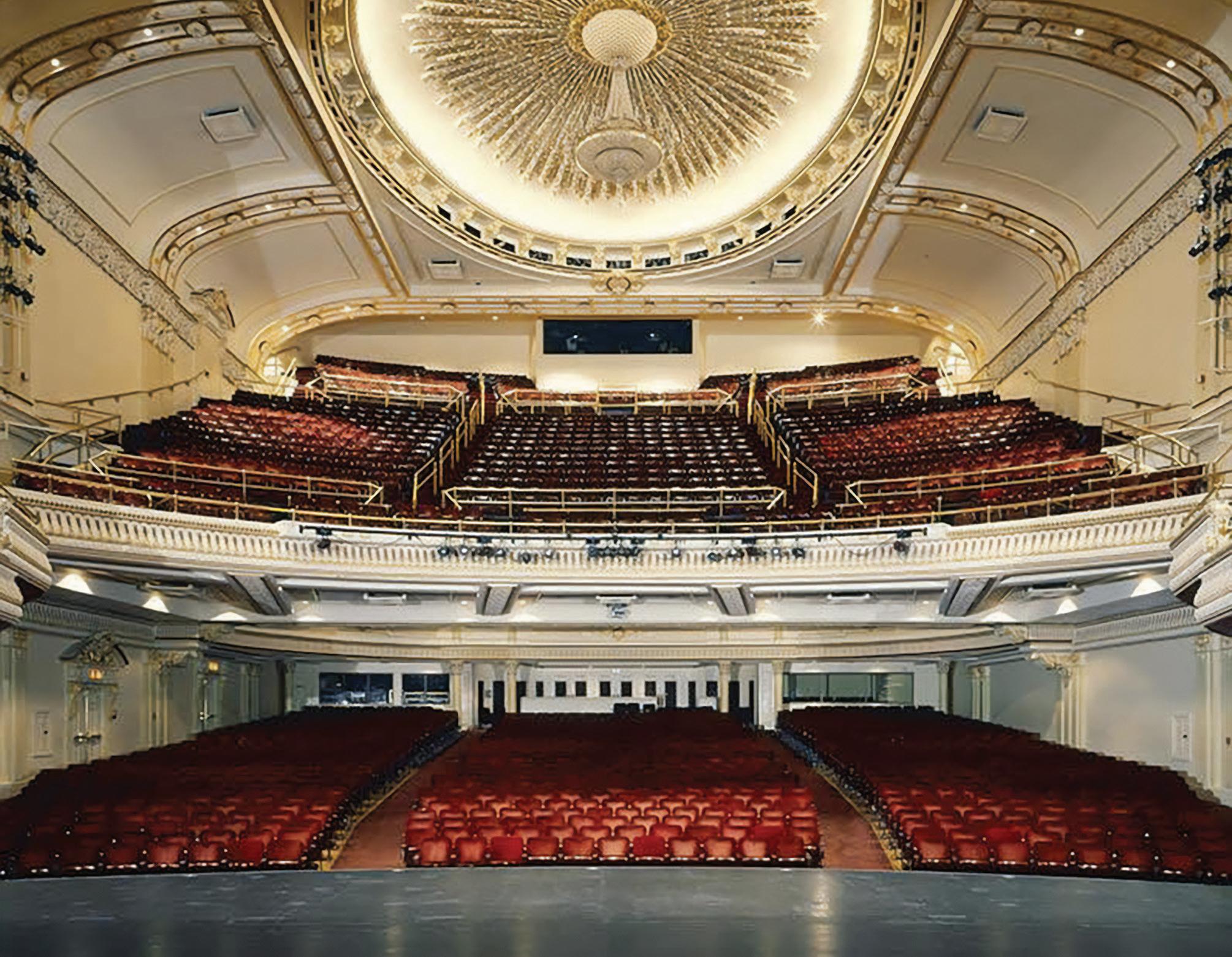
Have you ever felt a sudden chill or a burst of heat while enjoying a performance? You’re not imagining things!
Here’s an overview of why this occurs and the enhancements we’re implementing to improve your comfort.
The entire theatre - stage, orchestra level, and balcony - is served by a single air handler and it is a delicate balance to keep temperatures just right for the audience and the performers on stage. This means some areas may be a little warmer and other areas may be a little colder.
We monitor temperatures in real-time using the IMonnit App, allowing us to respond to temperature fluctuations quickly. Backstage, we can deploy portable heaters for localized temperature adjustments. We work hard to find ideal temperatures in all areas of the auditorium
and stage, but because of the historical design of the systems we are not always able to reach perfect temperatures in every area.
Our long-term goal is to design and install an HVAC system with independent temperature control for different zones. This multi-year project begins in 2026 with a feasibility study to determine the best options for optimizing temperatures and associated costs, while preserving the historical nature of Capitol Theatre. From there, we will seek funding and develop a construction timeline. Because of the scope of this project, it is expected to take several years.
Thank you for your continued patience as we work to make the Capitol Theatre a more comfortable experience for everyone.
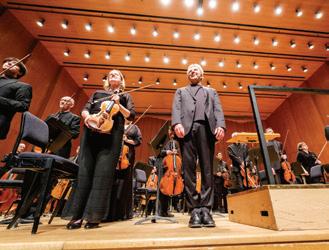



ON BEHALF OF THE BOARD, MUSICIANS, ARTISANS, AND ADMINISTRATIVE STAFF of Utah Symphony | Utah Opera, it is our pleasure to welcome you to today’s performance!
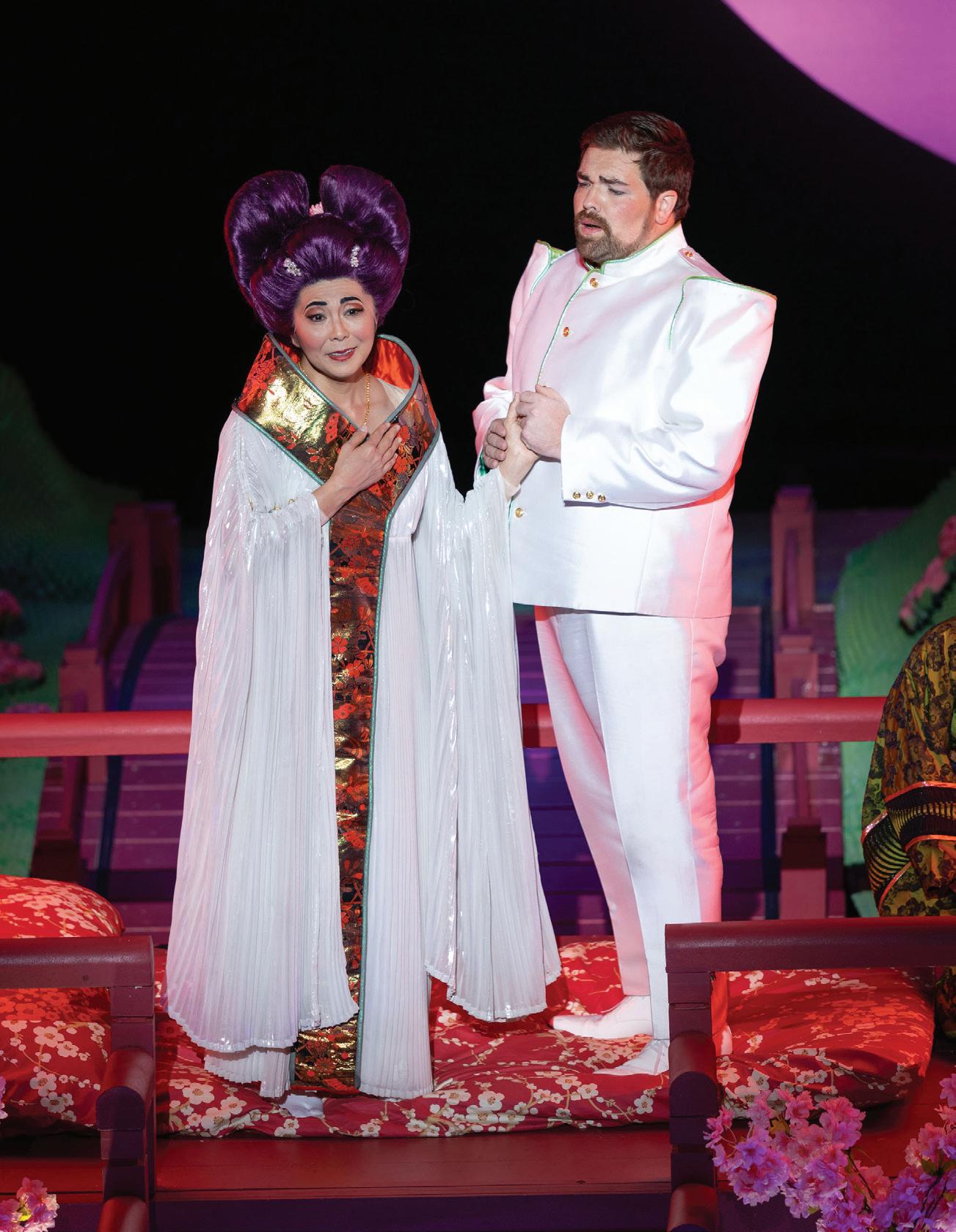
Whether you’re joining us for a performance of symphonic masterworks delivered by the exceptional musicians of our orchestra in concert with some of the world’s most-renowned artists, the bel canto comedic gem of Gaetano Donizetti’s The Elixir of Love set in a Southern California orange grove during the early 20th century (learn more on pp. 52–53), or our program specifically crafted for families featuring The Carnival of the Animals paired with a brand-new companion piece by Utah composer Andrew Maxfield inspired by Good Golden Sun (learn more on pp. 64–65), we guarantee you will leave enriched through the shared experience of great live music! Come as you are and leave changed.
We are proud to be recognized not only for our exceptional concerts and opera productions, but also as an industry leader in education and community engagement. In addition to the mainstage performances like you are enjoying today, our professional orchestra and opera artists present performances and interactive opportunities for students and adult learners throughout Utah. Our longest-standing curriculum is the Fifth-Grade Concert program introduced by Maurice Abravanel, the Utah Symphony’s legendary past music director for whom our concert hall was named. This February, we anticipate that more than 17,000 students will attend these special concerts during the school day; for many, it is their first introduction to the thrill of live symphonic music. Throughout the academic year, our musicians bring live music directly to schools statewide, inspiring creativity and enriching lives. (See p. 53 for a special message from 2020–22 Resident Artist Daniel O’Hearn who is returning for a mainstage performance of a role he first performed in Utah schools.)
Annually, we serve more than 100,000 Utahns through specific education and community engagement initiatives and nearly one-third of our total audience is comprised of students, reflecting our deep commitment to making the arts accessible to every community in Utah. USUO is profoundly grateful to the Utah State Legislature and its visionary allocation of public funding from the state’s citizens for Professional Outreach Programs in the Schools (POPS), which helps us meet over one-third of the expenses needed to introduce students to live orchestral music and opera. We are also indebted to our many donors who cumulatively augment the state’s support of this important work. Underscoring the impressive number of Utahns served through these programs are the countless stories of joy and curiosity sparked and memories made through connections that resonate long after the final note.
Thank you for your patronage and advocacy of Utah Symphony | Utah Opera. Your attendance at our performances and support of USUO ensures that the superbly creative people of this organization serve and inspire the citizens of Utah (as well as visitors to our beautiful state) as deeply and broadly as possible.
Steven Brosvik President & CEO
The O.C. Tanner Chair
Annette W. Jarvis Chair, Board of Trustees
p.s. (from Annette) How do I know what kind of impact music can make? I’ve personally experienced the power of music to heal after my voice was damaged from thyroid cancer surgery (see pp. 56–59). In April you can witness me singing with the Utah Symphony Chorus at Abravanel Hall. You’ll see the joy in my face as we live USUO’s mission to connect the community through great live music.


Annette W. Jarvis* Chair
Judy Moreton* Vice Chair
Joanne F. Shiebler* Vice Chair
Thomas Wright* Vice Chair
Jason Englund* Secretary
Steven Brosvik*
President & CEO
The O.C. Tanner Chair
Dr. Stewart E. Barlow
Larry Brownstein
Paul E. Burdiss
George Cardon-Bystry
Gary L. Crocker
John D’Arcy*
David L. Dee*
Barry L. Eden*
Senator Luz Escamilla
Jonathan Freedman
Brandon Fugal
Marie Gochnour Gardner
Dennis H. Hranitzky
Stephen Tanner Irish*
Thomas N. Jacobson
Abigail E. Lowder
Derek B. Miller
Dr. Dinesh C. Patel
Frank R. Pignanelli*
Gary B. Porter
Jennifer Price-Wallin
Shari H. Quinney
Miguel R. Rovira
Stan Sorensen
Aaron Starks
Clint Stone
Dr. Shane D. Stowell
Thomas Thatcher
W. James Tozer
David Utrilla
Sharlene Wells
Don Willie
Kim R. Wilson
Henry C. Wurts*
MUSICIAN REPRESENTATIVES
Andrew Keller*
Lissa Stolz*
EX OFFICIO REPRESENTATIVES
Christina Myers Onstage Odgen
Curtis Woodbury Associate Board
LIFETIME BOARD
Kem C. Gardner
Brian Greeff*
Jon Huntsman, Jr.
G. Frank Joklik
Thomas M. Love*
David T. Mortensen
Scott S. Parker
David A. Petersen
Patricia A. Richards* Harris Simmons
HONORARY & TRUSTEES EMERITI
Carolyn Abravanel
Jesselie B. Anderson
Howard S. Clark
Geralyn Dreyfous
Lisa Eccles
Spencer F. Eccles
* Executive Committee Member
Kristen Fletcher
Julie Aiken Hansen
Richard G. Horne
Ronald W. Jibson
Dr. Anthony W. Middleton, Jr.
Edward Moreton
Marilyn H. Neilson
Stanley B. Parrish
Marcia Price
Jeffrey W. Shields, Esq. E. Jeffery Smith
Markus Poschner
Music Director Designate
The Maurice Abravanel Chair, endowed by the George S. and Dolores Doré Eccles Foundation
Thierry Fischer
Music Director Emeritus
David Robertson
Creative Partner
Jessica Rivero Altarriba Assistant Conductor
Austin McWilliams
Chorus Director & Opera Assistant Conductor
The Sandefur Schmidt Chair
VIOLIN*
Madeline Adkins
Concertmaster
The Jon M. & Karen Huntsman Chair, in honor of Wendell J. & Belva B. Ashton
Kathryn Eberle
Associate Concertmaster
The Richard K. & Shirley S. Hemingway Chair
Laura Ha 2nd Associate Concertmaster
Claude Halter Principal Second
Evgenia Zharzhavskaya Acting Associate Principal Second
Karen Wyatt Acting Assistant Principal Second
Erin David
Emily Day-Shumway~
Joseph Evans
Wen Flatt
Lun Jiang
Rebekah Johnson
Tina Johnson~ Alison Kim
Amanda Kofoed~
Jennifer Kozbial Posadas~
David Langr
Hannah Linz
Yuki MacQueen
Alexander Martin
Rebecca Moench
Suni Norman~
Hugh Palmer
David Porter
Lynn Maxine Rosen#
Elina Rubio
Barbara Ann Scowcroft
Ju Hyung Shin
Bonnie Terry
Julie Wunderle
VIOLA*
Brant Bayless Principal
The John C. Kish Chair
Yuan Qi
Associate Principal
Julie Edwards
Joel Gibbs
Carl Johansen
Scott Lewis
John Posadas
Leslie Richards~ Whittney Sjogren
CELLO*
Matthew Johnson
Acting Principal
The J. Ryan Selberg Memorial Chair
Andrew Larson
Acting Associate Principal
John Eckstein
Walter Haman
Anne Lee
Louis-Philippe Robillard
Kevin Shumway
Hannah Thomas-Hollands~ Pegsoon Whang
BASS*
David Yavornitzky Principal
Corbin Johnston**
Associate Principal
Andrew Keller
Edward Merritt
Masaru Podgorny~ James Stroup~
Jens Tenbroek
Thomas Zera
HARP
Louise Vickerman** Principal
FLUTE
Mercedes Smith Principal
The Val A. Browning Chair
Lisa Byrnes
Associate Principal
Caitlyn Valovick Moore
PICCOLO
Caitlyn Valovick Moore
OBOE
Zachary Hammond
Principal
The Gerald B. & Barbara F. Stringfellow Chair
James Hall
Associate Principal
Lissa Stolz
ENGLISH HORN
Lissa Stolz
CLARINET
Tad Calcara Principal
The Norman C. & Barbara Lindquist Tanner Chair, in memory of Jean Lindquist Pell
Erin Svoboda-Scott
Associate Principal
The Shane & Stacey Stowell Chair
Lee Livengood
BASS CLARINET
Lee Livengood
E-FLAT CLARINET
Erin Svoboda-Scott
BASSOON
Lori Wike Principal
The Edward & Barbara Moreton Chair
Leon Chodos#
Associate Principal
Jennifer Rhodes Acting Associate Principal
Jaquain Sloan~
CONTRABASSOON
Leon Chodos#
Jaquain Sloan~
HORN
Jessica Danz Principal
The Marcia JS Richards Chair
Edmund Rollett** Associate Principal
Lauren Robinson~ Acting Associate Principal
Jonathan Chiou
Julia Pilant~ Stephen Proser
TRUMPET
Travis Peterson** Principal
Alex Mayon~ Acting Principal
Jeff Luke
Associate Principal
Seretta Hart~ Paul Torrisi
TROMBONE
Mark Davidson
Principal
The Nathan & Shannon Savage Chair
In Memory of Neal Savage
Sam Elliot
Associate Principal/Second Trombone
BASS TROMBONE
Graeme Mutchler
TUBA
Alexander Purdy Principal
TIMPANI
Micah Harrow~
Acting Principal
Eric Hopkins
Associate Principal
The Theodore & Elizabeth Schmidt Family Foundation Chair
PERCUSSION
Keith Carrick Principal
Eric Hopkins
Michael Pape
KEYBOARD
Jason Hardink Principal
LIBRARIANS
Clovis Lark Principal
Anna Thompson~ Acting Associate Principal Librarian
ORCHESTRA PERSONNEL
Laura Conrad
Interim Director of Orchestra Personnel
Hannah Thomas-Hollands
Orchestra Personnel Manager
Sabbatical
Substitute Member
Come tour a campus and see for yourself!

Challenger School offers uniquely fun and academic classes for preschool to eighth-grade students. Our students learn to think for themselves and to value independence.
Farmington (PS–G8) (801) 451-6565
1089 Shepard Creek Parkway
Holladay (PS–K) (801) 278-4797 4555 South 2300 East
Lehi (PS–G8) (801) 407-8777
3920 North Traverse Mountain Boulevard
Salt Lake (PS–G8) (801) 487-4402 1325 South Main Street
Sandy (PS–G8) (801) 572-6686 10670 South 700 East
West Jordan (PS–G1) (801) 565-1058 2247 West 8660 South
UTAH SYMPHONY | UTAH OPERA SEASON SPONSOR
MASTERWORKS SERIES SPONSOR
FAMILY SERIES SPONSOR
UTAH OPERA ARTISTIC DIRECTOR SPONSOR
CONCERT SERIES AT THE NOORDA SPONSOR
POPS SERIES SPONSOR

ASSISTANT CONDUCTOR SPONSOR

CREATIVE PARTNER SPONSOR

OFFICIAL VOICE CARE PROVIDER OF USUO
2025-26 Utah Symphony | Utah Opera Season Sponsor
Enriching excellence in the arts in Utah for more than half a century
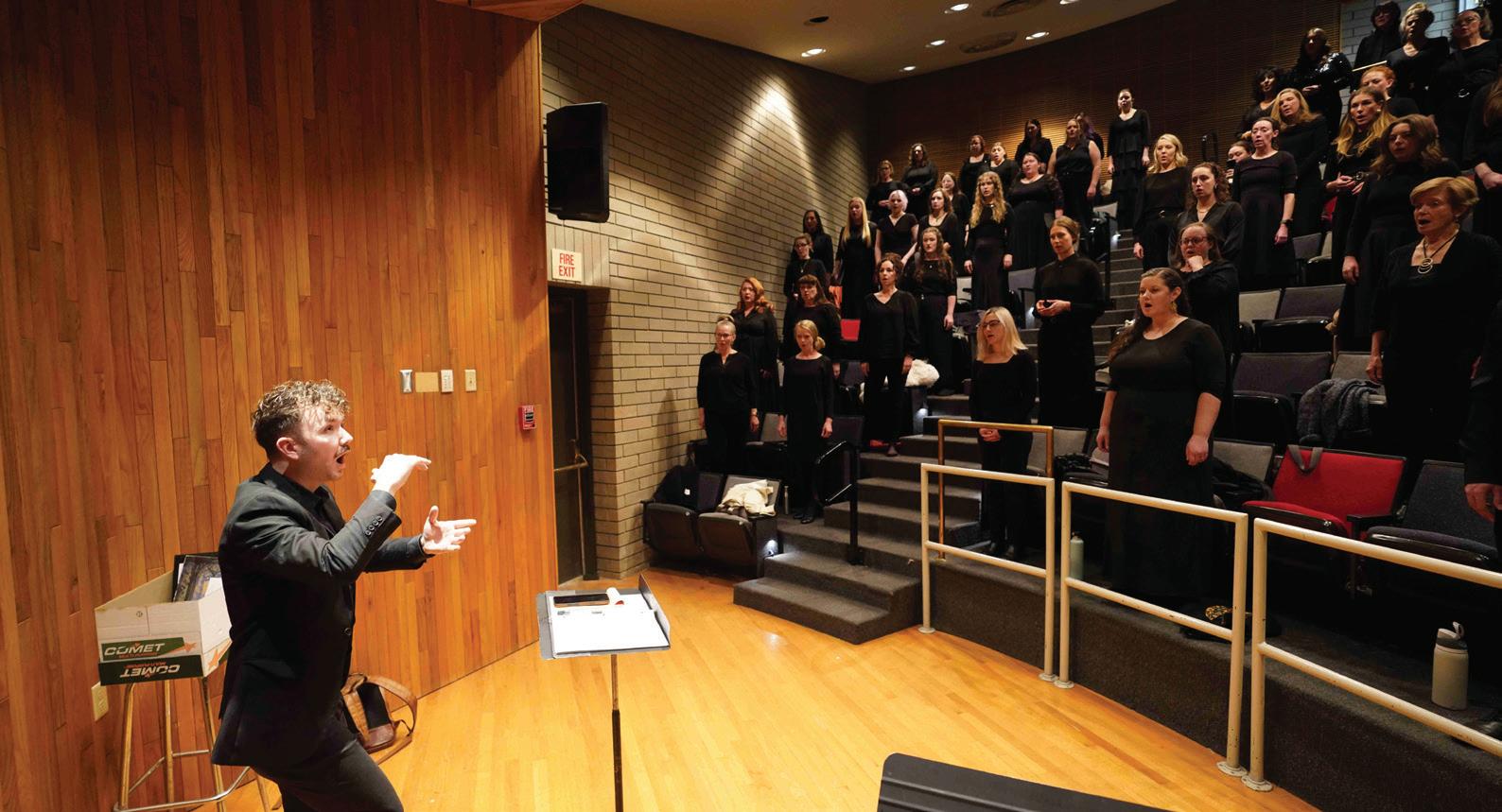

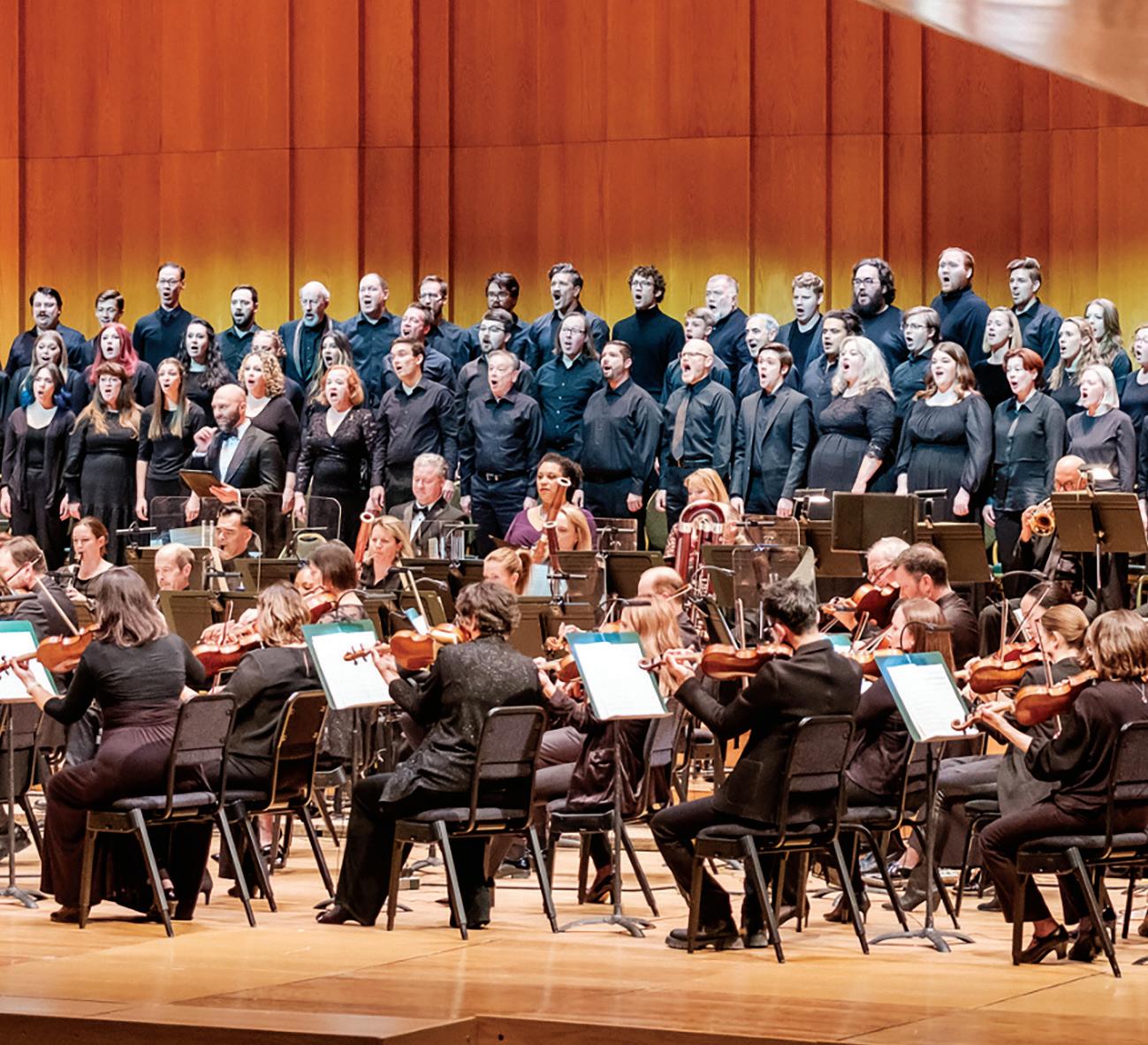
Utah Symphony Chorus Director Austin McWilliams warms up the singers before a performance of Fauré’s Requiem last fall.
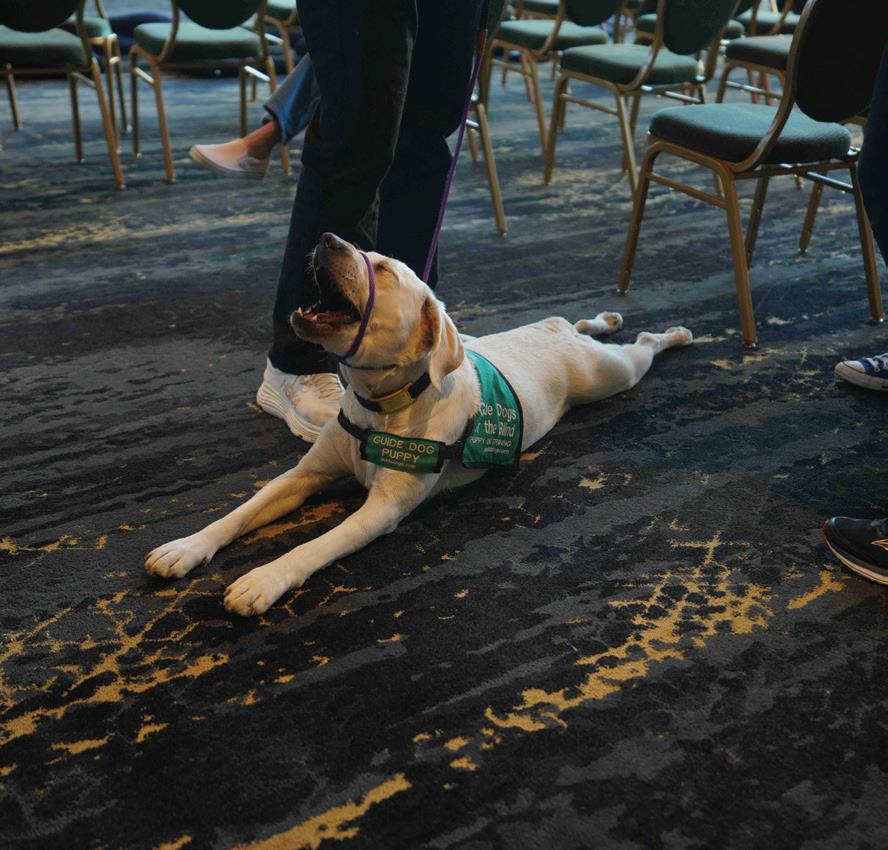
2. A guide dog puppy yawns after a Well-Being Concert in the lobby of Abravanel Hall in November.
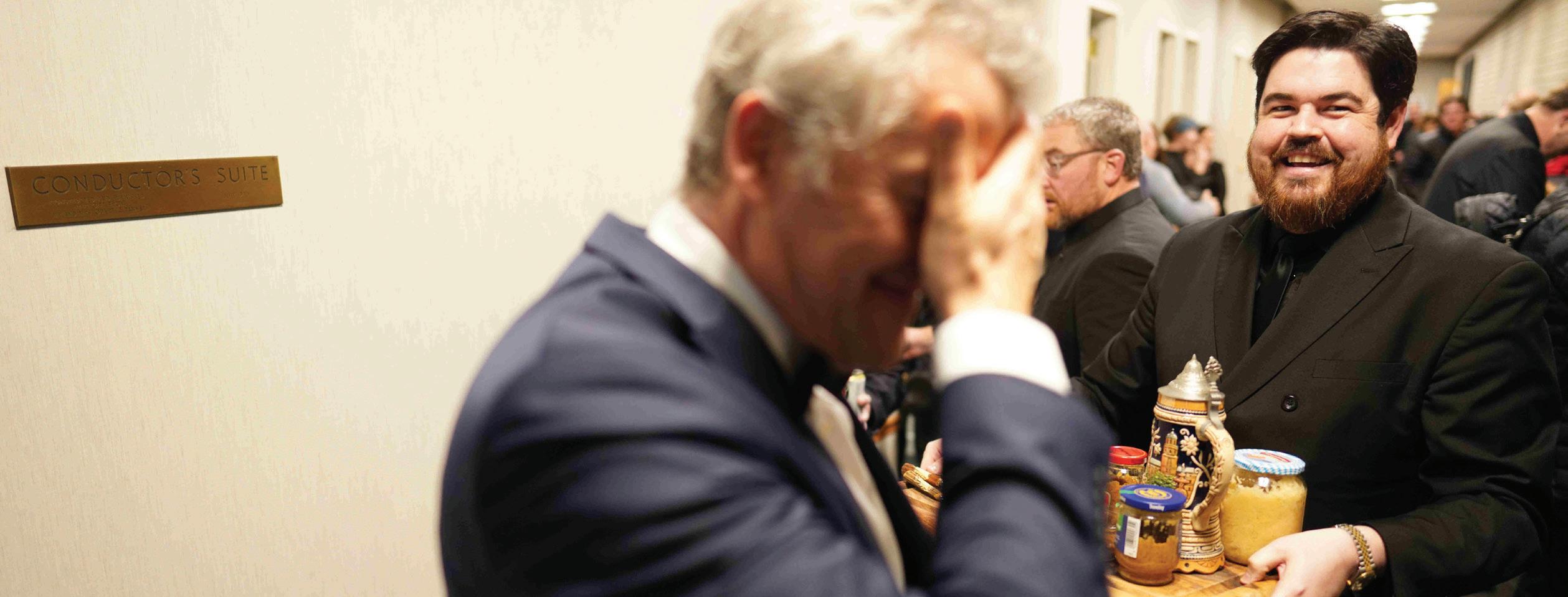
3. Our incoming Music Director Markus Poschner laughs after our musicians present him with a surprise German-themed afterparty following a performance of Strauss’ A Hero’s Life in December.
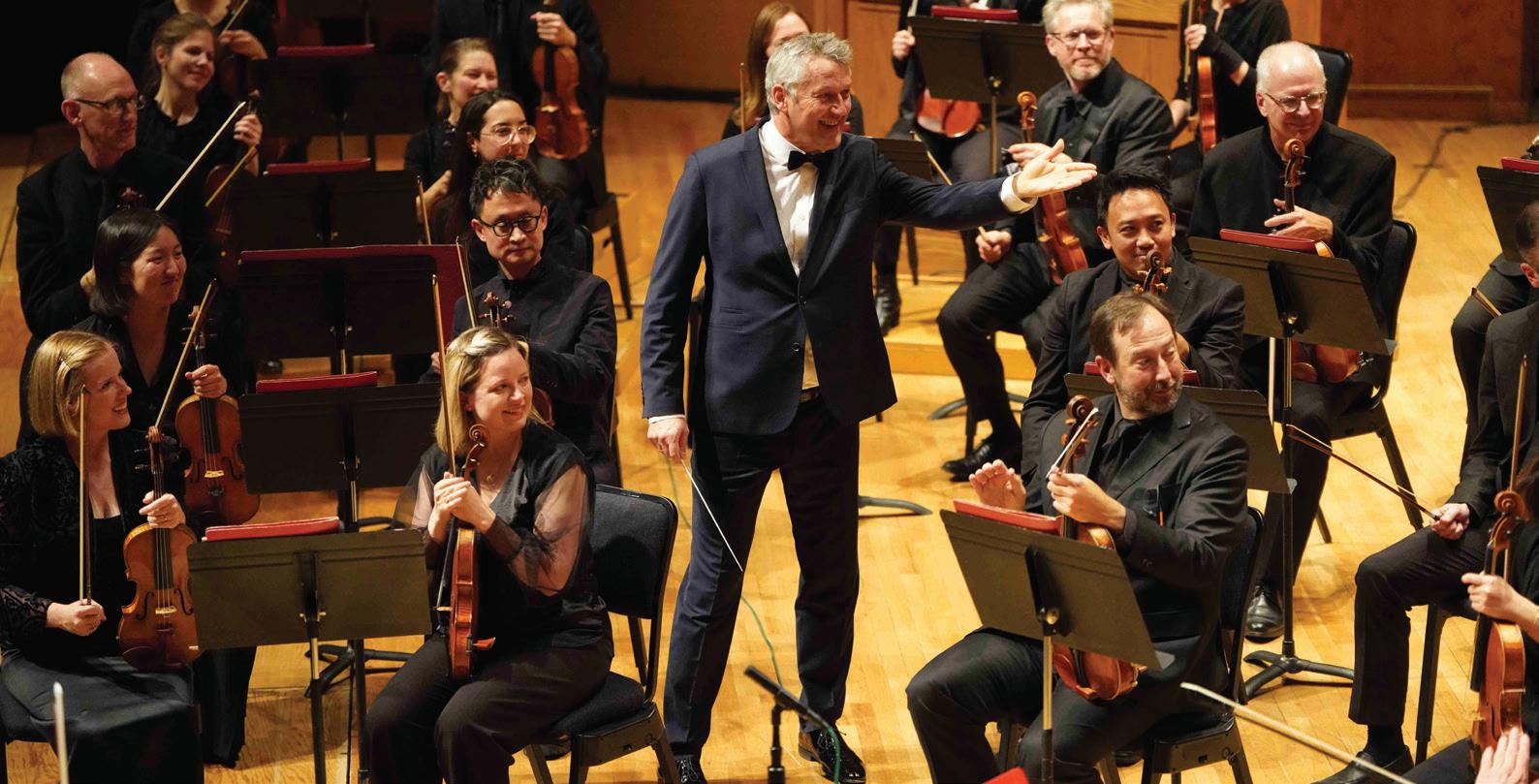
4. Poschner recognizes members of the orchestra after a performance of Tchaikovsky’s emotional “Pathétique” Symphony.
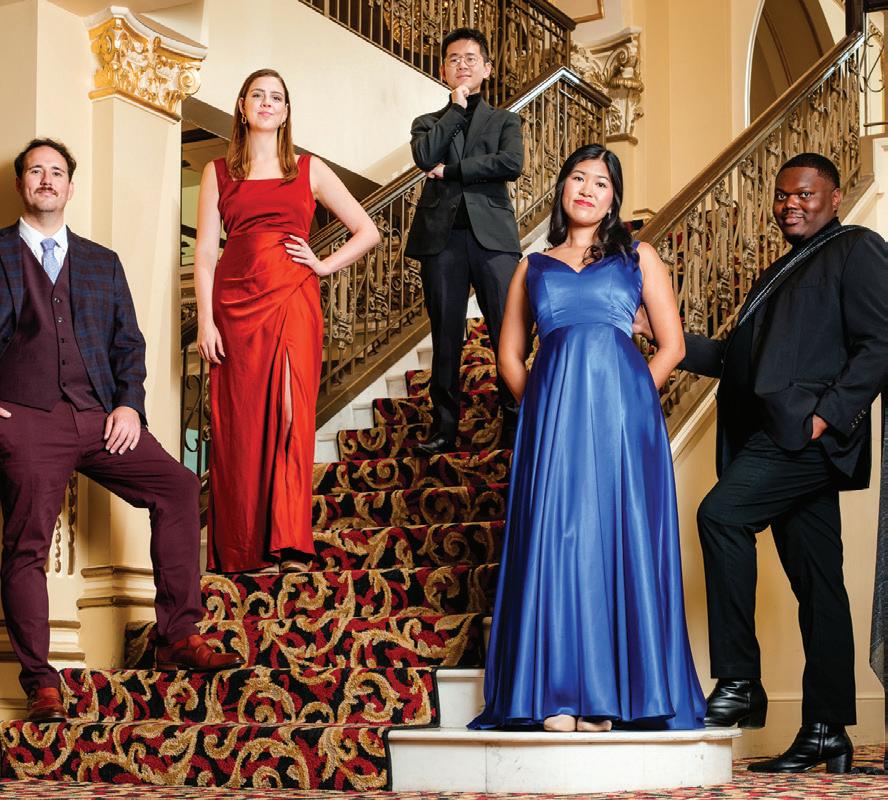
5. Our Resident Artists pose for a stunning class portrait at the Janet Quinney Lawson Capitol Theatre.
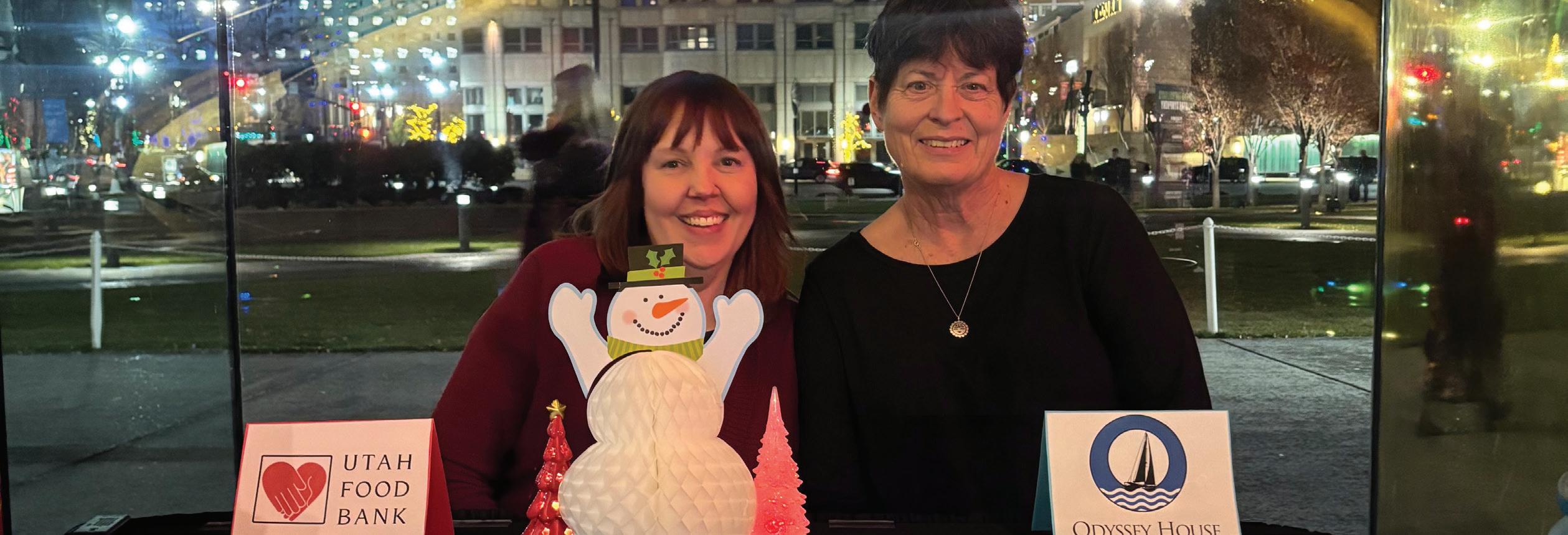
6. Violinist Becky Johnson and oboist/English horn Lissa Stolz collect donations of food, warm clothing, and blankets to support clients of Utah Food Bank and Odyssey House of Utah.
7. Students at Backman Elementary relax after participating in our Mindful Music Moments program in December.
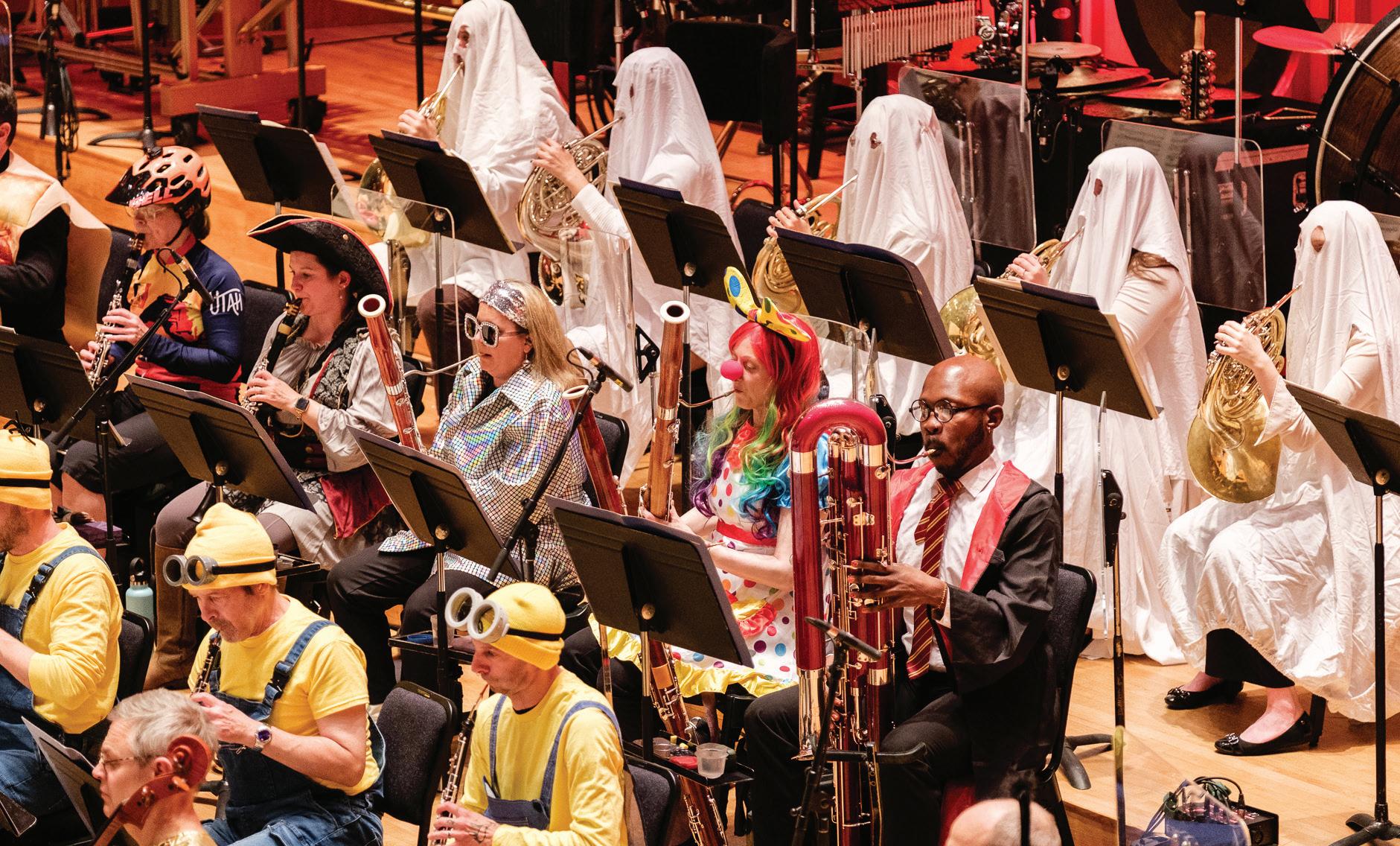
8. Our musicians show off their creative costumes during our annual Halloween Spooktacular concert in October.
ADMINISTRATION
Steven Brosvik
President & CEO
The O.C. Tanner Chair
David Green
Senior Vice President & COO
Micah Luce
Director of Human Resources & Organizational Culture
Julie McBeth
Executive Assistant to the CEO
Natty Taylor
Human Resources Manager
Farrah Valdez
Executive Assistant to the Senior VP & COO
SYMPHONY ARTISTIC
Kerry Smith
Vice President of Artistic Planning
Ebner Sobalvarro
Director of Orchestra Personnel
Laura Conrad
Interim Director of Orchestra Personnel
Hannah Thomas-Hollands
Orchestra Personnel Manager
Morgan Moulton
Artistic Planning Manager
Jessica Rivero Altarriba Assistant Conductor
Guillermo Sanchez
Artistic Planning Coordinator & Assistant to the Music Director
OPERA ARTISTIC
Christopher McBeth
Opera Artistic Director
Austin McWilliams
Chorus Director & Opera
Assistant Conductor
Deborah Robertson
Principal Coach
Michelle Peterson Director of Production
Ashley Tingey
Production Coordinator
Stephanie Chee, Soprano
Julia Holoman, Mezzo-Soprano
Aaron McKone, Tenor
Rodney Sharp II, Baritone
Jie Fang Goh, Piano
Resident Artists
SYMPHONY OPERATIONS
Jen Shark
Director of Orchestra Operations
Melissa Robison
Front of House Director
Chip Dance Director of Production
Fiona McGowan
Operations Manager
Sarah Madany
Stage Manager
Garrett Vargo
Assistant Stage Manager
OPERA TECHNICAL
Kelly Nickle
Properties Master
Dusty Terrell
Scenic Charge Artist
JR Orr
Head Carpenter/Shop Foreman
COSTUMES
Carol Wood
Costume Director
Marcos Ambriz
Cutter/Draper & Costume Manager
Abby Gehring
First Hand
Mallory Goodman
Costume Rentals & Collection Manager
Spencer Smith
Costume Rentals & Collection Assistant Manager
Milivoj Poletan
Master Tailor
Kathryn Wieland
Assistant Tailor
Julie Porter
Crafts Artisan/Milliner
Amy Fernelius
Lee Sego Stitchers
Leslie Peterson
Vice President of Development
Garrett Murphy Director of Development
David Hodges
Director of Development, Institutional Giving
Calli Forsyth
Assistant Director of Institutional
Sponsorships and Engagement
Katie Swainston
Assistant Director of Individual Giving
Lisa Poppleton
Grants Manager
Dallin Mills
Development Database Manager
Ellesse Hargreaves
VIP and Sponsorship Benefits Manager
MARKETING & COMMUNICATIONS
Meredith Kimball Laing
Vice President of Marketing &
Communications
Amelia England
Director of Marketing
Julia Lyon
Communications Manager
Emma Price
Marketing Manager
Nina Starling
Website Content Coordinator
Camila Baltazar
Marketing & Communications Coordinator
PATRON SERVICES
Caitlin Marshall
Sales & Engagement Manager
Toby Simmons
Patron Services Assistant Manager
Genevieve Gannon
Group Sales Associate
True Moore
Chloe Toyn
Patron Services Specialists
Michael Gibson
Ananda Spike
Val Tholen
Samantha Morris
Kjelbi Elassali
Tanush Saran
Patron Services Associates
ACCOUNTING & INFORMATION TECHNOLOGY
Jeffrey Andreasen
CFO
Mike Lund
Director of Information Technologies
Melanie Giles Controller
Jared Mollenkopf
Patron Information Systems Manager
Bobby Alger
Accounts Payable Specialist
EDUCATION & COMMUNITY ENGAGEMENT
Ben Kipp
Vice President of Education & Community
Engagement
Kevin Nakatani
Opera Education Manager
James Wesson
Symphony Education Manager
Beth Foley
Education Coordinator
We would also like to recognize our volunteers, interns, and temporary and contracted staff for their work and dedication to the success of Utah Symphony | Utah Opera.

DISCOVER THE ADVENTURE-READY, CITY-SAVVY 2025 BMW X3.
When you pair “adventure ready” with “city savvy,” you’ll find a vehicle that lives at the intersection of downtown avenues and mountain roads: the BMW X3.
With a reimagined design and sporty handling, the latest iteration of this icon doesn’t just tackle any journey with ease; it draws attention while doing it.
And it wouldn’t earn the X3 name without versatility at its heart and a premium interior that makes it unmistakably BMW.
Visit BMW of Murray or BMW of Pleasant Grove for exceptional offers on the BMW X3.
BMW of Murray
4735 S. State Street
Murray, Utah
801-262-2479
bmwofmurray.com
BMW of Pleasant Grove 2111 West Grove Parkway Pleasant Grove, Utah 801-443-2000
bmwofpg.com
FRIDAY, JANUARY 30, 2026 / 7:30 PM / MAURICE ABRAVANEL HALL
SATURDAY, JANUARY 31, 2026 / 7:30 PM / MAURICE ABRAVANEL HALL
THIERRY FISCHER, conductor
SIOBHAN STAGG, soprano * UTAH SYMPHONY
MOZART
Ser (13’)
Exsultate, jubilate (16’)
I. Allegro
II. Recitativo - Andante
III. Allegro (Allelujah)
INTERMISSION
MAHLER
Symphony No. 4 in G major (58’)
I. Bedächtig, nicht eilen
II. In gemächlicher Bewegung, ohne Hast
III. Ruhevoll (Poco adagio)
IV. Sehr behaglich
*Utah Symphony debut
ORCHESTRA SPONSOR

CONDUCTOR SPONSOR
PATRICIA RICHARDS & WILLIAM NICHOLS
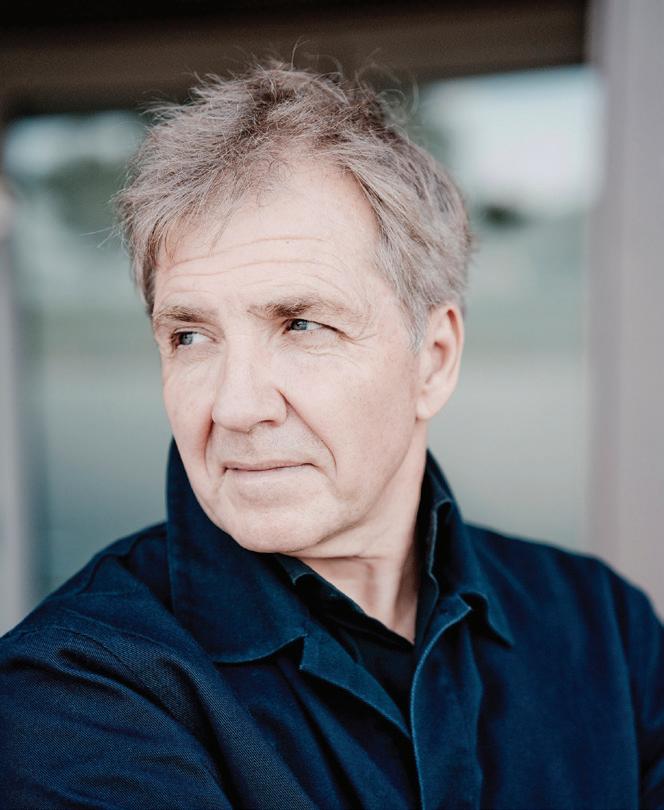
THIERRY FISCHER HAS BEEN MUSIC DIRECTOR OF THE SÃO PAULO SYMPHONY since January 2020 and of the Orquesta Sinfónica de Castilla y León since September 2022. He is also Music Director Emeritus of the Utah Symphony (where he was Music Director from 2009–2023).
Fischer has conducted orchestras across the globe, notably the Cleveland Orchestra, the Boston, Atlanta, and Cincinnati Symphonies, London Philharmonic, Royal Philharmonic, Oslo Philharmonic, Rotterdam Philharmonic, and Maggio Musicale Firenze, among others. He has performed and commissioned many world premieres, and works with the London Sinfonietta, Ensemble Intercontemporain and other leading chamber orchestras such as the Chamber Orchestra of Europe, Orchestra of the Age of Enlightenment, and Swedish Chamber.
April 2024 saw the launch of the Frank Martin Odyssey, of which Fischer is Artistic Director. To celebrate the 50th anniversary of his compatriot’s death, Fischer has curated a series of concerts running through the end of 2026 in which every note of Martin’s oeuvre will be performed in Geneva. As part of the festival, he conducted the world premiere of a newly commissioned orchestration of the ballet Die blaue Blume with the Orchestre de Chambre de Lausanne in their main season and at the Amsterdam Concertgebouw.
Stagg
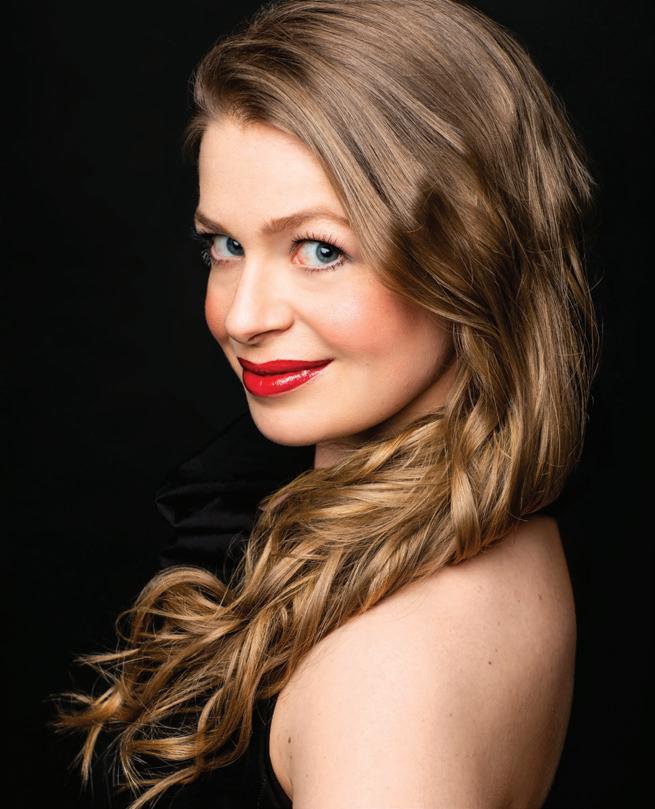
WITH HER “ANGELIC VOICE” (Kölner Stadt Anzeiger) and “ethereal stage presence” (Sydney Morning Herald), soprano Siobhan Stagg is one of today’s leading lyric artists.
As a former member of the Deutsche Oper Berlin ensemble, she has sung Pamina in Die Zauberflöte, Tytania in A Midsummer Night’s Dream, and Micaëla in Carmen and has since appeared as the title role in Cendrillon (Lyric Opera of Chicago), Pamina in Die Zauberflöte, Susanna in Le nozze di Figaro (Royal Opera House, Covent Garden), Sophie in Der Rosenkavalier (Opernhaus Zürich; Staatsoper Berlin), the title role in Lady Magnesia (Bayerische Staatsoper) and many more.
In 2025–26 she debuts as Juliette in Roméo et Juliette (State Opera South Australia), Adalgisa in Norma (Irish National Opera), returns to Staatsoper Berlin as Antonia/Stella in Les contes d’Hoffmann, and appears in concert with Melbourne Symphony, Staatskapelle Dresden, Minnesota Orchestra, Trondheim Symphony, Nord Deutscher Rundfunk, Orchestre National de Lyon, and Orchestre National du Capitole de Toulouse. She also looks forward to returning to London’s Wigmore Hall in recital with Jonathan Ware.
BY NOEL MORRIS
In a time when the conducting world was all but closed to women, Tania León studied the art with Seiji Ozawa and Leonard Bernstein.
The soprano takes on two different characters in this concert. With Mozart, she must maintain steady breath support to sound effortless across ornate passages while crossing the extremes of her range. In Mahler’s Symphony No. 4, the composer asked for “happy childlike expression, definitely without parody!”
With Gustav Mahler, music emerged as a fusion of poetry, philosophy, and spirituality, alongside perceptions of the natural, visual, and auditory worlds. With the multi-layered Symphony No. 4, he kept most of these inspirations to himself and left it to us to discern its meaning.
Ser
TANIA LEÓN
born May 13, 1943, in Havana, Cuba
composed in 2017 premiered in Los Angeles, California, in 2017 Utah Symphony premiere
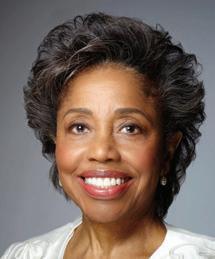
On December 4, 2022, Cuban-American composer Tania León took the stage alongside George Clooney, Gladys Knight, Amy Grant, and members of U2—the 2022 Kennedy Center Honorees. “Little did I imagine when studying in La Habana that life was going to grace me with such a distinction,” León beamed. “My first thoughts went to my ancestors: they believed in my dreams, and what we lacked in material wealth, they made up for in spirit, encouragement, and support.”
Despite winning a Pulitzer Prize and a lifetime of appearances with the world’s leading performers, León remains firmly rooted in her Cuban family. She wrote Ser (the Spanish word for “to be”) as a tribute to her ancestors, who include people of French, Spanish, African, and Chinese descent. In the 1960s, she was one of 300,000
Cubans who emigrated to the United States, where she quickly threw herself into establishing major cultural organizations in New York City and beyond, including the Dance Theater of Harlem and the Brooklyn Philharmonic’s Community Concert Series. She’s held advisory roles with the New York Philharmonic and the American Composers Orchestra and has guest-conducted orchestras worldwide.
The Music
Ser is a life-affirming stream of consciousness with rhythmic, playful, and jubilant aspects, as well as a hint of Afro-Cuban big band music. It opens with “night music” before growing into a joyful romp. The piece is an exercise in contrast, melding the colorful flavors of the composer’s multicultural roots.
WOLFGANG AMADEUS MOZART
born January 27, 1745, in Salzburg, Austria died December 5, 1791, in Vienna
composed in 1773 premiered in Vienna, in 1786 last performed by the Utah Symphony in July 2016 with conductor Jayce Ogren and soprano Simone Osborne
The Backstory
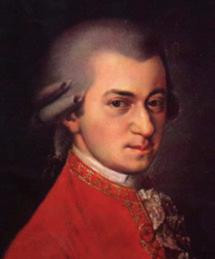
In October 1772, 16-year-old Wolfgang Mozart crossed the Alps with his father for a job: to write and produce an opera for Carnival season in Milan. They arrived on November 4th, and the boy got to work: composing and rehearsing the cast for a December 26th premiere. The opera, Lucio Silla, ran for 26 performances—by all measures, a success. Young Mozart especially liked the singing of the leading man, soprano Venanzio Rauzzini, a famous castrato (yes, that word means what you think it means).
Rauzzini was a virtuoso, with beautifully rounded highs and lows, and Mozart decided to give him a show-off piece worthy of his technique.
The Music
Although Exsultate, jubilate functions as a sacred motet to be performed during High Mass (especially on feast days), it is, for all intents and purposes, a concerto for solo voice. The piece has everything the composer could throw at the intrepid soloist, from giant leaps to fleet-footed runs. It
also hints at Mozart, the emerging opera composer, with a recitative and tender aria in the middle.
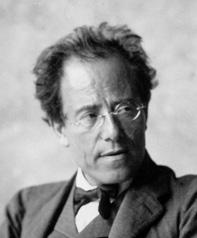
born July 7, 1860, in Kaliště, Bohemia died May 18, 1911, in Vienna
composed in 1899–1900 premiered in Munich, Bavaria, in 1901 last performed by the Utah Symphony in May 2015 with Thierry Fischer conducting
The Backstory
Gustav Mahler’s compositions hold a mirror up to a dizzying, volatile, and fast-changing world, marked by the advent of industry, urbanization, automobiles, lightbulbs, and anti-Semitism. Mahler felt at odds with society: he was a Bohemian Jew working in Catholic Austria. And as a major conducting talent, he was a bookish nature-lover stuck in urban environs. As a young composer, Mahler took refuge in a set of German-language folk poems about rural life called Des Knaben Wunderhorn (The Youth’s Magic Horn).
With the Wunderhorn poems in hand, Mahler wrote songs. With the songs, he wrote symphonies.
Des Knaben Wunderhorn
At the start of the nineteenth century, German unification was still decades away. In the city of Göttingen, two 20-somethings forged a friendship: Ludwig Achim von Arnim and Clemens Brentano. They took a river cruise together and laughed through the night as they traded songs from childhood. Along the way, they picked up some folk-song anthologies, and their famous collection, Des Knaben Wunderhorn, began to take shape.
If you’re picturing ethnomusicologists transcribing songs from the back country—this isn’t it. Arnim and Brentano were poets who harvested a collection of folk poems from books. They edited them, re-wrote them, and composed new ones from scratch to create their own take on rural life.
As Napoleon’s army bulldozed its way into Central Europe, their work assumed greater urgency. They considered the patchwork of states that made up the German-speaking world and began to see Wunderhorn as a way to forge cultural unity.
Though Des Knaben Wunderhorn started as a pastiche by two Romantic poets, the poems have since become the thing they aspired to be: a memory of a pre-industrialized world—the seasons, wanderlust, loneliness, love, loss, nature, and death—the very things that a nostalgic composer like Mahler put to music.
Eighty years later, he took up the poems, rewrote them to suit his purposes, and set 24 to music between 1887 and 1901. He orchestrated 14 and liberally repurposed them for his Symphonies Nos. 2-4.
One of the Wunderhorn poems came from the German idiom “Der Himmel hängt voller Geigen,” which means “Heaven hangs full of violins” and describes a state of euphoria, akin to what we call “cloud nine.” In 1892, Mahler modified the poem into “Das himmlische Leben,” in which a child describes Heaven. Initially, the composer planned to use the song as the finale to his Third Symphony. In that context, it capped a metaphysical journey that began with “Pan Awakes” and passed through revelations gleaned from the flowers, the animals, man, the angels, love, and, finally, the child—a movement subtitled “What the Child Tells Me.”
Mahler then had second thoughts and moved the “Child” movement—the song about Heaven—to the finale of his Fourth Symphony. With “Das himmlische Leben” as his source, he derived an entire three-movement prologue, all forged through links to the finale (plus a passing reference to the opening of the yet-to-be-written Fifth Symphony).
It’s hard to wrap one’s head around the idea of basing a symphony on the death of children. But it’s a subject that was ever-present in Mahler’s life. By the time he was twenty, he’d outlived eight of his 13 siblings. Across the Austrian Empire, children died of disease and suffered from food scarcity (which informs the nature of the text in the last movement). At the same time, Mahler tapped into the notion that children, uncorrupted by the world, are closer to divinity. The child is the vessel through which Mahler conveys notions of Paradise. In essence, the Fourth Symphony is Mahler’s metaphysical reflection on childhood and a journey to Paradise.
To bring us into the child’s view of the world, Mahler scored for a smallish orchestra. Notice, there are no trombones. The opening jingle signals humor (like a jester). The frolicsome first movement radiates a childlike sense of detachment. The second movement playfully dances around a spooky skeletal figure from German folklore,
“Freund Hein,” or “Friend Death,” portrayed by a rawsounding solo fiddle. Here, Mahler indicated the use of a violin tuned up a step to give it a shrill quality. The composer offered a couple clues to the third movement: “a vision of a tombstone on which was carved an image of the departed, with folded arms, in eternal sleep.” He said he also found himself preoccupied by thoughts of his mother, who often smiled through her tears.
Mahler wrote the third movement in the form of theme and variations, but achieved a “static bliss,” as biographer
Henri-Louis de La Grange put it. Notice how he stitched the movement together over a repeated bass line (even sounding in the great timpani strikes at the end). Gradually, the variations pass through various moods and scenes, including a folk dance called a ländler, until, in one cataclysmic gesture, the gates of Paradise fly open. The symphonic journey arrives at the fourth movement with the mythical child (soprano soloist) serving as host to a Heavenly feast prepared for us by a joyful communion of saints. Symphony No. 4 became the bookend to Mahler’s four Wunderhorn symphonies. He would reinvent himself to write the Fifth.

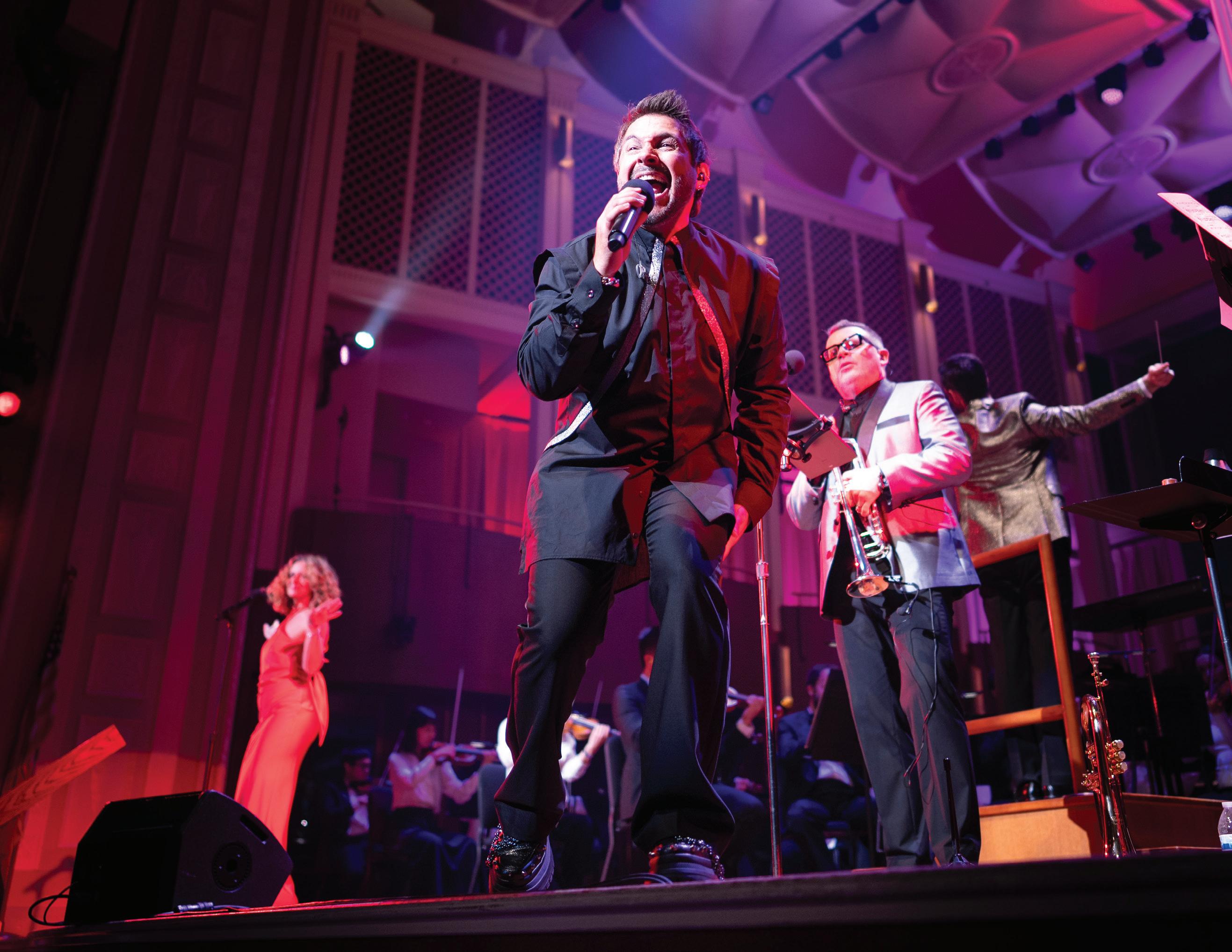
FRIDAY, FEBRUARY 6, 2026 / 7:30 PM / MAURICE ABRAVANEL HALL
SATURDAY, FEBRUARY 7, 2026 / 5:30 PM / MAURICE ABRAVANEL HALL
ALPESH CHAUHAN, conductor*
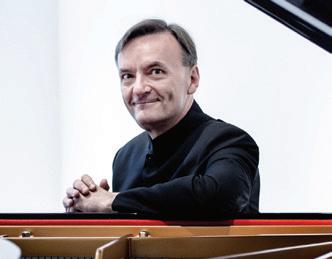
STEPHEN HOUGH, piano
UTAH SYMPHONY
TCHAIKOVSKY
RACHMANINOFF
Polonaise from The Golden Slippers (Cherevichki) (07’)
Rhapsody on a Theme of Paganini, Op. 43 (23’)
INTERMISSION
SHOSTAKOVICH
Symphony No. 5 in D minor, Op. 47 (46’)
I. Moderato
II. Allegretto
III. Largo
IV. Allegro non troppo
*Utah Symphony debut
CONCERT SPONSOR
STOWELL
LEADERSHIP GROUP
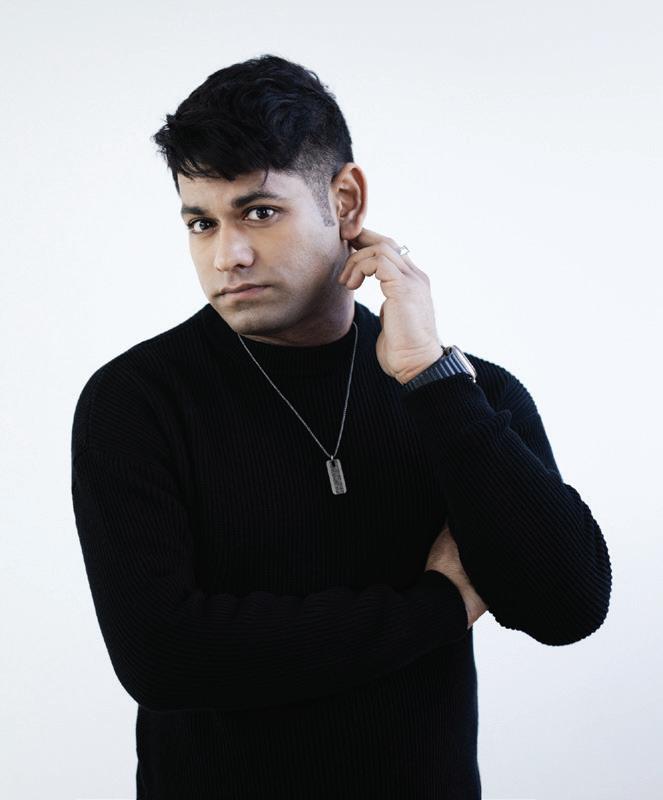
GUEST CONDUCTOR OF THE DÜSSELDORFER SYMPHONIKER, Music Director of Birmingham Opera Company, and Principal Conductor & Musical Advisor of the National Youth Orchestra of Great Britain, Alpesh Chauhan is equally praised for his “exceptional musical talent” (GBOPERA) and his “lithe, expressive and bold conducting style” (Seen and Heard).
He has firmly established himself on the international stage and works regularly with orchestras including City of Birmingham Symphony, Hallé Orchestra, Adelaide Symphony, Oslo Philharmonic, Antwerp Symphony, Stavanger Symphony, Detroit Symphony, Phil Zuid, Orchestre National de Belgique, Vancouver Symphony, and National Youth Orchestra of Great Britain.
Following his debut in 2015, he was appointed Principal Conductor of the Filarmonica Arturo Toscanini in Parma, where he performed complete cycles of the symphonies by Beethoven and Brahms. Chauhan has a longstanding relationship with BBC Scottish Symphony, with whom he was former Associate Conductor and appeared at the BBC Proms in 2022. He continues to appear regularly as a guest conductor and is currently partnering with them on a Tchaikovsky cycle with Chandos Records.
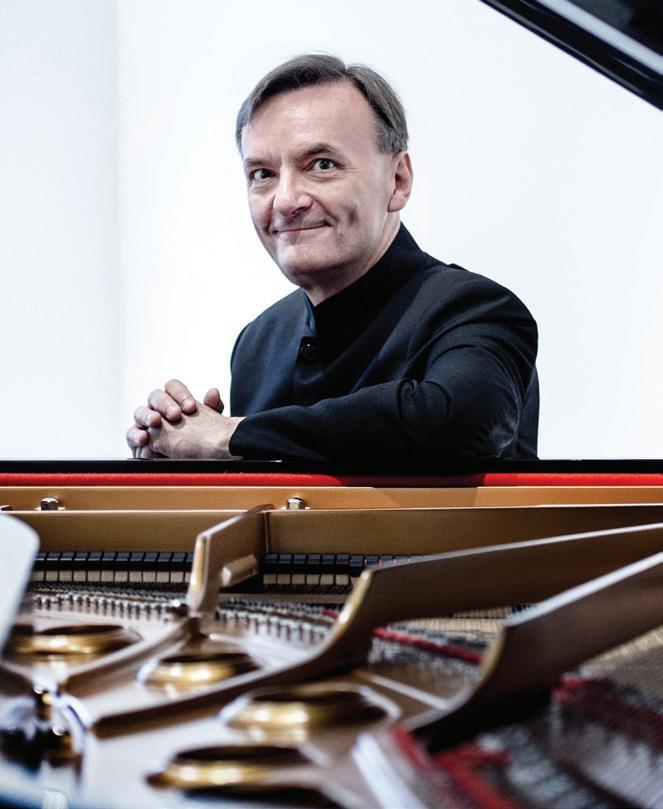
ONE OF THE MOST DISTINCTIVE ARTISTS OF HIS GENERATION, Sir Stephen Hough combines a distinguished career as a pianist with those of composer and writer.
Named by The Economist as one of Twenty Living Polymaths, Hough was the first classical performer to be awarded a MacArthur Fellowship (2001). He was awarded Northwestern University’s 2008 Jean Gimbel Lane Prize in Piano, won the Royal Philharmonic Society Instrumentalist Award in 2010, and in 2016 was made an Honorary Member of RPS. In 2014 he was made a Commander of the Order of the British Empire (CBE) and was knighted in the Queen’s Birthday Honours in 2022.
Since taking first prize at the 1983 Naumburg Competition in New York, Hough has appeared with most of the major European, Asian, and American orchestras and plays recitals regularly in major halls and concert series around the world from London’s Royal Festival Hall to New York’s Carnegie Hall. He has been a regular guest at festivals such as Aldeburgh, Aspen, Blossom, Edinburgh, La Roque d’Anthéron, Hollywood Bowl, Mostly Mozart, Salzburg, Tanglewood, Verbier, and the BBC Proms.
BY NOEL MORRIS
Sergei Rachmaninoff loved fast cars and spent hours crisscrossing American highways between concerts. He became a United States citizen in 1943.
In 1937, Soviet authorities declared Dmitri Shostakovich an enemy of the people, prompting him to write his Fifth Symphony as an apology.
Tchaikovsky’s The Golden Slippers is based on a libretto by Yakov Polonsky, written at the request of the granddaughter of Catherine the Great. Ironically, the tsar’s censors prohibited the portrayal of Grandmama onstage, and Tchaikovsky had to change the libretto.
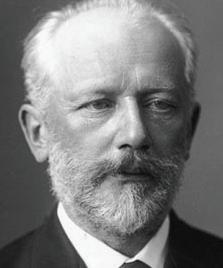
PYOTR ILYICH TCHAIKOVSKY
born May 7, 1840, in Votkinsk, Russia died Nov 6, 1893, in St. Petersburg
composed in 1874 and revised in 1885 premiered in Moscow, in 1887 Utah Symphony premiere
The Nightmare Before Christmas?
In 1832, the 23-year-old Ukrainian author Nikolai Gogol published a short story about the Devil making mischief on Christmas Eve. Mingling comedy and horror, his story features the Devil, who disrupts holiday celebrations by stealing the moon. Undaunted, a wily blacksmith—Vakula— visits the girl of his dreams. She promises to marry him if he brings her the slippers of Catherine the Great. Vakula tricks the Devil into helping him. Empress Catherine finds the blacksmith charming and gives him her slippers.
In 1874, fiction met real life when Catherine’s granddaughter, Grand Princess Elena Pavlovna, staged an opera competition based on Gogol’s story. Different composers wrote music using the libretto she provided. Tchaikovsky drafted his submission in three months but waited a year to learn he’d won the competition. Alas, his comedy didn’t do well at the box office. In 1885, he revised his opera and titled it Cherevichki (The Golden Slippers).
The Polonaise comes from Act III, during the Empress’s Christmas celebration. The blacksmith wonders, “Have I reached Heaven, or is all this just a dream?”
The libretto describes “a hall in the palace with columns, lamps, and candelabras. A crowd of guests and courtiers in period costume. They are dancing in couples to the rhythm of a polonaise.” Traditionally, a polonaise is a Polish dance in 3/4 time, a walking dance in which couples process around a room.
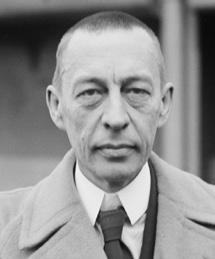
born April 1, 1873, in Semyonovo died March 28, 1943, in Beverly Hills, California
Rhapsody on a Theme of Paganini
composed in 1934
premiered in Baltimore, in 1934 last performed by the Utah Symphony in July 2022 with conductor John Morris Russell
Niccolò Paganini was one of the original goths. With “large, black eyes, [a] hooked nose, and jet black hair,” some described his pale face as cadaverous. Onstage, his long, wiry frame twisted into strange postures as he played violin. He seemed demon-possessed, and people whispered that he’d sold his soul. As a natural showman, Paganini did nothing to convince them otherwise.
Setting the bar for all future players, he distilled his violin gymnastics into a fiendish set of solo pieces, “caprices,” and went down in history as one of the all-time greatest players.
Beyond the mythology, Paganini’s 24th Caprice cast a spell over composers. Dozens have written music based on its bouncy tune, including Johannes Brahms, Frédéric Chopin, Franz Liszt, Andrew Lloyd Webber, Benny Goodman, and the Russian metal band Aria.
Two months after the Bolsheviks seized power, the esteemed composer and conductor Sergei Rachmaninoff slipped out of Russia. He left his estate, his friends, and his career, reducing his entire existence to a couple of suitcases. But that wasn’t the worst part; he, his wife, and kids had no country, no security, and no income. The
Rachmaninoffs moved to America in 1918, where Sergei embarked on a piano career to rebuild his fortune.
In 1930, he and his wife, Natalia, bought a lakeside property in Lucerne and christened it “Senar” (Sergei-NataliaRachmaninoff). Bathing in the natural beauty of the Swiss Alps, the composer found his muse in 1934 and wrote a set of variations on Paganini’s 24th Caprice. The sections take on wildly different personalities. One echoes the sound of jazz pianist Art Tatum. Several variations include the spooky medieval chant Dies irae (Day of Wrath). He created the tender eighteenth variation by flipping the Paganini tune upside down.
In 1937, choreographer Mikhail Fokine suggested turning the Rhapsody into a ballet. Rachmaninoff loved the idea and responded with a scenario.
“Consider the Paganini legend—about the sale of his soul…in exchange for perfection in art, and for a woman,” he wrote. “All variations on the Dies irae would be for the Devil. …the eleventh variation to the eighteenth—these are the love episodes.” Variation nineteen would be the “triumph of Paganini’s art.” The ballet Paganini debuted in London in 1939.
It is one of only six major compositions Rachmaninoff wrote during his 25 years in exile.
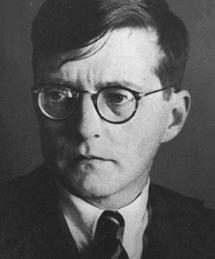
born September 25, 1906, in St. Petersburg, Russia died August 9, 1975, in Moscow
composed in 1937 premiered in Leningrad, in 1937 last performed in full by the Utah Symphony in March of 2022 with conductor Francesco Lecce-Chong (the third movement is part of this year’s in-school education concerts performed throughout Utah)
What to Listen for
Dmitri Shostakovich wrote his Fifth Symphony after failing to comply with Soviet artistic standards. Many find his piece sarcastic and subversive. What do you hear?
The Backstory
Dmitri Shostakovich was only 11 when the Bolsheviks seized power. He entered the Petrograd Conservatory two
years later, and his First Symphony made its rounds among top Soviet orchestras by the time he reached 19.
Shostakovich became a poster child for Soviet art, and his country demanded much of him. At 24, friends commented on his sickly appearance. What they didn’t know was that the composer, beyond the multitude of concerts and public appearances, had begun a project for himself, an opera called Lady Macbeth of Mtsensk
Basing his piece on a Party-approved satirical novella, he drafted a potent score framing a super-charged story of love, sex, and murder. The show premiered on January 22, 1934, and became one of the most successful operatic debuts in history. Night after night, Leningrad audiences packed the house. Soon, it opened in Moscow and, within two years, spread to the United States, Europe, and South America. In early 1936, two separate productions of Lady Macbeth of Mtsensk ran in Moscow. That’s when the massmurdering tyrant Joseph Stalin entered the picture. On January 26, he arrived at the Bolshoi Theater to see the show and walked out mid-performance.
Days later, the state-run newspaper Pravda published a blistering article titled, “Muddle Instead of Music.” Overnight, musicians across the Soviet Union dropped Shostakovich from their programs, and colleagues stopped speaking to him. The composer’s income fell by 75 percent. But he was not entirely contrite. He threw himself into completing his acerbic Fourth Symphony—a marvelous and terrifying piece that went into rehearsal with the Leningrad Philharmonic later that year. Under pressure from a skittish music community, the composer withdrew the piece and stowed it away, keeping it hidden for the next 25 years.
Now with his life in the balance and a new baby at home, Shostakovich needed to stage a comeback. He did it with the Fifth Symphony. Not a time for nuance, he subtitled his new piece “A Soviet Artist’s Response to Just Criticism.” It was a brilliant solution to a sticky problem, which poses interpretive questions for musicians. Is the Fifth Symphony an act of contrition or is it an act of defiance? Or is it both?
The composer gave Stalin everything required. His first movement harkens back to Beethoven with a volcanic opening. Shostakovich shows his love of Slavic culture with a familiar folksong. He gooses Soviet propaganda with a rousing military march (picture heroic tractors on parade). But in every case, the composer added a patina of something else—a bit of crunch to otherwise familiar musical territory.
The second movement aligns with Soviet life, suggesting popular entertainment, such as country dancers or circus performers. The third movement is dark. With heavy, hushed strings, the music wallows in a level of sorrow that necessitates redemption in the finale—the requisite happy ending.
This is where the composer cranks it up to eleven. The hair-raising fourth movement cycles through episode after episode of irresistible permutations of the opening tune, culminating in the heroic Hollywood ending. Here, the triumphant call of the brass and timpani signal the symphony’s conclusion again and again. And again. Until one wonders if it’s all a spoof. Hence, the scratching of heads.
Is the symphony really an acknowledgment of “just
criticism”? Or is it packed with sarcasm? Some ears detect a passing reference to Mussorgsky’s opera Boris Godunov, in which soldiers force people to cheer for the Tsar.
In the unverified memoir, Testimony, Shostakovich reportedly said this: “It’s as if someone were beating you with a stick and saying, ‘Your business is rejoicing, your business is rejoicing,’ and you rise, shaky, and go marching off, muttering, ‘Our business is rejoicing, our business is rejoicing.’”
The Leningrad Philharmonic gave the first performance of the Symphony No. 5 on November 21, 1937. According to witnesses, Shostakovich received a 40-minute ovation. Soviet authorities took the win and declared him a reformed citizen.
THURSDAY, FEBRUARY 12, 2026 / 7:00 PM / MAURICE ABRAVANEL HALL
FRIDAY, FEBRUARY 13, 2026 / 7:00 PM / MAURICE ABRAVANEL HALL
SATURDAY, FEBRUARY 14, 2026 / 7:00 PM / MAURICE ABRAVANEL HALL
SUSIE SEITER, conductor
UTAH SYMPHONY
WALT DISNEY PICTURES presents A PIXAR ANIMATION STUDIOS Film UP
Directed by PETE DOCTER
Co-Directed by BOB PETERSON
Produced by JONAS RIVERA
Executive Producers JOHN LASSETER & ANDREW STANTON
Screenplay by BOB PETERSON & PETE DOCTER
Story by PETE DOCTER, BOB PETERSON, TOM McCARTHY Music by MICHAEL GIACCHINO
Today’s performance lasts approximately 1 hour and 37 minutes, including a 20-minute intermission.
The performance is a presentation of the feature film Up with a live performance of the film’s score. Out of respect for the musicians and your fellow audience members, please remain seated until the conclusion of the end credits.
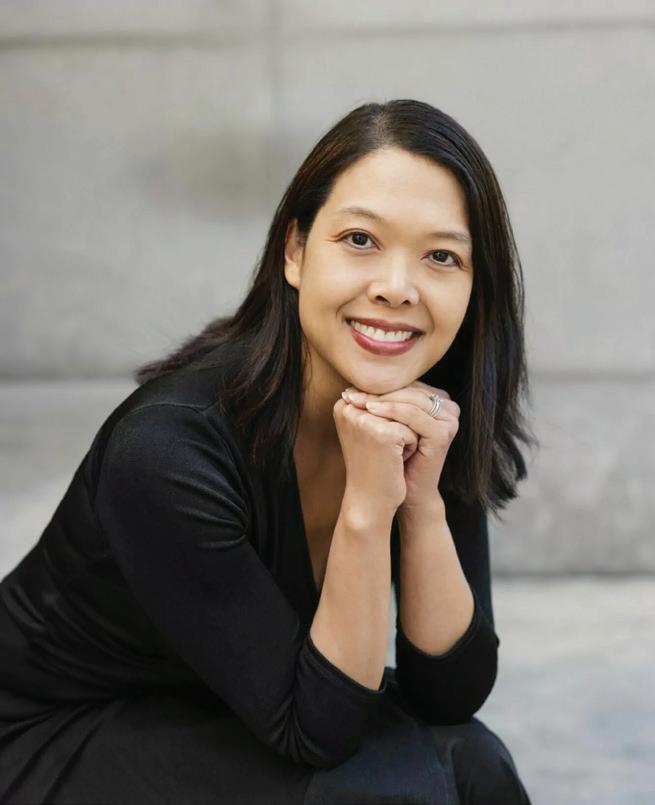
SUSIE BENCHASIL SEITER IS A PROLIFIC CONDUCTOR AND ORCHESTRATOR in film, television and video games. She hails from Baltimore where her early interests in choir and piano gave roots to her now thriving career. Seiter received rigorous training at University of Southern California’s Scoring for Motion Pictures and Television program.
Seiter began her career assisting Hollywood composers and working at Disney’s department of music preparation. She is best known for orchestrating the concert tour The Legend of Zelda: Symphony of the Goddesses, performed more than 90 times by respected orchestras. In 2013 Seiter worked alongside her husband, composer Chad Seiter, conducting and orchestrating his music to Star Trek: The Video Game. She followed that up with orchestration on another childhood favorite, Smurfs 2
Most recently, Seiter orchestrated Fox Studio’s animation The Book of Life, and she is currently conducting the concert tour Pokémon: Symphonic Evolutions, sharing orchestral music celebrated by all generations.
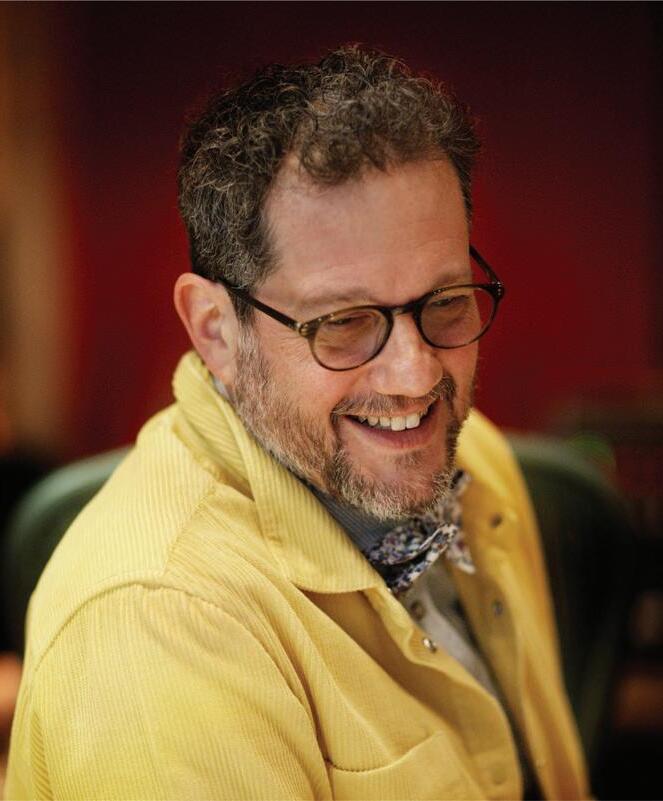
COMPOSER MICHAEL GIACCHINO HAS CREDITS ON POPULAR AND ACCLAIMED FILMS including The Incredibles, Ratatouille, Star Trek, Jurassic World, Rogue One, and Coco. Giacchino’s 2009 score for Up earned him an Oscar®, a Golden Globe®, the BAFTA, and two GRAMMY® Awards.
Giacchino studied filmmaking at the School of Visual Arts in NYC and later composition at Juilliard and UCLA. At Disney Interactive he wrote music for video games. After scoring The Lost World: Jurassic Park, Steven Spielberg hired him as composer, leading to work on the Medal of Honor series.
His video game work sparked the interest of J.J. Abrams, leading to scores for Alias, Lost, Mission Impossible III, Star Trek, Super 8, and Star Trek Into Darkness films.
Jojo Rabbit earned him a BAFTA nomination. His upcoming projects include Matt Reeves’ The Batman. Giacchino serves as Governor of the Music Branch of the Academy of Motion Picture Arts and Sciences.
FRIDAY, FEBRUARY 20, 2026 / 10:00 AM / MAURICE ABRAVANEL HALL (FINISHING TOUCHES)
FRIDAY, FEBRUARY 20, 2026 / 7:30 PM / MAURICE ABRAVANEL HAL
SATURDAY, FEBRUARY 21, 2026 / 7:30 PM / MAURICE ABRAVANEL HALL
DAVID ROBERTSON, conductor
MADELINE ADKINS, violin UTAH SYMPHONY
ROUSE
JOHN ADAMS
CARTER
HARRIS
Rapture (11’)
Violin Concerto (35’)
I. Quarter note = 78
II. Chaconne: Body through which the dream flows
III. Toccare
INTERMISSION
Holiday Overture (10’)
Symphony No. 3 (19’)
CONCERT SPONSOR
CONDUCTOR SPONSOR

GUEST ARTIST SPONSOR
THE SHIEBLER FAMILY FOUNDATION
DAVID ROBERTSON–CONDUCTOR, ARTIST, COMPOSER, THINKER, American musical visionary–occupies the most prominent podiums in orchestral and new music, and opera. He is a champion of contemporary composers, and an ingenious and adventurous programmer. Robertson has served in numerous artistic leadership positions, such as Chief Conductor and Artistic Director of the Sydney Symphony Orchestra, a transformative 13-year tenure as Music Director of the St. Louis Symphony Orchestra, with the Orchestre National de Lyon, the BBC Symphony Orchestra, and, as protégé of Pierre Boulez, the Ensemble InterContemporain. He appears with the world’s great orchestras, including the New York Philharmonic, The Philadelphia Orchestra, Los Angeles Philharmonic, Royal Concertgebouw Orchestra, Vienna Philharmonic, Czech Philharmonic, Leipzig Gewandhausorchester, São Paulo State Symphony Orchestra, Seoul Philharmonic Orchestra, and many major ensembles and festivals on five continents. Since his 1996 Metropolitan Opera debut, Robertson has conducted a breathtaking range of Met projects, including the 2019–20 season opening premiere production of Porgy and Bess, for which he shared a Grammy Award, Best Opera Recording, in March 2021. In 2022, he conducted the Met Opera revival of the production, in addition to making his Rome Opera debut conducting Janáček’s Káťa Kabanová. Robertson is the Director of Conducting Studies, Distinguished Visiting Faculty of The Juilliard School, New York, and serves on the Tianjin Juilliard Advisory Council. In the 2024–25 season, he celebrated the Boulez Centennial with the New York Philharmonic, Juilliard Orchestra, Aspen Music Festival, and Lucerne Festival Contemporary Orchestra; conducted the orchestras of Philadelphia, Cleveland, Seattle, San Francisco, Chicago, Seoul, Berlin, Leipzig, the NDR Elbphilharmonie Orchestra, and Symphonieorchester des Bayerischen Rundfunks. He leads European tours of the Deutsches Symphonie-Orchester Berlin and the Australian Youth Orchestra, and continues his three-year project as the inaugural Creative Partner of Utah Symphony | Utah Opera, where his guitar ensemble, Another Night on Earth, made its U.S. debut. Robertson is a Chevalier de l’Ordre des Arts et des Lettres of France, and is the recipient of numerous artistic awards. Discover more about David Robertson at ConductorDavidRobertson.com, and on Facebook, Instagram, Threads, and YouTube: @conductordavidrobertson.
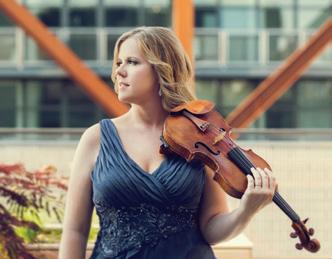
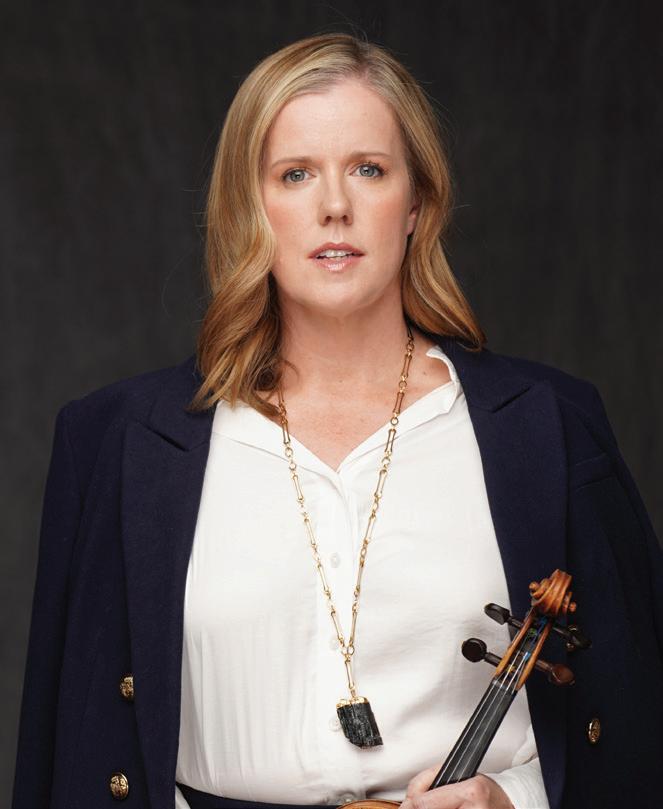
MADELINE ADKINS JOINED UTAH SYMPHONY | UTAH OPERA AS CONCERTMASTER in 2016. She served as Associate Concertmaster of the Baltimore Symphony Orchestra from 2005–2016.
She performs on the “ex-Chardon” Guadagnini of 1782, graciously loaned by Gabrielle Israelievitch to perpetuate the legacy of her late husband, former Toronto Symphony concertmaster, Jacques Israelievitch.
Adkins is a Concertmaster of the Grand Teton Music Festival and has served as Guest Concertmaster of the orchestras of Pittsburgh, Cincinnati, São Paulo, Houston, and Hong Kong, among many others. A sought-after soloist, Adkins has appeared with orchestras in Europe, Asia, Africa, and 26 U.S. states. Her recording of the complete works for violin and piano by Felix Mendelssohn was released to critical acclaim in 2016.
As an educator, Adkins has coached the National Youth Orchestra at Carnegie Hall, the National Orchestral Institute, and the Haitian Orchestra Institute. She completed her studies at the New England Conservatory and the University of North Texas. When not on stage, Adkins is passionate about animal rescue, and has fostered over 100 kittens!
BY NOEL MORRIS
For many years, Christopher Rouse taught composition and the history of rock and roll at the Eastman School of Music. He won the 1993 Pulitzer Prize for his Trombone Concerto.
Conductor David Robertson, Utah Symphony’s creative partner, is champion of American and contemporary composers; he’s recorded many works by John Adams, including the Violin Concerto. Last fall, he conducted saxophonist Tim McAllister and our musicians in the Utah premiere of Steven Mackey’s Anemology, recorded at Abravanel Hall.
Elliott Carter won two Pulitzer Prizes as a modernist. Holiday Overture came from his Neoclassical phase.
All the composers on tonight’s concert are associated with an American sound, yet their differences highlight the individualism and innovation of America’s melting pot.
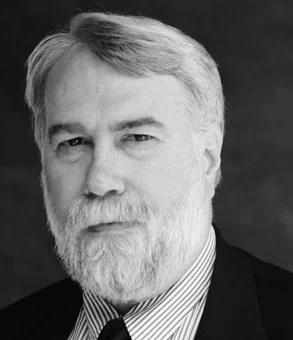
born February 15, 1949, in Baltimore, Maryland died September 21, 2019, in Baltimore
composed in 2000
premiered in Pittsburgh, Pennsylvania, in 2000 last performed by the Utah Symphony in September 2001 with conductor Keith Lockhart
“I completed Rapture at my home in Pittsford, New York, on January 9, 2000. Commissioned by the Pittsburgh Symphony Orchestra, it is dedicated to that orchestra’s music director, Mariss Jansons.
It should be noted that the title of this score is not The Rapture; the piece is not connected to any specific religious source. Rather, I used the word ‘rapture’ to convey a sense of spiritual bliss, religious or otherwise. With the exception of my Christmas work, Karolju, this is the most unabashedly tonal music I have composed. I wished to
depict a progression to an ever more blinding ecstasy, but the entire work inhabits a world devoid of darkness— hence the almost complete lack of sustained dissonance. Rapture is also an exercise in gradually increasing tempi; it begins quite slowly but, throughout its 11-minute duration, proceeds to speed up incrementally until the breakneck tempo of the final moments is reached. Although much of my music is associated with grief and despair, Rapture is one of a series of more recent scores—such as Compline (1996), Kabir Padavali (1997), and Concert de Gaudí (1998)—to look ‘towards the light.’”
It takes five percussionists to pull off Christopher Rouse’s Rapture, which calls for two timpani, “bass drum, five triangles, tam-tam, Chinese cymbal, suspended cymbal, chimes, glockenspiel, and antique cymbals.”
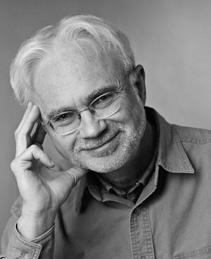
JOHN ADAMS
born February 15, 1947, in Worcester, Massachusetts
Violin Concerto composed in 1993
premiered in St. Paul, Minnesota, in 1994 last performed by the Utah Symphony in September 2007 with conductor Keith Lockhart
A Note from the Composer
“The proposal to write a violin concerto came from the violinist Jorja Fleezanis, a close friend and enthusiastic champion of new music. Composers who are not string players are seriously challenged when it comes to writing a concerto, and close collaborations are the rule, as it was in this case.
A concerto without a strong melodic statement is hard to imagine. I knew that if I were to compose a violin concerto, I would have to solve the issue of melody. I could not possibly have produced such a thing in the 1980s because my compositional language was principally one of massed sonorities riding on great rippling waves of energy...
But in the early 1990s, while composing The Death of Klinghoffer, I began to think more about melody. This was perhaps a result of being partially liberated by a new chromatic richness that was creeping into my sound. Still, it was more likely due to the need to find a melodic means to
set Alice Goodman’s psychologically complex libretto. As if to compensate for years of neglecting the ‘singing line,’ the Violin Concerto (1993) emerged as an almost implacably melodic piece—an example of ‘hypermelody.’
The violin spins one long phrase after another without stop for nearly the full thirty-five minutes of the piece. I adopted the classic form of the concerto as a kind of Platonic model, even to the point of placing a brief cadenza for the soloist at the traditional locus near the end of the first movement. The concerto opens with a long, extended rhapsody for the violin, a free, fantastical ‘endless melody’ over the regularly pulsing staircase of upwardly rising figures in the orchestra. The second movement takes a received form, the chaconne, and gently stretches, compresses, and transfigures its contours and modalities while the violin floats like a disembodied spirit around and about the orchestral tissue. The chaconne’s title, ‘Body through which the dream flows,’ is a phrase from a poem by Robert Haas, words that suggested to me the duality of flesh and spirit that permeates the movement. It is as if the violin is the ‘dream’ that flows through the slow, regular heartbeat of the orchestral ‘body.’
The ‘Toccare’ utilizes...surging, motoric power…to create a virtuoso vehicle for the solo violin.”
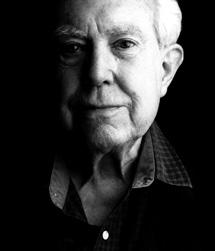
born December 11, 1908, in New York, New York died November 5, 2012, in New York
composed in 1944
premiered in Frankfurt, Germany, in 1946 Utah Symphony premiere
The Backstory
Elliott Carter was a native New Yorker, but traveled often with his parents. Fluent in French, he went to Paris to study with a renowned composition teacher. “I did learn a great deal from Nadia Boulanger,” he reported. But he also described his time there as “frightening.”
Hitler was on the rise, and the French capital received waves of panicked refugees. Carter returned home in 1935, and the Nazis rolled in, in 1940.
During the war, German soldiers shot people for having a
radio. French civilians owned them anyway, stowing them in secret cubbies to have a lifeline to the free world. And it mattered. In August of 1944, as Allied forces pushed deeper onto the Continent, Parisians took to the streets. They piled up carts, tires, sidewalk grates, and trees to barricade the roadways until the Allies arrived.
“Twisted cockeyed barriers from behind which the valiant [French resistance] had held the Germans for so many days with single-shot rifles and hunting pistols and museum pieces were pulled aside to let the armor through,” said the voice on the newsreel. “Frenchmen and GI Joes in tanks rolled under the Eiffel Tower” and routed the German army.
With the liberation of Paris, tens of thousands of ecstatic civilians poured out of their homes, cheering, kissing, and embracing American GIs in what became one of the most memorable scenes of the war. That’s precisely the moment painted for us in Elliott Carter’s Holiday Overture. It is an American piece with a distinctly American sound. Using brash, twisting, and colliding polyrhythmic lines, Carter captured a moral and historic victory.
He wrote his overture for the Boston Symphony Orchestra, but, ironically enough, premiered it in Frankfurt, Germany.
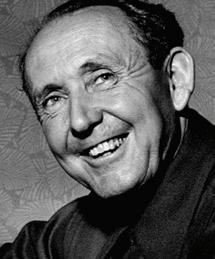
born February 12, 1898, in Chandler, Oklahoma died October 1, 1979, in Santa Monica, California
composed in 1939 premiered in Boston, Massachusetts, in 1939 last performed by the Utah Symphony in October 1975 with conductor Maurice Abravanel
“Harris once characterized his countrymen as being ‘optimistic, young, rough and ready’ and that Americans possess ‘heroic strength, determination, the will to struggle, faith in our destiny and a fierce driving power’ all phrases that perfectly describe his own music.”
The New York Times
Roy Harris was born in a log cabin, served in World War I, and drove a dairy truck to support his music habit. Grit and
talent paid off when Aaron Copland steered him toward a wealthy patron who bankrolled Harris’s four-year study with Nadia Boulanger in Paris. He returned to the United States and quickly became one of contemporary music’s most steadfast champions.
Life as a composer is rarely easy. A hundred years ago, it was especially difficult for Americans, who’d yet to prove themselves equal to the European masters. Harris helped to change that perception with his Third Symphony (1938). It was an instant success and played by orchestras worldwide.
While the Third Symphony is a compact, single-movement work, Harris structured it with distinct sections: Tragic, Lyric, Pastoral, Fugue, and Dramatic. (Notice how he eschewed the European model of labeling them according to their tempo.)
As a beacon for the next generation of American composers, Harris never stayed in a location for long and affiliated with many musical and academic institutions. In 1948, Maurice Abravanel brought him to Salt Lake City to perform the Third Symphony. Harris told the press that


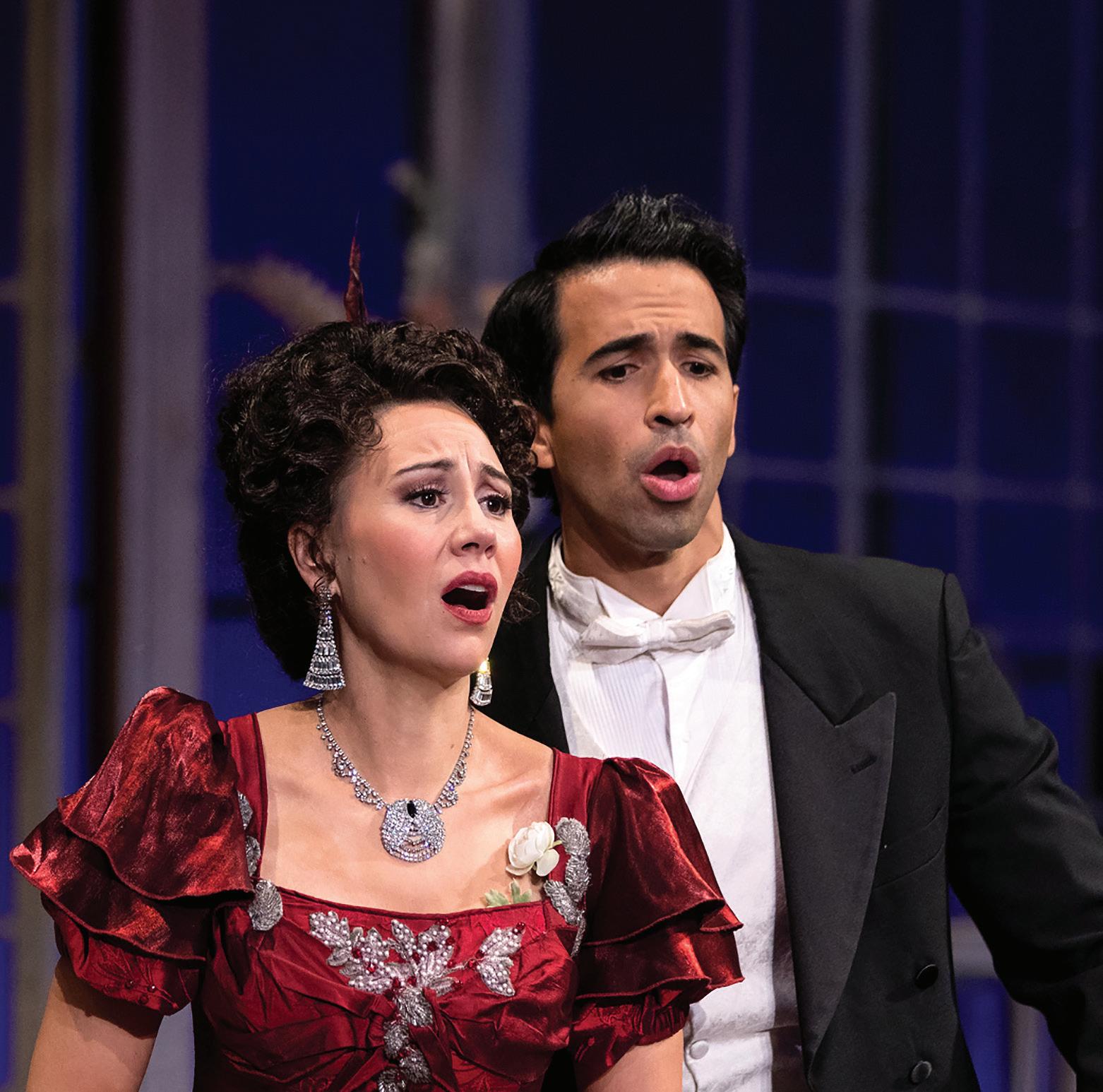
FRIDAY, FEBRUARY 27, 2026 / 7:30 PM / MAURICE ABRAVANEL HAL
SATURDAY, FEBRUARY 28, 2026 / 7:30 PM / MAURICE ABRAVANEL HALL
NICHOLAS CARTER, conductor*
NELSON GOERNER, piano * UTAH SYMPHONY
BAX
MENDELSSOHN
DEBUSSY (ORCH. HENRI BÜSSER) DEBUSSY
Tintagel (15’)
Piano Concerto No.1 in G minor, Op. 25 (20’)
I. Molto allegro con fuoco
II. Andante
III. Presto - Molto Allegro e vivace
INTERMISSION
Petite Suite (13’)
I. En bateau
II. Cortège
III. Menuet
IV. Ballet
La mer (23’)
I. De l’aube à midi sur la mer (From Dawn to Noon on the Sea)
II. Jeux de vagues (Play of the Waves)
III. Dialogue du vent et de la mer (Dialogue of Wind and Sea)
*Utah Symphony debut
CONCERT SPONSOR
QUINN EMANUEL
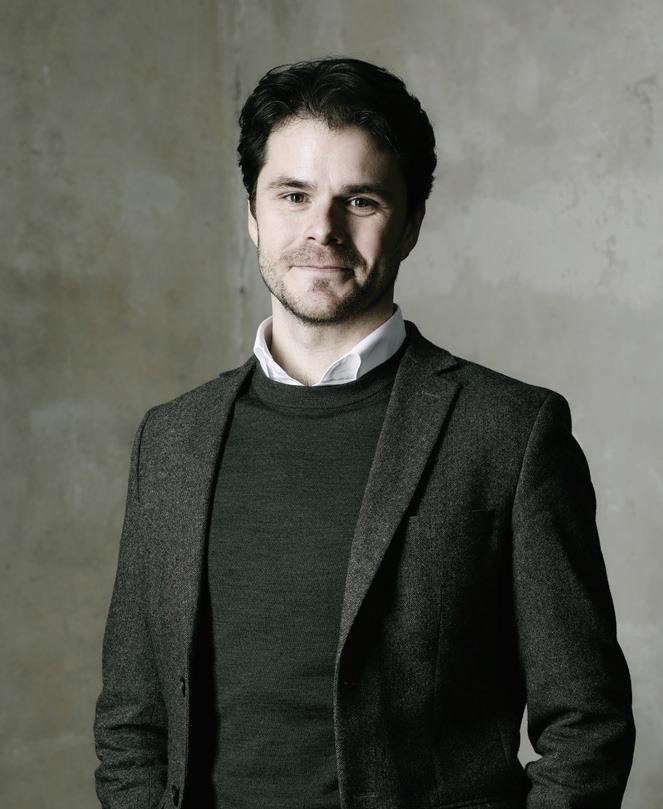
NICHOLAS CARTER, THE NEWLY APPOINTED MUSIC DIRECTOR of the Staatsoper and Staatsorchester Stuttgart from the 2026–27 season, has emerged as one of the most riveting opera conductors, acclaimed for his arresting presence in the pit. His distinguished artistic versatility has earned him a reputation as a perceptive interpreter of opera, ranging from Mozart, Verdi, Wagner, and Strauss to Russian and French repertoire, encompassing as far as music dramas of Britten and contemporary composers such as Brett Dean. Equally sought after in the concert hall, Carter conducts a wide breadth of symphonic repertoire and maintains regular collaborations with leading international orchestras.
He opened the 2025–26 season with his return to The Metropolitan Opera to conduct Strauss’ Arabella, followed by debuts with Semperoper Dresden in two titles, Mozart’s The Magic Flute and Verdi’s La traviata, as well as with Bayerische Staatsoper for Donizetti’s L’elisir d’amore. Carter concludes the season with his return to the Glyndebourne Festival for Billy Budd by Benjamin Britten.
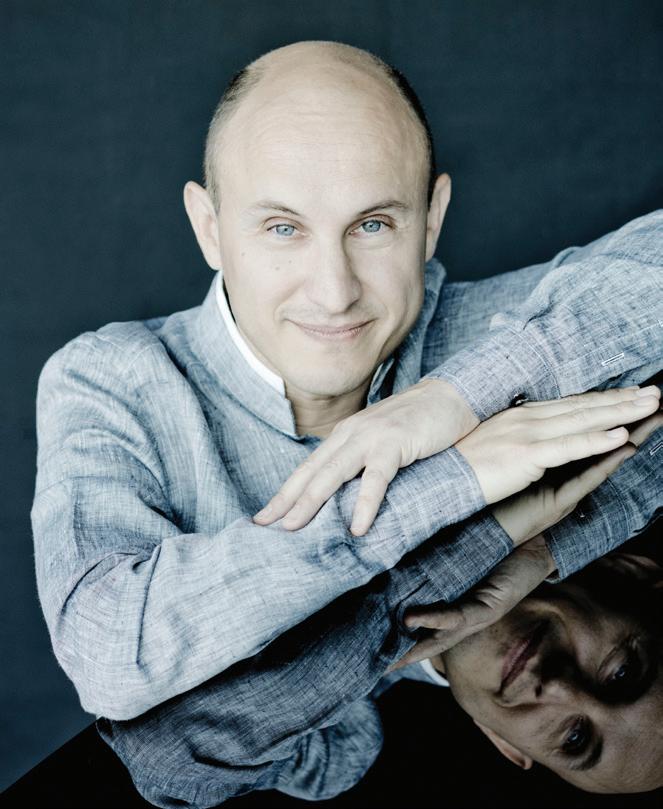
NELSON GOERNER HAS PERFORMED WITH MANY OF THE MAJOR ORCHESTRAS including the Royal Concertgebouw Orchestra, NHK Symphony Orchestra, Orchestre Philharmonique de Radio France, Los Angeles Philharmonic, Dallas Symphony Orchestra, Helsinki Philharmonic Orchestra, Deutsche Kammerphilharmonie, Philharmonia, and Spanish National Orchestra, with leading conductors such as Alain Altinoglu, Vladimir Ashkenazy, Elim Chan, Sir Mark Elder, Ivan Fischer, Neeme Järvi, Paavo Järvi, Fabio Luisi, Jonathan Nott, Vasily Petrenko, EsaPekka Salonen, Jukka-Pekka Saraste, and Kazuki Yamada.
Goerner was born in San Pedro, Argentina in 1969. After studying with Jorge Garrubba, Juan Carlos Arabian and Carmen Scalcione, he was awarded First Prize in the Franz Liszt Competition in Buenos Aires in 1986. This led to a scholarship to work with Maria Tipo at the Geneva Conservatoire, and in 1990 Nelson Goerner won the First Prize at the Geneva Competition.
BY NOEL MORRIS
Claude Debussy disliked being called an Impressionist, but listeners zeroed in on the dreaminess of his music— like the blurred edges of an Impressionist painting—and relentlessly applied the word to him until it stuck like dried paint.
You can hear Debussy’s influence on the sumptuous tone poem Tintagel by Sir Arnold Bax.
Felix Mendelssohn had a charmed childhood. The son of a banker, he enjoyed first-rate instruction and excelled in literature, languages, geography, math, and drawing. His parents cultivated a home life that was the envy of Europe, a gathering place for famous poets, scientists, writers, musicians, artists, and thinkers in Berlin.
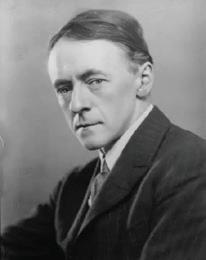
Tintagel
SIR ARNOLD BAX
born November 8, 1883, in London died October 3, 1953, in Cork, Ireland
composed 1917–1919
premiered in Bournemouth, England, in 1921 Utah Symphony premiere
The Backstory
Sir Arnold Bax’s Tintagel plays like an audio postcard of Cornish ruins jutting high above the roiling sea on the southwestern shore of England. Built upon a head-shaped outcropping, the castle once spanned a great crevasse between the mainland and Tintagel Island. Arthurian legend places the castle as the King’s birthplace. Below the sheer rock face, you can visit Merlin’s Cave at low tide.
The Music
In 1917, Sir Arnold Bax spent six weeks in Cornwall with his lover Harriett Cohen, a marvelous pianist and socialite. He added the following description to his sensuous musical souvenir:
The entrance of the brass “may be taken as representing the ruined castle, now so ancient and weather-worn as almost to seem an emanation of the rock upon which it was built.”
A melody in the strings suggests the “almost limitless spaces of the ocean. After a while, a more restless mood begins to assert itself as though the sea were rising, bringing with it a new sense of stress, thoughts of many passionate and tragic incidents in the tales of King Arthur and King Mark [of the Tristan saga] and others among the men and women of their time”—not to mention Sir Arnold and Harriet.
Bax hints at “one of the subjects of the first act of [Wagner’s] Tristan and Isolde.” After a great climax, waves gather force and smash into the “impregnable rocks. The theme of the sea is heard again, and the piece ends as it began: with a picture of the castle still proudly fronting the sun and wind of the centuries.”
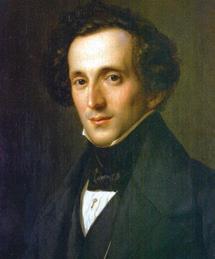
born February 2, 1809, in Hamburg, Germany died November 4, 1847, in Leipzig, Germany
composed 1830–1831 premiered in Munich, Germany, in 1831 last performed in full by the Utah Symphony in September 2008 with conductor Thierry Fischer and pianist Louis Lortie (Christina Sung performed the third movement as part of our 2022 Salute to Youth concert)
The famous prodigy Mozart showed an extraordinary gift, noted Johann Wolfgang von Goethe, but otherwise behaved like a normal child. Twelve-year-old Mendelssohn, on the other hand, spoke with “the cultivated talk of a grown-up person.”
Sixty years separated the poet from the latter prodigy, but young Felix counted the literary legend as a friend. And with his adult-like abilities, Mendelssohn wrote his first masterpiece at 16.
Between 1829 and 1832, Mendelssohn set off on a grand tour of Europe and collected friends and acquaintances along the way. He befriended Franz Liszt and Frédéric Chopin in Paris and visited his friend Goethe in Weimar.
In Munich, he fell in love with Delphine von Schauroth, a beautiful young woman and a gifted pianist.
“Ministers and Counts trot around her like domestic animals in the hen yard,” Mendelssohn wrote.
They played duets together. She shared with him her Songs without Words. When Felix moved on to Venice, they kept up a correspondence, and he wrote for her a “song without words.”
By the time Mendelssohn made it to Rome, the 21-yearold had started his “Italian” Symphony. Meanwhile, he continued to tour the sites, paint watercolors, and write vivid letters home. (He found the Papal Choir “completely unmusical.”) Scarcely sleeping, Mendelssohn had no time to commit a piano concerto to paper, but he composed one in his head and kept it there for later.
In October 1831, the composer returned to Munich to see Delphine and spent three days writing out his new concerto (minus the piano part, which still lived in his head). He dedicated the piece to his love, but played the premiere himself, as society frowned upon ladies performing in public.
The Music
Mendelssohn wrote his three concerto movements to be played without pause. With a compact, integrated form, the first movement explodes “con fuoco,” meaning “with fire,” wending its way to a sudden peal of brass and a brief cadenza to usher in the middle movement. Here, we get a hint of Delphine in the form of a “song without words” that passes between the strings and piano. Soon, the brass return to signal the start of the last movement and another display of pianistic fireworks.
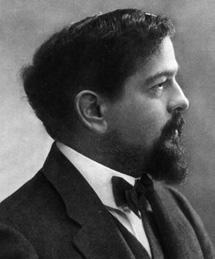
born August 22, 1862, in Saint-Germain-en-Laye, France died March 25, 1918, in Paris
Petite Suite composed in 1888 premiered in Paris, in 1889 last performed by the Utah Symphony in July 2017 with conductor Conner Gray Covington
What to Listen for
Claude Debussy often used the pentatonic scale, which
he derived from East Asian music. You can play the scale yourself by touching the black keys of a piano.
The Backstory
Not unlike the Impressionist painters, young Debussy riled the old guard. His professors chided him for breaking basic rules in harmony, although they sometimes acknowledged his genius.
In 1884, Debussy won the coveted Prix de Rome, which awarded him a scholarship to the music school at the Villa Medici in Italy. Like many composers before him, he immersed himself in the glories of Italian opera, but Debussy found he didn’t care much for it. Once again, he felt like a misfit.
After two years in Rome, he returned to Paris. In 1888, he luxuriated in the operas of Richard Wagner at Bayreuth— an enjoyable experience that prompted him to say, “Wagner was a beautiful sunset mistaken for a dawn.” Later that year, 26-year-old Debussy wrote his Petite Suite for piano four-hands, still with both feet firmly planted in 19th-century France.
The Music
He crafted the first two movements after his favorite poet, Paul Verlaine. Drawing from the 1869 collection Fêtes galantes, Debussy painted the poem “En bateau” about seduction and disappointment on a mysterious lake at dusk. The second movement, “Cortège,” follows a lady, her pet monkey, and her servant. The “Menuet” has no literary device, but is the most intimate of the set. The last movement, “Ballet,” echoes Debussy’s fascination for Javanese gamelan, an ensemble of tuned percussion instruments. Here, he used a scale that’s ubiquitous in East Asian music, the pentatonic scale. Henri Büsser orchestrated the suite in 1907 with Debussy’s blessing.
composed 1903–1905 premiered in Paris, in 1905 last performed by the Utah Symphony in January 2020 with conductor Conner Gray Covington
The Backstory: Is this Impressionism?
In mid- to late-19th century France, the likes of Monet, Degas, and Renoir painted gauzy images to capture the flickering, transient dance between sunlight and color. The label, “Impressionist,” did not come from fans but from critics who savaged their paintings for their coarse brush strokes and blurred edges. Given its (then) pejorative
connotations, Claude Debussy bristled at being called an Impressionist. He argued that the label oversimplified his art.
French scholar Paul Beauchamp offered a more fitting characterization of Debussy’s aesthetic. He described an “evocation of subtle moods and states of soul, through metaphor, sense imagery, and ‘symbolic’ landscapes; a bias toward suggestion and indirection; experimentation in rhythm and meter.” Oddly enough, Beauchamp wasn’t speaking of music. He was describing the work of Debussy’s favorite poet, Paul Verlaine, who, more than anyone, served as the developing composer’s north star.
In Debussy’s world, art was a conversation between painters, poets, composers, and writers. He adored the seascapes of J.M.W. Turner and Katsushika Hokusai. But it was through Verlaine that he found his answer to those works of art. And this is where it gets gauzy.
The Music Debussy made liberal use of the whole-tone and pentatonic

scales, which lack half-steps—the signposts to the thing we perceive as a tonal center. In La mer, his harmonies often lack a gravitational pull to a home key. Instead, they exist purely based on their beauty.
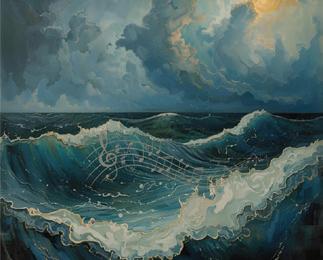
Many in the first audience suggested that La mer meandered to nowhere. In fact, Debussy built its structure through the use of distinct musical motives that undergo transformation throughout the score—not unlike the sea itself.
Like his piece, the sea is of one substance, without edges, ever moving and changing in shape, mood, and color. Although Debussy used a sizeable orchestra, he achieved an exquisite degree of translucence, like water.
In the end, he gave us a clue about La mer when he sent his score to the publisher. He instructed him to include a piece of cover art. For this, Debussy eschewed the Impressionists, with their heavy layers of pigment, in favor of the kinetic energy of the woodblock print, “The Great Wave off Kanagawa,” by Katsushika Hokusai.


Utah Opera Sponsors - The Elixir of Love
PRODUCTION SPONSOR
OPERA ARTISTIC DIRECTOR SPONSOR
DIRECTOR SPONSOR
ORCHESTRA SPONSOR

VIP INTERMISSION RECEPTION SPONSOR
VIP INTERMISSION BEVERAGE SPONSOR

FLORAL SEASON SPONSOR
CAST PARTY SPONSOR
MARCH 7 (7:30PM), MARCH 9 (7:00PM), MARCH 11 (7:00PM), MARCH 13 (7:30PM), MARCH 15 (2:00PM) JANET QUINNEY LAWSON CAPITOL THEATRE
Composed by Gaetano Donizetti with Libretto by Felice Romani
Premiere – May 12, 1832, Teatro della Canobbiana, Milan
Previously at Utah Opera - 1980, 1987, 1998, 2006, 2014, 2019
Performed in Italian with English Supertitles (Captions)
(in order of vocal appearance)
Giannetta Stephanie Chee*
Adina ................................................. Katrina Galka
Nemorino Daniel O’Hearn**
Sergeant Belcore Alexander Birch Elliott
Dr. Dulcamara .......................................... Daniel Belcher
Dulcamara’s Assistant Gemma Isaacson
Utah Opera Chorus
Supernumeraries – Guards & Bridesmaids
Conductor Steven White
Stage Director Daniel Ellis
Chorus Director & Assistant Conductor ................... Austin McWilliams
Scenic Designer Jaime Mejia
Costume Designer Angela M. Kahler
Lighting Designer ................................... Cheri Prough DeVol
Original Choreographer Heidi Spesard-Noble
Revival Choreographer Gemma Isaacson
Wig & Makeup Designer ................................ Emma Gustafson
Principal Coach Deborah Robertson
Guest Coach Lindsay Woodward**
Chorus Pianist Jie Fang Goh*
Assistant Director Colter Schoenfish
Intimacy Coach Christopher DuVal
Stage Manager Lisa R. Hays
Assistant Stage Managers Hannah Schumacher & Ezra Rose
Supertitle Musician Mitchell Atencio
Scenery, Properties, & Costumes for this production were constructed by Minnesota Opera and are owned by Minnesota Opera.
Original Production & Staging by Daniel Ellis
Scenery & Properties Design by Jaime Mejia
Costume Design by Angela M. Kahler
Lighting Design by Cheri Prough DeVol
English Captions created for the Minnesota Opera by Joseph Li
The performance run time is approximately 2 hours 30 minutes with one intermission
*Current Resident Artist
**Former Resident Artist
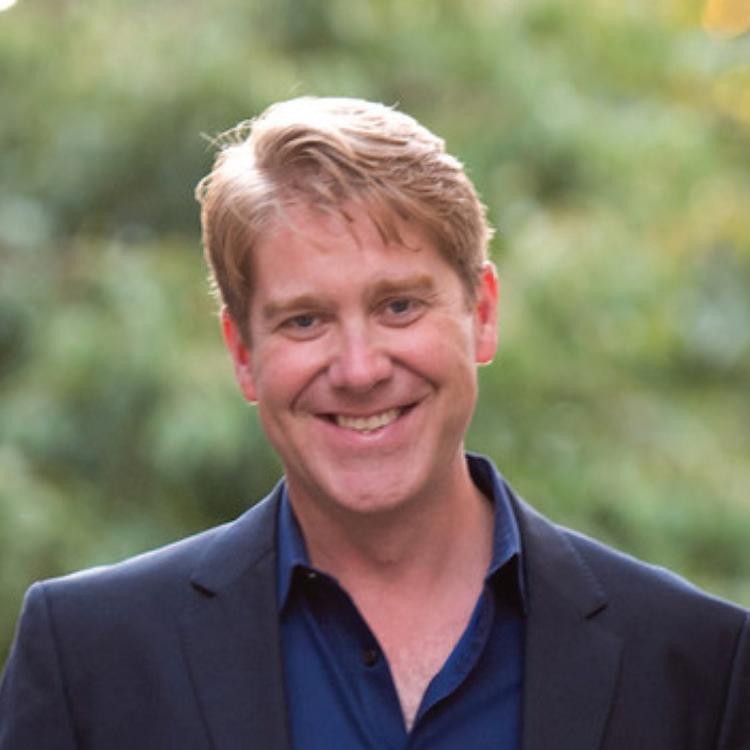
Daniel Belcher (Texas)
Dulcamara
Most Recently at Utah Opera, La bohème
Recently: Il viaggio a Reims, Opera Philadelphia
The Central Park Five, Detroit Opera
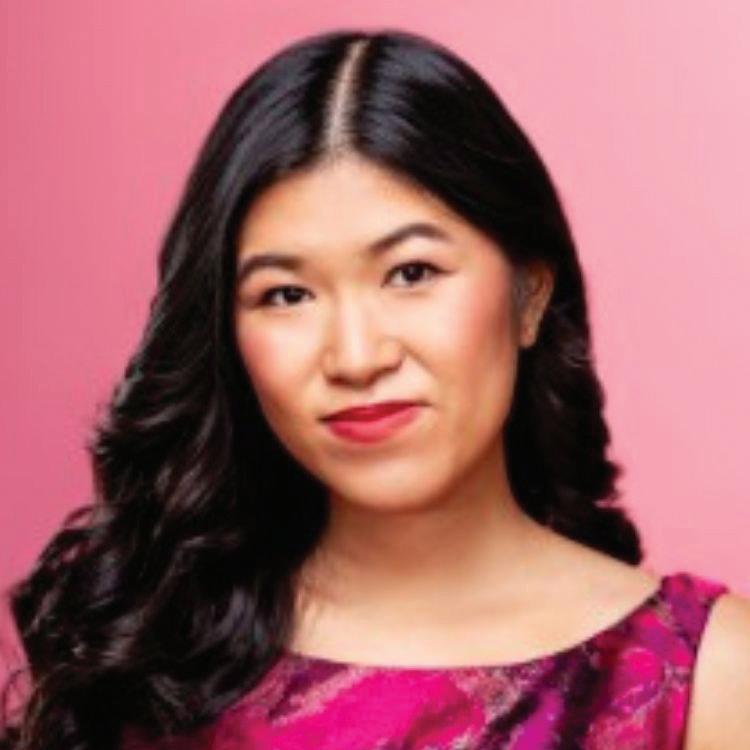
Stephanie Chee (California)
Giannetta
Most Recently at Utah Opera, Fidelio
Recently:
Utah Opera Resident Artist
Messiah, Utah Symphony
The Shining, Utah Opera
Hansel and Gretel, Utah Opera
The Rape of Lucretia, The Shepherd School of Music
L’incoronazione di Poppea, The Shepherd School of Music
Upcoming:
La traviata, Utah Opera
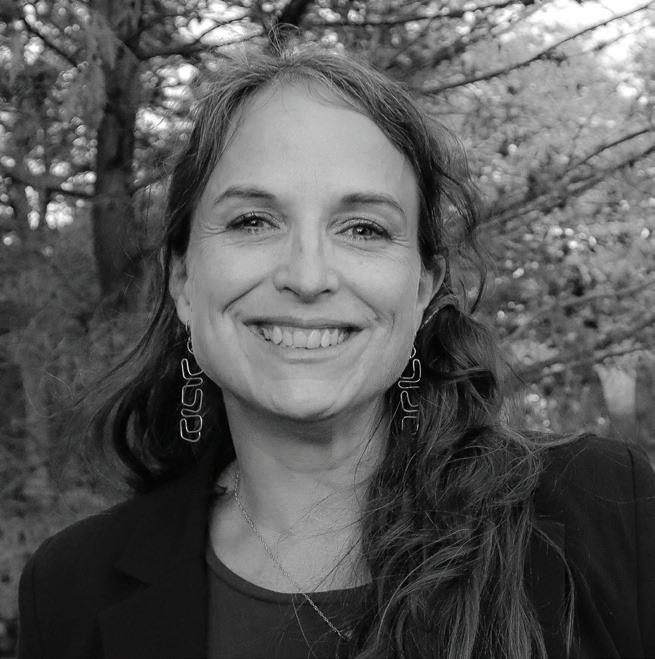
Cheri Prough DeVol (Texas)
Lighting Designer
Utah Opera debut
Recently:
A Chorus Line, Beck Center for the Arts
La finta giardiniera, University of Georgia
Upcoming:
Cinderella, Texas State University
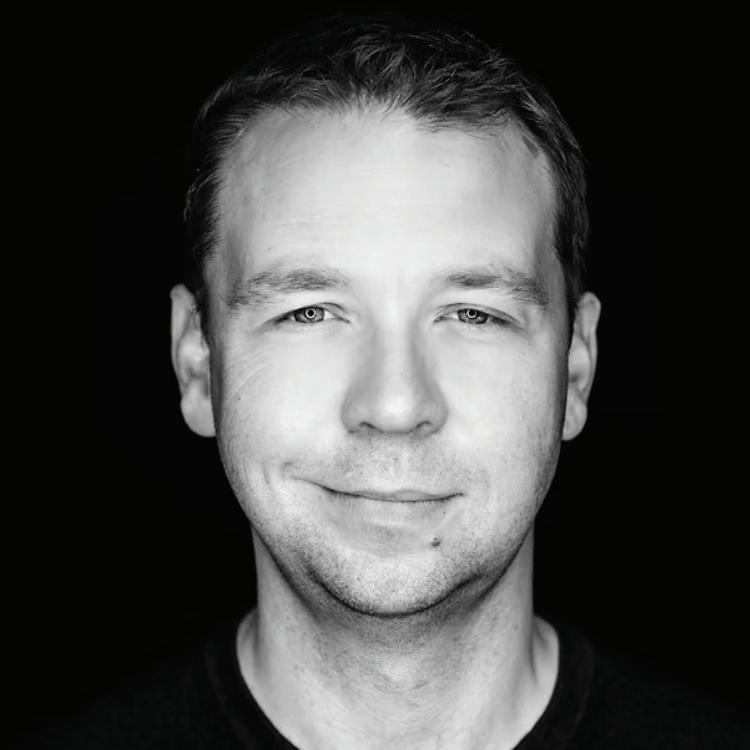
Daniel Ellis (Georgia)
Stage Director
Utah Opera debut
Recently:
The Elixir of Love, Minnesota Opera
Wozzeck, Finnish National Opera
The Magic Flute, Cincinnati Opera
The Elephant Man, Williams Street Repertory
The Ring of Polykrates, University of Georgia at Athens
Upcoming: Mansfield Park, University of Georgia at Athens
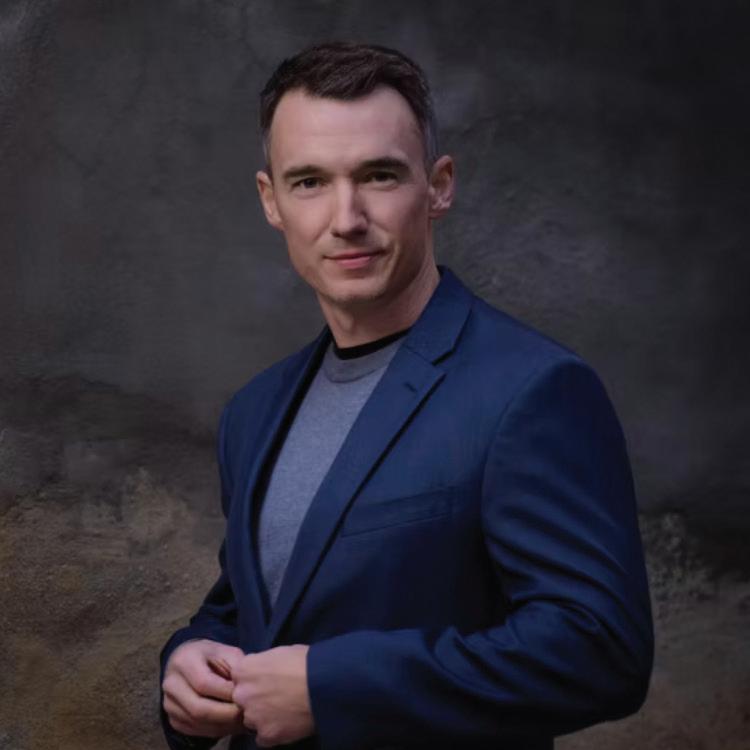
Alexander Birch Elliott (Utah)
Sergeant Belcore
Utah Opera debut
Recently:
Andrea Chénier, The Metropolitan Opera
Carmen, Florida Grand Opera
Upcoming:
La bohème, The Metropolitan Opera
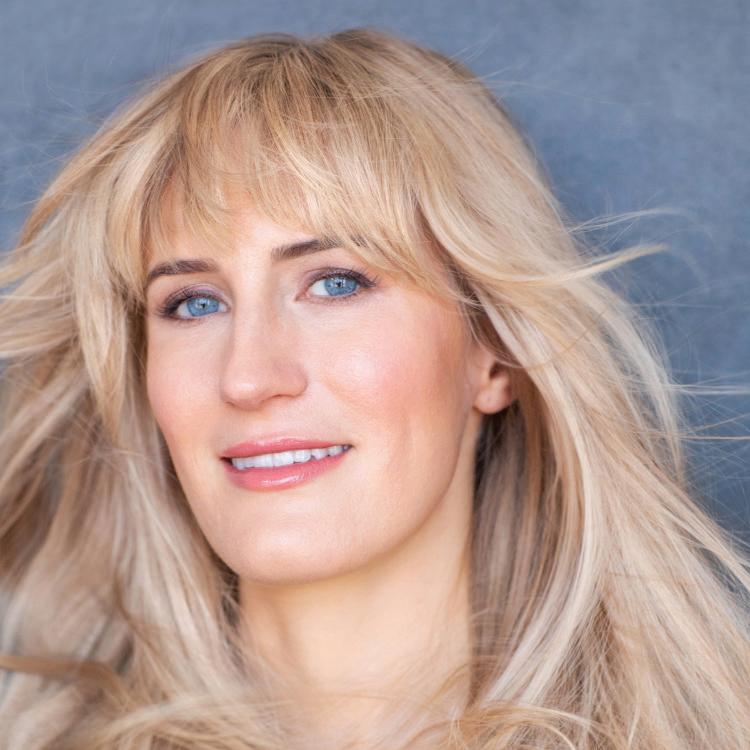
Katrina Galka (Wisconsin)
Adina
Most Recently at Utah Opera, Thaïs
Recently:
Il nome della rosa, Teatro alla Scala
Die Fledermaus, Semperoper Dresden, Staatsoper Hamburg
Les contes d’Hoffmann, Opernhaus Zürich
The Handmaid’s Tale, San Francisco Opera
La fille du régiment, Opera Colorado
Upcoming:
Glière’s Concerto for Coloratura Soprano, Westdeutscher
Rundfunkorchester
Don Pasquale, Orff’s Carmina Burana, Teatro Carlo Felice

Emma Gustafson (Minnesota)
Wig & Makeup Designer
Utah Opera debut
Recently:
Così fan tutte, Minnesota Opera
A Christmas Carol, Geva Theatre
Upcoming:
My Ántonia, Theater Latté Da
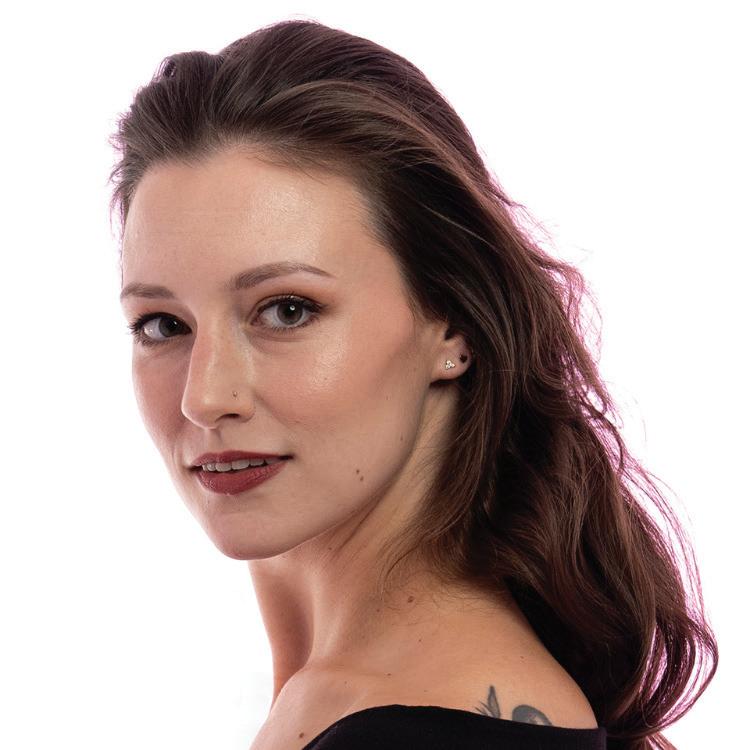
Gemma Isaacson (Minnesota)
Dulcamara’s Assistant/Revival Choreographer
Utah Opera debut
Recently:
The Elixir of Love, Minnesota Opera
Carmen, Portland Opera
Upcoming:
Pagliacci, Minnesota Opera
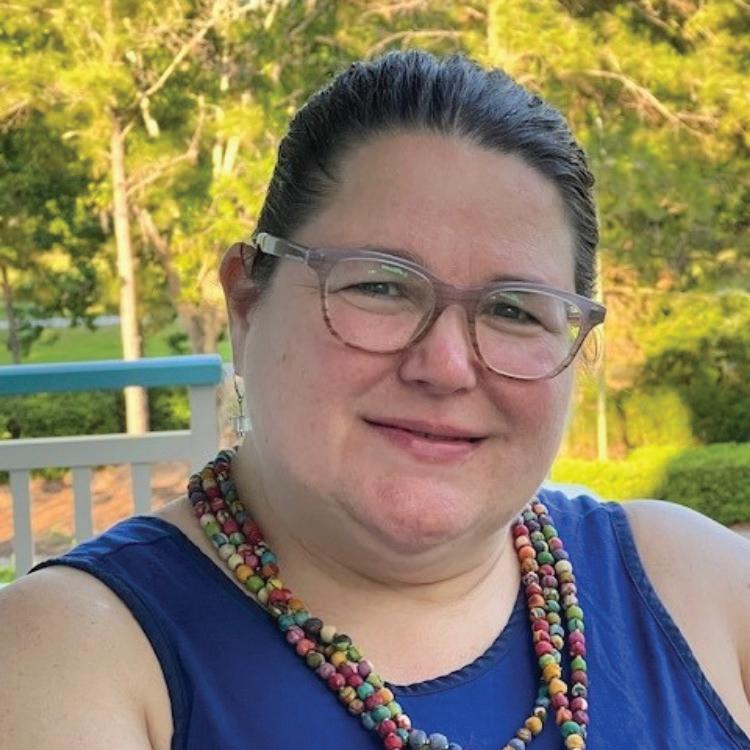
Angela M. Kahler (New York)
Costume Designer
Utah Opera debut
Recently:
The Elixir of Love, Minnesota Opera
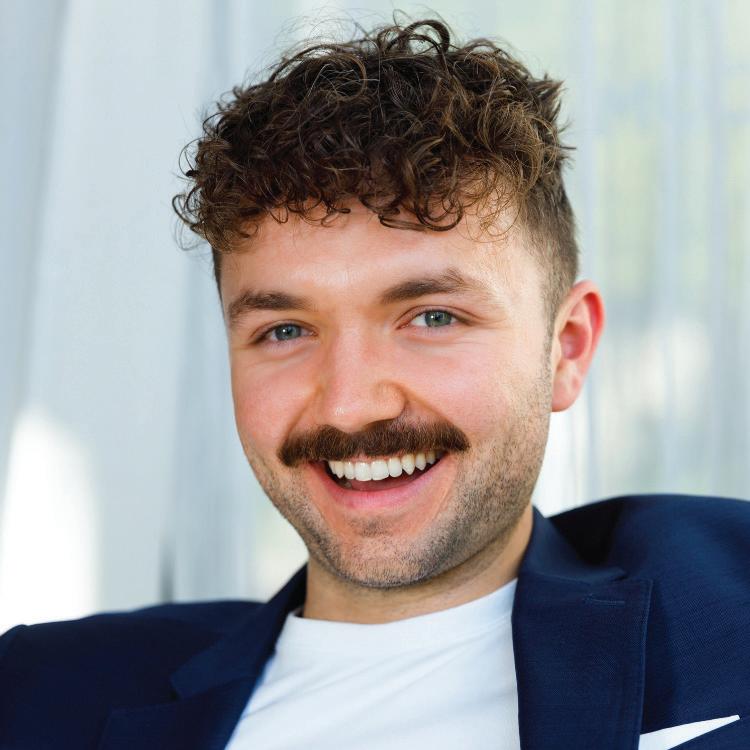
Austin McWilliams (Missouri)
Chorus Director & Assistant Conductor
Most Recently at Utah Opera, Fidelio
Recently:
Associate Conductor & Chorus Master, Opera Grand Rapids Director of Choral Activities, Aquinas College
Upcoming:
Cantata misericordium, The Cathedral of the Madeleine Faculty, Missouri Scholars Academy
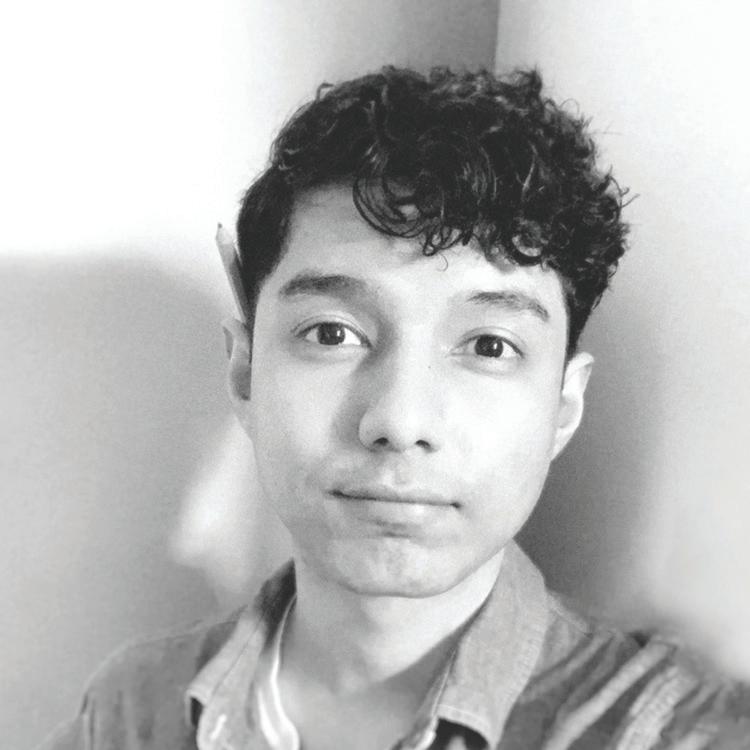
Jaime Mejia (New Jersey)
Scenic Designer
Utah Opera debut
Recently:
Kodachrome, Barry University
F.A.S.T., Warner Brothers
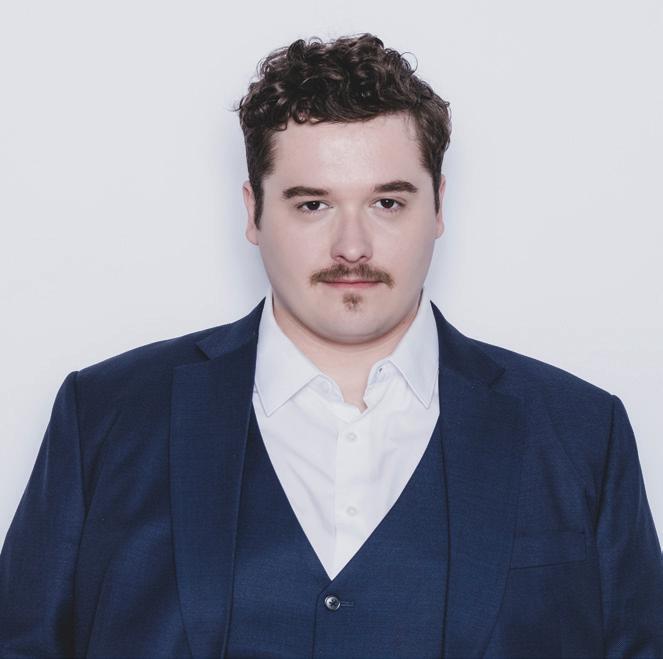
Daniel O’Hearn (Ohio)
Nemorino
Most Recently at Utah Opera, Tosca
Recently:
La bohème, Pittsburgh Opera
Arabella, Deutsche Oper Berlin
The Queen of Spades, The Metropolitan Opera
Upcoming:
Carmen, Seattle Opera
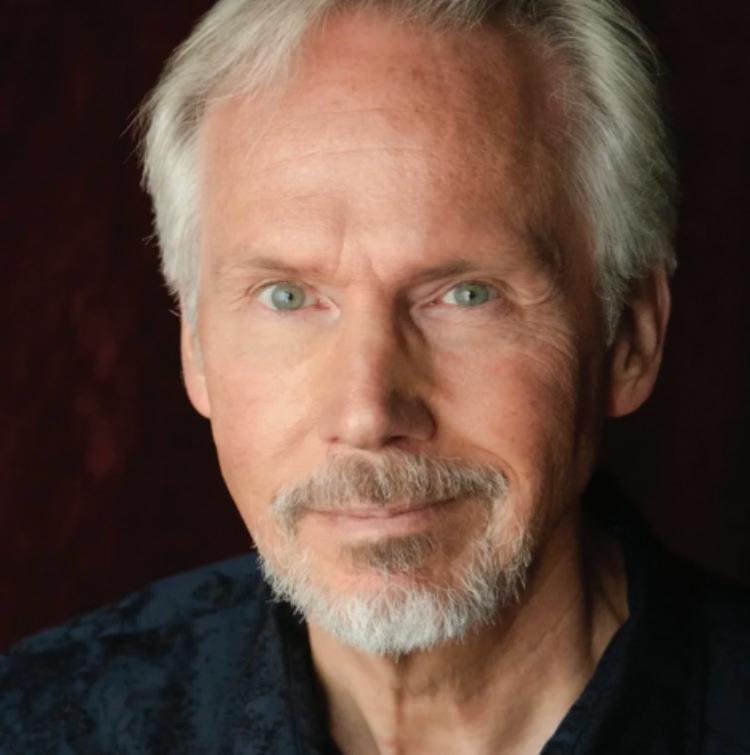
Steven White (Virginia)
Conductor
Most Recently at Utah Opera, Thaïs
Recently:
The Magic Flute, The Metropolitan Opera
The Rake’s Progress, Opera Omaha
Upcoming:
Susannah, Opera Omaha
Falstaff, Academy of Vocal Arts
Utah Opera Chorus
Soprano
Rebekah Barton Stockton
Lauren Bohannan
Genevieve Gannon
Kate Olsen
Michaela Shelton
Katie Sullivan
Alto
Paula Fowler
Jennifer Hancock
Melissa James
Jamie Johnson
Rebecca Keel
Alice Packard
Tenor
Orion Gray
Elijah Hancock
Layton Loucks
Daniel McDonnall
Lucas Henry Proctor
William Tepner
Bass
Buddy Eyre
Jarren Hancock
Thomas Klassen
Nelson LeDuc
Oscar Safsten
Carson Smith
Supernumeraries
Jana Conrad
Amanda Pieper
Bonnie Robertson
By Daniel Ellis
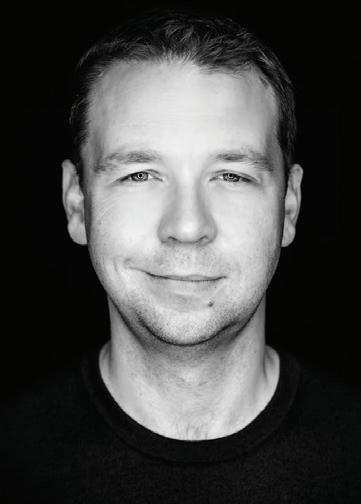
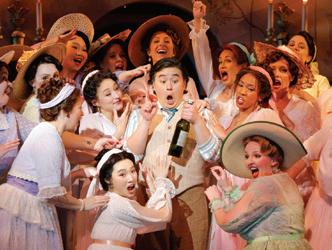
WHEN THIS TEAM OF GIFTED DESIGNERS and I first imagined our production of The Elixir of Love, we were scattered across the country, collaborating remotely through the long months of the COVID-19 lockdown. Cheri Prough DeVol, Angela Kahler, Jaime Mejia, and I chose this opera for submission to the OPERA America Robert L. B. Tobin Director-Designer Prize—an honor we were grateful to receive in 2021.
In the midst of uncertainty and isolation, this project brought us real joy. It rekindled our passion through shared purpose, camaraderie, and hope. Its light was as irresistible as Dulcamara’s famed elixir, and each weekly Zoom meeting reminded us why we fell in love with this art form. Free from the pressure of immediate production deadlines, we rediscovered our creative process: developing a shared vocabulary, exploring how storytelling infuses every design choice, and allowing time for deeper research to shape each detail—from the texture of a wall to the stitch of a bodice to the flicker of a distant smudge pot.
Whenever I approach a work from the inherited repertoire, my goal is to recontextualize it so that it remains historically, emotionally, and ethically accessible—honoring the spirit of the original while allowing the story to resonate with today’s audiences. Sometimes that means embracing tradition; at other times, shifting the setting or period reveals what has been there all along.
As we examined the world of this Elixir of Love, we found more than a charming love story. It became clear that beneath its charm lies a quiet, enduring warning—about
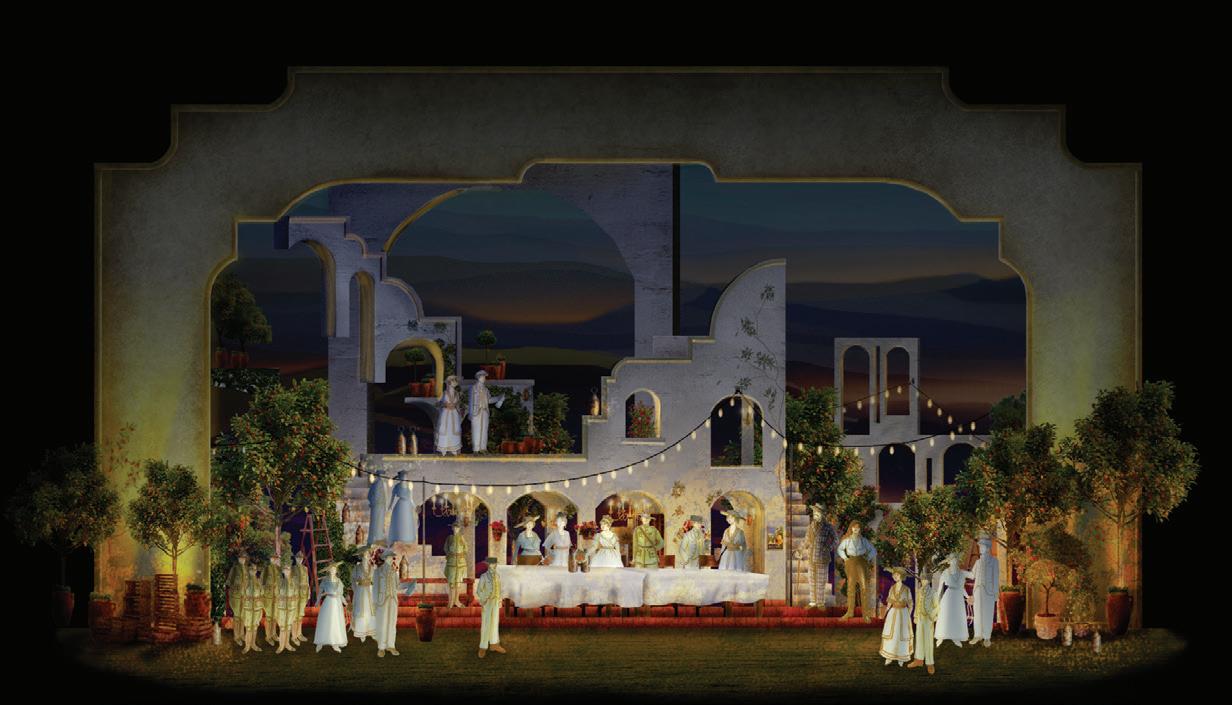
hucksterism, gaslighting, consumerism, and the alluring false promises we are so quick to trust.
Our research led us to early 20th century American marketing, particularly Albert Lasker’s 1916 campaign that revived California’s struggling orange industry. His simple idea—pasteurized orange juice promoted with the cheerful call to “Drink an orange!”—reshaped public attitudes almost overnight. This discovery, along with the broader history of California in this era, made 1916 Southern California the ideal setting for our production.
It was a moment of profound transition: immigration from Asia and Latin America was increasing, the Great Migration was underway, women’s suffrage was gaining ground, and the nation was struggling to recruit soldiers for the border conflict with Mexico. It was a time of change, yes, but also of industry, community, and a belief that the country could grow stronger through the contributions of many.
Placing the opera in this landscape allowed us to keep the libretto intact while widening the doorway for today’s artists and audiences. The world of 1916 California reflects the variety and spirit of the American experience, and each singer brings their own authenticity and heritage into the rehearsal room, creating a stage world that is welcoming, familiar, and distinctly ours.
This production honors Donizetti’s charm and musical brilliance while celebrating an American chapter defined by resilience, ingenuity, and hope—as refreshing, in its own way, as a glass of orange juice with breakfast.
By Daniel O’Hearn
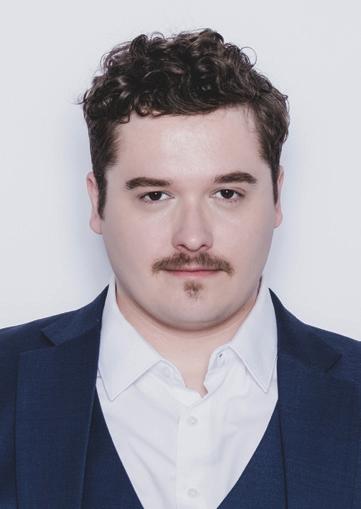
THANK YOU SO MUCH FOR COMING TO SEE GAETANO DONIZETTI’S 1832 comedic masterpiece L’elisir d’amore (The Elixir of Love) here at Utah Opera. I’ll be singing the role of Nemorino—a role I sang many times in an abridged, English version of L’elisir performed for students all over the state of Utah as part of Utah Opera’s extensive education programs during my time as a Resident Artist from 2020 to 2022. Performing for local children was not only a great experience in spreading awareness about this artform, but was also an opportunity to hone my skills for the day that I’d eventually sing the full opera in Italian—something I am so excited to be doing for you this evening as I return to Utah Opera for the first time as a guest artist.
Utah Opera has a special place in my heart, because it was the first professional contract I ever had as an opera singer. It was also where I was introduced to my longtime voice teacher, Nova Thomas, who remains a driving force in my vocal development. At the time I auditioned for my Utah Opera residency, I was finishing my Master of Music in Vocal Performance at DePaul University’s School of Music in Chicago, Illinois. I accepted the job just before graduating as the COVID-19 pandemic was taking over the world. To my sheer luck, Utah Opera was somehow one of
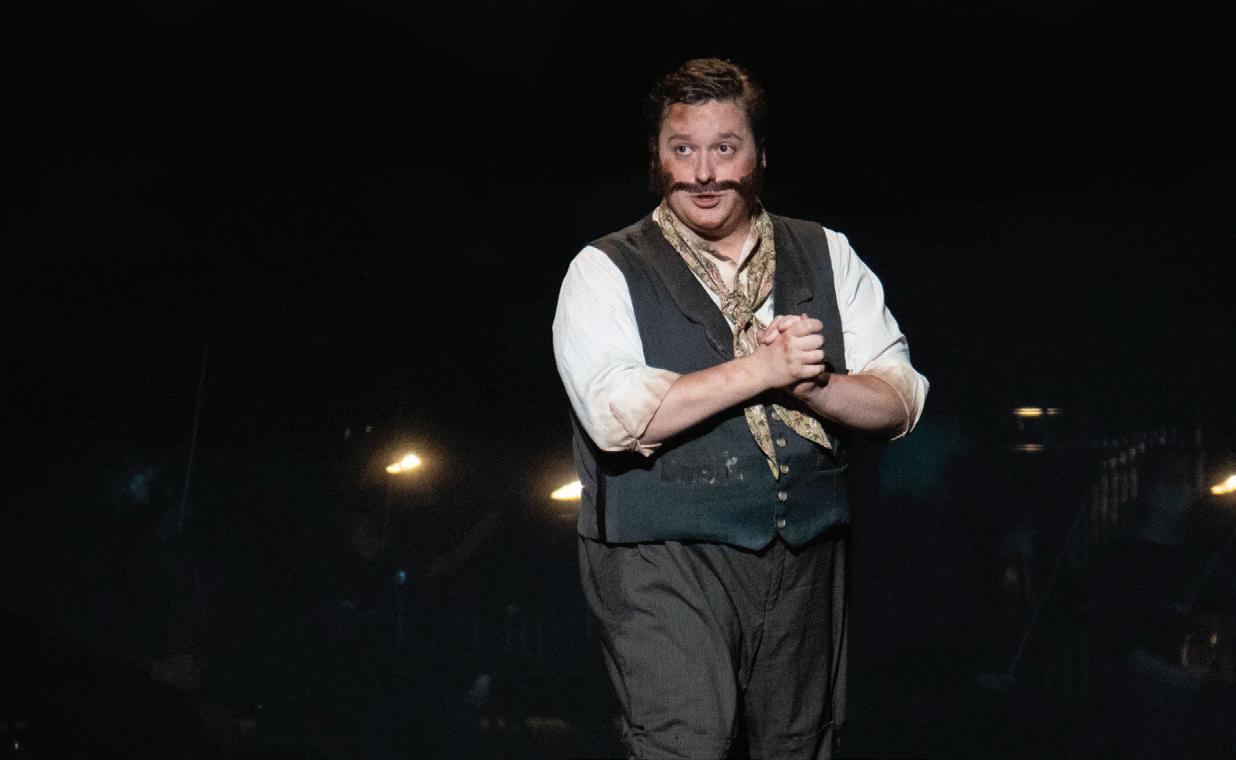
the only opera companies in the United States that found creative ways to resume performances in the fall of 2020. After testing twice per day on every day of production, my operatic debut was as Mr. Gray in Joseph Horovitz’s two-man operatic comedy Gentleman’s Island in October of 2020 at the Janet Quinney Lawson Capitol Theatre to a 15% capacity audience. While it was certainly not the glamorous debut to a packed house of thousands that most opera singers dream of, it was the start of a career that continues to grow far beyond what I had initially hoped for to this day.
Since my graduation from Utah Opera’s Resident Artist Program in 2022, I have sung all over the world at houses like The Metropolitan Opera, Lyric Opera of Chicago, and Deutsche Oper Berlin. As I go from one performance to the next, I can’t help but think of how grateful I am to Utah Opera for taking a chance on a young singer like me at a time when the world seemed like it was at its darkest. Now, I suppose it’s time for me to step back into the light here at Utah Opera with the house at 100% capacity, as this cast of talented artists under the leadership of Maestro Steven White and Director Daniel Ellis performs L’elisir d’amore. Enjoy!

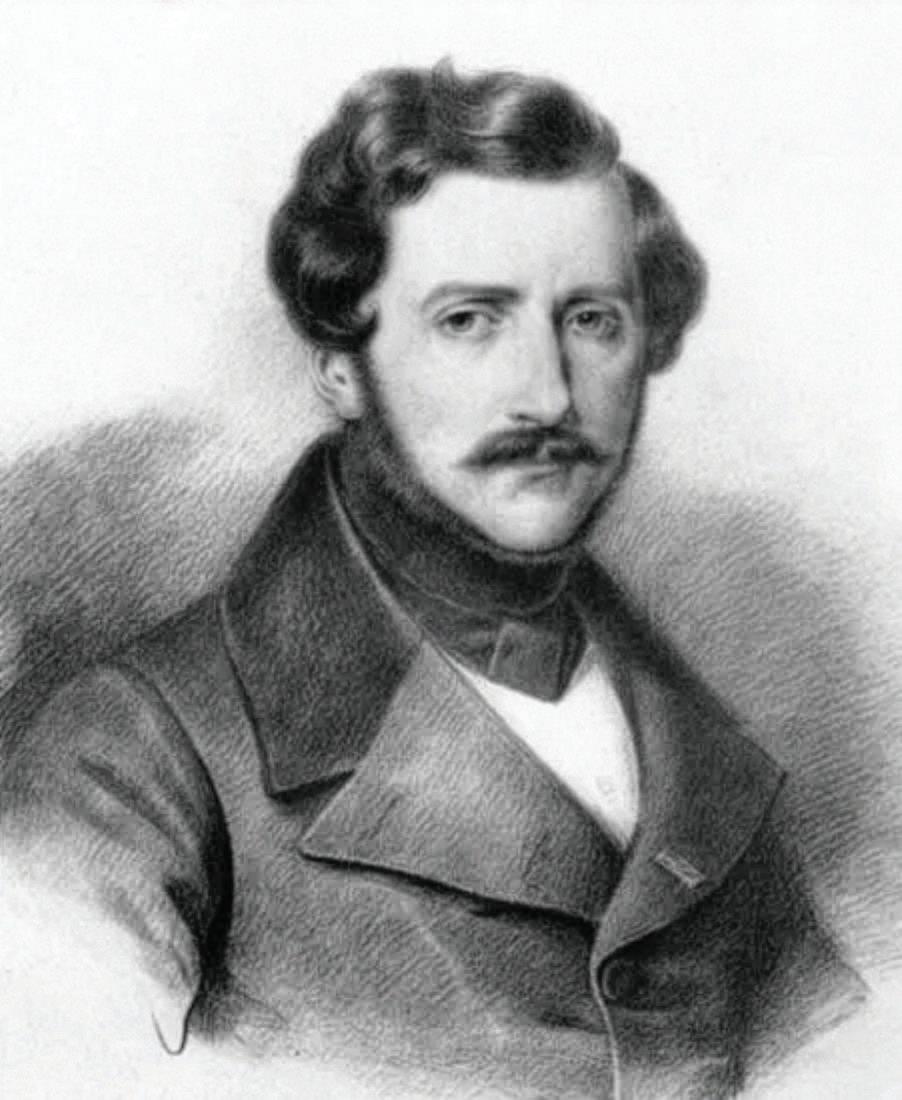
GAETANO DONIZETTI WAS BORN ON NOVEMBER 29, 1797, IN BERGAMO, ITALY. He, Bellini, and Rossini are considered to be the great masters of the opera style known as bel canto. Donizetti’s musical talents were apparent at an early age. When he was 9 years old, he was admitted with a full scholarship to the Lezioni Caritatevoli School. His first staged opera was Enrico di Borgogna in 1818. However, it was the success in 1822 of his fourth opera, Zoraida di Granata, that caught the attention of Domenico Barbaia, a prominent theatre manager. Donizetti achieved international fame in 1830, when Anna Bolena was performed in Milan. As his fame grew, he wrote operas for French and Italian opera houses. He relocated to Paris in 1838, where he composed La fille du régiment in 1840. During his productive career, Donizetti completed 65 operas. L’elisir d’amore (1832) and Don Pasquale (1843) are masterpieces of comic opera. His most famous serious opera is Lucia di Lammermoor (1835). Illness confined him to a hospital in France in the 1840s. His friends finally arranged for him to return to Bergamo, where he died in 1848.
FELICE ROMANI, BORN IN 1788, STUDIED LAW AND LITERATURE IN PISA AND GENOA. After failing to obtain a post at the University of Genoa, he travelled and then wrote two librettos for the composer Simon Mayr, which resulted in his appointment as the librettist for La Scala. Romani became the most highly regarded of all Italian librettists of his age, producing nearly one hundred works. As a rule, Romani did not create his own stories; he kept up with what was happening in the Paris theatre and adapted plays which were popular there. Romani wrote the librettos for Bellini’s Il pirata, La straniera, Zaira, La sonnambula, Norma, and Beatrice di Tenda; for Rossini’s Il turco in Italia and Bianca e Falliero; and for Donizetti’s Anna Bolena and L’elisir d’amore (which he adapted from Eugène Scribe’s Le philtre). In 1834 Romani became editor of the Gazzetta Ufficiale Piemontese to which he contributed literary criticism. He retained the post, with a break 1849–54, until his death in Moneglia 1865.
BY DANIEL ELLIS
As workers rest, Nemorino secretly admires the beautiful Adina reading aloud from Tristan and lsolde. She laughs at the thought of anyone using a love potion to win someone’s heart.
The swaggering Belcore and his soldiers arrive, recruiting new border guards. Presenting gifts to Adina, Belcore proposes immediate marriage, but Adina coolly asks for time to consider the offer. Nemorino summons the courage to share his love for Adina, who promptly turns him down.
A mysterious “doctor” named Dulcamara arrives on the scene, causing a commotion. Dulcamara touts curious concoctions to cure all sorts of ailments for a small price. Nemorino excitedly inquires if Dulcamara carries Isolde’s famous love potion. Cleverly, Dulcamara assures him that it’s one of his best-sellers, much to the chagrin of Dulcamara’s Assistant.
Conveniently, Nemorino has “just enough” to pay Dulcamara. The Assistant scrambles to “create” the elixir disguising an old bottle of Bordeaux with juice squeezed from oranges around Adina’s farm. Dulcamara reassures Nemorino that the elixir will need 24 hours to take effect, buying time for him and the Assistant to leave before the truth is exposed. Nemorino eagerly downs the drink.
Nemorino’s new carefree and indifferent mood vexes and annoys Adina, driving her to hastily accept Belcore’s proposal. Nemorino, flustered, doubles down on his indifference, confident that in 24 hours’ time Adina will be his, inciting Belcore’s rage.
Suddenly, Belcore receives orders from his men that they must depart imminently and leverages this to pressure Adina to marry him that very day. Nemorino embarrasses Adina as he begs her to wait—he needs more time for the zesty elixir to work its magic—but she refuses. Nemorino despairs as Adina and Belcore rush off to search for a notary to marry them later that evening.
Later that evening, despite not having signed the marriage contract, Adina hosts a wedding party. Dulcamara heartily enjoys the refreshments, singing a song in honor of his hostess, and Adina chimes in, enjoying the flattery. The notary arrives to draw up the wedding contract, but Adina, annoyed by Nemorino’s apparent absence, decides to wait before putting pen to paper.
Nemorino pleads for Dulcamara’s help, and the “doctor” suggests he double the dose, but...no discounts. Unable to pay, Nemorino seeks out Belcore and joins his regiment for the enlistment fee. With the fee in hand, Nemorino secures his second dose.
Meanwhile, Giannetta reveals to the town that Nemorino’s uncle has passed away, leaving his nephew a fortune. Nemorino, unaware of his uncle’s passing, believes his sudden popularity with the ladies is thanks to Dulcamara’s zesty elixir. Seeing how the women are treating Nemorino, Dulcamara starts to believe in the power of his own potion and, specifically, in the power of oranges from Adina’s farm.
Adina marvels at Nemorino’s new-found popularity, so Dulcamara confesses to her the potency of his love potion. He reveals that Nemorino joined Belcore’s unit just to obtain the funds to purchase the elixir and win her heart. Fearing that she is about to lose Nemorino, Adina admits her feelings for him and resolves to win him back.
With dawn approaching, Nemorino still dreams of winning Adina’s love. Adina arrives having repaid Belcore the recruitment fee and confesses to Nemorino that she loves him. Overjoyed, Nemorino thanks Dulcamara’s miracle elixir. Word of Nemorino’s inheritance finally catches up to him and their happiness is complete. Belcore leaves empty-handed.
As a gift, Adina provides some of the farm’s oranges to Dulcamara. Hoping to recreate his elixir, Dulcamara departs in triumph as all wish him good health and the good health of the new couple.
By Julia Lyon
FIVE YEARS AGO, ANNETTE JARVIS—a member of the Utah Symphony Chorus and current Board Chair of Utah Symphony | Utah Opera—thought she’d never sing again. Thyroid cancer surgery had damaged nerves in her throat, stealing her voice.
At first, she could only whisper, very quietly.
After months of working with speech pathologists, Jarvis could speak. But her voice, much lower in pitch than it used to be, wobbled uncontrollably when she tried to sing. Doctors said it was unlikely to improve.
Jarvis, a successful bankruptcy attorney by profession, couldn’t remember a time when she didn’t sing. Her mother taught her first. She started singing in choirs when she was 9 years old.
“My youngest daughter would say, ‘People think of you as a serious lawyer, because they haven’t heard you singing in the car.’”
As Co-Managing Shareholder of the Salt Lake City office of Greenberg Traurig, Jarvis is no stranger to grit. She had to find a way to sing again. So she called the McBeths.
An unexpected Christmas gift
Christopher and Julie McBeth are at the heart of Utah’s classical music world. Christopher has been Utah Opera’s Artistic Director for more than 20 years. Julie, Executive Assistant to the Utah Symphony | Utah Opera CEO, sings in the Utah Opera Chorus and organizes the Utah District round of the Metropolitan Opera Laffont Competition.
Julie contacted Lynn Maxfield, a choir colleague and singing voice rehabilitation specialist at the University of Utah, for a recommendation. He offered to work with Jarvis himself, though he knew that an injury like hers to the superior laryngeal nerve was particularly challenging.
Because it was the early months of the Covid shutdown, Jarvis introduced herself over email. Her words about her family stood out to him.
“I realize I can never sing in public again or even in church or community choirs,” Jarvis wrote. “But I would like not to be embarrassed singing with my family, including with my
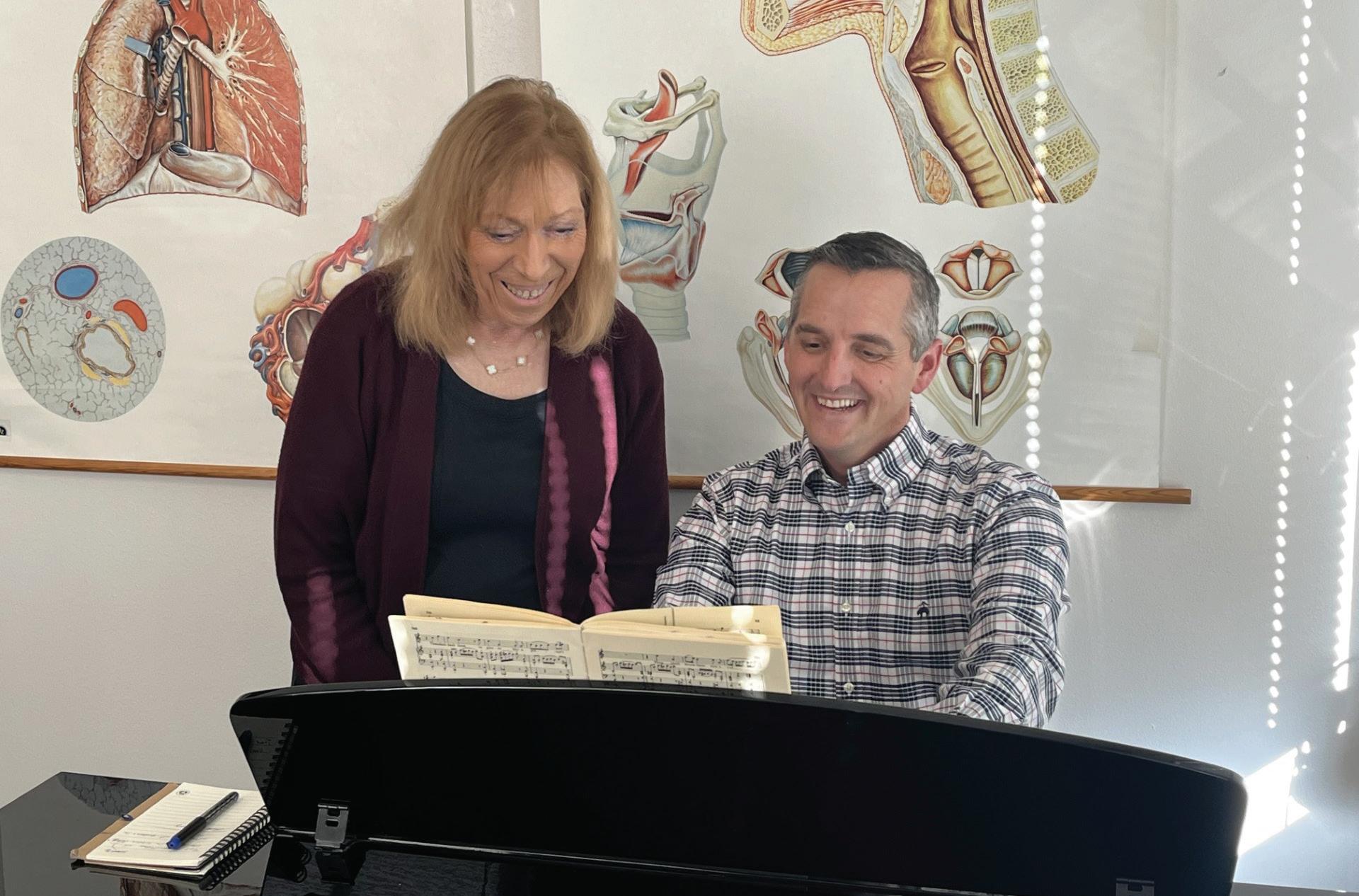
grandchildren, who miss me not singing with them.”
“You don’t realize how much your voice is part of your identity,” Jarvis said.
As they met virtually, Maxfield made her feel safe. He built on the progress Jarvis had made with her voice therapist, working with her on what’s called resonant voice therapy. Because of the nerve damage, she needed to retrain other muscles to help control her pitch, especially for high notes.
In essence, she had to retrain her brain by focusing on physical sensations such as vibrations in the front of her mouth and lips, working toward more stability in her voice.
“Some days I’d give up in frustration,” Jarvis recalled.
After nine months, she could sing her first song: “Homeward Bound,” by Marta Keen. But no one else had heard her—yet. It was right around Christmas when she
sang “In the Bleak Midwinter” in front of her family.
The moment felt like a miracle.
Jarvis was determined to keep going.
A joyful chorus
Over two years, she worked with Maxfield weekly until one night, while cooking dinner, she started singing along to a recording of Handel’s Messiah, which she’d memorized in college.
Suddenly, Jarvis realized: “I can do this again.”
Maxfield agreed.
Jarvis asked Christopher McBeth if she could sing with the Utah Symphony Chorus at the annual Messiah Sing-In, a longtime Utah Symphony | Utah Opera tradition. When then Chorus Director Sharon Lavery heard Jarvis sing, she
Continued on the next page…
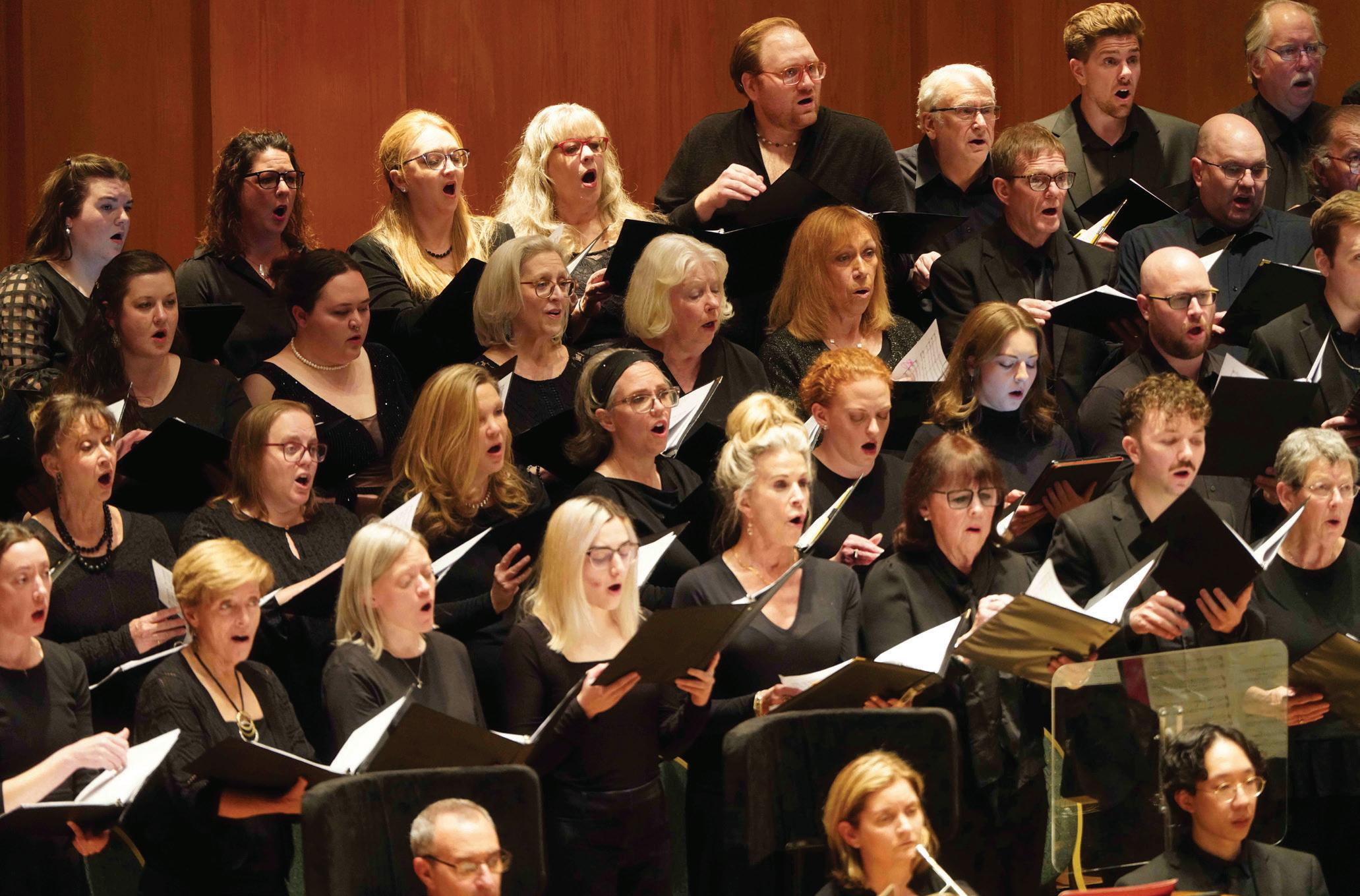
said, “You have a beautiful voice... you should come sing everything with us.”
And now Jarvis does.
Healthy voices
Vocal injury has been stigmatized, explains Maxfield. Singers often don’t want to admit they have problems, because they worry about how that might affect their prospects. Some teachers don’t want singers to disclose their injuries, mistakenly thinking that it reflects poorly on their teaching. But the culture seems to be shifting.
“Some high-profile singers are being vocal about their own injuries and demystifying and destigmatizing it,” said Maxfield, who directs the Utah Center for Vocology at the University of Utah, where he teaches and leads research on voice and the intersection of music and wellbeing.
He tells his students that if they have a sudden change in their voice that doesn’t resolve in a week or so and isn’t explained by something like a cold, they should get evaluated by a specialist. Ideally, that would include a visit to a laryngologist—an ENT who has specialty training in voice and upper airway disorders.
Every other musician gets to put their instrument away after rehearsal “in a nice, satin-lined box,” Maxfield observed. Singers don’t get to put away their voice, ever.
“It’s totally normal. It’s going to get beat up every now and again,” he said.
Now Jarvis tells her story to everyone.
“It encourages people to be self-disclosing,” she noted. “As I talk to other singers they say, ‘Maybe I should get some help, too.’”
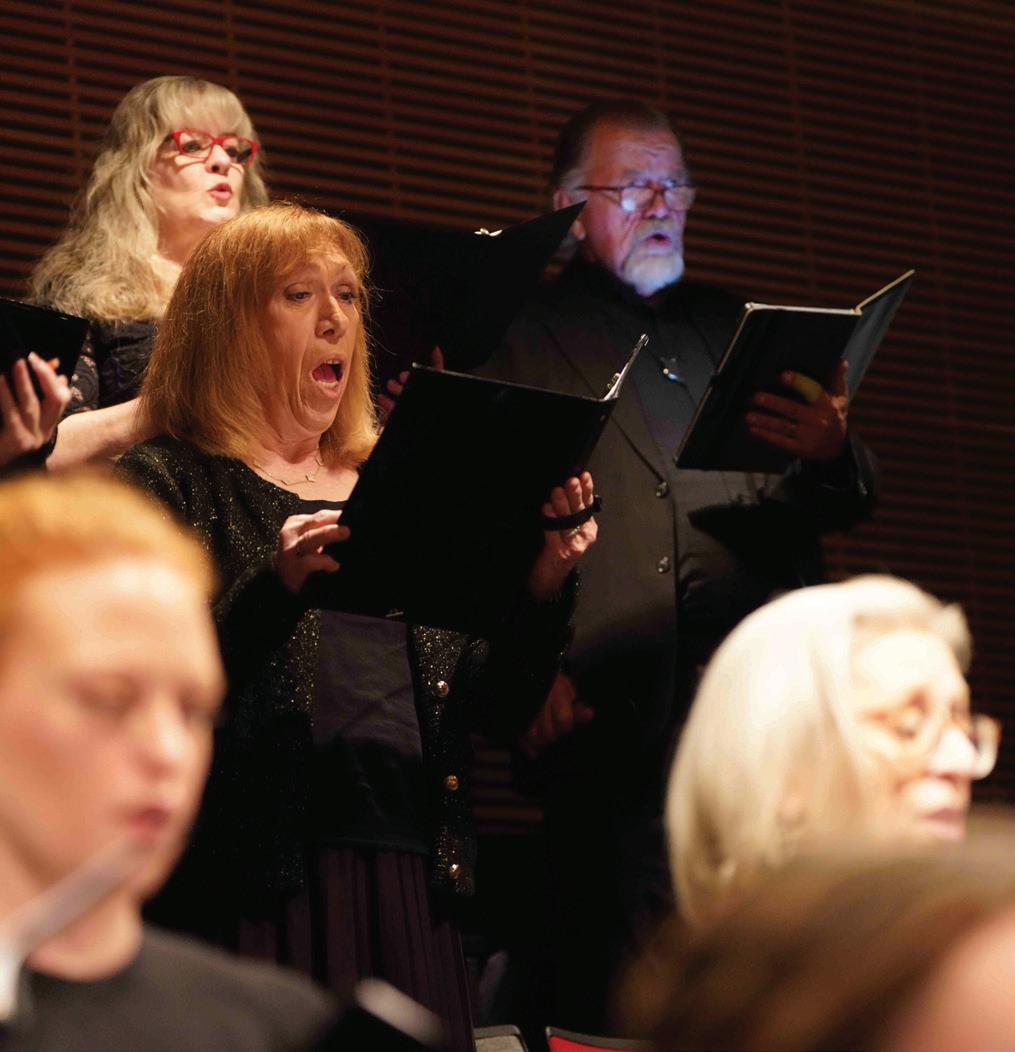
Triumph with Mozart
After the final performance of Mozart’s Requiem with the Utah Symphony Chorus last spring, Jarvis felt elated.
“To be able to make such beautiful music collectively with so many talented musicians after years of work to recover my voice was just an indescribable feeling of triumph,” she recalled. “I’m sure my friends in the audience, including Lynn Maxfield and Christopher and Julie McBeth, could see that emotion on my face.”
Chair of the USUO Board of Trustees since September 2025, Jarvis believes strongly in the connection between music and wellness, which USUO pursues through programs in partnership with schools, hospitals, medical professionals, and healthcare organizations. Jarvis is living proof of how closely music and mental health are intertwined.
“For me, it is a sense of indescribable joy to sing again,” she said.
Jarvis’ friend, Angie Keeton, ordered her a special score of the Mozart Requiem from Europe after they sang it as a
celebration of Annette’s journey. Both Keeton and Maxfield wrote in it. Here is what they said:
Dear Annette,
What an honor to sit beside you in this journey of hard work and determination. I hope you will cherish this score as much (likely more) as I have mine from my first performance. Here’s to many more joyous musical moments for you in the years to come.
~Angie
Dear Annette,
I don’t really have the words to adequately capture just how much joy it brought me to see you up on stage singing in public! I go back to your first email to me, in which you stated: ‘I know I will never be able to sing in public again.’ Oh, look how far you’ve come. Thank you so very much for letting me be a part of your journey! It is an honor and a privilege!
~Lynn
Hear Annette Jarvis sing with the Utah Symphony Chorus in Carmina Burana this April 10–11 at Abravanel Hall.
SATURDAY, MARCH 14, 2026 / 11:00 AM / MAURICE ABRAVANEL HALL
JESSICA RIVERO ALTARRIBA, conductor
CHILDREN’S DANCE THEATRE, guest artists
UTAH SYMPHONY
ANDREW MAXFIELD
SAINT-SAËNS
Good Golden Sun*
The Carnival of the Animals
*Commissioned by the Barlow Endowment for Music Composition at Brigham Young University.
CONCERT SPONSOR
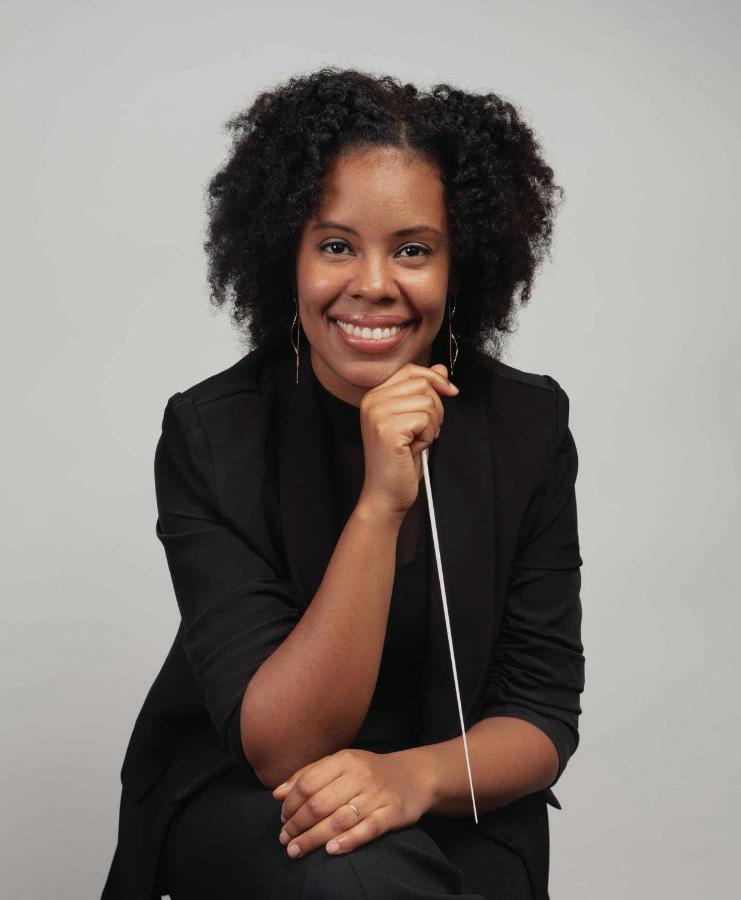
CONDUCTOR SPONSOR

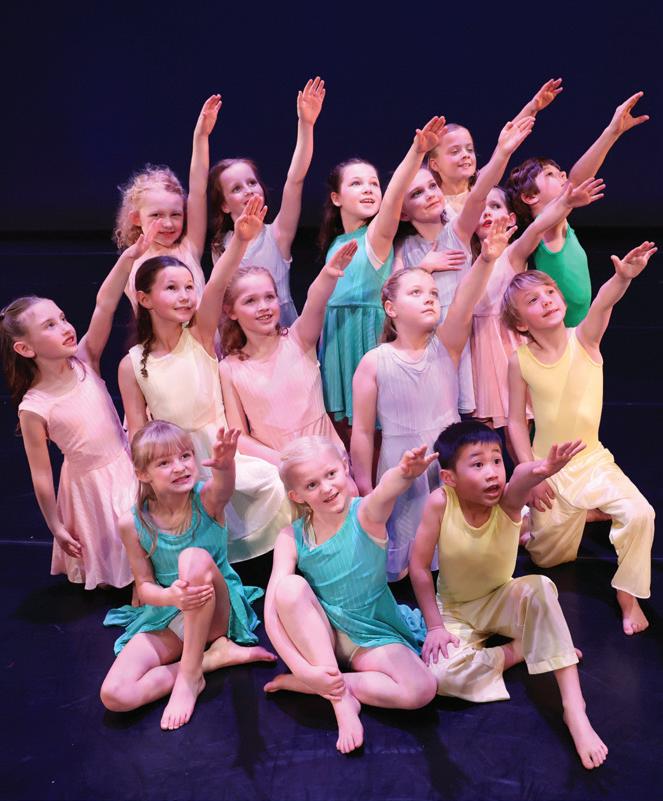
NUANCED INTERPRETATIONS, DYNAMIC ENERGY, AND A CHARISMATIC STAGE PRESENCE are hallmarks of Cuban conductor Jessica Altarriba. Praised for her communicative skills, impactful performances, and equally vested in both established and wellknown repertoire as well as contemporary compositions, Altarriba currently serves as Assistant Conductor for the Utah Symphony and is a Taki Alsop Fellowship Award Recipient (2024-26). Altarriba is concurrently pursuing her master’s degree in conducting at the Peabody Institute of Johns Hopkins University.
This past summer, she conducted the Utah Symphony’s summer community concerts as well as select concerts at the Deer Valley® Music Festival, including Tchaikovsky’s 1812 Overture, closing the festival. She also participated in the Youth Orchestra Los Angeles National Festival in California, collaborating with LA Philharmonic Artistic Director Gustavo Dudamel, YOLA Artistic Director Gaudy Sanchez, and the YOLA National Team in festival programming and conducting a final concert in collaboration with Dudamel.
CHILDREN’S DANCE THEATRE (CDT), A COMPANY OF DANCERS AGES 8 TO 18, is the major performing arm of the Tanner Dance Program. CDT presents a new work each year with original choreography, music, and costumes at the Janet Quinney Lawson Capitol Theatre and other professional venues throughout Utah. The company has earned state, national, and international recognition, and is the second-oldest performing arts organization in Utah. CDT’s mission is to develop young people into creative problem solvers, powerful performers and compassionate community members, while providing professional and engaging performances for audiences of all ages.
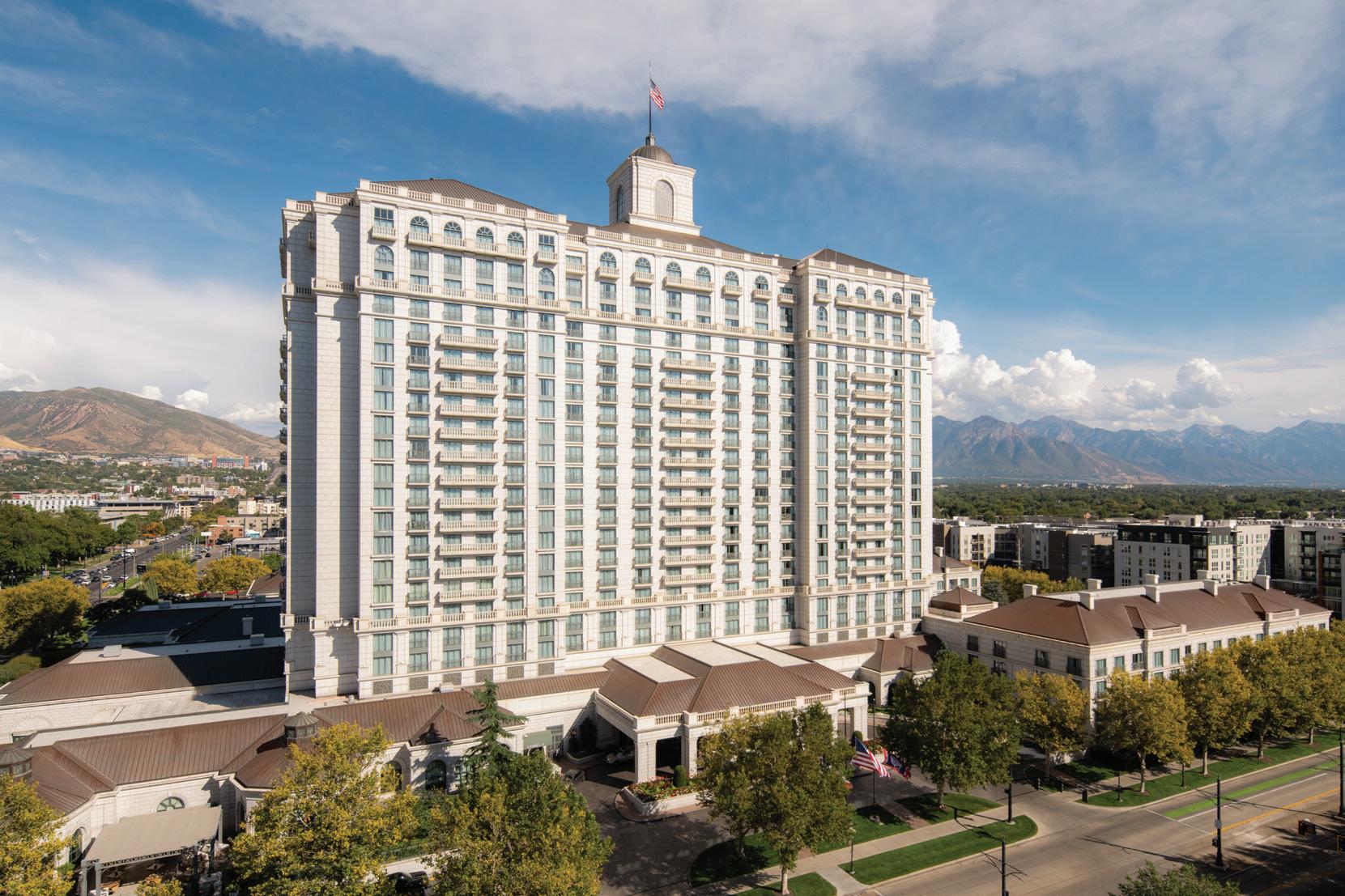
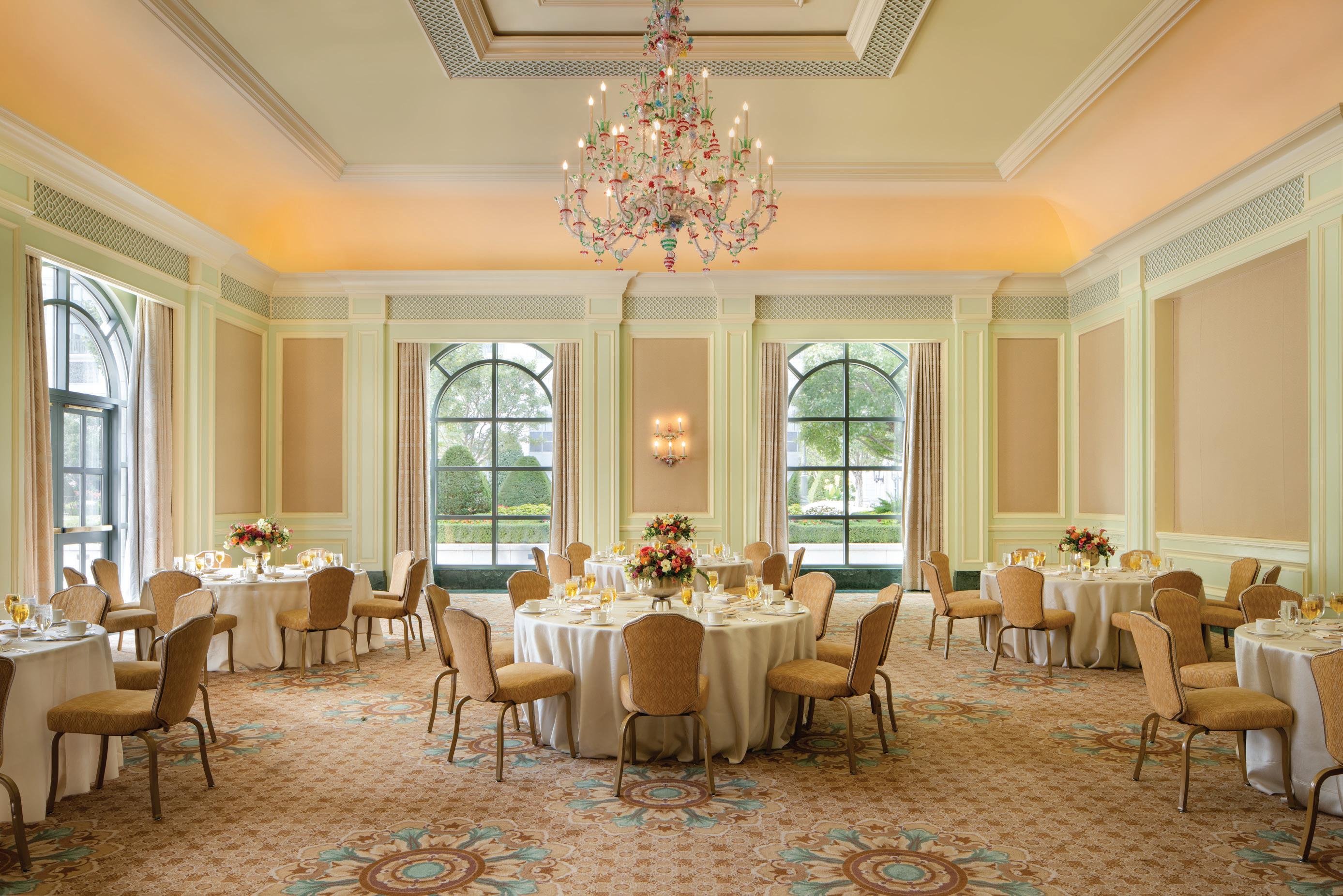


By Julia Lyon
If you’re like us, you wish you could ask Mozart or Beethoven about their music. What inspired each symphony? Each concerto?
But we’d need a little time travel—or fairy dust—to make that happen.
Here at Utah Symphony, we can speak with living composers like Andrew Maxfield. He wrote a new piece of music being premiered at our Family Series Concert this March.
Maxfield, who lives in Provo, took us back to the beginning.
It All Started with a Book
Brooklyn-based Brendan Wenzel writes and illustrates children’s books with bright, bold colors and shapes, often about something with fur or feathers. Maybe you know his popular picture book They All Saw a Cat
Maxfield composed an orchestral piece for that book, too. As a father, he’s spent many hours reading with his own kids. After reading Good Golden Sun, he knew its vivid illustrations would be perfect for another collaboration.
“It’s a real gift to have someone of [Andrew’s] talent spend time with something I’ve made,” Wenzel
reflected.
“It offers a rare and special chance to see the book from a new perspective.”
In Good Golden Sun, the main character is, of course,
the sun, but seen through the eyes of different creatures throughout the day.
We spoke with Maxfield right before Thanksgiving when his new work had officially moved from the incubation phase into what he calls “the madman phase.”
With a deadline only a few months away, Maxfield was getting up every day at 5 AM to compose.
“The goal for me during this phase is to write as much and as fast as possible,” he said. “It’s a really active, spilling ink onto the page, kind of phase,” he explained. “When there’s some kind of deadline or parameter, I have to write so fast I can’t overthink things.”
He first works on paper, reflecting on the form and landscape of the piece before writing the music itself.
“I do a lot of narrative sketching,” Maxfield said. “What’s the journey? How many minutes will it take? And what route are we going to follow?”
In Good Golden Sun, the sun rises and sets, creating a natural arc, which Maxfield uses as the structure of his piece. Wenzel’s art will be projected above the orchestra during the concert.
“In this case, we’re starting with something visual and working our way into a sonic, social experience in the hall,” Maxfield explained.
Colors on the page lighten and sweeten before fading at the end of day.
“I’m mirroring those basic things in the sound of the music,” Maxfield explained. “Young listeners will be able to hear and see those changes, particularly in the percussion.
The music begins with what he calls “dark, mellow sound” before brightening into daylight. Then it mellows again as the sun sets.
Maxfield knew he wanted his instrumentation to match Saint-Saëns’ The Carnival of the Animals so the same musicians could play both pieces in the concert.
But percussionists can play many instruments, which expanded Maxfield’s musical vocabulary.
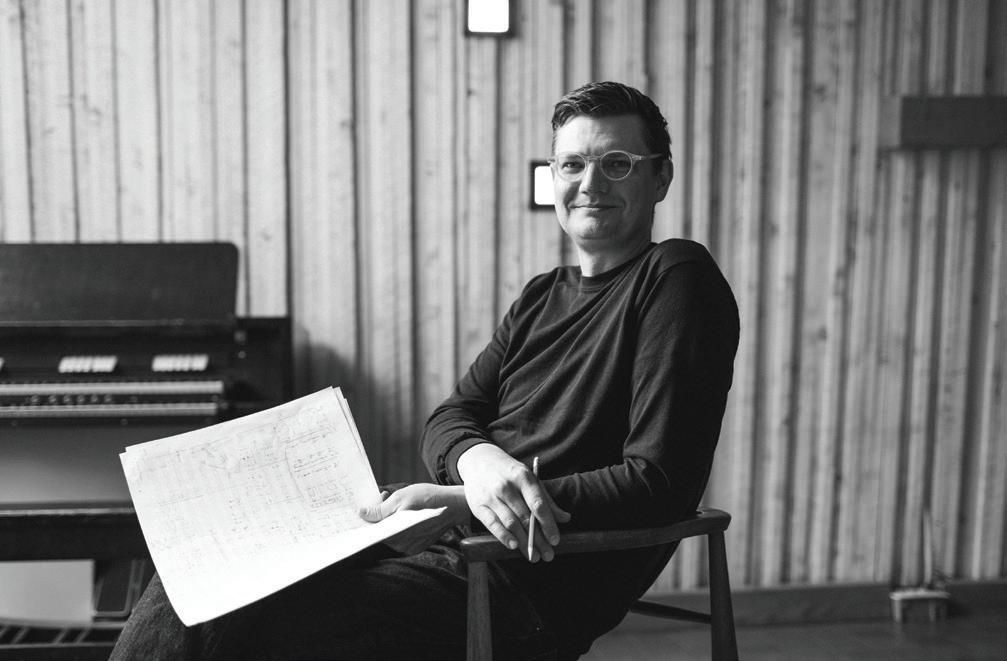
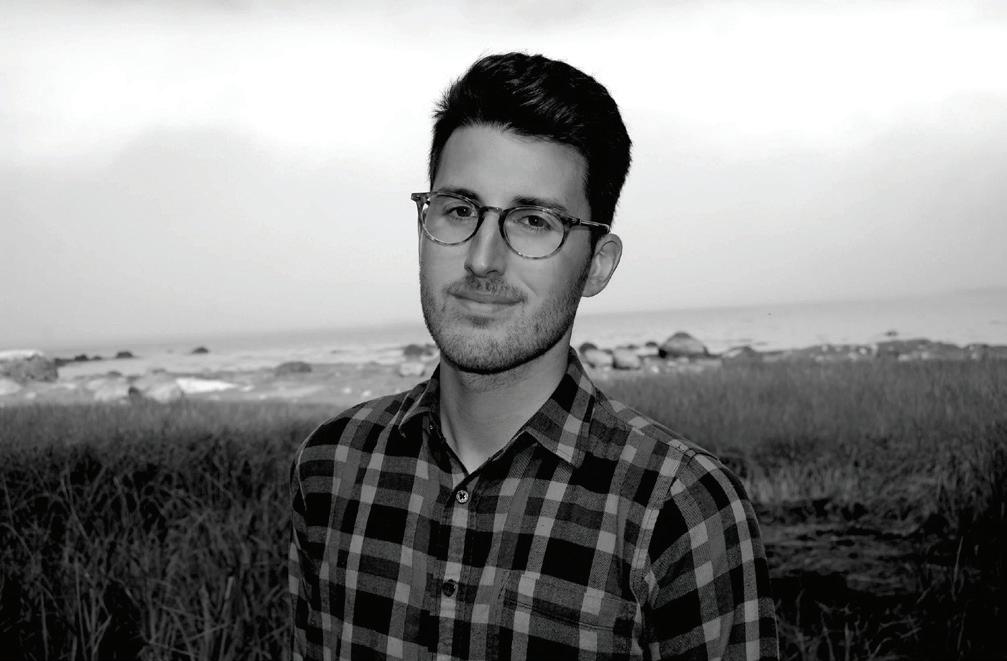

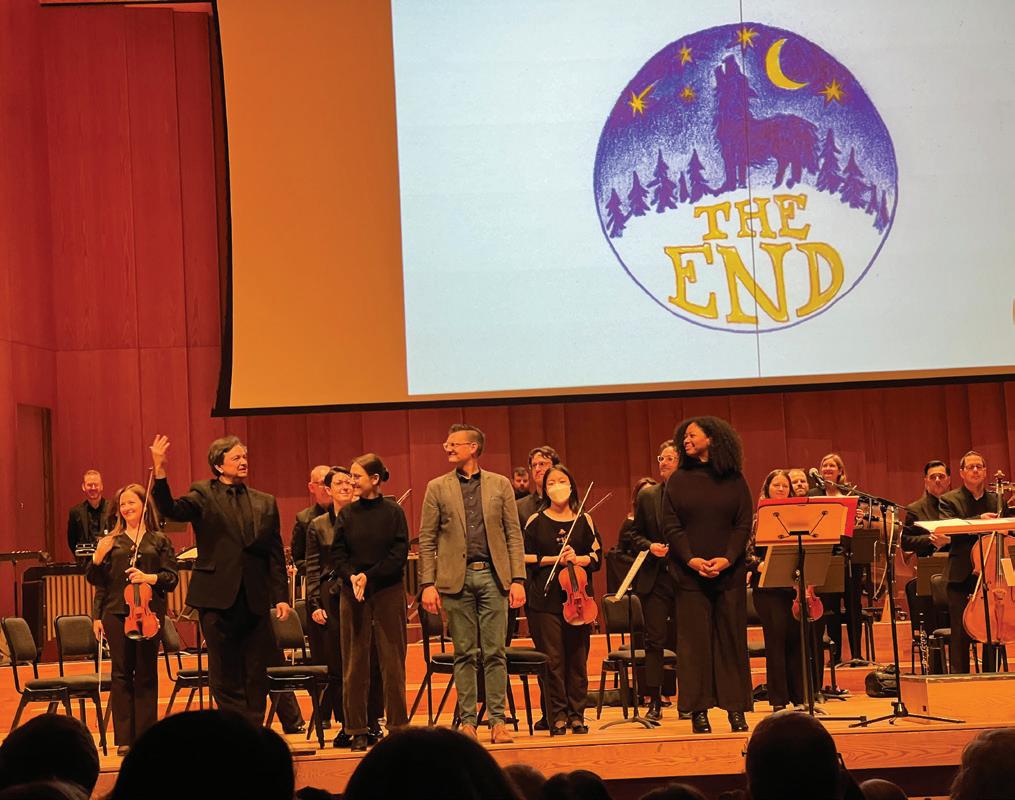
“As the percussionists move sideways from stage left to right, the sound brightens,” he revealed. “Then the percussionists move back as the sun sets.”
A bright, sparkly sound could be the glockenspiel or the shimmer of a high cymbal. A dark sound might be the low notes on a marimba or the resonance of an orchestral gong.
“There’s a visual dimension to percussion that listeners of all ages, especially young ones, can clue into,” Maxfield explained.
Typically, he spends about three months writing a new piece. The final phase is cleanup and polishing.
“It’s the perspective that comes after you’ve done the wild, creative stuff that helps you shape the work,” Maxfield said.
He knows that even after the Utah Symphony starts rehearsing, there will likely be small revisions.
“You learn things in the hall,” he observed. He might make one more round of edits after the premiere, but then it’s time to let the music rest.
Maxfield won’t be the only artist whose new work will be showcased at the concert. Two visual artists will have their drawings projected during The Carnival of the Animals Maxfield couldn’t be prouder. Why?
They’re his two sons: 13-year-old Eliot and 11-year-old Simon.
“As a composer, there aren’t so many ‘take your kids to work’ opportunities,” he said. My kids are some of the most interesting, creative people I know, and I’m honored to share any playbill with them!”

THURSDAY, MARCH 19, 2026 / 7:30 PM / UVU NOORDA CENTER FOR THE PERFORMING ARTS
FRIDAY, MARCH 20, 2026 / 7:30 PM / MAURICE ABRAVANEL HAL
SATURDAY, MARCH 21, 2026 / 7:30 PM / MAURICE ABRAVANEL HALL
KEITARO HARADA, conductor*
ALEXANDER MALOFEEV, piano*
UTAH SYMPHONY
MATTHEW JACKFERT
SCRIABIN
Foggy Moon Over the Gorge (08’)
Symphony No.2 in C minor, Op. 29 (52’)
I. Andante - Allegro giocoso
II. Allegro
III. Andante - Piu vivo, poco agitato
IV. Tempestoso
V. Maestoso
INTERMISSION
RACHMANINOFF
Concerto No. 2 in C minor for Piano and Orchestra, Op. 1 (32’)
I. Moderato
II. Adagio sostenuto
III. Allegro scherzando
*Utah Symphony debut
ORCHESTRA SPONSOR
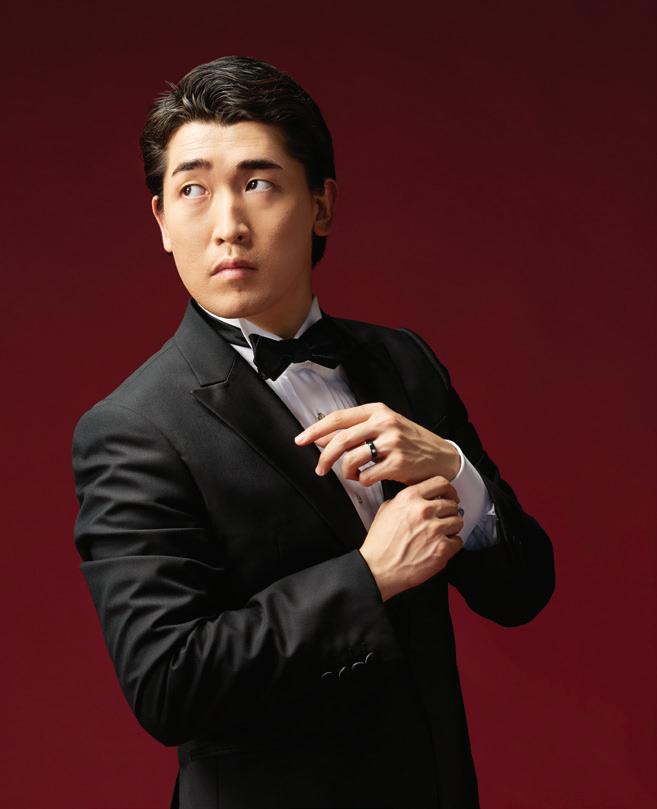
KEITARO HARADA IS ARMED WITH INTENSITY AND DEPTH, consistently providing riveting concerts and opera performances in Asia, the Americas, and Europe. As Music Director of the Savannah Philharmonic since the 2020-21 season, Harada has transformed the orchestra and energized its audiences throughout the community with his imaginative programs and charismatic presence. He is currently Music and Artistic Director of the Dayton Philharmonic Orchestra. In 2024, Harada became Permanent Conductor of the Tokyo Symphony Orchestra. He has forged a close connection with the NHK Symphony Orchestra with whom he appears frequently and has recorded three albums. Also in 2024, Harada became Principal Guest Conductor and Artistic Partner for the Aichi Chamber Orchestra. His eclectic musical scope ranges from symphony, opera, and chamber music to pops, film scores, educational outreach, and multidisciplinary projects, all of which enrich his programming. Harada is a recipient of the 2023 Sir Georg Solti Conducting Award.
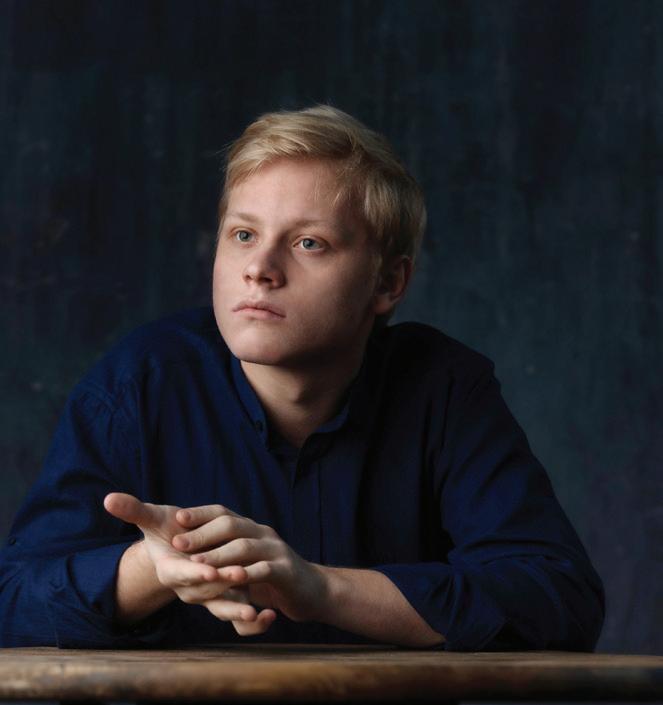
GUEST ARTIST SPONSOR
ALEXANDER MALOFEEV ROSE TO INTERNATIONAL PROMINENCE IN 2014 when, at just thirteen, he won the International Tchaikovsky Competition for Young Musicians. Reviewing the performance, Amadeus noted, “Contrary to what could be expected of a youngster...he demonstrated not only high technical accuracy but also an incredible maturity.”
Since then, Malofeev has established himself as one of the leading pianists of his generation, performing with top orchestras and conductors around the world. Highlights of the 2025–26 season include concerto engagements with the Vancouver, Oregon, Buffalo, Seattle, and Frankfurt Radio symphonies, the Netherlands Philharmonic, Vienna Symphony, and Belgian National Orchestra. In March, he embarks on a recital tour across the U.S., with performances in Orlando, Houston, Santa Monica, Fresno, Sarasota, Sanibel, and Atlanta.
Born in Moscow in 2001, Malofeev now resides in Berlin. He is an exclusive SONY Classical recording artist, and his debut album releases in 2026.
BY NOEL MORRIS
When Alexander Scriabin died suddenly in 1915, Sergei Rachmaninoff took Scriabin’s piano music on the road to raise money for his widow.
Scriabin had a primal connection to music. His mother was a famous piano virtuoso and played a recital just five days before giving birth to him. (Sadly, she died of tuberculosis after his first birthday.)
Sergei Rachmaninoff wrote his Piano Concerto No. 2 for his own hands, which were huge. For pianists with smaller hands, fluidity of motion is key.
born March 28, 1988, in Charleston, West Virginia
Foggy Moon Over the Gorge composed in 2024 premiered in Charleston, West Virginia, in 2024 Utah Symphony premiere
Rising star composer Matthew Jackfert is a native of Charleston, West Virginia, and is active as a composer and program host on West Virginia Public Radio.
A Note from the Composer
“I’ve grown up with the New River Gorge (now a National Park and Preserve) just over an hour away from my hometown of Charleston, WV—a place I could go to explore its natural wonders and raft on its world-class rapids. However, several years ago, I had a unique experience while passing over the chasm. I was driving up I-64 from Hinton to Charleston in the middle of the night. There was a full moon and not a cloud in the sky. The clouds, as I discovered, were not above me, but below me, in the gorge. Semi-delirious, I drove across the Glade Creek Bridge (the highest bridge in the interstate system) and saw a sea of fog filling the New River Gorge.
The full moon reflected off the clouds, creating a marvelous scene where I felt like I was almost floating on the fog, drifting away into the night. The scene had me so
enchanted that I had to snap myself back into reality and remember to keep my eyes on the road. This piece reflects that experience of floating on a foggy, moonlit gorge with its mysterious harmonies, ethereal colors, and sounds familiar [including a freight train] to the New River Gorge National Park and Preserve.”
Rachmaninoff and Scriabin
Sergei Rachmaninoff and Alexander Scriabin were two of the most gifted pianists of the 20th century—a credit to the irascible teacher Nikolai Zverev in Moscow. While young Scriabin could live at home, Rachmaninoff lived under his teacher’s roof. He described life in the Zverev household as a “musical prison.” Piano practice started at 6:00 AM, and beatings came often. The students enrolled in the Moscow Conservatory. At the same time, the teacher provided clothing and tickets to concerts, operas, and plays. On Sundays, the Zverev home transformed into what Rachmaninoff called “a musical paradise,” with informal gatherings that drew the likes of Arensky and Tchaikovsky. Through the experience, Rachmaninoff and Scriabin became lifelong friends.
ALEXANDER SCRIABIN
born January 6, 1872, in Moscow, Russia died April 27, 1915, in Moscow, Russia
composed in 1901
premiered in St. Petersburg, Russia, in 1902 last performed by the Utah Symphony in April 2003 with conductor Pavel Kogan
What to Listen for
In Alexander Scriabin’s Symphony No. 2, notice how the opening clarinet melody transforms over the course of the piece.
Alexander Scriabin came from an era when many Russian people sought answers beyond the Orthodox Church. The occult occupied a prominent place. Tsar Nicholas II fell under the spell of healer and mystic Grigori Rasputin. Beyond the palace walls, people consulted mediums and participated in séances. To this day, critics describe Scriabin as deluded, megalomaniacal, and Messianic. And maybe he was. But when he famously stated, “I am
God,” he only meant to suggest that divinity flows through all people.
More than anything, he was a seeker. An avid reader and world traveler, he embraced Theosophy and tirelessly pursued a connection to something beyond our realm. Eventually, he came to believe that his art could take us there. (A quick survey of our religious music and beautiful places of worship suggests he’s not alone in that.) Curiously, Scriabin had synesthesia, meaning music made him see colors, and he eventually aspired to create multimedia works that could realize the music in his head.
If he sought to move beyond the boundaries of material existence, he also moved beyond conventions in harmony. One senses something original, challenging, unique, sensuous, and beautiful in his music.
The Music
Scriabin wrote his Symphony No. 2 in 1901, after having written a series of Chopin-esque piano works. He was a stickler about structure, and so, before writing a single note, he predetermined the number of measures required for a section to achieve perfectly balanced proportions.
In the Second Symphony, a doleful clarinet melody serves as glue for the piece. The five movements divide into three parts (2+1+2). He conjoined the first two and the last two movements, but the real story is the unmistakably steamy intent. The Adagio and Allegro flow together without pause and set up a contrast between intense longing in the first movement and ardor and passion in the second, before building into a tremendous climax. The middle movement stands alone in this three-part structure. Marked Andante, it opens with a birdsong and offers richly hued sensuality.

Like the first two movements, the fourth and fifth flow from one to the next without pause and bring back the clarinet melody, now transformed into joy and sunshine. The piece culminates in a triumphal march.
Scriabin died of septicemia at age 43, leaving behind sketches for a mammoth, interactive multimedia composition to be performed in the foothills of the Himalayas. For sure, his ambition went over the top. But he gifted us a marvelous treasury of music because of it.
born Apr 1, 1873, in Staraya Russia, Russia died Mar 28, 1943, in Beverly Hills, CA
composed 1900-1901 premiered in Moscow, in 1901 last performed by the Utah Symphony in June 2024 with conductor Conner Gray Covington and pianist Wynona Yinuo Wang as part of the Gina Bachauer International Artists Piano Competition
As a child, Sergei Rachmaninoff had been an excellent pianist, but an undisciplined student. His cousin, the pianist Alexander Siloti, suggested he study with Nikolai Zverev at the Moscow Conservatory. His mother agreed and sent the screaming child 450 miles to Moscow. He was only 12.
As he matured, Sergei developed an interest in composition, which led to a blow-up with Zverev. The young composer finished his piano degree early and moved in with family to continue his composition studies. By the time he graduated, he’d written an acclaimed piano concerto and a successful opera. He seemed destined to be Russia’s next great composer.
The Music
On March 28, 1897, the 24-year-old composer huddled on a staircase outside a concert hall with his fingers jabbed in his ears. He desperately tried to blot out the sound, to escape the world premiere of his First Symphony.
It was a train wreck (to borrow a term from orchestral musicians). Some said that conductor Alexander Glazunov was drunk. Others noted that whole sections of the symphony had been rendered unrecognizable. Critics savaged the young composer.
“I had a very high opinion of my work,” said the composer, thinking back on its composition. “The joy of creating carried me away. I was convinced that here I had discovered and opened entirely new paths in music.”
One could forgive a young genius for feeling cocky. It’s a perfectly worthy symphony, written by a 22-year-old with a national reputation. Whatever the reason for the conflagration, it nearly ruined him.
Rachmaninoff turned to conducting and wrote almost no music for three years. Although he proved gifted on the podium, people close to him noticed changes: he grew thin and moody, and complained of sleepless nights. In January 1900, his family staged an intervention, suggesting he see Dr. Nikolai Dahl, a neurologist who’d built a practice treating trauma through hypnosis.
Rachmaninoff agreed and began to pay daily visits to the doctor. Dahl was a fine cellist, and the two bonded over their love of music. Their sessions focused on improving Rachmaninoff’s mood, appetite, and sleep habits. Dahl paid special attention to composition, reinforcing the notion that Rachmaninoff would soon write a terrific piano concerto. And he did.
Piano Concerto No. 2 began to take shape over the following summer, with material from a student work, his Romance in A for six hands (1891), feeding into the slow movement. Known among musicians as the “Rach Two,” the title page bears the dedication “À Monsieur N. Dahl.”
The concerto’s legacy is gigantic. Apart from being one of the most popular concertos ever written, its music found its way into two hits by Frank Sinatra (“I Think of You” and “Full Moon and Empty Arms”), a runaway hit for ‘70s pop star Eric Carmen (“All By Myself”), and the 1955 Marilyn Monroe film The Seven Year Itch

At Residence Inn by Marriott® Salt Lake City, Downtown, we provide spaces and experiences that allow you to travel like you live. Enjoy a variety of amenities including outdoor spaces with fire pits and grills; and our seasonal Outdoor Pool. Start each day off right with our hot breakfast and Wi-Fi. Plus, head outdoors and get moving with access to outdoor parks and trails all within minutes. See why The Residence Inn SLC Downtown is your perfect home away from home today by visiting w ww.marriott.com/slcri.
Residence Inn Salt Lake City Downtown Marriott.com/SLCRI
THURSDAY, MARCH 26, 2026 / 7:30 PM / BYU CONCERT HALL - SCHOOL OF MUSIC BUILDING
FRIDAY, MARCH 27, 2026 / 7:30 PM / MAURICE ABRAVANEL HAL SATURDAY, MARCH 28, 2026 / 5:30 PM / MAURICE ABRAVANEL HALL
DAVID DANZMAYR, conductor
PABLO FERRÁNDEZ, cello*
UTAH SYMPHONY
R. STRAUSS
Suite from Der Rosenkavalier, Op. 59 (22’)
I. Prelude
II. Presentation of the Silver Rose
III. Baron Ochs’s Waltz
IV. “Ist ein Traum”
V. Waltz (reprise)
KORNGOLD
Concerto for Cello and Orchestra in C, Op. 37 (13’)
INTERMISSION
TCHAIKOVSKY
RESPIGHI
Variations on a Rococo Theme, Op. 33 (18’)
I pini di Roma (The Pines of Rome) (23’)
I. I pini di Villa Borghese (The Pines of the Villa Borghese)
II. Pini presso una catacomba (Pines near a Catacomb)
III. I pini del Gianicolo (The Pines of the Janiculum)
IV. I pini della via Appia (The Pines of the Appian Way)
*Utah Symphony debut
CONCERT SPONSOR
David Danzmayr is in his fifth season as Music Director of the Oregon Symphony. Alongside his position in Oregon, Danzmayr also serves as Music Director of the innovative ProMusica Chamber Orchestra, comprised of musicians from all over the U.S. who are building exciting projects towards their upcoming 50th anniversary season. He also works regularly with Zagreb Philharmonic Orchestra with whom he previously served as Chief Conductor –highlights of his tenure included several European tours with concerts in Vienna Musikverein as well as Salzburg Festival Hall, where together they performed the prestigious New Year’s concert.
Danzmayr received his musical training at the University Mozarteum in Salzburg where, after initially studying piano, he went on to study conducting in the class of Dennis Russell Davies. His first post was in Scotland, as Assistant Conductor to the Royal Scottish National Orchestra.
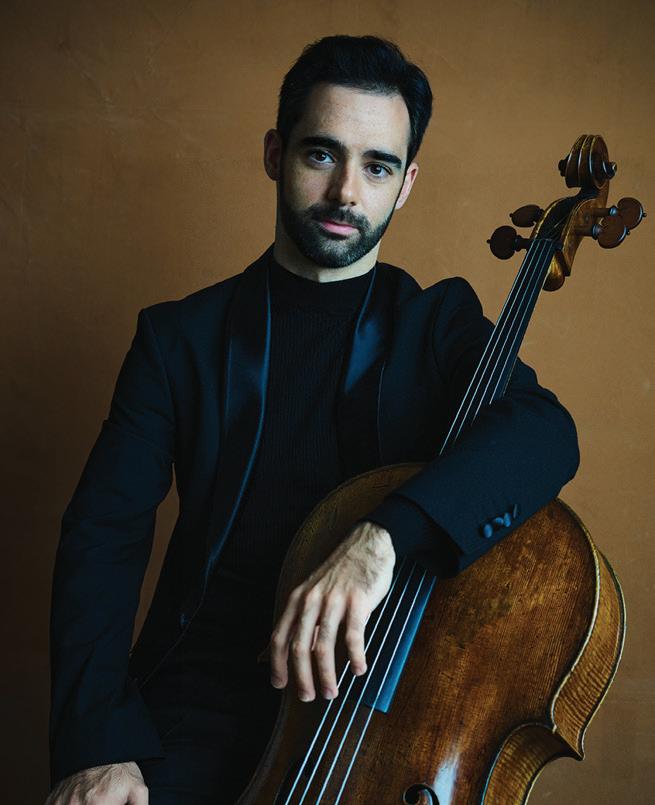
Prizewinner at the XV International Tchaikovsky Competition and SONY Classical exclusive artist, Pablo Ferrández is hailed as a “new cello genius” (Le Figaro). A captivating performer, “Ferrández has the lot: technique, mettle, spirit, authority as a soloist, expressivity and charm” (El Pais). Introduced by the Pittsburgh Symphony as “the next Yo-Yo Ma,” Pablo Ferrández has turned into a cello phenomenon and one of the most in-demand instrumentalists of his generation.
His debut album under SONY Classical, Reflections, released in 2021, was highly acclaimed by critics and received the Opus Klassik Award. In Fall 2022 Pablo Ferrández released his second album, which comprised the Brahms Double Concerto, performed with Anne-Sophie Mutter and the Czech Philharmonic under M. Honeck, as well as Clara Schumann’s Piano Trio, performed with Mutter and Lambert Orkis.
Ferrández plays the Stradivarius “Archinto” 1689, on a generous life-long loan from a member of the Stretton Society.
BY NOEL MORRIS
Ottorino Respighi studied orchestration with Nikolai Rimsky-Korsakov, the guy who wrote the book on the subject. Respighi specifies a large percussion section for The Pines of Rome, plus offstage brass, including six ancient Roman trumpets called buccine (the orchestra will use modern instruments, instead), organ, and a specific audio recording of a nightingale supplied by the publisher. Respighi was a pioneer in the use of electronics in orchestral music.
Despite his seminal work in Hollywood, Erich Korngold only ever wanted to write classical music.
The 1911 debut run of Richard Strauss’ opera Der Rosenkavalier caused such a sensation that officials had to add extra trains to Dresden to accommodate the crowds.
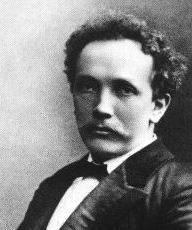
born June 11, 1864, in Munich, Bavaria died September 8, 1949, in GarmischPartenkirchen, Germany
composed in 1909–1910 premiered in Dresden, Germany, in 1911 last performed by the Utah Symphony in April 2023 with conductor Kevin John Edusei
The Backstory
By 1903, Richard Strauss had issued two operas without success. Undaunted, he rather audaciously turned to a banned play, Salomé by Oscar Wilde, for his next venture. His new opera premiered in Dresden at the end of 1905 and reportedly drew 38 curtain calls. Within two years, some 50 productions popped up across Europe, giving the composer a fat bank account. He followed Salome with another horror show, the opera Elektra (1909), and then made a hard turn away from dark and gruesome things.
The Music
Strauss’ Der Rosenkavalier, (The Knight of the Rose), presents an idealized Vienna. It takes place in the
eighteenth century, with its imperial palaces, powdered wigs, and puffy gowns, yet with the magic and nostalgia of the Viennese Waltz (which arrived a hundred years later). Completing the opera in 1911, Strauss melded bygone eras to produce a lush opera that dazzles the eyes and ears with sumptuousness, comedy, bittersweetness, and social commentary.
The story features a love triangle told through three women’s voices, one of whom plays a young man (in opera, it’s known as a “pants role”). Over the course of the opera, the “aging” Marschallin (she’s only 32) wistfully acquiesces to the march of time and nudges her young lover into the arms of his beloved.
The orchestral suite offers a sampler of this 4 ½-hour opera, with gushing love music and buoyant Viennese waltzes—but always through the veil of a 20th century modernist. Strauss’ love letter to “Old Vienna” includes orchestral colors never achieved in the 18th and 19th centuries. And his piquant harmonies drip with the richly chromatic ornamentation that became his signature sound in the tone poems.
Der Rosenkavalier became one of the most successful operas of all time. In post-World War II Bavaria, American soldiers randomly selected Strauss’ villa in Garmisch as a military headquarters. When they entered the house to oust the family, the white-haired composer announced, “I am Richard Strauss, composer of Der Rosenkavalier and Salome.” The soldiers left the house untouched.
born May 29, 1897, in Brno, Moravia died November 29, 1957, in Hollywood, California
composed in 1946
premiered in Los Angeles, California, in 1946 last performed by the Utah Symphony in February 2000 with conductor Keith Lockhart and cellist Ryan Selberg
“She owes her career to one man. She owes her heart to another.” So oozed the trailer to Warner Bros.’ campy film
Deception (1946), starring Bette Davis, Claude Rains, and Paul Henreid. The three of them play classical musicians—a pianist, a conductor, and a cellist—caught in an unsavory love triangle. Tension mounts as the cellist and the conductor prepare to perform a cello concerto together.
With plot holes the size of an SLC block, the picture is tedious, but Erich Korngold’s film score is outstanding. And he quickly morphed his silver-screen cello concerto into an actual concert piece.
Korngold was the son of a prominent music critic who knew how to open doors for his prodigious son. When 11-yearold Erich wrote his ballet-pantomime The Snowman, his father helped usher the show through its debut before the Emperor and the Vienna cognoscenti. Throughout the boy’s youth, the greatest musical talents in Europe affirmed Korngold’s genius, including Gustav Mahler, Richard Strauss, Giacomo Puccini, and Jean Sibelius. At age 24, he debuted his third opera, Die tote Stadt, at The Metropolitan Opera in New York City.
At that point, the young hotshot seemed unstoppable. But Adolph Hitler had other ideas, and Korngold was Jewish.
In 1934, the director Max Reinhardt lured Korngold to Hollywood to arrange music by Mendelssohn for a screen adaptation of A Midsummer Night’s Dream. At the time, most film scores were little more than pastiches of existing music. A year later, Warner Bros. offered the composer a lucrative exclusive contract. He accepted, thinking he could maintain his composing career in Europe. That changed with the Anschluss (the annexation of Austria) in 1938. Sensing the danger, Korngold sent for his family and settled in Southern California.
During his 12 years in Hollywood, the composer inspired directors to reimagine the role of music in the cinema. He pioneered the sumptuous, sweeping melodies that defined Hollywood’s Golden Age and won two Academy Awards for his efforts.
At war’s end, he announced his retirement from film. Soon, he mined his score from Deception and reissued the music as his Concerto for Cello and Orchestra in C, Op. 37. But don’t be deceived by its luxurious melodies: the
cellist is the jealous type. And Bette Davis plans to bump off the conductor.
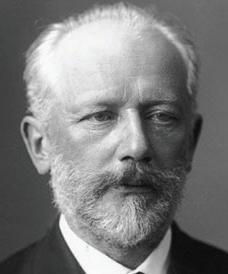
born May 7, 1840, in Votkinsk, Russia died November 6, 1893, in St. Petersburg
composed in 1876
premiered in Moscow in 1877 last performed by the Utah Symphony in July 2022 with conductor Kerem Hasan and cellist Zlatomir Fung
What to Listen for
It’s easy to mask the cello’s dark and mellow sound. To avoid that trap, Pyotr Ilyich Tchaikovsky scored around it. Notice how his Rococo Variations vary not only in mood but in color and range to highlight the expressive capabilities of the soloist.
The Backstory
“Rococo” is a funny word that doesn’t come up in conversation very often. But in the decorative arts, it applies to 18th-century palaces adorned with rosy-cheeked cherubs and golden swirls.
In music, it’s the bridge between the Baroque (such as Bach) and Classical (such as Mozart). Bach’s sons, who were also composers, turned away from the tendrilous, chromatic lines of the Baroque in favor of short, light, balanced phrases. Elegance was the operative term in Rococo music, and it nourished the young Mozart.
“It is to Mozart that I am obliged for the fact that I have dedicated my life to music,” Tchaikovsky admitted. “He gave the first impulse to my musical powers and made me love music more than anything else in the world.”
The Music
In December 1876, Pyotr Ilyich Tchaikovsky skipped his family Christmas to buckle down and work. He finished his lush, stormy symphonic poem, Francesca da Rimini, and settled on the perfect palate cleanser: a light, elegant tune that could serve as a springboard for a charming set of variations.
Cellist Pablo Ferrández noted that “Mozart was Tchaikovsky’s favorite composer, and Tchaikovsky is clearly channeling something of his Classical spirit in this piece.”
Each variation takes up the tune while projecting a unique personality for the orchestra and cellist. Note: The tune itself is not from the Rococo but from Tchaikovsky’s imagination. By eliminating brass and percussion, he scaled back the orchestra to a Classical-sized ensemble, which helped to solve a perennial problem with writing cello concertos: ensuring that the mellow cello cuts through the orchestra’s sound.
In this instance, Tchaikovsky enlisted the help of a fellow faculty member at the Moscow Conservatory, the cellist Wilhelm Fitzenhagen, who advised the composer on cello technique. In fact, his contribution became a flashpoint for Tchaikovsky fans who felt the man had overstepped. Original manuscripts show Fitzenhagen’s handwriting atop the composer’s. He even went so far as to re-order the variations.
Around 1941, scholars reconstructed the original work, but today’s cellists overwhelmingly prefer Tchaikovsky’s published version with the Fitzenhagen modifications, which allow the soloist to go out with a bang.
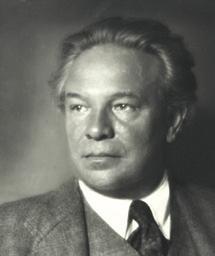
born July 9, 1879, in Bologna, Italy died April 18, 1936, in Rome
composed in 1923–1924 premiered in Rome in 1924 last performed by the Utah Symphony in September 2019 with conductor Thierry Fischer
Ottorino Respighi wrote The Pines of Rome in 1924 as a tribute to the Eternal City, with the ever-present Pinus pinea—the stone pine—looking on. These towering, umbrella-shaped trees form elegant canopies over the city. (They also produce the delectable pine nut.)
“The centuries-old trees which so characteristically dominate the Roman landscape become witnesses to the principal events in Roman life,” wrote Respighi.
I. “Pines of the Villa Borghese” captures children at play in the historic Borghese Gardens. Here, Respighi’s wife, Elsa, contributed children’s songs from memory. Respighi breathes life into the scene with a lively banter between the winds and brass, punctuated by crackling percussion.
II. “Pines near a catacomb” goes underground to the ancient burial chambers with melodies lifted from the Latin Mass, first intoned by muted horns, as if rising from the underworld.
III. “Pines of the Janiculum” conjures a moonrise over one of Rome’s seven hills, with a recording of a nightingale singing its song.
IV. The “Pines of the Appian Way” takes you to a roadway in ancient Rome as an endless column of armored soldiers threads its way into the city center. “Trumpets blare and the army of the Consul bursts forth in the grandeur of a newly risen sun toward the Sacred Way, mounting in triumph the Capitoline Hill,” wrote the composer.
The Pines of Rome is part of a trilogy with The Fountains of Rome (1916) and Roman Festivals (1928).


























Utah Symphony | Utah Opera is grateful to our generous donors who, through annual cash gifts and multi-year commitments, help us bring great live music to our community.
Millennium ($250,000+)
Anonymous Marcia JS Richards Jacquelyn Wentz
Encore ($100,000 – $249,999)
Anonymous
Estate of Dr. J.R. Baringer
Estate of Eva-Maria Adolphi
Kem & Carolyn Gardner
Dennis Hranitzky
Bravo ($50,000 – $99,999)
Berenice J. Bradshaw Trust
Estate of Dorothy B. Cromer
Dr. Kent DiFiore & Dr. Martha Humphrey
Estate of Jeff Drenker
Estate of Barbara Hartman
Estate of Gerry Hixson
Frederick & Lucy Moreton
Scott & Jennifer Huntsman
Anthony & Renee Marlon
Edward Moreton
John & Marcia Price Family Foundation
Patricia A. Richards & William K. Nichols
Mark & Dianne Prothro
Estate of Joyce Rice
Shiebler Family Foundation
Harris H. & Amanda P. Simmons Foundation
Beano Solomon
Stowell Leadership Group, LLC*
Norman C. & Barbara L. Tanner
Second Charitable Trust
George Speciale
Norman C. & Barbara L. Tanner
Charitable Trust
Zibby & Jim Tozer
Wheatley Family Charitable Fund
Overture ($25,000 – $49,999)
Frances Akita & Christine Akita Sulser
Scott & Kathie Amann
Doyle Arnold & Anne Glarner
Thomas Billings & Judge Judith Billings†
Bloomfield Family Foundation
Mr. Charles Boynton
Judy Brady† & Drew W. Browning
Judy & Larry Brownstein
John & Flora D’Arcy
Estate of Stephen L. Fife
Kristen Fletcher & Dan McPhun
David & Angela Glenn
Intuitive Funding
Tom Jacobson
Charles & Pat McEvoy
Gifts as of December 2, 2025
in-kind donation
in-kind & cash donations
Mr.† & Mrs. Alvin Richer
Nathan & Shannon Savage
Peggy & Ben Schapiro
Theodore & Elizabeth Schmidt Foundation
Taft & Anne Symonds
Naoma Tate & the Family of Hal Tate
John & Jean Yablonski
Maestro ($10,000 – $24,999)
Anonymous
Clisto & Suzanne Beaty
Beesley Family Foundation
Jim & Susan Blair
Steven & Cassandra Brosvik
Paul Burdiss
Howard & Betty Clark
Joseph & Cathy Cleary
Marian Davis & David Parker
Kathleen Digre & Michael Varner
Pat & Sherry Duncan
Barry & Traci Eden
Sarah Ehrlich
Pam & Jonathan Eichner
Matthew B. Ellis Foundation
Carolyn & Craig Enenstein
Robert & Elisha Finney
John F. Foley M.D. & Dorene Sambado
M.D.**
Allegro ($6,000 – $9,999)
Anonymous [4]
Kyle & Melissa Barnett
Marc & Kathryn Cohen
Kenneth Colen
Fifty50Fifty Family Fund
John H.† & Joan B. Firmage
David & Karen Gall
Brian & Detgen Greeff
Emma Hamilton & Brian Casper
Douglas & Connie Hayes
Susan & Tom Hodgson
Sunny & Wes Howell
Mary P.† & Jerald H. Jacobs Family
Stephen C.† & Lynda M. Jacobsen
Annette & Joseph Jarvis
G. Frank & Pamela Joklik
G F Larsen Family Charitable Fund
Bill Ligety & Cyndi Sharp
Matthew Prince & Tatiana Lingos-Webb
Prince
Michal & Maureen Mekjian
Millburn Philanthropy Trust
The Millerberg Family Giving Fund
Harold W. & Lois Milner
James & Ann Neal
Dr. Dinesh & Kalpana Patel
Leslie Peterson & Kevin Higgins
Frank R. Pignanelli & D’Arcy Dixon
Pignanelli
Walter J. & Peggy Plumb
Alice & Frank Puleo
David & Shari Quinney
Albert J. Roberts IV
Richard & Carmen Rogers
Sandefur Schmidt
Jonathan & Marisa Schwartz
Gerald† & Shari Seiner
Dewelynn & J. Ryan† Selberg
Mr.† & Mrs. G. B. Stringfellow
Thomas & Marilyn Sutton
Brad E. & Linda P. Walton
Dr. & Mrs. Harry C. Wong
Caroline & Thomas Wright
Kathie Zumbro
Diana George
Barbara Greenlee
Chuck & Kathie Horman
Tim & Angela Laros
David Luker
Carol & Anthony W. Middleton, Jr., M.D.
Jed Millburn
Sheryl & James Snarr
Paul Taylor
Dr. Jeannette Townsend
Jaelee Watanabe
Abravanel & Peterson Society ($3,000 – $5,999)
Anonymous [4]
Clayton & Julia Anderson
Austin & Kristi Bankhead
Dr. Peter & Rosemary Beck
David Murrell IV & Mary Beckerle
Philip Bienert
C. Kim & Jane Blair
Mr. & Mrs. William D. Callister
Helen & Jeff Cardon
Dr. Thomas D. & Joanne A. Coppin
Mr. & Mrs. Kenneth R. Cutler
Michael Brent Davies
Matt & Nancy Dorny
Barbara & Melvin Echols
Linda Francis
Sarah Ratchye & Edward Frank
Mr. & Mrs. Eric Garen**
David E. Gee
Dr. & Mrs. John Greenlee
Kenneth & Kate Handley
Brad Hare MD & Akiko Okifuji PhD
John Edward Henderson
Drs. Carolyn & Joshua Hickman
Dixie S. & Robert P. Huefner
Stephen Tanner Irish
Jay Jackson
Drs. Randy & Elizabeth Jensen
Rhett & Willow Jeppson
Maxine & Bruce Johnson
James R. Jones Family
Dr. Michael A. Kalm
Lucinda L. Kindred
Jeffrey LaMora
Dr. Donald & Alice Lappe
Christie & Franklin
Michael Liess
Dennis & Pat Lombardi
Hillary Marquardson
Kathryn & Jed Marti
Dale & Carol Matuska
Christopher & Julie McBeth
David & Nickie McDowell
George & Nancy Melling
Pieter & Janice Mensink
John & Bria Mertens
Gail Miller & Kim Wilson
Dr. Louis A. & Deborah Moench
Terrell & Leah Nagata
Eva Novak
Patricia Legant & Thomas Parks
Sidney Stern Memorial Trust
Lisa Poppleton & Jim Stringfellow
Mick Rasmussen
Glenn Ricart & Patricia Guenther
Kenneth Roach & Cindy Powell
Kazuhiro Saito
Margaret P. Sargent
Smith & Wilcox Blue Skies Foundation
Gibbs† & Catherine W. Smith
Eddie Stone
Ruth Stone
Douglas & Susan Terry
Susan & David† Wagstaff
Sally Wakefield & Anthony Arnason
John & Susan Walker
Susan Warshaw
Sharlene Wells
Michael Wolfe
Jennifer Wollin
E. Woolston† & Connie Jo HepworthWoolston
A dynamic group of young professionals, the Associate Board partners with Utah Symphony | Utah Opera to shape the future of live music. They bring fresh ideas, cultivate philanthropy, and strengthen connections between USUO and the community.
Contact Katie Swainston at kswainston@usuo.org for more information about becoming involved.
Curtis Woodbury, chair
Kylee Dickamore
Hillary Marquardson
Jeff Pickett
Rayanne Riepl
Stephen Tracy
as of December 2, 2025
Friend ($1,000 – $2,999)
Anonymous [6]
Craig & Joanna Adamson
George & Frances† Alderson
Christine A. Allred
Drs. Crystal & Dustin Armstrong
A. Scott & Jesselie Anderson
Joe Arnold
Ian Arnold
Mr. Gaylen Atkinson
Dr. Ann Berghout & Dennis Austin
Fred & Linda Babcock
David Bateman
Robert & Dagmar Becker
Lowell Bennion
Vicki & Bill Bennion
Patter & Thomas Birsic
Roger & Karen Blaylock
Susan Boyer
Diane Banks Bromberg & Dr. Mark
Bromberg
Céline Carol Browning & Nathan
Sutherland
Dana Carroll & Jeannine Marlowe
Carroll
Linda Jo Carron
Po & Beatrice Chang
William & Patricia Child
Phillip I. & Gail Coleman
Dr. & Mrs. David Coppin
David & Carol Coulter
Jason & Kristin Covili
Coleen Cronin
Mark B Dean
Tim & Candace Dee
Paul Dorgan
Eric & Shellie Eide
David & Susan Erhart
Leonard Farnsworth
Craig Fineshriber & Dr. Nancy Futrell
Drs. Norman L. & Carol† M. Foster
Phillip & Alice Newberry
Dr. Robert Fudge & Sylvia Newman
Larry Gerlach
Bob & Mary Gilchrist
Ralph & Rose† Gochnour
John & Linda Green
Olga Gromadzka
Keith Guernsey & Rebecca Burrage
Dr. Elizabeth Hammond
Helene Harding & Patrick Briggs
Robert & Marcia Harris
Virginia Harris
Jonathan Hart
Jeff & Peggy Hatch
Lex Hemphill & Nancy Melich
Susan K. Hickenlooper
Connie C. Holbrook
Laura Holleman
Ron & Marsha Houston
Eldon Jenkins & Amy Calara
Jay & Julie Jacobson
Joann & Russell Jex
Chester & Marilyn Johnson
Dr. & Mrs. Ramon E. Johnson
Bryce & Karen† Johnson
Kimberly Johnson & Bennett Greenfield
Nicholas Johnson
Rebekah & Joseph Johnson
Kimberli Jones
Neone F. Jones Family
Michael & Amy Kennedy
Alsco Uniforms
Mary Denice & George Koch
Michael & Peg Kramer
Patricia L Leikhim
Scott and Valerie Lindley
Ms. Susan Loffler
Heidi & Edward D. Makowski
Neylan McBaine & Elliot Smith
Jerilyn S. McIntyre & David Smith
Julie Mckee
Warren K.† & Virginia G. McOmber
Mr. & Mrs. Reed W. Merrell
David B. & Colleen A. Merrill
Jim & Nanette Michie
Kenny Mizel
Stephen & Sandy Morgan
Barry & Kathy Mower
Dan & Janet Myers
Drs. Norman L. & Carol† M. Foster
Craig Sparrow Ogan
Maura & Serge Olszanskyj
Stephanie Pappas
Elodie Payne
Cynthia & George Petrow
Keith & Linda Poelman
Dr. Susan J. Quaal
Thomas Quam
Esther Rashkin
Mick Rasmussen
Dr. Barbara S. Reid
Frances Reiser
Gina Rieke
G. Dale & Susan Richey
Miguel Rovira
Gail T. Rushing
Rachel Sabin
Mark & Loulu Saltzman
Monica Fleckenstein & Steffen SchmitzValckenberg
August L. Schultz
Ronald Schwarz
Mr. Jeffrey W. Shields & Ms. Mary Ross
Jeffrey Simmons
Barbara Slaymaker
Jan H. Smith
Dr. & Mrs. Michael H. Stevens
Clint & Jody Stone
Annie & Cory Strupp
Jay Teevan
Brent & Lissa Thompson
William & Donna† R. Vogel
Sharon Walkington
Judith Warner
Bruce & Leigh Washburn
M. Terri Poli and J. Craig Weakley
Frank & Janell Weinstock
Jody L. Williams
David† & Jerre Winder
Michael & Judy Wolfe
Tolford & Mary Young Gifts as of December 2, 2025
in-kind donation
Utah Symphony | Utah Opera is grateful to those donors who have made commitments to our Endowment Fund.
Anonymous
C. Comstock Clayton Foundation
The Elizabeth Brown Dee Fund for Music in the Schools
Lawrence T. & Janet T. Dee Foundation
Thomas D. Dee III & Dr. Candace Dee Hearst Foundation
Carolyn T. Irish Revocable Trust
The Right Reverend Carolyn Tanner Irish† & Mr. Frederick Quinn
Edward Moreton
The Linda & Don Price Guest Artist Fund
Perkins-Prothro Foundation
Kenneth† & Jerrie Randall
The Evelyn Rosenblatt Young Artist Award
Bill† & Joanne Shiebler
Steven P. Sondrop Family Trust
James R. & Susan Swartz
Clark L. Tanner Foundation
Norman C. & Barbara L. Tanner Charitable Trust
Norman C. & Barbara L. Tanner Second Charitable Trust
O.C. Tanner Company
Jack & Mary Lois Wheatley Family Trust
Edward & Marelynn† Zipser
The Endowment Fund is a vital resource that helps the long-term well-being and stability of USUO, and through its annual earnings, supports our Annual Fund. For further information, please contact Garrett Murphy, Director of Development, at (801) 869-9016.
Many donors have made gifts to Utah Symphony | Utah Opera in memory or to honor friends and loved ones. Thank you for your generous tributes.
IN MEMORY OF
Jack Ashton
David Luker
J. Richard Baringer, MD
Norman L. Foster, MD
Judith Billings
Thomas Billings
Frances J. Darger
Peggy & Richard Sacher
Maxine, Frank & Joel McIntyre
Jerilyn McIntyre & W. David Smith
Ruzena (Rose) Novak
Eva Novak
Glade & Mardean Peterson
Leslie Peterson & Kevin Higgins
Kelvin Peterson
Scott & Kathleen Amann
Rick & Betsy Anderson
Kirsten & Gary Dodge
Lory Hendry & Rob Ayres
Joann & Russell Jex
Richard Morais
Shelley Morandi
Sean Myles
Carol Steffen Richards
George & Frances† Alderson
Wallace Ring, MD.
Dr. Harry Wong
Gladys Gladstone Rosenberg
David Luker
Bill Shiebler
Tom & Laurie Eastwood
Fickling Family Foundation
Kristen Fletcher & Dan McPhun
Jim & Barbara Gaddis
Veloria M. Jacobson
Allison Kitching
Frank & Alice Puleo
Deanna L Rodeghier
Peggy & Ben Schapiro
Anne & Taft Symonds
The Swartz Foundation
Allison Weiss
Willard & Evelyn Smith
Jerilyn McIntyre & W. David Smith
IN HONOR OF
Ronald Lee Bennett
Marianne Riehl
Joanne Shiebler
Maria S. Tuttle
Barbara Scowcroft
Dean Zobell
We thank our generous institutional donors for their annual support of Utah Symphony | Utah Opera.
$100,000 or more
The Church of Jesus Christ of Latter-day Saints Foundation
Emma Eccles Jones Foundation
George S. & Dolores Doré Eccles Foundation
The Florence J. Gillmor Foundation
$50,000 – $99,999
Anonymous
47G Utah Aerospace & Defense**
AHE/CI Trust
Crocker Catalyst Foundation
$25,000 – $49,999
Anonymous
Arnold Machinery
Big-D Construction
BMW of Murray/BMW of Pleasant Grove
Bill & Vicki Bennion
John & Carol Firmage
John† & Joan Firmage
Carol Franc Buck Foundation
$10,000 – $24,999
Altabank
B.W. Bastian Foundation
Bertin Family Foundation
Capital Group
Enbridge Gas
R. Harold Burton Foundation
FanX Salt Lake Pop Culture & Comic Convention
Goldman Sachs Philanthropy
Frederick Q. Lawson Foundation
Larry H. & Gail Miller Family Foundation
Lawrence T. & Janet T. Dee Foundation
LOVE Communications**
Marie Eccles Caine Foundation-
Russell Family
Marriner S. Eccles Foundation
O.C. Tanner Company
Sorenson Legacy Foundation
Stowell Leadership Group, LLC*
Zions Bank
The Grand America Hotel & Little America Hotel*
Moreton & Company
Charles Maxfield & Gloria F. Parrish Foundation
Salt Lake Chamber of Commerce*
World Trade Center Utah**
Cultural Vision Fund
Deer Valley Resort*
Goldman Sachs & Co. LLC
Richard K. & Shirley S. Hemingway Foundation
Intermountain Community Care Foundation
The Kahlert Foundation
The John C. Kish Foundation
Janet Q. Lawson Foundation
McCarthey Family Foundation
Minky Couture*
Moreton Family Foundation
S.J. & Jessie E. Quinney Foundation
Simmons Family Foundation
Summit Sotheby’s International Realty
Nora Eccles Treadwell Foundation
Greenberg Traurig
Joseph & Kathleen Sorenson Legacy Foundation
Merit Medical Systems, Inc.
Millburn & Company
Park City Chamber of Commerce & Visitors Bureau
Pura
Regence BlueCross BlueShield of Utah
Gifts as of December 2, 2025
in-kind donation
in-kind & cash donations
deceased
The Joseph & Evelyn Rosenblatt
Charitable Fund
Stewart Education Foundation
University of Utah Health
Utah Valley Chamber of Commerce*
WCF Insurance
Woodbury Corporation
$1,000 – $9,999
Anonymous
Amano Artisan Chocolate*
Bank of America
The Buckner Company
Caffé Molise*
CHG Healthcare Services
Spencer F. & Cleone P. Eccles Family Foundation
EcoView Windows & Doors
Henry W. & Leslie M. Eskuche
Charitable Foundation
Every Blooming Thing*
The Fanwood Foundation Western Office
Grandeur Peak Global Advisors
Holland & Hart
Huntsman International LLC
Intermountain Health
J. Wong’s Thai & Chinese Bistro*
Kennecott Utah Copper LLC
KeyBank
KKC Foundation
Microsoft Corporation*
Millcreek Coffee Roasters*
Mountain America Credit Union
Mountain Temp Services, LLC
OPERA America
Osher Lifelong Learning Institute
Precision Hermetic Technology
Promontory Foundation
Ray, Quinney & Nebeker Foundation
Red Rock Brewing Company*
Ruth’s Chris Steak House*
SALTT
Serving Table 22*
Sotheby’s Cares
Spencer Fane Snow Christensen & Martineau Foundation
Squatters Pub Brewery*
St. Regis / Deer Crest Club**
Stay Park City
Summerhays Music Center
The Swartz Foundation
Swire Coca-Cola, USA*
Urban Hill
Utah Autism Foundation
Vergara Miller Law
Vox Marketing Group*
Wells Fargo
Utah Symphony | Utah Opera would like to especially thank our major sources of public funding that help us to fulfill our mission and serve our community.
Salt Lake County Zoo, Arts & Parks
Utah State Board of Education
Utah Department of Cultural & Community Engagement
Utah Division of Arts & Museums
Utah Office of Tourism
Utah State Legislature
Summit County RAP Tax


Summit County Restaurant Tax
National Endowment for the Arts
Salt Lake City Arts Council
Orem City CARE Tax



Utah Symphony | Utah Opera offers sincere thanks to our patrons who have included USUO in their financial & estate planning.
Beethoven Circle (gifts valued at more than $100,000)
Anonymous [3]
Doyle Arnold & Anne Glarner
Edward R. Ashwood & Candice A. Johnson
Dr. J.R. Baringer†
Dr. Melissa J. Bentley
Marcy & Mark Casp
Shelly Coburn
Raymond & Diana Compton
John & Flora D’Arcy
Anne C. Ewers
Annette W. & Joseph Q. Jarvis
Flemming & Lana Jensen
James Read Lether
Daniel & Noemi P. Mattis
Anthony & Carol W. Middleton, Jr., M.D.
Robert & Diane Miner
Pieter and Janice Mensink
Glenn Prestwich
Kenneth A.† & Jeraldine S. Randall
Marcia JS Richards
Mahler Circle
Anonymous [3]
Dr. Robert H.† & Marianne Harding Burgoyne
Richard Clegg
Mr. & Mrs. Kenneth E. Coombs
Robert & Carolee Harmon
Barbara Hartman†
Richard G. & Shauna† Horne
Virginia A. Hughes
Herbert C.† & Wilma Livsey
Dianne May
Jerry & Marcia McClain
Anonymous
Judy Brady† & Drew W. Browning
Dr. Robert H.† & Marianne Harding
Burgoyne
Richard Clegg
Shelly Coburn
Travis & Jamie Donio
Anne C. Ewers
Joseph & Pat Gartman
Annette W. & Joseph Q. Jarvis
Edward R. Ashwood & Candice A. Johnson
Herbert C.† & Wilma Livsey
Richard W. & Frances P. Muir
Marilyn H. Neilson
Carol & Ted Newlin
For more information, call (801) 869-9001
† Deceased
Dr. Louis & Deborah Moench
Jim & Andrea Naccarato
Stephen H. & Mary Nichols
Craig S. Ogan
Mr. & Mrs.† Scott Parker
Mr. & Mrs.† Michael A. Pazzi
Patricia A. Richards & William K. Nichols
Mr.† & Mrs. Alvin Richer
Laura Scholl
Jeffrey W. Shields
G.B.† & B.F. Stringfellow
Dr. Ralph & Judith Vander Heide
Edward J. & Marelynn† Zipser
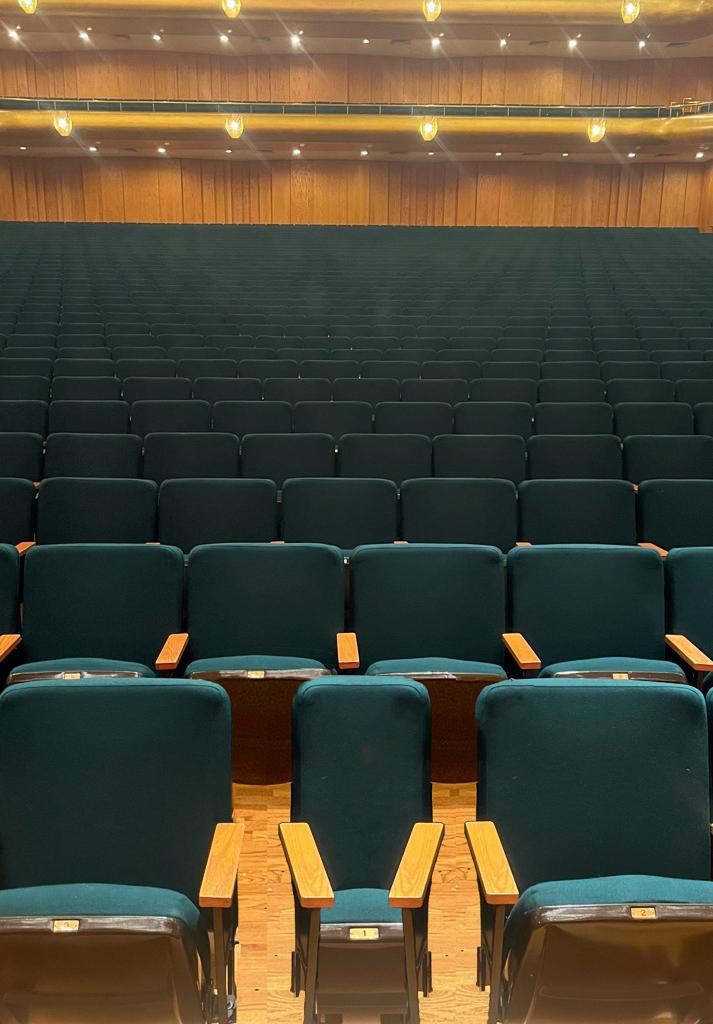
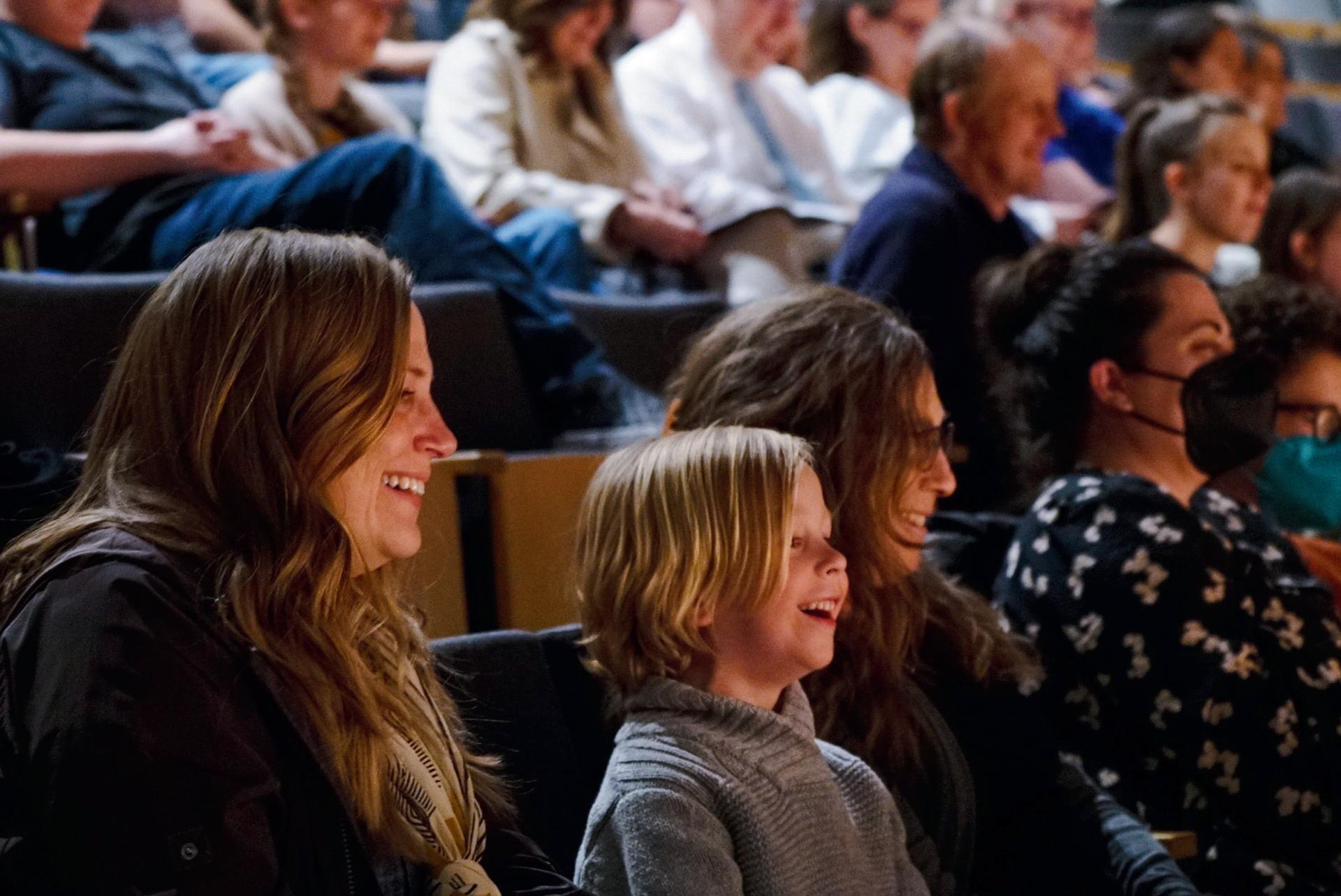
The remaining 2/3 comes from generous supporters like you. With ticket sales covering roughly 30% of the cost of our performances, your contribution helps complete the experience. Here’s
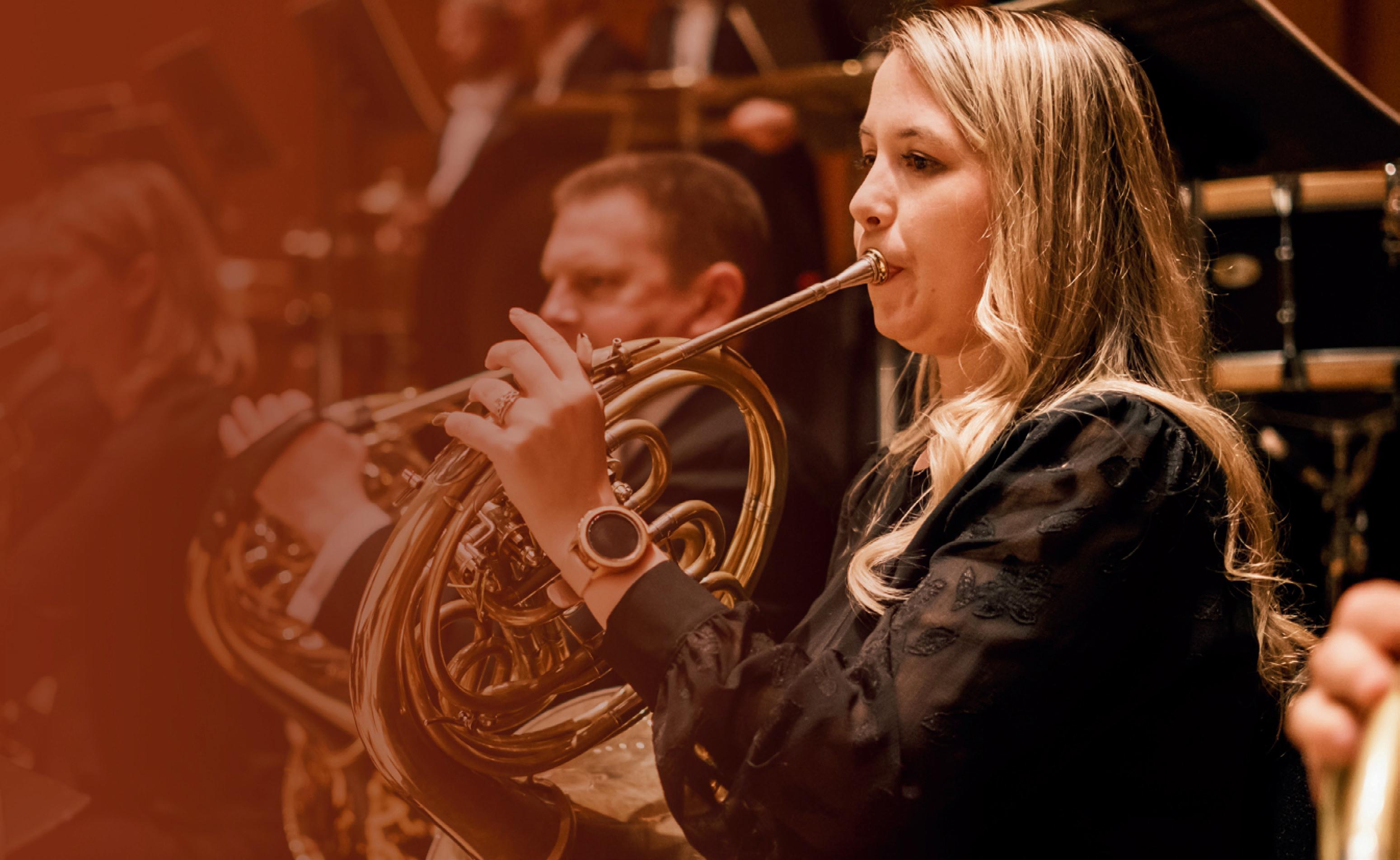
“When I was young, I dreamed about becoming a professional horn player. I attended Eastman School of Music, but realized there was little chance of a female brass player being hired by a major orchestra. Today, I can be part of the Utah Symphony horn section through financial support, adding my name to the principal horn chair. My childhood dream is now realized in a different way.”
-Marci Richards
Foster a unique connection with the individual behind the music while supporting the Symphony’s commitment to excellence.
LEARN MORE
by contacting
Development of Director Murphy, Garrett gmurphy@usuo.org
Make a lasting impact while meeting your financial goals today. Including Utah Symphony | Utah Opera in your will is simple, often taxadvantageous, and helps ensure the power of music touches lives for generations to come. To learn more, please reach out to your financial advisor or contact us at: 801-869-9200 usuo.org/planned-giving
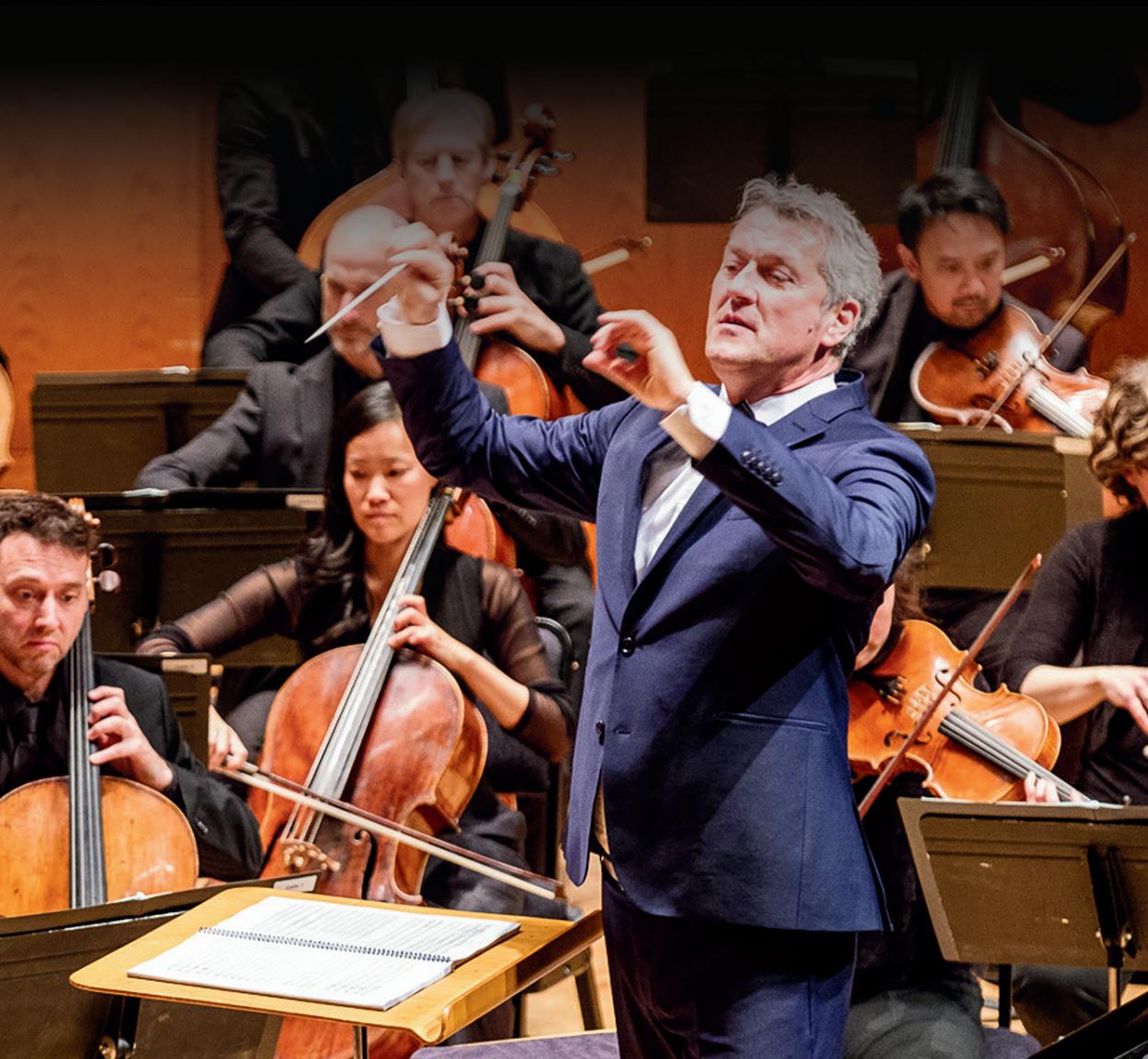
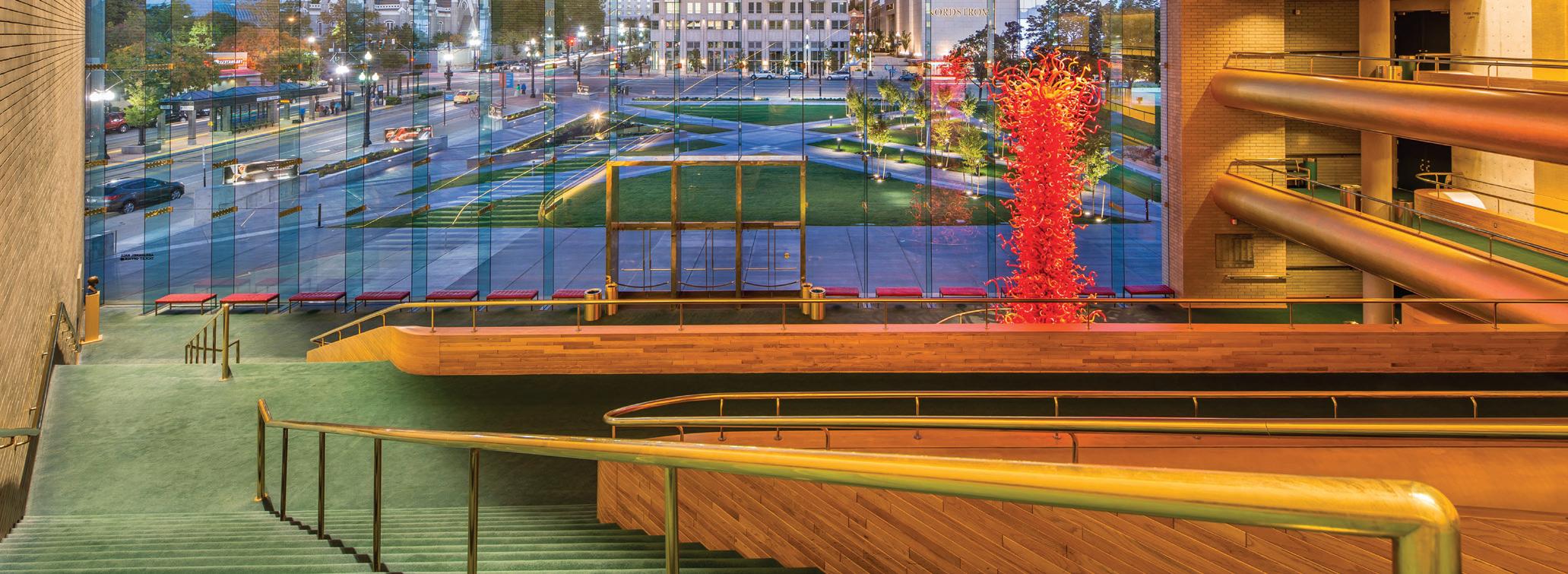
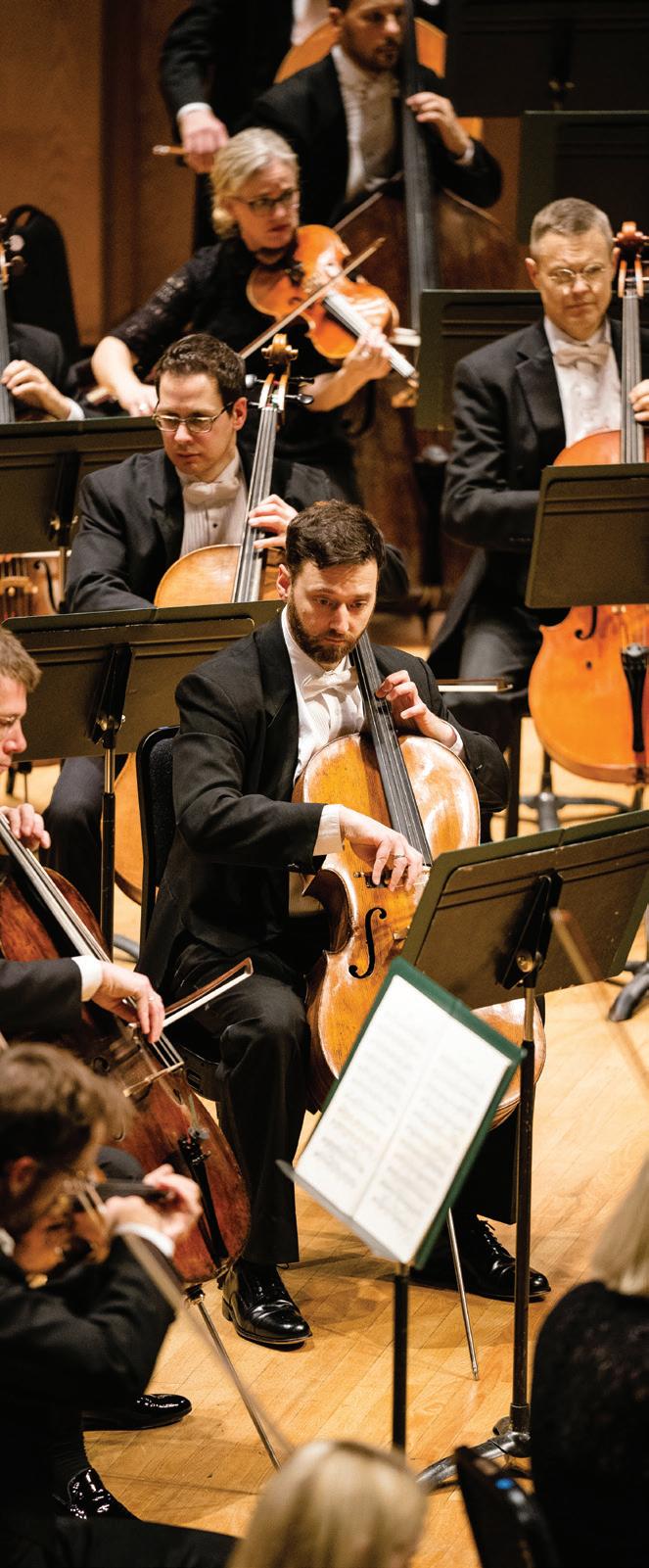
UTAH SYMPHONY | UTAH OPERA 123 W. South Temple Salt Lake City, UT 84101
801-533-5626
EDITOR
Julia Lyon
HUDSON PRINTING COMPANY www.hudsonprinting.com 241 West 1700 South Salt Lake City, UT 84115 801-486-4611
AUDITING AND ACCOUNTING SERVICES PROVIDED BY Tanner, llc
LEGAL REPRESENTATION PROVIDED BY Greenberg Traurig, llp Parsons Behle & Latimer, llp
ADVERTISING MEDIA & WEBSITE SERVICES PROVIDED BY Love Communications, Salt Lake City

The organization is committed to equal opportunity in employment practices and actions, i.e. recruitment, employment, compensation, training, development, transfer, reassignment, corrective action and promotion, without regard to one or more of the following protected class: race, color, religion, sex, national origin, age, disability, family status, veteran status, sexual orientation, gender identity and political affiliation or belief.
Maurice Abravanel Hall and and The Janet Quinney Lawson Capitol Theatre are owned and operated by the Salt Lake County Center for the Arts.
By participating in or attending any activity in connection with Utah Symphony | Utah Opera, whether on or off the performance premises, you consent to the use of any print or digital photographs, pictures, film, or videotape taken of you for publicity, promotion, television, websites, or any other use, and expressly waive any right of privacy, compensation, copyright, or ownership right connected to same.