(eBook PDF) Introduction to Professional Engineering in Canada, Fifth Canadian Edition
https://ebookluna.com/product/ebook-pdf-introduction-toprofessional-engineering-in-canada-fifth-canadian-edition/ (Original PDF) Social Work: Contexts & Practice 4e by Connolly, Marie; Harm
The Ethical Standards and Risk Management Period 72
The Canadian Association of Social Workers’ Code of Ethics 75
Code of Ethics Core Values 77
Strengths and Limitations of the CASW Code of Ethics 79
Addressing Ethical Dilemmas: The Process of Reflexive Decision-Making 80
Describe the Case and Context 82
Define the Ethical Problem 82
Explore Values and Biases 83
Gather Information: Research, Theory, and the Code of Ethics 83
Explore Options 86
Ethical Social Work Practice and Self-Care 86
Conclusion 89
Questions for Critical Thought 89
Recommended Readings 89
Recommended Websites 90
Part Foundational Skills for Social Workers
4 Social Work with Individuals and Families 93
Learning Objectives 93
Chapter Outline 94
Historical Contexts of Social Work with Individuals and Families 94
Practice with Individuals and Families 94
Communication Skills 95
Attending 95
Questioning 96
Reflecting 96
Summarizing 97
The Social Work Relationship 97
Care and Concern 98
Genuineness 98
Empathy 98
Collaboration 99
Self-Disclosure: A Contested Issue in Supporting the Development of Common Factors 101
Hope: A Neglected Common Factor 101
Official Language Legislation and Social Services in Canada 102
Phases of the Helping Process 104
Phase I: Exploration/Assessment 104
Phase II: Contracting/Planning 113
Phase III: Implementation/Intervention 115
Phase IV: Ending/Evaluation 116
The Helping Process with Families 117
The Genogram 118
Conclusion 120
Questions for Critical Thought 120
Recommended Readings 120
Recommended Websites 121
5 Social Work with Groups and Communities 123
Learning Objectives 123
Chapter Outline 124
Historical Contexts of Social Work with Groups and Communities 124
Different Forms of Social Work Groups 124
Treatment Groups 127
Task Groups 130
Stages of Group Development 137
Group Leadership and Facilitation 139
Community Social Work Practice 141
Community Practice Frameworks 142
Conclusion 149
Questions for Critical Thought 149
Recommended Readings 149
Recommended Websites 150
Part Fields of Social Work Practice
6
III
Social Work and Health 153
Learning Objectives 153
Chapter Outline 154
Early Health-Care Provision 154
Contemporary Approaches to Health-Care Provision 155
Report by the Commission of Inquiry into Health and Welfare (1970) 155
Canada Health Act (1984) 157
Romanow Report (2002) 158
The Privatization of Health Services in Canada 158
Social Work Practice in Health Care 160
Hospital-Based Social Work 160
Social Work and End-of-Life Care 160
Social Work and Mental Health Care 161
Social Determinants of Health in Canada 163
Income 164
Early Childhood and Adolescence 166
Unemployment and Working Conditions 168
Food Insecurity 169
Housing 171
Contemporary Challenges in Urban Settings 229
Disappeared and Murdered Indigenous Women and Girls 231
National Inquiry into Missing and Murdered Indigenous Women and Girls 232
Walking with Our Sisters 234
Steps toward Healing 235
The Medicine Wheel as a Healing Tool 235
Indigenous Worldviews in Social Work 238
Uniqueness of the Métis 239
Social Work Theories as Seen through an Indigenous Lens 239
Challenges Facing Indigenous Social Workers 240
Indigenous-Focused Social Work Programs 241
Being an Ally 243
Idle No More 243
The Eighth Fire 244
Truth and Reconciliation Commission of Canada 248
Conclusion 252
Questions for Critical Thought 252
Recommended Readings 253
Recommended Websites 254
9 Social Work with Immigrants and Refugees 257
Learning Objectives 257
Chapter Outline 258
Overview of the Contemporary Canadian Migration Landscape 258
Who Are Today’s Migrants? 259
Who Is Where? Migrant Countries of Origin and Settlement across Canada 261
The War in Syria 262
Migration Policy Overview 263
International-Level Policies 263
National-Level Policies 264
Theoretical Approaches to Working with Migrant Populations 266
Ecological Systems Theory 266
Strengths and Empowerment Approaches 266
Integrating Culture into Practice Approaches 267
Stages of Migration Framework 268
Settlement Issues Facing Migrants in Canada 273
Goals and Expectations 274
Employment and Education 274
Language 274
Health 276
Housing 276
Social Support 277
Settlement Services 277
Vulnerable Groups 279
Gender and Migration 279
Trafficking 280
Unaccompanied Minors 281
Lesbian, Gay, Bisexual, Transgender, and Queer (LGBTQ) Immigrants and Refugees 283
Refugee and Immigrant Older Adults 284
Migrants with Disabilities 285
Survivors of Torture 285
Conclusion 286
Note 286
Questions for Critical Thought 287
Recommended Readings 287
Recommended Websites 288
10
Social Work and Sexual and Gender Diversity 291
By Edward Ou Jin Lee and Shari Brotman
Learning Objectives 291
Chapter Outline 292
Taking Up Sexual and Gender Identity Terms 293
Overview of the TSLGBTQ Human Rights Global and Canadian Landscape 294
Global Context 294
Canadian Context 295
Violence, Discrimination, and Stigma 298
Internalized Homophobia and Transphobia 299
Intersectionality as a Theoretical Framework 299
Intersectionality, Identity, and Social Location 300
Disclosure of Sexual and Gender Identity: Coming Out 301
Families and Communities 303
Families 303
Communities 305
Social Work Practice with TSLGBTQ People across Health-Care and Social Service Settings 308
Historical Dimensions 308
Social Dimensions 308
Access to Health Care for Specific TSLGBTQ Groups 310
Access to Social Services for TSLGBTQ People 313
Barriers to Access for TSLGBTQ Individuals across Health-Care and Social Service Settings 315
The Continuum of Attitudes toward Sexual and Gender
Difference in Health-Care and Social Services 316
Guidelines for Social Workers to Foster Safe and Affirming Spaces for TSLGBTQ People 317
Social Location and Institutional Power 318
Collective Empowerment 319
Conclusion 319
Questions for Critical Thought 320
Recommended Readings 320
Recommended Websites 321
11 Disability and Social Work Practice 323
By Carl Ernst and Radha MacCulloch
Learning Objectives 323
Chapter Outline 324
Defining Disability 324
What Is Disability? How Is Disability Defined in Canada? 324
Theorizing Disability 325
The Medical Model of Disability 325
The Social Model of Disability 325
The World Health Organization’s International Classification of Functioning, Disability and Health (ICF) 326
Categorizing Disability 327
The Categorical or Diagnostic Approach 328
The Non-categorical or Functional Approach 328
Prevalence of Disability in Canada 329
History of Disability Policy in Canada 330
Early Beliefs about Individuals with Disabilities 330
Asylum, Confinement, and Institutionalization 331
Deinstitutionalization 334
Progress and Development of Disability Rights in Canada 337
Social Work Practice with Individuals with a Disability 339
Health and Social Services for Individuals with Disabilities: Navigating the Systems of Care 339
Settings for Social Workers in a Disability Context 343
Promoting Inclusion: Roles for Social Workers in a Disability Context 344
Social Work Practice Guidelines 349
Conclusion 350
Questions for Critical Thought 351
Recommended Readings 351
Recommended Websites 352
12 Social Work with Aging Populations 355
Learning Objectives 355
Chapter Outline 356
Overview of Canada’s Aging Population 356
Ethnic and Racial Diversity among Older Adults in Canada 357
Aging of Minority French-Speaking Canadians 358
Rural Aging 359
Mental Health and Aging 359
Theorizing Aging 360
Micro Theories of Aging 360
Macro Theories of Aging 361
Policies That Have an Impact on Older Adults 363
Retirement Policies and Programs 363
Long-Term Care Policies and Programs 366
Elder Abuse: A Global Issue 373
Elder Abuse in Canada 374
Theorizing Elder Abuse 375
Social Location and Elder Abuse 376
Conclusion 378 Note 378
Questions for Critical Thought 378
Recommended Readings 378
Recommended Websites 379
13 International Social Work
381
Learning Objectives 381
Chapter Outline 382
Why International Social Work? 382
Social Work beyond Borders: Historical Patterns of Expansion and the Canadian Connection 384
Defining International Social Work: An Ongoing Challenge 385
International Social Welfare Organizations and Their Functions 388
The United Nations and Its Agencies 389
Government Agencies 393
List of Boxes
Theory in Practice
The Medicine Wheel 6
AOP in Practice: The Montreal City Mission 59
Writing Psychosocial Assessments 107
Multidisciplinary Teams 133
Project Genesis 147
Council of Yukon First Nations Cultural Orientation and Protocols Toolkit 182
Why Do Families Experience Difficulties? 198
Young Offenders and Cognitive-Behavioural Therapy 213
Practical Tip
How Does One Choose a Theory? 36
The Process of Theory Analysis 37
How to Make an Eco-Map 44
Contact Information on Regulatory Bodies across Canada 75
The Helping Relationship Inventory 100
Questions to Reflect on During the Exploration and Assessment Phase of the Helping Process 107
Tips for Facilitating and Leading Groups 141
Ethics and Immigrants and Refugees 259
Empowerment 268
The Three Spheres 270
Identity Formation 300
Linking Macro Issues with Micro Practice 306
AGIR (Action LGBTQ with Immigrants and Refugees) 318
Post-caregiving 372
In a Cultural Context 398
Learning about Other Cultures 267 Trafficking 282
Creating Safer Spaces for TSLGBTQ People 317
Working in a Disability Context 343
Test Your Knowledge about Aging 358
Signs of Late Life Onset Depression 359
Creating a Timeline 363
Training and Preparing for International Social Work Practice 405
In Their Own Words
The Black Church in Canada: Pillars of Strength 22
Indigenous Ethics 85
The “Outsiders” 142
The Sixties Scoop 226
My Name Is Ruth Maloney Loft 249
Indigenous Peoples’ Rights and the International Arena 391
Practitioner’s Voice
Asylum Seekers 52
Walking on Eggshells? 73
Self-Care in Social Work Practice 88
Remaining Hopeful While Working with Immigrants and Refugees 103
Setting the Tone for Collaboration through Assessment with Families of Children with Neurodisabilities 105
Working with Indigenous Peoples in Small Communities 136
Individuals with Co-Occurring Disorders 180
Spirit Bear’s Plan to End Inequalities for First Nations Children 201
Child Welfare Workers 205
Bridging the Gap 237
Learning through an Indigenous Lens 241
How I See Myself as an Ally 245
Rural Settlement Practice 278
Working with Two-Spirited People 302 At Home 311
Recreation Integration Victoria 341
Ready, Willing and Able 345
Elder Abuse Prevention 376
Appreciating the World from a Global Perspective 395
Case Study
J.S. Woodsworth, the City, and Social Reform 18
Ethics and Dual Relationships 78
Debating the Role of Spirituality and Religion in Social Work Practice 112
Electronic Communication and Social Work 115
Arts-Based Group Work 131
Working Together to Explore Northern Community Responses to Intimate Partner Violence 144
Telehealth and Mental Health Training 162
Victimization and Harassment in Childhood and Adolescence 167
Child Maltreatment in Canada: The Canadian Incidence Study of Reported Child Abuse and Neglect 189
Indigenous Youth and the Criminal Justice System 210
Restorative Justice 238
Refugee Youth and Education 275
Disconnection and Community Belonging 309
Jordan’s Principle 340
Living on the Margins 368
Ongoing Tensions in International Social Work Practice with Women and Girls 400
From the Publisher
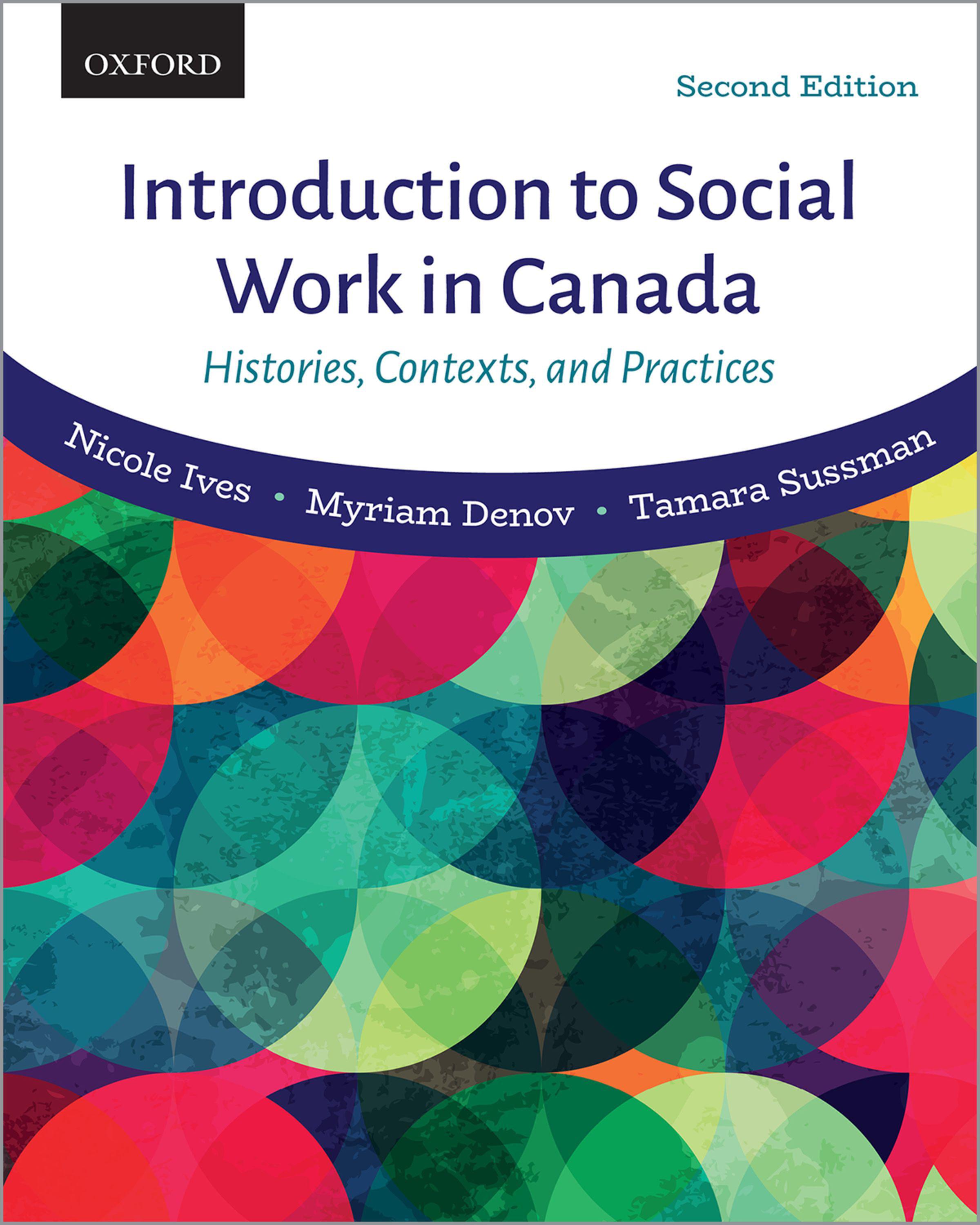
Oxford University Press is excited to present the second edition of Introduction to Social Work in Canada: Histories, Contexts, and Practices, a comprehensive introductory text designed for students of social work at Canadian universities and colleges. Drawing extensively on Canadian statistics and scholarship, the book begins by examining the historical roots of social work practice in Canada before moving on to discuss contemporary theoretical perspectives, ethics, and research. Practical applications are emphasized throughout, providing students with foundational skills they can apply in a broad range of contexts, from working with families, groups, and communities, to practising social work among children, Indigenous peoples, and people with disabilities.
Guided Tour
10 Part I | Historical, Theoretical, and Philosophical Frameworks
This section presents a history of social welfare provision in early Quebec, key figures in the development of Quebec social services (see Table 1.2), the Catholic Church’s central role in the delivery of social work and social welfare, and how these historical factors shaped social welfare legislation after the Great Depression.
Poverty Relief and the Involvement of the Roman Catholic Church
In the seventeenth century, French-speaking colonists in New France approached early poverty relief as did their ancestors in France. Welfare in Quebec was heavily influenced by France’s emphasis on the family as the primary institution given responsibility by society for providing aid to its impoverished members. When families failed in their obligations to family members, relief provision depended on the charity of local parishes of the Roman Catholic Church and Christian-based charity. Rather than through a coordinated system, relief was provided by multiple entities using their own evaluation criteria to address the needs of those living in poverty in Quebec’s cities and towns. For example, in 1688, bureaux des pauvres were established and operated in the cities of Quebec, Montreal, and Trois-Rivières. These “offices of the poor,” under a local priest’s supervision, relied on funds through collections taken periodically by the parishes and then distributed to its impoverished members (Lessard, 1987).
Providers of relief believed two major tenets regarding poverty, which also guided relief across Canadian territories. First, poverty was individually driven due to a perceived inability to live within the current economic and social system in combination with unfavourable character traits. Second, the poor were either “deserving” or “undeserving.” Receiving charity was not considered a right; thus, it was only conferred upon
Ive28818_ch01_001-031.indd 10 01/22/20 06:20 PM
An inclusive approach draws on not only English contributions to Canadian social work practice but also long-neglected Indigenous and French contributions, providing students with the most diverse and well-rounded introduction to social work on the market. This updated edition features a substantially revised and expanded chapter on Indigenous Peoples and Social Work.
This chapter provides an overview of the most significant aspects of what social work is to Aboriginal/Indigenous Peoples in Canada. There has always been a troubled relationship between the social work profession and this population as social work has mostly served as an element of social control and an arm of colonization throughout history and into the present day. The chapter begins with Indigenous ways of helping and caring for families and communities prior to contact with European settlers and then relays social work’s role in the cultural genocide of Indigenous Peoples primarily through the residential school and child welfare systems. Current challenges that Indigenous Peoples face are discussed in the context of colonization and the ongoing role of social work as an agent of social control. The chapter will then discuss how Indigenous Peoples are recreating their original ways of helping within their communities and their success in doing so.
This chapter explores how Indigenous worldviews, in the context of helping and healing, can, in part, work together with promising social work theories such as structural and anti-oppressive social work. The literature focused on in this chapter is based primarily on academic writing by Indigenous authors and their allies. All of these authors write passionately about past and present social work with Indigenous families and communities. Specific examples connect theories to practice and a case study provides concrete examples. The chapter concludes with a discussion of the value of Indigenous ways of helping to all people and the role of non-Indigenous social work allies in working with Indigenous Peoples.
Who Are Indigenous Peoples?
Indigenous Peoples are the original inhabitants of what the Haudenosaunee Nation calls Turtle Island or what is referred to as the continent of North America. According to the Canadian Constitution, there are three groups of Indigenous Peoples:
Celebrated Mi’kmaq
knowledge of social suffering with faith and engagement in the world to make a difference through our helping relationships and actions for social change” (Profitt, 2008, p. 161). Profitt (2008) recommended creating a safe space within the workplace to practise collective self-care. First, this space should be one that facilitates sharing stories about and reflecting on one’s work. Engaging in collective problem-solving can counteract feelings of isolation and stress. Second, within this space, one could process challenging emotions and work toward maintaining personal-professional balances. Third, this space
Practitioner’s Voice
that are obstacles to taking care of yourself. Pay attention to the voice inside your head that pushes you to do more for others, and then makes you feel bad when not everyone’s needs are met. This is the feeling of guilt and grief experienced when you feel you aren’t able to help
for
Learn to
“no” and stand up for
and your workload. The workload will not manage itself. Consequently, earning to maintain and practise good boundaries will help you empathize with rather than over-identify with a client’s experience. Invest in yourself. Incorporate activities in your schedule (not just when you have time, because you never will) that bring pleasure and joy. Identify activities that are relaxing to you. Seek support if you feel you need it. Listen to your body. Identify aches and pains that won’t go away, muscle tension, teeth grinding, upset stomach, and insomnia; all may be indications that you require additional self-care.
In reality there are many aspects about one’s professional experience that are out of one’s control, such as policies, procedures, client caseload, and unpredictability of the work. That being said, we do have control over how we invest in and take care of ourselves. Therefore, maintaining the aforementioned components related to self-care will certainly help to prevent and reduce the risk of burnout, compassion fatigue, and vicarious trauma.
—Corrie Sirota, MSW PSW, is a clinical social worker and psychotherapist.
“Practitioner’s Voice” boxes feature first-person narratives by social workers who are active in the field, giving students diverse perspectives from across the country in an up-close and personal way. Similarly, “In Their Own Words” boxes are written by other social work experts and service-users.
2012). It is important to note that the practices of the Sixties Scoop continue to this day. As observed by Blackstock in 2008, three times the number of Indigenous children were placed in the care of the child welfare system than were placed in residential schools at the height of their operation. Furthermore, as of 2016, Aboriginal children accounted for an astounding 51 per cent of children in care when they represent only 7.7 per cent of all children aged 0 to 4 (Statistics Canada, 2017a). This means that today Indigenous children are placed in the care of child welfare at a rate 12 times higher than non-Indigenous children (Statistics Canada, 2017a). See Chapter 7 for more on Cindy Blackstock’s research on Indigenous child welfare, and for her “Practitioner’s Voice: Spirit Bear’s Plan to End Inequalities for First Nations Children” feature box.
In Their Own Words
Learning objectives and chapter outlines at the beginning of each chapter provide students with a preview of the chapter contents and an overview of the concepts that will be covered
Ive28818_ch02_032-067.indd 46
ego or superego, such as an overdeveloped id (giving in to your instinctual desires) or an underdeveloped superego. In both cases, the ego is weak and unable to mediate between drives and restraints. In the case of the overdeveloped id, individual desires take precedence over societal responsibility.
Developmental Stages
Freud identified key stages (oral, anal, phallic, latency, and genital) through which humans move as they age. In each of these stages, an individual experiences particular challenges, which are normally resolved, and then moves on toward the next developmental stage. However, any childhood trauma that takes place during a particular stage may lead to the individual becoming “stuck” at that stage, potentially leading to future difficulties in adulthood.
Attachment
Theories of attachment focus on emotions and early childhood development as the basis for later relationships and emotional problems. A key interest is how early experiences of attachment are an important foundation for later social competence. John Bowlby (1984) developed a theory of how seeking attachment to others is a basic drive. Bowlby focused on how children separated from their mothers in early life later experienced anxiety, feelings of loss, and, eventually, disturbances in behaviour. In contrast, if the important attachment relationships are coherent and consistent, children learn the skill of relating to others and experience themselves as “potent,” or able to have an impact on the situations they are in.
Person-Centred Approaches
Person-centred approaches, which also fall within the realm of onion-peeling theories, emerged from the work of Carl Rogers, who provided important building blocks for thinking about intersubjectivity and the co-creation of meaning and experience that occurs within the context of the therapeutic relationship. Similar to psychodynamic
01/22/20 06:21 PM
to those without work or who had always lived in poverty; the Depression affected, albeit to different degrees, all strata of Canadian society. Social workers across Canada were directly involved in providing relief at this time, and by necessity, focused greater attention on helping individuals and families survive than on individual casework. Significant social welfare legislation grew out of the Depression. Creating the context for the Canadian welfare state, these pieces of legislation were
Visually engaging photos, tables, and figures bring
Figure 2.5 Cognitive-Behavioural Therapy: Thoughts, Feelings, and Behaviour
Sources: Social Emotional Resource Site for SPS Parents. (n.d.). Cognitive behavioral therapy (CBT). Retrieved from https://sites .google.com/a/sudbury.k12.ma.us/social-emotional-resource-site-for-sps-parents/emotional/cognitive-behavioral-therapy-cbt
thought and behaviour. Reframing works to “change the conceptual and/or emotional setting or viewpoint in relation to which a situation is experienced and to place it in another frame which fits the ‘facts’ of the same concrete situation equally well or even better, and thereby change its entire meaning” (Watzlawick, Weakland, & Fisch, 1974, p. 95). By reframing a situation, a social worker creates the potential for an alternative reality and can bring forth in clients greater compassion for themselves and less attribution of blame.
From a cognitive-behavioural approach, social work interventions are structured, problem oriented, goal oriented, brief, and time limited. Moreover, treatment is specific and concrete, and the use of homework assignments and practice skills is common. There is also an emphasis on the ability to problem solve. Cognitive-behavioural practice has been used in response to conditions such as phobias, panic disorders, anorexia, and bulimia where distorted thinking prevents optimal functioning.
Cognitive-behavioural theory has a strong evidence base to support its overall effectiveness, which has led Howe (2009, p. 73) to refer to it as “a top-rank social work theory.”
Both behavioural and cognitive-behavioural approaches provide key insights into the here and now and address clients’ immediate and pressing concerns. For example, implementing a behavioural approach and working with parents to manage a constantly screaming child is highly practical and useful. Faulty-engine theories can bring forth a sense of hope, as they underscore human capacity to learn and unlearn behaviours, providing hope for change and recovery.
At the same time, critics argue that some thinking processes are deeply entrenched and not easily amenable to quick change. It has been suggested that some belief systems or cognitions may not be irrational, but instead a natural and appropriate response to difficult life events (such as victimization, bereavement, and discrimination).
29 1 | Historical Foundations of Addressing Need
Cummings, Moody, & Benuto, 2019). Occupational exposure to stress can lead to burnout (Urdang, 2010), “compassion fatigue” (Radey & Figley, 2007), and vicarious traumatization (Dane, 2002), which may reduce one’s practice effectiveness, hinder one’s ability to concentrate, and impair decision-making. Self-care can be “an integral part of multiple aspects of a person’s life, including health and wellness” (Collins, 2005, p. 264). (See Chapter 3 for more about self-care.) Thus, Indigenous traditions teach that it is critical to conceptualize one’s health from a holistic perspective, including the mental, physical, emotional, and spiritual, and pay attention to and acknowledge the value of multiple facets of one’s own well-being. To ignore any element of health is to ignore an important source of strength for individuals and communities.
Conclusion
Although Canada first adopted multiculturalism as official policy in 1971, its historically diverse ethnocultural and religious populations are centuries old, and for Indigenous Peoples of Canada, the history is measured in millennia. This chapter has reviewed the foundations of working with vulnerable individuals and families from three different traditions: Indigenous, French, and English. These three groupings of traditions evolved alongside or oftentimes in conflict with one another. Contemporary social work should be considered an integration of multiple histories—Indigenous, French, and English— that have contributed to the development of social work in Canada. This integration reflects a plurality that includes the political, social, or cultural realities of all who live in Canada.
Questions for Critical Thought
1. How are principles of early social welfare from the English and French traditions reflected in contemporary social policy and social work practice?
2. How can non-Indigenous social workers integrate foundational principles of healing and helping of Indigenous Peoples into their own practice? What are key considerations when exploring Indigenous approaches?
3. One’s beliefs and values shape how an issue is seen and whether it is considered a social problem, or, for example, a personal failing. Therefore, what is a social problem? How would you define it? What role does public opinion play in its definition?
4. What are the implications of a growing “scientific emphasis” in and professionalization of social work for a social worker’s role in society? Do these changes push social work in the direction of a particular approach to practice (e.g. locating problems in the individual or social structure)?
Recommended Readings
Baskin, C. (2016). Strong helpers’ teachings: The value of Indigenous knowledges in the helping professions (2nd ed.). Toronto, ON: Canadian Scholars’ Press. This book covers topics related to social work with Indigenous Peoples such as child welfare, justice, and holistic healing with examples of successful programs in these areas.
Questions for critical thought challenge students to engage with the content beyond the chapter pages and further explore the material, issues, and concepts. Recommended readings and websites provide links to information and other resources for further study and research that is relevant to work in the field.
Ive28818_ch01_001-031.indd 29 01/22/20 06:20 PM
Recommended Readings
Affilia: Journal of Women and Social Work. This is the only scholarly social work journal to address concerns of social workers and their clients from a feminist point of view, offering a unique mix of research reports, new theory, and creative approaches to challenges confronting women.
Allan, J., Briskman, L., & Pease, B. (2009). Critical social work: Theories and practice for a socially just world. Sydney, Australia: Allen and Unwin. Critical Social Work is a resource to inform progressive social work practice. It includes case study chapters on disability, older people, children, rurality, and violence and abuse.
Gray, M., Coates, J., Yellow Bird, M., & Hetherington, T. (Eds.) (2013). Decolonizing social work. London, UK: Ashgate. Indigenous and non-Indigenous social work scholars examine local cultures, beliefs, values, and practices as central to decolonization. Included are trends, issues, and debates in Indigenous social work theory, practice methods, and education and research models.
Razack, N., & Jeffery, D. (2002). Critical race discourse and tenets for social work. Canadian Social Work Review 19(2), 257–271. This article focuses on how diversity, race, and oppression are integrated into social work pedagogy and curriculum.
Sinclair, R., Hart, M. A., & Bruyere, G. (2009). Wícihitowin: Aboriginal social work in Canada. Halifax, NS: Fernwood. Wícihitowin is the first Canadian social work book written by First Nations, Inuit, and Métis authors who are educators at schools of social work across Canada.
Recommended Websites
Association of Community Organizations for Reform Now www.acorncanada.org
The Association of Community Organizations for Reform Now (ACORN) Canada is a community organization of low- and moderate-income families working together for social justice and stronger communities.
Canadian Association of Cognitive and Behavioural Therapies www.cacbt.ca
The Canadian Association of Cognitive and Behavioural Therapies represents the multidisciplinary association working to advance the science and practice of cognitivebehavioural therapy in Canada.
Canadian Counselling and Psychotherapy Association www.ccpa-accp.ca
The Canadian Counselling and Psychotherapy Association is a national bilingual organization dedicated to the enhancement of the counselling profession in Canada. It offers a student membership program.
Narrative Approaches
www.narrativeapproaches.com
Narrative Approaches provides resources on narrative therapy, including academic resources.
Ive28818_ch02_032-067.indd 67 01/22/20 06:21 PM
Student and Instructor Supplements for the Text
Introduction to Social Work in Canada is accompanied by a wide range of supplementary online resources for students and instructors alike, all designed to enhance and complete the learning and teaching experiences. These resources are available at www.oup.com/he/Ives2e
For Instructors
• An Instructor’s Manual provides chapter summaries, learning objectives, discussion and debate ideas, class activities and assignments, and lists of recommended videos with discussion questions.
• PowerPoint slides summarize key points from each chapter and may be edited to suit individual instructors’ needs.
• Test Generator provides multiple-choice, true-or-false, short-answer, and essay questions for each chapter.
For Students
• The Student Study Guide includes chapter summaries, learning objectives, review questions, lists of recommended resources, and self- grading quizzes.
• Flashcards of all key terms and definitions from the text help students as they study.
www.oupcanada.com/he/Ives2e
Contemporary Canadian social work draws on foundational knowledge composed of myriad histories, theoretical frameworks, and research-based practices to understand human behaviour in countless social, cultural, political, and economic contexts. This knowledge shapes how social workers conceptualize issues needing intervention, where they locate the “problem,” and how they determine their approach to practice. Despite the multiple histories and knowledge bases informing the development of social work practice in Canada, most Canadian texts frame the site of foundational knowledge in the English roots of social work, starting with the Poor Laws of 1601. As a consequence, historical contributions of Indigenous and French peoples have been largely ignored.
The three of us came together with the idea for this text after teaching introductory social work history and practice skills courses for many years. Frustrated with the often narrow and Eurocentric focus in other Canadian texts, we decided that we wanted to write an introductory textbook that explored the evolution of social work knowledge through the lens of three interwoven histories. We also wanted to help students learn how to think about and use these multiple knowledge bases to inform their practice with individuals, families, groups, and communities, and to problematize how particular paradigms became prominent in the social work knowledge base. Our main goal in writing this textbook is to create space for the integration of multiple and diverse histories— English, French, and Indigenous—that have contributed to the development of social work in Canada, addressing directly a criticism of social work texts for providing primarily a Eurocentric perspective that does not adequately reflect the complex political, social, or cultural realities of all who live in Canada.
Thus, we have conceptualized the foundation of social work in Canada as interwoven braids, each braid representing English, Indigenous, and French histories and contemporary approaches to social work practice and policy. Each braid is composed of countless strands, or stories, that reflect Canada’s diverse history and relationships among its peoples. Including Canada’s multiple histories of and approaches to social work addresses the shortcomings of generalist texts that have tended to privilege one perspective. In addition to the existence of the English, Indigenous, and French traditions, the most recent Canadian census (2016) demonstrates that Canada’s demographic landscape has been and continues to be shaped by and transformed through international migration. Therefore, in this sense, as the landscape changes, diverse perspectives and approaches form new braids that continue to be woven into the Canadian landscape. Another goal of the book is to address such complexities, opening up opportunities for contributions from multiple communities, whether they are newly arrived in Canada or have been up-to-now un- or underrepresented populations in social work curricula. Although Canada first adopted multiculturalism as official policy in 1971, its historically diverse ethnocultural and religious population is centuries old. Many chapters describe the contexts of diverse ethnic communities that have deep roots in Canada’s history and how beliefs, values, and traditions of these communities shape contemporary social work practice. In order to provide relevant, effective services, social work students need to be aware of the historical experiences of diverse groups and communities and to understand how contemporary manifestations of racism and discrimination continue to shape lives.
Unique Features of This Book
This book’s historical backdrop includes Indigenous, English, and French histories and multicultural practice perspectives. Multiple historical foundations are an important component of Canadian history, but are rarely addressed in Canadian social work texts. We believe that an inclusive approach to teaching social work history and philosophy is strengthened by the integration of approaches by Canada’s founding peoples together with the contemporary realities of the country’s multicultural population.
In keeping with our commitment to featuring the foundational elements of Canadian social work practice, the text focuses on examples and references from British Columbia to Nova Scotia, from Yukon to southern Ontario, making it highly relevant to Canadian social work students. Each chapter contains boxes featuring examples from cities big and small across Canada, as well as provincial, national, and international illustrations related to the specific content of the chapter. Some chapters also contain “Practical Tips” that provide practice- and research-based suggestions for working with clients. “In Their Own Words” boxes feature short guest editorials written by individuals with lived experience who share their insights as they relate to social work practice. Also included in almost every chapter are “Case Study” boxes that draw attention to significant Canadian studies that illustrate the concepts under discussion.
Every chapter includes theoretical linkages to social work practice. Theory is addressed in a clear and engaging style, making it accessible to undergraduate students. To underscore the theoretical linkages, the majority of chapters contain “Theory in Practice” boxes that demonstrate application of social work theories and ideological approaches to the real world of practice. To help facilitate the connection of theory to practice, the book also encourages students to engage in a process of reflexivity. The practice examples and “Questions for Critical Thought” are designed to elicit how in-practice knowledge shapes actions and reactions. This practical approach will help students learn how to identify and question the social work knowledge informing their own in-practice actions and reactions—a common challenge for students.
Finally, this text interweaves foundational practice skills expected of social workers across settings with specific content. Throughout the book, social work students are provided with an overview of the contexts in which social workers typically work and of the roles they may be called on to play. Particular attention is paid to the iterative processes of reflective practice, and models of reflection that will help students learn how to link the concepts and knowledge base of the profession to case material are offered. As students move through the text, they are taken through a process to help them recognize that what they ask and what they do is tied to what they think.
Highlights of This New Edition
This second edition has a number of new features. First, we have differentiated between the voices of persons with lived experiences and the voices of practitioners by reserving “In Their Own Words” boxes for individuals speaking from a personal perspective and adding “Practitioner’s Voice” boxes to capture perspectives of social work professionals. This change allows students to appreciate the value of including multiple voices when addressing social issues.
Second, we have expanded coverage of rural and remote social work and attention to mental health and addictions. Paying more attention to rural and remote social work honours the diversity of settings wherein Canadian social work is practised. Extending coverage of mental health and addictions acknowledges the growth in demand for social
work practice in this area. In keeping with the book’s philosophy of integration, this new content is interwoven throughout the text rather than offered as stand-alone chapters.
Third, we have added content related to self-care in this second edition. While there is growing recognition that self-care is a critical aspect of social work practice, self-care principles and practices have been sorely missing from the social work curriculum. We address this gap by framing self-care as an ethical responsibility and offering students and instructors tools and practice tips.
Finally, since the writing of the first edition, there have been significant social and political changes that we felt were critical to address. The National Inquiry into Missing and Murdered Indigenous Women and Girls, the pressing need for resettlement of Syrian refugees, the Truth and Reconciliation Commission’s Calls to Action, the release of new census data, and a change in the federal government have all impacted the landscape in which social work is practised in Canada. All of these contemporary issues are discussed in this second edition.
The Structure of This Book
This new edition offers section openers that outline the focus of each section of this book. Part I focuses on the historical foundations of social work and the theoretical and philosophical frameworks that guide social work practice, as well as ethics in social work practice. Part II concentrates on social work practice and foundational skills for social workers. Attention is paid to social work practice with individuals and families and social work practice with groups and communities. Although Part III is composed of chapters that highlight multiple fields of social work practice, each chapter contains examples that illustrate the interconnectedness of these fields. Each chapter ends with questions for critical thought to further engage students in discussion of and reflection on the chapter’s content, as well as recommended readings and websites. Three chapters are authored by prominent scholars whose areas of expertise cover Indigenous social work practice, social work practice and sexual and gender diversity, and social work with people with disabilities.
Part I
Chapter 1 establishes the braided theme of the book by exploring First Nations, Métis, and Inuit foundations of helping and healing. It then addresses social welfare’s French historical foundations, without which the history of Canadian social welfare cannot be fully understood. Such traditions are of particular relevance to innumerable communities living in Ontario, Quebec, Manitoba, and New Brunswick. Thus, this chapter includes the unique features of social welfare emerging from the French traditions, with a discussion of the maintenance of French culture and traditions. This is followed by the origins and evolution of social work and social welfare in English-speaking Canada. Addressing the historical realities regarding the transition from private charities to public welfare, settlement houses, and the emergence of trained social workers, the chapter also traces how English traditions and values have shaped and continue to shape service delivery in English-speaking regions of Canada. The chapter ends with a review of major Canadian social welfare legislation and a look at the contemporary professional social work landscape.
Chapter 2 examines key theoretical perspectives that have informed social work thinking and practice over time, beginning with a discussion of the role of theory in social work. It explores theory’s multiple meanings and definitions, addresses why theories are useful, their limitations, and the process of selecting theories to guide social work practice. The chapter then summarizes key theoretical perspectives in social work
Discovering Diverse Content Through Random Scribd Documents
With a population estimated at 250,000, Cleveland supports a dozen public gambling houses, half a dozen private poker clubs and two policy shops. In deference to unfavorable public sentiment, which forms the basis of restrictive measures enforced by the police, all forms of gambling are of necessity conducted in an exceedingly quiet manner. As a rule, all public gaming is conducted behind locked doors and applicants for admission are subjected to close scrutiny. For thirty years but one line of policy has been pursued by the municipal authorities toward gambling houses, and in all that time public opinion has been uniformly hostile to the business. The policy of the authorities has been to restrict, rather than to abolish, gambling. They have endeavored to place the games, as far as possible, beyond the reach of uninitiated and guileless citizens who would probably prove easy victims, and to limit their patronage to those whose experience has made them more familiar with the wiles of the professional gamester.
There is not a gambling house in Cleveland conducted on the ground floor, nor is there one run with open doors. With a solitary exception, the gambling rooms, of which there are about a dozen, are located in the second story of the business blocks. The exception referred to is a Chinese “joint,” operated in connection with a Mongolian laundry in a basement.
In 1866, there were but a half dozen gambling establishments in the city, and nearly all the six opened have commenced operations within the past eight years. There have, however, been several gambling rooms opened and conducted for only a short time, whose doors were closed because of the slender resources of the “bank,” which could not sustain the loss of a few thousand dollars. Within the past few years the police have emphatically insisted that the gambling rooms be kept hidden from public gaze. The object undoubtedly has been, as before intimated, so to arrange matters that only those who were obstinately bent on play, could find a place in which to stake their earnings on the turn of a card.
It has also been a feature of police policy to make a formal raid every year. In the Police Court it has been the custom to assess nominal fines of fifty dollars and costs on the keepers of gambling
man can lose with more nonchalance or win with an easier grace. He owns a gambling establishment in Saratoga, but has an interest in two “hells” in Cleveland. His fortune is estimated at $30,000.
As regards the extent of gambling in Cleveland, it may be said that four-fifths of the playing is done in eight establishments, in all of which the principal games are “faro,” “roulette” and “poker.” In each of those places the paraphernalia—that is, the gambling implements and furnishings—cost about $2,500. The total amount invested in the outfit of the gambling rooms is about $25,000. There are in nearly all cases two partners, three dealers, and a porter, who also acts as sentinel. The dealers receive from $20 to $30 per week; the rents range from $60 to $80 per month, and the gas bills average about $6 per week. Under the head of expenses should be included the fines assessed at the time of the annual raids, all of which are paid by the proprietors. The average expenses of the twelve gambling houses in the city may fairly be summarized as follows:
The amount of capital backing the establishments is about $80,000, of which faro has some $30,000, and roulette and poker the balance. There are about fifty employes. The profits during the past year have been, in the estimation of the best judges in the city, about $35,000. It has, however, been an unfortunate year for the fraternity, for, in addition to the losses already mentioned, one firm lost $6,000 in a month.
There are three semi-public poker clubs, of which the expenses are paid by the “rake off.” Besides these there are several private
poker clubs, the members of which contribute all the money needed to maintain the rooms. A great deal of poker playing is also carried on in private rooms at various points throughout the city.
The Chinese laundrymen love to indulge in “fan-tan” and poker, and are inveterate gamesters. Many of them wear jasper rings on their left wrists “for luck.” They are in the habit of assembling in small parties in several localities, the main establishment being located at the corner of Seneca and Chaplain streets. The last mentioned place is also the headquarters of one of their secret societies. A police raid upon it, not many months ago, resulted in the capture of some twenty Celestials.
Policy playing is limited to two establishments. Each is conducted by the proprietor and one assistant, and they do a prosperous business. Their patrons are poor people, who are necessarily ignorant or they would not strive to overcome the heavy odds against their chance of winning. The patrons of the game invest about $1,500 per week in their effort to name the winning combination.
About $5,000 per month is invested in the Louisiana State Lottery. The local agent is the proprietor of a cigar store who maintains little secrecy, and even women and children figure among the patrons. The greater number of tickets are ordered by express or mail directly from New Orleans.
Gambling in stocks and grain is conducted through a few brokers who act as agents of the parties in New York and Chicago. They do a fair business, but it is not nearly so large as it was during the speculative craze a few years ago. They are understood to receive a commission of five per cent. Gamblers in Cleveland have never taken an active part in politics, their interest having been chiefly limited to wagers on the result of elections.
Police officials all unite in saying that little or no crime has been traced to gambling. One bank cashier embezzled nearly $1,000,000, and another about $80,000 to invest in stocks and wheat, but only one or two trifling defalcations have been traced to ordinary gambling. Recently a young man $200 short in his accounts disappeared, and he probably lost the money at roulette. A trusted
employe ruined a prominent book firm, misusing perhaps $20,000; but business mismanagement and possibly other weaknesses combined with his fondness for poker to bring about his downfall.
There have undoubtedly been cases of embezzlement due to cards, however, that never became public. The laws against gambling have also made the proprietors cautious, and they are careful in permitting visitors to stake large sums. The gamblers, aside from a lot of “hangers on,” known as “shoestring” or “tin horn” gamblers, do not figure in the criminal records. Most of the latter exist on the earnings of prostitutes, and steal and gamble as a matter of course.
GAMBLING IN MOBILE.
Before the war, the slave owner with wealth at his command, with his plantations overseered by trustworthy men, with his crops cultivated by his slaves, gradually became more and more indifferent to mercantile pursuits, and indeed, to any vocation involving actual work, of either mind or body, his main anxiety being to solve the question, how should he spend his money and live. Especially was this true before the advent of the railroad, when Mobile was the principal city in the State, the most easy of access on account of its rivers, and the focus of at least two-thirds of the entire wealth of Alabama. Gaming at that time in Mobile was almost universal, the sporting element being by far more gentlemanly, better educated, and in every respect more polished than are the men of that ilk today. Among the patrons of the race-course were such men as Wm. R. Johnson, Col. Sprague, “Wagner” Campbell; while the gamblers numbered in their ranks, Capt. Geo. Grant and Jack Delahaunty. As long as money poured into Mobile, that city was specially noted among the gambling fraternity for the high stakes wagered on horse-racing, and the amount risked on the turn of a card. Even when “the late unpleasantness” came on, substantially the same state of affairs existed, and what diminution there was in gaming
among the residents, was more than counterbalanced by the prevalence of gambling among the soldiers of both armies during the war.
At this time a well known figure on the streets of Mobile, was Capt. Wm. H. Williamson. He was a Virginian by birth, of wealthy parents and educated as a gentleman. Early in life he settled in Alabama. He was exceedingly fond of horses, and generally devoted to sporting and was a frequenter of the races in Mobile, even up to a date within the last few years. He was one of the California “Fortyniners” and one of the witnesses of the famous Broderick-Terry duel, the story of which has recently been revived by the shooting of Judge Terry. Capt. Williamson was elected Chief of Police for two terms, holding that office during six years. It is fairness of play and unfailing courtesy rendered him popular, and he was one of the best types of the gamblers who, before the war, made Mobile their headquarters.
During the ante-bellum days “brace” games were either exceptional or not desirable. In fact they may be said to have been comparatively unknown in Mobile until after the occupancy of the city by the federal forces, when an army, estimated at 60,000, occupied the city and its immediate vicinity. With the advent of the camp followers, came sharp practices, and gambling revived in its most pernicious form.
From 1865 to 1872 this state of affairs continued. In the year 1873, Mobile having, like every other city in the Union, undergone the ordeal of a financial panic, which at that time swept over the country at large, was not a particularly favorable spot for the operations of gamblers. The laws of the State enacted about that time, moreover, were decidedly hostile to gambling. However, keno rooms and lotteries began to flourish, at the expense of poker, faro and roulette. Each successive legislature passed more stringent laws against gaming than had its predecessor, and public gambling almost ceased to exist. Simultaneously, however, with the advent of each new administration, some of the sporting fraternity, more venturesome than others, attempted to run keno, faro and poker rooms. Yet the popular demand for the enforcement of the laws was
so loud, and the sentences of the court so severe, that at present gambling in Mobile is conducted with the utmost secrecy, and every precaution is taken to avoid police interference.
During the decade between 1870 and 1880 lotteries flourished. A test case was made up against A. J. Moses, and its determination temporarily put a stop to them all. At present lottery tickets are exposed for sale with great caution, the grand jury presenting a true bill against the venders, so far as the latter can be ascertained, two or three times a year, notwithstanding the fact that they usually turn their wheels in some place outside the city limits.
It was during the period between 1875 and 1880 that “Bud” Reneau, who has since figured so prominently in sporting circles, particularly as one of the managers of the Sullivan-Kilrain fight, began to attract attention as a member of local sporting clubs. His handsome figure and courtly manners always made him a favorite wherever he went. He has retained for his native place an affection which years of absence have not lessened, and his purse has always been open to the needy of his own city.
The sporting element has repeatedly essayed to influence elections in Mobile, but it cannot be said that their efforts have been rewarded with success, the policy of each municipal administration having been uniformly against gambling.
Among the negroes, “craps” is greatly in vogue, and there are but few terms of the courts in which indictments for “crap shooting” are not more numerous than for almost any other violation of the gambling laws. This description of gaming is almost exclusively confined to the colored population, and the prosecution of the offense is perhaps not retarded by the fact that the solicitor receives $150 for each conviction, as against $37.50 for other classes of misdemeanors.
The court enjoys the discretion in the case of conviction under the gambling laws, of either inflicting a fine, or sentencing the offender to the coal mines or both. As a rule, the sentence in the case of managers of lotteries has been a fine of $100 and solicitors fees $150 and costs of court which has resulted in the collection for the city of nearly ten thousand dollars per year from this source. At
degrading. The master spent his time in the enjoyment of such festivities as Charleston could afford. There he lived in a fine house, gave fine dinners, went to the theatre to see Mrs. Rawson, or to the circus to see Mr. Ricketts; subscribed to the assembly, joined the Hell-fire club or the Ugly club, or the Mount Zion Society, and rode his favorite horse at the races.”
Irving’s history of the turf in South Carolina, shows that the Jockey Club in Charleston was probably the oldest in the Union, and while at its annual meetings betting was not as common or as heavy as elsewhere, and the prizes were more frequently plate than money, yet the early popularity of horse racing indicates of necessity a passion for betting as well as for its alleged object, the improvement of the breeds of horses.
The early narratives give two notes of interest to the student of gambling, one before, and the other after, the Revolution, neither of which is cited by McMaster.
Johnson in his “Traditions of the Revolution” tells of the visit of Lord Anson, the well known British naval commander, to Charleston, about the year 1733. He was hospitably received by the citizens, among them, Thomas Gadsen, the King’s collector for the province. Lord Anson’s passion for gaming was such that he had been censured for even winning money from his humble midshipmen. Mr. Gadsen (who had formerly been a Lieutenant in the British Navy) played with his lordship, lost a large sum of money, and paid the debt of honor by giving him titles for all those lands which to this day (1840) bear the designation of Ansonborough. It was that portion of Charleston between Boundary and Laurens Street, extending eastwardly from Anson street to the channel of Cooper River. These valuable lands which now constitute a large section of the city were afterwards purchased from Lord Anson by General Christopher Gadsen, the distinguished soldier and statesman of the Revolution, and a son of the King’s collector, Thomas Gadsen, the unlucky gamester.
DRAWN NUMBERS of the South Carolina Lottery,
The other reference to the gambling habits of the time is that of the Duke de La
class No. 15, for 1844.
30 43 55 56 52 73 66 64 5 31 22 36.
RECEIVED AT J. G. GREGORY & CO., Managers, Ap 12 26 Broad street.
DRAWING DUE THIS DAY
AT 3 p. m. GREEN and PULASKI MONUMENT LOTTERY, Class No. 12.
20,000 DOLLS. 30 of 500 DOLLS.
Fifteen Drawn Ballots. Tickets $5—shares in proportion. FOR SALE BY J. G. GREGORY & CO., Managers, Ap 12 26 Broad street.
DRAWING DUE MONDAY. VIRGINIA MONONGALIA LOTTERY,
Class No. 15. for 1844.
7,000 DOLLS.
2,034 DOLLS.
Rochefaucault Liancourt, who visited Charleston about 1798. He says: “The French planters and commanders of the privateers differ widely in their political opinions, but the love of gaming reconciles them all, and in the French gaming houses, which are very numerous in Charleston, aristocracy and sans culottes mix in friendly intercourse and indiscriminately surround the tables. It is asserted that they play very high.” From which it appears that the gambling table was then, as now, a great leveler.
Newspaper advertisements and a few traditions are all that exist to show the history of the gaming table from the times of La Rochefaucault to the present day. Rich planters still kept up and encouraged horse racing at the courses in Charleston and throughout the state, as the records of the Jockey club show, though, as intimated before, the improvement of horse-flesh rather than betting was the main object. Faro banks undoubtedly existed in Charleston, but they were not so numerous nor as well patronized as they are today. Undoubtedly there was considerable private gambling,