Enchiridion on Faith, Hope, and Love (selections) / 216
7. Thomas Aquinas / 222
Summa Contra Gentiles (selections) / 223
8. Thomas Hobbes / 237 Leviathan (selections) / 237
9. Joseph Butler / 248
Fifteen Sermons (Sermons I, II, III, IX, XI, XII) / 249
10. David Hume / 283
A Treatise of Human Nature (selections) / 283
An Enquiry Concerning the Principles of Morals (selections) / 295
11. Immanuel Kant / 320
Groundwork for the Metaphysics of Morals / 320
12. Jeremy Bentham / 360
An Introduction to the Principles of Morals and Legislation (selections) / 360
13. John Stuart Mill / 369
Utillitarianism / 369
14. Henry Sidgwick / 404
The Methods of Ethics (selections) / 404
15. Friedrich Nietzsche / 433
On the Genealogy of Morals (selections) / 433
PART II: MODERN ETHICAL THEORY
Introduction, James Rachels / 469
16. G. E. Moore / 479
Principia Ethica (selections) / 479
17. H. A. Prichard / 486
Does Moral Philosophy Rest on a Mistake? / 486
18. A. J. Ayer / 496
Language, Truth, and Logic (selections) / 496
19. C. L. Stevenson / 502
The Emotive Meaning of Ethical Terms / 502
20. John Dewey / 513
Theory of Valuation / 513
21. R. M. Hare / 545
Freedom and Reason (selections) / 545
22. J. J. C. Smart / 556
Extreme and Restricted Utilitarianism / 556
23. Bernard Williams / 564
A Critique of Utilitarianism / 564
24. W. D. Ross / 581
The Right and the Good (selections) / 581
25. John Rawls / 591
A Theory of Justice (selections) / 591
26. David Gauthier / 613
Why Contractarianism? / 613
27. T. M. Scanlon / 624
What We Owe to Each Other (selections) / 624
28. Barbara Herman / 641
On the Value of Acting from the Motive of Duty / 641
29. Philippa Foot / 655
Morality as a System of Hypothetical Imperatives / 655
30. Christine Korsgaard / 662
Skepticism About Practical Reason / 662
31. Thomas Nagel / 676
Moral Luck / 676
32. Susan Wolf / 685
Moral Saints / 685
33. Jean-Paul Sartre / 698
Existentialism Is a Humanism / 698
34. G. E. M. Anscombe / 705
Modern Moral Philosophy / 705
35. Julia Annas / 718
Being Virtuous and Doing the Right Thing / 718
36. Nomy Arpaly / 729
Moral Worth / 729
37. Virginia Held / 744
Feminist Transformations of Moral Theory / 744
38. Gilbert Harman / 760
The Nature of Morality (selections) / 760
39. J. L. Mackie / 771
Ethics: Inventing Right and Wrong (selections) / 771
40. Walter Sinnott-Armstrong / 782
Moral Intuitionism Meets Empirical Psychology / 782
41. Mary Midgley / 800
Trying Out One’s New Sword / 800
42. James Rachels / 804
Egoism and Moral Skepticism / 804
PART III: CONTEMPORARY MORAL PROBLEMS
Introduction, Peter Singer / 811
43. Judith Jarvis Thomson / 815
A Defense of Abortion / 815
44. Don Marquis / 826
An Argument That Abortion Is Wrong / 826
45. James Rachels / 837
Active and Passive Euthanasia / 837
46. Philippa Foot / 841
Killing and Letting Die / 841
47. Peter Singer / 847
Famine, Affluence, and Morality / 847
48. Travis Timmerman / 855
A Reply to Singer / 855
49. Tom Regan / 862
We Are What We Eat / 862
50. Henry Shue / 868
Global Environment and International Inequality / 868
51. Karen Hanson / 879
Facing Facts and Responsibilities / 879
52. Laurence Thomas / 883
What Good Am I? / 883
53. Celia Wolf-Devine / 887
Proportional Representation / 887
54. N. Ann Davis / 893
Sexual Harassment in the University / 893
55. Margaret Crouch / 910
Sexual Harassment in Public Places / 910
PREFACE
The most comprehensive collection of its kind, Ethics: History, Theory, and Contemporary Issues, seventh edition, is essentially three books in one. Its fifty-nine selections offer instructors the opportunity to construct courses in ethics combining, as wished, the history of moral philosophy, modern ethical theory, and contemporary moral problems. The readings are reprinted, wherever possible, without omissions. Historical works presented unabridged are Plato’s Euthyphro, Defence of Socrates, and Crito, Kant’s Groundwork for the Metaphysics of Morals, Mill’s Utilitarianism, Dewey’s Theory of Valuation, and Sartre’s Existentialism Is a Humanism.
NEW TO THIS EDITION
• Joseph Butler, “Sermon IX”
• Substantial excerpts from Henry Sidgwick, Methods of Ethics
• Articles by Tom Regan and Henry Shue on environmentalism
• Articles by Nomy Arpaly on moral worth and Travis Timmerman on famine relief
• Articles by Karen Hanson, Laurence Thomas, and Celia Wolf-Devine on affirmative action
• Articles by N. Ann Davis and Margaret Crouch on sexual harassment
• Newer selection by T. M. Scanlon on contractualism
• More essays (over one-third in Parts II and III) by women
READINGS ADDED TO THIS EDITION
• Joseph Butler, “Sermon IX”
• Henry Sidgwick, from The Methods of Ethics
• T. M. Scanlon, from What We Owe to Each Other
• Nomy Arpaly, “Moral Worth”
• Travis Timmerman, “A Reply to Singer”
• Tom Regan, “We Are What We Eat”
• Henry Shue, “Global Environment and International Inequality”
• Karen Hanson, “Facing Facts and Responsibilities”
• Laurence Thomas, “What Good Am I?”
INTRODUCTION
All of us from time to time reflect on the moral dimension of our lives: what sorts of persons we ought to be, which goals are worth pursuing, and how we should relate to others. We may wonder about the answers to these questions that have been provided by the most profound thinkers of past generations; we may speculate whether their conflicting opinions amount to disagreements about the truth or are merely expressions of their differing attitudes; we may consider how their varied theories might help us understand moral issues of our own day.
This book of readings provides the materials to address these matters. In Part I we have collected the most influential ethical theories from nearly 2,500 years of philosophical thought, beginning in ancient Greece with Socrates, Plato, and Aristotle and continuing through medieval and modern times to Sidgwick and Nietzsche. Part II contains recent articles that explore theoretical issues concerning the nature of moral judgments, the resolution of moral disagreements, and the evaluation of moral theories. Part III offers reflections on contemporary moral problems, including abortion, euthanasia, and global economic inequality. In each case thoughtful arguments for and against are presented for your consideration.
Which philosophical positions are correct? Just as each member of a jury at a trial needs to make a decision and defend a view after considering all the relevant evidence, so each philosophical inquirer needs to make a decision and defend a view after considering all the relevant arguments. This book makes available in convenient form the materials on which to base your thinking. The challenge and excitement of philosophy, however, is that after taking account of the work others have done, the responsibility for reaching conclusions is your own.
Should you wish to learn more about particular moral philosophers or specific moral issues, an excellent source to consult is the Encyclopedia of Ethics, 2nd ed. (Routledge, 2001), edited by Lawrence C. Becker and Charlotte B. Becker. It contains detailed entries with bibliographies on every significant topic in the field.
ETHICS h
distinct from another is by identifying differences in moral concepts. So it is an elementary commonplace to point out that there is no precise English equivalent for the Greek word δικαιοσυ′νη [dikaiasune], usually translated justice. And this is not a mere linguistic defect, so that what Greek achieves by a single word English needs a periphrasis [longer phrasing] to achieve. It is rather that the occurrence of certain concepts in ancient Greek discourse and of others in modern English marks a difference between two forms of social life. To understand a concept, to grasp the meaning of the words which express it, is always at least to learn what the rules are which govern the use of such words and so to grasp the role of the concept in language and social life. This in itself would suggest strongly that different forms of social life will provide different roles for concepts to play. Or at least for some concepts this seems likely to be the case. There certainly are concepts which are unchanging over long periods, and which must be unchanging for one of two reasons. Either they are highly specialized concepts belonging within stable and continuing disciplines, such as geometry; or else they are highly general concepts necessary to any language of any complexity. I have in mind here the family of concepts expressed by such words as and, or, and if. But moral concepts do not fall into either of these two classes.
So it would be a fatal mistake to write as if, in the history of moral philosophy, there had been one single task of analyzing the concept of, for example, justice, to the performance of which Plato, Hobbes, and Bentham all set themselves, and for their achievement at which they can be awarded higher or lower marks. It does not of course follow, and it is in fact untrue, that what Plato says about δικαιοσυ′νη and what Hobbes or Bentham says about justice are totally irrelevant to one another. There are continuities as well as breaks in the history of moral concepts. Just here lies the complexity of the history.
The complexity is increased because philosophical inquiry itself plays a part in changing moral concepts. It is not that we have first a straightforward history of moral concepts and then a separate and secondary history of philosophical comment. For to analyze a concept philosophically may often be to assist in its transformation by suggesting that it needs revision, or that it is discredited in some way, or that it has a certain kind of prestige. Philosophy leaves everything as it is—except concepts. And since to possess a concept involves behaving or being able to behave in certain ways in certain circumstances, to alter concepts, whether by modifying existing concepts or by making new concepts available or by destroying old ones, is to alter behavior. So the Athenians who condemned Socrates to death, the English parliament which condemned Hobbes’ Leviathan in 1666, and the Nazis who burned philosophical books were correct at least in their apprehension that philosophy can be subversive of established ways of behaving. Understanding the world of morality and changing it are far from incompatible tasks. The moral concepts which are objects for analysis to the philosophers of one age may sometimes be what they are partly because of the discussions by philosophers of a previous age.
It is all too easy for philosophical analysis, divorced from historical inquiry, to insulate itself from correction. In ethics it can happen in the following way. A certain unsystematically selected class of moral concepts and judgments is made the subject of attention. From the study of these it is concluded that specifically moral discourse possesses certain characteristics. When counterexamples are adduced to show that this is not always so, these counterexamples are dismissed as irrelevant, because not examples of moral discourse; and they are shown to be nonmoral by exhibiting their lack of the necessary characteristics. From this kind
of circularity we can be saved only by an adequate historical view of the varieties of moral and evaluative discourse. This is why it would be dangerous, and not just pointless, to begin these studies with a definition which would carefully delimit the field of inquiry. We cannot, of course, completely avoid viewing past moralists and past philosophers in terms of present distinctions. . . . But it is important that we should, as far as it is possible, allow the history of philosophy to break down our present-day preconceptions, so that our too narrow views of what can and cannot be thought, said, and done are discarded in face of the record of what has been thought, said, and done.
He’s probably a smart fellow; and noticing that in my ignorance I’m corrupting his contemporaries, he is going to denounce me to the city, as if to his mother.
Actually, he seems to me to be the only one who’s making the right start in politics: it is right to make it one’s first concern that the young should be as good as possible, just as a good farmer is likely to care first for the young plants, and only later for the others. And so Meletus is no doubt first weeding out those of us who are “ruining the shoots of youth,” as he puts it. Next after this, he’ll take care of the older people, and will obviously bring many great blessings to the city: at least that would be the natural outcome after such a start.
Euthyphro. So I could wish, Socrates, but I’m afraid the opposite may happen: in trying to injure you, I really think he’s making a good start at damaging the city. Tell me, what does he claim you are actually doing to corrupt the young?
Socrates. Absurd things, by the sound of them, my admirable friend: he says that I’m an inventor of gods; and for inventing strange gods, while failing to recognize the gods of old, he’s indicted me on their behalf, so he says.
Euthyphro. I see, Socrates; it’s because you say that your spiritual sign visits you now and then. So he’s brought this indictment against you as a religious innovator, and he’s going to court to misrepresent you, knowing that such things are easily misrepresented before the public. Why, it’s just the same with me: whenever I speak in the Assembly on religious matters and predict the future for them, they laugh at me as if I were crazy; and yet not one of my predictions has failed to come true. Even so, they always envy people like ourselves. We mustn’t worry about them, though—we must face up to them.
Socrates. Yes, my dear Euthyphro, being laughed at is probably not important. You know, Athenians don’t much care, it seems to me, if they think someone clever, so long as he’s not imparting his wisdom to others; but once they think he’s making other people clever, then
they get angry—whether from envy, as you say, or for some other reason.
Euthyphro. In that case I don’t much want to test their feelings towards me.
Socrates. Well, they probably think you give sparingly of yourself, and aren’t willing to impart your wisdom. But in my case, I fear my benevolence makes them think I give all that I have, by speaking without reserve to every comer; not only do I speak without charge, but I’d gladly be out of pocket if anyone cares to listen to me. So, as I was just saying, if they were only going to laugh at me, as you say they laugh at you, it wouldn’t be bad sport if they passed the time joking and laughing in the courtroom. But if they’re going to be serious, then there’s no knowing how things will turn out—except for you prophets.
Euthyphro. Well, I dare say it will come to nothing, Socrates. No doubt you’ll handle your case with intelligence, as I think I shall handle mine.
Socrates. And what is this case of yours, Euthyphro? Are you defending or prosecuting?
Euthyphro. Prosecuting.
Socrates. Whom?
Euthyphro. Once again, someone whom I’m thought crazy to be prosecuting.
Socrates. How’s that? Are you chasing a bird on the wing?
Euthyphro. The bird is long past flying: in fact, he’s now quite elderly.
Socrates. And who is he?
Euthyphro. My father.
Socrates. What? Your own father!
Euthyphro. Precisely.
Socrates. But what is the charge? What is the case about?
Euthyphro. It’s a case of murder, Socrates.
Socrates. Good heavens above! Well, Euthyphro, most people are obviously ignorant of where the right lies in such a case, since I can’t imagine any ordinary person taking that action. It must need someone pretty far advanced in wisdom.
Discovering Diverse Content Through Random Scribd Documents
CHAPTER XXII
JASON FINDS THE GOLDEN FLEECE
WHEN the Argonauts had drawn their ship up on the beach, Jason presented himself before the king and said: “Oh, king, we have come to ask thee for the Golden Fleece, which belongs to the Greeks at Iolkos. The ram which it covered was given to Phrixos and he dedicated it to Zeus; but the Fleece he hung up in the garden sacred to Ares. Moreover, the King of Iolkos has sent me to bring it back to Hellas.”
The king answered: “Oh, stranger, thou art welcome to the Fleece. Take it back to Hellas, I pray thee. But first thou must yoke two wild bulls, which no one has ever yet been able to manage, to a plough, and turn up furrows in a field and sow it with dragons’ teeth. The bulls snort fire with every breath and have brass hoofs. Beware lest they turn upon thee and burn thee to death with the fire of their nostrils, and trample thee into the earth.”
Jason did not know how to tame the terrible bulls, and began to ponder. But Medea, the daughter of the king, saw Jason and pitied him. Medea was very much of a witch and could make all sorts of charms and mixtures of enchantment. She gave a magic ointment to Jason and said: “Stranger, I would gladly help thee to tame the wild bulls. Take this box of magic ointment and anoint thyself, also the end of thy spear and thy shield. It will make thee proof against fire and steel for one day, so that they cannot harm thee.
“And thou shouldst know that out of the dragons’ teeth which thou art to sow, men will spring up all clad in armor. Hide thyself where
these men cannot see thee, and when they stand close together throw stones among them.” Jason took the drug and did as he was told. He anointed himself and his spear and shield, and went in search of the fiery bulls.
As soon as he found them he went boldly up and hitched them to a plough. They breathed fire at him and tried to strike him with their brazen hoofs. But he ploughed the field, turning back furrow after furrow. Then he went back to sow the field with dragons’ teeth and hid himself nearby. Soon armed giants arose out of the ground. Jason threw a large stone into the midst of them, which made them think that some one of their own company was attacking the others. They began fighting among themselves, and became so furious with one another that they did not see Jason approach. He took his sword and slew them all. Then he returned to the king to receive the Golden Fleece.
But the king was surprised, for he had no intention of keeping his promise. He expected that Jason would be slain and never come back. And he was contriving a plot to burn the ship Argo, and kill Jason’s companions.
Jason had done all that the king had required of him and would not give up the idea of taking the Fleece, and the king refused to let him have it. Then Jason went back to Medea for advice. Her admiration for the hero was greater than ever, since she had seen how fearlessly he went about his tasks.
She led him to the grove where hung the Golden Fleece, and with her magic drugs put the watchful dragon that guarded it to sleep. Jason snatched the Fleece and made for the ship, taking Medea, who had promised to be his wife, with him. When the old king missed his daughter he was very angry, and gave pursuit. But Jason and his companions pushed the boat out into the sea, and unfurling the sails, they swiftly took their way over the waters toward their own land.
After many wanderings and perils, the Argonauts came to the Greek coast, and the Argo entered again the sea of their own beloved country. They reached Iolkos, bringing the world-famous Golden Fleece with them, and the people received them in triumph. But Pelias still refused to give up the throne to Jason, although he gladly took the Golden Fleece which the young hero had brought him. So Jason slew him and made himself King of Iolkos; and as Medea’s father had once reigned in Corinth, he added that country to his kingdom.
Jason lived in peace ten happy years in Kolchis, and his kingdom prospered; but a great trouble came upon his household. Medea, with her black arts of witchery and enchantment and her evil heart, could not always please him or hold his affections. He went to Corinth, where he met the gentle-hearted Kreusa, and her peaceful, kindly disposition won his heart. Now in those days a man was not despised and looked upon as a law-breaker if he married more than one wife, for the people had a different standard of right and wrong from that of the present day. And Jason in an unlucky hour took Kreusa for his wife.
Medea was maddened with jealousy when she heard of this, and she consulted the evil spirits of her witchcraft to find out how she could do away with Kreusa. She took a beautiful dress and a crown, and having sprinkled them with an enchanted juice, sent them to Kreusa. Her rival accepted the gifts and put them on, but she could never get them off again. They clung to her and burned into her flesh, so that she died. Then Medea took further revenge by burning Kreusa’s home; and when she found that Jason was angry with her she slew her children and fled from Iolkos in a fiery chariot drawn by winged serpents. Poor Jason, beside himself with grief, went to his good ship Argo, which was now kept as a sacred place for the worship of the gods, and there he died.
CHAPTER XXIII
ORPHEUS, THE HERO OF THE LYRE
IN the same land of Thrace in which Jason’s family ruled, Orpheus, the greatest musician of Greece, was born. It was said that his mother was the Goddess of Song, and such was the power of his voice and his art of playing on the lyre that he could move stones and trees. When the wild beasts heard his music they left their dens and lay down at his feet, the birds in the trees stopped singing, and the fishes came to the surface of the sea to listen to him.
Orpheus had a wife, Eurydike, celebrated for her beauty and virtue, and he loved her very dearly. One day when Eurydike was gathering flowers on the bank of a lake a venomous snake bit her foot and she died. Orpheus could not be consoled. He went off into the wildest waste that he could find and there he mourned day and night till all nature shared in his grief. At last he made up his mind to go down into Hades and beg her back of King Pluto, for life was worthless without her.
Orpheus took his lyre, and singing as he went, found his way down to Hades through a dismal abyss. Grim Cerberus himself held his breath to listen to the marvellous music. Not one bark did he give from any of his three terrible heads, and when Orpheus passed him he crouched at his feet. So Orpheus entered Hades unhindered, and standing before the throne of Pluto and his pale queen Persephone, he said: “Oh, king and queen, I have not come down into Hades to see the gloomy Tartaros, nor in order to carry away the threeheaded warder of your kingdom, the dreadful Cerberus. I came down to implore you to give me back my beloved wife, Eurydike. I cannot bear life without her. To me the world is a desert, and life a burden. Why should she die, so young and beautiful? Have pity on me! If I may not take her back, then I will not again see the light of the sun, but I, too, will remain in the gloomy Hades.”
Pluto and Persephone listened in silence to the pleadings of Orpheus. His pathetic voice and the sweet tones of his melodious lyre held them like a charm. The shades of the dead came flocking around him and mourned. Tantalos forgot his thirst and listened to the singer’s complaints. Sisyphos, who was compelled to roll a stone to the top of a mountain whence it always dashed back again to the bottom, ceased his dreadful labor to listen, and the Furies themselves first shed tears.
Persephone and Pluto were pitiless gods. Their hearts were long since hardened to the cries of the living who prayed for the restoration of their loved ones. But they could not resist the power of the enchanting sounds that Orpheus made. They called the spirit of the beautiful Eurydike to them and said to the musician: “Take thy wife Eurydike and go up again to the light of
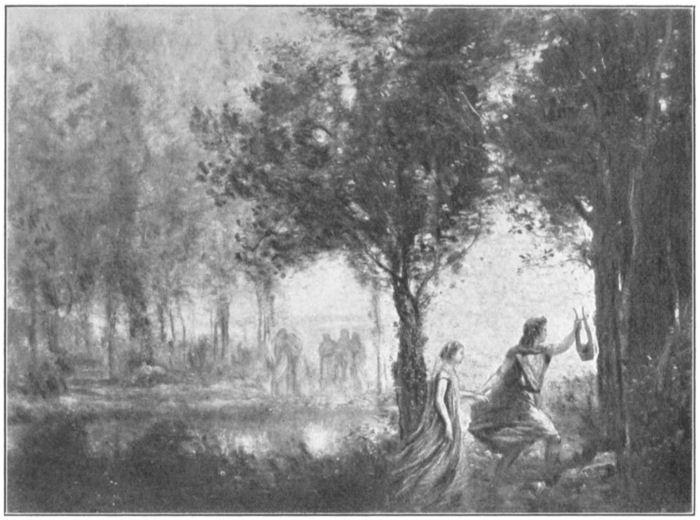
ORPHEUS LEADING EURYDIKE OUT OF HADES. (From the painting by Corot.)
the sun. Let her gaze on the smiling sky and see the fields of the upper world. But beware of one thing. Let her follow thee and do not turn around to look at her before reaching the world of the living. If thou shouldst turn and look upon her she will return at once to her place among the dead.”
Orpheus left Hades in great haste and Eurydike followed him. In the midst of deepest silence they ascended through dismal rocky places. They neared their journey’s end. They could almost see the green earth when Orpheus was seized with a dreadful doubt. “I hear no sound whatever behind me,” he said to himself. “Is my beloved Eurydike really following me?” He turned his head a little. He saw Eurydike, who followed him like a shadow. But suddenly she began to be drawn backward. She stretched out her arms toward Orpheus as if imploring his help. Orpheus hurried to take her in his arms, but she vanished from his sight and Orpheus was alone again.
Yet he did not despair. Again he descended into Hades and reached the river which separates this world from that of the dead, but the boatman, Charon, refused to ferry him across. Seven days and seven nights Orpheus remained there without drink or food, weeping and mourning. The decree of the gods was not to be changed. When Orpheus found that he could effect nothing he returned to the earth. He wandered alone over the mountains and glens of Thrace, which resounded with his plaintive songs day and night.
One day as he sat upon a grassy spot and played his lyre a troop of wild women who were celebrating a festival rushed upon him and tried to make him play for them to dance. Orpheus indignantly refused, and they grew angry and handled him so roughly that he died. Where he was buried the nightingales sang more sweetly than elsewhere. And his lyre, which was thrown into the sea, was caught by the waves, which made sweet music upon it as they rose and fell.
Orpheus was honored by the gods, and after his death they brought him to the Abode of the Blessed, where he found his beloved Eurydike and was reunited to her.
CHAPTER XXIV
PELOPS, THE HERO OF THE PELOPONNESOS
SOME of the heroes famed in Greek song and story, and whose descendants lived in Greece, had come from foreign countries, many of them from Asia Minor. Greece and Asia Minor had always been closely connected. Travellers from each were in the habit of visiting the other country. Sometimes they traded together and sometimes made war on each other.
One of the most powerful kingdoms of Asia Minor was Phrygia, and it was ruled by a king of the name of Tantalos, who had at first governed wisely and in the fear of the gods. He was made arrogant by prosperity, and at length grew so overbearing and cruel even to his own son, Pelops, that the gods determined to make an example of him. They sent him living to Tartaros, the portion of Hades reserved for the very worst offenders, there to endure a terrible punishment forever.
He was placed up to his waist in the midst of running water, clear and cool, under hanging boughs laden with lovely fruit. Yet he could not reach the water or the fruit, and was always faint with hunger and thirst. Whenever he bent down to get a drink of water it rapidly rushed away from him, and if he lifted up his hand to pluck some of the ripe fragrant fruit, a sudden gust of wind tossed the branches high up into the air. Poor Tantalos never came nearer than this to quenching his thirst or satisfying his hunger.
To make his misery more unbearable, a huge block of rock was poised above his head, so lightly that it moved with every breeze,
and he was in perpetual fear of its falling down on him. Pelops, the son whom he had abused in childhood, became a great favorite with the gods, and they wished to make up to him for his father’s cruelty. They gave him a shoulder of ivory to replace the shoulder of which his father had deprived him. When he grew up the gods helped him to leave his native land, where he had been ill-treated, and they guided him across the Ægean Sea, and around the southern point of Greece to Elis, where Herakles had cleaned out the stables of Augeias. The capital of Elis was the city of Pisa, where a king ruled who had a beautiful daughter named Hippodameia. She must have been very fond of sports and athletics, for her name means “The Tamer of Horses.”
Hippodameia had many suitors, but her father, Œnomaos, had heard that he would be dethroned by his daughter’s husband, and so he did not wish her to marry. He was very warlike, being a son of Ares, the God of War, and he determined to kill all the suitors. So he proposed a chariot race with each of the wooers, and promised that the one who succeeded in winning the race should have his daughter in marriage; on the other hand, if the suitor lost the race he should be put to death by the king.
Œnomaos was a famous charioteer, and he had steeds which were swifter than the wind. The race-course began at Pisa, and stretched as far as the Isthmus of Corinth to the altar of Poseidon. Œnomaos believed in himself and in his own skill. So great was his selfreliance, and so sure was he of the swiftness of his horses, that whenever a suitor came along he let him go ahead with his chariot drawn by four horses, while he himself first sacrificed a ram to Zeus, and only at the end of the ceremony mounted his chariot, having as driver, Myrtilos, and being armed with a strong spear. Then he would overtake the suitor and kill him. Thus he had already killed a great many.
Pelops, on his arrival at Pisa, saw Hippodameia, and at once had a strong desire to make her his wife. When he saw that he could not conquer Œnomaos by fair means he planned a trick. He secretly
approached the king’s charioteer, Myrtilos, and said to him: “Myrtilos, hear what I have to say to thee. Help me to win the race and I will give thee half the kingdom when I become King of Pisa.”
Hippodameia, too, who greatly admired the young man, advised the charioteer to lend them his aid. Myrtilos accepted the proposal of Pelops. On the day of the race Œnomaos again waited to sacrifice a ram to Zeus, leaving Pelops to drive on ahead, and only mounted his chariot after the offering was over, being sure that he should overtake the suitor as he had done with the others.
But suddenly a wheel flew off from the king’s chariot, and Œnomaos fell to the ground, hurting himself badly. Myrtilos had removed the pin which held the wheel on to the axle. Thus Pelops reached the Isthmus before the king and won the race.
Œnomaos died of his injuries, and Pelops married Hippodameia, and took possession of the kingdom. Then Myrtilos demanded half the kingdom as it had been promised him by Pelops. But Pelops carried him to the sea and cast him into it. On account of this crime the descendants of Pelops, the Pelopides, had to suffer many misfortunes. Crime and craft may answer an immediate purpose, but they are followed by divine wrath.
Pelops instituted the famous Olympic games, which were celebrated every fourth year, and lasted five days. And he did many other things which were of great use to his people. In honor of Pelops, the great peninsula, south of the Isthmus of Corinth, was called Peloponnesos, which means Pelops’ Island. The name was not quite correct at the time, for the land was not an island but a peninsula. But after all these thousands of years it has curiously come to pass that the old name is a true one, for it was only a few years ago that the Isthmus of Corinth was cut in two, and the Peloponnesos was in truth made an island.