What Is the Difference between a Change in Supply and a Change in Quantity Supplied? 79
What Are the Determinants of Supply? 79
Business Connection: Using Demand and Supply 82
Debate: Is It Ethical to Grow Corn for Fuel? 83
Can We Review the Distinction between a Change in Supply and a Change in Quantity Supplied? 84 For Your Review 87
CHAPTER 4
BRINGING SUPPLY AND DEMAND TOGETHER 94
4.1 Market Equilibrium Price and Quantity 94
What Are the Equilibrium Price and the Equilibrium Quantity? 94
What Is a Shortage and What Is a Surplus? 95
Debate: Where There’s a Market, Should People Be Allowed to Trade Freely, without State Limitations or Intervention? 96
4.2 Changes in Equilibrium Price and Quantity 97
What Happens to Equilibrium Price and Equilibrium Quantity When the Demand Curve Shifts? 97
What Happens to Equilibrium Price and Equilibrium Quantity When the Supply Curve Shifts? 99
What Happens When Both Supply and Demand Shift in the Same Time Period? 100
Business Connection: Equilibrium Determines Price 101
4.3 Price Controls 104
What Are Price Controls? 104
What Are Price Ceilings? 104
What Are Price Floors? 105 For Your Review 108
CHAPTER 5
ELASTICITY 115
5.1 Price Elasticity of Demand 115
What Is Price Elasticity of Demand? 116
How Do We Measure Consumers’ Responses to Price Changes? 116
How Do We Use the “Midpoint Method” in Calculating Price Elasticities of Demand? 118
What Determines the Price Elasticity of Demand? 119
5.2 Total Revenue and Price Elasticity of Demand 122
How Does the Price Elasticity of Demand Impact Total Revenue? 122
How Does Price Elasticity of Demand Change along a Linear Demand Curve? 124 Business Connection: Canada’s Own Doughnuts and the Minimum Wage 126
5.3 Other Demand Elasticities 127
What Is the Cross-Price Elasticity of Demand? 127
What Is the Income Elasticity of Demand? 128
5.4 Price Elasticity of Supply 129
What Is the Price Elasticity of Supply? 129
What Determines the Price Elasticity of Supply? 131
5.5 Elasticity and Taxes 132
What Is Tax Incidence? 132
How Does the Relative Elasticity of Supply and Demand Determine the Tax Burden? 132
Debate: Will Taxation Control Cannabis Use? 135 For Your Review 136
CHAPTER 6
CONSUMER CHOICE AND MARKET EFFICIENCY 141
6.1
Consumer Behaviour 141
What Is Utility? 141
What Is Diminishing Marginal Utility? 142
Debate: Is a Government-Supported Pharmacare Program Desirable for Canada? 143
6.2 Consumer Choice 144
What Is the “Best” Decision for Consumers? 144
What Is the Connection between the Law of Demand and the Law of Diminishing Marginal Utility? 146
6.3 Consumer and Producer Surplus 147
What Is Consumer Surplus? 147
What Is Producer Surplus? 149
How Do We Measure the Total Gains from Exchange? 151
Business Connection: Amazon Prime Day—Now Bigger Than Black Friday 152 For Your Review 153
CHAPTER 7
PRODUCTION AND COSTS 160
7.1 Profits: Total Revenues Minus Total Costs 160
What Are Explicit and Implicit Costs? 160
What Are Profits? 161
What Are Sunk Costs? 162
Business Connection: The Importance of Watching All Costs 163
Debate: Should Greenbelt Legislation Be Dropped? 163
7.2 Production in the Short Run 164
What Is the Difference between the Short Run and the Long Run? 164
How Does Production in the Short Run Behave? 165
What Is the Relationship between Marginal and Average Amounts? 168
7.3 Costs in the Short Run 168
What Are Fixed Costs, Variable Costs, and Total Costs? 169
What Are Average Costs? 169
What Is Marginal Cost? 169
7.4 The Shape of the Short-Run Cost Curves 172
What Is the Relationship between Marginal Costs and Marginal Product? 172
Why Is the Average Total Cost Curve U-Shaped? 173
What Is the Relationship between Marginal Cost and Average Variable and Average Total Cost? 173
7.5 Cost Curves: Short Run and Long Run 175
How Is the Long-Run Average Total Cost Curve Created? 175
What Are Economies of Scale? 176
Why Would Cost Curves Shift? 177 For Your Review 178
CHAPTER 8
PERFECT COMPETITION 186
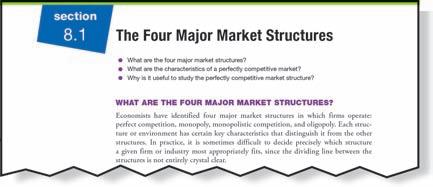
8.1 The Four Major Market Structures 186
What Are the Four Major Market Structures? 186
What Are the Characteristics of a Perfectly Competitive Market? 188
Why Is It Useful to Study the Perfectly Competitive Market Structure? 189
8.2 An Individual Price Taker’s Demand Curve 190
What Does the Individual Price Taker’s Demand Curve Look Like? 190
What Effect Will a Change in Market Price Have on an Individual Price Taker’s Demand Curves? 191
8.3 Profit Maximization 192
What Is Total Revenue? 192
What Are Average Revenue and Marginal Revenue? 193
How Do Firms Maximize Profits? 193
8.4 Short-Run Profits and Losses 195
How Do We Determine whether a Firm Is Generating an Economic Profit or Loss? 195
What Is the Individual Firm’s Short-Run Supply Curve? 198
Can We Review the Short-Run Production Decisions of an Individual Competitive Firm? 200
Business Connection: A Key Factor in Perfect Competition—Managing Costs 200
8.5 Long-Run Equilibrium 201
What Happens to Economic Profits and Losses in the Long Run? 201
What Is the Long-Run Equilibrium for the Competitive Firm? 203
Debate: Is “Perfect” Competition Imperfect in the Long Term? 203
8.6 Long-Run Supply 204
What Are Constant-Cost Industries? 204
What Are Increasing-Cost and Decreasing-Cost Industries? 206
How Is Perfect Competition Economically Efficient? 208 For Your Review 209
CHAPTER 9
MONOPOLY 218
9.1 Monopoly: The Price Maker 218
What Is a Monopoly? 218
Debate: Should Northern and Rural Bus Routes Be Served by One Provider? 220
What Are the Sources of Monopoly Power? 220
9.2 Demand and Marginal Revenue in Monopoly 222
How Does the Demand Curve for a Monopolist Differ from That of a Perfectly Competitive Firm? 222
Why Is Marginal Revenue Less than Price in a Monopoly? 223
What Is the Relationship between the Elasticity of Demand and Total and Marginal Revenue? 224
9.3 The Monopolist’s Equilibrium 226
How Does the Monopolist Determine the Profit-Maximizing Output? 226
How Do We Know whether the Monopolist Is Making a Profit or a Loss? 227
9.4
Monopoly and Welfare Loss 229
Does Monopoly Promote Inefficiency? 229
Does Monopoly Hinder Innovation? 230
Business Connection: Deregulation + Privatization = A Better Economy 231
9.5
Monopoly Policy 232
What Is the Objective of Anti-combine Laws? 232
What Is Government Regulation? 233
What Is Marginal Cost Pricing? 234
What Is Average Cost Pricing? 234
9.6
Price Discrimination 236
What Is Price Discrimination? 236
Why Does Price Discrimination Exist? 237
Does Price Discrimination Lead to Higher Profits? 239 For Your Review 240
CHAPTER 10
MONOPOLISTIC COMPETITION AND OLIGOPOLY 248
10.1
Monopolistic Competition 248
What Is Monopolistic Competition? 248
What Are the Three Basic Characteristics of Monopolistic Competition? 249
10.2 Price and Output Determination in Monopolistic Competition 250
How Is Short-Run Equilibrium Determined? 250
How Is Long-Run Equilibrium Determined? 252
10.3 Monopolistic Competition versus Perfect Competition 254
What Are the Differences and Similarities between Monopolistic Competition and Perfect Competition? 254
What Are the Real Costs of Monopolistic Competition? 255
Are the Differences between Monopolistic Competition and Perfect Competition Exaggerated? 256
10.4
Advertising 257
Why Do Firms Advertise? 257
Is Advertising Good or Bad from Society’s Perspective? 258
10.5 Oligopoly 260
What Is Oligopoly? 260
Business Connection: Tesla and Electric Vehicles—A New Player in the Auto Sector 260
Why Do Oligopolies Exist? 261
Why Is It So Difficult for the Oligopolist to Determine Its Profit-Maximizing Price and Output? 261
10.6 Collusion and Cartels 262
Why Do Firms Collude? 262
What Is Joint Profit Maximization? 263
Why Are Most Collusive Oligopolies Short-Lived? 264 Debate: Ride-Sharing—Should It Be Banned? 264
10.7
Game Theory and Strategic Behaviour 265
What Is Game Theory? 266
What Are Cooperative and Noncooperative Games? 266
What about Repeated Games? 269
What Are Network Externalities? 270 For Your Review 272
CHAPTER 11
LABOUR MARKETS AND THE DISTRIBUTION OF INCOME 277
11.1 Labour Markets 277
What Determines the Price Paid to Workers? 277 What Is Derived Demand? 277
11.2
Supply and Demand in the Labour Market 278 Will Hiring That Extra Worker Add More to Revenue than to Costs? 278 Why Is the Labour Demand Curve Downward Sloping? 279
How Many Workers Will an Employer Hire? 280 What Is the Shape of the Labour Supply Curve? 281
11.3 Labour Market Equilibrium 283
How Is Equilibrium Determined in a Competitive Labour Market? 283
What Shifts the Labour Demand Curve? 284 What Shifts the Labour Supply Curve? 285 What Is a Monopsony? 286 Business Connection: Is a Retail Giant Healthy for the Economy? 287
11.4 Labour Unions 288
Why Do Labour Unions Exist? 288
What Is the Impact of Unions on Wages? 289 Can Unions Increase Worker Productivity? 290
Debate: As Labour Markets Evolve, Should College Athletes Get Union Rights? 290
11.5 Income Distribution 291
What Has Happened to Income Distribution Since 1976? 291
How Much Income Inequality Exists in Other Countries? 292 Are We Overstating the Disparity in the Distribution of Income? 293
Why Do Some Earn More than Others? 294 How Can We Remedy Discrimination? 295
11.6 Poverty 297
How Do We Define Poverty? 297
How Many People Live in Poverty? 297
What Government Programs Help to Reduce Poverty? 300 For Your Review 302
CHAPTER 12 M ARKET F AILURE AND THE E N v IRONMENT 309
12.1 Externalities 309
What Are Externalities? 309
What Are Negative Externalities? 309
What Are Positive Externalities? 310
What Can the Government Do to Correct for Positive Externalities? 311
Are There Nongovernmental Solutions to Externalities? 312
12.2 Negative Externalities and Pollution 313
What Are Social Costs? 313
Can Externalities Be Accurately Measured? 314
Business Connection: Capitalism in Transition 315 Debate: Are the Oil Sands Worth the Environmental Costs for Canada? 316
12.3 Public Policy and the Environment 317
Why Is a Clean Environment Not Free? 317 What Can Be Done to Reduce Pollution? 318 What Is an Ideal Pollution-Control Policy? 321
12.4 Property Rights 322
What Is the Relationship between Externalities and Property Rights? 322 What Is the Coase Theorem? 323
12.5 Public Goods 324
What Are Private Goods versus Public Goods? 324
What Is the Free-Rider Problem with Public Goods? 325
Why Does the Government Provide Public Goods? 326
What Is a Common Resource? 326 For Your Review 327
Answers to Odd-Numbered Problems 329
Glossary 343
Index 346
Chapters in Review
Preface
Exploring Microeconomics, Fifth Canadian Edition, offers students a lively, back-to-thebasics approach designed to take the intimidation out of economics. With its short, self-contained learning units and its carefully chosen pedagogy, graphs, and photos, this text helps students master and retain the principles of economics. In addition, the current-events focus and modular format of presenting information makes Exploring Microeconomics a very student-accessible and user-friendly text. Driven by more than 70 years of combined experience teaching the economic principles course, the dedication and enthusiasm of Bob Sexton, Peter Fortura, and Colin Kovacs shine through in Exploring Microeconomics
New to the FIF th Ca N ad I a N e d I t I o N
Overall Highlights
As with previous editions of Exploring Microeconomics, attention has been paid to the structure and layout of each chapter to ensure that the material is presented in as clear and consistent a manner as possible. In addition, special attention has been given to the numerous examples and illustrations presented in each chapter to ensure that they are meaningful and relevant to today’s student.
The end-of-chapter For Your Review questions and problems have been continued in this edition. Blueprint Problems, the review feature introduced in the previous edition, have been retained and have undergone revision to ensure they continue to provide relevant and meaningful insight into the methodologies surrounding key economic concepts. As in the previous edition, all Blueprint Problems are accompanied by full and annotated solutions.
Also returning in this fifth Canadian edition are the Debate and Business Connection features. Both have undergone revision and updating. While their content has been revised, the purpose of each remains the same—Debate features are designed to promote in-class discussion and self-exploration, and Business Connection features are designed to highlight the link between economic theory and business principles.
C ha P te R h IG h LIG ht S
Chapter 4: Bringing Supply and Demand Together
In this chapter, readers will find an expanded discussion of price controls in the Canadian economy. An investigation of Canadian dairy production and the pricing of dairy products in Canada provides the reader with a more in-depth understanding of this key topic and how it impacts the efficiency of market forces in Canada.
Highlighted Learning Tools
Key Questions Each section begins with key questions designed to preview ideas and to pique students’ interest in the material to come. These same questions are then used to structure the section material that follows, each question being prominently displayed as a section heading, with additional subheadings provided as needed. In addition to ensuring a clear instructional layout of each section and chapter, these key questions can also be used by students as a review resource. After reading the section material, if students are able to answer the key questions, they can go forward with confidence.
Section Checks A Section Check appears at the end of each section and is designed to summarize the answers to the key questions posed at the beginning of the section. The summaries provided by the Section Check give students an opportunity to evaluate their understanding of major ideas before proceeding.
Debate Features Debate features are designed to provide students with an opportunity to develop and express their opinions about a variety of economic issues. The “For” and “Against” arguments that accompany each debate topic make it easy to use these features to initiate in-class discussions. By engaging in informal debate regarding current economic policy, students will be able to link course content to current events as well as to their own personal lives. Questions have been added to encourage critical thinking.
Business Connection Features Business Connection features are designed to help students see the link between economic theory and business fundamentals. They help students better understand the reasoning behind the empirical validity of economic theory, and they also aid in the grounding of abstract economic theory in more modern business principles. Accompanying each Business Connection feature are questions that can be used to either evaluate student understanding or initiate in-class discussion.
Photos Exploring Microeconomics contains a large number of colourful photos, which are an integral part of the book for both learning and motivation. The photos are carefully placed where they reinforce important concepts, and they are accompanied by captions designed to extend students’ understanding of particular ideas.
For Your Review Provided at the end of each chapter, these problems allow students to test their understanding of chapter concepts. The For Your Review questions are organized into sections to match the corresponding sections in the text so that students and instructors can easily identify particular topics. To assist in the learning process, solutions to all odd-numbered questions are provided at the back of the book. With a variety of both problems and application-style questions to choose from, this section can also be used by instructors to assign homework questions directly from the text.
Blueprint Problems Integrated into the end-ofchapter For Your Review sections, these fully annotated problems and their solutions are intended to provide additional insight into key economic topics and issues. Intentionally designed to mirror the accompanying For Your Review problems, each Blueprint Problem allows students to “walk through” a completed solution, seeing the essential steps necessary to successfully complete a key economic question.
Chapter in Review Cards Located at the back of the textbook, these detachable Chapter in Review cards are designed to give students a summary overview of key chapter concepts at a glance. Each Chapter in Review card contains the following information:
• Chapter Summary: A point-form summary response to the section’s key questions, highlighting the most important concepts of each section, is provided.
• Key Terms: A list of key terms allows students to test their mastery of new concepts. Both the definition and page number are included so that students can easily find a key term in a chapter.
• Key Exhibits/Graphs: Given the importance and explanatory ability of exhibits and graphical representations in economics, a list of key figures is provided for each chapter.
• Key Equations: A list of key equations enables students to quickly refer to important formulas.
INS t R u C to RS
The Nelson Education Teaching Advantage (NETA) program delivers research-based instructor’s resources that promote student engagement and higher-order thinking to enable the success of Canadian students and educators. Be sure to visit Nelson Education’s Inspired Instruction website at www.nelson.com/inspired to find out more about NETA. Don’t miss the testimonials of instructors who have used NETA supplements and watched student engagement increase!
The following instructor’s resources have been created for Exploring Microeconomics, Fifth Canadian Edition. Access these ultimate tools for customizing lectures and presentations at www.nelson.com/instructor.
Instructor’s Solutions Manual: Answers to all For Your Review questions in the textbook are provided in this manual, separated from the Instructor’s Manual for easier reference. Students can access only the odd-numbered solutions in the Answer Key at the back of the book. The solutions were prepared by the text co-author, Colin Kovacs, and independently checked for accuracy by Racquel Lindsay, University of Toronto.
NETA Test Bank: This resource was prepared by Russell Turner, Fleming College. It includes over 1550 multiple-choice questions written according to NETA guidelines for effective construction and development of higher-order questions. Also included are more than 300 true/false and approximately 100 essay-type questions.
The NETA Test Bank is available in a new, cloud-based platform. Nelson Testing Powered by Cognero® is a secure online testing system that allows you to author, edit, and manage test bank content from any place you have Internet access. No special installations or downloads are needed, and the desktop-inspired interface, with its drop-down menus and familiar, intuitive tools, allows you to create and manage tests with ease. You can create multiple test versions in an instant, and import or export content into other systems. Tests can be delivered from your learning management system, your classroom, or wherever you want. Nelson Testing Powered by Cognero for Exploring Microeconomics
can also be accessed through htp://www.nelson.com/login and http://login.cengage .com. Printable versions of the Test Bank in Word and PDF versions are available with the instructor’s resources for the textbook.
NETA PowerPoint: Microsoft® PowerPoint® lecture slides for every chapter have been adapted by Ifeanyichukwu Uzoka of Sheridan College. We offer two separate collections. The Basic PowerPoint collection contains an average of 40 slides per chapter. This collection is a basic outline of the chapter and contains key figures, tables, and photographs from the fifth Canadian edition of Exploring Microeconomics. The Expanded PowerPoint collection includes an average of 65 slides per chapter and provides a more complete overview of the chapter. NETA principles of clear design and engaging content have been incorporated throughout, making it simple for instructors to customize the deck for their courses.
Image Library: This resource consists of digital copies of figures, short tables, and photographs used in the book. Instructors may use these images to customize the NETA PowerPoint or create their own PowerPoint presentations.
Instructor’s Manual: The Instructor’s Manual to accompany Exploring Microeconomics, Fifth Canadian Edition, has been prepared by Phil Ghayad and Michel Mayer of Dawson College. This manual is organized according to the textbook chapters and includes teaching tips and active learning exercises. (Answers to all For Your Review exercises in the text are now provided in the separate Instructor’s Solutions Manual supplement described earlier.).
DayOne: Day One—Prof InClass is a PowerPoint presentation that instructors can customize to orient students to the class and their textbook at the beginning of the course.
Aplia 1 MindTap
MindTap is the digital platform that propels students from memorization to mastery, helping to challenge them, build their confidence, and empower them to be unstoppable. ApliaTM is an application in the MindTap platform that has proven to significantly improve outcomes and elevate thinking by increasing student effort and engagement. Aplia makes it easy to assign frequent online homework assignments and assessments, ensuring students master important concepts. Developed by teachers, Aplia assignments connect concepts to the real world and focus on the unique course challenges faced by students. The MindTap content for Exploring Microeconomics, Fifth Canadian Edition, was updated and revised by Jason Dean of Sheridan College. The Aplia problems for Exploring Microeconomics, Fifth Canadian Edition, were updated and revised by Hanika Bhojwani-Chen of Centennial College.
The challenging and interactive activities within Aplia guide students through assignments, moving them from basic knowledge and understanding to application and practice. Look for the Aplia logo in the MindTap app dock to explore all that Aplia has to offer. With Aplia, instructors can do the following:
• easily set their course with pre-built, flexible homework assignments;
• create custom assignments and populate them with self-authored—and Apliaauthored—questions; and
• inspire students to learn from their mistakes and reward them for effort with the Grade It Now feature that enables three attempts at different versions of a question.
The MindTap content for Exploring Microeconomics, Fifth Canadian Edition, was updated and revised by James Dean at Sheridan College.
Acknowledgments
Producing the fifth Canadian edition of Exploring Microeconomics has truly been a team effort. We would like to thank the editorial, production, and marketing teams at Nelson Education for their hard work and effort. First, our appreciation goes to Claudine O’Donnell, Vice President, Product Solutions, who has provided the vision and leadership for the Canadian editions of the text.
We would like to thank Katherine Baker-Ross, publisher at Nelson, for her continuing support. Thank you to Katherine Goodes, Content Manager, for her helpful advice and constant encouragement. Thanks also to Imoinda Romain, Senior Production Project Manager; June Trusty, Copy Editor; Marcia Siekowski, Marketing Manager; and all the marketing and sales representatives at Nelson Education Ltd. Special thanks are extended to Darren Chapman at Fanshawe College for providing the engaging and insightful Business Connection and Debate boxes. Darren’s continued contributions to these boxes, over many editions, are much appreciated. We would also like to extend our thanks to Sarah Arliss at Seneca College for contributing some new Business Connection and Debate box content to this edition.
We are grateful to our families for their patience and encouragement.
Finally, we would like to acknowledge the reviewers of the Canadian editions, past and present, for their comments and feedback:
Vick Barylak, Sheridan College
Aurelia Best, Centennial College
Jim Butko, Niagara College
Darren Chapman, Fanshawe College
Bruno Fullone, George Brown College
Jeffrey Dzikowicz, Red River College
James Hnatchuk, Champlain Regional College
Geraldine Joosse, Lethbridge College
Susan Kamp, University of Alberta
Michael Leonard, Kwantlen Polytechnic University
Nargess Kayhani, Mount Saint Vincent University
Margaret Rose Olfert, University of Saskatchewan
Jay Perry, Niagara College
John Pirrie, St. Lawrence College
Geoffrey Prince, Centennial College
Sheila J. Ross, Southern Alberta Institute of Technology
Judith Skuce, Georgian College
Norm Smith, Georgian College
Martha Spence, Confederation College
Lucia Vojtassak, Trent University
Carl Weston, Mohawk College
Their thoughtful suggestions were very important to us in providing input and useful examples for the fifth Canadian edition of this book.
articles related to economics— either directly or indirectly— are common in the news media. news headlines might trumpet: Gasoline prices Soar; Stocks rise; Stocks Fall; prime Minister Vows to Increase national Defence Spending; health-Care Costs Continue to rise.
Economics Is All Around Us
Although many things that we desire in life are considered to be “noneconomic,” economics concerns anything that is considered worthwhile to some human being. For instance, love, sexual activity, and religion have value for most people. Even these have an economic dimension. Consider love and sex, for example. One product of love—the institution of the family—is an important economic decision-making unit. Also, sexual activity results in the birth of children, one of the most important “goods” that many humans want. Economic forces have played a central role in the evolution of the family unit, from the traditional “nuclear family” (Dad, Mom, and two kids) to dual-income families, to dual-income no-kids (DINKs) families. Concerns for spiritual matters have likewise received economists’ scrutiny, as they have led to the development of institutions such as churches, mosques, and temples that provide religious and spiritual services. These services are goods that many people want.
Even time has an economic dimension. In fact, perhaps the most precious single resource is time. We all have the same limited amount of time per day, and how we divide our time between work and leisure (including perhaps study, sleep, exercise, etc.) is a distinctly economic matter. If we choose more work, we must sacrifice leisure. If we choose to study, we must sacrifice time with friends, or time spent sleeping or watching TV. Virtually everything we decide to do, then, has an economic dimension.
Living in a world of scarcity involves trade-offs. As you are reading this text, you are giving up other things you value, such as shopping, spending time on Facebook, text messaging with friends, going to the movies, sleeping, or working out. When we know what the trade-offs are, we can make better choices from the options all around us, every day.
W HY S TUDY E CONOMICS ?
Among the many good reasons to study economics, perhaps the best reason is that so many of the things of concern in the world around us are at least partly economic in character. A quick look at media headlines reveals the vast range of problems that are related to economics—global warming, health care, education, and social assistance. The study of economics improves your understanding of these concerns. A student of economics becomes aware that, at a basic level, much of economic life involves choosing among alternative possible courses of action—making choices between our conflicting wants and desires in a world of scarcity. Economics provides some clues as to how to intelligently evaluate these options and determine the most appropriate choices in given situations. But economists learn quickly that there are seldom easy, clear-cut solutions to the problems we face: The easy problems were solved long ago! Many students take introductory postsecondary economics courses because these are part of the core curriculum requirements. But why do the committees that establish these requirements include economics? In part, economics helps develop a disciplined method of thinking about problems as opposed to simply memorizing solutions. The problem-solving tools you will develop by studying economics will prove valuable to you in both your personal and professional life, regardless of your career choice. In short, the study of economics provides a systematic, disciplined way of thinking.
Using This Stuff
The basic tools of economics are valuable to people in all walks of life and in all career paths. Journalists benefit from economics because the problem-solving perspective it teaches trains them to ask intelligent questions whose answers will better inform their readers. Engineers, architects, and contractors usually have alternative ways to build. Architects learn to combine technical expertise and artistry with the limitations imposed by finite resources. That is, they learn how to evaluate their options from an economic perspective. Business owners face similar problems, because costs are a constraint in both creating and marketing a new product. Will the added cost of developing a new and improved product be outweighed by the added sales revenues that are expected to result? Economists can, however, pose these questions and provide criteria that business owners can use in evaluating the appropriateness of one design as compared to another. The point is that the economic way of thinking causes those in many types of fields to ask the right kind of questions.
W HAT D ISTIN g UISHES M ACROECONOMICS FROM M ICROECONOMICS ?
Like psychology, sociology, anthropology, and political science, economics is considered a social science. Economics, like the other social sciences, is concerned with reaching generalizations about human behaviour. Economics is the study of people. It is the social science that studies the choices people make in a world of limited resources. Economics and the other social sciences often complement one another. For example, a political scientist might examine the process that led to the adoption of a certain tax policy, whereas an economist might analyze the impact of that tax policy. Or, whereas a psychologist may try to figure out what makes the criminal mind work, an economist might study the factors causing a change in the crime rate. Social scientists, then, may be studying the same issue but from different perspectives.
Conventionally, we distinguish two main branches of economics: macroeconomics and microeconomics. Macroeconomics is the study of the aggregate or total economy; it looks at economic problems as they influence the whole of society. Topics covered in macroeconomics include discussions of inflation, unemployment, business cycles, and economic growth. Microeconomics is the study of the smaller units within the economy. Topics include the decision-making behaviour of firms and households and their interaction in markets for particular goods or services. Microeconomic topics also include discussions of health care, agricultural subsidies, the price of everyday items such as running shoes, the distribution of income, and the impact of labour unions on wages. To put it simply, microeconomics looks at the trees whereas macroeconomics looks at the forest.
macroeconomics
the study of the aggregate economy, including the topics of inflation, unemployment, and economic growth aggregate the total amount—such as the aggregate level of output microeconomics the study of the smaller units within the economy, including the topics of household and firm behaviour and how they interact in the marketplace
■ Economics is the study of the allocation of our limited resources to satisfy our unlimited wants.
■ Economics is a problem-solving social science that teaches you how to ask intelligent questions.
■ Macroeconomics deals with the aggregate, or total, economy, while microeconomics focuses on smaller units within the economy.
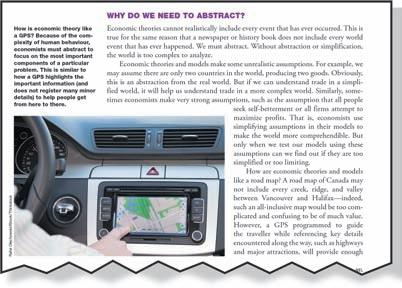
information to travel by car from Vancouver to Halifax. Likewise, an economic theory provides a broad view, not a detailed examination, of human economic behaviour.
W HAT IS A H YPOTHESIS ?
The beginning of any theory is a hypothesis, a testable proposition that makes some type of prediction about behaviour in response to certain changes in conditions. In economic theory, a hypothesis is a testable prediction about how people will behave or react to a change in economic circumstances. For example, if the price of iPads increased, we might hypothesize that fewer iPads would be sold, or if the price of iPads fell, we might hypothesize that more iPads would be sold. Once a hypothesis is stated, it is tested by comparing what it predicts will happen to what actually happens.
Using Empirical Analysis
To see whether a hypothesis is valid, we must engage in an empirical analysis. That is, we must examine the data to see whether the hypothesis fits well with the facts. If the hypothesis is consistent with real-world observations, it is accepted; if it does not fit well with the facts, it is “back to the drawing board.”
Determining whether a hypothesis is acceptable is more difficult in economics than it is in the natural or physical sciences. Chemists, for example, can observe chemical reactions under laboratory conditions. They can alter the environment to meet the assumptions of the hypothesis and can readily manipulate the variables (chemicals, temperatures, and so on) crucial to the proposed relationship. Such controlled experimentation is seldom possible in economics. The laboratory of economists is usually the real world. Unlike a chemistry lab, economists cannot easily control all the other variables that might influence human behaviour.
From Hypothesis to Theory
After gathering their data, economic researchers must then evaluate the results to determine whether the hypothesis is supported or refuted. If supported, the hypothesis can then be tentatively accepted as an economic theory.
Economic theories are always on probation. A hypothesis is constantly being tested against empirical findings. Do the observed findings support the prediction? When a hypothesis survives a number of tests, it is accepted until it no longer predicts well.
W HAT IS THE Ceteris Paribus A SSUMPTION ?
Virtually all economic theories share a condition usually expressed by use of the Latin expression ceteris paribus. This roughly means “let everything else be equal” or “holding everything else constant.” In trying to assess the effect of one variable on another, we must isolate their relationship from other events that might also influence the situation that the theory tries to explain or predict. To make this clearer, we will illustrate this concept with a couple of examples.
Suppose you develop your own theory describing the relationship between studying and exam performance: If I study harder, I will perform better on the test. That sounds logical, right? Holding other things constant (ceteris paribus), this is likely to be true. However, what if you studied harder but inadvertently overslept the day of the exam? What if you were so sleepy during the test that you could not think clearly? Or what if you studied the wrong material? Although it may look as if additional studying did not improve your performance, the real problem may lie in the impact of other variables, such as sleep deficiency or how you studied.
hypothesis a testable proposition
empirical analysis the examination of data to see whether the hypothesis fits well with the facts ceteris paribus holding everything else constant
Discovering Diverse Content Through Random Scribd Documents
PLEASE READ THIS BEFORE YOU DISTRIBUTE OR USE THIS WORK
To protect the Project Gutenberg™ mission of promoting the free distribution of electronic works, by using or distributing this work (or any other work associated in any way with the phrase “Project Gutenberg”), you agree to comply with all the terms of the Full Project Gutenberg™ License available with this file or online at www.gutenberg.org/license.
Section 1. General Terms of Use and Redistributing Project Gutenberg™ electronic works
1.A. By reading or using any part of this Project Gutenberg™ electronic work, you indicate that you have read, understand, agree to and accept all the terms of this license and intellectual property (trademark/copyright) agreement. If you do not agree to abide by all the terms of this agreement, you must cease using and return or destroy all copies of Project Gutenberg™ electronic works in your possession. If you paid a fee for obtaining a copy of or access to a Project Gutenberg™ electronic work and you do not agree to be bound by the terms of this agreement, you may obtain a refund from the person or entity to whom you paid the fee as set forth in paragraph 1.E.8.
1.B. “Project Gutenberg” is a registered trademark. It may only be used on or associated in any way with an electronic work by people who agree to be bound by the terms of this agreement. There are a few things that you can do with most Project Gutenberg™ electronic works even without complying with the full terms of this agreement. See paragraph 1.C below. There are a lot of things you can do with Project Gutenberg™ electronic works if you follow the terms of this agreement and help preserve free future access to Project Gutenberg™ electronic works. See paragraph 1.E below.
1.C. The Project Gutenberg Literary Archive Foundation (“the Foundation” or PGLAF), owns a compilation copyright in the collection of Project Gutenberg™ electronic works. Nearly all the individual works in the collection are in the public domain in the United States. If an individual work is unprotected by copyright law in the United States and you are located in the United States, we do not claim a right to prevent you from copying, distributing, performing, displaying or creating derivative works based on the work as long as all references to Project Gutenberg are removed. Of course, we hope that you will support the Project Gutenberg™ mission of promoting free access to electronic works by freely sharing Project Gutenberg™ works in compliance with the terms of this agreement for keeping the Project Gutenberg™ name associated with the work. You can easily comply with the terms of this agreement by keeping this work in the same format with its attached full Project Gutenberg™ License when you share it without charge with others.
1.D. The copyright laws of the place where you are located also govern what you can do with this work. Copyright laws in most countries are in a constant state of change. If you are outside the United States, check the laws of your country in addition to the terms of this agreement before downloading, copying, displaying, performing, distributing or creating derivative works based on this work or any other Project Gutenberg™ work. The Foundation makes no representations concerning the copyright status of any work in any country other than the United States.
1.E. Unless you have removed all references to Project Gutenberg:
1.E.1. The following sentence, with active links to, or other immediate access to, the full Project Gutenberg™ License must appear prominently whenever any copy of a Project Gutenberg™ work (any work on which the phrase “Project
Gutenberg” appears, or with which the phrase “Project Gutenberg” is associated) is accessed, displayed, performed, viewed, copied or distributed:
This eBook is for the use of anyone anywhere in the United States and most other parts of the world at no cost and with almost no restrictions whatsoever. You may copy it, give it away or re-use it under the terms of the Project Gutenberg License included with this eBook or online at www.gutenberg.org. If you are not located in the United States, you will have to check the laws of the country where you are located before using this eBook.
1.E.2. If an individual Project Gutenberg™ electronic work is derived from texts not protected by U.S. copyright law (does not contain a notice indicating that it is posted with permission of the copyright holder), the work can be copied and distributed to anyone in the United States without paying any fees or charges. If you are redistributing or providing access to a work with the phrase “Project Gutenberg” associated with or appearing on the work, you must comply either with the requirements of paragraphs 1.E.1 through 1.E.7 or obtain permission for the use of the work and the Project Gutenberg™ trademark as set forth in paragraphs 1.E.8 or 1.E.9.
1.E.3. If an individual Project Gutenberg™ electronic work is posted with the permission of the copyright holder, your use and distribution must comply with both paragraphs 1.E.1 through 1.E.7 and any additional terms imposed by the copyright holder. Additional terms will be linked to the Project Gutenberg™ License for all works posted with the permission of the copyright holder found at the beginning of this work.
1.E.4. Do not unlink or detach or remove the full Project Gutenberg™ License terms from this work, or any files
containing a part of this work or any other work associated with Project Gutenberg™.
1.E.5. Do not copy, display, perform, distribute or redistribute this electronic work, or any part of this electronic work, without prominently displaying the sentence set forth in paragraph 1.E.1 with active links or immediate access to the full terms of the Project Gutenberg™ License.
1.E.6. You may convert to and distribute this work in any binary, compressed, marked up, nonproprietary or proprietary form, including any word processing or hypertext form. However, if you provide access to or distribute copies of a Project Gutenberg™ work in a format other than “Plain Vanilla ASCII” or other format used in the official version posted on the official Project Gutenberg™ website (www.gutenberg.org), you must, at no additional cost, fee or expense to the user, provide a copy, a means of exporting a copy, or a means of obtaining a copy upon request, of the work in its original “Plain Vanilla ASCII” or other form. Any alternate format must include the full Project Gutenberg™ License as specified in paragraph 1.E.1.
1.E.7. Do not charge a fee for access to, viewing, displaying, performing, copying or distributing any Project Gutenberg™ works unless you comply with paragraph 1.E.8 or 1.E.9.
1.E.8. You may charge a reasonable fee for copies of or providing access to or distributing Project Gutenberg™ electronic works provided that:
• You pay a royalty fee of 20% of the gross profits you derive from the use of Project Gutenberg™ works calculated using the method you already use to calculate your applicable taxes. The fee is owed to the owner of the Project Gutenberg™ trademark, but he has agreed to donate royalties under this paragraph to the Project Gutenberg Literary Archive Foundation. Royalty
law in creating the Project Gutenberg™ collection. Despite these efforts, Project Gutenberg™ electronic works, and the medium on which they may be stored, may contain “Defects,” such as, but not limited to, incomplete, inaccurate or corrupt data, transcription errors, a copyright or other intellectual property infringement, a defective or damaged disk or other medium, a computer virus, or computer codes that damage or cannot be read by your equipment.
1.F.2. LIMITED WARRANTY, DISCLAIMER OF DAMAGES - Except for the “Right of Replacement or Refund” described in paragraph 1.F.3, the Project Gutenberg Literary Archive Foundation, the owner of the Project Gutenberg™ trademark, and any other party distributing a Project Gutenberg™ electronic work under this agreement, disclaim all liability to you for damages, costs and expenses, including legal fees. YOU AGREE THAT YOU HAVE NO REMEDIES FOR NEGLIGENCE, STRICT LIABILITY, BREACH OF WARRANTY OR BREACH OF CONTRACT EXCEPT THOSE PROVIDED IN PARAGRAPH 1.F.3. YOU AGREE THAT THE FOUNDATION, THE TRADEMARK OWNER, AND ANY DISTRIBUTOR UNDER THIS AGREEMENT WILL NOT BE LIABLE TO YOU FOR ACTUAL, DIRECT, INDIRECT, CONSEQUENTIAL, PUNITIVE OR INCIDENTAL DAMAGES EVEN IF YOU GIVE NOTICE OF THE POSSIBILITY OF SUCH DAMAGE.
1.F.3. LIMITED RIGHT OF REPLACEMENT OR REFUND - If you discover a defect in this electronic work within 90 days of receiving it, you can receive a refund of the money (if any) you paid for it by sending a written explanation to the person you received the work from. If you received the work on a physical medium, you must return the medium with your written explanation. The person or entity that provided you with the defective work may elect to provide a replacement copy in lieu of a refund. If you received the work electronically, the person or entity providing it to you may choose to give you a second opportunity to receive the work electronically in lieu of a refund.
If the second copy is also defective, you may demand a refund in writing without further opportunities to fix the problem.
1.F.4. Except for the limited right of replacement or refund set forth in paragraph 1.F.3, this work is provided to you ‘AS-IS’, WITH NO OTHER WARRANTIES OF ANY KIND, EXPRESS OR IMPLIED, INCLUDING BUT NOT LIMITED TO WARRANTIES OF MERCHANTABILITY OR FITNESS FOR ANY PURPOSE.
1.F.5. Some states do not allow disclaimers of certain implied warranties or the exclusion or limitation of certain types of damages. If any disclaimer or limitation set forth in this agreement violates the law of the state applicable to this agreement, the agreement shall be interpreted to make the maximum disclaimer or limitation permitted by the applicable state law. The invalidity or unenforceability of any provision of this agreement shall not void the remaining provisions.
1.F.6. INDEMNITY - You agree to indemnify and hold the Foundation, the trademark owner, any agent or employee of the Foundation, anyone providing copies of Project Gutenberg™ electronic works in accordance with this agreement, and any volunteers associated with the production, promotion and distribution of Project Gutenberg™ electronic works, harmless from all liability, costs and expenses, including legal fees, that arise directly or indirectly from any of the following which you do or cause to occur: (a) distribution of this or any Project Gutenberg™ work, (b) alteration, modification, or additions or deletions to any Project Gutenberg™ work, and (c) any Defect you cause.
Section 2. Information about the Mission of
Project Gutenberg™ is synonymous with the free distribution of electronic works in formats readable by the widest variety of computers including obsolete, old, middle-aged and new computers. It exists because of the efforts of hundreds of volunteers and donations from people in all walks of life.
Volunteers and financial support to provide volunteers with the assistance they need are critical to reaching Project Gutenberg™’s goals and ensuring that the Project Gutenberg™ collection will remain freely available for generations to come. In 2001, the Project Gutenberg Literary Archive Foundation was created to provide a secure and permanent future for Project Gutenberg™ and future generations. To learn more about the Project Gutenberg Literary Archive Foundation and how your efforts and donations can help, see Sections 3 and 4 and the Foundation information page at www.gutenberg.org.
Section 3. Information about the Project
Gutenberg Literary Archive
Foundation
The Project Gutenberg Literary Archive Foundation is a nonprofit 501(c)(3) educational corporation organized under the laws of the state of Mississippi and granted tax exempt status by the Internal Revenue Service. The Foundation’s EIN or federal tax identification number is 64-6221541. Contributions to the Project Gutenberg Literary Archive Foundation are tax deductible to the full extent permitted by U.S. federal laws and your state’s laws.
The Foundation’s business office is located at 809 North 1500 West, Salt Lake City, UT 84116, (801) 596-1887. Email contact links and up to date contact information can be found at the Foundation’s website and official page at www.gutenberg.org/contact
credit card donations. To donate, please visit: www.gutenberg.org/donate.
Section 5. General Information About Project Gutenberg™ electronic works
Professor Michael S. Hart was the originator of the Project Gutenberg™ concept of a library of electronic works that could be freely shared with anyone. For forty years, he produced and distributed Project Gutenberg™ eBooks with only a loose network of volunteer support.
Project Gutenberg™ eBooks are often created from several printed editions, all of which are confirmed as not protected by copyright in the U.S. unless a copyright notice is included. Thus, we do not necessarily keep eBooks in compliance with any particular paper edition.
Most people start at our website which has the main PG search facility: www.gutenberg.org.
This website includes information about Project Gutenberg™, including how to make donations to the Project Gutenberg Literary Archive Foundation, how to help produce our new eBooks, and how to subscribe to our email newsletter to hear about new eBooks.
Welcome to our website – the ideal destination for book lovers and knowledge seekers. With a mission to inspire endlessly, we offer a vast collection of books, ranging from classic literary works to specialized publications, self-development books, and children's literature. Each book is a new journey of discovery, expanding knowledge and enriching the soul of the reade
Our website is not just a platform for buying books, but a bridge connecting readers to the timeless values of culture and wisdom. With an elegant, user-friendly interface and an intelligent search system, we are committed to providing a quick and convenient shopping experience. Additionally, our special promotions and home delivery services ensure that you save time and fully enjoy the joy of reading.
Let us accompany you on the journey of exploring knowledge and personal growth!