
International Research Journal of Engineering and Technology (IRJET) e-ISSN: 2395-0056
Volume:12Issue:11|Nov2025 www.irjet.net p-ISSN: 2395-0072
International Research Journal of Engineering and Technology (IRJET) e-ISSN: 2395-0056
Volume:12Issue:11|Nov2025 www.irjet.net p-ISSN: 2395-0072
Dr. D. Koteswara Rao1, Viyyapu Durga Praveen2
1Professor of Civil Engineering & OSD to Hon’ble Vice Chancellor, JNTUK, Kakinada, Andhra Pradesh, India 2Post graduation Student, Department of Civil Engineering, University College of Engineering Kakinada(A), JNTUK, Kakinada, Andhra Pradesh, India
Abstract - Marine clay deposition in India is a significant geological phenomenon, particularly along the country's extensive coastline. These deposits are formed through the transportation and settling of fine-grained sediments, often brought by rivers and influenced by tidal and wave actions. which poses significant challenges for pavement construction due to their high compressibility, low shear strength, and poor California Bearing Ratio (CBR). The weak subgrade conditions lead to excessive settlement, loss of bearing capacity, and early deterioration of flexible pavements. Moreover, seasonal fluctuations in moisture content further aggravate shrink–swell behaviour, reducing long-term durability. In the present study the Geotechnical properties of marine clay such as Atterberg limits, Optimum Moisture Content (OMC), Maximum Dry Density (MDD), California Bearing Ratio (CBR) and strength characteristics were determined. Also, the industrial by product Foundry Sand is utilised for stabilization. The other additive used in this study is lime. This study demonstrates that the combined use of foundry sand and lime can effectively transformweak marine clay intoa competent pavement sub grade material. These findings contribute to the development of durable and resilient road infrastructure in coastal regions while supporting sustainable construction practices through industrial by-product utilization. Together, they provide a cost-effective and eco-friendly stabilization technique, reducing reliance on conventional materials and provide a valuable insight for design and constructionofpavements in marineclay dominatedcoastal regionsofIndia.
Key word: Marine Clay (MC), Foundry Sand (F.S) Lime, Maximum Dry Density (MDD), Optimum Moisture Content (OMC), California Bearing Ratio (CBR).
1.INTRODUCTION
Pavements in coastal regions are of great importance as they form the backbone of transportation infrastructure, connecting ports, cities, and towns along the coastline. These pavements facilitate the movement of services and people, supporting economic growth, trade, and tourism. Well-designedandwell-maintainedcoastalpavementsare essential for ensuring the safe and efficient
Transportation ofgoodsandcommodities,particularlyfor industries like shipping, and offshore energy. Flexible pavements are the most commonly adopted pavement system in highway construction due to their costeffectiveness,easeofconstruction,andabilitytowithstand repeated traffic loads through a multi-layered structural arrangement. The overall performance and durability of flexible pavements are greatly influenced by the strength of the subgrade soil, which acts as the foundation for distributing stresses imposed by vehicular loads. By supporting transportation infrastructure, coastal pavements contribute significantly to the economic and socialdevelopmentofcoastalregions.
This soil exhibits high natural moisture content and low bearing capacity, which make it unsuitable for use as a stablesubgrade.Whenflexiblepavementsareconstructed over untreated marine clay, the weak foundation leads to several structural distresses. These include rutting under traffic loads, longitudinal and alligator cracking due to differential settlement, edge failure caused by lateral movement, and pumping or heaving from moisture variations. Therefore, it becomes essential to adopt soil stabilization techniques such as the use of lime or industrial by-products like foundry sand to enhance the strength, reduce plasticity, and improve the load-bearing capacityofmarineclaysubgrades.
Marine clay requires stabilization before being used as a subgrade in flexible pavement construction because of its weak engineering properties. The main stabilization techniquesinclude:
1.MechanicalStabilization–Improvementofsoilstrength by compaction, blending marine clay with sand, gravel, or quarrydusttoincreasedensityandbearingcapacity.
2. Chemical Stabilization – Addition of stabilizing agents such as lime. Lime reduces plasticity and improves workability, while cement and pozzolanic materials increasestrengthanddurability.
3.GeosyntheticReinforcement–Applicationofgeotextiles, geogrids,orgeocellsbetweenpavementlayerstoimprove
International Research Journal of Engineering and Technology (IRJET)
Volume:12Issue:11|Nov2025 www.irjet.net p-ISSN: 2395-0072
load distribution, control settlement, and prevent soil movement.
1.2 The Effectiveness of Foundry sand and Lime on Marine Clay Stabilization
The Combined Effect of Lime and Foundry Sand, Lime chemically stabilizes clay, while foundry sand improves particlestructureandreinforcesstrength.
TheformationofC-S-HandC-A-Hgelsbindssoilparticles, leading to a denser, more compact structure. Cation exchange and flocculation reduce the plasticity index and inhibitthesoil'sabilitytoswellandshrinkwithchangesin moisture content. The immediate flocculation of clay particles makes the soil more granular and easier to handle and compact during construction. The cementitious compounds fill the soil's pore spaces, decreasing its permeability and making it more resistant towaterpenetration.
2. RIVIEW OF LITERATURE
2.1 A Study on the Influence of Lime on Fly ash Treated Marine Clay- by Dr. D. Koteswara Rao et.al., (2011), The author was noticed that the liquid limit of the untreated marineclayhasbeendecreasedby11%withthe addition of 20% fly ash as an optimum. Further it was also observed that the liquid limit of the 80%M.C + 20% F.A mix has been decreased by 9% on the addition of 6.5% lime as an optimum. It was observed from the laboratory test results that the C.B.R. Value of the untreated marine clayhasbeenincreased361%onadditionof20% Flyash as an optimum and further the CBR value of the 80%M.C + 20% F.A mix has been increased by 87% with the additionof6.5%Limeasanoptimum.
2.2 Assessing the Application of Lime and Foundry Sand in Soil Stabilization – by M. Naveen prasad et.al., (2023), In this study shows the ideal moisture content increases from 22% to 27% when 10% foundry sand and 5%limeareused,anditthendeclineswhenfoundrysand and lime volume are added over the course of the following 0,7,14 days. Maximum dry density decreases when 10% foundry sand and 5% lime are combined, but increases when 20% foundry sand and 10% lime are addedlaterinthealternatedays.When10%limeand20% foundrysandwereaddedduringtheexperiments,theCBR valuessignificantlyrosefrom9.56%to12.62%.
2.3 Improvement in CBR of Marine Clay Subgrade Stabilized with Lime and Rock Dust – by D. Prudhvi Raju (2018), It was observed the addition of lime decreases the Liquid limit, Plasticity index and increases the Plastic limit of the marine soil Liquid limit, Plasticity index goes on decreasing and plastic limit goes on increasing with increase in percentage of RD in lime treated. ThesoakedCBRvalueoflimetreatedmarineclay isgoesonincreasingwithadditionofRDcontent. At25% Rock dust content, the CBR value increase from 0.9% at
100%marineclayto16.2%at75%oflimetreatedmarine Clay+25%Rockdust.
2.4 Manali D. Patel et.al., (2020), The author was investigated by “Stabilization of soil by Foundry Sand Waste”.Inthisstudyshowstheeffectofstabilizingthesoil withfoundrysandwasteatdifferentwatercontent.
Addition of 0 % of foundry sand waste –1.57 g /ccofMaximumDryDensity(MDD)
Addition of 10% of foundry sand waste – 1.61 g /ccofMDD.
Addition of 15 % of foundry sand waste – 1.73 g/ccofMDD.
Additionof20%offoundrysandwaste–1.89g/cc ofMDD.
2.5 Dr. D. KoteswaraRao et.al., (2011), Carried out the “Laboratorystudiesonthepropertiesofstabilizedmarine clay from Kakinada Sea coast India” In this study explains the knowledge about the soft clay in connection with its Engineeringcharacteristics.Itwasobservedthattheliquid limit, plastic limit and the plasticity index were significantly high and the optimum moisture content was below the plastic limit. It is noticed that swell pressure is 160KN/m2, cohesion is 0.12kN/m2 & angle of internal friction is 3.5 degrees. The time required for 90% consolidation is 311.6 days. It is observed from the chemical analysis, the marine clay was found to possess significant proportion of carbonate content, organic matter content, cat ion exchange capacity and marginally alkaline.
1. To Determine the index and Engineering propertiesofthemarineclay.
2. Todeterminethepropertiesoffoundrysand.
3. To evaluate the performance of marine clay on addition of different percentagesof Foundrysand asanadmixture
4. ToEvaluatetheperformanceofthetreatedMarine Clay on addition of various percentages of Lime and its suitability as subgrade for Flexible pavements.
Thefollowingmaterialsusedinthisstudy
MarineClay(MC)
FoundrySand(F.S)
Lime(Ca(OH2))
Marine clay is soil deposited in a marine or oceanic environment,characterized byits microcrystalline nature,
International Research Journal of Engineering and
Volume:12Issue:11|Nov2025 www.irjet.net
high organic matter content, and a composition of both clay minerals (like Illite, kaolinite, and chlorite) and nonclay minerals (such as quartz and feldspar), often containing other components like mica, calcite, and iron oxides. This fine-grained soil is known for being soft, compressible, and having low permeability, which presentssettlementchallengesforstructuresbuiltuponit.
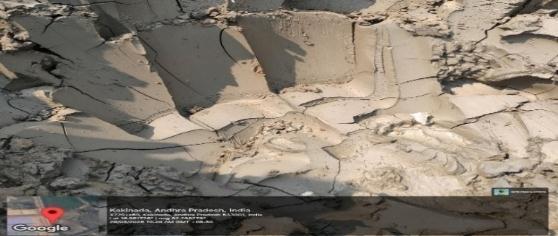
In this investigation, marine clay was sampled from a dredging site at a depth of 1m to 2m below the sea-bed levelwithintheKakinadadeepwaterportpremises.
Foundry sand is silica sand used to make Molds for metal casting. It is high-quality, uniformly sized silica sand that forms Molds for casting ferrous (iron) and nonferrous (aluminium, copper) metals. Binders (like bentonite clay or resins) and other additives are used to improve its Moulding properties. After repeated use, foundry sand loses its quality, becoming unusable for casting and thus consideredwaste.Inthisstudyfoundrysandwascollected from SRI BHAVANI CASTINGS Ltd., Kakinada, Andhra Pradesh,India.
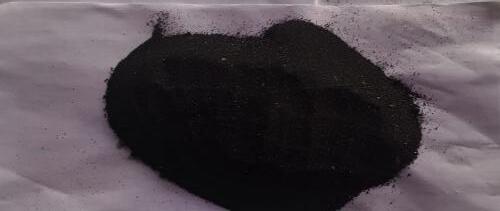
Foundry sand is added to marine clay to improve its geotechnicalpropertiesthroughphysicalmixinginvarious proportions, followed by laboratory tests to determine theoptimal amount and verify improvements in strength, density,andbearingcapacity.
2395-0072
CourtesytoSriBhavaniCastingLtd.,Kakinada.
International Research Journal of Engineering and
Volume:12Issue:11|Nov2025 www.irjet.net
))
Calcium Hydroxide is defined as a white, powdery substance composed of calcium, hydrogen, and oxygen atoms. Its chemical composition is represented by the formula Ca (OH)₂, indicating that each molecule contains one calcium atom bonded to two hydroxide groups. This structure makes it a strong base, capable of neutralizing acidsandparticipatinginvariouschemicalreactions.
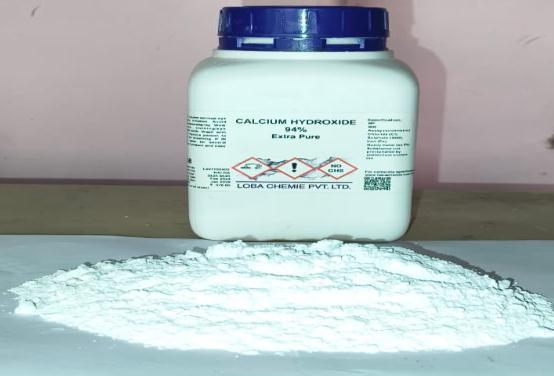
-3: Lime(Ca(OH2))
When lime is added to marine clay, it dissolves to form calciumhydroxide(Ca(OH)₂),whichreleasescalciumions (Ca²⁺) and hydroxide ions (OH⁻). The calcium ions then replace other absorbed cations (like sodium, Na⁺, or hydrogen, H⁺) attached to the clay surfaces, a process called cation exchange. To form new, non-crystalline cementitiousproducts,suchascalciumsilicatehydrate(CS-H)andcalciumaluminumsilicatehydrate(C-A-H).These productsactasabinder,strengtheningthesoil.
Table -4: Chemical Composition of Lime (Ca (OH2))
(IRJET)
-ISSN: 2395-0056
-ISSN: 2395-0072
In this study the quantity of Lime was varied from 4% to 8%bydryweightofsoil.
The Laboratory investigations are carried out on the Untreated marine clay and marine clay treated with various percentages of Foundry Sand (F.S) and Lime (Ca (OH2)). The Foundry Sand with proportions 8%,10%12%,14% and 16%. Lime with proportions 4%,5%,6%,7%and8%areusedinpresentstudy.
5.1 Liquid Limit (WL)
The Liquid Limit test, defined by Indian standard IS 2720 (Part5)–1985,determinesthemoisturecontentatwhich a soil passes from a plastic to a liquid state. This test involves making a soil paste, placing it in a Casagrande device'scup,cuttingagroove,andrepeatedlydroppingthe cup until the groove closes 12 mm. The number of drops andcorrespondingwatercontentarerecordedforatleast four trials to plot a curve and find the liquid limit corresponding to 25 blows. Liquid limit test was conducted on untreated marine clay and foundry sand treated marine clay and foundry sand treated marine clay treatedwithLime
5.2 Plastic Limit (WP)
In this test standardized under the Indian Standard code IS:2720(Part5)-1985.Thetestdeterminesthemoisture contentatwhichasoil,whenrolledintoathreadbyhand, crumbles when its diameter is reduced to 3 mm. Plastic limit test was conducted on untreated marine clay and foundry sand treated marine clay and foundry sand treatedmarineclaytreatedwithLime.
5.3 Differential Free Swell (DFS)
In this Differential Free Swell (DFS) test is a geotechnical test to determine the volume change of expansive soils. The test is performed according to IS 2720-(Part-40)1977,whichspecifiesusingasoilsamplepassedthrougha 425-micronsieve.TheformulaforDFSis:
DFS(%)=[(Vd–Vk)/Vk]x100
whereVdisthesettledvolumeofthesoilin waterandVk isthesettledvolumeofthesamesoilinkerosene.
5.4 Modified Proctor Test (MPT)
The procedure given by Indian Standard (IS) code for the Modified Proctor Test (heavy compaction) is IS-2720PART 8 - 1983, which specifies the laboratory method for determining the water content-drydensityrelationship of soils using heavy compaction. This test was conducted on untreated marine clay and foundry sand treated marine clay and foundry sand treated marine clay treated with Lime.
International Research Journal of
Volume:12Issue:11|Nov2025 www.irjet.net
5.5 Specific Gravity(G)
This test conducted as per is 2720- (part3/sec1)-1980. Specific gravity of soil is the ratio of the density of soil solidstothedensityofwaterataspecifiedtemperature
5.6 California Bearing Ratio (CBR)
The soaked CBR (California Bearing Ratio) test is conducted to determine the soil's load-bearing capacity under saturated conditions, simulating worst-case scenarios like flooding, which are critical for designing durable flexible pavements. The relevant code for conducting the CBR test is IS:2720-Part 16, a standard fromtheBureauofIndianStandards(BIS)forsoil testing. CBR test was conducted on untreated marine clay and foundry sand treated marine clay and foundry sand treatedmarineclaytreatedwithLime.
5.7 Triaxial Compression Test
The Indian Standard (IS) code that governs this test is IS 2720-Part 11: 1993, which specifies the methodology for conducting the unconsolidated undrained triaxial compression test without pore pressure measurement. To determining theshearstrength,cohesion(c),andangle of internalfriction(Φ)ofsoil.
6. RESULTS
6.1 Index and & Engineering properties of untreated marine clay. Table-5 Present the properties of untreated marineclayobtainedduringthisstudy.
Table-5: Index&EngineeringPropertiesofUntreated MarineClay
6.2 Marine Clay (MC) with percentage variation of Foundry Sand (F.S).
6.2.1 Differential Free Swell (DFS) Test Results
Table-6: DifferentialfreeswellvaluesforMC+FS
Differential Free Swell(DFS) (%)
Chart -1: DFSvaluesofmarineclaytreatedwithdifferent percentagesofFoundrySand(F.S)
6.2.2 Atterberg limits test Results (WL), (WP)(IP)
Table -7: AtterberglimitsvaluesforMC+F.S
International Research Journal of Engineering and Technology (IRJET) e-ISSN: 2395-0056
Volume:12Issue:11|Nov2025 www.irjet.net p-ISSN: 2395-0072
0 2 4 6 8 10 12
Chart -2: Atterberglimitsvaluesofmarineclaytreated withdifferentpercentagesofFoundrySand(F.S)
6.2.3 Modified Proctor Test (MPT) Results
Table -8: OptimumMoistureContent(OMC)and MaximumDryDensity(MDD)valuesforMC+F.S
Chart -4: MaximumDryDensity(MDD)valuesofmarine claytreatedwithdifferentpercentagesofFoundry(F.S)
6.2.4 Soaked California Bearing Ratio (CBR) test Results
Table -9: SoakedCBRvaluesforMC+F.S
Chart -3: Modified Proctor test results of marine claytreated with different percentages of Foundry Sand(F.S)
Chart -5: SockedCBRvaluesofmarineclaytreatedwith
International Research Journal of Engineering and Technology (IRJET) e-ISSN: 2395-0056
Volume:12Issue:11|Nov2025 www.irjet.net p-ISSN: 2395-0072
6.2.5 Triaxial Compression Test (cohesion (c) and Angle of internal friction(Φ)), Results
Table -10: Cand Φ valuesforMC+F.S
6
Chart -6 AngleofInternalfriction(Φ)valuesofmarine claytreatedwithdifferentpercentagesofFoundrysand.
Table-11: Present Geotechnical properties of Untreated and Treated marine clay with an Optimum of 12% Foundry Sand (F. S)
Discussion -1: In the present study, marine clay treated with an optimum of 12% foundry sand has exhibited a CBRvalueof5.378%.
The soil can be used as subgrade for flexible pavement should possess the minimum CBR value of 8% as per the IRC37-2012.Hencethistreatedmarineclayisnotsuitable assubgradeforflexiblepavementsaspertheIRC37-2012 codeofpractices.Presentinvestigationhasbeencontinued by using Lime (Ca (OH)2) with various percentages of 4%,5%,6%,7% and 8%. to improve CBR value of foundry sandtreatedmarineclay.
6.3 Marine Clay with optimum percentage of Foundry Sand and percentage variation of Lime
6.3.1 Atterberg Limits Test Results
Table -12: LiquidLimit(WL),PlasticLimit(WP),Plasticity Index(Ip)ValuesforMC+12%F.S+Lime
Atterberg limits
Classification
Swell
Chart -7: Atterberg Limits values of Marine Clay treated with an 12% Foundry Sand on addition of different percentagesofLime.
International Research Journal of Engineering and Technology (IRJET)
Volume:12Issue:11|Nov2025 www.irjet.net
Table -13: OMCandMDDvaluesforMC+12%F.S+Lime
-ISSN: 2395-0072
Table -14: SoakedCBRvaluesforMC+12%F.S+Lime
5
6
Chart -8: Modified Proctor Test (MPT) results of marine clay treated with an 12% of Foundry Sand on addition of differentpercentagesofLime.
Chart -10: Soaked California Bearing Ratio (CBR) test results of marine clay treated with an 12% of Foundry SandonadditionofdifferentpercentageofLime.
Chart -9: MDDvalues ofmarineclaytreatedwithan12% of Foundry Sand on addition of different percentage of Lime
Chart -11: SoakedCBR values ofmarineclay treatedwith an 12% of Foundry Sand on addition of different percentagesofLime
International Research Journal of Engineering and Technology (IRJET) e-ISSN: 2395-0056
Volume:12Issue:11|Nov2025 www.irjet.net p-ISSN: 2395-0072
6.3.4 Triaxial Compression Test (cohesion (c) and Angle of internal friction(Φ)), Results
Table -15: PresentCand Φ valuesforMC+12%F.S+Lime
3
4
5
6
Chart -12: Cohesion (C) values of marine clay treated with an 12% of Foundry Sand on addition of different percentageoflime
Also conducted the Specific gravity(G), Differential Free Swell(DFS)testsonthemarineclaytreatedwithoptimum percentagesoffoundrysandandLime.
Discussion -2:
In the present study, the marine clay is treated with 12%FoundrySand+6%LimehasexhibitedtheCBRvalue of 11.65%. which is suitable as per IRC 37-2012 codes of practice.Hence,themarineclaytreatedwiththeoptimum percentages of Foundry Sand and Lime can be used as subgradeforFlexiblepavement.
Table -16: Laboratory test results of untreated Marine clay and marine clay treated with an Optimum percentage of Foundry sand and Lime.
Chart -13: Angle of Internal Friction(Φ) values of marine clay treated with an 12% foundry Sand on addition of differentpercentagesoflime.
The Following conclusions are drawn based on the laboratorytests:
Itisobservedfromthelaboratorytestresultsthat theliquidlimitofmarineclayhasbeendecreased by 16.64% on the addition of 12% foundry sand and further it has been decreased by 36.16% on
International Research Journal of Engineering and Technology (IRJET) e-ISSN: 2395-0056
Volume:12Issue:11|Nov2025 www.irjet.net p-ISSN: 2395-0072
addition of 6% lime. when compared with untreatedmarineclay.
It is noticed from the laboratory test results that theplasticlimitofmarineclayhasbeenimproved by 10.33% on the addition of 12% foundry sand and further, it has been improved by 14.38% on addition of 6% lime. when compared with untreatedmarineclay.
It is observed that the plasticity index of marine clay has been decreased by 34.73% on the addition of 12% foundry sand and further it has been decreased by 70.07% on addition of 6% lime whencomparedwithuntreatedmarineclay.
It is observed that the specific gravity of marine clayhasbeenincreased by3.79%ontheaddition of 12% foundry sand and further it has been increasedby7.17%onadditionof6%lime.When comparedwithuntreatedmarineclay.
It is noticed from the laboratory test results that the differential free swell of marine clayhasbeen decreased by 38.88% on the addition of 12% foundry sand and further it has been decreased by 88.88% on addition of 6% lime. When comparedwithuntreatedmarineclay.
Itisobservedfromthelaboratorytestresultsthat the MDD of marine clay has been improved by 17.49%ontheadditionof12%foundrysandand further it has been decreased by 13.82 % with addition of 6% lime. When compared with untreatedmarineclay.
Itisobservedfromthelaboratorytestresultsthat the OMC of marine clay has been decreased by 25.16%ontheadditionof12%foundrysandand further it has been increased by 22.65 % on addition of 6% lime. When compared with untreatedmarineclay.
It is observed that the CBR of marine clay has been increased by 263.62% on the addition of 12% foundry sand. Further it has been increased by 687.89% on addition of 6% lime. When comparedwithuntreatedmarineclay.
Itisobservedthatthecohesion(C)ofmarineclay hasbeen decreased by29.99%on the addition of 12%foundrysand. Further ithas beendecreased by 43.07 % on addition of 6% lime. When comparedwithuntreatedmarineclay
It is observed that the Angle of internal friction (Φ)ofmarineclayhasbeenincreasedby122.17% on the addition of 12% foundry sand and further
it has been increased by 203.50 % with addition of 6% lime. When compared with untreated marineclay
[1] Dr. D. Koteswara Rao et.al., (2011), “Laboratory Studies on the Properties of Stabilized Marine Clay fromKakinadaSeaCoast,India”.InternationalJournal ofEngineeringScienceandTechnology(IJEST).Vol3, Jan2011.
[2] E.RamAnjaneyaRaju,et.al.(2018),“Improvementof CBR of Marine Clay Subgrade Stabilized w ith lime and RockDust”.InternationalJournalofAdvancedin Management, Technology and Engineering Sciences. Volume8,Issue1,Jan2018.
[3] Er.D. Venkateswarlu et.al.,(2014),“Laboratory Study on Lime and Cement Treated Marine Clay Subgrade Flexible Pavements”. IOSR Journal of Mechanics and Civil Engineering. (IOSR-JMCE). Volume 11 Issue 1 January2014
[4] Amendra Prasad Yadav et.al., (2019), “A Comparative Study of Waste Foundry Sand and Marble Dust for Stabilization of Subgrade Soil.” International Journal for Research in Applied Science & Engineering Technology(IJRASET).Volume7,Issue4,April2019.
[5] Amrullah Abdul Rahim Zai et.al., (2020), “Efficacy of Waste Foundry Sand and Glass Fiber on Stabilization of Clay Soil”. International Journal of Engineering Research & Technology (IJERT) Volume 9, Issue 1, January2020.
[6] Atul Torase et.al., (2019), “Soil Stabilization by using Foundry Sand and Rice Husk Ash”. International Research Journal of Engineering and Technology (IRJET).Volume6,Issue:3,March,2019.
[7] Amrendra Kumar, et.al., (2014), “Compaction and Sub-Grade characteristics of clayey soil mixed with Foundry Sand, Fly Ash, and Tile Waste”. IOSR Journal ofMechanicalandCivilEngineering(IOSR-JMCE).
[8] G. R. Ashwin Kumar, et.al., (2015), “Stabilization of Marine Clay by Using Copper Slag”. International Journal of Engineering Research & Technology (IJERT).Volume3,Issue112015.
[9] Manali D. Patel et.al., (2020), “Stabilization of Soil by Foundry Sand Waste”. IRJET Volume 7, Issue:05, May 2020.
[10] Determination of shear strength parameters for Marine clay, Journal of the Institution of Engineers, Singapore,Vol.14,No.3,pp39-46
[11] D S V Prasad, et al., (2018), “A Study on Geotechnical Properties of Marine Clay Stabilized with Lime and Recron-3sFibre.”InternationalJournalofEngineering &Technology2018.
[12] KuldeepGroweret.al.,(2019),“ExperimentalStudyof WasteFoundrySandandMarbleDustasaStabilizing Material”.IRJETVolume6,Issue6,June2019.
International Research Journal of Engineering and Technology (IRJET) e-ISSN: 2395-0056
Volume:12Issue:11|Nov2025 www.irjet.net p-ISSN: 2395-0072
[13] Balasubramaniam et.al., (1989), Strength and deformationcharacteristicsoflimetreatedsoftclays, GeotechnicalEngineering(AIT),20,1989,pp.49-65.
[14] ShruthiJohnsonet.al.,(2019),“EffectofFoundrySand onthe C.B.R Characteristics ofSoil.”IJEDR. Volume 7, Issue1,ISSN:23219939.
[15] IS:2720 Part-16-1987 Determination of California BearingRatio.
[16] IS: 2720 (Part 5) - 1985. “Indian standards methods oftestsforsoils(Part5),Determinationofliquidlimit andplasticlimit.”
[17] IS: 2720 (Part 8) - 1983. “Indian standards methods of tests for soils (Part 8), Determination of water content and dry density relation using heavy compaction.”
[18] IS:2720(PartXL)-1977. Determinationoffreeswell indexofthesoils.”


Author-1: Dr. D. KOTESWARA RAO, Professor of Civil Engineering&OSDtoHon’bleVice Chancellor, JNTUK, Kakinada, Andhra Pradesh, India He has received best teacher awards several times viz., national level, state level, university level and also, he has received the best teacher awards several times at thecollegelevelfromthestudent’s feedback.
Author-2:V.DURGAPRAVEEN, PostGraduationstudent, Soil Mechanics & Foundation Engineering, Department of Civil Engineering, University College of Engineering, JNTUK, Kakinada, AndhraPradesh,India