
International Research Journal of Engineering and Technology (IRJET) e-ISSN: 2395-0056
Volume:12Issue:11|Nov2025 www.irjet.net p-ISSN: 2395-0072
International Research Journal of Engineering and Technology (IRJET) e-ISSN: 2395-0056
Volume:12Issue:11|Nov2025 www.irjet.net p-ISSN: 2395-0072
Shradha S. Deshmukh¹, Dr. Sandeep G. Sutar²
¹Department of Computer Science and Engineering, ADCET, Ashta, India
²Professor, Department of Computer Science and Engineering, ADCET, Ashta, India
Abstract - Urban areas are witnessing an increase in the number of vehicles, which has led to a lack of parking spaces, more fuel consumption, and heavy traffic. This paper suggests a cost effective Internet of Things (IoT) and QR code technology-based Smart Parking System (SPS) that can be used to monitor in real-time, access automatically, and manage parking intelligently. The system uses sensors equipped with the Internet of Things (IoT), cloud computing, and computer vision-based object recognition to locate and track vehicles in parking areas. Moreover, QR code authentication is used in the proposed system to enable vehicle identification to be safe, contactless, and cheap, unlike traditional RFID-based methods. When a user scans a QR code using a smartphone or camera, the system checks the user's identity, writes the data of the entry or exit to the record, and updates the parking availability. An online or mobile interface through which both users and administrators can see updated occupancy information, is created by a cloud server that also communicates with IoT devices to get real-time data from the parking lot. To lessen the time spent searching for a parking space as well as to lower the likelihood of traffic congestion in the parking lot, the Farthest First Clustering algorithm is utilized additionally by the Dijkstra shortest path algorithm for the vehicles to be able to reach the closest vacant parking slot. Moreover, the parking usage patterns are being analyzed by the Farthest First Clustering algorithm to not only facilitate the area of a parking lot for the demand of a certain period but also allow for the prediction of future trends. The designed system will be able to work efficiently in a large city as the storage of data is the main responsibility of the central cloud with which the servers and sensors communicate seamlessly. Testing of the prototype indicates that the system is able to locate an object with an accuracy of more than 96%, recognize a QR code with a reliability of 99.9%, and have a response time of less than a second. These results help confirm that the system is suitable for realtime field application in environments such as cities. It is a technologically advanced, safe, and clean solution that helps to reduce parking problems and supports smart city development and intelligent transport infrastructure. Keywords: Internet of Things (IoT), Smart Parking System, QR Code Authentication, Cloud Computing, Object Recognition, Dijkstra Algorithm, Farthest First Clustering, Intelligent Transport Systems
Key Words: Internet of Things (IoT), Smart Parking System, QR Code Authentication, Cloud Computing, Object Recognition, Dijkstra Algorithm, Farthest First Clustering, Intelligent Transport Systems
Thegrowthinthenumberofvehiclesinmoderncitiesis themainreasonfortheseriousproblemofparkingspace shortage in the urban areas. Car owners in the majority of city centers have to drive around empty parking lots for a long time and this results in unnecessary fuel consumption, trafficcongestion,and pollution increases. Bad parking management does not only waste time and energybutalsoincreasesthelevelofurbanstressaswell asenvironmentaldegradation.Hencetheformationofan intelligent parking system is an essential step towards the cities of the future that are smart and sustainable. The performance of traditional parking systems is generallydonethroughhumanlabororpartlyautomatic procedures. In these systems, human beings are in charge of issuing tickets, collecting payments, and controlling the parking spaces. These methods are characterized by mistakes and problems that hinder the users' efficiency and comfort. To counterbalance these shortcomings, technological innovations over the last yearshave paved the means for the emergence ofsmart parkingsystemsthatuseaswellascommunicateviaIoT devices, sensors, computer vision, and cloud-based platforms and can, thus, fully, or partially, automate parkingoperationsaswellasofferreal-timeinformation to users. The first devices of smart parking systems widely utilized Radio Frequency Identification (RFID) technologyforvehicledetectionandaccesscontrol.RFID depends on the communication through electromagnetism between the car-attached tag and the gate-mountedreader.EventhoughRFIDisveryaccurate and is used in many applications, it is necessary to have certain hardware like RFID tags, antennas, and readers. Implementation raises the cost, limits extensibility, and requires ongoing hardware upkeep. In order to overcome these drawbacks, the system actuality proposed deregisters the use of RFID and features a Quick Response (QR) code-based approach to vehicle identification and authorization. QR codes represent visually the alphanumeric characters of the information they store without the limitation of space. They can be
International Research Journal of Engineering and Technology (IRJET) e-ISSN: 2395-0056
Volume:12Issue:11|Nov2025 www.irjet.net p-ISSN: 2395-0072
storedindigitalformandlaterprintedasonecaneasily andcheaplymakeacopy.Acommoncameramoduleora smartphonecanscantheQRcodeandsoftwarepackages likeOpenCVandPyzbarcandothedecodingatthesame time. The association of the distinctive QR code to each vehicle makes it the vehicle's digital identifier. The moment the driver comes in or goes out of the parking area,theQRcodeisscannedforrecordingentryandexit times automatically. After verification of the vehicle's identity, the system employs IoT sensors to locate free parking spaces and then communicates this information toacloudserver.Inordertofindtheshortestroutefrom theentrancegatetothenearestparkingplacethesystem is using Dijkstra’s shortest path algorithm. On a user interface or a display system, the driver gets this information,whichhelpshimtonavigatetheparkinglot quickly and easily. The use of QR code technology is combinedwithothertechnologies,suchasIoT,computer vision,andcloudservices,tocreateasystemthatismore affordable, adaptable, and expandable than an RFIDbasedone.TherecognitionoftheQRcodeeliminatesthe needforcostlytagsorreaders,whileIoTsensorsdeliver real-time monitoring of obtainable parking spaces. Thanks to cloud connectivity data management is centralized allowing for the usage of parking data for different purposes like predictive parking analysis or system development in the future. The QR code-based smart parking scheme proposed as the most suitable solution to the problems related to the parking space issuewouldessentiallyhelpurbanareastointegratethe different needs into one system in order to lighten the traffic,savetime,andmakebetteruseofresources.
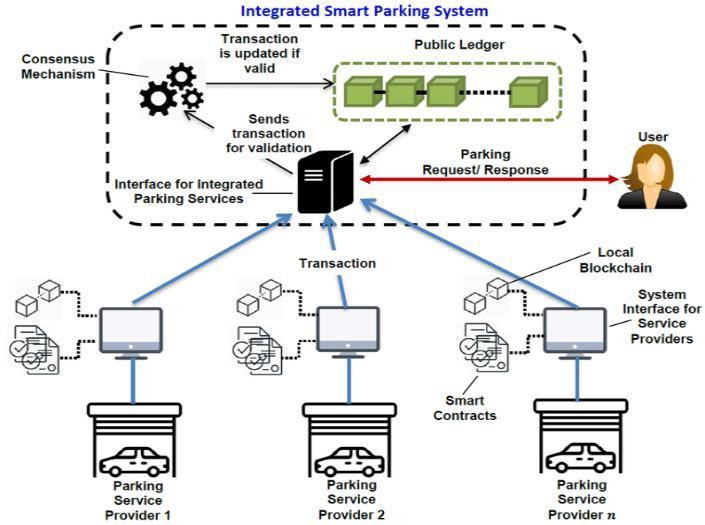
TheFigure1depictsthegenerallayoutoftheintegrated smart parking scheme, which is the result of the proposedresearch.ThesystemisdesignedtoutilizeIoT, blockchain, and QR code technologies to deliver secure, transparent, and efficient parking operations. On the user side, the driver is the one who makes a parking request by simply scanning a unique QR code that is assigned to the vehicle. After receiving this request, the
system replies by sending a message to the integrated parkingserviceinterface.Theinterface,therefore,islike a bridgethatconnectsseveral parkingservice providers together, each of whom is running its own local blockchainnetwork.Theselocalblockchainsaretheones that keep records of parking slot availability, transactions, and payments by smart contracts. Each time a parking transaction is done such as reserving a slot, making a payment, or recording entry/exit the transactionissenttotheintegratedparkinginterfacefor confirmation.Therefore,aconsensusmechanismisused bythesystemtodecideifthetransactionisrealbeforeit updates the public ledger. The transaction record thus becomespermanentandaccessiblewhentheyarelinked to the public ledger, thereby, enhancing data integrity andpreventingtamperingorduplication.Asaresult,any parkingservice providercanrun theirbusinessasusual and still have the benefit of being connected to the integrated network through the blockchain infrastructure. On the other hand, the use of QR codes makestheauthenticationofthevehicleeasybecausethe userisonlyrequiredtoscanthecodeattheentranceor exit gate. After that, the decoded data are sent in a securedmannertotheblockchainforverification,which is also the reason why security and traceability of parkingeventsareguaranteed. Thecoreelementsofthe system such as IoT sensors, QR code identification, and blockchain-based validation, together make up a robust, scalable, and secure smart parking ecosystem that is technologically advanced and well suited to urban environments of the future. The design of the system is suchthatitnotonlyfacilitatestheinteractionofdifferent parkingoperatorsbutalso,inessence,allthepartiesthat have a stake in it, by providing them with the access to informationandtrustinthesystem.
Itisthemaingoalofthepresentundertakingtoconceive and put into practice a smart parking management system that would kind use of QR code technology, IoT sensors, and data analytics for the purpose of turning urban parking into a more efficient, convenient, and secureone.Theproposedsystemiseagertosurpassthe limitations of the conventional and RFID-based systems by offering a cost-effective, user-friendly, and green solution.
The specific objectives of the project are as follows:
1. It should take less time for drivers to locate empty parking spaces in urban areas so that they can save time and make the parking processmoreconvenientforusers.
2. Thedecreaseintrafficcongestionresultingfrom thevehiclesthataredrivingaroundinsearchof parking spaces will make the traffic flow more fluentandtheuseofroadnetworkswillbemore efficient.
International Research Journal of Engineering and Technology (IRJET)
Volume:12Issue:11|Nov2025 www.irjet.net p-ISSN: 2395-0072
3. Lowering the fuel consumption in the search for parking will contribute to the reduction of environmental pollutionandtheimplementation ofthesustainableurbanmobilityconcept.
The installation of a QR code–based access system will secure the vehicle more tightly as it will verify that only the authorized vehicles are allowed to come in and go outfrom theparking area, thuslessening thechances of theftortheuseofthevehiclesinthewrongway.Through theuseofIoTandcloudanalyticsforsmartparkingdata, one can reveal significant patterns and insights which will enable the efficient management of parking resources and the planning of traffic to be done from data. If parking spaces are allocated more efficiently throughslotdetection, real-timeupdates,andoptimized routingbytheDijkstrashortestpathalgorithm,thenthe averagewaitingtimeofdriverswillalsobereduced.
As city populations rise rapidly and more vehicles are being bought, parking has become a major headache for thecitiesofthe21stcentury.Limitedparkingspacesare causing serious traffic jams, resulting in increased fuel consumption and car drivers getting annoyed. The root cause of city traffic are vehicles that roam around for vacant parking slots, thus energy is being consumed unnecessarily and the environment is being polluted. Whether fully manual or semi-automated, parking systems need the help of a person for issuing tickets, payment, and slot allocation. These ways are not only slow but are also inaccurate and are easily exploited. Though in the past smart parking systems resorted to RFID to identify and allow access to vehicles, they requirespecifichardwaresuchasRFIDtagsandreaders, thatraisesboththecostofthesettingupandthatofthe maintenance. Besides, RFID-based systems also have limitedflexibilityasaresultofonlybeingabletosupport a specific communication frequency with dedicated equipment. There is a necessity for a more efficient, economical,andversatilesmartparkingsolutiontosolve such problems. The new system eliminates RFID technologyinfavorofQRcodesforvehicleidentification andgateauthorization.AQRcodecanbemadeinstantly whileitsscanningcanbedonethroughacameramodule or a smartphone, thus no costly RFID parts are needed. Alternatively, the system can also be viewing on-line, thus real-time. Besides, the system uses IoT sensor equipped parking slots to know if they are free or not and the data collected from them is stored in the cloud making it accessible everywhere. Moreover, the Dijkstra algorithm for findingthe shortestpath isat the disposal to help the driver get the nearest free parking spot, hence the search time as well as traffic congestion is prettymuchcutdown.
The foundation of modern smart parking systems (SPS) lies in IoT architectures combining sensing, data transmission, and cloud-based management. Ala’anzy et al. [1] proposed a four-layer IoT–fog–cloud–provenance framework, validated through a university-campus case study. Using occupancy sensors and cameras connected to fog nodes for local processing, the model achieved significant reductions in latency and network load compared with a cloud-only configuration, proving fog computing’s suitability for real-time urban parking. Similarly,Nasimetal.[2]implementedalightweightIoT The system architecture included smart bay sensors, a communication backbone, and a central server that was connected to a mobile interface. The nine-month trial at the University of Oulu of a system that was put through its paces, saw the system functioning stably and the occupancy detection being accurate; however, it lacked predictive intelligence for a big-scale city application. Alam et al. [3] created a comprehensive IEEE Access surveythatdeeplyexaminedover170IoT-basedparking systems in detail. They segregated the systems by sensing technology RFID, ultrasonic, infrared, and camera communication protocol (ZigBee, Wi-Fi, NBIoT,LoRaWAN),andcomputational topology(cloud,fog, edge).TheypinpointedthelackofAI-drivenadaptability, non-standardized datasets, and limited interoperability as the most significant research gaps. Fahim et al. [4] scrutinized 116 papers in the areas of sensor networks, vision systems, and AI-enhanced SPS models. Their cross-paperstudyindicatedthetrendtowardstheuseof IoT + vision-based hybrid solutions with cloud/fog computing as preferred technology while also pointing to shortcomings of accuracy under environmental changes and the absence of common evaluation benchmarks. Jabbar et al. [5] envisioned a city IoTenabled LoRaWAN-based smart parking management system, that would allow the use of low-power, longrange communication suitable for a citywide deployment. The study confirmed the scalability and energy efficiency of LoRaWAN, thus, as a result, making it a feasible communication backbone for big smart-city infrastructures.
Follow-up cheap designs [6] used the same principle withcheapIoTnodesandcloudintegrationtogive realtime availability with low energy consumption. A number of researches [7] have combined IoT sensing withensemblelearning(Bagging,Boosting)andreached ameanabsoluteerrorof0.07%inoccupancyprediction, thereby proving the effectiveness of AI-assisted IoT analytics in congestion reduction. A digital
International Research Journal of Engineering and Technology (IRJET) e-ISSN: 2395-0056
Volume:12Issue:11|Nov2025 www.irjet.net p-ISSN: 2395-0072
transformation review such as [8] was an extensive summary of the urban mobility digitalization progress that acknowledged the significance of IoT, WSNs, computervision,andcloudanalyticsinthedevelopment ofparkingsystems.Theseinvestigationspointedoutthat contemporary SPSs not only keep track of space utilization but also interconnect with dynamic pricing and user-friendly reservation platforms. By experiment, Santana et al. [9] confirmed radio propagation of LoRaWAN for smart-parking services in the city of Santander, measuring coverage and interference to demonstrate the possible use of LoRa in real deployments. Moreover, several reviews [10]–[15] brought together the proof of the relentless implementation of IoT along the cloud-fog architectures while pointing out the remaining issues of scalability, privacy,andlackofpredictiveintelligence.
2.3.
Frameworks based on fog- and edge-computing [16]–[21] have shown that they can handle the data near the source, which results in less bandwidth usage and shorter decision latency. As a result, ML-supported fog networks [21] with AdaBoost classifiers were able to forecast the availability of parking spaces while also reducingtheconsumptionofenergyandtheemissionof pollutants. Researches like [17]–[22] have explored the design of LoRaWAN networks and the optimization of gateways for large-scale deployments, thus pointing out theadjustmentofthedata-rate(ADR)andthelocationof the gateway as the main factors for maintaining the performance and the coverage stability in heavily populatedurbanareas.
A fresh research wave has focused largely on smart sensors and the integration of AI. Geomagnetic + RNNbased models [23] utilized sequence prediction to foresee slot availability thus, they were able to bring down vehicle wait times considerably. LoRa-powered industrial scenarios [24] revealed the possibility of energy-efficient, city-wide parking that could be managed via cloud dashboards. Computer-vision methods like PakLoc and PakSta [25] as well as pixelwise ROI detection models [26] reached almost perfect (≈ 99.7 %) levels of accuracy by employing YOLO-based neural networks and automatic ROI extraction thus, they signal the completion of deep-learning-based occupancy detection. Arduino- and RFID-based prototypes [27]–[29] were able to show low-cost viability with about 100 % detection accuracy in controlled environments. These setups incorporated ultrasonic sensors and microcontrollers to make slot data updates through Wi-Fi and Firebase, thus, they were able to serve as feasible models for small-scale implementations.
Recent literature [30]–[37] delineates in detail the different comparisons of ultrasonic, magnetic, camera, and RFID sensing technologies. Ultrasonic sensors are characterized by their ease and low cost; magnetic sensors have been found to be very stable in outdoor environments; while camera systems facilitate visual analytics and license-plate recognition. Hybrid sensor fusion is thus considered the most robust approach by the majority of the authors for environmental adaptability. Geomagnetic and magnetic sensors [35] have been found to be highly reliable in real-world situations with a reported accuracy of more than 85%. Nevertheless, there are still problems with calibration and atmospheric interference. It has been suggested by the researchers that there should be a combination of different modalities (magnetic + ultrasonic + vision) to achievebetteraccuracy.
Industry reports [38]–[40] reveal that the changes are happening quite fast, the changes are moving beyond just showing models to actual AI-powered commercial deployments. On the one hand, an example is Bengaluru's KR Market smart-parking hub [38], which alongwiththeintegrationofautomatedticketlessentry, digital payments, and AI-driven CCTV surveillance for enhanced security also provides increased customer convenience and security. On the other hand, the use of ESP8266/ESP32-based IoT controllers and ThingSpeak cloud for real-time data streaming [40] has been implemented in several locations to demonstrate the feasibility of open-source hardware for large-scale, lowcostsystems.Thesetripsareunmistakablesignsthatthe mixofIoTandAItechscanbeanefficientwayofsolving the problems related to parking, cutting the traffic congestion, and spreading the idea of urban mobility as beingeco-friendly.
Despite significant progress, several gaps persist across reviewedstudies:
1. Limited Predictive Intelligence A majority of Internet of Things (IoT) systems utilise fixed rule-based logic and have only a very limited learningcapability[3][4][10].
2. Data Standardization Issues The lack of standard benchmarking datasets makes it difficulttocompareresults[3][4].
3. Scalability Constraints TheuseofRFIDand expensivesensorsystemsforalimitedarea,like a city, hinders the possibility of scaling the regiontothecitynetworks[11][28][29].
4. Latency and Bandwidth Challenges Even entirelycloud-basedsystemsarestillaffectedby longcommunicationdelays[1][16][20].
International Research Journal of Engineering and Technology (IRJET) e-ISSN: 2395-0056
Volume:12Issue:11|Nov2025 www.irjet.net p-ISSN: 2395-0072
5. Data Privacy and Security
The flow of centrally collected data is the source of the potentialsecuritybreaches[8][15][37].
The different pieces of literature taken together show therequirementofhybridIoTarchitecturesthatuse fog computing, a small AI inference, and a low-cost authentication mechanism, for instance, QR codes in order to be able to achieve a real-time, scalable, and privacy-preservingsmart-parkingmanagement.
In short, the research trends signal a clear shift from sensor-centric IoT implementations towards AIpowered, edge-optimized, and user-engaged smart parking ecosystems. The systems based on RFID and LoRa have become mature; however, frameworks based on QR codes have not been sufficiently studied. The integration of QR authentication with IoT and object recognition, as in the case of this study, is a breakthroughwaytoachievesecure,low-cost,andhighaccuracy parking management for the upcoming smart cities.
The QR Code–based Smart Parking System, as outlined, leverages an Internet of Things (IoT) framework, which is enhanced by cloud computing and computer vision technologies, for a dynamic parking management and monitoring solution. The system, detailed in Figure 2, is deeply layered with four different layers that include perception, network, processing, and application layers. Thesystemoperationsattheperceptionlayerdependon ultrasonic sensors, infrared detectors, and cameras for obtaining the occupancy condition of the parking slots. Anycarthatisabouttoentertheparkinglothastoscan a distinct QR code which is linked to its registration details. At the same time, the camera installed at the entrance takes the picture of the vehicle and hence the Object Recognition (OR) module processes it for verification of the vehicle identity and the parking slot measurement. The network layer is equipped with facilities that deliver secure and error-free communication of the sensor and image data from the local to the central cloud server. The data exchange can bedonethroughWi-FiorLoRa-basedIoTprotocolsthat allow the system to be used in both small and large parking infrastructures. The processing layer is performingon-the-flyanalyticsofthedata,startingfrom thepreprocessingofthedata,toslotdetection,shortestpath determination, and slot allocation. The most efficient path from a vehicle's entry point to the closest free slot is determined using Dijkstra's algorithm thus congestion can be lessened alongside the vehicle's idle time.
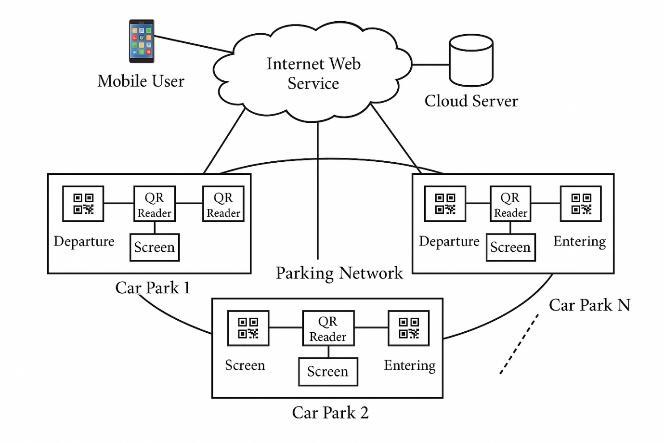
Cloud server is the primary decision-making and data storageunitattheapplicationlayer.Afterprocessingthe aggregated data, it provides real timely updates to both end users and administrators through mobile and web interfaces. Users can register, authenticate through QR scanning, check slot availability, and get directions to their parking spaces via the mobile application. The management dashboard shows a complete view of parking usage, the number of vehicles entering, and the performance of the system. The comprehensive integration of these levels is a low-latency, highprecisionparkingmanagementsystemthathardlyneeds human intervention and thus contributes to the reduction of traffic congestion and the increase of the efficiency of operations. The replacement of traditional RFID hardware with QR-based authentication not only cuts down the installation cost significantly and makes scalability easier but also provides a safe and comfortableparkingexperience.
Thesystemthathasbeenoutlinedcarriesasetoflinked functional modules which, in their individual functioning, are aimed at collectively propelling the intelligent operation of a smart parking environment. Essentially, the User Module is the front end of interaction for drivers whereby they are enabled to register,signin,andgetreal-timeaccesstoparkingdata. Usershavetheoptiontocheckforvacantparkingspaces, reserve their parking space ahead of time, and get realtime updates on the availability of the parking slot as wellasthedirectionstoreachthere.Throughcontinuous interactionwiththeclouddatabase,userscanbeableto minimize their waiting time and maximize their convenience.
The Admin Module via a cloud-based dashboard is endowed with the capacity of providing the functions of thecentralmanagement.Withthehelpofthedashboard administrators are able to oversee parking occupancy, log vehicle entry and exit, and keep track of revenue generation. The performance of the system can be gaugedthroughtheefficiencyoftheresourcesusedwith
International Research Journal of Engineering and Technology (IRJET)
Volume:12Issue:11|Nov2025 www.irjet.net p-ISSN: 2395-0072
the help of the analytical tools which are embedded in the module. This module plays a role in the smooth workingoftheparkingzonesbyeffectivelymanagingthe cooperation among them and also by ensuring that the service is up to the mark. Additionally, the Vehicle Detection through Object Recognition Module is instrumental in the process of automating vehicle identification.Photosofvehiclesattheentranceandexit gates are taken by the cameras, and are later processed by Python-based computer vision algorithms to detect thepresenceofvehiclesandtocheckwhethertheaccess isauthorized.Thewholeprocedureofthedetectionisin real-time and it not only facilitates the automation of access control but also the updating of the occupancy database with very high accuracy. Registration and Authorization Module is responsible for managing secure enrolment and verification of users and vehicles. At the time of registration, each user is given a distinct QRcodethatislinkedtotheirvehicleidentificationdata. Atthegate,thesystemscansandverifiestheQRcodeto allow access only to authorized users. This approach elevates security and prevents outsiders from gaining accesstothe parkingarea. TheCloud ServerIntegration Module is the part of the system that provides the computational power. It is in charge of real-time sensor data,QRauthenticationlogs,andoccupancyinformation. The cloud installation is in charge of the analytics work thatincludesslotallocation,routecomputation,anddata visualization. The entire layout is very open, scalable, and cross-device synchronization is done very effectively.
Data Collection and Preprocessing Modules are two separate units that work closely together to keep the latest occupancy data from IoT sensors and OR outputs updated continually. The initial steps in Preprocessing are noise removal, inconsistency correction, and validation of the data that comes in to ensure accurate data is available before the data is analyzed. The realtime implementation of slot detection and the overall system are thus very dependent on this data. Real-Time Slot Availability Module is actively updating and calculatingthenumberofoccupiedandfreeslots.These changesreflectinamobileappandanadmindashboard so that both users and operators have a real-time overviewoftheparkingsituation.TheShortestPathand SlotAllocationModulescoordinatetheworktoeliminate the facility's traffic inefficiency. Dijkstra’s algorithm determines the shortest route from the user’s point of accesstotheclosestfreeparkingspacethussavingtime forparkingandavoidingtheincreaseoftrafficinsidethe facility. Afterward, the system automatically locates the driver with the parking space that matches closest to him/her. The variables considered include the distance, space type, and if it is already occupied or not. The Navigation to Nearest Available Parking Module comes into play when there are no spaces left in a particular
areaandfindstheclosestparkinglotthathasfreespaces using cost-based routing that takes less travel distance and time into account. The Pattern Detection Module, which utilizes Farthest-First Clustering, reviews the historical data of occupancy to determine that factors like high-demand hours, repeating usage patterns, and spatial distribution of parking demand. The results of this module give the company ways to make the correct decisions about parking such as pricing that varies depending on demand, load balancing, and capacity planning. The real-timeupdateandnotificationsmodule allows the frontend and backend to be in real-time coordination which thus is the reason slot availability is convenient for visitors, and this is what they get in the form of notifications together with confirmations of reservations and routing instructions. Meanwhile, operators receive notifications about anomalies and capacitythresholds.TheReportingandAnalyticsModule generates statistical reports along with vibrant reports like daily occupancy, vehicle turnover, and operational efficiency. These accounts are used as a basis for longterm planning, system optimization, and administrative decision-making. The Performance Metrics and Optimization Module is responsible for the continuous monitoring of the most critical factors such as accuracy, response time, throughput, and slot utilization. As a result of these interactions, optimization policies are implementedautomaticallyinordertomaintainastable quality of the system. Finally, the System Security and Access Control Module is the one that ensures the security of user login details, data integrity, and communication privacy. The access control based on roles, encrypted QR validation, and intrusion detection mechanisms that are aimed at preventing unauthorized manipulation and ensuring that the system is operating normally, together, they contribute to the system's operationalstability.
Therefore, the modular architecture is a great way of integrating IoT sensing, QR-based authentication, computer vision, and cloud analytics into one cohesive systemthatishighlyreliable,scalable,andoperationally efficient. The design not only removes user effort and search time but also provides secure, data-driven managementforfuturesmartparkinginfrastructures.
Several quantitative trials have been carried out in this chapter to measure the effectiveness of the Smart ParkingSystemusingQRcodewhichisthemainsubject of the study. The main concentration of the research is on the Object Recognition (OR) model for parking slot detection, the QR code module for vehicle identification, and the overall IoT-cloud system integration. The performance metrics embodying accuracy, efficiency, andreliabilityrepresenttheextenttowhichthesystem
International Research Journal of Engineering and Technology (IRJET) e-ISSN: 2395-0056
Volume:12Issue:11|Nov2025 www.irjet.net p-ISSN: 2395-0072
fulfils the project objectives as per the outcomes obtained.
4.1 Performance Metrics of the Object Recognition Model
Theobjectrecognitionmodelhadbeentrainedon a datasetcontainingseveral thousandimagesofparking slots under various lighting and weather conditions, as wellasoccluded.Then,theperformanceofthesystemin the correct identification of the occupancy of each parkingslotwasassessed.
Table 1: Performance Metrics of the Vehicle Detection Model
Precisi on Ratiooftrue positive detections to all predicted positives TP / (TP +FP)
Recall Ratiooftrue positives to all actual positives TP / (TP +FN)
F1Score Harmonic mean of Precision andRecall 2 × (Precision × Recall) / (Precision +Recall)
Very few false positives; excellent system precision
High detection sensitivity; ensures few missed vehicles
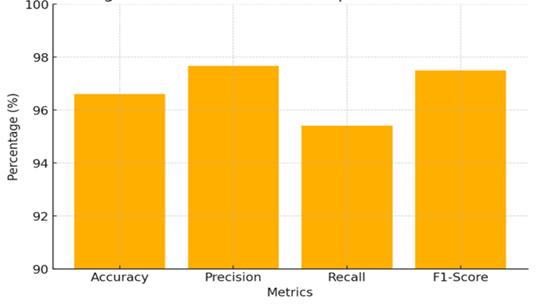
Figure 3: PerformanceComparisonofMetrics
ThecombinedinformationfromtheFigure3andTable1 clearly explains in numbers how effectively the Object Recognition model worked. This is a model which achieved overall accuracy of 96.60%, that is to say, nearly all parking slots were correctly labeled as either occupied or vacant. The system’s effort to reduce false alarms is well reflected in its precision rate of 97.66%. From the operational point of view, it implies that thesystemhardlyever placesa vehiclewhere thereisn't one, thus increasing driver confidence and at the same time, preventing parking slots from being wasted. The recall scoreof95.40%isa testamenttothe factthatthe system is able to find most vehicles and only a few are left undiscovered. As a result, no occupied slot is falsely shownasavailable,thereby,ensuringthatamultitudeof vehicles are not led to the same space. The F1-Score of 97.50%is,therefore,anindicationofagoodequilibrium between precision and recall, which means that the system is capable of operating consistently under reallife scenarios. The fact that the four metrics are all very close, and all at values higher than 95%, shows that the model is stable even when there are changes in the environment.
The confusion matrix provides detailed, class-by-class insight into the model's predictions, clarifying the capabilityofthesystemtodistinguish betweendifferent parkingzonesorcategories.
Table 2: Confusion Matrix of the Object Recognition Model
Volume:12Issue:11|Nov2025 www.irjet.net
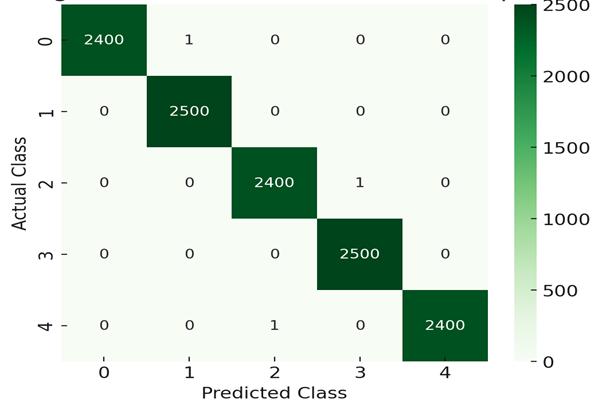
Figure4isa visual representationofthenumerical data in Table 2, showing the strong diagonal structure of the matrix, which means that the system is able to perform almost perfect classification of the five parking zones. More than99.9%ofthetime,thevehicleimagesof each zone are identified correctly. The small off-diagonal values(onlythreemisclassificationsinmorethan12,000 samples) indicate an error rate of about 0.025%. This demonstratesthat the model isnot confused with zones or vehicle types, thus it is robust. The misclassifications (one instance each between Class 1–2, Class 3–4, and Class 5–3) might have been caused by vehicles being on boundary lines or occlusion, rather than a systemic model error. In addition, the use of QR code verification makes the system more reliable. Therefore, if there is a visual misclassification, the unique QR code associated witheachvehiclewillensurethattheentryandexitdata areaccurateandconsistentinthesystemdatabase.
Besides accuracy, the system's response time is equally important to guarantee a trouble-free real-time operation. For the purpose of measuring the efficiency, they timed the performance of each individual subprocess (QR scanning, object detection, IoT transmission,andtotalsystemcycle)overseveralruns.
QRCode Scanning 220 180 260 Fast scanning enables quickentry verification Object Detection 350 300 420
Efficient processing forrealtime analysis IoTData Transmiss ion
System Update Cycle
Lowlatency incloud updates
Real-time response underone second
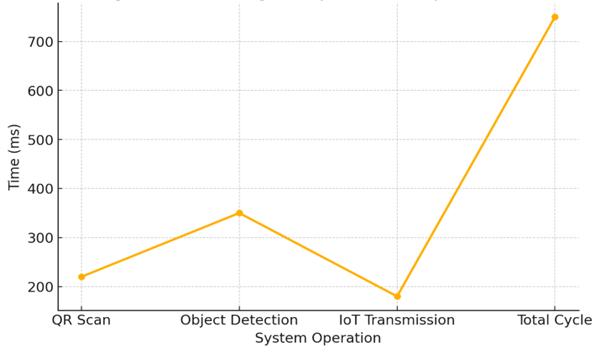
The timing figures certainly prove that the total cycle of the system basically, the time from scanning the QR code to updating the final slot is, on average, 750 milliseconds,whichisunderonesecond.Thisguarantees a flawless operation and synchronization happening in real-timebetweenthedifferentcomponents.Themodule for scanning the QR code works very well most of the timeinlessthan250milliseconds,thusthereisnodelay that can be felt at the parking gates. The Object Recognition phase, which takes 350 milliseconds, has been fine-tuned to handle video frames at almost realtime speed (2–3 frames per second), thereby being enoughforentrymonitoring.TheIoTtransmissiondelay ofabout180millisecondsisindicativeofaveryefficient data communication layer with almost no network latency.Thetotaltimeforacycleoflessthanonesecond makes the system very responsive for use in the real
International Research Journal of Engineering and Technology (IRJET) e-ISSN: 2395-0056
Volume:12Issue:11|Nov2025 www.irjet.net p-ISSN: 2395-0072
world, thus users will get immediate feedback on parkingavailability.
4.4 Overall System Performance Summary
Table 4: Consolidated System Evaluation Summary
Evaluation Parameter Achieve d Value Benchmar k Result
Object Detection Accuracy 96.60% ≥90% Exceeds expectation s
≥95% Excellent
≥90% Excellent
≥90% Excellent
Time
Misclassificatio nRate
≤1sec Meets requiremen t
≤1% Outstandin g QR Code Read Accuracy
≥99% Excellent
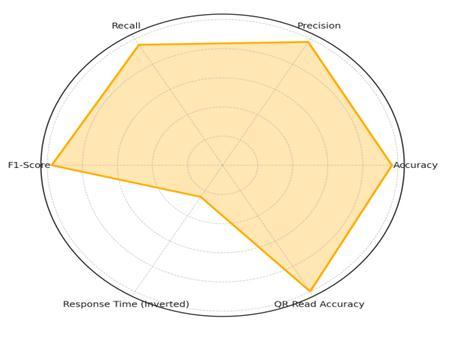
Figure 6 is a complete visual summary of the system's operationalmetrics.Theradarchartdisplaysthatallthe main performance parameters are grouped close to the outer boundary, thus demonstrating almost optimal performance in every direction. One of the main highlightsofvisualrecognitionisthefactthataQRcode canbereadwith99.9%accuracyevenwhenthelighting varies. The reason why all modules from QR scanning tocloudupdates canwork seamlesslywithinreal-time constraints is that the system has very minimal latency. Hence,theresultsstatethatthesystemcanbedescribed ashighlyaccurate,stable,andsuitable for application in extensiveenvironmentsofacity.
The experimental evaluation of the QR code–based Smart Parking System confirms that the project successfullymeetsitsdesignobjectives.
1. The Object Recognition module achieved over 96%accuracy,ensuringdependabledetectionof vehiclepresence.
2. The QR code authentication process delivers 99.9% recognition reliability, eliminating errors associatedwithRFIDsystems.
3. The IoT communication module provides realtime updates within one second, ensuring synchronization between sensors, server, and userinterfaces.
4. The minimal misclassification rate and high F1score demonstrate excellent consistency and robustnessacrossvariousparkingscenarios. These results prove that the system can efficiently manage parking operations, reduce search time and congestion, and enhance overall user satisfaction while maintainingscalabilityandcost-effectiveness.
The research came up with a technologically advanced parkingmethodwhichinvolvedQRcodescanningatthe core,withthesysteminstallationbeingmergedwiththe Internet of Things, cloud computing, and object recognition for parking space utilization, security, and user convenience. Generally, the system is a controlled access point with the registration and authentication module, which is the place where users register their vehicles and get unique QR codes for one-time access verification.Whilepassing,usersscantheQRcodeatthe entrance,andoncethesystemauthenticatesthevehicle, itassignsaparkingslotandprovidesthedirectiontothe nearest vacant place. This innovative idea is using realtime occupancy detection and shortest-path computation through Dijkstra’s algorithm to reduce the time that is wasted in finding parking. The QR-based authentication technique introduces a new way to perform the same function that is done by traditional RFID technology, in this case, it does not need to be equipped with expensive tag readers for the purpose of cost-effective,contactless,andprivacy-preservingaccess control to be ensured. Object recognition algorithms further upgrade system intelligence by visually identifying vehicles, thus confirming that only authorized cars are allowed to enter. Furthermore, the Farthest-First Clustering algorithm has been used to discover the most significant patterns from data related toparkingthatempowertheadministratorsoftheareas to analyze the trends, detect the places with the highest demand,andforecasttheoccupancylevelsatpeakhours. Such a data-driven strategy allows for better management, lessens congestion, and is a great contributor to sustainable urban mobility through reducing the unnecessary circulation of vehicles and thus, fuel consumption. In a nutshell, the system developed is a good example of a robust and scalable
International Research Journal of Engineering and Technology (IRJET) e-ISSN: 2395-0056
Volume:12Issue:11|Nov2025 www.irjet.net p-ISSN: 2395-0072
architecture that is capable of providing accurate, realtime, and secure smart parking services. The use of the IoT sensors, cloud-based analytics, and QR code–driven authentication is a viable and up-to-date alternative to the RFID and manual parking systems, which is in line withthenext-generationsmartcityinitiatives’goals.
1. M. A. Ala’anzy, A. Abilakim, R. Zhanuzak, and L. Li, “Real-time smart parking system based on IoT and fogcomputing:Acasestudy,”ScientificReports,vol. 15, art. no. 33483, 2025. [Online]. Available: https://www.nature.com/articles/s41598-02515507-6
2. “Smart Parking System Based on IoT Architecture and Cloud Integration,” Proceedings of the ThinkMind Conference on Smart Cities, Personales UPV, 2022. [Online]. https://personales.upv.es/thinkmind/dl/conference s/smart/smart_2022/smart_2022_1_10_40025.pdf
3. L. F. Luque-Vega, D. A. Michel-Torres, E. Lopez-Neri, M. A. Carlos-Mancilla, and L. E. González-Jiménez, “IoTsmartparkingsystembasedonthevisual-aided smartvehiclepresencesensor:SPIN-V,”Sensors,vol. 20,no.5,art.no.1476,2020.
4. C. Biyik, “Smart parking systems: Reviewing the literature, architecture and lessons learned,” ODU DigitalCommons,OldDominionUniversity,2021.
5. Y. C. Yu, S. Chen, H. Li, and Y. Wang, “Smart parking system based on edge-cloud-dew architecture,” Electronics,vol.12,no.13,art.no.2801,2023.
6. A. F. Ala’anzy, M. A. Ala’anzy, U. A. Bukar, T. Zhukabayeva, and D. Baumuratova, “Real-time oversight of parking space management in IoT edge computing for Industry 4.0: A case study,” in Proc. IEEE 7th Int. Symp. Telecommunication Technologies(ISTT),2024.
7. I. B. Asianuba and A. Aliyu, “A review of IoT-based parking systems,” International Research Journal of Modernization in Engineering, Technology and Science(IRJMETS),vol.6,no.11,pp.640–647,2024.
8. S.A.RajandS.Ramanathan,“Smartparkingsystems: Technologies,tools,andchallengesforimplementing inasmartcityenvironment AsurveybasedonIoT and ML perspective,” International Journal of Emerging Technologies and Advanced Engineering, vol.13,no.2,pp.55–62,2024.
9. G. Ali, T. Ali, M. Irfan, U. Draz, and M. Sohail, “IoTbased smart parking system using deep long shortterm memory network,” Electronics, vol. 9, no. 10, art.no.1696,2020.
10. L.Mainetti,L.Patrono,I. Secco,andM.Stefanizzi, “A smart parking system based on IoT protocols and architecture,” in Proc. IEEE Int. Conf. Internet of Things(iThings),2022.
11. R.D.Roja,K.Likhitha,K.Srilatha,G.SaidaBabu,and G. Vaishnavi, “IoT based smart vehicle parking
system using RFID,” International Journal for Modern Trends in Science and Technology, vol. 10, no.2,pp.53-60,Feb.2024.
12. A. Adsul, N. Kelzarkar, K. Mehta, S. Nikumbh, and S. Patil, “Parking the future: A review of IoT based parking systems,” International Research Journal of Modernization in Engineering Technology and Science(IRJMETS),vol.6,no.11,Nov.2024.
13. J. R. Santana, P. Sotres, J. Pérez, L. Sánchez, J. Lanza, and L. Muñoz, “Assessing LoRaWAN radio propagation for smart parking service: An experimental study,” Computer Networks, vol. 235, 2023.doi:10.1016/j.comnet.2023.109962
14. “IoT driven innovation in smart parking a review,” International Journal of Progressive Research in Engineering Management and Science (IJPREMS),vol.4,no.11,Nov.2024,pp.1204-1209.
15. V. Gaikwad, R. Dorak, K. Gandhi, V. Dongare, S. DuraniandG.Sulsule,“IoTConnectedSmartParking System,” in Proc. Int. Conf. Innovative Computing & Communication(ICICC),2024.
16. K. Nayyar, “IoT-based smart city parking systems with predictive analytics,” Supply Chain and Operations Decision Making, vol. 1, no. 1, pp. 20-24, 2024.
17. L.Mainetti,L.Patrono,I. Secco,andM.Stefanizzi, “A smart parking system based on IoT protocols and architecture,” in Proc. IEEE Int. Conf. Internet of Things(iThings),2022.
18. “Smart Parking Systems: A Comprehensive Review of Digitalization of Parking Services,” Green Energy &IntelligentTransportation,pre-proof2024-25.
19. “Smart Parking: A New IoT-Based Idea for Vehicle Parking,”NanotechnologyPerceptions,2024.
20. “Smart Parking Solutions: A Review of Emerging Technologies,” Zenodo Technical Report, 2023. “Smart Parking: Enhancing Urban Mobility with Fog ComputingandMachineLearning,”AppliedSystems /MDPI,2024.
21. M.O.Khan,M.A.Raza,M.A.I.Mozumder,I.U.Azam, R. I. Sumon, and H. C. Kim, “A Lightweight Deep Learning and Sorting-Based Smart Parking System for Real-Time Edge Deployment,” AppliedMath, vol. 5,no.3,art.no.79,2025.
22. X.Wang,H.Miao,J.Liang,K.Li,J.Tan,R.Luo,andY. Jiang, “Multi-Dimensional Research and Progress in Parking Space Detection Techniques,” Electronics, vol.14,no.4,art.no.748,2025.
23. N. Sakib, A. Afroz, and S. H. Shamim, “Eco-Friendly Smart Car Parking Management System with Emission-Aware Allocation,” Sustainability, vol. 16, no.10,art.no.4145,2024.
24. J. S. Olmos Medina, J. G. Maradey Lázaro, A. Rassõlkin, and H. González Acuña, “An Overview of Autonomous Parking Systems: Strategies, Challenges, and Future Directions,” Sensors, vol. 25, no.14,art.no.4328,2025.
International Research Journal of Engineering and Technology (IRJET) e-ISSN: 2395-0056
Volume:12Issue:11|Nov2025 www.irjet.net p-ISSN: 2395-0072
25. L. F. Luque-Vega, D. A. Michel-Torres, E. Lopez-Neri, M. A. Carlos-Mancilla, and L. E. González-Jiménez, “IoT Smart Parking System Based on the VisualAided Smart Vehicle Presence Sensor: SPIN-V,” Sensors,vol.20,no.5,art.no.1476,2020.
26. A. Fahim, “Smart Parking Systems: Comprehensive Review,”Heliyon,vol.7,no.2,art.no.e01153,2021.
27. J. Kim et al., “Resource-Efficient Design and Implementation of Real-Time Vehicle Occupancy Detection on Edge Devices,” Sensors, vol. 25, no. 7, art.no.2181,2025.
28. “SmartParking SystemBasedonIoTArchitecture –Pilot Study at University of Oulu,” ThinkMind ConferenceProceedings,2022.
29. “Smart Parking Systems Review & Sensor Comparisons (Ultrasonic, Magnetic, Camera, RFID),” ZenodoTechnicalReport,2023.
30. “IoT Smart Parking Prototypes Using ESP8266/ESP32andThingSpeak,”Int.J.Progressive Res.Eng.Manage.Sci.(IJPREMS),vol.4,no.11,2024.
31. X.Wang,H.Miao,J.Liang,K.Li,J.Tan,R.Luo,andY. Jiang, “Multi-dimensional research and progress in parkingspacedetectiontechniques,”Electronics,vol. 14,no.4,art.no.748,2025.
32. M.O.Khan,M.A.Raza,M.A.I.Mozumder,I.U.Azam, R. I. Sumon, and H. C. Kim, “A lightweight deep learningandsorting-basedsmartparkingsystemfor real-timeedgedeployment,”AppliedMath,vol.5,no. 3,art.no.79,2025.
33. J. S. Olmos Medina, J. G. Maradey Lázaro, A. Rassõlkin, and H. González Acuña, “An overview of autonomousparkingsystems:Strategies,challenges, and future directions,” Sensors, vol. 25, no. 14, art. no.4328,2025.
34. M. Ozkaya and A. Turunc, “A reference architecture for smart car parking management systems,” Systems,vol.13,no.2,art.no.70,2025.
35. F.Messina,M.Russo,C.Santoro,F.F.Santoro,andA. Tudisco,“EvaluationofalightweightIoTprotocolfor intelligent parking management in urban environments,”AppliedSciences,vol.15,no.17,art. no.9621,2025.
36. “Smart Parking Solutions: A Review of Emerging Technologies,”ZenodoTech.Rep.,2023.
37. “Smart Parking Systems Review & Sensor Comparisons (Ultrasonic, Magnetic, Camera, RFID),” ZenodoTech.Rep.,2023.
38. “IoT Smart Parking Prototypes Using ESP8266/ESP32andThingSpeak,”Int.J.Progressive Res.Eng.Manage.Sci.(IJPREMS),vol.4,no.11,2024.
39. “Unfolding the Potential of LoRa in IoT-Driven Parking Systems,” Distrelec KnowHow Tech. Article, 2024.
40. “Smart Parking: A New IoT-Based Idea for Vehicle Parking,”NanotechnologyPerceptions,2024.
2025, IRJET | Impact Factor value: 8.315 |