
International Research Journal of Engineering and Technology (IRJET) e-ISSN:2395-0056
Volume: 12 Issue: 04 | Apr 2025 www.irjet.net p-ISSN:2395-0072
International Research Journal of Engineering and Technology (IRJET) e-ISSN:2395-0056
Volume: 12 Issue: 04 | Apr 2025 www.irjet.net p-ISSN:2395-0072
Harshad Batham1 , Dr. Samina Elyas Mubeen2 ,
1M.Tech Scholar, Electrical & Electronics Department, REC Bhopal (M.P.)
2Professor, Electrical & Electronics Department, Bhopal (M.P.)
Abstract - Abstract: Although transformers are comparatively efficient equipment, the overall amount of energy lost during operation each year is substantial. A significant portion of these losses are caused by the electricalsteelsusedforcoreexcitation.Corematerialswith better electrical and mechanical qualities are continuously beingdevelopedinanefforttoreducethesecorelosses.This studyaimstoassesstheperformanceofthedifferentgrades of cold-rolled grain-oriented electrical steel used as transformer core material in terms of the total cost of ownership during a 25-year period. The sum of the transformer's original purchase price and the discounted present value of the future load and no-load losses represents the total amount owed.
Key Words: Core Material, Transformer Losses, and Loss Capitalization
1.INTRODUCTION
Asignificantamountofenergyiswastedintransformers during core loss as a sort of operation. In the current climate,where everyone is dealing withan energycrisis because ofa lackofenergyresources,lowering baseloss might be a useful strategy for energy preservation. The primary driver for the development of better electrical steelistheneedtoreduceelementaryloss.Inthe1930s, grain-oriented steel made its debut in America. It was made by cold rolling steel that contained phosphorus,silicon,aluminum,andmanganeseaccording toscientificstandards.50coldrolledgrainswereaddedto steeland60orientedgrains.
Materials with high permeability and low loss first appearedinthe1970sand1980s.Varioustechniqueswere developedduringthecourseoftheyeartolessentheloss of base. The fine materials heated recorded groove test fieldemergedaround1990.Thismaterialworkswellfor noise reduction and has outstanding low magnetic field qualities. New RGH 90s with a 0.23 mm diameter were recentlydeveloped,signifyingatinyreductioninironloss and breakout of tiny transformers. It is thought to be feasible to provide electrical steel grain that is further directedbyeachdistincttechnologicalelement,bringingit closer to resting conditions and thereby contributing to energy conservation, even though today's oriented electrical steel grain is already a product with a high degreeofcompletion.
The induction and loss of iron are used to assess the magneticcharacteristicsofgrain-orientedelectricalsteel. Whilelowlossmaterialbasessavewastedthermalenergy andhencereduceenergyconsumption,materialswithgood induction lower the drive current. Thesequalitieshavesteadilyimprovedinrecentyearsdue totheadoptionofnewtechnologies,whichhasledtothe availabilityofmanymaterialtypeswithvariousfeatures. CommonlyutilizedCRGOsare
1.1.1 Conventional Grain-oriented steel (CGO)
Itisproducedinvaryingquantitiesundermanytrade names:Grain size orientation ratings are frequently employedforinhibitorsCGOM4,M5,M6,and(RG).MnSeor MnSordersthegrainorientationinthiskind.
CGO's characteristics
1Ithasacorewithimprovedmechanicalandmagnetic propertiesthroughout
2.Acorewithpoorlossandbetterinduction,aninsulating coatingknownasDtopcoat.
3. Ahighcoldrollingthatcreatesasmoothsurface,andthe samelaminationfactorthickness.
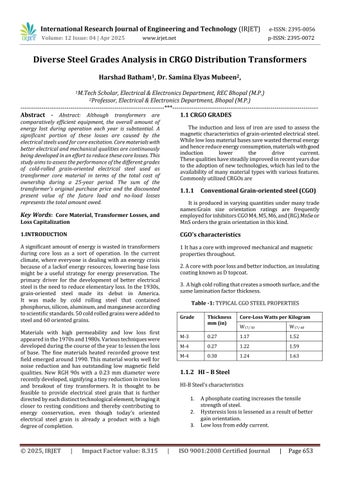
Table -1: TYPICALCGOSTEELPROPERTIES
1.1.2 HI – B Steel
HI-BSteel'scharacteristics
1. Aphosphatecoatingincreasesthetensile strengthofsteel.
2. Hysteresislossislessenedasaresultofbetter gainorientation.
3. Lowlossfromeddycurrent.
International Research Journal of Engineering and Technology (IRJET) e-ISSN:2395-0056
Volume: 12 Issue: 04 | Apr 2025 www.irjet.net p-ISSN:2395-0072
Table 2. TYPICAL PROPERTIES OF HI-B
Grade
1.1.3 Thin Guage of HI-B
Bydecreasingthethicknessoftheeddycurrentlossis decreased.Thesheetshouldbebetween0.15and0.23 mmthicktoreducetheoverallloss,whichisthesumof eddycurrentandhysteresisloss.
Table 3. TYPICALPROPERTIESOFTHINGUAGEHI-B
Grade
1.1.4
Aphysicalprocedurecalleddomaintechnicalrefinementis usedtolessenanomalouseddycurrentlosses.Theabnormal lossofeddycurrentinagrain-orientedmaterialisinversely relatedtothethicknessofthesheetandproportionaltothe distanceofthedomainwall.
1.1.5
(RGIHP)
It is not possible to achieve domain refinement using the laser irradiation approach. High permeability laserengravedleavesresultinasomewhatalteredhysteresisloss but a large decrease in eddy current loss. Laser-treatedsteelhasthefollowingcharacteristics:
1. ItloseslessironthanRGorRGHplate. Grade
Note: ARAMCO Company manufactures steel under the tradenamesM4,M5,HI-B,andZDKH.
whereasKawasakiSteelCorporationmanufacturesshades underthetradenamesRG,RGH,RGHPJ,andsoon.
HandwrittenBusinessandSocietyARAMCOand KAWASAKIreferencewereusedtocollecttheirdata.
Thecalculationmethodgivenbelowisapprovedbythe expertcommitteesofstateelectricityboardis:
•CapitalizedCostofNoLoadLosses/KW=AFactor=Hx Ex
•CapitalizedCostofLoadLosses/KW=BFactor=A FactorxL.S.
•CapitalizedCostofTransformer=IC+AxWi+BxWc
Where
•Histhetransformer'sannualservicehours.
•r=interestrate
•Energycost,whichisthepriceperkilowatt-hourof electricalenergyatthebustowhichthetransformeristo beconnected.
•n=Transformerlifeinyears.
•LSstandsforlossloadfactor.
•ICisthetransformer'sinitialcost.
•WI=NoLossesinLoad(KW)
• Wcisequaltoloadlosses(KW).
Thecommitteedeterminedthefollowingvaluesforthe differentparameters:
• Hours of service processors (H): Inordertocalculatethe numberofhoursofserviceprocessorsoperatingat350x 24=840hours,itwasassumedthatnoprocessorswould be in use for 15 days out of the year owing to repairs, maintenance,etc.ThisisinlinewiththeformulaCBI&P's hypothesis.
• Transformer life (n): TheDepartmentofEnergyhasbeen notifiedbytheIndiangovernmenttopowertransformers and distribute life, which is expected to compute depreciation over a 25-year period. The decision to terminate transformer 25 was made in light of the aforementionedinformation.
• Interest rate (r):Thediscountratefortheinvestmentof publicfundsisdeterminedbytheCommission'sDivisionof PlanningandEvaluationdraftafterconsideringanumber of variables. After subtracting the inflation rate, the discountratewashaltedat12%.Furthermore,thisvalue
International Research Journal of Engineering and Technology (IRJET) e-ISSN:2395-0056
Volume: 12 Issue: 04 | Apr 2025 www.irjet.net p-ISSN:2395-0072
hasn'tchangedinfourtofiveyears.Asaresult,theinterest rate of 12% was chosen for the funding formula.
• Lossofloadfactor(LS):0.3(30%)hasbeenchosenasthe loadfactorvalue,andtheloss'sloadfactorformulais
LS=0.2LF+0.8LF2.
Therefore,usingthemethodabove,theloadfactoris 0.172.
•EnergyCostE:Forthefollowingreasons,the committeehaschosentousethelongnmasfunding forenergycosts.
a) Itisrecognizedbyallinternationalfunding bodiesasas scientificmethod.
b) Theextraexpensesforbuildingmore transmission,distribution,andgeneration capacityarealsoincludedinorderto accommodatehigherloaddemands.
I. A=CapitalizedCostofNoLoadLosses.=Rs.1, 92,873/KW,
II. B=CapitalizedCostofLoadLosses.=AFactorx L.S.=Rs.25,479/KW,
III. CapitalizedCostofTransformer =IC+I,92,873xWi+25,479xWc
Inthiscase,WiandWcstandforNoLoadLossesand LoadLossesinKW.Thisformulaisusedtodetermine andcomparethecapitalizedcostofdifferent transformerratingswithHI-B,ZDKH,andCGO
3. RESULT AND DISCUSSION
Thefindingsandcomparisonofkeyperformance characteristicsofdifferentcoresteelgradesareshown inTable5.
Therearetwocomponentstothetransformer'stotalcost: thebasecostandthetotalcostofmaterials.Atthesame time,wediscoveredthattheuseofamaterialwithhigh permeability and low losses raises the cost of basic materials.Forthesamesizeandrating,thebasiccostof the transformer is 20% of its total cost, and this cost increases as the quality of the core material improves aside from lessening the loss. Therefore, we may claim thatthepriceincreaserepresentsasmallerloss.SizeIn contrast, a superior base material reduces the kVA transformerforthesamelosses.
The other very important aspects of operation of the transformeristheexpenditurerequiredtocomplywithall thelossesthatoccurintransformeronitsexpectedlife(25 years)REC(fordistributiontransformer). Therefore,by choosingcapitalizationoflossesasabasisforcomparison, we found that the use of high quality material gives the transformer less capitalized cost versus under rated materials,includingkVA.
Thecomparisonofdifferentcorematerialsoftransformers isshowninTable5itisevidentthatthedegreeoflossless ofZDKH,111-BandCGOcores.
IntheKVAratingofthetransformerincreaseswithlower lossesandincreaseZDHKHI-BincomparisontoCGO.
Forcxamplc,500kVAratedtransformerwithlossesbelow 13%qualitybasicCGO,ZDKH
SMVAlosstransformerwithacorematerialis38%less than ZDKH CGO. Fundamental value HI - B of loss is betweenthesetwoqualities.
International Research Journal of Engineering and Technology (IRJET)
Volume: 12 Issue: 04 | Apr 2025 www.irjet.net
4. CONCLUSION
TheperformanceofthevariousgradesofCRGOdiscussed. We see that the low-loss materials gives better performancei.e.favorableefficiency,affordableandlight weightedtocapitalize.SotheuseoflowerlossmaterialsHI B, amorphous (scoring up to 1 MVA) and ZDKH materialsreducesthecostofownershipandsignificantly contributestoenergyconservation.
[1]J&P"Transformerhandbook."
[2]REC(RuralElectrificationCorporation)–"Specification fordistribution transformer."
[3]JohonsonL.A."IEEEtractiononpower apparatus and systemVol.PAS101No.7July1982".
[4] Transformingefficiency,Feb.2008. Availableonline. http://www.engineeringtalk.com/news/sfp/sfp116.Html
[5]Mahavitaraninfrastructureplantechnicalspecification 47"technicalspecificationFor11 &22KVdistribution transformers of ratings 63 KVA & 100 KVA capacity" Siemens"Three-Phase DistributionTransformers50To 2501kVA”.
[6] TechnicalReportofKAWASAKI Special issue on "ElectricalSteel".
[7] SelectingEnergyefficientDistributionTransformersA guide for Achieving Least Cost Solutions, June 2008. Available on line http://www.copperinfo.co.uk/transformers/ downloads/seedtguide.pdF