
International Research Journal of Engineering and Technology (IRJET) e-ISSN: 2395-0056
Volume: 12 Issue: 04 | Apr 2025 www.irjet.net p-ISSN: 2395-0072
International Research Journal of Engineering and Technology (IRJET) e-ISSN: 2395-0056
Volume: 12 Issue: 04 | Apr 2025 www.irjet.net p-ISSN: 2395-0072
Snehal Kailas Borde
1 ,
Priyanka Manohar
Ingle2 ,
Sayli
Chandrakant Lande3 , Yogesh Kakasaheb Shejwal4 Chaitanya
Kadadas
5 ,
Jayaraj
U. Kidav6 1, 2,3,4,5,6 National Institute of Electronics & Information Technology, Aurangabad ***
Abstract -Water supply in remote and agricultural areas depends on solar water pumping systems (SWPS), and controllers are critical to optimizing energy conversion and ensuring steady pump performance. Although they are less expensive,traditionalcontrollerslikepulse-widthmodulation and on/off are less effective. Fuzzy logic, MPPT, artificial neural networks, and hybrid controllers are examples of advanced control technologies that provide enhanced energy economy and adaptability, making them more useful for maximizingsystemperformanceinavarietyofenvironmental circumstances. These controllers' performance and dependabilitycanbeenhancedbynewtechnologieslikeAIand the Internet of Things.
Key Words: MPPT,SolarWaterPump,FuzzyLogic,SWPS, ANNetc
Theincreasingdemandforcleanenergysolutionshasledto the widespread adoption of solar water pumping systems (SWPS)inagricultureandotherwatersupplyapplications. These systems are attractive for their ability to operate without fuel dependency, providing a cost-effective alternative in regions with abundant solar resources. Controllersplayapivotalroleinensuringthatsolarenergy isefficientlyconvertedandutilized.Byregulatingthepower flowfromphotovoltaicpanelstothewaterpump,controllers enhancesystemefficiency,safeguardcomponents,andadapt tovaryingsolarirradiationlevels.Thisstudydelvesintothe evolution of controllers for SWPS, categorizing them into traditionalandadvancedtypesandanalyzingtheirmerits, demerits, and suitability for different scenarios. Water scarcity is one of the most pressing global challenges, affecting millions of people worldwide. According to the UnitedNations(UN),by2025,nearly1.8 billionpeoplewill belivinginareaswithabsolutewaterscarcity,whiletwothirdsoftheglobalpopulationcouldbefacingwaterstress [1].Thisiscompoundedbythefactthatglobalwaterusehas increasedbyovertwicetherateofpopulationgrowthover thepastcentury.Agriculture,whichaccountsforaround70 percentage of global freshwater use, is particularly vulnerabletowatershortages,threateningfoodsecurityin manyregions.Inlightofthesechallenges,sustainableand renewablesolutions,suchassolar-poweredwaterpumping systems,haveemergedasviablealternativestotraditional grid-poweredordiesel-drivenpumps,especiallyinruraland
remote areas where conventional water supply infrastructure is scarce. To minimize energy costs, a photovoltaic (PV) system must consistently operate at its MaximumPowerPoint(MPP).However,achievingthisgoalis challengingduetothenon-linearityofthepower-voltage(PV)curve,whichisinfluencedbyintrinsicsystemfactorsand environmental conditions. Fossil fuel reserves are finite, withestimatessuggestingthatcoalcouldbedepletedwithin 100 years, and petroleum in 50 years, leading to both resourcedepletionandenvironmental degradationdue to theirextensiveuse.Incontrast,renewableenergysources provide significant advantages over conventional sources, includingapositiveenvironmentalimpact,zerofuelcosts, andsustainability.MaximumPowerPointTracking(MPPT)is acrucialtechniqueforoptimizingtheefficiencyofsolarPV systems, systems, with MPPT algorithm that ensure that ensuremaximumpowerextractionfromsolarpanelsunder varyingconditions. Asa result,PVenergyisbecomingan increasingly promising alternative for meeting growing energydemandsinasustainableandcost-effectivemanner. Acriticalcomponentofsolarwaterpumpingsystemsisthe controller,whichregulatesthepowerandoperationofthe pump by managing the flow of electricity from the solar panels. The controller ensures that the pump operates efficiently, adapting to changing levels of solar irradiance through out the day [1]. The choice of controller has a significantimpactontheperformance,cost,andreliabilityof the system. Common types of controllers include DC- DC converters, PWM (Pulse Width Modulation) controllers, MPPT (Maximum Power Point Tracking) controllers, Variable Frequency Drives (VFDs), On/Off switch controllers, and Hybrid controllers. This election of an appropriatecontrollerisparamountforoptimizingenergy output and ensuring reliable water supply, especially in regions with highly variable solar radiation. As the solar waterpumpingmarketgrows,under-standingthestrengths and weaknesses of different controllers is vital for both manufacturers and end-users seeking cost effective, long lasting,andhigh-performancesystems. Thispaperaimsto provideacomprehensivecomparativestudyofthevarious controllersavailableforsolarwaterpumpingsystems.
2395-0056
Volume: 12 Issue: 04 | Apr 2025 www.irjet.net p-ISSN: 2395-0072
2.1.1
ThePerturbandObservemethodforMaximumPowerPoint Tracking(MPPT)demonstrateshigheffectivenessinphotovoltaic(PV)systemsduetoitssimplicityandcomputational efficiency.Intermsofeaseofimplementation,Perturband Observe requires minimal complexity as it avoids sophisticated modeling and intensive calculations. The method operates on an iterative process, where perturbationsareappliedtoeithertheoperatingvoltageor current,andtheresultingchangesinpowerareanalyzedto adjust the system accordingly. Statistically, this approach providesflexibilitybyadaptingacrossavarietyofPVmodule types and system configurations, as it does not require extensive recalibration. The method maximizes energy extractionefficiencybycontinuouslyadjustingtheoperating point to ensure optimal power output [1] The core operationsinvolvedarebasicarithmeticfunctions,primarily multiplication for power calculation and subtraction for evaluatingthedifferencesinvoltageandpower,makingthe process computationally efficient. The low computational demand is a key advantage of the Perturb and Observe method, allowing it to be executed in real-time on microcontrollerswithlimitedprocessingpower.
2.1.2
The MPPT (Maximum Power Point Tracking) system is designed to optimize the operational efficiency of a photovoltaic(PV)systembymaintainingitsperformancein proximity to the Maximum Power Point (MPP) through precise voltage regulation and comparison with a fixed referencevoltage(RV).However,theConstantVoltage(CV) methodology employed in this context is most effective under conditions of uniform irradiation, yet it fails to adequately account for fluctuations in temperature and insolation.Thisresultsinamarginaldiscrepancybetween the estimated and actual MPP, causing the system’s operatingpointtodivergefromthetrueMPP.Consequently, adjustments that factor in geographical variations are essential to refine the reference voltage and minimize the associated errors in voltage estimation. Furthermore, the maintenance of a constant voltage is paramount for optimizing battery longevity, as it mitigates risks such as overcharginganddeepdischarge[1].Thispracticeenhances energy storage efficiency, prolongs battery lifespan, and curtailsmaintenanceexpenses.Thesystemalsoguarantees efficientbatteryutilizationbystabilizingtheoutputvoltage, thusavertingbothover-drainingandunder-charging,which inturnsafeguardsbatteryhealth,improvesoverallsystem efficiency and promotes the extended durability of the powerstorageinfrastructure.
The PID (Proportional-Integral-Derivative) controller augmentstheprecisionandstabilityofasystemthroughthe dynamicmodulationoftheP,I,andDcomponents,thereby minimizing the deviation between the desired and actual outputs. The P term rectifies instantaneous discrepancies, theItermaddresseslong-termsteady-stateerrors,andtheD term prognosticates potential future errors, collectively yielding enhanced accuracy, expedited response, and superiorstabilityovertime.Furthermore,thePIDcontroller demonstrates a remarkable capacity for adaptation to evolvingsystemconditions,continuouslyrecalibratingthese terms to ensure sustained performance and mitigate tracking errors, even amidst fluctuating operational environments[5]
PulseWidthModulation(PWM)controllersarerecognized fortheirsuperiorefficiencyinpowermanagement,primarily duetotheircapabilitytominimizeenergyloss.Incontrastto linearregulators,whichdissipateexcessenergyintheform ofheat,PWMcontrollersemployrapidswitchingbetweenon and off states, there by significantly reducing power dissipation[1] Theabilitytoadjustthedutycycleenables PWM controllers to provide highly precise control over critical parameters such as voltage, current, and motor speed. The system exhibits a moderate performance in regulating voltage and current, maintaining a balance between preventing overloading and ensuring adequate powerdeliverytocomponents.Itoptimizesenergyefficiency byoperatingwithindefinedenergyusageparameters,there by minimizing waste and enhancing overall system performancewithoutintroducingunnecessarycomplexity. Whileitdemonstratessuperiorenergyefficiencycompared to basic on/off controllers, its adaptability to rapidly fluctuating solar conditions is constrained. Under stable conditions,thesystemoperateseffectively,yetitsresponse tosuddenchangesinsolarintensity,suchasduringcloud cover or abrupt sunlight exposure, is comparatively slower, resulting in temporary in efficiencies during such transitional environmental changes.
Conventionaltrackingtechniquesemployedinphotovoltaic (PV) systems often encounter significant limitations, particularly in hardware implementation, when operating underPartialShadingConditions(PSC).Thisnecessitatesthe developmentofmoreadvancedcontrollerdesignstoachieve optimaltrackingperformance.Whiletraditionalcontroller designsbenefitfrommathematicalmodelingunderuniform irradiation conditions, their complexity escalates significantlyunderPSC,highlightingtheneedforalternative,
International Research Journal of Engineering and Technology (IRJET) e-ISSN: 2395-0056
Volume: 12 Issue: 04 | Apr 2025 www.irjet.net p-ISSN: 2395-0072
moreefficientapproaches [2] Apromisingsolutionisthe applicationofFuzzyLogiccontrollers,whichdonotrelyon precise mathematical models of the PV system. Fuzzy algorithms are particularly effective in addressing system nonlinearities and uncertainties, making them well-suited formanagingcomplex,dynamicsystemswhereconventional linear methods are insufficient. These controllers offer smoother and more adaptable control, ensuring stable system performance even in the face of fluctuating environmental conditions, load variations, or
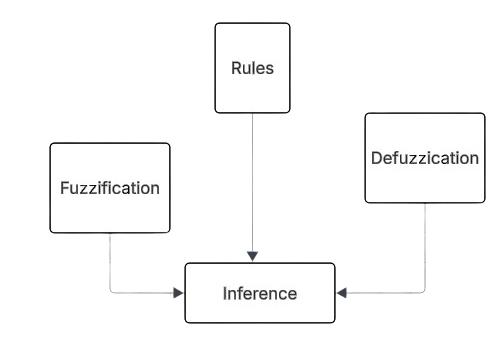
Fig -1:BlockDiagramofFuzzyLogicController[2] operationalchanges.Theincreasedcomplexityinherentinfuzzy logicsystemsrendersthemparticularlysuitableforhigh-end applications,wheretheyprovideenhancedprecision,greater control, and the ability to handle more intricate tasks with higherefficiency.TheprocessofFLCcanbeclassifiedintothree stages, fuzzification, rule evaluation and defuzzification The fuzzification step involves taking a crisp input, such as the change in the voltage reading, and combining it with stored membershipfunctiontoproducefuzzyinputs.Totransformthe crispinputsintofuzzyinputs,membershipfunctionmustbefirst assigned for each input. Once the membership functions are assigned,fuzzificationtakearealtimeinputsandcomparesit withthestoredmembershipfunctioninformationtoproduce fuzzyinputvalues.Thesecondstepoffuzzylogicprocessingis theruleevaluationinwhichthefuzzyprocessoruseslinguistic rulestodeterminewhatcontrolactionshouldoccurinresponse toagivesetofinputvalues.theresultofruleevaluationisa fuzzyoutputforeachtypeofconsequentaction.Thelaststepin fuzzylogicprocessinginwhichtheexpectedvalueofanoutput variableisderivedbyisolatingacrispvalueintheuniverseof discourseoftheoutputfuzzysets.Inthisprocess,allofthefuzzy output values effectively modify their respective output membership function. One of the most commonly used defuzzificationtechniquesiscalledCenterofGravity(COG)or centroidmethod.
The system is engineered to continuously track the MaximumPowerPoint(MPP)ofsolarpanels,dynamically adjustingthevoltageandcurrenttoensurethatthepanels consistentlyoperateattheirpeakpoweroutput,regardless offluctuationsinsunlight.Thiscapabilityenhancessystem
efficiency,particularlyundervaryingweatherconditions,as thesystemiscapableofrespondingtochangesinsunlight intensity,temperature,andotherenvironmentalfactorssuch as cloud cover or rain [3]. This adaptive behaviour maximizes the conversion of incoming solar energy into usable output, resulting in improved performance and increased energy generation. Consequently, such systems have gained widespread adoption in modern Solar Water Pumping Systems (SWPS), becoming a highly favoured solution due to their cost-effectiveness, environmental sustainability,andreliability,makingthemanideal
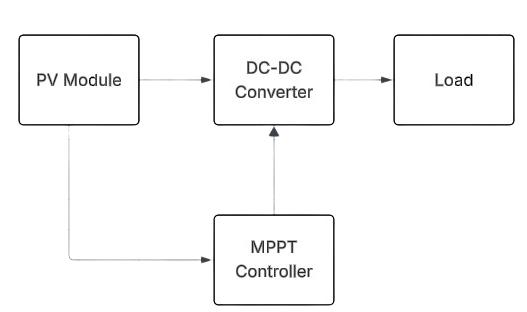
-2:BlockDiagramof MPPTController[3]
Choice for both developed and developing regions in meetingwatersupplyandirrigationneedsThebasicblock diagramforgeneraldescriptionofPVsystemitconsists of PhotoVoltaicmodule,DC-DCConverter,loadandtheMPPT controller. Multiple Photo Voltaic cells interconnected together forms the PV module. Energy generation by PV arrayisprimarilydependentonenvironmentalfactors(solar in solutions and the temperature) and the impedance matching. To have proper impedance matching, a DC/DC converter is used whose duty cycle is modulated by the MPPTcontrollerforachievingthisgoal.Duetogenerationof electrical energyatlowervoltagelevel,boostconverter is generallyused.ThecurrentandvoltageofPVarrayisfedto the MPPT algorithm. The output of converter is directly suppliedtotheloadifitisadcload.
A solar power system equipped with high-accuracy Maximum Power Point (MPP) tracking significantly enhancesenergyproductionbycontinuouslyensuringthat thesolarpanelsoperateattheiroptimalvoltageandcurrent levels [1]. This capability allows the system to extract the maximumpossible powerfromtheavailablesunlight,there byoptimizingoverallsystemefficiency. Furthermore,such systemsdemonstraterobustperformanceinthefaceofrapid fluctuations in solar irradiance, which may arise from environmentalfactorssuchascloudcover,weatherpatterns, ortime-of-dayvariations.Theabilitytomaintainstableand efficient energy output under these dynamic conditions is
International Research Journal of Engineering and Technology (IRJET) e-ISSN: 2395-0056
Volume: 12 Issue: 04 | Apr 2025 www.irjet.net p-ISSN: 2395-0072
vitalforsustaininghighperformance.Additionally,advanced solarsystemsdesignedtoeffectivelymanagepartialshading conditions commonlyencounteredduetoobstructionsor varyingsunlightangles minimizetheadverseimpactsof shading, thereby reducing energy losses. These systems ensurecontinuousoptimizationofenergyproduction,even inthepresenceofreal-worldchallenges,thusprovingtobe highly adaptable and efficient across a range of environmentalcontexts.
The system efficiently optimizes power consumption throughdynamicadjustmentsthatalignwiththereal-time energy requirements of the system, thereby ensuring energy-efficientoperation.Bycloselymatchingpowerusage to the actual demands of the system, it minimizes unnecessary energy consumption, which results in significantreductionsinoverallenergycostsandenhanced energymanagementMoreover,thesystemenhancespower conversion efficiency by continuously fine-tuning the reference voltage in response to changing real-time conditions.Thisadaptiveapproachensuresthatthesystem operates at peak efficiency, effectively minimizing energy loss during conversion while maximizing output. Consequently, the system not only improves its overall performancebutalsocontributestohigherenergyefficiency, demonstrating a significant advancement in energy optimization[1]
The sliding-mode controller (SMC) represents a sophisticated,non-lineartrackingapproachthatfacilitates rapidandpreciseMaximumPowerPoint(MPP)trackingin grid-connectedphotovoltaic(PV)systemsthroughaunified controlstructure[1].Thecontrolleroperatesbyregulating theDC–DCconverterbasedonreal-timecapacitorcurrent measurements, employing a three-mode frame work encompassingTraversstability,reachability,andequivalent control.Oneoftheprincipalbenefitsofthismethodologyis itsversatility,asitoperateseffectivelyindependentofthe specificcharacteristicsorcon-figurationsizeofthePVarray, ensuringbothrobustperformanceandswiftMPPtracking .Additionally, the SMC is adept at minimizing converter ripple,particularlyingrid-integrated applications; further enhancing system stability and efficiency. A distinctive featureofthesliding-modecontrollerisitsresilienceinthe face of model inaccuracies and unforeseen fluctuations in systemdynamics.Bycontinuouslyadjustingitscontrolinput in real-time, the SMC maintains consistent performance, safeguardingagainstperformancedegradationevenwhen subjected to uncertainties or dynamic disturbances. Moreover,theSMC’sminimalsensitivitytomodelerrorsisa significant advantage, as it operates efficiently without requiringanexactmathematicalmodelofthesystem.This inherent flexibility makes the SMC especially suitable for
practical applications, where system models may be incompleteorinaccurate,therebybolsteringthereliability and adaptability of the PV system in real-world operating environments.
Integratingmultiplestrategies,suchascombiningMaximum PowerPointTracking(MPPT)withfuzzy logic,providesa superiorcontrolmechanismforsolarpowersystems.MPPT ensuresthatthesystemoperatesatitsoptimalpowerpoint undervaryingenvironmentalconditions, whilefuzzylogic enhances the system’s adaptability and flexibility. This energy enables the system to effectively manage uncertainties, nonlinearities, and dynamic fluctuations, thereby improving the over- all responsiveness and performance [4]. This integrated approach achieves an optimalbalancebetweenefficiencyandreliability,thoughit introducesincreasedcomplexityandassociatedcosts.The system’scapabilitytoadjustinreal-timetofluctuationsin solar irradiance and temperature ensures sustained peak performance, whether maximizing energy production or minimizingconsumption.
Theratioofutilizedenergytothetotalsolarenergyavailable. the efficiency with which a solar energy system converts available sunlight into usable energy. It is expressed as a ratio or percentage, where the numerator represents the amount of solar energy that is successfully captured,converted,andutilizedbythesystem(suchasa solarwaterpumpingsystemorphotovoltaicpanels),while thedenominatorrepresentsthetotalamountofsolarenergy incident on the system, including both the energy that is successfully used and the energy that is lost or wasted A higherratioindicatesamoreefficientsystem,asitmeansa greater proportion of the available solar energy is being effectivelyutilized.
Perturb and Observe and Incremental Conductance controllersaregenerallyreliable,thoughtheymaystruggle with fast changes in irradiance or partial shading. MPPT controllersareknownfortheirhighreliabilityinensuring optimal energy extraction, particularly under fluctuating environmentalconditions.PWM(PulseWidthModulation) controllersprovidereliableoperationwithminimalenergy loss,maintainingstableperformance.PIDcontrollersoffer good reliability in steady- state conditions but may experiencelimitationsinhandlingdynamicchanges,while Fuzzy LogicControllersare highlyreliableindealingwith uncertainties and system nonlinearities. Constant Voltage (CV) controllers, while simple and cost- effective, are less
International Research Journal of Engineering and Technology (IRJET) e-ISSN: 2395-0056
Volume: 12 Issue: 04 | Apr 2025 www.irjet.net p-ISSN: 2395-0072
reliable in dynamic environments due to their limited adaptability to varying conditions. Adaptive Reference Voltage (ARV) controllers are reliable, adapting well to changing irradiance and temperature. Hybrid Controllers, whichintegratemultiplestrategies,areknownfortheirhigh reliability, ensuring stable performance in a variety of conditions. Sliding Mode Controllers (SMC) are highly reliable, capable of maintaining performance even in the presence of system disturbances and environmental fluctuations.
Perturb and Observe and Incremental Conductance controllers are relatively cost-effective, with lower initial costscomparedtomorecomplexcontrollers,butmayrequire moremaintenanceindynamicconditions,makingthemless cost- efficient in the long run. MPPT controllers, though generallymoreexpensive,offeroptimal energy extraction, providing long-term cost savings through higher energy output.PWM(PulseWidthModulation)controllersarecosteffective,offeringgoodefficiencywithminimalpowerloss, and are widely used due to their affordability and performancebalance.PIDcontrollersaremoderatelypriced andoffergoodcost-efficiencyinsteadyconditions,buttheir performance may degrade in dynamic environments, increasingmaintenancecosts..FuzzyLogicControllersoffer ahigherupfrontcostbutprovidesignificantcostsavingsin thelongtermbyimprovingsystemefficiency,particularlyin systems with high uncertainties. Constant Voltage (CV) controllersareamongtheleastexpensivebutarelesscosteffectiveindynamicconditionsduetolowerenergyoutput. AdaptiveReference Voltage(ARV)controllers offera good balance of cost and performance, typically being costeffective in systems with varying irradiance. Hybrid Controllerscombinestrategiesand,whilemoreexpensive, offerhighcost-effectivenessbyensuringstableperformance across a variety of conditions, making them ideal for demanding applications. Sliding Mode Controllers (SMC), althoughcostlyintermsofinitialinvestment,arehighlycosteffective in the long term due to their ability to handle disturbancesandrapidlytrack themaximumpowerpoint, ensuringoptimalenergyproduction.
Perturb and Observe and Incremental Conductance controllersexhibitlowimplementationcomplexity,requiring basic sensor integration and minimal computational demands,makingthemhighlysuitableforsimplersystems. PWM(PulseWidthModulation)controllersalsodemonstrate moderate implementation ease, offering good energy efficiency with minimal design intricacies. PID controllers present a moderate level of implementation complexity, necessitating careful tuning of proportional, integral, and derivativegains,thoughtheyaremanageableinsteady-state systems. Constant Voltage (CV) controllers are among the least complex to implement due to their straightforward
design,thoughtheiradaptabilityinfluctuatingconditionsis limited, affecting performance in dynamic environments. MPPTcontrollers,thoughmarginallymorecomplex,remain widelyimplemented,benefitingfrommodernhardwarethat facilitates their relatively straight forward integration for optimizedenergyextraction.FuzzyLogicControllersdemand highercomputationalpowerandadvancedsystemmodeling expertise, increasing their implementation difficulty but offeringhighadaptabilitytouncertaintiesandnonlinearities. AdaptiveReferenceVoltage(ARV)controllersareeasierto implement in systems with variable irradiance, requiring only simple modifications to the reference voltage. Hybrid Controllers,combining diverse strategies,introduceadded complexityduetointegrationdemandsbutprovidesuperior flexibility and adaptability to varying conditions. Sliding ModeControllers(SMC)arethemostcomplextoimplement, due to their nonlinear control approach, real-time adjustments,andneedforadvancedcomputationalresources and system modeling, positioning them as the highest in implementationdifficultyamongthelistedcontrollers.
PWM (Pulse Width Modulation) controllers are highly scalable,efficientlyhandling a widerangeofsystemsizes, from small to large installations, with minimal changes to design. Fuzzy Logic Controllers are also scalable, offering flexibility and adaptability for large, complex systems, though they require morecomputational resourcesasthe systemsizeincreases.MPPTcontrollers,beingspecifically designed to optimize energy extraction, are scalable and perform well across different system sizes. Incremental Conductancecontrollersaresimilarlyscalable,performing effectivelyinsystemsofvaryingsizesbutrequiringaccurate sensor measurements for optimal performance. Adaptive Reference Voltage (ARV) controllers can be scaled across various system configurations, making them suitable for systemswithchangingirradiance.HybridControllers,which combine different strategies, offer excellent scalability, as theycanbetailoredtodifferentsystemsizesandconditions forenhancedperformance.SlidingModeControllers(SMC) arescalablebutmayrequireincreasedcomputationalpower andfine-tuningforlargersystems.PerturbandObserveand ConstantVoltage(CV)controllersarerelativelylessscalable, with Perturb and Observe scaling well in medium-sized systemsandCVcontrollersbeingmorelimitedduetotheir simplicity. PID controllers, while scalable, tend to be less efficientforlargersystemswithdynamicconditions.
Integration of AI and IOT The incorporation of Artificial Intelligence (AI) and the Internet of Things (IOT) into MaximumPowerPointTracking(MPPT)systemspresents substantial opportunities for enhancing performance and operationalefficiency.Machinelearningalgorithms,asubset
International Research Journal of Engineering and Technology (IRJET) e-ISSN: 2395-0056
Volume: 12 Issue: 04 | Apr 2025 www.irjet.net p-ISSN: 2395-0072
ofAI,canbeutilizedtoanticipateandadapttofluctuations in environmental variables, such as changes in solar irradianceandtemperature,therebyoptimizingthepower extractionprocess.Additionally,IOTtechnologiesfacilitate real-time monitoring and remote control of solar water pumping systems, which can yield valuable insights for predictivemaintenance,faultdetection,andoverallsystem optimization. The synergy between AI and IOT has the potential to create intelligent, self-regulating systems capable of maximizing energy output while minimizing operational down time and maintenance costs. However, challenges persist, particularly in the integration of these technologies,themanagementofvastamountsofdata,and ensuring seamless communication between decentralized devicesinreal-worldapplications.
Cost Optimization a critical challenge in the development anddeploymentofMPPTsystemsiscostoptimization.While advancedMPPTcontrollers,particularlythoseincorporating AIandIOT,offersuperiorperformancemetrics,theyoften come at a higher price point compared to traditional approaches. The increased cost of high-performance components, advanced algorithms, and the infrastructure required for AI and IOT integration can escalate the total investment in the system. To make MPPT systems more accessible,especiallyforsmall-scalefarmersorregionswith limited resources, futureresearchmustfocusonreducing costs without com- promising performance. This can be achievedthroughtheenhancementofalgorithmicefficiency, the utilization of cost- effective hardware, and the optimization of overall system designs, ensuring the economicfeasibilityofMPPTsystemsforabroaderrangeof applications.
Field Validation Field validation plays a pivotal role in confirming the real-world performance of MPPT systems. While laboratory tests and simulation models provide valuable insights, the unpredictable nature of real-world environmentscharacterizedbyfluctuatingsolarirradiance, temperature variations, and environmental disturbances poses additional challenges. Field validation ensures that MPPTcontrollersmaintainconsistentandreliableoperation across diverse environmental conditions. However, this validation process is often labor-intensive and costly, requiring comprehensive testing in varied geographical locationsandclimates.Toaddressthis,futureadvancements should aim to improve the accuracy of simulation models, reducing the need for extensive field validation, and to developmorerobustMPPTcontrollerscapableofdelivering reliable performance across wider array of real-world scenarios.
Environmentalvariabilityintroducesstochasticfluctuations insolarirradiance and temperature,leadingtonon-linear variationsinphotovoltaic outputandpumpperformance. Adaptive control strategies such as real-time MPPT algorithms,PIDtuning,andfuzzylogicsystemsareessential fordynamicsystemoptimization.Emergingtrendsleverage predictive modeling via AI/ML to forecast environmental parametersandoptimizesystemresponse.IOTintegration enablesreal-timedataacquisitionandcloudbasedanalytics forenhanceddecision-making.Futureresearchshouldfocus on developing robust, low-latency, and computationally efficient control systems to ensure operational stability under diverse environmental condition
International Research Journal of Engineering and Technology (IRJET) e-ISSN: 2395-0056
Volume: 12 Issue: 04 | Apr 2025 www.irjet.net p-ISSN: 2395-0072
ControllerType
PerturbandObserve(P&O)[1]
IncrementalConductance(IC) [1]
MPPT(MaximumPowerPoint Tracking)[3]
PulseWidthModulation (PWM)[1]
PID(Proportional-IntegralDerivative)[5]
FuzzyLogic(FL)[2]
ConstantVoltage(CV)[1]
AdaptiveReferenceVoltage (ARV)[1]
HybridControllers[4]
SlidingModeControllers(SMC) [1]
Table -3: literaturereview
KeyFindings
Demonstratesmoderate accuracy,butoscillates aroundsteadystate.
Provideshigheraccuracy, effectivelyeliminatessteadystateoscillations
Optimizespowerextraction undervaryingenvironmental conditions.
Offersstableregulationbut mightleadtosuboptimal performanceinfluctuating conditions.
[1] Fast response, but poor trackinginhighlyvariable environments.
Highlyadaptabletononlinear, uncertainsystems.
Lessefficientinnon-steady conditionscomparedto MPPT.
Adaptsvoltageaccordingto environmentalchanges.
CombinesMPPTwithother techniques,providingoptimal performance
Offershighrobustness,but pronetochatteringunder certainconditions.
Controllersarefundamentaltotheoperationofsolarwater pumping systems (SWPS), influencing key factors such as operational efficiency,reliability,andeconomicfeasibility. Whiletraditionalcontrollersarecost-effective,theytypically exhibit limitations in terms of adaptability to dynamic environmental conditions. On the other hand, advanced controllers,suchasMaximumPowerPointTracking(MPPT), fuzzylogic,andhybridmodels,offersuperiorperformance, butatthecostofincreasedcomplexity.Amongthese,hybrid controllers demonstrate considerable potential for highperformance SWPS, particularly in more demanding scenarios where enhanced adaptability and efficiency are required.FuturedevelopmentsinMPPTsystemsmustfocus on integrating Artificial Intelligence (AI)-driven methodologies and the Internet of Things (IOT) to create smarter, more resilient controllers capable of efficiently
Advantages
Cost-effective,easily implementable.
Moreprecisetracking underrapidirradiance variations
Maximizesenergy outputwithadaptive tracking
Highefficiency,smooth voltagecontrol
Quickimplementation andsimpletouse.
Effectiveunder uncertainty,high adaptability.
Simpleandlow-cost implementation.
Highlyadaptableto environmental variations.
Higherefficiency reducesoscillations, broadapplicability
Highlyrobust,effective inuncertain environments
Limitations
Oscillationsleadtoreducedefficiency underdynamicconditions.
Highercomputationaldemand, complexityincreases.
Increasedcomputationalcomplexity forreal-timeprocessing.
High-frequencyswitchingcauses powerlossesinlowpowersystems.
Limitedperformanceindynamic, nonlinearsystems
Requiresextensivetuningand manualadjustmentsoffuzzyrules.
Inefficientunderchangingirradiance, lowadaptability.
Requirespreciseenvironmentaldata foreffectiveoperation.
Highcomputationalburdendueto integrationofmultipletechniques.
Chatteringeffect,requirescomplex controlstrategies
managingreal-timevariationsinenvironmentalconditions. Furthermore, addressing the challenges of cost reduction and promoting eco-friendly designs will be essential to facilitate the widespread adoption of SWPS globally. This researchpaper presentsa comprehensiveclassification of existing MPPT techniques, based on factors such as the number of control variables involved, control strategies employed, circuitry, and cost implications. Such a classification provides valuable guidance for selecting an appropriateMPPTtechniqueforspecificapplications.The studyexploresseveralMPPTalgorithms,includingPerturb andObserve,IncrementalConductance(IC),andFuzzyLogic (FL). The results demonstrate that all the studied MPPT controllers are capable of effectively extracting the maximumpowerfromsolarsystems,evenunderfluctuating environmental conditions. However, the selection of an
International Research Journal of Engineering and Technology (IRJET) e-ISSN: 2395-0056
Volume: 12 Issue: 04 | Apr 2025 www.irjet.net p-ISSN: 2395-0072
optimalcontrollerforasolarwaterpumpingsystemshould be made based on a thorough assessment of specific requirements,includingfactorsuchhasthetypeofpump, thecharacteristicsofthewatersource,budgetconstraints, andthedesiredsystemfeatures.
[1] R.B.Bollipo,S.Mikkili,andP.K.Bonthagorla,“Critical Review on PV MPPT Techniques: Classical, Intelligent and Optimisation,” IET Renewable Power Generation, vol. 14, no. 9, pp. 1433–1452, Jun. 2020, doi: https://doi.org/10.1049/iet-rpg.2019.1163.
[2] AfuzzylogiccontrolmethodforMPPTofPVsystems,” www.researchgate.net. https://www.researchgate.net/publication/235761777 _A_fuzzy_logic_control_method_for_MPPT_of_PV_system s
[3] J.DadkhahandM.Niroomand,“OptimizationMethodsof MPPT Parameters for PV Systems: Review, Classification, and Comparison,” Journal of Modern PowerSystemsandCleanEnergy,vol.9,no.2,pp.225–236, 2021, doi: https://doi.org/10.35833/mpce.2019.000379.
[4] “Hybrid,optimization,intelligentandclassicalPVMPPT techniques:Review,”CSEEJournalofPowerandEnergy Systems, 2020, doi: https://doi.org/10.17775/cseejpes.2019.02720.
[5] W.A.Wali,J.D.Cullen,K.H.Hassan,A.Mason,andA.I. Al-Shamma’a,“ComparisonbetweenPIDandFuzzylogic controllers for advance microwave biodiesel reactor,” pp. 346–351, Mar. 2011, doi: https://doi.org/10.1109/isci.2011.5958939.
[6] A.Badis,M.N.Mansouri,andM.H.Boujmil,“Agenetic algorithmoptimized MPPT controllerfora PV system with DC-DC boost converter,” 2017 International ConferenceonEngineering&MIS(ICEMIS),May2017, doi:https://doi.org/10.1109/icemis.2017.8273010.
[7] B.Patra,P.Nema,M.Z.Khan,andO.Khan,“Optimization ofsolarenergyusingMPPTtechniquesandindustry4.0 modelling,”SustainableOperationsandComputers,vol. 4, pp. 22–28, 2023, doi: https://doi.org/10.1016/j.susoc.2022.10.001.
[8] W. Xiao and W. G. Dunford, “A modified adaptive hill climbing MPPT method for photovoltaic power systems,” IEEE Xplore, Jun. 01, 2004. https://ieeexplore.ieee.org/abstract/document/135541 7(accessedApr.12,2023).
[9] W.A.Wali,J.D.Cullen,K.H.Hassan,A.Mason,andA.I. Al-Shamma’a,“ComparisonbetweenPIDandFuzzylogic
controllers for advance microwave biodiesel reactor,” pp. 346–351, Mar. 2011, doi: https://doi.org/10.1109/isci.2011.5958939.
[10] M.Yaghoubi,M.Eslami,M.Noroozi,H.Mohammadi,O. Kamari, and S. Palani, “Modified salp swarm optimization for Parameter estimation of solar PV models,” IEEE Access, pp. 1–1, 2022, doi: https://doi.org/10.1109/access.2022.3213746.
[11] C.Dieu,W.Shuting,andZ.Bolin,“ComparativeStudyof MPPT and PWM Charge Controllers: Designing an EfficientSolutionforSmall-ScaleSolarInstallationswith BudgetConstraints,”Saudi JournalofEngineeringand Technology,vol.9,no.08,pp.367–376,Aug.2024,doi: https://doi.org/10.36348/sjet.2024.v09i08.001.
[12] E. Koutroulis, K. Kalaitzakis, and N. C. Voulgaris, “Developmentofamicrocontroller-based,photovoltaic maximumpowerpointtrackingcontrol system,”IEEE TransactionsonPowerElectronics,vol.16,no.1,pp.46–54,Jan.2001,doi: https://doi.org/10.1109/63.903988.