
International Research Journal of Engineering and Technology (IRJET) e-ISSN: 2395-0056
Volume: 12 Issue: 06 | Jun 2025 www.irjet.net p-ISSN: 2395-0072
International Research Journal of Engineering and Technology (IRJET) e-ISSN: 2395-0056
Volume: 12 Issue: 06 | Jun 2025 www.irjet.net p-ISSN: 2395-0072
1Assistant Professor, Dept of Electronics and Communication Engineering, SJCET Palai, Kerala, India
2,3,4,5,6 UG Student, Dept of Electronics and Communication Engineering, SJCET Palai, Kerala, India ***
Abstract -Manypeoplenurturetheirpetfishinaquarium tanks,whichrequirepropersetupandmaintenancetoensure the fish live comfortable and long lives . Therefore proper attention should be given to ensure optimal conditions and improve water quality in aquarium tanks. The project automateswater levelcontollingandqualitymaintenance by integrating various components and an ESP32 WROOM 32 microcontroller.Thecomponentsincorporatedintothedesign are water level sensors, pH and turbidity sensors, relays, solenoid valve, and a waterpump. These components work together effectively to regulate inflow and outflow automatically based on sensor readings. In summary, this automated system makes aquarium management more efficient, ensures healthier aquatic life, and promotes sustainabilitybyreducinghumaneffort,conservingresources, and maintaining optimal conditions for fishes.
Key Words: Smart Aquarium System, Water quality monitoring, Automated Aquarium Maintenance.
For aquatic life to thrive in their carefully maintained home,theyrequireongoingmonitoringandmaintenanceof water. Maintaining optimal water levels and quality is essential tothe health and well-being of the fish and other marine life in the tank. Even slight deviations in environmental features, including changes in water levels, acidity,orclarity,canhaveanegativeimpactonaquaticlife.If thesefactorsarenotman-aged,theaquaticinhabitantsmay suffer from stress, disease,or even pass away. Traditional aquariumcaremethodsincluderoutinemanualmonitoring andintervention,whichcanbetime-consuminganddifficult. While manual tank maintenanceis pleasurable for many aquariumhobbyists,itissometimesimpracticableforothers withbusyschedules.Additionally,largeraquariums,suchas thosefoundinpetstores,researchinstitutes, etc., require a more advanced technology. The installation of an Automated Water Level and Quality Control System is a creativeandpracticalsolutiontocopewiththesedifficulties. Byintegratingseveralsensorswecancontinuouslymonitor thewaterlevelandwaterqualityparametersthusreducing thehumanintervention.Inordertocontrolwaterconditions, the system comprises of a number of sensors and control systems such as an ultrasonic sensor, pH sensor, turbidity sensor, microcontroller, LCD display, water pumps, and solenoidvalves.Thereal-timemonitoringcapabilitiesallows aquarium owners to observe updated water condition parameters on an LCD display, ensuring comprehensive
visibilityandcontrolovertheaquarium’senvironment.This capability is particularly advantageous in larger-scale applicationssuchas fish farms,laboratories, or petstores, wheremonitoringmanytanksmanuallywouldbeatedious effort.Inconclusion,anAutomated WaterLevel andQuality Control System offers a highly effective and intelligent solution for maintaining aquariums with minimal human intervention. By integrating sensors, microcontrollers, pumps,anddisplays,thissystemensuresthatessentialwater parameterssuchaslevel,acidity,andclarityarecontinuously monitoredandcontrolled.Theabilitytoautomaticallyrefill, drain,andcleantheaquariumpromotesahealthieraquatic environment, making it an ideal solution for home aquariums, pet stores, research facilities,and fish farms. This innovative system simplifies aquarium management, enhancesefficiency,reduceshumandependency,andensures the long-term stability of aquatic ecosystems.
[1] L.-B. Chen, Y.-H. Liu, X.-R. Huang, W.-H. Chen, and W.-C. Wang, “Design and implementation of a smart seawater aquarium system based on artificial intelligence things technology,” IEEE Sensors Journal, vol. 22, no. 20, pp. 19908–19918, 2022 This study presents the development of an automated seawater aquarium system that incorporates artificial intelligence for efficient water qualitymanagement. The research highlights methods for regulating parameterslike pH and turbidity to ensure a stable aquatic environment. The insights from this study help in designing precise control mechanisms for our project.
[2] J.-H. Chen, W.-T. Sung, and G.-Y. Lin, “Automated monitoring system for the fish farm aquaculture environment,”in 2015 IEEE International Conference on Systems, Man, and Cybernetics, pp. 1161–1166, IEEE, 2015..This paper discusses an automated system for monitoringwaterqualityinfishfarms.Thesystemfocuses on measuring pH levels, dissolved oxygen, and other essentialparameters.Thetechniquesexploredinthisstudy are relevant to our aquarium monitoring system, particularly for maintaining water quality stability.
[3] Y.-B.LinandH.-C.Tseng,“Fishtalk:Aniot-basedmini aquarium system,” IEEE Access, vol. 7, pp. 35457–35469, 2019. This study introduces a compact, automated miniaquarium system designed to maintain optimal water conditions.Itdiscussesdifferentsensor-basedapproaches
International Research Journal of Engineering and Technology (IRJET) e-ISSN: 2395-0056
Volume: 12 Issue: 06 | Jun 2025 www.irjet.net p-ISSN: 2395-0072
for monitoring and controlling key parameters such as temperatureand pH. The methodologies presented in this paperprovidevaluablereferencesfortheimplementationof asimilarsystemin our project.
[4] Y.W.M.Yusof,M.Kassim,andN.A.N.Azlan,“Design and analysis of iot-based aquarium monitoring systemfor guppyfishhabitats,”in202212thInternationalConference onSystemEngineeringandTechnology(ICSET),pp.95–100, IEEE, 2022 This research explores techniques for maintaining water quality in guppy fish aquariums. It discusses the role of automated monitoring systems in preservingoptimalenvironmentalconditions.Thefindings ofthisstudycontributetotheselectionofsuitablesensors andcontrolstrategiesforouraquarium system.
[5] J.Luoetal.,”pHControlAccuracyinSmartAquariums Improving Through Servo Mechanisms for Precise pH Maintenance,” in Proceedings of the IEEE International Conferenceon Aquatic Systems, 2021, pp. 100-105. This paperexamineshowprecisepHregulationcanbeachieved through servo mechanisms in automated aquariums. It emphasizestheimportanceofmaintainingstablepHlevels to prevent fluctuations that could harm aquatic life. The insightsfromthisstudyareusefulfordesigninganaccurate pHcontrolmechanisminourproject.
[6] Z.Harun,E.Reda,andH.Hashim,“Realtimefishpond monitoringandautomationusingArduino,”inProceedings ofIOPConferenceSeries:MaterialsScienceandEngineering, 2018,vol.340,sp.012014Thisstudyinvestigatesreal-time monitoring and control techniques for fish ponds using micro-controllers.Itprovidesdetailsonhowsensor-based systems can be used for continuous monitoring of water parameters.Theimplementationofautomationtechniques from this study serves as a reference for our aquarium monitoringandcontrolsystem.
The aim of the system is to simplify aquarium managementbypromotingoptimalwaterconditions.The mainfeaturesofthe project are:
1. DevelopanAutomatedSystem:Designandimplement an automated system to monitor and control water qualityand levels in aquarium tanks using the ESP32 WROOM32microcontroller.
2. Automate Water Control: Use relays ,solenoid valve and water pump to regulate inflow and outflow automaticallybasedon sensor readings.
3. EnhanceUsability:Thissystemsimplifiesaquarium maintenancebyautomaticallymonitoringandregulating water conditions, ensuring a stable and healthy environment for aquatic life with minimal user intervention.
4. PromoteAquaticHealth:Maintainoptimalconditions to support the health, growth, and sustainability of aquatic life.
Aquariumspresentapeacefulandfascinatingsetting,but they are difficult to maintain with regular monitoring of waterparameterandlevel.Changesinwaterparameterslike pH,turbidity,andwaterlevelgreatlyaffectaquaticlife,which triggers regular maintenance. Manual observation, on the otherhand,istime-consuming,subjecttohumanerrors,and not viable for those with busy schedules. Most aquarium hobbyistsalsostruggletokeeptheirtankscleanandprovide thebestaquatic environment, hence hurting their aquatic friends.
Fortheseproblems,thisprojectplanstocreateanAutomated Water Quality and Level Control System that shall provide a persistent and healthy aquatic habitat with minimumhuman interaction. With the help of actuators, sensors, andamicrocontroller,thesystemshalladequately control water conditions, making simple aquarium maintenance reliable, convenient, and efficient. This technologyisveryhelpful in aquaculturefarms,hobbyists, pet shops, and research centers since it improves aquatic animalhealthandlongevityandsaveslabor.Thedrivingforce behindthisprojectistodevelopasustainable,intelligent,and simplesolutionthatmakesaquariummaintenanceeasyso thathobbyistscanenjoytheiraquaticpetswithoutworries.
A. Target Users
1. Aquarium Owners
2. Aquarium Care Professionals
3. Aquatic Life Researchers and Scientists
4. AquariumManufacturers andSuppliers
B. Customer Requirements
1. HighEfficiency
2. Accuracy in Monitoring
3. Reliability
4. Affordability
5. User-Friendly Operation
6. Reduced Manual Intervention
7. Easy Maintenance
8. Scalability
9. Ergonomic and Compact Design
International Research Journal of Engineering and Technology (IRJET) e-ISSN: 2395-0056
A. Sequence Diagram
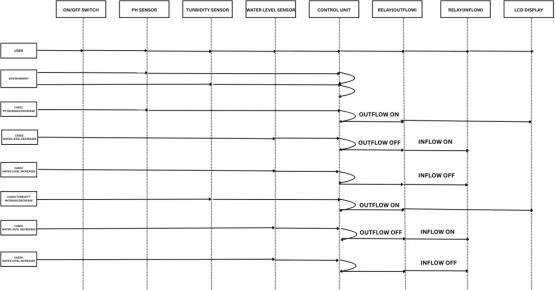
Fig -1:SequenceDiagram
B. Use Case Diagram
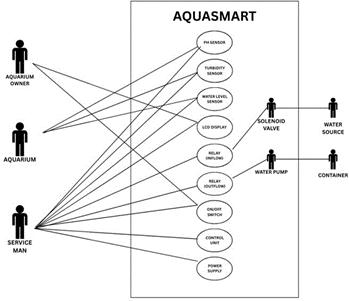
Fig -1:Use-CaseDiagram
BLOCK DIAGRAM
The Smart Aquarium System works by monitoring water quality in real time and maintaining optimal levels by regulatingwaterflowautomatically.Thesystemisdrivenby a 12V DC power supply and supplies 5V and 3.3V to the different components such as the ESP32-WROOM-32 microcontrollerandthesensors,whereasthesolenoidvalve andthewaterpumpoperateon12V.pHsensor(E201-CBNC, 3.3V)measureswateracidity,turbiditysensor(5V)measures suspendedparticles,andwaterlevelsensor(HC-SR04,5V) maintainstheproperwaterlevel. Sensorsprovidereal-time measurementsto the microcontroller, which analyzes the values and com- pares them to thresholds set prior to installation.Incaseofacceptablewaterquality,thesystemis dormant;otherwise,itinitiatescorrectivemeasures.When pHorturbidityisbeyondsafe limits, the inflow relay (5V) turns on the 12V solenoidvalvetopermitnewwaterinto the tank. In the case of excessive water level, the outflow relay(5V)turns on the12Vwaterpumptodrainsurplusor contaminated water. The LCD display (5V) gives live indications of system condition and water status. This
automated approach minimizes manual intervention, ensuringaconsistentlycleanandstableaquaticenvironment.
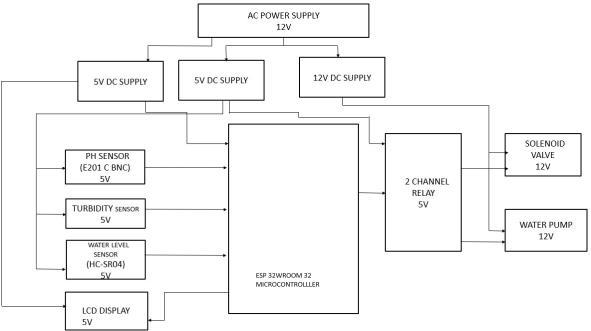
-3:BlockDiagram
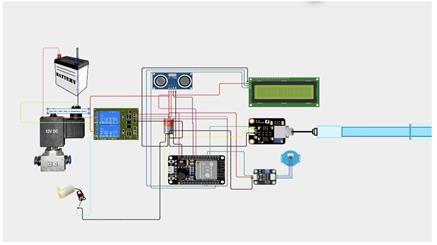
-4:CircuitDiagram
RESULT AND DISCUSSIONS
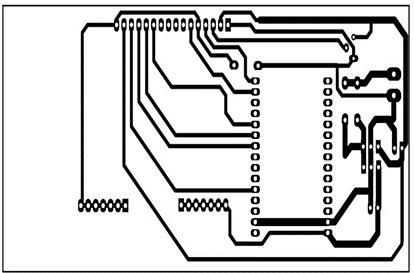
Fig -5:LayoutDiagram
Afterverifyingthecircuiton a breadboard, the designwas transferredtoaPCB using EasyEDA. The PCB lay-outwas carefullydesignedtoensureoptimalroutingandcomponent placement. The final PCB provides a more reliable and compactsolution,reducingwiringcomplexityandimproving overallsystemperformance.Thetransitionfrombreadboard toPCBeliminateslooseconnectionsandenhancesdurability. The finalized PCB design was developed basedon the
Volume: 12 Issue: 06 | Jun 2025 www.irjet.net p-ISSN: 2395-0072 © 2025, IRJET | Impact Factor value: 8.315 |
International Research Journal of Engineering and Technology (IRJET) e-ISSN: 2395-0056
Volume: 12 Issue: 06 | Jun 2025 www.irjet.net p-ISSN: 2395-0072
circuit schematic and layout created using EasyEDA. This implementation replaces the breadboard setup, ensuringa more reliable, compact, and durable system. The PCB is mounted on a sturdy base, with components securely soldered to minimize loose connections and signal interference.Themicrocontrollerunit(MCU)ispositionedat thecenteroftheboard,handlingtheprocessingandcontrol ofvarioussensorsandoutputdevices.A16x2LCDscreenis interfaced to displayreal-time data, providing a clear and user-friendlyoutput.Properwiringandcablemanagement have been implemented to maintain neat and efficient connectivity. Voltage regulators and power distribution componentsarestrategicallyplacedtoensurestablepower delivery to all connected modules. Relaysand other highpower components are isolated from low-powercontrol circuitstoenhancesafetyandperformance.TheuseofPCB tracks instead of jumper wires significantly reduces the chances of errors and improves overall system reliability. This PCB design offers a robust solution for the project, enhancingefficiency,durability,andeaseofdeploymentina practicalenvironment.
The implementation of circuit was initially done using breadboard.Thesystemsuccessfullyautomatedtheprocess of water quality monitoring and maintenance based on predefinedthresholdconditions Theintelligentaquarium system is based on offering an efficient and automated means of maintaining ideal water conditions. With components like the ESP32 microcontroller, pH sensor, turbiditysensor,waterlevelsensor,relays,solenoidvalve, and water pump, the system efficiently monitors and controlstheimportantparameterssothatastableaquatic environment can be provided. Through automation, the system reduces human intervention and improves the overall management of water quality. This increases efficiency, minimizes human effort, and allows for timely correction measures to preserve a healthy aquarium environment.Theintegrationofactuatorsandsensorshas theaddedadvantageofincreasedprecisionandreliabilityin watercontrol.Ingeneral,theprojectvalidatestheviabilityof utilizingembeddedsystemsandautomationtoautomatethe upkeep of aquariums, setting the stage for further developmentsinintelligentwatercontrolandenvironmental monitoring.
[1] L.-B.Chen,Y.-H.Liu,X.-R.Huang,W.-H.Chen,andW.-C. Wang, “Design and implementation of a smart seawater aquarium system based on artificial intelligence of things technology,”IEEESensorsJournal,vol.22,no.20,pp.19908–19918,2022
[2] J.-H. Chen, W.-T. Sung, and G.-Y. Lin, “Automated monitoring system for the fish farm aquaculture
environment,” in 2015 IEEE International Conference on Systems,Man,andCybernetics,pp.1161–1166,IEEE,2015.
[3] Y.-B. Lin and H.-C. Tseng, “Fishtalk: An iot-based mini aquarium system,” IEEE Access, vol. 7, pp. 35457–35469, 2019.
[4]Y.W.M.Yusof,M.Kassim,andN.A.N.Azlan,“Designand analysisofiot-basedaquariummonitoringsystemforguppy fish habitats,” in 2022 12th International Conference on System Engineering and Technology (ICSET), pp. 95–100, IEEE,2022
[5]J.Luoetal.,"pHControl AccuracyinSmartAquariums Improving Through Servo Mechanisms for Precise pH Maintenance," in Proceedings of the IEEE International ConferenceonAquaticSystems,2021,pp.100-105.
[6]Z.Harun,E.Reda,andH. Hashim,“Real timefishpond monitoringandautomationusingArduino,”inProceedings ofIOPConferenceSeries:MaterialsScienceandEngineering, 2018,vol.340,sp.012014