
International Research Journal of Engineering and Technology (IRJET) e-ISSN:2395-0056
Volume: 12 Issue: 06 | Jun 2025 www.irjet.net p-ISSN:2395-0072
International Research Journal of Engineering and Technology (IRJET) e-ISSN:2395-0056
Volume: 12 Issue: 06 | Jun 2025 www.irjet.net p-ISSN:2395-0072
Mr. Balwant Singh1 , Ms. Shivangi Dharora2
1Assistant Professor, and PI Coordinator, Dogra Degree College {Affiliated to the University of Jammu} BA, B. ED, PGDRD, MA{Sociology}, MA {Pub.Administration}, UGC NET{Sociology}
2Lecturer, Dogra College of Education
1. Abstract
The first primary concern of any nationshould be education, and the Indian government has been implementing several programstobringeducationtoeverycornerofthecountry.Severalgoals,includingraisingtheliteracyrate,enhancingthe standard OF educational status, boosting performance skills training, promoting practical skills education, encouraging innovative ideas and enabling institutional growth, were at the top of the list and made considerable advancements throughout time. In general, bothprivate institutions and government institutions are welcome to participate in government activities. The most important component of education is maintaining social connections. There were few possibilities for engagement with society at large in the higher education curriculum. The study highlights the "Unnat BharatAbhiyan”experienceoftheDograDegreeCollege[Non-technicalInstitute],affiliatedtotheUniversityofJammuhas beena ParticipatingInstitution{PI}ofUBAsince30th May2022.Theprojecthelpedemployeesandstudentsgraspsocial evolution,comprehendtheirplaceinsociety,usetechnologicaladvancements,andproducethingsthatareusedinsociety. This therefore gave students a platform to use their expertise to solve challenges in the present. Dogra Degree College, a participating institution, adopted five villages {Palli, Upper Kartholi, Meensarkar, Lower Kartholi & Smailpur} using the UBAframework,carriedoutvillageandhouseholdsurveys,andidentifiedtheissuesintheadoptedvillagesthatcalledfor technology interventions. The study also observed that up to 20 activities were organised by UBA Cell There were more than 350 students and 16 faculty members whotook part in the village survey and household survey. To ensure households' active involvement in all UBA activities, the government funded the participating institute, DDC to conduct a household survey. Students who participated in the program reported that it improved their academic performance and alteredtheirattitudesaboutsociety.
Keywords: Dogra Degree College, Community Engagement, Unnat Bharat Abhiyan, Service Learning, Students, Govt. Initiative
2. Introduction:
The Unnat Bharat Abhiyan (UBA) program of the Indian government was introduced in 2014 at the Indian Institute of Technology (IIT) in Delhi, India. IIT Delhi's efforts in the fields of suitable technology and rural development have garneredmediaattention.SeveralNGOsandeducationalinstitutions,aswellasthecoordinatorsoftheRuralTechnology ActionGroup(RuTAG),contributedtothedevelopmentoftheservice-learningintegrationidea.TheUBA'suniqueaimisto transformruraldevelopmentprocessesandofferthefoundationforaninclusiveIndiawithinstitutionsofhigherlearning The UBA's mission is to assist educational institutions in recognizing social challenges, developing skills to meet the demands of evolving professions, and becoming more socially conscious. You may become a stakeholder in UBA as a prospective mentoring institution, participating institute, subject expert, nonprofit organization, development agency, philanthropist, promoter of CSR (Corporate Social Responsibility), participant in the National Service Scheme (NSS), or enthusiasticvolunteer,amongotherroles. UnnatBharatAbhiyan,2014InitiativeoftheGovernmentofIndia.Amethodof teaching known as "service-learning" aims to meet academic learning objectives while encouraging students to perform meaningfulcommunityservice.Throughactivitiesthatarebuiltaroundcommunityneeds,studentsgrowandlearn.They encounter things while engaging in community interventions. They express their reflections through writing, creating a wayforfuturedevelopmentonthesocial,intellectual,andpersonallevels.1992(Duckenfield&Swanson).Service-learning practitionershaveofferedvarioustipsonthemythstoavoidwhenusingthemethodologyforlearning.Insteadoftackling all of the concepts at once, teachers might incorporate a few of them into their curriculum gradually. (2011) Anderson. Projectsincludingcommunityservice-learningaredesignedtohelpstudentsacquirearangeofabilities,perspectives,and dispositionsthatalsosatisfythedemandsofacademicevaluation.Scharrarer(2006).Numerousprogramshaveshownthe
International Research Journal of Engineering and Technology (IRJET) e-ISSN:2395-0056
Volume: 12 Issue: 06 | Jun 2025 www.irjet.net p-ISSN:2395-0072
benefitsofservice-learningpedagogyintermsofraisingcognitivelevels.(2010)Angelar.Bielefeldt.DograDegreeCollege, Bari Brahmana, Samba, established in 2008, is currently offering three-degreeundergraduate programs in business administration, arts, and commerce. On May 30, 2022, Dogra Degree College became associated with UBA as PI [NontechnicalInstitute].
3. Objectives of the Study:
1.Tohighlightthevalueofservicelearningincontemporarysociety.
2.Toencouragecommunityserviceamongcollegestudents.
3.Tousevolunteerstoraisepublicawarenessofvarioussocio-environmentalhealthissues.
4.Touseavarietyofskilldevelopmentprogramstohelpstudentsdevelopasindividuals.
5.Toidentifyissuesrelatedtodevelopmentincollaborationwiththeruralcommunity.
4. Methodology:
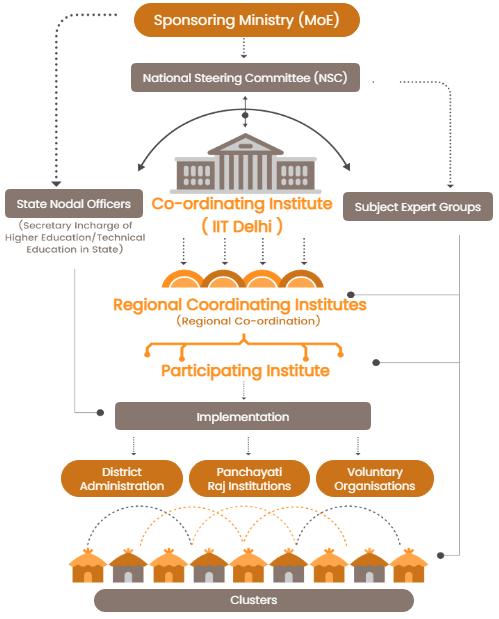
To achieve inclusive societal development, the UBA Participating Institutions are provided with specific requirements to undertake service-learning on the institution's behalf. There is a predetermined hierarchy that all stakeholders must adhere to in order to participate in the program and contribute their unique contributions. In order to clearly make a difference, structured networks with a huge number of institutions working together and a consistent way to organize, carry out, and monitor the actions are necessary. Encouraging synergistic collaboration between relevant ministries, neighborhood Panchayat Raj institutions (PRIs), volunteer organizations, and UBA members is also essential (see Figure 1).Thematchhasjustbeenenvisionedthusfarandisonlybeingstaged
International Research Journal of Engineering and Technology (IRJET) e-ISSN:2395-0056
Volume: 12 Issue: 06 | Jun 2025 www.irjet.net p-ISSN:2395-0072
The National Coordinating Institute is responsible for fully implementing the scheme by coordinating with all the stakeholders and in particular with the support of Regional Coordinating Institutes in the region. The Ministry of EducationisatthetopofthehierarchyfortheUBAFrameworkfortheinvolvementofeducationalinstitutionsinsocietal development, followed by the National Steering Committee to make policy decisions, review the program regularly, and make changes as necessary. Participating Institutes are the academic institutions that are expected to work with neighboringvillagesinthegivenframeworkandconnectvillageswithstudents.RegionalCoordinatingInstitutesmonitor the progress of the work carried out by the Participating Institutes and train the faculty to plan activities related to community engagement. The function of district, panchayat, and volunteer organization representatives is to assist students in their academic and social innovations. Dogra Degree College, Bari Brahmana, Samba, established in 2008, is currently offering three-degreeundergraduate programs in business administration, arts, and commerce. On May 30, 2022,Dogra DegreeCollege becameassociated withUBAasPI[Non-technical Institute]. The PI'sdutiesinclude adopting villages, conducting village and household surveys, developing action plans and gram panchayat development plans, and involving himself or herself in technical initiativesin thevillages. Thecoordinator from the PI isresponsible forcarrying outtheprocedureforadoptingacommunity.Thecoordinatorselectsavillageclosetotheinstitutionwherestudentscan participateinlearningaboutthehamlet'snumerousfacets.Therelevantpanchayatofficialsmustbeinformedofthis,anda request to adopt the village under the UBA Scheme must be made to the district collector. It would receive the district collector'sapprovalandbeupdatedintherecords.ToaddtheUBARegionalandNationalCoordinatingInstitutestothePI site,theapprovallettercanbeprovidedtothem.TheinformationappearsinthePI'sportalassoonastheNCIacceptsthe acceptance of the village. The village survey can be undertaken by PI as a preliminary step. Basic information on the villages is required for village surveys and is obtained from the village executives. Students are needed to carry the household survey forms to the village and conduct the survey once the village survey is finished. The household survey aims to gather information such as complete demographic data, gender-specific population throughout age categories, povertylineacrossthemajoritycastesection,andmore.Aadharprotection,coverageofgovernmentandbank initiatives, Migration Hypothesis, facilities, such as those for education, literacy, and health Access to drinking water, sanitization services, composting pits, and both toilet-equipped and non-equipped households, homes' types, Village connectedness, infrastructure,typeofland,patternoflanduse,andsourcesofirrigationprofileofforestryandhorticulture.fertilizersand chemicals usage agricultural output, animals as assets number of cattle, the pattern of work, earnings analysis, source of power and energy, and use of fuels for cooking. In order to have a basic picture of the livelihood and resources of the village,faculty,andstudentsareexpectedtolookthroughthesurveyforms.Theparticipatinginstitutionlearnsaboutand observesdifferentaspectsofsociety whilethe data isgathered.Students will getaccesstoactual challengesso they may apply what they learn and get better at learning. Five villages were adopted, and surveys of the villages' residents and households were undertaken byDogra DegreeCollege students.Bothlearnersand instructors were able to convert their concepts into academic projects using the UBA framework's systematic methodology, earning credit while using the finished goods to assist the community. For faculty, a number of workshops have been planned to help them support students'socialinvolvement.
Dogra Degree College adopted 5 clustersof villages in 2022 and continues to work with them to support students in understandingtheculture.ThevillagesthatDDChasadoptedarethoroughlydescribedinFigure2.Thecoordinatorvisited every village and discussed the inclusion of students in societal growth. The UBA Portal has been updated with the PI's logininformationandupdatedwithdetailsonthesignificantvillagers.
International Research Journal of Engineering and Technology (IRJET) e-IS
Volume: 12 Issue: 06 | Jun 2025 www.irjet.net
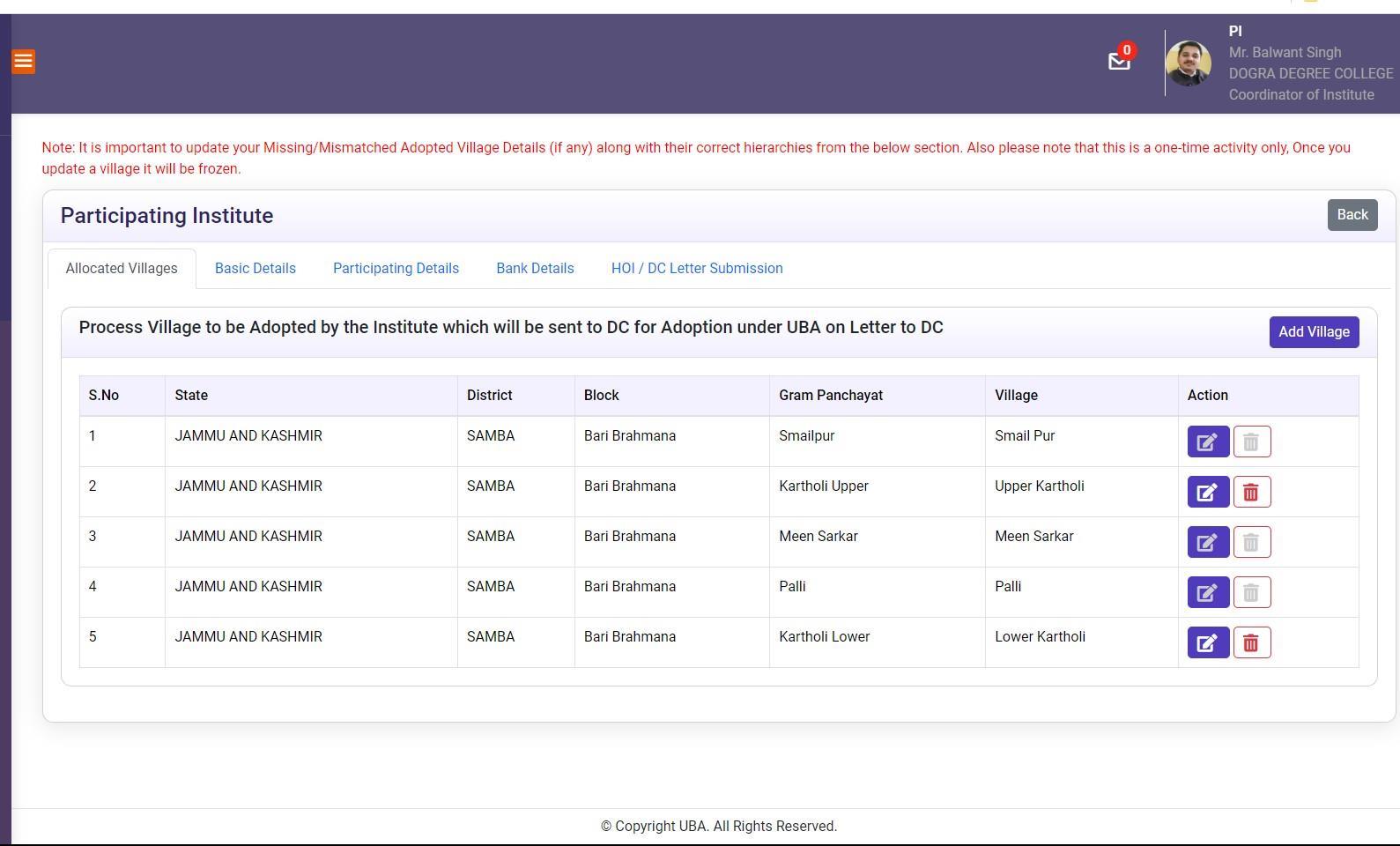
2OptionofaddingvillageintheUBAPortalloginofPIParticipatingInstitute{PI},DograDegreeCollege,Bari Brahmana,SambaJ&KUT
UNNATBHARATABHIYAN{UBA}SURVEYSTATISTICSATAGLANCE
VILLAGESURVEYSUNDERUBA
VILLAGE
Palli BariBrahmana Samba 11-06-2022 BalwantSingh RitikaKundal
Smailpur BariBrahmana Samba 08-05-2023 BalwantSingh ChiranjeevSingh
KartholiUpper BariBrahmana Samba 28-01-2023 BalwantSingh ChiranjeevSingh
Meensarkar BariBrahmana Samba 03-11-2023 BalwantSingh ManiyaBhardwaj
KartholiLower BariBrahmana Samba 04-11-2023 BalwantSingh JatinSharma
BASELINEHOUSEHOLDSURVEYSUNDERUBA
Village Date
Palli 04-06-2022to11-06-2022
Smailpur 23-03-2023to29-03-2023
KartholiUpper 28-01-2023
Meensarkar 11-10-2023to20-10-2023
KartholiLower 04-11-2023
Table:1UBASurveyataGlance{Source:PrimaryData}
International Research Journal of Engineering and Technology (IRJET) e-ISSN:2395-0056
Volume: 12 Issue: 06 | Jun 2025 www.irjet.net p-ISSN:2395-0072
After household data was gathered, students had access to a wide range of issue statements that matched their areas of interest. All of the students have developed the abilities necessary to collaborate with the community to produce new ideas. About 90 students have stated that participating in UBA activities at DDC considerably boosted their confidence. InformationaboutUBAeventsandstudentswhobenefitedfromthemisprovidedinTable1andFig4.
1 ABaselinevillageandhouseholdsurveywasconductedintheadoptedvillageofPalli.
2 P.I Dogra Degree College conducted a household-level survey on Solid Liquid Waste and GHG Emission survey of Village Palli and Tanda. Manual data collected (approximately 420 households) wassubmittedtotheAssociateDean,OutreachandSkillDevelopmentPrograms,RCIIITJammu.
3 Presentedaproposalondigitalclassroominthetech4sevaregionalworkshoporganizedbyUBARCI IITJammu
4 An interactive session and felicitation program was organized by the Dogra Degree College UBA teamincollaborationwiththeRegionalCoordinatingInstituteIITJammu
5 ABaselinevillageandhouseholdsurveywasconductedintheadoptedvillageofUpperKartholi. 90
6 ABaselinevillageandhouseholdsurveywasconductedintheadoptedvillageofSmailpur. 50
7 ABaselinevillageandhouseholdsurveywasconductedintheadoptedvillageofMeensarkar 100
8 ABaselinevillageandhouseholdsurveywasconductedintheadoptedvillageofLowerKartholi 31
9 Presentedaproposalondigitalclassroomintech4sevaregionalworkshoporganizedbyUBARCIIIT Jammuon28thJuly2022 03
Table2:NumberofstudentsparticipatinginUBAActivities
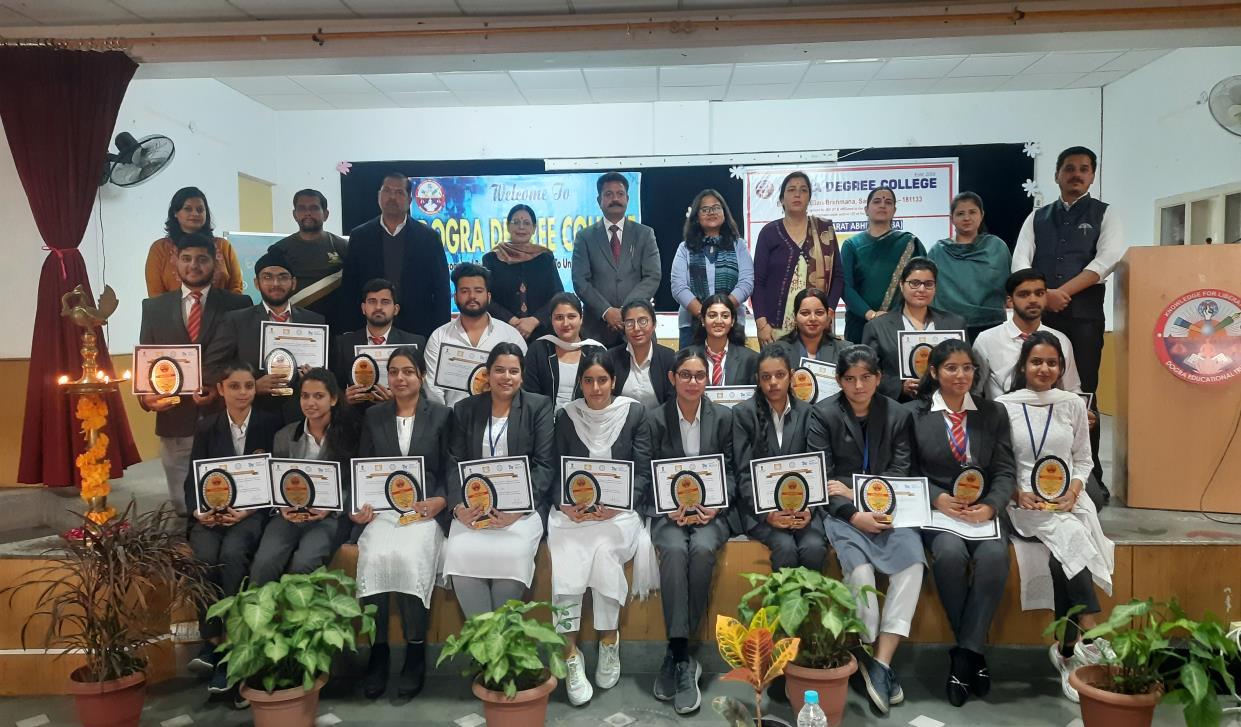
The students were honored by RCI, IIT Jammu Team members, and representatives of sponsored villages by giving them mementos. The felicitation program wasa verykindacton the part of the UBA.Theyalsopraisedthekids' initiativeand saidthatrecognizingdeservingpeopleinspiredotherstodothesameandencouragedthemtocontinueservingsociety.
International Research Journal of Engineering and Technology (IRJET) e-ISSN:2395-0056
Volume: 12 Issue: 06 | Jun 2025 www.irjet.net p-ISSN:2395-0072
Unnat Bharat Cell of Regional Coordinating Institute -Indian Institute of Technology Jammu is pleased to recognize PI, CoordinatorMr.BalwantSingh,DograDegreeCollegeBariBrahmanaJammuasoneofthebest-performinginstitutionsof UnnatBharat Abhiyan, {a flagshipprogramofMinistry ofEducation, Govt. of India}in Jammu Province and LadakhUT,in thequarterof1st and2nd 2023-2024
Unnat Bharat Abhiyan 2.0
Community Engagement and Social Responsibility {UGC MOOC Course}
Name of the Students Department/Semester Fieldwork
ChiranjeevSingh
JatinSharma
AradhanaPandey
SandeepKumar
Taniya
NandiniBhau
KashaviCharak
AnishPawar
KhushiBhagat
PriyankaCharak
DikshaKumari
SiyaSharma
GracyBongal
BA3rd year
BA3rd year
BA3rd year
BA3rd year
BA3rd year
BA3rd year
BA2nd year
BA2nd year
BA2nd year
BBA2nd year
BBA2nd year
BBA2nd year
BBA2nd year
Completed30hrs
Completed30hrs
Completed30hrs
Completed30hrs
Completed30hrs
Completed30hrs
Completed30hrs
Completed30hrs
Completed30hrs
Completed30hrs
Completed30hrs
Completed30hrs
Completed30hrs
Table3:ListofenrolledstudentsinUBAonlineSwayamUGCMOOC2creditcourse”CommunityEngagementandSocial Responsibility”underUnnatBharatAbhiyan2.0
Unnat Bharat Abhiyan's “Community Engagement and Social Responsibility” is a 2-credit course that awards 1 credit for theoryand1creditforfieldwork.Thecoursenowhasmorethan13participantsfromDograDegreeCollege.Thestudents havecompleted30hoursoffieldworkinadoptedvillagesfor“CommunityEngagementandSocialResponsibility”Indiaisa nationofvillages;henceruraldevelopmentisamustforthecountry'sadvancement.Thenumerousfacetsofrurallifeand its evolution in India are discussed in this course. It promotes the value of self-help organizations in community development. The well-beingof the people is a major focus of the training. Additionally, the definitions of literacy and employment have been developed in the context of rural Indian culture and its multifaceted growth. This course emphasizes social networking's role as a conduit between Indian citizens and various government programs. For the benefitofthepupils,explanationsofsensitivitytotheenvironmentandeducation,securityandVigor,passionforphysical, mental,andspiritualhealth,aswellassimplelivingandloftythinking,havebeenprovided.Thecoursealsodiscussesthe advantages of research- and innovation-based community participation. Students will be able to comprehend the numerous issues facing every community and potential solutions. The students must respect and learn from Indian cultures'uniquewisdom,whichisderived fromtheirancestors'andlivedexperiences,todeveloptheirabilitytoimprove other communities. In a nutshell, this course will assist the students in establishing a connection with the nation's true essence.Thesixtypesofcommunityengagementare:integratingknowledgewithvolunteerwork,doingcommunity-based participatory research, sharing information with the community,creating new curricula andcourses, hiring practitioners asinstructors,andstudent-ledsocialinnovation(Tandon,2014).
Technological advancements open up opportunities for students to have a deeper comprehension of difficulties. Additionally,theeffortsupportsstudents'developmentofethicalreasoningandcivicduty.Learningthroughservice(LTS) can be used to instruct students on broad ethical issues. (2016) (Angela R. Bielefeldt). The main driving force behind educationalinstitutionsandstudentsspendingtimeonsocialinterventionswhileputtingwhattheyhavelearnedinclass into practice is financial assistance. The improvement of lives and the creation of wealth would result from skill development using these interventions as pedagogies. The possibilities for social immersion in local service projects are
International Research Journal of Engineering and Technology (IRJET) e-ISSN:2395-0056
Volume: 12 Issue: 06 | Jun 2025 www.irjet.net p-ISSN:2395-0072
broad. (Gregory Bixler) 2014. It is important to intentionally invest time in the community to acquire the intricacies required for the nation's cultural, economic, and technological development. Given the students' reflections, Studentsshouldbeencouragedtouseservicelearningasawaytoacquireprofessionallifeskills.(2013)Carberry,Adam.
2. Main Key Findings:
1. AbaselinehouseholdsurveywascarriedoutbytheDograDegreeCollegeUBAcellinthefiveadoptedvillagesof Palli, Meensarkar, Kartholi Upper, Kartholi Lower & Smailpur, Bari Brahmana, andSamba. The volunteers were systematicallydistributed throughoutseveral wards bytheplansoftheUBAcell DDC.Therepresentativesofthe VillageSarpanchofSmailpur,Sh.BalwantSingh,theSarpanchofUpperKartholi,Sh.TarsemSingh,theSarpanchof Palli,andSh.RandhirSharma,theSarpanchofLowerKartholi,Sh.AngrezSinghaswellasthewardmemberswho shared the details of all the houses that needed to be surveyed and assigned an assistant to ensure a smooth surveyprocess,providedtheDDCsurveyteamwithfullsupport.
2. All these wards' homes weresurveyed by volunteers whocollected data on a varietyof issues,including general household information, the waste collection system, family member information, migration status, details about government programs for the villagers, sources of energy, and power and water, significant issues with village agricultureinputs,infoonlandholding,etc.
3. During the data collection process, the volunteers identified that many villagers were either not enrolled in any governmentschemesorhadnotreceivedanybenefitsfromthem.AfewinstancesofsuchschemesincludethePM Jan Dhan Yojana, Sukanya Samridhi Yojana, Mudra Yojana, PM Suraksha Bima Yojana, Atal Pension Yojana, Fasal BimaYojana,PMAwasYojana,JananiSurakshaYojana,KaushalVikasYojana,andothers.
4. The Volunteers discovered that these individuals needed family planning counseling, which the volunteers also provided, and that the families were extended. However, it wasn't the only issue. There were also a lot of other problems, suchas poorlivingconditions, social taboos, roads,trash, drainage systems,homelessness, and health issues.
5. The Volunteers also found that the pollution from the surrounding industry was the main problem in the community.Thevillagers'healthwasbeingnegativelyimpactedbythepollutantscomingfromthefactoryregion, whichwasleadingtoanincreasedriskofheartdisease,lungtroubles,andotherailments.Furthermore,thecanal water was becoming contaminated by the untreated water that the companies were discharging, rendering it unsafe for human consumption. The village's groundwater's flavor and quality had also been changed by the pollution.
6. The villages have highlighted a need for improved healthcare services and awareness initiatives due to limited accesstohealthcarefacilities.
7. Thepopulationofthevillageisdiverse.Atypicalhomeconsistsoffourtofivepeople. Themainsourceofincomeformanyhouseholdsinthevillageisagriculture.Onthe otherhand,diversificationof livelihoodoptionsandskilldevelopmentarerequired.
8. Althoughthehamlethasschools,thereisaneedforbetterfacilitiesandkid-focusedlearningopportunities.
9. The villagers emphasized the necessity for a garbage collection system, sanitary amenities, and an electrical supply.
Conclusion:
Studentsaremoremotivatedtoworkonprojectsthatpreserveboththeiracademiclearningobjectivesandtheirdesireto givebacktosocietyasaresultofthisservicelearning.Withthehelpofeducationalinstitutions,thegoalofasocietythatis indigenous and inclusive is being achieved. The government financing provided for these programs further increased student and instructor motivation. Additionally, it was seen that the UBA-related activities enhanced the learning. The collegewasabletouseagovernmentinitiativetointroducepupilstotheirsocialresponsibility.Furtherresearchisadvised on how to effectively include such activities into curricula through academic projects, motivate with considerable credit, andcreatemoresociallyusefuloutcomesinIndia.
References:
1. Deore,Vishal;Shinde,Avinash;Shinde,Harish;Singh,Sneha;andWaghmare,Smita(2022)"StudyonImportance, Procedure, and Scope of UNNAT Bharat Abhiyan –A Scoping Review," Graduate Research in Engineering and Technology(GRET):Vol.1:Iss.8,Article4.DOI:10.47893/GRET.2022.1143
International Research Journal of Engineering and Technology (IRJET) e-ISSN:2395-0056
Volume: 12 Issue: 06 | Jun 2025 www.irjet.net p-ISSN:2395-0072
2. Introduction: Unnat Bharat Abhiyan, Government of India's Initiative (2014,November11).Retrieved fromUnnat Bharat Abhiyan, Government ofIndia's Initiative: https://unnatbharatabhiyan.gov.in:8443/introduction Scharrer, L.C.(2006).AssessingLearninginCommunityServiceLearning:ASocialApproach. 13(1).3.
3. Tandon,R.(2014).PRIA’sEngagementswithHigherEducationalInstitutions(HEIs):InitiativesinCommunityBase Research.NewDelhi:ParticipatoryResearchinAsia.
4. Anderson, J. B. (2001).Principles ofgoodpracticeforservice-learninginpreserviceteacher education. InD.Hill, Principles of Good Practice for Service-Learning in Preservice Teacher Education. Omaha:DigitalCommonsUNO.
5. Angelar.Bielefeldt, K.G.(2010).Measuring theValueAdded from ServiceLearning in Project-BasedEngineering Education. 26(3),535-546.
6. AngelaR.Bielefeldt,N.C.(2016).ContributionsofLearningthroughServicetotheEthicsEducationofEngineering Students. 11(2). Duckenfield, M., & Swanson, L. (1992). Service Learning: Meeting the Needs of Youth at Risk. A Dropout Prevention Research Report. Clemson,SC.:NationalDropoutPreventionCenter,Clemson,SC.
7. Edmund Tsand, J. V. (2001). A Report on Service-Learningand Engineering Design: Service-Learning's Effecton StudentsLearningEngineeringDesignin'IntroductiontoMechanicalEngineering'. 17(1).
8. GregoryBixler,J.C.(2014).HumanitarianEngineeringatTheOhioStateUniversity:LessonsLearnedin Enriching EducationWhileHelpingPeople.
Special Edition