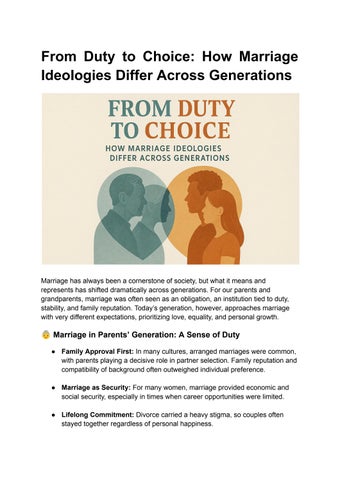
From Duty to Choice: How Marriage Ideologies Differ Across Generations

Marriage has always been a cornerstone of society, but what it means and represents has shifted dramatically across generations. For our parents and grandparents, marriage was often seen as an obligation, an institution tied to duty, stability, and family reputation. Today’s generation, however, approaches marriage with very different expectations, prioritizing love, equality, and personal growth.
�� Marriage in Parents’ Generation: A Sense of Duty
● Family Approval First: In many cultures, arranged marriages were common, with parents playing a decisive role in partner selection. Family reputation and compatibility of background often outweighed individual preference.
● Marriage as Security: For many women, marriage provided economic and social security, especially in times when career opportunities were limited.
● Lifelong Commitment: Divorce carried a heavy stigma, so couples often stayed together regardless of personal happiness.
● Defined Gender Roles: Responsibilities were clearly divided between men as providers and women as caretakers, leaving little space for negotiation.
�� Marriage in Today’s Generation: A Matter of Choice
● Love and Compatibility First: Young people increasingly value emotional connection, shared values, and mutual respect above family expectations.
● Partnership over Obligation: Marriage is seen less as a duty and more as a partnership of equals, where roles are shared and negotiated.
● Career and Independence: Many choose to delay marriage to focus on education, careers, and financial stability.
● Flexibility and Freedom: Divorce is no longer taboo. People are more willing to leave unfulfilling marriages rather than endure unhappiness.

�� Why the Shift?
● Education: Higher education levels, especially for women, have reshaped priorities and opportunities.
● Globalization: Exposure to diverse cultures has challenged traditional norms and introduced new ways of thinking about relationships.
● Technology & Dating Apps: The way people meet has changed dramatically, giving individuals more agency in choosing their partners.
● Changing Gender Dynamics: Women’s empowerment and financial independence have redefined expectations within marriage.

�� Bridging the Generational Divide
While differences are clear, both perspectives hold valuable lessons:
● From our parents’ generation, we learn about commitment, resilience, and family values
● From today’s generation, we see the importance of mutual respect, equality, and individual choice.
Perhaps the future of marriage lies in blending both ideologies, honoring the stability and family bonds cherished by our parents while embracing the freedom, partnership, and individuality celebrated by today’s youth.
✨ Wrapping Up: Marriage is no longer just about fulfilling duty or seeking security It has evolved into a conscious choice built on love, respect, and shared growth. And as generations continue to reshape it, marriage remains less about rigid traditions and more about creating a life together that reflects both personal dreams and collective values.