![]()


Copyright owned by Fastener World / Article by Gang Hao Chang, Vice Editor-in-Chief
Facing the global automotive industry's push for supply chain decarbonization and digital transformation, Taiwanese fastener manufacturer, Hu Pao Industries Co., Ltd., continues to pursue dual sustainability and efficiency goals through international-level carbon footprint verification, AI implementation, and process optimization. Not only has it successfully positioned itself as a green fastener supplier with immediate competitiveness in the CBAM era, but it also sets an exemplary transformation model for other SMEs.
Hu Pao has completed the ISO 14064-1 verification and annually upgrades the quality and scope of its carbon footprint verification. To achieve visual management, its carbon emissions data has been integrated with the internal ERP system. Data verified by ARES in 2022 shows that its carbon emissions from 2,448 tons of shipped finished products reached 10,959 tons (4.47 CO2e/ton). Data verified by French AFNOR in 2024 shows the carbon emissions from 2,663 tons of shipped finished products reached 10,239 tons (3.84 tons CO2e/ton). This demonstrates remarkable performance in maintaining production capacity and quality while achieving an 8.8% increase in shipment volume and a 14.1% reduction in emissions per ton within just two years.


internal quality control, preventive maintenance, etc. Such as initiative also improves its delivery reliability and operational transparency as required by Tier 1 automotive supply chains. For example, the platform automatically parses customers’ RFQ documents and cross-references them with ERP cost data, significantly reducing its quoting time from 120 minutes to just 5 minutes and ensuring consistent quoting logic.
Metal forming requires substantial amounts of lubricating oil, but the environmental pollution caused by untreated waste oil discharge has long been a headache for manufacturers. To address this, Hu Pao independently developed a waste oil recycling trough that can filter and store waste oil for reuse, fully implementing green innovation in the manufacturing process. This solution reduces monthly oil consumption by 20% while also lowering workplace safety risks and eliminating unpleasant odors in the factory area, thereby improving environmental quality. Such an innovation earned Hu Pao an honor as one of Tainan City's Top 10 SBIR Outstanding Projects in 2024, establishing it as an industrial benchmark.
Achieving an 8.8% increase in shipment volume and a 14.1% reduction in emissions per ton within just two years. Vsing the Intellicon Egenthub AI platform to strengthen the management capabilities of quotation effectiveness, internal quality control, preventive maintenance, etc.
To enhance operational efficiency and reduce human error, Hu Pao introduced the Intellicon EgentHub AI platform to strengthen the management capabilities of quotation effectiveness,
Compared to thousands of Taiwanese fastener manufacturers still in the early stages of ESG implementation, Hu Pao has established a significant competitive edge through its leadership in carbon emission verification, process innovation, AI integration, and internalizing ESG/CBAM into its corporate culture. Beyond conducting annual carbon footprint verification and completing thirdparty GHG verification every 2 years, the company drives internal improvements through innovative processes like waste oil recycling and energy intensity optimization. It also leverages AI to integrate quotation documents and resolve production bottlenecks. Hu Pao’s President and its management team's deep understanding of ESG and CBAM trends has embedded sustainability as a core corporate value. “We don't just produce fasteners; we provide customers with parts backed by credible carbon data and quality traceability, helping them navigate ESG and CBAM requirements with confidence,” said General Manager Bill Wang.
Hu Pao has implemented ESG practices and leveraged AI alongside innovative green manufacturing processes to meet the regulatory requirements of global industrial buyers, successfully demonstrating its value as a technology partner capable of collaborating with the industry to co-create sustainability. For other SMEs, this serves not only as a successful model but also as a benchmark example for Taiwan's fastener industry to enhance competitiveness and advance into the next decade.


"If you're looking for unreleased leading products and technologies, look no further than Kwantex in Taiwan!" This statement from an overseas customer not only highlights Kwantex's successful investment over the past 30 years, transforming from packaging & wire drawing to R&D in fasteners, but also demonstrates its long-established leadership at a different level among its Taiwanese counterparts in terms of product development, technological innovation, and brand positioning.
Kwantex contact: Ms. Tracy Lin
Email: kwantex@ms18.hinet.net
In recent years, Kwantex has consistently conveyed its focus on R&D and its strong R&D capabilities to the international market. Its outstanding innovation is reflected in its annual product development, with many products receiving recognition such as the German Red Dot Design Award, the Fastener Innovation Award from U.S. Worldwide Fastener Sources, the Best Booth Award at IFE 2025, etc. Furthermore, Kwantex actively keeps pace with environmental protection and carbon reduction trends, such as achieving ESG certification in 2024 and planning to release its latest ESG report in 2026, demonstrating its significant commitment and responsibility to environmental friendliness and sustainable development.

"To turn the market around, there's no chance without innovation," Kwantex President Jack Lin said. Kwantex develops over 100 improved, innovative, and patented products annually, with R&D and patent maintenance costs reaching tens of millions NTD For Kwantex, a product's ability to revolutionize the market requires a balance of functional and aesthetic innovation, along with optimal adjustments to meet customer needs. President Lin believes, "Only innovative products can give us pricing power." Therefore, since securing its 1st European customer order, Kwantex has been working at full speed. Through continuous development, testing, and product refinement, an average of 1 new product is adopted by customers every 5 years, with some new products already surpassing the design and functionality of many well-known European and U.S. brands.


The relatively poor rust and deformation resistance of traditional industrial steel beams has led markets in Europe, USA, and Japan to shift towards Cross Laminated Timber (CLT) construction, thereby driving demand for wood screws. Coupled with rising labor costs, the demand for wood screws that can meet automated & rapid fastening requirements without cracking or insufficient anti-loosening force, as well as industrial assembly and construction screw sets with high clamping force and easy maintenance & reuse, is also increasing daily. These needs can now be met through Kwantex's full-size and high-performance product offerings, such as wood screws that offer quick & easy fastening and anti-split performance while maintaining a clean and aesthetical finish; the TTX® Drive & Bit series, which fasten securely when turned (including the patented TTX® Drive with its 6-lobe hook design to prevent slippage and which won the Worldwide Fastener Sources Fastener Innovation Award in 2022); the Cutters series, a leading brand in the Nordic and N. American furniture/construction markets, known for its ease of use and crack resistance; and the Torpedo series, which allows for quick tapping (including the KTX-Torpedo Plastic Decking Screw, which fastens wood surfaces without cracking edges and features reverse threads to prevent mushrooming); the 3rd-generation Archimedes’ Secret Threads (AS’) series (the best alternative to the TY-17, double cut design and Torpedo thread) that can prevent wood cracking without damaging the wood fibers and reducing driving torque, and maintain high pull-out force; the KTX Convex (VK) Head that can replace traditional hex washer heads and prevent slippage and wear after installation (suitable for various steel structure, wood structure, and concrete screws and bolts, which are easy to use with VN nuts); the KTX-Jig (for Hidden Decking Screw System) that can create a clean, fastener-free surface by side fastening, which won the Worldwide Fastener Sources Fastener Innovation Award in 2025; and the stainless steel KTX Terrace (IPE) Screw that can drill into extremely hard wood without predrilling and snapping-off.
"Kwantex products have consistently achieved positive results in each market. A high percentage of customers who have used our products become our agents or use our patents for private label sales. When customers are experiencing economic downturns or excessive market competition and shift towards product upgrades, it presents an opportunity for us to leap forward. With hundreds of product improvements and innovations every year, we still achieved growth of over 20% in 2025." President Lin said. Kwantex's innovation extends from product design to subsequent packaging and logistics, and it aims to integrate concepts such as environmental protection, storage, and reuse with users' home life. Kwantex will celebrate its 30th anniversary in 2026. President Lin also announced that in the 2nd half of 2026 the company will present more groundbreaking innovations to global customers in product design, packaging, and logistics, showcasing Kwantex's world-class R&D capabilities and quality strength on par with international giants. "When Kwantex received the Best Booth Award at IFE 2025, the judges praised us as 'an industry leader and a model of innovation in Taiwan.' I believe that a large part of the reason we won this award is based on our consistent efforts to demonstrate the core value of our products and our forward-looking vision of future market trends," President Lin said.
In addition to its commitment to product innovation, Kwantex also values environmental protection and carbon reduction. The company's representative color “purple” conveys Kwantex's aspiration to maintain its business development while striving to reduce pollution in the screw manufacturing process and coexist sustainably with the Nature, because screws are not just products, but an integral part of everyone's life. "Kwantex products are certified by the EU CE/ETA, US ICC, and SGS quality management systems. They can be reused in various fields such as industrial assembly, civil engineering, bridges, vehicles, ships, and aviation, eliminating the problem of needing to scrap a large number of screws due to failure. This perfectly aligns with the spirit of ESG environmental protection and carbon reduction," President Lin said. Regarding corporate responsibility, Kwantex creates a safe workplace for its employees. In addition to professional safety and fitness managers stationed at the factory, there are also dedicated factory nurses and external occupational physicians providing employees with regular medical check-ups and assistance.

On the occasion of the company's 30th anniversary, President Lin said, "We will continue to focus on product innovation and corporate sustainability, so that our employees can work with peace of mind and we can attract more customers from more countries to adopt Kwantex products or our brand."
Copyright owned by Fastener World / Article by Gang Hao Chang, Vice Editor-in-Chief


TSLG耐落是全球扣件預塗膠首選品牌

高雄廠: 高雄市湖內區中山路二段二巷53弄9號
TEL: 886-7-6996777 / FAX: 886-7-6998999 / E-mail:tslg.kh@tslg.com.tw
耐落系台灣耐落股份有限公司註冊商標 precot e®系德國 omniTECHNIK 公司註冊商標 NYLO K®系美國NYLOK公司註冊商標


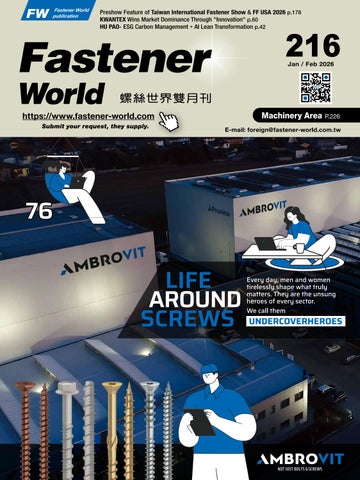
In recent years, Ambrovit has embarked on a path of profound transformation, focusing on technological innovation, logistical efficiency and environmental sustainability. Among the most significant projects is the Proxima automated warehouse, a state-of-the-art infrastructure that has revolutionized internal management, optimizing time and processes while reducing environmental impact. More than simply a technological investment, Proxima is a clear statement of responsibility toward the planet. Thanks to advanced automation systems, it enables a significant reduction in energy consumption and contributes to a more sustainable workflow.


In parallel, Ambrovit has overhauled its digital presence with the launch of a completely revamped online catalog. This smart, intuitive, and highly functional tool has been designed to provide a simple and personalized navigation experience that can guide both industry professionals and end customers through the process of selecting high-quality screws, bolts, and fastening systems. The new digital catalog is not simply a technical update: it is a true support tool for daily work, accessible from any device, loaded with informative content, and designed to meet the needs of an increasingly dynamic and complex market.
www.catalog.ambrovit.it

In addition to the “GoEasy!” retail project, which marked a major breakthrough in product distribution, Ambrovit continues to invest in innovation to strengthen its leading position in Europe. The company is recognized for its ability to anticipate industry challenges and for its ongoing commitment to supporting customers by providing integrated solutions and dedicated consulting. In a context of rising operating costs, stricter environmental regulations, and increasingly fierce industrial competition, Ambrovit stands out as a reliable and strategic partner. Through personalized services, ongoing support and cutting-edge technology, the company helps its customers to improve operational efficiency, reduce waste, and adopt more sustainable practices.
Looking ahead, Ambrovit's vision for 2026 focuses on significantly evolving its brand and communication approach. The concept for the new ADV campaign is based on one key innovative idea: to lock in on social issues and informative visuals as levers to effectively communicate the company's services, activities, and products. This represents a clear departure from classic self-referential campaigns, to embrace communication that is more authentic, engaging, and relevant to the true dynamics of the market and society in general.
Through this new language, Ambrovit intends to emphasize its central role in the direct and indirect markets in which it operates, reinforcing its image as a brand that is attentive to and participates in social and industrial transformations. The 2026 campaign will therefore serve as a tool to not only share news about products and technical solutions, but also talk about human value, social commitment, and responsibility toward a more sustainable and innovative future. Because behind every product delivered is the careful and meticulous work of a team of “hidden heroes” who ensure quality, safety, and strict control: core values that maintain Ambrovit's impeccable reputation.
This new communication strategy perfectly complements the company's philosophy, which has always focused on excellent quality and reliability and constant care for people: customers, employees, and business partners. As such, Ambrovit aims to consolidate its positioning as a global benchmark in the industrial supply sector, anticipating new market needs and building value in a sustainable and lasting way.
In summary, Ambrovit closed 2025 with a clear and concrete vision: to continue to innovate in order to simplify processes, to grow with the determination to be closer to its customers, and to communicate with authenticity and responsibility. 2026 will be the year in which this vision will take shape through more direct and meaningful dialogue with the market, making Ambrovit not only a supplier of excellence, but also a key player in the challenges and opportunities of the future of industry and society as a whole.


Denmark is often underestimated when you look only at its population (≈5.9 million) and think “small market.” That’s the wrong lens for fasteners. The right lens is: what industries in Denmark consume high-spec fasteners?
The country hosts leading offshore wind developers and turbine OEMs (Vestas, Ørsted as project developers and integrators), a strong maritime and ship-repair cluster, advanced food and pharmaceutical equipment manufacturing, and a sophisticated construction sector focused on durable and sustainable solutions. These sectors need premium fasteners — stainless, duplex/super-duplex, high-strength bolts, and coated corrosion-resistant solutions — often in traceable, certified formats (EN/ISO standards, material certificates, and batch traces). The offshore wind pipeline — new tenders and maintenance for existing farms — alone creates longterm predictable demand for millions of specialized fasteners and structural bolting systems. 1
Denmark’s imports of bolts and screws are substantial. In 2024, the country imported USD 321.5 million worth of fasteners, totalling 64.5 thousand tons. In the same year, Denmark exported more than 33 thousand tons of fasteners, valued at USD 239 million. That reflects a steady reliance on foreign suppliers for many fastener types. Denmark is not a low-margin bulk screws market. Success hinges on technical differentiation, certification, and supply reliability.
Industry analysts project a steady growth path for Denmark’s industrial fasteners market (cited forecasts show CAGR estimates in the 4–6% range until 2030 driven largely by renewables, construction refurbishment, and manufacturing upgrades). These forecasts reflect higher-end fastener demand (special alloys, coated products) rather than commodity low-cost screws alone.
Denmark imported USD 321.5 million worth of fasteners in 2024.
Now look at the distribution:
• Germany: 113,115 thousand USD → 35.2% of Denmark’s total imports.
• China: 33,617 thousand USD → 10.5% of Denmark’s total imports.
• United Kingdom: 25,972 thousand USD → 8.1% of Denmark’s total imports.
• Sweden: 22,697 thousand USD → 7.1% of Denmark’s total imports.
• Taiwan: 22,560 thousand USD → 7.0% of Denmark’s total imports.
These five suppliers alone accounted for 68% of Denmark’s fastener imports.
2024 Denmark’s Fastener Import/Export Values
▓ Import: 321.5 million USD
▓ Export: 239 million USD
Denmark’s Import Market Structure
321.5 million USD
▓ Germany: 35.2%
▓ China: 10.5%
▓ United Kingdom: 8.1%
▓ Sweden: 7.1%
▓ Taiwan: 7.0%
▓ Other countries: 32.1%


Germany supplies over one-third of Denmark’s total fastener imports. That only happens when:
√ Proximity and delivery time matter more than price.
√ Industrial customers require strict certification.
√ Supply chain reliability is critical.
√ Long-term purchasing contracts dominate the category.
If any country is planning to compete with German suppliers, they need an argument beyond cost.
China supplies 10.5% of Denmark’s market. Given China’s role as the global low-cost producer, the number is lower than what one might expect.
This means:
√ Denmark is cautious with quality-critical imports.
√ There may be EU tariffs, standards, or buyer preferences holding China back.
√ Lead times and reliability still matter in this industry.
The UK, Sweden, and Taiwan Form the
Each contributes 7–8% of the market. They are not dominant, but they are not marginal either.
They likely serve:
√ Specialized fasteners
√ Niche certifications
√ Automotive or machinery-specific components
The market is fragmented at the technical level even though the top supplier dominates volume.
Total exports: USD 239.4 million (M).
Top destinations:
• Germany: 52.5M (21.9%)
• United States: 27.2M (11.3%)
• United Kingdom: 20.4M (8.5%)
• Sweden: 16.9M (7.1%)
• Norway: 16.4M (6.9%)
• China: 14.5M (6.1%)
These six countries together make up 62% of Denmark’s fastener exports.
Germany is Denmark’s largest export destination and the largest supplier to Denmark.
This usually means:
√ The supply chain between Denmark and Germany is deeply integrated.
√ Companies on both sides are part of the same manufacturing networks.
√ There may be reprocessing or value-added steps (import → refine → re-export)
This pattern is typical in precision engineering, automotive parts, and machinery.
The U.S. buying USD 27M from Denmark is meaningful. The U.S. does NOT import high-value fasteners from everyone. They buy when:
√ The product is highly specialized.
√ Certification requirements are stringent.
√ Supply reliability is essential.
√ The supplier has strong reputation.
This indicates Denmark isn’t just trading commodities.
There is a niche, value-added manufacturing capability inside the country.
239.4 million USD
▓ Germany: 21.9%
▓ United States: 11.3%
▓ United Kingdom: 8.5%
▓ Sweden : 7.1%
▓ Norway: 6.9%
▓ China: 6.1%
▓ Other countries: 38.2%
Sweden and Norway together imported USD 33.4M, about 14% of Denmark’s exports.
This is expected because:
√ These markets are geographically close.
√ They share industrial standards.
√ They have machinery, maritime, and construction sectors with similar needs
Proximity alone doesn’t guarantee this level of trade, but Denmark’s producers are trusted in the region. Quality over price.


China is the world’s biggest producer of fasteners, yet it imported USD 14.5M from Denmark.
That doesn’t happen unless Denmark makes things China cannot easily produce.
Denmark holds technological or certification advantages in selected segments.
Possible reasons:
√ Aerospace or defense-certified fasteners
√ High-spec, corrosion-resistant marine fasteners
√ Custom precision-engineered components
√ Niche production for European OEMs operating in China


Denmark is a global leader in offshore wind development and continues to open large tenders: the Danish Energy Agency recently announced tenders for three offshore areas totalling at least 2.8 GW (Contracts-for-Difference model). This kind of pipeline produces large, concentrated demand for heavy structural components.2
Denmark’s maritime cluster (shipowners, repair yards, and marine equipment manufacturers) relies on corrosion-resistant fasteners and custom bolting solutions (e.g., for retrofits, deck machinery, hull joints). In 2024, Denmark was a top-ten global maritime nation with 740 ships flying the Danish flag and a fleet tonnage of 60.5 million tons. While its traditional shipbuilding capacity has decreased, the industry's overall size is strong due to its leading position in maritime equipment manufacturing, design, and repair services.
Denmark stands out as a high-value fastener market not because of its size, but because of the industries that anchor its economy. Offshore wind, maritime engineering, pharmaceutical machinery, and advanced construction collectively create a level of technical demand that few countries of similar population can match. These sectors require certified, traceable, corrosion-resistant, and highstrength fasteners — the kinds of products that reward capability, not low-cost competition. The country’s import profile, dominated by Germany and other European producers, reinforces that buyers prioritize reliability, standards compliance, and consistent delivery over price alone.
The pharmaceutical market in Denmark is expected to reach a projected revenue of US$ 19,029 million by 2030 3. A compound annual growth rate of 6.5% is expected of Denmark's pharmaceutical market from 2025 to 2030. The combined market for food and pharmaceutical machinery in Denmark was estimated to be around US$3.78 billion in 2025. This figure is based on the 2025 projection for the broader "Industrial Machinery Manufacturing" market, as specific, up-to-date data for just food and pharmaceutical machinery is not readily available for 2024. This broader market is expected to have a compound annual growth rate of 0.18% through 2029. 4
Denmark’s construction sector is focused on renovation, sustainable materials, and quality builds. Indices and statistical series from Statistics Denmark point to active construction indices (residential, civil engineering, maintenance/renovation) that sustain demand for structural bolts, anchors, and specialty fasteners used in façade systems, bridges, and public infrastructure.
The Danish construction and civil engineering market was valued at approximately US$46.19 billion in 2024. The market was predicted to grow to US$51.97 billion by 2025 and is supported by government initiatives and green development projects.
At the same time, Denmark’s export structure reveals a deeper layer of opportunity. The country not only imports premium fasteners but also produces specialized components trusted by top-tier markets such as the United States, China, and the Nordic region. This confirms the presence of high technical standards within Denmark’s industrial ecosystem and positions the country as a strategic gateway to the broader Northern European market. For fastener suppliers capable of meeting stringent specifications, Denmark represents a stable, growing, and technically sophisticated market where strong positioning and certification can translate to long-term, defensible business.
1. https://www.iea-wind.org/wp-content/uploads/2024/11/Denmark_2023.pdf
2. https://ens.dk/en/press/danish-energy-agency-opens-tenders-three-new-danish-offshore-wind-farms
3. https://www.grandviewresearch.com/horizon/outlook/pharmaceutical-market/denmark
4. https://www.statista.com/outlook/io/manufacturing/industrial-machinery-manufacturing/denmark
Copyright owned by Fastener World / Article by Behrooz Lotfian


Sweden, as one of Europe’s most industrialized nations with a diversified manufacturing base, offers a fertile ground to examine demand potential for fasteners. By analyzing Sweden’s industry structure, output, and key industrial segments, we can identify where fastener demand likely concentrates — which may offer useful signals for suppliers, traders, or exporters.
According to a recent sector breakdown, the industrial sector (which includes manufacturing, mining, energy, construction) contributed about 22.6% of GDP in 2024. More narrowly, manufacturing value added reached US$ 84.15 billion in 2024. Historically, manufacturing has accounted for nearly 20% of GDP.
Within manufacturing, traditional heavy industry segments, such as steel (basic metals and metal products), automotive, industrial machinery, and metal fabrication, remain substantial contributors. Sweden’s “advanced manufacturing/industrial engineering” sector is estimated to be about US$ 40 billion, contributing significantly to exports. Around 75% of Swedish exports reportedly come from manufacturing/industrial engineering.
The manufacturing sector also provides employment to a large workforce — many hundreds of thousands: some sources estimate around 700,000–800,000 people employed in manufacturing in recent years. This broad industrial base implies that Sweden remains heavily reliant on production sectors where mechanical joining (fasteners) is essential.
Sweden’s industrial profile is broad and heavy duty — exactly the kind that generates sustained demand for fasteners across many use cases. Sweden’s industrial diversity spans:
• Metals and Basic Metal Products:
Every metal fabrication job, whether building a steel structure, frame, machine casing, sheet metal housing, or heavy-duty structural parts, requires fasteners or welded assemblies, including steel production, metal processing, and metal fabricated goods. In 2024, Sweden's metals and basic metal products industry had revenues of approximately US$9.2 billion, with a 0.9% contraction in the industry. Ore production was just over 80 million tonnes, a 5% decrease from 2023, though the number of active mines increased to thirteen. Despite production declines, Sweden remains a leader in sustainable and fossil-free advanced metallic material production, supported by its natural resources and energy system. 1
• Automotive and Transport Equipment Manufacturing (vehicles, trailers, semi trailers, heavy vehicles): It is part of “motor vehicles and transport equipment” classification within manufacturing. In 2024, Sweden's automotive and transport equipment manufacturing industry had an estimated revenue of US$5.2 billion and produced 270,500 units, representing a decline from previous years due to the transition to electric vehicles. The sector employed approximately 60,400 full-time equivalent employees in 2023, with a significant export value of approximately 14% of total Swedish goods exports in 2022, notes Sharing Sweden. 2
Metals and Basic Metal Products
Automotive and Transport Equipment Manufacturing Construction and Infrastructure
Sweden’s Diversified Heavy-duty Industries Aerospace Industry
Forest based Industries Industrial Machinery & Equipment, Mechanical Engineering, Automation Equipment, Metalworking
• Industrial Machinery & Equipment, Mechanical Engineering, Automation Equipment, Metalworking: The Sweden Industrial Process Automation Market size was valued at US$390.6 million in 2024 and was projected to grow to US$407.9 million by 2025. Additionally, the industry is expected to continue its growth trajectory, reaching US$ 446.4 million by 2030, at a CAGR of 2.25% from 2025 to 2030. 3
• Forest based Industries, Including Timber, Pulp/Paper, Wood Products, and Wooden Building Materials: In 2024, Sweden's forest-based industry was a major economic force, with exports valued at US$19.6 billion, representing about 85% of its products. The industry is a significant employer,
1 https://www.sgu.se/en/about-sgu/news-from-sgu/2025/june/swedish-mining-industry-continues-togrow--despite-decreased-ore-production-in-2024/#:~:text=The%20ore%20production%20in%20 Sweden,extending%20the%20lifespan%20of%20mines.


supporting 140,000 jobs, and consumes approximately 15% of Sweden's total electricity for its operations, which are largely powered by bioenergy. The sector has also invested billions, with US$ 6.9 billion invested between 2020-2024. 4
• Aerospace Industry: In 2024, Sweden's aerospace industry was valued at approximately US$14 billion (Market Cap) and had a 2021 sales revenue of about US$2.586 billion, with projections to reach US$5.24 billion by 2033. The sector is driven by a strong focus on defense, with companies like Saab experiencing significant order growth. It also has a leading role in the development of electric aviation technology, with initiatives like ELISE (Electric Aviation in Sweden).
• Construction and Infrastructure: It is especially given the importance of construction in complementing industrial activity and urban development. In 2024, the Swedish construction industry's value was around US$ 49.30 billion, with a notable but shrinking transportation infrastructure sector valued at approximately US$ 16.86 billion. While residential construction declined significantly due to high interest rates, investments in transportation and energy are expected to provide some support to the overall market, which is projected to shrink by about 3.9% in real terms for the year. 5
Quantitative Perspective:
Sweden’s import profile in 2024 shows a sharply concentrated sourcing pattern. Out of a total of US$ 525.2 million, Germany accounted for more than a quarter with US$ 142.4 million. The reasons may be: Germany sits close, offers stable logistics, and holds a strong reputation for industrial reliability.
More interesting is the second tier. Taiwan, at US$ 79.9 million, has secured a position far beyond what its size suggests. This isn’t an accident; it reflects specialization, consistency, and the kind of high-precision manufacturing that buyers can rely on. China, despite its global manufacturing scale, trailed at US$ 46.7 million. This gap points to a purchasing environment where quality, trust, and technical standards matter as much as price—areas where Taiwan tends to outperform.
Italy’s US$ 41.9 million formed the tail of the top exporters, reinforcing a pattern: Sweden relies on partners that deliver engineering quality, predictable supply chains, and regulatory alignment. The hierarchy isn’t driven by sheer production capacity but by assurance, precision, and consistency.
Sweden’s Fastener Export Reach (USD)
Importers
Sweden’s outward trade flows in 2024, totalling US$ 399.8 million, reveal a pattern that is anything but random. The country’s export footprint is broad, yet its commercial gravity remains firmly regional.
Norway led with US$ 57.4 million, a familiar result given tightly integrated Nordic supply chains and low logistical friction. But notice the next positions: the United States at US$ 41.3 million, followed closely by Germany at US$ 33.1 million. This mix tells you Sweden succeeds where established trust, regulatory compatibility, and demand for advanced, reliable goods converge.
The presence of Denmark (US$ 29.6 million) and the United Kingdom (US$ 25.2 million) reinforce the point: Sweden’s strongest markets are countries that value quality over scale and place a premium on dependable long-term partners. These are not markets won by price competition alone; they’re shaped by technical standards, cultural proximity, and industrial alignment.
In short, the numbers expose a highly stable export ecosystem—broad internationally, but with undeniable concentration among Sweden’s closest economic and regulatory allies.
Taken together, Sweden’s industrial structure and its trade patterns point to a market where fastener demand is anchored in long-standing, technically demanding sectors rather than speculative growth pockets. Heavy industries such as metals, automotive, machinery, and forest-based manufacturing continue to dominate both output and employment, ensuring a consistent baseline need for mechanical joining solutions. Even in segments facing cyclical pressure— construction, vehicle production, or basic metals—the underlying engineering intensity remains high. These industries cannot function without reliable fastening systems, meaning suppliers who match Sweden’s expectations for precision, certification, and supply-chain stability will remain relevant despite short-term fluctuations.
The country’s import and export dynamics reinforce this industrial profile. Sweden relies on partners known for quality and engineering standards, not cheap volume, and its outward trade is the strongest with regions where industrial expectations mirror its own. This alignment suggests that the Swedish fastener market is not simply large—it is selective. For foreign suppliers or exporters, the opportunity is real but contingent on meeting the technical, regulatory, and reliability thresholds that Swedish industries treat as non-negotiable. In essence, the data describes a market where demand is robust, but access must be earned through capability rather than price.
2 https://sharingsweden.se/app/uploads/2024/11/SI_IP_Transport_Overview_241101.pdf
3 https://www.nextmsc.com/report/sweden-industrial-process-automation-market
4 https://www.nextmsc.com/report/sweden-industrial-process-automation-market
5 https://www.nextmsc.com/report/sweden-construction-market#:~:text=Sweden%20 Construction%20Industry%20Overview%20The%20Sweden%20 Construction,CAGR%20of%206.6%25%20from%202025%20to%202030.


As Taiwan's largest fastener export destination, the U.S. since 2025 has undergone structural changes in its external fastener procurement amid intensifying international political, economic, and trade competition. This poses unprecedented challenges to Taiwanese fastener makers' overseas orders and profit margins. As China’s tensions against the U.S. and relations become the new norm, the restructuring of global fastener supply chains is now firmly established and becoming long-term and frequent, requiring Taiwanese businesses to accelerate their transformation to adapt to it.
In his address, Chairman Tsai stated: "Facing challenges like U.S. tariffs and the EU's CBAM, businesses must stay united, accelerate transformation, and grit their teeth to push through. Over the past two years, the industry has faced unprecedented volatility in costs, order demand, and exchange rates. We must consolidate domestic team strength, regain our footing, and seize the initiative in the next wave of opportunities. I call on fastener industry veterans and second-generation successors to join hands and fight for Taiwan's future!"
To assist Taiwanese fasteners industry to compete through a group model, TIFI will once again form the Team Taiwan, continuing the success made in the IFE show. Again, TIFI will establish "Taiwan Quality Fastener Pavilion" at Taiwan International Fastener Show, IFE (Phoenix, U.S.), and Fastener Fair Global (Stuttgart, Germany) in 2026. TIFI will also organize a group to exhibit at FASTENER POLAND®, promoting Taiwan's high-value fastener businesses, products, and services to visitors and buyers worldwide. All TIFI members have been invited to join and participate.
The event drew a distinguished gathering, including Kaohsiung Mayor Chen Chi-Mai, Economic Development Bureau Director Liao Tai-Hsiang, Metal Division Chief Guo Yan-Yun from the Industrial Development Bureau, and Secretary-General Chiang Tsung-Yi of Taiwan Steel Wire & Wire Rope Industries Association. Mayor Chen delivered remarks to boost morale, instructing the Economic Development Bureau to provide full administrative and resource support to help businesses overcome obstacles—even amid turbulent waves—with government backing. Chairman Tsai expressed gratitude to members for not giving up amid challenges and firmly breaking through, while specially thanking the government for supporting Taiwan's fastener industry development. He wished everyone prosperity at the end of the journey and a new peak ahead.
Additionally, the Assembly featured a lecture on "Corporate Resilience and R&D Transformation Guidance," covering key areas members need to know: "Dual-Axis Transformation" (green design, energy-saving and carbon reduction), "Technology Value-Add" (new processes, new materials, high-precision products), "Cross-Boundary Integration," and "Marketing Deployment" (product certification, channel development). Businesses facing client demands to absorb tariffs, cargo returns, order cancellations, or delays—even without export operations—can apply for related assistance.
Amid international economic and trade challenges, TIFI leads members forward steadily. Through the united power of the Team Taiwan, it helps businesses seize new export opportunities and jointly forge a stable future for the fastener industry.
TIFI (Taiwan Industrial Fasteners Institute) Member Assembly was grandly held on December 18, 2025, at the "Enjoy Your Life Banquet Hall" in Gangshan, Kaohsiung City. TIFI Chairman Mr. Yung-Yu Tsai emphasized the TIFI role in helping Taiwanese businesses turn the tide in this critical survival battle. Since taking office, he has actively linked TIFI with the Ministry of the Interior, Ministry of Economic Affairs, Kaohsiung City Government, and others, articulating the export challenges faced by fastener businesses to various government agencies and securing their support. This has enabled TIFI to lead numerous Taiwanese fastener companies in forming a "Team Taiwan," realizing the vision of creating "Taiwan Quality Fastener Pavilion" to unite Taiwanese exhibitors under one roof and shine at major global trade shows. Copyright owned by


TIFI and Taiwan CSC held the final year-end production & sales networking event for the fastener industry on Dec./05 2025 at the Taiwan CSC Headquarters in Kaohsiung. TIFI Chairman Yung-Yu Tsai and Vice Chairman Simon Lin, along with Taiwan CSC Vice President of Sales Tung-Chieh Chuang and Sales Department Director Po-Han Chen, were present to discuss current domestic and international industry conditions and shared positive developments for enhancing competitiveness and expanding future international marketing amid the current market downturn with over 100 fastener industry representatives.
Chairman Yung-Yu Tsai stated that 2025 has been the most challenging year for Taiwanese fastener industry, but he believes this is not necessarily a bad thing, as such competition will enable the industry to build greater resilience to tackle market challenges. He emphasized that business owners have no time for lamentation and they must adjust their mindset to steer companies toward positive growth. Over the past few years, as Chinese and Vietnamese competitors vied for market share and rivals from India and elsewhere pressed closer, some domestic Taiwanese factories indeed succumbed to the pressure and closed down. However, those who have survived must now seize the moment to assess whether their production, delivery, and overall capabilities are sufficient to meet future market order demands.“Don't wait until the Russia-Ukraine War truly concludes to realize your delivery lead times have stretched beyond a year!”
Taiwan CSC reps noted that external pressures this year including U.S. reciprocal tariffs, steel & aluminum duties pursuant to Section 232, and the sharp short-term appreciation of New Taiwan Dollar (NTD) have sent shockwaves through the industry, with occasional reports of poor order intake and factory closures. Not only have tariff issues caused customer orders to freeze and shrink, but profits generated earlier in 2025 from overseas customers shifting orders have also been eroded by the rapid NTD appreciation. Although the fastener market has been sluggish for 3 years, signs of urgent orders showing gradual


replenishments in the market are now visible. Pressure from the NTD appreciation is also easing. Additionally, the Bank of Japan's potential consideration of yen appreciation could boost the competitiveness of Taiwanese exports. A market turnaround and recovery can be anticipated in the future. Taiwanese downstream steel-related industries possess strong management capabilities and sufficient competitiveness, just awaiting the right timing to flourish. It is believed that as long as the Russia-Ukraine War and Middle East conflicts could be resolved swiftly, and the international situation could stabilize 2026, the performance of the steel market and related industries should improve progressively.
Speaking of the widespread lamentations of the market, where companies are desperately waiting for orders, Chairman Tsai emphasized, “Market crises are no excuse. The real problem lies in lacking self-confidence!” He believes that making profits during good times is expected, but demonstrating resilience during downturns is what truly reflects the strength of Taiwanese industries. At this stage, companies should not focus on fiercely competing for orders. Looking at factories in the US, Japan, the UK, and Germany, they also face market challenges yet thrive. How dire could the crisis be for Taiwanese factories? Instead, this wave of challenges should be seized as an opportunity to thoroughly refine and strengthen corporate fundamentals.
Chairman Tsai also announced plans to expand marketing efforts for Taiwanese fastener industry at the Taiwan International Fastener Show in April 2026 and the IFE in October 2026. He encouraged companies to abandon the practice of undercutting prices to capture market share, urging them instead to collectively showcase at int’l exhibitions how Taiwanese superior fastener enterprises are advancing with the times, which involves demonstrating their robust capabilities in carbon reduction and environmental protection, highlighting their close integration with global corporations, etc. Chairman Tsai stated that TIFI's stands at the Taiwan International Fastener Show 2026 will be even bigger. TIFI will also select 4 companies for enhancing their promotion. At the IFE, the number of stands booked by TIFI will also expand to 12 booths, and TIFI will exclusively select 8 companies to feature their fasteners for more brand awareness. Specially arranged staff will be on-site to provide introductions. TIFI’ s stands at both shows will also allow non-exhibiting companies to apply for catalog placement. Companies may directly register to engage with clients through assistance from TAITRA personnel. Additionally, the Metal Industries Research & Development Centre (MIRDC) team will be present to offer technical consultations. Additionally, in response to China's market expansion, TIFI is actively coordinating with MIRDC to share resources and guide Taiwanese manufacturers in developing high-value products like SEMS screws to expand into the U.S. market. Chairman Tsai emphasized that with the U.S. actively promoting manufacturing reshoring, the next two years present the optimal timing for Taiwanese fastener industry to gain more market share. Companies must seize this opportunity to consolidate their market positions. Particularly as Taiwanese government has offered various resources available for application, businesses should leverage these resources to enhance competitiveness through initiatives like energy saving, carbon reduction, and advanced equipment upgrades.

Regarding the wire rod & coil pricing for Q1 2026, which is the primary concern for industry players in attendance, Chairman Tsai stated that Taiwan CSC holds significant influence among global steel mills and possesses a far clearer understanding of global steel market trends than any individual company. Based on past experience, if CSC reduced its price, Chinese steel mills would follow suit. Given that some Chinese screw prices in the market are already as low as Taiwan CSC's wire rod quotations, Taiwan CSC should have the wisdom to set optimal pricing that allows long-term supporters to sustain their operational momentum.
Taiwan CSC reps stated that they understand many manufacturers continue to enhance competitiveness and create more favorable conditions by refining personnel training and upgrading/maintaining equipment. Taiwan CSC is also striving toward equipment renewal and material development, with more tangible results expected by 2026. Although current market signals remain mixed, China's wire rod trends remain a key influencing factor. However, positive developments are increasingly prevalent, including sustained inventory reduction and the emergence of urgent orders in the market. Should the Russia-Ukraine War conclude, raw material supply and demand begin to balance, and Taiwan-U.S. tariff negotiations yield clearer positive outcomes, the industry should witness improved prospects.
Copyright owned by Fastener World / Article by Gang Hao Chang, Vice Editor-in-Chief


The Overseas Information Committee of Fasteners Cooperative Association of Kansai (Western Japan) led a delegation of 7 members on a tour to Manila, Philippines, from October 22 to 24, 2025. The purpose was to gain insights into local market dynamics and business environment while exploring potential future collaboration opportunities.

The group departed from Kansai International Airport and, upon arriving in Manila, they toured the historic Intramuros district first to experience remnants of the Philippine colonial era. The following day, the delegation visited Yamaguchi Nut Philippines Corporation (affiliated with Japan's Yamaguchi Nut Company), where they received a company overview and details on future development plans. Discussions focused on Philippine market trends and business challenges, followed by a tour of the nut factory to examine production processes. The group then proceeded to Philippines Ogami Corporation (affiliated with Japan's Ogami Co.), listened to a company briefing, and conducted a tour of the mold factory to gain a deeper understanding of local operations.
After concluding the tour, the delegation returned home from Manila. This activity not only gathered valuable overseas information but also strengthened ties between Japanese and Philippine companies, contributing to the association's future internationalization efforts.

According to the 2025 Overseas Activities of Japanese Companies in North America survey, released by the Japan External Trade Organization, the study indicates that under Trump’s tariff policies, the profitability structure and supply chain configurations of Japanese companies in North America are at a major turning point. The survey highlights the high volatility of the North American business environment, with firms reconfiguring supply chains and business strategies to cope with new tariffs and market risk.
The survey notes that while about 66.5% of Japanese companies in the U.S. still expect to achieve operating profits in 2025, the proportion of improved profit prospects has declined compared with 2024. This reflects how tariff-driven cost


increases and market demand uncertainty are eroding profitability. Firms are more inclined to source materials and components locally in the U.S. to alleviate cost pressures, a shift that has doubled compared with 2024. In terms of the supply chain, an increasing number of companies are considering relocating production bases to the U.S. By 2025, 34 firms stated they are reviewing such adjustments—the highest figure since 2019. This move is driven not only by tariff pressures but also by strategic aims to bolster North American competitiveness and shorten supply chains.
Furthermore, facing labor shortages and rising personnel costs, firms must balance cost control with market expansion. The majority of Japanese companies in the U.S. still plan to expand their business over the next 1–2 years, indicating that the North American market remains strongly attractive in the long term despite policy pressures.
Criticize: Carbon Border Tax Too Lenient on
Starting in 2026, the EU imposes carbon fees on cement, iron, steel, aluminum, and fertilizers imported from countries with weaker emissions standards, ensuring "dirty" imports do not gain unfair advantages. EU domestic products must pay around €80 per ton of CO 2 European high-energy-intensive industries are deeply concerned that the CBAM is too soft on heavily polluting imports from China, Brazil, and the US, undermining the mechanism's original purpose.

The main challenge lies in foreign producers not providing precise emissions data, so the EU plans to use default formulas for calculations. Drafts show that default emissions values for Chinese steel products are even lower than EU equivalents, sparking industry criticism. Green steelmaker Stegra is surprised that some EU production routes have "higher emissions than China" and suggests adjusting the values.
Industry warns that low default values will weaken incentives for clean production, allowing high-emission imports to enter the market at low carbon costs, potentially backfiring. CBAM Alliance Acting Chair Leon de Graaf stresses that default values should be set high to "punish" those not reporting real data, or importers will lack motivation to comply. Incorrect values could harm EU producers for two years.
In response, Chinese media reports that these European industry figures overlook China steel sector's green transformation achievements, claiming that by 2024, China's steel industry had 660 million tons of capacity engaged in energy efficiency benchmarking, saving 105,000 tons of standard coal annually per 10 million tons of capacity—totaling 10.5 million tons saved and 27.5 million tons of carbon reduced yearly, equivalent to the annual carbon sink of 570 million trees. China's Ministry of Commerce has urged the EU to uphold fairness, transparency, WTO rules, minimize trade disruptions, and avoid protectionism and green trade barriers.
The EU will not grant the UK a CBAM exemption unless the two sides formally link their emissions trading systems. UK government estimates indicate that from 2026, this will burden British industry with around £800 million in annual carbon fees, plus heavy administrative requirements like emissions reporting, verification, and certification—similar to post-Brexit paperwork surges.
Limited relief may apply to UK electricity exports. The EU recognizes higher UK electricity generators’ carbon costs, exempting them in principle from CBAM fees, welcomed by the UK government. However, steel, cement, fertilizers, and aluminum exports remain affected. Frank Aaskov, Policy Director for UK Steel, warned that CBAM would heighten competitive disadvantage amid global trade uncertainty. Although the carbon cost for hot-rolled wire is only €13 per ton, market prices are highly sensitive (around €650 per ton), and a €5 difference can determine a purchase decision. The impact is particularly large on small and medium-sized enterprises, making it hard to compete with low-cost imports from China. A UK government spokesperson reiterated prioritizing carbon market linkage to spare £7 billion in exports from CBAM fees. Industry fears eroded competitiveness, urging swift agreement.
The Canadian government has issued an official announcement imposing a 25% surtax on specified steel derivative products effective December 26, 2025. This measure applies to steel derivatives imported from all countries worldwide, aimed at protecting the domestic steel industry. Importers must declare and pay through the Canada Border Services Agency (CBSA). Goods in transit on the effective date are exempt. Affected fastener HS codes include: 731811, 731812, 731813, 731814, 731815, 731816, 731819, 731821, 731822, 731823, 731824, 731829.
Exemptions: Goods covered by existing surtax orders (e.g., China/U.S. steel surtax orders), casual goods, Chapter 98 goods, and in-transit goods.
Temporary Exemptions: Until July 1, 2026, goods for manufacturing motor vehicles or vehicle chassis, or parts/accessories thereof; goods for aircraft, ground flight simulators, or spacecraft, or parts thereof.

Remissions: Case-by-case relief available for goods unavailable domestically or causing severe economic impact. Existing U.S. import remissions temporarily extended through January-June 2026 (depending on use).

The Executive Yuan's Office of Trade Negotiations (OTN) states that Taiwan formally requested consultations under the WTO framework on December 15, 2025, targeting Canada's unfair import restrictions on fasteners and other steel products. The WTO announced this to member states on December 18. OTN acted on appeals by request of Taiwan Steel & Iron Industries Association (TSIIA), aiming to secure a fair competitive environment for Taiwanese businesses.
OTN notes Canada imposed a 25% tariff on global steel derivatives, severely impacting Taiwan's steel interests. TSIIA estimates total annual losses exceeding NTD1.7 billion, with the fastener industry facing an extra NTD1.3 billion tariff. OTN emphasizes steel's critical role in national defense and exports, but Canada's restrictions have heavily disrupted Taiwanese shipments. Taiwan has repeatedly raised concerns through bilateral and multilateral channels; while Canada respects Taiwan's rights, it has not proactively resolved the issues.
To prompt mutual benefit discussions, Taiwan activated the WTO dispute settlement mechanism. OTN highlights Taiwan and Canada as like-minded partners with signed agreements on double taxation avoidance, investment protection, and science/technology cooperation. Both should enhance collaboration to combat low-priced steel and illegal transshipment, upholding free and fair trade order.

Despite persistently falling export prices, China's fastener industry demonstrates strong resilience. According to the latest data, China's fastener exports reached 5.107 million tons in the first 11 months of 2025, up 7.5% year-over-year. Full-year exports are projected to grow substantially for the second consecutive year, though the average price stood at just USD 1.921 per kg, down 2.7% from the previous year.
January's exports soared to 587,339 tons, setting a historical single-month record. Volumes contracted sharply to 249,243 tons in February and fell further to 411,424 tons in October—the secondlowest monthly figure of the year. November saw a rebound to 493,438 tons, up 19.93% month-over-month and 4.31% year-overyear, approaching the 500,000-ton mark and signaling demand recovery.
On pricing, August 2024 plunged to USD 1.85 per kg—the lowest in 6 and half years. This year, January dipped to USD 1.857 per kg, while March briefly rose to USD 2.008 per kg, ending nine straight months below the USD 2 threshold. October and November slid again to USD 1.893 and USD 1.874 per kg, respectively, both annual lows. By contrast, December 2022 peaked at a record USD 3.278 per kg, with March 2023 at the second-high USD 3.205 per kg.
In 2024, full-year exports totaled 5.289 million tons, up 16.66%, but prices crashed 14.3% to USD 1.97 per kg. Analysts note that low pricing remains a key competitive edge, driving volume growth amid pricevolume divergence. Historical lows, like February 2023's 190,000 tons, underscore volatility, yet the overall upward trend bolsters China's global market share.

Taiwanese wire rod leader Chun Yu emphasized at its December 24, 2025 conference that vertical integration and global operations sustain its unbeatable edge in construction and industrial fasteners, with long-term low-carbon process strategies to meet international sustainability and supply chain demands.
Despite global economic cycles pressuring the fastener industry, Chun Yu maintains solid profitability. Gross margins held 14%-16% from 2022-2024, reaching 13.8% in the first three quarters of 2025, with operating profit margins above 4%, demonstrating strong cost absorption and pricing power amid raw material fluctuations and demand shifts. Taiwan remains the core market at 35%, followed by Hong Kong/China and Southeast Asia at 23% each, with Europe and the U.S. totaling 16%—high diversification reduces single-region risks.
Looking ahead, Chun Yu anticipates short-to-medium-term rate cuts spurring infrastructure investments and steel fastener demand; long-term focus shifts to low-carbon electric arc furnace processes and products, raising entry barriers. Upon economic recovery, the company stands ready to seize opportunities and generate peak profits.

Walsin Lihwa unveils its new stainless steel cold-finished bar brand "Steeval." The AI era ushers in a new chapter for metal processing, with Taiwan entering global supply chains for automation, new energy, robotics, and aerospace. "Steeval" signals the company's transformation from material supplier to comprehensive technical service solutions provider.
Taiwan's steel industry fueled the rise of its fastener kingdom. Facing precision manufacturing upgrades, Walsin Lihwa offers full-spectrum solutions—from products and processes to services. Its cold-finished bars hold top market share globally, featuring high machinability, cleanliness, wear/corrosion resistance, heat resistance, and soft magnetic properties. They support fasteners, automotive, aerospace, semiconductors, AI servers, and automation precision needs. The new brand initially integrates Taiwan and China production lines, with plans to incorporate premium European products for higher value.
By the end of 2026, China, Taiwan, and Europe cold-finished bar output will reach 180,000 tons annually: China monthly from 3,500 to 5,000 tons, Taiwan from 4,000 to 5,000-6,000 tons. Walsin Lihwa's annual stainless steel capacity is 1.3 million tons, with cold-finished bars at 10%—primarily targeting at automotive, rising to 13.8% targeting at new energy vehicles.

Packer Fastener, a premier distributor of threaded fasteners and industrial supplies, has unveiled its latest distribution hub in Pearl, strategically positioned to support the Jackson region. This state-of-the-art facility enhances service for commercial contractors, manufacturers, and fabricators throughout Mississippi and the Southeast U.S., with a particular focus on fast-growing industries such as data centers, electric vehicle battery and automotive manufacturing, power generation, and heavy industrial construction.

The opening represents a key step in Packer Fastener's expansion plans, driven by surging customer needs and the company's dedication to superior inventory access and responsive support. Linked directly to the Atlanta distribution center, the Jackson hub ensures procurement teams, project leads, and site managers maintain seamless workflows free from delays. "Expanding our footprint brings us closer to the communities we serve," stated Terry Albrecht, CEO of Packer Fastener. "With the backing of our robust Atlanta operations, this new Pearl location reinforces our role as a dependable partner for regional construction and industrial projects— delivering the rapid, reliable service our customers expect."
U.S. anchor bolt and nonstandard construction fastener manufacturer Portland Bolt has expanded its production plant in North Augusta, South Carolina. The facility has grown from 25,000 to 62,500 square feet, significantly boosting production capacity, enhancing service levels, and shortening lead times for customers across the Eastern U.S.
The expansion features a new hot-dip galvanizing line, delivering consistent, high-quality corrosion protection for Portland Bolt's products. This system not only streamlines internal manufacturing but also offers galvanizing services to external partners in industries including construction, infrastructure, fabrication, utilities, and transportation. "This expansion underscores our commitment to supporting


customers with unmatched speed, quality, and technical expertise," said Blake Ray, CEO of Portland Bolt. "By strengthening our East Coast presence and adding new capabilities, we're improving national coverage with greater rush-order capacity, faster turnaround times, and smoother production flows—enhancing our ability to meet urgent project demands and deliver industry-leading service." Operations VP Todd McGurk added that the additional space and equipment ensure even greater efficiency in producing, galvanizing, and shipping high-quality products.
MinebeaMitsumi will manufacture two types of fasteners to support Boeing's 737 MAX and 787 Dreamliner aircraft programs. Moving forward, the company will continue strengthening quality management and supply systems, maintaining high quality standards to contribute to the aerospace industry. The MinebeaMitsumi Fujisawa Plant originated as the factory of Tokyo Screw Manufacturing Co., Ltd., founded in Minato-ku, Tokyo, in 1898, and relocated to its current site in 1921. In 1981, it was absorbed and merged into Minebea Co., Ltd. Fujisawa Plant. Current main operations span aircraft fasteners and machined parts, measurement instruments with strain gauges as core technology, and products like railway/ industrial motors and electromagnetic clutches.

Carscoops reports BMW has publicly disclosed a patent for a custom screw head mimicking its iconic round logo. Unlike standard Phillips, hex, or Torx designs, if it goes to mass production it could mandate specialized tools for removal.
Patent illustrations show the screw head divided into four quadrants inspired by the brand emblem: two recessed, two flat or raised, creating a unique geometric profile operable only by matching bits. Documents stress conventional screws are easily manipulated by anyone; BMW aims to limit access to authorized personnel for operation, removal, or installation. The logo structure is non-replicable without permission, covering screws and tools. Primary applications target vehicle interiors: cockpitto-body connections, center console mounting, seat fasteners. Variants include half-round, countersunk, and cylindrical heads for enhanced visibility.


Carscoops notes such non-standard fasteners boost brand recognition but challenge mechanics and DIY owners—standard toolkits won't grip, requiring BMW-specific sets for critical parts. However, carmakers file many patents annually with many unrealized. This design, filed June 7, 2024, and published December 11, 2025, remains conceptual.
Whitesell Group—including Whitesell Corporation, Thread Rite Screw Products, Whitesell Supply, and Whitesell Precision Components—announces its new name “Altius Solutions, Inc.” as a North American powerhouse in engineered fasteners, components, and supply-chain management.
Over five decades, Altius has mastered an uncommon blend of in-house production, value-added distribution, and a robust global sourcing network. This integration enables delivery of precision fasteners, assemblies, fabrications, and Class C components with exceptional scale, adaptability, and seamless coordination unmatched by competitors. Customers gain flexible sourcing choices: inhouse cold heading, advanced machining, and sheet-metal fabrication for rapid control, or cost-effective global vendor partnerships cultivated for decades. Parts arrive as individual items, kits, assemblies, VMI, or 3PL services tailored to exact specifications.


Altius serves expanding sectors including aerospace, automotive, HVAC, energy, heavy equipment, and specialized industrials, partnering with leading OEMs and manufacturers. "Our name 'Altius' signifies 'higher,' embodying our daily commitment to excellence," stated Jason Albro, President of Altius. "This rebranding launches our next evolution phase. Customer trust remains our foundation—we stay dedicated to dependable solutions that empower confident scaling."
Tesla’s latest breakthrough targets a seemingly ordinary yet critical component: the fastener. This innovation not only ensures structural integrity for vehicles like Cybertruck but also transforms manufacturing processes. Combining different metals, such as stainless steel body panels with traditional fasteners, often triggers galvanic corrosion, leading to premature rust, especially in harsh environments. The Cybertruck's stainless steel exoskeleton faced this issue, as standard steel fasteners couldn't endure it, while stainless steel alternatives proved too costly and mechanically inflexible for mass production.
Tesla conceived a non-metal fastener system featuring a central rotating lock and flexible housing, completely avoiding metal corrosion problems. Through a unique mechanical leverage mechanism, these fasteners secure vehicle panels with unprecedented strength. High-strength glass fiber-reinforced polyamide polymers ensure durability, challenging the conventional belief that only metals provide reliable structural robustness. This system allows pre-assembly on parts to reduce assembly line labor and time. Snap-fit designs ensure stability during transport, optimizing logistics and processes. Though made of "plastic," these fasteners match metal endurance against high wind resistance and vibrations. Their reusable design facilitates easy removal and reinstallation, minimizing waste and demonstrating sustainability commitment. This technology supports the "Unboxed" modular manufacturing for future models like Robotaxi. Replacing metals with polymers yields major cost savings while maintaining quality and margins.


Seika Corporation announced it acquired 100% of the shares in Asahi Sunac—a manufacturer and seller of coating machines, die-casting machines, and precision cleaning equipment—on December 1, 2025, making it a subsidiary. The market has expectations of performance contributions. The two companies previously established joint ventures in Germany and Thailand. This acquisition aims to leverage Seika Corporation's expertise as a comprehensive machinery trading firm, deepening collaboration not only in sales but also in business development. The acquisition price was not disclosed.


Howmet Aerospace announced it has signed a definitive agreement with Stanley Black & Decker to acquire its subsidiary Consolidated Aerospace Manufacturing (CAM) for approximately USD1.8 billion in cash. CAM is a global leader in the design and manufacture of precision fasteners, fluid fittings, and other highly engineered products for aerospace and defense applications. The transaction qualifies for favorable federal tax treatment, delivering significant tax benefits to Howmet. Howmet expects CAM's fiscal 2026 revenue to range from USD485 million to USD495 million, with EBITDA margins exceeding 20% (excluding synergies). Including synergies and tax benefits, the transaction multiple is approximately 13x.
Howmet Executive Chairman and CEO John C. Plant stated: "The acquisition of CAM is an important step in expanding our differentiated fasteners portfolio. CAM's established brand, engineering expertise, and deep customer relationships perfectly complement this transaction, enabling us to serve aerospace and defense customers with a broader range of critical fastening solutions and create value for shareholders." The deal is expected to close in the first half of 2026. This move strengthens Howmet's leadership position in the high-demand aerospace market.

This move represents a key step in RCF's ongoing growth strategy, expanding its product range and enhancing its capacity to meet rising customer demand across multiple sectors. By integrating Lyndenway's expertise and product portfolio, RCF can now offer a broader selection of fasteners with improved efficiency and availability. Both companies share a longstanding commitment to quality, reliability, and exceptional customer service. The acquisition supports RCF's mission to invest in UK manufacturing, expand capabilities, and deliver the best possible solutions to customers.
RCF looks forward to the opportunities this deal brings, continuing to grow, strengthen its strengths, and uphold the high standards customers expect from RCF. As a key player in the UK fastener market, this transaction not only expands market share but also highlights the resurgence of domestic manufacturing, helping the company stand out in a competitive global supply chain.


Valley Fastener Group proudly announces the acquisition of Chicago Fastener, a strategic move that broadens its portfolio of companies and reinforces its dominant position in the fastener industry. For over five decades, Valley Fastener Group has earned its reputation as a reliable U.S.-based producer of semi-tubular and solid rivets, threaded components, and custom cold-formed specialties—all rooted in its renowned heritage of superior rivet solutions. The addition of Chicago Fastener enhances its ability to provide customers throughout North America with expanded production capacity, cutting-edge innovation, and unmatched value. This integration promises stronger service and growth opportunities as it continues to lead the market.


compiled by Fastener World
GameChange Solar, a leading U.S.-based provider of PV trackers and fixed-tilt racking systems from Connecticut, has unveiled an innovative twopiece rivet mounting solution compatible with its Genius series trackers. This alternative delivers faster field installation, reduced long-term costs versus bolt methods, and proven reliability through independent and internal lab testing.
The rivet system—featuring a rivet pin and tubular collar—employs a rivet gun for automatic locking and pin trimming, bypassing torque adjustments entirely. Unlike bolt connections through pre-punched holes that demand regular tightening for environmental resilience, this design ensures permanent tightness and durability. Targeted at EPC firms as a bolt replacement , the solution has passed rigorous UL 2703 testing for structural integrity, electrical grounding, and flat-type PV module performance. Certification came from third-party Intertek labs and GameChange's in-house facilities, with zero failures. Installation and removal tools were validated at the company's training center, confirming real-world deployment efficiency. This advancement streamlines solar project timelines while enhancing system longevity for developers.


Keystone Electronics unveils an upgraded SEMS screw variant for its PCB screw terminals, designed to streamline wire connections and boost mechanical reliability in dense board assemblies. The pre-assembled SEMS screw enables secure fastening of wire leads—including bare wires—without the rotation issues common during tightening.
Rated for 15- and 30-amp applications, these terminals feature an anti-rotation, nonwobbling structure ideal for high-density PCB layouts. The SEMS screw incorporates a captive, free-spinning lock washer that preserves clamping pressure and stops wire spin under torque. Available in horizontal and vertical orientations, they suit diverse board configurations. Constructed from tin-plated brass, the terminals ship either fully assembled with SEMS hardware or as components for custom integration. Keystone distributes them via its worldwide network and e-commerce platforms, alongside its extensive interconnect solutions and custom machining, stamping, and assembly services.

Japanese YS Corporation has developed the "Tentacle® Nut", based on years of screw research that thoroughly analyzes nut loosening causes. This patented product is now expanding into the market. Designed like an octopus tentacle "firmly wrapping" bolts, it fits standard M6, M8, M10, M12, and M16 bolts, with the latest addition of M2 size for more precise applications. Loosening mainly occurs due to vibration causing cumulative thread gap shifts. "Tentacle Nut" uses a double-nut structure where the upper nut compresses the lower nut's protrusion, filling tolerance gaps to ensure axis alignment and no bolt damage. The lower nut manages torque and tension, with easy removal by reverse rotation from upper to lower. Ideal for vibrating machinery in factories, amusement rides, towers/bridges, or high-temperature sterile environments, it enhances safety and maintenance-free operation. In NAS3350 impact tests (30Hz, 30,000 vibrations) it retained over 80% tension; DIN25201 vibration tests (2,000 cycles) show no detachment with 94.3% residual tension, far surpassing standard nuts. Analysis confirms no self-rotation, achieving "never-loosening" bolt-nut combos with simple nut replacement.


World's First "Seal
Japanese Fuji Seira Company has unveiled the globally pioneering trademark-registered (No. 5757876) "Seal Up® Screw," featuring a largecontact-area flat sealing gasket automatically embedded in the seat's annular groove. This dramatically enhances waterproofing, oilproofing, and dust-proofing performance. Simply replace the screw to use immediately on existing equipment—no hole modifications needed. Key advantages include no gasket detachment: the inner thread diameter is smaller than the outer thread diameter for secure fixation. The gasket offers high adhesion volume for superior waterproofing. Even with larger pilot holes in workpieces (standard: nominal thread diameter +0.5mm Max.), it reliably compresses and deforms, enabling easy screw swaps. Performance rigorously verified: tightened in a sealed fixture under 115MPa water pressure (equivalent to 11,000m depth), confirming no leaks; withstands Mariana Trench pressure (10,994m depth), the world's deepest. Ideal for marine engineering, high-pressure environments, or precision machinery. Fuji Seira announces the addition of the Hex Socket Bolt “Seal Up Cap" variant to the series, enhancing sealing for hex socket bolts.


Key Features:
Nissen Corporation introduces the domestically pioneering titanium high-pressure blind rivet "N Valve Titanium", designed specifically for ultra-thin titanium sheets. Featuring a large-diameter back-side buckling structure, it effectively grips the parent material and significantly boosts bonding strength! Ideal not only for titanium-totitanium joining but also for areas demanding superior corrosion resistance, fully leveraging titanium's lightweight and durable advantages.
Tailored for titanium's common ultra-thin sheets, it employs a large back-side buckling shape to dramatically enhance thin-sheet joint performance. Perfect for lightweight vehicles, flying objects, aerospace fields, or medical devices, chemical equipment, and plant facilities that capitalize on titanium properties.
Japan’s First: Titanium high-pressure blind rivet, filling a market gap.
Large Back-Side Buckling Diameter: Especially effective for thin titanium sheets, with markedly improved bonding strength. Pure Titanium Material: Maximizes titanium's lightweight, high corrosion resistance, and biocompatibility advantages. The product pioneers new possibilities in high-spec titanium applications, advancing lightweight durability in aerospace, medical, and other cutting-edge sectors.
In the field of industrial equipment and machinery maintenance, bolt looseness inspection and position marking have always been crucial for ensuring safe operation. The industrial marker pen Shokue Pen, recently launched by Nejiya (Japan), enables workers to instantly determine if a bolt has loosened through clear markings. During routine patrols, simply checking if the mark has shifted allows quick assessment of equipment status, significantly reducing inspection time and the risk of human error. Additionally, during equipment repair or disassembly, the product serves as an alignment marker, helping technicians accurately realign to original positions during reassembly and ensuring the mechanism returns to its correct state. It is also suitable for confirmation marking after inspections or verifications, allowing subsequent personnel to clearly identify finished work areas.
In terms of specifications, the Shokue Pen features white ink for clear, conspicuous markings on various metal surfaces. It withstands temperatures up to 250℃ , making it ideal for highheat operating environments without degrading due to heat exposure. The pen tip produces a line width of about 2 mm, balancing precision and visibility for marking small bolts and parts.


LISI Group achieved sales of €1.44 billion for the first nine months of 2025, up 9.1% compared to the same period in 2024, with LISI AEROSPACE up 19% on the same period and LISI AUTOMOTIVE and LISI MEDICAL down 4% and 1.8% respectively.
LISI AEROSPACE sales totalled €883.4 million in the first nine months of 2025. The ‘Fasteners’ segment continued to benefit from the ramp-up of single-aisle aircraft production rates, and from strong maintenance demand linked to sustained commercial aircraft fleet traffic. Third quarter sales rose 22.8% in the United States and 15.2% in Europe, despite an unfavourable currency effect. LISI MEDICAL sales amounted to €132 million in the first nine months of 2025, down slightly by 1.8% compared to the same period in 2024. The third quarter of 2025 was down 2.1% compared to the same period last year. On 31st October 2025, LISI confirmed the sale of its LISI MEDICAL division to SK CAPITAL, a private American investor. LISI MEDICAL has been renamed Precera Medical and has established its headquarters in Minneapolis, USA. LISI AUTOMOTIVE division sales totalled €429.4 million in the first nine months of 2025, down 4% compared to the same period in 2024.
LISI AUTOMOTIVE HUNGARY, a subsidiary of LISI AUTOMOTIVE, has acquired expert injection moulding manufacturer POLYSEMBLE HUNGARY, an affiliate of the American Industrial Acquisition Corporation (AIAC), located in Győr, Hungary. POLYSEMBLE HUNGARY is a specialist supplier to the automotive industry, manufacturing technical, visual and safety components for premium customers across central and northern Europe. Its manufacturing site is strategically located near the Audi Arena in Győr and plays a key role in serving the regional automotive ecosystem with nearly 90 skilled workers and engineers.
Completed on 30th September 2025, this transaction completes the range of plastic assembly solutions parts produced by LISI AUTOMOTIVE clip solutions, enabling LISI AUTOMOTIVE to better serve the central Europe automotive ecosystem, including OEMs and tiers, from Győr.


Third quarter revenues for Stanley Black & Decker reached US$3.8 billion (€3.3 billion), in-line with the prior year, as price and currency gains were offset by anticipated lower volume. Christopher J. Nelson, Stanley Black & Decker’s president & CEO, commented: “Stanley Black & Decker delivered solid third quarter results, despite prevailing macroeconomic uncertainty. Our performance included continued growth in our DEWALT® brand, as well as yearover-year gross margin expansion and solid free cash flow. The gross margin progress achieved during the third quarter illustrates our rapid and effective response to tariffs and our commitment to achieving our long-term financial objectives.”
He continues: “Our goal is to build a world-class, branded industrial company by solving our end users’ most pressing and complex challenges. We have nearly reached a critical milestone on this journey, with our multiyear global cost reduction programme on track to achieve targeted 2025 and full programme savings. The proficiency we have developed through this transformation allows us to serve our customers and end users with greater effectiveness and improved profitability. We will continue to build upon the foundation established by our transformation and drive continuous improvement, as we execute our strategic imperatives of


activating our brands with purpose, driving operational excellence and accelerating innovation.”
“We are well positioned for profitable growth and are focused on creating significant value from our powerful brands and businesses to generate long-term revenue growth, margin expansion, cash generation and shareholder return,” adds Christopher.

According to the European Steel Association (EUROFER), the new trade measures presented by the European Commission on 7th October, are a long awaited proposal to forcefully defend the European steel sector, in full respect of WTO rules, from unfair imports flooding the EU market due to massive global overcapacity. The provisions unveiled by the Commission respond to the needs of the sector and represent a real lifeline for EU steelmakers and steelworkers. The European Parliament and the Council should therefore adopt it as a matter of urgency to enable its entry into force at the beginning of 2026, states EUROFER.
“We strongly welcome and fully support the Commission’s proposal on the new steel trade measure. This is a major leap forward to defend the sector and constitutes clear evidence that the Strategic Dialogue on Steel, initiated by President von der Leyen, is starting to bear fruit. We are thankful for the groundbreaking work carried out by EVP Séjourné and Commissioner Šefčovič to implement the most urgent point of the Steel and Metals Action Plan. This trade measure is vital to preserve not just the sector and its workforce, but the very backbone of EU industrial independence and ‘green’ transition,” comments Axel Eggert, director general of EUROFER.
Unlike US tariffs that impose 50% duties on all steel imports, and are justified on unilateral national security grounds under US Section 232, the new EU trade measure is fully WTO compliant and based on Article 28 of the General Agreement on Tariffs and Trade (GATT). The EU measure introduces a Tariff Rate Quota (TRQ) system, allowing a fair volume of imports to enter Europe free of tariffs.
This quota is set in-line with 2013 market conditions before the first wave of Chinese steel flooding, at over 18 million tonnes of tariff-free steel – an amount almost equivalent to the combined steel production of France, Belgium and Luxembourg. Only unsustainable imports above quota levels will be subject to a 50% tariff to avoid further import deflection towards the EU, with regular revisions to ensure quotas remain aligned with market conditions in the coming years. Steel derivatives – similarly under threat from cheap imports and also hit by US tariffs – may be shielded in the future.
The new trade measure also includes a ‘melted and poured’ clause to trace the country of origin of steel, avoiding circumvention and more robustly ringfencing against the spillover effects of global overcapacity.
On 13th October, 2025, a binding investor agreement with the aim of financing the restructuring plan of Joseph Dresselhaus GmbH & Co KG was signed, beginning a strategic partnership between Dresselhaus and Fabory – two European specialists for fasteners and supply chain solutions.

Implementation is still subject to the final approval of financing partners and employee representatives. The partnership aims to combine Dresselhaus’s proven RFID Kanban, point of sale expertise, and C-parts management solutions, with Fabory’s innovative supply chain solutions and extensive fastener product range – particularly special and custom made parts. Customers will gain broader access to fastening technology applications, all from a single source with a strong service focus. The alliance’s supply chain performance will be measurably increased by aligning procurement and logistics capabilities, strengthening availability, shortening lead times, and improving cost efficiency along the value chain. This will particularly benefit Dresselhaus’s Kanban business and C-parts solutions, which will be further professionalised through additional capacity, economies of scale and best practice processes. The companies also complement each other geographically. While Fabory holds a strong position in Benelux, central and eastern Europe, France, Spain, Portugal, and the UK, Dresselhaus’s core market is in Germany, Austria, as well as southern and eastern Europe.


Present on the Chinese market since 1999, Böllhoff is expanding its presence in southern China with a new sales office in Guangzhou, which was officially opened on 21st October 2025.
The new sales office in Guangzhou now complements Böllhoff’s existing presence in Wuxi, near Shanghai, with closer ties to southern China. “With two locations in China, we are now better equipped to meet the evolving requirements of our local customers,” comments Böllhoff. “ The new branch in Guangzhou covers an area of approximately 610m ² and includes both a sales office and its own warehouse. Eight employees work at the site, close to existing and potential customers in southern China.”
Until now, Böllhoff has only been represented in eastern China with its own location in Wuxi, which combines sales, production and logistics at one location. Originally opened in 2004, the Wuxi site was home to Böllhoff’s first production facility in Asia and now employs over 330 people.
“We are delighted to celebrate the opening of Böllhoff’s new Guangzhou branch. Guided by our ‘passion for successful joining’, this milestone strengthens our long-term commitment to creating value for customers,” underlines the company.

News provided by: SOCKET BOY Magazine (Japan)
Compiled by: Fastener World & Kinsan Fastener News
SOCKET BOY magazine is a free publication issued by Sunco Industries Co., Ltd. Since its launch in 2024, it has consistently delivered a wide range of content, including the latest news about the fastener industry, interviews with suppliers, and the culture and history of Higashi-Osaka City, Japan's manufacturing hub.
Furthermore, Sunco launched the SOCKET BOY magazine website in autumn 2025. In addition to the magazine PDF, exclusive articles only available online will be posted. This content will be shared globally, targeting industry professionals, manufacturing enthusiasts, and anyone with a curious spirit.

In July 2025, Sunco Industries invited 4 key suppliers from Japan's fastener industry to hold a roundtable focused on the current status and future of Japanese fastener companies’ overseas business, as well as the challenges and opportunities they face in the global market. This dialogue deeply revealed Japan’s core manufacturing strengths and the complexities stemming from international competition, market adaptation, and cultural differences.
Mr. Hidefumi Ando, President of Ansco Co., Ltd., specializing in manufacturing ultra-thin socket screws with production bases in Aichi and Saga of Japan, and Thailand. Their main customers are from the machine tool and automotive industries. Compared to last year, demand from machine tools has been strong, while the automotive market remains stable.
Mr. Yoshifumi Taniguchi, President of Nakaumi Industries Co., Ltd., focusing on the manufacture of threaded rods ranging from 3 to 64 mm, mainly using steel and stainless steel. They have five factories in Japan and Vietnam. Recently, the construction market has somewhat slowed, but their European business performs well, and the Vietnam factory is busy.
Mr. Atsushi Hashimoto, President of Unytite Corporation, founded in 1946, manufacturing grade 10.9 high-strength bolts, nuts, and related products for multiple industries. Their headquarters is in Kobe, with branches in the U.S. and China. The construction and civil engineering markets have slowed, but shipbuilding remains strong; business with Chinese automotive clients is weaker compared to Japan, though their U.S. operations are stable.
Mr. Tateo Murakami, Deputy General Manager of Nippon Fastener Corporation, producing CHQ steel wires, high-tension bolts, and hex socket bolts with factories in Tsurumi (Osaka) and Shiga. They focus mainly on domestic sales but have begun targeting the international market.
Ms. Miki Hiraoka, General Manager of Purchasing Department at Sunco Industries.
Mr. Tomokazu Takada, Chief of International Trade Section (Purchasing Department) at Sunco Industries.
Technical excellence and a commitment to quality were central themes.

Hidefumi Ando
(Speaking highly of overseas appreciation for Japan’s precision,) “When overseas customers see our screws in the 1-millimeter range, they marvel at our precision manufacturing.”
Tateo Murakami
“I’ve noticed differences in manufacturing approaches. Overseas, the attitude tends to be that it’s fine to sort out defects during final inspections, even if the production process isn’t perfect. In contrast, Japanese manufacturers aim to prevent defects right from the production stage.” Strict quality control from production onset is the foundation of Japan's competitiveness.

Despite Japan’s advanced technology, price pressures are unavoidable.
Yoshifumi Taniguchi

“It's difficult to mass-produce inexpensively in Japan, so our overseas facility focuses on highvolume production. The more we produce, the more cost-effective it becomes, which helps us stay competitive globally.” The Vietnam factory exemplifies this.
Sales channels and brand recognition are major obstacles for Japanese firms.
Atsushi Hashimoto
“There are also challenges related to standards— many companies can handle JIS specifications, but not ISO. That limits us. In the U.S., tackling niche markets could yield big opportunities.”

This shows that Japanese companies must flexibly manage diverse standards to go global.

Tateo Murakami
“Even something as simple as our website is an issue—we only have it in Japanese. It’s naturally hard to reach an international audience. We definitely need to adapt to more global languages.”
Language barriers and marketing limitations severely impact Japanese companies’ exposure.

Tomokazu Takada
“We’re seeing more and more inquiries from abroad that fall outside what we can handle alone—things like specific standards or tight delivery timelines. Meanwhile, we plan to continue ramping up our promotion to overseas markets to generate more inquiries —creating mutual benefits for us and our suppliers.”

Miki Hiraoka
“We are able to ship screws individually or in mixed configurations, called BARA. By adding value to products supplied by domestic manufacturers, we can give Japanese fasteners a compelling competitive edge.”

Hidefumi Ando
“People and cultural differences are crucial. Cross-cultural communication difficulties obstruct business.”
Understanding culture beyond products is fundamental to cross-border operations.

Yoshifumi Taniguchi mentioned the Vietnam market’s regulatory challenge:
“Anti-corruption policies have slowed administration, forcing us to independently judge legal and tax matters.” This illustrates how local laws add operational complexity for Japanese businesses.
Strategic alliances are vital—combining technology and marketing to deepen global channels is key to overseas expansion.
Hidefumi Ando
“Collaboration between manufacturers and trading companies is essential for overseas success.” Optimizing both products and logistics is crucial to gain market share.


Atsushi Hashimoto
(Facing the risk of population aging and shrinking domestic markets,) “Japan’s geographic isolation leads the industry to focus domestically; population decline will spur consolidation or foreign investment.”


Tomokazu Takada
“This is the moment for us to unite and showcase Japan’s manufacturing excellence to the world,” expressing confidence.
Japan’s fastener industry is at a pivotal transformation point. It must combine world-class technology, flexible international standards, deeper cultural understanding, and strong cooperative networks to remain undefeated in global competition. This roundtable clearly expressed the industry’s expectations and difficulties, indicating that future success depends on innovation, collaboration, and cultural adaptation strategies. Socket Boy Magazine website


News provided by: John Wolz, Editor of FIN (globalfastenernews.com) Mike McNulty, FTI VP & Editor (www.fastenertech.com)

With Chinese imports carrying 145% tariffs, reshoring has become urgent for U.S. industries, according to manufacturing consultant Kip Hanson. For small and mediumsized manufacturers, the playing field is beginning to tilt in their favor. After companies survived daily supply disruptions during the pandemic, shorter transit times and fewer variables make localized supply chains appealing.
But risks remain. Reshoring is “an arduous calculation that pits long-term control and tariff avoidance against the brutal math of higher input costs,” Hanson said. Most manufacturers are embracing hybrid models of supply chains, a trend that Hanson refers to as “strategic reshoring.” “That means keeping critical production inhouse while sourcing commodity components from friendlier markets, offsetting higher costs or unavailable labor with automation, and shortening some supply chains while diversifying others.”
Reshoring Initiative founder Harry Moser recalls how reshoring announcements surged in 2017, only to fizzle out the next year amid business whiplash from shifting tariff policies. “We all remember when Trump put tariffs on steel imports,” Moser says. “Now, steel in the U.S. costs roughly one-third more than it does in Mexico or China.
Some U.S. fastener manufacturers have benefited from the import duties. Prairie Rivet is a prime example. Founded in 1957, Markesan, WI-based Prairie Rivet has delivered rivets to print for distributors and OEMS for decades. “Tariffs have shifted the equation,” the company stated on LinkedIn. “Our recent quotes compared to overseas are within 10% — and when you factor in freight, cash flow, and reliability, the total cost advantage goes local.”
The news comes as the U.S. Department of Commerce is expected to announce tariff relief for automakers. The plan would extend lower import tariffs on auto parts for another five years… a win for Ford, GM, and others facing higher costs from previous tariffs on parts, steel, and aluminum.
The Canada Border Services Agency issued its fourth sunset review final determination of antidumping (AD) and countervailing duty (CVD) measures on carbon steel fasteners originating in or exported from China, and AD measures on the same goods from Taiwan.
The CBSA determined that dumping and subsidization of the subject products would likely continue or resume if the current measures expire.
The Canadian International Trade Tribunal (CITT) will carry out an investigation to assess if the expiration of these measures is likely to cause injury to the domestic industry and will announce its decision by March 11, 2026.


TriMas agreed to sell its aerospace fasteners segment for an all-cash price of USD 1.45 billion to industrial-focused investment firm Tinicum. The price represents an enterprise value multiple of approximately 18x last 12 months (LTM) third quarter 2025 adjusted EBITDA.
City of Industry, CA-based TriMas Aerospace designs and manufactures fasteners, collars, blind bolts, rivets, ducting and connectors for air management systems, and other machined parts and components. With approximately USD 374 million in revenue over the last 12 months, TriMas Aerospace operates nine manufacturing facilities and employs 1,250 people.
Brands include Monogram Aerospace Fasteners, Allfast Fastening Systems, Mac Fasteners, RSA Engineered Products, Weldmac Manufacturing, Martinic Engineering and TFI Aerospace. The deal is expected to close by the end of March 2026.

KKR has agreed to sell Novaria Group, a high-spec component supplier to Boeing, Airbus and other defense primes, to Arcline Investment Management for USD 2.2 billion in cash, the Wall Street Journal reports.
Since acquiring Novaria in 2020, KKR has tripled its size and completed 13 bolt-ons, including: Sky Aerospace Products in Commerce, CA; John Hassall, Inc. in New York; Fastener Specialty, Inc.; Long-Lok Fasteners in Ohio and California; Space-Lok in Los Angeles; ESNA in Arkansas; Fitz Aerospace in Texas; The Young Engineers in California; and Hohman Plating in Ohio. Texas based Novaria Group provides fasteners and other products to the aerospace and defense industries.
With rising geopolitical tensions, reshoring imperatives, and sustained DoD investment, private equity firms are targeting high-margin, fragmented supply chains that offer both growth and resilience, according to the Journal.

ARaymond Tinnerman is reorganizing its U.S. and Canadian operations to streamline its organizational structure, enhance agility, and strengthen its ability to meet evolving customer needs. The process includes shuttering its fastener factory in Kentucky and opening a new centralized distribution center near Detroit. The Flemingsburg facility will begin closing in April and end all operations in December 2026, leaving 112 people unemployed. The company blamed the shuttering on “unfortunate market realities — including capacity utilization, changing customer demands, and operating cost pressures.”
“As a sixth-generation, family-owned business, we deeply regret closing this historic facility given the strong and valued relationships we have built with our employees and the Flemingsburg community,” CEO Ramesh Gaddam said. ARaymond, which has more than 700 employees across five plants in North America, also plans to open a new U.S. and Canadian distribution center near Detroit in the first quarter of 2026. Founded in 1865, France-based ARaymond employs 8,000 people in 25 countries.

Fasteners and tools supplier Southern Carlson, Inc. has been acquired by Truelink Capital, a Los Angeles-based private equity firm, from Kyocera Corp. of Japan. Terms of the deal were not disclosed.
Founded in 1947, Nebraska-based SouthernCarlson operates eight distribution centers and 115 local stores, stocking 67,000 SKUs for 50,000 professional customers. SouthernCarlson was acquired by Kyocera in 2019.
“This transaction marks an exciting new chapter for SouthernCarlson,” CEO Andrei Militaru said. “We are grateful for Kyocera’s support and ownership over the last 6 years, during which time we have achieved strong growth, including expanding into new customer segments.” SouthernCarlson will transition into an independent company.


Grainger has agreed to sell its UK-based Cromwell business to private equity firm AURELIUS. In September, Grainger announced the closure of its Zoro U.K. business.
“Over the past decade we’ve made a concerted effort to focus… on the geographies where we can deliver the greatest long-term impact,” CEO D.G. Macpherson said. “We remain committed… through our High-Touch Solutions model in North America and our Endless Assortment businesses in the United States and Japan.”
AFC Industries, West Chester, OH, USA, a leading provider of vending management solutions, programs and distribution solutions, launched two new business group brands: AFC Tooling and AFC Aerospace & Defense. These new identities unify several respected legacy businesses under focused banners
AFC Tooling joins Cline Tool and PF Markey, under one name. These combined companies provide decades of expertise in cutting tools, vending solutions and advanced services. AFC Tooling positions itself as a market leader in helping manufacturers improve their efficiency and performance. AFC Aerospace & Defense unifies AFC’s expansion in the aerospace and defense sector. It brings together MTI, CIF, CGG and Askew Marine under a single identity dedicated to supporting both commercial and defense markets. These new brand identities are part of AFC’s effort to create clarity in the market by aligning acquired businesses under unified groups, while maintaining local expertise and service.


The Fastener Industry Coalition (FIC) announced the launch of its new domain and redesigned website, reflecting a modernized look and expanded functionality for members and the industry at large. Bob Baer, current FIC Chair, shared, “The site has been updated to reflect modernization and now includes several new features designed to make it easier for users to connect and stay informed.”
The updated website now provides direct access to every FIC member association’s events calendar, offering a single, convenient location for fastener industry news and happenings. Visitors will also find links to current Board Members’ LinkedIn profiles, a dedicated Contact Us page and information about the “FIC Social Media Impact Award,” including a simple online nomination form.
“We will continue to enhance the updated website to drive traffic as well as to provide added value to our members and the broader fastener community,” added Baer.

Chinese producer of precision fasteners, structural parts and other precision metal parts, ZJK Industrial Co., Ltd., entered into a strategic cooperation framework agreement with Chaince Digital Holdings Inc. to jointly build a precision components R&D and manufacturing gigafactory in the USA serving the AI, semiconductor, electronics, automotive and other industries.


Under the framework agreement, the companies will invest in multiple projects through a combination of self-owned capital and external fundraising, with total investment expected to reach up to USD 200 million. The planned gigafactory will focus on high-value precision and hardware components, excluding restricted semiconductor segments such as wafer fabrication, chip design or advanced packaging. ZJK and Chaince Digital will establish a Delaware-based JV site to serve as the operating entity for the proposed manufacturing factory.

In 2025, Cordova Bolt Inc. celebrated 50 years, a milestone few companies reach—and even fewer achieve with their founding values still intact. Cordova Bolt was founded in 1975 by Moses E. Cordova and his wife, Rachel Verrinda Cordova. Moses, a U.S. Navy Radioman and son of a southern Colorado coal miner, built his career on determination— calling a steel company owner every day for 30 consecutive days until he was hired.
Rachel, with accounting expertise, played an essential role early on, returning to the business world after raising their family and helping establish the firm’s finances and operations.
Cordova Bolt now operates from a centrally located warehouse stocked with millions of pounds of fasteners. It services all 50 USA states and exports globally. The sales team has a reputation for delivering where others cannot. Structural fasteners remain Cordova’s bread and butter, and can be found holding together some of the nation’s most iconic landmarks—SoFi Stadium, Walt Disney Concert Hall, Buena Vista Towers, The Venetian Resort, bridges, hospitals and more.


by Sergio Milatias,
‘Revista do Parafuso’ (The Fastener Brazilian Magazine) revistadoparafuso@revistadoparafuso.com www.revistadoparafuso.com
The milestone celebration aligns with the inauguration of its new headquarters and the launch of immediate-delivery stock for fastener industry machinery and tools.
▼ Deives and Rodrigo Wentz

Founded in São Leopoldo, Rio Grande do Sul, Brazil, RWD International Import celebrated its 15th anniversary in the end of 2025. College classmates and company founders Deives Duran (CTO) and Rodrigo Wentz (CCO) spent over a decade working at Micheletto S/A (Mitto)—a company that ceased operations in 2015 after more than a century producing screws and related products since 1912.
Fortunately, from the ashes of Micheletto S/A rose these two entrepreneurs, who gained invaluable expertise over a decade
dealing directly with suppliers. Their hands-on experience with product quality, pricing, and delivery timelines inspired them to switch sides, become suppliers themselves, and deliver superior results.
Overall, RWD serves as a sales agent for international manufacturers of multi-stage automatic horizontal and vertical presses, supplying fastener producers, automotive parts makers, and special components fabricators—primarily in Brazil and Argentina.
All product lines originate from Asia and North America and are used worldwide. The portfolio also includes grinding, wire drawing, threading, drilling, point forming, chamfering, point grooving, and optical sorting machines; washer mounting equipment; lathes and machining centers; and raw materials like drawn wire ready for machine feeding.
As Wentz notes, the new 250 m² headquarters—spreading across two floors—strengthens RWD's administrative and commercial operations while expanding inventory for immediate delivery of tools and automatic cold forming presses.
Best practices for environmental sustainability in surface treatment take center stage

Soon after the 30th United Nations Climate Change Conference (COP30) in Brazil in November 2025, the Brazilian Association of Surface Treatment Companies (ABTS) hosted a workshop on November 25 in Diadema, São Paulo, at the local CIESP industrial association facility.
The event focused on environmental protection and sustainability in surface treatments, with special emphasis on water conservation.
Participants gained practical insights into why safeguarding water—essential for life and industrial profitability—is crucial. A key presentation was the one by Bruna Gandolfi on "Efficiency and Innovation in Wastewater Treatment."
A graduate in Chemistry and Environmental Management, Bruna brings experience from the galvanic sector and currently serves as Head of Sustainability and Regulatory Affairs at Circulagem, a service firm
specializing in environmental management and ESG implementation for industry.
She provided a compelling overview of water's role, not just in industry but for all life. About 97.5% of Earth's water is saltwater, leaving only 2.5% as freshwater— nearly 70% of which is trapped in polar ice caps in Antarctica and the Arctic. Rational use of this precious resource is vital from cradle to grave.


Despite the bleak market atmosphere, with Taiwanese businesses complaining that reduced customer demand and lower unit prices have led to lower-than-expected overall order volume and profitability, is the situation really that bad?
Copyright owned by Fastener World / Article by Gang Hao Chang, Vice Editor-in-Chief
Looking at the export data for the first 11 months of 2025, Taiwanese fastener industry is fortunate to have maintained a stable export volume of over 1.1 million tons. Compared to the same period in 2024 (approximately 1.2 million tons), exports to developed countries (such as Germany, Japan, Canada, Poland, France, Sweden, Denmark, Slovakia, Finland, and the Czech Republic) and emerging markets (such as Thailand, India, Saudi Arabia, Vietnam, Brazil, and the Philippines) have shown varying degrees of growth, with some countries even experiencing increases of several tens of percent. This conveys a message: the sluggish market does not mean that fastener demand is shrinking in all countries; some countries or regions are still experiencing growth against the trend.
In a market where opportunities and pressures coexist, businesses that can uncover potential opportunities others haven't yet seen to offset the enormous challenges posed by external pressures, amplify their unique advantages over competitors, and accelerate the adjustment of their development strategies, can definitely break through against the odds, attract customers to switch orders, and continue to achieve excellent performance.
The massive dumping of Chinese products at below-market prices is gradually disrupting the existing balance of supply chains in many countries. The overwhelming influx of lowpriced goods into local markets is causing substantial damage to local businesses, forcing many countries to seriously consider whether to impose protective import tariffs or high AD measures on manufacturers from China and other countries. This means that the era of trade liberalization created by the WTO framework is gradually coming to an end, and may also have ripple effects on Taiwan and other export-oriented fastener producing countries.
According to the foreign trade data released by China's General Administration of Customs, China's total import and export value for the first 11 months of 2025 reached US$5.75 trillion, a year-on-year increase of 2.9% (of which exports were US$3.41 trillion, a year-on-year increase of 5.4%; and imports were US$2.34 trillion, a year-on-year decrease of 0.6%). The overall trade surplus was approximately US$1.07 trillion (approximately NT$33.3 trillion), exceeding the US$1 trillion mark for the first time and surpassing the surplus for the entire year of 2024. Many industries (not only fasteners) in China operate on a large-scale dumping competition model, with exports often exceeding hundreds of thousands of tons, making it extremely difficult for competitors to compete on price alone. Under such circumstances, if one would like to maintain profit margins and avoid losing orders, it's essential to find breakthroughs beyond price. With the low-price competition for market share seemingly a dead end, many industry associations in Taiwan are calling for a rapid pace of transformation and upgrading. This includes accelerating product differentiation, digitizing production lines, and reducing carbon emissions to promote industrial upgrading. In addition, increasing participation in international exhibitions to solidify customer loyalty in Europe and the United States and expanding brand awareness in emerging markets will help alleviate the pressure caused by low-price competition or trade protectionism.


When the NTD appreciated to NT$28-29 to 1 USD, it wiped out the profits of many Taiwanese manufacturers. Fortunately, it has recently recovered to a more stable level of NT$31-32, which has temporarily alleviated businesses' concerns about the continued erosion of profits by the exchange rate. For the past 2 decades, the NTD exchange rate has been closely influenced by fluctuations in the U.S., China, Japan, and S. Korea. However, observing the changes in the Japanese yen, Korean won, and Chinese yuan against the US dollar in 2025, the Japanese yen fluctuated significantly but did not form a one-way sharp appreciation or depreciation trend throughout the year. The Korean won also fluctuated moderately within a range. The Chinese yuan appreciated moderately due to the influence of Chinese policies and foreign exchange market adjustments. In contrast, the NTD experienced a sharp appreciation in a short period of time. This is quite unfavorable for Taiwan's traditional industries and fastener industry, which rely heavily on exports. In particular, Taiwan has fewer domestic resources compared to other countries, and it cannot compete with China's strong dumping and subsidized prices for steel raw materials and wire rods. Various unfavorable conditions for competition have left many businesses in a difficult position. Therefore, Taiwanese government should play a key role in considering the difficulties faced by industrial development and doing its utmost to maintain the stability of the NTD exchange rate without being regarded as a currency manipulator.
Historical data shows that Taiwanese fastener industry has remained stable despite fluctuations in the past two years. With the support of the government and related industry associations, it is estimated that exports would still hover around 1.2 million tons in 2025. However, it is important to note that although there are no signs of deterioration in exports at present, some countries may further implement AD duties due to trade protectionism or competition from Chinese manufacturers. Furthermore, the EU's CBAM and the U.S. tariffs on steel and aluminum pursuant to Section 232, and even the potential expansion of trade protection policies by Canada, Mexico, the EU, or Japan, will inevitably have varying degrees of impact on major markets, and Taiwan cannot be excluded from these scenarios.
Some manufacturers believe that the impact of the U.S. Section 232 may last for at least 5 years. In other words, the next year or two will be a critical period for the survival of Taiwanese businesses. If they do not upgrade and transform, and actively seek potential development opportunities, their advantages may soon be overtaken by competitors from China and emerging countries.
2025 has passed. Although the overall economic environment remains uncertain, if we look ahead to 2026 and even 2027, the market still holds a lot of potential and development opportunities. Facing economic cycles and external challenges, businesses and individuals inevitably experience pressure; however, this is not the time to be discouraged or to stop moving forward. Only by continuously striving to improve your capabilities, strengthening your professional skills and competitive advantages can you maintain the foundation during downturns. Through continuous learning, adjusting strategies, and accumulating energy, you can seize opportunities and make the best preparations for future growth and breakthroughs when the overall economy gradually improves.


Fastener Taiwan 2026 serves as a significant international trade show for the global fastener industry. Under the theme “Sustainable Fasteners, Precision in Action!”, the show focuses on the practical applications of sustainability, green innovation, and smart manufacturing, driving the industry’s transition toward a net-zero future.
In the face of net-zero transformation and global supply chain realignment, Taiwan has firmly retained its position as the world’s thirdlargest exporter of fasteners, thanks to its well-integrated industrial clusters, strong precision manufacturing capabilities, and highly flexible supply chain. Fastener Taiwan 2026 emphasizes value-added manufacturing and low-carbon development. The show will highlight breakthroughs in R&D, smart manufacturing, and carbon reduction, offering the latest fastener applications across advanced sectors such as EVs, aerospace, semiconductors, medical devices, and construction. More than 10,000 buyers and industry professionals from around the world are expected to attend to explore cross-border and cross-sector business opportunities.

FASTENER WORLD INC.
www.fastener-world.com
Established in 1987, Fastener World Inc. is a worldrenowned marketing media for fasteners, hardware, and industrial components industries. With a team of over 30 years of experience in offering the global industry the most effective marketing solutions and the combination of printed magazines, online B2B platform, representation of leading int’l trade shows, and instantaneous business info service, Fastener World provides the industry with diversified marketing approaches to promote their brand awareness and boost order intake.
• Fastener World Magazine
• China Fastener World Magazine
• Hardware & Fastener Components Magazine
• Emerging Fastener Markets Magazine
• Fastener World Europe Special Edition
Our publication has a circulation of over 10,000 printed copies per issue sent to more than 200 countries and we participate in at least 30 int’l trade shows per year. We are also the exclusive sales agent in Taiwan of Fastener Fair Global, IFE, Fastener Poland, Fastener Fair India, Fastener Fair Mexico, etc.
ALEX SCREW INDUSTRIAL CO., LTD. www.alexscrew.com.tw
See page 180
N1550
JI LI DENG FASTENERS CO., LTD. www.jldfasteners.com.tw
Our professionalism elevates every single fastener.
Choose JLD for competitiveness, high quality, and high efficiency.
JLD’s strength lies in being a one-stop shop for customers, offering a wide range of products, with extensive experience in special fasteners and customized screws—allowing us to provide highly competitive pricing.
All materials and manufacturing processes are completed in Taiwan, enabling us to closely monitor every step and ensure stable, reliable quality.
At the same time, our professional and efficient team responds quickly to your requests and provides clear progress updates throughout the manufacturing process, keeping you informed every step of the way.


www.screwtech.com.tw See page 181
YOW CHERN leverages patented technology and advanced manufacturing equipment to deliver customized solutions, striving to establish a solid presence in the global automotive fastener market.
We deeply understand that every single fastener carries the weight of safety and responsibility. Therefore, we earn customer trust through stringent quality management and continuous innovation.
YOW CHERN not only pursues excellence but also values the needs of its partners, actively expanding international cooperation to create sustainable growth together. We believe that integrity and professionalism are the foundation of genuine collaboration, enabling us to move forward steadily in the face of global market challenges.
With reliable technology, superior products, and attentive service, YOW CHERN is committed to being your most trusted partner.


Booth no. N2204
Self-drilling screws are commonly used fasteners in many outdoor and construction fastening operations, but their performance sometimes may not meet customer expectations due to insufficient technical expertise from manufacturers. Recognizing the potential market demand and application advantages of self-drilling screws, Alex Screw Industrial Co., Ltd., with its extensive screw manufacturing knowledge, has invested heavily in self-drilling screw technology in recent years, in addition to window screws and building screws. It aims to provide global customers with product solutions that combine performance and durability through its superior technology and design capabilities.
Among various short, medium, and long self-drilling screws, the one with a #5 point is arguably the most technically demanding. Previously, customers often encountered inconsistent penetration performance or fluctuating penetration times when using these screws for fastening sheet metal. However, Alex Screw's technical team conducted in-depth research into the shape and processing steps of self-drilling screws, introduced professional appearance measurement fixtures, and carried out precise control of mold service life, successfully developing the self-drilling screws whose penetration speed and stability have amazed customers. These screws will be also showcased at the Taiwan International Fastener Show 2026. "Making self-drilling screws with good quality is not easy, but making a longer #5 point self-drilling screw is even more difficult! Thanks to the efforts of our technicians, our #5 point self-drilling screw can penetrate a 12 mm thick steel plate in 15-16 seconds, demonstrating excellent drilling speed and high stability, and has received extremely high praise from many of our clients. Not only does it have a differentiated technological advantage, but it is also more price-competitive compared to other major manufacturers' products," Sales Manager Anne of Alex Screw said.
Understanding the differences in customers' knowledge of products and two-way communication skills, Alex Screw skilled in customer communication can tailor the most suitable solutions for customers, covering materials, specifications, and technology, and can also create greater value for customers through quality control upgrades and shortened delivery times. Starting with rigorous control over associate service providers for heat treatment, electroplating, and surface treatment, it implements inspection step by step. In addition to purchasing X-ray film thickness and salt spray testing machines to control quality, its QC personnel have fully switched to Bluetooth-interconnected instruments to integrate accurate data directly into the ERP system, avoiding human-made errors and inaccurate reports. "Quantitative data make it easier for us to analyze and improve. In the future, we will gradually replace large instruments that have exceeded their service life to create a more complete interconnected quality control system," Sales Manager Anne said.
In addition to stable deliveries to mature markets such as Europe, Alex Screw continues to focus on the needs of customers in emerging markets such as the Middle East, Russia, and Central/Eastern Europe who demand "good prices but not low quality," and also has suitable products to meet the needs of various building projects or structural fastening applications. "Emerging markets have significant demand for self-drilling screws, but their

ordering and inquiry patterns differ greatly from those of customers in Europe and the U.S. We can flexibly adjust shipments from our own factories in China or Taiwan to suit the regulations and customer requirements of different markets, and we are happy to offer customers discounts without compromising quality while maintaining reasonable profits. We hope to expand our presence in emerging markets while fully satisfying our customers' needs," Sales Manager Anne said.
Alex Screw contact: Sales Manager Anne Email: anne-cherng@alexscrew.com.tw
ScrewTech Industry Co., Ltd. has been serving global customers with its professional design and manufacturing of precision screws for nearly 30 years, with products widely used in electronics, automotive, medical, and AI semiconductor industries. Because of its customers' uncompromising demands, ScrewTech places particular emphasis on ensuring its products perfectly meet their requirements for high precision and top-tier performance. In the traditional standard screw manufacturing industry, some appearance/color/dimensional tolerances are often considered acceptable; however, at ScrewTech, these details are incorporated into rigorous quality management, striving to achieve near perfection in every product detail.
Screwtech's clients are mostly end users, many of whom are industry leaders but may not be specialists in screw manufacturing. The ScrewTech team’s excellence at pre-process communication with clients, assessing potential risks in drawings, and producing client products


on time and at the most cost-effective level is perfectly complementary to their clients. "When it comes to precision screw manufacturing, many customers immediately think of us, but we don't accept all customer drawings without question! If there are space or appearance limitations in the customer's design or potential risks during assembly, we can promptly identify and inform them, and find the most suitable solutions under the best cost control," said ScrewTech General Manager Fion Peng. ScrewTech's exceptional technical capabilities are also perfectly demonstrated in situations where customers cannot provide detailed technical information but urgently need delivery. For example, a customer once requested an assembly consisting of a screw, a spring, and a machined part without providing complete technical details, yet ScrewTech still successfully helped them deliver within their customer's deadline. "Our experienced technical team allows us to demonstrate great flexibility in handling small-batch, high-variety orders. Even if a customer's actual demand is only 2,0003,000 pieces, ScrewTech can still flexibly adjust the production batch from the perspective of process stability and electroplating quality consistency to ensure that every product presents a uniform surface quality. If a customer requires the order to be completed within 1 month, we can also use CNC machining or other methods to produce it if the delivery time of the custom materials cannot be met," General Manager Peng said.
To demonstrate its commitment to detail to its clients, ScrewTech employs multiple approaches from process and management. In addition to implementing ISO9001, IATF16949, ISO14001, and QC080000 standards, it has introduced 10 smart pressure inspection machines that can trigger alarms and shut down machines when mold pressure is abnormal, thus controlling quality and reducing material waste. Furthermore, monthly management-led improvement proposals, the planned installation of solar panels on its 2nd plant (aimed at obtaining its operating license in April 2026), ISO14064-1 certification (expected in the 1st half of 2026), and the ISO45001 and EcoVadis application plans are all aimed at enhancing client trust through various means.
Screwtech's newly released Hi-Cass is cost-effective and highly resistant to acid/alkali corrosion, providing easy fastening and making it an excellent replacement for SUS 316 screws. It has passed the ASTM B368 Cass 200-hour test and 2,000-hour neutral salt spray test. Its thin, high-density nano-ceramic surface has no issues with corrosion caused by potential difference, and its environmentally friendly manufacturing process does not produce a large amount of wastewater like electroplating. "ScrewTech is probably the first company to apply nano-ceramics on MS or Type C thread. In the future, we hope to strengthen the promotion of Hi-Cass and refine our processes to produce even smaller items. ScrewTech doesn't just offer small screws. We also have our own Hi-Cass brand," General Manager Fion Peng said.

As industries like AI place increasingly stringent requirements on screw precision, ScrewTech continues to demonstrate its leading manufacturing and development capabilities. One Thai customer even traveled all the way to Fastener Fair Global to seek cooperation. General Manager Peng believes, "The increasing presence of customers in Southeast Asia and rising operating costs are eroding Taiwan's competitive edge. Therefore, doing what others can't to create market differentiation is crucial to maintaining competitiveness. In 2026, we’ll also visit or exhibit in Poland and Italy to introduce ScrewTech’s precision screws and technical services to customers from more markets."
Screwtech contact: Mr. Gerry Johnson (International Sales Manager), Ms. Ling (Sales Chief) Email: gerry@screwtech.com.tw / ling@screwtech.com.tw
May 5-6, 2026 Charlotte Convention Center,
As North America's premier trade show and conference for the fastener industry and its allied manufacturing sectors, Fastener Fair USA offers an unparalleled opportunity for every link in the supply chain to converge, collaborate, and cultivate new connections.
The Fair covers every facet of the industry, from manufacturers to master distributors, equipment makers, processors, packagers, and end-users. Fastener Fair USA isn't just an event; it's a gateway to the future of fastening technology and solutions.
• Networking: Fastener Fair USA provides a unique platform for attendees to network with peers, exchange ideas, and establish new business relationships.
• Product Showcase: Attendees can explore the latest products and technologies in the fastener industry and gain insights into emerging trends.
• Industry Insights: The event features expert-led sessions and workshops that offer valuable insights into the latest industry developments, best practices, and regulatory updates.
• Supplier Sourcing: Attendees can source new suppliers, evaluate products and services, and compare prices to make informed purchasing decisions.
• Professional Development: Fastener Fair USA provides opportunities for attendees to enhance their professional skills, expand their knowledge base, and stay abreast of industry trends and advancements.
• Advanced manufacturing
• Aerospace
• Agriculture & off-highway
• Appliances
• Automotive
• Construction
• Distribution
• Electronic & telecom
• Furniture
• Industrial machinery
• Maintenance
• Marine
• Military
• Renewable energy
And more…
Established in 1987, Fastener World Inc. is a world-renowned marketing media for fasteners, hardware, and industrial components industries. With a team of over 30 years of experience in offering the global industry the most effective marketing solutions and the combination of printed magazines, online B2B platform, representation of leading int’l trade shows, and instantaneous business info service, Fastener World provides the industry with diversified marketing approaches to promote their brand awareness and boost order intake.
• Fastener World Magazine
• China Fastener World Magazine
• Hardware & Fastener Components Magazine
• Emerging Fastener Markets Magazine
• Fastener World Europe Special Edition
Our publication has a circulation of over 10,000 printed copies per issue sent to more than 200 countries and we participate in at least 30 int’l trade shows per year. We are also the exclusive sales agent in Taiwan of Fastener Fair Global, IFE, Fastener Poland, Fastener Fair India, Fastener Fair Mexico, etc.
BOLTUN CORPORATION
www.boltun.com.tw
CELEBRITE FASTENERS CO., LTD.
www.celebritefasteners.com
CHITE ENTERPRISES CO., LTD.
www.chite.com.tw
E-MARK TOOLS INTERNATIONAL CO.,LTD.
www.emark.com.tw

H-LOCKER COMPONENTS INC.
www.hlocker.com.tw
JET FAST COMPANY LIMITED
www.jetfast.com.tw

JI LI DENG FASTENERS CO., LTD.
www.jldfasteners.com.tw
Our professionalism elevates every single fastener.
Choose JLD for competitiveness, high quality, and high efficiency.
JLD’s strength lies in being a one-stop shop for customers, offering a wide range of products, with extensive experience in special fasteners and customized screws—allowing us to provide highly competitive pricing.
All materials and manufacturing processes are completed in Taiwan, enabling us to closely monitor every step and ensure stable, reliable quality.
At the same time, our professional and efficient team responds quickly to your requests and provides clear progress updates throughout the manufacturing process, keeping you informed every step of the way. KOT UNIONTEK CO., LTD.
www.kot.tw L & W FASTENERS COMPANY
www.lwfasteners.com.tw LIANG YING PRECISION INDUSTRY CO., LTD.
www.liang-ying.com MAO CHUAN INDUSTRIAL CO., LTD.
www.maochuan.com.tw
www.molscorp.com.tw
MOLS Group has 35 years of experience in screw manufacturing and operates a supply chain system with screw manufacturing, heat-treating and head painting. MOLS manufactures Self-Tapping Screws, Roofing Screws, Gutter Screws, Self-Drilling Screws, RV Screws, Home Appliance Screws, and Triangular Thread Screws for various industries in USA.
With 35 years of experience focusing on the supply in the US market, MOLS is familiar with what customers’ needs and dedicates to quality improvement, cost savings and steady lead times. MOLS treats customers’ comments as treasure and listens to customers and responds to their needs at our best. MOLS utilizes our valuable resources to create maximum benefits for customers.
WAN IUAN ENTERPRISE CO., LTD.
www.w-i.com.tw

Jan �, ����
Taiwan began carbon fee collection
Domestic pricing mechanism activated
Final CBAM base value announced
Determination of importers’ costs
Possible CBAM review/expansion
Fasteners at risk of inclusion
Oct ����
CBAM took effect (EU 2023/956)
Transitional reporting has begun

Oct �, ����
CBAM Revised (EU 2025/2083) 50-ton exemption introduced
Sep ����
CBAM certificate submission deadline First full compliance cycle
����
Free allowances phase to zero
Full CBAM cost exposure
On October 8, 2025, the European Parliament and Council revised the EU 2023/956 Regulation, which took effect on October 1, 2023, to simplify and strengthen the Carbon Border Adjustment Mechanism (CBAM). The revised EU 2025/2083 Regulation by the European Commission confirms the completion of system simplification and enhancement before the end of the 2026 transitional period through quarterly reporting data and stakeholder exchanges, ensuring smooth subsequent implementation.
Based on import distribution and embedded emissions data collected during the transitional period, the European Commission determined that emissions at the import end are highly concentrated among a few importers. Its analysis found that 97% of CBAM-covered carbon emissions came from just 20% of the companies. From the perspective of administrative
burden, exempting the remaining 80% of the companies from tax obligations is the prudent approach. Therefore, the revision introduces a minimum threshold exemption based on annual cumulative net weight, initially set at 50 tons, applicable cumulatively to goods in industries such as steel, aluminum, fertilizers, and cement. Electricity and hydrogen energy are excluded from this minimum threshold exemption due to their different trade patterns and emissions characteristics.
As long as an importer's cumulative net weight of the aforementioned goods imported within the same calendar year does not exceed 50 tons, they are exempt from CBAM obligations for that year. Once the threshold is exceeded, the importer must bear full obligations for all relevant goods imported in that year, with no evasion allowed through split shipments. The EU also
clearly states that the threshold is designed to ensure at least 99% of embedded emissions remain within CBAM's scope, limiting exemptions to no more than 1% of emissions, while significantly reducing the administrative burden on the majority of importers (approximately 182,000 importers, mostly SMEs).
For the fastener industry, which uses steel as its core material, this adjustment means future emissions calculations and compliance communications will focus more on embedded emissions at the raw material end and their traceability, rather than allocating substantial CBAM costs to the low-proportion downstream processing; However, as the EU's methodology discussion paper released in mid-December 2025 further emphasizes disclosure requirements for energy use in product manufacturing processes, emissions generated from postproduction processes involving fuels such as liquefied petroleum gas (LPG) or liquefied natural gas (LNG) must still be included in the overall calculation of embedded emissions. Relevant details remain pending the formal announcement of subsequent official templates and reporting procedures.
Complementarily, the EU also strengthens default values and verification arrangements: reported embedded emissions using

default values require no verification, and only actual values must be verified by accredited verifiers. It also adjusts timelines for annual reporting and certificate submission, giving authorized declarants more time to collect data, complete verification, and allocate certificates.
The EU 2023/956 Regulation also states that importers can use CBAM certificates to offset embedded emissions exceeding the base value (adjusted by CBAM coefficients, at 97.5% in 2026). Certificate pricing will align with the average auction price of the EU ETS, which stood at approximately €73 per ton of CO₂ in 2025. Companies can purchase CBAM certificates and submit them to the EU for compliance by September 2027.
Overall, these simplification measures reduce administrative hurdles for small-volume imports and downstream processing on one hand, while directing compliance pressure more clearly toward emissions data from steel raw materials and supply chain consistency on the other hand. For Taiwan's metal fastener industry, building data structures for raw material traceability and embedded emissions calculations offers higher priority and costeffectiveness than chasing fragmented process data.
The European Commission has released provisional CBAM base value, allowing EU importers and manufacturers to begin quantifying CBAM costs. However, the final base value won't be published until Q1 2026, and both provisional base value and country-specific default values remain complex, leaving companies facing significant challenges and risks in the coming months. In an interview, President of the EIFI noted that while CBAM revisions trend toward simplifying reporting, the association believes raw material carbon emissions – despite seemingly negligible process emissions – are the core of future transparency demands from clients and supply chains. Simplified reporting does not equate to relaxed carbon management and could introduce risks of inconsistent standards. For instance, while CBAM eases administrative requirements in practice, it does not improve carbon pricing or emissions determination consistency, potentially distorting competition by allowing imports with incomplete carbon data disclosure to enter the market, pressuring established suppliers.
Moreover, the EU's "target big players and give small fry a pass" approach refines CBAM, substantially easing reporting and compliance burdens for exempt entities in the short term. This gives SMEs and supply chains from developing countries
more time to build emissions data and carbon reduction capabilities, preventing from being kicked out of the market due to excessive carbon and compliance costs. However, this narrowed scope could spill over to influence other countries developing carbon border policies.
Since the UK's CBAM closely mirrors EU principles and the US CCA Act is often seen as a response to EU CBAM, tracking whether nations maintain stringent border carbon policies is essential. For emerging economies like China, India, and Brazil – which question the legitimacy of CBAM – the EU's scope contraction could bolster arguments framing it as trade protectionism, reducing cooperation willingness. This dilemma is reflected in corporate implementation: companies have previously admitted struggles meeting CBAM data demands, with surveys showing most German firms unable to fully provide emissions data. No matter the design, implementation hinges on data availability and calculation capabilities. This underscores for Taiwan's fastener industry that building credible, coherent product carbon footprint databases and raw material emissions mechanisms is key to EU market access.


Data Source: Fast Markets Carbon / Compiled by the author (Dec., 18, 2025)
Note for Fig. 1 : Purple line represents baseline scenario with expected future carbon prices; blue line represents low carbon price scenario; yellow line assumes sharply rising carbon prices.
Figure 1 illustrates CBAM's cost impact on EU imported goods under different carbon price scenarios. The left axis shows CBAM costs, while the right axis shows CBAM costs as a percentage of imported goods' value. Despite only a 2.5% free allowance reduction in 2026, CBAM costs see their largest annual growth in the first year, as all embedded emissions exceeding the base value must incur fees from the start. With free allowances phasing to zero by 2034 and EU ETS prices climbing steadily, costs will rise year after year. Research institutions' final projections indicate that by 2035, over 90% of imports from CBAM-covered industries will face taxes exceeding 10% of the product value.
In the low carbon price scenario, prices remain moderate, so CBAM costs as a share of import value rise gradually but stay manageable overall. This allows supply chains more room for progressive adjustments by corporates via efficiency gains and cost-sharing. However, in the high carbon price scenario, surging EU ETS prices rapidly amplify CBAM costs, potentially making them a non-negligible portion of import values in the medium to long term. This creates structural disadvantages for high-carbon raw materials and products, forcing markets to reassess supply sources and trade feasibility.
Across all scenarios, the cost pressure from CBAM clearly escalates annually. While not immediately reshaping trade structures, it steadily erodes product margins and import competitiveness. If EU domestic supply chains can't achieve self-sufficiency, supply-demand imbalances could drive inflation. These three scenarios converge on one key message: CBAM's real impact lies not in its launch but in carbon price trends and cumulative time effects. Once on a high carbon price trajectory, carbon costs shift from a compliance issue to a core driver of import competitiveness and supply chain choices.
Constellium, the Paris-based aluminum giant supplying global aviation, automotive, and packaging industries, had its CEO JeanMarc Germain bluntly state in late 2025 that CBAM should be scrapped entirely, or it will inflict death by a thousand cuts on European industry, risking capacity offshoring and structural decline.
The weight of these words comes from a speaker of a firm that is not of high-carbon emission or exporting to the EU, but of a highly localized European manufacturer theoretically protected by CBAM. Constellium primarily uses European aluminum raw materials and local processing, so it shouldn't directly bear CBAM carbon taxes. Yet market anticipation of CBAM's full 2026 rollout pushed European aluminum prices to a nearyear high by late 2025. All aluminum prices will rise in sync going forward—no exceptions—and this isn't a one-off hit but a chronic drain on client profits.
Constellium further highlights CBAM's key flaws, with lessons valuable for global manufacturing firms. Overseas suppliers can dodge carbon taxes by exporting aluminum scrap (low-carbon product) to Europe while producing high-carbon goods elsewhere—a move with no real global emissions benefit but one that inflates EU aluminum costs. This is why the CEO calls CBAM a climate policy in name that undermines Europe's own competitiveness.
The fastener industry's challenges mirror aluminum's: heavy reliance on steel, wire rod, heat treatment, and surface finishing, with clients in European automotive, machinery, and construction supply chains. According to Constellium, costs incurred by CBAM don't stop at imports—they amplified and passed through each supply chain layer. Even if fasteners aren't in the list to be influenced first, they will be in the future. Taiwanese business owners should stay vigilant.


The EU CBAM does not entirely disregard exporting countries' existing carbon pricing mechanisms. It allows importers to claim credits under specific conditions for carbon prices already paid on product emissions in the country of origin. According to CBAM rules, if the exporting country has imposed carbon fees or taxes on the product's embedded emissions – and this can be proven as actually paid with a clear calculation basis – importers can reduce the number of CBAM certificates they must submit during declaration. In other words, CBAM's core is not "double taxation" but bridging the carbon price gap with the EU ETS.
Taiwan's current carbon fee system, while not yet directly linked to EU ETS, qualifies as a clear carbon pricing mechanism with potential for CBAM credit eligibility. Though not labeled a "carbon tax," Taiwan has planned implementation under the Climate Change Response Act, with carbon fee supporting regulations finalized since 2024 – including the Carbon Fee Collection Regulations, Greenhouse Gas Reduction Targets and Voluntary Reduction Plan Management Regulations, and others – marking Taiwan's official entry into the carbon pricing era.
Date of Collection
The carbon fee collecting system was started on January 1, 2025, targeting companies exceeding annual emission thresholds. Payments, based on the prior year's emissions, will be due by May 2026. Rates are set by the central authority: an initial standard rate of NTD 300 per metric ton of greenhouse gases, with preferential rates tied to voluntary reduction plans. Coverage includes direct emissions (Scope 1) and indirect emissions like electricity use (Scope 2), mainly hitting high-emission sectors such as manufacturing and energy.
The inclusion to be subject to Taiwan's carbon fee is not determined by industry or company but by whether a single site or firm's annual greenhouse gas emissions hit the legal threshold. For the fastener industry, large-scale producers with concentrated heat treatment or high-energy processes are likeliest to face it first; smaller fastener plants mostly remain in indirect impact or preparation phases.
Taiwan's Carbon Fee System Overview
Jan 1, 2025
Payment Due May 2026 (based on 2025 emissions)
Standard Rate NTD 300/Metric Ton GHG Coverage Scope 1 (direct) + Scope 2 (eletricity)
Target
Sites/Companies Above Emission Threshold Impact on Fastener Industry Large Plants With Heat Treatment/High Energy
Actual CBAM credit eligibility hinges not on the regulations’ titles, but on three practical requirements:
(1) Whether the carbon fee explicitly targets product-embedded emissions;
(2) Whether it clearly maps to specific products or processes
(3) Whether supporting data meets EU-recognized verification standards.
Thus, even if Taiwan's fastener firms can avoid direct CBAM duties in the short term, they must urgently build emissions data and product carbon footprints, compatible with the carbon fee system. These will manage domestic burdens and form the foundation for CBAM credit discussions and carbon cost-sharing with European clients.

From a long-term perspective, CBAM is not a one-off mechanism but a tool evolving with EU industry and energy policies. Current discussions point to another review and revision in 2028, assessing expansion to more downstream products like automotive components and appliances – key end-markets for Taiwan's fastener industry. Notably, while discussing broader carbon tariff scopes, the EU is easing fuel vehicle policies under industry pressure. On December 16, 2025, the European Commission proposed that new cars in 2035 need only to reach the emissions 90% below 2021 levels, with sales still dominated by EVs, but allowing limited hybrids, hydrogen vehicles, or even gas cars. This signals pragmatic rebalancing between energy transition and industrial competitiveness.
Such policy tensions mean CBAM's evolution may not follow a single path of relentless tightening. Instead, it could oscillate between decarbonization goals, industry tolerability, and geopolitical competition. As policies iterate and boundaries expand, resilient firms won't just chase regulatory changes – they'll manage carbon risks amid uncertainty and reposition their competitive edge.
Costa Rica is small in population (≈5 million) but punches above its weight in export sophistication. Over the last decade the country has successfully attracted multinational manufacturers in life science (medical devices), precision electronics and specialty manufacturing. The medical device sector alone has grown into one of the country’s leading export industries — reaching roughly USD 7.6–7.7 billion in exports in 2023 and accounting for a very large share of manufactured exports (reports indicate medical devices comprised about 42% of total exports in 2023). This sector’s needs for high-precision, certified components — including specialized fasteners used in medical device assembly lines and devices themselves — create ongoing demand. 1
Manufacturing’s contribution to Costa Rica’s GDP sits close to global averages for similar economies. Recent data indicate the manufacturing sector accounts for roughly 13% of GDP (2023–2024 range), with value-added manufacturing rising to support export growth. 2
Medical device manufacturers require high-precision fasteners (miniature screws, captive fasteners, specialty stainless and titanium screws, locking assemblies) with stringent material, traceability and sterilization compatibility requirements. Costa Rica's medical device and life science sector is booming, making it a top global hub, hosting over 90 multinationals (including 13 of the top 20 OEMs), generating over 54,000 jobs, and accounting for about 42-43% of national exports (around USD 7.6B in 2023).
Costa Rica has been strengthening its electronics and semiconductor ecosystem (including government roadmaps and investments in back-end assembly and test). Semiconductor Device exports were about USD 8.79M (60th globally), with major destinations being Hong Kong, the U.S., China; imports were about USD 69.2M, mainly from the US, China, Malaysia.
Local automotive parts production is modest but present; Costa Rica imports and locally produces smaller metal components and assemblies. Fasteners are a continuous consumable for aftermarket and local assembly activities.
√ Market Growth: The number of vehicles in Costa Rica has more than doubled since 2010, fuelling demand for parts.
√ Manufacturing Share: Manufacturing's share of GDP was around 12.96% in 2024.
1. https://www.wipo.int/en/web/global-health/w/news/2024/costa-rica-s-medical-device-revolution?utm
Driver Key Metrics
Medical Devices
90+ multinationals; 54,000 jobs; about 42–43% of exports (USD 7.6 billion, 2023)
Electronics/Semiconductors Exports: USD 8.79 million; Imports: USD 69.2 million (Top origins: USA, China, Malaysia)
Automotive Parts Vehicles doubled since 2010; Manufacturing GDP: 12.96% (2024); Output +20.83% (USD 11.78B, 2023); Auto imports +40% (TTM to Aug 2024); Metal mechanics exports +51% (last decade)
Construction/Infrastructure Growth via roads/renewables; challenges in funding/execution
√ Manufacturing Output: Increased 20.83% in 2023, reaching USD 11.78 billion USD.
√ Auto Parts Imports: Imports grew 40% in the trailing twelve months (TTM, Sept 2023-Aug 2024), with China, the US, and Japan being major suppliers.
√ EV Impact: A surge in EV imports is creating new demand for specific parts.
√ Exports: Metal mechanics exports grew 51% in the last decade, with the U.S. and Dominican Republic as key destinations for auto parts.
d)
Costa Rica's construction and infrastructure sectors show growth driven by government investment in roads, but face challenges like poor road quality, institutional bottlenecks, and funding gaps, especially in public works; recent data highlight improvements in infrastructure transparency and ongoing modernization efforts in transport (rail, roads), though significant investment and planning are needed, with the private sector seeing opportunities despite bureaucracy. Key statistics point to a focus on connectivity, energy transition (renewables), and sustainable building, with the sector contributing to economic diversification but requiring more efficient project management.
Import:
Costa Rica’s total imports show a clear expansion phase from 2020 to 2023, rising from 34.052 to 50.842 million USD ( Table 2). This growth is substantial and reflects a post-2020 recovery combined with increased sourcing activity. However, the decline to 48.539 million USD in 2024 marks a turning point. While not dramatic, it signals that the market has moved out of a pure growth phase and into a more selective, possibly more pricesensitive stage. Any assumption that demand will keep rising automatically is no longer justified by the data.
The United States remains the largest exporter to Costa Rica throughout the period, but its performance is notably volatile. After the steady growth in 2020 and 2021, US exports dropped sharply in 2022, recovered strongly in 2023, and then declined again in 2024. Its share
Unit: Numbers in thousand USD
of Costa Rica’s total imports fluctuates widely, ranging from about 39% to over 50%. This instability suggests that Costa Rica does not treat the US as an untouchable supplier and is willing to shift sourcing when conditions such as price, supply security, or alternatives change.
China’s trajectory is different and more structurally revealing. Between 2020 and 2022, Chinese exports to Costa Rica more than doubled, indicating a deliberate and successful expansion rather than a temporary spike. From 2023 to 2024, China’s export value stabilized at around 14.5 million USD, showing resilience even when total imports declined. Although China did not surpass the US, it secured a stable and significant share of Costa Rica’s import market, demonstrating that it had become a permanent and credible supplier.
The competitive dynamics between the US and China was most evident in 2022, when their export values to Costa Rica were nearly identical. This moment highlights Costa Rica’s active diversification strategy and its openness to balancing major suppliers. The US regained ground in 2023 but failed to sustain it in 2024, while China maintained relative consistency. This contrast implies that the US advantage lies in scale and rebound capacity, whereas China’s strength lies in cost control and stability.
Overall, the data show a market that is growing but increasingly competitive and selective. Costa Rica is reducing dependency on any single exporter and exercising greater flexibility in sourcing. For exporters, this means that success in this market can no longer rely on historical dominance or price alone. A clear value proposition—whether based on reliability, compliance, logistics, or differentiation—is now essential. Any strategy that ignores the dual dominance of the US and China, or assumes automatic growth, rests on weak analytical ground.
Costa Rica’s total exports showed an extreme structural break between 2020 and 2021 (Table 3). The jump from USD 964,000 to USD 15.9 million is not organic growth; it signals a step-change—either the start of a new export category, a major contract, or a reclassification of trade flows. From an analytical standpoint, 2020 is not a useful baseline. Any serious interpretation must treat 2021 as the real starting point of Costa Rica’s current export pattern.
From 2021 to 2022, exports grew modestly from USD 15.9 million to USD 16.7 million, indicating consolidation rather than expansion. The sharp decline in 2023 to USD 11.7 million, followed by a further dip in 2024 to USD 11.37 million, confirms that Costa Rica failed to sustain its initial export surge. This is not volatility around a growth trend; it is a clear contraction phase. The country is exporting significantly less than its 2021–2022 peak, and there is no sign of recovery yet.
The United States emerges as the most stable and strategically important importer, despite fluctuations. US imports rose strongly in 2021, fell in 2022, then recovered in 2023 and continued growing in 2024 to USD 4.28M. Importantly, while total global imports from Costa Rica declined after 2022, US imports increased. This means the US was absorbing a larger share of Costa Rica’s shrinking export base, not merely riding overall market growth. That is a sign of structural demand rather than opportunistic buying.
Malaysia tells a very different story. It appeared suddenly in 2021 with USD 9.3 million, grew further in 2022 to USD 11.2 million, and then collapsed to USD 4.1 million in 2023 and USD 3.1 million in 2024. This pattern is classic project-based or opportunistic trade, not a durable export relationship. Malaysia likely drove the export peak—and its withdrawal largely explains the global decline after 2022. Any strategy that treats Malaysia as a dependable long-term destination would be analytically weak.
Singapore’s numbers are small in absolute terms but meaningful in trend. From negligible imports in 2021–2022, they rose to USD 1.64 million in 2023 and USD 2.22 million in 2024. This is not yet scale, but it is directional. Unlike Malaysia, Singapore shows gradual buildup rather than spike-and-collapse, suggesting early-stage market development rather than one-off transactions. Dismissing it due to size would be short-sighted.
The most important structural insight is this: Costa Rica’s export contraction is not demand-driven across the board. It is driven by the loss of a single large buyer (Malaysia), while exports to the US and Singapore are either stable or growing. This means Costa Rica’s problem is concentration risk, not competitiveness per se. The export base is narrow, and when one large buyer exits, total figures deteriorate rapidly.
In summary, Costa Rica’s export profile is fragile. It depends heavily on a few buyers, lacks diversification, and has not replaced lost volume after 2022. The U.S. represents the only clearly resilient market, Malaysia represents a warning about overreliance on episodic demand, and Singapore represents a slow but potentially strategic expansion path. Any serious export strategy must prioritize stability over volume illusions, otherwise the next downturn is not a risk—it is inevitable.
Costa Rica’s fastener market does not reward simplistic growth assumptions. The coexistence of expanding industrial sectors and flattening or contracting trade figures is not a contradiction; it is the defining feature of the market. Demand is growing where specifications are strict, traceability is mandatory, and supply reliability matters. At the same time, undifferentiated, price-driven fastener volumes are facing intense competition, sourcing substitution, and margin compression.
Costa Rica’s role as a global hub for medical devices, electronics, and advanced manufacturing reflects the presence of foreign-owned, export-oriented production rather than a diversified national export base for industrial components. This distinction is critical. The country’s manufacturing sophistication generates steady demand for high-precision fasteners, yet its export profile remains narrow and exposed to concentration risk, as evidenced by the post-2022 contraction driven largely by the loss of a single major buyer. Market fragility, therefore, stems from dependency, not from declining competitiveness.
Trade data further reinforce this selectivity. While total imports peaked in 2023 and softened in 2024, the stability of Chinese supply alongside the volatility of U.S. exports underscores Costa Rica’s active sourcing discipline rather than weakening demand. Buyers are willing to shift suppliers when cost, availability, or compliance advantages emerge. Conversely, on the export side, the United States stands out as the only consistently resilient destination, absorbing a growing share of Costa Rica’s reduced export volume. Malaysia’s collapse illustrates the risk of episodic, project-based dependence, while Singapore’s gradual rise points to a more sustainable, albeit slower, diversification path.
Taken together, these dynamics redefine what “opportunity” means in this market. Costa Rica is not an attractive destination for commodity fastener exporters seeking scale through price competition. It is, however, a strategically valuable market for suppliers capable of meeting stringent quality standards, integrating into regulated supply chains, and offering logistical responsiveness and documentation discipline. Growth potential exists, but it is concentrated on medical devices, life science, advanced electronics, EV-related components, and specialized construction applications— segments where value is determined by reliability and compliance rather than volume.
Data note: The data for this article is derived from the US Census trade statistics. US Census trade statistics analyze imports and exports across all modes of transportation. That value is calculated in FOB USD. Automobiles in this article are categorized under HS 8703 (motor cars and other motor vehicles design for the transport of people), 8704 (motor vehicles for the transport of goods, i.e. commercial trucks, pickups and vans used for cargo), and 8702 (motor vehicles for the transport of ten or more people).

Imports and exports in 2025 have become just as important as sales figures in understanding the direction of the U.S. automotive market. Over the first three quarters of 2025, the United States imported nearly USD 170 billion worth of automobiles from its foreign trade partners, while exporting approximately USD 55 billion, highlighting the scale and imbalance of vehicle trade flows shaping the industry. U.S. statistical trade data illustrates how deeply integrated global supply chains continue to underpin the American auto market, even as manufacturers expand domestic production and policymakers emphasize reshoring. Passenger vehicle imports remain a critical source of supply for U.S. consumers, while exports of U.S. built trucks and SUVs reinforce the country’s role as a key production hub for larger vehicles. Leading automakers including General Motors, Ford, Toyota, Hyundai-Kia, and Stellantis are competing not only on demand, but on how effectively they manage imports, exports, and North American production capacity.
Trade flows continued to play a defining role in the U.S. automotive market in 2025. Passenger vehicle imports, classified primarily under HS 8703, accounted for more than 80% of inbound motor vehicle trade(Table 1) , showcasing the U.S. market’s sustained reliance on foreign made cars and cross-border production networks, particularly within North America and Asia. One notable exception occurred in April 2025, when newly implemented tariffs began to influence trade patterns and Japan’s share of passenger vehicle imports rose to nearly 27%, while Mexico’s share fell to 19%.
Fig. 1. Origins of U.S. Auto Imports in Q1-Q3, 2025
(Fig. 1) Mexico largely maintained its position as the United States’ primary automotive trade partner through the first three quarters of 2025, accounting for approximately 19% to 28% of total passenger vehicle imports. S Korea followed with a share ranging between 13% and 20% over the same period.

Fig. 2. Origins of U.S. Auto Imports
25,331,212,277
6,526,828,838
9,721,259,848
6,499,356,688
6,251,746,137
5,056,678,330
3,941,188,238
3,235,911,400
3,882,075,347
3,836,972,760
2,325,655,240
2,485,384,504
3,659,622,168
FOB Value (USD)
Import volumes also reflected significant month-to-month volatility during the first half of 2025. March saw higher-thanaverage import activity, followed by a sharp contraction in April, when total import values declined from approximately USD 20.5 million to USD 13.2 million. Subsequent months continued to trend below first-quarter levels, suggesting a period of adjustment following policy changes and shifting sourcing strategies. From a geographic perspective, the majority of imported passenger vehicles were destined for Michigan and California, which together accounted for roughly 35% of total monthly imports, reflecting their central roles in automotive distribution, manufacturing, and consumer demand.
A similar pattern emerged in the trade of trucks and pickups classified under HS 8704, where imports were overwhelmingly concentrated among North American partners. Mexico and Canada together accounted for over 90% of total U.S. imports in this category, while countries such as the United Kingdom and Japan each represented roughly 1%. Over the past several years, imports of trucks and pickups steadily increased, rising from approximately USD 35 billion in 2022 to USD 47.5 billion in 2024, representing growth of nearly 35%. This trend reflects persistent U.S. demand for light trucks and pickups, as well as the deeply integrated nature of North American production networks supporting these vehicle segments.
Motor vehicles designed for the transport of 10 or more passengers, classified under HS 8702, represent a more specialized import segment. U.S. sourcing in this category is concentrated primarily among Canada, Turkey, and North Macedonia. Canada’s role reflects its long-standing integration with U.S. transit and commercial vehicle manufacturing, supplying a steady volume of buses built to U.S. specifications. At the same time, Turkey and North Macedonia function as

important global export hubs for buses and coaches, supporting niche demand and specialized configurations. In Turkey, manufacturers such as TEMSA, Otokar, and Mercedes-Benz Türk dominate exports to the U.S., while Canadian suppliers including New Flyer, Motor Coach Industries, and Prevost remain key providers for U.S. transit agencies and fleet operators.
In export terms, the United States ships significantly fewer vehicles abroad than it imports, reflecting a trade profile driven more by production specialization than by overall market volume. U.S. auto exports are concentrated in larger frame vehicles and full-size pickup trucks, particularly those produced by manufacturers such as Ford, General Motors, and Stellantis, where domestic manufacturing remains globally competitive. In addition, a smaller but high-value share of exports consists of luxury sedans, premium SUVs, and performance vehicles produced in U.S. facilities serving global markets. Canada remains the dominant destination for U.S. vehicle exports, accounting for approximately 45% of export value in Q1 2025, 30% in Q2, and 34% in Q3, underscoring the depth of North American automotive integration. (Table 2) A significant portion of these exports originate in South Carolina, where manufacturers such as BMW, Volvo Cars, and Mercedes-Benz Vans operate major production facilities that supply both the U.S. market and international buyers.
Despite continued investment in domestic manufacturing, vehicle imports remained essential to meeting U.S. market demand in 2025. Imported vehicles, particularly passenger cars and compact SUVs, accounted for a substantial share of vehicles sold in the United States, filling segments that domestic production alone did not fully serve. While General Motors and Ford continued to dominate U.S. production with trucks and SUVs, much of the volume in passenger vehicles was supported by foreign-built models from manufacturers such as Toyota and Kia, whose global production networks supplied the U.S. market efficiently at scale. These import flows reflect longestablished sourcing strategies rather than short-term market dislocation.

Vehicles imported from Mexico, Canada, Japan, and South Korea support price-sensitive and fuel-efficient segments of the market, while U.S. based production is increasingly aligned with full-size pickups, larger SUVs, and premium models that are also well positioned for export.
This reliance on imports helps explain why U.S. vehicle sales have remained relatively resilient in 2025, even as domestic production remained concentrated in higher-margin segments. For leading automakers, including GM, Ford, Toyota, and Kia, competitiveness in the U.S. market depends on balancing domestic manufacturing with strategic imports, an approach that highlights how deeply trade flows are embedded in the structure of the U.S. automotive industry.
The U.S. automotive market in 2025 is best understood through the intersection of production, sales, and trade. Import and export data reveal structural realities that sales figures alone cannot capture, while automaker performance reflects how effectively manufacturers navigate these dynamics. As leading OEMs continue to refine their production footprints and sourcing strategies, trade flows will remain a critical indicator of competitiveness in the U.S. auto market.

On August 7, 2025, U.S. President Trump proposed the "reciprocal tariff" policy with its core idea: if other countries impose high tariffs on U.S. goods, America will respond with equal or higher rates. This "tit-for-tat" approach aims to force trading partners to lower their tariff barriers and push companies to relocate factories to the U.S., rebuilding domestic supply chains under the "Make America Great Again" (MAGA) banner.
The policy rollout triggered immediate market reactions. The U.S. dollar strengthened in the short-term due to the need for hedging, but emerging market currencies faced pressure amid accelerating capital outflows. Global stock markets tumbled on fears of escalating trade friction, especially hitting exportdependent sectors like high tech, autos, and agriculture. Taiwan's traditional industries—such as machine tools and fasteners—took a major hit under the hightariff squeeze. U.S. importers demanded Taiwanese manufacturers absorb part of the costs, sometimes up to half the tariffs. For Taiwan's fastener sector already in a threeyear slump since 2022, shrinking profits go beyond "adding insult to injury"—the word "disastrous" captures it best.
Taiwan's other key export market, Europe, is grappling with soaring energy costs from the Russia-Ukraine war, driving up inflation and tipping the economy into recession. With demand from both the U.S. and Europe declining, Taiwan's fastener industry must tap into new emerging markets to fill the production gap. The author sees bright prospects in the "BRICS" nations' infrastructure needs, which could bring a ray of hope for the sector's future.
The "BRICS" has emerged as a key player in global politics and economics, reflecting the shifting balance of global economic powers and the rise of emerging markets. From the initial "BRIC" to the "BRICS" and now expanded to "BRICS+10", this bloc has become a major driver of global growth.
In 2001, Goldman Sachs Chief Economist Terence Jim O'Neill coined the "BRIC" concept referring to Brazil, Russia, India, and China. The acronym mimics the English word "brick," symbolizing solidity and foundation as a potent future economic force.
In 2002, the four nations signed a trade and cooperation agreement. O'Neill's 2003 report, "Dreaming with BRICs," predicted that by 2050, they would surpass Western developed economies like the UK, France, Germany, and Italy, joining the U.S. and Japan as the world's top six economies. The report propelled the BRIC idea to global fame.
On December 23, 2010, China's then-Foreign Minister Mr. Yang Jiechi spoke with South Africa's Minister of International Relations and Cooperation, Ms. Maite Nkoana-Mashabane, confirming South Africa's entry. It officially joined on January 1, 2011, expanding the bloc to "BRICS" South Africa's addition boosted geographic diversity and gave the bloc a strategic foothold in Africa. Since then, BRICS has symbolized emerging market collaboration, wielding growing influence on the world stage.
By late 2024, the BRICS had cemented their global economic clout, forming an important pillar of the world economy in GDP, population, land area, commerce, and exports. See Table 1 for details.


In terms of the overall economy, the BRICS combined GDP reached about USD 28 trillion, accounting for roughly 25% of the global total. China led with about USD 19.5 trillion as the world's largest economy, while India grew rapidly at about USD 4.1 trillion, showing powerful growth. Russia and Brazil clocked in at about USD 2.5 trillion and ~USD 2.3 trillion respectively, relying on energy and agriculture exports. South Africa, at ~USD 0.4 trillion, is the smallest but holds major regional influence in Africa.
On population, the five countries totaled around 3.2 billion people, or 39% of the global figure. India topped the list at 1.469 billion, closely followed by China at 1.416 billion. Brazil has 210 million, Russia 144 million, and South Africa 60 million. This vast base provides expansive markets and labor resources.
Geographically, their combined land area spans 39,746,220 sq km, or about 26.7% of the world's land surface. Russia dominates at 17,098,242 sq km, followed by China (9,596,961 sq km), Brazil (8,515,770 sq km), India (3,287,263 sq km), and South Africa (1,221,037 sq km). This expanse supports diverse resource extraction and industrial layouts.
For main industries and exports, China focused on manufacturing like electronics, machinery, and autos. India emphasizes IT services, pharmaceuticals, textiles, and agriculture. Russia leaned on oil, natural gas, metals, and military goods. Brazil highlighted soybeans, coffee, iron ore, and oil. South Africa highlighted platinum, gold, agriculture, and autos.
Export value reveals a highly uneven structure but considerable in scale. The five nations together exported about USD 5.3 trillion, or 23% of global trade, underscoring their weight in the world trading system.
(soybeans, coffee, iron ore, oil)
natural gas, metals, military
pharmaceuticals, textiles, agriculture
(electronics, machinery, autos), rare earths
(platinum, gold), agriculture, autos
China dominated with about USD 3.42 trillion—66% of the BRICS' total—thanks to its "world factory" manufacturing edge and robust supply chains. Its exports centered on electronics, machinery, autos, and high-tech manufacturing, shifting toward higher value-added areas.
India's export value has surged lately to around USD 820.9 billion, fueled by IT services, pharmaceuticals, biotech, and textiles. Unlike China, it plays a global role in services and niche manufacturing.
Russia's export value at around USD 490 billion hinged on energy and raw materials like oil, gas, and metals. Sanctions have hit, but its energy export retained its scale and continues shifting to Asia.
Brazil at around USD 300 billion stemmed from agriculture and minerals such as soybeans, coffee, beef, and iron ore, positioning it as a key global food and resource supplier.
South Africa at around USD 120 billion, though smaller, focused on platinum, gold, minerals, and auto parts, making it vital in Africa's supply chains.
Overall, the BRICS export mix forms a complementary yet dependency-imbalanced system: "China-led manufacturing, rising Indian services, Russian energy backbone, stable Brazilian agricutural and minerals supply, and South Africa's regional resources supply."
Taiwan's fastener industry has historically exported low weights to the BRICS, constrained by market structures, industry positioning, and local competition. Taiwan has long targeted Europe and the U.S., especially for high-strength, precision fasteners in autos, machinery, and construction—leading to concentrated export layouts. In contrast, BRICS massive populations and growing domestic demand favor mid-to-low-end products, backed by mature local supply chains. China, India, and Brazil boast large-scale fastener production with price advantages, limiting Taiwan's penetration. See Table 2 for Taiwan's steel fastener exports to the BRICS by weight and value in 2024.


China stood out as the top export market, with USD 139,246 thousand in value and 26,142,661 kg in weight— far surpassing the others. More importantly, its price per kg hit USD 5.33, USD 1.83 above Taiwan's average of USD 3.50. This signals not just large demand but willingness to pay higher prices for quality, high-value products, giving Taiwan's fasteners a strong edge in added value and competitiveness.
South Africa’s export weight, though smaller at 3,106,914 kg, reached USD 4.75 per kg, higher than the average price of USD 1.25. It's a high-value market: limited scale but high margins, ideal for sustained efforts in branding and positioning to secure high price exports.
Brazil's export weight was approximately 4,866,164 kg, with a unit price of USD 3.43 per kg, close to Taiwan's average of USD 3.5 and indicates a stable market. This shows that Brazil's price structure is similar to Taiwan's global average unit price, making it suitable to maintain the current scale as a foundational support for exports.
India and Russia exhibit characteristics of lowprice markets. India's export weight reached 10,859,736 kg, with a value of USD 34,662 thousand, but the unit price was only USD 3.19 per kg, which is USD 0.31 below Taiwan's average. Russia's export weight was 6,651,303 kg, with an even lower unit price of USD 3.02 per kg, USD 0.48 less than Taiwan's average. This indicates that while both countries have substantial demand, market prices are low, limiting profit margins and likely emphasizing price competition; to improve profitability, enhancements through product differentiation or cost control are necessary.
Taiwan's fastener industry has long played a key role in the global market, leveraging mature technology and quality advantages to build international competitiveness. The BRICS (Brazil, Russia, India, China, and South Africa), as emerging economies, offer vast and diverse markets with strategic potential for Taiwan's future fastener exports. By analyzing each country's export weight, unit price, and market characteristics, distinct strategies can be formulated to create a balanced deployment combining stability and growth.
China and India serve as core growth markets for Taiwan's fastener exports. Although China is a major global producer, it still relies on imports for high-end precision fasteners and specialized applications; Taiwanese firms can seize opportunities in China's new energy vehicles, aerospace, and advanced manufacturing by enhancing technological upgrades and low-carbon processes. India,
driven by rapid infrastructure and automotive growth, sees sustained fastener demand, where Taiwan can expand through partnerships with local manufacturers to build supply chain relationships and further expand markets.
Russia and Brazil face geopolitical and economic volatility; yet their energy, agriculture, and heavy industry sectors require substantial fasteners, with post-RussiaUkraine war reconstruction offering strong potential. Taiwanese firms can enter via third countries or regional trade platforms, providing high-quality products meeting international standards to capture niches. South Africa, as Africa's industrial gateway, has massive demand from auto assembly and mining equipment; Taiwan's fasteners combining sustainability and high-strength tech can establish brand influence in Africa.
Taiwan's fastener export strategies in BRICS can be summarized into: high-added value, stable support, and low-price.

High-Added Value China, S. Africa


Low-Price with Profitability India, Russia

Promote high-value-added products, build brand and tech advantages.
Maintain scale of current export.
Implement cost control and differentiation to avoid low-profit margins.
Through market segmentation management, brand and technology enhancement, and risk diversification, Taiwan's fastener industry can establish a stable and growth-oriented export deployment in the BRICS, further elevating its global competitiveness.
Future challenges lie in the BRICS' gradual strengthening of local manufacturing capabilities and carbon emission controls. Taiwanese fastener companies must accelerate lowcarbon transformation, introduce green processes and digital management, to comply with international regulations like CBAM and boost competitiveness. Meanwhile, through highend and differentiated strategies, Taiwan's fastener industry can not only maintain its advantages in the US and Europe, but also find new growth momentum in the BRICS markets. The future of Taiwan's fastener industry in the BRICS will be full of "challenges and opportunities." By leveraging technological upgrades, low-carbon transformation, and strategic collaboration, Taiwan can not only sustain their fastener export share in the BRICS but also become a key partner in high-end manufacturing and sustainable supply chains for the BRICS.


Provided by Irem Yaren BAYSAL, Editor of Fastener Eurasia Magazine www.fastenereurope.com
The Turkish Employers Association of Metal Industries (MESS) partnered with McKinsey & Company to establish MEXT, a tech center built over several years that equips manufacturers with digital transformation tools and strategies.
Turkey is rapidly positioning itself as a hub for digitally advanced and environmentally conscious manufacturing, driven by strategic initiatives and collaborations. The establishment of the Manufacturing Excellence and Transformation Center (MEXT) is the most recent move from Turkish manufacturers doing their best to stay competitive.
Recognizing the need for Turkish manufacturers to remain competitive in a rapidly evolving global landscape, MESS partnered with McKinsey & Company in 2017 to establish MEXT. This comprehensive innovation and learning hub provides tools, strategies, training programs, and access to a global technology network. Established in 1959, MESS is a major force in the Turkish economy, representing over 230,000 employees across vital industries and accounting for 40% of the nation’ s manufacturing exports. Membership in MESS includes big names in manufacturing like Bosch, Mercedes Benz, Ford, and Fiat, among others.
MEXT empowers its over 650 member companies to strive for both digital and green transformations. AI has recently also been integrated as a core part of MEXT’s overall mission – the center leads the AI European Digital Innovation Hub (EDIH).
“MESS proactively took the initiative to set up MEXT because they felt a strong sense of responsibility to prepare companies and workforces to become future-ready,” notes Bengi Korkmaz, partner at McKinsey & Company.
MEXT, which opened its 10,000-square-meter facility in 2020, operates through four key pillars: A digital factory for testing and showcasing digital and sustainable applications, capabilitybuilding programs targeting all organizational levels, a global partner ecosystem of over 100 thought leaders and technology companies, and a technical consulting and advisory arm.
“Having something very tangible and actionable definitely helps in the transformation journey,” says MEXT General Manager Efe Erdem. “Those four elements combined ensure we are giving comprehensive support to our industrial ecosystem so they can future-proof the digitization and sustainability of their operations.”
Through MEXT, members of MESS gain access to maturity assessments and a broad network of global partners, including the World Economic Forum, Harvard University, and Microsoft. The center’s digital factory features over 170 digital and sustainable use cases for demonstration and testing. It also offers ESG tools to assist members, particularly those in high-emission industries like automotive, in evaluating and improving their sustainability practices. MEXT’s capabilitybuilding programs have already trained over 31,000 participants, ranging from CEOs to frontline workers. These initiatives also include projects focused on diversifying industries, like empowerment program aimed at upskilling and employing women in manufacturing roles.

In the January–October 2025 period, the total production increased by 4 percent compared to the same period of the previous year, while the passenger car production decreased by 3 percent. During this period, the total production reached 1,163,425 units, and the passenger car production amounted to 717,321 units.

In the January–October 2025 period, the total market of all vehicle types grew by 10 percent compared to the same period of 2024, reaching 1,078,527 units. In this period, the passenger car market increased by 11 percent and reached 833,382 units.
In the commercial vehicle segment, the total commercial vehicle production increased by 17 percent in the January–October 2025 period compared to the previous year, while the light commercial vehicle production increased by 20 percent and the heavy commercial vehicle production decreased by 2 percent. According to the January–October data, the commercial vehicle market grew by 5 percent, the light commercial vehicle market grew by 7 percent, while the heavy commercial vehicle market declined by 6 percent.
In the January–October 2025 period, compared to the same month of 2024, the total automotive exports increased by 5 percent in unit terms, while the passenger car exports decreased by 9 percent. During this period, the total automotive exports amounted to 864,809 units, and the passenger car exports reached 488,385 units.
In the same period, compared to the same month of 2024, the total automotive exports increased by 11 percent in USD terms. According to data from the Uludağ Automotive Industry Exporters’ Association (OİB), the total automotive exports reached 33.5 billion USD in this period, while passenger car exports increased by 6 percent to 9.6 billion USD.


Taiwan's fastener industry serves as a key foreign exchange earner, with the U.S. as its largest export market. In 2024, exports to the U.S. reached USD 2.04 billion, accounting for nearly half (44.9%) of total exports. However, following President Trump's inauguration in 2025, new tariff policies activated derivative tariffs under Steel and Aluminum Section 232, imposing 50% tariffs on fasteners imported from various countries into the U.S., increasing operational costs and impacting domestic fastener firms.
Taiwan's U.S.-bound fastener exports primarily consist of standard parts, which face intense price competition and high substitutability. Domestic firms must explore potential markets beyond standard products, such as fasteners for drones, automated machinery, new energy vehicles, hydrogen and clean energy equipment, high-end medical devices, and semiconductor equipment. Leveraging Taiwan's globally most complete semiconductor supply chain, advanced process clusters, and vacuum equipment industry chain, fastener makers can enter the global semiconductor equipment market by enhancing material technology, cleaning processes, surface treatments, and precision inspection capabilities to meet high-end fastener needs for critical modules like exposure, etching, cleaning, and advanced packaging. Nevertheless, firms require thorough upfront assessments of initial investments, technical barriers, training costs, market size, and ROI. This article provides preliminary analysis on fastener product categories, application environments, material properties, quality requirements, and supply chain structures for semiconductor equipment, offering references for Taiwanese firms.
The global semiconductor manufacturing equipment market reached approximately USD 105-110 billion in 2024 and is projected to grow to USD 175-220 billion by 2030-2034, with a CAGR of about 7-9%. Wafer fabrication equipment plant investments remain high, estimated at USD 110 billion on the front-end equipment by 2025, with further growth expected in 2026.
According to Infinity Market Research, the global industrial fasteners market will reach about USD 88 billion in 2025, with a CAGR of around 4%. The "industrial sealing fasteners" segment for vacuum, sealing, and cleanrooms is valued at USD 410 million in 2025, projected to reach USD 500 million by 2031 with a CAGR of 3.2%, indicating high-spec fasteners as a distinct niche. Public statistics rarely isolate "semiconductor equipment-specific fasteners" by tariff codes. In that case, using estimates by bill of materials (BOM) where fasteners comprise 0.5-1.5% of equipment value, the 2024 semiconductor equipment output of USD 110 billion suggests an annual fastener market of USD 0.5-1.5 billion—a critical component market that is small in volume but high in technical barriers.
Semiconductor equipment fasteners are highly correlated with equipment investments. Recent drivers including AI, high-performance computing, automotive electronics, and advanced process expansions boost demand for EUV lithography, epitaxial (EPI) processes, advanced packaging, and testing equipment, thereby increasing needs for vacuum screws and clean fasteners. Compared to general industrial


fasteners, semiconductor fasteners command higher unit prices but lower volumes, making them less sensitive to economic fluctuations. Supported by equipment upgrades, maintenance packages, and demand for consumables, they exhibit a dual-track structure of "investment cycles + rigid maintenance demand."
(1) Overview: Semiconductor and optoelectronic equipment heavily rely on precision screws and fasteners to ensure structural rigidity, vacuum sealing, and repeatable positioning accuracy. These are key to the "small parts, high yield" principle.
(2) Application Scope: Covering semiconductor processes such as wafer fabrication (exposure, etching, cleaning, chemical vapor deposition [CVD], physical vapor deposition [PVD]), advanced packaging, optoelectronic panel machinery, vacuum chambers, carriers, and automation arms. By application scenario, major categories include: Frame/Base Screws, Vacuum Seal Fasteners, PCB Mount, Sensor Fixture, Alignment, Optical Adjustment Screw, Robot/Actuator Mount.
(3) Core Requirements from Equipment Systems: High cleanliness, low particle generation, low outgassing, nonmagnetic properties, high strength, high temperature/corrosion resistance, vibration resistance, high tightening precision, and long-term reliability.
(4) Differences in Fastener Requirements by Equipment Segment: Table 1 summarizes fastener requirement differences across semiconductor equipment segments.
Table 1: Fastener Requirement Differences by Semiconductor Equipment Segment Segment Requirements and Materials
Upper Layer (Precision Motion/Optical Modules)
Middle Layer (Transmission, Pneumatic/Hydraulic, Cooling Systems)
Lower Layer (Structural Bases and Housings)
High rigidity, non-magnetic, high-precision positioning; materials are often titanium alloys or high-strength stainless steel.
Medium-high strength and corrosion resistance; materials are often high-temperature stainless steel (e.g., A286) or medium-high strength alloy steel (e.g., SCM435).
Structural support, vibration damping, and maintenance ease; materials primarily are carbon steel and aluminum alloys.
(5) Classification by Product Type
1. Category 1: Bolts, Screws, Nuts, Washers (Including Springs)
① Application Scenarios: Machine frame/base fixation, PCB and electronic module mounting, optical modules and motion platforms, external vacuum chamber connections, hightemperature zone fixation.
② Primary Materials:
A. Stainless Steel (304L, 316L): Corrosion-resistant, high cleanliness; mostly used in vacuum chambers and wet cleaning modules.
B. Precipitation-Hardened Stainless Steel (e.g., A286): High strength and rigidity; mostly used in transmission structures.
C. Nickel-Based Alloys (Inconel, Hastelloy): High temperature and corrosion resistance; used in hightemperature process zones.
D. Aluminum Alloys (6061-T6): Lightweight; mostly used in structural housings and heat dissipation modules.
E. Titanium (Ti-6Al-4V): Non-magnetic, high rigidity; mostly used in optical and high-precision positioning applications
2. Category 2: Stud Bolts/Dowel Pins (Chamber/Flange Fastening)
① Application Scenarios: Vacuum chamber flange sealing, high-pressure gas/liquid pipeline fastening, precise positioning (alignment pins); chamber structures requiring heat/pressure/corrosion resistance. Dowel pins and flange studs demand higher precision than standard screws, critically affecting vacuum integrity and chamber leak rates in semiconductor equipment.
② Materials: 316L stainless steel (vacuum chambers), precipitation-hardened stainless steel (e.g., A286 for higher preload and thermal cycling resistance), nickelbased alloys (Inconel, Hastelloy for high-temperature and corrosive environments).
3. Category 3: Flange Clamps/Complementary Fasteners (Flange Clamp Sets)
① Application Scenarios: Quick clamping of vacuum chambers, flange pipeline connections (small-diameter ISO-KF, large-diameter ISO-CLAMP standards), rapid disassembly of PVD/CVD chamber piping, fasteners for modules needing frequent maintenance (to reduce downtime).
② Primary Materials: Surface-hardened aluminum (flange bodies for lightweight, low particle generation, and easy assembly/disassembly); stainless steel and nickel-based alloys (bolts for high preload and corrosion resistance; nickel alloys for high-temperature zones).
(6) Material Categories and Properties
Table 2 summarizes materials and surface treatments for semiconductor equipment fasteners.
Table 2: Material Categories and Properties for Semiconductor Equipment Fasteners
Material
Stainless Steel SUS304/316L
High-Strength Steel (e.g., SCM435, A286)
Aluminum Alloy 6061-T6
Titanium Alloy Ti-6Al-4V
Special Alloys (Inconel, Hastelloy)
Engineering Plastics (PEEK, PTFE)
Corrosion-resistant, high cleanliness; used in vacuum chambers and cleaning modules.
High clamping force and rigidity; used in transmissions and machine bases.
Lightweight housings and heat dissipation structures.
Non-magnetic, high strength; suitable for optical modules and advanced vacuum structures.
High-temperature, highly corrosive environments, such as high-temperature process zones.
Insulation and anti-contamination; used in fluid modules and electronic substrate fixation.


Table 3 summarizes surface treatment/coating process specifications for semiconductor equipment fasteners.
Surface Treatment/ Coating
Nickel Plating
Passivation
DLC Coating
TiN Coating
Black Chrome
PEEK Coating
Low Outgassing
Description
Electrolytic process deposits uniform nickel layer on fastener surface, enhancing corrosion barrier, reducing oxidation in vacuum environments, and improving friction stability with minimal wear/debris.
Oxidizes or passivates stainless steel surface to form stable Cr2O3 protective layer, boosting corrosion resistance and reducing free iron on surface.
Deposits amorphous carbon film from carbon-containing gas; offers high hardness, low friction, wear resistance, and corrosion resistance. Achieves low outgassing and low particle shedding in ultra-high vacuum; used on internal vacuum chamber shields and transport mechanism sliding surfaces.
PVD (magnetron sputtering, arc discharge) forms titanium nitride thin film on metal surface; provides high hardness, wear resistance, and conductivity. Used on shielding component fasteners in vacuum chambers to suppress metal wear and particle generation.
Chromium plating with additives creates gray-black appearance; combines conductivity, high corrosion resistance, and UV resistance. Common on instrument exteriors, optical frames, medical devices, and automotive parts.
Sprays PEEK powder + fusion or solution-coats film on metal surface; offers high temperature resistance, mechanical strength, chemical resistance, and low outgassing.
Minimal volatile release (organics, solvents, small molecules) from fastener materials under vacuum/heating, reducing contamination on optical lenses, wafers, and detectors.
Low Particle Generation Semiconductor fabs require "low outgassing + low particle" for lubricants, seals, and transport parts to prevent secondary contamination inside equipment.
Table 4 summarizes process and inspection requirements for semiconductor equipment fasteners.
Process and Inspection Requirements
Thread Precision Beyond ISO 6H/JIS Grade 2, semiconductor fasteners require enhanced pitch deviation control, polishing, vacuum cleaning, precision rolling, deburring/no burr tails (to avoid particles).
Cleanliness Requirements
Ultrasonic degreasing + pure water rinse + vacuum drying, with vacuum or nitrogen-sealed packaging; corresponds to ISO Class 5–7 cleanrooms (low particles, low outgassing, preventing nickel plating flaking).
Inspection Items Appearance & dimensions (CMM 3-axis full/spot inspection), material (spectroscopy/XRF analysis), torque testing, surface roughness, etc.
In summary, while the global semiconductor equipment fastener market is a small niche, its stringent requirements for high vacuum, low contamination, non-magnetic properties, and high material strength create technical barriers far exceeding general industrial fasteners. It grows steadily with equipment investments and cleanroom expansions, exhibiting "low volume, high price, high loyalty" traits. The US, Japan, and Europe control major brands and advanced materials, while Asia is the largest demand source—forming a supply-demand regional mismatch that creates entry opportunities for Taiwan. For Taiwan's fastener industry, this market aligns with the shift from standard to precision parts. By bolstering materials, clean processes, and vacuum inspection capabilities, opportunities exist in maintenance markets, localized regional supply, and custom specials products. The next article will focus on Taiwan's current status in developing semiconductor equipment fasteners, industry gaps, and concrete strategies, proposing technical, industrial, and policy pathways for Taiwan's deployment.
(1) Suppliers Highly Concentrated in the US, Japan, Europe, with Tight Links to Semiconductor Equipment Clusters
1. USA: Major suppliers focus on fasteners and O-rings (elastomeric seals) for high vacuum/ultra-high vacuum (HV/UHV) systems, targeting "cleanliness critical sectors" like semiconductors, vacuum coating, energy, and defense.
2. Japan: Major suppliers tap in via "Special Screws," covering vacuum screws, lowoutgassing screws, clean screws, titanium screws, etc., serving semiconductor equipment, flat panel displays (FPD), medical, and food machinery industries with mature brand strength.
3. Europe: Vacuum component companies provide complementary vacuum screws and chamber parts, closely tied to European high-vacuum equipment and research markets.
(2) Market Characteristics: Diverse Product Lines but High Brand Loyalty
1. High-end fasteners, though of the "components" category, involve vacuum reliability, particle control, and maintenance efficiency, leading equipment giants to exhibit high loyalty to suppliers. Once certified, they often stick to the same brand or item for a very long time.
2. Global mainstream suppliers adopt a "standard + customization" dualtrack, offering catalogued standard vacuum screws and flange fasteners, while accepting equipment makers' custom designs for head shapes, lengths, materials, and surface treatments.
(3)
Semiconductor equipment investments are clearly concentrated in Asia (Taiwan, South Korea, China, Japan), accounting for over two-thirds of the global equipment market. However, high-end fastener brands and technology remain dominated by the US, Japanese, and European firms, creating a "demand in Asia-Pacific, brands in USA/Japan/ Europe" structure.


The 39th Southeast Asian metalworking industry’s grand event held at the Bangkok International Trade & Exhibition Centre (BITEC) gathered over 3,000 international brands covering machine tools, sheet metal processing, welding, industrial robots, metrology, factory automation, AI, and other cutting-edge technologies. It attracted metalworking professionals from across the ASEAN region to boost industry productivity and competitiveness.
Fastener World introduced its published magazines to visitors and promoted its integrated global fastener supplier information service. Actively collecting visitor contact information, it also used its website to facilitate online matchmaking, providing business connection opportunities between domestic and international fastener and related machinery manufacturers.
During the exhibition from November 19 to 22, Fastener World observed that most visitors were locals from Southeast Asia and Japanese, with some Europeans present. They mainly focused on equipment and new technology trends. Fastener World also learned that machinery imported from China to Thailand currently enjoys tax exemptions, prompting many Thai businesses to purchase Chinese machines for production. Furthermore, exhibitors came from a wide range of origins, with a high proportion of companies from Taiwan, Japan, and China, especially Japanese companies showcasing various metalworking related equipment.
By closely meeting the needs of professional visitors, Fastener World not only promoted fastener industry resources but also facilitated exchanges and cooperation between exhibitors and buyers onsite. This solidified its important role in the international metalworking field and contributed to advancing the intelligence and internationalization of the Asian metalworking industry.
Copyright owned by Fastener World / Article by Dean Tseng

From December 4 to 6, 2025, the 10th Vietnam Hardware & Hand Tools Expo was held at Saigon Exhibition and Convention Center in Ho Chi Minh City. As a key event in Vietnam’s machinery and supporting industries, the expo spanned over 6,000 square meters with 450 booths. It focused on five main product categories: tools, power tools, fasteners, building hardware, and personal protective equipment , covering sectors such as engineering, manufacturing, repair, assembly, construction, and DIY, advancing the development of Vietnam’s mechanical engineering industry.
Celebrating its 10th anniversary, the organizer aimed to attract reputable international brands to showcase Vietnam’s domestic market potential. The event promoted foreign direct investment, technology transfer, and global supply chain integration, while fostering local brand development and export growth.

At the Fastener World booth, numerous professional buyers and wholesale traders mainly from Hà Bắc Province of Vietnam visited. Visitors showed strong interest in forming machinery and hammer drills, seeking detailed performance information and reliable original manufacturers. Several clients actively expressed interest in advertising working within Fastener World magazines to promote their products.
Market insights revealed Vietnamese buyers prefer brands with local agents to ensure after-sales service and stable supply. Exporters noted increased difficulty from stricter customs inspections and complicated clearance procedures. Most exhibitors were Chinese hardware companies showcasing electric drills, screws, nails, wrenches, and elevator parts.
Fastener World used this opportunity to introduce multiple professional publications to interested clients and actively collected contact details for future collaboration. Fastener World’s proactive invitations and professional explanations effectively attracted visitor attention, highlighting significant collaboration potential and injecting fresh momentum into Southeast Asia market expansion.


The global situation has become more unstable and turbulent since 2025. Besides Taiwanese companies, operators from other countries also regard Southeast Asia as an investment target to diversify political and economic fluctuation risks. Over the past 5 years, demand for fasteners in Southeast Asia, especially in ASEAN countries, has shown a growing trend. ASEAN's main economic indicators also reveal growth momentum. Can we discern local fastener demand trends from the statistical data of these indicators? This article analyzes ASEAN's economic indicators, compiles the fastener trade statistics and rankings for the 10 ASEAN countries, and lists the top 10 import & export trade partners for each ASEAN country, providing readers with references for future business investments. Additionally, the latest data available at the time of writing are all from 2024, sourced from the official ASEAN statistics website (ASEANstats).
Table 1 lists 7 major economic indicators of ASEAN. In 2024, ASEAN ranked third globally in population, accounting for 8.4% of the world's total, with nearly half the population under 30 years old and over half living in urban areas, reflecting a very young population and rapid urbanization in this region. From 2020 to 2024, ASEAN's “population” grew by 3.8%, reaching 682 million people. During the same period, “GDP” grew 28.8% to 3.98 trillion USD; “GDP per capita” grew 22.6% to 5,768.30 USD; “merchandise trade volume” grew 43.9% to 3.84 trillion USD, with “exports” up 39.8% to 1.95 trillion USD and “imports” up 48.5% to 1.89 trillion USD; and “foreign direct investment inflows” grew 88.6%.
Except for the single-digit growth in population, all other indicators exhibit double-digit growth, clearly showing that ASEAN's economic growth momentum and potential are surging upward. Could fastener products also be part of this upward trend?
in ASEAN Fastener Import Market
Figure 1 shows the total value of fasteners imported by the 10 ASEAN countries from the world, reaching a 5-year peak of USD 3.91 billion in 2024, up 37.0% from 2020. Except for a decline in 2023, all other years in this period recorded positive growth, indicating substantial overall expansion across ASEAN.
Key drivers include large-scale expansion in manufacturing and infrastructure, along with vibrant automotive and electronics industries boosting demand for industrialgrade fasteners. Post-pandemic supply chain diversification and increased foreign investment in factories have further contributed to recovery in raw materials and parts imports. ASEAN nations' push for Industry 4.0 and smart manufacturing policies has also spurred demand for high-specification fasteners. Overall, ASEAN fastener demand has risen sharply, benefiting from industrial development, infrastructure investment, and global supply chain reconfiguration.
Figure 2 shows ASEAN's top five import sources: China (USD 1.44 billion, taking up 36.9%), Japan (USD 747 million, 19.0%), the U.S. (USD 328 million, 8.37%), Taiwan (USD 207 million, 5.29%), and Malaysia (USD 168 million, 4.31%). China's market share far exceeds the others, nearly 7 times that of Taiwan.
Figure 3 shows the total value of fasteners exported by the 10 ASEAN countries to the world, peaking at USD 2.33 billion in 2022, then dropping 17.4% in 2023 due to weak global demand, inflationary pressures, and end market inventory adjustments. In 2024, exports rebounded 7.8%, signaling restored growth momentum , driven by global economic stabilization, vibrant regional manufacturing, construction, and automotive sectors, plus order replenishment after inventory depletion. The economic recovery in China at the time and the ASEAN regional agreements drove regional export growth, also prompting an increase in export volumes from ASEAN countries. In addition, the capacity enhancements and price competitiveness in ASEAN countries, and flexible adjustments of international supply chains were also important forces driving the recovery of exports.
2,500,000,000 3,000,000,000 3,500,000,000 4,000,000,000 4,500,000,000
3,500,000,000
3,000,000,000
Fig. 1. Global Fastener Import Value of ASEAN by Region
2,500,000,000
2,000,000,000
3,500,000,000 4,000,000,000 4,500,000,000
2,858,893,240
2,858,893,240 3,642,698,457 3,809,139,194 3,674,162,420 3,918,093,272
Fig. 1. Global Fastener Import Value of ASEAN by Region
3,000,000,000
2,000,000,000
2,500,000,000
2,000,000,000
2,000,000,000
[HS 7318] Screws, bolts, nuts, coach screws, screw hooks, rivets, co�ers, co�er-pins, washers (including spring washers) and similar ar�cles, of iron or steel 1,448,458,981 747,047,513 328,024,813 207,379,543 168,698,893 161,987,838 157,266,616 114,434,053 100,768,103 53,211,639 0 500,000,000 1,000,000,000 1,500,000,000 2,000,000,000 Unit: USD
[HS 7318] Screws, bolts, nuts, coach screws, screw hooks, rivets, co�ers, co�er-pins, washers (including spring washers) and similar ar�cles, of iron or steel 1,448,458,981 747,047,513 328,024,813 207,379,543 168,698,893 161,987,838
[HS 7318] Screws, bolts, nuts, coach screws, screw hooks, rivets, co�ers, co�er-pins, washers (including spring washers) and similar ar�cles, of iron or steel 1,448,458,981 747,047,513
328,024,813
207,379,543 168,698,893 161,987,838 157,266,616 114,434,053 100,768,103 53,211,639
Fig. 2. ASEAN Region's Top 10 Fastener Import Sources in 2024 1,648,062,422 2,077,220,694 2,339,101,165 1,931,457,054 2,083,795,956 1,500,000,000 1,600,000,000 1,700,000,000 1,800,000,000 1,900,000,000 2,000,000,000 2,100,000,000 2,200,000,000 2,300,000,000 2,400,000,000
U n i
Fig. 2. ASEAN Region's Top 10 Fastener Import Sources in 2024 1,648,062,422 2,077,220,694 2,339,101,165 1,931,457,054 2,083,795,956 1,500,000,000 1,600,000,000 1,700,000,000 1,800,000,000 1,900,000,000 2,000,000,000 2,100,000,000 2,200,000,000 2,300,000,000 2,400,000,000
0 500,000,000 1,000,000,000 1,500,000,000 2,000,000,000 Unit: USD
[HS 7318] Screws, bolts, nuts, coach screws, screw hooks, rivets, co�ers, co�er-pins, washers (including spring washers) and similar ar�cles, of iron or steel 1,448,458,981 747,047,513 328,024,813 207,379,543 168,698,893 161,987,838 157,266,616 114,434,053 100,768,103 53,211,639 0 500,000,000 1,000,000,000 1,500,000,000 2,000,000,000 Unit: USD
Fig. 3. Global Fastener Export Value of ASEAN by Region
114,434,053 100,768,103 53,211,639 0 500,000,000 1,000,000,000
Fig. 3. Global Fastener Export Value of ASEAN by Region
2,000,000,000 Unit: USD
Fig. 3. Global Fastener Export Value of ASEAN by Region
Fig. 2. ASEAN Region's Top 10 Fastener Import Sources in 2024 1,648,062,422 2,077,220,694 2,339,101,165 1,931,457,054 2,083,795,956 1,500,000,000 1,600,000,000 1,700,000,000
Fig. 3. Global Fastener Export Value of ASEAN by Region
[HS 7318] Screws, bolts, nuts, coach screws, screw hooks, rivets, co�ers, co�er-pins, washers (including spring washers) and similar ar�cles, of iron or steel
[HS 7318] Screws, bolts, nuts, coach screws, screw hooks, rivets, co�ers, co�er-pins, washers (including spring washers) and similar ar�cles, of iron or steel
Fig. 2. ASEAN Region's Top 10 Fastener Import Sources in 2024 1,648,062,422 2,077,220,694 2,339,101,165 1,931,457,054 2,083,795,956 1,500,000,000 1,600,000,000 1,700,000,000 1,800,000,000 1,900,000,000 2,000,000,000 2,100,000,000 2,200,000,000 2,300,000,000 2,400,000,000
Fig. 4. ASEAN Region's Top 10 Fastener Export Des�na�ons in 2024
259,724,397 176,067,543 162,298,783 157,689,067 139,506,204 106,045,069 104,576,658 98,525,866 84,608,490 74,407,949
Fig. 4. ASEAN Region's Top 10 Fastener Export Des�na�ons in 2024
[HS 7318] Screws, bolts, nuts, coach screws, screw hooks, rivets, co�ers, co�er-pins, washers (including spring washers) and similar ar�cles, of iron or steel 259,724,397 176,067,543 162,298,783 157,689,067 139,506,204
Figure 4 shows ASEAN's top 5 export destinations: the U.S. (USD 259 million, 12.4%), Germany (USD 176 million, 8.4%), Japan (USD 162 million, 7.7%), Indonesia (USD 157 million, 7.5%), and India (USD 139 million, 6.6%). ASEAN primarily exports fasteners to the U.S.
[HS 7318] Screws, bolts, nuts, coach screws, screw hooks, rivets, co�ers, co�er-pins, washers (including spring washers) and similar ar�cles, of iron or steel 259,724,397 176,067,543 162,298,783 157,689,067
259,724,397 176,067,543 162,298,783 157,689,067 139,506,204 106,045,069 104,576,658 98,525,866 84,608,490 74,407,949 0 100,000,000 200,000,000 300,000,000 Unit: USD
Fig. 5. Global Fastener Import Value of ASEAN Countries in
Fig. 5. Global Fastener Import Value of ASEAN Countries in 2024
Fig. 4. ASEAN Region's Top 10 Fastener Export Des�na�ons in 2024 1,037,346,587
Figure 5 shows Thailand as ASEAN's top fastener importer in 2024 at USD 1.03 billion, followed by Vietnam (USD 872 million), Malaysia (USD 620 million), Indonesia (USD 500 million), Singapore (USD 494 million), Philippines (USD 286 million), Cambodia (USD 81.58 million), Myanmar (USD 9.75 million), Brunei (USD 8.44 million), and Laos (USD 7.47 million).
These countries feature strong industrial bases, rapid automation and industrialization, regional manufacturing hub status, and expanding infrastructure and export processing zones. Thailand excels in automotive, appliances, and infrastructure; Vietnam attracts foreign production bases with strong electronics, machinery, and construction fastener demand; Malaysia’s and Indonesia’s imports benefit from automotive, electronics, and construction; Singapore demands precision manufacturing despite its small market size; the Philippines sees demand driven by residential and industrial infrastructure. These economies together indicate a strong fastener demand from the major manufacturing and export-oriented countries in ASEAN.
Fig. 5. Global Fastener Import Value of ASEAN Countries in 2024 [HS 7318]
Fig. 5. Global Fastener Import Value of ASEAN Countries in 2024
[HS 7318]
Thailand
Fig. 6. Global Fastener Export Value of ASEAN Countries in 2024 [HS 7318]
Figure 6 shows Thailand also leads ASEAN in fastener exports in 2024 at USD 594 million, followed by Vietnam (USD 541 million), Singapore (USD 409 million), Malaysia (USD 328 million), Indonesia (USD 131 million), Philippines (USD 75.14 million), Myanmar (USD 1.94 million), Brunei (USD 392.18 thousand), Cambodia (USD 124.99 thousand), and Laos (USD 48.47 thousand).
Thailand boasts complete automotive, electronics, and appliance supply chains, high capacity, and regional logistics advantages as ASEAN's top exporter. Vietnam drives growth via foreign factories, export-oriented industries, and low labor costs, enabling local production and global transshipment. Although Singapore has a small industrial scale, it focuses on precision manufacturing and hightech industries, making it competitive in exporting high-value fasteners. Malaysia leverages diverse industries, foreign clusters, and port infrastructure. Indonesia grows via population scale, strengthening manufacturing, and rising regional output. The common traits among these countries include solid manufacturing foundations, strong global supply chain links, and good infrastructure.
As Southeast Asia's key production base, Thailand offers mature processing, logistics integration, re-exporting imported materials and parts after reprocessing and assembly—exhibiting high volume import and high export characteristics. Active foreign investment attraction, export processing incentives, and complete supply chains position it atop both import and export markets. Diverse industry structure, international supply chain integration, and regional hub role give Thailand a competitive edge in fasteners.
Next, our focus shifts to each ASEAN country's fastener trade dynamics, each of their top 10 trade partners in 2024, and each trade partner's proportion in the top 10 partners, detailed in Figure 7 (arranged alphabetically by country names).
Fig. 7. Each ASEAN Country's Fastener Trade Dynamics and Top 10 Trade Partners in 2024
Brunei's Top 10 Import Sources in 2024 (in USD)
Switzerland, 170,496, 2 15%
UAE, 201,595, 2 55%
Germany, 209,145, 2 64%
Taiwan, 227,775, 2 88%
Japan, 422,814, 5 34%
Singapore, 2,461,098, 31 09%
Malaysia, 1,561,876, 19 73% China, 1,080,639, 13 65%
Brunei's Top 10 Export Des�na�
Vietnam, 1,154, 0 30%
Thailand, 1,233, 0 32%
UAE, 1,994, 0 51%
Nepal, 5,135, 1 32%
USA, 8,887, 2 29%
UK, 20,059, 5 16%
in 2024 (in USD)
Singapore, 152,575, 39 24%
Netherlands, 88,910, 22 87%
Malaysia, 75,273, 19 36%
Brunei's Top 10 Import Sources in 2024 (in USD)
UK, 726,575, 9 18%
Switzerland, 170,496, 2 15%
UAE, 201,595, 2 55%
UAE, 201,595, 2 55%
USA, 854,396, 10 79%
Brunei's Top 10 Import Sources in 2024 (in USD)
★ From 2020 to 2024 (hereafter referred to as "the same period" below), total imports fell 46.8% to USD 8.44 million. Brunei's import demand shrank sharply after the pandemic outbreak, showing recovery by 2024 but lacking strong rebound momentum.
Germany, 209,145, 2 64%
Taiwan, 227,775, 2 88%
Japan, 422,814, 5 34%
Singapore, 2,461,098, 31 09%
Malaysia, 1,561,876, 19 73% China, 1,080,639, 13 65%
Malaysia, 1,561,876, 19 73%
China, 1,080,639, 13 65%
★ Main import sources: Singapore (31.0%), Malaysia (19.7%), China (13.6%), the U.S. (10.7%). Imports from Southeast Asian nations— Singapore and Malaysia—totaled 50.8%. Imports from European countries—UK, Germany, and Switzerland—accounted for 13.9%, slightly above China.
UK, 726,575, 9 18%
UK, 726,575, 9 18%
Cambodia's Global Import Value [HS
USA, 854,396, 10 79%
Cambodia's Top 10 Import Sources in 2024 (in USD)
USA, 339,408, 0 42%
Malaysia, 98,989, 0 12%
S Korea, 448,567, 0 55%
Taiwan, 1,120,521, 1 38%
Japan, 1,314,146, 1 62%
Hong Kong, 2,172,340, 2 68%
Thailand, 2,903,382, 3 58%
Italy, 95,494, 0 12%
China, 68,862,687, 85 01%
Cambodia's Top 10 Import Sources in 2024 (in USD)
Vietnam, 3,651,936, 4 51%
Cambodia's Top 10 Import Sources in 2024 (in USD)
USA, 339,408, 0 42%
USA, 339,408, 0 42%
Malaysia, 98,989, 0 12% Italy, 95,494, 0 12%
S Korea, 448,567, 0 55%
Brunei's Top 10 Export Des
Indonesia, 33,610, 8 64%
Vietnam, 1,154, 0 30%
Thailand, 1,233, 0 32%
Vietnam, 1,154, 0 30%
Thailand, 1,233, 0 32%
UAE, 1,994, 0 51%
UAE, 1,994, 0 51%
★ From 2020 to 2024 (hereafter referred to as "the same period"), total exports surged 921% to USD 392.18 thousand, but the small scale and fluctuations limit trend predictions.
Nepal, 5,135, 1 32%
Nepal, 5,135, 1 32%
USA, 8,887, 2 29%
USA, 8,887, 2 29%
Singapore, 152,575, 39 24%
Netherlands, 88,910, 22 87%
★ Brunei mainly imports from Southeast Asia, Europe, China, and the U.S.
★ Main export destinations: Singapore (39.2%), Netherlands (22.8%), Malaysia (19.3%). Exports to 5 Southeast Asian countries—Singapore, Malaysia, Indonesia, Thailand, Vietnam—totaled 50.8%.
UK, 20,059, 5 16%
UK, 20,059, 5 16%
Malaysia, 75,273, 19 36%
Netherlands, 88,910, 22 87%
Malaysia, 75,273, 19 36%
Taiwan, 1,120,521, 1 38%
1,314,146, 1 62% Taiwan, 1,120,521, 1 38%
1,314,146, 1 62%
2,903,382, 3 58% Hong Kong, 2,172,340, 2 68%
★ During the same period, total imports rose 54.2% to USD 81.58 million, with 5 consecutive years of growth indicating steady fastener demand momentum.
★ 85.0% imported from China, showing tight import ties between Cambodia and China.
★ Cambodia mainly imports from China.
Indonesia, 33,610, 8 64%
Cambodia's Global Export Value [HS
★ Brunei mainly exports to Southeast Asia and the Netherlands.

S Korea, 70, 0 06%
Lao PDR, 119, 0 10%
Denmark, 290, 0 23%
Hong Kong, 389, 0 31%
Japan, 438, 0 35%
Kenya, 3,651, 2 92%
China, 44,348, 35 49%
Vietnam, 40,485, 32 40% USA, 19,181, 15 35%
Cambodia's Top 10 Export Des�na�ons in 2024 (in USD)
Thailand, 15,987, 12 79%
Cambodia's Top 10 Export Des�na�ons in 2024 (in USD)
S Korea, 70, 0 06%
S Korea, 70, 0 06%
Lao PDR, 119, 0 10%
Lao PDR, 119, 0 10%
Denmark, 290, 0 23%
Denmark, 290, 0 23%
Hong Kong, 389, 0 31%
438, 0 35% Hong Kong, 389, 0 31%
Japan, 438, 0 35%
3,651, 2 92%
★ During the same period, total exports increased 55.9% to USD 124.99 thousand; small amounts and high fluctuations hinder trend predictions.
★ About one-third each exported to China (35.4%) and Vietnam (32.4%), followed by the U.S. (15.3%), Thailand (12.7%). Exports to 3 Southeast Asian countries—Vietnam, Thailand, Laos—totaled 45.2%, exceeding China overall.
★ Cambodia mainly exports to Southeast Asia, China, and the U.S.
Cambodia's Top 10 Import Sources in 2024 (in USD)
USA, 339,408, 0 42%
Malaysia, 98,989, 0 12%
S Korea, 448,567, 0 55%
Taiwan, 1,120,521, 1 38%
Japan, 1,314,146, 1 62%
Hong Kong, 2,172,340, 2 68%
Thailand, 2,903,382, 3 58%
Italy, 95,494, 0 12%
China, 68,862,687, 85 01%
Vietnam, 3,651,936, 4 51%
Indonesia's Top 10 Import Sources in 2024 (in USD)
550,000,000
500,000,000
450,000,000
400,000,000
★ Imports peaked in 2022 at USD 591.45 million, but declined for 2 consecutive years afterward; by 2024, still above 2021 levels.
Indonesia's Top 10 Import Sources in 2024 (in USD)
40.8% (over one-third) from Japan, followed by China at 23.4%.
★ Indonesia shows clear heavy reliance on Japan and China for imports.
Malaysia, 10,438,330, 2 27% Italy, 8,434,303, 1 84%
Taiwan, 11,764,007, 2 56%
S Korea, 16,985,392, 3 70%
★ Imports from 3 Southeast Asian countries—Thailand, Singapore, Malaysia—totaled 15.5%, second to China.
Singapore, 21,221,160, 4 62%
Australia, 27,261,986, 5 94%
★ Indonesia mainly imports from Japan, China and Southeast Asia.
USA, 28,229,915, 6 15%
Thailand, 39,926,938, 8 69%
Japan, 187,389,008, 40 80%
China, 107,649,773, 23 44%
Cambodia's Top 10 Export Des�na�ons in 2024 (in USD)
Indonesia's Global Export Value
S Korea, 70, 0 06%
Lao PDR, 119, 0 10%
Denmark, 290, 0 23%
Hong Kong, 389, 0 31%
Japan, 438, 0 35%
Kenya, 3,651, 2 92%
Thailand, 15,987, 12 79%
China, 44,348, 35 49%
Vietnam, 40,485, 32 40% USA, 19,181, 15 35%
Indonesia's Top 10 Export Des�na�ons in 2024 (in USD)
3,061,240, 2 73%
3,268,898, 2 91%
5,104,642, 4 55%
6,992,122, 6 23%
7,332,184, 6 53%
7 61%
2,630,731, 2 34%
★ Total exports dipped in 2023 but grew 71.8% during the same period to USD 131.57 million, maintaining on upward trajectory with strong demand momentum.
Indonesia's Top 10 Export Des�na�ons in 2024 (in USD)
Malaysia, 3,061,240, 2 73%
★ Nearly half exported to Philippines (48.1%), followed by Germany (10.6%). Exports to 4 Southeast Asian countries— Philippines, Thailand, Singapore, Malaysia—totaled 65.4%.
2,630,731, 2 34%
USA, 3,268,898, 2 91%
India, 5,104,642, 4 55%
★ Indonesia mainly exports to Southeast Asia and Germany.
Singapore, 6,992,122, 6 23%
Japan, 7,332,184, 6 53%
Netherlands, 8,543,015, 7 61%
Thailand, 9,358,763, 8 34%
Philippines, 54,057,542, 48 16%
Germany, 11,897,153, 10 60%
U n i t : U S D
USA, 28,229,915, 6 15%
Thailand, 39,926,938, 8 69%
187,389,008, 40 80% China, 107,649,773, 23 44%
Laos’ Top 10 Import Sources in 2024 (in USD)
Malaysia, 43,946, 0 60%
Singapore, 53,805, 0 73%
Japan, 104,152, 1 41%
Germany, 136,456, 1 85%
Australia, 185,105, 2 51%
USA, 337,199, 4 58%
France, 37,045, 0 50%
Vietnam, 346,794, 4 71%
China, 4,082,393, 55 39%
Thailand, 2,043,043, 27 72%
Laos’ Top 10 Import Sources in 2024 (in USD)
★ Imports peaked in 2023 at USD 25.23 million, then plunged 70.3% in 2024 to USD 7.47 million.
Malaysia, 43,946, 0 60% France, 37,045, 0 50%
Singapore, 53,805, 0 73%
★ Over half imported from China (55.3%), followed by Thailand (27.7%). Imports from 4 Southeast Asian countries—Thailand, Vietnam, Singapore, Malaysia— totaled 33.7%, second to China.
Japan, 104,152, 1 41%
Germany, 136,456, 1 85%
48 16%
Laos’ Top 3 Export Des�na�ons in 2024 (in USD)
Vietnam, 2,318, 4 78%
Myanmar, 10,000, 20 63%
Thailand, 36,158, 74 59%
Laos’ Top 3 Export Des�na�ons in 2024 (in USD)
★ During the same period, total exports fell 54.1% to USD 48.47 thousand; too small with too high fluctuationsfor clear predictions.
2,318, 4 78%
4,082,393, 55 39%
★ Laos mainly imports from China and Southeast Asia.
Australia, 185,105, 2 51%
USA, 337,199, 4 58%
Malaysia's Global Import Value [HS 7318]
★ Export destinations are limited to 3 countries, indicating low export demand.
10,000, 20 63%
36,158, 74 59%
Global Export Value [HS 7318]
Malaysia's Top 10 Import Sources in 2024 (in USD)
700,000,000
UK, 15,396,248, 2 72%
Hong Kong, 15,676,274, 2 77%
Thailand, 19,050,272, 3 36%
Germany, 23,591,561, 4 17%
Taiwan, 25,356,898, 4 48%
USA, 57,371,968, 10 13%
Indonesia, 12,365,189, 2 18%
383,835,503 522,623,686 612,298,720 587,348,035 620,130,230
China, 230,208,656, 40 65%
Malaysia's Global Import Value [HS 7318]
Japan, 62,743,826, 11 08%
Singapore, 104,503,810, 18 45%
Malaysia's Top 10 Import Sources in 2024 (in USD)
15,396,248, 2 72%
15,676,274, 2 77%
19,050,272, 3 36%
23,591,561, 4 17%
57,371,968, 10 13%
62,743,826, 11 08%
Malaysia's Global Export Value
Poland , 9,448,766, 3.96%
Qatar, 9,694,543, 4.06%
China, 19,018,811, 7.97% Germany, 18,930,043, 7.93% Netherlands , 10,221,143, 4.28% Turkey, 10,211,938, 4.28% Indonesia, 9,924,532, 4.16%
16.44%
Malaysia's Top 10 Export Des�na�ons in 2024 (in USD)
, 9,448,766, 3.96%
9,694,543, 4.06%
9,924,532, 4.16%
230,208,656, 40 65%
104,503,810, 18 45%
★ Imports peaked in 2022 (USD 612.29 million), then hit new high in 2024 at USD 620.13 million; 61.5% growth during the same period indicates strong momentum.
★ Exports peaked in 2021 (USD 363.75 million), declined, then recovered in 2024 to USD 328.48 million; 21.4% growth during the same period, with momentum slowing.
Malaysia's Top 10 Import Sources in 2024 (in USD)
UK, 15,396,248, 2 72% Indonesia, 12,365,189, 2 18%
Hong Kong, 15,676,274, 2 77%
383,835,503 522,623,686 612,298,720 587,348,035
Thailand, 19,050,272, 3 36%
★ Nearly half imported from China (40.6%), followed by Singapore (18.4%), Japan (11.0%), and the U.S. (10.1%).
Germany, 23,591,561, 4 17%
Taiwan, 25,356,898, 4 48%
Imports from 3 Southeast Asian countries—Singapore, Thailand, Indonesia—totaled 23.9%, second to China.
USA, 57,371,968, 10 13%
Malaysia's Top 10 Export Des�na�ons in 2024 (in USD)
9,694,543, 4.06%
★ Malaysia mainly imports from China and Southeast Asia, with Japan and the U.S. each holding at least 10%.
Malaysia's Top 10 Import Sources in 2024 (in USD)
China, 230,208,656, 40 65% Singapore, 104,503,810, 18 45% Japan, 62,743,826, 11 08%
39,852,517
Myanmar's Global Import Value [HS 7318]
India, 113,515, 1 20%
Italy, 118,075, 1 25%
Germany, 145,346, 1 53%
Vietnam, 179,411, 1 89%
Myanmar's Global Import Value [HS
Taiwan, 273,357, 2 88%
1
★ Thailand took up nearly one-quarter (24.7%), followed by Singapore (22.2%), the U.S. (16.4%). Exports to 3 Southeast Asian countries—Thailand, Singapore, Indonesia—totaled 51.0%. Exports to 4 European countries—Germany, Netherlands, Turkey, Poland—totaled 20.4%, second to Singapore.
★ Malaysia mainly exports to Southeast Asia, Europe and the U.S.
Malaysia's Top 10 Export Des�na�ons in 2024 (in USD)
S Korera, 447,869, 4 72%
Myanmar's Top 10 Import Sources in 2024 (in USD)
India, 113,515, 1 20% USA, 101,346, 1 07%
Italy, 118,075, 1 25%
1,835, 0 09% Myanmar's Top 5 Export Des�na�ons in 2024 (in USD)
2,762, 0 14%
Myanmar's Top 5 Export Des
★ During the same period, total imports fell 75.5% over 5 years to USD 9.75 million, with demand momentum sharply declining.
Germany, 145,346, 1 53%
Vietnam, 179,411, 1 89%
Korera
★ Over one-third imported from China (35.8%) and Thailand (35.4%) each. Imports from 2 Southeast Asian countries—Thailand, Vietnam—totaled 37.3%, higher than China.
Taiwan, 273,357, 2 88%
S Korera, 447,869, 4 72%
China, 3,398,282, 35 84% Thailand, 3,363,334, 35 47% Japan, 1,340,720, 14 14%
Malaysia, 2,762, 0 14% India, 1,835, 0 09%
★ Myanmar mainly imports from Southeast Asia and China, with at least 10% from Japan.
Thailand, 79,296, 4 08%
S Korera, 245,552, 12 64%
★ Exports peaked in 2022 (USD 4.66 million), then declined; despite 234% growth during the same period, momentum clearly slowed.
Japan, 1,612,653, 83 04%
★ Export destinations are limited to 5 countries, indicating low demand.
Philippines' Top 10 Export Des�
, 1,507,935, 2 19%
2,760,100, 4 01%
3,029,116, 4 40%
S Korera, 447,869, 4 72%
Philippines' Top 10 Import Sources in 2024 (in USD) China
Thailand, 6,032,023, 2 35%
Vietnam, 12,600,647, 4 91%
Singapore, 12,846,982, 5 00%
Germany, 13,122,069, 5 11%
Taiwan, 14,162,385, 5 51%
Hong Kong, 5,447,106, 2 12%
China, 89,499,499, 34 85%
Japan, 58,395,454, 22 74%
Philippines' Top 10 Export Des
Spain, 1,251,218, 1 82% China, 1,166,600, 1 69%
Brazil , 1,507,935, 2 19%
Thailand, 2,760,100, 4 01%
Taiwan, 3,029,116, 4 40%
S Korea, 3,453,519, 5 01%
France, 3,788,963, 5 50%
Japan, 26,801,217, 38 91%
USA, 19,400,935, 28 16%
USA, 16,654,733, 6 48%
Malaysia, 28,083,627, 10 93%
Germany, 5,728,114, 8 32%
Philippines' Top 10 Import Sources in 2024 (in USD)
Thailand, 6,032,023, 2 35% Hong Kong, 5,447,106, 2 12%
★ Total imports dipped in 2022 but grew 92.0% during the same period to USD 286.52 million, maintaining an upward trend with strong momentum.
Vietnam, 12,600,647, 4 91%
Singapore, 12,846,982, 5 00%
Germany, 13,122,069, 5 11%
Philippines' Top 10 Export Des�
Spain, 1,251,218, 1 82% China, 1,166,600, 1 69%
Brazil , 1,507,935, 2 19%
★ Exports peaked in 2021 (USD 142 million), declined, recovered in 2024 to USD 75.14 million; down 31.2% during the same period, indicating weakening momentum.
Thailand, 2,760,100, 4 01%
★ China took up over one-third (34.8%), followed by Japan (22.7%), Malaysia (10.9%). Imports from 4 Southeast Asian countries— Malaysia, Singapore, Vietnam, Thailand—totaled 23.1%, slightly above Japan, second to China.
Taiwan, 14,162,385, 5 51%
China, 89,499,499, 34 85% Japan, 58,395,454, 22 74%
Taiwan, 3,029,116, 4 40%
★ Philippines mainly imports from China, Southeast Asia, and Japan.
28,083,627, 10 93% USA, 16,654,733, 6 48%
Singapore's Global Import Value [HS
361,285,084 437,315,140 481,982,411 463,442,941
Singapore's Top 10 Import Sources in 2024 (in USD)
UK, 14,583,386, 3 51%
Indonesia, 15,153,734, 3 64%
Italy , 15,378,126, 3 70%
Japan, 17,070,991, 4 11%
Germany, 17,165,809, 4 13%
Liechtenstein, 20,136,399, 4 84%
Taiwan, 26,869,522, 6 46%
USA, 128,424,135, 30 88%
China, 106,439,446, 25 60%
Singapore's Top 10 Import Sources in 2024 (in USD)
UK, 14,583,386, 3 51%
Indonesia, 15,153,734, 3 64%
Italy , 15,378,126, 3 70%
Japan, 17,070,991, 4 11%
Germany, 17,165,809, 4 13%
Liechtenstein, 20,136,399, 4 84%
Taiwan, 26,869,522, 6 46%
800,000,000 850,000,000
Malaysia, 54,592,442, 13 13%
USA, 128,424,135, 30 88%
China, 106,439,446, 25 60% Malaysia, 54,592,442, 13 13%
S Korea, 3,453,519, 5 01%
882,213,198 1,147,314,022 1,097,818,019 1,024,931,614 1,037,346,587
★ Total imports dipped in 2023 but grew 36.7% during the same period to USD 494 million, steady upward with solid momentum.
★ The U.S. took up nearly one-third (30.8%), followed by China (25.6%), Malaysia (13.3%). Imports from 4 European countries— Liechtenstein, Germany, Italy, UK—totaled 16.1%, above Malaysia and second to China.
Top 10 Import Sources in 2024 (in USD)
★ Singapore mainly imports from the U.S., China, Europe, and Malaysia.
France, 3,788,963, 5 50%
Japan, 26,801,217, 38 91% USA, 19,400,935, 28 16% Germany, 5,728,114, 8 32%
★ Japan took up over one-third (38.9%), followed by the U.S. (28.1%). Exports to 3 European countries—Germany, France, Spain—totaled 15.6%, second to the U.S.
★ Philippines mainly exports to Japan, the U.S., and Europe.
Singapore's Global Export Value [HS 7318]
Singapore's Top 10 Export Des�na�ons in 2024 (in USD)
Hong Kong, 14,048,992, 4 24% S Korea, 6,954,196, 2 10%
Philippines, 17,104,126, 5 17%
USA, 17,501,407, 5 29%
Australia, 18,248,860, 5 51%
China, 20,441,810, 6 18%
Singapore's Global Export Value [HS 7318]
Indonesia, 104,889,770, 31 68%
Malaysia, 75,734,366, 22 88%
Singapore's Top 10 Export Des�na�ons
Thailand, 21,593,849, 6 52%
India, 34,522,744, 10 43%
Hong Kong, 14,048,992, 4 24% S Korea, 6,954,196, 2 10%
Philippines, 17,104,126, 5 17%
USA, 17,501,407, 5 29%
Australia, 18,248,860, 5 51%
China, 20,441,810, 6 18%
Thailand, 21,593,849, 6 52%
Indonesia, 104,889,770, 31 68%
75,734,366, 22 88%
34,522,744, 10 43%
★ Total exports dipped in 2023 but grew 37.9% during the same period to USD 409.70 million, steady upward with solid momentum.
★ Indonesia took up nearly one-third (31.6%), followed by Malaysia (22.8%), India (10.4%). Exports to 4 Southeast Asian countries—Indonesia, Malaysia, Thailand, Philippines—totaled 66.2%.
Top 10 Export Des�na�ons in 2024 (in USD)
★ Singapore mainly exports to Southeast Asia.
[HS 7318]
Singapore's Top 10 Import Sources in 2024 (in USD)
UK, 14,583,386, 3 51%
Indonesia, 15,153,734, 3 64%
Italy , 15,378,126, 3 70%
Japan, 17,070,991, 4 11%
Germany, 17,165,809, 4 13%
Liechtenstein, 20,136,399, 4 84%
Taiwan, 26,869,522, 6 46%
1,000,000,000 1,050,000,000 1,100,000,000 1,150,000,000 1,200,000,000
USA, 128,424,135, 30 88%
China, 106,439,446, 25 60%
Malaysia, 54,592,442, 13 13%
882,213,198 1,147,314,022
★ Total imports declined from 2021, bottomed in 2023, and slightly recovered in 2024. Due to the low baseline formed in 2020, there is still a growth of 17.5% compared to the same period; The 2024 value clings above 2023, signaling slowing decline and weak momentum.
Thailand's Top 10 Import Sources in 2024 (in USD)
UK, 12,230,464, 1 28%
Italy, 12,815,601, 1 34%
Singapore, 18,836,781, 1 97%
★ Japan took up one-third (33.1%), followed by China (32.6%), Taiwan (8.5%). Imports from 2 Southeast Asian countries— Malaysia, Singapore—totaled 9.2%, above Taiwan and second to China.
Japan, 316,389,811, 33 12%
S Korea, 21,166,646, 2 22%
Singapore's Top 10 Export Des�na�ons in 2024 (in USD)
700,000,000
Hong Kong, 14,048,992, 4 24% S Korea, 6,954,196, 2 10%
Philippines, 17,104,126, 5 17%
USA, 17,501,407, 5 29%
Australia, 18,248,860, 5 51%
China, 20,441,810, 6 18%
Thailand, 21,593,849, 6 52%
Indonesia, 104,889,770, 31 68%
Malaysia, 75,734,366, 22 88%
India, 34,522,744, 10 43%
Thailand's Top 10 Export Des�na�ons in 2024 (in USD)
★ Total exports surged from 2020, peaked in 2022 (USD 667.55 million), and declined to USD 594.51 million in 2024. Due to the low baseline formed in 2020, there is still a growth of 34.8% compared to the same period, signaling weakening momentum.
Thailand's Top 10 Export Des�na�ons in 2024 (in USD)
Malaysia, 22,620,894, 5 55%
UK, 20,394,184, 5 00%
Italy, 16,794,275, 4 12%
★ Mainly exported to the U.S. (22.5%) and India (20.7%). Exports to 3 European countries—Germany, UK, Italy— totaled 18.7%. Exports to 2 Southeast Asian countries—Indonesia, Malaysia— totaled 14.5%.
South Africa , 26,076,773, 6 40%
USA, 91,929,210, 22 55%
Germany, 39,446,337, 4 13%
★ Thailand mainly imports from Japan, China, Southeast Asia, and Taiwan.
Malaysia, 69,859,824, 7 31%
USA, 70,580,092, 7 39%
China, 311,926,456, 32 65%
Taiwan, 82,038,514, 8 59%
755,585,521
622,577,713
★ Thailand mainly exports to the U.S., India, Europe, and Southeast Asia.
Argen�na, 30,277,615, 7 43%
Indonesia, 36,696,958, 9 00%
Japan, 38,939,051, 9 55%
11,723,750, 2 84%
Canada, 18,120,129, 4 38% Italy, 18,086,042, 4 37% China, 14,126,411, 3 42% India, 12,187,582, 2 95%
Argen�na
India, 84,449,960, 20 72%
Germany, 39,421,198, 9 67%
17 50%
Netherlands, 44,895,194, 10 86% Poland, 37,630,945, 9 10%
692,070,369
622,577,713
[HS 7318]
Vietnam's Top 10 Import Sources in 2024 (in USD)
Malaysia, 3,827,946, 0 46%
Italy, 5,295,639, 0 63%
India, 5,638,142, 0 67%
Germany, 13,452,428, 1 61%
Thailand, 18,009,377, 2 15%
USA, 25,131,620, 3 00%
Taiwan, 45,565,839, 5 44%
S Korea, 93,626,539, 11 18%
62 71%
101,876,590, 12 16%
★ Total imports dipped in 2023 but grew 40.1% during the same period to USD 872.31 million. Demand back on growth track.
★ China took up over half (62.7%), followed by Japan (12.1%), South Korea (11.1%).
★ Vietnam mainly imports from China, Japan, and South Korea.
Vietnam's Top 10 Export Des�na�ons in 2024 (in USD)
Thailand, 11,723,750, 2 84%
India, 12,187,582, 2 95%
China, 14,126,411, 3 42%
Italy, 18,086,042, 4 37%
Germany, 96,007,191, 23 22%
72,376,447, 17 50%
44,895,194, 10 86% Poland, 37,630,945, 9 10% Canada, 18,120,129, 4 38%
★ Exports peaked in 2022 (USD 680.89 million), declined, then slightly recovered to USD 541.86 million in 2024. 19.5% growth during the same period, but with weak momentum.
★ Mainly exported to Germany (23.2%), the U.S. (21.3%), Japan (17.5%), Netherlands (10.8%). Exports to 4 European countries—Germany, Netherlands, Poland, Italy—totaled 47.5%.
★ Vietnam mainly exports to Europe, the U.S., and Japan.
★ ASEAN's fastener import market scale exceeds exports.
★ In the ASEAN import market, China (36.9%) and Japan (19.0%) hold the largest market shares. China's fastener export spillover effects have significantly expanded to the ASEAN region, dominating the market share.
★ Except for Laos, all the other ASEAN countries have imports from Taiwan, with Taiwan's share at 5.2%. Taiwan's top 3 fastener export destinations by value are Thailand (USD 66.24 million), Philippines (USD 37.84 million), and Singapore (USD 16.14 million).
★ Cambodia has the closest fastener trade ties with China, where China accounts for 85.0% of its import market and 35.4% of its export market.
★ Singapore shows steady growth momentum in both imports and exports.
As Figure 7 reveals, it is evident that 5 ASEAN countries—Malaysia, the Philippines, Singapore, Thailand, and Vietnam—demonstrate resilient demand for fastener imports, with the capacity to withstand shocks or achieve new highs. From a long-term investment perspective, these represent lowerrisk targets backed by solid fundamentals for fastener companies across different countries. Although Cambodia's fastener import demand exhibited explosive growth during the same period, reaching a new high of an USD 80 million market size, its high risk stems from heavy monopolization by China, requiring lower prices than China and compatibility with the country's social system to compete effectively.
For Taiwanese fastener companies, amid the current US-China conflict and rising investment uncertainties, Taiwan's 5.2% market share in ASEAN signals room for further expansion as part of diversification and risk dispersion strategies. Chinese fasteners, emphasizing price competitiveness, and Japanese ones, prioritizing high quality, represent the two extremes of the scale; if China and Japan can secure the top two market shares in ASEAN, Taiwan's mid-tier pricing with high quality could form a tripartite balance with them.
Finally, below are 4 key recommendations for global fastener manufacturers considering factory investments in ASEAN:
Market and Supply Chain Strategy: ASEAN has become a top choice for global supply chain diversification due to US-China trade frictions. Fastener firms should actively assess capacity expansion potential in ASEAN nations, prioritizing areas with stable political environments and robust logistics infrastructure to mitigate cross-border supply chain risks.
Localization and Policy Leverage: Many ASEAN countries offer investment incentives and free trade agreements (FTAs). Fastener producers can combine local labor advantages to boost cost competitiveness, fully utilizing regional economic integration for cost reductions and facilitating exports to global markets.


Technology Upgrades and Automation: To meet high-quality fastener demands and rising labor costs, invest in smart manufacturing and quality control technologies during factory setup. This enhances production efficiency, product value, and opportunities in emerging industry chains.
Sustainability and Regulatory Compliance: ASEAN nations are increasingly emphasizing environmental policies. Fastener enterprises should proactively adopt green manufacturing processes to meet ESG standards and regulations, avoiding future trade barriers or export restrictions while seizing opportunities in the green market.


According to the latest comprehensive market data report, Brazil's economic performance in each quarter of 2025 and across the year exhibited significant fluctuations. First-quarter GDP growth benefited from robust export momentum (a 1.4% quarterly increase compared to Q4 2024), placing Brazil at the forefront among all G20 nations- even outperforming China and Turkey.
The second quarter saw a turning point, with economic momentum slowing and facing multiple challenges.
However, the good times did not last. The second quarter saw a turning point, with economic momentum slowing and facing multiple challenges, which was primarily due to persistently rising inflationary pressures in the market (with some Brazilian economists projecting the annual inflation rate for 2025 to reach 4.45%), forcing the Central Bank of Brazil to maintain its benchmark interest rate at a high of 10.75%. This has dampened investment sentiment and consumer demand in the domestic market to a certain extent. Additionally, the Brazilian government's recent implementation of stricter fiscal measures to achieve budgetary targets indirectly contributed to the deceleration in economic growth.
Market analyses generally suggest that Brazil's GDP performance for the full year of 2025 may not see a significant growth surge, with forecasts potentially declining to around 2% (Moody's projects 2.1%, the Central Bank of Brazil projects 2.0%, and Deloitte projects 2.8%). Growth
projections for the subsequent years of 2026 and 2027 may also be revised downward to below 2%. Furthermore, following U.S. President Trump's imposition of 50% tariffs on global steel and aluminum imports, declining U.S. orders have slowed market demand. This has also imposed substantial operational cost pressures on related industries within South America's largest economy. Under these combined market and regulatory impacts, Brazil's fastener industry (a key pillar supporting various sectors) is beginning to sense signs of gradually cooling supply and demand within the local market.
The following statistics show the changes in Brazil's fastener imports and exports in 2023, 2024, and Jan.-Oct. of 2025. Although official Brazilian statistics are currently only updated through October 2025 at the time of writing, extrapolating from the average monthly import and export weights and values in 2023 already indicates downward signals in Brazil's fastener market supply and demand. It is projected that both exports and imports of Brazilian fasteners for the full year of 2025 will likely remain below the previous year's performance.
HS 7318 Iron and
(Note: Table data sorted by weight for 2025; source: http://comexstat.mdic.gov.br/en/geral)
Brazil's imports of fasteners showed growth in both volume and value between 2023 and 2024, with only imports from the United States and India experiencing a reversal and decline. In the first ten months of 2025, Brazil imported approximately 207,700 metric tons of fastener products globally; in monetary terms, imports totaled about US$9.668 billion. China, Italy, and Japan were Brazil's top three import partners, with nearly 65% of imported fasteners originating from China, clearly demonstrating China's dominant position in Brazil's fastener imports. Additionally, approximately 6% came from Italy and 5% from Japanese suppliers, though their supply volumes fell far short of those from Chinese manufacturers. Taiwan, alongside the United States and Germany, each held about a 3% market share in Brazil's fastener market. South Korea, India, and France also ranked among Brazil's top ten fastener import partners.
HS 7318 Iron and steel screws, bolts, nuts, screw hooks, rivets, washers (incl. spring washers), cotter pins and similar articles
(Note: Table data sorted by weight for 2025; source: http://comexstat.mdic.gov.br/en/geral)
Although Brazil is primarily an importoriented country for fasteners, its domestic fastener industry still exports a portion of its products to foreign markets. However, these exports are largely confined to the United States and South American nations. Among Brazil's top ten export partners, only Germany and France are European countries. Brazil's fastener exports began showing signs of decline as early as 2023. In the first ten months of 2025, Brazil exported approximately 20,000 metric tons of fasteners globally, valued at around US$133 million. A significant portion was exported to Argentina, Paraguay, the United States, and Uruguay. Argentina accounted for about 36% of Brazil's total fastener exports, Paraguay for approximately 22%, the United States for roughly 14%, and Uruguay for about 6%.
As one of the founding members of BRICS and a founding signatory of the Southern Common Market (Mercosur), Brazil stands as Latin America's largest country by land area, most populous nation (with approximately 200 million people), and one of the region's most robust economies. Its industrial strength has long rivaled Mexico's for supremacy in Latin America, making it a crucial barometer for the region's market economy. Its slightest shifts can ripple through neighboring economies in Central and South America, including Argentina, Chile, Peru, Colombia, Panama, Paraguay, etc. Despite a short-term weakening trend in Brazil's fastener supply and demand market, the country remains a crucial pillar supporting strategic industrial development in South America. This is due to its abundant iron ore reserves and mature manufacturing sectors, including automotive, aerospace, steel, and shipbuilding. Looking at Brazil's top fastener import partners in 2025, besides China, which holds a competitive edge in average pricing, many are nations specializing in supplying mid-to-high-end fastener products—such as Italy, Japan, the United States, Germany, and Taiwan. For manufacturers primarily focused on high-precision, specialized components, or midto-high-end industrial fasteners, these countries may also warrant inclusion in future
and market development strategies.


The Russian market for fasteners and related machinery has undergone one of the most significant structural shifts in recent industrial history. The combined pressure of international sanctions, restrictions on steel and machinery exports, financial limitations, and supply chain reorientation has created a landscape that is both challenging and unexpectedly dynamic. Despite these barriers, many suppliers, particularly from China, report that Russia remains a large and commercially attractive market, partly because alternative suppliers from Europe and North America have withdrawn.
From 2022 onward, Russia accelerated a deep reconfiguration of its import patterns. The European Union, the United States, and allied economies introduced sanctions affecting iron and steel products, machinery, industrial components, and high precision equipment. As these markets closed, Russia redirected its import channels towards Asia, the Middle East, and select non-aligned economies. The outcome has produced a Russian industrial ecosystem that relies more heavily on partners outside the Western sphere.
Russia has historically depended on imported fasteners and mechanical components for both civil and industrial use. Domestic output covers part of the demand, but not enough for sectors such as automotive, heavy machinery, and construction. Sanctions have not erased this dependency. Instead, they increased cost pressures and created incentives for new suppliers to enter.
Trade data shows that Russia’s import volumes of industrial goods shifted dramatically toward China. Several economic studies confirm that China now accounts for roughly one third of Russia’s total trade, making it by far the largest external partner. Machinery and manufactured components represent some of the strongest growth areas within this relationship. This includes standard fasteners, high tensile bolts, structural components, tooling, and machine parts.
For Chinese exporters, the Russian market has become both a buffer and an opportunity. Many Chinese fastener manufacturers report rising orders from Russian distributors and construction firms, despite the complexity of financial transactions and logistics. Russia’s inability to source many items from Europe creates high demand for alternatives, while supply chain adaptation has been fast and resourceful. This shift accelerated after Western suppliers halted shipments because of sanctions.


The machinery and machine tool sector offers an important indication of the industrial conditions that shape fastener consumption in Russia. In 2024, Russian machine tool output increased as part of government supported efforts to build domestic capacity and compensate for the withdrawal of Western suppliers. Despite this growth, Russia still lacks the capability to manufacture many advanced or high precision machines, which keeps demand for imported equipment and tool grade fasteners at a high level.
Export Values of Chinese Fastener Machinery to Russia (Unit:
Chinese suppliers play a central role in meeting this demand. Following the conflict in Ukraine and the introduction of extensive US and EU sanctions, nearly all European and North American machinery manufacturers withdrew from the Russian market. Restrictions on high precision equipment, metal forming machines, and industrial technology created a wide supply gap. Russian buyers responded by increasing purchases of Chinese metalworking equipment, forming machines, thread rolling units, and other machinery that they could no longer access from Western sources. Trade data confirms this shift. Chinese exports of fastener making and metal forming machinery to Russia grew from less than eight million USD in late 2022 to more than twenty six million USD by the third quarter of 2025. The strongest growth periods occurred in late 2023 and again in 2025 as Russian plants replaced sanctioned European equipment and expanded production under wartime conditions.
Although machinery deliveries remained significant, the wider trade environment softened in 2025. Chinese Customs data indicate that total Chinese exports to Russia declined during the middle of the year, reflecting weaker industrial investment and tighter financial conditions. This general slowdown did not remove the need for fasteners or machinery, but it contributed to steadier import volumes in 2025 after the sharp increases recorded in late 2024.
One of the clearest effects of sanctions has been the rise in import prices for industrial goods, driven by limited supplier availability, complex routing, and higher compliance costs. Peer reviewed research shows significant increases in the unit prices of controlled goods between 2021 and 2024. Machinery and mechanical appliances saw some of the sharpest jumps, in some cases rising more than 70 percent beyond pre-war levels.

+70%
Import price rise in some machinery & mechanical appliances.
Fasteners are not formally high technology items, but restrictions on steel supply chains create indirect pressure. Many jurisdictions prohibit imports of iron and steel products processed with Russian materials. This rule affects trade routing, payment procedures, documentation requirements, and shipping patterns. Non Western suppliers can still sell to Russia, but compliance requires careful handling, and risk premiums are often embedded in prices.
Higher import prices influence purchasing behaviour. Russian companies are increasingly selective about which fasteners they import and which they replace with domestic products. High precision fasteners, corrosion resistant components, and specialty machinery bolts still require imports. Lower grade commodity fasteners, on the other hand, are increasingly substituted with domestic production, even if quality varies.


Feedback from the industry indicates that many Chinese fastener suppliers have experienced rising demand from Russian buyers since 2022. Several factors support this trend:
• Russia remains a large market with substantial consumption in construction, energy, agriculture, and machinery;
• Western sanctions and export restrictions removed most European suppliers from the market;
• The departure of European suppliers creates open space for new entrants;
• Russian distributors often prefer Chinese shipments because of competitive pricing and fast delivery cycles;
• Currency arrangements and settlement routes have improved, reducing initial barriers.
Despite this, the market is not entirely stable. Recent reporting shows that Russia’s overall import demand from China softened in early 2025 due to a slowing economy. Industrial investment has been volatile. Exchange rate fluctuations add further uncertainty. High import prices may restrain purchasing in some heavy industry segments.
Recent trade statistics confirm this pattern. China’s HS 7318 fastener exports to Russia increased from about 88 million USD in the first quarter of 2023 to roughly 142 million USD in the third quarter of 2025. The strongest surge occurred in late 2024, when exports reached nearly 186 million USD in a single quarter. Although Russia’s economy slowed in early 2025, demand for imported fasteners stayed consistently above pre sanction levels. This suggests that Russia has become a structurally important destination for Chinese fastener producers and that substitution for European suppliers continues to shape the market.
For manufacturers, the Russian market continues to offer strong potential, but strategies must be flexible. Product categories that remain in high demand include high tensile bolts for machinery, structural fastening systems for construction, agricultural machinery fasteners, automotive components, and replacement parts for legacy European machines no longer serviced by their original suppliers.
Forecasting the Russian fastener market under sanctions requires balancing several conditions. On one hand, demand for industrial input materials is sustained by construction, mining, energy, logistics, and public infrastructure projects. On the other hand, sanctions, price inflation, and macroeconomic uncertainty limit Russia’s ability to maintain previous levels of investment.
A realistic base case projection suggests modest growth in the value of fastener imports over the next two years. Growth in volume is likely to remain flat or slightly positive. Import values may rise primarily because prices remain elevated. Russia’s accelerated efforts in machine tool development may gradually increase domestic capacity, but replacement cycles and quality limitations mean that imported fasteners will continue to play a central role.
An optimistic scenario would require stronger industrial activity, wider use of Chinese industrial credit facilities, and improved settlement systems. Under such a scenario, Russia could see moderately higher import activity in fasteners and machinery components, especially if price pressures ease.
A pessimistic scenario would involve further economic decline or stricter sanctions, which could reduce import volumes and cause buyers to choose more domestic substitutes. Even under these conditions, certain fastener categories remain difficult for domestic producers to replicate, preserving at least a core segment of import demand.
Suppliers targeting the Russian market should monitor regulatory shifts closely. Compliance with international trade rules is essential, especially for goods that have steel content or dual use potential. Competitive advantage will depend on reliability, shipping stability, flexible payment arrangements, and technical support for buyers working with complex machinery.
The continued reorientation of Russian trade towards China and the wider Asian region provides opportunities for exporters with the capacity to scale production and maintain consistent quality. Russia’s industrial base remains large and active. The challenge lies in navigating a market where economic volatility and geopolitical pressure sit alongside strong structural demand. Suppliers also need to monitor changes in secondary sanctions enforcement, which can affect logistics partners and financial routes even if the products themselves are not restricted.
Sources:
Chinese Customs (GACC)
European Commission - Russia Sanctions
US BIS / OFAC export controls
Reuters China-Russia trade reporting (2024-2025)
ITC Trade statistics for international business development


A: From time-to-time users may discover that they have a screw or bolt that has loosened up and maybe even fallen entirely out. Most likely, this has occurred because the screws were subjected to transverse vibration and loosened up on their own. Not all experts agree on the exact mechanism that causes fasteners to do this, but everyone does agree that a fastener will not loosen unless the frictional forces between the external and internal threads are either very low or nonexistent. When the frictional forces which “bind” the external fastener with the internally threaded member are very low or nonexistent, the application of external cyclic forces, like vibrational forces, can cause the fastener to slip and loosen. In extreme cases the fastener may actually completely fall out.

A: The most common loading situation that results in selfloosening is from vibration, specifically transverse vibration. Transverse vibration is where the cyclic loads are applied perpendicular to the part axis as opposed to axial vibration that is applied along the part axis. Although axial vibration may reduce clamp load by 30% to 40%, transverse vibration often causes the clamp load to go all the way to zero. Thus, transverse vibration is a much more severe loading condition than axial vibration and much more prone to result in self-loosening. In joints where the vibration may be applied in a combination of axial and transverse directions, the resulting impact on the clamp load may be to decrease it, increase it, or have no change at all. In addition to vibration, any type of cyclic loading can result in self-loosening. Other cyclic loads result from thermal cycling, flexing, and bending.


A: The answer is yes but provided with a cautionary note. There are testing apparatuses that can apply vibration to a part while measuring the effect on clamp load. The most famous and probably common test is a Junkers test. A Junkers test apparatus applies a transverse load to the test joint. This is a very severe test and most systems that don’t have exceptional “locking ability” exhibit almost immediate and sharp losses of clamp load, many losing their entire clamp load in a matter of seconds. Another test is known as the ALMA test which cycles the test joint/fastener up and down in a channel on the test apparatus. One must be careful about results though. Because there are so many factors that come into play, a test joint that does not simulate the exact joint conditions may perform very differently than the actual joint.
A: Two criteria are necessary for selfloosening. First, the joint must be exposed to transverse cyclic loading and secondly, there must be slip between mating thread surfaces or bearing contact surfaces. To resist self-loosening, therefore, we must employ a solution that decouples or eliminates one or both factors. Therefore, the four most common strategies employed to resist vibration and selfloosening are…

1. Preserve a high enough preload to exceed any force which is trying to loosen the nut.
2. Provide some sort of mechanism to prevent slip between the mating threads or the bearing contact surfaces.
3. Reduce the thread helix angle.
4. Provide prevailing torque or locking action that counters the tendency for loosening after the friction forces have been “overwhelmed”by vibration.

A: Prevailing Torque is the resistance of the fastener to turning before any clamp load is generated. A common trait of many prevailing torque fasteners is that they have some sort of deflection or added element that generates friction between either the thread or the bearing contact areas.

A: Yes, many of the prevailing torque fasteners rely on a deflection, protrusion, or wedge-type action to increase friction. The problem is that some of these designs can exhibit significant variation in the generated prevailing torque values. If the prevailing torque is too high, it can lead to excessive installation torque exhausting the assembler, causing torsional failure, or increasing the likelihood of galling. On the other hand, if the feature does not generate a lot of prevailing torque it may fail to accomplish its mission and supply insufficient “locking” action. To make sure that the prevailing torque is neither too high or too low and exists after the first installation and removal cycle, parts are tested against a performance standard. The most common prevailing torque performance standards are from the Industrial Fasteners Institute, IFI 100, IFI 107, IFI 124 and IFI 155. These test procedures will look at both the first and third on and off torque cycle.

A: The simplest and most economical way to resist vibration is to develop and retain sufficient preload. Remember that that the relationship between preload and failure is first order and critical for success. Explained a slightly different way, if the preload is greater than the loads being exerted against the system, nothing should happen to the joint.


A: Prevailing torque fasteners are probably the most commonly employed of the “locking” fasteners and systems. They come in both internal and externally threaded versions. On the externally threaded side they fall into all metal, nylon patch, and plastic insert varieties. The all-metal versions usually rely on some sort of thread deflection or feature that causes interference with the normal internal thread. A patched fastener is one where a bead of Nylon has been applied to just one side of the externally threaded fastener. When it is installed, this section wedges the other side of the fastener into the internal threads resulting in increased frictional contact and increased prevailing torque. A round plastic insert or plastic strip effectively does the same thing. For internally threaded nuts there are also essentially three main types, side, top, and insert locking nuts. In the Side Locking variety, a pin is pushed into one or more of the hex flats. This indented punch effectively creates a protrusion inside the threaded section of the nut which generates interference and increased fiction when assembled onto an externally threaded fastener. A Top Locking Nut has either two or three indentations at the top which effectively deflect the top threads or ovalize the nut at the top. Both conditions have the effect of creating interference and friction when mated with the externally threaded fastener. Finally, Nylon Insert Lock Nuts have a round Nylon ring whose ID is smaller than the externally threaded fastener OD inserted into the top of the nut. When the two components are assembled, the smaller diameter ring creates interference and friction with the externally threaded fastener, generating prevailing torque.
Is There a Difference Between a Patched Part and One with Pre-applied
A: Yes, a patched part generates friction through mechanical wedging action of the imbalance of having the patch on one side of the thread. Adhesives are applied 360 degrees around the external thread and rely on chemical action to bond or cement the fastener in-place. Whereas a patched part is expected to perform over several assembly and disassembly cycles, an adhesive is usually designed for a single application. Different strengths of chemical bonds exist so that fasteners can be designed to provide only moderate adhesion, so that they can be easily disassembled or very strong bonds that are nearly impossible to break without damaging the fastener or joint.

A: Within reason, yes. There are instances where losing clamp load is bad but losing the fastener is catastrophic. An example might be the fasteners used to hold a suspension link together. Losing clamp load may cause the link to be loose and cause vibration in the system, but if the link comes apart because the fastener falls out, a driver could lose complete control of the vehicle resulting in a car crash. To address these sorts of situations there are three methods that are commonly utilized; 1. Locking wires- where wires are inserted through holes in the head and braided to prevent the fastener from moving or being lost if it should break. 2. Cotter Pin and Slotted Nut- where a hole is drilled through the external threaded component, a slotted nut is installed, and the cotter pin is inserted through the hole and the protruding end wrapped around the lugs of the slotted nut. 3. Tab Washers- special washers that have folding tabs or hex cut outs that are intended to keep the nut from rotating or the system from coming apart.

A: If you put ten experts in a room and asked this question you are bound to get about seven or eight that answer no and two or three that answer yes. This author is in the camp that they do not provide enough benefit to justify the cost of the extra component. However, there are some studies which suggest that under certain circumstances these washers may provide some benefit.

A: These washers are found on the market under several different brand names. They work as a matched pair with one face of each having ridged serrations and the opposing faces being an interlocking pair of ramped wedge features. The serrated side of the washer goes against the bearing face of the bolt or nut and the contact surface of the clamped material. The serrations “dig into” the contacted surface and prevent the washer from spinning. The other face interlocks and as the system is tightened these wedges cam over one another until locking into place when the fastener achieves its preloaded position.
The cam angle on these wedge features is greater than the lead angle of the threads so that once locked in-place it is impossible for the wedge to disassemble on their own. This locks the system in place. This system is one of the few that actually retains the clamp load after assembling. This makes them a powerful option for critical joints where the designer needs to ensure that clamp load is retained.

There are many other special fasteners or methods that can supply resistance to vibration and selfloosening. They are not, however, all the same and some may provide better performance than others under certain application scenarios. For example, a top locking all metal locknut usually provides more consistent prevailing torque than its side locking cousin. However, if space constraints limit the number of full threads that can extend beyond the top of the nut, a top locking nut may be ineffective and the side locking version a better choice. The moral of the story, therefore, is that designers should understand what they need to accomplish and seek to find the best solution amongst this crowded field of options.
Copyright owned by Fastener World
Article by Laurence Claus


Screw thread is a timeless natural structure unchanged by technology. While AI improves knowledge and safety in bolted joints, it cannot revolutionize the screw thread itself. Instead, AI and human intelligence together steadily advance understanding, but the thread remains constant.
“We have already discovered the tunnel of knowledge. The light at the end of it is still out of sight.”
Could popular Artificial Intelligence (AI) platforms help discover the light at the end of the tunnel of knowledge? This is the fundamental question plaguing the current society. Fig. 1 is an attempt to show the individual stages of the development. Each of the stages contributed in its own way to the level of knowledge, while sharing experiences with each other. When homo sapiens entered the scene, big things started to happen. Three of the stages in particular left a significant mark on the development of bolted joints.


1. Prenatal stage (not created by mankind)
2. Human dominance stage
3. Algorithms (AI) dominance stage
The task of this article is not to analyze the individual stages in detail. It is only necessary to emphasize that the characteristic element of fasteners, namely the threads, is an autochthonous geometric element (like the structure of DNA, or architecture of galaxes). It was not invented, but exists ab origine; that is, from a time immemorial. Not only did men (such as Archimedes, Leonardo da Vinci, Whitworth, Sellers) knowing its
advantages began to use it exclusively for their own benefits, there is evidence that Nature itself has noticed the magical powers of threads ( Fig. 2 ). Even a trigonopterus beetle can extend its leg using a biological thread (Fig. 3).
The industrial revolution provoked an enormous consumption of fasteners which were already being mass-produced (Fig. 4).
It took quite a long time to understand that a screw‘s thread connection is not an ordinary soulless monster, but a living organism with its own life. Understanding this "life" has been made possible by scientific and technological progress, especially with the advent of information technology. Finite Element Method (FEM) has made it possible to analyze the stress state of structural elements as threaded joints ( Fig. 5 ). This was a huge contribution of information technology to the knowledge of the behavior of bolted joints during assembly and operation.
To understand the continuity of development, some important facts need to be clarified. Laws of matter are independent of intelligence, exist from time immemorial. Men have no influence on this. Their genius lies only in the fact that they observed and formulated into logical mathematical relationships (Newton's law of gravity for example). Let us therefore take note that all the laws of matter mentioned here existed long before intelligence. Below are some of the important ones concerning bolted joints:
Property 1:
Friction is the force that slows down movement over a surface. It plays an important role in bolted joints because without friction the bolted joints would immediately fall apart. It is calculated using the formula:
Ft = µ.FN, where
Ft - shear friction force in [N]
FN - perpendicular pressure force between the bodies in [N]
µ - coefficient of friction (dimensionless number)
Property 2:
The ability to create a thermodynamic equilibrium state, i.e. to transfer or absorb heat by conduction, convection or radiation. Heat or thermal energy is the internal energy that a body receives or transfers during heat exchange with another body. Only bodies with different temperatures are able to exchange heat. The formula for calculating the heat required to increase the temperature of a body is:
Q = m.c.(t-t0), where
c - specific heat capacity [J.kg-1.K-1]
m - mass [kg]
t-t0 - final and initial temperature [°C]
Property 3:
Under external load, it transitions from an equilibrium state to an unbalanced state and changes its external dimensions (Fig. 3).
All of the above properties and many more of matter have existed since time immemorial, long before man formulated them into laws. They are independent of intelligence and after all played an important role not only in bolted joinings.


In confrontation with Fig. 1, we now enter the current development stage of Artificial Intelligence, which is able to take over, process and evaluate all previous experiences.
It is known that technical universities do not provide students with sufficient knowledge in the field of mechanical joining technology. In general, this topic is underestimated. Therefore, specialized institutions organize professional seminars for relevant clients (Bolt Science, EN, Ferodom, SK, etc.). Also thanks to these seminars and professional publications, AI will be able to provide anyone with easily accessible information at the appropriate level. This will increase the overall "culture" of connecting with practical use. This means, above all, higher safety of structural units and higher economic utilization. However, one cannot expect any revolutionary progress in the field of screw joint design from AI as a separate category. The screw as such is a very conservative structural element. No one has been able to replace threads. Neither technical revolution nor information technology has done it, and neither can AI. Artificial and human intelligence are in a synergistically relationship. One supports the other. Therefore, it can be reasonably expected that the development curve in Fig. 1 will go up sharply and will asymptotically approach the limit value. The big surprise is therefore not included.
Deus et machina or machina et deus (God and machine or machine and God)? Even the greatest thinkers of the time, such as Albert Einstein or Steven Hawking, were unable to reliably answer this to near Hamlet question. However, if we look at the evolutionary series of human intelligence, we cannot help but notice a gradual escape from technocratism in human life. This also applies to screw connections. Let's be surprised by what happens next, what artificial intelligence will bring. One thing is certain, however: The world changes, but threads (spiral) remain because they are an ideal trajectory that leads from simplicity to complexity in the shortest possible way!

Thread turns of metric profile or projections on the surface forming a spiral are an integral part of the fastening threaded connection (FTC). Thread turns must ensure the reliability and strength of the FTC between fasteners (stud, bolts, nuts), as well as the integrity of the fastened components of the working structure. Due to the thread turns in the FTC, the force is transmitted with its fixation, thereby ensuring the tightness of the joint of the working structure. High static loads on the FTC should not lead to problems in the operation of the working structure.
In this regard, when designing FTC for large-sized and loaded structures and systems, it is important to optimally use the strength of thread turns made of high-strength steels with acceptable viscoplasticity. The static strength of the metal of fasteners depending on the geometry of the thread turns is an important criterion for the functionality of the FTC due to the absence of destruction of the thread turns by the shear mechanism.
FTC, as a rule, is tested or assessed under conditions of high tensile loads when tightening using torque or preliminary hydraulic jacking of the stud. The following FTC testing methods are most widely used:
√ Direct axial force loading in testing machines;
√ Loading during tightening with a nut by torque. Where the performance of the FTC is limited by the destructive load, i.e., the minimum external force or stress causing irreversible deformation and destruction.
The first method is the most widely used, characterized by the simplicity and accuracy of determining the strength of the FTC. The second method is used for workpieces during tightening, for example, of prefabricated structures and units during bridge construction, in the construction industry for frame-beam structures, etc. Experience in the operation and testing of FTC has shown that the following types of destruction are most common:
√ Fracture of the stud (bolt) shank along the thread by a shear mechanism, caused by the influence of the fastener metal’s tendency to brittleness or by the destruction of the stud (bolt) body (smooth part) with good viscoplasticity of the fastener metal;
√ Destruction of the thread turns by shearing or crushing.
√ Failure of the thread turns by cutting or crushing them.
If the length of the screwing of the turns of the FTC is insufficient, as well as if the mechanical properties of strength and ductility of the metals of the stud and nut differ, the failure of the FTC occurs by cutting the turns. The turns are cut off at a larger diameter than the internal diameter, taking into account the thickness of the nut walls as well as the initial overlap of the turns and weakening of the FTC.
With minimal overlap of turns (H 1 and H min are the theoretical and minimum working height of the profile, respectively), determined by the equality H 1 ~ H min, (1), and the mechanical properties of the metal of the stud and nuts, plastic bending of the turns and crushing of the thread may occur. The strength of the FTC in this case is significantly less than when the turns are cut.
The aim of this study was to experimentally evaluate the influence of the thread geometry of metric profile turns on the strength of the FTC with different make-up lengths. To identify the strength potential of thread turns at the level of or higher than the strength of the stud (bolt) body. Data on such studies are important not only for assessing the performance of the FTC under high loads, but also for choosing the optimal thread geometry based on a small pitch. The use of a large (recommended pitch in standards, small pitches are optional) thread pitch is not effective enough to increase the strength of the stud (bolt) body.
Thread deformation and destruction is a serious and common cause of FTC failure, associated with preload to achieve connector tightness and integrity of the working structure, such as a high-pressure vessel, as well as operational loads from temperature and pressure increase. It should be noted that according to the operation data of South Korean nuclear power plants from 1980 to 2005, about 350 cases of FTC failures were identified and analyzed. The main share of FTC degradation was mechanical damage at 90 cases and the remaining 240 cases without determining the cause. Factors such as corrosion, wear, vibration and fatigue in total accounted for only 67 cases. 1
The main design parameters determining the strength of the threads are the diameter d, the thread pitch P, the nut height H (the screw-on length l or the H/d ratio). The strength of the thread turns was investigated for the “stud-nut” workpiece, where the fasteners were manufactured by cutting the thread with a cutter from medium-carbon low-alloy steel grade A 193 B7 (ASTM A193/ASME SA193 standard) and alloy steel grade SA-540, Grade B23, B24 (ASTM A 540/A 540M standard) of the pearlitic class. In this case, the former steel was selected as a “brittle” fastening steel with the following mechanical properties at T = 20ºC: Rp 0.2 = 860-870 and R m = 975-985 N/mm 2; A 5 = 15-17 and Z = 62-65%; KCV = 10-40 J/cm 2; the percentage of fiber in the fracture of the impact sample KCV 5-15%.
For steel SA-540: Rp 0.2 = 910-920 and R m = 1015-1025 N/mm 2; A 5 = 15-20 and Z = 62-65%; KCV = 90-100J/cm 2; the percentage of fiber in the fracture of the impact sample KCV 100%. Moreover, 100% of the fiber was also at a temperature of minus 40ºC. According to the criterion of 50% fiber in the fracture, provided that KCV is not less than 59 J/cm 2 , the critical brittleness temperature was minus 50 and plus 50ºC for steels SA-540 and A 193 B7, respectively. The difference in the temperature reserve for the critical brittleness temperature was 100ºC, which indicates a significant difference in the resistance of fastening steels to brittle fracture. To study the strength of the thread turns for the FTC, the nominal thread diameter M12 was selected. The thread pitch was: 1.0; 1.25; 1.5 and 1.75 mm. Tests of the FTC M12 under axial tension were carried out on an electromechanical setup with a force of 120 kN (12 tons) at a temperature of T = 20ºC and a gripper travel speed of 3-4 mm/min (ISO 6892-1 and ASTM E8 standards). To assess the influence of the thread turn geometry, the following make-up lengths H/d were used: 0.25; 0.5; 0.75; 1.0 and 1.5, where H is the nut height, and d is the nominal thread diameter.
The test results are shown in Fig. 1 and 2. At make-up lengths H/d < 0.75, the destruction of the stud thread turns by shearing was observed. In this case, the value of destructive stress increases almost proportionally to the increase in the make-up length to H/d = 0.75-0.80. On inclined sections of short make-up lengths (H/d<0.75), where the destruction of the FTC is associated with shearing of the turns, a decrease in the pitch leads to a slight decrease in the destruction stress of the FTC. In this case, a large pitch of 1.75 mm makes it possible to obtain a very small advantage in the values of the critical stress, as well as in the value of the destructive load. At a make-up length H/d > 0.75, the destruction of the FTC in almost all cases occurred along the body (smooth part) of the studs. On horizontal sections of long make-up lengths, the higher destructive loads, the smaller the thread pitch.
Fig.1 and 2 also show that the destructive stresses on inclined sections of the strength of thread turns with small screwing lengths had practically no dependence on the geometry of the thread. Whereas on the horizontal section the maximum destructive load was determined by the influence of the internal diameter of the thread and, accordingly, the geometry of small thread pitches.
Fig. 1. Fracture stresses of the M12 fastening threaded connection depending on the makeup length. The material of the studs and nuts is A 193 B7 steel. P is the thread pitch.
Fig. 2. Fracture stresses of M12 and M174x6 fastening threaded connections depending on the make-up length. The material of the studs and nuts is SA-540 steel.
It should be noted that in the present additional studies of static strength, the scale factor did not show any effect on the shear of the thread turns and the destruction of the body of the FTC M174x6 (thread pitch factor) stud made of high-strength and viscoplastic steel SA-540 for screwing lengths H/d = 0.41 and 0.69, respectively. The FTC M174x6 tested on the hydraulic machine (force up to 3000 tons) had the finest thread with a ratio of d/P = 29, while the conventionally fine or actually very coarse thread M12x1.0 had d/P = 12, which is more than 2.4 times larger than the M174x6 thread. It can be noted that the screwing for loaded FTC is usually recommended within the range of (1.0-1.2) d, which is 1.25-1.5 times greater than in the case of H/d = 0.8, when the strength of the FTC is limited by the body of the stud. 2
A study of the strength of thread turns taking into account the loading of the FTC in structures under pressure, as well as data from Reference 3, showed that the ultimate load corresponding to the failure diagram in Fig. 1 and 2 can also be determined by the strength and sensitivity of fasteners to stress concentration in the thread. The sensitivity coefficient to stress concentration in the thread of a turn is conveniently characterized by the following relationship : K б = R m (thread) / R m (stud body) , where R m (thread) and R m (stud body) are the ultimate strength taking into account stress concentration in the thread and the smooth part of the stud, respectively. At K б > 1, the FTC failure occurs along the stud body, which corresponds to the horizontal section of the strength of the thread turns. At K б < 1, the FTC failure occurs by cutting the thread turns. Fig. 3 shows the ultimate fracture diagram of the FTC, consisting of 3 schemes, taking into account the strength and sensitivity of the fastening steel to the concentration of stresses in the thread. These diagrams allow us to systematize the following variants of thread strength:
√ For fasteners that are not sensitive to the influence of threads, an increase in the strength level of the FTC metal ensures maximum destructive load in accordance with an increase in the screwing length (Fig.3a);
√ For fasteners that are sensitive to threads, the destruction of the FTC in the first most loaded thread turns is possible even at short screwing lengths until the FTC is destroyed by cutting off the turns (Fig. 3b);
√ For fasteners that are strengthened by stress concentration, it is advisable to increase the screwing length in order to ensure the reability of the FTC.
Studies have shown that the FTC stud-nut M174x6 with the finest thread (d/ P = 29) made of viscoplastic steel SA-540 with a yield strength of 1000-1100 N/ mm 2 with a screw-on length of H/d 0.7-0.8 provides strength along the stud body due to the increased resistance of the thread turns to shear failure. It can also be noted that the existing division of thread pitches into normal, main large and small pitches (4-5 small pitches per 1 large pitch) in accordance with the standards (ISO 724, DIN 13, ANSI/ASME B1.13M) is conditional. Since the small pitch can also be considered normal and main, providing not only the strength of the thread turns, but also the increased load-bearing capacity of the FTC with a screw-on length of H/d = 0.75 and more. A small pitch with a known increase in the net cross-sectional area of the studs (bolts) significantly reduces the level of their tension stresses, which can constitute a significant proportion of the yield strength of the metal. At the same time, there is a critically small pitch in the ranked series of small pitches for one nominal thread diameter, which reduces the strength of the FTC due to destruction of the thread turns by the shear mechanism while maintaining the integrity of the stud body.
The strength of the thread turns of the stud-nut connection M12 and M174x6 in the range of the nominal diameter to pitch ratio d/P 6,85 - 29 depends on the make-up length H/d (nut height/nominal diameter) in the range of 0.25-1.5, where the range in the thread geometry by the pitch parameter is a factor of this influence. With a make-up length H/d less than 0.75, a large pitch of 1.75 mm provides a slight advantage in the strength of the M12 thread turns during shear compared to small pitches of 1.0 and 1.25 mm. At the same time, a make-up length of thread H/d less than 0.75 reduces the strength of the thread turns almost independently of the value of the pitch parameter. The highest strength of the M12 thread turns was provided by a small pitch of 1.0 mm, provided that the makeup length H/d = 0.75 and more. It has been established that the static strength of
Fig. 3. Limit diagram of failure of thread turns of a stud-nut fastening connection depending on the make-up length: a) the stud material is not sensitive to stress concentration in the thread; b) the stud material is sensitive to stress concentration in the thread; c) stud material hardening under the influence of stress concentration in the thread.
(H/d)1
the M174x6 thread turns with the highest degree of thread refinement (d/P = 29) exceeding d/P for M12x1.0 by 2.4 times, corresponds to the strength of the M12 thread turns on the inclined and horizontal sections of the dependence of the destructive stresses on the make-up length H/d in Fig. 1 and 2. It has been established that a fine pitch, which is not a normal or main pitch, ensures the strength of the thread turns of the connection with a make-up length H/d of at least 0.75 more than a coarse pitch and the stud body, which allows us to consider such a fine pitch also a normal or main pitch, ensuring the strength of the threaded connection with a make-up length H/d of 0.75 and more at the level of or above the strength of the stud body.
References
1. Yong-Sung Lee, Jae-Gon Lee, Yong-Chul Kang, Ki-Jong Shin. Review of Bolt Preload and Torque for Assembling Threaded Fasteners in Nuclear Power Plant. Transaction of the Korean Nuclear Society Spring Meeting. Jeiu, Korea, May 10-11, 2007.
2. Wiegand H., Illgner K.-H., Striegens P. Einfluss der Gewindesteigerung auf die Haltbarkeit von Schraubenverbindungen bei zugiger Beanspruchung. Industrie Anzeiger. 1969. 91. No. 38. S. 869-874.
3. Hase R. Beanspruchung der Gewindegange. Eingriff eine Gewind-everbildung Werkstatt und Betrag. 1980. 13. No. 4. S. 225-231.

In the summer of 1977 one of the most catastrophic events of the last century would befall New York City. At 8:37 pm on the evening of July 13, a lightning strike spawned by heavy storm activity in the Northeastern region of the United States, would take out a single power substation that swelled into a cascading series of the power grid failures knocking out power to almost all of New York City and surrounding Westchester County. It would take almost twenty-five hours for complete restoration, during which time almost 1,600 stores and residences would be looted, vandalized and burned. In fact, it was estimated that damages amounted to over US$300,000,000.
In the aftermath of this disaster, officials would track down the culprit of the initial substation failure. Amazingly, it was all due to a several cent “locknut” that had loosened causing the switchgear equipment it was part of to not perform properly. In the US Department of Energy’s Federal Energy Regulatory Commission Report, “ The Con Edison Power Failure of July 13 and 14, 1977 ”, it stated, “Equipment malfunctions preventing the proper automatic restoration to service of three of the four lines struck, and leading directly to loss of additional transmission circuits, resulting from a loose lock nut on a control rod of a circuit breaker and a bent contact on a protective relay, both at the Millwood West Substation.”
Although this is an extreme example, designers are routinely challenged with engineering joint designs and careful fastener selection to combat fastener self-loosening from vibration, flexing joint members, thermal cycling, and any other mechanism that will cause the joint to loosen. In fact, this area of fastener engineering has been the genesis of an entire category of fasteners, commonly known as “locking fasteners”. Even though there are several types of cyclic loading, vibration is the most common and, theoretically speaking, the same concepts apply to all. This article will take a high altitude look at how vibrations (and these other cyclic loads) influence the bolted joints and one’s choice of preferred fasteners.
Without going into much detail, traditional bolted joint engineering teaches that the bolt must behave like a spring. This means that design, material, and processing choices must be carefully combined to produce a fastener that is elastic in nature. When stretched, or what is commonly referred to as “preloaded”, compressive forces opposite to the preload forces are generated that result in compressive or “clamping” forces exerted between the bearing faces of the bolt head and the nut. The more preload that we can obtain, the more clamping force that is generated.
Of course, when we envision a spring, a bolt does not immediately pop into our minds. Bolts are, in fact, very stiff springs and to get them to do what we want when we tighten them, we introduce significant tension, torsion, and perhaps bending energy into them, which stretches, twists, and bends the bolt. When we stop tightening, this accumulated energy remains only by friction between the bearing faces of the nut, bolt head, and joint and the friction between the contacting surfaces of the internal and external threads. If these friction forces are lost for any reason, the energy that has been stored in the fastener (especially to stretch it) is released. If enough of the preload is lost, the joint becomes vulnerable to progressive failure mechanisms like fatigue and self-loosening. And in some cases, if the preload disappears altogether, the fastener may completely disassemble and be lost. In some cases, this scenario would just be a nuisance but in more critical applications a lost fastener can spell catastrophe.
If one digs deeply into this subject, they will discover that there are multiple expert opinions and theories as to the actual mechanism of self-loosening. Although some of these theories are more compelling or better supported with empirical evidence, we don’t really know that there is just one way that this works and, in the
end, it’s probably not that important. We all recognize that vibration (and similar loading) can cause a joint to loosen up. In Bickford’s, “Introduction to the Design and Behavior of Bolted Joints- 3rd Edition”, he concedes that “Everyone agrees that a threaded fastener will not loosen unless the friction forces existing between male and female threads are either reduced or eliminated by some external mechanism acting on the bolt and joint.” In other words, it is only when the contacting friction between the contacting surfaces becomes low or nonexistent that self-loosening can occur.
Imagine for a moment that we have a wooden crate resting on a very gently sloped ramp. It does not move on its own because the weight of crate generates some friction between the bottom surface and the contacting surface of the ramp. However, when I give it a slight push in the downward direction, I can overcome those light frictional forces and slide the crate to the bottom of the ramp. Now imagine the same scenario, but a 150 kg (330 lb.) individual is standing on top of the crate. The added weight generates significantly more friction and, thus, what was before an easy task is now Herculean.


Now, how does vibration factor in? Let’s go back to the illustration above with the crate resting on the ramp. Imagine that a force is imposed on the crate that is just high enough to break the hold of the frictional forces holding the crate in-place. What happens to the crate? With no frictional forces to resist, the crate will slide down the incline. In the same way, this illustrates what Bickford is communicating in the quoted line above. If there are very small or no frictional forces between threads, when exposed to vibration, the thread may be free to move and, thus, begin self-loosening.
Vibration is a more severe problem for a shear loaded joint than one in tension. In fact, it is believed that vibration acting along the axis of the bolt may only reduce the preload by 30% to 40% while transverse vibration, where the vibration loading is perpendicular to the bolt axis, can result in 100% preload loss. In some cases, vibrational loading may be applied in a combination of axial and transverse directions. In these cases, this loading pattern may result in loosening, tightening, or have no effect at all. Thus, transverse vibration is what designers and users must be especially wary of.


Self-loosening is a function of two essential components being present; cyclic loading and slip between mating threads and contact surfaces. Keeping this in mind, there are four strategies that one might employ to resist self-loosening due to vibration.
• Keep the friction forces between threads and contact surfaces above the vibrational forces trying to loosen them. This is accomplished by maintaining sufficient preload.
• Prevent slippage between the internal and external threads and contacting surfaces.
• Reduce the helix angle of the threads.
• Develop prevailing torque or create a locking action that counters the torque that is acting on the system to loosen the fastener in the joint.
Traditionally, the most economical and simplest method of maintaining joint integrity is to have a properly designed joint that retains sufficient preload to oppose all forces that may be acting on the joint. For this purpose, designers may opt to take advantage of the fastener’s full potential and tighten to as near yield as practical. For a number of reasons, this may not always be possible or practical and is particularly manifest with smaller screws or ones that might be considered “place keepers”.