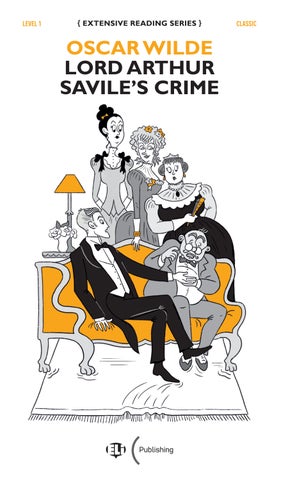

OSCAR WILDE
LORD ARTHUR SAVILEāS CRIME
About the Author

Oscar Wilde (1854-1900) was a famous writer from Ireland. He is known for his plays, poems, and stories. He became very famous in the late 1800s.
Early Life and Family
Oscar Wilde was born on 16th October 1854 in Dublin, Ireland. His father, William, was a famous doctor, and his mother, Jane Francesca, was good at languages and wrote poetry. They had three children, Willie, Oscar and Isola Francesca. Oscarās sister died when she was ten years old and Oscar was twelve.
Studies
After finishing school, Oscar studied at Trinity College, Dublin, and then at Oxford University. Here he became interested in the Aesthetic Movement. This was an artistic movement in the late 1800s, also known as āart for artās sakeā. For these people, the most important thing was that art was beautiful and that it didnāt need an important meaning behind it.
Travelling and Love
After university, Oscar went to live in London. He wrote a book of poetry called Poems (1881) and people started to think of him as a good writer. That same year he met Constance Lloyd for the first time in London. Then Oscar decided to go to the United States to talk about art and beauty in the universities there. He stayed for nine months. Then he came back to Great Britain and in 1884, Oscar became Constance Lloydās husband. They had two children, Cyril (1885) and Vyvyan (1886), but after Vyvyan was born, Oscar and Constance werenāt as happy as before. Oscar began to prefer men to women. This was a problem in Victorian England because homosexuality was against the law.
His Writings
After writing for many magazines, Oscar became editor of The Ladyās World magazine in 1888. This was a very good moment for Oscar. He became famous for writing The Happy Prince and Other Tales (1888). Then in 1891, he wrote another collection of childrenās stories called A House of Pomegranates That same year, he wrote his one and only novel, The Picture of Dorian Gray. He wrote funny plays for the theatre too. The most famous is The Importance of Being Earnest (1895).
Later Life
Wilde liked to be different and was popular because of his ideas and story-telling words, but in 1895, he went to prison for his homosexuality He spent two very difficult years in prison. When he came out, he went to France and stayed with friends or in cheap hotels. He wrote a poem, The Ballad of Reading Gaol, about his time in prison. Oscar died on 30 November 1900 at the age of 46 and was buried in Paris.
OOKMARKS
Bookmarks is an innovative series of graded readers for curious students who want to enjoy reading in English. It is divided into six levels from beginner to advanced.
Donāt miss Bookmarks Readers, the series where every reader finds their place.
Lord Arthur Savileās Crime by Oscar Wilde
Adaptation and activities by Silvana Sardi
Illustrated by Sara Cristofori
Bookmarks
Founder and Series Editors
Grazia Ancillani, Daniele Garbuglia (Art Director)
Graphic Design and Layout: Emilia Coari
Production Manager: Francesco Capitano
Photo credits: Shutterstock
Ā© 2026 ELI s.r.l. P.O. Box 6 62019 Recanati MC Italy support@elionline.com www.elionline.com
Typeset in 12 / 15 pt Monotype Dante
Printed in Italy by Tecnostampa Recanati ā EBM101.01 ISBN 978-88-536-4857-0 First edition: February 2026
www.elipublishing.com
Oscar
Lord Arthur Savileās Crime
Wilde
Retold by Silvana Sardi
Illustrated by Sara Cristofori
About the Story
This short story about Lord Arthur Savile, a rich, young man, is set in London during the Victorian period (18371901). Lord Arthur is happy and in love with Sybil. She will soon become his wife. Then one evening at a party, a cheiromantist āreadsā Lord Arthurās hand. He tells him that he will kill someone in the future, and Lord Arthur believes him. Here, Wilde shows us how rich people believed in cheiromantists and other strange things.
Lord Arthur is rich and doesnāt have to work, so he spends all his time worrying about what the cheiromantist said. He doesnāt want Sybil to become his wife until after the ācrimeā. This is a funny and crazy idea. Wilde shows us that rich people at that time often worried about silly things and about looking good for others instead of real problems. Lord Arthur tries to kill people, but things donāt go as planned. This is what makes the story so funny to read and shows that his idea is wrong. Wilde uses these situations to make us think about the Victorians and their strange āvaluesā.
Lord Arthur Savileās Crime, first published in 1887 in the British literary magazine The Court and Society Review, talks about āfateā, love, and choosing what to do in your life. Later, this story and others by Wilde, like The Canterville Ghost, became part of a collection called Lord Arthur Savileās Crime and Other Stories, published in 1891.
Main Characters

Lord Arthur Savile
The protagonist and title character of the story.

Lady Gladys Windermere
She loves life and having parties.

Sybil Merton
Sybil loves Lord Arthur very much and wants to become his wife as soon as possible.

Mr Septimus Podgers
He āreadsā the lines on peopleās hands to tell them about their future.

The Dean of Chichester
The Dean, Lord Arthurās uncle, loves clocks.

Count Rouvaloff
One of Lord Arthur Savileās friends, heās a Russian with revolutionary ideas.

Lady Clementina Beauchamp
Lady Clem is Lord Arthurās cousin.

Herr Winckelkopf
Heās good at making all kinds of things.
Chapter 1 Lady Windermereās Party

Every important person in London was at Lady Gladys Windermereās last party before summer. Lady Gladys was now forty years old with no children. After three husbands but always only one lover, she loved parties and all the good things of life.
There were all kinds of people at the party. There were men of the world of business and important women in beautiful dresses. There was even Princess Sophia of Carlsruhe, with her little black eyes and her big expensive hat. The party was very good, and Princess Sophia stayed until about 11.30 p.m. After she left, Lady Windermere went to talk to the Duchess of Paisley. She looked about the room and said, āWhereās my cheiromantist*?ā
āYour what, Gladys?ā said the Duchess. Was it the same as a cheiropodist*? she asked herself.
āMy cheiromantist, Duchess. He tells me what to do. He comes to see my hand every week, on Tuesdays and on Fridays,ā said Lady Gladys. āCome and meet him!ā
āOh! Is he here?ā The Duchess of Paisley didnāt want to meet him⦠not at a party. After all, he was a kind
Windermereās Party
of cheiropodist, only Gladysās cheiromantist did hands, not feet. She never saw her cheiropodist at parties!
āOf course heās here! I only have parties when he can come,ā said Gladys. āHe tells me about my future!ā
āOh, I see!ā said the Duchess, happier now. āDoes he tell you lots of nice things?ā
āGood and bad,ā answered Lady Windermere. āFor example, next year, the sea isnāt safe for me, so I wonāt go on any boats. Itās all here to see on my hand. I think itās a good idea for everyone to have a meeting with a cheiromantist two or three times a month. Then you know what not to do. Now, where is Mr Podgers?ā
āIāll go and look for him, Lady Windermere,ā said a tall, good-looking young man near them.
āThanks so much, Lord Arthur, but I donāt think youāll find him.ā
āBut Lady Windermere, you say heās wonderful*! Iāll find him no problem.ā
āYou donāt understand. Thereās nothing wonderful about him. Heās a little fat man with no hair on his head. He wears big glasses⦠Ah, here he is! Now, Mr Podgers, please read the Duchess of Paisleyās hand.ā
āDear Gladys, I really donāt think itās right,ā said the Duchess, but she took off the glove of her right hand.
āNothing interesting ever is,ā said Lady Windermere. āSo, Mr Podgers, what can you see?ā
Mr Podgers looked at the Duchessās little fat hand and said, āYouāll live a long life, Duchess, and youāll be very happyā¦.ā
Lord Arthur Savileās Crime
āOh, Mr Podgers! Tell us something more⦠interesting!ā said Lady Windermere.
āIām sorry, but thereās nothing more to tell. The Duchess has got lots of love in her life. She lives a good life because she knows very well whatās right and wrong.ā
āOh! What a wonderful man!ā said the Duchess. āPlease tell me more, Mr Podgers.ā
āI see that you love new things,ā said Mr Podgers. Lady Windermere laughed*.
āWhen I became Paisleyās wife,ā said the Duchess, āhe had eleven castles* in Scotland but not one house that I could live in.ā
āAnd now he has got twelve houses and not one castle,ā laughed Lady Windermere.
āWell, my dear,ā said the Duchess, āI like āā āNice things,ā said Mr Podgers. āThings like hot water in every bedroom. Your Grace is right. Life is easier with nice things.ā
Next, there was Lady Flora, the Duchess of Paisleyās daughter. She was a tall Scottish girl with light brown hair. Mr Podgers took her long, slim hand in his to read.
āAh, I can see this lady plays the piano!ā said Mr Podgers. āYes, sheās a wonderful pianist, but she doesnāt really understand music very well. I also see that sheās honest*, so she doesnāt say much, and she loves animals.ā
āThatās right!ā said the Duchess to Lady Windermere. āFlora has twenty-four dogs at one of our houses in the country. Sheād like to bring them to our house in town too, but her father always says no.ā
Lady Windermereās Party
āWell, I like lions* better than dogs,ā said Lady Windermere, laughing. āThey usually come to my house on a Thursday evening!ā
Sir Thomas, an old man with white hair, was next. He was very happy with Mr Podgersā words. He wanted Mr Podgers to read his second wifeās hand, but she didnāt like the idea. She wasnāt the only one. The Russian Ambassador didnāt even take his glove off! Other people didnāt like the idea of getting their hand read after Mr Podgers said to Lady Fermor, āI see that you donāt like music, but youāre very fond of* musicians!
Lord Arthur Savile didnāt know anything about Lady Fermorās story, and he really wanted Mr Podgers to read his hand. He went over to Lady Windermere and, a little red in the face, asked, āCan Mr Podgers read my hand?ā
āOf course!ā said Lady Windermere. āThatās what heās here for. All my lions do what I say, Lord Arthur, but remember Iāll tell Sybil everything. Iām seeing her for lunch tomorrow to talk about hats.ā
Lord Arthur smiled. āIām not worried,ā he answered. āSybil knows everything about me, and I know everything about her.ā
āOh, how boring!ā said Lady Windermere. āNow, Mr Podgers, Lord Arthur Savile wants you to read his hand. Donāt tell us that heāll get married* to Sybil, one of the most beautiful girls in London. That was in the newspapers a month ago.ā
Lord Arthur Savileās Crime
Mr Podgers smiled, took Lord Arthurās right hand, and looked at it. Then he stopped smiling and said nothing. Lord Arthur saw that something was wrong and said, āI am waiting, Mr Podgers.ā
Mr Podgers said nothing, but he took Lord Arthurās left hand and looked at it too. His face became white, and he looked very worried. Then he remembered where he was.
āHmm... You will be very happy,ā said Mr Podgers quickly. He didnāt look at Lord Arthur in the face.
Lord Arthur wasnāt happy. Something was very, very strange*. Lady Windermere was bored. She told everyone to follow her into the next room for something to eat. Lord Arthur stopped Mr Podgers and said, āMr Podgers, be honest with me.ā
Mr Podgers looked around. Then he said, āI saw something bad in your future.ā
āHow bad?ā asked Lord Arthur.
āVeryā¦you... you will murder* someone,ā said Mr Podgers.
Lord Arthur stood there with his mouth open. āMurder? Me? No! Iām not that kind of person! Iām nice!ā he cried*.
āI know,ā said Mr Podgers. āBut I saw it in your future. You canāt change it. Youāll commit a crime*, and it will be murder.ā
Lord Arthur ran out of the house into the cold night air. He walked and walked. He couldnāt believe it! I canāt get married to my dear Sybil and then murder someone,
