Climate Events and Insurance Radar in Brazil - 2025
Radar of Climate Events and Insurance in Brazil
Profile of Losses in Brazil ................................ Main Disasters of Recent Years ................................ Estimate of the Protection Gap ................................ Trends and Opportunities
Luciana Dall’Agnol, Pedro Werneck and Thiago Ayres
Radar of Climate Events and Insurance in Brazil / CNseg
Rio de Janeiro: CNseg, November 2025.
82 pp.
Produced in collaboration with EY
Marcelo Lustosa
Fernando Gouveia
Fernando Silas Siedschlag
Julia Pereira
Mariana Balieiro
Contact information:
Rua Senador Dantas 74, 16º andar - Centro - Rio de Janeiro, RJ - CEP 20031-205 Tel. 21 2510 7777 - www.cnseg.org.br
Executive Summary
History of climate-related losse
Major events of recent years1
Between 2022 and 2024, 67 significant events were identified, resulting in estimated economic losses of BRL 184 billion. By 2025, with data up to June, 10 events had already been identified, which accumulated estimated losses of BRL 31 billion
Despite the higher frequency of isolated phenomena related to rainfall volume (hydrological), such as storms, floods and inundations, drought events are more representative in terms of economic losses, since they are phenomena that affect more extensive regions (practically the entire country) throughout the year.
losses in the last decade (Jan/2015-Jun/20252
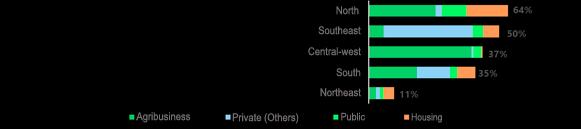
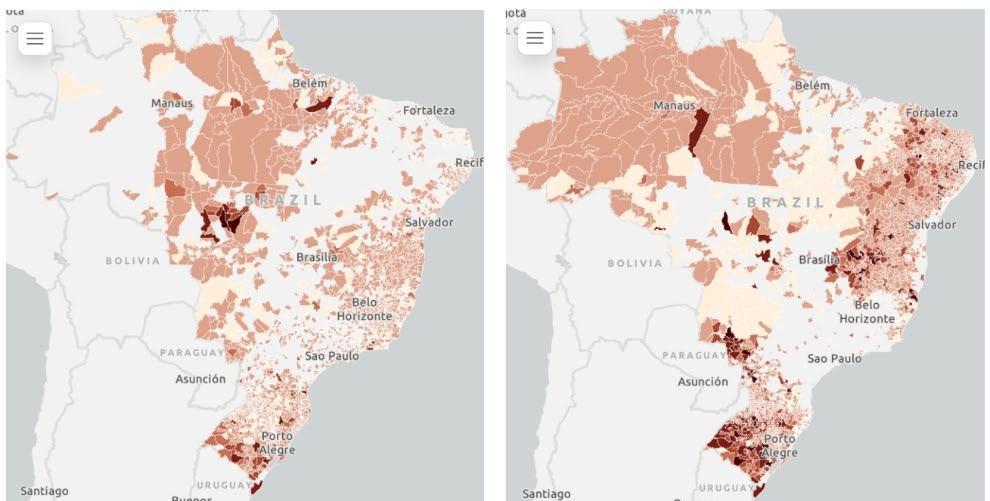
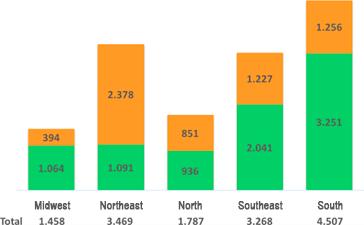
The Southern Region concentrated the largest part of these losses The Agribusiness sector was the most affected in all Regions.
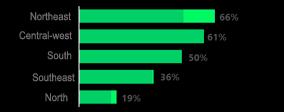
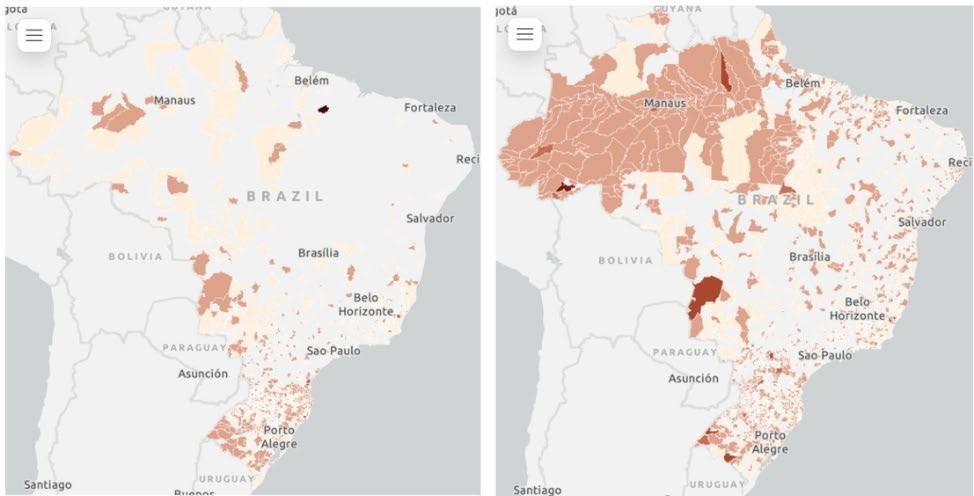
Drought events, usually associated with losses in the Agribusiness sector, were responsible for more than 50% of the losses observed in the Midwest, South and Northeast regions In the Northeast, significant losses are also recorded in the Public sector due to water supply shortages.
% of Losses due to Drought Events
% of Losses per Region
Hydrological events had a more significant impact on the North, Southeast, Midwest and South; however, their impacts affect various sectors depending on the region considered.
% of Losses due to Hydrological Events
Other effects of climate disasters
Beyond the economic effects, climate events also affect the lives and health of the population. These repercussions manifest as a number of deaths, typically due to flooding, inundations, and flash floods, and affected individuals, such as homeless or displaced, resulting from various events, ranging from drought to flooding and cold waves.
It is also worth highlighting the effects on Health, both direct effects in the form of sick and injured, and indirect and chronic effects in the form of increased incidence of infectious diseases, including viral, bacterial, and parasitic
1 According to CNSEG research, considering estimated losses above BRL 300 Million, 10 or more deaths, or more than 100 affected
2 According to SEDEC data
Impacts on the Insurance Market
Compensation for climate-related events
In 2024, compensation paid for damages totaled BRL 60.4 billion. Of this total, approximately 12% (BRL 7.3 billion) are related to climate events.
This amount not only represents financial relief for the population that has faced significant losses due to natural disasters but also highlights the importance of the insurance sector in protection against risks associated with climate change, and reduction of dependence on public resources in crisis management
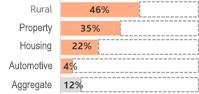
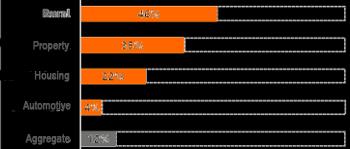
Compensation for climate-related events compared to total sector compensation for the year 2024
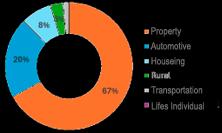
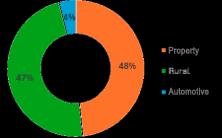
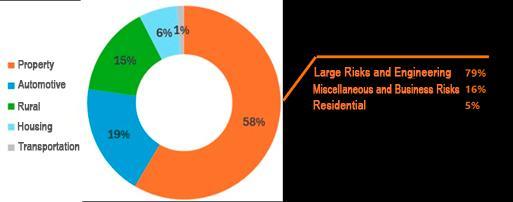
Most affected Groups of Lines of Business (% of indemnities paid in 2024)
Although the Agribusiness sector is the most affected by climate events in terms of economic losses, it does not concentrate on the largest volume of compensation. This result is explained by the low participation of rural insurance in Brazil. In 2024, only about 6% of the total area planted with grain had insurance coverage, which represents a reduction of about 50% compared to 2023. (CNseg, 2025; CONAB, 2025).
% of Claims Paid in 2024
Reinsurance
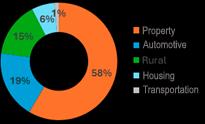
In this regard, the Property group presented the largest share of claims related to climate disaster events in 2024, with 58% of claims. It is noteworthy that this group includes both mass-market products offered to individuals, such as Residential, and products offered to companies, such as Comprehensive and Major Risks.
The Housing and Auto groups also have a significant share in the volume of claims, also reflecting a significant portion of the population's assets at risk.
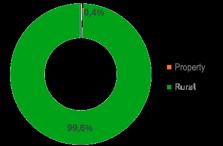
The groups that used reinsurance the most in disasters were Property, Housing and Rural.
In the event in Rio Grande do Sul, taking as an example an exceptional case, reinsurance had a participation of approximately 69% of the reported indemnities.
Protection Gap
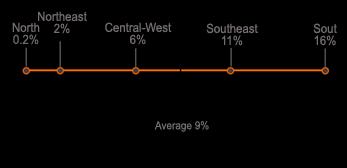
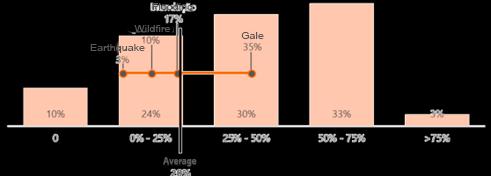
Based on a study carried out by CNseg with its associates, it is estimated that approximately 9% of the economic losses from climate disasters are covered by the Brazilian insurance market (in 2024 this average reached 13%, mainly due to the disaster in Rio Grande do Sul).
In comparison to the experience of developed Countries, the estimated average coverage varies between 20% and 55%, depending on the methodology, period analyzed and scope considered by the study.
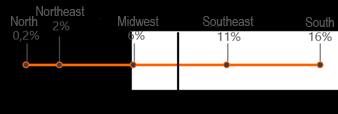
It should be noted that the North and Northeast regions have the largest protection gap, with average coverage of less than 2%
Coverage range for a representative portion of the Economic Losses from the analyzed Climate Disasters
Main Events of 2024
Floods and inundations in Rio Grande do Sul (2nd Quarter)
People Affected: 2.4 million
Deaths: 182
BRL 35.6 Billion
Drought throughout the Country (Year)
People Affected: 33,8 Mil
Deaths: 5
Portion Compensated per group of lines of business
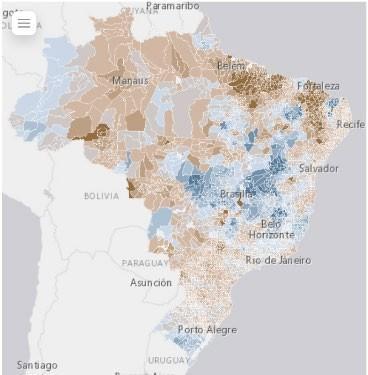
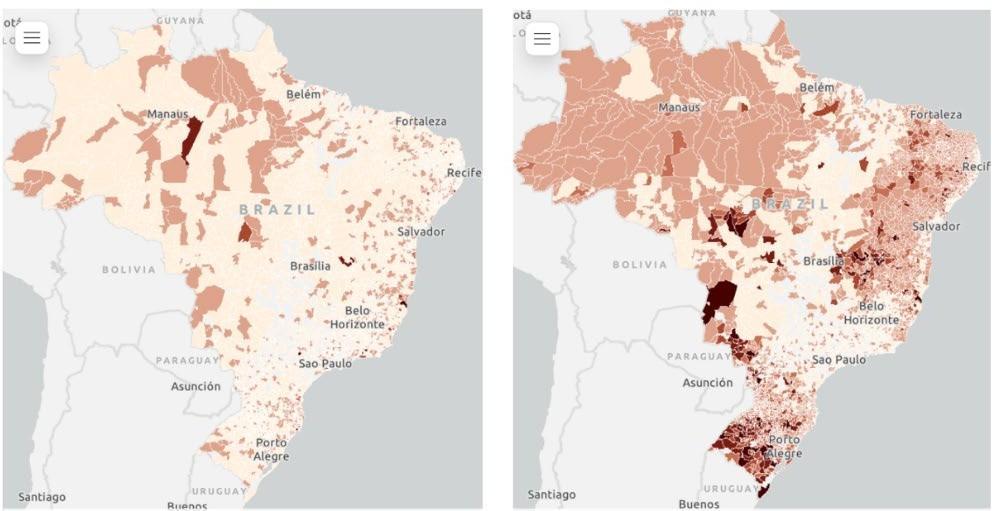
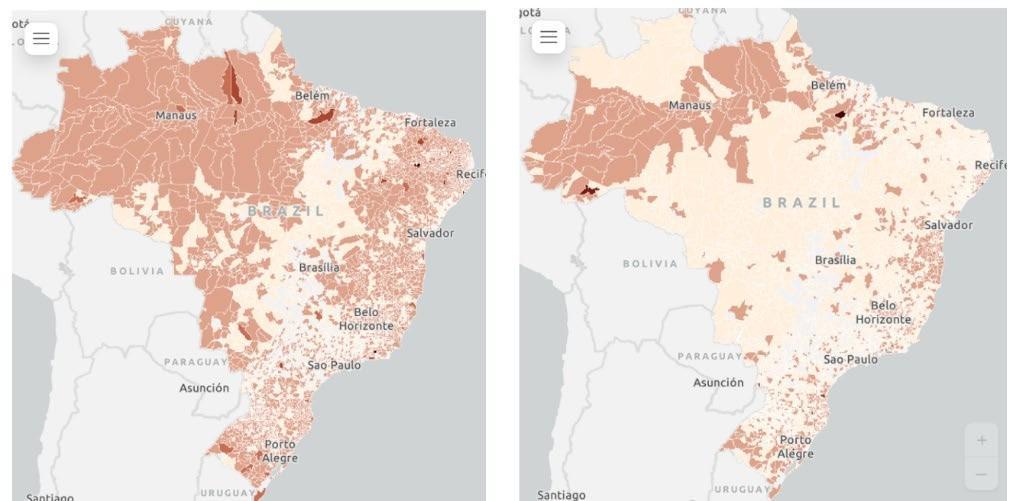
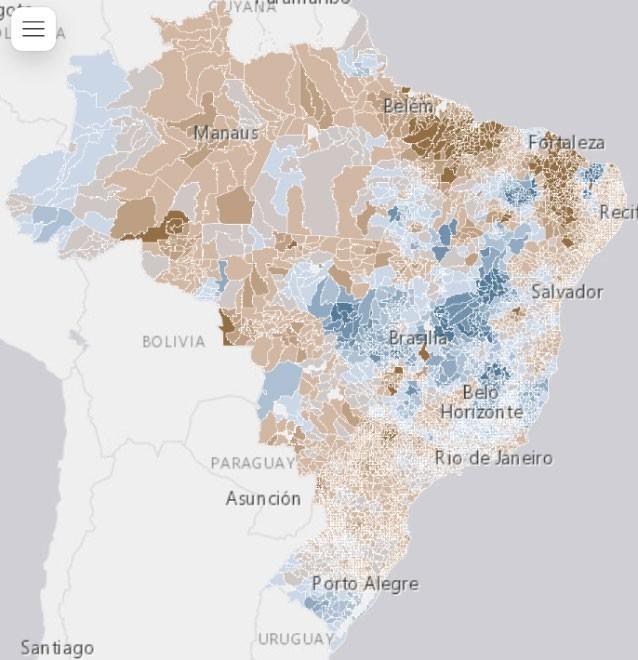
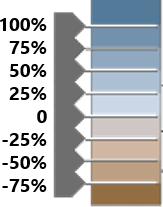
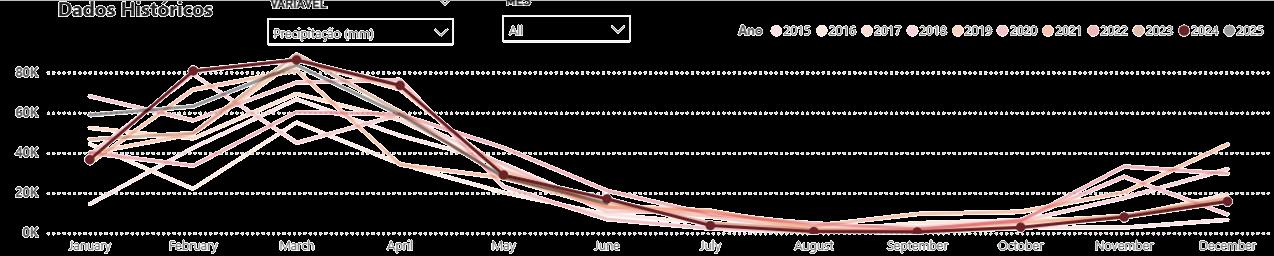
Relative difference between the observed rainfall volume of 2024 and the average of the previous 10 years
Estimated Damages: $ 13.2 Billion 6% Compensated
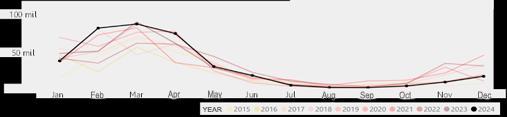
Historical Rainfall (mm) – Brazil
Relative difference between the observed rainfall volume of 2024 and the average of the previous 10 years (months of Aug, Sep and Oct)
Portion Compensated per group of lines of business
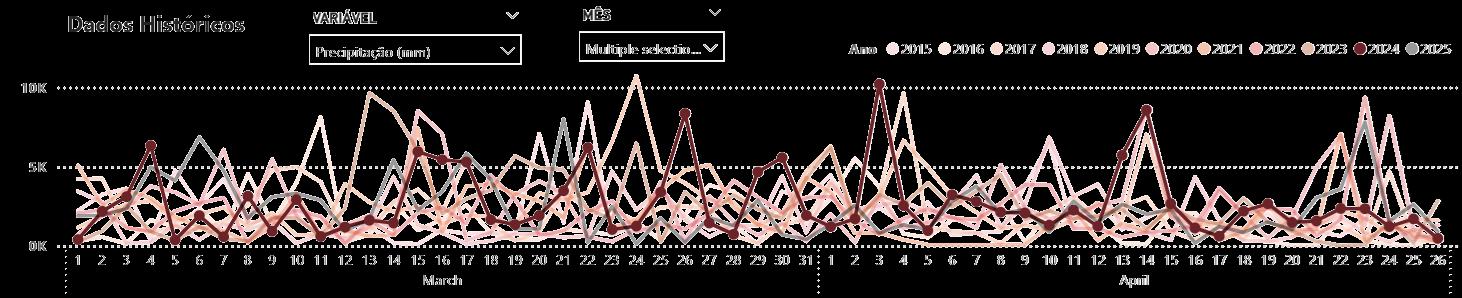
Relative difference between the observed rainfall volume of 2024 and average of the previous 10 years (months of Feb, Mar and Apr)
Deaths: 4
Portion Compensated per group of lines of business
Estimated Losses: BRL 1 billion 2% Compensated
Historical Rainfall (mm) – São Paulo
Source: EY, INMET data
Compensated losses per group of lines of business
Relative difference between the maximum observed temperature of 2024 and that of the previous 10 years (month of August)
Source: Prepared by the author
Trends
Aggravation of observed losses due to climatic events3
With the increase in global warming, the effects of climate change are becoming increasingly severe, this resulting in greater losses economics
This new risk reality directly impacts how insurance companies identify, assess and manage their exposures, requiring a review of traditional processes.
The growing awareness of climate issues has transformed society's perception of risk, strengthening the understanding of insurance as an essential instrument of adaptation and resilience in the face of extreme climate events.
Source: Own preparation with data from SEDEC
Impacts and challenges for the Insurance Company market:
Product Pricing
Historical losses may not adequately reflect the magnitude and frequency of future climate risks, requiring the incorporation of different analytical approaches to more accurately reflect future exposure.
However, the scarcity of reliable data and the limited disclosure of relevant climate information applied to insurance operations make it difficult to adequately price these risks. (BIS, 2023)
Coverage Offer
Climate disasters in Brazil show that the economically vulnerable population is the most affected. It is necessary to develop solutions to strengthen the protection of this segment, whether through accessible products or publicprivate protection mechanisms.
Losses in public infrastructure and essential services show that many of these facilities do not have insurance coverage. It is important to explore ways to make the offer of insurance viable for cities, urban infrastructure and critical services.
Risk Management
Climate risks can present different levels of severity, requiring a combination of traditional and innovative mechanisms to allow the diversification of exposures and expand the capacity of the insurance market, avoiding the occurrence of anti-selection.
Climate risk cannot be fully absorbed by the insurance sector. A model of sharing between different agents is essential, ensuring the sustainability of the ecosystem.
Opportunities
Increased supply and progress in closing the protection gap:
As extreme weather events become more frequent and impactful, insurance companies face the challenge of adapting their offerings to protect policyholders and promote the resilience of communities. The growing demand for insurance that covers climate risks opens opportunities to develop new products.
New Products and Services:
There is potential for products that integrate technology, data and agile processes, with clear and easy-to-understand conditions. Insurance companies can act before the crisis, promoting alerts, monitoring and preventive measures, and after the crisis, offering emergency assistance and recovery support, making insurance a continuous adaptation tool.
The combination of financial coverage with risk management services allows for more complete and strategic solutions.
New Audiences and Horizons:
Accessible products and public-private protection schemes can expand coverage for low-income populations and small businesses, reducing social protection gaps, increasing insurance inclusion, strengthening trust in the sector and stimulating spontaneous demand for other insurance products.
It is necessary to think about ways to develop and offer solutions for cities, urban infrastructure and strategic services, increasing the resilience of the public sector and society, protecting critical assets and ensuring the continuity of essential services in the face of extreme weather events.
Incentive for risk mitigation:
Insurance can become an instrument that not only protects, but also directs and catalyzes more responsible and resilient economic behaviors
Responsible Investment and Underwriting:
Allocating resources to assets aligned with the sector's investment profile and that have a positive socioenvironmental impact allows insurance companies to foster sectors and practices, which reduce climate and socioenvironmental risks in the long term.
Developing pricing criteria that reward risk mitigation practices creates a mechanism capable of stimulating the implementation of sustainable measures by policyholders. This approach can generate a ripple effect, influencing insurance premiums as economic agents implement concrete actions.
Climate Transition Insurance:
Integrating transition plans with active engagement of policyholders enables continuous monitoring, technical guidance, and support for the implementation of mitigation and adaptation measures, strengthening operational resilience and the implementation of sustainable practices.
Expanding the insurance offering to sectors that are strategic for climate transition and sustainable and lowcarbon practices creates synergy between the risk assumed and the long-term socio-environmental benefits, while enabling these activities.
Developing nature insurance, encouraging the valuation of natural capital and the maintenance of essential ecosystem services, contributing to reducing risks that compromise environmental and economic conditions in the long term
Sustainable Reconstruction:
The market can design products that, in addition to coverage, include additional benefits aimed at adapting to and mitigating risks after damage has occurred. For instance, they can include compensation to cover improvements that reduce future risks. (IAA, 2023)
Furthermore, insurance companies could establish requirements for houses to be rebuilt in accordance with stricter building codes.
CNseg Message
The worsening of climate events in Brazil and the world has imposed increasing challenges on society, public authorities and, in an increasingly intense manner, on the insurance sector. The data presented in this report highlights the urgency of understanding and addressing the impacts of climate change from the perspective of financial protection and social resilience.
In the last ten years, Brazil has faced a significant increase in the frequency and intensity of natural disasters. Between 2015 and 2019, an average of 2,500 events were recorded per year; between 2020 and 2024, this number almost doubled, reaching approximately 4,500 annual records. Drought events and hydrological phenomena, such as heavy rains, flash floods and flooding, were the main causes of the economic losses recorded during the period. While droughts generated the greatest accumulated losses, affecting large productive regions and water supplies, events associated with rainfall resulted in a greater number of fatalities, injuries, and displaced people, highlighting the diversity and severity of climate impacts in the country.
In 2024, the climate disaster in Rio Grande do Sul became the most severe ever recorded in the country, affecting 2.4 million people, resulting in 182 deaths and BRL 35.6 billion in direct losses. However, the economic and social impacts of the event went far beyond immediate losses. It is estimated that the total damage, including effects on infrastructure, agriculture, housing, and the environment, reached BRL 88.9 billion.
The survey also highlights the regional inequality in coping and recovery capacity. While the Southern Region concentrated the greatest economic losses, the North and Northeast presented the largest protection deficit, with less than 2% of losses caused by disasters covered by insurance policies. At national level, it is estimated that only 9% of economic losses associated with climate disasters are currently protected by insurance. This rate remains far from the average observed in developed economies, which ranges from 20% to 55%.
Even in the face of this challenging scenario, the Brazilian insurance sector has reaffirmed its essential role in protecting society. In 2024, insurance companies paid BRL 7.3 billion in claims related to climate events, alleviating the financial impact on families, businesses, and local governments. The Property (mass market and large risks) lines of business accounted for 58% of these claims, followed by the Auto (19%), Rural (15%), and Housing (6%) lines of business, reinforcing the importance of insurance as an instrument of stability and economic reconstruction.
International experience shows that countries with greater insurance participation in society are able to recover more quickly from disasters, reduce emergency public spending, and strengthen their local economies. Brazil has the conditions to follow this path, provided that insurance is recognized as a strategic part of urban climate adaptation policies and social protection.
CNseg works continuously to expand insurance protection in the country, promoting dialogue between insurance companies, government and civil society, with the aim of placing insurance at the center of the national climate adaptation agenda. Concurrently, it fosters innovation in products and services, strengthens technical training and develops structuring tools, which allow insurance companies to expand their leading role in addressing climate disasters and building a more resilient country.
This report consolidates an unprecedented effort to analyze the profile of economic losses and the protection gap in Brazil. More than a statistical snapshot, it marks the beginning of a new stage of continuous sectoral monitoring, gathering data and evidence that demonstrate how the insurance sector is impacted by climate disasters and, at the same time, how it can contribute more effectively to reducing vulnerabilities and expanding the protection of society.
Addressing climate risks requires cooperation between the public and private sectors, investments in resilient infrastructure, and valuing insurance as a tool for economic and social security. The future of climate resilience in Brazil depends on our ability to anticipate risks, protect lives, and rebuild sustainably. The insurance sector is ready to continue contributing with technical knowledge, financial capacity, and social commitment in light of this new reality.
Introduction
In recentyears, Brazil has faced an increase in the frequency of natural disasters, such as heavy rains, floods, landslides, and severe droughts. These events not only cause direct damage, but also generate profound economic repercussions, affecting the lives of millions of Brazilians.
The insurance sector finds itself in a critical position, as the intensification of these events poses challenges to risk management and pricing, directly impacting losses, coverage policies, and protection gaps. To the same extent that it is extremely sensitive to the worsening of these issues, the sector plays a central role in climate adaptation, resilience, and social protection, preventing losses resulting from adverse events from turning into prolonged economic crises. Compensation enables the resumption of activities and the restoration of income, minimizing social and economic impacts, and preventing disruptions in production chains and essential services.
This report aims to assess the level of insurance compensation coverage (also called gap or protection gap) related to catastrophic events. Thus, the report provides a comprehensive overview of climate disasters in Brazil with a 10-year retrospective, focusing on the years 2022, 2023, 2024, and 2025 (partial data up to June), then presents the estimated impacts on the insurance sector based on data provided by market participants, and finally presents trends and opportunities for the market in its conclusions.
Although studies on the impact of natural disasters exist, there is a lack of sector-specific assessments that specifically address the implications for the insurance sector in Brazil. Global reports frequently present natural disasters and economic losses from a broad perspective, with analyses focused on macro-regions and impacts on reinsurance, case studies with lessons learned, and studies on catastrophes and general assessments of protection gaps, scenarios, and trends. In turn, Brazilian reports tend to focus on human and material damage and economic losses, covering a wide range of natural disasters, with analyses of disaster typology, municipal impacts, and aspects related to public policies.
The need to build a vision of the impacts of natural disasters on the insurance sector in Brazil is evident. The purpose of this report is to produce knowledge to help the insurance market and society become more resilient in light of the growing landscape of natural disasters. By providing detailed analysis of existing impacts and gaps, it can support the formulation of more effective policies, promote innovation in insurance products, and contribute to the protection of affected communities.
Methodology
Since one of the main purposes of this report is to estimate the coverage of climate disaster insurance, this section aims at describing the methodology and sources used to estimate the protection gap estimated and presented herein.
There are several approaches to estimating the protection gap, or insurance coverage in natural and climate disasters. The Mapfre Foundation (2024), in producing its annual report on the Global Insurance Potential Indicator (GIP), indicates two approaches:
(i) ex-ante , in which insurance coverage is defined before the occurrence of a specific insured event. In this case, an ideal volume of insurance premium participation in the market is defined, and the gap would be the difference between this ideal volume and the participation observed in the period.
(ii) ex-postin which the volume of economic losses for a set of events in a given period of time is estimated, as well as the volume of claims indemnified related to these events, and the protection gap would be derived from the ratio between the estimate of claims indemnified and economic loss related to the mapped events.
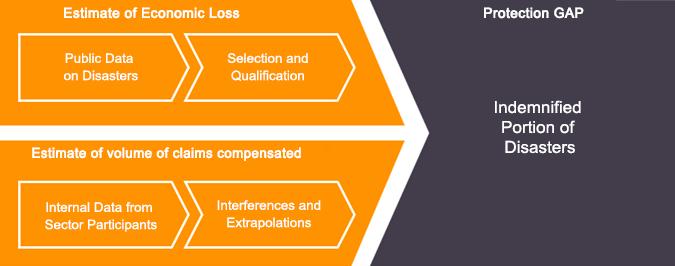
Thus, the estimation of the level of insurance indemnity coverage (also called protection gap) involves the study of the items presented below:
Source:
Capture and analysis of public data on disasters
Public data sources were compiled for the purpose of creating a relationship of climatic events covering the years 2022 to June 2025, and respective estimates of economic losses. The sources considered were:
Figure 1 – Methodology for Estimating the Protection Gap
Prepared by the author based on public data, data up to June 2025.
Secondary Data – Governmental and Public Sources
• Digital Atlas of Natural Disasters (Brazil – Sedec/S2iD): maintained by the National Secretariat of Civil Protection and Defense (Sedec), gathers records of disasters that occurred in the country from 1991 to 2024. Data is extracted from the Integrated Disaster Information System (S2iD), fed by the municipalities themselves. The platform allows for data consultation and extraction, with filters by municipality, disaster type, period of occurrence, and impact categories, such as human damage, material damage, and economic losses. Data up to 2024 was extracted in April 2025, and partial data up to 2025 was extracted in June 2025.
• EM-DAT – The International Disaster Database (CRED): the EM-DAT database compiles disaster data that includes human and economic losses, from information compiled from various sources, such as UN agencies, non-governmental organizations, reinsurance companies, research institutes, and news agencies. Data is provided for open access by the Center for Research in Disaster Epidemiology (CRED).
Secondary Data – Documentary Research
• Reinsurer Reports (AON, Swiss Re – Sigma, Howden): reports analyzing climate catastrophes were collected, which estimate insured losses due to natural disasters, economic losses, details of extreme events on an international scale, and seek to compile complementary analyses on climate risks and trends in extreme weather events.
• National Climate Data Reports (CEMADEN, INMET and CNM): technical documents prepared by the National Center for Monitoring and Alerts of Natural Disasters (CEMA-DEN), the National Confederation of Municipalities (CNM), and the National Institute of Meteorology (INMET) were used as inputs for understanding the historical record of extreme climate events recorded over the years, analyses of risk and vulnerability patterns associated with natural disasters, on decrees, economic losses and human impacts caused by natural disasters in Brazilian municipalities.
• World Meteorological Report (WMO): report collected with information on climate indicators and socioeconomic impacts of climate change in Latin America and the Caribbean, as well as documentation of extreme weather events that occurred in the year of analysis.
• News Portal Searches: searches were conducted in recognized journalistic outlets with the aim of gathering complementary information on extreme weather events, including reported data, statements from authorities, and socioeconomic impacts highlighted by the media.
Selection and qualification
After compiling a comprehensive overview of climate disaster events in Brazil, criteria were defined for selecting the most relevant events, including both the estimated loss value (total estimated losses exceeding BRL 300 million), such as the number of lives lost (estimated at 10 deaths or more) and the number of people affected (100 or more people affected).
In addition, work was carried out to enrich the information, covering descriptions of the events, periods of occurrence and location, as well as the consolidation of estimates of economic damage, lives and those affected.
Brazilian Classification and Coding of Disasters (Cobrade (2017))
It is worth highlighting here that Cemaden classifies disasters as natural and technological. Those classified as natural disasters are categorized into 5 groups:
• Geological: Earthquake, volcanic eruption, mass movement and erosion.
• Hydrological: Floods (related to overflowing watercourses, usually in plains), flash floods, inundations (related to the inability of drainage in urban areas).
• Meteorological: Large-scale systems (cyclones, cold fronts and convergence zones), storms (tornadoes, lightning storms, hail, heavy rain and gales), extreme temperatures (heat waves and cold waves, including frosts).
• Climatological: Drought (dry spell, drought, fire and low humidity of the air).
• Biological: Epidemics (viral, bacterial, parasitic and fungal infectious diseases).
For the assessment of the most relevant events, for estimating the protection gap, this report focuses on hydrological, meteorological and climatological phenomena.
Internal data from industry participants
To obtain data relating to the volume of claims paid out for the identified climatic events, we relied on the voluntary participation of a portion of CNseg members.
To deepen the discussions and enrich the analyses, an Insurance Laboratory was established with the participating entities, promoting broad participation and discussions on the results.
Inferences and Extrapolations
Based on information voluntarily provided by a sample of industry participants, data was processed and extrapolated to estimate the total volume of claims paid by the market, considering the participation of each company in its respective lines of business.
History of Climate-Related Losses in Brazil
Overview of Climate Disasters in Brazil
Brazil, being a country of continental dimensions, is exposed to a wide variety of climatic events, the impacts of which vary significantly according to the environmental, economic, and social characteristics of each region.
In the last 10 years, Brazilian municipalities have recorded losses associated with climatic and natural phenomena through the Integrated Disaster Information System (S2iD), maintained by the National Secretariat
for Civil Protection and Defense (SEDEC). According to data available up to June 2025, most records are related to events of drought, heavy rains and floods, although, in some years, forest fires have stood out among the main occurrences.
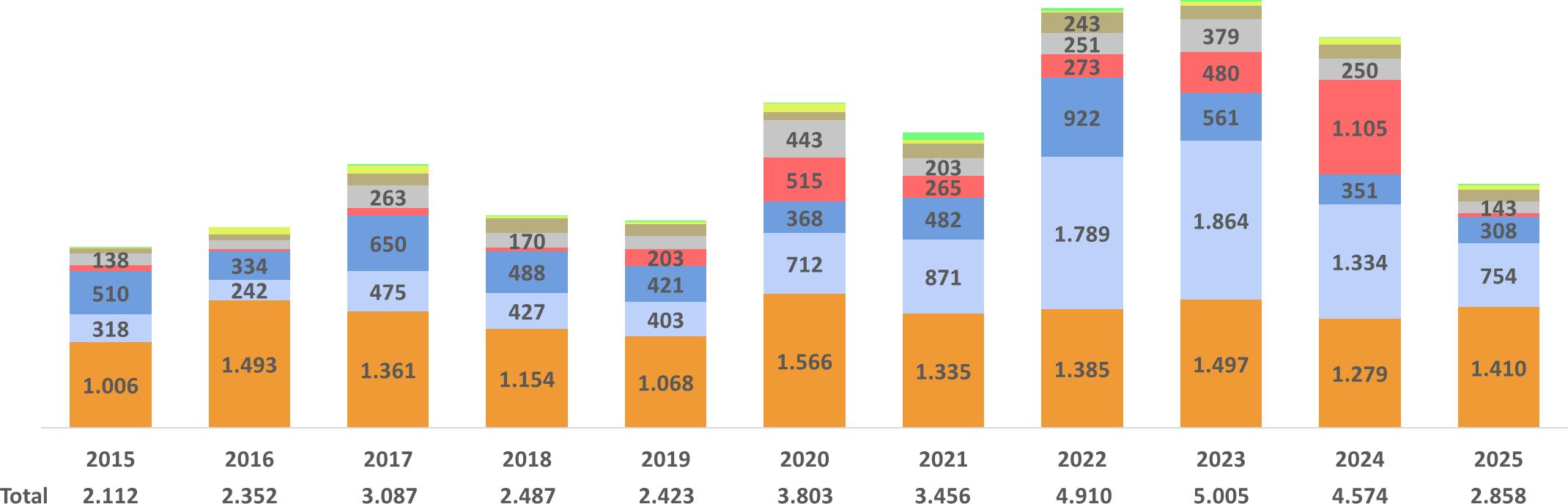
There is a significant increase in the number of records over the period, especially from 2022 onwards4. While between 2015 and 2019 the average volume was around 2,500 records per year, between 2020 and 2024 this average almost doubled, reaching approximately 4,500 records annually.
Source: SEDEC, data up to June 2025
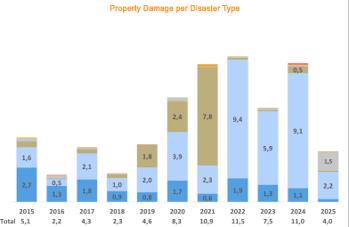
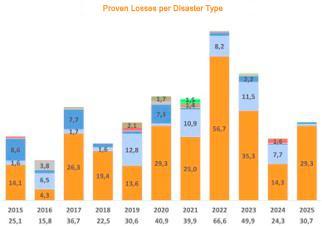
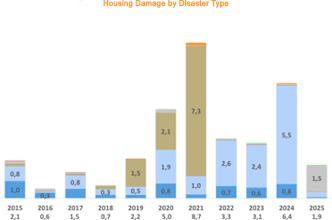
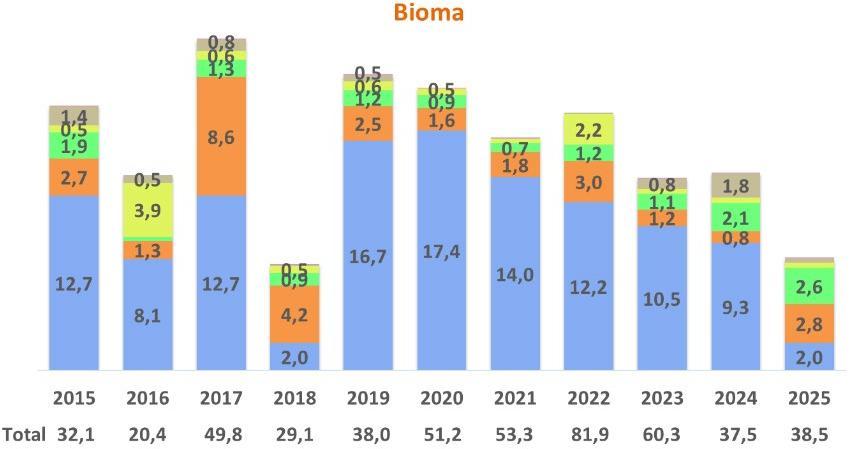
When analyzing the volume of financial losses5, a greater impact is observed associated with Drought and Heavy Rains, followed by Flooding events.
4
Graph 1 – Records of Natural Disasters Related to Climatic Phenomena per Typology
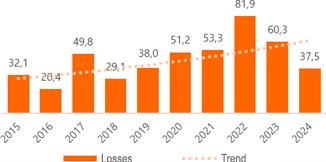
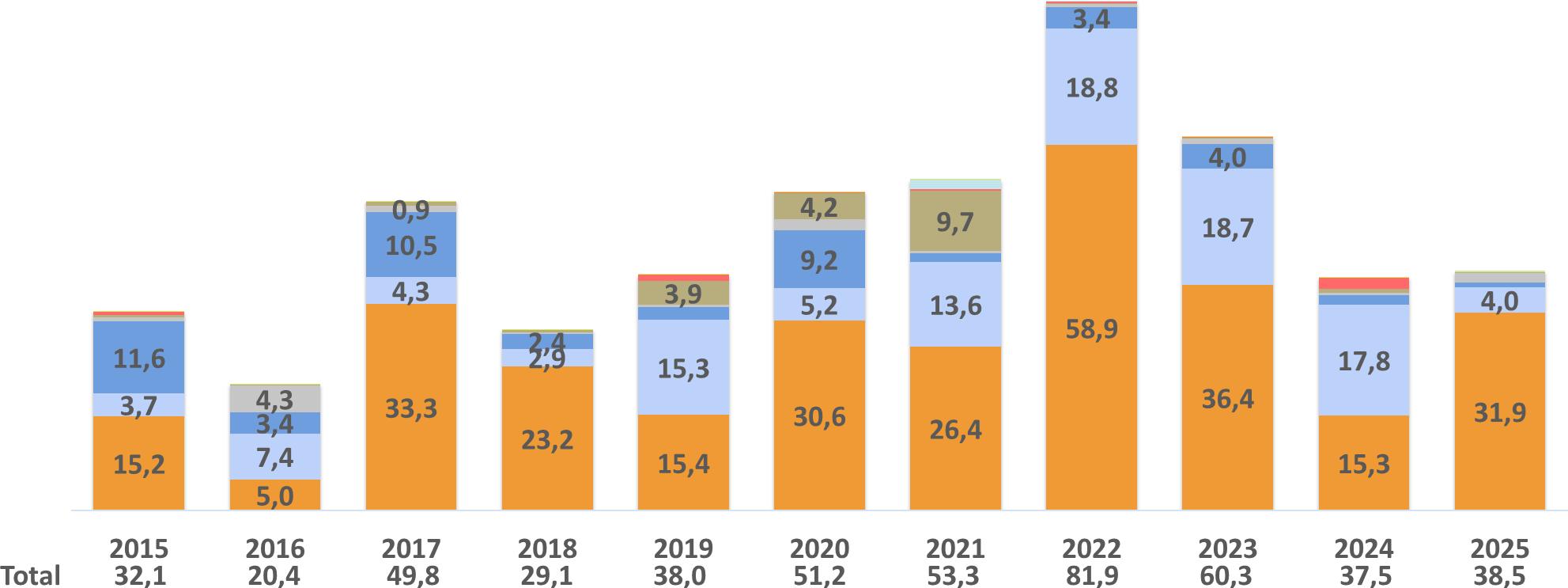
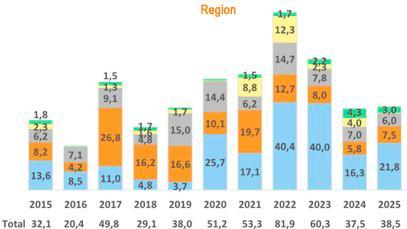
The volume of reported losses fluctuates considerably over the years, ranging between BRL 20 billion and BRL 82 billion, which suggests reflecting the concentration of losses resulting from intense or recurrent regional events throughout each year. This behavior reinforces the need for risk management strategies capable of dealing with peaks of concentrated losses and regionalized modeling.
In 2021, losses due to landslides and erosion stand out, mainly due to soil subsidence associated with rock salt extraction in the Maceió region. In 2022 and 2023, the La Niña phenomenon resulted in significant losses in agribusiness due to Droughts and Water Scarcity. Finally, the year 2024 presents a volume of losses resulting from fires, mainly in the interior of São Paulo and in several states in the North and Midwest.
Source: SEDEC, data up to June 2025
Regarding sole records6, 42% are related to losses of less than BRL 150,000. The second highest frequency is records with losses between BRL 3 million and BRL 12 million. It is also noteworthy that there are records with losses exceeding BRL 1 billion
When disregarding records related to losses from the Agribusiness sector, there is a greater participation of records with losses below BRL 150,000 (56%), with the second highest frequency (8%) being losses between BRL 150,000 and BRL 375,000.
Graph 2 – Losses from Natural Disasters Related to Climatic and Natural Phenomena: Brazil (BRL billions)
(By jun.)
≤
≤
Graph 3 – Distribution of records per loss range: Brazil 2015 – June 20257
Agribusiness 42%
Source: SEDEC, data up to June 2025
When analyzing the total volume of losses recorded, most of them are related to records between BRL 50 million and BRL 125 million and between BRL 1 billion and BRL 10 billion.
When disregarding records related to losses from the Agribusiness sector, most are categorized between BRL 1 billion and BRL 10 billion, without any other significant range.
Graph 4 – Total losses per loss range: Brazil 2015 – June 2025 2025 (BRL Bi)
Source: SEDEC, data up to June 2025
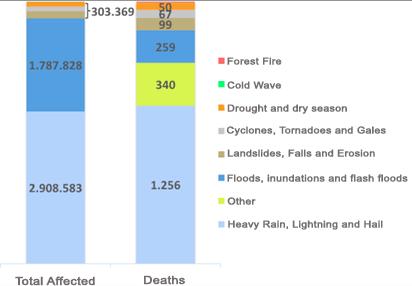
Regarding the social impact, these disasters resulted in several hundred deaths every year, among which the Petrópolis event in 2022 stands out, which generated more than 300 deaths.
The disasters also left millions affected, mainly homeless and displaced people, most notably the event inRio Grandedo Sulin2024, which affected approximately 2.4 million people.
Graph 5 – Deaths and People Affected by Natural Disasters: Brazil 2015 – June 2025
Source: SEDEC, data up to June 2025
The events that generated the highest number of deaths are those related to heavy rains, floods, and other causes, such as infectious diseases, for example.
The volume of homeless and displaced people is mainly due to heavy rains and floods.
Graph 6 – Human Damage per Disaster Type: Brazil 2015 – June 2025
Source: SEDEC, data up to June 2025
Breakdown per Sector
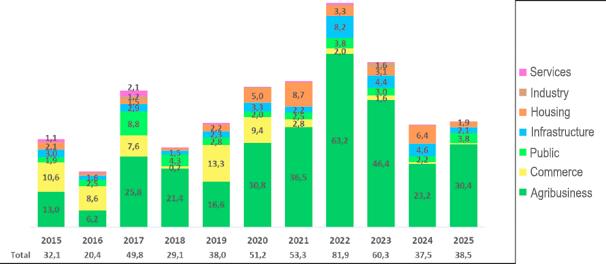
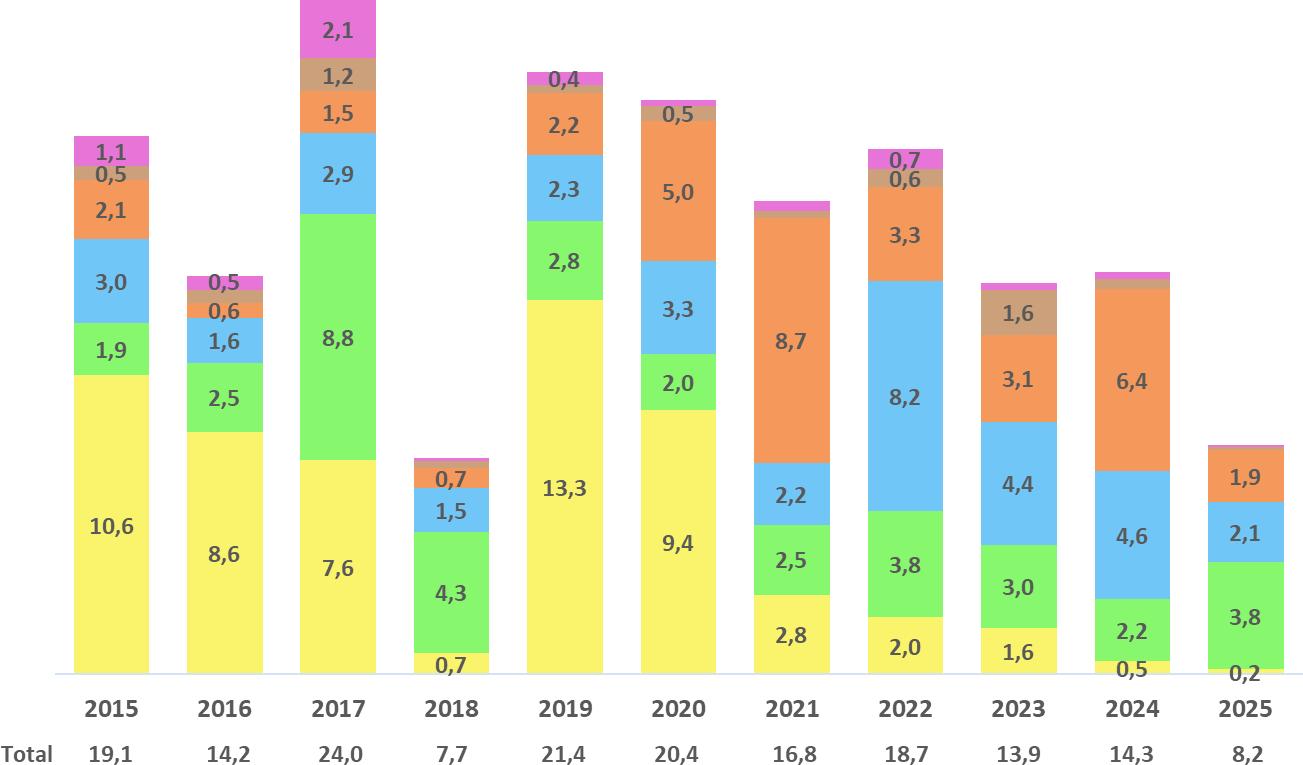
The Agribusiness sector presented the highest volume of losses related to natural disasters, mainly from the year 2020 onwards, which can be correlated to the exposure of this sector's productivity to adverse weather conditions.
When observing the other sectors (excluding Agribusiness), a smaller impact is found in the Industry and Services sectors, while the others
show variable predominance over time, depending on the profile of critical events that occurred each year.
2025
(Until June)
Graph 7 – Losses from Natural Disasters per Sector: Brazil 2015 – June 2025 (BRL billions)
Source: SEDEC, data up to June 2025
Graph 8 – Losses form Natural Disasters per Sector (excluding Agribusiness): Brazil 2015 – June 2025 (BRL billions)
Source: SEDEC, data up to June
(By jun.)
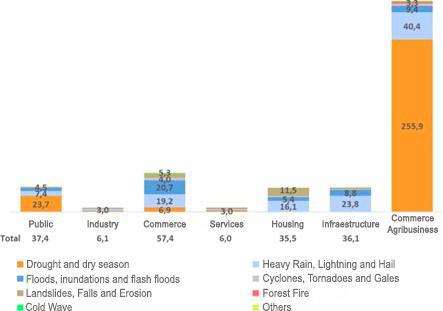
The sectors are not affected equally by different types of disasters and climatic phenomena. While the Agribusiness sector suffers from the effects of drought and dry spells, the Housing sector, for instance, is more affected by phenomena related to heavy rain, floods, inundations, and landslides.
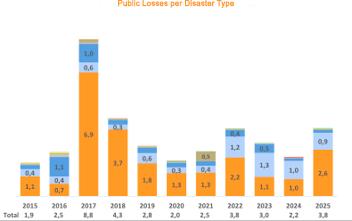
Another highlight of the impacts of drought is the Public Sector, especially regarding the supply of drinking water. In this context, the sector directs resources towards sending water trucks and opening new wells.
The Services sector is also significantly affected by the effects of drought, but with effects more related to the consequences of reduced agribusiness production and the impact of drought on the income of the general population.
The other sectors are more affected by rain and flooding events, mainly due to the greater physical and direct relationship between the natural phenomenon and the resulting property loss.
Graph 9 – Losses per Sector and Disaster Type: Brazil 2015 – June 2025 (BRL billions)
Source: SEDEC, data up to June 2025
Source: SEDEC, data up to June 2025
Graph 10 – Evolution of Losses per Loss Category 2015 - June 2025 (BRL billions)
By Jun)
(Até Jun.)
(Até jun.)
By Jun.)
Breakdown per Region
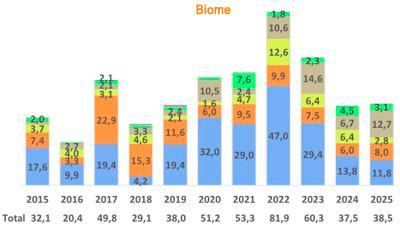
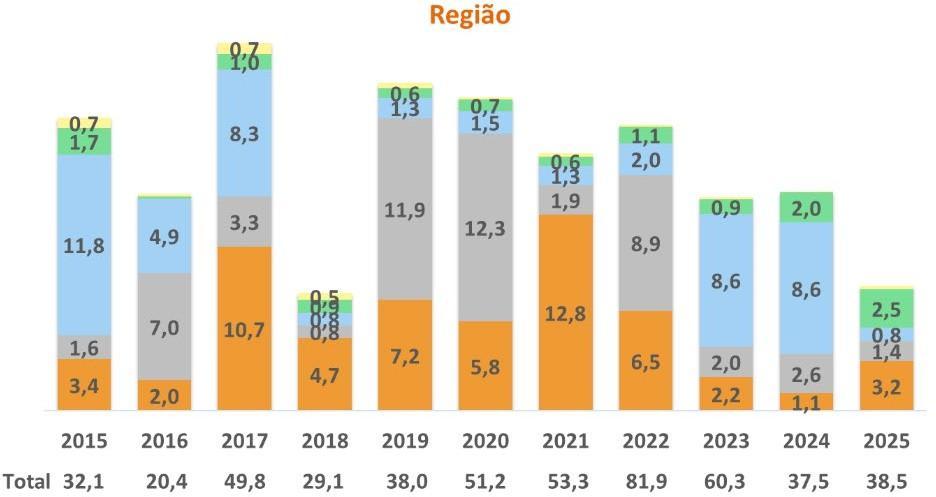
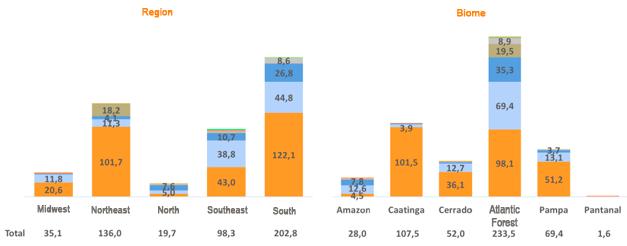
The Southern region concentrates a significant portion of the losses resulting from natural disasters in recent years. It is noteworthy, however, that a large part of this proportion is associated with the agribusiness sector (75%).
The Northeast and Southeast regions also presented a significant share in the total volume of losses.
In the Northeast, the Agribusiness sector predominates (62%), followed by the Public sector
(18%), while in the Southeast, the Agribusiness sector (43%) and the other Private sectors (35%) stand out.
Considering the distribution among Brazilian biomes, there is a significant participation of the Atlantic Forest possibly associated with the greater economic and population concentration9 in this region. However, depending on the year analyzed, biomes such as Caatinga, Cerrado, and the Pampa may also stand out.
Source: SEDEC, data up to June 2025
Graph 11 – Losses from Natural Disasters per Region and Biome: Brazil 2015 - June 2025 (BRL billions)
(By Jun)
(Until Jun)
When the agribusiness sector is disregarded, the Northeast and Southeast regions stand out more consistently, while the South region maintains relevance, although with less intensity.
In the analysis per Biome, the Atlantic Forest stands out recurrently, while the Caatinga showed greater relevance in the years 2017 and 2018.
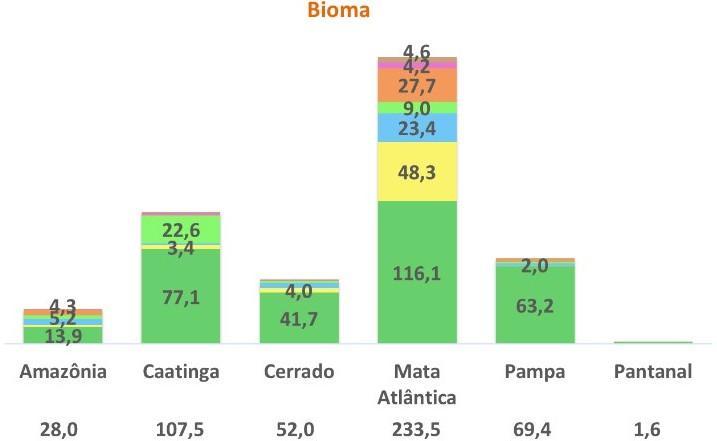
Drought and dry spells caused significant losses in the Midwest, South, and Northeast regions. In the first two cases, theimpacts were concentrated almost exclusively in the agribusiness sector, while in the Northeast, losses to the public sector were also observed, resulting from the scarcity of potable water.
Although to a lesser extent, the Southeast region was also significantly affected by droughts, especially in the Cerrado areas.
Losses associated with intense rainfall and flooding significantly affected the North,
Southeast, and South regions, while the Midwest was impacted to a lesser extent.
In the analysis per biome, it is observed that the Caatinga, the Cerrado, and the Pampa sustained losses mainly due to Drought events. Rain and flooding events resulted in a greater proportion of losses in the Amazon biome.
The Atlantic Forest biome was affected by both Drought and Rain/Flooding events, while in the Pantanal, fire events had a greater share in the historical volume of losses.
Graph 12 – Losses due to Natural Disasters per Region and Biome (Except for Agribusiness): Brazil 2015 - June 2025 (BRL billions)
Source: SEDEC, data up to June 2025
(By jun.)
(By Jun.)
13 – Losses per Region and Biome and Disaster Type: Brazil 2015 – June 2025 (BRL billions)
Source: SEDEC, data up to June 2025
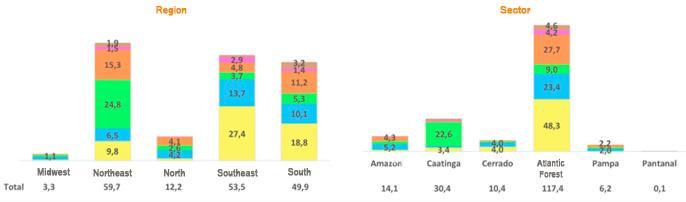
In the analysis per sector, the losses in the Midwest and South regions mainly registered losses related to the Agribusiness sector.
However, losses related to the Agribusiness sector also had a significant share of the losses recorded in the other regions.
14 – Losses per Region and Biome and Sector: Brazil 2015 – June 2025 (BRL billions)
By omitting the effects of the Agribusiness sector, one identifies that the Public sector is affected by losses mainly in the Northeast region (Caatinga biome).
Regarding the Commerce sector, the South and Southeast regions (mainly the Atlantic Forest) presented the highest volume of losses
Graph
Graph
Fonte: SEDEC, dados até junho de 2025
Source: SEDEC, data up to June 2025
The types of events affected theeconomic sectors differently depending on the geographic region analyzed.
In the case of Floods, Inundations and Flash Floods, the most affected sector in the South and Southeast regions was the Private sector (except for Agribusiness), while in the Midwest it was Agribusiness, in the Northeast it was Infrastructure, and in the North, it was Housing.
In the case of Heavy Rains, Lightning and Hail, the most affected sector in the Midwest, North and South regions was the Agribusiness sector, while in the Northeast it was Infrastructure and, in the Southeast, the Private sector (except for Agribusiness).
For Cyclones, Tornadoes and Gales, the most affected sector in the Midwest and Northeast was Infrastructure, while in the North it was Housing, in the Southeast the Private sector (except for Agribusiness), and in the South it was Agribusiness.
For these first 3 types of events, the predominance of losses related to Infrastructure in the Northeast and thePrivate sector (except for Agribusiness) in the Southeast stands out.
Drought and Dry spells, Fires and Cold Waves mainly affected the Agribusiness sector.
In the case of Landslides, Falls and Erosion, the most affected segment was Infrastructure, except in the Northeast, where the Housing and Private (except for Agribusiness) segments were mostly affected.
In the case of Landslides, Falls and Erosion, the most affected segment was Infrastructure, except in the Northeast, where the Housing and Private (except for Agribusiness) segments were mostly affected.
Finally, events categorized as "other," which include animal infestations and infectious diseases, primarily affected the Agribusiness sector in the South, North, and Northeast regions, and the public sector in the Southeast and Midwest regions.
When analyzing the main effects per region, in the Northeast region, the infrastructure sector is the most affected, suggesting a strong relationship between the recurrence of extreme events and the vulnerability of the Public Sector. This pattern reinforces the idea that drought and extreme hydrological events impose direct pressure on essential public services.
In the Midwest and South regions, the Agribusiness sector appears as the most affected, reflecting the direct exposure of agribusiness production to climate variability, especially prolonged droughts and dry spells. However, in the South region there is an aggravating factor: intense rainfall and flooding events also generate significant losses for the private sector, highlighting a double vulnerability both in rural and urban areas.
In the North, the Housing sector stands out, indicating that recurring floods more directly affect populations residing in precarious areas or those without proper infrastructure.
Gráfico 15 – Perdas por Região e Bioma e Setor (Sem Agropecuário): Brasil 2015 – junho de 2025 (R$ Bilhões)
Table 1 – Sectors with the highest recorded losses for each type and region of disaster: Brazil 2015- June 2025
Tornadoes and Gales
Falls and Erosion
Source: SEDEC, data up to June 2025
2 – Box of Losses per Type and Municipality 2015 - June 2025 (BRL)
Cyclones, Tornadoes and Gales
Floods, Inundations and Flash Floods
Heavy Rains, Lightning and Hail
Drought and Dry spells
Source: SEDEC, data up to June 2025
Figure
3 – Box of Losses per Sector and Municipality 2015-June 2025 (BRL)
Private Loss (except for Agribusiness)
Agribusiness Loss
Public Losses and Infrastructure Damage
Housing Damage
Source: SEDEC, data up to June 2025
Figure
Main Events
(2022, 2023, 2024 e 2025 – until June)
Despite the high volume of loss records resulting from climatic events by Civil Defense, usually, a single climatic event is related to several records - either because it affects different municipalities simultaneously, or because it generates effects over many days, when complementary records can be made.
Thus, we highlight the main events that occurred each year, considering the economic impacts (encompassing both private losses, as well as public losses, in infrastructure and housing), as well as the human impacts (whether through deaths, or the volume of people affected by the event).
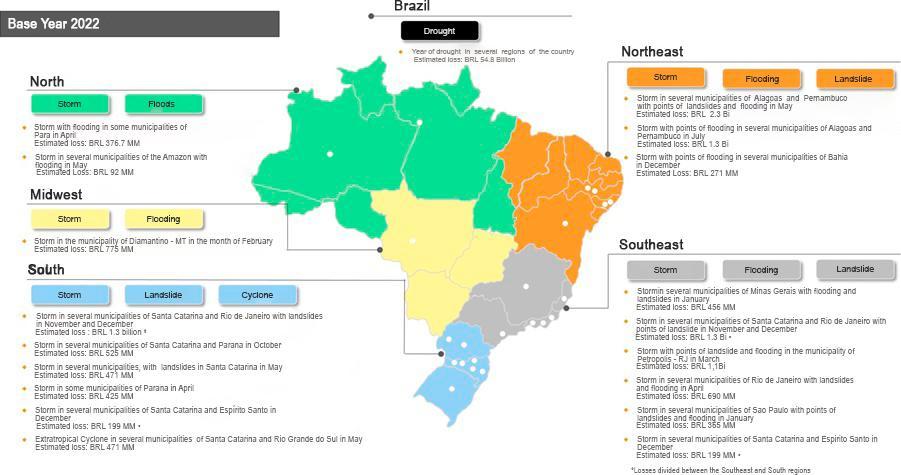
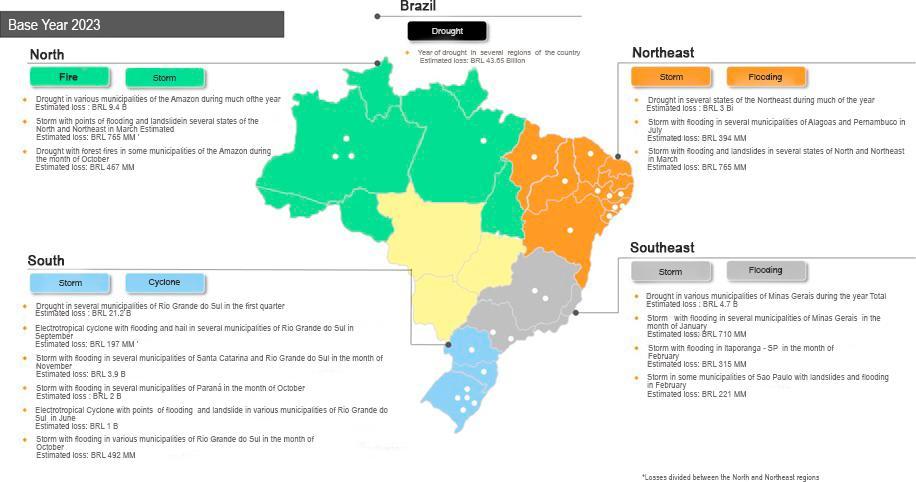
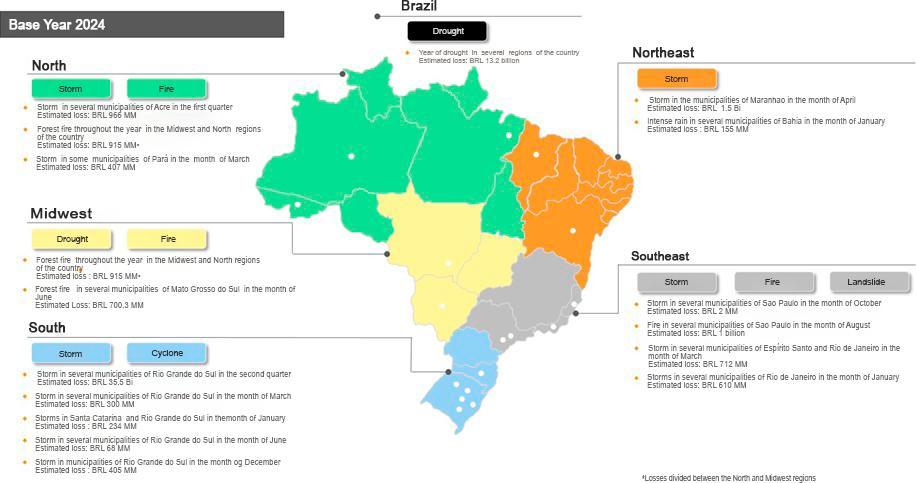
In all, 26, 23, and 18 events were recorded for the years 2022, 2023 and 2024, respectively.
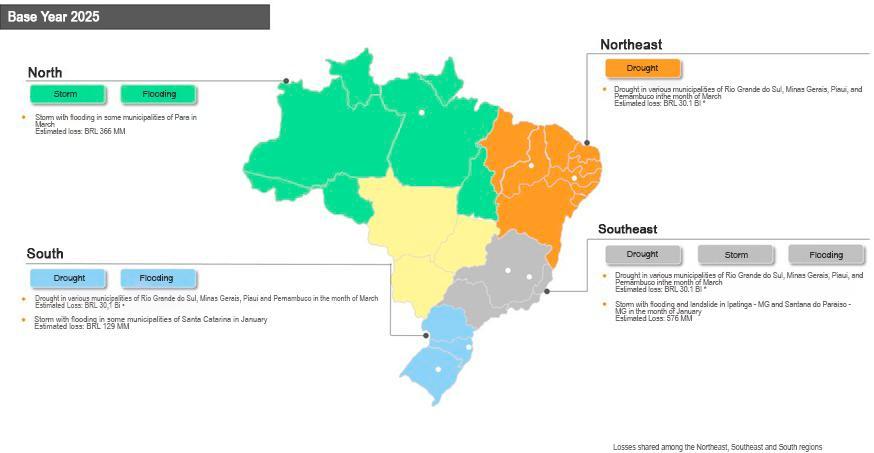
For 2025, 10 events were partially identified up to the month of June.
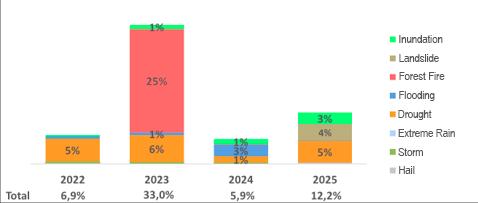
Although Drought is a minority among the events identified, with the exception of 2024, it was responsible for the largest volume of losses. These events mainly affected Agribusiness, resulting in a significant volume of economic losses in various regions of the country simultaneously, for a prolonged period.
The average estimated losses for the events identified were BRL 61.2 billion per year. When considering the drought event, this average was BRL 37.1 billion per year, while for the other events, it was BRL 24.2 billion per year.
Average 2022 to 2024
Other Events
Source: Prepared by the author based on public data, data up to June 2025.
The highest frequency of events is related to Floods, Inundations, Storms and Extreme Rainfall. Drought and Fire
also appear as less frequent events; however, as stated previously, with the aforementioned losses due to the geographical and temporal extent.
Graph 16 – Highlighted Events: Total Loss and Estimated Average Loss per Event per Year in Brazil – (BRL billions)
Droughts
Graph 17 – Highlighted Events: Frequency of Events per Type and Year (Brazil)
Waterlogging
Source: Own preparation based on public data, data up to June 2025
Most of the featured events are related to losses with an economic impact of less than BRL 250 million. This does not necessarily mean that they are events of lesser social relevance, as they can result in a significant number of deaths or affected people.
Events up to BRL 5 billion are present in almost every year, while those of higher value, above BRL 10 billion, are usually associated with both long periods of drought and episodes of extreme rainfall and urban flooding, which have become increasingly frequent in recent years.
Graph 18 – Highlighted Events: Distribution of Events per Loss Range and per Year (Brazil)
Source: Own preparation based on public data, data up to June 2025
The highlighted events represent a significant portion of the total estimated losses resulting from climate disasters. They represented, from
2022 to 2024, between 85% and 96% of the total estimated losses caused by climate events. When drought events are disregarded, this range reduces to 72% to 95%.
Graph 19 – Share of Highlighted Events Compared to Estimated Total Loss with Climatic Events per Year (With and Without Drought Events)
Highlighted Events Loss not Highlighted
Highlighted Events without Drought Loss not Highlighted without Drought
Source: Prepared by the author based on
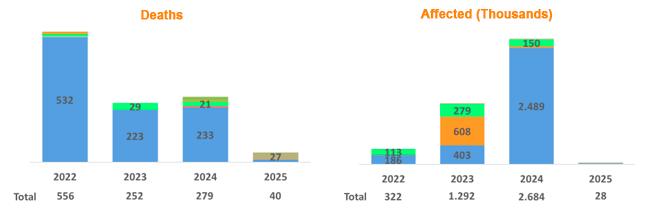
Flooding and Inundation events are those that generated the highest number of deaths and affected people.
The 2023 Drought event stands out, which hit the northern region of the country, resulting in thousands of affected people: families without drinking water and food, diseases caused by contaminated water, and difficult access due to reduced navigability caused by low river levels.
Graph 20 – Highlighted Events: Deaths and Affected per Type and per Year
Source: Prepared by the author based on public data, data up to June 2025.
(By Jun.)
(By Jun.)
Main Events of 2022
Source: Own preparation based
Source: Own preparation based on public data
Figure 4 – Economic Highlights of the Year 2022
Main Events of 2023
Source: Own preparation based on
12
Source: Own preparation based on public data
Main Events of 2024
Source: Own preparation based on public data
Figure 6 – Economic Highlights of the Year 2024
Main Events of 2025 (Partial up to June 2025)
Prepared by the author based on public data, data up to June 2025.
Figure 7 – Economic Highlights of the Year 2025 (up to the month of June)
Highlights of 2024
Flooding in Rio Grande do Sul between April and June
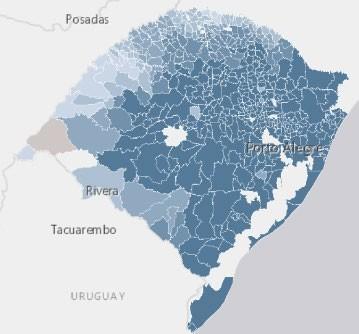
478 of the497 cities inRS were impacted by flooding, resulting from excessive rainfall and overflowing rivers.
The results were economic losses in various sectors, mainly affecting agribusiness and housing, but also significant losses in infrastructure, and private and public losses.
This event, due to its magnitude, has been extensively studied, and there are several studies, from various perspectives, which seek to estimate the resulting socioeconomic impacts. A more comprehensive study conducted by the IDB
(WORLD BANK, IDB, CE-PAL, 2024) for example, estimates that total damages and losses, including environmental costs and expenses related to responding to the population's initial emergency needs, reached BRL 88.9 billion.
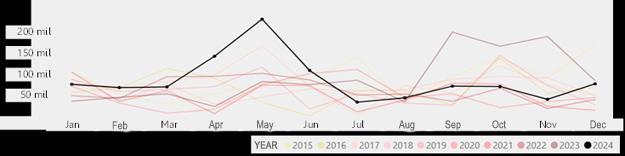
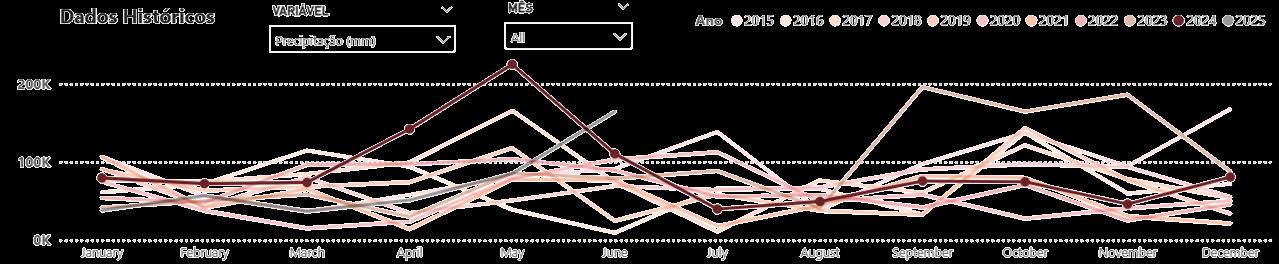
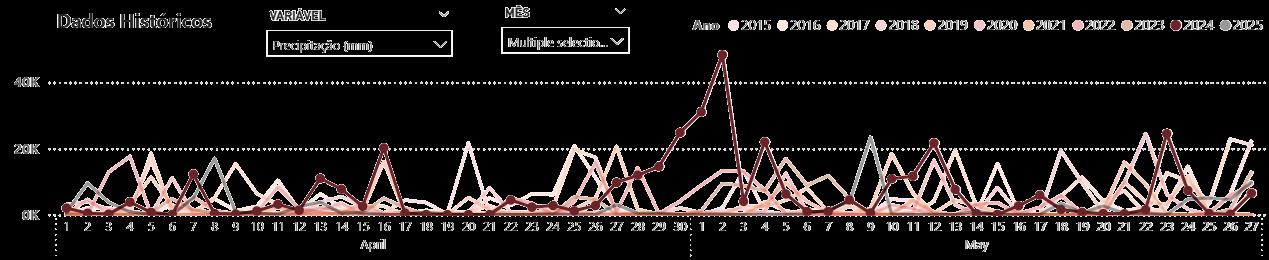
The months of April, May, and June saw rainfall above that recorded since 2015, especially when considering the last days of April and the first days of May.
For the insurance sector, the main affected lines of business were property (mainly Named and Operational Risks and
Engineering), Auto, Liability, Housing, Maritime, Transportation and Rural, in addition to reductions in revenue volume (either due to the suspension of new sales or the non-payment of installments).
Insurance companies also needed to implement measures to expedite the resolution of reported claims, including increasing the number of surveyors and optimizing the handling of salvage, as well as facilitating and automating the claim settlement and notification processes.
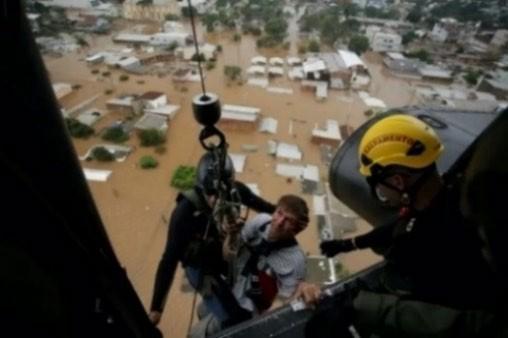
Figure 8 – Rescue of a resident of Canoas amidst the floods in RS
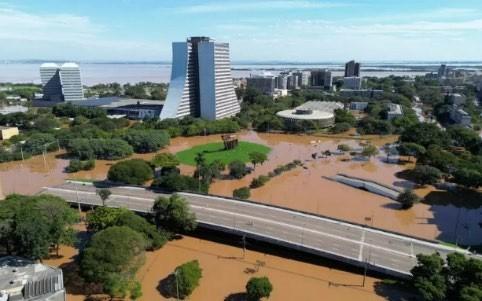
Figure 9 – Flooded Porto Alegre
Source: BBC News Brasil, 2024
Source: BBC News Brasil, 2024
Figure 10 – Flooded Beira-Rio Stadium
Source: BBC News Brasil, 2024
Graph 21 – Comparison between the last 10 years of rainfall volume throughout the months in RS
Source: EY, INMET data
Graph 22 – Comparison of rainfall volume over the last 10 years during the months of April and May in RS
Source: EY, INMET data
Graph 23 – Main data on the event
Main Groups of Affected Lines of Business Property, auto, liability, housing, maritime, transportation and rural Deaths 182 Affected 2,399,061
Source: Own preparation
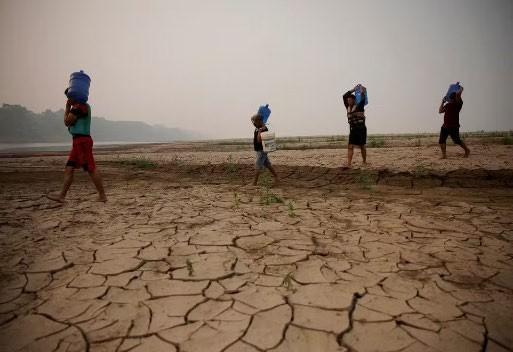
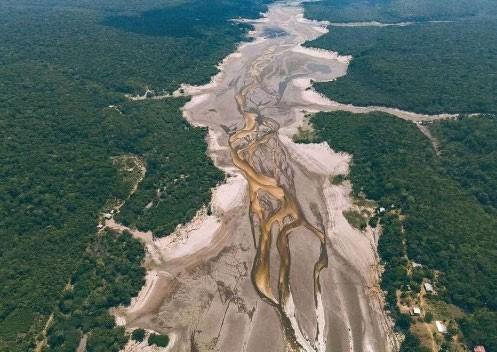
Drought throughout the Country in the Year 2024
Drought events have been affecting various regions of the country in recent years, resulting in substantial losses when considering the aggregate of the affected municipalities.
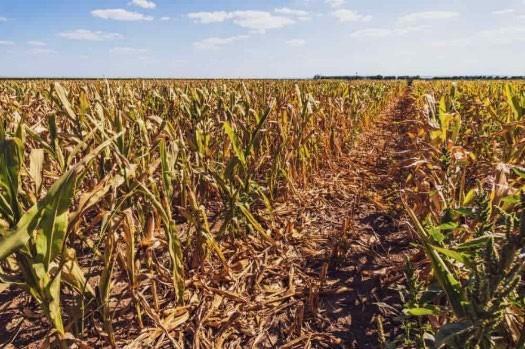
The phenomenon of Drought has affected the agribusiness sector repeatedly over the years, also resulting in a challenge for the insurance market in compensating for such substantial economic losses and significant
participation in reinsurance agreements. In addition to the direct impacts on agribusiness production, the losses affect the entire value chain, impacting traders and service providers.
Drought also causes significant socioeconomic effects, with expenses related, among other things, to the supply of drinking water and health, due to diseases
associated with the environmental conditions generated by the drought.
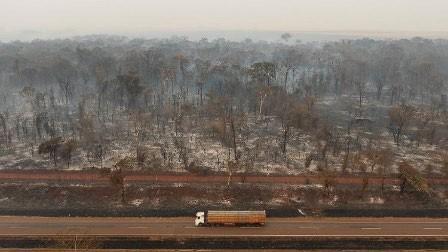
For the insurance sector, the main group of lines of business affected was the Rural sector. Drought also causes significant socioeconomic effects, with expenses related, among other things, to the supply of drinking water and health, due to diseases associated with the environmental conditions generated by the drought.
Figure 11 – Residents of Humaitá (AM) cross the Madeira River carrying gallons of water
Figure 12 – The Negro River reached its lowest historical level
Figure 13 – Drought affects agricultural production
Source: G1 Environment, 2024
Source: Metrópoles, 2024
Source: Agro2, 2024
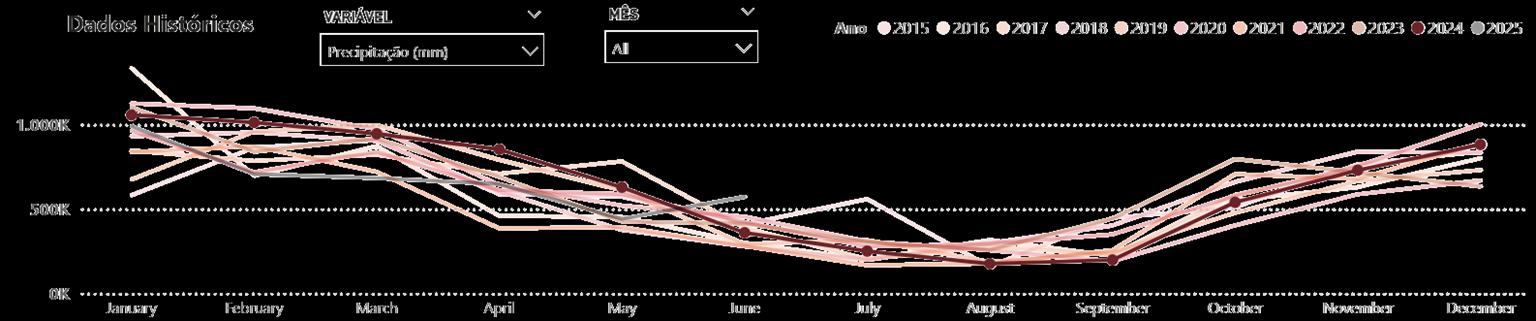
Graph 24 – Comparison between the last 10 years of rainfall volume throughout the months in the country
Source: EY, INMET data
Graph 25 – Relative difference between the observed rainfall volume of 2024 compared to the average of the previous 10 years (Months of August, September and October)
Source: EY, INMET data
Graph 26 – Main data on the event
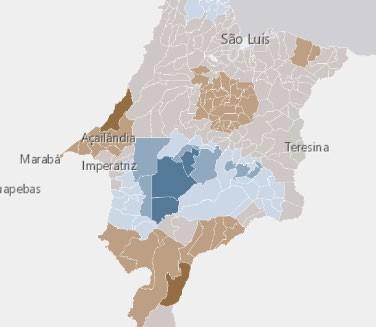
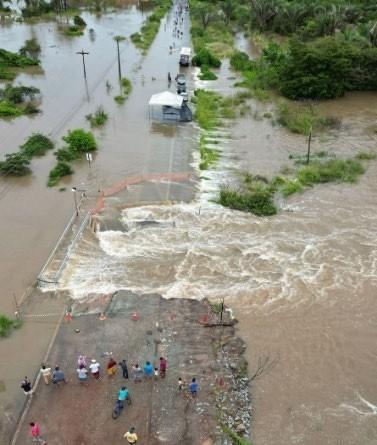
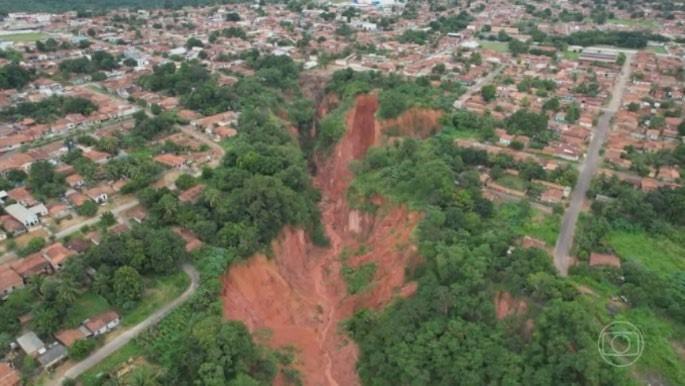
Flooding in Maranhão in April
Excessive rainfall caused flooding in Maranhão, resulting in dozens of municipalities in a state of emergency (the municipality of Santa Inês declared a state of public calamity) and thousands of families left homeless and displaced
The greatest impacts were concentrated on losses related to infrastructure and housing, but there were also significant losses in agribusiness, other sectors of the private sector, and for the public sector.
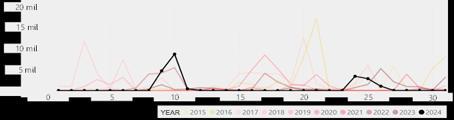
The accumulated rainfall in the State of Maranhão
between the months of February and April was the highest in the historical period considered, since 2015.
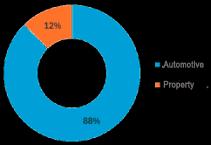
For the insurance sector, the main groups of lines of business affected were Auto and Property.
Figure 14 – Roads completely blocked due to the collapse of tracks
Source: G1 MA, 2024a
Figure 15 – In Buriticupu, rainfall volume intensified the advance of gullies
Source: G1 MA, 2024c
Graph 27 – Comparison between the last 10 years of rainfall volume throughout the months in MA
Source: EY, INMET data
Graph 28 – Comparison between the last 10 years of rainfall volume during the months of March and April in MA
Source: EY, INMET data
Graph 29 – Main data on the event
Cause Flooding
Privado
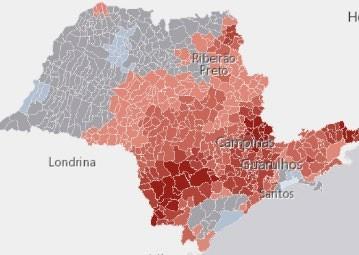
Fire in São Paulo in the month of August
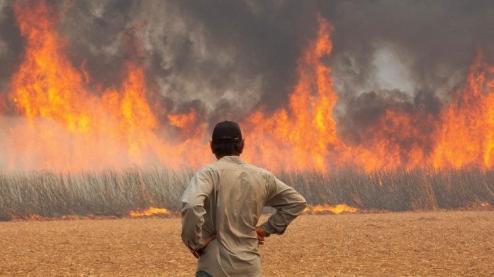
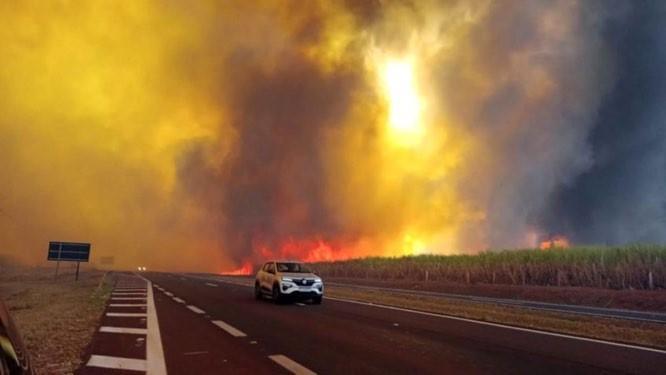
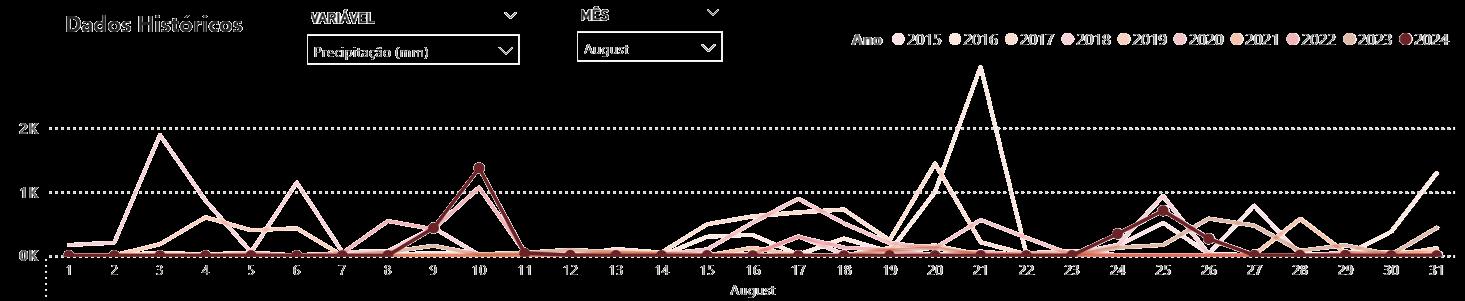
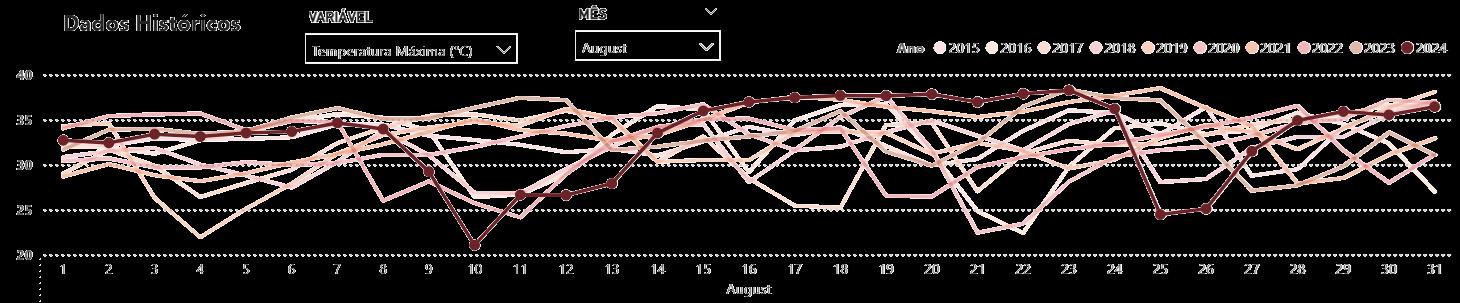
The low volume of rainfall observed, combined with high maximum temperatures compared to recent years, led the State of São Paulo to register a national record, with more than two thousand, three hundred fire outbreaks.
Dozens of municipalities declared a state of emergency due to forest fires, resulting in economic losses mainly related to the agribusiness sector, deaths, and hundreds of people affected
For the insurance sector, the main affected lines of business were Auto, Property, Rural, and Housing.
Figure 16 – Area affected by the fires near Ribeirão Preto
Source: UOL News, 2024
Figure 17 – Fire in a sugarcane plantation in Dumont
Source: UOL News, 2024
Figure 18 – Road on fire in the interior of São Paulo
Source: Poder 360, 2024
Graph 30 – Comparison between the last 10 years of rainfall volume throughout the month of August
August
Selection: Affected cities in the interior of São Paulo Source: EY, INMET data
Graph 31 – Comparison between the last 10 years of maximum temperature throughout the month of August
August
Selection: Affected cities in the interior of São Paulo Source: EY, INMET data
Graph 32 – Main data on the event Loss per Sector
Cause Fire
Estimated Total Loss BRL 1 billion
Estimated Compensation BRL 19 million
Main Groups of Affected Lines of Business Rural, Property, Auto and Housing
Deaths 4
Affected 945
Source: Own preparation
Other Socio-environmental Impacts
Beyond the financial impacts, climate disasters have resulted in a series of effects for the affected population.
Perhaps the most directly observable effect is the volume of housing units destroyed (related to housing losses and the number of people affected highlighted in the previous section).
Despite the visible underreporting in 2023 in the Civil Defense database, an average of 300,000 da-
maged homes and 14,000 destroyed homes were observed in the years 2022 and 2023. The year 2022 was particularly significant in the Northeast Region due to heavy rains that resulted in flooding in several municipalities. Primarily from the States of Alagoas, Pernambuco, and Paraíba, and in 2024 driven by the Southern Region, due to floods and inundations caused by excessive rainfall.
Health Effects
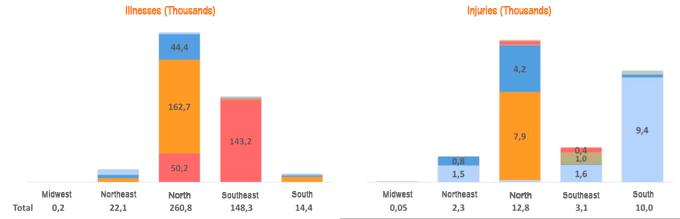
Another effect resulting from natural disasters is the increase in the number of ill and injured people, generating impacts and pressures on the health system. In this context, the case of the floods in Rio Grande do Sul in 2024 stands out, causing a high number of injuries due to excessive rainfall and the resulting flooding.
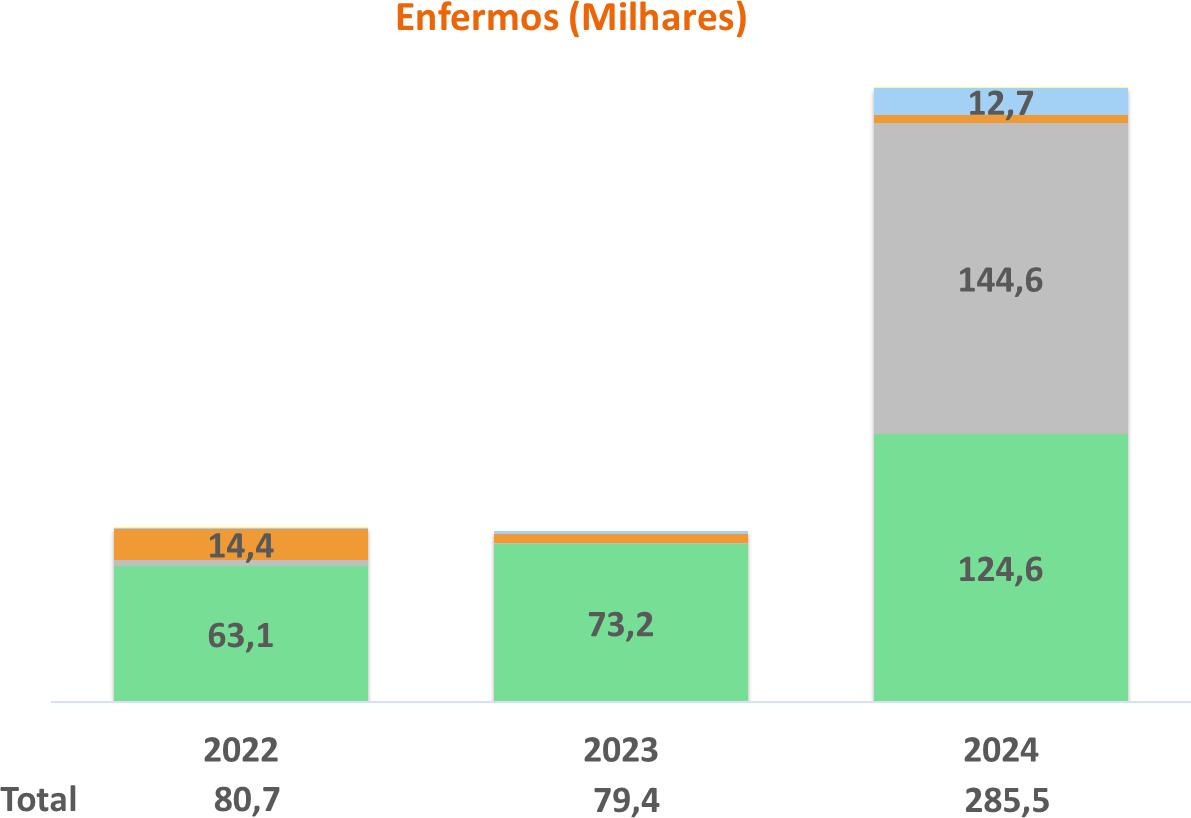
Regarding the number of sick people, the Southeast Region stood out in 2024, mainly
due to the fire events that occurred during the period, which resulted in respiratory problems in the local population.
Finally, it is important to highlight the chronic effect observed in the North Region, both in terms of sick and injured people, mainly associated with drought events, but also resulting from flooding and fires.
Source: SEDEC
An indirect effect of both chronic climate change and specific climate disasters is the increase in the number of diseases, mainly infectious ones18
Studies indicate that 58% of known infectious diseases appeared to be aggravated by events related to climate changes.
Such diseases can have various origins. They can be transmitted by vectors (e.g., dengue, malaria, Zika virus), water contamination (e.g., cholera, hepatitis A, leptospirosis), soil contamination,
vulnerability to respiratory infections (influenza, pneumonia, and tuberculosis), as well as skin infections.
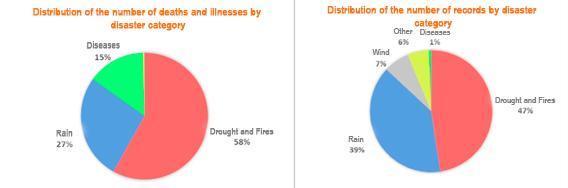
Regarding disaster records, those related to diseases represent only 1% of the total records; however, when considering the number of deaths and illnesses, diseases are responsible for about 15% of the occurrences.
Graph 34 – Number of Sick and Injured People in Climate Disasters per Region (2022-2024)
Fonte: SEDEC
Gráfico 35 – Number of Sick and Injured People in Climate Disasters per Type of Event (2022-2024)
Source: SEDEC
18 Gov Agency, 2025 Center for Scientific and Technological Information, Oswaldo Cruz Foundation, 2009
Library of Medicine, 2024
Galileu, 2022
Ill (Thousands) (Thousands)
Injured (Thousands)
Injured (Thousands)
Ill (Thousands)
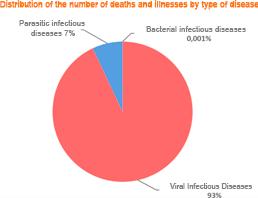
Graph 36 – Proportion of Records and Deaths and Sick People per Disease. Brazil: 2015 – June 2025
Source: SEDEC, data up to June 2025
Environmental Effects
The effects of climate disasters are not limited to economic losses, but also include environmental impacts. Among the records of losses due to climate disasters in municipalities, considering the period from 2022 to 2024, a significant portion shows an indication of some associated environmental damage.
In the Northeast region, the proportion of records marked with environmental damage is 68%, while in the South and Southeast regions this proportion is 32%.
NoEnvironmentalDamages WithEnvironmentalDamages
Source: SEDEC, data up to 2024
The effects in terms of environmental damage caused by climate disasters differ according to each Brazilian region.
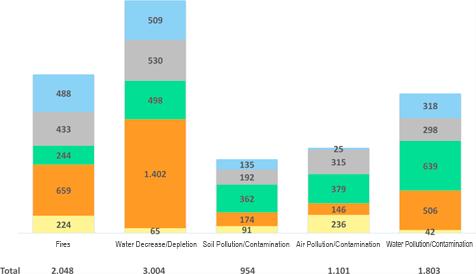
Damage related to fire and water scarcity is more frequent in the Northeast region, but also with a significant share in the South and Southeast regions.
Damage related to soil, air, and water contamination is more prevalent in the North region but also has a significant share in the Southeast and South regions.
The Northeast region is also quite present when it comes to water contamination.
Graph 37 – Records of Losses from Natural Disasters Marked with Environmental Damage: 2022 and 2024
Graph 38 – Records of Losses from Natural Disasters with Environmental Damage Marking, per Damage Category: 2022 and 2024
Fonte: SEDEC, dados até 2024
Other Socioeconomic Effects
When considering the impact of losses compared with the GDP of the municipalities affected by the events, those related to Drought and Fire stand out. Although, depending on the year, events
related to flooding, landslides, and inundation are also representative.
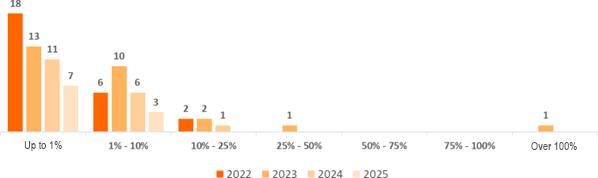
Most of the highlighted events generate losses of less than 1% - on average - of the GDP of the affected municipalities, but it is also common for this impact to reach 10%.
On the other hand, the most serious events can affect a significant portion of the GDP. These
events are mainly related to flooding and inundations that result not only in public and private losses (such as, for example, in the Agribusiness sector), but also in damage to Housing and Infrastructure.
The losses resulting from floods and inundations caused by excessive rainfall in Rio Grande do Sul in 2024 were extensively analyzed in this context. According to a report prepared by ECLAC, in partnership with the IDB and the World Bank
(WORLD BANK, IDB, ECLAC, 2024), the event could have impacted up to 2.4% of the regional GDP; however, the actions of the Federal Government - through transfers to States and Municipalities - reduced this impact to 1.3% of GDP.
Graph 39 – Highlighted Events: Economic Loss in Relation to the GDP of Affected Municipalities per Year
Source: SEDEC, data up to June 2025
Graph 40 – Highlighted Events: Economic Loss in Relation to GDP of Affected Municipalities per GDP Impact Range per Event
Source: Prepared by the author based on public data, data up to June 2025.
(By Jun.)
Source: World Bank, IDB, Cepal, 2024.
Government costs for emergency response were approximately BRL 61 billion, encompassing operational costs of rescues, civil defense transfers, and direct transfers to the affected population.
The largest portion of this amount refers to reconstruction aid. But it is also worth highlighting the increase in transfers through social programs, such as Bolsa Família, when we compare the increase in transfers to Rio Grande do Sul in relation to the rest of the Country.
Source: National Confederation of Municipalities (CNM), 2025
Graph 41 – Impact of the 2024 Events in Rio Grande do Sul in relation to GDP
Table 6 – Expenses related to the state of emergency in Rio Grande do Sul, per expense type group (GND)
Graph 42 – Increase in the transfer of Bolsa Família throughout 2024 for Rio Grande do Sul
Impacts on the insurance sector
Role of Insurance in Climate Disasters
The insurance market plays a strategic role in protecting society against extreme weather events, acting as a mechanism for risk transfer and sharing.
By assuming part of the financial impact of disasters, the sector ensures that the losses sustained by affected policyholders do not compromise their ability to recover economically.
The indemnities paid can far exceed the value of the premiums paid, reaching, in individual cases, tens, hundreds, or even thousands of times the amount paid by the policyholder. Compensation is fundamental to maintaining the continuity of economic activities and the stability of critical production chains.
Compensation in Climate Disasters
In 2024, the insurance market paid out approximately BRL 7.3 billion in compensation due to climate events. This amount not only represents financial relief for the population that faced significant losses due to natural disasters such as floods, storms, and droughts, but also highlighted the essential role of insurance in
Reinsurance expands this capacity, allowing events of great magnitude or national scope to be absorbed without compromising the capacity of insurance companies.
Segments such as property, housing, and rural heavily rely on reinsurance. In the example of the 2024 event in Rio Grande do Sul, approximately 69% of the reported indemnities had reinsurance coverage.
Thus, insurance not only protects the assets and income of individuals, but also strengthens the financial resilience of the insurance market and society, reducing pressure on public resources and enabling more efficient and planned responses to climate disasters.
In 2024, 12% of the total compensation paid for damages was related to climate events. This percentage varies according to the group of lines of business analyzed.
Graph 43 - Compensation for climate-related events compared to total sector compensation for the year 2024
Source: Own preparation
Although the agribusiness sector is the most impacted by climate events in terms of economic losses, it is not the one that concentrates the largest volume of compensation. This result is explained by the low participation of rural insurance in Brazil. In 2024, only approximately 6% of the total area planted with grains had insurance coverage, which represents a reduction of around 50% compared to 2023. (CNseg, 2025; CONAB, 2025).
In this regard, the Property group recorded the largest share of indemnities related to climate
disaster events in 2024, with 58% of the indemnities, encompassing residential coverage for individuals, but mainly business coverage, including named and operational risks and engineering.
The Housing and Auto groups also have a significant share in the volume of indemnities, also reflecting a significant portion of the population's assets at risk.
Graph 44 - % of indemnities paid in 2024
Source: Own preparation
Climate Disaster Insurance Coverage
Most intensification of climate disasters in Brazil has directly affected the insurance sector, resulting in a growing volume of indemnities paid to the population with contracted coverage. On the other hand, this same dynamic reinforces the essential role of the insurance activity in reducing the economic and social impacts resulting from these events, positioning the sector as a central agent for climate adaptation.
A survey conducted with the market revealed that the groups of lines of business most affected by the main climatic events are Property, Auto, Housing, and Rural, which reflects the nature of the direct "physical" and property impacts that these disasters cause.
However, it is important to consider that natural disasters can also impact other insurance segments that, at first glance, did not appear to be significantly affected in the survey. This may indicate both greater difficulty in measuring the indirect effects of these events, and a potential for innovation in the creation of new products and coverages aimed at protecting the population and economic activities.
From the survey conducted, it is estimated that about 9% of the economic losses from the
analyzed climatic disasters are compensated through indemnities paid by the insurance market.
When the analysis is restricted to private losses, insurance coverage increases to approximately 12%, revealing a lower share of insurance inlosses associated with the public sector. This scenario represents a significant potential for expanding climate loss insurance in this segment, especially focused on protecting public infrastructure.
Another relevant aspect is the regional inequality in insurance coverage. While the southern and southeastern regions have average climate loss coverage between 16% and 11%, respectively, the northern and northeastern regions do not exceed 2%. This imbalance reflects structural differences in access, income, and insurance culture, but also opens up space for insurance inclusion policies, and the development of tailor-made solutions for the most vulnerable regions of the country.
Finally, the case of prolonged droughts stands out, which widely affect the agribusiness sector and multiple regions simultaneously. In these events, it is estimated that around 7% of losses are covered by insurance, and this can exceed 25% in specific situations.
Since 2022, EIOPA has been conducting a study with the European insurance market, resulting in the development of a panel on the natural disaster protection gap (EIOPA, 2024). When
analyzing the raw data used in the study, based on estimated losses and insurance coverage from the “CatDat” database, it is observed that the average coverage of estimated losses with
Graph 45 – Coverage range for a representative portion of the Economic Losses from the Analyzed Climate Disasters
Average 9%
Source: Own preparation
insurance indemnities is around 20%, although this result varies significantly according to the type of disaster analyzed.
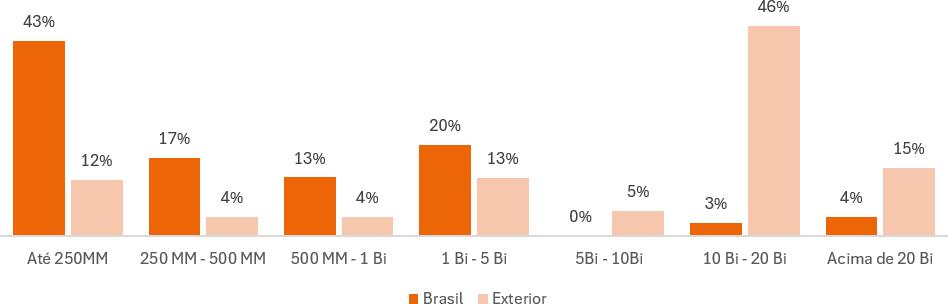
Another aspect that deserves highlighting in comparison with the database provided by EIOPA is the magnitude of individual disasters in terms of economic losses. While most events observed in Brazil register losses of up to BRL 5 billion (with a large volume of cases up to BRL 250 million),
the EIOPA database shows a significant volume of events that caused losses above BRL 10 billion, including a considerable number of events between BRL 10 and BRL 20 billion.
Graph 46 – Insurance Coverage of Economic Losses from Natural Climate Disasters (European Market)
Source: Own preparation, EIOPA data
Graph 47 – Histogram of Losses from Natural Disasters Brazil vs. Europe: 2022-2024 (BRL)
Source: Own preparation
Up to 250M
Over 20B
Brazil Foreign
Other International References
The methodology for assessing the insured portion of losses from natural disasters varies according to the sources of information, disaster identification, and extrapolation methodologies. Thus, although a direct comparison is not possible, considering other studies contributes to positioning Brazil relatively in relation to other markets.
One of the main global benchmarks is the Sigma publication, prepared annually by the Swiss Re Institute, which presents a mapping of natural catastrophes and a comparison between total economic losses and the amount covered by insurance.
In the 2024 edition (Sigma No. 01/2025), the study indicates that 43% of global economic losses were covered by the insurance sector (an increase compared to 39% in 2023, and slightly above the 10-year accumulated average of 41%).
The publication highlights; however, the heterogeneity of this indicator among the regions of the globe.
While insurance coverage for economic losses in North America and Europe was 55% and 44%, respectively, Latin America recorded a rate of only 13% (compared to 32% in 2023).
The results indicated by Sigma are consistent with the conclusions of this report and with the data analyzed by EIOPA: insurance coverage in Brazil, as a member of Latin America, remains significantly lower than that observed in developed markets (namely North America, Europe, and Oceania).
Although the magnitude of the absolute values differs from that presented inthis study and inthe EIOPA data, these variations can be explained by methodological differences, such as the severity level of the events considered, the geographical and temporal scope adopted, or even the type of information available to each institution in the assessment of losses and insurance indemnities.
Source: Swiss Re (2023)
Table 7 – Economic Losses and Insured Share Worldwide (2023)
In 2015, the Sigma publication (No. 5/2015) categorized portions of the population of countries into 4 categories, according to the level of insurance coverage against economic losses resulting from catastrophic events. This categorization highlighted different degrees of insurance subcontracting, reflecting the global inequality in the capacity for financial protection against natural disasters:
Figure 19 – Categories of insurance subcontracting
Portion of the population, especially in emerging countries that do not have any type of insurance coverage. The population might not have adequate knowledge on cost vs benefit of insurance, although they might have auto (mandatory in some cases) or life insurance, but they do not have catastrophe specific coverage.
Population that have contracted property insurance coverage (for example, against fire), but natural disasters are excluded from coverage.
In turn, the Mapfre Foundation periodically conducts a study of the Insurance Potential Index (GIP) (Mapfre, 2023), in which the Protection Gap (IGP) is a relevant component. The Foundation explains that the protection gap can be assessed in two distinct ways: ex-post, based on observed economic losses, where the GAP is calculated from the portion of these losses covered by insurance; and ex-ante, in which a theoretical optimal level of insurance coverage to be maintained by the country is defined (in terms of insurance premium issued inrelation to GDP). The ex-ante approach is the one used by the Mapfre Foundation in its analyses.
The 2023 GIP report presented by the Mapfre Foundation indicates that, of the total global protection GAP in the property and casualty segment, 45.5% comes from BRICS Countries and 42.7% from other emerging countries.
In a specific study of Latin America (Mapfre, 2023), the Mapfre Foundation indicates that the volume of
Portion of the population with coverage against natural disasters, but such coverage is insufficient, and taking out broader coverage is not financially feasible for the policyholder.
Portion of the population with coverage against disasters but underestimates the value of the asset to be covered, or the potential loss that such asset may sustain in the event of a disaster.
Adapted
insurance premiums in Brazil should grow by 142% to close the protection GAP.
According to thereportfocusedon Latin America, the study shows that while the share of insurance premiums in relation to Brazilian GDP is 3.1% (excluding capitalization, supplementary pension and health products), Chile records 4.3% (the global average is 71%). As for the per capita premium, Brazil registers USD 281, while in Chile this value is USD 665.
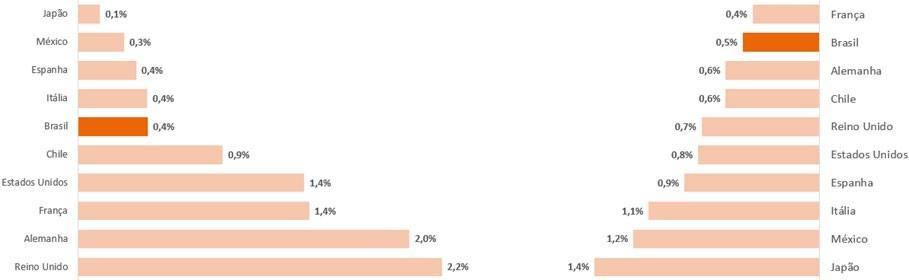
OECD data corroborates these differences: both annual per capita insurance expenditure and the share of the insurance market in Brazilian GDP are significantly lower than those observed in most selected countries, confirming the lower insurance coverage in Brazil and Latin America compared to more developed markets.
Source:
from Swiss Re (2015)
Graph 48 – Annual per capita insurance expenditure in US$ in Brazil compared to other countries (2023)
Source: OECD (2023)
Graph 49 – Insurance market share in Brazil's GDP compared to other countries (2023)
Fonte: OECD (2023)
When considering lines of business that are typically more affected by climate disasters (auto and property), we emphasize that there is an opportunity to increase the participationof theinsurance sector,compared to other countries, in order to reduce the protection gap.
Graph 50 – Participation in GDP of Insurance with coverage of the most relevant lines of business in climate disasters (2023)
Source: OECD (2023)
Operational Challenges
Beyond the payment of indemnities, insurance companies are challenged to build an operational structure that meets the complexity and demand for claims related to the disaster. In this context, they are compelled to develop and implement
innovations that allow policyholders to be served promptly in climate disaster situations, where the volume of service is much higher than usual.
Thus, insurance operations must be prepared to address a set of challenges in a climate disaster scenario:
• Greater ease and automation of the claim settlement and notification process
• Fraud assessment and detection processes in operations under normal conditions may not be applicable in natural disaster scenarios
• Greater flexibility in expanding the partner network to meet the increased volume of demand
Other financial effects
The insurance sector i salso impacted by other financial effects resulting from climate disasters, not restricted se restringindo ao pagamento de indenizações, o mercado segurador também sofre outros efeitos financeiros decorrentes de desastres climáticos:
• Increase in Redemptions: There is a trend of increased redemptions of capitalization bonds, capitalized life insurance and pension plans. While these accumulated and redeemable amounts for policyholders and beneficiaries serve as a form of savings and protection precisely for cases of need, insurance companies need to be prepared to provide the necessary liquidity for these redemptions to be carried out, as well as review their expectations for maintaining assets under management for the coming years.
• Default and Reduced Sales: The loss of income by the population and the need for investments to rebuild affected assets result both in the cancellation of existing policies, the reduction of the renewal rate and the contracting of new policies, leaving the population unprotected against new events.
Trends and Opportunities
Trends
The worsening of climate change is causing significant changes in meteorological patterns, resulting in increasingly frequent and severe climate events and disasters (MCTI, 2024).
With the increase in global warming, the effects of climate changes are becoming increasingly severe, resulting in greater economic losses.
This new risk reality directly impacts how insurance companies identify, assess, and manage their exposures, requiring a review of traditional processes.
The growing awareness of climate issues has transformed society's perception of risk, strengthening the understanding of insurance as an essential instrument of adaptation and resilience in light of extreme weather events.
Increased Frequency of Extreme Events
With the increase in global warming, the effects of climate change will become greater in the short term (2021 - 2040). (IPCC, 2023)
This increase in frequency and severity is due to the interaction and cascading effects of climate change in various regions of the globe, which are becoming increasingly difficult to manage.
The economic impacts attributable to climate change are increasingly affecting people's livelihoods and causing economic and social impacts. (IPCC, 2023)
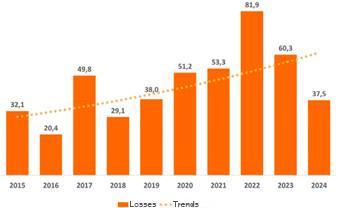
In the Brazilian case, the volume of losses reported by Civil Defense due to climatic events in the last 10 years shows a clear upward trend.
The continuation of current unsustainable development patterns will increase the exposure and vulnerability of ecosystems and people to climate risks.
Source: Own preparation, data up to 2024
In a World Bank report (World Bank, 2025) on Brazil's climate risk profile, it is highlighted that
the temperature increase has been accelerating over the years, while between 1951 and 2020 the
Graph 51 – Trend of Losses from Natural Disasters Related to Climatic and Natural Phenomena: Brazil (BRL billions)19
increase was 0.17ºC every 10 years, the increase every 10 years between 1991 and 2020 was 0.29ºC, the expectation isthat this increase will be 0.34ºC between 2000 and 2050, and 0.51ºC between 2050 and 2100 (scenario of high emissions of SSP3-7.0).
Also in the same report, projections indicate reduced rainfall, especially in the Northeast, intensified dry seasons (including an increase in these seasons), extreme heat, and an increase in days with peak heat, in addition to actual extreme events, aggravating the risks of flooding.
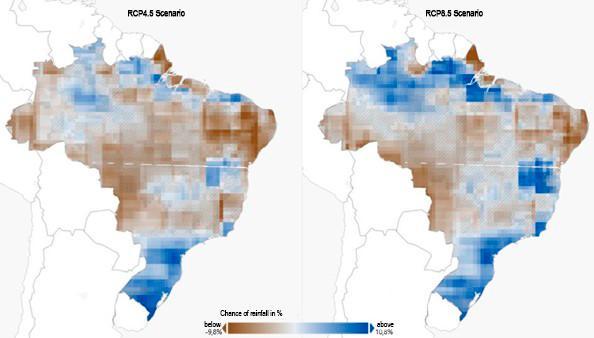
The trend of worsening climatic conditions can also be observed in the IPCC projections for the year 2050 in the scenarios RCP 4.5 (which predicts
an increase in global temperature between 2.5º C and 3º C by the year 2100) and RCP 8.5 (which predicts an increase in global temperature of 5º C by the year 2100).
In these scenarios, depending on the region to be considered, the effects may include a reduction in rainfall, which may mainly affect the Agribusiness sector and populations that depend on access to water or aquifer transportation. In other regions, the effect is expected to be an increase in rainfall, which may exacerbate intense rainfall and its effects, such as floods and inundations, which have been consistently generating economic losses in recent years.
The risks associated with climate disasters are multifaceted and can severely impact the insurance market.
In addition to the expected chronic increase in both the frequency and severity of claims arising from coverage guaranteed by insurance
agreements, the very nature of the risk covered may change over time. For example, regions where excessive rainfall was not a feasible risk will now experience this type of risk, and vice versa.
Graph 52 – Projection of variation in average rainfall volume for 2050 (IPCC RCP 4.5 and RCP 8.5 scenarios)
Source: Climate Analytics
Product Pricing
Historical losses may not adequately reflect the magnitude and frequency of future climate risks, requiring the incorporation of different analytical approaches to more accurately reflect future exposure.
The scarcity of reliable data and the limited disclosure of relevant climate information applied to insurance operations hinder proper pricing of these risks. (BIS, 2023)
The limited contracting of insurance policies for natural disasters hinders the modeling of these risks, as the available data does not constitute a sufficiently robust loss base for use in actuarial models. This lack of information makes structured pricing decisions difficult.
Coverage Offer
Climate disasters in Brazil show that the economically vulnerable population is the most affected. It is necessary to develop solutions to strengthen the protection of this segment, whether through accessible products or publicprivate protection mechanisms.
Losses in public infrastructure and essential services show that many of these facilities do not
have insurance coverage. It is important to explore ways to make the offer of insurance for cities, urban infrastructure and critical services viable, protecting public assets and ensuring the resilience of society.
Risk Management
Climate risks can present different levels of severity, requiring a combination of traditional and innovative mechanisms to allow for the diversification of exposures and expand the capacity of the insurance market.
The occurrence of anti-selection, when more exposed regions or activities concentrate the demand for insurance, exacerbates the risk management challenge, increasing portfolio volatility and putting pressure on pricing. This dynamic reinforces the need for strategies to dilute risks and expand the insured base.
Climate risk cannot be fully absorbed by the insurance sector. A sharing model between different agents is essential, ensuring the sustainability of the ecosystem and the continuity of operations in the face of the increased frequency and severity of extreme events.
Opportunities
Assessing trends and challenges opens doors to a diversity of opportunities for the insurance market to contribute to society in the context of climate change.
By offering protection, the insurance sector ensures the financial resilience of society, preventing losses resulting from adverse events from turning into prolonged economic crises. Compensation allows for the resumption of activities and the restoration of income, minimizing social and economic impacts, and preventing disruptions in production chains and essential services.
This capacity to absorb and redistribute financial impacts can reduce dependence on public resources in crisis management, preserving the State's fiscal capacity and allowing public efforts and investments to be directed towardsareas such asprevention,climateadaptation,and resilientinfrastructure.It is amechanism that favors efficiency and rationality in the allocation of collective resources, minimizing the need for reactive actions and fragmented emergency responses.
Increased supply and progress in closing the protection gap
As extreme weather events become more frequent and impactful, insurance companies face the challenge of adapting their offerings to protect policyholders and promote community resilience. The growing demand for insurance that covers climate risks opens opportunities to develop new products
New Products and Services
There is potential for products that integrate technology, data, and agile processes, with clear and easy-to-understand conditions.
Insurance companies can act before the crisis, promoting alerts, monitoring, and preventive measures, and after the crisis, offering emergency assistance and recovery support, making insurance a continuous adaptation tool.
The combination of financial coverage with risk management services allows for more complete and strategic solutions.
New Audiences and Horizons
Accessible products and public-private protection schemescan expand coverage for lowincome populations and small businesses, reducing social protection gaps, increasing insurance inclusion, strengthening confidence in
the sector, and stimulating spontaneous demand for other insurance products.
It is necessary to think about ways to develop and offer solutions for cities, urban infrastructure, and strategic services, increasing the resilience of the public sector and society, protecting critical assets, and ensuring the continuity of essential services in the face of extreme weather events.
Incentive for risk mitigation
Insurance can become an instrument that not only protects but also directs and catalyzes more responsible and resilient economic behaviors.
Responsible Investments and Underwriting
Allocating resources to assets aligned with the sector's investment profile and that have a positive socio-environmental impact allows insurance companies to foster sectors and practices that reduce climate and socioenvironmental risks in the long term, strengthening the resilience of portfolios.
Developing pricing criteria that reward risk mitigation practices creates a mechanism capable of stimulating the implementation of sustainable measures by policyholders. This approach can generate a ripple effect, influencing insurance premiums as economic agents implement concrete actions.
These combined approaches help reduce longterm asset risk, ensuring the maintenance of insurability and the continuity of sector operations in the face of extreme climatic and socio-environmental events.
Climate Transition Insurance
Integrating transition plans with active engagement from policyholders allows for continuous monitoring, technical guidance, and support for the implementation of mitigation and adaptation measures, strengthening operational resilience and promoting the consistent implementation of sustainable practices.
Expanding the insurance offering to strategic sectors for climate transition and sustainable, low-carbon practices creates synergy between the risk assumed and the long-term socioenvironmental benefits, while enabling the scalability of these activities.
Developing nature-focused insurance by encouraging the appreciation of natural capital and the maintenance of essential ecosystem services, contributing to reducing risks that compromise environmental and economic conditions in the long term.
Sustainable Reconstruction
The market can design products that, in addition to coverage, also include additional benefits aimed at adapting to and mitigating risks after damage occurs. For example, these innovations could include the payment of extra compensation when a residence is damaged, intended to cover improvements that reduce future risks during the reconstruction process. This could involve the implementation of more resilient construction technologies and practices, ensuring that new structures are designed to better withstand climate challenges (IAA, 2023).
Furthermore, insurance companies could establish requirements for homes to be rebuilt according to stricter building codes, something that is often not required for older buildings. This approach not only protects policyholders, but also contributes to the creation of safer and more sustainable communities, where buildings are adapted to meet the challenges posed by climate change.
List of Figures, Graphs and Tables
Graph
Graph
Graph
List of Tables
Table
Table
Lista de Abreviações
IDB Inter-American Development Bank
BIS Bank for International Settlements
CEMADEN National Center for Monitoring and Alerts of Natural Disasters
ECLAC Economic Commission for Latin America
CNM National Confederation of Municipalities
CNSEG National Confederation of General Insurance, Private Pension and Life, Supplementary Health and Capitalization Companies
COBRADE Brazilian Disaster Coding
CONAB National Supply Company
CQCS Insurance Broker Qualification Center
CRED Centre for Research on the Epidemiology of Disasters
EIOPA European Insurance and Occupational Pensions Authority
EM-DAT International Disaster Database
FEMA Federal Emergency Management Agency
GIP Global Insurance Potential Index
IAA International Actuarial Association
IAIS International Association of Insurance Supervisors
IGP Insurance Gap Protection
INMET National Institute of Meteorology
IPCC Intergovernmental Panel on Climate Change
MCTI Ministry of Science, Technology and Innovation
mm Millimeters
NPR National Public Radio
OCDE Organization for Economic Cooperation and Development
WHO World Health Organization
GDP Gross Domestic Product
S2iD Integrated Disaster Information System
NbS Nature-Based Solutions
SEDEC State Secretariat of Civil Defense
SUSEP Superintendence of Private Insurance
Trim. Quarter
UNCDF United Nations Capital Development Fund
WMO World Meteorological Organization
References
AGÊNCIA BAURUENSE DE GEOGRAFIA (AGB BAURU) (MARENGO, José A) Extremos de precipitação e desastres hidro-geo-meteorológicos no Brasil. In: AGÊNCIA BAURUENSE DE GEOGRAFIA (AGB BAURU). Do local ao global: mudanças climáticas e gestão de risco de desastres. 1. ed. Bauru: AGB Bauru, 2025. p. 487-489. Available at: https://agbbauru.org.br/publicacoes/DLAG2025/DLAG_1ed-2025-38.pdf
ALIANÇA BRASILEIRA PELA CULTURA OCEÂNICA. Brasil em transformação 1 – 2024: o ano mais quente da história. [S.l.]: Maré de Ciência, 27 dez. 2024. Available at: https://maredeciencia.eco.br/wp-content/uploads/2024/12/Brasil-em-transformacao-1-2024-o-ano-mais-quente-da-historia.pdf
AON. 2023 Weather, Climate and Catastrophe Insight. [S.l.]: Aon, 24 jan. 2023. Available at: https://www.aon.com/getmedia/f34ec133-3175-406c-9e0b-25cea768c5cf/20230125-weather-climate-catastrophe-insight.pdf
AON. 2025 Climate and Catastrophe Insight. [S.l.]: Aon, 2025. Available at: https://www.aon.com/en/insights/reports/climate-and-catastrophe-report
BANCO MUNDIAL. Climate Risk Country Profile: Brazil. [S.l.]: Banco Mundial, 2021. Available at: https://climateknowledgeportal.worldbank.org/sites/default/files/country-profiles/17303-WB_Brazil%20Country%20Profile-WEB.pdf
BANK FOR INTERNATIONAL SETTLEMENTS (KHOO, Felicia.; YONG, Jeffery.) Too hot to insure – avoiding the insurability tipping point. Basel: Bank for International Settlements, 2023. (FSI Insights on policy implementation, n. 54). Available at: https://www.bis.org/fsi/publ/insights54.pdf
BRASIL. Law No. 15,042, of December 11, 2024. Establishes the Brazilian Greenhouse Gas Emission Trading System (SBCE) and amends Laws No. 12,187, 12,651, 6,385 and 6,015. Official Gazette of the Federal Government: section 1, Brasília, DF, 12 dez. 2024. Available at: https://www2.camara.leg.br/legin/fed/lei/2024/lei- 15042-11-dezembro-2024-796690-publicacaooriginal173745-pl.html
BROOKINGS (FOWLIE, Meredith.; BOOMHOWER, Judson.; RICHTER, Daniel.; FUJII-RAJANI, Riki.) How is climate change impacting home insurance markets? Brookings Institution, 2025. Available at: https://www.brookings.edu/articles/how-is-climate-change-impacting-home-insurance-markets/
CENTRO DE ESTUDOS E PESQUISAS EM DESASTRES (CEPED/UFSC). Relatório de danos e prejuízos decorrentes de desastres naturais em Santa Catarina. Florianópolis: CEPED/UFSC, mar. 2016. Available at: https://www.ceped.ufsc.br/wp-content/uploads/2016/04/Relat%C3%B3rio-Danos-e-Preju%C3%AD- zosSC_290316-BAIXA.pdf
CENTRO DE ESTUDOS E PESQUISAS SOBRE DESASTRES (CEPED/UFSC). Relatórios de danos: análise e recomendações. Florianópolis: Universidade Federal de Santa Catarina (UFSC), jan. 2017. Available at: https://www.ceped.ufsc.br/wp-content/uploads/2017/01/111703-WP-CEPEDRelatoriosdeDanoslayoutPUBLIC-PORTUGUESE-ABSTRACT-SENT.pdf
CENTRO DE INFORMAÇÃO CIENTÍFICA E TECNOLÓGICA, FUNDAÇÃO OSWALDO CRUZ, RIO DE JANEIRO-RJ (BARCELLOS, Christovam et al). Mudanças climáticas e ambientais e as doenças infecciosas: cenários e incertezas para o Brasil. Epidemiologia e Serviços de Saúde, Brasília, v. 18, n. 3, p. 285-304, jul./set. 2009. Available at: http://scielo.iec.gov.br/pdf/ess/v18n3/v18n3a11.pdf.
CLIMATE ANALYTICS. Climate Impact Explorer – Impacts in Brazil under RCP4.5 and RCP8.5 scenarios. [online].[s.l.]:Climate Analytics, [s.d.]. Disponível em: https://climate-impact-
COMPANHIA NACIONAL DE ABASTECIMENTO (CONAB). Boletim da Safra de Grãos: 9º levantamento – Safra 2024/25. Brasília, DF: Conab, 2025. E-book. Available at: https://www.gov.br/conab/pt-br/atuacao/informacoes-agropecuarias/safras/safra-de-graos/boletim-da-safra-de-graos/9o-levantamento-safra-2024-25/e-book_boletim-de-safras-9o-levantamento-2025
CONFEDERAÇÃO NACIONAL DAS EMPRESAS DE SEGUROS GERAIS, PREVIDÊNCIA PRIVADA E VIDA, SAÚDE SUPLEMENTAR E CAPITALIZAÇÃO (CNSeg). Conjuntura CNseg. Ano 8, n. 121, jul. 2025. Rio de Janeiro: CNseg, 2025. Available at: https://production-cms-upload.s3.sa-east-1.amazonaws.com/Conjuntura_121_2_T25_v4_72c4fc0173.pdf
CONFEDERAÇÃO NACIONAL DE MUNICÍPIOS (CNM). Danos e prejuízos causados por desastres no Bra- sil entre 2013 e 2023. Brasília: CNM, 2023. Available at: https://cnm.org.br/storage/biblioteca/2022/Estudos_tecnicos/202204_ET_DEF_Danos_Prejuizos_Causados_Desastres2023.pdf
CONFEDERAÇÃO NACIONAL DE MUNICÍPIOS (CNM). Panorama dos Desastres no Brasil 2013 a 2024. Brasília: CNM, 2025. Available at: https://cnm.org.br/storage/biblioteca/2025/Estudos_Tecnicos/ET_DEFCIVIVL_05-2025_Panorama_dos_Desastres_no_Brasil_2013_a_2024.pdf
CONFEDERAÇÃO NACIONAL DE MUNICÍPIOS (CNM). Estudo – Recuperação no Rio Grande do Sul. Bra- sília: CNM, 2025. Available at: https://www.cnm.org.br/storage/noticias/2025/Links/26042025_Estudo_recuperacaoRS.pdf
CRED. 2022 Disasters in Numbers: Climate in Action. Bruxelas: Centre for Research on the Epidemiology of Disasters (CRED), 2023. Available at: https://www.cred.be/sites/default/files/2022_EMDAT_report.pdf
CRED. 2023 Disasters in Numbers: A Significant Year of Disaster Impact. Bruxelas: Centre for Research on the Epidemiology of Disasters (CRED), 2024. Available at: https://files.emdat.be/reports/2023_EMDAT_report.pdf
CRED. 2024 Disasters in Numbers: A Hot and Stormy Year. Bruxelas: Centre for Research on the Epidemiology of Disasters (CRED), 2025. Available at: https://files.emdat.be/reports/2024_EMDAT_report.pdf
DELFORGE, D. 2025: the Emergency Events Database. Data in Brief, [S.l.], v. 124, p. 108, 2025. DOI: https://doi.org/10.1016/j.dib.2025.108 Available at: https://www.sciencedirect.com/science/article/pii/S2212420925003334?via%3Dihub
EUROPEAN INSURANCE AND OCCUPATIONAL PENSIONS AUTHORITY (EIOPA). Climate change, catastrophes and the macroeconomic benefits of insurance. Luxemburgo: Publications Office of the European Union, 2021. Available at: https://www.eiopa.europa.eu/system/files/2021-07/thematic-article-climate-change-july-2021.pdf
EUROPEAN INSURANCE AND OCCUPATIONAL PENSIONS AUTHORITY (EIOPA) Dashboard on insurance protection gap for natural catastrophes. [S.l.], 26 nov. 2024. Available at: https://www.eiopa.europa.eu/tools-and-data/dashboard-insurance-protection-gap-natural-catastrophes_en
FEDERAL EMERGENCY MANAGEMENT AGENCY (FEMA). Initial page available at: https://www.fema.gov/
FLOOD RE. Initial page available at: https://www.floodre.co.uk/
FLORIDA HURRICANE CATASTROPHE FUND (FHCF). About the FHCF. Available at: https://fhcf.sbafla.com/about-the-fhcf/
FREITAS, A. W. Q. de; ALMEIDA, M. F. de; SILVA, L. M O peso da saúde dos desastres naturais e tecnológicos no Brasil: uma análise da carga de doenças e fatores de risco. Cadernos de Saúde Pública, Rio de Janeiro, v. 39, n. 4, art. e00154922, 2023. Available at: https://cadernos.ensp.fiocruz.br/static//arquivo/1678-4464-csp-39-04-EN154922.pdf
GERMANWATCH (ADIL, Lina; ECKSTEIN, David; KÜNZEL, Vera; SCHÄFER, Laura). Climate Risk Index 2025: Who suffers most from extreme weather events? [S.l.]: Germanwatch e.V., 12 fev. 2025. Available at: https://www.germanwatch.org/sites/default/files/2025-02/Climate%20Risk%20Index%202025.pdf
HOWDEN / Howden Group. Panorama climático no Brasil e no mundo – Edição 4, Abr. 2025. São Paulo: Howden, maio 2025. Available at: https://www.howdengroup.com/sites/brazil.howdenprod.com/files/2025-05/Panorama%20clim%C3%A1tico%20no%20Brasil%20e%20no%20mundo%20%20Edi%C3%A7%C3%A3o%204%20-%20Abr25.pdf
INSTITUTO NACIONAL DE METEOROLOGIA (INMET). Comparativo: maio 2022 x maio 2023 nota técnica. [S.l.]: INMET, 2023. Available at: https://portal.inmet.gov.br/uploads/notastecnicas/Maio-2022- x-Maio2023_acs3.pdf
INSTITUTO NACIONAL DE METEOROLOGIA (INMET) Historical data. National Institute of Meteorology website. Available at: https://portal.inmet.gov.br/dadoshistoricos
INSTITUTO NACIONAL DE METEOROLOGIA (INMET). Social and economic damage resulting from natural disasters caused by meteorological phenomena in Brazil: 2010 – 2019. Brasília: INMET, August 2021. Available at: https://portal.inmet.gov.br/uploads/publicacoesDigitais/impactos-clima-2010- 20192.pdf
INTEGRATED RESEARCH ON DISASTER RISK (IRDR). 2023 Global Natural Disaster Assessment Report. Beijing: IRDR, 30 dez. 2024. Available at: https://irdrinternational.org/upload/20241230/2023-globalnatural-disaster-assessment-report.pdf
INTERNAL DISPLACEMENT MONITORING CENTRE (IDMC). 2024 Global Report on Internal Displace- ment (GRID 2024). [s.l.]: IDMC, 2024. Available at: https://www.internal-displacement.org/global-report/grid2024/
INTERNAL DISPLACEMENT MONITORING CENTRE (IDMC) Global Report on Internal Displacement 2025 (GRID 2025). [S.l.]: IDMC, 2025. Available at: https://www.internal-displacement.org/global-report/
INTERNATIONAL ACTUARIAL ASSOCIATION. Importance of climate-related risks for actuaries. Ottawa: IAA, 2020. Available at: https://actuaries.org/app/uploads/2025/04/CRTF_ImportanceClimateRelatedRisksActuaries_FINAL.pdf
INTERNATIONAL ACTUARIAL ASSOCIATION. The climate change adaptation gap: an actuarial perspective. Ottawa: IAA, 2023. Available at: https://actuaries.org/app/uploads/2025/04/IAA_CRTF_Paper6_AdaptationGap.pdf.
INTERNATIONAL ASSOCIATION OF INSURANCE SUPERVISORS (IAIS). OCAMPO, Denise Garcia; LOPEZ MOREIRA, Carlos. Uncertain waters: can parametric insurance help bridge NatCat protection gaps? Basel: Bank for International Settlements, 2024. 26 p. (FSI Insights on policy implementation; n. 62). Disponível em: https://www.iais.org/uploads/2024/12/FSI-IAIS-Insights-on-parametric-insurance.pdf
IPEA – INSTITUTO DE PESQUISA ECONÔMICA APLICADA. IpeaData. Brasília: Ipea, [s.d.]. Available at: https://www.ipeadata.gov.br
JARZABKOWSKI, Paula; CHALKIAS, K.; CACCIATORI, E.; BEDNAREK, R. Between State and Market: Protection Gap Entities and Catastrophic Risk. Cass Business School, City, University of London, 26 jun. 2018. Available at: https://www.citystgeorges.ac.uk/ data/assets/pdf_file/0020/420257/PGE-Report-FI- NAL.pdf
MAPFRE ECONOMICS. El mercado asegurador latinoamericano en 2022. Madrid: Fundación MAPFRE, 2023. Available at: https://documentacion.fundacionmapfre.org/documentacion/publico/es/media/group/1121616.do
MAPFRE ECONOMICS. MAPFRE GIP 2023: Global Insurance Potential Index. Madrid: Fundación MAPFRE, out. 2023. Available at: https://documentacion.fundacionmapfre.org/documentacion/publico/es/media/group/1122068.do
MICROINSURANCE NETWORK. The Landscape of Microinsurance 2024. Luxemburgo: Microinsurance Network, 2025. Availableat: https://microinsurancenetwork.org/resources/the-landscape-of-microinsurance- 2024
MINISTRY OF SCIENCE, TECHNOLOGY AND INNOVATION (MCTI). 81% of the events recorded by Cemaden in 2023 occurred in the South and Southeast regions of the country. Brasília, Feb 1, 2024. Available at: https://www.gov.br/cemaden/pt-br/assuntos/noticias-cemaden/81-dos-eventos-registrados-pelo-cemaden-em-2023-ocorreram-nas-regioes-sul-e-sudeste-do-pais
MINISTRY OF SCIENCE, TECHNOLOGY AND INNOVATION (MCTI). In 2023, Cemaden recorded a greater number of occurrences of disasters in Brazil. Brasília, 19 jan. 2024. Disponível em: https://www.gov.br/mcti/pt-br/acompanhe-o-mcti/noticias/2024/01/em-2023-cemaden-registrou- maiornumero-de-ocorrencias-de-desastres-no-brasil
MINISTRY OF SCIENCE, TECHNOLOGY AND INNOVATION (MCTI). Cemaden records a record number of alerts and more than 1,600 disaster occurrences in Brazil in 2024. Brasília, Jan 12, 2025. Available at: https://www.gov.br/mcti/pt-br/acompanhe-o-mcti/noticias/2025/01/cemaden-registra-recorde-de-alertas-e-mais-de-1-6-mil-ocorrencias-de-desastre-no-brasil-em-2024
MINISTRY OF SCIENCE, TECHNOLOGY AND INNOVATION (MCTI). Cemaden Technical Note SEI/MCTI No. 12567552: Summary 2024. Brasília, Jan 31, 2025. Available at: https://www.gov.br/mcti/pt-br/acompanheo-mcti/noticias/2025/01/201ca-era-dos-extremos-ja-chegou-ao-brasil201d-avalia-pesquisador-do-cemaden/nota-tecnica-cemaden-sei_mcti-12567552-sumario-2024.pdf
MINISTRY OF INTEGRATION (S2ID); NATIONAL SECRETARIAT FOR CIVIL PROTECTION AND DEFENSE (SEDEC). Federal Recognition Reports 2025. 2025. Available at: https://s2id.mi.gov.br/paginas/relato-rios/
MINISTRY OF REGIONAL DEVELOPMENT (MDR). Digital Atlas: Graphs. [S.l.]: MDR, [2025]. Avaliable at: https://atlasdigital.mdr.gov.br/paginas/graficos.xhtml
MORGAN LAW GROUP. What does hurricane insurance cover in Florida? Policy Advocate, [s.d.]. Avaliable at: https://policyadvocate.com/blog/what-does-hurricane-insurance-cover-in-florida/
WORLD METEOROLOGICAL ORGANIZATION (WMO). State of the Climate in Latin America and the Caribbean 2023. Geneva: OMM, 2024. WMO-No. 1351. Available at: https://library.wmo.int/viewer/68891/download?file=1351_State_of_the_Climate_in_LAC_2023_en.pdf&type=pdf&navigator=1
WORLD METEOROLOGICAL ORGANIZATION (WMO). State of the Climate in Latin America and the Caribbean 2022. Geneva: OMM, 2023. WMO-No. 1322. Available at: https://library.wmo.int/viewer/66252/download?file=1322_State_of_the_Climate_in_LAC_2022_en.pdf&type=pdf&navigator=1
WORLD METEOROLOGICAL ORGANIZATION (WMO). State of the Global Climate 2024: Significant Weather & Climate Events. Genebra, 18 mar. 2025. Available at: https://wmo.int/sites/default/files/202503/State%20of%20the%20Global%20Climate%202024_Extremes%20Supplement.pdf
WORLD METEOROLOGICAL ORGANIZATION (WMO). WMO-No. 1367: State of the Global Climate 2024. Genebra, 2024. Available at: https://library.wmo.int/viewer/69456/download?file=WMO-13672024_en.pdf&type=pdf&navigator=1
PAN AMERICAN HEALTH ORGANIZATION (OPAS). Natural disasters and health in Brazil. Brasília, 2014. Available at: https://iris.paho.org/handle/10665.2/7678
ORGANIZATION FOR ECONOMIC COOPERATION AND DEVELOPMENT (OECD). Gross insurance premiums. 2023. Disponível em: https://www.oecd.org/en/data/indicators/gross-insurance-premiums.html
INTERGOVERNMENTAL PANEL ON CLIMATE CHANGE (IPCC). Climate Change 2023: Synthesis Report. Full Volume. Geneva: IPCC, 2023. 184 p. DOI: 10.59327/IPCC/AR6-9789291691647. Available at:
S&P GLOBAL RATINGS. Floods in Rio Grande do Sul: insurance companies' profits withstood the peak in claims; disaster coverage may grow. S&P Global Ratings, 2025. Available at: https://www.spglobal.com/ratings/pt/regulatory/delegate/getPDF?articleId=3394007&type=COMMENTS&defaultFormat=PDF
UNITED NATIONS. ECONOMIC COMMISSION FOR LATIN AMERICA AND THE CARIBBEAN (ECLAC); WORLD BANK; INTER-AMERICAN DEVELOPMENT BANK (IDB). Assessment of the effects and impacts of floods in Rio Grande do Sul. Technical Note IDB-TN-3039. Brasília: ECLAC, World Bank and IDB, Nov 2024. Available at: https://publications.iadb.org/pt/publications/portuguese/viewer/Ava-liac%C3%A3o-dosefeitos-e-impactos-das-inundac%C3%B5es-no-Rio-Grande-do-Sul.pdf
SUPERINTENDENCY OF PRIVATE INSURANCE (SUSEP). Public Consultation on Air Impact Assessment. [S.l.], Aug 18, 2025.
Available at: https://www.gov.br/susep/pt-br/documentos-e-publicacoes/normativos/consultas-e-audiencias-publicas/consulta-publica-analise-de-impacto-regulatorio-air
SUPERINTENDENCY OF PRIVATE INSURANCE (SUSEP). Protection Gap for Natural Disasters: Case study on events in Rio Grande do Sul during the fall of 2024. Technical Study No. 01/24 CGECO/DIRPE/SUSEP, version 2, Dec. 2, 2024. Available at: https://www.gov.br/susep/pt-br/arquivos/ar-quivos-dadosestatisticos/LacunadeProteoparaCatstrofesNaturaisRS2024.pdf
SWISS RE. Natural Catastrophe Insurance Global Resilience Index 2024. Zurique: Swiss Re, 24 jul. 2024a. Available at: https://www.swissre.com/institute/research/sigma-research/natural-catastrophe-insu-ranceglobal-resilience-index-2024.html
SWISS RE. Sigma 1/2024: Natural catastrophes in 2023. Zurique: Swiss Re, Mar 26, 2024b. Available at: https://www.swissre.com/institute/research/sigma-research/sigma-2024-01.html
SWISS RE. Sigma 1/2025: Natural catastrophes: insured losses on trend to USD 145 billion in 2025. Zurique: Swiss Re, Apr 29, 2025. Available at: https://www.swissre.com/institute/research/sigmaresearch/sigma-2025-01-natural-catastrophes-trend.html
SWISS RE. Underinsurance of property risks: closing the gap. Zurich: Swiss Reinsurance Company Ltd, 2015. (Sigma, No. 5/2015). Available at: https://www.riskandinsurance.com/wp-content/uploads/2015/10/Swiss-Re_Underinsurance-of-property-risks.pdf
THE GUARDIAN (HOLDEN, E.) Climate crisis is making insurance premiums unaffordable for many. The Guardian, 5 dez. 2024. Available at: https://www.theguardian.com/environment/2024/dec/05/climate-crisis-insurance-premiums
UNITED NATIONS CAPITAL DEVELOPMENT FUND (UNCDF). Samoa’s first parametric microinsurance product launched to cushion impact of climate change. UNCDF, 17 out. 2023. Available at: https://www.uncdf.org/article/8452/samoas-first-parametric-microinsurance-product-launched-to-cushion-impactof-climate-change
VERISK Global Modeled Catastrophe Losses 2024. [S.l.]: Verisk, 2024. Available at: https://www.actuarialpost.co.uk/downloads/cat_1/Verisk-global-modeled-catastrophe-losses-2024.pdf
WORLD BANK. Groundswell: Preparing for Internal Climate Migration. Washington, D.C.: World Bank, 19 mar. 2018. Available at: https://openknowledge.worldbank.org/entities/publication/2be91c76-d023-58099c94-d41b71c25635
WORLD BANK. World Development Report 2023: Migrants, Refugees, and Societies. Washington, DC: World Bank, 2023. Available at: https://www.worldbank.org/en/publication/wdr2023 DOI: 10.1596/978- 14648-1941-4.
WORLD BANK. World Development Report 2023: Migrants, Refugees, and Societies. Washington, D.C.: Banco Mundial, 2023. Available at: https://www.worldbank.org/en/publication/wdr2023
WORLD ECONOMIC FORUM (NDLOVU, Lindelwe Lesley). Can parametric insurance mitigate Africa's climate risk? World Economic Forum, 4 ago. 2022. Available at: Can parametric insurance mitigate Afri- ca's climate risk? | World Economic Forum
WORLD WEATHER ATTRIBUTION (WWA). Study tracker. [S.l.]: WWA, [2025]. Available at: https://www.worldweatherattribution.org/study-tracker/
ZURICH INSURANCE GROUP. Zurich and Amundi launch the Zurich Global Green Bond Fund. Zurich, 10 jul. 2025. Available at: https://www.zurich.com/media/news-releases/2025/2025-0710-01 News
AGÊNCIA ESTADO. Understand the phenomenon of 'landslides' that left more than 200 people homeless during the Amazon drought. UOL News, Oct 3, 2023. Available at: https://noticias.uol.com.br/ultimasnoticias/agen-cia-estado/2023/10/03/entenda-o-fenomeno-das-terras-caidas-que-deixou-mais-de-200desabrigados-na-seca-do-amazonas.htm
AGÊNCIA GOV (PIRES, Andreia). How does climate change affect public health? Agência Gov / Ebserh, Mar 16, 2025. Available at: https://agenciagov.ebc.com.br/noticias/202503/como-as-mu-dancas-climaticasafetam-a-saude-da-populacao
AGÊNCIA SÃO PAULO. Government helps Carapicuíba after rains. Government of the State of São Paulo, Jan 27, 2025. Available at: https://www.agenciasp.sp.gov.br/governo-ajuda-carapicuiba-apos-chuvas/
AGRO2. Prolonged drought: risks for agriculture, the economy, and water supply. Agro2. Sep 5, 2024. Available at: https://agro2.com.br/agricultura/seca-prolongada-riscos-para-a-agricultura-econo-mia-eabastecimento-de-agua/
BBC NEWS BRASIL. 25 shocking images of the rain tragedy in Rio Grande do Sul. BBC. 2024. Available at: https://www.bbc.com/portuguese/articles/cx7d1ppl0lzo
CBN (STACCIARINI, I.) Less than 1% of households in the country have flood insurance coverage. CBN, May 18, 2024. Available at: https://cbn.globo.com/brasil/noticia/2024/05/18/menos-de-1percent-dosdomicilios-do-pais-possuem-cobertura-contra-alagamentos-em-seguros.ghtml
CBN GLOBO (VIEIRA, Laís). Angra dos Reis (RJ) declares a state of emergency due to the destruction caused by the rains. CBN Rio de Janeiro, Dec 9, 2023. Available at: https://cbn.globo.com/rio-dejaneiro/noti-cia/2023/12/09/angra-dos-reis-rj-decreta-situacao-de-emergencia-devido-a-destruicao-daschu-vas.ghtml
CEMADEN — NATIONAL CENTER FOR MONITORING AND WARNING OF NATURAL DISASTERS. Brazilian Disaster Classification and Code (COBRADE). Published on Dec 7, 2017. Available at: https://educacao.cemaden.gov.br/midiateca/classificacao-e-codificacao-brasileira-de-desastres-cobrade/
CNN BRASIL (GAMA, Guilherme). Tragedy in Ipatinga: images show houses that withstood the landslide. CNN Brasil, Jan 23, 2025. Available at: https://www.cnnbrasil.com.br/nacional/sudeste/mg/tra-gedia-emipatinga-imagens-mostram-casas-que-resistiram-a-deslizamento/
CNN BRASIL (KOGA, Gabriele). Landslides and floods leave six dead and 33 municipalities in a state of emergency in Maranhão. CNN Brasil, Mar 21, 2023. Available at: https://www.cnnbrasil.com.br/nacional/deslizamentos-e-enchentes-deixam-seis-mortos-e-32-municipios-em-situacao-deemergencia-no-maranhao/
CQCS. Home insurance helps to reverse damage, but it has a loophole in the event of a climate disaster: see how it works. CQCS, Feb 10, 2025. Available at: https://cqcs.com.br/noticia/seguro-habitacional-ajudaa-reverter-dano-mas-tem-lacuna-em-caso-de-desastre-climatico-veja-como-funciona/
EDITORIA GALILEU. Extreme weather events have worsened 58% of infectious diseases. Galileu Magazine, Aug 10, 2022. Available at: https://revistagalileu.globo.com/Um-So-Planeta/noticia/2022/08/eventosclimaticos-extremos-agravaram-58-das-doencas-infecciosas.html
G1 AL (BATISTA, Roberta). Water levels recede, leaving behind a scene of destruction after floods in cities of Alagoas. G1 Alagoas, July 11, 2023. Available at: https://g1.globo.com/al/alagoas/arquivo/noticia/2023/07/11/nivel-da-agua-baixa-e-deixa-cenario-de-destruicao-apos-enchentes-em-cidades-de-alagoas.ghtml
G1 AL (MAIA, Erik; BATISTA, Roberta) Alagoas experiences the worst flood in the state's recent history, worse than the one in 2010. G1 Alagoas, July 10, 2022. Available at: https://g1.globo.com/al/alagoas/arquivo/noti-cia/2022/07/10/alagoas-tem-maior-enchente-da-historiarecente-do-estado-pior-que-a-de-2010.ghtml
G1 ALAGOAS. Rainfall decreases in Maceió, but alert remains in place; average rainfall for the month of February is 802 mm. G1 Alagoas, Feb 6, 2025. Available at: https://g1.globo.com/al/alagoas/arquivo/noticia/2025/02/06/volume-de-chuva-diminui-em-maceio-mas-alerta-e-mantido-media-para-o-mes-de-fevereiro-e-de-802-mm.ghtml
G1 AM. In Manaus, the Rio Negro reaches severe flood levels. G1 Amazonas, May 9, 2022. Available at: https://g1.globo.com/am/amazonas/noticia/2022/05/09/em-manaus-rio-negro-atinge-cota-de-inundacaosevera.ghtml
G1 BA. More than 50 municipalities in Bahia have been affected by the rains. G1 Bahia, Dec 4, 2022. Available at: https://g1.globo.com/ba/bahia/noticia/2022/12/04/mais-de-50-municipios-sao-afetadospelas-chuvas-na-bahia.ghtml
G1 CAMPINAS. In a state of emergency, Socorro has 204 families affected by flooding. G1 Campinas, Jan 22, 2024. Available at: https://g1.globo.com/sp/campinas-regiao/noticia/2024/01/22/em-estado-deemergencia-socorro-tem-204-familias-atingidas-por-enchente.ghtml
G1 CE. In Ceará, nearly 3,000 people are homeless or displaced due to the rains. G1 Ceará, Mar 29, 2023. Available at: https://g1.globo.com/ce/ceara/noticia/2023/03/29/ceara-tem-quase-3-mil-pessoasdesabrigadas-ou-desalojadas-por-causas-das-chuvas.ghtml
G1 MA. The National Civil Defense recognizes a state of public calamity in Santa Inês due to the rains. G1 –Maranhão. 16 abr. 2024a. Disponível em: https://g1.globo.com/ma/maranhao/noti-cia/2024/04/16/defesacivil-nacional-reconhece-estado-de-calamidade-publica-em-santa-ines-por-causa-das-chuvas.ghtml
G1 MA. The number of cities in Maranhão in a state of emergency due to the rains has risen to 30; more than one thousand families are homeless. G1 Maranhão, May 8, 2024b. Available at: https://g1.globo.com/ma/maranhao/noticia/2024/05/08/sobe-para-30-o-numero-de-cidades-do-ma-emsituacao-de-emergencia-por-causa-das-chuvas-mais-de-mil-familias-estao-desabrigadas.ghtml
G1 MA. Gullies are once again swallowing houses and frightening residents in Buriticupu, Maranhão. G1 –Maranhão. Apr 15, 2024c. Available at: https://g1.globo.com/ma/maranhao/noticia/2024/04/15/vocorocas-voltam-a-engolir-casas-e-amedrontar-moradores-em-buriticupu-no-maranhao-video.ghtml
G1 MEIO AMBIENTE. Photos: Stunning scenes from the worst drought in Brazilian history. G1. Sep 14, 2024. Available at: https://g1.globo.com/meio-ambiente/noticia/2024/09/14/fotos-as-cenas-impressionan-tesda-maior-seca-da-historia-no-brasil.ghtml
G1 PE. Rain causes flooding and disruption in Greater Recife and the Zona da Mata region. G1 Pernambuco, June 7, 2022. Available at: https://g1.globo.com/pe/pernambuco/noticia/2022/06/07/chuvacausa-alaga-mentos-e-transtornos-no-grande-recife-e-na-zona-da-mata.ghtml
G1 RN. Cities in the Natal metropolitan area declare a state of public emergency due to the rains. G1 Rio Grande do Norte, July 5, 2022. Available at: https://g1.globo.com/rn/rio-grande-do-norte/noticia/2022/07/05/cidades-da-regiao-metropolitana-de-natal-decretam-calamidade-publica-por-causa- daschuvas.ghtml
G1 RS (PERACHI, Giulia). Barra do Ribeiro and Guaíba declare a state of emergency after hail damages properties. G1 Rio Grande do Sul, Apr 17, 2023. Available at: https://g1.globo.com/rs/rio-grande-dosul/noticia/2023/04/17/barra-do-ribeiro-e-guaiba-decretam-situacao-de-emergencia-apos-granizodanificar-imoveis.ghtml
G1 RS. Subtropical cyclone hits Rio Grande do Sul with winds of up to 100 km/h, leaving people injured and thousands without power. G1 Rio Grande do Sul, Dec 16, 2024. Available at: https://g1.globo.com/rs/rio-grande-do-sul/noti-cia/2024/12/16/ciclone-subtropical-atinge-rs-comvendaval-de-ate-100-kmh-deixando-feridos-e-milha-res-sem-luz.ghtml
G1 SC (CALDAS, Joana; BRIDI, Gabriella). Heavy rain causes damage in more than 90 municipalities in Santa Catarina, and the state has more than 170 people left homeless. G1 Santa Catarina, NSC TV, May 4, 2022. Available at: https://g1.globo.com/sc/santa-catarina/noticia/2022/05/04/chuva-causa-estragos-emmais-de-90-muni-cipios-de-sc-e-estado-tem-mais-de-170-desabrigados.ghtml
G1 SC (CALDAS, Joana; CATIE), Talita. House containing victims of the rains was swept into a stream anddisappeared in SC, firefighters say. G1 Santa Catarina, Jan, 18 2023. Available at: https://g1.globo.com/sc/santa-catarina/noticia/2023/01/18/casa-com-mortos-pelas-chuvas-foi-arras-tadapara-dentro-de-corrego-e-sumiu-em-sc-dizem-bombeiros.ghtml
G1 SC (PACHECO, John). Rio do Sul confirms second-largest flood in history. G1 Santa Catarina, Nov 18, 2023. Available at: https://g1.globo.com/sc/santa-catarina/noticia/2023/11/18/rio-do-sul-confirma-2amaior-enchente-da-historia.ghtml
GOVERNMENT OF THE STATE OF RIO GRANDE DO SUL. November rains affected nearly 700,000 people in the state. Government of the State of Rio Grande do Sul, November 27, 2023. Available at: https://estado.rs.gov.br/chuvas-de-novembro-afetaram-quase-700-mil-pessoas-no-estado
FEDERAL GOVERNMENT. Several Brazilian states are affected by heavy rains, and some municipalities are in a state of emergency. Brasília, Dec 6, 2022. Available at: https://www.gov.br/pt-br/noticias/transito-etranspor-tes/2022/12/estados-brasileiros-sao-afetados-por-chuvas-fortes-e-tem-municipios-em-situacaode-emergencia
INSURANCE JOURNAL. Climate change is impacting insurance in the Southeast. Insurance Journal, Dec 29, 2016. Available at: https://www.insurancejournal.com/news/southeast/2016/12/29/436754.htm
MCTI MINISTRY OF SCIENCE, TECHNOLOGY AND INNOVATION . "There is no doubt that these extreme events are associated with climate change," says scientist.. MCTI, May 6, 2024. Available at: https://www.gov.br/mcti/pt-br/acompanhe-o-mcti/noticias/2024/05/nao-ha-duvida-que-esses-eventosextremos-sao-associados-a-mudanca-do-clima-afirma-cientista
METRÓPOLES. Record: The Amazon and Pantanal regions reached extreme drought levels in 2024. Metrópoles. 2024. Available at: https://www.metropoles.com/brasil/recorde-amazonia-e-pantanalatingiram-o-extremo-da-seca-em-2024
NATIONAL GEOGRAPHIC BRASIL. Typhoon, hurricane, cyclone: what's the difference? National Geographic Brasil, Aug 15, 2022. Available at: https://www.nationalgeographicbrasil.com/meio-ambiente/tufaofuracao-ciclone-qual-e-diferenca
NATIONAL LIBRARY OF MEDICINE (ACOSTA-ESPÁÑA, Jaime David; ROMERO-ÁLVAREZ, Daniel; LUNA, Camila; RODRIGUEZ-MORALES, Alfonso J) Infectious disease outbreaks in the wake of natural flood disasters: global patterns and local implications. Le Infezioni in Medicina, v. 32, n. 4, p. 451-462, 2024. Available at: https://pmc.ncbi.nlm.nih.gov/articles/PMC11627491/
NPR. Climate home insurance discount: Alabama and California. NPR, Jun 11, 2025. Available at: https://www.npr.org/2025/06/11/nx-s1-5340712/climate-home-insurance-discount-alabama-ca
O GLOBO (ROCHA, Carla). Three people have already died, suspected of suffering from hypothermia, during the cold wave in Brazil. O Globo, May 20, 2022. Available at: https://oglobo.globo.com/brasil/noticia/2022/05/tres-pessoas-ja-morreram-com-suspeita-de-hipotermiadurante-onda-de-frio-no-brasil.ghtml
PODER 360. Human action caused 99.9% of fires in São Paulo, says Civil Defense. Poder360. Aug 26, 2024. Updated: Sep 5, 2024. Available at: https://www.poder360.com.br/poder-governo/humanos-causa-ram999-dos-incendios-em-sp-diz-defesa-civil/
PORTAL NORTE (BRITTO, John). Following heavy rains, five municipalities in the State of Rio de Janeiro declare a state of emergency. Portal Norte, Rio de Janeiro, Feb 11, 2022. Available at: https://portalnorte.com.br/noticias/naci-onal/2022/02/11/apos-fortes-chuvas-cinco-municipios-do-rjdecretam-situacao-de-emergencia/
MACAPÁ CITY HALL . The Municipality of Macapá declares a state of emergency due to flooding. Municipal Government of Macapá, February 13, 2024. Available at: https://macapa.ap.gov.br/prefeitura-demacapa-decreta-situacao-de-emergencia-por-alagamentos-e-inundacoes/
REVISTA VEJA (NEVES, Ernesto). Europe more than doubles its losses from extreme weather events this decade. VEJA, Sep 29, 2025. Available at: https://veja.abril.com.br/agenda-verde/europa-mais-que-do-braprejuizo-com-eventos-climaticos-extremos-nesta-decada/
SBT NEWS (PINHEIRO, Christiane). Five cities in Santa Catarina are in a state of emergency after heavy rain. SBT News, Dec 21, 2022. Available at: https://sbtnews.sbt.com.br/noticia/brasil/234079-cinco-cidadesde-santa-catarina-estao-em-situacao-de-emergencia-apos-chuva
TV BRASIL. Rains in Recife: Seven people died and 100 are homeless. Repórter Brasil Tarde, Feb 7, 2025. Available at: https://tvbrasil.ebc.com.br/reporter-brasil-tarde/2025/02/chuvas-em-recife-7-pes-soasmorreram-e-100-estao-desabrigadas
UOL (PELANDA, Lorena). Waterspout leaves more than 700 people homeless in a city in Paraná. UOL Notícias, Mar 5, 2023. Available at: https://noticias.uol.com.br/cotidiano/ultimas-noticias/2023/03/05/tromba-dagua-700-pessoas-desalojadas-cidade-do-parana.htm
UOL NOTÍCIAS. Petrópolis declares a state of emergency due to heavy rains. UOL Notícias, Apr 5, 2025. Available at: https://noticias.uol.com.br/cotidiano/ultimas-noticias/2025/04/05/petropolis-situacao-deemergencia.htm
UOL NOTÍCIAS Plantation "eaten" by fire and orange sky: the fires in São Paulo in pictures. UOL –Cotidiano. Aug 27, 2024. Available at: https://noticias.uol.com.br/cotidiano/ultimas-noticias/2024/08/27/imagens-incendios-interior-sao-paulo.htm