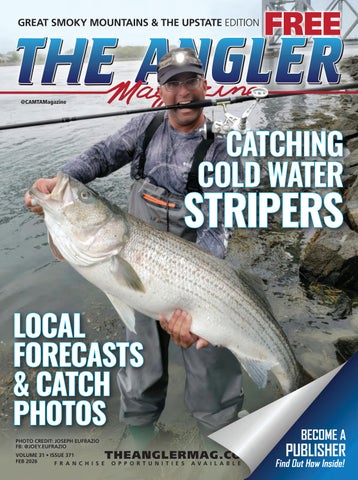
LOCAL FORECASTS & CATCH PHOTOS















Ever see a commercial harbor full of Furuno Marine Electronics and wonder why the pros rely on us?




See why here








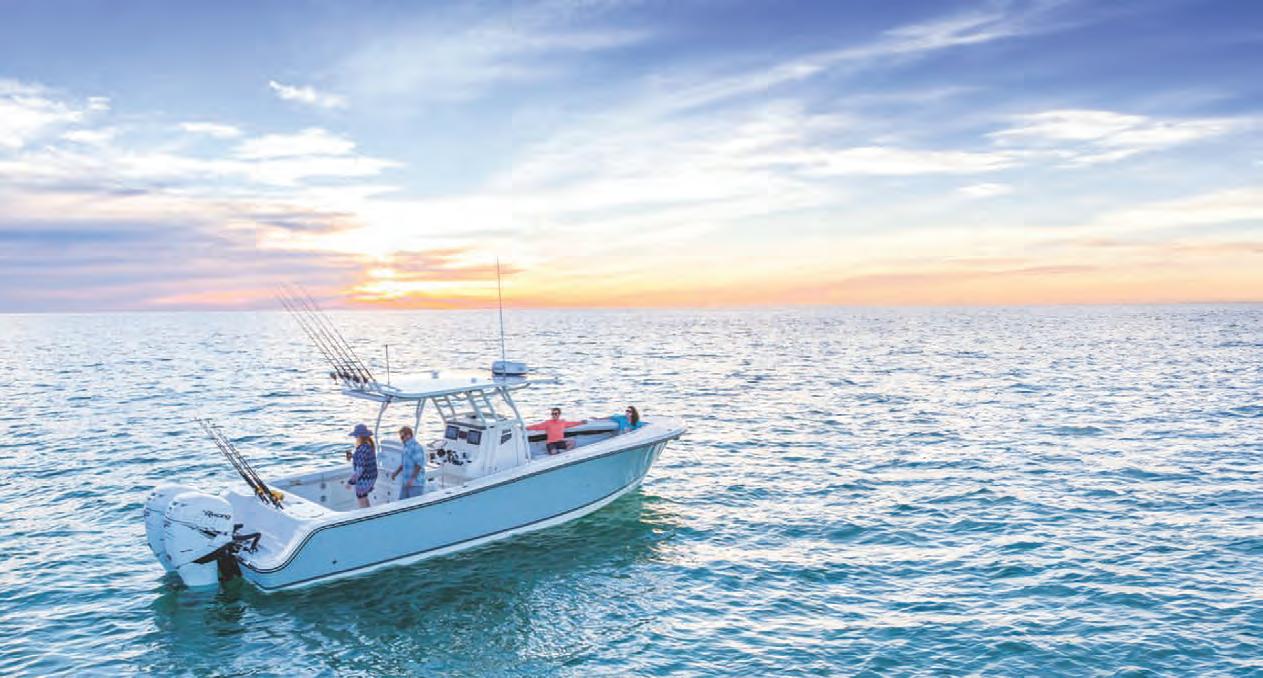






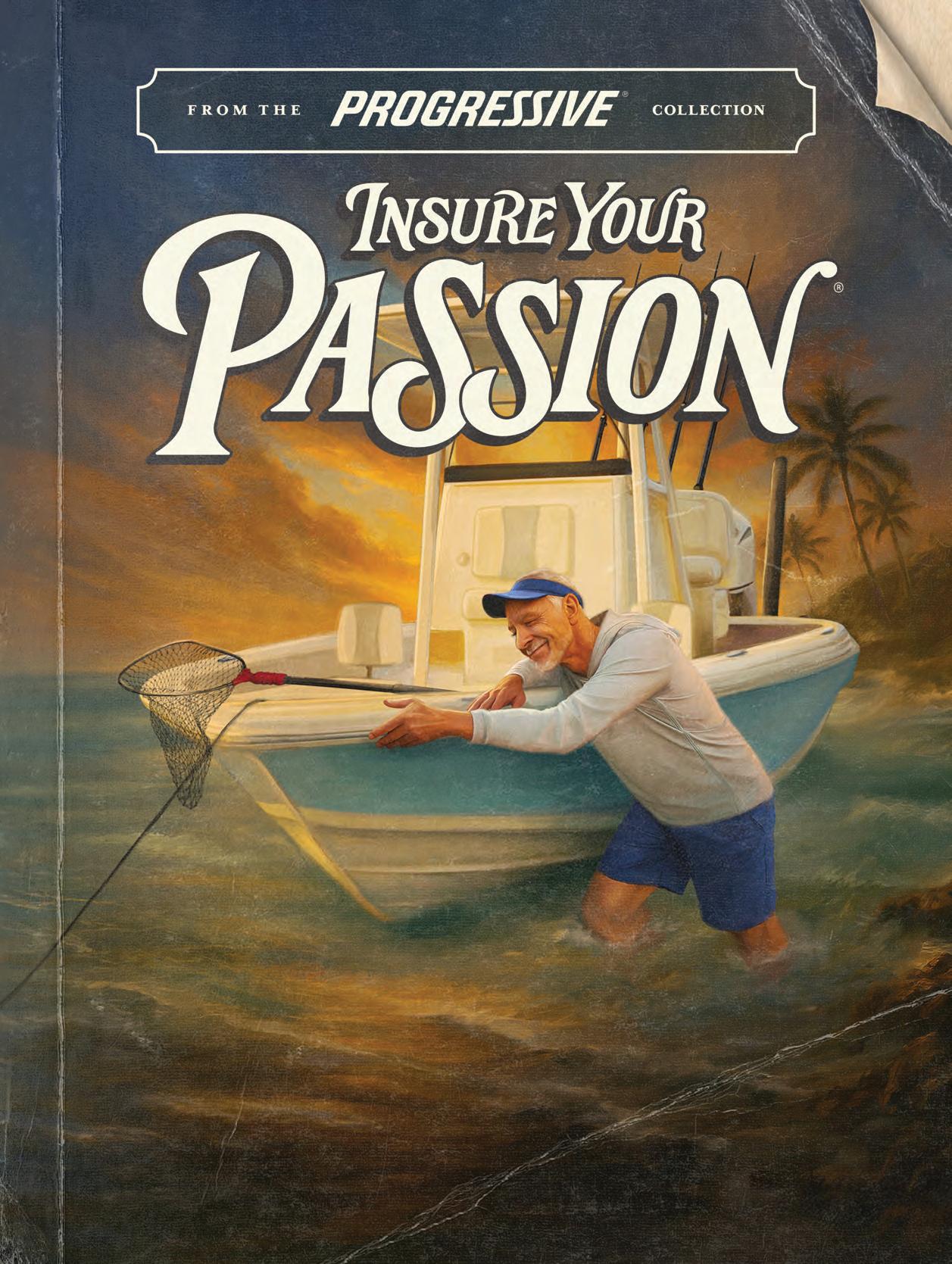
Are you ready to embark on your next on-water adventure? Before you set sail, here are fve things to know about boat insurance.
1. Boat insurance isn’t just for accidents
With comprehensive coverage, you’ll also be protected fnancially for theft, vandalism, and unexpected events like storms if you need repairs or replacements due to damage. 2. Accidents can happen to anyone
When accidents happen, boat insurance offers liability coverage for damages or injuries you cause while boating, up to specifed limits. It can also cover lawsuit costs if you’re sued.
3. Boat insurance can cover medical payments
Boat insurance offers a range of optional medical payments coverage limits, helping to cover medical expenses if you’re in an accident or someone is hurt on your boat, regardless of fault.
4. Most lenders require boat insurance
If you fnanced your boat, you’ll likely need boat insurance since most lenders require boat insurance to protect their investment. Additionally, some marinas or municipalities require proof of insurance for docking.
5. Progressive offers specialized boat coverages
Ever worry about getting stuck on the water?
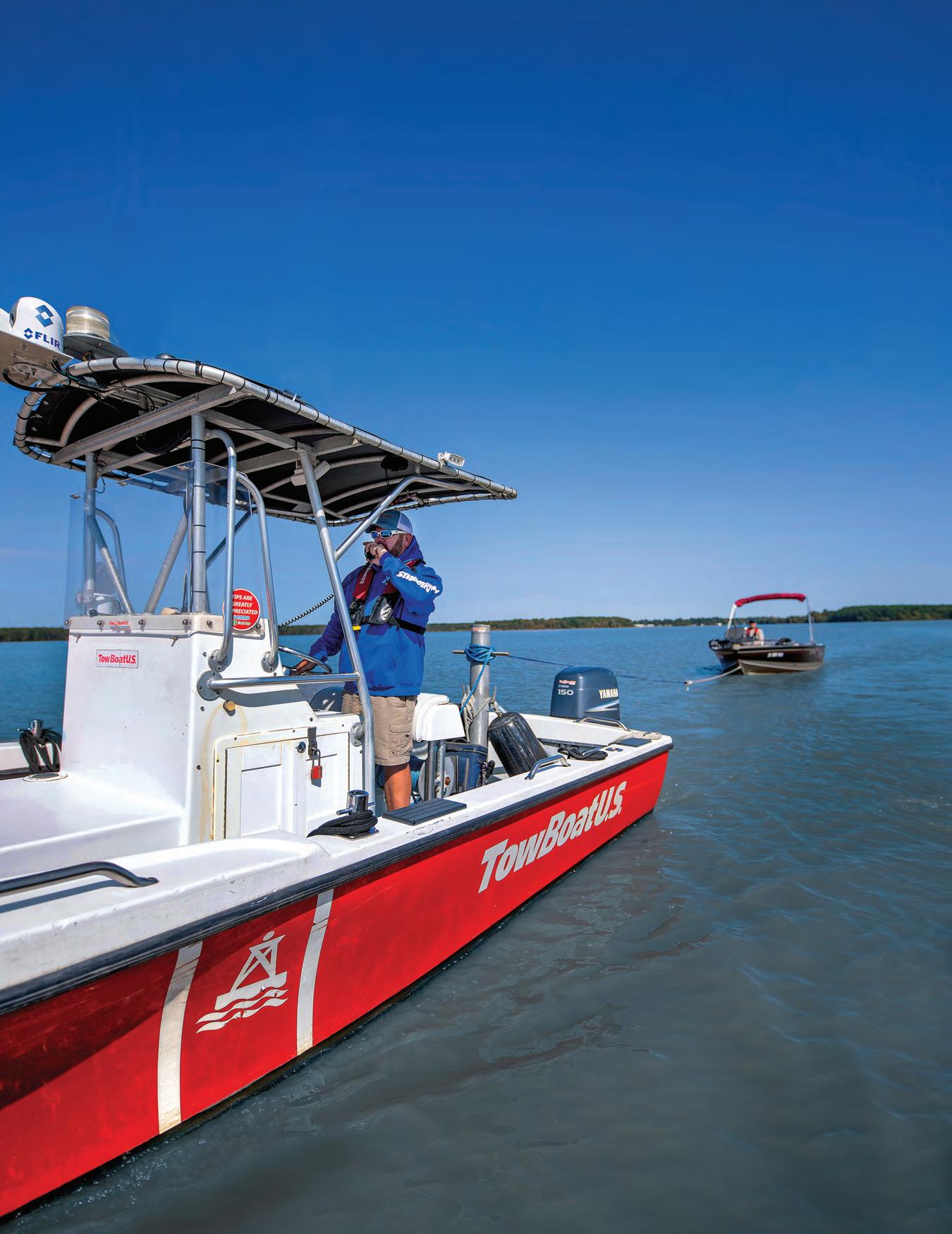
Progressive’s Sign & Glide® On-Water Towing coverage** can help. It’s an additional coverage that steps in if your boat is disabled or breaks down on the water, paying for on-water towing, jump starts, soft ungroundings, and fuel delivery. Fuel cost isn’t included.
Don’t let unforeseen circumstances disrupt your voyage. Cruise with confdence thanks to Progressive Boat insurance. Because when it comes to your boat, peace of mind is the ultimate luxury.
Scan to get a quote in as little as 4 minutes.
to learn more.











Do you want to catch more !ounder? You will need to nd an area with current, bait and structure for the !ounder to ambush its prey.
Where are they?
Flounder are very prevalent in creek mouths, jetties, sandy points, oyster bars, docks and any other underwater structures. e !ounder will take advantage of the structures to block the current, saving them energy and bringing bait right to their gluttonous mouths.
Flounder are the perfect ambush predator. ey like to bury in the sand adjacent to structures of some kind facing directly into the current. Your lure presentations always need to come from up current or you will spook them.
What do they eat?
CAPT. MIKE SMITH
and bait sh imitations.
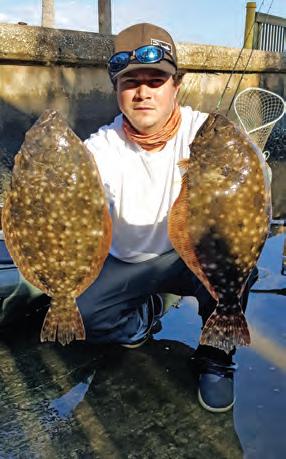
Flounder love to eat unsuspecting shrimp and sh brought to them by the current. e best lures to catch !ounder are scented shrimp

e best colors of lures to use for !ounder are any color as long as it is white. White is by far the best color of lure to catch !ounder. Do other colors work? Yes, if you want to catch fewer !ounders, then use something other than white.
e best lures that I have found for !ounder are Gulp! Shrimp and swimming mullets on a jig head. Start small and go bigger if you notice the bait in the area is large. Having an assortment from 3 to 5 inches will usually be perfect.
A great second choice for a !ounder lure is a white bucktail jig. Add a small piece of shrimp to add odor for best results.
How do you catch a flounder?
Flounder have a very small cone of awareness. ey are very unlikely to notice and
chase a lure that is more than 3 or 4 feet away from them.
ey also have a very small strike zone. ey are very hesitant to rise more than 18 inches o$ of the bottom to eat your lures.
Let’s say you found a beautiful oyster point at the mouth of a creek with plenty of current and bait !owing around it. is scenario is perfect for catching a !ounder.
Cast up current and work the lure on the bottom very slowly in 1 to 3 feet of water. When you think you hooked an oyster, set the hook. Flounder strikes are subtle and o en feel like a hang up.
It is very hard to work your lure too slowly for a !ounder. Old timers will tell you to just drag it on the bottom. I personally like to bounce my lures o$ the bottom being careful to not li it more than 18 inches into the water column.
Pro Tip: Use braided line and !uorocarbon leaders when shing for !ounder. Flouro sinks and helps you present your lures more e$ectively on the bottom. Braid doesn’t stretch and will help you feel a !ounder’s very subtle bites.
If you want to become an o cial !ounder pounder, then follow the tips above and catch more !atties. Go get ‘em!
Capt. Mike Smith, owner of Fish Your Ass O Charters, is an inshore "shing guide who has been "shing the inshore waters, oyster bars and grass ats of Florida for more than 40 years. Reach him at (561) 339-2317, email: contact@ "shyourasso .com or visit "shyourasso .com.


By Jim Mize
My daughter named this hole. I was sitting back in the woods watching her cast repeatedly to a twenty-inch rainbow and all the while it refused her offering, she was muttering under her breath, “Hateful, hateful, hateful.”
The Hateful Fish Hole, in case you lack good sense and want to fish there, lies on the upper end of Humility Creek, the stream where hemlocks crossed with Venus flytraps consume enough flies to keep the local fly-tackle shop in business. The fish on this stream are said to sport rearview mirrors, so regardless of your direction of approach, they take off with a wave of their tails.
The Hateful Fish Hole looks like any other nondescript flat run, with a riffle at the top and a small ledge at the bottom that brings the flow to a stop before plummeting three feet into the next hole. Only hip deep at its deepest point, in this hole the fish usually can be seen lined up in a feeding lane that ranges from the bottom to the top parallel to the flow. Bump one fish and he bumps the next, who bumps the next until all have gone to hide.
My daughter can fling a fly with the best of them and knows enough about bugs and branches to guide edible flies through the overhangs on Humility Creek and catch these wild trout. Upstream or downstream, rainbows or browns, the fish fall to the temptations she floats past them. It’s just this one hole that won’t share its fish.
On this particular day, she had tried an assortment of flies from small caddis to stonefly nymphs, only to have trout inspect her offering and politely decline. All during this episode, I could see fish rise to sip midges, open their mouths underwater in a flash of white, or roll sideways to nudge a nymph loose. After she had flailed to her dissatisfaction, I eased into the hole and tried a tan caddis with a midge dropper, usually the ticket for picky trout in these parts. Rainbows would rise to look, drift backwards with the fly, then settle into their original positions. After a while, they didn’t even rise to look.
I went through my box of tricks to see what else I could drift past these masters of indecision. Considering the possibilities, I first thought that maybe my midge was the wrong color. But how can you spot the color of an insect too small to see? We had already drifted larger flies and I had presented my smallest flies, both with the same result. We concluded that these trout were just hateful.
Whenever we fish this stretch of Humility Creek, we give extra effort to the Hateful Fish Hole. It’s become a challenge, knowing that if we can catch these fish, we can catch any fish. Last fall, on an afternoon when the browns were battering a Foxee Clouser, I came to the Hateful Fish Hole with renewed confidence. After all, I’d had enough luck already to almost
By Perry Hensley and Matt Xenos
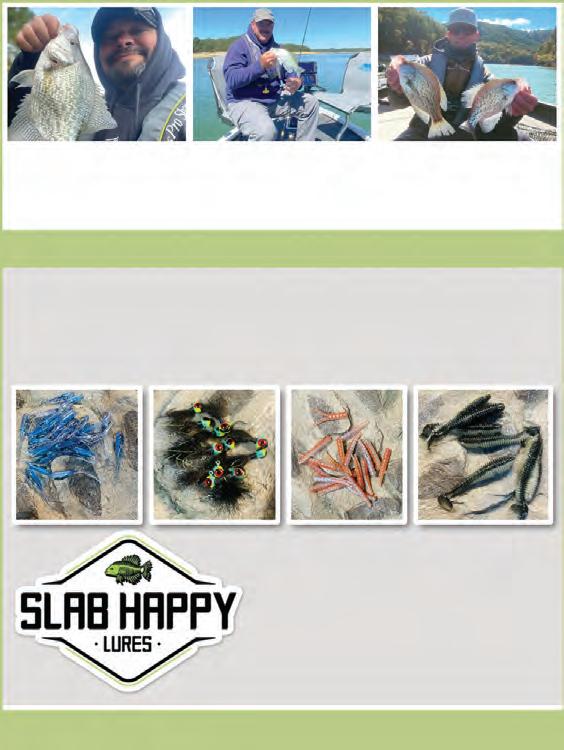
What a day and what a turnout from both the anglers and the fish. Cherokee is alive and healthy. The weights on today were up from usual with 4 teams posting weights over 9 lbs with 7 fish. Most anglers reported catching their fish in open water suspended. However, some teams caught fish on brush and on docks. So needless to say, you could catch good fish in a lot of different ways. That always makes for a fun tournament.
The team that was able to finish on top of the day in 1st Place was the team of Matt Xenos & Joel Nash with a 7 fish bag weighing 10.16 Lbs. Congrats men on the win!
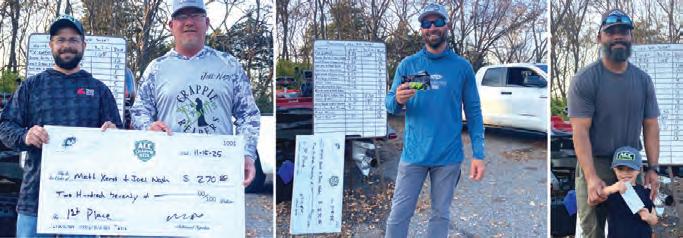
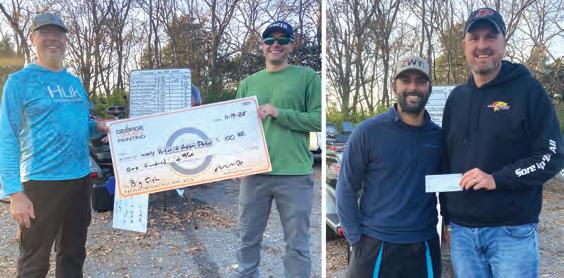
Winning the George Hamby Painting Big Fish Pot with a monster slab weighing 2.32 Lbs was the team of Wally Porter and Aaron Porter Huge slab guys congrats.
Finishing in 2nd Place with another impressive bag was the Larue Isom! Weighing in a sack of fish at 9.90 Lbs. Great job sir!
In the number 3 hole in 3rd Place was the team of Michael Wilson and Russ Thompson with a bag of 9.64 Lbs. Wonderful job guys!
Our Roll the dice giveaways at each event continue to grow and we continue to give away more and more free stuff.
Winning the ACC Crappie Stix Reels was the team of Louis Gibson and George Cooke.
Winning the ACC Crappie Stix Hats was the teams of Perry Hensley/ JD Dyer and Ronnie Everitt.
Winning the BoneHead Tackle Baits was Ty Coffelt.

Provided by Capt. Jim Durham, Owner StriperFun Guide Service, Tennessee and Kentucky Walleye, Bass, Crappie and Muskie Charters, Superbaittanks.com, Captain Jim Marine Electronics and much more…… DATE OF REPORT: January 2026
Greetings to my readers! I hope that the world finds you and your family doing well!
COME VISIT BEAUTIFUL THE BEAUTIFUL CUMBERLAND RIVER, CHEROKEE LAKE, HOLSTON RIVER AND CENTER HILL LAKE FOR FABULOUS WINTERTIME FISHING TRIPS –CALL EARLY WHILE WE STILL HAVE DATES AVAILABLE!

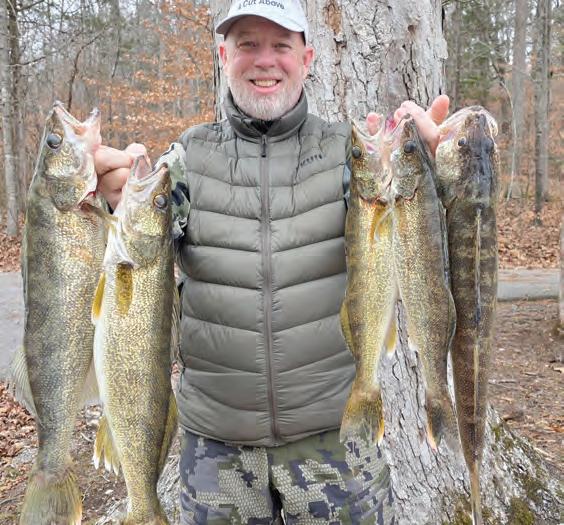
CUMBERLAND RIVER STRIPER, WALLEYE AND SAUGER HOLSTON RIVER AND CENTER HILL WALLEYE
StriperFun Guide Service and Tennessee Walleye Charters stays busy fishing for stripers, walleye and sauger on the Cumberland River near
Continued, see KY/TN FISHING REPORT Page 13


By Thomas Champeau
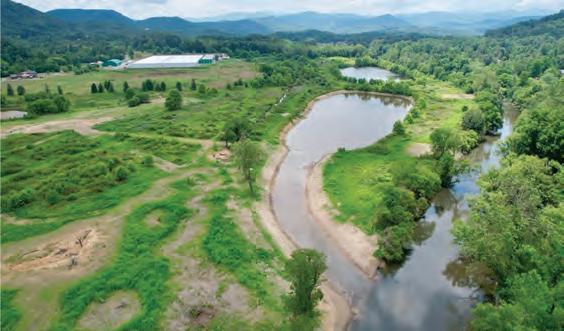
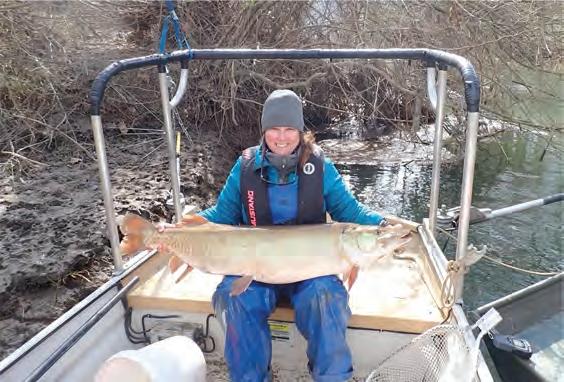
In the French Broad River, specifically along the “Muskie Mile”, anglers willing to pursue the “fish of 10,00 casts” can experience an incredible experience of catching a monster fish that was historically the apex predator of the French Broad system. While muskie can be found along much of the river south of Asheville, a 3-mile section east of Brevard from Hap Simpson Park Landing to the confluence of the Davidson River supports the best fishery with the last mile considered by many as the “Muskie Mile”.
Spin, baitcast, and fly fishing are used to throw big plugs and articulated, bushy flies as close to downed trees and limbs as anglers dare. Muskie lurk in the shadows of submerged wood patiently waiting to ambush their preferred prey of sunfish, suckers, snakes, frogs, and anything else that swims by. They are notorious for following a lure or fly on the retrieve nearly stopping the heart of the angler. Often working the lure or fly close to the boat in a “figure 8” pattern will trigger a reaction strike which results in a wild battle of a 40 - 50 inch fish on a short line. This exhilarating experience makes the challenge of muskie fishing worthwhile.
SPAWNING continued from page 7
Muskellunge or muskie (Esox masquinongy) are native to the Tennessee River system, with the French Broad River watershed the southern and eastern extent of its range. From the late 1800’s through the 1920’s, logging, water pollution including major chemical spills, and floodplain alterations from mainly agriculture combined to eliminate muskies from the French Broad by the middle of the 20th century. The Clean Water Act of 1972 and North Carolina pollution discharge regulations during the 1980’s resulted in improved water quality allowing the recovery of the fish community.
The North Carolina Wildlife Resources Commission (NCWRC) began stocking muskies from the Table Rock State Fish Hatchery in the 1970’s and annual/biannual stocking creates a successful put-growtake fishery. A study published in 1986 documented natural reproduction of muskie in the French Broad, but the lack of habitat suitable for muskie spawning, egg deposition, and fry survival limits the contribution of natural reproduction to the French Broad muskie fishery.
to distribute hatchery fish in the river to release them in the best habitat and at desirable densities. The club also holds youth fishing derbies and river clean ups. The catch data muskie guides and anglers provide to NCWRC biologists is also essential to evaluate the status of the fishery. Muskie spawn during spring (mid-March to mid-April) in slowflowing side channels or sloughs that were typically old oxbows off the main channel. These features were very common along the French Broad corridor historically until humans began developing the floodplain for agriculture. To drain the floodplain and prevent crop inundation, tributaries were channelized, and riparian banks were elevated by berms to keep high flows contained within the river channel. Without the sloughs, muskie reproductive success was reduced and the population gradually declined to eventual extinction.
In 2018, NCWRC biologists began releasing muskies implanted with passive integrated transponder (PIT) tags that can be detected with radio frequency identification devices (RFID) much like the pre-pay toll transponders drivers in big cities often use. By placing RFID detectors along the river, biologists can track movements of individual fish, revealing habitat preferences
The NCWRC works with the Western
Continued, see MUSKIE SPAWNING Page 10


MUSKIE SPAWNING continued from page 8 of muskie during various times of the year.
Working with other agencies, conservation organizations like Conserving Carolina, private landowners, and other partners, projects were developed to restore sloughs and evaluate their effectiveness. Two projects in Henderson County; Mud Creek and Pleasant Grove, created “muskie sloughs” to provide habitat for reproduction, however, they provide habitats for a wide variety of reptiles, amphibians, fish, invertebrates, birds, and mammals.
Conserving Carolina purchased 103 acres of flood-prone farmland in Fletcher where Mud Creek empties into the French Broad. Floodplain restoration was completed in 2020 with three sloughs for muskie spawning. The key to a slough is a direct connection to the French Broad while providing reduced flows and aquatic vegetation. Muskie eggs adhere to the vegetation to develop and hatch. Larval muskie are protected in the vegetation and feed on invertebrates living on the plants. Juvenile muskie feed on crayfish and small fish in the slough until they venture out into the river. When the project was completed, muskies were soon documented in the slough, with some traveling 20 miles to get there. This project also restored acres of wetland habitat that absorbs floodwaters attenuating downstream flows.
The Pleasant Grove property was a failed golf course community south of Etowah that Conserving Carolina purchased and restored in 2023. This 70-acre area now includes creeks, riverside forest, backwater slough, ponds, wetlands, and pollinator meadows. Flood waters from Hurricane Helene covered much of the site, some areas under 15 feet of water. Once the waters receded, project managers were amazed that restored habitats were in good condition, a testament to excellent project design, and luckily, enough time to allow vegetation to establish
at restored areas. A RFID recorder installed at the site by the NCWRC (at an elevation of 17 feet above ground - just above the unprecedented flood stage), detected muskies and other fish with implanted PIT tags that swam into the slough as a refuge from the flood. As of January 2026, a total of 44 different muskies have been detected in the slough.
Funding and assistance for the Mud Creek Floodplain Restoration Project came from the U. S. Fish and Wildlife Service, NCWRC, National Fish and Wildlife Foundation, NC Clean Water Management Trust Fund, NC Department of Environmental and Natural Resources, and NC
Natural Resources Conservation Service. Funding for the Pleasant Grove project came from the NC Land and Water Fund, NC Department of Public Safety, and National Fish and Wildlife Foundation. Conserving Carolina led both projects that were designed by Greg Jennings with Jennings Environmental. Volunteers from Trout Unlimited, the muskie club, and other conservation groups helped plant native vegetation following slough construction.
Projects like Pleasant Grove and Mud Creek store hundreds of acre-feet of floodwaters that would otherwise add to the torrent that roars downstream during flood events. Following the devastation from Helene, land managers are looking at potential sites along rivers that could be restored. Reconnecting rivers to their historic floodplains, restoring sloughs and wetlands provides flood protection and benefits wildlife. Many communities most impacted by Helene flooding and are struggling to recover have lower incomes than average. Protecting these communities from future floods is essential, and the additional benefits of higher conservation and recreational values will boost economic development that these communities need. This is the definition of restoring habitat to create resilient communities - wildlife and human.
By Capt. Cefus McRae, Nuts & Bolts of Fishing Series
January heralds in what I call the “winter doldrums.”
Christmas is over, the decorations are boxed up, and we begin to settle in for a few months of cold, dreary weather. But for those of us with the moxie to brave the cold weather, the fishing can be outstanding.
In fact, it’s those cloudy, drizzly, bone-chilling days that you’ll find me on the water. Most gamefish species welcome the cooler waters after surviving the hot summer temperatures. And on a dismal weather day, you may find that you have the entire trout stream to yourself. You’ll need to slow down your presentation, and also consider downsizing your baits. Smaller nymphs fished near the bottom will get these lethargic fish to bite. But on a day when the sun shines and the air warms a little, look for midge hatches and be ready to tie on a floater.
sounds, throw a Project-X X-Rig with ¼ ounce bucktails and slow-retrieve it through the area. Slow trolling these rigs is also quite productive.
Down at the coast, you can wrestle with some tasty filets inshore and nearshore. Sheepshead are fun to catch and so good on the table. We may or may not have a speckled trout closure in North Carolina due to the cold weather, but that’s to be determined; so, stay informed via the NC Wildlife Regulations site.
Similarly, bass anglers will be rewarded with slower presentations over deep holes, ledges and brush piles. On a sunny, warmer day, the fish will move to shallower spots for a while where crankbaits and jerk baits will trigger a strike. But the tried and true drop-shot rigs and spoons will produce good numbers. Use your electronics to locate bait schools and actively feeding fish.
Of course, stripers and hybrids absolutely love these cooler waters. They will be all over the water column, from mere inches of water to the deeper depths. The key is locating the kitchen. Start early in the backs of the creeks and move to the mouth as the day warms up. Look for diving birds to help locate the actively feeding schools. Topwater action this time of year can be phenomenal. Tie on a MirroLure Top Dog and cast past the feeding schools, working it into the chaos, and hold on. Once the school
FISH HOLE continued from page 2
lose my humility and replace it with confidence.
At the head of the pool, the last storm had pushed a log into the hole and wedged it against a boulder on the far side. The gorge in these mountains channels an inch of rainfall into a foot of stream flow, so the debris gets rearranged with every major storm. With that log providing cover, any big brown holed up here would lie in its shadow. So, I drifted the Clouser a breath off the log and without hesitation the brown rolled on the fly.
He just didn’t take it.
It looked like one of those football drills where linemen jump over each other while another one rolls under them. The fish rolled over the fly, flashed that big bronze belly at me, and came down on the other side of my line with no fly in its mouth. I set the hook, sent a perfectly-good Clouser into the hemlock behind me, which took it in one big gulp and I swear I heard it belch. The brown went back into his ambush spot in the Hateful Fish Hole and waited for the next unsuspecting fisherman.
During the dark hours of the night, I often ponder the secret to the Hateful Fish Hole. I tie ever-smaller midges in various colors, plot approaches to stay more concealed, and constantly buy smaller Fluorocarbon tippet every time a new brand comes out. I concluded that I needed to wait them out, wait for the perfect season, the perfect water, and the perfect weather. Then, this week it came.
Late in the summer, Humility Creek gets a little warm and the water a little low. So, I leave the fish alone until the nights cool. Then, if a piece of a tropical storm breaks off, we can get several days of back-to-back drizzle. Not enough to muddy the water, just enough to perk up the fish. Give them a good dose of oxygen and a few more inches of current to hide in. So, when that storm came, I took off and headed to the Hateful Fish Hole.
Using the stretch downstream to fine-tune my offer, I found the browns most receptive to an inchworm. I tie a small one with a curled
There’s something else you can do in January that is a little more comfortable. It’s Boat Show Season. And the big show to kick off the year is the Discover Boating Atlanta Boat Show January 8 – 11 at the Georgia World Congress Center. You’ll find everything from bass boats to jet skis to offshore boats here. Dealers from across the southeast will have the latest and greatest models on display, and they really want to sell boats. So, you can find some awesome deals. It’s the perfect way to spend a cold winter day, and you’ll probably find the boat that you’ve always wanted.
The Let’s Go Fishing Center will have seminars all day, every day with the Pro’s sharing their tactics to help you catch more fish on the lakes, in the rivers, and on the ocean. I’ll be conducting seminars on striper fishing and inshore saltwater. So, stop by and say Hi…and take a tour of my boat, the Wide Open II. There’s plenty to do and see, so plan to make a day of it.
Regardless of your fishing preferences, January is a great time to get outside. And getting on the water or attending a boat show is an excellent way to avoid cabin fever.
See you on the water or in Atlanta!
Tight Lines and Calm Seas, Capt. Cefus McRae
tail and it looks like it just fell from the sky. Maybe my tippet passes for its web, but the browns strike like they haven’t had a meal since spring. I had already released a handful of browns and rainbows when I had fished my way up to the hole. I watched it before moving in to see if any fish were active. On this day, nothing moved.
I tried the tail of the hole first to avoid bumping any browns that had moved into the shallows to feed. Three quick casts, left, center, and right of the stream flow produced nothing. Up near the boulder, subsequent storms had taken the log downstream, so the most likely spot now for a big fish was behind the rock and under a mountain laurel branch. I carefully worked about fifteen feet of line and twelve more of leader side-armed to keep it low and landed the inchworm with a noticeable “kerplop”, just the way browns like it. Before the rings could expand, a brown pounced and I set the hook.
To my amazement, the brown actually was on my line, in the Hateful Fish Hole, just like any other fish and hole. Maybe the curse was broken. Or maybe not.
The brown took off on a tear toward me at the lower end of the hole. On the opposite bank, brush had piled up and the brown streaked toward it. I leaned into the three-weight and 6X-tippet as much as I dared but knew I would be better off risking a broken line than letting that fish get into the brush.
Even with his head of steam I managed to turn him enough to skirt the brush pile and as soon as I did, I discovered it had all been a ruse. He never meant to go into the brush. Instead, he immediately dived under a flat rock. This rock looked like any other part of the stream bed, flat, three feet across, and at first glance, flush with the bottom. There couldn’t have been more than a couple inches of clearance on the back side, but he squeezed in with my line scraping over the top. I tried pulling him out, but he found a hold and I couldn’t. Continued, see HATEFUL FISH
By Ronnie Parris
Hey folks I hope you all had a great Christmas. The temps outside are dropping but the bites heating up. Although it may be uncomfortable if you can tough it out your gonna get in on some of the best fishing of the year. There’s several things you can do to help hedge your bets on a good trip starting with your boat.
Always check your batteries before heading out the cold can weaken
KY/TN FISHING REPORT continued from page 6
Gainesboro, Tennessee all winter long – December running through the end of March! We also have great walleye trips on the Holston River in eastern TN as well as on Center Hill Lake in middle Tennessee! These beautiful waters are loaded full of big fish.
CHEROKEE LAKE IS A FABULOUS
Cherokee Lake in Eastern Tennessee covers 30,300 acres, is 59 miles long and has 463 miles of shoreline. Cherokee Lake is noted for big stripers but is also “loaded” with big fat “hybrid” stripers as well! The striper and hybrid fishing is simply off the charts!
StriperFun offers day trips on Cherokee Lake year-round (weather permitting). We use freshly caught live gizzard and alewives shad, as well as a variety of my own brand of Captain Jim Special artificial lures to cast and troll with!
It is great to be alive and be a “free” American! I look forward to seeing all of you this year on the water. Always remember to stop and shake the hand of a person in uniform or wearing garb that shows they are a veteran! Their service is why you speak English, can vote and enjoy the freedoms you do! Until next time, blue skies and tight lines!
With full USCG and State licensing and insurance, all guides who take Captain Jim’s clients (13 guides on 14 waterways) can take you on a safe, fun and unforgettable fishing adventure! Check out all of our fishing services as well as our exclusive “online” store at www.striperfun. com or call 931-403-2501 to make reservations today.
With full State licensing and insurance, all Captain Jim’s Guide Service guides (19 guides on 18 waterways) can take you on a safe, fun and unforgettable fishing adventure! Check out all of our fishing services as well as our exclusive “online” store at www.striperfun.com or call 931-403-2501 to make reservations today.
or kill a battery faster than anything. Also, if you’re still using a 2 stroke or you haven’t cranked your boat in a while it’s not a bad idea to do so before you head to the lake. As far as tackle make sure you service your rods and reels good too. The cold especially below freezing temperatures make drags sluggish and line frailer, so I’d make sure I checked those really good before heading out.
Once on the water your clothes are probably the most important thing as far as comfort. I like to either wear a really good cold weather waterproof pair of coveralls or layer with good moisture wicking base layers a finishing with a waterproof outer shell. Boots are very important as our toes seem to take the worst from the cold. I have a really good pair of cold weather mick boots, which come in handy if I need to wade at the landing for any reason. Wool socks or battery powered socks are also nice in the cold. Gloves can

We o er both full and half day trips with the most competitive rates available. All tackle and supplies you will need while you are on your trip is covered by our listed price.
By James McManus
So, the new year always brings back great memories with lifelong friends. For years my bud Marty Jones and I had a standing date to troll lake Glenville on New Year’s Day. There had been a flood up Pine Creek earlier and had washed many trout into the lake. Typically, we would troll small Rapalas on lead core and flat lines. Not sure how many years this went on, but I had many pictures of five to eight pound trout all with an obituary date of January 1. Think the only years we didn’t do this was when the ramps would be iced over. There is nothing like the sound of a clicker buzzing wildly, while behind the boat a two foot long missile skys several feet into the air. Not sure why those trout

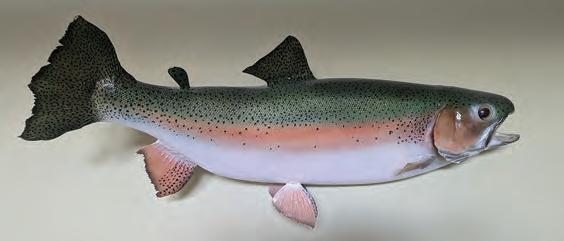
were so mean but haven’t caught any like those since.
Nowadays most of my winter fishing is at Fontana. With fewer guide trips, I love to take grandkids, and spotted bass have mostly replaced trout. Some of the best bass fishing will occur over the next couple of months. Fat, hungry, mean fish, that are eating to stay warm, are there for the taking.
As long as you prepare with layered clothing, proper safety measures, hot drinks and knowledge provided to loved ones what you’ll be doing and where you will be, there is no reason not to fish this time of year. The fish are certainly willing and able to make it a memorable trip.
Stay safe and thank God for our beautiful and bountiful lakes... later Capt. James.
Capt. James McManus owns 153 Charters. Give him a call for a great day on the water at (828) 421-8125
Not wanting to lose my first hateful fish, I waded out to get an angle from the back side and pry him loose. But by the time I got there, he’d found some leverage on tippet or fly, worked it loose, and made his departure just as I got there. From where I stood, his tail seemed to wave good-bye.
So, in the wee hours when it’s quiet and dark, I still plot strategies for the Hateful Fish Hole. I will keep buying smaller tippets with each new technological breakthrough. I will track my fishing log for hatches and stream conditions to plan the time of attack. And maybe I will come up with a different color midge that a trout with good eyesight can’t resist.
But on a creek that teaches humility, hateful fish are master instructors.
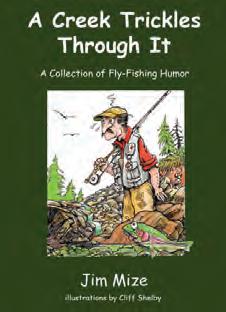
“The Hateful Fish Hole” is an excerpt from the award-winning book, A Creek Trickles Through It. You can order copies online or purchase autographed copies at www.acreektricklesthroughit.com.
from page 13
be great if you can fish with them on. Sometimes it’s hard to find a pair that you can fish with so you may want to experiment to see what works for you. Also, you can put hand warmers in your pockets and there are several different types of these I got introduced to the rechargeable ones on a recent trip with friends and I’m sold on them. Also, hot hands have the ones you shake and throw away at end of the day if you prefer them. Between netting, fishing and water from minnow buckets, your bound to get some ice buildup in the floor of your boat, so be really careful. I usually have a stove on the boat in the winter but take precautions as this could be a fire hazard. Travel and launching takes a little more care too as road conditions an ice buildup on the ramp can add to safety issues. Bottom line is it may be a little more difficult, but the winter fishing can be the best of the year. Be safe. Have fun. And when it warms up, take a kid fishing.

By James Marsh
South Carolina’s Middle Saluda River became the first stream in the state to be designated in the Scenic River program. The Middle Saluda River and its tributary, stream, Coldspring Branch, are both included. This portion of the stream lies in the Jones Gap State Park. It is a beautiful stream and one of South Carolina’s best wild trout streams. Fly fishing the Middle Saluda River can be both fun and rewarding.

The Middle Saluda River begins in the Mountain Bridge Wilderness Area. From there it flows through two state parks, Jones Gap and Ceasars Head. The stream has both stocked and wild rainbows, browns and brook trout. There is a catch-and-release section that starts at the footbridge at the Jones Gap State Park line and continues downstream to Hugh Smith Road.
The upper part of the Middle Saluda River drops on a good decline and has lots of fast pocket water with some runs and a few riffles. It is mostly completely covered with a canopy of tree limbs that helps keep the water cool. The wild trout are on the small side, probably averaging only about 5 or 6 inches but they can go up to 12 inches. Access is fairly easy in the upper section of the stream, but you will have to do some hiking. Jones Gap Trail follows along the stream for over five miles.
The state and the Mountain Bridge Chapter of TU arranged for the trout to be feed in the catch-and-release section of the stream, so the trout do grow large. It is managed as catch-and-release on a year round basis.
Below the special section, the lower Saluda River flows to its confluence with the South Saluda River. Most of the property along the lower section is private. You can access the lower section in the town of Cleveland at the U. S. Highway 76 Bridge. This area of the stream is stocked and does get warmer in the summer.
By Capt. Lukas Brickweg
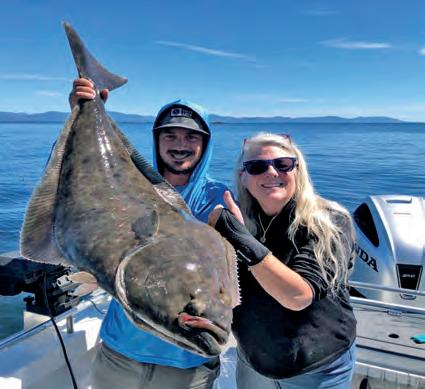
If you’ve ever dreamed about catching halibut and cod in the wilderness of Alaska - rod bent, line screaming, and majestic wildlife abound – now is the time to turn that dream into reality. Every season in Ketchikan, Alaska, May marks the kicko! to world-class halibut and Paci c cod shing, and we are ready to put you on the sh of a lifetime.
May is a special month in Southeast Alaska. e long daylight hours return, the ocean comes alive, and the early-season halibut move onto nearshore waters to feed. Halibut gather on the underwater ledges, humps, and sandy $ats, areas that we know like the backs of our hands, ranging from 200-400 feet.
At the same time, hungry Paci c cod patrol the same bottom structure, adding an action-packed bonus to every trip. “Alaska cod shing chaos” is the best way to describe
this seasonal bite. ere are no limits on retaining Paci c cod, allowing anglers to bring home huge hauls of cod and halibut. is means you can o en pull up a mixed bag of halibut, cod, and rock sh - making for one of the most productive and delicious shing experiences anywhere in the world.
Reeling up cod and halibut until your arms give out is a good way to summarize Alaska bottom shing in May.
May trips tend to ll quickly because the reputation for aggressive sh and minimum shing pressure. is combination equates to an anglers dream scenario. Whether you’re $ying in for our three to four day allinclusive lodging/ shing packages or on a cruise, it’s best to start planning and booking early. Ketchikan provides convenient $ights, accommodating guests from all over the US. Our all-inclusive packages provide airport transfer, lodging, meals, shing and sh processing.
The Bottom Line ere’s shing, and then there’s Alaska shing. And when it comes to halibut and
cod, May in Ketchikan is as good as it gets. So give us a call to book your spot, and come experience the thrill of hooking giants where every trip is a story worth telling.
Book your "Bucket List" trip to Alaska with Capt. Lukas Brickweg, of Ketchikan’s Finest Fishing Charters, at ketchikan shingtrips.com, call (907) 617-4717 or email ketchikan shingtrips@gmail.com.




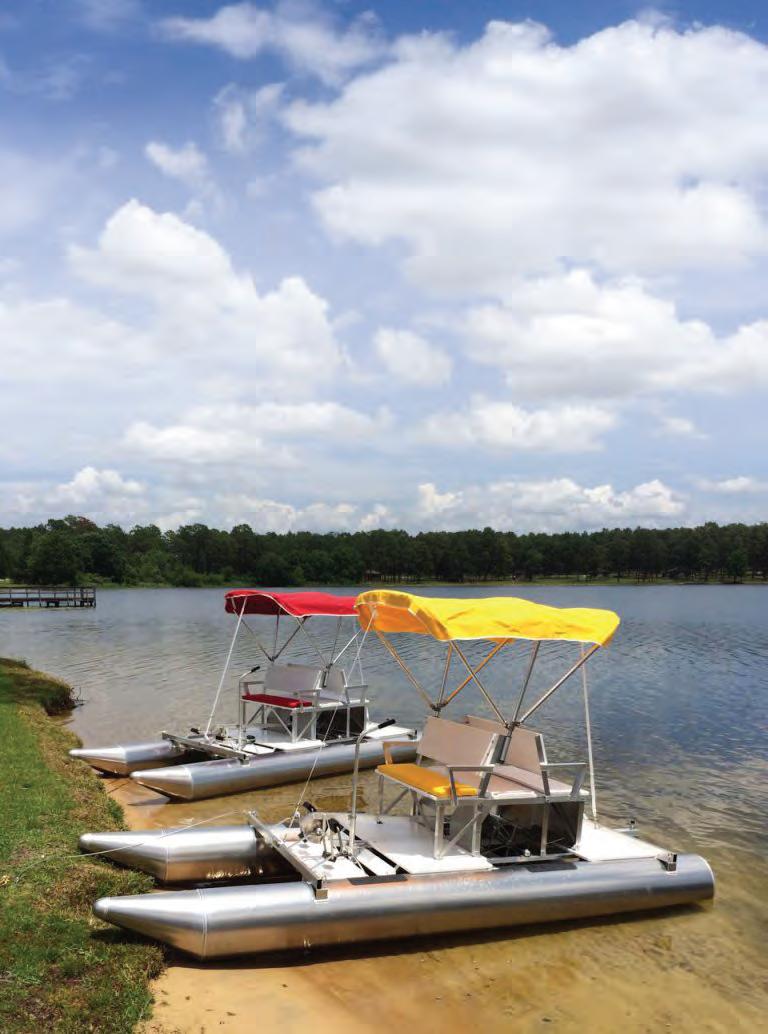
CAPACITY: Four Adults or 800 pounds (reduce by accessories and gear) Rear sun deck with retractable ladder for boarding in deep water. Two passengers face forward and two face backward. The front passengers pedal.
By CAM Sta
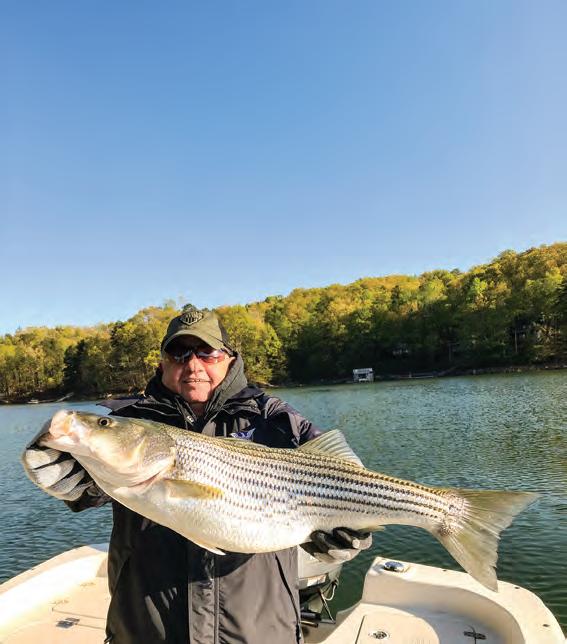
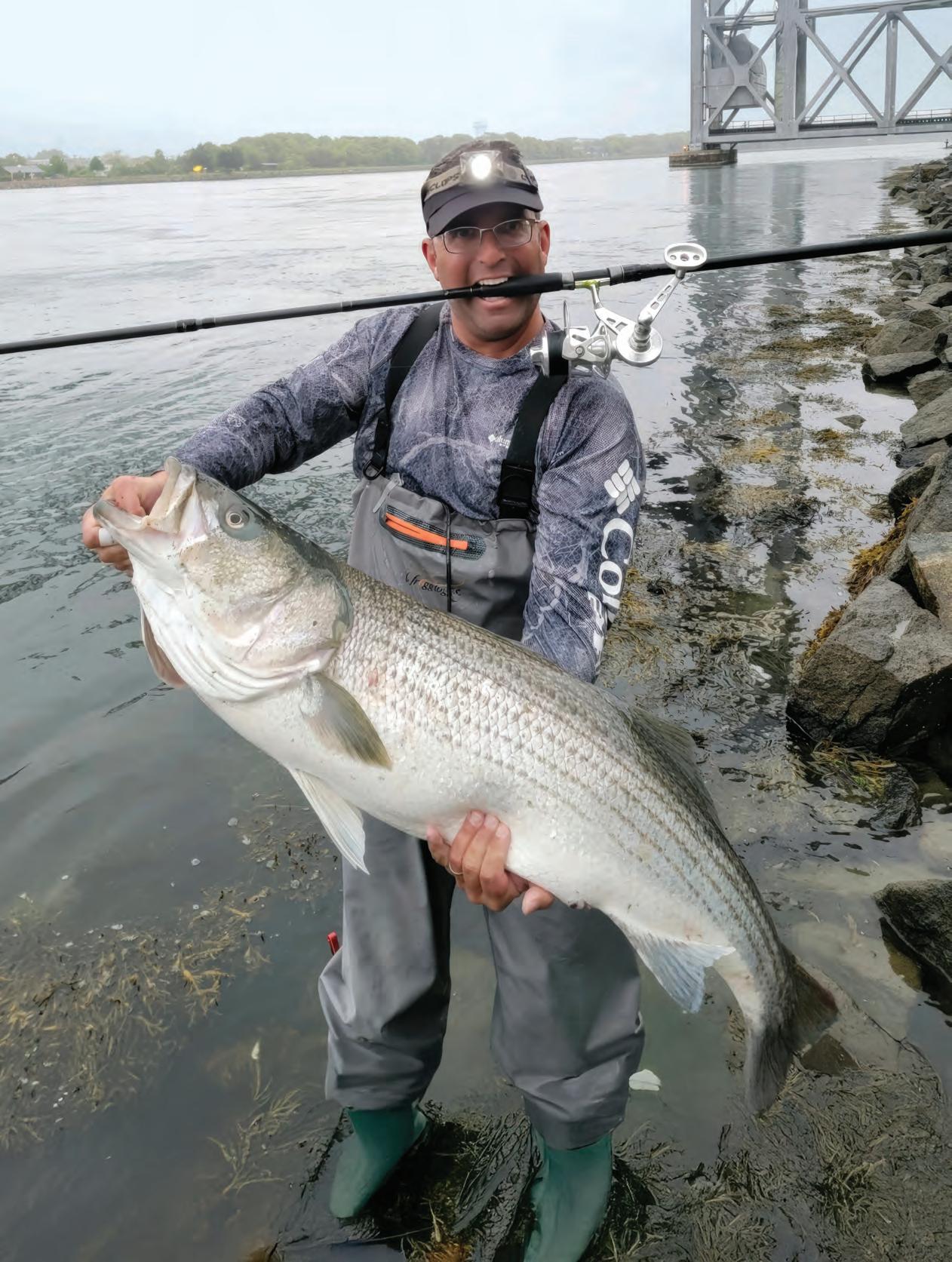
Whether in saltwater or freshwater, excellent striper shing awaits anglers hearty enough to brave winter conditions. So layer up, zip into that parka, and go—some of the biggest sh of the year are feeding right now.
At the southern end of their fall migration, striped bass spend the winter o! the coast of North Carolina. ey follow schools of bait up and down the shoreline from Wilmington to the Outer Banks, feeding heavily along the way. In many years, Oregon Inlet becomes the epicenter of the action, though stripers can be found in most inlets throughout the region.
e key is to follow the birds, which o en reveal bass blowing up on menhaden, glass minnows, or eels. At times the action pushes close enough to shore that surfcasters can hook stripers right from the beaches of the Outer Banks. More o en, however, the best approach is hiring a local captain armed with recent intel and a fast boat.
Farther south, Wilmington provides another winter opportunity as striped bass stack up in the Cape Fear River. ese sh hold near structure, dropo!s, and creek mouths, and can be caught on arti cials—or even on $ies. is resident population is separate from the highly migratory sh wintering o! the Outer Banks. Cape Fear stripers are strictly catch-and-release and must be returned to the water immediately, so keep an eye out for tagged sh.
Meanwhile, freshwater reservoirs across the Southern states and into the Mid-Atlantic also produce solid winter striper shing. While smaller, schoolie-sized sh can become sluggish during the coldest periods, larger stripers continue to feed. e pace may not match summertime downline action over massive schools, but the sh that do bite are o en bigger.

Tactics vary by shery, but when water temperatures stabilize—or during a multi-day warming trend—the largest sh in the lake o en push shallow, sometimes surprisingly so, as they shadow schools of small shad. Find the $ickering bait, and you’ll nd the stripers. You may even see them picking o! prey near the surface. Stealth is critical in these situations, and so plastics like Flukes frequently outproduce live bait. ey’re easier to cast and allow for a slow, controlled retrieve.
Another e!ective approach is covering water by trolling wide spreads of small live baits, pulling umbrella rigs loaded with swimbaits, or combining both methods. When shing this way, good local information is invaluable. On some lakes, stripers spend the winter near the dam; on others, they push far up into the creeks.
Winter may test an angler’s resolve, but for those willing to endure the cold, striper shing can be at its best. From coastal inlets and rivers to inland reservoirs, striped bass remain active and accessible, o en with less pressure and a better chance at trophy-sized sh. Success comes down to preparation, paying attention to bait and bird activity, and adapting tactics to changing conditions. Bundle up, do your homework, and embrace the season—the reward could be the biggest striper of your year.


Coming o! the heels of a record-breaking 2025 season that awarded 11 century belts, saw four- rst time champions (two of which were members of the 2025 rookie class) and garnered over 183 million social media impressions, B.A.S.S. has announced the 101-angler eld for an exciting 2026 Elite Series season.
is year, anglers will be put to the test with the use of forward-facing sonar only being allowed at ve of the nine regular-season Elite events. Anglers will be competing for a $100,000 rst-place prize at each stop of the season, while also accumulating valuable Progressive Bassmaster Angler of the Year points in hopes of making it to the 2027 Bass Pro Shops Bassmaster Classic presented by Under Armour.

“Each season, the Bassmaster Elite Series showcases the very best in professional bass shing, and 2026 will be no exception,” said B.A.S.S. Elite Series Tournament Director Lisa Talmadge. “We’re excited to welcome 101 incredibly talented anglers who represent the heart of this sport—a mix of proven champions, rising stars and hungry newcomers all ready to compete on some of the most iconic sheries in the country. It’s going to be an unforgettable season for our anglers and fans alike.”
With the exception of one angler, every 2025 Elite Series angler who quali ed is returning next year. e list of anglers includes 2025 Bass Pro Shops Bassmaster Classic champion Easton Fothergill of Grand Rapids, Minn., who won the most coveted trophy in bass shing during his freshman season on the Elites. Two-time Progressive Bassmaster Angler of the Year Chris Johnston will also join the ranks of returning anglers alongside Dakota Lithium Bassmaster Rookie of the Year Tucker Smith, who took home his rst blue trophy at the 2025 Bassmaster Elite at Lake Fork with a 127-pound, 8-ounce winning weight that also earned him a century belt.
Ten anglers from the Nitro Boats Bassmaster Elite Quali ers will also be joining the 2026 Elite roster, including 20-year-old Alabama phenom Fisher Anaya who claimed the 2025 Nitro Boats Bassmaster Elite Quali ers Angler of the Year title. Wisconsin’s Nick Trim clinched an Elite Series spot for himself alongside his big win at the 2025 Mercury B.A.S.S. Nation Championship at Upper Mississippi River presented by Lowrance. e 2026 Progressive Bassmaster Elite Series kicks o! on Alabama’s Lake Guntersville February 5. From there the tournament trail will wind through six states as anglers battle for cash prizes and attempt to qualify for the 2027 Bass Pro Shops Bassmaster Classic presented by Under Armour.
Each tournament will begin with the full eld of anglers on Days 1 and 2 before the eld is cut to the Top 50 on Semi nal Saturday. Only the Top 10 anglers will sh the nal day of the event, with a $100,000 rstplace prize and a blue trophy on the line. For the complete roster, and to keep up with all the action from the 2026 Elite Series season visit Bassmaster.com.

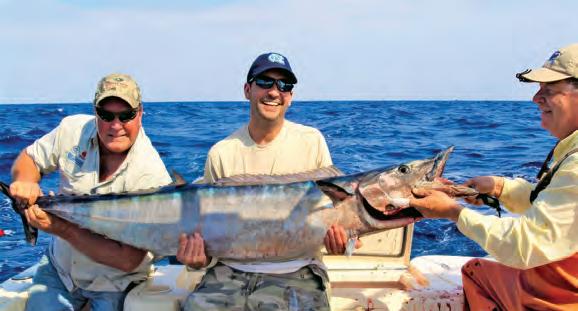
This is the time of year to nd the wall of warmer water and get the wahoo bite going. All of the water nearshore is cold and where the 68- plusdegree water meets that cold water can be an excellent spot for targeting wahoo. is is a great time of year to target wahoo during the rst hour or two of your trip using high speed trolling. You can cover a lot of ground high speed trolling, which speci cally targets wahoo. Once the sun has been up for a few hours your chances at a wahoo bite diminish unless it’s an overcast or rainy day. Wahoo regulate the amount of sun they take in by going deeper as the sun rises, so midmorning is a good time to change tactics.
Slow dri s, kite shing and jigging the column with live baits is a great mid-morning tactic and the bigger the bait the better. ere’s no telling what you’ll raise during these colder days shing the temperature change. Never count out deep dropping near these temperature change areas either. Fishing the entire water column from the surface to the bottom turns a cold day into a cooler full of sh and some awesome dinners.



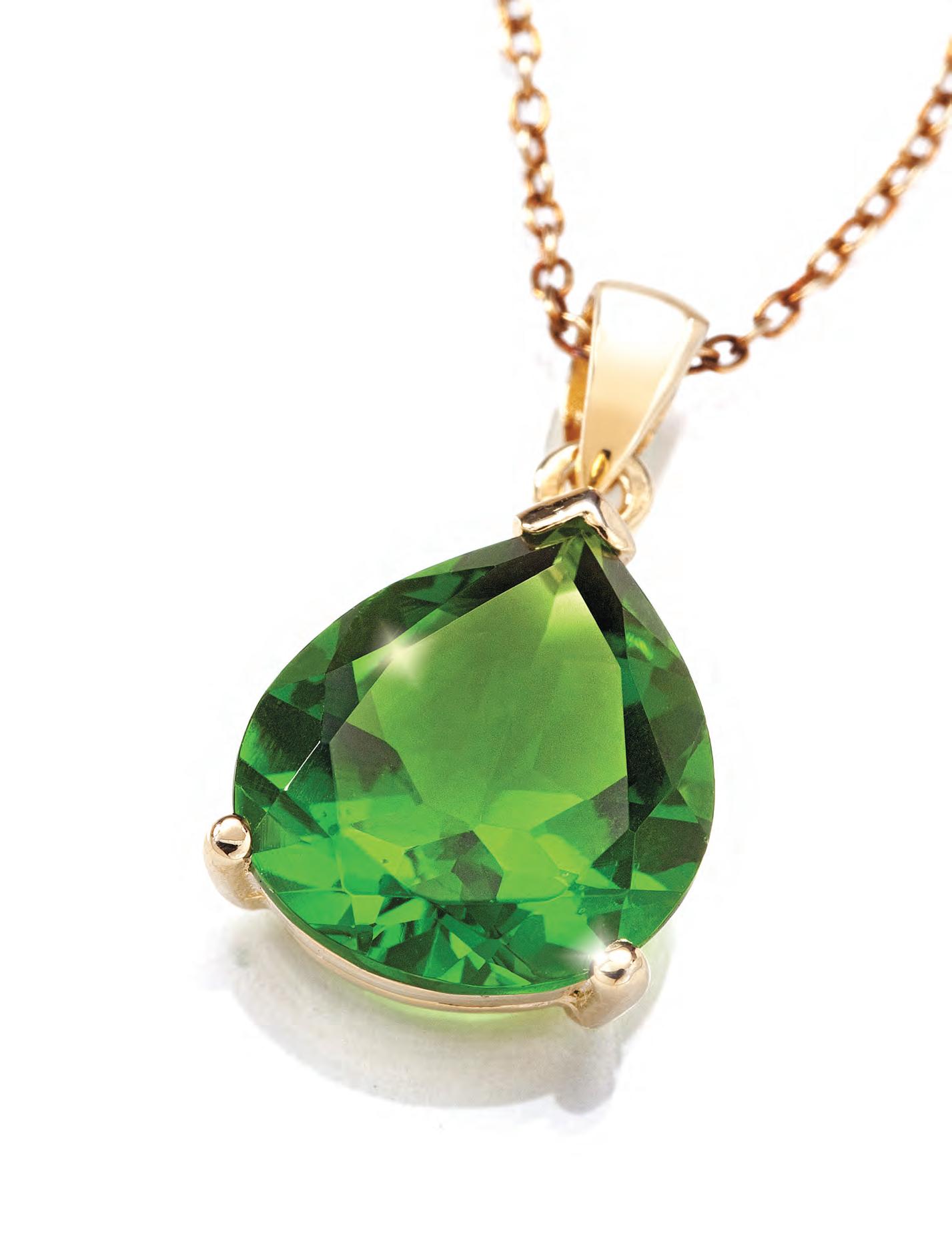
Discover this spectacular 6½-carat green treasure from Mount St. Helens!
For almost a hundred years it lay dormant. Silently building strength. At 10,000 feet high, it was truly a sleeping giant. Until May 18, 1980, when the beast awoke with violent force and revealed its greatest secret. Mount St. Helens erupted, sending up a 80,000-foot column of ash and smoke. From that chaos, something beautiful emerged… our spectacular Helenite Necklace
Helenite is produced from the heated volcanic rock of Mount St. Helens and the brilliant green creation has captured the eye of jewelry designers worldwide. Today you can wear this massive 6!-carat stunner for only $99!
Helenite Earrings -a $99 valuewith purchase of Helenite Necklace
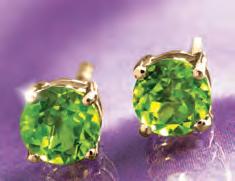
Make your emeralds jealous. Our Helenite Necklace puts the green stone center stage, with a faceted pearcut set in .925 sterling silver finished in luxurious gold. The explosive origins of the stone are echoed in the flashes of light that radiate as the piece swings gracefully from its 18" luxurious gold-finished sterling silver chain. Today the volcano sits quiet, but this unique piece of American natural history continues to erupt with gorgeous green fire. Your satisfaction is guaranteed. Bring home the Helenite Necklace and see for yourself. If you are not completely blown away by the rare beauty of this exceptional stone, simply return the necklace within 30 days for a full refund of your purchase price.
JEWELRY SPECS:
- 6 ½ ctw Helenite in gold-finished sterling silver setting - 18" gold-finished sterling silver chain
Limited to the first 600 orders from this ad only
Helenite Necklace (6 ½ ctw) ............. Only $99 +S&P
Helenite Stud Earrings (1 ctw) ................ $99 +S&P
Helenite Set $198 ........... Call-in price only $99 +S&P (Set includes necklace and earrings)
Call now to take advantage of this extremely limited offer.
1-800-333-2045
Promotional Code HNN213-05
Please mention this code when you call.
color.

“My wife received more compliments on this stone on the first day she wore it than any other piece of jewelry I’ve ever given her.” - J. from Orlando, FL Stauer Client