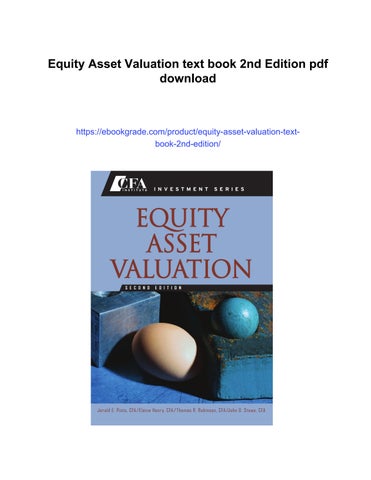
Equity asset valuation text book 2nd edition - The full ebook with complete content is ready for dow

Page 1


Equity Asset Valuation text book 2nd Edition pdf download

https://ebookgrade.com/product/equity-asset-valuation-textbook-2nd-edition/

Equity Asset Valuation Workbook

https://ebookgrade.com/product/equity-asset-valuation-workbook/

ebookgrade.com

Equity Asset Valuation Workbook 3rd Edition

https://ebookgrade.com/product/equity-asset-valuation-workbook-3rdedition/

ebookgrade.com

Private Equity as an Asset Class 2nd Edition

https://ebookgrade.com/product/private-equity-as-an-asset-class-2ndedition/

ebookgrade.com

Equity Asset Valuation (CFA Institute Investment Series) 2nd edition Pinto Jerald E. & Henry Elaine & Robinson Thomas R. & Stowe John D

https://ebookgrade.com/product/equity-asset-valuation-cfa-instituteinvestment-series-2nd-edition-pinto-jerald-e-henry-elaine-robinsonthomas-r-stowe-john-d/ ebookgrade.com

Aircraft Valuation Airplane Investments as an Asset Class

https://ebookgrade.com/product/aircraft-valuation-airplaneinvestments-as-an-asset-class/

ebookgrade.com

Investment Valuation Tools and Techniques for Determining the Value of any Asset 3e

https://ebookgrade.com/product/investment-valuation-tools-andtechniques-for-determining-the-value-of-any-asset-3e/

ebookgrade.com

Investment Valuation Tools and Techniques for Determining the Value of Any Asset 3rd University Edition

https://ebookgrade.com/product/investment-valuation-tools-andtechniques-for-determining-the-value-of-any-asset-3rd-universityedition/

ebookgrade.com

Valuation for Mergers and Acquisitions (2nd Edition)

https://ebookgrade.com/product/valuation-for-mergers-andacquisitions-2nd-edition/

ebookgrade.com

Other documents randomly have different content

The queen she’s into her chamber gone, Amongst her maries, so frank and free; ‘You may weep, you may weep, Margaret,’ she says, ‘For hanged must the laird of Logie be.’

8

She has torn her silken scarf and hood, And so has she her yellow hair: ‘Now fare you well, both king and queen, And adieu to Scotland for ever mair!’

9

She has put off her goun of silk, And so has she her gay clothing: ‘Go fetch me a knife, and I’ll kill myself, Since the laird of Logie is not mine.’

10

Then out bespoke our gracious queen, And she spoke words most tenderlie; ‘Now hold your hand, Lady Margaret,’ she said, ‘And I’ll try to set Young Logie free.’

11

She’s up into the king’s chamber gone, And among his nobles so free; ‘Hold away, hold away!’ says our gracious king, ‘No more of your pardons for Young Logie.

12

‘Had you but askd me for houses and land, I would have given you castles three; Or anything else shall be at your command, But only a pardon for Young Logie.’

13

‘Hold your hand now, my sovereign liege,

And of your anger let it be; For the innocent blood of Lady Margret It will rest on the head of thee and me.’

14

The king and queen are gone to their bed, But as he was sleeping so quietly, She has stole the keys from below his head, And has sent to set Young Logie free.

15

Young Logie he’s on horseback got, Of chains and fetters he’s got free; As he passd by the king’s window, There he has fired vollies three.

16

The king he awakend out of his sleep, Out of his bed came hastilie; Says, I’ll lay all my lands and rents That yonder’s the laird of Logie free.’

17

The king has sent to the prison strong, He has calld for his keepers three; Says, How does all your prisoners? And how does the young laird of Logie?

18

‘Your Majesty sent me your wedding-ring, With your high command to set him free;’ ‘Then tomorrow, before that I eat or drink, I surely will hang you keepers three.’

19 Then out bespoke our gracious queen, And she spoke words most tenderlie;

‘If ever you begin to hang a man for this, Your Majesty must begin with me.’

20

The one took shipping at [the pier of] Leith, The other at the Queen’s Ferrie; Lady Margaret has gotten the man she loves, I mean the young laird of Logie.

Harris MS., fol. 16; from Mrs Harris’s recitation.

1

Pretty is the story I hae to tell, Pretty is the praisin o itsel, An pretty is the prisner oor king’s tane, The rantin young laird o Logie.

2

Has he brunt? or has he slain? Or has he done any injurie? Oh no, no, he’s done nothing at all, But stown a kiss frae the queen’s marie.

3

Ladie Margaret cam doon the stair, Wringin her hands an tearin her hair; Cryin, Oh, that ever I to Scotland cam, Aye to see Young Logie dee!

4

‘Had your tongue noo, Lady Margaret, An a’ your weepin lat a bee! For I’ll gae to the king my sell, An plead for life to Young Logie.’

5

‘First whan I to Scotland cam, You promised to gie me askens three; The first then o these askens is Life for the young laird o Logie.’

6

‘If you had asked house or lands, They suld hae been at your command; But the morn, ere I taste meat or drink, High hanged sall Young Logie be.’

7

Lady Margaret cam doon the stair, Wringin her hands an tearin her hair; Cryin, Oh, that ever I to Scotland cam, A’ to see Young Logie dee!

8

‘Haud your tongue noo, Lady Margaret, An a’ your weepin lat a bee!

For I’ll counterfiet the king’s hand-write, An steal frae him his richt hand gloe, An send them to Pitcairn’s wa’s,

A’ to lat Young Logie free.’

9

She counterfieted the king’s hand-write, An stole frae him his richt hand gloe, An sent them to Pitcairn’s wa’s,

A’ to let Young Logie free.

10

The king luikit owre his castle-wa, Was luikin to see what he cald see:

‘My life to wad an my land to pawn, Yonder comes the young laird o Logie!’

11

‘Pardon, oh pardon! my lord the king, Aye I pray you pardon me; For I counterfieted your hand-write, An stole frae you your richt hand gloe, An sent them to Pitcairn’s wa’s,

A’ to set Young Logie free.’

12

‘If this had been done by laird or lord, Or by baron of high degree, I’se mak it sure, upon my word,

se a t su e, upo y o d, His life suld hae gane for Young Logie.

‘But since it is my gracious queen, A hearty pardon we will gie, An for her sake we’ll free the loon, The rantin young laird o Logie.’

Motherwell’s Minstrelsy, p. 56, the third stanza; from recitation.

May Margaret sits in the queen’s bouir, Knicking her fingers ane be ane, Cursing the day that she ere was born, Or that she ere heard o Logie’s name.

B.

61 . and towirs in ed. 1776.

Qu in what, etc., is rendered by w, and z in ze, etc., by y.

C.

Maidment’s copy has some slight variations, such as often occur in different issues of stallprints.

13 . very very.

14 . the love.

31 . into.

42 . you be.

64 . It’s hanged.

71 . her own.

72 . and so free.

73 . Lady Margret.

81 . tore.

82 , 92 . she has.

83 . ye.

111 . up to.

142 . beds.

182 . commands.

193 . you do hang.

201 . at the pier of.

21 . Perhaps brent.

61 . Perhaps houses.

102 . Perhaps culd.

WILLIE MACINTOSH

A. ‘Burning of Auchindown.’ a. The Thistle of Scotland, p. 106. b. Whitelaw, The Book of Scottish Ballads, p. 248.

B. ‘Willie Mackintosh,’ Finlay’s Scottish Ballads, II, 89.

The murder of the “Bonny Earl of Murray” was the occasion of serious commotions in the North Highlands. Towards the end of the year 1592, the Macintoshes of the Clan Chattan, who of all the faction of Murray “most eagerly endeavored to revenge his death,” invaded the estates of the Earl of Huntly, and killed four gentlemen of the surname of Gordon. Huntly retaliated, “and rade into Pettie (which was then in the possession of the Clan

Chattan), where he wasted and spoiled all the Clan Chattan’s lands, and killed divers of them. But as the Earl of Huntly had returned home from Pettie, he was advertised that William Macintosh with eight hundred of Clan Chattan were spoiling his lands of Cabrach: whereupon Huntly and his uncle Sir Patrick Gordon of Auchindown, with some few horsemen, made speed towards the enemy, desiring the rest of his company to follow him with all possible diligence, knowing that if once he were within sight of them they would desist from spoiling the country. Huntly overtook the Clan Chattan before they left the bounds of Cabrach, upon the head of a hill called Stapliegate, where, without staying for the rest of his men, he invaded them with these few he then had. After a sharp conflict he overthrew them, chased them, killed sixty of their ablest men, and hurt William Macintosh with divers others of his company.”[299]

Two William Macintoshes are confounded in the ballad. The burning of Auchindown is attributed, rightly or wrongly, to an earlier William, captain of the clan, who, in August, 1550, was formally convicted of conspiracy against the life of the Earl of Huntly, then lieutenant in the north, sentenced to lose his life and lands, and, despite a pledge to the

contrary, executed shortly after by the Countess of Huntly.[300]

Auchindown castle is on the banks of the Fiddich, B 1. By Cairn Croom, A 4, is meant, I suppose, the noted Cairngorm mountain, at the southern extremity of Banffshire.

Aa. The Thistle of Scotland, p. 106, 1823. b. Whitelaw, The Book of Scottish Ballads, p. 248; from an Aberdeen newspaper of about 1815.

1

‘Turn, Willie Macintosh, Turn, I bid you; Gin ye burn Auchindown, Huntly will head you.’

2

‘Head me or hang me, That canna fley me; I’ll burn Auchendown, Ere the life lea me.’

3

Coming down Deeside, In a clear morning, Auchindown was in flame, Ere the cock-crawing.

4 But coming oer Cairn Croom, And looking down, man, I saw Willie Macintosh Burn Auchindown, man.

5

‘Bonny Willie Macintosh, Whare left ye your men?’

‘I left them in the Stapler, But they’ll never come hame.’

6

‘Bonny Willie Macintosh, Whare now is your men?’

‘I left them in the Stapler, Sleeping in their sheen.’

Finlay’s Scottish Ballads, II, 89, 1808, as recollected by a lady and communicated by Walter Scott.

1

As I came in by Fiddich-side, In a May morning, I met Willie Mackintosh, An hour before the dawning.

2

‘Turn again, turn again, Turn again, I bid ye; If ye burn Auchindown, Huntly he will head ye.’

3

‘Head me, hang me, That sall never fear me; I’ll burn Auchindown Before the life leaves me.’

4

As I came in by Auchindown, In a May morning, Auchindown was in a bleeze, An hour before the dawning.

5 Crawing, crawing, For my crowse crawing, I lost the best feather i my wing For my crowse crawing.

12 . Turn, turn.

13 . If you.

22 . That winna.

3 wanting.

41 . But wanting.

After 4: Light was the mirk hour At the day-dawing, For Auchindoun was in flames Ere the cock-crawing.

5, 6 wanting.

THE LADS OF WAMPHRAY

Glenriddell MSS, XI, 34, 1791.

‘Lads of Wamphray, ane old ballad, sometimes called The Galiard,’ is the superscription in the manuscript. Printed in Scott’s Minstrelsy, I, 208, 1802, II, 148, 1833; with the omission of 4 and 36, the insertion of four verses after 8, two transpositions, and some changes of language.

“The following song celebrates the skirmish, in 1593, betwixt the Johnstones and Crichtons, which led to the revival of the ancient quarrel betwixt Johnstone and Maxwell, and finally to the battle of Dryffe Sands, in which the latter lost his life. Wamphray is the name of a parish in Annandale. Lethenhall was the abode of Johnstone of Wamphray, and continued to be so till of late years.

William Johnstone of Wamphray, called the Galliard, was a noted freebooter. A place near the head of Teviotdale retains the name of the Galliard’s Faulds (folds), being a valley, where he used to secrete and divide his spoil with his Liddesdale and Eskdale associates. His nom de guerre seems to have been derived from the dance called the galliard. The word is still used in Scotland to express an active, gay, dissipated character. Willie of the Kirkhill, nephew to the Galliard, and his avenger, was also a noted Border robber.”

“Leverhay, Stefenbiggen, Girth-head, etc., are all situated in the parish of Wamphray. The Biddes-burn, where the skirmish took place betwixt the Johnstones and their pursuers, is a rivulet which takes its course among the mountains on the confines of Nithesdale and Annandale. The Wellpath is a pass by which the Johnstones were retreating to their fastnesses in Annandale. Ricklaw-holm is a place upon the Evan water, which falls into the Annan below Moffat. Wamphray-gate was in these days an alehouse.” Scott’s Minstrelsy, I, 208 ff., ed. 1802.

This affair is briefly noticed in the Historie of King James the Sext in the following terms: “Sum unbrydlit men of Johnestons ... hapnit to ryd a steiling in the moneth of Julij this present yeir of God

1593, in the lands and territoreis pertening to the Lord Sanquhar and the knyghtis of Drumlanryg, Lag and Closburne, upon the watter of Nyth; whare, attoure the great reaf and spulye that thay tuik away with violent hand, thay slew and mutilat a great nomber of men wha stude for defence of thair awin geir and to reskew the same from the hands of sik vicious revers.”[301] P. 297.

It is hard to determine whether the first eight stanzas of the ballad are anything more than a prelude, and whether 5, 7 note the customary practice of the Lads of Wamphray, or anticipate, as is done in 3, certain points in the story which follows. The gap after 8 is filled by Scott with verses which describe the Galliard as incapable of keeping his hands from another man’s horse, and as having gone to Nithsdale to steal Sim Crichton’s dun. The Galliard makes an unlucky selection from the Crichton stable, and takes a blind horse instead of the coveted dun. Under the impression that he has the right beast, he calls out to Sim to come out and see a Johnstone ride. The Crichtons mount for pursuit; the Galliard sees that they will be up with him, and tries to hide behind a willow-bush. Resistance is vain, for there is no other man by but Will of Kirkhill; entreaties and promises are bootless; the Crichtons hang the Galliard high. Will of Kirkhill vows to avenge his

uncle’s death, and to this end goes back to Wamphray and raises a large band of riders, who proceed to Nithsdale and drive off the Crichtons’ cattle. On the return the Johnstones are followed or intercepted by the Crichtons; a fight ensues, and the Crichtons suffer severely. Will of Kirkhill boasts that he has killed a man for every finger of the Galliard. The Johnstones drive the Crichtons’ nout to Wamphray.[302]

There is a story, not sufficiently authenticated, that Lord Maxwell, while engaged in single combat with Johnstone, at the battle of Dryfesands, “was slain behind his back by the cowardly hands of Will of Kirkhill.” The New Statistical Account of Scotland, IV, 148, note[B].

1

Twixt the Girthhead and Langwood-end Livd the Galiard and Galiard’s men.

2

It is the lads of Lethenha, The greatest rogues among them a’.

3

It is the lads of Leverhay, That drove the Crichtons’ gier away.

4 It is the lads o the Kirkhill, The gay Galiard and Will o Kirkhill,

5

But and the lads o Stefenbiggin, They broke the house in at the riggin.

6

The lads o Fingland and Hellbackhill, They were neer for good, but aye for ill.

7

Twixt the Staywood Bass and Langside Hill, They stelld the broked cow and branded bull.

8 It is the lads o the Girthhead, The diel’s in them for pride and greed. 9

The Galiard is to the stable gane;

The Galiard is to the stable gane; Instead of the Dun, the Blind he’s taen.

11

‘Come out now, Simmy o the Side, Come out and see a Johnston ride!

12

‘Here’s the boniest horse in a’Nithside, And a gentle Johnston aboon his hide.’

13

Simmy Crichton’s mounted then, And Crichtons has raised mony a ane.

14

The Galiard thought his horse had been fleet, But they did outstrip him quite out o sight.

15

As soon as the Galiard the Crichton he saw, Beyond the saugh-bush he did draw.

16

The Crichtons there the Galiard hae taen, And nane wi him but Willy alane.

17

‘O Simmy, Simmy, now let me gang, And I vow I’ll neer do a Crichton wrang!

18

‘O Simmy, Simmy, now let me be, And a peck o goud I’ll gie to thee!

19

‘O Simmy, Simmy, let me gang, And my wife shall heap it wi her hand!’

20

But the Crichtons wadna let Willy bee, But they hanged him high upon a tree.

21

O think then Will he was right wae, When he saw his uncle guided sae.

22

‘But if ever I live Wamphray to see, My uncle’s death revenged shall be!’

Back to Wamphray Willy’s gane, And riders has raised mony a ane.

24

Saying, My lads, if ye’ll be true, Ye’s a’be clad in the noble blue.

25

Back to Nidsdale they are gane, And away the Crichtons’ nout they hae taen.

26

As they came out at the Wallpath-head, The Crichtons bad them light and lead.

27

And when they came to the Biddess-burn, The Crichtons bad them stand and turn.

28

And when they came to the Biddess-strand, The Crichtons they were hard at hand.

29

But when they cam to the Biddess-law, The Johnstons bad them stand and draw.

30 Out then spake then Willy Kirkhill: ‘Of fighting, lads, ye’s hae your fill.’

31 Then off his horse Willy he lap, And a burnishd brand in his hand he took.

32 And through the Crichtons Willy he ran

And through the Crichtons Willy he ran, And dang them down both horse and man.

33

O but these lads were wondrous rude, When the Biddess-burn ran three days blood!

34

‘I think, my lads, we’ve done a noble deed; We have revengd the Galiard’s blood.

35

‘For every finger o the Galiard’s hand, I vow this day I’ve killed a man.’

36 And hame for Wamphray they are gane, And away the Crichtons’ nout they’ve taen.

37

‘Sin we’ve done na hurt, nor we’ll take na wrang, But back to Wamphray we will gang.’

38

As they came in at Evanhead, At Reaklaw-holm they spred abread.

39

‘Drive on, my lads, it will be late; We’ll have a pint at Wamphray Gate.

40

‘For where eer I gang, or eer I ride, The lads o Wamphr[a]y’s on my side.

41

‘For of a’the lads that I do ken, The lads o Wamphr[a]y’s king o men.’

Not divided into stanzas in the MS. Scott makes stanzas offour lines.

31 . Leuerhay.

After 8Scott inserts:

For the Galliard, and the gay Galliard’s men, They neer saw a horse but they made it their ain.

The Galliard to Nithside is gane, To steal Sim Crichton’s winsome dun.

201 . let Willy bee, in the text: or the Galiard, in the margin.

211 . In the margin: Will of Kirkhill.

382 . Breaklaw: changedin the MS. to Reaklaw.

DICK O THE COW

a. ‘An excelent old song cald Dick of the Cow.’ Percy Papers, 1775. b. Caw’s Poetical Museum, p. 22, 1784. c. Campbell, Albyn’s Anthology, II, 31, 1818.

a seems to have been communicated to Percy by Roger Halt in 1775. b was contributed to Caw’s Museum by John Elliot of Reidheugh, a gentleman, says Scott, well skilled in the antiquities of the western border. c was taken down “from the singing and recitation of a Liddesdale-man, namely, Robert Shortreed, sheriff-substitute of Roxburghshire, in the autumn of 1816;” but it differs from b in no important respect except the omission of thirteen stanzas, 17, 18, 24, 32, 35–38, 51, 52, 56–58.

Scott’s copy, I, 137, 1802, II, 63, 1833, is c with the deficient stanzas supplied from b. A copy in the Campbell MSS, I, 204, is b.

Ritson pointed out to Scott a passage in Nashe’s Have with you to Saffren Walden which shows that this ballad was popular before the end of the sixteenth century: “Dick of the Cow, that mad demilance northren borderer, who plaied his prizes with the lord Jockey so bravely,” 1596, in Grosart’s Nashe, III, 6.

An allusion to it likewise occurs in Parrot’s Laquei Ridiculosi, or Springes for Woodcocks, London, 1613, Epigr. 76.

Owenus wondreth, since he came to Wales, What the description of this isle should be, That nere had seen but mountains, hills, and dales; Yet would he boast, and stand on pedigree From Rice ap Richard, sprung from Dick a Cow; Be cod, was right gud gentleman, look ye now!

Scott’s Minstrelsy, II, 62, 1833.

In a list of books printed for and sold by P. Brooksby, 1688, occurs Dick-a-the-Cow, containing north-country songs: Ritson, in Scott’s Minstrelsy, I, 223, 1833.

Two stanzas are cited in Pennant’s Tour in Scotland and Voyage to the Hebrides in 1772, Part II, p. 276,

ed. 1776.

Then Johnie Armstrong to Willie gan say, ‘Billie, a riding then will we; England and us have been long at feud; Perhaps we may hit on some bootie.’

Then they’re come on to Hutton-Ha; They rade that proper place about; But the laird he was the wiser man, For he had left na geir without.

Fair Johnie Armstrong[303] and Willie his brother, having lain long in, ride out on the chance of some booty. They come to Hutton Hall, but find no gear left without by the experienced laird, except six sheep, which they scorn to take. Johnie asks Willie who the man was that they last met, and learning that it was Dick o the Cow, a fool whom he knows to have three as good kine as are in Cumberland, says, These kine shall go with me to Liddesdale. They carry off Dick’s three kine, and also three coverlets from his wife’s bed. When daylight reveals the theft, Dick’s wife raises a wail; he bids her be still, he will bring her three cows for one. Dick goes to his master and makes his loss known, and asks leave to go to Liddesdale to steal; his troth is required that he will steal from none but those who have stolen from him. Dickie goes on to Puddingburn, where there are three and thirty Armstrongs, and complains to the

Laird’s Jock of the wrong which Fair Johnie Armstrong and Willie have done him. Fair Johnie is for hanging Dick, Willie for slaying him, and another young man for tossing him in a sheet, beating him, and letting him go. The Laird’s Jock, who is a better fellow than the rest, tells Dick that if he will sit down he shall have a bit of his own cow. Dick observes that a key has been flung over the doorhead by lads who have come in late. With this key he opens the stable where are the Armstrongs’ three and thirty horses. He ties all but three with a triple knot,[304] leaps on one, takes another in his hand, and makes off. Fair Johnie discovers in the morning that his own horse and Willie’s have been stolen, borrows the Laird’s-Jock’s, which Dick (for improvement of the story) happens not to have tied, arms himself, and sets out in pursuit. Overtaking Dick on Canoby lee, Johnie sends a spear at him, which only pierces the innocent’s jerkin. Dick turns on Johnie, and has the good fortune to fell him with the pommel of his sword. He strips Johnie of armor and sword, takes the third horse, and goes home to his master, who threatens to hang him for his thieving. The fool plants himself upon the terms his master had made with him: he had stolen from none but those that had stolen from him. His having the Laird Jock’s horse requires explanation; but Dick is able to give

Turn static files into dynamic content formats.

Create a flipbook
Issuu converts static files into: digital portfolios, online yearbooks, online catalogs, digital photo albums and more. Sign up and create your flipbook.