IN-DEPTH











AUTHOR
















AUTHOR











Captain James Wakeley (7th Battalion, The Rifles Regiment) deployed to East Africa as the Counter al-Shabaab Strategic Communications Coordinator (from October 2023 to July 2024) and continues to work at the British High Commission, Nairobi, in a civilian capacity.



TThe Centre for Historical Analysis and Conflict Research is the British Army’s think tank and tasked with enhancing the conceptual component of its fighting power. The views expressed in this In Depth Briefing are those of the author, and not of the CHACR, Royal Military Academy Sandhurst, Ministry of Defence or British Army. The aim of the briefing is to provide a neutral platform for external researchers and experts to offer their views on critical issues. This document cannot be reproduced or used in part or whole without the permission of the CHACR. www.chacr.org.uk
HIS In-Depth Briefing offers an update on the world’s most resilient land-holding Islamist insurgency: al-Shabaab. The first half of 2025 saw dramatic developments in a conflict that has witnessed the UK invest at least £2.3 billion since 2012 in aid and support to the internationally recognised authorities. Al-Shabaab –proscribed as a terrorist group in 2010 – made significant territorial gains. The group once again came to set the tempo of conflict across central and southern Somalia and even increased its attacks on Aden Adde International Airport, the home of Op Tangham.
In an age and policy environment shaped above all by state threats and the European theatre, countering terrorism in Africa has become a second-order consideration in a third-tier geography. The strategic nature of the Horn of Africa and the considerable British equities in Kenya – where al-Shabaab continues to operate an endemic, low-level insurgency – should, however, force us to maintain
sight on how best to address the continued challenge from alShabaab.
In December 2024, six soldiers of the Somali National Army were killed by clan militiamen in the vicinity of El Baraf, Hirshabelle State, central Somalia. This attack, on men who were ostensibly members of the national army stationed in the area to combat al-Shabaab, shines a light on the underlying dynamics of the War on Terror’s last ‘forever war.’ The six were killed in an act of clan revenge. The men belonged to the Hawadle sub-clan of the Hawiye, other members of whom had murdered camel herders from the Hawiye-Abgaal some months before. Hundreds of Hawadle defected from the Somali National Army and other agencies of the Federal Government of Somalia after this incident, with high-level members of the Government rushing to the area to mediate with clan elders. Diya – blood money – was paid, and a balance between the clans restored. Given persistent and endemic competition over resources and political prestige between the
two sub-clans, however, this balance hardly meant a complete resolution to the rivalry and the reassertion of a united front against al-Shabaab, let alone a demonstration of lasting state authority in the area.1
State power in Somalia is a phantom. The ability of the Federal Government to control its territory and to prosecute the war against al-Shabaab relies largely on international support and the cooperation of Somalia’s clans. In late February 2025, just before the beginning of Ramadan, simmering clan rivalry in the Middle Shabelle valley and an upcoming reduction in international support interacted with the other main driver of the war in Somalia – al-Shabaab’s intent – to create what is now widely recognised to be a new status quo.
In the years before what has become dubbed the ‘2025 Ramadan Offensive’, al-Shabaab suffered considerable territorial
1Internal HMG reporting.
losses in central Somalia.2 Clan militias, known as ma’awisley after the traditional Somali kilt, had combined with international assistance forces under the auspices of the African Union and the Somali National Army to take advantage of a breakdown in relations between al-Shabaab and some local clans to make considerable inroads against ‘al-Qaeda’s most successful affiliate’. As many as 215 towns and villages were retaken. By the beginning of 2024, however, it had become clear that the early promise of the offensive would remain unfulfilled.3
Failures in force generation and logistics – partially the result of wider governmental weaknesses in a state system that has never recovered from the collapse of the Barre regime – and international support insufficient to solve, rather than simply to try to shape, issues on the ground, proved unable to overcome al-Shabaab’s organisational resilience. The years 2011-2022 had seen the group pushed out of major urban centres like Mogadishu
“2011-2022 HAD SEEN THE GROUP PUSHED OUT OF MAJOR URBAN CENTRES LIKE MOGADISHU AND KISMAYO, ENDURE A LOSS OF SOME OF ITS LEADERS THROUGH DEATH AND DEFECTION, AND SUFFER FRATRICIDE FROM INTERNAL RIVALRIES. YET AL-SHABAAB’S ESTABLISHED
STRUCTURES OF GOVERNANCE, WEALTH, IDEOLOGICALLY CONDITIONED MORALE, AND FIGHTING STRENGTH AND COHESION ENSURED THAT IT DID NOT COLLAPSE.”
and Kismayo, endure a loss of some of its leaders through death and defection, and suffer fratricide from internal rivalries. Yet al-Shabaab’s established structures of governance, wealth, ideologically conditioned morale, and fighting strength and cohesion ensured that it did not collapse. Al-Shabaab is an entrenched state actor, not an effervescent terrorist network. Its annual income is estimated by the United Nations to sit in the region of $200 million, and its system of governance has been called ‘the most extensive and effective’ to have existed in Somalia since the early 1990s.4 It is therefore able to sustain shocks and losses – both physical and
reputational – and to regroup and re-plan.
From late February last year, al-Shabaab started to overrun towns and villages in the Middle Shabelle, in the general area where the intra-Hawiye clan rivalry had exploded the previous December (El Baraf itself briefly fell on 21st February).5 Many Somali National Army and ma’awisley contingents simply melted away, with some unwilling to fight for a government unable to maintain influence over clans beyond the president’s own, and an administration which struggled adequately to supply them. Civilians in some towns, such as Balcad – on a major
highway leading to Mogadishu – were even seen to welcome al-Shabaab. As the offensive continued, the group employed its characteristic combination of intimidation and inducements –assassinating certain clan leaders whilst winning-over others – to degrade the fighting strength on which the Federal Government of Somalia could call.6 Battlefield successes were habitually amplified in the information
2See Sustaining Gains in Somalia’s Offensive against al-Shabaab, Crisis Group Africa’s Briefing No. 187 (24 Mar 2023) for a contemporary account.
3Somalia’s Stalled Offensive against alShabaab: Taking Stock of Obstacles, Muibu, D., CTC Sentinel (February 2024).
4Thirty-fifth report of the Analytical Support and Sanctions Monitoring Team submitted pursuant to resolution 2734 (2024) concerning ISIL (Da’esh), Al-Qaida and associated individuals and entities, United Nations (February 2025), p.10/24. See Everything You Have Told Me is True: The Many Faces of al-Shabaab, Harper, M., (2019), p.102-116 for a description of al-Shabaab’s administrative and financial abilities.
5Event insights are taken from the insight service provided by Aldebaran Threat Consultants as well as other sources cited.
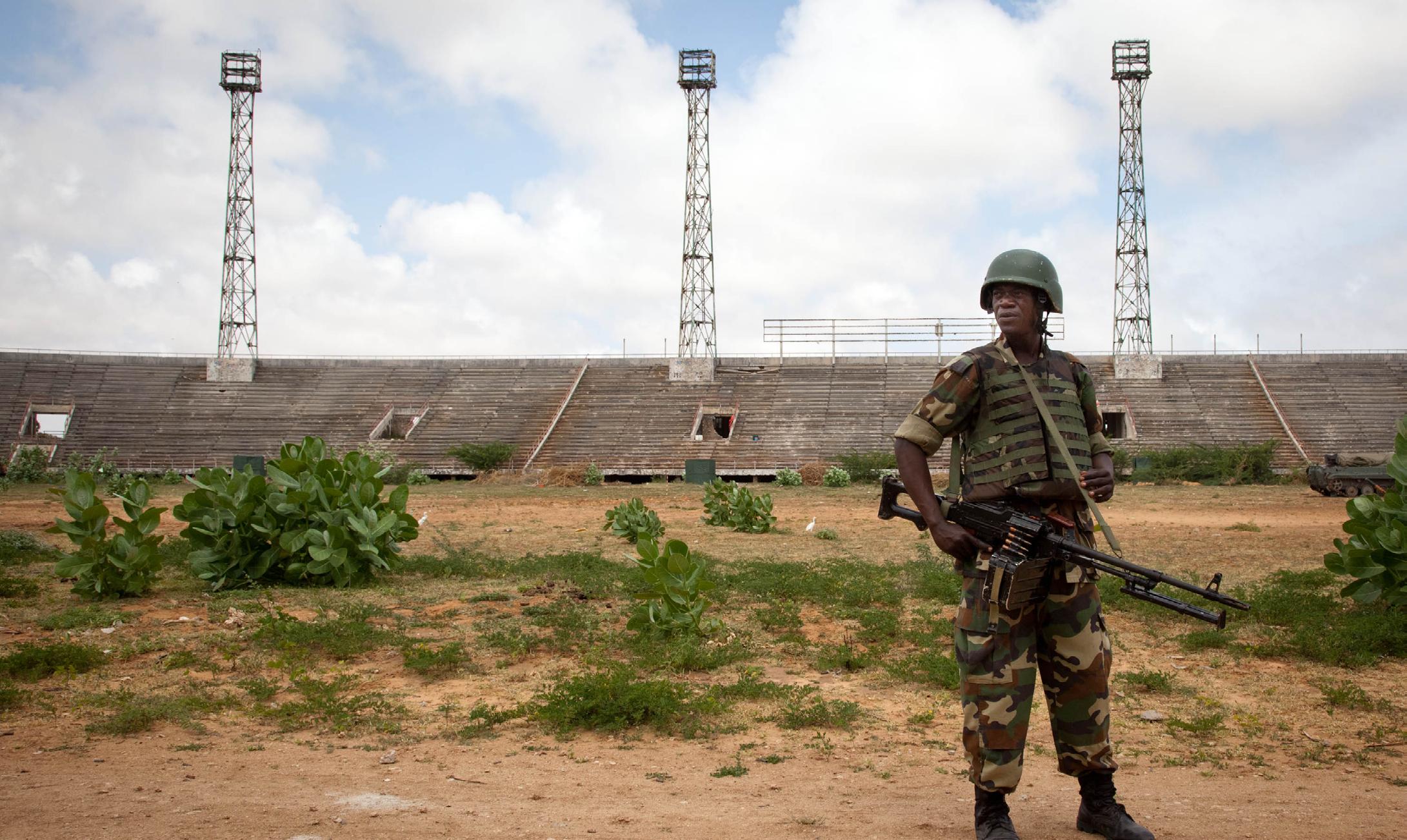
in Mogadishu stadium, the former al-Shabaab headquarters. AlShabaab withdrew from the city on the 6th August 2011.
CC0 1.0 Universal
6On 25th March, for instance, a ma’awisley leader was targeted by an improvised explosive device in Hawadley, which finally fell to the group on 2nd June. The locals did not resist. Groups of ma’awisley are reported to have defected to al-Shabaab in recent months, probably in return for payment. The group’s model of governance allows for regular payments of hundreds of dollars to clan elders for their support (see Taming the Clans: al-Shabaab’s Clan Politics, Hiraal Institute, 2018).
environment. Pre-planned press releases and dramatic footage were broadcast immediately upon a location’s capture – showing superb integration between information operations and manoeuvre – with the clear purpose to undermine the morale of the Somali National Army and to project a persuasive strength to civilian audiences.
Al-Shabaab also picked their moment. At the beginning of the year, the future of the African Union military mission supporting the Somali National Army was widely known to be uncertain (it remains dramatically underfunded even after its December 2025 extension).7 It is also a realistic possibility, given how penetrated Mogadishu is thought to be by al-Shabaab informants, that the group became aware of a reduction in the support provided by the USA to Bancroft, the private security company training and assisting the elite Danab. The Danab are widely recognised to be most proficient partner force in Somalia but suffered a temporary loss of salaries and some expert support in March.8
As the weeks wore on, and as alShabaab started to demonstrate a consistent intent to hold the land it had seized, it became increasingly apparent that a shift in the paradigm was afoot. Contrary to earlier suspicions, events in the Middle Shabelle had moved on from the ‘cyclical’ pattern of al-Shabaab occasionally overrunning some locations only to abandon them under pressure. The nature of the change became apparent when, on 9th March, the Federal Government’s Religious Affairs Minister, Mukhtar Robow – a former al-Shabaab leader who defected in 2017 – claimed that Mogadishu is not “Kabul or Damascus”, a statement that naturally invited comparisons with the Islamist takeovers in Afghanistan and Syria.

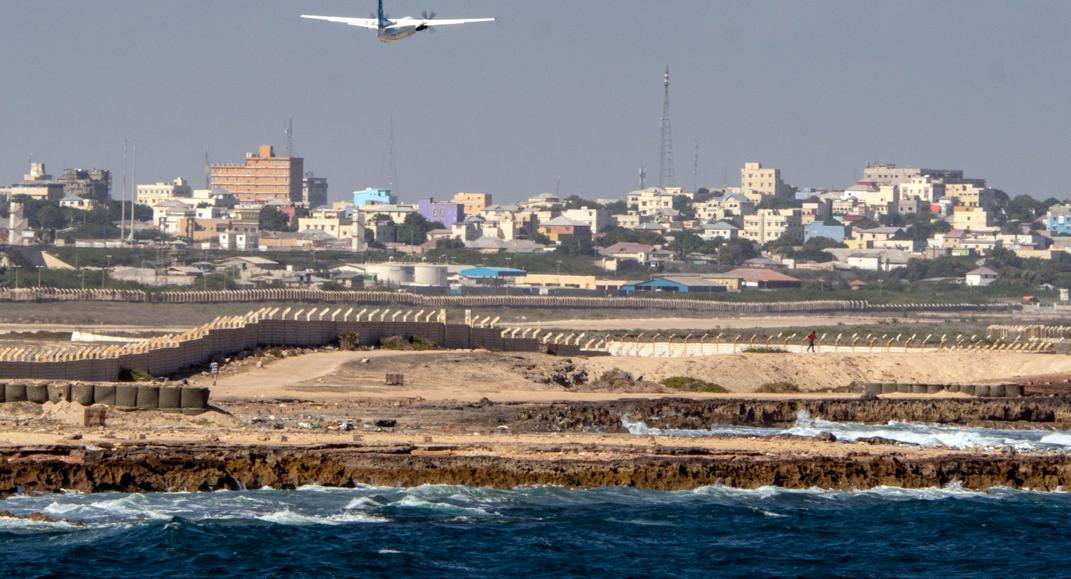
“THESE ATTACKS [ON THE AIRPORT]... INDICATE THE EXTENT OF FREEDOM OF ACTION AL-SHABAAB CAN ENJOY IN MOGADISHU’S SUBURBS, AND THE LATENT LETHAL THREAT POSED TO BRITISH AND OTHER INTERNATIONAL PERSONNEL.”
Al-Shabaab’s offensive was not limited to central Somalia. Before entering an operational pause upon the coming of the Gu rains in April and June, the group seized key settlements in the so-called Afgoye Corridor – the main route leading south-west from Mogadishu in the Lower Shabelle valley – and even attacked Somali security forces on the outskirts of Mogadishu itself. Al-Shabaab made a point of raising their flag and erecting vehicle checkpoints on key routes connecting the capital to the rest of the country, demonstrating an ability to contest security forces’ movements and threatening the city’s isolation. Subsequent airstrikes conducted by international partners have caused considerable casualties and deterred troop concentrations, but they have overall failed to shift the balance on the ground.
Mogadishu itself experienced an increase in attacks. On 18th March, an improvised explosive device almost succeeded in assassinating the Somali president at a road junction inside the city. Al-Shabaab has also increased the tempo of its campaign of targeted assassinations against government officials, combined with a bombing on a Somali National Army recruitment
Islamist insurgency in the neighbouring country of Kenya.
centre, to raise the costs of cooperation with the Federal Government and to deter resistance to the group. Strikes on the airport, the home of the international community, similarly surged. According to data stretching back to 2014, the first half of 2025 matched earlier annual totals of indirect fire attacks on the airport, with a similar high seen only once before, in 2020.9 Even though these attacks proved largely ineffectual, they indicate the extent of freedom of action alShabaab can enjoy in Mogadishu’s suburbs, and the latent lethal threat posed to British and other international personnel.
Across central and southern Somalia, therefore, 2025 saw al-Shabaab demonstrate an ability to set the tempo, make significant territorial gains, project success into the information environment and ultimately to humiliate a government that receives hundreds of millions of dollars in aid and assistance every year. Somalia, however, is not the only country to be menaced by al-Shabaab.
Al-Shabaab is all but synonymous with Somalia. Yet the past decade has also seen the group wage what has now become an endemic
The terrorist group’s attacks on targets in Nairobi – Westgate (2013) and DusitD2 (2019) –are well known, representing al-Shabaab’s most high-profile response to the Kenyan Defence Forces’ invasion of Somalia in 2011. Less widely appreciated, however, is al-Shabaab’s insurgency in the country’s northeast. Over recent years, the counties of Mandera, Wajir, Garissa and Lamu – a world away from highland Kenya, populated by Muslim Somalis and other, predominantly Muslim, ethnic groups – have experienced literally hundreds of terror attacks. A high point was reached in 2022 with 146 separate incidents – improvised explosive devices, small arms engagements, assassinations – before falling in 2023 and recording a total of 99 in 2024.10
From targeting civilians –notably in the Garissa University Massacre of 2015 in which almost 200 students were killed – al-Shabaab’s more recent attacks reflect a strategic intent to undermine the Kenyan state by disrupting and degrading the Kenyan Defence Forces and other security actors. Event data from the past two years suggests that Kenya loses between a section to a platoon wounded or killed every month.11 As well as contesting the state’s monopoly of force, al-Shabaab seeks to create a ‘hostile environment’ for non-Muslims in the area
7Somalia at a Crossroads: Resurgent Insurgents, Fragmented Politics, and the Uncertain Future of AUSSOM, Muibu, D., and Mbengue, Y., CTC Sentinel (May 2025).
8Author’s conversation with an ex-Bancroft employee, March 2025. On the Danab’s effectiveness, my interlocutor simply said, ‘only the Danab fight, the SNA walk away.’ 9-10Internal HMG reporting.
11Assessment based on internal HMG reporting.
mixed with limited attempts to influence communities through recruitment and by expanding the kind of structures of governance it operates in Somalia.
The insurgency is both conditioned by the wider conflict in the Horn of Africa whilst also being shaped by drivers of terror unique to Kenya. Like any insurgency, al-Shabaab requires fertile ground in which to grow and sustain itself. The Ramadan Offensive saw fighters redeployed from the northeast to Somalia, an indication of al-Shabaab’s effective command and control and its expansive facilitation routes.12 The very fact that insurgents in Kenya are recruited locally, however, points to the historic marginalisation of some ethnic groups in a complex country of 42 tribes, profound material deprivation that makes al-Shabaab an attractive career choice, and the legacy of Salafist influence activities throughout East Africa. Attack patterns in the northeast, moreover, occasionally hint at rivalries over land, suggesting how al-Shabaab exploits, and is influenced by, local dynamics.
Overall, al-Shabaab’s activities in Kenya offer further evidence for the group’s nature as a capable battlefield actor with ambitious strategic aims. Its ideology denies the territorial integrity of the West’s so-called regional ‘Anchor of Stability’, seeing Kenya’s northeast as part of an idealised, Islamist ‘greater Somalia’ (Somaliweyn). Kenya is home to considerable British interests – an economic relationship of almost £2 billion, tens of thousands of British residents, and an exceptional military and diplomatic footprint – but that is hardly the only reason why we should continue to care about what could all too easily become another forgotten war in Africa.
AL-SHABAAB: THE AXIS OF IDENTITY
There is a tendency among some
policymakers and observers of East Africa to describe alShabaab as a self-containing, ‘militant group’ as opposed to considering it first and foremost as an international al-Qaeda affiliate. Words are dangerous. The phraseology we use channels thought, influencing how we understand a problem and how we respond to it. Where alShabaab is placed on this axis of identity can arise from stressing different pieces of evidence. The first interpretation tends to emphasise al-Shabaab’s deep ethnic inflection – in a clear contrast to Islamic State, foreign fighters like Thomas Evans are exceptions – whilst noting a lack of recent external operations aimed at Western interests since the Manda Bay attack in 2020. It could even be argued that events like the attacks on potential international targets in Mogadishu airport are so imprecise that they point to an intent to cause no actual harm.
If we look at the group’s communications, however, a picture of a more conventional Islamist terrorist organisation emerges. Eid celebrations are marked by young boys wearing black parading around with toy Kalashnikovs, ‘Palestine’ –written in Arabic – emblazoned on their foreheads. Scholarly disquisitions on jihad and critiques of the ‘apostate’ Federal Government and their ‘Crusader’ backers dominate the airwaves, and brutal executions in front of baying crowds are broadcast to deter dissent. Even when attacks in Mogadishu fail to kill ‘white Crusaders’, al-Shabaab still habitually makes the claim through radio output on stations like al-Andalus. Being aimed at domestic audiences in the territories they occupy, this tendency demonstrates how rhetorical claims of directly fighting the West are used as a tool to legitimise al-Shabaab’s rule. Allusions to related Islamist movements worldwide are
similarly exploited to suggest that the group is part of a wider, religiously endorsed and prestigious struggle.
Officers of the European Union Training Mission in Somalia, moreover, only narrowly escaped a suicide bombing on Mogadishu’s Jaalle Siyaad Military Academy on 9th July. Al-Shabaab will make rhetorical claims a reality if it can. Just because the group’s current operational and strategic priorities see it directing effort to fighting what Islamist ideology would describe as the ‘near enemy’ of the Federal Government does not mean that al-Shabaab will not come to shift fire against the ‘far enemy’ of the West.13 Even before the formal declaration of its affiliation with al-Qaeda in 2012, al-Shabaab was irredeemably shaped by Islamist extremist thought, which remains its guiding creed today.14
One facet of the group’s role in this wider struggle can be found in its cooperation with Yemen’s Ansar Allah (the Houthis). What analysts in the cafés of Nairobi first dismissed as an over-reading of shared weapons facilitation routes increasingly seems to be something deeper. Al-Shabaab and the Houthis are now understood to have some kind of working relationship, with the latter equipping the former with drone and other capabilities. Both sides stand to benefit from this relationship and have shared ideological foes and visions of an Islamist future. If left unchecked, cooperation between the two could choke the Bab al-Mandab whilst giving Iran – the hand behind the Houthis – deeper proxy reach into what an Iranian diplomat has described as a ‘continent of opportunities.’15
The United Kingdom cannot afford to neglect al-Shabaab. The past year shows that the
group continues to represent a significant, complex threat. We should therefore continue to think how best to combat a group whose longevity makes the Islamic State’s territorial caliphate seem an historical flash in the pan in comparison.
The weight of British interests in the region is focused on protecting Kenya and in ensuring freedom of navigation, both of which are focused on Somalia’s flanks. It could perhaps consequently prove beneficial to become more comfortable with the now exaggerated nature of Somali federalism, working more with partners in Jubaland and Puntland.
Finally, Defence could do more with African Union nations directly involved in fighting alShabaab. Training and assistance provided through Defence Engagement activities not only improves partner capabilities but can also win considerable influence in the contested space of the Global South – a world where historic ties maintained by a relatively small footprint can have disproportionate impacts. If counter-terror in an age of conventional threats remains a second thought, improving the means to address it by investing more in targeted militarydiplomatic relationships may well make a considerable contribution to the age of competition that has now succeeded the age of the War on Terror.
12Internal HMG reporting. The number of attacks in Kenya also fell dramatically between March and May relative to 2024.
13The language of ‘near’ and ‘far’ enemies comes from Said Qutb, whose work profoundly influenced the founders of modern Islamism.
14Al-Shabaab in Somalia: The History and Ideology of a Militant Islamist Group, 2005-2012, Hansen, S. J, (2013), p.1-29.
15Dhows, Drones, and Dollars: Ansar Allah’s Expansion into Somalia, Jalal, I., and al-Jabarni, A., Carnegie Endowment for International Peace (March 2025).