DIVINING LESSONS FOR THE DIVISIONAL FIGHTER CHACR COMMENTARY // JANUARY 2026
BY: Colonel Simon Worth, Chief of Staff 3rd (UK) Division
T
HE ability to generate warfighting capability at the divisional level lies at the heart of the British Army’s operational design and its offer to NATO, however, preparing formations for the challenge of fighting at higher tactical level is far from easy. This short Commentary highlights insights from 3 (UK) Division’s recent deployment on Exercise Warfighter (WFX) and offers some thoughts that may be of value to those with an interest in divisional warfare.
Though we must be cautious with lessons drawn from a single exercise, and particularly one that relies on simulation, Warfighter continues to offer a useful and operationally relevant platform for analysis.1 It does not feel too much of a stretch to suggest that this US Army-delivered exercise provides the most demanding
training currently available to a formation HQ outside of warfighting operations. This was the fifth time that the Division has deployed on an WFX and so the insights on offer reflect an approach that has been developed by our predecessors over time. Perhaps the headline lesson from our experience is that the Army’s Land Operating Concept works and must be applied at all levels of command. The Division’s strong performance was underpinned by application of recce strike2 (and a conscious effort to fight at range), a constant effort to integrate multi-domain effects, and a significant increase in emphasis on protection. As a consequence, this Commentary does not propose substantial revisions to our way of fighting but instead offers a view on how the Land Operating Concept might be applied in practice.
KEY INSIGHTS Achieving system disintegration – shaping becomes decisive. Though it has long been accepted that the Division’s principal focus should be on the deep fight, it has often been tempting to focus on the close battle and to view it as our primary concern. In contrast, our experience on WFX indicated strongly that mission success was instead determined by our ability to disintegrate the enemy’s fighting system at range, principally through a ruthless and relentless approach to targeting. We might characterise this change in emphasis as the shaping phase becoming the decisive activity determining outcome. This is not to suggest that the close battle is no longer inevitable or important, there remain critical functions that only our close elements can deliver,3 however, our experience suggests that the efficacy of our
targeting system from sensor – though decider to effector4 – is the key determinant in mission success and thus deserves greater emphasis in our thinking.5 This change in emphasis should, perhaps, not come as a surprise WFX 25.4 saw 3 (UK) Div deployed under III US Armoured Corps which, in turn, was positioned under a NATO Multi Corps Land Component Command. The scenario involved large-scale combat operations in Eastern Europe.
1
Defined as the coordinated employment of sensors and fires to find and destroy priority targets at extended range.
2
For example, seizing and holding ground.
3
And supported by effective sustainment.
4
It is worth noting that most corps and divisional exercises (US, NATO and UK) tend to focus on generating an immediate kinetic close fight rather than allocating time for shaping activity. While the temptation to ‘get things going’ is understandable, there would be merit of rebalancing training time to focus on corps and div shaping activity.
5
1 // DIVINING LESSONS FOR THE DIVISIONAL FIGHTER // CHACR
U.S. Army Photo by Sgt. Jose Escamilla
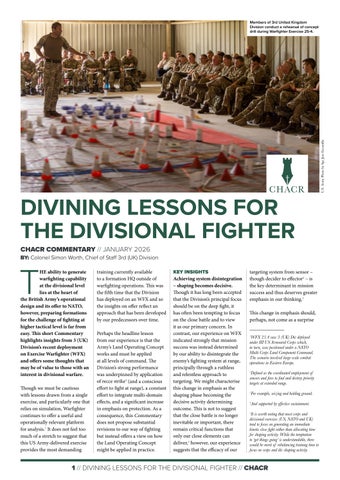
Members of 3rd United Kingdom Division conduct a rehearsal of concept drill during Warfighter Exercise 25-4.
given that this approach mirrors the Army’s transition to recce strike. However, what may be of greater value are some thoughts on how to apply this approach in practice. The following bullets outline some key themes:
on, and status of, the enemy fighting system. Close elements are only committed when data-led analysis indicates that an appropriate level of systemic disintegration has been achieved. The key point is, I think, that successful manoeuvre can only be achieved when it is founded in the application of a relatively scientific approach rooted in data analysis. We note the potential of the Army Futures Directorate’s Land Battle Metrics Study to add additional sophistication to this approach. n Defining the fight by echelon. The second critical element of this approach is the requirement to define the fight by echelon, ensuring that each formation from Multi Corps Land Component Command to Brigade has clarity on the targets it must destroy, and is resourced with the assets required to do so. Failure to define and resource the echelon fight risks both duplication of effort and missing high priority targets – most likely as
a consequence of formations assuming the target is someone else’s responsibility. Whilst it is tempting to apply a more functionally based approach to target allocation,6 our view is that a geographic approach is the simplest and most efficient mechanism. However, the allocation of geography must be matched by provision of assets that can range to the extent of the area of operations. This avoids providing the enemy with areas of sanctuary that enable him to employ his fires complex without interference and thus gain the initiative. n Asymmetry = efficiency. Finally, we found that our targeting activity was at its most effective when fires were applied asymmetrically, applying strength to vulnerability. Put simply, rockets defeat integrated air defence systems, which enables aviation to defeat enemy artillery and tanks, which in turn enables our armoured brigades to enter an unfair
fight to defeat an already near disintegrated enemy force. Tempo remains the objective. As ever, there is an instinctive desire for the Division to go faster. Our observation was that speed conferred only very limited advantage at the divisional level. During WFX, divisions that focussed on pace, committing their close elements to battle without effective shaping activity, culminated rapidly once they extended beyond their air defence coverage and once they entered the range of enemy Divisional Artillery Groups and Brigade Artillery Groups. As Commanding General 1st US Armored Division noted “there is little to be gained in chewing up grid squares”. Our doctrine tells us, rightfully I think, that we should focus on achieving tempo rather than speed. Our conclusion is that at the divisional level, tempo is achieved primarily through a deliberate and methodical approach to shaping and targeting.7 To an extent and to paraphrase the General Officer For example, allocating different types of enemy equipment to each level of command.
6
We accept that at the Brigade level and below, speed has a closer relationship with tempo due to the requirement to achieve shock and the inherent protection that rapid movement offers.
7
UK MOD © Crown copyright
n A metricised approach to systems warfare. At the heart of the 3rd Division way of fighting is a focus on defeating the enemy’s fighting system through data-driven targeting. The critical first step in this approach is development of a deep understanding of the enemy’s fighting system and, specifically, identification of key capabilities and vulnerabilities. Armed with this detail, the Division must then focus its efforts on dismantling the enemy’s system in order to set the conditions for a close fight that is characterised by overwhelming advantage. This approach relies on a highly tuned collection system that draws on capabilities from across the domains to find and strike critical targets. The efficiency and speed associated with this process is, of course, fundamental. Concurrently, the execution staff, supported by specialist operational analysts, review the effects of targeting activity applying a rigorous metricised approach that seeks to understand the impact
“AT THE HEART OF THE 3RD DIVISION WAY OF FIGHTING IS A FOCUS ON DEFEATING THE ENEMY’S FIGHTING SYSTEM THROUGH DATA-DRIVEN TARGETING... SUCCESSFUL MANOEUVRE CAN ONLY BE ACHIEVED WHEN IT IS FOUNDED IN THE APPLICATION OF A RELATIVELY SCIENTIFIC APPROACH”
2 // DIVINING LESSONS FOR THE DIVISIONAL FIGHTER // CHACR
Commanding’s senior mentor8 “at the divisional level, tempo simply equals days of shaping”. This approach seeks to paralyse the enemy’s command and control system by applying kinetic and non-kinetic fires continuously throughout his depth generating to present multiple dilemmas that overwhelm his ability to respond and reset his system. In this sense, at the divisional level, the tempo of fires is perhaps more relevant than the tempo of manoeuvre. This approach, when combined with disruptive and imaginative manoeuvre (achieved through deception, simultaneity and surprise) and synchronised with corps and divisional multi-domain effects windows, was at the heart of the 3rd Division’s success. Acknowledging the volatile battlefield: Decision Point Tactics. It quickly became clear during WFX that the Division’s traditional approach to planning – which involves G5 generating an outline plan, G35 refining it and G3 executing, did not reflect the volatile character of contemporary warfighting. There is a reasonable argument that suggests that this has always been the case. On earlier exercises, the divisional staff produced a very detailed plan weeks in advance of battle that was largely irrelevant at the point of execution. While there is some inherent value in planning activity, the production of a detailed but inflexible plan resulted in a considerable waste of staff effort and did little to help the execution team. The traditional approach also tended to fix the G35 team by requiring them to generate a revised plan within 48 hours of execution. This inhibited them from maintaining their planning horizon at an appropriate range. The emotional attachment to the extant plan and the work required to develop it also generated an instinctive desire to ‘fight the plan’ rather than the enemy and created unnecessary friction as the staff attempted to wrestle the Division back to the original
“THE WAR IN UKRAINE HAS DEMONSTRATED THE IMPORTANCE OF APPLYING MUCH GREATER THOUGHT TO PROTECTION. SIMILARLY, THE EXERCISE WARFIGHTER CONSTRUCT PUNISHES SEVERELY THOSE WHO FAIL TO PROTECT THEIR FORCE ELEMENTS, AND PARTICULARLY THEIR CRITICAL ASSETS.” plan – a pointless and counterproductive endeavour. In an attempt to resolve this challenge, the Division experimented with Decision Point Tactics. This saw us generating a central plan in outline and then developing a range of options in less detail that could be enhanced as the likelihood of them being executed increased. The Division’s G35 cell established a ‘decision tree’ and used a daily 2* plans update to determine which branches could be discarded (“pruned”) and which should be developed in greater detail. To ensure the planning horizon remained appropriate, a G3 Operational Planning Team was generated with exclusive responsibility for all planning activity within the 24-hour horizon. This approach, which is now covered in more detail in a Land Warfare Centresponsored doctrine note, ensured our approach remained enemy focussed, enabled G35 to remain appropriately dislocated from the current ops fight, and delivered greater efficiency in staff effort. In terms of next steps, the Division will refine its approach during forthcoming exercises, we will also work with our formations to
and conditions briefs. n Targeting planning should give appropriate consideration to protection requirements, focussing on “killing what is killing us”. n The Rear Area Security Group was identified early as a critical force element and was resourced appropriately. The optimal scaling for the Group is probably a light infantry brigade which must be supported by combined arms capabilities and – importantly – sufficient lift to enable it to respond the threats across the divisional rear area. Critically, the command and control node commanding the Rear Area Security Group must have the wherewithal to plan and fight a combined arms battle. Its capacity can be multiplied through partnering with host nation forces (regular/reserve military, militias and police). It is at its most effective when it operates proactively and aggressively, using a range of intelligence feed to hunt enemy force elements attempting to infiltrate and threaten the divisional rear.
understand whether an approach of this type offers utility at the brigade level and below. An increased focus on protection. The war in Ukraine has demonstrated the importance of applying much greater thought to protection. Similarly, the WFX construct punishes severely those who fail to protect their force elements, and particularly their critical assets. As a consequence, 3 Div applied almost as much staff energy to planning protection as to manoeuvre, growing its prominence from a niche concern into a core planning cell with SO1 Protect positioned as a key member of the Principal Planning Group. The following bullets lay out some of the tactical approaches that worked for us during the exercise: n The Prioritised Protection List was treated as a critical fighting product and was reviewed by the General Officer Commanding daily.9 Each element on the list was resourced with a ground, electronic and air defence asset creating a “triple lock”. Protection was also considered as a function in all go/no go
“At the heart of [Britain’s Article V] commitment sits the provision of a fully operational warfighting corps and the guarantee that that critical asset can be delivered to NATO in a timely manner, to best effect, whenever and wherever it is needed. – Major General (Retd) Dr Andrew Sharpe. The latest issue of The British Army Review – NATO expects... – is out now and available via www.chacr.org.uk
Admittedly little of this is new, however, given the relative scarcity of officers with divisional staff experience and the centrality of formation warfighting capability to the Army’s operational design, the insights are perhaps worthy of repetition. So what next? Although we will continue to maintain our close relationship with the US Army, our focus will shift to supporting the Allied Rapid Reaction Corps in their efforts to deliver the Strategic Reserve Corps – the UK’s capstone offer to NATO. We will work closely with them and the 1st Division, drawing on their experience and wisdom to continue refining our way of fighting.
Lt Gen (Retd) Lee Quintas.
8
Critically the PPL must be rooted in analysis of the enemy’s HPTL.
9
3 // DIVINING LESSONS FOR THE DIVISIONAL FIGHTER // CHACR