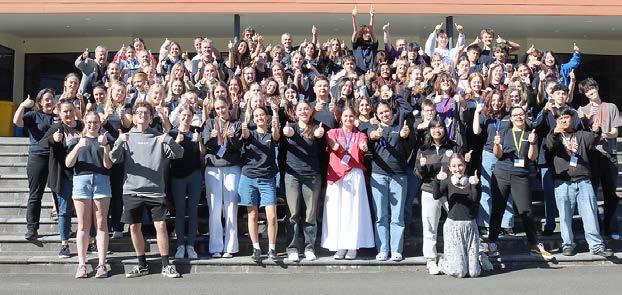
The 11th annual Kirikiriroa Hamilton Zinefest and market day is back this month and for the third year at Hamilton Central Library. Zinefest is made up of a group of volunteers, local artists, writers and creatives who are passionate about self-publishing, DIY art projects and tiny books. After the market, an after party in Garden Place will feature local musicians, performers and poets with the annual “best of the fest” awards and prize giving.
Riverside hotel
A central city hotel proposal has ‘blown away’ the requirements set by Hamilton City Council for development of a prominent riverside site. The council has entered into an unconditional agreement with Templeton Group, to sell the land at 242-254 Victoria Street for what will be the biggest one-off investment in Hamilton’s central city. Templeton’s latest (but not final) proposal envisages a tiered 25-storey development featuring hotel accommodation, apartments, and a carefully curated riverfront dining and entertainment precinct.
Raukawa aspires
The government has reaffirmed its commitment to supporting the aspirations of Raukawa and communities across the South Waikato, Minister for Māori-Crown Relations Tama Potaka has announced. Raukawa holds an inspiring commitment to ensuring their marae are available to serve the needs of the entire community in the south Waikato region during tough times, he said.
Bach expert
The New Zealand Symphony Orchestra, featuring the legendary conductor, harpsichordist and organist Masaaki Suzuki, will perform in concert at the Gallagher Academy of Performing Arts this month. Suzuki will lead a New Zealand orchestra for the first time in an extraordinary programme of masterpieces by JS Bach, WA Mozart, and Ludwig van Beethoven. He is a world authority on Bach.
New life for CBD buildings
Those of a certain age will remember it as the Housing Corporation Building in Hamilton. Senior writer Mary Anne Gill discovered what’s happening.
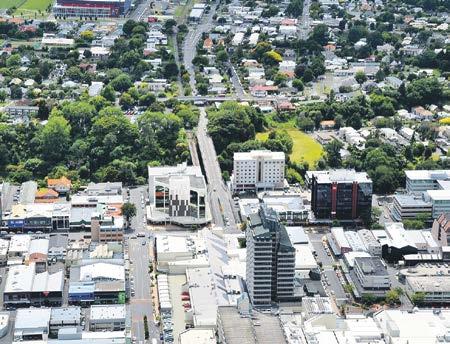
Hamilton’s Central Business District (CBD) is undergoing a significant transformation, with several key buildings being refurbished and repurposed.
From the rooftop of 500 Victoria Street on a grey day, the view is still spectacular, revealing a city undergoing a remarkable metamorphosis.
Looking west, there is significant activity at the city’s tallest building in Ward Street, formerly known as the Government Life building. It is set to become a $100 million Pullman hotel.
To the north, work is about to start on Norris Ward McKinnon House, while the former Housing Corporation Building on the corner of Victoria St and Claudelands Rd is bustling with activity.
Wellington-based Primeproperty Group, a private investment company, is behind the refurbishments of 500 Victoria and Norris Ward McKinnon House.
Property manager Richard Tait describes 500 Victoria as a tired building, once frequented by government, Telecom, and ACC workers.
“This is a building where we want to get tenants,” he says on a recent media tour, emphasising the goal of attracting new occupants.
Referring to these buildings as ‘old’ would be a disservice, as they were mostly built in the 1970s and 1980s and Hamilton has other more historic buildings of note.
Tait uses the word iconic for 500 Victoria, which is a stretch for the 38-year-old building, and landmark for the 1985 building at 711 Victoria St, which given its two top floor exterior balconies regularly attract attention from down belowonlookers always on the lookout for anyone standing on them – is apt.
But buildings built in this era with no major refurbishment are no longer fit for purpose for today’s workers, says Hamilton Central Business Association general manager Vanessa Williams.
“The CBD is where businesses want to be and should be,” she says.
Buildings without the mod cons workers expect now will not attract anyone, especially those cautiously returning post Covid.
Things like places to store their bicycles and scooters, electric charging stations, showers, cafés, natural light, parking and the allimportant high seismic ratings brought in post the 2016 Kaikōura earthquake which revealed vulnerabilities in tall buildings across the country.
Tait is not giving much away but does reveal a $4 million spend for 500 Victoria, one floor is nearing completion for an undisclosed tenant and three other floors should be finished by year’s end.
Primeproperty owns the impressive scaffolding structures on the building which will be moved north to Norris Ward McKinnon House, and one suspects, given
Tait’s demeanour, other projects around Hamilton.
Workers are giving it a face lift, installing new exterior cladding and soon painting will get underway. There is the possibility of building signage naming rights – a 360 degree brand visibility has some appeal but for the moment it remains 500 Victoria.
The company has its own sustainability goals aiming for a five-star Nabers rating. Nabers - the National Australian Built Environment Rating System – is now in New Zealand and is a system that rates the energy efficiency of office buildings.
Plus, it is environmentally friendly to repurpose an existing building rather than just pull them down,
he says.
“It’s very green to be doing up a building like this,” he says from the rooftop.
Asked about the adjacent building, formerly home to Inland Revenue and in recent years called an eyesore because of its tagging and broken windows, Tait diplomatically offers only one comment that it would be nice to see that upgraded too.
The Wellington company, famed for its commitment to restoring the capital’s building to seismic glory and for its sympathetic restoration of the Erskine Chapel in Island Bay, bought the building in 2018.
The News understands the company is in talks with other interested parties to redevelop the site.
On a high: Central business district general manager Vanessa Williams, centre, is thrilled with the refurbishments at 500 Victoria St and in the distance, Norris Ward McKinnon House. With her, Richard Tait of Primeproperty, left, and NAI Harcourts Hamilton managing director Mike Neale.
Photo: Mary Anne Gill
How the building will look in the Hamilton city landscape once completed. Artists impression.
After 33 years . . . Immigration NZ gets its act together!
Pathways recently celebrated 33 years in the “immigration business”. From humble beginnings in 1992, sharing an office with Asset Recruitment in Alexandra Street, then moving to the top floor of the ex-IRD Building in Bryce Street in 1995, which we shared with Coast to Coast TV, and to our present office in the McCaw Lewis building, it has been a challenging but always interesting, and wonderfully rewarding, journey.
During this time, we have assisted some 25,000 visa applicants, from over 125 different countries with their New Zealand visa applications, and in making their New Zealand dreams come true. Dealing with people’s lives, and their family’s futures, requires special people who have the passion, commitment and experience to manage wide-ranging and challenging situations with the necessary care and expertise, and at Pathways we have been, and continue to be, privileged with the calibre and loyalty of our people.
Over these past 33 years the only thing that has been consistent in our business is the constant changes. Visa policy, application processing and interpretation changes by Immigration NZ (INZ), and Governments of the day, and the inevitable immigration cycle of squeezing and then loosening, and squeezing again, to manage numbers and resources in response to political and public machinations. Almost every day we will see some change, or a completely new situation, and the old adage of “you learn something new every day” is never truer than when working in the immigration space!
There is also little doubt that dealing with a Government Department can be challenging and “head scratching” at times. This time last year we were doing a lot of “scratching”! INZ was taking 2-3 months to process job check and accredited employer work visa applications – whereas a year before, these applications were taking just a few days. INZ had “cycled” from a “let them in” to a “keep them out” regime, even though the underlying policies had not materially changed. However, there have been marked changes with INZ over the past six
months. Visa processing times, generally, have not been better with most employer accreditation, job checks and work visa applications now taking just a few days to 1-2 weeks to process. Online applications for label transfers and permanent resident visa applications take only days. Skilled residence applications are down to 1-3 months while parent retirement residence applications, which were previously taking 18 months to process, are now down to 6 months.
The flagship Active Investor Plus (AIP) policy, which was “re-invigorated” from 1 April with new settings, has seen 53 applications received, representing an investment of NZ$320 million, and with 11 applications approved in principle already (as of 22 April). The AIP is on track to deliver $1 billion of new direct foreign investment into New Zealand by the end of this year and, if this is the case, INZ can take due credit for its role in the AIP’s success.
Behind the scenes Immigration NZ officials are also actively engaging with the private sector regarding policy development and immigration instructions and, to INZ’s credit, they have embraced this challenge. This opportunity for constructive sector collaboration is a “breath of fresh air” and can only lead to better informed, and more pragmatic, policy settings and the smooth transition of policy changes.
In our 33 years of undertaking immigration work, we have experienced 14 different Ministers of Immigration. The current turn-around in performance, and approach, of Immigration New Zealand can, to a large extent, be attributed to the present Minister of Immigration, the Hon Erica Stanford. We have not previously experienced a Minister who is so passionate, knowledgeable and proactive about the immigration portfolio.
It has taken 33 years, but Immigration NZ may now have its act together (well at least until the next Minister!).
Safeguarding our economy
By PAMELA STOREY
As councillors prepare to read screeds of submissions to the Waikato Regional Council’s Annual Plan, I want to talk about how we’re delivering resilient infrastructure for growth. And the Annual Plan supports that.
Investment in critical infrastructure remains a cornerstone of Waikato Regional Council’s strategy to ensure our region’s resilience, economic vitality, and intergenerational wellbeing.
Last year, we invested $48 million in transport, flood protection, and environmental restoration projects across the Waikato, supported by $29 million in central government funding. These efforts reflect our commitment to balancing today’s needs with tomorrow’s challenges.
But our focus on infrastructure isn’t just about maintaining stopbanks or protecting waterways. It’s about safeguarding the foundations of our economy.
For example, we completed critical stopbank reinforcements along the Firth of Thames and Piako River, part of our stopbank and flood protection system that defends over $2.5b in agricultural GDP and vital infrastructure like roads, power networks, and telecommunications.
Take the Churchill East pump station, equipped with two Archimedes screw pumps, now ensures safer fish passage while maintaining flood resilience - a win for both industry and ecosystems.
These projects are part of a broader 10-year infrastructure roadmap that prioritises climate resilience, nature-based solutions, and partnerships with iwi and hapū.
PHILANTHROPY
The western world is on the cusp of the largest inter-generational transfer of wealth in history, as the Baby Boomer generation reach the end of their lifetimes.
To give this a local perspective, here’s some facts and figures.
$1.6 Trillion is the estimated total value of estates to be transferred in New Zealand as the boomers pass away over the next 25 years, only 55 per cent of New Zealanders have a will and only 6 per cent of those include charitable giving, well below the rates of similar countries globally.
These are some of the findings in the newly launched The Bequest Report – Reshaping Aotearoa New Zealand by creating a legacy that goes beyond asset wealth, by JBWere New Zealand, one of Momentum Waikato’s investment partners.
This report asserts that if the frequency and proportion of charitable giving in wills were to grow in Aotearoa, even marginally, it would be transformational for the entire not-for-profit sector and the communities they support.
Ultimately, JBWere’s purpose in laying out the facts and forecasts in The Bequest Report is to promote the potential for “a deeper meaning of legacy that can be achieved with stronger connections to community”.
Quite apart from the figures involved, they point out that charitable bequests are the most valuable type of income for charitable not-for-profit organisations, as bequests provide by far the best ‘return on
This year’s proposed 5.9% rates increasedown from an initial 8.6% - reflects prudent financial stewardship amid shifting central government policies and cost pressures.
A significant portion of this adjustment supports infrastructure, including transitioning to a fairer public transport funding model through targeted rates, ensuring all communities contribute equitably; and Wharekawa Coast catchment works that address erosion and flooding risks with a targeted rate split between affected communities and the wider region.
Nationally, councils spent $12b on transport and water infrastructure in 2023, with 43% directed to capital projects. Waikato’s approach mirrors this trend, prioritising long-term resilience over shortterm fixes.
Our ability to deliver these projects hinges on strong partnerships. Central government’s $101 million commitment to flood resilience infrastructure acknowledges the critical role regional councils play in protecting high-value land and communities.
By the time you read this, our consultation period for this year’s Annual Plan will have closed.
Councillors will be holding hearings from May 19-22 where those who made a submission can choose to present to councillors in person or via video link.
Then we will deliberate and adopt the final version on 24 June. I do hope you made a submission and had your say.
Pamela Storey is Waikato Regional Council chair and these are her personal views.
investment’ on the effort and costs involved in any kind of fundraising.
New Zealanders are a generous people, we all know that because so many of us routinely give time and money.
So, this is not about a lack of generosity, it is about us needing to normalise the act of charitable giving when we consider our will and legacy.
As the report acknowledges, community foundations like Momentum Waikato are ideally placed to enable a will-writer’s perpetual legacy, through our philanthropic investment fund model - what we call ‘smart giving’.
This is the message we are spreading through the ‘Professional Advisors Network’ we are currently setting up, where we are asking and enabling the Waikato’s lawyers, accountants and other financial advisors to have conversations with their clients about including a charitable bequest in their will. Really, it is time we all had a chat – with our partner, family and friends, and our lawyer, accountant or investment advisor, and ideally with Momentum Waikato. Because gifting even a small proportion of your will to a charity will still leave most of your estate to your family, while creating an enduring legacy of your values.
Charitable gifts clearly need to be a routine part of our will writing, because such bequests can add up to being transformational for our society. Let’s do it! David Christiansen is Executive Officer at Momentum Waikato.
B
DAVID CHRISTIANSEN
Positive leadership
By SENGA ALLEN
“Oh Senga, what’s this new fad you’re talking about now? Positive Leadership –what does that even mean?”
Well, first of all – it’s not a fad, and it’s certainly not new. But in times of uncertainty and volatility, Positive Leadership becomes more important – and more visible – than ever.
So, what is it?
Positive Leadership is about creating a supportive, optimistic environment by focusing on strengths, growth, and potential rather than dwelling solely on problems or shortcomings.
Now, I hear the cynics already: “But everyone has weaknesses!” – and yes, I agree. We all have them.
But ask yourself – what’s the real value in fixating on them?
Instead of harping on deficits, positive leaders focus on developing what people are already good at.
They help individuals tap into their strengths and passions, so they can perform at their peak.
It’s about modelling positive language and behaviour, encouraging collaboration, and empowering people to thrive – not just survive.
Positive leaders build trust, inspire motivation, and cultivate a workplace culture where people feel safe, seen, and valued. In short, they help teams flourish.
Now, let’s be clear: positive leadership doesn’t mean ignoring poor performance, tolerating bad behaviour, or painting everything with a “just be positive” brush. It’s not toxic positivity. It’s not complacency.
What it does mean is leading with intention and optimism, and recognising that building people up yields stronger, more resilient, and more engaged teams.
Some of the proven benefits of positive leadership include:
• Increased employee engagement and alignment with purpose
• Improved productivity
• Greater resilience (and who doesn’t need that right now?)
• Higher retention
• Stronger, more positive workplace relationships
• A sense of safety where people feel comfortable speaking up
• Greater trust across the board.
Positive leadership expert Sue Langley outlines four core success factors:
• Positive climate
• Positive relationships
• Positive communication
• Positive meaning.
These elements not only support performance but also foster a culture where diverse talent can thrive.
And the good news? The skills and strategies that underpin each of these factors can be learned – if we choose to. So, maybe Positive Leadership isn’t such a “fad” after all.
Maybe, just maybe, it’s the leadership we’ve been needing all along.
Senga Allen is managing director of Everest People
SESSION ONE
Wednessday 14 May
SESSION TWO Thursdaay 5 June
SESSION THREE Thursdaay 19 June e
Is your website invisible?
By JOSH MOORE
Many business owners invest in a new website and assume that’s the end of the job — but weeks or months later, they’re left wondering why the phone hasn’t started ringing more and why their competitors are still showing up on Google much higher than them. The answer is simple: Just having a website doesn’t mean people can find it.
Search engine visibility is driven by a combination of factors that fall under the umbrella of SEO, or Search Engine Optimisation. It’s not magic, but it is complex — and it’s something most business owners shouldn’t try to tackle alone.
In fact, one of the biggest reasons a website fails to rank is because it’s not focused on the right keywords. That means the language on the site doesn’t match what potential customers are actually searching for.
For example, your homepage might say “quality solutions” or “tailored services,” but your customers are typing in things like “roof repair Hamilton” or “emergency dentist Te Awamutu.” A digital agency that understands SEO can help uncover those high-value phrases and integrate them naturally into your website’s content so it starts attracting the right traffic.
Even if the words are right, many websites suffer from technical issues that fly under the radar. These could include broken links, pages that load slowly, clunky mobile performance, or even missing page titles — all of which can hold your rankings back. A good SEO agency will run
a technical audit to uncover these issues and ensure your website is not just userfriendly, but search-engine friendly too. If you serve a local area, local SEO is another essential piece of the puzzle. Having an optimised Google Business Profile, consistent contact details across the web, and location-based content can all help you show up in the “map pack” — the prime real estate at the top of Google search results for local queries. Again, it’s the kind of setup that looks simple but takes strategy and attention to detail to do well.
And then there’s content. Google rewards websites that are active, helpful, and trustworthy. That means regularly updating service pages, adding FAQs, interesting case studies, and publishing blog posts that answer real customer questions. In today’s world, every SEO strategy must include regular fresh content. This may sound like a lot of work, and that’s because it is! But getting found high up in Google search results can have significant impact on the number of leads your website generates for your business. The bottom line? If your website isn’t ranking, there’s a reason — and more often than not, it’s fixable. Nobody ranks highly on Google without intentional effort. Implementing a solid SEO strategy can make sure your business is seen by the people who need you most.
Josh Moore is the Managing Director at Hamilton digital marketing agency Duoplus.
Call for blinkers off strategy
Raising the level of constructive debate on all things security is a useful role for businesses to consider says a long-time military officer as senior writer Viv Posselt reports.
A global environment increasingly beset with military threats, trade challenges, cyberattacks and risks to maritime security means Kiwis can no longer consider geographical distance to be an adequate buffer.
Threats to our security and way of life are real, and New Zealanders need to forego thoughts of hunkering down and isolating themselves.
“The bottom line is that we cannot afford to,” says Jon Broadley, a business advisor and long-time military officer who is also a brigadier in the New Zealand Defence Forces (NZDF) and vice-president of the
Cambridge RSA.
After a 22-year fulltime military career, Broadley transferred to part-time Territorial Force Army Reserve. He is now a business advisor with Strategy+Ltd, and has an extensive background in business, defence and logistics. In 1996, he was made a member of the British Empire (MBE) for his work during a peacekeeping deployment to Yugoslavia.
In his address to a Cambridge U3A meeting recently he urged Kiwis to be cognisant of the many security challenges currently facing New Zealand.
Terrorism, plus related interstate and internal conflicts around the world threaten global populations, he said. The Global Peace Index last year identified 56 major conflicts, the largest number since WW2, involving 92 countries or 47 per cent of the 195 countries across the world.
Cyber-attacks, occurring at an estimated 100 to 250 global attacks a second, pose another threat to New Zealand, while other collective international security challenges include maritime security, including piracy, and the increase in provocative activity from North Korea and China.
“To put it bluntly, globalisation has made the impacts of global events local,” he said.
“As a trading nation, one that relies on freedom of navigation, access to markets, international rule of law and strong international institutions, we have nothing less than a vital stake in the international system.
“It is a system that has helped ensure our
economic prosperity as a trading nation that is far from the world’s markets. Of our $90 billion export earning last year, China took about 26 per cent, the US and Australia about 13 per cent each, and ironically the UK only about 3 per cent, so our prosperity is inextricably linked to our exporting partners across the globe.
“Therefore, we must care when one country invades another in Eastern Europe, when instability in the Middle East is supported by countries such as Iran and Yemen, and when groups of foreign fighters and pirates pop up in various parts of the world. We must be cognisant of the South China Sea
and southwest Pacific security debate to ensure we understand its potential impact to New Zealand’s economic interests.”
Broadley said at 30 million square kilometres, New Zealand’s Economic Exclusion Zone is one of the largest of the world. Monitoring that area, as well as providing assistance when needed to Pacific Island nations, adds to security concerns closer to home.
He said the exact role New Zealand and the NZDF will play in the future is a government matter, “but raising the level of constructive debate on all things security is a useful role for all of us”.
WAIKATO AUTOMOTIVE DIRECTORY
WAIKATO AUTOMOTIVE DIRECTORY
The reasons for rotation
Rotating your tyres and ensuring proper wheel alignment and balancing are essential for maintaining vehicle safety, performance, and prolonging the lifespan of your tyres.
Tyre rotation ensures that all tyres wear evenly, as front and rear tyres experience different levels of stress due to steering and braking. Regularly rotating them every 10,000–12,000 km promotes even wear, prolonging tyre life and ensuring consistent traction. It’s important to note your tyres should match in terms of make and model; certainly in width. Uneven tyre wear can reduce grip on the road, especially in wet or slippery conditions. By rotating your tyres, you maintain optimal tread depth across all wheels, which improves braking and cornering performance, making your vehicle safer to drive. This regularly prevents premature wear, reducing the need for early replacement. This not only saves
money on new tyres but also improves fuel efficiency by reducing uneven drag.
You also need to think about wheel alignment. What this does is ensures your tyres are set to the correct angles, so they meet the road properly. Misaligned wheels cause uneven tyre wear, poor handling, and can lead to increased fuel consumption. Regular alignment ensures your car tracks straight, improving driving comfort and safety.
Next is correct balancing. Unbalanced tyres cause vibrations, uneven wear, and stress on suspension components. Balancing distributes the tyre weight evenly, ensuring a smoother ride, longer tyre life, and better handling. By rotating tyres and maintaining proper alignment and balance, you enhance vehicle safety, performance, and save on long-term costs.
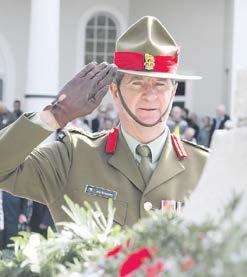
Jon Broadley salutes at Anzac Day commemorations in Cambridge.
Photo: Mary Anne Gill
Jon Broadley lays a wreath on behalf of Cambridge RSA at the Anzac Day service at the Town Hall in 2022.
Photo: Mary Anne Gill
Out and about…
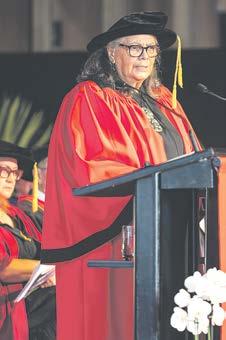
the Māori Language Commission, three years later. Mason had four sons while she was living in Tokoroa and in her 30s, she enrolled in university where she did a BA in education and te reo Māori.
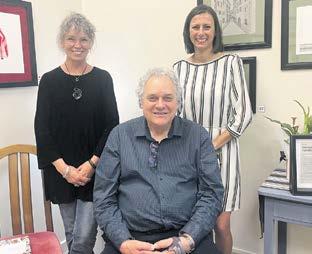
Hamilton-based artists Sandra TurnerBarlow, left, and Italian-born Elena Brambilla spoke about their work at a recent afternoon of informal conversation around Welcome Swallow Gallery’s exhibition ‘Out of Italy’. The gallery directs its profits to nonprofit organisations supporting children. The current exhibition, which ends on May 9, is the gallery’s 36th. Pictured with the artists is gallery
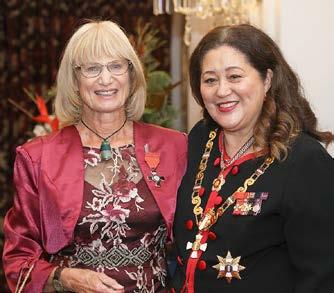
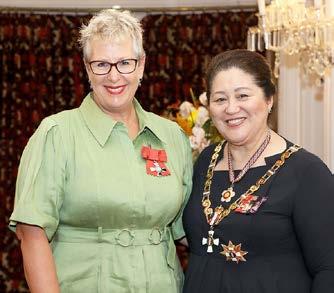
Paula Baker, manager of Braemar Trust, with Governor General Dame Cindy Kaio at an investiture ceremony in Wellington where she received her MNZM for services to health governance and the community.
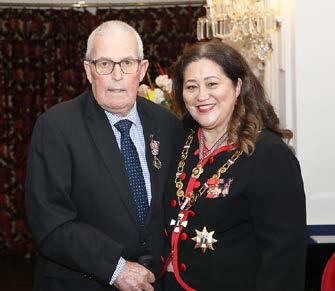
Hamilton community psychologist Ingrid Huygens, who cofounded the education programme ‘Tangata Tiriti – Treaty People’ in response to calls by refugee and migrant communities for treaty education, received her MNZM for services to education and Māori from governor general Dame Cindy Kiro.
Long-time Waipā district councillor and Federated Farmers leader Grahame Webber received his KSM from Dame Cindy Kiro for his services to local government and farming governance.
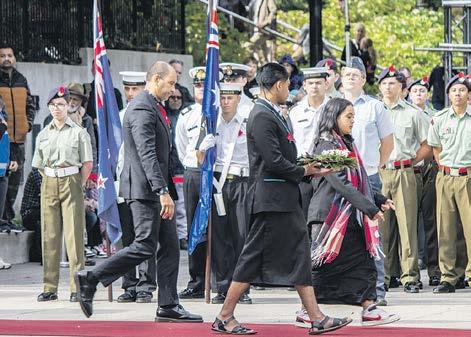
Hamilton West MP Tama Potaka moves forward to lay a wreath at the Cenotaph during the city’s Anzac Day civic service.
Photo: Jessie Meng
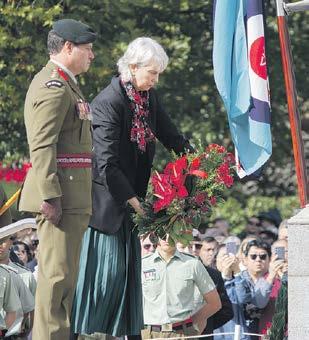
Hamilton mayor Paula Southgate, presiding at her last Anzac Day civic service, lays a wreath at the Cenotaph with Colonel Olly Te Ua.
Photo: Jessie Meng
ABOVE: Renowned te reo Māori translator and linguist Te Haumihiata Mason, 74, (Ngāi Tūhoe, Te Arawa, Ngāti Pango) was bestowed an honorary doctorate from the University of Waikato. She became a registered translator and interpreter in 1993, and started working for Te Taura Whiri i Te Reo Māori,
LEFT:
curator Clive Gilson. Photo: Viv Posselt.
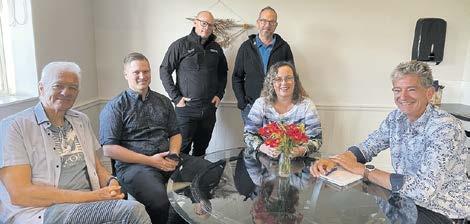
At the Kingdom Initiatives Hamilton Christian Business Breakfast, from left: retired pastor Graham Ferry, CSC Group’s Jason Masters, Grime Off’s Jason Linch, Farmgate’s Andrew Sing, leadership coach Tracey Olivier, and Interseed’s Murray Beer. Photo: Chris Gardner
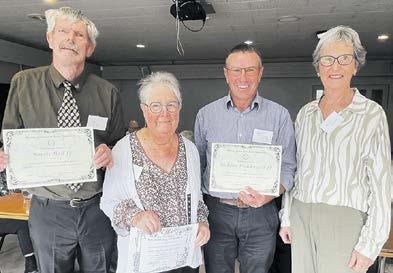
Three long-serving members of the Te Awamutu Justice of the Peace branch were presented with certificates at a special luncheon. They are pictured here with Te Awamutu Justice of the Peace Branch chairperson Janet Livingston, right. The long-standing JPs are, from left, Norris Hall (19 years), Paula McWha (26 years), and Nicholas Prendergast (19 years). Photo: Viv Posselt