

Formative Assessment Task Options


‘Learn that’
6.1. Implementation is an ongoing process that must adapt to context over time, rather than a single event. It involves the application of specific implementation activities and principles over an extended period (e.g., implementation planning, ongoing monitoring).
6.2. Successful implementation requires expert knowledge of the approach that is being implemented and the related area of practice (e.g., behaviour), which is shared amongst staff.
6.4. Effective implementation begins by accurately diagnosing the problem and making evidenceinformed decisions on what to implement.
‘Learn how to’
Plan and execute implementation in stages by:
6.a. Ensuring that implementation is a structured process where school leaders actively plan, prepare, deliver, and embed changes.
6.b. Making a small number of meaningful strategic changes and pursuing these diligently, prioritising appropriately.
6.c. Reviewing and stopping ineffective practices before implementing new ones. Make the right choices on what to implement by:
6.d. Identifying a specific area for improvement using a robust diagnostic process, focusing on the problem that needs solving, rather than starting with a solution.
6.e. Providing credible interpretations of reliable data that focus on pupils’ knowledge and understanding.
6.f. Examining current approaches, how they need to change, and the support required to do so.
6.g. Adopting new approaches based on both internal and external evidence of what has (and has not) worked before (e.g., pupil outcome data and research-based guidance).
As you develop in your career as a leader of teaching you may discover that some of your biggest challenges come not from generating new ideas for improving provision or for generating enthusiasm about new developments; rather they come from ensuring that developments are implemented rigorously, with fidelity to your original intentions, and have deep roots so that they become sustainable over the longer term.
You will significantly increase the probability of successfully implementing change if you adopt a planned, systematic approach. This task is designed to focus your attention on some of the essential activities you should undertake prior to the introduction of any new behaviour management strategies.
The above publication is essential reading for leaders who wish to ensure that changes they introduce take root and flourish. You should download and read the report (use the link at the bottom of the page) and its recommendations before you undertake this task.
You should focus on the importance the report attaches to establishing the ‘active ingredients’ of any planned changes, i.e., those elements of the planned change that must be implemented with fidelity. An example of an active ingredient might be that as part of a new approach to behaviour management a school determines that all teachers must go through each of the steps detailed in the classroom behaviour management policy before requesting external support with behaviour management. In this instance it would be essential for the person leading the change to not only convey this message but to provide further specific detail of what the policy might mean in practice. This might mean, for example, a requirement that all teachers explain the behaviour policy to the pupils at the start of their lesson so that pupils are aware of what is expected of them.
The focus of this task is on how to plan effectively for the implementation of change. Before commencing the task, you should meet with your performance coach to discuss the requirements of the task and to gain their advice/guidance on completing the task.
Stage one: identify an aspect of pupil behaviour management you wish to address. You may choose a relatively small aspect, or it could be a practice that is whole school, but you should focus on a real issue.
Examples:
1 EEF (2019) Putting Evidence to Work – A School’s Guide to Implementation. Available at https://educationendowmentfoundation.org.uk/education-evidence/guidance-reports/implementation
§ low-level disruption in a particular class/year group/key stage
§ bullying by a small group of pupils
§ support for NQTs in developing their behaviour management skills
§ developing self-management skills of a small group of pupils
Stage two: complete the Planning for Implementation Checklist below. This is designed to prompt your thinking about the factors you will need to consider and the challenges that may arise when implementing your planned change.
Stage three: reflect on your responses to the Planning for Implementation Checklist and use this to complete an Implementation Action Plan, using the template provided below.
When you have completed your Implementation Action Plan, upload it in Canvas to your leadership mentor within the timeframe identified.
Guidance: Use the prompts below to help clarify your thinking about the nature of the problem you have identified; your evidence that it is a problem; and your initial thoughts on possible improvement strategies for addressing the problem. You should make brief notes in the response column against each prompt; you will use these later to support your development of an Implementation Action Plan.
Why do you want to introduce this change? What are the specific behaviours you wish to address?
What evidence do you have that change is necessary? You will need this evidence to justify your plans to colleagues, senior leadership, etc. Consider the questions below:
§ What data sources have informed your judgments, e.g., progress data? Staff feedback? Pupil voice?
§ How do you know that this evidence base is robust? For instance, how might feedback from teachers on pupil behaviour vary between the start and end of a term? How might you allow for this?
§ Can you accurately pinpoint, and communicate to others, the specific aspects of pupils’ behaviour that could be improved? Can you provide one or two detailed examples, such as a script of an exchange between a pupil and a teacher, or a description of the types of lowlevel disruption that have occurred in a particular classroom?
Corroboration:
How will you check if your analysis of the issue is accurate? Which other perspectives might provide valuable insights? Consider:
§ discussing with team members
§ discussing with line manager
§ discussing with a colleague at another school
Identifying possible solutions:
There will usually be a number of different possible approaches to bringing about the changes you desire.
§ Can you describe, in headline terms, one or two possible strategies?
§ Can you provide examples of possible active
ingredients of these strategies?
§ Can you explain why you have opted for your chosen strategy?
§ What external research underpins or supports your chosen strategy? (Refer to the programme reading materials for possible sources; the EEF website is also a useful starting point.)
§ Could you repurpose existing resources/practices rather than introducing new ones?
Introducing your strategy to your team members: Where, when, and how will you do this? Think about each prompt below and then make your decision and provide a rationale for your choice.
§ As an embryonic idea that you wish to discuss?
§ As a firm proposal(s) you wish colleagues to discuss and feed back on?
§ A different approach to the two above?
Experience tells us that many good ideas fall by the wayside, not because they are poor ideas, but because their implementation was poorly planned. Drawing up a robust action plan will help ensure that your good ideas are successfully implemented.
The template is divided into four phases:
1. Problem analysis/solution generation. In this phase you should indicate when/how you will seek out explanations for the cause of the problem, e.g., why do some pupils find selfmanagement difficult? You will also indicate your method(s) for exploring possible strategies to address the problem. You may also indicate how you will use other professionals as sources of expertise.
2. Preparation for implementation. In this phase you should identify key actions to be undertaken prior to the actual implementation. These might include explaining your plans to colleagues, training relevant staff, developing new resources, purchasing new equipment, securing external support, etc.
3. Implementation. This is the phase when your ideas will be put into practice. You may wish to document which pupils will be involved, how long the period for trialling new materials will last, when and how you will monitor the impact of the changes you have introduced, how staff will be supported during the implementation process, and if there will be ongoing staff training.
4. Evaluation. You should indicate in your plan the methods you intend to use to collect evidence of the impact of your initiative on pupil performance and teacher development. The greater the range of evidence you collect, the more secure will be any conclusions you draw.
The template has four columns:
1. Actions to be taken. These should be described in headline terms.
2. Who is involved? Briefly list the individuals/groups affected by, or responsible for, each of the activities.
3. Timeframe/when? Indicate in which half term, approximately, you anticipate specific activities will take place.
4. Support needed. Indicate any individuals or organisations, internal or external, that you may go to for advice or expertise, e.g., your school’s SENDco, a Behaviour Hub, a local teaching school or an educational psychologist.
Use the template to record each significant activity you plan to undertake at each phase; you should expand the table if you need to insert additional lines. We have provided an example (from a primary setting) of the sorts of thing that you might record in each phase. You should refer back to
your Planning for Implementation Checklist; this will provide you with useful prompts on activities to be undertaken during the problem analysis/solution generation phase.
Phase
Problem analysis/solution generation
Brief description of the issue/strategy:
Preparation for implementation/
Example: Analyse the school’s behaviour log to establish volume of incidents involving bullying by boys Behaviour Lead Autumn One Deputy Head to help with data interpretation
Example: Staff meeting to launch headline outcomes from problem analysis/solution generation. Focus on need to develop behaviour for learning strategies. Behaviour
specifying the active ingredients
Implementation Example: Provide individual coaching for staff as required, e.g., to help them develop strategies for teaching social and emotional literacy to individual pupils.
Behaviour Lead Spring One to end of Summer One
Evaluation phase Example: Analysis of case studies on target group of boys
Behaviour Lead and Staff Team Summer Two Deputy Head to provide external view of data
Implementation
‘Learn that’
6.10. A school’s capacity to implement an approach is rarely static (e.g., staff leave, contexts change). Sustained implementation requires leaders to keep supporting and rewarding the appropriate use of an approach and check it is still aligned with the overall strategy and context.
6.11. Implementation benefits from dedicated but distributed school leadership. Senior leaders should provide a clear vision and direction for the changes to come. At the same time, implementation is a complex process that requires feedback from staff and shared leadership responsibilities.
6.12. Implementation processes are influenced by, but also influence, school climate and culture. Implementation is easier when staff feel trusted to try new things and make mistakes, safe in the knowledge that they will be supported with resources, training, and encouragement to keep improving.
‘Learn how to’
Make the right choices on what to implement by:
6.h. Ensuring it is suitable for the school context, recognising the parameters within which the change will operate (e.g., school policies) and where the school is in its development trajectory (e.g., addressing any significant behaviour problems would be an immediate priority).
6.i. Assessing and adapting plans based on the degree to which colleagues are ready to implement the approach (e.g., current staff motivation and expertise).
Deliver changes by:
6.n. Managing expectations and encouraging ‘buy-in’ until positive signs of changes emerge.
Sustain changes by:
6.s. Continuing to model, acknowledge, support, recognise and reward good approaches.
To successfully implement change into your school requires not only that you have expertise in the change itself, but that you also have, or acquire, a deep understanding of your school’s culture and how it might assist or hinder developments you have planned.
“Standards of behaviour remain a significant challenge for many schools. There are many things that schools can do to improve, and leadership is key to this. Teachers alone, no matter how skilled, cannot intervene with the same impact as a school leader can. The key task for a school leader is to create a culture – usefully defined as ‘the way we do things around here’ – that is understood and subscribed to by the whole school community.”2
Bennett identifies a number of aspects of a school’s practices – ‘the way we do things around here’ –that may potentially hinder a leader’s efforts to implement effective behaviour management strategies (see fig 1 below). The list is not exhaustive, and you may be able to add to it.
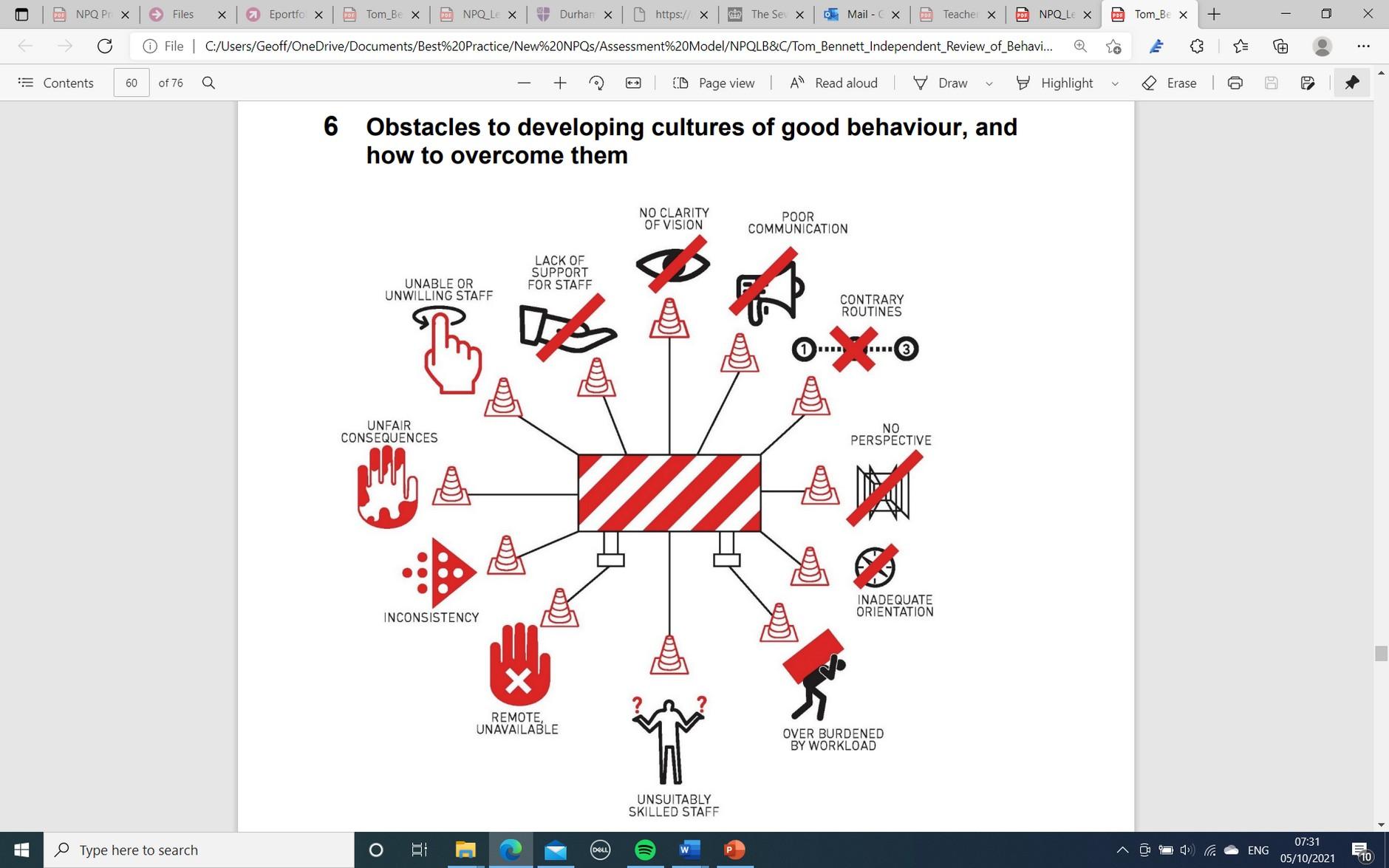
Before commencing this task, you should download Bennett’s report and read pages 60 to 62, taking notes as appropriate.
Understanding and monitoring a school’s culture is a necessary pre-condition for the successful implementation of change, but it isn’t sufficient. Effective leaders will also evaluate the current
2 Bennett, T. (2017). Creating a culture: how school leaders can optimise behaviour (p. 6). London, DfE. Available at https://www.gov.uk/government/publications/behaviour-in-schools
3 Ibid., p. 60.
climate in their organisation, and if it is conducive to the introduction of a significant change. This task focuses on how you might go about assessing the culture and climate of your school in relation to its readiness for change.
Note: This task asks you to look at the health of your organisation. As such this involves, in part, exploring the performance and attitudes of staff members. In completing the task, you should observe normal professional standards and you should not identify any individuals.
Consider this scenario: your headteacher has asked you to introduce a significant change to an aspect of your school’s behaviour management practice (you should choose the aspect, e.g., a change to the management of low-level disruption, a new rewards system, a new strategy for dealing with a particular group of pupils, etc.).
The headteacher recognises that it is improbable there will ever be perfect conditions for implementing a change and has asked you to provide them with a judgment as to the organisation’s overall readiness. The headteacher has pointed out that there will be occasions when it will be necessary to address culture issues as a necessary pre-condition to success; and there will also be occasions when the climate in the school is judged to be more or less supportive of the launch of an initiative, which may affect how an initiative is introduced and/or when the initiative will be introduced.
Stage one: exploring the culture
Use Tom Bennett’s list of obstacles to the prevention of developing a culture of good behaviour to evaluate your school’s culture. A prompt sheet is provided below for you to record your responses.
Stage two: assessing climate
Arrange to meet with your performance coach to discuss the current climate in your school. A prompt list for use in your discussion with them is provided below.
Stage three: evaluating readiness for change
Reflect on the observations you have recorded on the two prompt sheets and use these to produce a PowerPoint presentation titled ‘Our readiness for change’ (maximum 15 slides), in which you outline your analysis. In compiling your presentation, you may wish to address the following headings:
§ School culture – positives and issues to be addressed (provide a brief rationale for your judgments)
§ School climate – positives and issues to be addressed (provide a brief rationale for your judgments)
§ What needs to be done to support the successful implementation of the change
When you have completed your presentation, upload it in Canvas to your leadership mentor within the timeframe identified.
You may wish to carry out this exercise alone or in discussion with a group of colleagues.
The prompts below are taken from Tom Bennett’s report (fig 1 above). The list is presented as a deficit model, i.e., it identifies features that inhibit effective change. Clearly, if the opposite conditions exist these will be noted and celebrated as positive features.
For each prompt, make a judgment: is this item, on balance, a strength or an issue to be challenged? Then, note down the evidence you have used to support your judgment.
No clarity of vision from the school’s leadership
Example: Strength.
Ofsted highlighted this in most recent report. School’s Behaviour Policy models DfE guidance. All policy documents are simple to understand and clear in their intent. Behaviour policy displayed in all classrooms. Standards of behaviour have improved since HT took over 5 years ago – exclusions down.
Inconsistency between staff, year groups, subject areas
Unfair consequences, e.g., reward poor behaviour
Unwilling or unable staff (to implement the school’s policies)
Poor communication of the school’s vision to staff or pupils
Remote, unavailable leaders
Lack of support for staff to follow agreed routines
Demonstrating values or routines contrary to the stated ones
No perspective, e.g., considering low standards to be high
Inadequate orientation for new staff and/or pupils (as to systems, expectations)
Overburdened staff
Unsuitably skilled staff in charge of pivotal roles
Limiting beliefs – low expectations of what pupils can achieve
Other factors (if you identify aspects of your school culture that are not in Tom’s list, include them here)
You should carry out this exercise in conversation with your performance coach. The reason for this is so that you can check out your perspective with an experienced colleague, who may be able to offer you a different perspective. The approach taken for this activity is a simplified approach to analysing if the climate in your school is conducive to the introduction of a significant change. The prompts provided are just that – they are things that you might wish to consider if you planned to launch the initiative next term. For each prompt, note down the nature of the issue(s) and its implications for implementing change, together with any evidence you may have to support your response.
Timings: consider
a) What else is on the agenda next term?
b) How might this impact upon staff attitudes towards, or capacity to implement, a proposed change?
Staff attitudes: consider
a) Are staff generally positive about the school, the way it operates, the direction of travel?
b) What are their feelings about the school’s current behaviour management practices?
c) What is their general attitude toward change –excitement or overload?
Key individuals: consider
a) Supporters, such as senior colleagues who provide you
Example:
Issue: Ofsted are expected in the next two terms.
Implications: Negative because staff will be focused on this. Positive because it will demonstrate to Ofsted that we are addressing a weakness we have identified.
with advice, or enthusiastic colleagues whom you hope to use as champions for the change. Do they have the time/capacity to support you?
b) Sceptics who may be influential in the staffroom.
‘Learn that’
3.5. Teaching model behaviours will reduce the need to manage misbehaviour.
3.6. Teachers should encourage pupils to be self-reflective of their own behaviour.
3.9. The ability to self-regulate one’s emotions affects pupils’ ability to learn, success in school and future lives.
‘Learn how to’
Support the development of a positive, predictable and safe environment for pupils by:
3.c. Explicitly teaching model behaviours (including self-regulation) to pupils.
There is a recurrent theme in the programme materials:
“The successful management of behaviour relies on far more than a set of strategies to draw upon when pupils misbehave.”4
This has led to a focus on the importance of teaching learning behaviours. As a key leader in this area, it is essential that you understand, and are familiar with, the theories and research that underpin this approach to managing pupil behaviour. You are strongly advised, therefore, to read pages 16 to 18 of ‘Improving behaviour in schools: guidance report’ 5 to refresh your understanding. You may find it beneficial also to explore some of the references found in this short extract from the report, available at:
EEF Improving behaviour in schools Report
In their report (p. 6), the EEF make three recommendations:
§ Teaching learning behaviours will reduce the need to manage misbehaviour.
§ Teachers can provide the conditions for learning behaviours to develop by ensuring pupils can access the curriculum, engage with lesson content and participate in their learning.
§ Teachers should encourage pupils to be self-reflective of their own behaviours. The task below focuses on developing teachers’ skills in teaching learning behaviour.
4 Ellis,S.,&Tod,J.(2018). Behaviour for learning: Promoting positive relationships in the classroom.Routledge.
5 EEF.(2019).Improvingbehaviourinschools:Guidancereport.
If you wish to read about the application of teaching learning behaviours in practice, access the following resources:
§ ‘Lessons from a PRU’, Sian Edwards
Teacher Toolkit - How To Teach Good Behaviour
§ ‘What does teaching learning behaviours look like in the classroom?’ Jon Eaton, Director of Kingsbridge Research School, 2020. Short article, with good examples of strategies.
Research Schools Network - What does teaching ‘learning behaviours’…
A powerful way of demonstrating to teachers the effectiveness of particular teaching strategies is through a successful case study involving a pupil from their school. The aim of this task is to try to generate a case study that you can use as part of future staff development activities. This is a challenging but potentially hugely rewarding task, and whatever the outcomes, it should provide you with material that you can draw from in staff development activities. For this task you should choose one or two pupils in your school who frequently do not meet the school’s expected standard(s) of behaviour. Ideally these will be pupils taught by a colleague(s) rather than yourself; this will give you an opportunity to not only evaluate the efficacy of the strategies used but also to practise guiding a colleague(s) in the implementation of strategies that you advocate, which is a significant part of your role. If, however, you do not feel confident in doing this without having tried out the strategies yourself, focus on a pupil that you teach.
Read through the whole task and then arrange to meet with your performance coach to discuss its requirements and how you plan to approach and manage the task.
Stage one: identify the pupil/pupils for the case study
§ Identify one or two pupils as the focus of your case study. Gain the agreement of your colleague(s) for their involvement.
§ Specify the particular learning behaviour you wish to focus on, e.g., persistent low-level disruption, coping with failure, bullying.
Stage two: staff training/problem/analysis/developing strategies
Use the extract from ‘Improving behaviour in schools: guidance report’, cited above, to:
§ explain the approach you would like them to take, referencing the models provided
§ diagnose possible reasons why the pupil(s) is/are exhibiting the particular behaviours specified at stage one
§ agree the strategies the teacher(s) will implement, in particular strategies that involve showing the pupil models of the expected behaviour
§ inform the pupil(s) of the school’s concerns about their behaviour, and that their teacher
will be giving them extra support to help them better manage their behaviours. Contact parents to inform them also, and to enlist their support as appropriate.
Stage three: putting the strategies into practice
Clearly the need to employ any agreed strategies will be determined by the pupil’s behaviour, which may vary from day to day and week to week. In order to ensure that the agreed strategies are being implemented, and that the teacher(s) involved feel supported, you should arrange for regular catch-up sessions. These will allow you and them to clarify any issues with regard to the implementation of the strategies you have agreed and to adjust them as appropriate. The frequency and timing will be for you and the teacher to determine. You may wish to arrange to meet with the child/children to discuss their perceptions about the impact on their behaviours, and any modifications they feel that might be helpful.
Stage four: reviewing outcomes
§ Meet with the teacher(s) and discuss the project’s impact (use the prompt sheet below).
§ Meet with the pupil/pupils and invite them to self-evaluate the impact of the strategies (use the prompt sheet below).
§ Complete a self-evaluation of your role (use the prompt sheet below).
Stage five: project evaluation
Reflect upon the review you carried out at stage four and use the findings you recorded on the prompt sheet to write a 400-word summary of your key learning from completing the task. You should address the following:
§ Headline outcomes: overall, how do you judge the success of the project?
§ Project strengths: what were the critical ingredients?
§ Project weaknesses: what things would you do differently next time?
§ Personal learning: what have you learned about your skills in working with colleagues to implement a behaviour management strategy?
§ Developing a case study: could you use this project as a resource to support future professional development activities?
When you have completed your evaluation report, upload it in Canvas to your leadership mentor within the timeframe identified.
Use the prompts below to review the project’s effectiveness. It is not necessary to use all of the prompts; select those that you feel will provide you with the information you need to effectively evaluate the project’s impact.
Prompts: Teachers Observations
Overall, what impact did the strategies have on the pupil(s)’ behaviour?
Can you pinpoint any particular moments/strategies that were significant during the process, e.g., a lightbulb moment for the child or yourself?
Did you find the application of the strategies challenging? What qualities/skills do you feel a teacher needs to be effective in teaching learning behaviour?
What do you plan to do next to sustain any improvements the pupil has made?
Will you use these strategies in the future with other pupils?
Would you advocate the use of these strategies to other colleagues?
What limitations do you perceive to the approaches adopted?
Other observations?
Prompts: Pupils
(Use the prompts as a guide for yourself – rephrase them for the child so that they are age appropriate.)
How would you compare your behaviour now to when we started?
Has the teacher(s) treated you differently? If so, in what way(s), and what effect has this had?
Are you different now? Have you learned ways of managing your behaviour to avoid problems?
How could the teacher(s) help you in the future?
Prompts: Self-evaluation
Overall, how would you rate the outcomes from the project? Choose from: Outstanding/Good/Limited/Weak
Which elements of the project were most successful? Why?
Which elements of the project were least successful? Why?
Reflect upon your preparation for the project:
Was the advice you gave to staff adequate? What might you improve or do differently in the future?
Was your explanation of the project to the pupil(s) appropriate? What might you improve or do differently in the future?
Looking ahead:
Do you feel that teaching learning behaviour is an effective strategy that you feel confident to promote as an important element of the school’s behaviour policy?
If you feel that it is an effective strategy, but you are not confident in promoting it to the whole staff yet, what do you need to do? For example, what support would you like? What skills do you need to develop? What further research is necessary?
Could you use the outcomes from this project as a case study/example to be used as part of staff development activities? (Note: the project may not have changed the child’s behaviour(s) but may still have generated useful learning that can be used as part of training activities.)
If so, what might be the strengths and weaknesses of using the case study/example as a staff development
tool?
Other observations?
+44 (0) 117 920 9200
npq@bestpracticenet.co.uk
bestpracticenet.co.uk