

NPQLTD Teacher Development: An Introduction

Face-to-face event 1





linkedin.com/school/the-best-practice-network @bestpracticenetworkbpn

Face-to-face event 1
linkedin.com/school/the-best-practice-network @bestpracticenetworkbpn
Welcome Programme orientation and Participant learning journey
Learning review

“Schools should probably make fewer, but more strategic choices, and pursue these diligently. Investing time and effort to carefully reflect on, plan, and prepare for implementation will reap rewards later. School leaders play a central role in improving education practices through high-quality implementation. They create a leadership environment and school climate that is conducive to good implementation.”

- Sharples, J. M., Albers, B., Fraser, S., and Kime, S. for EEF (2018): Putting evidence to work – a school’s guide to implementation
09:45 10 minutes Session two: introduction to content areas, key themes and concepts
Session
09:55 55 minutes
• To review initial learning and application and articulate initial shift in knowledge and understanding
• To engage with the key themes of ‘Leading Teacher Development’ content areas Designing effective teacher development, Delivering effective teacher development and Implementation
• To be familiar with key ‘learn that’ and ‘learn how to’ statements
• To understand key related research and its implications for practice
• To align research to application through others’ practice and then to own practice
• To identify learning pathway for remainder of Cycle One to address areas for development
• To participate in peer conversations to support and challenge colleagues to develop knowledge and understanding
NPQ Leading Teacher Development
NPQ Leading Teaching
NPQ Leading Behaviour & Culture
For those who are, or aspire to, lead the development of other teachers 12 months (followed by assessment)
For those who are, or aspire to, lead teaching in a subject, year group, key stage or phase
12 months (followed by assessment)
For those who are, or aspire to, lead behaviour and culture and/or pupil well-being
12 months (followed by assessment)
NPQSENCO
NPQ Senior Leadership
NPQ Headship
NPQ Executive Leadership
Minimum of two years teaching
Minimum of two years teaching
Minimum of two years teaching
For those wanting to become an expert in special educational needs coordination and discover how to cultivate an inclusive culture in their school
18 months (followed by assessment)
For those who are, or aspire to be, senior leaders leading across a school
18 months (followed by assessment)
For those who are, or aspire to be, headteachers leading across a whole school
18 months (followed by assessment)
For those who are, or aspire to be, executive leaders with responsibility across more than one school
18 months (followed by assessment)
Minimum of two years teaching Teacher Reference Number
Minimum of two years teaching and in a middle leadership role or senior leadership role
18 months from headship application
Current deputy headteacher, vice principal or new to headship
Minimum of three years as a head of school/headteacher
BPN’s core business: Engaging with and contributing to producing world class teaching and leadership in our schools and academies through high quality professional development opportunities.
1. Increased focus on evidence-informed research with explicit connection to the DfE programme frameworks
5. There will be an online leadership mentor assigned to all participants engaging in a specialist NPQ programme to support with all online aspects – they will be the main point of contact
2. Seven National Professional Qualifications rather than four
3. Minimum 95% commencing an NPQ must remain engaged until the end of the programme
4. School improvement projects are replaced by an unseen case study and compliance of 90% engagement to achieve the qualification
6. All participants on specialist NPQ programmes will have an in-school performance coach assigned by the school to support from a school perspective through a participative coaching approach
7. The DfE scholarship awarded to programmes will follow a different allocation system
8. Ofsted will undertake inspection of NPQ Provision
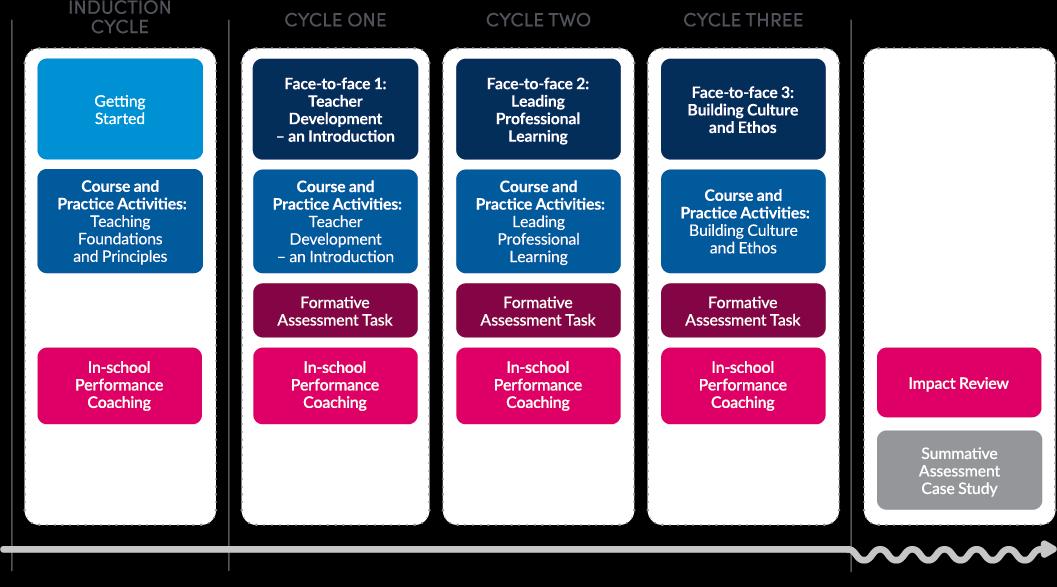
To pass the NPQ participants must engage with a minimum of 90% of the programme and pass a summative assessment task. All elements of the programmes are grouped into four engagement areas and have a % requirement designed to ensure participants meet and exceed the specifications.
Leadership Development Record (LDRs) 90% minimum completion requirement
Face-to-face events 100% minimum attendance requirement
Online learning and coaching 90% minimum completion requirement
Formative Assessment Tasks 100% minimum completion requirement
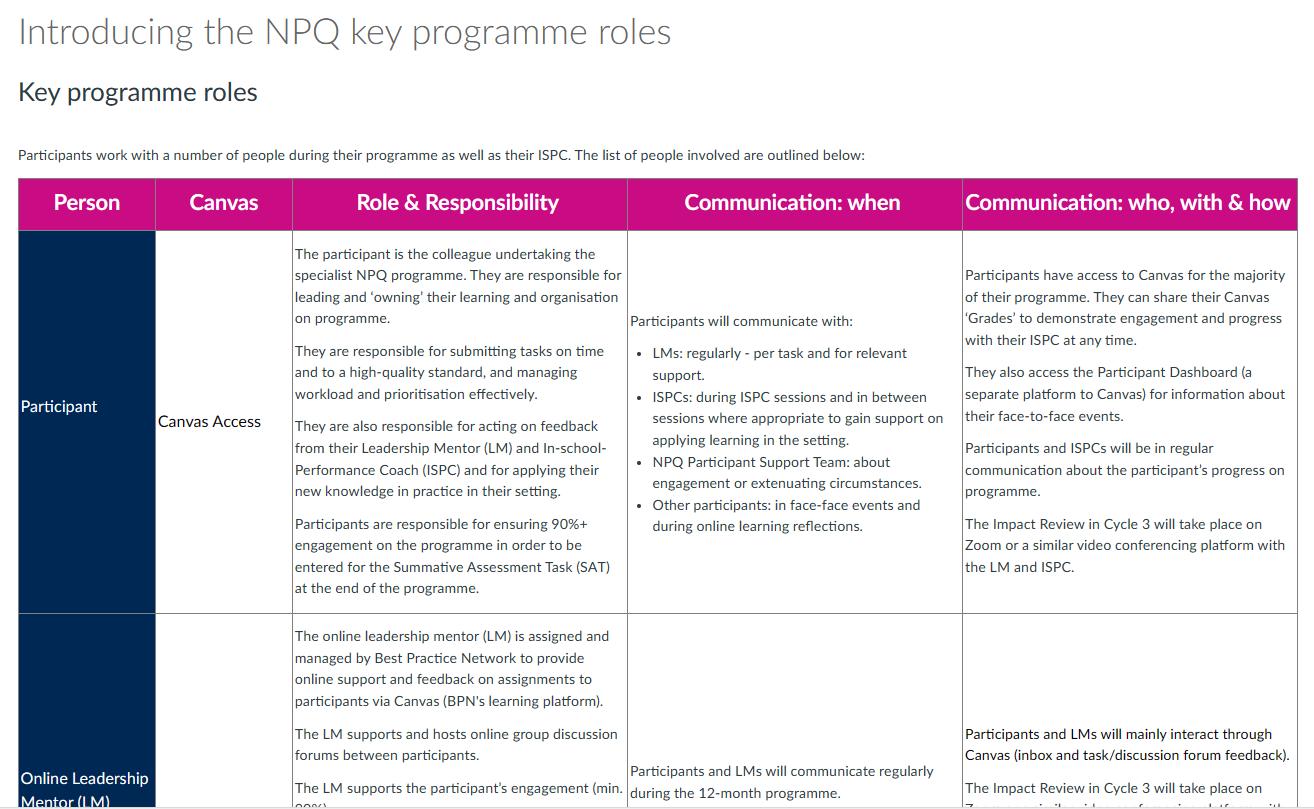
• Participant to lead
• Leadership Mentor (LM)
• In-School Performance Coach (ISPC)
• Face-to-face event facilitators
• Assessment team
• Formative assessment tasks (FATs) to inform progress and development direction to prepare and practise
• Assessment tab on Canvas contains all guidance and information required (released near end of programme)
• Eight-day window at the end of the programme
• Unseen case study
• Participants write and submit written response to case study of 1,500 words max
• To gain the qualification, the participants will need to:
o engage with at least 90% of the programme’s elements
o pass one summative assessment task (case study scenario)

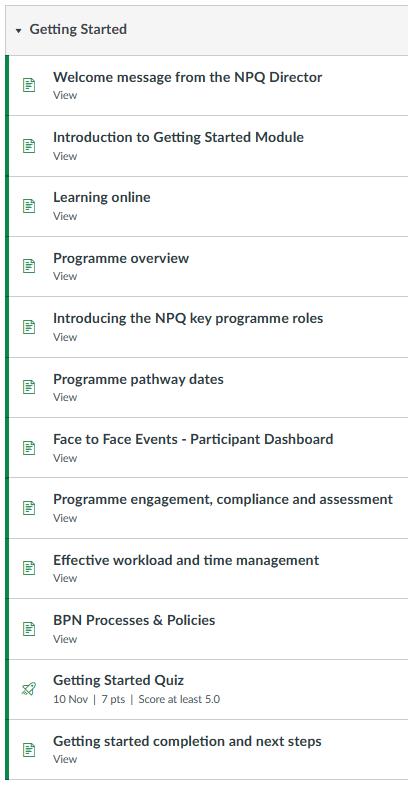

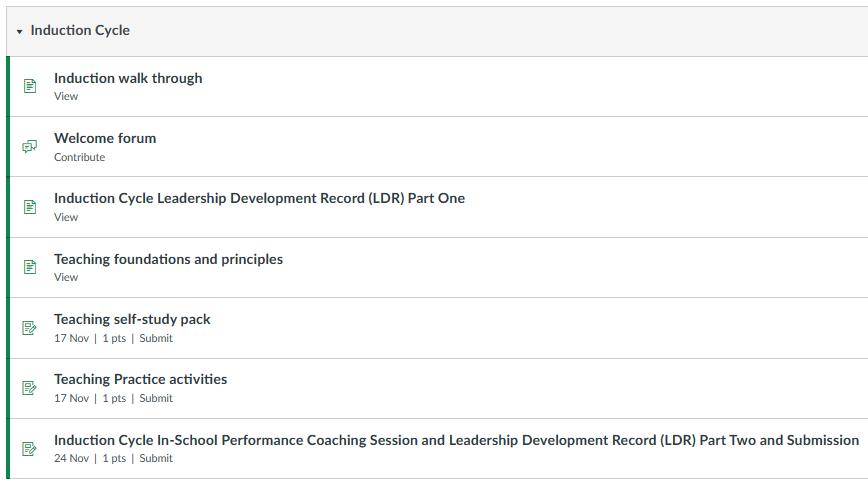

Using your completed Induction Cycle LDR, Practice Activity feedback and Resource 8, answer the questions on Resource 3, to review your learning so far.
“Every teacher needs to improve, not because they are not good enough, but because they can be even better.”
- Dylan Wiliam
Supportive environment
Evidence
Context-relevant
Three
Designing effective teacher development: concepts, research and practice application
Learn that…
2.1. Teaching quality is a crucial factor in raising pupil attainment.
2.2. Helping teachers improve through evidence-based professional development that is explicitly focused on improving classroom teaching can be a cost-effective way to improve pupils’ academic outcomes when compared with other interventions, and can narrow the disadvantage attainment gap.
2.7. The content of professional development programmes should be based on the best available evidence on effective pedagogies and classroom interventions and aim to enhance capabilities and understanding in order to improve pupil outcomes.
Learn how to…
Select evidence-based approaches and design effective professional development by:
2.a. Ensuring any professional development is focused on a shared responsibility for improving outcomes for all pupils.
2.b. Involving colleagues (particularly school leaders) in the selection of professional development priorities and approaches to ensure alignment with wider school improvement priorities.
2.c. Diagnosing what teachers know and can do; starting professional development from that point and adapting the approach based on the teachers’ developing expertise, and applying an understanding of the typical differences between novice and expert teachers.
• Groups of 3-4
• 15 minutes
• Discuss the ‘designing effective teacher development’ research summaries from Resource 1 (one read each as pre-task): what are the key pieces of knowledge?
• Individually, record knowledge arising from the research and your discussion on Resource 4, noting the DfE statement related to each
Supportive environment
Time and quality
Teaching quality and pupil attainment
Evidence base
1. What are the key things you understand from the research about designing effective teacher development?
2. How can this evidence inform your practice, and help you in supporting your colleagues?
3. How can this evidence improve teacher practice and pupil outcomes?
4. How does this research support your development as a leader?
Supportive environment
Teaching quality and pupil attainment

Time and quality
Evidence base
• Great teaching is the most important lever schools have to improve pupil attainment.
• Effective professional development is structured professional learning that results in changes in teacher practices and improvements in student learning outcomes.
• Well-designed and implemented professional development should be considered an essential component of a comprehensive system of teaching and learning that supports students to develop the knowledge, skills and competencies they need to thrive in the 21st century.
• Professional development offers a greater improvement than other school-based interventions, including performance-related pay and lengthening the school day.
• Professional development can lead to increased student self-efficacy and confidence.
• It is necessary to design professional development that focuses on improving and evaluating pupil outcomes.
• High-quality teaching improves pupil outcomes, and effective professional development offers a crucial tool to develop teaching quality and enhance children’s outcomes in the classroom. Therefore, careful attention should be paid to how professional development is designed.
• Traditional on-site coaching programs are a resource-intensive intervention due to the high personnel costs of staffing the intervention, given the skills required, but coaching should not be seen as prohibitively expensive from a policy perspective. Instead, it must be judged whether current expenditures on professional development could be utilised more effectively.
• Professional development is most effective when informed by robust evidence (from a range of sources).
• Professional development is most effective when its providers are explicit about the evidence underpinning practices and how and why practices are intended to work, and when school leaders make evidence-informed development a major leadership priority.
• Professional development that focuses on teaching strategies associated with specific curriculum content supports teacher learning within classroom contexts, and this element includes an intentional focus on discipline-specific curriculum development and pedagogies in areas such as mathematics, science or literacy.
• Groups of 3-4
• 20 minutes
• How does the leader explain their selection of evidencebased approaches and designing effective teacher development by:
• Discuss the ‘designing effective teacher development’ leader case studies from Resource 4 (one engaged with each as pretask) using the questions
• Individually, add to your notes on Resource 4 with new knowledge for you in your context (‘designing effective teacher development’ row), labelling the relevant DfE statements
• ensuring professional development is focused on a shared responsibility for improving outcomes for all pupils? (2.a.)
• diagnosing what teachers know and can do and then starting from that point (before adapting the approach based on the teachers’ developing expertise, and applying an understanding of the typical differences between novice and expert teachers)? (2.b.)
• identifying and focussing on the essential knowledge, skills and concepts of teaching a particular subject within a particular phase/domain and then planning activities that focus teachers’ thinking on these essential components? (2.c.)
• How can the leaders’ responses influence your leadership in your setting?
Whole-group discussion (5 minutes)
What statements have you seen from the leader case studies in practice that can influence your leadership development?





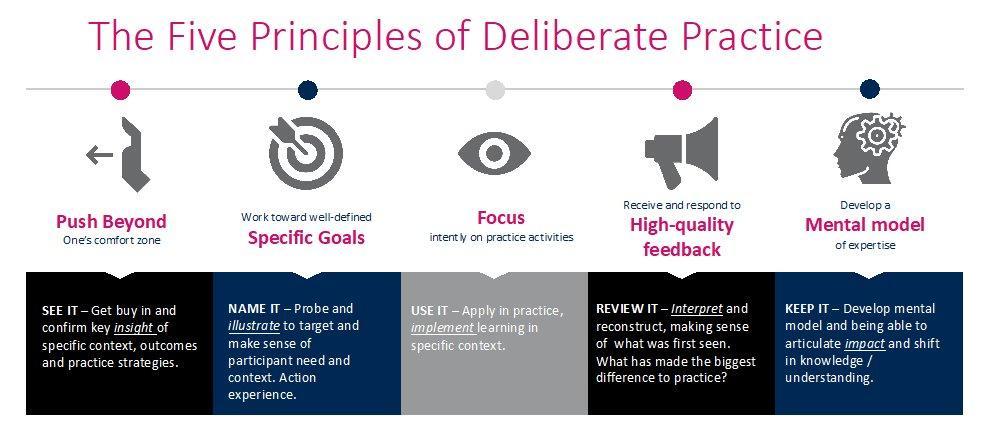
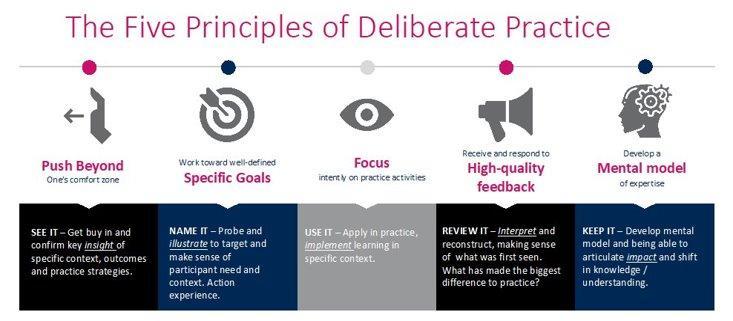
Receive and respond to High-quality feedback Develop a Mental model of expertise
SEE IT – Get buy in and confirm key insight of specific context, outcomes and practice strategies.

NAME IT – Probe and illustrate to target and make sense of participant need and context. Action experience.
KEEP IT – Develop mental model and being able to articulate impact and shift in knowledge / understanding. Work toward well-defined Specific Goals Focus intently on practice activities
USE IT – Apply in practice, implement learning in specific context.
REVIEW IT – Interpret and reconstruct, making sense of what was first seen. What has made the biggest difference to practice?

Please
facebook.com/bestpracticenetwork
@bestpracticenet
linkedin.com/school/the-best-practice-network
@bestpracticenetworkbpn

Four
Delivering effective teacher development: concepts, research and practice application
3.2. Teacher developers should choose activities that suit the aims and context of their professional development programme. Successful models have included regular, expert-led conversations about classroom practice, teacher development groups and structured interventions. However, these activities do not work in all circumstances and the model should fit the educational aims, content and context of the programme.
Deliver effective professional development by:
3.a. Providing clarity on where content fits into school improvement priorities and, where appropriate, a wider curriculum for professional development.
Teacher and pupil needs
Specialist expertise and evidence
Context-relevant activities
• Groups of 3-4
• 15 minutes
• Discuss the ‘delivering effective teacher development’ research summaries from Resource 1 (one read each as pre-task): what are the key pieces of knowledge?
• Individually, record knowledge arising from the research and your discussion on Resource 4, noting the DfE statement(s) related to each
Teacher and pupil needs
Specialist expertise and evidence
Context-relevant activities
1. What are the key things you understand from the research about delivering effective teacher development?
2. How can this evidence inform your practice, and help you in supporting your colleagues?
3. How can this evidence improve teacher practice and pupil outcomes?
4. How does this research support your development as a leader?
Teacher and pupil needs
Specialist expertise and evidence
Context-relevant activities
• A coherent professional development system that supports teachers across the entire professional continuum is advisable for leaders to focus on: professional learning should link to teachers’ experiences in preparation and induction, as well as to teaching standards and evaluation. It should also bridge to leadership opportunities to ensure a comprehensive system focused on the growth and development of teachers.
• Professional development is most effective when school leaders draw on expert input to ensure that activities are clear about how and why practices work in different contexts and when teachers seek to understand how and why practices work and how to implement them successfully in different contexts.
Teacher and pupil needs
Specialist expertise and evidence
Context-relevant activities
• It is important to develop practice and theory side by side rather than as separate components and include activities that link logically to the intended pupil outcomes.
• Active learning engages teachers directly in designing and trying out teaching strategies and therefore providing them with an opportunity to engage in the same style of learning they are designing for their students. Such professional development uses authentic teaching and learning artefacts, interactive activities and other strategies to provide deeply embedded and highly contextualised professional learning. This approach moves away from traditional learning models and environments that are lecture based and have no direct connection to teachers’ classrooms and students.
• Professional development should align with the needs of the school and be supported by school leadership.
Teacher and pupil needs
Specialist expertise and evidence
Context-relevant activities
Task:
• Groups of 3-4
• 20 minutes
• Discuss the ‘delivering effective teacher development’ leader case studies from Resource 4 (one engaged with each as pre-task) using the questions
• Individually, add to your notes on Resource 4 with new knowledge for you in your context (‘delivering effective teacher development’ row), labelling the relevant DfE statements
Questions:
• How does the leader provide clarity on where content fits into school improvement priorities and, where appropriate, a wider curriculum for professional development when delivering effective professional development? (3.a.)
• What relationships do you see between the ways the leader described the school’s approach to design and delivery of effective teacher development?
• How can the leaders’ responses influence your leadership in your setting?
Whole-group discussion (5 minutes)
What statements have you seen from the leader case studies in practice that can influence your leadership development?
Learn that…
4.1. Implementation is an ongoing process that must adapt to context over time, rather than a single event. It involves the application of specific implementation activities and principles over an extended period (e.g. implementation planning, ongoing monitoring).
4.4. Effective implementation begins by accurately diagnosing the problem and making evidence-informed decisions on what to implement.
4.5. Thorough preparation is important: time and care spent planning, communicating and resourcing the desired changes provides the foundation for successful delivery. Teachers and leaders should keep checking how ready their colleagues are to make the planned changes.
Learn how to…
Plan and execute implementation in stages by: 4.a. Ensuring that implementation is a structured process where school leaders actively plan, prepare, deliver and embed changes.
Make the right choices on what to implement by: 4.d. Identifying a specific area for improvement using a robust diagnostic process, focusing on the problem that needs solving, rather than starting with a solution.
Prepare appropriately for the changes to come by: 4.l. Developing a clear, logical and well specified implementation plan, and using this plan to build collective understanding and ownership of the approach.
(Deliver and) Sustain changes by: 4.r. Using reliable monitoring and evaluation to review how the implementation activities are meeting the intended objectives and continue to align with school improvement priorities.
20 minutes
Read one ‘implementation’ research piece from Resource 1 each, recording individual notes on Resource 4
Discuss in group – what is resonating?
Record key pieces of knowledge arising from the research, recording the statement related to each
What are the key things you understand from the research about implementation?
How can this evidence inform your practice, and help you in supporting your colleagues?
How can this evidence improve pupil outcomes and other practices in your setting?
How does this research support your development as a leader?
“One of the characteristics of effective schools, in addition to what they implement, is how they put those approaches into practice. [The framework statements for implementation] set out some important principles of implementation: the process of making, and acting on, effective evidenceinformed decisions. The principles and activities can be applied to a range of different school improvement decisions – programmes or practices; whole school or targeted approaches; internally or externally generated ideas. The statements should be treated as guiding principles and activities, rather than as a rigid set of steps.”
– Department for Education, 2020: 26
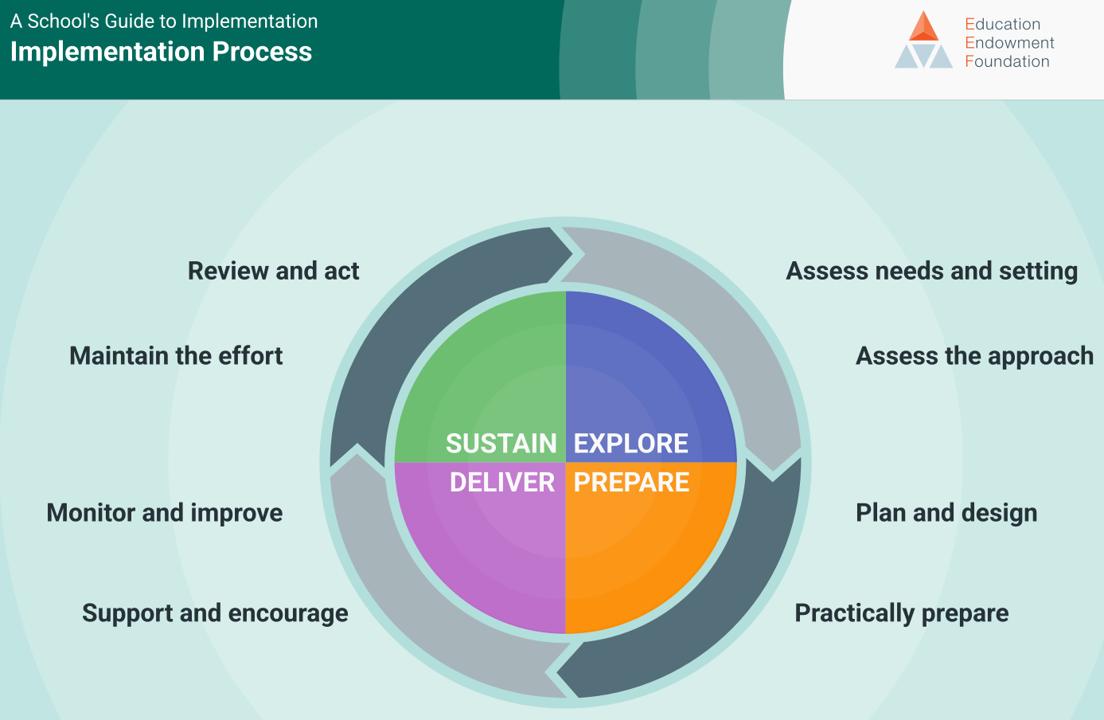
“Treating implementation as a process, not an event; planning and executing it in stages.” (Sharples et al., 2019)
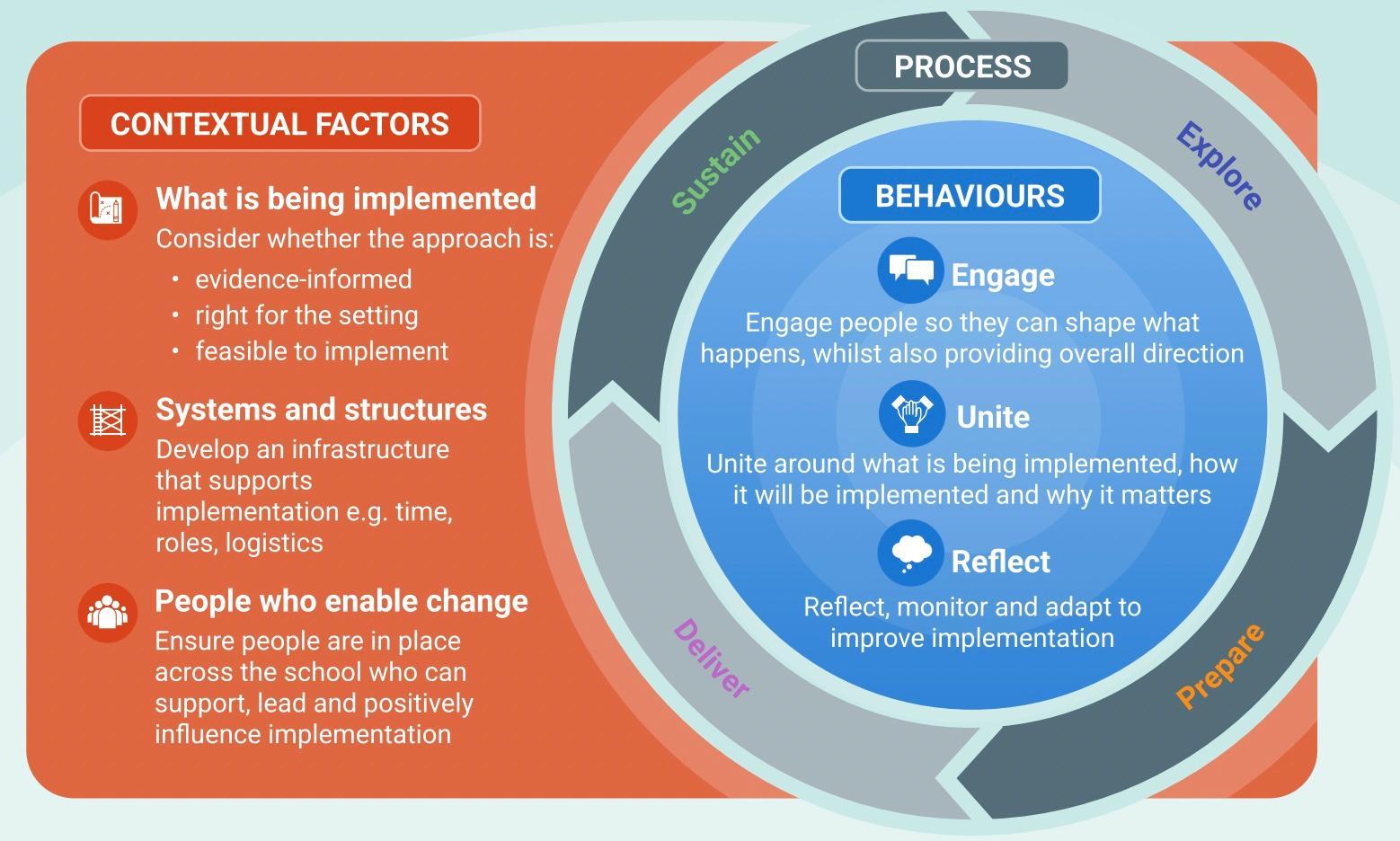
Explore Prepare Deliver Sustain
• New ideas are often introduced with too little consideration for how the changes will be managed and what steps are needed to maximise the chances of success.
• Implementation: process of making, and acting on, effective evidence-informed decisions
• EEF recommendations for school leaders:
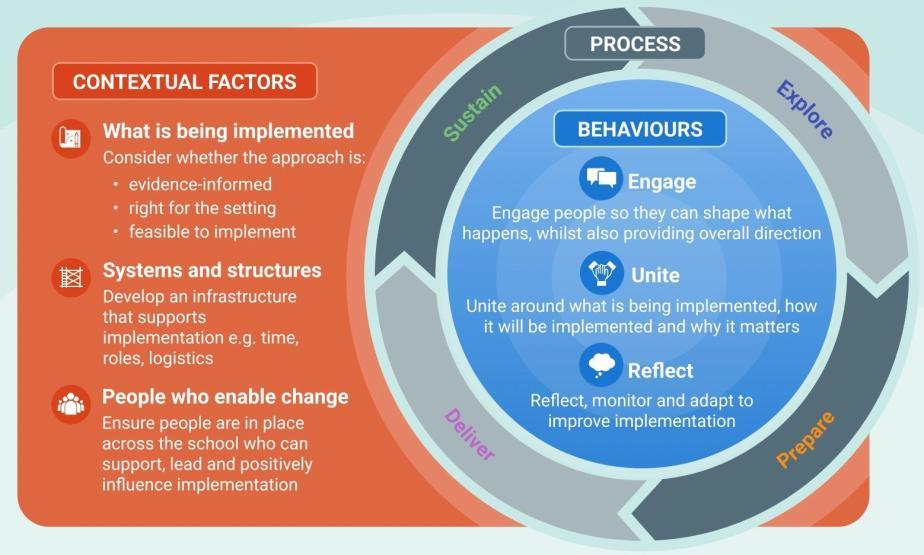
1) Adopt the behaviours that drive effective implementation.
2) Attend to the contextual factors that influence implementation.
3) Use a structured but flexible implementation process.

Please

facebook.com/bestpracticenetwork
@bestpracticenet
linkedin.com/school/the-best-practice-network
@bestpracticenetworkbpn
Task and question:
• Groups of 3-4
• 20 minutes
• Discuss the ‘implementation’ leader case studies from Resource 4 (one engaged with each as pre-task), using the questions:
o How will the leaders’ responses influence your leadership in school?
o How did the leaders describe the treatment of implementation as a process (not an event), planning and executing it in stages? (4.a.)
• Individually, add to your notes on Resource 4 with new knowledge for you in your context (‘implementation’ row), labelling the relevant DfE statements.
Session Five (ii)
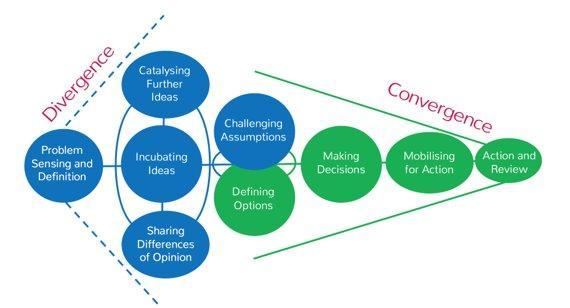
Implementing your vision

Individual task (10 minutes)
• Go through your completed Resource 4 to remind yourself of new knowledge gained through the event so far
• Using the SOAR analysis template in Resource 5, create your vision for teacher development in your setting
• Use the event statements (presented as prompting questions below the SOAR analysis template) to prompt your thinking
• Identify areas where you would like support and challenge from your group
Paired task (10 minutes)
• Take turns to briefly present your vision
• Ask for support and challenge to develop the vision
• Record any additional ideas on your vision
Whole-group discussion (10 minutes)
1. During the event, what are the most important issues you have identified within your setting, in the context of leading teacher development, and seek to address in your vision?
2. What key potential solutions feature in your vision that you would implement first, and why?
3. What challenges might arise in securing the successful implementation of your vision, and how will you plan for/address them in your implementation plan? Why have you chosen this approach?
“Vision without implementation is hallucination.”
• Individually, using your SOAR vision and the example Implementation Plan (Resource 7), begin to populate the blank Implementation template (Resource 7) in:
o Problem/Issue column
o Intervention/Potential solution column
o Challenges row
• In pairs, identify the leadership behaviours and skills (Resources 8 and 9) necessary for implementing your vision effectively in your setting and add them to your Implementation
facebook.com/bestpracticenetwork @bestpracticenet
linkedin.com/school/the-best-practice-network
@bestpracticenetworkbpn

Individual task (25 minutes)
Using your blank Cycle One LDR, begin to plan your learning pathway for Cycle One:
1. Complete the initial ratings, noting where the low ratings lie.
2. Focusing on your lower ratings and what is most relevant for your context, use Resources 10 and 11 to plan your potential learning pathway:
• Where to focus your time during your online learning
• Which 3 (of 9) practice activities to undertake
3. Write these choices into the ‘identify actions…’ column next to the DfE statements with lower initial ratings only.
4. Add other relevant actions (e.g. assess in conversation with in-school performance coach, meet with the HT/Lead for x, etc.) into the ‘identify actions...’ column.
Whole-group discussion (10 minutes)
What statements have you seen in your LDR that that you would like to develop?
Cycle One LDR (initial ratings and actions)
You are here
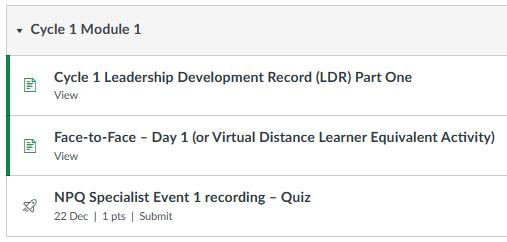
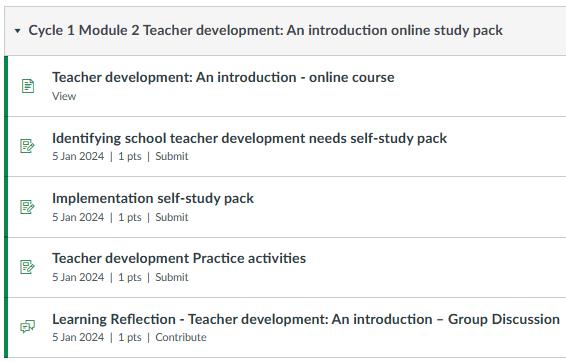
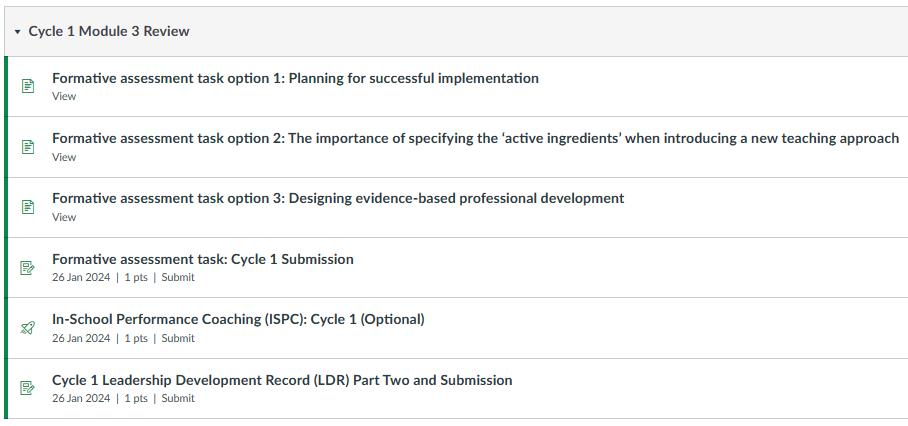

Canvas \ Log in \ Grades \ Assignment Group
1. Log in to Canvas.
2. Go to ‘Grades’ and select ‘Assignment Group’.
3. Check that you have completed the tasks at the top of the gradebook (tick or 1 in score column).
4. Scroll down until you reach today’s date and check that all tasks to that point have a tick or 1 next to them.
5. If there are any incomplete/missing, make a note of them and prioritise for completion after the event.


Contact details for questions
• First point of contact: online Leadership Mentor (programme, online tasks)
• In-school application of learning: In-School Performance Coach
• Other queries: NPQ Participant Support
Follow us on social media
facebook.com/bestpracticenetwork @bestpracticenet
linkedin.com/school/the-best-practice-network @bestpracticenetworkbpn
Please follow us on social media for all of the latest CPD updates.
Share photos from today’s Face-to-Face event using #NPQF2F for a guaranteed retweet!
Employ an apprentice teacher or upskill your workforce and benefit from:
• a trainee in class and teaching 4 days a week
• access to a wide pool of high-calibre trainees
• filling an otherwise vacant post
• an employer grant of up to £28,000
Contact teach@bestpracticenet.co.uk Visit www.bestpracticenet.co.uk/itt