

Induction cycle leadership development record (LDR) – participants’ own completed versions
Cycle One leadership development record (LDR) – blank template
Cycle One formative assessment task options


Induction cycle leadership development record (LDR) – participants’ own completed versions
Cycle One leadership development record (LDR) – blank template
Cycle One formative assessment task options
Please come to the event having undertaken the following:
1. Familiarise yourself with the contents of the participant event resource pack and slide deck
2. Read three of the research summaries in the table below (one from each DfE content area), making notes on the key points and any implications for your leadership practice
3. Watch/read with one of the four sets of four leader case studies in Resource 4
4. Please ensure that you bring the slide deck and participant resource pack to the face-to-face event (either electronically or as paper copies)
5. Have available an up-to-date copy of your completed induction cycle LDR completed, and a blank cycle one LDR ready for completion during the event.
Read one of:
Darling-Hammond L., Hyler, M. E., and Gardner, M. (2017). Effective teacher professional development. Palo Alto, CA: Learning Policy Institute.
Department for Education (2016). Standard for teachers’ professional development: Implementation guidance for school leaders, teachers, and organisations that offer professional development for teachers.
Fletcher-Wood, H., & Zuccollo, J. (2020). The effects of high-quality professional development on teachers and students: A rapid review and meta-analysis. Wellcome Trust.
Kraft, M. A., Blazar, D., & Hogan, D. (2018). The effect of teacher coaching on instruction and achievement: A meta-analysis of the causal evidence. Review of Educational Research, 88(4), 547–
Fact sheet
Pages 5 and 7
Pages 8–11
https:// learningpolicyinstitute.org/ product/teacher-prof-dev
https:// assets.publishing.service.gov.uk/ government/uploads/system/ uploads/attachment_data/file/ 537031/160712__PD_Expert_Group_Guidance.pdf
EPI-Wellcome_CPDReview__2020.pdf
Pages 24–25
Pages 27–33
https://scholar.harvard.edu/ files/mkraft/files/ kraft_blazar_hogan_2017_teacher _coaching_meta_analysis_wp.pdf
588.
And read one of:
Department for Education (2016). Standard for teachers’ professional development: Implementation guidance for school leaders, teachers, and organisations that offer professional development for teachers
Education Endowment Foundation (2021). Effective professional development
And read one of:
EEF (2019). A school’s guide to implementation online course.
Sharples, J. M., Albers, B., Fraser, S., and Kime, S. (2018). ‘Putting evidence to work – a school’s guide to implementation’. London: EEF
Albers, B., and Pattuwage, L. (2017). ‘Implementation in education: findings from a scoping review’. Melbourne: Evidence for Learning.
Page 8
Whole poster of Recommendations
https:// assets.publishing.service.gov.uk/ government/uploads/system/ uploads/attachment_data/file/ 537031/160712__PD_Expert_Group_Guidance.pdf
https:// d2tic4wvo1iusb.cloudfront.net/ eef-guidance-reports/effectiveprofessional-development/EEFEffective-PD-RecommendationsPoster.pdf?v=1635355217
Module 1: Introduction
Summary of recommendations (pages 6–8)
Recommendation 1 (pages 10–11)
Section 5.3 (pages 21–28)
https:// educationendowmentfoundation. org.uk/courses/a-schools-guideto-implementation-online-course
https://dera.ioe.ac.uk/31088/1/ EEF-Implementation-GuidanceReport.pdf
https://www.researchgate.net/ publication/ 319176978_Implementation_in_E ducation__Findings_from_a_Scoping_Revie w
‘Learn that’
2.1. Teaching quality is a crucial factor in raising pupil attainment.
2.2. Helping teachers improve through evidencebased professional development that is explicitly focused on improving classroom teaching can be a cost-effective way to improve pupils’ academic outcomes when compared with other interventions, and can narrow the disadvantage attainment gap.
2.7. The content of professional development programmes should be based on the best available evidence on effective pedagogies and classroom interventions and aim to enhance capabilities and understanding in order to improve pupil outcomes.
how to’
Select evidence-based approaches and design effective professional development by:
2.a. Ensuring any professional development is focused on a shared responsibility for improving outcomes for all pupils.
2.c. Diagnosing what teachers know and can do; starting professional development from that point and adapting the approach based on the teachers’ developing expertise, and applying an understanding of the typical differences between novice and expert teachers.
2.d. Identifying and focussing on the essential knowledge, skills and concepts of teaching a particular subject within a particular phase/domain and then planning activities that focus teachers’ thinking on these essential components.
3.2. Teacher developers should choose activities that suit the aims and context of their professional development programme. Successful models have included regular, expert-led conversations about classroom practice, teacher development groups and structured interventions. However, these activities do not work in all circumstances and the model should fit the educational aims, content and context of the programme.
Deliver effective professional development by:
3.a. Providing clarity on where content fits into school improvement priorities and, where appropriate, a wider curriculum for professional development.
‘Learn that’
4.1. Implementation is an ongoing process that must adapt to context over time, rather than a single event. It involves the application of specific implementation activities and principles over an extended period (e.g. implementation planning, ongoing monitoring).
4.4. Effective implementation begins by accurately diagnosing the problem and making evidenceinformed decisions on what to implement.
4.5. Thorough preparation is important: time and care spent planning, communicating and resourcing the desired changes provides the foundation for successful delivery. Teachers and leaders should keep checking how ready their colleagues are to make the planned changes.
how to’
Plan and execute implementation in stages by:
4.a. Ensuring that implementation is a structured process where school leaders actively plan, prepare, deliver and embed changes.
Make the right choices on what to implement by:
4.d. Identifying a specific area for improvement using a robust diagnostic process, focusing on the problem that needs solving, rather than starting with a solution.
Prepare appropriately for the changes to come by:
4.l. Developing a clear, logical and well specified implementation plan, and using this plan to build collective understanding and ownership of the approach.
Sustain changes by:
4.r. Using reliable monitoring and evaluation to review how the implementation activities are meeting the intended objectives and continue to align with school improvement priorities.
Your leadership learning and practice
Use your completed Induction Cycle LDR (leadership development record) and Practice Activity feedback as prompts to focus your individual review.
In which areas and for which statements has your understanding developed the most?
How have you applied your understanding and what impact has it had on:
a) your leadership?
b) school practice?
What leadership behaviours (Resource 8) have you demonstrated?
What areas do you need to continue to work on and develop?
How will you address these?
Highlight here the key points arising from the research and case studies to consolidate your new knowledge, articulate what you have understood about each of the content areas’ key themes and raise any misconceptions for correction.
Content areas Themes
Designing
(Session three) Supportive
Delivering
Leader case study set
Name of leaders and setting Phase Case study
Set 1 Louise Gohr
The Chancery Trust
Set 2 Florence Pope
Tytherington School
Primary
Set 3 Nicky Archer, Fort Pitt
Secondary, links to curriculum development and teaching quality, rural town in North of England
Designing effective teacher development
https://youtu.be/s_am2DFguaY
Delivering effective teacher development
https://youtu.be/5iAs_PZ-b3c
Implementation
https://youtu.be/Tlk89SHIPyQ
Designing effective teacher development
https://youtu.be/HSPxeRFPh4I
Delivering effective teacher development
https://youtu.be/qBCYKG2iR-A
Implementation https://youtu.be/4VSITpXGuI0
Secondary, links to curriculum Designing effective teacher development
Grammar School development, selective singlesex grammar in South of England
Set 4 Yasim, Special School Special
https://youtu.be/T1pNd0awCYk
Delivering effective teacher development
https://youtu.be/nwWW54KSqnU
Implementation https://youtu.be/b7ucHHa7Bpc
Designing effective teacher development
Delivering effective teacher development
Implementation
Written case study below
Sessions three and four (Designing and delivering effective teacher development)
Yasim believes aligning teacher development with wider school improvement priorities is fundamental, especially in the special education part of the sector, as the student and teacher needs can be quite specific and individualised. “Teacher development has got to work hand in hand with the direction of the school and the needs of the individuals.” At Yasim’s school, he supports the leadership team in working on the setting’s CPD in conjunction with the school development plan in the summer term to establish the key areas of focus and the needs of their colleagues. “Not everything would require professional development to be dovetailed with it, but where are those particular areas of tension that we need to invest in our staff for that to move forward?” Yasim recommends that leaders make sure they have that dialogue with colleagues in charge of teaching and learning as well as the broader team so that the CPD work tallies with performance management systems, which are also tied to the school development plan. “Talk to colleagues responsible for assessment or whatever the areas of focus are, so that you know what their drivers are, and you can make that work in turn with the work that you are going to put in place to support colleagues.”
Yasim’s school has a learning partnership with other local schools (SEND, primary and secondary) which offers them some collaboration and networking: they have created a professional learning team across the partnership. Yasim says that this small group of lead practitioners are really integral to his school’s improvement “because they are working to promote the work from a classroom perspective and a number of us are able to offer the perspective of special schools. You can then also promote that in terms of any professional learning offer.”
Yasim listens to his stakeholders to identify areas of need and the support required to make them feel confident about the action to be taken.
“When you have done the first round of appraisal observations it may pick up other areas of development required, particularly if you have had a high staff turnover in any year; it would not mean you are going to change the direction of what you are doing, because that is on a much more strategic level, but it may be that you need to feed in additional professional learning opportunities if you can see there are trends in particular areas of delivery that are weaker than others.”
He makes sure that the appraisal process, line management and staff meeting focus on the idea of professional development to improve outcomes for pupils. “Any dialogue, any small meeting, is all professional development, it does not need to be a fixed training session. There are so many ways in which you can be enhancing your own career path and your sort of ways forward in terms of teaching. It is really important that the work you are doing is relevant and purposeful and it is going to have impact for both colleagues, students and their families. I think that is why it is really integral when you are aligning it with your school development plan, that this is in your mind as well, why are we doing this? What is the relevance of this? And how is it going to impact our colleagues and young people?”
Yasim ensures the delivery of professional development is adapted to meet the needs of individual colleagues (leaders, teachers and support staff). Increasingly, professional development is delivered virtually or sessions
recorded and stored online for colleagues to access or revisit in their own time. Short, two or three-minute demos and training videos are shared across the school.
“In terms of teaching needs, a crucial thing is looking at what the working hours are of colleagues. Look at your calendar, when are the pressure points? When do we want to be avoiding that support? Or when is that support really needed? For example, we do a very short one-off session for teachers that are new to form tutoring in September. It does not require all staff to attend, but it is there as an option.
Yasim provides lots of drop-in type training that staff can opt into: “so if they are feeling they need the support they can go, but equally if they are feeling confident there is no obligation to sit through training that they are confident and happy with and do not need to be using their time for.”
He found the Early Career Framework useful for supporting the design of professional development workshops and recommended accessing resources from research schools, curriculum hubs, teaching school hubs and commercial organisations to access high-quality materials and save time. Staff are able to develop subject- and domain-specific expertise through engagement with professional organisations and networks.
Before you implement any change in your school, you need to consider exactly why you are doing it. Why is the change happening, is it you that’s driving the change, or has it come from the school or national level, and where is the change coming from?
“I always start with, ‘why’ is it being implemented and I keep the ‘why’ at the centre of all of stages of the process; the planning, the preparing, the delivering, and the embedding.”
Teachers are not always time-rich, particularly in a setting like ours where the students’ needs are diverse and often unpredictable, so it is vital to ensure that you have the necessary amount of time available before implementing any change so that you can ensure to that you successfully embed that change. The process begins with an assessment of the current situation. “You can’t do the other steps if you haven’t assessed where you’re at, right at the beginning,” says Yasim. “You need to give yourself the time and the space to do that. And then make your plan from there.”
Part of the assessment process should identify the needs of your fellow staff members and the needs of the students. You can identify these through talking to students, staff, and parents, using whatever channels work well in your school, for example pupil and parent conference evenings and surveys.
Time, again, is important when moving through the stages, as Yasim explains. “You’ll need to have sufficient time to plan with the key stakeholders, whether that is the students if it’s affecting them more, with your staff, or with parents to explain the changes, whatever they might be,” he says, “and then obviously, making sure there is sufficient time for the actual implementation.”
To keep things on track, Yasim puts together a summary of what needs to happen, including a timeline, to ensure that everyone involved in the process is clear on what will happen and how long that might take. Not only does this help people manage workload, it helps to manage the change process and avoid it getting submerged by the day-to-day activities in school – a situation that often leads to reactive rather than proactive leadership and implementation of change.
“To remain proactive, you need to give yourself the time and space to think strategically, and to assess strategically,” advises Yasim. “So, I always try and make sure there’s a couple of hours in my week that are
blocked off, that aren’t for marking, planning or being the first port of call in an emergency (which happen frequently). This time can then be used for learning walks, for one of my strategic change aspects, to speak to staff and students, or even just to research upcoming changes. For example, when we inputted a coaching system recently, I needed to take the time to sit and properly digest all the information.”
During the assessment stages, it is important to be entirely honest with yourself – and others – about current practice, what works, and what does and doesn’t bring about positive benefits, Yasim advises. This can be easier when you are new in position and it is not your own systems that are under review. That review process involves talking to all the stakeholders, listening to their feedback and opinions, and then adding to them to your own review. You also need to have the courage to tackle any glaring issues head on, always keeping in mind the ‘why’ of any change you decide to make.
Sometimes you will notice big changes that need making, but most of the time it will be small adjustments that can make a real difference. Yasim has been at his school for just over a year and has already made some changes to CPD provision. “At the moment, I’m not going to overhaul anything, but for me, it’s always about incremental gains,” he says. “For this new academic year, I’ve expanded the provision of coaching to give more colleagues the opportunity to spend time reflecting quite openly, knowing that their individual needs and goals will arise from this process, to set a more specific process for the following academic year.”
Yasim’s approach to setting up a coaching process was to train a colleague in coaching and then to offer all other colleagues 3–4 coaching sessions over the course of the academic year. 60% of colleagues took up the offer, which in turn led to a second group of colleagues accepting it (based on positive feedback from the first cohort), and now 85% of colleagues are being coached. Coaching takes place to suit the colleagues’ timetables – before, during and after school. Yasim has set up a cover plan where colleagues cover each other in class, maintaining the school’s tight ratio of 6 students to 1 adult at any given time. The coaching process is now being used as a key recruitment tool in job adverts and has appealed to the recent recruits as it is open to leaders, teachers and support staff alike.
“The difference it made to practice was that we had a much more reflective team of colleagues who began to collaborate better, and in turn discussing pupils’ needs much more forensically. And it meant that students and parents began to have even tighter attention paid to their needs, and teachers went on to sign up for other CPD to develop their classroom practice and attention to specific student and family needs a great deal more,” says Yasim.
Yasim acknowledges that although the decision to set up a coaching process in his setting was the right one, the results backed up his conviction, his approach involved a great deal of change over one academic year. “Perhaps I brought in too large a change at once,” he says. “Now, I would perhaps have rolled it out to a smaller group of colleagues initially, and then a second group in the second year, rather than all in one. The biggest challenge was getting staff to buy into the change. But we made sure that everything was about how colleagues were feeling and how it was impacting on their work with students and their families, as they are truly at the centre of everything we do, and I listened to all stakeholders’ concerns and spoke to them directly about the advantages as well, and colleagues’ buy-in came quite quickly after that. Once the process had begun virtually all colleagues had bought in to the idea and the final 15% are signed up to start next term.”




Setting/team/individual strengths and abilities already in place
The possible opportunities that could be ahead
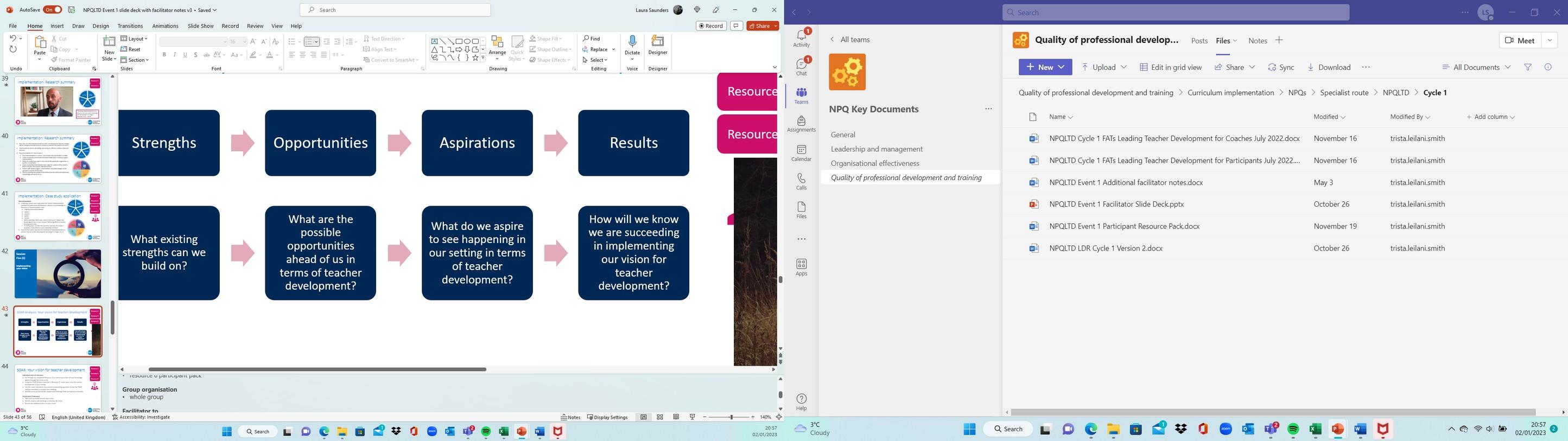
The aspirational vision: the big picture ‘dream’
What are the setting’s current strengths here?
What are we most proud of here?
What are my and others’ leadership strengths here?
What are the current pockets of strength (individuals, teams, departments, whole settings, community, etc.) relevant here?
How do we currently utilise our strengths to improve our practice
What practices/ initiatives/ partnerships/ interventions/ programmes/ funding/ new colleagues, etc. are possibly available to us?
How else could we be utilising our strengths to develop our practice here?
If I could design my perfect ‘dream’ picture here, what would be its key features?
What research needs to influence my aspiration/vision?
Who would be involved in my aspiration/vision? Why? How?
Which statements (below) need to feature in my aspiration/vision?
The (desired) results that would demonstrate the successful implementation of the aspirational vision
What would I see if my aspiration/vision was realised (practices)?
What would I hear if my aspiration/vision was realised (language)?
What would I feel/sense if my aspiration/vision was realised (culture/norms)?
How might the vision be implemented?
What do I know about effective
here?
Which statements (below) are already effective in my setting?
implementation to ensure my aspiration/vision is realised effectively?
Which statements (below) would I need to consider to successfully implement my vision?
Designing effective teacher development Delivering effective teacher development Implementation
How will we ensure that teaching quality is the priority of all teacher development designs? (2.1, 2a)
How will we ensure that our professional development programme is focused on a shared responsibility for raising pupil attainment and narrowing the disadvantage gap? (2.1, 2.2)
How will we ensure that we are helping teachers to improve through evidence-based professional development? (2.2)
How will we ensure that our professional development programme is designed to explicitly focus on the evidence about improving classroom teaching? (2.2)
How will we ensure cost-effectiveness of our professional development programme? (2.2)
What is the best available evidence on effective
How will we choose activities that suit the aims and context of our professional development programme? (3.2)
What will a successful model of professional development activities look like in our school (e.g. regular, expert-led conversations about classroom practice, teacher development groups and structured interventions)? (3.2)
How will effective professional development content fit into our school improvement priorities? (3a)
How will effective professional development content fit into a wider curriculum for professional development? (3a)
How can we link the vision for designing effective teacher development with what we now know about delivering effective teacher development in this part of the vision?
How will we ensure that implementation in my school is treated as an ongoing and structured process that must adapt to context over time, rather than being treated as a single event? (4.1, 4a)
How will we ensure that all implementation begins with accurately diagnosing the problem and making robust, evidence-informed decisions on our implementation focus? (4.4, 4d)
What will we need to do to ensure preparation is thorough in terms of time, care spent planning, communications, and resourcing? (4.5)
How do we ensure our implementation plan is clear, logical and well-specified in order to build collective understanding and ownership of the approach? (4l)
How will we ensure our monitoring is reliable
pedagogies and classroom interventions that we would like to base on our professional development programme on? (2.7)
Which evidence-based approaches could we use to design our professional development programme based on diagnosing what teachers know and can do, using that as a starting point and then adapting the approach based on teachers’ developing expertise? (2.c)
How will we select our evidence-based approaches to designing the professional development programme based on identifying and focusing on the essential knowledge, skills and concepts of teaching a particular phase/domain and then planning activities that focus teachers’ thinking on these essential components? (2.d)
In what ways will this vision help design effective teacher development?
In what ways will this vision help deliver effective teacher development? and clear in order to be able to improve the approach over time whilst still meeting the intended objectives? (4r)
How will I ensure I stay focused on successfully developing teacher practice for improving pupil outcomes?
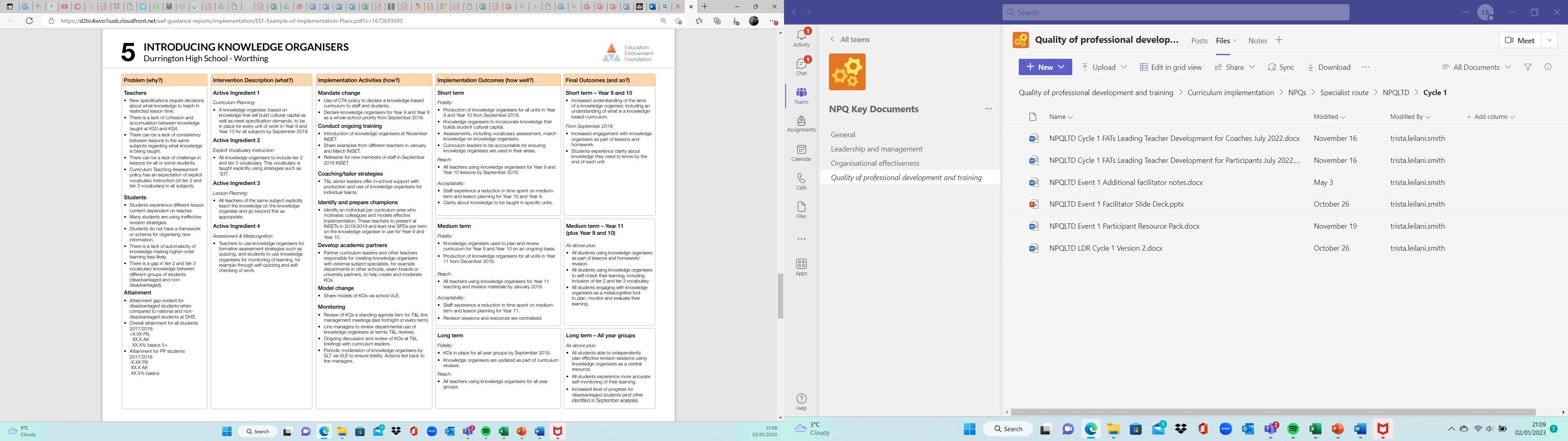
Problem/Issue (why?) Intervention/potential solution
(how?)
Behaviour Explanation
Self-awareness
Integrity
Resilience
Impact and influence
Effective leaders will know themselves and their teams, continually reflect on their own and others’ practices, and understand how best to approach difficult or sensitive issues. They are aware of their personal strengths and areas for future growth and understand how their own behaviour impacts others.
Effective leaders act with honesty, transparency and always in the interests of the school and its pupils. They are able to gain the respect of others by acting in line with their own values, as well as making decisions or choices with the best interests of education and pupils in mind.
Effective leaders remain courageous and positive in challenging, adverse or uncertain circumstances. They are able to respond appropriately, manage uncertainty and bounce back even in the most trying of situations.
Effective leaders have a positive impact on students, colleagues and the wider community through persuading, convincing and bringing others round to their perspective. They understand others’ perspectives and priorities and tailor their communication to suit their audience.
Delivering continuous improvement
Learning focus
Developing others
Respect
Effective leaders secure and maintain positive improvement through articulating a clear vision, setting high expectations and leading a cycle of research, planning, monitoring, analysis and change. They demonstrate the ability to combine operational action with strategic planning, securing short term improvements whilst building sustainable change.
Effective leaders keep learning and pedagogy at the core of the whole-school curriculum and at the heart of their leadership practice. Their strong knowledge and understanding of learning theories (both adult and children) and pedagogies allows them to use their leadership to influence and improve effective teaching and learning. They encourage a culture of dialogue – formal and informal – about pedagogy, learning, curriculum design and development (assessment).
Effective leaders develop and empower colleagues. They proactively look for ways to develop others, seeking opportunities to develop colleagues through activities such as mentoring, supporting, championing and guiding, in order to bring out the very best in them.
Effective leaders respect the rights, views, beliefs and faiths of pupils, colleagues and stakeholders.
Commitment
Effective leaders are committed to their pupils and understand the power of worldclass teaching to improve social mobility, wellbeing and productivity.
Skill Explanation
Critical knowledge and understanding of research techniques and selfmanagement
Critical enquiry, review, analysis and evaluation
The best leaders undertake and use research, drawn from a range of sources, to support decision making and strategy development – using their time effectively within disciplined and well-organised systems and methodologies.
The best leaders use critical thinking, statistical and data analysis tools, techniques and concepts to identify strengths and areas for development. They design effective leadership plans to support intervention, direction and development. They analyse the implications of change, deploying well-evidenced research to frame school selfevaluation and improvement.
Challenge
Dealing systematically and creatively with complex issues
Priority identification
Clear articulation and application of knowledge
The best leaders use challenge effectively and adopt a range of strategies in the best interests of achieving progress – demanding ambitious standards for all pupils and a strong sense of accountability in staff for the impact of their work on pupils’ outcomes.
The best leaders have clear systems and protocols in place that enable them to consider and find solutions to issues, as they arise, in a way which deals most effectively with the barriers and challenges they face. The systems in place do not constrain but create a firm foundation for taking positive action.
The best leaders scan the horizon to anticipate change, taking a long-term view of the implications of change and improvement needed to identify short- and long-term priorities and goals, with specified milestones to ensure effective leadership and management.
The best leaders take time to reflect and learn from their leadership activity and apply this knowledge to bring about improvements in themselves and their work.
Self-direction and originality
The best leaders have clear and ambitious targets for themselves as leaders, for their pupils and for their schools. They take a unique strategic view of situations and their implications for long-term impact and outcomes – sometimes using unexpected actions to get the best for those concerned.
The best leaders take time to reflect and evaluate their practice and effectiveness in their leadership and as leaders. They are aware of the education landscape, understand the context of their school and its needs and direct professional practice and intervention appropriately.
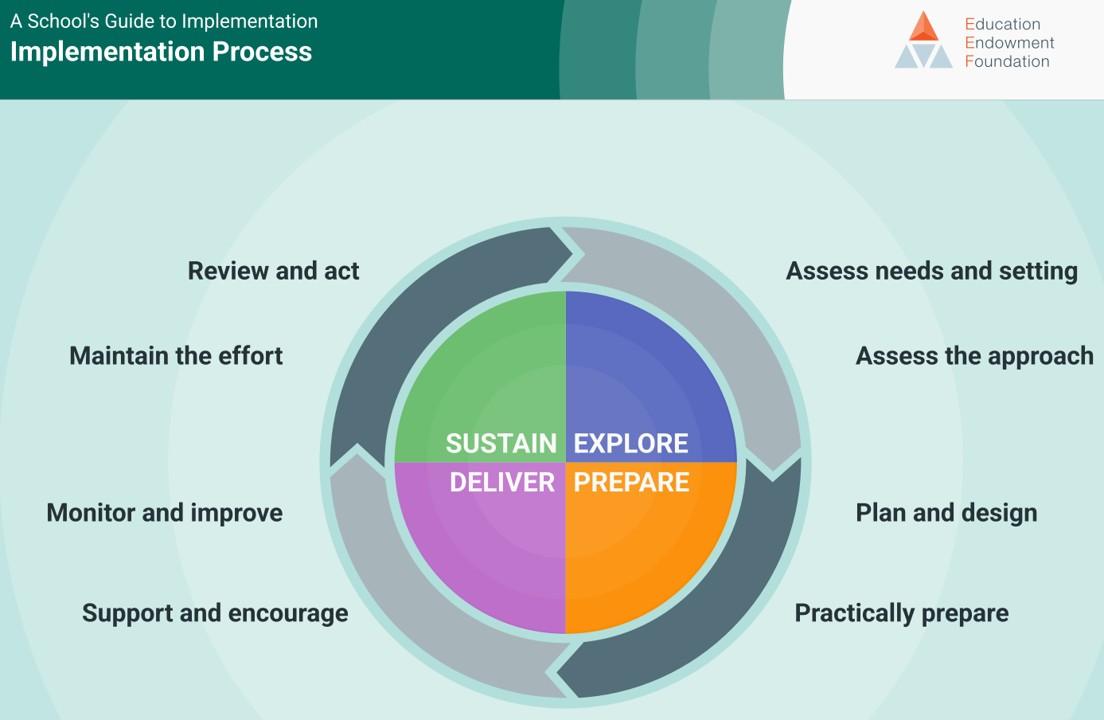
Implementation
Plan and execute implementation in stages
Make the right choices on what to implement
Prepare implementation
Deliver implementation
Sustain implementation
Expert practice
Effective teacher development
Identifying development needs
EEF Effective Professional Development
DfE Standards for Teacher Development
Select three of the following nine activities to submit to your leadership mentor.
Choose an activity based on your areas of interest and the results of the diagnostic review undertaken at the start of the course.
In the practice scenario from Make the right choices on what to implement in the Implementation selfstudy pack, Jaz explained how the data he examined demonstrated children with SEND were not making the expected progress.
Read the EEF guidance on Gathering and interpreting data, paying attention to the section on recognising weaknesses in data.
What can you learn from the case study and EEF guidance about collecting relevant, reliable data?
What action can you take to ensure your own data is relevant and reliable?
Submit a summary of your response to your leadership mentor (maximum 200 words).
EEF Gathering and interpreting data summary
The EEF’s ‘School’s guide to implementation’ includes guidance on identifying and prioritising the ‘active ingredients’ of a project. Read the guidance, paying attention to section e. Use the active ingredients to anchor the implementation process.
What key learning can you take away from the guidance?
How will you apply what you have learned to help you identify and prioritise the key ingredients of your own professional development projects?
Submit a summary of your response to your leadership mentor (maximum 200 words).
EEF Implementation theme - Active Ingredients
One of the recommendations in the ‘prepare’ section of ‘Putting evidence to work: A school’s guide to implementation’ outlines the importance of creating a shared understanding of what will be expected, supported and rewarded during the implementation process. The EEF provided a simple template for users to share what is:
expected
supported
rewarded
Complete the template for a small, recent professional development activity.
How does this increase clarity and support a shared understanding of the project?
Submit a summary of your response to your leadership mentor (maximum 200 words). https://educationendowmentfoundation.org.uk/education-evidence/guidance-reports/implementation
The EEF’s ‘School’s guide to implementation’ includes guidance on supporting implementation with professional development. Read the guidance, paying attention to the recommendation to reinforce initial training with expert follow-on support. Consider the implications of this for implementation activity in your school.
How will you apply what you have learned in a potential professional development project?
Submit a summary of your response to your leadership mentor (maximum 200 words).
EEF Implementation theme - Professional Development
In the study pack ‘Identifying teacher development needs’, in the section on establishing teacher development needs, in the practice scenario Peter describes his school’s approach to teacher appraisal. Read this, the DfE Teacher Appraisal and Capability model and the DfE Making data work report.
Compare your reading to your school’s own appraisal model or policy.
How effective is your school appraisal model or policy at identifying teachers’ development needs?
How would you change the model to improve the assessment of teachers’ professional development needs?
Submit a summary of your response to your leadership mentor (maximum 200 words).
DfE (2019) Teacher appraisal and capability: Model policy
DfE Making data work
In the identifying teacher development needs study pack, there is a recommendation that you explore your school self-assessment and school improvement plan and use the data used in preparing it to start a needs analysis.
Pick one improvement theme from your school’s SIP and explore the underlying data at the school, department and, if possible, the individual level.
What does the data tell you about the development need at the different levels?
How would you differentiate any subsequent professional development?
Submit a summary of your response to your leadership mentor (maximum 200 words).
The section on teacher assessment in identifying teacher development needs explores a range of teacher assessment methods and recommends that a range of methods are used to judge the quality of teaching and support teachers in their professional development. There is a specific recommendation that that review protocols are used to standardise reporting. Look at your own school’s teacher assessment or observation policy.
Reflect on why standardisation is important and its place in helping teachers develop.
How are judgements of teaching quality standardised in your school?
How might standardisation be improved?
Submit a summary of your response to your leadership mentor (maximum 200 words).
Explore the Teachers’ standards and the Ofsted inspection framework.
Discuss with your in-school coach how the choice and wording of the standards compare to your own understanding of teaching excellence.
How would you amend the standards to reflect your definition of teaching excellence and make them more accessible for teachers?
Submit a summary of your response to your leadership mentor (maximum 200 words).
DfE Teachers’ standards
Ofsted Education inspection framework 2019
In the practice scenario in the self-study pack lesson, Evaluating the impact of professional development, Laura discusses how she and her team used data and evaluated the impact of their work.
Reflect on how you and your colleagues have recorded the impact of your work for a recent improvement project.
Apply Guskey’s levels of impact to a recently delivered professional development programme. (Keep this at a high level capturing the key points, perhaps in a table.)
Submit a summary of your response to your leadership mentor (maximum 200 words).
Guskey. T. R. (2002) Does it make a difference? Evaluating professional development. Educational Leadership, 59(6), 45–51
Guskey. T. R. (2016) Gauge impact with 5 levels of data. Learning Forward, 37(1), 32–37