

Careers information, advice and guidance

Part of the BPN Boost provision
Careers information, advice and guidance
Part of the BPN Boost provision
Aim
To develop the ability to communicate project ideas, decisions and outcomes clearly and persuasively, adapting messages for different stakeholders and assessment contexts.
Objectives
•Structure messages clearly for impact and clarity (K1, K15, S1)
• Adapt communication style for different stakeholders and purposes (K10, K15, S17, B2)
• Use evidence and evaluation to strengthen credibility (K6, S10, B1)
• Communicate effectively in presentation and questioning contexts (K1, S1, S16, B5)

of
A. I already have a communication structure that usually works
B. I sometimes lose clarity when explaining decisions
C. I know what I want to say but not always how to land it
D. I am still developing confidence under questioning
…describing instead of evaluating
…talking too long before getting to the point
…leading with opinion rather than evidence
…losing confidence when challenged
Evidence – What has informed your decision
Impact – What difference this will make
Learning – What you will be reviewing as a result
• Introduce yourself and network with the group
• Discuss the following prompts and prepare to give feedback
Choose one (real, if you can) example of: • A project • A decision • A change you lead
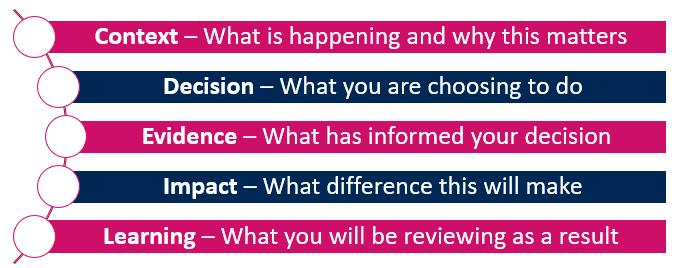

Using ‘The Impact Line’, where did it feel most challenging?
A. Being clear about the decision.
B. Explaining the evidence without over-explaining.
C. Articulating the impact clearly.
D. Other (type a summary response).
What do they (think they) care about?
What decision/s might they make?

..think first, communicate second!
• Introduce yourself and network with the group
• Discuss the following prompts and prepare to give feedback
Choose an audience:
• A stakeholder
• A team
• An external assessor
• Other…
Which part of the Impact Line would you lean on most?
Which part would you keep lighter? Why?
When adapting your message for different audiences, what changed most?
A. Context – What is happening and why this matters.
B. Decision – What you are choosing to do.
C. Evidence – What has informed your decision.
D. Impact – What difference this will make.
E. Learning – What you will be reviewing as a result.
You are asked to justify your decisions
How will I check it’s going to plan?
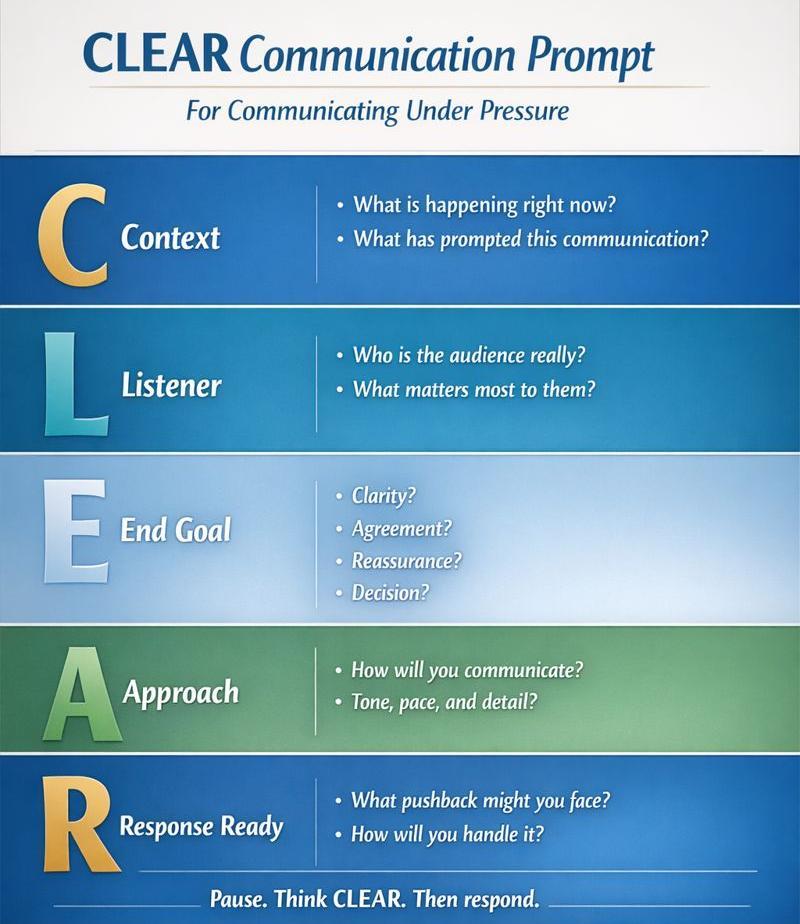
Listener End goal Approach Response ready
What is happening right now?
What has happened that makes this communication necessary?
What might matter most to them in this moment?
What might matter most to them in this moment?
How
Tone, pace, channel, level of detail etc.
What questions, challenge or pushback might you get?
How will you respond without getting defensive?
A little humour (‘Here it comes!”)
The pause after the question is delivered
No ‘aggressive/defensive’ response.
“This gentleman is right, in some of the things he says”.
Openly admits he doesn’t know ‘everything’.
Reframes – start with the ‘customer’. What is it they need and then take them further.
Then mentions loads of other things they’ve achieved!
Celebrates others and acknowledges mistakes will be made (part of the process).
Doesn’t directly answer “What have you been doing for 7 years?”
His role is implied via the significance of his vision and collaborative strategy.
Listener End goal Approach Response ready
• What will pay more attention to?
Aim
To develop the ability to communicate project ideas, decisions and outcomes clearly and persuasively, adapting messages for different stakeholders and assessment contexts.
Objectives
•Structure messages clearly for impact and clarity (K1, K15, S1)
• Adapt communication style for different stakeholders and purposes (K10, K15, S17, B2)
• Use evidence and evaluation to strengthen credibility (K6, S10, B1)
• Communicate effectively in presentation and questioning contexts (K1, S1, S16, B5)