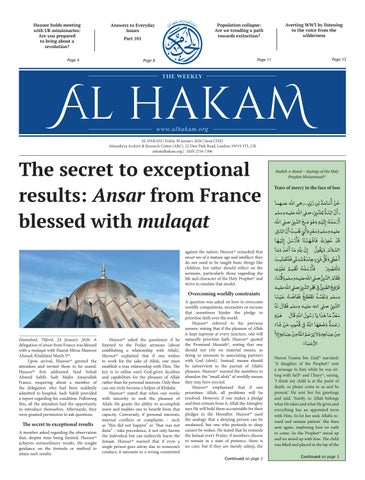
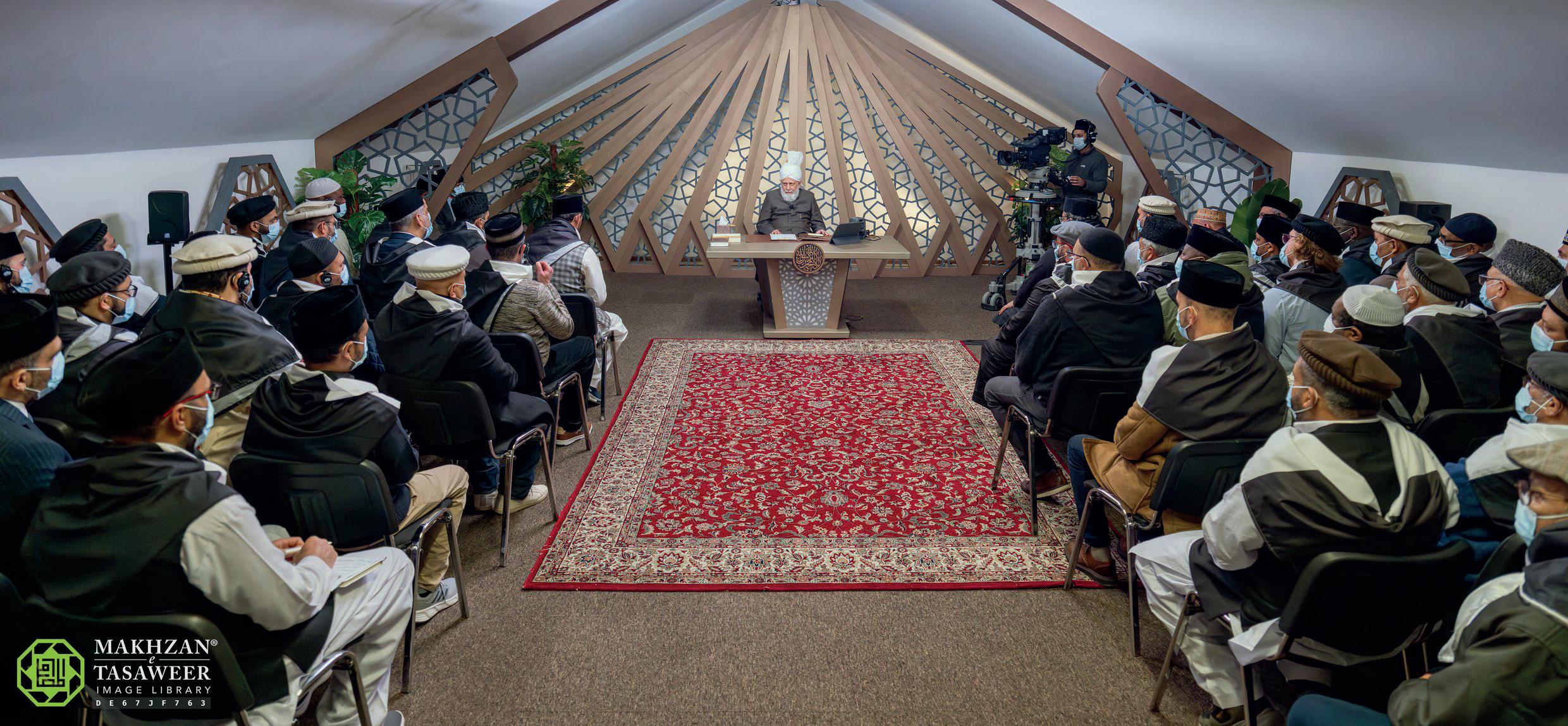
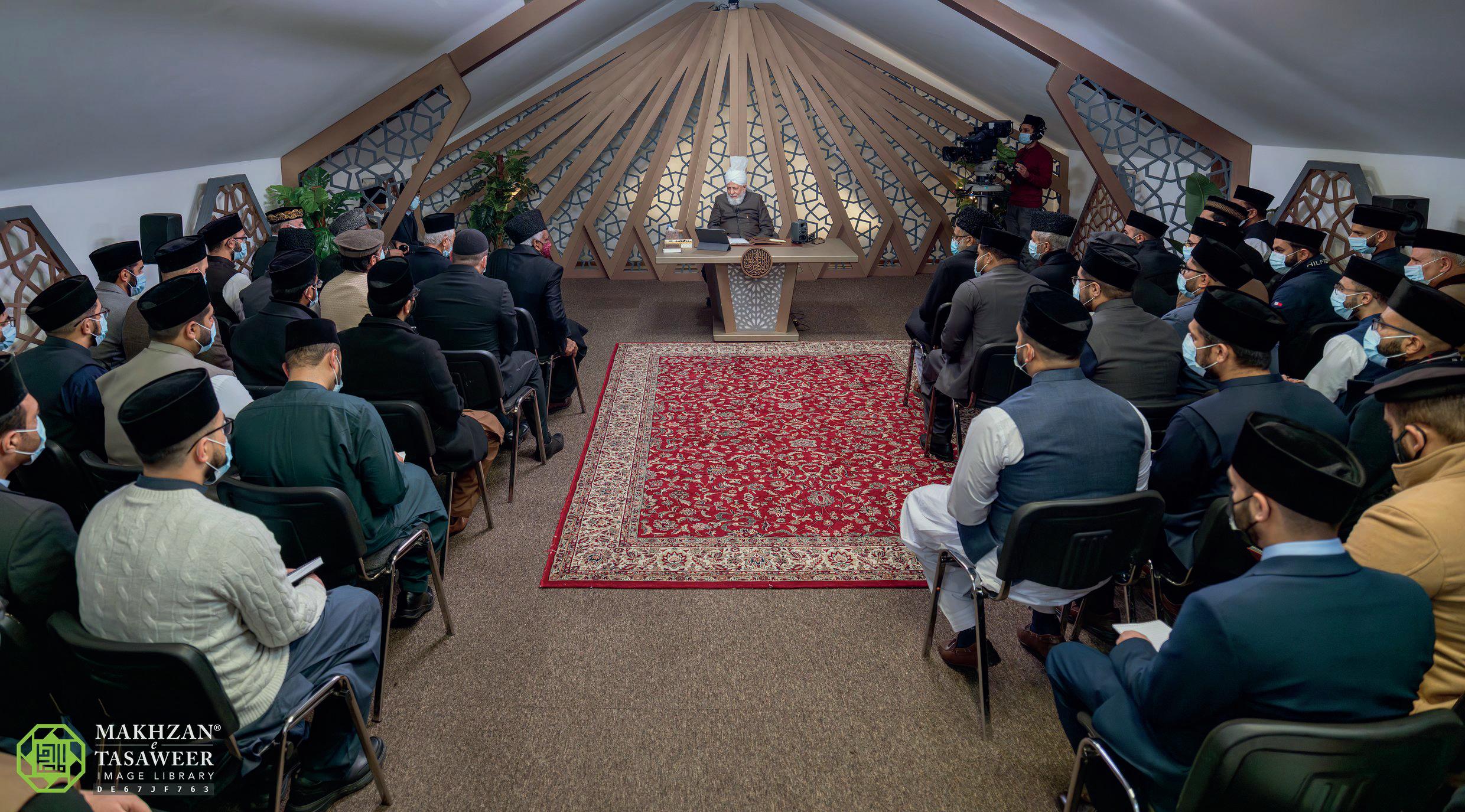
Islamabad, Tilford, 24 January 2026: A delegation of ansar from France was blessed with a mulaqat with Hazrat Mirza Masroor Ahmad, Khalifatul Masih Vaa
Upon arrival, Huzooraa greeted the attendees and invited them to be seated. Huzooraa first addressed Syed Sohail Ahmed Sahib, Sadr Majlis Ansarullah France, enquiring about a member of the delegation who had been suddenly admitted to hospital. Sadr Sahib provided a report regarding his condition. Following this, all the attendees had the opportunity to introduce themselves. Afterwards, they were granted permission to ask questions.
The secret to exceptional results
A member asked regarding the observation that, despite time being limited, Huzooraa achieves extraordinary results. He sought guidance on the formula or method to attain such results.
Huzooraa asked the questioner if he listened to the Friday sermons [about establishing a relationship with Allah].
Huzooraa explained that if one wishes to work for the sake of Allah, one must establish a true relationship with Him. The key is to utilise one’s God-given faculties and capabilities for the pleasure of Allah rather than for personal interests. Only then can one truly become a helper of Khilafat.
Huzooraa stated that when one works with sincerity to seek the pleasure of Allah, He grants the ability to accomplish more and enables one to benefit from that capacity. Conversely, if personal interests, internal conflicts or complaints – such as “this did not happen” or “that was not done” – take precedence, it not only harms the individual but can indirectly harm the Jamaat. Huzooraa warned that if even a single person goes astray due to someone’s conduct, it amounts to a wrong committed
against the nation. Huzooraa remarked that ansar are of a mature age and intellect; they do not need to be taught basic things like children, but rather should reflect on the sermons, particularly those regarding the life and character of the Holy Prophetsa and strive to emulate that model.
Overcoming worldly constraints
A question was asked on how to overcome worldly compulsions, necessities or excuses that sometimes hinder the pledge to prioritise faith over the world.
Huzooraa referred to his previous answer, stating that if the pleasure of Allah is kept supreme at every juncture, one will naturally prioritise faith. Huzooraa quoted the Promised Messiahas, noting that one should not rely on material means, as doing so amounts to associating partners with God (shirk). Instead, means should be subservient to the pursuit of Allah’s pleasure. Huzooraa warned the members to abandon the “small idols” of worldly means they may have erected.
Huzooraa emphasised that if one prioritises Allah, all problems will be resolved. However, if one makes a pledge and then retreats from it, Allah the Almighty says He will hold them accountable for their pledges in the Hereafter. Huzooraa used the analogy that a sleeping person can be awakened, but one who pretends to sleep cannot be woken. He stated that he reminds the Jamaat every Friday; if members choose to remain in a state of pretence, there is no cure, but if they are merely asleep, the
Hazrat Usama bin Zaidra narrated: “A daughter of the Prophetsa sent a message to him while he was sitting with Sa‘dra and Ubayyra, saying, ‘I think my child is at the point of death, so please come to us and be present.’ He sent her his greetings and said, ‘Surely, to Allah belongs what He takes and what He gives and everything has an appointed term with Him. So let her seek Allah’s reward and remain patient.’ She then sent again, imploring him on oath to come. So the Prophetsa stood up and we stood up with him. The child was lifted and placed in the lap of the
Continued on page 3
30 January
30 January 1897: Famous Muslim saint Hazrat Khawaja Ghulam Faridrh wrote letters to the Promised Messiahas expressing his love and devotion. The first of these letters, written in Persian and dated 27 Sha‘ban 1314 AH, was written on this day.
To read more about this correspondence, see: “Letters from Chachran: Khawaja Ghulam Farid’s support of Hazrat Mirza Ghulam Ahmad” at alhakam.org (29 January 2021, pp. 19-20).
30 January 1956: On this day, a delegation of three established scientists from Russia and America arrived in Rabwah for two days. The next day, Prof Brotof from Leningrad, Prof Skateman and Prof Emparess from the USA visited Talimul-Islam College and addressed the faculty members and students at the campus. Later that day, they also enjoyed the blessed company of Hazrat Musleh-e-Maudra. (Daily Al Fazl, 1 February 1956, p. 1)
This Week in History
31 January
31 January 1909: Among
Masih Ira was the establishment of the true status of Khilafat in the hearts and minds of Jamaat members and opponents alike. From the outset, certain individuals who were against the institution of Khilafat tried to stir unrest within the Jamaat.
On this day, to firmly settle this debate, Hazrat Khalifatul Masih Ira called a special session of Shura, which was attended by around 250 representatives. He delivered a powerful speech uprooting all doubts and misconceptions about the divine institution of Khilafat. He also invited certain members to reaffirm their bai‘at
In Tarikh-e-Ahmadiyyat, volume 3 (p. 258), this incident has been described in detail and has been named “Yaum al-Furqan”.
31 January 1992: On this day, for the first time in history, the Friday sermon of Hazrat Khalifatul Masih IVrh was broadcast live via satellite and watched across the continent of Europe. In this sermon, Huzoorrh highlighted that the magnificent prophecy regarding the triumph of Islam is closely linked to the Promised Messiah and Imam Mahdi, peace be upon him. (Khutbat-eTahir, Vol. 11, pp. 69–86)
Jesusas and the solar and lunar eclipses were answered in the same announcement. (Majmu‘ahe-Ishtiharat, Vol. 2, 20019, p. 194)
1 February 1945: On this day, Hazrat Musleh-e-Maudra selected 22 young missionaries to be sent to foreign lands for the propagation of Islam Ahmadiyyat. Huzoorra also selected nine more missionaries to pursue advanced studies in academic fields. (Tarikh-eAhmadiyyat, Vol. 7, pp. 107-108)
2-3 February
2 February 2007: During his Friday sermon on this day, Hazrat Khalifatul Masih Vaa instructed Ahmadi doctors, particularly the waqifeen, to always take care of patients’ sentiments and treat them with good morals. (Khutbate-Masroor, Vol. 5, p. 43)
Pakistan, where he worked as a medic. Since there was no local jamaat in the area, the news about his martyrdom came later. The deceased accepted Ahmadiyyat in 1994 and was the only Ahmadi in his family. He was survived by a widow and two children.
4-5 February
4 February 1914: An Ahmadi Muslim’s letter sent to Hazrat Khalifatul Masih Ira was received on this day, which said that other Muslims in their area had expelled Ahmadis from their mosques. In reply, Huzoorra replied that those Ahmadis should then offer prayers in an open field. Huzoorra also said one must continue to do istighfar and exhibit patience. (Tarikh-eAhmadiyyat, Vol. 3, p. 502)
announcement had Sheikh Najfi, examining of suggested jump Shahi Lahore honest, Objections
On this day, the published an announcement in Persian which had a message for Shiites, like Haji Sheikh Muhammad Raza Tehrani Najfi, who came up with a way of examining the truth of a claimant of prophethood. Haji Sahib had suggested that the claimant should jump from the roof of Shahi Mosque Lahore and if the claimant was honest, they would survive the fall. Objections regarding the death of
3 February 1955: On this day, Hazrat Musleh-e-Maudra graciously sent eight pages of Haqiqatul Wahi from the original handwritten manuscript of the Promised Messiahas to the Jamaat members in Indonesia as tabarruk. The Vice President of Indonesia Jamaat had visited the Markaz in Qadian for a month. Upon his departure, Hazrat Musleh-e-Maudra showed this generosity as a token of his love and affection towards the loyal and devout members of the Jamaat in a far distant land. Along with the original manuscripts, Hazrat Musleh-e-Maudra himself penned a letter for the Jamaat members in Indonesia. (Tarikh-e-Ahmadiyyat, Vol. 16, pp. 448-449)
4 February 1966: On this day, while delivering the Friday sermon at Masjid Mubarak, Rabwah, Hazrat Khalifatul Masih IIIrh announced his scheme of Taleem-ul-Quran (The Quran Education Initiative). Huzoorrh expressed his desire that the recitation of the Holy Quran should be heard from every Ahmadi home in the morning. (Khutbat-eNasir, Vol. 1, pp. 121-129)
3 February 2012: During his Friday sermon on this day, Hazrat Khalifatul Masih Vaa mentioned Muhammad Amir Sahib, who had been martyred on 1 December 2011 in Harnai, Balochistan,
5 February 1898: The Promised Messiahas used to advise his Jamaat regarding administrative matters on a regular basis. An announcement was published on this day, in which it was notified that from that point onwards, contributions towards Madrasa Ahmadiyya should be sent directly to Hazrat Hakeem Maulvi Noor-ud-Deenra so that the expenses for the Madrasa remained separate from other expenses. News about the publication of Kitab-ul-Bariyya was conveyed to members of the Jamaat in the same announcement. (Majmua-eIshtiharat, Vol. 2, p. 389)
Continued from page 1
sermons serve to awaken them.
Huzooraa remarked that the Jamaat in France is small, but if they truly fulfilled the pledge of prioritising faith, they could bring about a revolution despite the evils of the society around them. Huzooraa challenged them, stating that if the world means everything to them, they should admit it and not make the pledge to prioritise faith. He reminded them that the Companions did not receive honour for free; they made immense sacrifices. Huzooraa concluded by stating that one can perhaps trick people with various tactics, but “God cannot be deceived.”
Global blocs and the threat of war
A member asked about the formation of opposing global blocs and the flaring of war, enquiring how Ahmadis living in these countries should create awareness to stay safe from such turmoil.
Huzooraa stated that he has been warning the world about this for the past 20 years. Initially, people dismissed these warnings as negative thinking, but they now acknowledge the reality. Huzooraa explained that the United Nations was formed to unite nations, but the introduction of veto power and inequality meant justice could not be established. This injustice allowed a fire to smoulder, which is now spreading.
Huzooraa noted that when leaders prioritise their own laws over international cooperation – referencing the approach of certain American administrations –divisions deepen. He also mentioned the Canadian Prime Minister’s recent comments in China, the changing world order and the formation of new blocs. Huzooraa explained that nations are now forming groups for their own survival and the powerful will inevitably try to subjugate the weak, leading to destruction.
While this destruction is destined to turn people towards God, Ahmadis must pray, warn others within their circles and strive to establish peace. Huzooraa quoted a couplet of the Promised Messiahas regarding protection from fire for “those who love the God of Glory,” emphasising that establishing a strong relationship with Allah is the only true safeguard. The Promised Messiahas has said:
[“There is a fire, but all those shall be saved from this fire who possess love for the God of Great Wonders.”]
Destiny and human effort
A question was raised regarding qadr or destiny: if fate is predetermined, does human effort play any role?
Huzooraa clarified that “destiny” does not mean Allah has forced a specific outcome upon a person. While Allah has knowledge of the future and knows who will commit sins, He has not compelled them to do so. Huzooraa gave the example of the man who had killed 100 people but was forgiven because, in his final moments, he turned towards righteousness and sought forgiveness.
Huzooraa explained that a person can change their destiny through their final actions. Allah’s decree is that evil actions lead to punishment, but His decree is not that a specific individual must commit evil. Huzooraa stated that one should not sit idle, assuming their fate is sealed in Hell; rather, Allah is All-Forgiving and accepts repentance. God has granted humans intellect to seek His refuge. Huzooraa concluded that if a person changes their conduct and attitude, Allah changes His decision regarding them.
Harmony between auxiliaries and the Jamaat
A member asked how auxiliary organisations can work in complete harmony with the Jamaat system, given their clear objectives.
Huzooraa reiterated that the auxiliaries and the main Jamaat structure act as the four wheels of a vehicle. Hazrat Musleh-eMaudra established these organisations to foster cooperation. Huzooraa illustrated that a vehicle runs smoothly only when all four wheels are functional; if one is punctured, the vehicle cannot move forward. He noted that while a two-wheeled scooter might run, it is unstable and prone to falling, whereas a four-wheeled vehicle provides balance.
Huzooraa reminded them of the Quranic injunction to cooperate in righteousness and piety. If office bearers – whether the Ansarullah, Lajna or Khuddam – seek to
establish their own authority rather than working for Allah, cooperation becomes impossible. Huzooraa quoted a couplet of Sir Iqbal, stating that “Action makes life heaven or hell,” but humorously noted that only the first line is valid and relevant here: practical action is essential. It is not enough to give lectures on cooperation; one must practise it.
‘We are the Helpers of Allah’
A member asked how ansar can practically demonstrate the spirit of their motto, “We are the Helpers of Allah” (“���ا رﺎﺼﻧا ﻦ��”).
Huzooraa referred the member to his address to Ansarullah delivered two years prior, stating that if they do not act upon it, the motto remains a hollow slogan. Huzooraa warned that if they do not reform, Allah is not dependent on them; other nations, such as Arabs or Africans, will progress and take the lead. Being of Pakistani origin grants no special right.
Huzooraa advised every member to perform a daily self-assessment: How much did I worship Allah? Did I fulfil the rights of His creation? Did I increase my religious knowledge? Did I convey the message of Allah? Did I show good conduct at home? Huzooraa warned that without these qualities, one is like useless flesh that is cut off and discarded. To truly be Ansarullah, i.e., the helpers of Allah, one must embody these values practically.
Preparation for the Hereafter
A question was asked regarding the best method to prepare for the Hereafter.
Huzooraa responded that Allah the Almighty has commanded His remembrance. Huzooraa explained that fulfilling the rights of Allah and the rights of His creation are the means to attain the pleasure of Allah. Huzooraa urged the members to read the Holy Quran, reflect upon its commandments and strive to act upon them, as these instructions are clearly laid out.
At the end of the meeting, the ansar had the honour of a group photograph with Huzooraa. Huzooraa graciously gifted pens to the attendees before taking leave.
(Summary prepared by Al Hakam)
Continued from page 1
Prophetsa and the child’s breath was rattling. The eyes of the Prophetsa overflowed with tears. Sa‘dra said, ‘O Allah’s Messengersa, what is this?’ He replied, ‘This is a mercy which Allah has placed in the hearts of whomsoever He wills from among His servants and Allah shows mercy, from among His servants, only to those who are merciful.’”
(Sahih al-Bukhari, Kitab al-marda, Bab ‘iyadati s-sibyan, Hadith 5655)
Is there anyone from among the remaining Jews belonging to the Children of Israel, or anyone from among the Christians, who calls upon the Messiah saying: ‘O Lord! O Lord!’ who can contend with me in these signs? I loudly proclaim that there is no one. Not even one. This is a proof of the power of our Prophet, peace and blessings of Allah be upon him, to show miracles that display divine power. For it is an accepted principle that miracles manifested at the hands of a follower are deemed to be miracles of the Prophet who is their Master. Therefore, the extraordinary signs that have been given to me, and the magnificent sign of prophecies that has been bestowed upon me, are actually fresh and living miracles of the Messenger of Allah, peace and blessings of Allah be upon him. No follower of any other Prophet has been blessed with the honour of being able to claim that even today, they can show miracles due to the spiritual influence of the Prophet who is their chief. This honour is reserved for Islam alone and this very fact establishes that only Muhammad, the Messenger of Allah, peace and blessings of Allah be upon him, can be deemed to be the living Messenger who shall remain until the end of time. Moreover, it is through the blessings of his pious followers and his own spiritual influence that in every era, a man of God shows the countenance of God to the people.
(Malfuzat [English], Vol. 2, p.127)
Hazrat Mirza Ghulam Ahmadas, In His Own Words
Prophet Muhammadsa is the only living Messenger until the end of time
From the markaz
Huzoor holds meeting with UK missionaries: Are you prepared to bring about a revolution?
Islamabad, Tilford, 24 January 2026: Missionaries serving with Jamaat-eAhmadiyya UK had the blessed opportunity of a mulaqat with Hazrat Mirza Masroor Ahmad, Khalifatul Masih Vaa. The group comprised 60 missionaries in total, with 41 serving in the field and 19 assigned to various offices.
The proceedings began when Huzooraa graced the hall with his presence, greeted the attendees and led everyone in a silent prayer.
A revolution
Huzooraa commenced the meeting by enquiring from the Missionary-In-Charge regarding the composition of the group and whether the performance of the field missionaries was satisfactory. “They were making efforts”, he replied. Huzooraa remarked that one must strive throughout one’s life, emphasising the need for tangible results.
Turning to a young missionary who had graduated from Jamia Ahmadiyya UK
in 2012, Huzooraa noted that about 13 years had passed since his graduation. Huzooraa asked what revolution he had brought about in that time. Huzooraa observed that graduates of Jamia UK are educated in the West, have no language barrier and understand the local culture well; therefore, significant results were expected. Huzooraa asked if any such results had manifested.
Tabligh
Huzooraa enquired about the personal tabligh contacts of the missionaries. He asked the Missionary-In-Charge if each missionary had at least 20 contacts. When it was reported that the average was significantly lower, between two and five, Huzooraa asked those with at least 10 contacts to raise their hands.
During a conversation with a missionary, Huzooraa asked about local demographics. The missionary said there was a significant African diaspora community nearby. Huzooraa expressed surprise that he had not established sufficient contacts within that
community and emphasised the need for proactive planning and outreach.
Huzooraa enquired of another missionary about his annual bai‘at figures. The missionary reported, “By the grace of Allah, this year 31 bai‘ats have been achieved.” Huzooraa then asked what role he had played in these conversions. The missionary mentioned that in his office, at least four tabligh sessions took place with each person and literature was given before the bai‘at. When Huzooraa asked whether the conversions were through the Tabligh Department or personal contacts, the missionary replied, “Mostly, members of the Jamaat bring them individually; sometimes these individuals come on their own.”
Huzooraa observed that with 41 missionaries in the field, even if each maintained 10 personal contacts, there would be over 400 tabligh contacts. He instructed that a comprehensive tabligh plan be developed and given to the missionaries to ensure better results.
Speaking to another missionary, Huzooraa asked about the number of bai‘ats
he had achieved in the past year. When asked about the total over the last decade, the missionary was unsure but gave an estimated figure. Huzooraa expressed dissatisfaction with this lack of data and results. He attributed the shortcomings in tabligh to sloth.
Later in the meeting, Huzooraa recalled his longstanding guidance that, if the Jamaat consistently introduced its message to a meaningful portion of the country’s population each year (about five to 10 per cent), a clear impact could become visible within a few years. He observed that public awareness still required strengthening in many places and therefore urged systematic planning and sustained outreach efforts.
Tarbiyat and teaching children the Holy Quran
Huzooraa highlighted tarbiyat issues, particularly regarding family life. He noted that marital disputes are increasing, with couples seeking divorce or khul‘ even after 20 or 25 years of marriage. Huzooraa stated
that missionaries must play an active role in resolving these domestic issues.
Huzooraa noted that attendance at congregational prayers was low and urged missionaries to persistently follow up with members personally to foster a change. He added that the tarbiyat of children is not solely the responsibility of the auxiliary organisations but is a primary duty of the missionary. Huzooraa referenced his earlier sermons regarding the teaching of the Holy Quran, stating that it is unacceptable for a missionary to claim that teaching the Quran is not their job. Huzooraa emphasised that giving a brief five-minute dars is not sufficient; missionaries must ensure members learn the Holy Quran.
Huzooraa said:
“Do you think the tarbiyat of [children] and teaching them the Holy Quran is only the work of Ansarullah or Khuddam-ulAhmadiyya or Lajna? It is true that every auxiliary organisation has a system of Talim-ul-Quran or the teaching of the Holy Quran, as well, but it is also the duty of the murabbis. I drew attention to this in a Friday sermon a few months ago, too, that you should pay attention to teaching the Holy Quran. Otherwise, people have [their children] taught by non-Ahmadis or they write to me asking where they should have them taught. [...] If it is not your job, then whose job is it?”
Later in the meeting, Huzooraa also drew attention to the fact that many Ansar were still unable to recite the Holy Quran properly and urged missionaries to come forward and make arrangements to teach them as well.
When speaking to another missionary about tarbiyat matters, Huzooraa said:
“[For tarbiyat], you have to persistently follow up with people. Send them repeated messages, [containing] the injunctions of the Holy Quran, the sayings of the Holy Prophetsa from the ahadith, the words of the Promised Messiahas and the advice of the Khulafa. And keep reminding them how essential congregational salat in the mosque is.”
Later in the meeting, with regard to tarbiyat, Huzooraa emphasised that the foremost objective was to strengthen and draw closer one’s own people first, as only then could the message be conveyed effectively to others.
Huzooraa cautioned that if tarbiyat was neglected, apparent outward progress would not be sustained. He explained that moving forward without consolidating those already within the Jamaat was like repeatedly advancing without securing what had already been gathered, resulting in little lasting gain and the same cycle being repeated without real progress.
Friday sermon-based weekly planning
Addressing the Missionary-In-Charge, Huzooraa further directed that his Friday sermons should be used as the basis for weekly planning and focused tarbiyat work.
Huzooraa instructed that, after each sermon, its key points should be extracted and a weekly action plan prepared in line with those points. He directed that the most important themes be shared with all missionaries, with clear guidance that, during that week, emphasis must be placed on those particular matters. To ensure this
was done consistently, he instructed that a dedicated team be established at the Markaz to prepare this material and send it out regularly.
Huzooraa further directed that, once this plan had been prepared, the missionaries should be given clear instructions that this was the plan and that they should work accordingly. He also instructed that, alongside messaging the missionaries, a brief summary of two or three lines should be circulated to Jamaat members as well.
Later in the meeting, Huzooraa also urged all missionaries to take notes of the Friday sermon themselves so that its guidance could be retained and acted upon more effectively.
Huzooraa reminded the missionaries that it was not a matter of simply attending a monthly meeting or leading the five daily prayers, as this, in itself, was not an achievement.
Call for spiritual reformation
Huzooraa then drew attention to the importance of offering Tahajjud regularly and reminded the missionaries that they must strive to be role models in their worship.
He also urged them to offer at least two nawafil daily for the progress of the Jamaat, for its members and for their respective areas. Huzooraa noted that, alongside personal supplications for one’s family and loved ones, it was essential to pray consistently for the Jamaat so that Allah’s blessings may descend.
Understanding the spirit of waqf Huzooraa urged the missionaries to fully recognise the gravity of their responsibilities, reminding them that they had been entrusted with a great task. He said:
“Understand your responsibilities. A [great] task has been entrusted to you.
Merely writing in a letter to me, asking, ‘[Pray that Allah] may make us the sultane-naseer of Khilafat,’ does not make one a sultan-e-naseer just like that. For this, one must exert oneself to the utmost, offer sacrifices and partake in a jihad. Only then will you attain that which is your objective. The Promised Messiahas has said that the Companions used to go forth for jihad and they even sacrificed their lives. But today, that jihad is not [in that form]; rather, whatever jihad there is in this age, you must discharge it properly. You are among those who have presented yourselves, saying that we shall remain at the forefront in this jihad, we shall guide others too and we shall establish our own example. When this happens, only then can you bring about the revolution for which you have dedicated your lives. Otherwise, it will be an attempt to deceive Allah the Exalted, but Allah the Exalted cannot be deceived. [...] If you have dedicated yourselves for the sake of Allah, then you must also offer sacrifices for it. The very name waqf signifies sacrifice. [...] There may be issues concerning children, one has to fulfil their rights and there are the rights of one’s wife that one has to fulfil, but along with that, also see where and to what extent we are fulfilling the right of our true objective. If you are fulfilling that true right, then your progress can be, at the very least, tenfold.”
“
Offer Tahajjud and when the days grow long, even then try to offer it. Not merely ‘try’; rather, offer it – it is essential – because it is then that the reward of Tahajjud is greater.
Strengthening tarbiyat, knowledge and accountability
Huzooraa reiterated the need for sustained attention to teaching children the Holy Quran. He also urged missionaries to strengthen their own religious knowledge so that they could guide young members effectively, address contemporary influences with confidence and provide satisfactory answers when members sought help.
He also reminded those assigned to office duties that administrative work did not lessen their core responsibilities and that Tahajjud, the five daily prayers, recitation of the Holy Quran, its translation and tafsir, study of Jamaat literature and personal spiritual discipline must remain central.
Huzooraa also noted that some missionaries efficiently prepared written points after his Friday sermon and that this was commendable and he encouraged others to adopt the same practice.
Huzooraa encouraged missionaries to adopt an organised daily programme that included Tahajjud, congregational prayer, regular tilawat with translation, purposeful study and clear priorities throughout the day, including tabligh, tarbiyat, strengthening contacts and reconnecting with those Jamaat members who had become distant. He advised that, before retiring at night, each missionary should assess what had been done for the Jamaat, for learning and for personal reformation.
Huzooraa said:
“Offer Tahajjud and when the days grow long, even then try to offer it. Not merely ‘try’; rather, offer it – it is essential – because it is then that the reward of Tahajjud is greater. Regarding the narrating of the aspect of Allah’s love in the Holy Prophet’ssa life, [which I have been mentioning in my Friday sermons], one purpose I had in view was this as well: that when divine love is kindled, a zeal and passion will arise and then people will themselves strive for it. And you who are missionaries will strive all the more and will make this most excellent example [uswah-e-hasanah] a part of your practical lives – indeed, will make every effort to do so. Only then can successes be attained; otherwise, whether we have 41 missionaries in the field or 4,000 missionaries in the
field, if they are to remain seated at home, there will be no benefit; they will only be a burden upon the Jamaat and there is no other advantage. Therefore, take account of yourselves [daily].”
Huzooraa also directed that progress should be reviewed through regular reports and daily diaries.
Huzooraa drew attention to the tahrik of prescribed azkaar and prayers recited in fixed numbers and enquired about the regular observance of it. He emphasised that, as representatives of Khilafat, missionaries should first embody these disciplines themselves so that they could credibly encourage the same spirit within the Jamaat members.
Concerning house visits, Huzooraa acknowledged the ongoing efforts and urged that the pace and follow-up be strengthened through firmer oversight and clear accountability.
He said, “Devise a comprehensive, concrete programme – one that makes it evident that you are truly prepared to bring about a revolution.”
Benefitting from Jamaat media
Huzooraa drew attention to regularly benefiting from the various Jamaat platforms, stating, “Now, through the media – through Al Fazl, through Al Hakam and through MTA – whatever I say to anyone in order to explain things reaches the people.”
He noted that, alongside his sermons, MTA also regularly broadcasts the guidance of past Khulafa and the Promised Messiahas Huzooraa urged that missionaries be encouraged to develop the habit of listening to MTA daily – at least for an hour – just as people routinely follow other channels. He added that with multiple MTA channels and a full schedule – available live and ondemand across devices and in different languages – benefitting from it ultimately depends on one’s own interest and passion; otherwise, life simply continues to pass by without meaningful change.
Serving with sacrifice and gratitude
Huzooraa drew attention to the material circumstances of the UK missionaries and
observed that, through the allowances and support provided, they were not in a position of any hardship in worldly terms. He noted that they were not facing any such difficulties, especially when compared with those serving in some other countries, where missionaries often have to manage in far more constrained circumstances.
In light of this, Huzooraa urged the missionaries to show gratitude for Allah’s blessings by striving to increase their efforts beyond what they had done before. He reminded them that, given the level of support available, they should devote the time and sacrifice required for the sake of Allah, rather than becoming absorbed in routine domestic matters and other worldly preoccupations.
Huzooraa said:
“Even from a worldly point of view, it cannot be said that we are in a very bad state. And in some countries, our missionaries are in a very poor condition and making ends meet is difficult; they cannot even get through 10 days on their allowance. So, as an expression of gratitude, you should pay even greater attention than before to working harder, that we are better off than people – better off than the missionaries in other places and better off than ordinary people as well. Therefore, the amount of time we ought to give and the sacrifices we ought to make for the sake of God Almighty – those we should make.”
Huzooraa also added, “All of this is a matter of zeal and passion. If it is present, the work will be accomplished; if it is absent, it will not.”
Huzooraa remarked that, in his view, some of the more senior missionaries, who had graduated from Jamia Ahmadiyya UK and had served in the UK for many years, should perhaps be assigned for periods of around three years to serve in Africa. He indicated that newly graduated missionaries could be deployed within the UK, while senior graduates should be sent to more remote areas of Africa, including villages, so that they could experience firsthand the hardships and demands of service in challenging conditions.
Huzooraa clarified that he was not suggesting that those serving there were performing their work to perfection, but he observed that they were, at the very least, enduring hardships and learning to bear difficulties. He emphasised that true gratitude for Allah’s favours and blessings is shown by striving to increase one’s efforts and working harder than before.
Questions and answers
Following the review of their activities, the missionaries were permitted to ask questions.
A missionary asked about the permissibility of using prayer beads (tasbih) or electronic counters, noting that some people find it difficult to keep count of large numbers of prayers.
Huzooraa clarified that there is no harm in using them. He explained that while the Promised Messiahas discouraged counting in a different context, he also prescribed specific numbers for certain prayers to be recited. Without counting, one cannot know if the prescribed number has been reached. Huzooraa said that one can use beads or electronic ring counters at home, provided
it is not done for show. However, Huzooraa emphasised that the essence of prayer is focus and attention.
A question was raised regarding the consumption of meat from fast-food chains in the UK. The missionary noted that some Ahmadis insist one cannot eat there even after reciting bismillah and impose this view on others.
Huzooraa laid down the principle: if it is known with certainty that the animal was killed by full stunning or shock without any slaughter or bleeding, then it should not be eaten. However, Huzooraa noted that generally, even with machine slaughter, the throat is cut and bleeding occurs. If the name of anyone other than Allah is not invoked and the blood is drained, it is generally considered halal. Huzooraa advised that unless there is clear knowledge that the animal was not slaughtered and bled, one may eat after reciting bismillah
A missionary asked if a dedicated team
of missionaries could be formed with an independent portfolio to respond to the growing online opposition against the Jamaat.
Huzooraa replied that the UK Tabligh Department is already efficient and making efforts. He said that, rather than creating separate platforms, missionaries should support the existing UK Tabligh Department to avoid disjointed efforts. He further noted that those who are more knowledgeable and better equipped in this area should join and support the central team, so that the response remains unified and effective. He added that he had already issued guidance on this in an earlier circular.
Huzooraa also highlighted the need for wisdom, noting that modern attention spans are short. He suggested creating short video clips for social media featuring excerpts of the Promised Messiahas to counter misconceptions. Huzooraa said that a misconception was being propagated that,
God forbid, Ahmadis do not believe in the Holy Quran or disrespect the Holy Prophetsa Huzooraa said such misconceptions should be cleared using contemporary methods.
Huzooraa added:
“And let me also make this clear: do not imagine that merely by working you have done your duty and pleased Allah. No –alongside this, you must also pay attention to supplications and salat. Begin every task with supplication and seek help from Allah the Almighty; then there will be blessings.
“[In my sermons] I have been giving examples of the Holy Prophetsa for the past two or three weeks. What [need was there for supplication when] Allah the Almighty’s promises were there? [...] Yet, despite all those promises, he remained deeply engrossed in zikr and would weep and supplicate before Allah. In the accounts of the Promised Messiah’sas life as well, this very point is found: despite everything, he gave his attention to supplications. So do
The battle between artificial and human intelligence
Ume Sabeekah
As I watch any toddler playing with a mobile in different waiting areas, it hurts to see how we have changed the perceptions of intelligence.
Giving artificial happiness through devices fueled by AI (AI) can lead to weaker eyesight, weak memory storage methods of the brain and last but not the least emotional/physical wellbeing.
Even toddlers are affected just like elders by the hype surrounding AI.
For context, AI refers to programming computers to perform tasks that normally require human intelligence and input, often by learning patterns.
AI is a human invention, and manmade stuff will always be lesser in comparison to the creation of God. With manmade things, there will always be flaws and disadvantages.
Like everything in this temporary abode of life, everything has its pros and cons. AI has the same plethora of advantages and disadvantages. For example, one of the advantages include artificially increasing supporting roles in countries or organisations with less manpower.
AI, with the help of algorithms lets you watch your favorite reels (short videos online)/videos, people and places in a way that your feed becomes curated to keep you engaged and makes you constantly return. This develops an unending thirst for that kind of content.
It tracks what you like and in a way
makes you a prisoner of it, which consumes other aspects of your life which require time and energy, such as family, studying, health & fitness and last but not the least – prayer time – the reason behind human existence, as God Almighty says:
“And I have not created the Jinn and the men but that they may worship Me.” (Surah adh-Dhariyat, Ch.51: V.57)
Below is an explanation of the benefits and disadvantages of AI, and how it can potentially adversely affect various aspects of life.
Education
The technology of accessing education of any field at your fingertips is both an advantage and disadvantage.
This abundance of knowledge may help a research student in the underdeveloped world with limited library/resource access. But it can’t be a direct substitute for the type of knowledge gained through hard work and research.
As a simple example, say I want to know the capital of a country. I type it in any world-famous search engine. The name of the country comes up with the correct spelling and all related videos and information about it.
Had I searched for the country in an atlas map, I probably would have learnt its location better, such as whether it is in the southern hemisphere or northern, which continent and land mass it is a part of, and
the specific geographic location of that city within its country.
Many will testify that this old-school or seemingly outdated method helps a student memorise such facts the first time they search for them. This is called “Picture Superiority Effect”. (“Multiple mental representations in picture processing”, springer.com, 10 June 2021)
Medicine
As far as advantages are concerned, AI helped collect Covid data globally and continues to do so relating to other infectious and non infectious diseases.
Artificial Neural Network (ANN) is also used in predicting diseases accurately. With the help of AI, the lowest possible cost approach decreases financial pressure on patients and their families. (“Artificial Neural Network and Its Application in Medical Disease Prediction: Review Article”, scitepress.org, accessed on 2 December 2025)
AI can help detect infrequent symptoms and help quicker decision making in healthcare industries and hospices. In endocrine and metabolic research, AI continues to support humans in precision medicine, therapeutic efficacy and patient monitoring. (B Ihnaini, MA Khan, TA Khan, S Abbas, MS Daoud et al, “A smart healthcare recommendation system for multidisciplinary diabetes patients with
not forget these things – and then work.”
A missionary asked how to remain steadfast and work effectively if the local amila’s cooperation is limited.
Huzooraa advised that a missionary’s primary tasks are tarbiyat and tabligh These should be organised through the respective secretaries. If cooperation is not forthcoming, the matter should be raised at the amila meeting or with the MissionaryIn-Charge or the Amir. Huzooraa reminded them that the goal is reformation, not conflict and one should not interfere unnecessarily in other departments but should remain focused on their core duties.
Regarding Christians who claim their prayers are answered by Jesusas and ask why they need Islam, Huzooraa advised that while we revere Jesusas as a Prophet, one must examine the reality, the results and the quantity of these alleged miracles. Huzooraa noted that extraordinary events can happen even to atheists or through psychological
effects, but this does not validate their beliefs. A true relationship with Allah is proven through consistent signs and the acceptance of prayers that are free from shirk or associating partners with God.
The missionary also asked what to do if prayers are not being answered despite a long period of supplication.
Huzooraa advised self-reflection on the quality of one’s worship. He explained that a delay often signals a greater potential for acceptance. He said:
“This means that there is some weakness within you. If an answer is not forthcoming, then there is some weakness. Are you truly fulfilling the due right of worship to Allah the Exalted, fully and properly? And at times, an answer comes late.
“You do relate that incident: a man kept praying for 30 years, yet it was not being accepted. One day, in the presence of his disciple, an answer came that his prayers would not be accepted. The disciple said,
Continued from page 6
data fusion based on deep ensemble learning,” Computational Intelligence and Neuroscience, 2021, Vol. 3, No. 1, pp. 1-16)
Dental as well as ordinary surgeries and disease protection are being assisted with AI technology to prevent infection. (TM Ghazal, S Abbas, S Munir, MA Khan, M. Ahmad et al, “Alzheimer disease detection empowered with transfer learning,” Computers, Materials & Continua, 2022, Vol. 70, No. 3, pp. 50-65)
Despite all of this help provided by AI, the physician remains indispensable. AI can never give compassionate, patient centered care the way a human being can.
Cybersecurity
In the cybersecurity sector, AI has had an upward trajectory in helping humans. Cylance – owned by Blackberry – is an AI fueled endpoint security solution. It prevents devices from threats.
There is improved detection and response to external threats. Adaptability has increased due to AI in detecting widespread network traffic and consumer behaviour.
AI driven deception technology helps trick attackers and brings forth their identity. This helps in early warning systems in organisations.
Overall, for the time being it can be said that AI has had a net-positive
‘Then leave it now.’ He said, ‘I have been praying for 30 years. Where else shall I go?’
Thereupon Allah the Exalted said that the prayer had been accepted. Indeed, all the prayers of those 30 years had been accepted.
“The Promised Messiahas also explained this philosophy: the longer the delay in the acceptance of prayer, the greater the potential of acceptance becomes. Then there is this: a person should examine their own condition. Have I fulfilled that right [of worship]? Are my nawafil, my zikr-e-ilahi, my salat and my attention towards Allah the Exalted as they ought to be? Is it that, having offered only a cursory [worship], you say, ‘That’s it. I have said it, so now I must receive an answer’? It is not necessary that any [revelatory] answer should be granted. Sometimes, the heart is granted reassurance. This, too, is the answer.
“And if, in some particular matter, an answer is not forthcoming, then pray thus: ‘O Allah! If this is not better for me, then
remove it from my heart. If it is better, then create reassurance within my heart and also make it manifest to me.’
“Prayer has its time; it has its method and it can also take some time. To say, ‘I have given a limited time, 10 days, 15 days, a month; now Allah the Exalted should give an answer,’ then Allah the Exalted is not bound by us. When the Sharia was being revealed to the Holy Prophetsa, did it continue to descend without interruption? At times, a long interval occurred and the disbelievers began to mock. Then Allah the Exalted sent down verses again. Allah the Exalted has His own ways; therefore, one should continue to beseech Allah the Exalted, ever asking.”
The meeting concluded with group photographs, after which Huzooraa graciously presented pens to the missionaries as gifts.
(Summary prepared by Al Hakam)
impact in cybersecurity. (“Transforming Cybersecurity in the Digital Era: The Power of AI”, researchgate.net, February 2024)
Despite this, effective, speedy and scalable cybersecurity will always rely on ethical judgement of humans.
Research
There are both advantages and disadvantages when it comes to research.
The lack of research abilities, decisionmaking skills, self-reliance and hard work in students who choose ChatGPT and other AI chatbots for educational purposes is ever increasing, even amongst educational institutions such as universities and think tanks.
AI is already replacing many jobs, and this added decrease in competence due to outsourcing critical thinking and research related tasks to chatbots can exacerbate this trend. This disadvantage alone will push back the livelihoods of many people in different segments of society. (“Impact of robots and AI on labor and skill demand: evidence from the UK”, springer.com, 26 August 2025)
When it comes to factual information, AI can at times be faulty and not provide sufficiently authentic information, jeopardising the credibility of such content even further. (“AI chatbots fail at accurate news, major study reveals”, dw.com, 22 October 2025)
There is no doubt that AI has sped up the process of finding references and citations, which can be accessed within minutes rather than the traditional way where one would have to go through books and encyclopedias. However, we must ask ourselves, is the cost worth it?
Governance
According to well-known and respected research and educational sources, governments should be cautious because if jobs are taken away, then the governments will receive less tax funds.
When people have an income, they pay taxes for the government to function. It is by virtue of these taxes that a government can run. When income decreases, economies will begin to collapse. Then, governments will say that AI should be shut down. The only solution is to develop contentment and fulfilment. (“Automation and taxation”, Oxford Economic Papers, 15 March 2024)
This prediction was in line with the opinion of Hazrat Khalifatul Masih Vaa when asked about the impact of AI on jobs in the future.
Although there may be many apparent advantages to reducing government spending by slashing jobs and replacing humans with AI technology, the resulting decrease in taxes would offset the benefit.
Disaster Management/ Pollution
Expert systems are being developed for mitigating erosion and sedimentation due to storm water during construction activities according to research. Data driven quick decision making is supported vastly by AI. (“Knowledge Based Expert System for Minimising Stormwater Erosion and Sedimentation in Malaysian Construction Sites”, ijaseit.insightsociety.org, accessed on 2 December 2025)
More than a network connection
The connection to God Almighty that early Muslim as well as many non-Muslim scientists had – some of whom were true pioneers of science – helped in discovering new inventions, developing research analysis and improved decision making.
For example, behind every element of the Periodic Table is a story of human hands – a story of research, hard work, resilience, physical experiments and scientific examinations.
In addition, there has always been the unique guidance of the Greatest Creator and Inventor Who is Omnipotent and the most Powerful, Who helped Scientists and steered them to success and innovation.
If it wasn’t for God’s laws of nature, the apple wouldn’t have fallen on Einstein’s head and he would have never discovered gravity – let alone all other discoveries and inventions attributed to him.
If it wasn’t for God’s laws of nature, the apple wouldn’t have fallen from the tree, and Newton would never have discovered gravity – let alone all other discoveries and inventions attributed to him.
The connection of the human soul to the Creator of everything, the Giver of life is the key element to true, ethical progress. God is what helps steer mankind to better decision making.
AI and technology do not have morals and ethics the way humans do, nor do they have a soul which holds them spiritually accountable. Souls are caring, comforting and connected to God. AI is not supposed to be that by design – thus there is a real possibility that it can mislead humans, organisations and maybe even entire countries to their destruction.
Conclusion
Just like an air freshener can never replace a tree, AI can never replace human intelligence and spiritual accountability. What we can and should do is to use AI to support human intelligence to make decisions and not vice versa. Strong authority over AI decisions is quintessential. Rather than letting AI make decisions for you, make them yourself after human consultations, analytical and critical thinking, prayers to the One Who guides, with AI acting as a supplementary source. What would AI know about the love for one’s religion, family or country. It can never realise the depth of emotions involved the same way that humans do.
Answers to Everyday Issues
Hadith on souls as troops, zakat on trade assets and real estate, Sacred Months vs Hajj Months, investment schemes and AIDS statistics
Guidance regarding basic Islamic issues that Hazrat Amirul Momineen, Khalifatul Masih Vaa, has given on various occasions in his written correspondence and during MTA programmes is being published officially below for everyone’s benefit.
What is the meaning of the hadith on souls being marshalled troops?
A lady from Germany wrote to Hazrat Amirul Momineen, Khalifatul Masih Vaa, asking about the meaning of the following hadith of the Holy Prophetsa:
[“Souls are troops arranged in ranks: those among them who recognise one another grow harmonious and those among them who are estranged fall into variance.”]
Huzoor-e-Anwaraa, in his letter dated 2 November 2023, provided the following answer to this question:
“This hadith has been recorded by Imam Bukharirh on the authority of Hazrat Aishara and by Imam Muslimrh on the authority of Hazrat Abu Hurairahra in their respective sahih collections. The general meaning of this hadith is that souls are like troops, arranged in distinct groups. Those among them that recognise one another become attached to one another and those that do not recognise one another differ.
“Scholars have provided various interpretations of this hadith. Explaining this hadith, Hazrat Syed Zain-ul-Abidin Waliullah Shahra writes:
“‘A person of virtuous nature finds peace in the company of the virtuous and one of corrupted nature in the company of the wicked. It is a daily observation that those of similar dispositions naturally gravitate towards one another. Moreover, it has been observed that an evil person becomes good in the company of the righteous. This matter is not contrary to the aforementioned rule,
because goodness has been ingrained in human nature. According to a hadith, every child who comes into this world brings with him a true nature [fitrah sahihah]; thereafter, his parents make him a Jew or a Christian. (Sahih al-Bukhari, Kitab aljana’iz, Bab iza aslama s-sabiyyu fa-mata hal yusalla ‘alayhi) Thus, this innate inclination towards goodness shines through righteous company and becomes muddied through evil company. A person who apparently seems evil to us but then becomes reformed through good company, his soul is certainly from among those souls that possess an inherent capacity for righteousness. The Prophets, peace be upon them, [...] belong to the same group of the righteous by birth; they are united in faith and alike in character.’ (Sharh Sahih al-Bukhari, Vol. 6, pp. 174-175)
“However, in my view, one meaning of this hadith is also that in this world, people’s natures resemble one another in terms of religion and faith. Jews are inclined towards Jews, Christians are inclined towards Christians and Muslims feel an affinity with Muslims. Similarly, the inclination of righteous people is towards the righteous and the tendency of evil people is towards evil people. That is why the Holy Quran commanded its followers:
i.e., ‘Keep company with the righteous.’ (Surah at-Taubah, Ch.9: V.119) The Promised Messiahas states in this regard:
“‘If a person desires to see, let him look upon those who have severed their attachment to worldly things and have turned towards God and whom God brings to life. Seeing them removes afflictions. He who comes to the one possessing mercy will
draw closer to mercy and he who goes to an accursed one will draw closer to the curse. In this world, this is indeed the matter worthy of reflection. God Almighty says, ‘
’; meaning, ‘O servants, your safety lies in this alone: that you remain with the truthful.’” (Al Badr, No. 11, Vol. 1, 9 January 1903, p. 86)
“Furthermore, if this hadith is interpreted in the context of life in the Hereafter, it would mean that regarding a husband and wife whom Allah the Exalted has united in this world, if they wish to remain together in the Hereafter as well, both must strive to attain Paradise. If both are righteous, they will inherit Paradise together in the Hereafter. Therefore, both husband and wife should continue striving in this world to guide their partner onto the path of righteousness and taqwa.”
How to calculate zakat on trading stock and real estate?
Someone from Jordan asked Hazrat Amirul Momineen, Khalifatul Masih Vaa: “Is zakat payable on trading stock [amwal-e-tijarat]? If so, how is it to be calculated? Also, if a person is in the business of buying and selling land and property, is zakat payable on that?”
Huzoor-e-Anwaraa, in his letter dated 3 November 2023, provided the following guidance:
“According to the majority of jurists [jumhur], zakat is obligatory on trading assets and this is also the position of Fiqhe-Ahmadiyya. One method stated in Fiqh-eAhmadiyya for calculating zakat on trading assets is as follows: ‘Multiply each amount of capital by the number of months for which it remained deployed in the business. Add these amounts together, then divide the total by 12. Pay one-fortieth (2.5%) of the resulting figure as zakat.’ (Fiqh-eAhmadiyya, ‘Ibadat, p. 361)
“In my view, a simpler method is to fix one date in the year as an annual valuation date and to value one’s trading assets at that time. If the [zakatable] assets reach the nisab threshold, zakat should be paid at the rate of 2.5%. In this regard, the Promised Messiahas states:
“‘No zakat is payable on merchandise held as stock-in-trade when it is merely kept in one’s dwelling. Hazrat Umarra used to take accounts at six-monthly intervals and zakat was assessed on cash holdings.’ (Badr, No. 7, Vol. 6, 14 February 1907, p. 8)
“It means that there is no zakat on the [unsold] trade goods themselves; rather, zakat will be levied on their value, as Hazrat Umarra used to do.
“Similarly, a gentleman enquired: ‘In trading assets, a large portion consists of amounts due from customers and remains outstanding as receivables; is zakat payable on this or not?’ Huzooras replied:
Image: Eyüp Çelik/Pexels
“No Zakat is payable on suspended or outstanding assets until they come into one’s possession. However, a trader ought not to defer zakat by resorting to excuses and contrivances. After all, he also meets his expenses, according to his means, from this very wealth. With taqwa, he should keep in view both the assets in hand and those outstanding and continue to seek the pleasure of Allah the Exalted by paying an appropriate zakat. Some people make excuses even with God; this is not right.” (Badr, No. 28, Vol. 6, 11 July 1907, p. 5)
“Accordingly, zakat is obligatory in relation to trade and the best method is to draw up an annual account of one’s assets and of income and expenditure at the end of the year and then discharge zakat accordingly.
“The same method applies to a business engaged in buying and selling land and property: once a year, account for income and expenditure; any remaining surplus upon which a year has passed (whether held as cash or reinvested in the business) will be subject to zakat at the rate of 2.5%.”
What is the difference between the Sacred Months and the Hajj months?
Someone from France asked Hazrat Amirul Momineen, Khalifatul Masih Vaa, about the difference between the Sacred Months [alashhur al-hurum] and the Months of Hajj. Huzoor-e-Anwaraa, in his letter dated 4 November 2023, provided the following answer to this question:
“Both the Sacred Months and the Months of Hajj are mentioned in the Holy Quran and ahadith. Thus, Allah states:
“‘The number of months with Allah has been twelve months by Allah’s ordinance since the day He created the heavens and the earth. Of these, four are known as sacred.’ (Surah at-Taubah, Ch.9: V.36) He also states: ‘The months of Hajj are well known.’ (Surah al-Baqarah, Ch.2: V.198)
“The details of these months – which ones are the Sacred Months and which are the Months of Hajj – have also been laid out in ahadith. Regarding the Sacred Months, there is a narration by Hazrat Abu Bakrara that the Holy Prophetsa said, ‘The year is of 12 months, out of which four months are sacred: Three are in succession – DhulQa‘dah, Dhul-Hijjah and Muharram –and (the fourth is) Rajab of [the tribe of] Mudar, which is between Jumada [al-Thani] and Sha‘ban.’ (Sahih al-Bukhari, Kitab almaghazi, Bab hajjatu l-wada‘) Regarding the Months of Hajj, Hazrat Abdullah bin Umarra says that these refer to Shawwal, Dhul-Qa‘dah and the 10 days of DhulHijjah. (Sahih al-Bukhari, Kitab al-hajj, Bab qawlillahi ta‘ala ‘al-hajju ashhurun ma‘lumat’)
“One objective of both the Sacred Months and the Months of Hajj is to provide safe passage on the routes for those coming to Mecca and returning, for the sake of such a major act of worship as Hajj, so that they may visit the House of Allah the Exalted and perform the related rites with full concentration. Accordingly, the two months of Dhul-Qa‘dah and Dhul-Hijjah are common to both the Sacred Months and the Months of Hajj. Furthermore, the Sacred Months include the month following these two, i.e., Muharram, while the Months
of Hajj include the month preceding these two, i.e., Shawwal. In this way, pilgrims have been provided with an open timeframe of four months so that those who have to travel from far-off regions may have ample time for Hajj preparations, etc., within these four months. However, by specifically mentioning the Months of Hajj, it was also clarified to those coming for Hajj that the rites related to Hajj, such as ihram, etc., can only be entered into during the Months of Hajj (Shawwal, Dhul-Qa‘dah and DhulHijjah), but the return journey can also be undertaken in the Sacred Month, i.e., Muharram. Hence, Hazrat Syed Zain-ulAbidin Waliullah Shahra states:
“‘A prima facie reading of the expression ‘ﺖﻣ��ﻌﻣ ﺮ�ﺷا ���ا’ [‘The months of Hajj are well known.’ (Surah al-Baqarah, Ch.2: V.198)] may suggest that Hajj may be performed at any point within the [three] designated months. However, [although ihram for Hajj may be assumed within these months, the essential rites of Hajj are fixed to specific days in Dhul-Hijjah]; thus, it cannot be performed before or after that. Imam al-Bukharirh elucidates the purport of the verse by citing hadith 1560 (which describes the Holy Prophet’ssa departure from Medina for Hajj, his entry into ihram and his directives to the Companions concerning Hajj and Umrah), making it clear that the ihram for Hajj may be assumed in any one of these months. It is in consideration of pilgrims’ travelling from far-off lands that three months have been specified. It is precisely on account of forming the intention for Hajj and entering into ihram for it that Shawwal and DhulQa‘dah have also been designated as the Months of Hajj.’
“Hazrat Khalifatul Masih Ira, in his commentary on
“‘Some
states:
reckoning of months with Allah has been twelve months.’ (Surah at-Taubah, Ch.9: V.36)] that the entire year is for Hajj, but I have seen among the four Imams that they do not approve of assuming ihram throughout the year.’ (Haqaiq-ul-Furqan, Vol. 1, p. 335)
“Thus, the purpose of the Sacred Months was to suspend war and bloodshed – which was a pastime of the Arabs – and maintain peace so that those coming to the House of Allah the Almighty would not face any difficulty. Then, by specifically mentioning the Months of Hajj, attention was drawn to the fact that matters related to Hajj should be performed within these months.
“As for the question of why the month of Rajab was included in the Sacred Months, the answer is that among the Arabs, Umrah was greatly disliked during the Months of Hajj; rather, it was considered afjarul-fujur, meaning the greatest of all sins (Sahih al-Bukhari, Kitab al-hajj, Bab attamattu‘i wa l-iqrani wa l-ifradi bi l-hajj).
The Holy Prophetsa reformed this and, through his own example, demonstrated to the Companions that performing Umrah along with Hajj is not only not forbidden but is entirely permissible. However, as I mentioned, since the performance of Umrah during the Months of Hajj was considered a grave sin among the Arabs, Allah the Exalted declared the month of Rajab also a Sacred Month so that those who wished to come to the Kaaba for Umrah at a separate time could have safe passage on the routes during this month.
“Here, it is also necessary to remember that Islam has maintained certain commandments just as they were before Islam. Accordingly, Islam has followed the same principle regarding the Months of Hajj and the Sacred Months. Thus, Hazrat Musleh-e-Maudra states in this regard:
“‘In
it has been pointed out that the Holy Quran has not given any new commandment regarding Hajj, but has maintained the same commandment that has been in practice since the time of Prophet Abrahamas. For this reason, the Months of Hajj are also known to all people, i.e., Shawwal, Dhul-Qa‘dah and DhulHijjah.’ (Tafsir-e-Kabir, Vol. 3, UK, 2023, p. 251)”
Is investing in profit-only schemes halal?
Someone enquired from Hazrat Amirul Momineen, Khalifatul Masih Vaa, referring to various investment arrangements and enquiring whether he may invest his money in them.
Additionally, in one letter, he wrote regarding the disease of AIDS that Hazrat Khalifatul Masih IVrh had stated that the disease of AIDS would become worse, whereas the peak of this virus was in 1994 and with the invention of many medicines, deaths caused by this disease have decreased. In this regard, the questioner also attached various graphs with his letter. Furthermore, in one letter, the questioner mentioned his mulaqat experience and wrote that he was given very little time.
Huzoor-e-Anwaraa, in his letter dated 6 November 2023, provided the following guidance:
“Regarding the various arrangements you have mentioned for investing money: those in which capital is deployed on the basis of participation in both profit and loss are permissible. However, where only profit (i.e., a return) is indicated and the agreement contains no provision for sharing in loss, such a return is treated as interest [riba], which is not permissible in Islam. In explaining the definition of riba, the
Promised Messiahas states:
“‘In the Sharia, interest is defined as follows: a person lends money to another for his own benefit and stipulates an [additional] gain. Wherever this description applies, it is interest [riba]. However, if the borrower makes no undertaking – neither promise nor commitment – but, of his own accord, pays back more, then this falls outside interest. Thus, the Prophets have always been scrupulous regarding stipulated conditions. Likewise, if a king takes a sum and, of his own accord, returns more and the giver does not advance it with the intention of interest, then it too does not fall within interest; rather, it is a benefaction from the sovereign. The Prophetsa of God did not take a loan from anyone, but that, at the time of repayment, he would return something additional; yet it must be borne in mind that there should be no desire or expectation for the excess. Any increase received contrary to one’s desire is not included within interest.’
(Al Badr, No. 10, Vol. 2, 27 March 1903, p. 75)
“However, if there is a financial institution that is wholly state-owned (such as National Savings and the National Bank in Pakistan) which deploys its funds in various public welfare endeavours and uses this money for the broader benefit of the public – thereby contributing to economic development, creating employment opportunities and increasing the state’s revenue – then the benefit is not confined to the depositors alone; rather, the wider public also benefits through those welfare endeavours. In such circumstances, if that state institution includes its depositors in its surplus and labels the payment ‘profit’ and depositors may withdraw their funds when required, then the additional amount paid to depositors under the name of ‘profit’ does not fall within the category of riba. Instead, it is to be regarded [as a discretionary favour on the part of the state,] akin to a benefaction from the sovereign. Accordingly, such an amount may be utilised for one’s personal needs.
“As for the existence of elements of interest in various types of businesses in the current age, the following saying of the Just Arbiter [Hakam ‘Adl] of this age, the Promised Messiahas, holds fundamental status for understanding this matter. Huzooras states:
“‘In recent times, most jurisprudential issues in this country have become convoluted. There is one or the other element of interest [riba] involved in every trade. This is why renewed ijtihad is needed in this age.’ (Al Badr, Nos. 41 & 42, Vol. 3, 1 & 8 November 1904, p. 8)
“This matter is currently being deliberated upon in the Jamaat. When a definite opinion is formed, the members of the Jamaat will, insha-Allah, be informed of it.”
Will AIDS continue to spread despite advancements in medicine?
“Regarding what you mentioned about the disease of AIDS: it is true that, at present, owing to advances in treatment, it does not inflict harm in the way it did in the past. However, as far as the spread of the disease is concerned, your own graphs show a sustained increase. Viewed in that light, the statement of Hazrat Khalifatul Masih IVrh
is borne out as true: that it would spread further – and it has, to this day, continued to do so.
“Furthermore, it should also be remembered that as a result of Allah the Almighty’s mercy, epidemics sometimes subside. Thus, in the time of the Promised Messiahas, the plague outbreak began in India in 1898 and, after some time, abated to some extent; yet in 1905 it resurged, resulting in many deaths. Some epidemics, therefore, continue to spread quietly beneath the surface and then, at a later point, regain momentum. For this reason, one should always beseech mercy from God Almighty and abstain from deeds that provoke His
displeasure. Yet it is a human weakness that when a person is afflicted by calamity, the fear of God arises in their heart and they turn towards Him to some degree; but as soon as the signs of that affliction begin to fade, they revert to their former ways. Whereas a person should at all times remain humbly bowed before their True Creator –repenting and seeking forgiveness.
“Our lord and master, Hazrat Muhammad al-Mustafasa, said: ‘By Allah! I seek forgiveness from Allah and turn to Him in repentance more than 70 times a day’ – the number ‘70’ being used in Arabic to denote abundance. (Sahih al-Bukhari, Kitab ad-da‘wat, Bab istighfari n-nabiyyi fi
Opening the doorway to dialogue: Reflecting on the recent incident in the Federated States of Micronesia
Aansa Naseer Mirza
Federated States of Micronesia
Pohnpei, a small island in the Pacific, may not feature in global conversations, yet it has not remained untouched by the message of the Promised Messiah, Hazrat Mirza Ghulam Ahmadas
Located in the Federated States of Micronesia (FSM), Pohnpei is home to a close-knit population of just over 30,000, where faith and community life are deeply intertwined. Christianity forms the spiritual foundation of most communities, with churches serving as central gathering points. Religious life here is lived collectively, and for many islanders, faith is an essential part of daily identity.
In this context, Islam, particularly Islam Ahmadiyyat, is still new to many. As a result, misconceptions can arise not from hostility, but from unfamiliarity.
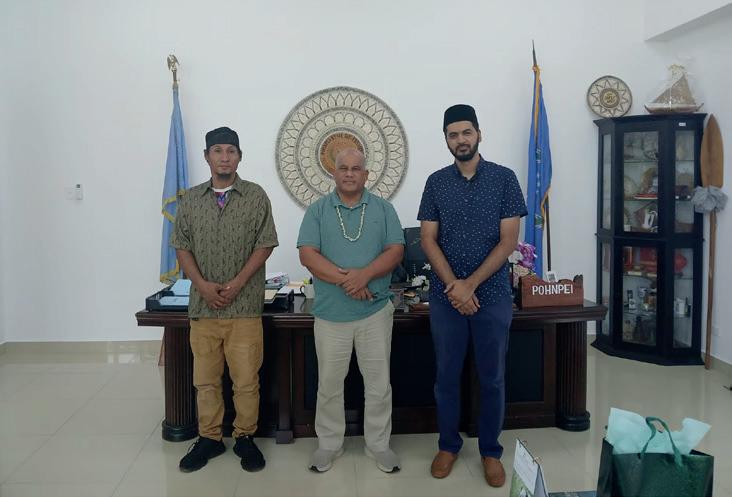
Recently, the Ahmadiyya Muslim Jamaat in FSM experienced a wave of backlash following peaceful initiatives and engagement with local leaders. After a meeting with the Governor of Pohnpei, negative commentary began circulating online. The comments echoed the negative representation of Muslims as shown in mainstream media.
The comments continued to grow over the following days. It was a glaring reminder of the great task we had ahead of us: to increase our reach and spread the peaceful message of Islam to all Pohnpeins.
A few days later, the Governor’s Office issued a detailed public press release expressing support for the Ahmadiyya Muslim Jamaat. The statement acknowledged the Jamaat’s consistent efforts to promote peace, unity and service to humanity, and reaffirmed a commitment
to interfaith harmony on the island. It read:
“It is also important to clarify factual context. The Ahmadiyya Muslim Community [...] is internationally recognized as a peaceoriented Islamic community that explicitly rejects violence and terrorism. [...] Locally, the Ahmadiyya community has engaged in constructive outreach, including youth sports activities, homework assistance, interfaith dialogue, and peace conferences attended by representatives of multiple religious traditions, including former municipal leaders. These efforts reflect bridge-building, not division; community service, not ideology.”
This response served as a powerful reminder of a recurring truth in the history of Islam Ahmadiyyat: opposition often marks the beginning of deeper dialogue.
The Holy Quran reminds us that truth is rarely accepted without resistance. (Surah Ya Sin, Ch.36: V.31) From the earliest days of Islam, prophets and reformers have faced opposition. The Promised Messiah, Hazrat Mirza Ghulam Ahmadas, repeatedly emphasised that the spread of Islam Ahmadiyyat would be accompanied by trials, yet those very trials would become means through which the message would reach hearts that might otherwise remain untouched. At one instance, he states:
“This is a natural spectacle of truth: the
l-yawmi wal l-laylah) And yet he also said: ‘My Satan has become a Muslim.’ (Sahih Muslim, Kitab sifati l-qiyamah wa l-jannati wa n-nar, Bab tahrishi sh-shaitan) Thus, the import of this hadith is that a person must not become heedless in seeking the mercy of Allah the Almighty.
“Regarding what you mentioned about being given little time in the mulaqat, this is an unavoidable constraint on our part, as some time must be given to everyone. Therefore, in such circumstances, you should not take offence.”
(Compiled by Zaheer Ahmad Khan, Head of Records Department, Private Secretariat, London and translated by Al Hakam)
more intensely it is opposed, the more it shines and displays its grandeur. We have ourselves tested and seen that wherever there has been greater clamour and uproar against us, a jamaat has come into being.”
(Malfuzat, 2022, Vol. 5, p. 31)
How true are the words of Hazrat Khalifatul Masih Vaa when he stated: “As far as the opposition is concerned, remember that opposition acts like fertiliser and a seed. The Jamaat is being introduced to people even more so [through opposition]. The more the Ahmadis are persecuted, the more the Jamaat is being introduced to people.” (“Answers to everyday issues – Part VII”, alhakam.org, 22 January 2021)
The recent backlash in Pohnpei was rooted in misinformation. Yet amid the noise, something significant occurred: conversations began and curiosity replaced. We are reminded that our response is not shaped by circumstance, but by the guidance of our Khalifa. This moment presents an opportunity. Under the guidance of our beloved Khalifa, Hazrat Mirza Masroor Ahmadaa, the Ahmadiyya Muslim Jamaat is called to win hearts with love. Such moments open doors for sincere engagement, allowing us to exemplify the true teachings of Islam Ahmadiyyat through conduct rather than argument.
Rather than responding to opposition with confrontation, Ahmadis are taught to embody compassion, patience and moral integrity, trusting that sincere behaviour speaks louder than words. This principle has enabled the Jamaat across the world to transform trials into opportunities to facilitate understanding and dialogue.
For those living as a visible religious minority, this serves as a reminder to remain true representatives of our faith. As the Ahmadiyya Muslim Jamaat continues its work globally through humanitarian service and interfaith engagement, we do so with renewed conviction. It stands as a reminder that even in distant corners of the world, the message of Islam Ahmadiyyat continues to find pathways toward peace.
Reflecting upon this, one cannot help but recall the revelation received by the Promised Messiahas: “I shall carry your message to the ends of the earth.” (Tadhkirah [English], 2018, p. 407) In a place as geographically distant as the Federated States of Micronesia, this prophecy takes on a deeper and more personal meaning. The presence of the Jamaat here is not the result of strategy or scale, but a manifestation of a divine promise unfolding.
Population collapse: Are we treading a path towards extinction?
Daniyal Mahmood Ahmad Al Hakam
Japan will collapse – unless the Japanese start having more children. At the current trajectory, the population will drop from 123.4 million to 63 million.1 The projections for population collapse and its detrimental effects are being brought to light with increased intensity and urgency as the years go by.
It’s not only Japan (fertility rate: 1.2); South Korea’s birth rates have also plummeted (fertility rate: 0.78), along with many “developed” nations. Even China, once the world’s largest population, is seeing a steady decline (fertility rate: 1.0).2
The economic implications are severe; the societal even more so. Without a population to sustain growth, entire civilisations and cultures can disappear into nothingness.
This may seem like doom feeding and there’s no doubt that there are many experts who disagree with such apocalyptic predictions.3 However, whether a future with fewer people is bleak or not worth worrying about, the fact remains that birth rates are declining in many regions of the world.
Why are people having less children?
In order to understand the trend of people having less children, we must look at why they are choosing to do so in the first place, assuming that they are in fact choosing in the first place. Afterall, it could be argued that it is being done out of necessity.
Modern society is generally based on a system in which both men and women are in the workforce. Women are increasingly becoming involved in pursuing higher education followed by decades-long careers, as our current society values this path over the more conservative and traditional approach of the homemaker role of women.4
This already puts a dent in the traditional cycle of child-rearing, as spouses have less time to balance their already busy schedules. Taking on more responsibilities requires time and energy, which are already being consumed at the workplace.
Another aspect is that even if a couple feels like they are able to fit in this extra responsibility of having a child, it may get in the way of one of the partner’s careers – usually the woman who takes the role of primary caretaker 5
There are modern solutions to these obstacles, such as day-care or hiring babysitters. These seemed to have worked for a few decades, but with the ever rising cost of living, child-care is becoming increasingly expensive and unaffordable.
At times, it is so expensive that it neutralises the entire income brought in by a person, so there have been examples
of some women realising that if everything they’re earning is being spent on childcare, they might as well spend their time at home with their children instead of at the workplace with coworkers and bosses that they may or may not necessarily like.6
Even if a couple manages to have a child or two, the issue remains that it’s still not enough. In order to sustain our population, every woman needs to have an average of 2.1 children 7 Many countries average below that.
How do we fix this?
The problem with trying to fix an issue that is disputed as to whether it even is an issue is exactly that; many people, including experts, won’t see it as something that needs to be fixed.
This is despite the fact that there are statistics from experts, such as economists who have provided proof that this issue is a serious matter that must be dealt with.8
However, despite all the efforts through the numbers, charts and graphs presented by such experts, many people are still unconvinced. In such a scenario, implementing a solution becomes quite difficult.
The ambiguous moral compass of our atheistic/agnostic society makes it even more difficult to provide an incentive from a moral and ethical standpoint. Why should we have so many children rather than pursuing our own interests and enjoying our lives? Why should we have any children at all?
Again, there are both sides to argue whether or not to have children at all, such as the studies that found that people with children tend to be more motivated and energised to build and provide for their families.9
This seems counterintuitive, since anyone with children (especially infants and toddlers) can attest that they require a lot of energy and attention, yet, as mentioned, both sides of the argument present evidence.
In addition to the motivation provided by having children, practicing and believing Muslims have the added benefit of guidance through the Islamic lens. The Holy Quran, for instance, states that:
“Kill not your children for fear of poverty. It is We Who provide for them and for you.” (Surah Bani Isra’il, Ch.17: V.32)
This can easily be understood to mean that contraception shouldn’t be used with the intention of avoiding children due to the financial “burden” that they will come with. As science shows, having children can increase a person’s willpower to improve their financial condition.
Once the financial stress factor is removed, the issue of time and energy remains. With both spouses working, who will take care of the child?
This also has a simple solution. In Islamic tradition, the woman’s primary role and responsibility is to nurture the children in the environment that they grow up in (i.e., the home). (Sahih al-Bukhari, Kitab aljumuah, Hadith 893)
This is not to say that women are strictly discouraged from entering the workforce. Rather, it is about priorities based on natural strengths and inclinations, which again is proven through scientific studies 10
How many children should we have?
Once these hurdles have been crossed, the question remains as to how many children are enough children?
There is no doubt that modern society functions in such a way that parents are often left to mostly their own in raising children.
Throughout human history though, we’ve generally had a lot of help through the support network around us, such as grandparents, siblings, aunts and uncles, etc. That is how our hunter-gatherer ancestors lived.11 This is still common in a lot of societies, such as the subcontinent.
But the challenge remains, especially to
young parents living in the West and other developed countries. Raising one or two children seems just about possible, but any more seems like a stretch. The solution to this obstacle is quite nuanced, and it may need some more thought and adaptation in line with the society we live in. But we have a general direction and standard to aim for, as the Holy Prophetsa said:
“Marry the one who is fertile and loving, for I will boast of your great numbers before the nations.” (Sunan an-Nasa‘i, Kitab annikah, Hadith 3227)
As long as there is a clear goal, the path can be carved. Even if the rest of the world gradually regresses towards population collapse, Muslims have a good chance of offsetting this.
Endnotes
1 (“In 30 Years, One in Five Municipalities Will Halve Their Population; Total Population to 63 Million by 2100”, ippjapan.org, 10 June 2025)
2 (“While Global Population is Rising, East Asia is Shrinking”, populationinstitute.org, 9 July 2024)
3 (“No evidence ageing or declining populations compromise socio-economic performance of countries”, arxiv.org, 23 August 2025)
4 (“In rich countries, women have become a much bigger part of the workforce over the past 50 years”, ourworldindata.org, 7 August 2024)
5 (“Gender differences in the relationship between informal caregiving and subjective health: the mediating role of health promoting behaviors”, link. springer.com, 15 February 2022)
6 (“As Childcare Prices Outpace Inflation, More Women Are Dropping Out of The Labor Market”, investopedia. com, 4 November 2025)
7 (“Society at a Glance 2024: OECD Social Indicators”, oecd.org, 20 June 2024)
8 (“Macroeconomic Impact of Population Aging in Japan”, boj.or.jp, accessed on 27 November 2025)
9 (“Family and work: how relatives can boost workers’ motivation”, jbs.cam.ac.uk, 12 July 2024)
10 (“Mothers matter most: Women and parental investment”, academic.oup.com, February 2002)
11 (“Hunter-Gatherer children’s closeproximity networks: Similarities and differences with cooperative and communal breeding systems”, cambridge. org, 31 January 2024)
How 24 multilingual speeches proved the truth of the Promised Messiah (1926)
Announcement of a multilingual event
In one of the previous issues of Al Fazl, an announcement was published on behalf of Hazrat Mufti Muhammad Sadiq[ra] (President of the Anjuman-e-Irshad), stating that on Friday, 29 January 1926, after the Friday prayer, speeches on the truth of the Promised Messiahas would be delivered in 20 different languages.
From twenty to twenty-four languages
On that Friday, speeches were delivered not in 20 but in 24 different languages. Hazrat Khalifatul Masih II[ra] was also present at the gathering and towards the end, he delivered a brief address as well. A photograph was also taken of those who delivered speeches in the various languages.
Linguistic limitation to global reach
While inaugurating the session, Hazrat Mufti Muhammad Sadiq[ra] stated that there was once a time when the Promised Messiahas received a revelation in English and he wrote it down while also noting that there was no one present who knew English and therefore its meaning could not be ascertained at that time.
However, Mufti Sahib[ra] remarked, “The present age is such that individuals are now present here who will deliver speeches before the audience in various languages on the truth of the Promised Messiahas.”
Languages and speakers
The speeches [in 24 different languages] were delivered in the following order:
1. Sheikh Mahmood Ahmad Sahib, missionary to Egypt, read out a speech in Arabic.
2. Brother Fakhruddin Sahib Malabari delivered a speech in the Malayalam language.
3. Mir Qasim Ali Sahib, editor of Faruq, gave a speech in Urdu.
4. Jundub Sahib, a student of Madrasa Ahmadiyya, read out a speech in the Javanese language.
5. Abdul Wahid Sahib of Kashmir, a student of Madrasa Ahmadiyya, delivered an address in Kashmiri.
6. Sheikh Mahmud Yusuf Sahib, editor of Nur, gave a speech in the Gurmukhi language.
7. Hasan Khan Sahib, a student of Madrasa Ahmadiyya, read out a speech in Odia, the language of the Orissa region.
8. Maulvi Muhammad Ismail Sahib, headmaster of Madrasa Ahmadiyya, delivered a speech in Persian.
9. Mufti Muhammad Sadiq Sahib presented an address in the Hebrew language.
10. Muhammad Noor Sahib, a student of Madrasa Ahmadiyya, delivered an address in the Malay language.
11. Khawaja Mian Sahib, an official of the Bait-ul-Mal department, delivered an address in the Marathi language.
12. Maulvi Abdul Rahim Sahib Nayyar presented an address in English.
13. Mian Shah Wali Sahib delivered an address in the Gojri language.
14. Maulvi Arjumand Khan Sahib, a Maulvi Fazil and teacher at Madrasa Ahmadiyya, delivered an address in Pashto.
15. Mahasha Muhammad Umar Sahib, a student of Madrasa Ahmadiyya, read out a speech in the Sanskrit language.
16. Ali Qasim Sahib, son of Khan Maulvi Abul Hashim Sahib, a student of Madrasa Ahmadiyya, delivered an address in Bengali.
17. Ibrahim Sahib of Ceylon, a student of Madrasa Ahmadiyya, delivered a speech in the Ceylonese (Sinhala) language.
18. Master Abdul Rahman Sahib, a new convert and BA graduate, delivered an address in Punjabi.
19. Master Muhammad Shafi‘ Sahib Aslam, missionary to the Malkana region, presented an address in the Purbi language.
20. Ahmad Siredo Sahib, a student of Madrasa Ahmadiyya, delivered an address in Dutch.
21. Ihsan-ul-Haqq Sahib, an employee of Noor Hospital, gave a speech in the Riasti language.
22. Ziaullah Sahib, a high school student, read out an address in Sindhi.
23. Malik Ahmad Hussain Sahib, who conducts a business in Nairobi, Africa, read out an address in the Swahili language.
24. Ahmad Hussain Sahib, an advocate, delivered a speech in the Kannada language.
Speech of Hazrat Musleh-e-Maud Thereafter, Hazrat Khalifatul Masish II[ra] delivered the following address:
“The Promised Messiahas was an embodiment of Jesusas of Nazareth. With regard to Jesus, it is recorded that there was a prophecy concerning his disciples, namely that they would deliver speeches in different tongues.
“Accordingly, it is written in the Book of Acts, chapter two, that after the crucifixion [attempt] of Jesusas, on one occasion when Jews from various regions had assembled, the disciples of Jesusas addressed them in different languages.
Re-examining the Pentecost narrative
“I find it deeply striking, however, when I observe how this matter has been incorrectly understood. Christians generally present it in this manner and it is commonly assumed on this basis that the disciples spoke in foreign languages. Whereas this very incident itself establishes that they did not speak in foreign languages as such, but rather in the different languages of the Jews, for it is clearly stated that the Jews had come from various regions. The disciples addressed them in different languages and those people understood those languages. Had the speeches been delivered in truly foreign tongues, how could the Jews have understood them?
Languages of the Jewish tribes –not foreign tongues
“The reality is that the disciples delivered their speeches in the manner of speech prevalent among the Jewish tribes. Even then, their speech was imperfect, for it is written that the Jews listened and remarked that the speakers were intoxicated with wine.
“Now, if someone were to deliver an eloquent speech in the French language, would he be described as being drunk with wine? The meaning of their remark was simply that the speakers were speaking incorrectly; they were not fully proficient in the languages of the other tribes.
“Nevertheless, their zeal for preaching was so intense that they stood up to address each group in the language of whatever tribe was present there. When they uttered an incorrect word, the listeners laughed at their manner of speech, just as even today, people laugh when someone mispronounces or uses an incorrect word.
“In short, the prophecy concerning the disciples of Jesusas of Nazareth – that they would speak in different tongues –was fulfilled in precisely this manner: such fervour was generated among them that they preached to the Jews in the languages of their various tribes.
From tribal dialects to global languages
“However, the Promised Messiahas was superior to the former Messiah and [...] held a higher status than him. Therefore, if the disciples of the earlier Messiah were granted the ability to speak the various languages of the Jewish tribes, the Community of the Promised Messiahas was granted the greater
distinction that speakers of entirely foreign languages emerged within it.
“Although there were certain differences among the languages of the Jewish tribes, in reality their language was essentially one, much like the Urdu language, which exists in many forms: the Urdu of Hyderabad differs from that of Uttar Pradesh; that of Delhi and Lucknow differs from that of Punjab. Within our Community, there are individuals who speak all these varieties of Urdu. Moreover, the Promised Messiahas was raised in Punjab and the Punjabi language itself has many forms: that of the Sialkot region, the Jhang region, Lyallpur, Ferozepur and Ludhiana, as well as Gujrat and Jhelum. Speakers of all these varieties are present within our Community. In this way, the resemblance to Jesusas of Nazareth is fully established.
Fulfilment of similarity and superiority
“Yet the Community of the Promised Messiahas possesses a distinction even beyond this, in that it includes speakers of foreign languages – languages spoken in other regions and countries. Learning the language of one’s own country is one matter; however, for people of those distant regions and nations themselves to embrace the Jamaat is quite another.
Many people – Hindus, Pathans, Aryas, Muslims and others – learn English and come to speak it, but no particular distinction is established thereby. By contrast, if an Englishman were to enter another religion, that would constitute a distinction and merit for that religion.
“Thus, the Promised Messiahas was granted this destined distinction: that people from so many diverse nations entered his Jamaat as had not entered the community of Jesusas of Nazareth. Undoubtedly, in the present age, people from various countries are found within Christianity; however, in the time of Jesusas and for three hundred years thereafter, Christianity spread only within three or four countries. By contrast, only seventeen years have passed since the demise of the Promised Messiahas and already Islam Ahmadiyyat has spread to nearly thirty foreign countries.
“Accordingly, these speeches delivered in various languages on the truth of the Promised Messiahas, taken collectively and in themselves, constitute a compelling proof of the truth of the Promised Messiahas.”
(Translated by Al Hakam from the original Urdu, published in the 2 February 1926 issue of Al Fazl)
Averting WW3 by listening to the voice from the wilderness
From time immemorial, it has been the practice of God Almighty that He raises a certain individual at every turn of human moral and spiritual decadence. The voice of the chosen serves as a means of deliverance and a guiding light away from the pit of destruction that is being approached.
It was in accordance with this voice of guidance, that the annual National Ijtema of Majlis Ansarullah Nigeria for the year 2025 bore the theme “Listening to the voice from the wilderness to avert third world War.”
The theme captured the situation of the world at this perilous hour in which the fire of a nuclear war is being ignited by the world leaders and the drastic need to implement necessary measures to mitigate it.
The decadence of the world
Current events, if carefully studied, would lead to one conclusion and that is the fact that humankind is gradually moving away from its Creator and by doing so, the rights due to fellow man are being trampled upon.
It is to this effect that Hazrat Khalifatul Masih Vaa has been calling on the leaders of the world to reason and walk the path that leads to the Creator. This is the voice that keeps resonating at this time of ours just like it has been since the appearance of the Promised Messiahas
The Promised Messiah and Imam Mahdias came as a warner for this age. He foretold world-shaking events – including the rise of global conflict and destruction. His words, uttered more than a century ago, speak with astonishing relevance today.
While addressing the devastating direction that the world is heading towards, he stated:
“Bear in mind that God has informed me about the coming of earthquakes in
general. So know it with certainty that just as, in keeping with the prophecy, there have been earthquakes in America and also in Europe, so will they occur in different parts of Asia, and some of them will be like the Doomsday.
“There will be death on such a large scale that streams of blood will flow. Even birds and grazing animals will not escape this death. Such destruction will overtake the earth as has not happened since man was created. Most places will be turned upside down as if they had never been inhabited.
“There will also be other terrible afflictions, both in heaven and earth to the extent that every sensible person will realise that they are not ordinary phenomena, and no trace of them will be found in books of physics or philosophy. Then people will be seized by anxiety and they will wonder what is going to happen? Many will be delivered, and many will perish. Those days are near, indeed they are at the door, when the world shall witness the spectacle of a doomsday.
“Not only the earthquakes, but other terrible calamities will also appear, some from heaven and some from earth. This will occur because mankind has abandoned the worship of their God, and have fallen upon materialism with all their heart, all their resolve, and all their thoughts.” (The Philosophy of Divine Revelation [HaqiqatulWahi], 2023, pp. 326-327)
He further stated:
“Had I not come, these calamities might have been delayed a little, but with my coming the hidden designs of God’s wrath that had remained hidden for a long time, have been manifested. As God Almighty says:
‘We never punish until We have sent a Messenger.’ (Surah Bani Isra’il, Ch.17: V.16)
“And those who repent shall find
security and those who fear before the calamity overtakes them will be shown mercy.
“Do you reckon that you will be safe from these earthquakes, or that you can save yourselves by your own machinations? Absolutely not. All human works will come to an end that day. Do not imagine that America etc. were hit hard by severe earthquakes while your country remains safe from them. Rather, I see that perhaps you will encounter greater adversity than them.
“O Europe! You are not safe! And O Asia! Neither are you secure! And O the dwellers of Islands! No artificial ‘God’ will come to your aid. I see cities falling and habitations in ruin. That One and Unique God remained silent for a long time. Abominations were committed before His eyes and still He remained silent. But now He shall reveal His countenance in an awestriking manner.
“Let him who has ears hear that the Hour is not far. I strived to bring everyone under the protection of God, but the ordained decrees had to be fulfilled. I say it truly that this country’s turn is also drawing near.
“The age of Nuh [Noah] shall appear before your eyes, and you will witness with your own eyes the incident of the land of Lut [Lot]. But God is slow to wrath. Repent so that you are shown mercy. He who abandons God is a worm, not a man; and he who does not fear Him is dead, not alive.” (Ibid., pp. 327-328)
The dynamics of war has evolved over time and the phase that it is in presently is such that it can lay waste to the world as we know it if an all-out nuclear-powered war is engaged in. An indication to these impending catastrophic dangers is alluded to in another prophecy of the Promised Messiahas:
“Five times shall I show you the dazzling manifestation of this Sign.”
(Tajalliyyat-e-Ilahiyyah, Ruhani Khazain, Vol. 20, p. 395)
Regarding this, Hazrat Khalifatul Masih Vaa said:
“It should not be assumed from the mention of earthquakes in these warning prophecies that these calamities will only manifest in the form of earthquakes. Rather, it can also mean other disasters that may spread destruction in a similar way to earthquakes.”
Clarifying this, the Promised Messiahas stated:
“And yet it is true that God’s words are often in the form of metaphors, as, for example, He says:
“[‘Whoso is blind in this world will be blind in the Hereafter.’ (Surah Bani Isra’il, Ch.17: V.73)]
‘‘Therefore, it was quite possible that the earthquake might mean some other great calamity that has all the characteristics of an earthquake. Still, the actual words have priority over the interpretation. Even though this prophecy had a wide scope, God fulfilled it literally as well, so as to humiliate the enemy. And it is possible that aspects of this prophecy might manifest themselves in the future in some other way. But it will still be something out of the ordinary, as stated by the prophecy. […]
“Thus, this prophecy foretells an extraordinary event of the first order. Moreover, it is quite possible that it may be followed by calamities resulting from various natural causes and lead to destruction that is extraordinary.
“Thus, even if there were no specific mention of the earthquake in any part of this prophecy, it would still constitute a very great Sign; for, the crux of the prophecy is the extraordinary and unparalleled destruction of houses and places, regardless of whether it comes about through an earthquake or through other means.’’ (Barahin-eAhmadiyya V [2018], p. 232)
Prophecies made by a once unknown man in the remote place of Qadian are met as time passes.
A call by the Caliphs Catastrophic events are occurring, threatening the existence of man, and as ironic as it can be, it is mostly man-made. Thus, in order to call mankind back to its senses, the Khulafah of the Ahmadiyya Muslim Community have been advising mankind to return to and tread the path that leads to the Creator, through which at last, peace would reign.
Over the past two decades, Hazrat Khalifatul Masih Vaa has consistently warned the world about the devastating effects of a nuclear war and its looming threat.
True to this, history bore witness to the fact that the use of advanced weapon systems is a force driving mankind towards self-destruction. The year 1945, during World War II, is a testament to this and its mark is forever knitted in the topography of Hiroshima and Nagasaki; a year that etched its mark in the history of Japan and the world at large.
Hazrat Amirul Momineenaa said:
“We should never forget the heartwrenching experiences of the two World Wars that occurred during the last century. The sheer devastation that they caused, in particular the Second World War, was unprecedented. Just through the use of conventional weapons heavily populated and thriving towns and cities were utterly demolished and left in absolute ruin and millions were killed. Further, during the Second World War the world witnessed that truly devastating event when the atom bomb was used against Japan causing such annihilation that just hearing of its effects makes a person tremble and shudder. The museums in Hiroshima and Nagasaki are a sufficient reminder of the horrors and utter devastation that took place.” (World Crisis and the Pathway to Peace [2017], p. 159)
Ariyo Fadlul-Hakeem Ahmad Jamia Ahmadiyya International, Ghana
Ahmadiyya Muslim Business Association (AMBA) Canada holds first trade conference
Azmat Bhatti General Secretary AMBA Canada
The Ahmadiyya Muslim Business Association (AMBA) Canada held its first official trade conference on 6 December 2025, marking a historic milestone for Ahmadi Muslim professionals engaged in trade and commerce across Canada.
AMBA Canada was established as a distinct auxiliary body dedicated to fostering entrepreneurship, professional excellence and ethical business leadership among Ahmadi Muslims in Canada.
This inaugural event embodied AMBA Canada’s mission – to connect, collaborate and empower Muslim business professionals through education, mentorship and shared values of honesty, service and perseverance.
The conference began with a recitation from the Holy Quran, followed by the opening address by Chairman AMBA Canada, Abdul Haleem Tayyab Sahib, who emphasised the spiritual and moral foundation of business success, citing historic and modern Muslim businessmen who achieved excellence through hard work, honesty and integrity. He reminded attendees that lasting success comes by following Islamic ethics and maintaining trust and service to humanity in every business venture.
Participants were deeply moved by several established entrepreneurs who shared their personal stories of growth, perseverance and blessings derived from
prayers and guidance under the blessed system of Khilafat.
In his address, Vice-Chairman of AMBA Canada, Farhan Malik Sahib, outlined the vision and mission of AMBA Canada, reaffirming its commitment to help members reach professional excellence while contributing positively to the broader Canadian economy and community.
An address was delivered by the Chairman of the Ahmadiyya Muslim Trade Association (AMTA) Canada, Kalim Bhatti Sahib, who highlighted AMTA Canada’s role in guiding new entrepreneurs, fostering trade skills and building bridges among industry professionals across Canada.
Insightful success stories showcased how small beginnings, supported by community prayers and ethical discipline, grew into thriving enterprises. In the roundtable discussions, participants from various sectors, including HVAC, electrical, kitchen cabinets, mechanical, plumbing and woodworking, exchanged ideas on market challenges, industry standards and opportunities for collaborative growth.
Concluding remarks were given by Naib Amir Jamaat Canada, Farhan Khokhar Sahib, who also led the silent prayer and thus brought to a conclusion this conference.
In-person attendance was above 120, while more than 40 individuals joined online. Nearly 20 businesses displayed their work through exhibition booths, creating valuable networking opportunities for participants and visitors.
Majlis Atfal-ul-Ahmadiyya USA holds ‘New Year Meet Up’ event
The “Atfal New Year Meet Up” programme was organised by Majlis Atfal-ulAhmadiyya USA, with the event held by majalis throughout the United States on 31 December 2025. Where possible, arrangements were made for atfal to stay the night and be able to offer Tahajjud and Fajr prayers at the mosque.
The programme featured engaging tarbiyat discussions, including a presentation on the topic of Salat. This was decided in coordination with the theme of the year, “Hayya ‘ala l-Falah” – “Come Towards Success,” reminding atfal of the importance of finding success through
offering and understanding their prayers.
Along with the tarbiyat presentation on Salat, each majlis was encouraged to include time for atfal to write letters to Hazrat Khalifatul Masih Vaa. Alongside tarbiyat discussions and waqar-e-amal, the “New Year Meet Up” also featured fun activities, alongside playing sports. Atfal also spent the night with various brotherhood activities, including bonfires and further discussions with their fellow members.
39 out of 52 majalis (75%) participated throughout the country, with 463 atfal participating in this programme. Many of the members ended the year 2025 and began 2026 in the best possible way – with brotherhood and prayers in the remembrance of Allah.
Continued from page 13
On the effects of a world war aided by the use of nuclear weapons, His Holinessaa stated:
“It is said that in Japan, even though seven decades have passed, yet the effects of the atom bombs are still continuing to be manifest on newborn children. If a person is shot by a bullet, then it is sometimes possible for him to survive through medical treatment, but if a nuclear war breaks out, then those who are in the firing line will have no such luck. Instead, we will find that people will instantly die and freeze like statues, and their skin will simply melt away.
“Drinking water, food and vegetation will all be contaminated and affected by radiation. We can only imagine what type of diseases such contamination will lead to. In those places that are not directly hit and where the effects of the radiation are somewhat less, even there the risk of diseases and illness will become much higher and the future generations will also bear much greater risks.” (Ibid., p. 51)
Hazrat Mirza Nasir Ahmadrh in his visit to Europe in 1967 where he discussed the same topic in light of the aforementioned prophecies of the Promised Messiahas, stated:
“The Holy Founder of the Ahmadiyya Muslim Community, presented hundreds, if not thousands, of signs to the world as evidence of the truthfulness of Islam. One of these signs was his prophecy, received through divine revelation, regarding five great calamities. The first and second world wars have already occurred, fulfilling two aspects of the prophecy in grand fashion. The effects of the third devastating calamity, whose ominous signs are already appearing on the horizon, will be extremely terrifying and destructive. [...]
“The only way for humanity to escape this calamity is to choose the true path and that path is Islam. Allah’s wrath is about to descend upon this world. The flames of destruction are already raging. Come and cool down the blazing flames of this fire with tears of repentance [istighfar]. Come and seek refuge under the cool shade of the mercy and kindness of Muhammad, the Messenger of Allah. Rise up and establish a living relationship with Allah. Come, if you want to save yourself from the raging flames of this fire!’’ (Khutbat-e-Nasir, 2023, Vol. 1, pp. 809-810)
Elaborating on this, in another place, he said:
“But, gentlemen, let us not forget that this prophecy, like all prophecies, is a warning and its fulfilment can be delayed or
Delegation of Jamaat Niger meets the Minister of Urbanism
Muhammad Jamal Niger Correspondent
On 7 January 2026, a delegation of Jamaate-Ahmadiyya Niger met with the Minister of Urbanism, Colonel Major Abdul Qadri. During the meeting, the honourable minister was introduced to Ahmadiyyat, its objectives and its services. Amir Jamaat
even averted provided man turns to his Lord, repents and mends his ways. He can yet avert Divine wrath if he stops worshipping the false deities of wealth, power and prestige, establishes a genuine relationship with his Lord, refrains from all transgression, does his duty to God and man, and learns to work for true human welfare.” (A Message of Peace and a Word of Warning [2014], p. 14)
Thus, in the wilderness of today’s global conflicts and tensions, it is crucial that we listen to the accompanying voice of reason, wisdom, and compassion which is resonating from Huzoor-e-Anwaraa. We need to heed His call towards peace and work towards building bridges of understanding between nations, communities, and faiths. Allah the Exalted, reminds us of our shared humanity and the importance of mutual understanding and respect:
“O mankind, we have created you from a male and a female; and We have made you into tribes and sub-tribes that you may recognize one another. Verily, the most honourable among you, in the sight of Allah, is he who is the most righteous among you. Surely, Allah is All-knowing, All-Aware.” (Surah al-Hujurat, Ch.49: V.14)
Conclusion
During the address of Hazrat Khalifatul Masih Vaa to the European Parliament in Brussels, he said:
“You may say that if these are the true teachings of Islam, then why do we see such divisions and disorder in the Muslim world? This I have answered earlier by mentioning the need for the advent of a reformer, whom we believe was the Founder of the Ahmadiyya Muslim Community. We, the Ahmadiyya Muslim Jamaat, always endeavour to convey these true teachings to as wide an audience as we can. I would request all of you to also make efforts to raise awareness within your own circles of influence about these issues, so that long lasting peace can be developed in all parts of the world.
“If we fail in this task, then no part of the world will remain safe from the horrifying and destructive effects of war. I pray that may Allah the Almighty enable the people of the world to rise above their personal interests and desires, in an effort to save the world from the coming destruction.” (World Crisis and the Pathway to Peace [2017], p. 159)
Niger, Asad Majeeb Sahib, presented the honourable minister with a copy of the Holy Quran with French translation and the Promised Messiah’sas book The Philosophy of the Teachings of Islam. Upon receiving the Holy Quran, the minister expressed his happiness and stated that this was the first time in his life that someone had given him a copy of the Holy Quran. He opened it with great interest, observed the French translation and said that he would keep it in his office. The honourable minister also appreciated the efforts of Jamaat-e-Ahmadiyya.
Arsalan Omer
Secretary Ishaat, Majlis Atfal-ul-Ahmadiyya USA
Friday Sermon
Mubarak Mosque, Islamabad, Tilford, UK
2 January 2026
Muhammadsa and the Promised Messiahas: Reflections of the divine love
After reciting the tashahhud, ta‘awwuz and Surah al-Fatihah, Hazrat Khalifatul Masih Vaa stated:
In the previous sermon, some mention was made of the Holy Prophetsa and his model of love for Allah. In this age, we see a reflection of that same divine love in the actions of his true servant, through his complete obedience and following of his Master. These examples exist even today. That is, the lofty standards of love for Allah, and as a result, the divine favours bestowed upon him and his deep love for God Almighty were felt by people around him.
However, before relating the remaining incidents, I will mention this love in the words of the Promised Messiahas himself. In one place, he states:
“I cannot describe which particular action of mine caused this divine favour to be bestowed upon me. I only feel within myself that, by nature, my heart possesses a pull towards God Almighty, accompanied by loyalty, a pull that nothing can restrain. Thus, this is entirely His grace – among the favours that Allah the Exalted has bestowed upon me.” (Kitab-ul-Bariyyah, Ruhani Khazain, Vol. 13, pp. 195-196, footnote)
As I mentioned in the previous sermon as well, the Promised Messiahas has expressed on many occasions that all of this was granted to him because he was a perfect follower of, and one who deeply loved, the beloved and dear Prophet of Allah, the Holy Prophetsa. As a result, the doors of Allah’s love continued to open for him, and he was granted a deep awareness of it. Thereafter, the rain of Allah’s blessings continued to pour down upon him.
While describing this inner spiritual state and his blessed life, Hazrat Sheikh Yaqub Ali Sahib Irfani writes at one place that the Promised Messiahas wrote:
“The mosques are my dwelling, the righteous are my brothers, the remembrance of Allah is my wealth, and the creation of Allah is my family.” (Sirat Hazrat Masih-eMaud, Vol. 3, p. 402)
That is, everything he described revolved entirely around Allah the Exalted.
The Promised Messiahas states at one place:
“I love everything for the sake of God Almighty, whether it is my wife, my children, or my friends. My relationship with everyone is for the sake of Allah Almighty.” (Malfuzat, Vol. 2, p. 184)
This is the very teaching that Allah
the Exalted has given and which the Holy Prophetsa proclaimed and instructed to spread.
The greatest manifestation of this teaching in this age is seen through the practical example of the Promised Messiahas, in complete obedience and following of the Holy Prophetsa
The Promised Messiahas states at one place:
“The truthful remain steadfast even at the time of trials, and they know that in the end God Himself will be their supporter. This humble one, although grateful to God Almighty for the presence of such perfect friends, nevertheless firmly believes that even if not a single person remains with me, and all abandon me and go their own ways, I have no fear. I know that God Almighty is with me. Even if I am crushed and ground down, reduced to something more insignificant than a particle, and if from every direction I face persecution, abuse, and curses, I shall still ultimately be victorious.
“No one truly knows me except the One who is with me. I can never be ruined. The efforts of my enemies are futile, and the schemes of the envious are fruitless. O foolish and blind people! Who among the truthful before me was ever ruined that I should be ruined? Which true and loyal servant did God ever destroy in humiliation that He should destroy me?
“Remember this with certainty and listen attentively: my soul is not one that will perish, and the very fabric of my nature contains no element of failure. I have been granted such courage and truthfulness before which mountains are insignificant. I care not for anyone. I was alone, and I was not displeased at being alone. Will God ever abandon me? Never will He abandon me. Will He ever ruin me? Never will He ruin me.
“My enemies will be disgraced, the envious will be ashamed, and God will grant victory to His servant in every field. I am with Him, and He is with me; nothing can sever our bond. By His honour and majesty, I swear that there is nothing dearer to me in this world or the Hereafter than the manifestation of the greatness of His religion, that His majesty should shine forth and His supremacy be established.
“With His grace, I fear no trial – even if there are not one but a million trials. In the arena of trials and in the wilderness of
suffering, I have been granted strength.”
Then, in Persian, he expresses this sentiment in a couplet, saying:
“I am not one whose back you will see on the day of the battle; I am the one whose head you will espy in the midst of dust and blood.”
He tells us, “This is my condition in the love of God Almighty. Therefore, if anyone does not wish to walk in my footsteps –addressing the Jamaat – then he should separate from me. Hardships will certainly come. I do not know which terrifying wildernesses and thorn-filled valleys still lie ahead of me, which I must yet traverse.”
Then he says, “Can we be frightened by earthquakes? Can we become fearful of trials in the way of God Almighty? Can we ever separate ourselves from any trial sent by our Beloved God? We can never do so.”
(Anwarul Islam, Ruhani Khazain, Vol. 9, pp. 23-24)
Hazrat Mirza Bashir Ahmad Sahibra relates a narration in which, while mentioning love for Allah the Almighty and the passion of sacrifice for His religion, he states: “Maulvi Sarwar Shah Sahib narrated to me, saying that during the days when the case with Karam Din was proceeding in Gurdaspur and the magistrate had fixed a date, the Promised Messiahas was in Qadian.
“Then, two days before the date of the hearing, Huzooras sent me to Gurdaspur so that I might go there to extract and prepare certain references, because references were to be presented in the following hearing. Huzooras also sent Sheikh Hamid Ali and the cook Abdur Rahim with me to Gurdaspur.
“When we reached the house in Gurdaspur, we called out from below to the late Dr Muhammad Ismail Khan Sahib (who was upstairs), asking him to come down and open the door. The doctor was staying upstairs in the house at that time. Upon our calling out, the doctor began to uncontrollably cry and shout. We called out several times, but he continued crying in the same manner.
“Finally, after a short while, he came downstairs while wiping his tears. When we asked the reason, he said, ‘Muhammad Husain Munshi came to me.’ (He was a clerk in the court, a non-Ahmadi). Maulvi [Sarwar Shah] Sahib used to say that the aforementioned Muhammad Husain was a clerk or court official in some court in Gurdaspur and was a fierce opponent of the Jamaat, and he was among those who would meet Maulvi Muhammad Husain Batalvi. Nonetheless, the doctor (who had come downstairs upon being called) narrated that when he came downstairs, he explained that Muhammad Husain, the clerk, had come and said to him: ‘These days, an Arya gathering had taken place here. Some Aryas had brought their friends to the gathering, so in the same way, he too went there with an Arya friend.
“‘After the proceedings of the gathering, the administration announced that the gathering had concluded and the general public should leave, because some private matters were to be discussed. Accordingly, all non-members stood up to leave. I too began to leave, but my Arya friend said that, “We will go together, you should either sit
to one side or wait outside.” Accordingly, I sat there to one side (this is being said by Muhammad Husain Sahib, who is a nonAhmadi).
“‘Then one person from among the Aryas stood up and, uttering the name of the Promised Messiahas, said to the magistrate that “this man is our fierce enemy and the killer of our leader, Lekhram. Now he is a prey in your hands, and the eyes of the entire nation are upon you. If you let this prey slip from your hands, then you will be an enemy of the nation.” That person said such inciting words of this nature. Upon this, the magistrate replied that “It has already been my intention that, if possible, not only Mirza but also all his companions and witnesses in this case should be sent to hell. But what can be done, the case is being conducted with such cleverness that no place is found to lay hands on it. However, now I make a pledge that whatever happens, in this very first hearing, I will carry out judicial action.”’
“Maulvi Sahib used to say that the doctor narrated: Muhammad Husain said to me, ‘You may not have understood what is meant by judicial action. This means that every magistrate has the authority that, at the beginning or during a case, whenever he wishes, he may arrest the accused without accepting bail and place him in custody.’ Muhammad Husain continued, ‘Doctor, you know that I am a fierce opponent of your Community. (He was a follower of Maulvi Muhammad Husain and also an opponent, and even the name was the same.) But I possess this quality that I cannot see any respectable family being disgraced and ruined, especially at the hands of Hindus, and I know that Mirza Sahib’s family is the most respectable family in the district. Therefore, I have conveyed this information to you so that you may make some arrangements.’ He then also expressed his opinion: ‘In my opinion, there are two suggestions. One is that efforts should be made to have the case transferred from here to the Chief Court. (In those days, the High Court was called the Chief Court.) And the second is that, by whatever means possible, Mirza Sahib should not appear in court at the next hearing, and a medical certificate should be presented.’
“Maulvi Sahib stated that, ‘When the doctor narrated this incident, we all became extremely frightened and decided that a man should immediately be sent to Qadian who would convey these events to the Promised Messiahas. Night had already fallen. We searched for a carriage, looked for a means of transport, an open carriage or a horse. Although many carriages were present, the fervour of opposition was so intense that no carriage or transport could be found. No one agreed; everyone refused. We offered four times the regular fare, but no carriage driver agreed. Finally, we sent Sheikh Hamid Ali, the cook Abdur Rahim, and a third person on foot toward Qadian.
“‘They reached Qadian at the time of the Fajr prayer and briefly submitted the matter to the Promised Messiahas. Huzooras said with indifference, “Very well, we will go to Batala. Khawaja Sahib and Maulvi Muhammad Ali Sahib will meet us there while returning from Lahore.” The Promised Messiahas said that “Khawaja Sahib and Maulvi Muhammad Ali Sahib are coming from Lahore, and we will meet them there. We will discuss with them this entire matter
that you have narrated, and we will come to know what has happened regarding the effort to transfer the case.” Sensing the bias of the magistrate, our lawyers had already submitted an application to the Chief Court to have the case transferred to another court.
“‘Thus, he proceeded to go to Batala the same day. On the way, Khawaja Kamaluddin and Maulvi Muhammad Ali Sahib joined him. They informed him that the attempt to move the case was unsuccessful – that the request for transferring the case to the chief court hadn’t worked.
“‘After this, the Promised Messiahas went to Gurdaspur and didn’t tell either of them about this incident. He did not inform them of the news. When the Promised Messiahas arrived at his place of residence in Gurdaspur, as was his habit, he retired to a different room and rested for a bit on a charpai.
“‘At that time,’ Maulvi Sahib describes, ‘the hairs were standing up on the back of our necks out of worry for what would happen now. The magistrate has made a very solemn vow. After a while,’ Maulvi Sahib explains, ‘the Promised Messiahas called for me.
“‘When I went in, I saw that the Promised Messiahas was lying down with both his hands under the back of his head and lying straight. When I entered, he turned to his side so that he began leaning on his elbow, and his head rested upon his palm.
“‘He said to me, “I’ve called you here to listen to the entire account of what happened.”
“‘At this time, there was no one else in the room aside from Mian Shadi Khan, who stood at the door. I recounted the entire incident: how, upon arrival, we found Dr Ismail Khan Sahib crying and how Dr Sahib told us about the arrival of Munshi Muhammad Husain Sahib and then added what Muhammad Husain recounted. The Promised Messiahas continued to listen quietly. When I reached the word “prey,” meaning that he had said that the prey is in my hands, the Promised Messiahas at once shot up and sat upright.
“‘His eyes began shining, and his face became flushed with red, and he said: “Me? His prey? I am not anyone’s prey; I am a lion, and God’s lion at that! Can he even lay his hands upon the lion of God? Let him dare to try it.”
“‘While saying these words, the Promised Messiah’sas voice became so loud that even the people outside the room were taken by surprise and suddenly became attentive. But no one came into the room.
“‘The Promised Messiahas repeated the words “the lion of God” several times, and his eyes, which were normally lowered and partially closed out of humility, began to look like the eyes of a lion, shining with fierceness, and his face became so red that it was difficult to even look at him in that moment.
“‘Then he said, “What shall I do?” After saying all this, the Promised Messiahas said, “What shall I do? I have submitted before Allah that for the sake of Your faith, I am prepared to wear chains in both my hands and feet.”
“‘He meant to say that if I am handcuffed, it makes no difference to me if I am chained up. “But God Almighty states, ‘No – I shall save you from humiliation and shall exonerate you with dignity.”
“‘After this, he began delivering a speech on the love of God and continued to speak for about half an hour on the subject.’” (Siratul Mahdi, Vol. 1, narration 107)
What a profoundly curious understanding of making sacrifices in the way of God’s love he possessed. What deep trust he possessed in God Almighty. This trust was the result of the love that he possessed for God. And he carried the conviction that “because I love God Almighty and I am ready to make any and every sacrifice for Him, He will not allow me to be wasted.”
There’s also another incident like this.
On one occasion, the superintendent police captain Lemarchant suddenly came with police officers to Qadian out of suspicion of Lekhram’s murder, and Hazrat Mir Nasir Nawab Sahib learned of this. He went to the Promised Messiahas in a state of great worry and – in a barely audible voice – submitted that the superintendent was coming with an arrest warrant and handcuffs in hand. The Promised Messiahas at that time was writing his book The Light of the Quran
He raised his head from writing and calmly said with a smile on his face:
“Mir Sahib, people in moments of joy don bangles of gold and silver, so we will consider that we have donned metal bangles in the love of Allah Almighty.” Then, after some time, he continued: “But it shall not come to pass, for the government of God has its own laws, and He does not humiliate his representatives and appointees in this way.”
And so it happened – they were unsuccessful. (Al Hakam, Vol. 39, 7 June 1936, p. 3; Al Hakam, Vol. 3, 10 July 1899, pp. 1-2)
Similarly, another narration has been recorded by Maulvi Abdul Karim Sahib Sialkoti. He relates that on one occasion, at Jalandhar, he stated:
“At times of trial, our concern is for certain faint-hearted individuals within our Jamaat. It is these faint-hearted people of the Jamaat who weigh upon my mind.” One faces trials, cases are lodged, and there is opposition; it happened to the Promised Messiahas and against the members of his Jamaat as well. Thus, at such times, he stated that he is concerned for certain weakhearted individuals of the Jamaat, i.e., for some who are weak of faith.
He then said: “My state of affairs are such that even if I were to hear a clear voice saying: ‘You are forsaken and not a single one of your desires will be fulfilled,’ I swear by God’s Being that there would be no decrease in my passion and love for God or in my service to the Faith, because I have already seen God.” (Life of the Promised Messiah, p. 90)
[Meaning:] My trust and certainty are in Allah the Almighty, and there will be no decrease in my love, no matter what may happen.
Similarly, Nawab Mubaraka Begum Sahiba relates a narration. She states: “The most dearly beloved to the Promised Messiahas was Allah the Almighty, which surged through every particle of his body and soul, was manifest at all times in every word and deed of his. I have heard him, even outside the prescribed times of prayer, calling upon his Gracious Lord with intense anguish and yearning. (Not only at the times
of the formal prayers, but even in ordinary circumstances, I heard him calling upon Him in supplication with the same anguish and fervour.) And what he would say was: ‘My beloved Allah, my beloved Allah, my beloved Allah.’ He would continue to call out in this manner, as though I could hear that voice even now; it still echoes in my ears, and I see his tears flowing. This scene is before my eyes.”
She then paints a picture of that moment and presents an eyewitness example of his sense of honour and protectiveness for his Beloved – the Eternal and Everlasting God. She states that this was the condition of his prayers, which she herself had witnessed, but she also relates an incident.
She writes: “The Promised Messiahas was in his room, preparing to go outside somewhere. I was with him. Our paternal aunt’s attendant, who later became an Ahmadi as well and is buried in Bahishti Maqbarah [Heavenly Graveyard], came to Hazrat Amma Jan and, considering it a matter of familial obligation on her part, began expressing condolences to him over the death of our uncle, Mirza Imam-udDin. She was speaking in Punjabi, as she had just uttered the words, “He was indeed a very good man,” the Promised Messiahas emerged. His blessed face was turning red. Striking his staff upon the ground, he said, ‘Wretched woman! You praise the enemy of my Lord in my house?’ Mirza Imam-ud-Din Sahib had turned away from Islam and used to mock Allah the Almighty. His sense of honour could not tolerate that, while sitting in his own home, such mention should be made.”
Nawab Mubaraka Begum Sahiba writes: “There was such majesty and awe in his voice that the woman fled from there at once. Mirza Imam-ud-Din was an atheist, and so how could the Promised Messiahas ever tolerate that such praise should be lavished upon an atheist? (Tahrirat-e-Mubaraka, pp. 223-224)
In line with the practice of his master, the Holy Prophet Muhammadsa, the Promised Messiahas spent his childhood and youth in the love of God Almighty.
In one narration, Hazrat Mirza Bashir Ahmad Sahib writes:
“A Sikh landowner relates an account. He states that he once conveyed a message of employment to the Promised Messiahas on behalf of our grandfather. He says that a senior officer or landlord asked our grandfather, ‘I hear that you have a younger son, but we have never seen him.’ Smiling, the father of the Promised Messiahas replied, ‘Yes, I do indeed have a younger son, but like a newly-married bride, he is seldom seen. If you wish to see him, go and look for him in some corner of the mosque. He is devoted to the mosque.’” (Sirat-e-Tayyabah, pp. 9-10)
This narration has been further elucidated in detail by Miraj Din Sahib Umar, who writes:
“Go to the mosque and search for him by the taps of the water-bearers. (Go and look where the place of ablution is; the place of the water tank and the taps.) If you do not find him there, do not return in disappointment. Go inside the mosque and search in some corner there. If you do not find him even there, still do not return in despair. Look in the prayer mats; it may be that someone has wrapped him up and stood him there, for he is dead to the world even in this life.
Such is his state of being completely lost in God that if someone were to wrap him up and stand him in a prayer mat, he would not even move, nor would he notice.” (Hazrat Masih-e-Maud ke Mukhtasar Halat, p. 67)
Mirza Bashir Ahmad Sahib relates another account. He writes:
“Haji Abdul Majid Sahib Ludhianvi related to me that on one occasion, Huzooras was in Ludhiana. There was a neem [Indian lilac] tree in my house, and as it was the rainy season, its leaves were a most pleasing green. Huzooras said to me, ‘Haji Sahib, look at the leaves of this tree, how beautiful they are.’ Haji Sahib says that at that moment, I observed that his eyes were filled with tears.”
(Siratul Mahdi, Vol. 1, narration 95)
He was reminiscing over the power of Allah the Almighty and His love, and as a result, at that moment, tears welled up in his eyes.
Hazrat Musleh-e-Maudra states:
“There was a person here who later became a very sincere Ahmadi, and he developed a close relationship with the Promised Messiahas. However, before this individual accepted Ahmadiyyat, the Promised Messiahas remained displeased with him for 20 years. The reason was that the Promised Messiahas was deeply aggrieved by one of his statements. It so happened that one of his sons passed away. The Promised Messiahas went to his house, along with his brother, to offer condolences and to comfort them. It was their custom that whenever someone came with whom they had very friendly relations, they would embrace him, weep, cry and shriek. In accordance with this custom, they embraced the Promised Messiah’sas elder brother and, while clinging to him and crying, he said: ‘God has committed a great injustice against me.’ Upon hearing this, such aversion took hold of Hazrat Sahib that he did not even wish to see the man’s face. Later, Allah the Almighty granted that person the ability to reform, and he was saved from those ignorant customs.” (Taqdir-e-Ilahi, Anwarul-Ulum, Vol. 4, pp. 606-607)
Hazrat Mirza Bashir Ahmad Sahib also relates another narration. Munshi Zafar Ahmad Sahib of Kapurthala states that he related to me in writing that the Promised Messiahas suffered from migraines and experienced dizziness. There was a famous physician whose expertise in this regard was well known, and he treated this illness. He was summoned from a distant place, and his fare was sent. He examined Huzooras and said, “Within two days, I will give you relief; I will cure you.” Upon hearing this, Huzooras went inside and wrote a note to Hazrat Maulvi Noor-ud-Deen Sahib, stating: “I do not wish to seek treatment from this person under any circumstance. What sort of claim to divinity is he making?” He instructed that the return fare be given to him, along with an additional 25 rupees, and sent word from inside that these be handed over to him and that he be dismissed. Accordingly, this was done.
The Promised Messiahas stated: “He says that ‘I will cure you’. Who is there, besides Allah the Almighty, who can cure? The true Healer is none other than Allah the Almighty Himself.” (Siratul Mahdi, Vol. 2, narration 1038)
Similarly, Hazrat Mirza Bashir Ahmad Sahib relates another narration from Munshi Zafar Ahmad Sahib of Kapurthala:
The late Chaudhry Rustam Ali Khan Sahib was an Inspector in the Railways. He had a monthly salary of 150 rupees. He was most sincere and a person of standing within the Jamaat. He would keep only 20 rupees per month for himself and would send the remainder of his entire salary to the Promised Messiahas. This was his constant practice. He had only one son. When the boy fell ill, he brought him to Qadian along with his wife. They stayed in the residence of the Promised Messiahas
One day, the Promised Messiahas stated that during the night, he had seen in a vision that someone was hurling abuse at his God, which caused him great anguish. The very next day after the Promised Messiahas mentioned this vision, Chaudhry Sahib’s only son passed away. Since he was their only child, the mother of the child was overcome with extreme grief, and in that state, words escaped her lips to the effect: “O oppressor, you have dealt me a great injustice,” addressing God. She continued uttering such expressions, which the Promised Messiahas heard.
Immediately, he came out, visibly grieved and deeply moved, and declared with great intensity that the woman must leave his house at once. The mother of Doctor Mir Muhammad Ismail Sahib, who was a woman of great wisdom and understanding, counselled Chaudhry Sahib’s wife and explained to her that the Promised Messiahas was severely displeased. She repented, sought forgiveness, and stated that she would not even weep any longer. Mir Sahib’s mother then conveyed to the Promised Messiahas that the woman had repented and ceased crying, and requested forgiveness on her behalf. The Promised Messiahas replied, “Very well, let her stay, and make arrangements for the burial of the child.” (Siratul Mahdi, Vol. 2, narration 1119)
Sheikh Yaqub Ali Sahib Irfani, while recording his impressions of the life of the Promised Messiahas, relates that the Promised Messiahas stated:
“Whenever I happened to go to Dalhousie (the Promised Messiahas himself stated this and Irfani Sahib writes in the words of the Promised Messiahas), upon observing the green mountain meadows and flowing streams, an involuntary fervour of praise for Allah the Almighty would arise within me, and I would experience a special delight in worship. I would also observe that the place provided an excellent opportunity for solitude.” (Hayat-e-Ahmad, Vol. 1, Part 1, p. 85)
In a similar manner, while describing this spiritual delight and love for God Almighty, he stated at another place:
“A great pleasure of the love of God – nurtured by the sweetness of union – is placed within their hearts (i.e., the hearts of those who love Allah). If their very beings were to be crushed in the mortar of afflictions, squeezed under severe trials and torments, their very essence would yield nothing but the love of Allah.” (Surma-eChashm-e-Arya, Ruhani Khazain, Vol. 2, p. 79, Footnote)
That is to say, such is the love implanted in the hearts of those who love Allah the Almighty that even if they were ground in a mortar, crushed in a grinder, or pressed under the harshest of constraints, nothing would emerge from them except divine love.
Hazrat Mirza Bashir Ahmad Sahibra narrates another account from Malik Maula Bakhsh Sahib, stating:
“When Sahibzada Mirza Mubarak Ahmad Sahib was ill, the concern of the Promised Messiahas regarding his condition was evident. When Sahibzada Sahib passed away, Sardar Fazl Haq Sahib, the late Doctor Ibadullah Sahib, and the narrator himself came to Qadian to offer condolences. However, when the Promised Messiahas arrived at the mosque, he appeared as cheerful as usual – indeed, even more so.
“When the demise of Sahibzada Sahib was mentioned, the Promised Messiahas said:
“‘Mubarak Ahmad has passed away. The word of my Master has been fulfilled. He had already informed me that this child would either pass away early or become profoundly devoted to God. Thus, Allah has taken him unto Himself. What does it matter if one Mubarak Ahmad – or even a thousand sons – are born and all pass away, so long as my Master is pleased and His word is fulfilled? My happiness lies in this alone.’
“Witnessing these circumstances, the narrators state that although they had come to express grief, none of them found the courage to utter a single word of condolence.” (Siratul Mahdi, Vol. 2, narration 1191) Hazrat Nawab Mubaraka Begum Sahibara writes:
“His true and sincere love for the Pure Being of Allah the Exalted was manifest at all times. On one occasion, I saw him supplicating and weeping, calling upon his Master and Beloved with intense anguish, repeatedly uttering, ‘My beloved Allah, my beloved Allah.’ This I have witnessed with my own eyes. He was a true lover of the Holy Prophetsa, and a devoted lover of his Exalted Lord. The light of that love was visible upon his face, and the same light flowed from his tongue. From his words flowed springs of that spiritual light, yet the blind of sight were unable to perceive them.” (Tahrirat-eMubaraka, pp. 312-313)
When the renowned Sufi saint of Ludhiana, Hazrat Munshi Ahmad Jan Sahib, was preparing to depart for Hajj, the Promised Messiahas wrote a letter to him prior to his journey, in which he stated:
“Kindly remember the humble request of this low and worthless one, when by the Grace of Allah, You see the House of God. In that blessed and praiseworthy place, offer this prayer of a lowly servant of God, with utmost humility. Raise your hands in prayer with meekness and total devotion, and supplicate: ‘O the Most Merciful of all who show mercy, Your meek, worthless, and humble servant, full of faults, Ghulam Ahmad, who is in the part of the world called India, supplicates to You, O the Lord of Mercy! Be pleased with me; forgive my sins and transgressions, for You are the Most Forgiving and Merciful. Enable me to do deeds that please You greatly. Put as much distance between my evil self and me as there is between the East and the West. Let my life, my death and every faculty that I possess be for Your sake. Keep me alive in Your love, cause me to die in Your love and raise me among those who love and obey You the most. O the Most Merciful of all who show mercy! Accomplish my mission of propagation that You have entrusted me. Ensure that the service for which You have
put zeal in my heart is completed. Cause the truth of Islam to become apparent through this humble one, to all the enemies of Islam. Show the beauty of Islam to those who are yet unaware of the beauties of this faith. Keep this humble one, my friends and my companions, protected by Your forgiveness and mercy. Be with them and be sufficient for them in worldly and spiritual matters. Enable them to achieve Your pleasure. Shower Your blessings and Durood on Your Messenger, his Companions and his followers.’” (Sirat Masih-e-Maudas, pp. 541542)
I have read some parts of that prayer; perhaps some parts may have been missed out.
In any case, Hazrat Munshi Sahib, in accordance with the instruction of the Promised Messiahas, offered this prayer at the House of Allah and at Arafat during the occasion of Hajj Akbar, together with his group (of pilgrims). We observe how every word of this supplication is imbued with divine love, expressing profound devotion to the One God, and how the Promised Messiah’sas love for Allah radiates from every word he expressed.
The Promised Messiahas states:
“I proclaim that if I come to learn with certainty that the gravest and most severe of punishments would be given to me for loving God Almighty and being obedient to Him, I can swear on oath and say that my disposition is prepared to bear all of these agonies and trials with pleasure and with a passion and yearning of love. Even if I was told with absolute certainty that there would be only punishment and grief, my disposition would feel more pain in taking even one step beyond the pale of obedience and submission to God than I would feel in a thousand, nay, in an infinite number of deaths, agonies and afflictions.” (Malfuzat [English], Vol. 4, p. 252)
The Promised Messiahas further states:
“How unfortunate is the man, who even now, is unaware that there is a God Who has power over all things. Our paradise lies in our God. Our highest delight is in our God for we have seen Him and found every beauty in Him. This wealth is worth procuring though one might have to lay down one’s life to procure it. This ruby is worth purchasing though one may have to lose oneself to acquire it. O ye, who are deprived! Hasten to this fountain as it will satiate you. It is this fountain of life that will save you. What am I to do? How shall I impress the hearts with this good news? What sort of a drum am I to beat in the streets in order to make the announcement that this is your God, so that people might hear? What remedy shall I apply to the ears of the people so that they should listen?
“If you become one with God, rest assured that God too will be yours. God Almighty shall remain awake for you as you sleep. God shall watch over your enemy and frustrate their designs, while you are unmindful of him. You still do not know the extent of God’s powers. Had you known, not a single day would you have grieved over the world. Does he who owns a treasure weep, cry and become sorrowful unto death over the loss of a single coin? Had you been aware of this treasure and knew that at every time of need God is able to fulfil your requirements, why would you look to the world so restlessly? God is a precious
treasure; appreciate Him accordingly, for He is your Helper at every step. You are nothing without Him, nor do your resources and your schemes amount to anything.” (Noah’s Ark [Kashti-e-Nuh], pp. 35-36)
Then, expressing his deep love for God in a most beautiful manner, the Promised Messiahas said:
“O my God, my Master, my Beloved Lord, my Dear Master, my True Love – the world calls me a disbeliever. But can I ever find anyone dearer than You? If there were one, perhaps I would forsake You for his sake. Yet I see that when people become heedless of the world, when neither my friends nor my foes have any knowledge of my condition, it is You Who awakens me and lovingly says, ‘Do not grieve, I am with you.’ So then, O my Master, how could it ever be possible, after such favours from You, that I would abandon You? Never – never!” (Life of the Founder of the Ahmadiyya Movement, a speech by Maulana Sharif Amini Sahib, pp. 23-24)
The Promised Messiahas further said:
“I cannot even count the blessings I know of. I recognise You alone as my God.”
And addressing Allah the Almighty, he said:
“It is for this reason that my soul leaps with joy at Your name, just as an infant leaps at the sight of its mother. Yet most people have not recognised me, nor have they accepted me.” (Tiryaq-ul-Qulub, Ruhani Khazain, Vol. 15, p. 511)
This was that divine love and ardent devotion that the Promised Messiahas had developed with God Almighty by following in the footsteps of his master, the Holy Prophetsa. It was this same love of God that he instilled within his Jamaat. He said to be ever ready for every sacrifice. When you sacrifice for the sake of Allah, expressing your love for Him and fulfilling His due, then Allah too will love you in return. He will protect you from every enemy, He will shield you from every pain, and for every deed you perform solely for His pleasure, He will grant you immense blessings – in this world and in the hereafter.
May Allah enable us to become such beloved servants of His – true lovers of Allah.
As people are aware, the new year commenced yesterday. People are exchanging new year greetings with one another as well. Pray that this year brings countless blessings for us. May Allah the Almighty cause the ploys of the opponents and the enemies to be completely destroyed. May He grant success and progress to the Jamaat even more than before. Those of us who live outside (of Pakistan) and particularly in countries where we enjoy freedom and are able to experience the joyous occasion of the new year – people in Pakistan are also celebrating the new year –but at such a time, do remember your fellow brothers in your prayers, who are currently imprisoned due to their faith.
I mentioned recently the case of Mubarak Sani Sahib, who has been sentenced to life imprisonment; there are others who are imprisoned as well. Despite the circumstances they are enduring, they are expressing their gratitude to Allah the Almighty as they enter the new year; they utter no words of complaint. For the sake of acquiring the pleasure of Allah the Almighty, they are clad in iron bangles. May Allah the
Almighty swiftly create the means for their release. May Allah the Almighty enable us and those who have been imprisoned due to their faith and all those who are enduring difficulties, to develop an even greater understanding of the love for Allah the Almighty. Owing to the difficulties we are facing, may our love for Allah the Almighty always increase even more than before instead of decreasing. Pray for all those who are facing oppression. May Allah the Almighty grant freedom to everyone who is under oppression and release them from the grip of the unjust and establish peace in the world.
After the prayer, I shall lead funeral prayers in absentia. There are three funeral prayers in absentia:
The first is of Rehana Basmah Sahiba, the wife of Syed Ahmad Sahib Nasir, who recently passed away at the age of 90.
[“Surely, to Allah we belong and to Him shall we return.”]
By the grace of Allah, she was a musia She was the great-granddaughter of the Promised Messiahas, the granddaughter of Hazrat Mirza Sultan Ahmad Sahib, the daughter of Hazrat Mirza Aziz Ahmad Sahibra, and the granddaughter of Hazrat Mir Ishaq Sahibra
After her marriage, she moved with her husband to East Africa, residing in Kenya, where she served the Jamaat under Lajna Imaillah at various administrative levels. Two of her sons are life devotees: Syed Tahir Ahmad, who serves as Additional Nazir Ishaat in Sadr Anjuman Ahmadiyya, Rabwah; and Syed Muzaffar Ahmad, who serves in the Department of Properties.
Her other son – she has three sons –is Anees Ahmad. His daughter, Sultana Sahiba, is married to Dr Mirza Sultan Ahmad Sahib. Another daughter, Farhana, is married to Mirza Kaleem Ahmad Sahib and is the daughter-in-law of Sahibzada Mirza Waseem Ahmad Sahib.
Her son, Syed Tahir Ahmad, writes that she had a deep love for the Holy Quran and would recite it regularly and abundantly. Her love and devotion to Khilafat were profound – a sentiment shared by all her children. She instilled these same values in them.
Her son, Anees Ahmad, writes that she always took part in the joys and sorrows of others and would particularly urge us to pay financial contributions regularly, inquiring whether we had done so. She would also remind us to observe voluntary fasts.
Her daughter, Farhana Fauzia, writes, “Since childhood, I saw my mother regularly offering Tahajjud [pre-dawn voluntary prayers]. She was punctual in her prayers and urged us, children, to offer them on time. Because she recited the Quran so often, she had memorised many long chapters. She would tell us, ‘Recite the Quran aloud.’ Due to her deep study of the Quran, she had developed a remarkable command of it; if we ever erred in recitation, even from afar, she would correct us.
“She was extremely hospitable,” she writes. “In earlier times, before modern conveniences, during winter when hot water was not readily available from a boiler, she would personally heat water early in the morning for guests so they could perform ablution. Her husband, Syed Ahmad Sahib –
who was the son of Hazrat Mir Muhammad Ismail Sahibra – was a friend of Hazrat Khalifatul Masih IVrh. Hazrat Khalifatul Masih IVrh would stay at his home sometimes during travel, and he himself recounts that she would always prepare warm water for him for ablution in the mornings. He said that once he thought to wake up very early to heat the water himself so as not to trouble her, but when he awoke, he found that she had already placed warm water for him.”
She faced financial difficulties but managed her household with great dignity and discipline.
As mentioned earlier, she first lived in Kenya, but at the instruction of Hazrat Khalifatul Masih IIIrh, the family returned to Pakistan. Conditions there were no longer as before, yet she spent her time cheerfully and with patience.
Her sister, Atiqa Farzana, writes that she possessed deep devotion to the Jamaat and could not bear to hear a single word against it. Another sister, Durr-e-Shahwar Durdana, writes that she had the habit of waking for Tahajjud without the need for an alarm. “When I was worried about the marriages of my five daughters,” she said, “my sister would tell me not to worry, that Allah would arrange everything – and indeed, He did.” She describes her as patient, grateful, and full of courage.
May Allah the Almighty grant her forgiveness and mercy.
The next mention is of respected Iffat Haleem Sahiba, former Sadr Lajna Imaillah Liberia. She was the wife of Dr Abdul Haleem Sahib, a life-devotee and In-charge of the Clinic in Monrovia, Liberia. She fell ill and went to Holland for treatment. She passed away on 21 December, at the age of 59.
[“Surely, to Allah we belong and to Him shall we return.”]
By the grace of Allah the Almighty, she was a musia who offered one-third of her wealth. Ahmadiyyat was established in her family through her great-grandfather, respected Muhammad Ali Sahib, who pledged allegiance at the hand of Hazrat Khalifatul Masih IIra
In July 2004, she went to Liberia with her husband. She spent 21 years there, during which time she served as Sadr Lajna Imaillah on two or three occasions. Even at the time of her demise, she was serving as Sadr Lajna Imaillah.
She was devoted to offering the predawn voluntary prayer (Tahajjud), regular in observing fasts, consistent in the recitation of the Holy Quran, and deeply attached to Khilafat, expressing profound love and loyalty towards it. She fulfilled her administrative responsibilities with great sincerity. She was at the forefront in offering financial sacrifices and gave charity generously. She was known for her hospitality, warmth, excellent morals, and a heartfelt passion for serving those who were suffering. She was a truly virtuous woman. Not only did she herself recite the Holy Quran with great devotion, but she also arranged special classes for Lajna and taught children the Holy Quran, even organising their “Amin” ceremonies. Hospitality was an outstanding quality in her character. Guests would stay at her home not merely for a day or two, but often for many days,
and she would host them wholeheartedly. During the month of Ramadan, she would regularly arrange the pre-dawn meal before the fast and the meal for breaking the fast for those in need. Everyone who knew her mentioned this quality of hers with great affection.
A local Lajna president, Arifa Sahiba, says that her observance of prayers was exemplary. She states that whenever she had the opportunity to visit her home, she observed her punctuality in offering prayers, in that if the time for prayer arrived while work was ongoing, she would say, “First, we will offer the prayer; then, we will continue with the work.” There was never an attitude of completing work first and praying later; rather, prayer always came first before any other work.
Similarly, Farrukh Shabir Sahib, a missionary there, says, “If the personality of Iffat Haleem Sahiba were to be described in just a few words, it would suffice to say that she was the true face of Ahmadiyyat.”
Likewise, a local Liberian missionary, Momo Kromah Sahib, says, “I had numerous opportunities to meet and converse with her, and every time I felt as though I were speaking to a mother whose love for her children knows no bounds.” She did not have any children of her own. She is survived by her husband and two adopted children. One is the daughter of her husband’s brother, whom she took in and raised; she is now 14 years old and currently studying. The other is a Liberian boy, Ahmad Masroor Singhbah, whom she adopted at a very young age and raised like her own child, educating him as well. He is currently a sixth-year student at Jamia Ahmadiyya International Ghana. May Allah the Almighty accept her prayers for these children and grant her forgiveness and mercy.
The third mention is of respected Abdul Aleem Al-Barbari Sahib of Egypt, who also passed away recently at the age of 64.
[“Surely, to Allah we belong and to Him shall we return.”]
The deceased was a righteous, sincere, and devoted Ahmadi. By the grace of Allah, his wife and daughter are Ahmadis. His wife writes, “My husband loved Allah the Almighty so deeply that it seemed as though he had been created solely to remember Him. He was a man of excellent character and never spoke ill of anyone.” She says, “Throughout our 31 years of married life, he never caused me any distress; rather, he was an exemplary and virtuous husband.”
Both Abdul Aleem Sahib and his daughter accepted Ahmadiyyat in 2008 after watching MTA Al-Arabia. His wife writes, “I strongly opposed this decision and created many difficulties for him, even involving my family in the opposition. Yet both father and daughter remained patient. One day, after prayer, I heard my husband supplicating aloud, repeatedly saying about me: ‘O Lord, either guide my wife or take her far away from me.’” She writes, “This prayer deeply moved me; however, I did not mention this to him. I continued praying, and after one month, by the grace of Allah, I was granted contentment of the heart and the opportunity to accept Ahmadiyyat.” Those
who say that they do not receive guidance should know that Allah the Almighty does guide those who seek it with sincerity.
After Abdul Aleem Sahib’s acceptance of Ahmadiyyat, his brothers strongly opposed him, yet he remained steadfast in faith. His brothers even brought a well-known cleric to try to turn him away from Ahmadiyyat, but the cleric failed. Abdul Aleem Sahib’s wife writes, “My husband, in his unique manner, gave him a single response: ‘The truth of the Promised Messiahas is so clear to me and so firmly rooted in my heart that I cannot turn away from my faith, for through the Promised Messiahas I have attained true recognition of Allah the Almighty, which I cannot give up at any cost.’” This is a manifestation of divine love and how the Promised Messiahas instilled it in people’s hearts.
He went to great lengths in his worship.
She says, “Despite severe illness for 11 years, he endured suffering with patience and contentment with divine decree. He
would often say, ‘Whoever loves to meet Allah, Allah also loves to meet him.’ Even in his final days, the words ‘Allah, Allah’ continued to flow from his lips.”
The President of the Jamaat in Egypt says, “I always observed a natural expression of love for the Jamaat and Khilafat from him. Some people tried to entangle him in discord, but he remained firmly loyal to his pledge of allegiance. Hundreds of nonAhmadis from his village joined Ahmadis in offering his funeral prayer.” His son is not Ahmadi, yet he had instructed before his demise that his funeral prayer be led by Ahmadis. Accordingly, the President of the Jamaat led the funeral prayer at a non-Ahmadi mosque, and non-Ahmadis participated in it. As mentioned, his son is not Ahmadi but is of good character and is researching about the Jamaat. May Allah the Almighty grant forgiveness and mercy to the deceased.
Tahir Nadeem Sahib has also written about him. He says, “I met him during a
acceptance of Ahmadiyyat. He said that while his own faith in the Promised Messiahas had always been firm, Allah the Almighty accepted his prayer through his wife’s acceptance, thereby strengthening his faith even further, because it was unimaginable that the wife who had once become his staunch opponent would now accompany him to every Jamaat gathering and happily participate in Jamaat work, including cleaning, cooking, and all Lajnarelated duties.”
May Allah the Almighty continue to increase his wife and daughter in sincerity and loyalty, grant his son the ability to accept Ahmadiyyat, and grant forgiveness and mercy to the deceased.
(Original Urdu published in the Daily Al Fazl International, 23 January 2026, pp. 1-8. Translated by The Review of Religions.)
visit to Egypt a few years ago, where Abdul Aleem Sahib narrated the incident of his wife’s