30 Quranic insights that have influenced my journey to 30
The quarter zip trend on social media: An Islamic perspective on ‘enclothed cognition’
Page 8
Page 13
Islam’s response to the digital feminism trend
Reflecting on the year gone by A checklist from the Khalifa of the time
Page 10
Page 5
THE WEEKLY
A
www.alhakam.org AL HAKAM | Friday 2 January 2026 | Issue CDVII Ahmadiyya Archive & Research Centre (ARC), 22 Deer Park Road, London, SW19 3TL, UK info@alhakam.org | ISSN 2754-7396
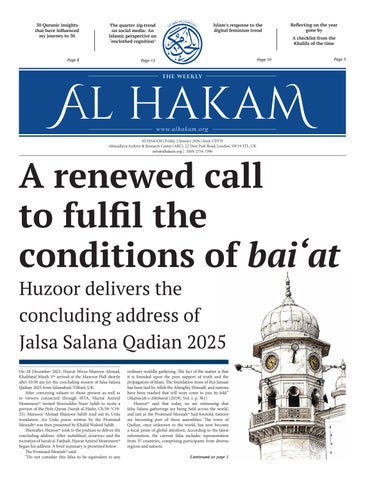
A renewed call to fulfil the conditions of bai‘at Huzoor delivers the concluding address of Jalsa Salana Qadian 2025
On 28 December 2025, Hazrat Mirza Masroor Ahmad, Khalifatul Masih Vaa arrived at the Masroor Hall shortly after 10:30 am for the concluding session of Jalsa Salana Qadian 2025 from Islamabad, Tilford, UK. After conveying salaam to those present as well as to viewers connected through MTA, Hazrat Amirul Momineenaa invited Nooruddin Nasir Sahib to recite a portion of the Holy Quran (Surah al-Hashr, Ch.59: V.1925). Mansoor Ahmad Mansoor Sahib read out its Urdu translation. An Urdu poem written by the Promised Messiahas was then presented by Khalid Waleed Sahib. Thereafter, Huzooraa took to the podium to deliver the concluding address. After tashahhud, ta‘awwuz and the recitation of Surah al-Fatihah, Hazrat Amirul Momineenaa began his address. A brief summary is presented below: The Promised Messiahas said: “Do not consider this Jalsa to be equivalent to any
ordinary worldly gathering. The fact of the matter is that it is founded upon the pure support of truth and the propagation of Islam. The foundation stone of this Jamaat has been laid by Allah the Almighty Himself, and nations have been readied that will soon come to join its fold.” (Majmu‘ah-e-Ishtiharat [2019], Vol. 1, p. 361) Huzooraa said that today, we are witnessing that Jalsa Salana gatherings are being held across the world, and just as the Promised Messiahas had foretold, nations are becoming part of these assemblies. The town of Qadian, once unknown to the world, has now become a focal point of global attention. According to the latest information, the current Jalsa includes representation from 37 countries, comprising participants from diverse regions and nations. Continued on page 3
Friday 2 January 2026 | AL HAKAM
2
This Week in History A glimpse into the rich history of the Ahmadiyya Muslim Jamaat
2-8 January 2 January 2 January 2000: On this day, a tragic collision occurred between a train and a passenger wagon at the railway crossing in Rabwah during the morning hours. On this occasion, Majlis Khuddam-ul-Ahmadiyya, Fazle-Umar Hospital and local Ahmadis of Rabwah rendered invaluable services. For instance, 28 khuddam immediately donated blood for the injured. (Al Fazl, Rabwah, 4 January 2000, p. 1) 2 January 2006: During his tour of India, on this day, Hazrat Khalifatul Masih Vaa visited various places in Qadian, including Talim-ul-Islam College, Noor Mosque, Tahrik-eJadid’s boarding, SS Bajwa School, Kothi Darus Salam, Noor Hospital, Aqsa Mosque and the Ahmadiyya Central Library, etc. (Al Fazl International, 24 February 2006, p. 11)
1January 3 January 1898: The Promised Messiahas had expressed multiple times his intention to open and establish a middle school in Qadian to meet the educational requirements of the growing Jamaat. On this day, this
historic milestone was achieved and Talim-ul-Islam School was inaugurated in Qadian. (Tarikh-eAhmadiyyat, Vol. 2, p. 3)
every Ahmadi family must ensure that at least one person from their family devote their lives to serving the Jamaat.
3 January 2014: During his Friday sermon on this day, Hazrat Khalifatul Masih Vaa mentioned Yusuf Latif Sahib of Boston, USA, who had passed away on 23 September 2013 at the age of 93. He had accepted Ahmadiyyat in 1948 and was amongst the early Afro-American Ahmadis. He was the author of various books. Once, President Clinton invited him to the White House and Yusuf Sahib attended the event wearing a shalwar kameez.
Huzoorra explained that the work of tabligh and spreading religion could not solely be done with finances; the efforts of people were also required. (Khutbat-eMahmud, Vol. 26, p. 1)
4-5 January 4 January 1952: On this day, Hazrat Musleh-e-Maudra directed the central administrative Jamaat offices to draw up a list of projects in detail that needed to be completed during the year. He also instructed that the projects should be completed within their given timeframe. (Al Fazl, 11 January 1952) 5 January 1944: In the night between 5 and 6 January 1944, Hazrat Musleh-e-Maudra was shown in a vision that he was the person mentioned in the Promised Messiah’sas announcement of 20 February 1886 that spoke of a ‘promised son’. At the time, Huzoorra was staying in Lahore at Sheikh Bashir Ahmad Sahib’s residence located on 13 Temple Road. To read more about the background and fulfilment of this divine prophecy and heavenly sign, read: “Friday sermon – Musleh-e-Maud: The Prophecy and The Man (23 February 2024)” at alhakam.org (22 March 2024, pp. 21-24). 5 January 1945: On this day, Hazrat Musleh-eMaudra instructed that
6-7 January 6 January 1945: On this day, Hazrat Hafiz Mirza Nasir Ahmadrh, then principal of Talim-ul-Islam College, was elected as a member of the academic council of Punjab University for 1945-46. The principals of the concerned intermediate colleges elected him unanimously. As soon as Talim-ul-Islam College was established, its reputation grew due to its teaching standards. This had an effect not only on the province of Punjab but also on the whole country. (Tarikhe-Ahmadiyyat, Vol. 9, p. 63) 7 January 1910: On this day, Hazrat Mir Qasim Alira, a companion of the Promised Messiahas, launched his paper Al Haq from Delhi. The name of the newspaper was granted by Hazrat Khalifatul Masih Ira. (Tarikh-eAhmadiyyat, Vol. 3, p. 313) To learn about the services of this magazine, see: www. ahmadipedia.org. 7 January 1947: Jamaat’s missionary Maulana Nazir Ahmad Mubashar Sahib, who rendered invaluable services on the African continent under the guidance of Hazrat Khalifatul Masih IIra, returned to Qadian on this day after spending over 10 years in the field, serving as a missionary. To read more about his sacrifices and achievements, see: “Pioneer
Missionaries: Part 10 – Eleven years in Gold Coast: A lesson of sacrifice, resilience and love for Islam Ahmadiyyat” at alhakam.org (9 June 2023, p. 16). 7 January 2017: On this day, Hazrat Khalifatul Masih Vaa inaugurated the Baitul Ehsan Mosque in Mitcham, London. In addition to the prayer halls, the five-storey building holds conference rooms, offices and various other facilities. (“Head of Ahmadiyya Muslim Community Inaugurates New Mosque in Mitcham, London”, www. pressahmadiyya.com)
8 January 8 January 1932: On this day, Hazrat Musleh-e-Maudra initiated a remarkable scheme for the propagation of Islam Ahmadiyyat and added that every year, there should be a large number of people entering the Jamaat from around the world. To achieve this noble goal, Huzoorra also stressed that Jamaat members had to unite, bridging any internal rifts. (Al Fazl, 14 January 1932) 8 January 2010: During his Friday sermon on this day, Hazrat Khalifatul Masih Vaa mentioned Professor Muhammad Yusuf Sahib of Rachna Town, Lahore, Pakistan, who had been martyred on 5 January, at the age of 65. He had been serving as the local president for the last 20 years.
AL HAKAM | Friday 2 January 2026
3
Seeking Allah’s help amid judicial failure in Pakistan During his Friday sermon, delivered on 26 December 2025, Hazrat Mirza Masroor Ahmad, Khalifatul Masih Vaa, condemned the unjust life sentence handed to Mubarak Sani Sahib in Pakistan, highlighted the disturbing influence of extremist clerics over the judiciary and urged Ahmadis to intensify their prayers and spiritual efforts to invoke divine support. He said: “Pray for the Ahmadis in Pakistan. Two days ago, in a court case that was ongoing regarding Mubarak Sani Sahib, the session judge sentenced him to life imprisonment. The accusation levelled against him is that he had a copy of the Holy Quran in his possession, which he would recite himself and teach to others as well. When this is the state of the courts, then what hope can there be for any improvement in the situation? “Even the non-Ahmadis have expressed their opinions upon this decision and have labelled it as a mockery [of justice]. Although the clerics are generally applauding this decision and praising the judge, the fairminded people have written, and some have commented on this in a sarcastic manner,
Continued from page 1
This reality stands as clear evidence that the support and succour of Allah the Almighty accompany this Jalsa. However, the true benefit of this gathering can only be attained by those who strive to fulfil the pledge they made with the Promised Messiahas. Only then can we become rightful heirs to the prayers he offered for those who attend the Jalsa. The Jalsa attendees must have listened to many scholarly and thought-provoking speeches during this Jalsa, but these addresses will only yield benefit in their practical lives if they keep their pledge of allegiance firmly in view. Over time, people often forget the basis upon which they entered into bai‘at and lose sight of the true purpose of being an Ahmadi Muslim. The Promised Messiahas was raised for the purpose of bringing back, in a practical and transformative manner, those who had drifted away from the true teachings of Islam, so that they might once again become the kind of Muslims the Holy Prophet Muhammad, peace and blessings of Allah be upon him, sought to cultivate. This was the very purpose for which Allah the Almighty sent the Holy Prophetsa who brought about pure and profound transformations among his Companionsra, moulding them into the finest and exemplary Muslims. This objective must always remain at the forefront of our minds. The Promised Messiahas laid down several conditions in the pledge of bai‘at. Foremost among these conditions is the avoidance of shirk (associating partners with God). Shirk does not merely consist of prostrating before someone; rather, as the Promised Messiahas explained, if a person
that this is such a huge crime in that he recites the Holy Quran, has kept a copy of it in his home and teaches it to children. In any case, this is the state of the so-called scholars and their followers. In some places, the administration of the government is following these clerics and implementing their policies. “We pray that Allah the Almighty creates the means for them to be swiftly seized. Insha-Allah, Allah the Almighty will swiftly seize them and we can even witness signs of it unfolding as well. But we should be concerned lest there is a delay in this owing to any negligence on our part in terms of our supplications, practical conduct and fulfilling the due rights of worship, just like the Holy Prophetsa would look up at the clouds and, out of the same concern, would pray. Thus, there is a great need to pay close attention to prayers. “Likewise, pray for the oppressed people of the rest of the world as well, that Allah the Almighty may grant peace to everyone, everywhere, and protect all from every form of disorder and turmoil.” [Amin.]
gives precedence to their own actions, schemes, or ego over Allah the Almighty, they are, in effect, setting up an object of worship alongside God. The Promised Messiahas stated that those who enter into bai‘at with him must also affirm that they will never speak falsehood, nor will they commit adultery. In the present age, through television and other forms of media, such content frequently comes to the fore which, even if it does not lead to wrongdoing in practice, nevertheless gives rise to immoral and corrupt thoughts. It is therefore essential that we remain vigilant and safeguard ourselves against all such influences. He further instructed that the five daily prayers should be offered in accordance with the command of Allah and His Messengersa, and that one should strive to observe Tahajjud. Moreover, one should invoke blessings upon the Holy Prophet, peace and blessings of Allah be upon him, seek
forgiveness for one’s sins, repeatedly reflect upon the favours of Allah the Almighty, and express gratitude for them. The Promised Messiahas also stated that one who has entered into a pledge of bai‘at with him must never inflict any form of unjust harm upon the creation of Allah the Almighty in general, and upon Muslims in particular, under the influence of selfish passions – whether through the tongue, the hand, or by any other means. Furthermore, the Promised Messiahas emphasised that in all circumstances – whether in times of hardship or in times of prosperity – one must remain steadfastly loyal to Allah the Almighty. Although we repeat these commitments every year and reaffirm that we shall act upon the conditions of bai‘at, we nevertheless often fail to keep them firmly present in our minds. Some devoted members also write that they have displayed the Conditions of Bai‘at in their homes. This serves as a constant reminder of what the conditions of bai‘at entail, and by reading them regularly, one is continually encouraged towards selfreformation. In this way, it becomes clear how one is to become a true Ahmadi believer and how one is to fulfil the pledge of bai‘at. In times of trial and difficulty, one must never turn away from Allah the Almighty. Some people write that they have offered many prayers, yet they have not been accepted. This indicates that there is a deficiency in our own efforts as well as in our supplications. There is no refuge for us other than Allah the Almighty before whom we may bow. If we persist steadfastly in this path, Allah the Almighty will surely bestow His grace. We must also guard ourselves against false customs, immoral practices and the pursuit of base desires, and instead adopt the commandments of the Holy Quran as our guiding code of life. All these matters require serious self-examination. We must ask ourselves whether we are truly acting upon the commands of Allah and His Messengersa in their entirety. The Promised Messiahas stated that whoever has entered into bai‘at with him must abandon arrogance and adopt virtues such as humility, good moral conduct, gentleness and meekness – only then can one become a true Ahmadi. We should keep all these matters before us and continuously assess the extent to which we are acting upon them. The Promised Messiahas further
Hadith-e-Rasul – Sayings of the Holy Prophet Muhammadsa
Do not wish for death
ُ َ َ َ َ ََ ْ َ �ٰ ٍس ـ رضى الّٰله عنه ـ َقاَل َقاَل ََر ُُسوُل َعْن َأَن ٍ َ ٰ َ ّ َ � �ٰ ٌ ّ لَا َي َ ََت ََم �َّنَي �َّن َأ ََحٌد:الّٰل ِِه صلى الّٰله عليه وسلم ّ� َ َ َ ْ َ َ َ ُ َ ْ ُ اَن لَا ُبَُّد َف ِِإْن َك،ِِم ْْنُك ُُم اْل ََم ْْوَت ِل ُِض ّ�ٍّر َن ََزَل ِبِ ِِه َ ّ ُ ّ� ُ ْ َ ْ َ َ � َ ِت ِ ُُمَت ََمِّن ًًّيا ِل ِْل ََم ْْو ِِت َفْل ََيُق ِِل الَّلُه �َّم َأ ْْح ِِي ِِني ََما َكاَن ْ َ ُ َْ ْ َ ُ َ ْ َ َ َ ّ� َ َ َ ِت اْل ََوَفاُة َخْي ًًرا ِ َوَتَوَّف ِِني ِِإَذا َكاَن،اْلَح ََياُة َخْي ًًرا ِلِي .ِلِي
Hazrat Anasra narrated that “Allah’s Messengersa said, ‘None of you should wish for death because of a hardship that has befallen him. But if he finds himself compelled to wish for death, then he should say, ‘O Allah, keep me alive for as long as life is better for me and cause me to die when death is better for me.’’” (Sahih al-Bukhari, Kitab ad-da‘awat, Bab ad-du‘a’i bi l-mawti wa l-hayat, Hadith 6351) (Sahih al-Bukhari, Kitab al-jana’iz, Bab albuka’i ‘inda l-marid, Hadith 1304)
Hazrat Mirza Ghulam Ahmadas, In His Own Words
The heart in Arabic
The word qalb, which is used for ‘heart’ in Arabic, has two meanings. Firstly, there is the apparent and physical meaning, and then there is the spiritual meaning. The apparent meaning of qalb is one of ‘turning about’. Since it is the heart that causes the circulation of blood in our bodies, it is referred to as qalb in Arabic. In the spiritual sense, this word implies that any progress an individual hopes to attain in terms of spirituality can only be attained through the power of the heart. Just as the circulation of blood, which is absolutely critical in sustaining human life, is powered by the heart or qalb, in the same manner, all forms of spiritual advancement are dependent on the power of the heart. (Malfuzat [English], Vol. 2, pp.118-119)
Friday 2 January 2026 | AL HAKAM
4
stated that honouring faith and showing compassion for Islam, holding it dearer than one’s own life and wealth, is also a requirement for one who has pledged allegiance to him. Moreover, he instructed that the abilities and blessings granted by Allah the Almighty should be utilised for the benefit of mankind. This includes financial sacrifice as well as other means through which service to humanity can be rendered. The Promised Messiahas further emphasised complete obedience to him – that all these recognised virtues should be practised solely for the sake of Allah the Almighty – and that one should strive to uphold them until the very end of life. The Promised Messiahas appeared for the sole purpose of removing the dust that had settled upon the face of Islam, purifying it and presenting it afresh in its pristine form. For this mission, a community was to be prepared that would continue this work. The very purpose of Jalsa Salana is to act upon the teachings articulated by the Promised Messiahas and to assess the extent to which we are implementing them in our lives. He clearly stated that this is a religious gathering, initiated under the special support of Allah the Almighty, so that He may transform us into truly Godly individuals. All those attending the Jalsa, as well as those participating through MTA, have pledged allegiance upon these very principles. And just as the Promised Messiahas foretold that nations would join this Jalsa, this prophecy too has been fully realised. Therefore, we must keep these matters constantly before us and make every possible effort to act upon them fully, never allowing ourselves to drift away from them. The Promised Messiahas explained that in order to act upon these teachings and to guide people onto the straight path, it is essential that we cultivate righteousness (taqwa) within ourselves. On one occasion, he stated that mere rhetoric is of no avail without practical action. If we wish to discharge the true right of bai‘at, we must adopt taqwa. If we do so, we will enter the strong fortress of Allah the Almighty. If we are confronted by nations that view us with hatred and contempt, the only way to withstand such opposition is to purify our
inner selves; once we do so, the help of Allah the Almighty will surely be with us. Some people say that they have offered this prayer and that prayer, seeking worldly matters, yet none of their prayers have been accepted. However, the first question that must be examined is whether we have prayed in order to attain closeness to Allah the Almighty. Thus, it is only through taqwa that our identity as Ahmadi Muslims can truly benefit us. The Promised Messiahas stated that even if one attains the elementary stages of taqwa, the grace of Allah the Almighty may still be bestowed. If a person lacks taqwa and yet complains that their prayers had not been accepted, this constitutes a matter of ignorance. Accordingly, the Promised Messiahas emphasised that it is incumbent upon every member of his Jamaat to tread the paths of righteousness and to partake of an ever-increasing share of faith. The Promised Messiahas advised to adopt taqwa so that we may fulfil all those requirements that are essential for his bai‘at. Offer the prayers, and offer them with humility and submissiveness. Huzooraa stated that many people come to him and say that they offer prayers and supplications. While it is true that they do observe the prayers, greater effort and deeper supplication are still required. The Promised Messiahas further stated that if one has entered into bai‘at with him, then they must also engage in selfreformation and repentance, and develop a sincere concern for acting upon the commitments they have made with him. In order to attain these qualities, seeking istighfar is also essential. To rely on supplication and personal schemes while abandoning Allah the Almighty is also a form of folly. The true benefit of bai‘at lies in witnessing a clear and manifest transformation within one’s life. Although it is permissible to combine prayers and offer them together, it is not acceptable to claim forgetfulness and fail to offer the prayers altogether. Ahmadis, in particular, must safeguard themselves against such negligence. On the occasion of Jalsa, attention is undoubtedly given to the observance of the prayers and to the offering of Tahajjud. However, when people return to their
homes, this level of attentiveness often diminishes. Thus, when the Promised Messiahas drew attention to this matter, his intent was that if the prayers are observed properly and consistently, people will also benefit in their worldly affairs. Allah the Almighty does not concern Himself with everyone indiscriminately; rather, He shows special concern for the salih (righteous and upright). Cultivate mutual affection and love among each other, and abandon cruelty and mockery. The Promised Messiahas stated that a tree which bears no fruit is uprooted and discarded by the gardener. Therefore, if we have entered into bai‘at, we must fulfil its conditions so that no opposition may cause us harm. We should establish a firm relationship with Allah the Almighty, so that He Himself may care for us, and no one may be able to cause us any injury. The Promised Messiahas advised us to live as brothers and exist as one united people. This should be the distinguishing feature of the Jamaat, and indeed one of its defining signs. Remove hostility from among ourselves and occupy ourselves with great and noble works. People will oppose us, but respond to them with gentleness and never allow passion to govern our actions. This is his exhortation; remember it as a solemn testament. The Promised Messiahas stated that he repeatedly received the revelation that if we become righteous and tread the subtle paths of taqwa, God will surely be with us. The Promised Messiahas further stated that he is also concerned with identifying truly righteous individuals within his Jamaat and entrusting certain religious responsibilities to them.
Therefore, each one of us should strive to be counted among such people and be prepared to serve in the propagation of faith. By the grace of Allah, a special group of Waqifeen-e-Nau is also being prepared, and they must keep these admonitions of the Promised Messiahas firmly in mind. Every individual should strive to walk the path of taqwa and become an heir to the prayers of the Promised Messiahas. The Promised Messiahas offered prayers for his followers that they may attain the pleasure of Allah the Almighty and become seekers of His mercy. If we desire to become heirs to the prayers of the Promised Messiahas – particularly those prayers he offered for participants of the Jalsa – then we must keep the conditions of bai‘at constantly before us. Huzooraa also drew attention to the importance of displaying the Conditions of Bai‘at in a framed form as a continual reminder. If we wish for the counsel and prayers of the Promised Messiahas to be fully realised in our own lives, we must act upon his teachings and faithfully fulfil the conditions of bai‘at that we have pledged with him. Huzooraa then led everyone in silent prayer. Following the prayer, participants from Qadian presented taranas and poems. At the end, Hazrat Amirul Momineenaa announced the attendance figures for Jalsa Salana Qadian 2025 and also provided updates on the participation at various other jalsas being held simultaneously across the world. Excluding those listening from home, the total number of participants connected through the Jamaat’s system was around 40,000. (Summary prepared by Al Hakam)
The new year: Thoughts from my Notes app, shared here with you
Jalees Ahmad Al Hakam “New year, new me” – as the saying goes. Many of us use the new year as a time to reflect on the past year and see it as an opportunity to improve ourselves. Some may decide to start habits that benefit them: getting healthier, going to the gym, or buying running shoes in the longing of building momentum. Others may prefer to read more books and gain more knowledge. When you think about it, reflecting, looking back, and motivating yourself to grow is actually not just a good thing,
it’s very useful. And each year, this deep feeling, once submerged and buried deep, seems to return and resurface with renewed inspiration. However … ah, yes, there’s always a but. How often do we actually stick to our New Year’s resolutions? For many, the motivation lasts only through January before it begins to lose momentum. Are we demanding too much of ourselves, or does our early-year craving simply wither and lag before it can carry us forward? While some do manage to stay consistent, many find themselves struggling to keep up. The point I am getting at is that, in order to keep a resolution afloat, this act of reflection must become more frequent and more present in our daily lives. The well-known, or maybe not so well known, words of Hazrat Umarra, the second Khalifa of the Holy Prophetsa, should be ingrained in our minds: take account of yourselves before you are taken to account. (Jami‘ alTirmidhi, Hadith 2459). As Muslims, the Continued on page 5
AL HAKAM | Friday 2 January 2026
5
Reflecting on the year gone by A checklist from the Khalifa of the time M Adam Ahmad Al Hakam
As the world prepares to welcome a new year with dramatic public displays and short-lived celebrations, we must stop and think: what are we actually celebrating? Can we say the passing year was a successful one for us? And if so, what metric are we using?
While calendars turn and clocks strike midnight, Hazrat Khalifatul Masihaa draws our attention away from outward celebrations towards inward reflection, on ourselves and our actions. The true distinction of a believer lies not only in refraining from vain pursuits and expressing aversion to them, but also in undertaking sincere self-examination
(muhasaba-e-nafs). The following questions were laid out by Hazrat Khalifatul Masihaa in a Friday Sermon just before the new year, for us to reflect on whilst carrying out this process of self-examination in light of the year that has passed. The answers to these questions will truly determine how successful the year was:
Checklist for the year gone by • What have we gained in the passing year, and what have we lost? • Have we truly fulfilled the conditions of bai‘at by avoiding all forms of shirk – including hidden shirk expressed through deception, ostentation and self-centred desires? • Did we observe the five daily prayers with regularity and commitment throughout the year? • Did we strive to offer Tahajjud prayer consistently, recognising it as a means of spiritual nearness to Allah the Almighty? • Did we regularly recite durood (invoking blessings) upon the Holy Prophet Muhammadsa, recognising it as a condition for the acceptance of prayers? • Did we remain steadfast in seeking istighfar on a regular basis? • Were our prayers, fasts, charities, financial sacrifices, service to humanity and time given to the Jamaat performed solely for the pleasure of Allah, or for worldly display and the approval of others? • Did our hidden desires ever take precedence over obedience to Allah?
• Did we remain content with Allah in all circumstances, without complaint or resentment over unanswered prayers or hardships? • Did we consistently remember and praise Allah the Exalted before beginning our actions? • Did we sincerely endeavour to follow the teachings of the Holy Quran and the commands of the Holy Prophetsa in their entirety? • Did the past year pass in complete truthfulness, especially at moments when speaking the truth carried personal loss or harm? • Did we consciously distance ourselves from gatherings, media and influences that generate impure thoughts and moral corruption? • Did we make every possible effort to guard ourselves from lustful glances and to observe true modesty of the eyes? • Did we strive to abstain from all forms of immorality, harsh speech, verbal abuse and sinful conduct? • Did we protect ourselves from injustice in every form, even the slightest infringement
upon the rights of others? • Did we remain free from all forms of dishonesty and betrayal, even towards those who wronged us? • Did we actively avoid creating or spreading discord, gossip and division among people? • Did we refrain from rebellious attitudes and defiance? • Were we able to restrain ourselves from being overcome by carnal passions in an age of widespread immodesty? • Did we refrain from causing harm to others through our hands or tongues, and practise forgiveness, humility and forbearance? • Did we fully avoid customs, innovations and vain practices driven by desire rather than guidance? • Did we abandon pride and arrogance, recognising them as among the gravest spiritual diseases after shirk? • Did we strive to attain the highest standards of good moral character and humility? • Did each day bring growth in faith and a renewed commitment to giving precedence to religion over worldly pursuits?
• Did our love for Islam reach a level where it outweighed attachment to wealth, honour and even family? • Did we actively advance in compassion and sympathy for all of Allah’s creation? • Did we strive, using all our abilities, to benefit humanity and care for the needs of Allah’s creation? • Did we pray consistently for ourselves and our children to remain firm in obedience to the Promised Messiahas and to grow in those standards? • Did we strengthen our bond of loyalty and obedience to the Promised Messiahas to the extent that worldly ties became secondary? • Did we regularly pray to remain steadfast in loyalty and obedience to Khilafat, and nurture this attachment in our children? • Did we consistently pray for the Khalifa of the time and for the Jamaat? Having reflected upon the above questions, can we say that the year brought spiritual gain – or does it demand serious repentance, renewed resolve and earnest prayer for reform in the year ahead?
Continued from page 4
For example, if one has plans for the early morning, the best time to prepare is the night before. And if you intend to wake up for tahajjud (pre-dawn voluntary prayers), it would be counterproductive to stay up late watching a movie or sitting in front of a screen. Thus, when it comes to New Year’s resolutions, one should focus on things one can actually do consistently; actions that feel seamless in our daily lives but have a powerful, atomic habit impact over time. As Muslims, rather than looking down at our phones, we can choose to look up. Look up at the sky and seek the signs of a living God. This year, as in years past, many questions have arisen in the minds of young people, and there are many who struggle to connect not only with God, but even with the very idea of a living God.My response is that the world today is, in many ways, an ambush. It is designed to do exactly that. It keeps us busy, distracted and often leaves us without the time or, frankly the patience, to truly search for God. (Side note: In contrast, the azan has a beautiful way of waking us up from this trance and calling us to Allah, who is greater.)
Rather than wasting hours on our phones, we can take a shorts break (yes, pun intended) and use that time to become more intentional with how we live our days. We can learn to be more attentive. Attentive in our prayers, present with our families, and present in moments that often pass unnoticed. Rather than romanticising in setting unrealistic goals, we can focus on strengthening what we already do: become more consistent in Salat, more sincere in our prayers and dealings with people, and more aware of God throughout the day. This year has shown us how quickly viral trends catch on and how the youngsters, and really, all of us, follow them just to be part of something. Take, for example, the whole “6/7” thing among the youth. Most don’t even know what it means, yet everyone seems to be part of it. I’m not here to scold youngsters; we only need to look back at our own youth to remember trends like planking, something people did without fully understanding it. I’m simply saying that viral trends often reveal, to those attentive, how people’s ability to think and act for themselves, or
their cognitive capacity, is declining. Why not reflect more and react less? In a world that pushes us to constantly react, we can opt to pause, reflect and respond with patience and intention. Why not forgive more, especially when it can lead to better outcomes? Instead of carrying baggage of past hurts and conflicts, why not set that luggage down? You’ll feel lighter and be able to focus more on yourself. Give yourself a break. Just like you check in your luggage at the airport to make the trip easier, why not do the same for the journey of life? Forgive more, for how can we seek God’s forgiveness while holding onto grudges against our fellow human beings? Why not connect with the Quran? Not just by reading it, but by living it, using it as a guide for your soul? And why not reflect every day, instead of waiting for the new year? Channel that energy daily, making reflection a part of your everyday life. The new year doesn’t have to be about becoming someone new; it can be about returning to who you are meant to be.
Holy Prophet taught to “cherish that which gives you benefit,” alluding to that which benefits you here and in the hereafter. (Sahih Muslim, Hadith 2664) Thus, we are given a clear approach, a path to keep our zeal and sense of purpose alive and our compass straight. In our daily lives, technology has taken over. The world has become far too fast paced, often faster than our minds and bodies can comfortably manage. Because of this, there is indeed a weighty value in taking a step back each night, and reflecting on the day that has passed. And you can likely see where this leads: journaling. Journaling is simply a structured form of reflection. As Muslims, it closely mirrors the practice of reviewing and examining our day, hoping to do better, earn more blessings, and serve humanity better the following day. As Muslims, we know that the next day begins after Maghrib. This means that after the Maghrib prayer, as we begin to wind down from the day, we should also begin preparing ourselves for the day to come. sa
(Friday Sermon, 30 December 2016)
Friday 2 January 2026 | AL HAKAM
6
NEWS 5th Annual Award Ceremony of ITQA
Firhaad Ahmed Missionary, ITQA Academy The 5th Annual Award Ceremony of the International Talimul-Quran Academy (ITQA) was held on 7 December 2025, at Tahir Hall, Baitul Futuh Mosque Complex. The event was presided over by Rafiq Ahmed Hayat Sahib, Amir Jamaat-e-Ahmadiyya UK. The ceremony commenced with a recitation from the Holy Quran, followed by hadith, selected sayings of the Promised
Messiahas and an Urdu poem. This was followed by a 15-minute documentary showcasing the brief history of the Academy’s establishment, the performance of its various learning zones, an introduction to its office departments and feedback from students residing in distant countries who have been attending ITQA classes. Thereafter, Hafiz Fazle Rabbi Sahib, In-Charge of ITQA, presented the annual report, highlighting the Academy’s educational activities, year-long progress and major achievements. He stated that the
International Academy was established in 2020, under the special guidance of Hazrat Khalifatul Masih Vaa. The Academy was launched from London with the aim of delivering Quranic education to Ahmadi boys and girls in their homes across the world. The Academy currently has approximately 4,000 students receiving online Quranic education from 36 countries, organised into five learning zones, with the number of volunteer teachers exceeding 550. This year, teachers who have continuously served the Academy for five years were also awarded certificates. Hafiz Sahib further informed the audience about the progress made during the past year in courses related to nazirah (Quran reading), translation of the Quran, Arabic grammar and Hifzul-Quran. He also mentioned that word-by-word Quran translation classes are being conducted in 13 major world languages, which are uploaded to the Academy’s YouTube channel and are benefiting people beyond the Jamaat as well. Subsequently, Hafiz Aneeq-ur-Rehman
Sahib, In-Charge of the Office Management Department, announced the names of students who demonstrated outstanding performance in the examinations. Certificates and prizes were awarded to female students by Dr Qurratul-Ain Sahiba, Sadr Lajna Imaillah UK, while male students received their certificates and awards from Amir Sahib Jamaat UK. At the conclusion of the ceremony, Amir Sahib Jamaat UK delivered his closing speech. He briefly mentioned the establishment and rapid progress of ITQA under the guidance of Hazrat Khalifatul Masih Vaa and paid tribute to the dedication, sincerity and services of the Academy’s entire staff and teachers. He then led the gathering in silent prayer, marking the conclusion of this blessed ceremony. Dinner was then served to the guests. The entire programme was broadcast live on YouTube, enabling students and teachers from other countries to participate virtually.
Interfaith event held in Regina, Canada
from Holy Rosary Cathedral, the Church of Jesus Christ of Latter-day Saints, Sikh and Baha’i communities, Daughters of Africa, Multicultural Council of Saskatchewan, Regina School Board Trustee Mr Ted Jaleta and Arabic Christian Alliance Church. Members of the Legislative Assembly of Saskatchewan were also present, including Ms Jacqueline Roy (Regina Northeast), who shared remarks on behalf of NDP Opposition Leader Ms Carla Beck and Mr Bhajan Brar (Regina Pasqua). The feedback from some of the guests is presented below: Alycia DeLong said: “We always feel welcome by the friendly community at the Ahmadiyya Mosque. The guest speaker, topic and conversation were very interesting. We’re grateful for the care they show to the city of Regina.” Sandra Nixon from the Church of Jesus Christ of Latter-day Saints said: “Thank you for the presentation ‘A Beacon of Light in a Troubled World.’ It gave me so much to reflect on. We deeply appreciate the warm welcome.” Following the formal programme, guests enjoyed refreshments and engaged in meaningful one-to-one discussions with Jamaat members. Several female guests joined Lajna members in the Lajna Hall for further conversation. Many guests took copies of Jesus in India, while others requested additional books for further study. The event was attended by 28 guests and 63 Jamaat members.
Syed Mukarram Nazeer Canada Correspondent
Medical camp and blood donation On 29 November 2025, Jamaat-eAhmadiyya Regina, Canada, hosted an interfaith event titled “The Imam – A session held in Ivory Coast Beacon of Light in a Troubled World.” Shahid Ahmad Masud Regional Missionary, Ivory Coast On 7 December 2025, Humanity First Ivory Coast organised a free medical camp and a blood donation session in the town of Soko. The initiative aimed to provide essential healthcare services to needy people and to support the national blood bank through voluntary donation. The medical camp offered a wide range of services, including general consultations, health screenings, medical advice and distribution of free medicines. A team of dedicated doctors, nurses and volunteers worked throughout the day to ensure that every patient received proper attention and care. More than 215 people benefited from
the medical services provided during the camp. In addition, a blood donation campaign was also conducted, during which volunteers generously contributed, resulting in the collection of 33 bottles of blood. By Allah’s grace, this contribution will assist the national blood bank in saving lives and supporting hospitals in urgent need of blood supplies. Insha-Allah. The programme was attended by the First Vice Mayor of Bondoukou, the Director of the Health Department of Bondoukou and other local authorities. Media representatives and journalists were also present and covered the event through detailed reports, helping to highlight the impact of the initiative.
The event commenced with a recitation from the Holy Quran, followed by Jamaat’s introduction, introductory remarks by Madeeh-ur-Rehman Sahib and recitation of an Arabic qasidah of the Promised Messiahas by a group of atfal. The In-Charge of the Turkish Desk in Canada then delivered a speech, offering insights on the purpose and blessings of true imamat, the importance of unity and moral leadership and the continued guidance of Khilafat-e-Ahmadiyya in contemporary times. A thoughtful and engaging questionand-answer session followed, jointly presided over by In-Charge Turkish Desk Canada, Regional Amir Prairie, Dr Habibur-Rehman Sahib and Missionary Khalil Tanvir Sahib. The event welcomed a diverse gathering, reflecting strong interfaith and community engagement. Guests included representatives
AL HAKAM | Friday 2 January 2026
7
71 Jalsa Salana held in Nigeria st
Muhammad Al-Fareed Ajimoti Nigeria Jamaat-e-Ahmadiyya Nigeria held its 71st Jalsa Salana on 19-21 December 2025, at the Conference Ground, Jamia Ahmadiyya Ilaro, Ogun State, Nigeria. After the flag-hoisting ceremony, the first session started with a recitation from the Holy Quran, followed by an Arabic qasidah. The special message from Hazrat Khalifatul Masih Vaa was read out by Amir Sahib Jamaat Nigeria, followed by his inaugural speech, which was then translated into the Yoruba and Hausa languages for the benefit of attendees. The first day concluded with Maghrib and Isha prayers, followed by dinner. On Saturday, the second session
commenced with Amir Sahib Jamaat Nigeria presiding. The session had a number of dignitaries in attendance, including government officials, traditional rulers, educators and representatives from other communities, both within Nigeria and from neighbouring countries, who were all introduced and recognised. The recitation from the Holy Quran was followed by an Urdu poem and an Arabic poem. This was followed by a speech on the theme “Unity is Strength: Lessons from Islamic History as a Guide to Current Global Challenges to the Muslim Ummah,” by Professor Saeed Olurotimi Timehin Sahib, Member of the National Qadha Board. Subsequently, the annual academic merit awards were distributed under the coordination of the National Talim Secretary, Tajudeen Oladoja Sahib. Some of the guests
Opinion: The bullet that killed millions and the serum that saved millions Daniyal Mahmood Ahmad Al Hakam
When the world saw death There once was a prince who took his princess to inspect their army. They got in their royal carriage and visited a relatively recently annexed part of their kingdom. En route with great pomp and splendour, they were cheered and welcomed by citizens who had lined up on the streets. The route was predetermined and the envoy was well on their way when an assassin threw a bomb at the carriage. Fortunately for the prince, the bomb bounced off the car, and its detonation didn’t cause him and his princess any damage. As the prince went on, he changed his planned route to visit some people at the
hospital who had been injured in the bomb attack. The driver took a wrong turn, right where an assassin was standing. He took his pistol out, aimed at the prince and took his shot. This fatal moment was the final link in a chain of events which led the world into war. The prince was Archduke Franz Ferdinand, and his assassination took place in Sarajevo, coincidentally on his wedding anniversary, 28 June 1914. (“Assassination of Franz Ferdinand”, britannica.com, accessed on 23 November 2025) That single bullet ultimately led to 15-22 million deaths in World War I, and since the occurrence of World War II is sometimes linked to the heavy punishment and severe treaty imposed on the Germans after the first war, another 40-50 million deaths occurred. (“Killed, wounded, and missing” britannica. com, 17 November 2025; “Casualties of
were invited to give short speeches from the podium. The programme was brought to a close by a silent prayer, which was followed by a visit to the exhibition stands by the invited guests and lunch. The third session commenced with the Missionary-In-Charge Nigeria, Adnan Tahir Sahib, presiding. It began with a recitation from the Holy Quran, followed by an Arabic qasidah. This was followed by a speech on “Sacrifices in the way of Allah: Pious Examples of Hazrat Sir Zafrulla Khanra and Hazrat Syeda Nawab Mubarika Begumra,” by the MissionaryIn-Charge. A special announcement was made regarding the commencement of Year 1 at Minaret University Ikirun (MUI) by Professor Abdullah Abdur Rahman Sahib, Vice Chancellor. The second day ended with Maghrib and Isha prayers, followed by
World War II”, britannica.com, accessed on 3 December 2025) In total, that bullet was the final domino that led to the loss of 72 million lives. With this perspective, this verse of the Holy Quran suddenly takes on a more literal meaning: “Whosoever killed a person […] it shall be as if he had killed all mankind.” (Surah al-Ma’idah, Ch.5: V.33) The spiritual, moral and ethical dilemmas involved in unjustly taking a life have always been apparent. Still, the fact that a single assassination could be a cause of so much death and destruction testifies to the ethical standard set by the Holy Quran. However, whilst one bullet took millions of lives, there was a single scientific discovery which also saved millions.
When the world saw life Over the span of the 20th century, in addition to the fateful assassination of the Archduke and the resulting conflict, the world was grappling with another lethal assassin – this time in the form of a disease. During the entire century, it is estimated that 150-300 million malaria-related deaths occurred. (“A Brief History of Malaria”, ncbi. nlm.nih.gov, accessed on 3 December 2025) Although drugs to treat malaria existed, such as chloroquine, their efficacy was, in reality, quite low due to widespread resistance. That all changed when China launched a secret medical mission called “Project 523” to discover an effective cure for the disease. Among the team of scientists assigned to the project was a relatively unknown scientist by the name of Tu Youyou, who was trained in traditional Chinese medicine. After years of failure, Tu rediscovered a fourthcentury Chinese medical manuscript, which suggested that wormwood (Artemisia annua) could treat intermittent fevers. She went on to refine the extraction method and made the daring decision to use the medicine on a critically ill malaria patient. That patient’s fever stopped, the malaria parasite count dropped drastically and the patient fully recovered. This led to further successful human trials. Tu then purified artemisinin, a
dinner and a comprehensive question-andanswer session. The panel was chaired by Professor Abdul Majeed Hassan Bello Sahib, President of the Qadha Board. The fourth and closing session commenced on Sunday immediately after the Fajr prayer. The recitation from the Holy Quran was followed by an Arabic qaseedah. This was followed by a speech on “Modern Day Evidence for the Existence of Allah,” by Professor Mashud Adenrele Fashola Sahib, former Amir of Jamaat Nigeria and Member of the Board of Trustees, Minaret University, Ikirun (MUI). The Jalsa was brought to an end by the closing remarks by Amir Jamaat-eAhmadiyya Nigeria, Alhaji Barr Alatoye Folorunso Azeez Sahib. Throughout the three-day event, Jalsa Radio continued to provide live translations of the proceedings in the Yoruba and Hausa languages, ensuring accessibility for all attendees. Jalsa Salana Nigeria 2025 recorded a total checked-in attendance of 35,771 individuals.
compound that kills 100% of malaria parasites at an unprecedented speed. In 2006, the WHO (World Health Organisation) even adopted Artemisininbased Combination Therapies (ACTs) as the global standard for malaria treatment. (“The discovery of artemisinin and Nobel Prize in Physiology or Medicine”, pmc.ncbi.nlm.nih. gov, 29 July 2016) This treatment has already saved millions of lives, with over 6 million lives saved in only the past decade or so. It reduced global malaria fatalities by 50% and became the frontline therapy in over 90 countries, saving millions of children in Sub-Saharan Africa. (“WHO/UNICEF report: Malaria MDG target achieved amid sharp drop in cases and mortality, but 3 billion people remain at risk”, who.int, 17 September 2015) Tu went on to become the first Chinese woman to win the Nobel Prize, in recognition for discovering the most effective anti-malarial drug in history. China itself managed to gain malaria-free certification by the WHO, having brought down cases of malaria from 30 million in the 1940s to zero in the past few years. (“WHO officially declares China malariafree”, china.org.cn, 30 June 2021) The same verse of the Holy Quran, mentioned above, goes on to state: “And whoso gave life to one, it shall be as if he had given life to all mankind.” (Surah al-Ma’idah, Ch.5: V.33) A single person’s life-saving discovery contributed to saving millions of lives worldwide. This event serves as another authentic testimony to the Holy Quran’s ethical standard.
Human agency and responsibility Sometimes, verses such as these may sound noble and deeply reflective when looked at surface level. But they also pass the litmus test practically with many examples, such as the millions of deaths during the two World Wars and the millions of lives saved through scientific innovation. Both of these events prove that one small action, whether a bullet or a serum, can cascade into vast consequences.
Friday 2 January 2026 | AL HAKAM
8
even if they are few.” (Sahih al-Bukhari, Hadith 6465) “A river cuts through rock not because of its power but because of its persistence.” – James N. Watkins
Learn to not react immediately ُ ُُخِل ََق اۡلِۡاۡن ۡ ََس اُن ِِم ۡۡن ََع ََج ٍٍل ِ ِ
30 Quranic insights that have influenced my journey to 30 Abdul Hadi Masood Missionary, Norway
Turning 30 feels like an awkward inbetween age: not quite young enough to adapt to new trends, yet not old enough to be fully wrapped in the wisdom of age. As I reach this milestone, I have found myself reflecting on the many life lessons in the Holy Quran. The Holy Quran is a source of timeless guidance, relevant at every stage of life. With this in mind, I have put together 30 lessons from it that resonate with me most as I turn 30 this year, insha-Allah.
Have a strong purpose for every goal � الَّرَ ۡۡح ٰٰمِن � ِب ۡۡسِم الل ِِہ الَّرَ ِِح ۡۡی ِِم ِ ِ ِ
“In the name of Allah, Most Gracious, Ever Merciful.” (Surah al-Baqarah, Ch.1: V.1) This verse from the Holy Quran reminds us to always remember God in everything we do. For a believer, this itself is a powerful purpose. All his actions should revolve around God, because nothing else truly matters. As the Holy Quran says: “All that is on it (earth) will pass away. And there will remain only the Person of thy Lord, Master of Glory and Honour.” (Surah ar-Rahman, Ch.55: V.27-28) But even for those who are not believers, having a strong purpose is essential. A clear “why” can carry you through any challenge. “He Who Has A Why To Live Can Bear Almost Any How” – Friedrich Nietzsche Be patient, for patience transforms hardship into growth
�ٰ اللَہ ََم ََع َ ِِا �ََّن الّٰصِبِِرِۡیۡ ََن
“Surely, Allah is with the steadfast.” (Surah al-Baqarah, Ch.2: V.154)
One of the meanings of sabr in Arabic is “to endure afflictions with fortitude, without complaint or murmur” (Five Volume Commentary, Ch.2: V.154). The Holy Prophetsa said: “Wondrous is the affair of a believer, as there is good for him in every matter; this is not the case for anyone but a believer. If he experiences pleasure, he thanks Allah and it is good for him. If he experiences harm, he shows patience and it is good for him.” (Sahih Muslim, Hadith 2999) Learning to face trials with a positive attitude greatly increases the chances of turning challenges into opportunities for growth. “I Never Lose. I Either Win or Learn.” – Nelson Mandela Don’t complain, show patience Our emotions can drive us to vent and complain, but such expressions rarely bring true benefit. The mind may trick us into believing that sharing our complaints with others will lead to something useful, yet this is almost never the case. Instead, patience serves us better. If we turn our emotions inward and channel them into prayer, hope and constructive reflection, they can transform into a source of strength. “No misfortune is so bad that whining about it won’t make it worse.” – Jeffrey R. Holland
Be consistent One of the meanings of sabr in Arabic is “to be steadfast and constant in something” (Five Volume Commentary, Ch.2: V.154). In both worldly and spiritual matters, consistent effort often outweighs brief bursts of intense work. When the Holy Prophetsa was asked, “which deeds are most beloved to Allah?” he replied, “the most regular, constant deeds,
“Man is hasty by nature.” (Surah alAnbiya, Ch.21: V.38) Human beings are emotional beings, and it’s easy to be affected by what happens around us. Hence, a valuable lesson is to pause before reacting – allow your emotions to settle, reflect, and then respond thoughtfully rather than impulsively. The Holy Prophetsa said: “When one of you becomes angry while standing, he should sit down. If the anger leaves him, well and good; otherwise, he should lie down.” (Sunan Abi Dawud, Hadith 4782) “Never trust your tongue when your heart is bitter.” – Unknown
Learn to let the grass grow One of the laws of nature is that everything unfolds gradually. Whether you want something to grow or to fade, it will take time. Don’t be hasty; remember that everything takes time and nurture your efforts. “Even the smallest seed can grow into a mighty tree with time and patience” – Susan Bynes
See yourself as a beginner and practice Seeing yourself as a beginner has many benefits: you practice more, are more curious, and always push yourself to learn. But as you gain experience and confidence, you stop seeing yourself as a beginner and often practice less. However, it is essential to practice, especially when you already feel confident in your skills. Resist the urge to give in to your hasty nature and take the longer road of practice. “Practice endlessly before appearing in public.” – Robert Greene
Your environment matters – keep good company ۡ �ٰ َ َ ۡ ُ ۡ ُ َ َ ُ َ� ُ َ ٰ َ ۡ َ� َ ُ� َ ۤ الّٰص ِِدِقِۡی ََن ٰۤیَاُّیَہا اَّل ِِذۡیَن ٰاَمُنوا اَّتُقوا اللَہ َوُکۡوُنۡوا َمَع “O ye who believe, be mindful of your duty to Allah and keep company with the righteous.” (Surah at-Taubah, Ch.9: V.119) The company you keep and the environment you surround yourself with play a decisive role in shaping who you become. As the Promised Messiahas said: “There is great honor in keeping good company; its influence always brings some benefit. If someone carries a fragrance, it naturally reaches those nearby as well.” (Tafsir Hazrat Masih-e-Maud, V. 2, p. 18) “It’s better to hang out with people better than you. Pick out associates whose behavior is better than yours and you’ll drift in that direction.” – Warren Buffet
Always practice gratitude َۡ ۡ َ ۡ َاۡل ََح ۡۡم ُُد ِلِله ََر ِ�ِّب اۡل ٰٰعَل ِِمۡی ََن
“All praise belongs to Allah, Lord of all the worlds” (Surah al-Fatiha, Ch.1: V.2)
As we grow older, we begin to realise and appreciate how many blessings God has bestowed upon us, even if it is something as simple as water, as God Almighty says: “If We so pleased, We could make it bitter. Then, why are you not grateful?” (Surah al-Waqi‘ah, Ch.56: V.71) Saying “All praise belongs to Allah” five times a day, every single day, reminds us to reflect on the many blessings we often take for granted. “We can complain because rose bushes have thorns, or rejoice because thorns have roses.” – Alphonse Karr
Be humble Islam takes the concept of “practicing gratitude” further by directing gratitude towards God. Being grateful to God not only eases negative thinking but also nurtures humility. The phrase “All praise belongs to Allah” reminds us not only of the blessings in our lives, but also that every blessing comes from Him and not from us. This perspective prevents arrogance and reminds us that if God can bless us, He can bless anyone, especially those we may consider low. “Power is always dangerous. Power attracts the worst and corrupts the best.” – Edward Abbey
Humility even after achievement and success It is easy to be humble when starting a task, as the outcome is uncertain. The real test comes after success, when God Almighty has granted achievement. To boast then is to forget that it was His help that made it possible. Even for a non-believer, it is a valuable lesson that pride is often the beginning of a fall. The Roman emperors allegedly understood this. Tertullian, in his Apologeticus (Chapter 33), writes that after a great victory, the emperor would have someone behind him whispering: “Respice post te! Hominem te memento!” “Look behind you. Remember you are just a man.”
Never lose hope
َ� ُ َ ُ ََُۡ َ ُ َۡ ُق ۡۡل ٰٰی ِِع ََبا ِِد ََی اَّل ِِذۡیۡ ََن َا ۡۡس َ َُرُفۡوۡا ََعٰۤلۤی َاۡنُف ِِس ِِہ ۡۡم َلَا َتۡقَنُطۡوۡا ِِم ۡۡن �َّر ۡۡح ََم ِِۃ َ ٰ ٰ � َ ۡ � َ ُ � ال �ّٰل ِِہ� ِِا �َّن ال �ّٰل ََہ َیَۡغ ِِف ُُر الُّذُنۡوۡ ََب ََج ِِم ۡۡی ًًعا� ِِاَّن ٗٗہ ُُہَوَ اۡلَۡغ ُُفۡوۡ ُُر الَّرَ ِِح ۡۡی ُُم “Convey to them: O My servants who have committed excesses against your own selves despair not of the mercy of Allah, surely Allah forgives all sins; He is Most Forgiving. Ever Merciful.” (Surah az-Zumar, Ch.39: V.54) Losing hope, whether in spiritual matters or worldly pursuits, diminishes one’s ability to progress. Our mindset shapes our work, as has been beautifully explained in the commentary of this verse: “The present is one of the most beautiful verses of the Quran. It holds out a message of hope and good cheer to those who have wronged their souls. It encourages optimism and kills despair and despondency. It denounces and condemns pessimism because pessimism lies at the root of most sins and failures in life.” (Five Volume Commentary, Ch.39: V.54) “I am an optimist. It does not seem too much use being anything else.” – Winston Churchill
AL HAKAM | Friday 2 January 2026 Your tone of voice and body language matter
ۡ َ ۡ َ ۡ َ َ� َ ۡ ُۡ َ ۡ اِت ِ َََواۡق ِِص ۡۡد ِف ِ ۡۡی ََمۡش ِِیَک ََواۡغُضۡض ِِم ۡۡن ََصۡوۡ ِِتَک� ِِاَّن َاۡنَک ََر اۡلَا ۡۡصَو ۡ ۡ ُ َ َِل ََصۡوُۡت اۡل ََح ِِمۡیِر “Walk at a moderate pace and restrain thy voice; verily, the most disagreeable sound is the bray of a donkey.” (Surah Luqman, Ch.31: V.20) A lot of times, it is not about what you are saying, but how you are saying it. Psychologist Albert Mehrabian proposed the famous “7%-38%-55% Rule”, which suggests that only 7% of the impact from communication comes from words, 38% from tone of voice, and 55% from body language. While the exact percentages are debated, what almost all psychologists seem to agree on is that tone and body language matter more than we think. Interestingly, the verse mentioned above deals with both the tone of your voice and your body language. “Raise your words, not your voice. It is rain that grows flowers, not thunder.” – Rumi
Love overrides a lot
ً �ٰ ِِا �ََّن اَّل�َ ِِذۡیۡ ََن ٰٰا ََم ُُنۡوۡا ََو ََعِم ُُلوا � الّٰص ِِل ٰٰح ِِت ََس ََی ۡۡج ََع ُُل َل َ ُُہ ُُم الَّرَ ۡۡح ٰٰم ُُن ُُو �ًّدا ِ “The Gracious One will create enduring love for those who believe and work righteousness.” (Surah Maryam, Ch.19: V.97) Love is one of the central themes of the Holy Quran because every kind of relationship is dependent upon it. For example, the verse mentioned above can be understood in several ways: (a) God will place His own love in the hearts of the righteous; (b) God will have deep love for the righteous; (c) God will instill in the righteous a profound love for mankind; or (d) God will create love for the righteous in the hearts of people. (Five Volume Commentary, Ch.19: V.97) We might think motivation, philosophy, psychology or other motivators are important, yet love overrides them all. That is why the true love of God Almighty makes us follow His commandments, and true love for His chosen ones makes us follow their examples.
9
“A single word infused with love can wield more impact than a thousand arguments.” – Hazrat Musleh-e-Maudra
You are never alone ُ ََ َ �ٰ ۡ ََو اۡع ََت ِِص ُُمۡوۡا ِِب ََح ۡۡب ِِل الّٰل ِِہ ََج ِِم ۡۡی ًًعا �َّوَلَا َتَف �ََّرُقۡوۡا
“And hold fast, all together, by the rope of Allah and be not divided” (Surah Aal-eImran, Ch.3: V.104) The world is full of supportive people around us, yet at times we may feel alone – not only when we are sad or depressed, but also when we face a task ahead or even after accomplishing one. The lesson is to remember that help is always available, and there has always been support along your path. Even the journey of spiritual development has been designed by God Almighty as a path of support, evident through many collective spiritual practices, and this continues even into the Hereafter. As God Almighty says in the Holy Quran: “They will have therein mates most pure.” (Surah al-Baqarah, Ch.2: V.25) “If you want to go fast, go alone. If you want to go far, go together.” – African Proverb Take advice
ۡ َۡ ۡ ُ ۡ َ َ َِوَشا ِِوۡرُہۡم ِفِی اۡلَاۡمِر
“[...] And take counsel with them” (Surah Aal-e-Imran, Ch.3: V.160) Learning from the experiences of others can save you years of struggle and prevent mistakes that might otherwise cost you dearly. If even the Prophets were commanded by God to take counsel from people, then who are we to refuse it? At times, you may hesitate to accept advice, thinking it has never benefited you. And indeed, that can happen, because every person’s circumstances are different. That’s why true wisdom lies not only in seeking advice but also in knowing how to apply it in the best way possible according to your own situation. “Everyone you will ever meet knows something you don’t.” – Bill Nye
Be decisive
�ٰ َ � َ َ َ َ ۗ�َف ِِاَذا َع ََز ْْم ََت َف ََتَوََّك ّْْل ََعَلى الّٰلِۗه “Then when thou hast made up thy
mind concerning a matter, put thy trust in Allah” (3:160) At some point, you must make up your mind about the task before you. Remaining uncertain only holds you back from taking action. After instructing the Holy Prophetsa to seek advice from his companions, God Almighty then commanded him to make a decision and place his trust in Him. The truth is, almost every decision carries some risk, and nearly every decision will face some criticism. These realities should not prevent you from moving forward. “Deliberate often – decide once.” – Latin Proverb
Good and bad can be a construct of our emotions ُ َ� ۡ َ َ ً َ َۡ َ ُ َ ً َ ََو ََع ٰۤۤسی َا ۡۡن َتۡک ََر ُُہۡوۡا َش ۡۡیًئا �َّو ُُہَوَ َخۡی ٌٌر َّلُک ۡۡم� ََو ََع ٰۤۤسی َا ۡۡن ُت ِِح �ُُّبۡوۡا َش ۡۡیًئا ُ َ� ٌ َ َ ��َّو ُُہَوَ َش �ٌّر َّلُک ۡۡم “It may be that you dislike a thing while it is good for you, and it may be that you like a thing while it is bad for you.” (Surah al-Baqarah, Ch.2: V.217) The verse above has been explained in the following way: “The clause, ‘it may be that you dislike a thing while it is good for you, and it may be that you like a thing while it is bad for you,’ points to a very important principle, i.e., that errors of judgment mostly result from two causes: (1) the misuse of the sentiment of love, and (2) the misuse of the sentiment of dislike or hatred. One should, therefore, be particularly careful about one’s judgment when swayed by either of these two sentiments. They undermine dispassionate thinking as nothing else does.” (Five Volume Commentary, Ch.2: V.217) “Nothing is as good or as bad as it seems.” – Morgan Housel
Don’t let circumstances negatively affect your routine َ َ� َ َ� َ ۡ ُ ۡ ُ َ ۡ َ� الَّس �َّرٓا ِِء ََوالَّض �َّرٓا ِِء اَّل ِِذۡیَن ُیۡن ِِفُقۡوَن ِفِی
“Those who spend in prosperity and adversity” (Surah Aal-e-Imran, Ch.3: V.135) When our feelings are shaped by outside events, our actions and routines are often negatively affected. This is why God Almighty has commanded us to continue doing good in all circumstances – whether in times of ease or in times of hardship. Such circumstances could be as significant as a family tragedy, or as minor as people not attending an event you organised. A powerful example is our beloved Huzooraa, who never allows outside events to negatively affect his routine or the work he carries out for the sake of God. As Abid Khan Sahib mentioned in the MTA News documentary Patience & Prayer, even on the day his mother passed away, Huzooraa was in the office, continuing his duties with steadfastness and devotion. (“Patience & Prayer - A story of our time [MTA Documentary Special]”, youtube.com) “We must do our work for its own sake, not for fortune or attention or applause.” – Steven Pressfield
No matter the work – big or small – do it ٰ َ ُ ُ َ ُ ۡ �ٰ َ َ ِِا �َّن الّٰل ََہ َیَۡا ُُمُرُُک ۡۡم َا ۡۡن ُت ََؤ �ُّدوا اۡلَۡا ٰٰمٰن ِِت ِِاٰۤلۤی َا ۡۡہ ِِل ََہا “Verily, Allah commands you to make over the trusts to those entitled to them”
(Surah an-Nisa, Ch.4: V.59) People often regard some tasks as “big” and others as “small.” We naturally put more effort into tasks that seem big, while giving less attention to those that appear small. But if we approach every task with equal care – doing even the seemingly minor ones to the best of our abilities – what appears insignificant may reveal to have the most benefits beyond our understanding. “Greatness is not in where we stand, but in what direction we are moving.” – Oliver Wendell Holmes
Not every fight is worth fighting َ َ َ َ ً ۡ َ ۡ َ َ َ ۡ ُ ۡ َ َ ۡ َ� ٰ ۡ َ� ُ َ َ ِض ََہۡوًۡنا �َّو ِِاَذا َخاَط ََب ُُہ ُُم ِ َو ِِعَباُد الَّرۡحٰم ِِن اَّل ِِذۡیَن َیۡم ُُشۡوَن ََعَلی اۡلَاۡر ُ ۡ اۡل ٰٰج ِِہُلۡوۡ ََن َقاُلۡوۡا ََس ٰٰل ًًما
“And the servants of the Gracious God are those who walk on the earth in a dignified manner, and when the ignorant address them, they say, ‘Peace!’” (Surah alFurqan, Ch.25: V.64) Not every battle deserves your energy. Arguments and explanations aren’t always necessary; what is necessary is to find the path to peace, which is sometimes found in silence and sometimes in thoughtful action. The most powerful response can be no response at all. Hazrat Khalifatul Masihra explained one of the meanings of this verse: “There are two clear messages here. The first is that they leave the place because this is a farewell greeting. The message here is that when you encounter people who have descended into ignorance, it is not necessary to remain there. Leave the place in such a situation while there is still peace.” (Khutbat-e-Tahir, Vol. 2, p. 206) “Silence is the best speech you will ever give to fools.” – Nitin Namdeo
Be adaptable َ ۢ َ � َ ۡ َ ُ َ َۡ ۡ اَل ََر �ُّبَک ِل ِۡل ََم ٰٓٓل ِِئَک ِِۃ ِِاِّن ِ ۡۡی َخاِلٌِۢق� َبََش ًًرا �ِّم ّۡۡن ِِطۡی ٍٍن ِِاۡذ َق
“When thy Lord said to the angels, ‘I am about to create man from clay” (Surah Sad, Ch.38: V.72) One of the meanings of being created from clay is that human beings are adaptable, just like clay. “Figuratively, الطینmay signify such persons as possess docile natures suitable for being moulded into any good shape like pliable clay.” (Five Volume Commentary, Ch. 3, Vol. 50). Life throws different situations and challenges at you, and it is essential to adapt to each new circumstance while acting righteously. Being rigid in everything doesn’t help; the more you adapt, the more you can stay true to your core values in every situation. “Intelligence is the ability to adapt to change” – Stephen Hawking
Having knowledge without action holds no value َ� َ ۡ َ َ َ ُ َ َ ُ َ َ� ُ ََِمَث ُُل اَّل ِِذۡیۡ ََن ُُح �ِِّمُلوا الَّتۡوۡ ٰٰرٮَۃ ُث �َّم َل ۡۡم َیَ ۡۡح ِِمُلۡوَۡہا َک ََمَث ِِل اۡل ِِح ََماِر َ َ َیَ ۡۡح ِِم ُُل َا ۡۡسَف ًاًرا “The case of those who were made subject to the Law of the Torah, but did not carry out their obligations under it, is like that of a donkey carrying a load of books.” (Surah al-Jumu‘ah, Ch.62: V.6) Knowledge by itself is incomplete; its true value lies in how it is applied.
Friday 2 January 2026 | AL HAKAM
10
Without action, knowledge is like a seed left unplanted or a lamp left unlit. This is why, throughout the Holy Quran, God Almighty consistently links faith with deeds. Right at the beginning of the Holy Quran, the righteous are described as: “Those who believe in the unseen, observe Prayer, and spend out of what We have provided for them” (Surah al-Baqarah, Ch.2: V.4). “Learning more is a smart person’s favorite way to procrastinate.” – Mark Manson
Reminders are necessary ۡ ُ َ ۡ َ ۡ � َ� َ ۡ � َ َ� ۡ الِّذۡک ٰٰری َتۡنَفُع اۡل ُُم ۡۡؤ ِِم ِِنۡی ََن ِ َّوَذِّکّۡر َف ِِاَّن “But keep on exhorting; for exhortation benefits the believers.” (Surah adh-Dhariyat, Ch.51: V.56) Human beings are habit-driven. Even if we are not aware of it, we are always acting on one habit or another. According to Charles Duhigg, every habit follows a loop: cue → routine → reward. For example, a TV program ends (cue), we go to the fridge (routine), and eat a snack (reward). The key to changing habits is identifying the cue and modifying it. Different types of reminders can serve as that cue. The verse mentioned above comes just before the famous verse: “And I have not created the Jinn and the men but that they may worship Me” (Surah adh-Dhariyat, Ch.51: V.57). Even prayers have a system of reminders through adhan since the time of the Holy Prophetsa. If even our life’s very purpose requires reminders, then every habit we form can benefit from thoughtfully placed cues. “People need to be reminded more often than they need to be instructed.” – C.S. Lewis
Sacrifice is inevitable – so choose yours wisely َ ۡ َ َ ۡ ُ ۡ َ ۡ َ ۡ َ � ۡ َ ۡ ُ َ� َ ُ ۡ َ َ َ ٍص �ِِّم ََن اۡلَۡا ۡۡمَوَ ِاِل ٍ َوَلَنۡبُلَوَّنُکۡم ِِبَش ۡۡیَ ۡ ٍٍء ُ ِِّمَن اۡل �ََخۡو ِِف َواۡلُج �ۡو ِِع َو َٰنۡق � ََواۡلَاۡنُفِس ََوالَّث ََم ٰٰر ِِت� ََوَبَ ِِّشِر الّٰصِبِِرِۡیۡ ََن ِ ِ
“We will surely try you with somewhat of fear and hunger, and loss of wealth and lives and fruits; then give glad tidings to the steadfast,” (Surah al-Baqarah, Ch.2: V.156) Hazrat Khalifatul Masih Ira states: “This is a prophecy, and Allah the Exalted Himself declares:
َ ۡ َ َ ۡ ُ ۡ َ ۡ َ ۡ َ � ۡ َ ۡ ُ َ� َ ُ ۡ َ َ َ ٍص �ِِّم ََن اۡلَۡا ۡۡمَوَ ِاِل ٍ َوَلَنۡبُلَوَّنُکۡم ِِبَشۡی ٍٍء ِِّمَن ۡا َۡل َۡخ ُۡو ِِف َواۡل �َُجۡو ِِع َوَنۡق َ ِس ََوالَّث ََم ٰٰر ِِت ِ َواۡلَاۡنُف
Allah says: On My path, there will come some fear, and there will be some hunger. (Hunger also comes from fasting – meaning, you should observe some fasts). And in a pious manner, you should also impose hunger upon yourselves – that is, give so much in charity and alms that at times you yourselves may even face privation. Spend your wealth in the way of God to such an extent that it diminishes, and even your lives should be spent in His cause.” (Haqaiq-ulFurqan, Vol.1, p.272) We witness these struggles in every walk of life; moreover, every worldly success demands sacrifice, whether of time, wealth, or comfort. How fortunate, then, are those who endure such sacrifices for the sake of Allah, and even more fortunate are those who willingly embrace them out of love for Him. “The greater the objective, the greater the sacrifice required” – Unknown
Remember death often ٰ َ� ُ ُ ٰ ۡ َ َالَّتَکَاُثُُرُ� ََحّٰت�ی ُُز ۡۡرُتُ ُُم اۡل ۡ ََمَقَ ِاِبَر َاۡلٰہُکُم
“The desire of increase in worldly possessions beguiles you. Till you reach the graves.” (Surah at-Takathur, Ch.102: V.2-3) We all know death is certain – the moment will come when our life will end. Yet the paradox is that we spend much of our lives ignoring this reality. We distract ourselves by competing with others, trying to outdo them in wealth, status, or possessions. The word “Takāthur” means “contending with one another for superiority in numbers, property, children, and men” (Five Volume Commentary, Ch.102: V.2). This verse points directly to the very distraction that keeps us from remembering death. For both believers and non-believers, remembering death is essential because it reminds us of what truly matters. For
a believer, this life is a journey toward the hereafter, and death serves as a reminder to live in a way that pleases God. “Almost everything--all external expectations, all pride, all fear of embarrassment or failure--these things just fall away in the face of death, leaving only what is truly important.” – Steve Jobs Step out of your bubble
ٌ َاَ ََف ََل ۡۡم َیَِسۡی ۡ ُُر ۡۡوا ِفی اۡلَۡاَ ۡۡرِض ََف ََت ُُکۡوۡ ََن َل َ ُُہ ۡۡم ُُق ُُلۡوۡ ٌٌب �َّیَ ۡۡعِق ُُلۡوۡ ََن ِب ََہۤا ۤ َاَ ۡۡو ٰٰا ََذ اٌن ِ ِ ِ ِ َ ِ �َّی ۡۡس ََم ُُعۡوۡ ََن ِِب ََہا
“Have they not travelled in the land, so that they may have hearts wherewith to understand, or ears wherewith to hear? …” (Surah al-Hajj, Ch.22: V.47) We all live in a bubble shaped by our experiences, thoughts, surroundings and the people around us. As we grow, our perspectives and actions often become rigid. This is natural – we cannot live our
whole lives questioning everything. But true wisdom comes when we step outside our bubble and see the bigger picture. The Holy Quran encourages this through exploration: by travelling the Earth, observing different cultures, learning from other environments and reflecting on both past and present civilisations. “We find comfort among those who agree with us - growth among those who don’t.” – Frank A Clark
Verify your information
ُ ُۡ َۡ ۡ َ َ� َ� ٌ ۡ َ الَّس ۡۡمَع ََواۡل ََب ََص ََر ََواۡلُف ََؤ َاَد ُک �ُُّل ََوَلَا َتۡق ُُف ََما َل َ ۡۡی ََس َلََک ِِب ٖٖہ ِِعۡلٌم� ِِاَّن ۡ َ َ َ ٓ ُ اَن ََعۡن ُُہ ََم ۡۡسُٔـ�ُۡوًۡلًا ُاوٰٓل ِِئَک َک
“And follow not that of which thou hast no knowledge. Verily, the ear and the eye and the heart – all these shall be called to account.” (Surah Bani Isra‘il, Ch.17: V.37) What’s remarkable about this verse
Islam’s response to the digital feminism trend Gender equality in Islam
Rahma Roshadi Indonesia In recent years, support for women has grown rapidly, especially through social media. This trend is not only followed by women themselves but also by men who feel the need to express solidarity on gender issues. On platforms such as Instagram, TikTok and X, hashtags and campaigns promoting women’s empowerment can go viral within hours. This wave of attention creates the impression that society is entering a new era where women are finally receiving greater recognition. Yet behind all the noise lies a serious question worth pondering. Is this support truly born out of a deep awareness of women’s rights and status? Or is it merely the product of a passing social trend – an echo without substance, lacking a solid foundation?
The wave of digital feminism The rise of digital feminism is one of the most striking signs of the social media era. We are witnessing a global movement that encourages women to share experiences of violence and discrimination that had long been hidden. At the grassroots level, many women’s communities now use social media to raise awareness about reproductive health, domestic violence and the need for fairer employment opportunities. On the positive side, the advocates of digital feminism believe that it has opened a space for women to speak out. Those who were previously silenced now have channels to express themselves, find support, and even build networks of solidarity across borders. The digital world offers women the chance to create, to shape public opinion,
and to contribute from the comfort of their homes. It is undeniable that this space has driven social change and opened public conversations on issues once considered taboo. At the same time, there is a downside that must be recognised. Many campaigns end up limited to slogans and hashtags, with no real follow-up. The phenomenon of “jumping on the bandwagon” is common. Support is voiced while an issue is trending, but quickly disappears once public attention shifts. For some, such support is more about appearing relevant or gaining social validation than showing genuine commitment to the cause of women. Hazrat Khalifatul Masih Vaa, in his address at the Lajna Imaillah UK Ijtema 2025, drew attention to this very point. The world today often portrays women as weak, which makes online campaigns for women appear even more widespread – sometimes joined by men as well. (“Modesty and dignity – the pride and distinction of an Ahmadi woman: Huzoor addresses Lajna & Nasirat UK Ijtema 2025”, alhakam.org, 27 September 2025) Yet, Huzooraa explained, many of these statements remain shallow, as they show little effort to highlight women’s true positive potential. Too often these movements are coloured by a desire for unrestrained freedom, grounded only in human logic rather than deeper values.
Looking back through history, Islam from the very beginning brought forward progressive teachings regarding gender relations. The Holy Quran explicitly states that men and women are equal before God in matters of faith, deeds and reward. “Whoso acts righteously, whether male or female, and is a believer, We will, surely, grant him a pure life; and We will, surely, bestow on such their reward according to the best of their works.” (Surah an-Nahl, Ch.16:V.98) Islamic history also records many remarkable women who played significant roles in society. Khadijara bint Khuwaylid, the first wife of the Holy Prophet Muhammadsa, was a successful businesswoman who laid the financial foundation of the family and a vital supporter of the early mission of Islam. Aisha bint Abu Bakrra is remembered as one of the greatest narrators of hadith and a leading authority in Islamic jurisprudence of her time. Nusaybahra bint Ka‘b is known as a valiant fighter who took up arms to defend the Holy Prophetsa on the battlefield. Rufaida al-Aslamiyyah is often recognised as the pioneer of medical and nursing practice in Islamic history. These examples affirm that Islam has never closed the door for women to take active roles in social, economic, intellectual and even political spheres. Huzooraa, in various sermons, has emphasised that Muslims, in particular Ahmadi women, can proudly declare that over 1,400 years ago Allah and His Messengersa had already established the equality and freedom of women. (“Modesty and dignity – the pride and distinction of an Ahmadi woman: Huzoor addresses Lajna & Nasirat UK Ijtema 2025”, alhakam.org, 27 September 2025) Thus, the concept of gender justice is not
AL HAKAM | Friday 2 January 2026 is that it appears in a line of sins that are especially prevalent in modern society. Today, misinformation is more widespread than ever. With so much information available, entire articles are sometimes based on incorrect information. That’s why it’s essential to verify what we read and hear. While it’s not always possible to check everything, it’s something we should strive for. Likewise, when sharing information, we should ensure that what we say is accurate and reliable. “Better to remain silent and be thought a fool than to speak out and remove all doubt.” – Maurice Switzer
Be wise in how you act on information Having correct information is not enough – we also need to know how to act on it. Acting wisely requires considering
something foreign or newly imported into Islam; it has always been an integral part of the faith. On the other hand, the modern feminist ideology that developed in the West often advances the spirit of absolute freedom and complete equality, which at times clashes with Islamic principles. Feminism frequently insists that men and women must be identical in every aspect, including social roles and family responsibilities. Yet Islam emphasises not sameness, but balance – between rights and duties. We must be discerning, because what appears to be “the same” is not always fair or balanced. For example, Islam establishes that the father is responsible for providing for the family, while the mother is not burdened with this obligation, even though she fully retains the right to own and manage her own wealth. If the principle of being “the same” were applied, then women too would be forced to provide financially in all circumstances. That may seem equal, but it is not balanced, as it ignores women’s biological and psychological burdens, such as pregnancy and childrearing. Another example can be found in the laws of inheritance. Men receive a larger share, not because they are more noble, but because financial responsibility rests on their shoulders. By contrast, whatever a woman inherits is entirely her own property, with no obligation to spend it on the family. If “equal shares” were enforced, women would still enjoy their wealth, while men would remain financially responsible for dependents. This would in fact create imbalance, not fairness. If the principle were simply “the same,” then men and women would be expected to follow identical dress codes. For instance, men would also have to cover their hair and wear long-sleeved clothing every day, or women would be free to dress in relatively more revealing outfits. That might appear equal, but in reality it is not balanced – especially when cultural practices vary widely from one country or region to another. Islam, however, does not operate in this
11
the context and all the relevant factors. Sometimes information is based on a statistic that isn’t wrong, but without other important details, it can lead to a completely misleading conclusion. For example, during the Second World War, the Statistical Research Group (SRG) at Columbia University analysed returning aircraft and suggested reinforcing the areas with the most bullet holes. However, the statistician Abraham Wald pointed out that these were the parts that could sustain damage and still allow the plane to return safely. The real need was to reinforce the parts that showed little or no damage, because planes hit in those places did not return. In the same way, advice that works well in one situation may have the opposite effect if applied incorrectly. It’s not just about what you know, but how and when you put it into practice.
“Any fool can know. The point is to understand.” – Albert Einstein
way. It emphasises balance. Women are instructed to observe modest dress, while men are commanded to lower their gaze. Both are directed towards the same goal: preserving dignity and preventing moral corruption. Yet the form of instruction is tailored to each gender’s circumstances. It is not about being “identical,” but about being proportionate. This debate often surfaces in public discourse. Some argue that Islam restricts women’s freedom, while others insist that Islam in fact honours women by granting them protection and placing them in a dignified position. Misunderstandings usually arise because religious teachings are read through the lens of patriarchal culture or interpreted selectively, without appreciating the principles of justice and balance that lie at the heart of Islam.
without leaving any real impact. From the perspective of tawhid (oneness of God), all human beings are equal before God, and true distinction lies in righteousness, not in gender. With this principle, gender bias and discrimination can be reduced, while affirming that the struggle of women is not merely about demanding rights, but also about fulfilling their devotion to Allah. “Surely, men who submit themselves [to God] and women who submit themselves [to Him], and believing men and believing women, and obedient men and obedient women and truthful men and truthful women, and men steadfast [in their faith] and steadfast women, and men who are humble and women who are humble, and men who give alms and women who give alms, and men who fast and women who fast, and men who guard their chastity and women who guard [their chastity], and men who remember Allah much and women who remember [Him] – Allah has prepared for [all] of them forgiveness and a great reward.” (Surah al-Ahzab, Ch.33: V.35) This verse highlights the fundamental spiritual equality of both men and women. Each has the same opportunity to attain a lofty rank in the sight of Allah. One’s worth is not determined by gender, but by the level of piety and righteous deeds they perform. More specifically, the key to realising gender justice in Islam lies in education. The family, as the smallest unit of society, plays a central role in instilling egalitarian values and mutual respect from an early age. Children – both boys and girls – need to be taught that they are equal before Allah, and that every role they take on should be carried out with a deep sense of responsibility.
Relevance in today’s era In the digital age, the challenges faced by Muslim women have become increasingly complex. On one hand, the online world opens vast opportunities for self-expression, entrepreneurship and outreach. Many Muslim women today are active as educators, online business owners and content creators who share positive messages. They prove that the sharia does not restrict creativity or participation, so long as moral values and dignity are preserved. On the other hand, the trend of feminism based solely on the logic of absolute freedom has begun to influence the younger generation. There is a tendency to view certain Islamic teachings – such as the obligation to observe modest dress or the concept of family leadership – as unjust restrictions. Yet a deeper reflection reveals that these rules were in fact established to safeguard women and to uphold social balance. For this reason, it is vital for Muslim women to approach gender-related trends with wisdom and discernment. Genuine support is marked by consistency, grounded in knowledge, and expressed through meaningful action within society. By contrast, support that remains at the level of slogans or hashtags will soon fade away
Nothing is achievable without God’s help َ َ َ ۡ َ َ َ ِِا �َّیاَک َن ۡۡع ُُب ُُد ََو ِِا �َّیاَک َن ۡۡس ََت ِِعۡی ُُن
“Thee alone do we worship and Thee alone do we implore for help.” (Surah alFatiha, Ch.1: V.5) Regarding this verse, it has been stated in Five Volume Commentary: “In the verse the word نعبدhas been placed before the word نستعینto signify that after man has become aware of God, his first impulse is to worship Him. The idea of invoking God’s help comes after the impulse to worship. Man wishes to worship God but he finds that for doing so he needs God’s help. That is why the word نستعینis placed after the word عبد. Man should first make up his mind to
Identity, spirituality and the future To conclude, Ahmadi Muslim women need not feel inferior, nor feel compelled to seek validation by imitating modern feminist trends. From the very beginning, Islam has affirmed the noble status of women and granted them wide scope for participation. The real challenge lies in reviving these values amidst entrenched patriarchal
worship God, then seek His help for carrying out this resolve.” (Five Volume Commentary, Ch.1: V.5) If man is unable to even worship God without His help, then what else can he do without it? He cannot even fulfil the very purpose for which he was created. In daily life, we see this time and again: sometimes we plan with great care, putting in our best effort, yet the results do not come. At other times, with little effort, God’s help becomes evident, and the task is completed with ease. So always pray to God for everything, and do not rely solely on plans, advice or strategies – including all the advice you’ve just read here. “Hands that are raised with a spirit of humility and meekness as a result of sincerity and faith are never returned empty.” – Hazrat Mirza Ghulam Ahmadas (Malfuzat [English], Vol. 1 p.143)
cultures and the currents of global ideologies that can at times be misleading. Huzooraa has said that the establishment of Lajna Imaillah was so that the piety and potential of its members may shine brightly and be recognised by the world. Thus, Ahmadis must raise their standards of spirituality and morality, devote themselves wholly to Allah the Almighty, and stand firmly upon truth. (Ibid.) We must remain conscious that worldly goals are not the ultimate purpose of life. The moral quality expected of every Ahmadi is to continuously strive to strengthen their faith. It is not sufficient to merely utter the shahadah; true conviction requires a wholehearted effort to live by the commandments of Allah, for every believer will inevitably face trials and challenges. Study and reflect upon the Holy Quran – consider the more than 700 commands of Allah: what He enjoins and what He forbids. Every Ahmadi must elevate the standard of their faith and their prayers, and also keep in mind the Lajna pledge that is so often recited in Jamaat gatherings. If this pledge is truly lived, then surely divine blessings will descend upon you. Participate in jamaat activities with a spirit of obedience. Hold firmly to this identity and this beauty, so that we may stand apart with a distinct character from the rest of the world. If Ahmadi women live by all these teachings, then they are not only reforming themselves, but also becoming those who purify the world from the chaos that surrounds it. To achieve such a lofty goal, however, requires great sacrifice. (Ibid.) Amidst the strong currents of digital feminism, Muslim women have a unique opportunity to show that their struggle is not merely a passing viral trend, but rather a lifelong journey rooted in faith. By upholding the just and balanced teachings of Islam, they can demonstrate that true gender justice is not simply unbounded equality, but rather honour, responsibility, and dignity – bestowed with the pleasure of Allah.
Friday 2 January 2026 | AL HAKAM
12
ago...
100 years
How Islamic teachings shaped Europe’s path to peace – Hazrat Khalifatul Masih II Hidden reverence for religion “Notwithstanding my consciousness of British apathy towards matters religious, I had, after a deep and careful study of the British mind and the different influences that are affecting it, returned convinced that beneath this apparent indifference lay concealed a liking for and attraction towards religion and though an impenetrable layer of irreligiousness had spread over the English mind, yet England was not absolutely devoid of love and reverence for religion.
Not beyond spiritual cure
A year after his return from England, Hazrat Mirza Bashir-ud-Din Mahmud Ahmadra, Khalifatul Masih II, reflects upon the West’s apparent indifference towards religion and the deeper spiritual realities concealed beneath it. While acknowledging the material progress and religious apathy prevalent in Europe, he argues that this indifference masks an underlying attraction towards faith and reverence for God. His observations lead to a hopeful conclusion – that despite its advanced spiritual malaise, Europe is not beyond cure and that through sympathy, perseverance and the universal principles of Islam, a path towards genuine spiritual and international peace remains open. Hazrat Khalifatul Masih IIra states: “It has been a full year since I left England, but the kind treatment which the English people extended to me and my companions during my brief sojourn in England and the attention accorded to me by the English press are yet fresh in my mind. I had gone to England with a heart full of sympathetic feelings for England and the British people. On my return, I found that those feelings had intensified.
Western material progress and religious apathy “It is true that a general apathy towards religion prevails in all Western countries on account of the great material progress they have made. England is no exception in this respect. It has had its share of this indifference towards religion. I was conscious of this fact and therefore, when I left England last year, I was more solicitous of her spiritual welfare than when I had entered it.
“This filled me with greater certainty that England is not beyond the pale of spiritual cure and though the disease is very serious and is in an advanced stage, yet there is hope for her to rally. It requires only perseverance and sympathy on the part of her physicians and the patient shall recover. Then shall the erring flock enter the Master’s fold and the prodigal son shall come to his Father and he shall see that his Father shall not demand from him the shedding of blood for the remission of his sins and his restoration to His favour, as Christianity of today teaches, but as Islam teaches, from which Christianity in its pristine form did not differ a jot, shall accept the sacrifice of his sincere repentance and heartfelt contrition and shall make merry and be glad and shall kill a fatted calf on the return of His penitent son.
East-West unity under the banner of the Messiah “Those will be the days when all distinctions of East and West shall vanish and all would be God’s servants and the Easterners shall look upon the West as their home and the Westerners shall regard the East as their own. All shall gather under the banner of the Messiah who has been raised a second time to give salvation to the world and shall be presented before the Greatest of all Prophets, Muhammad, peace be upon him, who is the last and the Most Perfect Divine Manifestation. Then shall the whole world say with great joy: “‘Let His Kingdom be upon earth as it is in heaven.’” [Matt. 6:10]
How the West is moving towards Islam “I clearly perceive that God is manifesting sign after sign to bring about the desired end and is providing means after means for the same object. The tongue is chanting the praise of Christianity, but the hearts are being attracted towards Islam. The question of divorce is being solved in accordance with Islamic teachings, the objections
against polygamy are weakening, women are given their rights on the lines laid down by Islam and a vigorous campaign is being conducted against the use of wine. Sundry other problems are being solved in the light of the Islamic teachings. “Though the excellence and superiority of the teachings of Islam are not openly acknowledged because old-standing enmities are not so readily got rid of, yet the everyday changes demonstrate that the West, unconsciously and against its will, is coming over to Islam.
The Locarno Pact and Islamic principles of peace “But what I at present wish to draw the attention of the Western people to is the Locarno Pact. Up till now, Europe has been following the Islamic teachings in social matters. In politics, she thought, she was too advanced to stand in need of guidance from any other quarter. But the Locarno Pact is Europe’s practical admission of the fact that in politics and international problems as well, Islam is the best guide and without acting upon its teachings, no success is possible.
Engagement with the League of Nations “During my stay in England last year, two representatives of the religious branch of the League of Nations came to see me and they desired that, being the head of a large community, I should use my influence in getting the branches of the League established in India and help those who are already engaged in this work. I had told the aforesaid gentlemen that though the League of Nations had not yet been constituted on such lines so as to establish peace and tranquillity in the world, yet as it was a step in the right direction, I would lend every possible support to it. “I told them as well that Islam has laid down some lines and principles on which a League of Nations could be made. According to these principles, when two nations which are members of the League go to war against each other, the other nations should, as arbitrators, hear the cases of the belligerent parties and then decide how mutual understanding could be brought about between them. If either of the parties concerned refused to accept the League’s award, they should all unite to fight against it till it submitted to the decision of the League and refrained from encroaching upon the rights of the other party. When the war was over, the victors, to feed fat their grudge or to make the most of the victory, should not impose new financial burdens upon the vanquished and should not make
preposterous demands which render the foundations of war stronger and firmer. They evinced their entire sympathy with the scheme but said that the time had not come when the League could be constituted on these lines because mutual mistrust and suspicions were not removed yet and some big powers had not accepted the membership of the League. “I have outlined the above-said scheme in my book, entitled ‘Ahmadiyyat or True Islam,’ which was originally written for the Conference of Living Religions within the British Empire. I have made it quite manifest in the book that a League of Nations established on these lines only could restore peace in the world.
Why the Locarno Pact succeeded “I consider it a great heavenly sign that in less than a year, God has made the European nations follow the lines of the scheme outlined by me. Where the League failed, the Locarno Pact has succeeded in establishing peace in Europe because only that Pact can bring about peace in which the interests of all the parties are equally safeguarded and which, if violated by one party, should be vindicated by the united strength of all other parties. Take off from the Pact the clauses about mutual cooperation and the equal representation of all interests and the armed intervention of all parties against that party which violates it and it will become a mere scrap of paper. “The difference in this Pact and the treaty which the German Chancellor styled as ‘a scrap of paper’ is that in that treaty the interests of one party were quite safe and no provision was made to defend the interests of the other party. Belgium enjoyed every protection, but no safeguard was provided for the German frontiers. Compelled by the existing circumstances and fearing lest Belgium, which was inclined towards France, should give the latter’s armies a passage through her territories, Germany committed that breach of trust which shall remain forever an indelible blot on the names of those in whose hands were then the reins of Germany’s politics. But in the present Pact, as the interests of all parties are equally safeguarded, it has succeeded in creating an atmosphere of trust and confidence. This is the line of action suggested by Islam. “The second distinctive feature of this Pact is that all the signatories have pledged themselves to armed intervention on behalf of the injured party and the international relations could not be based on a satisfactory basis without this clause. “Though the Locarno Pact has been signed by a few nations only, if pacts were made among different countries on the same lines and in the same spirit, the possibility of future wars would be greatly reduced.
Islam and the dawn of a new era in European politics “Europe is delighted and justifiably delighted that a new era has dawned in European politics and there is no doubt about it that
AL HAKAM | Friday 2 January 2026 the Locarno Pact is the precursor of a new era. But what is that era? It is the era of Islam, which, in order to base international relations on a better and firmer footing, had suggested this line of action. “Is it then too much to expect of the serious-minded people of Europe that when they have practically accepted the scheme suggested by Islam for establishing peace, they will make verbal acknowledgement also of the excellence of Islamic teachings and will express their indebtedness to Islam, which is the bounden duty of all nobleminded people. “I pray that the new era, for which the foundations are laid on the teachings of Islam, may prove an era of real peace, because Islam means ‘to give peace.’ “What harm did the boycott of Russia by other powers do to her? If she was isolated on one side, she contracted relations and established her influence on other sides. A boycott could coerce into submission only that country which depends on other countries for its very life. A big country sustains no serious loss on account of such a boycott; neither can all its neighbours maintain this boycott against it, because some financially weak nations take advantage of such an opportunity to improve their fiscal condition. “When a nation is bent upon shedding innocent blood and reducing a sister nation to slavery, particularly when she is advised by other nations that she is not justified in what she is doing, nothing can check such a nation from her inhuman and unjust course except for the fear of or actual armed intervention by other nations in favour of the aggrieved party. By providing this most important clause, the Locarno Pact has done much greater service in creating an atmosphere of mutual trust and confidence than the League Protocol had done.
A call to Europe’s moral and spiritual vanguard “I pray also that God may vouchsafe strength to those thousands of British and other European people who are convinced in their hearts of the excellence and truth of the teachings of Islam, that they should come forward and should prove themselves the vanguard of the era which is about to dawn. “True, it is the vanguard which always suffers most, but it is they who constitute the vanguard that deserve undying fame and endless reward. It is they whose memories are perpetuated in this world and whose souls in the next are guided to the interminable summits of spiritual altitude. I appeal to the noble feelings of these great souls that they should extend us their hand of sympathy and help in this apparently doomed-to-failure task of the propagation of Islamic ideas and should tarry no longer. They should come forward and should faithfully and bravely discharge that sacred obligation which they owe to their own selves, to the whole of mankind, to coming generations, nay, to humanity and to the cause of truth, justice and morality. Then they shall deserve to be called God’s elect and then shall they claim Him as their own.” – Khalifatul Masih II (Transcribed and edited by Al Hakam from the original English, published in the January 1926 issue of The Review of Religions)
13
The quarter zip trend on social media: An Islamic perspective on ‘enclothed cognition’ Qasim Choudhary Missionary, Marshall Islands
Do you own a Ralph Lauren quarter zip sweater? Or Charles Tyrwhitt? Don’t worry, neither do I… yet. If you have a TikTok or Instagram account, you will have likely seen the latest social media trend where young men are abandoning their streetwear, such as hoodies and tracksuits, and adopting a classier and more elegant corporate wardrobe. Cue the quarter zip. It’s the perfect layering piece – they come in all different colours and materials, and are versatile enough to be worn in the office with a dress shirt, or on your day off with a t-shirt. What is being pushed online as a humorous way to get more likes and views actually highlights an underlying message that we as Muslims can genuinely benefit from. What we wear affects how we think It is well established that clothing affects our psychology and the way we think. Take the white-coat effect, or the term “enclothed cognition.” Studies indicate that wearing a white lab coat can enhance sustained attention and improve performance. (“Enclothed Cognition and Controlled Attention”, Journal of Problem Solving, Vol. 7, 2014) Interestingly, another study found that patients sometimes experienced elevated blood pressure when faced with a doctor in a white coat. (“Normal Blood Pressure Control and the Evaluation of Hypertension”, Comprehensive Clinical Nephrology, 4th Edition, 2010) From such studies, one thing becomes clear – how we dress influences not only how our own minds function and how we perceive ourselves, but also how others perceive us. The Promised Messiahas also explained this principle in The Philosophy of the Teachings of Islam. He wrote that physical conditions have a strong and powerful effect on the soul, and that outward habits shape the inner state of a person (The Philosophy of the Teachings of Islam, pp. 8-9). This beautifully mirrors what modern researchers call “enclothed cognition” and shows that Islam recognised this truth long before it became a scientific discussion. The Holy Quran on clothing and intention Islam also guides us on how to think about clothing. Allah the Almighty says: “O children of Adam. We have indeed sent down to you raiment to cover your shame and to be an elegant dress. But the raiment of righteousness, that is the best.” (Surah al-A‘raf, Ch.7: V.27) This verse highlights that the real value of clothing lies in righteousness. Whenever
we choose a particular style, it is worth asking from which culture or subculture we are drawing inspiration. After all, fashion always imitates something. Islamic principles on how we present ourselves A common question people ask is why Muslim men are forbidden from wearing gold. Scholars offer various explanations, but one point is that gold and similar adornments can soften a man’s outward appearance. The Holy Prophetsa encouraged men to maintain a dignified and masculine presence and to avoid styles that are feminine. Another point to remember is that the Holy Prophetsa cursed men who are effeminate and cursed women who imitate men. In another narration, he cursed men who imitate women and women who imitate men. (Sahih al-Bukhari, Hadith 5886 and 6834) Hazrat Khalifatul Masih IVrh explained the wisdom behind this teaching. He stated that Islam emphasises maintaining a clear distinction between the sexes. Modern society has blurred these boundaries to the point where men and women are often indistinguishable in both appearance and roles. Islam, on the other hand, stresses that men and women have different natural strengths and responsibilities. Ornaments and adornments do not suit the nature of men, who are expected to lead tougher lives. If men adopt feminine styles, it eventually affects their inner character and makes them less fit for the duties they have been created to fulfil. (“Why are Muslim men prohibited from wearing gold and silk?”, www.alislam. org/askislam) On a practical level, if you are unsure about a piece of clothing or jewellery, simply reflect on how the noble and respected people of society dress compared to those who are not good influences. As a young man, if you are considering wearing a chain, earrings or excessively baggy jeans, ask yourself how often respected professionals such as teachers, doctors or chief executives dress in this way. A person’s clothing plays a major role in how seriously others take him. Those who commonly wear such clothing and accessories are often rappers, celebrities or figures associated with pop culture or even crime culture. These are not role models worth imitating. Islam encourages us to dress in a way that reflects dignity and self-respect. If that means joining the quarter zip trend, so be it. But all jokes aside, wearing clean and presentable clothing is a sunnah. Once, a man asked the Holy Prophetsa if wearing good clothes and shoes was considered arrogance. The Holy Prophetsa responded, “Allah is beautiful and He loves beauty.” (Riyad-us-Saliheen, Hadith 611) Islam teaches balance – to look good
and dress well, but also to maintain dignity. Do not become arrogant, even if your quarter zip has a tiny Ralph Lauren horse on the chest. Presentation does matter, but humility matters more. Clear and concise speech Returning to the trend for a moment, many of the young men embracing the quarter zip also make an effort to clean up their speech. They move away from heavy slang and start using clearer, more thoughtful and more professional language. Interestingly, this too is something our faith places great emphasis on. The Holy Quran instructs the believers: “And say to My servants that they should speak that which is best.” (Surah Bani Isra’il, Ch.17: V.54) The best is not only truthful and free from falsehood, but also calm and respectful. It is narrated that the Holy Prophetsa spoke at such a moderate and composed pace that the listeners could practically count his words as he said them and even memorise them. (Jami‘ at-Tirmidhi, Hadith 3639; Sahih Muslim, Hadith 2493b) Clear and noble speech reflects a clear heart. Just as neat clothing elevates one’s outward presence, refined speech elevates one’s inner character. An example for the modern man An excellent example for young Muslim men navigating our modern era is the great companion of the Promised Messiahas, Hazrat Chaudhry Muhammad Zafrulla Khanra. He was a man who reached a high rank in both his spiritual and worldly life. He represented nations, sat with world leaders and moved comfortably among the most influential people in society. Yet his style remained simple, clean, dignified and content. His presence commanded respect not because of branded clothing or expensive jewellery, but because of his clean appearance, composed manner and spiritual aura. And perhaps that is a big lesson for us. Whether the quarter zip trend is a passing fad or something that remains popular, the underlying principle will remain relevant. A Muslim should be well-groomed, well-presented, inwardly humble and above all, righteous in all endeavours. This was the way of our Holy Prophetsa and this is what communicates dignity before we even speak.
Friday 2 January 2026 | AL HAKAM
14
Friday Sermon Mubarak Mosque, Islamabad, Tilford, UK
5 December 2025
Muhammadsa: The great exemplar After reciting the tashahhud, ta’awwuz and Surah al-Fatihah, Hazrat Khalifatul Masih Vaa said:
In the previous sermon, it was mentioned that Hazrat Ka’b bin Malik and some other Companions remained behind on the occasion of the Battle of Tabuk, and the Holy Prophetsa subsequently expressed his displeasure at this. Hazrat Musleh-e-Maudra has also discussed this and admonished the Jamaat through this. He states: “In the ahadith, it is recorded that three believers did not participate in this battle. In the ahadith, a lengthy statement of one of them has been recorded. He (i.e., the Companion) says: ‘When I went to the Holy Prophetsa after his return, I inquired from the people whether or not any of the others who stayed behind had come as well, what excuses they presented and how they were treated.’ They said that people came and presented excuses as soon as they arrived and said, ‘O Messengersa of Allah! Pray for our forgiveness.’ In return, the Holy Prophetsa prayed for them. He further says (i.e., Hazrat Ka’b), ‘I also thought of presenting an excuse and being saved from rebuke. However, another thought came to mind, and I asked the Companions about who had already come. They named a few individuals, but they were all hypocrites. They only mentioned two believers and said that they did not present any excuses. On the contrary, they acknowledged their mistake. Upon this, I thought to myself, why should I join the hypocrites? Rather than presenting excuses, which cannot be deemed as valid excuses, it would be better to clearly say that I made a mistake and that the Holy Prophetsa could deal with me as he pleased. As this thought entered my mind, I decided to confess to my mistake, and by doing so, Allah the Almighty protected
me from joining the hypocrites. I went and clearly told the Holy Prophetsa that it was due to my indolence and negligence that I did not participate in the battle; there was no other valid excuse. Upon this, the Holy Prophetsa said that “until Allah the Almighty reveals His decree in relation to you, we will break our ties with you.”’ The name of this Companion was Ka’b bin Malik. He says: ‘This decision caused us great distress as only Muslims were living in Medina and not even anyone from among the hypocrites dared to speak to us.’” I have mentioned this entire incident very briefly, as I have already presented the details in the previous sermon. Hazrat Musleh-e-Maudra mentioned this in a sermon, and as I said, he also referenced this incident in order to impart guidance to the Jamaat. Hazrat Musleh-e-Maudra states: “I have seen here (this was referring to Qadian in 1936) that regarding those whom it is stated they must not be spoken to (that is, those who have been handed a punishment), they go to the houses of Ahmadis in the local areas. It appears as if the locals are heedless and are not even aware of this. Some Ahmadis here are nourishing vipers in their chests, but they should remember that these vipers can neither harm God nor His Messengersa nor the Khalifa. They can only harm those who are hosting them. By the grace of Allah the Almighty, we are safe, because who can bite the one whom Allah the Almighty takes into His protection? They will only bite those whom they are able to bite. It is regrettable that although they are able to see, they are turning a blind eye to the movement of these vipers.” In that time, certain trials had arisen due
AL HAKAM | Friday 2 January 2026 to which he had to give such instructions. In short, he goes on to say that in Medina, not even the hypocrites would speak to them. “Ka‘b bin Malikra further narrates: ‘A few days after this instruction, it became known that the Messengersa of Allah had said that even their wives and children should separate from them. Among the three of us, one Companion was elderly. His wife went to the Holy Prophetsa and said, ‘O Messengersa of Allah, my husband is already nearing his end. He neither eats nor sleeps, and due to his old age, he is constantly in need of help. He has not been capable of conjugal relations for some time now. If you permit, I can assist him with food and drink.’ The Holy Prophetsa replied, ‘Alright – you may give him this much help.’ “Hazrat Ka‘bra says, ‘This made me think that perhaps I should also request similar permission. But then I thought – he is an elderly man, whereas I am young. It would not be appropriate for me. So I said to my wife, “Go to your parents’ home, lest I call you one day and you refuse.” I did not think anyone else would speak to me. Due to the Holy Prophet’ssa love and compassion, I thought that, seeing my distress, he might take pity on me. “‘For this reason, I would go to his gathering and loudly say “assalamu alaikum” [peace be upon you], then look to see whether his blessed lips moved. But he would not reply. I would become anxious, thinking perhaps his lips had moved, but I had not seen it. Then I would leave that sitting, return once again, say “assalamu alaikum” loudly, and look at his lips. Then I would leave again. But he would not reply – though occasionally he would glance at me from the corner of his eye.’ “He continues: ‘When many days passed, I went to my cousin, with whom I always ate and lived. He was working in his orchard. I said, “My brother, you are my confidant. We have always lived together and kept nothing hidden from each other. You know very well that I am a sincere Muslim and that there is not a fibre of hypocrisy in me. I have come today in great anxiety to ask you – tell me, am I a hypocrite?” He did not reply. He only raised his gaze to the sky, which meant: “Allah and His Messengersa know best.”’ “He then says, ‘When such a brother – my closest confidant – gave me this answer, it felt as though the earth had become constricted for me. I panicked, climbed over the orchard wall and ran toward the city in a frenzy. When I neared Medina, a man approached me and asked, “Are you soand-so?” I said, “Yes.” He handed me a letter and said, “This is from such-and-such king” – a Christian Arab ruler under the Roman Empire. “‘I opened the letter. In it, he had written: “We have learned that you are one of the nobles amongst the Arabs, yet Muhammad[sa] has humiliated you, while you deserved to be honoured. If you come to us, we will treat you according to your true rank.”’ “Ka‘b bin Malikra continues: ‘My heart was already in a state of distress from the answer my brother (i.e., by the answer his cousin had given him when he went to the orchard. He was deeply distressed at the time). When I read this letter, I was overcome by a state of shock, and I thought:
15
“This is Satan’s last attack. It should not be the case that this causes me to stumble!” So I said to the messenger, “Follow me.” Nearby, a man was lighting a furnace. I tore the letter into pieces and threw it into the fire. I said, “Tell your king that this is my answer.”’ “These were the final moments of their trial. Eventually, Allah the Almighty showed mercy and revealed to the Messengersa of Allah that their mistake had been forgiven.” (Khutbat-e-Mahmud, Vol. 17, Friday Sermon 9 October 1936, pp. 655-658) In another place, Hazrat Musleh-eMaudra states: “Just observe how great a lesson can be drawn from the incident of Ka’b bin Malik. He fought alongside the Holy Prophetsa in all battles. He was even present in the Conquest of Mecca. Yet, owing to indolence on his part, he remained behind in the Battle of Tabuk. The Holy Prophetsa gave him such a severe punishment that he did not even return his greetings of peace. He forbade the Muslims from speaking to him. To the extent that even his wife was ordered to stay separate from him. It was during this time that the messenger of the Ghassanid king brought a letter in which it was written: ‘Your companion has not shown you due regard; come and stay with me.’ Ka’b said, ‘This is the final onslaught from Satan,’ and with this, he put the letter in the furnace. He then told the messenger to relay his message to his king.” Given the situation at the time, Hazrat Musleh-e-Maudra further states: “There are some members of the Jamaat who, if they are questioned on a matter, reply by saying that ‘No consideration has been shown for our services and we were not shown due regard.’ It should be remembered that the administrative system of the Jamaat is one matter, and the services one renders are a separate matter. And in order to uphold the system of the Jamaat, the person who makes an error must be questioned, irrespective of who they may be. Therefore, in line with the command of God, strive in the way of faith in such a manner that Satan runs away. But do not do it for the sake of receiving praise, nor do it so that one may be spared from the consequences of their mistakes. Furthermore, do not boast of your favours before God Almighty, nor employ taunts or injury. Serve Islam through all means.” (Khutbat-e-Mahmud, Vol. 5, Friday Sermon 27 July 1917, pp. 527-528) One should not remind of the favours conferred by them; this should be the spirit in which one should serve and seek to attain the pleasure of Allah. This was an excerpt from the early sermons of his Khilafat; the first one was from 1936. The journey of the Battle of Tabuk proved to be such a wise and blessed journey that the awe of the Muslims was established over the whole region of Arabia, and in a short time, the flag of Islam began to wave over all of Arabia. (Dibacha Tafsir-ul-Quran, Anwar-ul-Ulum, Vol. 20, p. 363) Thus, regarding this as well, Hazrat Musleh-e-Maudra has stated that, “After the return from Tabuk, the people of Ta’if also came and accepted their authority. (Before, they were adamant on fighting but then they accepted their rule.) Subsequently, various tribes came turn by turn and asked for permission to live under Islamic rule, and
in a short period, the Islamic flag began to wave over all of Arabia.” After returning, there was also a campaign, which is called the expedition of Hazrat Khalid bin Walid, which was towards Najran, to the Banu ‘Abd al-Madan, who were from among Banu Harith bin Ka‘b. Abd al-Madan, to whom the attribution of the tribe is made, was the forefather of Banu Harith, and his name was ‘Amr bin Yazid. According to the narration of Ibn Sa‘d, this expedition occurred in Rabi al-Awwal in 10 AH, whereas according to Ibn Hisham, this expedition took place in Rabi al-Akhir or Jumada al-Ula of 10 AH. In The life and Character of the Seal of Prophets, Hazrat Mirza Bashir Ahmad Sahibra has stated the date of the expedition of Khalid bin Walid towards Najran as Rabi al-Awwal, 10 AH. (Ibn Sa’d, Al-Tabqat AlKubra, Vol. 2, Dar Al-Kotob Al-Ilmiyah, Beirut, 1990, p. 128; Ibn Hisham, Al-Sirah al-Nabawiyyah, Dar Al-Kotob Al-Ilmiyah, Beirut, 2001, p. 861; Ibn Habban, Al-Sirah al-Nabawiyyah Wa Akhbar-ul-Khulafa, Vol. 2, Part 3-4, Al-Kotob Al-Thaqafiyyah, Beirut, 1987, pp. 385-386; Sirat Khatam-unNabiyyeen, p. 833) Nonetheless, the details are as follows: the Holy Prophetsa instructed Hazrat Khalid to invite them to Islam three times before fighting, i.e., the people towards whom the expedition was sent. If they accept, then it is better; otherwise, fight them. This meant that if they attempted to fight you, even then, you should give them the invitation to Islam’s teachings three times. If, after that, they still desire to fight, then so be it; wage war against them. Thus, Hazrat Khalid did exactly that and all of them became Muslims. Hence, Hazrat Khalid stayed among them (meaning he only preached to them, and a war did not occur), and they became Muslims. Hazrat Khalid stayed among them and began teaching them about Islam, the Book of Allah, and the Sunnah of the Holy Prophetsa and this was exactly what the Holy Prophetsa had instructed Hazrat Khalid. After this, Hazrat Khalid sent a letter to the Holy Prophetsa. In the letter he wrote: “To the Messengersa of Allah from Khalid bin Walid. May the peace, blessings and mercy of Allah be upon you, O Messengersa of Allah. I praise that God besides Whom there is no deity. After this: O Messengersa of Allah, may Allah send mercy upon you. You sent me to Banu Harith and instructed me to invite them to Islam for three days. Then if they accept Islam, I should stay among them and teach them the commandments of Islam, the Holy Quran, and the Sunnah of the Prophetsa. And if they do not accept Islam, then I should wage war against them. (Some matters are not detailed, and in other places, certain matters and reports are found, but the teaching of Islam is not that Islam should be forced upon anyone. The meaning was that if they do not enter a treaty, or if they still attempt to fight, then permission is given to fight against them.) So, I came to them, and according to your instruction, I invited them to Islam for three days, and I sent riders to them saying: ‘O Banu Harith, accept Islam, and you will remain safe.’ Thus, the people accepted Islam and refrained from war. (He preached, and they accepted Islam. From this phrase, it also
becomes very clear that they refrained from war; if the opponents did not initiate the war, they did not do so either. These people had not gone to wage war; they had gone to preach, and this is what they did. Then he writes:) Now I am residing among them and am informing them of the commandments and prohibitions of the religion. Whatever command shall later be issued by you, I shall act according to it. May the peace, mercy and blessings [of God] be upon you, O Messengersa of Allah.’” The Holy Prophetsa replied to this letter of Hazrat Khalid, saying: “In the name of Allah, the Gracious, the Merciful. From Muhammad, the Messengersa of Allah, to Khalid bin Walid. Peace be upon you. I praise that God besides Whom there is no other deity. After this: Your letter reached us along with its messenger, and I have come to know that Banu Harith have accepted Islam, and before any battle took place, they bore witness to ‘There is no god but Allah, Muhammadsa is the Messenger of Allah’, and this is the guidance of God, which He bestowed upon them. So, give them the glad tidings of God’s reward and make them fear the punishment of God. And take some of their men with you and come to us. May the peace, mercy and blessings of Allah be upon you.” Hearing this instruction, Hazrat Khalid, along with some members from the Banu Harith tribe, presented himself before the Holy Prophetsa. The names of the people he brought with him are as follows: Qais bin Husain, Yazid bin Abdil Madan, Yazid bin Mu‘ajjal, Abdullah bin Qarad, Shidad bin Abdullah, and Amr bin Abdullah. When these people presented themselves before the Holy Prophetsa, he asked, ‘Who are these people? It seems like they are from the land of al-Hind?’ The Holy Prophetsa was told, “O Messengersa of Allah, these people belong to the tribe of Banu Harith.” These people then addressed the Holy Prophetsa, saying, “We bear witness that you are Allah’s Messengersa and that there is none worthy of worship besides Allah.” The Messengersa of Allah replied, “I also bear witness that there is none worthy of worship except Allah, and that indeed, I am His Messengersa.” The Messengersa of Allah then asked them, “Are you those people who cause their enemy to flee when you engage them in battle?” They remained silent. Nobody from among them spoke. The Messengersa of Allah asked them a second time, but they remained quiet again. Not one of them responded. He asked them a third time, and they did not respond. Finally, he asked them a fourth time – are you those people who used to cause your enemies to flee? Meaning they thought themselves to be very powerful. Finally, Yazid bin Abdil Madan stepped forward and replied, “O Messengersa of Allah, we are indeed those people; when we engage our enemy in battle, we cause them to flee.” He repeated this four times – that indeed we are brave and experienced in warfare, but now this has come to pass. The Messengersa of Allah replied, “If Khalid had not written to me that you all have accepted Islam, I would have had you all beheaded.”
Friday 2 January 2026 | AL HAKAM
16
Yazid responded: “We are neither indebted to you nor to Khalid.” He had just accepted Islam and so responded in this manner. The Holy Prophetsa asked them, “Then who are you grateful to?” He replied, “O Messengersa of Allah, we are grateful to Allah Who enabled us to be guided through you.” He also gave an excellent response too. The Holy Prophetsa replied, “You have spoken the truth.” The Holy Prophetsa then said, “Tell me, by what means did you use to fell your enemy in battle during the age of ignorance?” They replied, “We used to fight as a united front. We knew that if we fought as one, we would be victorious, and no one would be able to overpower us. When Islam came and caused all the tribes to unite, the people of our tribe understood that this unity is too strong to compete with and not only is it better not to engage with them in battle, but we should accept Islam because it is the true religion.” The Holy Prophetsa appointed Hazrat Qais bin Husain as the leader of the Banu Harith tribe. And either at the end of Shawwal or the beginning of Dhul-Qa‘dah, bid these people farewell. Four months after these people returned to their tribesmen, the Messengersa of Allah passed away. (Ibn Hisham, Al-Sirah al-Nabawiyyah, Dar AlKotob Al-Ilmiyah, Beirut, 2001, pp. 861863) The final expedition that the Holy Prophetsa took part in was Tabuk, while the final expedition he dispatched was that of Hazrat Usama. The details of this expedition have already been mentioned in the accounts of Hazrat Usama and Hazrat Abu Bakrra, but I will briefly mention some of the context to the battle here as well. There is a narration in Sahih al-Bukhari by Hazrat Anas bin Malik, who stated that the Holy Prophetsa informed people of Hazrat Zaid, Hazrat Ja‘far and Hazrat Abdullah bin Rawaha’s demise before any news of their death reached the people. He explained that Zaid had taken the flag. (There was an expedition that took place before Usama’s expedition.) He explained that Zaid took the flag but was martyred. Then Ja‘far took the flag, and he too was martyred. Then Ibn Rawahah took the flag, and he was also martyred. The Holy Prophet’ssa eyes welled with tears while he described this account. He continued explaining; then finally, a sword from among the swords of Allah – Hazrat Khalid bin Walid – took the flag, until God Almighty granted him victory over the enemy. (Sahih al-Bukhari, Kitab al-manaqib, Hadith 3757, [Translation], Vol. 7, p. 243) Upon returning from the Farewell Pilgrimage, when the Holy Prophetsa reached Medina, there no longer remained any threat to the people of Medina from the south. However, the danger from the Byzantines in the north still persisted. The Christians took great pride in their strength; thus, an attack from their side could occur at any time. Moreover, retribution for the martyrs of the Battle of Mu’tah had not been exacted. In that battle it was owing to the skill of Hazrat Khalid bin Walid that the Muslim army succeeded in returning to Medina. Not many days had passed after the
Holy Prophetsa returned from Hajj when, a few days later, he ordered that an army under the command of Hazrat Usamah bin Zaid be dispatched to launch an attack on Syria. (Muhammad Husain Haikal, Hiyat-eMuhammad, Abu Afzal Muhammad Khan, p. 597) The preparations for the army of Usamah were completed on Saturday, two days before the passing of the Holy Prophetsa, and its preparations had begun prior to the onset of his final illness. Towards the end of Safar, the Holy Prophetsa had instructed for preparations to be made to fight against the Byzantines. He called for Hazrat Usama and said, “Set out towards the place where your father was martyred.” Hazrat Zaid was martyred in that same place in an earlier battle. The Holy Prophetsa said, “Go there and trample them – i.e., the enemy – with your horses. I have appointed you as the commander of this army.” (Ibn Hajr, Fathul-Bari, Vol. 8, Qadeemi Kutub Khana Maqabil Aram Bagh, Karachi, p. 192) In another narration, it is recorded that the Holy Prophetsa said, “Trample Balqa and Darum with your horses.” Balqa is a region in the land of Syria situated between Damascus and Wadi al-Qura. Darum is a place in Palestine after Gaza on the route to Egypt. While instructing the departure towards Syria, he said, “Then at daybreak launch an attack upon the people of Ubna.” Ubna is the name of a place in Syria towards Balqa. He further said, “Travel swiftly so that you reach them before the news of your advance reaches them. Thus, if Allah grants you victory, then do not prolong your stay there, and take guides with you for the route, and send informers and scouts ahead of you.” The Holy Prophetsa tied a banner for Hazrat Usama with his own hands. He then said, “In the name of Allah, perform jihad in His path, and fight against him who denies Allah. Do not commit treachery. Do not kill women or children and do not desire confrontation with the enemy.” This clause, too, points to the danger from the enemy – that if the enemy attacks, then one must fight, but one must not desire confrontation. He said, “You may not be aware, but perhaps you may be tried through this. But you should say: ‘O Allah, be sufficient for us against them in whatever manner You please and avert this war away from us.’” Thus, he taught this prayer as well: that war is not necessary; if war can be averted, then avert it. He continued, “If they clash with you and if battle ensues and they gather together raising a clamour, even then dignity and silence are incumbent upon you. Then fight with composure and dignity, and do not quarrel among yourselves, otherwise you will become cowardly, and your awe and prestige will vanish. Become unified, and say: ‘O Allah, we are Your servants and they too are Your servants. Our forelocks and their forelocks are in Your hand, and You alone can be sufficient against them.’ And know that Paradise lies beneath the shade of the swords.” Hazrat Usama departed bearing the banner tied by the hand of the Holy Prophetsa and entrusted it to Hazrat Buraydah bin Husayb. He gathered the army at Jurf. Jurf is a place three miles north of Medina. From among the honourable Muhajirin and
Ansar, not a single person remained who was not called for this expedition. Among them were Hazrat Abu Bakr, Hazrat Umar, Hazrat Abu ‘Ubaidah bin al-Jarrah, Hazrat Sa‘d bin Abi Waqqas, Hazrat Sa‘id bin Zaid, Hazrat Qatadah bin Nu‘man and Hazrat Salamah bin Aslam: all of them were placed under the command of Hazrat Usama. Some people began to say, “This youth has been made a commander over the most eminent of the Muhajirin. Among them are great and senior Companions! How can a young boy be appointed as their leader?” When these comments reached the Holy Prophetsa, he became greatly displeased. At that time, his blessed head was wrapped with a cloth, and he had covered himself with a cloak. He ascended the pulpit, praised and glorified Allah, and said: “O people! The words that some of you have uttered concerning Usama’s appointment as commander have reached me. If you object to my appointing Usama as leader, then know that you had objected before when I appointed his father as a leader. By God, he was fully deserving of leadership, and after him, his son too is deserving of it. He was among those dearest to me, and indeed, both father and son are of such noble character that only goodness can be thought of them. Therefore, think well of this man (i.e., Usama), for he is among the best of you.” The Muslims who were to depart with Hazrat Usama would go to bid farewell to the Holy Prophetsa and then proceed to join the army at Jurf. Meanwhile, the Holy Prophet’ssa illness intensified, but he continued to urge them, saying: “Dispatch Usama’s army! Let them march ahead without delay.” On Sunday, the pain of the Holy Prophetsa became more severe. When Hazrat Usama returned from the camp, the Holy Prophetsa was unconscious. He returned because he learned of his critical condition. That day, the people had given the Holy Prophetsa some medicine. Hazrat Usama knelt down and kissed him. The Holy Prophetsa could not speak, but he raised both his hands toward the heavens and then placed them on Usama’s head. Hazrat Usama says, “I understood that he was praying for me.” Hazrat Usama then returned to his army. On Monday, he came again to the Holy Prophetsa and found that he had somewhat recovered. The Holy Prophetsa said to him: “Go forth with the blessings of Allah the Almighty.” Thus, Hazrat Usama departed from the Holy Prophetsa and went to his army, ordering them to prepare for departure. But before they could set out, a messenger came from his mother – Hazrat Umm Aiman, the mother of Usama – bringing news that: “It would seem that the Holy Prophetsa is in his final moments.” Upon hearing this, Hazrat Usama immediately returned to the Holy Prophetsa, accompanied by Hazrat Umarra and Hazrat Abu Ubaidah. The Holy Prophetsa was nearing his demise at the time. Soon after this, he passed away. Owing to his demise, the Muslim army returned from Jurf to Medina. Hazrat Buraidah bin Husaib brought back Hazrat Usama’s standard and fixed it at the door of the Holy Prophetsa. According to one narration, when
Hazrat Usama’s army had reached Dhu Khushab, the Holy Prophetsa passed away. Dhu Khushab is a valley about a night’s journey from Medina, on the route to Syria. In any case, the army returned. After the demise of the Holy Prophetsa and the pledge of allegiance to Hazrat Abu Bakrra, Hazrat Abu Bakrra ordered Hazrat Buraidah bin Husaib to take the banner to Usama’s house and instruct him to proceed with his mission. Hazrat Buraidah took the flag to the place where the army had first encamped. (Tarikh al-Tabari, Vol. 2, Dar Al-Kotob Al-Ilmiyah, Beirut, 2012, p. 244; Ibn Sa’d, Al-Tabqat AlKubra, Vol. 2, Dar Al-Kotob Al-Ilmiyah, Beirut, 2012, pp. 146-147; Subul al-Huda wa al-Rashad, Vol. 6, Dar Al-Kotob Al-Ilmiyah, Beirut, 1993, p. 248; Ibn Kathir, Al-Bidayah Wa Al-Nihayah, Vol. 3, Part 6, Dar Al-Kotob Al-Ilmiyah, Beirut, 2001, p. 302; Mu’jam-ulBuldan, Vol. 1, Dar Al-Kotob Al-Ilmiyah, pp. 101 and 579-580; Furhang-e-Sirat, Zawar Academy Publications Karachi, 2003, pp. 87, 114 and 119) The army consisted of three thousand men, among whom, according to one report, was a cavalry unit of one thousand. Another narration states that Hazrat Usama bin Zaid was sent towards Syria with seven hundred men. (Sharh Al-Allamah Alzarqani ‘ala Al-mawahib Al- Ladunniyyah, Vol. 4, Dar Al-Kotob Al-Ilmiyah, Beirut, 1996, p. 155; Subul al-Huda wa al-Rashad, Vol. 6, Dar Al-Kotob Al-Ilmiyah, Beirut, 1993, p. 250; Ibn Kathir, Al-Bidayah Wa AlNihayah, Vol. 3, Part 6, Dar Al-Kotob AlIlmiyah, Beirut, 2001, p. 302) It is related that on the second day after the Holy Prophet’ssa demise, Hazrat Abu Bakrra made a public announcement: “The expedition of Usama will be completed as planned. No one from among the army of Usama shall remain behind in Medina. All of them must join the army at Jurf.” (Tarikh al-Tabari, Vol. 2, Dar AlKotob Al-Ilmiyah, Beirut, 2012, p. 244) Hazrat Musleh-e-Maudra has described the situation as follows: “When the Holy Prophetsa passed away, the whole of Arabia fell into apostasy. Even courageous men like Hazrat Umarra and Hazrat Alira were momentarily disheartened at the sight of this great turmoil. Shortly before his passing, the Holy Prophetsa had prepared an army to march towards the Roman territories and had appointed Hazrat Usama as its commander. However, the army had not yet departed when the Holy Prophetsa passed away. “At his demise, when Arabia rose in rebellion, the Companions thought: ‘If, during such a time of revolt, the army of Usama is sent away towards the Roman frontiers, then only elderly men, women and children will remain behind in Medina, and there will be no means left for the city’s defence.’ “Therefore, they proposed that a delegation of the senior Companions should go to Hazrat Abu Bakrra and request him to delay the dispatch of the army until the rebellion subsides. “Accordingly, Hazrat Umarra and other leading Companions went to him and presented their request to delay dispatching the army until the rebellion subsides. “When Hazrat Abu Bakrra heard this, he replied with great indignation:
AL HAKAM | Friday 2 January 2026 “‘Do you wish that after the demise of the Messengersa of Allah, the very first act of Abu Quhafah’s son should be to halt the army that the Holy Prophetsa himself had ordered to be dispatched? “‘By Allah, even if the enemy were to invade Medina, and dogs were to drag the bodies of Muslim women through the streets, I would still not withhold this army which the Holy Prophetsa had commanded to go forth!’ “It was this faith and courage that Allah had instilled in Hazrat Abu Bakrra through His Word:
َ� ُ ْ َ ُ َ� َ ٗ َ َ َ ْ َ� َ �ٰ ُ ْ ُ َ� ٌ َ� َ ُ ُمَحَّمٌد َّرُسْوُل الّٰل ِِه َو اَّل ِِذْیَن َمَعٗه َا ِِشَّد ِآُء ََعَلى اْلُكَّفاِر
“[Muhammad is the Messenger of Allah. And those who are with him are hard against the disbelievers, tender among themselves (48:30)] “Just as when a current is passed through an ordinary wire it becomes charged with immense strength, likewise, through their attachment to the Holy Prophet Muhammadsa,َ his followers became َ ُ َ� َ � ُ [“ َا ِِشَّدhard embodiments of: آُء ََعَلى اْلُْكَّفا�ر against the disbelievers].” (Sair-e-Ruhani (6), Anwar-ul-Ulum, Vol. 22, pp. 593-594) The Promised Messiahas has also described the dispatch of Usama’s army in his blessed book Sirr-ul-Khilafah: “Ibn Athir writes in his chronicles: ‘When the news of the demise of the Messenger of Allah, peace and blessings of Allah be upon him, reached Mecca, its Governor, ‘Itab ibn Usaid, went into hiding and Mecca was shaken to the core, and it seemed imminent that its people would renounce Islam. He also records— The common and elite of every tribe in Arabia apostatised. Hypocrisy came out in the open, and Jews and Christians started looking for favourable opportunities. (In other words, they observed that the Muslims were weakened and could now be attacked.) Muslims were like sheep on a rainy night due to the loss of their Prophet, their small number and the multitude of their enemy. (They were like sheep soaked in the rain and immobilised.) “It was at such a time that the people said to Hazrat Abu Bakr: ‘These people only consider the army of Usama to be the Muslim army, and, as you can see, the Arabs have rebelled against you. It is, therefore, not prudent to separate yourself from these soldiers.’ Upon this, Hazrat Abu Bakr said: ‘By the One who has my soul in His Hand, even if I am convinced that wild, predatory animals would snatch me away, I would still send out Usama’s army in accordance with what the Messenger of Allah had commanded. I will never go against a decision taken by the Messenger of Allah, peace and blessings of Allah be upon him.’” (Sirr-ul-Khilafah, Ruhani Khazain, Vol. 8, p. 394 [footnote], Urdu Translation, Nazrat-eIshaat Rabwah, pp. 188-189) In short, Hazrat Abu Bakrra upheld and carried out the command of the Holy Prophetsa exactly as it had been given. He instructed that all those Companions who had been appointed to the army of Usama by the Holy Prophetsa should immediately rejoin it, saying: “No person whom the Messengersa of Allah included in the army of Usama shall remain behind. I will not grant anyone permission to stay back. Even if he has to go on foot, he must
17
join the army.” Not a single person remained behind – all of them went with the army. (Sharh Al-Allamah Al-zarqani ‘ala Almawahib Al- Ladunniyyah, Vol. 4, Dar AlKotob Al-Ilmiyah, Beirut, 1996, p. 155) In any case, regarding Hazrat Abu Bakrra dispatching this army, it is written that when, according to Hazrat Abu Bakr’sra command, Usama’sra army gathered in Jurf, Hazrat Abu Bakrra himself went there and inspected the army and arranged its ranks. Regarding this, it is also mentioned that Hazrat Abu Bakrra said to Hazrat Usama, “If you consider it appropriate, leave Hazrat Umarra behind so that he may assist me in my work,” as Hazrat Umarra was also included in that army. Hazrat Usama agreed to this. (Tarikh al-Tabari, Vol. 2, Dar AlKotob Al-Ilmiyah, Beirut, 2012, p. 246) After this incident, whenever Hazrat Umarra met Hazrat Usamah, even after he was elected as the Khalifa, he would address Usama saying:
السلام علیک ایھا الامیر Meaning, “O leader, peace be upon you.” In response, Usama would say:
َ �ٰ َ َ َغَف ََر الّٰل ُُہ َلََک
[“May Allah grant you forgiveness.”] Hazrat Abu Bakrra instructed Hazrat Usama: “You must fully carry out everything that the Holy Prophetsa instructed you to do. Do not show any negligence whatsoever in fulfilling the commands of the Holy Prophetsa.” (Al-Kamil Fi Tarikh, Vol. 2, Dar Al-Kotob Al-Ilmiyah, Beirut, 2006, pp. 199200; Al-Sirah Al-Halabiyyah, Vol. 3, Dar Al-Kotob Al-Ilmiyah, Beirut, 2002, p. 294; Tarikh al-Tabari, Vol. 2, Dar Al-Kotob AlIlmiyah, Beirut, 2012, p. 246) The details of the battle have already been mentioned previously, so I will leave that aside. Just as the Holy Prophetsa had said, this army returned victorious. The enemy was either killed or taken prisoner. Not a single Muslim life was lost in the battle. According to narrations, this army returned to Medina after remaining away for 40 to 70 days. Hazrat Abu Bakr’sra love for the Holy Prophetsa was such that he said regarding Usama’s flag, which the Holy Prophetsa had tied with his own hands, “How could it be that the son of Abu Quhafah should undo the knot of that flag which the Holy Prophetsa himself tied with his hands?” Consequently, when the army of Usama returned, the knot of that flag was not untied, and that flag remained in Hazrat Usama’s house thereafter, until Hazrat Usama passed away. (Al-Kamil Fi Tarikh, Vol. 2, Dar Al-Kotob Al-Ilmiyah, Beirut, 2006, p. 200; Ibn Sa’d, Al-Tabqat Al-Kubra, Vol. 2, Dar Al-Kotob Al-Ilmiyah, Beirut, 2012, p. 147; Munir Muhammad Al-Ghazban, Al-Maseeratul Islamiyyah Li Jil-ul-Khilafah Al-Rashidah Al-Majlid Al-Awwal Abu Bakr Siddiq, Darul-Islam, 2015, pp. 34-35)
َ َ ٰ َ � َ َ� ُ �ٰ لٰی ُُم ََح �َّم ٍٍد ََو ٰٰا ِِل ُُم ََح �َّمد الّٰلُھَّم َص ِِّل َع
[“O Allah, send blessings upon Muhammadsa and the people of Muhammadsa.”] With this, the series on battles and expeditions concludes. I will see about presenting other aspects from the life of the Holy Prophetsa in the future, insha-Allah. At this time, I also wish to mention
two deceased members and will lead their funeral prayers afterwards, insha-Allah. The first is respected Azizur Rahman Khalid Sahib, a missionary of the Jamaat, who recently passed away in America at the age of 79.
ۤ َ� �ٰ َ� ِِاَّنا ِلِّٰل ِِہ ََو ِِاَّنۤا ِِاَل َ ۡۡی ِِہ ٰٰر ِِج ُُعۡوۡ ََن
[“Surely, to Allah we belong and to Him shall we return.”] The deceased’s maternal grandfather was Hazrat Mian Rang Ali Sahibra, a Companion of the Promised Messiahas. Regarding his admission to Jamia, Azizur Rahman Khalid Sahib relates that when he was in seventh grade, one day during the assembly at Talim-ul-Islam High School, Hazrat Maulana Qazi Muhammad Nazir Sahibra came and delivered a lecture on the need and importance of devoting one’s life. This lecture had a profound effect on many students. When the lecture ended, the deceased felt a strong desire to devote his life. He went straight to Jamia, and after a brief interview, he was admitted in 1960. He obtained the Shahid degree from Jamia in 1969. It took him nine years to complete Jamia as he had suffered a train accident, which caused serious injuries, resulting in him falling behind by two years. Despite this, he did not give up, and his life was saved. He used to say that it was through the prayers of Hazrat Khalifatul Masih IIIrh that his life was saved. After becoming a missionary, he served abroad in Sierra Leone, Nigeria, Ghana, Tanzania and Zanzibar. In Pakistan, he served in various places as a missionary. Upon returning, he continued serving in Tahrik-e-Jadid, in Wakalat-e-Ishaat in Rabwah. His grandson, Hamza Obaidullah, who is also a missionary and a graduate of Jamia, says that Azizur Rahman Sahib used to tell him that there were times in Africa when he would boil rice, sprinkle salt over it and eat it; there would be no curry or other food available. At times, even such simple food would not be available, not even boiled rice, and sometimes they had to remain hungry for several days. These were the kinds of sacrifices made by the early missionaries, which today’s missionaries should keep before them. His son, Anisur Rahman Anas, says that he would never allow food to be wasted. Even at Jalsa, many times, instead of having food served on a plate, he would simply eat the leftover pieces of bread from the tables. He would say, “If the Promised Messiahas could eat these pieces of bread, why can’t we?” From his youth, he was devoted to Tahajjud. He was kind, sociable, compassionate, pious, hardworking and loyal. He had a deep bond of love with Khilafat. The deceased was also a musi. He was with me in Ghana while I was there. He worked with great loyalty, effort and simplicity. He served selflessly. He is survived by two sons and three daughters, and many grandchildren. May Allah the Almighty grant the deceased forgiveness and mercy and elevate his station. The second mention is of respected Eddi Humaedi Sahib from Indonesia. On 22 November, after completing Umrah, he suddenly fell ill, and due to that illness, he passed away in Medina at the age of 77.
ۤ َ� �ٰ َ� ِِاَّنا ِلِّٰل ِِہ ََو ِِاَّنۤا ِِاَل َ ۡۡی ِِہ ٰٰر ِِج ُُعۡوۡ ََن
[“Surely, to Allah we belong and to Him
shall we return.”] Ahmadiyyat entered his family in the 1930s when his maternal uncle, Muhammad Rauf Sahib, pledged allegiance through Hazrat Maulana Rahmat Ali Sahibra. Afterwards, his maternal grandfather and mother also accepted Ahmadiyyat. His sonin-law, Basuki Ahmad Sahib, is a missionary. He says that day and night, he had a passion for propagating the message, and it was always his longing to give his life in the path of propagation. He says that whenever he met him, propagating the message was always his preferred subject of conversation, and his method of preaching was a source of inspiration for many missionaries. His daughters also write that he would go to the mosque before the call to prayer and spend time engaged in the remembrance of Allah. He recited the Holy Quran daily, studying the translation and commentary. He would mark the verses important for preaching. He never abandoned the Tahajjud prayer. Even at the age of 76, he would travel on a motorcycle for preaching. He used to tell his children, “Do not fall short in financial sacrifice; this is the right of Allah. To the utmost extent, offer as much sacrifice as you can. And beware, never use even a single penny from the Jamaat’s funds; you will be held accountable.” The group leader who accompanied him during Umrah writes that throughout the pilgrimage, he would keep saying, “When I return from here, I will preach, and I will tell people that members of the Ahmadiyya Jamaat perform the worship of Hajj in Mecca.” When the doctor saw him after he became ill and then passed away, he said, “God Almighty has accepted his good deeds, as he has been granted the honour of burial in Jannat-ul-Baqi.” He passed away there, and he was buried there in Jannat-ulBaqi. In Pakistan, Ahmadis are not allowed to bury their deceased in their own cemeteries. And if the grave of another Muslim is nearby, they say, “You cannot come near it.” But Allah the Almighty granted him the opportunity to be buried in Jannat-ulBaqi. Now, let those people try to dig up his grave from there. They would never have the courage to do so. These clerics will themselves meet their end soon, inshaAllah. The Secretary for Tabligh in Indonesia, Ghanawun Wardi Sahib, says that he was a successful and extremely passionate preacher, who truly made the motto “Do not let a single day pass without doing tabligh” the principle of his life. He had an old motorcycle, on which he would travel to faroff villages. He would also go to areas where there was opposition to the Jamaat, and as a result of his preaching, he brought hundreds of people into the fold of Ahmadiyyat. He says that he had a very strong bond with Khilafat, full of love and affection. By the grace of Allah, he was a musi. He is survived by four daughters and ten grandchildren. As mentioned, one of his sons-in-law is also a missionary. May Allah the Almighty grant him forgiveness and mercy and elevate his station. (Official Urdu transcript published in the Daily Al Fazl International, 26 December 2025, p. 2-8. Translated by The Review of Religions.)
18
Friday 2 January 2026 | AL HAKAM
TEN CONDITIONS OF BAI‘AT I
IV
VII
The initiate shall solemnly promise that he/she shall abstain from shirk [associating any partner with God] right up to the day of his/her death.
That under the impulse of any passions, he/she shall cause no harm whatsoever to the creatures of God in general and Muslims in particular, neither by his/her tongue, hands, nor any other means.
That he/she shall entirely give up pride and vanity and shall pass all his/her life in humbleness, cheerfulness, forbearance and meekness.
V
That he/she shall hold faith, the honour of faith and the cause of Islam dearer than his/her life, wealth, honour, children, and all loved ones.
II That he/she shall keep away from falsehood, fornication/adultery, trespasses of the eye, debauchery, dissipation, cruelty, dishonesty, mischief and rebellion; and that he/she will not permit himself/ herself to be carried away by passions, however strong they might be.
III That he/she shall regularly offer the five daily Prayers in accordance with the commandments of God and the Holy Prophet Muhammadsa and shall try his/her best to be regular in offering the tahajjud and invoking durud on the Holy Prophet Muhammadsa. That he/ she shall make it his/her daily routine to ask forgiveness for his/ her sins, to remember the bounties of God and to praise and glorify Him.
That he/she shall remain faithful to God in all circumstances of life, in sorrow and in happiness, in adversity and in prosperity, in felicity and in trial; and that he/ she shall in all conditions remain resigned to the decree of God and keep himself/herself ready to face all kinds of indignities and sufferings in His way and shall never turn away from Him at the onslaught of any misfortune; on the contrary, he/she shall march forward.
VI That he/she shall refrain from following un-Islamic customs and lustful inclinations and shall completely submit himself/ herself to the authority of the Holy Quran; and that he/she shall make the Word of God and the sayings of the Holy Prophet Muhammadsa his/her guiding principles in every walk of his/her life.
VIII
IX That he/she shall keep himself/ herself occupied in the service of God’s creatures for His sake only and shall endeavour towards the beneficence of mankind to the best of his/her God-given abilities and powers.
X That he/she shall enter into a bond of brotherhood with this humble servant of God, pledging obedience to me in everything good for the sake of God, and remain faithful to it until the day of his/her death. That he/she shall exert such a high devotion in the observance of this bond as is not to be found in any other worldly relationship and connection that demand devoted dutifulness.
Editor-in-Chief: Qaasid Muin Ahmad | Associate Editor: Aqeel Ahmed Kang | Current Affairs Editor: Romaan Basit | Faith & Religion Editor: Jazib Mehmood | Science & Technology Editor: Daniyal Mahmood Ahmad | Society & Lifestyle Editor: Ataul Fatir Tahir | Proofreaders: Ata-ul-Haye Nasir, M Adam Ahmad | Design: Jalees Ahmad, Tahmeed Ahmad | Research: Awwab Saad Hayat | Jamaat News: Ata-ul-Haye Nasir | Social Media: Romaan Basit, M Adam Ahmad | © Al Hakam 2025