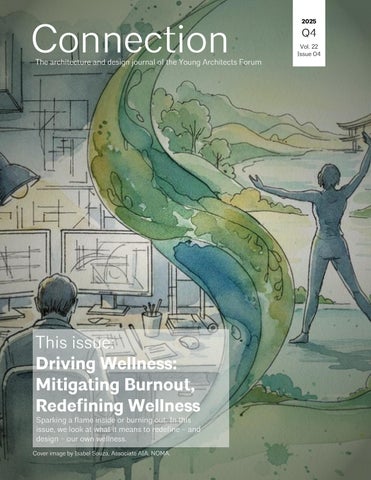
Driving Wellness: Mitigating Burnout,
Redefining Wellness
Sparking a flame inside or burning out. In this issue, we look at what it means to redefine – and design – our own wellness.
Cover image by Isabel Souza, Associate AIA, NOMA.
2025 Young Architects Forum Advisory Committee
2025 Chair
2025 Vice Chair
2025 Past Chair
2025-2026 Advocacy Director
2025-2026 Communications Director
2024-2025 Community Director
2025-2026 Knowledge Director
2024-2025 Strategic Vision Director
2025 AIA Strategic Council Representative
2025 College of Fellows Representative
2025 Council of Architectural Component Executives Liaison
Sarah Woynicz, AIA
Kiara Gilmore, AIA
Jason Takeuchi, AIA
Tanya Kataria, AIA
Nicole Becker, AIA
Seth Duke, AIA
Arlenne Gil, AIA
Carrie Parker, AIA
Patty Boyle, AIA
Bill Hercules, FAIA
Jillian Tipton, AIA AIA Staff Liaison
Kathleen McCormick
2025 Young Architect Representatives
Alabama, Ashley Askew, AIA Alaska, Zane Jones, AIA Arizona, Andrea Hardy, AIA Arkansas, Lauren Miller, AIA California, Magdalini Vraila, AIA Colorado, Kaylyn Kirby, AIA
Connecticut, Andrew Gorzkowski, AIA
Delaware, Jack Whalen, AIA
Florida, Bryce Bounds, AIA
Georgia, Laura Sherman, AIA
Hawaii, Krithika Penedo, AIA
Idaho, Katie Bennett, AIA Illinois, Raquel Guzman Geara, AIA Indiana, Matt Jennings, AIA Iowa, Ben Hansen, AIA Kansas, Garric Baker, AIA Kentucky, George Donkor, AIA Louisiana, Calvin Gallion, III, AIA Maine, Sarah Kayser, AIA Maryland, Joe Taylor, AIA Massachusetts, Darguin Fortuna, AIA Michigan, Trent Schmitz, AIA Minnesota, Constance Chen, AIA Mississippi, Robert Farr, AIA Missouri, Chelsea Davison, AIA
Montana, Elizabeth Zachman, AIA Nebraska, Angel Coleman, AIA
Nevada, Daniela Moral, AIA
New Hampshire, Courtney Carrier, AIA
New Jersey, Abby Benjamin, AIA
New Mexico, Diana Duran, AIA
New York, Mi Zhang, AIA
North Carolina, Colin McCarville, AIA
North Dakota, Brady Laurin, AIA
Ohio, Alex Oetzel, AIA
Oklahoma, Brian Letzig, AIA
Oregon, Elizabeth Lagarde, AIA
Pennsylvania, Mel Ngami, AIA
Rhode Island, Taylor Hughes, AIA
South Carolina, Ryan Lewis, AIA
South Dakota, Liz Brown, AIA
Tennessee, Sara Page, AIA
Texas, Kyle Kenerley, AIA
Utah, Zahra Hassanipour, AIA
Vermont, Devin Bushey, AIA
Virginia, Erin Agdinaoay, AIA
Washington, Rio Namiki, AIA
West Virginia, Joey Kutz, AIA
Wisconsin, Justin Marquis, AIA
Wyoming, Kendra Shirley, AIA
Washington, D.C., Kumi Wickramanayaka, AIA
Puerto Rico, Reily J. Calderón Rivera, AIA
AIA International, Jason Holland, AIA

Connection is the official quarterly publication of the Young Architects Forum of AIA.
This publication is created through the volunteer efforts of dedicated Young Architect Forum members and made possible through generous grant funding from the College of Fellows.
Copyright 2025 by The American Insititute of Architects. All rights reserved
Views expressed in this publication are solely those of the authors and not those of The American Institute of Architects. Copyright © of individual articles belongs to the author. All images permissions are obtained by or copyright of the author.
05 Rewriting the Rules: Editor’s Note
Nicole Becker, AIA
06 Chair’s Message
Sara Woynicz, AIA
07 Breathe In: Burn Out
Arti Verma, AIA
08 The Art of Suffering
Nicole Becker, AIA
12 The Unapologetic Productivity System
Abigail Benjamin, AIA
14 Redefining Productivity Through Wellness
Isabel Souza, Assoc. AIA
16 From Moments to Movements
Gabriella Bermea, AIA
19 Colleague to Colleague (C2C) Mentorship Program
Vince Avallone, AIA
20 How Do We Grow New Architects
Shannon Christensen, FAIA
23 Designing Balance Between Work, Service, and Self
Saakshi Terway, Assoc. AIA
26 Motherhood as a Catalyst for Redefining Care and Wellness in Architecture
Danielle McCormick, Assoc. AIA
29 The Future of Human Mobility
Manuel Granja, AIA
31 Women’s Leadership Summit 2025 Arti Verma, AIA
34 Beyond the Stamp Devora Schwartz, AIA
36 Taking Care of Business Aerianne Gil, AIA
39 Critical Aspects
Rocky Hanish, AIA
41 The Hidden Infrastructure of Practice
Alya Staber, WELL AP, Silvia Colpani, Assoc. AIA
43 Breaking the Silence Contributed by our readers
45 The ArchiTEXT Book Club: Eating Salad Drunk Review by Justin Marquis
46 Connect & Chill AIA YAF Knowledge Focus Group
Editorial team
Nicole Becker, AIA, NCARB, LEED AP BD+C Editor in chief

Nicole is an Associate and Project Architect at ZGF Architects in Portland, Oregon specializing in Healthcare. She is the 2025 Communications Director of the AIA Young Architects Forum.
Bryce W. Bounds, AIA, NCARB, CGC Senior editor

Bryce is a Miami native, a Construction Project Management Supervisor in the Public Works department of Broward County, and Florida’s YAR. He attended Design and Architecture Senior High School (DASH) in Miami-Dade and graduated from the Rhode Island School of Design (RISD) with bachelors in both Architecture and Fine Art.
Constance Chen, AIA, NCARB Senior editor

Constance is a Minnesota native and a principal at Locus Architecture in Minneapolis. A University of Notre Dame graduate, her design approach intends to make meaningful connections between people and spaces. She serves as Minnesota’s YAR.
Andrew Gorzkowski, AIA, NCARB Senior editor

Andrew is a Senior Associate at Pickard Chilton in New Haven, Connecticut, where he works in design and project management roles on a variety of large-scale commercial projects. Passionate about advocating for a sustainable future for the profession, he serves as the Connecticut YAR and co-chair’s his local AIA Committee on the Environment. He received his degree at Cornell University, where he was a Meinig Family Cornell National Scholar.
Andrea E. Hardy, AIA, EDAC, NOMA, NCARB Senior editor

Andrea is a Senior Architect at Shepley Bulfinch, where she supports healthcare projects out of their Phoenix Office as a Project Manager. She is Arizona’s YAR, and is passionate about community involvement whether through work, AIA, or locally in the City of Phoenix. She has degrees from Wentworth Institute of Technology and ASU.
Kyle Kenerley, AIA Senior editor

Kyle is an Associate at Modus Architecture based in Dallas, Texas where he works on healthcare and workplace projects as the project manager and technical design lead. He is currently the YAR for Texas where he also serves on the board for the Texas Society of Architects. Kyle’s service with his local and state AIA chapter has primarily been focused on mentoring young architects and education outreach.
Justin Marquis, AIA, NCARB Senior editor

Justin is a Project Architect with Somerville Architects & Engineers in Green Bay, Wisconsin. Managing projects through all phases of development from conceptual design to construction administration, he currently supports the healthcare and educational studios at Somerville. He has a degree from the University of Wisconsin - Milwaukee and lives in the Fox Valley area with his family. Justin is the Wisconsin Young Architect Representative..
Garric Baker, AIA, NCARB Senior graphic designer

Baker is a graduate of the College of Architecture, Planning & Design at Kansas State University and excels in leadership positions with state and regional Chambers of Commerce, Young Professionals, the Kansas Barn Alliance, local and state Wide AIA Kansas Board of Directors, and Regional Economic Development activites.
Katie Bennett, AIA, NCARB Senior graphic designer

Katie is a project manager at Babcock Design in Salt Lake City, Utah and Boise, Idaho, and oversees projects during their inception phase through schematic design. She is the current YAR for the state of Idaho and is passionate about housing and sustainable design.
Calvin Gallion, III, AIA, NOMA, NCARB, LEED GA Senior graphic designer

Calvin is an architect and principal at studio^RISE in New Orleans. A Tulane graduate and Natchitoches native, he is a passionate advocate for community and rehabilitation projects. He serves as EDI Chair for AIA New Orleans and as Louisiana’s YAR.
Kendra Shirley, AIA, NCARB Senior graphic designer

Kendra is a project architect at Arete Design Group in Wyoming and Colorado and is Wyoming’s YAR. As a graduate from one of the top undergraduate architecture programs in the country, Kendra’s training and experience provides her with a unique and innovative perspective for creating extraordinary experiences and designs.
Rewriting the Rules
Editor’s Note
This issue is one that feels deeply personal. Like many in our profession, I’ve faced burnout, the kind that quietly builds until the work you once loved feels heavy. Working long hours was worn as a badge of honor, a symbol of passion and commitment. But somewhere along the way, exhaustion became mistaken for excellence. I’ve learned that wellness isn’t about perfection or balance that never falters, it’s about learning to pause, creating room to breathe, aligning our goals with our values, and then returning to our work recharged and grounded in purpose.
In this final issue of the year, we explore wellness not as a trend, but as a practice. We dig into what burnout really means beyond being a buzzword. We ask: what does it mean to truly sustain ourselves and our profession? Through reflections on Designing Balance Between Work-Service-and Self, Motherhood as a Catalyst for Redefining Care and Wellness in Architecture, and Redefining Productivity Through Wellness, this issue invites us to look beyond productivity and toward wholeness.
We also examine wellness through the lens of design and business. From Critical Aspects: Experiencing Mental Health, The Future of Human Mobility, and Breaking the Silence: What we Don’t Say Outloud on Burnout, our contributors unpack how systems, firm culture, and urban design can either sustain or strain us.
Articles like Breathe In: Burn Out, The Unapologetic Productivity System, and The Art of Suffering: Lessons from The Summit to the Studio remind us that care starts with setting boundaries and redefining what “enough” looks like.
This issue also celebrates forward movement: Women’s Leadership Summit reflections, the Future Forward Grant recipients research on motherhood and practice, and the Taking Care of Business’s holistic look at shaping successful practice management, all showcase leadership rooted in humanity. Together, these stories reveal that driving wellness isn’t a solo pursuit, it’s a collective recalibration of how we lead, mentor, and design.
As we close the year, may these stories serve as reminders to rest, to reflect, and to reconnect with the parts of this work that first inspired you and to eliminate what is leaving you without passion. The future of our profession depends not just on innovation or efficiency, but on our capacity to stay well enough to imagine what’s next.
In pursuit of wellness, Nicole Becker
Editor in chief / Connection
Take a deep breath.

Nicole Becker, AIA NCARB, LEED AP BD+C
All nighters are not a badge of honor or pride
Chair’s message: Committed to Designing Wellness
Architecture is a practice, not a profession. Wellness is a discipline, not a destination.
As we close out this year, I find myself holding two truths: this has been a really long year - and a deeply fulfilling one. A year of growth, challenge, inspiration, and,if we’re being honest,a year, like many others, that has left many simply tired. More and more when asking, “How are you?” the collective answer seems to be a familiar sigh of “hanging in there.” This is especially felt among mid-career professionals, many of whom sit squarely in the “sandwich” of the profession. We’re leading projects, managing client relationships, guiding teams, mentoring emerging designers, and simultaneously reaching upward toward leadership. It’s no surprise that the proverbial jelly is squeezing out.
The World Health Organization defines burnout specifically within the context of the workplace1. However, we know burnout arrives long before stepping into the office and lingers long after the workday ends. Many factors - life, culture, society, finance, family, demographics, and more - are the many pieces of this collective puzzle. So when talking about burnout and wellness, the question becomes: How do we build not only psychologically safe environments to talk about these realities, but also shift and shape policies and practices that honor them? How do we redefine the practice of architecture so that it mirrors the discipline of wellness we so often talk about and implement in the built environment, but don’t often enough recognize the impact to those behind the work?
Architecture is a practice, not just a profession.
Wellness is a discipline, not a destination. And to say it bluntly, the all-nighter is not a badge of honor.
my personal and professional wellness. I’m grateful for the hybrid workplace policies that create space and flexibility. For colleagues who offer empathy, patience, and compassion. For the open conversations that replaced “just pushing through” with “how can we support you?”
These changes and the articles you will read, are anything but small. They are honest. They are vulnerable. They are tangible. And they represent something powerful: a profession in motion. A needle moving. A culture shifting. A present practice shaping the future.
As a priority and focus to not just end the year, but be carried through and into the next, the Young Architects Forum is committed to designing wellness as thoughtfully and carefully as we design the built environment. Together, we can redefine the future of architecture; not just through our buildings and those continually engaging in the places and spaces architects design, but through the health and well-being of those who create them. For all who have joined us this year, thank you for showing up. Not just for the profession, but for yourselves, for each other, and for the future we are building together.
Though each of us defines our own boundaries, we also know that wellness in practice does not end with the individual. Our profession must shift—culturally, structurally, and collectively—if we truly want to drive wellness.
As I reflect on the year, this publication, and the stories you will read, I also reflect on my own journey—one of understanding the impacts of chronic burnout while slowly, intentionally reclaiming
With gratitude, Sarah

Sarah Woynicz, AIA
Breathe In: Burn Out
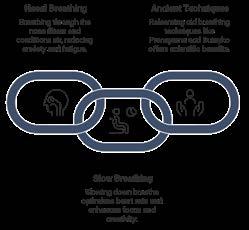
He highlights that mindful breathing during moments of high tension can help us gain composure and clarity.
Key takeaways from his book that we can incorporate in our lifestyle include:
• Breathe through your nose — not your mouth.
• Mouth breathing can contribute to anxiety and fatigue
• Nasal breathing filters, humidifiers and conditions air that improves oxygen circulation that in turn lowers blood pressure and stress
• Slow down your breathing — aim for about 5–6 breaths per minute.
• The “perfect breath” is 5.5 seconds in, 5.5 seconds out
• This optimizes your heart rate and increases focus and creativity
• Relearn old breathing techniques — they’re scientifically sound.

Stress is often seen as an integrated aspect in the field of architecture, embedded in every phase. Tight deadlines, complex coordination, time crunch, pressure to create something innovative and the relentless pursuit of perfection can cause slow and detrimental burn out. And due to our busy schedules, we need something quick and efficient, something that is easily accessible yet powerful that we can integrate effortlessly to contribute to our wellness.
Breath is a beautiful tool that sits at the intersection of an involuntary and voluntary activity. While we do not have to constantly remind ourselves to breathe in order to stay alive, we have the option to control the way we breathe. This aspect makes breath a unique tool that we rely on although we use it every moment, often without noticing.
In the book Breath: The New Science of a Lost Art¹, the author James Nestor reveals that most of us have forgotten how to breathe properly. We have taken breathing for granted which has led us to default to unconscious shallow breathing or mouth breathing. He mentions that this has resulted in the distortion of natural respiratory rhythms and causes us to be in a state of low grade stress that drains focus, energy and creativity.
• Techniques from India - Pranayama, Russia - Buteyko and Tibet - Tummo are great examples of the benefits of breathwork
• These techniques have now been scientifically validated through various research studies such as Yale’s Study on Breath and Mental Health²
Additionally, there are many tools surrounding breathwork that are available that we can learn to incorporate in our daily lives such as podcasts, books, breathwork workshops, videos, etc. Incorporating short breathing shifts in your day can provide you the much needed quick reset, similar to a boost of caffeine!
Breathing doesn’t require extra time or tools - only a gentle awareness is enough. It is like paying attention to detail, something that enhances our daily life, just like details enhance our designs, and luckily we already are trained to do that as a part of our profession.
Footnotes
1. Breath: The New Science of a Lost Art, by James Nestor 2. Yale News, published July 2020

Arti Verma, AIA, NCARB, LEED AP BD+C, ALA
Verma is a Project Manager at Dynamik Design in Atlanta, GA. Verma is a licensed Architect and is also a certified breathwork and meditation instructor.
Above: Breathwork Tips by Napkin
The Art of Suffering: Lessons from the Summit

Mountaineering is the art of suffering. The sooner you decide you like it, the better you’ll be at it.
– Voytek Kurtyka
To most, mountaineering and architecture seem worlds apart. One involves ice axes¹ and crampons²; the other, Revit files and red pens. But in a strange way, the mountains have become my best teacher and my sanity saver in the profession of architecture. Not because they don’t test me, but rather because they do. Learning to embrace suffering isn’t just for the mountains; it’s essential in life and in the creative process of architecture.
What is Suffering?
There are no shortcuts to the top of the mountain or to good architecture. What gets you there is commitment, process, and the ability to endure and transform. Suffering in the mountain context: food poisoning at 15k feet, frozen eyelashes, bone chillingly cold bivouacs3, and terrifying exposure.4 But, architects know their own version all too well: endless iterations, design competitions that go nowhere, and being underestimated in rooms where you should have a voice.
Different gear. Same language.
And somehow, we keep coming back for more. Because through adversity we are shaped.
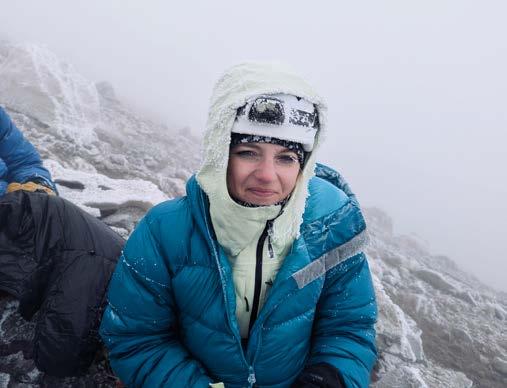
Pequeno Alpamayo, Bolivia, 17,799’. Photo Credit: Nicole Becker
The Mindset Shift
Every climber has the, “What the hell am I doing here?” moment. The doubt and the discomfort seep in and you wonder if you belong. You wonder if you should quit. I have felt it both on alpine ridgelines and in the office at 2 a.m.. Climbers embrace suffering because it transforms them; architects avoid burnout because it depletes them.
Here’s the critical distinction: suffering and burnout may look alike: exhaustion, frustration, doubt - but they are not the same. Suffering is temporary, purposeful, and sometimes chosen. It sharpens us.
Burnout is chronic, draining, and imposed. It strips away meaning.
The goal isn’t to avoid hard things, it’s to learn which kinds of struggle build you and which break you. There’s an art to that, and both mountaineering and architecture require it. It’s in the alpine starts5 and the harsh critiques, the taped-up blisters and the battle-tested models.
The difference lies in intention: one builds resilience, the other erodes it.
Avoiding Burnout Matters
Architecture is a profession that too often confuses burnout with commitment. We call it a “labor of love”, and we wear exhaustion like a summit flag. But that mindset is not only unsustainable, it’s dangerous.
In mountaineering, ignoring fatigue gets you benighted6, frostbitten, or worse. You learn to respect your limits, listen to your body, and turn back when needed. Not because you’re weak, but because you want to come back stronger. In architecture, we need the same wisdom. When we romanticize overwork, we lose people. We lose talent, creativity, diversity, and perspective. We burn out the very voices we need most, often the ones still fighting just to get on the rope team7
The profession suffers when we define success as summits at any cost. Avoiding burnout isn’t just about surviving, it’s about working smarter, climbing as a team, and creating space for everyone to breathe - because no one gets to the top alone.
Frozen eyelashes on Mt. Hood, Oregon, 11,249’. Photo Credit: Nicole Becker
Wellness Is Not the Absence of Struggle
Burnout doesn’t just come from long hours, it’s caused by a lack of meaning. If everything feels like drudgery with no payoff, no ownership, or joy, of course you’ll crash.
But when struggle challenges and humbles you, it builds you. Climbers call this “Type 2 fun”- misery that turns into joy in hindsight. The retrospective “I’d do that again” kind of suffering. The kind that makes us stronger, sharper, and more grounded. The healthiest people I know, climbers and creatives alike, don’t avoid stress, they embrace it on their own terms and in ways that align with their values. That’s not burnout. That’s resilience.
Redefining Wellness
Wellness in architecture doesn’t mean yoga at lunch or free snacks in the office (although as a dirtbag climber8, I won’t say no to free food). It means having something outside the profession that lights you up, challenges you in new ways, and allows you to return to your work feeling restored. Something that reminds you that your worth isn’t measured by design awards or billable hours.
For me, that’s mountaineering. For you, it might be music, volunteering, writing, teaching, or activism. The point is: we need
more than architecture. If our entire identity is wrapped up in one thing, we have no perspective when it breaks us.
Wellness is having an impact. Having interests. Having balance. A balance that is dynamic and intentional and leaves room for you to be a human, not just a productive designer.
The Art of Suffering
There’s a strange euphoria in surviving misery. Everything feels earned. Whether it’s watching sunrise from a summit or seeing your design realized in the real world. It’s a joy that only makes sense after the pain.
The suffering becomes the story. It isn’t a side effect; it is the process. Architects and mountaineers are wired to want hard problems. These challenges rewire our threshold for resilience that keeps us coming back for more. Once you’ve stood on a precarious slope, a tough client meeting doesn’t shake you. Every climb, every project, every risk teaches us who we are.
But here’s the reminder: suffering and burnout are not the same. Suffering is temporary, and transformative; it gives back more than it takes. Burnout is imposed, and depleting; it takes until nothing is left. One builds resilience. The other destroys it. It’s
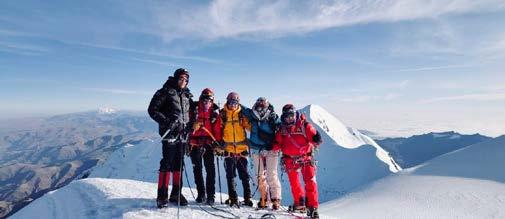

Kautz Glacier, Mt. Rainier, Washington, 14,411’. Photo Credit: Nicole Becker
Illimani, Bolivia, 21,122’. Photo Credit: Nicole Becker
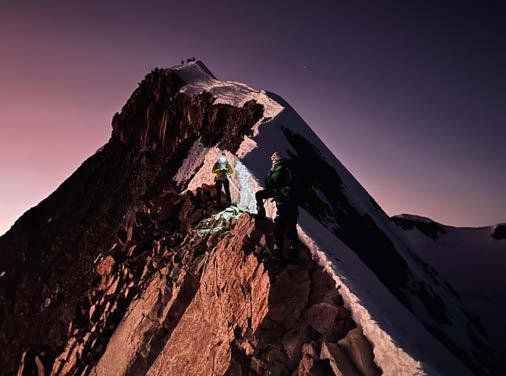
Ouray, Colorado, 7,792’. Photo Credit: Nicole Becker
crucial to recognize the difference.
Suffering becomes an art form on the path to building resilience. A practiced elegance in pain. A way of thinking that says: “This is hard. And that’s okay.” Whether it’s a crevasse9 or a critique, true artistry lies in transforming the pain into purpose, so long as that pain is building you and not breaking you.
The sooner we choose to embrace suffering, the sooner we can grow. The sooner we stop just surviving, the sooner we can start crafting something worthy; in the mountains, in architecture, and in life.
Footnotes:
1. “Ice axes” are tools for climbing on ice or steep snow, also for self-arresting (stopping oneself) during a fall.
2. “Crampons” are spiked devices attached to boots to provide traction on snow and ice.
3. “Bivouac” is a temporary, often minimalist overnight camp, usually without a tent, often in high alpine conditions.
4. “Exposure” is a situation on a climb where a fall would be long and dangerous; often deadly and can be described as
feeling very “open” or unprotected.
5. “Alpine start” refers to beginning a climb very early in the morning, typically between midnight and 4:00 a.m., to avoid dangerous afternoon conditions by climbing during the coolest part of the day.
6. “Benighted” refers to getting stuck on a mountain overnight, unintentionally, often due to poor planning or fatigue.
7. “Rope Team” is a group of climbers connected by rope for safety, often in glacier or alpine environments. Implies teamwork and mutual risk.
8. “Dirtbag climber” is a term of endearment in climbing culture referring to someone who devotes a lot of their life to climbing.
9. “Crevasse” is a deep crack or fracture in a glacier caused by movement of the ice.
Nicole Becker, AIA NCARB, LEED AP BD+C
Nicole Becker, AIA, NCARB, LEED AP BD+C is a Mountaineer, Associate, and Project Architect at ZGF Architects in Portland, Oregon, and the 2025-2026 Communications Director of the Young Architects Forum.
Huayna Potosi, Bolivia, 19,947’. Photo Credit: Nicole Becker
The Unapologetic Productivity System
How I Found 1,500 Extra Hours to Achieve My #1 Goal
What if I told you that you could find an extra 1,500 hours to achieve your number one goal in the next year?
That’s the equivalent of 62.5 days straight — two full months of time — on top of working a full-time job, maintaining relationships, and keeping your life in order. Sounds impossible, right?
Well… over the course of 1 year, 1 month, and 1 day, I found over 1,500 hours to devote exclusively to studying for the Architect Registration Examination (ARE). In that time, I passed all six divisions and earned my architecture license.
Looking back, even I was shocked by the numbers. But the truth is — it wasn’t magic. I developed a system for evaluating opportunities and making deliberate choices that aligned with my goals. I call it the Unapologetic Productivity System
It’s a way of finding the time you don’t think you have to say “yes” to your goals — by learning to unapologetically say “no” to everything that doesn’t serve them.
How It Started: Tracking Everything
You might be wondering how I know these statistics so precisely.
It’s because I tracked them. Neurotically.
At the beginning of 2018, I decided I was serious about passing the ARE. But life wasn’t slowing down to make it easy. I was working full-time, managing deadlines, client meetings, and travel. My mom had just had surgery, and I was helping her get to physical therapy and doctor’s appointments — all while trying to eat, sleep, and stay sane.
Something had to change.
I needed to get intentional with my schedule, so I started tracking where every hour of my time was going. I shared my schedule with my family to stay accountable, and together we found pockets of time that could be repurposed for studying.
Then, I joined a study bootcamp where we took time tracking to the next level. We logged our study minutes in a shared Excel file, visible to everyone. It became a friendly competition — no
one wanted to be last or called out by the instructor, Michael. That system forced me to get brutally honest about how I spent my time.
And, that’s how I know exactly where those 1,500 hours came from.
The Mindset Shift: From Productive to Unapologetic
Looking back on what worked, I realized that this wasn’t just a productivity system — it was an Unapologetic one.
Because at its core was a simple but powerful habit: a series of questions I asked myself every time an invitation, opportunity, or distraction came my way.
Here’s how it worked:
1. Do I actually want to spend my time on this?
Independent of others’ opinions — is this something I truly want?
• Personal example: When invitations came for distant family events (you know, the third cousin’s BBQ two hours away), I learned to say, “Sorry, not this time.”
• At work example: I paused on taking new roles or responsibilities that would compete with my study schedule. I didn’t need to “advance” in every direction at once.
2. Does this opportunity support my goal — directly or indirectly?
If yes, great. If not, it’s probably a “no.”
• Direct support: Study groups, architecture podcasts, or practice exams.
...be intentional. Every “yes” has a cost - and every “no” creates speace for something that matters.
• Indirect support: Self-care and accountability. For instance, having dinner with friends who respected my study schedule was a “yes.” Going out for late-night drinks with coworkers who didn’t — “nope.”
I’m not saying you should never hang out with coworkers or go to happy hour. But be intentional. Every “yes” has a cost — and every “no” creates space for something that matters.
3. What is the time commitment?
Even a worthwhile opportunity can be too heavy a lift at the wrong time.
• When I was asked to volunteer as an AIA New Jersey Licensing Advisor, the timing overlapped with my final exam. I evaluated it carefully — I was already helping coworkers navigate AXP and licensure questions, and the role only required one committee call a month.
• Worth the time investment. Saying yes to this role has opened doors to additional opportunities over the last 6 years within AIA NJ, the local sections and now on the national level, which otherwise may not have come around. When looking back at the big picture, there was only a 2 month overlap in my studying and service which has turned into a 7 year and going volunteer endeavor.
• Now, I’m proud to say I’m serving my seventh year as Licensing Advisor, have served one term as AIA NJ Treasurer and am in my third year as AIA NJ Young Architect Representative with the Young Architects Forum (YAF).
4. If I say no now, will this opportunity come again?
Some things are once-in-a-lifetime. Most aren’t.
When I got invited to a friend’s wedding across the country during my final testing window, I realized the event itself was nonnegotiable — but how I showed up was flexible. I studied on the plane, reviewed flashcards in the hotel, and stayed mobile with my materials. I showed up for the people I cared about without abandoning my goals.
What You Can Learn From This
The Unapologetic Productivity System isn’t about being rigid or robotic. It’s about being intentional
It’s about realizing that every “no” is really a “yes” to something more important.
Over the course of 13 months, I didn’t just find 1,500 hours — I reclaimed them from distractions, overcommitments, and obligations that didn’t serve my purpose.
So, if you’re staring down a big goal — whether it’s passing the ARE, earning a promotion, or starting something new — start by asking yourself:
“What can I say no to, so I can finally say yes to what matters most?”
That’s the essence of being unapologetically productive.

Abigail Benjamin, AIA, NCARB, CNU-A Benjamin is an Associate Vice President and New Jersey commercial studio leader at AECOM, licensing advisor at AIA New Jersey and the Young Architect Representative for AIA New Jesery.
Redefining Productivity Through Wellness
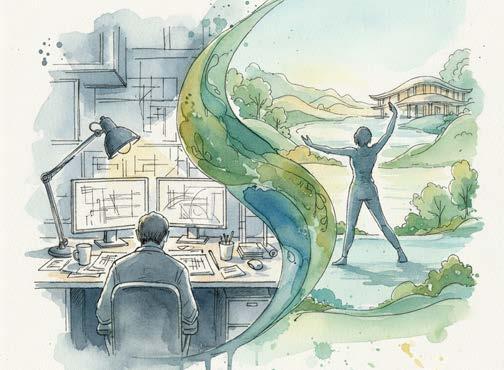
Above: Wellness and work in sync — where creativity and performance thrive together. (Graphic created by the author)
In the architecture profession, demanding deadlines, client expectations, and project goals often drive us to stay glued to our desks for long hours. Many professionals push through the day without taking breaks, convinced that constant effort equals productivity. But our bodies weren’t designed to sit all day and neither were our minds. To truly perform well and deliver great work, we need to find balance, or better yet, harmony, the space where wellness and performance meet.
Research shows that rest, movement, and intentional downtime don’t slow us down, but instead make us sharper, more creative, and more capable over time (Greater Good Science Center, 2024)¹. For architects, whose work demands both technical precision and creative vision, redefining productivity through wellness isn’t a luxury—it’s essential for sustainable success.
Research shows that rest, movement, and intentional downtime don’t slow us down, but instead make us sharper, more creative and more capable over time...
What the Research Says
1. Rest Fuels Creativity
Rest isn’t wasted time; it’s part of the creative process. A Stanford study found that people who walked produced twice as many creative ideas as those who remained seated (Oppezzo & Schwartz, 2014)². Even a brief nap can enhance problem-solving; dipping into the first stage of sleep can triple creative insight (Lo et al., 2023)³.
In practice, this means giving yourself permission to pause—take a short walk, stretch, or step away from the screen. That “lost” time often leads to better and faster design thinking when you return.
2. The Power of Downtime
In a profession that prizes constant focus, true rest can feel uncomfortable. Yet research shows that daydreaming and mental breaks allow our brains to form new connections (Rominger, Fink, & Weiss, 2024)⁴. Psychologists call this the incubation effect. When you stop thinking about a problem, your subconscious keeps working on it (Wilson, 2024)⁵. This is why ideas often strike in the shower or during your commute.
3. Movement and Hydration Boost Focus
Staying hydrated, moving around, and stretching throughout the day play a huge role in our performance and health. Movement isn’t just for fitness—it’s a creative and mental reset. Short walks, stretch breaks, or even walking meetings can restore focus and energy (Van der Zee, 2024)⁶. Microbreaks also help reduce fatigue and sustain attention throughout the day (Greater Good Science Center, 2024)¹.
4. Boundaries Prevent Burnout
Constantly saying “yes” can lead to exhaustion. Burnout often happens when boundaries blur and we feel we must always be “on.” Executive coach Molly Wilding (2025)⁷ suggests doing a “resentment audit”, or paying attention to moments of frustration or fatigue, which often signal where limits need to be reset. Setting boundaries protects your creativity and long-term motivation.
Conclusion
Redefining productivity through wellness means shifting our work attitude from constant output to sustainable creativity. Staying hydrated, moving, stretching, resting, and getting enough sleep are small actions that make a big difference. When we take care of our bodies and minds, we bring our best selves to the drawing board.
For architects and designers, wellness is not separate from good design—it fuels it. By prioritizing balance, we don’t just create better work; we create better lives.
Practical Strategies
Strategy
Why It Helps
Scheduled Rest Breaks Keeps energy and focus steady throught the day
Power Naps & Good Sleep Boosts creativity, memory, and problem-solving
Walking, Stretching, & Hydration Improves mood, focus, and overall health
Mindful Rests & Idleness Encourages fresh ideas and mental clarity
Clear Boundaries Reduces burnout and maintains motivation
Supportive Firm Culture Promotes lasting wellness across teams
Resources
1. Greater Good Science Center. (2024). The Science of Rest and Renewal.
2. Oppezzo, M., & Schwartz, D. L. (2014). Give your ideas some legs: The positive effect of walking on creative thinking. Stanford University.
3. Lo, J. C., et al. (2023). Napping and Creative Insight. Nature Scientific Reports.
4. Rominger, C., Fink, A., & Weiss, E. M. (2024). MindWandering and Creativity. Psychology of Aesthetics, Creativity, and the Arts.
5. Wilson, T. (2024). The Incubation Effect and Creative Problem Solving. Journal of Applied Psychology.
6. Van der Zee, E. (2024). The Connection Between Movement and Creativity. European Journal of Behavioral Science.
7. Wilding, M. (2025). The Resentment Audit: Reclaiming Energy and Focus. Harvard Business Review.

Isabel Souza, Assoc. AIA, NOMA
Isabel is a design professional with 10+ years in the AEC industry, working at PMBA Architects in Ohio. She’s pursuing licensure and is committed to creating innovative and impactful design solutions.
From Moments to Movements
Four architects on the sparks that shaped their call to lead, and the movements they’re building now.
Architecture is often seen as a profession of permanence - concrete, steel, and glass. But for many designers, the foundation is built far earlier: in classrooms where their names were mispronounced, among neighborhoods no one cared to map, or within family histories etched in resilience.
In this feature, four architects reflect on the moments that lit the fuse: Brien, Shadia, Richie, and Samantha. Before the board appointments and keynote stages, and before the awards and the advocacy, there were pivotal memories that sparked something deeper. This is where their movements began.
This is how their sparks ignited.
Architecture Should Always Be About the People Brien Graham, AIA, NOMA, NCARB
“The combination of architecture and advocacy has been a culmination of pivotal moments throughout my career,” says Brien Graham. But two memories stand out.
The first: being a young boy, living in a neighborhood where voices weren’t invited, only impacted. “[I realized] the lack of residents’ input in my neighborhood to voice concerns or desires about the spaces we wanted to inhabit.”
The second: realizing the immense power of architecture to shape people’s daily lives.
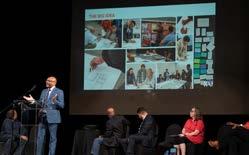
That contrast, between disempowerment and potential, sparked something that would define Brien’s path forward. Growing up in public housing, he recalls the coldness not just in concrete walls and tile floors, but in the environment itself. “It didn’t exude joy,” he says. “It fostered symptoms of hopelessness.” That’s when he began to understand the power of place.
And it’s what anchors his work today, as the Civic, Municipal, and Cultural Market Leader for KAI Design, as Texas’ representative on the AIA Strategic Council, and as the South Region VP for the National Organization of Minority Architects. Every project is guided by one clear belief: Architecture should always be of, for, and about the people.
Architecture should always be of, for, and about the people.
“I’ve made it my personal mission to use joy as a motivator and hope as an aspiration,” he says. “To provide spaces where people can enjoy, grow, thrive and spark the next changemaker.” Because the truth is, design doesn’t reflect value, it sets it. And Brien’s work makes it clear: communities deserve to be at the center of the process. Not afterthoughts. Not outsiders. Authors.
It’s Not Just About the Building Shadia Jaramillo AIA, WELL AP
The lesson was deceptively simple. “If an architect designs even one stair rise at a different height, it could affect someone physically for life.” It’s a line Shadia Jaramillo, AIA, WELL AP, will never forget, spoken by a professor in a prospective class
Above: Brien Graham presenting at a convention.
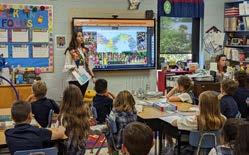
Above: Shadia Jaramillo in a classroom.
back in Panama. This lesson was beyond technical instruction. It was the first moment she truly understood the weight of the architect’s responsibility, that design decisions ripple far beyond the drawing set.
“That moment defined my purpose,” she reflects. “That lesson revealed how deeply our decisions shape human experience.” For Shadia, architecture is not simply about completing buildings. It’s about crafting experiences, and ensuring that clients, users, and communities feel acknowledged, supported, and connected. That awareness has been the foundation of her leadership ever since.
Today, Shadia is based in Pensacola, Florida, with a diverse portfolio spanning residential, commercial, healthcare, higher ed, and civic design. But just as powerful as her built work is her commitment to the people behind it: empowering professionals, mentoring emerging leaders, and serving as a passionate advocate for volunteer leadership.
“The value of our work extends far beyond what we can fully grasp,” she says. “my purpose has centered on more than tangible outcomes; it’s about the people behind them and the awareness that every choice I make carries the power to influence and impact someone’s life.” That, for Shadia, is what gives architecture meaning. It’s not just about shaping space, it’s about shaping meaning across generations.
It’s not just about shaping space, it’s about shaping meaning across generations.
Mentorship Was the Door That Opened Everything
In the early years of Richie Hands’ career, it wasn’t a title or a project that changed everything, it was two people. Jason Pugh and Oz Ortega saw something in him, and more importantly, they made sure he saw it too.
“They didn’t just mentor me,” Richie says. “They looped me
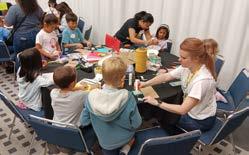
in. Pulled up a chair. Made sure I had a seat at the table—and the confidence to speak up once I was there.” That quiet act of inclusion unlocked something. Because once you’ve felt the impact of being seen, you start to see others differently too. “It helped expand my career,” he says, “but it also helped form the foundation of what I find to be incredibly rewarding and engaging: mentoring the next generation.”
I know how much representation matters. It’s not just about access, it’s about belief.
That calling led him to Project Pipeline and ACE Chicago, where he worked with students who looked like him, came from where he came from, and who might not have otherwise known that architecture was for them. “It afforded me the opportunity to offer advice to students from communities that are still largely underrepresented in the profession,” Richie shares. “I know how much representation matters. It’s not just about access, it’s about belief.”
Now, Richie serves as National Chair of Project Pipeline, shaping programming and outreach for future architects across the country. He’s also a Director on the ACE Chicago Executive Board, and the acting VP of Membership and Secretary for AIA Chicago. The same tables he was once invited into, he’s now building for others.
“These opportunities only happened,” he reflects, “because I was surrounded by exceptional NOMA mentors and heavily involved in those communities.” What started with one door opening has turned into Richie holding space open for hundreds more. And the movement? It’s growing.
Designing Spaces That Shape Belonging Samantha Markham, AIA
“The moment that first sparked my purpose happened during the community opening of a junior high we had fully renovated,” says Samantha Markham. It wasn’t the construction milestones or the polished finishes that stayed with her. It was the people.
Richie Hands, AIA, NOMA, NCARB, LEED AP BD+C
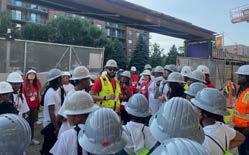
Above: Richie Hands on site with Project Pipeline students.
Above: Samantha Markham at Design Dash 2024.
She remembers standing in the hallway, watching students, parents, and teachers step into their transformed spaces for the first time. “Their reactions shifted from surprise, to pride, to pure joy,” she says. In that instant, Samantha understood that architecture isn’t only about buildings, it’s about daily lives. It’s about crafting environments where people feel seen, supported, and valued.
That realization became the throughline of her work. As the North Texas K–12 Market Leader at Stantec, Samantha leads with that same clarity of purpose, balancing technical expertise with a deep commitment to community. Her leadership extends far beyond the firm: through the ACE Mentor Program, AIA, and A4LE, she’s helped hundreds of students step into their own confidence and potential.
“As my career grew, that same spark pushed me toward mentorship,” she reflects. Investing in high school students, sharing the possibilities of the profession, and helping them find their voice became as essential as any design project. Years later, watching those students enter the industry, mentor others, and give back to their communities, Samantha experienced a full-circle moment that reaffirmed everything she believed. “The impact becomes exponential,” she says, “when we help the next generation realize their potential.”
. . . architecture isn’t only about buildings, it’s about daily lives. It’s about crafting environments where people feel seen, supported, and valued.
These aren’t just stories of architects. They’re stories of sparked purpose turned into lasting impact. Each of these leaders, Brien, Shadia, Richie, Samantha, chose to answer the call not just to build, but to build differently. To shape spaces with empathy. To mentor with intention. To center people in every elevation.
If you’re reading this and feeling a pull, don’t ignore it. Start with your moment. Trace it back. What ignited your passion? What change are you uniquely positioned to lead? Because movements don’t start with titles. They start with you.
Those early experiences moved her from simply practicing architecture to shaping movements around design, equity, and leadership. They taught her that this work extends beyond a single school or program. It’s about building systems, opportunities, and spaces where people can thrive.
“That purpose has guided every step of my journey,” Samantha says, “and it continues to drive the work I hope to elevate across our profession.”

Gabriella Bermea, AIA
Bermea is a senior associate and project manager at Perkins Eastman in Austin, TX, where she speacializes in Pre-k - 12 educational facilities. She is a co-chair of NOMA National’s Elevate Committee.
Colleague to Colleague (C2C) Mentorship Program AIA Academy
of Architecture for Health
Healthcare architecture is the specialized design of spaces like hospitals, clinics, and medical offices to support patient healing and staff efficiency. It focuses on patient-centered design, functional and efficient planning, healing environments and community well-being.
The Colleague 2 Colleague (C2C) Mentorship Program is the mentoring program of the AIA Academy of Architecture for Health. It’s an online program targeting design professionals who are new or early in their careers with an interest in healthcare architecture, planning, and design. It’s a 10-month program from March to December, with presentations and discussions around the topics of healthcare architecture, planning, design, and career development.
The mission is to empower a diverse cross-section of professionals within the health design field through an intentional community fostering growth, networking, and leadership creation.
Commitment
• Two (2) online meetings a month, one (1) hour each.
• Previewing material speakers might send in advance.
• Willingness to join the conversation, participate in group discussions, and be open to networking and connecting within your mentoring Pod and within the larger group online
“All the sessions I participated in thus far have been incredibly enlightening. Not only are the topics well-structured for open discussions, but what I find far more enjoyable is learning through getting this one-on-one experience with all the mentors and mentees”.
- C2C participant
Mentoring Candidate (Mentee) Qualifications
• Students in their final year of a professional or postprofessional degree in architecture.
• Less than 10 years total work experience starting from graduation with a NAAB accredited degree or on an NCARB equivalency path.
• Strong interest in healthcare architecture, planning, and design.
Mentee Candidate Application criteria
• One (1) page letter from your supervisor or faculty lead on firm or school letterhead, recommending you for the program and agreeing to support your commitment for two
(2) hours a month for your participation in this program.
• Half page CV/Resume.
• Half page essay (200-word max) describing your interest in this mentoring program and your willingness to commit to the two (2) meetings per month.
2026 Application Timeline:
• December 1, 2025: Application process opens.
• January 23, 2026: All Applications are due.
• February 2026: Selection. Accepted candidates will receive an email notification and program details.
• March 2026: Program kick-off with schedule of all sessions for the mentoring year.
• December 2026: Final session.
“All the topics were well done and insightful. Keep this program going. I am so happy I was involved in this program!”. - C2C participant
Applications can be submitted through this jotform on the AIA AAH C2C webpage.
If you are interested in knowing more about the AAH Knowledge Community or have questions about C2C, please send an email to Isabella Rosse IsabellaRosse@aia.org and put C2C 2026 in the subject line.

Vince Avallone, AIA, FACHA, CASp, LEED AP is a Vice President and Director of Medical Planning at SmithGroup based in San Francisco. Among his 30+ years in healthcare architecture, Vince has led projects in roles such as principal-in-charge, senior medical planner/programmer, project manager, and project architect.
How Do We Grow New Architects?
Previously Published in COF Quarterly Q3 2025
How Do We Grow New Architects?
“What do you want to be when you grow up?” is a question often answered with well-known and shared professions like teacher, firefighter, policeman, doctor, sports star, and even YouTuber. Less talked about professions, like architecture, design, and engineering aren’t exposed to younger audiences who may very well develop a love and interest for these and other STEM careers early on in their lives.
The Architecture Job Market Gap
In regard to architecture, as of 2025, there were about 116,000 working architects in the United States, according to the National Council of Architecture Registration Boards. There are about 8,500 openings for architects each year and many of those are expected to result from a need to replace workers who exit the workforce, often for reasons such as retirement.
K-12 mentorship programs are critical to reach students at all levels to expose them to architecture and design.
This is to say that architecture is a field that requires constant
pruning, much like a prized plant. To meet the output necessary for architectural positions — which are undeniably essential for urban planning and development, historic preservation, business development and growth, and residential development — there must be a consistent watering, trimming, and propagation of architects to meet the demands of the world.
As we know, becoming an architect often takes years and includes schooling, on-the-job experience, and licensure, which further complicates the job market. Those who may be interested in this creative, strategic, rewarding, and stable profession are required to begin planning accordingly, years in advance, which brings to light the need for early architectural mentorship.
The Importance of K-12 Architectural Mentorship
I decided to be an architect in seventh grade, even though I didn’t know a single architect. If it wasn’t for my seventh-grade shop teacher who assigned us to hand draft stacks of blocks, learning the basics of plan, elevation, and isometric drawings, I might never have known architecture was an option for me. Well, there was also the fact that I loved drawing out a house plan or planning out my bedroom furniture as a kid, but other children may engage in these kinds of activities without understanding that this creative practice could develop into an affinity for architecture.
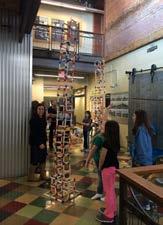
Above: Shannon interacting with a 5th grader during the Amazing Shake at Beartooth Elem. in Billings. MT.
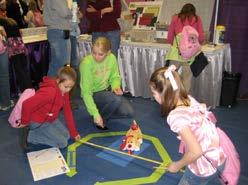
Above: Students learning how to measure and draw a dog house at Cushing Terrell’s interactive booth at Girls in Science hosted at Montana State University Billings.
Luckily, my father knew some architecture students in college and as such was quite encouraging to me in my pursuits. As previously mentioned, children are unable to explore fields they aren’t exposed to. K-12 mentorship programs are critical to reach students at all levels to expose them to architecture and design. This is why I, and Cushing Terrell, participate in educational initiatives and volunteering efforts for schools.
Mentorship Programs for Children and Teens
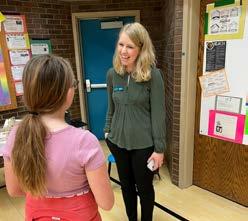
One such program, which is nearing an almost 30-year partnership with Cushing Terrell, is our support of Newman Elementary School. What started as reading fluency support has now expanded to mathematical enrichment and other STEM activities. It’s during these interactions with kids that I make sure to introduce myself as an architect and explain what my job is just in case there’s another little one out there who has never heard of the wonderful world of architecture. You never know who may be sparked by those conversations.
Additionally, programs exist like:
• ACE Mentor Program
• For highschoolers across the country to learn about architecture, engineering, and construction
• NOMA Project Pipeline
• Gives 6th-12th grade students of color the opportunity to learn the fundamentals of architecture and design
• AIA Dallas Designing My Future
• A hands-on program that teaches students ages 6-18 about the world of architecture and design
• AIA New York Summer Programs
• Week-long classes for students in 3rd grade through 12th that are held at the Center for Architecture
If you don’t live near one of these programs, there are still chances for you to get involved. You can reach out to a local school, Girl or Boy Scouts troop, etc. to find out how you can help. AIA has many child-centric resources on “What is an Architect?” as well as specific lesson plans and worksheets for K-5 and grade 6-12 classroom projects that are ready to go for instant architectural engagement.
Mentoring Architecture at the College Level
What’s more, you can connect with local colleges or universities to encourage students to keep up their studies and remind them why they started in the first place. Sometimes, when you’re in the thick of mid-terms, studio deadlines, and finals you need that extra push of encouragement and the spark of desire to reignite your “why” and follow through on your aspirations — and not every student, especially those who are very new to the field, has that built-in support system. Things that have beneficial outcomes can be challenging to keep up with and sometimes, it just takes that one impactful voice to set someone up for success.
It’s during... these interactions with kids that I make sure to introduce myself as an architect and explain what my job is just in case there’s [a child] who has never heard of... architcture
Programs such as the Wing Mentorship from AIA Chicago and AIA Atlanta Student Mentorship Program pair architecture students with working professionals, letting them see
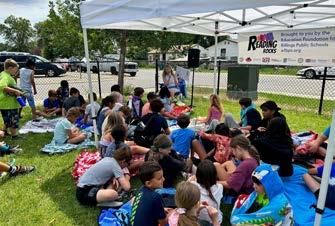
Left: AIA Montana and Montant State University AIAS hosted the Girl Scouts of Montana and Wyoming for a hands-on day learning about architcture. Right: Shannon reads “Iggy Peck, Architect” to students outside of Orchard Elementary during Reading Rocks, the summer reading program of the Education Foundation for Billings Public Schools.
Connection
architecture in practice and can help young people truly envision it as a viable career.
Furthermore, universities may have an advisory council that connects professionals with students. For example, the AIA Montana School of Architecture Advisory Council hosts formal, one-on-one and informal mentorship opportunities. These mentoring sessions may include panel discussions, resume and portfolio workshops, networking events, mock-interviewing, and more.
Becoming a mentor for young architects can be as fulfilling and rewarding as you make it. It may be as simple as providing a firm tour and making yourself available for questions or interviews, or as deep as one-on-one mentoring and becoming a pillar of architectural education to your local K-12 community and beyond.

Christensen is an architect and principal at
where she specializes in commercial architecture, with a focus on the design and construction of financial institutions.
Shannon Christensen, FAIA
Cushing Terrell in Billings, MT,
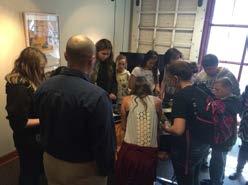
Above: Students at Newman Elementary School during one of Cushing Terrell’s Volunteer days..
Designing Balance Between Work, Service, and Self
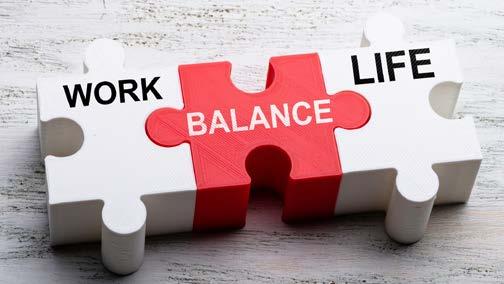
In architecture, “work-life balance” often feels like a myth. Between demanding projects, volunteer roles, and personal commitments, we are constantly negotiating time and energy.
The challenge is not that balance is impossible; it is that our definition of it is too limited. Work-life balance and time management are a never-ending study, one that evolves with every stage of our careers and personal lives.
As architects and designers, we are trained to synthesize complexity into coherence. Yet in our own lives, we often separate work, service, and self into competing priorities. What if wellness is not about dividing time evenly, but aligning choices with values?
The Myth of “Having It All”
Early in my career, I held the belief many young designers share: that passion equals endless endurance. I thought that to
succeed, I needed to excel at work, stay engaged in volunteer leadership, nurture creative interests, and remain emotionally present for family living thousands of miles away. Like many, I thought being busy was proof of commitment.
But “having it all” often translates to “doing it all, all the time.” And the traditional mindset of the profession, “you can do it all if you work hard enough”, reinforces it. Many firms today are adopting healthier practices such as flexible schedules, implementing mental-health initiatives, and hybrid workweeks. The personal rewiring required to break old habits takes far longer than policy changes, though.
...wellness is not the absences of stress; it is the ability to understand which pressures are necessary and which are negotiable.
Above: Created by Saakshi Terway (author) using an AI image generation tool
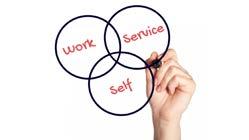
Above:
The pandemic intensified this misalignment. Work seeped into evenings, weekends, and the emotional spaces where rest should have been. I realized that wellness is not the absence of stress; it is the ability to understand which pressures are necessary and which are negotiable.
Navigating Expectations as an Immigrant Woman
For many immigrants, ambition is shaped by sacrifice. We leave home, start over, and internalize the belief that endurance equals worth. Saying no can feel like disappointing not just a colleague but an entire family watching and cheering from afar.
The emotional labor multiplies, navigating two cultural worlds, managing time zones across continents, and constantly proving credibility in spaces where few people share your lived experience.
Over time, I learned that boundaries do not signal a lack of commitment. They signal sustainability. When I began communicating my limits clearly, people respected them. I reclaimed agency over my schedule and well-being.
...boundaries do not signal a lack of commitment. They signal sustainability.
My community strengthened that shift. Connections formed through AIA committees, the Women’s Leadership Summit, the AIA National Associates Committee, and the Immigrant Architects Coalition reminded

Above:
me that shared purpose sustains us when individual capacity wears thin. Mentorship became more than service; it became a wellness practice. It replaced isolation with belonging. Yet the profession still lacks adequate support systems. Nearly 25 percent of architecture graduates in the U.S. are international students¹, but few structured resources exist to guide their cultural, emotional, and professional transitions. If our profession values diversity, it must also value support.
From Balance to Alignment
Success in Architecture is often measured by outputs like projects completed, awards won, and committees joined. But wellness demands a shift in priorities from performance to presence.
The question is not “How do I balance everything?” The question is “How do I align what I do with what matters most?”
Below are the approaches that reshaped my own rhythm.
How do I align what I do with what matters most?
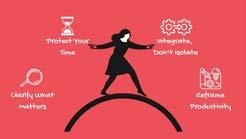
Clarify What Matters
Once a year, I list every role I hold and evaluate whether each one still aligns with my priorities and values. Anything that feels purely transactional deserves reevaluation.
Protect Your Time (and Your Health)
Time is the first boundary of wellbeing. There are seasons of growth, rest, and transition. During project-heavy months, I scale back on volunteer work; when deadlines ease, I re-engage. This rhythm replaces guilt with grace. I also maintain “no-work zones” such as Sunday calls with family, board-game/ movie nights, or writing hours.
Integrate, Do not Isolate
Intersection enriches impact. Rather than treating professional and volunteer worlds as separate, I look for ways to let them inform one another. Many of my closest friends are also colleagues, mentors, or collaborators. Allowing work and service to intersect creates a holistic sense of purpose instead of compartmentalized pressure.
Created by Saakshi Terway (author)
“Doing It All” created by Saakshi Terway (author)
Above: Created by Saakshi Terway (author)
Reframe Productivity
In design, we celebrate iteration, yet in life, we chase output. Redefining productivity as intentional alignment rather than task accumulation creates space for creativity and rest.
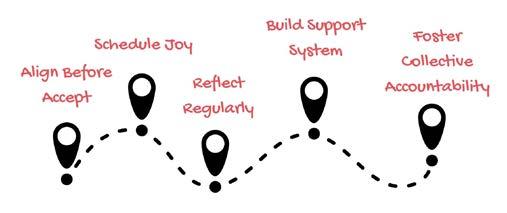
Designing a Roadmap to Thrive
Thriving today means designing systems where ambition and well-being can coexist. The roadmap is not fixed; it evolves with every stage of our careers.
• Align Before You Accept: Ask whether the opportunity supports your core values, not just your résumé.
• Schedule Joy: We schedule deadlines and deliverables, but joy must also be intentional. Connection is fuel, not a distraction.
• Reflect Regularly: Check whether you feel energized or depleted. Adjust without guilt.
• Build Support Systems: Surround yourself with mentors, peers, and friends who can remind you of perspective when the pace accelerates.
• Foster Collective Accountability: Wellness should not be an individual burden. When leaders model balance, it becomes culture.
From Individual to Collective Wellness
Redefining balance is not just an individual act; it is a cultural one. As firms, institutions, and mentors, we have the power to model healthier practices and dismantle the idea that exhaustion is proof of passion.²
We cannot pour from an empty pot. But when we fill it with purpose, connection, and clarity, the impact extends far beyond our own careers.
Volunteerism, mentorship, and community care remind us that giving back can also restore. Collective care sustains creativity and ensures that purpose does not come at the cost of health.
We cannot pour from an empty pot. But when we fill it with purpose, connection, and clarity, the impact extends far beyond our own careers. Balance, like any well-designed space, emerges through iteration, one decision, one boundary, one breath at a time.
Footnotes
1. 2024 NAAB Annual Report
2. Guides for Equitable Practice

Saakshi Terway, Assoc. AIA
Terway is a Design Professional at Quinn Evans, the 2025 Associate Representative on the AIA Strategic Council, and Secretary of the Immigrant Architects Coalition.
Above: Created by Saakshi Terway (author)
Motherhood as a Catalyst for Redefining Care and Wellness in Architecture
Architecture is a profession built on endurance. From design school to licensure, we’re conditioned to equate passion with overextension, to push harder, stay later, and deliver more. This culture leaves little room for wellness, especially for mothers who navigate two full-time responsibilities: the work of caregiving and the work of creation.
Having my first child magnified these tensions but also clarified a personal question: How can I redefine success in ways that sustain both my practice and my well-being? When I became pregnant during the beginning of the pandemic, as the world stood still, I began reflecting on my career and sense of purpose. I realized I had been chasing deadlines and milestones - licensure, higher salary, more prestigious job title - believing they were prerequisites for starting a family. But when I finally became a mother, my world didn’t just shift; it completely reframed how I saw my profession.
Architecture had taught me to manage complexity and lead with precision, but motherhood taught me something the studio rarely emphasized: the necessity of self-care. Balancing late-night feedings with early-morning meetings revealed a truth many in our field quietly live with. Burnout isn’t a badge of honor; it’s a symptom of imbalance. Motherhood is not a detour from architecture, it’s a framework for resilience, creativity, and empathy . It demands boundaries and redefines what “productive” truly means. With that realization, wellness becomes not just a personal pursuit but a collective responsibility, challenging us to design workplaces as thoughtfully as we design buildings.
Architecture has long celebrated the myth of the tireless designer, the one who outlasts deadlines, perfects every detail, and proves devotion through exhaustion. From studio to practice, we inherit an unspoken expectation that creativity thrives under pressure. Yet behind every all-nighter lies a quieter truth: burnout is not a personal
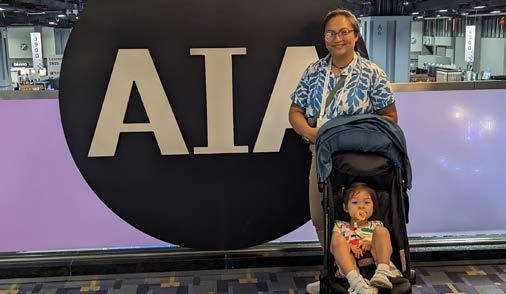
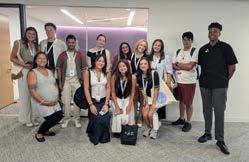
Attending AIA National Convention 2024
weakness but a flaw in how the profession measures success. The culture of “more” - more projects, more hours, more outputrewards endurance over empathy. Mothers feel this most acutely. They navigate rigid timelines while managing the unpredictability of caregiving, often within systems that offer limited parental leave, inflexible schedules, and little recognition for the demands of family life. The profession still operates on a false comparison: you’re either “all in” or “not passionate enough.”
The result is chronic burnout disguised as dedication. According to the Association of Collegiate Schools of Architecture’s (ACSA) Where Are My People? study, women, particularly caregivers, continue to leave the profession at higher rates, citing inflexible structures and unsustainable expectations. The pinch points remain: licensure, caregiving, and the glass ceiling. Many leave before completing licensure, not from lack of talent, but from lack of support. This loss is cultural as much as personal. When we lose mothers and caregivers from practice, we lose perspectives attuned to balance, adaptability, and human-centered design.
During my first year back from parental leave, I struggled to find balance. To mitigate burnout, I had to reevaluate what success looked like and ask harder questions about how we work. Who sets the pace? How is commitment defined? What would it look like if architecture valued sustainability not only in buildings, but in people? Until these questions are part of our design process, burnout will remain embedded in our deliverables.
Motherhood is an exercise in adaptability. It teaches patience amid uncertainty, resourcefulness in constraint, and compassion in chaos - skills architecture demands, but rarely rewards. While firms often define wellness through benefits or billable hours, mothers redefine it through balance: the negotiation between caring for others and caring for oneself, between ambition and sustainment. Returning to work after maternity leave, I began to see wellness not as an individual pursuit but as a shared design problem. Remote work revealed that flexibility isn’t a luxury, it’s infrastructure. Supportive leadership isn’t optional, it’s structural integrity. If design is the thoughtful arrangement of relationships, then designing for wellness means reimagining how those relationships functionbetween colleagues, clients, and time itself.
Motherhood also reframes productivity. It challenges the assumption that value lies in visible hours rather than meaningful outcomes. Many mothers learn to work with sharper focus, deeper empathy, and a clearer sense of purpose, qualities that strengthen teams and elevate design culture. When firms recognize these traits rather than penalize them, they create environments that are more humane, resilient, and inclusive.
Since the pandemic, small but powerful shifts have begun. Firms experimenting with flexible schedules, hybrid options, and transparent expectations are seeing better morale and retention. Peer networks and caregiver resource groups provide validation and support, proving that wellness is not found in isolation but in community. The lessons of motherhood, empathy, adaptability, and care, when embraced by practice, can help us design cultures that value both creativity and well-being as professional strengths.
If architecture is about creating environments that support human experience, then our workplaces should reflect the same principles. Designing a culture of care means rethinking how we structure time, define value, and support one another. It means moving beyond wellness as an individual responsibility, something managed in the margins, toward wellness as an organizational ethic woven into practice.
A culture of care begins with leadership. When firm leaders model empathy, set boundaries, and acknowledge capacity, they normalize care as part of professional excellence. Simple actsasking “How are you doing?” and truly listening - build trust and safety, the foundation for creativity and collaboration. But intention isn’t enough; systemic care requires policy. Flexible schedules, equitable parental leave, and return-to-work programs should be standard, not special accommodations. These aren’t perks; they are essential tools for equity and retention. The pandemic proved that flexibility can drive efficiency and loyalty while diversifying leadership pipelines.
We also need to measure wellness differently. Instead of equating success with output, we can measure sustainability: how supported employees feel, how equitably work is distributed, and how healthy teams remain over time. Some firms now include wellness metrics in project planning or create peer “care councils” to monitor workload and culture.
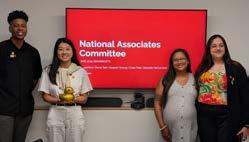
Representing the NAC at AIAS Grassroots 2025 (NAC)
Leading AIA Focus Group at AIAS Grassroots 2025 (NAC)
Ultimately, designing a culture of care asks us to apply design thinking inward - to our firms, our teams, and ourselves. Wellness becomes a form of architectural integrity; a measure of how well our practices serve the people who sustain them.
Motherhood has taught me that wellness isn’t found in stillness alone, but in support, in caring for others while being cared for in return. Architecture thrives on collaboration; our best work emerges from trust and collective intelligence. The same must be true for how we sustain ourselves within the profession.
Burnout isn’t inevitable; it’s the product of systems never designed for care. Like any flawed design, it can be reimagined.
To truly advance wellness, we must broaden its definition beyond self-preservation. True wellness is systemic, reflected in how firms distribute work, how leaders set expectations, and how teams support one another. It’s not about merely surviving the work but cultivating the conditions to thrive within it.
When mothers, caregivers, and advocates challenge the norms that equate overwork with excellence, they’re not asking for less commitment to architecture, they’re asking for a more sustainable one. Our lived experiences offer a perspective for designing practices that value empathy, flexibility, and longevity as essential measures of success. Care is not an interruption to the profession; it is the foundation upon which its future can be built.

Danielle McCormick, Assoc. AIA is a Senior Technical Designer at Page in Washington DC. She serves as AIA DC | NAC STAR and leadership roles with the AIA DC | Historic Resources Committee and the Association for Preservation Technology DC Chapter.
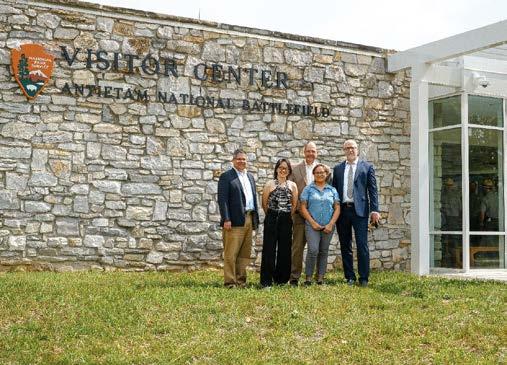
Rededication of NPS Antietam Visitor Center (Page)
The Future of Human Mobility: Why the Humble Shower is the Hidden Key to an Active Workforce
In the United States, a nation saturated with fitness facilities and dedicated exercise spaces, a striking paradox exists: according to the CDC, only about 25.5% of American adults meet the guidelines for both aerobic and muscle-strengthening activities. We have the infrastructure for fitness, but we lack participation. The question is, why? The answer may not be found in a new workout trend or a high-tech gym, but in a far simpler, oftenoverlooked amenity: the shower. As our cities evolve, the shower is emerging as the hidden key to unlocking the future of human mobility and wellness.

A Commuter’s Dilemma: My Story
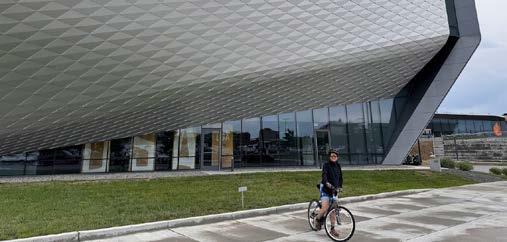
As a passionate urbanist trained to understand the dynamics of city life, I put theory into practice by commuting via bicycle in Panama City. The experience was an immediate lesson in the practical barriers to active mobility. The tropical climate meant that rain was a frequent challenge, but the most common questions from my colleagues were not about safety or traffic, but about logistics: “What about the sweat? What do you do when it rains?”
I was the only person in my office who biked to work. On dry days, I could manage by changing my shirt in the restroom, as I don’t sweat heavily. But when it rained during my morning commute, my choice was stark: either turn back, go home to shower, and arrive late to work by car, or not bike at all. The evening commute was different; rain was no obstacle, as a refreshing shower was waiting for me at home.
This personal experience highlights a universal truth: the primary deterrent to active commuting for many professionals isn’t the physical effort, but the logistical nightmare of arriving at work sweaty, damp, or disheveled.
The Modern Workplace and the Exercise Paradox
Many people find it difficult to plan physical activity after a long day at work. Morning exercise is often a more viable option. Logistically, it makes more sense to exercise near your workplace than your home. Consider the time saved: you can leave home at 6:30 AM, arrive at a park or fitness facility near your office by 6:45 AM, enjoy a full hour of exercise, and still have time to prepare for the workday. This strategy allows you to bypass the stress and variability of peak rush-hour traffic.But this perfect scenario hits a wall with one simple question: Where do I take a shower?
This is the root cause of inactivity that many people don’t even recognize. Without access to showers at or near the office, employees are forced to either wake up significantly earlier to exercise and commute from home during rush hour, or forgo morning activity altogether. Showers in the workplace fundamentally change this dynamic. They empower people to:
• Commute actively: Bike, jog, or walk to work, eliminating concerns about sweat in the summer or rain and snow in the winter.
• Utilize urban spaces: Take advantage of nearby parks, running trails, or even boutique gyms that may not offer their own shower facilities.
Designing for Wellness: Building Codes and the WELL Standard
If we are serious about fostering a healthier, more active population, we must integrate wellness into the very fabric of our buildings. This begins with updating building codes to encourage or even mandate the inclusion of showers and changing facilities in new commercial developments.
This concept is already a cornerstone of leading-edge design philosophies like the WELL Building Standard. WELL is a performance-based certification that measures, monitors, and verifies features of the built environment that impact human health and well-being. Within its “Movement” concept, WELL specifically rewards projects that provide dedicated support for active transportation. Feature V05: Active Transportation Support often requires the implementation of secure bicycle storage and, crucially, corresponding shower and changing facilities.
By pursuing WELL Certification, companies signal a genuine commitment to employee health that goes beyond superficial perks. They recognize that enabling physical activity is as critical as providing an ergonomic chair or good lighting.
A Call for a Mindset Shift
The solution to our exercise deficit is not another subsidized gym membership that goes unused. The solution is removing the most significant practical barrier.
• For Employees: The next time your Human Resources department surveys wellness needs, ask for a shower and changing facilities. It is a one-time investment that provides a permanent solution, empowering you to integrate activity into your daily life on your own terms.
• For Architects and Owners: When designing a new office space, resist the urge to simply install a small, private gym. Instead, invest in high-quality, spacious showers and changing facilities. This single amenity unlocks the entire city as a potential gym. It is a more cost-effective and utilitarian solution than purchasing some treadmills that see limited use. By solving the root cause, you provide your workforce with a place to refresh and prepare for the day, fostering productivity, health, and morale.
In conclusion, the future of human mobility is not just about bike lanes, electric cars or hyperloops; it’s about enabling humanpowered movement. The humble shower is not a luxury—it is a piece of critical infrastructure for wellness. By prioritizing it in our workplaces and building codes, we can finally begin to close the gap between our fitness ambitions and our daily reality.
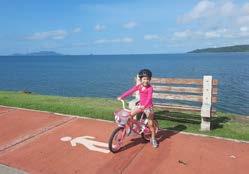
Resources: Healthy People 2030

Manuel Granja, AIA, LEED AP, WEEL AP, MBA is a Project Architect at Mt Studio in Troy OH. He serves as a National Associate Representative of AIA Ohio and Co-Chair of the Urban Design Committee in Cincinnati. Granja is interested in fitness and human mobility in the architecture environment.
Women’s Leadership Summit 2025, Atlanta GA: A Recap
The 11th edition of the Women’s Leadership Summit 2025 took place in Atlanta, GA on November 3-5 inside the Marriott Marquis Hotel designed by distinguished architect John Portman. This conference being held in the soaring atrium of this iconic hotel was almost symbolic, women in AEC inhabiting a building that has pushed the boundaries of hotel and atrium design, to gather and talk about leadership, ambition and the future of women in the profession. With almost 1000 attendees this year, this conference has evolved into the biggest gathering of women in AEC that provides a unique stage and a safe space for women to discuss challenges that are unique to them.
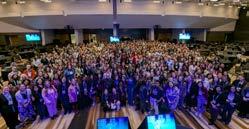
The learning tracks for the 2025 WLS Conference spanned across leadership, wellness, designing equitable practice, money making, and navigating the mid-career slump. These themes were explored through keynotes, round tables, breakout sessions, talks, walking tours, firm visits, and networking - engaging women at every stage of their careers, from early to mid-career professionals to seasoned architects and firm leaders.
The Summit opened with the “Executive Leadership Roundtable” which was a hands-on session for senior firm leaders to navigate today’s complex professional landscape. Attendees discussed the emerging issues in the profession including advocating for leadership roles for women, sustainability, emerging technologies like AI, DEI policies, and many more. After this collaborative workshop, attendees returned with actionable takeaways to drive meaningful change in their firms.
Other sessions on Day 1 included a “Speed Mentoring on the Move” session that provided attendees a unique “active” mentorship experience through walking and talking. Attendees were paired for a one-on-one walk, run, or wheel along a twomile route through Centennial Olympic Park, beginning and ending at the Atlanta Marriott Marquis. This was followed by
various “Tour and Talk” sessions where attendees could pick from the Georgia Library Renovation, Exploring Sustainability in Downtown Atlanta, Bold New Architecture in Atlanta’s Old Fourth Ward, Historic Oakland Cemetery, and Innovative Public Spaces on the Atlanta Beltline to tour. There were also visits to firms in Atlanta such as TVS Design, Gensler and Corgan + Clark Construction.
Day 1 of the Summit came to a close with a power packed keynote by Vernice “FlyGirl” Armour, America’s first Black female combat pilot and author of Zero to Breakthrough. In her keynote “Leading in Uncertain Times: Gutsy Leadership for Architects Shaping Tomorrow”, Vernice urged attendees to seize their own “clearance” in leadership rather than waiting for permission. This was followed by the Opening Night Celebrations at the Georgia Aquarium, the largest aquarium in the United States. Held in the Oceans Ballroom, attendees enjoyed the opening night as beluga whales and sharks glided by!
“Fly Girl” Armour” - Keynote Speaker
Georgia Library Walking Tour & Talk
AIA Women’s Leadership Summit 2025 Group Photo
Day 2 of the Summit started with a self defence workshop “Everyday Self-Defense: Building Confidence Through Boundaries” for participants to learn practical tools to set boundaries and de-escalate real world situations. This was followed by “Resilience & Representation in the Next Generation of Leadership” where the AIA Next to Lead program was highlighted and this year’s cohort were introduced. After this was a listening session for the AIA Strategic Planning followed by the keynote “Designing for Impact” that framed the future of practice through the lenses of resilience, climate leadership, and visionary firm culture. Designing for Impact brought together Dr. Alyssa L. Provencio, Illya Azaroff, FAIA, Jazz Graves, AIA, Jessica Orlando, AIA, and Wendy Rogers, FAIA, to confront the realities of a warming world and the responsibility architects hold in shaping equitable, climate-resilient communities. Through case studies in adaptive design, decarbonization, and post-disaster response, the speakers made clear that environmental stewardship is no longer optional, but a core leadership competency.
The mid morning and afternoon sessions offered attendees a choice of some amazing talks on various topics such as business development, equitable practice, support for parents and caregivers, podcasting, disaster recovery,, power of networking, evolving firm strategies, salary negotiation, AI practices and path to fellowship. The sessions concluded with a blissful visioning workshop featuring a sound bath, “Building Wellness Through Visioning, Self-Advocacy, & Sound”.
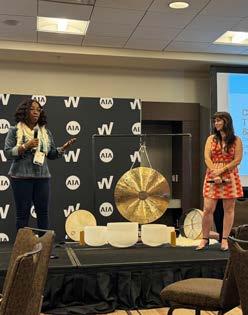
The attendees then proceeded to“Dine Arounds” across some of the vibrant restaurants in Atlanta which were small-group dinners that offered a relaxed way to network, connect and unwind. The connections I made during the dine arounds were very authentic and we spoke about such deeply personal topics to our experiences as architects and as women. One of the best Girl’s Night Out I have had in a long time!
The last day of the summit began with a second session of selfdefense by popular demand and was followed by two inspiring talks on the main storytelling stage - “Leading with Strength and an Invisible Disability” that spoke about the vulnerable and empowering stories of women with chronic health conditions and disabilities as well as “Designing a Legacy of Leadership” which was a highlight on how consistent and international leadership at every stage of one’s career can build a meaningful practice with a strong legacy.
Building on this theme, Wendy Rogers returned to the stage to open the Visionary Leadership in Practice keynote, sharing how LPA Design Studios’ “No Excuses” philosophy uses integrated, research-based design to deliver measurable sustainability outcomes at scale. A leading economist followed with a sharp snapshot of the shifting forces shaping the AEC industry, before a dynamic panel—Emily Schickner, AIA; Evelyn Lee, FAIA; Margo Martin; Rosa Sheng, FAIA; and Tara Bayke—explored how firms are evolving through systems thinking, innovation, and cultural transformation in an honest and vulnerable keynote “Leading Through the Now” .
Together, these sessions offered a clear message: the future of architecture demands courageous leadership—technically rigorous, equity-centered, climate-responsive, and unafraid to rethink how practice is done. This was indeed a summit that felt like a movement. The movement continues next year on November 1-3, 2026 in Kansas City!
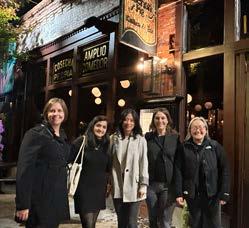
“Dine Arounds” - Atlanta, GA
“Building Wellnes Through Visioing, Self-Advocacy, & Sound” Sound Bath
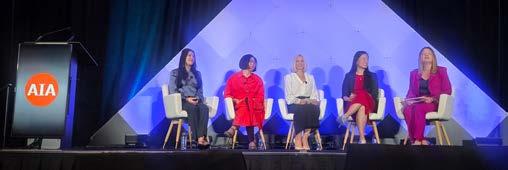
Since this was my first WLS, and in my home city, my excitement was unparalleled! I came back home every night with a deep connection to the profession as well as a sense of pride of being a woman. The connections I made were not just acquaintances, some of them were deep friendships that developed with an instant connection over shared challenges. This conference was a safe space to talk about all challenges, may those be issues at the workplace, motherhood, immigration, hindrances in leadership or unequal treatment in the profession. I was fortunate enough to receive the prestigious Carmen Stan Scholarship by EQiA (Equity in Architecture), Georgia to attend the conference this year! For young architects who would like to attend this summit, there are many resources available if your firm is not able to sponsor you. Some resources are listed below with their tentative application windows based on historic data. These may be subject to change, please verify before applying.
• Sho‑Ping Chin Women’s Leadership Summit Grant by the Architects Foundation offers awards. Preference is given to emerging professionals (under 10 years, small firm, pre-licensure) etc. Tentative application window: May to July
• AIA Pennsylvania offers a scholarship for its members in good standing. Tentative Application window - April to June
• AIA New York State offers a scholarship for its members that have been a chapter member for a minimum of two years. Tentative application deadline: October
• The Carmen Stan Scholarship by AIA Georgia / Equity in Architecture (EQiA) provides multiple scholarships towards WLS for women in Georgia. Tentative application window: August to September
• AIA Chicago gives a scholarship to attend the Women’s Leadership Summit. Application timeline unknown.
• Beverly E. Hauschild Baron Leadership Fund Scholarship by AIA Minnesota to attend the Women’s Leadership Summit. Tentative application window - June to July
• AIA Next To Lead cohort can attend the WLS as a part of their 10 month long program. Tentative application window: June to August
• Students studying Architecture in the state of Georgia can be nominated by their school for the NextGen Pathways Cohort, which is supported by AIA Georgia and NAC.
• Volunteer with the AIA: if WLS is in your city, reach out to your local chapter to volunteer for the summit to see if you can receive a discounted ticket.
Please reach out to your local AIA chapters to enquire if they have any grants available for this conference.
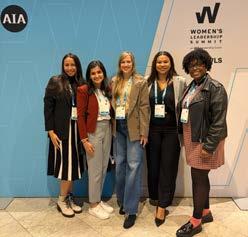

Arti Verma, AIA, NCARB, LEED AP BD+C, ALA is a Project Manager at Dynamik Design in Atlanta, GA. Verma attended the WLS 2025 as a recipient of the Carmen Stan Scholarship by EQiA and AIA Georgia. Photos by Arti Verma and Lalitha Bommanahal.
Carmen Stan Scholarship Winners
AIA Women’s Leadership Summit 2025 - Keynote Speakers
Beyond the Stamp: Building Identity After Licensure
When I received my architecture license, I expected a triumphant sense of completion. For years, my academic and professional life revolved around a single milestone: licensure. Studio culture built my endurance, internships shaped direction, and evenings were spent studying. It felt like the finish line. But when it arrived, I felt something unexpected: relief, yes—but also a subtle emptiness.
For so long, licensure was my North Star. When I finally reached it , the horizon felt wide open with no clear next peak. Instead of certainty, I was met with possibility—both thrilling and disorienting. I quickly learned that licensure isn’t the finale; it’s the overture.
Reframing Goals Through Wellness
Fitness grounds me. Movement brings clarity when stress builds and restores control when deadlines intensify. Even on busy project days, I carve out time for small acts of wellness: walking during lunch, stepping away from my desk, breathing fresh air instead of eating in front of a screen. That midday break from routine resets my focus and prevents burnout from quietly accumulating.
After licensure, my first major goal wasn’t professional at all—it was training first for a half, and then for a full marathon. Running introduced structure without external deadlines, blending physical endurance with mental resilience and charitable support. It provided balance and reminded me that achievement can and should exist outside of work.
From Achievement to Contribution
A surprising outcome of licensure was how my aspirations shifted. Instead of chasing the next credential, I found myself asking a different question: How can I contribute? Suddenly, success felt less about personal milestones and more about cultivating pathways for others.
I realized that many students and emerging professionals enter the field of architecture without a clear understanding of the licensure journey and I wanted to change that. Mentorship
These small choices strengthen longevity in our careers. When we nurture our physical and mental wellbeing, we preserve our ability to show up creatively, collaboratively, and compassionately.
became a priority for me, and volunteer engagement followed naturally.
In October, I collaborated with AIA Brooklyn and the City College of New York on an NCARB-focused event designed to demystify the process. We walked students and young professionals through straightforward steps, timelines, and strategies that make licensure approachable. Seeing uncertainty turn into confidence affirmed my belief that transparency drives equity and access in architecture. Experiences like these continue to shape my values.
Post-licensure identity, for me, lives in advocacy—knowledge sharing, offering guidance, and helping others move forward confidently.
Wellness as Professional Sustainability
Architecture’s demanding pace can easily normalize exhaustion. The culture of “always on” risks dulling creativity and eroding joy. Wellness, therefore, cannot be reserved for the weekend alone. It must be woven into our daily practice.
Sometimes it looks like a 15-minute walk. Other times, training for a race.
Sometimes it means starting a new hobby for mental clarity. Other times, finding fulfillment in mentorship rather than metrics.
These small choices strengthen longevity in our careers. When we nurture our physical and mental well-being, we preserve our ability to show up creatively, collaboratively, and compassionately.
Reimagining Identity Beyond the Stamp
One of the most transformative realizations after licensure was understanding that the stamp does not define identity. It is a tool—one that grants responsibility and agency. With it, we have an opportunity to shape culture, influence policy, and elevate emerging voices.
Post-licensure, I’ve asked myself:
How do I want to contribute to this profession?
Who am I supporting along the way?
What legacy am I building beyond drawings and deadlines?
My answers continue to evolve. They emerge through movement—in running, mentoring, volunteering, and prioritizing mental health. They show up in moments of pause, reminding me that fulfillment rarely lives in constant acceleration.
A New Definition of Success
Licensure grants the freedom to design not only buildings, but also careers, communities, and culture. For many emerging professionals, the path ahead may feel uncertain once the exams are behind them. But that uncertainty is an invitation to define success on your own terms, to balance achievement with restoration, and to invest in people as much as projects. Wellness and contribution are not distractions from professional excellence, but rather its foundation.
Beyond the architect’s stamp lies something far more meaningful: purpose. When we commit to wellness, mentorship, and service, we strengthen ourselves and the profession we care so deeply about.

Devora Schwartz, AIA NCARB is a Project Manager at LMV Architects in Poughkeepsie, New York. She is a mentor passionate about empowering future architects.
Taking Care of Business: Transparency in Firm Ownership
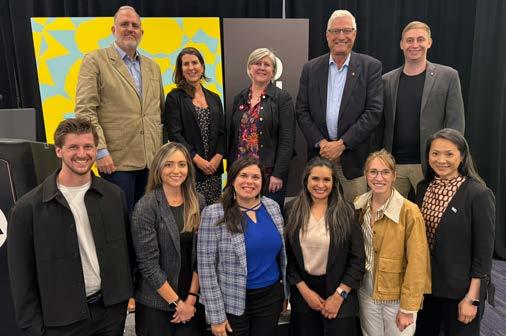
The AIA Young Architects Forum (YAF) and Large Firm Roundtable (LFRT) have a longstanding partnership in providing business education for young architects and emerging professionals. Since the A’15 Conference, the two groups have co-presented the “Mini MBA: Mastering the Business of Architecture,” a workshop designed to introduce firm leaders to key principles of practice management. For the AIA24 conference, this session was revamped and rebranded as “Taking Care of Business” to focus more directly on Young Architects and their specific needs,shifting the emphasis from organizational business acumen to the individual’s growth as a leader and future firm owner.
By learning from industry leaders,both from large firms and small practices who have successfully navigated their careers,young architects have a unique opportunity to build upon the foundational business principles set by their predecessors and prepare for a
stronger, more informed future. The tradition of sharing knowledge with the AIA young architect members continued to flourish in 2025. Through knowledge sharing, the workshop each year is designed to empower the next generation of leaders toward greater business confidence and long term success.
At this year’s AIA25 Conference in Boston, more than 100 participants gathered for “Taking Care of Business.” Developed through a multi-month collaboration between members of the YAF Knowledge Focus Group and LFRT leaders, the session centered on this year’s theme: Transparency in Firm Ownership. Presentations explored key aspects of firm ownership, including Mentorship for Leadership, Business Development, Different Models of Ownership, and Founding Your Own Firm. Together, these topics provided a holistic look at the professional, strategic, and personal considerations that shape successful practice management.
YAF Knowledge Group Facilitators with featured speakers at the Taking Care of Business workshop at AIA25 in Boston, MA.
AIA25 Boston featured speakers:
• Carol Rickard-Brideau, AIA, LEED AP BD+C, WELL AP
Chief Executive Officer, Little
• Guy Geier, FAIA, FIIDA, LEED AP Senior Partner, FXCollaborative
• Dan Hart, FAIA, PE
Executive VP of Architecture and Partner, Parkhill
• Mel Price, FAIA
CEO and Principal, Work Program Architects
AIA25 Boston YAF Knowledge Focus Group facilitators:
• Arlenne Gil, AIA
Knowledge Director, YAF
• Reily Joel Calderon Rivera, AIA
Young Architects Representative, Puerto Rico
• Diana Duran, AIA
Young Architects Representative, New Mexico
• Robert Farr, AIA
Young Architects Representative, Mississippi
• Brady Laurin, AIA
Young Architects Representative, North Dakota
• Daniela Moral, AIA
Young Architects Representative, Nevada
• Melanie Ngami, AIA
Young Architects Representative, Pennsylvania
• Trent Schmitz, AIA
Young Architects Representative, Michigan
• Joseph Taylor, AIA
Young Architects Representative, Maryland
• Elizabeth Zachman, AIA
Young Architects Representative, Montana
• Mi Zhang, AIA
Young Architects Representative, New York
By bridging dialogue between emerging professionals and firm leaders, this workshop continues to demystify the
business side of practice, fostering a culture of openness and shared learning that strengthens the future of the profession. “It was a pleasure to participate in a session focused on growing young architects’ business development skills,” reflected Guy Geier, FAIA. “This critical component of growing a career is often overlooked but is crucial to a young professional’s career growth and trajectory toward leadership, whether as part of a larger firm or growing their own practice.”
Following its success in Boston, the “Taking Care of Business” workshop was also accepted for presentation at the NOMA National Conference in Kansas City, where a new lineup of speakers brought fresh perspectives to the same core topics — continuing the conversation on mentorship, leadership, and transparency across the profession.
Mel Price, FAIA, from Work Program Architects in Norfolk, Virginia, was able to present on the final topic of “Founding a Firm” during both conferences. “It was incredibly rewarding to share my firm’s case study and the journey of founding my own practice. What stood out most was how many emerging professionals and young architects came up afterward with thoughtful questions about firm ownership and leadership,” said Mel Price, FAIA. “I’m glad to see a growing interest in transparency around what it really takes to start and sustain a practice — those conversations are where meaningful learning happens.”
The workshop held in Kansas City featured:
• Melanie Ngami, AIA
Architect, SmithGroup (YAR, Pennsylvania)
• Nicole Nichols, AIA
Higher Education Leader + Principal, DLR Group
• Kate Thuesen, AIA, NOMA, LEED AP
Director of Business & People Partnerships, Vice President, CannonDesign
• Mel Price, FAIA
CEO and Principal, Work Program Architects
Taking Care of Business workshop at AIA25 in Boston, MA
Presenters for Taking Care of Business, NOMA 2025, Kansas City, MO
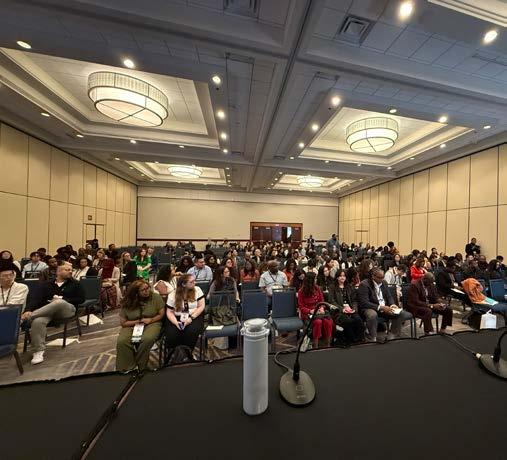
Both sessions displayed a variety of perspectives on the intangibles that make business practices flow. Key takeaways for attendees included a better understanding of ownership roles and leadership transition pathways in architecture, including the risks and rewards at each level and various firm ownership models. These insights included a high-level overview of planning and expectations, which highlighted factors that could influence whether you want to start your own practice. The presentations at each conference offered an exploration of emerging leadership styles and ideologies, including how proactive and reactive mentorship approaches benefit a changing workforce. Lastly, the sessions provided an overview of business development strategies, ways to leverage community engagement and partnerships, and pathways for developing essential soft skills.
Be on the lookout for a new iteration of “Taking Care of Business” next year!
The YAF Knowledge Group extends its appreciation to all speakers and contributors who continue to champion transparency, mentorship, and growth across the profession.

Arlenne Gil, AIA
Arlenne Gil is an Architect and Principal at DLR Group in Orlando, FL. She currently serves on the YAF Advisory Committee as Knowledge Director. She is passionate about mentoring students on the business aspects of architecture.
Attendees at the Taking Care of Business session at NOMA 2025 in Kansas City, MO.
Critical Aspects:
Experiencing Mental Health
Often it’s not until we enter a crisis that we’re aware of it. This maxim might also apply to larger narratives, but setting our current predicament aside for a moment, I believe it’s our responsibility as professionals to take the best care of ourselves possible, such that we put the best foot forward in projects, relationships, and our personal and professional growth as individuals. As recent changes in technology, access, and hybrid work take hold as a new modes in design fields post-pandemic, it’s good to take stock of what elements of these changes reflect positive advancements for flexible work, and which undermine collaboration and the ever-important ‘studio dynamic’, which forms in professional and educational settings. What are the takeaways, we might ask. Remote work, it turns out, largely reflects this presently-evolving dynamic between individuals, teams, and managers to whom trust in one another is a central tenant.
In a time when more than 20 million individuals, or around 6% of the US population, identify as being seriously mentally ill [NIMH
data 2025], the topic of mental health has finally broken ground in the public consciousness. As an area of study, it’s emerged as not a mere passing topic, but a long term central focus for how humans thrive, or don’t in specific environments and conditions, attuned to those with more than typical every day needs. These attunements, in my view, take a reflexive relationship with the environments we inhabit. Taking a wider view, most environments are designed, but often not by experts in the field (designers) - our cities laid out as computer microchips revolving around worship of efficiency rather than places of public interaction or for the healthy flows of daily existence as they are conceived more globally. While these problems of development patterns persist, what we’ve collectively learned about the mind’s link to its environment might teach about ourselves in ways we don’t expect.
My experience with mental health was generally framed in ignorance, the sort of ignorance one finds in not knowing better. In 2013, I was diagnosed as bipolar after a series of manic
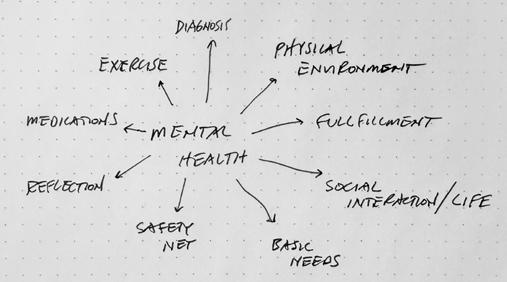
Sketch credit: Rocky Hanish
episodes, sometimes lasting weeks, and largely without my knowledge, resulting in a challenging time in which I learned the mind’s ability to guide itself to healthier lifestyles isn’t always automatic (it takes a village). Over the course of several years, I struggled to get hold of who I thought I was, post-diagnosis. There are lessons to be learned, most importantly, and I’m infinitely grateful to those who’ve supported me through the hardest times in my life, doctors, family, friends, and those exhibiting sorts of kindness I never expected, or knew existed. Architecture is a challenging field in any mental capacity, and struggling through years of undiagnosed symptoms would take me many years to fully understand. Twelve years later, I’m able to have a sort of view on it all.
Primary agents of care in my experience were my doctors, who upon first telling me of my diagnosis were shocked at my “No I’m not” response. I failed to believe something could be different with my very brain… “Hey! I live there!” But eventually, it sunk in. It turned out neurochemistry is in fact a fragile balance, and as an area of interest and study, should be taken more seriously in its implications than it generally is.
Architecture is a challenging field in any mental capacity, and struggling through years of undiagnosed symptoms would take me many years to fully understand. Twelve years later, I’m able to have a sort of view on it all.
We come from a culture, true of all of us, and most cultures don’t speak of mental illness in productive ways. One is liable to be labeled ‘crazy’ and cast out as someone incapable of holding trust in society. But, diagnoses shed light on this otherwise mysterious mental reality. Some are jailed for behavior, for example, due to a lack of facilities to care for those with mental differences. This situation most certainly exacerbates their difference, leading to terrible systemic outcomes and what I would label evil, if the word ever had a better definition, I’m not aware of one. As architects unite in this moment of political turmoil around creating a lasting impression on the built realm in productive,
sustainable, and new ways we shouldn’t lose sight of the human element in the center of the (all) equation(s).
The lessons I’ve carried forth about balancing my workload, daily habits, and finding a firm that supports flexible work with a trusting environment and the ability to make an impact in ways that feel natural to myself, took a long time to learn. In my current capacity teaching (or as we might label it, advanced learning), practicing, and collaborating the most important value I’ve carried forth is ultimately unity is what matters. A kind of flow with our social sphere. We all rely on those around us to support us in ways we might never perceive, so the extra mile of kindness is always worth it. In my view, the world is held together by the ‘sticky tape’ of relations between caring individuals. These might be family, friends, neighbors, co-workers, or acquaintances but in each case something wholly unfamiliar is formed as a result. It cannot be engineered, but is emergent, and these sets of relations have the capacity to assist us in understanding ourselves more fully. In short order, we find it’s our own mental health and capacity for reflection which ultimately creates the highest order of future-proof resilience.

Rocky Hanish, Associate AIA Hanish has designed, built, and planned urban-scale projects since getting his M.Arch. in 2011. He teaches architecture and planning studios at ASU and is focused on Phoenix as a desert metropolis.
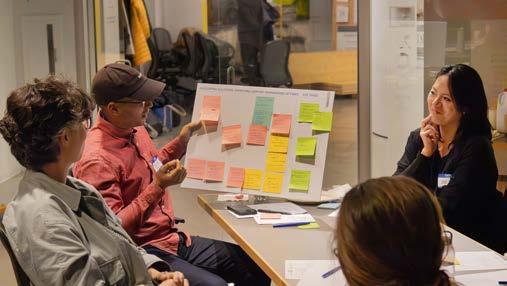
The Hidden Infrastructure of Practice:
Building Cultures of Care in Architecture
Two years ago, Alya and Silvia found themselves in a small conference room after Silvia had returned to work from the birth of her second son. The exhaustion and emotional weight of trying to balance it all brought her to tears. Watching her colleague struggle, Alya recalled her own experience of a 2.5 hour commute each way that became impossible when her former employer refused flexible options. Both experiences underscored a painful truth: these challenges are far from unique. Countless parents and caregivers face the same impossible tension between professional expectations and family needs. It’s not just a mother’s issue; it is a community-wide matter.
The question remains: career or family?
Architecture has always been associated with long hours, unpredictable deadlines, and an expectation of constant availability. While this culture is beginning to evolve, it still poses significant challenges for those with caregiving responsibilities. Parents navigating childcare, employees caring for aging relatives, or staff managing family health concerns often find
themselves in an impossible position, torn between the demands of work and the needs of their loved ones.
This imbalance doesn’t only affect individuals; it has real consequences for the profession. Talented employees leave firms or the field altogether when they feel unsupported. Women, who are still disproportionately responsible for caregiving, are particularly at risk of attrition during mid-career years. For a profession already grappling with equity, diversity, and workforce sustainability, ignoring this reality is not an option anymore.
It Takes A Village: A Parents & Caregivers Initiative (ITAV) emerged from that small conference room. These women dedicated themselves over the last 3 years to help firms recognize new ways of thinking about workplace support. They applied for the 2023 and 2024 YAF Future Forward Grant and were the 2024 awardees. The initiative reframes caregiving as part of the firm’s “infrastructure”, it addresses the disconnect between employees and owners/leadership around leave transitions and a sustainable new normal.
Through a series of workshops, policy reviews, and resource development, ITAV developed a Framework that helps firms normalize discussions about family, support needs and worklife balance, while also providing strategies that go beyond compliance to create an empowering office environment. It is not a one-size-fits-all solution but a modular framework that can be tailored to the resources of the firm and encourage employers to build their own “village”.
For firms unsure where to begin, the first step is often the simplest: talk about it. Normalizing conversations about caregiving helps break the silence that leaves many employees feeling isolated. Leaders can set the tone by acknowledging their own responsibilities or by explicitly inviting staff to share their support needs.
Architects often talk about legacy: the buildings and communities we leave behind. But our greatest legacy may be the profession itself and the people who sustain it. Supporting caregivers is not an extra benefit; it is essential to building a resilient and equitable future for architecture.
It Takes a Village is both a reminder and an invitation: a reminder that no one succeeds alone, and an invitation for firms to design cultures of care as thoughtfully as they design buildings. Because just as it takes a village to care for a family, it takes a village to sustain a profession.


Alya Staber, WELL AP
Staber is an Associate at Jones Architecture in Salem, MA, a co-founder of the 2024 YAF Future Forward Grant, It Takes a Village: A Parents & Caregivers Initiative.
Silvia Colpani, Assoc. AIA
Colpani is an Italian-born designer and advocate based in Boston, co-founder of It Takes a Village and Chair of the BSA Ethics Committee, promoting equity and caregiver support in architecture.
Breaking the Silence:
What we don’t say out loud on burnout
Due to the sensitivity and personal nature of these topics, we invited Young Architects to participate in this anonymous column featuring quotes, reflections, and short stories from Young Architects’ lived experiences.
Our hope is that these stories may help others feel seen, spark important conversations, and shape how our profession approaches wellness. To help brighten the mood, we have also included some of our favorite haiku poems from this quarter’s book review of “Eating Salad Drunk - Haikus for the burnout age” by Gabe Henry.
“Once my project manager told my team that those with kids shouldn’t be working late, implying those without kids should be putting in the long hours.” - Anonymous
There’s no greater joy Than sloppy wet kisses from A Chihuahua mouth.
—Margaret Cho
Bought avocados Eleven organic ones Now I can’t pay rent
-Atsuko Okatsuka
Eating salad drunk Is both irresponsible And responsible - Josh Gondealman
“Architecture often feels like a constant balancing act between project deadlines, leadership roles, and family expectations. I have realized that wellness is not about doing more but about allowing space to pause, rest, and breathe.”Anonymous
“If I would have known I would be living paycheck to paycheck after getting a master’s and a professional license, while being expected to work 60hr weeks, I would have unquestionably chosen a different career. Now I feel stuck.” - Anonymous
“As a millennial I struggle with wanting to outperform my peers, but also manage others by respecting boundaries. I see the next generation as entitled and ungrateful while also realizing that the way I “grew up” in this profession may have been toxic. There should be a balance but finding it is hard. Knowing when to push and provide feedback without being too harsh but enough to get the point across. Addressing my own biases towards taking time off to address my mental wellbeing gets trumped by not wanting to come back to a dumpster fire of emails and feeling as though no one can fill my shoes when I need time. Or being able to trust that people will do it until the task is complete.” - Anonymous
“I work in a “work hard, play hard” environment. Our group knows how to work hard and have fun together, but due to the periods of high stress often created and fostered within the professional world our group will forget their physical and emotional wellbeing in the process. As the work continues to grow with less staffing availability the work becomes very hot and cold- too much work or not enough work for random periods of time. Younger staff members worry about the health of older staff members and try their best to advocate for their emotional, physical, and financial wellbeing (another part of feeling like the work isn’t worth it is when we aren’t paid adequately!). There was a time where there was more energy and care- and those aspects aren’t completely gone but have been replaced with low morale and exhaustion. I want to design, grow on my own two feet and explore how to make the built environment an experience that is equitable, exciting, and fun! However, these days that goal doesn’t always feel attainable.” - Anonymous
I chew on my ice
To let people know, if pushed, I’d do this to bones.
―Jo Firestone and Mike DiCenzo
If you hold a shell
Up to your ear, you can hear How lonely you are - Emily Blotnick
“Right now it FEELS like I have to accept that periodically (once per month, once per project, once per project phase), I will overwork myself, crash into exhaustion, and feel taken advantage of in my work. I REFUSE for this to be the case if I am going to stay in this profession longterm, so I am trying to learn how to recalibrate my expectations for myself and others so we don’t perpetuate this. Even if it’s common, it’s not normal and it’s not okay.”Anonymous
“I’ve had so much momentum throughout my architectural education, AXP, ARE, and early years of working to become an architect. The last few years have had me seriously questioning... is this it? Can I “make” it in this field for the rest of my career? Is this worth it financially (hey student loans)? Do I think the profession will wake up, acknowledge, and make meaningful change for the better to retain people in the profession? I am
still here, showing up in my firm and in AIA trying to help be the change I want to see, but I am concerned there may be a wall of burnout and apathy that is unavoidable at some point.” - Anonymous
“I had a project in which a client screamed at me over construction administration issues regarding a project I had just inherited and had no knowledge of. This happened on the job site in front of other contractors as well as the Senior Architect who was the main source of the miscommunications. The client told me “You are useless and I could do your job. I don’t know why I even bother having you” all while the Senior Architect stood by quietly. It really made me question my abilities and contemplate a career change. I knew at that moment that I would always strive to be the person who stands up for my team and make sure no one is ever treated that way.”- Anonymous
“During my first few years in practice, my project manager gave several unrealistic asks and expectations. At one point, my PM told me that my utilization for the following week would be 175%, and said it was my problem. At the time, my uncle was struggling with late-stage cancer. I felt like I couldn’t escape my job, and ended up not being able to visit him before he passed away. I don’t blame myself looking back, but I do blame the hostile working environment. I was a young professional who was easily manipulated. Now, I place much greater priority on my health, time, and family, and my job will never dictate that.”- Anonymous
“I don’t ask for much. As a first-generation student from a single-parent household in rural poverty, everything I have now is more than I ever had before and easier than my family ever had it. It often feels disingenuous to ask for more time, more space, or fairer compensation.” - Anonymous
“I think the best way to address burnout is self awareness and learning what works or doesn’t work for you. Just like you might find a study buddy, find a burnout buddy. I have a coworker that is a safe space for me that I know will listen to my frustrations and just let me get it all out of my system. I have found that this method of expressing my feelings helps me approach stress causing situations a bit more level-headed.”- Anonymous
I limit myself
To one cup of coffee each Five to ten minuets
-Alyssa Limperis
Hindsight is 20/20. But I’ll never look Back on that damn year.
—Sasheer Zamata
I’ve said it before And i will say it again I’ve said it before
- Ariel Elias
“Do I feel like doing anything?”
No no no no no
No no no no no no no
No no no no no
- Ziew Fumudo
The dogs I follow On Instagram have better Lives than most of us
- Sierra Katow
“Human connection Is what life is all about” She typed on her phone
-Amanda Lund
ABC | Archi-TEXT Book Club
Eating Salad Drunk: Haikus for the Burnout Age by Comedy Greats, A Review
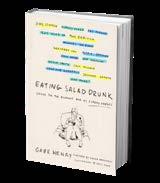
During the 16th century in Japan a Buddhist monk, Tamazaki Sōkan, knelt before the bed of his ailing father and composed the following verse.
Even at the time When my father lay dying I still keep farting.
As one of the founders of the haikai, the forerunner to the namesake haiku poetry, Sōkan scribes this phrase which will come to be one of the very first haikus in the world. What does this tell us (beyond the fact that fart jokes have been around for a long time)? To me it signifies that even during the darkest moments when we struggle, the need to bring joy and laughter is one of the most basic elements of being a human. That is what Gabe Henry tries to do in his book Eating Salad Drunk: Haikus for the Burnout Age by Comedy Greats. Reminding us of the origins of the Haiku poetry and its structure: three lines, seventeen syllables, and the original word (haikai) literally meaning “comic verse”; this book aims to capture the pithy wit of some of the great comedians of our time to remind us that even though we all might be sharing in the struggles of this modern burnout age, we can also all be united in the joys of laughter and doing it together.
In the spirit of the haiku, we have decided to pull some of our favorite poems from the book and pair them with your stories provided to us in Breaking the Silence. All of the stories provided by you will be listed as “ - Anonymous” while the haikus will note the comedian who wrote it. Hopefully the sharing of our stories can remind us that we are not as alone as we think we are in our struggles, and this modern age is something we are all dealing with, after all….
Who has time for more Than seventeen syllables These days anyway?
-Gabe Henry
If you read this quarter’s book, we’d love to hear what you thought. Whether you loved it or found it lacking—one sentence or one paragraph—share your reflections with us at nicolejbecker1@ gmail.com. And if you have suggestions for future reads, we’re all ears!



Above: Eating Salad Drunk: Haikus for the Burnout Age by Comedy Greats by Gabe Henry.
Connect + Chill
Cocktails & Streaming Content for the Casual Consumer
Each quater the YAF Knowledge Focus Group curates streaming video content and a cocktail / mocktail recipe to salute each quarterly theme. In Q4 we highlight Driving Wellness: Mitigating Burnout, Redefining Wellness with the following recommendations:
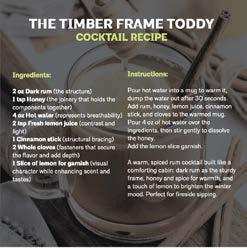
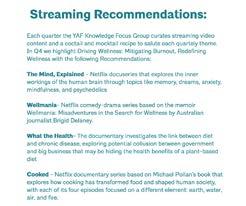
Author: AIA YAF Knowledge Focus Group (Arlenne Gil, AIA/Joe Taylor, AIA/Mel Ngami, AIA/Robert Farr, AIA/Elizabeth Zachman, AIA/Brady Laurin, AIA/Trent Schmitz, AIA/Diana Duran, AIA/Mi Zhang, AIA/Reily Joel Calderon Rivera, AIA/Daniela Moral, AIA/ Courtney Carrier,AIA)

Bio: The AIA YAF Knowledge Focus Group is dedicated to identifying important issues of recently licensed architects and the creation of knowledge resources to enable young architects to advance their careers
Author
