Finland A Cultural Cookbook Sample

Page 1


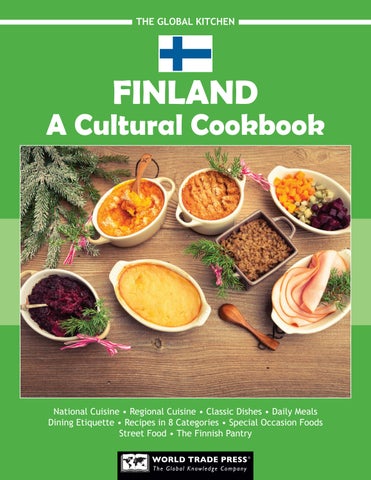
FINLAND

A Cultural Cookbook

National Cuisine • Regional Cuisine • Classic Dishes • Daily Meals

Dining Etiquette • Recipes in 8 Categories • Special Occasion Foods Street Food • The Finnish Pantry
Recipes in The Global Kitchen series are provided for informational and cultural purposes only. Results may vary due to differences in ingredients, equipment, and individual cooking experience. Always follow safe food-handling practices and exercise caution with sharp utensils and hot surfaces. Check all ingredients for potential allergens before use. World Trade Press has not independently tested every recipe and assumes no responsibility for the outcome, safety, or accuracy of any recipe or information presented.

Copyright © 2026 by World Trade Press

Publisher: Edward G. Hinkelman

Editors: Brielle Burt, Felicia Topp, Kasey Myers, Emily Padgett

Series Designer: Kristie Wolgamott

Production Designer: Michael Warner

Cover Image: Jarvna/Shutterstock

No part of this publication may be reproduced, stored in a retrieval system, or transmitted in any form or by any means, electronic, mechanical, photocopying, recording, scanning, or otherwise, except as permitted under Section 107 or 108 of the 1976 United States Copyright Act, without the prior written permission of the Publisher.

For information about permission to reproduce selections from this report, please contact Permissions: permissions@worldtradepress.com

For information about special discounts for bulk purchases, please contact Sales: sales@worldtradepress.com

ISBN: 978-1-60780-045-3

www.TheGlobalKitchen.com www.worldtradepress.com

World Trade Press, 616 E. Eighth St., Ste. 7, Traverse City, MI 49686

FINLAND

A Cultural Cookbook

Gen S. DuMonde

LIST OF RECIPES

Graavilohi (Salt-Cured Salmon) ..........................46

Grated Turnip and Apple Salad ...........................94

Hapankaalikeitto (Sauerkraut Soup) ....................74

Hernekeitto (Pea Soup) ...................................75

Imelletty Perunalaatikko (Sweetened Potato Casserole) ...................186

Isoäidin Salaatti (Grandmother’s Salad) ................95

Janssonin Kiusaus (Jansson’s Temptation)............134

Joululimppu (Christmas Rye Loaf).....................112

Kaalikääryleet (Cabbage Rolls) ........................136

Kalakeitto (Fish Soup) .....................................76

Kalakukko (Fish-Filled Bread) ..........................140

Karjalanpaisti (Stewed Meat) ..........................142

Karjalanpiirakat (Karelian Pasties) ......................48

Kasvissosekeitto (Vegetable Purée Soup) ..............78

Kesäkeitto (Summer Soup) ...............................80

Kiisseli (Berry Soup) .....................................214

Kinkku-Juustosalaatti (Ham and Cheese Salad) .......96

Klimppisoppa (Meat and Dumpling Soup) ..............82

Korppu (Twice-Baked Toast) ............................114

Korvapuusti (Cinnamon Rolls) ..........................216

Korvasienimuhennos (Mushroom Stew) .................85

Köyhät Ritarit (French Toast) ..........................149 ..........194

Kurkkusalaatti (Cucumber Salad) ........................98

Lanttulaatikko (Rutabaga Casserole) .................198

Laskiaispulla (Shrove Buns) .............................220

Lihamakaronilaatikko (Macaroni and Beef) ..........150

Lihamureke (Meatloaf) ..................................152

Lihapiirakka (Meat Pie) ...................................50

Lihapullat (Meatballs) .....................................52

Lohikeitto (Salmon Soup) .................................86

Lohimousse (Salmon Mousse).............................54

Maksalaatikko (Liver Casserole) .......................156

Mämmi (Rye Pudding) ...................................222

Merimiespata (Sailor’s Stew) ...........................158

Munavoi (Egg Butter) ....................................199

Munkki (Doughnuts) ......................................224

Mustikkapiirakka (Blueberry Pie) ......................226

Nakkikastike (Hot Dog Sauce) ..........................160

Näkkileipä (Crispbread) .................................116

Omenapiirakka (Apple Pie) .............................228

Pääsiäisleipä (Easter Bread) ............................118

Paistetut Muikut (Fried Vendace) ........................57

Pannu Kakku (Baked Pancake) .........................121 .....................233

Perunarieska (Potato Flatbread) .......................122

Pikkupizzat (Mini Pizzas) ..................................58

Pinaattikeitto (Spinach Soup) ............................88

Porkkanalaatiko (Carrot Casserole) ...................203

Poronkäristys (Sautéed Reindeer) .....................168

Pulla (Cardamom Bread) ................................124

Punajuuripihvit (Beet Steaks) ............................61

Pyttipannu (Meat and Potato Hash) ...................170

Raparperipiirakka (Rhubarb Pie).......................234

Rieska (Flatbread) .......................................126

Riisipuuro (Rice Porridge)...............................171

Rosolli (Beet Salad) ........................................99

Ruisleipä (Rye Bread)......................................62

Runebergintorttu (Runeberg Torte) ...................238

Salmiakki (Salty Licorice) ...............................240

Sienisalaatti (Mushroom Salad) ........................100

Sillikaviaari (Herring Spread) ............................65

Sillisalaatti (Herring Salad) .............................104

Sipulihillo (Onion Jam) ....................................66

Sipulipiirakka (Onion Pie) ...............................172

Siskonmakkarakeitto (Sausage and Root Vegetable Soup) ...............90

Smoked Fish Salad .........................................68

Tiikerikakku (Tiger Cake) ...............................242

Tippaleivät (May Day Cookies) .........................244

Uunipuuro (Oven Porridge) .............................177

Vihreä Salaatti (Green Salad) ..........................109

Vispipuuro (Whipped Berry Porridge) .................178

Vorschmack (Savory Meat Spread) .......................70

FOREWORD

Welcome! This cookbook offers a structured and research-informed exploration of Finnish cuisine, built upon more than 30 years of culinary documentation and cultural study. Developed from our reference database, cooks, chefs, and food historians. It is not a personal narrative but a contextualized account of how Finnish food has evolved and what it reveals about the country’s northern environment, cultural intersections, and enduring traditions.

familiar symbols. Early Finnic peoples adapted to a harsh northern climate through resourcefulness—smoking, introduced grains such as barley, oats, and rye, while lakes and forests provided an abundance of freshwabrought baking traditions, soups, casseroles, and pastries that blended seamlessly into local customs. In modern times, Finnish cuisine has evolved further through innovation and the global reach of Nordic culinary movements, which continue to emphasize purity, seasonality, and connection to nature.

context alongside preparation. From kalakukko and karjalanpiirakka to lohikeitto, poronkäristys, and mustikkapiirakka, each dish is presented within its broader narrative—whether rooted in peasant foodways, regional trade, cultural fusion, or contemporary reinterpretation.

As with all books in this series, the approach is factual rather than anecdotal. The goal is to offer readers a practical yet culturally grounded understanding of Finnish cuisine—not only what is eaten, but how and why. In doing so, the collection reveals a national food identity shaped by simplicity, resilience, and a deep relationship with the land and seasons. It serves both as a record of heritage and a reference for the continuing

REGIONAL CUISINE

Finnish cuisine is distinguished by its reliance on fresh, local

the country’s varied landscape. From dense forests to vast lakes and the Baltic Sea, Finland’s natural environment provides a rich to its culinary practices. Traditionally, Finnish dishes emphasize used. Root vegetables, rye, barley, and dairy products also play

Southern Finland: Coastal and Urban Flavors

Southern Finland, including the capital, Helsinki, features a blend of modern and tradi-

traditions. The coastline supports a diet rich in seafood, with dishes such as Baltic herring a regional staple. Helsinki’s vibrant food scene also includes modern interpretations of classic Finnish dishes. A popular dish in this region is lohikeitto, a creamy salmon soup that showcases the quality of local seafood seasoned with dill.

Western Finland: Agricultural Heartland

Western Finland is known for its vast agricultural output, particularly potatoes and rye. The region’s output shapes many core Finnish foods, especially breads, porridges, dairy products, and vegetable-based dishes, many of which feature potatoes. The city of Turku and its surroundings are famous for muikku,

fried and served with garlic sauce. The region is also famous for its lihapyörykät (meatballs), often accompanied by mashed potatoes and lingonberry jam, which combine the staple crops and local tastes into hearty meals.

In southern Finland, Baltic herring is a regional staple, celebrated annually during the Helsinki Baltic Herring Market.
Around the city of Turku, a small fish called muikku is particularly popular.

CLASSIC DISHES

Karjalanpaisti – Also known as Karelian hot pot, this is a traditional meat stew from the region of Karelia, prepared with pork, beef, and lamb. It is often considered the national dish of Finland.

Lihamakaronilaatikko – This traditional Finnish dish is a meat and macaroni casserole.

SIDE DISHES

Kaalikääryleet – Stuffed cabbage rolls are a peasant dish popular not only in Finland, but also throughout Europe and Central Asia.

Karjalanpiirakat – These savory Karelian pastries are popular for breakfast or lunch.

Munavoi – A smooth spread of mashed hardboiled eggs with butter, munavoi often accompanies Karelian pies.

DESSERTS

Kiisseli – The name kiisseli literally means “the stable master’s fruit compote,” and is a berry soup thickened with potato starch or cornstarch.

Pappilan Hätävara – Cookies, whipped cream, and jam or berries are layered together for this traditional dessert.

– A salty black licorice, salmiakki may be soft or hard.

Salmiakki
Karjalanpaisti
Karjalanpiirakat
Salmiakki
Pappilan Hätävara

DAILY MEALS

Drinks

In Finland, more coffee is consumed per capita coffee all day long. Milk, piima (fermented milk), and tea also are popular. Alcoholic drinks are commonplace. Finns drink various home brews as well as Finlandia and Koskenkorva vodkas, Jaloviina brandy, berry liqueurs, wine, and hard cider.

sahti, a

Desserts

Sweet breads are common as desserts, includpulla and cinnamon rolls. Kiisseli, a thin jelly, is made from berries, prunes, or other fruit. Finns also have a taste for unusual sweets, such as the salty black licorice candy called salmiakki and terva leijona, a licorice

Finns have a taste for unusual sweets such as chocolate flavored with salty black licorice, or salmiakki
Finnish people drink more coffee per capita than people in any other nation in the world.

SPECIAL OCCASION FOODS

JOULU (Christmas)

Finns may begin their day during the Christmas season with riisipuuro, a milky rice porridge sweetened with cinnamon, sugar, and prune kiisseli (jelly). They set a special Christmas table, called joulupöytä, that includes many special dishes only made for this holiday. Typically included is joulukinkku (a large roasted ham) served with sides such as laatikkoruoat (casseroles made from potatoes, rutabaga, and carrots), pickled herring or cured salmon, and rosolli (a beet and potato salad).

PÄÄSIÄINEN (Easter)

Easter in Finland is both a religious and seasonal celebration. Roast lamb is often the main course for the Easter meal, symbolizing renewal, and is usually accompanied by potatoes and seasonal vegetables as well as smoked salmon, herring, and egg dishes. A traditional Easter dessert is mämmi, a dark rye pudding typically served with cream and sugar. Pasha, a sweet cheese dessert with dried fruits, also is popular, par-

balance between religious observance and the joy of spring’s arrival, with meals bringing families together to celebrate.

Sweet pastries baked at Christmastime include piparkakut buns called joulupulla joulutorttu. Warm treats such as roasted chestnuts and glögi Finnish traditions of sharing and generosity, with the large family meal being the focal point of the celebration.

Life Milestones and Personal Celebrations WEDDINGS

Finnish weddings are grand affairs with a strong focus on food. A traditional wedding feast includes the national dish Karjalanpaisti (Karelian meat stew), salmon, potatoes, and an assortment of cold

cake, often a multi-tiered creation, is a centerpiece, sometimes made with berries and whipped cream. The food served at Finnish weddings is meant to symbolize abundance, love, and the union of families.

the occasion.

STREET FOOD

MUIKKU

Muikku, or fried vendace, is a traditional Finnish dish of mashed potatoes. Muikku is particularly popular in the lake regions of Finland, such as around Tampere and Savonlinna, and is commonly available at outdoor markets, food festivals, and along lakeside stalls.

HERNEKEITTO

Hernekeitto (pea soup) is a traditional Finnish dish

ham or bacon, and served with mustard. Some variations might include adding carrots or onions to the soup. Hernekeitto has been a staple of Finnish cuisine for centuries and is traditionally eaten on Thursdays. As a street food, it is commonly found at markets, festivals, and during winter events, particularly in urban areas such as Helsinki.

Sweet Treats KORVAPUUSTI

Korvapuusti is a popular Finnish pastry made from cinnamon before being baked until golden. Some variations might include adding cardamom to the dough or glazing the rolls with icing. Korvapuusti is similar to Swedish kanelbulle and has been a staple in Finnish bakeries for generations. It is commonly available at cafés, bakeries, and street stalls, particularly during coffee breaks or as a snack on the go.

RUNEBERGINTORTTU

Runebergintorttu is a small, cylindrical pastry made from almonds, breadcrumbs, and rum or arrack, topped with raspberry jam and a ring of icing. Also known as Runeberg torte, it is named after the Finnish poet, Johan Ludvig Runeberg, and is traditionally eaten in early February to celebrate Runeberg’s birthday. These tortes are commonly found at bakeries, cafés, and markets during the winter months, particularly in Helsinki and other southern cities.

DID YOU KNOW?

Fish Fans

Fish dishes are the heart of the Finnish diet, with or smoked vendace (a species of freshwater whiterapujuhlat, are a Swedish tradition the Finns adopt usually served as starters to a steak entree.

Squeaky Cheese

Leipäjuusto, known as “squeaky cheese,” is a mild and tasty cheese that’s typically made of cow’s milk. The cheese is made by curdling milk before it’s baked in the oven. The exterior of the cheese gets a spotted black and white coloring from the heat of the oven— partly why the Finnish name means “cheese bread.” Leipäjuusto is said to squeak when bitten into.

Reindeer Dinner

Reindeer are found in the northern province of Lapland, and their meat is considered one of the healthiest as it is high in B-12, omega-3 and omega-6. Sautéed reindeer is a Finnish treat that’s eaten throughout the country all year round, and is served alongside mashed potatoes.

Holiday Eats

Finnish cuisine is deeply rooted in the cultural traditions that surround holidays and special occasions. For example, Christmas is a major celebration in Finland, marked by feasting on traditional dishes including ham, casseroles, and rice pudding. Midsummer is celebrated with a traditional Finnish barbecue, fea-

COFFEE CULTURE

How It’s Enjoyed

Coffee is consumed throughout the day in Finland, with most people drinking several cups daily—often more than four. It is traditionally served with pulla (cardamom-spiced sweet bread), korvapuusti (cinnamon rolls), or other pascafés may serve more modern drinks such as cappuccifoam) and cortados—one part espresso, one part steamed milk. Social events, family gatherings, workplace breaks, and even funerals are often marked by shared coffee sessions. In many workplaces, coffee breaks are protected by collective labor agreements.

Interesting Facts

• Finland has the highest per capita coffee consumption in the world—about four cups per person per day on average.

• than in most other European countries.

• The kahvitauko (coffee break) is an institutionalized part of Finnish work culture, often occurring twice daily.

• Serving coffee at a Finnish funeral is traditional, typically accompanied by sandwiches and cakes.

• The Finnish Coffee Roasters’ Association ensures strict quality control and promotes sustainable sourcing practices.

Pastries such as pulla and korvapuusti often accompany coffee in Finland.

GRAAVILOHI (SALT-CURED SALMON)

Prep Time: 15 minutes

Recipe Servings: 6–8

Rest Time: 24 hours

Total Time: 24 hours 15 minutes

Dietary Considerations: Gluten Free, Dairy Free, Kosher, Halal

Graavilohi is a traditional Finnish preparation in which raw salmon is cured with salt, sugar, and fresh dill. This

Graavilohi is commonly served at holiday meals, weekend brunch tables, summer gatherings, and yearround as part of Finnish cold spreads, often accompanied by rye bread, boiled potatoes, or mustard-dill sauce. It remains one of the most recognizable and widely enjoyed dishes in Finnish cuisine.

SMOKED FISH SALAD

Prep Time: 20 minutes

Recipe Servings: 6–8

Total Time: 20 minutes

Dietary Considerations: Gluten Free, Dairy Free, Kosher

vorful and light, and it can be served either as an appetizer or as a side dish to a meal. Other kinds of smoked

KINKKU-JUUSTOSALAATTI

(HAM AND CHEESE SALAD)

Prep Time: 15 minutes Total Time: 15 minutes

Recipe Servings: 4 Dietary Considerations: Gluten Free

Kinkku-juustosalaatti is a familiar Finnish mixed salad commonly served at family gatherings, weekday meals, and as part of larger buffet-style spreads. Variations appear in Finnish home cooking from the mid-20th century onward, often using diced ham, mild cheese, lettuce, cucumber, and simple dressings based on yogurt or sour cream. Oltermanni, similar to Danish havarti, and edam cheese are two commonly used cheeses. The Variations may include cooked and cubed potatoes as well as peas.

JANSSONIN KIUSAUS

(JANSSON’S TEMPTATION)

Prep Time: 20 minutes

Cook Time: 1 hour

Recipe Servings: 4–6

Total Time: 1 hour 20 minutes

Dietary Considerations: None

A popular dish in Finland and Sweden for Christmas, Easter, and other family gatherings, Janssonin kiusaus is a creamy potato casserole that includes pickled sprats. This dish belongs to a group of Finnish kiusaus— casseroles that combine sliced potatoes with various proteins, with Janssonin kiusaus the oldest and bestknown version. In Finland, potato casseroles commonly use the vegetable sliced into sticks, as in this recipe. The sprats, often called Norwegian anchovies, may be substituted with lightly salted Atlantic herring. Simple to make and versatile, this dish has been a family favorite passed down for generations.

MAKSALAATIKKO (LIVER

CASSEROLE)

Prep Time: 20 minutes Cook Time: 1 hour 25 minutes Total Time: 1 hour 45 minutes

Recipe Servings: 4–6

Dietary Considerations: Gluten Free, Kosher, Halal

Maksalaatikko is a traditional Finnish baked casserole made with rice, minced liver, onions, and warming spices. It has long been a staple of everyday Finnish home cooking, typically made during Christmas, and

whole animal, especially beef or pork liver, which were affordable sources of nutrients in rural households. Maksalaatikko is commonly eaten as a weekday meal and is often served with lingonberry jam for contrast. It remains widely available in Finnish grocery stores today as a ready-made dish.

SIENISALAATTI (MUSHROOM

SALAD)

Prep Time: 15 minutes

Recipe Servings: 4–6

Rest Time: 20 minutes Total Time: 35 minutes

Dietary Considerations: Vegetarian, Gluten Free, Kosher, Halal

Sienisalaatti is a classic Finnish cold salad traditionally made from salted or pickled forest mushrooms, with foraging for these fungi a classic Finnish tradition. Because salted mushrooms were once a key preservation method in Finland, this salad became a way to serve foraged autumn mushrooms throughout the snowy months. Among the mushrooms that may be used are chanterelles, milk caps, cremini, porcini, or mixed forest earthy mushrooms, mild onion, and a creamy yet slightly acidic dressing. Sienisalaatti is commonly served as part of the Finnish Christmas feast called Joulupöytä, and with cold cuts or rye bread.

PÄÄSIÄISLEIPÄ (EASTER BREAD)

Prep Time: 20 minutes Rest Time: 45 minutes Cook Time: 30 minutes Total Time: 1 hour 35 minutes

Recipe Servings: 4

Dietary Considerations: Vegetarian, Dairy Free, Kosher, Halal

Pääsiäisleipä is Finland’s traditional Easter bread, typically baked on the eve of Easter Sunday. Similar to German stollen, this yearly specialty originated in eastern Finland and Russia, where it is called kulitsa or kulitch pääsiäisleipä is cardamom, and the bread often includes almonds, golden raisins, bread, and it may be braided, round—sometimes with a cross cut into the top—or tall and cylindrical, from traditionally being baked in milking pails to recognize the arrival of new calves in the spring.

JOULULIMPPU

(CHRISTMAS RYE LOAF)

Recipe Servings: 1 loaf

Dietary Considerations: Vegetarian, Kosher, Halal

Joululimppu translates to “Yule loaf” and is a festive rye bread traditionally baked for Christmas throughout Finland. Joululimppu molasses, and imported spices that became common in Finnish holiday baking in the 1800s. Families baked several loaves at once before Christmas to enjoy with butter, cheese, gravlax, and holiday dishes such as (siirappi) or molasses combined with fennel, anise, or orange peel, giving it a characteristic holiday aroma.

BEET

Description

Beets are herbaceous plants (Beta vulgaris) with broad dark green leaves and edible tuberous roots. Beet roots are round, most commonly dark red or maroon in color, and are harvested at a weight of about 100 grams (3.5 ounces), although they can grow to weigh more than a pound. Both the greens and the root of the plant are edible.

Origin

Wild beets originated in prehistoric North Africa. Beets were cultivated by the ancient Romans, leading to their introduction in northern Europe, where they became popular around the 16th century.

Varieties

Beets come in red, golden, and white cultivars. Popular varietals include Green Top Bunching, Crosby Egyptian, and di Chioggia, an heirloom Italian varietal with red-and-white striping.

Beet leaves have a bitter, lively taste. Beetroots have beet roots have a soft and buttery texture.

Beet tops are a good source of vitamin A. Beet roots of manganese. Beets contain low concentrations of B vitamins, vitamin C, iron, magnesium, and potassium.

Preparations

Beet tops are cooked or served as fresh greens. Beet roots can be steamed, boiled, pickled, roasted, or eaten raw. Beets are used in a number of world pickled beets are common in the southern United States, and in India beet roots are a common vegetable in curries. Eastern European borscht contains beet juice as a key ingredient, and beet juice also can be drunk fresh.

Season

Although beets prefer warm weather, they can be planted up to a month before the last spring frost. Beet roots should be harvested after about 60 days.

Did You Know?

• Beets get their deep red color from their high concentration of betanin pigments. Cooking with beets can leave one’s hands stained red, and eating large quantities of beets can lead to beeturia, a harmless condition of passing pink or red urine. Betanin pigments from beets also are used as a food colorant.

MUSHROOM

Description

Agaricus. Many varieties are umbrella-shaped, with a cap, stem, and gills. Others are shaped like a ball, ear, cup, or shelf. Most edible varieties range in color between brown and white, and in size from 2-12 inches (5–30 cm).

Origin

and by the 1800s cultivation had spread to North America and other continents.

Varieties

Popular edible mushroom varieties in Western cooking include the button, oyster, chanterelle, morel, porcino, and portabella (small portabellas are called cuisines, popular varieties are shiitake, maitake (also called hen-of-the-woods), enoki, beech, straw, and wood ear mushrooms. Some varieties of mushroom are poisonous—even lethal—and some species are hallucinogenic or bioluminescent.

White and portabella mushrooms have a mild, earthy porcini have a nutty, woodsy taste, while chanterelles are fragrant, with hints of apricot and pepper. Shiitake

Mushrooms are a good source of B vitamins (B2, B3, and B6) and can be a good source of vitamin D. They also are high in selenium, copper, phosphorus, and potassium.

Preparations

Mushrooms are eaten raw or cooked in sauces, soups, salads, or atop pizza. They also can be dried or marinated. Large portabella mushrooms are often grilled as a meat substitute. Shiitake, maitake, enoki, straw, beech, and oyster mushrooms are commonly used in Asian soups and stir-fries. Morels and chanterelles are usually foraged from the wild and eaten in shaved atop gourmet dishes or infused in oil.

Season

Commercially grown mushrooms are available year-round. Wild mushrooms can be found in forested regions during the growing season.

Did You Know?

• Mushrooms have been instrumental in the discovery of many antibiotics including penicillin. They are useful in composting and environmental cleanup, due to their ability to break down and absorb heavy metals, poisons, and pollutants. When exposed to sunlight, mushrooms can make their own vitamin D.

ABOUT WORLD TRADE PRESS

World Trade Press is a publishing and information products company specializing in country-based information company’s mission is to strengthen mutual understanding across cultures by lowering the information barriers that prevent individuals and organizations from succeeding in the international arena. World Trade Press clients include academic and public libraries, universities, global businesses, government agencies, global logistics

Databases

World Trade Press has developed and maintains more than a dozen large-scale online databases of country and city information covering business, culture, food, import/export, local living, and travel for 174 world countries and 201 world cities.

Physical Books, Atlases, and Maps

World Trade Press has published multiple editions of more than 100 physical reference books, country business guides, books for international trade and logistics, world atlases for travel and logistics, and world and country wall maps.

Professional Reports and E-Books

World Trade Press has developed and maintains more than two dozen professional-level country e-reports and e-books for each of 174 countries. These products cover topics such as business culture, cost of living, demographics, education, environment, holidays and festivals, government, money and banking, music, quality of life, religion, security, social indicators, and more.

Contributors

All World Trade Press products—from our databases and e-content reports to our physical books, maps, and atlases—are created through the collaboration of a dedicated internal staff of researchers, writers, editors, and cartographers and more than 100 external subject-matter experts to create world-class security, and travel. To view a partial list of contributors to titles in The Global Kitchen series, go to TheGlobalKitchen.com/World-Trade-Press.

Learn more about World Trade Press and its products at www.WorldTradePress.com.

Enjoyed this cookbook?

For more recipes, updates, and global food inspiration, follow The Global Kitchen on Facebook and BlueSky.

Social Links:

Facebook - www.facebook.com/wtpglobalkitchen

Check

Turn static files into dynamic content formats.

Create a flipbook
Issuu converts static files into: digital portfolios, online yearbooks, online catalogs, digital photo albums and more. Sign up and create your flipbook.
Finland A Cultural Cookbook Sample by worldtradepresss - Issuu