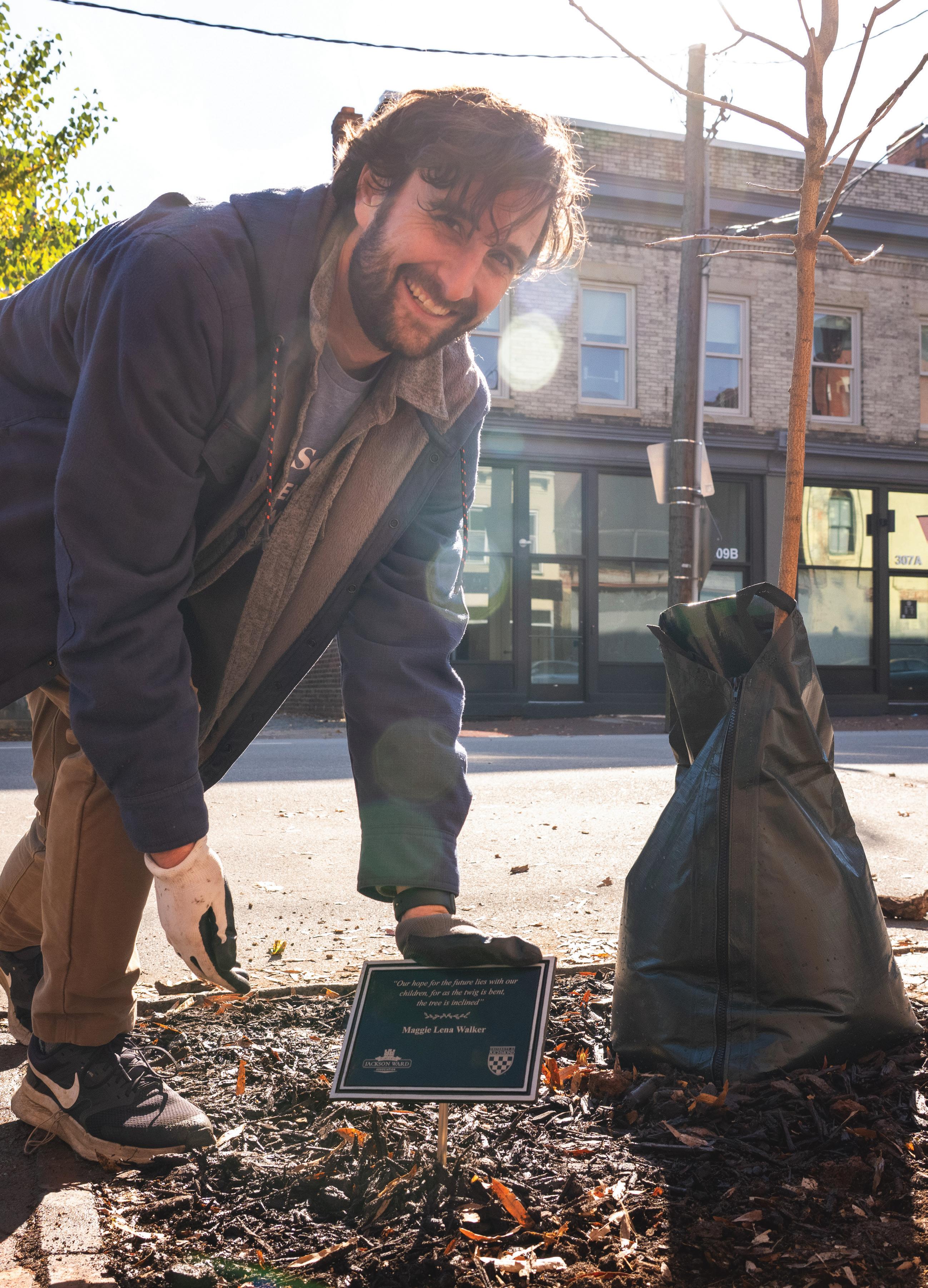
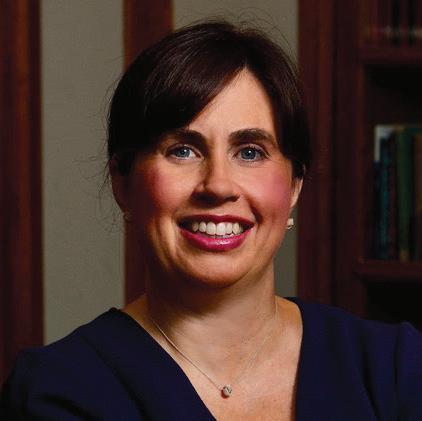
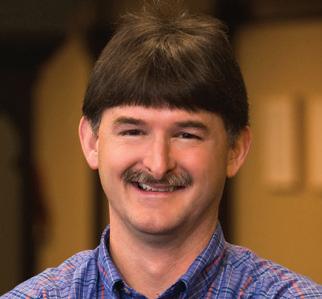
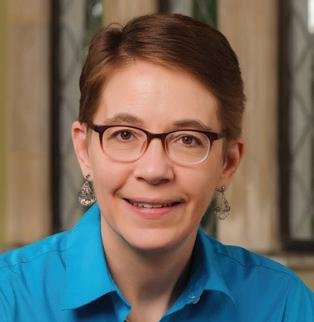
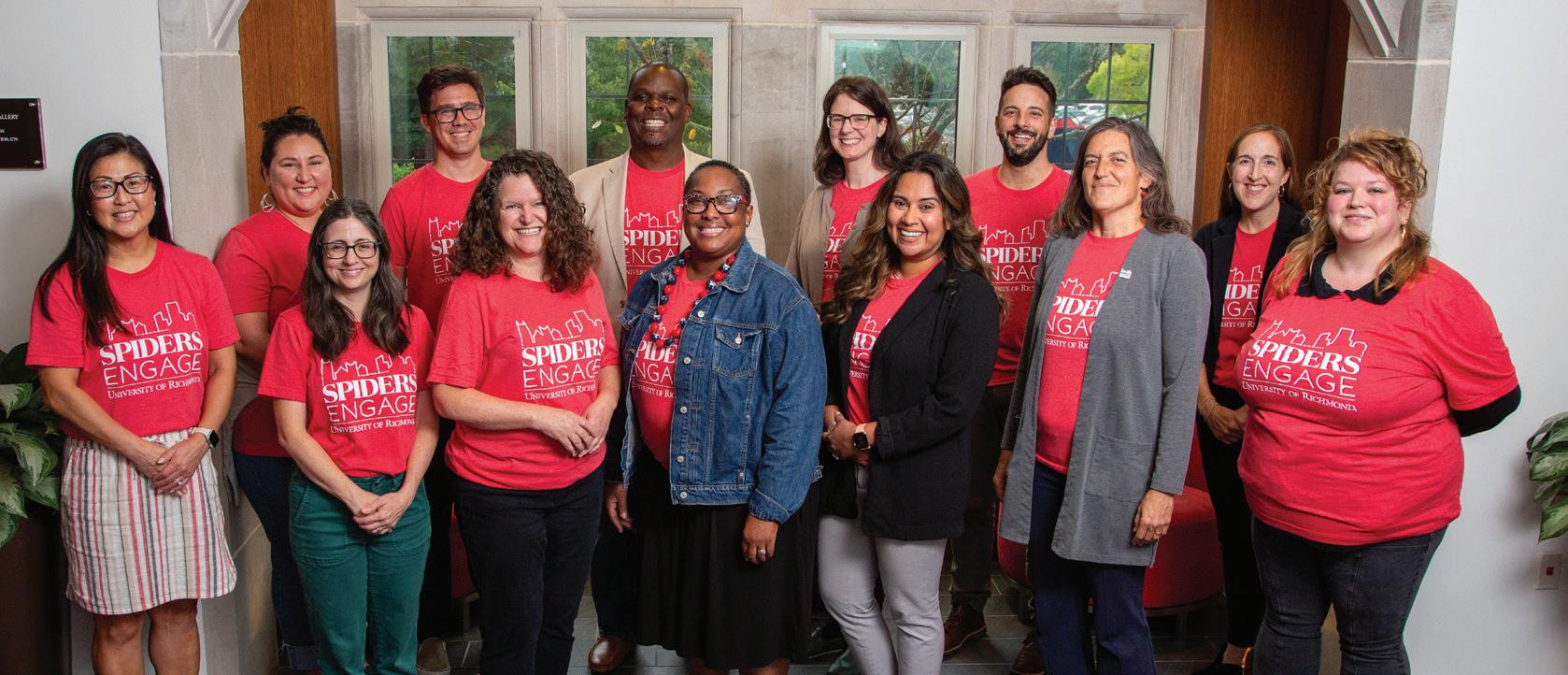
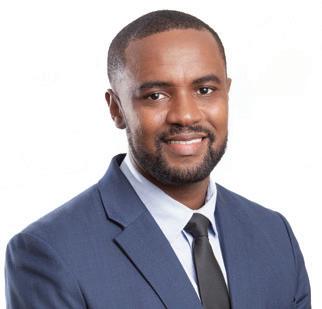
Faculty, staff, students, and community members partnered with the Historic Jackson Ward Association to plant trees in the neighborhood in November, blending environmental science with cultural history. The project grew from summer research in which students measured urban heat, identified vacant tree wells in the hottest areas, and worked with residents and arborists to select suitable tree species. Students also explored Jackson Ward’s history through museums, walking tours, and local partnerships, inspiring commemorative plaques honoring notable neighborhood figures.
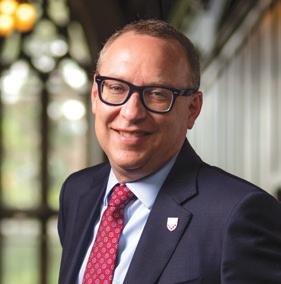
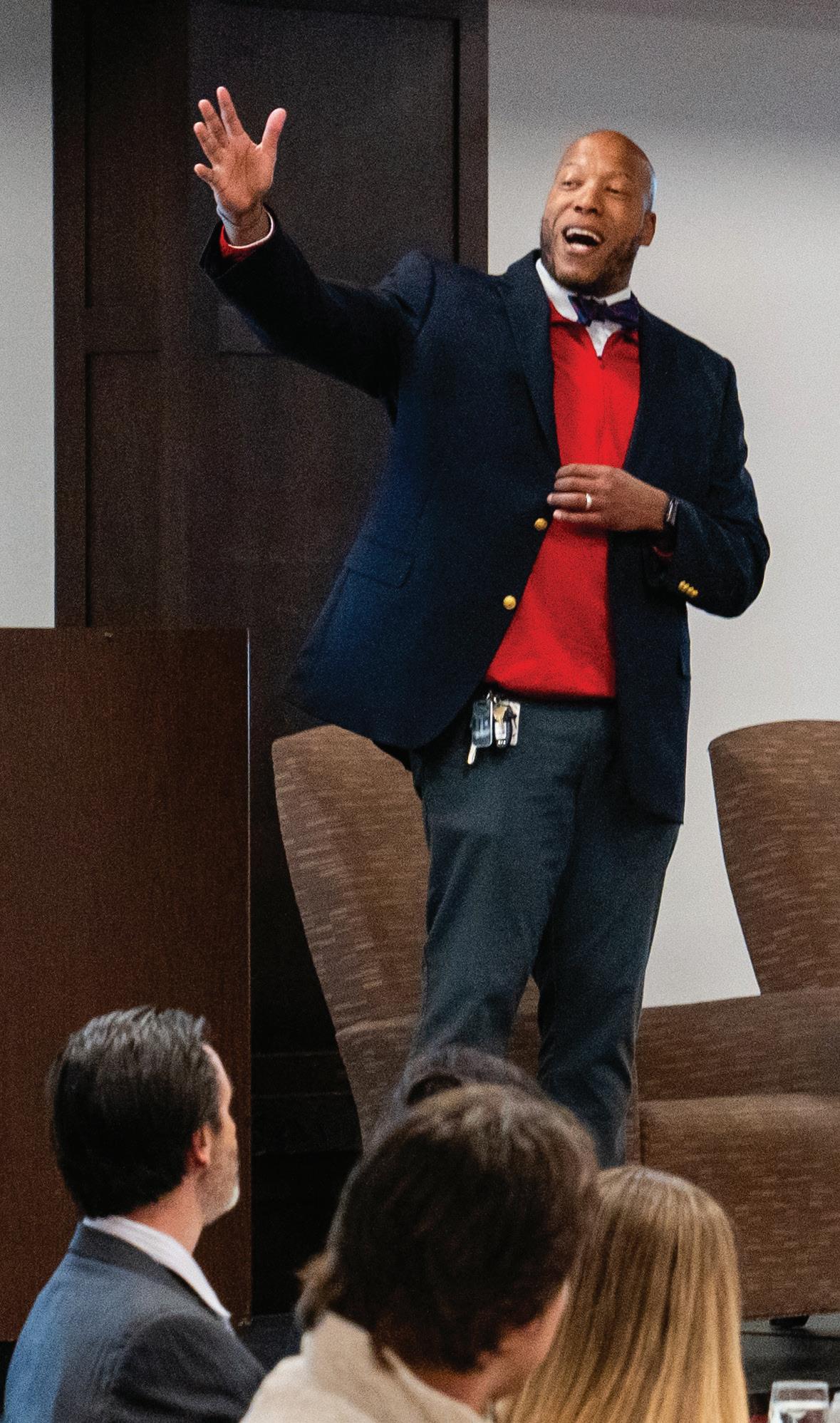
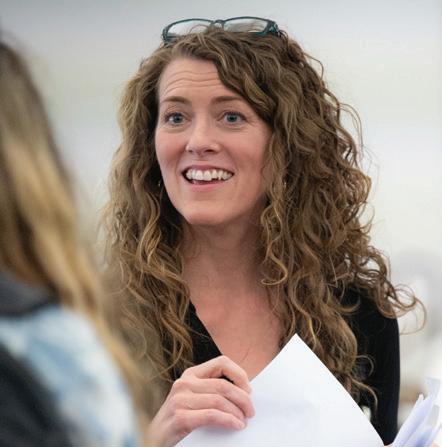
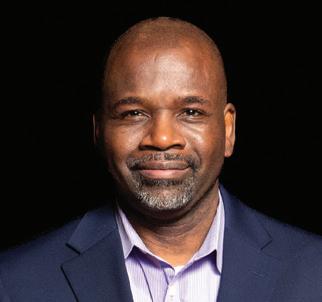
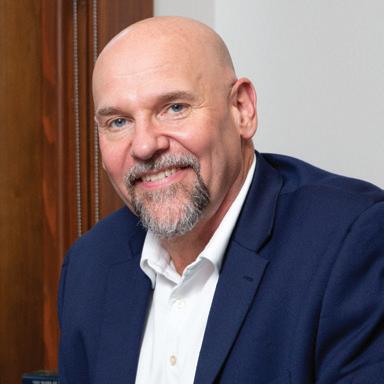
“Seeing everything come together seamlessly was remarkable,” said Kyle Redican (pictured), teaching faculty of geography, environment, and sustainability and director of the Spatial Analysis Lab. “It was especially meaningful to watch my students transform our summer research into something with tangible community impact that extends far beyond an academic paper or conference presentation.”
Vice president for communications and chief marketing officer
Tom Addonizio
Associate vice president for communications
Cynthia Price
Editor Cheryl Spain
Associate vice president for creative and design services
Samantha Tannich
Graphic designer
Ashley Gladner
Photographer Jamie Betts
Staff contributors: Lauren Anesta, Sunni Brown, Sandi Cauley, Megan Condict, Kevin Creamer, Catherine Cribbs, Nia Darrisaw, Rachel Dawson, Matthew Dewald, Lucy Gilbert, Phillip Gravely, Terrance Henderson, Kevin Heraldo, Alicia Hubbard, Lee Anna Jackson, Ava Jenks, ’27, Pamela Lee, Rachel Long, Katie McBride, Rayne Miller, Kyra Molinaro, Amy Ogle, ’26, Cassie Price, Gordon Schmidt, Sandra Shelley, Cindy Smith, and Greg Thompson
WINTER 2026
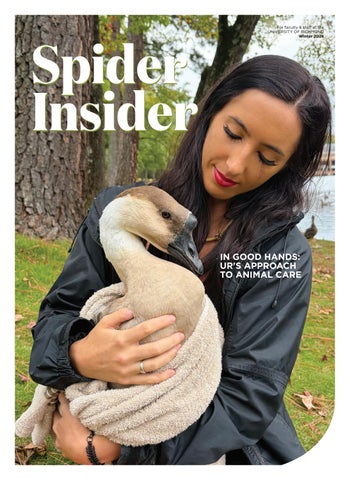
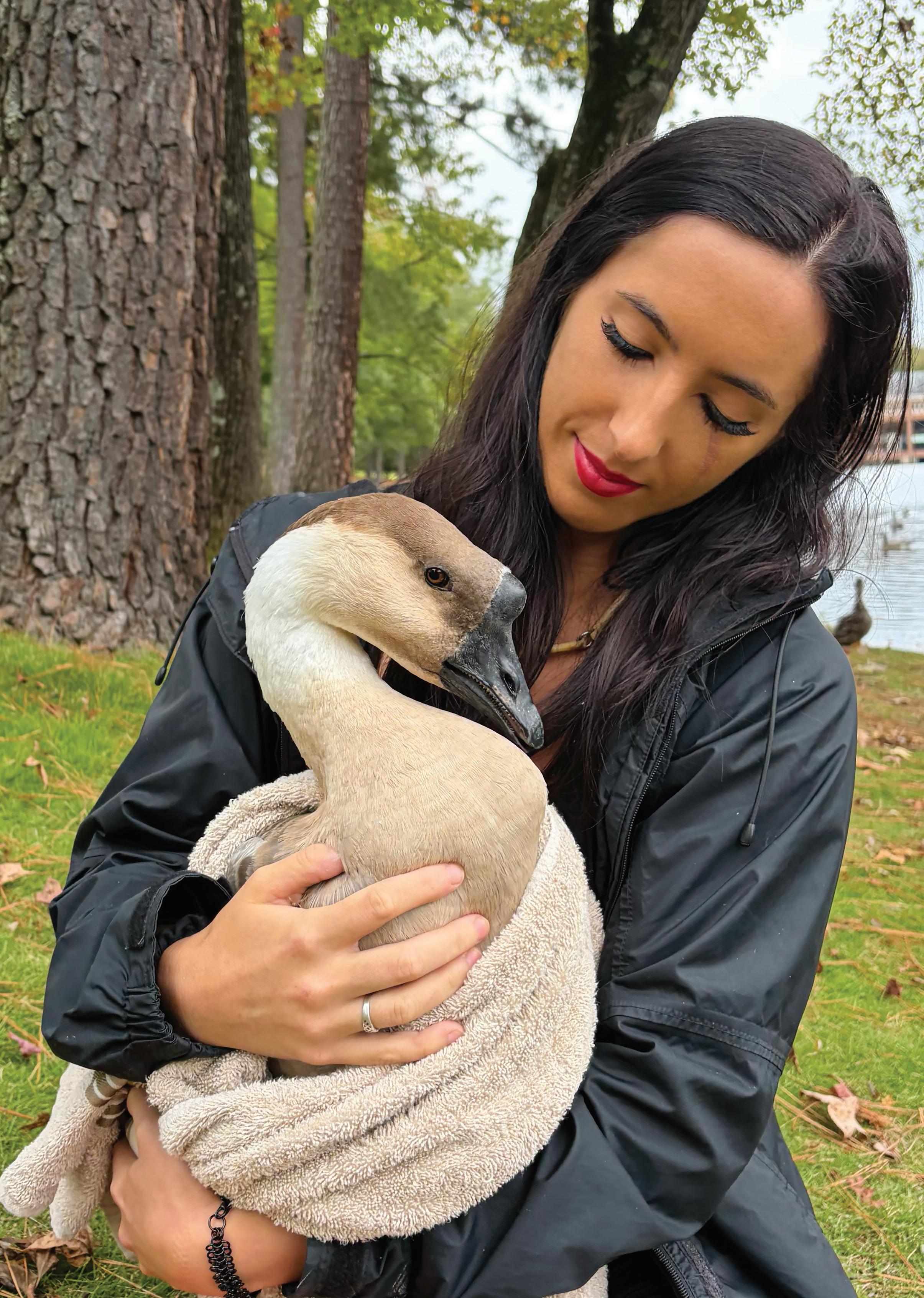
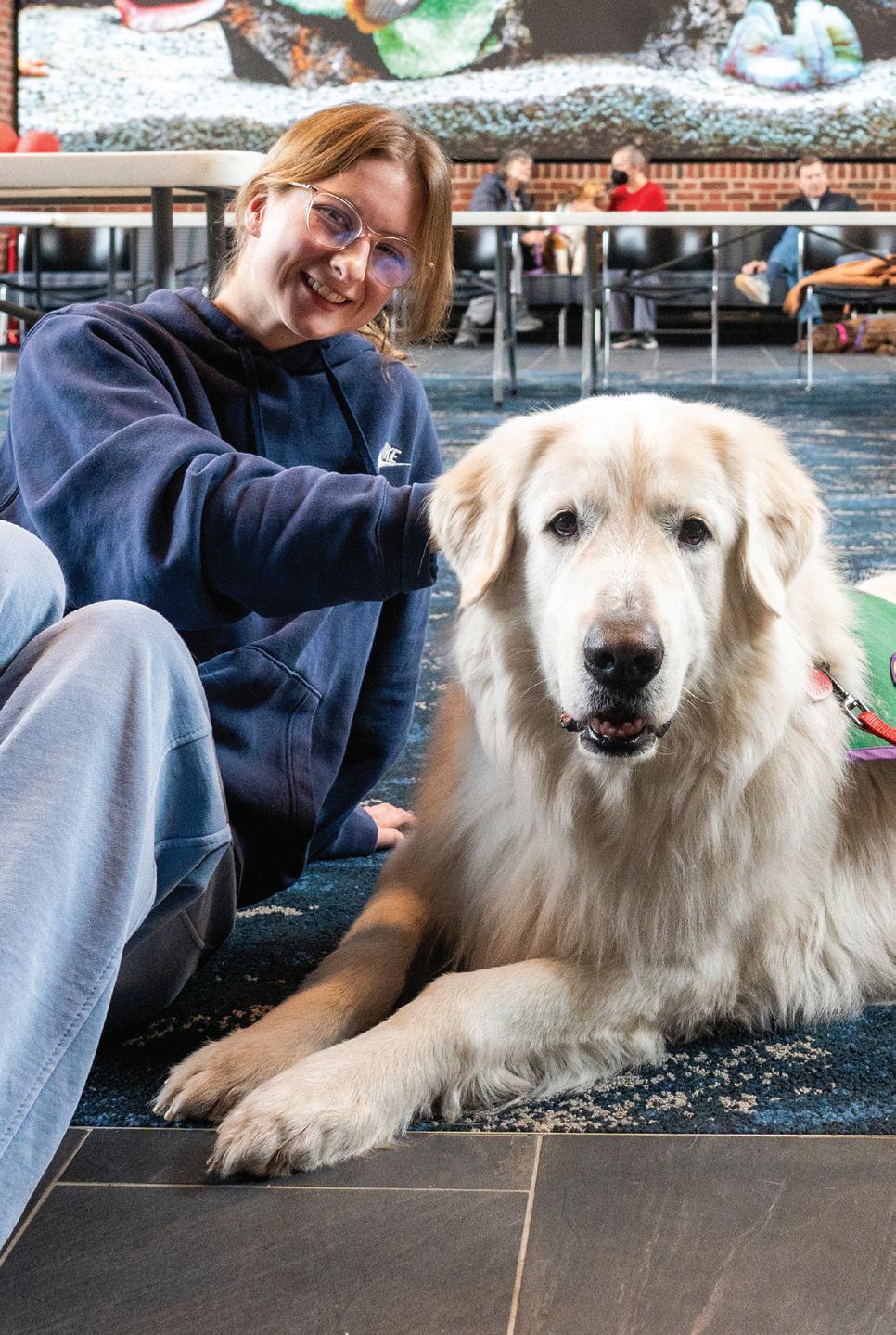
Jamie Wagner, animal care specialist, tends to Triceragoose, one of campus's many resident creatures. Read the story on Page 4.
We welcome your
Send your story ideas or comments to spiderinsider @richmond.edu.
STAY CONNECTED
Read more of President Hallock’s messages to the University community — or share your thoughts with him at any time — at president.richmond. edu.
Growing Through Dialogue
Dear Spiders,
In October, students from the University’s College Democrats and College Republicans organizations came together to debate for the first time in four years. Each team listened to the other’s ideas and responded thoughtfully, and occasionally, opposing sides even found common ground. A rapt audience, including more than 200 of our students, filled every chair, stood along the walls, and peered down from the second-floor banisters of Tyler Haynes Commons. It was exactly the kind of event that should happen at universities like ours. I’m grateful to our students for listening to and learning from each other and to the many colleagues who provided support — from staff in the Office of Student Development and University Communications to dedicated faculty mentors and advisors.
As we begin a new calendar year, I am also grateful to be part of a university that offers so many opportunities to come together, share our ideas, and consider others’ perspectives. For instance, we have a Community Dialogue Network (CDN) that helps our campus community build and practice skills to navigate challenging conversations. Last semester, the CDN graduated its ninth cohort, and dozens of the program’s staff and faculty alumni gathered over lunch in the Heilman Dining Center to reconnect.
We can also explore different perspectives through programs that bring visiting speakers to campus, such as the Gary L. McDowell Institute’s Lecture Series and the Sharp Viewpoint Speaker Series. Last year, a visiting scholar shared that the McDowell Institute’s “willingness to entertain a range of thinkers and ideas from across
the political spectrum makes it a unique place in American higher ed.” I agree, and I’m proud that our university is being recognized as a place that truly welcomes and supports the exchange of ideas. I am also looking forward to the next Sharp Series program, on Feb. 5, when two economists, David Autor from the Massachusetts Institute of Technology and Anton Korinek from the University of Virginia, will share differing views about the role of artificial intelligence today and in the future. I am excited to learn more about where their ideas diverge and where they share common ground. I hope you will consider joining us for the event.
Spiders are already doing so much great work to support dialogue and provide pathways for sharing and considering different vantage points. In addition, a new Presidential Advisory Group on Dialogue, composed of students, staff, and faculty and chaired by my chief of staff, Dara Gocheski, is now exploring how we might further advance our efforts. They will offer recommendations informed by our current work, our mission, and our strategic priority of belonging and community. I will carefully consider their ideas, and I am confident that together, we will continue our positive momentum and cultivate a relentlessly welcoming community.
Thank you so much for being an important part of our web and for all that you do to strengthen it.
With gratitude,
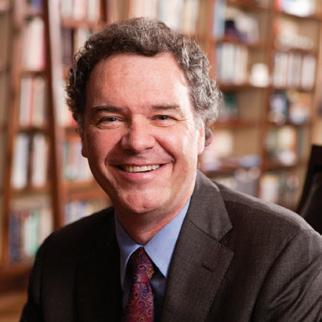
Kevin F. Hallock President and Distinguished University Professor of Economics
A Time of Giving
Spiders Helping Spiders, Gratitude Day celebrate donor support
In the fall, University Advancement hosted two popular campuswide initiatives to engage the Spider community in philanthropy.
The eighth annual Spiders Helping Spiders campaign was held Nov. 12–19, raising more than $460,000 from a record number of 1,500 donors to support students with financial need. Gifts are directed toward financial aid; the Student Emergency Fund, which helps students who experience urgent and unforeseen expenses; and the Career Opportunity Fund, which provides students financial assistance to pursue internships, job interviews, or graduate school.
“We are thrilled with this year’s results,” said Gabrielle Strickland, director of annual giving. “It’s heartwarming to see how much our Spiders care for one another and want to offer support so students can have the resources they need to succeed.”
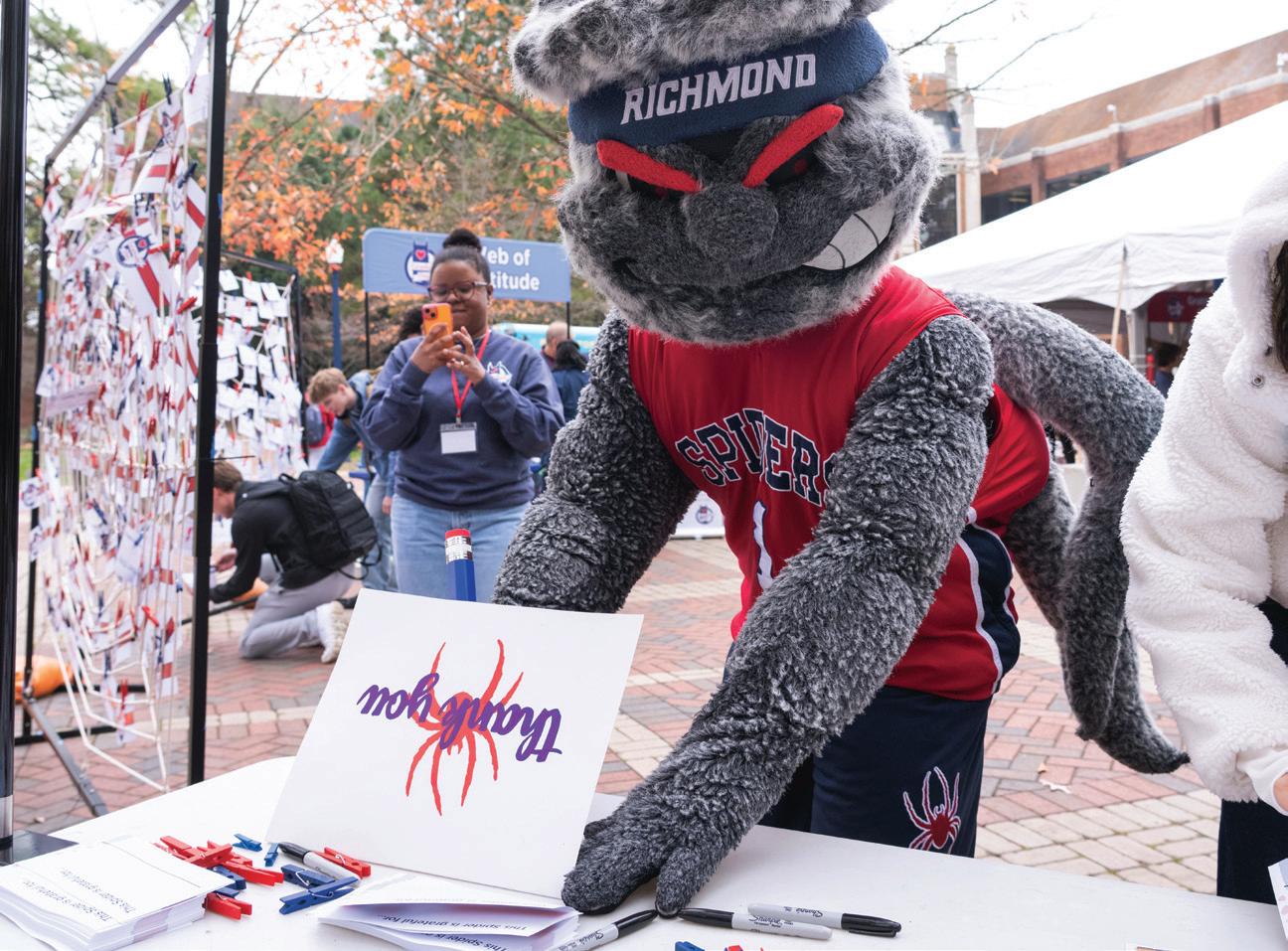
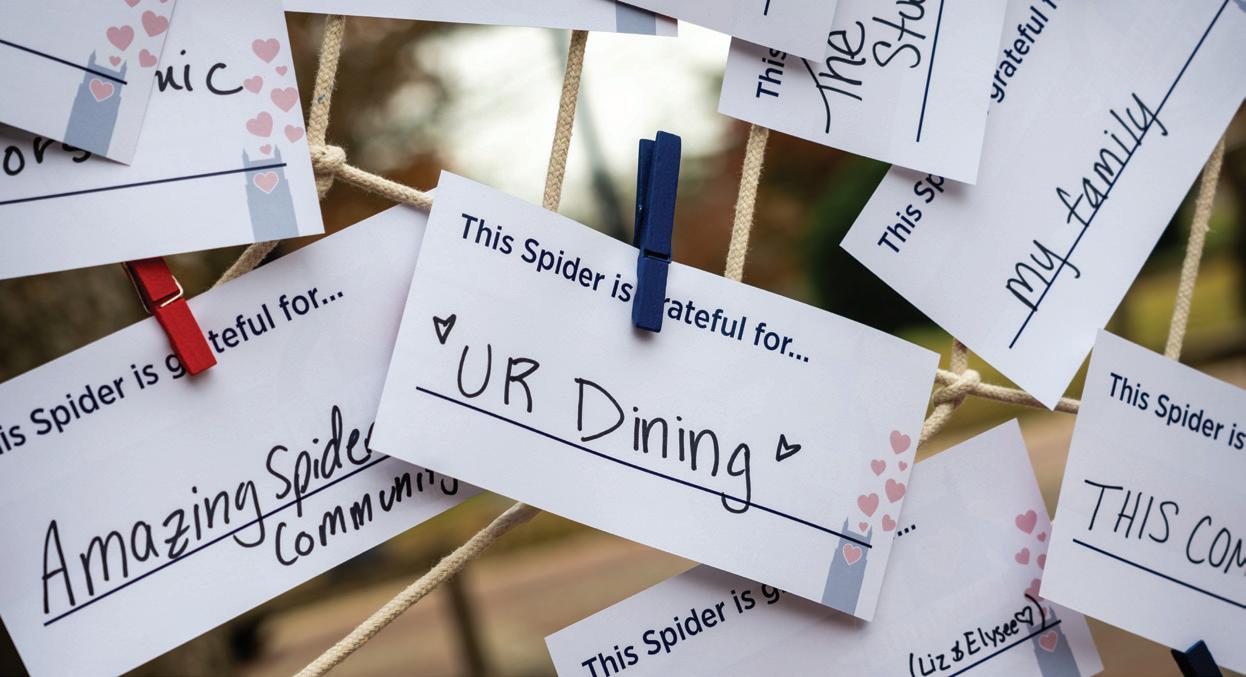
More than 750 members of the Spider community came together to celebrate the generosity of donors as part of the sixth annual Gratitude Day on Nov. 20. Students, faculty, and staff gathered on the University Forum and participated in various activities to thank donors, such as writing down their words of appreciation on cards that were displayed on large webs and writing thank you notes, which were mailed to donors around the country.
“Gratitude Day has become a beloved annual tradition that brings everyone together to reflect on the immeasurable impact that donor giving has on the Spider experience,” said Rachel Hill, assistant director, donor recognition and experience. “It’s a wonderful opportunity to learn more about donor philanthropy and express sincere appreciation.”
Save the date: The 2026 UR Here Giving Day will be held April 8–9 to support funds that help make Richmond affordable for all students and enable UR to offer students the personal care, experiences, and academic excellence for which Richmond is known.
THE IMPACT OF SPIDERS HELPING SPIDERS
1,500 DONORS GAVE $460,000+ TOTAL
109 FACULTY/STAFF DONORS GAVE $8,290
FUNDS RAISED IN 2024 WERE USED TO PROVIDE:
• Tuition assistance
• Meals, transportation, and housing for students on campus during Thanksgiving break, winter break, and summer break
• Technology/laptops
• Formal event/professional attire
• Winter clothing
• Travel to job interviews
• Graduate school application fees
• And more!
SOCIAL BUZZ
Proclamation Night is one of my favorite UR memories! What a great tradition to write yourself a letter to read years later.
— gwynnemccueinteriors via Instagram
It’s important for students to stay connected to nature, especially for their mental health and overall well-being.
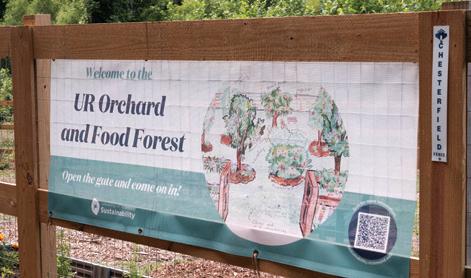
—Jack Carman via LinkedIn, referring to the grand opening of the orchard and food forest in the Eco-Corridor
We love the energy on campus! We love our Spiders!
—urvacollege via Instagram
Beautiful place to work for nearly 17 years.
— Kathe O’Shea Edmonds via Facebook
My husband, a survivor from the 87th floor of Tower 2, and I participated in the Memorial Walk. We were so impressed with the event and with the involvement of students not even born in 2001.
#NeverForget.
—Evan Quimby via Facebook
It’s ridiculous how picturesque campus is any given regular day. I thought of it often while I was there. Just such a beautiful sweet spot on the planet.
— alexisj11 via Instagram
I spent seven years at U of R earning two degrees. I don't think you fully appreciate the splendor of campus until you're away from it.... but I am grateful to have had that time there.
—Bill Wright via LinkedIn
My kiddo is in there somewhere! Hope she and all the freshmen have a wonderful year (and just have to say how impressed we are by the UR campus and community, its commitment to students wellness - all of it).
—Lisa Eckley Cocchiarale via Facebook
Connect with us on Facebook, X, Instagram, and TikTok: @urichmond
LEARN MORE ABOUT IACUC
The University of Richmond Institutional Animal Care and Use Committee (IACUC) oversees the ethical use of animals in research at UR. To learn more about the committee, including information on how to submit a proposal or report a concern, visit iacuc.richmond.edu.
Caring for Every Creature
UR’s approach to discovery starts with attentive care for every species
Spiders may be the University of Richmond’s iconic mascot, but the campus hosts a far wider variety of species, including zebrafish, rats, Madagascar hissing roaches, and the wildlife that inhabits Westhampton Lake and the vicinity. Their well-being falls to animal care specialist Jamie Wagner, who joined UR in 2024 with nearly a decade of experience in animal welfare, veterinary medicine, and exotic species work.
“I’ve worked with all different types of animals — pretty much anything you can think of,” she said. “I loved working medicinally, and I’ve always had a huge interest in science. This is my first time moving into research, and I absolutely love it.”
Wagner’s position emerged as research programs expanded and the complexity of maintaining animal environments grew. Today, zebrafish help UR scientists explore potential epilepsy treatments, and rats help researchers examine the neurobiology of stress, resilience, depression, parenting, and natural enrichment. Previously, principal investigators handled every aspect of animal care themselves, from cleaning and maintaining their living spaces to training students and navigating federal regulations.
“It’s really an extensive and unique workload, and they needed somebody to take charge of it,”
Wagner said. “There are a lot of changes federally when it comes to our regulations and compliance.”
One of Wagner’s first priorities was modernizing how UR tracks animal care through the creation of a digital database to replace paper records. “The online database is more secure and more efficient, and it lets us keep up with genotypes, medications, and experiments — everything we’re required to document,” she said. Those records matter. The University holds a Public Health Service (PHS) Assurance, a formal agreement requiring compliance with federal policies on the care and use of animals in research. Oversight is provided by UR’s Institutional Care and Use Committee, which includes scientists, nonscientists, and a community member, all of whom bring unique perspectives to research protocols.
“We have inspections consistently with the IACUC, the National Institutes of Health, and the U.S. Department of Agriculture,” Wagner said. “There are a lot of people looking out for our animals.”
Much of Wagner’s work — and that of the student animal care assistants who support her — focuses on tailoring care to the needs of
each species. That means health monitoring, managing cleaning schedules, and providing habitats that encourage natural behaviors.
“All species need an enriched environment if we want them to thrive,” she said. “If they’re in a captive environment, we want to provide the things that they would cognitively enjoy doing in the wild.”
UR uses a positive enrichment approach that emphasizes large, pet-quality enclosures, toys, and treats and attention to physical and emotional well-being. “Our rats are very spoiled here,” she said. Some remain on campus for the duration of their lives — typically two to three years, while others are adopted through Second Chance Heroes Rat Adoptions.
Wagner’s care extends the walls of UR’s research labs. She regularly joins faculty on off-campus field labs and helps monitor campus wildlife, especially as recreational use of the lake has increased. She and her team even keep an eye on Triceragoose, the University’s beloved resident goose.
Wagner recognizes that conversations about research animals can evoke strong emotions and welcomes opportunities to talk openly about how the University approaches their care. For Wagner, the philosophy guiding that work is simple: The better care the animals receive today, the better care people, animals, and the environment receive tomorrow.
For Wagner, the philosophy guiding that work is simple: The better care the animals receive today, the better care people and the environment receive tomorrow.
The zebrafish also receive species-specific enrichment. Wagner and her students grow Artemia, or brine shrimp, to stimulate natural hunting behaviors. “It fulfills their natural prey drive,” she said.
She hopes the zebrafish colony is one that continues to attract interest because of the zebrafish's unique anatomy. “They are 80% anatomically identical to a human, so they’re incredible research models,” she said. “They have the same gene mutation that humans have with epilepsy and other comorbidities.”
“That’s the outcome of all of this,” she said. “This is biomedical research we’re doing here. We’re looking for ways to make lives easier for people; we’re looking for cures for diseases and ways to relieve pain. And there’s so much oversight. It’s not just me who cares. Our principal investigators care. The federal government cares. There are a lot of people looking out for our animals.”
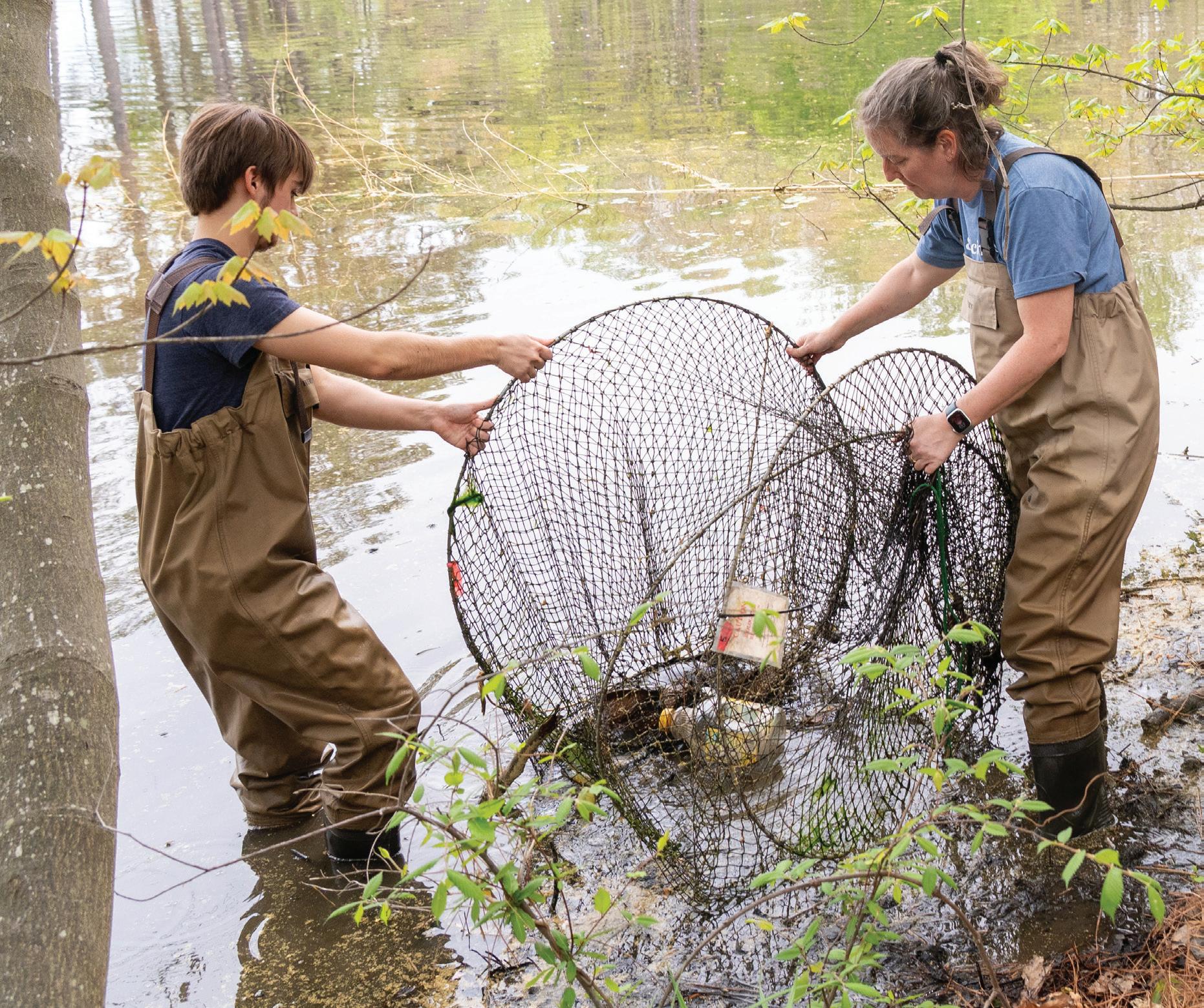
Jamie Wagner (right), animal care specialist, collaborates with Emily Boone (center), senior teaching faculty in biology and environmental studies, and her students to ensure both proper turtle handling and student safety during a turtle-tagging field lab on Westhampton Lake.
Students in entrepreneurship instructor
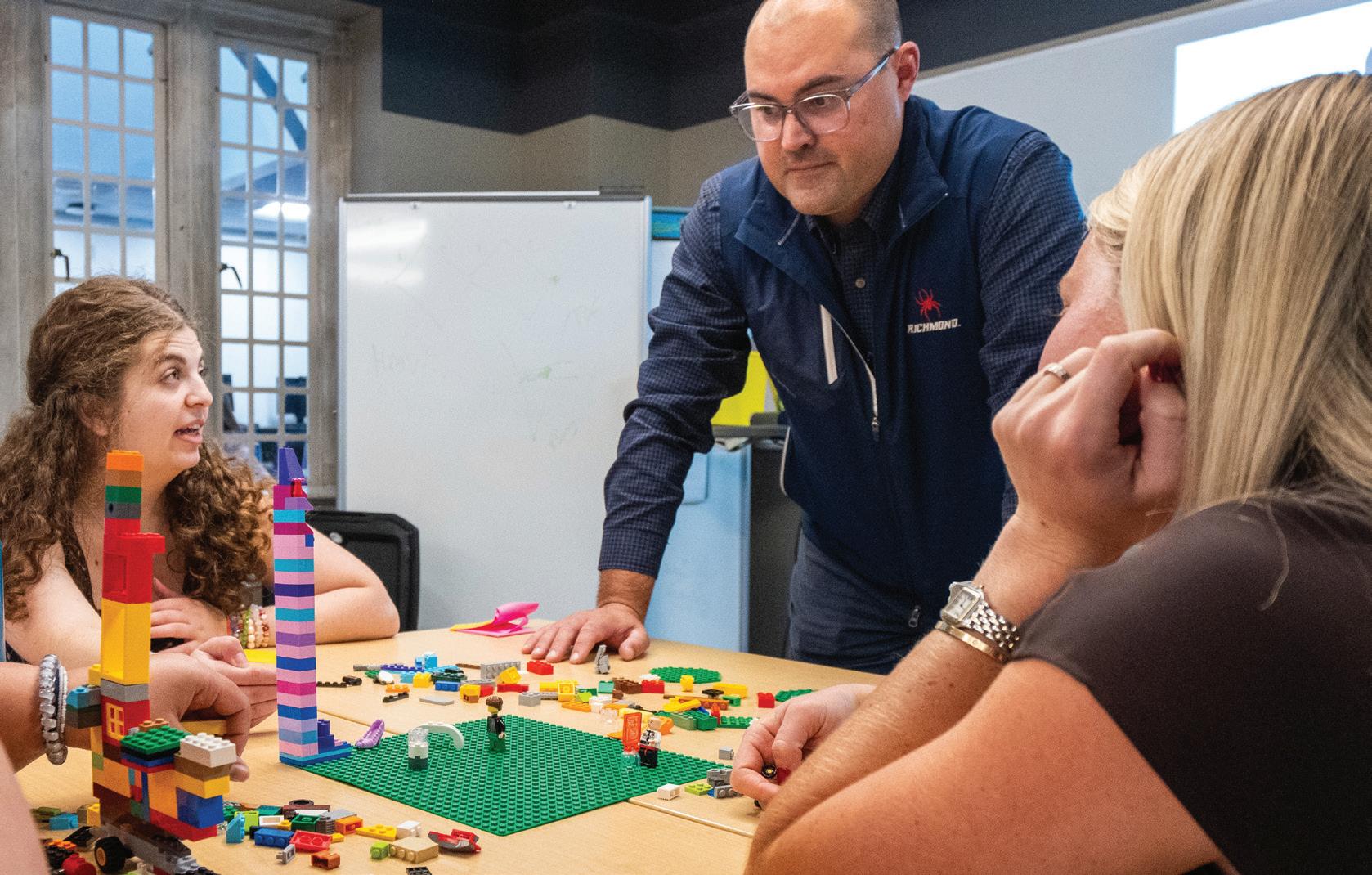
Dale Fickett’s Managing Innovation class participate in Lego Serious Play with Andrew Ilnicki (pictured), director of the Innovation Studio, in the Robins School of Business’ EY iLab.
FROM IDEA TO IMPACT
Over the last two years, seniors Ayush Garg and Ryan McCarroll incubated AnswerThis, an AI-powered literature review service, in the Innovation Studio.
“They needed a space that was owned by no one discipline — a welcoming, open place to practice and iterate on their concept,” said Andrew Ilnicki, director of the Innovation Studio. The studio provided access to knowledge and a gateway to regional founders with a network of resources to evolve their startup.
AnswerThis launched in 2024 and has more than 100,000 users worldwide. San Franciscobased Y Combinator, one of the top 10 business accelerators in the U.S., chose Garg and McCarroll from among 10,000 applicants to join its fall 2025 cohort. It’s the first company started by UR students to be selected by Y Combinator. The AnswerThis co-founders will receive $500,000 from the accelerator in exchange for an equity stake in their company.
Where Inspiration Meets Action
UR’s Innovation Studio offers a space to develop ideas, build skills, and bring projects to life
The fourth floor of Boatwright Memorial Library radiates with new ideas. A major source of that energy is the University of Richmond’s Innovation Studio, a collaborative hub where students, faculty, and staff turn imagination into action.
“It’s really a space that is about sparking new ideas and project continuation of already existing ideas,” said Andrew Ilnicki, director of the Innovation Studio.
The studio offers a variety of small-group and course workshops to encourage hands-on problem solving to equip participants with skills to further ideas, systems, products, technologies, and processes across sectors to advance society.
about sustainable solutions around campus. “It’s for anybody who wants to continue working on an idea and needs ways to dig in and set goals for themselves and a road map to success,” he said.
“It’s much more reflective, and almost like brainstorming through the use of bricks.”
Programming includes courses on design thinking, prototyping, business pitch development, and the popular Lego Serious Play, a hands-on brainstorming workshop where players build, break down, and adapt towers to explore new ideas.
“It’s much more reflective and almost like brainstorming through the use of bricks,” Ilnicki said. “But it’s done in a particular sequence that gets people playing and not planning what to build, just snapping bricks together. It’s a buildto-think methodology.”
The studio’s offerings have proven useful far beyond business settings. Ilnicki has tailored Lego Serious Play for a genetics class, the provost’s office, and a geography course discussion
In addition to regular programming, the studio also offers drop-in advising, course support, a summer incubation program, and resources for innovation competitions. The studio also partners with Bench Top Innovations, a yearlong production course, on pitch practice and supports the Richmond Innovation Fellows, a cohort of nine arts and sciences, business, and leadership students who receive 24/7 studio access, travel to creative problem-solving conferences, and attend workshops. “It’s a high-touch, high-impact program designed for young students to understand and practice innovation,” he said.
Ilnicki and the Innovation Studio are redefining where innovation and entrepreneurship take hold on campus. For him, innovation is interdisciplinary, and the studio is an inclusive space open to anyone who wants to get creative.
“Any idea that you have — faculty, staff, students — if you want to continue to work on it and bring your idea to life or if you want to gain access to a new tool set, come on up, make an appointment with me,” Ilnicki said. “It’s open to everybody.”
Weathering the Storm
Planning and processes guide UR operations in weather events
Winter weather varies each year, but the University’s plans and processes ensure the community is ready for any storm. The University closely monitors weather conditions and makes decisions about the campus operating status that prioritize safety while maintaining academic continuity.
“When a storm is imminent, we begin monitoring early and making plans for the impact to campus well in advance,” said Maribel Street, director of emergency management. “The goal is to continue with as many classes, events, and services as possible to best meet the needs of our community while maintaining safety as the top priority.”
Two primary groups activate during inclement weather — the operations group and the policy group. The operations group includes staff from facilities, dining, student development, athletics, and other areas who assess conditions and prepare campus. The policy group, composed of key administrators, makes operational decisions in consultation with emergency management.
“When a storm is imminent, we begin monitoring early and making plans for the impact to campus well in advance.”
Decisions may include canceling classes and events before or after a certain time or for the day. As a primarily residential campus, the University remains open and provides essential services such as dining and public safety. Some University staff are designated as essential personnel to provide these functions. During storms, the facilities team works diligently to clear parking lots and sidewalks.
In 2025, the University implemented a new modified operating status that works well if an event extends for multiple days or in unique circumstances, such as exams. This status ensures the continuity of the educational mission and business functions while addressing the inclement weather. Faculty have some flexibility to implement remote learning options if needed, while some staff may complete their work remotely.
If schedule changes are necessary, the University communicates promptly to provide clarity on the campus operating status and expectations via campus email, UR Alert, the campus hotline (804-289-8760), and local media. Community members should ensure contact information is current and review resources at alert.richmond.edu. Updates to campus services, including dining locations, library hours, transportation, and the Weinstein Recreation Center are also posted on UR Alert.
“While winter weather is the most common weather-related event to impact campus operations, this same process is applied for any weather or event that may impact campus operations, including a hurricane or tornado,” Street said. “No matter the forecast, the University’s priority remains the same — to keep our community safe while ensuring learning and campus life continue.”
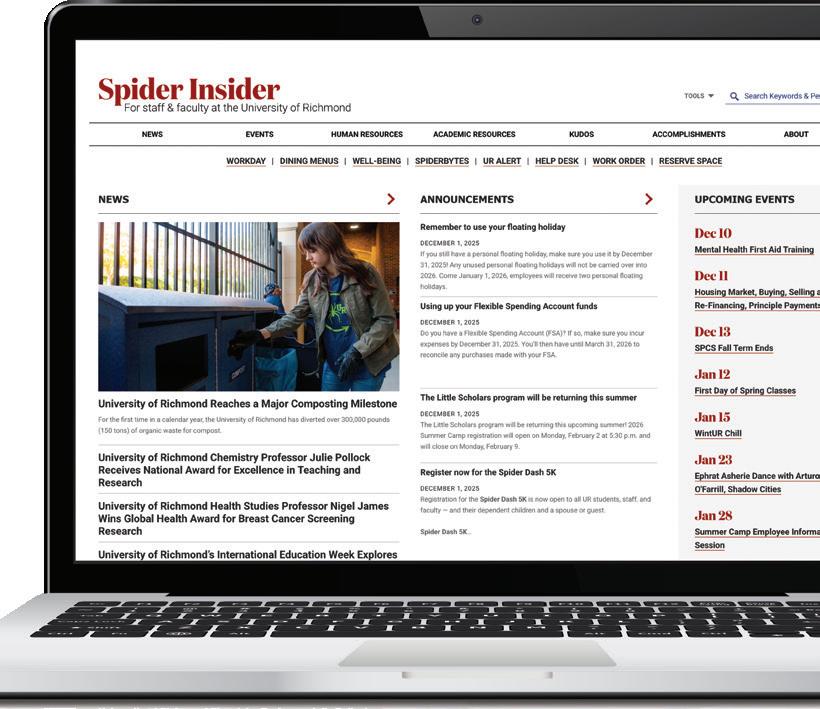
Spider Insider
Saturday, March 7
Race runs through the UR campus.
Don’t wait. Register now and save 20% with code Spiders2026. sportsbackers.org/events/rivercityhalf
LEARN MORE
For more information on the Center for Liberal Arts and AI — and to subscribe to the CLAAI newsletter — visit claai.richmond.edu.
A Liberal Arts Approach to AI
CLAAI brings interdisciplinary insights to the study of artificial intelligence
As conversations around the use of artificial intelligence (AI) tend to center on techno-business enterprises, the Center for Liberal Arts and AI (CLAAI) at UR bridges the technology with the critical inquiry and humanistic values of the liberal arts to study, inform, and enhance artificial intelligence. To do this, the center, which launched in fall of 2025, brings together researchers, students, and educators from institutions across the Associated Colleges of the South to explore pressing social, cultural, and legal questions and dimensions of AI.
“A liberal arts approach is that we don’t approach AI too narrowly.”
Lauren Tilton, professor of digital humanities and director of CLAAI, believes collaboration is key to the center’s mission. At the heart of the center are its 23 faculty fellows. By bringing together faculty from numerous colleges and universities — including eight from UR — Tilton hopes to pool resources and build on each other’s individual strengths.
“The schools across our network have various levels of resources and expertise, so it’s valuable to combine our efforts around such an important topic,” Tilton said. “We’re deeply committed to thinking, ‘How do we strengthen all of our small liberal arts colleges across the South together?’”
Variety and accessibility are essential to CLAAI’s programming. Besides monthly informal lunches around the annual theme “Under
the Hood,” Tilton partners with organizations across campus to host both in-person and virtual events. For example, the Humanities Center and the Faculty Hub invited historian Katherine McDonough to lead a workshop on digitized maps as data. CLAAI also hosts workshops with other ACS AI centers such as the Prompting, Learning, and Artificial Intelligence Lab at Washington & Lee University.
For Vladimir Chlouba, assistant professor of leadership studies and a CLAAI fellow, the multifaceted approach to understanding AI reflects the spectrum of opinions about it.
“People’s views really vary — some are quite excited, others scared; many of us are somewhere in the middle,” he said. “I thought joining the CLAAI group was the best way to be aware of trade-offs and make conscious, informed decisions about how I incorporate AI into my research and possibly teaching.”
Tilton credits the range of faculty specialties for success of the fellows. The variety reflects both a commitment to value the process of education rather than the product and Tilton’s hope that CLAAI will embody the community’s needs and interests.
“A liberal arts approach is that we don’t approach AI too narrowly,” Tilton said. “We think about it through the social, political, economic, and cultural implications. To do that, we can’t just draw on a single field or single narrow area.”
Building AI Confidence
SpiderAI offers support for productivity and learning
SpiderAI is the University’s in-house artificial intelligence (AI) tool, designed with people in mind. For those who are curious, cautious, or already regular AI users, it offers a simple, private space to experiment, learn, and get practical help with everyday work.
SpiderAI brings together several advanced AI tools, including ChatGPT, enabling students, staff, and faculty to try different types of AI assistance in one place. Students can use SpiderAI as a free environment to learn about paid AI tools and features. Staff can accelerate routine tasks such as drafting emails, summarizing lengthy documents, writing event copy, and preparing clear procedures. Faculty can use the same features to save time on administrative work and enrich teaching, learning, and research.
“SpiderAI lets us learn and innovate together in a safe space.”
“SpiderAI lets us learn and innovate together in a safe space,” said Keith “Mac” McIntosh, vice president for information services and chief information officer. “It’s a step toward using AI not just efficiently, but wisely.”
Because SpiderAI is managed by the University, it offers an added layer of privacy compared with public AI platforms. It also eliminates the need for individual subscription fees, making it easier to explore advanced AI tools.
Key features:
• Instructional mode: Learn how to improve prompts by seeing the assumptions AI tools make.
• Prompt clarification: Answer system-generated follow-up questions so the AI understands what’s really wanted.
• File analysis: Upload documents or spreadsheets and get clear summaries, key points, or suggested edits.
• Assistants: Use or create reusable environments with instructions and documents to frame a prompt. Users can share their assistant with a class or colleagues.
“I encourage everyone in the campus community to see how SpiderAI might work for them,” McIntosh said. “By bringing AI into a University-managed environment, we’re giving everyone the chance to build confidence with technology that’s shaping the future.”
SpiderAI is available at spiderai.richmond.edu for all members of the University community. Access requires University credentials and a connection to the campus network or VPN.
ACCOLADES
U.S. News & World Report ranked UR No. 22 among national liberal arts colleges in the 2025–26 “BEST COLLEGES” guide. UR has been ranked a top 25 liberal arts school by U.S. News for nine consecutive years. U.S. News also ranked UR No. 8, up from No. 13 last year, on the “MOST INNOVATIVE SCHOOLS” list, which highlights colleges that are making the most innovative improvements in terms of curriculum, faculty, students, campus life, technology, or facilities.
The U.S. Department of State ranked UR NO. 1 among baccalaureate colleges for the third consecutive year for number of students studying abroad in its 2025 Open Doors Report. UR ranked No. 1 (tied) in mid-length duration of study abroad, No. 8 in international student enrollment, No. 11 in long-term duration of study abroad, and No. 12 in short-term duration of study abroad.
The Princeton Review named UR one of the top 50 schools in the nation for environmental responsibility in its 2026 edition of its annual GUIDE TO GREEN COLLEGES. UR has been ranked among the top 50 for four consecutive years.
The American Institute of Architects Virginia awarded the Burying Ground Memorial a 2025 AWARD OF HONOR in the Contextual Design category, which recognizes projects that reflect the history, culture, and physical environment of the places they stand. Historic Richmond awarded the memorial a GOLDEN HAMMER AWARD for Best Placemaking and Urban Design.
Town&Country recognized UR on its list of the TOP 15 ALT-IVIES OF 2025, noting UR’s blend of liberal arts intimacy and research university resources. The magazine described Richmond as an “attractive destination for high-achieving students who value intellectual depth and real-world readiness.”
Forbes featured UR as one of the colleges defining the VIBE SCHOOL trend — institutions that combine social vibrancy with academic rigor and have strong career services. UR is described as a school that “distinguishes itself with a liberal arts foundation that delivers professional outcomes well beyond its size.”
Mortar Board, a national honor society that recognizes college seniors for exemplary scholarship, leadership, and service, presented its UR chapter with a PROJECT OF EXCELLENCE AWARD in the Leadership category for the President’s Forum, highlighting it as an outstanding chapter project with strong member participation.
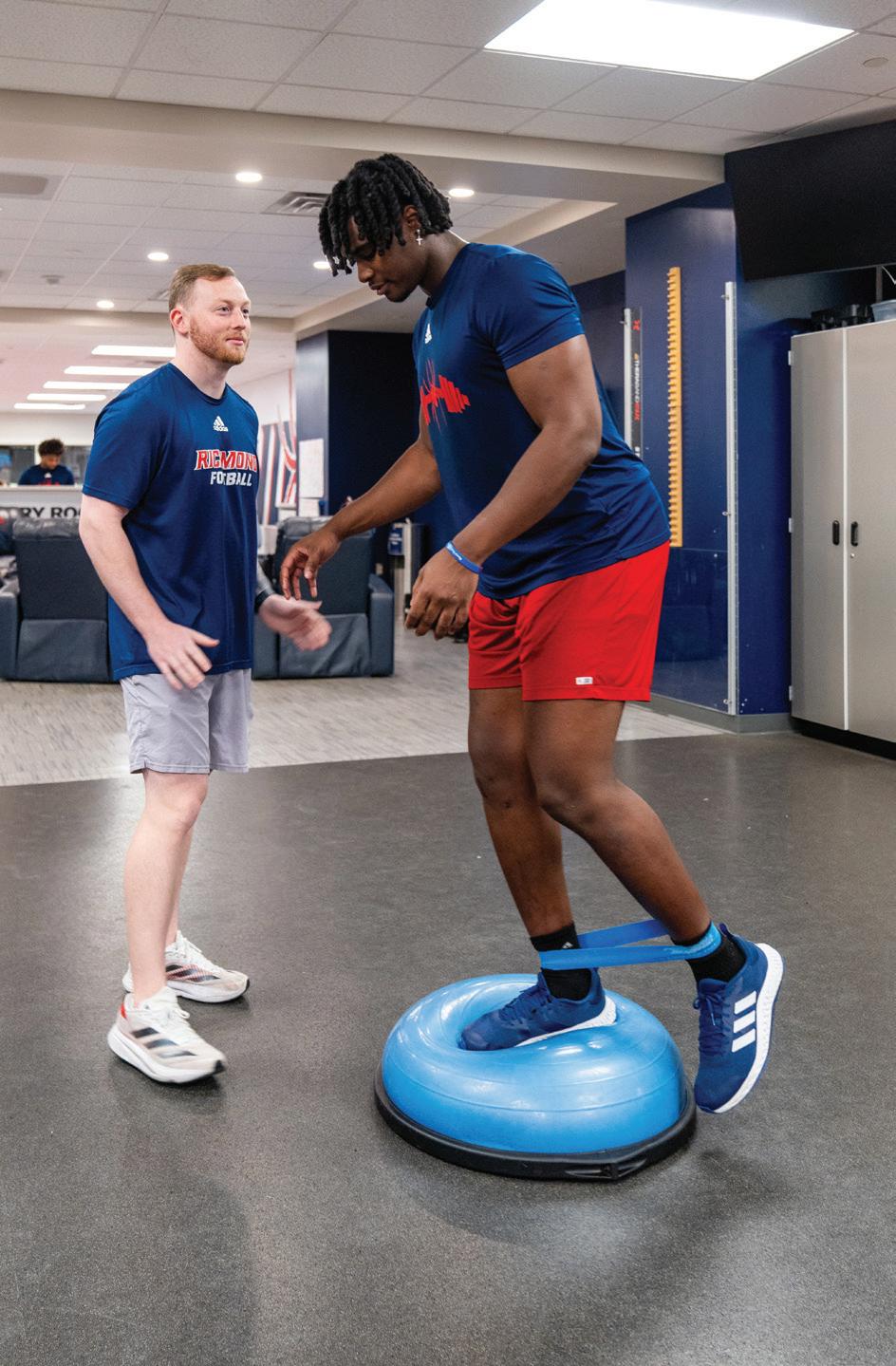
Spider Performance, or SP4, is UR’s signature student-athlete support program that helps students become champions in the classroom, on the field, in their personal lives, and in their careers.
The Team Behind the Team
SP4 helps University of Richmond student-athletes thrive in every arena
For the more than 400 University of Richmond Division I student-athletes, success is a team effort — and not just on the field. Behind every Spider competitor is another team: Spider Performance, or SP4, the University’s signature student-athlete support program.
SP4 brings together coaches, advisors, psychologists, tutors, mentors, trainers, doctors, faculty, and others to provide coordinated, comprehensive, and individualized support. Its goal is to help student-athletes become champions on the field, in the classroom, in their careers, and in their personal lives.
Lauren Wicklund, senior associate athletics director for leadership and student-athlete development, says SP4 reflects a long-term vision she and athletics director John Hardt have shared to create the best student-athlete support system in the country.
“We knew it was more than just strength and conditioning, more than just leadership or academics or well-being,” Wicklund explains. “It was all of those things combined.”
The name SP4 refers to the four areas of student-athlete success: athletic, academic, personal, and professional. Support starts before student-athletes arrive on campus and continues throughout their time at Richmond.
“There are times when it will be really pronounced, like when you’re a first-year or when you’re getting ready to go into your senior year,”
Wicklund said. “But for the most part, they are not seeing what we’re doing behind the scenes to make it all happen.”
SP4’s work is both broad and detailed. Sports science and technology are used to collect and analyze data and tailor workouts. Academic advisors, tutors, and mentors help athletes manage coursework, labs, and presentations. Medical teams support physical and mental health, and career counselors help students line up internships, prepare for interviews, and build skills for their future careers. Other staff members arrange leadership, team-building, and personal development programming on everything from financial literacy workshops to cooking classes to learning to change a tire. SP4 is, by design, a comprehensive approach to doing all of it well.
“Students coming into college often struggle with connecting to resources,” Wicklund said. “If you want to have the best experience possible, you’ve got to understand how things work and where the resources are.”
Academic
At Richmond, SP4 surrounds student-athletes with comprehensive support from day one. Small classes, faculty mentorship, tutoring, and personalized advising ensure students can balance competitive schedules with rigorous coursework. Bridge to Success and personalized academic
plans, including instruction on time management and study strategy, help new student-athletes transition smoothly, while study-abroad and cocurricular research opportunities expand their horizons. SP4 empowers Spider athletes to excel academically while juggling the demands of Division I sports.
Athletic
SP4 elevates athletic performance through an integrated network of coaches, trainers, nutritionists, and sports-medicine experts dedicated to each student-athlete’s development. Custom fueling plans, strength training, and advanced exercise analytics help athletes compete at their peak. Mental performance coaching builds focus and resilience, while team-leadership programming allows student-athletes to apply their leadership abilities. From injury prevention to postgame recovery, SP4 ensures Richmond student-athletes receive holistic, individualized care that optimizes both personal growth and team success.
Personal
network of student groups and affinity organizations creates space for connection and inclusion, while community-engagement opportunities encourage service and reflection. SP4 works to ensure every student-athlete feels valued, supported, and empowered.
Professional
SP4 prepares student-athletes for purposeful futures by connecting them with Richmond’s extensive career, mentorship, and alumni networks. Advisors guide students through résumé building, internship searches, and interview preparation, while mentorship pairings offer insight into industries of interest.
“We knew it was more than just strength and conditioning, more than just leadership or academics or well-being. It was all of those things combined.”
SP4 fosters well-being, belonging, and personal growth across campus life. Through leadership development, mental-health counseling, and access to the Well-Being Center, student-athletes learn to manage stress, build healthy habits, and strengthen relationships. Richmond’s vibrant
Life-skills programming — from financial literacy and health care to changing a tire and swimming— builds confidence for life beyond Division I athletics.
Paired with access to 60,000+ alumni, SP4 equips Spider athletes to launch strong, successful postcollege careers.
Wicklund has worked hard to pull the SP4 resources together. Throughout her career, she’s seen student-athlete support programs of various shapes and sizes, but she says few do it as well as Richmond.
“From the faculty to the dining hall and nutritionists to maintenance and facilities, everyone is so collaborative here,” she said. “That collaboration is the heart of SP4’s success.”
WHAT’S
IN A NAME?
SP4 takes its name because the Spider athletic program has four areas of focus: athletic, academic, personal, and professional achievement. This comprehensive approach results in highly personalized care plans that help student-athletes before, during, and after game day. Learn more at spides.us/sp4.
Virtuous thinking, Kant wrote, is like good carpentry: It constructs a strong edifice of ideas that support each other.
JOIN THE CONVERSATION
This article has been updated and adapted for length with permission from the author. A complete list of The Conversation articles, including this one in its entirety, is available at news.richmond. edu/placements/ conversation.html.
Faculty interested in writing for The Conversation can contact Sunni Brown, senior director for media relations and strategic communications, at sbrown5@richmond. edu, or Lauren Anesta, media relations manager, at lauren. anesta@richmond. edu.
Reprints of The Conversation articles appear frequently in Spider Insider, University of Richmond Magazine, and UR Now (urnow.richmond.edu).
THE CONVERSATION
Building a
stable ‘abode
of
thought’: Kant’s rules for virtuous thinking
What makes a life virtuous? The answer might seem simple: virtuous actions — actions that align with morality.
But life is more than doing. Frequently, we just think.
As a philosopher, I specialize in the Enlightenment thinker Immanuel Kant, who had volumes to say about virtuous actions. Kant also believed people can think virtuously, and should.
To do so, he identified three simple rules, listed and explained in his 1790 book Critique of the Power of Judgment: Think for yourself. Think in the position of everyone else. And, finally, think in harmony with yourself.
Rule 1: Think for yourself
Thinking can be both active and passive. We can choose where to direct our attention and use reason to solve problems. Still, we cannot completely control our stream of thought; feelings and ideas bubble up from influences outside our control.
thought now proliferate, including deepfakes, the use of ChatGPT, and information ecosystems that block out opposing views.
Kant’s Rule 1 tells us to approach content and opinions cautiously. Active or autonomous thinking protects people from those who seek to think for them.
Rule 2: Think in the position of everyone else Pride often tempts us to believe that we have everything figured out.
Kant wrote that we have an obligation to take responsibility for our own thinking and to check its overarching validity and soundness.
One kind of passive thinking is letting others think for us.
Kant wrote that we have an obligation to take responsibility for our own thinking and to check its overarching validity and soundness.
In Kant’s day, he was especially concerned about superstition since it provides oversimplified answers to life’s problems.
Many new, pernicious forms of trying to control
Rule 2 checks this pride. Kant recommends what philosophers call “epistemic humility,” or humility about our own knowledge.
Suppose you’re in a meeting and a consensus is taking shape. Strong personalities and a quorum support it, but you remain unsure.
At this point, Rule 2 does not recommend that you adopt the view of the others. If you simply accept the group’s conclusion, you’d be breaking Rule 1: Think for yourself.
Instead, Rule 2 prescribes temporarily detaching yourself from even your own way of thinking, especially your own biases.
Kant believed that, while difficult, a standpoint can be achieved in which biases all but vanish. But this requires appreciating our own limitations and seeking a wider view.
Rule 3: Think in harmony with yourself
The final rule is both the most difficult and profound. He said that it was the task of becoming
“einstimmig,” literally “of one voice” with ourselves.
To clarify, a metaphor that Kant employed can help — namely, carpentry.
Constructing a building is complex. The blueprint must be sound; the building materials must be high quality; and craftsmanship matters. If the nails are hammered sloppily or steps performed out of order, then the edifice might collapse.
Rule 3 tells us to construct our abode of thought with the same care as when constructing a house. Each thought, belief, and intention is a building block. To be “einstimmig” or “bündig” — to be in “harmony” — these building blocks should fit well together and support each other.
Imagine a colleague who you believe has impeccable taste. But one day, he shares his secret obsession with death metal music — a genre you dislike.
A disharmony in thought might result. Your reaction to his love of death metal reveals your belief that only people with disturbed taste could love something you perceive to be so grating.
Rather than immediately change your belief about him, Kant’s third rule commands you to investigate your own thoughts further. Perhaps you have never listened to death metal with a discerning spirit. Maybe your original beliefs about your colleague were inaccurate. Or could it be that having good taste is more complex than you thought?
Ultimately, Kant found harmony important because it supports the construction of a coherent worldview. At its most basic, a harmonious worldview allows us to feel more at home in the world: We gain a sense of how it hangs together, and see it as imbued with meaning.
How we think ultimately determines how we live. If we have a stable abode of thought, we take that stability into everything we do and have some shelter from life’s storms.
By Alexander Englert, assistant professor of philosophy
MEDIA MENTIONS
A translation of Jenny Erpenbeck’s Things That Disappear by KURT BEALS, German professor and humanities fellow in literary translation, is reviewed in “For This Writer, the Personal and Political Are Inseparable.” Beals’ recent work as a translator also includes acclaimed editions of All Quiet on the Western Front by Erich Maria Remarque and The Steppenwolf by Hermann Hesse.
STEPHANIE DUPAUL, vice president for enrollment management, is quoted in “Can an Instant Price Estimator Help Students See Private Colleges as Affordable?” “The truth is, schools like the 20 who are implementing the net price estimator are far more affordable than most people realize, because we provide a significant amount of scholarships and grants to students,” she said. “The public perception about price at schools like ours is inaccurate, and students who may not realize that are missing out … and we are also missing out on the chance to engage with them!”
DAMON YARNELL, associate provost and executive director of career development, is quoted in “How to Handle a Job Market That’s Worse Than It Looks.” He advises students and job seekers to look at job market data by paying attention to which industries and regions show steady signs of growth.
MADELINE NATHE and KAREN HENSLEY, nutritionists with UR’s Dining Services, are featured in “Partnerships enliven nutrition education,” highlighting various nutrition events that are available to students through partnerships across campus.
DAVID SOULE, lecturer in economics, and KYLE REDICAN, director of the Spatial Analysis Lab, co-authored the piece “The Real Losers in the Redistricting War: Voters,” originally published in The Conversation “Studies have shown that districts contorted for political purposes make it more difficult for constituents to know who their representatives are, reduce representative-citizen interactions and lower voter participation in elections,” write the authors.
COLLEEN CARPENTERSWANSON, assistant professor of biology, is interviewed in “Tapping Into Nature’s Pharmacy To Develop Safer Antiseizure Medications?” “In my lab, we use zebrafish to quickly assess how plant-derived compounds act in the brain,” she said. “We showed that vitexin, a flavonoid found in several herbal supplements, can strongly reduce seizure-like activity without disrupting normal behavior or causing harm. These findings add to growing evidence that plant compounds can serve as effective scaffolds for developing new antiseizure therapies.”
Visit news.richmond.edu to view additional media mentions or connect with University Communications’ Media and Public Relations team, Cynthia Price, Sunni Brown, and Lauren Anesta.
AROUND THE LAKE
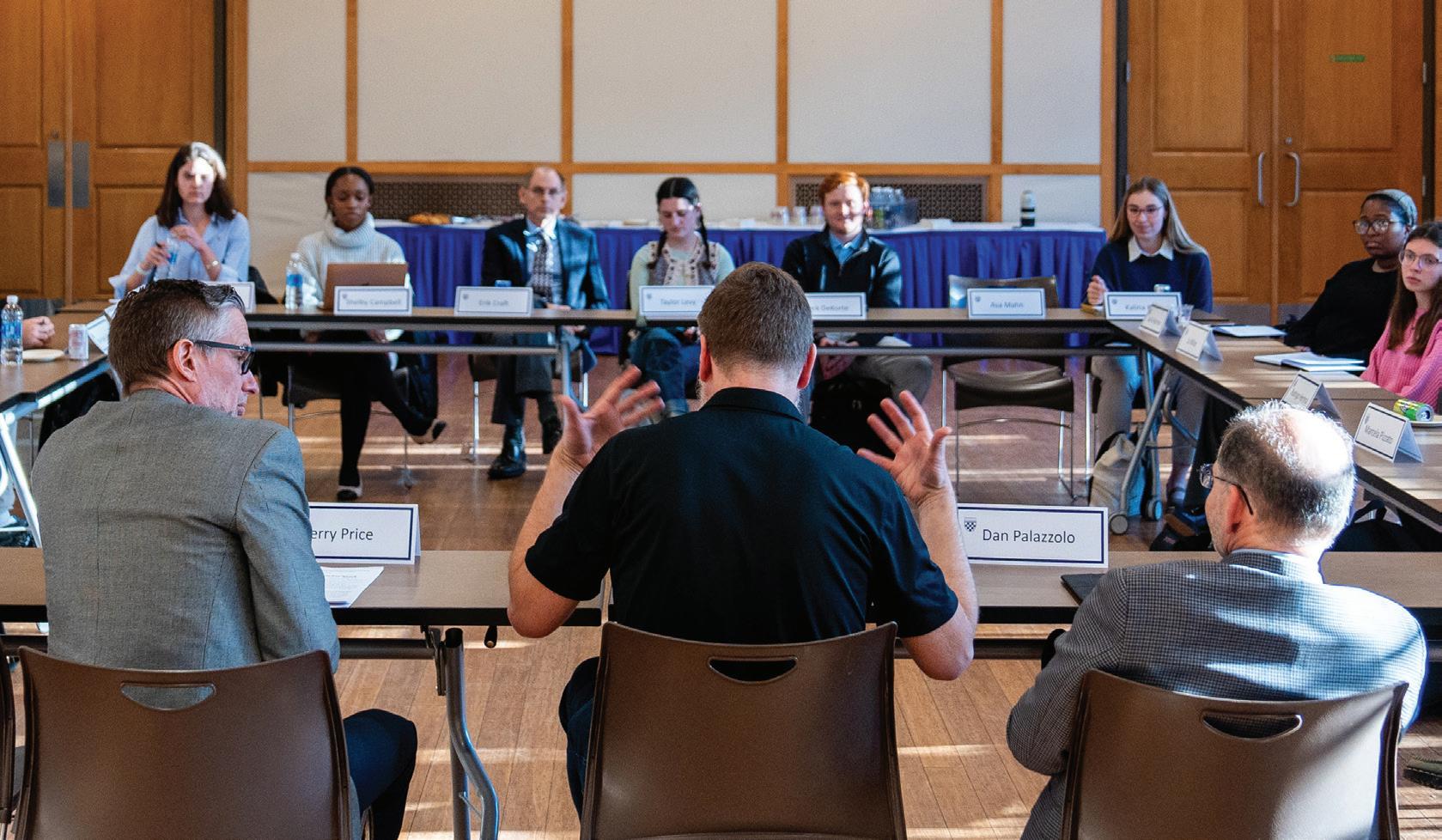
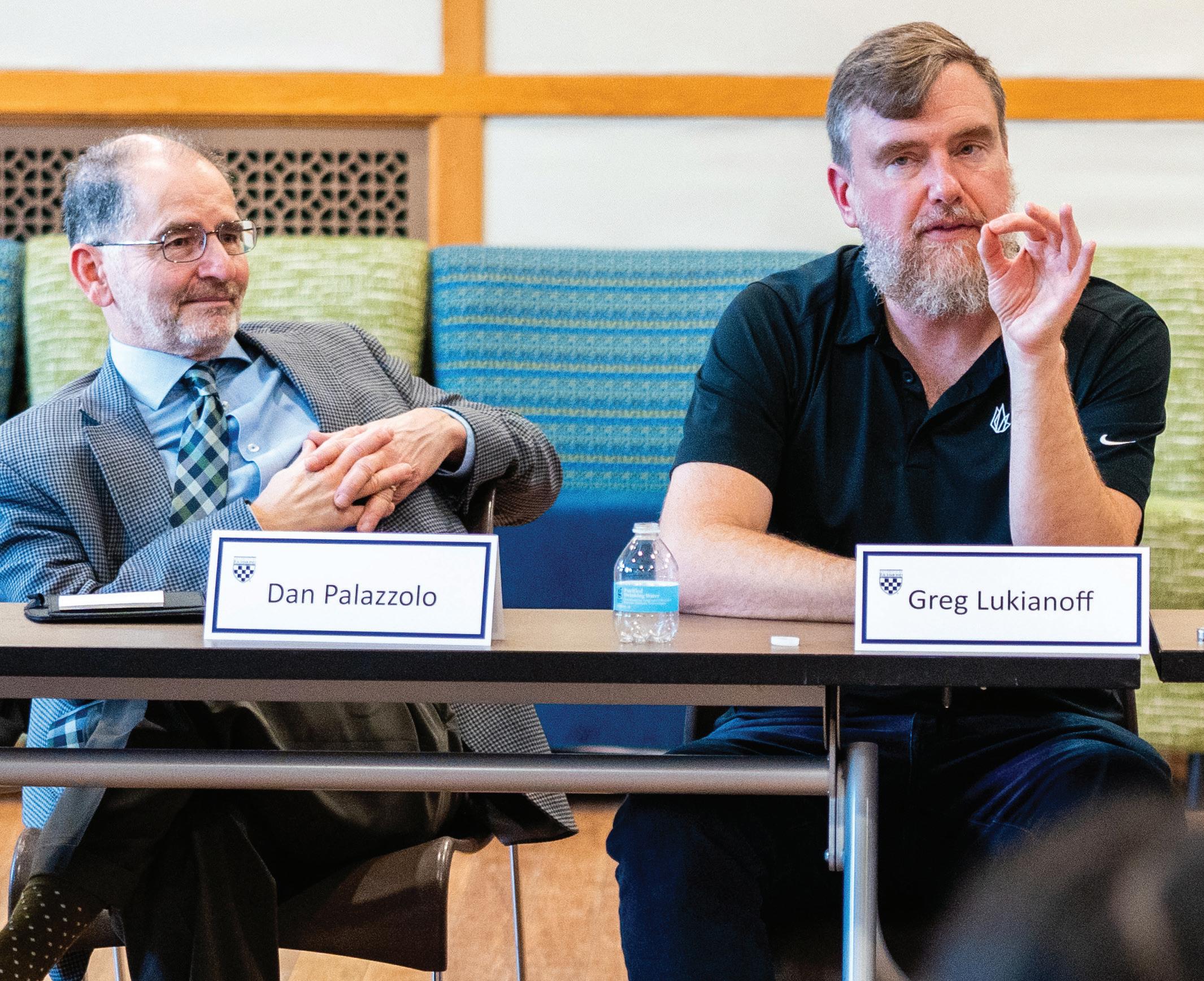
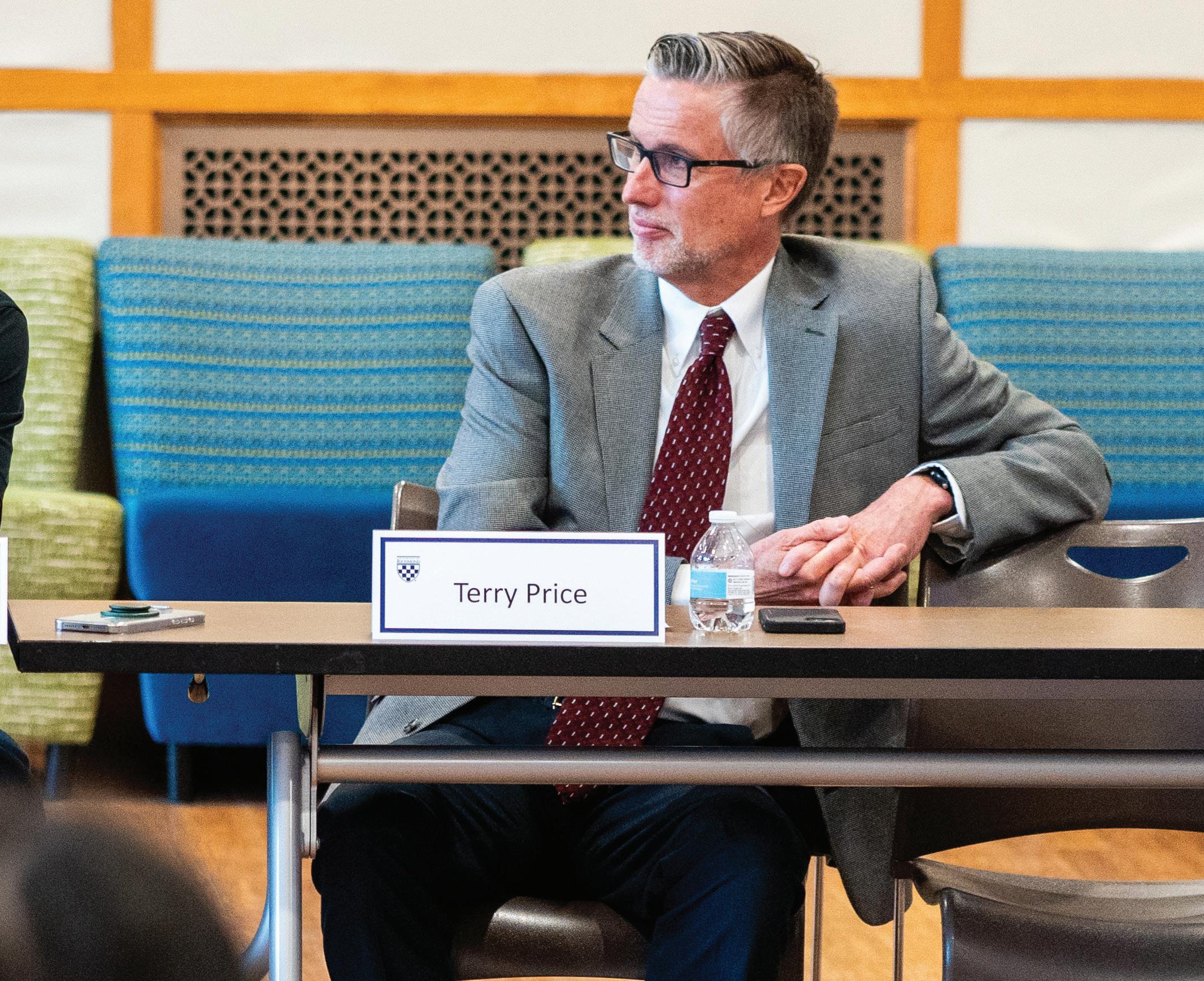
Greg Lukianoff, president and CEO of the Foundation for Individual Rights and Expression, accompanied by McDowell Institute co-directors Dan Palazzolo and Terry Price, speaks to student fellows.
Bridging Divides Through Conversation
LEARN MORE
For more on the Gary L. McDowell Institute, including information about future speakers and recordings of past lectures, visit jepson.richmond.edu/ signature-programs/ mcdowell-institute/ public-lectures.html.
McDowell
Institute promotes the exchange of competing ideas at the University of Richmond
National news is rife with reports of America’s decline in civility and increasing polarization.
But at the University of Richmond, the Gary L. McDowell Institute offers a possible solution for mending the fraying social fabric. Named for a former professor of leadership studies, the institute honors the memory of Gary McDowell through its commitment to the civil exchange of diverse viewpoints on issues in governance, economics, and law.
So it is fitting that Greg Lukianoff, president and CEO of the Foundation for Individual Rights and Expression (FIRE), served as the institute’s inaugural practitioner-in-residence in 2025. On Nov. 18, he met with students and gave a public presentation on free speech in higher education.
“Our fellows are diverse in their own politics but clearly appreciate exposure to the ideas of people with whom they disagree.”
“Today we have greater awareness of free speech on college campuses — but a lot less free speech,” Lukianoff said, attributing this paradox to a lack of diverse opinions among faculty. “We need to kick the tires, have more structured friction, more political diversity in higher education. We could benefit from implementing listening projects, where the goal is not to change someone’s mind, but to listen and understand the perspective of someone who holds a different view.”
This is exactly what the McDowell Institute does. Founded in 2020, the institute grew out of and subsumed the Jepson School of Leadership Studies’ John Marshall International Center for the Study of Statesmanship, the brainchild of McDowell. Dan Palazzolo, professor of political
science, and Terry Price, Coston Family Chair in Leadership and Ethics and professor of leadership studies and philosophy, politics, economics, and law (PPEL), served at different times alongside McDowell as co-directors of the Marshall Center.
After McDowell retired, Palazzolo and Price successfully advocated for the name change to honor their friend and colleague. Housed in the Jepson School, the McDowell Institute retained the Marshall Center’s commitment to cross-school collaboration, but its programming focus shifted.
“The Marshall Center was primarily outward facing,” Price said. “Dan and I wanted to redirect programming to internal audiences, especially our students.”
To that end, the institute launched a student fellows program in 2020–21 with an inaugural cohort of 20 fellows. Today, the program is 59 fellows strong.
“The structure of the institute — co-directors, student fellows, and faculty discussion leaders drawn from different schools — exemplifies one of the core values of the institute: to welcome all members of the University community and a wide range of political perspectives,” Palazzolo said.
Faculty members Kevin Cherry (political science), Erik Craft (economics and PPEL), Jessica Flanigan (leadership studies and PPEL), and Lidia Radi (French and Italian studies) serve as discussion leaders.
“Student fellows read works from ideological perspectives that are typically underrepresented in the classroom,” Price said. “Our fellows are diverse in their own politics but clearly appreciate exposure to the ideas of people with whom they disagree. They are not always convinced, but they
learn how to read and listen carefully and disagree constructively — something a Richmond graduate should be able to do.”
This year, the fellows are reading The New York Times opinion columnist Ross Douthat’s book Believe: Why Everyone Should Be Religious. He will give a public lecture on the same topic on March 26.
“We want students, faculty, and staff to have the opportunity to hear some of the nation’s most interesting, thoughtful writers speak to important enduring and contemporary issues,” Palazzolo said.
Heidi Thompson (left), program coordinator for the McDowell Institute and the Jepson School, seconded Palazzolo on this point. “McDowell Institute lectures are special opportunities to be in the room, for free, with thought leaders and newsmakers, people we might otherwise only read online, hear on podcasts, or see on TV,” she said. “Every program I’ve attended has had something — a detail, a story, a question posed by someone in the audience — that has made me consider an issue from a different perspective, thereby broadening my thinking.”
STRONGER TOGETHER
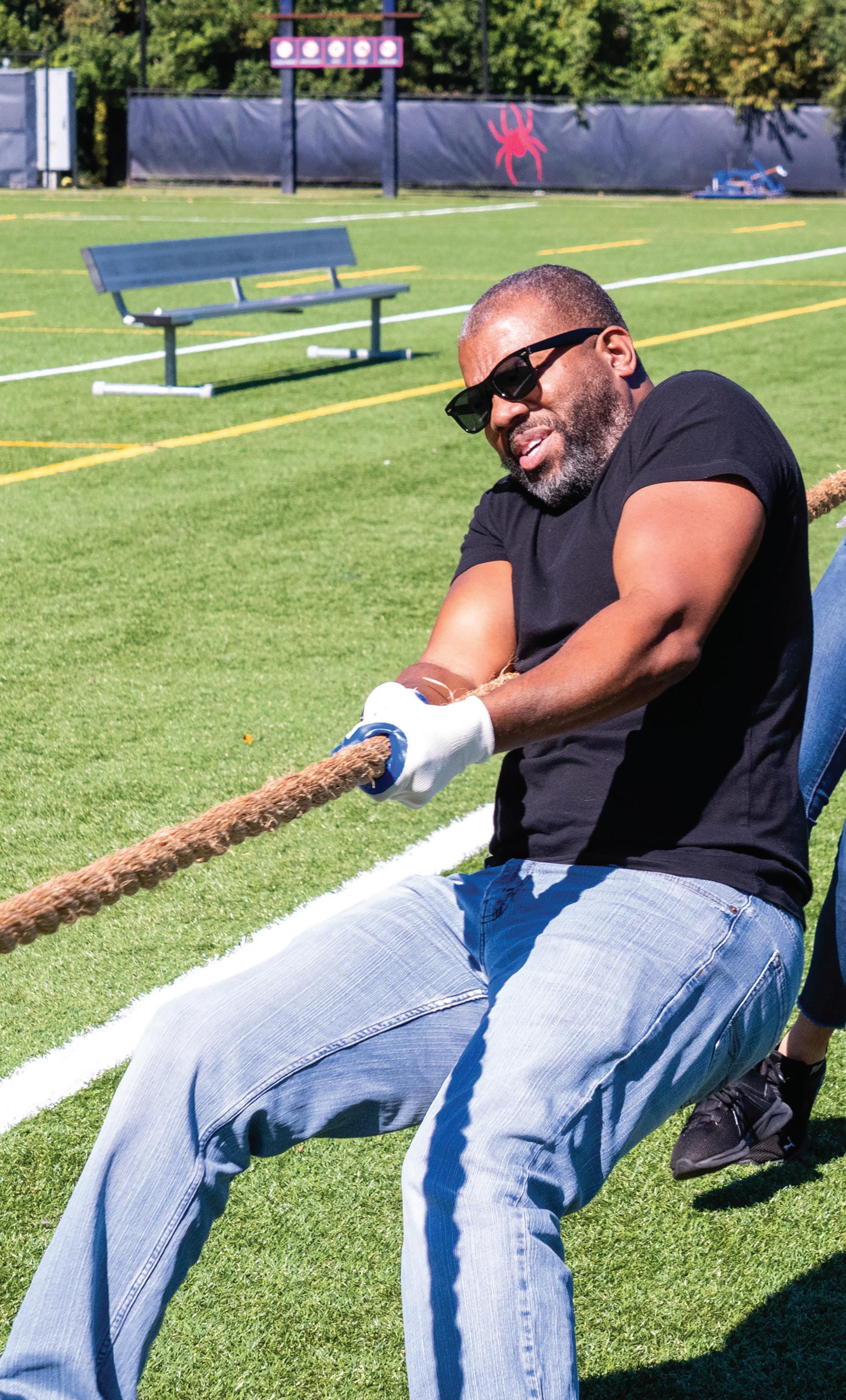
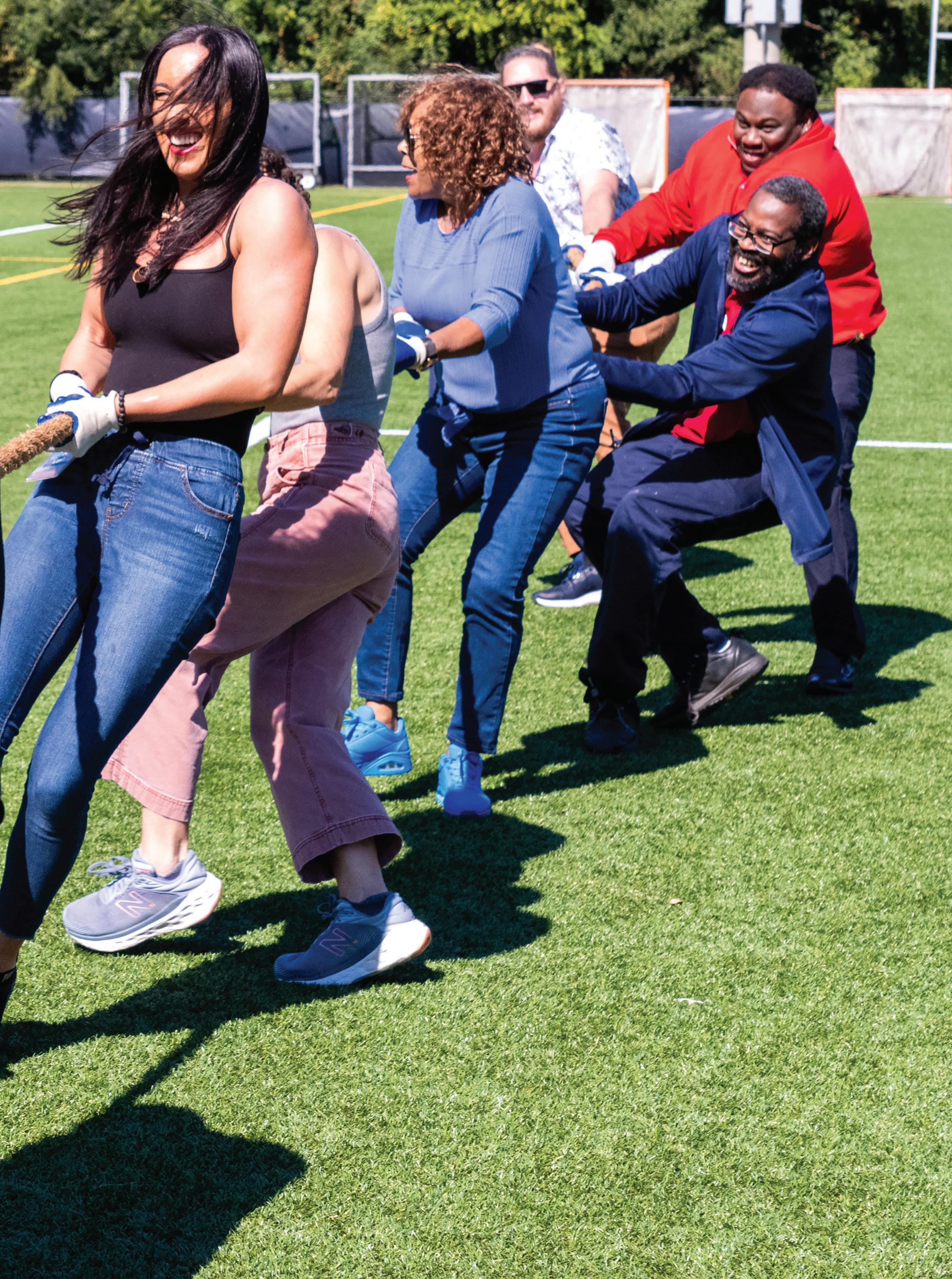
Staff and faculty showed off their competitive spirit at Fall Fest, where more than 350 friends and colleagues gathered on the intramural fields for an afternoon of games, crafting, and field-day favorites — including a tug-of-war showdown. The annual employee appreciation event, hosted by Human Resources and Health Promotion in partnership with Sports Backers, offered chances to unwind, laugh, and connect outside of the office.
Attendees also brought donations for “Kids on the Move,” a Sports Backers program supporting 70 youth fitness clubs across the Richmond region, contributing more than 300 prize items to the initiative.
“Taking time to step away from our day-today roles and simply enjoy one another’s company is so important for wellbeing and for building community,” said Geraldine Sullivan, chief human resources officer. “Events like this remind us that we’re all on the same team — on and off the field.”
Photos by Jamie Betts
See more accomplishments and submit your own grant, publication, or honor at richmond.edu/ faculty-staff.
OUR ACCOMPLISHMENTS
EDWARD AYERS, TuckerBoatwright Professor of the Humanities and president emeritus, was selected as Monticello’s 2025–26 Fritz and Claudine Kundrun Fellow at the Robert H. Smith International Center for Jefferson Studies.
ELIZABETH BAUGHAN, associate professor of classics and archaeology, published “Contextualizing Reuse: Marble Furniture Tops in the J. Henry Brown Monuments Order Books” in AGS Quarterly: Bulletin of the Association for Gravestone Studies and presented “Concrete Gravemarkers as Regional Cultural Heritage” at the Association for Gravestone Studies Conference and Annual Meeting in Grand Rapids, Michigan.
ANDREW BELL, associate director, digital pedagogy and research, and Amy Treonis, associate professor of biology, published “Namibian fairy circles: Hostile territory for soil nematodes” in PLOS One.
DENIZ BESIK, assistant professor of analytics and operations, presented at the Commodity and Energy Markets Association’s 2025 annual meeting held at Rice University.
TYLER BETZHOLD, executive chef; Andy Kerscher, chef de cuisine; and Dining Services received the Career Impact Award: Most Value in Student Care and Upward Mobility from Reynolds School of Business and Industrial Trades.
COURTNEY BLONDINO, assistant professor of health studies, and students published “Generational Differences in Tobacco Use Patterns: Results from Wave 6 (2021) of the Population Assessment of Tobacco and Health Study (United States)” in the Journal of Studies on Alcohol and Drugs.
JENNIFER BOWIE, professor of political science, and a student published “Jones v. Hendrix on Habeas Corpus” in SCOTUS 2023 Major Decisions and Developments of the US Supreme Court.
COLLEEN CARPENTER-SWANSON, assistant professor of biology, and students published “Validating the antiseizure effects of vitexin and related flavone glycosides in zebrafish” in Frontiers in Pharmacology
JERRY CLEMMER, executive director of campus business services, received the National Association of College Auxiliary Services’ Cornerstones of the Profession Award. Honorees demonstrated extraordinary leadership, lasting impact on their institutions, and significant contributions to NACAS over a lifetime of service.
MONTI DATTA, associate professor of political science, received the Bonner Foundation’s Spirit of Ubuntu Award, given to individuals who embody the spirit of community engagement. Datta also
received the American Political Science Foundation Distinguished Teaching Award, honoring outstanding contributions to undergraduate and graduate teaching of political science at two- and four-year institutions.
JONATHAN DATTELBAUM, professor of chemistry, and a student published “Isolation and Whole Genome Sequence Analysis of Alcaligenes and Chromobacterium Strains with Antimicrobial Activity Against ESKAPE Pathogen Relatives” in the Journal of Genomics.
KIM DEAN-ANDERSON, senior associate director of community relationships in the Bonner Center for Civic Engagement, received the Bonner Foundation’s Lives of Service Award for long-term work with the Bonner Program.
NATHAN DERSTINE, visiting assistant professor of biology, received a 2025 Early Career Award from the International Society of Chemical Ecology.
TERRY DOLSON, senior associate director for community-engaged learning in the Bonner Center for Civic Engagement, received the Bonner Foundation’s Lives of Service Award for long-term work with the Bonner Program.
RAYMOND DOMINEY, associate professor of chemistry; Emma Goldman, associate professor of chemistry; and students published “Stereoselective Synthesis of Unsymmetrical 3,3-Diarylpropenals by a Suzuki-Miyaura Reaction of (Z)-3-Aryl-3-Chloropropenal Intermediates” in the European Journal of Organic Chemistry
WADE DOWNEY, professor of chemistry and Clarence E. Denoon Jr. Chair in Natural Sciences and students published “One-pot enol silane formation-alkylation reactions of ketones promoted by trimethylsilyl trifluoromethanesulfonate: Direct access to β,β-diarylated ketones and related compounds” in Tetrahedron Letters
JEREMY DRUMMOND, associate professor of art, received the Best Avant Garde Film award at the Mesa International Film Festival for his film Monument. His film was also named an Official Selection by the Brooklyn Film Festival, Digerati Experimental Media Festival, St. Moritz Art Film Festival, Umbria Underground Film Festival, TerraLenta International Environmental Documentary Film Festival, Experimental Brasil Film Festival, Mesa International Film Festival, Beaufort Film Festival, and Santa Cruz Film Festival. Drummond presented Monument at the Mykonos Biennale, the 37th Girona Film Festival, and the UFF – Underground Film Festival and as an Official Selection at RPM25/Revolutions Per Minute Film Festival. The film was also screened at XV Encuentro para Cinéfagos, where it won the Best Video Art Award. Additionally, Monument was featured in “Zombies, ghosts, videogames: 10 highlights from St. Moritz Art Film Festival” in Dazed. Drummond will also present the film at Rhizome DC, a nonprofit community arts space dedicated to promoting creativity as a force for personal empowerment and community engagement.
ART DURNEV, professor of finance, presented at the Commodity and Energy Markets Association’s 2025 annual meeting held at Rice University.
JOEL EISEN, Robert Merhige Faculty Research Scholar and Professor of Law, published “Impacts of Recent US Supreme Court Administrative Law Jurisprudence on the Electricity Wholesale Markets” in the OGEL Energy Law Journal.
ALEXANDER ENGLERT, assistant professor of philosophy, published The Reality of the Ideal: A Study of Kant’s Highest Good (Oxford University Press).
PRISCILLA ERICKSON, assistant professor of biology, with postbaccalaureate research assistants and students published “Rapid Wing Size Evolution in African Fig Flies (Zaprionus Indianus) Following Temperate Colonization” in Evolution; “Field Sampling of Zaprionus indianus in the Eastern United States in 2023–2024” in microPublication Biology; and “Limited population structure but signals of recent selection in introduced African Fig Fly (Zaprionus indianus) in North America” in G3 Genes|Genomes|Genetics.
Head of Parsons Music Library LINDA FAIRTILE’s critical edition of Verdi’s penultimate opera, Otello, premiered at the Teatro Regio in Parma, Italy.
MARY FINLEY-BROOK, professor of geography, environment, and sustainability, received the Bonner Foundation’s From Action to Impact Award for excellence in teaching.
LAURA FITRER, senior program manager, professional education, was named to the 2026 class of Leadership Metro Richmond’s flagship program, Leadership Quest. The 10-month experience equips participants with the tools to drive lasting change in the greater Richmond region.
JESSICA FLANIGAN, professor of leadership studies and PPEL, co-authored Libertarianism: The Basics (Routledge). Flanigan published the chapter “Ehren Watada and Selective Conscientious Objection” in the edited volume Case Studies in Political Leadership (Edward Elgar Publishing).
SYLVIA GALE, executive director of the Bonner Center for Civic Engagement, received the Bonner Foundation’s Lives of Service Award for long-term work with the Bonner Program.
DAVID GIANCASPRO, associate professor of Spanish, published “Lost and Found? Shifts in Heritage Speakers’ Processing of Mood Morphology Over the Course of a Semester Abroad” in Languages.
CHIARA GIORGETTI, Walter W. and Maria Teresa Regirer Research Scholar in International Law and professor of law, co-published Ethics and Investor-State Dispute Settlement (Brill | Nijhoff).
EMMA GOLDMAN, associate professor of chemistry; Raymond Dominey, associate professor of chemistry; and students published “Stereoselective Synthesis of
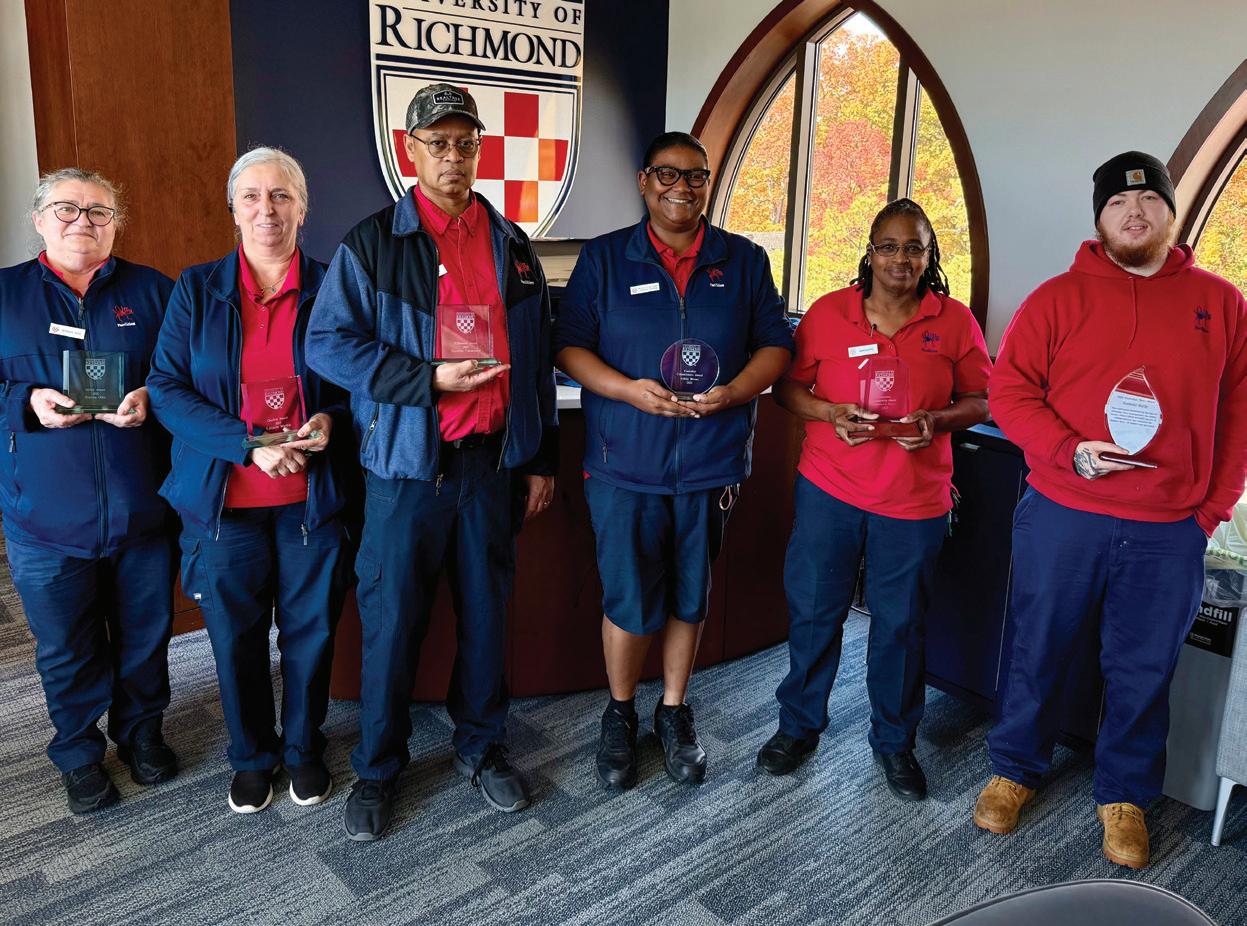
2025 Custodial Award Winners
These annual University Facilities awards recognize individuals who have gone above and beyond in demonstrating the custodial commitments — safety, hospitality, quality, and efficiency.
CUSTODIAL SAFETY AWARD
Champions safety through their actions and commitment to themselves, their fellow staff, and the entire UR community
BRANKA ODIC, TEAM LEADER
CUSTODIAL HOSPITALITY AWARD
Demonstrates a positive attitude and an ability to build lasting relationships
CORRENE CHRISTIAN, CUSTODIAN
CUSTODIAL QUALITY AWARD
Displays exemplary attention to detail and exceptional service
LJILJANA MARTIC, CUSTODIAN
CUSTODIAL EFFICIENCY AWARD
Displays creative thinking, provides innovative suggestions, and continually seeks ways to improve the operation
MAURICE THOMPSON, CUSTODIAN
CUSTODIAL COMMITMENT AWARD
Most exemplifies all four commitments of the custodial department
ASHLEY BLOUNT, CUSTODIAN
CUSTODIAL LEADERSHIP AWARD
Demonstrates dedication to the team’s success, develops those around them, and serves those they lead
ANTOINETTE FERRELL, TEAM LEADER
CUSTODIAL HERO AWARD
Performs decisively in the face of adversity; their acts of selfless service demonstrate the highest form of respect and gratitude
GABRIEL KELLY, CUSTODIAL FLOOR TECHNICIAN
From left: Branka Odic, Ljiljana Martic, Maurice Thompson, Ashley Blount, Antoinette Ferrell, Gabriel Kelly
Unsymmetrical 3,3-Diarylpropenals by a SuzukiMiyaura Reaction of (Z)-3-Aryl-3-Chloropropenal Intermediates” in the European Journal of Organic Chemistry.
JULIAN HAYTER, professor of leadership studies, published the chapter “Give Us the Ballot: The Ratification of the Voting Rights Act of 1965” in the edited volume Case Studies in Political Leadership (Edward Elgar Publishing).
LAUREN HENLEY, assistant professor of leadership studies, received the Bonner Foundation’s From Action to Impact Award for excellence in teaching.
AURORA HERMIDA-RUIZ associate professor of Spanish, published “Vivir para descontarla: Maravall y el Quijote (1948–1976)” in Hispanic Review.
JAVIER HIDALGO, professor of leadership studies and PPEL, published the chapter “Political Leadership and the Struggle for Tibet, 1950–1959” in the edited volume Case Studies in Political Leadership (Edward Elgar Publishing).
DANIEL HOCUTT, SPCS web manager and adjunct professor of liberal arts, co-authored the chapter “Give Yourself a Break: Juggling Rugrats, Experiencing Regrets, and Cultivating Compassionate Community” in Parenting while PhDing: Surviving and Improving the Working Conditions of Graduate Student Parents (Rutgers University Press).
AMY HOWARD, associate provost for strategic initiatives and community engagement, received the Bonner Foundation’s Lives of Service Award for long-term work with the Bonner Program.
CRYSTAL HOYT, Colonel Leo K. and Gaylee Thorsness Endowed Chair in Ethical Leadership and professor of leadership studies and psychology, published the chapter “Stacey Abrams: Championing Voting Rights and Transforming American Democracy” in the edited volume Case Studies in Political Leadership (Edward Elgar Publishing). Hoyt co-published “Loneliness mindsets: A new measurement approach and implications for predicting wellbeing” in Behavioral Sciences and “Distinguishing between individual and societal socioeconomic mobility beliefs: Understanding attitudes toward those in poverty” in Group Processes & Intergroup Relations.
KATHRYN JACOBSEN, William E. Cooper Distinguished University Chair and professor of health studies, co-published “Hepatitis B (HBsAg) prevalence among obstetric patients in Caluquembe, Angola, 2023–2024” in PLOS One.
NIGEL JAMES, assistant professor of health studies, published “Tackling the (un)affordability of medicines for cardiometabolic risk factors worldwide: a call to action” in BMJ Global Health.
KRISTINA JEAN-BAPTISTE, doctoral intern in Counseling and Psychological Services, co-published “Warrior Woman: An Examination of the Relationship Between the Superwoman Schema, Emotion Regulation, and PTSD Symptoms in Africana Women” in Siyabonana: The Journal of Africana Studies.
YUCONG JIANG, assistant professor of computer science, published “Piano Precision: Advancing Music Performance Analysis by Integrating User-Correctable Audio-to-Score Alignment” in the Proceedings of the 2025 Sound and Music Computing Conference and “Performance Precision: A Software Prototype for Computer-Assisted Annotation and Analysis of Music Performance” in the Proceedings of the 2025 International Computer Music Conference, where she presented the paper.
SANDRA JOIREMAN, Weinstein Chair of Global Studies and professor of political science, co-published “In the Shadow of the Dragon: Chinese Soft Power in Central Asia” in International Affairs and “Property Confiscation in the Zanzibar Revolution” in African Affairs.
SHANNON JONES, senior teaching faculty of biology; Marcella Torres, teaching faculty of mathematics; and students published “Development of a mathematical model of the innate immune response to inhaled toxicants” in the Journal of Theoretical Biology.
PETER KAUFMAN, George Matthews and Virginia Brinkley Modlin Chair in Leadership Studies, and a student published the chapter “Thomas More, Chancellor” in the edited volume Case Studies in Political Leadership (Edward Elgar Publishing).
ANDY KERSCHER, chef de cuisine; Tyler Betzhold, executive chef; and Dining Services received the Career Impact Award: Most Value in Student Care and Upward Mobility from Reynolds School of Business and Industrial Trades.
LAURA KNOUSE, professor of psychology, co-published Living Well With Adult ADHD: Practical Strategies for Improving Your Daily Life (The Guilford Press). Knouse and a student published “SmartADHDMonitor: A Novel Approach to Automatic ADHD Monitoring Through Smartphone App Usage Data” in the Proceedings of the 2025 IEEE 49th Annual Computers, Software, and Applications Conference.
MICHAEL LEOPOLD, Floyd D. and Elisabeth S. Gottwald Chair of Chemistry, and students published “Adsorptive Cathodic Stripping Analysis of Xylazine Within Fouling-Resistant and Nanomaterial-Enhanced Modified Electrode Sensors” in Sensors
MATTHEW LOWDER, associate professor of psychology, published “Comparing Sustained Attention Performance Across Laboratory-Based Versus Web-Based Settings” in Attention, Perception, & Psychophysics.
PATRICK MARTIN, assistant professor of computer science, presented “On the Design and Implementation of a Live Human-Robot Coding Platform for Contemporary Dance Performances” at the International Conference on Live Coding.
2025 Engage for Change Award Winners
These awards, given annually by the Bonner Center for Civic Engagement, celebrate and acknowledge faculty, staff, students, and area leaders working together to make an impact in our communities.
COMMUNITY-ENGAGED TEACHING AWARD
Recognizes a faculty member who has consistently demonstrated excellence in community-engaged teaching at the University of Richmond
JULIAN HAYTER
Professor of Leadership Studies
MICHELLE KAHN
Associate Professor of History
COMMUNITY-ENGAGED SCHOLARSHIP AWARD
Recognizes a faculty member — or members — whose scholarly and/or other creative activity emerges from a mutually beneficial partnership with a community and creates new knowledge that contributes to positive social change
KYLE REDICAN
Director of the Spatial Analysis Lab
SANDY WILLIAMS IV
Assistant Professor of Art
COLLABORATION FOR CHANGE AWARD
Honors a collaborative community-based partnership between campus and community stakeholders
ALLISON BRENNING
Director of Special Education and Elementary Instruction
TAMMY MILBY
Director of Reading Instruction
CONTRIBUTION TO THE INSTITUTION AWARD
Recognizes faculty or staff whose communityengaged teaching, scholarship, and/or service made a significant contribution to the University of Richmond, furthering opportunities for faculty engagement, community collaboration, and the learning and thriving of students
UNIVERSITY OF RICHMOND SCHOOL OF LAW’S IN-HOUSE CLINICS
BILL COLEMAN AWARD
Recognizes a staff member who is dedicated to supporting meaningful engagement with our local and global communities
JANAE DRIVER
Associate Director, Employer Relations
CIVIC COMMITMENT AWARD
Honors an individual who demonstrates civic commitment and inspires it in other learners, enhancing their positive impact on the world around them
COURTNEY HUGHES
Assistant Athletics Director for Academic Support and Civic Engagement
PUBLIC SCHOLARSHIP AWARD
Honors an individual for their scholarly or other creative activity that serves a public good extending beyond the academic purpose of the work
ROB NELSON
Director, Digital Scholarship Lab
LEARN MORE
For a complete list of winners, visit engage. richmond.edu/events/ awards.
RICK MAYES, professor of health policy, copublished “Inside the Meteoric Rise in Medicare Advantage” in Health Affairs
AMY MCCRACKEN, associate dean for graduate programs, was named one of Virginia Business’ 2025 Women in Leadership honorees. These awards celebrate top women executives for their overall professional accomplishments, civic engagement, mentorship, and breaking glass ceilings.
BRITTANY NELSON, associate professor of photography and extended media, was named one of 20 artists to watch in Art in America’s “New Talent” issue. In publishing the announcement, Art News featured one of Nelson’s photographs as a collectable print. Nelson opened the solo exhibition “To Leave Is To Return” at Quartz Studio at the Exposed Torino Foto Festival in Italy.
CAMILLA NONTERAH, associate professor of psychology, co-published African American Psychology From Africa to America (Sage Publications).
MALCOLM OGDEN, visiting assistant professor of rhetoric and communication studies, presented “AI, grammar, and consciousness: A media genealogical analysis of Grammarly” at the 50th annual meeting of the Society for Social Studies of Science (4S): Reverberations.
OLUBUKOLA OLAYIWOLA, visiting assistant professor of anthropology, published “‘Having Experience of What To Do To Succeed’: Unsettling Neoliberalism Through the Lived Experiences of Microcredit Trader-Borrowers in Ibadan” in Economic Anthropology
MATTHEW OWARE, Irving May Professor of Human Relations, published “Race and Space in Rap: Conceptions of (Multi)Racial Identity and Urban Life in Rap Music” in The Arts and Urban Development.
JOONSUK PARK, associate professor of computer science, co-published “ReSCORE: Label-Free Iterative Retriever Training for Multi-Hop Question Answering With Relevance-Consistency Supervision” in the Proceedings of the Association for Computational Linguistics and “ArgInstruct: Specialized Instruction Fine-Tuning for Computational Argumentation” in Findings of the Association for Computational Linguistics (ACL)
KYLE REDICAN, teaching faculty of geography, environment, and sustainability and director of the Spatial Analysis Lab, received the Bonner Foundation Engaged Scholar Award, given to scholars who have made significant contributions to the field.
MICHEL ROBE, Patricia A. and George W. Wellde Jr. Distinguished Chair in Finance, chaired the Commodity and Energy Markets Association’s 2025 Scientific Committee held at Rice University. Robe developed the conference’s academic program and presented research on risk premia in agriculture futures markets.
AARYN ROBBINS, assistant professor of psychology, co-published “The Pictures by Category and Similarity (PiCS) database: A multidimensional scaling
database of 1200 images across 20 categories” in Behavior Research Methods.
DAVID SALISBURY, associate professor of geography, environment, and sustainability, and Stephanie Spera, associate professor of geography, environment, and sustainability, published “Transboundary Road-Building in the Southwestern Amazon” in the Journal of Latin American Geography.
TENACE SETOR, assistant professor of analytics and operations, received the Association for Computing Machinery Special Interest Group on Management Information Systems’ Early Career Award, which recognizes outstanding achievements of researchers and educators as they commence their journey pursuing excellence in the management information systems discipline.
TOM SHIELDS, associate professor of education and leadership studies, moderated a meeting of the Richmond Public Schools Board and the Richmond City Council.
ISAAC SKROMNE, associate professor of biology, co-published “A cell fate mapping simulation laboratory to increase undergraduate students’ understanding of early developmental processes in frog, zebrafish, and tunicate embryos” in the Journal of Microbiology and Biological Education.
CHARLYNN SMALL, assistant director of health promotion, published Black Women with Eating Disorders: Clinical Treatment Considerations (W. W. Norton & Co.), which was reviewed and featured in The Eating Disorder Journal.
STEPHANIE SPERA, associate professor of geography, environment, and sustainability; Melinda Yang, assistant professor of biology; Beth Zizzamia, Spatial Analysis Lab geographic information systems operations manager; and students published “The AADR Visualizer: An ArcGIS online visualizer for ancient human DNA from the Allen Ancient DNA Resource” in Bioinformatic Advances. Spera and David Salisbury, associate professor of geography, environment, and sustainability, published “Transboundary Road-Building in the Southwestern Amazon” in the Journal of Latin American Geography.
BOB SPIRES, associate professor of education, was recognized for leading a workshop for educators at the National Institute of Education in Phnom Penh, Cambodia. Spires edited and introduced a special issue of The Urban Review on the continued impact of neoliberalism on urban education.
BLAKE STACK, senior associate director of student engagement in the Bonner Center for Civic Engagement, received the Bonner Foundation’s Lives of Service Award for long-term work with the Bonner Program.
AGNIESZKA SZYMAŃSKA, associate professor of art history, published “Painted Plaster” in City and Cemetery: Excavations at Kourion’s Amathous Gate Cemetery, Cyprus: The Excavations of Danielle A. Parks, Vol. 2 — Human Skeletal Remains, Ecofacts, and Artifacts (American Society of Overseas Research) and “Deposition and Dumping in Area A” and “The Cist Tombs” in City and Cemetery: Excavations at Kourion’s Amathous Gate Cemetery, Cyprus: The Excavations of Danielle A. Parks, Vol. 1 — Context, Analysis, and Conclusions (American Society of Overseas Research). Szymańska presented “Sailing the Desert Seas: Images of Ships in Monastic Spaces of Late Antique Egypt” at the Byzantine Studies Symposium.
MARGARET TAIT, assistant professor of health studies, published “News media coverage of the U.S. social safety net: themes and gaps from a scoping review” in BMC Public Health and “Was health skepticism accounted for in communication about the COVID-19 vaccine? A content analysis of federally-sponsored public service announcements about the vaccine to protect against COVID-19 in the United States” in Preventive Medicine Reports. Tait presented her research “Considering Catholic Health Care: Exploring Perceptions of Trust and Discrimination in Religiously Affiliated Health Systems” at the 2025 Interdisciplinary Association for Population Health Sciences Conference.
MARCELLA TORRES, teaching faculty of mathematics; Shannon Jones, senior teaching faculty of biology; and students published “Development of a mathematical model of the innate immune response to inhaled toxicants” in the Journal of Theoretical Biology.
NANCY TRAN, assistant professor of finance, presented at the Commodity and Energy Markets Association’s 2025 annual meeting held at Rice University.
AMY TREONIS, associate professor of biology, and Andrew Bell, associate director, digital pedagogy and research, published “Namibian fairy circles: Hostile territory for soil nematodes” in PLOS One.
KARINA VÁZQUEZ, senior teaching faculty of Latin American, Latino, and Iberian studies, received the Bonner Foundation’s Engaged Scholar Award, given to scholars who have made significant contributions to the field.
CHRISTOPHER VON RUEDEN, professor of leadership studies, co-published “The Multi-Capital Leadership Theory: An Integrative Framework for Human Leadership Diversity” in Human Nature.
SHWETA WARE, assistant professor of computer science; Laura Knouse, professor of psychology; and a student published “SmartADHDMonitor: A Novel Approach to Automatic ADHD Monitoring Through Smartphone App Usage Data” in the Proceedings of the 2025 IEEE 49th Annual Computers, Software, and Applications Conference. Ware presented the paper at the conference.
PEGGY WATSON, director of the Osher Lifelong Learning Institute, was invited by the National Resource Center (NRC) for Osher Lifelong Learning Institutes to become a member of the inaugural Osher NRC Advisory Council. Watson will serve a two-year term.
EMMY WELDON, assistant professor of theatre and dance, received the Bonner Foundation’s Spirit of Ubuntu Award, given to individuals who embody the spirit of community engagement.
DAVID WILKINS, E. Claiborne Robins Distinguished Professor in Leadership Studies, published the chapter “The Determined Ones: The Collaborative Leadership of Hank Adams, Vine Deloria, Jr., and Billy Frank, Jr.” in the edited volume Case Studies in Political Leadership (Edward Elgar Publishing). Wilkins gave the keynote address at the Democracy Reform Summit: Removing Barriers to Native Political Participation.
THAD WILLIAMSON, professor of leadership studies and PPEL, published the chapter “Richmond, Virginia’s 20-Year Experiment With ‘Strong Mayor’ Government” in the edited volume Case Studies in Political Leadership (Edward Elgar Publishing).
JAMELLE WILSON, dean of the School of Professional and Continuing Studies, was reelected to the board of the Virginia Early Childhood Foundation as board secretary. She joined the VECF board in 2020.
JORGE WONG MEDINA, assistant professor of classical studies, presented “The Names of Odysseus” at the Classical Association of Virginia Fall Meeting.
TIANYUAN XU, assistant professor of mathematics and statistics, received an American Mathematical Society–Simons Research Enhancement Grant for Primarily Undergraduate Institution (PUI) Faculty to support research in combinatorial representation theory. Xu co-published “Orthogonal roots, Macdonald representations, and quasiparabolic sets” in Forum of Mathematics, Sigma.
MELINDA YANG, assistant professor of biology; Stephanie Spera, associate professor of geography, environment, and sustainability; Beth Zizzamia, Spatial Analysis Lab geographic information systems operations manager; and students published “The AADR Visualizer: An ArcGIS online visualizer for ancient human DNA from the Allen Ancient DNA Resource” in Bioinformatic Advances.
BETH ZIZZAMIA, Spatial Analysis Lab geographic information systems operations manager; Stephanie Spera, associate professor of geography, environment, and sustainability; Melinda Yang, assistant professor of biology; and students published “The AADR Visualizer: An ArcGIS online visualizer for ancient human DNA from the Allen Ancient DNA Resource” in Bioinformatic Advances.
OMICRON DELTA KAPPA FALL 2025
Epsilon Circle Inductee
This national leadership honor society recognizes individuals who have demonstrated exemplary character and leadership achievements in one of the five phases of campus life: scholarship, athletics, service, communications, and arts.
JOE BOEHMAN Dean Richmond College
The following highlights full- and parttime faculty and staff hires and retirements from July 1 to Oct. 31.
NEW HIRES
FACULTY
SCHOOL OF ARTS & SCIENCES
BIOLOGY
Allison Cornell Assistant Professor of Biology
Nathan Derstine Visiting Assistant Professor of Biology
Fenglian Xu Visiting Lecturer of Biology
CHEMISTRY
Alexandra Johnson Visiting Lecturer of Chemistry
CLASSICAL STUDIES
Caitlin Mongrain Visiting Faculty of Classical Studies
ENGLISH
Kathryn Harlan Visting Writer
HEALTH STUDIES
Hemali Oza Assistant Professor of Health Studies
Solis Winters Assistant Professor of Health Studies
HISTORY
Bill Link Cornerstones Visiting Chair in History
JOURNALISM
Kavitha Cardoza Assistant Professor of Journalism
LANGUAGES, LITERATURES, AND CULTURES
Daria Bozzato Visiting Assistant Professor in Italian Studies
Kamal Gasimov Assistant Professor of Arabic Studies
MATHEMATICS AND STATISTICS
Miranda Evans Visiting Assistant Professor of Data Science
PHILOSOPHY
Alexander Englert Assistant Professor of Philosophy
Evan Welchance Visiting Lecturer of Philosophy
PHYSICS
Akshatha Vydula Postdoctoral Research Associate
POLITICAL SCIENCE
Apolonia Calderon Assistant Professor of Political Science
PSYCHOLOGY
Amna Agha Visiting Lecturer of Psychology
Katie Roderick Teaching Faculty of Psychology
RHETORIC AND COMMUNICATION STUDIES
Chaz Barracks Visiting Assistant Professor of Rhetoric and Communication Studies
Ben Pettis Assistant Professor of Rhetoric and Communication Studies
THEATRE AND DANCE
Ashley White Visiting Assistant Professor of Theatre
ROBINS SCHOOL OF BUSINESS ECONOMICS
Md Yasin Arafat Visiting Lecturer of Economics
Sebastian Laumer Assistant Professor of Economics
SCHOOL OF LAW
Douglas Boyle Faculty of Practice, Legal
JEPSON SCHOOL OF LEADERSHIP STUDIES
Kazi A S M Nurul Huda Cmelikova Visiting International Scholar in Leadership and Ethics STAFF
ACADEMIC AFFAIRS SCHOOL OF ARTS & SCIENCES
Jake Cardwell Digital Media Lab Manager, Journalism
Amy Jablonski Postbaccalaureate Research Assistant, Biology
Jaden Kang Postbaccalaureate Assistant, Biology
Julia Kardos Postbaccalaureate Research Assistant, Biology
Erika Robbins Postbaccalaureate Research Assistant, Biology
ROBINS SCHOOL OF BUSINESS
Jonathan Adams Director, Center for Professional Skills and Development
Sharon Condrey Strategic Payroll and Tax Compliance Advisor
Christina Mlynar Administrative Coordinator, Dean’s Office
SCHOOL OF LAW Katelyn Child Administrative Coordinator, Dean’s Office
Courtney Curry Associate Dean of Development and Alumni Relations
Elena Kritter
Administrative Coordinator, Instruction
Marissa Wilhoit Law Clinic Paralegal and Administrative Specialist
PROVOST
Matthew Banfield Chief of Staff for the Provost’s Office
John Boyd Director of Speech Support, Student Learning Center
Jessica Durrett Administrative Coordinator, Student Learning Center
Rachael Fellabaum Associate Director of Study Abroad and Short-Term Programs, Global Engagement
Tiara Hicks Assistant Director of Career Services
Rebecca Johnson Director of Writing Support, Student Learning Center
Alexandra Reinhart Administrative Coordinator, Career Services
Laura Vachet Director of Academic Coaching, Student Learning Center
Shawnda Williams Administrative Coordinator, Career Services
ADVANCEMENT
Matt Camire
Senior Associate Director of Major Giving
Amaya Jones
Assistant Director of Alumni Networks, Alumni Engagement
ATHLETICS
Lindsey DeHaven
Academic Graduate Assistant, Spider Performance and Development –Academic Services
Emily Dunnavant
Athletics Leadership Intern, Spider Performance and Development – Academic Services
Cole Ekert
Assistant Coach, Men’s Golf
Madison Evko Director of Marketing and Sales, Sports Operations
Page Farmer
Assistant Athletics Director for Annual Giving, Athletics Fundraising
Mackenzie Flores Velasquez
Spider Athletics Fund Graduate Assistant
Ellie Joyce
Assistant Director of Development Communications, Athletics Fundraising
Jim Merritt
Associate Athletic Director for Basketball Development
Kyle Norman Assistant Coach, Baseball
Gabriella Pacini
Assistant Athletic Trainer, Spider Performance and Development –Sports Medicine
Taylor Paige Assistant Coach, Women’s Lacrosse
Amanda Pendleton
Assistant Athletic Trainer, Spider Performance and Development — Sports Medicine
Matthew Roberts
Assistant Coach, Strength and Conditioning
Conor Whipple
Assistant Coach, Men’s Lacrosse
BOARD OF TRUSTEES
Kathy Hieber
Project Coordinator
BUSINESS AFFAIRS
Josh Breeden Senior Workday Architect
Paul Lozo
Senior Vice President of Campus Operations
CAMPUS SERVICES
Douglas Blake Events and Projects Technician, Events, Conferences, and Support Services
Trevor Moulton Marketing and Retail Specialist, SpiderShop
CAMPUS SAFETY
Faith Ludwig Environmental Health and Safety Specialist
Adarius Moody Police Officer
DINING SERVICES
Travis Brandon
Utility Associate, Heilman Dining Center
India Brown Café Associate, FlavUR
Dani Christian Café Lead, 8:15 at Boatwright
Eugene Dix
Utility Associate, Heilman Dining Center
Rachel English Baker II, Heilman Dining Center
Anthony Giuseppe Truck Driver, Catering
Chris Holloway Cook I, Heilman Dining Center
Juanetta Jenkins
Manager Floater, Heilman Dining Center
William Kearney Cook II, Heilman Dining Center
Lea McLain
Utility Associate, Heilman Dining Center
Nautica Murchison
Café Associate, Tyler’s Grill
Franchesca Pazos
Café Associate, Lou’s Café
LaKia Quarles
Café Associate, Tyler’s Grill
Samia Ross
Café Associate, 8:15 at Boatwright
John Valentine
Utility Associate, Heilman Dining Center
Shena Williams
Line Service Associate, Heilman Dining Center
Amy Wingfield Cook II, Heilman Dining Center
Jamani Wright Utility Associate, FlavUR
FACILITIES
Dominic Boswell Custodial Floor Technician
Sarah Champine Project Manager, Design and Construction
Elis Cordova de Zepeda Custodian
Sondra Daniels Custodial Supervisor
Mimi Mokpako Custodian
Brandon Smietanski Integrated Pest Management Specialist
Larissa Tonini Project Manager, Design and Construction
Clifford Wilkinson Groundskeeper
Billy Zetino Medrano Groundskeeper
FINANCE Makenzie Smith Student Account Specialist, Controller
HUMAN RESOURCES
Keila Bolden Benefits Analyst
Courtney Morse Communications Specialist
SPIDER MANAGEMENT William Galbraith Investment Analyst
COMMUNICATIONS
Nia Darrisaw Marketing Engagement Specialist
ENROLLMENT MANAGEMENT
Lorielle Bouldin Program Coordinator, Scholars and Fellowships
Susannah Carter Admission Counselor
Victoria Lara Financial Aid Advisor
Gabriel Molina Content Manager and Marketing Specialist
Miah Wilson Admission Counselor
INFORMATION SERVICES
Taylor Lowery Technical Support Analyst, User Services
PLANNING AND POLICY
Peterson Haas
Junior Data Analyst, Institutional Effectiveness
STUDENT
DEVELOPMENT
Alfonso Amanecer Assistant Dean, Richmond College
Revae Boykins Doctoral Psychology Intern, Counseling and Psychological Services
Hannah Guffey Staff Counselor, Counseling and Psychological Services
Kristina Jean-Baptiste Doctoral Psychology Intern, Counseling and Psychological Services
Jay Manalo Staff Counselor, Counseling and Psychological Services
Alfie Price Spider Fellow
Cambria Rotondo Area Coordinator, Residence Life
Isaiah Smith Area Coordinator, Residence Life
Troy Smith Staff Counselor, Counseling and Psychological Services
Julie Tucker Assistant Vice President and Chief of Staff
RETIREMENTS
40 Years
ANNEMARIE WEITZEL Controller’s Office
28 Years RICK GLASS Events, Conferences, and Support Services
27 Years
BILL QUIG University Facilities –Architectural Services
17 Years SHELLEY BURNS Robins School Dean’s Office
6 Years JOHN STUDER Athletics – Women’s Basketball
4 Years ROSARIO FOX Campus Operations
IN MEMORIAM
REMEMBERING THOSE WE LOST IN 2025
ALEM AREKI March 28, 2025 Senior Web Developer, Web Services 20 YEARS OF SERVICE
MARCIA WHITEHEAD October 24, 2025 Humanities Librarian, Boatwright Memorial Library
40 YEARS OF SERVICE
We welcome your input.
Send your story ideas or comments to spiderinsider @richmond.edu.
410 Westhampton Way
University of Richmond, VA 23173
FEBRUARY
Feb. 14
Preview Richmond Open house for prospective students and their families
Feb. 21, 8 a.m.
Spider Dash
MARCH
March 3, 2 p.m.
Employee Service Awards
Booker Hall of Music, Camp Concert Hall
March 7–14
Undergraduate Spring Break
March 20
Experience Richmond Open house for admitted students and their families
APRIL
April 10
Experience Richmond
April 17
Experience Richmond Overnight Overnight program for admitted students
April 18
Experience Richmond
April 24
Last Day of Undergraduate Spring Classes
USAC
The University Staff Advisory Council represents the needs of staff to senior administration and works to make the University of Richmond an employer of choice.
Meetings* Feb. 10
March 10
April 14 1–3 p.m.
Visit usac.richmond.edu for meeting locations.
FACULTY SENATE
The University of Richmond Faculty Senate represents the faculty in the University’s governance process on matters that impact the University or affect more than one school.
Meetings* Feb. 20 March 20
April 17
3–4:30 p.m.
Visit facultysenate. richmond.edu for meeting locations.
*Unless otherwise noted, meetings are open to all faculty and staff.