The Rice Thresher | Wednesday, January 28, 2026

Page 1


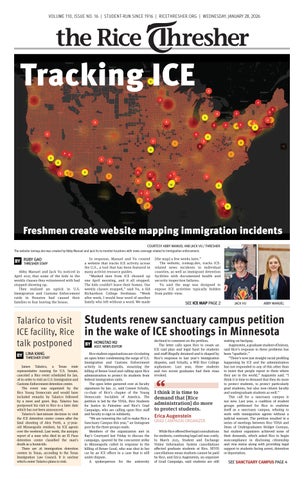
Tracking ICE

Freshmen create website mapping immigration incidents

website icemap.dev was

RUBY GAO THRESHER STAFF

Abby Manuel and Jack Vu noticed in April 2025 that some of the kids in the weekly classes they volunteered with had stopped showing up.

They realized an uptick in U.S. Immigration and Customs Enforcement raids in Houston had caused their families to fear leaving the house.

Talarico to visit ICE facility, Rice talk postponed

James Talarico, a Texas state representative running for U.S. Senate, canceled a Rice event scheduled for Jan. 28 in order to visit an U.S. Immigration and Customs Enforcement detention center.

The event was organized by the Rice Young Democrats and would have included remarks by Talarico followed by a meet and greet. Rep. Talarico has postponed his visit to Rice to a later date which has not been announced.

Talarico’s last-minute decision to visit the ICE detention center comes a er the fatal shooting of Alex Pretti, a 37-yearold Minneapolis resident, by ICE agents over the weekend. Last week, the autopsy report of a man who died in an El Paso detention center classi ed the man’s death as a homicide.

There are 26 immigration detention centers in Texas, according to the Texas Immigration Law Council. It is unclear which center Talarico plans to visit.

In response, Manuel and Vu created a website that tracks ICE activity across the U.S., a tool that has been featured in many activist resource guides.

“Masked men from ICE showed up one April morning, and it all stopped. The kids couldn’t leave their homes. Our weekly classes stopped,” said Vu, a Sid Richardson College freshman. “Week after week, I would hear word of another family who left without a word. We made

[the map] a few weeks later.”

The website, icemap.dev, tracks ICErelated news incidents in individual counties, as well as immigrant detention facilities with documented health and security inspection failures.

Vu said the map was designed to expose ICE activities typically hidden from public view.

Students renew sanctuary campus petition in the wake of ICE shootings in Minnesota

HONGTAO HU ASST. NEWS EDITOR

Rice student organizations are circulating an open letter condemning the surge of U.S. Immigration and Customs Enforcement activity in Minneapolis, mourning the killing of Renee Good and calling upon Rice administration to protect its students from federal immigration raids.

The open letter garnered over 26 faculty signatures by Jan. 27, said Conner Schultz, co-chair of Rice’s chapter of the Young Democratic Socialists of America. The petition is led by the YDSA, Rice Students for Justice in Palestine and Rice’s Grad Campaign, who are calling upon Rice sta and faculty to sign in solidarity.

“We are renewing the call to make Rice a Sanctuary Campus this year,” an Instagram post by the three groups reads.

Members of the organization met in Ray’s Courtyard last Friday to discuss the campaign, spurred by the concurrent strike in Minneapolis called in response to the killing of Renee Good, who was shot in her car by an ICE o cer in a case that is still under dispute.

A spokesperson for the university

declined to comment on the petition.

The letter calls upon Rice to create an ICE raid plan and legal fund for students and sta illegally detained and is shaped by Rice’s response to last year’s immigration disputes, said Schultz, a Will Rice College sophomore. Last year, three students and two recent graduates had their visas revoked.

I think it is time to demand that [Rice administration] do more to protect students.

While Rice o ered free legal consultations for students, continuing legal aid was costly.

In March 2025, Student and Exchange Visitor Information System cancellations a ected graduate students at Rice. SEVIS cancellations mean students cannot be paid by Rice, and Erica Augenstein, an organizer of Grad Campaign, said students are still

waiting on backpay.

Augenstein, a graduate student of history, said Rice’s response to these problems has been “apathetic.”

“There’s now just straight racial pro ling happening by ICE and the administration has not responded to any of this other than to insist that people report to them where they are in the world,” Augustein said. “I think it is time to demand that they do more to protect students, to protect particularly grad students, but also non-citizen faculty and undergraduate students as well.”

This call for a sanctuary campus is not new. Last year, a coalition of student groups petitioned for Rice to enshrine itself as a sanctuary campus, refusing to work with immigration agents without a judicial warrant. The petition resulted in a series of meetings between Rice YDSA and Dean of Undergraduates Bridget Gorman, but student organizers achieved none of their demands, which asked Rice to begin noncompliance in disclosing citizenship and visa status along with providing legal support to students facing arrest, detention or deportation.

COURTESY ABBY MANUEL AND JACK VU / THRESHER
The
created by Abby Manuel and Jack Vu to monitor locations with news coverage related to immigration enforcement.
JACK VU ABBY MANUEL SEE ICE MAP PAGE 2

Senate considers banning Blanket Tax Org. endorsements

The Student Association focused on the upcoming election and voted to approve an election packet on Monday a er rejecting two amendments concerning GroupMe and email campaigning as well as endorsements from Blanket Tax Organizations.

At 11:59 p.m. on Feb. 3, election packets with signatures, campaign statements and pictures are due to the SA email.

Campaigning will begin Feb. 16 and voting will open Feb. 25.

The voting period will end at noon on March 4, and election results will be announced at noon on March 6.

There will be two elections information sessions held from 8 to 9 p.m. on Jan. 29 and 30, hosted by SA Secretary Cedric Lau. Brown College Senator Max Menchaca proposed an amendment that would allow candidates to campaign using their own college’s messaging platforms, such as emails or GroupMe. The amendment was voted down.

This amendment would have added an exception to the current ruling in the elections packet, which states that a candidate is not allowed to use any organizational or residential college messaging platform to campaign.

Martel College Senator Abigail Chiu pushed back against this amendment, believing that it would lead to inequity between di erent colleges’ policies on campaigning in their GroupMe.

“Doesn’t that go against the whole point of it being equitable,” Chiu said. “If one college says you aren’t allowed to campaign in their GroupMe, but another college allows that?”

Editor’s note: Chiu is a senior news writer for the Thresher.

Chiu o ered an example: Martel College policies state that a candidate, even one from Martel, would not be allowed to campaign in their GroupMe. This would put that candidate at a disadvantage compared to a candidate from a di erent college, which might allow them to campaign in their GroupMe.

SA President Trevor Tobey proposed another amendment to the Elections packet that would prohibit Blanket Tax Organizations from endorsing, opposing or expressing any preference for candidates or ballot items in SA

“There is a deliberate e ort to lie to people about what ICE is doing,” said Vu, a Sid Richardson College freshman. “But when you got a site that allows you to see these local news and national news articles, you see what it is. And that leads to some di erence in the way we enforce immigration policy. That’s a huge positive in my view.”

Since its rst launch, the ICE map has received more than 40 donations from around the U.S. and internationally.

“Thank you for this. I’m sending this to my family living in Cincinnati as I’m watching the horror overseas. We are an immigrant family,” one supporter wrote in a comment accompanying their donations.

The map was most recently shared on Instagram in a collaborative post by climate change activist Greta Thunberg and humanitarian nonpro t Humaniti. The post has over 300,000 likes.

The map was also featured in a recent Instagram post by chnge, a sustainable clothing brand account, and listed in the Civic Tech Field Guide, a directory of

elections. When passed into voting, this amendment also failed.

Blanket Tax Organizations are groups that receive their primary funding from the $85 of each student’s tuition that comprises the Blanket Tax and serve the majority of the Rice community, including the SA, the Rice Program Council and student media.

Tobey said this amendment was necessary for an equitable election and there is too much of a con ict of interest between organizations dependent on Blanket Tax funds and the candidates.

“When these organizations endorse candidates in Student Association elections, they are supporting individuals who will a ect not only their oversight but also their funding, and I think that is an obvious problem that needs to be addressed,” Tobey said.

McMurtry College President Berny Guerra Arthur seconded Tobey’s amendment, believing Blanket Tax Organizations like the Thresher have too much sway in an election.

“The Thresher ended up endorsing Trevor for president and Jae Kim, the previous SA President, also endorsed Trevor for President,” said Arthur. “And that, of course, had a massive impact on the election outcome. Maybe Callum would have had a better chance if they didn’t have these two giants completely suppressing them.”

Sid Richardson College President Arjun Surya opposed this amendment, disagreeing with the statement that the BTOs have a conflict of interest in the elections.

“I think it is a big step backwards from a lot of our e orts on improving free speech,” Surya said. “Let’s say there is a BTO like ktru, and let’s say a president’s running who says that the SA should just get rid of ktru. Obviously they should have the ability to post on their public platform opposing candidates or policies.”

Tobey maintained his position, saying the problem is not the endorsement, but who the endorsement is coming from.

“Individuals can de nitely endorse in SA elections,” Tobey said. “What it is stopping is an institution using their unique platform as a Blanket Tax Organization to endorse in elections that will a ect their funding.”

technology projects, tools and organizations dedicated to public interest and democracy.

The project received increased exposure a er Manuel and Vu presented the project at the Media Cloud and Media Ecosystems Alliance Group New(s) Knowledge Symposium at the Massachusetts Institute of Technology in October 2025.

There is a deliberate effort to lie to people about what ICE is doing. But when you got a site that allows you to see these local news and national news articles, you see what it is. And that leads to some difference in the way we enforce immigration policy.

Jack Vu

Manuel and Vu said they used a web scraper to aggregate thousands of local stories to surface where ICE activity was reported, ltering it into individual counties and keywords.

The project also uses national news to ll in missing information in areas that lack local journalism.

“There are some areas where we simply don’t have local sources,” said Manuel, a McMurtry College freshman. “We try to cover and make up for this using federal news lines and national newspapers as well.”

Vu said searching for relevant data is challenging, since online immigration reports can be complex and the website must di erentiate between the acronym ICE and the word ice.

As the site began gaining attention on social media, Manuel said the team encountered public criticism, though the project operates within legal boundaries.

“In the early days of the site, when we were launching it on social media and it was getting some traction, we got some negative public pushback,” Manuel said. “But we’re not doing anything legally ambiguous. We’re basically creating and navigating and taking information that’s already out there and

In the early days of the site, when it were launching it on social media and it was getting some traction, we got some negative public pushback. But we’re not doing anything legally ambiguous.

Abby Manuel MCMURTRY COLLEGE FRESHMAN

putting it into an easily visualized form.” Manuel said she and Vu plan to continue re ning the map during their time at Rice, though some updates may take longer to implement.

“We’ve still been trying to build it and keep it refreshed, collaborating with other people and communities who are interested in similar topics and using some of the resources available to the university,” Manuel said. “But that might be further down the line.”

FROM FRONT PAGE ICE MAP
JESSICA XU / THRESHER
TOBY CHOU THRESHER STAFF

Winter freezes, robberies, protests: Inside campus security

RUBY

As students prepared for subfreezing temperatures and possible icy conditions over the weekend, Rice’s Incident Management Team was stationed around campus, sleeping on cots and working around the clock to ensure that university operations continued running smoothly.

“We [were] sleeping over to make sure all of our students are safe, our power is there, [if there’s] any debris,” said Tam Dao, associate vice president of campus safety and research security.

The IMT, run by the Rice University Police Department, Emergency Management and Rice Emergency Medical Services, re ects just one facet of the campus safety initiatives that extend to every aspect of student life, Dao said.

“When we have events on campus, [like] basketball and football games, we have to coordinate a strategy to protect that event,” Dao said. “We’re in the background making sure these events run smoothly.”

Dao said Rice security is continuing to expand its reach beyond campus perimeters as the university grows.

“We have the Gateway Project, which is really opening our doors up to the public and extending out into Rice Village,” Dao said. “We’re more than just a campus now, and so our o ce has to be ready to address criminal o enses that may not be just campus.”

Dao said the campus safety department is implementing new safety measures such as updated camera technologies and enhanced lighting around Rice Stadium and pedestrian crosswalks to help improve security in and around campus.

“One is making sure our cameras are up to date, and we’ve learned a lot from the Brown University situation,” Dao said. “[Another is] making sure all our control access is up to date, making sure we can protect students from unauthorized users of buildings.”

The search for a gunman who killed two students and injured nine more at Brown University on Dec. 13, 2025 was hindered by lack of usable surveillance camera footage from the scene of the shooting.

Within RUPD, Lieutenant Frank Fernandez said communication among o cers — who are split between patrolling and monitoring cameras — is vital to the daily operations of the department, which he said can receive up to 100 calls on a busy day. Most of them are non-emergencies, such as lock-outs, minor vehicle accidents and petty the , but Fernandez said that the team always remains alert in anticipation of potential emergencies, like when two students were robbed at gunpoint in West Lot last semester.

“On the larger incidents, like the robbery, one of our goals is to notify campus as soon as we can,” Fernandez said. “But the number one priority is taking care of the incident at hand … hopefully

we’ll be able to nd the perpetrators and arrest them right there.”

One of the most signi cant challenges to anticipating potential threats to campus is the instability of the current political climate, Dao said.

“The Charlie Kirk incident, the protesting issues that we’ve had over the last few years at Columbia and other universities, those things are always at the top of my mind,” Dao said. “People get so passionate about what their beliefs are, and it’s hard to stop that.”

You should be able to [protest] even if it’s against us, if it’s a protest against RUPD or a protest against Rice administration.

Frank Fernandez

RUPD LIEUTENANT

The campus safety team has also undergone extensive training and is equipped to respond in the event of an active shooter on Rice’s campus. In 2024, Jones College junior Andrea Rodriguez Avila was shot and killed in her dorm room on campus in a murder-suicide, a case that RUPD was involved in investigating.

While Dao declined to comment on the speci cs of the case, he said a rapid and coordinated response is key when responding to similar situations where there is an active threat to the campus population.

“I’ve been in law enforcement [the]

majority of my life. You really can’t stop a shooter from coming on campus, it’s impossible. You can’t put enough cameras up, you can’t put enough security up,” Dao said. “What we can do is make sure we respond quickly and appropriately.”

Beyond responding to external threats, the campus safety department is responsible for enforcing university regulations and maintaining security at student demonstrations. In recent years, Rice has seen multiple walkouts and demonstrations staged in response to the Israel-Hamas war.

Fernandez said while he recognizes that college campuses are essential spaces for free expression, demonstrations must comply with Policy 820, which governs campus protests.

“You should be able to [protest] even if it’s against us, if it’s a protest against RUPD or a protest against Rice administration,” Fernandez said. “We’ll protect your right to do that, but it’s got to be done according to the law — free speech does not mean you can break windows, loot stores and that kind of thing.”

Dao said he is mindful of preventing an overreach of RUPD’s authority when approaching campus protests.

“I just hope that the community understands freedom of speech, [and] as much as we would like to intervene in certain cases, [they] don’t meet the threshold that allows an intervention,” Dao said.“And I feel for those students, no doubt they feel bad … but with that comes freedom of speech, freedom of religion and all kinds of things that we cherish here in the United States.”

From his experience monitoring protests related to the Israel-Hamas war, Dao said

he generally views Rice as a campus where demonstrations have remained peaceful and within university guidelines.

“We have people who protest very peacefully, and that’s their right,” said Dao. “[If] people weren’t happy with the [RUPD] response, I didn’t hear that.”

Students for Justice in Palestine member Erica Augenstein said SJP experienced resistance from RUPD during the Condoleezza Rice protests and “liberated zone” in spring 2024.

“Grad students were dragged out of the Condoleezza Rice talk by some mix of RUPD and HPD. RUPD initially reported the encampment,” Augenstein said. “RUPD failed to prevent the mural painted at the encampment from being vandalized.”

In response to new political developments, Dao said campus security also plays a role in helping students navigate uncertainty under new travel bans and restrictions for student visa holders under the Trump administration.

“Some of our minority students have been having di culties with travel with visas and all this crazy stu ,” Dao said. “We do a lot of community outreach to some of those populations that are high-risk in terms of travel [and] of getting jammed up at the port of entry.”

Fernandez said supporting students through di cult times, regardless of the particular scenario, is the most rewarding part of his job.

“Whatever the situation is, you’re able to intervene. You’re able to be that ear,” Fernandez said. “It’s good that that student trusts you enough to share that stressful moment for them, and then you’re able to have a successful conclusion.”

FWIS classes examine arti cial intelligence and the writing process

RISHI

Generative arti cial intelligence tools are being incorporated at Rice with the advent of an undergraduate major, workshops and business partnerships, and the technology is now reaching freshmen in rst-year writing seminars.

David Messmer, director of the FWIS program, said AI has immediate e ects on foundational writing skills.

“I think AI was, in many ways, kind of a wake-up call for a lot of us to reevaluate our assignments,” Messmer said. “If AI can do what we’re asking students to do, then why are we asking students to do it? We need to have an answer for that.”

FWIS courses are required for all rstyear students, with a variety of topics to choose from.

Ali Garib, who teaches the newly

introduced FWIS 125: Writing with AI, said most student usage of generative AI follows a predictable pattern.

“Early on, some are wary or assume GenAI use equals cheating,” Garib, a lecturer in biosciences, wrote in an email to the Thresher. “By mid-semester, most are cautiously enthusiastic: they use GenAI to brainstorm or check structure but rely on themselves for argument, evidence, and voice.”

For Garib’s FWIS course and many others, teaching academic integrity centers on establishing a working relationship between student and technology.

“The ideas should originate from the students’ own thinking and GenAI can play a major role in the process of editing and revising the expression of these ideas,” Garib wrote.

However, for Garib, using generative AI does not mean renouncing writing

altogether.

“Writing is a skill that cannot be abandoned,” Garib wrote. “If students do not learn to write well, they will not be able to tell poor writing from strong writing.”

We discussed what it means to be authentic in a world plagued with AIgenerated content.

One assignment in Garib’s FWIS class involves writing a personal narrative and generating two AI versions. Students then write a comparative essay, without AI, comparing all three to examine structure,

tone, evidence and voice.

Isaac Abraham, a student in Garib’s class, said he uses AI to help with researching content and improving his phrasing.

“I avoid using AI in the brainstorming and ideation processes of my work, as I nd it detracts from my understanding and processing of information,” said Abraham, a Baker College freshman.

Abraham said the conversations he has in class o en move beyond usage guidelines to broader questions about authorship.

“We discussed what it means to be authentic in a world plagued with AIgenerated content,” Abraham said.

As generative AI continues to advance, Messmer said the university has a responsibility to educate students on the available tools.

“I think that we have to prepare students for a world where AI exists,” Messmer said. “I think we do have to embrace that reality.”

BENJAMIN SADOWSKI / THRESHER
A man walks through campus as it is closed down for the winter freeze. Rice’s Incident Management Team was stationed around Rice, working to keep the campus safe.

Rice launches ‘global brain initiatives’ at Davos economic forum

Rice University revealed the Global Brain Economy Initiative, which emphasizes the value of brain health in the age of arti cial intelligence, at the World Economic Forum in Davos, Switzerland earlier this month.

Harris Eyre, lead for the GBEI and a senior fellow at the Baker Institute for Public Policy, said the initiative is centered around the “brain economy,” a framework that treats brain health and brain skills as essential economic infrastructure.

Mental health, neurological health and cognitive health, alongside skills like adaptability, empathy and problem-solving, are increasingly critical as AI reshapes how societies operate, Eyre wrote.

Eyre said the brain economy is a new way of thinking about prosperity.

“[I]f brains are healthier and skills are stronger, societies are more productive, more innovative, and more resilient,” Eyre wrote in an email to the Thresher. “The Global Brain Economy Initiative (GBEI) is designed to move that idea from concept to practice.”

Eyre said the initiative focuses on translating research into tools that governments, employers and investors can use, emphasizing shared frameworks, common metrics, real-world pilots and nancing approaches that make “brain-

positive decisions” easier to implement and scale.

Rice launched the initiative at Davos to engage various types of leaders. The World Economic Forum gathers business leaders and heads of state — including President Donald Trump and French President Emmanuel Macron — to discuss issues facing the world.

[I]f brains are healthier and skills are stronger, societies are more productive, more innovative, and more resilient.

Harris Eyre

GLOBAL BRAIN ECONOMY INITIATIVE LEAD

Eyre said the forum’s unique value lies in its ability to convene heads of government, investors, employers, health leaders and technology leaders in the same place. During the forum, Rice representatives participated in discussions on workforce mental health, healthy longevity, cognitive resilience and AI-enabled innovation.

“Collectively, these engagements demonstrated Rice’s growing role as a bridge

institution — connecting neuroscience, economics, policy, and AI governance — and showed how Rice scholars are helping global leaders rethink economic strategy through the lens of the brain economy, exactly at the moment when that shi is most urgently needed,” Eyre wrote.

Rice’s work at the forum integrated neuroscience with economics, public policy and nance, Eyre said.

“This interdisciplinary lens resonated strongly in Davos, where leaders are actively seeking frameworks to manage AIdriven disruption without eroding human capability,” Eyre wrote.

Provost Amy Dittmar participated in discussions highlighting how investments in brain health translate into productivity and long-term economic value.

“The Global Brain Economy Initiative aligns closely with Rice’s academic and research priorities by drawing on Rice’s multidisciplinary strengths and bringing together neuroscience and neuroengineering with economics and public policy to address how AI and demographic shi s are reshaping work, education and society — and why action is needed now,” Dittmar wrote in an email to the Thresher.

Dittmar also said universities play an important role in advancing brain science while cultivating skills like critical thinking and problem-solving in a world increasingly

in uenced by AI.

President Reggie DesRoches said Davos provided a global stage to showcase Rice’s research strengths and commitment to translating discovery into impact.

“The real-world impact of our research was positioned on the world’s stage,” DesRoches wrote in an email to the Thresher. “Through this initiative, Rice is helping shape global conversations around human potential while reinforcing our role as a university committed to public good and long-term global impact.”

GBEI connects to interdisciplinary research through the Rice Brain Institute and policy engagement through the Baker Institute, Eyre said. Rice is also involved in Project Metis, a Houston-based e ort applying brain economy principles at the city level. The GBEI follows Rice’s recent movement in brain research, including state-level e orts like the newly approved Dementia Prevention and Research Institute of Texas and Proposition 14, but according to Eyre, the initiative’s global scope is unique. Eyre said meaningful success for the initiative will be measured not by visibility, but by metrics, nancing and policy, which would allow his idea of a “brain economy” to come to life.

“[T]he brain economy becomes less of a slogan and more of a functioning operating system for human development in the AI era,” Eyre wrote.

Shepherd to host inaugural Cliburn conducting competititon

The Shepherd School of Music will host a new contest for young conductors in partnership with the Houston Symphony and Cliburn, a classical music nonpro t.

The Cliburn International Competition for Conductors will take place in June 2028 and will be held every four years. It will be open to conductors aged 21 to 35 with a $50,000 grand prize.

An Artistic Advisory Committee will consult on rounds, repertoire and support for young artists. Shepherd’s own Miguel HarthBedoya, distinguished resident director of orchestras and professor of conducting, will serve alongside other conductors, including Marin Alsop, Kent Nagano, Robert Spano, Juraj Valčuha and Xian Zhang.

Under Harth-Bedoya, Shepherd recently announced a new undergraduate conducting program, setting Shepherd apart as the only music school in the country to o er a conducting major to undergraduates.

“From its earliest days, the Shepherd School has been deeply committed to training young conductors,” said Matthew Loden, dean of the Shepherd School, in a press release. “We are eager to host conducting talent from around the world in 2028, and we’re proud to be part of launching this next generation of musical leadership.”

Alsop, a critically acclaimed conductor, will serve as jury chair. She previously served as the conductor for the 2022 and 2025 Van Cliburn International Piano Competitions. The idea for the competition came from Alsop, who has supported a number of early career conductors.

“Creating access and new opportunities for the next generations of gi ed musicians

FROM FRONT PAGE SANCTUARY

Currently, federal immigration agents can only enter Rice’s campus in two cases: discussing immigration matters with university officials or with a judicial warrant or court orders, according to the Office of International Students and Scholars. However, for students holding F-1 or J-1 visas, OISS is required to share their U.S. address and citizenship status with ICE and other immigration officials if requested.

is one of the most meaningful aspects of my work,” Alsop said in a press release. “When I was invited to serve as Jury Chair for a new conducting competition modeled on the Cliburn’s piano competition, it felt like a natural next step in my partnership with this wonderful organization and one that strongly aligns with my mission to remove barriers and expand opportunities for emerging conductors.”

We’ve been distributing signs to faculty that say, for their offices, ‘this office is a safe space for students.’

Conner Schultz

RICE YOUNG DEMOCRATIC SOCIALISTS OF AMERICA CO - CHAIR

Some schools are hesitant to adopt the “sanctuary campus” status, according to Inside Higher Ed, due to a fear of backlash from the Trump administration which may draw “unwanted attention”

The competition is named after Fort Worth-born pianist Van Cliburn, who received international acclaim after he won the 1958 International Tchaikovsky Competition in Moscow, Russia at the age of 23. His piano competition was started in 1962 and has been held in Fort Worth ever since.

The Houston Symphony will perform with the nalists. A screening jury will select

to undocumented students or the university’s federal funding.

Augustein said this argument is an example of “preemptive compliance with fascist policy.”

“We had a number of meetings where the answer was always, ‘well, what can we do? Our hands are tied,’” Augustein said. “We felt that the administrative response was deflecting all possible risk away from themselves and forcing that risk and the consequences, which are much more severe, onto international grad students.”

These student groups are also aiming to involve faculty and staff in the struggle

up to 25 nalists for a live audition hosted by the Shepherd School . Then, 12 competitors will compete at Shepherd or the Jesse H. Jones Hall for the Performing Arts, home of the Houston Symphony.

“We are eager to host conducting talent from around the world in 2028, and we’re proud to be part of launching this next generation of musical leadership,” Loden said.

for a more anti-ICE Rice.

“We’ve been distributing signs to faculty that say, for their offices, ‘this office is a safe space for students,’ saying that this is a private area and that students are welcome in this office in the event of an ICE raid,” Schultz said. Schultz said the recent wave of immigration crackdowns requires a response from Rice.

“There have been attacks on university students across the country, and the fact that Rice doesn’t even acknowledge that very much means that it could happen here, and Rice will be completely unprepared,” Schultz said.

RICHARD LI / THRESHER
The Shepherd School of Music will host the Cliburn International Competition for Conductors in 2028.

Interdisciplinary conference focuses on soccer as World Cup approaches

Rice will host an interdisciplinary conference examining soccer’s global impact as Houston gears up to host matches for the 2026 FIFA World Cup.

Organized by the School of Humanities and Arts and titled “The World at Play: The Beautiful Game in 2026,” the conference will take place Feb. 6-7 at the BioScience Research Collaborative.

The conference will be free and open to the public. With disciplines including history, psychology, economics, data science, sport management, sport medicine and cultural studies, the conference aims to examine soccer as both a source of structural inequality and a potential force for change.

“This conference is grounded in the humanities, but it’s interdisciplinary,” said Jacqueline Couti, an organizer for the event and chair of the department of modern and classical languages, Literatures and Cultures, in a press release. “We’re interested

in what soccer means for people culturally, politically and emotionally — not just as a sport, but as a global social force.”

Caroline Fache

ASSOCIATE

The conference will feature keynote speeches by Briana Scurry, a member of the National Soccer Hall of Fame, and Laurent DuBois, a historian of global sports culture.

“Soccer allows us to talk about politics, culture, gender, economics and identity in ways that feel immediate and relevant,” said Caroline Fache, associate professor of French studies, in the press release. “It gives people a familiar entry point into complex conversations.”

Students temporarily lose access to buildings during winter freeze

Campus buildings lost swipe and keypad access due to technical issues on Monday. Information technology teams recovered access in the a ernoon.

The outage, rst announced by the O ce of Information Technology in the morning, arose from a database-related problem with CBORD — a platform used by Rice to manage control systems — that prevented access to buildings through ID card or keypad, Chief Information Security

O cer Marc Scarborough wrote in an email to the Thresher.

“Once identi ed, Rice IT worked directly with CBORD support to diagnose and ultimately resolve the issue,” Scarborough wrote.

Impacted buildings included residential colleges. For students living on campus like Makeen Shafer, only facilities with key locks could be accessed.

“Somebody I know told me they were up at 3 a.m. and they were locked out of the building during the winter storm, so it was super cold,” said Shafer, a Duncan College

freshman. “It was very inconvenient [that] it happened during the winter storm.”

The OIT con rmed repairs were completed and access restored to buildings in a campuswide email sent at 2:58 p.m. on Monday.

Scarborough said IT teams have come up with new detection and alert methods to catch similar issues with CBORD before they lead to outages.

“What matters most is how quickly issues are detected, how e ectively they are resolved, and what improvements are made a erward,” Scarborough wrote. “Rice

continues to invest in reliability, monitoring, and vendor partnership to minimize disruptions and ensure the safety of the campus community.”

CBORD is the platform Rice uses to manage access control systems across campus, including Rice ID access for buildings on campus and other related security functions. The outage a ected all buildings protected by the CBORD system. However, building access behavior during the outage was inconsistent; while the system worked for some, most people were denied access to areas they normally had access to.

Thresher New St aff Training

SYDNEY AN / THRESHER

EDITORIAL

Rede ning success by using academic tools for good

Much of the talk from computer science students concerns job placements. It could be Google, Microso or Facebook — companies that are actively preying on our already overtaxed attention and the erosion of civic discourse. Perhaps it could be OpenAI or Claude, and the new legion of AI majors can work to replace jobs and destroy intellectual life. Even worse, it could be Palantir or BlackRock, and our peers can unleash a wave of surveillance and new technological forms of killing hitherto unknown to human history.

We’re not here to judge people’s personal decisions to such a high level of scrutiny. Some people might seek to support their family, surely a noble cause! Others might want to raise their parents out of debt. Perhaps they want to give their kids a better life growing up than they had.

But that can’t be the full picture for everyone. At a school that idolizes the size of the company you get placed at, how much money you make and the prominence of your role, there must be another driver. It goes beyond material needs. And it must be success. It’s inexorable.

There’s a push for success, stemming from peers, professors and institutional environments, that drives people to work for these companies, no matter what damage they cause. It is a cult formed around prestige, blind to questions of ethics and morals.

What freshmen Abby Manuel and Jack Vu have shown us is that there are other ways to de ne success. Using familiar computer science principles, they have created icemap.dev to hold the government accountable and protect vulnerable

communities as we witness suppression, terror and killings at the hands of U.S. Immigration and Customs Enforcement.

Are you really successful if you are just sitting back, maybe even actively contributing to corporate control, surveillance, state terror, murder and genocide?

It might not get them a big fancy gig at a top tech company. They probably won’t make any money o of it. But it is

Can we just touch grass already?

The other morning, out of boredom, I went on Fizz for the first time in a couple of days. I thought it might have gotten tamer. After all, that one guy who kept posting about crime “statistics” seemed to have calmed down.

Compared to most other social media platforms, Fizz is not that bad. It doesn’t give me the same disgust as a horribly phrased X post or the general disappointment in humanity when checking the comments of an Instagram reel featuring a transgender person.

Instead, it’s a rip-off of Reddit combined with a tiny bit of the edginess of 4chan. Most racist posts are buried under the tons of Rice Marriage Pact initials questions, images of the Lovett College cat or complaints about C.J. Stroud. However, what it lacks in general content, it more than makes up for in its user base.

Fizz is completely anonymous. This,

of course, emboldens people to divulge their deepest and darkest secrets and begin rage baiting out of some sick sense of satisfaction. But every social media platform does that, and it doesn’t really bother me. No, what really bothers me is that Fizz is exclusive to Rice students.

Yet when I talk to people about Fizz, most people still believe that they are viewing a digital zoo.

Before, there was a sense that the edginess of social media was separate from my community. It allowed me to say “Wow, those people are crazy” and continue with my day because it didn’t really impact me. That safety net is removed with Fizz.

Every horrifying and generally disgusting post was made by one of us.

The edgy crime “statistics” poster could be getting a drink at Chaus (probably just whole milk), and the guy who really, really likes posting about 67 could be studying at Fondy. There is a real sense of paranoia I feel when I look at Fizz.

Yet when I talk to people about Fizz, most people still believe that they are viewing a digital zoo. One where the users honk and bray about silly little things that have no real meaning. One that is still separate from real life.

Fizz underlies the main issue with social media today: We get too comfortable with viewing. We give trolls a place to post and foment a vortex of engagement, where they rage bait and spew racism to fill their egos and help fill our egos as well, as we laugh at how wrong they are. As a byproduct, we get more desensitized to their views and the more impressionable among us start to accept them.

If it were up to me, I’d say remove Fizz. I’m not gaining anything from it, and Instagram Reels cannot be beat. It’s

a success. Enough to be recognized by Greta Thunberg — and enough to make a di erence.

To the students here: This university gives us so many tools and skills that we can apply to this pressing political moment. Why don’t we use them? Our current crises demand all of the talents and knowledge that are so easily at our disposal.

Are you really successful if you are just sitting back, maybe even actively contributing to corporate control, surveillance, state terror, murder and genocide? Now is the time to act, and act decisively. Lives are on the line. Manuel and Vu recognized that — it’s about time we do too.

Editor’s Note: Sports editor Evie Vu recused herself due to relation to Jack Vu.

not up to me though. So, for now, Fizz is still a place where people can laugh at, get mad at or be disappointed in the posts without having to truly interact with them. I hope it stays that way. Editor’s Note: This is a guest opinion that has been submitted by a member of the Rice community. The views expressed in this opinion are those of the author and do not necessarily represent or reflect the views of the Thresher or its editorial board. All guest opinions are fact-checked to the best of our ability and edited for clarity and conciseness by Thresher editors.

An urbanist’s guide to Houston: Rice Village trending toward luxury amid Gateway redesign

JACOB

In November 2025, Rice University announced its plans to begin work on the Gateway Project, an ambitious $120 million plan to redesign the west side of Rice’s campus and to integrate it more closely with Rice Village. The basic outline of this plan is threefold: establish a new pedestrian corridor on Amherst Street, extend this corridor into Greenbriar Lot and renovate Rice Stadium. This is the latest and boldest development in a long series of redesigns and redevelopments in the area and speci cally along Amherst Street. In 2017, the area around Amherst Street and Morningside Drive was reimagined to include a pedestrian plaza, the space with seating and Wi-Fi in front of Hopdoddy Burger Bar and Mendocino Farms. That same year, the storefront facades on the block between Kelvin Drive and Kirby Drive were also redesigned.

In 2018, Montreal architecture rm CCxA proposed a potential pedestrian-oriented redesign of Amherst Street’s garage underpass

that never materialized.

In 2023, Los Angeles architecture studio RELM proposed a comprehensive plan for Rice Village that would have created a pedestrian plaza along the Amherst Street corridor between Morningside Drive and Greenbriar Drive. Unfortunately, this idea seems to have been abandoned in newer renderings.

Architect Doug Childers and HKS Architects have since submitted a new master plan for the area. Their project images are being kept con dential.

Given Childers’ involvement in other transit-oriented design projects across Houston, it seems likely that, if implemented, Rice Village will follow patterns of development familiar to Midtown and East Downtown.

At a time when many Houstonians now want to live in walkable, denser, mixed-use neighborhoods, the proposal for Amherst Street seems to come at a perfect time. Rice’s description of the development describes a variety of uses and emphasizes tree-lined walkways with communal greenspaces, lling some of the growing demand for this kind of development in a city that doesn’t see

much of it.

However, we can’t help but wonder who will actually enjoy its bene ts. The redevelopment, while clearly ambitious and well-intentioned in nature, is ultimately intended to turn a pro t for the university above all else.

Ultimately, while walkable redevelopments like this are certainly an important step towards a more livable Houston, it’s important to keep in mind who a development is intended to serve and who may be left out.

The Rice Real Estate Company exists not rst and foremost to create livable places but rather to make smart investments to fund the university’s future. So we can’t exactly expect

this development to be student- rst, at least not in any non-monetary sense.

For reference, the average household income of Rice Village’s Primary Trade Area, a ve mile radius around the area, was $136,653 in 2020, over double the national average. New developments in the immediate area, such as Hanover Southampton and Chaucer, trend toward luxury, and newly opened shops include a high-end boutique, esthetician and restaurant.

Although the plan promises to lure a grocery store back to Rice Village, it’s not clear exactly how or when this will happen, and there’s no publicly available plan to replace Half Price Books, priced out by rising rent in 2020.

Ultimately, while walkable redevelopments like this are certainly an important step towards a more livable Houston, it’s important to keep in mind who a development is intended to serve and who may be le out. As the project is in its early stages, there’s still time to have these conversations and make sure this redesign serves not just high-end customers but students and members of the larger community as well.

DAVID LOPEZ
DUNCAN COLLEGE FRESHMAN

The Baker Institute should not take a partisan position

When does the Baker Institute lose its esteem and credibility? When Director David Satter eld takes a blatantly unbalanced stance on a very important issue of our time. On Jan. 12, he hosted the CEO of the American Jewish Committee, Ted Deutch, for a program titled “U.S. Policy in the Middle East.”

Deutch has the right to his views and statements. However, Satter eld, in his role as host and director of the Baker Institute, has an obligation to maintain neutrality. Sadly, that did not happen.

Despite the ndings of the International Association of Genocide Scholars and two Israeli human rights groups, B’Tselem and Physicians for Human Rights Israel, that a genocide has been occurring, both men dismissed this interpretation. Satter eld went so far as to say that such accusations are a “delegitimization” of Israel.

Deutch claimed Hamas was “driving up the civilian death count” by going underground, leaving “Hamas civilians” above ground. He thus coined a new

phrase that, in my opinion, dehumanizes innocent civilians. That is shameful. The Baker Institute should condemn the killing of children anywhere and the destruction of civilian infrastructure.

Satter eld repeated the Israeli stance instead of educating his audience. The entire Rice community has reason to be concerned when an institution with a global reputation diverts from scholarly discussion and takes a partisan position. Rice’s stated mission in its graduate studies is to “attract some of the world’s brightest and most talented minds.”

The entire Rice community has reason to be concerned when an institution with a global reputation diverts from scholarly discussion and takes a partisan position.

The Baker Institute has been a leader in addressing some of our world’s most

challenging problems. But it can only do so when it stays objective and adheres to the truth, regardless of how daring that may be.

Editor’s Note: This is a guest opinion that has been submitted by a member of the Rice community. The views expressed in this opinion are those of the author and do not necessarily represent or re ect the views of the Thresher or its editorial board. All guest opinions are fact-checked to the best of our ability and edited for clarity and conciseness by Thresher editors.

The hungry owl: The servery’s unexpectedly delicious soup

When it comes to servery food, soups seem unloved. At West Servery, the soup station is tucked away next to the salad bar, neglected by the droves of students waiting for hot food. Here, the congee is forgettable, and the seafood soup is suspicious. Few students stop to look.

It is also not uncommon to see the same soup served for both lunch and dinner. More variety would, at the very least, dispel the impression that the soup has been simmering for six hours on end.

No wonder they remain untouched.

Yet there is one soup that I seek out: the pozole rojo. It is a traditional Mexican soup. Its base contains hominy — made from dried maize kernels treated with lime — and either pork or chicken in a chile-based broth. It is topped with fresh ingredients like cabbage, chopped radish, lime, onion, jalapeño and pico de gallo. The toppings mellow out the rich and brothy taste of the soup, adding acidity, fresh crunch and heat. Even given the scale of mass student dining,

the toppings from the servery feel thoughtfully composed.

While I would normally criticize soups being left on low heat for long periods, as this can overcook the meat and burn flavors, it’s actually ideal for pozole. It allows for the flavors to meld better and the meat to cook slowly.

After spooning myself a portion, I adorn the brick red broth with pink radish slices, green vegetables and pico de gallo. It’s a meal-in-one — soup, salad and meat all together. That’s why the taste succeeds.

The broth clings to my palate, rich enough to feel substantial but not heavy. Each bite is punctuated by the crunch of vegetables and the creeping heat of

jalapeños. The hominy chews gently and the tender chicken absorbs the broth’s savory flavors.

That said, there were some compromises made with the soup. While the servery’s use of chicken is not unusual for pozole, some qualities of pork make it the more traditional choice. A mix of pork shoulder and ribs provides a deeper and uncompromisingly meaty flavor to the stock. While chicken can be tasty, with bones absent, cuts unmixed and base added, it becomes a bit lackluster in comparison.

Still, in its lighter version, this pozole delivers a surprisingly balanced and substantial broth. The flavors come together nicely and the textures stay alive. This pozole reminds me of why I love soups: They provide comforting warmth that goes beyond temperature. It isn’t fancy or perfect, but it is satisfying. By the time I empty my bowl, I feel the dish’s richness settling in and the mild heat smoldering on my tongue. In an otherwise ignorable part of the servery, where most soups don’t get much attention, the pozole rojo survives as a rare success.

EDITORIAL STAFF

* Indicates Editorial Board member

Kathleen Ortiz* Editor-in-Chief

Sarah Knowlton* Editor-in-Chief

Juliana Lightsey* Managing Editor

NEWS

James Cancelarich* Editor

Belinda Zhu Asst. Editor

Hongtao Hu Asst. Editor

Hope Yang Asst. Editor

OPINION

Jenna Perrone* Editor

FEATURES

Emily Nguyen Asst. Editor

ARTS & ENTERTAINMENT

Arman Saxena* Editor

Chi Pham Asst. Editor

SPORTS Andersen Pickard* Editor

Evie Vu* Editor

BACKPAGE

Charlie Maxson Editor

Max Scholl Editor

Will Howley Editor

Rykelle Sandidge Senior Writer

COPY Shruti Patankar Editor

ABOUT

The Rice Thresher, the official student newspaper of Rice University since 1916, is published each Wednesday during the school year, except during examination periods and holidays, by the students of Rice University.

Letters to the Editor must be received by 5 p.m. on the Friday prior to publication and must be signed, including college and year if the writer is a Rice student. The Thresher reserves the right to edit letters for content and length and to place letters on its website.

Editorial and business offices are located on the second floor of the Ley Student Center: 6100 Main St., MS-524 Houston, TX 77005-1892

Phone: (713) 348 - 4801

Email: thresher@rice.edu

Website: www.ricethresher.org

The Thresher is a member of the ACP, TIPA, CMA and CMBAM.

© Copyright 2025 ricethresher.org

ANDREW RYNSBURGER THRESHER STAFF
Andrew Rynsburger is a Duncan College freshman majoring in political science. Hailing from Michigan, he brings a breadth of experience from cooking, recipe creation and his passion for culinary literature. When he’s not writing, you can find him reading in Fondren Library, playing the piano or on his bike.

Woodson Research Center preserves unconventional tradition

to experience seeing a book from the 1500s or the 1600s and taking it out and putting it in the book cradle, and being able to ip through the pages,” Scott said. “That’s the kind of thing that, unless you’re in an archive, you wouldn’t necessarily have the opportunity to see.”

Beyond research and instruction, the Woodson Research Center curates pop-up exhibits located around Fondren Library and the Rice Memorial Center. In 2026, these exhibits will center around America250@ Fondren, a cross-library collaboration celebrating the 250th anniversary of the United States.

We’re going to try to do some pop-up events with our common press, which is a movable type tabletop press, to convey how important it has been historically for people to have the power of the press.

Amanda Focke WOODSON RESEARCH CENTER HEAD OF SPECIAL COLLECTIONS

“We’re going to try to do some pop-up events with our common press, which is a movable type tabletop press, to convey how important it has been historically for people to have the power of the press,” Focke said.

The center also supports hands-on creative work through Athena Press, formerly known as the Printing and Book Arts Program, which was established in 2023.

The Woodson Research Center nestled in the corner of Fondren Library’s first floor is not your average archive. Chronicling histories both familiar and unexpected, local and global, the center’s special collections and archives range from oral histories of Houston’s folk music scene to a selection of over 1 million items related to paranormal activity and extraterrestrial phenomena.

Amanda Focke, head of special collections, said the center was formally established in 1969 with the addition of Fondren’s Graduate Research Wing. The Woodson Research Center was named a er Benjamin N. Woodson, a local philanthropist and insurance magnate who donated funds to support the creation of a special collections department at Rice.

Today, the center houses over 1,000 manuscripts and 35,000 rare books, according to its website, and serves students, researchers and community members alike.

Focke said most materials enter the collections through donations while others are purchased from rare book dealers or directly from artists and authors.

“Primarily, the archival collections grow in two ways,” said Focke.“One of them is in support of faculty research interest, and then the other one is what we consider to have important Houston and Texas community research value.”

Because of space limitations, only about one-quarter of the center’s more popular physical items are stored on-site, with the remaining are housed in the o -site Library Service Center a few miles away on Main Street. Visitors to the center can request to view physical materials in the reading room by appointment.

“One of the groups of collections that is very heavily used is the Center for the Impossible, a group of paranormalrelated archival collections,” Focke said.

“It represents currently close to half of the research appointments we have.”

The Center for the Impossible, also called the Archives of the Impossible, contains thousands of rsthand accounts of alien abductions, documentation of UFO sightings and declassi ed government research into remote viewing. The center has also hosted three international conferences, bringing astronomers, anthropologists and ufologists from around the world together on the subject of otherworldly phenomena.

Making sure that important things for history and research are being preserved in a way that would make them accessible to researchers in the future is a really worthy cause.

In addition to physical items, the Woodson Research Center maintains a growing number of digital collections that are publicly accessible online, including Campanile, ktru and Thresher archives, said Megan Scott, the center’s digital archivist.

“Especially with digital content nowadays, we’re creating so much of it

at such incredible speeds,” Scott said. “Making sure that important things for history and research are being preserved in a way that would make them accessible to researchers in the future is a really worthy cause.”

The Woodson Research Center also plays a signi cant role in classroom instruction. Many Rice classes incorporate visits to the center to engage directly with primary sources relevant to their curricula.

“In a given semester, I think we have about 35 di erent classes that come in here and have a session,” Focke said. “Some of them come every week, some of them come for a single visit.”

One such class is HIST 205: Mapping the World From Ptolemy to Google, which Focke said comes in every Friday to examine a variety of maps over the course of time.

“We have really interesting rare map collections, and so it’s basically a world history class through the lens of maps,” Focke said. “It’s really fascinating.”

Although the Woodson Research Center is o en associated with humanities and social sciences subjects, Focke said the center also has an extensive collection of STEM-related materials.

“We have faculty papers from science and engineering, so anyone who might be interested in the history of their elds would nd rich collections here,” Focke said. “Robert Curl’s faculty papers are here, and also Richard Smalley[’s]: They were the two guys who are considered behind the discovery of the buckyball and kicked o the nanotechnology research at Rice. They won a Nobel Prize for it.”

Scott said even students who may not have a particular research question can discover something new and exciting in the Woodson Research Center.

“That’s something really cool, to be able

“The program developed based on requests from faculty and students to have a creative maker space and activities in the library, plus English faculty requests to house and provide access to a replica 18thcentury star wheel rolling press,” Rebecca Russell, archivist and special collections librarian, wrote in an email to the Thresher.

I’ve never used a typewriter before, and it was really cool that the Woodson Research Center had one available for students to use.

Suri Jiang WILL RICE COLLEGE FRESHMAN

Athena Press hosted a Valentine’s Day card-making open studio session on Friday, where attendees used techniques such as powder embossing, stitch binding and typewriting to create customized cards.

“I’ve never used a typewriter before, and it was really cool that the Woodson Research Center had one available for students to use,” said Suri Jiang, a Will Rice College freshman who attended the event. “The environment within the center was very welcoming, and I’m excited to attend more events like this that the center o ers.”

In the future, Scott said she hopes that more community members will take advantage of the center’s vast resources and o erings.

“We’re here for the students and researchers, so we hope that people will come in, use what we have and participate in the di erent classes and workshops that we o er,” Scott said. “We want to see you guys here.”

YILIAN JIANG THRESHER STAFF
JOCELYN CHEN / THRESHER
A student looks through les in the Woodson Research Center. The collections include millions of documents related to Rice, Houston history and even the paranormal.

Africa’s o cial languages

Unicorn feature

Security breach

Aviator

Not a thing

Neither the past nor the ture Lyric “We gonna rock down to Electric ______”

Sharpen, as a skill

Sunburn soother

Vinyl music medium

Behavior

Holmes character portrayed by Millie Bobby Brown Pretend

Rapper

‘Out of this world’: Scuba LPAP explores the love of the dive

No voices, no noise — just the sound of air regulators in the background. All thoughts disappear into the feeling of calm. Then she resurfaces and breathes air on land again.

Scuba diving is Annie Coulter’s life. Since getting certi ed at 12 years old in Houston, the Duncan College freshman’s lifelong love for the ocean has translated into scuba trips, a job at a scuba shop and even a dive in the waters of Belize. Her latest adventure, though, is right on Rice campus as a TA and Divemaster for the Lifetime Physical Activity Program class taught by Jim Baber.

The course, Open Water Scuba, is an open water certi cation that also includes a nitrox certi cation, which allows divers to stay below water for longer periods of time. Students in the class begin by going over manual rules, equipment usage, safety procedures and test dives in the pool before their nal checkout dive at Lake Longhorn in League City.

Baber has taught the scuba LPAP since 2013, but he said his love for the ocean has been lifelong.

“I was always a water baby,” Baber said. “I honestly remember breathing underwater on scuba for the rst time … like it was yesterday. It was such a revelation. Few experiences in my life are as memorable as that. I love that I get to show that same moment to so many other people now.”

Baber began his professional career as a Chicago commodities trader. He said that made his switch to scuba and teaching all the more surprising.

“I wasn’t really known for my patience or my congenial attitude,” Baber said. “It’s not really how you succeed in commodities trading. So I was shocked to nd out that I actually really love teaching and helping people learn. I just want everybody that wants to dive to learn how to dive.”

Baber describes being able to breathe underwater and experience microgravity as one of the neatest things in the world.

“It’s just such a di erent experience,” Baber said. “You kind of have to do it. It’s out of this world.”

Microgravity occurs under water as an environment where the e ects of gravity are weak and objects seem weightless.

A few years a er he began teaching the LPAP, Baber decided to co-found Gulf Coast Scuba with business partner Aiar Ghelber. The shop, which o ers basic to advanced scuba training and all kinds of equipment, is also what brought Coulter and Baber together in the rst place.

I honestly remember breathing underwater on scuba for the first time … like it was yesterday. It was such a revelation. Few experiences in my life are as memorable as that. I love that I get to show that same moment to so many other people now.

Jim Baber

A er going to Gulf Coast Scuba at 12 years old, Coulter started working for the shop at 15. She got her Divemaster certi cation at 18, and a er committing to Rice, began assisting Baber with teaching the LPAP.

“I got certi ed in this crappy Houston lake, and it was a class with all 35-yearolds and then there was me,” Coulter said. “I fell in love [and] absolutely adored it. I went diving in Belize for my rst ocean trip and it changed my life. That’s when I decided I was going to do marine [biology], and it’s been my thing ever since.”

Coulter said her initial view of Baber as her boss shi ed into a closer relationship over time as she continued to dive.

“He’s my best friend, but in a dad, mentor, hero kind of way,” Coulter said. “He’s always making sure that

everything’s going great at school. It feels so good to be able to teach people to scuba dive, and to be able to do that with someone you’re so close to is a really good feeling.”

Although Coulter has plenty of diving experience, she said she doesn’t know everything and that there’s always room for improvement.

“Scuba diving is my entire life,” Coulter said. “And Jim is just the greatest instructor. He knows so much and he’s so patient and kind. He’s brilliant. I look up to him so much. Every time that I dive, I try to dive like Jim.”

Ava Thienel, who is currently enrolled in the scuba LPAP, said Baber’s lighthearted spirit goes a long way toward making the class less daunting.

“I’ll be honest, at rst I had this super intimidated mindset,” said Thienel, a Hanszen College senior. “But he’s very reassuring, which has made the environment super welcoming. I’ve only had a limited experience in the class, but I would already recommend him, because I can just tell that he’s gonna be a really good instructor to rely on.”

The only barrier to entry for the scuba LPAP is a swim test to demonstrate that students are comfortable in the water, which consists of swimming 200 yards with any recognized stroke, a 10-minute tread and diving down to retrieve a 3-pound weight.

“It was fun because I went and actually practiced with my friends who aren’t taking the class,” Thienel said. “They went with me before the swim test to make sure I could do that … so I knew going into it, I’ve done it before, so I’ll be able to pass that.”

Baber encourages all students who feel comfortable in the water to sign up for the class or waitlist it, noting that the waitlist can move quickly. However, he also said he would love to see students who aren’t at that level yet learn how to swim and come back.

“One of my favorite stories is that I had a woman that came to our store and she wasn’t sure if she actually needed to learn how to swim,” Baber said. “We passed

[Jim Baber] is very reassuring, which has made the environment super welcoming. I’ve only had a limited experience in the class, but I would already recommend him, because I can just tell that he’s gonna be a really good instructor to rely on.

Ava Thienel

SCUBA LPAP STUDENT

her on to a swim coach, and she came back and she was one of the most fun, most excited scuba divers I’ve ever met. She just loved every minute that she was underwater, but started out not knowing how to swim.”

Baber said he loves to hear stories about his trained divers impressing professionals when they dive outside of class. Some of his students keep in contact even a er graduating.

“From time to time, I get emails from former students with pictures and they tell me where they’ve been diving,” Baber said. “That’s always fun. It’s rare, but sometimes my old students will come to my shop and dive from time to time with us.”

One of the biggest reasons Baber said he loves teaching the scuba LPAP is that he sees it as a true lifelong activity.

“I used to say I would dive until my 80s,” Baber said. “Now I say my 90s. Probably when I’m in my 80s, I’ll say I’m going to dive at 100. I had a friend who was diving well into his 90s, and I want to be that guy.”

Regardless of his goals for himself, Baber said he loves seeing his students persevere and succeed when it comes to diving.

“If they keep trying, then I keep trying,” Baber said. “I just never give up on them.”

SHYLA JOGI THRESHER STAFF
COURTESY ANNIE COULTER & JIM BABER
In Jim Baber’s scuba Lifetime Physical Activity Program class, students can get certi ed in open water and nitrox diving. The course ends with a dive in Lake Longhorn in League City.

A&E sounds off on 2026 Oscar nominations snubs

“No Other Choice” in Best International Film

The Academy has not been a friend to Park Chan-Wook. The director of “Oldboy” and “The Handmaiden” has never been nominated for an Oscar and neither have his lms. 2022’s “Decision to Leave” was projected to be nominated for Best International Film three years ago, but was ultimately snubbed. “No Other Choice” fell victim to the same fate — a shame considering this dark satirical thriller is one of the best lms of the past year.

“It Was Just an Accident” in Best Picture

Given its Palme d’Or win and broad international acclaim, Jafar Panahi’s “It Was Just an Accident” seemed like a near lock for a Best Picture nomination. The lm landed nominations for International Feature and Original Screenplay, but missing Picture entirely is ba ing, especially considering how e ectively it marries formal playfulness with political urgency. Panahi’s lm operates with deceptive lightness, using coincidence, humor and procedural absurdity to expose the mechanics of authoritarian power.

The snub feels particularly glaring given Panahi’s personal history as a dissident filmmaker in Iran and the film’s resonance with international voters. If “It Was Just an Accident” isn’t Best Pictureworthy, it’s worth asking what, exactly, the category is for anymore.

“Marty Supreme” in Best Score

While the album “Tranquilizer,” released under his alter ego Oneohtrix Point Never, might be a better body of work overall, Daniel Lopatin’s score for “Marty Supreme” is a masterclass in

film accompaniment. From the riveting table tennis matches to the tension of Marty’s moneymaking schemes, Lopatin’s twinkling electronic score perfectly complements every scene of Marty Mauser’s rollercoaster ride pursuit to be the greatest table tennis player in the world. It’s a travesty that this simultaneously lush and epic soundtrack won’t be recognized by the Academy.

“Magellan” in Best Cinematography

Lav Diaz is infamous for his sevenhour-plus epics, but “Magellan” proves that patient in his arsenal. On “Magellan,” Diaz has partnered with Gael García Bernal to make his most accessible drama centering on the colonial explorer Ferdinand Magellan and his time in the Philippines. While the hours long, the reduced runtime wasn’t enough to get the Academy’s attention, which is a shame because “Magellan” is one of the most beautifully of the year.

Shot by Artur Tort, the masterclass in restraint and composition. Diaz reframes the conquistador’s legacy through an Indigenous periphery, refusing spectacle and instead letting violence register through absence, a and implication. Tort’s static long takes are immaculate, stretching time just enough to force the viewer to sit with the consequences of colonialism rather than its sensationalized acts. The chiaroscuroin ected digital images bathe forests, shorelines and interiors in an eerie calm.

Jesse Plemons in Best Actor

Might there be a systematic ploy to prevent actors who’ve portrayed Rice alumni from winning Academy Awards? Probably not. But there must be some kind of ocular disease that blinds Academy

voters from recognizing Hollywood power couple Jesse Plemons and Kirsten Dunst as serious Oscar contenders. Why are they chronically overlooked?

Plemons delivered the hands-down best performance in “Bugonia” and serves as the lm’s heart (no disrespect to Emma Stone, who rightfully earned her nomination — but she did come in second). His portrayal of conspiracy-addled Teddy Gatz was one of the most striking performances of the year, a uniquely strange role that few stars could’ve convincingly executed with Plemons’ swagger.

Local rockers shine at Axelrad’s Stardust Festival

attended the concert and reviewed three back-to-back acts.

Music lovers and aspiring artists packed into the Axelrad beer garden on Jan. 17 to hear Houston’s crop of local bands play. Highlighting acts that ranged from metal to wispy indie, the Stardust Festival offered free admission, food and merchandise from local vendors. Performers weaved through the crowd, meeting people after their sets and running their own merch booths at the back of the venue.

More than a concert, Stardust doubled as a networking event for musicians. The attendees clearly bought into the event — people in full-face clown makeup engaged in headbanging competitions at the front of the crowd, attendees donned outfits (and mullets) from every decade and almost everyone seemed to be in a band or learning an instrument. The line between artist and audience member was tastefully blurred.

The early sunset grazed on me as I grabbed pizza slices and cucumber gelato from the Luigi’s Pizzeria vendor booth, snagged conversations with artists fresh off the stage or thrifted dresses from the vendors a few paces from the stage. Up until early evening, people swayed in multicolored hammocks planted by the stage and listened to artists noncommittally. I

Act 1: David Reyna: 4.5/5

Houston native and solo act David Reyna took the stage with a signature charisma. He introduced his band members and made up for any lack of energy with his ability to make the audience feel like his friends. His actual friends must have been in attendance, because a group of college-aged kids in the front row fell to their knees, screaming after he announced the first song.

His sound is reminiscent of Vacations and boy pablo, with his bassist as the act’s secondary star. The 2019-esque electric guitar wails clash perfectly with the steady bassline. Reyna’s shouty voice conveys yearning in a way that’s easy to decipher even in the busy venue. I watched multiple audience members reach for their phones to save his profile to their Spotify account.

Reyna churned out other fan favorites like “Maybe Baby,” a groovier track influenced by Malcolm Todd’s

Act 2: Confluence: 3/5

Confluence, the next act, took over as the sun set, projecting chaotic graphics and footage on the screen behind them. Unlike Reyna, the band skipped a formal introduction or audience engagement in favor of an extensive instrumental opener.

The two lead guitarists — decked out in sparkly open button-downs and flowy brown manes that made them look like prototypical rock gods — bent over their instruments, focused solely on their craft. The MVP of the set, the drummer, broke down every single riff as he headbanged with the growing crowd. It was also the best guitar playing I’d heard all night.

Finally, after five minutes of pure music, the lead guitarist yelled a “How y’all doing tonight?” that was immediately drowned out by cheers. Confluence’s set felt catered toward other musicians rather than a mainstream audience. Their sound, a blur between Korn and The Cardigans, reflected hours of meticulous practice

that other artists could appreciate. However, I felt them losing casual listeners with each new song that wasn’t properly introduced.

Act 3: Padlock: 5/5

I was most excited to hear Padlock’s set, since the Houstonbased alternative/rock band has been playing local venues for a while. People migrated from the pizza stand in droves to catch their set. From the second they took the stage, they commanded the crowd with a certain confidence that hadn’t been emulated by many of the prior acts.

The lead singer has perfected the art of scream-singing. Emulating Courtney Love’s desperate heaving on “Live Through This,” he could hold the melody of each song without sounding hoarse. The band danced around the stage as they sang “mess,” inviting audience members in spiky chokers to kick up sand in the process.

In a world filled with Kurt Cobain dupes, Padlock actually sounds like they were transported from a ’90s dive bar.

RANI SOODA / THRESHER
“Sweet Boy.”
MUNA NNAMANI THRESHER STAFF

Senior Spotlight: Peltrau on what Black vampires thirst for

For Sam Peltrau, pulling tarot is just one of her many mediums of choice for change. Peltrau, a Duncan College senior, did readings at the recent Archi Market on Nov. 11, she said, using centuries-old lessons from divination to advise fellow Owls.

“A lot of people were asking about internships and whether or not they should stay in this major or continue dating this person,” Peltrau said. “But I think the vibe is still the same.”

With her senior thesis for her English major, Peltrau is confronting far bigger problems than return o ers. Her research focuses on media representations of Black vampires. Peltrau said in ction, vampirism can o en be a metaphor for slavery.

“Black vampire stories are getting at the disappointment Black folks feel with failed promises from the nation-state: the failed promises of Reconstruction, of integration, of abolition,” Peltrau said.

Recent media o en explores this disappointment through stories about white vampires who want to turn Black people into one of their own, Peltrau said. In Ryan Coogler’s 2025 lm “Sinners,” set in the Jim Crow South, an Irish vampire tries to convince a Black man to become one by saying he’ll be able to accomplish more than the conditions of his present time period allow, invoking the fantasy of a postracial utopia as a manipulation tactic.

“Growing up in Gen Z, how we

learn about the world … each other … ourselves is mostly through TV and lm,” Peltrau said. “So what does it mean to actually take a step back and look at the stories that we’re being told about ourselves and each other, to look more deeply at the ideology we might be passively consuming? What does it mean to investigate media that’s … challenging dominant ideologies about the world?”

My ethos … is producing new ideas that allow us to imagine the world in new ways, in ways that could potentially … impact systems that denigrate our freedoms.

Sam Peltrau

DUNCAN COLLEGE SENIOR

Peltrau came to Rice as a business major, but she always planned on studying the humanities.

“In [humanities] classrooms, I was uncovering parts of myself,” Peltrau said.

Rice’s humanities o erings pushed her to major in English with a visual culture and comparative media concentration. She’s also minoring in African and African American studies and cinema and media studies.

“My ethos … is producing new

ideas that allow us to imagine the world in new ways, in ways that could potentially alter how we operate and potentially impact systems that denigrate our freedoms and keep us separated from each other,” Peltrau said. “Imagination is such a powerful tool for that … the second part is that being a collective practice.”

She spent this past summer in Houston working on her research, where she said she felt “so at home.”

She mentioned her love for Kindred Stories, a Black-owned bookstore in Houston’s Third Ward that hosts community events like jazz and journaling workshops and topical book clubs.

“I also went to DreamCon last summer, which is this anime and gaming convention … created for Black nerds and Black gamers and Black streamers,” Peltrau said. “I went by myself, so I was absorbing just all the magic.”

As one of the Black Student Association’s creative directors, she cowrote an original play for Soul Night, the BSA’s annual cultural showcase, this year. She said she considers Soul Night to be one of her favorite Rice traditions, having also co-directed and produced last year’s event.

“So many alumni remember [Soul Night], have really profound memories attached to it, and it’s a very special part of my heart,” Peltrau said. “Every year we get lots of alumni going … It’s great for people to come back.”

She’s also nostalgic for the Duncan

College community, she said, in which she was involved as a Peer Academic Advisor.

I’m interested in becoming an educator, making use of my mentoring experience and passion for community to spread my love for literature and media.

Sam Peltrau

DUNCAN COLLEGE SENIOR

Peltrau’s academic advice to Rice students is simple: “Take English classes,” she said.

One class she said had a personally significant impact was Journey Towards Justice, a sociology course about the civil rights movement taught by associate professor Elizabeth Hordge-Freeman. She said the course included an emotional field trip to Alabama along historical sites and created long-lasting relationships between her, Hordge-Freeman and peers in the class.

“I’m interested in becoming an educator, making use of my mentoring experience and passion for community to spread my love for literature and media,” Peltrau said.

COURTESY AJ JACOBS
Sam Peltrau, a Duncan College senior, studies English, African and Africa-American Studies and cinema and media studies. Her current research looks at Black vampires in books and lms.
CORA WAREH THRESHER STAFF

Review: ‘Fire and Ash’ rehashes colonial tropes

COURTESY 20TH CENTURY STUDIOS

The third installment in the Avatar series, “Avatar: Fire and Ash,” continues the story of the plight of the Na’vi, an alien species whose planet is colonized by a militarized corporation from Earth. The movie, directed by James Cameron, depicts the direct confrontation between the Na’vi and humans. Spoilers ahead: “Fire and Ash” attempted to represent indigenous resistance but failed, playing into orientalist logic that undermines the lm’s overall message.

“Let’s face it, Neytiri’s a racist,” Zoe Saldana said of her character in an interview with CinemaBlend, which sums up the uninformed nature of this movie in its representation of colonized people.

The movie was incredibly crude in

its surface-level understanding of what colonialism actually looks like and how political violence is allowed to be expressed, like in cases of indigenous populations taking back their land.

Take the character of Spider, a human raised by the Na’vi a er being orphaned during the Pandoran War: There were many times when Neytiri implied their clan would be better o killing him, as it would save hundreds of Na’vi lives if he were to inherit the nature of his father, the Colonel Miles Quaritch, who had killed her own father and destroyed her ancestral home. This is the reason Saldana called Neytiri racist: She didn’t want to compromise with the colonizer or their progeny.

Spider’s character represents a settler’s plea of innocence, claiming indigeneity to frame themselves as the good guy in such colonial dynamics.

It was a big turning point in the story when Neytiri stopped Sully from killing Spider. This scene contributes to larger messaging in the media where the oppressed must become a model human when dealing with their oppression.

The Na’vi are people who faced genocide at the hands of the extractivist colonizers. The humans in the movie are a shallow reduction of what extraction looks like in actuality, yet their grotesque actions continue to destroy the livelihoods of the Na’vi. The problem here is that Neytiri is deemed villainous for suggesting to kill Spider, unlike the strong, weapon-bearing colonizers when they kill the Na’vi. The movie indicates that human life matters more than Na’vi life, and the loss of human life is allowed to take more of an emotional toll than the loss of Na’vi life.

The lesson that the colonized are expected to take away from such narratives is to adhere to a model of noble stoicism, only responding with violence when absolutely necessary, which forecloses what rebellion could look like. Peaceful rebellion has o en been favored over violence by the historian, who deem the only moral mechanisms as those in which the colonized become this model minority.

Other characters, like Jake Sully, also play a role in conveying harmful messaging. Sully is the human-turnedNa’vi who leads the Na’vi in their e orts against the humans. His character is awed for a few reasons. For starters, his status as an authority gure, leading a people who aren’t his own, and them having to respect him, is a portrayal of white saviorism. He is considered the most civilised in the group and thus knows how to ght and how to live. His character is contrasted with traditional Na’vi ways, implying they are primitive or backward. His positionality

in the movie becomes one where he is valorized as the model of what the Na’vi should follow.

When he ghts, he uses guns. Na’vi ways ensure that no metal is used in combat. Sure, that may have lost them a lot of ghts, but Sully is clearly going against their rule. He becomes de ant, yet no one can truly counter his ways.

Moreover, Neytiri’s portrayal in opposition to Sully is problematic. In one scene, Sully publicly argues with a village chief, and Neytiri is visibly in disagreement with his actions; however, she refrains from saying so. When the couple discuss the interaction later, she explains her silence at the time, saying she would never disrespect him, her man, in front of everyone.

It’s a rather conservative view held by an otherwise liberated woman. Why would her openly voicing her opinion be disrespectful? Is her portrayal here in opposition to human women, whose ways — that is, treating their male counterparts as equals — are loud and disrespectful? Neytiri is momentarily stripped of her agency, a character who’s supposed to be strong and an exemplar of female empowerment. But the movie only permits this when it is backed by male authority.

The relationship between Colonel Quaritch, the main antagonist, and Varang, his love interest, is also clearly misogynist. Their relationship is almost entirely sexual, and she is portrayed as an exotic other. She is powerful before all her people, yet when the human man comes, she submits.

All in all, “Fire and Ash” is incredibly troubling in its attened depiction of colonial dynamics and indigenous resistance. Cameron’s treatment of the other aligns itself with persistent orientalist tropes in media and how they demarcate colonized peoples as objects.

Review: ‘The Voice of Hind Rajab’ is a documentary

John Grierson coined the term “documentary” in 1926, describing it as a “creative treatment of actuality.” A century later, the definition of documentary has expanded, but Grierson’s core idea still holds: Documentaries attempt to bear witness to reality as it exists.

In “The Voice of Hind Rajab,” director Kaouther Ben Hania takes that mandate with terrifying seriousness. By blending reenactment, real audio and archival footage, she creates a film that does not just feel real — it insists on its own reality.

This is a film interested in fact: in what happened, how it happened, the truth that is still happening.

Ben Hania blurs the line between documentary and dramatization with deliberate precision. Lookalike actors portray the workers of the Palestinian Red Crescent Society.

The film opens with text informing the audience that it is “based on real events.” Within its first ten minutes, Ben Hania introduces Omar, Rana, Nisreen and Mahdi, PRCS workers whose names we later understand are not fictional. They are real people who were on the phone with five-year-old Hind Rajab as she hid in a car, surrounded by the corpses of her family members who were killed by Israeli soldiers.

The real audio recordings of Hind Rajab’s phone calls play over scenes. Actual footage intermittently replaces reenactment without warning. File names appear onscreen. Dialogue aligns perfectly with recordings taken from the real world. At no point does the film allow the audience the comfort of forgetting that this story exists outside the screen.

Hind is alone. She whispers. She cries. She pleads for the PRCS to come save her.

The documentary unfolds almost entirely from within the PRCS office. The tension comes from the bureaucratic web of approvals required to send an ambulance that is only minutes away.

The Red Crescent must first receive clearance from the Red Cross, which must then receive clearance from the Israeli military.

Hours pass. The audience sits with the operators as they attempt to extract details and keep Hind calm as she hides from the soldiers who killed her family.

What makes “The Voice of Hind Rajab” especially powerful is that it documents the bravery of human agency under oppressive constraint. Ben Hania rejects the idea that Palestinians are only abstract victims or faceless statistics. Omar, Mahdi, Rana and Nisreen are not symbols; they are workers making decisions, disagreeing, arguing and acting within a system designed to undermine them.

The film allows for friction between approaches to survival. Mahdi believes in procedure, in bureaucracy as a form of safety, however flawed. Omar wants action immediately, even if it means breaking protocol.

diverse values and limits, all operating under genocidal violence.

Ben Hania’s filmmaking remains efficient and devastating. Handheld camerawork presses close to faces streaked with sweat and tears. Glass walls reflect workers onto one another, creating layered images of exhaustion and helplessness.

At moments, the actors’ voices drop out entirely, replaced by the original recordings. In one of the film’s most crushing scenes, a character films Nisreen for social media, and the image suddenly cuts to the real footage taken that day.

plainly that explicitly stated ideology becomes unnecessary.

The film’s ending crystallizes its emotional core. Ben Hania interviews Hind’s mother, who speaks about her daughter’s love for the sea, a place Hind treated “like a friend.” Earlier in the film, when Hind grows unresponsive, Nisreen gently brings her back by talking about the sea, about Gaza’s coast, something familiar and comforting.

At one point, Omar says to Mahdi, “People like you are why we are being occupied.” The film does not endorse this view, but it refuses to diminish it either. In doing so, Ben Hania rejects the idea that Palestinians in the Gaza Strip are a monolith. These are people with

The film’s political clarity comes not from slogans but from reality itself. Messaging matters. But they require a foundation, which comes in the form of a shared understanding of what is actually happening. “The Voice of Hind Rajab” provides that foundation. It documents the mechanics of violence and the wanton brutality of its perpetrators so

The film closes on a memory of a child’s inner world, rich with imagination and affection. In an era when atrocities are endlessly documented yet easily scrolled past, “The Voice of Hind Rajab” is impossible to look away from. It demands attention, presence and grief. It does not offer catharsis or hope.

What it offers instead is something more necessary: a refusal to let one life be reduced to a statistic. Ben Hania gives Hind Rajab something many others have been denied: the dignity of being fully seen.

COURTESY MIME FILMS AND TANIT FILMS
ARMAN SAXENA
A&E EDITOR

Déjà vu? Men’s basketball struggling in conference play again

Last week, men’s basketball picked up a pair of losses against Temple University and the University of Tulsa, bringing their record to 8-12 on the season and 2-5 against American Conference teams. Rice now sits at 241st out of 365 teams in the KenPom rankings, falling 72 spots from their preseason evaluation.

They beat us so handily and decisively in the first half, it appeared to me that maybe these guys didn’t believe they could win.

Rob Lanier

MEN’S BASKETBALL HEAD COACH

Last Wednesday, the Owls started off hot against Temple, shooting 4-for-7 from three and taking a commanding 24-14 lead through the first 10 minutes.

Despite back-to-back threes from sophomore forward Eternity Eguagie and two blocks from redshirt senior center Stephen Giwa, Rice struggled to penetrate the paint in the latter half of the period and trailed 33-32 at halftime.

“The ball was sticking in the first half,” said head coach Rob Lanier. “We’ve gotta do a better job of sharing it.”

Rice kept the score close throughout most of the second half, but Temple took a four-point lead in the game’s final minutes. With 45 seconds to go, the Owls forced a turnover with a full-court press and cut the Temple lead to two on a layup from graduate point guard Trae

Broadnax.

After a near Rice steal was taken away by a foul with 30 seconds left, Temple was able to close out the game on free throws, handing Rice a 65-69 loss.

“It comes back to getting stops down the stretch in the last four minutes,” Broadnax said. “Too many layups and too many fouls.”

Lanier said that he wants to get Rice’s big three even more involved on the offensive end. Broadnax, redshirt senior guard Jalen Smith and senior guard Nick Anderson have been the Owls’ primary offensive contributors so far.

“Our key guys have to be more aggressive,” Lanier said. “We got [Anderson] and [Smith], two of our top scorers, only taking six and seven shots respectively.”

In their Saturday matchup against Tulsa, the Owls faced an opposite issue, as their defense struggled to contain the Golden Hurricane’s pressure from beyond the arc. Tulsa shot 10-for-15 from three in the first 20 minutes and took a 51-31 lead at halftime.

“The first half, we were playing against a boogeyman, a team that beat us so soundly on our home court, it was evidence that we didn’t approach the game with great confidence,” Lanier said. “They beat us so handily and decisively in the first half, it appeared to me that maybe these guys didn’t believe they could win.”

Coming out of halftime, the Owls began to chip away at the Tulsa lead, as Broadnax, Smith and Anderson took over on the offensive end. Rice also cleaned up on defense, holding Tulsa to only one three-pointer on 10 second-half attempts.

Rice cut the lead to as few as three points, but ultimately came up short again, losing 81-87.

After the game, Lanier said the team

has a lot to learn from the loss.

“There are some really great takeaways in the aftermath,” Lanier said. “The disappointment is more in the outcome and the fact that we didn’t give ourselves much of a chance in the first half.”

Anderson said their lack of cohesion kept the Owls out of the win column.

“It’s just trying to have everyone mesh together,” Anderson said. “We’re trying to have the offense feel like it’s one unit, instead of guys just kind of doing their own thing.”

On paper, Rice’s in-conference performance appears eerily similar to

last year’s 4-14 skid, beginning with two early wins, followed by a 2-14 collapse that dropped the Owls to last in the conference.

The Owls’ trip to East Carolina University on Wednesday will prove important for the Owls if they want any chance of being competitive in the endof-season tournament.

“The goal is for us to become the best version of ourselves with this particular group,” Lanier said. “There’s a gap between where we are and where we can be, so we have to keep trying to move that needle.”

Upcoming basketball schedule MATCH

CAYDEN CHEN / THRESHER
Junior forward Jimmy Oladokun Jr. dribbles against a defender during the Owls’ home loss to Temple University on Wednesday. Rice is currently on a two-game losing streak.
CAYDEN CHEN / THRESHER
Three men’s basketball players defend a layup attempt during a home loss to Temple University. The Owls have dropped to 8-12 overall, including 2-5 in the American Conference.

Sports notebook: Last week’s highs and lows

Hockey takes down UH for first win since 1941

Rice Hockey Club hit the ice for its first game since winter break, hosting the University of Houston Ice Hockey Club on Friday. The team, which returned for its first season since 1941 this year, entered the game with an 0-5 record. Rice lost 12-1 in its season opener against UH last October, but they got revenge this time with a 6-2 victory at home.

We had a sold-out crowd [with] 200-plus fans, and we wanted to give them a good showing of what Rice Hockey is. It is also icing on the cake that our rst win came against our rivals over at UH.

David Nyari WIESS COLLEGE SOPHOMORE

“It is incredible that we got our first win in our first season, especially at home,” said Wiess College sophomore David Nyari, the club’s co-founder. “We had a sold-out crowd [with] 200-plus fans, and we wanted to give them a good showing of what Rice Hockey is. It is also icing on the cake that our first win came against our rivals over at UH.”

The Cougars jumped out to an early 2-1 lead in the first period, but Rice responded with five second-period goals and never relinquished the lead.

Duncan College freshman Reece Liu, who had scored the Owls’ only goal in

the season opener, recorded a hat trick on Saturday. He also assisted Rice’s three other goals, finishing the game with six points.

“Reece brings competitive hockey experience to the team straight from junior-level hockey in Canada,” Nyari said.

Goalie Brylin Schrock, who joined Rice Hockey after two seasons with UH, played all 60 minutes and saved 37 of 39 shots against his old team. Nyari said having depth at goalie and other positions helped Rice win the game.

“This was the first time where we had our full roster play, so we had a larger bench,” Nyari said. “We had 12 skaters and two goalies. Being able to stay fresh and not exhaust ourselves early in the game made a huge difference.”

Rice will have two weeks off before hitting the ice for a pair of road games at Louisiana State University on Feb. 6 and 7, according to a schedule that the team posted on Instagram.

Women’s hoops snag 12th win in a row

Women’s basketball continues to rack up victories in its pursuit of an American Conference title.

The Owls hosted Tulane University for a conference battle at Tudor Fieldhouse on Saturday. Offense was on display in the first quarter as both teams dropped 24 points.

“Tulane came out really hot and came out looking to be super aggressive on the offensive end, and we got off to a little bit of a slow start defensively,” head coach Lindsay Edmonds said. “We really challenged this group at the end of the first quarter to defend better.”

Both defenses settled down in the second quarter, and Rice held Tulane to just 11 points in the period. The Owls carried a narrow 38-35 lead into halftime.

Rice outscored the Green Wave by seven points in the second half to seal a 70-60 victory. Senior center Shelby Hayes led the way with 16 points, and she went 6-for-7 from the line. Sophomore guard Aniah Alexis led the way with 12 rebounds, and senior guard Dominique Ennis added 13 points while going 3-for-10 from beyond the arc.

“I’m proud of this group,” Edmonds said. “They responded really well. Their toughness, their togetherness and they never looked to back down.”

The victory improved Rice to 17-3 this season, including a perfect 9-0 at home and 7-0 in the American. The Owls’ 12 consecutive wins represent their longest winning streak since the 2018-19 season, when Rice was in Conference USA and won 21 games in a row.

I’m proud of this group. They responded really well. Their toughness, their togetherness and they never looked to back down.

Lindsay Edmonds WOMEN’S BASKETBALL HEAD COACH

Rice returns to action Wednesday at 7 p.m. with a home game against Temple University. Temple ranks seventh in the American with a 3-4 conference record.

Men’s tennis splits ITA Kickoff Weekend

The men’s tennis team traveled to California for a pair of contests at the ITA Kickoff Weekend event.

Rice opened the event with a narrow victory over the University of Oregon. The Ducks and Owls each won a doubles set, but Rice secured the doubles point as senior Santiago Navarro and junior Petro Kuzmenok won their set.

The two programs continued to exchange points in singles play, leading to a 3-3 tie with one set remaining.

Senior Kabeer Kapasi fell behind early in his decisive set, but he won the next two to earn Rice its match-clinching fourth point.

The Owls returned to the court on Saturday against No. 3 Stanford University. The Cardinals were 3-0 entering the weekend and remained unbeaten with a 4-0 sweep of the Owls.

Kapasi and Yair Sarouk opened the day with a 6-3 win in doubles play, but Rice dropped its next two doubles matches. Then, Stanford defeated Rice in three consecutive singles matches, sealing the victory for the Cardinal.

Rice and Stanford were in the middle of other competitive singles matches when play was halted. Kuzmenok’s second set was tied 2-2 at the time, and Sarouk had forced a third match on his court. Kapasi was clinging to a 5-6 deficit in his second set after dropping the first.

The Owls are now 2-2 in the spring season with seven more matches until conference play begins. Rice returns to the court Friday against Lamar University, which has limped to an 0-4 record so far this season.

Track and field teams open season in College Station

Rice’s track and field teams competed in the Ted Nelson Invite at Texas A&M University last weekend. The indoor season got underway with both the men’s and women’s teams adding to the history books.

Men’s junior Sultan Bakare finished second in the weight throw with a mark of 21.06 meters, which ranks third-best in Rice history. Meanwhile, freshman Edward Bocock made his collegiate debut with a triple jump distance of 14.34 meters, ranking ninth all-time.

“Overall, we had several standout performances,” head coach Jon Warren said. “With just a handful of guys making the trip, I thought we did pretty well.”

The men’s program will now prepare for Friday’s Robert Platt Invitational at the University of Houston.

This was a good start to the season. We will have a full team showing at Houston, and I am excited to see where we are at to start the season.

Jim Bevan

WOMEN’S TRACK & FIELD HEAD COACH

On the women’s side, junior Barbora Malíková won the 400-meter with a time of 53.16 seconds, which is the secondbest in program history. Meanwhile, graduate student Savannah Simms jumped 13.08 meters in the triple jump. This distance won the event and ranked third-best in Rice history. The women’s team will also compete at UH on Friday.

“This was a good start to the season,” head coach Jim Bevan said. “We will have a full team showing at Houston, and I am excited to see where we are at to start the season.”

The Backpage is the satire section of the Thresher, written this week by Will Howley, Charlie Maxson, Rykelle Sandidge, and Max Scholl, and designed by Brandon Nguyen. For comments or questions, please email realricethreshero cial@rice.edu.

Turn static files into dynamic content formats.

Create a flipbook
Issuu converts static files into: digital portfolios, online yearbooks, online catalogs, digital photo albums and more. Sign up and create your flipbook.