VOLUME 110, ISSUE NO. 14 | STUDENT-RUN SINCE 1916 | RICETHRESHER.ORG | WEDNESDAY, JANUARY 14, 2026
‘She noticed people’: Remembering Claire Tracy ABIGAIL CHIU
SENIOR WRITER
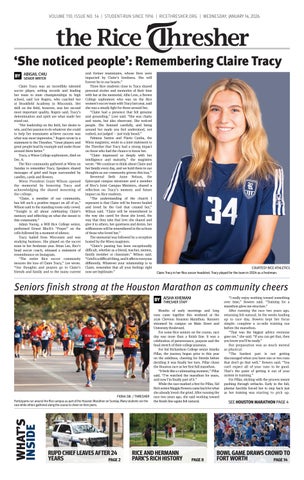
Claire Tracy was an incredibly talented soccer player, setting records and leading her team to state championships in high school, said Lee Rogers, who coached her at Brookfield Academy in Wisconsin. Her skill on the field, however, was her second most important quality, Rogers said. Tracy’s determination and spirit are what made her stand out. “Her leadership on the field, her desire to win, and her passion to do whatever she could to help her teammates achieve success was what was most impressive,” Rogers wrote in a statement to the Thresher. “Great players and great people lead by example and make those around them better.” Tracy, a Wiess College sophomore, died on Dec. 8. The Rice community gathered at Wiess on Sunday to remember Tracy. Speakers shared messages of grief and hope surrounded by candles, cards and flowers. Wiess President Grant Wilson opened the memorial by honoring Tracy and acknowledging the shared mourning of the college. “Claire, a member of our community, has left such a positive impact on all of us,” Wilson said to the standing-room-only crowd. “Tonight is all about celebrating Claire’s memory and reflecting on what she meant to this community.” Adam Vuong, a Will Rice College senior, performed Ernest Bloch’s “Prayer” on the cello followed by a moment of silence. Tracy hailed from Wisconsin and was studying business. She played on the soccer team in her freshman year. Brian Lee, Rice’s head soccer coach, released a statement of remembrance on Instagram. “The entire Rice soccer community mourns the loss of Claire Tracy,” Lee wrote. “Our thoughts and prayers go to Claire’s friends and family and to the many current
and former teammates, whose lives were impacted by Claire’s kindness. She will forever be in our hearts.” Three Rice students close to Tracy shared personal stories and memories of their time with her at the memorial. Allie Love, a Brown College sophomore who was on the Rice women’s soccer team with Tracy last year, said she was a steady light for those around her. “Claire had a presence that felt genuine and grounding,” Love said. “She was chatty and warm, but also observant. She noticed people. She listened carefully, and being around her made you feel understood, not rushed, not judged — just truly heard.” Fabiana Santos and Flavio Cunha, the Wiess magisters, wrote in a joint statement to the Thresher that Tracy had a strong impact on those who had the chance to know her. “Claire impressed us deeply with her intelligence and maturity,” the magisters wrote. “We continue to think about Claire and her family every day, and we hold them in our thoughts as our community grieves this loss.” Reverend Beth Anne Nelson, the Episcopal campus missioner and a member of Rice’s Joint Campus Ministers, shared a reflection on Tracy’s memory and future impact on Rice students. “The understanding of the church I represent is that Claire will be forever healed and loved by the God that created her,” Wilson said. “Claire will be remembered in the way she cared for those she loved, the way that they take that love she shared and give it to others, her quietness and desire, her selflessness will be remembered in the actions of those who loved her.” The memorial was followed by a reception hosted by the Wiess magisters. “Claire’s passing has been exceptionally difficult, whether as a friend, teacher, mentor, family member or classmate,” Wilson said. “Grief is a difficult thing, and it affects everyone differently. Whatever your relationship is to Claire, remember that all your feelings right now are legitimate.”
COURTESY RICE ATHLETICS Claire Tracy in her Rice soccer headshot. Tracy played for the team in 2024 as a freshman.
Seniors finish strong at the Houston Marathon as community cheers AISHA KHEMANI
THRESHER STAFF
WHAT’S INSIDE
FIONA SIK / THRESHER Participants run around the Rice campus as part of the Houston Marathon on Sunday. Many students ran the race while others gathered along the course to cheer on their peers.
Months of early mornings and long runs came together this weekend at the 2026 Chevron Houston Marathon. Runners streamed by campus on Main Street and University Boulevard. For some Rice seniors on the course, race day was more than a finish line. It was a celebration of perseverance, purpose and the final stretch of their college journeys. For Sid Richardson College senior Amelia Pillar, the journey began prior to this year on the sidelines, cheering for friends before deciding it was finally her turn. Pillar chose the Houston race as her first full marathon. “It feels like a culminating moment,” Pillar said. “I’ve watched the marathon for years, and now I’m finally part of it.” While the race marked a first for Pillar, Sid Rich senior Maggie Bowers came back for what she already loved: the grind. After running the race two years ago, she said working toward the finish line again felt natural.
“I really enjoy working toward something over time,” Bowers said. “Training for a marathon gives me structure.” After running the race two years ago, returning felt natural. In the weeks leading up to race day, Bowers kept her focus simple: complete a 20-mile training run before the marathon. “That was the biggest advice everyone gave me,” she said. “If you can get that, then you know you’ll be ready.” But preparation was as much mental as physical. “The hardest part is not getting discouraged when you have one or two runs that don’t go that well,” Bowers said. “You can’t expect all of your runs to be good. That’s the point of getting it out of your system in training.” For Pillar, sticking with the process meant pushing through setbacks. Early in the fall, plantar fasciitis forced her to step back just as her training was starting to pick up.
SEE HOUSTON MARATHON PAGE 4
A&E RUPD CHIEF LEAVES AFTER 24 YEARS PAGE 2
content content content
RICE AND HERMANN PAGE 11 PARK’S RICH HISTORY
PAGE 8
BOWL GAME DRAWS CROWD TO FORT WORTH PAGE 14
2 • WEDNESDAY, JANUARY 14, 2026
THE RICE THRESHER
‘Rice will always be a part of me’: Chief of police retires after 24 years ABIGAIL CHIU
SENIOR WRITER
Clemente Rodriguez, chief of the Rice University Police Department, left Rice after nearly 25 years of service on Dec. 31. During his tenure, Rodriguez said he focused on expanding the police force’s presence in the Rice community. Rodriguez is now the director of public safety for the University of HoustonDowntown campus, and Rice will soon commence a search for his replacement, administrative officials said. In addition to RUPD, Rodriguez oversaw the emergency management, parking and transportation and emergency medical services departments. During his time rising through the RUPD ranks from officer to chief, Rodriguez said he prioritized shifting the department from being reactive to proactive when dealing with campus incidents. Rodriguez said he has also expanded the police force as Rice and RUPD’s responsibilities have grown. RUPD has added more officers and specialists to its department, such as expanding its criminal investigations unit from zero to two officers. Last year, RUPD added a community behavioral specialist to train officers to handle mental health cases or respond to help students, faculty or staff in crisis in place of an officer. Rodriguez said RUPD has “evolved” in their mental health response. “The other big thing I’ve seen us be successful at is utilizing technology to help us keep the campus safe,” Rodriguez said. He named the Everbridge app and license plate recognition cameras as examples of new technology that has helped RUPD solve crimes more quickly.
[It’s difficult to] not be a curmudgeon or not be one of these individuals who’s beaten down and hates the world, which law enforcement can do to you. You can be very jagged and rigid and ugly. Chief is not like that. Tam Dao ASSOCIATE VICE PRESIDENT OF CAMPUS SAFETY AND RESEARCH SECURITY
Interaction with Rice students and staff — through events like the annual Operation Blue Santa gift drive and National Night Out — was another strong focus for the department, said Rodriguez. He said other RUPD outreach events include a citizens police academy and a youth law enforcement academy geared toward children of Rice staff members. “Sometimes it might be too expensive to send your kid to a camp. We did a free one,”
Rodriguez said. Tam Dao, the associate vice president of campus safety and research security, said he admired Rodriguez’s many years of service and sacrifice.
The community of Rice and the way that I was accepted into the community as part of Rice made it so special to me the entire time I was there, which made it really difficult when I made the decision to start a new chapter in my life. Rice will always be a part of me. Clemente Rodriguez FORMER RUPD CHIEF OF POLICE
Dao previously worked with Rodriguez as the head of the FBI’s Houston-area threat management team, where he would alert Rodriguez to threats to Rice or the Texas Medical Center. After Dao joined Rice in 2023, Rodriguez reported directly to him. “He’s genuinely somebody who’s got a really good heart. In our career, that can be hard, being nice and working hard doesn’t usually go hand in hand,” Dao said. “He stood watch over Rice for 20-something years. That takes a lot out of your family to constantly be alert and ready.” As chief of police, Rodriguez had to be ready to respond to calls at all hours of the night, Dao said. “[It’s difficult to] not be a curmudgeon or not be one of these individuals who’s beaten down and hates the world, which law enforcement can do to you,” Dao said. “You can be very jagged and rigid and ugly. Chief is not like that.” One of Dao’s goals for the future of the police department is to shift the mindset toward public safety on top of campus safety, starting by changing the name of the department from campus safety to public safety. RUPD is working to enhance campus security with measures such as tightening infrastructure to deter individuals who Dao said do not have a need to be on campus from entering. Dao said they plan to eventually switch to badge swipe access for residential college rooms instead of physical keys. Having proactive intervention has been a strong focus for the department, and Dao said he wants to focus on early identification of potential threats through relationships with state and federal partners for shared intelligence. RUPD’s partnerships with a regional threat assessment team, the Internet Crimes
COURTESY CLEMENTE RODRIGUEZ Former Rice University Police Department Chief of Police Clemente Rodriguez retired in Decemeber after 24 years. He said he values the Rice community and campus connections as he takes on his new role as director of public safety for the University of Houston-Downtown campus.
NOA BERZ / THRESHER Rice University Police Department Corporal Barry Oliver in his police car. Under Clemente Rodriguez’s direction, the department has expanded the police force and its responsibilities. Against Children Task Force and the Human Trafficking Rescue Task Force allow officers to receive specialized training from other Houston-area law enforcement agencies. “What’s great about that is they get to leverage some of those external resources in case we need assistance internally,” Rodriguez said. “While maybe those things don’t happen frequently on campus, they will be prepared if they ever have to deal with it.” Lieutenant Thomas Hudak is currently serving as the interim chief of police after Rodriguez’s departure. A search process for his replacement will be completed within four to six months, said Dao. “I tell this to a lot of the folks when we hire people into our department: You’re not only
coming to work for Rice; if you really want to, you can become a part of the community,” Rodriguez said. “Yes, it was my workplace, but I also quickly felt like I’m a member of Rice, even though I didn’t go to Rice, I wasn’t an alum of Rice. I felt integrated into the community, just as a staff member.” Rodriguez said he would often bring his two daughters to Rice events and said he plans to continue attending Rice football games and supporting the university. “The community of Rice and the way that I was accepted into the community as part of Rice made it so special to me the entire time I was there, which made it really difficult when I made the decision to start a new chapter in my life,” Rodriguez said. “Rice will always be a part of me.”
Gorman announced as vice provost, continues focus on student life JAMES CANCELARICH
NEWS EDITOR
Bridget Gorman is now vice provost for student life and dean of undergraduates, an update from her former role as dean of undergraduates, as announced in a Jan. 13 campuswide email sent by Provost Amy Dittmar. “Her division encompasses a wide range of services for all students, including health and wellness, disability resources and career development,” the email read. Gorman took the role of dean of
undergraduates in 2018. Under her tenure, Rice has experienced record-setting growth in the student population, with undergraduate enrollment set to increase to 5,200 by 2028, from about 4,000 in 2020. In addition, the Student Disability Resource Center has expanded services for students, including digital accessibility initiatives and a restructuring of the department. Gorman’s department’s name was changed as well, to the Division of Student Life and Undergraduate Education. “I’m honored to serve as Dean of Undergraduate and Vice Provost for Student
Life,” Gorman wrote in a statement to the Thresher. “The new title reflects the growing scope of the division’s work in supporting both undergraduate and graduate students, including the establishment of the new Student Disability Resource Center (SDRC) and an expanded focus on the Center for Career Development. Renaming the division signifies our commitment to promoting health and wellness, enhancing student engagement, and fostering career development for all students.” Gorman has implemented restrictions on the alcohol policy. Following 2024’s Night
of Decadence, Wiess’s infamous public party that saw seven students hospitalized, the party was permanently canceled and the campus faced threats of going dry. The CCD, among other expansions, offered an additional career fair in fall 2025. “The division’s name change acknowledges the vice provost’s commitment to providing comprehensive support to both graduate and undergraduate students,” Dittmar wrote in an email to the Thresher. “I appreciate her hard work and dedication to Rice and look forward to her continued successful leadership.”
WEDNESDAY, JANUARY 14, 2026 • 3
NEWS
Senate kicks off spring semester with 9-minute meeting TOBY CHOU
THRESHER STAFF At the first Student Association Senate of the year, voting members trickled in slowly. Soon after SA President Trevor Tobey called the meeting into session with a roll call, it was discovered that only 17 voting members were in attendance, just shy of the 18 minimum required by the constitution. According to the bylaws, in order for the Student Association to be able to introduce and vote on topics, two-thirds of the voting members must be present. “Can anyone call anyone that is a voting member?” Parliamentarian Zach Weinbrum asked during the meeting. “They just have to say yes.” After failing to contact Lovett College President Ayush Suresh, Wiess College Senator Eli Risinger was able to contact
Brown College Senator Max Menchaca, officially meeting the quorum. While Tobey did bring up new amendments in the agenda, echoing
I expect to codify the things we’ve already been working towards, like $10 printing credit, 24-hour Fondren Library, late night dining expansion, making sure that the students have affordability and we improve their quality of life. Trevor Tobey STUDENT ASSOCIATION PRESIDENT
the constitutional reforms proposed last semester, discussion on these items was postponed due to a lack of voting members present. The SA adjourned early after about nine minutes, and members filed out. Despite the brief meeting to start the semester, members of the executive board said they looked forward to continuing their work up until the election and changeover. “I’m looking forward to getting the printing credit going for all of our Rice students,” External Vice President Mahtab Dastur said. “Looking forward to enthusiasm and energy, bringing it from 2025 to 2026.” Tobey said he hoped to continue working on the projects they introduced last year. “I expect to codify the things we’ve already been working towards, like $10
printing credit, 24-hour Fondren Library, late night dining expansion, making sure that the students have affordability and we improve their quality of life,” Tobey said. The Executive Committee — consisting of the SA president, EVP, internal vice president, secretary and treasurer — also highlighted the importance of the upcoming election and mentioned plans to increase voter turnout. “We are going to have more tabling events,” Secretary Cedric Lau said. “We want to make sure people actually know what’s on the ballot.” Dastur emphasized the importance of Rice students getting involved with the Student Association and their elections. “We want them to be informed voters,” said Dastur. “Civic engagement is important everywhere, in all walks of life.”
JAMES CANCELARICH / THRESHER Voting members of the Student Association Senate attend Monday’s meeting, which barely met the quorum needed to continue. Members of the Executive Committee said they hoped to continue working on projects started last year.
Fondren Library undergoing third floor renovations for accessibility HONGTAO HU
ASST. NEWS EDITOR On the third floor of Fondren Library, areas are closed or sectioned off with plastic as the library renovates the restrooms. The construction began on Dec. 18, 2025, and is expected to be completed during the semester. “The third-floor construction is necessary to provide ADA-accessible bathrooms on that level, where there are none currently,” Mary Lowery, the executive director of Friends of Fondren Library – an alumni and community member group supporting Fondren Library through fundraising and publicity efforts — wrote in an email to the Thresher. Currently, the restrooms the library lists as Americans with Disabilities Act-accessible are on four of the seven floors: the basement, first, second and sixth floors. The library website reads that gunshot-like sounds may be heard from the building, which are from “powder-actuated nail guns.” The loud noises are expected to end by Jan. 24, according to the website. Construction will be between 6 a.m. and 5 p.m., but
the library expects to concentrate noise during “early morning hours to minimize disruption.” Renovations are taking place in an area to the right of the Kyle Morrow Room, encompassing a pair of restrooms, the elevator nearest the east entrance and its corresponding stairwell. “The existing number of bathrooms has been insufficient to support large events held in the Kyle Morrow Room,” Lowery wrote. Lowery stated that Fondren will construct an all-gender restroom on the third floor. This will be an addition to one on the first floor and two on the sixth floor of the library, according to the library website. Built in 1949, Fondren has undertaken several renovations recently. According to Fondren’s strategic plan in 2018, the 77-year-old building is a major obstacle to accessibility since it was built before accessibility standards were widespread. This is the second of three renovations planned for the library in the near future. Last fall, the Rice-only reading room on the sixth floor was refurnished. The final project, renovating Fondren’s east entrance facing the academic quad, has not entered construction.
ABIGAIL CHIU / THRESHER The construction site on the third floor of Fondren Library, where students may hear “gunshot-like” sounds from the equipment. The restrooms are being renovated for accessibility.
4 • WEDNESDAY, JANUARY 14, 2026
THE RICE THRESHER
FROM FRONT PAGE
HOUSTON MARATHON
“I had to take a month off of running,” Pillar said. “I was really uncertain if I was going to be able to actually do the marathon.” Even after returning, preparation was not always easy. Some long runs meant heading out alone in the cold while home on break. “I had to go run 20 miles, and it was freezing where I live,” Pillar said. “That was definitely the moment I had to tell myself, ‘okay, yeah, I’m doing this.’”
My friends who are running it too have been such a big support. Just knowing we’re all kind of doing this together makes it feel a lot less lonely. Amelia Pillar SID RICHARDSON COLLEGE SENIOR
Training was less about a strict plan and more about finding consistency wherever she could. Typically, that meant five runs a week. “I had big dreams of following a much more regimented training plan, but with school and everything, I got kind of busy,” Pillar said. “So I just did the best that I could.” Pillar’s friend and fellow Sid Rich senior Maya Harpavat ran the Aramco Houston Half Marathon not just for herself, but for a cause close to her heart. She participated in the Run for a Reason program to raise funds for Steel Magnolia Moms, an organization that supports mothers of children with special needs in Houston and beyond. Harpavat said she has been volunteering with the organization since her junior year of high school. “For a lot of parents, it’s hard to find a place where all of their child’s medical needs
RICHARD LI / THRESHER Fans cheer on runners for the Houston Marathon, which stretched by campus on Main Street and University Boulevard. For some Rice students who ran, it was their first full marathon and took months of training. can be taken care of, whether that’s feeding tubes or one-on-one support,” Harpavat said. “Being part of that meant so much to me. It was such an honor.” When Harpavat and her friends decided to train for the race, she saw it as the perfect opportunity to give back. The money she raised, along with funds from other participants in the program, will be used to support scholarships that help send children with complex medical needs to camp. “It’s really special to be able to run for
an organization that makes such a big impact for mothers,” Harpavat said. “That’s honestly my motivation.” Rice students didn’t just show up as runners. Many took to the curb to cheer on their friends who ran. The Long Distance Squad, an on-campus running group, set up a cheer station near Martel College. “We worked with a student to host a cheering station last year and loved supporting members during their race!” supreme leaders of the club Connor Nguyen,
Varsha Chandramouli and Lauren Nguyen wrote in a message to the Thresher. “It has been so awesome to see a community that gets together consistently not only to run but also to have a good time.” That same sense of support is what Pillar said carried her through the toughest parts of training. “My friends who are running it too have been such a big support,” she said. “Just knowing we’re all kind of doing this together makes it feel a lot less lonely.”
Come work for the Thresher! We’re hiring paid staff positions. Scan the QR code to access the applications. Email thresher@rice.edu with any questions. Business Manager ersee hresher spending Wor with ad reps to sell ad space reate and monitor yearly udgets ssis an ini n i r Edit opinion articles and columns Wor with columnists ttend wee ly meetings with staff ssis an igi a Me ia ire r Wor on we site design and function elp with app de elopment Wor with photo ideo social media
WEDNESDAY, JANUARY 14, 2026 • 5
NEWS
DesRoches focuses on expansion at the State of the University address colleges to preserve college culture. Along with undergraduate growth, DesRoches said the university is working to increase the graduate student population. “I anticipate at some point in the next five to seven years, we will have more graduate students at Rice than undergraduate students, which is where the vast majority of our peer institutions are, particularly those with medical schools and law schools in addition to business schools,” DesRoches said. Rice’s profile around Houston and internationally is growing as well, DesRoches said. With the opening of The Arc at the Ion District, Rice has a larger profile
JAMES CANCELARICH
NEWS EDITOR
President Reggie DesRoches — whose contract was recently extended until the 2030 fiscal year, announced in a Dec. 4 email from the Board of Trustees — talked about Rice’s unprecedented growth during his annual State of the University address on Dec. 8. This year, Rice welcomed the largest undergraduate class in its history, with over 1,337 students. Rice has also seen a more than 80% increase in applications since 2017. “I would say we are the most ambitiously growing private institution in the world in terms of the percentage increase of our student body,” DesRoches said in his speech. To account for the growth, the newest residential college will open this fall. Chao College is set to open next to a new Lovett College building.
in Houston’s Midtown neighborhood. In addition, Rice in Paris recently welcomed its first semesterlong class. Rice has also recently joined a consortium of schools in Venice, Italy and has plans to expand its presence in India. Rice has had record growth in faculty, with over 300 faculty members hired in the past three years. In addition, Rice welcomed 16 new full professors in 2025. Full professors are often academics later in their careers who take on more responsibility, which DesRoches said makes the hiring process challenging. DesRoches also spoke about some of the challenges coming from the Trump
I would say that we are the most ambitiously growing private institution in terms of the percentage increase in our student body. Reggie DesRoches RICE UNIVERSITY PRESIDENT
“For us, it was an issue of accessibility,” DesRoches said. “When you receive 37,000 applications, we know there are more than 1,000 kids that deserve to have access to a Rice degree, which is why we intentionally grew.” DesRoches also said there are plans to add more rooms to the existing residential
BENJAMIN SADOWSKI / THRESHER Chao College, the newest residental college, as it was under construction last year. During his State of the University address, President Reggie DesRoches touched on Rice’s growth in undergraduate enrollment.
administration, which has put increased pressure on higher education via threats to federal funding. From fiscal years 2024 to 2025, Rice’s sponsored research has dropped from $218 million to $187.60 million. “There was a small dip in fiscal year ’25, in part because of some of the challenges in the federal government,” DesRoches said. “We’re seeing some of that rebound in this current fiscal year, but we’ve seen steady growth in our research enterprise, which obviously is a reflection of the great work that the faculty are doing and the support that we’re getting from our incredible staff.” In addition, DesRoches said he plans to reduce some of the university’s dependency on its endowment for operating. Compared to peer universities, Rice has one of the highest percentages funded by the endowment, at 38.6%. “One of the things that makes us unique as it relates to our endowment is the percentage of our endowment that we spend on our operating budget,” DesRoches said. “It’s a nice problem to have, but it also makes us vulnerable to the broader market changes.” Since Rice draws heavily on its endowment, changes in the market could have a more pronounced effect on operating budgets compared to other universities that draw their operating budget from other sources. At the end of the speech, DesRoches thanked the community for attending. “You are a huge part of what makes Rice such a wonderful place and one of the most sought after schools in the nation, in a place that I love to come to work every day, frankly, because of the people that we have and the community that we have and the culture of care which is which is very real,” DesRoches said.
Thresher New Staff Training o o n on
o
on o
o
n n
o o nn
o
o
Session 1: 7-9 p.m. on Thursday, Jan. 22
a
h ad m udy r ad
d sn n h
Session : - p.m. on unday, Jan. 2 a h ha
n r
un
n h
an d a h Thr sh r
d s n r a n n a r
s
p rs ra d s n d r sn r ss rds
h raphy us ra n a m da dar s
WEDNESDAY, JANUARY 14, 2026 • 6
THE RICE THRESHER
EDITORIAL
Celebrating 110 years of student journalism at Rice
This week, we’re celebrating the Thresher’s 110th birthday. Our first issue was published Jan. 15, 1916. Here’s what was happening on campus this week over a century ago. The West Hall dormitory building, now known as Old Hanszen, was announced to students. The building was completed later that year, and the Thresher reported that the construction would cost $98,900, which amounts to about $3 million in today’s money. At the time, the building would house 125 men — women wouldn’t be able to live on campus for another 41 years, when Jones College was founded as the university’s first women’s dormitory.
A group of freshmen and sophomore girls calling themselves the “Leap Year Club” hosted a dance at the home of one of its members. According to the announcement for the club’s founding, it was named after the Leap Day tradition that women could propose to men on Feb. 29. The men invited to the dance were thus given premade dance cards with the members of the club that would be their partners. The Thresher reported that the event was a success, lasting into the “wee small hours of the morning” with punch, sandwiches and candy provided for attendees. After the fall 1915 semester finals, between
20 and 25 students failed out of Rice. The Thresher estimated the exact number to be 24. All of the students were freshmen or sophomores, making a dent in the university’s undergraduate population of 410. According to the article, this was about the same number that failed in the previous year, while 100 new students were admitted since then. Two star football players were reportedly among those who failed. However, the writer stated that the academic rigor of the then-Rice Institute would only increase the new university’s reputation. The Thresher was established by Rice’s literary societies, then some of the most
popular and prominent campus groups. The societies included the Owl and the Riceonian, both men’s clubs, and the Elizabeth Baldwin, a women’s club. Members from all three societies made up the first Thresher masthead. “We want you to understand that The Thresher is merely for the benefit of the students of Rice,” the staff wrote in their inaugural editorial. “If there is any way in which you can help us to make it more interesting we hope that you will do it without waiting for us to ask you.” Read our first issue, along with every other old issue of the Thresher, at ricethresher.org/archives.
COLUMN
An urbanist’s guide to Houston: Navigating Rice with hearing loss JACOB JORDAN
THRESHER STAFF
For most of my life, I have dealt with hearing issues that have ranged from a mild annoyance to single-sided deafness. As an urbanist, I like to think of the ways in which the built environments I’ve lived in either accommodate or aggravate my condition. For the past year or so, I’ve dealt with moderate to profound deafness in my left ear. Since I’ve been able to experience Rice with and without single-sided deafness, I can identify the variety of implications it’s had on my use of public space in and around the university. Single-sided deafness, like many types of hearing loss, has a significant impact on localization — the ability to identify a sound’s direction and distance — and speech-in-noise — the ability to understand speech in background noise. In my experience, attempting to do either of these things for long periods of time is exhausting. Hard, long and flat surfaces like the parking lots at the edge of campus or certain buildings in the Texas Medical Center generate sound reflections and reverberations that make localizing sounds — like those made by approaching people or vehicles — significantly more difficult. This issue is also pervasive in places with significant echoing and amplification effects like the hallways, stairwells and colonnades that are common across campus. These reverberation effects also make it significantly more challenging to hold conversations in these spaces. Finally, these localization issues make it difficult to identify where a cyclist or scooter user is approaching from, which can result
LAKSHMI ARAVINDAN / THRESHER in dangerous situations if these people are using pedestrian walkways at high speeds. Comparatively, Rice’s physical infrastructure is generally good at diffusing noise, which alleviates speech-in-noise issues on most areas of campus outside of major events. Traffic makes up the vast majority of street-level noise, and the large live oak trees along the inner and outer loops are good at blocking traffic noise.
However, the prevalence of light trucks and SUVs in Houston, which emit significantly more noise pollution than sedans, makes these problems prevalent just outside of Rice. High traffic speeds amplify this problem, as do roads with little or no separation between the curb and sidewalk like Westheimer Road or Kirby Drive. This is aggravated by the excessively narrow sidewalks in these areas. With
unilateral hearing loss, to effectively have a conversation with someone while walking, it’s important to be able to walk directly beside them with the good ear facing them to avoid the head shadow effect. If the sidewalk or walkway is too narrow, this often forces one of the interlocutors to walk in the grass. For deaf people, these walkways need to be even wider to facilitate conversations in American Sign Language. Other spaces seem actively hostile in this regard. One especially egregious example of this is the “Climate Parliament” installation in the Ralph S. O’Connor Building for Engineering and Science — the black hallway with hundreds of speakers on the ceiling — which not only makes it impossible to hear but is also dizzying and disorienting for people with unilateral hearing loss. To improve things for hard of hearing people on campus, Rice can break up large, hard surfaces with trees or hedges; build with sight lines, visibility and echoes in mind; and enforce existing policies against cyclists and scooters on sidewalks and other walkways. 93.1% of adults aged 18-44 have no difficulty hearing when using a hearing aid, so one might wonder at the cost-benefit analysis of redesigning the urban landscape to accommodate such a small minority. However, in what is known as the curbcut effect, we often all stand to benefit from these design treatments. Curb cuts, which are ramps leading up to sidewalks, were designed for wheelchair users but are widely used for bicycles, strollers and luggage and have become ubiquitous. My proposed solutions would also improve sight lines, noise pollution and pedestrian safety for people of all hearing abilities.
Jacob Jordan is a Baker College junior studying civil engineering with a minor in environmental studies. He believes every Rice student should be well-informed about their built environment and have the knowledge necessary to advocate for their interests in and beyond Houston. LETTER TO THE EDITOR
The glory days of Rice Stadium TOM OLIPHANT
RICE FOOTBALL FAN I know the coming reduction in Rice Stadium’s seating capacity. is a necessary change; however, it is sad to see. I am now 80 years old; I spent many great Saturday afternoons in the ’50s and early ’60s in Rice Stadium. If I was not attending a game with my father as a Rice Institute fan, my best friend and I were probably selling Cokes or popcorn in the stands just so we could get in to watch the game. My first date was bringing a girl to a Rice football game, corsage and all. In those days, Rice was the only game in town — no Houston Oilers, Houston Texans, Houston Rockets or Houston Astros — and the University of Houston was still a small school in the Missouri Valley Conference.
They used Rice Stadium if they had a game that was important to them. When major schools like Texas A&M University or the University of Texas at Austin came to play Rice, there was little struggle to fill the 70,000 available seats. Time changes everything, but I am still a college football fan. The coming changes to Rice Stadium bring back a time I remember both vividly and fondly. Nostalgia has kicked in. Editor’s Note: This is a letter to the editor that has been submitted by a member of the Rice community. The views expressed in this opinion are those of the author and do not necessarily represent or reflect the views of the Thresher or its editorial board. Letters to the editor are fact-checked to the best of our ability and edited for grammar and spelling by Thresher editors.
COURTESY WOODSON RESEARCH CENTER Aerial view of a football game taking place at Rice Stadium circa 1955.
WEDNESDAY, JANUARY 14, 2026 • 7
OPINIONS GUEST OPINION
Impeach Trevor Tobey BECKETT & ALEENA GILANI
DUNCAN COLLEGE SOPHOMORE & BROWN COLLEGE FRESHMAN
On Dec. 3, Student Association President Trevor Tobey attended a White House roundtable titled “Biased Professors, Woke Administrators, and the End of Free Inquiry on U.S. Campuses,” hosted by Trump-appointed Secretary of Education Linda McMahon.
There is nothing neutral about attending a roundtable that uses propagandistic language to delegitimize academic freedom. There is also nothing pro-free speech about supporting a federal administration that censors professors and punishes students for political expression. While it may seem reasonable for a student looking for a future in government to accept an invitation to network with federal bigwigs, context matters. In the political reality that Rice students are currently facing, this visit was not just a tone-deaf misstep — it was a betrayal. The roundtable’s title alone should raise alarm bells. “Biased professors” is a direct assault on the integrity of Rice’s teaching staff. “Woke administrators” is also far from a neutral phrase: It’s a weaponized epithet used by the far-right to attack universities that attempt to counter discrimination. Worse, it reflects a presidential administration that has explicitly targeted international students and threatened to revoke university funding over curriculum content. Just this past year, the Trump administration has attempted to deport students for speaking out in support of Palestine, cut funds to schools that do not conform to ideological demands and used law enforcement to quell student activism. Do not let anyone convince you that this is an abstract issue. 13.59% of Rice’s class of 2028 are international students. Many others are part of vulnerable communities. Given the hostile national climate, they depend on their university to fight for their right to a safe campus environment. In the last few years, the SA has fought to protect these students through establishing the Undocumented Student Task Force and partnering with the Office
EDITORIAL STAFF
of General Counsel on legal training for international students. Tobey himself has engaged with this work through his role as SA President, yet is now explicitly aligning himself with an administration that actively undermines it. Even worse, Tobey couches his actions in the language of free speech and neutrality. There is nothing neutral about attending a roundtable that uses propagandistic language to delegitimize academic freedom. There is also nothing pro-free speech about supporting a federal administration that censors professors and punishes students for political expression. And there is nothing excusing his cozying up to Turning Point USA, an organization that runs a “Professor Watchlist” with a stated mission “to expose and document professors who discriminate against conservative students and advance leftist propaganda in the classroom.” This list has led to professors around the country facing virulent racist, sexist and sometimes violent threats and harassment for advancing what the organization deems to be “leftist propaganda.” Tobey’s actions are pure opportunism. Tobey has every right to express his personal political beliefs, but he chose to attend this roundtable as the president of the Student Association. He cannot have it both ways: being the public face of the Rice student population while participating in events that threaten the most marginalized among us. This is not the first time that Tobey has abused his power as SA President to further his own political beliefs. Back in September, Tobey posted a statement on the SA Instagram condemning the shooting of Charlie Kirk, a prominent farright commentator.
Rice students deserve leadership that listens to them, not opportunistic men who sell their constituents out for a seat at the table. His decision as SA President to comment on Kirk’s death but not any other act of political violence that has plagued our nation demonstrates his willingness to use his office as his own personal platform. Tobey’s visit to the White House was not just a misstep; it was a conscious decision that directly contradicts the values of a student body he was elected to represent. His actions have made many students feel unsafe, unwelcome
* Indicates Editorial Board member Kathleen Ortiz* Editor-in-Chief Sarah Knowlton* Editor-in-Chief Juliana Lightsey* Managing Editor NEWS James Cancelarich* Editor Belinda Zhu Asst. Editor Hongtao Hu Asst. Editor Hope Yang Asst. Editor OPINION Jenna Perrone* Editor FEATURES Emily Nguyen Asst. Editor ARTS & ENTERTAINMENT Arman Saxena* Editor Chi Pham Asst. Editor SPORTS Andersen Pickard* Editor Evie Vu* Editor BACKPAGE Charlie Maxson Editor Max Scholl Editor Will Howley Editor Rykelle Sandidge Senior Writer COPY Shruti Patankar Editor Julianne Ma Editor and unheard, especially those whose immigration status, identity or political expression places them at risk. Tobey’s participation in this roundtable is conduct injurious to the Rice student body and incompatible with the duties of his office. Under SA Bylaw 1502, there are four possible options that can be grounds for impeachment. Two are applicable to Tobey: “failure to satisfactorily fulfill the duties of the office” and “conduct injurious to the Student Association.” By going to the White House, Tobey is putting a target on the backs of Rice faculty and students. This is an abject failure on his part to be an advocate and representative for Rice students and also “injurious” to the students who make up the Rice community. For the sake of our community’s integrity, safety and values, the Senate must seriously consider drafting Articles of Impeachment. Students deserve leadership that listens to them, not opportunistic men who sell their constituents out for a seat at the table. Editor’s Note: This is a guest opinion that has been submitted by a member of the Rice community. The views expressed in this opinion are those of the author and do not necessarily represent or reflect the views of the Thresher or its editorial board. All guest opinions are fact-checked to the best of our ability and edited for clarity and conciseness by Thresher editors.
Thresher’s latest online poll results What was your average daily screentime over winter break?
Total number of responses: 419
4% 8+ hours
232% 8%
6-8 hours
32%
PHOTO, VIDEO, & WEB Ayaan Riaz Director of Digital Media Francesca Nemati Photo Editor Konstantin Savvon Asst. Photo Editor Steven Burgess Video Editor Fiona Guo Social Media Manager DESIGN Jessica Xu Art & Design Director Magnolia Hickey-Zamora News Sydney Chang Opinion Jose Eleuterio Features Alexa Bu Arts & Entertainment Kirstie Qian Sports Brandon Nguyen Backpage Richard Li Design Consultant BUSINESS Alina Zhong Advertisement Rahul Santhanam Advertisement
ABOUT The Rice Thresher, the official student newspaper of Rice University since 1916, is published each Wednesday during the school year, except during examination periods and holidays, by the students of Rice University. Letters to the Editor must be received by 5 p.m. on the Friday prior to publication and must be signed, including college and year if the writer is a Rice student. The Thresher reserves the right to edit letters for content and length and to place letters on its website. Editorial and business offices are located on the second floor of the Ley Student Center: 6100 Main St., MS-524 Houston, TX 77005-1892 Phone: (713) 348 - 4801 Email: thresher@rice.edu Website: www.ricethresher.org The Thresher is a member of the ACP, TIPA, CMA and CMBAM. © Copyright 2025
2-6 hours
32% <2 hours Follow @ricethresher on Instagram to answer weekly polls.
ricethresher.org
8 • WEDNESDAY, JANUARY 14, 2026
THE RICE THRESHER
Rice and Hermann Park’s bond goes deeper than a transit stop the reflecting pool’s eastern edge.
CHI PHAM
ASST. A&E EDITOR The METRORail Red Line slows at the Hermann Park/Rice University station. A handful of students step off, cross Sunset Boulevard, and disappear — some toward the hedges marking where it seems Rice starts and the city ends, others beneath the live oaks of Hermann Park. The boundary between a private university and a public park, here on Main Street, is little more than a curb. That was by design. More than a century ago, the men who built these two institutions conceived of them as a single civic project, each neighbor animating the other’s vitality. “The happiest day of my life” In 1914, George H. Hermann knew he was dying. The 71-year-old multihyphenate — cattleman, oilman and eccentric — spent decades accumulating a fortune he seemed unwilling to spend on himself. In lieu of an automobile, he rode his horse Leo through a city only beginning to understand what it might become, according to a 2016 Houston Chronicle profile. But Hermann had been watching the construction across Main Street. The Rice Institute held its first classes in 1912, its buildings rising from what had recently been coastal prairie. Hermann, who once donated land for a county hospital only to watch officials fail to build it, saw in Rice’s ambition a kind of permission. The timing was opportune. Hermann had signed his will in July 1910 — the same year Rice’s campus plan was adopted — leaving property for a public park. Four years later, with Rice open and thriving, he formalized the gift. “With engaging frankness Mr. Hermann told me that he had been influenced in making this disposition of his property by the example of William Marsh Rice,” Edgar Odell Lovett, Rice’s first president, wrote in a footnote to a 1915 opening address. “Thus, in addition to a university for all the people, this city of homes and schools and churches is to have a great public park.” On May 30, 1914, in then-Mayor Ben Campbell’s office at City Hall, Hermann signed over 285 acres of timberland — given, as his deed stated, “to promote the general welfare of the City of Houston, and the health, comfort and happiness of the citizens thereof.” “This is the happiest day of my life,” Hermann said at the ceremony. “I thank God that I am able to do this.” He would be dead by October. His estate added another 122 acres to the gift. Hermann Park and Rice Institute emerged from the same cultural moment, a period when Progressive Era reformers, emboldened by the success of Frederick Law Olmsted’s urban parks in the Northeast, pushed industrial American cities to think of public space as a tool for social responsibility and order. Houston was catching up. The Board of Park Commissioners had been formed in 1910. The city’s first planning document, prepared by the Cambridge landscape architect Arthur Coleman Comey in 1913, identified the land along Brays Bayou as the ideal site for a major urban park. That land belonged to Hermann. The axis George Edward Kessler arrived in Houston in 1915 at the urging of oilman Joseph Stephen Cullinan, who was developing Shadyside, a walled subdivision adjacent to both Rice and the new park. Kessler was one of America’s most celebrated landscape architects, the designer of Kansas City, Missouri’s park system. He understood that the park could
LUCY LI / THRESHER Students and families walk in Hermann Park, located right outside Rice’s campus. not be designed in isolation. His 1916 master plan made the unity evident. The park’s entrance sequence began at the intersection of Main Street and Montrose Boulevard, where a sunken garden — the site of today’s Mecom Fountain — would greet visitors. The crucial detail was the axis. Kessler designed the park’s central spine to align with Entrance 2 of the Rice Institute. The Sam Houston Monument, erected in 1925, would be placed on this sight line — a bronze general on horseback, facing toward the reflecting pool and lake beyond, his back to the hedges. Kessler died in 1923, his plan only partially realized. The death that renewed the park By the 1980s, that whole had fallen into disrepair. Hermann Park, once the flagship of Houston’s park system, became, in the words of the Houston Post, “an embarrassment to the city.” Decades of deferred maintenance stripped the park of the coherence Kessler had envisioned. Then, on Feb. 18, 1992, O. Jack Mitchell died. Mitchell had been dean of the Rice School of Architecture for 11 years, an advocate for Houston’s public spaces who understood the relationship between the university and its neighbor as well as anyone. He began visiting Hermann Park with his sons in 1966 and spent more than a decade advising the city on the park’s improvement.
The Hermann Park master plan is driven by a desire for equity and justice, for beauty and delight, both in the place, and in each other’s company. Laurie Olin PHILADELPHIA LANDSCAPE ARCHITECT
“The fit between streets, places, parks, and institutions should have collective meaning,” Mitchell wrote in Texas Architect shortly before his death. “These elements become the public infrastructure and ultimately the symbol of our collective,
communal lives.” The afternoon Mitchell died, his friends gathered at his home. What could be done? The answer came from Susan Booth Keeton, a lifelong Houstonian and landscape advocate, who recalled that Mitchell had recently drawn a sketch of the park’s central axis. He called it “the heart of the park.” Within weeks, Jay Baker M. Arch. ’80, a former Mitchell student and president of the Rice Design Alliance, organized a committee to plan a design competition focused on that axis — the Monument Circle which Kessler had aligned with Rice. The ‘Heart of the Park’ design competition, held that fall, drew 117 entries from 23 states, Puerto Rico and Italy. The winning scheme proposed a series of connected gardens, including one dedicated to Mitchell’s memory. But the competition’s deeper significance was in what its publicity inspired. It united the disparate groups working on the park’s behalf and caught the attention of Bob Lanier, Houston’s newly elected mayor. The man with a(nother) plan In 1994, Lanier secured a $1.5 million grant from the Lila Wallace-Reader’s Digest Fund for park restoration and insisted that no new construction begin until a comprehensive master plan was complete. The Friends of Hermann Park (now the Hermann Park Conservancy) hired the Philadelphia landscape architect Laurie Olin. Olin spent months researching the park’s history, meeting with community representatives and walking the grounds. His 1995 master plan, “Renewing Hermann Park,” was grounded in Kessler’s vision but reimagined for a new century. He described the park as a “civic arena” — a place where the surrounding institutions and neighborhoods would reinforce one another. “The Hermann Park master plan is driven by a desire for equity and justice, for beauty and delight, both in the place, and in each other’s company,” Olin wrote in his plan. “The renovated park will provide a common ground for people from many varied neighborhoods. It will provide a respite from urban life, a change of air and scene and a chance to reconnect with nature.” The O. Jack Mitchell Garden, dedicated in 2004, now occupies a quiet corner along
Convergence The renewal Olin set in motion took more than a decade. By 2014, when the park celebrated its centennial, eight of 10 major capital projects in the master plan had been completed, with the reflecting pool restored and new gardens planted throughout. The park that Hermann had given to the city finally became what its founders envisioned. Rice marked the occasion. In fall 2013, students in the Rice Building Workshop began designing a pavilion for the park’s approaching centennial gala. They called it “Convergence”: an installation of steel frames, concrete benches and woven cords situated within a stand of existing trees. The pavilion was temporary, but the site they chose was not: a triangle of land marking where the university, the park and the Texas Medical Center, after a century of separate growth, finally met. Two years earlier, Rice had celebrated its own centennial. On Nov. 16, 2012, Y. Ping Sun gathered more than 75 volunteers at McGovern Lake to plant the 100 native trees forming the Rice Centennial Grove. Sun, the university representative and wife of former Rice President David Leebron, organized the grove to honor both Rice’s centennial that year and the park’s approaching one. Among those turning shovels were Harris County Judge Ed Emmett ’71 and Hermann Park Conservancy Executive Director Doreen Stoller MBA ’91, both Rice graduates. “If you took us off the map of the city of Houston and said that you could put us back anywhere you wanted, we would put ourselves exactly where we are,” Leebron said at the dedication. “And there are lots of reasons for that, but one of them is being across the street from Hermann Park.” The feeling was mutual. “The newly-planted trees reaffirm the special connection between Rice University and Hermann Park as they welcome the next hundred years as Main Street neighbors,” the Hermann Park Conservancy’s winter 2013 newsletter read. Today, Hermann Park draws about 6 million visitors annually. A miniature railroad loops past the Houston Zoo. Families gather beneath live oaks that shaded this land when George Hermann rode through it on his horse. In her 2013 book “Houston’s Hermann Park: A Century of Community,” architectural writer Barrie Scardino Bradley chronicled the park’s meaning to the city. “The men and women who dreamed, financed, approved, designed, built, and renewed Hermann Park are as important to the history and understanding of the park as the gardens and trees,” Bradley wrote in the preface. Many of them came from Rice — Mitchell, whose death catalyzed the park’s renewal; the students who planted trees and erected pavilions at the centennial; and the architects trained in Rice’s classrooms who continue to shape the area today. On a weekday afternoon, you can see students stroll through the park after classes, joggers on the trail that connects to Rice’s three-mile perimeter loop and Houstonians of all ages heading toward the zoo. Across Main Street, the live oaks part where Kessler intended them to, opening onto the paths of a university that has always understood itself as part of something larger. The curb between was never meant as a barrier. Neither were the hedges. This article has been condensed for print. Read the full story at ricethresher.org.
WEDNESDAY, JANUARY 14, 2026 • 9
FEATURES
Orange Era 1
2
3
4
4
11
6
7
12
15
8
13
13
21
22
23
24 27
29
37
38
43
34 39
38
35 40
14
36
51 54
32
33
36 42 45
54
24
31
41
44
46
8
28 30
36
10
19
26
35
9
17
18
25
53
5
16
19 20
5
AVA MCCLUNG
CROSSWORD EDITOR
47 52
53
55
56
50
51
48
49
50
DOWN
ACROSS 1 When repeated, a Hawaiian fish 5 Singer-songwriter Stevens, also known as Yusuf Islam 8 Fill in ___ blank 11 Way to run? 12 Gymnast Raisman 13 Buffoons 15 Person who broadcasts on Twitch, perhaps 17 Longest sentence? 18 Location of the great ancient library 20 Letter before tee 23 “Sing us a song, you’re the _____ man” 24 Ariana Grande hit “___, and?” 25 Smallest of the U.S. Virgin Islands 27 A pair 29 Spot of 33-Down, to a Brit 30 “No worries __ ___!” 34 Not yet scheduled, abbr. 36 “Ugh, all right” 37 Smokey Bear ad, for instance 40 Goad 42 Actress and singer Michele 43 Undershoots, in a way 46 K-pop figure 47 Vegas performer, perhaps 51 Word repeated after “que” 52 Beige 53 B of ROY G. BIV 54 Protagonist of “The Last Jedi” 55 Texter’s “Wow!” 56 Jekyll counterpart
1 Taco Bell slogan “Live ___” 2 Quantity, abbr. 3 Opposite of vert. 4 Swedish meatball store 5 Entered 6 Amazon Echo’s default name 7 Dictator 8 “I ____ you so!” 9 Unshaven 10 Trinket of The Hunger Games 14 Salty septet 16 Type of soup 19 “Learned my lesson!” 20 Corner key 21 “Rugrats” dad 22 Rice Code of Student Conduct enforcers, abbr. 26 Choose 28 Not quite right 31 Lucrative deal for a college athlete 32 27-Across preceder 33 Brewed drink 35 Septiembre preceder 36 Traditional Chinese type of 37 33-Down Country, to Spaniards 38 East _____ (Manhattan 39 resident) When the moon hits your eye, like a big pizza pie 41 Hold nothing back, slangily 44 Kill it 45 Boston TV station that produces much of PBS’ programming 48 Texter’s expression of affection 49 Hari ___, river in Afghanistan 50 “To Kill a Mockingbird” author
Researchers and Indigenous groups aim to tell history of native land ANNAMIKA KONKOLA
THRESHER STAFF
Years before Lovett Hall was built, buffalo herds roamed the coastal prairie ecosystems of the Houston area on land that Indigenous nations called their home. Now, Rice researchers and Indigenous partners across the state are collaborating to create a public archive of Indigenous people describing their personal histories, lives and identities in their own words. The idea grew out of a partnership between the Texas Tribal Buffalo Project — a nonprofit that works with Indigenous communities across Texas — and Associate Director of the Center for Environmental Studies Weston Twardowski. Since fall 2024, Twardowski’s team has recorded more than 30 oral histories with Indigenous people living across the state, totaling roughly 70 hours of interviews. These recordings are preserved and publicly available through the Woodson Research Center in Fondren Library. Twardowski, the project’s principal investigator, said the archive is meant to give the public a way to see Indigenous life in Texas as something current and lived rather than confined to the past. “It’s a publicly available digital tool for folks who want to understand what indigeneity in this moment looks like in Texas,” Twardowski said. Alika Jimenez, a Duncan College junior who has been involved with the project for a year conducting interviews and helping code transcripts, described their role in collecting oral histories as collaborative and supportive. “We were there to guide the conversation to wherever our participants wanted it to go,” Jimenez said. “It was really just a vessel for them to share any stories or experiences they wanted.” That openness sometimes led to moments that would not have been possible in a scripted interview. Isabella Bourtin, a McMurtry College senior involved in the project from the start as a research assistant, said one of her most meaningful interviews required almost no prompting at all. “I felt like we’d given him a space to share what he’d always wanted to share and get on record,” Bourtin said.
NHU CHU / THRESHER Bourtin, the founder of Rice’s Native American Student Association, noted that building a visible Indigenous presence on campus has been difficult. “It’s been a struggle getting a lot of Indigenous representation on campus,” Bourtin said. “We have very few members.” From the project’s start, the research team designed it as community-based research, considering how it would lead to knowledge that would advance Indigenous community goals. Texas Tribal Buffalo Project staff helped shape the interview questions, participated in early interviews and continue to review materials as the team moves toward publishing results. “They co-own all of the material that we’ve collected,” Twardowski said. “They’re allowed to use that data however they like.” For Charles Bush, that collaboration is essential. Bush develops curriculum for the Texas Tribal Buffalo Project and is an enrolled member of the Oglala Sioux Tribe from Pine Ridge, South Dakota. He is also a graduate student in tribal resources and environmental stewardship at the University of Minnesota Duluth. “Data is the new gold of the 21st century,” Bush said. “A lot of Indigenous communities don’t have the resources or capacities to count themselves, to be able to
get resources from the federal government.” As the research team has begun analyzing interviews, one theme keeps emerging: Indigenous life in Texas does not follow a single lineage, geography or experience. The people the research team interviewed come from many different places, tribes and backgrounds, including families rooted in Texas for generations and others who arrived more recently from places like the Great Lakes, California or Mexico. Chaney Hill, formerly a graduate student lead on the oral history project and now a lecturer in Rice’s environmental studies program who continues to work with the team, said the complexity of indigeneity in Texas is shaped by a history of border changes, colonization, assimilation and migration across regions. “It’s become this really interesting tapestry of mixed indigenity,” Hill said. “There’s not the same kind of tribal boundary lines that exist in some other places in the U.S. It’s confusing, and it’s kind of quilted.” Bush, who contributed his own oral history to the archive, said his life’s journey reflects that movement, having moved to San Antonio from outside of Texas. “I participated in the oral history project just giving my perspective on indigeneity,
academia, the stereotypes that might exist about Indigenous people in South Texas,” Bush said. “I am just a visitor, but I’m here just sharing my lived experiences as far as what it means to be Indigenous.” That diversity complicates how institutions like Rice think about Indigenous history. Some members of the Rice community include land acknowledgments in email signatures or program materials. In Twardowski’s, it reads, “The campus of Rice University sits on the traditional homelands of the Karankawa, Coahuiltecan, Atakapa-Ishak, and Sana nations.” Alexander Byrd, vice provost for the office of access and institutional excellence, said some members of the Rice community research and write their own land acknowledgments. Hill said these land acknowledgments are designed to anchor institutions to place and remind their inhabitants of their complex history. Some of the nations named in the Rice land acknowledgments, such as the Karankawa, were described in historical accounts as “extinct” but are now working to revive their culture and advocate for their ancestral land. At the same time, Hill said place-based recognition cannot capture the full reality of Indigenous Texas today. “It does not give credence to the vast numbers of tribal affiliations in Texas,” said Hill, who uses land acknowledgements in her own classes. “It just acknowledges the specific land upon which Houston is.” Although there are only three federally recognized tribes (which can access specific federal funding, programs, resources and self-government rights) in Texas — none of which are originally from the state — the oral history project includes members of dozens of tribes. “The folks represent all four corners of Texas,” Twardowski said. As a result, Bush said the archive can help to fill memory and historical gaps in the record of Texas Indigenous experiences. “I’m here to talk about the diversity of what indigeneity looks like in South Texas,” Bush said. “There’s so many tribes … and all deserve a certain spotlight to be able to tell their own history by them and for them.”
10 • WEDNESDAY, JANUARY 14, 2026
THE RICE THRESHER
Houston Grand Opera nabs first GRAMMY nod in 30 years LINA KANG
THRESHER STAFF For the first time in over three decades, Houston Grand Opera is nominated for a GRAMMY award. The nomination for best opera recording recognizes “Intelligence,” an opera that showcases the hidden bravery of Civil War spies Mary Jane Bowser and Elizabeth Van Lew. HGO General Director and CEO Khori Dastoor said the nomination was a moment of pride for the entire team. “Now I have the great satisfaction of knowing that this acknowledgement will ensure that more people around the world experience this piece,” Dastoor said. Dastoor said the recording will also make “Intelligence” more accessible to audiences who may not be able to attend live performances. “We’ve launched a record label in-house to be able to share more of these groundbreaking projects with the world,” Dastoor said. “We want to make sure these American stories have the opportunity to reach as many folks as possible.” Founded in 1955, Houston Grand Opera has long been recognized as a leader in the opera world, commissioning new works and stories — often with historically rooted themes. “Intelligence,” which premiered in 2023, centers the story of two women whose roles in the Civil War were significant but often unrecognized. “The piece was created to sing these women into the record,” Dastoor said. “We weren’t taught their story in school. Opera gives us this tremendous vehicle to canonize stories.” Mezzo-soprano Jamie Barton played Van Lew, a woman from a prominent Confederate family. “It was clear even from the dress
rehearsal that this story would resonate,” Barton said. “The opera is based on U.S. history that is relatively unknown and utterly jaw-dropping.” Soprano Janai Brugger portrayed Bowser, a woman born into slavery who chose to serve as a Union spy after being freed by Van Lew. Brugger said she was focused on being present in the moment and connecting with her colleagues while preparing for the production rather than the awards or what would come after. “I felt immense responsibility carrying her story onto a permanent recording,” Brugger said. “I want those who take on her role after me to have an honest and stable foundation to go from when they hear it and then … develop their own interpretations and make it uniquely their own. Even the small part that I played in helping get her story out there is just so meaningful.” Conductor Kwamé Ryan said his preparation process focused on understanding every orchestral and vocal element.
Now I have the great satisfaction of knowing that this acknowledgement will ensure that more people around the world experience this piece. Khori Dastoor
HOUSTON GRAND OPERA DIRECTOR AND CHIEF EXECUTIVE OFFICER
“Only when I have the orchestral environment mapped do I approach the vocal parts, learning to sing each one so I understand firsthand how the
COURTESY MICHAEL BISHOP Performers dance and sing on stage in Houston Grand Opera’s “Intelligence,” which recently earned a GRAMMY nomination for Best Opera Recording. notes and text express character and the challenges the performers might face,” Ryan said. He then looked at the storytelling and how the orchestra parts supported it. Ryan said the structure of “Intelligence” relies on momentum and character development. “The soul of the piece is in the weaving together of the scenes into a propulsive, absorbing experience,” Ryan said. “It hinges on developing characters the audience can care about.” The show took eight years to create, from conception to realization, said composer Jake Heggie. He said he felt grateful when he learned of the GRAMMY nomination. “All the faith, time and hard work is being recognized,” Heggie said. Heggie said the opera blends
historical research with imaginative interpretation, using music, movement and theatrical elements to explore what might have happened. “We wanted to do justice to these heroic women,” he said. “It was the era of slavery — a nation torn apart by war. We needed to allow each character to express their perspective.” Barton said the opera also reflects ongoing issues in modern society. “Xenophobia, bigotry and racism didn’t end when the Civil War was won,” Barton said. “Telling this story felt like an opportunity to call attention to the cyclical nature of history. We got to shine a light on two women who came together across racial barriers and did something extraordinary. I hope we made people curious about what other parts of history we haven’t been told.”
Movies you may have missed over winter break “The Handmaiden.” His latest “No Other Choice” is a darkly funny tragedy about Man-su, a lifelong company man laid off after an American corporate takeover who slowly convinces himself that murder is just another job-hunting strategy. Lee Byung-hun, previously in “Squid Game,” gives one of the year’s most unnerving performances, charting a man’s transformation from diligent worker to moral void. What begins as absurd comedy hardens into a bleak portrait of identity hollowed out by capitalism.
COURTESY JANUS FILMS
ARMAN SAXENA
A&E EDITOR
Between travel, family obligations and the blur of days without assignments or meetings, plenty of great films slip through the cracks. If you’re looking to catch up on the final — and some of the best — films of 2025, here are a few winter releases you may have missed. “Is This Thing On?” Bradley Cooper’s third directorial effort is a deceptively low-key comedy about divorce, masculinity and emotional paralysis. Will Arnett and Laura Dern play
Alex and Tess Novak, a wealthy New York couple whose separation unfolds with almost absurd civility. Cooper leans heavily on the strength of his actors’ performances, letting closeups do a lot of the emotional work of the film. Arnett is quietly devastating as a man who finds unexpected solace in stand-up comedy, while Dern brings a familiar sense of melancholy to Tess. “No Other Choice” Few directors skewer the contemporary world like South Korean auteur Park Chanwook, the filmmaker behind “Oldboy” and
“The Plague” Set at a water polo camp in 2003, Charlie Polinger’s unnerving debut reimagines adolescent social hierarchies as psychological horror. Polinger uses jump scares, body horror and cold compositions to externalize the quiet terror of preteen masculinity. Everett Blunck and Kayo Martin are excellent as two adolescent boys navigating cruelty, conformity and fear. The result is a sharply observed horror about how power circulates among boys long before they become adults. “Resurrection” Bi Gan’s “Resurrection” is best described as a fever dream about cinema itself. Structured as a labyrinth of eras, genres and sensory experiences, it traces
a century of filmmaking through a surreal sci-fi fable about dreaming, memory and extinction. From silent-film pastiche to noir thriller to an astonishing extended long take set on the eve of Y2K, it’s one of the most audacious and moving films in years. “The Secret Agent” Set during Brazil’s military dictatorship, Kleber Mendonça Filho’s latest blends political paranoia with humor and slowburn suspense. Wagner Moura plays Marcelo, a widower and reluctant fugitive whose bureaucratic dispute spirals into a deadly state-sponsored vendetta. Mendonça Filho turns repression into dark comedy and drama, crafting a portrait of tyranny that’s as unsettling as it is strangely playful. “Sentimental Value” Joachim Trier follows “The Worst Person in the World” with a quieter, more introspective family drama about art and emotional damage. Renate Reinsve plays Nora, a theater actress forced to confront her estranged filmmaker father’s attempt to mine family trauma for artistic redemption. Trier lets the performances carry the weight, benefiting from an incredible screenplay that is humane, funny and deeply observant.
11 • WEDNESDAY, JANUARY 14, 2026
THE RICE THRESHER
Breaking the sonic mold: The Thresher’s best albums of 2025 If 2025 proved anything, it’s that ambition is back in style. Across pop, rap, electronic and the experimental fringes, artists treated the year like an open invitation to reinvent themselves, and, occasionally, the genre they work in. Here are the projects that we played on repeat and earned a place in the Thresher’s yearend list.
moment (“Phoebe”) and bemoaning an unsuccessful night out the next (“Sex and the city”). Hobert’s music videos and visuals are just as charmingly unsettling as her music, and her lyrical honesty rings even truer than early 2000s Taylor Swift. A strong debut, “Who’s the Clown” sounds like glitter nail polish and colored tights. Muna Nnamani, Thresher Staff
HONORABLE MENTIONS: “Through The Wall” - Rochelle Jordan “Deseo, Carne y Voluntad” - Candelabro “Carne” - Todos Mis Amigos Están Tristes “love?…or something like it” - Halle “From The Pyre” - The Last Dinner Party
13. “DeBÍ TiRAR MáS FOToS” - Bad Bunny Bad Bunny returned to his roots with an album that felt like a love letter to Puerto Rico. Opening track “NUEVAYoL” sampled El Gran Combo de Puerto Rico while blending salsa with dembow, setting the tone for 17 tracks of genre fusion. Collaborating with Tainy and local artists like Pleneros de la Cresta, Benito balanced tradition with innovation on standouts like “CAFé CON RON” and “EL CLúb.” The politically charged “LO QUE LE PASÓ A HAWAii” confronted gentrification head-on, while the title track ached with personal regret. A few songs overstayed their welcome, but this was Bad Bunny at his sharpest. The album became culturally significant for Latin music, and with a Super Bowl halftime show on the horizon, he cemented his status as the genre’s most important artist in recent times. - Charlie Cruz, Thresher Staff
15. “Balloonerism” - Mac Miller Recorded during 2014’s creative burst, “Balloonerism” finally saw release as a posthumous project that set the standard for how to handle an artist’s unfinished work. The estate worked with collaborators like Thundercat to present something cohesive rather than scraped together. “DJ’s Chord Organ” opened with SZA’s vocals and Daniel Johnston’s actual instrument, while “Friendly Hallucinations” and “5 Dollar Pony Rides” showcased his lo-fi flow. In an era where posthumous albums often feel like cynical cash grabs, this felt intentional and respectful. Miller’s family proved that honoring a legacy means presenting art the way the artist would have wanted, not exploiting leftover material for profit. The album captured Miller during a pivotal creative period without pretending to be something he never finished. - Charlie Cruz, Thresher Staff 14. “Who’s the Clown” - Audrey Hobert 2025 was a fantastic year for hot girl pop – see Sabrina Carpenter and Tate McRae – but with her debut album, “Who’s the Clown”, Audrey Hobert cuts through the glamour with rambly anecdotes set to a soaring acoustic guitar. By radically accepting that she is the clown, Hobert proves that she understands what it’s like to be a twenty-something woman. The album sounds like she wrote it with a glitter gel pen: discarding beauty standards one
12. “Fancy That” - PinkPantheress With “Fancy That”, PinkPantheress adds to her catalog of ditzy, glamorous dance pop in a more creative way than before. She proves with the album’s intricate mixing that she is more than a TikTok artist: The intro to “Illegal” may be an earworm, but the song’s matter-offactness makes it a strong album opener and establishes her voice. The album’s numerous samples are almost lovingly folded into corners of tracks – “Tonight” alludes to Panic! At the Disco at the start and “Nice to Know You” samples from William Orbit’s “Spiral.” PinkPantheress makes being unlucky in love funny, from the conversation sample on “Noises” to the frustrated buildup in
MAGNOLIA HICKEY-ZAMORA / THRESHER
“Stars.” She’s vulnerable, but takes it all in stride. - Muna Nnamani, Thresher Staff 11. “GOLLIWOG” - billy woods There is no better album that captures the fear, uncertainty and surreality of living in the year 2025. While woods’ poetry has always been decidedly political and literary, there is an urgency to “GOLLIWOG” that simultaneously tracks the intersecting histories of racism, colonialism and capitalism while also emphasizing how they manifest in our current moment. It’s essential listening for fans of MF DOOM’s abstract poetry, Moor Mother’s pessimistic radical politics or anyone who is interested in listening to someone whose depth is a perfect way to process our times. - Arman Saxena, A&E Editor 10. “Willoughby Tucker, I’ll Always Love You” - Ethel Cain Ethel Cain has been a popular figure in the gothic/folk dream pop scene, noteworthy for her emotionally rich writing and unique style of worldbuilding and storytelling. “Willoughby Tucker,
I’ll Always Love You” is the most recent addition to her library, a prequel to 2022’s “Preacher’s Daughter.” The writing on this album is simply fantastic. Cain tells the story of the romance between her main character and the titular figure, Willoughby Tucker, and the decline thereof. Through brutal lyricism and despondent, visceral metaphor, “Willoughby Tucker” is a hard listen emotionally but provides such transcendent beauty at the same time. Layne Heath, For the Thresher 9. “Egotrip” - John michel and Anthony James Maximalist, passionate and lush, “Egotrip” is one of those albums that feels like an introduction to artists you won’t be able to ignore. For those missing the triumphant chipmunk soul tracks of early Kanye West and The Diplomats, this is the album for you. michel and James harken back to that early 2000s hip-hop sound but add their own spin on it, injecting new energy into the genre with michel’s emotive lyricism and James’ immediately arresting beats. - Arman Saxena, A&E Editor
Saddle up for this year’s five must-see Houston Rodeo artists
guaranteed to get you out of your seat and singing along.
March 10: Megan Moroney If you’re a fan of emo cowgirl country, glittery mascara tears and pink, March 10 is your night. Fans of early country Taylor Swift will not be disappointed. Megan Moroney will be headlining, and she’s bound to make you shed a tear or two in the best way possible. Not only that, but you’ll be catching her at a pivotal moment in her career: just weeks after the release of her third studio album, “Cloud 9,” is set to drop on Feb. 20. As one of country music’s rising stars and a first-time Houston Rodeo performer, Moroney brings a confessional, pop-leaning sound that stands out in the lineup. Moroney’s set promises fresh material, fan-favorite hits and lots of heartstrings tugged.
March 12: Chris Stapleton Few names in modern country carry as much weight as 11-time GRAMMY winner Chris Stapleton, whose influence stretches far beyond his own charttopping hits. Stapleton has collaborated with and written for some of country music’s biggest names, including George Strait, Taylor Swift, Kenny Chesney and Brad Paisley. Known for his powerhouse vocals and raw, soulful sound, this returning star brings an intensity drawn from sheer musical force. Whether you’re drawn in by his songwriting, unmistakable vocals or legacy of collaboration and influence, Stapleton’s set promises gorgeous steel guitar and no-frills blues for a classic country night at the rodeo.
March 6: Lizzo Expect rhinestones, flute riffs and confidence anthems on one of the Houston Rodeo’s most electric days as Lizzo makes her long-awaited rodeo debut on Black Heritage Day. Before becoming a global pop icon and multiGRAMMY winner, Lizzo studied classical flute at the University of Houston — a hometown connection that makes this performance feel especially full-circle. Known for stadium-filling energy and unapologetic confidence, Lizzo brings a genre-blending sound that fuses pop, R&B and hip-hop — a bold shift from the rodeo’s country roots.
March 11: Creed Dust off your early 2000s playlists and get your grunge on. Creed, an American rock band from Tallahassee, Florida, stands out as one of the Houston Rodeo’s boldest and most unexpected bookings, bringing post-grunge rock to a country-dominated stage. The band, which broke up in 2004, has never performed at the Houston Rodeo and has only toured sparingly in recent years, making their appearance feel like a comeback moment. Expect one of the month’s most distinctive nights, and one that proves the Houston Rodeo lineup knows how to surprise.
March 21: Tim McGraw Some nights at the Houston Rodeo are less like a concert and more like a tradition. Tim McGraw returns to for his 11th Houston Rodeo performance, cementing his place as one of the event’s most enduring and beloved headliners. Across decades, McGraw has undeniably left a legacy on country music, building a catalog of hits that balances reflection, fun and heartland storytelling. Closing out the rodeo season, McGraw’s set is expected to blend nostalgia with staying power. Few artists can span decades of radio dominance while still commanding a crowd with ease, and McGraw remains one of them.
MARTIN XIE / THRESHER
HANNAH GUO
THRESHER STAFF The Houston Livestock Show and Rodeo doesn’t just boast bull riding and barbecue — it is also one of Houston’s biggest annual stages in music. Tickets will go on sale on Thursday in two waves. Wave 1 tickets go on sale at 10 a.m. for March 2-11 performances, and Wave 2 tickets go on sale at 2 p.m. for March 12-21 performances. In 2026, the Houston Rodeo promises to feature 15 country artists as well as artists spanning genres such as R&B, pop, Latin, rock and more. Whether you’re a longtime rodeo fan or just looking for unforgettable concerts, here are five artists in the lineup — fresh faces and long-awaited returns — who are
WEDNESDAY, JANUARY 14, 2026 • 12
ARTS & ENTERTAINMENT
Unemployed? ‘No Other Choice’ has an idea for you
COURTESY NEON
ARMAN SAXENA
A&E EDITOR
There are few filmmakers alive who can capture the preoccupations of the contemporary world with the precision and fury of Park Chan-wook. Even though his 2016 masterpiece “The Handmaiden” was set in 1930s Korea, that film critiqued heteronormative structures in a way that felt like a direct reaction to a world where same-sex marriage was being legalized while interpersonal and structural antiqueer violence still widely persisted. “No Other Choice” makes no bones about it being a film about the contemporary moment and its contradictions and absurdities. Park’s newest is a jet-black tragicomedy about a man crushed by the job market, undone by the fiction of working class economic security and slowly driven to violence by the exact systems that insist they had, well, “no other choice.” The film opens with the idyllic image of Lee Byung-hun’s Yoo Man-su joyfully cooking eel on a backyard barbecue, celebrating what he believes is his reward for being a star employee at his job with a paper manufacturer. The eel turns out to be a severance gift, and when he begins to argue against his and his colleagues’ firing, he is shut down with the words “we had no other choice.”
From there, “No Other Choice” unfolds with a mix of slapstick panic and suffocating dread. Man-Su, a paper company lifer, discovers that 20 percent of the workforce has been laid off after an American corporate buyout. Artificial intelligence is later named as one of the culprits. Park frames these details absurdly, putting a comic spin on everyday fact. For the central family, the aftermath of Man-su’s firing is mundane yet catastrophic. The family cuts groceries, gives away their dogs and — worst of all for their son Si-one — cancels their Netflix subscription. Man-su applies for jobs that evaporate as quickly as they appear. His toothache worsens. Si-one steals iPhones. His wife, played with quiet devastation by Son Ye-jin, begins working for a dentist. Their house, Mansu’s childhood home, is suddenly at risk of foreclosure. The economic despair here is the freefall from comfort to shame. And Park is merciless in showing how quickly a man whose self-image has been built
entirely from “busyness” — believing employment to be purpose — collapses once the system that busied him spits him out. That collapse drives the film’s grim second half. Man-su convinces himself there is truly no other choice but to kill the three candidates better positioned for his job of choice. Park frames this as an extension of capitalist logic: If your worth and your livelihood are tied to your employment status, then competition becomes a war for your survival. These early murder attempts are among the funniest things Park has ever directed. A potted plant ambush goes awry. A snakebite interrupts another killing. A jealous husband mistakes Mansu for his wife’s lover and nearly murders him instead. Park shoots these scenes with operatic cuts and bright, unsettling color. But we only laugh while Man-su still retains a shred of humanity. As his murder attempts continue, Man-su loses himself and the film’s tone becomes much darker. The environmental metaphors threaded throughout deepen the themes. Man-su buries a corpse in his garden, layering death beneath the soil of his perfect, idyllic home. We learn his father once slaughtered his pigs and buried them in the ground after returning from Vietnam. Promotional videos try to divert attention away from paper’s ecological harm while the film ends over images of forests being demolished. Park draws a direct line between capitalist extraction, environmental collapse and the lives being buried beneath both. Lee Byung-hun delivers one of the best performances of the year, charting Man-su’s unraveling with both pathos and repulsion. Son Ye-jin is the ethical anchor, watching her husband transform into someone she can stand beside but will never again trust — or love. Park refuses to moralize. He understands that while Man-su’s choices are monstrous, the pressures that shape them are familiar. When Man-su finally lands the job he attained through death and deceit, he is placed in a pristine, fully automated paper mill where machines, not men, do the work he once called his passion. Park Chan-wook has made thrillers, melodramas and operatic revenge sagas. With “No Other Choice,” he has made an absurdist dark comedy about survival that slowly reveals itself to be a tragedy about identity and capitalism. Park has made one of the defining films of this contemporary moment of global economic insecurity: a story of a man driven to madness by the systems he trusted, clawing at the dirt, convinced there was “no other choice.”
‘Stranger Things’ Season 5 is a disappointing finale
COURTESY NETFLIX
CHARLIE CRUZ
THRESHER STAFF
When Netflix crashed because fans expected a secret “better” ending to the fifth season of “Stranger Things” a week after its finale was released, the backlash said everything about how poorly it landed. After nine years and nearly half a billion dollars spent on production, the Duffer Brothers delivered a final season that felt like a checklist of plot points rather than a crafted conclusion. For the uninitiated, “Stranger Things” follows a group of kids in the 1980s as they battle supernatural threats from an alternate dimension called the Upside Down. The show became a cultural phenomenon for its blend of nostalgia, horror and heart. It made stars of its young cast and became one of Netflix’s biggest shows. Season 5 picks up in 1987, with the gang’s hometown of Hawkins under military quarantine and the group facing their biggest threat yet. The truth is, Season 5 was a disappointment. There were moments of genuine brilliance that broke through. But the show ultimately just felt hollow, a ghost of what made “Stranger Things” essential viewing when it was released in 2016. What once masterfully drew on ’80s aesthetics with exciting stakes and authenticity stumbled through its final chapters with clunky dialogue, rushed character arcs and narrative pacing so inconsistent that you’d think different writers had handled each episode without consulting one another. The writing was the biggest failure of the season. Characters explained their feelings or actions instead of showing them. The kids, now adults, delivered speeches filled with quips that sounded artificial intelligence-generated rather than thoughtfully written. I couldn’t shake the feeling that someone fed prompts into ChatGPT and called it a script. Even Winona Ryder and David Harbour, reliably excellent in previous seasons, struggled with material that gave them nothing beyond reacting to increasingly absurd plot developments. Pacing became nightmarish, eroding my faith in the plot. Splitting eight episodes across three release dates created this weird rhythm where nothing felt right. The first four episodes set up an amazing start, and then we waited. The next three rushed through plot points that deserved room to breathe or focused on side characters. The finale crammed in resolution, sacrifice and a time jump that felt obligatory rather than natural. Stakes that should have felt life-ordeath instead felt predetermined, another symptom of Netflixification. I kept waiting for the show to find its footing. It never did.
What bothered me most was how safe everything felt. The show that started as a scrappy love letter to ’80s cinema turned into something that felt focus-grouped despite its massive budget. Plot threads from earlier seasons got abandoned or wrapped up with hand-waves. The Upside Down, once genuinely creepy, became another computergenerated imagery playground. It feels like a particular brand of algorithm-driven storytelling, where every decision seems calculated to maximize engagement metrics. It felt like the Duffer Brothers were directing the show for TikTok attention spans. Fortunately, Season 5 wasn’t a complete disaster. Jamie Campbell Bower as Henry Creel elevated every scene he appeared in. His performance brought menace and depth to a character who could have been just another villain. He made viewers understand his motivations without excusing his actions, finding humanity in monstrousness. Sadie Sink delivered a standout performance as Max, bringing weight to her character’s arc. Charlie Heaton and Natalia Dyer’s chemistry as Jonathan and Nancy provided some of the season’s most heartfelt moments. However, the best moments came from guest directors who brought fresh perspectives. These directors understood pacing. They knew when to linger and when to cut; they trusted the actors to carry emotional weight. I wish the Duffers had stepped back more often and let other voices shape the final season. The difference was big enough that I could feel when they weren’t in control. I kept thinking about the first season while watching this one. The show worked then because it knew restraint. It trusted silence and its environment. It was a show about a mother searching for her lost child, and it was incredibly entertaining. Season 5 forgot all those lessons. The show became so preoccupied with servicing fan theories and introducing new characters that it forgot to tell a complete story.
Season 5 had some moments worth celebrating. Individual scenes reminded you why you fell in love with the show in the first place. But moments aren’t enough when everything connecting them feels like filler. After nine years of investment, fans were left wanting more, though not in the way the Duffers intended. The Netflix crash wasn’t about finding a better ending. It was about hoping one existed at all.
13 • WEDNESDAY, JANUARY 14, 2026
THE RICE THRESHER
Quarterback shortage clips Owls’ wings in Armed Forces Bowl
SARAH BRADLEY / THRESHER Redshirt freshman quarterback Lucas Scheerhorn receives a snap during Rice’s 41-10 loss against Texas State University at the Lockheed Martin Armed Forces Bowl in Fort Worth on Jan. 2.
ANDERSEN PICKARD
SPORTS EDITOR
Rice football won the coin toss and chose to receive the opening kickoff at the Lockheed Martin Armed Forces Bowl in Fort Worth on Jan. 2. In each of the 10 previous Armed Forces Bowl contests, the team that won the coin toss also won the game. The Owls ultimately snapped that streak with a 41-10 loss to Texas State University. Although the Owls kept the game close during the first half, their outnumbered roster and inability to limit yardage allowed Texas State to slam the door in the second half. Quarterback questions plagued Rice entering the bowl game, which the Owls only earned after being named a replacement team based on Academic Progress Rate. Redshirt freshman Lucas Scheerhorn started at quarterback after redshirt sophomore Chase Jenkins and redshirt freshman Drew Devillier entered the transfer portal. However, the Owls went three-andout on each of Scheerhorn’s first two drives, prompting head coach Scott Abell to put freshman Patrick Crayton Jr. into the game. Crayton quickly led the Owls into scoring range; momentum swung back in the Bobcats’ favor when they pressured Crayton and intercepted his pass. Texas State returned the interception into Rice territory. Eight plays later, the Bobcats’ quarterback scored a 6-yard rushing touchdown to break the scoreless tie. “It was a pretty tough day for us,” said head coach Scott Abell. “Our young quarterbacks struggled and we didn’t get a rhythm. No matter what you’re doing, the quarterback position still remains very important.” The Owls turned back to Scheerhorn following Crayton’s interception, but they went three-and-out. Graduate kicker Chase Allen’s ensuing punt went 66 yards, pinning Texas State at its own 10-yard line. Allen handled punting duties after graduate punter Alex Bacchetta entered the transfer portal. Rice’s defense stood strong for a series of three plays, including a pass breakup from junior linebacker Ty Morris and a sack from redshirt sophomore Aquantis Clemmons. However, during the sack, an individual on Rice’s sideline made contact with an official,
negating the fourth down and giving Texas State an automatic first down. The second chance fueled the Bobcats, who moved into scoring position and kicked a field goal to pull ahead 10-0. With limited time remaining in the first half, Crayton delivered a 54-yard strike to freshman wide receiver Payton Matthews, getting Rice to the goal line. On fourth down with the clock running, Crayton tossed the ball forward to graduate receiver Aaron Turner, who scored a two-yard touchdown. Turner finished the game with 10 catches, 24 receiving yards, six carries, 29 rushing yards and the touchdown.
It was a pretty tough day for us. Our young quarterbacks struggled and we didn’t get a rhythm. No matter what you’re doing, the quarterback position still remains very important. Scott Abell FOOTBALL HEAD COACH
The score held at 10-7 heading into halftime, but Rice’s one-possession deficit was short-lived. Texas State pulled ahead by two scores on a 69-yard touchdown catchand-run early in the third quarter. “We felt we had some momentum at halftime, felt good about it, but then a quick score to start the second half kind of took the air out of it,” Abell said. Shortly after, the Bobcats added 10 points off turnovers when Crayton fumbled on backto-back Rice offensive snaps. Crayton finished with 70 passing yards, one passing touchdown, one interception and two lost fumbles. Scheerhorn, his quarterback counterpart, completed six of his nine pass attempts for 16 passing yards, zero touchdowns and zero turnovers. Both signal-callers rushed for negative yards. Abell took responsibility for the offense’s shortcomings. “That’s on me,” Abell said. “Obviously, I did not do a good enough job putting a game
plan together for P.J. and Lucas. As I told the guys, I’ll learn from this and hopefully they will, as well.” Suddenly trailing by three possessions in the third quarter, Abell pulled both quarterbacks and opted to run plays out of the wildcat, which is a zero-quarterback formation that puts the running back — in this case, redshirt junior Quinton Jackson — under center. Abell ultimately mixed Scheerhorn, Patrick and Jackson for the rest of the game, but this rotation only added three more points. Jackson finished the game with a team-leading 16 carries for 78 rushing yards. Near the end of the third quarter, all 28,243 fans at Amon G. Carter Stadium fell silent as senior safety Daveon Hook was hit in the upper body during a Rice fumble recovery. Hook stayed on the ground and received medical attention for approximately 10 minutes. Players from both teams knelt on the ground during the stoppage; many of them were seen praying. Eventually, medical personnel stabilized Hook’s neck and body, strapped him onto a backboard, loaded him onto a stretcher and carted him off the field. Hook was able to move both of his arms. Abell later said Hook had feeling in his extremities and was speaking words. Hook was transported to a local hospital for evaluation. Rice Athletics told the Thresher that he was discharged postgame and returned to Houston. Texas State added 14 more points in the fourth quarter as both teams rested some of their starters and called plays that allowed the clock to deplete. When the clock hit triple zeroes, Texas State came away with a 41-10 win. The Bobcats have won all three bowl games since joining the Football Bowl Subdivision in 2012, including two against Rice. Graduate defensive lineman Tony Anyanwu’s 1.5 sacks and redshirt senior linebacker Andrew Awe’s two tackles for loss reflected bright spots on defense, but Abell acknowledged that the unit made some costly errors, too. “Defensively, I thought we played hard until we didn’t,” Abell said. “I won’t hide from that. Maybe we got a little tired, lost our mojo a little bit. [Texas State] won the game up front; they won the rushing battle — that’s
kind of the tale that needs to be told.” The loss dropped Rice to 5-8 this season and handed the Owls their second bowl defeat in three years. They’ll now turn their focus to the transfer portal window, which opened Jan. 2. Rice has numerous voids on its roster. “We’ll be on top of it to see what kind of decision we can make to bring the right people into the [quarterback] room,” Abell said. “12 o’clock hit and our coaches were up, messaging at midnight, because we could. And not just [quarterback], but across the board.” Initially, quarterback represented the most glaring hole following the departures of Jenkins and Devillier, but Rice quickly added to the position by signing redshirt junior quarterback Jacurri Brown, a transfer from the University of Central Florida, and redshirt freshman quarterback Gael Ochoa, a transfer from the University of Nevada, Las Vegas. The portal remains a hot topic across college football, but Abell said he isn’t straying from the goal he set when he was hired in November 2024: recruit high school talent with a heavy emphasis on Texas and the surrounding areas.
That’s on me. Obviously, I did not do a good enough job putting a game plan together for P.J. and Lucas. As I told the guys, I’ll learn from this and hopefully they will, as well. Scott Abell FOOTBALL HEAD COACH
“I still think, without hesitation, that the right growth for Rice is to develop and grow the program from high school talent in the state of Texas and the bordering states,” Abell said. He then listed the names of true freshmen who started Friday’s bowl game, underscoring the importance of landing talented, young high-school prospects. As the offseason gets underway, Abell and his staff have an opportunity to put their own stamp on Rice’s roster as they look to build on this year’s five-win finish.
14 • WEDNESDAY, JANUARY 14, 2026
THE RICE THRESHER
Armed Forces Bowl draws Rice crowd to Fort Worth EVIE VU
SPORTS EDITOR Owls fans across Texas flocked to Fort Worth to watch Rice face the Texas State Bobcats in the Lockheed Martin Armed Forces Bowl on Jan. 2. The game, despite resulting in a decisive loss, produced a horde of dedicated Rice supporters. Fans of all ages — from toddlers to alumni — gathered to cheer on the team. At the Rice-sponsored alumni tailgate, fans were dressed in Rice gear from head to toe. Women wore purse straps decorated with blue and white beads that spelled out phrases like “Rice Fight Never Dies” and “Go Owls.” Children ran around in Rice jerseys and cheer uniforms. Alumna Betty Hammer said she came to the game to see that kind of enthusiasm from Rice fans. “We just want our kids to love Rice
as much as we do,” said Hammer, who graduated in 2000. Hammer traveled five hours from Houston and said she was most excited to show the football team her support. She also said she and her husband enjoy bringing their kids to Rice events to share their passion for the school.
We just want our kids to love Rice as much as we do. Betty Hammer SID RICHARDSON COLLEGE ’00
Chris Williams, a Sid Richardson College freshman from the Dallas area, attended the game with his family. Williams said his desire to attend the game originated from his love of the university.
Inside the stadium, blue-wearing Rice fans dispersed among the sea of maroon and gold Texas State supporters. Michael Amey II stood out in his custom “Amey III” jersey. Amey II, the father of Rice football safety Michael Amey III, said he specifically came to Fort Worth to cheer for a win. “I want to see Scott Abell win his first bowl game in his inaugural season,” Amey II said. Rice’s bowl game appearance brought out some who did not characterize themselves as usual Rice football fans. Barry Leonowicz ’87 said he had not attended a Rice game in years, but when he received free tickets to the Armed Forces Bowl, he figured he’d show some support and enjoy the sunny January day in the stands. Since the game was played near campus and within the state that 37% of Rice students are from, it attracted a crowd
Fans stand and cheer at Amon G. Carter Stadium in Fort Worth during the Lockheed Martin Armed Forces Bowl between Rice and Texas State University Jan. 2.
that came to the game spontaneously. Duncan College senior Adam McFarland was attending a conference with Cru at Rice, a club that fosters a Christian community on campus, the weekend of the game. McFarland said when he found out Rice would be playing nearby, he knew he had to go. Toward the end of the third quarter, McFarland said he wanted to see the team complete a few more touchdowns, but mostly just wanted to see them try their best. The gameday experience featured extra entertainment sponsored by Lockheed Martin. Before kickoff, paratroopers descended onto the field to promote each branch of the U.S. military. Later, planes and fireworks filled the sky to signal the start of the matchup. “I feel like Rice needs a lot more support,” Hammer said. “We came out here to show them that.”
SARAH BRADLEY / THRESHER
Starting quarterback enters transfer portal ANDERSEN PICKARD
SPORTS EDITOR
KAIRI MANO / THRESHER Rice quarterback Chase Jenkins runs with the football during a regular season game against the University of Memphis Oct. 31. Jenkins entered the transfer portal Dec. 27.
Quarterback Chase Jenkins, who started all 12 regular-season games in 2025, entered the transfer portal Jan. 2. Jenkins, a redshirt sophomore, chose not to participate in the Armed Forces Bowl, which Rice ultimately lost to Texas State University, 41-10. Jenkins informed the coaching staff of his decision Dec. 27, according to a statement posted by head coach Scott Abell on X. “Chase came to me this morning … and informed me of his decision to opt out of the bowl game,” Abell wrote in the post. “College football players today are being pulled in a lot of directions and I hope the information that led him to this decision is accurate and has his best interests in mind.” Jenkins arrived at Rice in 2023 after totaling 38 touchdowns and two interceptions over his final two seasons at Alief Taylor High School, according to his MaxPreps page. He made five appearances as a true freshman, including a relief appearance in the SERVPRO First Responder Bowl against Texas State. Jenkins converted to wide receiver in 2024, but he converted back to quarterback ahead of the 2025 season
and was named the starter in Abell’s gun triple option offense. Jenkins became the first Rice quarterback to start every game in a regular season since Driphus Jackson in 2015. He finished the 2025 season with a 69.2% completion rate, 1,025 passing yards, nine passing touchdowns and two interceptions. The Katy native also had 531 rushing yards and five rushing touchdowns. It is currently unclear which schools are pursuing Jenkins, who is Rice’s second starting quarterback to transfer in as many years. He follows in the footsteps of E.J. Warner, who transferred from Rice to California State University, Fresno last offseason. Redshirt freshman Drew Devillier, who played in six games this year and made one start last year, spent this season as Jenkins’ backup. However, Devillier also recently announced his plan to transfer. Freshman Patrick Crayton Jr. and redshirt freshman Lucas Scheerhorn both played snaps in the Owls’ bowl loss. After the transfer portal opened, Rice signed redshirt junior quarterback Jacurri Brown, a transfer from the University of Central Florida, and redshirt freshman quarterback Gael Ochoa, a transfer from the University of Nevada, Las Vegas.
WEDNESDAY, JANUARY 14, 2026 • 15
SPORTS
Accept-Abell? Football season wraps under new head coach
SARAH BRADLEY / THRESHER Rice football head coach Scott Abell stands on the sideline during a timeout in the Armed Forces Bowl against Texas State University Jan. 2. The Owls went 5-8 during Abell’s first season as head coach.
PATRICK SHUKIS
THRESHER STAFF
The Owls suffered a 41-10 defeat in the Lockheed Martin Armed Forces Bowl against the Texas State University Bobcats, ending the inaugural season of Rice football’s Scott Abell regime. Despite introducing a new offensive scheme and building around a young wide receiver room, Abell and the Owls posted a final record of 5-8, only one win better than last season.
You put a plan in place, you got trusted, you gotta work at it, and then you got to take the good and the bad and then build on it. We’ve talked about that from day one with our guys, so we’ll get right back to work. Scott Abell FOOTBALL HEAD COACH
The Owls’ 4-8 campaign in 2024 under former head coach Mike Bloomgren triggered the changing of the guard last November that vaulted Abell into the head coaching position. As a veteran coach who earned the record for best winning percentage in Davidson College history, Abell came in with equally ambitious goals, hoping to bring the Owls their first winning season since 2014. Rice’s 3-1 start followed by a 2-6 performance in conference play resulted in a 5-8 record, leaving the Owls two games
EDITORIAL CARTOON
shy of the winning season Abell hoped for. As far as change goes, the main point of emphasis has been Abell’s decision to incorporate the gun triple choice offense that Abell operated in his successful Davidson tenure. This past season, the offense strategy failed to attain the same success. “It was a frustrating year,” Abell said after the bowl game. The Owls’ offense struggled all year as Rice fell well below average in many offensive statistics such as passing yards, points scored and total yardage. More specifically, Rice ranked in the bottom 20 out of all Football Bowl Subdivision teams in total yardage and points scored; the Owls were also second-to-last in passing yards per game, ahead of only Army. Looking ahead to next season, the main looming issue for Abell is the imminent need to fill the vacancy at quarterback in response to redshirt sophomore Chase Jenkins’ declaration to enter the transfer portal Dec. 27. Rice will work to develop its two inhouse options, freshmen Patrick Crayton Jr. and Lucas Scheerhorn. These two shared the start against Texas State on Friday, combining to go 10-for-18 with 86 passing yards. Crayton recorded an interception and a touchdown in the contest. “I’m excited to get them into spring,” Abell said. “We’ll continue to grow that [quarterback] room, and we’ll continue to grow both of them.” Abell also mentioned the importance of the transfer portal in finding new recruits. After the bowl game, Abell said his staff had been making use of the portal to look for new players across all positions. “We were working on it this morning and messing with it at midnight, because we
“Owl-American”
HONG LIN TSAI / THRESHER “Adios.”
could,” Abell said. “Not just in that room, but across the board for this portal season.” The recruiting staff’s late-night efforts came to fruition Jan. 6 when Rice Football announced it had signed former University of Miami and University of Central Florida quarterback Jacurri Brown from the transfer portal. As Brown enters the roster with only one year of eligibility remaining, the new quarterback is only a temporary fix. In the long term, Abell said his plan for the growth of the program rests mainly on high school recruiting. Ayden Wilhelm, a recruit from Blue Springs South High School in Missouri, was the only quarterback Rice added on the Dec. 3 signing day. “Without hesitation, the right growth for Rice is to develop and grow the program from high school talent in the
state of Texas and the bordering states, and get older,” Abell said. No matter where Rice’s future starting quarterback comes from, they will have immense pressure to perform next season. Abell will surely look to move the needle to push the Owls over .500 in 2026, and on top of that, the gun choice requires a savvy quarterback with quick decision-making and better execution. Regardless, Abell said he has learned a lot over the course of the season and is ready to get right back to work on turning Rice into a winning football program. “You put a plan in place, you got trusted, you gotta work at it, and then you got to take the good and the bad and then build on it,” Abell said. “We’ve talked about that from day one with our guys, so we’ll get right back to work.”
16 • WEDNESDAY, JANUARY 14, 2026
BACKPAGE
The Backpage is the satire section of the Thresher, written this week by Will Howley, Charlie Maxson, Rykelle Sandidge, and Max Scholl, and designed by Brandon Nguyen. For comments or questions, please email realricethresherofficial@rice.edu.