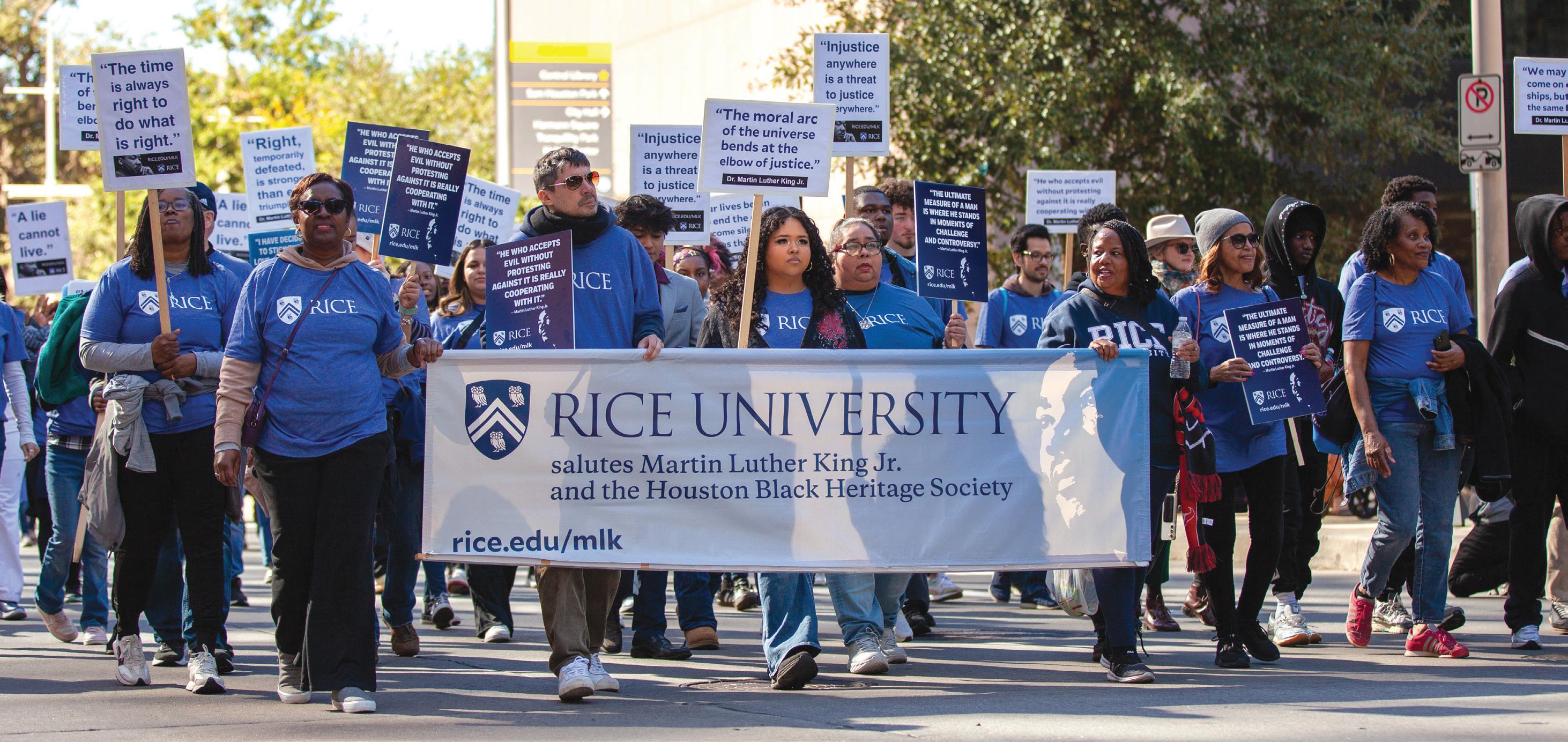
Rice students, faculty and alumni gathered in downtown Houston to commemorate the life and legacy of civil rights leader Martin Luther King Jr. in the rst MLK Unity Parade on Monday.
This year’s newly retitled parade combined the historically separate MLK Grande Parade and the Black Heritage Society’s parade into a single event, according to the City of Houston’s event description.
Rice was represented at the parade by a walking group organized by the Association of Rice University Black Alumni, the O ce of Access and Institutional Excellence, the O ce of Alumni Relations, the O ce of Public A airs and the Marching Owl Band.
Participants carried signs bearing several King quotes.
“The time is always right to do what is right,” read one sign, and another read, “Hate cannot drive out hate, only love can do that.”
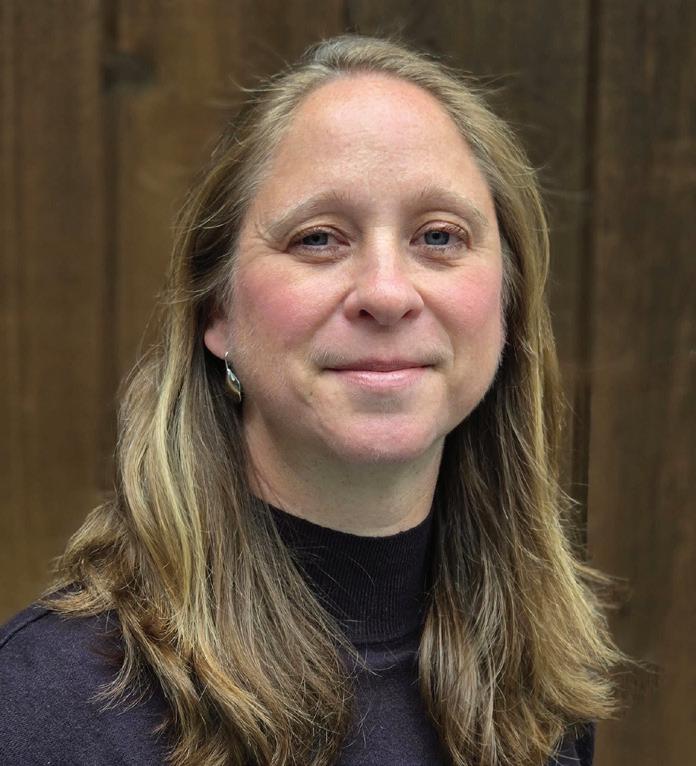
Chaundra Frank, president of the
Association of Rice University Black Alumni, said Rice’s participation in the annual MLK Day parade is a long-standing tradition, dating her own involvement in the mid-2000s, right a er she completed her undergraduate degree in 2000. She returned to Rice to complete her MBA.
“We have a lot of our alumni out today, I see a lot of familiar faces,” said Frank, MBA ’22. “A lot of the Black student organizations are here, and I love that we have a diverse crowd, lots of support and energy.”
For Pamela Price ’78, the parade served
as an opportunity to reconnect with Rice a er moving back to Houston from California three years ago.
“Things were very different at Rice in ’78,” Price said. “The fact that Rice is participating, the fact that we have President DesRoches and so many more people of color on campus than we used to back in my day. It’s just wonderful to see everybody get together and pay tribute to Martin Luther King.”
CRUZ THRESHER STAFF
Hip-hop has quietly lived at Rice for 20 years through professor Anthony Pinn’s religion courses. Now, with a new faculty member bringing his own approach to the genre, students can explore rap music through sociology, creative writing and religious studies, turning what was once a singular o ering into the foundation of something larger.
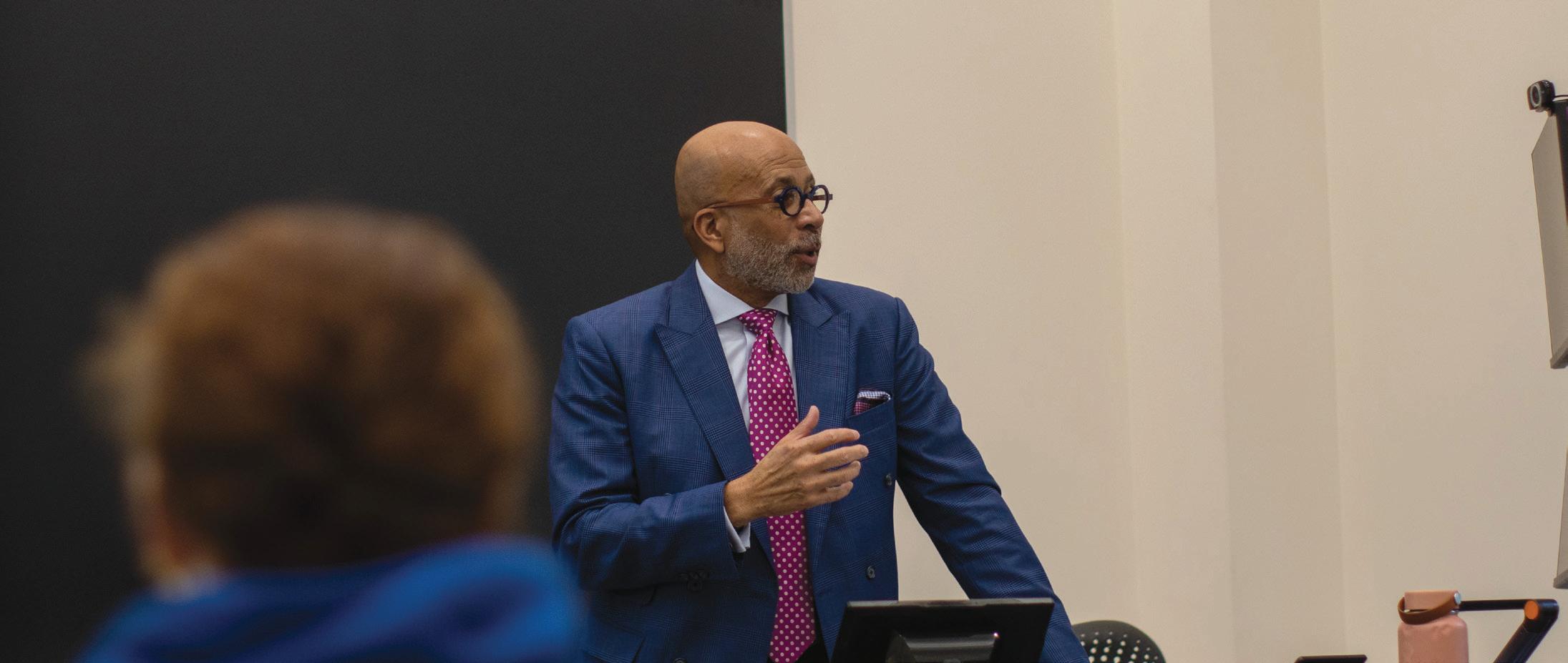
“I’ve been teaching hip-hop at Rice for 20 years now,” said Pinn, an Agnes Cullen Arnold distinguished professor of humanities and professor of religion. “So it’s not really new to campus, but because of recent hiring, we’ve brought more people to campus who have a personal and professional connection to hip-hop.”
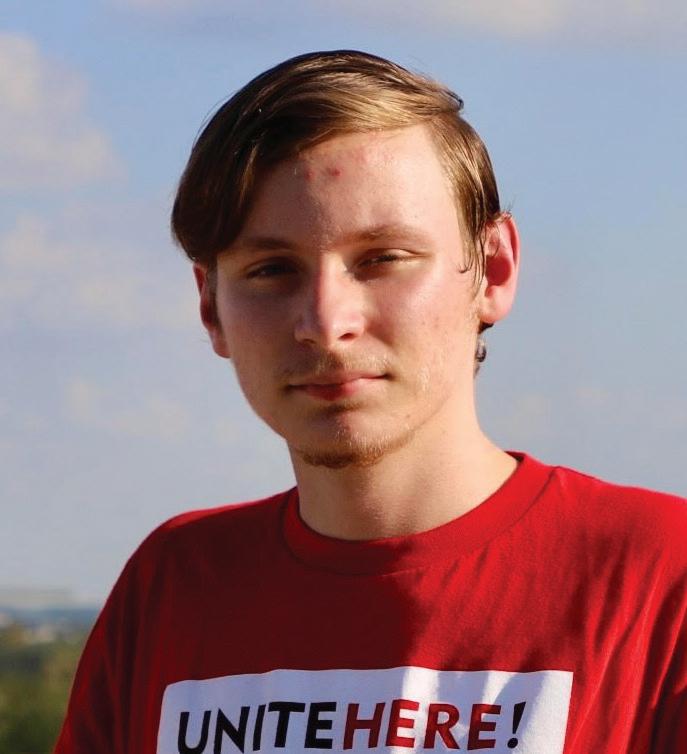
The new hire is Joseph Ewoodzie, an associate professor of sociology teaching Hip Hop and Urban America. Together with Kiese Laymon, a Moody Professor of English and creative writing who teaches Verses/
WHAT’S INSIDE
Versus, the three courses o er di erent perspectives on the same cultural force, one that each of the professors argues deserves rigorous academic study.
Ewoodzie’s course examines hip-hop as a lens for understanding urban inequality. Students are each assigned a rapper and a corresponding city, studying economic inequality, crime and punishment, housing segregation and life through both sociological research and rap lyrics.
“Let’s say we give you Biggie,” Ewoodzie said. “As I talk about economic inequality in the country, since you’re assigned Biggie, your job is to pay attention to economic inequality in Brooklyn and research the issues.”
The course also features an NCAA-style bracket tournament, where students face o by playing songs and presenting the city for their assigned rappers. The class votes, and winners advance through the bracket. A trophy, engraved with past champions’ names, sits in Ewoodzie’s o ce.
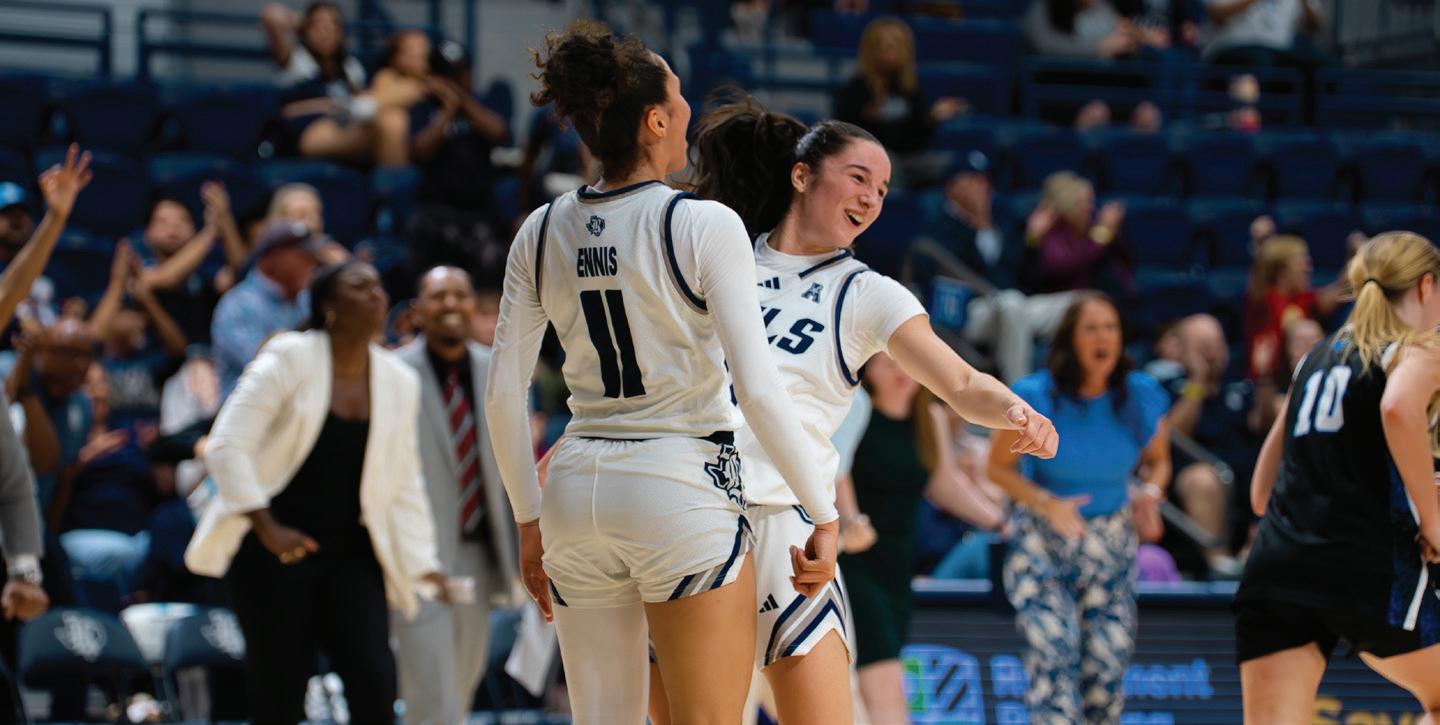
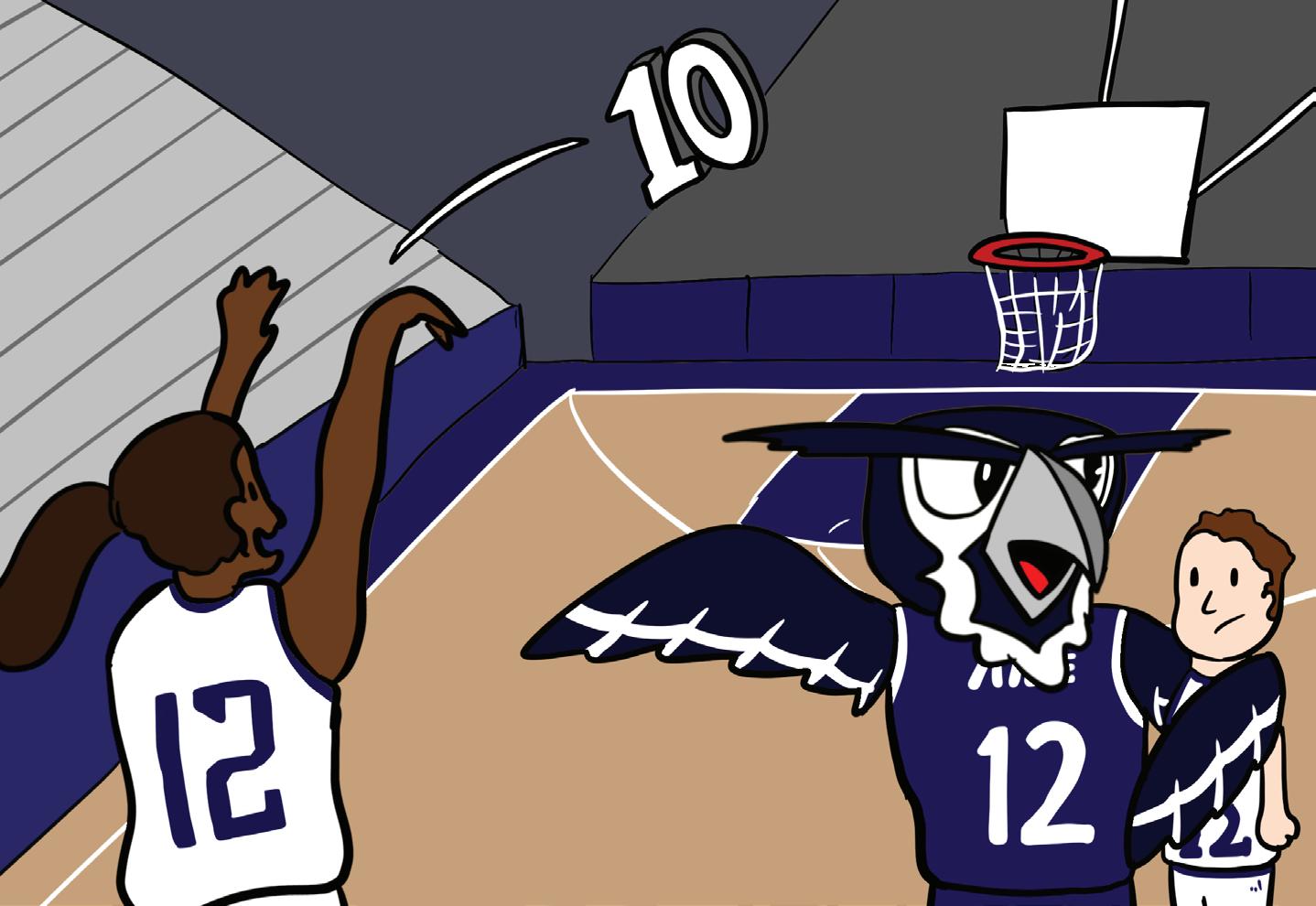
The women’s basketball team extended its winning streak to 10 games with a pair of victories last week. The Owls secured a 76-56 home win on Wednesday against the University of Alabama at Birmingham, followed by a 58-54 victory on Saturday at the University of North Texas. The team is currently 5-0 in conference play, ranking first in the American Conference, and has won 13 of its last 14 games.
The Owls got out to a quick 11-0 start in the first five minutes of Wednesday’s game and never relinquished that lead. While the game ended with ae 20-point score differential, UAB cut the deficit to as low as two in the third quarter.
KAIRI MANO / THRESHER
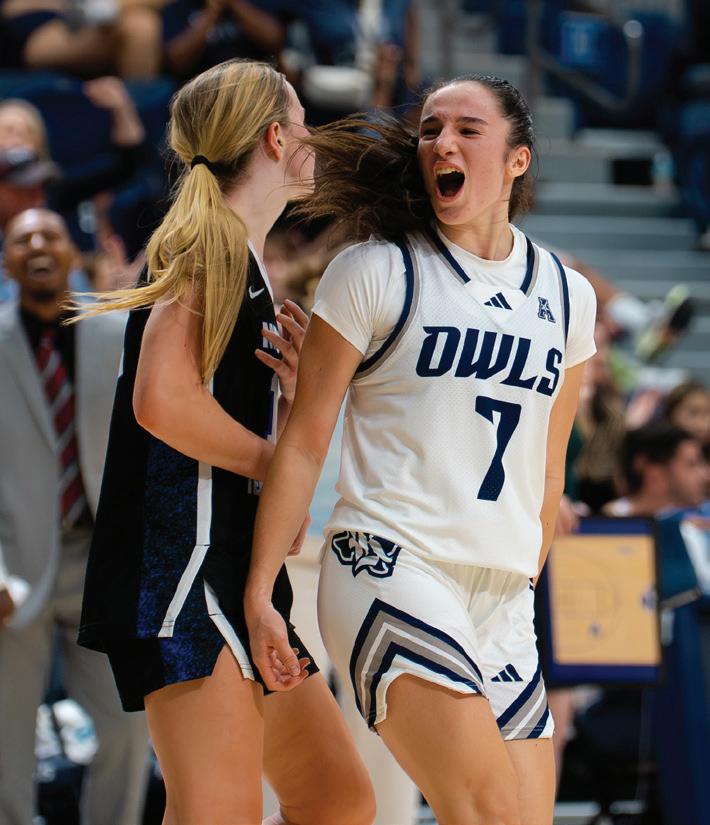
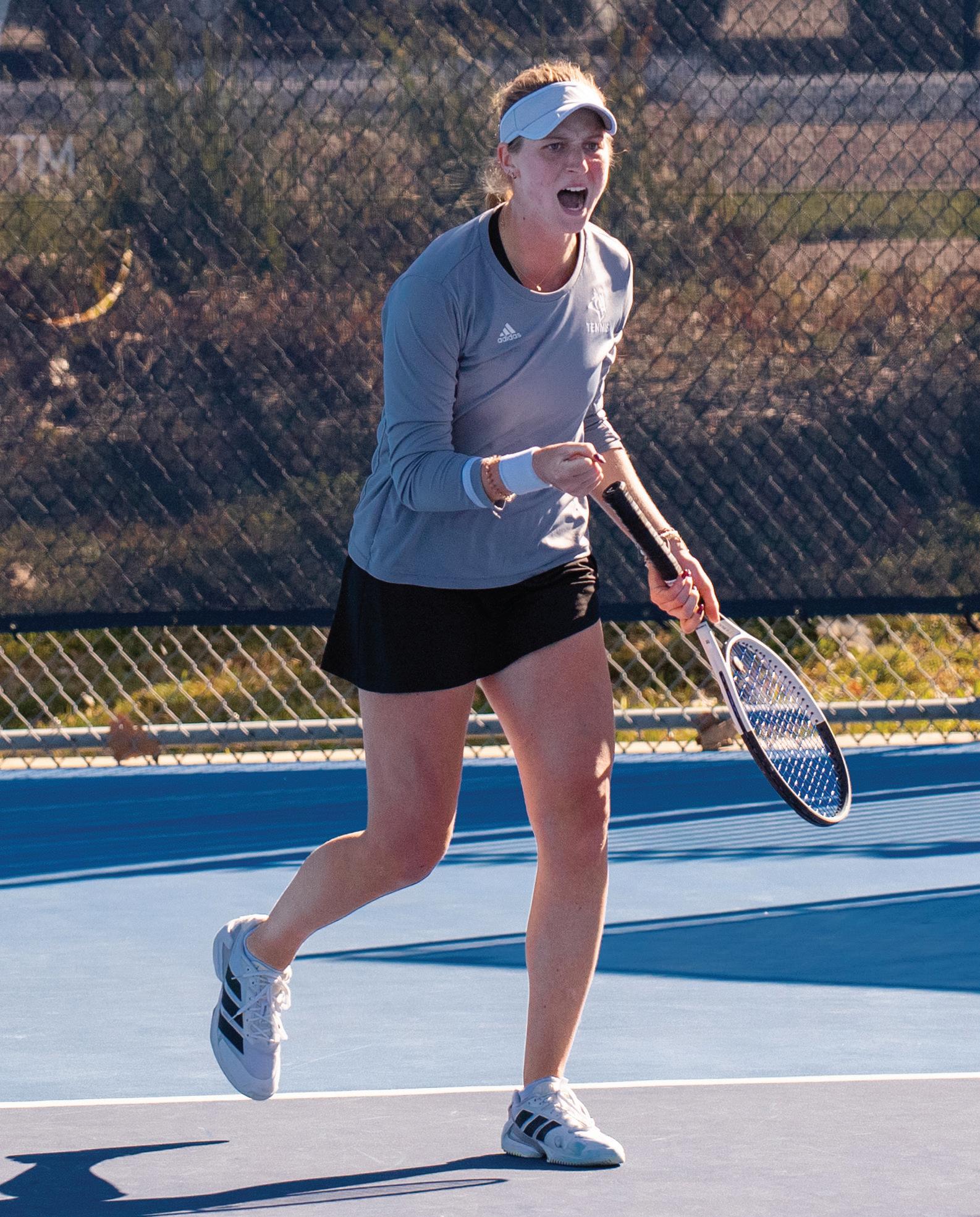
Junior guard Louann Battiston celebrates during a Rice women’s basketball game against Middle Tennessee State University on Nov. 15, 2025. The Owls have won their last 10 games.
CHARLIE
RICHARD LI / THRESHER
The Association of Rice University Black Alumni, the O ce of Access and Institutional Excellence, the O ce of Alumni Relations, the O ce of Public A airs and the Marching Owl Band participated in the MLK Unity Parade on Monday
France, Italy, India? Admin says they want 50% of students to travel internationally
KEYA PATEL THRESHER STAFF
Rice University is developing and expanding its international presence through programs and partnerships in Paris, Venice and India.
The growth is part of Momentous: Personalized Scale for Global Impact, Rice’s 10-year strategic plan launched in 2024. The plan emphasizes global engagement as central to Rice’s future as a research university, with a focus on expanding educational and research opportunities for students and faculty.
“Momentous gave us a clear framework for being more intentional about our global program,” President Reggie DesRoches wrote in an email to the Thresher. “The plan emphasizes personalized scale — the idea that Rice can extend its impact globally without losing what makes the student experience here distinctive and close-knit.”
But beyond broad language about “global impact,” Rice’s expansion has taken shape through speci c initiatives that have grown signi cantly in recent years, from new academic o erings in Paris to consortium teaching in Venice, Italy and a research hub in Bangalore, India.
“Our goal is to ensure that at least 50% of all Rice undergraduates graduate with an international educational experience,” said Caroline Levander, vice president for global strategy. “Thus far we have more than doubled per year the number of students who are getting an international experience.”
Rather than relying on a single global model, Rice has pursued different structures depending on local context and opportunity, Levander said. Rice Global Paris has evolved from a summer study destination to a year-round academic experience.
Rice now o ers a full fall semester abroad in Paris taught by Rice faculty and for Rice credit, a program that did not exist three years ago, Levander said. In addition, Rice has expanded its summer o erings to a 12-course curriculum with Rice residential housing, enrolling more than 350 students over the past two summers.
Rice has also formalized a partnership with Université Paris Sciences & Lettres, a top-ranked European institution. Through the agreement, Rice students can pursue coordinated coursework alongside PSL students and some may earn both a Rice and PSL degree if they follow a de ned academic pathway.
For Rylee Coyne, who participated in the summer session in Paris, the experience was transformative.
“I de nitely felt like it was worthwhile academically because there was so much hands-on, active learning,” said Coyne, a Martel College senior.
Coyne described eld trips nearly every
EMILY NGUYEN / THRESHER
The event also drew newer members of the Rice community, bringing together multiple generations of Rice students and alumni.
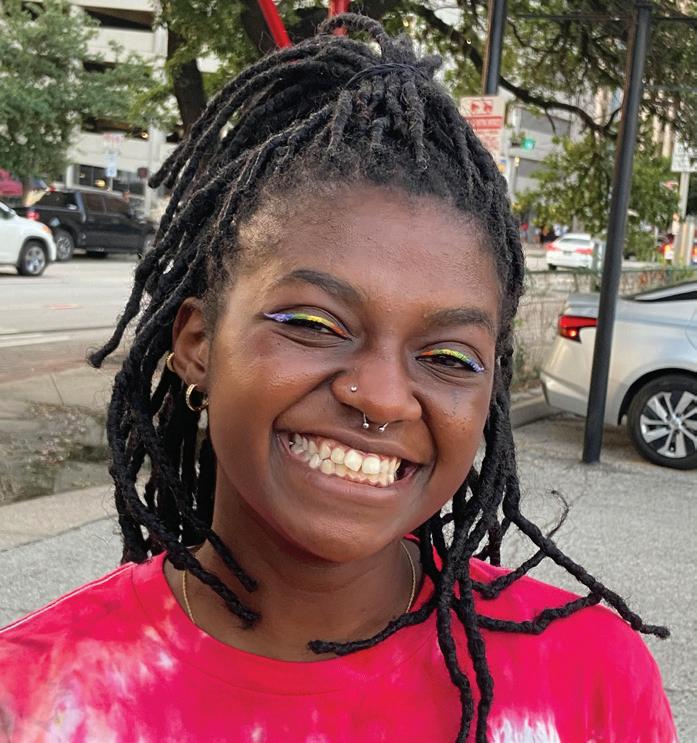
Sydney Batts, a Black Student Association executive board member, said this was her rst time attending an MLK Day parade.
“I’ve lived in Houston for most of my life, but I’ve never been, so I thought it would be a fun side quest,” said Batts, a Will Rice College freshman. “I would encourage more people to come out next year. It’s a really cool experience.”
The MOB returned to perform at the parade, joining an ensemble of over 35 marching bands from around the region.
class day, ranging from the International Energy Agency’s nuclear power plant to the Palais de la Porte Dorée.
“The knowledge and experience I gained from this wouldn’t have been possible without taking the course or being part of the program,” she said.
Our goal is to ensure that at least 50% of all Rice undergraduates graduate with an international education experience. Thus far we have more than doubled per year the number of students who are getting an international experience.
Caroline Levander
VICE PRESIDENT FOR GLOBAL STRATEGY
For Coyne, the structure of the course, combined with experiential learning, felt both rigorous and attainable.
“This program was one of the highlights of my time at Rice,” she said. “It was very well organized and provided us with everything we needed to succeed academically but also to feel safe and make the most of the opportunity.”
Levander said Paris is a model for how Rice hopes to build sustained international engagement rather than short-term study
Chuck Throckmorton, director of bands at Rice, said MOB’s involvement in the citywide event was a natural continuation of their active campus presence at football games and tailgates.
“It’s a great thing to support the celebration of the community,” Throckmorton said. “This is why bands exist, to do things like this.”
Elena Alvarado, a MOB conductor, said performing at public events is a fun opportunity for band members. The MOB also made a recent appearance at the 2026 Houston Marathon on Jan. 11.
“It’s huge crowds, it’s so exciting,” said Alvarado, a Martel College junior. “We prepped a couple of songs, got them all ready, and we’re ready to play for the people.”
Beyond the parade’s celebration of
abroad experiences.
Rice’s involvement with Venice International University represents a di erent approach to global education. Rather than operating a standalone Rice program, the university joined a global academic consortium where students from partner universities across multiple continents study together in Englishlanguage courses.
Levander said the Venice model emphasizes collaboration and immersion in a “truly international classroom,” where Rice students take courses alongside peers from around the world. Rice faculty are also beginning to teach at VIU, integrating the partnership into the university’s academic mission.
The consortium structure allows Rice to participate in global teaching and research without establishing a permanent Rice-only campus, re ecting the university’s multimodel approach to international expansion.
Rice Global India, launched in 2024, was initially a temporary university presence at the Indian Institute of Science. But the initiative has since become a more permanent presence, housed at a WeWork Prestige Central.
Levander confirmed Rice now maintains physical space in Bangalore, employs on-the-ground staff and has completed its legal entity setup in India. The university has established partnerships with other institutions, including Infosys, the Indian Institute of Technology Kanpur and IIT Madras.
“Rice Global India is very much a ‘real place’ today, not just an idea,” said Sreya Ghose, director of Rice Global India.
King’s contributions to the Civil Rights Movement, Frank said the event serves as a reminder to carry forth his legacy amid today’s current political climate.
I think it’s very important for us to commemorate and remember the things that [King’s] done and try to figure out how we can get inspired and motivated to start making changes again.
Pamela Price CLASS OF ’78
“We have a physical o ce in Bangalore with an on-the-ground team supporting partnerships, research coordination and visiting Rice faculty.”
Ghose said Rice Global India acts as a connector and facilitator spanning across many disciplines, helping faculty form collaborative projects, navigate institutional processes and access seed funding.
“So far, the strongest engagement has been in engineering and natural sciences, particularly arti cial intelligence, energy, neuroscience, materials science and physics,” Ghose said.
Looking forward, Ghose said success for Rice Global India would mean the initiative is seen as a trusted long-term academic partner.
“To get there, we need to strengthen institutional frameworks, including sustainable funding models, clearer pathways for joint research and long-term commitments from partner institutions,” Ghose said.
DesRoches said ve years from now, success would look like more students graduating with meaningful international experience, research and teaching that re ect Rice’s mission.
At the same time, he said administrators are aware of where adjustments might be needed.
“If participation is uneven, if programs are not delivering clear educational bene ts or if opportunities are not accessible to the students we aim to serve, those would be signs that adjustments are needed,” DesRoches wrote. “The goal is not expansion for its own sake, but impact—measured thoughtfully and revised as the world, and Rice, continue to change.”
“Sometimes I think that people forget about Martin Luther King and the principles and mission he was trying to accomplish, given what’s going on in our world today,” Frank said. “Civil rights are for everybody, not just the Black community.”
For Price, the parade was a meaningful re ection on the advancement and regression of the ght for equality and functioned as an opportunity to catalyze change in the present day.
“Despite the fact that I saw so many progressive things happen in my lifetime, we are back to things being very di erent again,” Price said. “I think it’s very important for us to commemorate and remember the things that [King’s] done and try to gure out how we can get inspired and motivated to start making changes again.”
FROM FRONT PAGE MLK
Hermann Park land may be used to expand hospital capacity
RUBY
GAO THRESHER STAFF
When Eddie Barreda, a McMurtry College senior, was treated a er a car accident on campus le him in critical condition with a fractured skull, he noticed inpatient rooms in Ben Taub Hospital are consistently crowded, slowing movements between rooms.
“I was at the general ICU, and the beds are always full,” Barreda said. “Once I was good enough to leave the ICU, they took a while to be able to nd me a room.”
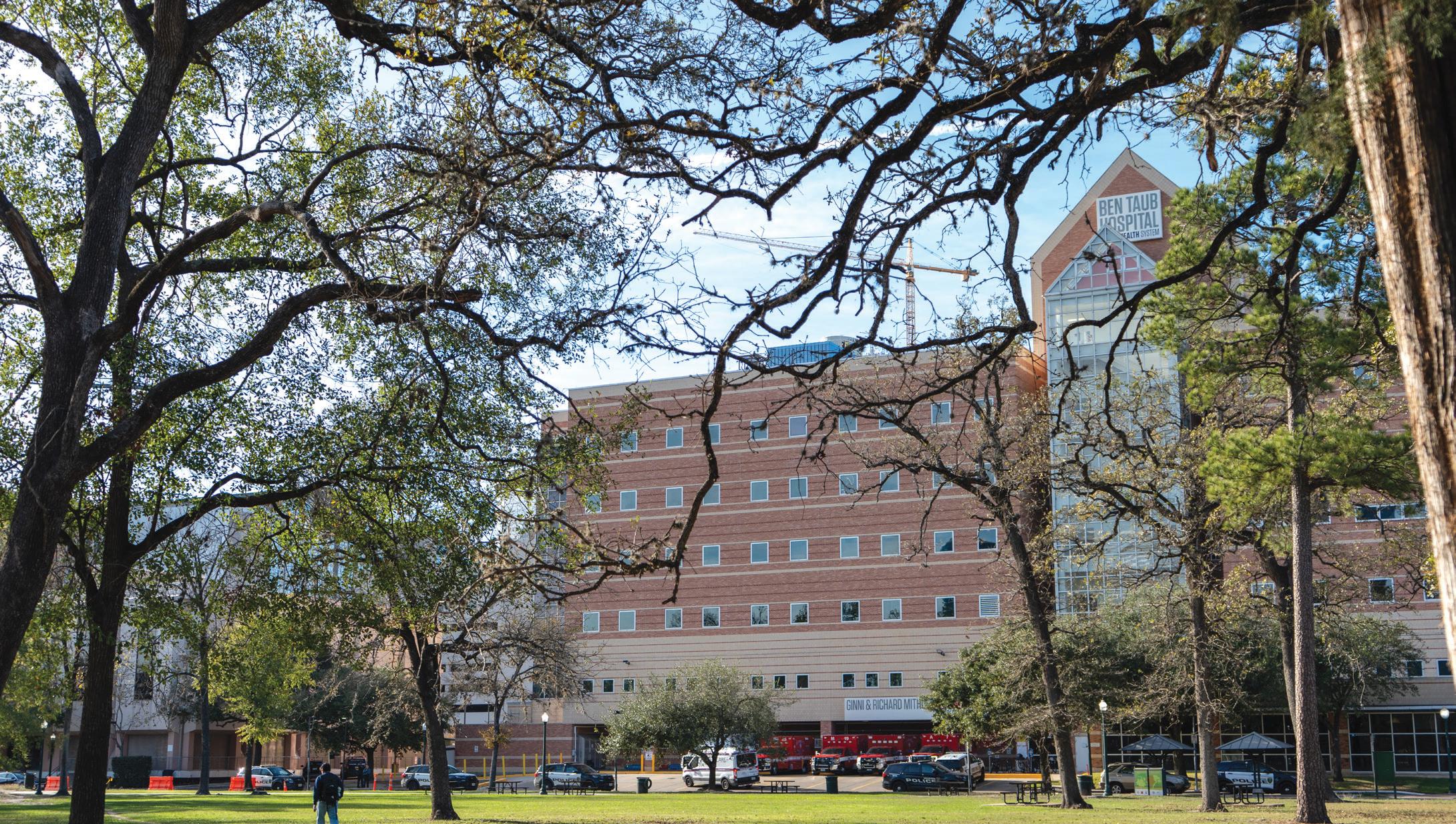
Harris Health, the public healthcare safety net provider serving the residents of Harris County, proposed an expansion project in which Ben Taub Hospital, which sits across from Rice by the southwest corner of Hermann Park, would acquire approximately 8.9 acres of Hermann Park property.
Glorimar Medina, CEO of Harris Health Hospital Campuses, said in a video on Harris Health’s website that limited inpatient capacity is the primary reason for the hospital’s expansion.
“Ben Taub is one of the two Level I trauma centers that we have in our community where we should have four. We’re over 100% capacity,” Medina said in the video. “For a hospital to be e cient, it should be around 85% capacity.”
A Level I trauma center provides the highest quality of care: 24-hour sta ng by medical specialists, more than 1,200 trauma patients every year and programs for research and medical school training.
The American College of Surgeons recommends one high-level trauma center for every million residents. Harris County, with a population over 5 million, has three Level I trauma centers (two for adults and one for children) and one Level II trauma center.
On March 30, 2023, the Harris Health Board of Trustees initiated the plan to build a new patient tower that adds about 120 incremental patient rooms and addresses capacity management through renovations.
Later, on April 28, 2023, Harris County voters approved Harris Health’s $2.5 billion bond package to fund its multi-year strategic facilities plan, which authorized the expansion of patient bed capacity at Ben Taub Hospital.
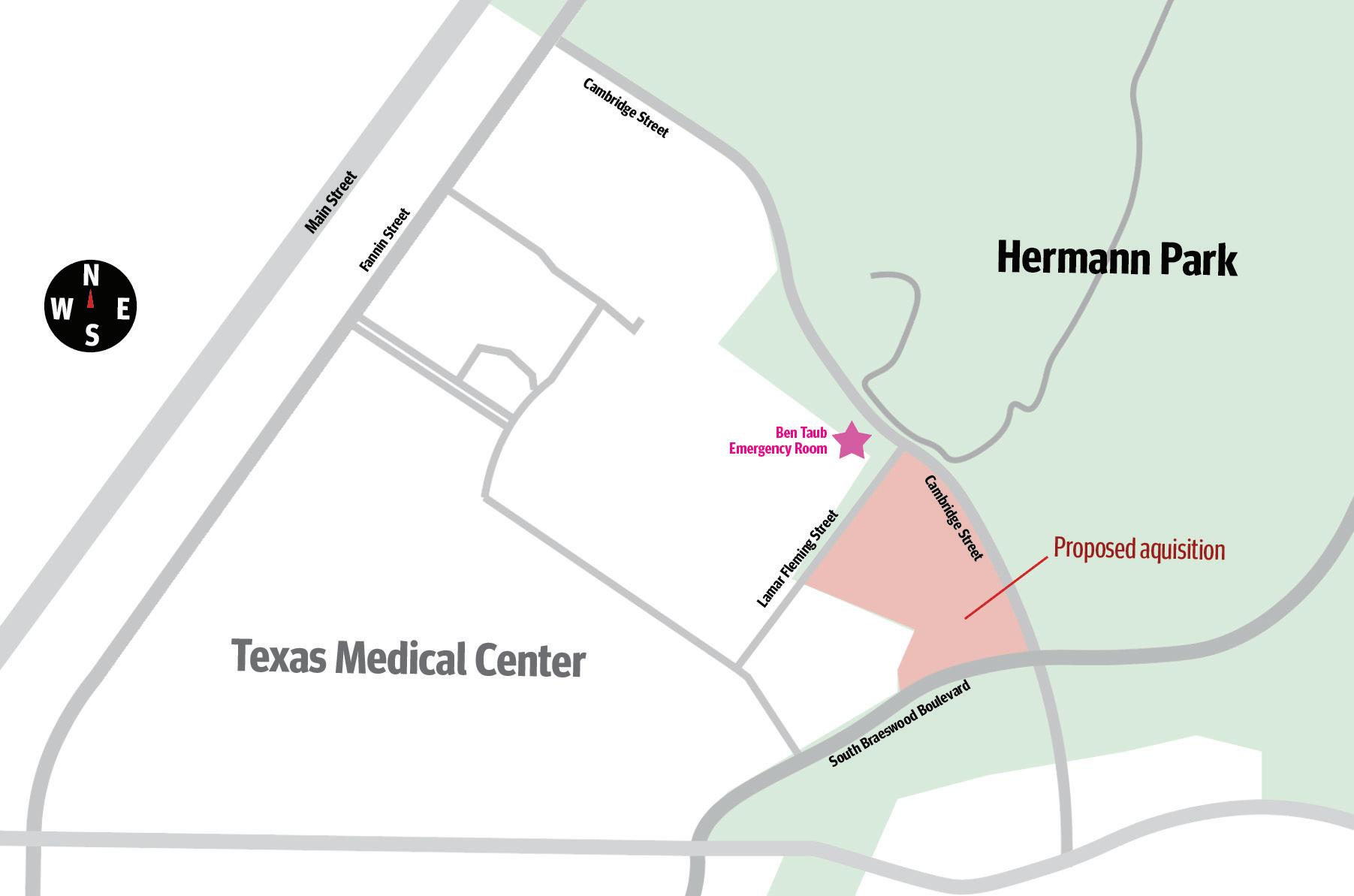
Harris Health said it is important for Ben Taub Hospital to remain in the Texas Medical Center. The proposed land seizure is property of Hermann Park — land historically taken away from the Texas Medical Center — located near Ben Taub Hospital emergency and trauma center, bordered by Lamar Fleming Avenue, Cambridge Street and South Braeswood Boulevard.
Much of the land includes the Warnecke
tract, donated by Houston resident August Warnecke in a will a er his death in 1914.
The will stipulated that ownership would transfer back to Warnecke’s descendants if it lost its parkland status. Warnecke was also responsible for selling portions of his land to Rice University — another tie between Hermann Park and Rice University since its creation.
Ben Taub is one of the two Level I trauma centers that we have in our community where we should have four. We’re over 100% capacity. For a hospital to be efficient, it should be around 85% capacity.
Glorimar Medina CEO OF HARRIS HEALTH HOSPITAL CAMPUSES
Through the expansion project, Harris Health expects to add 100 beds, which will provide 36,500 additional inpatient days.
Bryan McLeod, the administrative director of communications at Harris Health, wrote in an email to the Thresher
that the proposed expansion would have a minimal impact on Hermann Park and the surrounding neighborhood.
“While there will be change on the proposed land, no other part of Hermann Park will be a ected by any of the expansion projects,” McLeod wrote. “In fact, we expect our e orts will enhance the area with accessible walking trails and a healing garden that will add to the beauty of property.”
According to the Texas Parks and Wildlife Code Chapter 26, departments or agencies in Texas cannot approve the seizure of public parkland unless “there is no feasible and prudent alternative to the use or taking of such land,” and that the project “includes all reasonable planning to minimize harm” during and a er its completion.
Who determines the de nition between feasible and infeasible is up to the Harris County Commissioners Court, which “shall consider clearly enunciated local preferences” before coming to a conclusion.
If eminent domain is approved by the court, fair compensation to the descendants of August Warnecke as part of the process may run up to $100 million, according to ABC13.
“At that point, Harris Health could assume control of the land and begin architectural and design work,” McLeod wrote.
The design work can be done in about a
JOCELYN CHEN / THRESHER
JESSICA XU / THRESHER
year; therefore, groundbreaking could occur in 2027, with the new facility operational around 2030, according to McLeod.
“The land being considered for expansion has been sitting there for more than 100 years with little development,” McLeod wrote. “Also, once people have learned of the desperate need to expand driving this action and understand the usefulness of the land for that purpose, their concerns o en ease considerably.”
While there will be a change on the proposed land, no other part of Hermann Park will be affected by any of the expansion projects.
Bryan McLeod
ADMINISTRATIVE DIRECTOR OF COMMUNICATIONS AT HARRIS HEALTH
Planning documents from the Hermann Park Conservancy in 2024 include the tract in its land, envisioned to be a connection between the park and Brays Bayou, as well as a location for parking.
“You can’t say [that] just because there’s nothing here now, it’s not critical to the park’s plans,” Doreen Stoller, the former CEO of the conservancy, told Houston Public Media a er a town hall on Nov. 12, 2025.
Martin Xie, president of Rice RAW Photography, Rice’s largest photography club, wrote in an email to the Thresher that the expansion will not signi cantly a ect future events.
“The club usually focuses on areas such as the McGovern Centennial Gardens and other visually active parts of the park,” said Xie, a McMurtry sophomore. “The construction could present short-term challenges for photographers, both in terms of access and increased crowding in other areas of the park. This may not directly disrupt RAW’s typical activities.”
Emma Yuan, a Sid Richardson College freshman, said the expansion does not a ect her runs in Hermann Park in a major way either. Yuan said she runs in the park nearly weekly.
“I don’t think it will a ect the frequency that I visit the park,” Yuan said. “I’m excited to see how the hospital’s expansion plays out for the zoo, and hopefully the Ben Taub Hospital has more space for patients and doing what they need.”
The Ben Taub Hospital is proposing a land acquisition of Hermann Park to expand its inpatient capacity for its Level I trauma center. Hermann Park and Rice University have historic ties going back to the park’s founding.
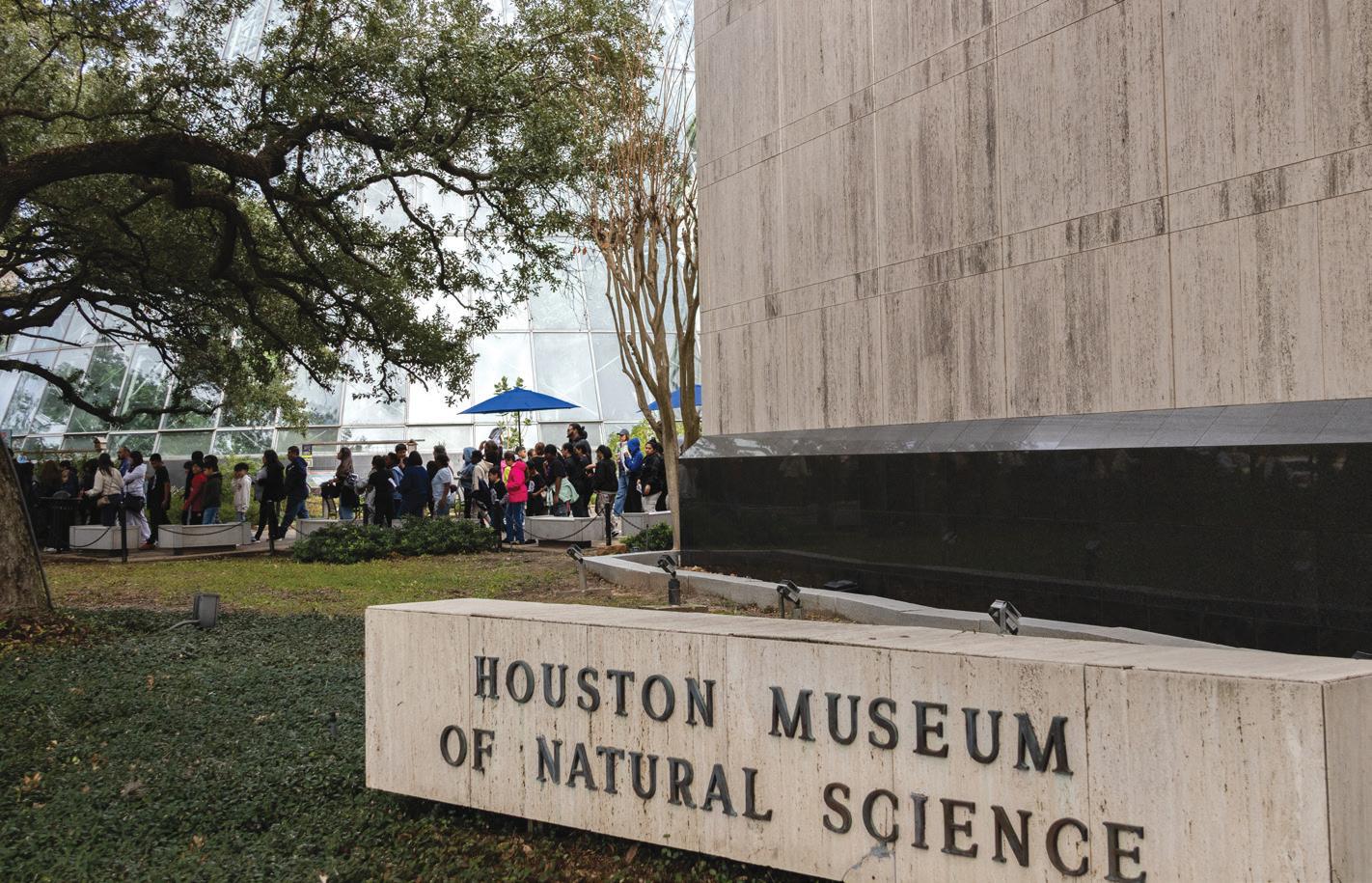
Students lose free access to Museum of Natural Sciences
JAMES CANCELARICH NEWS EDITOR
The Passport to Houston program will temporarily stop o ering free access to the Houston Museum of Natural Sciences due to unspeci ed reasons, according to an Instagram post.
We want to increase student access to our higher demand opportunities, such as Zoo Lights and Rodeo, as well as explore offering new opportunities for our Rice students in our city.
Heather Bennett Mallory ASSISTANT DIRECTOR OF CAMPUS EVENTS
Program Council, gives students free or discounted access to a number of Houston institutions — such as the Museum of Fine Arts, Houston and the Houston Zoo — as well as Metro Q Fare Cards, allowing for up to $30 a month in rides.
Heather Bennett Mallory, assistant director of campus events, said the goal of the program is to allow students to access educational and cultural opportunities in Houston.
“We are currently reevaluating processes with our community partnerships to ensure we are capturing our reach in the best way possible,” Mallory said. “We want to increase student access to our higher demand opportunities, such as Zoo Lights and Rodeo, as well as explore o ering new opportunities for our Rice students in our city.”
Mallory said the pause is not permanent. Representatives for the HMNS could not be reached for comment in time for publication.
The museum is still free for all visitors on Tuesdays from 5 to 8 p.m. Otherwise, general admission costs $25.
The museum houses exhibits focused
on wildlife and history, such as a hall with examples of Texas wildlife and an exhibit showcasing ancient Egyptian artifacts.
butter y room and a planetarium. Passport to Houston has included HMNS access since 2005.
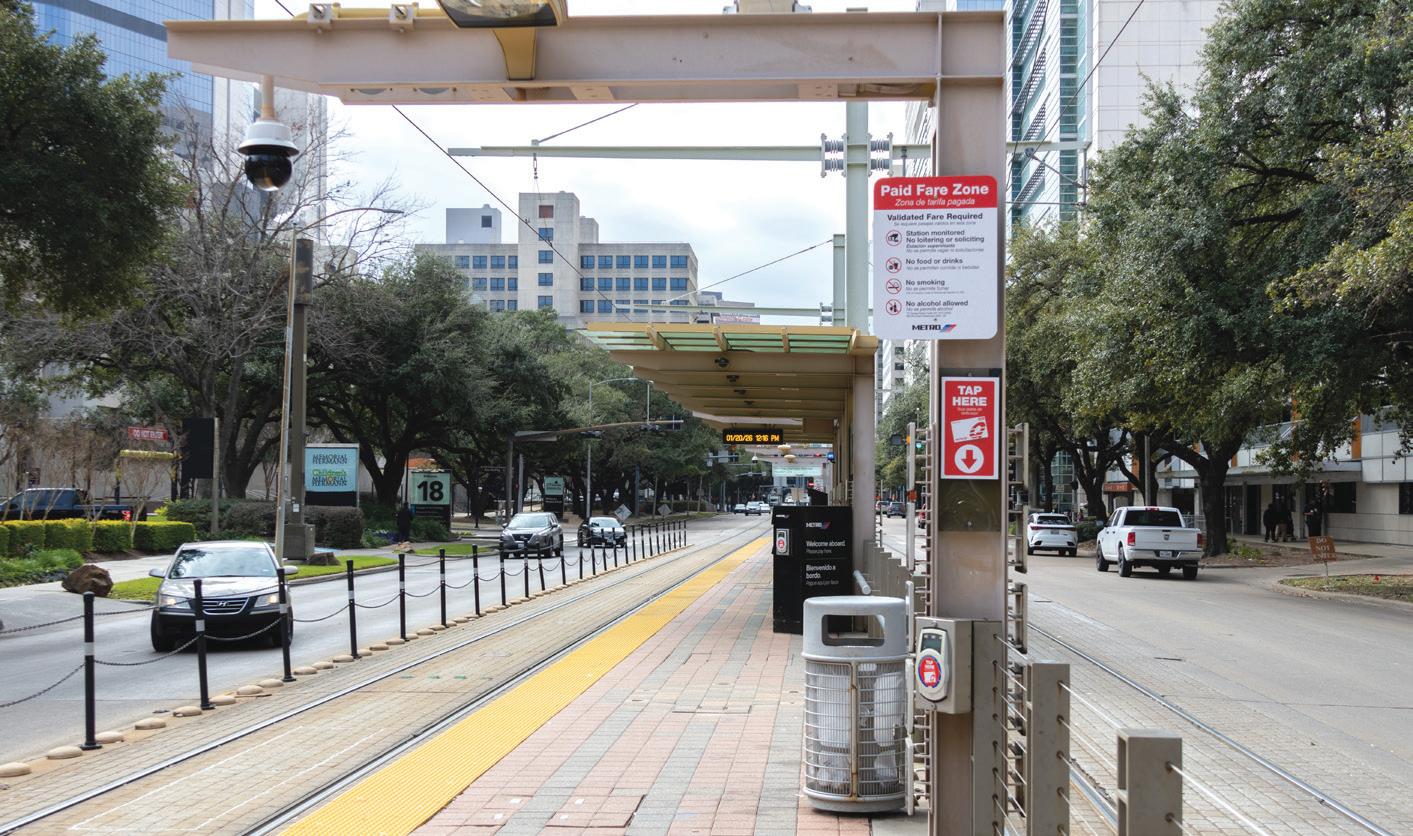
METRO Q Fare Cards will expire, new cards needed by April to ride
HONGTAO HU ASST. NEWS EDITOR
Rice students will need to replace their orange METRO Q Fare Card before April 4, 2026. The Houston Metro is introducing a new red-and-blue RideMETRO Fare Card as part of a new fare payment system, and Rice and other organizations a liated with the Metro’s RideSponsor program are expected to receive the new physical card.
Karen Marshall, the director of ridership and client services at Houston Metro, said the Metro is currently working with over 100 organizations in the RideSponsor program to administer changes.
“We want to make sure that students and the general public know that if they are with a company subsidized institution or school, they should wait for their institution to notify them on the date that they need to exchange their card,” Marshall said.
The Rice Bursar’s o ce told the Thresher
that they have not received any information about changes to the Q Fare Card.
Marshall said that RideMetro hopes the switchover can be completed by midMarch, and the new cards will have no signi cant changes from the original Q Fare Card.
“When they get their new card, it will operate very, very similarly to the old Fare Card, except that they’ll have updated technology,” Marshall said.
However, students will not be able to use the online fare card the new RideMETRO Fare System o ers. This new system allows riders to pay for Houston public transit with their phone on the RideMETRO app, or with credit cards and Apple Pay.
As part of Rice’s Metro Q Fare Card program, undergraduates currently receive up to $30 in rides on Houston’s bus and light-rail system, according to Rice’s METRO QCards website.
Winter externships connect students with alumni and mentors
CHARLIE CRUZ
THRESHER STAFF
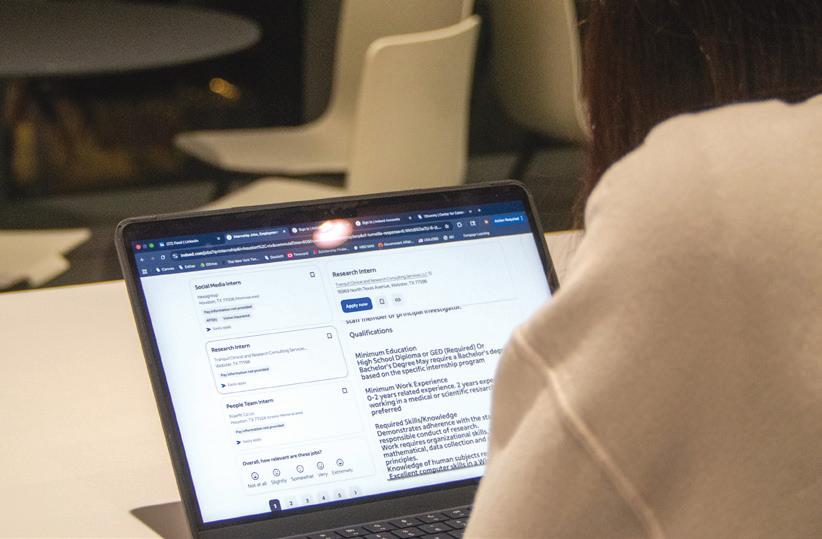
Over 500 students seeking hands-on work experience were matched with Rice alumni as part of Rice’s Owl Edge Externship program during winter break.
With about 2,000 externship applicants and 200 more matches than last year, this is a record year for the Center for Career Development, according to Alexander Rodriguez, assistant director of experiential learning and data at the CCD.
“The program is growing, student interest is growing, especially from the graduate student side,” Rodriguez said.
Unlike traditional internships, externships are unpaid shadowing experiences ranging from one-hour informational interviews to multi-day in-person visits. Rodriguez said the program serves students at all stages of career exploration.
“A student would do an externship if they either don’t know what they want to do with their life post-graduation, or maybe they are a double major in Spanish and engineering,” Rodriguez said. “Our program, because you can complete multiple externships during one semester, we hope that students can get perspectives from many di erent folks.”
Vikrant Hajarnavis completed a twoday product design externship at Microso over winter break. He said the experience gave him insight into the eld beyond what Rice’s curriculum o ers.
“One of the biggest things was how to strengthen my design portfolio and especially the interview process for
something like a product design role,” said Hajarnavis, a Wiess College sophomore. “It’s very di erent compared to some of the more nance or consulting jobs that have a lot more of a technical component in the interview process.”
Hajarnavis said he applied through Handshake a er seeing the opportunity in a Rice newsletter. During his externship, he observed how designers collaborate in professional settings.
“They have these o ce hours where di erent UX designers can collaborate and
get feedback on their own design before submitting it,” Hajarnavis said. “I got to learn more about some aspects of UX — it’s not just product design but also UX research and exactly how people in UX or product design need to communicate their ideas in particular ways.”
Jihra Hill shadowed emergency medicine physicians, neurologists and nephrologists during a four-day externship in the New Braunfels Emergency Room, connected by a Rice alumnus who works in emergency medicine.
Hill, a Wiess junior, said the externship included hands-on learning experiences across multiple medical settings.
“We got to go shadow at a cadaver lab, which does training for medical professionals in the area,” Hill said. “We got to shadow a pre-op surgery. I really just sat with some nurses and followed them around and saw what they did. I got to shadow a neurologist and a nephrologist. I also got to shadow on an EMS ride, which was really cool.”
Hill said the externship revealed aspects of medical careers beyond clinical work.
“It gave a lot of insight into just the depth of what working in medicine looks like and all the di erent things that go into it — not just doing the medicine, which was personally really helpful for me,” Hill said.
Hill said she applied partly because she felt pressure as a junior to gain professional experience. She had maintained premedical status since freshman year but felt uncertain about her path.
“I was still just trying to figure out what all I wanted to do,” Hill said. “I was just like, I need to get some experience. There’s the pressure just to be involved in some way with some internship opportunity. I honestly did not think I would get it.”
Rodriguez said the program is designed to facilitate alumni-student networking and provide experiential learning opportunities critical to career success.
“I hope to see every student at Rice complete at least one externship before they graduate,” Rodriguez said. “I think this is a critical program.”
The program, o ered by the Rice
The museum also has a
FRANCESCA NEMATI / THRESHER
The exterior of the Houston Musuem of Natural Sciences. Students will temporarily lose free access to the musuem through the Passport to Houston program.
FRANCESCA NEMATI / THRESHER
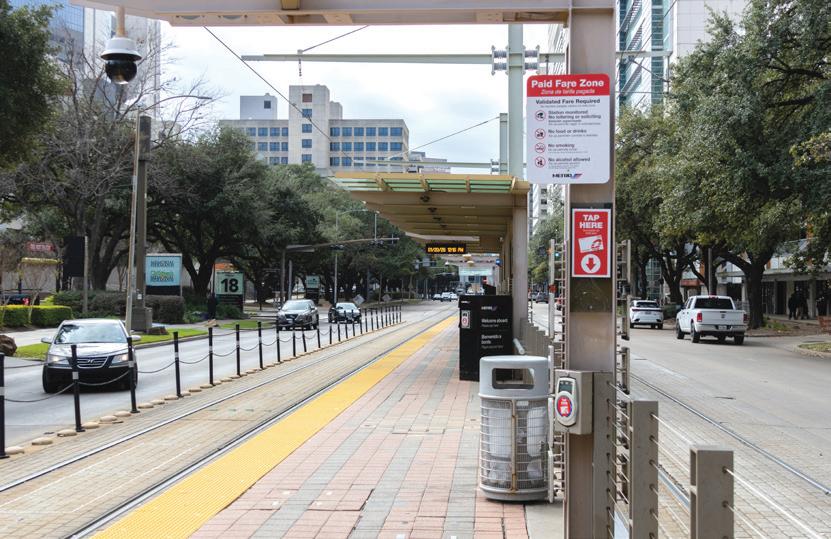
A stop for the Houston Metro. Due to a change in the payment system, students will need to receive new cards by April to continue to ride for free.
SKYLAR WANG / THRESHER
New study focuses on Houston area’s rapidly growing Asian population
AISHWARYA RAMASUBRAMANIAN THRESHER STAFF
Detailing the experiences, attitudes and beliefs of Asian Americans in the greater Houston area, a recent study explored nuances in the community through multiyear surveys. The Kinder Institute for Urban Research published the 2025 series of results on Jan. 12.
The study builds on 30 years of research and examines a range of topics including education, economic outcomes, political views, identity and experiences with discrimination, according to the Institute.
Daniel Potter, director of the Kinder Institute’s Houston Population Research Center, said over 655,000 residents in Harris, Fort Bend, Brazoria and Montgomery counties are Asian.
“More Asian residents live in Fort Bend County today than lived in the entire state of Texas in 1980, yet there is o en a lack of knowledge and understanding of the many di erent populations grouped under the label ‘Asian,’” Potter said.
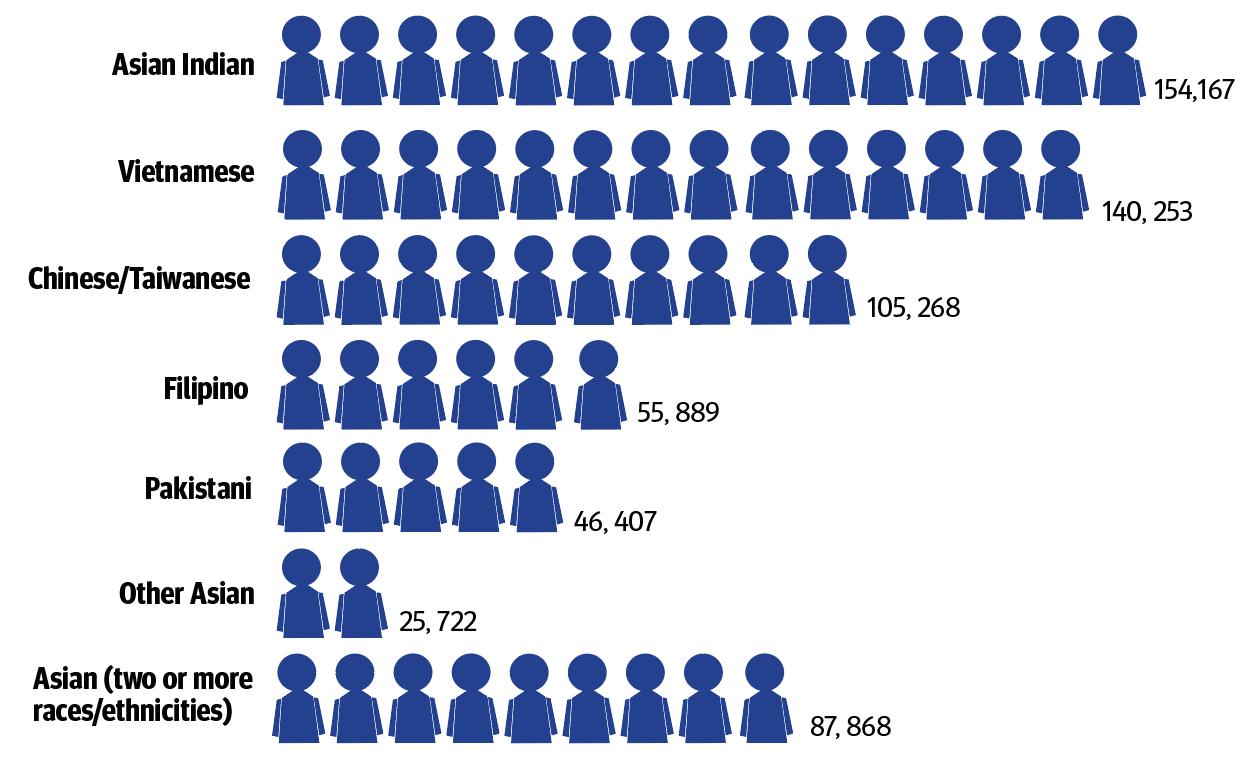
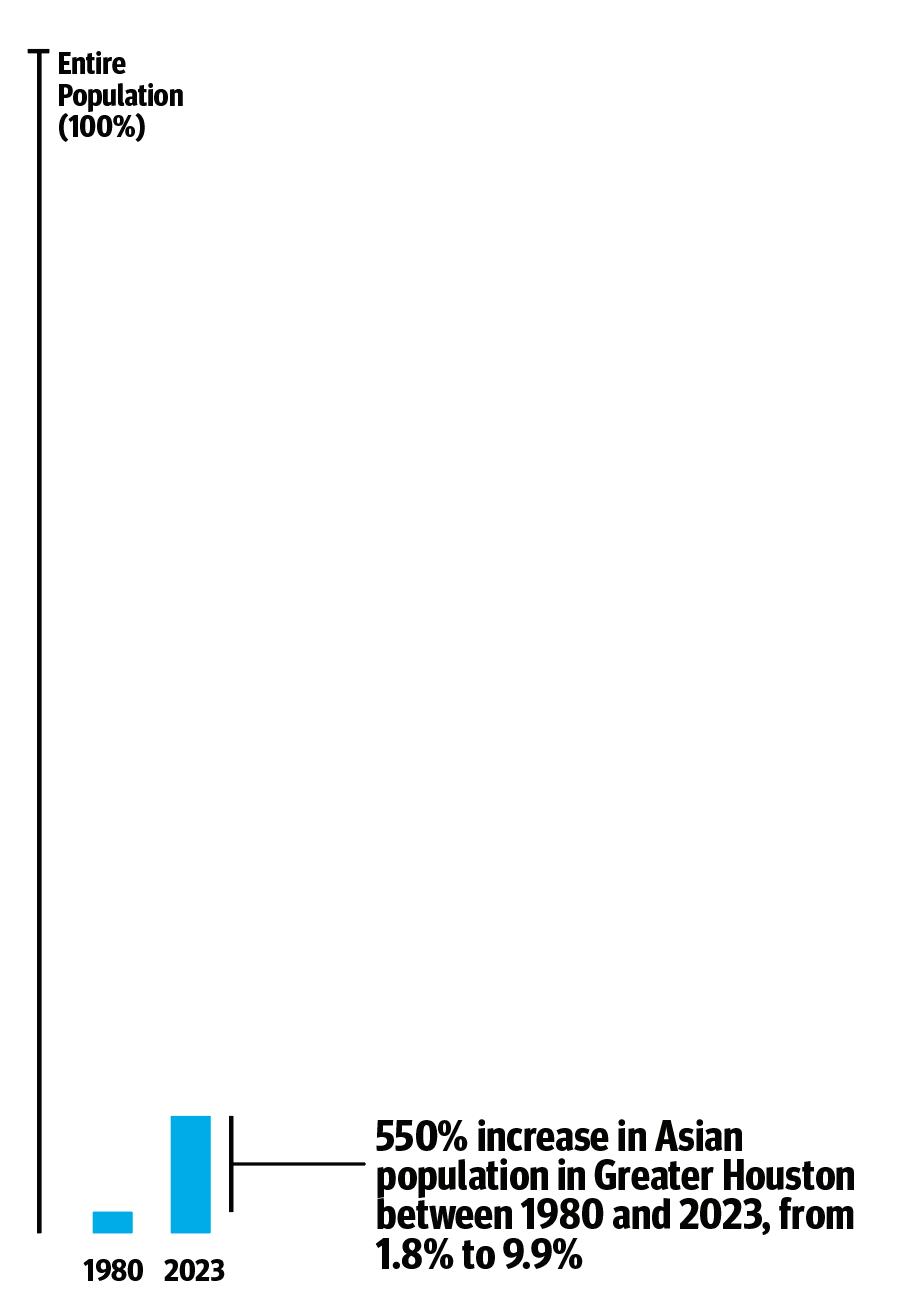
As a part of the multiyear, multilingual e ort, researchers surveyed residents across Harris, Fort Bend, Montgomery and Brazoria counties. The study found rapid growth in the Asian population of the region, from 1.8% to 9.9% in a span of 40 years. The Asian population is highly diverse, with Indians comprising the largest ethnic group at 150,000 residents, followed by Vietnamese, Chinese/Taiwanese, Filipino, Pakistani, Korean and Japanese.
About two-thirds of the population was born outside of the U.S., a quarter was second-generation and about 7% was third-generation or more.
Findings from the study also highlight signi cant variation across Asian ethnic groups in education level, income and political a liation.
This research is not just what’s of interest to academics or intellectuals, but people who are in communities, lived experiences, people that have their hands on the levers of power and influence that can help to shape the policies and programs to improve the lives of Asian community members here in the Houston area.
Daniel Potter
DIRECTOR OF THE KINDER
INSTITUTE’S HOUSTON POPULATION RESEARCH CENTER
The Asian population tended to be ideologically moderate, with 62% identifying as slightly liberal, moderate or slightly conservative. Political identities were almost evenly split between Democrats, Republicans and independents, with Republican identity most common among Vietnamese and Filipino residents, and Democratic identity most common among Japanese and Filipino residents. The highest percentage of independents was found among Chinese/Taiwanese and Pakistani residents.
The study found that the Asian American population in the counties surveyed had the largest economic and educational disparities of any major racial or ethnic group in the U.S., with nearly half of the households making over $100,000 and nearly a quarter making under $50,000.
More than half of the Asian population holds a four-year degree or higher and about 30% hold a graduate degree.
The study also touched on experiences
From 2010 to 2023, Asian resident growth across counties
with discrimination and feelings of belonging. Ethnicity was important to almost 80% of the group, and “being American” to at least 59% of the larger group.
41% of Asian residents reported that they or their family had experienced antiAsian discrimination in the past year, with many indicating COVID-19, the political climate and xenophobia as contributing factors.
Looking forward, the Kinder Institute will partner with the University of Texas School of Public Health to conduct the latest iteration of the health of Houston study, which surveys the overall public health of the city and its metropolitan regions.
The study found that the Asian American population in the counties surveyed had the largest economic and educational disparities of any major racial or ethnic group in the U.S.
“It will give us this very wide, very deep look at health and sort of healthy living among Asian communities here in the Houston area, but then potentially also helping to elevate disparities and inequalities that exist,” Potter said.
The ultimate goal of the Asian American Community Study is to provide data that can better inform policymakers, educators and community organizations as Houston continues to grow and diversify, Potter said.
“Hopefully, through this process of making sure that this research is getting back out into the community, we will have the opportunity to hear from more and more organizations,” Potter said. “This research is not just what’s of interest to academics or intellectuals, but people who are in communities, lived experiences, people that have their hands on the levers of power and influence that can help to shape policies and programs to improve the lives of Asian community members here in the Houston area.”
JESSICA XU / THRESHER
Ethnic makeup of the Asian population in greater Houston. Data from the Kinder Institute of Urban Research’s Asian American Community Study.
EDITORIAL
Rice deserves more references in popular culture
From a materials science and Russian literature major in the video game series
“Tom Clancy’s Rainbow Six” to an astronaut and former physics doctoral student in a 2009 “Doctor Who” special, ctional Rice students and faculty have made the occasional cameo in popular culture over the past few decades.
Most recently, Rice served as the backdrop for part of a 2025 Taylor Jenkins Reid novel about a female astrophysicist joining NASA’s space shuttle program. The vast majority of the credits in Rice’s
GUEST OPINION
popular culture catalog, then, appear to follow a similar pattern of featuring people in the elds of physics or astrophysics.
But for a school with such varied and quirky traditions, Rice deserves more recognition in the world of popular culture and certainly more diverse representation than a few physicists here and there.
Imagine your favorite sitcom character telling sordid tales about the time they ran Baker 13. Imagine a thriller playing into the residential college system that has you at the edge of your seat. Imagine a rom-com
For all you Owls with creative ambitions, we urge you to consider Rice as the setting of your next project.
about nding love where you least expect it: your Orientation Week family.
We’re tired of seeing every smart high schooler in popular culture go to Harvard
University or Princeton University. Rice can and should be another option in the minds of creatives as a place for their high-achieving and overzealous characters to go.
All of this is to say that Rice has everything it needs to become a staple setting in the world of popular culture: fun traditions, a beautiful campus, a reputable name and a unique vibe. For all you Owls with creative ambitions, we urge you to consider Rice as the setting of your next project.
Rice needs to protect students in the wake of escalating ICE attacks
CONNER SCHULTZ CO-CHAIR, RICE YOUNG DEMOCRATIC SOCIALISTS OF AMERICA
On Jan. 7, Jonathan Ross killed Renee Good, who was observing an immigration raid in her community when U.S. Immigration and Customs Enforcement agents approached her vehicle, rapidly escalating the scenario until one agent shot her.
Rather than take responsibility for their actions, the federal government has prevented Minnesota from participating in the investigation into the shooting. The same day, ICE agents came onto the property of Roosevelt High School, used pepper spray against bystanders and handcu ed sta members while in the process of making an arrest.
These incidents represent a rapid escalation in the number of attacks on our communities by the Trump administration, showing their reach has no limits and they will not hold their agents accountable.
So why should Rice care about these attacks? ICE is already leading attacks on college campuses. On Jan. 29, 2025, Trump signed an executive order calling for the prosecution or removal of perpetrators of antisemitic harassment, an order that has been used to suppress people protesting Israel’s genocide in Gaza.
Mahmoud Khalil, a Palestinian green-
card holder and graduate student at Columbia University, was arrested by immigration agents without a warrant over his pro-Palestinian activism and now faces deportation.
Rumeysa Ozturk, a Turkish graduate student at Tu s University, was surrounded by masked, plain-clothes federal o cers and arrested a er writing an op-ed calling for her university to recognize Israel’s genocide.
Any Lucia López Belloza attempted to y home to Texas from Babson College but was arrested by immigration agents at Boston Logan International Airport and deported to Honduras two days later.
Rice has a responsibility to protect its students so they can continue their education without fear, and we have a responsibility to protect our friends.
With international students comprising 14% of the undergraduate class of 2028 and nearly 47% of all graduate students, Rice has already faced attacks on its student body. Last year, three students and two recent
graduates faced visa revocations. All ve had their visas reinstated, but since then, ICE has only expanded its attacks on the American people.
The university’s response to these attacks has been lackluster at best. The primary action they took was to cover the cost of initial legal consultations for those ve students.
It is no longer a question of if the Trump administration will attack our student body, but when. Inaction from our administration will only lead to the worst possible outcomes for our students.
So what can we do to ght this madness? At the very least, we can organize to make up for their inaction. Donate to mutual aid funds through groups like Rice Mutual Aid or the Grad Campaign. Last year, the Grad Campaign raised over $1,200 to cover legal debt for students a ected by visa terminations. Attend Know Your Rights trainings; multiple clubs on campus host them throughout the year to inform people on how to protect themselves and others during immigration raids.
Lastly, make sure to let the university know about your concerns for student safety. Email our administration calling on them to set up a full legal fund for all students a ected by immigration raids and create a publicly available plan of action in the event of an ICE raid.
Rice has a responsibility to protect its
Disabled students deserve a seat at the table
teachers and institutions is conditional. I realized I had to work much harder than my able-bodied peers to make up for the time lost when I was unable to attend class.
I have been disabled for a decade now. When I got into Rice, my parents envisioned a school where I could thrive and also take care of myself. They assumed I would no longer be a victim of insensitive remarks made by instructors or have to explain myself to professors, but they could not have been more wrong.
I have epilepsy, which is a neurological disorder characterized by abnormal electrical activity in the brain that results in seizures. Additionally, I su er from debilitating chronic pain in my dominant shoulder as a result of tendinopathy, a term for conditions that a ect tendon function.
My body is different, and I refuse to be penalized for how it functions. We deserve a seat at the table. Society has long tried to get rid of disabled people, but for as long as mankind exists, so will disabilities.
Through primary and high school in Kenya, I became aware that support from
This meant that during hospital stays, as doctors ran tests to gure out what was wrong and devised treatments, the rst thing on my mind was school. I did not have the luxury of sleeping in because I was admitted to the hospital. Instead, I had to catch up on schoolwork.
Some teachers o ered little to no support, while others went to the extreme end of ridiculing me for being epileptic. The protections provided to disabled students in Kenya are insu cient, so I had few options for recourse. These perverse attitudes exist because my body is considered abnormal and many people view disabilities as an inherently awful thing to have. They don’t imagine for a minute that they too could become disabled.
My acceptance to Rice offered my parents some reprieve: I was able to get accommodations for my disability through the Student Disability Resources Center, as the Americans with Disabilities Act provided me much more protection than the Persons with Disabilities Act, 2003 in Kenya.
I chose to major in biosciences due to my fascination with illness — extremely conceited on my end, I know. I was in awe of the many researchers the biosciences
department housed and the topics of their research. Through these classes, I gained a deeper understanding of genetics, biochemistry and molecular biology. I also experienced what I would describe as the most harrowing ableism that I have personally ever seen.
In one instance, a er asking if there was a Zoom option for an upper-level biosciences course, the instructor suggested I may need to think about dropping the course or even taking a leave of absence if I was unable to attend class.
I was dumbfounded. What a brilliant idea! My medical team and I had never considered it in the last 10 years: taking time o for chronic pain! A short respite would surely be the cure for the decade of pain I had experienced.
Another professor similarly suggested I drop a course — this time a er the drop deadline — when I missed out on a group presentation because I had own to Nairobi, Kenya to receive care for heart palpitations. The professor was understanding at rst, but once this shi occurred, I was le feeling like their allyship was conditional on my being physically well.
While speaking with my friends who have disabilities, I realized this was not an isolated incident. O en, my friends complained that professors would treat their accommodations as suggestions, sometimes refusing to
students so they can continue their education without fear, and we have a responsibility to protect our friends. The more action we take to protect one another, the better we can defend ourselves from these unconstitutional and inhumane attacks.
Editor’s Note: This is a guest opinion that has been submitted by a member of the Rice community. The views expressed in this opinion are those of the author and do not necessarily represent or re ect the views of the Thresher or its editorial board. All guest opinions are fact-checked to the best of our ability and edited for clarity and conciseness by Thresher editors.
o er reasonable accommodations such as extended deadlines.
Living with a disability can be extremely di cult, but for me, it seldom has to do with actual seizures and physical pain. How society treats me is the main struggle. My body is di erent, and I refuse to be penalized for how it functions. We deserve a seat at the table. Society has long tried to get rid of disabled people, but for as long as mankind exists, so will disabilities.
Editor’s Note: This is a guest opinion that has been submitted by a member of the Rice community. The views expressed in this opinion are those of the author and do not necessarily represent or re ect the views of the Thresher or its editorial board. All guest opinions are fact-checked to the best of our ability and edited for clarity and conciseness by Thresher editors.
MICHELLE OYOO ABIERO MCMURTRY COLLEGE SENIOR
Rice’s K-12 blind spot
MINDALYN GALLI MASTERS IN TEACHING STUDENT
A staggering disconnect exists just beyond our hedges. While Rice University builds its identity as a world-class epicenter for innovation, our local K-12 system is being forced in the exact opposite direction.
In the name of “reform,” we as a society are enforcing rigid, top-down curriculum models. We are, as educationalist Sir Ken Robinson famously warned, running an industrial-age system that is actively “educating people out of their creative capacities.”
This isn’t just a philosophical problem; it’s a crisis for Houston’s future. The data shows the devastating cost: Graduates aren’t ready for work, and they are unprepared for an ever-changing future. In some Houston school districts, only 10.1% of high school graduates are academically college-ready in reading and math.
Moreover, according to a recent Charles Butt Foundation report, 78% of Texas public school teachers seriously considered leaving their jobs in 2024. We are reforming in the wrong direction, and our best educators are voting with their feet. The real tragedy is that this de citbased model completely ignores the “asset richness” of the very communities it serves. Neighborhoods like the East End are staterecognized Texas Cultural Districts, a vibrant “Mural Capital” brimming with “civically engaged residents.” But our schools are treating kids as de cits to be lled, not as unique assets to be cultivated. This disconnect — between our community’s assets and our schools’ de cits — is the true crisis. To solve it, we must see education in a new light. This isn’t about tinkering; it’s about a total redesign.
This is where Rice’s leadership becomes critical. Rice is launching a new
COLUMN
Alternative Teacher Certi cation program through the Susanne M. Glasscock School of Continuing Studies. This is a golden opportunity. Rice must not create just another one-size- ts-all program that trains educators for the old, failing system. It has the opportunity — and the responsibility as a university built on innovation — to get this right.
It’s time to create a new blueprint. This new program should be the rst in Texas to train leaders for the transformative, researchbacked models that make an impact. We must train our teachers to be artisans of their trade, trusted as professionals and empowered to lead active learners.
Consider what this education looks like.
Imagine a rst grader in a native prairie garden, working alongside a Texas Master Naturalist to discover why bumblebees are attracted to one ower over another.
Imagine a h grader in a workshop, building a prototype with city of Houston engineers to solve a real ooding problem in their own neighborhood. Imagine a high schooler spending two days a week at Ion District, learning from a mentor in a eld they are passionate about.
This is the authentic, communityembedded learning ecosystem that prepares students for life a er graduation.
I know this is possible because this mission is personal. I was a student who needed to be immersed in the learning process to thrive — and I’ve learned that all students deserve that chance.
My 20+ years as an educator proved that deep learning happens when we are curious and connected to the world. My experience in informal education at the Children’s Museum, my work as the founder of a children’s creative studio and my time homeschooling my own children all showed me the same thing: When you
give children agency, they become active, passionate learners.
I am a Houston educator, and I am a graduate student at Rice working toward my principal certi cation because I was called to make this vision happen.
This calling is what brings us full circle. These innovative teaching methods create the curious, critical-thinking and creative innovators that Rice needs to ful ll its own research mission and populate its visionary hubs.
Rice’s Momentous strategic plan is a promise to engage with and empower Houston. I invite Rice to ful ll that promise. Let’s form a coalition. Let’s use this new Alternative Teacher Certi cation program to train educators who can build a new, transformative education for our city — one that empowers students, builds learner agency and truly prepares them for life.
Editor’s Note: This is a guest opinion that has been submitted by a member of the Rice community. The views expressed in this opinion are those of the author and do not necessarily represent or re ect the views of the Thresher or its editorial board. All guest opinions are fact-checked to the best of our ability and edited for clarity and conciseness by Thresher editors.
Global chats: Returning home, returning to my culture
I am staring out the black window of the airplane. It’s 9 p.m., and I have nally arrived in Mexico City, Mexico.
A er dragging my sti ened body out of the airplane’s seat, I wait for my luggage. This was supposed to be fast, but since Mexico’s airport is going through a massive renovation for the 2026 FIFA World Cup, my bags take over two hours to come out.
Insane, I think.
More insane, however, was the fact that the next day I had to take another ight to Peru to visit the rest of my family.
So, a er arriving home at 1 a.m., sleeping for barely ve hours, and ying for another six hours, I nally landed in
Lima, Peru at 4 a.m.
As always, the first thing my family and I did was explore the city.
On our rst day, we went to the Mira ores district, located on a cli op above the Paci c Ocean.
Walking by the magni cent beachfront park gave me instant relief. A er the stress from the fIights, I felt I could nally breathe. As my siblings and I walked by the sea, we ate lúcuma ice cream, chatted and watched people paragliding in the distance.
Each day we would go to di erent restaurants to enjoy the warm, magni cent dishes Peru has to o er: ceviche, causa, papa a la huancaína, pollo a la brasa and ají de gallina. Slowly, memories resurfaced with every meal, reminding me of the
beautiful moments we’ve built in this place.
One a ernoon, we wandered through a local cultural market, where I was struck by the precious cra s from indigenous communities. Seeing the handmade jewelry, wood carvings, stone knives, pots, alpaca fur clothes and Inca art lled me with joy and inspiration.
A er a week in Lima, we traveled to Ica, a city known for its beautiful desert oasis and where my father was born.
Once there, we decided to go to the Paracas National Reserve to visit La Mina beach. While feeling the warm sun on my skin and smelling the salty breeze, a million memories came in an instant.
This article has been cut o for print. Read more at ricethresher.org.
Valeria Revatta is a Duncan College freshman majoring in architecture. After living all her life in Mexico City, Mexico, she brings a unique voice and perspective on international students’ experiences.
EDITORIAL STAFF
* Indicates Editorial Board member
Kathleen Ortiz* Editor-in-Chief
Sarah Knowlton* Editor-in-Chief
Juliana Lightsey* Managing Editor
NEWS
James Cancelarich* Editor
Belinda Zhu Asst. Editor
Hongtao Hu Asst. Editor
Hope Yang Asst. Editor
OPINION
Jenna Perrone* Editor
FEATURES
Emily Nguyen Asst. Editor
ARTS & ENTERTAINMENT
Arman Saxena* Editor
Chi Pham Asst. Editor
SPORTS Andersen Pickard* Editor
Evie Vu* Editor
BACKPAGE
Charlie Maxson Editor
Max Scholl Editor
Will Howley Editor
Rykelle Sandidge Senior Writer
COPY
Shruti Patankar Editor Julianne Ma Editor
PHOTO, VIDEO, & WEB
DESIGN
&
Hickey-Zamora
BUSINESS Alina Zhong Advertisement
Santhanam Advertisement
ABOUT
The Rice Thresher, the official student newspaper of Rice University since 1916, is published each Wednesday during the school year, except during examination periods and holidays, by the students of Rice University.
Letters to the Editor must be received by 5 p.m. on the Friday prior to publication and must be signed, including college and year if the writer is a Rice student. The Thresher reserves the right to edit letters for content and length and to place letters on its website.
Editorial and business offices are located on the second floor of the Ley Student Center: 6100 Main St., MS-524 Houston, TX 77005-1892
Phone: (713) 348 - 4801
Email: thresher@rice.edu
Website: www.ricethresher.org
The Thresher is a member of the ACP, TIPA, CMA and CMBAM.
Owls in popular culture, from ‘Marvel’ to ‘Doctor Who’
CHI PHAM ASST. A&E EDITOR
The rst woman to land on Mars is a Rice alumna. Her name is Adelaide Brooke.
She earned her doctorate in physics here before becoming a NASA astronaut and, eventually, the commander of an international base on Mars in the late 2050s.
Brooke was also the rst astronaut candidate selected by NASA who was not a United States citizen, and she once brie y accompanied a time-traveling alien known as the Doctor.
Brooke is a ctional character, of course, appearing in the British science ction series “Doctor Who” in the 2009 special “The Water of Mars.” But she is not alone. Rice has accumulated a robust roster in popular culture, from a Marvel superhero to a leading lady in a Taylor Jenkins Reid novel.
The university has been name dropped in sitcoms, written into primetime dramas and immortalized — sort of — through an appearance on an 1980s blockbuster soundtrack.
Several television series set in Texas have written Rice into their plotlines. Television writers, when they need a Texas university that signals smarts rather than athletics, tend to reach for Rice. In “King of the Hill,” Connie Souphanousinphone — a star student and occasional love interest of Bobby Hill — is invited to interview for a summer program on campus. The admissions o cer (voiced by Elizabeth
Perkins) is unimpressed. Connie’s father drives down to Houston from the ctional town of Arlen and storms into her o ce to protest, though it doesn’t help.
“Friday Night Lights” o ered a happier ending for another Rice applicant. Jesse Plemons, two decades before starring opposite Emma Stone in “Bugonia,” played Landry Clarke, a football player on the Dillon Panthers who was also good at school.
In the rst episode of the show’s nal season, Landry is preparing to leave his small town for his Rice orientation. He and his girlfriend mark the occasion by visiting a strip club before bidding farewell.
Not all characters made it to campus, though. In Season 7 of “Young Sheldon,” George Cooper Sr. — the titular character’s father — receives an o er to coach football at Rice. He su ers a fatal heart attack before his rst day.
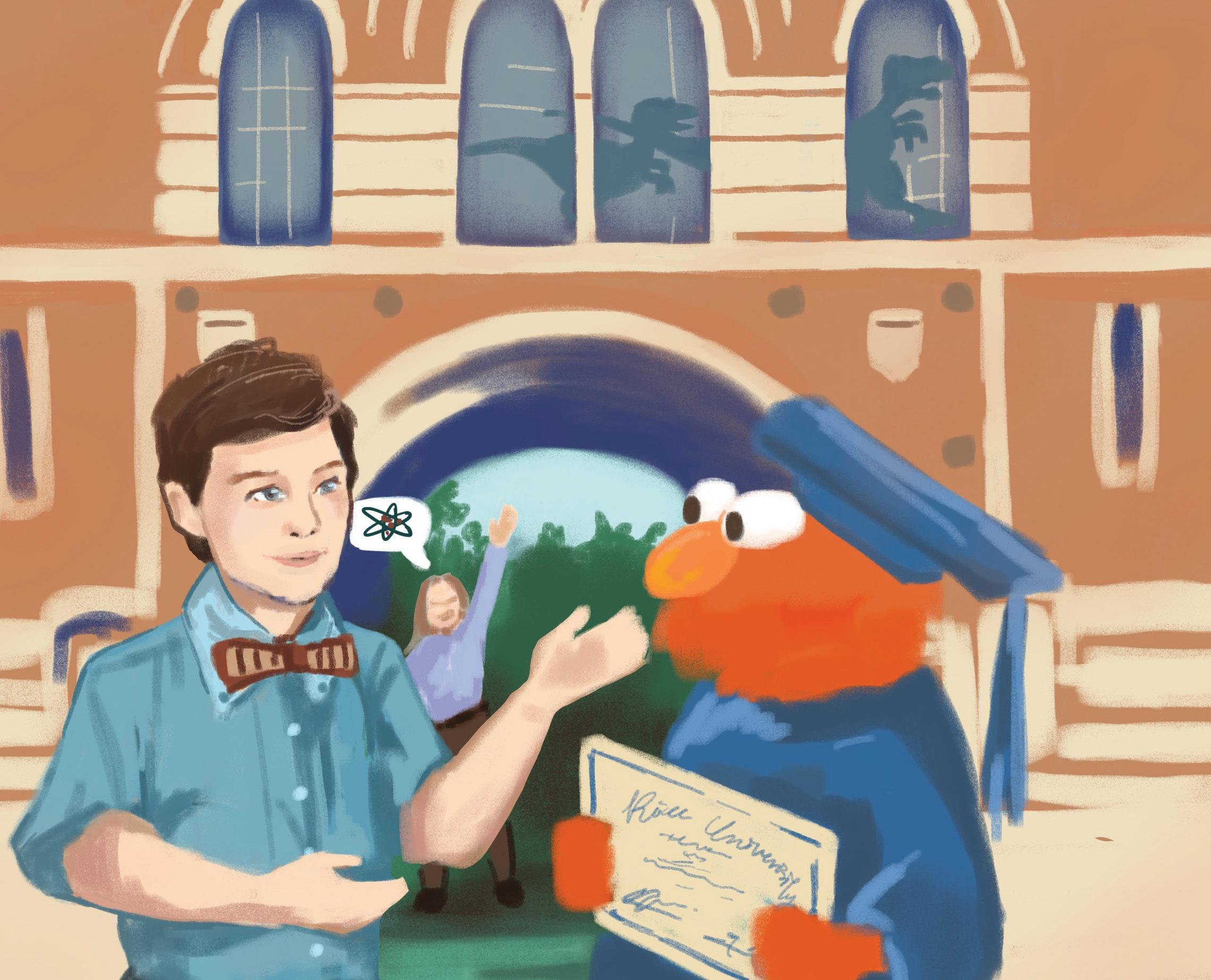
One alum graduated from Rice at just three-and-a-half years old — but only in a daydream. An astute Owl in an alumni Facebook group noticed a familiar backdrop in a 2008 episode of “Sesame Street,” in which Elmo learns a new word: “school.” Elmo is so excited by the concept of school that his sh, Dorothy, even fantasizes about what his graduation would look like, taking place in front of Rice’s Sallyport.
Rice’s ctional alumni tend toward a physics background. Brooke has her doctorate. Monica Rambeau, a Marvel Comics superhero who appears in the lms “Captain Marvel,” “The Marvels” and the
“WandaVision” miniseries, also holds a Rice Ph.D. in physics and astronomy.
Another astrophysicist, Joan Goodwin, is the protagonist of Reid’s 2025 novel “Atmosphere,” a romance set in the 1980s. Joan is a Rice professor who, like Brooke, becomes a NASA astronaut.
One Rice physicist featured on screen is not ctional at all. Jason H. Hafner Ph.D. ’98, a professor in the department of physics and astronomy, made a cameo appearance in the 2020 lm “Palm Springs,” which premiered at Sundance. Hafner holds a doctorate from Rice and still teaches at the university.
Not every ctional Owl studied physics. Gerald Morris, a character in the video game series “Tom Clancy’s Rainbow Six,” graduated from Rice in the 1980s with bachelor’s degrees in materials science and Russian literature. He went on to become a Rainbow operator (an elite counterterrorism agent) before pivoting to international terrorism. The international literature background, one could assume, was formative.
From the department of modern and classical languages, literatures and cultures, another alumnus appears in Jonathan Franzen’s 1992 novel “Strong Motion.” The protagonist, Louis Holland, has recently graduated from Rice with a degree in French. During his time on campus, he served as station manager at ktru.
The Marching Owl Band has made its own contributions to popular culture — though in one classic 1980s blockbuster,
another university band got the credit. In 1986, the MOB performed its signature rendition of “Louie Louie” in an episode of “Pee-wee’s Playhouse.” A house remix of the same recording, produced by Young MC, appeared in the 1990 comedy-drama “Coupe de Ville.”
Their most notable credit was for the 1988 crime comedy “The Naked Gun: From the Files of Police Squad!” On screen, the University of Southern California’s Trojan Marching Band performs. On the soundtrack, you hear the MOB’s arrangement.
A handful of feature lms have been shot on campus. Robert Altman featured Rice in his 1970 screwball comedy “Brewster McCloud.” The 1996 drama “The Evening Star,” adapted from a novel by Larry McMurtry M.A. ’60, brie y depicts student life.
In “The Evening Star,” Juliette Lewis plays Melanie Horton, a Rice undergraduate taking a class on early 20th-century literature in Keck Hall. A er unking an exam on the poetry of Rupert Brooke, she sprints across the Academic Quad to beg her professor for clemency.
Melanie lives o campus with her family. Her mother, played by Shirley MacLaine, lectures her on the price of tuition a er class. Eventually, Melanie drops out to become an actress.
A dropout, a terrorist, a superhero, an alien’s companion — Rice’s distinguished alumni on screen and in literature are as eclectic as its real ones. But the ctional ones don’t have to worry about Room Jack.
ASHLEY ZHANG / THRESHER
For most freshmen, Rice University is a maze of new buildings and unfamiliar faces. But for children of university sta , the campus is already a scrapbook of childhood memories. Long before Rice was a place of lecture halls and late-night study sessions, it was a landscape of playgrounds, parents’ o ces and summer camps.
Nyla Hartigan, a Jones College senior, said she grew up viewing the campus as a place to play rather than an academic institution. Hartigan’s mother, Louma Ghandour, serves as director of the o ce of faculty development, and her father, Patrick Hartigan, is a professor of physics and astronomy.
“I mostly thought of the university in terms of the summer program,” Hartigan said. “I remember spending time in [Gibbs Recreation and Wellness Center] and my parents’ offices, but not much time anywhere else on campus.”
While Hartigan was running around the Rec Center, Paul Yao, a Will Rice College freshman, experienced a quieter Rice. He recalls doing homework in his mother’s office while watching the campus move around him.
“The campus was beautiful,” Yao said. “I viewed it as a workplace rather than a school.”
For Thomas Kimbro, a Sid Richardson College sophomore, his early impressions were shaped by Rice baseball games and running around the tables between Brochstein Pavilion and Fondren Library while his mother, Dean of Social Sciences Rachel Kimbro, and his father, theatre lecturer Rob Kimbro, attended meetings.
“I was a big Rice baseball fan when I was a kid,” Kimbro said. “That was honestly the context in which I thought of Rice the most until middle school.”
When it came time to apply to college, that childhood familiarity played a major role. Yao said growing up on campus made Rice feel safe because he had a clear expectation of student life. Hartigan, who initially focused on outof-state schools, was ultimately won over by the culture and academic rigor she already knew existed at Rice.
But for Kimbro, the decision was practical. He started seriously considering Rice in his junior year of high school, largely driven by a benefit available to children of faculty and staff members. Rice provides tuition for the dependents of eligible staff or faculty who have worked at the university for at least three continuous years.
“The fact that tuition would be covered for me kind of overruled any other opinion I had about it,” Kimbro said.
Crossing the threshold from faculty kid to undergraduate changed the scenery. The spaces they occupied as children took on new meanings. Hartigan noted that her student memories now feel distinct from her parents’ routines.
“A lot more of the memories [at Rice] I made were separate from them,” she said.
Others found that the Rice of their childhood doesn’t quite match the Rice of today. Kimbro said he noticed the campus feels more pre-professional than it did when his parents attended in the 1990s, shifting both the academic and social atmosphere. Yao said he discovered sides of the university, such as the party scene, that were invisible to him as a child.
Despite the changes, that early exposure provided a unique foundation.
“It’s definitely a unique angle for a student to approach college from,” Kimbro said. “But it’s made me feel very at home and familiar with the school, which I appreciate.”
Generation Z nemesis
“___, you’re it!”
Type of text
“Kill Bill” singer
Tralalero _______
Corollas and Camrys
Musical compositions with several movements
Gives the facts
Scottish father
Hapless
Blood type
Shakespeare’s “____ Ado About Nothing”
Sporting goods retailer
End of the world, abbr.
“The Sign” band ___ __ Base
Social media feeds, abbr.
Hockey player Hughes, recently traded to the Minnesota Wild
Be serious
Perfect grade
Go to bed
First edition, abbr.
Group of three Frightens
“Up” on a map, abbr.
Weasel-like animal Draco Malfoy was turned into
Children’s book author Dr. _____
Food preservative, for short
Brownish gray
De nct Wiess
College public and way to say yes
Common fruit salad ingredient
Gloomy
Let loose, as hogs
Hockey goalposts
Saved shot that bounces into open ice
Player enters the zone too soon
Athletic wear brand
CBS drama concerned with DNA
College near the Texas Rangers’ home eld, for short
Wonder
2,000 pounds
Kit ___ (candy bar)
Texter’s expressions of gratitude Zilch
WEDNESDAY,
Tie-breaker periods, abbr.
Make or create
Mythical cure-all
“All The Things She Said” pop duo “I come from _ ____ down under” (1981 hit song lyric)
Caused to question one’s own sanity
They’re used to move 57-Down
Cloistered men
Television channel showing science ction, horror and fantasy
“Buckle your seatbelt!”
Ice resurfacer
Donkey
Solfege note a er sol
What a ghost might say
SoCal school that publishes The Daily Bruin
“Mom” in Scotland
Graduation distinction ______ borealis
Anderson Cooper’s channel
Lets go
Peace’s partner
“’___ the season!”
Medieval-themed fair in Todd Mission, abbr.
Young MC lyric “Now you know what to do, _, bust a move!”
Male hormone, slangily
U.S. gov. ID
Company’s main boss, abbr.
“The Birds of America” ornithologist John James League 31-Across plays in, abbr.
Slavic language spoken by Ilya Rozanov U.S. gov. org. that monitors pollution
Type of talk?
2002 lm “____ __ Like Beckham”
Reach the upper limit
High-IQ society
Neat, e ective
“Nyet,” in 44-Down
Rubber disc used in ice hockey
Forever chemicals, abbr.
“Is” in Barcelona
Traitor
“Mr. Blue Sky” band, for short
O ense committed behind the wheel, abbr.
Slippery swimmer
WEDNESDAY,
‘Purifying my life’: Students prepare for Ramadan
SHYLA JOGI THRESHER STAFF
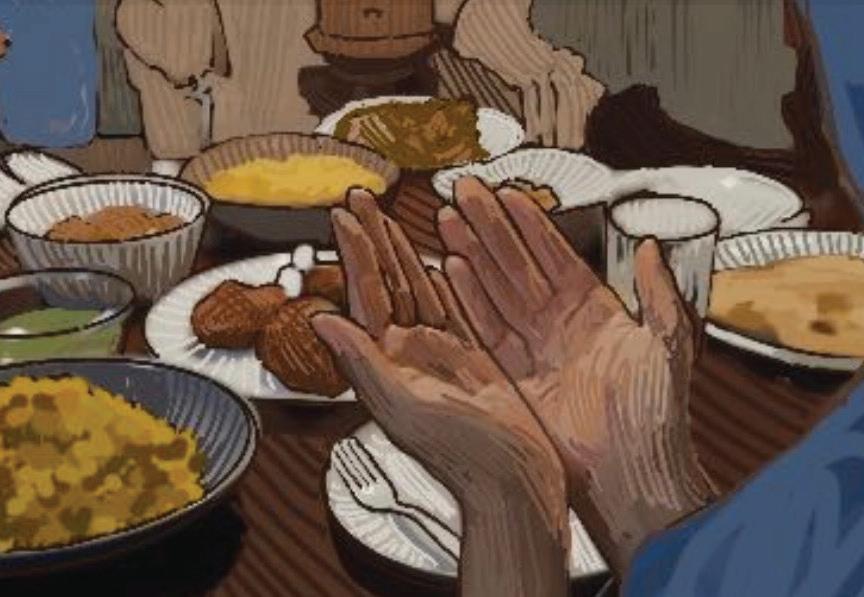
Students across the Rice campus and the world will blearily wake before the sun rises from Feb. 17 to March 19 this year. For the month of Ramadan, Muslims fast each day from dawn to dusk, a process intended for spiritual puri cation and increased self-discipline.
Mariam Khan, a Wiess College senior, said she sees Ramadan as a time for increased religiosity and initiating desired habits.
“We keep each other accountable, but we’re also aware of our own accountability,” Khan said. “I think this is something that’s very powerful about Ramadan, the idea that you’re not fasting in performance, your fasting is for Allah. It’s a relationship that is beyond all human interaction.”
Ali Usman, a Hanszen College freshman, said he acknowledges the importance of being immersed in his faith year-round.
“I don’t want it to be that I’m only thinking about my faith during the month and then all the time leading up to the month and all the time a er, I just forget about it,” Usman said. “I try to get myself in the headspace of purifying my life.”
This year will be Usman’s rst time experiencing Ramadan on campus without his family, which he said presents its own set of challenges.
“I have some Muslim friends here, but it’s kind of di erent when you’re within the community and it feels like you’re all in it together,” Usman said. “I expect it to be a little more of an isolating experience when I’m here alone, but I think it’ll be ne.”
Although Usman said he expects Ramadan on campus to be more di cult than at home, Khan has found it to be the opposite. She said she views the month as a way to add structure on top of the preexisting framework life at Rice provides.
“There’s so much structure in a day at Rice,” Khan said. “Every single day of your life disappears into meetings and classes and Google Calendar. So during Ramadan,
it’s almost like you’re just adding meetings with your Creator, which is what prayer is to begin with.”
Every single day of your life disappears into meetings and classes and Google Calendar. So during Ramadan, it’s almost like you’re just adding meetings with your Creator, which is what prayer is to begin with.
Mariam Khan WIESS COLLEGE SENIOR
Nayla Morshed, a Jones College junior, said fasting helps her study better when she’s not focused on her meals throughout the day.
KATHERINE CITINO / THRESHER
“It might seem like it’s very hard, but I actually feel like I have a clear mind when I’m fasting,” Morshed said. “I’m praying a lot and in a state of re ection during Ramadan.”
Khan said her experiences with the University of Oxford Islamic community during a semester abroad helped her deepen her faith even further, inspiring her to start attending nightly prayers.
“It was the rst time I was in a really large Muslim community,” Khan said. “It really encouraged me to increase my engagement with my religion on a daily basis, regardless of Ramadan.”
While the community was larger at Oxford, Khan said she has had positive experiences with how Rice assists students during Ramadan. For example, during Khan’s freshman year, she intended to spend each weekend at home 45 minutes away because the servery closed at 7:30 p.m. before i ar, the meal that breaks the day-long fast.
However, she ended up going home very little because of how accommodating the servery was, describing how it reopened in
time for students to break their fast.
“It’s not just the meals,” Khan said. “I had a midterm that took place during i ar. And I emailed my professor, and I told him my situation. He told me not to worry at all. And he actually shi ed my exam two weeks in the future, which was incredible.”
My favorite Ramadan memory has to be my freshman year, when me and some of the other [Muslim Student Association] girls on campus all met up. We did some prayers together and we made chicken and waffles, and it was just a really fun night.
Nayla Morshed JONES COLLEGE JUNIOR
Aside from the structural accommodations Rice a ords Muslim students on campus, Morshed said the university does a good job of creating a sense of community for them.
“I de nitely think the Muslim community plays a big part in my life on campus, and we’re a really close community,” Morshed said. “Everyone’s very supportive. My favorite Ramadan memory has to be my freshman year, when me and some of the other [Muslim Student Association] girls on campus all met up. We did some prayers together and we made chicken and wa es, and it was just a really fun night. It felt like a wholesome all-nighter.”
In addition to the community Ramadan builds, Usman sees it as a period of the year very di erent from the rest in terms of his state of mind.
“It’s hard to put the feeling into words,” Usman said. “You just feel this peace and spiritual strength.”
Ewoodzie said the course has had a lasting impact on students at previous institutions where he taught it.
“I have a kid who went and worked for Cleveland’s Housing Authority because they had a rapper from Cleveland that they researched,” Ewoodzie said. “I have people who become huge fans of whoever they get assigned because they listen to the entire catalog.”
Laymon’s Verses/Versus course takes a di erent approach. Focused on the Drake and Kendrick Lamar feud, the creative writing course asks students to listen to music and respond deeply through their own writing.
“I think for a lot of young people, it is rigorous to ask them to really consider what they’ve been listening to,” Laymon said.
Unlike a traditional lecture course, Laymon said his class depends entirely on student engagement.
“The students in that room are the most important texts we explore,” Laymon said.
Pinn’s Religion and Hip Hop course examines the relationship between rap music and Christianity and Islam, tracing hip-hop’s connections to spirituals and gospel music.
“Hip-hop’s relationship to religious traditions doesn’t come out of nowhere,” Pinn said. “It is part of a long history of cultural production being used within African American communities to wrestle with fundamental questions of our existence.”
The course brings local Houston artists to campus to discuss how religious commitments inform their music.
All three professors expressed interest in seeing hip-hop studies grow at Rice. Pinn said he is considering proposing a minor in hip-hop studies if faculty and student interest remain strong.
“My hope is that what we develop is
hip-hop studies that are interdisciplinary in nature,” Pinn said. “I’d love to see work being done at the school of music related to hip-hop or the business school on the business of hip-hop culture or the school of architecture.”
Rice is part of this growing wave of elite institutions that understand hip-hop culture has something to offer a rigorous education Anthony Pinn PROFESSOR OF HUMANITIES
Pinn said hip-hop studies now exist
at Harvard, Duke, MIT and other top institutions.
“Rice is part of this growing wave of elite institutions that understand hip-hop culture has something to o er a rigorous education,” Pinn said.
Ewoodzie, who has taught the course six times at previous institutions, said the course could help Rice better connect with communities outside the hedges.
“What I keep hearing all the time is Rice always attempts, and there are di erent levels of achieving or failing, to connect itself to communities outside of the hedges,” Ewoodzie said. “I’m hoping a class like this can be the beginning of some of those connections.”
All three professors said they encounter misconceptions about teaching hip-hop in an academic setting.
“The biggest misperception that people have is that hip-hop is just about ‘thugs,’ it has nothing to o er us,” Pinn said. “They misunderstand and don’t appreciate its signi cance and its depth.”
Ewoodzie said his course challenges assumptions about what constitutes serious academic work.
“This is not a music appreciation class,” Ewoodzie said. “It’s a sociology class that is treating hip-hop artists as people who can tell us, who can do some serious reporting.”
For Pinn, who has taught hip-hop courses for two decades, the current moment feels like validation of work that began long before it became fashionable.
“Attention to hip-hop will only grow as faculty members are added who find it intriguing and students still find it worth their time,” Pinn said.
Concerts to check out this semester in Houston
Bruno Mars
Date: April 22, 7 p.m.
Place: NRG Stadium
In between midterms, “there was an assignment on Friday?” and endless labs, everyone needs time to wind down, whether that be at a public party or with a well-deserved nap in your room. Nonetheless, an alternative to occupy your evenings is to take a trip to some of the amazing Houston concerts available this semester. Spanning events starting this weekend to others in the middle of March, there are more than enough options for any music fan.
“Free Rein”
Date: January 23 - January 25
Place: Midtown Arts & Theater Center Houston
Price range: Pay-What-You-Can + $5 checkout fee
An innovative, magical blend of music and science takes the rails in “Free Rein,” a fusion of music, dance, design and neuroscience that is debuting in Houston. This event tries to answer profound questions such as what happens inside the mind of an artist at the moment of creation and how inspiration moves between music, dance, visual art and audience.
You can embark on this philosophical discussion while you enjoy the projection of real-time neural activity of the dancers as they showcase their talent through rehearsed routines and spontaneous creativity.
The cost of this show is pay-what-youcan, meaning you don’t need to stretch your wallet to be part of this event. This can’t-miss experience is only available for three days at the Midtown Arts & Theater Center Houston and is only 10-12 minutes away from campus by car or bus.
Price range: $400+
Bruno Mars’ new hit “I Just Might” makes me think that I just might go to his concert on April 22 at NRG Stadium. That song will be one of the many played at “The Romantic Tour,” which includes many of his classics as well as recent hits, of which he has lots to spare.
Known for his strict no-phones policy for concerts, you can cut down your 15hour screen time and instead enjoy the memorable, engaging concert experience.
Also, Rice students get $30 worth of Metro rides each month when they sign up for a METRO QCard. Instead of paying $25 for parking or a Lyft, you can just use your card and be at NRG in around 15 minutes.
Houston Livestock Show and Rodeo
Date: March 2-22
Place: NRG Stadium
Price range: $21 - $70
A er the exhilarating experience of watching people fall o bulls and close calls in barrel riding, you can get a di erent kind of rush if you stay for the amazing selection of artists who take the stage.
From Lizzo’s long-awaited rodeo debut to Luke Bryan coming back for the 13th time, there’s someone for everyone. Other big names such as Kelly Clarkson, Tim McGraw, Cody Johnson and J Balvin make this year’s rodeo an incredible mashup.
Conan Gray
Date: March 11, 8 p.m.
Place: Toyota Center
Price range: $70+
Conan Gray, an American singer raised in our very own Texas, first became
popular with his song ‘Heather’ in 2020 after the song blew up on TikTok. Gray has an exquisite mix of pop, indie and acoustic sounds that make an amazing concert experience.
No need to waste that wishbone on wishing Conan Gray would come to Houston, because the “Wishbone World Tour” has a show at the Toyota Center on March 11.
Starting at 8 p.m., the show gives you enough time to finish up your Wednesday night lab before catching the late concert. If you go by Lyft or Uber, you can avoid the on-site parking fees.
Attack On Titan
Date: March 17, 7:30 p.m.
Place: Smart Financial Centre at Sugar
Land
Price range: $170+
In tone with the bloodthirsty Titans and the apocalyptic world, the music in “Attack on Titan” is otherworldly. The orchestra in the “Beyond The Walls World Tour” showcases all the intense emotions from watching “Attack on Titan” for the rst time. Instead of listening to the “Attack on Titan” soundtrack on your crappy laptop, you can go listen to it live with your favorite scenes playing simultaneously on high-resolution screens on March 17.
FIONA SIK / THRESHER
Professor Anthony Pinn leads Religion and Hip Hop Culture, a class that charts the dynamic between rap music and the religious themes that have inspired both its lyrics and sound.
ELÍAS MARTÍ-CASTRO FOR THE THRESHER
SKYLAR WANG / THRESHER
FROM FRONT PAGE HIP-HOP
Houston bars to check out this weekend
ARMAN SAXENA A&E EDITOR
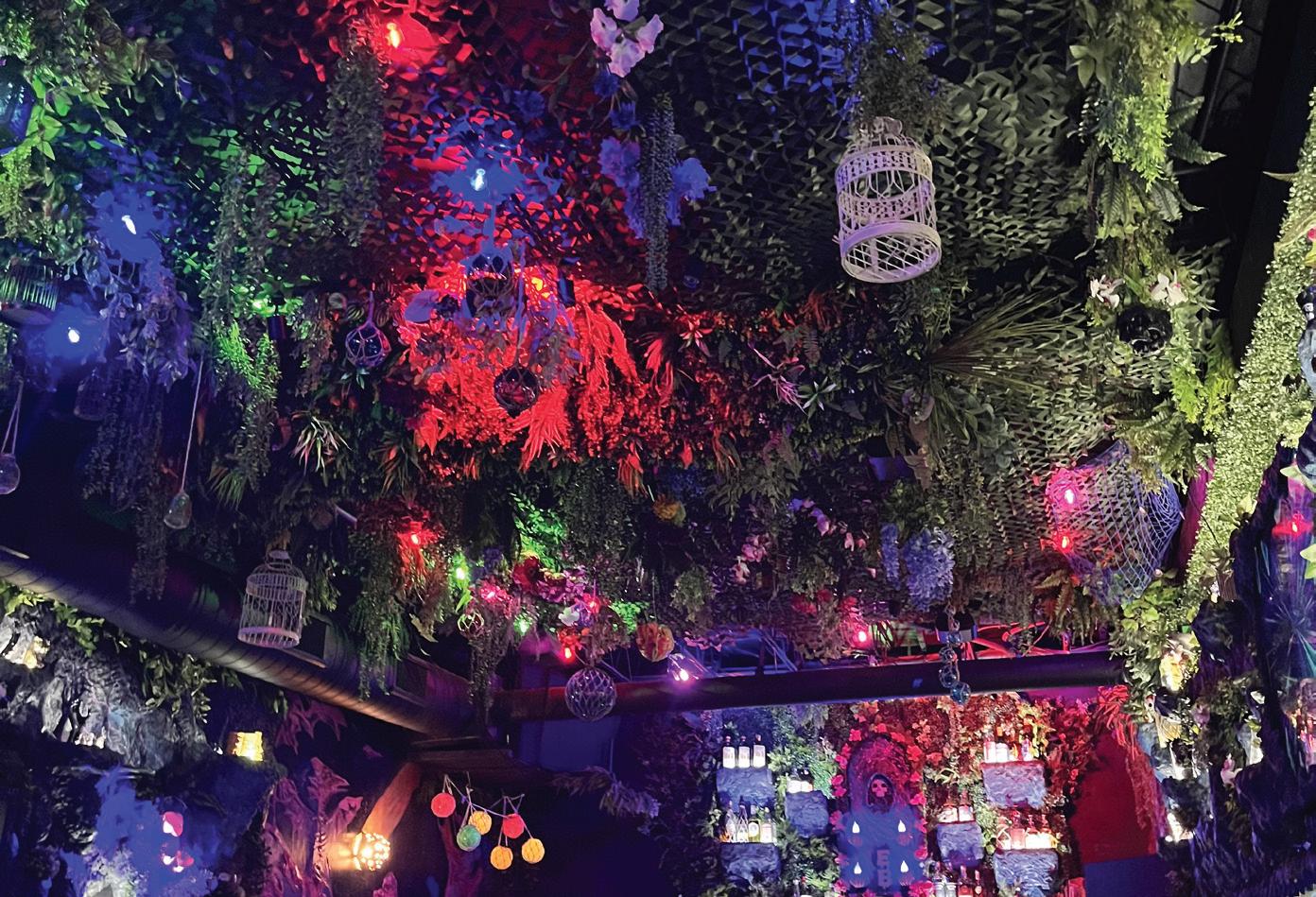
While Houston isn’t your classic college town, Bayou City’s bar scene, including areas near campus, has everything one could want in a local watering hole. From cozy neighborhood staples to polished cocktail hideouts, the city o ers something for every kind of night out. These are some of the best bars within Houston to check out — all within a reasonable distance from campus.
Anvil Bar & Refuge (~13 min drive from campus)
Anvil is a bar that takes classic cocktails seriously, with just enough air to keep things interesting. The space itself is intimate and beautifully designed, with seating best suited for groups of ve or fewer.
The espresso martini is a standout, as is Pliny’s Tonic. If you’re looking for a place that values atmosphere and consistency across drinks, Anvil is one of Houston’s most reliable cocktail institutions.
Bar No. 3 (~11 min drive from campus)
Tucked inside the La Colombe d’Or Hotel, Bar No. 3 feels like stepping into a quieter, more old-fashioned pocket of the city. Dark wood, so leather and low lighting give it a speakeasy-adjacent energy. It’s a cozy bar separate from the hotel restaurant, making it ideal for a solo drink or a date night.
Double Trouble Ca eine and Cocktails (~13 min drive from campus)
As the name suggests, Double Trouble excels at the co ee-cocktail crossover. The espresso martini is excellent, but the menu goes even further, o ering iced Mexican co ee, Irish co ee martinis and thoughtfully cra ed mocktails. The atmosphere is quaint, eclectic and e ortlessly cool, with a subtle tiki-meets-James Bond vibe.
One of the highlights is the patio, which features adjustable bamboo shutters you can move yourself. Friendly, prompt sta and a relaxed energy make this a great spot to catch up with friends or ease into a night out.
Endless Bummer (~10 min drive or ~15 min metro from campus)
Hidden inside Betelgeuse Betelgeuse on Montrose, Endless Bummer is worth visiting for the decor alone. The space is small, immersive and packed with personality, and the drinks hold their own. Cocktails are strong, balanced and thoughtfully constructed, with inventive twists on classics.
It’s a creative place with seasonal variations. During their recent “A Very Bummer Christmas” theme, the festive mugs and lighting added an extra layer of fun to the establishment’s atmosphere.
Two-Headed Dog (~13 min drive from campus)
Two Headed Dog walks the line
ERIC SHACKELFORD / THRESHER
Endless Bummer sits inside Montrose’s Betelgeuse Betelgeuse and boasts eclectic decor, an immersive atmosphere and classic cocktails.
between cocktail bar and dive. The vibe is lively, weird in the best way and full of character, starting with the must-see bathroom decor.
There’s free popcorn, water, board games and plenty of seating both inside and out. They don’t serve food and parking is scarce, so plan on a rideshare or a walk. Still, it’s a fantastic place to start or end a night.
Under the Volcano (~6 min drive from campus)
Under the Volcano is one of those places that feels like a casual spot you’re always happy to revisit. The frozen screwdriver is deservedly famous and the cocktails are consistently on point. The rotating beer selection keeps things fresh, and the food is incredibly solid, making this an easy pick for a low-key post-class evening.
Catch ‘Fridamania’ with the MFAH’s newest exhibit
RUBY GAO
THRESHER STAFF
Looking through the crowd in front of the painting, “My Dress Hangs There” hangs on the wall of the Museum of Fine Arts, Houston, echoing the surrealistic way Frida Kahlo’s iconic Indigenous dress hangs above the chaotic New York City.
“Frida: The Making of an Icon” examines the vibrant life of Frida Kahlo and tells the story of how she was posthumously transformed into one of the most in uential female artists.
The exhibition, which held its world premiere at the MFAH on Monday, is organized into seven thematic sections that address the perception and projection of the late Mexican artist as a phenomenon, showcasing over 30 of her works alongside 120 pieces by ve generations of artists inspired by her.
During the MFAH’s member lecture, Mari Carmen Ramírez, the exhibit’s curator, said “Frida” is the culmination of a research project by the International Center for Arts of the Americas that began four years ago.
Ramírez said the research stems from Kahlo’s de ance of the traditional de nition of the word “icon.”
“An icon is generally a singular yet malleable image that de nes a type of character, personality or even a celebrity that is widely admired for its captivating
features,” Ramírez said during the lecture. “Frida Kahlo’s case, however, is the opposite. Her iconicity is plural. This plural quality is at the core of what I refer to as the ‘Frida phenomenon,’ a combination of iconicity, myth and consumer culture.”
The exhibition opens with “Construction/Self-Construction,” which consists of Kahlo’s self-portraits, nude Kahlo in her husband Diego Rivera’s work and her Indigenous clothes and jewelry, which document how a young Kahlo deliberately fashioned her persona long before becoming an icon. The second section, “Surreal A nities,” reveals xations on death, dreams and masks.
Though o en labeled a surrealist, Kahlo is o en cited as having said, “I don’t paint dreams or nightmares. I paint my own reality.”
“She was a woman who turned herself inside out,” Ramírez said in the lecture. “In other words, whether capturing her face or splitting her body open to display her pain, Frida o ers herself to the viewer, positioning herself as being unmasked and direct.”
A er accompanying Rivera to the U.S. in the early 1930s, Kahlo felt alienated by its culture and yearned for her homeland. She believed that the United States was riddled with rampant consumerism and industrialization in contrast to Mexico’s cultural richness.
The third section, “On the Other Side of the Border,” consists of paradigmatic works that movingly depict Kahlo’s ambivalence toward the nation during her temporary residence.
The next section, “Gendered Dialogues,” shows Kahlo’s exploration of gender, identity and sexuality. Her exploration of sexed bodies against social conventions resonated with and in uenced feminist and LGBTQ+ movements from the 1970s onward.
The exhibition furthers with “Queer Interventions and Decolonization,” showing how artists across Latin America, inspired by Kahlo’s 1939 self-portrait “The Two Fridas,” have relied on her works to confront colonial histories, gender norms and social exclusion.
The h section, “Neo-Mexicanisms,” features additional works from subsequent generations of Mexican artists who have drawn on Kahlo’s interventions and reused
imagery from Mexican religious festivals, folk traditions and cra s to challenge and expand conceptions of what Mexican identity can look like.
Throughout the whole exhibition, two “ofrendas,” altars built in homes for Mexico’s Day of the Dead, stand quietly decorated with Kahlo’s own photos, photos with Rivera, paintbrushes and palettes to honor Kahlo’s brilliant art and spirit.
A er the 2000s, Kahlo’s in uence expanded. She became a role model for challenging norms and for her activism on matters of race, gender, sexuality and disability, as displayed in the sixth section, “A Pro-Activist Legacy.”
By embodying Kahlo’s spirit, feminist art pioneers in the U.S. such as Judy Chicago blended her distinctive mode of self-portraiture and iconography with their own, producing powerful statements that give voice to female perspectives. Other female artists have used Kahlo as a reference for the exploration of topics like miscarriage, the body’s a nity with nature and sexual violence.
She was a woman who turned herself inside out. In other words, whether capturing her face or splitting her body open to display her pain, Frida offers herself to the viewer, positioning herself as being unmasked and direct.
Mari Carmen Ramírez
EXHIBIT CURATOR
With a heart connected to a broken limb by a thin thread, the whole composition “From Heart to Hand” seems bloodsoaked, so saturated that it even appears to be brown. This work illustrates how Kiki Smith, in uenced by Frida Kahlo, pursued agency and performativity through the depiction of birth or miscarriage represented by isolated body parts.
Ramírez said in the lecture that Kahlo paved the way for Mexican feminist artists by expressing the female body in an innovative and personal way.
“In their view, before Frida, no other woman had succeeded in nding e ective ways to communicate the personal dimension of politics,” Ramírez said. “Meanwhile, for many white feminists at the time, Kahlo simpli ed the politics of the body and the notorious strife in her marriage, the result of prevailing in delity, exempli ed women’s oppression.”
The exhibition ends with “Fridamania.” Frida’s rise as a pop icon coincided with the commercialization of her art and image, a trend that began in the mid-1980s and continues today. The section is full of commodities featuring Frida Kahlo, concluding with the photograph “Everyone Can Be Frida” by Camila Fontenele.
Ramírez said the obsession with Frida Kahlo goes beyond just focusing on her identity.
“Even though people use her image to support good causes, this creates a problem,” Ramírez said. “She is being turned into a generic product. Instead of seeing her complex reality, we just see a stack of labels — Chicana, feminist, queer — piled on top of her. These labels act like a mask, turning her into a silent icon and hiding the real woman underneath.”
Inspired by the exhibition, the MFAH will host the runway show for its annual “Fashion Fusion” design competition on Jan. 30, during which aspiring designers showcase garments in conversation with Kahlo and the artists she influenced over the past five decades.
The exhibition is on view at the MFAH until May 17 before traveling to Tate Modern in London. Stepping inside the vibrant space, viewers can experience Frida’s works alongside those of artists inspired by her, uncovering her many facets and ties with pressing issues.
“The fact that by means of Kahlo’s iconicity, they can all claim a place at the illustrious table reaffirms her endurance as an emblem of nonconformity and a standard bearer for those who operate from the margins,” Ramírez said.
FIONA SIK / THRESHER
Rio Yanez’s “Ghetto Frida’s Mission Memories” is part of the Museum of Fine Arts, Houston’s newest exhibit “Frida: The Making of an Icon,” exhibiting until May 17.
Norigami’s chefs cra nigiri with love and discipline
SOFIA KALOFONOS FOR THE THRESHER
In Japan, an aspiring sushi chef trains for nearly a decade before earning the title of “itamae” (master). The journey begins with a year of humility, as “deshi” (apprentices) scrub plates and clean fish. This is followed by three years devoted entirely to mastering rice.
Only then do chefs advance to the rank of “wakiita” (senior apprentice),
where they learn knife skills and garnish preparation. After years of discipline, an “itamae” is finally entrusted with leading the kitchen. Even then, the art of crafting nigiri can take a lifetime to perfect.
Chef Don Yamauchi explains this hierarchy to me as he assembles an avocado hand roll. A Houston native, Yamauchi never trained in Japan; instead, he learned under the Taiwanese head chef at Norigami, a sushi restaurant ten minutes northwest of campus.
Despite his unconventional path, Yamauchi’s respect for tradition is evident in every movement.
years ago and has since risen to become something of a Houston institution, with 4.4 stars and 106 reviews on Yelp. In a city saturated with Japanese restaurants, standing out is no small feat — but Norigami manages to do exactly that.
Yamauchi is a major part of the equation. Seating is arranged around a U-shaped bar that encircles the kitchen, placing diners only feet from where he prepares their food.
Guided by “fusui” — the Japanese adaptation of feng shui — the space feels alive and communal. Across the bar, where I was celebrating the end of nals season, a couple laughed together on their rst anniversary. The room felt less like a restaurant and more like a gathering.
The other fantastic element of Norigami is, of course, the food. You can taste all three years of rice training in each bite. It felt almost theatrical as I watched Chef Yamauchi finish the seared scallops with a blowtorch, his movements confident and precise. The king salmon sashimi tasted impossibly fresh, as though it had lived a very good life before reaching my plate.
It would be criminal to leave without sampling one of Norigami’s signature cocktails. However, our waitress began the night with a solemn apology.
“We’re out of coconut,” she said, in the same tone one might use to announce a tragedy.
Despite the blow, I carried on. With a sweet tooth, I asked for her recommendation and was guided toward Nice to Matcha, a rum-infused matcha cocktail that proved both indulgent and refreshing.
As Anthony Bourdain once said, “A great sushi bar is like the perfect Irish pub. You make decisions with your sushi chef, with your bartender, over the course of the night, and you leave feeling extremely well cared for.”
Norigami began as a pop-up just two
Norigami delivers exactly that experience, sending you home with a full stomach and an equally full heart.
‘Heated Rivalry’ depicts desire without apology
THOMAS LU FOR THE THRESHER
Sports have always been gay — or, at the very least, homoerotic. Nowhere is this more prevalent than in 2025’s hit show “Heated Rivalry.” The show, an adaptation of the rst two books of Rachel Reid’s “Game Changers” series, follows two hockey players as they navigate their rivalsto-lovers romance on the ice.
The show stars Connor Storrie as Ilya Rozanov, a brash, seemingly hot-headed Russian, and Hudson Williams as Shane Hollander, a shyer, more reserved Asian Canadian. Their acting and chemistry shine especially in their on-screen arguments, which feel realistic and grounded. They bring the characters’ internal monologues and motivations to life with subtle shi s in their facial expressions and nuances that o en demand full attention.
The show isn’t entirely about Hollander and Rozanov’s budding relationship.
Robbie G.K. plays Kip Grady, a smoothie shop worker who falls in love with Francois Arnaud’s Scott Hunter, an older and more established hockey player in the show.
the central couples to live more freely and express their feelings truthfully.
Jacob Tierney, who serves as showrunner, writer and director, cra s episodes in which not a moment is wasted. Even the numerous sex scenes serve to underscore the characters’ shi ing dynamics as their relationship evolves.
Their relationship, following a more traditional romance timeline, plays a pivotal role in bringing Hollander and Rozanov together. The rest of the cast, which includes actresses Sophie Nélisse and Ksenia Daniela Kharlamova, serve as great supporting characters who encourage
Those scenes usually linger, with minimal background music and cuts, focusing only on Hollander and Rozanov. Outside of these scenes, the show keeps a tight, organized timeline with a pace that is quick but never feels frantic.
These acting and writing talents deliver
a show that feels electric from start to nish, making for a riveting watching experience. What lies at the center of the show is the struggle for authenticity that its characters face. Hollander and Rozanov constantly wrestle with the pressures of being a professional athlete and being in love with another man. They try to push the other away, yet orbit and draw closer with all the inevitability of a true, will-they-won’t-they romance. Viewers wait on the edge of their seats, aching for Hollander and Rozanov to be able to love in the light.
The pursuit of authenticity feels all too real today. In fact, while pitching the show,
Tierney met with an American executive who told him to save the rst kiss for the h episode, out of six total episodes. Tierney believed it would undercut the nontraditional nature of Shane and Ilya’s relationship, so he sought out alternative sources of funding to produce the show. It’s a good example of staying true to one’s vision and not compromising on core beliefs. At a cultural moment where studio heads prefer uncontroversial content to bold storytelling, “Heated Rivalry” stands out as a fearless exploration of what it means to insist on rawness without apology.
SOFIA KALOFONOS / THRESHER
The hamachi crudo topped with tru le, cilantro, serrano peppers and fried garlic is one of the signature shareables on the menu of Norigami, a sushi restaurant 10 minutes northwest of Rice campus.
COURTESY CRAVE
“We got a bit complacent with some of our defensive stu and had defensive slippage in that third quarter,” head coach Lindsay Edmonds said.
The Owls weathered the storm, extending the lead to eight by the end of the third quarter and eventually outscoring UAB 24-12 in the fourth quarter.
“I think it was just about the mindset of ‘that was their run and now we gotta go on our run,’ and I think we answered in a really dominant fashion,” Edmonds said.
The Owls were led by senior guard Dominique Ennis, who scored 19 points on just nine shots, and senior center Shelby Hayes, who added 18 points and 12 rebounds.
“I felt great,” Hayes said. “Teammates got me the ball, and they just trust me to go in there and do my thing every time.”
Redshirt junior forward Hailey Adams also lled the stat sheet, putting up 10 points, 13 rebounds and seven assists.
“She does so many things really well,”
said Edmonds. “She’s our Swiss Army knife.”
Heading into the game, UAB ranked last in the American in o ensive rebounds allowed, and Rice exploited this weakness by grabbing 12 o ensive boards compared to UAB’s ve. The Owls continued to ourish at the free-throw line, making all 12 of their attempts. The Owls are now shooting 82% on
free throws for the season, the second-best mark in Division 1 women’s basketball. On the ip side, the Blazers went just 5-for-12 on free throws, a crucial seven-point di erence in the game.
Edmonds said Rice’s success at the line was not purely luck-based.
“It’s about [the players’] focus and also
about our prep work in it,” Edmonds said. “We shoot free throws every single day, multiple times during practice.”
Rice rode this momentum into a close game against UNT on Saturday. The Mean Green pulled close with a 7-0 run to open the fourth quarter, but the Owls held o UNT’s late comeback e ort to win by four points.
“It’s always a battle between us and North Texas,” Edmonds said. “We know each other.”
Junior guard Victoria Flores led the Owls with 16 points, shooting 6-for-12 from the eld and 2-for-4 from beyond the arc. Adams added six rebounds and two assists, tying team-highs.
With the victory, Rice snapped UNT’s 13-game conference home game winning streak. The Owls’ 10-game winning streak is their longest since the 2019-20 season, and it’s also the longest during Edmonds’ stint as head coach.
“I’m incredibly proud of the toughness we showed to withstand their run in the fourth quarter and secure the win,” Edmonds said. “We displayed extreme togetherness and grit down the stretch.”
Rugby captain to try out for collegiate all-star
Zain Nazir, captain of Rice rugby, was selected as the only athlete from Rice to try out for the Lonestar Conference’s All-Star Rugby team.
The Lonestar Conference is composed of Texas A&M University, the University of Texas at Austin, Sam Houston State University and other Texas universities.
“They select a couple of players from each team to come and represent them,” said Nazir, a Duncan College senior. “You go through four rigorous tryout sections, and they narrow it down per tryout. I’m currently on the second round of that.”
If Nazir makes the team, he will have a chance to represent the U.S. in Ireland over the summer.
Nazir said he has been an athlete his entire life, but he had never played rugby before coming to Rice. His rugby journey began in his freshman year when he was recruited a er Orientation Week.
“I didn’t have any experience with it before,” he said. “I had just played football.”
Through Rice rugby, Nazir had the chance to train internationally under the All Blacks, New Zealand’s national team, as well as with Houston professionals who coached him throughout his journey.
“Rice Rugby has connected me with professionals,” Nazir said. “I’ve gone through four di erent coaches altogether, three of which are professional players and two of which are on or were on the U.S.A. national team at one point.”
Nazir has a rigorous training schedule to make sure that he’s prepared for his tryouts for the national team.
“Rice Rugby has training on Tuesday and Thursday from 4 to 6 p.m.,” Nazir said. “Outside of that, I train with one of the men’s teams in Houston, HARC. I
train with them Tuesdays and Thursdays from 8 to 10 p.m.”
On the days he’s not in practice, Nazir said he trains on his own, with intense workouts involving either li ing or additional training with his rugby friends around Houston.
Looking internationally, Nazir said he hopes to play for Pakistan’s national team. He had the opportunity to train with them for a couple of months and has been in contact with the coaches.
“The hope is that I can at one point represent them in whatever kind of test series they have going on,” Nazir said. “I hope to be able to represent my country.”
The coolest feeling is being able to represent your school, play hard and leave it all out on the field.
Zain Nazir
DUNCAN COLLEGE SENIOR
Having submitted his game film to the team, Nazir said he hopes to emphasize that he’s been a versatile player throughout his rugby career, having been trained to play different positions such as loosehead prop, hooker, and inside center. This required him to train differently off the court to ensure his weight matched his position.
“I completely changed my body composition, playing a completely di erent role than I did,” Nazir said.
Nazir recalled having to go from 250 pounds playing loosehead prop his freshman year to around 195 pounds sophomore year to play hooker.
This article has been cut o for print. To read more, visit ricethresher.org.
The Owl connection
Indiana University’s head football coach Curt Cignetti started his FBS coaching career at Rice. He was the Owls’ quarterbacks coach from 1986 to 1988.
Cignetti’s Hoosiers won the College Football Playo National Championship with a 27-21 victory over the University of Miami on Monday night.
Indiana entered the 2025 season with the most losses in NCAA football history. However, under Cignetti’s leadership, they went 16-0 and became the rst program since 1996 to win a National Championship for the rst time in school history.
ZAID RASHID THRESHER STAFF
KONSTANTIN SAVVON / THRESHER
Duncan College senior Zain Nazir prepares to catch the ball during a Rice Rugby match against Sam Houston State University on Sept. 9. Nazir is trying out for the Lonestar Conference All-Star team.
KAIRI MANO / THRESHER
Senior guard Dominique Ennis celebrates with junior guard Louann Battiston during a Rice women’s basketball game against Middle Tennessee State University on Nov. 15.
Women’s tennis sweeps Lamar in season opener
OLIVER STERN FOR THE THRESHER
The Rice women’s tennis team defeated Lamar University 7-0 Sunday a ernoon. The Owls dominated the early doubles matches, securing an early rst point before rolling through singles play to grab their rst win of the 2026 season.
Coming into Sunday, Rice held an alltime record of 31-1 against Lamar, with the sole loss in 1980. With their win on Sunday, the Owls have now gone three consecutive matchups against the Cardinals without dropping a match.
Rice wasted no time setting the tone in doubles as they captured the two matches necessary to secure the single point available from the rst three matches.
On Court 3, freshman Ema Mravcova and junior Anushka Ashar shook o some early rust and picked up a 6-1 win. Strong play by Ashar gave the pair an early 2-0 lead before Lamar picked up their rst and only game of the match.
Mravcova consistently excelled at the net throughout the match, adding an ace at 4040 to halt Lamar’s momentum and secure a 3-1 lead. Mravcova and Ashar then won 11 consecutive points late in the set and sealed the victory on an unforced error by Lamar.
We’ve been training great the past two weeks and have been focused. We were ready for doubles and singles, and we showed it.
Fernanda Martinez
SOPHOMORE TENNIS PLAYER
“Ema has been very disciplined in making a lot of shots, and college tennis is about that,” head coach Elizabeth Schmidt said. “She’s learning when to step up her pace, and she’s really starting to nd her rhythm.”
The matchup on Court 2 went even better for the Owls, as sophomores Fernanda Martinez and Francesca Maguina cruised to a 6-0 win. The duo hurried out to a 3-0 lead and faced a no-ad point in the fourth game, which they handled before rattling o the next eight points to seal the match.
“We’ve been training great the past two
weeks and have been focused,” Martinez said. “We were ready for doubles and singles, and we showed it.”
I was really locked in on my tactics given to me by my coaches. I was just trying to be disciplined and play my best shots.
Ema Mravcova
FRESHMAN TENNIS PLAYER
Rice’s rst-ranked doubles pair juniors Uma Bakaityte and Nithesa Selvaraj jumped out to a 3-0 lead in their match. However, a er some extended games slowed the pace, the doubles matches on Courts 2 and 3 concluded, securing the doubles point for Rice. Once the sole doubles point was claimed by Rice, Bakaityte and Selvaraj’s match was stopped with Rice leading 4–1 and ruled un nished.
Similar to doubles, it was complete domination for the Owls as they won 72 of the 91 games across their six singles victories.
Bakaityte nished her singles match with a decisive 6-3, 6-2 victory.
A er not competing in doubles play, junior Divna Ratkovic pushed through a slow start to overpower her opponent. Ratkovic went up 2-0 early before her opponent won two consecutive no-ad points to tie the set at 2-2. From there, Ratkovic never looked back as she won the next 10 games to close out a 6-2, 6-0 victory.
Maguina continued the momentum from her early doubles victory and won 6-2, 6-1. Her opponent got out to a 1-0 lead before Maguina took ve consecutive games and closed out the opening set on a no-ad point. Maguina broke serve repeatedly in the second set to secure the win and give Rice the fourth point it needed to o cially beat Lamar.
Similar to Maguina, Martinez stayed hot from her doubles match and won 6-0, 6-0 to end her return to the court without dropping a single game.
Last year, Martinez su ered a seasonending injury that shortened a freshman season in which she posted a 19-4 singles record and was named AAC Freshman of the Week following singles and doubles wins against the University of Houston.
“It was just great to have her back out there for her rst real match post-surgery,” Schmidt said. “The level of play that she was playing at was really good.”
Mravcova also carried over her strong doubles play to the singles court, where she picked up a 6-3, 6-1 win. A er a tightly contested rst set that saw the two players locked up at 3-3, 30-30, Mravcova broke her opponent twice to win the set 6-3. Mravcova won six consecutive games spanning the end of the rst set and the start of the second to run away with a win.
“I was really locked in on my tactics given to me by my coaches,” Mravcova
said. “I was just trying to be disciplined and play my best shots.”
The Owls collected their seventh and nal point with Selvaraj closing out her opponent 6-2, 6-3. Following their rst win of the season, Rice will travel to Charlottesville, Virginia, for the ITA Kicko Weekend. The Owls will face No. 14 University of Virginia on Saturday before taking on either No. 19 University of Southern California or the University of Wisconsin on Sunday. If the Owls win their region, they will earn one of the qualifying spots for the ITA National Team Indoor Championship.
KAIRI MANO / THRESHER
Uma Bakaityte prepares to hit the ball during a home match on Jan. 18. The Owls swept Lamar University 7-0, securing their rst win of the 2026 season.
KAIRI MANO / THRESHER
Uma Bakaityte celebrates during a home match on Jan. 18. The Owls swept Lamar University 7-0 and will now prepare for ITA Kicko Weekend.
‘I’m in heat!’: ‘Heated Rivalry’ Pub Trivia leads to rise of clubs about gay men run by straight women
A er last week’s incredibly heated “Heated Rivalry” trivia night at Pub at Rice, a group of spirited students announced that they were establishing a new student organization, Straight Women for Gay Media. The club is hoping to capitalize on the recent widespread support among straight women for the television series “Heated Rivalry” and other forms of gay media. It will o er a safe space for women to talk about their favorite gay characters, read u /smut fan ction on Archive of Our Own and speculate about the sexualities of people around them.
Cecilia McCoy, one of the founding members of SWGM, spoke about the gap in Rice’s current queer club o erings.
“We noticed that while there are spaces like Rice Pride and Chaus that provide the opportunity for queer people to discuss current happenings in gay media, there isn’t an exclusive space for straight women to do so,” said McCoy, a freshman.
McCoy went on to explain that she needs a space to “fujo out” about “Heated
Rivalry” characters Shane Hollander and Ilya Rozanov without judgment.
As there are already 500 women on the listserv, SWGM has adopted a rigorous selection process. Prospective members of SWGM will be required to submit a 10-page report on the homoerotic subtext in “Wheel of Fortune” and be able to thoroughly explain foundational concepts such as the Omegaverse.
“This way we can ensure the most informed and nuanced discussions of gay media,” said Dorothy Birdwhistle, another founding member of SWGM.
For one of its rst events, SWGM is planning to pick two players from the Rice men’s basketball team to nonconsensually fantasize about — or “ship” — until they publicly declare a romantic relationship in the fashion of characters Scott and Kip from “Heated Rivalry.” The club will select the rst two players to look at each other on the court during the team’s next game.
A spokesperson from the organization has stated SWGM will “gently encourage” the two men to come out as a couple by harassing their social media pages with Grok-generated images of them kissing. In response to criticism of this plan, the club
cited YouTubers Dan and Phil as a clear success story of this strategy.
The founding of SWGM triggered a cascade of similar clubs to form around campus. Inspired by the times when numerous gay men and straight women recreated sex positions in front of a massive audience at “Heated Rivalry” trivia, the Gay Best Friend Club was formed. The club caters to an audience of straight women endlessly fascinated by their gay best friends’ unique culture. Subsequently, a smaller club named the Straight Women Doing Poppers Club was formed.
I was a gay man in the 1970s in my past life.
Madison Relish SWDPC FOUNDING MEMBER
“I was a gay man in the 1970s in my past life,” said Madison Relish, founding member of the SWDPC. “I was really in with the, you know, underground scene. Everybody there was, like, so edgy and grimy and gross, but so fun and interesting! Like, it makes me
want to say, ‘yass, mama, queen, slay, diva!’”
The in ux of SWGM-related clubs has not avoided controversy, causing somewhat of a heated rivalry between clubs. Linda Ebert, founder of the new Straight Women for Rare Pairs club, decided to create her organization a er being cut from a shortlist of potential SWGM members.
“They refused to acknowledge the feasibility of my ship of the Property Brothers from ‘Property Brothers,’” said Ebert, a sophomore.
Straight Women for Straight Media, another organization created in the wake of SWGM, plans to discuss shows such as “Law & Order” and “Yellowstone.” They plan to table outside of public parties, passing out pamphlets on the importance of straight representation.
Despite this budding controversy, however, the founders of SWGM are hopeful that all clubs can coexist.
“We’ve seen what shows like ‘Heated Rivalry’ can do to unite all types of people, although mostly straight women. We hope that our organization and others can spread awareness of the importance of straight people watching non-straight media, and we can all come, together,” McCoy said.
The Backpage is the satire section of the Thresher, written this week by Will Howley, Charlie Maxson, Rykelle Sandidge, and Max Scholl, and designed by Brandon Nguyen. For comments or questions, please email realricethreshero cial@rice.edu.