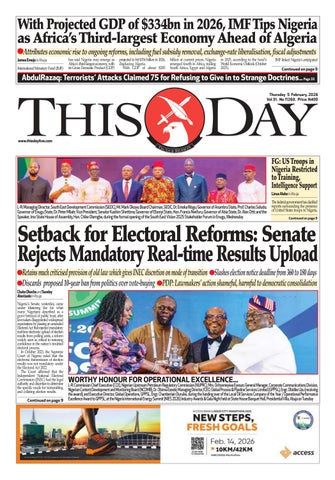
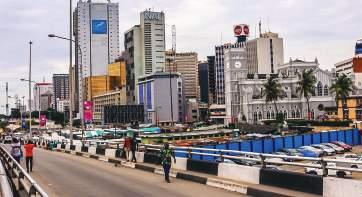
With Projected GDP of $334bn in 2026, IMF Tips Nigeria as Africa’s Third-largest Economy Ahead of Algeria
Attributes economic rise to ongoing reforms, including fuel subsidy removal, exchange-rate liberalisation, fiscal adjustments
James Emejo in Abuja International Monetary Fund (IMF)
has said Nigeria may emerge as Africa’s third-largest economy, with its Gross Domestic Product (GDP)
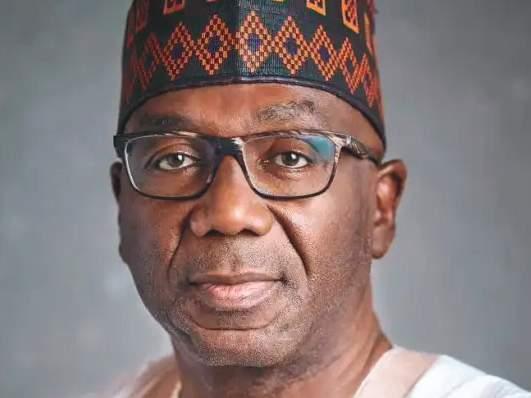
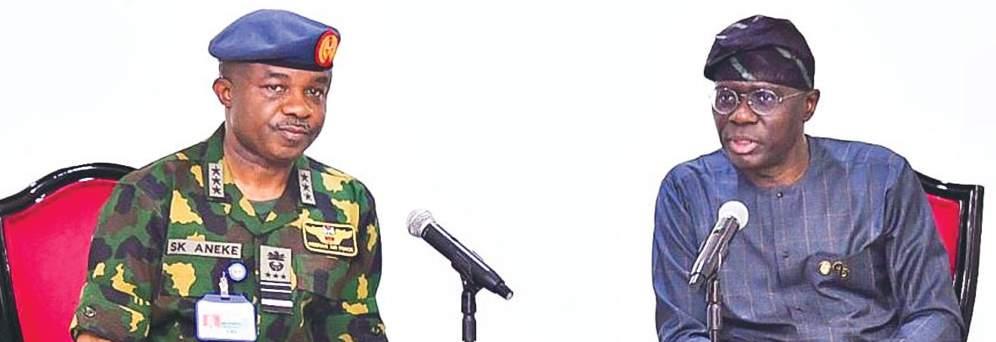
AbdulRazaq: Terrorists’
www.thisdaylive.com
projected to hit $334 billion in 2026, displacing Algeria. With GDP of about $285
billion at current prices, Nigeria emerged fourth in Africa, trailing South Africa, Egypt and Algeria
in 2025, according to the fund’s World Economic Outlook (October 2025).
IMF linked Nigeria’s anticipated
Continued on page 9
Setback for Electoral Reforms: Senate Rejects Mandatory Real-time Results Upload
Chuks Okocha and Sunday Aborisade in Abuja
Nigeria’s Senate, yesterday, came under blistering fire for what many Nigerians described as a grave betrayal of public trust, after lawmakers disappointed widespread expectations by passing an amended Electoral Act that rejected mandatory real-time electronic upload of election results from polling units, a reform widely seen as critical to restoring confidence in the nation’s troubled electoral process.
In October 2023, the Supreme Court of Nigeria ruled that the electronic transmission of election results was not mandatory under the Electoral Act 2022. The Court affirmed that the Independent National Electoral Commission (INEC) had the legal authority and discretion to determine the specific mode for transmitting and collating election results.
Continued on page 9
WORTHY HONOUR FOR OPERATIONAL EXCELLENCE...
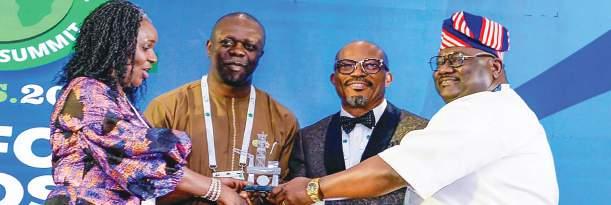
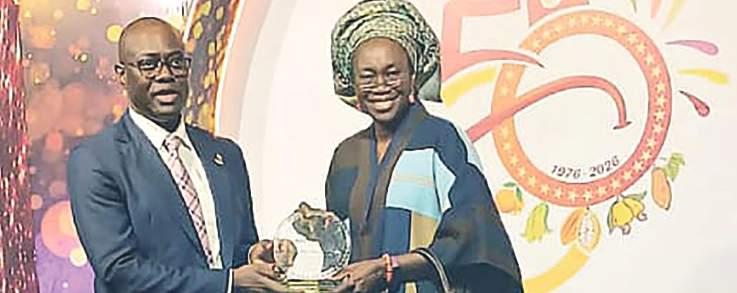
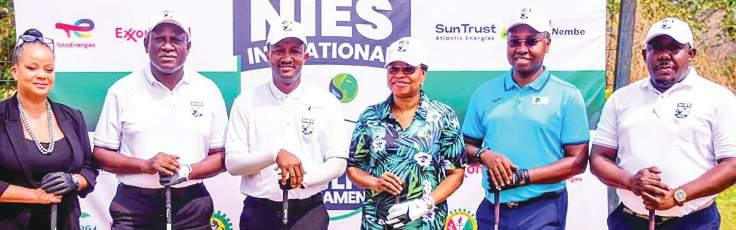
L-R: Commission Chief Executive (CCE), Nigerian Upstream Petroleum Regulatory Commission (NUPRC), Mrs. Oritsemeyiwa Eyesan; General Manager, Corporate Communications Division, Nigerian Content Development and Monitoring Board (NCDMB), Dr. Obinna Ezeobi; Managing Director/CEO, Global Process & Pipeline Services Limited (GPPSL), Engr. Obidike Uzu (receiving the award); and Executive Director, Global Operations, GPPSL, Engr. Chamberlain Duruike, during the handing over of the Local Oil Services Company of the Year / Operational Performance Excellence Award to GPPSL, at the Nigeria International Energy Summit (NIES 2026) Industry Awards & Gala Night held at State House Banquet Hall, Presidential Villa, Abuja on Tuesday
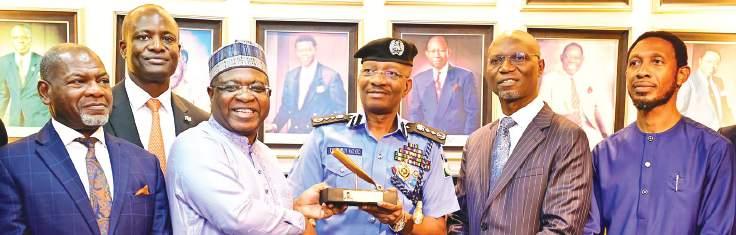
L-R: Managing Director, South East Development Commission (SEDC), Mr. Mark Okoye; Board Chairman, SEDC, Dr. Emeka Wogu; Governor of Anambra State, Prof. Charles Soludo; Governor of Enugu State, Dr. Peter Mbah; Vice President, Senator Kashim Shettima; Governor of Ebonyi State, Hon. Francis Nwifuru; Governor of Abia State, Dr. Alex Otti; and the Speaker, Imo State House of Assembly, Hon. Chike Olemgbe, during the
Linus Aleke in Abuja
The federal government has clarified reports surrounding the presence of United States troops in Nigeria,
ABDULSALAMI ABUBAKAR AND WIFE PAY CONDOLENCE VISIT TO THE OJORAS...
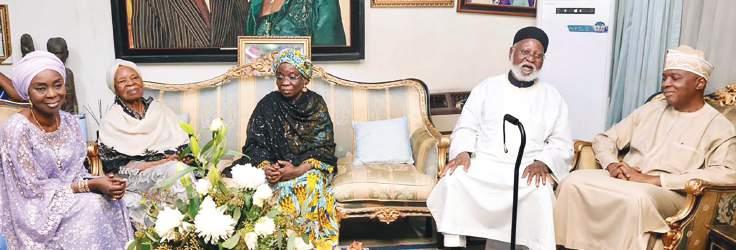
L-R: Daughter of the deceased, Mrs. Toyin Ojora-Saraki; widow of the deceased, Erelu Ojuolape Ojora; wife of former Head of State, Justice Fati Abubakar; and former Head of State, General Abdulsalami Abubakar, during a condolence visit to the Ikoyi home of the Ojoras following the death of Otunba
At South-East Vision 2050 Blueprint Launch, Shettima
Says Region Central Pillar of Nigeria’s Economic Future
Gov Mbah proclaims South-east can’t afford to operate as 5 parallel actors Lauds Tinubu for SEDC, calls it catalyst for regional devt
Deji Elumoye in Abuja and Gideon Arinze in Enugu
Vice President Kashim Shettima on Wednesday launched a 25year development blueprint for the South-east region, saying the region is a central pillar of Nigeria’s economic future.
Shettima also announced that President Bola Tinubu had approved the establishment of the South East Investment Company Limited, designed to mobilise resources from the diaspora, capital markets, and development finance institutions for the region’s development.
Speaking during the South-East Vision 2050 Regional Stakeholders’ Forum in Enugu, the vice president said the gathering was a decisive break from short-term governance cycles towards a structured, multidecade development framework.
At the event, Governor of Enugu State, Dr. Peter Mbah, declared the South-east must be reimagined and built into a common market and economic bloc in order to realise its potential as an economic power house.
Mbah emphasised the South-east could no longer afford to operate as five parallel states, commending Tinubu for the establishment of South East Development Commission (SEDC). He said it was a clear demonstration of an understanding that regional development never occurred in isolation.
NDPC
Mbah spoke on Wednesday as Shettima, officially declared open the South East Vision 2025 (SEV2025) Regional Stakeholder Forum at the International Conference Centre (ICC), Enugu.
Shettima, stated, “This forum reflects foresight, responsibility, and a shared understanding that the future is not something we wait for, but something we must deliberately design.
“In recognition of the distinctive character of the South-East, its entrepreneurial spirit, its global diaspora, and its long-standing relationship with international capital, President Bola Tinubu approved the establishment of the South East Investment Company Limited.”
According to Shettima, the company will work in synergy with the South-East Development Commission (SEDC) to address postwar infrastructure gaps and drive long-term regional competitiveness.
The vice president reaffirmed that SEDC was conceived to focus on structural transformation rather than routine administrative activity, insisting that Nigeria is strongest when its regions thrive.
He stated, “Let me be clear. This is not another layer of bureaucracy. It is a delivery institution, focused on tangible outcomes that translate into jobs, productivity, and growth.”
Shettima said the South-east carried a unique historical burden, which made deliberate regional
planning both urgent and necessary.
He praised the inclusive nature of the forum, which brought together federal and state governments, traditional institutions, the private sector, civil society, and development partners.
He also acknowledged the presence of Umu Igbo Unite, a United States–based network of over 10,000 young professionals, saying, “The future of the South-east will be built both at home and abroad, together.”
Addressing the youth directly, the vice president insisted that development must produce concrete results.
He said, “To the young people of the South-East and of Nigeria as
a whole, let me speak plainly. You are not spectators in our national journey. You are central to it. Your energy, creativity, and ambition are essential to the Nigeria we are working to build.
“Development must not remain an abstract promise. It must be felt in the daily lives of our people.”
Mbah, proposing the birth of South East Common Market, declared, “I am here to invite you to a bold re-imagining of the South East as a single economic bloc. For too long, we have looked at our five states as individual islands, but the era of the solitary path is over.
“Today, I propose the birth of
the South East Common Market – a bold, borderless unification of our commerce, our talent, and our industrial grit.”
The governor said, “By fusing our five distinct economies into one powerhouse, we are no longer just negotiating for a seat at the table; we are building the table ourselves.
“This is more than a policy shift; it is the awakening of an economic giant, transforming the South East into a single, seamless theatre of enterprise where our shared heritage fuels our collective prosperity.”
At the event, themed, “Charting a Shared Path to Sustainable Prosperity for South East Nigeria,” Mbah
reminded the audience that the rules of prosperity were changing globally into a new era where those who could organise themselves, integrate their markets, and build systems at scale would rise, while those who could not, would remain consumers of other people’s added value.
He described South East Vision 2050 as an instrument to help the South-east to solve problems that no single state could solve alone. He said the development plan must be matched with immediate action, starting with a region-wide feasibility and project preparation phase to be jointly funded and governed.
Mshelbila: Over 600m People Lack Access to Electricity in Africa
Says Nigeria stands at forefront of Africa’s gas story
Blessing Ibunge in Port Harcourt
The Secretary General of the Gas Exporting Countries Forum (GECF), Mr Philip Mshelbila has reiterated that over 600million people lack access to electricity in Africa, stressing that a bigger number lack access to clean cooking.
Mshelbila stated this in his remarks at the 2026 Nigeria International Energy Summit,
held at the State House, Abuja, yesterday.
Speaking, Mshelbila who is the immediate past Managing Director and Chief Executive Officer of Nigeria LNG Limited (NLNG) said GECF analysis indicates that Africa’s total energy consumption will triple by 2050 to place the continent on a genuine path out of energy poverty.
Stressing that the continent’s
Expresses Commitment to Balancing Data Privacy, Protection Information
Oghenevwede Ohwovoriole Emejo in Abuja
The National Commissioner of the Nigerian Data Protection Commission (NDPC), Dr. Vincent Olatunji, has expressed its commitment to balance information around data privacy and protection. He made the disclosure in Abuja yesterday, at the National Data Privacy Summit with the theme, “Privacy in the Era of Emerging
Technologies,” organised by the commission.
Olatunji said the NDPC, at the moment, was looking at balancing information around data privacy and protection.
“What we are doing is just to look at how to balance information around privacy and protection, which is really important, because as we are innovating, at the same time, we have to consider issues around privacy and protection,”
he stated.
He added that the commission has been very bold in taking risks that would bring about growth.
“Our starting point is growing at a very alarming rate, and we are not afraid of anything. We can take risks. And that is why a lot is happening in Nigeria, and this is the level of clarity,” he explained.
In his address, the Executive Vice Chairman (EVC) of the Nigerian Communications Commission
(NCC), Dr. Aminu Maida, stated that Internet of Things holds promise for Nigeria’s economy.
The EVC, who was represented by the Executive Commissioner, Technical Services (ECTS), Abraham Oshadami, noted that, “in an era in which digital assets, Internet of Things, future digital computing and other transformative technologies are key, and both a cornerstone of building trust for the adoption and a prerequisite for sustainable progress.
energy consumption per capita is barely one-third of the global average, Mshelbila said “While more than 600 million Africans still lack access to electricity, GCF analysis indicates that Africa’s total energy consumption must at least triple by 2050 to place the continent on a genuine path out of energy poverty.”
“This requires a structural transformation. Natural gas is central to this transformation, whether it is converted into electricity, whether it is used for fertilizer production to strengthen food security, whether it is scaling up LPG production in order to provide clean cooking. Whatever it is, we must deploy the resources that we have been blessed with in order to transform our national economy and the lives of our people,” he added.
He challenged the stakehold- ers at the summit that if in their long-term planning they have not factored in the 400 million Nigerians that will be in this country in another 25 years, they have to go back to the drawing board.
“ And if your business or
activity covers Africa, and you are not thinking about the 2.5 billion, you need to go back to the drawing board. Because all of us are responsible not just to meet the needs of today, but to ensure that the population of tomorrow, that their needs are also met.
“And so, as a nation, we have to think about how we are going to provide healthcare for 400 million people, education, and not just education as we’ve always done it, because the skill sets that will be needed will be completely different, “ he said.
Noting that natural gas has demonstrated remarkable resilience as a critical cornerstone of the current and future energy mix, even amid recent crises, Mshelbila said the crises have shown what the importance of natural gas is.
“When we think about the developments with regards to the energy mix in general, you will find that over the long term, GECF analysis shows that global primary energy demand will rise by nearly 20 per cent by 2050, driven by strong economic growth and the population increase.
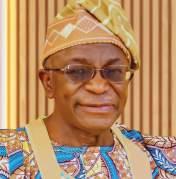
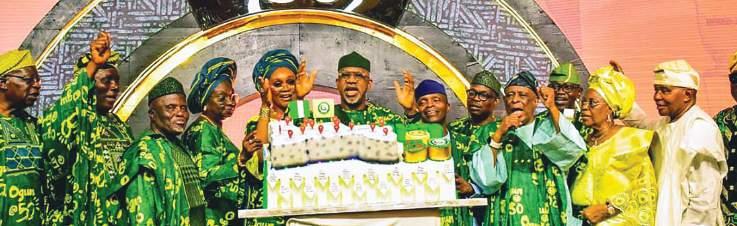
Adekunle Ojora
MEDIA BRIEFING ON THE STATE OF DANGOTE PETROLEUM REFINERY...
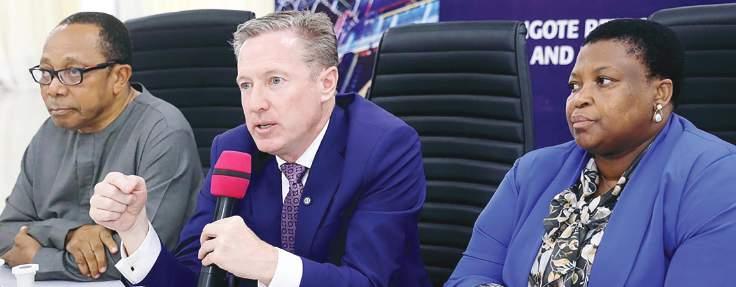
L-R: Group Chief Brand and Communications Officer, Dangote Industries Limited, Mr. Anthony Chiejina; Dangote Petroleum Refinery Managing Director/CEO, Mr. David Bird; and Dangote Petroleum Refinery Head, Economic Scheduling and Planning (EPS), Lindelani Zondi, during the press conference on the state of Dangote Petroleum Refinery held in Lekki, Lagos, yesterdayy
Dangote Refinery Denies Petrol Import Claims, Says Allegations False, Misleading
Reaffirms commitment to delivering Euro standard fuel to Nigerians
Peter Uzoho
Dangote Petroleum Refinery & Petrochemicals (DPRP) has firmly denied reports suggesting that it imports finished petroleum products, describing the claims as incorrect and based on a misunderstanding
of global refinery operations.
The company stated that as a state of the art, large scale merchant refinery, it refines crude oil and processes intermediate feedstocks into premium petroleum products and petrochemicals that meet the highest international standards.
Speaking during a media briefing at the refinery complex at IbejuLekki, Lagos, yesterday, the Chief Executive Officer and Managing Director, David Bird, explained that processing intermediate or semi processed materials was a standard practice within the global
refining industry.
He clarified that this practice does not amount to importing finished petroleum products.
Bird highlighted that the Dangote Petroleum Refinery operates using a European and Asian merchant refinery model, which integrates
World Cancer Day: Survivors, Advocates Demand Better Government Support
Chuks Okocha in Abuja and Blessing Ibunge in Port Harcourt Cancer survivors and advocates have called on the Nigerian government to urgently improve access to cancer care, funding, and medical facilities, as they shared powerful testimonies at an event marking World Cancer Day in Abuja.
The call came same day the Corporate Accountability and Public Participation Africa (CAPPA) called on the Nigerian government to address the growing link between cancer and country’s food system.
Speaking at the event, organised by Sambai in partnership with Cormode Cancer Foundation yesterday, Ochai Igba Friday, a blood cancer survivor, recounted his journey after being diagnosed with cancer in 2016 while in India. Nearly a decade later, he said he was a living proof that cancer was no longer a death sentence.
“I went through pain that made it look like I was going to die, but here I am today, strong and healthy,” he said, and emphasised the importance of early detection, faith, and financial support. He noted that cancer treatment was expensive and beyond the reach of many Nigerians.
He credited his survival to divine intervention and the support he
received from his former employer, which sponsored his medical treatment abroad.
“If not for that support, only God knows what would have happened to me,” he said, lamenting what he described as the government’s poor response to cancer care.
“The government is not doing well at all. Cancer patients and survivors are suffering,” he said.
Also speaking, CEO and founder of the Cormode Cancer Foundation, Dr. Denis Ejoh, shared her personal battle with cancer, revealing that she has lived with metastatic breast cancer for the past 10 years.
“I live with cancer. I take chemotherapy every day. My breast cancer spread to my brain, and I have had over 15 tumors,” she added.
Ejoh, a cancer patient advocate and author of five books, said her foundation works to change the narrative around cancer in Nigeria, especially among children and young people.
She expressed concern over the lack of government funding for cancer patients, noting that the Cancer Health Fund failed to disburse funds last year.
“Everybody has a right to live. We are begging the government to help us live. Cancer patients cannot afford treatment on their
own,” she said.
International cancer advocate and founder of Touch the Black Breast Cancer Alliance, Ricki Fairley, also addressed the gathering, stressing that cancer was not a death sentence if detected early.
“Early detection saves lives. People must become the CEO of their own health. Know your body, know your family history, and get checked when something feels wrong”, Fairley said.
While acknowledging challenges in Nigeria’s healthcare system, she said access to care could be improved through education, advocacy, and collaboration between government, hospitals, and medical professionals.
She further highlighted the importance of survivor-led support groups and NGOs, describing them as critical sources of emotional support and guidance for cancer patients.
“Advocacy and survivor support groups help patients feel understood without having to explain everything,” she said.
The event ended with a renewed call for stronger government engagement, increased funding, early detection programs, and sustained support for NGOs working to improve the lives of cancer patients and survivors across Nigeria.
Meanwhile, CAPPA has called on the Nigerian government to address the growing link between cancer and the country’s food system.
The non-governmental organisation made the call in a statement yesterday to commemorate the 2026 World Cancer Day, with the theme “United by Unique.”
In the statement made available to journalists in Port Harcourt, the public interest organisation reaffirmed its solidarity with the global community to honour the millions affected by cancer.
advanced refining, blending and trading systems designed to meet modern quality and environmental benchmarks.
“DPRP produces high quality fuels aligned with international environmental and health standards. Our gasoline is lead free and MMT free with 50 parts per million sulphur, while our diesel meets ultra low sulphur specifications.
“These standards help reduce emissions, protect engines, and safeguard public health,” Bird stated.
He reaffirmed that the Dangote Refinery supplies only fully refined, market-ready products, adding that semi-finished fuels are unsuitable for vehicles and are therefore not released into the Nigerian market.
Samples of both intermediate feedstocks and fully refined products were displayed to journalists during the briefing.
Bird further noted that the refinery was established to end years of exposure to substandard fuel in Nigeria by providing products that meet stringent global standards.
He added that DPRP’s products are now exported to international markets, highlighting their quality and competitiveness.
He explained that intermedi-
ate materials—such as naphtha, straight run gas oil, vacuum gas oil (VGO), reformate, alkylate and isomerate—serve as feedstock for additional refining into finished fuels like petrol and diesel, as well as petrochemicals.
Bird stressed the refinery’s commitment to transparency in its operations and engagements with regulators. He urged the media to help properly educate the public on the clear distinction between intermediate products and finished fuel.
“Unfortunately, some individuals are deliberately spreading misleading narratives about a refinery that has transformed Nigeria and the West African region from a dumping ground for substandard fuels into a hub for high quality products,” he said.
He added that the refinery’s flexible design allows it to process a diverse mix of crude oils and intermediate feedstocks into premium finished fuels. Bird assured Nigerians of sustained product availability, noting that the refinery has contributed significantly to easing fuel scarcity, stabilising the naira, and reducing pressure on foreign exchange.
Police Partner Capital Market Operators to Enhance Transparency, Investor Confidence
Kayode Tokede
The Inspector-General of Police, Kayode Egbetokun, yesterday described the growing partnership between the Nigeria Police Force (NPF) and the capital market community as a strong symbol of integrity, renewed investor confidence and deeper institutional collaboration.
Speaking after leading the closing gong ceremony on the trading floor of the NGX in Lagos, Egbetokun said the exercise was
more than a ceremonial gesture. He noted that it also underscored a shared commitment to market integrity, transparency and investor protection.
“The bell is a symbol of prosperity for investors. I want its sound to travel far beyond this trading floor to boardrooms across the world and into the homes of Nigerians investing in their future,” he said, adding that the engagement marked a new phase in cooperation between the Police Force and the Nigerian capital market.
Egbetokun noted that stronger collaboration with market institutions would support efforts to curb financial misconduct, enhance investor confidence and position Nigeria’s capital market as a safe destination for long-term investment. In his remarks, the DirectorGeneral of the Securities and Exchange Commission, Dr. Emomotimi Agama, said the visible alignment between regulators and law enforcement sends a powerful message of safety and orderliness to both local and foreign investors.
PHOTO: SUNDAY ADIGUN
ENCOURAGING TECHNICAL EDUCATION...
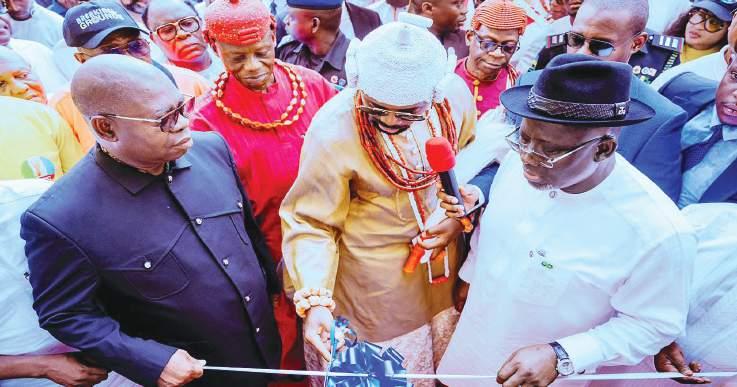
L-R: Delta State Deputy Governor, Monday Onyeme; The Olu of Warri Kingdom, HRM, Ogiame Atuwatse III, and Delta State Governor, Sheriff Oborevwori, cutting the ribbon to inaugurate the Model Technical College, Omadino, Warri South Local Government…recently
FG: How Nigeria Reduced Fuel Import Losses by over N6 Trillion in 9 months
Targets 1 million bpd local refining in medium term Lokpobiri to IOCs: It’s time to raise crude oil production
Ojulari: Unrealistic oil output budget projection caused financial crisis in 2025 NNPC upstream EVP wants prioritisation of high yielding projects
Emmanuel Addeh, Peter Uzoho and Blessing Ibunge in Abuja
The federal government yesterday disclosed that Nigeria cut losses associated with fuel imports by more than N6 trillion within the first nine months of 2025, attributing the sharp drop to rising domestic refining output and a sustained decline in petrol imports as well as foreign exchange reforms.
Building on the gains, the government said it was targeting local refining capacity of about 1 million barrels per day in the medium term, combining output from large-scale private refineries, modular plants and rehabilitated state-owned facilities.
The Chief Executive of the Nigerian Midstream and Downstream Petroleum Regulatory Authority (NMDPRA), Saidu Mohammed, stated this in a keynote address themed: “Driving Nigeria’s Downstream Renaissance: Regulation, Investment, and Market Confidence“, at the ongoing 2026 Nigerian International Energy Summit (NIES) in Abuja.
Mohammed said the cumulative impact of policy reforms under the Petroleum Industry Act (PIA) including
the removal of price controls, harmonisation of the foreign exchange market, expanded use of gas and the increasing trade of crude oil and petroleum products in naira, had drastically reduced the country’s dependence on imported fuel.
According to him, the reforms had eliminated structural inefficiencies that for decades drained public finances and undermined investor confidence.
He noted that Nigeria’s downstream value chain, once characterised by chronic product scarcity, weak infrastructure, poor safety records and underinvestment, was undergoing a fundamental transformation driven by regulation, private capital and market-based pricing.
Central to the shift, Mohammed said, was the rapid growth in domestic refining capacity, led by the 650,000 barrels per day Dangote Petroleum Refinery, stressing that the facility was already meeting a significant share, and in some cases all, of Nigeria’s domestic demand for key petroleum products.
“The capacity for enhanced domestic supply of petroleum products in Nigeria will continue to grow as the planned investments in our refinery sector
matures. We are optimistic that the issued Licences to Establish (LTEs) refineries which are being progressed through various levels of completion, coupled with the rehabilitation of the NNPC refineries will improve the overall installed refining capacity in Nigeria to well over 1 million bpd in the medium term.
“The bold economic reforms of President Bola Ahmed Tinubu have created the renaissance that the downstream sector is enjoying and would continue to leverage upon for sustained sectoral growth in the future.
“The cumulative impact of the full deregulation of the downstream sector; the harmonisation of the forex market;
the incentivisation and deepening the use of gas and the trading of crude and product in Naira has reduced the fiscal economic losses of importing petroleum product by over N6 trillion in the 1st nine months in 2025,” Mohammed added.
Beyond refining, the NMDPRA chief highlighted the growing role of natural gas in reshaping Nigeria’s energy landscape. He said strategic investments in gas infrastructure, supply and demand development were helping position gas as a cleaner and more affordable alternative fuel for power generation, transportation and industrial use, while also supporting broader economic diversification.
Planned Strike: Power Minister Intervenes in Electricity Unions, TCN Faceoff
Says demand for 100% salary increase unreasonable
The Minister of Power, Chief Adebayo Adelabu, yesterday called on the National Union of Electricity Employees (NUEE), the Senior Staff Association of Electricity and Allied Companies (SSAEAC) and staff of the Transmission Company of Nigeria (TCN) to embrace dialogue over the issues of welfare and wages.
He also enjoined the labour unions to be realistic in their demands for increase in allowances, a statement in Abuja made available to journalists by the minister’s spokesman, Bolaji Tunji, stated.
The minister made the appeal in a meeting with the unions and management of TCN in his office in
FG Kicks Off Abuja Leadership Centre, Inaugurate 467 Projects
Kuni Tyessi in Abuja
The federal government has flaggedoff the construction of the Abuja Leadership Centre of Excellence in Public Governance at the Yakubu Gowon University in Abuja.
The executive secretary of TETFund, Sonny Echono, conducted the foundation stone laying for the project alongside the vice chancellor
of the university, Prof. Hakeem Babatunde Fawehinmi, at Jahi, in Abuja yesterday. At the event, Echono disclosed that TETFund would, between now and October, commission about 467 projects across tertiary institutions nationwide.
He said leadership remains one of the most critical elements of national development, stressing that nations
rise or fall based on the quality of leadership they produce.
According to him, effective leadership requires the collective harnessing of intellectual, human and material resources, adding that when these efforts are efficiently coordinated, they can drive national development aspirations.
“It is my prayer and hope that this centre will become a stopping
point for every leader visiting our country. It is not by accident that it is located in the nation’s capital,” he said.
He expressed optimism that the Abuja Leadership Centre would evolve into a world-class facility capable of producing leaders to serve all sectors of the economy, while also hosting globally renowned speeches, conventions and declarations.
Abuja. His intervention followed a fresh move by the workers to embark on industrial action over demands for increase in their salaries and allowances.
Adelabu asked the unions to consider the sensitivity of the industry to the economy of the country and other measures being taken by the federal government to improve the working conditions of Nigerian workers.
Adelabu told the union leaders that the government was not against salary increase for the workers, but explained that the dwindling revenue of the country has made it imperative that everyone must be reasonable in their demands.
He said: “Nobody is against an increase in what you earn. You must enjoy yourself because that is why you are working and when you are happy at your work, that is when you can give your maximum. So, you must be well remunerated.
“However, where we have found ourselves in our revenue earnings as a nation is such that we must be realistic in our demands. We must see this company as our own and work with the management to keep it moving. I want to appeal to you to stop this attitude of locking your management out at every turn of events.
“ Let us embrace peace and work together for the good of the company and the development of our nation”, the minister said, adding that the entire earnings of the company cannot be utilised for personnel cost alone. “The company will be wrecked when we do that and all of us will head back home when that happens,” he argued. The unions are demanding a 100 per cent increase in their salaries and allowances which the minister said would raise the wage bill of the company to about N4 billion monthly, a move which he said would be unsustainable.
Emmanuel Addeh in Abuja
NSIA, IFC Sign Deal to Boost Access to Quality Diagnostic, Cancer Care Services
Project valued at $154.1 million
James Emejo in Abuja
Nigeria Sovereign Investment Authority (NSIA) is partnering with International Finance Corporation (IFC), a member of the World Bank Group, to scale oncology and diagnostic services to underserved communities across the country.
The initiative will deliver over a dozen modern diagnostic and treatment centres across Nigeria, create 800 direct jobs, and train more than 500 healthcare professionals in oncology and cardiology specialties.
The project is valued at $154.1 million, with IFC contributing about $24.5 million, about (N14.2 billion) in long-tenor local currency financing, marking the corporation’s first healthcare investment in the country using this structure.
Speaking during the formalisation of agreement in Abuja, Managing Director/Chief Executive, NSIA, Mr. Aminu Umar-Sadiq, said, “This partnership with IFC represents a significant milestone in NSIA’s commitment to strengthening Nigeria’s healthcare ecosystem
through sustainable, locally anchored investment solutions.”
Umar-Sadiq said, “By deploying long-tenor naira financing, we are addressing critical infrastructure gaps while reducing foreign exchange risk and ensuring that quality diagnostic and cancer care services are accessible to underserved communities.
“MedServe’s expansion underscores our belief that commercially viable healthcare investments can deliver strong development impact while supporting national health priorities.”
In addition, the deal allows both
parties to provide naira-denominated financing to NSIA Advanced Medical Services Limited (MedServe), a wholly owned healthcare subsidiary of NSIA.
Supported by International Development Association’s Private Sector Window Local Currency Facility, the financing enables MedServe to scale critical healthcare infrastructure while mitigating foreign exchange risks.
Commenting on the historic partnership, IFC Vice President for Africa, Ethiopis Tafara, said, “Nigeria’s focus on addressing the rising prevalence of non communicable diseases presents
a significant opportunity to deploy innovative financing mechanisms capable of mobilizing private capital at scale, while ensuring equitable access to quality care.
“This ambition is consistent with our broader vision for Africa, one where resilient health systems and inclusive growth reinforce each other to deliver long term impact across the continent.”
Essentially, the funds will support MedServe’s expansion programme to establish diagnostic centres, radiotherapy-enabled cancer care
SETBACK FOR ELECTORAL REFORMS: SENATE REJECTS MANDATORY REAL-TIME RESULTS UPLOAD
The apex court clarified that the INEC Result Viewing (IReV) portal was not a collation system and was intended only for public viewing because the 2022 Electoral Act did not recognise it as a collation instrument.
It further ruled that failure or unavailability of results on IReV did not invalidate an election outcome or halt the manual collation process.
The ruling emphasised that the Electoral Act 2022 did not explicitly mandate “electronic transmission” only; rather, it allowe INEC to prescribe any manner it deemed fit, which might include manual or electronic methods.
This decision was part of the final judgment dismissing appeals by Atiku Abubakar (PDP) and Peter
Obi (Labour Party), thereby affirming the victory of President Bola Tinubu.
The decision taken during the passage of the Electoral Act (Repeal and Enactment) Bill, 2026, effectively retained the contentious provisions of the 2022 law on results transmission, triggering outrage from opposition parties, civil society and pro-democracy advocates, who warned that the move undermined democratic consolidation.
By voting down a proposal that would have expressly mandated presiding officers to upload polling unit results to INEC portal in real time, the Senate opted for continuity over reform, even as it moved to amend other aspects of the electoral framework by shortening election timelines, revising penalties for
FG: US TROOPS IN NIGERIA RESTRICTED TO TRAINING, INTELLIGENCE SUPPORT
stressing that their deployment is limited to intelligence support and training as part of ongoing cooperation to combat terrorism and insurgency.
The clarification followed an announcement on Tuesday by the United States Africa Command (AFRICOM) confirming the deployment of a small team of American personnel to Nigeria.
Speaking in Dakar, AFRICOM Commander, General Dagvin Anderson, said the deployment was made at Nigeria’s request and was focused strictly on intelligence assistance.
“Our partnership with Nigeria is a great example of a willing and capable ally that requested unique capabilities only the United States can provide,” Anderson said. However, the announcement sparked widespread speculation and concern over Nigeria’s sovereignty, prompting the Defence Minister, Gen. Christopher Musa (rtd)to address the issue.
In a chat with the BBC, Musa explained that the US personnel were not combat troops but a small advisory team supporting intelligence gathering and training initiatives. He did not disclose details regarding the size of the team, their arrival date, location, or duration of stay.
Recall that on December 25, 2025, the US military, in collaboration with the Armed Forces of Nigeria, conducted air interdiction operations across multiple locations in the North-West and North-Central regions as part of renewed international cooperation against terrorism and violent extremism.
Despite these assurances, the latest development has reignited public debate, with some Nigerians expressing fears that foreign troops’ presence could undermine national
sovereignty.
Reacting to the concerns, the All Progressives Congress (APC) said the cooperation between Nigeria and the United States is strictly coordinated and does not compromise the country’s independence.
Speaking during an interview on ARISE Television on Wednesday, the party’s National Publicity Secretary, Mr Felix Morka, reaffirmed that US support in counter-terrorism efforts poses no threat to Nigeria’s sovereignty.
“What we know is that the US government and Nigerian authorities are working very closely to defeat terrorism in our country,”
Morka said. “Terrorism has brought immense pain and suffering to our people, with innocent citizens killed senselessly by these violent actors,” he added.
He said that President Bola Tinubu remains resolute in taking all necessary measures to eliminate terrorist threats and restore security across the country.
Dismissing suggestions that the collaboration amounts to foreign intervention, Morka said such concerns usually arise when host nations are excluded from decisionmaking processes, a situation he noted does not apply to Nigeria.
“That is not the case here,” he said. “This is a coordinated effort between the Nigerian government and the United States, with both sides fully involved in all decisions.”
According to him, any actions taken on the ground would reflect agreements jointly reached by both governments.
“Whatever is agreed at the table is what will be implemented,” Morka added, emphasising that the priority remains the protection of Nigerian lives and the defeat of terrorist groups.
electoral offences and formally replacing the smart card reader with the Bimodal Voter Accreditation System (BVAS).
The Senate specifically rejected a proposal of its Committee on Electoral Matters to mandate real-time electronic transmission of election results from polling units while retaining electronic transmission as provided under the 2022 Electoral Act.
The action of the senators came to many Nigerians as a rude shock because their counterparts in the House of Representatives had passed the landmark provision two months ago which drew applause from stakeholders, who saw it as a major step to guaranteeing electoral integrity in the country.
The decision on results transmission, the most contentious issue during clause-by-clause consideration, saw lawmakers vote down a recommendation by the Senate Committee on Electoral Matters to compel presiding officers to upload polling unit results to the Independent National Electoral Commission’s (INEC) IREV portal in real time.
Instead, the Senate adopted the existing Section 60 of the 2022 Act, which required results to be electronically transmitted “in a manner as prescribed by the Commission” after announcement at the polling unit and transfer to the next level of collation.
Protest Over Conference Committee Composition Tears Senate Apart
The chamber was, however, thrown into confusion after Senate President Godswill Akpabio
announced the membership of the Conference committee of the red chamber that would meet with their counterpart in the House of Representatives.
The confrontation was actually between Senators Simon Lalong and Asuquo Ekpenyong, which was caused by the observation of northern senators, led by Ali Ndume, who protested the non-inclusion of Lalong, chairman of the Electoral Matters panel among the Conference committee.
The development led to an an uproar for a few minutes before Akpabio quickly announced Lalong as the Chairman of the Conference committee and his quick intervention doused the tension.
During the argument, Lalong was seen telling Ekpeyong to learn how to speak to Elders and stop being rude to him.
“Go learn how to speak to your elders and stop talking to me in in such rude manner,” Lalong shouted at Ekpeyong
Under the retained provision, presiding officers were to count votes at the polling unit, record the scores on prescribed forms, announce the results, provide copies to polling agents and security personnel where available, and transmit results electronically as directed by INEC.
Any willful contravention will attract a fine of up to N500,000 or imprisonment for at least six months.
The rejected proposal would have expressly compelled real-time upload to IREV immediately after signing of Form EC8A, with penalties of not less than N500,000 or six months’ imprisonment or both.
Senators opposed to the amendment argued that codifying “real-
time” could introduce ambiguity and operational risks, particularly in areas with poor network coverage.
Chairman of the Senate Committee on Media and Public Affairs, Senator Adeyemi Adaramodu, said the dispute was largely semantic. “Who determines real-time?” he asked.
He said, “Election result transmission should not be based on grammar. Results will be transmitted electronically for public access, and once it is mandatory, it is no longer left to discretion. There is no way a presiding officer can falsely claim there is no network without the community knowing.”
Beyond results transmission, the Senate approved far-reaching changes to election timelines. The lawmakers slashed the notice period for elections from 360 days to 180 days before the end of the current administration’s tenure.
Political parties’ deadlines for submitting candidates’ lists were reduced from 120 days to 90 days, while the deadline for nomination of candidates was also cut from 180 days to 90 days.
In a bid to tighten compliance and curb electoral malpractices, the Senate increased the fine for unlawful possession of voters’ cards to N5 million, but rejected a proposal to impose a 10-year ban from political activities for vote buying.
Instead, it adopted a higher monetary penalty, raising the fine from N500,000 to N5 million. Lawmakers also deleted the smart card reader from the law and formally replaced it with BVAS, while retaining electronic transmission of results.
The amendments further clarified consequences for candidates
disqualified for submitting fake documents, barring parties from replacing such candidates after elections and providing for fresh polls excluding the disqualified candidate and party where necessary. Akpabio, who presided over the session that stretched into the evening, insisted that claims that the Senate had rejected electronic transmission were false.
He said: “Electronic transmission has always been in our hearts. What we did was to retain what worked in 2022. Retaining the previous provision means electronic transmission remains part of our law. We are moving forward, not backwards.”
Akpabio commended senators for their stamina and bipartisan engagement, noting that the chamber remained full well into the evening. He also announced the constitution of a harmonisation conference committee to reconcile differences between the Senate and House of Representatives versions of the bill. Senator Simon Lalong will chair the committee, with members drawn from all geopolitical zones, including Senators Adamu Aliero, Orji Uzor Kalu, Abba Moro, Asuquo Ekpeyong, Aminu Iya Abbas and Tokunbo Abiru. Senator Adeniyi Adegbomire was added to provide legalTheguidance. Senate President said the committee would work expeditiously to return a harmonised version within the month, paving the way for presidential assent and timely preparations for future elections. He added that the Senate would adjourn plenary to focus on the 2026 budget, with ministry-by-ministry defence schedules to be released
WITH PROJECTED GDP OF $334BN IN 2026, IMF TIPS NIGERIA AS AFRICA’S THIRD-LARGEST ECONOMY AHEAD OF ALGERIA
economic rise to increased oil production, better Foreign Exchange (FX) liquidity, and the effects of ongoing economic reforms, including fuel subsidy removal, exchange-rate liberalisation, and fiscal adjustments – all of which are aimed at supporting mediumterm growth, despite short-term inflationary pressures.
Nigeria’s GDP is tipped to rise to about $334 billion, placing it ahead of Algeria, whose output is projected at $284 billion this year.
IMF projections indicate a shift in the review year, with Nigeria’s economy expected to sustain current resilience with a strong growth outlook.
South Africa is expected to remain Africa’s leading economy, with a projected GDP of $443 billion, followed by Egypt at $399 billion in 2026.
In 2025, South Africa retained its
spot as Africa’s largest economy with GDP of $426 billion, followed by Egypt at $349 billion, while Algeria ranked third with about $288 billion.
Nigeria’s economic ranking has fluctuated in recent years due to currency devaluations, rebasing exercises, and broader macroeconomic challenges affecting major African economies.
Earlier this year, IMF revised the country’s 2026 economic growth forecast upward to 4.4 per cent, from an earlier estimate of 4.2 per cent.
The World Bank also raised its growth projection for Nigeria to 4.4 per cent in 2026, up from 3.7 per cent forecast in mid-2025.
Last week, IMF projected Nigeria to contribute 1.5 per cent to global real GDP growth in 2026, which placed the country as the sixth highest contributor, and among the top 10 globally.
The development further positioned the country ahead of several advanced and emerging economies, including Brazil 1.5 per cent, Vietnam 1.6 per cent, Saudi Arabia 1.7 per cent and Germany - 0.9 per cent.
China is expected to retain its position as the largest contributor to global growth, accounting for 26.6 per cent, followed by India 17.0 per cent, United States 9.9 per cent, Indonesia 3.8 per cent, and Türkiye 2.2 per cent.
China and India are projected to drive 43.6 per cent of total global economic growth in this year.
The IMF report further hinted on the dominance of the Asia Pacific region, which was expected to account for nearly 50 per cent of total global economic growth, reflecting continued economic momentum across the region.
Reacting to the IMF report, Chief Executive of Tesla, Elon Musk,
said, “The balance of power is changing.” According to sources, Nigeria’s real growth projection remains around 3-4 per cent amid current challenges.
The country’s consumptiondriven growth aided expansion in energy, services, telecoms, and trade.
The ranking also reflected the county’s role as a key growth driver among emerging economies, and its strong resilience, despite ongoing domestic and global economic challenges.
The IMF report showed how India and China were emerging as driving forces of global economic growth.
The Eurozone collectively adds two per cent to global growth. Advanced economies as a group are projected to expand 1.8 per cent while emerging markets reach 4.2 per cent.
facilities, and cardiac catheterisation laboratories across several Nigerian states.
Aminu Umar-Sadiq
Acting Group Politics Editor DEJI ELUMOYE
Email: deji.elumoye@thisdaylive.com
08033025611 sms only
Aderinokun: ADC Has Capacity to Wrest Power from APC in 2027
a chieftain of the Peoples Democratic Party, Chief Olumide aderinokun, in this interview said the growing opposition coalition around the african Democratic Congress has the capacity to defeat the ruling all Progressives Congress in the 2027 general election. He argues that while President bola Tinubu remains a formidable political force, many of his appointees lack the wherewithal to deliver their wards for the President in the forthcoming poll. sunday okobi brings excerpts.
The PDP says it has resolved its long-running internal disputes. From your vintage position, how deep is this resolution, and what must the party do to prevent a return to factional battles?
Thank you. Let me start from the legal angle, because that is very important. Last week, a Federal High Court in Abuja dismissed the fresh suit filed by a former National Secretary of the PDP, Senator Samuel Anyanwu. One of the key points from that ruling was that the law does not allow a court to dictate to a political party how it should manage its internal affairs. I actually had a similar experience during my own primaries in the last election. One of the so-called aspirants, who did not even participate in the primary, took me to court. The court was clear that if you did not take part in an election, you do not even have the locus standi to challenge it. The court said the party has the final authority over its primaries and decisions. That was why some people tried to stop the party’s national convention from being held. They knew that if the convention went ahead, there would be no way back. So they rushed to court to frustrate the process.
Some critics argue that the PDP has failed to provide a credible opposition to the APC. Is the protracted internal squabbling responsible for that? Has the party lost its political soul and relevance?
Honestly, a lot of people have lost confidence in the PDP because of what is happening internally. There is no point in deceiving ourselves. Sometimes, when I
tell some people that I am still in PDP, they ask me, “You are still there? What are you doing there?”
However, when you look at Ogun State, the story is slightly different. PDP is still strong and very much
Imo Beyond 2027:
on the ground.
The results of the 2023 governorship and senatorial elections show that people are still with the party. Even in my own election, I honestly believe I won. But because of the internal crisis, some people within the party
worked against us and even collaborated with the APC. That affected the outcome. So, yes, internal problems have weakened our ability to act as a united opposition.
As a chieftain of the party, what do you make of its factionalisation?
A - Now, on the issue of factionalisation in the party, let me be clear. There are vested interests, both within and outside the PDP, whose agenda is to destabilise the party. PDP remains one of the strongest political parties in Nigeria and even in Africa. That is why some people want to disorganise it. I honestly do not see a faction. What I see is noise created by people who do not want the party to move forward. INEC and the courts have spoken clearly. We were even informed that by March, most of these cases would be concluded. Personally, I recognise only the Turaki-led executive. I do not know any other structure, and the court proceedings have made that very clear.
After years in opposition, what does the PDP need to change, not just in leadership but in political culture, to regain public trust ahead of 2027? When I talk about trust, I am not talking about our capacity to govern. PDP has governed this country before, and Nigerians know what we can do. The issue is perception. All the people hear about PDP today is crisis, court cases, and bad news.
NOTE: Interested readers should continue in the online edition on www.thisdaylive.com
Akagburuonye as a Natural Choice
as Imo State gradually turns its gaze toward the question of succession, the debate is no longer about who wants power, but who is prepared to govern. beyond party alignments and political calculations, attention is increasingly shifting to individuals whose public relevance is anchored on verifiable service, institutional capacity, and a clear understanding of the state’s development trajectory. One of such figures is Chief Obioma Success akagburuonye. Wale Igbintade reports.
Leadership in Imo State is increasingly being measured not by lofty promises but by tangible results, depth of preparation, and proven service to the people. As conversations around succession and continuity quietly gather momentum, one name that continues to surface across communities, professional circles, and grassroots networks is that of Chief Obioma Success Akagburuonye (JP). Lawyer, civil engineer, entrepreneur, philanthropist, and grassroots mobiliser, Akagburuonye represents a rare convergence of professional excellence and lived service, qualities many believe are essential for steering Imo State into its next phase of development.
Akagburuonye’s rising profile is not the product of sudden political ambition. Rather, it is the cumulative result of decades of engagement with ordinary people, independent investments in human capital, and a leadership philosophy grounded in proximity, accountability, and impact. Those who know his work argue that his story reflects not only readiness for public office but a deep understanding of governance as an extension of service.
His journey did not begin from a place of privilege or ease. Akagburuonye’s early education took place at Town School, Ogbor, followed by Oke Ovoro Secondary School, Uvuru. Like many young Nigerians navigating systemic and personal challenges, his academic path was disrupted by circumstances that required deliberate correction. In a defining moment, he proceeded to Government Secondary School, Ihugh, in Benue State, specifically to address deficiencies that could have limited his future prospects. Rather than viewing this as a setback, he embraced it as a formative
experience that instilled resilience, humility, and perseverance—traits that continue to shape his leadership outlook. That determination carried him into higher education, where he attended Kogi State University, Anyigba, earning both his Bachelor
of Laws and Master of Laws degrees. His call to the Nigerian Bar in February, 2012 marked not just the start of a legal career but the formal beginning of a lifelong commitment to justice, fairness, and public interest. For Akagburuonye, the law was never merely a profession; it was a framework for protecting society’s most vulnerable and ensuring balance in public life.
Although he had earlier engagements in engineering and entrepreneurship, his decision to deepen his legal training was driven by the conviction that law is the engine that powers society. In his view, law regulates business, guarantees justice, and protects rights, making it indispensable to sustainable governance.
This belief informed his involvement in public-interest litigation, where he challenged excessively harsh bail conditions and procedural injustices that kept many Nigerians incarcerated unnecessarily. These interventions contributed to prison decongestion and improved access to justice, reinforcing his belief that authority must always be exercised with empathy and responsibility.
Beyond law, Akagburuonye is widely acknowledged as a self-made entrepreneur whose business success predates any political aspiration. He founded and nurtured several enterprises, including Praco International Limited, Peace Be Still Hotels Limited, Obisco Foods and Beverages Limited, and Akara Ugo Foundation Property Limited. These ventures span hospitality, manufacturing, real estate, and services, sectors critical to employment generation and economic stability. Notably, Akagburuonye insists that all these businesses were built independently, without reliance on government patronage.
For many observers, this independence speaks volumes about his capacity to manage resources, create jobs, and understand economic realities outside the corridors of power.
Aderinokun
Akagburuonye
Untangling Legal Pathways in the Coup Plot against State
Yemi Kosoko submits that due process should be followed both in conventional and military courts in the trial of the officers and individuals accused of plotting to overthrow President bola Tinubu.
In a season of heightened political vigilance and renewed anxieties over national stability, the debate over how Nigeria should prosecute alleged coup plotters has returned to the centre of public discourse.
The controversy is not merely about guilt or innocence. It is about jurisdiction — a constitutional question that sits at the inter section of democratic governance, military discipline, and the rule of law.
At issue is a deceptively simple question: Who should try individuals accused of plot ting to overthrow the government — the civilian courts or the military’s court‑martial system?
The answer, as always in Nigeria’s constitu tional architecture, is layered on what could be tagged a Constitution built on dual tracks.
Nigeria’s 1999 Constitution creates two parallel systems of justice, each with its own mandate and boundaries. The civilian judiciary — anchored by Sections 6 and 36 — is the guardian of fundamental rights and the arbiter of offences against the state. The military justice system — preserved under Sections 217, 218, and 315 — is designed to enforce discipline within the Armed Forces.
These two systems occasionally collide, especially in politically sensitive cases where soldiers and civilians are implicated in the same alleged conspiracy.
For civilians, the Constitution leaves no ambiguity. Treason and treasonable felony fall under the exclusive jurisdiction of the Federal High Court, as provided in Section 251(2). This is why, during the Second Re public, businessman Muhammadu Mandara — accused of mobilising soldiers to topple President Shehu Shagari — was tried and convicted by a civilian court.
Mandara’s case remains a touchstone for legal scholars: a reminder that civilians cannot be subjected to military tribunals, no matter the gravity of the allegation.
The situation is markedly different for serving military personnel. The Armed Forces Act — constitution ally preserved by Section 315 — grants the military the authority to discipline its own. Court‑martial jurisdiction is triggered not by the nature of the offence, but by the status of the accused.
This principle has been affirmed repeatedly by Nigerian appellate
courts. In Brigadier‑General Anyankpele v. Nigerian Army, the Court of Appeal held that court‑martial proceedings are constitution ally valid and fall within the judicial powers recognised by Section 6.
For soldiers, a coup attempt is not only treason under civilian law; it is also mutiny, insubordination, and conduct prejudicial to military discipline — all offences squarely within the purview of the Armed Forces Act.
This dual character explains why soldiers
accused of plotting coups have historically been tried by court‑martial, even when civilians involved in the same plot face the Federal High Court.
Nigeria’s courts have long navigated the delicate balance between civilian supremacy and military discipline. During military rule, tribunals dominated the landscape. Under democracy, the courts have taken a more assertive posture, insisting on due process while respecting the constitutional boundaries of military justice.
In politically charged cases, the judiciary has struck down attempts to try civilians in military courts, upheld the validity of court‑martial trials for serving soldiers, insisted on strict adherence to fair‑hearing standards and intervened when military tribunals exceeded their statutory powers
This balancing act reflects a broader con stitutional philosophy: the Armed Forces must remain disciplined, but the military must never overshadow civilian authority.
Recent allegations of coup plotting — re portedly involving serving military personnel — have reignited the debate.
Rights lawyer, Femi Falana (SAN) has argued that all suspects, including soldiers, should be tried in civilian courts because treason is an offence against the democratic order.
His position is principled and rooted in constitutional supremacy. But it confronts a long‑standing legal reality: the Constitution expressly preserves military discipline, and Nigerian courts have consistently upheld the military’s authority to try its own members.
The Mandara precedent, often cited in public debate, applies only to civilians. It does not resolve the question of how to treat soldiers who allegedly mastermind a coup.
NOTE: Interested readers should continue in the online edition on www.thisdaylive.com
As Tudun Biri Gets New Lease of Life...
Stanley Nkwocha writes that the quiet Tudun biri community in Igabi local government area of Kaduna state now wears a new look with the recent inauguration of 133 housing units, educational facilities and state-of-the-art infrastructure courtesy the President bola Tinubu-led administration.
“A government that keeps its promises is the noblest of all institutions.”
The above quote by an anonymous scholar echoes the ethical and moral viewpoints regarding the nature of good governance, the social contract, and public integrity in Nigeria under the administration of President Bola Tinubu. The idea is that the legitimacy of government is based on the consent of the governed, which implies a, often unwritten, contract to act in the best interest of the citizens.
What is happening in Nigeria at the moment reflects a fiduciary conception of public office, where the state’s highest duty is to fulfill its commitments to the people.
In December 2023 when President Tinubu pledged to rebuild Tudun Biri, a quiet com munity in Igabi Local Government Area of Kaduna State that was shattered by a devastat ing military drone misfire, his commitment was dismissed in certain quarters as one of those empty government promises.
But on Friday, January 29, 2026, the once deserted community, which became a mere shadow of its boisterous self, came alive. The president’s promise to rebuild the community, severely hit by an accident bomb from military drones, claiming innocent lives, injuring some, and leaving many in trauma, unfolded into a pleasant reality.
Vice President Kashim Shettima inaugurated the Tudun Biri Resettlement Scheme, with about 133 completed housing units, educa tional facilities, and other state of the art infrastructure.
programme in Sokoto, but in the light of recent development, the President directed that the Pulaku Initiative should be kick started here in Kaduna State. And Tudun Biri will be the first beneficiary of that scheme. It’s a complete package of solutions as a non kinetic response to the problems of banditry and kidnapping in the North West,” he added.
The Vice President also informed the com munity’s leaders about how worried President Tinubu had been over the tragic incident, acknowledging that, away from the number of casualties, it was gruesome to lose even one life. “I am here because the President is deeply concerned. He was deeply touched by what happened. As the late Dele Giwa rightly said, let’s not talk about the numbers; ‘one life taken in cold blood is as gruesome as millions lost in a pogrom,” he stated.
Keeping that promise real, Senator Shettima returned to Kaduna Last Friday to inaugurate the resettlement scheme. A government that prioritizes transparency, accountability, and keeps to its words is seen as an ideal, often contrasted with the reality of unfulfilled promises. This is truly what the inauguration signifies a testament to the commitment of the Tinubu administration to keeping its promises and delivering results.
When VP Shettima visited victims of the tragedy in December 2023, he could not believe what he saw at Barau Dikko Teaching Hospital in Kaduna, where some of the casualties, most of whom were women and children, were receiving treatment. Palpably, he struggled to hold back tears from rolling down his cheeks. Moved by the pathetic sight, he directed the National Emergency Management Agency (NEMA) to ensure that the victims get adequate relief materials.
pledge to rebuild the community, the Vice President told leaders of the community and other stakeholders in the state that “most importantly, the President approved the com mencement of the Pulaku Initiative by next month. The Pulaku Initiative is the President’s unique response as a non kinetic approach to the challenges in the North West.
The Vice President said the project is an agenda anchored on a simple but powerful notion that governance must serve people, heal divisions, and strengthen the foundations of national stability.
-Nkwocha, media aide to Vice President Shettima, writes from Abuja.
Announcing President Tinubu’s
“Actually, our intent was to kick off the
CDS, Gen Musa
Shettima
FEaturEs
How MTN Made the Yuletide Hit Different with Y’ello Tide
Long after the Yuletide decorations came down, the season continues to be remembered as one that hit different. For a lot of people, that feeling is inseparable from Y’elloTide, MTN’s festive experience that quietly, and sometimes loudly, touched lives across the country. Chiemelie Ezeobi, who monitored the multiple surprises, the shock and joy across board, writes that what unfolded in December was not just a campaign or a series of events, but a moving mosaic of moments that met Nigerians where they already were, and months later, those moments are still being felt
By the time December wound down, one thing was clear across cities and communities: the season had felt different. Louder in some places, lighter in others, and unexpectedly generous in between.
For many Nigerians, that difference came with a familiar colour-yellow, which was a name that quietly became part of the country’s festive vocabulary with the Y’elloTide.
Y’elloTide was MTN’s flagship festive season experience, rolled out across Nigeria as a mix of concerts, live shows, weddings, street activations, giveaways and moments of surprise.
It did not arrive as a single event or location, but as a sequence of experiences that met people in the middle of their December lives, on the road, at celebrations, in stores, at bus parks, and sometimes in places where no one expected anything at all. Rather than asking people to come somewhere special, Y’elloTide came to them.
A December That Moved with the People
What stood out about Y’elloTide was how widely it travelled. From Lagos to Abuja, Enugu to Port Harcourt, and across other cities, MTN’s festive experience unfolded in ways that felt both big and personal.
All MTN customers, new and existing, were able to take part in the season’s activities. Some planned ahead, registering through the Y’elloTide portal for concerts or experiences. Others simply stumbled into moments, a free bus ride, a store visit, a street activation that changed the tone of an ordinary day.
December is already crowded with expectations in Nigeria. Y’elloTide did not try to compete with that. Instead, it blended into it.
The Portal That Pulled It All Together
Behind the scenes, much of the season ran through the Y’elloTide portal. It served as the central hub where customers subscribed to Vibe Packages, accessed event tickets, tracked countdowns and registered for concerts and experiences across multiple cities.
For many users, the portal simplified what could have been an overwhelming season. Instead of chasing information across platforms, everything lived in one place, concerts in Lagos, experiences in Abuja, registrations in Enugu or Port Harcourt.
It was practical, but it also reflected something deeper: the idea that December experiences could be planned, not just stumbled into.
Vibe Packages and the Value of Staying Connected
Connectivity mattered more than ever during the festive season, and MTN leaned into that reality with its Vibe Packages. Customers chose between the Vibe Starter, Vibe Insider
and Vibe Curator, each offering voice and data bundles paired with value added benefits designed specifically for the yuletide period.
For many customers, these packages became their entry point into Y’elloTide. Most activities were free for those who purchased a package, while others came at discounted or bundled rates. It was not just about data or airtime; it was about unlocking access to experiences.
Seven Days That Defined the Season
If Y’elloTide had a heartbeat, it was Y’ello Week. For seven straight days, experiences unfolded across Nigeria, weddings were surprised, rides were offered, treats were shared, and shows lit up different cities. While the activations were nationwide, Lagos and other festive hotspots carried some of the loudest energy. Y’ello Week felt fast, joyful and unpredictable, much like December itself. One day it was a wedding surprise, the next a rave, then a bus ride or a street appearance that had people stopping to ask, “What’s going on here?”
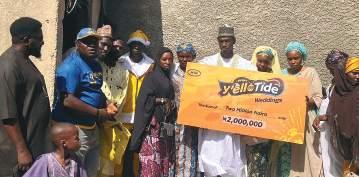
When Love Took Centre Stage December is wedding season in Nigeria, and Y’elloTide found a natural home there. Through Y’elloTide Weddings, couples were invited to nominate their ceremonies for a surprise.
For those selected, MTN showed up, sometimes quietly, sometimes dramatically, turning already emotional days into moments couples would talk about long after the guests had gone home. Gifts were shared, memories were
created, and love became part of the festive story Y’elloTide was telling. It was one of the season’s softer touches, and also one of its most memorable.
Nights That Belonged to the Crowd with Rave Parties
For those who live for December nights, the Y’ello Rave Party delivered exactly what it promised. High energy shows combined music, live performances and immersive brand experiences, pulling in crowds that wanted more than just background sound.
In Lagos especially, the rave parties captured the city’s December spirit, bold, loud, crowded and unapologetically alive. They were nights where people danced, shouted lyrics, recorded memories and left knowing they had been part of something shared.
Meaning Relief, One Ride at a Time
Not every Y’elloTide moment was loud. Some were quietly practical. The Y’ello Train offered free daily bus rides from major bus parks in selected cities. In a month known for traffic and long waits, those rides became small but meaningful relief for commuters moving around for work, family visits or last minute errands. It was a reminder that festive cheer does not always come with music. Sometimes, it comes with a seat on a bus.
Santa, Merch and the Magic of Surprise
Y’elloTide also thrived on details. The Merch Market offered
exclusive merchandise, while Y’ello Santa appeared in different locations as MTN #PaintTheStreetsYello, especially delighting children and families. Then there were the surprises that could not be scheduled. At Just Rite on Ring Road in Ibadan, a routine shopping trip turned into something else entirely when customers received unexpected vouchers.
“Oh wow. This is such a pleasant surprise,” said Gbemisola A., who received a ₦10,000 voucher. “I have always known MTN to do these kinds of surprises during the December period, but I have never benefited until today. Thank you MTN. Keep up the good work.”
When December Finally Slowed Down, Memories Abound
By the time the season eased into January, Y’elloTide had already left its mark. It had moved through cities, weddings, roads and nights, leaving behind stories people told casually, at home, at work, online.
It was not just the scale of activities that mattered, but the way they showed up in everyday life. Y’elloTide did not try to redefine December. It simply leaned into it, amplified it, and coloured it yellow. And when people looked back on the season, many agreed on one thing: December really did hit different and MTN played a role in that.
It echoed the simple truth behind the season, captured in the words of Aisha Mumuni, MTN Chief Digital Officer, who said, “at MTN, we believe in connecting people”. In December, MTN did just that, and even now, in February, the feeling of being connected still lingers.
The newlywed couple MTN surprised with N2,000,000 in Kano during the Yellotide MTN Prestige Experience and the fusion of haute cuisine, high fashion, and music
An excited couple after their groceries were paid for by MTN in Ibadan
At Chisco Park Abuja where MTN covered the transport fare of all passengers in the bus
Anthony Chukwuedozie: Celebrating a Legacy of Leadership, Discipline and Service
emeka Chiedozie
In Ihiala, Anambra State, and far beyond, the impact of one man’s life is still being felt. Pa Anthony Onuchukwu Chukwuedozie, a soldier, teacher, farmer, and devoted family patriarch, left a legacy defined by discipline, service, and the creation of opportunity for others.
It was for that reason that on Sunday, February 1, 2025, family, friends, and dignitaries gathered at the Catholic Church of Transfiguration, Victoria Garden City, Lagos, to celebrate his extraordinary journey.
The memorial thanksgiving was a tapestry of memories. Photographs lined the reception hall, capturing moments from Pa Chukwuedozie’s life, from his disciplined military years and his classroom days to the quiet hours he spent tending his farm. Yet amid the nostalgia, the gathering also became a forum to discuss the tangible ways one life can influence communities.
His son, Mr. Calistus Chukwuedozie, CEO of MICCALLY AUTOS and philanthropist, shared a striking observation. “I was at home for almost one month during my father’s burial ceremony and noticed that there was no report of kidnapping, robbery, or
criminal activities in my community,” he said.
Investigating further, he discovered that Allen Onyema, Chairman of Air Peace, had provided employment for over 250 youths, pledging even more jobs. “With what he did for the community, he was able to solve the problem of insecurity, and the youths listened to him when he advised them to shun crime,” Chukwuedozie explained.
For him, employment was more than a paycheck. “Families forced their bad children to give up crime and renounce it, and many of them have turned new leaves. I, for one, have more than 100 people under my employment,” he said. “Employment is not just about income; it gives purpose, responsibility, and hope.”
The memorial drew community and business leaders who spoke about Pa Chukwuedozie’s influence. Chief Edwin Eze Ogidigha, Chairman of Yamaha Sub-Saharan Africa, said: “A man whose influence extended far beyond his immediate family. The remarkable achievements and values seen in his children stand as living proof of a life well lived.”
Nnamdi Ifebi of Idemili highlighted the role of good governance in security, noting: “What miscreants
were doing before now, thinking they were untouchable, is a thing of the past. I commend the governor and security agencies for their good job.”
Mrs. Chinyere Okafor, a community leader in Ihiala, reflected on the patriarch’s mentorship. “He was a man whose counsel and character commanded respect. Many youths benefited from his guidance and advice, and his influence in shaping ethical and disciplined citizens cannot be overstated,” she said.
Chukwuedozie also called for the replication of such communityminded actions nationwide. “If well-to-do people in each community in the South East or Nigeria at large should replicate what Allen Onyema did, every youth will be gainfully employed, and nobody will be a willing tool in the hands of criminals,” he said.
He further urged governments and financial institutions to provide soft loans to youths eager to start small-scale businesses, saying: “Many of our youths have learnt one trade or the other but have no money to set up their businesses. If they can get access to soft loans for their businesses, the nation will be a greater and more peaceful place
to do business.”
Pa Chukwuedozie’s own life exemplified the principles he championed. A soldier, teacher, and farmer, he combined strength with nurturing care. His commitment to raising seven accomplished children reflected a life devoted to family, ethics, and community service.
“The peace I experienced during my stay at home was a direct result of sustained communal engagement and youth empowerment. Employment, mentorship, and skills acquisition remain among the most effective tools against insecurity and social vices. We must collectively work to replicate this model across the country,” Chukwuedozie said.
As prayers were offered and stories shared, the memorial evolved into a celebration of leadership and societal impact. Guests repeatedly noted that his life offered a blueprint for positive change. “He taught us that discipline, service, and opportunity are not just values but actionable principles,” one attendee said. By the end of the day, the message was clear: Pa Anthony Chukwuedozie’s legacy will continue to inspire generations. Through his family, his community, and the principles he lived by, he showed that a life rooted in discipline, service, and opportunity can leave an enduring mark on society.
Julius, Eddy Pondi Foundation Award N10m Scholarship to 100 Students
In a political climate often defined by shortterm gestures, Rt. Hon. Julius Gbabojor Pondi’s approach to representation has taken a more deliberate path, one anchored in education and sustained through institutional partnership with the Eddy Pondi Foundation.
That approach is made evident with the recent disbursement of a ₦10 million scholarship scheme supporting 100 students across Delta State.
The programme, implemented by the Eddy Pondi Foundation, draws beneficiaries from Burutu, Warri South West, and Uvwie Local Government Areas, each receiving ₦100,000 after a structured and transparent selection process.
Unlike many interventions that end at disbursement, the scholarship is designed as a long-term commitment. Beneficiaries will continue to receive the ₦100,000 award annually for the duration of their first degree programmes, subject to the Foundation’s guidelines.
In an era of rising tuition costs and increasing dropout rates, the assurance of
sustained support offers more than financial relief. It provides academic stability and confidence.
For many of the students, the scholarship represents trust as much as assistance. It affirms education as a credible route to opportunity and signals that academic effort is recognised and rewarded.
This focus on human capacity development reflects the core philosophy of the Eddy Pondi Foundation, which positions education as a tool for social mobility and community resilience.
The current scheme is part of a broader education agenda advanced by Julius Pondi.
The lawmaker is currently enrolling 400
students from Burutu Federal Constituency, and the Gbaramatu Kingdom in Warri South West Local Government Area, are also being sponsored for JAMB enrolment ahead of the 2026 examination cycle.
By removing early financial barriers, the initiative widens access to university education at a critical entry point.
The Sologha Ekpemupolo JAMB CBT Centre in Ogulagha, a brainchild of Pondi’s legislative acumen, now provides students in riverine communities with closer, safer access to examination facilities.
For many families, this has reduced the cost, risk, and disruption associated with long-distance travel for national examinations. While education remains central, the initiative reflects a wider understanding of representation as a lived experience.
The collaborative efforts between Julius Pondi and the Eddy Pondi Foundation demonstrate a sustained investment in people and institutions. For students, families, and communities across the constituency, the impact is tangible. More importantly, it reinforces a simple idea that effective representation begins with deliberate attention to human potential and that education remains one of its most enduring foundations.
Mr. Calistus Chukwuedozie, C e O of MICC a LLY autO s flanked by family and friends at the memorial service of the late patriarch of the Chukwuedozie family, late Pa a nthony Onuchukwu Chukwuedozie
uzoma Mba
Hon. Julius Pondi, House Member Burutu federal Constituency and e ddy Pondi foundation’s founder, e ngr. e ddy Pondi PhD
Global Health at Risk, Yet Recoverable as Gates Foundation Presses for Urgent, Collective Action
For the first time in a generation, the world is moving backwards on global health. More children are dying, foreign aid is shrinking, and debt is tightening its grip on low-income countries just as needs are rising. In this moment of reversal, Mark Suzman, Chief Executive Officer of the Gates Foundation, is calling for urgency rather than retreat. In the foundation’s 2026 Annual Letter, The Road to 2045, Suzman confronts the moral and practical consequences of stalled progress, lays out a 20-year plan to accelerate impact before the foundation closes, and argues that proven interventions, innovation and partnership can still ensure that where a child is born, including in countries such as Nigeria, no longer determines whether they live, learn and thrive.
Chiemelie Ezeobi reports
For the first time in more than two decades, global health progress has gone into reverse. It is a moment Mark Suzman, Chief Executive Officer of the Gates Foundation, describes with visible gravity, and one that frames his newly released 2026 Annual Letter, “The Road to 2045”.
Released on February 3, 2026, the letter arrives at what Suzman calls a consequential moment, not only for global health and development, but for the foundation itself. After years of stalled gains, foreign aid has fallen sharply by more than 25 per cent, while low-income countries face rising debt burdens that are constraining investment in their people. Against this backdrop of tightening resources and growing need, Suzman warns that recent losses threaten hard-won gains.
“In 2025, for the first time this century, it’s almost certain that more children died than the year before. That’s a sentence I hoped I’d never have to write,” Suzman says. “It’s not as if the world forgot how to save children’s lives. It just wasn’t prioritised.”
The reversal marks a sobering break from a 25-year period during which child mortality declined sharply and infectious diseases were pushed back through sustained global investment.
A Crisis Driven by Aid Decline and Debt
Suzman’s letter directly links the current setback to declining development assistance and mounting debt pressures across developing economies. Foreign aid cuts and fiscal constraints, he notes, are limiting governments’ ability to invest in health, nutrition and social services at a time when needs are rising.
Yet Suzman is clear that the situation is not irreversible. He argues that progress can be reclaimed through renewed political will, sharper prioritisation and sustained investment, even in a constrained global financial environment.
Reflecting on what is at stake, he writes, “Over the years, I’ve held fast to the conviction that poverty is not a sad inevitability but a solvable problem, one we have a moral obligation to take on.”
A 20-Year Mission to 2045
At the heart of The Road to 2045 is a long-term commitment that builds on Bill Gates’ May 2025 announcement that the Gates Foundation would spend a total of $200 billion over the next 20 years before closing in 2045.
Suzman reaffirms three core goals that will guide the foundation’s work over that period: that no mother or child dies of a preventable cause; that the next generation grows up in a world without deadly infectious diseases; and that hundreds of millions of people break free from poverty, putting more countries on the path to prosperity.
He argues that achieving these ambitions remains possible if resources are directed where they save the most lives. To that end, the foundation will focus its accelerated
spending on scaling proven interventions such as immunisation, nutrition and maternal health care, while investing in new tools to combat malaria, tuberculosis and other infectious diseases.
The Stakes for Nigeria, Africa
For Nigeria and Africa at large, the overarching question is.. what does it mean for the health systems even with the continuous investments over the years by the foundation aimed at strengthening primary health care systems across the continent. Undoubtedly, these efforts include expanding access to new tools, including artificial intelligence, to improve service delivery, decision-making and access to care.
For countries such as Nigeria, where primary health care, maternal and child survival, infectious disease control and health system financing remain central
development challenges, the priorities outlined in the letter directly intersect with national health outcomes. Suzman stresses, however, that technology alone is not enough.
He emphasises that innovation must be paired with equity, strong public institutions and local leadership to deliver lasting impact, a point that underscores the importance of government capacity and community ownership in translating global investment into measurable progress.
Funding, Innovation and Partnership
The Gates Foundation’s recently announced $9 billion annual payout, described by Suzman as historic, is presented as a response to urgency rather than a departure from disciplined stewardship. The letter also highlights how responsibly deployed innovation can help limited resources go further at a time when global funding is under strain. Equally central to Suzman’s vision is partnership. “None of the progress of the last 25 years would have been possible without our partners,” he writes. He describes the foundation as a catalyst, one that takes risks others cannot or will not take, while working alongside governments, businesses and communities to ensure solutions endure beyond its funding.
Looking Beyond the Reversal
Despite the gravity of the current moment, Suzman frames the coming years as a pivotal opportunity rather than a period of decline. He expresses hope that the present setback will ultimately be remembered as temporary.
“My hope is that future generations will look back on this period as a small spike, an almost forgotten moment when progress hung in the balance before the world got back on track,” he writes.
As the foundation looks towards its planned closure in 2045, Suzman ends with a statement of confidence fused with hope in what sustained global effort can achieve. “When the foundation closes its doors,” he adds, “I’m confident that where a child is born will no longer determine whether they live, learn, and thrive.
ACPN Advocates Free Antivenom Medication for Nigerians to End 2,000 Preventable Yearly Deaths
The Association of Community Pharmacists of Nigeria (ACPN) has called on the Federal Government to prioritize local manufacturing of antivenom medication and implementation of a robust free distribution plan to all Nigerian so as to curb 2,000 preventable yearly deaths.
Following the tragic death of
soprano singer, Ifunanya
Nwangene, the association in an eight- point agenda issued on Monday, insisted that Nigeria must transition from a donor-dependent supply chain to a self-sufficient local production model to safeguard lives and meet the World Health Organization’s (WHO) 2030 target of halving snakebiterelated fatalities. ACPN in the statement signed by it’s Chairman, Pharm. Ambrose Eze, warned that snakebite remains one of the
most neglected public health emergencies in Nigeria revealing that while the country records over 20,000 cases annually, approximately 1,700 Nigerians suffer permanent disabilities, including limb amputations, due to tissue necrosis and delayed access to care.
This crisis, the statement noted, disproportionately affects the most vulnerable populations including rural dwellers, subsistence farmers, herders, women, and
children—who often reside far from functional health facilities and insufficient funding.
As part of its eight-point agenda, the association called for a one-off government investment of approximately $12 million to establish a local production plant and full inclusion of antivenoms under the National Health Insurance Authority (NHIA) to subsidize the ₦40,000 average treatment cost, which remains prohibitive for the average rural Nigerian.
It further condemned administrative interference crippling Drug Revolving Funds (DRF) in public hospitals arguing that DRFs must be protected and professionally managed to prevent the “stock-out syndrome” and ensure that emergency medicines and consumables are available at all times.
These systemic failures, it stated, are echoed in the 2026 Global Strike Out
Snakebite (SOS) report, which found that 98 per cent of Nigerian healthcare workers face extreme challenges in administering treatment.
In addition, it called for the decentralization of treatment capacity to rural Primary Health Care Centres (PHCs) and the engagement of traditional rulers and healers as partners in early referral systems and sustained public education to discourage harmful traditional practices.
Mark Suzman Wikidata
Esther Oluku
Abuja
AbdulRahman AbdulRazaq @66: Footprints in Good Governance
His Excellency, Mallam AbdulRahman
AbdulRazaq (CON), Governor of Kwara State, Chairman of the Nigeria Governors’ Forum (NGF), and Sardauna of Ilorin, turns 66 today, Thursday, 5th February 2026.
This tribute celebrates Governor AbdulRazaq’s remarkable footprints in good governance—an inspiring record of political leadership in Kwara State and Nigeria at large.
From Collapse to Renewal
Before 2019, Kwara State suffered decades of poor governance, underdevelopment, and institutional decay. Funds meant for education, healthcare, infrastructure, and socioeconomic growth were diverted into private hands, leaving the state on the brink of collapse.
The historic Otoge political revolution of 2019 changed that trajectory. The people of Kwara overwhelmingly voted to end the ruling dynasty and elected AbdulRahman AbdulRazaq, ushering in a new era of reform and accountability.
A Distinct Leadership Style
Governor AbdulRazaq adopted politics without bitterness ; a modest, people-focused leadership style with emphatic zero tolerance on political thuggery ,eschewing fanfare, convoys, and cash politics. Instead, he launched a 10-year development plan, only the second in the state’s history, built on four pillars:
• Institutional Reform
• Economic Development
• Social Development
• Infrastructure Development
This plan aligns with the United Nations’ Sustainable Development Goals (SDGs), targeting poverty eradication, quality education, healthcare, gender equality, clean water, climate action, and innovation.
Transformative Achievements
Education
• Renovation and construction of 1,995 classrooms across 193 wards.
• Introduction of digital literacy through KWARA LEARN.
• Recruitment of 8,912 teachers, regular promotions, and training.
• Kwara students consistently winning international education competitions.
Healthcare
• Revitalization of 136 Primary Health Centres (PHCs) and upgrade of 83 to standard level-two facilities with solar power, clean water, and laboratories.
• Over 722,000 outpatient visits recorded.
• General Hospital upgraded to a Teaching Hospital with state-ofthe-art equipment.
• Improved welfare and recruitment
of medical and health professionals.
Civil Service Reform
Clearance of pre-2019 salary and pension arrears.
• Implementation of promotions and training.
• Implementation of minimum wage increases (#18,000, #30,000, and #70,000).
• Restoration of dignity and morale among workers. Effective and efficient implementation of Local Government Financial autonomy with unprecedented positive impact at restoring public confidence in Government at the grassroots level
Social Investment & Inclusivity
• Establishment of KWASSIP (Kwara State Social Investment Programme) first of its kind in Nigeria with full legislative instrument .
• Billions of Naira in financial support for traders, market women, youth entrepreneurs, transporters , Okada riders , artisans and the elderly (Owo Arugbo).
• Youth empowerment and inclusion in governance.
• First state in Nigeria to legislate 35% mandatory women’s representation in leadership.
• Election of five female lawmakers (ie 20%) in the State Assembly.
Infrastructure
• Urban renewal projects transforming Ilorin into a modern “New London.”
• Smart City initiatives to attract investors and tourists as well as create a conducive environment for new residents.
Economy & Revenue
• Internally Generated Revenue (IGR) increased from N30 billion in 2019 to over N90 billion in 2025—over 200% growth.
Security
• Appointment of seasoned military and intelligence experts as advisers.
• Provision of vehicles, logistics, and synergy among security agencies.
• Effective response to insurgency threats, restoring Kwara’s reputation as one of the most peaceful states in North Central Nigeria.
Legacy Projects
• The Innovation Hub for digital economy growth.
• The Sugar Factory Film Studios which attracted N350 million support from the First Lady, Senator Oluremi Tinubu.
• Remodeled 5-star Kwara Hotel and the new International Conference Centre are significant investments to enhance Kwara as a conference destination and international exhibition hub .
• Construction of over 300 roads across the state including two flyovers in Ilorin.
• Established the New University of Education, Ilorin.
• Established the Visual Arts Studios, Eyenkorin Industrial Park, Kiama Shea Butter Factory, Justice Saidu Kawu Court Complex, and Senator Oluremi Tinubu Hospital.
Indicators of Good Governance
Governor AbdulRazaq’s administration embodies the fundamentals of good governance: rule of law, justice, inclusivity, education, healthcare, poverty eradication, gender parity, digital innovation, peace and security. His leadership reflects a deep commitment to equality, fairness, and transformation, making him a role model for present and future generations.
A Statesman at 66
As the world celebrates Mallam AbdulRahman AbdulRazaq—a patriot par excellence, Integrity personified, a reformer of distinction, and a transformer of Kwara State—we wish him a memorable 66th birthday and many more years of impactful service to God and humanity . Happy birth day to our mentor , leader and role model, His Excellency, Mallam AbdulRahaman AbdulRazaq ( CON ), the Governor of Kwara State, Chairman, Nigeria Governors’ Forum NGF and Sardauna of Ilorin .
•Saadu Salahu is Senior Adviser and Counsellor to the Governor of Kwara State
Governor AbdulRahman AbdulRazaq of Kwara State
Saadu Salahu
AKINTUNDE E. AKINADE pays tribute to Jacob Olupona, an ‘organic intellectual’ at home in the church, academy, and Yoruba worldview
EMERGING WORLD
ORDER: LESSONS FOR AFRICA
Africa must act in pursuit of its own vision of prosperity, stability, and sovereign self-determination, argues OUMAROU SANOU
HAPPY BIRTHDAY, JACOB OLUPONA
See page 21
STRATEGIC INVESTMENTS FOR NIGERIA'S ENERGY
SECURITY
Elumelu's Seplat investment provides an opportunity to also look into the maritime and ports sector, argues CHUKWUEMEKA
UWANAKA
See page 21
The 75th birthday of Professor J.K. (Jacob Kehinde) Olupona today offers an auspicious opportunity to truly acknowledge his massive and monumental contributions to both intellectual engagements and humanity. Ordinarily, birthdays are occasions for people to count their blessings one-byone and resoundingly proclaim that God is good. They serve as moments to pause, quietly slip away from the cacophony of life and appreciate stupendous transcendental grace and gravitas. These opportunities are tranquil and telling. Mozart once remarked that: “The music is not in the notes, but in the silence between.” Quiet memories engender solemn songs of praise that energize the soul and spirit. Remembrance plays a key role in this process of stock-taking. In theological parlance, remembrance, anamnesis sustains tradition and dogma. Jesus boldly proclaimed: “Do this in remembrance of me.” Remembrance provides the substance for celebration, plenitude, and gratitude.
Olupona is a true embodiment of the Yoruba saying: ‘bibire ko see fi owo ra’ (good and noble character cannot be bought with money). He was raised in a context that valorized piety, service, and commitment. He embraced the virtues of both tradition and transformation from an early age and knew that an uncommitted life is not worth living. Mark Twain poignantly remarked that: “The two most important days in your life are the day you are born and day you find out why.”
Venerable Michael Alatake Olupona and Mrs. Henrietta Olupona inculcated lifeaffirming values in Olupona and guided him in the path of righteousness.
I have known Professor J.K. Olupona for almost four decades. It seems to me that his vocation as a teacher, scholar, and mentor has been thoroughly shaped by his unequivocal commitment to God and humanity. St. Isaac of Qatar once remarked that “true wisdom is gazing upon God.” This perspective about the intrinsic value of a vision that is shaped by what Johannes Metz dubbed “transcendental neediness” provides the formidable staying power for Olupona’s committed life and distinguished academic profile. God’s divine grace and mercy remain the fons et origo of his academic fortitude and forte. His faith is built on nothing else and the words of the hymn “Take My Life and Let it Be” were permanently seared in his heart, mind, and soul. His solemn oriki (praise song) as “omo alaago ajilu,” “the son of the early morning bell ringer” undoubtedly situates his footing and bearing under the sacred canopy. He was raised in a parish setting, thus like sunflowers turning to the sun, it was natural for him to embrace the values of the Christian tradition.
It is no happenstance that some of his friends have described him as “a reverend gentleman without the collar.” He has chronicled his early experience in his In My Father’s Personage: The Story of an Anglican Family in Yoruba-Speaking Nigeria. Nevertheless, that was just the beginning of his deep passion for religious matters. His interest in phenomenological inquiry resulted in the publication of Kingship, Religion, and Rituals in a Nigeria Community: A Phenomenological Study of the Ondo Yoruba Festivals in 1991.
This work was only an intellectual appetizer to The City of 201 Gods: Ile-Ife in Time, Space, and the Imagination that was published in 2011 and for all intents and purposes remains his magnum opus. The oikos beckoned with an alluring invitation and Olupona’s inquisitive mind could not resist the summon to explore its limitless sacred possibilities. He felt the pulse of the need for a radical paradigm shift in the study of indigenous religious traditions when people were still groping in the dark about the relevance of indigenous spiritualities. He rejected the provincial policies and parochial paradigms that relegated African indigenous practices to the periphery of serious academic discourse.
Through his extensive interdisciplinary and ethnographic research, a religious phenomenon that was more or less a terra incognita was given a much-needed visibility especially within the Western academic magisterium. A similar zeitgeist engendered his foray into the study of African Immigrant Communities in the US. Truly, Olupona has the tremendous gift of shining a radiant light unto unrecognized paths and projects. The incandescent spirit of his intellectual creativity has added depth and breadth to uncharted territories and terrains. Like a trudging elephant, he leaves his mark where ever he steps and goes. Ajanaku ko ja, mo ri nkan firi, ibi ti erin ba ti koja, tigbo tiju ni o mo ola erin. An elephant leaves its mark where ever it steps, these marks are in every nook and cranny of the
thick forest and its presence is profoundly felt by everybody.
Oga reminds one of the profound sagacity and creativity of Imodoye in Wole Soyinka’s The Forest of a Thousand Daemons: A Hunter’s Saga. This treatise was a translation of D.O. Fagunwa’s first novel, Ogbojo Ode Ninu Igbo Irunmole. Imodoye, a fervent intellectual represented knowledge fused with understanding and wisdom. Imodoye transcended facile, artificial, and rigid categories. His intellectual pursuits evoke intuition, originality, and focus. I hasten to say that Fagunwa’s novel was actually published by the Church Missionary Society in 1938. This fortuitous perspective adds more credence to the meaning and veracity of ecumenical sensibilities.
Olupona’s professional overtures have established him as an “organic intellectual” to borrow a phrase from Antonio Gramsci. In contrast to a traditional intellectual, an organic intellectual has deep roots in his or her community and works diligently to foster connections with the hopes and aspirations of the people. He is totally committed to active engagement with both the academic world and also his different contexts and communities. Olupona is at home in the hollowed hallways at Harvard, the sanctified space at Riverside Church in New York, and the sanguine streets in IleIfe. He is a global citizen that has embraced his cultural roots with gusto and grace. Only a scholar and Nwalimu such as Olupona who has been fully baptized in the waters of Yoruba traditional ethos, parish life, and the rigors of intellectual investigation can accomplish an extraordinary vocation with ease and panache. He is a man that is at home in the church, academy, and Yoruba worldview. I salute him for his courage, cadence, and consistency.
Happy birthday Oga. ‘Igba odun, odun kan,’ may 200 years be like the passing of one day. May God Almighty continue to grant you good health, strength, and grace to be the beacon of hope to multitudes of people looking up to you. May your days continue to shine with grace. Hearty congratulations to Ojogbon Agba, most learned professor. I celebrate and honour an intellectual extraordinaire whose life and vocation continue to illuminate the path of many people all over the world. I warmly salute you from Doha, the Pearl of the Arabian Peninsula and the Land of Sheikhs. Great is thy Faithfulness, O Lord, our Redeemer and Rock! Indeed, it is well with your soul, Oga!
Akinade is a Professor of Comparative Theology at Georgetown University’s School of Foreign Service in Qatar.
Africa must act in pursuit of its own vision of prosperity, stability, and sovereign selfdetermination, argues OUMAROU SANOU
EMERGING WORLD ORDER: LESSONS FOR AFRICA
The post–Cold War international order was never perfect, but it rested on an implicit bargain: economic integration, shared security frameworks, and a rulesbased multilateral system that, however asymmetrical, offered predictability. Today, that fragile system is cracking. What we are witnessing is not merely a shift in global power centres; it is a contest for the very architecture that governs the relations between the powerful and the weak.
In Davos earlier this year, Canadian Prime Minister Mark Carney delivered a speech that resonated far beyond Canadian audiences. He warned that the world is experiencing “a rupture, not a transition” in the international order—a rupture driven by great power rivalry, coercive economic instruments, and the abandonment of long-standing norms that underpinned international cooperation. Carney’s admonition was clear: “If we are not at the table, we are on the menu.”
Carney’s words are particularly relevant in light of the behaviour of the United States under President Donald Trump. Whether it was threats of acquisition or control over Greenland, aggressive tariff wars, or overt economic coercion against traditional allies like Canada, Trump’s actions revealed a willingness to privilege raw national interests over collective stability and legal norms.
Trump’s repeated threats to Greenland—suggesting the United States might pursue control of the territory and even floating military options—were not only alarming in themselves but illustrative of a broader willingness to subordinate sovereignty to strategic ambition. When such rhetoric comes from a self-described champion of “America First,” it sends a sobering message: might still make right in the world, even among countries that claim to champion democracy and the rule of law.
Meanwhile, revelations that officials from Washington held private meetings with Alberta separatist activists in Canada stirred fears of foreign interference in a neighbour’s internal affairs. Critics in Ottawa denounced these contacts as a breach of Canadian sovereignty. Such actions, whether driven by geopolitical opportunism or domestic political theatre, further illustrate the weakening of mutual respect that once characterised Western alliances.
Yet it is not only Western allies who have felt the tremors of this shifting order. Trump’s use of tariffs as negotiation tools—far beyond strategic trade leverage, extending toward punitive measures against Canada, Mexico, and other trading partners—underscored a willingness to weaponise economic integration itself. The result: fractured alliances, defensive economic posturing in Europe and Asia, and a deterioration of trust that had anchored global cooperation for decades.
For Africa, these developments are not
Elumelu's Seplat investment provides an opportunity to also look into the maritime and ports sector, argues CHUKWUEMEKA UWANAKA
STRATEGIC INVESTMENTS FOR NIGERIA'S ENERGY SECURITY
abstract. They serve as both a warning and a lesson.
First, the era of assuming predictable behaviour from great powers—whether the United States, Europe, or others—is over. If a democracy like the US can threaten tariffs or territorial ambitions without significant institutional pushback, what then for African states facing far more powerful neighbours or external influences? Africa must understand that in a multipolar scramble, goodwill will not protect it. Sovereignty must be backed by strategy and diversified partnerships.
Secondly, the Trump era illustrates the limits of aligning too closely with any one power. African nations have long faced pressure to choose between Western influence and alternative models—whether from Russia, China, or other actors. What Africa needs, as Carney suggested for middle powers, is “cooperation without subordination”: strategic alignment that preserves autonomy rather than replacing one patron with another.
This is where many pseudo-pan-African narratives fall short. They paint Africa’s choices as binary—either anti-Western or pro-Russian/Chinese. Such framing is simplistic and dangerous. Africa’s challenge is not to replace one hegemon with another, but to craft an independent strategy rooted in its own developmental priorities, not the geopolitical interests of outsiders.
Africa also faces internal vulnerabilities that external actors can exploit. Just as the alleged Trump Administration's interactions with Canadian separatists raised fears of meddling in domestic cohesion, many African states grapple with separatist movements, ethnic tensions, and governance deficits. These internal fractures could be manipulated by external powers seeking influence–be it the US, Russia, China, EU and the others. Nigeria’s own experience with separatist agitation, for example, could invite unwelcome foreign interest if not managed within a strong governance framework.
Sanou is a social critic, Pan-African observer and researcher focusing on governance, security, and political transitions in the Sahel
The December 30, 2025 announcement that Heirs Energies owned by Tony Elumelu had emerged as the single largest shareholder of leading upstream firm Seplat Energy Plc, through the acquisition of 120.4 million ordinary shares from French firm Maurel & Prom at £3.05 per share, totaling $496 million and 20.07 percent equity stake of the London Stock Exchange listed Seplat, did not necessarily come as a surprise. This is due to the business trajectory and decades-long staying power of Elumelu, economist, banker and promoter of the Africapitalism economic philosophy across banking, insurance, real estate, electricity and petroleum sectors, plus social philanthropy through the multilateral Tony Elumelu Entrepreneurship Programme (TEEP). What the acquisition of majority shareholding in Seplat Energy however can do, is potentially optimise an emerging energy and maritime corridor in Imo and Abia States where Seplat and Heirs Energies already have significant economic presence, while providing the promoter of Africapitalism with the strategic opportunity to invest in the maritime and ports sector, especially in an era where geopolitics and geoeconomics require such strategic ownership.
So what about Imo and Abia States, and the expansion of an economic corridor influenced by geoeconomics and geopolitics?
Energy supply is crucial for economic and security purposes. With artificial intelligence (AI) increasingly an economic and geopolitical factor, the energy demands for data centers that are the key infrastructure for AI, cloud computing, hyperscalers, enterprise, lease and crypto-mining, is expected to double by 2030; from 386 terawatt-hours (TWh) to 755 TWh in North America, 145 TWh to 238 TWh in Europe, 267 TWh to 493 TWh in Asia-Pacific and globally from 860 TWh to 1,587 TWh all by 2030. The most valuable companies globally such as Nvidia, Google and Meta have been key players, with the United States (U.S.) government launching the $500 billion ‘Stargate Project’ in January 2025 for U.S. global AI superiority and massive AI infrastructure roll out. Also, the U.S. launched ‘Genesis Mission’ in November 2025, to coordinate an AIaccelerated innovation and discovery program that aims to resolve the world’s most challenging developmental problems, as well as for U.S. security and energy dominance, as part of its drive for AI and tech dominance. Most of the power for data centers is however from natural gas, and the Nigerian government lauched a ‘Decade of Gas’ policy initiative in 2021 to transform the country into a gas-powered economy by 2030, from its over 210.54 trillion cubic feet of proven natural gas reserves.
It is this gas-powered AI and tech economic scenario, that positions Imo
state, which has about 200 trillion cubic feet (TCF) of natural gas in proven reserves and additional potential 600 TCF in unproven reserves according to the Imo State government- one of the largest gas reserves in Africa, as a strategic geoeconomic and geopolitical location. Already, Seplat Energy is the operator of the $650 million 300 million standard cubic feet of gas per day (MMscfd) capacity Assa North Ohaji (ANOH) Gas Processing Company at OML 53 in Imo state, with Nigerian National Petroleum Company Limited (NNPCL) as JV partner. ANOH GPC is designed with a 23km spur to Obiafu-ObrikomOben (OB3) pipeline that will feed the Ajaokuta-Kaduna-Kano (AKK) pipeline when operational, and the NigeriaMorocco Gas Pipeline, if built. Already operating in Imo are Waltersmith Refinery and OML 16, TotalEnergies/NNPCL JV, Niger Delta Petroleum Resources OML 54, Sterling Oil Exploration & Energy Production Co (SEEPCO), Chrous Energy ltd (former Shell portfolio), Associate Oil & Gas ltd/Dansaki Petroleum ltd, while procurement has started for a new refinery in Nekede as part of the Iheoma Marginal Field Project. But of particular strategic interest is the Orashi Special Energy Free Trade Zone (FTZ), that has institutional and partnership commitments from African Export-Import Bank (Afreximbank), for the development of maritime and business opportunities that include the ongoing Oguta Port development, plus the dredging of Orashi River for ship navigation into the Atlantic Ocean. The roles the Ruhr River played and stills play in the economic and industrial development of Germany and Switzerland, the Mississippi river in the U.S. and the Yangtze river in China, are some of the examples that influenced the involvement of Afreximbank and Deloitte in the maritime project, with Prof. Oramah, immediate past President and CEO of Afreximbank quantifying its business opportunities in billions of U.S. dollars.
Dr. Uwanaka writes from African University of Science and Technology, Abuja. chukweks@yahoo.com
Editor, Editorial Page PETER ISHAKA Email peter.ishaka@thisdaylive.com
THE MAKOKO EVICTION SAGA
The evicted residents should be handsomely compensated
The ill-treatment of protesters at the Lagos State House of Assembly over the ongoing demolition of Makoko waterfront communities was unfortunate. During the protest, police operatives fired teargas canisters at demonstrators who had converged on the Assembly complex in Alausa to demand an end to forced evictions, respect for court orders, and the protection of their constitutional rights. We do not believe that the interest of the people is served in the manner the Lagos State Government handled the issue.
Makoko on the Lagos Lagoon is an abode of the poor, and those on the margins of society. It is perhaps Africa’s largest floating slum, a community where homes and livelihoods coexist. Houses in Makoko are built mostly on wooden shacks on stilts, and shaped by fishing routes. Residents have limited access to sanitation, clean water, electricity and waste management. It is one of the informal settlements in Lagos, bred by a city of more than 20 million people with serious housing shortages.
demolished buildings. In its ruling, the Lagos High Court described the ejection of residents without adequate notice or provision of alternative shelter as cruel, inhuman, degrading and a violation of section 34 of the Nigerian Constitution. Justice Onigbanjo, who ordered the parties to explore settlement through court-ordered mediation and report back within one month, had stated without ambiguity: “the eviction/ threat of forcible eviction of any citizen from his home at short notice and without any immediate alternative accommodation or sufficient opportunity to arrange for such alternative accommodation before being evicted from his current abode [is] totally undignifying and certainly inhuman, cruel and degrading”.
While it is right for Lagos, as indeed, any other state for that matter, to improve the lives of residents by renewing and regulating urban spaces, they also have the sacred duty to ensure that there is adequate consultation
T H I S D AY
EDITOR SHAKA MOMODU
DEPUTY EDITOR WALE OLALEYE
A community which has been in existence for more than a century, Makoko is home to about 300,000 people. But within weeks, homes, schools and businesses were crushed, reduced to floating debris - pieces of corrugated zinc sheets, planks of wood, drifting canoes, and fragments of fishing nets. Thousands of families were stripped naked, with no homes, and sources of income. The waterfront stilt settlements were razed reportedly with little notice. And there was no compensation. Unfortunately, there is something familiar about this development.
In November 2017, the Lagos State government had similarly evicted no fewer than 30,000 residents of Otodo Gbame along the creeks and waterfronts. In that exercise, the state government deliberately breached its own law by refusing to hear and determine the complaints of the owners/occupiers of the
MANAGING DIRECTOR ENIOLA BELLO
DEPUTY MANAGING DIRECTOR ISRAEL IWEGBU
CHAIRMAN EDITORIAL BOARD OLUSEGUN ADENIYI
EDITOR NATION’S CAPITAL IYOBOSA UWUGIAREN
THE OMBUDSMAN KAYODE KOMOLAFE
T
EDITOR-IN-CHIEF/CHAIRMAN NDUKA OBAIGBENA
GROUP EXECUTIVE DIRECTORS ENIOLA BELLO, KAYODE KOMOLAFE, ISRAEL IWEGBU
DIVISIONAL DIRECTORS SHAKA MOMODU, PETER IWEGBU, ANTHONY OGEDENGBE
But the State government has long described Makoko as an environmental and security hazard, citing fire risks, unplanned structures, and indeed, flooding. “We are not demolishing the whole of Makoko; we are clearing the shanties so they do not get to the Third Mainland Bridge and stay behind the high tension,” Governor Babajide Sanwo-Olu said. “We are aware that there are some local and international NGOs that want to profit from this.”
Available reports indicate that dozens of informal settlements across the Lagos waterfront have been affected by forcible ejections by the Lagos State Government in recent years without providing alternative abodes for the displaced inhabitants. Yet, there are clear and definite constitutional provisions that entrench the rights of such people to their dignity. While it is right for Lagos, as indeed, any other state for that matter, to improve the lives of residents by renewing and regulating urban spaces, they also have the sacred duty to ensure that there is adequate consultation. It is heartening that the State Assembly has pledged to halt further demolitions, while the affected residents would be compensated.
The Oko-Baba relocation in Lagos where residents were moved to modern facility in Agbowa-Ikorodu should serve as a model. The Makoko people deserve compensation for their painful displacement.
Letters in response to specific publications in THISDAY should be brief (150-300 words) and straight to the point. Interested readers may send such letters along with their contact details to opinion@thisdaylive.com. We also welcome comments and opinions on topical local, national and international issues provided they are well-written and should also not be longer than (750- 1000 words). They should be sent to opinion@thisdaylive. com along with photograph, email address and phone numbers of the writer.
SOLUDO’S BOLD STEPS TO STOP SIT-AT-HOME
The reopening of the Onitsha Main Market on a Monday, for the first time in about five years, marks a significant and symbolic moment for Anambra State. Beyond the excitement it generated among traders and residents, the development represents a decisive step in the right direction toward reopening the state’s economy and strengthening its revenue base after years of disruption caused by the sit-at-home phenomenon.
This bold move was championed by the Anambra State Governor, Professor Charles Chukwuma Soludo, following the closure of the market for one week. The action was taken as a response to the persistent failure of traders and business owners to open their shops on Mondays over the years, a trend that had gradually crippled commercial activities and weakened confidence in public safety.
Despite threats and warnings issued by some non-state
actors, urging traders to stay away from the market, the call was largely ignored. Traders defied fear and opened for business, drawing admiration from many within and outside the state. Their courage sent a strong message that economic survival and collective progress must not be held hostage by intimidation.
The reopening of the market is more than a one-day event; it is a statement of intent. It signals a renewed determination by the state government to reclaim normalcy and assert lawful authority. For many residents, it restored a sense of hope that Anambra can once again function fully, without artificial restrictions imposed through fear.
Sustaining this progress is critical. Over the years, the sit-at-home order has severely affected businesses, academic activities, healthcare access, and daily movement of people. Many traders stayed home not out of agreement, but out of fear of attacks. Ending this cycle requires
consistency, courage, and clear leadership from the government.
Beyond reopening markets, Governor Soludo must ensure the provision of watertight security, not only in and around major markets every Monday, but across the entire state. A visible and effective security presence will further boost the confidence of traders, business owners, workers, and residents to go about their legitimate activities without fear.
As confidence grows, economic activities will naturally rebound. Increased commercial operations will improve internally generated revenue, create jobs, and restore Anambra’s reputation as a major commercial hub in the South East. Security and economic revival must go hand in hand for the gains to be lasting.
Tochukwu Jimo Obi, Obosi Anambra State
Report: T2 Leads in Technical Compliance as Operators Score High in Road Network Coverage
T2, the last entrant among the four major telecoms operators in Nigeria, is leading other operators in technical compliance on road network coverage, even as all GSM operators scored high in major road network coverage across Nigeria, according to the Q4 2025 Industry Performance Report, released by the Nigerian Communications Commission (NCC).
The report, which is the outcome of a study on telecoms industry performance, carried out by Ookla, a global leader
Emma Okonji
The Nigeria Data Protection Commission (NDPC), established under the Nigeria Data Protection Act (NDPA), has stressed the need for data security among data subjects and organisations, in order to protect individual data and organisational assets.
The National Commissioner/CEO of NDPC, Dr. Vincent Olatunji, who reiterated this in Lagos during a training session for the media, organised by NDPC, said the main objective of the commission was to protect citizens’ data
in network intelligence and connectivity insights, shows that Southern and Central corridors such as Lagos, Abuja and Port Harcourt, enjoy robust signal in major road network coverage, while the Northern corridors face significantly sparse coverage.
According to the report, T2 leads the technical compliance on major road network connectivity, outperforming larger legacy carriers in keeping signals strictly within technical standards along highways (trunk roads).
The feat achieved by T2, is sequel to the roaming service agreement it signed
and ensure citizens’ rights to freedom and to uphold the interests of all immigrants and people with disabilities.
According to him, data security involves protecting digital data from unauthorised access, corruption or theft throughout its lifecycle. It encompasses various practices, technologies and methodologies to safeguard information.
“The focus is to proactively prevent or minimise the consequences of personal data breaches. The increasing internet connectivity and the digitization of the global
with MTN, which allows T2 subscribers to roam on MTN network and have access to network signal in every location that is covered by MTN network.
The report, which covered and analysed a total of 292,000 km of primary, secondary and trunk roads across Nigeria, shows that 326 km of primary roads in Nigeria, representing 0.27 per cent, do not have network service from any of the operators, while there are much lower gaps of 0.6 per cent in secondary and trunk roads, indicating that major roads are generally covered, but feeder roads face dead
economy have led to a rapid surge in the collection, use, and cross-border transmission of data, a trend that continues to accelerate. Cybercriminals are continuously evolving their tactics to exploit these connections for financial gain. This necessitates a robust emphasis on data security to protect organisational assets,” Olatunji said.
He disabused the erroneous belief that NDPC was set up by government as another money generating agency of government, but however said due to the cost of operations, and the need to address the funding
zones. The report explained that major highways are well connected with network signals, but deeper primary routes still carry a risk of total network disconnection.
According to the report, MTN covers 14,955.08 km of primary roads, 17,702.95 km of secondary roads and 10,265.99 km of trunk roads, totaling 42,924.02 km of road coverage in Nigeria.
Airtel covers 14,066.00 km of primary roads, 16,115.13 km of secondary roads and 10,041.26 km of trunk roads, totaling 40,222.39 km of road coverage in Nigeria.
Globacom covers 9,336.83
challenges faced by NDPC since its inception in 2023, the commission decided to create an economy around data collection and processing.
“In 2023, we started with 17 Data Protection Compliance Organisations (DPCOs), but by the last count this year, we have licensed 310 DPCOs in Nigeria, and each DPCO employed between five to ten staff, a development that enabled Nigeria to create about N16.2 billion data privacy economy in a year. The data privacy society that we have established has already started progressing
km of primary roads, 10,608.64 km of secondary roads and 7,569.53 km of trunk roads, totaling 27,515.01 km of road coverage in Nigeria.
T2 covers 1,231.84 km of primary roads, 1,530.40 km of secondary roads and 1,292.06 km of trunk roads, totaling 4,054.30 km of road coverage in Nigeria.
The report classified trunk roads as highways that connect cities, and primary roads as major roads inside cities, while secondary roads are rural or feeder roads.
Giving the technology strength of road networks, the report said 5G technology
with us. Again, in terms of licensing fees, taxation fees, financing fees, remedial fees, and penalties, we are getting over N5.2 billion in the last two years. In terms of job creation, we are able to place over 28,000 jobs.
As at 2023, we had less than 1,000 certified Data Protection Officers (DPOs), but the number of certified DPOs has reached over 7,000 presently,” Olatunji further said.
He also stressed the need for Nigeria to develop digital technologies that could drive awareness, confidence and innovation among others,
delivered the strongest signal of between -96 to -98 dBm on roads, but with limited reach, which means 5G network performs best on highways for video streaming and downloads, but has limited coverage areas on the highways. But 4G remains the most balanced technology on roads with 97 per cent quality compliance, and high reliability for streaming on the move. 3G remains critical for reach, providing a fallback in rural areas, where 4G fades, despite its low speed.
through cooperation and collaboration.
Addressing the issue of data protection and the implication of data breaches in their separate presentations, Assistant Manager, Partnerships Unit, NDPC, Alexander Onwe and IT/Cybersecurity Officer, NDPC, Busayomi Oludotun, highlighted the need for data controllers and data processors to protect data privacy of the data subjects and ensure the proper usage of data without compromise.
Emma Okonji
L-R: Chairman, Anambra State Universal Basic Education Board (ASUBEB), Dr Vera Nwadinobi; Anambra State Commissioner for Education, Prof Ngozi ChumaUdeh and Regional Bank Head, Fidelity Bank Plc, Awka, Dr. Nosa Orumwense; at the handover ceremony of the administrative block renovated by Fidelity Bank Plc to Community Secondary School, Enugwuabo Ufuma, Orumba North Local Government Area, Anambra State… recently
NCS Intercepts Cannabis, Rice Worth N3.2bn in Lagos, Ogun
The Nigeria Customs Service (NCS), Federal Operations Unit (FOU), Zone ‘A’ Ikeja, has said that it seized 12 trucks of foreign parboiled rice and intercepted 1,431 kilogrammes of synthetic cannabis, popularly known as “Ghanaian Loud”, in operations that yielded smuggled goods with a total duty paid value (DPV) of N3.32 billion across Lagos and its environs.
Head of the command, Comptroller Gambo Aliyu who disclosed this during his maiden press briefing described the seizures as the outcome of a strategic operational overhaul anchored on intelligence-led enforcement.
Aliyu said the unit recorded 144 interceptions after reorganising patrol patterns, strengthening internal supervision and shifting from predictable checkpoints to targeted deployments across the Lagos metropolis.
According to him, the seizures included 6,954 bags of foreign parboiled rice (equivalent to 12 trailer loads), 77 bags of foreign sugar, 21 units of used vehicles, 3,362 jerrycans of foreign vegetable oil, 20,700 litres of Premium Motor Spirit (PMS), 915 bales of used clothing and a 20-foot container loaded with stone-coated aluminium roofing sheets.
Aliyu revealed that officers intercepted 3,029 parcels of synthetic cannabis weighing about 1,431kg, describing the operation as a significant disruption of criminal supply networks fueling insecurity in the country.
“These seizures occurred against the backdrop of rising banditry, terrorism and other societal vices threatening national stability. Drug trafficking fuels these crimes by providing chemical stimulants that embolden perpetrators and erode social order,” he said.
He disclosed that the
Firm, Foundation Celebrate Innovation at Masterclass Conference
LG Electronics Nigeria and CleanAce Foundation & Academy have partnered to energize Nigeria’s fabricare and drycleaning industry with the Hyper Masterclass Conference, themed ‘Making Audacious Moves in 2026’.
Targeted at members of
Deputy Business Editor Chinedu Eze
Comms/e-Business Editor Emma Okonji
Asst. Editor, Energy
Emmanuel Addeh
Asst. Editor, Money Market
Nume Ekeghe
Correspondents
KayodeTokede(CapitalMarkets)
James Emejo (Finance)
Ebere Nwoji (Insurance)
Reporter Peter Uzoho (Energy)
the Fabricare Professionals and Drycleaners Association (FDPA), the event delivered cutting-edge insights and practical strategies, inspiring professionals to embrace bold steps and drive the sector’s evolution.
Founder of CleanAce Foundation & Academy, Mr. Eniibukun Adebayo, opened the event with a powerful message: “Making audacious moves isn’t about recklessness, it’s courage guided by wisdom. Our industry stands at a crossroads of opportunity and responsibility.”
LG Electronics’ Head of Commercial Laundry Business, Nigeria, Samuel Odenusi, emphasised the importance of investing in reliable, high-performing equipment to build customer trust and boost profitability. “Clients judge a business by its tools, and LG is proud to support the industry with technology that delivers efficiency and dependability,” he said.
command lost one of its officers in the line of duty on Tuesday, noting that the development had been formally communicated to the Customs high command.
The Comptroller also announced notable environmental and wildliferelated interceptions,
including four live pangolins rescued along Alapa Creek, Ajilete, and handed over to the Wildlife Conservation Centre.
Similarly, the unit seized 581 used refrigerator compressors concealed in a vehicle, which Aliyu said posed serious environmental and public
health risks due to hazardous substances and greenhouse gas emissions.
He explained that the seizure aligned with Section 55(1)(d) of the Nigeria Customs Service Act, 2023, and the Basel Convention, both of which regulate transboundary movement of hazardous waste. In line with inter-agency collaboration, he disclosed that the seized cannabis would be formally handed over to the National Drug Law Enforcement Agency (NDLEA) for further investigation and prosecution.
South Korea Commends FG over Growth
The South Korea government has commended the Federal Government of Nigeria for shaping Nigeria’s digital future through the Devs in Government Digital Programme. The Senior Deputy Country Director, Korea International
of Nigeria’s Digital
Cooperation Agency (KOICA), Nigeria Office, Mr. Ki-Hyun Baik, stated this during the first Devs in Government meeting in 2026, which held in Abuja, with the theme: ‘Preparing Public Servants for the Digital Era’. Baik, who spoke to journalists on the sideline, said: “I just had a meeting with the minister, and
I remembered how he mentioned and actually accentuated the importance of Devs in government, for shaping the future of Nigeria in the digital sector.”
Speaking during the programme, he said the programme remained a core component of KOICA’s broader E-Governance project in Nigeria.
Future
“This training is a core component of KOICA’s broader e-Government project, which is designed to systematically strengthen the capacity of government officials to plan, implement, and manage digital government systems across Nigeria,” Baik added.
Permanent Secretary, Ministry of Communications
Firm, PAPSS to Launch Wallet-based Outbound Payments in Naira
Stories by Emma Okonji
Onafriq Nigeria Payments
Limited, has partnered The Pan-African Payment and Settlement System (PAPSS) to pilot the continent’s first wallet-based outbound payments from Nigeria to Ghana - fully in Naira, without relying on hard currency
conversion, in partnership with banks and Mobile Money Operators (MNOs).
The pilot service, approved by the Central Bank of Nigeria (CBN), enables crossborder intra-Africa payments for individuals, merchants, and traders. In particular, the service will benefit SMEs, the real engine of intra-
African trade; all now have access to a faster, cheaper way to reach customers and suppliers across the border. By reducing barriers to cross-border trade, the new service will allow these businesses to grow their addressable markets and activity. From the 1st of December, the service
will be fully operational for a 6-month period.
Managing Director Anglophone West Africa, Mxolisi Msutwana, said:
“Our work with PAPSS shows what collaboration at scale can unlock—seamless, secure connections between banking systems and mobile money ecosystems.”
Coys Partner on SmartPump Technology to Automate Downstream Oil Sector
Indigenous oil and gas downstream company MEA Energy, has adopted the revolutionary SmartPump technology to digitally automate its filling stations across Nigeria, giving customers the hope of fast and easier self-service satisfaction. SmartPump technology is the product of Petrosoft, a global provider of end-to-end retail technology solutions.
Chief Commercial Officer of MEA Energy, Mr Chris Vassilopoulos, said the partnership would mean his company and Petrosoft are setting a new benchmark for the “Station of the Future” in Africa, combining UAEbacked financial stability with Nigeria’s cutting-edge technological innovation to power growth.
He said: “Following an
exhaustive global search for a technology partner capable of meeting the rigorous demands of the African energy market, MEA Energy identified Petrosoft’s SmartPump solution as the gold standard for automation, transparency, and operational efficiency.
MEA Energy operates as a fully integrated player in the energy sector, spanning roles as an importer, wholesaler,
retailer, and logistics provider via ocean, coastal, and overland freight.”
Transforming the African Downstream Landscape Chief Executive Officer of Petrosoft, Dr. Joshua Denila, said the adoption of Petrosoft SmartPump by MEA Energy highlighted a significant shift in how downstream operators in Africa manage high-volume retail assets.
OADC Supports NDPC, Reinforces Commitment to Local Data Hosting
Open Access Data Centres (OADC) Lagos has reaffirmed its commitment to Nigeria’s data protection and digital transformation agenda through its sponsorship and active participation in the Nigeria Data Protection Commission’s (NDPC) National Privacy Week Summit. The National Privacy
Week Summit, organised by the NDPC, convened policymakers, regulators, technology providers, and industry stakeholders to promote data privacy awareness, strengthen compliance with the Nigeria Data Protection Act (NDPA), and advance conversations around data security,
sovereignty, and responsible data governance. Commenting on the engagement, Country Marketing Manager, Open Access Data Centres Nigeria, Adesola Adesugba, said:
“We are proud to have supported the Nigeria Data Protection Commission through the National Privacy
Week Summit and to stand alongside the government in advancing Nigeria’s digital transformation objectives. Strengthening local data hosting and domiciliation is fundamental to national data sovereignty, improved security, and sustainable digital growth, and OADC Lagos remains committed to enabling this
Oghenevwede Ohwovoriole in Abuja
Eromosele Abiodun
Group Business Editor Eromosele Abiodun
Nnorom: NFIU Has Helped to
Checkmate Fraudulent
Foreign Activities Within Insurance Industry
In this interview, the Managing Director/Chief Executive Officer of Pinnacle Insurance Brokers Limited, Dr. Dennis Nnorom, revealed how the Nigerian Financial Intelligence Unit has dealt a big blow to fraudulent foreign activities within the insurance industry, impact of the Nigerian Insurance Industry Reform Act 2025 on the sector and the new tax reforms, among other salient issues. Charles Ajunwa brings excerpts
As founder of Pinnacle Insurance Brokers Limited, can you tell us what the company is all about?
We are basically into risk management, insurance services, and our scope of job includes ensuring that assets of both individuals and the corporate entities are protected on their insurance. For us to remain in the business of insurance, we are licensed by National Insurance Commission (NAICOM) and Nigerian Council of Registered Insurance Brokers Brokers (NCRIB). We have the Nigerian Insurance Industry Reform Act (NIIRA) 2025 as amended, guiding our principles and what we do.
You have been in the industry for over 30 years, what is the experience like working in the insurance industry in Nigeria?
Well, it has been rewarding. As we know, insurance is an arrangement where unknown risk, for instance, is given to an insurance company with the payment of premium. What that means, is that, in the event of an insured event happening, you can fall back on insurance. Insurance is basically there to reinstate an insured back to the position he or she was supposed to have been before the loss occurred. So that is what we do in the primary aspect of our services. But that dovetails into larger arrangements in oil and gas, in real estate, in transportation, in aviation, and even life insurance. Insurance basically, as I’ve said, is to put back an insured in the position he was before the loss occurred.
What are the challenges in the insurance industry?
Just like every other industry, there are challenges. Challenges of non-professionals, challenges of depths of knowledge, and then accessibility of insurance. Maybe because of a peculiar Nigerian situation where everything is attributed to God. ‘My God will protect me’. Nobody’s care about when the matter eventually happens. Just like we had before Christmas, the Great Nigerian Insurance building on Lagos Island, where most people stocked their goods in Balogun got burnt, and people died because they didn’t protect what they have. If they have had insurance, what they would have done is get the records out and then move up from there for their safety. Because some of them don’t have that, they were relying on God, and when it eventually happened, some of them died in the process.
That is what insurance is meant to take care of and that is why we are saying from a professional perspective, that the low acceptability of insurance has been one of the major challenges we have in the insurance industry for now. But that has improved drastically because for the corporate ones, they realised that the only way forward is to get insurance, and people are buying insurance. It has been one of the major challenges in the past, which we are overcoming now, by constant public enlightenment through the National Insurance Commission, through the Nigerian Council of Registered Insurance Brokers (NCRIB), through other sectors, including the Institute of adjusters. Now, to bridge the gap between the inexperienced or quacks, an insurance college has been established by Chartered Insurance Institute of Nigeria (CIIN), the area of insurance industry training professionals. To have a college of insurance, the aim is to train more people into insurance. Then we have the brokering aspect of it, handled by the Nigerian Council of Registered Insurance Brokers, who also are in the business of ensuring that members of the council are trained and retrained. While the National Insurance Commission chunk out the laws and rules governing everybody that does insurance.
Lack of awareness on the part of those doing business, especially traders affected by the fire incident at Balogun recently. Don’t you
think NAICOM and other bodies should be held responsible as they haven’t done enough advocacy and enlightenment programmes?
I would disagree with you on that because I know advocacy wise, the industry has been working seriously to ensure that people are enlightened about insurance, about the risk they’re exposed to and why they should take insurance.
But many stakeholders insist NAICOM and others haven’t done much in terms of advocacy.
If they say we haven’t done enough, I can agree with them but are we doing something? Initially, it was a question of tiny prints in insurance policies. We said, no, that has stopped. They said people just go take insurance from the local government. That also has stopped and that’s why from the brokering perspective, we have said, discuss with professionally registered insurance brokers. Just like you cannot go to court and start handling issues in court without going to a lawyer or going to deal in the stock exchange.
Yes, I know that there are schemes now where you can trade from your house. But it is still better for you to talk to a professionally licensed consultant in that field. So for those who engage in services of insurance brokers, which is free of charge to the insuring public. They get the benefit of insurance. Somebody asked, how does the broker earn his income? There are laws that set out insurance services. In those laws, there’s what we call a premium. From the fixed premium income, there are components that make up the premium.
Premiums to pay for insurance include the insurance risk, administrative services, insurance brokering commission embedded in the premium charged by the insurance company. So if you have a broker, he earns that money, which ordinarily would have gone to the insurance company. And that entitles him to serve you as his client. But if there is no broker, it goes to the insurance company. People have challenges when they go directly to do insurance business with insurance companies.
When there are losses, for instance, the level of cooperation you’re going to get when you deal directly with the insurance company and when you deal with a broker, is not going to be the same thing. But the broker has taken you as his client and therefore he will ensure that everything is done in your favour. Unlike when you go to do business directly with an insurance company. I’m not saying it’s not good. It’s good. However, you are likely to get more benefits, more better services, than when you are dealing directly with the broker, than when you are dealing with an insurance company. That’s the difference between people having challenges getting insurance, pay them their claims and all have you. But the broker will insure because from the broker’s perspective, when loss occurs, he will follow up to ensure that the adjuster is appointed, who will assess the loss. When you have submitted your repay estimates or replacement costs, the broker will ensure that the adjuster did not surcharge the clients. He makes sure the client gets what is due to him.
Nnorom
UBA GMD Visits Benin, Reaffirms Commitment to Strategic Economic Growth
Mishra
appointed CEO of UBA UK
Oriarehu Bonny
Group Managing Director/CEO, United Bank for Africa (UBA), Oliver Alawuba, has reinforced the bank’s commitment to deepening and facilitating Republic of Benin’s economic growth, through dedicated support for its transformative infrastructure and development projects.
Alawuba made this disclosure during a highlevel strategic working visit to the country on the 28th of January 2026.
The one-day engagement, which focused on strengthening ties with the government, key corporate clients, and the bank’s internal team, underscored UBA’s integrated approach to fostering economic growth. Alawuba, who spoke during the courtesy meeting with the Senior Minister of Finance,
Economy, and Cooperation of Benin, Romuald Wadagni, highlighted the bank’s ongoing as well as future support for the Government of Benin’s transformative infrastructure and development projects.
“Our presence in Benin is that of a committed stakeholder, and we see our role as a catalyst that will continue to collaborate in turning the vision of Benin’s strategic development plans into a tangible, bankable reality”
He further expressed the bank’s appreciation for the government’s partnership, specifically acknowledging the land allocated to UBA Benin as compensation for its former main branch, which was acquired for public utility.
In another development, UBA announced the appointment of Loknath Mishra as Chief Executive Officer of UBA UK.
The bank said the appointment, reinforces its commitment to strengthening its international footprint and enhancing its role as a key financial bridge between Africa and the world.
As CEO of UBA UK, Mishra will focus on positioning the UK subsidiary as a centre of excellence for regulatory compliance and customer service, strengthening financial resilience through diversified liquidity and income sources, as well as deepening UBA’s leadership in trade, transaction, and correspondent banking in support of business flows in and out of Africa.
Commenting on the appointment, Alawuba, said, “Loknath brings an exceptional combination of global banking experience, regulatory credibility and deep expertise in wholesale and transaction banking.
Bank Unveils Mobile App to Deepen Digital Banking Experience
Nigeria’s retail lender, Unity Bank Plc, has launched an upgraded version of its mobile banking platform, Unifi, as part of ongoing efforts to improve customer experience and reinforce its proposition in e-business.
“Digital banking has become an integral part of everyday life, particularly for retail customers who expect speed, dependability, convenience, and security
Speaking on the upgrade, Divisional Head, Retail, SME, Digital Banking & Fintech Partnerships at Unity Bank, Adenike Abimbola, said the improvements were built on the back of continuous interrogation of the platform to be more responsive to customer feedbacks which are being received overtime in our interactions and engagements.
as standard. With the latest upgrade to Unifi, we are responding directly to these expectations by enhancing functionality, strengthening security, and simplifying key payment and transaction journeys. Our goal is to ensure that customers can carry out their banking activities seamlessly, confidently, and without friction, anytime and anywhere,” Abimbola said
Nine Finalists Unveiled Ahead Grand Finale of CSR Initiative
Interswitch, has concluded the semi-final stage of the seventh edition of its flagship Corporate Social Responsibility (CSR) initiative, the InterswitchSPAK national science competition, where it unveiled nine exceptional students who will compete at the grand finale of Nigeria’s STEM contest.
From an initial pool of over 18,000 registered senior secondary school students nationwide, the competition progressed through a rigorous computer-based qualifying test, producing
81 outstanding students drawn from across Nigeria’s six geopolitical zones.
Speaking about the significance of the milestone, , Executive Vice President, Group Marketing and Communications, Interswitch, Cherry Eromosele, said the competition continues to play a critical role in shaping Africa’s future talent pipeline.
“InterswitchSPAK was created to identify, inspire, and reward excellence in STEM education while equipping young
Africans with the skills needed to solve realworld problems. These nine finalists have demonstrated exceptional brilliance, resilience, and a passion for innovation. They represent the future of science, technology, and problem-solving in Africa,” she said.
Now in its seventh year, InterswitchSPAK has evolved beyond a competition into a national platform dedicated to nurturing the next generation of scientists, engineers, innovators, and problemsolvers.
MFB Pays over N7bn Interest to Savers
FairMoney Microfinance Bank has announced that it disbursed over N150 billion in loans, and recorded a total interest payout on savings exceeding N7 billion in the past year
Speaking about its loan disbursement for 2025, its Managing Director, Henry Obiekea, said: “Our record loan disbursements and savings payouts over the past year are more than just numbers; they represent our unwavering tenacity in supporting the Nigerian financial ecosystem. At FairMoney, we are driven by the knowledge that our platform provides the essential capital for individuals to thrive and for businesses to scale. Our savings products provide both retail and business customers with inflation-beating returns, ensuring genuine wealth preservation. We remain deeply committed to closing the financial gap and empowering our community.”
According to him, “Our efforts in 2025 were defined by an unwavering commitment to financial inclusivity and a customercentric mission rooted in fairness, empowerment, and consumer confidence. As we move into 2026, we remain resolute in our mission to uphold these values and drive the continued growth and resilience of Nigeria’s financial landscape.”
The price of OPEC basket of twelve crudes stood at $63.14 a barrel on Monday, according to OPEC Secretariat calculations.
The OPEC Reference Basket of Crudes (ORB) is made up of the following: Saharan Blend (Algeria), Djeno (Congo), Zafiro (Equatorial Guinea), Rabi Light (Gabon), Iran Heavy (Islamic Republic of Iran), Basrah Medium (Iraq), Kuwait Export (Kuwait), Es Sider (Libya), Bonny Light (Nigeria), Arab Light (Saudi Arabia), Murban (UAE) and Merey (Venezuela).
OPEC DAILY BASKET PRICE As AT
Stock Market Advances by N1.4trn on Q4 2025 Corporate Earnings
Kayode Tokede
The Nigerian stock market yesterday closed on a positive note, with investors gaining N1.4rillion, driven by strong Q4 earnings reports from key companies.
The Nigerian Exchange Limited All Share Index (NGX ASI) gained by
2,128.61 points or 1.28 per cent to close at 168,030.18 points. Accordingly, market capitalisation rose by N1.4trillion to close at N107.861 trillion.
The upturn was impacted by gains recorded in medium and large capitalised stocks, amongst which are; Aradel Holdings, MTN Nigeria Communications, Skyway
Aviation Handling Company, Lafarge Africa and Dangote Cement. Market sentiment closed positive with 53 gainers outpacing 26 losers.
Berger Paints Nigeria, Daar Communications, R.T. Briscoe and Fortis Global Insurance recorded the highest price gain of 10 per cent each to close at N66.00, N1.87, N10.45
and 22 kobo respectively, per share.
First HoldCo followed with a gain of 9.92 per cent to close at N48.75, while Zichis Agro-Allied Industries rose by 9.88 per cent to close at N5.56, per share.
On the other hand, DEAP Capital Management & Trust and Red Star Express led the
losers’ chart by 9.97 per cent each to close at N6.86 and N17.15 respectively, while McNichols followed with a decline of 9.93 per cent to close at N6.53, per share.
eTranzact International declined by 9.89 per cent to close at N16.85, while Omatek Ventures depreciated by 9.89 per cent to close at N16.85,
per share. However, the total volume traded dropped by 5.66 per cent to 694.788 million units, valued at N20.569 billion, and exchanged in 42,095 deals. Transactions in the shares of Chams Holding Company topped the activity chart with 57.444 million shares valued at N256.313 million.
PRICES FOR SECURITIES TRADED AS OF FEBRUARY /4/26
A Mutual fund (Unit Trust) is an investment vehicle managed by a SEC (Securities and Exchange Commission) registered Fund Manager. Investors with similar objectives buy units of the Fund so that the Fund Manager can buy securities that willl generate their desired return.
An ETF (Exchange Traded Fund) is a type of fund which owns the assets (shares of stock, bonds, oil futures, gold bars, foreign currency, etc.) and divides ownership of those assets into shares. Investors can buy these ‘shares’ on the
floor of the Nigerian Stock Exchange. A REIT (Real Estate Investment Trust) is an investment vehicle that allows both small and large investors to part-own real estate ventures (eg. Offices, Houses, Hospitals) in proportion to their investments. The assets are divided into shares that are traded on the Nigerian Stock Exchange.
GUIDE TO DATA:
Date: All fund prices are quoted in Naira as at 03 Febuary 2026, unless otherwise stated.
G A min G W EE k
Edited by nSEOBOnG OkOn-EkOnG |
What Must Nigeria’s Gaming Industry Get Right on Tax, Compliance and Licensing in 2026?
With the federal government’s tax reforms now in full swing, Nigeria’s historic exit from the Financial Action Task Force’s (FATF) grey list, and the ongoing implementation of withholding tax on winnings, stakeholders in the Nigerian gaming industry convened for a monthly webinar organised by SLEC Africa, writes Ikenna Bede
The session aimed to examine issues set to shape the trajectory of the gaming space in 2026.
Tagged ‘Gaming Industry Outlook 2026: Regulatory Forecast, Market Trends, and Tax Reforms’, the session brought together regulators, operators, members of the Association
of Nigerian Bookmakers (ANB), and representatives of the Economic and Financial Crimes Commission (EFCC) to clarify, inform, and address pressing issues within the gaming industry.
Lauding the efforts of all stakeholders in ensuring Nigeria was removed from the grey list, Compliance and Financial
Crime Risk Specialist (CAMS), Folashade Oluwasanya, encouraged all parties not to rest on their oars. She clarified that sustained, effective implementation of policies remains a fundamental element to staying off the list permanently. This is especially vital as regulatory standards evolve regularly to tackle new problems;
Lessons Nigeria Can Learn from Ubisoft’s Current Struggle
Ikenna Bede writes that Ubisoft, the French publisher known for games like ‘Assassin’s Creed’ and ‘Far Cry’, has shaken the global games industry with a major reset.
The company cancelled six games that were in development, including the long-anticipated ‘Prince of Persia: The Sands of Time’ remake. Other titles have been delayed as part of its effort to refocus production and control costs. Ubisoft has also reorganised its development teams into five ‘Creative Houses’ with new reporting lines and accountability.
The changes are widely seen in industry reporting as a response to rising development costs and the challenge of managing multiple large projects at once. Ubisoft’s situation highlights the pressures on big studios that depend on huge budgets and long development cycles.
In Nigeria, the gaming industry looks very different. The Nigerian market now has more than 46 million active gamers, most of them on mobile devices, according to recent industry estimates. The annual value of gaming in Nigeria is around $300 million. Across Africa, data from industry analysts show the games market generated about $1.8 billion in revenue in 2024, with
roughly 349 million gamers. Most activity on the continent is on mobile platforms. These figures show demand, participation and engagement. But behind them is an ecosystem that is still young, informal and driven by small teams. Studios here are typically under 20 people. They work on shorter production cycles and much smaller budgets than the big global publishers. Many sustain themselves through brand partnerships,
work-for-hire or by building games that reflect local tastes and preferences. That contrast between global giants like Ubisoft and African developers is stark. Ubisoft’s challenges arise from the complexity of managing hundreds of developers on a single game over several years. Budgets can run into tens of millions of dollars.
The story continues online on www.thisdaylive.com
for instance, the 2001 terror attacks on the United States led to a strict review of global standards and the introduction of eight additional Special Recommendations on Terrorist Financing.
Oluwasanya reiterated the need for a risk-based approach alongside a documentation-driven framework. This enables operators to become more proactive in testing their assessments in real-time and plugging loopholes. Such measures strengthen the prospects of attracting increased local and foreign investment.
On the issue of KYC, where most operators avoid demanding excessive documentation until a payout to discourage punters, she noted that “KYC is an ongoing process, from the beginning stages, during, and after winnings”. She advised that operators invest in technologies that can help them harness the most from a punter’s basic information to build a formidable database.
The tax reforms that took effect on January 1, 2026, have left much of the gaming industry uncertain about their application, especially for offshore platforms.
The story continues online on www.thisdaylive.com
Olabimpe Akingba
Olajide Boladuro
Fadeke Akeju, Founder, SLEC Africa
AIR CHIEF’S COURTESY VISIT TO SANWO-OLU...
Chief of Air Staff, AVM Sunday Aneke (left) with the Governor of Lagos State, Mr. Babajide Sanwo-Olu, during a courtesy visit at Lagos House, Marina, on Tuesday
Elumelu’s Redtech Plans $100m Capital Raise to Fuel African Expansion
Projects N100 trillion in processed transactions within 2 years from N30 trillion in 2025
James Emejo in Abuja and Nume Ekeghe in Lagos with agency report
Financial technology company, Redtech Limited is seeking to raise about $100 million over the next two years to support its rapid expansion across Africa.
The Lagos-based fintech, owned by business tycoon, Tony Elumelu, offers payment services and agency banking in Nigeria. The company’s Chief Executive, Emmanuel Ojo, said it planned to raise additional funding to expand into 29 African countries in the first half of the year, according to
Bloomberg.
Following the expansion drive, Redtech is expected to explore a Series A funding round to deepen its footprint and roll out new products across the continent. The company expects transaction volumes on its platform to rise to about 100 billion annually within
the next two years, up from 25 billion recorded last year.
Over the same period, the value of processed transactions is projected to reach N100 trillion ($73 billion), from about N30 trillion in 2025, underscoring its ambition to become a major pan-African payments player.
Ojo said, “We have been scaling up very fast. The business has now reached a more mature stage, and to expand meaningfully across Africa, we need additional equity and a broader product offering.”
The company has deployed over 30,000 point-of-sale (POS) terminals nationwide and launched
West Africa Launches First-ever Roadmap for Lassa Fever Vaccine Access
Sunday Ehigiator
West Africa has taken a historic step toward strengthening regional health security with the official launch of the Lassa Fever End-to-End (E2E) Access Roadmap, the first regionally-led framework aimed at ensuring equitable access to safe and effective Lassa fever vaccines once they become available.
Developed under the leadership of the West African Health Organisation (WAHO) and with support from the Coalition for Epidemic Preparedness Innovations (CEPI), the roadmap reflects a unified commitment to epidemic preparedness, vaccine equity, and long-term health security across the region.
Lassa fever, an often-deadly viral disease, continues to pose a serious public health threat in West Africa, causing thousands of deaths annually, straining fragile health systems, and resulting in significant socio-economic losses.
While several promising vaccine candidates are progressing through development, stakeholders stress that scientific breakthroughs alone are not enough.
The roadmap focuses on early and deliberate planning, uninterrupted vaccine supply, and equitable distribution to ensure countries are prepared before vaccine licensure.
In a statement from WAHO, the Executive Director of Access and Business Development at CEPI, Emma Wheatley, noted that “For decades, Lassa fever has affected the lives and livelihoods of people across West Africa; but the tide is turning. With experts expecting the first Lassa vaccine approvals in the next five years, we must begin our preparations now.”
Also speaking, the Director of Healthcare Services at WAHO, Dr. Virgil Lokossou, noted that: “The E2E Access Roadmap outlines a regionally driven, unified approach that spans every stage of vaccine deployment, from research and development to regulatory and policy preparedness, manufacturing, financing, procurement, delivery systems, and long-term sustainability. By mapping responsibilities, timelines, and decision points, the framework equips governments, funders, manufacturers, and implementing partners with
clear guidance to support timely, affordable, and equitable vaccine access, particularly in countries where Lassa fever is endemic.
“The roadmap was developed through extensive consultations involving national governments, regional bodies, technical experts, civil society organizations, manufacturers, and global health partners, with West African leadership and
country ownership at its core.
“Ending the threat of Lassa fever demands early, deliberate actions; rooted in strong regional preparedness and sustained, trusted partnerships.
“The Lassa Fever End-to-End Access Roadmap represents a decisive step forward: a clear, region-led framework through which West Africa is defining its
priorities for vaccine access and aligning countries, partners, and institutions around a shared vision.”
Beyond planning, the roadmap serves as a call to action for sustained collaboration and investment, signaling the region’s determination to be ready ahead of vaccine availability and avoid delays that have hampered responses to previous epidemics.
a payment gateway, positioning it to compete with industry heavyweights.
Fintech is a subsidiary of Heirs Holdings, Elumelu’s investment group with interests spanning energy, hospitality and financial services.
Elumelu is also the chairman and largest individual shareholder of United Bank for Africa (UBA) Plc.
As competition in Africa’s payments space intensifies, Redtech will be going head-to-head with rivals that are also scaling aggressively.
Ojo said the company plans to integrate its payments infrastructure with UBA’s cross-border banking network and other financial institutions, enabling transactions across as many as 54 African countries by the end of the year.
“We’ll be deploying over 100,000 POS machines before the end of this year,” he said.
Enugu State, UNDP Sign MoU to Deliver Accelerated Development
As UNDP lauds Mbah’s leadership, reform drive, vision clarity
The Enugu State Government and the United Nations Development Programme, UNDP, Nigeria, on Tuesday, signed a Memorandum of Understanding, MoU, to anchor the state into the UNDP Nigeria’s Integrated Smart States Programme, ISSP.
This was even as the UNDP commended Mbah’s “leadership, reform drive, and vision clarity,” describing
France Deepens Defence Ties with Nigeria
France has reiterated its commitment to strengthening defence cooperation with Nigeria, underscoring the shared responsibility of both nations in promoting regional stability, countering emerging threats, and building sustainable military capacity.
The pledge was made yesterday by the French Defence Attaché to
Nigeria, Colonel Stéphane Useo, during a bilateral meeting with the Chief of Army Staff (COAS), Lieutenant General Waidi Shaibu, at Army Headquarters in Abuja. Colonel Useo described the partnership as mutually beneficial, enhancing the defence capabilities and professional standards of both countries.
He also highlighted the resilience and dedication of the
Nigerian Army in addressing emerging security challenges.
Particular commendation was given to the Army’s successful recovery operations in the Republic of Benin.
The French officer further advocated for expanded access to strategic professional military courses, especially in the fields of Public Relations and Aviation.
the MoU as “partnership that speaks to Enugu State’s ambition, and to Nigeria’s evolving development story.”
Speaking at the MoU signing ceremony at Government House, Enugu, the Resident Representatives, UNP Nigeria, Ms. Elsie Attafuah, said ISSP would enable the state to translate political priorities into investment-ready portfolios, use state resources as anchor capital, crowd-in Development Finance Institutions and private investors, and strengthen delivery systems for results.
“Your Excellency, what we are doing today is not ceremonial. It is strategic. And it reflects a deliberate choice by Enugu State to lead development differently, through integrated planning, co-investment, and disciplined delivery.
“What also makes today exceptional is that we are signing three instruments: the Memorandum of Understanding, which sets the strategic framework; the Programme Description of Action, which translates that framework into a clear, integrated delivery pathway; and the Financing Agreement, which moves us from intent to execution,
with a significant initial cost-sharing commitment by the Enugu State Government.
“This is exactly the kind of leadership signal that turns partnerships into results,” she stated.
According to Ms. Attafuah, although Nigeria was at a turning point where bold reforms were shaping the macroeconomic landscape on energy, fiscal policy, revenue mobilisation, and governance, they would not make any meaning unless they trickle down to the“Wepeople. all now see one fundamental truth: reforms only matter when they translate into livelihoods, jobs, services, and opportunity for people. And in a federal system like Nigeria’s, states are where reform dividends must be delivered.
“That is why UNDP Nigeria has repositioned how we work with subnational governments, moving from projects to portfolios, from aid to co-investment, and from delivery alone to systems transformation,” she said.
Throwing more light on the MoU
entitled ‘UNDP-Enugu Integrated Smart State Programme for Accelerated Development (2025-2027),” Attafuah said the agreement was structured around five mutually reinforcing pillars: health systems strengthening; Smart Green Schools; energy for development; innovation and digital economy; and trade, tourism and investment promotion.
She promised immediate action, saying the Financing Agreement provided a clear runway for activation, with the first tranche due on March 1, 2026, and a second tranche on July 1, 2026, saying the UNDP would ensure the availability of resources ahead of planned activities, and enabling disciplined implementation in line with UNDP’s accountability standards.
“Signing an MoU is not the destination. Activation is. Delivery is. Immediately after today, our joint priority is to finalise the Joint Action Plan with clear sequencing, responsibilities, and costing, because costing is the bridge between commitments and implementation.
Linus Aleke in Abuja
OGUN AT 50 ANNIVERSARY BANQUET...
L–R: Ogun State APC Chairman, Chief Yemi Sanusi; Speaker, Ogun State House of Assembly, Rt. Hon. Oludaisi Elemide; husband of the Deputy Governor, Alhaji Bode Oyedele; Deputy Governor, Engr. Noimot Salako-Oyedele; wife of the Governor, Mrs. Bamidele Abiodun; Ogun State Governor, Prince Dapo Abiodun; former Vice President of Nigeria, Prof. Yemi Osinbajo; Minister of State for Health and Social Welfare, Dr. Iziaq Adekunle Salako; former Governor of Ogun State, Chief Olusegun Osoba; Secretary to the Ogun State Government, Mr. Tokunbo Talabi; wife of the former Governor, Mrs. Derinsola Osoba; and former Military Administrator of Ogun State, Col. Daniel Akintonde (Rtd), at the Ogun State 50th Anniversary Banquet held at the Arcade Ground, Governor’s Office, Oke-Mosan, Abeokuta.
PETROAN: Petrol Retailers Suffered N9bn Losses, Reduced Margins in 2025 over
Dangote-Importers’ Price
Wars
Wants product importation to remain in 2026 Raises lapses in naira-for-crude policy implementation Re-echoes call for privatisation of PH, Warri, Kaduna refineries
Oil and gas downstream operators under the aegis of the Petroleum Products Retail Outlet Owners Association of Nigeria (PETROAN) incurred an estimated N9 billion losses and slashed profit margins in 2025 due to the price wars between Dangote Refinery and importers.
They claimed that the price wars led to frequent adjustments of petrol pump prices, which adversely affected their business and discouraged new investments in the sector.
National President of PETROAN, Dr. Billy Grillis-Harry, disclosed this figure in a short text to THISDAY, in response to enquiries.
The association had in its review of Nigeria’s petroleum sector activities for 2025, which was obtained by THISDAY, claimed that without exactitude, its members lost billions of Naira as a result of the price wars between local refineries and importers during which pump prices of petrol were frequently cut.
Throughout last year, Dangote was the only local refinery producing petrol and supplying to the domestic market while the big marketers were importing the product to complement
and ensure sustained availability and alternative supply source.
“The downstream sector experienced intense price competition between petroleum importers and local refiners. This price war led to frequent pump price adjustments resulting to loses of billions of naira to our members, market uncertainty, and reduced margins for retail outlet operators.
“While short-term consumer relief was observed, long-term sustainability and investment confidence were negatively affected”, the document jointly signed by the PETROAN president, Grillis-Harry and the National Public Relations Officer, Dr. Joseph Obele, stated.
But in his response to THISDAY on the exact amount lost, Grillis-Harry said, “Approximately 9,030,000,000. Estimated.”
Also, in its prospects and recommendations for the downstream sector for 2026, PETROAN advocated continuation of importation of petrol, saying specifically that the window for petroleum importation should remain open.
According to the association, the idea is to maintain import flexibility to guarantee an uninterrupted supply
during refinery maintenance or shutdowns.
The group praised the introduction of the Naira-for-Crude policy as a measure to reduce pressure on foreign exchange demand and support domestic refining by allowing crude oil allocated to local refineries to be paid for in naira instead of dollars.
It said volume supplied in 2025
was approximately 250,000 – 300,000 barrels per day of crude, which were allocated to domestic refineries under this policy.
However, PETROAN flagged some gaps in the implementation of the policy, saying delays and inconsistencies in crude allocation affected refinery operations.
It added that some refiners reported that the naira pricing
mechanism did not align with international crude price fluctuations, affectingPETROANprofitability.observed that while the Naira-for-Crude policy has strategic potential for stabilising the downstream sector, its effectiveness in 2025 was constrained by operational and regulatory challenges.
It suggested that strengthening transparency, timely allocation, and
pricing alignment was critical for maximising the benefits of the policy in 2026.
Overall, it noted that the year 2025 was a defining period for Nigeria’s petroleum sector, shaped by regulatory reforms, refinery development efforts, pricing realignments, leadership changes, and heightened competition within the downstream market.
HURIWA Commends Arrival of US Security Forces
Chuks Okocha
The Human Rights Watch Association of Nigeria (HURIWA) has applauded the Government of the United States for fielding American security forces to partner her Nigerian counterpart in counterterrorism operations to wipe out terrorists engaged in the massive killings of Nigerian citizens.
HURIWA averred the U.S. Africa Command had announced that a small team of American forces has been deployed to Nigeria.
HURIWA recalled Reuters reported on Tuesday night, Febru-
UK Supports Nigerian Women’s Empowerment, As NSCDC Launches 2026-2030 Gender Policy
Kuni Tyessi in Abuja
The United Kingdom Government has reaffirmed its commitment to promoting women’s rights and inclusive policymaking in Nigeria, saying this will lead to better outcomes, more women participation and growth.
Speaking yesterday at the formal launch of the 2026-2030 Gender Policy by Nigeria Security and Civil Defence Corp, NSCDC, Deputy High Commissioner of the British High Commission in Nigeria, Gill Lever, said the focus is on increasing women’s participation in Nigerian politics, which could lead to national
transformation and improved social and economic policies.
At the programme which was organized by United Kingdom International Development, Strengthening Peace and Resilience in Nigeria, SPRiNG, in collaboration with the NSCDC, Lever said the UK government believes that women’s underrepresentation in politics is a missed opportunity for Nigeria’s development.
She added that with women making up nearly 50% of Nigeria’s population, their involvement in politics could bring significant benefits.
“This is a very inclusive
policy that addresses technologyfacilitated gender-based violence, embeds gender-responsive budgeting/monitoring and accountability systems,” she said.
Lever described the inauguration as a clear statement of intent, an affirmation of the leadership in the women, peace and security space and a confident step towards a more resilient Nigeria.
“The UK is supporting initiatives like the special seats bill to increase women’s representation in government. The UK government has also been instrumental in supporting Nigeria’s efforts, with a focus on strengthening training and institutional capacity.
ary 3, the deployment follows an agreement between the two countries to more effectively counter terrorist threats in West Africa.
The report said the deployed team brings “unique capabilities from the United States.
Nigeria’s Minister of Defense, Christopher Musa, has also confirmed the presence of the team but did not provide further details.
According to the report, the deployment of U.S. forces comes after pressure from Washington on
the Nigerian government.
U.S. President Donald Trump had previously accused Nigeria of failing to protect Christians from Islamist militants in the country’s northwest.
HURIWA has however cautioned the defence minister should ensure the military chiefs put out preemptive strategy to stop saboteurs embedded within the armed forces of Nigeria from leaking intelligence shared with the Nigerian military by the United
States forces to terrorists. It stated: “Nigerian security heads must root out undesirable elements within the armed forces that collude with terrorists and are in the habit of leaking out information and intelligence from the military to terrorists which mostly compromise counterterrorism operations.
“If the activities of saboteurs aren’t minimised by Nigeria, then the United States forces may not trust us to maintain the partnership which is largely in our own interest.”
SETBACK FOR ELECTORAL REFORMS: SENATE REJECTS MANDATORY REAL-TIME RESULTS
UPLOAD by the Appropriations Committee.
Addressing journalists after the session, Adaramodu reiterated that electronic transmission to the public remained intact, with physical result forms serving as corroborative evidence.
He said the reforms were designed to protect voter intent, deter fraud through stiffer fines, and ensure that disqualification for illegality did not upend the will of millions without a fresh, lawful contest.
With the bill passed at third reading, attention has now shifted to the conference committee and the final shape of Nigeria’s electoral framework ahead of the next general election.
But in a reaction, the Peoples Democratic Party (PDP) slammed the Senate over the rejection of electronic transmission of results, describing it as shameful to democratic consolidation In a statement by the National
Publicity Secretary of the PDP, Ini Ememobong, the party said, “Today, after an intentional and protracted delay , the Senate, while passing the amendment to the Electoral Act, rejected the electronic transmission of results at the polling units.
‘’This rejection is most shameful and unfortunate, attracting condemnation from all democratic-minded persons. We charge our lawmakers to remember that they are delegates of power invested in them by the voters in their various constituencies and must endeavour to mirror their desires and wishes at all times.”
According to the party, it was common knowledge that the majority of Nigerians all across the 109 Senatorial Districts desired electoral sanctity which was better guaranteed through the electronic transmission of votes from the polling units.
‘’We are all witnesses to the widespread practice of altering
results before it gets to the collation centre or at the collation centre.
This electronic transmission would have brought an end to this ignoble practice that has been deployed by politicians to win elections against the wishes of the people expressed through the ballot.
‘’This rejection is a clear indication that the National Assembly is not willing or ready to legislate for electoral sanctity and democratic consolidation. This is indeed a sad day for electoral democracy.
“We hereby call the National Assembly to immediately reconsider its stand on this matter and take steps to pass the amendment approving the electronic transmission of results.
‘’This is the minimum amendment. That can increase faith in the electoral process, without which the apathy will be worse than the last general election, which is greatly unhelpful to democracy,’’ the PDP stated.
Peter Uzoho
in Abuja
OYO HONOURS FUNKE ABOYADE FOR CONTRIBUTIONS TO DEVELOPMENT OF STATE...
Oyo at 50 Celebration: Ex-administrators, Govs, Makinde, Awe,
Late Aboyade, Daughter
Former military administrators and governors of Oyo State were on Tuesday night honoured with merit awards at the closing ceremony/ award night to celebrate the state’s golden jubilee, held at the Government House, Agodi, Ibadan.
Others also honoured include Governor Seyi Makinde; Prof. Bolanle Awe; late Chief Omowale Kuye; Prof. Tunji Olaopa; Ms. Funke Aboyade, SAN, and late Prof. Ojetunji Aboyade.
Governor Makinde while speaking at the event attended by over 1,600 guests, said the state @ 50 celebration will continue over the next one year with the commissioning of key projects and building of stronger institutions.
He declared that some projects that will transform transportation, logistics and economic growth across Ibadan and beyond, such as the upgrade
of the Ladoke Akintola Airport and the 32-Kilometre first segment of the Senator Rashidi Ladoja Circular Road, would be commissioned before the end of the first quarter. He further stated the surveillance aircraft purchased to fortify security in the state would soon be delivered, adding that modern electric buses would also soon be delivered as part of his administration’s commitment to expanding transport infrastructure and ensuring that public transportation remains efficient and affordable for the people.
According to the governor, all past leaders of the state have made specific and general impact on the state, laying strong foundations, which successive administrations continue to build on, leading to the state having an advanced public service and an improved education and social development.
The governor noted that part of such impact was the free education introduced by the former Governor Bola Ige, which he (Makinde) benefited from as a student in the state, stressing that his government is also leaving a legacy of delivering long-term, system-driven infrastructure and transport reforms targeted at further expanding the economy of the state.
He said, “As we draw the curtain on this 10-day celebration of Oyo State at 50, I am reminded of a simple but enduring truth: government will come and go; administrations will begin and end, but Oyo State will remain.
“What we celebrate tonight is not the achievement of one government. It is not the achievement of one political party. It is not the celebration of one moment in time. We are celebrating a living state.
“This state has been shaped
Funke, Others Honoured
by many themes. You saw from General David Jemibewon, as the first military governor of Oyo State, how he contributed his own quota. His team contributed and then successive administrations also did.
“Interacting with them, what we have seen is we’re celebrating a state shaped by many themes, strengthened by many sacrifices, and carried forward by generations of people who believe that Oyo State will always be a place better today than it was yesterday.
“From the foundational years, after Oyo State was created in 1976, when early administration, beginning with the military government of then, Colonel David Jemibewon, focused on establishing the structures of governance to the Second Republic, when Chief Bola Ige administration placed emphasis on public service, education, and social development,
Grief, Tribute, Power Shift as Senate Bids Farewell to Ezea, Welcomes Two PDP Defectors
The Senate was on Wednesday enveloped in a sombre yet politically significant atmosphere as it held a valedictory session in honour of the late Senator Okechukwu Okey Ezea, even as two senators from Taraba State formally defected from the Peoples Democratic Party (PDP) to the ruling All Progressives Congress (APC).
Leading tributes to the late lawmaker, President of the Senate, Godswill Akpabio, described Senator Ezea as a principled legislator whose commitment to duty transcended partisan boundaries and whose life exemplified the nobility of public service.
In an emotional funeral eulogy delivered on the floor of the Red Chamber, Akpabio said the death of Senator Ezea had once again reminded lawmakers of their shared humanity beyond political affiliations.
He noted that while the Senate
was traditionally organised along party lines, moments of loss dissolved such divisions and united members as one family.
Akpabio said, “We have lost a brother and a friend. Ezea belonged to the rare class of lawmakers driven not by noise or spectacle but by purpose, conviction and service.”
He described the late senator as one who believed deeply in the dignity of public office, the sanctity of the Constitution and the slow but noble labour of nation-building.
Several other personalities, including the Presidential candidate of the Labour party, Mr. Peter Obi, National chairman of LP, Senator Nenadi Usman, Ken Nnamani and Chris Ngige paid tribute to the late senator, describing him as a man who loved his people. Many senators in their various tributes also extolled the virtues of their departed colleagues who they described as an epitome of humility.
They also stressed the need for the chamber to help his family as three of his children who are already graduates, were still jobless.
our state continues to evolve through different national seasons.
“Subsequent military administration carried on with the task of developing Oyo State. With the return of democracy in 1999, attention shifted towards rebuilding democratic institutions, strengthening urban governance, and responding more directly to the expectations of our people.
“In the years that followed, infrastructure renewal, security reforms, and urban modernisation became defining priorities, reshaping how our cities function and how communities experience governance.
“Let us not forget that Oyo State has passed through moments of tension, transition, and institutional testing. And each time, we emerged stronger, wiser, and more committed to stability and progress.
continuity and progress.
“In the coming months, we will formally commission the completed Samuel Ladoke Akintola Airport. It has been upgraded to an international airport providing an important gateway to the world.
“We will also continue to work and commission key sections of the Senator Rashidi Ladoja Circular Road project, a transformational infrastructure that reimagines mobility, logistics, and urban growth across Ibadan and beyond.
“As a matter of fact, within this first quarter, the first segment of that road will be commissioned. That is before the end of March 2026.
“Beyond roads, the future we are building is already arriving. I spoke with my Chairman; the Chairman of the Nigerian Governors’ Forum. We spoke about the surveillance aircraft that we ordered.
Ezea, who represented Enugu North Senatorial District until his death in November 2025 after a brief illness, served as Vice Chairman of the Senate Committee on Housing and was also an active contributor across several other committees.
“Today, we are building on all that has come before, delivering long-term, system-driven infrastructure, transport reforms, and economic projects that will be commissioned throughout this anniversary year. So, people may think this is the end of Oyo at 50. Well, it is just the beginning. We will celebrate throughout the year.
Akpabio said the late lawmaker carried out his legislative duties with diligence, earning the respect of colleagues through calm counsel and principled debate.
“We have projects to be commissioned, and we have structures to be built as well. So, this anniversary is not an isolated achievement, but it is part of a continued promise to future generations. So, this celebration will continue with the steady commissioning of projects that reflect both
“Well, as we speak, we are tracking the vessel. Three days ago, it was at Lome. Now, the vessel is at the port in Lagos. So, that is also being delivered. And it will help us, both Oyo and Kwara, to ensure that we can have surveillance across our common areas and deep into our states.
“Also, as part of this celebration, we have ordered modern electric buses. This will also be delivered later in the year. It will expand our transport infrastructure and ensure that our public transportation system becomes efficient and affordable for our people.
FRSC Records 597 Road Crash Fatalities in One Month
Kasim Sumaina in Abuja
The Federal Road Safety Corps (FRSC) Wednesday revealed that it recorded 597 road crash fatalities between 15 December, 2025 and 15 January, 2026.
The Corps Marshal FRSC, Shehu Mohammed stated this Abuja while reviewing the agency’s crash data for the period 15 December 2025 to 15 January 2026, compared to the 2024/2025 and 2025/2026 festive operations, which shows an
increase across all major indices.
The FRSC boss, disclosed that its Operation Zero for 2025/2026, shows that the total road traffic crashes rose from 665 in 2024/2025 to 687 in 2025/2026, representing a 3.4 percent increase.
Mohammed stated that in the spirit of accountability and transparency, briefing presents a concise, evidence-based assessment of road traffic crash trends recorded in 2025, with specific focus on the December festive operation
and comparative year-on-year performance.
He said: “Let me begin by stating clearly that road safety outcomes are not measured by intentions, but by data. The number of persons involved increased from 5,761 to 5,942, while fatalities rose from 571 to 597, a 4.2 percent increase. Injuries also increased from 2,462 to 2,522.
“However, those rescued without injury rose from 2,697 to 2,792, reflecting improved rescue and
emergency response outcomes. These figures demonstrate that while interventions saved lives, risky road user behaviour continues to undermine safety during peak travel periods.”
The Corps Marshal, asserted that analysis of Operation Zero for 2025/2026 also shows that the most severe crashes were concentrated along key interstate and in urban corridors, with several single crash incidents resulting in mass casualties.
Sunday Aborisade and Onyebuchi Ezigbo in Abuja
Kemi Olaitan in Ibadan
Ms Funke Aboyade SAN (R) receiving a Merit Award for her contributions to the development of Oyo State from Governor Seyi Makinde at the state 50th Anniversary Awards ceremony in Ibadan ... yesterday
COLLABORATING TO BOOST INVESTOR CONFIDENCE...
L-R: Executive Commissioner, Operations, Securities and Exchange Commission (SEC), Mr. Bola Ajomale; Group Managing Director/CEO, Nigerian Exchange Group (NGX Group), Mr. Temi Popoola; Group Chairman, NGX Group, Alhaji (Dr.) Umaru Kwairanga; Inspector-General of Police (IG), Mr. Olukayode Egbetokun; Director-General, SEC, Dr. Emomotimi Agama; and Chairman, Nigerian Exchange Limited (NGX), Mr. Ahonsi Unuigbe, during the presentation of a replica Closing Gong to the IG Egbetokun at NGX, Lagos, yesterday
AbdulRazaq: Terrorists’ Attacks Claimed 75 for Refus-ing to Give in to Strange Doctrines
70 given mass burial in Kaiama council as survivors recount ordeal Saraki seeks military intervention to halt the escalat-ing violence Senate demands immediate citing of military barracks, 35 killed in Katsina, over 16 in Be-nue market attack
Hammed Shittu in Ilorin, George Okoh in Makurdi, Sunday Aborisade and Linus Aleke in Abuja
Kwara State Governor, Alhaji AbdulRahman AbdulRazaq, yesterday, said about 75 people were reportedly massacred in Tuesday’s attack by suspected terrorists at Woro and Nuku communities in Kaiama Local Government Area of the state.
AbdulRazaq said President Bola Tinubu had set up a security taskforce, named “Operation Shield Savannah,” to ensure safety and protection of the people of the area. The governor stated this last night when he paid a sympathy visit to Emir of Kaiama, His Royal Highness, Dr. Muazu Omar, and the families of those affected by the incident.
AbdulRazaq, who was accompanied by personnel of some security agencies in the state, described the incident as unfortunate.
He commiserated with the emirate and families of those affected by the attack.
He said the state government would intensify efforts to ensure the protection of life and property in the state.
Chairman of Kaiama Local Government Area, Alhaji Abubakar
Danladi, disclosed that 70 victims were buried in a mass grave yesterday afternoon at Woro community. Danladi stated this in Woro, when he visited the affected communities.
One of the survivors and head of Woro Village, Alhaji Umar Tanko, said he was not at home when the bandits arrived.
Speaking in an angry tone, Tanko said the bandits killed his daughter and two sons, and abducted his second wife with two other persons.
He stated, “I was away at my shop, where I sell goods, when the army of bandits arrived my residence on Tuesday evening. My daughter and two sons were shot dead, while my second wife and two others were abducted.”
Another survivor, Razaq Abdulazeez, who said his house was at the outskirts of town, stated that he was returning home late in the afternoon when he saw people running towards the outskirts of town
Abdulazeez stated, “I was returning home from work when saw many people running towards my area. I asked what happened and was told that they were running to escape the wrath of bandits who came to attack the community.
“I increased my speed to my house, packed my family members, and we escaped to the far bush in the outskirts of town. Many people, who couldn’t run out of town, escaped to the top of trees to avoid bandits’ attacks.”
Soldiers, Forest Guards Take Over in Kwara
Following Tuesday’s attacks at Woro and Nuku communities of Kaiama Local Government Area, Kwara State, soldiers and forests guards had, reportedly, taken over the communities to check further attacks in the area.
The death toll in the affected communities had reportedly risen to over 40. Some members of the affected communities, who pleaded anonymity, confirmed the development.
One of them said, “Let me tell you that as of this morning, the casualties are over 40 persons as we speak, and soldiers and forest guards have taken over the two communities.
“It is such a very sad development at a time we thought we were having peace from bandits’ attacks of the past.”
Bandits, in a renewed onslaught, attacked Woro and Nuku on Tuesday evening.
Many families, THISDAY gathered, lost their loved ones in the attacks, while several houses were burnt by the criminals.
Sources close to the two communities said the bandits from neighbouring villages in Niger State had come to preach to residents of the two communities to jettison the Nigeria constitution and embrace Qur’an.
It was further gathered that the bandits had been going around Niger villages preaching the same message, before they infiltrated the affected communities in Kaima Local Government Area of Kwara State.
It was gathered that during the sermons by the bandits, there were dissenting voices, which infuriated the bandits, prompting them to open fire on the people.
One survivor, who did not want to be named, said, “The angry bandits opened fire indiscriminately on the congregation and no fewer than 40 persons from the two communities died. A few of them escaped.
“They should be preparing mass burial for them as we speak.”
The state government, in an earlier statement by Chief Press Secretary (CPS) to the governor, Rafiu Ajakaye, before the governor’s
visit to the affected communities, said the governor was saddened by the cowardly attack on civilians in Woro and Nuku communities. The statement said, “The governor condemns the attack, which he says is a cowardly expression of frustration by terrorist cells following the ongoing counterterrorism campaigns in parts of the state and the successes so far recorded.
“Governor AbdulRazaq says the attack was apparently to distract the security forces, who have successfully hunted down several terrorist and kidnapping gangs across many parts of the state.
“The governor expresses heartfelt condolences to Woro and Nuku communities on the sad incident, especially the families affected in the Tuesday attack.”
Continued on page 34
Former Benue Governor, Suswam, Resigns from PDP
Chuks Okocha in Abuja and George Okoh in
A former governor of. Benue State, Senator Gabriel Suswam, yesterday,
2027: Expedite Action on Electoral Act Amendment, INEC Tells National Assembly
Adedayo Akinwale in Abuja
The Independent National Electoral Commission (INEc), has called on the National Assembly to expedite action on the ongoing amendment of the Electoral Act ahead of the 2027 general election.
INEC Chairman, Prof. Joash Amupitan, made the call yesterday in Abuja during the first regular consultative meeting with Civil Society Organisations.
He stated, “Section 28(1) of the Electoral Act, 2022 empowers the Commission to issue a notice of election not later than 360 days before the date of the poll.
“While the National Assembly is
currently working on amendments to the Electoral Act, the Commission has made its submission as required.
“We are mindful of the growing public interest and anticipation surrounding the release of the timetable and wish to assure political parties and the Nigerian public that the Timetable and Schedule of Activities for the 2027 general election will be released in full compliance with the Constitution of the Federal Republic of Nigeria, 1999 (as amended), and the Electoral Act, 2022.
“Having said that, we seek your support in urging the National Assembly to expedite action on
the ongoing amendment of the Electoral Act.
“As we look towards the 2027 General Elections, it is imperative that we remain vigilant and proactive. We must prepare for a seamless electoral process that embodies the ideals of democracy, justice, and inclusivity. This is a collective responsibility, and each one of you plays a vital role in fostering democracy in Nigeria.”
Amupitan added that a credible register of voters remained the bedrock of free, fair and transparent elections, saying no electoral process could command public confidence without trust in the integrity of its voters’ register.
resigned his membership of the Peoples Democratic Party (PDP).
This was contained in a letter he personally signed and addressed to Mbagber Council Ward, Logo Local Government Area of the state.
Suswam said the decision to leave the party was not taken lightly, adding that the PDP had provided him with many opportunities in the past to serve the state and nation.
“For decades, the PDP provided me with a platform to serve the Nigerian people in various capacities. As a member of the House of Representatives, as governor of Benue, and as a senator of the Federal Republic of Nigeria.
“For these opportunities and the trust reposed in me at different times, I remain sincerely grateful,” he said, noting that the PDP was currently bewildered with unending internal crisis.
He said all efforts by men of goodwill to resolve the crisis had failed thereby leaving him with no option but to resign from the party.
“The party that once stood as a
symbol of cohesion, internal democracy, and progressive opposition, has regrettably become plagued by persistent and unresolved internal conflicts.
“These disputes, spanning leadership, structure, discipline, and ideology, have been allowed to fester without any clear or credible pathway to resolution.
“In spite of repeated interventions, reconciliatory committees, and public assurances, the party continues to operate in a state of deep internal dysfunction.
“The PDP today appears to be perpetually trapped in crisis mode; an institution in political intensive care, with no consensus diagnosis and no agreed treatment plan in sight,” he said
Suswam further said as a democrat he found it difficult to reconcile his continued PDP membership with his personal convictions, political philosophy, and desire to contribute meaningfully to nation-building within a stable and functional political framework.
“I believe that political parties
must serve as platforms for ideas, discipline, and constructive engagement, not arenas of endless internal warfare. Regrettably, the current state of affairs within the PDP no longer aligns with these ideals.
“I, therefore, consider it honourable and necessary to step aside, while wishing the party well should it one day find the courage and consensus to resolve its longstanding internal contradictions.
“Please accept my resignation and convey my appreciation to members at all levels for the shared journey over the years,” he said.
Although Suswam failed to state the next political party he was aligning with, he has been identified with the coalition of the opposition leaders, who adopted the African Democratic Congress, ADC as platform to contest the next election.
Suswam has been a very strong supporter of the Benue State Governor Hyacinth Alia and observers have predicted that he might likely join Alia in the All Progressive Congress (APC).
Makurdi
CEREMONIAL TEE-OFF TO OPEN THE 2026 NIES INVITATIONAL GOLF TOURNAMENT...
L-R: Executive Director, J.A.K. Energy Solution, Ms. Priscilla Thorpe; Tournament Organisers Lead, NIES Golf Tournament, Dr. Isichei Osamgbi; the Captain, TYB International Golf Resort and Country Club, Brig.-Gen. Ashinze Nicholas; Permanent Secretary, Ministry of Petroleum Resources, Mrs. Patient Oyekunle; Chief Corporate Communication Officer, NNPC, Mr. Andy Ode; and Event Director, NIES Golf Tournament, Mr. Lanre Baiyemi, during a ceremonial tee-off to open the 2026 NIES Invitational Golf Tournament in Abuja … recently
killing of innocent residents.
Saraki Seeks Military Intervention in Kwara State After Alleged Killing of 100
Former President of the Senate, Dr. Abubakar Saraki, described the alleged killing of more than 100 people in Kaiama Local Government Area as a national disaster, and called for urgent and decisive federal intervention to halt the escalating violence in the state.
In a statement, Saraki said the security situation in parts of Kwara State, particularly the northern and southern senatorial districts, had overwhelmed the capacity of the state government and now required direct action from the federal government.
He urged Tinubu to immediately deploy troops from 2 Mechanised Infantry Division of the Nigerian Army in Ibadan to the affected areas.
According to him, a permanent military base should be established in the troubled districts to stem the tide of killings and destruction of property.
Saraki also called for enhanced collaboration among security agencies and a strong, coordinated security presence across the state to deter armed groups.
He warned that insurgents fleeing intensified military operations in other parts of the North-central zone should not be allowed to turn Kwara State into a haven.
Describing Kwara as a strategically important state, Saraki said its central location, role as a link between the north and South-west, and its international border with the Republic of Benin made it critical to national security.
He expressed sympathy to the affected communities, particularly families who lost loved ones in the attacks, and prayed for comfort for the bereaved and quick recovery for those injured.
The former senate president cautioned against limiting responses to the incident to mere statements, stressing the need for concrete action to prevent a recurrence.
He said while the federal government must take the lead in restoring security, the state government and local councils also had a responsibility to play their part.
Speaker, Senator, PDP Task Security Agencies to Intensify Efforts
Speaker of Kwara State House of Assembly, Hon. Yakubu DanladiSalihu, yesterday, urged security agencies in the country to put in more effort to address the insurgency in the state and reduce the incessant
Danladi-Salihu made the appeal in a statement in Ilorin, against the backdrop of recent massacre of residents of Woro and Nuku communities in Kaiama local government council.
He stated, “I am calling for intensified military action against the perpetrators. Furthermore, I urge our communities to cooperate fully with security agencies to bring an end to these killings once and for all.”
The speaker condemned the violence, calling for an immediate escalation of military operations along the axis bordering Niger State to flush out the criminal elements.
He stated that as military pressure increased across various parts of the state, “elements of destabilisation” might attempt to divert attention or seek refuge in new areas.
He reaffirmed the Assembly’s commitment to supporting all necessary measures to ensure the safety and security of life and property in Kwara State.
The senator for Kwara Central Senatorial District, Saliu Mustapha, also called for more troops to be be deployed to the affected communities to check the activities of terrorists.
In a press release personally signed, Mustapha said he received the “distressing news of the tragic attacks on innocent civilians” with deepHesadness.described the incident as a senseless act that underscored the urgent need for unity, vigilance, and stronger community cooperation in tackling insecurity.
The senator urged residents of the affected areas and the entire state to remain calm, support security agencies, and promptly report suspicious movements to help safeguard their communities.
He also commended the state government for its swift response and proactive steps to protect citizens, just as he appreciated the efforts of security agencies in combating terrorists, kidnappers, and other criminal elements threatening the peace in the state.
Peoples Democratic Party (PDP) also condemned the latest attacks.
A statement by the state publicity secretary, Olusegun Adewara, described the attack as a despicable, inhuman, and callous act of wickedness that no human should ever inflict on fellow human beings.
Adewara stated, “This incident is yet another stark reminder that Kwara State requires far more than propaganda, photo-ops and hollow sympathy messages to defeat insurgency and banditry. What the state urgently needs is decisive, practical and people-oriented leadership.
“Let it be clearly stated that Kwara is far from overcoming insecurity and banditry, whether in the northern or southern parts of the state.
“As at press time, citizens are still being kidnapped and villages continue to suffer attacks, despite repeated claims by the government that insurgents are being decimated by ongoing military operations.”
PDP said, “We, therefore, call on the Kwara State government to immediately deploy humanitarian aid, relief materials and medical support to Woro community and other affected victims to help them navigate the trauma and destruction caused by this attack.
“We also call on security agencies, in the interest of justice and public safety, to intensify efforts to track down these criminal elements and ensure they are brought to book for the evil they have unleashed on innocent and defenceless people.”
Troops Uncover, Dismantle ISWAP Prisons, Eliminate Top Commanders, 27 Fighters
Troops of Joint Task Force North East, Operation Hadin Kai (OPHK), uncovered and dismantled three major detention facilities operated by Islamic State West Africa Province (ISWAP) within the Timbuktu Triangle of Sambisa Forest, an area spanning parts of Borno and Yobe states.
The operation, carried out during sustained offensive actions in the terrorists’ enclave, also resulted in heavy losses for ISWAP.
Five top commanders—identified as two Qaids and three Munzirs— were eliminated alongside 27 other fighters during intense exchanges with advancing troops.
Several additional terrorists were reported to have sustained severe injuries.
In a statement, Media Information Officer of OPHK, Lieutenant Colonel Sani Uba, said preliminary assess- ments showed that the dismantled detention centres were capable of holding up to 300 captives, underscoring their importance to ISWAP’s operational and coercive structure.
Uba said continued pressure from troops forced the terrorists to abandon the facilities, leading to the escape of more than 70 detainees.
Many of the freed captives later resurfaced in surrounding communities, including Goniri, Buratai and Mandaragirau.
Uba stated, “One of the escapees, Malam Jidda Ba Jidda, a native of Kufi village near Buratai in Biu Local Government Area, who was abducted on 22 December 2025, revealed that he fled during a gun battle between ISWAP fighters and
advancing troops in the Timbuktu Triangle.”
Following the successful clearance of the area, troops demolished the three detention facilities to permanently deny the terrorists any opportunity to reuse or reoccupy them.
The operation was executed without incident, reflecting the resilience, professionalism and combat effectiveness of personnel involved.
Uba stated that the destruction of the detention camps represented more than a tactical success.
He said it significantly weakened ISWAP’s internal enforcement system, disrupted its ability to detain civilians for ransom, and further constrained its freedom of action.
The mass escape of detainees, he added, deprived the group of a major source of funding while potentially providing valuable intelligence to support ongoing military operations.
He described the development as a major breakthrough into areas previously considered beyond the reach of security forces, highlighting the growing effectiveness and sustainability of counter-insurgency efforts in the North-east.
The army spokesman explained that the operation was conducted under Operation Desert Sanity V, following intelligence-led manoeuvres and sustained offensive pressure that compelled terrorist elements to abandon critical infrastructure within their strongholds.
He stated, “The exposure and destruction of these facilities clearly demonstrate that troops of Operation Hadin Kai have penetrated deep into ISWAP’s inner sanctuaries, denying the group both physical space and psychological advantage.”
Senate Demands Military Barracks, APCs for Katsina as 35 are Killed in 24 Hours
Senate, yesterday, sounded a fresh alarm over the deteriorating security situation in Katsina State following coordinated bandit attacks that claimed at least 35 lives within 24 hours.
It demanded urgent military action, improved policing capacity, and immediate humanitarian support for affected communities.
The upper chamber’s resolutions followed the adoption of a motion of urgent public importance arising from the recent ambush of operatives of the Nigeria Police Mobile Force in Bakori Local Government Area, where three policemen were killed, with two others critically injured, in broad daylight.
Leading the debate, the sponsor of the motion, Senator Mohammed
Dandutse, described the attacks as brazen and alarming, stating that the frequency and scale of violence have reached an intolerable level.
Dandutse disclosed that as of February 3, about 35 people had been killed in coordinated assaults across several local government areas of the state.
According to him, 24 persons were murdered in Faskari Local Government Area, eight in Dandume, two in Funtua, and one in Kankara, all within a single day, underscoring what he described as a dangerous escalation in bandit activities.
Dandutse warned that the persistent attacks on rural communities were crippling agricultural activities in Katsina, with over 50,000 farmlands, reportedly, abandoned due to fear and insecurity.
He said the development posed a serious threat to food security, livelihoods, and the local economy, given the state’s strategic role in national agricultural production.
He recalled that Governor Dikko Radda had earlier led a delegation of elders from the Funtua Zone to President Bola Tinubu to brief him on the worsening security situation.
During the visit, the president, reportedly, pledged to establish a military barracks in the zone, particularly around Malumfashi, as a decisive step to curb banditry.
The senator expressed concern that criminal gangs had continued to exploit porous corridors linking Katsina with parts of Kaduna and Zamfara states, including forest routes around Machika and Kankara.
Dandutse stressed the urgent need for stronger interstate security coordination and sustained military presence.
He cautioned that failure to act decisively could result in mass displacement of rural populations, the collapse of farming communities, and long-term psychological trauma for women, children, and other vulnerable groups.
Contributing to the debate, Deputy Senate President, Senator Barau Jibrin, alongside several other lawmakers, commended the military and security agencies for their ongoing efforts.
They insisted that the situation demanded greater force, enhanced surveillance technology, and intelligence-driven operations to dismantle bandit networks.
Many senators described the affected areas as part of Nigeria’s agricultural heartland, rich in food crops and industrial raw materials, such as cotton. They warned that prolonged insecurity there constituted a national economic risk.
Senator Aliyu Wadada cautioned against negotiating with bandits, stating that such engagements often
embolden criminal elements rather than delivering lasting peace.
In the end, the senate unanimously resolved to urge Tinubu to immediately implement his pledge to establish a military barracks in the affected Katsina zone.
It also directed the InspectorGeneral of Police to equip the newly established police squadron in the area with at least three Armoured Personnel Carriers (APCs) to strengthen intelligence-led operations, forest combing, cross-border collaboration, and community-based intelligence gathering.
Over 16 killed in Benue Market Attack
More than 16 people were, reportedly, killed following an attack by suspected armed herdsmen on Abande settlement in Mbaikyor Ward, Turan, Kwande Local Government Area of Benue State.
The attack, according to some residents, was carried out on Tuesday afternoon at Abande market while traders and buyers were conducting their businesses.
The marauding herdsmen stormed the market, opened fire on the victims, looted shops, and set parts of the market on fire.
A community leader and former supervisory councillor in Kwande Local Government Area, Mr. Lawrence Akerigba, said the attackers carted away millions of naira from traders before setting the market on fire.
Akerigba said, “Yesterday was Abande market day. People were buying and selling when the herders attacked. They looted shops, took away large sums of money and later set the market on fire.
“As of 11:55pm, some of the victims’ bodies were conveyed to Jato-Aka by personnel of the Mobile Police Force stationed in the area.”
He stated that apart from the locals that lost their lives, “a Mobile Police officer, said to be the unit commander on duty at the time of the attack, was also killed”.
Akerigba said several residents were still missing and search for them was ongoing.
Arewa Group Condemns Resurgence of Terrorists Attack in Northern Region
Arewa Discussion Group (ADG) condemned the resurgence of terrorists’ attacks across several states in the northern region of the country.
The group said it was horrified by the recent wave of attacks and abductions plaguing communities in Kwara, Katsina, Kaduna, and other
33RD CONVOCATION CEREMONY OF FUNAAB...
L-R: Guest, Mr. Tunde Olaniyi; celebrant’s father, Mr. Adesoye Oyelami; the Aragbiji of Iragbiji and Pro-Chancellor / Chairman, Federal University of Agriculture, Abeokuta (FUNAAB) Governing Council, HRM, Oba (Dr.) Abdul Rasheed Ayotunde Olabomi; his Chief of Staff, Hon. Olaide Oladiti; the graduating celebrant, Halimah Adesoye Oyelami; Vice-Chancellor, FUNAAB, Prof. Olusola Babatunde Kehinde; former PPRO, Ogun State Police Command, Mr. Abimbola Oyeyemi; and Mrs. Fatimah Oyelami, at the 33rd convocation ceremony of FUNAAB held at the University Main Auditorium, Abeokuta, Ogun State… recently
I Won’t Be Distracted, Gov Fubara Tells Rivers People
Blessing Ibunge in Port Harcourt Rivers State Governor, Siminalayi Fubara, has reaffirmed his resolve to remain steadfast in delivering development projects across the state, declaring that political distractions would not derail his administration’s commitment to the people.
The governor gave the assurances while inspecting the ongoing rehabilitation of major roads within the old Port Harcourt Township, including the Creek Road Market project, yesterday.
Accompanied by Mr Michel Issa of Setraco Nigeria Limited,
Fubara toured several completed and ongoing roadworks, inspecting rehabilitated streets around Moore House before concluding the exercise at aforementioned Market.
Speaking on the market redevelopment, the governor described the project as central to the revival of the old Port Harcourt township,
noting that the modernisation of the facility would restore its lost glory and improve commercial activities in the area.
He explained that the new market was designed to accommodate traders currently operating on the roads, a situation he said contributed to traffic congestion
PDP: Defections of Our Members into APC Won’t Affect Our Chances in Kwara in 2027
The leadership of the Peoples Democratic Party(PDP) in Kwara State, yesterday, said, the recent defections of some members of the party into All Progressives Congress (APC) was an isolated development that would not weaken the PDP structure and chances of the party ahead of the 2027 elections in the state.
Addressing members of the Ilorin
parts of the region.
A statement in Ilorin, signed by ADG spokesperson, Dr. Garba Abari, on behalf of the chairman, Alhaji Maisudan Bello, said, “We must move beyond rhetoric to concrete, effective, and sustainable action against the insecurity in the region
“The devastating attack on Tuesday, February 3, 2026, in Woro and Nuku communities of Kaiama Local Government Area, Kwara State, where reports indicate over 100 lives were tragically lost, and several houses and sundry property burnt was worrisome.
“We also note with grave concern the continuing incidents in areas like Faskari in Katsina and Kajuru in Kaduna states.
“It is especially shameful and a monumental failure that local governments and communities, which recently entered into a truce with these criminal elements, having been failed by the state, are witnessing such brazen attacks.
“This so-called truce has been
Central (Magaji/Ngeri) constituency, the constituency chairman, Alhaji Nuhu Magaji, said PDP remained united and determined to reclaim political power in Kwara State in the 2027 general election.
He said, no defection would affect chances of the opposition party in 2027 general election.
Addressing members of the Ilorin Central (Magaji/Ngeri) constituency in Ilorin, the state capital, the constituency chairman, Alhaji Nuhu
exposed as a farce, a naive concession to anarchy that has only emboldened the perpetrators. This approach is not a solution; it is an abdication of responsibility.”
The statement said, “The ADG believes the time for mere condemnation is long past. While we unequivocally condemn these acts of madness, we must now be as creative and decisive as possible in ending this scourge.
“We must move beyond rhetoric to concrete, effective, and sustainable action. Therefore, the ADG reiterates the urgent call made in our previous statements on the subject where we suggested immediate and total overhaul of the security strategy in the region.”
CAS Vows to Sustain Decisive Air Power
Chief of Air Staff (CAS), Air Marshal Sunday Aneke, reaffirmed the commitment of the Nigerian Air Force (NAF) to sustaining decisive air power in the defence of the country.
Magaji, said PDP remained united and determined to reclaim political power in Kwara State in the 2027.
Magaji, who acknowledged recent defections by some politicians to the ruling APC, described the development as isolated and incapable of weakening the PD structure in the constituency.
The PDP members, however, commended Dr. Bukola Saraki, for reaffirming his commitment to the PDP, describing his stance as
Aneke made the pledge during the unveiling of the reactivated Super Puma helicopter (NAF 565) at 205 Rotary Wing, Ikeja, Lagos on Wednesday.
In a statement, Director of Public Relations and Information, Air Commodore Ehimen Ejodame, said the event highlighted NAF’s renewed operational capabilities and institutional focus.
Speaking at the ceremony, the CAS emphasised that the return of the Super Puma would significantly boost maritime security operations in Lagos, while also reinforcing counterinsurgency and anti-banditry efforts across the country.
Aneke stated, “This occasion is not merely about the return of an aircraft to our fleet, but a demonstration of our unwavering commitment to maintain a highly motivated, professional, and mission-ready force.”
He stressed that the restoration of legacy platforms was central to strengthening national security.
a source of confidence and stability for party members across the state.
Addressing rumours that a former National Assembly aspirant from the constituency, Ibrahim Ajia, might defect to the ruling APC, the Constituency Secretary, Hon. Abdulkadir Tunde, said such a move, if it occurred, would be a personal decision that would not reflect the position of the constituency or the party’s grassroots strength.
The statement said the federal government’s Renewed Hope Agenda had continued to translate into tangible capability gains for NAF through strategic acquisitions and the revitalisation of critical assets.
He highlighted the operational significance of the Super Puma, describing it as one of the most versatile rotary-wing platforms in the NAF inventory.
Aneke said, “The Super Puma is a workhorse whose role is second to none in the Nigerian Air Force. Its missions include troop transport, casualty evacuation, search and rescue, and logistics support, and it has already proven invaluable during Operation Hadin Kai and other joint operations.”
Aneke commended the teams responsible for the aircraft’s reactivation, including consultant retired Air Commodore T.A. Badru, Air Officer Commanding Mobility Command, and the technicians of 205 Rotary Wing.
and the rapid deterioration of road infrastructure along Creek Road.
“What are we trying to do? You can see the difficulty in driving through Creek Road because we don’t have proper settlement for marketers. If we fix this market, those trading on the streets will move inside,” he said.
According to him, relocating traders into the market would make it easier to properly rehabilitate the roads and preserve their structural integrity, while also enhancing the aesthetics of the township.
On the road network, the governor disclosed that the rehabilitation works spanned from Borokiri
through all major streets in the old township, stressing that the approach was holistic and aimed at delivering lasting infrastructure upgrade.
Reacting to the prevailing political atmosphere, Fubara insisted that his priority remained governance and service delivery, not political pressures.
“I have promised our people that no matter the situation, we will not lose focus on governance. They entrusted us with leadership, and the least we owe them is confidence, stability and the assurance that governance will continue strongly,” he said.
Sanusi: Beating Women Not Excusable Even If Culture Permits It
The Emir of Kano, Muhammadu Sanusi II, has condemned domestic violence against women in Nigerian society, noting it was wrong for a man to beat a woman because his culture allowed it.
The Emir blamed state governments in the north for failing to provide adequate education in their states.
The monarch said men take advantage of their power to oppress, noting that women were also humans entitled to protection.
“Violence happens in all societies. It’s not about an African culture. It’s about power relations where you have men having power, and women are not protected; men will take advantage of that power and oppress them.
“And in our society, the weak and the vulnerable are victims. You have women who are victims of violence. You have young children, you have the poor, you have the disabled.
“Okay, they’re all victims. If you go to hospital, you find crippled women, blind women, who are victims. You have pediatric sexual abuse.
“So we need to first of all say that as a country, we have citizens and human beings, and they have
rights. Those rights are inviolable. You cannot violate them in the name of a culture.
“You cannot beat a woman because your culture says you can beat her. She’s a Nigerian citizen entitled to protection. It doesn’t matter what you think because these are the values that we live by in this time,” Sanusi said on Channels Television’s The Morning Brief yesterday.
Sanusi attributed the persistence of child marriage in parts of northern Nigeria on the failure of government to provide adequate schools and structured opportunities for young girls after primary education.
“We’re talking about child marriage, but you go to some parts of the north, there’s a primary school and that’s it. Between 11 and 18, what arrangements have you made for her?
“The poor man basically finds that she’s 12 or 13; he’s afraid that she can get pregnant on the road, and the next young man that comes, he marries her off. Sometimes, these cultures basically reflect poverty.”
The emir criticised urban perspectives that ignored rural realities, pointing out that roads were often unsafe, schools were distant or non-existent, and local government services were lacking.
Chuks Okocha in Abuja
Hammed Shittu in Ilorin
sUPORTiNG sECURiTy iMPROVEMENT iN LaGOs……
L-R:
Ayo Ogunsan; Director, Administration, LSSTF, Mr. Degbola Lewis, and Executive Assistant, LSSTF, Mrs. Adaobi Nwankwo, during the donation of 10 vehicles by Mikano Motors to LSSTF in Lagos….yesterday
School Pupils, Nursing Mother, Others
Abducted in Edo, Demand N260m Ransom
Felix Omoh-asun in benin
Gunmen suspected to be kidnappers have abducted nine family members, including five school children, a nursing mother with her baby and two others.
The incident reportedly happened between EkoAbeku-Iyowa Road in Evboneka community along the Benin-Akure road.
The kidnappers were said to have abducted the
family on Monday, February 2, 2026, at about 5.00p.m while returning from school.
The father of the victims, who identified himself as Mr Festus Bamidele, said the abductors, however, released the nursing mother and the baby after the rain that fell that day.
He said the family knew of the incident when the nursing mother and the baby got home.
He said through the assistance of the leadership
Ex-Diplomat Tasks Govts, Stakeholders on Education without Geographical Location
Kemi Olaitan in Ibadan
A retired diplomat, Ambassador Akinremi Bolaji, has made a compelling case for prioritising education without geographical location as a fundamental pillar for the development of society. Bolaji, who is the pioneer Global President of Iroko Community Grammar School Old Students’ Association (ICGSOSA), stated this while addressing journalists in Ibadan, Oyo State, on activities to mark the 60th anniversary of the school.
He stressed that the school, despite its location in a rural community, has produced notable alumni who have excelled in various fields, stating that its location did not affect the quality of education impacted in alumni like himself who have distinguished themselves all over the world.
He disclosed that the school has faced challenges over the years that have affected its infrastructure and learning conditions, noting that it is incumbent on the government at all levels, old students associations, and other stakeholders to
ensure that schools such as Iroko Community Grammar School are restored to their former glory such that the location of the schools would not be a hindrance to the progress of the students in the schools.
While unveiling plans to restore the institution to its former glory, he said the 60th anniversary celebration is not just a commemoration of the past but a strategic moment of renewal.
According to him, “Established 60 years ago through the collective vision and sacrifice of our forebears, Iroko Community Grammar School has produced generations of men and women who have excelled in public service, business, academia, professions, and community leadership across Nigeria and beyond.
“This school is not just a place of learning; it is a symbol of hope, resilience, and shared heritage.
“However, like many longstanding public institutions, our alma mater has faced challenges over the years— challenges that have affected infrastructure, facilities, and overall learning conditions.
of vigilance and Mobil Police at Evboneka community three other victims, who are in pre-kindergarten classes, were rescued.
Bamidele explained
that four others, who are between the ages of 11 and 26 years are still being held captive by the kidnappers.
Among those still being held by the kidnappers are
his children, junior sister and a sister-in-law.
He said the kidnappers have contacted the family and are demanding the sum of N260 million ransom.
He, however, appealed to the security agencies and the state government to come to their aid by ensuring that the victims were rescued unhurt.
Women Protest against Decades of Injustice in Rivers Community
Blessing ibunge in Port harcourt
Hundreds of women from Elem Kalabari, in Degema Local Government Area of Rivers State, recently defied a heavy downpour to stage a peaceful protest at the Cawthorne Channel 2 Jetty, drawing national attention to what they described as decades of systemic exclusion, environmental devastation, and economic injustice in their area.
The women, who lamented
Ikeja Electric
Ikeja Electric Plc has strongly dismissed a malicious publication circulating on WhatsApp and other social media platforms alleging impropriety within the company, describing the report as a calculated act of disinformation aimed at defaming its leadership and undermining public confidence.
In a statement signed by the company’s Head, Corporate Communications, Kingsley Okotie, the company said the publication
the decades of injustice, said despite being Nigeria’s most oil-producing host communities, they hardly felt the impacts of the natural abundance.
Carrying placards bearing messages such as “We Carry the Burden, They Take the Benefits”, “Our Sacrifice, Their Gain”, and “Local Content Law Violated: Kalabari Demands First Right of Refusal,” the women declared that their long silence had ended.
According to the protesters, Elem Kalabari has for decades
hosted critical oil infrastructure pipelines, flow stations, gas facilities, and export routes, yet remains one of the most neglected communities in the Niger Delta.
The immediate trigger for the protest, it was gathered, was the recent award of the OML 18 pipeline security and surveillance contract by NNPC Eighteen Limited to Manton Engineering Limited, a company neither based in Elem Kalabari nor in the state.
The women described the
decision as a violation of Nigeria’s Local Content Law and the Petroleum Industry Act (PIA), which guarantee host communities the right of first refusal in contracts affecting their territory. They questioned what they called a glaring contradiction in the law, noting that while Section 257(2) of the PIA holds host communities responsible for sabotage, those same communities are excluded from securing assets on their own land.
Dismisses Malicious Online Allegations
falsely accused its Chief Executive Officer, Mrs. Folake Soetan, and its Board Chairman, Dr. Kola Adesina, of wrongdoing, stressing that the allegations were entirely fabricated and unsupported by verifiable facts.
“Ikeja Electric has become aware of a malicious and misleading publication currently circulating online, particularly on WhatsApp and other social media platforms, falsely alleging impropriety against the company and defaming
its Chief Executive Officer, Mrs. Folake Soetan, and its Board Chairman, Dr. Kola Adesina,” the statement read.
The company said preliminary investigations had exposed fundamental flaws in the credibility of the publication, including the absence of any identifiable or legally recognised authoring body.
“Investigation so far reveals that the ‘Nigerian Global Business Forum’ is an unregistered organisation with no recognised legal or
corporate existence locally or abroad,” Ikeja Electric stated.
It added that the individuals listed as signatories to the publication lacked any verifiable professional standing.
“The signatories, ‘Dr. Alaba Kalejaiye’ and ‘Musa Ahmed have no verifiable professional credentials or established public profiles,” the company said, raising further questions about the origin and intent of the report.
Sexual Violence: Mirabel Centre Records 10,000 Survivors
Mirabel Centre, Nigeria’s first Sexual Assault Referral Centre (SARC), has reached a major milestone as 10,000 survivors of sexual violence have sought and received support at the Centre since its establishment in 2013.
According to a statement, this milestone highlights both the trust survivors place in Mirabel Centre and the scale of sexual and gender-based violence in Nigeria. Many survivors face stigma, fear, limited access to services,
and weak justice outcomes, leaving countless cases unreported.
However, Mirabel Centre provides free, survivorcentred medical, psychosocial, forensic, and legal support, regardless of age, gender, or background. For many survivors, it is the first place where they are believed, protected, and treated with dignity.
Commenting, Founder of Mirabel Centre, Itoro Eze-Anaba, said: “Reaching
10,000 survivors is both a moment of impact and a moment of reflection. It tells us that survivors trust us. But it also reminds us of the scale of sexual violence in our society and how much more work remains.”
According to her, beyond crisis response, the Centre works in prevention education, professional training, and advocacy to improve survivor care, accountability, and longterm outcomes.
“However, demand for services continues to grow, underscoring the need for sustained funding, stronger policies, and collective action.
Mirabel Centre calls on government, healthcare providers, law enforcement, the private sector, and communities to treat sexual violence as a national emergency and prioritise survivor-centred responses,” she added.
Showroom Manager, Mikano Motors, Grace Chinyere Anasiudu; National Operations Manager, Mikano Motors, Syam Abdulkadir; Executive Secretary/CEO, Lagos State Security Trust Fund (LSSTF), Dr.
ELECTRONiC MEdiCaL RECORds PROJECT…
L–R: Chief Executive Officer, Abia State Hospital Management Board, Dr. Odochi Azubuike; Vice President, Health Ecosystem (Public Sector), Interswitch,Babatunde Fadeyi; Honourable Commissioner for Health, Abia State, Prof. Enoch Ogbonnaya Uche; Permanent Secretary, Ministry of Health, Abia State, Dr. Ifeyinwa Blossom Uma-Kalu, and, Digital Health Focal Person, Abia State Ministry of Health, Onyinyechi Odoemela, at the high-level stakeholders’ engagement between the Abia State Ministry of Health and Interswitch on the Electronic Medical Records (EMR) project, in Umuahia…recently
Stakeholders Seek Lasting Solution to Farmers/ Herders Crisis to Boost Livestock Production
Fidelis david in akure
Stakeholders in Nigeria’s livestock sector have called on the federal government to urgently find a lasting solution to recurring farmers–herders clashes across the country, warning that the persistent conflict is undermining efforts to transform the livestock industry into a major driver
of national revenue and food security.
The call was made yesterday during the Livestock Productivity and Resilience Support (L-PRES) Stakeholders’ Engagement Plan and Roundtable held in Akure, the Ondo State capital.
The programme was organised by Ondo L-PRES in partnership with the federal
NSCDC Boss Tasks Personnel on Professionalism, Integrity in VIP Protection
Michael Olugbode in abuja
The Commandant-General (CG) of the Nigeria Security and Civil Defence Corps (NSCDC), Prof. Ahmed Audi, has issued a stern mandate to officers of the corps to uphold the highest standards of professionalism, integrity, and commitment in the protection of Very Important Persons (VIPs).
The CG gave this charge during his keynote address at a three-day VIP leadership and management workshop held at the NSCDC national headquarters in Abuja yesterday.
The intensive training brought together state commandants,
VIP commanders, and armorers from across the country.
Audi emphasised that the mandate for VIP protection as conferred by President Bola Tinubu is a sacred trust that must not be compromised, warning that his administration maintains a zero-tolerance policy for any form of misconduct.
He said: “This administration will sanction any personnel found sabotaging the corps’ efforts in implementing the VIP mandate,” adding that: “This responsibility must be carried out to the admiration of the government and Nigerians, to justify the confidence reposed in us.”
Ondo at 50: ‘Time to Reflect, Ponder over State’s Future’
yinka Kolawole in Osogbo
As Ondo State marks the 50th anniversary of its creation, a grassroots philanthropist and youth development enabler, Prince Kenny Adekanmi, popularly known as Kenny Kunma, has said that the celebration should be a moment of reflection, and also a time to ponder over the future of the state.
Adekanmi, in his congratulatory message to the people of Ondo state yesterday, maintained that Ondo State has contributed immensely to nation building and Nigeria’s shared patrimony through political, financial, and human
resource contributions.
He added that it is imperative for the people of the state, be it political class or not, to pursue the growth and development of the state with renewed vigour and a more pragmatic approach in order to hand down an Ondo State that generations to come will be proud of.
The statement, which he made available to THISDAY yesterday in Osogbo, read: “As we mark exactly 50 years since the creation of our dear Ondo State, I join millions of state indigenes and residents to celebrate this major milestone - our Golden Jubilee.
government, Ondo State Government, Global Peace Development, and the World Bank, and brought together representatives of federal and state institutions, local government authorities, traditional and religious bodies, livestock producers, crop farmers, and private sector actors, among others.
Speaking at the gathering, the resource person, Professor Jude Momodu, director of the Centre for Peace and Security Studies, Modibo Adama University, said the livestock sector had suffered decades of violent conflict due to the absence of a coherent national strategy.
According to him, “For more
than two decades, the livestock sector has been plagued by violent conflict, particularly between farmers and herders.
“The National Livestock Plan and Strategy introduced by the federal government is designed to reverse the trend by transforming breeding, production,n and the entire livestock value chain in Nigeria.
“The policy seeks to restructure the sector, bring in more stakeholders, rs and expand their capacity to participate meaningfully. The overall objective is to make the sector economically viable in terms of generating income for the federal government, state governments, and practitioners within the sector.”
Vigilance Leader Killing: Politician Tasks Delta on Thorough Investigation
Leader of Warri North Local Government Legislative Arm , Honourable Duakpemi Kunu Gift, has urged the Delta State Government to conduct thorough investigation into the death of the team leader of a security vigilance (SOS), Liberty Kunu.
Honourable Gift, who is a blood brother to the deceased, made the demand in a statement. .
Liberty Kunu, reportedly died in the custody of the
Police after he was arrested for alleged robbery.
But Honourable Gift maintained that his brother was innocent of the alleged offence as he noted that he had collaborated with security agencies in the past.
The politician, who declared that the Delta State Police Command was misled to label his brother a gun runner and robbery suspect, called for a thorough, transparent, and independent investigation
into circumstances that led to his brother’s death.
His statement read:” I am deeply pained and compelled to speak out over the unjust killing and subsequent false labeling of my younger brother, Commander Liberty, who sacrificed his life in service to the security of Delta State.
“Commander Liberty worked closely with the Delta State Police Command and, by extension, the Delta State
Government, in the protection of lives and property within Warri, Sapele, and beyond. His commitment and courage contributed significantly to the drastic reduction of cult clashes across several parts of the state. Through his security outfit, SOS, his impact was felt from Oghara to Sapele, from Ughelli to Jesse, and across Ekpan in Uvwie LGA. There are few communities in Delta State that his efforts did not touch.
Anti-party Accusations: APC Support Group Defends Jaji
Onuminya innocent in sokoto
The North-West All Progressives Congress (APC) Youth Frontiers, a prominent support group of the party, has condemned accusations against a lawmaker, Sani Aminu Jaji, a member representing Kauran Namoda/Birnin Magaji federal constituency of Zamfara State in the National
Representative, over alleged anti-party activities.
In a statement issued by the group’s Coordinator, Malam Danladi Cika, the accusations were described as a “fraudulent effort” aimed at tarnishing Jaji’s reputation with unfounded anti-party accusations.
Cika emphasized that Jaji is a formidable lawmaker and astute politician who has significantly contributed to
the 2023 elections and the APC’s growth in Zamfara State and at the national level.
The statement highlighted Jaji’s efforts in engaging with various stakeholders, including religious leaders, Islamic organisations in Kaduna, the Arewa Farmers Association, initiating the Northern Christian Political Forum, and building ties with student unions to support the APC, including his
philanthropic activities, which have also reached various parts of the state and nation. Jaji served as the director of Contact Mobilisation for the North West and the party’s presidential return agent in the 2023 elections. The APC Youth Frontier asserted that given Jaji’s efforts and support in his political ward and constituency, it is illogical to associate him with antiparty conduct.
Dangote Group, Kaduna Chamber, Drive Local Content Agenda
The Dangote Industries Limited and the Kaduna Chamber of Commerce Industry Mines and Agriculture (KADCCIMA) are in strategic partnership to promote local manufacturing at the 47th Trade Fair, which is expected to be declared open on February 6, 2026 by President Bola Ahmed Tinubu.
The Dangote Group is sponsoring the fair with the theme: ‘From Reforms to Results: Economic
Transformation through Sustained Local Content Development.’
The fair, according to KADCCIMA, is expected to attract over 10,000 participants.
Commenting on the this development, President of KADCCIMA, Alhaji Farouk Suleiman, said: “Our relationship with Dangote Group is one of strategic partnership built on shared values, industrial growth, local content development
and economic transformation.”
“Dangote Group has consistently demonstrated belief in Northern Nigeria’s economic potential, and KADCCIMA sees the company not just as a sponsor, but as development partner.”
He said the 2026 edition of the fair will focus on business matchmaking between Business to Business(B2B) and Business to Government(B2G), local manufacturing and value addition, investment facilitation,
SMES financing, market access, and strategic partnerships with companies like the Dangote Group.
The KADCCIMA president said this year’s fair is designed as an economic catalyst to increase trade and commerce, as well as attract investors. Other areas of focus, he said, include: import substitution through local production, promotion of Made-in-Nigeria goods and stronger private sector-led growth.
Lookman May Get Atlético Debut against Betis Today
Sunday Oliseh
Duro Ikhazuagbe
Ademola Lookman who switched from Italian Serie A club, Atalanta to Atlético Madrid early this week, may get his baptism in Spanish football this evening when Diego Simeone’s side take on Real Betis in the Copa del Rey quarter-final at the Estadio La Cartuja de Sevilla. Lookman, 28, signed a contract with Atletico until June 30, 2030 after more than three years in Italy.
Already, Atlético’s Argentine gaffer, Diego Simeone, has expressed confidence in the former Atalanta star’s ability to make a significant impact at the Wanda Metropolitano.
thumbs up the move as inspiring for Nigeria football
“He joined the group very quickly, and you could immediately notice his physical strength, his speed, his ability to change the play, and his power in the final third,” Simeone said yesterday in the Spanish capital.
“We hope he can help us in the way he believes he can, and in the way we expect.
“And obviously, that important partnerships are formed for the good of the team, because that’s what it’s about: bringing good players together.”
Meanwhile, former Super Eagles coach, Sunday Oliseh, has said the transfer of Ademola Lookman to
FIFA Museum Welcomed Record 430,000 Visitors Worldwide in 2025
The FIFA Museum celebrated a landmark year in 2025, welcoming a total of 430,594 visitors around the world with exhibitions in Zurich, Miami, New York, Asunción and Rabat. The cultural institution also reached a record 9,556,588 engagements globally with its digital content.
Advancing its mission to celebrate and safeguard the rich heritage and culture of international football while engaging diverse audiences, the FIFA Museum marked a major highlight in 2025 with the creation of Unidad - The World’s Game in Miami’s Freedom Tower, the FIFA Museum’s new immersive and interactive exhibition in North America to celebrate the upcoming FIFA World Cup 2026 and to leave a lasting legacy after the tournament.
In Zurich, alongside a range of pop-up exhibitions, live screenings and events to bring fans and legends of the beautiful game together, the FIFA Museum unveiled “Innova-
tion in Action”, a dynamic special exhibition exploring how technology is supporting football on and off the pitch.
Following its successful run in Switzerland, the exhibition will travel to Science World in Vancouver in May 2026.
During the final week of the inaugural FIFA Club World Cup™, the FIFA Museum curated The Legacy Tunnel in New York, offering fans an evocative journey through the new era of global club football at Michelob Ultra’s Pitchside Club.
Meanwhile, in Rabat, Morocco, the pop-up exhibition Rising Stars: The FIFA U-17 Women’s World Cup Legends celebrated the champions and emerging talents who have helped define the women’s game. As another milestone, the FIFA Museum marked FIFA’s 120th anniversary with a commemorative exhibition in Asunción, Paraguay, during the 75th FIFA Congress.
Team Delta Restructures Trials for Niger Delta Games
Expectedly, the trials for Delta State contingent to the 2nd Niger Delta Games drew a huge number of athletes to Asaba, the state capital.
This year’s edition of the Games, organised by by Dunamis-Icon Limited for the nine states that make up the region under the Niger Delta Development Commission (NDDC), will hold in Benin City, Edo State from February 20 to 27.
Last year in Uyo, Akwa Ibom State, Team Delta was beaten to the title by Bayelsa State with the odd gold medal on the last day of competition.
This time around, Team Delta do not seem prepared to leave anything to chance.
On Wednesday, due to the large turn out of athletes, Team Delta officials decided to split the scheduled trials into two phases, with the first phase running from Friday, February 6 to February 8.
The Chairman, Delta Sports
Commission, Onoriode Oborievwori, stated on Wednesday that the final trials will run from February 9 to 11.
“After these two phases of the trials, our athletes will begin main camping for the Niger Delta Games on February 12. At the moment, we have 374 athletes and 51 officials set for this trials. Our athletes will be camped in various locations in Asaba, and they will depart for Benin City on February 19,” Oborevwori stated.
Meanwhile, the Executive Assistant to Governor Sheriff Oborevwori on Sports, Festus Ohwojero, has praised the leadership of Delta Sports Commission for the various steps taken, particularly on welfare of athletes and officials ahead of the Games.
Ohwojero, who is the immediate past Director General of Delta Sports Commission, said he is optimistic of Team Delta topping the medals table at the end of the Games in Benin City on February 27.
a top club in Europe like Atletico Madrid will inspire more young Nigerian players to sign for such clubs.
The criticism has been that most Nigerian players are not playing for top clubs in Europe and this has gone on to affect the quality
of the Super Eagles. And Ademola Lookman could have opted for Fenerbache in the less regarded Turkish league as they
ITS CITY, ARSENAL CARABAO CUP FINAL...
Manchester City’s Tijjani Reijnders (left) celebrates scoring their third goal with Antoine Semenyo. City made light work of their Carabao Cup semi-final against Newcastle United, winning 3-1 on the night to take the aggregate score to 5-1 while also recording a 12th consecutive home win against the Magpies to set up final clash with Arsenal.
Adegoke, Ojeli, Okon-George Lead 29 Other Athletes to Camp in Asaba
Nigeria’s top home-based athletes are leading the contingent of 16 females and 16 males track and field stars to commence a six-week camping exercise in the Asaba, Delta State, as preparations for the 2026 Commonwealth Games in Glasgow, Scotland, begin.
The home-based stars are led by sprinter Enoch Adegoke, quartermilers Emmanuel Ojeli and Patience Okon-George.
According to the statement issued by the Athletics Federation of Nigeria (AFN) last night, the athletes, drawn from track and field events including sprints, relays, jumps and throws.
They are expected to arrive at the camp in Asaba on Saturday for the first phase of the AFN build-up programme.
The Asaba camp is designed to fine-tune fitness levels, improve technical execution and foster team cohesion ahead of international competition.
The camping exercise is being handled by a six-man technical crew led by AFN Head Coach, Solomon Aliyu, who will oversee training sessions and performance evaluations throughout the period.
offered him more money, but he instead chose Atleti.
“Ademola Lookman transfer might just have saved Nigerian football,” stated Oliseh in his podcast Global Football Insight.
“Atletico Madrid play every year in the UEFA Champions League, the Spanish La Liga pays well, if you play in a top club, you become big.
“Young players in Nigeria can now hope and dream of playing for such a big team,” concludes Oliseh, a FIFA Technical Study Group member.
Supporting him are specialist coaches responsible for sprints, relays, hurdles and jumps.
AFN Technical Director, Gabriel Okon, is leading the delegation and will coordinate the technical framework, athlete monitoring and compliance with federation standards during the camp.
The President of AFN, Chief Tonobok Okowa, believe that the six-week programme will help
identify athletes in peak condition while laying a solid foundation for subsequent phases of preparation as Nigeria targets a strong showing at the Commonwealth Games in Glasgow.
Okowa stated that AFN remains optimistic that the Asaba camp will sharpen the athletes’ competitive edge and position Team Nigeria for podium success on the global stage.
Anambra FA Affirms Nweke as Scribe, Vote of Confidence on Iloenyosi
The Anambra State Football Association (ANSFA) has affirmed Ralph Nweke as it’s substantive Secretary after nearly two years on acting capacity.
This was one of the resolutions reached during the first full board meeting of the ANSFA Executive Committee held on Wednesday, February 4, 2026, at its Secretariat in Awka. The meeting came on
the heels of the board’s by-election conducted on January 15, 2026.
In the communique released after the meeting and signed by Ralph Chidozie George, the board approved February 6, 2026 as date for its Annual General Assembly (AGA) following the elections of the new Local Football Councils board.
The Board dissolved all its standing committees with the exceptions of
the Electoral and Appeals Committees and stated that new standing committees will be constituted soon.
The board expressed concern over the increasing number of unauthorized football competitions being organised across the state and warned against such practices, stressing the need for proper approval and regulation of football activities under the association’s jurisdiction.
CHIMAMANDA’S SON AND MATTERS ARISING
of the boy’s distraught mother, Mrs Ngozi Ezi-ashi. With the boy practically crippled and the police investigation affirming Orji’s culpability, he was charged to court by the Lagos State government and convicted in 2023. But having secured an Abuja court reprieve over his suspension by the MDCN, Orji may still be in practice, even while the case is on appeal.
I have highlighted the foregoing not to disparage medical practitioners or healthcare delivery in Nigeria as some are doing. But rather to point out the issues we must address. In any case, I have written several sympathetic columns on our healthcare delivery, including ‘Who Wants to be a Doctor?’ and ‘The Exodus of Nigerian Doctors’, both of which dwelt on the frustrations that go with the practice of medicine in our country. In December 2019, I was also the speaker at the 36th Annual General Meeting and Scientific Conference of the Association of Resident Doctors, University of Ilorin Teaching Hospital and my paper, (Medical Tourism and the Challenge of Healthcare Delivery in Nigeria – THISDAYLIVE) spoke to the same issue. But we cannot continue to gloss over this problem of medical negligence. We must confront it as other countries are doing.
For the benefit of the ‘May Nigeria never happen to you’ crowd, let me drop this quickly. In 2016, a study conducted by the John Hopkins
University revealed the magnitude of preventable medical mistakes in the United States. Using hospital admission rates from 2013, the report concluded that out of 35,416,020 hospitalizations, 251,454 deaths occurred as a result of medical error. The researchers therefore urged the Center for Disease Control and Prevention (CDC) to add medical errors to its annual report of leading causes of death. Based on that recommendation, CDC currently lists medical error as the third leading cause of death in the United States.
What the number indicates is that despite their best efforts, even a country like the United States has not been able to deal effectively with the challenge. In November 1999, the United States Institute of Medicine released a report, ‘To Err Is Human: Building a Safer Health System’ which was about health care providers in the country. “Experts estimate that as many as 98,000 people die in any given year from medical errors that occur in hospitals. That’s more than die from motor vehicle accidents, breast cancer, or AIDS--three causes that receive far more public attention,” according to the report which set a minimum goal of 50 percent reduction in errors over a period of five years. “Indeed, more people die annually from medication errors than from workplace injuries. Add the financial cost to the human tragedy, and medical error easily rises to the top ranks of urgent, widespread
public problems.”
The foregoing is not to justify negligence in our hospitals. It is for us to understand that our healthcare professionals are not necessarily worse than their counterparts abroad. But too many have gotten away lightly after committing grievous medical havoc. According to a 2022 survey by the American Medical Association (AMA), 31.2% of U.S. physicians have been sued for medical malpractice at some point in their careers, with about 17,000 to 20,000 malpractice lawsuits filed annually in the country. It must be noted that about 78% of these civil cases are dropped, dismissed, or withdrawn without a finding of negligence. Only in about 10 percent of cases are medical negligence proved. But the realisation that there are consequences for professional misconduct or fatal error is enough to make a medical personnel exercise due diligence and extra caution when dealing with patients, regardless of their social status. It is not the same in Nigeria.
When a system is strained beyond capacity like ours and healthcare workers are stretched to breaking point, what you witness is accountability mechanisms that bend toward power rather than patients. In Nigeria, we see this in doctors working 120-hour weeks for less than a dollar an hour, in the exodus of 15,000 doctors between 2020 and 2024, in elite hospitals that function as ‘diagnostic stopgaps’
before real treatment can be had abroad. We must all remember: Our former president spent about 250 days of his stewardship on medical trips to London, with one single sojourn in 2017 lasting 104 days. Despite all the disguises, our current president has not done badly in that regard too, though the destination is Paris. That says everything about institutional trust.
Now that Chimamanda’s tragedy has forced us into a long-overdue reckoning, health authorities and stakeholders in the sector should seize the moment. Lagos State has ordered an investigation and we all await the report while the Healthcare Facilities Monitoring and Accreditation Agency (HEFAMAA) has promised transparency. These are necessary steps. But it should not end there. All these must lead to systemic change, stronger oversight, protection for overworked doctors, enforceable professional standards, and consequences for negligence.
The lesson of Chimamanda’s loss is not that Nigeria is uniquely broken. It is that healthcare delivery in our country is only as strong as the accountability we demand, the investment we make, and the value we place on every life. To fix it, we must fund infrastructure, enforce standards and build a system that is not only rewarding but can also hold negligent medical practitioners accountable.
Court Rejects Sowore’s Documents in Defence of Alleged Cyber-bullying Charge
Alex Enumah in Abuja
A Federal High Court in Abuja, yesterday, rejected two sets of documents tendered by former presidential candidate and publisher of Sahara Reporters, Omoyele Sowore, in defence of his trial on alleged cyberstalking against President Bola Tinubu.
Justice Mohammed Umar, in two separate rulings, declined to admit the documents on the grounds that Sowore could not tender the documents through the prosecution witness, especially when the witness claimed not to have any knowledge about them.
The federal government, through the Department of State Services (DSS) is prosecuting Sowore, convener of #RevolutionNow protest, for allegedly making false claim against Tinubu, by calling the president a criminal in a post he made on his X handle and Facebook accounts.
At the resumed trial on Wednesday, Sowore’s lawyer, Marshall Abubakar, sought to tender a set of
documents orally in defence of the charge of cyberstalking against him.
Among the documents he sought to tender were media reports about DSS’ dismissal of 115 officials for misconduct, Economic and Financial Crimes Commission (EFCC) charging five ex-governors with corruption, EFCC’s sacking of 27 officials over fraud and misconduct, and EFCC’s arrest of some ex-staff of NNPCL over N7.2 billion fraud.
But the judge, in his ruling, agreed with prosecuting lawyer, Akinlolu Kehinde, SAN, that the best opportunity for the defendant to tender the documents was during the conduct of his defence.
The judge held that since the first prosecution witness (PW1) being cross-examined by Abubakar said he knew nothing about the publications contained in the documents, such documents could not be tendered through the witness.
Umar said, “You cannot tender a document through a witness who said he did not know anything about it. The document is marked
as rejected.”
In the second ruling, the judge rejected another set of documents, which included printouts of publications, which Abubakar claimed showed that Tinubu had in 2011 called then President Goodluck Jonathan a drunkard and sinking fisherman, and also called former President Olusegun Obasanjo an expired meat.
The judge marked the documents rejected for the same reason he gave in rejecting the first set of documents.
Umar frowned on the report by the prosecuting lawyer that a member of the defence team had live streamed previous proceedings in the case and urged the court to order an investigation to identify the person behind it.
Although Abubakar denied that any member of the defence team was involved and claimed that it could have been done by the DSS or people in the presidency, the judge said such conduct amounted to contempt of court.
Abubakar urged the court to only caution against a repeat of such incident, but to decline the request by the prosecuting lawyer that an investigation be ordered by the court.
Umar said it was easy to identify the person behind the incident and that he could direct security agencies to investigate the issue because it was a serious matter.
Although the judge promised to address the issue at the end of the day’s proceedings, he remained silent on it when adjourning the case.
While being cross-examined, PW2, Cyril Nosike (an official of the DSS), said as at the time Sowore made the post in respect of which he was being prosecuted, Tinubu’s official X (twitter) handle was @ officialABAT
The witness rejected Abubakar’s suggestion that the president’s official X handle was @PBAT.
Nosike said he did not tender any court judgement before the court to show that corruption had
AU Appoints, Inducts Atiku’s Aide Prank
Shaibu
into Agenda 2063 Governing Council
Chuks Okocha in Abuja
The African Union has appointed the Senior Special Assistant on Public Communication to former Vice President Atiku Abubakar, Hon. Phrank Shaibu as an Ambassador.
The induction of Shaibu into the Governing Council of the Pan African AU Agenda 2063 took place Wednesday, February 04, in Abuja.
The Agenda 2063 is the African Union’s 50-year strategic framework (2013-2063) aimed at transforming Africa into a global
powerhouse through inclusive, sustainable development, integration, and Pan-Africanism.
The Agenda serves as a blueprint for achieving “The Africa We Want,” focusing on economic growth, democratic governance, peace, security, and cultural identity.
According to a statement by Atiku’s Media aide, Paul Ibeh, Ambassador Shaibu’s nomination into the advisory council and ambassador of the Pan-African African Union Agenda 2063 diplomatic mission was contained in a letter dated 18th of November 2025 and signed by the President of the Pan
African AU, Ambassador Stephen Gbatigbi Ben-Joel.
According to the letter, Shaibu’s nomination is in recognition of his “outstanding excellence as an educationist, administrator, academic and businessman.”
The letter reads: “After a distinguished review of your exemplary contributions to national development, your invaluable service under various political leaders in Nigeria, it is with profound honour that we hereby convey your nomination into the advisory council of the Pan-African AU Agenda 2063 Diplomatic Mission.
“In addition, the Governing Council is pleased to further nominate you to serve as an Ambassador Plenipotentiary of the Mission – a role reserved for exceptional leaders whose influence, intellect, and integrity embody the spirit of the African Union Agenda 2063.”
Hon. Shaibu, who currently serves as a Senior Special Assistant on Public Communication to Atiku Abubakar, is a teacher, journalist and public relations and crisis communication expert with a combined experience of nearly three decades.
ended in Nigeria.
On whether there was corruption in Nigeria, the witness said he was not a politician and could not make comments on such an issue. He added that the defence lawyer was merely asking for his opinion, saying, “I am not here to give an opinion, but to state the facts.”
He faulted claims by Abubakar that DSS dismissed 115 of its officials for corruption, and explained that they were dismissed after internal investigation and not because of corruption, as claimed by the defence lawyer.
The witness denied knowing that in 2025 EFCC charged five ex-governor to court because of corruption; that EFCC arrested ex-staff of the Nigerian National Petroleum Company Limited (NNPCL) over N7.2 billion fraud; and that EFCC dismissed 27 of its officers for fraud and misconduct.
On whether as a security officer he was aware of global corruption ranking, the witness said he was not aware of global corruption ranking. He also said he was not aware of the Transparency International corruption index.
The witness equally said he was not aware that Nigeria was ranked 140 among the 180 countries captured in the global corruption index.
On whether he knew that as at 2011, the current president was a major opposition figure in the country, the witness said he did not know.
On whether he was aware the in 2011 the current president called then President Goodluck Jonathan corrupt and shameless, the witness said he was not aware.
Nosike also said he was not aware that the current president called Jonathan a drunkard and a sinking fisherman.
On whether he knew former
President Olusegun Obasanjo, the witness said yes. He, however, said he was not aware that Tinubu called ex-President Obasanjo an expired meat.
The witness said he would be surprised if shown documents where Tinubu allegedly made such comments about the two former presidents.
When asked if he had heard of the name Femi Fani Kayode, who is now an ambassador designate, the witness said yes, but added that he could not recall that Fani Kayode was a vocal critic of the president before his nomination as ambassador.
Nosike denied knowledge of the claim by Abubakar that Fani Kayode made a post on social media alleging that Tinubu knew something about the death of Funso Williams, who was a governorship candidate in Lagos State.
The witness said he was not aware that DSS screened Fani Kayode as an ambassador designate because that did not form part of his schedule.
Nosike said he could not recall that Funso Williams was murdered in Lagos while Tinubu was the governor of the state.
He admitted knowing Chief Reno Omokri and confirmed that Omokri was an ambassador designate, appointed by this government.
The witness said he was not aware of Omokri’s social media post claiming that Tinubu knew about the murder of Funso Williams, adding that he has not come across videos of Omokri saying Tinubu knows about Funso Williams’ murder.
The witness said he was not aware that Omokri staged a protest against Tinubu in London, claiming that the president was involved in drug trafficking and knew about Funso Williams’ murder.
NIGERIA INTERNATIONAL ENERGY SUMMIT...
L-R: Chairman, Society of Petroleum Engineers (SPE) Nigeria; Group CEO NNPCL Mr. Bayo Ojulari; Manager Communications, Chevron Nigeria Ltd, Mr Victor Anyaegbudike; EventsCommunications, Corporate Affairs Ms Joy Emeghara and Chief Relations Officer, Nigerian National Petroleum Corporation Ltd, Morenike Adewumi during Ojulari’s visit to Chevron Stand at the ongoing Nigeria International Energy Summit with the theme: “Energy for Peace and Prosperity” in Abuja … yesterday
OLUSEGUN ADENIYI
olusegun.adeniyi@thisdaylive.com
Chimamanda’s Son and Matters Arising
Nkanu Nnamdi, the 21-monthold son of acclaimed novelist, Chimamanda Ngozi Adichie, died at Euracare Hospital in Lagos on January 6th. In a statement regarding circumstances surrounding the tragedy, Chimamanda alleged criminal negligence. According to the bereaved mother, the anesthesiologist administered excessive propofol, failed to monitor the sedated toddler and casually switched off the oxygen before carrying him to the ICU without following proper protocol. Sadly, a child who reportedly arrived the hospital unwell but stable and was scheduled to fly to Johns Hopkins Hospital in the United States the next morning, never made that flight.
First, let me commiserate with Chimamanda and her husband, Dr Ivara Esege. No tragedy can be greater for a parent than to lose their child. I pray God to comfort the family at this most difficult period. But predictably, the tragedy has also provided fodder for Nigerian social media commentators, which explains why I waited before writing this column. The subtext in most posts was clear: This is another uniquely Nigerian tragedy. It is not. The uncomfortable truth we must confront is that such systemic failures transcend geography and access to ‘world-class’ healthcare. The real issue is that other societies have developed systems to deal with the problem and we have not. For instance, in India where middleclass Nigerians travel to for their healthcare, this same problem led to the enactment of Consumer Protection Act, 1986 that gives aggrieved hospital patients an easy route to litigation. But that also opened a Pandora box and the Indian Supreme Court had to prescribe guidelines on grounds that medical practitioners would not be able to save lives if they were to practice in fear. “Such timidity forced upon a doctor would be a disservice to society,” the court reasoned before asking government to work with the Medical Council of India to prescribe guidelines.
But here is the main point from the Indian Supreme Court intervention: A private complaint “may not be entertained unless the complainant produces prima facie evidence before the court in the form of credible opinion given by another competent doctor to support the charge of rashness or negligence on the part of the accused doctor.” Incidentally, this is also the established jurisprudence in Nigeria
today and it derived from the interesting case between Dr Alex Otti, the current governor of Abia State, and Excel-C Medical Centre Ltd, Lagos. “It is rudimentary law that in order to find a medical professional guilty of negligence, the situation has to be such that what he did is what professional colleagues would say that he really made a mistake and that he ought not to have made it,” the Court of Appeal ruled. “Put differently, the action would be such that falls short of the standard of a reasonably skillful medical professional.”
This for me is where Chimamanda’s claim of medical negligence by the hospital is most serious. Nkanu’s father happens to be a respected Family Doctor who was not only present throughout his son’s ordeal but also witnessed all that happened! For a medical practitioner, who was in 2009 certified by the American Board of Family Medicine, to feel so aggrieved by what he saw as to contemplate legal redress, it must be serious. Meanwhile, the tragedy has also provided opportunity for many people to share their medical experiences which suggests that we are dealing with a huge systemic problem. From forgetting a pair of surgical scissors inside the abdomen of an operated patient to wrong diagnosis and drug prescriptions, the list of Nigerians who have been sent to their untimely death through the carelessness/ negligence of medical personnel is very long.
Last September, there was a highly revealing report in Mondaq (a renowned online law publication), ‘Litigating Medical Negligence in Nigeria’. The authors, Olufe J. Popoola and Olatunji Bamidele, began with a popular saying in the Nigerian medical community: ‘We care, but God cures.’ As a Christian, I cannot fault that but there is also a place for taking individual responsibility for our actions, too often lost in the Nigerian public space. “A 2017 study on medical errors in Nigeria published by the Archives of Medicine and Health Sciences revealed a negligence rate of 42.8% among 145 medical practitioners. The report indicated that the three most prevalent errors were medication prescription errors (95.2%), errors in radio-laboratory investigation (83.9%), and errors in physician diagnoses (69.4%), making medical negligence the third leading cause of death in Nigeria, following cancer and cardiovascular disease,” the duo wrote. “Yet, many patients still remain silent on issues related to medical negligence and fear taking legal action against the perpetrators of this act.”
In a way, Chimamanda is waking us up to a problem that we refuse to address. And we must not waste this moment. What compounds the problem is that quacks have taken over most professions. These days, even auxiliary nurses and hospital ward attendants adopt
the appellation of ‘Dr Somebody’, performing surgical operations on the unwary and sometimes desperate patients. And let’s not talk about regulatory oversight. About a decade ago, a fake medical doctor was discovered to have served in the Federal Ministry of Health (FMoH) for nine years. He not only rose to Grade Level 13 in the ministry but had also worked in the Department of Hospital Services before he was eventually detected as a fraud! The practice of medicine is regulated by the Medical and Dental Council of Nigeria (MDCN) which has both an Investigating Panel and Disciplinary Tribunal. But the case of Dr Ferdinand Ejike Orji is indicative of the challenge we face in the sector. On 20th January 2023, Orji was convicted of criminal negligence by the Lagos State High Court in the treatment that led to the deformity of the left limb/leg of a 16-year-old patient named Somi Ezi-ashi. The summary of the case is that the boy sustained the injury while playing basketball on 26 July 2018 and was taken to Excel Medical Centre where Orji allegedly gave some non-medical personnel surgical gloves to wear, injected the boy with sedatives and then wrapped his leg with a fiber glass cast without performing any x-ray to determine the nature of the fracture. All this in the presence
Continued on page 39
Jacob Olupona at 75
Harvard Professor, Jacob Kehinde Olupona, who has for the past two decades been my mentor, is 75 today.
A professor of African Traditional Religion and member of the American Academy of Arts and Sciences, Olupona began his career as a lecturer at the then University of Ife before moving to the University of California, United States where he became a tenured professor. In 2006, he joined Harvard University. Olupona holds an honorary doctorate from the University of Edinburgh in Scotland and is a recipient of the Nigerian National Order of Merit (NNOM), the Martin E. Marty Award for the Public Understanding of Religion among several other international laurels. Olupona is the founder of the annual Ife Institute of Advanced Studies which plays
host to hundreds of in-resident early-career, doctoral, and post-doctoral scholars, and others who join remotely for two weeks of critical conversation, workshops, and mentoring sessions. With renowned academics invited from all over the world to serve as faculties, Olupona is helping to advance the careers of many of our lecturers. “The Institute is designed to foster connections, networking opportunities, and collaborations among participants, encouraging the exchange of ideas and best practices,” Olupona once told me. “By building communities of practice, we can drive sustainable development and innovation across Africa.”
As he clocks 75, I can only wish Professor Olupona happy birthday, long life and good health. Igba odun, Ojo kan!