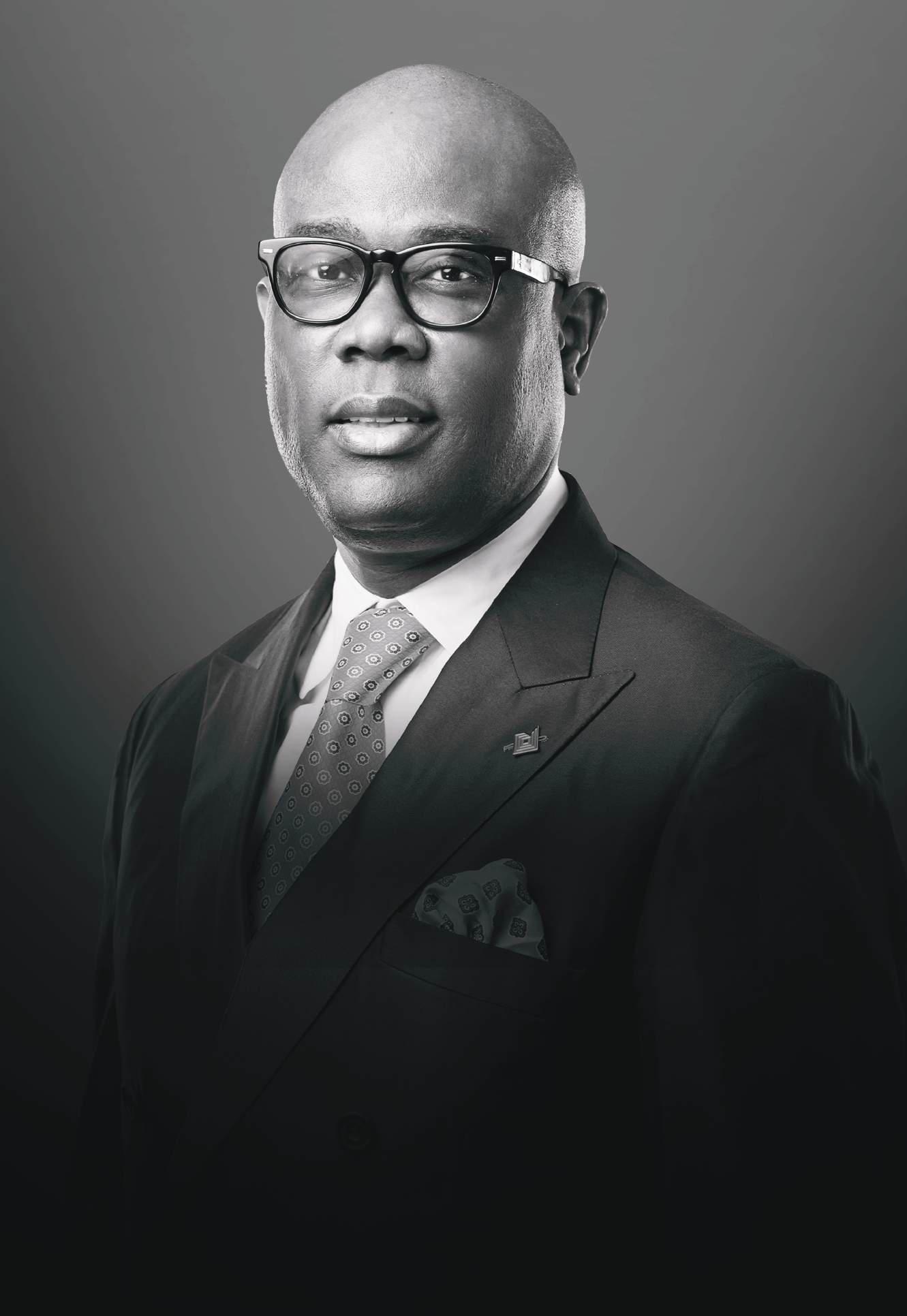
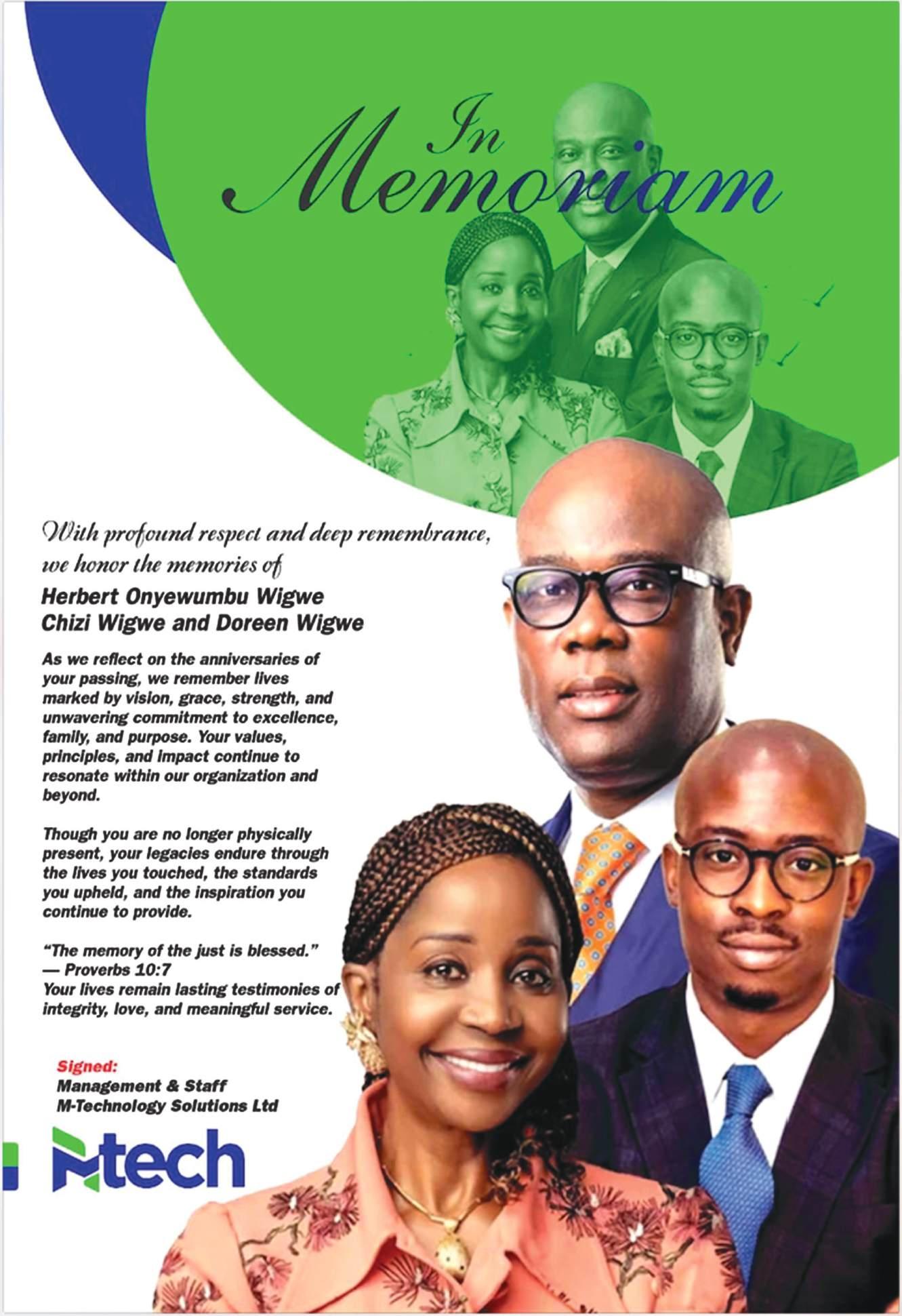
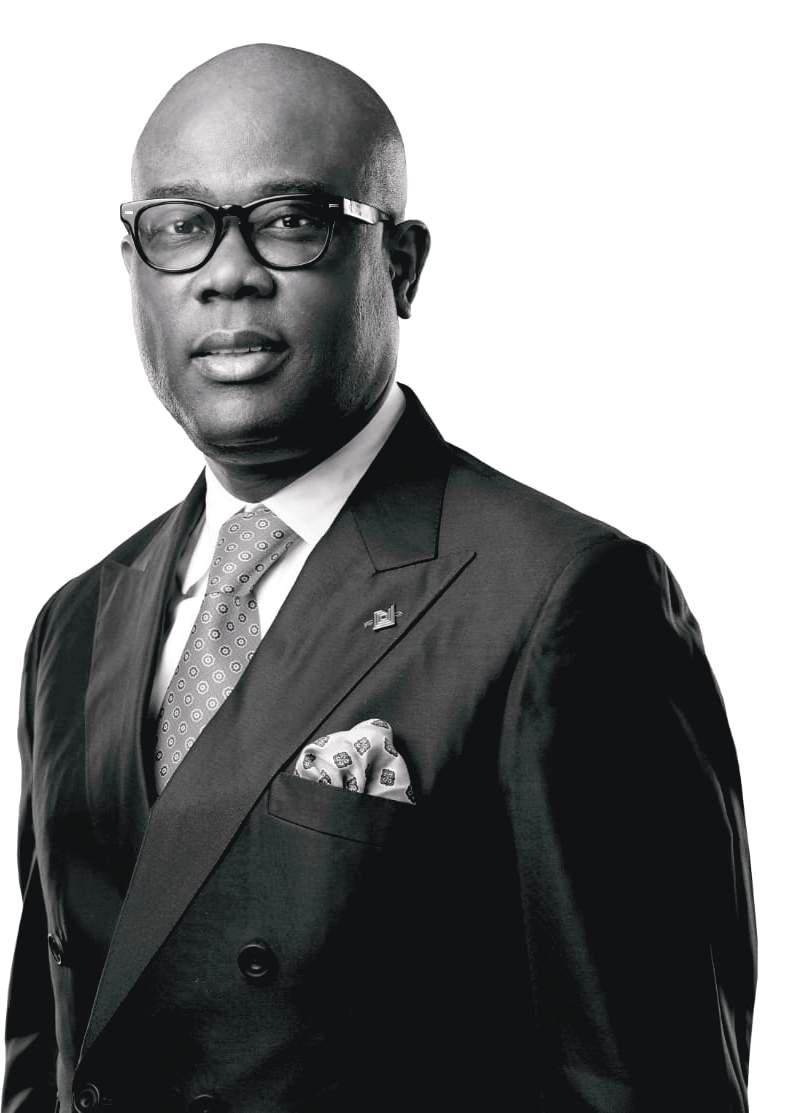
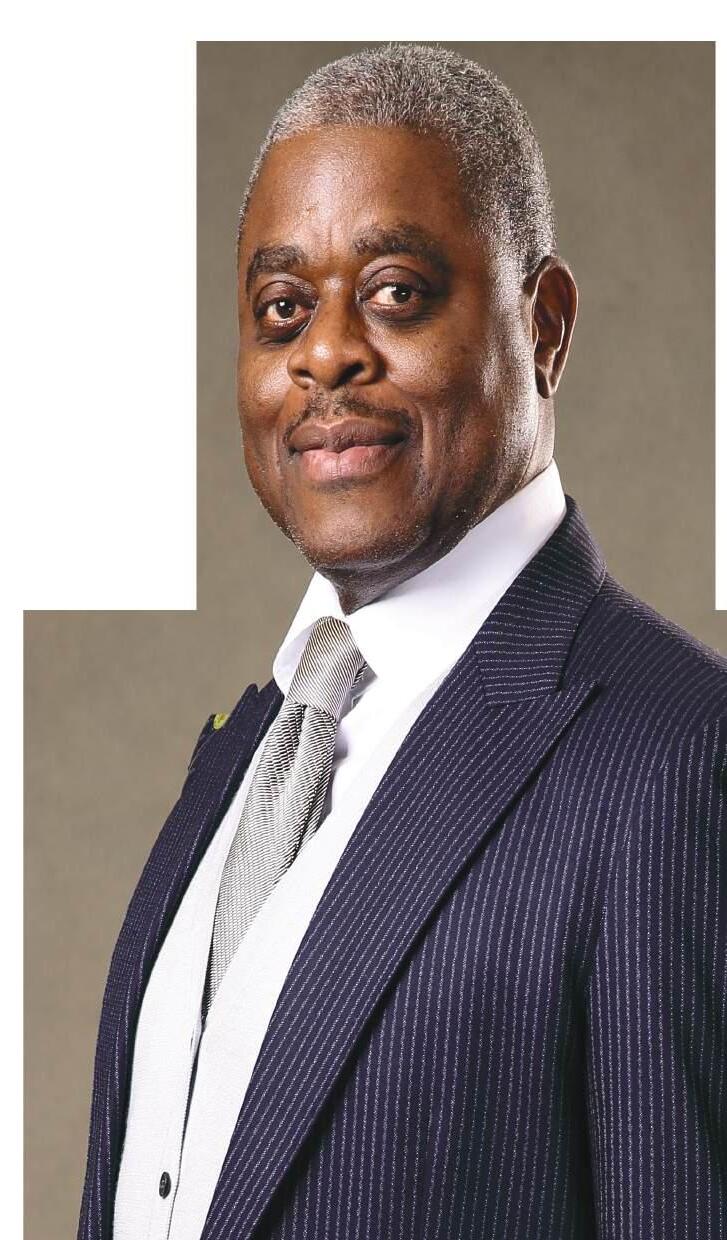
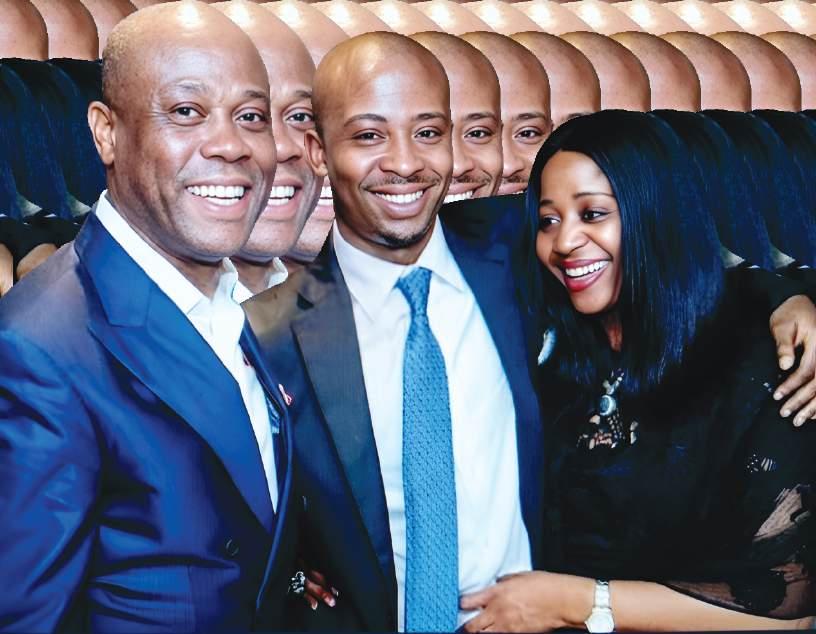
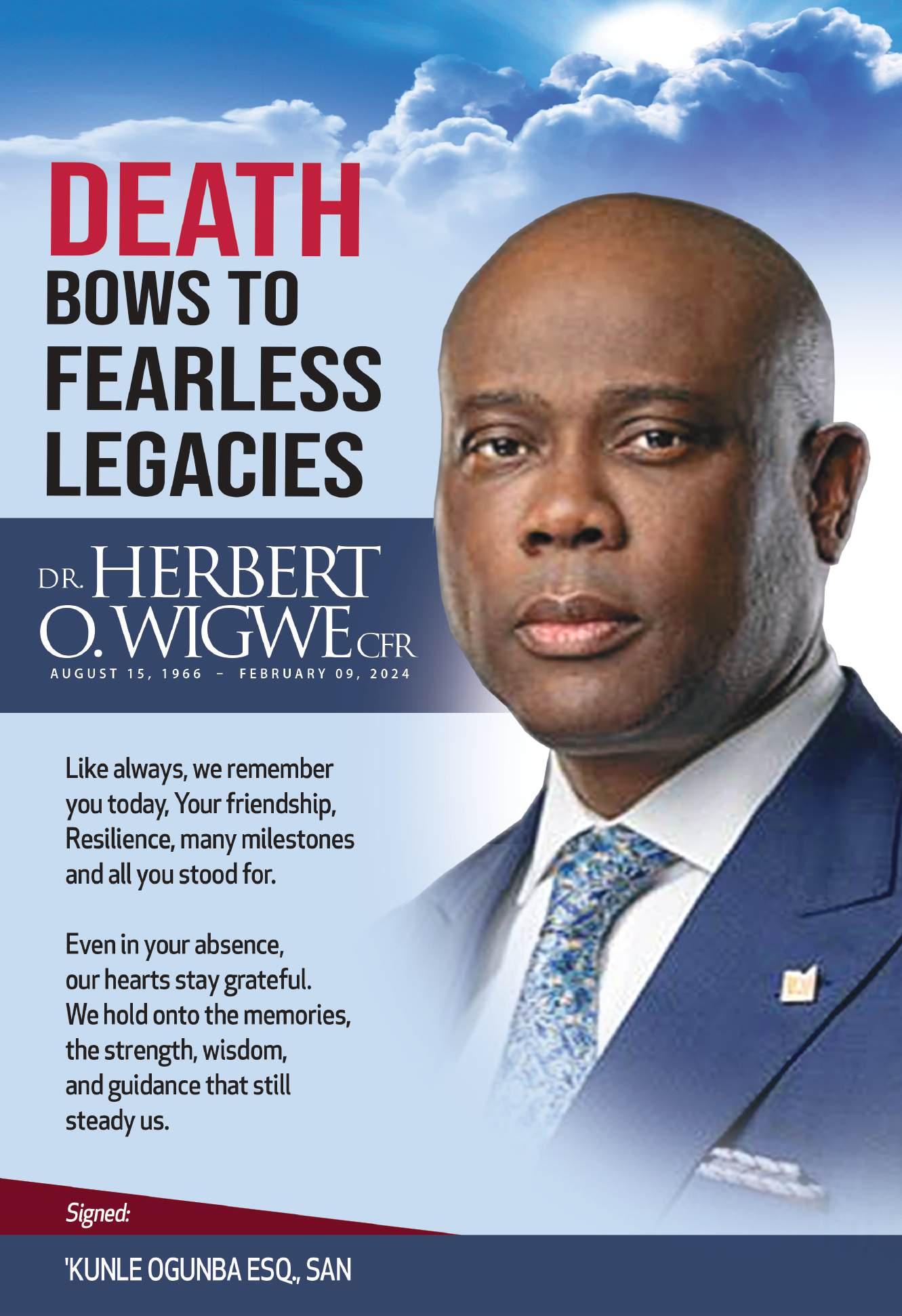
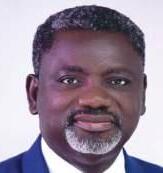
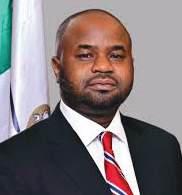
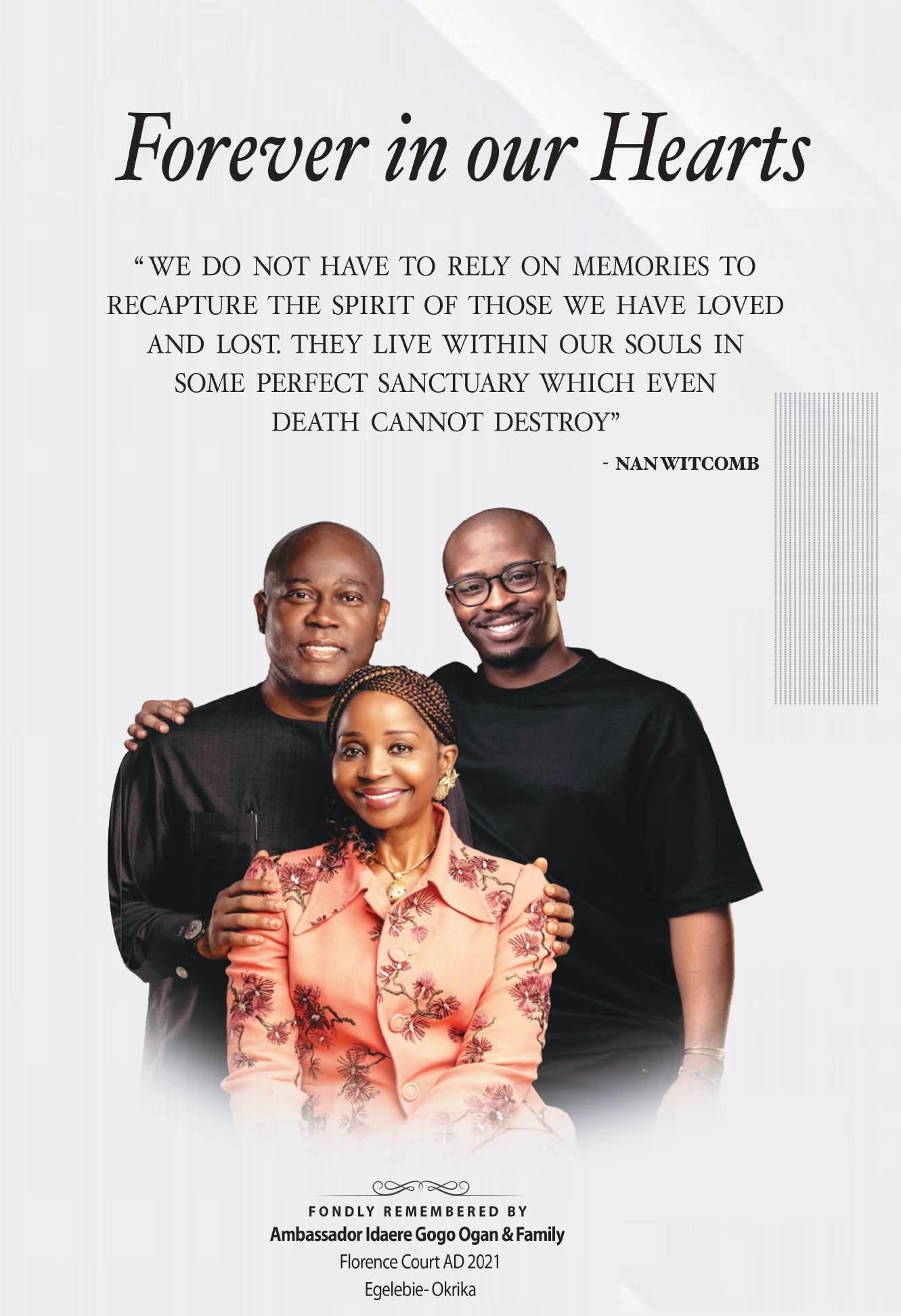
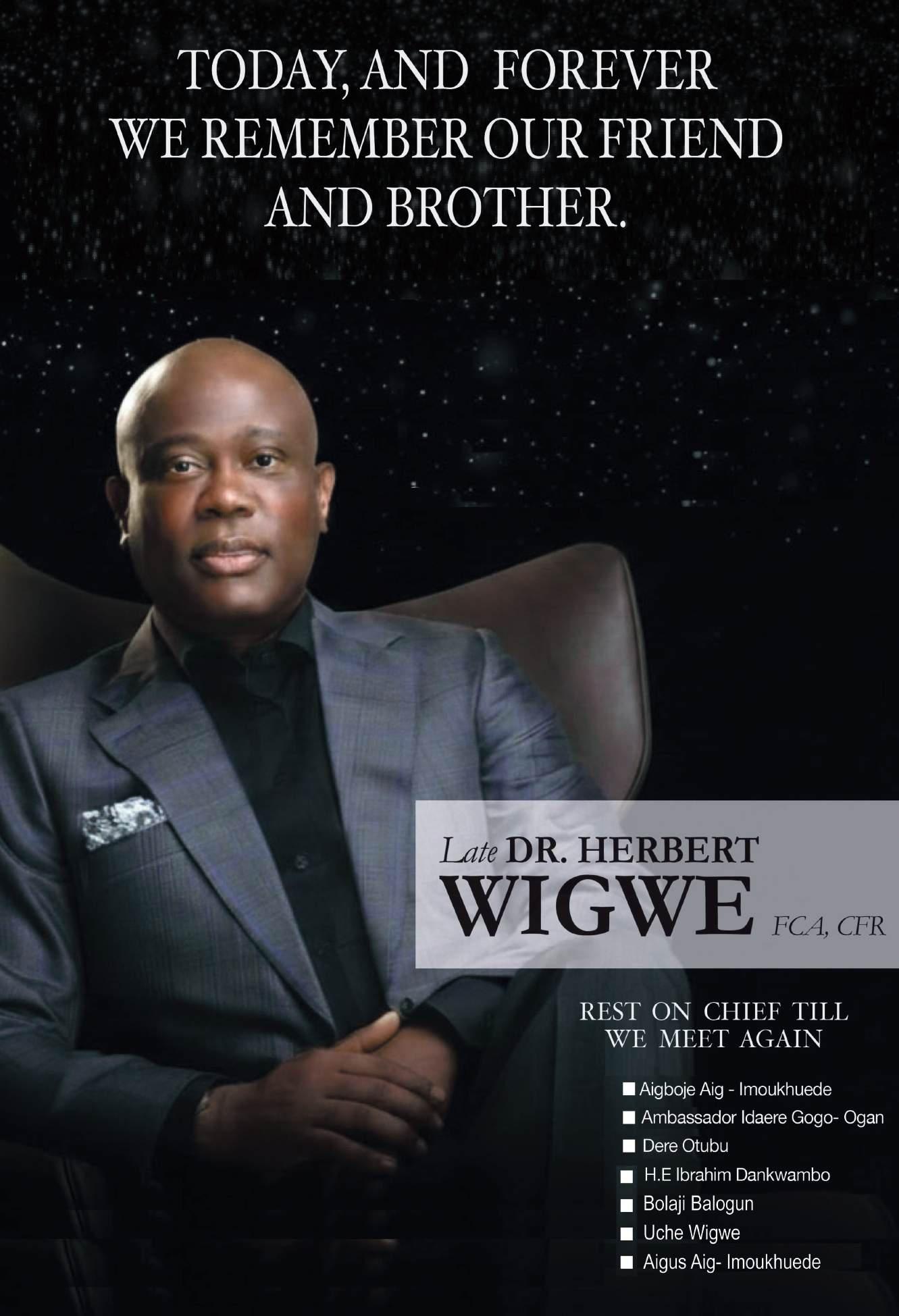
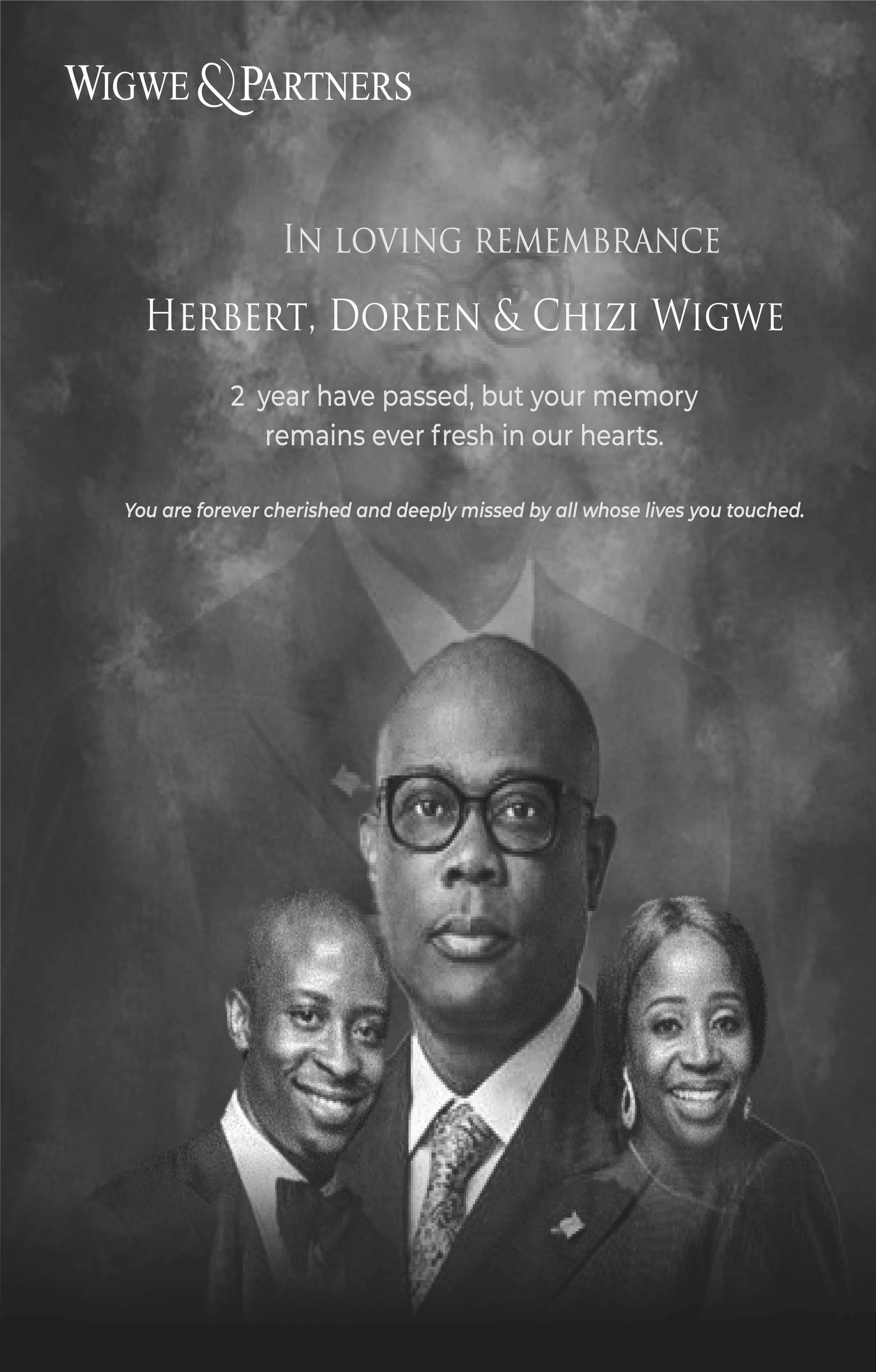
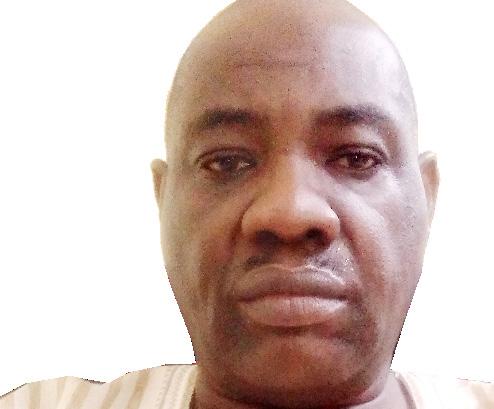
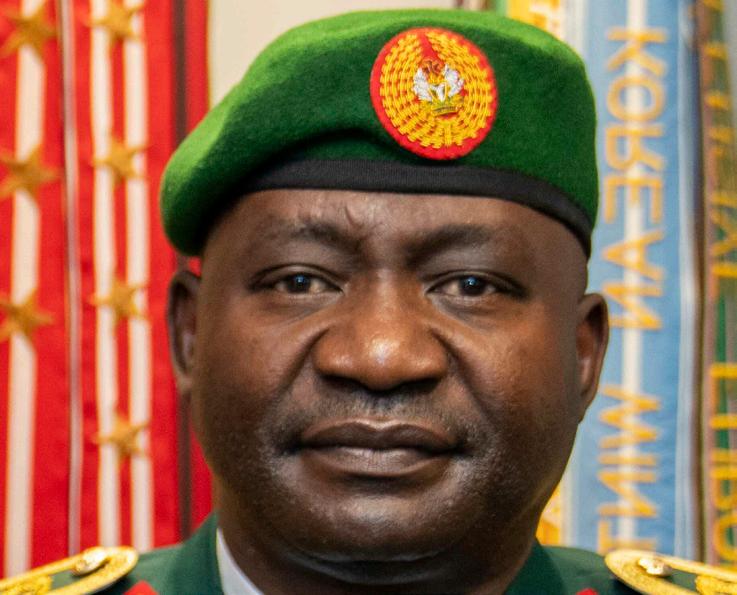
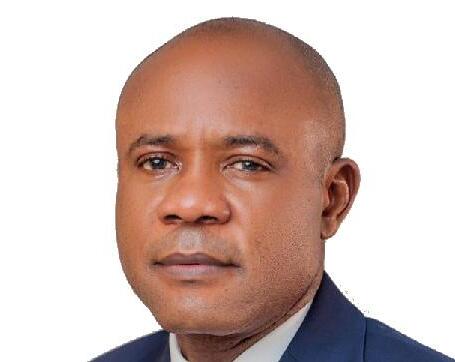
Dr. Herbert Wigwe, His wife Chizoba and son Chizi.
2 ye a r s o n , t h e m e m o r y o f D r H e r b e r t Wi g w e ,
p r iv i l e g e d e n o u g h t o c a l l h i m a f r i e n d . H i s
C F R , r e m a i n s a s v iv i d a n d i m p a c t f u l a s e ve r A s a
b u s i n e s s , w e c o n t i n u e t o p u r s u e o u r m i s s i o n
w i t h d e e p g ra t i t u d e f o r t h e i n d iv i d u a l s wh o h ave
i n s p i r e d , s u p p o r t e d , a n d e n a b l e d o u r j o u r n e y
H e r b e r t w a s u n d o u b t e d l y o n e o f t h o s e
i n d iv i d u a l s . H i s p u r s u i t o f e x c e l l e n c e , i m p a c t ,
a n d s i g n i fi c a n c e , c o m b i n e d w i t h a n
u n m i s t a k a b l e p a s s i o n f o r l i f e , s e r v e d a s a n
i n s p i ra t i o n f o r b u s i n e s s e s a n d f o r t h o s e o f u s
l e g a cy e n d u r e s , a n d w e c o n t i n u e t o h o n o u r
wh a t h e s t o o d f o r : t h e c o u ra g e t o d r e a m
b o l d l y, a n d t h e d i s c i p l i n e a n d d e t e r m i n a t i o n
t o t u r n t h o s e d r e a m s i n t o r e a l i t y. A s w e p r e s s
f o r wa r d w i t h o u r a m b i t i o n s , w e c a r r y h i s
m e m o r y w i t h u s a n d c o n t i n u e t o b e i n s p i r e d
by h i s f e a r l e s s n e s s . H i s a b s e n c e i s s t i l l d e e p l y
f e l t , a n d o u r t h o u g h t s r e m a i n w i t h a l l t h o s e
a f f e c t e d by t h e p r o f o u n d l o s s o f H e r b e r t , h i s
b e l ove d w i f e , C h i z o b a , a n d t h e i r s o n , C h i z i .
Th e i r m e m o r i e s r e m a i n i n o u r h e a r t s
I n L ov i n g M e m o r y, O n b e h a l f o f t h e B o a r d
a n d M a n a g e m e n t o f Pe t ra l o n E n e r g y L i m i t e d .
Sanwo-Olu Seeks Stakeholders' Collaboration to Position Lagos as Global Financial Hub
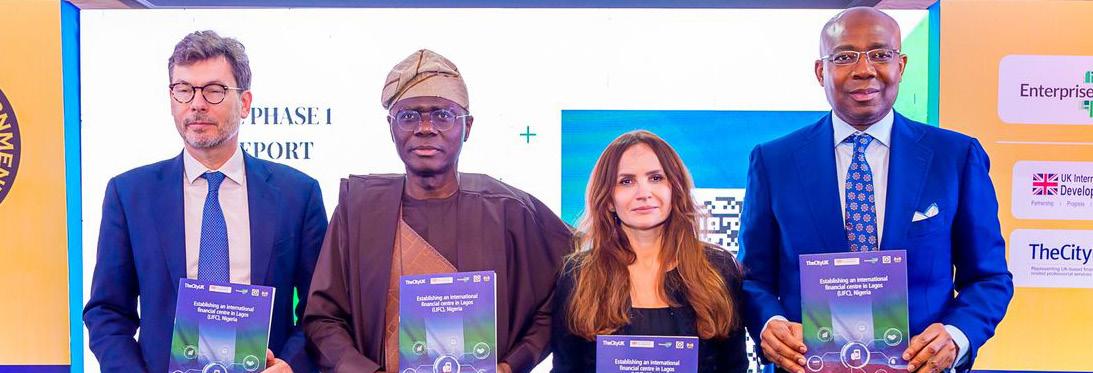
Launches Lagos International Financial Centre Phase 1 report
Governor Babajide Sanwo-Olu of Lagos State has called on stakeholders across the public and private sectors to support and sustain collaboration towards positioning the state as a global financial hub through Lagos International Financial Centre (LIFC).
Sanwo-Olu said the LIFC project, conceived about two years ago, was designed to
Emmanuel Addeh in Abuja
The Nigerian National Petroleum Company Limited (NNPC Ltd) has revealed that the country requires a staggering $22 billion investment in pipeline infrastructure, as part of a comprehensive strategy to move Nigeria to an economy powered by gas.
The disclosure was a central pillar of the newly released NNPC Gas Master Plan (GMP) 2026 seen by THISDAY, a
attract international capital, deepen financial markets, and create sustainable economic opportunities for the country.
The governor, who is Chairman of LIFC council, spoke during the launch of Lagos International Financial Centre (LIFC) Phase 1 Report, at Lagos House, Marina. LIFC is a project of Lagos State Government,
in conjunction with EnterpriseNGR, which captures the strategy and pathway to the implementation of initiatives that would transform Nigeria's economic growth, deepen the financial market, and foster innovation.
Speaking at the launch of LIFC Phase 1 Report, Sanwo-Olu reaffirmed his administration’s commitment
to establishing the centre.
He described the initiative as a strategic economic reform designed to strengthen Nigeria’s global competitiveness and position Lagos as a leading international financial hub.
GSanwo-Olu commended EnterpriseNGR for the initiative and the work done so far. He also appreciated the United Kingdom Government and
TheCityUK for providing technical and financial support in the formative phase.
The governor stressed that the development of a credible international financial centre required robust institutional framework and strategic investment partnerships.
He said, “The foundation we are laying today is for the future of our economy, our
children, and generations to come. This is not just about Lagos; it is about building an economic legacy that will transform Nigeria’s financial ecosystem. Sanwo-Olu
Required to Boost Nigeria's Gas Pipeline Infrastructure
roadmap designed to bridge the gap between Nigeria’s massive sub-surface reserves and its domestic energy needs.
According to the NNPC, while the country possesses Africa’s largest proven gas reserves, estimated at 210 trillion cubic feet, it remains only 16th in global production. This energy paradox, it said, is what the GMP 2026 seeks to resolve by prioritising midstream connectivity, infrastructure expansion, and commercial
viability.
The GMP 2026 highlighted that the current gas transportation network, spanning over 2,500km, is a significant foundation but remains insufficient to meet the nation’s burgeoning industrial and power demands. To close this gap, the NNPC said it is pushing for the completion of strategic national and regional projects, including the AjaokutaKaduna-Kano (AKK) and the OB3 pipelines.
The NNPC noted that intensified investments are needed to stimulate gas supply growth, particularly for nonassociated gas and deepwater developments, which are critical for long-term sustainability.
“The Domestic Gas Delivery Obligations (DGDO) performance improved from 50 per cent five years ago to 70 per cent in 2024. Looking forward, gas demand is set to exceed gas supply in all scenarios by 2030, indicating an urgent need
to incentivise gas development and supply whilst prioritising high economic impact demand.
“Domestic demand is expected to continue to be driven by power, Gas BasedIndustries (GBI) and commercial sectors. Export demand will continue to be driven by LNG which accounts for 70 per cent of export demand (NLNG historically accounted for over 95 per cent of these volumes).
“On gas transportation network, Nigeria boasts of
over 2,500KM of pipelines, with plans to expand through major projects like the AjaokutaKaduna-Kano (AKK) and OB3 pipelines among others, which will enhance gas distribution across the country. Current gas pipeline infrastructure in development plans could require up to $22 billion investment,” the document stated. One of the most ambitious targets within the GMP, it said,
Continued on page 44
Atiku Berates Wasted Refinery Spending, Insists on Privatisation
Former Vice President Atiku Abubakar has said the admission by the Nigerian National Petroleum Company Limited (NNPC) that reopening the Port Harcourt Refinery is a waste of scarce resources validates his long-standing position that Nigeria’s refineries should be privatised.
Atiku made the assertion in a statement posted on his Facebook page on Sunday, reacting to reports that
Of the total amount, tax revenue accounted for N51.5 billion, representing 12.6 per cent, while non-tax revenue stood at N355.2 billion, representing 87.4 per cent of the total IGR.
The government recalled that although the state’s IGR stood at N26.8 billion in 2022, it was able to scale it up to N37.4 billion in 2023 following Governor Peter Mbah’s ascension to office. It ramped it up further to N180.5 billion in 2024, before hitting N406.7 billion in 2025.
Chairman of ESIRS, Mr. Emmanuel Nnamani, who announced the IGR leap during a press briefing in Enugu yesterday, attributed the steady astronomic growth to deployment of technology, e-payment, widening of the tax net without increasing the rate, as well as other extensive reforms by the Mbah
the refinery had gulped about $1.5 billion without producing petrol.
According to him, the Bola Tinubu administration’s acknowledgment marks a belated acceptance of an economic reality he had consistently highlighted over the years — that continued public funding of moribund refineries is economically indefensible.
“It is instructive that the administration has finally come to terms with an inevitable truth:
administration to block revenue leakages.
Nnamani stated, “The state’s total IGR of Enugu State in 2022 was N26.8 billion made up of N16.2 billion tax revenue and N10.6 billion non-tax revenue.
“In 2023, we pushed the IGR to N37.4 billion, made up of N22.9 billion tax revenue and N14.5 billion non-tax revenue.
“In 2024, we moved the IGR to N180.5 billion made up of N30 billion tax revenue and N150 billion non-tax revenue. At that point, Enugu State had started thinking differently and dependence on FAAC for every government activity had drastically reduced.
“The shift from tax revenue-driven funding had happened as at 2024, as Enugu State focused on natural resources, recovery, and revival of moribund
pouring public funds into moribund refineries makes no economic sense,” Atiku said. “Paying billions of naira in salaries to facilities that do not produce a single litre of petrol does not serve the national interest,” he added.
The former vice president recalled that he had repeatedly advocated privatisation of the refineries but was vilified and accused of planning to sell public assets to cronies.
“Today, the facts have
assets to move our revenue into stability.”
The ESIRS chairman added, “Enugu State collected a total IGR of N406,774,321,758.87 out of the N509,947,000,000 projected in the 2025 Appropriation Law. This represents a performance of 80 per cent from budget perspective as well as a 125 per cent IGR growth from 2024 figure of N180.5 billion.
“It is also a revenue performance that has shown that Enugu State has developed fiscal resilience and sustainability.”
He also said, “It is important to state clearly that out of this N406.7 billion IGR, tax revenue is just N51.5 billion, representing 12.6 per cent of the total IGR in 2025, while non-tax revenue is N355.2 billion, representing 87.4 per cent of the total IGR.
caught up with the rhetoric,” he said, adding that decades of so-called turnaround maintenance had consumed billions of dollars with little or nothing to show for it.
Atiku argued that the failure of the refineries exposed deep structural problems, including gaps in technical capacity, weak financial discipline and poor management. He further criticised recent efforts to revive the refineries, describing them as politically
“As I stated earlier, most of our non-tax revenue is driven by recovery, revitalisation, and optimisation of state assets, many of which were hitherto moribund and fallow assets.”
He expressed optimism over the tax revenue growth, explaining that the state’s huge investments in infrastructure would attract more residents and businesses, which would not only pay taxes, but also create taxable employments.
Nnamani explained, “If you look at the trend, you would see a conscious effort to grow the tax revenue of Enugu State. Just in 2025, the tax revenue grew from N30 billion in 2024 to N51.5 billion in 2025, which represents 72 per cent growth year-on-year. It also shows resilience in growth, outperforming tax revenue growth of 31 per
motivated rather than driven by sound economic reasoning.
“The latest push to ‘revive’ these refineries was propelled by political pressure, not economic sense. Politics must never substitute for sound, transformative policy,” he said.
Atiku also advised against pursuing any new refinery agreements, including partnerships with foreign firms, warning that such arrangements would merely replicate failed models of the past.
cent in 2024.
“This is imperative because tax revenue is most sustainable for any national and subnational government. This is the reason we have intensified efforts to grow it in line with the provisions of tax laws.”
He said, “What we have done with tax revenue and by extension the non-tax revenue, is like fees, levies, and assets, is to plug the leakages in revenues, introducing technology to ensure traceability, accountability and transparency.
“So, 2026 is another year to watch out for Enugu State. Projected IGR is N870 billion and tax revenue is expected to dwindle as we implement a pro-citizen tax reform. However, we are very optimistic that we will beat economic expectations in tax revenue as compliance
According to him, Nigeria would have been better served by selling the refineries before embarking on costly rehabilitation projects, thereby avoiding rising debt levels and the continued depreciation of assets he described as liabilities.
He concluded that decisive privatisation remains the most viable option for ending decades of waste and inefficiency in the country’s refining sector.
with tax laws has gone up in Enugu State.”
According to Nnamani, “The feedback we get from our people and businesses daily is that they are now encouraged to pay their tax and fulfill their other financial obligations to the government by the fact that they see the transformations going on in every sector of the state under the present administration – the infrastructure.
“There are the 260 Smart Green Schools and the 260 Type-2 Primary Healthcare Centre spread across the 260 electoral wards, the Enugu International Conference Centre (ICC), the ICC 5-Star Hotel, the Enugu International Hospital, the Enugu Air, the five modern bus terminals, the 100 CNG buses, and indeed the over 2,000 completed and ongoing projects across the state, just to name a few.”
Chuks Okocha in Abuja
AFRICOM DELEGATION VISITS PRESIDENT TINUBU...
Bank of Industry Gets CBN’s Nod to Float Non-Interest Banking Window
Olusi: Licence will help to reach new category of underserved borrowers
James Emejo in Abuja
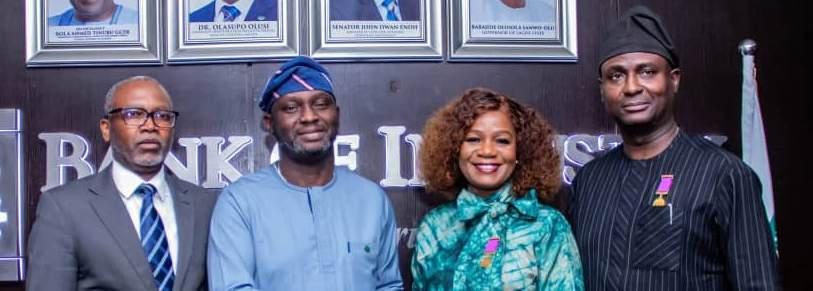
Bank of Industry (BoI) said it had secured regulatory approval from Central Bank of Nigeria (CBN) to operate a Non-Interest Banking (NIB) Window, marking a significant milestone in the development finance institution’s growth and long-term development agenda.
The approval authorises the bank to commence non-interest banking activities, positioning it to further advance sustainable and inclusive industrial development
through tailored financial solutions for underserved and high-impact business segments.
Commenting on the development, Managing Director/Chief Executive, BoI, Dr. Olasupo Olusi, stated, “This license marks a pivotal moment in the bank’s journey of transforming Nigeria’s industrial sector. With this license we can reach a new category of borrowers who before now could not be served.
Olusi said, “This will allow the bank to scale its operations,
introduce innovative financing solutions, and deepen support for Micro, Small and Medium Enterprises (MSMEs), as well as other underserved segments critical to Nigeria’s sustainable economic growth.”
Essentially, the NIB operations will enable BoI to drive inclusive growth, mobilise new ethical funding, expand support for the real economy, and align its financing activities with social and developmental objectives.
Under the framework, BoI will be able to finance assets and raw
materials for customers using approved non-interest banking products.
In a statement issued by Divisional Head, Public Relations, BoI, Theodora Amechi, Olusi said the approval underscored CBN’s confidence in the bank’s commitment to responsible financing.
She said the bank’s decision to commence NIB operations was aimed at expanding access to ethical funding for businesses—particularly those that had traditionally avoided
Insecurity: Tinubu Hosts AFRICOM Commander, U.S. Envoy at State House
Deji
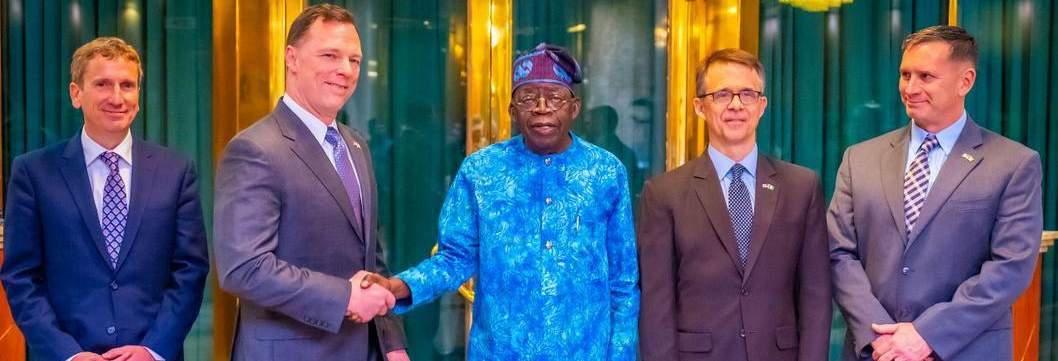
President Bola Tinubu has played host to a high-level delegation from the United States Africa Command (AFRICOM), led by its Commander, General Dagvin Anderson, at the State House, Abuja.
Senior Special Assistant to the President on Social Media, Dada Olusegun, who disclosed this via his verified X handle, @DOlusegun, said the
Sunday evening meeting was also attended by top brass of Nigeria's military and security organisations.
According to Olusegun, President Tinubu, alongside the National Security Adviser (NSA), Mallam Nuhu Ribadu, and the service chiefs, received General Anderson, members of his team, and the Charge d’Affaires of the U.S. Embassy in Nigeria, Mr. Keith Heffern. Those present on the U.S. side included the Charge
d’Affaires, Mr. Keith Heffern; the Commander of AFRICOM, General Dagvin Anderson; the Command Sergeant Major, Garric M. Banfield, who is the Command Senior Enlisted Leader of AFRICOM; and the Senior Foreign Policy Adviser, AFRICOM, Ambassador Peter Vrooman.
On the Nigerian side, President Tinubu was joined by the National Security Adviser, Mallam Nuhu Ribadu; the Minister of
Defence, General Christopher Musa (rtd); Chief of Defence Staff, General Olufemi Oluyede; Chief of Army Staff, Lieutenant-General Waidi Shaibu; Chief of Defence Intelligence, Lieutenant-General Emmanuel Uandiandeye; the DirectorGeneral of the National Intelligence Agency (NIA), Mohammed Mohammed; and the Director-General of the Department of State Services (DSS), Tosin Ajayi.
SERAP Petitions CCB to Probe Senate Over Electoral, Tax Laws
Chuks Okocha in Abuja
The Socio-Economic Rights and Accountability Project has petitioned the Code of Conduct Bureau to investigate members of the Senate and other public officers over alleged irregularities in the passage of the Electoral Act Amendment Bill and the Tax Reform Laws.
According to a statement
issued on Sunday by SERAP Deputy Director Kolawole Oluwadare, the organisation is seeking a prompt, thorough, and effective probe into claims that some senators removed provisions on electronic transmission of election results from the Electoral Act Amendment Bill during plenary, despite a majority having voted for their inclusion and without any debate on
the proposed removal.
“According to our information, certain members of the Senate allegedly removed the provisions on electronic transmission of election results from the Electoral Act Amendment Bill during plenary after the majority of the senators had voted for the inclusion of the provisions and without any debate on the proposed
removal of the said provisions,” SERAP said.
The organisation also requested the CCB to investigate alterations in the Tax Reform Bills, which reportedly led to discrepancies between the harmonised versions passed by the National Assembly and the copies signed into law and gazetted by the federal government.
conventional interest-based financing.
According to her, the initiative opens new opportunities for ethically motivated and faithsensitive enterprises, as well as segments of the economy that face challenges accessing traditional credit.
Olusi explained that the platform would enable such businesses to access muchneeded financing and participate confidently in the formal financial system in a manner consistent with their values and business realities.
BoI remains a foremost Development Finance Institution (DFI), committed to driving
industrial growth and inclusive economic development.
It was established in 1959 as the Investment Company of Nigeria (ICON) and reconstituted as Nigerian Industrial Development Bank (NIDB) under World Bank guidance in 1964.
The bank assumed its current form in 2001 following the merger with Nigerian Bank for Commerce and Industry (NBCI), and National Economic Reconstruction Fund (NERFUND).
Its primary mandate is to provide financial assistance for the establishment and expansion of large, medium, small-scale, and micro projects.
FG to Hold NEC Conference to Drive Inclusive Economic Growth Monday
Shettima to chair confab to be attended by all govs and other key stakeholders
Deji Elumoye
in Abuja
The Federal Government will on Monday convene the National Economic Council (NEC) Conference to strengthen Nigeria’s economic coordination and accelerate inclusive growth across all states of the federation.
According to a statement issued on Sunday by Media Aide to the Vice President, Stanley Nkwocha, governors of the 36 states and key national stakeholders will attend the conference.
Scheduled for February 9 and 10, 2026, and holding at the Banquet Hall of the State House, Abuja, the conference is being convened by the Minister of Budget and Economic Planning, Senator Abubakar Atiku Bagudu.
The theme of the conference which is “Delivering Inclusive Growth and Sustainable Development: The Renewed Hope National Development Plan", is expected to produce far-reaching policy direction for the states as they align with the Federal Government’s long-term economic agenda.
According to the Permanent Secretary of the Federal Ministry of Budget and Economic Planning and Secretary of the NEC, Dr. Deborah Oko Odo, the conference will address pressing macro-economic priorities.
“The conference will focus on national economic issues aimed at encouraging economic growth and development across the country,” she said.
Elumoye in Abuja
L-R: Charge D’Affairs, U.S. Embassy in Nigeria, Mr. Keith Heffern; Commander, AFRICOM, General Dayvin Anderson; President Bola Tinubu; Command Sergeant Major, Mr. Garric M. Banfield; Command Senior Enlisted Leader, United States Africa Command (AFRICOM); and Senior Foreign Policy Adviser, AFRICOM, Amb. Peter Vrooman, during the AFRICOM delegation’s visit to President Tinubu at the Presidential Villa, Abuja, yesterday GODWIN OMOIGUI
COURTESY VISIT...
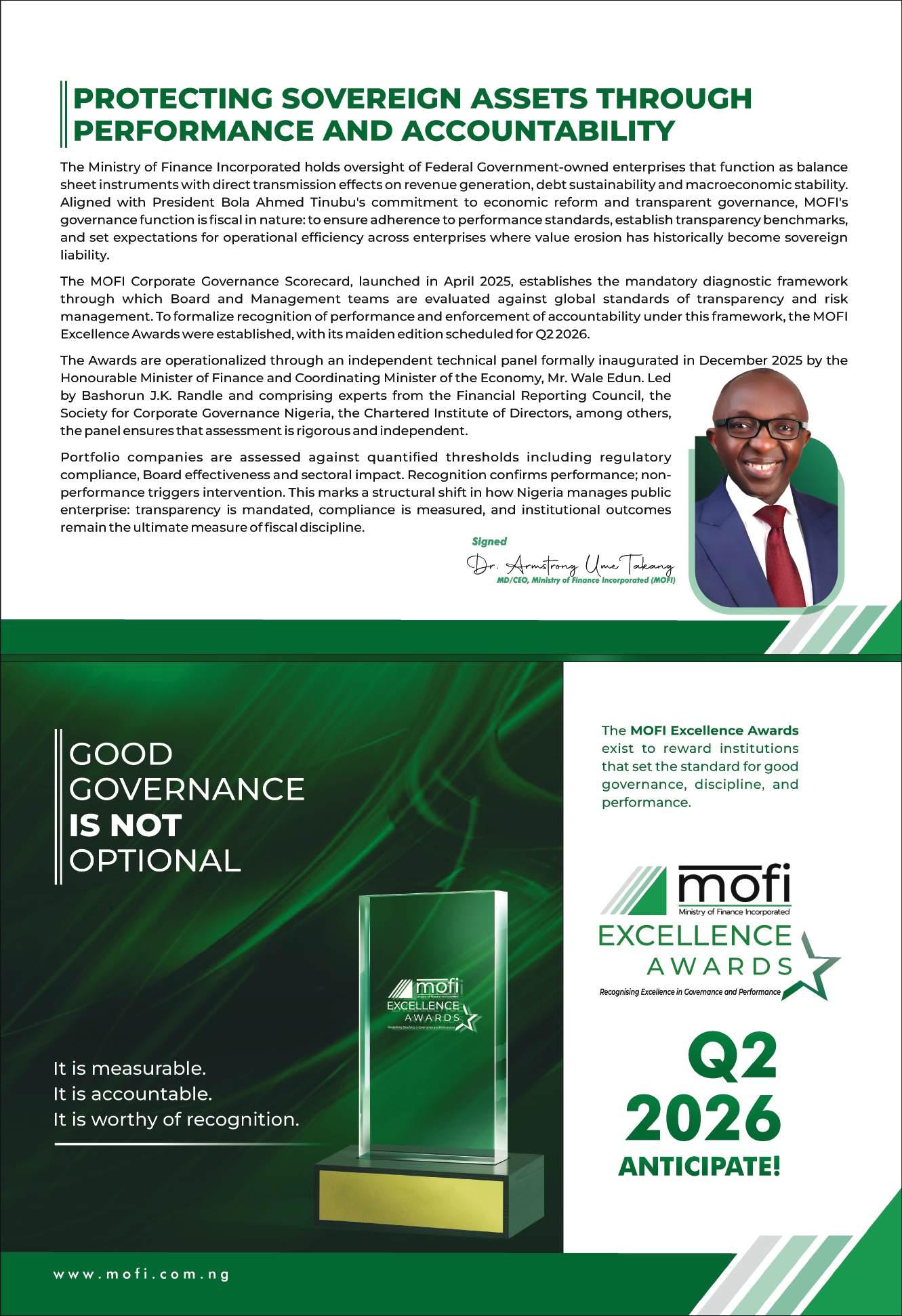
In Bid to Promote Good Governance across Government-owned Enterprises, MOFI Set to Unveil Inaugural Excellence Awards
Ndubuisi
Ministry of Finance Incorporated (MOFI) is set to announce the inaugural MOFI Excellence Awards, scheduled for the second quarter of 2026, and designed to instil the culture of good corporate governance among Government-owned Enterprises (GOEs).
The awards panel of the
fiirst-of-its-kind initiative in the country dedicated to recognising excellence in corporate governance and performance across Federal Government-owned and linked enterprises, was constituted last December.
MOFI said, in a statement issued yesterday, that the awards will hold in the second quarter of 2026, although no
The Nigerian Society of Engineers (NSE) at the weekend threw its weight behind real-time electronic transmission of election results, dismissing the Nigerian Senate’s reasons for rejecting the proposal as professionally indefensible.
In a statement in Abuja signed by the NSE President, Ali Rabiu, the umbrella body of engineers in Nigeria said that none of the arguments advanced by lawmakers against mandatory realtime transmission had the endorsement of any competent professional or technical body.
The Senate had during the week opted to retain existing provisions that allow the Independent National Electoral Commission (INEC) to transmit results “in a manner prescribed by the Commission,” rather than mandating immediate electronic uploads from polling units to INEC’s result viewing portal.
The NSE recalled that lawmakers justified their position by citing poor network coverage across large swathes of the country, particularly in rural and
remote areas; cybersecurity risks associated with hacking and data interception; weak infrastructure such as unreliable electricity at polling units; and the possibility that technical failures could trigger prolonged legal disputes over election outcomes.
But the NSE rejected these concerns, arguing that they reflect outdated assumptions about modern election technology and underestimate Nigeria’s existing and potential technical capacity.
“Let it be on record that the reasons mentioned above do not have the endorsement of any technically proficient professional organisation such as the Nigerian Society of Engineers (NSE). Electronic transmission of election results offers several technical advantages that could enhance the integrity, efficiency and credibility of Nigeria's electoral process,” the organisation argued.
According to the engineering body, electronic transmission of results offers clear advantages over the current reliance on manual movement of result sheets, which it described as highly vulnerable to manipulation, loss and alteration during transit.
specific date was given.
According to the statement, "This milestone event underscores MOFI's commitment to promoting transparency, accountability, and good governance across Federal Government-owned enterprises.
"The MOFI Excellence Awards are a culmination of the Ministry's efforts to establish a robust governance framework, aligned with President Bola Ahmed Tinubu's economic reform agenda.
"The MOFI Corporate Governance Scorecard, launched in April 2025, provides the foundation for evaluating Board and Management teams against global standards of transparency and risk management.”
The statement said, "An independent technical panel, inaugurated by Honourable Minister of Finance and Coordinating Minister of the
Economy, Mr. Wale Edun, in December 2025, will assess portfolio companies against stringent criteria, including regulatory compliance, Board effectiveness, and sectoral impact.
"The MOFI Excellence Awards mark a structural shift in how Nigeria manages public enterprise: transparency is mandated, compliance is measured, and institutional outcomes remain the ultimate measure of fiscal discipline."
The statement added that the awards will recognise institutions that demonstrated exceptional governance, discipline, and performance, reinforcing the notion that "Good Governance is Not optional”.
Inaugurating the awards panel, chaired by Chief J.K. Randle, last December, Minister of Finance and Coordinating Minister of
the Economy, Mr. Wale Edun, said, “The MOFI Excellence Awards are not about applause for its own sake; they were conceived to promote corporate governance excellence, high institutional performance, and strategic alignment across MOFI’s portfolio of public enterprises.”
Edun alluded to the programme’s intent to drive fundamental changes in the public sector, adding, “In essence, this programme will shine a spotlight on those boards and management teams that exemplify transparency, accountability, and strong performance.”
The minister stated that the awards sought to recognise agencies and their leaders who demonstrated high standards of transparency, accountability, and performance in managing public assets. He stressed that by doing so, the federal government was
sending a clear message that good governance and results will be rewarded, and that every entity under MOFI should strive towards the highest ideals of service and stewardship.
Managing Director of MOFI, Dr. Armstrong Takang, described the swards as a “first-of-its-kind initiative in Nigeria dedicated to recognising excellence in corporate governance and performance across Federal Government-owned and Linked Enterprises”.
Takang underscored the ambitious reform agenda MOFI had continued to pursue over the past year to transform the management of Nigeria’s public assets. He stated that from launching the MOFI Corporate Governance Scorecard to, now, instituting an awards programme, MOFI was “translating reform ideas into tangible outcomes".
Oando: Policy Clarity, Risk Reduction Driving Energy Investment
Oando Plc, Africa’s leading indigenous energy solutions provider, has underscored the importance of collaborative leadership, disciplined capital structures, and risk management in sustaining Africa’s upstream momentum and unlocking financing for long-term energy development.
At the Nigeria International Energy Summit (NIES) 2026, Managing Director of Oando Energy Resources, Dr. Ainojie ‘Alex’ Irune, and Mr. Akinbambo
Ibidapo-Obe, General Manager of Commercial, participated in crucial high-level discussions on upstream leadership and financing Africa’s energy future.
They articulated a unified perspective on the importance
of aligning policy, governance, and scale to attract investment, a statement from the energy company said.
Speaking at the Upstream Leadership Dialogue, Irune said Africa’s upstream resurgence is no longer speculative, but the result of deliberate collaboration, innovation, and renewed confidence across the sector.
“What many once viewed as a myth has become a tangible story,” Irune said. “We are seeing new partnerships and a different way of approaching an industry that had been written off. The focus now must be on sustaining that momentum and unlocking the scale of opportunity ahead,” he added.
He noted that while Nigeria’s upstream sector has strong technical capability, achieving
national production ambitions will depend on access to capital that recognises the realities of upstream development.
“We are often clear about production targets, but the conversation around cost and capital is less explicit,” he said. “To scale sustainably, we must rethink traditional financing pathways and pursue capital structures that provide patience, alignment, and long-term support.”
Irune concluded by emphasising that Oando's presence at NIES 2026 underscores its commitment to building a resilient upstream business grounded in disciplined capital allocation, robust governance, and enduring partnerships.
He asserted that Oando will continue to strategically align its leadership, enhance policy
engagement, and optimize commercial execution to ensure that its energy portfolio is positioned for sustainable growth and enduring value creation not only in Nigeria but throughout Africa.
During the ‘Financing Africa’s Energy Future’ panel, General Manager, Commercial, Oando Energy Resources, Ibidapo-Obe, explained how scale, integration, and risk management are central to Oando’s approach to unlocking competitive capital.
“Scale and integration give you the right to go after capital, but they are not enough on their own,” Ibidapo-Obe said. “What truly unlocks competitive capital is managing risk and reducing the risk premium,” he emphasised.
Emmanuel Addeh in Abuja
Emmanuel Addeh in Abuja
Francis in Abuja
L-R: Vice Chairman, Building Project Committee, Institute of Chartered Secretaries and Administrators of Nigeria (ICSAN), Mr. Tajudeen Ahmed; Managing Director/CEO, Bank of Industry (BoI), Mr. Olasupo Olusi; President/Chairman, ICSAN, Mr. Uto Ukpanah; and Vice President, ICSAN, Mr. Francis Olawale, during a courtesy visit of ICSAN’s top executives to the BoI in Lagos … recently
His Excellency, Pr esident Bola Ahmed Tinubu, GCFR, President and Commander-in-Chief of the Ar med Forces, Federal Republic of Nigeria
His Excellency, Pr esident Car los Vila Nova, President of the Democratic Republic of São Tomé and Príncipe
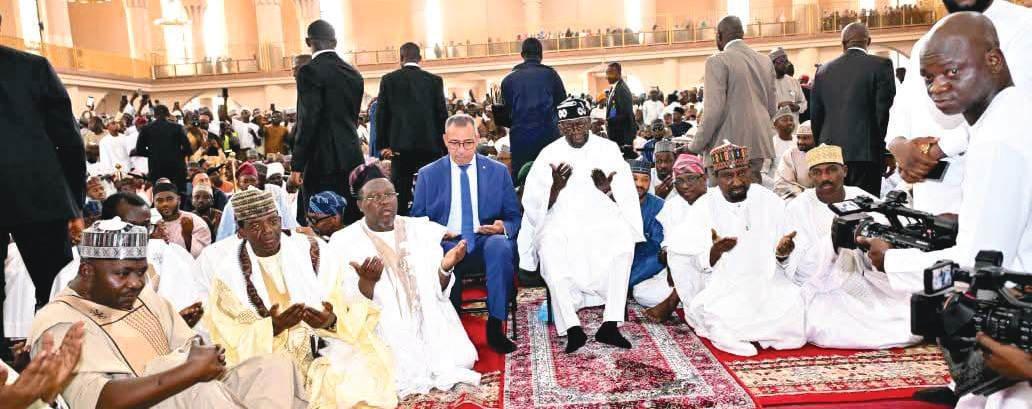
On behalf of my family, I extend my profound gratitude and hear tfelt appreciation to His Excellenc y, President Bola Ahmed Tinubu, GCFR, President and Commander-in-Chief of the Ar med Forces of the Federal Republic of Nigeria, for the great honour of his distinguished presence at the wedding Fatiha of my c hildren, held on Friday, 6 Febr uary 2026, at the National Mosque, Abuja.
I am equally grateful to His Excellency, President Car los Vila Nova, President of the Democratic Republic of São Tomé and Príncipe, for his graci ous attendan ce alongside President Tinubu. Their presence brought exceptional dignity and signicance to the occasion, for whic h my family and I remain deeply thankful.
The goodwill, prayers and war m suppor t extended on this joyous occasion added immeasurable value to the celebration and will forever be c herished.
I express my sincere appreciation to the Deputy President of the Senate, Senator Barau Jibrin; the Minister of Defence, General Christopher Gwabin Musa (r td.); and the Executive Gover nors of Sokoto State, Alhaji Ahmad Aliyu; Kebbi State, Dr Nasir Idris; Bor no State, Professor Babagana Umara Zulum; Kano State, Alhaji Abba Kabir Yusuf; Jigawa State, Malam Umar Namadi; and Kaduna State, Senator Uba Sani, for honouring us with their distinguished presence despite their demanding national responsibilities
I am par ticular ly grateful to the National Security Adviser, Mallam Nuhu Ribadu; the Chief of Staff to the President, Rt. Hon. Femi Gbajabiamila; Hon. Ibrahim Masari; for mer Gover nors and Senators Ahmad Sani (Yariman Bakura) and Abdul’aziz Yari of Zamfara State; Senator Atiku Bagudu of Kebbi State; the for mer Gover nor of Kano State and immediate past National Chair man of the APC, Dr.
My sincere appreciation also goes to the distinguished members of the National Assembly, members of the Federal Executive Council, and the Ser vice Chiefs, whose attendance greatly honoured us. Your steadfast c o m m i
appreciated.
I thank the members of the Diplomatic Corps for their attendance, whic h added an impor tant inter national dimension to the ceremony, and for their continued friendship and cooperation with Nigeria.
I fur ther ac knowledge our revered traditional r ulers for their guidance, wisdom and blessings, whic h continue to strengthen our cultural heritage and social har mony, as well as the religious leaders who offered prayers for the success and blessings of these marriages May Allah reward you abundantly
To our family members, friends, associates and all other well-wishers who travelled from far and near in this memorable occasion, I express my deepest gratitude. Your presence, prayers and good were invaluable.
I am deeply humbled by the overwhelming love and suppor t extended to my family continue to wor k together for the peace prosperity and progress of the Federal R of Nigeria.
Thank you, and may Allah continue to guide us all.
Signed: Dr. Bello Mohammed Ma ta walle, MON
Minister of State for Defence
Abdullahi Umar Ganduje, Emir of Kano, His Highness Alhaji Aminu Ado Bayero, Chair man/ CEO Dangote Group of Companies Alhaji Aliko Dangote for their valued presence and goodwill.
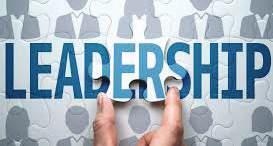
Leaders should do the most important things exceptionally well, contends LINUS OKORIE
PEOPLE-CENTERED APPROACH TO POLICY IMPLEMENTATION
Zach Adedeji takes message of new tax laws to the youths, writes YAKUBU DATI
UNPACKING
STOCKBROKERS’ HIDDEN ROLES IN FINANCIAL LITERACY
SOLA ONI argues that exposing students to fundamentals of savings and investing bodes well for financial responsibility
REFINERIES AS MONUMENTS TO WASTE
THE GROWTH TRAP: WHY MORE ISN'T ALWAYS BETTER
Every successful leader faces a dangerous temptation that if something is good, more of it must be better. When they see the revenue growing, they push for faster growth. As the market share expands, they expand into adjacent markets. They launch more product lines because existing products are selling. This relentless pursuit of "more" feels like ambition is often the beginning of the end. This is where companies move from doing a few things exceptionally well to doing many things mediocrely. And it almost always starts with leadership decisions that seem brilliant at the time but prove devastating in hindsight. There is a critical difference between growth and scale. Growth aligned with core strengths builds sustainable advantage. Undisciplined expansion destroys it. Yet research shows that 67% of companies that fail do so not from lack of opportunity but from pursuing too many opportunities simultaneously. Companies launch products outside their area of expertise. They acquire businesses in unfamiliar industries. They expand geographically before mastering their home market. The strategic clarity and focus that defined their early success gets replaced.
Between 2001 and 2017, General Electric under Jeff Immelt expanded aggressively into finance, entertainment, and other sectors far from its industrial core. The company made over 380 acquisitions during this period. By 2018, GE's market value fell from $400 billion to less than $100 billion. The pursuit of more had destroyed three-quarters of shareholder value. Quibi, the short-form video streaming service raised $1.75 billion and shut down after just six months in 2020. Despite having no proven productmarket fit, they pursued massive content deals, extensive marketing campaigns, and rapid scaling. The undisciplined pursuit of growth killed the company before it could find its footing.
Under Adam Neumann, WeWork went beyond co-working spaces, into co-living apartments, schools, banking, and even airlines. In nine years, the company had 600 spaces globally. His undisciplined expansion led to its valuation plummeting from $47 billion to less than $10 billion in months, eventually filing for bankruptcy in 2023. Neumann himself acknowledged that the $47 billion valuation went to his head, a perfect illustration of how undisciplined pursuit of more destroys.
Leaders create the conditions for undisciplined pursuit of more through identifiable behaviors, and understanding these patterns is the first step toward avoiding them. Many leaders treat growth
as the primary measure of success rather than as one indicator among many. They celebrate revenue increases without examining profit margins, tout expansion into new markets without assessing strategic fit, and measure activity rather than impact. Data reveals that 78% of major corporate growth initiatives fail to deliver expected returns, yet companies continue launching them at an accelerating pace. This is because leaders have made growth itself the goal rather than a byproduct of doing something valuable exceptionally well.
In the early stages of success, most organizations maintain clear boundaries about what they will and won't do. They understand their core competencies and stick to them. But as success builds, these boundaries start to blur. Leaders begin saying yes to opportunities that would have rejected a few years earlier.
Undisciplined leaders pursue bigness for its own sake. They want to be in more markets, have more products, serve more customers, generate more revenue. But they neglect the unglamorous work of strengthening core operations, improving quality, building better systems, and developing deeper capabilities. A study of 1,850 companies found that those focused on operational excellence and improvements outperformed those pursuing dramatic expansion by 300% over fifteen years. The tortoise will eventually win because the hare is only interested in drama.
As organizations pursue undisciplined growth, they become more complex with more products, more markets, more processes, more layers of management. Leaders often point to this complexity as justification for declining performance, which is not true. Southwest Airlines serves millions of customers with remarkable simplicity. Amazon has extraordinary scale but maintains intense focus on customer experience fundamentals.
In undisciplined organizations, busyness becomes a badge of honor. Leaders brag about how many initiatives they are running or how many meetings they are in. But research consistently shows that
the damage from undisciplined growth is not always immediately visible in financial statements, which is why it is so dangerous. By the time declining performance becomes obvious, the problems are deeply embedded. Perhaps most dangerously, undisciplined pursuit of more means your limited resources get spread across too many priorities. The mathematical reality shows that when everything is important, nothing is important.
If undisciplined pursuit of more is a leadership problem, the solution must also come from leadership. The most successful leaders can articulate in one sentence what their organization does better than anyone else in the world. Everything else is either in service of that core strength or a distraction. Creating what some call a "stop-doing list" becomes essential, a catalog of opportunities you will deliberately not pursue regardless of how attractive they appear.
Before pursuing any new opportunity, leaders need to ask these questions: Does this strengthen our core capabilities? Does this align with our long-term strategic direction? If the answer to any question is no, walking away is the right choice regardless of how lucrative the opportunity appears. The discipline of having clear criteria aids decision-making.
Revenue and growth are easy to measure, but they are lagging indicators (e.g., monthly sales) that tell you what already happened rather than what is coming. Leaders in this phase of decline often make the critical mistake of overestimating these indicators and using them to predict future success, assuming that because revenue grew 30% last year, it will continue growing at similar rates indefinitely. When you use lagging indicators to predict the future, you are essentially driving forward while looking in the rearview mirror; you will eventually crash.
Okorie MFR is a leadership development expert spanning 30 years in the research, teaching and coaching of leadership in Africa and across the world. He is the CEO of the GOTNI Leadership Centre
Zach Adedeji takes message of new tax laws to the youths, writes
YAKUBU DATI
PEOPLE-CENTERED APPROACH
TO POLICY IMPLEMENTATION
The application portal for accessing loans by Nigerian students officially opened on May 24, 2024 and since then, tertiary education in Nigeria has never been the same again with increase in rate of admission and wider interest by applicants.
The loan is to enable indigent students in universities, polytechnics, colleges of education, etc., have access to quality education.
With that access granted, came the need for students of tertiary institutions to understand the workings of the system that makes it possible for such funds to be generated for them to use and the responsibility that comes with it.
Much as they understand that the facility is to support their education, the need for them to comprehend how it was conceived and derived to remove any ambiguity on how it works becomes imperative.
Fortunately, chairman of the National Revenue Service (NRS) Mr Zach Adelabu Adedeji who understands President Bola Ahmed Tinubu’s Renewed Hope Agenda of economic reform, fiscal discipline, and inclusive governance has been living up to expectations in that regard, playing a strategic role by driving grassroots ownership of Nigeria’s new tax laws through direct public engagement and education.
The opportunity to further expand on that narrative and break down the New Tax Laws beckons presently as he has been invited as guest lecturer at the Maiden Combined Convocation lecture of the Federal Polytechnic, Ayede, Oyo State.
Students, who are the future of the nation, need to understand that tax reforms are critical to rebuilding Nigeria’s revenue base and reducing dependence on borrowing and how their success depend largely on public understanding and trust.
Adedeji’s acceptance to serve as a lecturer at the Federal Polytechnic, Ayede, is exactly the kind of people-centered approach to policy implementation required as thousands of students would be there to receive his message.
By breaking down complex tax provisions in an academic setting, he is equipping students—future entrepreneurs, professionals, and public servants—with the knowledge needed to appreciate taxation as a tool for national development.
Already the graduating students, parents and beneficiaries of the NELFUND students support scheme are warming up to appreciate President Bola Ahmed Tinubu for his revolutionary policies that is creating opportunities for indigent students to access education in a novel initiative.
As a lecturer at the maiden combined convocation of the Federal Polytechnic, Ayede, the chairman will dwell on the topic “The Role of Technology in implementing Nigeria’s New Tax Law: Challenges, Prospects and implications for National Development."
This engagement aligns squarely with the Renewed Hope Agenda’s emphasis on bringing citizens along in the reform process.
Rather than restricting tax discourse to elite policy circles, Adedeji is fostering informed participation at the grassroots.
From there, students exposed to this practical knowledge become carriers of accurate information within their communities, helping to counter misinformation and distrust.
The maiden inaugural lecture is billed for Wednesday, 11th and the Maiden Combined Convocation is 12th February, 2026, at the Federal Polytechnic Ayede, Permanent Site, Ogo -Oluwa LGA, Oyo State.
Symbolically, the presence of the NRS chairman in the academic environment narrows the gap between government and the governed. It reinforces the idea that tax reform is not punitive but developmental.
By prioritizing education and inclusion, Adedeji is translating the Renewed Hope Agenda into tangible action, strengthening Nigeria’s fiscal future through informed and willing compliance.
Chairman of the Governing Council, Hon Yakubu Dati, is collaborating with the Rector, Dr T.A. Abdul-Hamid, Governing Board members, the Registrar and board Secretary, Mr Akin Odesola and the Management for a successful outing. Already, construction work to the permanent has commenced through the intervention of Zach Adedeji to create accessibility to the permanent site to enable take off of academic activities.
The dream of the founding fathers for an institution to be self sustaining is steps away from being realised.
Hon. Dati FNIPR
is the Council Chairman of Federal Polytechnic, Ayede, Oyo State
SOLA ONI argues that exposing students to fundamentals of savings and investing bodes well for financial responsibility
UNPACKING STOCKBROKERS’ HIDDEN ROLES IN FINANCIAL LITERACY
Despite playing a pivotal role in the investment value chain of the capital market, stockbrokers are often misunderstood by many stakeholders. In my commentary titled “Who’s Afraid of Nigeria’s Stockbrokers?”, published on April 4, 2025, I highlighted how these professionals are critical to the growth and sustainability of the financial sector. Yet, for years, their contributions to financial education and literacy have largely gone unnoticed. It is therefore encouraging that the Federal Government has now recognised stockbrokers as essential players in promoting financial literacy across the country, a recognition that could transform Nigeria’s financial landscape if supported with the right resources.
Stockbrokers are uniquely positioned to bridge the gap between the capital market and ordinary investors. They do not just facilitate transactions; they educate, advise, and guide investors, often demystifying complex investment concepts. However, many stakeholders, including students, young professionals, and even some policymakers, still underestimate the influence of these professionals in shaping financial awareness. By exposing students in tertiary institutions to the fundamentals of saving and investing, the Chartered Institute of Stockbrokers (CIS) is nurturing a culture of financial responsibility from an early stage. This proactive engagement is crucial in a country where financial literacy remains low and where misconceptions about investing often prevent people from participating in the capital market.
To attract millennials, Gen Z, and other young investors, the Institute has launched targeted programmes that make financial education more accessible and engaging. For example, tertiary students are being introduced to saving and investment principles through structured learning initiatives. The Institute has also created pathways for young people to earn Diploma-level certifications, ensuring that professional development is both attainable and meaningful. A notable example is the rebranded Diploma Programme to Certified Securities and Investment Support Specialist (CSISS) programme. Delivered entirely online via computer-based tests (CBT) and staged professional examinations, CSISS equips participants with practical skills while providing a credible entry point into the financial sector. This initiative not only strengthens technical skills but also boosts the confidence of young investors, enabling them to participate more actively in the capital market.”
Beyond certifications, the Institute operates the CIS Academy, a comprehensive platform for education and capacity-building. Through structured programs at various levels, the Academy strengthens the professional capabilities of both students and young practitioners. This ensures that stockbrokers are not merely facilitators of transactions but also educators, mentors, and advocates for financial literacy. By embedding
themselves in educational institutions and community programs, stockbrokers are gradually reshaping perceptions about investing, fostering informed decisionmaking, and contributing to a more financially aware society.
However, the potential impact of these initiatives can only be fully realized if the Federal Government actively supports them. The recent recognition of stockbrokers as drivers of financial literacy must go beyond political rhetoric. Concrete actions, including the provision of resources, funding, and infrastructure, are essential to ensure that professionals can implement programs efficiently and without delay. Without such support, even the most well-designed initiatives risk stalling, leaving students and young investors without the guidance they need. It is imperative that the Federal Government view financial literacy not just as a policy objective but as a strategic investment in the country’s economic future. Supporting stockbrokers in this endeavor will create a ripple effect: more knowledgeable investors, deeper capital markets, and a stronger, more resilient economy. By empowering these professionals with the tools and resources to educate the public, the government can turn a promising initiative into a transformative movement, ensuring that financial literacy reaches all corners of Nigeria.
The hidden roles of stockbrokers in promoting financial literacy are too significant to ignore. From educating young people and facilitating investment awareness to offering structured professional pathways, their contributions extend far beyond conventional perceptions of their work. The Federal Government has taken an important first step by acknowledging this role, but the real test lies in providing the necessary support to bring these programs to life. By doing so, Nigeria can cultivate a generation of informed, financially capable citizens, ensuring that the country’s capital market thrives and that the promise of financial literacy is realized for all.
Oni,
an Integrated Communications Strategist, Chartered Stockbroker, Commodities Broker and Capital Market Registrar, is the Chief Executive Officer, Sofunix Investment and Communications
Editor, Editorial Page PETER ISHAKA
Email peter.ishaka@thisdaylive.com
REFINERIES AS MONUMENTS TO WASTE
It’s time to privatise them
After years of plain deceit during which enormous scarce public resources were spent, the Nigerian National Petroleum Company Limited (NNPCL) has finally confirmed what we have been saying on this page: The federal government refineries are no more than monuments to waste. “When we came in, the refineries were a hot topic. Nigerians were angry, expectations were very high, and we were under extreme pressure. After a detailed review, it became clear that we were simply wasting money,” the NNPCL Group Chief Executive Officer, Bayo Ojulari, admitted at the Nigeria International Energy Summit (NIES 2026) in Abuja last week. “When we looked at the net outcome, we were leaking value with no clear line of sight to profitability.”
As unfortunate as that confession may be, Ojulari has not said anything new. The question is why it took the NNPCL this long to admit what has been clear to many Nigerians for decades. And only after several billions of dollars have been spent on the Turn Around Maintenance (TAM) of these same refineries. Meanwhile, it has for long been obvious that the issue with the refineries is not just that they do not produce refined products for Nigeria’s domestic economy, but also that they gulp huge funds as operational expenditures (OPEX).
remained the unrelenting mantra since 1999, it is now clear that we cannot continue to subsidise failure, which the refineries clearly represent, at great national cost. Ojulari’s position on the way forward is already documented: He supports their privatisation. But in doing this, we also strongly insist that competent consultants must be engaged to evaluate the assets of the refineries before a supervisory sale closely monitored by the National Council of Privatisation (NCP) and Bureau of Public Enterprise (BPE) could be undertaken.
We cannot continue to spend billions of dollars on phony repairs of refineries that are basically unproductive
T H I S D AY
EDITOR SHAKA MOMODU
DEPUTY EDITOR WALE OLALEYE
MANAGING DIRECTOR ENIOLA BELLO
DEPUTY MANAGING DIRECTOR ISRAEL IWEGBU
CHAIRMAN EDITORIAL BOARD OLUSEGUN ADENIYI
EDITOR NATION’S CAPITAL IYOBOSA UWUGIAREN THE OMBUDSMAN KAYODE KOMOLAFE
Our position on the state of the nation’s refineries is clear and has not changed. They are huge cost centres to the government and country, and we have always argued that they should be handed to credible private entities to restore their full productive capacities. A quick visit to the Port Harcourt refinery and its neighbour, Indorama Eleme Petrochemical Industry, which was privatised in 2006, reinforces this position. If Eleme can be restored to efficiency with private funds and still pay dividends to the federal government, privatising others should not be a problem, we have always reasoned.
While the rehabilitation of moribund refineries has
EDITOR-IN-CHIEF/CHAIRMAN NDUKA OBAIGBENA
GROUP EXECUTIVE DIRECTORS ENIOLA BELLO, KAYODE KOMOLAFE, ISRAEL IWEGBU
DIVISIONAL DIRECTORS SHAKA MOMODU, PETER IWEGBU, ANTHONY OGEDENGBE
For as long as our refineries remain within government’s absolute control, Nigeria will continue to lose value from their existence, scarce financial resources will be wasted on their repairs, salaries will be paid to hundreds of workers for doing nothing, and the country’s downstream petroleum sector will remain largely untapped to move millions out of poverty. So, the choice is now clear: It’s either the refineries are sold to private operators through a privatisation exercise or put into a transparent joint venture ownership and operatorship arrangement with trusted private investors.
To ensure that the processes leading to the refineries’ divestment are not interfered with by politics, we strongly recommend that a transparent and fair bidding process independently managed by the BPE, and transaction advisors be adopted while a post-privatisation performance mechanism be set up to review and checkmate likely unwholesome activities. It makes no sense to continue to waste scarce resources on unproductive refineries.
The reality is that Nigeria is fiscally broke and should spend scarce money wisely. The times we live in demand of governments across the world to be economically thoughtful. We cannot continue to spend billions of dollars on phony repairs of refineries that are basically unproductive. We need a clear and sensible solution to what has become a cyclical waste of scarce resources.
Letters in response to specific publications in THISDAY should be brief (150-300 words) and straight to the point. Interested readers may send such letters along with their contact details to opinion@thisdaylive.com. We also welcome comments and opinions on topical local, national and international issues provided they are well-written and should also not be longer than (750- 1000 words). They should be sent to opinion@thisdaylive. com along with photograph, email address and phone numbers of the writer.
AREWA AND THE BURDEN OF DEPENDENCY
The persistent rise in poverty across Northern Nigeria has become too visible, too widespread, and too uncomfortable to ignore. Despite years of government interventions, donor-funded programmes, and repeated political promises, the economic condition of many communities in the region has shown limited improvement. While poverty is a national problem, its intensity and social manifestations in Arewa compel a deeper, more honest examination beyond policy failures and leadership deficits.
Northern Nigeria has not lacked leadership or representation at the highest levels of government. Yet, compared to other regions with similar leadership exposure, economic outcomes remain strikingly different. This reality suggests that while governance matters, it alone does not fully explain the region’s enduring poverty. There is a need to look inward—into social structures,
community practices, and long-standing cultural habits that quietly shape economic behaviour.
One critical factor sustaining poverty in Arewa is the region’s high dependency ratio: a large population of unemployed, underemployed, or economically inactive adults relying on a small number of productive individuals for survival. This pattern has normalised dependence and weakened incentives for self-sufficiency.
In many towns and old cities across the North, families considered masu rufin asiri are familiar with the daily presence of masu neman taimako—individuals who depend on routine assistance for food, school fees, medical bills, and emergency needs. What often begins as a humane act of support gradually becomes an inherited obligation. As children of middle-class families grow into employment, the responsibility quietly transfers to them, expanding to include extended relatives and, in many
cases, the children of earlier dependants.
These demands are not symbolic. They can consume a significant portion of monthly income, sometimes exceeding ten per cent, in an economy already strained by inflation and rising living costs. While similar practices exist in other parts of the country, the scale and permanence of dependency in many northern communities distinguish it from elsewhere.
Helping others is noble, and no society survives without mutual support. However, what is troubling is how little the condition of beneficiaries changes over time. Decades pass, and the same families remain dependent, with new generations added to the cycle. Poverty becomes inherited, normalised, and quietly institutionalised.
Abdulhamid Abdullahi Aliyu, Abuja
FEaturEs
Woro Killings and Expectations for Operation Savannah Shield
With at least 75 people brutally killed in Woro community, Kaiama Local Government Area, on February 3, 2026, the quiet farming settlements of northern Kwara were thrust into mourning. According to reports, the coordinated massacre in Woro and neighbouring Nuku was not a random act of violence but an alleged punishment against a community that resisted extremist indoctrination. As grief spread from Kaiama LGA to the national stage, Chiemelie Ezeobi writes that the killings have become a defining test of whether Nigeria can halt the advance of terror, especially with the expectations for the already deployed Operation Savannah Shield to restore safety, peace, and calm
With at least 75 people brutally killed in Woro community, Kaiama Local Government Area, on Tuesday, February 3, 2026, Nigeria has again been confronted with the stark realities of violent extremism spreading into rural communities and the heavy human cost that follows when security fails.
The attack on Woro, alongside neighbouring Nuku village, has not only plunged families into grief but also raised urgent national questions about protection, response, and accountability.
The killings, carried out on Tuesday evening, were described by residents and authorities as a deliberate act of terror against a community that resisted pressure to abandon its long-held religious beliefs, which led the gunmen to descend on Woro and Nuku at about 6 p.m., rounded up residents and shot them in a coordinated assault that left scores dead and many others traumatised.
The killings have deepened fears that violent extremist elements, under pressure in other parts of the North Central region, are seeking refuge and operational space in previously peaceful rural communities. For residents of Woro, the attack was not only an assault on lives but an attempt to force ideological submission through terror.
Condolence Visits
When the information filtered in, one of the first responders was the Kwara State Governor, AbdulRahman AbdulRazaq, who was accompanied by security chiefs and cabinet members.
Describing the massacre as a cowardly expression of frustration by terrorist cells, the governor said the victims’ refusal to yield to the extremists’ teachings as the trigger for the violence.
He said, “We commiserate with you over the death of 75 of your subjects. And from the information I’ve been getting, this village refuses to succumb to a perverted form of Islamic doctrine. The terrorists are lying under their immolation, abiding by their Islamic faith.
“These villagers, they don’t want any alteration and because they refuse to change doctrine in their faith, they were attacked and massacred. It’s different from what we used to see, where subjects are kidnapped or ransacked. But this was just a pure massacre. And it’s something truly condemned.”
Later on, a federal delegation led by Vice President Kashim Shettima, touched down in Kwara and reassured that the president is determined to restore peace and security following the deadly terrorist attacks, adding that the battalion of the Nigerian Army had already been deployed to Kaiama and that all security agencies were fully engaged to stabilise the area.
Humanitarian-wise, he said the National Emergency Management Agency (NEMA), working with the Kwara State Emergency Management Agency, have mobilised resources to provide relief and support for the distressed communities.
Also, Governor Babagana Umara Zulum of Borno State, speaking on behalf of the North East Governors Forum, also extended condolences and prayers to the people of Kwara State.
Local leaders, including the Chairman of Kaiama Local Government Area, Hon. Abdullahi Abubakar Danladi, and the Emir of Kaiama, HRH Alhaji Mu’azu Shehu
Omar, expressed gratitude to President Tinubu, Vice President Shettima, and the state government for the rapid military and humanitarian response.
The Pope’s Expression of Sorrow
Also reacting to the killings, Pope Leo XIV took to X (formerly known as Twitter), expressed sorrow over recent violent attacks on communities in Nigeria, following reports that gunmen killed as many as 162 people in one of the country’s deadliest incidents in recent months.
The pontiff, who offered prayers for the victims and calling on authorities to strengthen security, wrote “It is with sorrow and concern that I learned of the recent attacks against various communities in Nigeria leading to a heavy loss of life. I express my prayerful closeness to all the victims of violence and terrorism. I likewise hope that the competent Authorities will continue to work with determination to ensure the safety and protection of the life of every citizen”.
The Pope’s intervention reflects growing international concern over the persistence and spread of mass violence in Nigeria’s rural communities.
Saraki: A National Disaster
Former Senate President, Bukola Saraki, who also hails from Kwara, described the killings as a national disaster. “What we are witnessing in parts of Kwara State, particularly in the northern and southern senatorial districts, has gone beyond the capacity of the state government and now requires decisive, direct federal intervention.
“What we require now to stop this mass destruction of lives and properties in our state and to restore harmony is the decisive and direct intervention from President Tinubu. We call on the Commander-in-Chief to direct the General Officer Commanding (GOC) of the Second Mechanised Infantry Division, Ibadan, to second his men to deploy into the troubled districts of Kwara State fully and to establish a base in the affected areas.
“There is also the need for other security agencies to work together and
have a strong presence across our state. That is the only way we can deter these assailants. The insurgents who are running away from the firepower of the security agencies in other states in the North Central zone should not be allowed to find a comfort zone in Kwara State.
“Kwara State is too strategic to this country that we should not allow insurgency to gain ground there. It is a state located in the middle of the country and serves as a bridge between the North and the Southwest. It also has an international border with the Republic of Benin and shares borders with many other states.
“We should not limit our reaction to this sad development to mere press comments. We should ensure that this violence against our people does not happen again anywhere in Kwara State. While the Federal Government should move strongly to protect people across the state, the state government and its respective local government councils should play their part.
“Kwara State has not always been this unsafe. The state has always been a peaceful place, and that is why it earned the sobriquet ‘State of Harmony’. Unfortunately, things have gone this badly. The level of killings, arson, and displacement of people that we are witnessing now is unprecedented.
“There must be decisive measures to stop this orchestrated violence against the people. It is an unfortunate situation. This attack in Woro is a national emergency. What these criminals did in Woro was to wage war against Nigeria. It is a war the country must win, without delay.
Pertinent Questions
Former presidential aspirant on the platform of the Peoples Democratic Party, Gbenga Olawepo-Hashim, who also condemned the recent killings, describing the incident as a grim illustration of Nigeria’s worsening rural insecurity and the failure of state protection.
“This killing is unprecedented in its scale and unmatched in its barbarity. I offer my condolences to the Woro
community, but condolences are not enough this time. The killings in Woro have shown how easy it is for any group of deranged men to take hundreds of lives without resistance.’
“I hear the unacceptable explanation that it takes hours to access the remote village. So what happened with the Air Force? The world needs to know why the Air Force, which could fly to the Benin Republic to save the Beninois President from mutiny, could not save the Woro people within the same geographical axis.
“The Nigerian Army stopped killings in Sierra Leone and Liberia before. Why then can it not stop the slaughter of Nigerians in their own communities? Nigerians deserve to know who ordered that withdrawal and why. When communities feel abandoned, they will begin to seek survival outside the state. That is how societies slide into deeper instability,” he queried.
Meanwhile, earlier, the police spokesperson in the state, Adetoun Ejire-Adeyemi, who confirmed the timeline of the attack, noted that security agencies were alerted only after the violence had already unfolded.
Expectations for Operation Savannah Shield
In response, President Bola Tinubu approved the immediate deployment of an army battalion under “Operation Savannah Shield” to launch counter-offensives against the perpetrators.
President Tinubu said the new military command will spearhead Operation Savannah Shield to checkmate the barbaric terrorists and protect defenceless communities.
This was just as he urged collaboration between federal and state agencies to provide succour to members of the community and ensure those who committed the atrocities do not go scot-free.
Meanwhile, Governor AbdulRazaq, who had a meeting with President Tinubu at the State House, Abuja, expressed appreciation for the speed with which the federal government responded by establishing a new military operation for the area.
Expressing optimism that the special operation would bring calm and deter further attacks, he said it will go a long way in deterring and bringing calm to the region in Kwara State.
“The first Commander for Operation Savannah Shield has reported in Kwara State, Ilorin, today and he’s hitting the ground running and we rely on the military to do what they do best,” he said.
Expectedly, Nigerians, especially those in the North Central, expect the operation to amongst other things urgently deliver not just reassurance, but clear, measurable security outcomes.
The foremost expectation is a swift halt to further killings. The operation is expected to disrupt and dismantle armed groups operating in and around affected communities, sending a strong deterrent signal that violence will not be tolerated.
A critical expectation is the identification, tracking, and arrest or neutralisation of those responsible for the killings. Operation Savannah Shield is expected to rely heavily on intelligence, surveillance, and local information to ensure perpetrators do not escape justice.
Beyond emergency deployment however, communities expect the operation to hold ground, maintain presence and rebuild trust so that the massacre in Woro and Nuku is not repeated, and justice is not delayed.
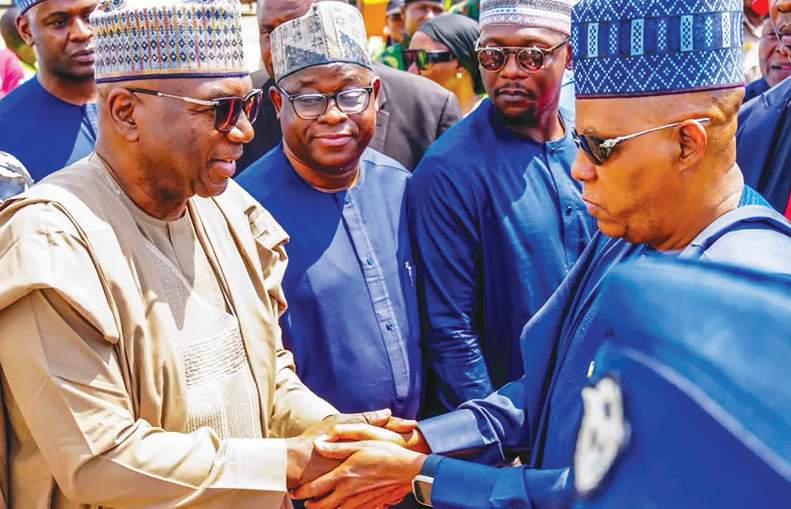
Governor AbdulRazaq receiving the federal government delegation led by Vice President Shettima
Afforts to get Pension Funds Administrators (PFAs) to invest in infrastructure may not materialise as attractive yields has continued to drive PFAs to the capital markets.
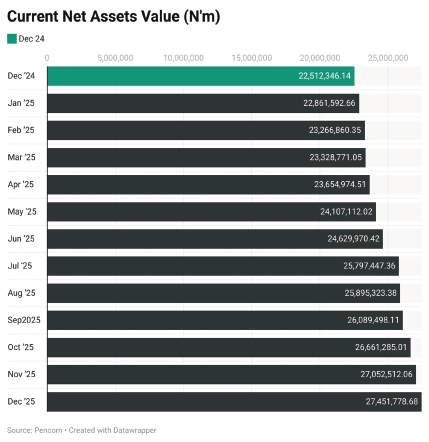
THISDAY analysis of the latest National Pension Commission (Pencom) monthly report, showed that the PFAs exposure in equities and FGN securities is now responsible for about 73.9 per cent or N20.29 trillion of the total pension fund value of N27.45 trillion.
The Nigerian stock market closed the first trading week in February 2026 on a positive note, gaining N4.08 trillion to extend its winning streak.
The growth was sustained as investor sentiment strengthened amid some impressive corporate earnings by some listed firms.
From a low of 165,370.40 basis points and N106.153 trillion as at Friday January 30, 2026; the Nigerian Exchange Limited All-Share Index and market capitalisation rose to 171,727.49 basis points and N110.23 trillion at the close
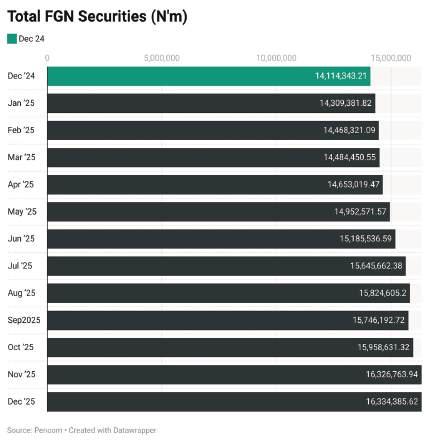
The report revealed that PFAs exposure in stock market and the Federal Government of Nigeria papers has increased significantly, attributable to attractive returns.
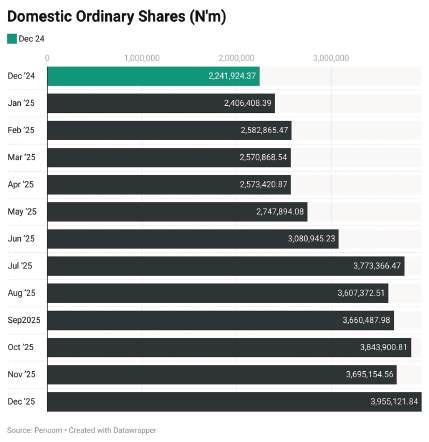
The report revealed that the PFAs exposure in the stock market appreciated to N3.96 trillion of as December 2025, about N1.71 trillion or 76.4per cent Year-on-Year (YoY) increase over N2.24 trillion in 2024.
For FGN Securities, it closed December 2025 at N16.33 trillion, a growth of N2.22
of trading last week.
The NGX ASI in its first trading week in February 2026 leaped above 170,000 basis points driven by investors who bought stocks like Seplat Energy Plc, among others that caused the 3.8per cent rally on the Exchange last week, bringing the year-todate returns to +10.4per cent.
Gains in MTN Nigeria Communications Plc (+8.4per cent), Dangote Cement Plc(+7.1per cent) Seplat Energy (+10per cent), Lafarge Africa (+6.4per cent) and Stanbic IBTC (+8.5per cent) impacted
trillion or 15.7 per cent YoY from N14.11trillion reported by Pencom in 2024.
FGN Securities comprises of FGN Bond Held-tillMaturity (HTM), FGN Available-for-Sale (AFS), Treasury Bills,Agency Bonds (NMRC), Sukuk (HTM), Sukuk (AFS), Green Bonds, and State Govt Securities.
Analysts have attributed PFAs increasing exposure in the stock market to increasing fundamentals of some listed companies in 2025, stressing that modest yield and riskfree government securities
on the equities market last week.
Market activity also strengthened, with total trading volume and value rising by 53.5per cent w/w and 98.3per cent week-onweek, respectively. Sector performance was broadly positive, as the NGX Oil & Gas Index (+10.9per cent), NGX Industrial Goods index (+4.4per cent), NGX Banking Index (+3.6per cent), and NGX Consumer Goods index (+1.0per cent) advanced, while the NGX Insurance
continued to influence PFAs exposure in FGN Bonds.
The FGN Bonds witnessed significant patronage by investors in 2025 with yields over 16.2 per cent on five-year government bonds and .15.8 per cent on 30-year government bonds. These yields are quite high in nominal terms. But real returns (i.e. after inflation) may be modest or even negative if inflation remains high. For example, inflation at ~20.12 per cent (or thereabouts) means a 16per cent nominal yield gives you
index (-2.3per cent).
However, the market breadth remained strongly positive, with 70 gainers outweighing 34 decliners, reflecting broad-based investor participation. R.T. Briscoe led the gainers table by 60.69 per cent to close at N12.63, per share. Zichis Agro Allied Industries followed with a gain of 60.38 per cent to close at N6.72, while Abbey Mortgage Bank went up by 59.04 per cent to close to N14.95, per share.
On the other side, Deap Capital Management & Trust
a negative real return.
Local and foreign investors seem to respond positively to the double-digit interest rates on FGN Bonds, as seen in the robust subscription rates, suggesting confidence in the CBN’s ability to manage the country’s monetary challenges amid scarcity of foreign exchange and double-dight inflation rate.
The participation by PFAs in the stock market led to a N36.6 trillion growth in 2025 and domestic institutional investors transacted an estimated
led the decliners table by 27.37 per cent to close at N6.82, per share. Red Star Express followed with a loss of 17.55 per cent to close at N17.15, while Cornerstone Insurance declined by 12.24 per cent to close at N5.45, per share. Overall, a total turnover of 3.860 billion shares worth N128.581 billion in 240,463 deals was traded last week by investors on the floor of the Exchange, in contrast to a total of 3.087 billion shares valued at N81.505 billion that exchanged hands previous week in 222,185 deals.
N5.62trillion in 2025 from N2.43trillion in 2024. Analysts expressed to THISDAY that PFAs are benefiting from the undervalued stocks amid the weakening of the Naira and renewed investors’ confidence in the Nigerian stock market. They stated that the PFAs and domestic investors reacted sharply to naira depreciation in the foreign exchange market, double-digit inflation rate, coupled with the CBN’s MPR at 27 per cent in 2025.
The Financial Services Industry led the activity chart with 2.188 billion shares valued at N50.459 billion traded in 94,005 deals; thus contributing 56.68 per cent and 39.24 per cent
The
^14.55
Sstories by Kayode tokede
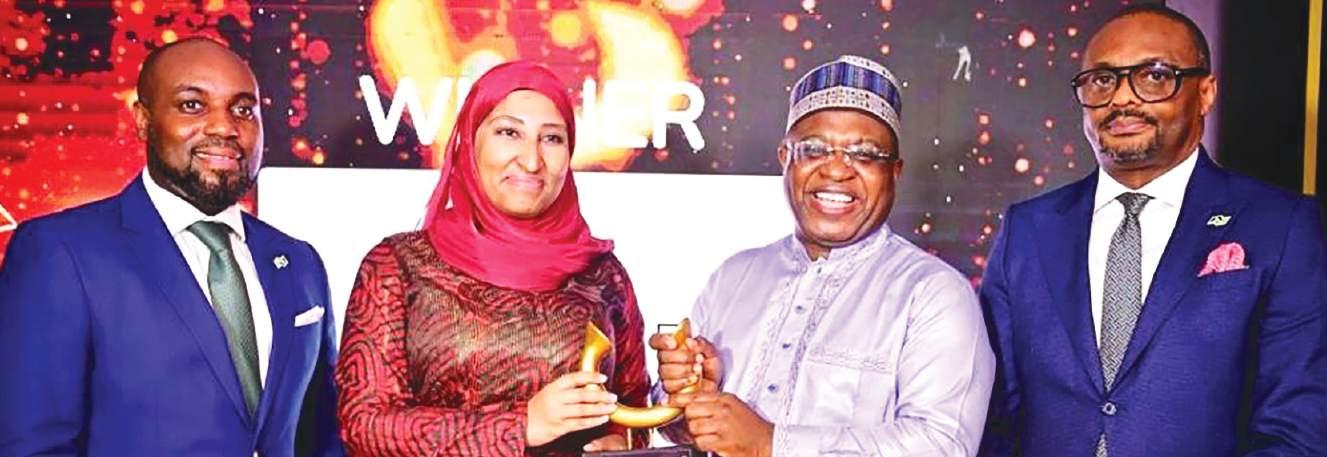
L–R: Chief Executive Officer, NGX Regulation Limited, Olufemi Shobanjo; Chief Executive Officer, Legend Internet Plc, Aisha Abdulaziz; Group Chairman, NGX Group Plc, Umaru Kwairanga and Chief Executive Officer, Nigerian Exchange Limited, Jude Chiemeka, during the presentation of the Market Debut Excellence Award to Legend Internet by the NGX in Lagos… recently
FMDQ Exchange Admits UAC’s N54.03bn 7-Year Fixed Rate Bond
Kayode Tokede
FMDQ Securities Exchange Limited revealed that it has approved the listing of UAC of Nigeria Plc’s N54.03 billion Series 1 7-Year 17.35% Fixed Rate Bond under its N150.00 billion Issuance Programme.
The approval, granted by the Exchange’s Board Listings and Markets Committee, underscores the Exchange’s pivotal role in enabling corporate entities to access long-term capital through transparent and well-regulated debt instruments.
Reacting to the bond listing, the Group Finance Director, UACN, Mrs Funke
Ijaiya-Oladipo in a statement stated that, “UACN is pleased to have successfully completed this landmark bond issuance in the Nigerian debt capital markets. The strong outcome of this transaction is a testament to our sound business fundamentals, the resilience of our brands, and the confidence the market continues to place in us. This issuance broadens our funding base and better positions the Company to advance its strategic initiatives, including the integration and growth of CHI Limited following our recent acquisition. We appreciate the unwavering support of the investor
ASSAM Urges FG to Boost Revenue Through Skills, Training
Africa School of Sales and Management (ASSAM) has urged the federal government to as a matter of urgency, prioritise revenue generation by investing in platforms that equip Nigerians with practical sales and incomegeneration skills, as part of efforts to strengthen the economy.
ASSAM, noted that
Nigeria’s economic challenges could be addressed by empowering individuals and businesses to increase earnings, rather than relying solely on salaries.
community and the dedication of our advisers throughout this process.”
Commenting on the transaction, the Sponsor of the bond listing on FMDQ Exchange, Stanbic IBTC Capital Limited, through its Chief Executive, Mr Oladele Sotubo, commented “Stanbic
IBTC Capital is delighted to have served as Lead Issuing House to UACN on this successful bond issuance.
“As Nigeria’s foremost investment banking franchise, we remain steadfast in our commitment to enabling high-quality issuers access the Nigerian debt capital markets.
UACN’s distinguished heritage and ambitious strategic direction, including the acquisition of CHI Limited to further strengthen its FMCG portfolio, highlight the significance of this transaction.
“This issuance provides UACN with a valuable opportunity to diversify its
funding mix, optimise its capital structure, and accelerate its growth trajectory. Together with the Joint Issuing Houses, we appreciate the trust and confidence reposed in us by the Board and Management of UACN to guide this transaction to a successful completion.”
GuarantCo Backs $75m Cashew Processing Plant with 100% Credit Guarantee
Sunday Ehigiator
GuarantCo, part of the Private Infrastructure Development Group (PIDG), has provided a 100 per cent credit guarantee to support a $75 million debt facility for Robust International Pte Limited to construct a new cashew processing plant in
Ogun State, in a move aimed at strengthening Nigeria’s agro-processing sector and boosting local value addition. The project is expected to significantly expand Nigeria’s domestic cashew processing capacity and reduce the country’s reliance on exporting raw cashew nuts.
Nigeria produces between 250,000 and 300,000 tonnes of raw cashew nuts annually, ranking among Africa’s largest producers. However, less than 10 per cent of the output is processed locally, with most exported unprocessed to Asian and other international markets.
Industry stakeholders
say exporting raw cashew nuts deprives Nigeria of up to 80 per cent of potential export value while increasing exposure to foreign exchange volatility.
The new processing facility is expected to help bridge this gap by retaining more economic value within the country.
Airtel Assures Subscribers of Massive Fibre Rollout, Network Expansion
Group Business Editor
Eromosele Abiodun
Deputy Business Editor
Chinedu Eze
Comms/e-Business Editor
Emma Okonji
Asst. Editor, Energy
Emmanuel Addeh
Asst. Editor, Money Market
Nume Ekeghe
Correspondents
KayodeTokede(CapitalMarkets)
James Emejo (Finance)
Ebere Nwoji (Insurance)
Reporter Peter Uzoho (Energy)
Executive Officer, ASSAM Dr Femi Joshua, while speaking on the sidelines of the 2026 Sales Power Conference with the theme, “Sell Smart, Win Big” in Abuja, advised the government to create similar platforms where citizens could learn practical revenue-generation strategies, stressing that government institutions must also focus on boosting internally generated revenue to drive economic stability.
Joshua opined that salary-based income alone was no longer sufficient to meet basic needs, noting that skills acquisition and revenue-driven training offered more sustainable economic benefits.
Speaking in similar vein, Dr.Elisha Manman, stated the need for sales executives to set goals that are effective, achievable, relevant and time bound saying sales is what can be done by everyone.
Despite the incessant fibre cuts during road construction, coupled with some calculated willful destruction of fibre optic cables by social miscreants, Airtel Nigeria
has assured subscribers of its plan to invest massively in fibre connectivity to the home and to further expand its network in order to boost service quality.
The CEO of Airtel Nigeria, Mr. Dinesh Balsingh, gave the
assurance in Lagos, during a media interactive session organised by Airtel Nigeria.
“We are rolling out massive fibre to the homes this year, despite the incessant fibre cuts experienced by telecoms operators. When there is fibre
cut, consumers are affected and to address the issue of fibre cuts, Airtel has devised a means of having multiple channels in our fibre rollout so that consumers are not affected when one channel is damaged,” Balsingh said.
Firm Celebrates Three Years of Growth in Nigeria
Sunday Ehigiator
Planet Bottling Company (PBC) yesterday held its first-ever distributor forum in Lagos, bringing together top distributors from across Nigeria to celebrate the company’s achievements
and discuss future growth strategies.
The event also marked the third anniversary of the launch of PBC’s flagship brand, American Cola.
Addressing journalists at the forum, PBC Marketing Manager, Naji Awada,
Emma Okonji
In a landmark innovation, New Horizons Nigeria has become the first institution to integrate the Chinese (Mandarin) language into its ICT curricular as an elective course, thereby positioning Nigerian students
for relevance in the rapidly changing world order.
New Horizons Nigeria is a leading ICT training and solutions provider committed to provide individuals and institutions with future-ready skills.
Managing Director and CEO of New Horizons
Awada emphasised the company’s focus on delivering high-quality yet affordable beverages to Nigerians.
“We aim to provide topquality products that are also accessible.”
highlighted the purpose of the gathering: “We organized this distributor forum to thank our partners for their support and to assure them that the more they support us, the more we will support them; with excellent service, quality, and results. Their contribution is a major part of our success in Nigeria.”
Firm Sets Record, Integrates Chinese Language into ICT Curricular
Systems Solutions Limited, Nigeria, Mr. Tim Akano, said the programme would represent far more than a language course. He asserted that very soon, the global labour market is likely to increasingly reflect China’s influence rather than the predominantly western orientation it currently exhibits. Language will be a major differentiator and the first Chinese-speaking technology experts in Nigeria will have a significant advantage, especially in integration into Chinese companies operating locally and globally.
Kasim Sumaina in Abuja
Emma Okonji
Arik Air and the Art of Omission
Simon Tumba
The recent ThisDay article titled “As Arik Air Continues to Decline” is not an exercise in accountability or investigative journalism. It is a carefully curated narrative built on omission — a textbook case of propaganda achieved by suppressing decisive facts.
The most glaring omission is also the most damaging to the article’s thesis: A Petition to wind up Arik Air International (UK-based entity of Arik Air) was already filed by foreign creditors in the United Kingdom even before the Asset Management Corporation of Nigeria (AMCON) assumed receivership in Nigeria. Arik Air International has since been placed in Administration. This is not disputed information. It is publicly available in the UK Gazette, the official journal of record of the British government.
Administration is not a public relations event. It is a legal process triggered by
insolvency — a formal declaration that a company can no longer meet its financial obligations. That Arik’s international operations entered administration abroad fatally undermines the suggestion that the airline was viable until AMCON intervened. A company already insolvent in a foreign jurisdiction was not “derailed”; it was already failing.
Yet readers of the ThisDay piece are never told this.
Instead, the article advances a narrative in which debt is portrayed as exaggerated, questionable, or even fictional. This claim collapses under minimal scrutiny. The same financial distress that led to administration in the UK manifested in massive loan defaults in Nigeria. Those loans were classified as non-performing and transferred to AMCON under powers granted by law. Debt on that scale does not materialise by regulatory conspiracy. It is accumulated
over years of borrowing without repayment.
The article does not rebut this reality. It avoids it.
Equally troubling is the erasure of legal context. AMCON’s receivership is portrayed as opaque and arbitrary, yet the fact that it has survived multiple legal challenges is ignored. Courts exist precisely to test legality. When a narrative critiques outcomes while pretending judicial validation does not exist, it is not informing the public — it is managing perception.
The same pattern appears in the discussion of fleet size. Headline aircraft numbers are cited without distinguishing between airworthy and grounded planes, creating the illusion of dramatic post-takeover collapse while concealing the airline’s operational fragility before intervention. Selective metrics are not neutral; they are persuasive tools.
But the clearest signal of advocacy is the article’s allocation of blame.
AMCON is relentlessly indicted. Former shareholders and management — who presided over the borrowing, defaults, and overseas administration — are largely absolved. This imbalance is not accidental. It reflects a narrative choice that aligns neatly with the interests of those seeking to rewrite their role in the airline’s failure.
That is why the piece reads less like journalism and more like a defence brief.
Propaganda-by-omission is effective because it feels reasonable. Readers are simply denied the facts required to judge fairly. When insolvency abroad is omitted, debt is minimised, and legal rulings are erased, the public record is distorted.
The truth is straightforward: AMCON intervened because Arik Air had already collapsed — financially and operationally. A fact acknowledged not only in Nigeria but in the United Kingdom.
• Simon Tumba of SY&T Communications Limited PR Agency of Receiver Manager of Arik Air (in Receivership), wrote from Lagos
Kebbi Govt Signs Deal with NCS for Niger-Benin Transit Corridor
Onuminya Innocent
Kebbi State is set to revolutionise trade and commerce in the region as it partners with the Nigeria Customs Service (NCS) to implement President Bola Tinubu’s approved transit
corridor for goods bound for Niger Republic through Benin Republic.
Speaking on the partnership, Governor Nasir Idris assured that Kebbi State is fully prepared to collaborate with the Federal Government to ensure smooth operations. “We are not surprised
because we know that when Mr. President says something, he means it and will follow through,” Idris said. “We will provide the necessary social amenities, infrastructure, and ensure roads are motorable,” he added, as quoted by Ahmed Idris, Chief
‘Aero Maintenance Facility will Effectively Service Airlines in W’Africa’
Chinedu Eze
The Director General, Ghana Civil Aviation Authority (GCAA), Rev. Stephen Wilfred Arthur, said Aero Contractors’ Aircraft Maintenance Organisation (AMO) will effectively service all commercial aircraft operating in West and Central Africa approved for maintenance in the facility.
Arthur stated this at the weekend after the facility tour of the maintenance facility located at the Aero head office, General Aviation Terminal (GAT), the Murtala Muhammed International Airport, Lagos.
He said, “This is unique by all standards. And I least expected to see what we have all witnessed today,
especially from this part of the continent.”
He linked the cost of aircraft maintenance to the cost of flight ticket, saying that ferrying the aircraft out of the West African region to the United States or Europe increases the cost of maintenance which is eventually passed to the passenger.
Agusto & Co., has upgraded Coronation Asset Management Limited’s rating to A from A-, citing significant improvements in risk management practices. The rating, which expires on December 31, 2026, reflects the firm’s enhanced operational infrastructure and strategic positioning as a top-tier institutional-grade asset manager. The upgrade follows a comprehensive assessment of research capabilities, investment management processes, risk oversight frameworks, corporate governance structure, technology deployment, and financial performance metrics, including growth in assets under management. According to Agusto & Co.’s rating release published on their website, “The rating upgrade reflects improvement in risk management practices, with the introduction of liquidity and credit risk monitoring limits. The rating also reflects the Manager’s experienced decision-making committees and a well-defined investment process.”
The announcement comes as Coronation Asset Management records remarkable growth, with Assets Under Management expanding by 128 per cent between December 2024 and November 2025. The firm’s
Collective Investment Scheme
Assets Under Management surged from N19.67 billion to N73.77 billion, whilst its Money Market Fund grew from N9.26 billion to N62.1 billion during the same period.
Firm Launches Hotel at MMIA, Lagos
Chinedu Eze
NAHCO Travel and Hospitality Limited (NHTL), a wholly owned subsidiary of NAHCO Plc has officially commissioned Sapphire Hotel a premier luxury hospitality suite located directly within the Murtala Muhammed International Airport (MMIA) Terminal II departure area.
The 20-room luxury hotel which marks a significant expansion of NAHCO’s footprint in the aviation service industry is specifically designed to offer world-class comfort and convenience for international travellers, transit passengers layovers and business executives.
A statement from the company said the hotel is strategically situated just
seconds away from the airport check-in and boarding areas, Sapphire Hotel operates 24/7 providing a seamless transition from the terminal to a high-end resting environment.
Speaking at the commissioning ceremony Prince Saheed Lasisi, Group Executive Director Commercial and Business Development, NAHCO Plc emphasised the company’s commitment to excellence.
He said, “As one of Nigeria’s most reliable travel management organizations, NAHCO continues to position itself as a trusted partner for hassle-free movement. We guarantee that the guest experience at Sapphire Hotel will be second to none in the country.”
Press Secretary to the Governor.
The Comptroller-General of Customs, Bashir AdewaleAdeniyi, stated that the initiative would strengthen cooperation on transit goods movement, improve information sharing, address border security challenges, and ensure legitimate trade contributes optimally to economic growth.
“President Tinubu has given us the mandate to allow trucks
transit to Niger Republic through Benin Republic and Kebbi State,” Adewale-Adeniyi said.
Under the new framework, trucks will pay a token fee for infrastructure maintenance in designated transit areas, particularly along the Tsamiya Corridor in Bagudu Local Government Area. The Customs Service will also streamline documentation processes and
remove bottlenecks along major corridors. The partnership is expected to boost trade, enhance economic growth, and create jobs. “When we speak of Kebbi, we reference the historic Gwandu Emirate whose influence extends across Nigeria and into neighbouring Benin and Niger Republics,” Adewale-Adeniyi said, highlighting the state’s strategic importance.
THE SENATE
FEDERAL REPUBLIC OF NIGERIA
OFFICE OF THE CLERK
8th Febr uar y, 2026.
NOTICE OF AN EMERGENC Y PLENARY SIT TING OF THE SENATE
I am directed by His Excellency, t h e P r e s i d e n t o f t h e S e n a t e ,
Distinguished Senator Godswill Obot Akpabio, GCON, to infor m all
D i s t i n g u i s h e d S e n a t o r s o f t h e Federal Republic of Nigeria that an Emergency Sitting of the Senate has been scheduled to hold as follows:
Date: Tuesday, 10 Febr uar y, 2026
Time: 12:00 Noon
Venue: Senate Chamber
Distinguished Senators are kindly requested to note this Emergency Sitting date and attend.
All inconveniences this will cause t o D i s t i n g u i s h e d S e n a t o r s a re highly regretted, please.
Emmanuel Odo, JP, PhD Clerk of the Senate
DBN Begins Capacity-building Training for Livestock-focused
Emma Okonji
Development Bank of Nigeria Plc (DBN) has commenced a nationwide capacity-building training programme for livestockfocused Small and Medium Enterprises (SMEs) and DBN Participating Financial Institutions (PFIs) across Nigeria’s six geopolitical zones with the first-in-the-series of training kick-starting in Enugu State State, South-East Nigeria.
The capacity-building programme under the World Bank–funded Livestock Productivity and Resilience Support (LPRES) Project is aimed at strengthening the capacity of PFIs to design and refine financial products tailored to bridge the funding gap for SMEs in the nation’s livestock sector.
Furthermore, the training is aimed at enhancing the financial readiness of SMEs
Google,
within the livestock sector by equipping them with the right knowledge and tools to access funding to grow and scale their businesses. It will also serve as a veritable platform for engagement, dialogue and mutual understanding between the PFIs and livestock enterprises.
Managing Director/ CEO, Development Bank of Nigeria, Dr. Tony Okpanachi, emphasised the importance of this training, stating, “Our capacity-building training programme is a catalyst for unlocking the potential of livestock enterprises as key drivers of economic growth, innovation, job creation, and prosperity in Nigeria,’’ urging SMEs and PFIs in each of the geo-political zones to participate actively in the training.
“Capacity-building is pivotal for MSMEs’
growth in Nigeria as it bridges the knowledge and skills gap, empowering entrepreneurs to innovate, compete, and thrive in a rapidly-evolving economy.
The LPRES SME/PFI Regional Training will not only strengthen the skills and capacity of SMEs in the livestock sector for business growth and sustainability, the training programme will promote national economic growth through MSME’s development,’’ he affirmed.
Okpanachi added that the capacity-building programme aligns with the Renewed Hope Livestock Development Initiative of the Federal Government under the administration of President Bola Ahmed Tinubu to bolster the potential of the livestock sector for improved food security and job creation, as well as repositioning it to contribute to national economic growth.
African Institutions Set to Boost 100m Africans in AI Future
Emma Okonji
Google and a consortium of leading African research institutions has announced the launch of WAXAL, a large-scale, openly accessible speech dataset designed to catalyze research and build more inclusive AI technologies.
The dataset bridges a critical digital divide for over 100 million speakers by providing foundational data for 21 sub-Saharan African languages, including Hausa, Luganda, Yoruba, and Acholi.
Head of Google Research Africa, Aisha Walcott-Bryantt, said: “The ultimate impact of WAXAL is the empowerment of people in Africa”. Said “This dataset provides the critical foundation for students, researchers, and entrepreneurs to build technology on their own terms, in their own languages, finally reaching over 100 million people. We look forward to seeing African innovators use this data to create everything from new educational tools to voice-enabled services that create tangible economic opportunities
across the continent.”
A central principle of the project was to ensure it was built by and for the community. African academic and community organizations, including Makerere University (Uganda), the University of Ghana, and Digital Umuganda (Rwanda), led the data collection with guidance from Google experts. These partner institutions retain full ownership of the data, establishing a new framework for equitable, partnership-led AI development.
Firm Launches “Black Valentine” to Redefine Celebration
Konga, Nigeria’s leading composite e-commerce giant, says it’s launching its Valentine campaign, “Black Valentine: Special Love Series”, a strategic and empathetic shift designed to redefine how Nigerians celebrate the season of love.
Vice President at Konga, Irfan Vayani, said: “Konga’s Black Valentine campaign is a direct response to this consumer insight, reframing the season as a period for self-appreciation and create a more inclusive shopping experience that resonates with both singles and those in relationships. The narrative around Valentine’s Day needs expansion.”
comfort, and aspirations on their own terms.”
According to Vayani, “Love is multifaceted, and the most foundational relationship one can nurture is the one with oneself. ‘Black Valentine’ is our way of honouring every individual’s journey. It’s a campaign built on the principle that whether you’re single, coupled, or simply focused on your own growth, you deserve to celebrate your worth. We are creating a platform for people to invest in their happiness,
AVEVA Appoints Khaled
AVEVA, a global leader in industrial software, driving digital transformation and sustainability, has appointed Khaled Salah, 37 years old, as Vice President of Africa.
In his new role, he will be responsible for about 30 employees to ensure the successful implementation of AVEVA’s growth strategy. Khaled Salah will report directly to Jesus Hernandez, SVP of the EMEA region.
With MBA in Management from the Warwick Business
Beyond price incentives, the Black Valentine campaign is supported by a comprehensive omnichannel marketing drive, spanning digital advertising, social media engagement, influencer collaborations, and on-platform promotions. This integrated approach ensures extensive reach, sustained visibility, and strong conversion across Konga’s expansive customer base, which spans millions of shoppers nationwide.
Salah as Vice President of Africa
School, UK, and a master’s degree in engineering from Ain Shams University in Egypt, Khaled Salah is an active advocate for driving sustainable progress in the industrial sector. With Sustainability in mind, Khaled is keen on making a positive business impact, while fostering progress for people and the planet.
Senior Vice President of the EMEA region, Jesus Hernandez, said: “Africa is a strategic region for AVEVA. In this major
industrial market, customers, world leaders in the fields of Energy, Metal & Mining, Chemicals, and Water, are looking for AVEVA’s expertise to accelerate and drive their digital transformation and sustainability strategies, as well as their energy transition projects. Khaled Salah’s qualities of leadership in a global environment will benefit his team spread across 12 countries including Algeria, Morocco, Egypt, Kenya, Nigeria, and South Africa.”
The price of OPEC basket of twelve crudes stood at $63.14 a barrel on Monday, according to OPEC Secretariat calculations.
The OPEC Reference Basket of Crudes (ORB) is made up of the following: Saharan Blend (Algeria), Djeno (Congo), Zafiro (Equatorial Guinea), Rabi Light (Gabon), Iran Heavy (Islamic Republic of Iran), Basrah Medium (Iraq), Kuwait Export (Kuwait), Es Sider (Libya), Bonny Light (Nigeria), Arab Light (Saudi Arabia), Murban (UAE) and Merey (Venezuela).
OPEC DAILY BASKET PRICE As At 24 t H n OV e M be R , 2025
Sterling Financial Holdings Company Plc has released its 2025 full-year interim financial results, showcasing an improvement in operational efficiency with a reduced cost-to-income ratio of 63per cent from 72per cent in 2024. This decline, coupled with a N90.7billion profit before
tax in 2025, up by 99 per cent from N45.86 billion in 2024, highlights the Group’s strategic focus on controlling operational expenses while driving robust revenue growth.
Sterling HoldCo’s gross earnings stood at N476.5 billion in 2025, about 46per cent increase from N326.82 billion in 2024, driven by healthy growth in both
interest and non-interest income. Interest income rose by 43 per cent to N369.6 billion, fueled by an increase in loans and advances and improved yields on investment securities.
Non-interest income grew by 57.3per cent, supported by higher trading income and growth in fees and commissions.
The Group’s total assets
surged to N3.92 trillion in 2025, representing an increase of 14 per cent from N3.54trillion in 2024, a strong indicator of its expanded market footprint.
Customer deposits reached N2.98 trillion in 2025, an increase of 18per cent to further reflect the Group’s successful efforts in enhancing customer engagement and product
adoption across its platforms. Sterling HoldCo has also continued to strengthen its capital position, with shareholders’ funds increasing 39per cent to N424.0 billion.
This bolstered capital base ensures the Group’s banking subsidiaries are well-equipped to support its future growth initiatives, having met the Central Bank of Nigeria’s recapitalisation requirements
ahead of the March 2026 deadline. This achievement was driven by a series of disciplined capital-raising initiatives, including a public offer of over N88billion to bolster Sterling Bank’s position, and a prior capital injection that secured The Alternative Bank’s status as a national non-interest bank.
PRICES FOR SECURITIES TRADED AS OF FEBRUARY /5/26
UNVEILING OF OSAS VANTAGE IN LAGOS...
Idi Maiha: No More Talks, It’s Time to Fix Livestock Sector
Declares
livestock can rival oil in GDP contribution, red meat industry worth $3.2 billion
James Emejo in Abuja Minister of Livestock Development, Idi Mukhtar Maiha, has declared that the time for conferences is over, adding that the ministry has moved from talks to implementing real solutions to fix the livestock sector.
Maiha said with greater support, the sector could soon “rival oil in its contribution to GDP”.
He said, “I say this with confidence, having spent 25 years in the oil and gas sector. The statistics support it. The era of lamentation is over. We are done with conferences alone. We are implementing solutions on the ground.
“We want to replace weapons
with tractors, conflict with productivity, and despair with opportunity. That is our mandate.”
The minister spoke at a reception dinner in his honour over the weekend, after he was announced “Minister of the Year” by Daily Asset Newspapers.
He said the country could further earn about $3.2 billion from the red meat industry if properly harnessed.
He said despite limited funding, and scattered structures, the ministry remained focused, adding, “We have branded ourselves and demonstrated what is possible. Going into 2026, we must break our own records. We must defy gravity.”
He said the ministry was a
PBC Marks 3 Years of Growth, Hosts Distributors’ Forum
Sunday Ehigiator
Planet Bottling Company (PBC) yesterday held its first-ever distributor forum in Lagos, bringing together top distributors from across Nigeria to celebrate the company’s achievements and discuss future growth strategies.
The event also marked the third anniversary of the launch of PBC’s flagship brand, American Cola.
Addressing journalists at the forum, PBC Marketing Manager, Naji Awada, highlighted the purpose of the gathering. “We organised this distributor forum to thank our partners for their support and to assure them that the more they support us, the more we will support them; with excellent service, quality, and results. Their contribution is a major part of our success in Nigeria.” Awada emphasised the
company’s focus on delivering high-quality yet affordable beverages to Nigerians.
“We aim to provide topquality products that are also accessible. Our distributors are crucial to ensuring that these products reach consumers nationwide,” he said, noting that the company currently produces four brands; American Cola, Reactor, Planet, and Bubble Up.
On concerns about sugar and fizzy drinks, Awada reassured consumers, saying, “Our factory is one of the most advanced in Nigeria. We work with Monarch, an international company, to ensure that every product meets the highest standards of quality and safety.”
Also speaking, PBC Deputy Managing Director, Lokman Jouni, spoke about the company’s vision and legacy in Nigeria.
platform for rural empowerment, national development, and national security, stressing that there is no reason for conflict over resources when productivity can be maximised.
Commenting on the recognition, Maiha said, “This award is not for me alone; it is for the entire Federal Ministry of Livestock Development. Generals are said to win wars, but they never do it alone. There are intelligence units, logistics, and support teams.
“This award belongs to every staff member of the Ministry. For us, this award is like a jet
propulsion engine. It pushes us forward.”
He said, “The red meat industry has the potential to be among the best. The Minister of Saudi Arabia once called me and asked, “Why Nigeria meat? We want it.”
Today, the major suppliers are Brazil, New Zealand, and Australia. If anything happens—disease outbreaks or supply disruptions—you cannot access meat. This is about national security.
“So, when we look at all these realities, it is clear what is waiting for us. That is the
way to go. And I believe we are already here to celebrate the success of the Republic, all of us, over the last period.
“When I saw the daily figures, I did not realise how much had been achieved. Our task now is to move the goalposts forward and keep meeting milestones. That is what we have been doing, and that is what we will continue to do.”
In his remarks, Editor-in-Chief, Daily Asset Newspapers, Dr. Cletus Akwaya, said the medium decided to recognize the minister’s efforts and milestones in the sector.
Akwaya said, “When you look at the statistics, everything is trending upward. We studied the numbers closely. We looked at how livestock output has increased significantly, which reflects the level of investment made in the sector. This did not happen by chance. It is the result of his advocacy to mainstream the livestock sector into the national economy. From projections, it is clear that the livestock sector will soon become a major contributor to national GDP, and this will happen within the course of his administration.
Osigwe: Judiciary Perceived as Market Place Where Justice Goes to Highest Bidder
Seeks urgent reforms
Alex Enumah in Abuja
President of Nigerian Bar Association (NBA), Mazi Afam Osigwe, SAN, has raised concerns about the declining image of the judiciary in the country, warning that the perceptions held by members of the public is not only a threat to democracy but also to the entire country.
Citing reports, Osigwe lamented that judges and lawyers had been indicted as the most corrupt Nigerians, who were influenced by the “fatness of envelopes” in the pursuit of justice rather than on evidence.
The NBA president made the assertions over the weekend in Enugu, at the Ralph Opara Memorial Lecture organised by National Association of Seadogs.
The lecture was themed, “Judicial Corruption in Nigeria: A Menace to Democracy and Social Justice."
According to the senior lawyer, the state of the judiciary is a “moral
crisis and a democratic emergency” that threatens the foundation of Nigeria.
He said, “The judiciary, once revered as the last hope of the common man, is increasingly perceived as a marketplace where justice is auctioned to the highest bidder."
The NBA president further lamented that widespread disillusionment had emerged as citizens now viewed courtrooms as arenas where rulings were influenced by bribes rather than evidence.
Citing data, Osigwe stated that a 2024 survey by UNODC and National Bureau of Statistics showed that public officials received approximately N721 billion in cash bribes in 2023, with judges among the top recipients.
An ICPC survey also indicated that N9.4 billion in bribes flowed through the justice sector between 2018 and 2020, with lawyers and litigants identified as primary bribe-givers.
“The rot in our judiciary has decimated public trust,” Osigwe said, pointing out that Transparency International’s 2024 Corruption Perceptions Index ranked Nigeria 140th out of 180 countries.
He warned that a compromised justice system allowed the wealthy and powerful to escape accountability while the poor bore the brunt.
Highlighting international repercussions, Osigwe cited cases like Okpabi v Royal Dutch Shell, where Niger Delta communities sued in UK courts due to lack of effective justice at home, and the P&ID arbitration saga, where a multi-billion-dollar award against Nigeria was only overturned in London after fraud was proven.
“These cases represent a global vote of no confidence in Nigeria’s legal system,” he said.
To tackle judicial corruption, Osigwe called for radical reforms, including merit-based judicial appointments, the creation of
state-level judicial academies, and removing Chief Justice of Nigeria from chairing the National Judicial Council to prevent power concentration.
He also advocated automated case assignments, mandatory suspension of judges under investigation, and full implementation of judicial financial autonomy.
“The fight against corruption is a collective responsibility of the Bar, the Bench, and the citizenry,” Osigwe said, urging religious and traditional institutions to stop honouring individuals with questionable wealth.
He stated, “History will judge us not by our eloquence, but by our willingness to act. The temple of justice must be cleansed to ensure the rule of law prevails over the rule of money.”
Osigwe said the survival of Nigeria’s democracy hinged on an incorruptible judiciary capable of commanding both local and international respect.
L-R: Founder/ Chief Executive Officer, Opulence Entertainment, Owen Odigie; Olu of Warri, Ogiame Atuwatse III; and Senator Daisy Danjuma, during the unveiling of Osas Vantage, a premium Hollywood original series, in Lagos… recently
RIVERS ENTREPRENEURS AND INVESTORS FORUM...
IsDB Unveils IsDB Concessional Fund as Lifeline for Least Developed Member Countries
Signs financing agreements to transform Uzbekistan's transport, education sectors
Sunday Okobi
In a landmark move to accelerate sustainable development, Islamic Development Bank (IsDB) has announced the launch of IsDB Concessional Fund (ICF) at the Second AlUla Conference for Emerging Market Economies.
The bank stated that the initiative represented a decisive evolution in its support
architecture, designed to address the urgent needs of its 27 least developed member countries (LDMCs).
IsDB said, in a statement made available to THISDAY by its Communication Director, Ahmed Abu Ghazeleh, that building on five decades of impactful development work, ICF introduced a streamlined model of enhanced financing
fully aligned with IsDB Group’s Ten-Year Strategic Framework (2026-2035).
The fund, the bank stated, deployed Shariah-compliant instruments – including multiple concessional modes of financing and targeted grants for fragile contexts – to alleviate debt burdens while catalysing high-impact investments in human capital, food security,
essential infrastructure, and climate resilience.
It stated, “Allocations from the ICF are determined by a rigorous, evidence-based framework prioritizing countries with the most acute needs.
“This process evaluates key indicators, such as per capita income, debt sustainability, and exposure to fragility and external shocks, ensuring resources
6,000 Citizens to Benefit as FG Kicks Off Free Cancer Screening, Treatment
No fewer than 6,000 persons would be benefitting from the ongoing nationwide free screening and treatment of breast, cervical and prostate cancer.
The Minister of State for Health and Social Welfare, Dr. Isiaq Salako, stated this at the flag-off of the screening and treatment of the three types of cancer at the Federal Medical Centre (FMC), Idi-Aba, Abeokuta, Ogun State.
According to the minister, 1,000 persons from each of the
six geopolitical zone, would benefit from the current free exercise.
He clarified the exercise was not for those who had been diagonised and had been undergoing treatment but for those that had not been diagonised before but showed symptoms during the ongoing screening.
He said, "This screening exercise is targeting asymptomatic individuals - people who haven't been diagnosed with cancer before.
"The goal is to screen 1,000 people per zone, focusing on
prostate cancer for men, cervical cancer for women, and breast cancer, with early detection and treatment for those who test positive.
"We making it clear that this isn't for people already diagnosed; there's a separate initiative for them and this programme will cover six zones, with 1,000 people per zone."
The minister said the cancer screening program reflects the federal government's strategic emphasis on prevention as the best and most cost-effective approach to controlling cancer
saying the approach focuses on all levels of preventionprimary, secondary, and tertiary.
He added that the Federal Ministry of Health was working with other agencies to address social and environmental determinants of cancer.
"We're tackling environmental pollution and introducing vaccines like HPV and Hepatitis B as permanent prevention strategies against cervical and liver cancers. By the end of 2025, close to 50 million girls aged 9-14 years have received the HPV vaccine across the country," he said.
flow to LDMCs confronting the severest vulnerabilities.”
IsDB said in the statement that the funding would support high-impact initiatives that aligned seamlessly with national development strategies.
According to Chairman of IsDB Group, Muhammad Al Jasser, during the launch in AlUla, “To ensure long-term sustainability, the ICF is backed by robust financial measures, including 20 percent allocation of the bank’s annual net income and periodic replenishments from member countries.
“The ICF is more than just a financing window; it is a renewed vow that the world’s most vulnerable will not face their struggles alone.”
Al Jasser affirmed that the fund aimed to triple IsDB’s concessional financing to approximately 15 per cent of the bank’s annual approvals, “fostering partnerships, sharing knowledge, and unlocking co-financing that multiplies the impact of every dollar invested.”
He also emphasised that ICF could not have been created without the significant financial and moral support of the Kingdom of Saudi Arabia
and Kuwait.
He stated, “The IsDB Concessional Fund is a declaration of hope and a pledge to stand by our least developed member countries. We are here to invest in their potential and help them build a resilient, inclusive future.
“By focusing on LDMCs, the ICF not only fortifies their path toward resilience but also advances a collective vision of equitable progress where no member country is left behind,”
Meanwhile, on the sidelines of the second AlUla Conference for Emerging Market Economies, Al Jasser and H.E. Dr. Djamshid Kuchkarov, Deputy Prime Minister and Minister of Economy and Finance of the Republic of Uzbekistan, signed financing agreements to advance critical infrastructure and social development.
Ahead of the signing, the two leaders held bilateral talks to discuss the expansion of the IsDB–Uzbekistan partnership, focusing on deepening cooperation and accelerating high-impact initiatives aligned with Uzbekistan’s national development goals.
Chinyere Igwegbe Inaugurated APWEN’s President, Pledges to Focus on Innovation
The Association of Professional Women Engineers of Nigeria (APWEN) at the weekend inaugurated its new President, Chinyere Igwegbe, as the 19th head of the organisation, with the new leadership underscoring the need to focus on research, development, and innovation.
At the investiture which took place in Abuja, Igwegbe said that APWEN under her leadership will encourage
solution-driven innovation that addresses pressing national and global challenges - energy sustainability, environmental resilience, water access, infrastructure, digital transformation, and climate adaptation.
Igwegbe argued that prototypes must evolve into products while ideas must translate into enterprises, pledging to create platforms to showcase and connect the body's innovations to industry and investors.
“Our interventions must positively affect our immediate communities. We will champion practical, natural, and sustainable solutions to environmental and societal challenges. Whether through clean energy initiatives, waste-to- wealth innovations, food mitigation strategies, or sustainable construction practices, APWEN must remain visible where solutions are needed most.
“Importantly, we will
institutionalise a robust framework for tracking and documenting APWEN's impact over the years. Data matters. Evidence matters. Legacy matters. We will strengthen our monitoring and evaluation systems to capture measurable outcomes of our STEM outreaches, policy advocacy, professional development programs, and community interventions. What we measure, we can improve,” she pointed out.
Besides, she pledged
to advance girl child exposure and expand STEM programmes, including structured robotic competitions for secondary school girls and advanced robotics competitions for university students.
For young engineers, she argued that technical knowledge alone is not enough, explaining that employability requires communication skills, leadership competence, digital literacy, entrepreneurial
thinking, and adaptability.
“We will organise workshops, webinars, and mentorship sessions focused on employability skills, leadership development, and industry readiness,” she pledged. According to her, APWEN under her leadership must think differently, act boldly and innovate sustainably to address Nigeria’s challenges in energy, infrastructure, digital transformation and climate adaptation.
James Sowole in Abeokuta
L-R: Business Development Officer, United Capital Plc, Ida Tonye Duruzor; MD/CEO, Bobmanuel Group of Companies, Ibifiri A.C. Bobmanuel; Director, Regional Operations, Nigeria, United Capital Plc, Seun Babasola; Director, Southern Region, United Capital Plc, Chukwuma Mojekwu; and Regional Business Head, South South, United Capital Plc, Hafsat Baba at the Rivers Entrepreneurs and Investors’ Forum on the Ease of Doing Business Seminar held in Rivers State ... recently
Emmanuel Addeh in Abuja
EXHIBITION BOOTH OF THE SPE AT THE 9TH EDITION OF NIGERIA INT’L ENERGY SUMMIT...
FG Awards Contract for Dualisation of 420km Akwanga-Jos-Bauchi-Gombe Highway
As part of efforts to boost transportation of goods, persons and the economy across the country, the federal government has awarded a multi-billion Naira contract for the construction of a dual carriageway stretching from Akwanga in Nassarawa State through Plateau State, Bauchi State ending in Gombe State. This was as the Federal Ministry of Works inspected the ongoing rehabilitation of the Bauchi-Dindima Village Road along the Gombe axis in Bauchi State, a 35.4-kilometre project valued at N39.9 billion.
Speaking while inspecting ongoing rehabilitation of a section of the Bauchi - Gombe Federal highway on Sunday, the Director of Information, Federal Ministry of Works, Mohammed Ahmed Abdullahi, said, "What we are doing is the stationization project carried out by the government, to gauge
the pulse of Nigerians as far as what government is doing in the provision of road infrastructure to Nigerians."
According to him, "As you are aware, the provision of the enhancement of infrastructure and transportation as an envelope of growth is one of the eight priority areas of
Experts Seek Formalised Will, Islamic Estate Transfer to Secure Family Wealth, Legacy
Legal, financial and religious experts have called on Nigerians to adopt structured Islamic estate planning frameworks to secure their wealth and legacies.
They warned that reliance on informal arrangements and verbal agreements exposes families to disputes, financial losses, and prolonged legal battles.
The advice was given at the 8th Annual Islamic Estate Planning Clinic with the theme, “From Informality to Legacy: Structuring Islamic Wealth Transfer” which was
organised by The Metropolitan Law Firm in collaboration with First Trustees Limited and Al-Ameen Trustees Limited in Abuja, over the weekend.
The speakers emphasised the urgent need for documentation, professional advisory support, and the adoption of modern financial and legal tools to ensure responsible wealth transfer, particularly amid Nigeria’s evolving tax environment and the rise of digital assets.
According to them, structured Islamic estate planning remains essential not only for protecting wealth but also for
promoting social stability, responsible governance, and intergenerational prosperity.
In his keynote, former minister of Communications and Digital Economy, Prof. Isa Ali Pantami, said wealth transfer should move from verbal arrangements to structured, documented, and Sharia-compliant systems.
He said, “The transition from informality to legacy means moving from cultural verbal agreements to formal, documented frameworks. Verbal agreements are unreliable and often lead to disputes.”
The former minister who is
FG Distributes Post-harvest
the Co-Chair, African Union’s 4th Industrial Revolution Policy Council, further advocated the use of modern technologies, including blockchain systems, to preserve wills and legal agreements securely, adding that structured wealth management was not only a legal necessity but also a religious responsibility rooted in Islamic teachings.
Pantami highlighted common challenges including cultural practices that conflict with Islamic inheritance principles, delayed will-writing, and inadequate documentation of property ownership across communities.
Equipment to Farmers to Cut Waste, Boost Rural Jobs, Others
James Emejo in Abuja Minister of Agriculture and Food Security, Senator Abubakar Kyari, has flagged-off the distribution of processing and post-harvest equipment to farmers and agribusiness groups in Nasarawa State. Kyari said the equipment
aimed to support enterprise growth, deepen market participation, and expand opportunities for rural employment under the Value Chain Development Programme (VCDP).
The minister, who was on a 2-day working visit to the state, said the intervention will
add value, reduce post-harvest losses, empower women and youth farmers, as well as encourage competitiveness and boost productivity.
Kyari stated that the programme, implemented with the International Fund for Agricultural Development (IFAD), aimed to address
structural constraints in the rice and cassava value chains through integrated investments in production, aggregation, processing, infrastructure, market access, and institutional strengthening as well as align with the National Agricultural Technology and Innovation Policy (NATIP).
the strategic agenda of His Excellency, President Bola Ahmed Tinubu's administration."
He stressed that, "The Federal Government and the present administration is doing everything possible since coming on board to provide road infrastructure to Nigerians because of the critical importance of the infrastructure to Nigerians and the provision of our socioeconomic activities as well as enhancing them."
"So, we are here on GombeBauchi Road. The project is the rehabilitation of the road. So, we are here with the Federal Controller of Works, Bauchi
State, Engineer Adamu. "We are also here with the Project Manager of the Company handling the project, Triacta Nigeria Limited. And we are also here with the officials of the Nigerian Society of Engineers, as well as the council for the regulation of engineering practice," he added.
Ahmed Mohammed Abdullahi added that, "So, as I have said, this is just to gauge the pulse of Nigerians. And the good thing about this alignment that we are on, the Federal Executive Council has recently approved the dualization of this road."
IPPG: With 50% of Nigeria’s Oil Produced by Local Firms, It's Time for Deeper Collaboration
Emmanuel
Addeh in Abuja
The Chairman of the Independent Petroleum Producers Group (IPPG), Mr. Adegbite Falade, has called for coordinated action to build a resilient and self-sustaining Nigerian energy industry capable of delivering long-term national prosperity.
This is coming against the backdrop of Falade’s disclosure that at least 50 per cent of Nigeria's total oil output is now produced by indigenous energy companies, a giant leap compared to what obtained in the past.
IPPG represents indigenous Nigerian exploration and production companies committed to advancing national energy development, encouraging investment, and promoting sustainable growth across the oil and gas value chain.
Delivering his maiden
address at the opening ceremony of the 2026 Nigeria International Energy Summit (NIES), Falade, a statement from the IPPG said, emphasised the urgent need for strategic reforms, stronger collaboration, and enhanced value creation within the domestic energy ecosystem.
Addressing global and regional dignitaries, industry leaders, and policymakers, Falade highlighted progress across the value chain, including improved upstream output, expanding gas infrastructure, and rising domestic refining capacity. Average liquids production increased to approximately 1.64 million barrels per day in 2025, with indigenous producers now accounting for more than half of national output, a milestone reflecting strengthened local ownership and supportive policy actions, he said.
L-R: Minister of state for Petroleum Resources (Oil), Sen. Heineken Lokpobiri; Minister of state for Petroleum Resources (Gas), Hon. Ekperikpe Ekpo; Permanent Secretary, Federal Ministry of Petroleum Resources, Mrs. Patience Oyekunle; Chairman, Society of Petroleum Engineers (SPE) Nigeria Council, Engr. Francis Nwaochie; and CEO, Brevity Anderson, Dr. James Shindi, at the exhibition booth of SPE Nigeria during the 9th edition of the Nigeria International Energy Summit (NIES 2026) held in Abuja … recently
AND INVESTMENT SUMMIT...
FG Approves Unified Procedure for Shoreline Reclamation, Waterways Management
The Ministry of Housing and Urban Development (FMHUD), National Inland Waterways Authority (NIWA) and Office of Surveyor-General of the Federation (OSGoF) have come up with a ‘unified and transparent’ framework for the effective control and management
of national inland waterways and shorelines.
This was part of the resolutions of a meeting of the technical inter-ministerial committee on the effective control and management of national inland waterways and shorelines, a statement by the Director of Press and Public Relations in the ministry, Badamasi Haiba said.
The committee, comprising the ministry NIWA and OSGOF was set up to review, harmonise and update procedures on shoreline reclamation applications, allocations and collaborative regulatory processes.
Minister of Housing and Urban Development, Ahmed Dangiwa, the Managing Director of NIWA, and Surveyor-General
of the Federation, set up the tripartite inter ministerial technical committee to carry out the assignment.
The inter-ministerial technical committee meeting focused on strengthening inter-agency collaboration, enhancing transparency and safeguarding the national interest in the administration of Nigeria’s
Imo at 50: Vice President Shettima Praises State's Giant Strides in Nigeria's Political Devt
Vice President Kashim Shettima has praised Imo State on its 50th anniversary, describing her immense contributions as pillar to Nigeria’s political, cultural, and intellectual life.
He also described Governor Hope Uzodimma of as a game changer.
Shettima spoke at the grand finale of the 50 years Anniversary of Imo State on Saturday, February 7, 2026 at the Government House Owerri, where Governor Uzodimma said he envisages an industrialised, digitised, and energy sovereign Imo in the future.
The Vice President had hailed Governor Uzodimma as
a “game-changing revolutionary in Imo’s modern political history whose leadership ensures that governance is not theatre, but duty.”
Shettima highlighted the state’s achievements in education, Nollywood, agriculture, and technology, noting that “Imo’s skill, human capital, and institutional strength remain strategic assets for long-term economic leadership.”
He urged the state to build on these foundations, saying the "golden jubilee should inspire unity, innovation, and service-driven policy for the next 50 years."
Addressing the mammoth crowth at the event, Governor Uzodimma chronicled Imo’s
50-year journey, and unveiled vision for trillion-dollar digital future for the state.
He described Imo State’s 50-year journey as a story of resilience, faith, and steady progress, declaring that "the state has risen and come of age” and is now firmly positioned for a digitally driven, trillion-dollar future.
Recalling Imo’s early years since its creation on February 3, 1976, Uzodimma said the state was born amid hope despite limited resources, noting that its first budget in 1976 stood at just ₦259.4 million, with heavy dependence on federal allocations.
“We truly had little at the beginning, but we were filled
with joy and hope,” he said adding, “fifty years later, God has proven faithful, guiding us from small beginnings to stability and ambition.”
Uzodimma acknowledged the contributions of past administrations, stressing that each government since 1976 added value to the Imo project, while leaving history to judge individual legacies.
He highlighted significant economic growth under his administration, revealing that Imo’s budget has grown to ₦1.439 trillion, while internally generated revenue rose from ₦226.6 million in 1976 to over ₦63 billion in 2023, describing it as “more than a 1,600-fold increase.”
Former Air Chief Amao: Precision Strikes Degrade Enemy Capabilities, Save Lives
Linus Aleke in Abuja
Former Chief of the Air Staff, Air Marshal Oladayo Amao (Rtd.), has said the Nigerian Air Force’s Intelligence, Surveillance and Reconnaissance (ISR) platforms played a decisive role in providing actionable intelligence, enabling precision air strikes that degraded enemy
capabilities and saved Nigerian lives.
Amao made the remarks at the 2025 Base Social Activities (BASA) of the Nigerian Air Force in Abuja, where he commended the personnel behind air operations, including pilots, intelligence officers, engineers, air defence teams, medical personnel, logisticians,
communicators, as well as administrative and finance staff.
He described their collective dedication as central to the success of NAF missions.
He explained that BASA, like the West African Social Activities (WASA) inherited from the colonial-era West African Frontier Force, was designed to foster unity
among personnel drawn from diverse cultural and ethnic backgrounds.
According to him, the event goes beyond celebration, serving as an important feature of the Air Force’s operational culture by recognising the human element behind every sortie, intelligence report and mission.
shoreline and inland waterways assets, the statement said.
“Following extensive deliberations, the committee approved a unified Standard Application Procedure (SAP) to guide all shoreline allocations, reclamation requests and related approvals, in order to ensure uniformity, accountability and transparency.
“Under the new framework, all shoreline applications shall commence with the submission of a Letter of Intent to the Federal Ministry of Housing and Urban Development, to be followed by a mandatory joint inspection by FMHUD and NIWA, with the participation of the applicant,” the statement explained.
The committee further resolved that provisional
allocations shall be based strictly on survey data jointly validated and charted by surveyors from the ministry, NIWA and the Office of the Surveyor-General of the Federation, in order to prevent encroachment into navigational channels, avoid overlapping grants and safeguard national spatial integrity.
In addition, all existing shoreline grants, whether new, active, dormant or pending, shall be subjected to immediate review in line with the newly approved SAP, it stated, adding that in accordance with earlier presidential directives, any approval granted in previous years without evidence of payment of statutory assessed fees has been revoked.
NCDMB Issues New Rules to Tackle Quack Middlemen in Oil Contracting
Peter Uzoho
As part of its efforts to speed up the oil and gas industry contracting processes and weed out firms lacking technical capacity to perform and reduce Nigeria’s cost of production, the Nigerian Content Development and Monitoring Board (NCDMB) has issued the Nigerian Content Equipment Certificate (NCEC) Application Guidance Notes, with effect from December 2025.
The document, which is available on the Board’s website and on the NCEC application portal, forms part of concerted efforts to operationalise the Presidential Directives (PDs) on Local Content Requirements.
The directives mandate NCDMB to take further steps to eliminate intermediaries in the contracting process lacking demonstrable technical requirements.
NCDMB disclosed this
in a statement signed by its General Manager, Corporate Communications, Dr Obinna Ezeobi.
Emphasising that one of the key requirements for participating in the Nigerian oil and gas industry contracting process is the possession of NCECs issued by the NCDMB, the document stated that “Unmerited possession and/or misapplication of the NCECs during tendering/ bid evaluations contribute to contracting delays and admittance of unqualified intermediaries into the contracting process”.
According to NCDMB, the goal of the new document is to "tackle cases of single and multiple NCEC applications not matched to capacities on ground, submission of fake/forged documents, under declaration of personnel, non-existent offices/ equipment, and many other dubious applications."
Emmanuel Addeh in Abuja
KATSINA WOMEN OF INFLUENCE
L–R: Founder, Katsina Inner Wheel Development Initiative (KIWDI), Hajiya Amina Zayyana; Executive Governor of Katsina State, His Excellency, Dikko Umaru Radda; Group Head, Women Banking, Access Bank Plc, Nene Kunle-Ogunlusi; and Zonal Head, North West, Commercial Banking Division, Access Bank Plc, Mustapha Aliyu, at the Katsina Women of Influence and Investment Summit organised by the Katsina Inner Wheel Development Initiative (KIWDI), held at the Continental Event Centre, Katsina State ... recently
Following the backlash that trailed the recent amendment to the Electoral Act, Senate President, Godswill Akpabio, has summoned an emergency session for tomorrow, Tuesday, February 10, in a move to fast-track legislative action on the controversial Electoral Act Amendments Bill.
That was as prominent Nigerians kicked against Senate’s alleged rejection of electronic transmission of results. They included former Senate President, David Mark; Mr. Femi Falana, SAN; Dr Oby Ezekwesili; Professor Pat Utomi; Comrade Ayuba Wabba; Dr Usman Bugaje; Dr
Bilikisu Magoro; Ambassador Nkoyo Toyo; Comrade Shehu Sanni; Comrade Ene Obi; and Olawale Okunniyi.
Nigeria Labour Congress (NLC) also urged Senate to ensure that the amended Electoral Act provided unambiguous mandate for the Independent National Electoral Commission (INEC) to electronically transmit and collate results from polling units in real-time.
A statement yesterday by Clerk of the Senate, Emmanuel Odo, directed all senators to reconvene for the extraordinary sitting scheduled to commence at noon.
While the official notice did not state the reason for the sudden recall, THISDAY learnt that the emergency plenary was
aimed at approving the Votes and Proceedings of Senate’s last sitting.
It is an essential procedural step to allow the conference committee on Electoral Act amendments to commence work.
A ranking senator, who was also a principal officer, confirmed the development, saying lawmakers have already received a circular from the presiding officer.
The senator, who spoke on condition of anonymity, said, “We have been formally asked to reconvene on Tuesday to approve the Votes and Proceedings of our last legislative sitting.
“This is necessary to clear the way for the conference committee to begin work on
the Electoral Act Amendments Bill.”
The senator further hinted that the emergency session might begin behind closed doors, given the rising political tension surrounding provisions on the electronic transmission of election results.
“It is most likely that there will be an executive session before the main business of the day. The issue of electronic transmission of results has already generated serious tension within and outside the National Assembly,” he added.
The sudden recall came amid intense public scrutiny and mounting criticism from opposition parties, civil society groups and election observers, who had accused the National
Again, Bandits Invade Kwara, Kill One
AbdulRazaq, Ododo, Oyebamiji visit victims of Woro attack in Ilorin Hospital
We’re under frequent attacks Borgu kingdom stakeholders cry out IPCR condemns killings, urges rural devt, stronger security measures
invaded the community, shooting sporadically and forcing residents to flee their homes in fear.
a hospital in Ilorin.
Suspected bandits, yesterday, struck again in Kwara State when they invaded Woro town in Ekiti Local Government area of the state, killing one person. Woro town is a boundary town with Egbe in the Yagba West Local Government Area of Kogi State.
The incident happened a few days after 75 persons were killed by the suspected terrorists in Woro and Nuku communities of Kaiama local government area of the state.
THISDAY checks revealed that, the attack occurred in the afternoon hours of Sunday when heavily armed men
The development, it was gathered, led many residents of the town to scamp to safety in view of the sporadic shooting that enveloped the whole town.
Sources close to the town told newsmen that, the suspected bandits took over the town while one person was shot as a result of the attack in the town.
Meanwhile, Governor AbdulRahman AbdulRazaq, yesterday, led his counterparts from Kogi and Ekiti States, Usman Ododo and Biodun Oyebanji, to visit victims of Woro terrorist attack, who were receiving treatment in
Also on the team was the member representing Irepodun/Isin/Oke-Ero/ Ekiti Federal Constituency in the House of Representatives, Raheem Ajulo-Opin
The governors, who sympathised with the victims, prayed God to grant them quick recovery.
Speaking with journalists inside the Government House, Ilorin, Oyebanji, who described the attack as unfortunate, commiserated with AbdulRazaq and the people of Kwara State.
He commended the federal and state governments for the swift response to the attack.
The Ekiti governor noted that the governors stood in
solidarity with the people of Kwara state and prayed for the repose of the souls of the departed.
We’re Under Frequent Terrorists Attacks Borgu Kingdom Stakeholders Cry to Govts
Stakeholders in Borgu Kingdom, Niger State, have cried out that their communities were frequently under siege by terrorists and bandits resulting in loss of lives and property and therefore asked for the intervention of both the Niger State and federal governments to save the situation.
The stakeholders specifically asked for the station of military bases in the affected communities to ensure quick intervention.
NLC Warns
Assembly of attempting to dilute key reforms ahead of the 2027 general election.
Senate and House of Representatives are currently on a two-week recess, during which lawmakers are expected to engage ministries, departments and agencies (MDAs) on the implementation of the 2026 budget.
However, the decision to interrupt the recess underscores the urgency the upper chamber’s leadership attaches to resolving outstanding legislative issues on the Electoral Act, which is the legislation that will shape the conduct, credibility and integrity of future elections in Nigeria.
Political watchers say Tuesday’s emergency sitting could prove pivotal, as it may determine the final direction of electoral reforms and set the tone for the next phase of engagement between the National Assembly, the executive and the Nigerian electorate, especially on the issue of electronic transmission of election results.
Prominent Nigerians, yesterday, kicked against Senate’s alleged rejection of electronic transmission of results ahead of the 2027 general poll.
Former Senate President and National Chairman of African Democratic Congress (ADC), Senator David Mark, insisted that ADC’s position was clear and non-negotiable on the matter.
The exchange occurred at the public presentation of “The Burden of Legislators in Nigeria”, held at the NAF Conference Centre, Abuja, where Mark chaired the
occasion.
During his address, Akpabio urged ADC and other critics of the amendment process not to be in a hurry, stressing that Senate has yet to conclude work on the Electoral Act amendment. He stated that calls for realtime electronic transmission of election results failed to take into account Nigeria’s infrastructure challenges, citing lack of electricity and internet access in many rural communities. According to him, allowing such a provision in the law can negatively affect electoral outcomes.
Responding, Mark said the senate president could not speak on behalf of ADC, adding that the party’s demand—and that of many Nigerians—is straightforward.
Mark said there was no need for lengthy explanations or justifications, and stressed that all ADC asked for was for the National Assembly to pass the amendment with provisions for real-time transmission of results, and allow the Independent National Electoral Commission (INEC) to determine its feasibility.
“The National Assembly should pass the law and let INEC complain if there is a problem,” Mark said, stating that neither INEC nor Nigerians are complaining about real-time transmission. He said, rather, the commission and Nigerians, generally, were demanding greater transparency and credibility in elections. He stated that raising infrastructure excuses at the law-making stage only weakened public confidence in the reform process, insisting that electoral laws should be designed to protect the integrity of the vote, not to pre-emptively limit it.
Chuks Okocha,
Ezigbo,
Aborisade and Folalumi Alaran in Abuja
Michael Olugbode in Abuja, Hammed Shittu in Ilorin and Laleye Dipo in Minna
L–R: Wife of Minister of Defence, Oghogho Musa; President, Federation of Tourism Association of Nigeria, Dr. Aliyu Badaki; CEO, Ogik Services, Dr. Chef Omon, and CEO, Hospitality Business School, Dr. Eric Mekweye during the HBS Graduation and awards Ceremony held in Ikoyi, Lagos ... recently
WELFARE VISIT TO THE VICTIMS/SURVIVOR OF WORO MASSACRE...
L-R: Commissioner for Health, Dr. Amina Ahmed El-Imam; Chairman, Kaiama LGA and ALGON Chairman, Alhaji Abdullahi Abubakar Danladi; Governor Abdulrahman Abdulrazaq (CON); Commissioner for Local Government, Chieftaincy Affairs and Community Development, Alhaji Abdullahi Bata; Governor of Kogi State, Alhaji Ahmed Usman Ododo; Governor of Ekiti State, Mr. Abiodun Oyebanji; Hon. Raheem Tunji Olawuyi; and Chief Medical Director, Ilorin General Hospital, Dr. Abdulkadir Bola Ahmed, during a welfare visit to the victims/survivor of the massacre that occurred in Woro Community of Kaiama LGA, Kwara State, Sunday
Desperate Oyetola, Oyebamiji Calling for State of Emergency in Osun, Says Adeleke
Yinka Kolawole in Osogbo Osun State Governor, Ademola Adeleke, has described the call by faceless civil society groups for the declaration of a state of emergency in Osun State, saying it was the last failed desperate act of former Governor Gboyega Oyetola and Bola Oyebamiji, who were frustrated by their
inability to destabilise the state.
In a statement, weekend, the governor branded the call as a continuation of the failed plot by the Osun APC leadership to seize power through the backdoor after their consistent failure to win the support of Osun people.
“We reiterate well-known facts in public domain that the APC was the main source
of disturbance in the state, paralysing local government, mismanaging LG fund, and illegally deploying police, making Mr Oyetola and his cohorts the most hated entities in Osun political space.
“The APC seized local government funds, mismanaged the same, and forcefully occupied the councils, all in a bid to provoke violence and
conflict. This is a deliberate strategy to create chaos and blame it on the Adeleke-led administration,” he said.
Adeleke, however, said he has succeeded in maintaining peace despite open confrontation and illegality being perpetrated by these groups, saying, “The call for a state of emergency is an act of frustration and desperation.”
Makinde: Genuine, Formidable Opposition Must Thrive for True Democracy in Nigeria
Oyo State Governor, Seyi Makinde, has assured the people that the opposition Peoples Democratic Party (PDP), would continue to provide a formidable opposition in the country, stressing that no amount of intimidation, threat and misrepresentation of facts would stifle opposition in the country.
He also stressed that in a true democracy, genuine and formidable opposition must be
allowed to thrive in the country.
The governor, who spoke on Saturday in Bauchi while giving a goodwill message at the celebration of Bauchi State at 50, public lecture, declared that, "Where there is no formidable and strong opposition, democracy will not thrive and people will not enjoy dividends of democracy as expected."
Makinde also assured that the PDP was formidable enough to wrest power from the ruling All Progressives Congress (APC) come 2027 considering
the hardship Nigerians were currently going through.
On Bauchi at 50, he lauded the founding fathers of the creation of the state in 1976 for laying the foundation successive administrations have continued to build on.
He also commended Governor Bala Abdulkadir Mohammed for becoming the architect of modern Bauchi State with the spread of democratic dividends through infrastructure that have direct bearing on the population.
"The administration has done
well to build on what was met on the ground. In the next Seventeen months or so, it will be another set of leaders in place," he said.
Mohammed, in his address, described the Golden Jubilee as a moment of renewal rather than celebration alone.
He reiterated that his administration was driven by a deliberate vision to reposition Bauchi State as a competitive investment destination, foster economic independence, and unlock opportunities across key sectors of the economy.
Tambuwal's Govt More Financially Prudent Than APC's, NTAG Declares
His words: “Osun APC has failed in its evil bid to destabilise and create mayhem in Osun State, hence their resort to an open call for emergency declaration, for which there is no basis or justification.
“How can the APC turn around to accuse Governor Adeleke of creating a crisis in Osun when the whole world knows that it was Mr Oyetola and his cohorts that masterminded the current instability at Osun local government level?
“How can any sane person blame Governor Adeleke when
it was the APC illegal chairmen who had criminally hijacked the local government and who had refused to quit office after the expiration of their self-awarded tenure?
“How can Governor Adeleke be responsible for the impunity of seeking tenure elongation by these illegal chairmen while staying on illegally across the councils?
“How is the Governor liable when it was the Osun APC that hijacked Osun LG fund at the UBA, in direct breach of the local government finance laws?
Kogi Closes Select Markets, Motor Parks for Security Reason, 16 Kidnap Victims Rescued
Ibrahim Oyewale in Lokoja
The Kogi State Government, has announced the temporary closure of select markets and motor parks across parts of Kogi West Senatorial District as part of intensified and coordinated security operations aimed at flushing out terrorists, bandits, and other criminal elements operating within the state.
agencies in Kogi State.
According to the statement, the temporary closure which took effect immediately, was intended to cut off logistics, restrict the movement of consumables, and deny criminal elements and their informants access to food supplies and other forms of support during the security exercise.
The directive affected selected communities across six Local Government Areas of the state.
NTAG insisted that Tambuwal's government was one of the most financially disciplined in Nigeria, citing commendations from international organisations like the World Bank and UN financial monitoring agencies.
The Northern Transparency Advocate Group (NTAG) has slammed the Justice Mu'azu Pindiga Committee of Inquiry's allegations against former Governor Aminu Tambuwal's administration, calling them "politically motivated, misleading, and laughable".
Speaking at a Kaduna seminar on "Corruption and Related Offences Against Economic Growth in Nigeria", NTAG's Zonal Coordinator, Dr. Murtala Abbas Tafoki accused the current Sokoto State Government of using the committee for persecution and intimidation.
"We find it very amusing, surprising, and disappointing that Justice Pindiga, who himself has unresolved allegations of corruption, is now leading a panel to accuse one of the cleanest administrations in Nigeria of financial mismanagement," Tafoki said.
The Commissioner for Information and Communications, Kingsley Fanwo, disclosed this in a press statement, yesterday.
Fanwo explained that the measure was in support of ongoing clearance operations being carried out in collaboration with the Office of the National Security Adviser (ONSA) and heads of security
"In Lokoja Local Government Area, the affected locations include Oshokoshoko Market and Motor Park, as well as Jakura, Ogbagbon, Agbaja, Atsawa, Obajana, Apata, Abugi, Amomi, Ebee, and Budon, where markets and motor parks will remain closed for the duration of the operation.
Onuminya Innocent in Sokoto
Segun Awofadeji in Bauchi
Police Confirm Dramatic Arrest of Abductors of Medical Doctors in Edo
The Edo State Police Command yesterday confirmed the arrest of three members of the kidnap gang which abducted two brothers, Dr. Ibrahim Babatunde Abu and Tahir Abu. The police in a statement by the command’s spokesperson, Eno Ikoedem, an Assistant
Superintendent of Police, disclosed that the three suspects were arrested in two separate occasions.
Ikoedem disclosed that the first breakthrough came on February 3, 2026, when operatives of the Auchi Division, while conducting a routine bush-combing operation in collaboration
with local hunters and vigilante groups, at Warake Forest following a lead on an intelligence, intercepted one Saminu Kawujie. Items recovered from him include two knives, two mobile phones, one UBA ATM card, and the sum of N20,250.
Recall that the Abu brothers were kidnapped after work
at about 7.30 pm on January 2, 2026, at the gate of their residence, along City Pride Road, Igbira Camp in Auchi, Etsako West Local Government Area of the State.
The kidnappers who demanded N200 million ransom, later killed the younger brother, Tahir, and insisted on collecting the sum of N100
Food Security: $1bn Poultry Project Moves to Pilot Phase in 3 States
Michael Olugbode in Abuja
Nigeria’s push to strengthen food security and cut dependence on poultry imports is set to gain fresh momentum as the $1 billion National Integrated Poultry Project moves into its pilot phase in Enugu, Kaduna and Oyo states.
The project, driven under
is the focus on gas monetisation, explaining that currently, Nigeria commercialises only about 60 percent of its total gas production, which translates to roughly 4.6 billion cubic feet per day out of a 7.5 billion cubic feet per day output. The remaining volumes are either reinjected for oil recovery or lost to routine flaring, with Nigeria currently ranking as the 7th largest gas-flaring nation in the world.
The NNPC stated that it aims to change this trajectory aggressively, targeting 75 per cent gas commercialisation by 2027 and 80 per cent by 2030.
“By 2030, monetisation is projected to increase to about 80 per cent of produced gas, supported by infrastructure readiness, sustained investment, and commitment in upstream development, reduced reinjection and flaring.
the Nigeria–China Strategic Partnership (NCSP), is designed as one of the most ambitious agricultural investments in the country’s history, targeting large-scale egg and meat production, expanded feed cultivation and direct support for local farmers.
Director-General and Global Liaison of the NCSP, Joseph Tegbe, announced the take-off of
Achieving these outcomes requires consistent investment in CPF reliability, pipeline revamps, and hub interconnections,” the new gas master plan stated.
To reach these goals, the national oil company reiterated its commitment to eliminating routine gas flaring by 2027. This shift, it said, is not just environmental but deeply economic, as it aims to redirect gas toward power generation and gas-based industries like fertiliser and petrochemical plants.
It said that seven highreadiness hubs have been identified as the engine room for near-term growth, accounting for 60 per cent of the nation’s quoted proved plus probable gas reserves.
Among these priority areas, the document indicated that the Gbaran-Soku-Obagi-OBOB Hub stands out as the largest, with a
the pilot phase at the weekend during the Chinese New Year Temple Fair in Abuja, held to mark the 55th anniversary of diplomatic relations between Nigeria and China. According to Tegbe, the initiative is structured to go beyond commercial farming. When fully operational, it is expected to produce about 6 million eggs daily, house more
Central Processing Facility (CPF) capacity of 5.2 billion cubic feet per day and a planned expansion of 1.1 billion cubic feet per day.
Similarly, the UtoroguUghelli-Okpokonou-Iseni-Brass Hub boasts a current capacity of 600 million standard cubic feet per day with a planned expansion of 1.2 billion cubic feet per day, which includes the ongoing NAG-3 project.
Besides, the Assa North Hub is also slated for a 600 million standard cubic feet per day expansion on its current 550 million standard cubic feet per day capacity. For more frontier developments, the NNPC said it has identified hubs requiring entirely new Central Processing Facilities, led by the Anyala-FuniwaOfrima-Madu project and the Zabazaba-Agbami-Nwa Doro hub.
than 7 million laying birds and over 2 million broilers, while supporting the cultivation of more than 60,000 hectares of maize and soybeans for feed.
He said the scale of the project positions it as a game-changer for Nigeria’s poultry value chain, with direct implications for employment, farmer incomes and food affordability.
According to the NNPC, the gas master plan is explicitly aligned with the President Bola Tinubu’s mandate to secure Nigeria’s energy future by a production increase to at least 10 billion cubic feet per day by 2027 and 12 billion cubic feet per day by 2030.
Achieving this, it explained, requires a fundamental shift in how gas is priced and traded, with the NNPC advocating for a willing buyer-willing seller commercial approach.
The national oil company stated that it is addressing the implementation of the massive undertaking through a robust operational backbone focused on transparency and accountability. This, it pointed out, includes a unified data platform and improved data governance to provide digital transparency across the value chain.
million ransom for Babatunde. A hefty ransom was said to have been paid before the release of Babatunde.
Ikoedem said: "An identification parade was conducted at the Police station and he was identified as one of the abductors of Dr Abu Babatunde."
The two other suspects, Idris Abubakar and Sani Abubakar were arrested at the premises of the Auchi General Hospital where Dr. Abu works.
It was gathered that one of the suspects had taken his daughter to the hospital for medical care when the doctor identified them as members of the gang responsible for his abduction and the killing of his younger brother during the incident.
The source added that Dr. Tahir immediately alerted local security operatives who arrested the suspects before handing them over to the police. They are now being detained at the Auchi Divisional Police Station for further investigation.
The police statement said: "On 08/02/2026 at about 0900hrs, the Divisional Police Officer following a lead on the same case mobilised operatives to the Specialist Hospital, Auchi, where two suspects identified as Idris Abubakar ‘M’ and Sani Abubakar ‘M’, were apprehended at the hospital premises.
"Both suspects have also been identified as part of the gang that abducted Dr. Babatunde on 02/01/2026.
Ghana Recalls Envoy to Nigeria over Alleged Electoral Malpractice
Michael Olugbode in Abuja
The Government of Ghana has recalled its High Commissioner to Nigeria, Mohammed Baba Jamal Ahmed, following allegations linking him to electoral malpractice during a party primary election in Ghana.
The recall was ordered by President John Dramani Mahama and announced in a presidential statement issued at the weekend.
According to the statement, the directive took immediate effect, with the Ministry of Foreign Affairs instructed to carry out the necessary diplomatic and administrative processes.
The decision is connected to allegations of voter inducement and vote buying during the National Democratic Congress (NDC) parliamentary primary held in the Ayawaso East
Constituency. Ahmed, who was serving as Ghana’s envoy to Nigeria at the time, was also a contestant in the primary election.
Reports from the primary indicated that items such as television sets and foodstuffs were distributed to delegates, actions that opponents and observers described as inducements. Ahmed has, however, maintained that the items were gestures of goodwill and not intended to influence voting.
In explaining the recall, the presidency said the move was necessary to uphold the ethical standards expected of public officers and to avoid any perception of impropriety. The government also cited concerns over a possible breach of Ghana’s Code of Conduct for political appointees, which governs the political activities of serving officials.
Felix Omoh-Asun in Benin
L-R: Lead speaker and Lecturer, University of Jos, Prof. Dauda Abubakar; Chairperson Better Life Program for the African Rural Woman (BLPARW), Hajia Aisha Babanginda; Managing Partner Metropolitan Law Firm, Hajia Ummahani Amin; Associate Director, FBN First Trustees Ltd, Mr Abimbola Ajinibi; Business Development Manager First Trustees, Mr Aminu Dabo Musa; during the 8th Annual Islamic Estate Planning Clinic in Abuja ... yesterday KINGSLEY ADEBOYE
NEW OLUOMO OF IJEBU IGBO…
L-R: olori osolo of ado-odo; oba of ado-odo, HRm oba olusola Idris osolo (otenibotemole II); the new oluomo of Ijebu Igbo, alhaji Lawal abiodun olawale, and other members of oba osolo’s entourage at the installation of olawale at the orimolusi Palace Ijebu Igbo, ogun State…recently
Group Demands Resignation of INEC Chairman, Accuses Him of Bias
Chuks Okocha and Alex Enumah in abuja
A group, Opposition Watch Nigeria (OWN) has called for the immediate resignation of the Chairman of the Independent National Electoral Commission (INEC), Professor Joash Ojo Amupitan, SAN, for allegedly interfering in the internal affairs of the Peoples Democratic Party(PDP) and Social Democratic Party (SDP).
The group, which made the call in a statement yesterday in Abuja by its Spokesperson, Aisha Bello, said it is committed
to protecting democratic principles, political pluralism, and the rule of law.
It accused the Chairman of INEC of blatant bias and improper interference in the internal affairs of political parties, specifically the SDP and PDP.
It expressed deep concern over actions that undermine the independence and impartiality of INEC as the nation’s electoral umpire.
Speaking on its case against the INEC chairman, the group highlighted recent developments where electoral umpire has been accused of taking sides in disputes within opposition parties.
IWG Adds Three New Workspaces in Nigeria
The International Workplace Group (IWG), the world’s largest platform for work, with brands including Spaces, HQ, and Regus, has announced the opening of three state-of-the-art flexible workspaces in Nigeria in February and April.
IWG noted that amid the long-term shift to more flexible ways of working, it is expanding its network to keep pace with rising demand nationwide.
In a statement issued and made available to THISDAY yesterday, the Chief Executive Officer and Founder of IWG Plc, Mark Dixon, stated:
“These newest facilities represent a vital expansion of our operational base within
Abuja, Port Harcourt, and Kano. Given its status as a dynamic commercial hub, Nigeria provides an excellent platform to advance our development goals. We are delighted to be partnering to grow our brand through a management agreement model, delivering innovative workspace environments within our partners’ premises.
“Our expansion across Nigeria comes at a time when businesses are increasingly accelerating their performance and productivity through platform and hybrid working models, which enable companies to scale operations with remarkable cost efficiencies and offer seamless access to a global portfolio of sites.”
Oremule Confirmed as Chairman of LLTC 1895 BOT
Chief Tunde Oremule has now been confirmed as the Chairman, Board of Trustee (BOT) of Lagos Lawn Tennis Club(LLTC) founded in the year 1895. The confirmation was done at the recent emergency general meeting (EGM) 2026. Also, the club is celebrating 130years anniversary.
Chief Oremule is a former president of the club from 1994-1997. He hails from Iperu Remo Ogun State Nigeria. A great tennis player representing, Western Region against Lagos State in the late 60s and 70s. He is also a great Golfer of all time and an icon in aviation industry.
It said: “The Supreme Court has repeatedly reprimanded INEC for unwarranted meddling in the party’s internal leadership and nomination processes,” describing such actions as a gross overreach of the commission’s constitutional mandate.
perceptions of selective interference.”
On the issue of the PDP internal disputes, OWN said: “Conflicting recognitions of leadership groups and questionable invitations to meetings have fueled
OWN alleged that “these moves” are strategically aimed at weakening opposition structures ahead of future electoral cycles.
While accusing Prof
Amupitan of a breach of constitutional mandate, the group said: “INEC’s role is to regulate and monitor elections, not to act as an arbiter or impose decisions on the internal governance of political parties.”
Experts Reassess Africa’s Foreign Policy Trajectory at ACAD Dialogue
Sunday Ehigiator and Esther Oluku
Foreign policy experts,historianss and political scientists have called for a renewed and more coordinated diplomatic direction for Africa, as stakeholders gathered in Lagos for the inaugural Africa Coming of Age Dialogue (ACAD) series
organised by the Murtala Muhammed Foundation (MMF) in partnership with the Nigerian Institute of International Affairs (NIIA).
The policy workshop with the theme: ‘Has Africa Come of Age? Murtala Muhammed’s Pan-African Vision 50 Years Later’ was convened yesterday to mark the 50th anniversary of the assassination of former
Nigerian Head of State, General Murtala Muhammed.
It provided a platform for critical reflection on Africa’s political, economic, and institutional evolution over the last five decades, as well as the continent’s positioning in an increasingly complex global order.
Participants at the dialogue examined the enduring relevance of Muhammad’s
foreign policy philosophy, which placed Pan-Africanism and support for liberation struggles at the centre of Nigeria’s diplomatic engagement.
General Muhammed, who led Nigeria between 1975 and 1976, is widely regarded for redefining Nigeria’s foreign policy with a bold, independent, and Africa-focused outlook.
Plateau PDP Reaffirms Unity, Dismisses Claims of Dissolution
The Plateau State chapter of the Peoples Democratic Party (PDP) has firmly rejected what it describes as “baseless and orchestrated provocations” alleging the dissolution of its state structures, insisting that the party remains intact, functional, and constitutionally grounded.
In a statement signed by
the State Publicity Secretary, Hon. Choji Felix Dalyop, the State Executive Committee (SEC) accused “already expelled individuals and their collaborators” of attempting to destabilise the party for personal gain.
The party emphasised that its leadership and mandate are fully protected under the PDP Constitution and other relevant
legal frameworks, stressing that no provision exists for the kind of dissolution being circulated.
The statement urged members to disregard attempts to incite internal conflict, noting that such actions only serve the interests of detractors and opposition forces. The party called for calm and discipline among its supporters, reaffirming its commitment to
internal stability.
According to the SEC, the national leadership of the PDP, led by Dr. Kabiru Tanimu Turaki (SAN), alongside the Plateau State Chairman, Hon. (Chief) Raymond Dabo, remains focused on repositioning the party through reconciliation, strategic planning, and renewed engagement with stakeholders.
Dangote Group VP Bags Person of the Year Award
The Vice President (Oil and Gas) of Dangote Industries Limited, Devakumar V. G. Edwin, has been honoured with the prestigious ‘Person of the Year’ award at the 9th Annual Award and Lecture of the Daily Asset Newspapers. This was contained in a
statement made available by the Corporate Affairs Unit of the Group to the journalists in Lokoja, Kogi State, yesterday. This award was in recognition of his outstanding contributions to Nigeria’s oil and gas sector and his role in advancing the operations and strategic communication of the Dangote Petroleum
Refinery Petrochemicals (DPRP).
The award was presented during a well-attended ceremony that brought together government officials, industry leaders, media executives, and key stakeholders. The ceremony celebrated Edwin’s leadership, professionalism, and
commitment to strengthening Nigeria’s energy sector.
Speaking at the award ceremony in Abuja, the Publisher of the Daily Asset Newspaper, Dr. Cletus Akwaya, described Mr. Edwin as instrumental to the success of the Dangote Petroleum Refinery and Petrochemicals (DPRP).
Datamellon, Nutanix, AWS Host Technical Workshop in Lagos
Datamellon, a frontline cloud, data and AI consulting firm, in partnership with Nutanix, a United States-based enterprise software company and AWS, will organise a technical workshop & sroduct Showcase, taking place on Monday, 23rd February 2026 in Ikoyi, Lagos.
According to a statement released by Chief Future Officer,
Barnaby and Edgar, advisers to Datamellon, David Ajie, the fullday event will bring together senior technology leaders, chief information officers(CIOs) and chief technology officers (CTOs), and decision-makers from across Nigeria. The statement note that participants will explore innovations in AI, Cloud
Computing, Data development and cutting-edge fraud detection systems, with practical insights on leveraging modern technology solutions to drive business growth.
“The workshop is expected to feature opening remarks by Executive Director at Wema Bank Plc, Mr. Tunde Mabawonku, setting the stage
for discussions, interactive sessions, and product showcases designed to inspire meaningful engagement among attendees,” the statement explained, adding,
“The workshop underscores Datamellon and its partners’ commitment to fostering innovation, collaboration, and knowledge-sharing within Nigeria’s tech ecosystem.”
Yemi Kosoko in Jos
Sunday Okobi
Ibrahim Oyewale in Lokoja
MONDAYSPORTS
Lookman’s La Liga Debut Ends in Defeat for Atletico
Real Betis avenge Copa del Rey 5-0 humiliation
Duro Ikhazuagbe
Ademola Lookman and his Atlético Madrid teammates were stunned 1-0 at their Estadio Metropolitano home ground by Real Betis in a Spanish La Liga fixture on Sunday.
Brazilian Antony’s first-half winner saw Betis end Atlético Madrid’s unbeaten home record in LaLiga.
The result was sweet revenge for Betis who were decimated by the capital city team 5-0 in a Copa del Rey quarter final last Thursday at Estadio La Cartuja.
Lookman was on the scorer’s sheet in his debut game for Atlético.
But yesterday, it was a
baptism of a sort for the Nigerian international in the Spanish La Liga. Although he came close to making it two goals in two games when he flashed a 10th-minute shot past the far post, the Atlético new signing from Atalanta missed the mark.
Just before the half way break, Lookman thought he had headed the hosts level, but his celebration was cut short only by a raised flag that ruled the goal scored from an offside position.
He was then replaced by Obed Vargas despite still posing goal threat to Betis in the 70th minute.
Another goal that would have restored parity with 16 minutes from time was
Osimhen Nets Ninth Turkish Super Lig Goal
Victor Osimhen netted his ninth Turkish Super Lig goal as Galatasaray recorded a 3-0 win at Rizespor last night.
Osimhen hit target in the 73rd minute to round up the scoring for the defending champions on the road.
again ruled offside by VAR when Betis centre-back, Diego Llorente, headed a cross into his own net 16 minutes
from time. The goal was disallowed following a lengthy VAR review after Antoine Griezmannwas adjudged to
be offside in the build-up.
The win keeps Betis fifth in LaLiga as they hunt a UEFA Champions League place while
Atleti stay third, but their title charge is faltering, with the gap to leaders Barcelonanow 13 points.
Galatasaray have now opened a six-point gap with second-placed and bitter rivals Fenerbache, who have a game in hand.
He latched on to a through ball, raced past the goalkeeper and was able to steer the ball into an empty net.
Adeleye Leads Nigeria’s Promotion to Davis Cup World Group II
NSC congratulates Nigeria’s tennis family over the feat
Daniel Adeleye emerged as the hero as Nigerian won a hard-fought victory over Uzbekistan to gain qualification to Davis Cup World Group II on Sunday afternoon in Lagos .
Adeleye capped a brilliant campaign for Nigeria against Uzbekistan in the World Group II Promotion Playoffs at the historic Lagos Lawn
RESULTS
Tennis Club, 1895.
Nigeria sealed the tie with a match to spare, confirming promotion after Adeleye delivered the decisive point on Sunday with a composed 6–3, 6–4 victory over Ilya Ignatov in the reverse singles to give the hosts an unassailable 3–1 lead.
In his reaction immediately after Nigeria won the playoff, the Director General of the National Sports Commission, Hon. Bukola Olopade, praised the players, officials and organisers for a job well done.
“We are extremely proud of the accomplishments of these players and the Nigeria Tennis Federation. We commend everyone who worked tirelessly to organise a fantastic tournament that ultimately ended in success for Nigeria with the promotion we earned,” Hon. Olopade said.
“This achievement comes at a time of renewed enthusiasm for sports in the country, driven by the strong commitment of Mr President. It reflects our belief that Nigerian sports is firmly on the right track.”
Oyinlola: Only Death Can Take Golf Away from Me
Former Governor of Osun State, Prince Olagunsoye Oyinlola, has revealed that only death can separate him from golf, stressing that he would continue to play and invest in the game and sporting activities as long as he is alive.
Oyinlola made the declaration at the weekend during the commemorative golf tournament held in his honour to mark his 75th birthday.
The event was powered by Engineer Olanrewaju Adeleke at his expansive Ile-Ogbo Golf Course and Resorts, and LanreLeke Sports Academy in Ile-Ogbo, Osun State.
Oyinlola used the opportunity to call for peace, unity and oneness among Nigerians in the country, saying that all hands must be on deck for the progress of Osun in particular and Nigeria in general.
Engr Adeleke who is also the MD/CEO, Peculiar Ultimate Concerns and founder, unveiled plans to turn the golf course to a world-class tourist destination.
Speaking during the special golf tournament organised in his honour on the occasion of his 75th birthday, Oyinlola reaffirmed his commitment to advancing the cause of the game of golf in the country.
He expressed profound
Royal Father Calls for Unity in Nigerian Basketball, Stakeholders Respond
Prominent Basketball Promoter and Initiator of Mark D’Ball Basketball Championship, Mr. Igoche Mark, has praised the Andoma of Doma, Dr. Ahmadu Aliyu Oga Onawo (OON), for convening a meeting of basketball stakeholders aimed at uniting the basketball family.
The meeting, held at the royal father’s palace in Doma,
Nasarawa State over the weekend, brought together critical stakeholders, both physically and virtually, to discuss ways to safeguard the institution of basketball in Nigeria.
The Andoma of Doma urged stakeholders to put aside their differences and work towards the betterment of Nigerian basketball. “The institution
has not been safe-guarded, this we must do, we must agree to do better. Each of us should jealously safeguard the NBBF. We must seek investments that will make the sport great. Our divergent views must not be our undoing; we must apply wisdom, and with this, the prosperity we are demanding will come,” he said.
gratitude to the founder of LanreLeke Sports Academy and Ileogbo Golf Course for bringing and citing the edifice in the state.
“I am happy that I belong to the golf family and only death can come between me and the game. That is why I must sincerely appreciate the founder of LanreLeke Sports Academy and Ileogbo Golf Course for bringing this facility here to our dear state and through this, he has further motivated many who are golfers and sports enthusiasts.
“I want to also appreciate him for celebrating my birthday with a golf tournament and he has promised to continue with this. No doubt, he is a kind man. I thank him for citing this here. I am optimistic that this edifice will eventually produce world stars in the world of golf. “
Ademola Lookman (right) in a one-on-one with Betis’ Aitor Ruibal during the Spanish La Liga clash at Estadio Metropolitano in Madrid...on Sunday evening
Some of the participants at the golf tournament in honour of former Osun Governor, Prince Oyinlola Olagunsoye who was celebrating his 75th birthday at Ile Ogbo Golf Course and Resort in Osun State...at the weekend
Dr Ahmadu Aliyu Oga Onawo
OUT WITH YANKS; BRING IN KAMIKAZE
terrorists in the bushes around Tafkin Kwato? A pipeline vandal in a small boat in the Bayelsa creeks, of what use is USS Gerald Ford and its 90 F-35s and Super Hornets, which is more useful in intimidating sovereign nations to bend to White House’s imperialist will? Who said you need sophisticated computers, drones and satellites to see a herdsman intent on revenge for his stolen cows? All the hundreds of school pupils that were kidnapped in Chibok, Dapchi, Katsina, Zamfara, Niger, Kaduna and lately in Kwara states, did Britain’s Special Air Service, US military’s Delta Force, Navy Seal Six and Green Berets, French Foreign Legion or even the German GSG 9 commandos raise a finger to bring them out?
Oga Chris Musa, did you ask the Yanks, if they are that powerful, why they deployed half a million troops in Vietnam, a country one-third Nigeria’s size, spent 14 years and billions of dollars, only to be driven out by the Vietcong, with Marines hanging on the tails of helicopters from the roof of the US’ Saigon embassy? Oga Mutawalle, did you ask the Yanks why they spent 16 years and $16 billion in Afghanistan, only to be thrown out by the ragtag Taliban army, or why they got a bloody nose in Iraq from the Fedayeen Saddam? Oga Oluyede, did you ask the Limeys why, right in their own backyard, Provisional Irish Republican Army kept them at bay for 30 years until they were rescued by the 1998 Good Friday Accords? You guys should advise the Commander-inChief properly, to seek foreign help from the right quarters, from those who have demonstrable ability to fight and win irregular wars. Tell him to seek help from the Chinese Peoples’ Liberation Army, CPLA. What we need right now is not Western hi-tech equipment, but to borrow a leaf from the guerilla tactics that Chairman
Mao Zedong and Marshal Zhu De deployed so well in the 1930s, namely to swamp the enemy with numbers. How many are they, them ISWAP and Boko Haram? A few hundred thousands, at best. With our population of over 200 million, all we need is to recruit a million and a half soldiers, train them and unleash them to occupy every inch of Sambisa Forest, Mandara Mountains and Lake Chad Timbus.
If we don’t want to try Chinese tactics, General Musa should go to Vietnam, locate old Viet Cong cadres and ship them here. We are thirteen years late because in 2004, when our then President Olusegun Obasanjo visited Hanoi, he was taken to meet the legendary Marshal Vo Nguyen Giap. By then the Marshal, who drove the French and then the Americans out of Vietnam, was sitting in a wheel chair and he died in 2013. If only Obasanjo, himself an old war commander, had asked him the right questions, he would have received a few tips about how to mount something akin to the Tet Offensive of 1968, which took the Americans and their supposedly hi-tech army completely unawares.
If General Musa does not want to go to Vietnam, he should go to Japan. The psychological advantage that Boko Haram has over our troops is that its cadres are not afraid to die, because they think they are going to heaven. Who said a regular army cannot be trained to be just as fanatical? In Japan, General Musa should seek out old Generals of the Imperial Japanese Army to teach him a thing or two about kamikaze tactics. During World War Two, Japanese pilots, shouting “Banzai!” [May the Emperor live ten thousand years!] flew their planes and rammed them directly into American warships. We should train our men at the Depot to shout, “May Emi lokan live ten
thousand years!” and then ram an armoured car into an ISWAP bunker.
We need soldiers with the spirit of those old Nippon soldiers. In 1974, 29 years after the Imperial Japanese Army surrendered in World War Two, one Japanese Army Sergeant was still fighting in the Philippines because his commander sent him there in 1943 and told him to fight to the death. He only agreed to stop fighting when they went to Japan, located his old commander, who then brought with him Emperor Hirohito’s 1945 Proclamation which ordered all Japanese soldiers, sailors and airmen to stop fighting and surrender to the Yanks.
In case General Musa cannot find any old kamikaze commanders, Army Chief General Waidi Shaibu should go to Sri Lanka, which is half as distant. Old Sri Lankan Army generals will happily tell him how they eradicated the Tamil Tigers after 26 years of civil war. How they surrounded Jaffna peninsula, cornered the Tigers’ redoubtable leader Veluppilai Prabakharan in a small farm house, killed him and brought the Sri Lankan civil war to an abrupt end. Can’t we do the same to Bello Turji, accost him just when he is busy recording a propaganda video clip and blast his terrorist head off?
When Minister of State for Defence Bello Mutawalle finishes marrying off his ten children, before he commences the wedding of another batch, he should go to Turkey. Turkish Generals will give him a quick tutorial on their 1998 special operation, how they captured Kurdish PKK leader Abdallah Ocalan in Kenya, bundled him into a plane and hauled him to Turkey, where he is still serving a life sentence. I believe Nigeria’s intelligence services borrowed a leaf from the Turks in 2021 when they grabbed IPOB leader Nnamdi Kanu in Kenya and bundled
REIMAGINING THE SOUTH EAST AS A UNIFIED ECONOMIC BLOC
This is more than a policy shift; it is the awakening of an economic giant, transforming the South East into a unified, seamless theatre of enterprise where our shared heritage fuels our collective prosperity.
Across the world, the rules of prosperity are changing. The global economy is being reorganised by technology, by climate pressures, by supply chain realignments, by capital that now moves faster than politics, and by competition that punishes delay.
The world is entering a new era where those who can organise themselves, integrate their markets, and build systems at scale will rise. Those who cannot will remain consumers of other people’s added value.
So, today I want to propose a simple premise. If we want a different future, we must build a different system. And a different system begins with a change in how we think. That begins with one decision, here in this hall: A decision to change our thinking and undertake a total re-imagining of what is possible for the South East.
This region has a long memory. Long before modern borders, our people understood cooperation not as sentiment, but as logic. Trade moved across communities. Skills travelled. Markets connected producers and buyers across distances. Identity was common and our purpose was shared. No one waited for permission to collaborate, because collaboration was how life worked. That instinct did not disappear. But it was interrupted by the creation of separate administrative states. Today, we feel the consequences.
We are culturally aligned, but structurally fragmented. Energetic, but under-scaled. Ambitious, but often operating below our collective potential.
That fragmentation is no longer a historical footnote. It has become a present-day constraint. The world we are operating in now is unforgiving of disconnection and lack of unity. The global economy does not reward isolated effort. It rewards regions that can act as systems, regions that can coordinate infrastructure, align skills with industry, move goods efficiently, mobilise capital at scale, and present a clear, credible proposition to investors and their own people. Nigeria itself is under pressure to make this transition. Youth unemployment, security
challenges, and fiscal constraints are forcing a reckoning. And within that national system, every region must now answer a hard question: how do we contribute to growth, stability, and opportunity at scale? The South East cannot answer that question by acting as five parallel actors.
We see the cost already, even if it arrives quietly. Our young people are not leaving because they lack pride. They are leaving because they lack systems that can hold their ambition. Businesses grow, but struggle to scale beyond narrow limits. Investors circle, but hesitate. Inefficiency fills the gaps that coordination should have closed.
Imagine the South East teeming with unicorn businesses. Imagine the South East with several companies listed on the Nigerian Stock Exchange. Imagine the South East with its own stock exchange. This is not an overnight failure, and it is not always obvious. Some may not feel the pinch while others starve. But make no mistake; it is quiet stagnation through fragmentation. Left unchecked, it becomes the death bell of a region and its culture.
The South East Vision 2050 is not another layer of democracy. It is not a replacement for state leadership. It is an instrument to help us solve problems that no single state can solve alone. Systems thinking teaches us something important. Strength does not come from conformity. It comes from intelligent connection. The human body does not work because every organ is the same. It works because different organs are coordinated through a common nervous system. When those connections fail, even the strongest parts are weakened.
The South East does not need to erase its differences. It needs to organise them. And the SEDC help us co-exist and make this region function as a coherent economic space.
So, how do we step from vision to execution? If this forum is to mean anything, it must mark the transition from agreement in principle to action in sequence. Not everything can be built at once. But the direction must be set clearly, and the first steps must begin immediately.
First, we must commit, by the time we leave this event, to a region-wide feasibility and project preparation phase, jointly funded and jointly governed. From the day we leave this hall, resources should be allocated to research
him over to Nigeria, where he was recently convicted for terrorist offences.
American troops are only good at storming presidential palaces and abducting presidents. Mutawalle should learn from the Turks how to capture Dogo Gide from the forests of Zamfara State, haul him to court and onwards to Oguta prison in Imo State. If only Gide were to languish in Oguta while Kanu is languishing in Sokoto, agitators will finally concede that Nigeria Correctional Services’ prisoner line up now reflects the federal character, thus fulfilling the command of the 1999 Constitution as amended. Another good place to go looking for help with our insecurity problems is Russia. All the Tucano planes that Yankees sold to us at great cost after doing yanga for a whole decade, of what use have they been? Have they done even a fraction of what the Russian Airforce did during the Chechen War, when it waited until guerrilla leader Shamil Basayev was making a phone call by the mountain side, then a plane sneaked in and blasted him off? You mean, ISWAP leaders are not making phone calls from inside dinghy boats in Lake Chad?
These Yanks are untested in Africa. I read in one book where an American General said it is logistics that win wars. I am not surprised. At the height of the Pacific War in 1943, Coca Cola Corporation followed US troops as they hopped from one island to another. It built a factory on every island that the US occupied so that Yankee troops will drink Coke. Which logistics have Boko Haram got, apart from water bottles that they refill from streams? When next Jagaban goes to France, he should get French Foreign Legionnaires to replicate here what they did in Shaba in 1977 and in Kolwezi in 1978. I say throw out the Yanks and Limeys, and get help from the right places.
and develop an initial set of bankable, cross-state projects, beginning with studies that answer hard questions around cost, sequencing, financing, governance, and delivery.
Second, we must begin with logistics and connectivity, because economies do not integrate on paper, they integrate through movement. The South East needs its first deliberately designed interstate logistics corridors, road, rail, inland hubs, and multi-modal systems that allow goods, people, and services to move seamlessly across state lines. These are not prestige projects. They are productivity infrastructure, and they must be planned and contracted as regional assets, not state trophies.
Third, security must be treated as regional infrastructure. Criminal networks do not respect state boundaries, and neither should our response.
Criminals in the zone should be ring-fenced, so they don’t simply find sanctuary elsewhere once dislodged from a neighbouring state. We must commit to enhanced cross regional security coordination, shared intelligence, interoperable communication, and a centralised information and response hub that allows state security architectures and federal agencies to act as one system. Safety is not just a social good; it is a precondition for investment and everyday economic life.
Fourth, we must align the rules of engagement, investment processes, regulatory expectations, and dispute resolution, so that the South East presents a coherent face to capital, enterprise, and its own citizens. Complexity discourages participation. Predictability enables growth.
These are the first moves. They are achievable if we decide, collectively, to treat the region as the unit of execution.
Initially, the true cost will be revealed in our inability to embrace a different mindset. We must be willing to engage honestly with the dialogue around change. We must balance personal priorities with a systems thinking approach.
For too long, collaboration has been treated as a courtesy rather than a necessity. Regional thinking has been aspirational rather than operational. We agree in principle, but retreat into familiar silos when decisions become difficult. A region that remains busy, talented, culturally alive, but increasingly peripheral to where value is created. A region that exports people instead of products, dreams instead of industries. A region whose
children learn to measure success by distance travelled, not value built at home. That region is not offering a future worthy of its people. So, this forum must mark a shift from conversation to commitment.
There will be obstacles: Old habits; Political friction; Personal differences; Impatience for quick wins; Scepticism born of past disappointment. We should not underestimate these challenges. But we should also be clear-eyed about the alternative. Nothing we will encounter by trying to change this system will be more damaging than leaving it as it is.
So, the question before us is not whether this is difficult. It is whether we are prepared to do what difficulty demands. Before we leave this hall, we must be able to say, practically, what comes next. How coordination will work. How priorities will be sequenced. How accountability will be shared. How momentum will be protected. Because the future of the South East will not be shaped by the quality of our language today, but by the discipline of our actions tomorrow. Let me end where I began. This region has never lacked energy. It has never lacked ambition. It has never lacked talent. What it has lacked, until now, is a shared system strong enough to hold those strengths together. Vision 2050 is our chance to build that system as a framework for action, not for someday, but starting now. So, let us leave this forum with clear commitments to fund and begin regional feasibility work immediately, to prioritise interstate logistics as the backbone of integration, to coordinate security as a shared regional responsibility, and to align our institutions around execution, not rivalry. This is about more than relevance. It is about survival. It is about ensuring that in a rapidly changing Nigeria and a competitive world, the South East is not left managing decline, but building its prosperity. That responsibility sits with us. We carry on our shoulders the enormous weight of history. And history will not ask what we said in this room. It will ask what we did when we left it.
Thank you.
•Being an address by Governor Peter Mbah of Enugu State at the just concluded South East Vision 2050 Regional Stakeholders’ Forum in Enugu
DURING LAUNCH OF PHASE 1 REPORT OF LIFC BY SANWO-OLU...
L-R:
MAHMUDJEGA
VIEW FROM THE GALLERY
Out with Yanks; Bring in Kamikaze
Minister of Defence General Christopher Musa, Minister of State for Defence Mohammed Bello Mutawalle, Chief of Defence Staff General Olufemi Oluyede, Army Chief Lt General Waidi Shaibu and Chief of Defence Intelligence Agency Lt General Emmanuel Undiandeye, are you guys sure that you gave the right advice to National Security Adviser and, through him, to the Commander-in-Chief, to allow Yankees and Limeys to put their boots on our ground allegedly to help us tackle our insecurity problems?
General Dagvin R.M. Anderson, head of the
PETER MBAH
GUEST COLUMNIST
U.S. military's Africa Command [AFRICOM], said on Tuesday last week that U.S. has sent “a small team of troops to Nigeria that brings some unique capabilities," but he refused to provide details about the size and scope of their mission. Defense Minister General Musa confirmed that a US team was working in Nigeria but also did not provide further details. Around the same time, CDS General Oluyede said while receiving the United Kingdom High Commissioner to Nigeria Dr. Richard Montgomery at Defence Headquarters that Nigeria and UK “have reinforced their long-standing defence partnership as part of a strategic push to strengthen Nigeria’s capacity
to address evolving security threats through sustained international collaboration.” Putting Yankee and Limey boots on our ground at the same time; what makes you guys think they can pull our Boko Haram, ISWAP, Lakurawa, bandit, cattle rustler, herdsmen, IPOB, pipeline vandal, Yoruba Nation and reprisal attack chestnuts out of the raging insecurity fire? Who told you that AWACS can spot a suicide bomber sneaking from Mandara Mountains towards a busy market to detonate a bomb? Can the UK’s Avro Lancaster bomber chase Lakurawa
Continued on page 47
Reimagining the South East as a Unified Economic Bloc
Iam honoured to host you here for the South East Vision 2050 Regional Stakeholder Forum. Indeed, coming barely one week after the signing of the concession agreement for the Akanu Ibiam International Airport,
I warmly acknowledge His Excellency, Senator Kashim Shettima, GCON, whose presence reinforces the principle that regional development thrives best when it is nationally enabled and institutionally supported.
development commissions is a strategic signal that development must be territorially-inclusive and economically rational. For the South East, this is significant. It reflects a federal posture that recognises the region not merely as a political
that looks impressive – but changes nothing. I am here to invite you to a bold re-imagining of the South East as a single economic bloc. For too long, we have looked at our five states as individual islands, but the era of the solitary path is over. Today, I propose the birth of the South East Common Market – a bold, borderless unification of our commerce, our talent, and our industrial grit. By fusing our five distinct economies into one powerhouse, we are no longer just negotiating for a seat at the table; we are building the table ourselves.
Continued on page 47
British Deputy High Commissioner in Lagos, Mr. Jonny Baxter; Governor of Lagos State and Co-chairman of Lagos International Financial Centre (LIFC), Mr. Babajide Sanwo-Olu; Director, International Development, The City UK, Ms. Anna Rogers and Co-chairman of LIFC, Mr. Aigboje Aig-Imoukhuede during the Phase 1 Report launch of LIFC, at the Lagos House, Marina, recently.