Diplomacy: Tinubu Plays the Remi Card on Trump; Christian, Pastor,
US President acknowledges Nigeria’s First Lady at America’s prayer meeting Says his administration hitting terrorists very hard Nigeria and the United States, President Bola Tinubu yesterday played a deft soft-power card, lever-
aging First Lady Oluremi Tinubu’s faith profile at a sensitive moment in bilateral relations between both
nations to reopen warmth with the Donald Trump-led administration. Oluremi’s appearance at the 2026
Emmanuel Addeh in Abuja In renewed diplomacy between Nigeria Keys Into $7.7trn Global Halal Market as National Economy
www.thisdaylive.com
Today we celebrate not just another year in your exciting journey of life but a cheerful lover who gives meaning strength and warmth to our lives and home
My Okinikini Erefabo Ereninabo The Ejatutu of Ife The Odogwu 1 ENITARI yei you carry your strength with humility and your authority with grace You lead with wisdom guide with courage and love with a caring heart that oozes joy to all in our home
Thank you for being our caring custodian our laughter our reassurance and our example
Y o u r c o
times are cherished by all You have
d
character faith and love
O u r d
personi ied as you mark this special day I and all in our family pray t h a t G o d s h a
renew
Eagles' give you peace of mind and make your years ahead more glorious than the past ones
Happy birthday,
Happy birthday to you my loving husband our anchor joy and gift of inestimable value by God Almighty to our family You are many things to many people but to us you are everything we desire in our lives my love, our heart
We dearly love and cherish you always
FG May Resume Issuance of Petrol, Diesel Import Permits By Mid February
Dangote: Petrol price could hit N1,000/litre,
Emmanuel Addeh in Abuja and Sunday Ehigiator in Lagos
Nigeria may resume the issuance of petrol and diesel import permits as early as mid-February, the first batch in 2026, to ward off a possible tightening of supply in the country after a temporary halt by the Nigerian Midstream and Downstream Petroleum Regulatory Authority (NMDPRA), THISDAY learnt yesterday.
According to industry sources quoted by Argus, the NMDPRA is expected to begin approving new import licences later this month or by early March latest. The move would mark the first approvals for 2026, following a regulatory pause aimed at limiting imports strictly to volumes required to cover shortfalls in domestic refinery output.
The sources told Argus that the delay in issuing permits was partly linked to leadership changes at the authority, following the exit of its former chief executive, Farouk Ahmed, on December 17. The transition, they said, had a knock-on effect on internal decision-making, slowing approvals during the early part of the year.
Under established practice, the NMDPRA issues refined product import permits on a quarterly basis, with each approval typically valid for three months, raising questions about how the framework would be applied if permits are issued almost halfway into the first quarter.
Market conditions have also shifted as crude receipts at the Dangote refinery declined to about 250,000 barrels per day in January, down from roughly 350,000 bpd in December, marking a 16-month low, the report said.
The fall in deliveries suggested lower run rates at the facility’s crude distillation unit, increasing the likelihood of refined product shortfalls that imports may be needed to bridge. Argus had earlier reported maintenance activities on key processing units, including the petrol-producing Residue Fluid Catalytic Cracking (RFCC) and the Crude Distillation Unit (CDU).
Although petrol demand softened during the Christmas and early January holiday period, traders have said tighter domestic supply and higher refinery asking prices have renewed interest in imported cargoes.
Asking prices for petrol jumped by about 14 per cent to N799 per litre on January 27, after earlier reductions to N699 per litre in December, making foreign barrels more competitive in recent trading sessions. Market participants said new import permits would allow marketers to supplement local supply while the regulator continues to prioritise domestic refining.
Also, the Dangote Refinery has warned that petrol pump prices could approach N1,000 per litre and impose an additional annual cost of about N1.75 trillion on the economy if marketers increasingly rely on coastal
transportation rather than gantry loading for fuel evacuation and if this cost is passed on to consumers.
In a note on X yesterday, the company said rising coastal logistics costs pose a significant risk to fuel affordability, despite Nigeria’s growing domestic refining capacity. The refinery noted that coastal transportation of petrol can add about N75 per litre to the final cost of the product, a margin that could push prices sharply higher if passed on to consumers.
Dangote Refinery said gantry loading remains the most costefficient evacuation method because it eliminates port charges, maritime levies and vessel-related costs that
ultimately do not benefit end users. These additional costs, it said, are embedded in coastal shipping and inevitably reflected in pump prices.
The company stressed that marketers are not compelled to evacuate products through any specific channel, noting that buyers are free to choose between gantry loading and coastal shipping based on their commercial preferences. It added that the refinery does not impose restrictions on evacuation modes and has continued to provide multiple options to market participants.
However, it cautioned that widespread reliance on coastal logistics would have major cost implications
for the economy. Nigeria’s average daily consumption, estimated at about 50 million litres of petrol and 14 million litres of diesel, means that the extra N75 per litre associated with coastal evacuation could translate into an additional annual burden of approximately N1.752 trillion.
Dangote Refinery argued that this cost would ultimately be borne by consumers and businesses, undermining recent gains achieved through local refining. It said domestic refining has already delivered substantial price relief compared with the period of heavy import dependence.
“Gantry loading is identified as the most cost-efficient evacuation method,
as it eliminates port charges, maritime levies and vessel-related costs that do not benefit end users. Marketers are free to choose between gantry and coastal loading, and the refinery does not impose restrictions on evacuation modes.
“Coastal logistics can add about N75 per litre to petrol costs, potentially pushing PMS pump prices close to N1,000 per litre if passed on to consumers. Nigeria’s daily consumption averages about 50 million litres of PMS and 14 million litres of diesel, meaning reliance on coastal logistics could impose an additional annual cost of approximately N1.752 trillion,” the company stated.
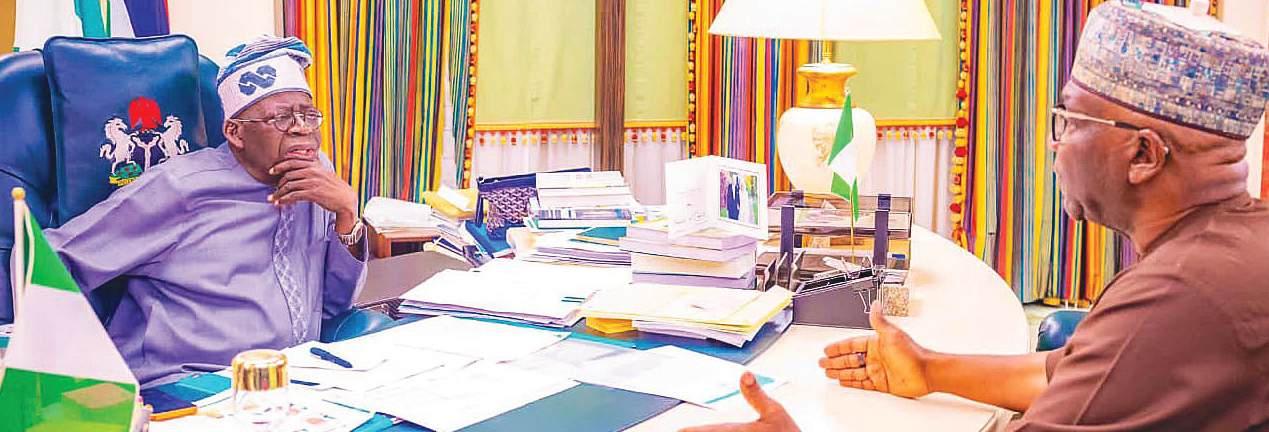
Minister of Finance and Coordinating Minister of the Economy, Mr. Wale Edun, has held talks with the visiting Managing Director, Operations, at World Bank Group, Ms. Anna Bjerde, on how Nigeria can collaborate with the global development institution to build a more productive and competitive economy.
Discussions centred around expanding reliable electricity,
strengthening agriculture, accelerating digital infrastructure, improving trade flows, and unlocking private sector investment.
Ministry of Finance, in a statement issued on Thursday, said the meeting reaffirmed President Bola Tinubu’s clear economic direction and rising global confidence in the country’s reform programme.
The minister highlighted strong momentum across key sectors, driven by decisive policy action and a renewed focus on growth,
investment, and job creation.
Edun stated that the government’s priority was to create an environment where investment could flow, businesses could grow, and Nigerians could find meaningful work.
The statement added, “Discussions centred on expanding reliable electricity, strengthening agriculture, accelerating digital infrastructure, improving trade flows, and unlocking private sector investment, all central to building a more productive and competitive economy.
NUPRC Sensitizes Host Communities in Delta, Vows to Implement PIA 2021
Sylvester Idowu in Warri
The Nigerian Upstream Petroleum Regulatory Commission (NUPRC) has reaffirmed its drive to ensure that all processes leading to the implementation of the Petroleum Industry Act (PIA) 2021 will be in line with the law.
The body also affirmed effective compliance by the Settlors and the nominated Host Communities
Development Trustees and their organs, including management and advisory committees.
Chief Executive of Nigerian Upstream Petroleum Regulatory Commission (NUPRC), Oritsemeyiwa Amanorisewo Eyesan, gave the assurance yesterday during Delta State Stakeholders and Petroleum Communities Sensitization Workshop.
The workshop sponsored by NUPRC was powered by the Delta
State Government and Mecco And Marine Holdings Limited was on the implementation progress regarding the direct social benefits of the host communities as enshrined in the Petroleum Industry Act (PIA) held at Government House Annex, Warri, Delta State.
Eyesan, represented by the Regional Coordinator, NUPRC, Warri Office, Chief Ambassador Ogunnubi Olusegun Benjamin said
the Commission would ensure full compliance of the PIA 2021.
She said the commission, as the instrument of the federal government, saddled with oversight functions to establish, implement and administer the PIA 2021, will ensure the processes involved were carried out in line with the Act.
The purpose and objectives of the PIA Act, she explained were to foster sustainable prosperity for the host
communities, to provide direct social economics benefit from the petroleum operations to the host communities, to maintain peace and harmonious coexistence between the communities and operating company and to create a framework for sustainable development of the communities.
“These can only be achieved when there are mutual understanding, cooperation and collaboration between the company and the host
“Nigeria also reaffirmed its leadership in energy reform and its ambition to serve as a regional economic hub, supported by Abuja’s role as host city to the Economic Community of West African States (ECOWAS).”
The statement added, “Ms. Bjerde welcomed Nigeria’s reform progress and commended the government’s clarity of purpose, noting increasing confidence from international markets and partners.
communities. And I believe that is already maintained, that is why it is possible for us to be here to brainstorm together and have more understanding of the act for a better result”, she stated.
Delta State governor, Rt. Hon. Sheriff Oborevwori, commended the NUPRC for organizing the sensitization workshop on the PIA Act with specific focus on chapter three on host communities.
Ndubuisi Francis in Abuja
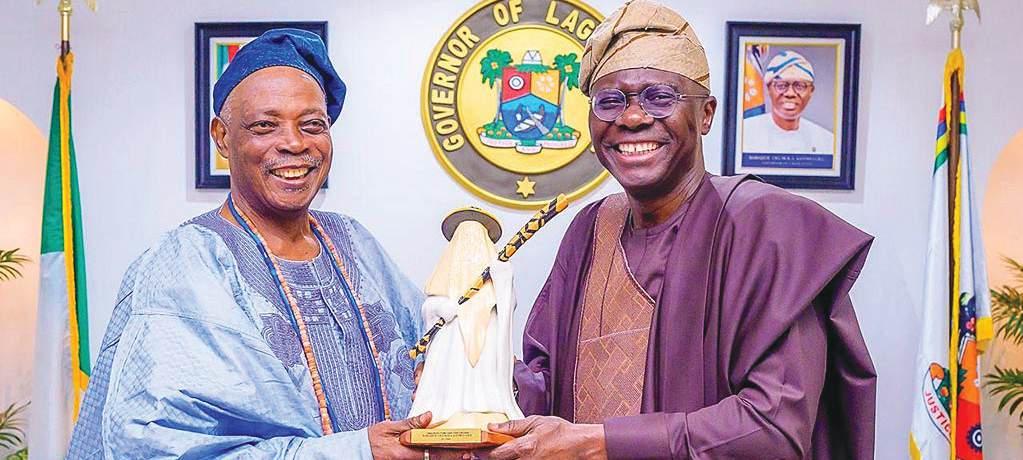
The Olubadan of Ibadanland, Oba Rashidi Ladoja (left), receiving an Eyo effigy from the Governor of Lagos State, Mr Babajide Sanwo-Olu, during a courtesy visit to Lagos House, Marina, ... yesterday
AWARD OF EXCELLENCE IN FISCAL POLICY REFORM...
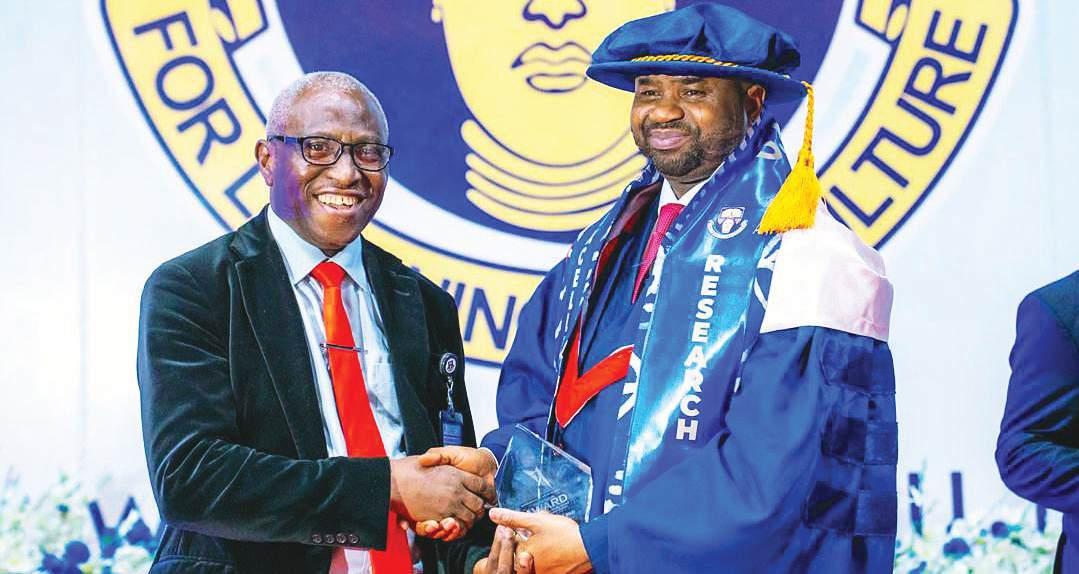
The Vice-Chancellor, Obafemi Awolowo University, Ile-Ife, Osun State (left), Prof. Adebayo Bamire, presenting an Award of Excellence in Fiscal Policy Reform and Administration to the Chairman, Nigeria Revenue Service (NRS), Dr. Zacch Adedeji, at the University, yesterday
Zacch Adedeji Seeks Value Addition to Raw Materials Export to Unleash Economic Prosperity
James Emejo in Abuja
Chairman, Nigeria Revenue Service (NRS), Dr. Zacch Adedeji, yesterday, canvassed a paradigm shift from dependence on raw material exports to ideas, innovation, and production of complex products as a pathway to sustainable economic growth and national prosperity.
Adedeji spoke while delivering the maiden distinguished personality lecture of the Faculty of Administration, Obafemi Awolowo University (OAU), Ile-Ife, Osun State.
In the lecture entitled, “From Potential to Prosperity: Export-led
Economy,” the NRS chairman stressed the need to rethink growth through the lens of complexity by not just producing more of the same stuff.
In a statement by his Special Adviser on Media, Dare Adekanmbi, Adedeji expressed concern that the country possessed a high-tech oil sector and low-productive informal sector, as well as lacked the “vibrant, labour-absorbing industrial base that serves as a bridge to higher complexity”.
The NRS boss stated that Nigeria witnessed stagnation in its export drive for three decades between
1998 to 2023, and only added six new products in its export basket between 2008 and 2023.
He said, “Because of our current position, the Harvard Atlas concluded that we are positioned to take advantage of very few opportunities to diversify using what we already know.”
Adedeji said Nigeria should learn from the world through comparative study of success and failure.
He said, “We are not just looking at numbers in a vacuum; we are looking at the strategic choices made by nations like Vietnam, Indonesia, Bangladesh, Brazil, and South Africa
over the same twenty-five-year period.
“While there are many ways to underperform, the path to success is remarkably consistent: it is defined by a clear strategy to build economic complexity.
“When we put these stories together, the divergence is clear. Vietnam used global trade to build a resilient, complex economy, while the others remained dependent on natural resources or a single low-tech niche.”
According to him, “There are three big lessons here for us in Nigeria as we think about our roadmap.
Olubadan Hails Sanwo-Olu’s Giant Strides, Appreciates Lagos’ Support at Coronation
The Olubadan of Ibadan, Oba Rashidi Ladoja, yesterday, paid a courtesy call on Governor Babajide Sanwo-Olu and hailed his administration’s giant strides in Lagos.
Speaking during the courtesy visit at Lagos House, Marina, Oba Ladoja thanked Sanwo-Olu for the role the state played during his coronation last year. He also praised the governor for infrastructure development in Lagos State.
He said he was in Lagos to appreciate the governor and key stakeholders in Lagos State for their support during his coronation, describing Lagos as a place deeply connected to his personal and traditional heritage.
The Chairman of the Oyo State Traditional Council of Obas and Chiefs, lauded the government’s efforts in traffic management and transportation, saying the incumbent
administration has reduced traffic gridlock with the provision of good infrastructure.
The monarch also commended the Blue and Red rail lines, as well as the water transportation systems in Lagos, which, according to him, have reduced journey times significantly in many parts of the State.
Oba Ladoja renewed the call for a constitutional role for traditional rulers in the country, saying such recognition would strengthen governance and foster closer collaboration between monarchs and government authorities.
He also disclosed that there was no dispute between the traditional institution and the Oyo State government but that a constitutional role would strengthen the relationship.
In his address, Sanwo-Olu, who described Ibadan as a rallying point of the Yoruba race, commended
Oba Ladoja for his leading role in ensuring peace as well as unity in Oyo state and beyond.
He thanked him for the visit, and commended him for his service to the country. He also praised his visionary leadership as the incumbent Olubadan of Ibadanland.
He prayed for a peaceful and impactful reign for the monarch, expressing confidence that Oba Ladoja’s leadership would bring development and transformation to Ibadanland and Nigeria.
“We thank God for your (Oba Ladoja) life. We thank Almighty God for your leadership in our country and for the several years that you have served this country. And now, you have graciously accepted to serve the people of Ibadan.
“Our prayer is that your tenure will not only be long but will bring transformational development to the
entire Ibadanland, your state and Nigeria in general. God will spare you. God will give you renewed energy, strength and wisdom to rule and rule well.
First, avoiding the resource curse is necessary, but it is not enough. You need a proactive strategy to build productive capabilities.
“Vietnam’s success came from integrating itself into Global Value Chains (GVCs). They positioned themselves as the assembly hub for the world’s electronics, importing high-tech parts and exporting finished products.
“This allowed them to ‘borrow’ technology and management skills from abroad to build their own know-how.”
Adedeji said, “Nigeria, on the other hand, remains a supplier of raw materials to these chains, not an active participant within them.
We must realise that productive capabilities are not permanent.
“The examples of South Africa and Brazil show us that you can actually lose your industrial edge if you are not careful. Over-reliance on the easy path of resource extraction creates economic and political incentives that crowd out the difficult, long-term work of building an industrial base.”
He added that for Nigeria, which was at an even earlier stage of development and even less diversified than those nations, the warning was stark.
Adedeji stated, “Relying solely on our natural endowments isn’t just a path to stagnation; it’s a path to regression. The global economy increasingly rewards knowledge and complexity, not just what you can dig out of the ground.
“If we want to move from potential to prosperity, we must stop being just a source of raw materials and start being a source of ideas, innovation, and complex products.”
He added that President Bola Tinubu had already begun the difficult work of rebuilding the economy to ensure collective knowledge to innovate, produce, and build a resilient economy.
Adedeji added, “The journey from potential to prosperity is not a short one, but with the right map and the right resolve, it is a journey we can finally complete.”
N2.4Nn Fraud: Court Slams 10-yr Jail Term on Ex NEXIM Bank MD, Orya
Alex Enumah in
Abuja
A High Court of the Federal Capital Territory (FCT) in Abuja has sentenced former Managing Director of Nigerian Export-Import Bank (NEXIM), Robert Orya, to 10 years in prison.
Justice Frances Messiri handed down the jail upon convicting Orya on all 49 counts criminal charge bordering on fraud to the tune of N2.4 billion.
Economic and Financial Crimes
Commission (EFCC) made the disclosure on Thursday, in a post on its X handle.
The anti-graft agency recalled that it had in 2021 dragged the former managing director to court over alleged criminal breach of trust, fraud, misappropriation, impersonation, official corruption, and abuse of office, among others.
Orya, who was NEXIM boss from 2011 to 2016, according to EFCC, had abused his position and
fraudulently divert funds, including through entities like Luxurium Leisure Services Limited (incorporated using fictitious names), and inducing loans, such as N488 million to Treasure Mix Construction Limited under false pretences. Although, he had pleaded not guilty to the charge, the court, in its judgement, held otherwise and, subsequently, sentenced him to 10 years imprisonment on each of the 49-count charges.
DURING THE CONSIDERATION OF ELECTORAL BILL...
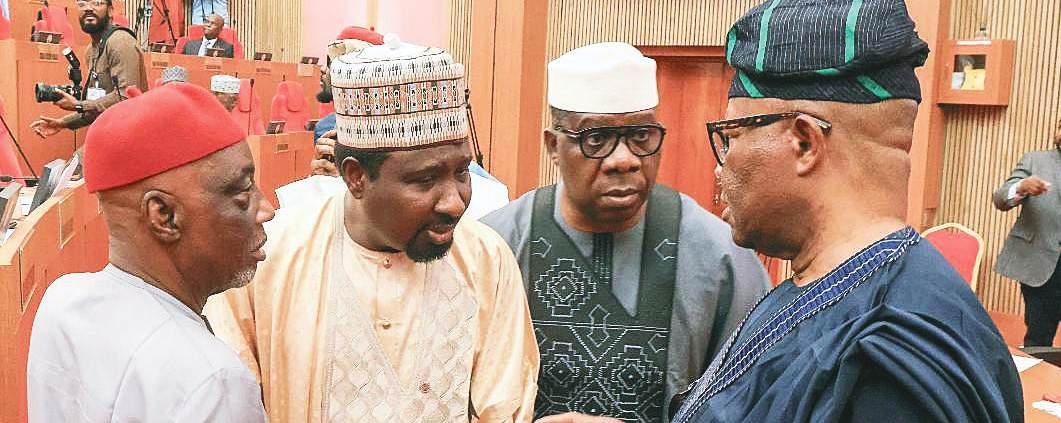
L-R: Minority Leader of the Senate, Senator Patrick Abba Moro; Deputy President of the Senate, Senator Barau I. Jibrin; Leader of the Senate, Senator Opeyemi
Senator Godswill Akpabio at the consideration of the Electoral Bill, 2025 at the Senate Chamber, National Assembly,
and President of the
Tinubu Expands Women’s Economic Programme to
25m Beneficiaries Nationwide Rolls out digital platform connecting women to finance, markets, skills
President Bola Tinubu has expanded the Nigeria for Women Programme to reach 25 million beneficiaries nationwide, reaffirming his administration’s commitment to women’s economic inclusion and national development.
The programme’s pilot phase in six states had already reached over one million beneficiaries, with the scale-up introducing Happy Woman App Platform, a secure digital interface that connects women to finance, skills, markets, essential services, and government support.
Speaking on Thursday at the Presidential Launch of the Programme Scale-Up at State House, Abuja, Tinubu, who was represented by Vice President Kashim Shettima, stated that Nigeria could not achieve sustainable growth without placing women at the centre of national planning.
According to him, “A nation that relegates its women is a nation bound for implosion. We have long understood this truth. That is why this administration has not only placed women at the forefront of decision-making
but has also entrusted them with leadership in causes that redeem our national promise.
“Today stands as proof of that commitment, and I am proud to be part of this journey.”
Tinubu observed that while women were the authors of Nigeria’s development story, they remained essential to family stability, community resilience, and national productivity.
He stated, “We have set a bold but achievable national ambition: to reach 25 million Nigerian women through this programme,” he stated, calling on the World Bank to strengthen its financing, technical support and innovation partnerships for the national scale-up.
“Digital inclusion is no longer optional; it is foundational to effective service delivery and national competitiveness.”
The president designated 2026 as the “Year of Social Development and Families in Nigeria,” directing coordinated action across all levels of government.
The declaration followed a Memorandum of Understanding signed during his January official visit to Turkey, aimed at
strengthening family cohesion and social welfare systems.
Tinubu commended the Federal Ministry of Women’s Affairs and Social Development for integrating technology into policy implementation and reorganising social development into a more coherent system since the launch of the Renewed Hope Social Impact Intervention in Lafia last year.
He said the transformation reflected what purposeful leadership could achieve.
The president also praised state governors and Nigeria Governors’ Forum for aligning federal vision with state-level execution, stating that “national transformation succeeds when all levels of government move with shared purpose”.
Earlier, in her welcome address,
Minister of Women Affairs and Social Development, Hajiya Imaan Sulaiman Ibrahim, said the launch underscored a significant shift under the leadership of Tinubu, where women were no longer viewed as peripheral beneficiaries of development but central drivers of Nigeria’s economic growth, social cohesion, and democratic stability.
She described the launch of
the Nigeria for Women Project (NFWP) Scale-Up as one of the most far-reaching and ambitious expansions of social and economic empowerment in the country’s history.
The minister stated that phase one of the project successfully achieved its objectives of addressing harmful social norms and strengthening women’s socio-economic resilience.
AWCAA: 60% of Breast Cancer Cases in Nigeria Diagnosed at Late Stages of Affliction
Onyebuchi Ezigbo in Abuja
Africa Women Cancer’s Awareness Association (AWCAA) has expressed concern over the dangers posed by late testing and diagnosis of breast cancer in ItNigeria said that low level of awareness among Nigerians and lack of early testing have resulted in fatalities from the disease.
Speaking at a Breast Cancer NGO Summit in Abuja on
Thursday, Founder of AWCAA, Mrs. Ify Nwabukwu said that the critical point in dealing with the cancer scourge is the emphasis on early detection through testing.
She said that late detection of cancer often spells doom for the victims and makes treatment and recovery very difficult.
In terms of statistics, Nwabukwu said that records show that many cases of cancer in the country were diagnosed very late.
She said: “For Africans and Nigeria, 60 to almost 80 percent show up at the hospital when cancer is already in late stage. And what is late stage? Stage three, stage four, stage five. Before you know it is that going up to other
parts of the body. We don’t want that to be happening.
Nwabukwu said her organization which started off in the United States of America is now in Nigeria collaborating with other stakeholders to promote right breast cancer response practice.
“My concentration is on breast cancer. Who has breast cancer and so to do that, we have a board of directors. One of them, she’s the oncologist at the National Hospital.
“But what is important to me is, again, where are we at the breast cancer space in my country, which is Nigeria, so we have ground ambassadors who do community outreach in churches, in different
places, where you can educate our women.
Speaking further, Nwabukwu said: “ We want you to know your body, know what your breast looks like, so that you that has the breast will know if something is not looking right.
“You need to know the color of your breast, the shape of your breast, and at all cost, is there any crack? Are there any basic signs and symptoms that tell you something is wrong? “
Speaking about the driving force behind her venturing into cancer awareness campaign, Nwabukwu said that apart from being a cancer survivor, she had also seen her mother battle the ailment till death.
Wike: Accommodation Provision Not to Compromise Judiciary 2026
As Nigeria continues in her drive to reposition the health sector, nine states of the federation have voted 15 percent and above for healthcare in their 2026 appropriation Bill.
According to the 2026 Budget analysis published by Promad Foundation, the nine states include; Abia, Bauchi, Kaduna, Kano, Ogun, Kwara, Nasarawa, Oyo and Taraba.
The move by the states is seen as major step forward in realizing the 15 percent budget target set by African leaders under the Abuja Declaration.
Signed in April 2001, the Abuja declaration is a pledge by African
Union to allocate at least 15 percent of their annual national budgets to the health sector to strengthen healthcare systems. However, despite being a landmark commitment, most countries, including Nigeria, have not able to meet this target, with many allocations remaining below 10% for over two decades.
Whereas the federal government is allocating N2.48 trillion to the health sector in the 2026 budget, representing roughly 4.2 percent of the total N58.47 trillion budget, the 10 sub-nationals average 15 percent in proposed spend for healthcare.
Nigeria is spearheading a new
campaign on health sector reform agenda which targets restructuring of healthcare systems, ensuring more domestic investments into the health sector and a drive to improve on the health sector value chain.
Details of the budget allocations to health sector by the nine states showed that Ogun state has (17%), Nasarawa (17.95%), Oyo (17.50%), Kwara (17.71%), Ogun (17%), Kano (16%), Abia (15%), Taraba (15.98%) and Bauchi (15.03%).
It is expected that the increased budgetary allocation by the states will translate into significant investment in healthcare infrastructure, capacity improvement for personnel and service delivery.
Olawale Ajimotokan in Abuja
Minister of the Federal Capital Territory Nyesom Wike has rubbished criticisms that government was compromising the independence of the judiciary through the provision of accommodation to judges in the nation’s capital. He made the assertion yesterday after inspecting the Court of Appeal Division Complex in Daki Biu as well as other projects to provide accom-
modation for judges in Katampe and Asokoro.
Wike said: “Let’s do it first. There is nothing you would do that the critics will not criticize. Before now that care was not taken for the third arm of government. Before now, they said, judges had nowhere to stay to carry out their job efficiently and effectively.
“Now you are providing it, it becomes an attempt to buy them.
How many people can you buy over? So, these things shouldn’t bother us,
Mr. President means well for the judicial arm government which is very, very key.
“You can’t talk about democracy without talking about the judiciary. You can’t talk about them doing their work when they cannot have befitting places to stay.
“So, even if, for example, you give them the funds directly, you are the ones still providing the funds. Every arm of government depends on the executive to provide funds.
Bamidele
Senate,
Abuja on Wednesday
PHOTO: OFFICE OF THE LEADER OF THE SENATE.
Deji Elumoye in Abuja
Onyebuchi Ezigbo in Abuja
Promad Report: States’ Annual Budget Increases
to N36.98tn in 2026
Lagos, Ogun, Delta, Enugu, others cross N1 trillion-threshold, commit to long-term capital development
James Emejo in Abuja
The total annual budget of the 36 states of the federation rose by 45 per cent to N36.98 trillion in 2026, from N25.58 trillion in 2025, according to a report by Promad Foundation.
The figure also indicated a 129 per cent increase compared to N16.15 trillion in states’ combined appropriation in 2024, and 11.17 trillion in 2023.
According to the 2026 Nigeria Subnational Budget Outlook by the foundation, the trend highlights growing state fiscal expenditure with stronger commitments to development priorities.
Promad stated that it was standard practice for all the states to prepare annual budgets outlining projected revenues and planned expenditures. These budgets provided a roadmap for governance, revealed sectoral priorities, and ensured transparency.
The foundation stressed that tracking allocations allowed stakeholders to check alignment with citizens’ realities, assess fiscal responsibility, monitor investments, and understand how public resources were used to drive development outcomes for the taxpayers.
According to the report, aggregate subnational budgets grouped by the six geopolitical zones, indicate each zone’s share of total state-level spending nationwide.
South-west accounted for 24 per cent of total subnational appropriation, while South-south accounted for 19 per cent, and North-west accounted for 17 per cent.
South-East represented 16 per cent of the total budget, Northcentral 13 per cent, and North-east 12 per cent.
The report further disclosed that 11 states crossed the N1 trillion budget mark in the period under
review.
They included Lagos, N4.45 trillion; Rivers, N1.85 trillion; Ogun, N1.67 trillion; Delta, N1.73 trillion; Imo, N1.45 trillion; and Enugu, N1.62 trillion.
Others were Akwa Ibom, N1.39 trillion; Kano, N1.69 trillion; Niger, N1.07 trillion; Abia, N1.01 trillion; and Bayelsa, N1.06 trillion.
The report said many states were investing in roads, transport networks, school construction, and rehabilitation programmes.
It stated that health and agriculture also attracted significant funding in several states, reflecting efforts to strengthen service delivery
and support economic resilience.
Of Lagos’ budget, N2.31 trillion or 52 per cent was earmarked for capital expenditure, while N2.23 trillion was set aside for recurrent spending.
Enugu set aside N1.3 trillion or 80 per cent for capital spending and N321.31 billion or 20 per cent for recurrent expenditure.
Delta budgeted N1.21 trillion or 70 per cent for capital expenditure and N518.96 billion or 30 per cent to recurrent expenditure, while Imo set aside N1.2 trillion or 83 per cent of its budget for capital spending and N244.63 billion for recurrent spending.
Nigeria Keys into $7.7trn Global Halal Market as National Economy Strategy is Launched
Tinubu assures it’ll unlock $12bn economic value for Nigeria, position nation as halal-friendly tourism destination Oduwole to chair strategy committee
Deji Elumoye in Abuja
President Bola Tinubu yesterday launched Nigeria’s National Halal Economy Strategy aimed at positioning the country to tap into the $7.7 trillion global halal market and diversify its economy.
Tinubu described the unveiling of the strategy as a signal of Nigeria’s readiness to join the world in grabbing a huge chunk of the global halal economy already embraced by leading nations. He said the strategy also clearly defined Nigeria’s direction within the market expected to add an estimated $1.5 billion to the country’s Gross Domestic Product (GDP) by 2027.
Speaking while unveiling the Nigeria National Halal Economy Strategy at State House, Abuja, the president, who was represented by Vice President Kashim Shettima, called for disciplined, inclusive, and measurable action for the strategy to deliver jobs, and shared prosperity across the country.
He stated, “It is with this sense of responsibility that I formally unveil the Nigeria National Halal Economy Strategy. This document is a declaration of our promise to meet global standards with Nigerian capacity and to convert opportunity into lasting economic value.
“What follows must be action that is disciplined, inclusive, and measurable, so that this Strategy delivers jobs, exports, and shared prosperity across our nation.
“It is going to be chaired by the supremely competent Minister of Industry, Trade and Investment.”
The vice president outlined what he described as clear and measurable ambitions set by the strategy, including, “expanding halal-compliant food exports, developing pharmaceutical and cosmetic value chains, positioning Nigeria as a halal-friendly tourism destination, and mobilising ethical finance at scale” by 2030.
According to him, the cumulative efforts, “are projected to unlock over twelve billion dollars in economic value, while strengthening food security, deepening industrial capacity, and creating opportunities for small-and-medium-sized enterprises across our states.”
Allaying concerns by those linking the halal with religious affiliation, Shettima pointed out that the global
halal economy had since outgrown parochial interpretations.
He stated, “It is no longer defined solely by faith, but by trust, through systems that emphasise quality, traceability, safety, and ethical production. These principles resonate far beyond any single community.
“They speak to consumers, investors, and trading partners who increasingly demand certainty in how goods are produced, financed, and delivered. It is within this broader understanding that Nigeria now positions itself.”
The vice president stated that many advanced Western economies had since “recognised the commercial and ethical appeal of the halal economy and have integrated it into their export and quality-assurance systems”.
He listed the developed countries, including the United Kingdom, France, Germany, the Netherlands, the United States, Canada, Australia, and New Zealand, saying they are currently among “leading producers, certifiers, and exporters of halal food, pharmaceuticals, cosmetics, and financial products”.
Shettima said what those developed nations had experienced was a confirmation of a simple truth, that “the halal economy is a global market framework rooted in standards, safety, and consumer trust, not geography or belief”.
He explained that while the Nigeria National Halal Economy Strategy was the result of careful study and sober reflection, it was inspired by the commitment of the administration of President Bola Tinubu “to diversify exports, attract foreign direct investment, and create sustainable jobs across the federation”.
He added, “It is also the product of deliberate partnership, developed with the Halal Products Development Company, a subsidiary of the Saudi Public Investment Fund, alongside Dar Al Halal Group Nigeria, with technical backing from institutions such as the Islamic Development Bank and the Arab Bank for Economic Development in Africa.”
Tinubu’s recent state visit to the Republic of Türkiye further reinforced Nigeria’s commitment to developing a globally competitive halal ecosystem, the government said.
A major outcome of that visit was
the signing of an Agreement in the Field of Halal Quality Infrastructure between Nigeria and Türkiye, aimed at strengthening standards, accreditation, certification, and quality assurance systems to enhance international acceptance of Nigerian halal products and services.
Commenting on the unveiling, Chairperson of National Halal Strategy Committee, and Minister of Industry, Trade and Investment, Dr. Jumoke Oduwole, said the launch of the Nigeria National Halal Strategy was a public-private collaboration that involved extensive interaction with stakeholders.
Oduwole stated that the private sector led the charge in ensuring that it was a whole-of-government and whole-of-country intervention, with the Office of the Vice President coordinating all ministries, depart-
ments, and agencies, while the Federal Ministry of Industry, Trade and Investment played a pivotal role.
The minister stressed that what the halal strategy had done for Nigeria “is to position us among countries that export Halal-certified goods across the world”.
Oduwole said, “We are going to leverage the African Continental Free Trade Area (AfCFTA) to ensure we export our Halal-friendly goods to the rest of Africa and beyond to any willing markets; participation is voluntary.”
She assured that as chairperson, her ministry would deliver on the objectives of the strategy for the prosperity of the country.
Earlier, Chairman and CEO of Dar Al-Halal Group Nigeria Limited, Alhaji Muhammadu Ladan, expressed satisfaction that
the Halal Product Development Company collaborated with the group in developing the National Halal Economy Strategy.
Ladan stated that, in addition to the strategy, an export programme was underway, which involved the Ministry of Trade and Investment, through which Nigerian companies could be on-boarded into the Saudi Arabian market and beyond.
Ladan described the strategy as a landmark opportunity for Nigeria, as it created market access and attracted foreign direct investment.
French Ambassador to Nigeria, Marc Fonbaustier, represented by Financial Counsellor at the French Embassy in Nigeria, Carole Lebreton, said the halal strategy was also key to Nigeria–France relations, as the French government explored more ways to build socio-economic bridges
with Nigeria.
She said the French government stood ready to support Nigeria’s export drive, especially in the areas of food, cosmetics, and pharmaceuticals.
The Nigerian delegation at the unveiling included CEO of Nigeria Export Promotion Council, Mrs Nonye Ayeni; Managing Director of Bank of Industry, Mr Olasupo Olusi; and Special Adviser to the President on Job Creation and MSMEs, Temitola Johnson, among others.
Developed by Halal Products Development Company (HPDC) of the Kingdom of Saudi Arabia — a wholly owned subsidiary of the Saudi Public Investment Fund — the strategy is an outcome of the bilateral cooperation agreement signed between Nigeria and HPDC in February 2025 at the Makkah Halal Forum.
DIPLOMACY: TINUBU PLAYS THE REMI CARD ON TRUMP; CHRISTIAN, PASTOR, SOFT POWER Abuja and Washington, THISDAY recalls.
However, the calculation seemed to have paid off publicly when Trump singled out Mrs Tinubu in the congregation, acknowledging her presence and offering unusually warm remarks, signalling renewed receptiveness after months of aggressive rhetoric against Nigeria and sent a clear message that Nigeria was, perhaps, back in positive view.
Specifically, the US President, Trump, specially acknowledged the presence of Nigeria’s First Lady, Oluremi, at the 74th edition of the programme, describing her as a respected figure and noting her role as a Christian pastor in the ‘largest church’ in Nigeria.
But like everything Trump, there is a risk. How sustainable is this new found receptiveness? Trump is mercurial and can easily change his mind.
Trump also stated that US forces, in collaboration with their Nigerian counterparts are conducting operations in Nigeria to protect Christians from being slaughtered, reiterating the significance of the Christmas day air strikes on terrorists in Africa’s most populous nation.
“But we’re honoured to be joined today by the First Lady of Nigeria, who also happens to serve as a Christian pastor at the largest
church in Nigeria. A very respected woman. First Lady, please, where are you? Thank you very much. It’s a great honour. Thank you very much. Very respected person, too,” Trump stated.
Besides, the US President stated that he had been working tirelessly to end dangerous conflicts in Nigeria and other countries and help move past what he described as ‘ancient hatreds’ against the Christian faith.
“We are hitting very hard (in Nigeria). My administration is confronting head-on the militants and really intolerant campaign that tried to drive religious believers out of public life and out of society. I mean, now religious leaders are respected as much or more as any leader of any type anywhere in the world. Religious leaders are respected again, and that’s the way we have to have it.
“They really are respected again. They were having a hard time. They were having a very hard time. The last four years previous to the one that we served, the last four years were brutal on religious leaders. They were brave. Some were very brave. Some couldn’t take it, and a lot of people understand that. Some were brave, really brave,” he added.
Trump boasted that no administration in modern history has done more to confront what he termed
the plight of persecuted Christians around the world than his, describing it as a mission.
“On Christmas Day, in close coordination with the government of Nigeria, we worked with them, but they have got to get tougher. I ordered powerful airstrikes to decimate the ISIS terrorists who have been slaughtering Christians in that country by the thousands. It’s not even believable. We hit them so hard, they still don’t know what the hell happened.
“And we were going to do it on a different day. I said, no, do it on Christmas, so they understand it.
When I ran in 2015, I announced that we were going to bring back Christmas because the word Christmas was almost gone, and people weren’t using Christmas anymore.
“We brought back the word Christmas. They didn’t want to use it, and we’re using it again.
But I specifically told Pete (US Secretary of War), I said, hit them on Christmas Day. Not earlier and not later. Right, Pete? And man, did he hit them. So then we hit them again recently. We hit them again pretty hard.”
Although the Bible says that “Blessed Are the Peacemakers,” Trump maintained that this can only be achieved through the
exertion of strength, pointing out that he had ended at least eight wars in one year.
Established in 1953, the National Prayer Breakfast is an annual event that brings together political leaders, faith leaders, and dignitaries from across the world for prayers and reflection in the US. In the last few months, both countries have formally moved past earlier tensions linked to security and governance concerns. Following sustained high-level dialogue, Nigeria has made sustained diplomatic moves to resolve the misunderstanding between both countries and put them on a more stable footing.
In recent times, security cooperation has deepened, with the US reiterating its support for Nigeria’s counterterrorism and regional stability efforts, amid expanded intelligence sharing, advisory support, and more responsive engagement on Nigeria’s security requests. This has been further enhanced with the setting up of a bilateral committee to thrash out outstanding issues. At the political level, regular exchanges between senior Nigerian officials, US diplomats, and legislators have resumed, with a focus on democratic governance, economic cooperation, and Nigeria’s regional leadership.
The report pointed out, “Overall, the distribution of capital spending illustrates how subnational governments are directing resources towards long-term development and state specific priorities.” Chairman of Governors Forum, AbdulRahman-AbdulRazaq
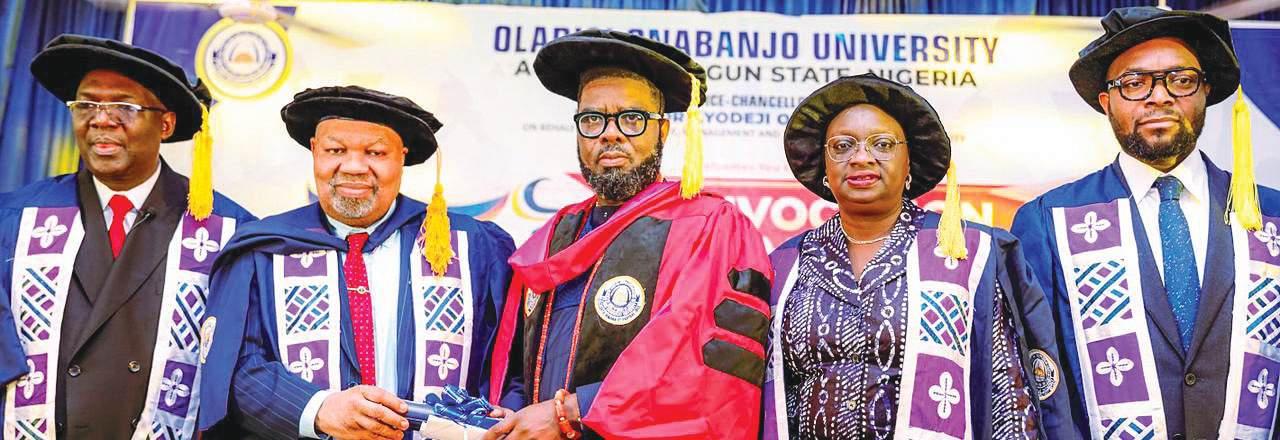
OLABISI ONABANJO UNIVERSITY CONVOCATION...
L-R: Vice Chancellor, Olabisi Onabanjo University (OOU), Prof. Deji Agboola; Pro-Chancellor and Chairman of Council, OOU, Prof. Toyin Ashiru; Honourary Doctoral Degee Awardee, Dr. Ayo Ojuroye; Deputy Governor of Ogun State, Engr. (Mrs.) Noimot Salako-Oyedele, and Hon. Minister of Communications, Innovation and Digital Economy, Dr. Bosun Tijani, during the 35th convocation ceremony of OOU, Ogun State...recently
S&P: Nigeria, Other African Nations Face $90 Billion Debt Wall in 2026
Egypt, Angola, South Africa, Nigeria lead JPMorgan to launch new frontier market local currency debt index
S&P Global Ratings has cautioned that African governments face rising debt risks as hard-currency repayment schedules in 2026 increase pressure on external buffers, contributing to rollover risks.
The agency’s latest African sovereign outlook report showed that government external debt repayments are now over three times larger than in 2012, a Reuters report said.
“Structurally high debt and low, concentrated revenue bases will continue to pose key risks and, with government external
debt repayments likely to exceed $90 billion this year, external vulnerabilities have also increased,” S&P’s Benjamin Young wrote in the report. “Government external debt repayments are approaching a peak,” he added.
Egypt accounts for nearly onethird of this year’s tally with $27 billion due in principal repayments, followed by Angola, South Africa, and Nigeria.
S&P noted that average sovereign ratings in the region have reached their highest levels since late 2020, reflecting reform momentum and improved growth. However, it was a sign of key credit metrics stabilising
rather than significantly improving, as structural adjustments to reduce debt burdens tended to require longer timelines, S&P analysts said.
Easing global financial conditions and investors seeking to diversify their investments have reopened the door for a number of African sovereigns to tap global capital markets.
However, some of them, such as Republic of Congo, had to offer double-digit yields in recent months, widely seen as too expensive for issuers, and a number of governments have resorted to off-market deals such as private placements or total return swaps.
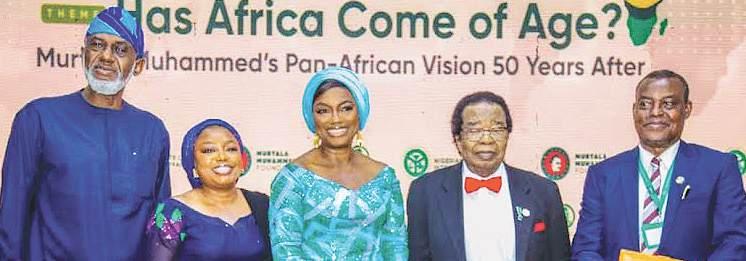
Bolaji Akinyemi: Murtala Muhammed Brought Out the Pride in Nigeria
Former Minister of Foreign Affairs, Professor Bolaji Akinyemi, has declared that the country’s late military head of state, General Murtala Muhammed, inspired a deep sense of accomplishment and national self-esteem in Nigeria with his radical foreign policy.
Akinyemi made the declaration yesterday at Nigerian Institute of Foreign Affairs (NIIA), Lagos, during a Strategic Policy Workshop, with the theme, “Has Africa Come of Age? Murtala Muhammed’s Pan-African Vision 50 Years After.”
The policy workshop was put together by Murtala Muhammed Foundation (MMF) and NIIA to honour the 50th anniversary of the assassination of General Murtala Muhammed.
Speaking on Muhammed’s impactful radical foreign policy posture that reverberated across Africa and beyond, Akinyemi said, “There was a time when we had in this country a head of state that brought out the pride in Nigeria.”
He added, “Nigerians knew what he stood for. Muhammed was not a head of state that avoided taking his stand on issues. And Nigerians knew what was expected of them.”
Akinyemi, who served as the first Director-General of NIIA during Muhammed’s regime, also used the occasion to clarify the question of whether he was the person that wrote the famous speech that Muhammed read at the General Assembly meeting of Organisation of African Unity in Addis Ababa, Ethiopia, in 1976.
He said, “Till today, there is still a debate on who wrote that speech. Ambassador Olu Adeniji (of the Ministry of Foreign Affairs) wrote it.
“People do not believe that it was not written by me. The speech was so radical that people did not believe that it could have come from the ministry.”
According to him, General Olusegun Obasanjo was meant to lead the Nigerian delegation to the OAU’s conference as Muhammed’s second-in-command.
However, Muhammed changed his mind, when the draft of the speech came out and accepted to deliver it himself.
Akinyemi said, “Before that script was written the decision has been taken that General Obasanjo will lead the delegation to the OAU meeting in Addis Ababa, Ethiopia.
“But General Muhammed loved
the draft so much that he decided that he will lead the delegation and will deliver the speech.
“When it has the imprimatur of the head of state it will carry more weight before the other heads of state that were there.
“The speech was like declaring ‘this is where I am taking Nigeria and I am not going to be afraid of anybody.’
“I emphasised this because it resonated in the hall. Before that speech Nigeria wanted government of national unity for Angola’s independence.
“People were confused when in conclusion he declared support for NPLA. It was like he threw a bomb inside that hall. I was there. Not that I was told.
“At the end of that conference we have succeed in moving the OAU to a radical decision of supporting the NPLA. It did not please the United States of America.
“But I am sure that they developed an understanding and respect for General Murtala Muhammed.”
Chief Executive Officer of MMF, Dr. Aisha MuhammedOyebode, the daughter of General Muhammed, said her father was being remembered today as a bold Pan Africanist.
Economic growth is projected to remain steady, with average real Gross Domestic Product (GDP) growth forecast at 4.5 per cent in 2026, while fiscal deficits are expected to modestly consolidate to 3.5 per cent of GDP. Nevertheless, government debt is anticipated to stay elevated at around 61 per cent of GDP on average, the report said.
The rising debt redemption burden is leading several governments to turn to liability management strategies, such as buybacks, exchanges, and maturity extensions, to reduce refinancing risks.
Notable users of such approaches include Côte d’Ivoire, Benin, Uganda, Republic of Congo, Mozambique, Kenya and South Africa.
Meanwhile, JPMorgan is finalising plans for a new index to track frontier market local currency bonds, investors consulted on the details told Reuters, as the bank looks to satisfy a growing appetite for riskier and more diversified high-yield debt.
The move, which comes 15 years after the Wall Street bank launched its hard-currency NEXGEM frontier
index, coincides with the year-long slump in the dollar and some extraordinary recent rallies in other markets.
Six leading money managers who spoke to Reuters on condition of anonymity said the bank’s engagements with them reached an advanced stage in the second half of last year.
The proposed index includes 20 to 25 countries, with Nigeria, Egypt, Vietnam, Kenya, Morocco, Kazakhstan, Pakistan, Sri Lanka and Bangladesh having the largest “weightings”, three of the managers said.
According to one source, there would be a limit that means no country has a weighting of more than 8 per cent. A second source said an earlier consultation document had a proposed 10 per cent limit.
It is also set to only include bonds of at least $250 million equivalent, although that has raised issues around Zambia, which many would like to see included but has traditionally only sold smaller individual bonds.
“We expect they (JPMorgan)
will give us a formal structure for the index around June with the opportunity to make some final comments,” said one senior fund manager. “They are then likely to formally launch (the index) next year, we think.”
Another senior fund manager said the initial announcement might be as early as the end of March, which could also bring the formal launch date forward. FTSE Russell has already had an equivalent index since 2021. JPMorgan’s versions, however, are more prominent among emerging market money managers, who effectively use them to compile their funds and measure their performance.
Analysis by Neuberger Berman estimates tradable local-currency debt has trebled over the last decade to around $1 trillion, Reuters said. It also calculates that over the last eight years, frontier market local FX debt had outperformed JPMorgan’s mainstream emerging market local currency index by almost 2.5 percentage points, and also outstripped the EM dollar bond index.
Julia Kleber: Nigeria’s Tourism Potential Huge, Untapped
Seeks to restore country on global map
James Emejo in Abuja
Chief Executive, Kleber Group, Julia Kleber, yesterday declared that Nigeria’s tourism potential remained enormous, and yet untapped.
Kleber said even though the tourism remained an industry that connects other sectors of the economy, helping to shore up global image, “Nigeria remains largely unknown to the international community”
She spoke at a media briefing in Abuja, revealing the group’s commitment to promote the country’s tourism and cultural assets to the global community.
She also said Africa in general remained unexplored when it comes to tourism development, yet it has huge potential to create jobs, employment, and income for the economy.
Kleber said, “The image of Nigeria is something we can work on—by promoting it strongly and educating the international market on what Nigeria is truly about. When you look at the different provinces, cultures, arts, music, and heritage, these are stories that need to be told to the international world.
She stated, “At the moment, Nigeria is a powerhouse on the continent, but few people truly know what it is all about. Tourism
development creates demand for travelers, and that demand also attracts investors.
“We need to build investor relations to support product development. Products need to be developed, demand needs to be generated, and we have strong connections within international tourism development.”
She told THISDAY, “We must identify which products we want to develop, which areas to focus on, and how to make it all happen. This requires a strategic plan to ensure that in the coming years, we see real growth in Nigeria’s tourism sector. Alongside this, capacity building is critical.
Dike Onwuamaeze
Emmanuel Addeh in Abuja
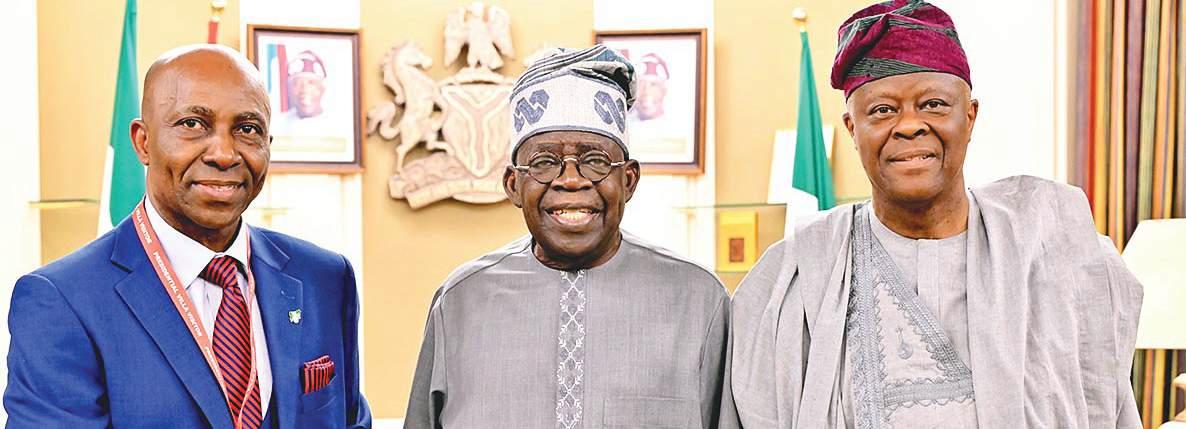
TAX OMBUDSMAN MEETS THE PRESIDENT...
L-R: Chief Executive, Tax Ombudsman, Dr. John Nwabueze; President Bola Ahmed
an audience
and
and Coordinating
NMDPRA Decries 5,000MW Power Supply, Says Gas Sufficiency Not Nigeria’s Problem
Minister declares Nigeria’s 210 Tcf reserves useless without getting to homes,
Emmanuel Addeh, Peter Uzoho and Blessing Ibunge in Abuja
Nigeria’s midstream and downstream petroleum regulator as well as policymakers yesterday voiced concerns over Nigeria’s sub-optimal energy performance, particularly in power generation and gas utilisation.
Speaking at the ‘National Gas Day’ session of the 9th Nigeria International Energy Summit (NIES) in Abuja, the Authority Chief Executive of the NMDPRA, Saidu Mohammed, expressed frustration over the country’s long-standing stagnation in electricity generation.
Mohammed said Nigeria was still generating about 5,000 megawatts of electricity, a level that has barely improved in more than two decades. He recalled that as a young engineer, the country had celebrated achieving around 4,500MW some 25 years ago, yet today remained “hovering around 5,000 megawatts,” despite having installed capacity of more than 13,000MW.
According to him, the problem was not the absence of gas resources or power plants, but
Marwa
weak commercial structures and inefficiencies across the gas-topower value chain. Nigeria, he said, produces about 8 billion cubic feet of gas daily and exports significant volumes, yet continues to operate a small and underdeveloped domestic gas market.
Mohammed questioned frequent claims by power plants that gas shortages were responsible for low generation, arguing that very few plants could demonstrate firm, bankable gas sales agreements for volumes allegedly not delivered. Gas, he said, is a commodity that must be sold before it is produced, warning that without credible buyers and enforceable contracts, producers have little incentive to invest in domestic gas supply.
He described gas as more than an energy commodity, calling it an economic enabler that underpins sustainable power, industrial growth, and economic development. Without reliable gas supply, he said, Nigeria would struggle to industrialise or diversify its economy, regardless of its resource endowment.
“We have been talking about gas-to-power. For us, actually, some of us grew up in it. As younger
Charges Nigerian
engineers, we have been talking about gas to PHCN, to the privatised companies and unfortunately in Nigeria, we are still hovering around the same thing.
“About 20 years ago or more, when I was a younger engineer operating a department at the Nigerian Gas Company (NGC), I think it was the first year or second year, we celebrated 4,500 megawatts of electricity generated at that time. 25 years later, we
are still hovering around 5,000 megawatts,” he lamented.
He added: “It is rather unfortunate that we are still hovering around 5,000 megawatts or so. Not because there is no generating capacity, there is up to 13,000 megawatts. There is a little bit more constraint in terms of wheeling capacity, but then the fundamental question is every time you hear no gas. The question I always keep on asking the power plants is how
much gas did you buy which is not delivered?
“Well, when we ask those questions, you hardly get an answer. I think we have not more than one or two power plants today that have bankable commercial gas sales agreements. If we don’t move the commerciality, we will not move those molecules called gas. Gas is a commodity that is sold before you even start drilling for it. If there is no buyer for gas,
others
you don’t look for it,” he argued. The NMDPRA chief said the Petroleum Industry Act (PIA) had introduced critical reforms, including domestic gas supply obligations, clearer pricing frameworks, and defined regulatory responsibilities. He said the authority was working with other regulators to enforce these provisions, while improving transparency in gas pricing and transportation tariffs.
NIS: Corruption Poses Existential Threat to National Security, Economic Devt, Nigeria’s International Standing
Michael Olugbode in Abuja
The Comptroller General of the Nigeria Immigration Service (NIS), Kemi Nandap has identified corruption as a serious threat to national security, economic development, and Nigeria’s global reputation.
She warned that corruption poses an existential threat to national security, economic development, and Nigeria’s international standing.
Speaking in Abuja on Thursday at the inauguration ceremony of the NIS Anti-Corruption and Transparency Unit
Youths on Skills Acquisition, Warns Against Drug Abuse
Olugbode
The Chairman and Chief Executive Officer of the National Drug Law Enforcement Agency (NDLEA), Brig. Gen. Buba Marwa (retd), has urged Nigerian youths to prioritise skills acquisition and empowerment opportunities as a strategic defence against drug abuse, unemployment and other social vices threatening national stability.
Marwa gave the charge in Abuja on Thursday while speaking as Special Guest of Honour at the launch of a youth empowerment and skills acquisition programme organised by Grassroots Bridge Builders, a non-governmental
organisation.
He described the initiative as a critical intervention that supports the Federal Government’s Renewed Hope Agenda, particularly its focus on youth empowerment, job creation, social inclusion and crime prevention.
According to him, equipping young Nigerians with practical and employable skills is a sustainable approach to addressing poverty, drug dependency and insecurity.
The NDLEA boss commended Grassroots Bridge Builders for its plan to train and empower 10,000 youths, noting that such efforts go beyond charity to serve as long-term investments in national
development.
He stressed that empowering young people strengthens their resilience, builds character and reduces their vulnerability to drug abuse and criminal activities.
Marwa emphasised the fight against drug abuse cannot be left to government alone, calling for stronger collaboration among non-governmental organisations, civil society groups, faith-based institutions, community leaders and the private sector.
He encouraged stakeholders to partner NDLEA in developing community-driven programmes that provide young people with skills, dignity and a sense of purpose.
(ACTU) Desk Officers for formations and commands across the country, Nandap noted the fight against corruption is inseparable from effective border management.
The inauguration marks a major step toward deepening institutional integrity and accountability in NIS and underscored the Service’s resolve to embed ethical governance at all operational levels through a decentralized and preventive anti-corruption structure.
Speaking at the event, the Comptroller General described the deployment of ACTU Desk Officers as a strategic shift from a largely centralized and reactive approach to a grassroots-driven framework
aimed at preventing misconduct and shaping organisational culture.
She stressed the Nigeria Immigration Service, as a key agency responsible for border governance and migration management, must uphold the highest standards of professionalism, transparency, and accountability.
She said: “Today marks a deliberate and consequential milestone in our collective resolve to strengthen institutional integrity, transparency, and operational excellence within the Nigeria Immigration Service.
“We are gathered not merely to inaugurate officers, but to entrench a proactive, grassroots framework for ethical governance through the
deployment of Anti-Corruption and Transparency Unit (ACTU) Desk Officers across all formations of the Service.
“The Nigeria Immigration Service stands as a critical sentinel at our nation’s gateways. We are entrusted with the solemn responsibility of border governance and migration management. This trust confers significant authority and, with it, an uncompromising obligation to uphold the highest standards of integrity, professionalism, and accountability.
“Corruption is not merely an administrative failing; it is an existential threat to national security, economic development, and Nigeria’s international standing.
Witness Admits Yahaya Bello not Linked with Kogi LGs Contract Awards
Alex Enumah in Abuja
A witness of the Economic and Financial Crimes Commission (EFCC), in the alleged money laundering trial of ex-governor of Kogi State, Mr Yahaya Bello, has admitted that the name of the former governor did not appear, either as beneficiary or signatory to any of the contracts awarded by local government councils in Kogi State, under his administration.
The witness, Olomotane Egoro, who is also the seventh prosecution
witness (PW7) of the EFCC, stated this when cross examined on the exhibits tendered by EFCC in its bid to establish allegations of corruption and money laundering against Bello. Egoro, a staff of Access Bank Plc, also admitted that no transaction in Exhibit 33(8) (statement of accounts) mentioned the name: Yahaya Adoza Bello.
At the resumed trial on Thursday, the witness was taken through bank accounts of some companies including E. Traders International
Limited, Keyless Nature Limited, Westwood Motors Limited and Fazab Business Enterprise. The Companies, according to the EFCC were awarded various contracts by local governments in Kogi State.
After scrutinizing the account opening packages and statements of accounts of the companies tendered by EFCC, the witness admitted the following; That Yahaya Bello’s name did not feature as signatory to any of the account opening packages.
Tinubu
Minister of Finance
Minister of the Economy, Wale Edun during
with president Tinubu at the Presidential Villa Abuja... yesterday
PHOTO: GODWIN OMOIGUI
Michael
in Abuja
Acting
Email:
Neglected Groups and Nation’s Forthcoming Polls
Afakriya Gadzama writes that marginalised communities across the federation have a critical role to play in shaping Nigeria’s political future as 2027 general poll approaches. He argues that sustained backing for the current administration is essential to consolidating inclusive governance, deepening national development, and addressing long-standing challenges of social exclusion, economic hardship, and insecurity facing the nation.
My last article examined how President Bola Tinubu has made remarkable inroads into the northern parts of the country. The article was by no means exhaustive; however, it attracted reactions from many readers. The most instructive responses came from some of my professional colleagues and other commentators who felt that I should have been more comprehensive in explaining the reasons President Tinubu has made such tremendous political gains in the North—an area which, prior to his emergence as President, was considered largely beyond his reach.
A university classmate, who has been a key player in previous governments and is a respected political commentator and scholar, while agreeing with the central thrust of my argument, observed that I failed to adequately highlight the growing influence of groups that have long been alienated and suppressed by successive governments at both state and national levels.
The critic further noted that I did not sufficiently address how marginalised people across much of the country have been oppressed and rendered politically irrelevant through various forms of intrigue. As earlier stated in the article, among those emerging as strong forces within the Tinubu administration are individuals and groups who were previously marginalised by entrenched power structures. These groups are sizeable in population and, comparatively, highly educated.
In many states, they are also marginalised by elites within their own communities, who collude with those in power to perpetuate their oppression. As I pointed out, their plight is often the result of betrayal, sabotage, and collusion by a few among their own people. Their interests are frequently mortgaged by influential figures from their communities.
Enclaves of marginalised people exist in virtually all states of the federation. They are often excluded from government, and even when appointed, they are relegated to inconsequential positions.
It was also observed that those exercising political leadership, particularly at the state level, often ensure that the voices of these marginalised groups are neither heard nor acknowledged. Their votes are frequently manipulated or suppressed, which explains why their concerns remain ignored despite their educational attainment. Even when representatives of these groups find themselves in executive or legislative positions, they are still marginalised within government structures.
The point was forcefully made that, until the emergence of President Tinubu, these marginalised groups were routinely denied major development projects such as motorable roads, hospitals, industries, and schools. Their communities, as earlier noted, exist across all parts of the country.
In reality, they constitute the silent majority.
Regrettably, their votes often do not count in elections, as powerful interests, electoral personnel, and, at times, security agencies collude to suppress or manipulate results in favour of entrenched political actors. This explains why the same political interests have continued to dominate elective offices since the advent of democratic governance in the country.
Commenters on the article separately pointed out that this irregularity is precisely what they expect the Tinubu government to address in its efforts to court marginalised groups nationwide.
It will be recalled that, during a recent meeting, we explained that President Tinubu would enjoy massive electoral support from marginalised communities across the country if elections are transparent, free, and fair.
This expectation is largely a result of the awareness and recognition the President has
accorded to previously marginalised groups since assuming office.
As earlier noted, President Tinubu has pursued a redemption agenda for the alienated and oppressed segments of society.
Under his leadership, many marginalised people have been freed from the imposition of unrepresentative political leadership. A notable example is the appointment of service chiefs, which is now largely based on competence
and professional ability rather than political patronage.
The President’s recent appointments of individuals who were previously marginalised have been widely welcomed across the country, reflecting the positive reception of these reforms.
It is also important to note that the appointment of the Director-General of the Department of State Services (DSS) has had a significant impact on improving the condition of marginalised groups across various sectors. One of the most positive outcomes of this appointment is the effective use of intelligence in addressing critical national security needs.
Additionally, the current leadership of the DSS has fostered improved confidence and cooperation among sister security agencies. Much of the success recorded by these agencies is attributable to the intelligence support and professional guidance provided by the Service and its Director-General.
Another major achievement of the current appointments is the restoration of confidence and professionalism across the security architecture. The prevailing culture of deception, excessive praise-singing, and reluctance to speak truth to power has been largely dismantled. Security and law enforcement agencies now benefit from the Director-General’s vast professional competence and experience.
In conclusion, failing to call for support for President Tinubu’s re-election in the forthcoming elections—given its potential to bring redemption to the plight of the long-oppressed majority—would be an omission. Supporting the President’s re-election is therefore crucial to safeguarding the interests of marginalised communities across the country.
-Gadzama, a former Director-General of the DSS, writes from Abuja.
2027: Why Nigerians Should Give Olawepo-Hashim a Chance
Dennis Okechukwu writes about the political trajectory of former spokesperson of the People’s democratic Party, Mr Gbenga Olawepo-Hashim, and submitted that Nigerians need to entrust him with public office during the 2027 general elctions.
Nigeria’s greatest leadership problem is not a shortage of talent but a surplus of compromised ambition. Election after election, the country recycles familiar faces—men shaped by power, sustained by patronage, and stained by corruption. As the nation approaches 2027, the question Nigerians must confront is simple but urgent: who among those seeking power has truly lived above it?
One name answers that question with uncommon clarity: Gbenga Olawepo-Hashim.
Olawepo-Hashim’s political life did not begin in boardrooms or backroom deals. It began in resistance. Born on June 28, 1965, in Yelwa, present-day Kebbi State, his leadership instincts were forged early and tested severely during Nigeria’s darkest military years.
As a student leader at the University of Lagos in the late 1980s, he stood at the forefront of the anti-apartheid and prodemocracy struggles. In 1989, during nationwide protests against the Structural Adjustment Programme (SAP) and military authoritarianism, he was arrested and detained without trial under the dreaded Detention of Persons Decree No. 2. He spent months in solitary confinement. Amnesty International declared him a Prisoner of Conscience.
This was not performative activism. Over 200 Nigerians reportedly lost their lives during those protests. Olawepo-Hashim paid his own price with incarceration, intimida-
tion, and a calculated attempt to destroy his future—the deliberate seizure of his university certificate for years after graduation.
Nigeria’s democracy has produced elections—but also plunder. Over 500 top politicians have faced corruption charges, their wealth traced to public theft and political fraud. Governors past and present. Senators. House of Representatives members. Party chieftains.
One name is missing from that list: Gbenga Olawepo-Hashim. No indictment. No investigation. No secret accounts.
He has walked through power without being stained by it—humane in spirit, firm in principle, accessible to the people.
His word is his bond. And in a nation tired
of betrayal, that alone is revolutionary. When military authorities ensured he could not follow a conventional career path, Olawepo refused to beg or compromise. Instead, he reinvented himself. Through self-study and global exposure, he pioneered a niche in political communications, founding Setandsell Ltd., an outfit that treated politics as ideas—not commodities.
His business success, including investments in the international energy sector, was built without government patronage. In a country where political office often precedes wealth, Olawepo-Hashim represents the reverse: a man who built capacity before seeking power.
Olawepo-Hashim was not just present at the birth of Nigeria’s Fourth Republic— he helped midwife it. As part of the G-34 movement and the founding process of the People’s Democratic Party (PDP), he worked closely with other pro-democracy figures to dismantle military rule.
Yet what truly distinguishes him is what came after. As Deputy National Publicity Secretary of the PDP, he challenged tenure elongation plots, internal impunity, and constitutional abuse—even when silence would have benefited him. That principled stand cost him influence and eventually his place in the party he helped build.
-Okechukwu writes from Lagos.
FACTFILE
Lanre Alfred
…truth behind the headlines, conspiracies, cover-ups, trials and triumphs
Measured Leadership: The Tokunbo Abiru ’s Golden Threads of Service with
Some politicians dominate rooms, and some steady them. Senator Tokunbo Abiru belongs firmly to the second category, and in a political culture addicted to volume, that alone makes him an anomaly worth pausing over. He does not arrive trailing spectacle or grievance. He arrives with files, figures, and an unshakeable preference for order. Over time, that preference has matured into something rarer than charisma: credibility.
What draws attention to Abiru is not the theatre of ambition but the calm persistence of consequence. In an environment where public life is often reduced to viral moments and performative outrage, he has chosen a different grammar of power—one that privileges structure over spontaneity and results over rhetoric. This has made him formidable. His work resists easy summarisation because it is cumulative, unfolding across institutions rather than headlines.
Within Lagos East, his presence is felt less through slogans than through systems that hold. Cooperative societies that now understand discipline. Young people whose confidence has been shaped by exposure, not pity. Public interventions are designed to outlive applause rather than chase it. These are the quiet markers of a statesman who understands that leadership is not a mood but a method. Abiru does not promise transformation; he builds capacity for it.
What sets him apart from many of his peers is a studied refusal to confuse accessibility with populism. He listens without pandering, engages without posturing, and governs without the need to narrate every step of the journey. This restraint is often misread in a country that has learned to equate noise with care. Yet restraint, in Abiru’s case, has proven to be an ethic, a way of keeping institutions intact in a system that routinely personalises power.
There is also something quietly subversive about his record. It unsettles because it denies familiar excuses. It suggests that seriousness still has a place in Nigerian public life, and that progress does not always announce itself before it arrives. Abiru’s statesmanship forces an uncomfortable question: what if the work was always the point, not the performance?
This is why he is worth celebrating, not as a flawless figure, but as evidence that another style of leadership remains possible. Tokunbo Abiru stands as a reminder that endurance, discipline, and fidelity to process can still move societies forward. And perhaps that, more than any speech or spectacle, is what makes him quietly exceptional. This is worth recording in a book.
However, I didn’t set out to write a book about Senator Abiru. That is the part people may find hard to believe, especially those who imagine that books are often commissioned or birthed from ambition.
The truth is that I decided to write a book about him because I got tired of the lazy conversations. You know the ones. The cocktail chatter. The knowing smiles at private dinners. The half-informed cynicism that passes for political sophistication in Lagos’ upper rooms. “He’s quiet.” “Too technocratic.” “Not dramatic enough.” “Where is the noise?” In a society addicted to spectacle, restraint is often mistaken for absence. In a polity obsessed with shouting, discipline feels suspicious.
And yet, beneath the gossip, something else kept surfacing—results. Not the loud, chest-thumping kind. The uncomfortable kind. The kind that refuses to go away.
That was when I knew “The Economist as Statesman” was inevitable. The book, I must confess, is not wholly neutral. It does not pretend to hover above opinion. It is a deeply argued, unapologetically subjective case for why Tokunbo Abiru represents a type of statesmanship Nigeria talks about endlessly but rarely rewards. And why, in a season of performative leadership, that alone makes him worth writing about. This book is not propaganda. It is provocation. Yes! Because what unsettles many people about Abiru is not what he has done, but how he has done it. No messianic posing. No populist theatre. No carefully choreographed outrage cycles. Just work. Quiet, structured, often boring work—the
kind that doesn’t trend but lasts. And that, in high society Lagos, is dangerous.
We love our heroes flamboyant. We prefer our politicians to be either tragic or theatrical. We are far more comfortable with scandal than with steadiness. Abiru resists all of that. He does not leak. He does not posture. He does not over-explain himself to rooms that thrive on misunderstanding.
That restraint alone has made him a subject of speculation, and yes, envy. But envy is not why I wrote this book. I wrote it because I kept noticing how often Abiru’s name surfaced in moments of quiet repair. When institutions needed stabilising. When systems were fraying. When trust had to be rebuilt without applause. Polaris Bank became functional because he passed through it. Lagos State’s finances reliably held, on Abiru’s watch, amid anticipation of collapse. Lagos East subsequently became a place where programmes survived beyond launch ceremonies.
Those are not accidents. They are patterns. Society journalism, at its best, documents patterns alongside glamour; it interrogates power too. It asks who actually holds things together while others take bows. It peers behind curated narratives and asks who does the unglamorous lifting.
That is the Abiru story. And yes, let us talk about society, because Abiru’s life is deeply social, just not in the Instagram sense. He belongs to old Ikorodu. To Oriwu Club conversations that predate hashtags. To family tables where decisions are debated before they are announced. To a marriage that has survived ambition without becoming decorative.
His wife, Feyisola, is not an accessory to his public life; she is a parallel force. An entrepreneur who built a manufacturing business when such choices were unfashionable for “well-educated women.” A woman whose factory employs real people, whose furniture sits in real homes, whose excellence earned her global recognition without borrowed prestige.
Power couples in Lagos often perform romance. The Abirus practise alignment. That distinction matters. It matters because it explains the tone
of Abiru’s politics. This is not a man performing masculinity or authority for applause. This is a man accustomed to being questioned at home, corrected privately, and supported without spectacle. That kind of domestic discipline bleeds into public conduct.
Now, let me address a crucial question: Why write a book now? Because silence, when prolonged, invites distortion. In the absence of narrative, noise fills the vacuum. And Lagos has never lacked noise. What it lacks is serious documentation of serious people who refuse to turn leadership into entertainment.
This book is a counterweight. It says: here is a man whose life refuses easy categorisation. Banker, yes, but not detached. Politician, yes, but not theatrical. Family man, absolutely, but not performative. Muslim, disciplined, private, consistent. These things do not trend, but they endure.
And endurance, in Nigerian public life, is radical. Let me be clear: the book does not canonise Abiru. It interrogates him. It examines his choices, his silences, his methods. It asks uncomfortable questions about restraint in an era that rewards excess. It challenges the reader to consider whether leadership must always announce itself to be effective.
Interrogation, in this sense, is not adversarial; it is rigorous. The book places Abiru’s decisions under light rather than spotlight, tracing not only what he did, but why he resisted doing other things that would have been easier, louder, and more immediately gratifying. It explores moments where spectacle was available to him and consciously declined, not out of timidity, but out of a disciplined belief that governance collapses when it becomes theatre. This refusal becomes a central line of inquiry: what does it mean to lead when you deliberately step away from applause?
The Economist as Statesman also probes his silences, which are perhaps more controversial than his actions. In Nigerian public life, silence is often read as guilt, weakness, or absence. Here, silence is treated as a strategic and moral choice. The narrative examines how Abiru deploys quiet not as evasion but as insulation—protecting processes from
premature politicisation and shielding institutions from being personalised. It asks whether silence, when paired with outcomes, can itself be a language of leadership.
Equally examined are his methods, particularly his insistence on structure over spontaneity. The book dissects how his banking background shaped an almost instinctive preference for systems that self-correct, for rules that outlast personalities, and for programmes that scale without constant supervision. This methodical posture is not romanticised; it is tested against Nigeria’s impatience, its hunger for visible relief, and its deep distrust of delayed gratification. The analysis asks whether such an approach is sustainable in a society conditioned to distrust anything that does not immediately perform.
Most critically, the book confronts the discomfort this approach creates for observers. It asks the reader to wrestle with a difficult possibility: that effectiveness may not always look like passion, that seriousness may not always sound inspiring, and that impact may not always arrive wrapped in drama. In doing so, it does not ask the reader to admire Abiru blindly, but to reassess the metrics by which leadership itself is judged.
What unsettles some of Abiru’s critics is that his record forces comparison. Quiet men are inconvenient because they remove excuses. When someone achieves without noise, it exposes how much noise others have been hiding behind. Comparison is destabilising because it strips away narrative protection. The presence of a figure who delivers without constant self-advertisement challenges the elaborate storytelling that props up underperformance elsewhere. It becomes harder to blame hostile environments, uncooperative systems, or impatient citizens when evidence exists that steady progress is possible without theatrical defiance. Abiru’s record does not accuse; it simply stands there, and that is often more threatening.
The discomfort deepens because quiet achievement disrupts the emotional economy of politics. Many actors rely on outrage, victimhood, or permanent agitation to justify stagnation. Abiru’s approach offers no such emotional currency. By refusing to dramatise obstacles, he denies critics the pleasure of shared grievance. This forces a reckoning: if progress can be incremental, disciplined, and largely uneventful, then what exactly has all the noise been for?
There is also a social dimension to this unease. In elite and political circles, visibility is often confused with relevance. Loudness becomes proof of importance. Abiru’s low-decibel presence unsettles this hierarchy. He occupies space without constantly asserting it, accumulates influence without performing it, and earns loyalty without demanding it. Such a posture quietly reorders the room, and not everyone benefits from that reordering. Ultimately, the comparison Abiru’s record invites is not merely between individuals, but between philosophies of leadership. One treats governance as a stage; the other treats it as stewardship. One depends on continuous validation; the other depends on continuity. The book does not claim that one model will always prevail, but it insists that the second deserves serious attention. And it is precisely because that attention threatens established habits that the quiet man, doing his work without noise, becomes so profoundly inconvenient.
That is why this book has already generated murmurs in certain circles. Some people would prefer Abiru remain an abstraction, safe to dismiss and easy to underestimate. Documentation disrupts that comfort.
A written record does not shout, but it lingers. And let us not pretend this is only about Abiru. It is about the kind of public culture we are rewarding. About whether we want leaders who build systems or stars who burn brightly and disappear. About whether Lagos East—and Nigeria more broadly—has the patience for governance that looks dull until it saves you.
High society loves stories of collapse. We dine on downfall. We trade in whispered scandals. But occasionally, a different story insists on being told: the story of steadiness in a volatile environment. That is what I have attempted with my narrative on Abiru.
SenatorTokunbo Abiru
Contractor in Diezani Trial Details Projects and Aluko’s Unpaid Bills
Eli Chijioke
Testimony from a former building contractor provided a detailed look into the management of high-value London properties connected to former Nigerian oil minister Diezani Alison-Madueke during the fifth day of her bribery trial at Southwark Crown Court.
Tony Mulcahy, the former director of Bear Rock Construction Ltd, gave evidence about work his company performed between 2011 and 2014 on several homes. His account, supported by emails and financial records shown to the jury, described a business relationship with Nigerian businessman Kolawole Aluko that involved substantial renovations for Alison-Madueke’s benefit and was marked by persistent issues over payment.
The court was shown emails indicating Bear Rock was engaged by Aluko to manage significant refurbishments at 39 Chester Close North in London. Floor plans revealed the installation of a residential lift, a modification Mulcahy said was necessary because the intended occupant, Alison-Madueke’s mother, was mobility impaired. The top floor was designated for the minister’s son. Mulcahy estimated the total cost for work at this property at approximately £2 million.
He testified to having direct contact with Alison-Madueke regarding these projects. He described meeting her at properties to review materials like stone
samples and fabric swatches. The jury saw text messages exchanged between Mulcahy and Alison-Madueke about lighting choices in early 2014, and he confirmed he held her personal mobile number.
A central theme of Mulcahy’s evidence was the financial difficulty his company faced due to late or incomplete payments from Aluko. He described a cycle of requests for funds, promises made, and subsequent delays. In September 2013, an email from a property manager, Vahabi, complained of not hearing from Donald Amamgbo, another associate, regarding urgent refurbishment work at a separate property, 5 Park View.
By December 2013, the situation escalated. Mulcahy emailed Aluko stating Bear Rock was “on the brink.” When the prosecutor asked what that phrase meant, Mulcahy replied, “going under.” Aluko promised a payment of £200,000. When it did not arrive, Mulcahy informed Aluko they had taken delivery of a large order from Harrods, holding it in storage as “leverage to collect our money.” The £200,000 payment was made shortly after.
The financial strain continued into 2014.
In March, an email from Mulcahy to Aluko referenced unpaid funds and hinted at a “situation with our friend.” Under questioning, Mulcahy said this referred to “a problem.” In April, another email asked if they should contact Alison-Madueke directly, as the unpaid bills were “ruining us.” Aluko’s response was to instruct Mulcahy to write a formal letter to the
minister detailing the outstanding debts, which he hand-delivered to her residence at St Edmund’s Terrace.
A payment of £270,000 followed a week later, routed through Aluko’s company, Atlantic Energy. Mulcahy recalled a meeting arranged by Aluko at one of London’s most expensive addresses, One Hyde Park. “It really pissed me off,” he told the court. “Here is a man who is owing me, and has the guts to invite me to meet him at One Hyde Park.”
Emails shown to the court indicated that Aluko’s personal office company, Tenka Limited, managed numerous expenses related to the properties Alison-Madueke used. This included paying staff salaries, utility bills, and maintenance costs. One internal Tenka email from May 2013 discussed the need for secrecy, instructing that references to “HM” for Honourable Minister be replaced with the word “Clients” in account documents.
Mulcahy’s testimony detailed how he eventually sought to resolve the mounting debts through Donald Amamgbo, whom Aluko introduced as a lawyer. They met over several sessions in mid-2014 to review the accounts line by line. Despite these discussions, the outstanding debts contributed to the failure of Bear Rock Construction, which entered voluntary liquidation.
The prosecution’s case alleges that the provision of these property renovations, along with other benefits like luxury shopping and chauffeur services, constituted bribes to Alison-Madueke.
They argue it was improper for her to accept such advantages from individuals whose companies, like Atlantic Energy, held lucrative contracts with the Nigerian state oil sector under her ministerial oversight.
The defence, outlined in earlier hearings, contests this characterisation. They have stated that Alison-Madueke’s use of properties and the payment for goods by associates was part of a lawful, if complex, arrangement. They argue that as a Nigerian minister prohibited from holding foreign bank accounts, it was necessary for third parties to make payments, with reimbursement later made from Nigeria through official or private channels.
A significant part of the defence argument is that an eleven-year delay in the investigation has prejudiced their case. They assert that financial records which could demonstrate such reimbursements have been lost or are unavailable, making a full defence difficult. They also argue that several of the furniture purchased was for Aluko’s personal use and that passport stamps prove that those purchases were made when Alison-Madueke was not in the UK.
Mulcahy’s testimony for the day concluded with his account of the company’s collapse. His evidence provided the jury with a ground-level view of the financial mechanics and interpersonal dynamics behind several of the luxury properties at the heart of the prosecution’s case. He will resume his testimony when the trial resumes tomorrow.
Alison-Madueke
Kolawole Aluko
The restoration of business on Mondays is to the southeast's overall benefit,contends IFEANYICHUKWU AFUBA
MAKING A SPLASH
Oborevwori is making his leadership felt, writes PIUS OBUS EJOGBAMU
page 21
WHAT PETER OBI CAN LEARN FROM AWOLOWO
JOSHUA J. OMOJUWA challenges Peter Obi to draw a blueprint on how to govern Nigeria
TRIUMPH OF COMMON GOOD AT ONITSHA
To the disbelief and disappointment of many a critic, traders at Onitsha main market complied with Governor Charles Soludo's directive for resumption of business on Monday, February 2, 2026. For the first time in over four years, excepting for Christmas periods, the market opened for activities on a Monday. News reports spoke of a ‘bustling main market' and environs, with the protagonist of change, Soludo and team marching through the market streets in proclamation of a new season.
The blacklisting of Monday as a nobusiness, no movement, people's crusade was a terrible siege on the population. The very people who were promised liberation became the major victims of an intervention.
But the greater tragedy lay in the climate of fear that paralysed reasoning. It was a setting in which it was a virtue to be pedestrian about self determination. And among those not held hostage by populism, some preferred to politicise a bid for reclamation of the public space.
And so, a strong pushback by Anambra State Governor, Charles Soludo on the lingering Monday sit - at - home protest in Anambra State, and indeed the southeast, sparked heated debates in the last week of January 2026. Soludo's order for the sealing of Onitsha main market for one week had the trappings of a Donald Trump movesurprise, audacity, and with the objective of redefining the subject.
The traders, remnant of the IPOB leadership - the group behind the imposed disobedience - and their apologists were caught off guard by the move. Anger, emotion, and finger - pointing dominated reactions. Neutral voices raised the issue of personal freedom within the orbit of law and society. Amidst the storm, Soludo succeeded in shifting the balance on the subject.
It was a necessary but hazardous task that the Anambra governor waded into. The trying circumstances of the matter was another case of who will bell the cat. Who will brave through the evil forest to retrieve the twin babies mercilessly left to die? The Onitsha market knot was one infused with power of chain reaction. By it's strategic positioning as commercial hub east of the Niger, Onitsha main market symbolised not just the face of markets in the region, but the fate of trade as well. On the surface,
Monday boycott of buying and selling at Onitsha main market bordered on economic impact. But the controversial observance had political and social implications as well. By their three dimensions, the Monday ritual posed challenges of governance. Together,
these manifestations of separateness, of a parallel order, constituted a leadership test. Perhaps, other southeast state governors had their different approaches to a common problem. Their steps, if they were not timid and tentative, would have emerged as measures to reckon with. The difference now is that Soludo has moved from the exploratory stages of engagement to now take the bull by the horns.
A lot of the opposition to Soludo's initiative thrived on specious argument. Much stock was placed on the presumed indictment of denying traders means of livelihood with the one week market closure. The charge of insensitivity, of putting families on hunger path is a line that'll whip up emotions any day. But this accusation in the face of available facts is disingenuous. It's akin to saying that omelette can be made without breaking eggs. Why didn't he use other options? Why didn't he engage the traders? Such stuff sound like effort to slyly send someone on a wild goose chase. The governor since coming into office in March 2002 severally engaged stakeholders, including traders towards overcoming the sit - at - home cul de sac. In any case, where lay the greater threat to the economic wellbeing of the traders? Since imposition of the lockdown in 2021, the traders had suffered 225 days of no sales. Without Soludo's decisive action, the wasted business days would continue on the 300 track. This staggering loss cannot be compared to the one - off seven day shutdown. The former was a disaster, the latter a corrective surgery.
Much capital was also made about security being a principal factor in the continued Monday "sit at home." Still, rationalising desertion of markets on Mondays on account of security inadequacy, does not preclude the government from restoring the hijacked market day. The linkage reinforces the need for government action. Government's security responsibility does not involve encouraging the people to live in fear. A government's mandate on security is not about abandoning citizens to restrictions on their lives by non - state actors. The task of security of lives and property is about the freedom of the people to go about pursuing their legitimate aspirations.
Located in this perspective, Soludo's
markets' reopening reflects integrated security architecture. Do we need to stress that the ubiquitous presence of guntoting operatives is not synonymous with societal safety? But in demonstration of the priority accorded protection of the people, the Soludo administration has invested in different forms of security resources - with good results to show for it. The Agunechemba outfit continues to play an active complementary role to the Police. Reduced crime rate is obvious in Anambra State today. The sense of improved security led to resumption of trading in markets on Mondays in most parts of the State. Schools are in session every Monday. Commercial vehicles ply their routes on Monday. So, there is something out of sync about insecurity being behind Onitsha main market Monday closures. It was most unlikely that the state government would have embarked on the Onitsha mission without security threat level assessment.
For some other critics, it was a straightforward, people have right not to open their shops, if they so choose. That is correct. But it's also the case that rights go with responsibilities. When organisations entice us with mouth - watering prizes to buy their products, it comes with a caveat. The lines "terms and conditions apply" at once protects the interests of the firm as well as limits the claims of the customer in the bargain. Shop holders at the market asserting their right to lock up the stalls as it suits them must contend with the power of government as owner of the property to state the clauses for their use. Government has the option of revoking the allocations of recalcitrant traders. What answer have those who insist on the personal right to lock shops on Monday to the right of those who want to open their stores the same Monday? Access to the market has been locked against the latter group for about five years now. Does their plight not deserve redressing? A responsible government endeavours to cater for the common good. An objective assessment of Soludo government's response to the markets closure cannot but situate it in the public interest. The restoration was to the state's and southeast's overall benefit. Afuba writes from Anambra State
Oborevwori is making his leadership felt, writes PIUS OBUS EJOGBAMU
JOSHUA J. OMOJUWA challenges Peter Obi to draw a blueprint on how to govern Nigeria
MAKING A SPLASH WHAT PETER OBI CAN LEARN FROM AWOLOWO
In the lead-up to the 2023 Delta State gubernatorial election, Sheriff Oborevwori faced vehement opposition from sections of the state's political class. Critics, including influential figures within his own Peoples Democratic Party (PDP) then, and rivals from the then major opposition All Progressives Congress (APC), dismissed him as a non-starter, supposedly lacking the requisite carriage, exposure, and gravitas to govern a complex state like Delta.
Pundits echoed these sentiments, questioning whether the former Speaker of the Delta State House of Assembly possessed the vision and sophistication to steer the oil-rich state forward.
However, since assuming office on May 29, 2023, Governor Oborevwori has not only silenced the critics by his stellar performance, he has also sparked a wave of admiration across Delta State. The consensus cutting across party lines and sentiments, is one of astonishment –“This is beyond our expectation.”
Residents, traders, and even former critics now openly applaud and express gratitude for a leader whose actions have transformed the state's infrastructure landscape in a manner never seen before.
Leveraging his MORE Agenda — Meaningful Development, Opportunities for All, Realistic Reforms, and Enhanced Peace and Security — Oborevwori has initiated and completed projects that touch every corner of the state, from urban centers to remote riverine communities for which he is been applauded everywhere he goes. He has redefined governance in Delta.
At the heart of Oborevwori's success is his focus on road infrastructure, a critical artery for economic growth in a state with diverse terrains and heavy reliance on transportation for oil, agriculture, and trade. Within his first year, the administration initiated 317 road projects across the state, a staggering number that set the tone for his tenure. By mid-2025, this had ballooned to over 600 road projects and 25 bridges, with many completed or nearing commissioning. One flagship achievement is the completion of the dualisation of the Ughelli-Asaba Road, a 46-kilometer stretch in Sectors C1 and C2, which has eased traffic congestion and boosted connectivity between the Delta North and Central senatorial districts. This project, part of the 42 roads earmarked for inauguration during his second anniversary celebrations in 2025, exemplifies Oborevwori's commitment to durable, high-impact developments.
In the riverine areas, neglected by past administrations, Oborevwori has delivered transformative projects. The Trans-Warri–Ode-Itsekiri corridor, a 20.95-kilometer access route dormant since 2006, was revived and completed with 15 bridges of various spans. Connecting 10 communities in Warri SouthWest, this initiative has improved mobility, strengthened trade, and opened
economic opportunities for residents. Similarly, the Ayakoromo Bridge, long stalled, is now under full-scale construction, promising to link remote Bomadi communities to urban hubs. Other rural roads, such as the 47-kilometer Ohoror–Bomadi Road and the Ogulaha–Okonti–Odimodi Road, are enhancing access for agricultural communities, reducing post-harvest losses, and fostering local economies.
Urban renewal has been another cornerstone, particularly in Warri and Effurun, where traffic bottlenecks once stifled commerce. Oborevwori signed a N78 billion contract with Julius Berger in 2023 for flyovers, cloverleaf interchanges, and road expansions. Key among these are the flyovers at PTI Junction, DSC Roundabout, Enerhen Junction, and Otovwodo Junction in Ughelli, along with the Uromi Junction flyover in Agbor. The groundbreaking ceremonies of the last two took place this year. These structures, coupled with the expansion of the DSC/NPA Expressway and pedestrian bridges, have decongested major arteries, improving urban mobility and attracting investments. The Enerhen Junction Flyover, inspected amid jubilant crowds in 2025, symbolizes the “beyond expectation” sentiment, as residents hailed the visible transformation.
Flood control and environmental resilience have also received unprecedented attention. The Phase III of the Airport Road, Ugborikoko, Ugboroke, and Environs Flood Control Project in Asaba addresses perennial flooding, protecting homes and businesses. Extensive storm water drainage systems in Warri and Asaba further mitigate urban flooding, while the Waterfront City Project in Asaba—nearing completion with access roads for mixed-use development—positions the capital as a modern hub for tourism and business.
Beyond roads and bridges, Oborevwori's administration has prioritized education and human capital development. The inauguration of the Omadino Technical College in Warri South on February 2, 2026, stands as a beacon of his commitment to skill-building.
Ejogbamu, Architect and Good Governance Advocate, writes from Ughelli, Delta State
There are many ways to lose a game, your opponent is so good, you are so bad, a combination of both or you were indeed just as good as your opponent, but you were unlucky to lose. In the context of Nigeria’s 2027 elections, the incumbent All Progressives Congress (APC) is building a formidable base whilst the main challenger, the African Democratic Congress (ADC) must navigate a primary election process that is certain to bring its brewing differences to the fore. Atiku Abubakar is the man to beat in the ADC whilst Peter Obi is his main challenger. Things aren’t as clear in play. The APC is stronger than ever, but the ADC cannot even speak of strength yet.
Some APC politicians insist Peter Obi already agreed a deal to be Atiku’s running mate again, but the angst amidst his supporters against such a proposal suggests that he’d be navigating a crisis were that to be the case. Peter Obi, in essence, is the main opposition in the ADC whilst being a major opposition figure to the incumbent party, the APC. Playing such a dual opposition role ought to be an opportunity. Obi on his part has chosen to play the game how he has always played it; project every negative news that isn’t from the South-East, amplify every perceived or real failing of government and insist on not seeing progress. These would all be fine if he also developed the habit of proposing his own ideas for development.
He recently posted what he called, ‘A Distressing January for Nigeria’, on his X account. Expending almost 400 words to say what Nigerians are so used to hearing, songs have been sung about them for decades. What he could have done differently is the only thing he never does. What would he do about Nigeria’s insecurity challenges? No one knows. More importantly, he doesn’t either. What is his blueprint on Education? He could not answer Seun Okinbaloye on how he would fix Electricity, so here one can be certain he has no clue. He wrote of “failing infrastructure,” when in the same breath he was condemning the construction of bus terminals and repeatedly knocked the construction of the Lagos-Calabar Coastal Road.
Peter Obi is as much in denial of reality as he seems to have no clue about the things that are objectively problematic, for instance, Insecurity. This January, Nigeria closed billion-dollar deals in the oil and gas sector whilst big deals were consolidated in the power sector. Shell’s $20bn, Exxon Mobil’s $1.5bn, Seplat, Geregu and the likes. Not to mention Coca-Cola’s new $1b commitment to the Nigerian Economy.
Nigeria locked in partnership with the United States on multiple fronts having turned a seemingly perilous situation into profit; the same country Peter Obi said he’d be happy for them to invade our country. The IMF listed Nigeria amongst the top 10 contributors to Global GDP in
the same month. This wasn’t a prediction or an honorary mention, it was a report based on what has already been achieved. Had the IMF listed Nigeria amongst the top 10 worst contributors to Global GDP, you most likely would have heard about it via a Peter Obi post. Here, he was decidedly so quiet, one could hear the echo of his silence.
The Economist conceded that the Nigerian economy is beginning to show good results from the reforms, etc. How can The Economist be more optimistic than you about a country you publicly claim to love? The Naira had its best month against the Dollar in over a year. Investors are speaking the language of objectivity by putting their money behind their optimism in the Nigerian economy. Nigeria is on the go. That is why Obi and his likes can never say that they will reverse the subsidy or forex reforms. Despite knocking it initially, with elections now closer, he cannot commit to stopping work on the Lagos-Calabar Coastal Road. He condemned all these at the start, but he has since abandoned his advocacy against them.
As an ADC member, Peter Obi cannot campaign against ‘the structure of criminality’. Because if he was right about any such structure, he is now firmly established as part of it, as he always was before his latest party sojourn. Like he said, his ADC leaders are his brothers and friends. He cannot differentiate himself as a good man by contrasting them as the bad guys. The wind sailed with that as soon as he left the Labour Party for the ADC. What he could do differently is the one thing he has never learnt to do; let Nigerians know how he’d govern better. He can learn from Chief Obafemi Awolowo’s template here.
A lot has been said and written about Awo’s generational leadership in the Western Region. Having taken time to read about his service years, I discovered that people hardly ever speak about the practical and often arduous ways he had to raise the money to fund his projects and programmes.
Omojuwa is chief strategist, Alpha Reach/BGX Publishing
Editor, Editorial Page PETER ISHAKA
Email peter.ishaka@thisdaylive.com
FATALITIES FROM SNAKEBITES
Public hospitals should be adequately equipped
The death of an Abuja-based rising singer, Ifunanya Nwangene, after she was bitten by a snake has raised concerns about one of the most neglected public health problems in Nigeria today. According to reports, the first hospital to which she was taken had no antivenom. The second, a Federal Medical Centre had an incomplete dosage. But many snakebite cases go unreported and thus do not appear in official epidemiological statistics. Besides, most health workers in Nigeria have little or no formal training in the management of snakebite.
With a mortality of 12 per cent, hundreds of Nigerians die annually from venomous snake bites, yet authorities in the health sector do not take the challenge seriously. From north to the south, inhabitants of our rural communities are frequent victims as they go about their daily food production and animal rearing activities, and sometimes even in the comfort of their homes. According to the World Health Organisation (WHO), snake bite particularly affects the most vulnerable members of society, which is why appropriate policies need to be put in place to tackle the menace. Treating snake bite requires at least two vials of anti-snake venom but with one vial costing as much as N85,000, most Nigerians in rural areas cannot afford the medication. States with the most cases of snakebite are Gombe, Plateau, Adamawa, Bauchi, Borno, Nasarawa, Enugu, Kogi, Kebbi, Oyo, Taraba and Benue. Former governor of Benue State, Chief Samuel Ortom reportedly spent about N680m on treating thousands of victims over 22 years period, with some dying due to delayed arrival for care.
snake bite victims. They are also to serve as a source of information for the public on how snake bites can be deadly if not treated quickly.
While the right anti-venom can save a victim, getting to an emergency room as quickly as possible is very important. If properly treated, many snake bites will not have serious effects. But the cost seems prohibitive. Since most of the victims are mainly subsistence farmers, it is important for the government to subsidise the treatment or make the anti-venom available in primary healthcare facilities. Besides, government, at all levels, must strengthen public clinics and hospitals as well as engage residents of rural communities in enlightenment campaign on preventive measures.
While the right anti-venom can save a victim, getting to an emergency room as quickly as possible is very important
T H I S D AY
EDITOR SHAKA MOMODU
DEPUTY EDITOR WALE OLALEYE
MANAGING DIRECTOR ENIOLA BELLO
DEPUTY MANAGING DIRECTOR ISRAEL IWEGBU
CHAIRMAN EDITORIAL BOARD OLUSEGUN ADENIYI
EDITOR NATION’S CAPITAL IYOBOSA UWUGIAREN
THE OMBUDSMAN KAYODE KOMOLAFE
T H I S D AY N E W S PA P E R S L I M I T E D
EDITOR-IN-CHIEF/CHAIRMAN NDUKA OBAIGBENA
GROUP EXECUTIVE DIRECTORS ENIOLA BELLO, KAYODE KOMOLAFE, ISRAEL IWEGBU
Against the background that guidelines for the prevention and clinical management of snakebite have been developed by WHO/AFRO, we should not be witnessing the number of fatalities being recorded in the country. These guidelines, developed at the request of the federal government two decades ago, are meant to assist health workers to improve medical care for
DIVISIONAL DIRECTORS SHAKA MOMODU, PETER IWEGBU, ANTHONY OGEDENGBE
In 2011, the federal government promised to make Anti-Snake Venom (ASV) available and affordable but insisted on preventive strategies. That led to the establishment of the Nigeria/UK Echitab Study Group to research and develop ASV, while exploring ways of providing free treatment for snakebite victims. The inauguration of the structure that houses the Echitab Snakebite Control and Research Centre in Kaltungo in Gombe State was part of the collaborative efforts aimed at finding lasting solutions to the menace of snakebite in the country. It has over the years developed three different brands of ASV, using venom extracted from local snakes purposely to address the Nigerian situation. While the idea to increase research activities and prepare room for the development of ASV in the country is good, there is an urgent need for sustained public enlightenment, particularly among dwellers of rural communities. To ensure the availability of the ASV before local production of the drugs begins, government should import large quantities. It is also important to train medical personnel to effectively manage cases of snakebite early since the venom usually worsens the health of victims by the minute and increases their likelihood of succumbing to death because of its potency.
Letters in response to specific publications in THISDAY should be brief (150-300 words) and straight to the point. Interested readers may send such letters along with their contact details to opinion@thisdaylive.com. We also welcome comments and opinions on topical local, national and international issues provided they are well-written and should also not be longer than (750- 1000 words). They should be sent to opinion@thisdaylive. com along with photograph, email address and phone numbers of the writer.
DEMOCRACY REMAINS THE BEST BET
Nigeria’s troubled tryst with nationhood has seen it all in more than 60 years of false dawns, cruel stops and starts, broken dreams, and shattered hopes. Indeed, it is to the eternal credit of the country and a testament to its resilience that it is still standing, somehow managing to hold things together.
Nigeria’s shaky foundations were laid with the amalgamation of 1914. If independence was supposed to consolidate those faulty foundations, the quick fire coups that followed in 1966 before snowballing into the cataclysmic Nigerian civil war of 1967-70 put paid to those hopes. The country has struggled to recover ever since, with the deep wounds inflicted during the civil war showing a significant capacity to fester.
Today, Nigeria faces significant challenges to achieving national unity and cohesion. Ethnic and religious di-
visions instigated by historical differences and disagreements remain sharp.
In 2023, against significant odds,Bola Ahmed Tinubu who campaigned on the platform of the All Progressives Congress (APC) won the race to become Nigeria’s president. The election was fraught with challenges and heavily contested, but at the end of the day, he was sworn in for a first term of four years.
If the challenges that greeted his emergence were considered significant, events since have put those challenges in their shadows.
President Tinubu has since presided over a country of deepening inequality, steep poverty, and rising discontent. Many Nigerians, not content with giving the government an earful through whatever channels they choose, have not let any opportunity to take to the streets
slip by. While many Nigerians have been content to bide their time and wait for the next cycle of elections to register their discontent by changing the government, some Nigerian military officers appear to have grown particularly agitated and impatient. Some time last year, reports emerged that about 16 military officers were taken into detention following a failed coup attempt against the government. While the Defence Headquarters confirmed the news, it was reluctant to release their names pending the conclusion of preliminary investigations. With the recent conclusion of investigations, the Defence Headquarters has since released the names confirming that there is a case made out against the military officers.
Kene Obiezu, keneobiezu@gmail.com
Dike Onwuamaeze
Growth was recorded in agriculture, manufacturing and service sectors even though the Nigerian private sector experienced a deterioration in productivity in January 2026, the Stanbic IBTC Bank Nigeria Purchasing Managers Index (PMI) report for January 2026 has revealed.
The report stated that economic activities deteriorated from 53.5 per cent recoded in December 2025 to 49.7.
It also reported that the pace of inflation ticked up to a three-month high during the month under review, which it attributed to higher raw material costs.
The PMI stated, “Readings above 50.0 signal an improvement in business conditions on the previous month, while readings below 50.0 show a deterioration. The headline PMI dipped to 49.7 in January, well down from December’s reading of 53.5 and ticking below the 50.0 no-change mark. Nevertheless, by posting close to the neutral threshold, the latest figure signalled broadly stable business conditions at the start of the year.”
According to the PMI report, “Data showed that weakness at the start of the year was centred on wholesale and retail companies. Meanwhile, growth was recorded in agriculture, manufacturing and services.”
It said that Nigerian companies faced a muted start to 2026 with broad stagnation of new orders led to much slower rises in output and purchasing activity.
“While some companies reported increased customer numbers, this was cancelled out by other firms that mentioned demand weakness, meaning that new orders stagnated following a 14-month sequence of growth. In turn, output rose only marginally,” the PMI reported.
It added, “Purchasing activity and stocks of inputs also increased at much slower rates than in December, in line with a stagnation of new orders. Purchase
prices increased sharply in January amid widespread reports from panellists of higher raw material costs. The pace of inflation ticked up to a three-month high.
“The rate of output price inflation quickened to a fourmonth high amid widespread reports of higher purchase costs being passed through to customers. That said, the pace of inflation remained among the weakest since the COVID-19 pandemic.”
Commenting on the PMI report, the Head of Equity Research West Africa at Stanbic IBTC Bank, Mr. Muyiwa Oni, stated; “This is the first time in the history of the PMI survey (since 2014) that January headline PMI
will be below the 50-point psychological threshold, thereby likely signaling deeper issue asides quiet activity that usually occurs in January after festive-induced improvements in December.
“After 13 months of consecutive reading above the 50 point no-change mark, Nigeria’s private sector activity deteriorated to 49.7 points in January from 53.5 in December. This is as new orders stagnated following a 14-month sequence of growth – likely linked to the weak demand that usually occurs in the start of the year after the festive-induced spending in December of the prior year.”
he added, “Historical data in the past six years
also confirm this, where headline PMI in January was lower than December of the prior year except for January 2024. Indeed, the weak business activity was more pronounced in the wholesale and retail which was deep below the 50-point growth threshold on a seasonally adjusted basis, while agriculture, services and manufacturing activity witnessed growth in the period as they were all above 50.0 points. Elsewhere, output prices increased markedly to a four-month high in January, with the companies linking this to higher purchase costs.”
Chinedu Eze
Stakeholders in the aviation industry have said they are expecting tremendous change at the Akanu Ibiam International Airport, Enugu, to justify its concession and service as incentive for more private sector participation in airport management in Nigeria.
The federal government’s disposition to partner with the private sector in the development of airport infrastructure and
management was brought to the fore recently when the Minister of Aviation and Aerospace Development signed the concession agreement for the Akanu Ibiam International Airport, Enugu.
The Concessionaire, Aero Alliance Limited is expected to take over the management of the airport and transform the facility and expectedly meet the key performance indicators outlined by government in the concession agreement in the Public, Private Partnership
(PPP) arrangement.
On July 31, 2025, the Federal Executive Council (FEC) approved the full business case for the 30-year concession of the Enugu airport.
The Akanu Ibiam International Airport is an international airport, as designated by the federal government. Currently it has one terminal, the domestic terminal with extended facility for international operations. The international terminal is under construction and
at the cusp of completion.
The airport is serviced by only one international airline, Ethiopian Airlines which has been recording losses on the route due to low load factor. But as an international airport covering the five states of the South East, it ought to have enough passenger throughput for only one international airline that operates there.
However, THISDAY investigation revealed that passengers who travelled
through the airport to international destinations in the past faced hostilities from the officers of the Nigeria Customs Services (NCS).
THISDAY recently monitored processing of international passengers at the airport and confirmed the hostility of the Customs officials who behave as if they were carrying out crime investigation. A young passenger who bought shoes from Aba and was travelling to another African country became infuriated when the
Customs official insisted that he must bring out over hundred pairs of shoes to the ground for inspection.
Nwanyiocha (Janine Udogu) a Swiss married to Nigerian, narrated her experience travelling from the Enugu airport to Addis Ababa in 2024. She recalled the unpleasant experience from men of the Nigerian Customs Service and the Nigerian Immigration Service (NIS).
How Cost of Residential Permit Aid Expatriates’ Illegally Stay in Nigeria
Chinedu Eze
The desire of the federal government to increase foreign direct investment in Nigeria may be facing some setbacks due to the high cost of residential permit which was increased from $2000 to $3, 750 in August last year and N300, 000/N500, 000 quota verification fees for expatriates already in Nigeria, introduced by the Ministry of Interior.
The Nigeria Immigration Services (NIS) may have temporarily suspended the issuance of permit to expatriate males who are married to Nigerian women and foreign wives of Nigerian men, known as Nigerian wives.
Informed source in Nigeria Immigration Service told THISDAY that expatriates who already had the permit before June 2025 are requested to pay N300, 000 quota verification fees, while applicants who obtained their permit after June last year are expected to N500, 000 quota verification fees.
The source said that many expatriates already in Nigeria are finding it difficult to renew, while others say the fees are exorbitant.
“Expatriates who have travelled cannot come back and many of them staying in Nigeria are staying illegally because of the difficulty in renewing their residential permit.,” the source said.
However, the Public
Relations Officer of the Nigeria Immigration Service, Assistant Comptroller of Immigration, Akinsola Akinlabi, told THISDAY that the quota permit paid by applicants for residential permit is not from NIS but from the Ministry of Interior. He also confirmed the increase in residential permit fee from $2000 to $3,750, saying that $1000 out of the sum is for insurance.
On residential permit men who are married to Nigerian women and women who are married to Nigerian men, he said that the process was not suspended but those who applied may be going through some default because NIS is reforming that process currently.
Aventium Taps Rising Enterprise Systems, Cloud Adoption to Drive Growth
Omolabake Fasogbon
Avetium Technologies has said it is leveraging the surge in demand for enterprise-grade business systems and cloud adoption across the West African sub-region to drive its expansion drive.
The company, which recently rebranded from Avetium Consult to reflect its evolution
into full-scale technology disclosed this recently at Zoho Inspire event in Dubai, where it secured the landmark status as ‘First Zoho Premium Partner in West Africa’ and also named Zoho Partner of the Year in Nigeria.
Speaking on the company’s recognition, its Managing Director and Chief Executive Officer, Adeyinka Adedokun
Air WAtCh
Awaiting Air Peace’s Brazil Service
Chinedu Eze
described it as a validation of years of disciplined execution.
“This recognition reflects the work our team has put into building strong systems, trusted partnerships, and long-term value for our clients. This global acknowledgement reinforces the belief that African-led teams can deliver at the highest international standards”.
Customs Generates N202.9bn Revenue at Murtala Muhammed Airport
Murtala Muhammed Airport Area Command of Nigeria Customs Service has reported earnings of N202.9 billion for period between January and December 2025,
Records showed that the command’s revenue increased 13 per cent above what was generated the same period in 2024.
This was made known by the Customs Area Controller, Comptroller G.A. Otunla who said the Command achieved far above its annual revenue target.
He however attributed the success recorded to
improved trader compliance, effective monitoring of import transactions, timely detection of irregularities, and measures to curb revenue leakages.
Otunla who praised the dedication of officers, collaboration with sister agencies, and the support of compliant traders and licensed customs agents, noted that
these factors were key to the Command’s outstanding performance.
He reaffirmed the Command’s commitment to transparency, accountability, and continuous stakeholder engagement, aligning with the Nigeria Customs Service’s mandate to facilitate trade and generate revenue.
Green Africa Acquires Second Aircraft, Expands Asset Financing Partnership
Group
Comms/e-Business
Asst.
Energy
Emmanuel Addeh
Asst. Editor, Money Market
Nume Ekeghe
Correspondents
Kayodetokede(CapitalMarkets)
James Emejo (Finance)
Ebere Nwoji (Insurance)
reporter Peter Uzoho (Energy)
Green Africa has announced the acquisition of its second owned aircraft. The incoming aircraft, an ATR 72-600 with manufacturer’s serial number 1064 and registration mark 5N-GAC, will help Green Africa increase capacity on its existing routes across the country.
The aircraft is expected to enter into service shortly after customary regulatory approvals. As with the carrier’s first aircraft acquisition, Access Bank, one of the largest financial institutions on the continent, provided the naira debt facility to partly fund this strategic fleet expansion.
Founder & CEO of Green Africa, Babawande Afolabi, said: “We are delighted to welcome our second
owned aircraft (5N-GAC) to the fleet. The addition of 5N-GAC will help strengthen a sustainable foundation for Green Africa to grow and deliver on its promise to provide safe, reliable, and affordable air travel to a broader group of customers in the country and across the continent at scale.”
Managing Director / CEO of Access Bank, Roosevelt Ogbonna commented: “At Access Bank, we are committed to empowering businesses that drive economic progress and create long-term value for society. Our partnership with Green Africa reflects our confidence in visionary enterprises that are transforming critical sectors of the economy.”
Last year, Nigeria’s leading carrier, Air Peace, hinted that it would expand its international flight operations to cover Brazil and other countries, but the plan was concluded in August when President Bola Ahmed Tinubu visited the South American nation.
One of the Nigerian entrepreneurs that accompanied him was the Chairman of Air Peace, Dr. Allen Onyema, who used the opportunity to reinforce the expansion plan, which became more realistic with President Tinubu’s endorsement and approval.
The airline secured approval from the federal government to commence direct passenger flights between Lagos and São Paulo under the Bilateral Air Services Agreement (BASA) signed between Nigeria and Brazil. Air Peace had longed to operate the route because of the cultural affinity between Nigeria and Brazil coupled with the growing business between the two countries.
The Nigeria-Brazil route will provide key access point into South America for African travellers, while also offering Brazilians onward links across Africa. In addition, over the years there has been cultural exchange and trips of Brazilian citizens to Nigeria in religious pilgrimage visit to South West Nigeria religious festivals such as Olojo festival in Ile-Ife and ceremonies honouring Orishas. The visits have increased over the years and have made direct flight service between the two countries very necessary.
Nigeria signed Memorandum of Understanding (MoU) prelude to the launch of flights between the two countries and Air Peace projected that it would start operating the route in March, 2026.
Explaining why it is engaging in long preparation for the route, the airline, in a statement, said: “An MoU is a statement of intent between governments to deepen bilateral cooperation. It is neither a ticket sale nor a flight schedule, and it does not constitute a guarantee of immediate commencement of operations. In aviation practice, several mandatory processes must be concluded after an MoU before any flight can operate.
“International long-haul operations require multiple regulatory and operational approvals that cannot be fast-tracked by publicity or political goodwill. These include, but are not limited to Bilateral Air Services Agreement (BASA) implementation frameworks, approval from Brazil’s civil aviation authority (ANAC), Slot allocations at São Paulo airport, safety, insurance, and ETOPS certifications, aircraft deployment planning and route economics.”
On the capacity to operate the route, the airline stated that it has the requisite
equipment to operate the route, as the airline currently has four Boeing 777-200/300 aircraft in its fleet. Two are deployed on the London Heathrow and London Gatwick routes, while the remaining two are on standby for deployment to other long-haul destinations, including São Paulo, upon completion of all regulatory and commercial processes. Reacting to speculations on the date it would start operations, the airline said it would go through the procedures to prepare effectively for the flight service to Sao Paulo.
“Until these requirements are fully met, no responsible airline would announce ticket sales or commence operations. Statements of intention or optimism must not be misrepresented as guarantees. Airlines routinely study and prepare international routes for extended periods before launch. By way of example, Air Peace’s London operations took approximately seven years from conception to execution,” the statement from the airline said.
The airline also noted: “For the avoidance of doubt and in the interest of the public, as of today, Air Peace remains the only airline in Nigeria and the West African sub-region with the capacity to undertake transoceanic flight operations using its own wide-body fleet. It is important to state that Air Peace commenced the processes toward the Lagos–São Paulo route as far back as last year (2025).
“The airline has been engaging with relevant Nigerian authorities, cooperating with the Brazilian government, and working with stakeholders in Brazil to bring the operation to fruition. All required processes must be fully concluded before the commencement of flights. Aviation is not a cut-and-paste business, and the safety of passengers, crew, and equipment remains a sine qua non.”
THISDAY learnt that Air Peace had sent its personnel to Brazil and they are working round the clock to ensure that all the documentation and other conditions for flight operations are met and also to secure all the necessary approvals from the Brazilian government.
These efforts are geared towards the plan for the airline to kick of flight service to the South American nation in March.
Re-emphasising the need to have direct connection between Nigeria and Brazil, a Brazilian who regularly visits Nigeria for religious festivals said the trip between Nigeria and Brazil evoked nostalgia because of the long historical and religious ties between the two countries, especially with South West Nigeria.
the story continues online on www.thisdaylive.com
As Arik Air Continues to Decline
It will be nine years in February 9, 2026 since the Asset Management Corporation of Nigeria took over the management of Nigeria’s foremost airline, Arik Air, under the receivership initiative. But the airline continues to decline despite the hopes raised at its takeover, writes Chinedu Eze
When Arik Air was taken over on February 9, 2017 by the Asset Management Corporation of Nigeria (AMCON) in a commando manner and with truck filled with security operatives, the government agency painted a rosy picture of its intervention and raised the hope of quick revamp of the airline.
The take-over ceremony demonized the former management chaired by the airline Founder, Sir Johnson Arumemi-Ikhide, and it painted a picture describing the former managers as chronic debtors. The new managers also justified the take-over of a private-sector driven on-going concern with about 3, 500 workers. But the court had since exposed that the alleged debt was a farce.
The Receiver Manager then, Oluseye Opasanya, obtained ex-parte order from the Federal High Court on February 8, 2017 and the airline was taken over the following day. The former Managing Director of AMCON, Ahmed Kuru said the objective of AMCON was to rescue the company. The ex-parte order ideally lasts for 14 days under which AMCON was supposed to issue a motion on notice to sue those running the company at the time. But the order was eventually struck out after four years.
Again, there was conflicting report on the number of aircraft which AMCON inherited after the takeover. While the former management insisted that it left 19 operating aircraft and total of 23 aircraft in the fleet, AMCON said that it inherited 9 airworthy aircraft. But document from the Nigeria Civil Aviation Authority (NCAA) confirmed that the aircraft in the fleet of the airline when it was taken over was 23.
But as at February 4, 2026, only two aircraft are being operated by the airline and the fleet has also shrunk.
The Genesis
When Arik Air was established, it pioneered some firsts. It was the first privately owned commercial airline that acquired brand new aircraft after the demise of Nigeria Airways Limited (NAL).
It was founded in 2004 started operation in 2006 with unprecedented
growth; that by 2010, the airline had become West Africa’s largest airline with over 20 aircraft, 120 daily flights, connecting Nigeria to London, New York, Johannesburg, west and central Africa while dominating domestic routes from its Lagos and Abuja hubs. It stimulated employment, tourism, trade, aircraft maintenance activity and airport development. By the time it was taken over in 2017 by AMCON, Arik Air had about 3, 500 staff.
What was remarkable about Arik Air was its international credibility and goodwill. Because of the way it was established. Its aircraft acquisition was financed by international financiers, a rare privilege for a Nigerian business concern and the institutions that financed the airline include, US EXIM, European Export Credit Agencies, PEFCO, Afreximbank, and global commercial banks such as HSBC( local guarantees by some local banks including Union Bank)—institutions that rely on legal predictability and transparent enforcement.
These international supports collapsed on 9 February 2017, when AMCON assumed control. Its later opaque operations indicated lack of sincerity in the take-over, as the new management under receivership could not sustain the aircraft in the fleet, pay suppliers owed by the airline or carry out fundamental policies to revamp the airline as it claimed it would do.
AMCON cut back international operation. Arik Air’s suspension of its New York route led to the delisting of Nigeria from the United States Federal Aviation Administration Category One Status (USFAA CAT 1) and International Aviation Safety Assessment Programme (IASA). This means that no Nigerian registered carrier can operate to any US destinations until Nigeria returns to the status.
It was Arik Air’s operations that sustained Nigeria’s membership, since FAAN recognised Nigeria as a Cat 1 country in 2010. It was also Air Air’s aircraft, Operation Control Centre and expertise in air operations that
were used to audit Nigeria before it obtained the FAA Cat 1 Safety Status.
Personnel Losses
Some staff of the airline started leaving the company immediately AMCON took it over, especially the technical expatriate staff. Limited capacity forced management to push out many others. Many pilots, engineers, cabin crew, ground staff and support workers lost jobs or careers. Many were forced to retrain, relocate or abandon aviation entirely.
“Institutional knowledge built over a decade evaporated, route networks broken, markets connectivity vanished etc. Aviation goodwill—painstakingly built and earned since 2006—was squandered. Today Arik barely operate 20 flights and reportedly operate only two aircraft,” an insider told THISDAY.
Nigeria’s Image
Nigeria’s image was further damaged when reports exposed the forceful way a government agency took over a company built by private investment. It was reported that export credit agencies and global lenders observed a troubling pattern: “impunity as emergency judicial powers converted into prolonged control, receivership and morphing into de-facto ownership”. What benumbed hopes in the industry was the way Arik Air was allowed to deteriorate. The ever vibrant labour unions never protested against the sack of the workers or the emasculation of once the biggest airline in West Africa; rather, experts analysis leaned on subtle sympathy with AMCON.
The federal government agency failed to revive the airline after nine years.
“Under AMCON’s receivership, Arik Air did not recover; it steadily declined. Aircraft were grounded in large numbers without any coherent, time-bound technical recovery plan. Strategic domestic, regional and international routes—painstakingly built over years at enormous cost— were shut down. Valuable airport slots
were lost, bilateral traffic rights lapsed, and brand goodwill evaporated. Skilled aviation professionals were rendered idle or displaced. A receivership that should have preserved value instead oversaw its systematic destruction.
“One of the most damaging decisions of this period was the installation of an airline captain as a figurative Chief Executive Officer. While technical flying competence is admirable, it is no substitute for the commercial, financial and strategic expertise required to restructure a distressed airline. Airlines survive only when aircraft fly productively. Yet the receivership era under receiver managers who have no verified track record of running any successful business in all their careers became defined by grounded fleets, shrinking schedules and managerial paralysis. The result was predictable: loss of relevance, loss of revenue and loss of confidence,” the insider also told THISDAY.
Highhanded Govt Officials
The Arik Arik story exposed increasing tendency of public officers to weaponise statutory powers to protect institutions, shield colleagues or advance personal narratives rather than pursue justice, value preservation and the public good.
“When extraordinary laws are applied without competence, humility or transparency, they cease to be tools of reform and become instruments of destruction. Arik Air is one of the clearest casualties of this culture,” an industry observer noted.
In other words, public servants who play critical roles in government agencies use their position to push for personal gains at the detriment of the organisations they serve. Also, the case of Arik Air, a privately-owned company, where government officials under AMCON were given access to a company built by the sweat and vision of a Nigerian, were romped on a self-serving mission and at the end it was left in tatters.
The Chief Executive Officer, Arik Air in receivership, Captain Roy Ilegbodu, did not answer calls made to him by THISDAY to review the nine years of Arik Air under AMCON, but referred THISDAY to the Receiver Manager in response to a message.
FY25: Aradel Holdings Grows Profit by 55%
Kayode Tokede
Aradel Holdings Plc, has reported full year unaudited December 31, 2025 result and accounts with N401.2 billion profit after tax, about 55 per cent increase over N259.1 billion reported in 2024 full year result and accounts.
Nigeria’s leading integrated energy company listed on the Nigerian Exchange Limited (NGX) also declared N463.7 billion profit before tax in 2025, representing an increase of 46 per cent when compared to N316.8 billion reported in 2024.
The increase in profit underpinned the company’s disciplined Merger & Acquisition execution and long term value creation.
The group said it delivered continued revenue and profitability growth, reflecting sustained momentum across all business segments.
Aradel Holdings
announced strong top-line growth, with total revenue at about N697.3 billion in 2025, up by 20 per cent from N581.2 billion in 2024.
Commenting on the 2025 performance, the Chief Executive Officer, Aradel Holdings , Mr. Adegbite Falade, in a statement said, “Aradel delivered a strong and resilient performance in 2025, reflecting the quality of our asset base, disciplined execution, and the inherent resilience of our diversified energy portfolio.
“Despite operating in a dynamic environment, we achieved meaningful growth across our upstream, gas, and refining businesses. During the year, we advanced our acquisition-led growth strategy with the completion of two landmark transactions: the acquisition of a 33.3per cent effective equity interest (comprising 12.5 per cent directly by
Aradel Energy; and 20.8per cent indirectly through ND Western Limited) in Renaissance Africa Energy Company Limited, operator of the Renaissance Joint Venture (formerly known as the SPDC Joint Venture), and the purchase of an additional 40per cent equity interest in ND Western Limited.
“The acquisition of the additional interest in ND Western Limited represents a significant milestone for the Group. It is fully aligned with Aradel’s longterm strategy of disciplined portfolio consolidation, asset base expansion, and sustainable value creation, and it further strengthens our strategic position within Nigeria’s upstream oil and gas sector. The completion of the NDW transaction increases Aradel’s effective interest in ND Western Limited to 81.67per cent and the Renaissance Africa Energy Company Limited to 53.33per cent.”
Orlean Invest Africa Limited has formally appealed the judgement of the Federal High Court in Abuja that ordered the seizure and forfeiture of a Bombardier BD-700 Global 6000 aircraft, insisting that the decision was reached without evidence and amounts to a serious miscarriage of justice. The company also filed for a stay of execution of the Federal High Court judgment.
The notice of appeal was filed on 23 January 2026 by the company’s lead counsel, Mr. Ama Etuwewe (SAN), a day after the Federal High Court delivered its ruling. The appeal, now before the Court of Appeal, sets out seven grounds challenging both the factual findings and legal conclusions of the trial court.
At the heart of Orlean
Invest Africa’s appeal is the argument that the Federal High Court wrongly concluded that the aircraft was imported into Nigeria by the company and remained in the country without payment of customs duties.
The appellants maintain that there was no evidence whatsoever before the court to support such a finding. They contend that the aircraft does not belong to Orlean Invest Africa Limited and that no proof was presented to establish ownership or importation by the company. According to the appeal, the aircraft was flown into Nigeria strictly on a charter basis as a visiting aircraft and never remained permanently in the country.
The company further argues that the aircraft has at all times been registered on the Malta Aircraft Registry and
was never transferred to Nigerian registration. It insists that unchallenged evidence before the trial court showed that the aircraft last entered Nigeria in 2018, contradicting the court’s conclusion that it was imported and remained in Nigeria. Orlean Invest Africa says the judge substituted speculation for proof and delivered a decision unsupported by the record.
The appellants also challenge the order of final forfeiture, arguing that there was no evidence before the Federal High Court to justify condemning the aircraft to the Federal Government. They insist that the trial judge wrongly held them liable for customs duty on an aircraft they neither own nor imported, and that no law or evidence supports such liability.
District 9111 Organises Summit, Hosts
Visiting Rotary International President
Rotary International District 9111 is set to organize Peace Summit on Saturday, February 14, 2026, between 10 am and 2 pm at Wole Soyinka Cultural Centre, Iganmu, Lagos as part of Rotary International President, Francesco Arrezo’s official visit.
According to Rotary International District 9111 Governor and the Chief host, Rotarian Prince Henry Akinyele the Peace Summit has its theme “ Promoting
Peace and Understanding Rotary’s Role in building a harmonious Society”.
Akinyele disclosed, “ The Governor of Lagos State, Mr Babajide Sanwo-Olu is the special guest of honor; former Federal Minister for Health and past Rotary District Governor, Prince Julius Adeluyi- Adelusi is to deliver the Keynote address.”
In his contribution, the Chairman Peace Institute Committee, Rotarian Tunde Olaniyan revealed that the theme speakers
include the visiting Rotary International President, Francesco Arrezo to address “Rotary’s role in promoting peace and understanding”; the Rotary International President-elect, Yinka Babalola to address “Community development: a pathway to peace” and the Vice Chancellor Olabisi Onabanjo University, Professor Ayodeji Johnson Agboola to speak on “Peace education: a key to building harmonious society.”
OPEC Reference Basket of Crudes (ORB) is made up of the following: Saharan Blend (Algeria), Djeno (Congo), Zafiro (Equatorial Guinea), Rabi Light (Gabon), Iran Heavy (Islamic Republic of Iran), Basrah Medium (Iraq), Kuwait Export (Kuwait), Es Sider (Libya), Bonny Light (Nigeria), Arab Light (Saudi Arabia), Murban (UAE) and Merey (Venezuela).
NAHCO Raises Dividend Expectation with 40% Profit Growth
Kayode Tokede
West Africa’s largest aviation services group, Nigerian Aviation Handling Company (NAHCO) Plc recorded impressive growths across key performance indicators in 2025, with net profit rising by 40 per cent to N18 billion.
The full-year results for the year ended December 31,
2025 released at the Nigerian Exchange (NGX) showed that NAHCO continued to grow its business apace whilst driving business efficiency to create bigger value for shareholders.
The unaudited results showed that total revenue rose by 21.8 per cent from N53.54 billion in 2024 to N65.21 billion in 2025. Gross profit increased from N33.08 billion to N38.61 billion.
Despite the inflationary environment, increasing digitization and business know-how held down administrative expenses, almost unchanged at N13.89 billion in 2025 as against N13.82 billion in 2024.
Operating profit thus rose by 25 per cent from N19.84 billion in 2024 to N24.84 billion in 2025.
Profit before tax jumped
by 30 per cent to N24.256 billion in 2025 as against N18.702 billion in 2024. After taxes, net profit grew by 39.91 per cent from N12.865 billion to N17.999 billion. With this, earnings per share leapt by 40 per cent from N6.60 in 2024 to N9.24 in 2025.
The interim report for 2025 underscores the capability of the leading
ground handling group to sustain its market-leading returns to shareholders.
Despite 134 per cent increase in dividend per share for the 2024 business year, the group’s dividend cover improved to 1.56 times in 2025 as against 1.11 times in 2024, underlining the significant headroom for the group to continue its impressive
dividend payment record. NAHCO’s balance sheet also emerged stronger, reflecting internally driven expansion in equipment and reserves. Total assets increased from N46.95 billion to N53.88 billion. Shareholders’ funds leapt by 32 per cent from N20.075 billion to N26.497 billion, showing high level of retained earnings.
PRICES FOR SECURITIES TRADED AS OF FEBRUARY /5/26
A Mutual fund (Unit Trust) is an investment vehicle managed by a SEC (Securities and Exchange Commission) registered Fund Manager. Investors with similar objectives buy units of the Fund so that the Fund Manager can buy securities that willl generate their desired return.
An ETF (Exchange Traded Fund) is a type of fund which owns the assets (shares of stock, bonds, oil futures, gold bars, foreign currency, etc.) and divides ownership of those assets into shares. Investors can buy these ‘shares’ on the
floor of the Nigerian Stock Exchange. A REIT (Real Estate Investment Trust) is an investment vehicle that allows both small and large investors to part-own real estate ventures (eg. Offices, Houses, Hospitals) in proportion to their investments. The assets are divided into shares that are traded on the Nigerian Stock Exchange.
GUIDE TO DATA:
Date: All fund prices are quoted in Naira as at 03 Febuary 2026, unless otherwise stated.
Mabel Nwanegbu: Transforming Spaces, e mpowering Lives
In a rapidly changing world, the way we design and interact with our living and working spaces is more important than ever. Mabel Nwanegbu is redefining the art of interior design with her commitment to creating spaces that nurture, inspire, and connect us. as Chief Executive Officer of Midas Interiors Limited, she’s at the forefront of a movement to craft spaces that are not only aesthetically pleasing but also enhance well-being and enrich lives, yet functional, sustainable, and tailored to the needs of their inhabitants. In this interview with MArY NNAH, she shares her insights on the future of interior design and how her company is leading the way in creating spaces that enhances lives
What inspired you to pursue a career in interior design, and how do you stay inspired and up-to-date with the latest trends and technologies in the industry?
My journey began with a passion for transforming spaces into functional, beautiful environments that enhance people’s lives. The defining moment was my first major commercial project, which taught me the power of design to influence productivity, comfort, and client satisfaction. That experience cemented my vision to build a company that delivers not just interiors, but experiences.
As a seasoned interior design consultant with over 12 years of experience, I’ve had the privilege of working on numerous projects that have allowed me to hone my skills and develop a unique approach to design. My passion for creativity and commitment to excellence drive me to continuously seek new inspiration and stay up-to-date with the latest trends and technologies in the industry. Whether it’s through reading novels, sketching, or traveling to experience different architectural styles, I find that my personal interests and hobbies play a significant role in shaping my design aesthetic and informing my approach to problem-solving.
I believe that interior design is not just about creating beautiful spaces, but also about crafting environments that are functional, sustainable, and tailored to the needs of the people who inhabit them.
Can you tell us about your educational background and how your academic experiences have influenced your approach to interior design and business?
My educational background in interior design from the University of the Arts London and strategic business management from Harvard University has provided me with a solid foundation in both the creative and business aspects of the industry. This, combined with my practical experience in business administration, enables me to approach projects with a holistic perspective and deliver results that meet and exceed client expectations.
What skills and qualities do you believe set you apart as a leader in the interior design industry, and how do you foster a culture of collaboration and innovation in your work?
What sets me apart in the field is my ability to multitask, develop creative solutions, and effectively manage highvalue projects. I thrive in fast-paced environments and am adept at juggling multiple projects simultaneously while maintaining attention to detail and ensuring that every aspect of the design is meticulously executed.
At Midas Interiors Limited, I have the opportunity to work with a talented team of designers and professionals who share my passion for design and commitment to excellence. Together, we are dedicated to delivering unparalleled results for our clients and pushing the boundaries of creativity and innovation in the world of interior design. My approach is centered around collaboration, attention to detail,
and client satisfaction, and I take pride in building long-term relationships with my clients and delivering spaces that are not only beautiful but also functional and sustainable.
Can you tell us more about Midas Interiors Limited and what drives your approach to interior design?
At Midas Interiors Limited, we’re driven by a passion for creativity and a commitment to excellence. We believe that every space has the potential to inspire, delight, and enhance the lives of those who inhabit it. Our approach to interior design is rooted in the belief that every environment should enhance how people live, work, and connect. We don’t just design spaces - we design experiences.
Our philosophy is built around a collaborative and client-centric approach. We take the time to listen to our clients, understanding their needs, preferences, and aspirations. We prioritize function, flow, and feeling, and we’re committed to delivering design solutions that are not only beautiful but also functional and sustainable.
We are guided by our core values of integrity, professionalism, and creativity. We believe in excellence without compromise, transparency, and honesty. We’re dedicated to delivering unparalleled results for our clients and pushing the boundaries of creativity and innovation in the world of interior design.
Our commitment to our clients is simple: when you trust us with your space, we treat it with the care we’d give our own. We’re not satisfied until you walk into your transformed environment and feel exactly what we intended - that this space was designed for YOU. We commit to three things: Design that endures.
Process that respects. Results that transform.
How does Midas Interiors aim to make a positive impact through its design solutions, and what specific values or goals drive your work beyond just creating beautiful spaces?
At Midas Interiors, we solve the challenge of creating spaces that are both practical and aesthetically elevated, and most importantly, create a sense of safety, comfort, and inspiration.
From corporate offices to clinics and event centres, our work improves functionality, user experience, and operational efficiency. Beyond design, we have empowered local artisans, fostered client satisfaction, and contributed to elevating Nigeria’s interior design industry.
What key decisions and strategies have contributed most to the growth and success of your business?
Key and vital decisions that fuelled our growth include focusing on quality, client-centered solutions, and strategic project selection. Building a strong team and investing in innovation has allowed us to take on high-profile projects and deliver consistently. I am also big on investing in Business Education, understanding financial operations, and not just designs. Leading by example, I prioritize integrity, creativity, and mentorship to inspire both my team and clients. Finding mentors outside the design industry for a fresh perspective, regular feedback from clients, and my team. It is important to understand that we are selling transformation and not just creative spaces.
What advice would you give to young women who aspire to
leadership roles in male-dominated industries, and how do you believe your perspective as a woman has influenced your approach to design and business?
Your perspective as a woman isn’t a limitation – it’s your competitive advantage. We naturally understand how spaces should feel, function, and nurture. My advice to women aspiring to lead is simple: trust your vision, embrace challenges, and never underestimate the value of resilience. Surround yourself with people who challenge and support you, focus on solutions rather than obstacles, and remember that impact is built over time, not overnight. Stop waiting for permission, I didn’t have all the credentials or connections when I started – I had vision and refused to shrink it.
Some days you’ll want to quit, that’s normal, but Rest instead, don’t quit, you can be kind and still be a tough negotiator. The world needs spaces designed with a woman’s lens - we create differently, and that matters.
What does legacy mean to you, and how do you envision Midas Interiors’ impact on the interior design industry and the world at large in the years to come?
I aim to build a legacy of excellence, innovation, and empowerment in the interior design space. I want spaces that outlive trends – timeless designs that future generations will continue to find beautiful and functional. In the next 3–5 years, success will look like expanding Midas Interiors across Nigeria, mentoring the next generation of women designers who go on to build their own empires, and delivering transformative spaces that set new industry standards. We would continue to show that we can build a successful business without compromising on our values or burning out our team. I want to build a company that proves design is a force for human flourishing, not just aesthetic pleasure. Where sustainability isn’t a marketing term but our foundation. Where our team thrives, not just survives. My legacy isn’t about my name on buildings it’s about the lives changed in those buildings. The employee who’s more productive in a space that respects their humanity. The family that reconnects in a home designed for real living.
The community that gathers in public spaces we have reimaged. I want to leave behind a more beautiful, equitable, and thoughtfully designed world and a generation of designers, especially women, who know they belong at the table where those decisions are made.
What activities or hobbies do you enjoy outside of work, and how do they influence your approach to design and creativity?
In my free time, I enjoy collecting vintage furniture pieces, attending design exhibitions and trade shows, and watching movies that fuel my imagination.
I believe that there’s beauty in the unexpected, and I find inspiration in the stories that people tell and the spaces that they inhabit. Whether it’s a modern skyscraper or a vintage armchair, I believe that every space has a story to tell, and I feel privileged to be able to play a role in shaping those stories through my work.
Mabel Nwanegbu
Ikoyi Golf Club Ladies Lead Climate Awareness, Tree Planting in s chools
The Ikoyi Club 1938 Ladies’ Section recently took its climate advocacy beyond the greens, spearheading a school-based climate awareness and tree-planting initiative to promote environmental sustainability and youth participation in climate action across Lagos State. The programme, held at Wahab Folawiyo Comprehensive Junior and Senior High School, Ikoyi, featured climate sensitisation sessions, donation of tree seedlings, planting equipment, fertilisers, and hands-on planting, in partnership with the Lagos State Office of Sustainable development Goals, underscoring the growing role of private organisations in complementing government efforts to address climate change while fostering long-term environmental stewardship among students. sunday ehigiator reports
The school environment at Wahab Folawiyo Comprehensive Junior and Senior High School, Ikoyi, provided the setting for a focused engagement on climate change education, environmental stewardship and collective responsibility. The gathering shifted attention beyond routine academic instruction to critical global issues, particularly the growing threats posed by climate change and the need for informed and coordinated action to address them.
The occasion was the Climate Change Sensitisation, Seedling Donation and Tree Planting Event, organised by the Ikoyi Club 1938 Ladies’ Golf Section in collaboration with the Lagos State Office of Sustainable Development Goals (SDGs) and other partners.
The programme aligns with Sustainable Development Goal 13 (Climate Action), which emphasises the urgency of strengthening awareness, education, and institutional capacity to mitigate and adapt to climate-related challenges.
By targeting schools, the initiative underscored the strategic importance of early sensitisation in building knowledge, responsibility and long-term commitment to environmental sustainability.
Beyond the planting of trees, the engagement served as a structured platform for climate awareness and policy-oriented education, highlighting the direct implications of climate change for human health, food security, environmental stability and economic development.
The sensitisation drive reinforced the role of knowledge and education as essential tools in empowering present and future generations to participate meaningfully in climate action and to contribute to the protection of humanity and the environment.
Beyond Golf: A Sustainability Mission Takes Shape
At the heart of the initiative is Mrs Peggy Onwu, Lady Captain of the Ikoyi Golf Club 1938 Ladies’ Section, whose tenure has been defined by an insistence that leadership must transcend comfort zones.
“Our golf course has existed for nearly a century,” Onwu said. “Many of the trees within the club are between 80 and 100 years old. They give us clean air, serenity and a healthy environment. We enjoy these benefits daily, and we asked ourselves a simple question: what are we giving back?”
That question became the foundation of a sustainability agenda anchored on the Ladies’ Section’s guiding philosophy: “Go Beyond. Reach It. Live It. Play It.”
According to Onwu, the motto was deliberately crafted to push the club beyond recreational activities and into meaningful social impact.
“Golf is recreation, yes,” she noted, “but life itself is bigger than golf. Sustainability is about reaching out, living our values and ensuring that what we enjoy today is preserved for tomorrow.”
School as the Starting Point
The choice of Wahab Folawiyo
Comprehensive Junior and Senior High School was both strategic and symbolic. Located close to the Ikoyi Golf Club, the school represents a generation that will inherit the consequences of today’s environmental decisions.
“This is your community,” Onwu said, while addressing the students. “We cannot claim to be reaching out if we do not reach out to you.”
A Practical Model of Biodiversity
For the Chairperson of the Ikoyi Club 1938 Lady Golfers’ Committee on Sustainability, Mrs Irene Ubah, the project was as practical as it was symbolic.
“When the Lady Captain challenged us to think about biodiversity, our first reaction was confusion. We asked ourselves, what does golf have to do with biodiversity? Then we looked around us and realised—we are surrounded by trees.”
That realisation led to a simple idea: collect seeds from existing trees within Ikoyi Club, nurture them, and return them to the community as seedlings.
From palm trees to almond trees, flame-of-the-forest species and frangipani cuttings, volunteers gathered seeds that would otherwise go unnoticed. Over time, these seeds were nurtured in a nursery, watered, monitored and grown into healthy seedlings.
In total, the project produced over 3,200 seedlings, more than 100 of which were donated to schools in the Ikoyi axis during the event.
“The cost is not just financial,” Ubah explained. “It is in the labour, the patience, the care. Gardening is a commitment. Sustainability is commitment.”
Recycling, Responsibility and Everyday Choices
Beyond tree planting, the initiative also addressed another visible
environmental challenge: plastic waste.
Ubah pointed to the prevalence of plastic bottles and sachet water waste, particularly in urban schools.
“When plastic waste ends up in drainage channels, it causes flooding. Flooding destroys homes, roads and livelihoods. Climate change is not abstract; it is personal.”
Recycling bins were listed as part of the broader sustainability drive, with students encouraged to dispose of plastic waste responsibly. The long-term plan includes partnerships with recycling plants, turning waste into reusable industrial materials.
“It is about awareness,” Ubah added. “Once you know better, you must do better.”
Government
and Policy Alignment
The presence of the Lagos State Office of Sustainable Development Goals underscored the alignment between private-led initiatives and public policy.
Representing the office, Head of Department, Outreach and Advocacy, Mrs Zaria Ido, described the programme as a model of effective collaboration.
“The Lagos State Government is fully committed to climate action. His Excellency, the Governor, Babajide Sanwo-Olu, has pledged to plant one million trees every year. Initiatives like this contribute directly to that goal.”
According to her, the government has undertaken tree planting programmes across communities, schools and public spaces, recognising trees as a critical defence against erosion, flooding and rising temperatures.
“Planting is important,” she stressed, “but nurturing is even more important. These trees must grow, mature and protect future generations.”
Students as Stakeholders, Not Spectators
One of the most striking aspects of the event was the active participation of students; not as passive observers, but as stakeholders.
During interactive sessions, students answered questions, shared ideas and demonstrated an understanding of environmental concepts. Some had previously participated in sustainability activities organised by Ikoyi Golf Club, including a competition in which Wahab Folawiyo School emerged top among more than ten schools in Lagos State.
For the organisers, this engagement reinforced the belief that young people are not too young to lead.
“In this room,” Ubah told the students, “may be a future president, a policymaker, a scientist. But nothing happens by chance. It happens through action.”
The initiative also received support from Lafarge PLC, whose contribution of seedlings and alignment with youth-focused environmental sensitisation was acknowledged by the organisers. Environmental experts note that such collaborations are essential if Nigeria is to meet its climate goals, especially in urban centres like Lagos, where population pressure and development continue to strain natural ecosystems.
Climate Action as Legacy
Beyond policy and partnerships, the emotional core of the event lay in its focus on legacy. Students were encouraged to take ownership of the trees planted; nurturing them, protecting them and, one day, returning proudly to a tree they helped
“Yearsplant.from now,” Onwu said, “you should be able to say, I planted that tree. That is a legacy.”
The message resonated deeply in a country grappling with environmental degradation, flooding and climate vulnerability. Nigeria, experts warn, is one of the countries most exposed to the impacts of climate change, from rising sea levels to food insecurity.
Members of the Ikoyi Club 1938 Ladies’ Section, alongside Teachers and Students during theClimate Change Sensitisation an Tree Planting event, recently held at Wahab Folawiyo Comprehensive Junior and Senior High School
SPECIAL LIFETIME ACHIEVEMENT AWARD TO FELA ANIKULAPO-KUTI AT THE 68TH GRAMMY AWARDS...
L-R: Lagos State Commissioner for Tourism Arts and Culture, Mrs Toke Benson-Awoyinka; Children of the honoree, Yeni Kuti and Kunle Kuti, at 68th Grammy Award in honour of the posthumous recognition of Special Lifetime Achievement Award to Fela Anikulapo-Kuti in Los Angeles, United States of America... recently
Soyinka Warns Against
Tyranny, Canvasses Justice, Historical Consciousness, Cultural Dignity as Antidotes to Oppression
Nobel Laureate, Prof. Wole Soyinka, yesterday, warned that societies that ignore their history and fail to confront injustice risk sliding into tyranny, stressing that cultural identity and historical consciousness are essential to justice and national renewal.
Soyinka, who made this known at the centenary anniversary of the Yoruba Tennis Club, Lagos, traced
the origins of the club to a broader struggle for social liberation, dignity and self-definition among Nigerians. Soyinka, who was the Guest Lecturer at the event, said the organisation that eventually became the Yoruba Tennis Club was conceived not merely as a social gathering, but also as part of a historical movement aimed at reclaiming dignity in the face of oppression. He described the club’s name as
a powerful affirmation of identity, rejecting the notion that embracing Yoruba heritage contradicts global or universal values.
“What is wrong with being Yoruba?” Soyinka asked, insisting that cultural rootedness does not negate cosmopolitanism.
He argued that humanity is not organised around cultural erasure but around the recognition and dignity of origins.
“The founders of the club clearly understood who they were and what they stood for,” he stated.
Soyinka recalled Nigeria’s postindependence trajectory, saying that many leaders were eager to replace colonial rulers without dismantling the structures of injustice they inherited.
He stated the excitement surrounding independence often overshadowed the need for deep reflection on governance, accountability, and justice.
Police Raid Kidnappers’ Den, Arrest Six in Edo
The Edo State Police Command said yesterday its operatives arrested six suspected kidnappers in the early hours of Tuesday, during a raid within the Agbede Forest in Etsako East Local Government Area of the state.
The command said the operation was launched following a intelligence breakthrough provided by a kidnapped victim, who was able to identify the forest camp where he had been held captive.
“Acting decisively on this lead, the Commissioner of Police, Edo State Command, CP Monday Agbonika, fdc, personally led a formidable joint team comprising the Nigeria Police Force, the Nigerian Army, the Nigeria
Security and Civil Defence Corps (NSCDC), the Edo State Security Corps (ESSC), and local hunters into the heart of the forest under the cover of darkness.
“Demonstrating precision and determination, the joint team drove for approximately three hours until the end of the last accessible motorable road.
“From that point, the operatives advanced on foot, navigating dense forest paths and crossing three locally constructed wooden bridges to reach the identified camp.
“The silent advance, which lasted close to two additional hours, ensured tactical surprise and prevented any compromise of the mission,” a statement by ASP Eno Ekoedem,
spokesperson for the command said.
She said the operation which took place about 3:45 a.m., was well-coordinated encirclement, effectively cutting off all escape routes.
“A thorough sweep of the camp resulted in the arrest of six suspects identified as: Mikel Gendaga ‘M’, aged 41 years, from Benue State; Yusuf Abubakar ‘M’, aged 34 years, from Kano State; Isyaka Abraham ‘M’, aged 30 years, from Kogi State; Isyaka Abubakar ‘M’, aged 37 years, from Kano State; Mohammed Sumo ‘M’, aged 20 years, from Kano State; and Mohammed Abubakar ‘M’, aged 25 years, from Kano State,” she disclosed.
The suspects are currently being profiled and subjected to intensive
Nigeria’s Future Hangs in the Balance: Experts Weigh in on Path Forward
Mary Nna
The recent premiere of Season 4 of “The Leading Woman” TV show has sparked a national conversation about the state of Nigeria and the path forward. The show’s theme, “The Nigeria We Want,” brought together a diverse group of experts and thought leaders to discuss the country’s challenges and potential solutions.
At the heart of the discussion was the need for greater inclusion and representation of women and minority groups in leadership positions.
According to Abosede George-
Ogan, the host of the show, “Women are not just passive beneficiaries of development, but active agents of change who can shape the future of Nigeria.”
This sentiment was echoed by Tawa Khalid Kareem, a writer and gender advocate, who emphasized that “women’s voices are critical to Nigeria’s development, and we need to create spaces for them to participate in decision-making processes.”
The show’s guests also highlighted the importance of addressing the country’s security challenges and promoting economic development.
“Without security, there can be no
development,” said Obafemi George, a realtor and public speaker. “We need to prioritize the safety and security of our citizens and create an environment that is conducive to economic growth and investment.”
However, the discussion also touched on the issue of corruption and the need for greater accountability and transparency in government.
“Corruption is a major obstacle to development in Nigeria,” said Ngozi Mwabweze, a lawyer and entrepreneur. “We need to hold our leaders accountable and ensure that they are working in the best interests of the country.”
investigation by officers of the State Criminal Investigation Department (SCID), Benin City, for diligent prosecution.
Describing the operation as a clear message to criminal elements, the Commissioner of Police commended the courage, discipline, and seamless inter-agency collaboration displayed by all personnel involved.
He reaffirmed the command’s determination to take the fight against organised crime to the abode of suspected criminals at their most remote locations and warned that Edo State forests will no longer serve as safe havens for criminals.
The playwright explained that his early work, ‘A Dance of the Forests’, was deliberately pessimistic, as it was intended to warn against repeating historical errors.
Contrary to expectations that the play should celebrate independence, Soyinka said he believed the real work of nation-building was only just beginning.
“The future is not merely about liberating ourselves from the past,” he said, adding that progress requires remembering, confronting, and learning from past mistakes in order not to reproduce them in new forms.
He warned that tyranny does not always arrive suddenly but often emerges when societies neglect justice, silence dissent, and allow leaders to step comfortably into the shoes of former oppressors.
“The failure to confront historical wrongs makes nations vulnerable to repeating cycles of abuse and domination,” the Nobel Laureate said.
Soyinka stressed that institutions such as the Yoruba Tennis Club have a responsibility beyond celebration, urging them to remain vigilant spaces for reflection, dialogue, and moral courage as Nigeria navigates its future.
The centenary lecture, he noted, should therefore serve not only as a moment of celebration but also
as a call to renewed commitment to justice, cultural integrity, and historical awareness.
Earlier in his remarks, Chairman, Yoruba Tennis Club, Chief Olawumi Gasper, reaffirmed its commitment to preserving history, culture, and intellectual leadership. He described the milestone as a reflection of the institution’s enduring legacy and its sustained role in shaping Nigeria’s cultural and intellectual landscape.
The club, founded a century ago, he noted, has remained firmly rooted in history and tradition while continuously engaging with contemporary national and global issues.
“Yoruba Tennis Club has long served as a meeting point for leaders, thinkers, and professionals committed to societal progress,” he stated.
Gasper described the renowned African literary scholar, Prof. Soyinka, as a man of deep intellectual capacity, cultural depth and moral clarity. According to him, “ the interactive session with the scholar offered a rare opportunity to engage in wide-ranging conversations on contemporary national and global issues, spanning literature, culture, nationhood, humanity, conscience and the enduring role of history in shaping societies and values.”
Katsina Targets 70MW Capacity to Tackle Epileptic Power Supply
Installs 30 megawatts of renewable energy across state
Francis Sardauna in Katsina
The Katsina State Government has set a target to generate at least 70 megawatts of electricity through renewable energy sources as part of a long-term plan to tackle epileptic power supply and insulate the state from national grid instability.
Addressing journalists in Katsina Thursday, the Special Adviser to Governor Dikko Umaru Radda on Power and Energy, Dr. Hafiz Ibrahim Ahmed, said the state government has since pursued an aggressive renewable energy strategy aligned with Nigeria’s Energy Transition Plan and net-zero target for 2060.
Ahmed, who outlined major achievements recorded by the Raddaled government in the power sector and the administration’s roadmap for the next phase of energy development during the media chat, said the government inherited zero installed renewable capacity in 2023.
He said: “We met virtually zero installed renewable capacity at the state level when this administration came in. Today, we have installed more than 30 megawatts of renewable energy across Katsina State in less than two and a half years.
“Our projection is to reach at least 70 megawatts and above with the current pace of implementation. With
the speed and pace that we are going, I think we’ll be able to achieve that 70 megawatts and above.”
He revealed the government approved the deployment of 20.1 megawatts of solar capacity to 11 critical government facilities after an energy audit showed that those facilities accounted for about 93 per cent of total public sector energy costs among over 200 facilities reviewed. He added that plans are underway to provide standalone solar systems to 361 primary healthcare centresone in each ward of the state - to guarantee 24-hour electricity supply for effective and efficient healthcare delivery across the state.
Felix Omoh-Asun in Benin
Funmi Ogundare
OPENING CEREMONY OF VISUAL HEALTH AWARENESS PROJECT...
L-R: Manager, CSR Strategy and Performance, TotalEnergies EP Nigeria Limited, Mr. Lucky Deekor; Mr. Joel Barde of NUIMS; Manager, Stakeholder Engagement Department, NUIMS, Mrs. Edith Lawson; General Manager, Community Affairs and Project Development, TEPNG, Mr. Dornu Kogam; and Acting General Manager, CSR, TEPNG, Mrs. Moyo Areola, during the opening ceremony of the company’s Visual Health Awareness Project in Port Harcourt, Rivers State … recently
76 Years After, Court Orders Britain to Pay 21 Murdered Enugu Coal Miners £420m
Directs FG to engage UK government within 60 days
Emmanuel Addeh in Abuja and David-Chyddy Eleke in Enugu
Seventy-six years after the killing of 21 coal miners in Enugu during the colonial era, a Nigerian court has ordered the United Kingdom to pay £420 million in compensation, marking one of the most significant legal acknowledgements of colonial-era violence against Nigerians.
The judgment relates to the 1949 Iva Valley coal mine incident, where colonial police opened fire on unarmed miners protesting poor wages and
working conditions. The court held that the killings were unlawful and that British colonial authorities bore direct responsibility for the actions that led to the deaths.
Justice Anthony Onovo of the Enugu High Court, ordered the British Government to pay £20 million each to the families of the 21 coal miners killed in the South-eastern state, the News Agency of Nigeria (NAN) reported yesterday.
The miners were protesting harsh working conditions, before adopting a “go-slow” protest method and occupied the mine to prevent manage-
ment from locking them out. This led the British superintendent to shoot and kill 21 as well as injuring 51 others.
NAN named the victims: Sunday Anyasodo, Ani Oha, Andrew J. Obiekwe Okonkwo, Augustine Chiwetalu, Onoh Ugwu, Ngwu Offor, Ndunguba Eze, Okafor Agu, Livinus Ukachunwa, Jonathan Agu Ozoani, Moses Ikegbu Okoloha and Chukwu Ugwu. They also include, Thomas Chukwu, Simon Nwachukwu, Agu Alo, Ogbonnia Ani Chima, Nnaji Nwachukwu, William Nwaku, James Onoh Ekeowa, Felix Nnaji, and Ani Nwaekwe.
Counsel to applicants describe judgement as historic
The suit, NO: E/909/2024 was brought by Human Rights Activist, Mazi Greg Onoh, who sought an acknowledgment of liability, a formal apology from the British Government, and comprehensive compensation for the loss of their loved ones.
The respondents were the Secretary of State for Foreign, Commonwealth and Development Affairs as first respondent, British Government as second, while the federal government was the third respondent.
Others were the AttorneyGeneral of the Federation and Head of Commonwealth,
NCC, NDPC Sign MoU to Enhance Data Protection in Telecoms Sector
The Nigerian Communications Commission (NCC) and the Nigeria Data Protection Commission (NDPC) have signed a Memorandum of Understanding (MoU) to strengthen the enforcement of data privacy and protection in the telecommunications industry.
The MoU, which is in response to the rapidly growing pace of digitisation in the country, will provides a structured framework for both organisations to formalise a shared commitment to advancing data protection and regulatory synergy in Nigeria’s digital ecosystem.
NCC’s Executive Vice Chairman and Chief Executive Officer Dr. Aminu Maida noted that data protection and privacy regulations have become important to the future of the communications industry and that effective regulation of data within the sector is critical to sustaining trust, innovation, and growth, particularly as Nigeria transitions
deeper into the digital and artificial intelligence era.
According to Maida, NCC remains committed to cooperation with the NDPC to ensure that the privacy rights of Nigerians are adequately protected, while maintaining a resilient and forward-looking communications network. He highlighted the remarkable growth of the sector, noting that Nigeria has evolved from about 500,000 connected telephone lines to over 170 million active connections today, reflecting the Commission’s mandate to not only connect Nigerians but also enable businesses, innovation, and national development.
“The next phase of growth lies in emerging technologies such as artificial intelligence (AI), which cannot function without data generated by users of digital platforms. He stressed that data is produced by people, belongs to people, and that citizens must be aware of the data they generate and the rights attached to it. He warned that where such aware-
ness is lacking, data risks being monetised without the consent or benefit of its owners,” Maida said, adding that people need to be aware of the data they are generating, and they need to know their rights around data.
“If they don’t know it, somebody will monetise it. When platforms are said to be free, they are not really free. Somebody is using your data.
“The future is data. If we do not get the principles of how we govern it right, even our national sovereignty could be undermined.,” Maida further said.
He described data as a critical component of national sovereignty, noting that for artificial intelligence to remain relevant and beneficial to Nigeria, the country must continue to generate fresh, locally relevant data within a trusted regulatory environment.
In his remarks, the National Commissioner and CEO of NDPC, Dr. Vincent Olatunji, described the MoU as essential for protecting the data of Nigerians. He said,
“It is always difficult to go into a sector and implement your mandate effectively without involving the regulator of that sector. We are not taking over the mandate of the telecom regulator. We are adding value to what you are doing, and you add value to what we are doing.
“We do not want this MoU signed and kept on the shelf. We want to sign and commence implementation immediately to ensure that the privacy and protection of Nigerians’ data is properly taken care of,” he said.
Olatunji noted that coordination and collaboration were core pillars of the NDPC’s approach to regulating data protection and safeguarding privacy. He expressed optimism that the partnership with the NCC would enhance effective data governance in the communications sector. He also said both agencies would share knowledge, expertise, and build capacity in areas of mutual regulatory interest to strengthen Nigeria’s data protection ecosystem.
Government of the United Kingdom as 4th and 5th respondents respectively.
NAN reported that no counsel represented the 1st, 2nd , 5th and 6th respondents.
Delivering the judgment, Onovo described the massacre as unlawful and an extrajudicial violation of the right to life, holding the British colonial administration liable and ordering substantial compensation, formal apologies, and diplomatic action.
According to him, the British government must be held accountable and must make reparations to the families of the 21 coal miners.
Onovo said: “These defenseless coal miners were asking for improved work conditions, they were not embarking on any violent action against the authorities, but yet were shot and killed.
”The 1st, 2nd, 5th and 6th respondents should pay £20 million per victim, totaling £420 million, payable by the British government as effective remedy and compensation for the violations of the right to life. They will also pay postjudgment interest at 10 per cent annum until fully paid while claims for pre-judgment interest and exemplary damages is hereby refused.”
He said that unreserved written apologies to the families via their counsel should be published in Nigeria’s Daily Sun, Daily Independent, and The Punch, plus three major national newspapers in the United Kingdom, recognising the historical injustice.
This, he said, must show proof of publication filed in court within 60 days, ordering that the monetary awards would be satisfied within 90 days from the date of judgment.
The judge added that the
Federal Government of Nigeria and Attorney-General had a constitutional duty under Sections 19(d) and 150(1) to pursue redress, and their prolonged inaction was held to constitute a dereliction of constitutional duty.
Onovo added that the Nigerian government must initiate and pursue diplomatic engagement with the British side within 60 days to seek justice, effective remedies, and reparations.
He, however, dismissed a preliminary objection based on sovereign immunity and affirmed its jurisdiction, stressing that grave historical injustices remained justiciable under Nigeria’s constitution.
“The argument by the representative of the federal government that Nigeria was still under colonial rule when the killing was committed is hereby struck out,” Onovo held.
Reacting to the judgement, Counsel to the applicants, Prof. Yemi Akinseye-George (SAN), and P.N Agazie, described it as a historic judgement and indication that governments anywhere in the world should not tolerate abuses and violations of any form, torture and taking of human lives without provocation.
According to them, the judgment drew persuasive parallels with international precedents, including the United Kingdom’s Mau Mau settlement, underscoring the continuing obligation to provide redress for serious human rights abuses.
“This ruling represents a significant milestone in the pursuit of historical accountability and justice for colonial-era violations, affirming that the right to life transcends time, borders, and changes in sovereignty,” Akinseye-George stated.
Emma Okonji
ANNUAL MONEY MAKING MOUTH CONFERENCE...
L-R: Joyce Daniels, Queen of Talk Convener, The Money Making Mouth Conference; Dr. Patrick Ijewere, Pharmacist/Panelist and Sherese Ijewere, Founder/ CEO, Carib Health Limited during the annual Money Making Mouth Conference in Lagos...recently
Opposition Warns Democracy on the Brink over Senate’s
Refusal to Mandate Real-time Upload of Results
Senate splits over e-transmission Senators insist real-time upload approved, say controversy rooted in procedure, not rejection Votes, proceedings yet to be adopted Battle shifts to conference committee
Opposition parties say lawmakers’ position contradicts expectations of Nigerians Nigerians deeply invested in realtime voting, counting, declares Amupitan Obi faults senate over electronic transmission vote, seeks vigilance by all
Chuks Okocha and Sunday Aborisade in Abuja
Nigeria’s major opposition political parties, yesterday, condemned Senate’s handling of amendments to the Electoral Act, warning that refusal to clearly mandate real-time electronic transmission of election results poses a grave threat to the country’s democratic future.
A group of senators also pushed back on the amendment to the Electoral Act, insisting that the upper chamber never rejected the reform Nigerians demanded.
Similarly, at joint press statement, Peoples Democratic Party (PDP), African Democratic Congress (ADC), and New Nigeria Peoples Party (NNPP) accused the All Progressives Congress
(APC) controlled Senate of deliberately preserving legal loopholes that could enable manipulation of future elections.
The parties described Senate’s action as “betrayal of public trust” and a dangerous rollback of democratic gains.
The outrage followed the passage of the Electoral Act (Repeal and Enactment) Bill, 2026, in which Senate voted down a proposal that would have expressly compelled presiding officers to upload polling unit results to INEC’s portal in real time.
Instead, they opted to retain Section 60 of the 2022 Act, which allowed electronic transmission “in a manner as prescribed by the commission”.
According to the opposition parties, the decision flew in the face of the lessons of the 2023 general election and contradicted the expectations of
millions of Nigerians, who had hoped the amendment process would finally close the gaps exposed by litigation and public distrust.
“The grave implications of this retrogressive act by the Senate have compelled us to jointly address an issue capable of derailing our hard-earned democracy,” the parties said, accusing the ruling APC of acting out of fear of electoral defeat.
They questioned why a ruling party that relied on technology for its internal processes, including nationwide electronic membership registration, would resist deploying the same technology to guarantee transparent elections.
The statement read, in part, “We are at a loss as to why a party that uses technology to organise itself is
averse to using technology to transmit election results.
“The Senate’s posture was designed to protect weaknesses in the system that could be exploited at the polls.”
The opposition also pointed to the Supreme Court’s October 2023 judgement, which held that electronic transmission of results was not mandatory under the Electoral Act 2022 and that INEC’s Result Viewing (IReV) portal had no legal status as a collation system.
The ruling, which proved decisive in dismissing the presidential election petitions and affirming President Bola Tinubu’s victory, they stated, exposed a legislative lacuna crying out for correction.
“Those judgements clearly signalled the need for explicit legislative parent-
At Meeting with Political Parties, INEC Recognises Wike-backed PDP, Usman’s LP
LP hails electoral body
Chuks Okocha
In compliance with a recent judgement of the Federal High Court, Independent National Electoral Commission (INEC) has recognised the faction of Peoples Democratic Party (PDP) led by Abdulrahman Mohammed and backed by Minister of the Federal Capital Territory (FCT), Nyesom Wike.
The Tanimu Turaki faction was recently sacked by the Federal High Court in Ibadan, Oyo State.
INEC’s tacit compliance with the court order became public knowledge following the decision of the electoral body to extend invitation to Wike’s faction to attend the commission’s first regular consultative meeting with political parties for 2026 held on Thursday
in Abuja.
Both Mohammed and the embattled Acting National Secretary, Senator Samuel Anyanwu, were part of the meeting held at the commission’s headquarters.
The commission recognised the Wike faction of PDP, despite the fact that the Tanimu Turaki-led PDP had appealed the judgement of the Federal High Court.
The quarterly consultative meeting was meant for national chairmen and national secretaries of all registered parties recognised by the commission.
Also present were the caretaker committee of Labour Party led by Senator Nenadi Usman, the national chairman of All Progressives Congress (APC), Professor Yilwatda Nentawe, as well as representatives of the David Mark-led African
Democratic Congress (ADC), among others.
Usman commended INEC for the recognition and invitation to its fourth quarterly meeting with political parties. A statement by her Senior Special Adviser on Media, Ken Asogwa, said in compliance with the judgement of the Federal High Court delivered on January 21, 2026, and following the recognition of Senator Nenadi Usman and Senator Darlington Nwokocha as Interim National Chairman and Secretary, respectively, of LP by INEC, the leadership of the party attended INEC’s Quarterly Consultative Meeting with leaders of political parties.
LP commended INEC for the invitation extended to its leadership and for its commitment to upholding truth and justice.
The party stated that while INEC had earlier complied with the judgement of the Federal High Court by publishing Senator Nenadi Usman and Senator Darlington Nwokocha’s names on its official portal, this singular invitation further affirmed and accorded full legitimacy to the current leadership of the party.
LP commended the present leadership of INEC, led by Amupitan, for its steadfast adherence to the rule of law.
It stated, ‘’As a minister in the temple of justice, his leadership skills, which we witnessed today, have proven him to be a round peg in a round hole.
‘’While the crisis that previously rocked the Labour Party was protracted and torturous, the party is pleased that this unfortunate chapter has now been firmly laid to rest.
age for electronic transmission,” the opposition parties said, insisting that leaving the matter to INEC’s discretion undermines transparency and public confidence.
They urged the conference committee expected to harmonise Senate and House of Representatives’ versions of the bill to adopt the House’s position, which mandated real-time electronic upload of results, warning that anti-democratic laws could have far-reaching consequences for national stability.
At the same time, a group of senators across party lines, yesterday, insisted that Senate did not, in intent or substance, jettison real-time electronic transmission. They stated that the controversy stemmed from procedural lapses, semantic confusion, and an incomplete legislative process.
Led by former Minority Leader, Senator Enyinnaya Abaribe, the lawmakers said reports suggesting that Senate rejected electronic transmission were “premature and misleading”.
They stressed that the chamber had yet to adopt its votes and proceedings, the legally binding record of what was passed.
Abaribe told journalists, “The Senate did not, I repeat, not reverse electronic transmission. What we passed is electronic transmission of election results, including real-time transmission. The process is not finished.”
According to the senators, confusion arose during clause-by-clause consideration, when a proposal compelling real-time upload to IReV was voted down, while the broader agreement on electronic transmission was allegedly affirmed during a closed-door executive session meant to resolve grey areas.
They said the long-standing ambiguity between the terms “transfer” and “transmission” in the electoral law, an ambiguity Nigerians hoped the amendment would eliminate, remained at the heart of the dispute.
A member of the Electoral Committee, Senator Abdul Ningi, lamented what he described as a disconnect between extensive nationwide public hearings and the emerging narrative
of the senate decision.
He said, “We conducted 27 public hearings across the country. Everything in this report reflects public opinion. Transparent elections are the foundation of democracy. This is not a party matter; it is a Nigerian matter.”
Tensions were further heightened by protests over the initial composition of the harmonisation committee, prompting Senate President Godswill Akpabio to revise the list and appoint Senator Adeniyi Adegbomire as chairman. Akpabio, however, maintained that retaining the 2022 provision still preserved electronic transmission in law, a position critics said fell short of the explicit mandate Nigerians demanded.
Beyond results transmission, Senate also approved amendments cutting election notice periods from 360 to 180 days, reducing timelines for submission of candidates’ lists, formally replacing the card reader with BVAS, increasing fines for vote-buying and mandating rerun elections where winners are disqualified for fraud. Yet, for opposition parties and many civil society voices, the defining issue remained the absence of a clear, unambiguous legal command for real-time results upload.
As the battle shifts to the conference committee, the fate of that provision is now widely seen as a litmus test for the credibility of Nigeria’s future elections, and Senate’s commitment to democratic reform.
Nigerians Deeply Invested in Real-time Voting, Counting, States INEC’s Amupitan
Chairman of Independent National Electoral Commission (INEC), Professor Joash Amupitan, SAN, said Nigerians were deeply interested in real-time voting and counting, and wanted to see results as they emerged.
Speaking at a quarterly meeting with political parties, Amupitan explained that while the idea of early voting had been considered, it raised serious operational and cultural concerns.
and Adedayo Akinwale in Abuja
INAUGURATION OF THE NEPZA BOARD...
L-R: Board Member, Nigeria Export Processing Zones Authority (NEPZA), Mrs. Vivian Richard Edet; Member, NEPZA, Alhaji Tanko Mijinyawa; NEPZA Board Chairman, Sen. Tijjani Yahaya Kaura; Minister of state, Industry, Trade and Investment, Sen. John Enoh; and Minister of Industry, Trade and Investment, Dr. Jumoke Oduwole, during the inauguration of the NEPZA Board by the minister in Abuja, yesterday
Tinubu: We Will Defeat All Those Out to Divide Nigeria Through Terrorist Attacks
Says attacks cowardly, beastly Meets Kwara gov After Kaiama attack; Akpabio, Yilwatda, Imo, other govs AbdulRasaq: Operation Savannah Shield will check terror threat and stabilise Kaiama area Northern governors demand decisive action, say violence against innocent citizens unacceptable New Plateau police chief vows tougher measures, stronger collaboration PDP seeks independent inquiry in Kwara IG moves tactical, intelligence assets to Kwara
Deji Elumoye, Chuks Okocha, Linus Aleke in Abuja, Segun Awofadeji in Gombe and Yemi Kosoko in Jos
President Bola Tinubu, yesterday, vowed to defeat all those out to divide the Nigerian nation through terrorist attacks.
In a press release after meeting with Governor AbdulRahman AbdulRasaq of Kwara State, at State House, Abuja, Tinubu declared, “We will protect our communities, defend our values, and defeat those who seek to divide us through terror.”
While condemning the cowardly and beastly attacks, Tinubu stressed that the actions offended the country’s humanity, faith and shared values.
The president, in the six-paragraph release, stated, “Today, I met with the Executive Governor of Kwara State, Abdulrahman Abdulrazaq @ RealAARahman, to be debriefed on the incident in Kaiama LGA.
“I condemn in the strongest terms this cowardly and beastly attack. The gunmen are heartless for choosing soft targets in their doomed campaign of terror. Their actions offend our humanity, our faith, and our shared values as a nation.
“Yesterday, I directed the immediate deployment of an army battalion to Kaiama Local Government Area of Kwara State following the horrific attack on innocent villagers in Worro.
“This new military command will spearhead Operation Savannah Shield to checkmate these barbaric terrorists and protect defenceless communities.
“It is particularly disturbing that the victims were killed because they rejected an attempt at forced indoctrination.
“As I said, ‘It is commendable that the community members, even though Muslims, refused to be conscripted into a weird belief that promoted violence over peace and dialogue.’Nigeria will never surrender its people to extremism and terrorism masquerading as faith.”
Tinubu added, “I have further directed close collaboration between federal and state agencies to provide immediate support and relief to the affected community and to ensure that those responsible for this atrocity are pursued and brought to justice, just
like other terrorists before them. They will not go scot-free.
“I pray for the repose of the souls of the departed and extend my deepest condolences to the families who have lost loved ones. I also sympathise with the people and government of Kwara State. The Federal Government stands with you. We will protect our communities, defend our values, and defeat those who seek to divide us through terror.”
The president met with AbdulRazaq following the recent attacks on communities in Kaiama Local Government Area of the state.
The meeting came barely 48 hours after more than 160 people were reported killed in Worro, a rural settlement, in an assault authorities linked to suspected jihadist fighters.
The engagement between the president and Kwara governor was said to be part of ongoing consultations on the security situation in the state and the immediate federal response to the killings.
Tinubu had earlier ordered the deployment of an army battalion to Kaiama and approved the establishment of a new military command to spearhead Operation Savannah Shield, aimed at flushing out the attackers and securing vulnerable communities.
The president also condemned the assault as cowardly and inhumane, expressing outrage that the victims were reportedly targeted for rejecting extremist indoctrination and choosing a peaceful practice of Islam.
He directed closer collaboration between federal and state agencies to provide relief for affected residents and ensure the perpetrators were tracked down and prosecuted.
Speaking with newsmen after the meeting, AbdulRazaq said Operation Savannah Shield, established by the federal government, would deter further terrorist attacks and help stabilise the area.
The governor confirmed that the field commander for Operation Savannah Shield had reported in Ilorin, the Kwara State capital, and was set to hit the ground running.
He further stated that the military
team had begun immediate ground engagement, as security forces moved to secure vulnerable areas and reassure residents.
The governor said, “Yes, I came to brief Mr. President about what happened in Kaiama Local Government Area of Kwara State and also to thank him for the prompt action taken by the president by establishing Operation Savannah Shield. That will go a long way in deterring and bringing calm to the region in Kwara State.”
AbdulRazaq expressed confidence in the capacity of the military to secure the area, adding that the state government is working closely with federal authorities to support ongoing security operations and provide relief to affected residents.
He stated, “Well, after meeting the president, I’m confident because as I speak to you, the Force Commander for Operation Savannah Shield has reported in Kwara State, in Ilorin, today and he’s hitting the ground running and we rely on the military to do what they do know best.
“Mr. President has directed the armed forces to move in and to clean up the place and make sure peace and calm are restored.”
Equally, yesterday, at State House, Tinubu met with President of the Senate, Godswill Akpabio; National Chairman of All Progressives Congress (APC), Professor Nentawe Yilwatda; and Governors Hope Uzodinma (Imo), Nasir Idris (Kebbi), and Bassey Otu (Cross River).
Chairman of the Northern States Governors’ Forum (NSGF) and Governor of Gombe State, Alhaji Muhammadu Inuwa Yahaya, condemned the recent spate of violent attacks and killings in parts of Kwara, Katsina, and Benue states, describing them as barbaric, senseless, and a direct assault on the collective conscience of the nation.
The condemnation followed deadly attacks on Woro and Nuku communities in Kaiama Local Government Area of
Kwara State, where suspected terrorists struck on Tuesday night. Killings by suspected bandits also occurred in Doma A and Doma B communities of Tafoki Ward, Faskari Local Government Area of Katsina State, where at least 20 persons were murdered. A separate incident in Abande community of Mbaikyor Ward, Turan, Kwande Local Government Area of Benue State, led to the killing of scores of residents.
In a statement on behalf of the Northern governors, issued by Ismaila Uba Misilli, Director-General, Press Affairs, Yahaya expressed deep sorrow over the tragic loss of innocent lives, extending his heartfelt condolences to the bereaved families, the affected communities, and the governments and people of the three states.
He stated, “These heinous acts of
violence are unacceptable and must be condemned in the strongest terms.
“The relentless targeting of defenceless citizens, including women, children and the elderly, lays bare the inhumanity of these attackers and underscores the pressing necessity for firm and decisive action.”
Yahaya commended the governors of Kwara, Katsina and Benue states for their leadership and resilience in the face of repeated security challenges, praising their continued efforts to support affected communities, strengthen local security architecture, and collaborate with federal authorities to restore peace.
He charged the country’s security agencies to intensify intelligence gathering, surveillance and coordinated operations to track down the perpetrators
and their backers, stressing that the protection of life and property remains a sacred duty.
“The northern governors’ forum stands firmly with our security agencies and urges them to deploy all lawful means necessary to bring the perpetrators to justice. These crimes must not go unpunished,” Yahaya stated.
New Plateau Police Chief Vows Tougher Security Measures, Stronger Collaboration
The newly appointed Commissioner of Police for Plateau State, Bassey Ewah, pledged a decisive and transformative approach to policing in the state, declaring that “it will not be business as usual” under his leadership.
Sani Receives All Freed 172 Worshippers in Kaduna Church Abductions
John Shiklam in Kaduna
Kaduna State Governor, Senator Uba Sani, yesterday,received all the 172 Christian worshippers abducted by bandits during coordinated attacks on three churches in Kurmin Wali community, Kajuru Local Government Area of Kaduna State, on January 18.
The governor received the victims at the Government House, Kaduna, following the release of the last batch of 89 persons in the early hours of Thursday.
Earlier, 83 victims had regained their freedom a few days before.
Most of the abducted worshippers were women and children, with ages ranging from two to 13 years. Some of the women were either nursing mothers or pregnant.
Some of the victims, who spoke to journalists said they were fed once or twice daily, mainly with pap made from maize powder.
Narrating their ordeal, one of the female victims said they trekked
for six days into the forest before settling at the bandits’ enclave near a river.
She said, “They were giving us food once or twice in a day.
They gave us pap made with maize powder, Masa and sometimes bread.
They bring drinking water for us from the nearby river where we camped.
“They prevented us from moving, even when you want to ease yourself, you must take permission and they will escort you.
“They were beating the men, even children were being flogged because they said the crying children were disturbing them. It was a horrible experience. We thank God we returned safely.”
Speaking while receiving the victims, Sani expressed shock over the incident, saying it occurred despite sustained efforts by his administration to improve security in the state.
He said, “because in the last two and a half years, the Kaduna State
Government has worked tirelessly with security agencies to protect lives and property.”
The governor said security agencies and other relevant stakeholders were immediately mobilised after the attack to ensure the safe return of the abducted worshippers. He, however, did not give details of how they were rescued – whether ransom was paid or not.
“Today, I can say without contradiction that all those abducted from Kurmin Wali have returned,” he said.
Sani explained that a total of 183 persons were abducted during the January 18 attack, adding that 11 of them escaped while being moved into the bush.
“Initially, 183 people were abducted. Eleven were released earlier and taken straight to hospital. They have been certified medically fit and have returned home. Out of the remaining, 83 returned a few days ago, while 89 were rescued just yesterday.
PHOTO: ENOCK REUBEN
SIGNING OF THE MEMORANDUM OF UNDERSTANDING BETWEEN NCC AND NDPC...
L-R: Barr. Rimini Makama, Executive Commissioner, Stakeholder Management, Nigerian Communications Commission (NCC); Dr. Vincent Olatunji, National Commissioner and CEO, Nigeria Data Protection Commission (NDPC); Dr. Aminu Maida, Executive Vice Chairman/CEO, NCC; and Engr. Abraham Oshadami, Executive Commissioner, Technical Services, NCC, during the signing of the Memorandum of Understanding between NCC and NDPC at the NCC Headquarters, Abuja, yesterday
Election Day Workers Are Silent Casualties of Nigeria’s Electoral System, Says Yilwatda
The National Chairman of the All Progressives Congress (APC), Prof. Nentawe Yilwatda, has expressed worry over Nigeria’s electoral process, pointing to what he described as a major but often ignored contributor to low voter turnout in elections.
Speaking at a meeting of Chair-
Adeleke:
Yinka Kolawole in Osogbo Osun State Governor, Ademola Adeleke, has condemned alleged impunity and violation of the constitution, declaring that, the “Osun people would not bow to impunity”.
He spoke against the illegal hijack of Osun local government funds and violation of Osun local finance laws.
Addressing the inaugural outing of the MINARET University in Ikirun, yesterday, Adeleke recalled the political conflicts of the first and second republics and declared that Osun people were too educated to be deceived, to be oppressed and to be suppressed.
“I will use this opportunity to
men and Secretaries of political parties with the Independent National Electoral Commission (INEC) at the Commission’s National Headquarters in Abuja, Yilwatda noted that thousands of Nigerians who were legally eligible to vote were effectively disenfranchised on election day
because of the very roles they play in safeguarding the process.
The chairman in a statement by his Special Adviser on Media and Communications Strategy, Abimbola Tooki, listed INEC ad-hoc staff, security personnel, civil society observers, medical doctors, journalists and other essential support staff who were deployed for election duties but were unable to cast their votes.
According to him, “These categories of citizens are later counted among those blamed for voter apathy, even though their absence from the polling booth is a direct consequence
Osun Won’t Bow to Impunity
remind us of the political conflicts of the first and second republics. When the darkness is thick, when brute force attempts to suppress legality, when impunity reigns supreme, genuine patriots remain unruffled. They stand by the Constitution and by God like the Olumo rock.
“Patriots, genuine leaders of the people, hold their heads high. They proclaim -this is a fiery furnace. This is a parable of God’s presence, where the righteous are protected even in the midst of extreme adversity.
“We won’t bow; we won’t surrender; we will forge ahead because the law, the constitution, the people and God are with us. And we shall triumph to the glory of God,” the governor declared.
Addressing the audience composed of academics, local and state leaders, Adeleke said “Osun people as one of the most literate groups in Nigeria know their rights as assured by the Constitution and God.”
He affirmed that “the devotion of our people to education accounts for the South West being the most literate section of the Federation.
“A well-read population is empowered with knowledge and is therefore stronger than those wielding brute force as a means of existence. The late sage, Chief Obefemi Awolowo designed the old western region as a zone to be propelled to the national frontline by educational access.
“The mileage of the first republic
was expanded by the late Bola Ige administration through its free education programme. That legacy was built upon in the new Osun state to guarantee an active citizenry that is ready and capable of resisting tyranny, impunity and lawlessness.
“An educated populace cannot be deceived; they know the truth of governance. They are not affected by fake news; they have facts by their verified assessment. They appreciate good leaders; they detest anti-people government heads.
“On a daily basis, the educated population assess their leaders; they know the liars from those genuinely serving the state,” the governor submitted.
Russia, US No Longer Bound by Nuclear Arms Reduction Treaty
Michael Olugbode in Abuja
The Russian Federation has formally marked the expiration of the Russia–United States New Strategic Arms Reduction Treaty (New START), stating that both countries are no longer bound by its obligations following the agreement’s termination on February 5, 2026.
In a statement issued by the Russian Ministry of Foreign Affairs, Moscow recalled that the treaty - signed in 2010, enforced in 2011, and extended once in 2021 - had played a significant role in curbing the strategic arms race and ensuring predictability in nuclear relations between the
two powers.
Russia noted it suspended its participation in New START in February 2023, citing what it described as persistent violations and hostile actions by the United States that undermined the treaty’s core principles.
According to the statement, Washington’s military policies, particularly in the area of missile defense, disrupted the strategic balance envisioned by the agreement and constituted a material breach that made full implementation impossible.
Despite these concerns, Moscow acknowledged the treaty had largely fulfilled its purpose over the years by enabling substantial reductions
in strategic offensive arms and reinforcing strategic stability.
Russian said even after suspending its participation, it voluntarily continued to observe the treaty’s central numerical limits until its expiration, a move the United States also pledged to follow.
The statement further disclosed that in September 2025, President Vladimir Putin proposed extending voluntary limits on strategic weapons for at least one year beyond the treaty’s end.
However, Russian authorities said the initiative received no formal response from Washington, which they described as regrettable and short-sighted.
With the treaty now expired, Russia stated that no binding commitments or reciprocal declarations remain in force.
Moscow emphasized that it would shape its future strategic arms policy based on an assessment of U.S. military posture and broader global security developments.
While warning that it is prepared to take militarytechnical measures to protect national security if new threats emerge, Russia reiterated its readiness to pursue diplomatic engagement aimed at stabilizing the strategic environment—provided conditions for equal and mutually beneficial dialogue are established.
of national service. Yilwatda stressed that this contradiction called for urgent policy reflection, particularly on the long-debated issue of early voting.
He emphasised that Nigeria must confront these realities honestly, balancing inclusivity, credibility, cost and culture, saying if the nation was serious about strengthening its democracy, it must ensure that no citizen was excluded from the ballot by virtue of service to the country.
INEC
Registers
Two Political Parties, 170 Other Groups Fail to Meet Requirements
Adedayo Akinwale in Abuja
The Independent National Electoral Commission (INEC) has announced the registration of Democratic Leadership Alliance (DLA) and Nigeria Democratic Congress (NDC) as two new political parties ahead of the 2027 elections.
It noted that its decision to register NDC was due to a judgement delivered by the Federal High Court, Lokoja, Kogi State, in Suit No. FHC/LKJ/CS/49/2025 between Takori Mohammed Sanni & Ors v. INEC, which ordered the commission to register NDC as a political party.
The electoral body, however, revealed that 170 other associations that submitted letters of intent to be registered as political parties failed the constitutional requirements.
INEC Chairman, Prof. Joash Amupitan, disclosed this yesterday in Abuja during the first regular consultative meeting with Political Parties for 2026.
He recalled that the Commission received a total of 171 letters of intent from associations seeking registration as political parties.
The chairman said the associations were assessed in line with Sections 222 and 223 of the Constitution of the Federal Republic of Nigeria, 1999 (as amended), Sections 75 and 79(1), (2) and (4) of the Electoral Act, 2022, as well as Clause 2 of the Commission’s regulations and guidelines for political parties, 2022.
Amupitan said 14 associations that satisfied the initial pre-
qualification were invited to proceed to the next stage.
He explained that of these, eight successfully uploaded their documents on the commission’s dedicated portal. These, Amupitan said, were: the All Democratic Alliance (ADA), Citizens Democratic Alliance (CDA), Abundance Social Party (ASP), African Alliance Party (AAP), Democratic Leadership Alliance (DLA), Green Future Party (GFP), National Democratic Party (NDP) and the Peoples Freedom Party (PFP).
He stated: “Out of the eight above, only two qualified for final assessment and verification of due compliance with the Constitution and the Electoral Act.
“After due consideration, only the Democratic Leadership Alliance (DLA) was found to have complied fully with the requirements of the law. Accordingly, the Commission has decided to register the Democratic Leadership Alliance (DLA) as a political party, effective from today, 5th February 2025.
“Furthermore, the Federal High Court sitting in Lokoja, Kogi State, in Suit No. FHC/LKJ/CS/49/2025 between Barr Takori Mohammed Sanni & Ors v. INEC ordered the Commission to register Nigeria Democratic Congress (NDC) as a political party.
“The Commission has decided to comply with the order and is being registered as a political party. Certificate of Registration will be handed over to the two new political parties in due course.”
POLiCy WORKsHOP iN MEMORy OF MURTaLa MUHaMMEd...
L-R: Chairman, Lafarge Africa Plc, Mr. Gbenga Oyebode; Daugther of the Late Gen. Murtala Muhammed, Fatima Murtala Muhammed; Chief Executive Officer, Murtala Muhammed Foundation (MMF), Dr. Aisha Muhammed-Oyebode; Former Minister of External Affairs, Professor Bolaji Akinyemi, and Director-General, Nigerian Institute of International Affairs (NIIA), Prof. Eghosa Osaghae, at MMF/NIIA Strategic Policy Workshop organised in commemoration of the 50th anniversary of the death of Gen. Murtala Muhammed in Lagos…yesterday
The Nigeria Police Force has dismantled a sophisticated online investment scam network operating in Agbor, Delta State, with the arrest of seven suspects, following a coordinated operation by the National Cybercrime Centre (NPF-NCC) in collaboration with the United Kingdom’s National Crime Agency (NCA) and intelligence support from Meta.
Addressing journalists at a press conference in Abuja, the Force Public
Relations Officer, ACP Benjamin Hundeyin, said the operation uncovered a well-organised cybercrime syndicate that specialised in online investment fraud and phishing schemes targeting foreign victims, particularly residents of the United States and the United Kingdom. Hundeyin disclosed that the suspects used fake social media profiles to impersonate reputable cryptocurrency traders and investment experts, luring unsuspecting victims who engaged with legitimate
MoMo PSB, SMEDAN Partner to Boost SMEs
Access to Financial Tools
Kayode Tokede
MoMo PSB has announced a strategic partnership with the Small and Medium Enterprises Development Agency of Nigeria
I,formerly known and addressed as miss blessiNG ChimeNem orluNda, now wish to be known and addressed as mrs blessiNG ChimeNem oluoha. All documents remain valid. The general public should please take note CHANGE OF NAME
I formerly known and addressed as Miss JANET ONYEMA OCHE Now wish to be known and addressed as Mrs JANET ONYEMA OLONITOLA due to the marriage to MR. BOLUWATIFE MIRACLE OLONITOLA. All former documents remain valid, general public and authority concerned please take note
I, formally known and addressed as NoNyelum Norah umeezeoke. now wish to be known and addressed as NoNyelum Norah odilibe. All former documents remain valid. The general public should please take note
I, formerly known as miss saNyaolu oluWaToyiN abibaT, now wishes to be known and addressed as mrs Temidire omolara esTher All former documents remain valid. The general public should please take note.
(SMEDAN) to support small and medium-scale businesses with digital and financial tools.
The aim is to make it easier to run their operations efficiently, grow revenue, and scale sustainably.
This Memorandum of Understanding (MoU) was signed yesterday at the MoMo PSB head office in Victoria Island, Lagos.
Through this partnership, registered SMEs under SMEDAN will gain access to MoMo PSB’s digital solutions across multiple channels, including apps, POS, USSD, partner portals, and other tailored platforms. These solutions enable merchants to accept payments through multiple channels, pay staff salaries, manage tills and multiple shops, and oversee core business activities from a single, integrated platform. Participating businesses will also enjoy access to market opportunities within the broader MoMo PSB and MTN ecosystem, alongside capacity-building support designed to strengthen their operations and support long-term growth.
online investment platforms. He explained that the leaders of the network recruited and trained young Nigerians in retirement
investment fraud and coordinated phishing attacks. Those arrested, according to the police spokesperson, are Collins Ogwuorie,
Christian Ogwuorie, Gbenoba Emmanuel, Samuel Olufemi, Collins Victor, Onyeka Emenem, and Kefas Ogunbor.
“Preliminary investigations revealed that the syndicate was led by Collins Ogwuorie, a Nigerian national with a history of online criminal deception.”
‘4.11% Women Representation in APC Convention Committee Unacceptable’
Kuni Tyessi in abuja
Women advocacy groups have spoken in unison on the forthcoming All Progressives Congress (APC), convention and have declared that 4.11 per ct of women representation in the constituted committee is unacceptable and falls below the 35 per cent gender affirmation.
To this, they have called on the executives and legislators to expedite action and see, as a matter of urgency, the passage of the gender bills calling for more seats in the National Assembly.
The Women in Politics Forum (WIPF), 100 Women Lobby Group, Women in Media, Safe-Point and Care Initiative and other
civil society organisations expressed concern that only three women were included in the 73-member committee, a figure they said falls far below the global 30 per cent benchmark and Nigeria’s 35 per cent affirmative action target.
Speaking on behalf of the groups yesterday in Abuja, Founder of WIPF, Ebere Ifendu, said the
development contradicts the APC constitution, which affirms inclusion and affirmative action. She warned that a ruling party that fails to demonstrate gender inclusion within its internal structures raises serious questions about its commitment to inclusive governance at the national level.
Governor Adeleke Stresses the Importance of Education
yinka Kolawole in Osogbo
Osun State Governor, Senator Ademola Adeleke, has stressed the importance of education, noting that a well-read population isstronger than those wielding brute force as a means of existence.
The governor stated this yesterday while speaking as the special guest of honour at the inauguration of Minaret
University, Ikirun, and the investiture of the pioneer Vice Chairman of the institution, Prof. Abdullah Abdur-Rahman.
Adeleke said Osun State under his watch is building upon the legacy of late Chief Obafemi Awolowo, which guaranteed an active citizenry that is ready and capable of resisting tyranny, impunity, and lawlessness.
The governor, while
lauding Athe hmadiyya Muslim community, the founder of the institution, said: “With the Minaret and other upcoming private institutions and both existing old colleges and universities, Osun State will continue to advance in scholarship and good governance. Our sons and daughters will continue to make the state proud locally and internationally. Never shall
Osun State retrogress, as the clock of advancement will continue to tick in our favour. The mileage of the first republic was expanded by the late Bola Ige administration through its free education programme. That legacy was built upon in the new Osun State to guarantee an active citizenry that is ready and capable of resisting tyranny, impunity, and lawlessness.
Owokoniran Appointed South-West Chairman of ADC
The National Chairman of the African Democratic Congress (ADC), Senator David Mark, has appointed and sworn in a former Commissioner for Housing in Lagos State, Alhaji Rahman Akanni Owokoniran, as the zonal chairman of the party in the South-west region. This is just as the party in a statement issued in Lagos after the
inauguration of the Owokoniranled zonal executive committee debunked the suggestion that the party is in crisis in the zone.
The statement signed by a chieftain of the party, Mr. Coker Onita, however, maintained that the ADC remains resolute in its resolve to wrest the control of the party from the All Progressives Congress (APC), adding that
the membership of the party must be wary of misleading and anonymous publications circulating under the name “ADC Lagos State Stakeholders Forum.”
Onita added that: “For the avoidance of doubt, Hon. (Alhaji) Rahman Akanni Owokoniran was today duly inaugurated and sworn in as the South West Zonal chairman of the
African Democratic Congress (ADC) by the Deputy National Chairman, Dr. Bamidele Ajadi, who is the highest ranking national officer of the party in Southwest, with the full consent, approval, and authority of the National Chairman of ADC, His Excellency Senator David Mark, and the national leadership of the party.”
Emokpae Pays Tribute to Advertising Icon Olu Falomo
The Chairman of St Michael’s Care Services Limited and Presiding Apostle of Macedonia Call Global Assembly, Dr Osaren Emokpae, has announced the passage of Chief Olu Falomo. He said Falomo, the organisation’s patron, died at the age of 87.
In a press statement, yesterday, Emokpae said: “We are profoundly grateful for a life that gave generously, inspired excellence and touched countless lives.
“To us, Chief Falomo was not merely a patron but a father, a constant source of wisdom, guidance, and
encouragement. He served with grace and distinction, leaving an indelible imprint on our organisation that will continue to inspire generations, the clergyman said.
Emokpae further described the deceased as “a consummate professional, a
trailblazer with unwavering dedication, whose life reflected excellence, integrity, and selfless service, certainly one of the finest gentlemen of all time.”
Born in Ilesa, Osun State, Chief Falomo was one of the most illustrious sons of Ijesaland.
Dream Atletico Debut for Ademola Lookman in Spain
Scores a goal, provides an assist as Atlético hammer Betis 5-0
Duro Ikhazuagbe
Nigerian international, Ademola Lookman, made a dream start to his career with Atlético Madrid, scoring a goal and providing an assist as Diego Simeone’s men hammered Real Betis 5-0 to progress to the semifinal not the Copa del Rey.
Lookman whose switch from Italian Serie A side Atalanta to Atlético was consummated on Monday in a €35million transfer with €5million add ons, made instant impact to justify
COPA DEL REY
the huge fee paid by the Spanish La Liga team.
The former Atalanta winger became the first Nigerian player to score a goal in Atlético Madrid’s entire history. Against Betis, Lookman was directly involved in three of the five goals.
Hancko broke the deadlock just 12 minutes in, making an unmarked run to the near post to meet Koke’s corner and glance a header past the
Nwabali Bids South African Club Chippa United Goodbye
South African club Chippa United have announced they have granted Stanley Nwabali his wish to quit the club.
The PSL club disclosed in a statement that Nwabali handed in a transfer request.
They expressed gratitude to the Super Eagles No 1 goalkeeper for his professionalism and commitment.
Nwabali posted on his X account his farewell message to the club.
The Nigerian first choice goalkeeper posted 25 clean sheets in 76 appearances for Chippa United.
unsighted Adrian.
Lookman then missed two presentable chances before Simeone stuck out a leg to poke Matteo Rugari’s low pullback into the back of the net on the half-hour mark.
Lookman would get his goal just seven minutes later, though, linking up neatly with Pablo Barrios on the counter before dancing away from two Betis defenders to scuff a shot into the bottom-left corner to make it 3-0.
A triple change at half-time gave Betis more impetus, with Abde Ezzalzouli forcing a sharp save out of
Juan Musso shortly after the break, but they could not build on the fast start.
Griezmann then added the fourth in the 62nd minute, beating Adrian with power as he rifled his effort straight through the goalkeeper’s hands into the roof of the net after being teed up by Lookman.
Thiago Almada made it 5-0 in the
Although it is not yet certain Nwabali’s next destination, there were however speculations that he has been linked to various top clubs across Africa and a club in Turkey.
ACFTA Fest 2026: Super Eagles Legends to Play African Legends in Abuja
As part of activities lined up for the African Continent Free Trade Area Festival (ACFTA Fest) 2026, the Super Eagles Legends are billed to take on the African legends at the MKO Abiola stadium in Abuja.
The match which is expected to hold between 26th and 28th February would see Austin Jay Jay Okocha, Kanu Nwankwo Kanu, Joseph Yobo, Daniel Amokachi, Mutiu Adepoju, among other Super Eagles legends taking part in the match tagged, “Tinubu’s Cup”.
The strategic goals of the ACFTA Fest 2026 is to empower 1.5 million African youth in entrepreneurship, arts and sports and also facilitate $5 billion in trade deals and partnerships, as well as strengthening ACFTA awareness at grassroots level.
Speaking at the press conference held on Thursday in Abuja, Kanu assured that the Super Eagles legends are going to be there.
He stated: “It is happening in Nigeria, and the legends are going to be there. We are going to do what we normally know how to do, and we will perform.
“I think the most important thing is to understand why we are even involved and is to promote the culture of Africa and at the same
time empower the grassroots.
“When you talk about legends, you have legends all over the world, but these are African legends, and being in Nigeria, all the legends are going to come out,
“Why we are doing this to make sure that the young ones who are growing up can understand and make them tick about their continents, Africa.”
Also, former Cameroonian international, Eyong Enong said Nigeria rather than any other African country deserves to drive the change in Africa.
According to him, Nigeria, better than any other country deserves to drive Africa’s transition, not just to its future, because someone once said, the future you talked about already today,
He described ACFTA as the perfect platform for everyone, irrespective of where they are, the level of politics, business key into it because it is going to make the difference.
“We’re not just going to bring these legends just to encourage them and celebrate them, but we’re going to tap into their experience. We’re going to tap into their history and how we can translate that to the next generation by getting them to be mentors, getting them to be coaches, getting them to be advisers, and sit down and talk about sports diplomacy,” Enong noted.
Niger State Threatens to Pull Out Tornadoes from NPFL
Alleges ‘Politicisation of Policies’ of the topflight league
Laleye Dipo in Minna
The Niger State Sports Commission has threatened to pull out the state’s professional football team, Niger Tornadoes FC of Minna, from the Nigerian Premier Football League (NPFL) over alleged politicisation of policies by the league body.
Speaking ahead of the commencement of the First Niger State Intercollegiate Sports Competition, the Chairman of the State Sports Commission, Alhaji Danjuma Masu, accused the leadership of the NPFL of playing politics with the game.
The NPFL had sent Niger Tornadoes presently placed seventh on the topflight league table to either Ilorin or Jos for their remaining home games.
In taking the decision, NPFL claimed that the playing turf of the Bako Mohammed Kontagora Memorial Stadium was not up to standard enough, adding that the facility has no provision for television cameras to broadcast matches, live.
However, in his response to the claim by NPFL, Danjuma Masu insisted that the stadium turf “is far better than those of more than 60% of teams in the league.”
The Niger State Sports Commission Chairman also added that provision has been made for live television coverage from the stadium from the start of next football season.
“These people in NPFL are playing politics with the management of the league. We will not take this lightly. We are going to advise our state Governor to pull I Fer Tornadoes out of the NPFL,” Masu warned.
Earlier on Wednesday, another NPFL team, Kun Khalifat had withdrawn
from the topflight league due to what the management of the club described as unfair and disproportionate sanctions imposed on the club by league authorities.
The club however rescinded its decision 24 hours later after the intervention of well-meaning football stakeholders in the country.
The NPFL had hammered Kun Khalifat with forfeiture of three points and three goals, as well as a fine of N10 million for not honoring their
weekend fixture against El Kanemi in Maiduguri.
The club said it had provided what it considered valid reasons for its inability to fulfil the fixture, but claimed these explanations were rejected by the league body.
Meanwhile the first Intercollegiate Sports Competition to be Organised by the Sports Commission will begin in Minna next Monday with over 500 athletes from tertiary institutions participating.
NSC Partners DGI to Upgrade Shooting Range
Olawale Ajimotokan in Abuja
The National Sports Commission (NSC) is partnering with Dicon Gray Insignia Nigeria Limited (DGI) to upgrade and manage the shooting range of Nigeria Shooting Federation (NSF) at Moshood Abiola National Stadium, Abuja to international standards.
The partnership, according to a statement by Patricia Nnandi, for Director Press, NSC, was sealed on Wednesday and will provide a training range for the athletes to enhance their performance to world standard.
Dr Mohammed Rabiu, who represented NSC, emphasized the responsible usage of the facility. He said the facility, hitherto neglected due to scarcity of resources, would be transformed to international standards by the Commission that is working to ensuring that the sports sector is developed.
He applauded the former NSF President Gen. Lonsdale Oladeji Adeoye (rtd) of working towards the realization of the project.
“Gen Adeoye did not see this in his time as President of the Shooting Federation. This collaboration is part
of the input of the former president. The National Sports Commission is now focused on economic growth and leveraging private sector partnerships to drive development. The government has included us among those generating revenue, rather than being a social agency, Rabiu said. He pleaded that the partnership be encouraged so that others will be inspired to invest, while assuring that more collaborations will be reached with the private sector to ensure that the upgraded facility will attract international events with its multiplier effects on the economy.
83rd minute to put Atlético first in the final four. Not even Diego Simeone could have imagined the immediate impact of Ademola Lookman. The Nigerian forward, one of the standout players at the 2025 Africa Cup of Nations, enjoyed a dream debut with Atlético Madrid.
Ademola Lookman (right) and Giuliano Simeone celebrating Atlético’s 5-0 hammering of Real Betis to reach the semi final of Copa del Rey...last night
Adedayo Akinwale in Abuja
Stanley Nwabali
ELECTORAL REFORM: AKPABIO’S SENATE THROWS DEMOCRACY UNDER THE BUS
Not under President Tinubu, not under Akpabio, not under INEC as presently constituted by the vile ruling party, APC.
All that the APC seeks desperately is to win the next election by hook or crook. Exactly how they stole the mandate in 2023.
Tinubu is not late President Umaru Musa Yar’Adua. Not by any stretch of imagination. When the venerable Yar’Adua came to power in 2007, he declared in his inaugural speech that the the electoral process which brought him to power was flawed. The patriot he was, he immediately empanelled the Justice Muhammed Lawal Uwais panel. It produced a ground-breaking electoral document which was never fully implemented by succeeding presidents after Yar’Adua died mid term.
The quagmire has remained with us since then with dubious and unpatriotic presidents making sure Nigeria could never achieve electoral integrity.
Let it be stated clearly to President Bola Tinubu, Senate President, Godswill Akpabio, the ruling APC and indeed INEC that where peaceful
change is denied a people, violent change is being courted.
All notable opposition have of course, spoken in condemnation of the charade called electoral reform.
Atiku Abubakar of the ADC says that, “real-time electronic transmission of results is not a partisan demand; it is a democratic safeguard. It reduces human interference, limits result manipulation, tampering and postelection disputes.”
Atiku noted further that at a time democracies the world over are strengthening their electoral systems through technology, the Nigerian senate has chosen to cling to opacity.
Labour Party described it as a “betrayal of Nigerians.”
Chief Bode George, chieftain of the PDP calls it an abomination, while Chief Chekwas Okorie said the action of the senate is an affront to the sensibilities of Nigerians.
As time runs out on the 2027 election, how this so-called electoral reform would impact the process is yet hanging in the air.
The only thing certain is that the 10th Senate is not a friend of Nigeria’s democracy.
LAST LINE: ISN’T IT TIME A STATE OF EMERGENCY WAS INVOKED ON KWARA STATE?
Consider this Vanguard front page headline for a moment: “Jihadists execute162 in Kwara massacre” - Red Cross.
This sounds too surreal to be real. Is it possible that in a sovereign nation, a rag-tag group of non-state actors would up and slaughter this number of fellow, innocent citizens in one swoop and disappear into the thin air... Yet the government didn’t declare a state of emergency? Everyone goes about as if nothing happened?
This column suggests that President Tinubu must declare an emergency situation in Kwara immediately. Whatever the range and dimensions it would take. ###
POWERING INDUSTRIALISATION IN SOUTH-EAST: CASE FOR REGIONAL ENERGY STRATEGY
I have been given the responsibility to address this august gathering on the subject of industrialisation and the case for a regional energy strategy. Permit me, distinguished ladies and gentlemen, to express my sincere gratitude to the Managing Director of the South East Development Commission, Honourable Mark Okoye, for pointing me to a conversation we had on the grand subject of development through industrialisation sometime last year when the board and management team of the Commission had an interface with our people in Abia. As many in this beautiful auditorium may know, I have written extensively on the interconnectedness of energy, industrialisation and accelerated economic development in my role as an editorial board member and columnist with Thisday Newspapers, guest speaker at multiple events and resource person to institutions and agencies. As the Governor of Abia State since May 29, 2023, I have also tried to keep faith with my philosophy that genuine development begins with extensive layout of infrastructure, especially road and public power supply systems, human capital development and then industrialisation to create jobs, expand the output of goods and services and activate dormant economic assets. While it is true that we are only just beginning; it still has to be noted that we have since established that the private sector will always go in the direction set for it by the public sector through patterns of investments and policy commitments.
Abia, and Aba in particular, has seen the resurgence of hundreds of businesses that were hitherto moribund; entrepreneurs who left the city several years ago are returning and the real estate market is booming as individuals, households and businesses struggle to reacquire property they once sold off in frustration for a pittance. What have we done differently in the last two and half years? Again, it would be simplistic to reduce our answer to just investments in road infrastructure or urban renewal which are obvious and true but the more profound way to look at it is to say that the government rebuilt private sector confidence by creating an enterprise-friendly environment and governance. It may also interest us to note that the leading private sector player in Abia and by extension, the whole of the South east region, is a power infrastructure company called Geometric Power Limited Aba. It took 20 years of hard work and hundreds of million of dollars to deliver. We thank the Vice President who was in Abia exactly a year ago to commission the project. Today, not only is the Aba ring-fenced area independent and unaffected by whatever happens within the national grid, the entire district sees more reliable and predictable power supply than most other places. The assurance of steady power supply, far above the national average, the freedom to move without the limitations of bad roads and other subsets of new infrastructure advantage have helped in resuscitating Aba’s industrial tradition with the extensive social and economic benefits that come with it — particularly job creation and the building of an expanded entrepreneurial base. Power is the foundation of industrial growth and the modern Aba is proof that investments and higher enterprise outputs are functions of steady and predictable power supply. Agreed that it is expensive to generate and distribute electricity for domestic and industrial applications; the high cost, in the final analysis is nothing compared to what the whole of society pays for the metaphorical and actual darkness that are guaranteed in the absence of reliable supply. Over the years, the argument amongst experts on the Nigerian energy conundrum has centred mostly around the subject of insufficient capital injection but when you tabulate how much has been committed to the sector in the last 26 years by different administrations and compare the outlay to the results, you will agree with me that the challenge goes beyond money. Yes, one may blame official corruption but as I have often pointed out, wrong diagnosis arising from simplistic assumptions
can only lead us to a false conclusion. Corruption is a major obstacle to our development aspiration but the real challenge oftentimes are behaviours and cultural tendencies many of us are either not prepared to see or perhaps understate the harm they inflict on the system. Talk about incompetence for example — what can be more harmful to a system than having a body of incompetent decision-makers driving institutional processes? How about the absence of political will to make the right call? The challenge here is not dissimilar to the setbacks in other national development frontlines but why the energy sector is critical is the simple reason that so much rests on it. At any rate, if we manage to get the energy outlook and pathway to sustainability right, multiple layers of opportunities would come alive, jobs will be created in tens of millions and ultimately, the appetite to travel round the world for economic expression and fulfilment will be moderated by the emergence of new opportunities here.
I would like to on this note, appreciate the Federal Government for the bold reforms that are taking place in the energy sector following the liberalisation of the electricity market through the Nigerian Electricity Act of 2023. Many may struggle to recognise it but the opening of the market for participation by states and private sector entities is a major step forward in the march to long term social and economic development. Conversations around regional energy strategy can only happen because of the provisions of the new electricity framework. I am also impressed that before now, many states and private sector players in the region have spotted the opportunities in the energy sector and have rightly activated investment vehicles to earn a first-mover advantage. It is also noteworthy that we are looking beyond the conventional energy sources. I am particularly delighted that investors are actively tapping into the renewable energy ecosystem to meet the power needs of our population and industries. In September last year, the Abia State mini-grid regulatory framework was signed into law to expand access to electricity for our people through a mix of conventional and new energy solutions. The overarching goal is to harness every resource at our disposal to extend the marvel of electricity to communities that are either poorly served or under-served. The framework protects investors and shields energy consumers from
exploitation. Also last year, we acquired the distribution assets of Interstate Electric that are domiciled in Abia, outside the Aba ring-fenced corridor. The motivation for the acquisition is clear: we are determined to take our energy destiny in our own hands. Critical to our pursuit of a robust electricity market in Abia is the setting up of the Abia State Electricity Regulatory Authority, ASERA. Last December, ASERA took over regulatory responsibilities for the electricity market in the State from the National Electricity Regulatory Commission, NERC. Effectively, the Abia State Government is functionally involved in every layer of the electricity value chain in the State and our focus is on the long term. While we work on building stability in the short to medium term through investments in the broad spectrum of energy infrastructure, development of industry-relevant skill-set and incubation of strong institutions to drive system-wide sustainability; the long term target is to set the stage for competent private sector entities to move in and drive the generation, transmission and distribution layers of the industry while the government restricts itself to regulatory activities. As I earlier hinted, however, the private sector will predictably rely on the government to do the heavy lifting through critical social investments and confidence building efforts. The private sector players, when the coast is sufficiently clear, can then step in to provide multiple layers of services and make decent profits. Nevertheless, I have to quickly sound the alarm bell that the market requires long term players, not those with their eyes on short term profits. Coming now to the region with its vast array of resources and the potential to attain energy sufficiency in the medium to long term, my recommendation would be the development of a broad energy industry strategy anchored on 3 connected approaches namely: resource identification and optimisation, sustained investments in critical energy infrastructure and adoption of the right market outlook. At the centre of this model should be value creation, customer satisfaction and fair deal for every stakeholder group. The first leg of the framework which deals with resource identification and optimisation encapsulates layers of processes that are critical to the identification, documentation, mapping and activation of all sources and channels of conventional and renewable energy domiciled in the region. This phase will form the foundation for
building a robust regional energy solutions strategy because not much can be achieved in the push for industrial-scale energy sufficiency unless we develop a strategic pathway for identifying the true strength of the region with respect to energy resources and size. At the moment, we know that Imo State holds about the largest reserve of natural gas in West Africa with experts estimating the size to be in the trillions of cubic feet, (Tcf). In Abia, Imo and Anambra, you find significant crude oil deposits and here in Enugu and in nearby Ebonyi State, large untapped deposits of coal exist. We also know that this region has extensive capacity for industrial energy production using solar vehicles, hydropower resources and biomass. It has also been established that significant but untapped natural gas deposits exist in the Ukwa West LGA of Abia State, especially around Owaza where the Abia Industrial Innovation Park (AIIP) is located. Evidently, we have enough resources to drive a comprehensive energy plan with a view to achieving optimal industrial output. At any rate, we also know that potential and reality are often worlds apart. It then follows that if the power-resource potential of the region is to be fully harnessed, a deliberate plan must be put in place to make that happen. As I had earlier hinted, not much shall be achieved by just talking about these prospects because talk, as they say, is cheap. What will help us instead is to undertake the building of a regional energy framework that prioritises the development of an accurate resource dossier which shall then be used as the foundation for holistic energy policy development and implementation. Other frontlines of interconnected needs include technology acquisition, human resource development, partnerships, especially with the federal government agencies and international investment groups.
These subsets of commitments within the energy resources identification and optimisation outlook are not complex but would require serious level of diligence and sincerity on the part of the participating stakeholders to yield results. More fundamentally, an understanding of the entire value chain by the relevant actors would be necessary to guarantee project sustainability as nothing should be left to chance. This is where the role of the private sector would be most prominent with respect to capital inflows, competence-based recruitment and focus on driving stakeholder value across the entire spectrum. It may be difficult to make an accurate prediction but I am optimistic that if we play it right, the region could successfully generate and distribute between 10,000-15,000 MW of electricity over the next decade.
Some people would not agree that coal is a viable energy source in view of the rising appetite for cleaner alternatives. I appreciate the sentiments but we would do well to also note that across the dominant industrial nations including China, USA, India, Japan and Indonesia, coal still constitutes a major element of their electricity supply mix. While I agree that we need to look beyond complex hydrocarbon sources for our energy supply demands, I am also of the view that we have to start by making the most of what is available to us to address urgent survival needs before adopting aggressive energy transition programmes. As I stated in a 2024 lecture at the University of Buckingham, Africa’s share of the total value of global emission still stands at less than 5%. If therefore, we have coal in abundant supply in our region, would it then be fair for us to remain in darkness, our industries dormant and the population hungry when the resources that can power our industrial growth are buried right under our feet?
Continues online •Being the text of an address presented by Governor Otti, OFR, at the South-east Vision 2050 regional stakeholders’ forum at the International Conference Centre in Enugu on February 4, 2026
Senate President Godswill Akpabio
President Bola Tinubu
SUPPORT FOR KWARA...
STEVE OSUJI
Electoral Reform: Akpabio’s Senate Throws Democracy Under the Bus
Shunning History: It could never have been otherwise. The Godswill Akpabio-led 10th senate has been remarkable so far only for being cheerleaders and chanting choruses for President Bola Tinubu, than playing their noble roles as mandated by the constitution.
Most Nigerians who know this current chamber are convinced that if the senate has to choose between national survival and their party/personal interests, they would shaft the nation without blinking - not giving a thought as to where they would operate from should they pull down the roof!
Two days ago, the 10th Senate under the watch of Godswill Akpabio shunned history and threatened to throw Nigeria’s democracy under the bus.
It was of course, a moment of history in which men transmute into statesmanship. But not so for this crowd. They don’t see history; they don’t care about history. What’s important to them is the next election.
Two days ago, the senate of the federal Republic of Nigeria claimed they had passed the longdelayed electoral (Electoral Act (Amendment)
Bill, 2025).
But it all turned out a ruse; Akpabio’s Senate chose to do a dirty job.
While the Senate President, troubled by guilt and self mutilation, told the press that he had not removed electronic voting, but instead retained it as contained in the 2022 law.
So if all the senate did was to retain the most offending portions of the law, why have Nigerians been campaigning for reform since after the 2023 election?
But the crux of the matter is that Akpabio’s Senate ruled out a mandatory real-time transmis-
sion of election results and retained the provision for electronic transfer of results as provided for in the 2022 Electoral Act.
We say shame on the senate president, shame on the 10th assembly and shame on the ruling party.
Of course this singular action would definitely mar the 2027 election just as it damaged the 2023 outing.
But the truth is that no serious Nigerian expected nobility of purpose from this process.
Continued on page 39
Powering Industrialisation in South-east: Case For Regional Energy Strategy
Iwould like to begin by expressing my profound gratitude to everyone involved in the conception, planning and the smooth take-off of the South East Vision 2050 Regional Stakeholders’ Forum (SEV2050) for the brilliance of their efforts and the diligence in execution. Special commendations are due to the Federal Government for spearheading this timely and bold intervention through the Office of the Vice President, the Federal Ministry of Regional Development and the South East Development Commission. May I take a moment to appreciate in a special way, Vice President Kashim Shettima, for his resolute dedication to this project and for honouring us with his esteemed presence at this epoch-making event. I am also wont to acknowledge the generous commitments of my colleagues in the South East Governors’ Forum to the success of this grand initiative which had been put together to bring relevant stakeholders to the table
as we collectively set a new 50-year development trajectory for our region. It is fulfilling to observe that this project has secured the buy-in of major players in the public and private sectors in the zone; I am also impressed that community and religious leaders, centres of learning and development partners are getting involved in the development conversations that efforts like this have engendered. This event, by the quality of debates and interests it has raised over the last few weeks, is already a success and the reason is simple: the SEV2050 has awoken a new consciousness amongst the different social and economic players in the region. Expectedly, the conversation has rightly shifted from the mundane to the sublime; it is no longer about the glory of individual states and communities but the destiny of the collective. It is interesting to see that after a long run of missed opportunities, we are now turning our attention to the untapped potential
that abound in the region and how we can begin to leverage the immense human and material resources across the land to create oceans of opportunities for our people.
Naturally, we are an itinerant population. You will find our people all over the world doing great things, adding value to systems that embrace their ingenuity. The truth, however, is that we do not travel round the world for the fun of it; we are driven by the promise of new opportunities, the thrill of beating the odds and the fulfilment that comes from going the whole distance to win. What we hope to achieve with this event and the engagements to follow is to create new streams of opportunities in the region for our army of young graduates, thinkers and innovators, skilled technicians and the thousands of young people who troop out of this land every day in search of meaning. From where I stand, this programme is connected to
the evolution of contemporary economic layouts on account of its orientation but there is more. We have gathered to establish a pattern of engagement that would henceforth drive investment decisions by public and private sector economic agents. The aspiration is to return us to the trajectory set by the vision of our fathers like Dr. M. I. Okpara and others who had the foresight to build structures and systems that have survived the passage of time and the evolution of technology. The emphasis will not just be on the theories and dialectics of development but on the pathway that would see us commit a certain share of our resources as governments and businesses to initiatives that improve the stock of our human capital and the physical infrastructural layouts to carry the weight of our dreams.
Continued on page 39
President Bola Tinubu (left) receiving briefings from Kwara State Governor AbdulRahman AbdulRazaq, on the recent terrorist attack in Kaiama, Kwara State, at the Presidential Villa in Abuja ... yesterday