This week, the Jewish people were brought together by Ran Gvili’s return, a moment that reflected both extraordinary courage and the enduring spirit of our people. His ordeal, and the strength with which he faced it, has left a profound impact on all who have followed his story. After months of anguish, fear and heartfelt prayers, his return affirmed what unity, perseverance and moral clarity can achieve. It brought relief not only to his family, but to an entire nation and to Jewish communities worldwide who have carried the hostages in their hearts every day.
The IDF’s conduct throughout the search embodied a level of courage, discipline and humanity that brings profound pride to our nation. Their steadfast commitment to accounting for every individual - even under
the most exacting and harrowing conditions — stands as a testament to the moral strength that defines Am Yisrael. In their unwavering devotion, we are reminded of the extraordinary character of the people to whom we belong.
The events of recent months have reached deeply into the fabric of family life throughout our community. On my daughter Annaelle Rachel’s first birthday on Simchat Torah, what began as a celebration became a day of heartbreak as the hostages were taken. On the very evening that Ran was brought home, my daughter Shira Rina became Bat Mitzva. From one milestone to the next, a painful chapter finds its closure - and the faint notes of hope begin to sound again. And this week, as we read Shirat HaYam in Parashat Beshalach - the song Bnei Yisrael sang as they rose from fear to faith - we are reminded that even after hardship, we sing again.
Continued on page 4
A Return, A Milestone, and the Strength of Our People
Continued from page 1
Also in this week’s parasha, we read how Moshe Rabbeinu ensured that the bones of Yosef were taken back to Eretz Yisrael — a fitting week for the repatriation of Ran’s body.
At the levaya, Ran’s father drew attention to a detail of striking resonance: the gematria of Ran’s name is 250 — precisely the number of bodies the IDF examined before finding him. Ran was the 250th. In the voice of a grieving father, the detail carried a resonance that could not be
overlooked.
Even in this moment of return, a deep sorrow remains unresolved. Nirel Zini’s head, together with other unrecovered hostage remains, has still not been brought back — a stark reminder of the brutality we continue to confront.
Yet hope does not erase reality. Israel remains on high alert, and the dangers confronting the region have not diminished. The threat from Iran — ideological, military and existential — remains pressing. Israelis understand this instinctively; it is reflected in quiet preparations, reserve call-ups, and the conversations held around kitchen tables and in safe rooms. Israel does not seek escalation, but history has taught the Jewish people that survival cannot be deferred or entrusted to others.
integrity.
At a time when clear, responsible Jewish journalism is more vital than ever, The Jewish Weekly reaches a milestone of profound significance: our 400th edition. This milestone is far more than a
For Jewish communities in the UK and beyond, every development in Israel resonates deeply, often accompanied by rising antisemitism and hostility. These moments reaffirm the essential role of strong, responsible Jewish media — the kind that informs with clarity and stands with its community with
numerical marker. It represents nearly a decade of bearing witness to Jewish life as it unfolds. Since its first edition in 2017, The Jewish Weekly has served as a steady and trusted communal voice — present in moments of challenge and celebration alike, and relied upon to capture the story of our people with clarity, dignity and
unwavering care. Four hundred editions demonstrate our unwavering commitment to documenting Jewish life with seriousness and integrity. From major geopolitical events to the everyday contributions of our community, we have sought to provide clarity, context and continuity in an increasingly uncertain world.
From the outset, The Jewish Weekly was founded with a clear purpose: to serve the community with honesty, dignity and responsibility. We have sought to provide reliable reporting, to reflect the full breadth of Jewish life, and to stand firmly for the values that define our people. Marking this milestone deepens our commitment to continue that work — and strengthens our resolve for the years ahead.
As we mark 400 editions, we do so with deep gratitude first and formost to Hashem. We also thank our readers, advertisers and contributors who have placed their trust in us. Your support strengthens our purpose. Our commitment remains unchanged: to report with honesty and care, and to stand with our community in moments of challenge and in moments of celebration — and to hold fast to the enduring truth that every Jewish life carries immeasurable worth, a truth brought into sharp and moving clarity by Ran’s return.
Spend your retirement doing what you love - not worrying about money
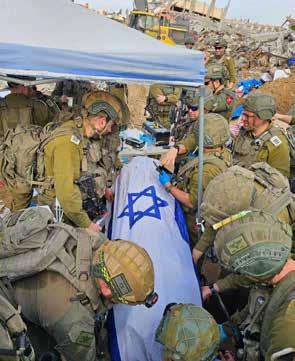
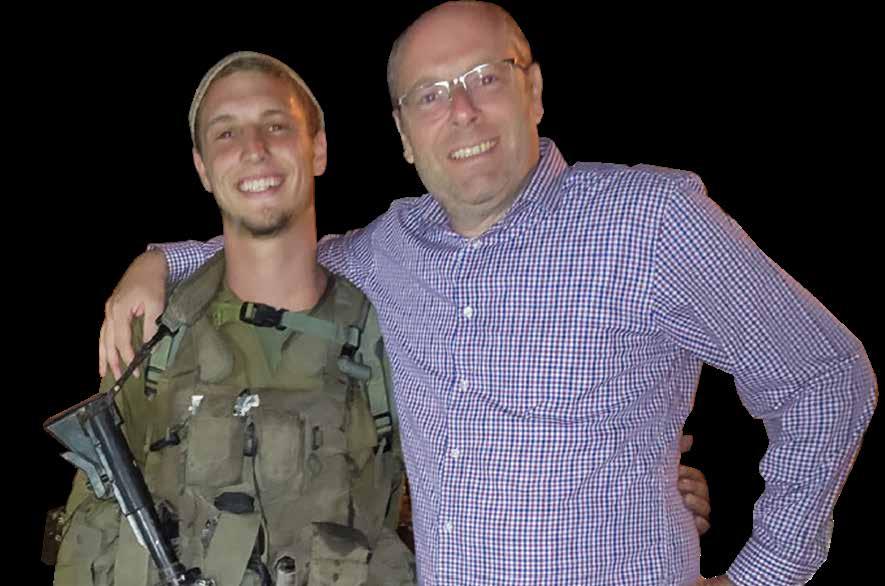
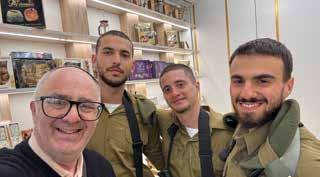
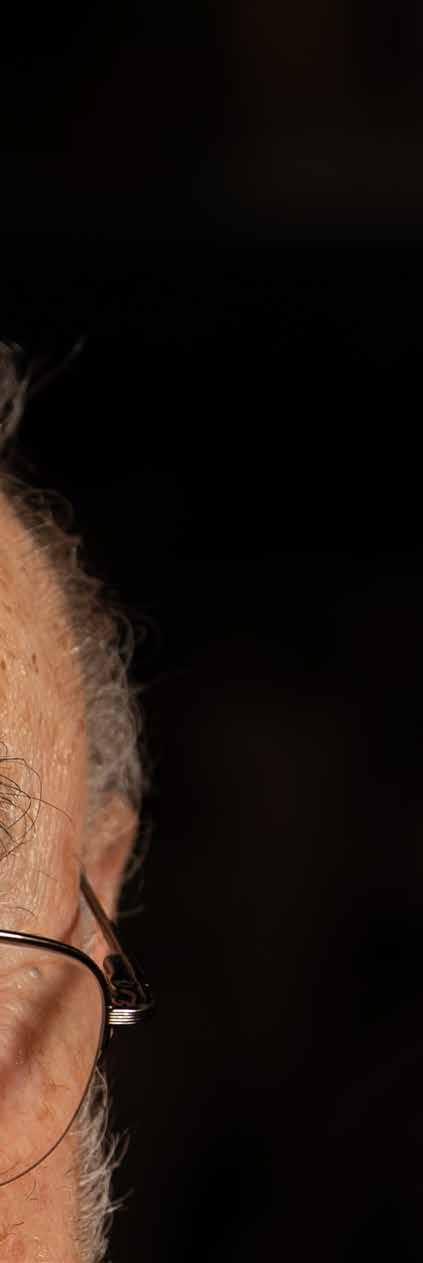
Emotional soldiers reunited with their comrade
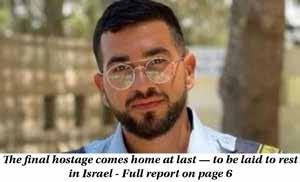
Ran Gvili has been returned
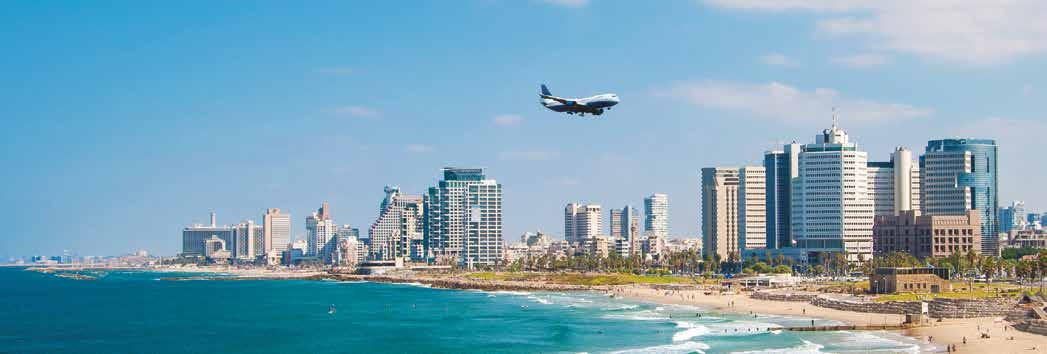
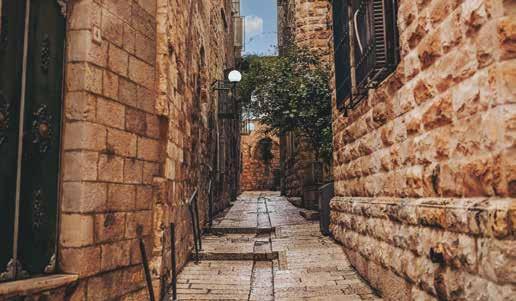
The future is bright in Israel
Raymond James Golders Green, together with The Jewish Agency, invites you to explore the Aliyah process, including incentives, tax savings and financial opportunities.
Tuesday 24th February 2026 | Zoom Webinar, 4pm GMT
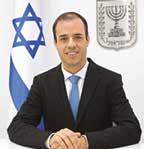
Including special guest speaker: Avichai Kahana Director General of the Ministry of Aliyah & Integration
Visit our website at GoldersGreen.RaymondJames.uk.com or scan the QR code to register. For more information, call 020 8202 1944 or email us at GoldersGreen@RaymondJames.com
With investing, your capital is at risk. Tax treatments are subject to individual circumstances and are subject to change.
Last hostage Gvili returns to Israel after 843 days
BY DAVID SAFFER
Thousands of mourners attended a memorial ceremony and funeral of police officer Staff Sergeant First Class Ran Gvili yesterday.
Gvili, 24, the last of 251 hostages abducted by Hamas terrorists to Gaza on October 7 2023, was held captive for 843 days. This is the first time since 2014 that no hostages are in Gaza.
President Isaac Herzog paid tribute to Gvili in a heartfelt eulogy at Meitar cemetery.
“This is the home Ran loved, the home he fought for together with his comrades, the home he went out to defend with supreme bravery and self-sacrifice on that bitter and fateful day,” he said.
Herzog asked for forgiveness that it took so long to bring Gvili home to his family.
He continued: “In the sanctity of this moment, the shattered fragments of our hearts can slowly begin to heal and repair, which we so desperately need as a people… We must rise to the next chapter of our journey as a people, strong and confident in our path, hand in hand, with far more boundless love and belief in our people and belief in our Jewish and democratic State of Israel, and guard it with utmost devotion, just as Rani did.”
“Thanks largely to you, all of Israel remembered that despite all the divisions, we are one big, strong people,”Talik Gvili
said in a eulogy about her son. “Everyone is worthy of your sacrifice.”
Itzik Gvili recited Kaddish for his son over the coffin, saluted and said: “Here, your friends are taking you.”
Herzog praised security forces who took part in Operation ‘Brave Heart’, which successfully retrieved Gvili’s remains from a Palestinian cemetery in Gaza City. Gvili’s abductors reburied his body a number of times.
Terrorists killed Gvili after he heroically rescued dozens of people fleeing the Nova music festival near Re’im. His body was abducted near Kibbutz Alumim.
Chief of Staff Lt. Gen. Eyal Zamir spoke with Gvili’s parents after positive identification.
“We kept our promise that no one is left behind,” he told them. “IDF soldiers, the fighters at the front and the entire nation are deeply moved by Ran’s return to a Jewish burial.”
Hundreds gathered at Hostages Square in Tel Aviv for a symbolic ceremony marking Gvili’s return.
After ‘Brave Heart’ was confirmed Prime Minister Benjamin Netanyahu, who attended the services along with other Israeli leaders, hailed the IDF, Shin Bet, Israel Police and Trump administration for securing the return of every hostage. He told Israeli media: “We promised, I promised, to bring everyone back. Ran, a hero of Israel was the first to enter and last to leave. This is a tremendous achievement for the IDF and State of Israel and for the citizens of Israel who gave us the support to complete the mission.”
Herzog hailed Gvili “our hero”, stating: “An entire nation is breathing an enormous sigh of relief tonight. All of our hearts are with Ran’s family, especially his parents, Talik and Itzik, who fought heroically and with remarkable courage to bring their son home,” he said. “An entire nation prayed and waited for this moment.”
Finance Minister Bezalel Smotrich praised the Gvili family, who demonstrated “extraordinary courage and strength”.
Opposition Leader Yair Lapid said: “I embrace his family, know how hard you fought for his return, and strengthen the security forces who did everything to bring him home.”
Yesh Atid chairman Gadi Eizenkot added: “My heart broke and healed at the same time with the news. This operation
is the essence of the story of the People of Israel, a people who do not forget, do not relent and do not give up on anyone, even in the toughest times and across the passage of years. This mutual responsibility is what makes us who we are.”
Herzog thanked President Donald Trump along with his advisors Steve Witkoff and Jared Kushner for their diplomatic efforts.
Trump posted: “AMAZING JOB! Most thought of it as an impossible thing to do. Congratulations to my great team of Champions!!!”
Kushner said recovering Gvili’s body closed one of the “darkest chapters of the Middle East conflict”.
The return of Gvili ends the first phase of Trump’s ceasefire peace plan, which came into effect last October.
Hamas was meant to return all hostages, 20 alive and 27 dead, within 72 hours of the deal.
Discussions have begun on the second phase which includes the partial reopening of the Rafah Crossing between Gaza and Egypt before demilitarisation of the Gaza Strip, disarmament of Hamas, a Palestinian transitional government, multinational force inside the Strip and Israeli withdrawal from the Yellow line.
The US and Egypt are expected to announce a Reconstruction Committee in the coming weeks.
Israel is opposed to reconstruction beginning before Hamas fully disarms.
Our dedication to trust , extensive experience , unwavering reliability , and vast professional contacts enable us to offer you a fulfilling and seamless Aliyah experience. We are passionate about helping you make Israel your home, and our mission is to support you every step of the way.
I'm Dov Newmark , and I'm here to help! Be in touch today to learn how I can help make your Aliyah easy !
TO SCHEDULE A FREE IN-PERSON MEETING WITH DOV OR A MEETING OVER ZOOM PLEASE BE IN TOUCH
INDEPENDENT ALIYAH CONSULTANT
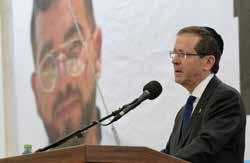
President Herzog eulogizing at the funeral
CFI announces new Parliamentary Chair
Conservative Friends of Israel (CFI) is delighted to announce the appointment of Greg Smith MP as its new Parliamentary Chair in the House of Commons.
Greg has served as the Conservative MP for Mid Buckinghamshire since his election in 2019 and brings a wealth of political and business experience to the role. He is Shadow Minister for Transport and Shadow Minister for the Department for Energy Security and Net Zero.
Previously a Parliamentary Vice-Chair of CFI, Greg has been a consistent and steadfast advocate of closer economic and security ties between the UK and Israel. In the wake of the atrocities of 7th October 2023, he provided a strong voice in the House of Commons in calling for the UK to stand shoulder-to-shoulder with its ally Israel.
Earlier this month Greg led a delegation of MPs to Israel and the West Bank to gain first-hand insights into the current security situation and the implementation of the Gaza peace plan.
Before entering Parliament, Greg built a career in design and marketing. He worked as a consultant in these fields, serving clients across sectors including manufacturing, medical technology and charities. He served as a Councillor on Hammersmith and Fulham London Borough Council from 2006 to 2018, where he held the position of Deputy Leader.
Greg Smith MP, CFI Parliamentary Chairman of the House of Commons: “It is an honour to take on this important
role alongside my constituency and frontbench duties. The UK-Israel partnership symbolises a shared commitment to democracy, security and tolerance in a world where these values are threatened like never before. I look forward to working closely with the excellent CFI team.”
Jeremy Brier KC, Chairman of CFI Board of Directors: “Greg has been a principled and intelligent voice in support of the UK-Israel partnership ever since he arrived in Parliament. His interventions over the Middle East have brought balance and moral clarity to a Commons chamber dominated by anti-Israel invective.”
Rt. Hon. The Lord Pickles, CFI Parliamentary Chairman of the House of Lords: “Greg’s energy and dedication to strengthening UK-Israel ties make him the ideal choice to lead CFI in the Commons. I look forward to working closely with him in this important work.”
Lord Polak CBE, CFI Honorary President: “I am thrilled to see Greg take on this vital role. His track record as a ViceChair and his unwavering support for Israel will ensure CFI continues to thrive as a voice for friendship and cooperation with Israel.”
CFI was founded more than 50 years ago to educate and inform Conservative politicians about Israel and the Middle East. It promotes closer ties between the UK and Israel, and builds friendships across the political spectrum in Israel.
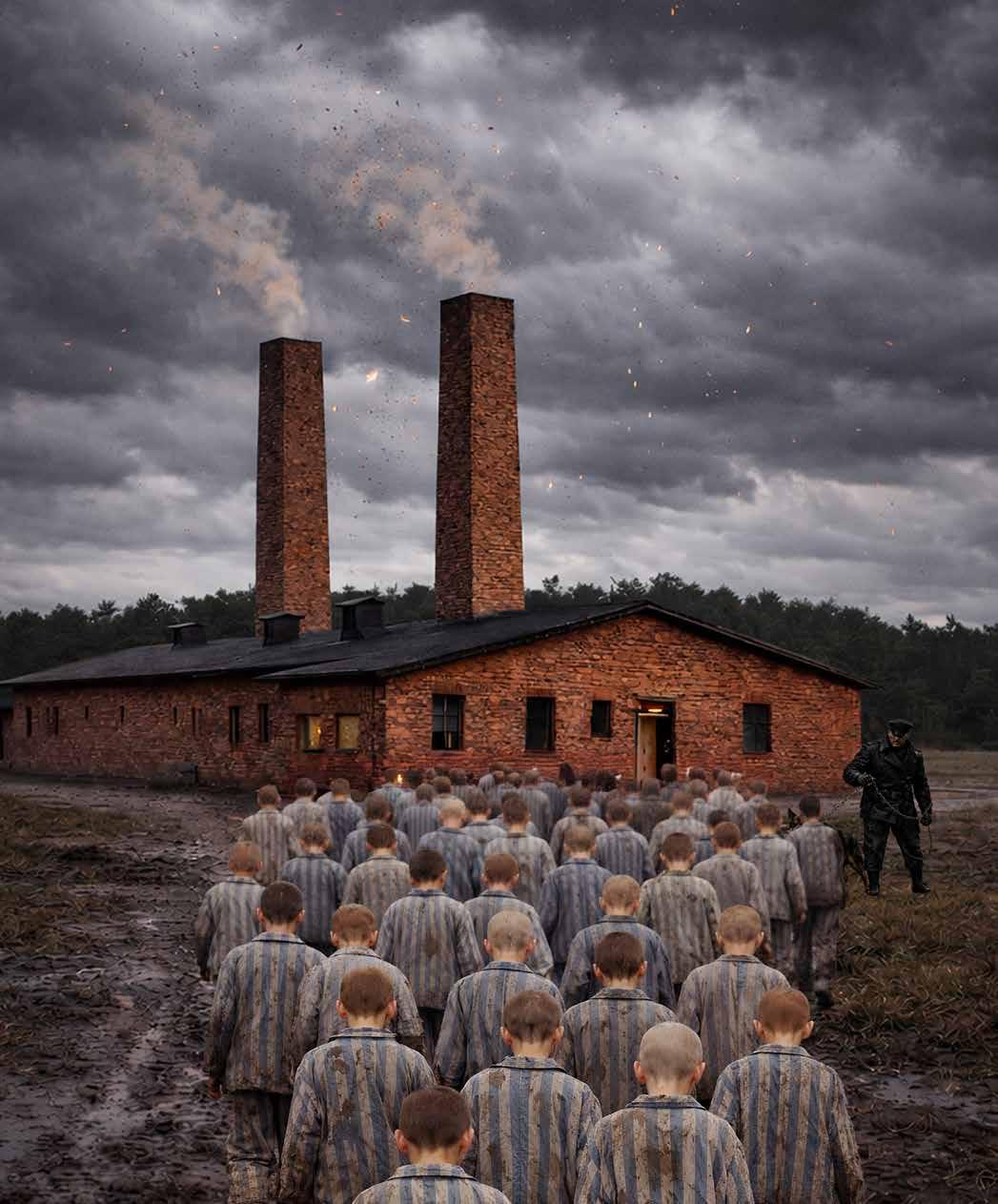
World gazed into “darkness of pure evil” at Auschwitz
BY DAVID SAFFER
Holocaust survivors and political leaders commemorated International Holocaust Remembrance Day at events around the world on Tuesday.
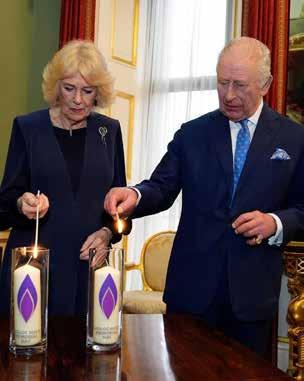
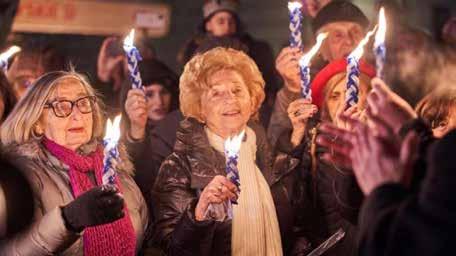
King Charles and Queen Camilla, on the 81st anniversary of the liberation of Auschwitz-Birkenau concentration camp, met survivors and lit remembrance candles at Buckingham Palace.
Polish President Karol Nawrocki joined survivors at the notorious death camp.
President Isaac Herzog addressed the second International Conference on Combating Antisemitism in Jerusalem.
Herzog told delegates, including Albanian Prime Minister Edi Rama, that the world “gazed into the darkness of pure evil” when the gates of Auschwitz opened.
loose on our societies once again. The rationale may be different, but it is the same ancient poison. To deny the Jewish people the right to self-determination in their national home is antisemitism.”
The European Jewish Congress held a commemoration event for 400 European leaders in Brussels.
“The Shoah was beyond comprehension,” EJC vice-president Raya Kalenova said. “Millions of lives were destroyed, families erased, dreams and futures stolen. And yet, Nuremberg gave those atrocities a name. It gave them a record. It gave humanity an answer, justice.”
In a hard hitting address, he observed: “The Holocaust was the single greatest catastrophe in the history of humanity and our people, and yet, it was upon those ashes of unthinkable destruction that a deep cry emerged. An outcry for repair, healing, and justice. An outcry for fraternity, cooperation and building.”
Herzog added: “Following the sacred vow of ‘Never Again’ we are witnessing the unravelling of the very moral architecture that the best of our human conscience has laboured so deeply to put into place.
“Hatred once again has become a legitimate form of political activism. Jews feel compelled to hide their identities on the streets of London and Paris, Jewish children must be escorted by armed guards to the school in the morning, Jewish worshippers must be protected on Saturday mornings from Toronto to Boston to Buenos Aires. We have watched the blood of Jewish worshippers being spilled in Manchester on Yom Kippur and have mourned the innocents massacred at a Chanukah celebration in Sydney. Jewish students at universities across the United States and Europe are isolated, alienated and harassed for being Jewish, for being Zionist, for being who they are.
“It is clear we are failing to meet our vow. The same old plague has been let
significant increase of Jew hatred right around the world… There is a desperate need for education, for reminders and for teaching people of the dangers of hatred.”
The Chief Rabbi noted the decreasing number of survivors.
“Year after year, there are fewer voices and we are deeply concerned about preserving those very important memories,” he observed. “The responsibility will now fall upon our shoulders to guarantee that the truth will be told well into the future.”
In Berlin, candles were lit at the memorial to the six million murdered Jews.
European Union foreign policy chief Kaja Kallas warned about new antisemitic threats including AI-generated content being used to “distort historical truth and undermine our collective memory”.
Kalenova noted the significance of the Nuremberg trials.
“It was at Nuremberg that terms such as genocide and crimes against humanity were first defined, not for politics, not for rhetoric, but for historical truth and justice,” he said. The event
included a screening of the film Nuremberg featuring Academy Award winners Russell Crowe and Rami Malek.
EJC noted: “The film highlights the Nuremberg trials’ enduring legacy for international justice. At a particularly challenging time for Jewish communities across the world, revisiting the lessons of Nuremberg remains both timely and essential.”
Ambassador Avi Nir-Feldklein, Head of the Mission of Israel to the European Union, said: “The reality Jews face today across the democratic, liberal world resembles more closely the days that led to the Nuremberg Laws than the world the Nuremberg Trials hoped to shape.”
In the UK, Mala Tribich, the first Holocaust survivor to address the cabinet, called on Prime Minister Meir Starmer’s government to do everything it can to tackle rising antisemitism.
The 95-year-old, who survived Ravensbrück and Bergen-Belsen, told ministers: “Soon, there will be no eyewitnesses left. I ask you today not just to listen, but to become my witness.”
Chief Rabbi Ephraim Mirvis expressed concern about surging antisemitism around the world.
“With the end of the Holocaust, hatred didn’t end,” he told LBC radio. “We are exceptionally concerned about a
Ukraine President Volodymyr Zelensky said that just as the world united to defeat the Nazis it “must act the same way now” in its war with Russia.
“The attempt, carried out by Nazi Germany, to erase the Jews from the face of Europe encapsulates, in an emblematic way, all the evil that human beings are capable of committing when they allow themselves to be infected out of superficiality, indifference, cowardice or
self-interest by the virus of hatred, racism and oppression,” Italian President Sergio Mattarella told survivors in Rome.
The Netherlands held a silent march through Amsterdam’s Jewish quarter to a memorial to Auschwitz victims.
“Bergen-Belsen, Sobibor, Auschwitz, they are unprecedented and still incomprehensible examples of what intolerance, hatred, and racism can lead to,” said Mayor Femke Halsema.
Czech President Petr Pavel said the remembrance day was a call to “reflect on the past”.
“Today there are people who trivialise the hateful Nazi ideology, or even sympathise with it,” he noted.
Around 196,000 Holocaust survivors are alive worldwide, according to the Conference on Jewish Material Claims Against Germany. Some 97% are ‘child survivors’ born 1928 and later.
Approximately 98,000 live in Israel, 31,000 in the United States, 17,300 in France, 14,300 in Russia and 10,700 in Germany. Ukraine, Canada, Hungary, Australia and Belarus have over 1,000 survivors.
Twelve months ago the Claims Conference estimated 220,000 survivors.
Adventures
in Wonderland
• Luxury resort with private beach
•
•
•
• Premium cocktail lounge & elegant dining
• Daily prayers & shiurim
• Exclusive tours to Crete's most spectacular sites
• Spa, fitness center, sports facilities
• Shainfeld managers with you throughout your entire vacation
Jami marks 10th Mental Health Shabbat
The community came out in force last Shabbat to mark the 10th Jami Mental Health Shabbat, centred on “bringing mental health to the table”. Taking place annually on Parashat Bo – when the plague of darkness is read – the Shabbat encourages open, stigma free conversations about mental illness and distress.
This year, synagogues, schools, university J Socs, families and individuals across the community took part, alongside people who use Jami and Jewish Care’s services.
SHARING MEALS, SHARING CONVERSATIONS
Food and gathering proved a powerful way to open dialogue. The Jewish Care Families Committee hosted a Sephardi cookery demonstration with food writer Jo Nissim to raise funds for Jami Mental Health Shabbat. And, at Jewish Care’s Michael Sobell Centre, members joined with Norwood residents for a joint Challah Make while learning about Jami’s services.
At Head Room, Jami’s social enterprise café, supported by The Maurice Wohl Charitable Foundation, over 40 community members, volunteers and staff attended the café’s first Friday night dinner. Guests of all faiths were welcomed, with volunteers guiding conversations around mental health awareness and community support. Gay, a regular participant at the
groups, said, “I felt very welcome. The food was generous and delicious, and I hope this event will be repeated.”
Head Room also welcomed 11 members of Jewish Care’s Michael Sobell Centre for a weekday lunch, where they learned about Jami’s services and the café’s Pay it Forward scheme. Centre coordinator Lauren Rose said, “Everyone really enjoyed the ambience at Head Room. They thought the Pay it Forward scheme was an amazing idea.”
At Jewish Care’s Holocaust Survivors Centre,
bringing gifts, saying, “Jami has been an important charity to my own family when we were in crisis. It’s a moment to reflect on our mental health and normalise these conversations.”
Zoe, whose dinner also marked her daughter’s birthday, used Jami’s Host a Meal toolkit to enhance the evening. She said, “Jami has been a vital support to my son over the last nine months.”
members enjoyed a heimishe pre-Shabbat lunch with music and song. And in Edinburgh, Scotland chaplain Eliran Shabo held a Friday night dinner for university students, making use of the Jami Mental Health Shabbat toolkit to give a D’var Torah and encourage discussion.
COMMUNITY LED INITIATIVES
Families and individuals embraced Jami’s Host a Meal initiative. Amy asked guests to donate to Jami instead of
Jami Ambassador Victoria hosted a dessert-themed Friday night in honour of her late brother, who would have been 50, to support Jami’s work.
And, on the Wednesday evening before Jami Mental
Health Shabbat, Head Room hosted a special music group. Sam, who attends regularly, said, “Coming to the group makes me feel joyful, relaxed and engaged. And Jami Mental Health Shabbat gives me a sense of belonging.”
SYNAGOGUES ENGAGE WITH MENTAL HEALTH
Many synagogues made use of Jami’s Mental Health Shabbat Toolkit, as well as
hosting activities and speakers. Hampstead Garden United Synagogue featured speakers including Jewish Care Chair Marcus Sperber, GP and author Dr Ellie Cannon, Beyond COO Julia Clarfield, and Chazan Avromi Freilich, who shared personal, clinical and lived-experience insights.
At Bushey United Synagogue, Dr Sabrina Cohen Hatton, Chief Fire Officer of Hampshire & Isle of Wight, shared her powerful story of resilience from teenage homelessness to leadership. Borehamwood & Elstree Synagogue at Croxdale hosted a Samaritan volunteer and the mother of Oli Leigh, founder of the suicide prevention charity in his name. And at Kinloss, congregants heard from Jewish Care’s Bola Owoade on anxiety and self-care.
Jami Ambassadors also contributed across the community. David Chernick spoke at Borehamwood & Elstree Synagogue at Yavneh, while Joey Kolirin addressed work burnout and anxiety at a Young Jami Jewish Care Committee Challah Make. Joey said, “Jami’s one-toone therapy was lifesaving. Head Room café allowed me to feel normal again.”
If you need support or are supporting someone who needs help, visit jamiuk.org/ get-support/ or contact 020 8458 2223.
Bibi warns Iran of “unprecedented” military response
BY DAVID SAFFER
Prime Minister Benjamin Netanyahu has warned Iran that any attack on the State of Israel will be met with a military response of “unprecedented” force.
Netanyahu’s stark message comes as the IDF remains on maximum alert over a possible US strike on the Iranian regime and a multi-front conflict.
US President Donald Trump has spoken of Iran reaching out for a “deal” after stating earlier this month he would strike the regime “very hard” over the killing of protesters against the regime.
Iran has threatened US military targets and Israel if the US strike.
Ben Gurion Airport is open as normal, but with a possible escalation in the region, El Al, Arkia and Israir have announced cancellation options on flights to Israel while a number of major carriers have rerouted flightpaths from Iranian airspace.
Following the return of the last hostage from Gaza, Ran Gvili, for burial. Netanyahu has begun to speak about the second phase of US President Donald Trump’s peace deal. Domestically, this will be extremely challenging with opposition politicians.
security role in Gaza.
He also rejected the establishment of a Palestinian state in Gaza.
“That did not happen,” he said. “I think all of you know that the one who repeatedly stopped the establishment of a Palestinian state is me.”
“Israel will maintain security control over the entire area from the Jordan River to the sea, and that applies to the Gaza Strip as well,” he added.
As for the regional threat of Iran, Netanyahu had a clear warning to the regime and its proxies.
“The Iranian axis is trying to recover, but we will not allow it to do so,” he said. “If Iran makes the grave mistake of attacking Israel, we will respond with a force Iran has never seen before.”
Northern Command chief Maj. Gen. Rafi Milo, head of the IDF’s Northern Command, told Israel’s Channel 12 that the military is on heightened alert.
“We are prepared and ready, if the US decides to strike Iran, we under-
stand it could affect Israel, with part of the Iranian response possibly reaching here,” he said.
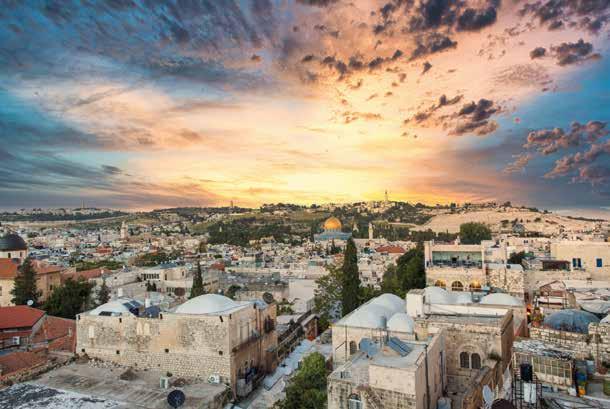
Pesach in
ISRAEL 2026
APRIL 1 - 10, 2026
“I believed that through the combination of military pressure and diplomatic pressure we could, and would, bring all of our hostages home,” he said. “What is more important in war than anything else is to ignore the background noise, to stand cool-headed in the face of pressures from within and from without. To understand what needs to be done and to pursue it with all one’s might, to achieve the objective.”
Speaking alongside Strategic Affairs Minister Ron Dermer and hostage coordinator Gal Hirsch, Netanyahu said he was now focused on the remaining targeted missions of dismantling Hamas’ weapons alongside demilitarising Gaza of arms and tunnels.
“As I agreed with President Trump, there are only two possibilities, either this will be done the easy way or it will be done the hard way, but in any case, it will happen,” he said. “I am already hearing the statements that we will allow Gaza’s reconstruction before demilitarisation. That will not happen.”
Netanyahu refuted suggestions that Turkish and Qatari forces may have a
Israel media continues to speculate about an Iranian strike and its capabilities.
According to reports US CENTCOM Commander Admiral Cooper met with Chief of Staff Zamir last weekend to discuss Israel’s defence in the event of an US attack on Iran resulting in Iranian missile fire.
Also, broadcaster KAN said Israel has been on “maximum alert” for over a week.
“Tehran could respond to any American attack by attempting to target Israel,” Milo told Channel 12. “US forces are deployed in the Gulf region, without a complete clarity on the next steps,” he added.
US media reportedly confirmed aircraft carrier USS Abraham Lincoln and three destroyers were en route to the Gulf of Oman in anticipation of a US attack on Iran.
Trump has stated an American “armada” was heading towards the Middle East and Washington was monitoring the situation in Iran.
There will be no let up in the speculation over the coming days.
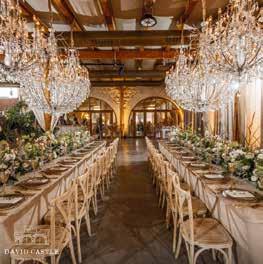
Experience a unique and uplifting Pesach in Jerusalem, with a spiritual atmosphere at the DAVID CASTLE HALL.
Catering by GAYA TOURS & ZONTRAVEL chefs, with over 10 years of experience organizing Pesach programs worldwide, ensuring excellence and meticulous attention to detail.
The program is Glatt Kosher L’Mehadrin, supervised by renowned Kashrus expert Rabbi Zalman Krems, Kashrus Administrator of Kosher Alef.
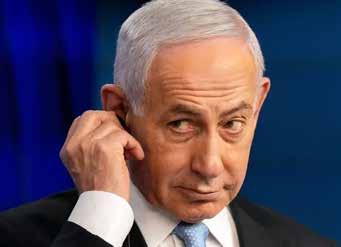
Israeli Prime Minister Netanyahu warned Iran
Bringing Jewish Campus Life to Life: The Inside Story
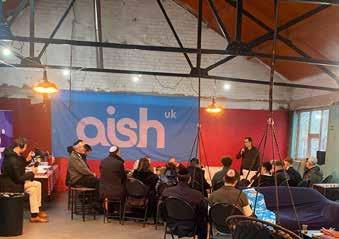
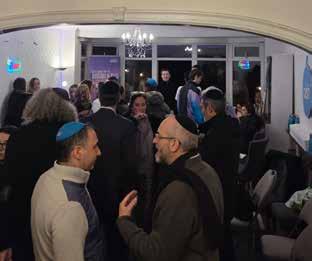
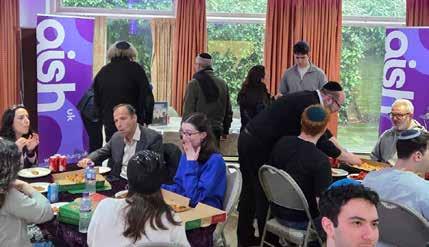
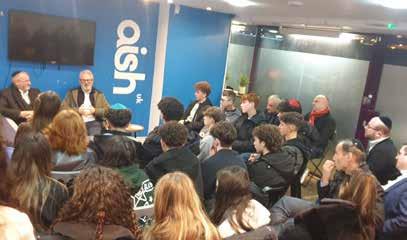
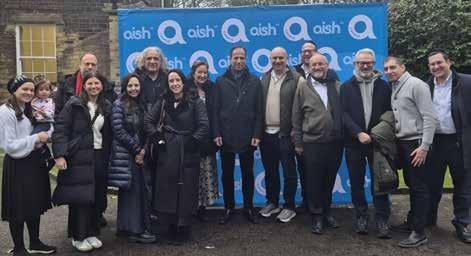
Jewish Futures and Aish UK have successfully delivered their inaugural Inside Story Roadshow - an immersive, multi-city journey designed to give trustees and special guests authentic insight into Jewish student life across the UK.
Travelling from London through Nottingham, Manchester, Leeds and Birmingham, the roadshow offered something rare: the chance to experience campus programming first-hand and meet students where Jewish life is truly lived.
Rather than relying on presentations or reports, participants experienced it directly - visiting campuses, spending time in Aish spaces, hearing from campus couples, and connecting with students to gain genuine understanding of what university life looks and feels like for Jewish students today.
wider community.
The following day brought one of the tour’s most profound moments. At Heaton Park, Rabbi Walker delivered a deeply moving talk about the recent attack there, offering guests greater understanding of both the incident and its emotional impact on the local Jewish community. It underscored the importance of Jewish resilience during moments of challenge.
FROM BREAKFAST TO BARBECUE
The journey began with energy and purpose: a Young Professional speed networking event over breakfast at Jewish Futures’ The Hub in London set the tone
Leeds showcased student creativity through a dynamic Dragon’s Den style activity, where participants pitched ideas with confidence and flair, while Birmingham provided the perfect
finale: a joyful barbecue with over 100 students celebrating community, connection and the future.
QUALITY AND AUTHENTICITY
Across every location, participants praised the professionalism, warmth and sensitivity of Aish UK’s campus couples and educators, witnessing first-hand how Aish houses provide genuine safe spaces - a true “home from home” for students navigating university life.
for authentic engagement throughout.
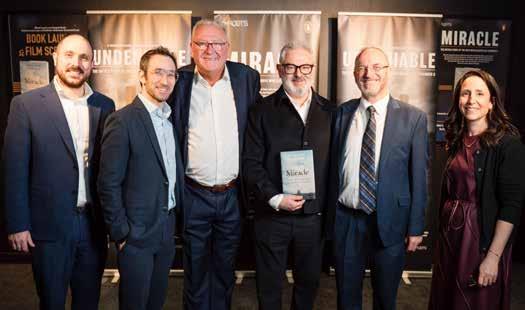
In Nottingham, an insightful Q&A saw students share honest perspectives on campus life, while Manchester delivered multiple highlights. At the Aish Hub, students and guests heard an inspiring career talk by Neil Blair of The Blair Partnership, literary agent to J.K. Rowling and many celebrated authors. That evening, over 100 attendees gathered at King David High School for the Penguin book launch of Miracle and its accompanying JRoots documentary, Undeniable - a powerful celebration hosted with the
on most of our campuses this is outright invaluable.”
VALUES IN ACTION
Guests didn’t just observe - they participated. Through GIFT’s supermarket challenge, teams worked with just £14 to purchase as much food as possible, all donated to beneficiaries afterwards. The exercise demonstrated how Jewish values translate into practical action with immediate impact.
strong connection to Jewish life and Israel, seeing their identity as an important connector rather than a burden.
Witnessing students confidently living full, engaged university lives was de-
Between cities, Rabbi Daniel Rowe delivered inspiring talks that framed the roadshow within a much larger context - helping guests see beyond today’s campus reality to understand their place in a Jewish story that continues to evolve while remaining deeply rooted.
Sylvia Abraham, roadshow special guest said of the experience, “I’m still buzzing from all we saw and heard on this extremely well and tightly organised Aish roadshow visiting several campuses to see their work with the students first hand. We met the young couples who give up their comfy lives in their communities to go and live where they are needed to create a community and homely hub for the students to socialise as well as learn. Especially now with the hostile mood
The journey revealed how Jewish Futures organisations complement one another: Aish’s relationship-based education and campus support, GIFT’s kindness-led social action, FJL’s leadership development, and JRoots’ immersive experiences and preservation of Holocaust survivor testimonies. Together, they form a powerful ecosystem supporting Jewish life.
scribed as both reassuring and deeply inspirational.
BEYOND THE HEADLINES
Perhaps most significantly, the roadshow challenged misconceptions. While antisemitism remains a serious concern,
guests discovered it doesn’t define students’ everyday experiences in the way often assumed. Many students expressed
Edward Misrahi, Chair of Trustees for Jewish Futures said of his experience: “It’s been a really wonderful trip. I’m already an enormous supporter and champion of Jewish Futures and the family of organisations, but seeing the impact the hard-working teams are having first-hand on the ground has been really eye-opening and positively uplifting.”
THE POWER OF PRESENCE
Above all, the Inside Story Roadshow delivered deep understanding - not through words on a page, but through lived experience, authentic connection, and the power of showing up where it matters most. For trustees and guests alike, it was an invaluable glimpse into the vital role Jewish Futures organisations play in supporting the next generation.
Aish Birmingham Event
Aish Leeds Event
Aish Manchester Event
Aish Nottingham Event
Inside Story Roadshow Special Guests and Team
Israel Faces Growing Mental Health Crisis as Demand Rises for PTSD Service Dogs
Israel is facing a mental health crisis on an unprecedented scale, as the psychological impact of prolonged conflict reaches deep into everyday life. After more than two years of sustained violence and insecurity, trauma now affects nearly every community. Almost one in three Israelis report needing professional mental health support, according to recent estimates, highlighting a challenge that shows no sign of easing.
Soldiers and veterans are among those most severely affected. Rates of post-traumatic stress disorder have already increased by around 40 percent, with mental health professionals warning that many more cases may surface in the years ahead. Since the attacks of 7 October 2023, nearly 39 percent of military personnel have sought mental health support, according to figures reported by The Jerusalem Post.
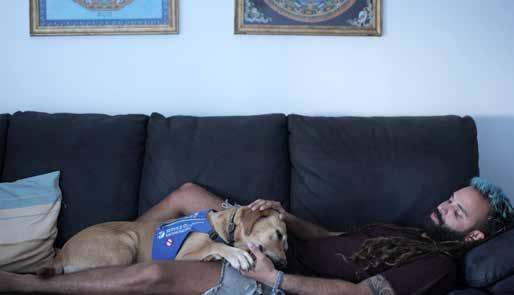
Behind these numbers are individuals struggling to function. Civilians live under constant threat from sirens and sudden violence, while soldiers returning from combat often face anxiety, disrupted sleep and difficulty carrying out everyday tasks. Families are left searching for ways to support loved ones dealing with trauma that is not always visible. Alongside traditional therapy and clinical care, PTSD service dogs are emerging as a vital form of support. Specially trained dogs help stabilise anxiety, interrupt panic attacks, improve sleep and support daily independence. Their constant, non-judgemental presence can provide a sense of safety for people whose nervous systems remain on high alert long after danger has passed.
The impact of these dogs is perhaps best illustrated through individual experience. One client of the Israel Guide Dog Centre, a combat soldier, took a leave of absence from work after the hostages
returned. He felt unable to function, unable to think clearly or complete even simple tasks. His PTSD service dog became the turning point. With the dog by his side, he began attending rehabilitation programmes and joined a support group for soldiers, steps he had not previously felt safe enough, physically or emotionally, to take.
During the war with Iran, he experienced a further setback. Each time an alarm sounded, the dog responded instinctively, placing a paw or its chin on him. The gesture helped ground him in the moment. He later described it as feeling as though the dog were telling him, “I’m here, you’re safe.” That quiet, steady presence allowed him to endure every alarm without losing control.
The Israel Guide Dog Centre is now significantly expanding its PTSD service dog programme in response to rising demand. Known internationally for training guide dogs for people with visual impairments, the Centre also trains and places PTSD service dogs with both military personnel and civilians affected by trauma. Each dog undergoes extensive training and is carefully matched with an individual to meet their specific needs.
As Israel confronts the long-term mental health consequences of conflict, the need to scale solutions that demonstrably work has never been more urgent. Supporting PTSD service dogs is not simply an act of compassion. It is an investment in recovery, resilience and hope for those carrying the lasting psychological cost of war.
To find out more about the Israel Guide Dog Centre and how you can support their work please visit www.israelguidedog.org.uk or email info@israelguidedog. org.uk
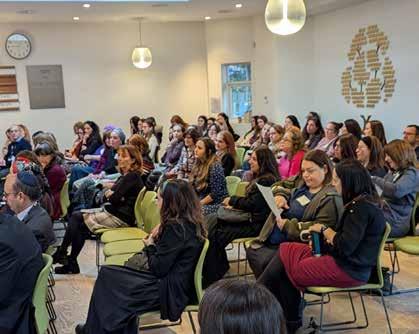
By mid-morning at the 15th Annual Primary Jewish Studies Teacher Conference, it was already clear this wasn’t a typical conference. Teachers were talking animatedly comparing notes, sharing frustrations, asking each other how they manage things in their classrooms. Accents bounced around the room. Someone from Istanbul sat next to someone from Glasgow. Warsaw next to London. Last week, The London School of Jewish Studies welcomed 150 Jewish Studies teachers from across the UK, Europe and Israel to London for our annual Primary School Education Conference. They travelled from Birmingham and Manchester, Sweden and Switzerland, Poland, Hungary, France, Germany, Gibraltar, Turkey and Israel. All different contexts but a shared sense that Jewish education matters, and that teaching it well requires a communal effort.
What many people commented on wasn’t just the learning, but the relief of being in a room with others who get it. “The connection we got from meeting all the other teachers was invaluable,” said Rabbi Yitzchak Peres, a Jewish Studies teacher from Istanbul. “It helped us understand where we’re standing in our schools, and how learning from others can help us improve what we do.” That feeling of locating yourself within a bigger picture came up again and again.
This year’s theme, Higher and Higher, was about confidence, stamina and purpose. About how teachers keep raising standards, staying thoughtful and holding onto purpose. The sessions were designed to meet teachers where they are. Insights from Inspections looked at what school inspectors are actually looking for and how strong Jewish learning can be made visible. Kodesh Lessons with Oomph and Reflective Questions in the Tanakh Classroom asked how we move lessons from “fine” to genuinely engaging, helping students think more deeply and care more about what they’re learning.
Alongside this, there was a strong focus on the human side of teaching. Sessions on Managing Neurodiverse Behaviour and Learning Spaces That Work offered practical ways to create calmer, more inclusive classrooms, while From Resistance to Relationship spoke honestly about what happens when learning breaks down, and how rebuilding trust can be as important as any lesson plan. Taken together, the learning was about helping teachers return to their schools with clearer tools, renewed confidence and the reassurance that the challenges they face are shared. There was a noticeable honesty in the room. People spoke about what isn’t working, as well as what is. About fatigue,
about complexity, about trying to do justice to Jewish learning in a world that feels increasingly noisy and demanding and full of antipathy. But the tone never tipped into despair. Teachers shared ideas, borrowed from one another, and tested what might be possible in different settings. The learning felt practical, but also deeply human.
This balance between seriousness and support is something LSJS tries hard to hold. Jewish education isn’t sustained by resources alone, but by people who feel connected to one another and confident in their role.
As Yolande Pieters, Head of Undergraduate Degrees and Continuing Professional Development at LSJS, put it: learning with and from each other gives educators renewed
strength “to do the thing we love doing that needs doing — teaching the next generation.”
Jewish education doesn’t thrive in isolation. It grows when teachers feel supported, challenged and part of something bigger. For the day in London, Higher and Higher felt like exactly that. For more information about conferences, teacher training and professional development at LSJS, please visit www. lsjs.ac.uk or email lsjsadmin@lsjs.ac.uk.
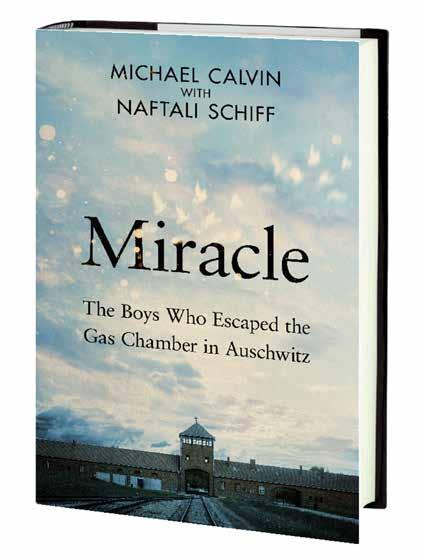
Miracle Book Launch Brings Remarkable Holocaust Survival Story to Light
The story is so extraordinary it defies belief: fifty-one Hungarian Jewish boys walked out of an Auschwitz gas chamber alive. Now, thanks to Penguin’s new book Miracle and its accompanying documentary Undeniable, produced by Holocaust Education charity, JRoots, this unprecedented tale of survival is reaching audiences across the UK - and challenging Holocaust denial at a time when it matters most.
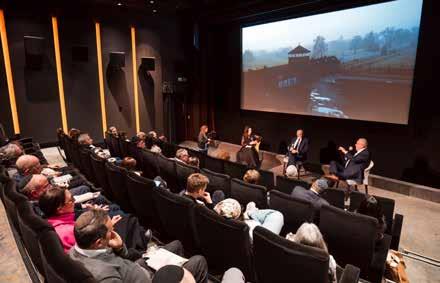
The launch event at Warner Bros.’ preview theatre in London last week brought together a VIP audience including press to witness the remarkable story of Chaim Schwimmer, Wolf Greenwald, Hershel Herskovic, David ‘Dugo’ Leitner, Yosef Zalman Kleinman, Mordechai Eldar, and forty-five other boys who experienced the unthinkable.
On 10 October 1944, eight hundred Jewish boys aged thirteen to seventeen were marched from their barracks to
escaping alongside them. They remain the only known group ever to have walked out of an Auschwitz gas chamber alive.
The event, facilitated by journalist Nicole Lampert, featured insightful panel discussions and Q&As with JRoots co-Founder and Executive Producer of the film, Rabbi Naftali Schiff and award-winning journalist Michael Calvin, who co-authored the book. Rabbi Schiff’s twenty-year search for these boys, combined first-hand testimony with rigorous forensic evidence to tell a story that has since been featured in the Telegraph, Daily Mail, and Jewish press.
Crematorium V. Their identity cards bore a chilling stamp: gestorben—”died.”
Stripped naked and herded into the gas chamber, they faced certain death. Then something unprecedented happened. Senior SS officers arrived and pulled fifty boys back from the brink – with an extra
“This is more than a survival story,” Schiff explained during the discus-
sions that have followed screenings in multiple UK cities. “These boys send a message to the world about resilience, dignity, and the power of truth - even though the majority are no longer alive to tell it themselves.”
For Calvin, a celebrated sportswriter
and award winning journalist turned chronicler of Holocaust testimony, the project represents intensely personal work. As a non-Jew documenting Jewish experience, he brings a unique perspective to searching for meaning in unfathomable circumstances. His previous Holocaust memoir of Josef Lewkowicz, The Survivor, prepared him for the emotional weight of this genre, yet Miracle has touched something deeper.
The story has captured public imagination precisely because it seems impossible. How did these boys survive when others perished? What qualities did they embody? Why were they saved? These questions echo through every screening, challenging audiences to grapple with the inexplicable while confronting a troubling reality: Holocaust denial and distortion are no longer fringe phenomena.
In an era when misinformation is amplified online and increasingly absorbed by younger audiences, this meticulously
documented story serves a vital purpose. It humanises the Holocaust without sensationalising it, restores individual names and voices, and brings together testimony with forensic proof in ways that make denial untenable.
Following each screening, panel discussions with Schiff and Calvin have drawn out these themes, helping audiences understand they are now part of a vital chain -one that begins with choosing to listen, record, verify, and preserve.
The closing thought resonates long after audiences leave: this story survived because people bore witness. What we do with that truth next remains the question that matters most. In bringing Miracle to publication now, Schiff and Calvin have ensured these fifty-one voices - and the seven hundred and forty-nine who didn’t walk out—will not be forgotten.
VIP Screening of Undeniable at Warner Bros. Cinema, London
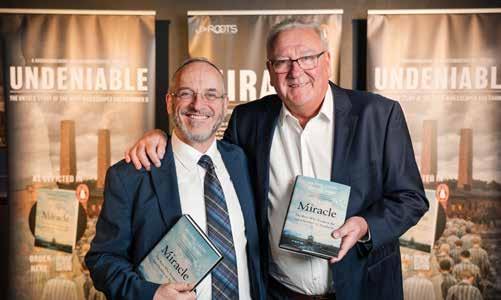
Miracle book co-authors, Rabbi Naftali Schiff and Michael Calvin
From L to R – Ari Kayser - Associate Producer, Jonathan Kalmus – Director, Michael Calvin, Neil Blair, Debra SobelProducer
Why Britain Must Finally Draw the Line on Ideological Extremism
BY STEVE WINSTON
For too long, Britain has struggled to say a simple word when it comes to certain forms of extremism: no. As long as violence happens overseas, or ideology dresses itself up as activism, community representation, or “legitimate grievance,” we convince ourselves that firm action can wait. That instinct, however well meaning, is now catching up with us.
Whether it is a hostile foreign power operating through intimidation and covert activity, or an Islamist movement quietly embedding itself into civil society, the pattern is the same. Britain’s openness is being exploited by ideological actors who do not share its democratic values and have no intention of playing by its rules. The cost of that hesitation is no longer theoretical. It is visible in our politics, our institutions, and our streets.
The Muslim Brotherhood sits squarely within this wider problem. Too Islamist to be entirely comfortable, yet often defended as non-violent and therefore tolerable, it has benefited for years from Britain’s reluctance to draw clear lines. That reluctance has come at a cost, not just for Britain’s Jewish community, but for the health of our democracy.
The government’s own 2015 review of the Muslim Brotherhood should have settled the issue long ago. It described the movement as secretive, hierarchical, and ideologically driven, operating through respectable front-facing bodies while concealing real loyalties. It also confirmed that senior Brotherhood figures have repeatedly used antisemitic language and defended violence carried out by Hamas, the Brotherhood’s Palestinian branch.
The threat posed by the Brotherhood is not that it will storm Parliament or plant bombs. Its strength lies in playing the long game: gradualism, entryism, and quietly shaping the environment around it. It seeks influence through charities,
campaign groups, student politics, trade unions, and community representation. Over time, this chips away at the idea that liberal democracy and pluralism are fixed principles rather than optional extras.
We are now seeing the consequences more clearly, including inside Parliament itself. Sectarian politics, once marginal in British public life, is edging closer to the mainstream. A small but noticeable group of independent MPs were elected largely on the back of a single overseas conflict, Gaza, campaigning less on domestic priorities and more on imported grievance politics. Parliament should represent citizens as citizens, not become a proxy battleground for foreign conflicts.
The same pattern shows up elsewhere.
The West Midlands Police decision to ban Israeli, Jewish and non-Jewish Maccabi Tel Aviv supporters from attending a football match was defended on public order grounds. Yet the political pressure surrounding it came overwhelmingly from activist voices whose politics revolve almost entirely around opposition to Israel. When that kind of pressure begins to shape policing decisions, it should concern everyone.
Education has not been immune either. The National Education Union’s relentless focus on the Israeli Palestinian conflict, often to the exclusion of other global crises, has turned too many classrooms and staff rooms into ideological battlegrounds. Repeated anti-Israel motions and campaigns have left Jewish teachers and pupils feeling isolated and targeted.
Whatever one’s views on Middle East policy, a trade union should not act as a vehicle for one-sided political mobilisation that fuels division at home.
This is exactly the sort of environment in which ideological extremism thrives.
Hatred of Israel becomes a unifying and disguising force, allowing antisemitism to be repackaged as politics and violence to be excused as “resistance.”
There is a clear parallel here with Iran’s Islamic Revolutionary Guard Corps. One is Sunni, the other Shia, but a recent Westminster policy briefing by We
Believe In Israel and the National Jewish Assembly argues that they belong to the same ideological ecosystem. Both reject liberal democracy, pursue transnational agendas, and rely on intimidation, propaganda, and institutional capture. One does so through overt state-backed violence, the other through slow, steady infiltration.
That is why the call by the National Jewish Assembly and We Believe In Israel to proscribe both the Muslim Brotherhood
and the IRGC is not about symbolism or community politics. It is about democratic self-preservation. A confident democracy does not wait until institutions are eroded, policing is politicised, and Parliament becomes a platform for sectarian grievance before acting. It draws lines early, clearly, and without apology.
Steve Winston, Managing Director of the National Jewish Assembly (NJA), a partner of We Believe In Israel (WBII)
We’re Together, property finance experts with common sense.
Whether you’re buying commercial or residential property or investing in your business, our wide range of mortgages and secured loans can support your ambitions at pace.
Heter Iska funding available.
Why Together?
• Speed and flexibility – fast lending available on a variety of property types from industrial to flats, with flexible criteria.
• Relationship lending – our experienced property funding experts can make quick decisions, with a strong appetite to lend.
• Lending since 1974 – trust our 50-year heritage backed by our funding capability.
Gaza’s Board of Peace and the End of Illusions
BY HEATH SLOANE
Gaza’s problem has never been a lack of plans, funding, or international attention. It has been the absence of enforceable authority. For decades, the United Kingdom and the European union have remained deeply involved in Gaza’s management while stopping short of assuming responsibility for outcomes. The result has been a system rich in process but poor in power, where instability was administered rather than resolved.
The Gaza Board of Peace (GBP) represents a serious attempt to confront that failure. Its premise challenges the model under which Europe has largely operated: that coordination, mediation and funding can substitute for enforceable governance. The Board’s logic is different. Gaza’s predicament, it argues, is not primarily humanitarian or rhetorical, but structural. Without authority, reconstruction is illusory.
Yet the initiative’s success depends on resolving a contradiction it has not yet answered. The Board requires Hamas to demilitarise as a precondition for reconstruction, but remains unclear about who is willing and able to enforce that requirement. Without clarity on enforcement, the GPB risks reproducing the very failures it seeks to overcome.
The launch of the Board at Davos on 22 January marks a departure from past approaches. Whether one endorses its design or not, it reflects a growing recognition that diffuse management has failed. Concentrating responsibility is a necessary corrective. But responsibility without coercive capacity is not authority. It is aspiration.
OPINION
For years, Gaza existed in a responsibility gap. International organisations delivered aid without enforcement, with the entirely foreseeable result that assistance was captured or exploited by Hamas and other Palestinian terrorist factions. States condemned developments from a distance, while treating enforcement as someone else’s problem, primarily Israel’s. In such conditions, power does not dissipate. It is seized by those willing to organise, arm themselves and rule by coercion.
The Board of Peace seeks to reverse that logic by concentrating accountability. Its reported US $1 billion buy-in for permanent seats on the Board, likely intended as a contribution towards rebuilding Gaza, represents a test of seriousness Contributors are meant to be stakeholders, not observers. Yet accountability matters only if it extends beyond funding and into enforcement.
be rebuilt without order, and order cannot be sustained without authority. But authority in Gaza is inseparable from Hamas’s coercive power.
On paper, the prerequisite of Hamas demilitarisation is clear. In practice, it is deeply contested. Several actors reportedly associated with the Board, most notably Qatar and Turkey, have long-standing political, financial and logistical ties to Hamas. Their inclusion exposes a contradiction at the heart of the initiative.
If demilitarisation is essential to reconstruction, yet key stakeholders lack either the will or credibility to enforce it, the question of who does so remains unanswered.
reconstruction, who intervenes? The Board’s architecture does not yet specify whether enforcement responsibility falls to regional actors, external guarantors, Israel, or some new security mechanism altogether. Absent an answer, authority risks remaining rhetorical rather than real.
For the United Kingdom and the European Union, this presents both an opportunity and a constraint. Europe has invested heavily in Gaza for decades, with limited returns. Engagement with the Board offers a chance to shape governance standards, legal frameworks and reconstruction oversight. But European influence will matter only if the Board resolves its enforcement dilemma. Norms and institutions cannot substitute for coercive capacity where armed actors retain veto power.
If Europe remains outside the room, decisions will still be made. Contracts will still be awarded. Security arrangements will still take shape. The question is whether European influence is exercised from within the process, or forfeited by default.
This is where the Board’s central vulnerability emerges.
The GPB’s composition reflects a changing geopolitical landscape. Gulf capital, regional security actors and Western strategic interests are converging around a blunt proposition: Gaza cannot
A changing world
BY ROBERT FESTENSTEIN
I was driving to the station in Manchester today and the podcast I was listening to came to an end. It was about 7.40am and it occurred to me that in the past I would have been listening to The Today Programme on BBC Radio 4. Not today though, and probably unlikely in the future. Such has been the BBC’s massive bias against Israel and their lacklustre approach to Jew-hate on the streets of London and other cities, this once revered institution has for me no credibility at all.
I could go on about the BBC, but that is not really the point of today’s piece. It is just another aspect of my life which has changed as a result of October 7. When things happen gradually it is natural that the changes are not noticed particularly
until you step back and realise that so much has in fact changed. This is not a new topic though for me, not wanting to listen to the Today Programme made me think of how my behaviour has changed. Its not a short list. I don’t watch the news on TV anymore. When I go to Shul I look around me as I get closer just to be on the safe side. I have a hoody with the words ‘We will Dance Again’ on the back. I wore this when I went out to a restaurant and when is saw people at a nearby table with brown faces I took it off and turned it
Economic incentives alone will not resolve it. Jared Kushner’s emphasis on free-market principles reflects a correct diagnosis of Gaza’s economic stagnation: without investment, trade and predictable rules, recovery is impossible. But markets cannot disarm militias. Prosperity does not neutralise coercive power. Without enforcement, reconstruction risks entrenching armed actors rather than displacing them.
If Hamas refuses to disarm, selectively complies, or resumes intimidation, expropriation or violence during
The Board of Peace is not simply about Gaza. It is a test case for a broader shift in conflict management - one that prioritises implementation over declarations. Its durability will depend not on rhetoric, but on whether power and responsibility are finally aligned. For liberal diplomacy, this is not an obituary. It is a stress test of whether it can function in a world where results, not intentions, are decisive.
Heath Sloane is the Director of Geopolitical Intelligence at B&K Agency, a public affairs firm based in Brussels.
inside out. I have no idea who they were and what religion or political stance they had, I just didn’t want to run the risk of a confrontation.
I have noticed also that there is a less reluctance amongst my acquaintances to comment about Israel, as if I am obliged to admit there is some aspect of the conduct of the IDF that I should find at fault. I can avoid that but what I cannot avoid is
the newish neighbours who have moved into our street wearing a kaffir. Various of those in the street have confronted them about this but all they get back is the
usual rubbish about genocide. I have not had the occasion to tackle them about this, but I do wonder why if they hate Israel and clearly have contempt for Jews they moved into a Jewish neighbourhood. I could go on about that, but probably better for my blood pressure not to. And then there are those things which have happened which have gone to restore my belief in the goodness of people. The strong support of another of our – non-Jewish – neighbours in their declared disgust directed at the kaffir wearer which really raised our spirits. They are not alone, there are many commentators who see the dangers facing our society in general and our community in particular. Bad though the current situation is for us just now, there are those around us who wish to see it improve. To them I say thank you, and here’s to me wearing my hoody in the restaurant again.
Letters to the Editor
Please note: The views of the letters do not necessarily reflect the views of this newspaper. Letters may be edited and publication is at the discretion of the editor.
THE MESS IN BIRMINGHAM
Dear Editor,
The Maccabi Tel Aviv / Aston Villa saga continues to roll on. It is quite clear and irrefutable that the intelligence relied upon by West Midlands Police Chief Constable Craig Guildford was false, and he has quite properly since stepped down, albeit on a full pension. He also has the nerve to contemplate suing for constructive dismissal!
The West Midlands Police and Crime Commissioner, Simon Foster — a known
Corbyn supporter — had the power to dismiss the Chief Constable but failed to do so, prevaricating and procrastinating when it was clear that this was the only possible route. He should likewise be falling on his sword and resigning.
This is one big, sorry mess and an insult to the Birmingham and UK Jewish communities, as well as to Maccabi Tel Aviv supporters, as a clear case of undiluted antisemitism, supported by elements of the local Birmingham Muslim community.
The UK Jewish community and its leaders must not be afraid to fight this antisemitic and anti-Israel behaviour, and must always
protest actively, stand up, and be counted. It is certainly about time.
The UK Jewish community is entitled to fulsome apologies from all the relevant participants, including local and national politicians.
As ever, we wait with bated breath!
Yours faithfully,
Jonathan Metliss Chairman , Action Against Discrimination
PROUD TO SUPPORT A GROWING COMMUNITY VOICE
Dear Editor,
We have been proud to advertise in the Jewish Weekly since its inception. It has quickly become a serious force to be reckoned with within the Jewish newspaper community, and we are fully committed to continuing our partnership with Yossi and his team.
We would also like to take this opportunity to note that gold and silver prices are currently at an all-time high. Should you wish to visit us in Finchley, we are open Monday to Friday, 10am–4pm, and we pay the live market price on the day for all gold, silver, and platinum.
We look forward to welcoming you.
Kind regards,
Jonathan Jewellery Cave
OUR JEWISH WOMEN
Dear Editor,
Where would our Jewish Communities be without our Jewish women
This week the question seems to be apt
Because this Friday 30th and Shabbat 31st January, is the time, when We can all enjoy the, “Women’s Shabbat.”
The answer, I believe, is that we would be lost, big time, that’s for sure Since in more ways than one They are pivotal, and vital, to the running of our Shuls and so much more So, they so merit this celebration
In this poem I want to pay my tribute to, and thank, them
For everything that they do for us all Often behind the scenes, (and the Mechitza), Baruch Hashem
Like, each Shul’s two, N’shot Chayil
Kol Hakovod to all women who are Eshet Chayil for this year
And to all of you others as well
For all that you did in 5785, to have been nominated for this year
Rightly so may your families kvell Shabbat shalom To everyone
Kind regards, J D Milaric
JNF UK invests in next generation of calm, confident Israel advocates and launches Fellowship Alumni network
In a period when public debate is increasingly polarised, and leadership too often feels in short supply - JNF UK is investing in a new generation of young Jewish adults equipped to engage with confidence, clarity and responsibility.
Last Sunday, JNF UK marked the graduation of its Fellowship Programme, celebrating two cohorts of young Jewish adults from across the UK who have spent the past year strengthening their leadership skills, deepening their connection to Israel, and preparing to become thoughtful advocates within their communities.
The Fellowship was created to provide a practical response to a changing environment for young Jewish adults, where many feel pressure to explain, defend, or justify their connection to Israel.
Over a year-long programme, Fellows combined serious Israel learning with practical leadership training, including developing communication skills for advocacy, exploring complex questions such as Jews and Arabs sharing one land, and preparing to navigate a more challenging environment for young Jews in Britain. The year also included
civic engagement, with Fellows visiting the Houses of Parliament and meeting an MP, alongside sessions on the wider geopolitical landscape, including the Abraham Accords and Iran.
Since its launch, the programme has grown from an initial cohort of 10 to 41 Fellows, reflecting rising demand among young Jewish adults for meaningful Israel engagement and leadership development.
At the graduation event, JNF UK also launched the JNF UK Fellowship Alumni network - designed to keep graduates connected to one another and to JNF UK, to continue developing the skills
gained through the Fellowship, and to build an alumni-led community, supported by JNF UK, with ongoing learning, leadership and involvement as Fellows move into university and early adult life.
During the ceremony, Fellows were presented with certificates by JNF UK Trustees. A number of participants also shared reflections on how the sessions and speakers developed their thinking, alongside the impact of visiting Israel with JNF UK.
Michael Cohen, Fellowship Leader, said:
“You rose to every challenge. Your energy, compassion and devotion to Israel
Looking for best value for Private Health Insurance? Ask The Expert!
To get the best value from your private medical insurance, you should speak to an expert who is qualified to advise you on the right policy for you, and recommend the providers who offer the most competitive premiums.
This advice covers individual, family and company policies, and is always FREE.
As an independent health insurance expert, I work with the healthcare insurers to provide you with the appropriate and most affordable level of cover. So whether you have an existing policy or not, let’s have a chat.
and the Jewish people have inspired all of us. You gave up your free time, stepped out of your comfort zones, and embraced the responsibility of becoming advocates and future ambassadors for JNF UK and Israel. You are, without doubt, leaders of tomorrow.”
Fellow Maya Noimark added:
“Through this programme, I gained a deeper understanding of Israel’s history and learned that effective advocacy begins with listening to and understanding those who disagree with you.”
Elan Gorji, CEO of JNF UK, said:
“Ultimately, this is about strengthening young Jewish adults, so they have the confidence, the knowledge, and the support to stand up for Israel, to be proud of their connection to it, and to represent JNF UK and our wider community with leadership. It is also about connection: keeping a living bridge between the community we build here in the UK and the people of Israel.”
Applications for the next JNF UK Fellowship Programme will open in May 2026.
Trevor Gee Independent Expert FCA registered Member of the Chartered Insurance Institute
From Fatherhood to Purpose
AN INTERVIEW WITH ROB AIRLEY ON LOSS, FAITH AND BUILDING HEALING AFTER OCTOBER 7
There are moments in history that divide life into “before” and “after.”
For Rob Airley, October 7 marked such a moment.
What follows is not only a story of loss, but a portrait of a father whose response to unimaginable grief became a mission—one rooted in faith, responsibility, and a profound belief in the resilience of the Jewish people.
“I don’t know a single family who went through this and didn’t end up doing something extraordinary,” he says. “It’s not something you plan. It’s something you’re compelled to do.”
A FAMILY BETWEEN WORLDS
Airley’s life, like that of many Anglo-Israeli families, spans continents. Originally from the UK, his family later lived in New York before ultimately settling in Israel. He and his wife raised six children—three born in New York, three in Israel.
Their son Binyamin, the second oldest, was never conventional.
“He wasn’t a kid who could just sit still and learn,” Airley explains. “He went through five different high schools. Not because he was rebellious—because he was searching.”
That search led Binyamin to alter native educational frameworks in Israel that combined learning with responsibility, land, and physical work. It was there, Airley says, that his son found direction.
“He connected to the land. To purpose. To something real.”
A FEARLESS SPIRIT
As a teenager, Binyamin began volunteering on remote hilltop farms—outposts where families lived with minimal infra structure, herding cattle and maintain ing a Jewish presence in contested areas.
“He had no fear,” Airley says. “None.”
Only later did the full scope of those years become clear. Stories sur faced after the fact— encoun ters and
confrontations that would have terrified most parents had they known in real time.
“There’s a video,” he recalls. “A hundred hostile men coming over a hill toward him and his friend. He doesn’t run. He calls the army and waits.”
It was not recklessness, he emphasizes, but conviction.
“He believed being there mattered.”
BECOMING FULLY ISRAELI
Though American-born, Binyamin chose to become Israeli in the deepest sense. In the army, he refused to speak English. When fellow soldiers later discovered he was fluent, they were stunned.
“He told another English speaker, ‘If you don’t know a word, I’ll explain it— but I’m not switching languages.’”
His commitment extended beyond words. Even on leave, he returned to the farm—sleeping outdoors, working with cattle, living without electricity or running water.
“He didn’t see it as sacrifice,” Airley says. “He saw it as responsibility.”
OCTOBER 7
By fall 2023, Binyamin was nearing the end of his mandatory service, with only months remaining.
traveling to yeshiva to pray with friends. When the farm called, short a minyan, he turned back.
The next morning, war began.
He was immediately deployed south. After securing border areas, his unit prepared to enter Gaza.
“We saw him twice,” his father recalls. “Once at a barbecue on base—except no one remembered the grill. And once at a family day, just before they went in.”
That was the last time.
HIS FINAL BATTLE
Binyamin entered Gaza in November.
“He felt he was exactly where he needed to be,” Airley says.
On November 18, during fighting in northern Gaza, terrorists opened fire from inside a civilian structure. Another unit engaged first. Binyamin voluntarily joined them, carrying a Negev machine gun.
“They needed a Negev. He had one.”
The terrorists were neutralized. Three soldiers fell.
Binyamin was one of them.
The army arrived that afternoon. It was Shabbat.
WHAT COMES AFTER LOSS
Grief does not move in straight lines. But in Israel, it is often accom-
purchased a large property in Tzfat—initially intended as a simple investment. After the loss, its purpose became unmistakable.
“We had a space,” he says. “And people were breaking.”
By early 2024, it reopened not as a rental, but as a retreat center for those shattered by war: bereaved families, reservists’ spouses, Nova survivors, and families on the brink.
Everything is provided—food, lodging, therapy, massages, art, and quiet.
“We don’t just give people a place to sleep,” he explains. “We give them permission to breathe.”
A GROWING MISSION
The center is constantly full. Programs are tailored to each group, often in partnership with therapists and trauma-recovery organizations. Support continues well after guests return home.
Funding arrives quietly—through small donations, consistent supporters, and people moved by Airley’s wife, who travels frequently to speak and inspire.
“She’s not fundraising,” he says. “She’s sharing truth. People respond to that.”
HONOURING A LEGACY
Binyamin’s legacy extends beyond healing into education.
This year marks the second annual Binyamin Invitational, a basketball tournament bringing together Jewish schools for competition rooted in identity and unity.
“It’s about more than sports,” Airley says. “It’s about Jewish kids playing
Airley is candid about the scale of the “Thirty percent of families are experiencing serious mental-health distress,” he notes. “Divorce rates among reservist families are frightening.”
As the intensity of war fades, the deeper work begins.
“That’s where we come in.”
He does not claim to have answers—only responsibility.
“There should be ten places like this,” he says. “At least.”
Even in the deepest loss, this father chose to build life.
www.betbinyamin.org
Understanding the Israeli Housing Market in 2026: A Clear Analysis for Overseas Buyers
BY DEBBIE GOLDFISCHER
The Israeli housing market is currently facing one of its most complex periods in history. A combination of geopolitical shocks, economic uncertainty, labor shortages, and rising financing costs has reshaped activity across the industry. While the recent 0.25% rate cut is widely viewed as an important signal, the immediate financial impact is expected to be limited. Yet, despite a slowdown in transactions, underlying demand remains structurally strong, and several trends emerging beneath the surface indicate that the market is entering a transitional phase rather than a longterm contraction. For international buyers considering a purchase, whether for a future home, a long-term investment, or diversification, understanding these dynamics is essential. This article provides an overview of the current environment, explains the forces driving it, and outlines the factors likely to influence the market’s direction over the next two to three years.
1. THE MULTI-YEAR SLOWDOWN: CAUSES AND CONTEXT
The slowdown that began in 2022 stemmed from several simultaneous shocks. Israel experienced one of its steepest interest-rate hikes in decades, sharply increasing mortgage and financing costs. For many households, higher repayments made homebuying unattainable, leading to fewer new-home sales, delayed project launches, and increased pressure on developers who depend on early sales to secure funding. While a recent 0.25% interest-rate cut, which goes into effect tomorrow (Thursday), signals the beginning of a potential shift in monetary policy and offers a psychological boost, the practical financial effect remains modest.
diversification, partly due to uncertainty in the local macroeconomic environment. These combined forces reduced transaction volumes and strained developer liquidity, though they did not fundamentally alter the long-term drivers of housing demand in Israel, which remain strong.
2. UNDERNEATH THE SLOWDOWN: LONG-TERM DEMAND IS INTACT
Despite the recent decline in transactions, the fundamental drivers of Israel’s housing demand remain unusually strong by international standards. Israel’s
show a temporary surplus.
3. SIGNS OF STABILIZATION AND REAWAKENING
While local demand has softened, international interest in Israeli real estate is stronger than ever. Both private buyers and global investors increasingly view property in Israel as a form of security, both financial and emotional. Even among those not planning Aliyah, there is a growing desire to hold a home in Israel, as a haven for capital and as an anchor of identity.
On the domestic front, several indica-
additional signs of confidence. Corporate bond issuance by real estate companies has risen since early 2025, indicating renewed institutional appetite and providing developers with liquidity that was less accessible in previous quarters. This increased financing capacity has supported ongoing construction and reduced the risk of project delays.
4. GEOGRAPHIC REBALANCING: THE PERIPHERY GAINS STRENGTH
On October 7, the construction sector lost an estimated 100,000 workers due to security restrictions, particularly among Palestinian laborers. This caused widespread delays, higher building costs, and slower progress across active sites. At the same time, the Gaza war, tensions in the north, and the political turbulence of 2023 weakened consumer confidence, prompting many families to postpone major financial commitments.
In parallel, significant capital shifted out of the Israeli real estate sector as institutional and private investors increased allocations abroad—partly for
population continues to grow at one of the fastest rates in the OECD, and household formation consistently adds pressure to the market, particularly in metropolitan areas where employment, universities, and infrastructure are concentrated. This demographic trajectory ensures a steady flow of demand independent of short-term economic cycles. Although a substantial volume of new construction, especially large multi-stage developments and urban renewal projects, has reached the market at a moment of weakened purchasing power, this surge reflects timing rather than structural oversupply. Put differently, while activity may fluctuate with economic conditions, the structural demand for housing in Israel remains firmly in place, and the current slowdown reflects a temporary reduction in purchasing capacity—not a reduction in need. Over the medium term, approvals and completions still lag the number of new households formed each year, maintaining long-term pressure on available inventory even if specific areas currently
tors point to early signs of stabilization. Developers report a rise in visits to sales offices and increased inquiries from prospective buyers. Although these engagements have not yet led to a broad increase in signed contracts, they generally mark the first stage of renewed market activity, as households often gather information well before committing to a purchase. While the single rate cut is not expected to fully release demand, households that hesitated during the rate-hike cycle are likely to reassess timing, and developers are preparing for the possibility of a gradual return of domestic buyers if further reductions materialize.
In the areas where sales have slowed most significantly, developers have become more flexible. Many are now open to negotiated pricing, alternative payment structures, multi-unit purchases, and terms designed specifically for foreign buyers. While this flexibility varies by region, it reflects a wider shift toward more pragmatic, market-responsive commercial strategies.
Finally, Israel’s capital markets offer
A significant trend in recent years has been the rising appeal of Israel’s peripheral regions, driven largely by major government investment in infrastructure, transportation, employment zones, and public services. Upgrades to the national rail network, new highways and interchanges, and strategic initiatives such as the expansion of Intel in Kiryat Gat and targeted development incentives in the north and south have strengthened the economic foundations of areas once considered remote. Improved connectivity has made many peripheral cities far more accessible. Faster links to central employment hubs mean that locations such as Ashkelon, Kiryat Malachi, Be’er Sheva, Afula, and Karmiel are now practical options for working families seeking space and affordability. With housing prices in high-demand areas remaining well above national averages, these shifts are prompting a gradual rebalancing of demand. The periphery is becoming an increasingly viable alternative for residents and a meaningful focus for long-term investment. For international buyers evaluating fundamentals, this geographic diversification is an important trend to watch.
5. PRICE OUTLOOK: STABILITY, NOT A REVERSAL
Current data points to price stability through 2025. While transaction volumes have declined, prices in most regions have not fallen sharply. Construction costs remain elevated, land values have not decreased, and many developers prefer to slow their sales pace rather than offer distressed discounts. At the same time, the national inventory of new units, though higher than in previous years, is not large enough to trigger broad downward pressure across the market.
Continued on page
Sales office in Ramat Beit Shemesh, for illustration only, not related to the article
Continued from page
400TH ANNIVERSARY SUPPLEMENT - SPONSORED BY SKY KOSHER EVENTS
Upward movement is also limited. High interest rates continue to weigh on mortgage affordability, and although the recent rate cut is expected to improve sentiment among buyers, developers, and lenders, it will take time for this to translate into a meaningful shift in purchasing power. Buyer confidence, while gradually strengthening, remains cautious, and government policies continue to prioritize affordability over rapid price growth. Competition among developers in slower markets has also helped temper price increases, even as early signs of renewed demand begin to re-emerge.
The result is a landscape defined by
regional dynamics rather than a uniform trend. Some peripheral areas, supported by infrastructure investment and improved connectivity, may see modest upward pressure. Conversely, segments of the market, particularly where large volumes of new construction are completing simultaneously, may continue to soften. Overall, the most likely scenario for 2025 is moderate stability rather than significant movement in either direction.
WHAT THIS MEANS FOR FOREIGN BUYERS
For international buyers, the current environment brings together several conditions that rarely coincide in the
Israeli housing market. Domestic activity is subdued, developers are more open to negotiation, and a wide range of supply, including many early-stage opportunities, is available. These features make the process more flexible and accessible than in more active periods, while the underlying long-term demand fundamentals remain stable.
A huge advantage for foreign buyers is the ability to enter projects at an early stage with gradual payment schedules. This allows purchasers to secure a home in Israel while spreading commitments over the construction period—giving time to sell a property abroad, arrange financing, or manage cross-border liquidity. These terms, combined with broader inventory and more measured market dynamics, create a window of opportunity that is not typical of Israel’s more competitive phases and unlikely to persist once domestic buyers re-enter the market in larger numbers.
Although every market carries risk, the combination of strong long-term fundamentals and temporary cyclical constraints in the Israeli market creates a window that merits careful attention. As conditions evolve, the dynamics shaping today’s environment may not remain in place for long, making this an important moment to evaluate opportunities with clarity and context.
Debbie Goldfischer is the founder and CEO of Buyitinisrael and host of the Israel Real Estate Podcast: On The House. A prominent figure in Israeli real estate since 2004, Debbie has spent the past two decades helping foreign buyers successfully navigate the property market in Israel. In 2020, recognizing the lack of reliable English-language resources, she launched Buyitinisrael.com, which has quickly become the leading platform for English speakers looking to buy property in Israel.
In addition to leading the platform, Debbie personally assists buyers in finding the right property, whether new or resale, anywhere in Israel.
To get in touch, please email debbie@ buyitinisrael.com.
Is it even worth Dollar-A-Day?
I'm sure there are plenty of other people supporting TorahAnytime
DON’T WAIT FOR TO GIVE
Someone else will give.
Someone else will give.
Someone else will give. Someone else will give.
Wait... if we all assume 'someone else' will give, then no one is actually giving! I have to step up. DOLLAR-A-DAY - YOUR POCKET CHANGE CAN CHANGE THE WORLD
Hey, TorahAnytime literally changed my life. I got off YouTube, I’m learning every day, my whole mindset shifted... I can’t even tell you how much I benefit
Wow,amazing!that’s
I already gave tzedakah. I’m good.
Hi. This is TorahAnytime. Can you please consider donating a Dollar-A-Day if you benefit from using the platform?
Sorry, I wasn’t thinking. I’d love to join the Dollar-A Day program. If I’m not gonna join, who is?
Wow...this class is exactly what I need to hear.
Another pop up? I’ll donate later.
But TorahAnytime is what I actually use
Funny... TorahAnytime never says "later" when I need it.
IF IT'S PART OF YOUR DAY, MAKE IT PART OF YOUR GIVING.
The New SOHO of Jerusalem — A New Kind of Community
Jerusalem is constantly evolving, yet new residential opportunities in its most sought after neighbourhoods are becoming increasingly rare. Overlooking Katamonim, a new development now taking shape offers the chance to be part of a vibrant Jerusalem neighbourhood, close to the pulse of city life and anchored by a strong Anglo community.
The New SOHO of Jerusalem is one of the most significant residential projects currently underway in the city, led by Africa Israel Residences. The project
is transforming a well located area into a modern, thoughtfully planned neighbourhood.
Community sits at the heart of the vision. A synagogue will form part of the development, alongside the arrival of a rabbi from overseas who is relocating specifically to establish an English speaking community, bringing families and community members with him and creating an immediate sense of belonging.
Elegant towers rise above landscaped parks, promenades, coffee shops, a
private gym and community centre, with homes ranging from one to four bedroom apartments, garden residences and penthouses.
The project is currently at presale stage, offering early stage pricing and flexible payment terms, benefits that will not be available at a later phase.
Deposits start from as little as 20%, with prices agreed at presale stage.
Conference of European Rabbis Opens with a Display of Unity and Hope
BY JOSH ARONSON
A sense of historical transcendence mixed with tears of relief filled the Western Wall Tunnels this week. At an event originally intended to open the Conference of European Rabbis (CER), the personal and the national merged into one unforgettable moment: the announcement of the release and return to Israel of Ran Gvili, the last remaining hostage in Gaza.
The event was eloquently hosted by Zvika Klein, Editor-in-Chief of The Jerusalem Post, who opened his remarks with an emotional Shehecheyanu blessing. “We stand here in the heart of Jerusalem, on an evening we have waited for a very long time,” Klein said, saluting the rabbis for their steadfastness in the face of waves of antisemitism in Europe.
Chief Rabbi Kalman Ber: “Your strength is the backbone of the Diaspora”
The centerpiece of the evening was an address by the Chief Rabbi of Israel, Gaon Rabbi Kalman Ber, marking one of his first significant public events since taking office. Rabbi Ber addressed the European rabbis with visible emotion: “I have had the privilege of seeing your work up close. You are not just spiritual leaders; you are the backbone that holds Jewish communities together during their most difficult moments.”
Rabbi Ber emphasized the importance of the bond between the Chief Rabbinate of Israel and Diaspora rabbis: “From Zion shall go forth Torah, but this Torah must reach every home in Paris, London, and Berlin. We are here to provide you with halakhic and professional support, working together so that every Jew, anywhere in the world, feels a sense of belonging and connection to their roots.” He welcomed the initiative to make
rabbinical and dayanut (rabbinical court) exams accessible abroad, a step that will strengthen the status of local community rabbis.
“In Jerusalem You Shall Be Comforted”: Closing the Circle at the Kotel
Mordechai (Soli) Eliav, CEO of the Western Wall Heritage Foundation, shared a moving personal story about Ran Gvili’s mother, who visited the Wall during her son’s darkest days in captivity.
“Today, with Ran’s return, it is a day of revitalization and rising up for the entire People of Israel,” Eliav said. He presented the rabbis with new archaeological discoveries that illustrate the unbreakable bond between the People of Israel and Jerusalem.
Sharp Criticism and a Call for Unity
The Rishon LeZion, Rabbi David Yosef, delivered a poignant speech in which, alongside the joy of the hostage’s return, he addressed internal struggles in Israel regarding Jewish identity. He called on the rabbis to utilize the global wave of antisemitism as an opportunity to unify communities and bring distant Jews closer to the Shabbat table and the study halls.
Rabbi Pinchas Goldschmidt: “Building a Tabernacle of Peace”
The President of the Conference of European Rabbis, Rabbi Pinchas
Goldschmidt, thanked the Israeli government for its hospitality after the conference was moved to Jerusalem due to security threats. “We will continue to build the Sukkah (tabernacle) of peace,” the Rabbi said. “Your strength and dedication are what ensure the continuity of the Jewish people, even when the winds outside are stormy.”
Practical News for Diaspora Rabbis
Member of Knesset Michael Malchieli, former Minister of Religious Services, concluded the speeches with a practical
announcement: “There is no reason a Jew from France or the U.S. should have to spend a fortune on flights to take rabbinical exams. In cooperation with Chief Rabbi Kalman Ber and CER Director General Gadi Gronich, we will bring the certification systems to you, to your communities.”
The evening concluded with late-night tours of the Western Wall Tunnels, as the European rabbis headed into the conference sessions deeply moved by the return of the hostage and the message of unity and renewal from the Chief Rabbinate.
Expert Real Estate & Services Providers
ASHKELON
NP-ASHK02
Options Marina & New Ir Hayayin Areas, 10min to beach, ideal for investment.
Options from 1,950,000NIS for 3 rooms 2 beds, no linkage 20/80. 3, 4, 5 Rooms
NETANYA
NP-NET09
Luxury projects, Ir Yamim & Shirat Hayam, sea views and walking distance to the beach. 5 Rooms plus
RAMAT BEIT SHEMESH
NP-RBSA04
Limited pre sale options and terms
From only 2,500,000 NIS 15% now and 85% at end. No Linkage. 3, 4, 5, 6 Rooms
TIBERIAS
NP-TIB05
High end investment options, to live or rent out. Sea views and all amenities. Various options available. 1 to 3 Rooms
We help you find your home, your place, where you belong and guide you every step of the way
CARMEI GAT
NP-CARMG01
NOW includes new North Carmei Gat, New projects 4 & 5 rooms, penthouses and villas in new Anglo Central areas, ideal to live & invest 20/80. 2 to 4 Rooms
NETANYA
NP-NET12
Pre sale limited offer, Gali Yam in between Ir Yamim & Nitza, from 3.250,000 NIS, 15% now 85% at end, no linkage. 4 to 5 Room
MISHKAFAYIM
NP-JERU17
New projects, Limited pre sale options with 15% now 85% at end. No Madad (not linked), Excellent locations. 3, 4, 5 Rooms
NEVE SHAMIR
NP-RBSH11
New projects, Excellent location from 2.4 Million NIS. No Madad, limited options, 20% secures. 3 to 5 Rooms
TEL AVIV
4 rooms, 5 rooms last few options. 20% now 80% at end. Excellent location Mishkafayim Ramat Beit Shemesh 4 to 5 Rooms
NP-RBSA01 BEER SHEVA & HAIFA
Investment options near university Large Apartments Options from 1,760,000 NIS Higher yield student
Boutique project options, old north walk to beach, high end. 2, 3, 4 Rooms
NP-TEL05 LAND INVESTMENT
Individual Purchase: Full ownership, max control, direct future appreciation. Syndicate: Lower entry cost per investor, shared risk, equal share in returns.
Partnership: Co-own with agreed terms. OPTIONS FOR ALL BUDGETS
The Mesila Impact
Before you coached us, money worries sat quietly in the background of our lives. Not loud enough to be called a crisis, but persistent enough to cause concern.
We are a busy working couple blessed with a large family. We had outgrown our home, but despite earning well, the idea of taking on a larger mortgage felt impossible.
More fundamentally, everything looked fine yet we felt financially stuck. Between school fees, kosher living expenses, and simchos, we assumed this was simply how life was at this stage.
We reached out to Mesila because our finances always felt tight and never made sense.
The early meetings were revealing. Our Mesila coach slowed us down to look clearly at what we earned, what we spent, and how everything interacted. Seeing it laid out so clearly was eye-opening, but at first we struggled to see how things could change.
Our coach showed us how we could feel that money was under control rather than overwhelming.
Mesila opened up possibilities where we had only felt pressure and anxiety.
We learned exactly where our money was going and where we had room to adjust. That clarity allowed us to streamline our spending without compromising our lifestyle, saving hundreds each month. For the first time since starting our family, our finances felt clear and manageable.
Halfway through the process, real change began to happen.
With our coach’s encouragement and practical support, we asked for salary increases that raised our household income by over £10,000 a year. Our coach also helped us plan for the future. We set up proper savings for upcoming simchos, replacing the old habit of hoping we would manage when the time came.
What surprised us most was how much Mesila changed our relationship with money. With our coach’s guidance, tense conversations became calm and practical, and we learned how a financial plan could work in real life, even when the unexpected came up.
Why Your Customers Don’t Care About Your Product!
BY MD (DARREN) STROM
The secret to powerful business brand is simple, yet most companies miss it: Your clients don’t care about your product. They don’t care about your impressive office, or the features you spent years perfecting. They don’t even care about your Nespresso machine in your office! They care about one thing:
“What’s in it for me?”
Every customer is driven by an issue, a pain or a frustration that keeps them awake at night. Your only job is to identify that pain, understand its root cause, and clearly demonstrate that you are the solution.
Selling, therefore, is not about the product—it’s about the person.
Take the famous sales challenge, “Sell me this pen!” Most people launch into describing its ergonomic design and smooth-flowing ink. This is a mistake. The
point is not to list features; it’s to uncover motivation. You must ask questions: “How often do you use a pen? Is it for signing contracts or just doodling?” Only then can you understand that a pen isn’t always for writing; often, it’s a statement, a symbol of success.
This is the power of brand storytelling, which hinges on the universal truth articulated by sales legend Zig Ziglar: “People buy emotionally and justify it logically.”
We make a decision based on feeling, and then use logic—like proof, trust, or price—to justify that emotional choice.
A true brand story is not a plaque outside your building celebrating your founding year. It is:
• Why you exist.
• The problem you solve.
• The transformation you deliver.
Features are forgettable; people remember how you make them feel.
Consider the luxury watch market:
A watch is a watch, right?
It tells the time. So why do some cost
a thousand times more than others? The difference isn’t the watch—it’s the story.
• Rolex sells trust and achievement.
• Patek Philippe sells legacy—you merely look after it for the next generation.
• Omega sells adventure—space, sea, and sport.
None of these stories are about the mechanism. They’re about what the watch means to the person wearing it. What problem does a Rolex solve? Trust. That distinctive watch, instantly recognisable across a room, signals credibility and success to a potential business partner.
This principle is not only for luxury items but also more mundane products -
In the supermarket:
Pampers, for instance, focuses its messaging on the ultimate parent pain point: a baby who sleeps soundly through the night.
You might have noticed an ultimate pain-solving ad from pampers. It featured a closeup image of child’s sleeping face and Pampers trailing off into the letters zzzz.
If a parent emotionally believes a brand delivers that
peace, they will pay more.
Ultimately, effective branding is not about how you look. It’s about ensuring the client believes you understand their needs and are completely committed to helping them. As Starbucks founder Howard Schultz famously said: “We’re not in the coffee business serving people. We’re in the people business serving coffee.”
People don’t return for the product; they return for the feeling—the feeling that someone took the time to understand them. That is the heart of every successful brand.
MD ( Darren) Strom is a Brand Consultant and CEO of VMAL Ltd – a London based creative agency focusing on strategy lead branding, marketing and web.. He can be reached by email at darren@ vmal.co.uk or on 0208 133 3527
Self-hating Jews wise up… Israel will NOT be driven into sea
BY DAVID SAFFER
Israel remains on high alert over fears of an Iranian attack.
Prime Minister Benjamin Netanyahu warned Iran this week that any attack would be met with a military response it had never seen before whilst Maj. Gen. Rafi Milo, Northern Command head, told Israeli network Channel 12 that the IDF was prepared for a United States strike on Iran and a multi-front conflict.
Milo’s comments followed US President Donald Trump stating earlier this month he would strike Iran “very hard” over the killing of protesters against the regime. Trump stepped back from his threat but if the US strikes Iran, the regime has threatened US military targets and Israel.
The collapse of the tyrannic regime remains global news. El Al, Arkia and
Israir have cancellation options on flights to Israel while a number of major carriers have rerouted flightpaths from Iranian airspace with the threat of an escalation in the region.
Diaspora Jews watch on with concern, and like many who have family in Israel, I have more than a vested interest.
At the turn of the year, my wife Deborah and I visited our elder daughter Daniella who made aliyah last summer with her husband Anthony and young family.
Twenty-four hours before we flew out, she messaged us over rumours of an Iranian strike. We were aware of the media stories but felt safe flying with El Al from Heathrow Airport. The late night flight was not full, which surprised us, indeed there were more people in the immigration line than foreign passports, a stark contrast to our previous visit last October, but that was an afternoon flight, again with El Al. Any thoughts of an empty airport however quickly disappeared as we passed the departure lounge then waited for our luggage. Israelis
have lived with the threat of war from its borders since independence in 1948, so unless sirens go off, life is always hectic. During our stay in Tel Mond, around 15 minutes from Netanya, then Jerusalem, everyday life was normal despite continued page one headlines about Iran, including my own in The Jewish Weekly! All the shops, markets, restaurants and historic sites were bustling. And observing IDF soldiers with weapons on the streets was reassuring not at all concerning.
In Tel Mond, the number of young children playing outside in the playground was a pleasure to see as the town grows with an influx of young families. It’s very much an outdoor way of life with a community gym in use and teens playing sports or doing circuit training at a huge playground in preparation for joining the army to defend their land.
Shabbat in Israel is always meaningful, when the sun sets it is spiritually extra special singing the likes of L’cha Dodi. Our time in Jerusalem was fantastic as we celebrated a landmark anniversary. Shopping in Machane Yehuda Market, Mamila and Ben Yehuda Street was terrific. At Machane, where incredibly I bumped into our editor Yossi Saunders, the atmosphere was typically chaotic and buzzing. Renowned for its authentic street food, among the throngs of Israelis were scores of teenage IDF soldiers, which was an emotional and thought-provoking sight. All were jovial whether buying a coffee, or an
assortment of breads, barraca or baklava. I made a point of stressing to them that Zionistic Diaspora Jews appreciate the dangers they face daily.
Visiting Jerusalem is never complete without walking down the winding steps of the Old City to the Western Wall. Donning tefilin with Chabad before a few reflective moments at the iconic site was, as it has always been for me, very special. I first went to the Kotel as an eightyear-old with my parents and siblings the year after the Six Day War when Israel’s military reunified Jerusalem and ensured Jews could pray at the iconic site after 2000 years. There is no place like it for Jews. At home, I have a grainy old picture, now enhanced through modern technology, with my late father, and brothers, at the wall. It brings back fond memories of yesteryear and I’ve been back through the decades. The feelings standing by the wall as a Jew that absolutely backs Israel never changes.
Back in 2017, through my Israeli press contacts, I had the opportunity to interview one of the ‘three paratroopers’ famously pictured in the ‘67 conflict when victory was assured at the Western Wall. It remains my favourite feature interview in over 1,000 weekly Jewish newspapers I’ve been published in since 2002. Yitzchak Yifat told me all the soldiers knew the enormity of the moment and reclaimed it for Jews of every religiosity and background.
Continued on the next page
Continued from the previous page
Israel has changed forever since the October 7 2023 terror attack. Quite rightly there are symbols at a plethora of sites regarding the hostages kidnapped by Hamas, many brutally murdered. Thankfully, the remains of the final hostage, Sergeant First Class Ran Gvili, has been found for a dignified burial yesterday. Whilst Gaza and Lebanese tensions continue, and geopolitical challenges over Iran intensify, Israel is on a war footing. Since 10/7, Diaspora communities globally have witnessed a surge in antisemitism, most recently the terror attacks
at Heaton Park Hebrew Congregation and Bondi Beach, Sydney. Jewish community buildings, schools and synagogues globally have enhanced security and there are many Jews questioning their safety in respective countries. Like it or not, all Jews, whether religious, ‘traditional’ or assimilated, are intertwined with Israel.
Observing IDF soldiers and older citizens during our stay, I could not help but wonder what conflicts they had fought to ensure the state’ survival. Diaspora Jews should be eternally grateful for their heroics.
Tourists from all over the world, Jewish and non-Jewish, continue to visit Israel.
With family living in Israel, we’ll be back whatever the headline news.
My message to Jews who berate Israel is simple, visit and see first hand what life is like. Don’t believe the incessant social media lies and conspiracy theorists. Israel yearns for peace yet has to battle for its survival. Every Jew who defends Palestinian ‘freedom fighters’ and refuses to challenge the Iranian regime, sadly we know a number, should hang their heads in shame. Global Jewry needs a strong State of Israel. The
not be driven into the sea, the better!
Why Investors and Property Professionals Should Use Plan Funding Solutions for Bridging, Buy-to-Let, HMOs and Commercial Loans
In today’s property and commercial finance market, securing the right funding is often the difference between completing a deal and missing an opportunity. With lending criteria constantly evolving, interest rates fluctuating, and lenders becoming more selective, having an experienced broker on your side is no longer optional—it is essential.
Plan Funding Solutions specialises in bridging finance, buy-to-let mortgages, HMO funding, and commercial loans, helping clients navigate complex lending environments and achieve their investment objectives with clarity and confidence.
EXPERIENCE THAT MATTERS
One of the key reasons to work with Plan Funding Solutions is experience. With over 25 years in the finance industry, we have seen multiple property cycles, market crashes, regulatory changes, and shifts in lender appetite. That experience means we understand how lenders think, what they prioritise, and how to structure cases so they get approved.
In addition, we maintain strong relationships with decision-makers at banks, building societies, and specialist lenders. This access allows us to present cases directly to underwriters and credit teams, resolve issues quickly, and secure terms that are often unavailable through standard retail channels.
SPECIALIST EXPERTISE ACROSS MULTIPLE FUNDING TYPES
Bridging Finance Bridging loans are often used for auctions, refurbishments, chain breaks, or time-sensitive purchases. These transactions require speed, clarity, and lenders who understand property risk. Plan Funding works with a wide panel of bridging lenders and can structure facilities for residential, semi-commercial, and commercial properties, often with flexible exit strategies. Buy-to-Let Mortgages Whether you are a first-time landlord or a portfolio investor, buy-to-let lending is becoming increasingly nuanced, with stress testing, portfolio analysis, and tax considerations affecting borrowing capacity. We help
clients optimise their structures, lender selection, and product choice to maximise leverage while remaining compliant.
HMO Finance Houses in Multiple Occupation (HMOs) are a specialist area requiring lenders who understand licensing, management standards, and rental yields. We have extensive experience placing HMO finance for both standard and large HMOs, including multi-unit blocks, and can advise on how to present your case to achieve the best terms.
Commercial Loans From care homes and retail units to mixed-use and investment portfolios, commercial lending requires detailed financial analysis and lender engagement. We support investors and business owners with acquisition finance, refinancing, and development funding, working with both mainstream and specialist lenders.
A STRATEGIC, CLIENT-FOCUSED APPROACH
At Plan Funding Solutions, we do not simply source rates—we provide strategic advice. Every client has different objectives, and understanding these at the outset is critical. A borrower looking for the lowest possible rate will take a different approach to someone prioritising speed or leverage.
We work closely with clients to define their goals and structure funding accordingly, whether that means optimising loan-to-value, reducing fees, or accelerating timescales.
PRACTICAL ADVICE TO SPEED UP YOUR FUNDING
To ensure a smooth and efficient process, borrowers should be clear about their objectives and prepared with key information. The more clarity you provide at the outset, the faster and more accurately we can place your funding.
1. Be Clear on Your Objectives
Consider what matters most to you:
Rate versus speed
Maximum loan amount versus cost efficiency
Short-term bridging versus long-term term debt
Fixed versus variable pricing
2. Understand Your Exit Strategy Lenders want to see a credible exit plan, whether that is refinancing, sale, or income generation. A clear exit reduces risk and improves terms.
3. Prepare Financial Information Early
Have company accounts, bank statements, property schedules, and ID documentation ready. This significantly reduces underwriting time.
4. Be Transparent About Risks and Issues
Planning challenges, licensing, refurbishment works, or title issues should be disclosed early. We can often mitigate these, but only if we know about them.
5. Work With an Experienced Broker
Trying to navigate specialist lending directly can slow down deals and result in suboptimal terms. A broker with direct lender relationships can accelerate approvals and resolve issues quickly.
WHY PLAN FUNDING SOLUTIONS
Clients choose Plan Funding Solutions because we combine experience, lender access, and commercial pragmatism. We understand that property and business finance is not theoretical—it is time-sensitive, competitive, and often complex. Our role is to simplify the process, protect our clients’ interests, and deliver outcomes.
Whether you are acquiring a single buy-to-let, expanding an HMO portfolio, funding a commercial acquisition, or bridging a complex transaction, we provide hands-on support from initial strategy through to completion.
Case Study 1: HMO Acquisition and Refinance
An experienced landlord sought to acquire and refinance a large HMO with licensing in place but complex rental structures. Mainstream lenders were cautious due to the property layout and income profile. We positioned the case with a specialist HMO lender, provided a detailed rental analysis, and structured the loan to maximise leverage while meeting stress testing criteria. The client
secured a competitive five-year fixed rate and released capital to expand their portfolio.
Case Study 2: Commercial Investment Loan (Care Sector)
A corporate client purchasing a regional care home required acquisition finance with a tight completion timetable and sector-specific underwriting. Plan Funding Solutions engaged commercial lenders familiar with healthcare assets, presented operational and financial forecasts, and negotiated terms aligned with the client’s business plan. Funding was secured at an appropriate LTV with a tailored amortisation profile, enabling a smooth acquisition and long-term stability.
Case Study 3: Portfolio Buy-to-Let Restructure
A portfolio landlord with multiple properties across different lenders wanted to consolidate and optimise borrowing. We reviewed the portfolio, stress testing outcomes, and tax position, then restructured lending across a mix of lenders to reduce interest costs and improve cash flow. The client achieved lower blended rates and increased borrowing capacity for future acquisitions.
FINAL THOUGHTS
In a market where deals move quickly and lenders are increasingly selective, having the right broker can be the difference between success and failure. Plan Funding Solutions offers deep experience, direct lender relationships, and a strategic approach designed to deliver results.
If you are considering bridging, buy-tolet, HMO, or commercial finance, speak to Plan Funding Solutions early. Clear objectives, early preparation, and expert guidance will help you secure the right funding—on the right terms, at the right time.
sooner self-hating Jews wise up to the fact that Israel is not going anywhere, and will
Pull Yourself Together: What You Need To Know Before Starting Your Passover Program Search
Pesach programs are a lot of things. They are a vacation, they are a holiday, they are an experience and they are- let’s be frank, an investment. When you and your family go on a Pesach program, you’re paying a premium for a long list of different types of experiences— exciting, mouth-watering, relaxing, exhilarating, spiritual, family bonding etc. It’s a package that includes entertainment, childcare, travel, cuisine, intellectual stimulation and so forth. That being said, the best way to make sure your research yields the most beneficial results is to be prepared when you begin.
WHO’S GOING?
Think about air travel. When searching for the best pricing for flights online, you need to have certain known parameters before starting. Even if you have flexibility, you need to know the number and ages of the passengers, as well as the specific dates and times that work for your trip. Without these it’s almost impossible to research effectively. On passoverlistings.com, a site that provides users with Passover program details, reviews, pricing, contact information and a concierge service to assist in find the best program for them, users can click on the “Pricing Tool” and enter the number of rooms and number of guests per room. The site then populates a list of programs in price order. While prices can vary to some degree based on a number of factors, this tool helps guide program seekers to standardized pricing so that they can compare apples to apples and support them making the most informed decision possible. Two currently popular and highly talked about programs on the site are Olam Barcelona and Olam Croatia. Offering extremely reasonably priced rates, paired with high end cuisine and beautiful resorts and destinations, previous attendees can’t say enough good things about their experiences at both of these programs. Regardless of which program you choose or how you sign up, knowing the number of guests, as well as their ages and how many rooms/ beds/suites you will be needing is critical information necessary to any kind of research for Passover program pricing.
HOW FAR YOU’LL GO
of the holiday with family and part at a program. Maybe your group includes an older or pregnant family member and so are limited to relatively local travel.
In the United States, with programs on the east coast, west coast and sprinkled in between, no matter where you are, a Passover program is no more than a short
are willing to journey across the world, knowing just that will make choosing a program much simpler a task.
HOW MUCH ARE WE TALKING?
plane or even car ride away. In Palm Springs, California, you’ve got Upscale Legacy just a two hour ride from Los Angeles. In Stamford, Connecticut, you’ve got Al Kanfei Nisharim’s The Pesach Experience at the Armon Hotel and Conference Center. In Long Branch, New Jersey, Leisure Time Tours is hosting one of their six programs this season. Agudas Achim in Aurora, Ohio offers those in the Midwest a local and affordable option to enjoy the holiday without having to travel too far. Add all of the Florida programs and Pesach rentals, as well as other programs in Texas, Arizona and Colorado. There are programs all over the US, making it easy for Americans to access wonderful options closeby.
On to everyone’s favorite topic- a budget. A dirty word to some and comforting to others, budgets help people determine what will work for their financial situations. Working in the business, I frequently get asked about Passover programs, but more specifically, I get asked about pricing. “I want to go on a Pesach program with my siblings and our kids. How much is it going to cost?” While this question may seem simple, it’s actually not. It’s just too open ended of a question to be able to offer a helpful response. I now know that properly answering their question requires them answering the follow up question, “What is your budget or price range?” This is the point at which people tend to
retreat, uncomfortable providing one. In most cases though, people do have a ceiling; a price point they will not exceed. This is key to finding the right Pesach program, or even kosher travel option. Knowing your budget, or your highest possible number, will give you tangible answers. Maybe that number will give you a list of options. Maybe you’ll find two to three. Maybe you’ll find that it’s not a realistic number and while it won’t work for this year, you now know how to plan for the future.
Having your basic information clear and together before beginning your search is really the best way save you time and energy while navigating the ever-growing world of Passover programs. By gathering and having ready your parameters for the number of people in your group and the number of rooms you’ll need, the distance you’re willing to travel, and the amount you’re willing to spend, you will exponentially simplify your research process and make communicating with programs a much more clear and efficient experience. Happy searching and have a great time!
For more information contact passoverlistings.com
Every year, opportunities for how and where people want to spend their Pesach vacations grow and change. You can choose from country retreats with actual organic farm to table dining or five star resorts. You can stay within the tri-state area or venture to Europe, Thailand, Morocco or Australia. In terms of location, the options are endless. That being said, everyone’s circumstances are different. Maybe you want to spend part
Those options are great for those who want to stay local. But what about those hungry for adventure and to experience something new and different? Kosherica Atlantis in the Bahamas offers guests once in a lifetime opportunities like touring through The Dig, a maze of underwater corridors and passageways, journeying through ancient Atlantis. At Safari Pesach Retreat in Rustenberg, South Africa, guests can tour Safari game reserves, animal sanctuaries, gold mines and go hot air ballooning. Zip lining through the jungles of Costa Rica. Swimming with Dolphins in Cancun. For those seeking adventure and experiencing something. Re and incredible- there are just so many options to choose from.
The bottom line is that whether you want to stay in your time zone or
Savvy
THE UNTOLD STORY OF THE BOYS WHO ESCAPED GAS CHAMBER 5
Miracle reveals the story of fifty-one boys who escaped Auschwitz’s gas chamber - the only known group of Holocaust survivors to evade the Nazi killing machine. Based on first-hand testimonies of six survivors, this extraordinary book is an unforgettable tale of hope, faith and fortitude in the face of one of the worst crimes against humanity.
'A dramatic, poignant and astonishing untold story of the Holocaust.' SIMON SEBAG MONTEFIORE
SCAN THIS QR CODE OR USE THE URL HTTPS://SHORTURL.AT/ZOQGL TO ORDER YOUR COPY AT A SPECIAL DISCOUNTED PRICE
Inheritance Tax: The Final Bill You Didn’t Ask For
BY HARVEY BRATT
Having dealt in the last few months with the subject of will making and the validity of wills, let us turn to the no less complicated matter of tax, specifically Inheritance Tax (IHT), often regarded to be the most iniquitous of all taxes because assets on which income tax has already been paid when earned are taxed a second time on death.
Tax is charged at 40% on the value of someone’s estate when they die, but only on the net estate after taking into account exemptions, allowances and reliefs:
• Exemptions
Whatever you leave to your spouse is tax free. Likewise anything you leave to charity. In both cases, there is no upper limit.
• Allowances
We each have a personal allowance that we can leave tax-free, known as the nil rate band (NRB). This was set back in 2009 at £325,000 per person/estate and has been frozen ever since. The recent Budget confirmed that the threshold will remain frozen until at least 2031. Had the NRB been increased in line with inflation since 2010, it would be about £530,000 in 2026/27 whilst in the same period average UK house prices are up by over
75% and UK share prices have more than doubled.
If on the first death of a married couple, any part of his/her allowance is not used, that is carried forward until second death. At today’s levels this could provide a combined tax free estate of up to £650,000.
In addition a further allowance known as the Residence Nil Rate Band (RNRB) and worth £175,000 is available but only for people who leave a property to direct descendants*.
• Reliefs
Gifts of certain types of asset currently attract relief from tax (at 50% or 100%). This includes agricultural property and business property, and most pension pots. But the Government has announced that these reliefs will be severely scaled back, or even withdrawn, within the next two years. In the case of agricultural and business assets and shares in AIM companies the relief will only be available after April 2026 at 50%, after an allowance of £2.5m per farmer/business owner (double that for a married couple).
Pension pots will be taxed in full for the first time from April 2027, in the same was as any other type of asset, bringing many more estates into IHT.
After exemptions, allowances and
reliefs an estate is taxed at a flat rate of 40% (36% where at least 10% passes to charity*).
Since Inheritance Tax is charged on the value of a taxable estate, it should follow that anything not within the estate cannot be taxed. And that’s true in respect of outright gifts made more than seven years before death. But tax is charged on lifetime gifts made less than seven years before death. And it’s also charged on a gift made more than seven years earlier, if the gift was not outright. For example you can’t give away your home and continue to live in it. This is known as gift with reservation of benefit – the right to live in the house, rent-free, is the benefit that you have reserved, and this means that the seven year ‘clock’ has not even started ‘ticking’.
IHT allowances have been frozen since 2009 in the face of increasing asset values. They will remain frozen until at least 2031. Freezing the NRB drags more estates into the IHT net, whilst at the same time more and more assets are losing their tax free status. It is clear that IHT is becoming an increasingly lucrative source of fiscal planning by successive governments, and
is predicted to generate £14.5bn by the end of this decade, up from £9.1bn in the current tax year. In the face of the Government’s election manifesto commitment not to increase income tax, VAT or National Insurance, Inheritance Tax is likely to remain in its crosshairs.
For more information contact Harvey Bratt, solicitor and UJIA Director of Planned Giving on 020 7424 6431 or harvey.bratt@ujia.org
*These topics will be dealt with in greater detail in the coming months’ columns
Reason Alone Falls Short
BY RABBI MOSHE TARAGIN
When the Gemara in Kiddushin reflects on the value of honoring parents, it presents it not as a narrow religious demand but as a foundational moral duty. Kibbud av va’eim cultivates gratitude, disciplines the ego, and lays the groundwork for a value-driven society, built in layers and carried across generations.
To underscore its universal reach, the Gemara turns to a non-Jew who distinguished himself in honoring his parents. By stepping beyond the Jewish world for its example, Chazal signal that this mitzvah speaks a moral language shared by all people, a responsibility that sustains human relationships and social trust.
The name of this particular non-Jew was Dama, and he lived in Ashkelon. He owned rare and precious gemstones needed for the priestly garments in the Temple. At one point, Temple officials came to purchase these stones. The gems were locked in a chest, and the key lay beneath Dama’s sleeping father. Out of respect for his father’s rest, Dama refused to wake him to retrieve the key, even though doing so meant forfeiting a large profit. This episode captures the depth of Dama’s commitment to honoring his father.
The story continues. The following year, a parah adumah was born into Dama’s herd—an animal that could command an even greater price than the gemstones from the year before. When the Temple officials returned, Dama said: I know that I could demand an enormous sum for this parah adumah. Instead, I ask only to be paid the money I lost last year when I honored my father and did not wake him.
The Gemara does not address the obvious question: why was Dama unwilling to profit from the parah adumah, yet willing to be compensated for the loss he absorbed the previous year when he honored his father?
My Rebbe, Rav Yehuda Amital, explained that Dama’s response reflects a broader moral logic. Dama was a religious and moral person, but he did not feel comfortable asking money for the parah adumah. The ceremony of the parah adumah made no rational sense to him, and his moral integrity did not allow him to profit from a ritual he could not honestly justify.
Honoring parents, by contrast, is entirely logical. No society can endure without strong families, and kibbud av va’eim nurtures core moral traits—gratitude, restraint, and the ability to look beyond oneself.
As a man of integrity, Dama felt comfortable asking to be repaid for money he had forfeited while honoring his father. He was not comfortable demanding a higher sum for a ceremony he did not understand.
Judaism, on the other hand, is a blend of commandments—some we understand, and others whose logic remains beyond us. For this reason, before our
arrival at Har Sinai, Hashem oriented us to both dimensions of religious life at Marah. He gave three formative mitzvot to prepare us for a life of command. Two were intelligible: Shabbat, and the establishment of a judicial system to enforce law and order. Alongside them, He introduced the ceremony of the parah adumah. The Mishkan had not yet been assembled, and the mitzvah itself could not yet be performed. Even so, the study of its laws impressed upon us that some Divine commands are not meant to cohere with human logic.
LIVING WITH THE ILLOGICAL
These twin modes are essential to a robust and healthy religious life. MItzvoth must speak to the human mind and register as coherent, constructive, and aligned with human welfare and growth. We believe that Hashem wills our good. Recognizing the wisdom embedded in many mitzvot allows religious observance to be experienced not as a burden, but as a force that elevates and sustains human life.
Religion, however, is also transcendent—a leap into a higher realm and an encounter with the Divine Other. It does not operate solely within the frequency of human logic or comprehension. It asks for submission to a higher Being and a higher wisdom. The mitzvot we cannot understand remind us that religion cannot be reduced to human reasoning or human experience. When we attempt to do so, we rob religion of its transcendence and flatten what is meant to be an encounter with something greater than ourselves.
This second dimension of religion is especially vital in the modern context, shaped by the rise of individualism and a deep suspicion of authority. The modern world has positioned the individual mind as the seat of conscience and truth, insisting that what cannot be fully understood or proven cannot be true—and certainly cannot be binding. That assumption threatens religious belief at its core.
Faith is a leap—into a realm of Divine wisdom that lies beyond human reach. Performing mitzvot that do not make sense to us reminds us that there is truth our minds cannot decipher. There is reason we may never discover, but Divine choice is not random. If Hashem commanded it, it must be beneficial; if He forbade it, it must be detrimental.
WHY JUDAISM ENDURED
Learning to balance the logical and the illogical was also central to Judaism’s survival through the tortured history of the past two thousand years. Much of Jewish life made sense from within. Our religious lifestyle ensured family orientation, personal discipline, restraint, and strong communal structures—conditions necessary for human flourishing. Judaism and halacha functioned as a
framework for welfare, community, and values, sustaining ethical individuals and stable societies. Within the inner world of both the individual and the community, Hashem’s will felt intelligible and constructive.
The broader historical picture, however, rarely made sense. Loyalty to a covenant that brought suffering rather than security could not be justified by experience or outcomes. History more often tested that loyalty than rewarded it. Rational calculation alone would not have sustained exile; logic by itself would have pointed toward assimilation and relief. Yet Jewish life trained us to remain bound to the covenant even when it no longer appeared rational or advantageous. That balance—holding fast to reason while living beyond it—allowed us to preserve meaning and continuity amid historical forces that were often hostile.
FAITH IN THIS WAR
The past two and a half years have also demanded that we blend rational understanding with the ability to persist even when events do not make sense. Much of this war is intelligible to us. Hashem has helped us defeat, and significantly set back, our enemies on multiple fronts, and the strength of our people has grown.
These gains are visible and understandable, and we are grateful to Hashem for enabling them.
Yet our vicious enemies remain bent upon our destruction, and this just war has ignited rabid, often inexplicable antisemitism across many sectors. Hatred has surfaced that defies evidence and moral clarity. We confront forces that cannot be reasoned with or morally decoded, and faith can no longer rely on understanding alone. Still, there is much about our current struggle that we do understand. Judaism has prepared us for precisely this condition: to act with clarity where events make sense, and to remain faithful where they do not—to follow Divine commands that speak to human reason, and to remain loyal even when they exceed it. That balance has shaped our religious life, sustained us through exile, and now continues to steady us as we move through history.
The writer, a rabbi at Yeshivat Har Etzion, was ordained by Yeshiva University and has an MA in English literature. His books include To Be Holy but Human: Reflections Upon My Rebbe, HaRav Yehuda Amital. mtaraginbooks.com.
Bones Bequeathal Weekly Dvar Torah FROM
BY RABBANIT SHIRA SMILES
Parashat Beshalach opens with the Exodus of the Jewish people from Egyptian tyranny. The Torah inserts an important detail: “Vayikach Moshe et atzmot Yosef imo ki hashbe’a hishbi’a et Bnei Yisrael leimor pakod yifkod Elokim etchem veha’alitem et atzmotai mizeh itchem – And Moshe took Yosef’s remains with him since Yosef had bound the children of Israel with an oath, saying, ‘When Hashem will remember you [to take you out of Egypt] you must bring my remains out of here with you.’” Why does the Torah share this now and not in the previous parasha when Am Yisrael was leaving Mitzrayim? Rav Wolfson in Emunat Itecha, shares the significance of this unusual placement. Chazal teach us that at keriyat Yam Suf, “hayam ra’ah vayanos – the sea saw and fled” (Tehillim 114:3). What caused the sea to flee at that moment? The sea saw the bones of Yosef HaTzadik, the one who “vayanos,” who fled from sin (falling
prey to the machinations of Potiphar’s wife). Rav Dov Yaffe in Leavdecha B’emet, further expounds that Yosef HaTzadik conquered his base nature, hence the sea went against its natural course and split for Am Yisrael. The Torah is sharing the refuah before the makah. We are clued into the Jews’ salvation before the crisis; it was Yosef’s merit that led to deliverance from their Egyptian pursuers.
What’s more, on the words “veha’alitem et atzmotai mizeh itchem,” Rashi adds an additional detail based on the Mechilta. Yosef’s directive to take his remains out of Mitzrayim included taking the remains of his brothers. Now, this begs the question, why doesn’t the Torah share this information outright? Why suffice with a hint? To answer, Rav Bloch in Shiurei Da’at, teaches a fundamental approach to learning Tanach. He explains that what we find written in Torah informs the world’s creation and development, moving us from the beginning of time until the end of time. Each pasuk is
ERETZ YISRAEL
connected to spiritual manifestations Above that directly impacts our physical world. Our limited perspective leads us to think we know what has significance and importance. Often, we err; only Hashem knows what constitutes the ‘pulse’ of the universe and what is worthy to be written. Yosef HaTzadik was the one who demanded that his remains were to be brought to Eretz Yisrael.
This then, most powerfully impacts the cosmos, hence it is mentioned; the brothers’ bones are not mentioned, it is a detail that holds lesser significance in the grand scheme. This vort from the Telshe Rosh Yeshiva encourages us to look deeply at every pasuk to find its eternal message. Never look at any part of Tanach as extraneous or inconsequential.
Rav Soloveitchik in Yemei Zikaron highlights Moshe Rabbeinu’s role in taking Yosef’s remains out of Mitzrayim. It is no coincidence that Moshe Rabbeinu, from the tribe of Levi, was the one who remembered Yosef’s promise. Levi
CLOSING DOWN SALE!!!
• Suits now from £50
• Overcoats from £69.50
• Knitwear from £10
• Casual Jackets from £29.50
• Sports Jackets and Blazers from £39.50
• Trousers £20 each 2 pair for £30 28-48 inch waist
• Shirts from £10
• Shoes from £15
weekdays until 6pm & Sundays til 5pm
was the brother who masterminded the original plot against Yosef HaTzadik. The Torah is underscoring the scope of the brothers’ teshuva. Here, a descendant of Levi grasped the extent of Yosef HaTzadik’s greatness and realized that without Yosef, Am Yisrael could not leave Mitzrayim.
Moreover, Rav Kasba teaches in Vayomer Yehudah, the image of Yosef was integral to the Jewish people’s loyalty to Hashem. Yosef HaTzadik was the model of one who successfully mastered his yetzer hara. Therefore, the Torah only mentions his remains as they symbolized the strength and conviction to live with the highest moral standard.
Mrs. Shira Smiles, a lecturer, author and curriculum developer, is a member of the Mizrachi Speaker Bureau (www. mizrachi.org/speakers).
MISSION ELEVATION
YESHIVA GEDOLA WELCOMES LOCAL AND INTERNATIONAL BOCHURIM TO GROW IN TORAH, MATURITY, AND CHASSIDISHKEIT. YOUR PARTNERSHIP HELPS CREATE AN ENVIRONMENT THAT SHAPES TOMORROW’S LEADERS.
Menachem Chabad Lubavitch
WHAT3WORDS/// We’re All Survivors
BY RABBI NAFTALI SCHIFF
Over the past week I have found myself travelling from one Jewish community to another, carrying stories- fragile yet lucid, urgent stories and watching them land in the hearts of thousands of young Jews.
Book launches for Miracle, penned with Michael Calvin, published by Bantam and Penguin.The incredible true story of 51 boys miraculously reprieved on Simchat Torah 1944 from certain death in the gas chambers at Auschwitz- Birkenau. Screenings of the JRoots film Undeniable. Moving events at Warner Brothers, London, King David School Manchester, Central Synagogue Birmingham, Hampstead Garden Suburb, Borehamwood, St John’s Wood, and across sixth forms at Immanuel, JFS and Hasmonean Schools. Thousands of young people. Thousands of faces. Thousands of moments when silence descended upon rooms that moments earlier had been restless and distracted.
And time and again, people have asked me the same question.
Why Miracle?
The truth is: there was much debate. Initially, I resisted the title. I was uneasy with applying any language remotely akin to “miracle” to the most hellish place modern man has ever created, the site of the brutal murder of over one million of our people in Auschwitz alone. To speak of miracle in the context of such annihilation felt almost like a betrayal of memory. And yet.
This year, as we once again read the story of the Exodus from Egypt, the very birth narrative of the Jewish people, I found myself looking again at how Judaism understands suffering, survival, and meaning.
The Exodus is surrounded and celebrated alongside the greatest miracles of Jewish history. And yet the Torah is uncompromisingly honest about its cost. Jewish babies were drowned, slaves beaten, lives crushed under a system of genocidal cruelty that Pharaoh institutionalised. Only a minority survived the brutal Egyptian slavery. The Midrash furthermore teaches that merely one fifth of the Israelites emerged.
And yet: this is the moment we commemorate daily. This is the story that anchors our mitzvot, our calendar, our Seder night. Not despite the suffering , but through it.
The Jewish people were forged in the fiery furnace of slavery in Egypt. Their survival was not neat, not painless, seemingly not even inevitable to the victims. And yet we sing it, recount it, transmit it with joy and reverence from generation to generation.
It was then that I realised: Jewish miracles have never been about the absence of pain. They have always been
about meaning wrested from pain. About destiny emerging from destruction.
And perhaps that is why Miracle is not a contradiction but a continuation of our Story.
As I read again in these weeks the Torah portions recounting the plagues, the splitting of the sea, the birth of a nation, I became newly aware: the greatest miracles of Jewish history seem always to be accompanied by significant loss, and yet remembered as moments of becoming.
That tension, between suffering and significance, lies at the heart of Jewish survival.
In an extended interview I conducted with Rabbi Lord Jonathan Sacks at his home in 2005, he spoke to me about lessons learned from Survivors. He reflected on the remarkable drive of Holocaust Survivors to orient their lives toward the future. Not merely to remember, but to build.
They were, he said, beacons of hope, teachers of goodness and moral fortitude.
footnotes.
That moment marked something in me. A transition. A responsibility consciously accepted, not merely inherited.
And now, painfully, time is pressing.
Last week we stood at the funeral of Harry Olmer of Mill Hill. This week, Mr Zanger of Golders Green passed away. The last Survivors with anything approaching adult memory are ebbing away before our eyes.
For us at JRoots, Holocaust education was never merely about history. It was always about destiny. Jewish memory is never passive. It demands that remem-
Jewish, not only that they are Jewish. Because if they do not understand what they carry, their children will not carry it forward. And no matter our protestations against our external detractors, fighting any semitism alone shall never guarantee our continuation.
Which is why the work of Holocaust education, Jewish education more broadly, and projects like Miracle and Undeniable are not about looking back nor even around, in despair, but about looking forward with responsibility.
Even their sacred insistence enshrined in “Remember; Never Forget, Never Again” were never about remaining trapped in the past. They were always about ensuring a better future. Memory, in Jewish thought, is not a museum. It is a mission.
That idea has followed me from room to room these past weeks.
As I journeyed from event to event, sharing the extraordinary stories of Survivors whom I had the privilege of interviewing for Miracle and Undeniable, I felt propelled not by sorrow alone, but by charge, by commission. These men and women were not handing us ashes. They were handing us torches.
And that realisation brought me back to a moment that now feels almost prescient.
Just before the pandemic, at the last great gathering of Survivors marking 75 years since the liberation of Auschwitz, as Founder Directors of JRoots, I had the privilege of leading a public Havdalah together with Zvi Sperber in the open central square of Kazimierz. The world’s press were present. We haded each of the 120 Survivors present their own burning Havdalah candle.
I asked them to hold them aloft. I asked them to raise them higher.
And we promised them something simple, yet immense: that we would carry their torch forward; that their pride, their faith, their refusal to surrender Jewish continuity would not be extinguished.
Many came to us afterwards, through tears, thanking us not for the ceremony, but for the sentiment. For the reassurance that their lives, their endurance, their courage would not dissolve into
brance become resolve.
Yet the focus now must be not only how we remember, but how and what we build.
Last week I had the privilege of being with Mr Hershl Herskovic at his grandsons wedding. A Survivor of the Auschwitz Simchat Torah miracle, blinded by the Nazis towards the end of the war, he is 98 years young. And despite everything, he radiates a thoroughly authentic joy. Optimism. Simcha. A palpable, irrepressible love of life.
He personifies something profoundly Jewish: the refusal to allow suffering to define the final chapter. Wheeled to the centre of the swirling centre of joyous simcha dancing, he brandishes his white stick aloft with something akin to the majesty of a royal sceptre, instead of the disability of blindness by which others attempted to define him.
As we cross the Red Sea in this week’s Torah reading and look long toward Pesach, it is sobering and stirring to internalise a deeper truth:
To be a Jew is, in itself, a miracle. You, and I!
By all logic, there should either be no Jews just as there are no Hittites or ancient Mesopotamians shopping in our supermarkets today. Or, alternatively, there should be at least hundreds of millions of us, like the Chinese or Indians. After all, we too have been around for thousands of years.
Instead, we are few, and enduring.
To be a Jew is to be a survivor.
But survival alone is not enough.
To survive long-term as Jews, our children must engage with why they are
The Survivors did not survive so that Judaism would be mourned. They survived so that it would be lived and celebrated.
Rabbi Sacks once observed that Jews are the people who refused to give up hope, even when hope seemed absurd. As the Torah explicitly teaches- the more they persecuted us, the more our resolve was fortified and the more we expanded. You and I are not here by accident. And we are not here merely to remember.
We are here to build.
So perhaps the real miracle is not that Jews survived Pharaoh, Haman, Rome, the Inquisition, the pogroms or Auschwitz, but that we chose life each time. We chose continuity. We chose to bring children into a world that had every reason to make us retreat from it.
Which is why, standing in rooms filled with young Jews this past week, I felt something quietly comforting- not grief but a deep sense of gratitude and of resolve. That the torch is being received. That the story is being told. That the miracle continues not because of the past but because you and I are the unfolding story of the future.
And that is why the book is called Miracle.
Not because Auschwitz was a miracle.
But because Jewish survival after Auschwitz is.
Shabbat Shalom
///What3Words is a geocoding system.
In this column, Rabbi Schiff reflects upon 3 key words each week, relating to issues of the day.
All feedback is welcome. Nschiff@ jfutures.org
Rabbi Schiff is the Founder and CEO of the Family of Jewish Futures educational organisations
Company Directors:
Are you building up surplus cash in your business? Too much cash just sitting there and feeling like you might be leaving money on the table? Fortunately, we can help.
As a long-established and renowned financial advisory practice, we advise on tax -efficient ways to grow your surplus cash or even extract it with less tax using our smarter dividend strategy all through the use of fully regulated investment solutions.
We provide comprehensive financial advice on all aspects and can also work closely with your accountant to ensure everything is coordinated, so that your cash works harder for you, not HMRC.
If you’ve ever asked, “How can I get more from my business while paying less tax?” then you’ll want to watch our pre-recorded webinar. Get access by emailing: webinar@arnoldaaron.co.uk or WhatsApp 07957 440 724.
to our newsletter: newsletter@arnoldaaron.co.uk
VARIABLE MEASUREMENTS MENACHOT 19b
BY RABBI YAKOV SCHONBERG
DO SHIURIM VARY RELATIVE TO A PERSON’S SIZE?
Menachos 19b cites a Baraisa that provides an interesting insight into the practice of kemitzah, scooping up the flour of the korban Minchah. This is the first of the services performed in connection with this korban and involves the separation of a small quantity of flour which, after adding some levonah crystals, is thrown onto the altar to be burned. Apparently, the function of the Kohen’s hand-scoop is to measure the quantity of flour required to be burned and the Gemara considers whether one may make a measuring scoop, sized according to the predetermined quantity, instead of using the fingers. The Baraisa derives from the superfluous word
, with his fistful (Vayikra 6:8), that one may not make a measure and must separate the flour with the physical action of his hand. It follows that the resultant quantity is not a fixed measure but will vary according to the size of the Kohen’s hands.
MISHNAH IN KEILIM
This understanding is also evident from a Mishnah in Keilim 17:11. The previous Mishnayos there discussed measures given by Chazal linked to food items such as eggs and olives, and states that the measures are calculated according to average-sized items. The Mishnah then notes a few laws in which variable rather than standard measures are used but depend on how big or small the person is. The first item on the list is the size of the kometz of a minchah, so we see that a kometz is not a fixed measure but depends on the size of the Kohen’s hand. The other three examples in the Mishnah are the two handfuls of the ketores offering, the cheekful of liquid for which one is liable on Yom Kippur, and the two-meal minimum needed for an eruvei techumin.
FURTHER EXAMPLES
Are the four examples in Keilim an exhaustive list? Superficially, there would appear to be other examples. The measure for the tzitzis garment is what would cover the body, so a larger person would require a greater size than a smaller person. The quantity of food required by the Torah for bircas hamazon is according to what satiates one’s appetite, and that will be variable. Why does the Mishnah’s list of variable shiurim not include these examples? Eiruvin 48a has an example of a variable measure in connection with the four-amah restrictive square allotted to someone outside his
techum area. The Gemara discusses whether these four amos are measured proportionate to the person’s size or according to the standard amah, posing the problem of a very large individual like Og, king of Bashan, who would be unable to move in such a small area. On the other hand, the Gemara asserts that if it is a variable measure, why was it not listed in the Mishnah in Keilim among the variable measures? The Gemara answers that since someone who has dwarfed limbs, but normal height would not have sufficient room for his needs if measured by his arm, he would have to be allocated four standard amos. As that case is not always variable, it was not listed in Keilim. However, we see from here that the Gemara considers the Keilim list as complete, so why were the variable measures of tzitzis and bircas hamazon not mentioned?
FUNCTIONAL SHIURIM
Rav Yosef Greenwald explains that the measures relating to the tzitzis garment and bircas hamazon are functional shiurim. There is a requirement to achieve a certain situation, such as to cover the body or to feel satiated, and therefore there is no need to fix a shiur. These are not really qualifying measures but simply an indication of what is required to achieve the desired result. Therefore, although they are variable, they are not considered variable shiurim to be included in the Keilim Mishnah. On the other hand, the quantity of kometz flour has no functional purpose it seeks to achieve, but the measure serves to determine a status of importance. In the case of mitzvos involving eating, the minimum quantity which removes the food from the category of just crumbs to be classed as a respectable piece of food is determined as an olive volume. The kometz must be created by the action of a Kohen and therefore his relative size determines what is a respectable kometz (The Bais HaVaad Halachah Centre).
cannot contain the volume of two olives is disqualified from the avodah. The obvious implication of this rule is that a Kohen whose fist contains less than two olives cannot perform kemitzah, which appears to contradict the principle that the kometz measure varies according to the size of the Kohen’s fist. Recent experiments showed that an average person’s kometz of flour works out to 26 cc (Or Torah 581). Now, the measure of a kezayis, in the view of the Mishna Berurah, is equal to half an egg, including the shell (28.8 cc), and, according to the Chazon Ish and other Acharonim, it is equal to half an egg without the shell (18.3 cc). Even taking the lower measure, two kezaysim would have a volume of 36.6 cc., a much greater volume than the standard Kohen’s fist of 26 cc. This would be problematic because no Kohen would have hands large enough to perform the kemitzah. The Mishneh Lemelech comments on the above Rambam that if a Kohen is disqualified from performing the kemitzah because his hands are too small, he would also be disqualified from all avodah in the Beis HaMikdash. If one follows that view, it will mean that no Kohen nowadays would be able to perform the avodah in the future Beis HaMikdash!
DUPLICATING THE KEMITZAH
people in the time of the Beis HaMikdash, and he is confident that we shall no doubt find outsized individuals who would be able to perform kemitzah in a future Mikdash (Shiurin Shel Torah 1:7).
SIZE OF OLIVES NOWADAYS
KOMETZ IS TWO OLIVES
It is therefore surprising to find that the Gemara, a little later in Menachos 26b, indicates that there is a fixed measure for the kometz. It cites the view of Rabbi Yehoshua ben Levi, who holds that the kometz must contain a minimum volume of two olives. The Rambam rules accordingly (Hilchos Maaseh HaKorbanos 13:14). The Yerushalmi (Yoma 2:5) explicitly states that a Kohen whose fist
The Chasam Sofer (Teshuvos, Orach Chaim 98) addresses this problem and suggests that a Kohen with smaller hands could repeat the scooping until he had accumulated enough to produce a two-olive shiur of flour. This would satisfy the Menachos 26b reference, which states that there is a two-olive measure for the kemitzah offering, but the Yerushalmi, which invalidates a Kohen with smaller hands, remains difficult. Chasam Sofer answers that the Bavli and Yerushalmi disagree on this point. According to the Yerushalmi, we would need to find a Kohen with unusually large hands to do the kemitzah, whereas according to the Bavli, the Kohen would do more than one kemitzah until the required measure is obtained. Likewise, the Mishnah in Keilim, which states that the fistful is a variable measure, may be interpreted to mean that the number of fistfuls is variable according to the Bavli. However, according to the Yerushalmi, which does not permit multiple fistfuls, the stipulated shiur would vary according to the size of the Kohen’s hands, upwards, but there is a minimum lower measure of two keseisim. The Steipler raised the question that, according to current fist sizes, it would be impossible to scoop two keseisim. He therefore surmises that our hands are much smaller than those of
Now, this problem arises only from following the stricter size of a kezayis at 18 cc. or 28 cc., linked to the volume of an egg. We have discussed the size of a kezayis in an earlier article on kezayis matzah – see Daf Topics 14 (https:// tinyurl.com/SHIURMATZAH ). The Shulchan Aruch (Orach Chaim 486) brings two opinions: Tosafos holds that a kezayis is one-half of an egg, while the Rambam holds that the olive is one-third of an egg. The Mahrshal suggests that olives have shrunk in size, as we have seen that others of the seven special species of Eretz Yisrael were previously much larger (Yam Shel Shlomo, Chullin 3:88). Rav Chaim Binisch published a detailed study of the halachic olive size entitled Mamar Shiur Kezayis in the back of his Sefer Middos V’shiurei Torah. He argues that the Baalei Tosafos did not have access to olives in Northern France and therefore could not use present-day olives as a basis for their measurements. Instead, they derived the olive volume from gemaros that linked its size to that of eggs, yielding a shiur of half or one-third of an egg. In our previous article, we discussed how Rav Yechezkel Landau, the Noda B’Yehudah, calculated his double-egg measure. He discounts any theory that olive sizes were larger in the time of Chazal as unlikely. He presents evidence that olive sizes were the same 2,000 years ago, based on olive pits found during excavations at Masada. The olive pit species was identified; it still grows today, and its pits measure the same as the ancient pits unearthed in Masada.
CHAZON ISH SHIUR KEMITZAH
Rav Avraham Chaim Noe maintains that we measure according to the size of olives in the time of Chazal, and the Rambam fixed this in relation to dirhem coins. The Chazon Ish, in his Kuntres Hashiurim, maintains that the essential kezayis shiur is that of an average olive as found today, say an average of 6–7 cc., and we follow only the larger shiurim as a chumra, as stipulated in the Shulchan Aruch. This is much smaller than Rav Noe’s 18 cc. Accordingly, with the lower Chazon Ish basic measure, there is no problem fitting the two kezeisim kemitzah within the 26-cc. fist of the Kohen.
To contact Rabbi Schonberg, please email, yschonberg@gmail.com
To find out more, you can sign up at mercazdafyomi.com and receive a free gemoroh.
Tu Bishvat – a celebration of trees and perspective
BY RABBI YONASAN ROODYN
Tu Bishvat, our New Year for Trees, is an opportunity to pause and reflect on our relationship with the natural world. In Jewish thought, this relationship is neither accidental nor sentimental. The world is neither ours to exploit, nor is it an object of worship, rather it is given to us on trust. The Torah calls us to take responsibility for the environment, while holding firmly to a crucial boundary: caring for the world must never cause us to lose focus on the One who created it.
From the opening chapters of Bereishit, humanity is given a dual mandate. Adam is placed in the Garden of Eden
to work it and to guard it. We are commanded to develop the world, but also to protect it. Neglecting either side distorts our role. Exploitation forgets that the earth belongs to Hashem; idolising nature takes Him out of the picture.
One who plants does so knowing that others may enjoy the fruit. The Talmud’s famous account of Choni HaMe’agel encountering a man planting a carob tree captures this powerfully. Asked why he plants something that will take seventy years to bear fruit, the man replies that just as others planted for him, he plants for future generations. Environmental responsibility, in Jewish terms, is an act of intergenerational kindness rooted in humility. We are temporary stewards, not owners, of the world we inhabit.
guilt-driven paralysis.
Tu Bishvat, then, is not a celebration of trees alone, but of perspective. It teaches us to love the world without worshipping it, to protect it without losing sight of our mission, and to act responsibly without surrendering moral clarity. The trees remind us that Hashem’s world is alive, generous, and entrusted to our care. Our task is to tend it faithfully and then to lift our eyes beyond it
Rabbi Yonasan Roodyn is the Educational Director of Jewish Futures, a tour guide for JRoots as well as serving as Rabbi of Finchley Federation Synagogue and on the Federation Beth Din’s Shailatext service. He has thousands of classes available online at www.torahanytime. com.
Judaism expresses environmental responsibility through concrete obligations rather than abstract ideology. The Torah prohibits bal tashchit, needless destruction. Even in wartime, cutting down fruit trees is forbidden. If restraint applies under the pressures of battle, how much more so in the routines of daily life. Wasting food, energy, or resources is not merely inefficient; it reflects a failure to recognise the world as a Divine gift. Yet the Torah frames this responsibility as obedience to G-d’s will, not as loyalty to “nature” itself. A tree has value because it is part of Hashem’s creation and sustains human life, not because it is sacred in its own right.
Tu Bishvat also reminds us that responsibility is long-term. Trees grow slowly.
At the same time, Judaism resists turning environmentalism into a replacement religion. In some contemporary discourse, nature becomes the ultimate authority, moral compass, and object of reverence, almost a form of modern paganism. In this framework, human dignity, growth, and even life itself can become secondary to abstract ecological purity. Torah does not allow that inversion. Human beings are created B’tzelem Elokim, and the world exists to enable moral responsibility, community, and spiritual growth. Protecting the environment matters precisely because it sustains human life and enables our service of Hashem.
This balance has practical implications. Reducing waste, choosing sustainable options, and caring for shared spaces are expressions of responsibility. Teaching children not to litter, to value food, and to respect communal resources is a form of chinuch, education. Communities that invest in green spaces, energy efficiency, and thoughtful consumption are rightly commended. But when environmental becomes a religion in its own right, where Tikkun Olam becomes the primary mitzvah in the Torah, often to the exclusion of all else, it has crossed a line. Torah insists on hope, growth, and responsibility not
rabbi.burman@bwkollel.org
FEEL GOOD!
NUTRITION TO SUPPORT YOUR PHYSICAL AND MENTAL WELLBEING
Join Project Lily for a free winter wellbeing webinar with Esther Donoff, registered nutritional therapist, as she explores how the food you eat can help improve your mood, boost your energy, and support your mental wellbeing.
• Wednesday 11th February 2026
• 8:00pm - Online via Zoom – 50 minutes
• Webinar places are limited - booking is required.
ESTHER DONOFF BSC (HONS), MSC, MBANT, CNHC REG
Esther is a registered nutritional therapist and NLP coach. She has helped countless clients improve their health, from managing weight, cholesterol and blood sugar levels, to reducing IBS symptoms and improving mood and energy. She believes in a personalised approach to create nutrition and lifestyle plans that are truly bespoke and complement people’s lifestyles. She is also a lecturer, clinic supervisor and module leader on the MSc in Personalised Nutrition at the Middlesex University accredited Centre for Nutrition Education & Lifestyle Management.
ASK THE RABBI
AM I JUST THE JUNIOR PARTNER?
Dear Rabbi
I am writing as a happily married man. I love my wife. I admire her. I trust her judgement implicitly, except, of course, when she disagrees with mine.
Here is my dilemma. When we were dating, I was led to believe that marriage was about becoming one. Somewhere along the way, however, I seem to have become a junior partner in a benevolent dictatorship.
Take the lights as one example. I believe a room does not need to be lit up like an airport runway at all hours of the day, not to mention the absurd electricity costs. My wife goes mad with me and considers
it like living in the dark ages - literally and, she maintains, electricity is a small price to pay for peace of mind. Is there a Jewish model for marriage that allows a man to retain a sense of dignity while still putting the bins out exactly the way his wife insists is “obvious”?
Aaron
Dear Aaron
Let me begin with a foundational truth of Jewish marriage: Marriage is not about being right. It is about being married.
The Torah tells us that husband and wife become one flesh. It does not say one mind or one opinion. “One flesh” does not mean uniformity. It means interdependence. Your right hand does
not argue with your left hand about whose turn it is to hold something. They work together to accommodate the body as best as possible and while on opposite sides of the body, they compliment one another and work in tandem.
With that said, let me address the elephant in your living room:
The Torah’s vision of marriage is not a democracy or a coalition. It is more like a jazz ensemble. There is structure, but there is also improvisation, listening, and the occasional moment where one person takes the lead while the other nods and wonders how this became their life. And that’s OK too.
Our Sages taught that a man must honour his wife more than himself. This is not because women are always right but because harmony is achieved through respect. It’s not about compromising your integrity, rather, choosing the relationship over the disagreement and potential argument.
When you give up being right about the electricity, you are not losing your
dignity. You are investing yourself in a marriage that will, I assure you, ultimately repay you in abundance.
May your home be filled with warmth, laughter, and the peace that comes from knowing when to speak, when to listen, and when to take the bins out exactly the way your wife told you.
Family Fun
Moshe Rabbeinu finally leads the Jewish people out of Egypt! But a few days later, Pharaoh thinks it would be clever to chase after the Jews, and force them back to being slaves. He takes a large army, and runs after the Jews, who are approaching a sea – Yam Suf. As he gets nearer the Yidden realise they must daven to Hashem,
Parasha Stats
and Hashem says – time to move forward! The sea splits, leaving dry land for them to walk through, completely calmly. The Egyptians decide to chase after the Jewish people, and the waters came onto the Egyptians, drowning them and their chariots.
The Jews then travel further to Marah, guided by a cloud during the day and a pillar of
fire by night. They are now beginning their journey in a desert, but they completely trust Hashem. When they ask for food, Hashem sends them a special food called Manna which had fabulous tastes! At the end of the Sidra, Amalek comes to fight with the Jews. Moshe goes up to Daven, ably supported by his devoted Yehoshua and,
Number of Lines in the Sefer Torah - 216 Number of Verses - 116 Number of Words - 1,681
Number of Letters - 6,423
with heartfelt connection to Hashem, the Jews were able to succeed in winning the war. Hashem tells us not to forget what Amalek did. And so, each year, we recall the bad deeds of Amalek and his great (great…. though not great) grandchild Haman. Can you remember when we do this?
Jewish Riddle
Last week’s answer: Which tractate’s name is the antonym of the name of the Order (seder) of which it is part
The answer is:
‘Chullin,’ the tractate whose name means ‘non-holy things’ is part of the order ‘Kodshim,’ - ‘holy things.’
This week’s Question:
Please fill in the missing 5 numbers in the following sequence: 15, 16, 115, 116, 215, 216,___, ___, ___, ___, ___, 315, 316.
S
Mazal Tov to Shira Rina Saunders on the occasion of her Bat Mitzvah! Love Mummy, Daddy, Ayala, Elisheva, Aliza Yael and Annaelle Rachel!
Well done David B From Golders Green!!!
HEBREW WORD OF THE WEEK...
Word Wheel
The goal of a word wheel puzzle is to create as many words possible with the letters in the word wheel. Each word must contain at least three letters. You can only use each letter once and every word must have the letter in the centre of the wheel.
Last edition’s words
ןייעמ MA’AYAN SPRING
Here are some words you may have found from last week – you may have found more! Use the area
write the words you have found. H T O R R E A N B
Jokes
Q: Where are sharks from?
A: Finland!
Q: What do you get when you cross a cow and a lawnmower?
A: A lawnmooer.
Q: What did the dog say to the flea?
A: Stop bugging me!
Riddles
1. What can be seen in the middle of March and April that cannot be seen at the beginning or end of either month?
2. I love to dance and twist and prance, I shake my tail, as away I sail, wingless I fly into the sky. What am I?
3. The more you take, the more you leave behind. What am I?