

By John R. Adkins jradproduction@gmail.com
Since ground broke on the Balboa Reservoir Housing Project in November, the west side of Frida Kahlo Way has been crawling with excavators. Now, with the launch of a new semester, and the Division of the State Architect having finally approved plans for the Diego Rivera Theater on Dec. 12, City College's Upper Reservoir student parking lot is handed over to the Rudolph and Sletten construction company to begin work on the college's latest installment.
Construction on the 1,100-unit housing project is expected to take 20 months and had previously restricted access to the Upper Reservoir. Now that the Diego Theater construction is greenlit, the former site of over 150 parking spaces is absorbed into the footprint, and with the projected construction timeline of 32 months, questions remain over accessibility for commuter students.
During the chancellor's report at the Academic Senate meeting on Dec. 19, Chancellor Kimberlee Messina announced plans to contract with a shuttle service to help alleviate parking strain, yet it remains unclear when a solution will be implemented.
Advocates Rejoice
Despite numerous delays and holdups with the Department of the State Architect, the groundbreaking for the Diego Rivera Theater is now set for Jan. 22, giving faculty members and advocates for the Theater Arts Department's new home a reason to celebrate.
Positioned between the Harry

Britt Building and the STEAM building on Frida Kahlo Way, the three-story performing arts center will feature practice rooms, recording and broadcast facilities, a recital hall, studio theater, and a main 600-seat performance hall with balcony seating.
The main lobby will serve as the new home of Diego Rivera's priceless
30-ton mural, “The Marriage of the Artistic Expression of the North and of the South on This Continent”, more commonly known as “Pan American Unity.” The Ingleside Light reported that the DSA cited a review of the “support anchorage” for the building's contents as a cause of the delay.
Former faculty member and
mural historian Will Maynez has pushed for conservators to conduct wellness checks on the mural while it sits stowed away on Ocean Campus.
Theater Arts Department Chair Madeline Mueller has staved off retirement for years, if not decades, waiting to witness the construction of a new performing arts center.
“Having a community theater
is the college's best chance of generating revenue by offering a space to rent for concerts and shows,” Mueller said, referencing the building's constant delays amidst the backdrop of the college's financial woes. “You can't rent out classrooms.”
The project will cost over $150 million and will be funded primarily by the 2020 bond measure, Prop A.
Three years of maintenance requests uncover persistent issues as the district works to rebuild facilities staffing.
By Abby Sigler abby.sigler@gmail.com
Awork order filed from Batmale Hall's fifth floor earlier this semester described an unfortunate scene: feces scattered across the length of a teacher's desk.
“I, for one, don't feel comfortable being in there, because those [offices] are full of the leavings of rodents,” ESL Instructor Jessica Buchsbaum told the Facilities Committee on Nov. 24.
City College's work orders from the past three years, obtained by The Guardsman through a public records
request, describe similar conditions across multiple buildings, including pest activity, leaks, broken accessibility equipment and long gaps in basic cleaning.
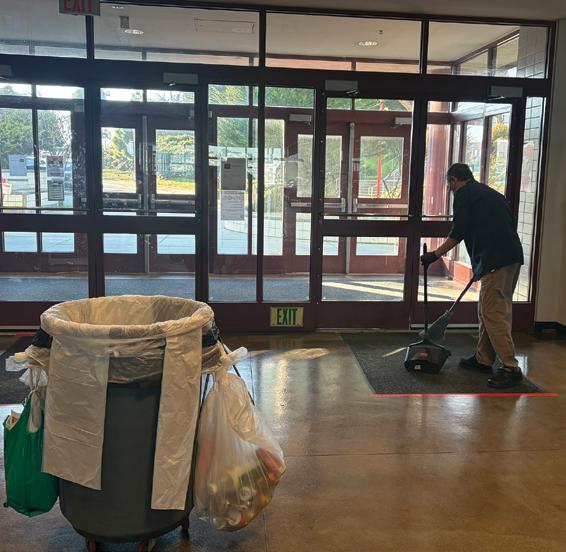
Many of these requests have remained open for extended periods. At the same time, several key facilities and custodial positions remain vacant, including the Director of Buildings and Grounds role, which oversees campus maintenance.
Concerns about facilities are not new. AFT 2121, the faculty union, maintained a public website that tracked facility problems contributing to inhospitable
conditions between 2022 and 2024. Many of the issues described there appear again in the current work order data.
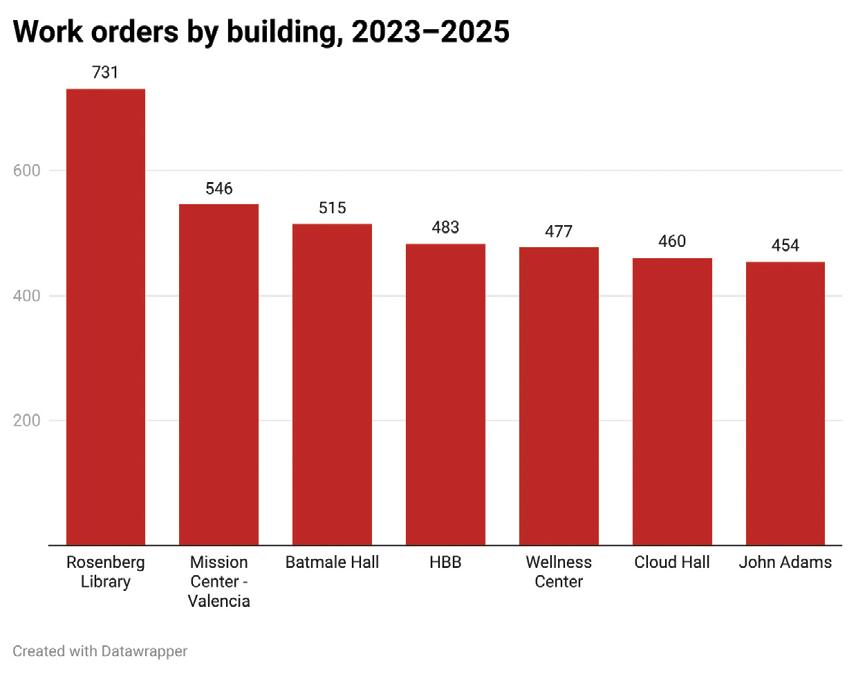
From 2023 to 2025, City College logged over 7000 work orders across 52 buildings. Ocean Campus' Rosenberg Library, which celebrated its 30th year this month, accounted for roughly 10% of all requests, significantly more than any other site. Other problem buildings included Valencia at Mission Center, Batmale Hall, the Harry Britt Building and the Wellness Center.
Staff
Editor-in-Chief
John Adkins
Managing Editor
Abby Sigler
News Editor
Marrion Cruz
Culture Editor
Karla Lopes
Op-Ed Editor
Lev Farris Goldenberg
Sports Editor
Henry Crowell
Social Media Editor
Alejandra Cardenas
Visuals Editor
Karim Farahat
Lead Designer
Tiffany Lam
Curator Photographer
Franchon Smith
Writers
Ahmad Aimaq
Alejandra Cardenas
Daniela Villegas Jovel
Diana Chuong
Ellen Yoshitsugu
Patricia Baldwin
Qi Mai
Tom Whitehead
Photographer
Isaac Ortiz
Illustrator
Cindy Chan
Graphic Designers
Cindy Chan
Sebastien Thugnet
Freelancers
Bob Kinoshita
Joan Walsh
Advisor
Juan Gonzales jagonzal@ccsf.edu
Contact us
TheGuardsman.com info@theguardsman.com 415-239-3446
Mailing Address
50 Frida Kahlo Way, Box V-67 San Francisco, CA 94112 Bungalow 615
Follow us


@TheGuardsmanCCSF
@TheGuardsmanCCSF


@TheGuardsman
@TheGuardsman
For even more articles, stay up to date at www.theguardsman.com

Join The Guardsman!
Contact Juan Gonzales at 415-517-4426.
continued from page 1
Rodents appear throughout the records. In Batmale Hall, staff reported droppings “from one end of the desk to the other.” Another request, also in Batmale, described an office “littered with rodent feces and urine.”
In the Smith Hall dining area, rats were reportedly “pushing down the ceiling tiles” and spotted “running through the main kitchen.”
At the Wellness Center, a faculty member described mice emerging from the rafters during classes and gym games, accompanied by an ant problem on the bottom floor.
Water intrusion and structural hazards were also common. One office in the brand-new Student Success Center reported “dust and water damage in the ceiling,” causing respiratory irritation. Another request from Conlan Hall described water dripping onto their desk, chair, and body during particularly foggy mornings or rainy days, noting that “these are not appropriate working conditions.”
Glass was reportedly falling from one of the greenhouses over at the Horticulture Center.
Several work orders describe long-term accessibility failures. In Smith Hall, the automatic door openers were removed when the exterior doors were replaced, preventing wheelchair users from easily entering the cafeteria. Another access button outside Batmale Hall's fourth-floor entrance “has not been working for more than 5 years.”
In the Student Union, staff reported an elevator that opened below the floor level and described it as “a tripping hazard.” Another department in Cloud Hall noted that an elevator outage made their academic department and sexual violence prevention services inaccessible to some students.
At the Dec. 4 Participatory Governance Council meeting, Associate Vice Chancellor for Facilities/Buildings and Grounds Alberto Vasquez explained that the accessible automatic door systems frequently break down. “We have done some repairs to the operable system, the push button, but as soon as we get it repaired, it goes down,” he said. “It doesn't function very well over time. It's got a short lifespan.”
Records also show overall patterns in how long these requests typically take to be fulfilled and which buildings wait the longest. The average completion time across all requests was 31 days, though some buildings experienced more prolonged delays. The Downtown Center had an average wait of 52 days, and the Visual Arts building
averaged 47 days.
As of early November, when the records request was fulfilled, over 2,000 work orders remained outstanding, including requests filed in early 2023. The longest completed repair in the dataset took 806 days and involved replacing the ballasts for four fluorescent lights in Science Hall's Electronic Lab.
Custodial staffing problems are evident. Room 215 in the Mission Center had “not been cleaned in over a month.” At Rosenberg Library, a work order filed in October reported that the second-floor women's restroom had been without soap since March and that the hand dryer was moldy.
An administrator at the Evans Center described cockroach activity tied to compost and recycling that
had not been picked up. “Our zerowaste stations are full of gnats and mold,” the requester wrote. “One designated worker once a week is not enough.”
According to a City College organizational chart presented at the Nov. 6 Board of Trustees meeting, the Buildings and Grounds departments had 21 vacant positions.
A month later, at the PGC meeting, Vasquez said hiring was underway across several roles. “We've been interviewing custodians this week,” he said. He added that they are “looking to hire two engineers to come on board in January, and also two plumbers.”
On Dec. 10, the district posted a job opening for Director of Buildings and Grounds, following a failed hiring attempt earlier this year.
By Tom Whitehead twhiteh9@mail.ccsf.edu
TheBoard of Trustees unanimously voted against the Department of Education's proposed revisions to the Accreditation Handbook that remove Diversity, Equity and Inclusion requirements for colleges.
The decision came despite some Board members' qualms about going it alone against the Department of Education, as well as recently receiving a clean bill of health from the Accrediting Commission for Community and Junior Colleges.
The Department of Education had published a Request for Information (RFI) in the Federal Register on Dec. 11, “to solicit feedback from the public on how best to reenvision and update” the Accreditation Handbook.
The “Resolution Affirming the Role of Accreditation in Protecting Academic Freedom, Institutional Autonomy, and Equity, and Expecting the Chancellor to Submit Public Comment,” approved on Jan. 8, doubles down on DEI, declaring it to be “essential to educational quality, student success,

workforce preparation, and democratic participation, particularly at open-access institutions such as community colleges that served diverse student populations.”
Drafted by Vice President Luis Zamora, the resolution calls on the chancellor to submit comments in response to the Department of Education's RFI. The Board felt that it needed to act quickly because the comment period closes on Jan. 26.
The current Accreditation Handbook, dated February 2022,
does not mention DEI, but the Assistant Secretary for Postsecondary Education, Dr. David Barker, said in the Dec. 10 press release that “changes to the accreditation handbook will complement a forthcoming negotiated rulemaking on Accreditation, which the Department plans to convene next year.”
According to Barker, the new rulemaking is a continuation of the department's implementation of Trump's Executive Order 14278, “Reforming Accreditation
to Strengthen Higher Education,” which Trump signed in April of last year.
During a lengthy discussion among Board members, during which the wording of the resolution was amended before a final vote to approve it, former Board President Anita Martinez made it clear that she felt there are significant risks to the college.
“I'm very concerned about retaliatory action from the Administration,” Martinez said. “Very concerned about financial aid.”
Zamora pointed to 20,000 plus individuals tied to Harvard's Crimson Courage who are also behind the sentiment of the resolution, and cited the San Francisco Board of Supervisors' decision to pass a similar resolution, “Protecting Academic Freedom and Condemning Attacks on Higher Education.”
The Resolution also names a large number of officials and institutions that the Chancellor is requested to contact for support. Chancellor Kimberlee Messina did not respond to a request for comment by press time.
City College's vision of vibrant diversity is undercut by its failure to attract a robust Latine workforce and the Board of Trustees' decision to roll back diversity via layoffs. This is the first of a two-part series assessing diversity at City College.
By Patricia Baldwin byebyebaldwin@gmail.com
According to its own vision statement, City College is “rooted in San Francisco's vibrant diversity.” For Academic Senate Vice President Alexis Litzky, vibrant diversity would include a “visual expression of difference” that celebrates diversity. Vibrant diversity would be “exciting,” according to Jill Evans, Physics Department Chairperson.
City College's workforce ethnicity percentages generally match those of San Francisco's population, according to demographic data.
The percentage of City College's workforce who identify as Latine does match San Francisco's population, 16%, according to the American Community Survey (ACS) collected from 2018-2022. Malaika Finkelstein, labor studies instructor, said that City College “tries to include the breadth of the diversity in the SF Bay Area,” which is consistent with their vision statement.
Renata Da Silva Araujo, president of Mission Campus Associated Students, said that “the staff at the Mission campus is diverse with multilingual representation.”
However, City College's Human Resources' Hiring Report 2023-24, the Employee Report Fall 2023, and interviews reveal two areas of concern: Latine representation in the workforce fails to reflect the student body, and layoffs have rolled back gains in faculty diversity.
The data shows that the district is lagging in Latine representation: 29% of City College's students identify as Latine, while the workforce is at 16%.
“There is more ethnic diversity among classified staff than among the faculty,” said Finkelstein.
Thirteen new classified hires identified as Latine, 18 classified professional and 96 classified support positions are filled with individuals who identify as Latine.
However, disaggregating the data by job subcategory reveals further gaps. Human Resources data indicate that Latine classified staff
are overrepresented in clerical/secretarial jobs, representing 22% of the classified district workforce in this job subcategory.
Hiring data also suggests that City College is not attracting Latine talent in the higher-paid, prestige positions. The hiring data for administrators reflects zero Latine applicants, while four out of 45, or 9% of current administrators, identified as Latine in fall 2023.
“Students need to see representations of themselves in the faculty.”
Jill Evans, Physics Department Chairperson
Faculty hiring data suggests that the institution prioritized hiring part-time faculty, adding 81 parttimers to the faculty for 2023-24. In contrast, just four full-time, tenuretrack faculty were hired during the same period.
And yet, for part-time faculty postings, there were zero Latine applicants out of 545 total applicants.
While it is possible for some Latine applicants to have chosen alternative classifications such as other, not disclosed, or of two or more races (multi-ethnicity), zero out of 545 is a vivid data point.
Full-time faculty postings also drew zero Latine applicants.
Araujo wonders if potential applicants face the same pressures as the Latine students at the Mission Center. Just as “many Latinas taking classes at the Mission Campus need to postpone education to feed their family,” she said, “it may be that the level of higher education needed for faculty and administrative positions is not accessible to large segments of the Latine population, leading to a reduced applicant pool.”
According to the data, a majority of City College's full-time faculty identify as white. In addition, there is

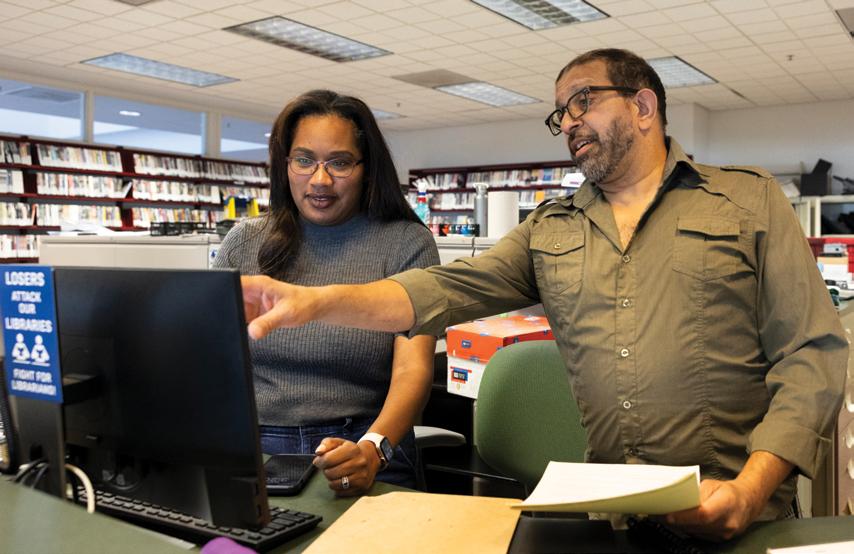
a “lack of visible diversity” on Ocean Campus, according to Litzky, who also teaches in communication studies.
Part-time faculty hires are more ethnically diverse and less white than the overall faculty. Evans said that the “faculty in physics is comprised predominantly of older white men, but there's more diversity now that some previously laid-off part-time faculty have been rehired.”
In Fall 2023, across all disciplines, 55 full-time faculty (13%) and 60 part-time faculty (11%) identified as Latine. These percentages lag behind both the identified Latine population in San Francisco, 16%, and City College's reported Latine student population, 29%.
“Students need to see representations of themselves in the faculty, especially gender and ethnic identity, to believe ‘I can do it,’” Evans said.
In 2022, the Board of Trustees voted to lay off approximately 150 part-time and tenured faculty. Only approximate numbers are available because the chancellor's office failed to grant the Office of Research and Planning (ORP) approval to provide the data.
“City College has worked hard to improve equity in faculty hiring, but with layoffs, we're going backwards,” said Finkelstein. “Downsizing impacted faculty diversity; we lost part-time faculty and newer faculty.” These were the groups that had been contributing to increased diversity at City College.
Coincidentally, three people interviewed for this pair of articles were pink-slipped and/or laid off in 2022. Danny Halford, who has been teaching English as a Second Language for 46 years, was laid off for the second time since 2006. Professor Jill Evans, the current chair, was the tenured faculty member laid off from the Physics Department.
Olga Galvez, chair of Disabled Students Programs and Services (DSPS) at the time and currently, received a pink slip warning that she might lose her job. In a video she made at the time for the faculty union, the American Federation of Teachers Local 2121, shared on social media, Galvez expressed, “I framed my whole career around ending up at City College.”
During her interview, Evans, who described vibrant diversity as “exciting,” had been enthusiastic when talking about students, but she lost her spark when the conversation turned to faculty layoffs. “Loss of diversity is not vibrant,” said Evans.
In 2022, eight part-time faculty and one tenured professor, Evans, were laid off. Of those, five part-timers identified as women, as did the tenured professor, leaving only one woman on the Physics Department faculty.
The layoffs tend to follow a lasthired, first-fired framework. The data below is based on the faculty union's data about employees who received pink slips in 2022.
At the direction of the Chancellor's office, data on the impacts of faculty layoffs could not be accessed through ORP.
Notices of layoffs disproportionately went to Filipino faculty, 15%; African American faculty, 17%; and Southeast Asian faculty, 25%. The eventual cuts impacted African American faculty, according to Kym Morrison, professor of history, who also noted that the loss of faculty through retirements or layoffs saps a department's vibrancy.
Faculty layoffs are about diversity lost. For example, during the 2022 layoffs, City College lost queer faculty. “Newer faculty, who made up the bulk of those laid off, offer creative approaches to teaching, as well as their varied lived experience,” said Heather Brandt, Student Chancellor.
Litzky noted that “because of tenure, higher education faculty tend to skew older.”
“It is just the nature of the organization,” she said.
“City College needs new blood; new faculty — part-time and tenured — bring different training, new teaching methods, different approaches to teaching, and varied reading material, possibly even new research into cultural changes,” said Finkelstein. “This variety can help students find what works for them. Students can find something to excite them about the subject matter,” she added.
Cuts to the faculty also show up as cuts to classes. In fall 2021, every class could be offered every semester in the Physics Department, according to Evans. Now, several classes are offered only once a year.
Alejandra Cardenas, a journalism major, has noticed a similar pattern in other disciplines, where “some classes are not offered every semester.” Evans notes that these changes in course availability “impact completion.”
Although counselors were not a separate category in Human Resources hiring data, students had thoughts about their role.
Araujo spoke to their ethnic and linguistic diversity, “two of the three counselors at Mission are Latine and Spanish speakers,” she said.
“Students, especially international students, need focused counseling and advising, so they know where to start and what to do in their major, otherwise they feel stressed,” said journalism student Ahmad Aimaq.
Cardenas said that students “need their own counselor who is familiar with them and can help with specific issues, rather than meeting with whichever counselor is available.”
From frigid ocean swims to AI cautionary tales, three filmmakers discuss the years of work and resourcefulness behind their standout projects.
By Abby Sigler abby.sigler@gmail.com
On a chilly December afternoon, a crowd assembled in the Big Roxie theater, shedding their coats and beanies for the 13th Annual Festival of the Moving Image. The two-hour program featured more than 20 student films from City College's Broadcast Electronic Media Arts (BEMA) and Cinema departments.
Misha Antonich of the BEMA department and Cinema Department Chair Denah Johnston have been collaborating on the festival for nearly a decade, providing students the opportunity to display their work on a professional screen in front of an audience beyond their filmmaking peers.
Of the expansive showcase, three films stood out.
Steve Peletz plunges audiences into the Pacific alongside the wild swimmers of China Beach in “Lands End.” The mini-documentary follows a group of adrenaline seekers who get their fix from the frigid temperatures and unforgiving currents that only open-water swimming can provide.
A swimmer himself, Peletz contended with the same harsh conditions as his subjects, training his camera on the action to capture striking footage. Most of the film unfolds among the waves, with occasional to-camera interviews on land woven throughout. From those conversations, viewers learn that many swimmers began coming to China Beach during the pandemic, and it subsequently “became a party every day.”
Peletz began casually filming these escapades with a GoPro he tucked into his swim shorts, completing roughly 1,000 swims over four years. Initially, he thought he might “make a gift for [his] friends” with the footage.
The filmmaker chiseled away at his doc over the course of six different classes. In a course focused on sound, Peletz worked with
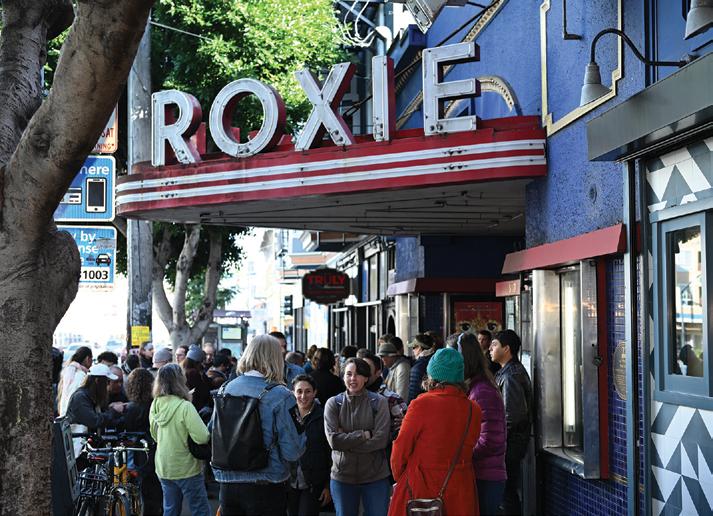
After the festival, filmmakers and audience members mingle outside the theater and discuss the two-hour slate of short films. Dec. 7, 2025.
(Abby Sigler/The Guardsman)
instructor Dan Olmsted to layer heartbeats over the tinny sloshing of waves, heightening the scene's tension. “Sound can make or break a film,” Peletz said.
For Peletz, the thrill of screening at the Roxie came from hearing the audience respond in real time. When dolphins unexpectedly surfaced in the background of one shot, audible gasps rippled through the theater.
Tonya Soloveva's “ADDIE” explores humanity's relationship with artificial intelligence through the story of an aimless young woman and her AI assistant, tasked with shaping her into a functioning adult. The short is a Black Mirror-esque take on the pitfalls of AI-reliance.
She encountered the script in Alexandra Lacey's directing class, which allows the students to read through scripts from the
By Alejandra Cardenas acarde25@mail.ccsf.edu
Its front entrance is held with strong vertical columns. The Art Deco building known as Science Hall was built in 1940, and is one of the very first buildings built on City College's Ocean Campus.
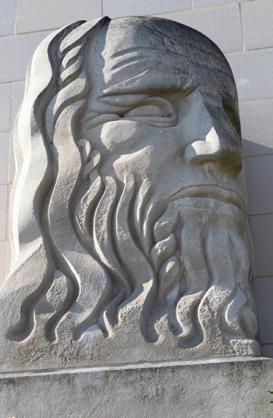
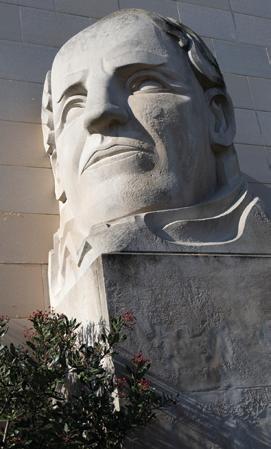
Science Hall is historically significant for its architectural design. Designed in 1940 by architect Timothy Pflueger, the building's north and south exterior ends feature large mosaic-tile murals by Swiss-American artist Herman Volz. There are also monumental stone sculptures of Thomas Alva Edison and Leonardo Da Vinci. The interior features two murals painted by Frederick Olmsted.
The Great Depression brought widespread deprivation across the community of San Francisco. There was an increase in unemployment and layoffs, resulting in an extensive resurgence of poverty and homelessness.
To combat the effects of the Great Depression in the 1930s, San Franciscans demanded that education be more publicly accessible. Eventually, the passage of the New Deal in 1938 helped fund the construction of City College.
It was a high bill to pay: the construction cost was $2.8 million, and the money from the New Deal covered at least 45% of the cost, but it wasn't enough — city voters were left to raise the remaining funds.
On Sept. 27, 1938, Proposition 4 was passed, which authorized the city to borrow funds to begin construction of the college campus.
As the college marks 90 years since its establishment, recent upgrades to Science Hall infrastructure include a fire alarm system upgrade and structural renovations for seismic safety. These upgrades were made to meet the requirements of the Division of the State Architect.
The college itself is not done with Science Hall, despite many science departments, such as biology,
screenwriting class and select their favorites. Screenwriter David Paculdo wrote “ADDIE,” and Soloveva was drawn to the subject matter. “AI is everywhere, it's getting into our lives, and everybody is happy about it,” she said. “But do we think about the possible consequences?”
The film was shot over two days on a selffunded budget of $1,800. Soloveva and her team scouted locations, conducted pre-shoots and blocked scenes in advance to maximize efficiency during the 12-hour shooting windows. The anchor of the film, Shoana T. Hunt, initially auditioned for a secondary role, but Soloveva was impressed by their detailed performance and cast them as the lead instead.
“It was like magic,” Soloveva said of the shoot.
The film has been submitted to more than 15 festivals, including Sundance, with decisions expected in early 2026. Soloveva hopes the film encourages viewers to reflect on their
relationships with chatbots, particularly “how much you should trust them.”
Brynn Casto's “Autumn” is a comingof-age story exploring queer identity and self-discovery. The film builds toward a tearful, reconciliatory conclusion and features a moody soundtrack, including “A Quick One…” by Have a Nice Life.
Casto spent four years writing and revising the script, drawing from her own experiences as a trans woman. After exploring film programs at other Bay Area community colleges, she enrolled at City College and completed a certificate in film theory.
Another piece from Lacey's directing class, the film was produced on a $3,600 budget. Lead actor Ronan Leamy also came from the same course. “He would ask me, ‘When does my character cry? When does my character smile?’” Casto said. “You would not assume that he could do that kind of role just by talking to him.”
Visually, “Autumn” draws from an Americana lineage — Spielberg, Lucas — using wide suburban shots and natural lighting. “I really like naturalism, especially in performance,” Casto said.
The production itself was anything but smooth, marked by a lost location, a screaming landlord and a burst water main. However, none of that chaos is evident on screen.
By the final frames, audience members were visibly moved by Leamy's performance.
“I wanted to demystify and destigmatize that section of the trans experience,” Casto said of the film's depiction of early transition. “I wanted to show that it's playful. It doesn't have to be this crazy thing.”
Casto now works as a gaffer in the Bay Area. “I pretty much work with one person from City College at least per shoot,” she said.
This spring, students will have another opportunity to showcase their films at City Shorts.
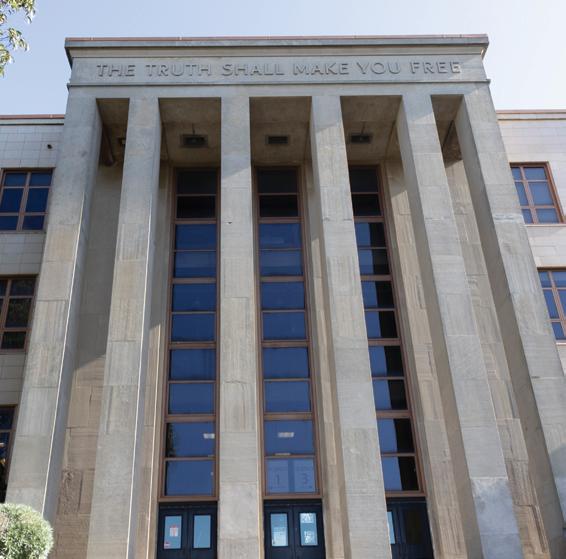
Above: Written up high on the west entrance of Science Hall are words of spiritual wisdom. Jan. 16, 2025 (Alejandra Cardenas/The Guardsman)
Right: Head sculptures of Leonardo Da Vinci (top) and Thomas Edison (bottom) carved by artist Fredrick Olmsted Jr. (Alejandra Cardenas/The Guardsman)
chemistry and physics, having moved into the new STEAM building. Science Hall is going through renovations to restore the space. Other STEAM programs still call Science Hall home, such as math, physics, astronomy, earth sciences,
engineering and CNIT. The future for Science Hall is bright. As it will remain throughout its restoration in its proud place on the hill, with steps leading up to the college motto, “The Truth Shall Make You Free.”
By Alejandra Cardenas acarde25@mail.ccsf.edu
City College journalism students
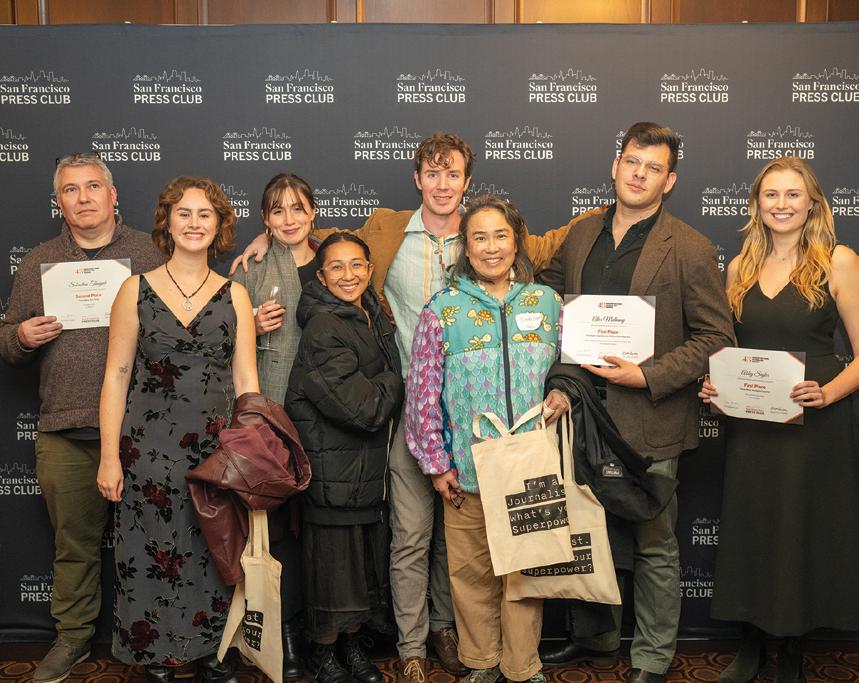
walked away winning 16 awards at last year's 48th Annual Greater Bay Area Journalism Awards hosted by the San Francisco Press Club.
Students with work published in both The Guardsman and Etc Magazine were recognized in the College Media category.
Cover Design
Second Place
Sebastien Thugnet
“Etc Magazine 2025” Etc Magazine
Editorial Cartoon
First Place
Cindy Chan
“Moving Forward” The Guardsman
Third Place
Cindy Chan
“Tariffs?” The Guardsman
Feature Layout Design
First Place
Tiffany Lam
“90 Years of History: Tracing the Rise of City College” The Guardsman
Feature Story / Light Subject
Third Place
Ellen Yoshitsugu
“What Are the Odds: The Identical Twins Who Have Served CCSF for Decades”
Etc Magazine
Front Page Design
Second Place
Isabelle Salvadori, Tiffany Lam, John R. Adkins
“The Guardsman Vol. 179, Issue 4” The Guardsman
Front Page Design
Third Place
Isabelle Salvadori, Tiffany Lam
“The Guardsman Vol. 179, Issue 5” The Guardsman
General News Story
First Place
John R. Adkins
“City College's Grounded Aeronautics Program May Find Runway Yet” The Guardsman Headline
Third Place
John R. Adkins
“City College's Grounded Aeronautics Program May Find Runway Yet” The Guardsman
Investigative Reporting
First Place
Abby Sigler, Marrion Cruz, Tom Whitehead
“Ghost Students at City College” The Guardsman
Photography / Feature
Second Place
Kyra Young “Mexika New Year” The Guardsman
Photography / News
First Place
Kyra Young
“City College Board of Trustees
Faces Overwhelming Testimonies to Restore Classes and Laid-off Faculty” The Guardsman
Photography / Photo Series
Second Place
Bob Kinoshita
“Women's Soccer Team Shuts Out San Joaquin 3-0” The Guardsman
SAT, JAN. 24
Film Premier: “Keeper of the Fire” by alejandro Murguia
7 p.m. | Brava Theater (2781 24th St.)
“Hearts in San Francisco” sculptures at Ferry building Jan. 24 - Feb. 11
“Zodiac Wall” art Installation in Chinatown
10 a.m. | 1138 Grant Ave.
SFMoMa Family Program Sculpture Making
12 - 2 p.m. | Fort Mason, Pier 3
SUN, JAN. 25
atrium: a new art Fair
6 - 9 p.m. | 1275 Minnesota St.
Golden Gate Park Sunday Roller Disco Party
1 p.m. | Skatin' Place
“Glowfari” lights Festival at oakland Zoo (Final Day)
MON, JAN. 26
CCSF: First Day of 16-week, 8-week and 4-week classes
Photography / Sports Second Place
Bob Kinoshita
“Rams Win Water Polo Shootout 16-11” The Guardsman
Feature Layout Design Third Place
Xiaoyi Yu
“Franchon Smith Ends Her Years as City College's Beloved Rocky the Ram” Etc Magazine
Columns - News/Political
Third Place
Emily Thorsen
“Emily Thorsen's Column” The Guardsman
WED, JAN. 28
Journalism Department Chair Juan Gonzales, who also serves as faculty advisor to The Guardsman, commended the caliber of the recognition.
“The San Francisco Press Club is a very prestigious organization, and for our students, to be recognized for their excellence in their work, as photographers, as writers, as illustrators, as designers, is really big,” Gonzales said. He felt good about his students receiving these awards, adding that it would set them up for great success in the field of journalism.
Cindy Chan brought home first and third place in the Editorial Cartoon category. Chan was in awe of winning her two awards. “I’m still walking on cloud 9, like wow,” she said.
CCSF Women's basketball vs. San Mateo
5 p.m. | Wellness Center
CCSF Men's basketball vs. las Positas
5 p.m.
FRI, JAN. 30
last day to add full term credit classes in person and on the web
last day to drop credit classes wihout a W
Men's basketball vs. De anza
7 p.m.
Slavic Festival
SAT, JAN. 31
11 a.m. | 2460 Sutter St.
lunar new year lion Dancing Festival 10:15 a.m. | All San Francisco Public Libraries
SUN, FEB. 1
Mozart to Mendelssohn Free Full orchestra Concerts 3 p.m. | Herbst Theater
Kyra Young, who took first place in the Photography / News category for photographs, which accompanied the news article “City College Board of Trustees Faces Overwhelming Testimonies to Restore Classes and Laid-off Faculty” published back in October 2024. She thought it was awesome to see her name projected on a screen in a room full of talented professionals.
The San Francisco Press Club was founded in 1963. The nonprofit organization has provided professionals in journalism with opportunities to connect and grow. According to the SF Press Club website, the club gives services to the following counties: Alameda, Contra Costa, Marin, Monterey, Napa, San Francisco, San Mateo, Santa Clara, Santa Cruz and Sonoma.
SUN, FEB. 1
asian art Museum: Free admission Day 10 a.m.
MON, FEB. 2
Queer Resource Center Pride lunch
12 - 2 p.m. | Location TBD
WED, FEB. 4
Women's basketball at Skyline 5 p.m.
Men's basketball vs Cañada 7 p.m.
last day to withdraw or reduce course work to qualify for 50% non-resident tuition free refund
GlbT History Museum: Free First Wednesday 11 a.m.
THUR, FEB. 5
CCSF baseball at Mendocino 2 p.m.
berkeley art Museum: Free First Thursday 11 a.m.
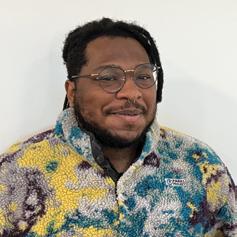
This is the school where I got my first job. I work at the African American Resource Center, and we try to do a lot there for African American students. We try to give them books and food, and point them in the right direction to get scholarships. So that's one thing I really appreciate, is that CCSF is very inclusive.
And a lot of the teachers here give you good advice on how to manage college, like one of my history professors, who said that when they were college students, they took 15 credits while working a part-time job, and they couldn't do it. They got C's and were threatened with getting kicked out, but they managed to get out of that problem by cutting a few classes. So, what we really need to be careful with is managing credits if we have a part-time job, which I feel is really good advice for many students.
The only issue I think CCSF has is that the programs aren't heavily advertised. And I feel like if they spread the message through more avenues, then it would be able to reach out to more students.
Adonai Tierrablanca, Administration of Justice major
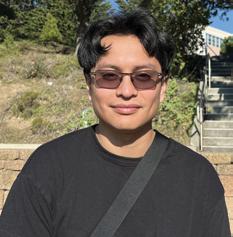
There are so many resources that we have that can help you. Either with living in the city, academic goal setting, financial issues, food issues — things like that.
And I feel like what's really holding me back is just outside of school things, just what is happening in our country. We have ICE obviously terrorizing our communities, the threat of fascism nationally, and with the rent crisis going on, it's become very hard to afford to live right now.
Dejon Chopin, Psychology major
Well, I do a lot of things in the library. Pretty much the only thing holding me back is time constraints, in the sense that I have other stuff to do here and there, so I'm always trying to manage my time better.
Jason, Business major
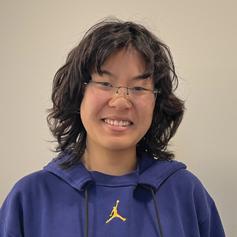
I would say something that really helped me in my educational journey was utilizing the resources that CCSF offers. A lot of free resources, and a lot of people here who were available and willing to help me on my educational journey, wanted to see my growth and progress.
Something that sort of held me back was, I think, my perception of the leap from high school to college, because I tested out of high school when I was 15, and I didn't get my junior or senior year to prepare for college. So I think if I had more support on that front, and I had learned how to study, or learned how to manage my time, I think that would have really helped me.
I feel like City College really did help once I started realizing where to find the resources and actually actively seeking help. Realizing that seeking help wasn't something that was shameful or bad, because the resources are there for a reason.
Karuna Chou, City College 2021 alum, currently studying game and entertainment design in Los Angeles

What's going really well for me is having a good foundation, faith and recovery. And my faith is Islam, so I have a foundation in prayer. Because in my old life, I studied at San Francisco State University, but didn't have a foundation in anything, and I graduated, but had nervous breakdowns and ended up in the streets, ended up in jail, but now I have a good foundation. And what else is going well? Taking judo classes. Not really much holding me back. I just try to do my best. There will always be distractions.
Marcian Diamond, Web Application Programming student

The Guardsman wants to hear what you think. Have something to say about the state of the world, or the state of City College?
We welcome any and all community letters. However, we reserve the right to not publish any submission. If you are a student, please include your name and area of study.
Please make all submissions to editor@theguardsman.com

Have a News Tip?
Have you overheard something happening in your community that you wish would get coverage by the press? The Guardsman welcomes any and all story ideas or tips, especially those that communicate a clear issue or problem. Evidence of the claim is encouraged.
Send news tips to editor@theguardsman.com

are looking for
Writers
Photographers
Illustrators
Designers

By Henry Crowell henrycrowell5@gmail.com
The Rams baseball team, led by Head Coach Mario Mendoza, is gearing up for the start of the season, “new” (temporary) field in tow.
The Rams are looking to improve, coming off a season in which they battled injuries and lacked a home-field advantage to finish 6-32. “We've been getting the body right, staying focused, staying in shape. Staying uninjured… It's hard to win games without your main guys,” Mendoza said.
City College baseball will be buoyed by the fact that they finally have access to a ballpark of their own, and one relatively close to campus, as they will be playing at Maloney Field for the next two years. It was
the former chomping grounds of the now-defunct San Francisco State Gators baseball program.
“I'm just excited for my players, the parents and the fans. It's the first time in 20 or 30 years that we actually have home games. We don't have to play at 10 or 11 o'clock, we can play at a normal time. And [the field] is somewhere in the city where students can come and watch us play,” Mendoza said.
Ocean Campus has never housed a baseball field, forcing the team to find other places to play over the years, with Balboa Park's sorely inadequate “Sweeney” diamond serving as the Rams' home field from the campus' inception to 2010, when they moved to Fairmont Field in Pacifica, some 7 miles away from campus. This field was also plagued
“I've never really had a home-field advantage.”
Mario
Mendoza, Rams Baseball Head Coach
by numerous issues, mainly availability, as St. Ignatius Preparatory owns the field and uses it for their baseball and softball teams.
“I'm excited for a guy like Kaleo Velez, who's been here for three years, who's been on the road for three years, that he and his family get 16 games at home this year. I'm excited to have a normal schedule,”
By Isaac Ortiz isaacortiz117@gmail.com
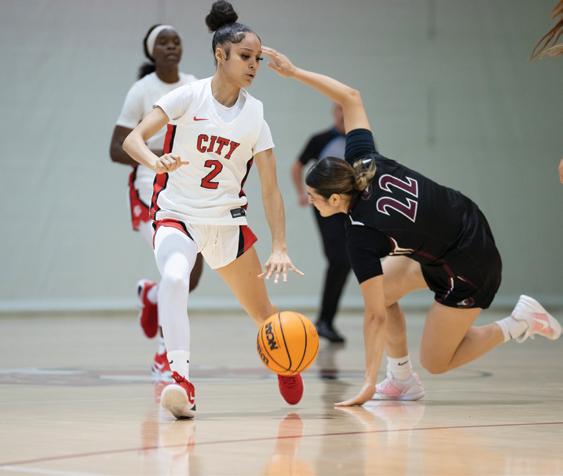
City College administered a beatdown on Monterey Peninsula, winning 81-36 in a rout for the Rams in its home game on Jan. 14.
City College held the Lobos scoreless in the first quarter, leading 14-0. Monterey struggled to create scoring opportunities to no avail, and the battle of the boards was decidedly won by the Rams.
“Yeah, I think it took us a little bit to figure out the pieces, but once we got going, we were just kind of firing on all cylinders. And we're just
cleaning up what we did from the last game to prepare for the rest of our conference,” said Assistant Coach Tiffany Mariano. The quality gap between the two teams widened drastically each quarter, leaving Monterey Peninsula to play perpetual catch-up.
Playing time was split relatively evenly between the Rams, and they shouldered the scoring load similarly, with five players scoring eight or more points. Rams
Center June Lumumba scored 22, her highest total of the season, to go along with nine rebounds and a pair of steals.
“We felt amazing, and we had to redeem ourselves from our previous loss. So this was something we really wanted today,” said Lumumba. It was a stalwart game for City College defensively, as they recorded 19 steals, locking down Monterey ball handlers and forcing bad passes. City College improved on its last game, a Jan. 9 loss to Skyline College, 55-53. They had won the previous four straight.
After their win against Chabot on Jan. 16, the Rams sit at 14-4 on the year. With conference play having started, the next nine games are evermore crucial.
Mendoza said. “I've never really had a home-field advantage.”
Velez is a super utility player for the Rams, logging innings at catcher and all around the infield in his three seasons at City College. “Recovery is the biggest thing. Sleeping, eating right, stretching every day,” Velez said of his preparation for the role. “Just doing the little things that keep your body healthy. [Coach Mendoza] can stick me wherever he needs me, and he knows I'm ready to go,” he continued.
Returning alongside Velez is newly minted member of the Preseason All-American list, Isac Mendoza, a standout on both sides of the ball, posting a .408 on base percentage to go along with stellar defense as the Rams' first baseman last year. “I've just been trying to get
better as a whole, a better athlete, a better teammate to everyone. Be a better leader,” Mendoza said.
Velez and Mendoza will seek to anchor and improve a lineup that had shown an ability to get on base but sometimes struggled to capitalize on the opportunities. “Our bats were pretty solid in the fall. Not amazing, not terrible, but our bats were solid enough to hang in with the teams we were playing,” said Velez.
“I tell our guys, if we play good baseball, if we don't worry about the other team, we just play catch, we execute, we get big plays, then everything else gets taken care of,” Coach Mendoza said.
Baseball's first game of the season will be played Jan. 23 at Maloney Field, against the Contra Costa Community College Comets.
By John R. Adkins jradproduction@gmail.com
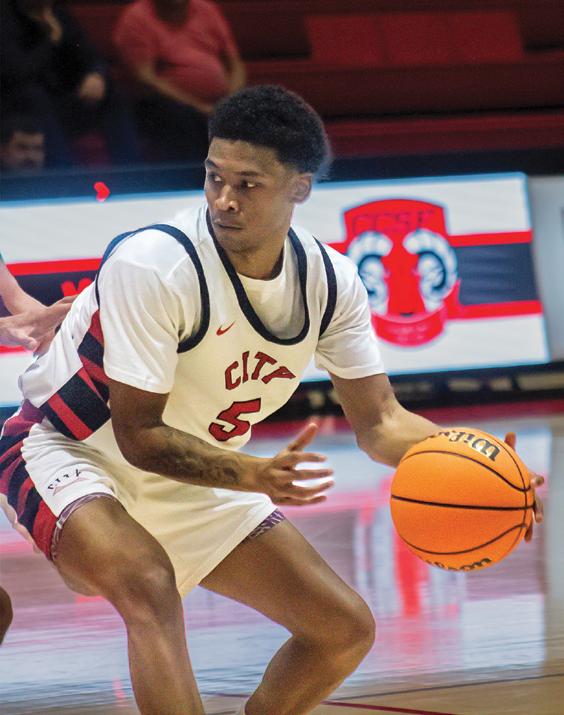
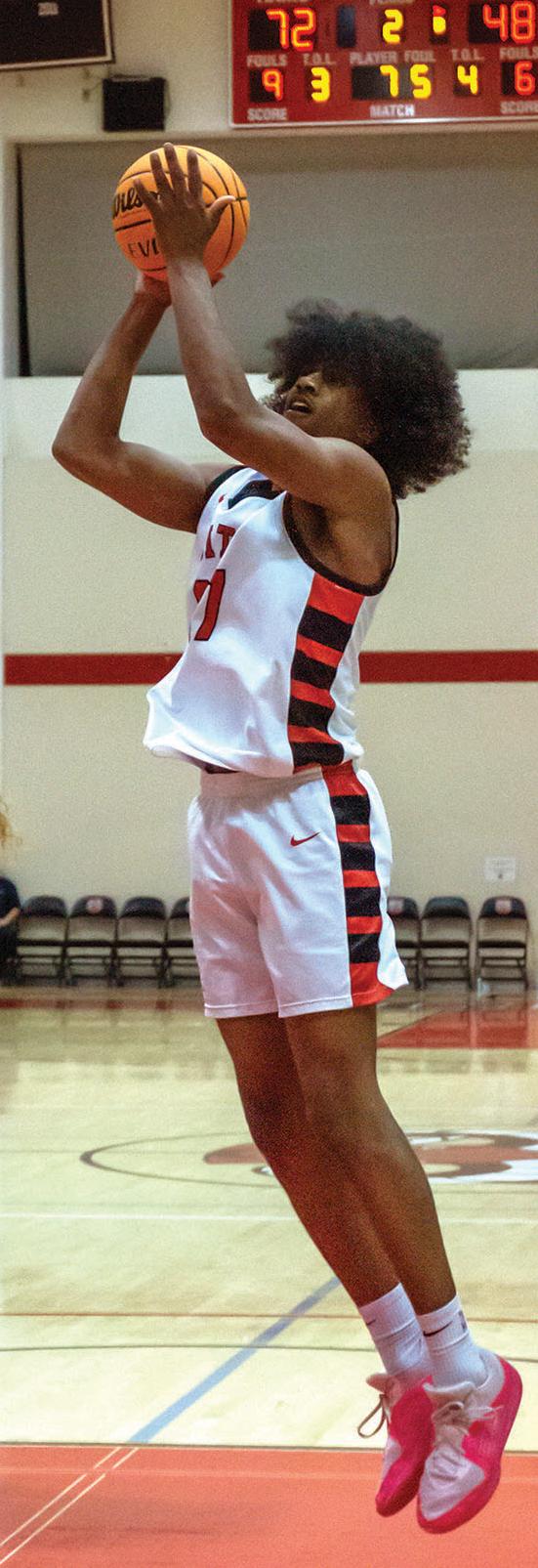
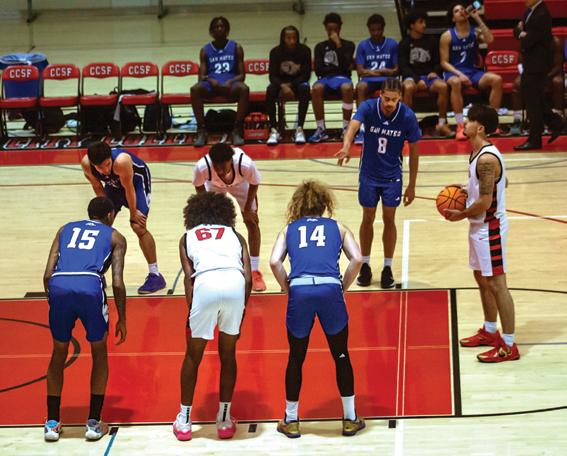
After Friday night's tip-off, starting guard Vitor Oliveira threw the defending state champions' possession out of bounds, creating a haphazard start to the Rams' return to the Brad Duggans court. The City College scoreboard hit a breakaway towards the end of the first half, managing to hold onto a nearly 30-point lead against the San Mateo Bull Dogs. Despite the Rams' defense locking up the visiting team and shutting down their first home game of the Spring Semester with an 80-54 lead, the coaches walked away shaking their heads.
We're still trying to put all the pieces together,” said Shane Lincoln. “We're not a finished product at all.”
Six minutes into the first half, the Bulldogs and the Rams had gone shot-for-shot and tied up the board 8-8. Despite the Rams' wall of defense, San Mateo pushed to break through their tie by driving the ball through the paint.
Throughout the game, the Rams proved able to recover from what would have been a lot more missed connections. A missed pass to Jaeden Hutchins was picked up again before going out of bounds and fed back to Hutchins for an easy dunk from under the net.
Defensive pressure kept forcing turnovers for San Mateo, and the lack of openings forced a lot of missed shot opportunities, allowing City College to get the lead. When the Bulldogs responded with a big 3, the Rams kept the energy alive with fast offensive ball movement.
“It was a tough game for me personally. I started out with a turnover right off the bat,” said Oliveira, who looked heated from the sidelines. “I was trying to turn the team back on on defense, trying to talk either from the bench or from the court, just trying to bring some energy that doesn't involve me scoring the ball.”
When Oliveira backed up into the paint, he turned to find guard James Moore for an open 3 from the corner.
At times, all the Bulldogs could do was try to muscle through in the hopes of drawing a foul. After Hutchins was there to put away a missed 3-pointer and extend the lead, the Bulldogs called a timeout.
Head Coach Justin Labagh was frustrated by the Rams' occasional lack of playmaking, which led to turnovers and dumping possessions without a plan despite pulling a 10-point lead towards the final minute of the half.
In the final 60 seconds before halftime, Nick Cubley stood ready for the ball in transition. After a failed 3-point attempt, Cubley was locked in and ready for the rebound and pulled off the shot and the foul after missed shot opportunities from City College. Then, when Cubley caught the ball in the corner, he fed it to Kirby Seals as he cut through the paint and put the Rams on a 14-0 run.
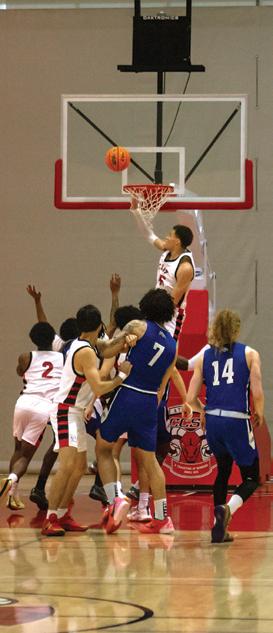
With 6 seconds left in the half, Lincoln jumped up and blocked what would've been a clean pull-up jumper from San Mateo. When Lincoln dribbled away, he glanced at the clock; seconds remained, and he jumped through the air from behind the half-court line. The buzzer echoed, the ball hung in the air, and drained through the net. The crowd roared as the game went to halftime: 42-21 Rams.
When San Mateo came back to the court with possession, they started to connect on a lot more of their open shot opportunities, which kept them in the game along with a slightly tighter defense.
Marcus Robinson was creating some scoring opportunities with his ball movement. When he got locked up in the paint, he got the ball to James Moore, who scored a layup through two defenders. Later, when the Rams caught the defensive rebound, Kirby Seals found Elliot Conley with a pass while in transition. Conley steamed ahead in full force and drew a foul on a missed slam dunk attempt.
Oliveira's offensive plays started gaining momentum, and his 3-pointer created a 19-point lead over San Mateo early in the second half. Oliveira continued to score more goals and generate good ball movement on offense for his teammates.
“I think we shot the ball pretty well,” said Kenyon DeMuynck. “We hit a lot of 3s, so that was good, and we set the energy. We were talking a lot actually on the court,” he said with a laugh.
With less than 10 minutes left in the first half, City College continued to make its 3-pointers and maintained a stable lead, while on defense, they forced the Bulldogs to choke up and run down their shot clock on multiple occasions.
“It was just some turnovers. That's what kept us out of the game a little bit,” DeMuynck said. “But we always got it back because we are a defensive team.”
The Rams finished strong in the final minutes of the game. Robinson drove down the lane and got caught trying to pop up in the paint, but got fouled and made both shots. When the Rams forced a turnover, Robert Morgan lobbed the ball up to 45, who came down with a dunk. The crowd roared. Only 20 seconds remained for San Mateo, who proceeded to miss two back-to-back 3-pointers before finally scoring a layup — but it was not enough. The score was 80-54, and City College dribbled out the final seconds of the clock with a 16-point lead.
For Head Coach Justin Labagh, the performance was not enough. “We're not playing that well. I think we have no attention to the details. And if we don't fix it soon, we're going to get beat.”
The win brought their season record to 19-1, and the defending state champions are currently ranking second in the league behind Las Positas College.