The Guardsman The Truth Shall Make You Free
Vol. 18 0, I ssue 6 | N ovem b er 6 – 1 9, 2025 | City Colleg e of San Fran c is co | Sin ce 1935 | F R EE | www.th e guardsma n .co m
KNOW YOUR RIGHTS! RAVE ALERTS
IIBA FREE LEGAL ADVICE
A Week of Protest: San Franciscans Push Back Against Trump Administration By Abby Sigler abby.sigler@gmail.com
A
n estimated 50,000 protestors flooded the streets of San Francisco for the second No Kings protest against the Trump Administration. Hoisting homemade signs and shouting pro-democracy chants, the crowd marched from the Embarcadero to City Hall on Oct. 18. In the days following that massive protest, tensions grew as President Trump repeatedly threatened to deploy the National Guard to San Francisco. After a tense 48 hours of uncertainty, the Trump Administration eventually walked back its plans for a federal “surge.” As residents breathed tentative sighs of relief, more than 200 people rallied with Bay Resistance on the steps of City Hall on PROTEST continued on page 4
By John R. Adkins jradproduction@gmail.com
S
an Francisco State University will automatically admit students from City College of San Francisco and the San Francisco Unified School District under a new partnership, education officials announced on Oct. 23. Enrollment at SF State has declined by 24% since 2018, falling from over 25,000 full-time equivalent students to fewer than 19,000, resulting in a $16 million deficit for the school. The guaranteed-admission pathway is designed to keep more students in the city and is said to “eliminate the uncertainty” from the application process.
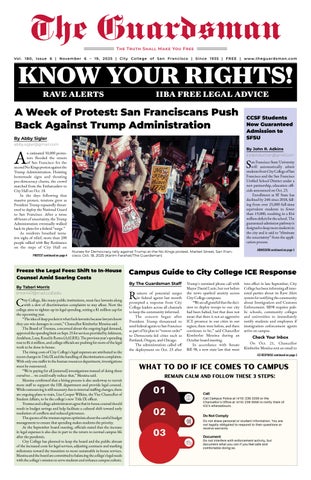
Nurses for Democracy rally against Trump at the No Kings protest. Market Street, San Francisco. Oct. 18, 2025 (Karim Farahat/The Guardsman)
Freeze the Legal Fees: Shift to In-House Counsel Amid Soaring Costs By Tabari Morris tmorri47@mail.ccsf.edu
C
CCSF Students Now Guaranteed Admission to SFSU
ity College, like many public institutions, must face lawsuits along with a slew of discrimination complaints to stay afloat. Now the college aims to tighten up its legal spending, setting a $1 million cap for the upcoming year. “The idea of deep pockets is what fuels lawsuits because lawyers know they can win damages in court,” Chancellor Kimberlee Messina said. The Board of Trustees, concerned about the ongoing legal demand, approved the spending limit on Sept. 25 for services provided by Atkinson, Andelson, Loya, Ruud & Romo (AALRR). The previous year's spending rose to $1.6 million, and college officials are pushing for more of the legal work to be done in-house. The rising costs of City College's legal expenses are attributed to the recent changes in Title IX and the handling of discrimination complaints. With only one staffer in the human resources department, investigations must be outsourced. “We're paying for all [external] investigations instead of doing them ourselves ... we could really reduce that,” Messina said. Messina confirmed that a hiring process is also underway to recruit more staff to support the HR department and provide legal counsel. While outsourcing is still necessary due to internal staffing changes, there are ongoing plans to train, Lisa Cooper Wilkins, the Vice Chancellor of Student Affairs, to be the college's new Title IX officer. Trustees and college administrators agree that in-house counsel should result in budget savings and help facilitate a cultural shift toward early resolution of conflicts and reduced grievances. The quotes of the trustees express optimism about the careful budget management to ensure that spending makes students the priority. At the September board meeting, officials stated that the increase in legal expenses is also due in part to the return to normal campus life after the pandemic. City College has planned to keep the board and the public abreast of the increased costs for legal services, adjusting contracts and marking milestones toward the transition to more sustainable in-house services. Messina and the board are committed to balancing the college's legal needs with the college's mission to serve students and enhance campus culture.
ADMISSION continued on page 3
Campus Guide to City College ICE Response By The Guardsman Staff
R
umors of potential surges in federal agents last month prompted a response from City College leaders across all channels to keep the community informed. The concern began after President Trump threatened to send federal agents to San Francisco as part of his plan to “restore order” to Democratic-led cities such as Portland, Oregon, and Chicago. The administration called off the deployment on Oct. 23 after
Trump's surmised phone call with Mayor Daniel Lurie, but not before the news sparked anxiety across City College campuses. “We are all grateful that the decision to deploy troops to our city had been halted, but that does not mean that there is not an aggressive ICE presence in our cities in our region; there were before, and there continues to be,” said Chancellor Kimberlee Messina during an October board meeting. In accordance with Senate Bill 98, a new state law that went
into effect in late September, City College has been informing all interested parties about its Rave Alert system for notifying the community about Immigration and Customs Enforcement. SB98 requires public schools, community colleges and universities to immediately notify students and employees if immigration enforcement agents arrive on campus.
Check Your Inbox On Oct. 21, Chancellor Kimberlee Messina sent an email to ICE RESPONSE continued on page 2
2 | NEWS
Vol. 180, Issue 6 | November 6 – 19, 2025
Staff
CCSF Board Targets Equity Gaps in New 2025-28 Plan
Editor-in-Chief John Adkins
By Tabari Morris
News Editor Tabari Morris Culture Editor Abby Sigler Op-Ed Editor Henry Crowell Sports Editor Lloyd Cobb Social Media Editor Abby Sigler Photo Editor Isaac Ortiz Copy Editor John Adkins Writers Ahmad Aimaq Karla Lopes Lev Farris Goldenberg Marrion Cruz Qi Mai Raeghan Green Samantha Palma Victoria Capree Photographers Bob Kinoshita Gibson Cain Karim Farahat Maria Krylova Illustrator Cindy Chan Graphic Designers Cindy Chan Sebastien Thugnet Tiffany Lam Advisor Juan Gonzales jagonzal@ccsf.edu
Contact us
TheGuardsman.com info@theguardsman.com (415) 239-3446
Mailing Address 50 Frida Kahlo Way, Box V-67 San Francisco, CA 94112 Bungalow 615
Follow us @TheGuardsmanCCSF @TheGuardsmanCCSF
tmorri47@mail.ccsf.edu
T
he Board of Trustees is scheduled to review and update the 2025-28 Equity Plan with the goal of addressing the persistent achievement gaps experienced by Black and African-American students and Latinx students in college-level math, English coursework and transfer rates. The new Equity Plan aims to analyze data on campus to identify students who face the greatest challenges in terms of educational equity. According to Chancellor Kimberlee Messina, every metric revealed large discrepancies in terms of students who were either Black, African-American or Latinx in terms of completing degrees and first-year coursework. The key areas in which the plan concentrates are improving rates of
ICE RESPONSE continued from page 1
students and employees in response to reports that San Francisco would be next on the list of cities targeted by the Trump Administration. “The President may be deploying National Guard and ICE agents to the City,” Messina wrote. “This has understandably caused great concern.” The message directed the campus community to www.ccsf.edu/ immigrant, which outlines the college's sanctuary status, ICE response protocol and student rights under California law. Students and staff were reminded to update their Rave Alert contact information, the system used to send emergency notifications by text or email in the event of immigration enforcement activity on or near campus. Messina reminded everyone that City College remains a sanctuary campus and that the college's policies prohibit cooperation with immigration enforcement.
Emergency Agenda At the Oct. 23 Board of Trustees meeting, Trustee Aliya Chisti requested an emergency agenda item under Board Policy 1.09 to address the “potential federal presence in San Francisco and its impact on our college and community.” The meeting followed Lurie's announcement earlier that day that the planned National Guard deployment had been called off. “We just want to name what everyone is experiencing right now and to acknowledge it, it's not
@TheGuardsman @TheGuardsman For even more articles, stay up to date at www.theguardsman.com
Join The Guardsman! Contact Juan Gonzales at (415) 517-4426.
Graphic by John Adkins
business as usual,” Chisti said. Student Trustee Angelica Campos supported the move, referencing a new Associated Students resolution that also seeks to strengthen campus response procedures for ICE activity. During the allotted time for the new item, Chancellor Messina reaffirmed the college's commitment to supporting immigrant communities, and stated that the college was working to ensure accurate information and implement training for all faculty, staff and students.
“We just want to name what everyone is experiencing right now and to acknowledge it, it's not business as usual.” Aliya Chisti
City College Trustee
Messina said the college had received a memo from the city attorney that reminds officials of the sanctuary city status, as well as the actions that can be taken on campus. “Because we are a sanctuary city, we cannot be compelled to assist immigration in any way; we are not allowed to impede them, but we are not able to use any college or city resources to assist immigration officials,” Messina said. The meeting was turned over to Lisa Cooper Wilkins, the Vice Chancellor of Student Affairs, who shared the website that she and her
persistence, retention and helping students master college-level math and English within the first year of college. More funds are expected to be allocated to populations with the biggest equity gaps in these areas. “What it really does is show our data and then show our plan for how we want to hopefully eliminate those equity gaps. What we found in almost every one of those markers is that our Black, African-American and our Latinx students had the greatest gaps. That's the population we're really looking at… it talks about things like persistence, retention, completing college-level math and English in the first year, and degree completion or transfer. Those are the markers,” Chancellor Kimberlee Messina said. The Board is to formally examine and potentially modify the Equity Plan during its next scheduled meeting. Any updates to the plan are expected to be posted shortly for community comment.
team had put together with the help of Maria Rodriguez Ramirez at City Dream. The web page, available in many languages, is designed to host all relevant information on Rave Alerts and dealing with a potential ICE presence on campus.
Chancellor and Chief On Wednesday, Oct. 29, Chancellor Messina and City College Police Chief Mario Vasquez released a video briefing to reiterate these procedures and remind everyone of their legal rights when dealing with immigration officers. Vasquez instructed people to request identity verification from ICE officials if they were sighted and to notify the Chancellor or himself immediately. Only the Chancellor is authorized to receive warrants and other legal documents from federal agents. Vasquez stated that district police would not assist ICE in detaining individuals or sharing personal information, and reminded everyone that they do not have to answer any of their questions. “[They] don't have access to classrooms, offices or behind counters, but do not impede them. We do not want our employees involved with interfering with ICE,” Vasquez said. Messina again mentioned compliance with SB98, but stated that due to federal law, everyone will ultimately have to stay out of the way of federal agents. In the video's comment section, Richard Baum, AFT member and Political Science instructor, wrote, “What will the campus police do if ICE breaks laws, or brutalizes
Resources CCSF Immigrant Resources: www.ccsf.edu/immigrant CCSF Police: (415) 239-3200 Chancellor's Office: (415) 239-3556 San Francisco Rapid Response Network: (415) 200-1548 The college's policy states that District Police will not: • Assist ICE in locating or detaining individuals. • Provide records or data to ICE. • Enter into agreements with federal immigration agencies.
or kidnaps people? And will ICE be told that they are not welcome on campus?” Another user wrote, “You're acting like these ICE ‘agents’ are reasonable people who will even wait for you or the chancellor or the dean to show up. We all know that's not true. These Gestapo don't care. They will just come in, wreak havoc, and disappear people. I appreciate the gesture but I feel like it's not enough, based on what I've seen on social media. These guys are ruthless. Please stay safe everyone.” City College's policies and community alert systems demonstrate that standing up for fairness is more than a legal obligation — it is a commitment to humanity, reminding the campus that dignity and safety belong to everyone.
NEWS | 3
Vol. 180, Issue 6 | November 6 – 19, 2025
ADMISSION continued from page 1
“Without SFUSD, the [California State University] struggles to exist; without CCSF transfers, the CSU in SF will have a hard time doing its work,” Jamillah Moore, vice president for student affairs at SF State, told The Guardsman. Students who meet eligibility requirements will now receive a postcard in the mail that reads “Congratulations! You're in!” Qualifying students must still file the necessary paperwork to finalize their admission. To qualify, City College transfer students must finish at least 60 transferable units with a minimum 2.0 GPA across all colleges attended. More than 50 people attended the press conference held behind San Francisco State's new Science and Engineering Innovation Center to celebrate the launch of the new student pathway. Speakers included SF State's President Lynn Mahoney,
SFUSD Superintendent Maria Sue and City College Chancellor Kimberlee Messina. College enrollment nationwide is still struggling to recover from the COVID-19 pandemic. Mahoney said San Francisco's post-pandemic recovery and continued success relies on its public education. Sue said the city will benefit from the students who continue their education to become future employees in San Francisco. “By knowing in advance that they have this opportunity, we truly believe our students will be empowered with the confidence to stay focused in their education,” she said. “City College is deeply proud to stand with two women-led institutions, San Francisco State and SFUSD. We are united by one mission to keep education accessible, affordable and equitable for all,” Messina said. “Together, we are not just preparing to support you; we are willing to realize the views and contributions to this great city.”
Lynn Mahoney, San Francisco State University's 14th president. “This is a day that I have dreamed about since I arrived at San Francisco State over six years ago. With the partnership of these two remarkable education leaders, we will make things happen in new ways in this city,” Mahoney said. (John Adkins/The Guardsman)
Board of Trustees Honors Juan Gonzales for Receiving SPJ Award By John R. Adkins jradproduction@gmail.com
A
Juan Gonzales speaks to the Board of Trustees about the benefits of the Journalism Department at the Harry Britt Building. Oct. 23, 2025 (Bob Kinoshita/The Guardsman)
s the student-led publication The Guardsman celebrates its 90th anniversary, Gonzales is receiving national recognition from the Society of Professional Journalists. The Distinguished Teaching Award, which honors only one teacher nationally each year, bookends Gonzales' more than 40 years of service to the college. On Oct. 23, members of the college's board of trustees, each carrying a copy of The Guardsman, offered praise of the teacher's contributions to the college and the field of journalism. “I'm very impressed with the
lifetime of work you have given to not only your field, but to students, and knowing that that legacy will continue even after you have retired,” Chancellor Kimberlee Messina said. The trustees honored Gonzales with their own certificate of recognition, then later acknowledged the retirements of several employees, including Gonzales, who will have served 41 years and 6 months come June. Trustee Alan Wong said that when he first met Gonzales more than five years prior, they discussed his retirement. “He told me, ‘I'm still here because I want to be sure to protect the Journalism Department, to
make sure it's still here after I go,’” Wong said. “That's one of the reasons he continued his work here and his passion here.” The City College Journalism Department has been a proving ground for journalists who have gone on to work at top media publications across the nation. Like many of the college's training programs, it has provided a pipeline to the city's workforce and helped sustain San Francisco's reputation as a media-rich model for other American cities. “The school should realize how important this program is to that sector of the city that relies on an institution that keeps its residents informed,” Gonzales said.
Know Your Rights with Immigration Institute of the Bay Area By Raeghan Green greenraeb@gmail.com
N
ine months after President Donald Trump took office, he has already signed more than 200 executive orders. Executive Order 14159, known as Protecting the American People Against Invasion, removes restrictions on Immigration and Customs Enforcement, allowing them to expand their authority in cities like San Francisco. So when the Immigration Institute of the Bay Area (IIBA) visited City College's Ocean Campus on Tuesday, Oct. 28, for a Know Your Rights presentation, it felt more urgent than ever. The IIBA is the largest nonprofit immigration organization in the Bay Area, with seven offices offering low-cost, high-quality legal services to community members and students in Northern California. The organization partners directly with 10 colleges in the California Community College system, including City College, offering free legal services to students, faculty and staff. At the entrance to the presentation, attendees were offered “red cards,” pocket-sized summaries outlining an individual's rights when interacting with immigration authorities. Alongside them were pamphlets detailing City College's
commitment to protecting immigrants on campus, a summary of rights for anyone on U.S. soil, and information about how to contact IIBA.
“Everybody here in the United States, regardless of whether you are documented or undocumented, has rights under the United States Constitution.”
Anna Howell
IIBA Representative
Anna Howell, an IIBA employee and speaker who joined the organization three months ago, opened the presentation with a warm welcome. An overview was presented in English, accompanied by translations into Mandarin and Spanish for each slide. Howell explained how to distinguish between local and federal law enforcement agencies that individuals might encounter, including ICE, Customs and Border Protection, United States Citizenship and Immigration
Services, and Homeland Security Investigations. Throughout the presentation, Howell emphasized one key message: “Know your rights and stay silent.” “Everybody here in the United States, regardless of whether you are documented or undocumented, has rights under the United States Constitution,” Howell said. “You have the right to remain silent and not to disclose.” Howell also warned that agents may disguise their identities. “Sometimes they'll pretend to be local police or say they're investigating a crime you were a victim of. They'll do anything to make it harder to identify them,” they said. “Remember your rights and don't fall for their tricks.” If immigration agents come to your home, Howell stressed that they cannot enter without a search warrant signed by a judge. An immigration warrant, often presented by ICE, is not a legal warrant to enter a residence. In the event of detention, IIBA can provide case updates and legal guidance. The presentation also provided contact information for IIBA and other organizations in the city that offer immigration support. The meeting concluded around 12:30 p.m., wrapping up with key takeaways for attendees. IIBA
provided lunch and time for guests to connect and ask follow-up questions. IIBA aims to host more sessions, including virtual ones, in the future. “We're glad we can do so when it's necessary,” Howell said. “We want
Graphic by John Adkins
to make as many resources available as possible. It's important to remember that no matter what, we have rights.” City College students can call (510) 992-6583 to schedule a free, confidential consultation, or go to findyourally.com.
4 | CULTURE PROTEST
continued from page 1
Oct. 23. Addressing the crowd, district supervisors and union leaders made speeches demanding federal agents stay out of the Bay Area. “Regardless of new announcements, we stand with our communities,” said District 10 Supervisor Shamman Walton. “We have to be careful because we do not trust this administration.”
Vol. 180, Issue 6 | November 6 – 19, 2025 President of SEIU Local 87, Olga Miranda, spoke to the remaining uncertainty, saying it was a victory she and the families she represents were happy to take. “I don't know for how long they're going to be held off, but today it's a momentary win and we're proud of it,” she said. Media contacts for Bay Resistance estimated 5,000 people rallied at Embarcadero later that evening.
No Kings protestor leads a chant against Trump. Market Street, San Francisco. Oct. 18, 2025 (Karim Farahat/The Guardsman)
Protestors organized all across the Bay Area in response to the proposed deployment of federal troops in San Francisco. Oct. 23, 2025 (Kyra Young/The Guardsman)
Over 200 people rallied in front of City Hall to protest the deployment of immigration enforcement officials in San Francisco. Oct. 23, 2025 (Kyra Young/The Guardsman)
Two Remaining Cemeteries in San Francisco, Zero Caretakers By Marrion Cruz mcruz88@mail.ccsf.edu
S
an Francisco gleamed in marigold and candlelight on the first weekend of November, as the Mission District honored Día de los Muertos, the annual celebration of the dead that merges Indigenous and Catholic traditions. The Marigold Project hosted its Festival of Altars at La Raza Park on Nov. 2. Litzia Sierra picked up her own marigold flowers in preparation for the Yucatec Mayan version of the holiday, Hanal Pixán. “I like to keep the memories of my ancestors alive,” she said. Sierra, one of the cultural bearers at the Festival of Altars, played instrumentals featuring drums and flute between poetry readings, evoking the celebration's themes of fire and earth. Community members brought offerings, photographs and mementos to remember loved ones. The celebration unfolded in the shadow of one of the city's last resting places.
two remaining cemeteries in San Francisco. Beneath them lie thousands whose names were never marked. Founded in 1776 atop the Ohlone village of Chutchui, the mission served as both a church and a graveyard for over 5,000 Indigenous men, women and children who were baptized, renamed and buried there during the Mission period. Today, the surviving acre sits quietly under
cypress and sage, a fraction of a cemetery that once stretched under what are now classrooms and a playground. A statue of Saint Kateri Tekakwitha, the f irst Native American saint, stands in the garden, honoring thousands whose graves remain unmarked. Mission Dolores' Cemetery and Museum curator, Andy Galvan, was out of the office at the time of
publication. Galvan was interviewed in a KQED news video last year, going through the cemetery and the history of its inhabitants with reporter Anna Vignet. The cemetery remains open for self-guided tours, with an entrance fee of $10.
National Cemetery Across the city, memory takes a different shape. The San Francisco
Mission Dolores Cemetery On Dolores Street, less than a mile away, a narrow gift shop hums beside the thick adobe of Misión San Francisco de Asís. Beyond its doors lies the small Mission Dolores Cemetery, shaded by cypress and bright with native yerba buena roses and magnolia trees. It's one of the
San Francisco National Cemetery in the Presidio, where U.S. service members and their kin are buried. October 19, 2025. (Fidel Miam Lambert/The Guardsman)
National Cemetery, at the northern edge of the Presidio, slopes toward the bay in precise rows of stones. Although the cemetery was still open during the federal shutdown, it's unclear whether the cemetery's caretakers were furloughed. A press release from the Department of Veterans Affairs stated that they were “no longer performing grounds maintenance” at any of their 157 national cemeteries. Established by the Department of Defense in 1884, it was the first national cemetery established on the West Coast. Soldiers from every major U.S. conflict rest there, from the American Frontier Wars through World War II. The unknown dead, reinterred together in 1934, lie beneath a single monument overlooking the Golden Gate Bridge. By 1901, the Board of Supervisors banned new burials, forcing the relocation of graves from Lone Mountain to North Beach. Entire cemeteries, such as the “Big Four” Laurel Hill, Calvary, Masonic and Odd Fellows, were emptied, and their stones were sold and reused in seawalls and park stairs. Thousands of bodies were left behind, and bones continue to surface during construction at the University of San Francisco. Some, as recent as 2022. Most of the city's dead now rest in Colma, incorporated in 1924 as the town of cemeteries.
CULTURE | 5
Vol. 180, Issue 6 | November 6 – 19, 2025
CCSF Retirees Showcase Art at Chinatown Campus By Karla Lopes kcarval7@mail.ccsf.edu
E
ye-catching works of art crafted by City College retirees adorn the walls and hallways of the Chinatown campus. Anyone studying in the cozy armchairs of the building's second floor or strolling through the fourth-floor hallway can appreciate this exhibition of colors, textures and human creativity. The idea for “The Power of Art” showcase came to Leslie Plato Smith, an ESL retiree and the art show organizer, in February of this year. Around that time, the Retiree Chapter of the American Federation of Teachers asked Smith to curate an exhibition that would bring together the artistic works of City College's retired faculty. Smith began assembling the works in June, marking her first time curating an art show. “This was super exciting,” she said of the experience. She also highlighted the collaborative efforts of the many artists and other departments that helped bring all the art pieces together. Without imposing a theme or restrictions, the curation process was spontaneous; Smith simply asked the artists to submit whatever artwork they wished. “Even though we didn't follow a specific theme for
the selection, all the different artworks worked together really well, and that was a big surprise,” she said. Around 75 guests attended the opening event on Oct. 9. At the reception, retiree artists reconnected with friends, many of whom hadn't seen each other in years.
Exhibit Highlights The show features a diverse range of art disciplines, including life-sized fiberglass figures from Smith's Missing Students project. Created in 2004 in collaboration with 60 colleges, the statues represent the consequences of restricted access to higher education. Other notable works include Anna Asebedo's striking monoprints and mixed-media pieces on paper, Jane Sneed's vibrant watercolor depictions of San Francisco, and Deborah Corsini's colorfully abstract tapestries. “The exhibition looks really good and stylish,” said Lisha Situ, a Child Development major who was studying on the second floor. “The paintings hanging on the walls make me feel like I'm standing in a small corner of a museum.” When asked to name her favorite work, Situ chose “Feather River in the Moon” by Lynn Regina Schneider. “I like the way the artist
Jayne Ogrodnik's handwoven, hand-felted woolen scarf displayed on the second floor. (Karla Lopes/The Guardsman)
uses color and water to create a fresh sense of nature,” she said. Yi Liang, a Chinatown campus librarian, pointed without hesitation to an acrylic painting by Serena Lam Chan as her favorite. Chan, an Admission and Enrollment retiree, depicts the Chinese village of Hongcun in her painting. Liang had once been in that village and could recognize the scene. “The artist painted the whole overview of the village, and the pond in the middle of it is a place where people wash clothes and their vegetables,” she said. Art Department retiree Allan Firestone's ethereal sculpture stands out against the white walls of the fourth floor. Across from it, mini origami sculptures, jewelry and other handcrafted pieces are displayed in a glass showcase. The exhibition also features poetry books by associate vice chancellor retiree Stephan Herman, a live jazz performance by Music Department retiree Lenny Carlson, and a haircut workshop by Older Adult Department retiree Hanna Martin, all of which highlight the show's interactive spirit. “The Power of Art” will conclude with a closing celebration on Dec. 11.
Master Yoda, a 60-step origami figure by Eunice Lew, in the glass showcase on the fourth floor. (Karla Lopes/The Guardsman)
Lu Marla Dea's “Color Wheel Design: Period Piece of Young James Taylor” is displayed on a column on the second floor of Chinatown/North Beach Center. (Karla Lopes/The Guardsman)
The Missing Students, life-size fiberglass figures by Leslie Smith, stand in the corner of Chinatown/North Beach Center's lobby. (Karla Lopes/The Guardsman)
Events Calendar Tue, November 11 CCSF Men's Soccer vs. Evergreen Valley 3:00 p.m. | Soccer Field, Ocean Campus Wed, November 12 Equity Talks: The Queendom 10:00 a.m. - 11:30 a.m. | HBB 140 Mini Teach for the Bay for Professionals 10:30 a.m. - 5:00 p.m. | Zoom CCSF Women's Basketball vs. Marin 5:00 p.m. | Wellness Center, Ocean Campus CCSF Women's Volleyball vs. San Jose 6:30 p.m. | Wellness Center, Ocean Campus Thu, November 13 Valencia LIVE! Block Party 5:00 p.m. - 10:00 p.m. | 16th and Valencia
Fri, November 14 CCSF Women's Soccer vs. Cabrillo 3:00 p.m. | Soccer Field, Ocean Campus CCSF Women's Volleyball vs. Ohlone 6:30 p.m. | Wellness Center, Ocean Campus Sat, November 15 Saluhall Makers Market 11:00 a.m. - 4:00 p.m. | Saluhall SF Mon, November 17 Make a Whirligig on the Cricut Workshop 2:30 p.m. - 4:00 p.m. | Rosenberg Library, Collaboratory R403
Tue, November 18 Sound Bath Wellness Session 12:00 p.m. - 1:30 p.m. | HBB 140 Wed, November 19 Workshop: Preparing for Careers in Mental Health All Day | Student Success Center 1079 LinkedIn: Designed for CCSF Students 1:00 p.m. | Student Success Center 2122 Thu, November 20 Virtual Career Fair 1:00 p.m. - 2:30 p.m. | Zoom
Tue, November 18
Fri, November 21
Listen & Learn: Outreach and Community Partnerships 12:00 p.m. - 1:00 p.m | Zoom
CCSF Men's Basketball vs. West Valley 7:00 p.m. | Wellness Center, Ocean Campus
6 | OPINION
Vol. 180, Issue 6 | November 6 – 19, 2025
Friends Turned Enemies: The Taliban and Pakistan's Crumbling Relationship By Ahmad S. Aimaq suhrab.aimaq2050@gmail.com
S
Illustration by Cindy Chan
You Can't Teach a Love of Reading in a Classroom Parents and teachers need an answer to SFUSD's reading problem By Marrion Cruz mcruz88@mail.ccsf.edu
L
iteracy continues to fail because kids don't read, and now, students in the San Francisco Unified School District are the test subjects of a new experiment. The district hopes this overhaul will finally close the literacy gap. But no program can succeed if children don't read beyond the classroom. If we want to improve literacy, we need to rebuild the culture of reading at home. After two decades under the same reading curriculum, SFUSD is piloting a new literacy program to help students catch up. The district adopted a phonics-based approach in 2024, shifting from a long-criticized “balanced literacy” model that experts say left many students decoding poorly. As someone who was an obsessive childhood reader, and now raises a five-year-old who began reading at three, I've seen how easily a love of books can vanish when reading becomes an assignment instead of a ritual. Spencer Russell, a literacy expert at Lovevery, recently asked parents online why they don't read to their kids. Many answered simply that their kids don't like it. According to SFUSD's own Literacy Insight video update (2025), early data show improvement in phonemic awareness but uneven progress in comprehension, especially among English learners. In San Francisco, too many children start kindergarten without recognizing a single word. SFUSD's new pilot showed modest gains in its first year (2024-25), but no curriculum can replace what begins at home. Nationwide, the picture is similar: U.S. high school students are losing ground in reading and math, with pandemic-era setbacks still visible in test scores. Even among elite college students, reading stamina has collapsed. As The Atlantic reported, many admit they “can't finish books” anymore. The problem starts long before college. The New York Times recently found that boys, in particular, are falling further behind in reading than girls. Despite literacy's bleak outlook, there remain corners of libraries and community rooms where supporters of the cause do what they can to uphold the value of childhood literacy. At Berkeley's Reading Rainbow library program, children earn stamps for every book they finish, turning reading into a community game. At 826 Valencia, a nonprofit founded by writer Dave Eggers that supports students in developing their writing skills, young readers thrive in a room disguised as a pirate ship. It works because it feels like play. Rebuilding literacy may require the same trick: turning duty back into delight. Across the street is the International Youth Library, another nonprofit working to uplift and showcase young creatives of San Francisco. Jade Howe, IYL's resident librarian, said the loft, above a narrow metal staircase, was the most popular spot in the library's pink interior. During a visit to the library, Howe pointed out newspapers written by middle-schoolers, which featured blatant political imagery that some adults might have filtered out. “Kids should be free to think and write what they want, it's refreshing,” Howe said. As Howe suggests, the loss of a literate youth results in a generation that is largely restrained, growing up inside Plato's cave, finding comfort in their oblivion of the realms of thought that become increasingly more alien with each passing year.
ince the emergence of the Taliban in 1990, it has been one of Pakistan's most valuable political relations in recent decades. Islamabad has considered the Taliban a deep strategic tool in Afghanistan since its establishment, a defensive front that will prevent India from gaining influence on Pakistan's western borders. But after more than three decades, that self-made puppet and close ally has become one of the biggest enemies and security threats to Pakistan. After the Soviet Union fell in 1991, Pakistan took a central role in the formation of the Taliban through various means, such as training and finding financial support from the Pakistani military intelligence agency. The Inter-Services Intelligence, with ammunition, logistical support, and huge sums of money it had obtained from Arab countries, helped the Taliban grow rapidly to establish the desired order in many parts of Afghanistan. In those years, Pakistan sought to establish a government that was ideologically and politically aligned with its interests and would greatly benefit from Afghan trade, as well as pave the way for trade with Central Asia. The Taliban first captured Kabul in 1996, and after forming a selfproclaimed Islamic government, they were only able to convince three countries to recognize them: Pakistan, Saudi Arabia and the United Arab Emirates.
9/11 Attacks The 9/11 attacks completely changed the equation, not only for
the U.S., but also for Pakistan and Afghanistan. Pakistan had no choice but to join the U.S.-led coalition, however in practice, it always maintained informal security ties with the Taliban. Pakistan's constant dual policy not only drew criticism from regional countries and even Washington D.C., but their relationship was based on a strategic principle: The Taliban should become strong enough to thwart India's influence in Afghanistan, but not so strong that they would become a direct threat to Pakistan.
Return to Power After the fall of the Republic of Afghanistan, many different groups emerged, such as the Tehreek-eTaliban Pakistan (TTP), which is ideologically aligned with the Afghan Taliban. The TTP carried out dozens of bloody attacks on Pakistani forces with the support of the Afghan Taliban. The Taliban have failed to resolve the differences within their group, reopen schools and prevent the complete disruption of telephone and internet networks. Their support for various proxy groups, like the TTP, promotes extremism in the region and is a clear indication of the regional jihadist mindset. Pakistan's support and behavior of the insurgency has strained relations between Islamabad and Kabul
over the past few months and has also angered neighboring powers such as China, Iran and Russia. The Taliban are already in crisis, caught in the cycle that once gave birth to them. Using religion as a tool and promoting extremism to achieve political goals will sooner or later consume them. Pakistan, long considered the political godfather and financial backer of the Taliban, is now embroiled in attacks by groups that feed on Afghan soil. However, this is not a war between the people of Afghanistan and Pakistan.
Illustration by Cindy Chan
Afghanistan has no place dealing with the sins of the Taliban's father. But the story will not be solved so easily. The Taliban need Pakistan to gain international legitimacy, but the question is whether Islamabad can handle this heavy, costly and dangerous burden. It seems that history is repeating itself; all countries that have used religious and linguistic extremism for their political benefit will sooner or later become victims of the same policy. Both Pakistan and Afghanistan are caught in the shadow of a terrifying violence that dates back decades, a violence that, if not controlled, a political shift in the region may have ramifications for Central Asia, South Asia and even the world.
Have Your Say: Campus Safety By Robert Solorzano rsolorz2@mail.ccsf.edu
We asked students: Do you think City College campus is a safe place?
Christian Bergstrom, 24 Film
I think City College is probably one of the safest areas around here because there are so many people. And the vibe here is really low-key and chill. No one's really here looking for trouble, they're here to do their classes and jet out to a university. The people are kind, but they mostly keep to themselves.
Jasmine Vo, 21 Interior Design
I would say overall it's pretty safe. I'm here from 9 a.m. to 9 p.m., two days out of the week, and I've taken BART home, too. Obviously, in San Francisco, you might feel unsafe in some areas, but it's not too bad here. Seeing the campus police and the call boxes all around campus, I feel that if anything were to happen, I have the resources here.
Noel Chen, 19 Mechanical Engineering
I do think CCSF is a relatively safe place because we have a campus police department. But there's a limited number of officers working there, so there's a limit to what areas on campus you can have covered at the same time. But I do think that it is a relatively safe place for students to study and do campus activities.
Fermin Ramirez, 30 Mechanical Engineering
I'd say it's pretty safe because we have officers on campus. I know sometimes there are areas that are not really covered, especially at night. Sometimes you get the email notifications, and you're like, ‘Oh, something happened here?' So there is room for improvement. Maybe putting more light posts around campus, or more regular patrols from the cops would help.
SPORTS | 7
Vol. 180, Issue 6 | November 6 – 19, 2025
MEN'S BASKETBALL
Rams Start Title Defense with Back-To-Back Wins By Abby Sigler abby.sigler@gmail.com
T
he slam echoed through the gym as City College's Elliot Conley threw down an alley-oop late in the first half of Saturday's season opener, and the message was loud and clear. The champs are back, baby. By halftime, the defending state champions led Butte College by 30 and never looked back, cruising to a 105-63 win in the opening game of the CCSF Tip-Off Classic. Returning sophomore Dominic Williams led the onslaught with 13 points. Coming off a remarkable 32-1 campaign, the Rams hope to repeat last year's success. In their first official game since the state title match, they needed a few minutes to find their rhythm against the Roadrunners (15-14 last season). Early on, the offense missed easy looks and struggled to finish at the rim. Ten minutes in, the Rams started clicking, and it was bombs away. Freshman guard Jordy McKenzie and Williams each hit three-pointers — two of the team's 12 — to stretch the lead to 28-16 as the team's pace and confidence grew. “We were just playing inside out, hitting the post a lot,” freshman guard Conley told The Guardsman. “That's kind of what we do here — put it in, [then] get it out to our guys that can shoot.” On defense, City College ran its trademark full-court press and attacked Butte on nearly every possession, forcing turnovers and converting fast-break opportunities. The Rams opened the second half by asserting their physical edge. On the first possession, they grabbed three straight offensive rebounds before freshman Shane Lincoln scored on a put-back layup. The undersized Roadrunners could not keep up in the paint, as City College towered over nearly every matchup. The Rams boast three redwoods this season: 6-foot-7 freshman forward Kirby Seals, 6-foot-8 sophomore Jaeden Hutchins, and 6-foot-9 freshman forward Kenyon Demuynck. On offense, the lanky Demuynck — a product of Link Academy in Missouri — stepped outside to hit a three-pointer. Then on the next trip down, he faked a defender into the air for an easy lay-in. Seals followed with a baseline spin and finish that pushed the lead to 80-40. “We played really hard and tough,” head coach Justin Labagh said. “I don't know how functional that was, though. I thought we got really sloppy.” With a massive lead in hand, focus lagged. Fouls stacked up, Williams left the court after a hard fall, and transition defense slowed. “Dropping 100 points is not that easy,” Conley said. “I thought it was pretty impressive offensively, but defensively we kind of gave up in the second half.” On Sunday, City College defeated Santa Rosa Junior College, 64-51, to close the weekend. “We've got to beat these guys at home while we can,” Coach Labagh said of the Bear Cubs, who went 23-7 last season. “They're like a Final Eight team.” City College returns to the court at 5 p.m. on Friday, Nov. 7, to face College of the Redwoods (21-8 last season) at home.
Sophomore guard Ahmaree Muhammed (right) goes up and under in City College's seasonopening win over Butte on Saturday. (Lev Farris Goldenberg/The Guardsman)
Freshman guard Jaylen Wheeler eyes two defenders in City College's season-opening win over Butte on Saturday. (Lev Farris Goldenberg/The Guardsman)
MEN'S SOCCER
Rams Take Down Ohlone College After Five-Game Drought By Isaac Ortiz Dominguez isaacortiz117@gmail.com
T
Cristhian Umanzor (27) takes a shot on target in the match against Ohlone College. Oct. 28, 2025 (Isaac Ortiz/The Guardsman)
he Rams struggled to find their rhythm and capitalize on opportunities in the first half, but finally, they secured their win after a five-game losing streak, beating Ohlone College 2-0. Their dominance has been lacking on the pitch with a conference record of 3-4-3. A standout performance from the second goalkeeper, Jonathan Ramirez, who was sharp in stopping really dangerous plays and solid shots from Ohlone. Ultimately, this aided in a decisive win for City College. “Our starting goalkeeper has been injured, so [Ramirez] had to step in, and it's been difficult for him,” said Coach Adam Lucarelli. Both teams were having trouble finding their confidence, and much of the first half was a battle in the midfield for control and opportunities. Late in the first half, Esrom Adhanom went for a header in the box, and upon striking the ball, he collided with the goalkeeper from Ohlone mid-air. The keeper was shown a yellow card, and a penalty was awarded to City College. Adhanom was subbed out, and Antonin Lesperance took the penalty and scored. The Rams were starting to get their confidence inside the box moving into the second half, and Sebastian Rivadeneyra scored off an assist from Cristhian Umanzor. After scoring, the Rams were off the wall; they were hunting for more goals, but a tired, yet motivated Ohlone snuffed out any additional goals from being scored. City College has three games left, after a 2-0 win over Foothill College on Thursday, Oct. 30. Their last game of the regular season will be played at home on Tuesday, Nov. 11.
SPORTS | 8
Vol. 180, Issue 6 | November 6 – 19, 2025
FOOTBALL
City College Football Drubs Foothill on Sophomore Night The Rams' sixth straight win secured a share of the league title By Lev Farris Goldenberg lfarrisg@mail.ccsf.edu
L
ast year, when Eduardo Yagües Nuño set out to change the culture of Rams football, he had a simple goal in mind: “We want to be the toughest dudes out there,” the second-year head coach said. For Nuño and his coaching staff, that means taking accountability. It means working harder than the other guy. It means staying composed when you feel like the referees are against you, and it's fourth down and your defender is shouting in your face. And sometimes, being the toughest also means playing for family. So when sophomore wide receiver Jeremiah Nash saw the pass
from quarterback Darius ClarkJames arcing toward him in the end zone, he knew what he needed to do, and who he was doing it for. Nash pulled down the fourthand-three, 35-yard touchdown pass late in the third quarter, a finishing touch on City College's 38-21 victory over visiting Foothill College on Saturday afternoon. Then, he sprinted away from his onrushing teammates, high-stepped halfway up the bleachers, and dapped up his 2-year-old nephew, Drew. “I said if I get a second touchdown, I was gonna celebrate with him,” Nash said. “He's a little cutie for sure. My biggest fan, my biggest supporter.” The Rams celebrated Sophomore Night prior to Saturday's game on Nov. 1, honoring second-year players
(Above) Sonny Vitale runs past a Foothill defender for a first down. (Top right) Jeremiah Nash catches a 35-yard pass for a touchdown at the the George M. Rush Stadium. Nov. 1, 2025 (Bob Kinoshita/The Guardsman)
and their families. Once the game started, freshman quarterback Clark-James kept sharing the love — the freshman field general tied his season-high with four passing touchdowns, totaling 347 yards and zero interceptions. “It's all about the O-line … I couldn't do what I'm able to do if I didn't have the line,” Clark-James said. “I love 'em to death. I'm 'bout to take them out to eat after this.” In the first quarter, he hucked a 68-yard touchdown pass to sophomore wide receiver Imari Conley to start the scoring. Conley led all wideouts with 155 yards and two touchdowns on six receptions. City College's two leading running backs — Michael Dabney and J.T. Foreman — sat out due to injury, so sophomores Andre Tarver Jr. and Zakkari Black took over rushing duties. Tarver Jr. racked up 83 yards and Black added 39 of his own. Later in the first quarter, ClarkJames handed off to Tarver Jr., who thundered 17 yards to put the Rams up 14-0. After Foothill cut the score in half on a 10-yard touchdown run by Jordan Fuentes, the D-line put its foot down, holding the Owls scoreless while the Rams went on a 24-0 run. The City College defense forced two missed field goals and racked up three interceptions. In the second quarter, Nash caught a 25-yard touchdown pass (his first of the afternoon). With under two minutes remaining in the half, Clark-James led the Rams on an 80-yard touchdown romp.
The crucial play came on firstand-20 at the Foothill 33-yard line. Nash ran a wide right fade, and Clark-James threw it over his receiver's head, but Nash leapt into the air, contorted his body, and kept a foot in bounds to haul in the 25-yard catch. Two plays later, Clark-James hit Conley in the endzone with 13 seconds remaining in the half. “The official told me afterward, once we scored, ‘That is the best catch that I've ever seen in junior college football,’” Nuño said. In the third, sophomore kicker Ryan Rodas nailed a 38-yard field goal. Rodas had a perfect day, also hitting all four of his extra point opportunities. Later in the quarter,
Nash's nephew-approved touchdown catch iced the game. Did the wide receiver stop to bask in the glow of his season-best performance? Nah. “My whole mindset is the postseason,” Nash said. “What's next?” The Rams' win — their sixth in a row — puts them at 7-2 overall and 4-0 in the competitive National Bay 6 League. With one game remaining in the regular season, City College secured a share of the Bay 6 title. On Nov. 7, the Rams head across the Bay to face Diablo Valley College (8-1 overall, 3-1 league). A win would clinch City's first league title since 2021, and its first with Nuño running the program.
700 Yards Later: In Nash We Trust By Lloyd Cobb lcobb10@mail.ccsf.edu
I
f at first you don't succeed at football, play volleyball until you grow to be 6-foot-2 and become a deep-threat receiver. That's the path of the Rams' superstar, Jeremiah Nash. Nash tried football at the age of 8, but it didn't stick. Basketball became his playground, where he was a “floater” — gliding between positions, guarding, scoring, doing whatever the team needed. But it was volleyball where he truly learned to dominate. Behind the net, he learned to meet the ball at its highest point — a skill Rams fans now see when the wide receiver seems to hang in the air as if gravity were negotiable. When he reached high school, football called again. He started on defense, but his dislike of being scored on made him aggressive. He soon switched to wide receiver — tired of preventing touchdowns, ready to score his own. He already knew what defenders hated most, and now he was the one causing the frustration. On Sophomore Night at City College on Nov. 1, Nash caught four passes for 101 yards and two touchdowns to secure the Rams' win over Foothill. “I love seeing my teammates do well — it makes the game better for everyone,” he said. Off the field, Nash is an avid fan of Japanese anime and says he's never too far from his copy of the Bible. Pregame, he prays with his father and listens to R&B to keep his mind calm and focused. During each play, he thinks of his mother — his way of repaying her. She's at every game, and Nash says it's his family that keeps him grounded. He ran a shallow sting — a quick slant that broke to the corner — snagged the pass, then dove for the pylon. After scoring, he scanned the stands and locked eyes with his mother, already on her feet. Nash plans to make it to the NFL, but first, he has to make it to Division I. “God wouldn't put me in this position if I wasn't meant for it,” Nash said. Nine games into the season, and Nash has nine touchdowns and 673 yards, with an average of 96 yards per game. Now the Rams are headed to their first conference championship since 2021. Two years at City College may be short, but for an all-around athlete who sees the game from both sides, it's been more than enough to make his mark — and hint at what's coming next.
Sophomore wide receiver Jeremiah Nash with a very promising future ahead of him. At George M. Rush Stadium on Ocean Campus. Oct. 31, 2025 (Franchon Smith/The Guardsman)