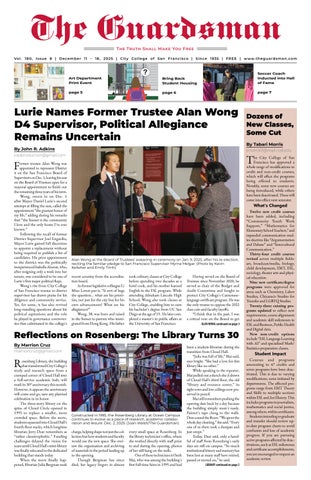
The Guardsman The Truth Shall Make You Free
Vol. 1 8 0, I ssue 8 | D e cem b er 1 1 – 1 8 , 2025 | City Colleg e of San Fran c is co | Sin ce 1935 | F R EE | www.th e gua rdsma n .co m
Art Department Print Event
Bring Back Student Housing
Soccer Coach Inducted into Hall of Fame
page 5
page 6
page 7
Lurie Names Former Trustee Alan Wong D4 Supervisor, Political Allegiance Remains Uncertain
Dozens of New Classes, Some Cut
By John R. Adkins
tmorri47@mail.ccsf.edu
jradproduction@gmail.com
T
he City College of San Francisco has approved a whole range of modifications to credit and non-credit courses, which will affect the programs being offered to students. Notably, some new courses are being introduced, while others have been deactivated. These will come into effect next semester.
F
ormer trustee Alan Wong was appointed to represent District 4 on the San Francisco Board of Supervisors on Dec. 1, leaving his seat on the Board of Trustees open for a mayoral appointment to finish out the remaining three years of his term. Wong, sworn in on Dec. 1 after Mayor Daniel Lurie's second attempt at filling the seat, called the appointment “the greatest honor of my life,” adding during his remarks that “the Sunset is the community I love and the only home I've ever known.” Following the recall of former District Supervisor Joel Engardio, Mayor Lurie gained full discretion to appoint a replacement without being required to publish a list of candidates. His prior appointment to the district was the politically inexperienced Isabella Alcaraz, who, after resigning only a week into her tenure, was considered to be one of Lurie's first major political flops. Wong's rise from City College of San Francisco trustee to district supervisor has drawn praise for his diligence and community service. Yet, for some, it has also revived long-standing questions about his political aspirations and the role he played in governance controversies that culminated in the college's
What's Changed
Alan Wong at the Board of Trustees' swearing-in ceremony on Jan. 9, 2025, after his re-election, reciting the familiar pledge to San Francisco Supervisor Myrna Melgar. (Photo by Kevin Kelleher and Emily Trinh)
recent scrutiny from the accreditation board. As former legislative colleague Li Miao Lovett put it, “It sort of begs the question… what are his priorities, not just for the city but for his own advancement? What are his allegiances?” Wong, 38, was born and raised in the Sunset to parents who immigrated from Hong Kong. His father
took culinary classes at City College before spending two decades as a hotel cook, and his mother learned English in the ESL program. While attending Abraham Lincoln High School, Wong also took classes at City College, enabling him to earn his bachelor's degree from UC San Diego at the age of 19. He later completed a master's in public affairs at the University of San Francisco.
Having served on the Board of Trustees since November 2020, he served as chair of the Budget and Audit Committee and fought to protect City College's Cantoneselanguage certificate program. He was the only trustee to oppose the 2022 class cuts and faculty layoffs. “I think that in the past, I was a critical vote on the Board to get ALAN WONG continued on page 3
Reflections on Rosenberg: The Library Turns 30 By Marrion Cruz marrioncruz@gmail.com
R
osenberg Library, the building that transformed City College's study and research space from a cramped corner of Cloud Hall into a full-service academic hub, will mark its 30th anniversary this month. However, it appears the anniversary will come and go, sans any planned celebration in its honor. The three-story library on the spine of Cloud Circle opened in 1995 to replace a smaller, more crowded space. Before the move, students squeezed into Cloud Hall's fourth-floor stacks, which longtime librarian Jerry Dear remembers as “rather claustrophobic.” Funding challenges delayed the vision for years until Cloud Hall's mini-library was finally relocated to the dedicated building that stands today. When the move finally happened, librarian Julia Bergman took
By Tabari Morris
Constructed in 1995, the Rosenberg Library at Ocean Campus continues to evolve as a place of research, academic collaboration and leisure. Dec. 2, 2025. (Joan Walsh/The Guardsman)
charge, helping shape not just the collection but how students and faculty would use the new space. She oversaw the organization and archiving of materials in the period leading up to the opening. Though Bergman has since died, her legacy lingers in almost
every small space at Rosenberg. In the library technician's office, where she worked directly with staff prior to and during the opening, photos of her still hang on the walls. One of those technicians is Oanh Mai, who was among the building's first full-time hires in 1995 and had
been a student-librarian during the transition from Cloud Hall. “Julia was full of life,” Mai said, eyes bright. “She had a love for this library like no other.” While speaking to the reporter, Mai pulled out a sketch she'd drawn of Cloud Hall's third floor, the old “library and resource center,” its tight rows and low ceilings now preserved in pencil. Mai still remembers pushing the opening date back by a day because the building simply wasn't ready. Painter's tape clung to the walls. Dust coated the floors. “We spent the whole day cleaning,” she said. “Every one of us there took a dustpan and just swept.” Today, Dear said, only a handful of staff from Rosenberg's early days are still on campus. “So much institutional history and memory has been lost as many staff have retired, passed or moved on,” he said. LIBRARY continued on page 2
Twelve new credit courses have been added, including “Community Youth Work Support,” “Mathematics for Elementary School Teachers,” and expanded communication studies electives like “Argumentation and Debate” and “Intercultural Communication.” Thirty-four credit courses revised across multiple fields: art, broadcast/media, biology, child development, EMT, ESL, sociology, theater arts and physical education. Nine new certificate/degree programs were approved for areas such as Chemistry, Labor Studies, Chicana/o Studies for Transfer and LGBTQ Studies. Twenty-three existing programs updated to reflect new requirements, course alignments and academic skill milestones in ESL and Business, Public Health and Digital Arts. New non-credit options include “ESL Language Learning with AI” and specialized Math/ Statistics preparation classes.
Student Impact
Courses and programs amounting to 47 credits and seven programs have been deactivated. This is due to varying modifications, some initiated by departments. The affected programs range from EMT Theory and Skills to multiple sections within ESL and Art History. This includes programs in journalism, mathematics and social justice, among others, within certificates. Students intending to graduate and transfer should review upto-date program charts to avoid confusion and loss of academic progress. If you are pursuing active programs affected by deactivations, such as ESL milestones and certificate accomplishments, you are encouraged to request an academic review.
2 | NEWS Staff
Vol. 180, Issue 8 | December 11 – 18, 2025
LIBRARY continued from page 1
Editor-in-Chief John Adkins News Editor Tabari Morris Culture Editor Abby Sigler Op-Ed Editor Henry Crowell Sports Editor Lloyd Cobb Social Media Editor Abby Sigler Photo Editor Isaac Ortiz Copy Editor John Adkins Writers Ahmad Aimaq Karla Lopes Lev Farris Goldenberg Marrion Cruz Qi Mai Raeghan Green Samantha Palma Victoria Capree Photographers Bob Kinoshita Gibson Cain Karim Farahat Maria Krylova Illustrator Cindy Chan Graphic Designers Cindy Chan Sebastien Thugnet Tiffany Lam Advisor Juan Gonzales jagonzal@ccsf.edu
Contact us
TheGuardsman.com info@theguardsman.com 415-239-3446
Mailing Address 50 Frida Kahlo Way, Box V-67 San Francisco, CA 94112 Bungalow 615
Follow us @TheGuardsmanCCSF @TheGuardsmanCCSF @TheGuardsman @TheGuardsman For even more articles, stay up to date at www.theguardsman.com
Join The Guardsman! Contact Juan Gonzales at 415-517-4426.
Namesake The building bears the name of Claude Rosenberg, a San Francisco philanthropist who chose to give away a large share of his fortune to public institutions. His gift to City College allowed students to learn, research and read in a space designed for them. After selling Rosenberg Capital Management that same year, he devoted himself to philanthropy, later telling SFGATE, “The people that need their name attached to everything they do are in need of a psychiatrist.” His children, Linda and Douglas, continue his civic legacy via their own philanthropy in the Bay Area and across the country.
More Than Books Rosenberg Library's construction was part of a broader expansion in the '90s that added the Media Center, Audiovisual Center, Language Lab and Learning Assistance Center, formalizing the building as a comprehensive academic resource rather
than a room full of books. In 2003, the vision was recognized with an Association of College and Research Libraries award. Today, the library houses a tutoring center, English and media labs, and a variety of study spaces, from dark, quiet lounges to bright, open areas lit by large windows. A recent change in library hours reflects the growing demands of students after the pandemic, yet still there are always students lingering until the last possible minute when the lights start to flicker. For Chad Stephenson, head of the Library & Learning Resources Center, Rosenberg is also a personal landmark. He first enrolled at City College in the fall of 1996. “It was like getting a brand new gift,” he said, recalling walking into the building for the first time and taking classes in what is now the defunct Media Center. At the time, he was also taking Japanese at Mission High School and had to “come back here to the library to ‘punch in' after I finished a [Japanese] cassette,” he said. “We don't have that anymore, but the room is still upstairs.”
“When I was a student, the librarians were teaching the students in person, in classes here,” Stephenson said, noting that the library's instructional role predated later formal agreements between SFUSD and City College that helped shape adult education. On the main floor, librarian Anthony Costa curates the library archives in Rosenberg Room 315. He fields routine requests for course catalogs as well as more personal ones. “Sometimes we get inquiries for things that we don't have, like a copy of an Associate's degree from 1967,” he said with a laugh. There are now only 15 fulltime librarians across the entire City College campus. In the archives on the bottom floor, management has just fallen onto whoever is willing to try to pitch in. Costa does what he can to maintain college records in the archives. Without a central leader like former librarian Christopher Cox, who “wore many library hats,” Costa said there is no single staff member with the same breadth of institutional knowledge. He noted that the budget
includes funding for a “full-time equivalent” staff member, but it is not yet clear whether that will be split among multiple part-time employees or filled by a single fulltime role. Before the pandemic, the library had 26 full-time librarians. Beyond staffing, the physical space is also due for changes. The library will need to be “re-jiggered” to meet ADA requirements in the coming years, Stephenson said as he walked through the top level. “We have to remove things and adjust to buy new furniture… like the fourth floor, that's ADA compliant.” For students who have only ever known Rosenberg as the main library, the 30th anniversary may look like just another date on the calendar. For those who remember Cloud Hall's cramped shelves, the “founding librarians” and the long wait for funding, the milestone marks the moment when a longpromised library finally became the heart of campus and stayed there. Costa agrees: 30th birthday cake for the Rosenberg Library is “a good idea,” and he plans to bring it up with the department chair.
ARTX Building to Receive Smart Classroom Upgrades After Long Shutdown By Danielle Flores dflore67@mail.ccsf.edu
C
lassrooms on the top floor of the Creative Arts Extension (ARTX) building, which have been largely vacant since the coronavirus pandemic, may be reopened and upgraded to smart classrooms, according to the Associate Vice Chancellor of Facilities and Capital Planning, Alberto Vasquez. The years of vacancy are a result of unresolved issues with the building's electrical and heating systems. Vasquez confirmed that IT will be involved in the smart classroom technology upgrades, with plans to update the general classrooms on both the top and bottom floors. The plan is to model the classrooms after the technology in STEAM 102 and 104 (but on a smaller scale due to the size of the ARTX classrooms). A smart classroom includes overall technology upgrades, as well as a “faculty station” with a desk that can be raised and lowered, HDMI connections, a console to turn on the projector and a document scanner, similar to the old overhead projector but digital. The document scanners are identified by their reddish tops and are currently referred to as “ladybugs.” According to Vasquez, this upgrade would not include the rooms in the Broadcast Electronic Media Arts Department (BEMA) that are located on the bottom floor, due to them being “functionally different.” When the ARTX general classrooms went offline, Vasquez said the classes were spread to different locations, wherever classrooms were available. He said the second floor of the Student Health Center (HC), the 800 Bungalows at the Judson Village Bungalows (JDVL), and possibly the Creative Arts (ART) building received some classes. Vasquez said they are upgrading
The upper level of the Creative Arts Extension has been closed since 2020 and is waiting on further upgrades before reopening. (Photo illustration by John Adkins)
the classrooms to increase demand and usage. The classrooms went offline during the coronavirus pandemic. When students returned to campus and the ARTX classrooms reopened, heat could not be delivered to the classrooms because the building's boiler was out. “The heating project is looking to be completed at the end of this year. They're working on it now. It's fenced off. The good news is there will be heating available this spring,” Vasquez said. In addition to the heating issues, there have also been electrical problems at ARTX. “We had an emergency board item to allow us to contract a vendor to bring a generator and start investigating the issue with it. We ended up replacing almost the entire electrical system in the electrical room,” Vasquez said. Once Vasquez and his team found they had the problem and that it could not be solved internally, they got the generator so BEMA could
have their instruction happen. Currently, BEMA is the only department that has classes at ARTX. When asked whether BEMA was affected by the electrical problems and the heating system going down, BEMA Department Chair Malcolm Cecil confirmed that the department has its own independent heating and cooling system due to the unique needs of its equipment. Cecil said the electrical issues led to at least four or five shutdowns for the department, during which power was interrupted entirely, including the time the generator was installed. Cecil said that all of BEMA's tech staff had to unplug all of the recording devices and equipment in the studios whenever there was a shutdown. “By the time the fourth or fifth time rolled around, they were pretty fed up with having to go through every lab and unplug everything,” Cecil said. Cecil explained that some of the equipment has specific shutdown routines, and a lot of their devices
had to go through a “turn off and then turn on protocol.” “What you don't want is to have a big surge of power blast into the equipment, which is why they unplugged it all. But I'm not sure they unplugged every time it happened, which is risky. With professional equipment, you shouldn't mess with the power,” Cecil said. At some point, the generator company recommended replacing the generators due to frequent power outages, according to an email Cecil received on Nov. 27, 2024. When asked about the electrical shutdowns, Vasquez confirmed there was a glitch in the first generator. The first generator needed repairs, and they ended up swapping it out with another generator. The generator was a temporary measure to keep BEMA operational until the electrical room project was completed in Spring 2025. Since becoming chair in July, Cecil has not seen any more electrical issues. BEMA shares a grant, administered by the Mayor's Office, in which they have two educational access cable television channels on the Comcast cable system, channels 27 and 75. Content is primarily purchased by BEMA and broadcast via antennas located in the building. “When we lose power, those channels just cut out,” Cecil said. Susan Boeckmann, a classified professional in the broadcast department, said that, in addition to power issues, there was a prior problem with the sliding doors not closing. Vasquez said the sliding doors are problematic and that ARTX plans to replace all sliding doors with operable, regular-swing doors, similar to those at Smith Hall. This will be alongside their next fall target plans of upgrading to smart classrooms. “I think it's great that the college is modernizing its teaching spaces,” Cecil said. “It would be nice to have more life here in the building.”
NEWS | 3
Vol. 180, Issue 8 | December 11 – 18, 2025
ALAN WONG continued from page 1
things done one way or another,” Wong said. Wong is a first lieutenant in the California National Guard, and helped draft the city's landmark Free City tuition program, which made City College tuition-free for San Francisco residents. Last year, he advocated against the reduction of the Free City program after former Mayor London Breed's budget proposed ongoing reductions in funding. Lovett worked alongside Wong in former Supervisor Gordon Mar's office from mid-2020 to late-2022.
Construction Alert: Balboa Reservoir Project Closes Major Parking By Tabari Morris tmorri47@mail.ccsf.edu
W
ork on the development at the Balboa Reservoir officially broke ground on Monday, Nov. 17 — and the effects of the construction are being felt at Ocean Campus, with more than 140 parking spaces being blocked out near the location of the Harry Britt Building.
What's Happening • About 90 parking spaces were closed along the east side of Lee Avenue, next to the Harry Britt Building. • Two fenced areas west of the Harry Britt Building are offlimits, blocking an additional 55 parking spots for construction work (Nov. 17-25). • Parking lot north of the STEAM Building? Now enter and exit using North Access Road — the Lee Avenue driveway is closed.
What You Should Do • Allow extra time to find a parking spot or catch public transit. • Consider alternatives like BART (Balboa Park) and Muni lines J, K, M, 8, 49, 29, 43 and 91. • Respect all fencing and construction zones — they're off-limits until the project wraps.
Why This Matters This marks the beginning of a significant shift. The Balboa Reservoir Project will affect the campus boundaries and parking availability over the next few years due to the construction of new housing and retail space right next to Ocean Campus by the city of San Francisco. Our college will do its best to keep you informed of the changes, yet parking availability will remain tight until the completion of the project. Stay informed: Watch your City College email for more updates from the Facilities Office — especially as work moves near classrooms or other campus pathways.
She remembers joining the team during the pandemic with the understanding that she would assume several major policy areas Wong had been managing. “I never really got enough of a transition,” she said. “I just never really got that sort of support in trying to do the work I was trying to do.” The office dynamics were unusual: staff turnover left Wong briefly shifted into an administrative aide role — what Lovett characterized as “a demotion” that she felt “was probably not great,” especially as he was running for City College Board that same year. She said the workload was unrelenting for all staff “you're putting in these backbreaking hours”, and while she described Wong as “really smart and really diligent,” she added that “some of that diligence went to other things,” including his National Guard service. “We're talking about going to fight wildfires. He'd come back after 16-hour days. And then where's the remaining energy?” Lovett said she didn't doubt his capacity, only whether he was “pulling fully with the team.” She recalls Wong checking in with her in 2024 about endorsement votes he mistakenly believed she still held as a City College faculty member. “He really was keen to make sure he had the AFT 2121 endorsement,” she said. “You have to be consistent in how your policies translate into outcomes.” That consistency is exactly what some faculty and labor leaders have questioned. Wong's record with AFT 2121 is mixed but notable. As union president Mary Bravewoman described it, “He did
Alan Wong at San Francisco City Hall, filing paperwork to run for a position on the City College of San Francisco Board of Trustees for the first time on Jan. 14, 2020. (Franchon Smith/The Guardsman)
show up for faculty in some key spots.” She points to 2022, when Wong was the only trustee to vote against faculty layoffs, and to 2023, when he urged trustees to participate directly in contract mediation. Yet even Bravewoman frames his engagement partly as political calculation. “I think that his seeking of AFT's endorsements in the past certainly has been strategic, just like anyone seeking an elected office would.” And despite her respect for his contributions, she emphasized her unease at his departure: “The fact that he just got re-elected to our board a year ago… that's the part that surprises me.” His actions on behalf of the faculty became entangled in a larger controversy. In January 2024,
the Accrediting Commission for Community and Junior Colleges issued a formal “warning” to City College, citing trustee interference in administrative matters and irregularities related to fiscal oversight. “Our most recent accreditation review pegged a misbehaving Board as the only 3 of 178 standards we did not meet,” Political scientist and City College professor Louis Schubert said No guessing which individuals were involved.” Schubert, who has studied community college governance for decades, described the City College Board more broadly as “the lowest hanging fruit for the politically ambitious.” Board of Trustees President Anita Martinez defended Wong's work ethic, emphasizing that “he did his work on the college board,” even when National Guard duty pulled him away at times. She praised his resolution supporting the Green New Deal for City College and his successful statewide advocacy for Lunar New Year recognition. “It appears to me that many individuals who run for and serve on either the school board or the City College Board of Trustees may have political ambitions, and I have no problem with that,” Martinez said. “As long as they do the work while they're on that board. And that's what I found to be true with Alan.” Trustee Louis Zamora called Wong's move to the Board of Supervisors “a logical step,” but noted that the appointment also leaves the board once again subject to a mayoral pick, something unique among California community colleges.
At the swearing-in ceremony, he emphasized housing affordability, saying he grew up sharing an ADU with family and dreams of owning a Sunset home. He warned that if San Francisco fails to propose its own solutions to state mandates, “Sacramento will dictate zoning for us and we will lose local control,” committing to work on legislation to address community concerns over the Family Zoning Plan. He also listed education, public safety, clean neighborhoods, and reducing bureaucratic barriers for small businesses among his top priorities and confirmed that he intends to run for a full term.
“It sort of begs the question… what are his priorities, not just for the city but for his own advancement? What are his allegiances?” Li Miao Lovett
Wong's Former Colleague
Wong's record shows loyalty to faculty unions, neighborhood groups, political mentors and state regulatory bodies. Yet, it remains to be seen how his strategic positioning as District 4 supervisor will continue to evolve. “It wouldn't be the first time somebody changes their allegiances,” Lovett said.
So Cose, Yet So Far: Why Students Stop Short of Graduation By Gibson Cain gibsoncain@icloud.com
A
recent national study found that many community college students drop out of school, even when they are close to finishing their coursework. At City College of San Francisco, student interviews suggest that the trend may be occurring here as well, driven by academic pressure, personal challenges and uncertainty about the future. The reasons students leave vary, but one thing is clear: the problem is visible to those who walk the campus halls. While official City College data for the past five years was not immediately available, students say they have seen the cycle play out repeatedly. Classrooms that start full in the early weeks of the semester gradually thin out. Group projects suddenly lose participants. Names disappear from online discussion boards. Many report that classmates struggle to balance coursework with jobs, commutes, family responsibilities and the rising cost of living, pressures that often lead to burnout long before graduation day. City College student Noah Ross, 19, says he has personally felt the strain of staying enrolled. “Yes, I've thought about quitting,” Ross said. “Having lots of homework on top of an already heavy load of classwork in classes like discrete math” made him consider stepping away. Ross says he also knows
classmates who have already given up on finishing their programs, often due to logistical issues unrelated to academic ability. “Some couldn't keep commuting to CCSF for their morning classes,” he explained. “People are academically challenged and lose the drive to come to school every class period.” His comments reflect a broader pattern. Students who juggle long commutes — particularly across the Bay Area's unreliable transit infrastructure — say that one missed train can turn into a missed class, and one missed class becomes many. Those working two jobs to support themselves often find it impossible to keep up with demanding course loads. Others face mental-health challenges or feel isolated in their academic journey. When asked whether City College provides enough support to help students stay enrolled, Ross was unsure whether the college could solve every barrier. “Students don't always want to reach out,” he said, pointing to the difficulty some students face when asking for help. Still, he offered one suggestion he believes could make a difference: “Incentivize students with career pathways.” For many community college students, the connection between coursework and future employment is not always clear. Without a strong sense of where their education is leading, students say it becomes
easier to question whether the sacrifices are worth it. Another student, Jackson Teitel, 20, shared Ross's experience. He, too, has considered giving up before finishing his program. “Yes, I have, I was given too much homework,” Teitel said. The volume and pace of assignments, he explained, sometimes felt overwhelming alongside his personal obligations.
For many, the cost of living in San Francisco creates a constant financial strain that education can't always compete with. Teitel says he doesn't personally know classmates who have dropped out, but he recognizes the pressures that push students away. “Students may find it hard to afford living expenses while also having to put time into academics,” he said. For many, the cost of living in San Francisco creates a constant financial strain that education can't always compete with. While Teitel believes City College offers a reasonable level of support, he notes that support alone cannot resolve the deeper challenges. “People struggle on a personal level,” he said. Mental health, uncertainty
and stress often compound, leaving school feeling like one burden too many. In his view, students who leave near the end of their programs often do so because of uncertainty about what comes next. “Maybe they are unsure of their future, especially career-wise,” Teitel said. Without confidence in a clear career direction, some students feel little motivation to finish the final stretch of their programs. City College students face pressure not just academically, but also emotionally, financially and logistically. Even those close to earning a degree may feel overwhelmed, unsupported or unsure of their direction. The reasons are rarely simple, and often they overlap. As City College continues its efforts to improve retention, student perspectives highlight the importance of support that extends beyond academics — including clearer career pathways, mental health resources, flexible scheduling options and campus services that address the real-life pressures facing community college students. If the national trend holds true locally, understanding why students leave before finishing may be the first step toward helping more of them stay. By listening to student voices, the college can identify what keeps its students going and what causes them to slip silently away before they can cross the finish line.
4 | CULTURE
Vol. 180, Issue 8 | December 11 – 18, 2025
The Struggle Is Real: The Life of an International Student By Karla Lopes kcarval7@mail.ccsf.edu
P
acking your life into a 50-pound suitcase to start over in a new country is difficult, but for international students, it's hardly their greatest challenge. They arrive carrying their dreams, fears and the courage to face the challenges of living in a foreign country. Some of them must build a life from scratch, while striving for academic success and future opportunities. The United States has been attracting international students for decades, who now make up 4.5% of the nation's higher education population. According to data released by the Open Doors Organization, responsible for the annual nationwide count of international students, there were 63,922 international students enrolled in Associate's Colleges in 2024-25, a 7.8% increase compared to last year. City College of San Francisco now hosts about 400 international students, a significant decrease compared to the 1,400 in pre-pandemic years. “The pandemic was one of the major reasons, but the current Donald Trump administration immigration policies are also contributing to the enrollment downturn,” explained Tuan Uyeda of the Office of International Programs (OIP). Although international student numbers have decreased, their presence continues to enrich City College's community with their diverse cultural backgrounds. They represent many countries, with the largest numbers currently coming from Myanmar, Mexico, Colombia, China, Japan, South Korea and Thailand. Business, Marketing, and Computer Science are among the top three choices for international students, who also maintain a strong academic performance. “Most international students perform better than domestic students; their majority GPA is 3.0 or higher,” Uyeda shared. Students from overseas pursue higher education for a variety of reasons. “City College attracted me because of the beauty of San Francisco and the good English program they offer for international students,” said Nicolás Rodríguez, a Computer Science major from Colombia. Gender Studies and Social Work major Jing Shi is from China and has been an international student for 13 years. Shi was attracted by the opportunities of meeting like-minded people, and cultivating community in San Francisco. As a social worker and mental health advocate, Shi wants to contribute by sharing resources and knowledge. “I come to college, not only to gain education, but also to give. That's why I am committed to building safe student organizations on campus for people to connect and get support,” Shi said. Beyond the shared experience of moving to another country with the desire for a degree, international students also face the struggles that come with holding an F1 visa status, which includes strict regulations. Paying higher tuition fees, maintaining health
insurance, and only working with approved authorization under limited conditions can be overwhelming. According to Uyeda, tuition prices have increased dramatically over the years due to inflation. What once cost international students around $2,700 for the required minimum of 12 units in 2011 now exceeds $5,000 per semester. “The college would have a higher tuition fee due to inflation and San Francisco cost of living,” Uyeda said, “but is giving lower prices to not affect students.” Veronica Lopez, a Psychology major from Mexico, pursued the Special Education certificate because of past experiences. Lopez chose City College mainly because its tuition is lower than that of other Bay Area colleges, yet the cost is still difficult to manage. “We pay a lot of money as international students, and sometimes it is very hard to manage your budget,” Lopez said. “Besides college, we still need to pay for housing, food and transportation.” “I had to save money, so I went through food insecurity,” Shi shared. Isolation from community, distance from family, not knowing what resources are available, and living in a climate that can feel threatening to immigrants were also highlighted as concerns. “The political environment has been a little threatening for immigrants. Even though I've done everything correctly, I still feel scared to go out, and I feel afraid of speaking in my native language in public,” Lopez said. Shi has been contributing to the International Students Union at City College, a group formed this fall as a means to build community among international students. Although City College already provides resources, like campus job opportunities, tutoring/orientation services and “keeping the OIP doors always open,” students believe that more could still be done. Shi highlighted that OIP has been slow to connect with the International Students Union and hopes to see more support from them. Rodríguez shared that although the OIP has been very helpful, he still thinks that more Optional Practical Training (OPT) and Curricular Practical Training (CPT) should be provided to make it easier for international students to access internships. Lopez expressed that the college should add more course sections for required classes. “It is hard to keep up with my educational plan when classes are not available.” Despite their many challenges, international students are united by their desire to achieve career success that higher education can unlock. “My goal is to start working in the field of Special Education soon,” said Lopez. Rodríguez aims to transfer to a 4-year university to pursue a Bachelor's in Computer Science. “My dream is to get into a big tech company, like Google, and later make a meaningful change in the tech world with my own company,” he said.
The on-campus pool that students have acess to if they choose to take a swimming class. Dec. 5, 2025. (Karim Farahat/The Guardsman)
Shake Up Your Schedule With These Guardsman Picks By Karim Farahat karimfarahat0823@gmail.com
R
egistration for the Spring semester has commenced, and once again, the course catalog is live and ready to be turned over. Prospective students, however, may have to dig a little deeper if they are to go beyond the required courses for their degree. Scattered throughout that mighty tome are hidden gems that could lead to new hobbies, new friends, or a whole new you. If you're looking for novel experiences next semester, start here.
Craft Your Own Jewelry Art 180A brings students into the world of design and fabrication craftsmanship behind jewelry and metal arts, blending technical skill with personal expression. In this studio class, students work hands-on with specialized equipment like torches, soldering irons and polishing tools. Due to its popularity, the class tends to fill up within days of registration opening. If you're interested, it's worth emailing the instructor early or showing up to the first meeting in person to secure a spot.
Learn a Language City College of San Francisco offers a variety of language classes for everyone, from beginners who haven't yet dared to speak a word of their desired language to more advanced speakers aiming toward fluency. The World Languages and Culture department offers classes in American Sign Language, Chinese, French, German, Italian, Japanese, Russian and Spanish. “Learning a language at CCSF gives students a genuine human connection and cultural depth that no app can match. Our language classes offer real interaction with fluent speakers and an authentic understanding of the communities and traditions behind each language. Together, this creates a meaningful learning experience rooted in people, culture, and lived practice,” says Perer DeHaas, an ASL instructor.
Get in Shape College is great for strengthening the brain, but it can also be a place to build some muscle. City College offers a wide range of physical education classes that meet students wherever they are. You can build cardio and endurance in a running and fitness course, learn practical self-defense through judo or jiu-jitsu, or choose a slower, more grounding practice like yoga or tai chi. These classes offer structured training, supportive instructors and a built-in community of people working toward similar goals, making them an accessible way to stay active during the semester.
Master the Guitar One of several instrument courses being offered at City College is Classical Guitar. This course is offered for all skill levels, from MUS 6A for beginners to MUS 6D for more advanced guitarists. Each of the four levels is taught by the renowned Pascal Thiam, the father of the AfroBlueGrazz band, and a recipient of the Jim Hall Jazz Master Award from Berklee College of Music and the Outstanding Jazz Soloist Award from Dizzy Gillespie and James Moody. “Playing instruments and singing lays down grey matter in the brain that relates to other situations, and you are more capable in other things. It's a double win. You not only benefit by learning the instrument, but you also get smarter,” says Madeline Mueller, the Music Department Chair.
Join the Newspaper Join the team that brings news to campus and produces City College's bi-weekly print newspaper. The newsroom offers unending opportunities, whether you're a designer, photographer, writer, social media expert, illustrator or just a particularly opinionated person. Whoever you are, we'd love to have you!
CULTURE | 5
Vol. 180, Issue 8 | December 11 – 18, 2025
A Legacy in Color: Art Print Event Celebrates Former Department Chair By Daniela Villegas dvilleg4@mail.ccsf.edu
C
ity College of San Francisco held its 3rd annual Autumn Print Adoption and Donation event from Nov. 17 to Dec. 3. Proceeds from the prints purchased went toward the Anna Asebedo scholarship. The hall buzzed with excitement in STEAM 103, where the event featured a collection of art from current and past students in the printmaking class taught by Anthony Ryan. The class engages students with the printmaking process, techniques and basic etching skills. The event has been a success over the past two years, raising a considerable amount of money for the scholarship, which was a tribute to a former Art Department chair and printmaking professor at the college. Asebedo was an influential figure during her time at City College and did whatever she could to give back to the community. In 2023, Asebedo held a retirement art exhibition where she featured work from the span of her 30-year career, and all the proceeds from the show went into creating what is now called the Anna Asebedo scholarship. The scholarship is meant to support students in the printmaking program and serves as a symbol of her everlasting support for the art department and its students. Two students are selected from the department, each of whom is awarded $250 to help with their education. It is currently only given during the spring semester. Esther M., a student in the art department and worker at the event, says she enjoys working there, talking with people about the various artworks and pitching the program she is so passionate about. Esther pointed out some of her favorite prints that included a piece named “Suffered Enough.” The piece depicts Rosa Parks, people fleeing and close-ups of people painted in harsh light and dark contrasts. Walking into the room, you're confronted by hundreds of prints hung all over the walls with different shapes, colors and techniques. Your eyes don't know which one to look at first. Stacks of prints were arranged across the tables, where people spent up to an hour searching for their favorite. For many, it was their first time at this event, and it was evident in their curiosity that lit up upon entering the gallery. Although the room remained mostly silent as eventgoers were mesmerized by the prints, attendees could feel the creative energy in the air, punctuated by the occasional question to Esther. She always seemed to have the answer. To entice the crowds, the art department offers a complimentary print of any size. Department Chair Stephanie Robison expressed the importance of the college celebrating art as well as education, and to try to get more people involved who might not have had the right opportunities or resources growing up. “We have the privilege to provide art for people who can't normally afford collectible art, as well as raise money for the wonderful Anna Asebedo scholarship,” she said.
Student looking through the collection. Nov. 25, 2025. (Joan Walsh/The Guardsman)
Above: Art showcased on the wall at the art gallery. Nov. 25, 2025. (Joan Walsh/The Guardsman)
Events Calendar Dec. 7 - Dec. 20 Sunday, Dec. 7
Thursday, Dec. 11
13th Annual Festival of the Moving Image 12:30 p.m. - 2:30 p.m. | The Roxie
CCSF Holiday Celebration 4 p.m. - 7 p.m. | Smith Hall Cafeteria
Tuesday, Dec. 9
CCSF Retiree Art Show Closing Celebration 5 p.m. - 8 p.m. | Chinatown/North Beach Center
Data Science Speaker: Measuring Discrimination in Police Stops 3:30 p.m. - 4:30 p.m. | STEAM 101 Fall Jazz Concert 7 p.m. | HBB 140
Winter Chorale Concert 5:30 p.m. | Rosenberg Library, 2nd Floor Atrium
Wednesday, Dec. 10
Friday, Dec. 12
SFO STEM Internships 4 p.m. | Zoom
Fort Mason Night Market 4 p.m. - 9 p.m. | Fort Mason Center
Thursday, Dec. 11
Sunday, Dec. 14
SFSU School of Engineering Visit 9:30 a.m. - 2:30 p.m. | SFSU Campus
Annual Bernal Heights Holiday Fair 11 a.m. - 4 p.m. | Bernal Heights Library
Holiday Plant Sale 11 a.m. - 2 p.m. | Horticulture Center, Ocean Campus
Friday, Dec. 19
Movie Night! Film Screening “Lilo & Stitch” 1 p.m. - 3 p.m. | SSC 2122
Women's Basketball vs. LA Valley 5 p.m. | Wellness Center
Art tee shirts for sale, with proceeds going to the gallery and art department. Nov. 25, 2025. (Joan Walsh/The Guardsman)
Join Our Award-Winning Newspaper Gain Experience, Get Published We are looking for • Writers • Photographers • Illustrators • Designers
For more info, contact Juan at 415-517-4426
6 | OPINION
Vol. 180, Issue 8 | December 11 – 18, 2025
CCSF Once Provided Housing For Students, Now It's Time They Brought It Back By Franchon Smith fsmith13@mail.ccsf.edu
T
Illustration by Cindy Chan
his is the 90th anniversary of our school and yes, while we have a lot to celebrate, I think one of the important things that we have to remember is that when the school was founded, the circumstances were different for students and their living situation. Today, we're in dire need of housing for students, faculty and staff alike. I'm disheartened by the board of trustees' lack of support over the years for the push for student housing. City College of San Francisco students, faculty and staff need housing provided by the school NOW. Ocean Campus once had student housing, both where the STEAM building and Creative Arts building are, respectively. But even when we had student housing, students' needs still exceeded what the school could offer. Fast forward to today, and the housing needs of the campus community have grown exponentially, with no solution so much as whispered. Students are living in vehicles, and some students are homeless. It would be a great idea to have emergency housing as an option. Traditional dorms are fine; however, there are other options that can be explored, with emergency housing being one of them. The Ocean Campus has the space to do this. There have been many studies done regarding students and housing, and the positive effect that it has on their grades, being close to resources, and so forth. It also needs to be mentioned that housing would bring jobs and revenue for the school, provided that it is handled correctly. How would we pay for it? Bond measures. That's how we paid for the three new buildings along Frida Kahlo Way, and I don't see why it can't be done again.
One of the obvious benefits of students living on campus would be saving time and money on transportation. As I previously mentioned, on-campus housing doesn't have to be traditional dorm-style. It can be tailored to what our campus community needs. As an example, Imperial Valley College, located in Imperial, California, east of San Diego, created the Lotus Living Tiny Homes for formerly-homeless and housing-insecure students. It was funded through a variety of sources, including a $58.6 million bond, known as Measure L, passed in 2004, and the $80 million Measure J, approved in 2010. I have often wondered why past and present Board of Trustees members, and especially the mayors of the City and County of San Francisco, do not want, or have not considered, the possibility of housing. Our campus community deserves housing just as much as the University of San Francisco, San Francisco State University and any other school with dormitories. City College has been part of San Francisco since 1935. The benefits of this are numerous. With the housing crisis going on in our city and the Bay Area, it only makes sense to offer housing as a means to the path to success. Of the 116 California community colleges, only 16 offer housing, and of those 16, two are in the Bay Area: Santa Rosa Junior College and Napa Valley College. City College should be one of these colleges. The Guardsman newspaper has written countless stories about housing in general and how it affects our students. It would be nice to have an article about the opening day of the dormitories on Ocean Campus before our celebration of the college's 100th anniversary.
A Story of Gentrification in San Francisco By Marrion Cruz mcruz88@mail.ccsf.edu
I
grew up in a building whose front door opened straight onto Stockton Street, just shy of the tunnel at the seam of Chinatown and whatever was left of the city my parents recognized. They have been here for three decades; my grandparents, longer. From our narrow lobby, you could see the Ross on one side and the tunnel on the other, a loud mouth carved into the city. The tunnel inhaled buses, transients and grandparents walking grandchildren home from school on a daily basis. When I was little,
I thought the white marble hotel above it was where the president lived. Later, I learned it was just for the rich and affluent. A neon-pink sign glared above the tunnel's mouth: “QUITE THROUGH TUNNEL.” I noticed the misspelling first, then the buzzing that never stopped, not even at 3 a.m., when the city shrank down to wind, and the highpitched whine of street-cleaning trucks would grind up Bush Street. Already, a collision of old and new was the San Francisco I grew up in. From the outside, it's easy to flatten that movement into a simple story. In 2020, San Francisco was crowned as “the most gentrified U.S.
city,” linking the Mission's murals and Fillmore's jazz clubs to a familiar set of villains: tech boom, luxury condos, rising rents. But researchers mapping neighborhood change in the Bay Area say the geography of that story is more uneven. A UC Berkeley/Urban Displacement Project map estimates that around 161,000 low-income households live in areas at risk of, or already gentrifying, but that close to three times as many census tracts are either already exclusive to higher-income residents or at risk of becoming that way. Gentrification gets the headlines; long-standing patterns of exclusion quietly shape who gets to move into
“good” neighborhoods at all. My parents never left and are now getting ready to retire to the Philippines. They own land, a small lot, cars and two houses in two cities. My mom shrugs and says, “We already made it back home,” when people ask whether she is worried about San Francisco's future. That is one face of gentrification that rarely gets talked about: immigrants who arrived poor, squeezed into overcrowded housing and quietly turned wages from hotel and retail jobs into property back in the homeland, even as debate about “gentrifiers” swirled around them. So when I walk along Mission Street in the Excelsior and see new storefronts between Silver and Ocean, I do not just see “gentrification.” I see another chapter in the same story: an older cafe where workers have gone for years before catching the bus across town, and a newer coffee shop down the street that hosted Sunday pop-ups during the pandemic, drawing lines for cinnamon rolls that sold out before noon. For the
older shop, the pandemic meant its commuters vanished overnight. The regulars who used to come in at 6:30 a.m. were suddenly working from home, if they still had jobs at all. It is tempting to cast one business as the villain and the other as the victim. But feminist geographer Leslie Kern has argued, in The Guardian and later in Fast Company, that coffee shops and boutiques are not the real culprits; closing them will not stop gentrification. The deeper story is about who owns buildings, who can raise rents and who has the power to decide which communities are worth preserving. Gentrification, in this view, is what happens when land, housing and small businesses are forced to carry the weight of global inequality, immigration, student debt, tourism and the simple human desire for a better life, all at once. Change is inevitable; justice is not. To many longtime residents, gentrification here feels like losing not just apartments, but the cultures that made San Francisco feel like a cultural mecca in the first place. When I step off the bus and walk through the tunnel with my son, I still look up at that neon sign telling everyone to “QUIET THROUGH TUNNEL,” a silent correction in its original thought. It's buzzing hums over the bus engines, now electric. The city, as usual, corrects itself while telling people to be quiet. Gentrification is loud. The people who have lived here the longest have every right to be louder.
Illustration by Cindy Chan
SPORTS | 7
Vol. 180, Issue 8 | December 11 – 18, 2025
Women's Soccer Head Coach Inducted Into Sacred Heart's Athletic Hall of Fame By Kyra Young kyrajyoung@gmail.com
W
omen's Soccer Head Coach Jeff Wilson is always looking to find his edge — not only for himself as a coach, but for his players. “I'm always going to do my best when a player comes here to help develop women to be the best person, not just a player, but the best person they can become,” Wilson said. Having led so many athletes with the same integrity and discipline that make up his philosophy, a Hall of Fame induction was inevitable. At Sacred Heart Cathedral's Athletics Hall of Fame ceremony on Oct. 18, Wilson was honored for his decades of dedication to the success of young men and women on and off the field in the Bay Area. At 22 years old, he stepped into an opportunity that would not only develop into a passion but also become a part of who he was for the next 30 years. Wilson took on an assistant coaching position at San Francisco State University the year after his college playing career. After that season, with winter around the corner, he was informed that SHC's men's varsity soccer team needed a coach. After his first season in 1996, Wilson returned to coach the SHC varsity boys team from 1998-2017, leading the Irish to five Central Coast Section finals appearances and four championships. He also taught and counseled at SHC for 19 years. In 2016, he once again returned to the college level — this time as head coach for women's soccer at City College of San Francisco. In his nine years with the Rams, the team has earned four Coast Conference League Titles, repeatedly closed the
season ranked in the National Top 20 and qualified for the CCCAA playoffs every season. In 2024, the Rams reached the Final Four and finished the season ranked fourth in the nation. Wilson himself has earned multiple Coach of the Year honors in his career. All the while, he has helped over 40 student-athletes transfer to play in the NCAA division, with seven All-Americans, four Scholar All-Americans and a National Scholar-Athlete of the Year all coming out of City College.
“The reason why I keep pushing is that I just see a different level in somebody, and I want them to just work to their fullest potential.” Jeff Wilson
Women's Soccer Head Coach
Paige Pineda-Aliamus, who played under Wilson's guidance for two years, went on to play for San Jose State University in the 2025 season. She earned a number of accolades in her time with the Rams, including being named to the United States Soccer All-America First Team and nominated as the Coast-North Conference's Player of the Year in 2024. “Coach Jeff was one of the best coaches I ever had,” Pineda-Aliamus said. “He cared for everyone on his team, not just as a player, but as a person. I feel very privileged to have had two years with him as a coach.” Maleah Evans, who played with the Rams from 2020-22, went on
to play at the Division 1 level with South Dakota State University. She originally intended on attending City College for a year. After her first season with Wilson, Evans admitted she was devastated at the realization that City College could not be where she finishes her soccer career. “I think that's just a testament to the culture Jeff creates and the people he brings in, how intentional he is with every single player, how he gets to know us, our stories, what makes us tick and how to coach us best,” Evans said. “Jeff is someone that I owe my entire college soccer career and post soccer career to. He has shaped me into the person and the player that I am. I cannot say enough amazing things about him.” Aside from athletic performance, Pineda-Aliamus and Evans emphasized Wilson's dedication to the team's academic success. He would help every individual get in contact with tutors and make himself available to read over their essays. “Jeff was the first person to engrain confidence in me in school,” Evans said. According to Wilson, teaching and counseling have many parallels with coaching that he believes have only helped him become a more wellrounded coach. Wilson found himself back on the field at SHC in 2021 with the girls' varsity soccer team, juggling SHC in the winter and City College in the fall. Despite the brief overlap in competition, Wilson says he finds a way to ensure balance amidst the chaos. “I'll learn to relax at some point,” he said. Surrounded by competition almost year-round, Wilson's own competitive nature guides him in his guidance of others. From men
Women's Soccer Head Coach Jeff Wilson talks through a drill while at practice on Thursday. Nov. 6, 2025 (Kyra Young/The Guardsman)
to women, high schoolers to college students, or the field to his daily life, his philosophy does not stray. “I think I'm somebody that asks players to push past their comfort zone, and I think part of that is understanding you've got to be audacious enough to really put yourself out there and push yourself, but humble enough to know that there's still work to do,” Wilson said. “And I think that's part of it — somebody who really believes in their players and will just keep pushing. The reason why I keep pushing is that I just see a different level in somebody, and I want them to just work to their fullest potential.” For Wilson, teaching his players
the importance of dedication has become fundamental to his coaching, pushing him to find his edge and make his team more confident and resilient. He aims for his players to take pride in the Rams legacy they are a part of and in what they helped create. As for the induction, Wilson says the entire experience has been humbling. “I was the only non-Sacred Heart grad to be inducted that night. Although I didn't graduate from there, it was such an influential institution in helping me become who I am today,” he said. Sacred Heart is a nationally renowned high school, and Wilson's name is now part of its 175-year history.
Rams' 17-Game Undefeated Streak Ends at the Regional Finals By Karim Farahat karim.farahat0823@gmail.com
T
he No. 3-seeded Rams began their playoff run with a convincing 5-0 win against No. 19 Reedley, followed by a 3-0 victory against No. 6 Cosumnes River College. A day prior to their opening playoff game, team captain and starting left back Catherine Cordova Bobadilla tore her ACL, marking a massive loss for the rest of the season. While her injury forced her off the field during the most crucial time of the season, her presence and leadership as captain continued to play a vital role in the Rams' playoff push. “She's the heartbeat of our program and at the center of everything that we do,” said Head Coach Jeff Wilson. “She brings energy, loosens the mood and makes people laugh. The team is definitely ready to rally for her.” Wilson praised his team, saying that they had built a sense of family that made it all worthwhile. “Playoffs are such a crucial time, but no matter what, they make it easy to show up
because of the amount of laughter and joy that they bring,” he said. Their opening playoff game versus No. 19 Reedley was a resounding 5-0 victory with five different scorers. The Rams dominated possession, scoring three goals in the opening 18 minutes and controlling the game thereafter. “I know that with such a long season, it's normal for there to be burnout and injuries, so showing up for your team no matter what situation you're in means a lot to these girls,” said Cordova Bobadilla. “We're in a really good spot to hopefully win States, and I want the girls to play like it's their last game because I know how far these girls can go.” In the next round versus the No. 6-seeded Cosumnes River College, the Hawks dominated possession for the first 20 minutes and put on lots of offensive pressure. Other than a few nervy moments and an offside goal that did not count, Cosumnes River's sustained pressure was to no avail. City College was clinical with its chances and closed the half with two goals, putting them
Rams Forward Abigael Zennadi (left) drives against Cosumnes River player during the third round of the 3C2A Women's NorCal Regional Playoffs in San Francisco on Tuesday, Nov. 25, 2025. (Bob Kinoshita/The Guardsman)
in a comfortable position. Forward Chemnui Simpson scored a penalty late in the first half, followed by a goal on the counterattack by forward Abigael Zennadi, giving the Rams a 2-0 lead at halftime. The Cosumnes River Hawks came out in the second half with
nothing to lose and pushed to balance the game. Again, their sustained pressure did not translate onto the scoreboard, and the Rams were able to counterattack in the final phase and put the game out of reach. The win secured a 17-game win streak before heading to the
NorCal Regional Final, where they suffered their first loss against the No. 2-seeded Sierra College. After six straight shutout games, the Rams conceded the first goal of their playoff run in the first half by Sierra's Olivia Sisto. The Wolverines controlled the game, taking 7 shots on goal to the Rams' 2. In the second half, Rams midfielder Luz Hernandez scored to tie the game, only minutes before the Wolverines reclaimed the lead, bringing the final score to 2-1. The Rams close the 2025 season with an overall 17-3-2 record, with a conference record of 10-0-1 and a handful of athletic honors. Cordova Bobadilla, Hernandez, Simpson, Perales, Kalea Dwelle, Sydney Grundland-Lanuza and Roisin Glynn were all named to the First-Team All-Conference. Zennadi, Ashley Rabara, D'Zeena Grewal and Nelzy Dominguez were named to the Second-Team All Conference, while Nuria Lopez Adorno and Anahi Gomez received honorable mentions.
SPORTS | 8
Vol. 180, Issue 8 | December 11 – 18, 2025
Rams WR Imari Conley (17) gains yards after a catch with WR Zakarri Black (13) as a blocker leading the way during the playoffs against Fresno City College in San Francisco on Saturday, Nov. 11, 2025. (Bob Kinoshita/The Guardsman)
Ram vs. Ram Showdown: Fresno City Takes Down City College in NorCal Quarterfinals
C
ity College of San Francisco's 2025 football season came to a crushing but hard-fought close on Saturday, Nov. 11, as the Rams fell 56-38 to Fresno City College in a 1,000-yard shootout at George M. Rush Stadium. Their 7-4 record for the season earned them a share of the Bay 6 League championship after fumbling their opportunity for a playoff appearance last year.
Left: Rams QB Darius Clark-James (3) scrambles to throw to an open receiver during the playoffs against Fresno City College in San Francisco, on Saturday, Nov. 11, 2025. ClarkJames threw for 357 yards and 2 TDs. He also ran for 142 yards and 3 TDs. (Bob Kinoshita/ The Guardsman) Right: Rams WR Isaiah Kesihk (right) catches a pass from QB Darius Clark-James for a touchdown during the playoffs against Fresno City College in San Francisco, on Saturday, Nov. 11, 2025. Kesihk caught a game-high 10 passes for 228 yards. (Bob Kinoshita/The Guardsman)
Darius Clark-James Wins Offensive Player of the Year
C
ity College of San Francisco's return to the playoffs this fall was led by freshman Quarterback Darius Clark-James, who was voted the Bay 6 League Offensive Player of the Year and was a unanimous selection for the league's first-team quarterback. Clark-James passed 2,504 yards and 17 touchdowns in just 10 regular-season games. Proving he was not afraid to think with his feet, the quarterback acquired 483 rushing yards and 6 TDs. Clark-James was one of 12 City College players to be recognized by the All-Bay 6 League's First-Team honors. Cheeves, Nash and Conley were also unanimous selections for the league. First-Team Offense Darius Clark-James, QB Jeremiah Nash, WR Imari Conley, All-Purpose Frankie Petuya, OL Tony Perez, OL Honorable Mention Bradley Amsden, DL
First-Team Defense Kalique Cheeves, DB Bryce Heckard, DB Kahanu Kalahiki, DB Sonny Vitale, LB Mwandishe Adams, DL Kam Bizer, DL
Eduardo Nuño Named Coach of the Year
C
losing out an impressive 2025 regular season, Head Coach Eduardo Nuño was awarded the All-Bay 6 League Coach of the Year. He shares the title with Diablo Valley College's Head Coach Jimmy Collins. In only his second season with the Rams, Nuño has led the team back to the Northern California Regional Playoffs. He found City College of San Francisco football at a low point. After last season had already begun, the former coach left for another team, taking some of the City College players with him. Nuño joined as interim coach after the team had been decimated in numbers, and the Rams started the 2024 season with a five-game losing streak. Unfazed and determined, Nuño brought the Rams back up with a determined fire, leading the team right back where they belonged: the All-Bay 6 championships, closing their playoff run with a 4-1 league record. Right: Head Coach Eduardo NuÑo as he walks onto the field before the football game against Fresno City College on Nov. 11, 2025. (Bob Kinoshita/The Guardsman)