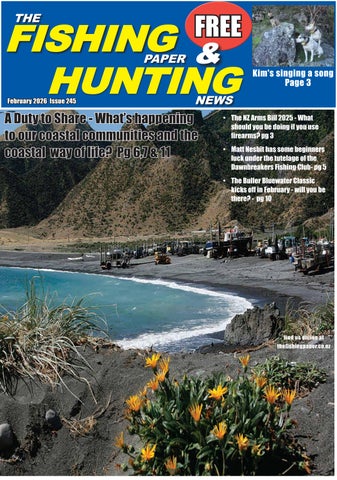
February 2026 - 245 The Fishing Paper and Hunting News
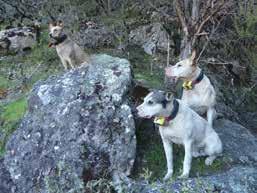
singing a song Page 3
• The NZ Arms Bill 2025 - What should you be doing if you use firearms? pg 3
• Matt Nesbit has some beginners luck under the tutelage of the Dawnbreakers Fishing Club- pg 5
• The Buller Bluewater Classic kicks off in February - will you be there? - pg 10
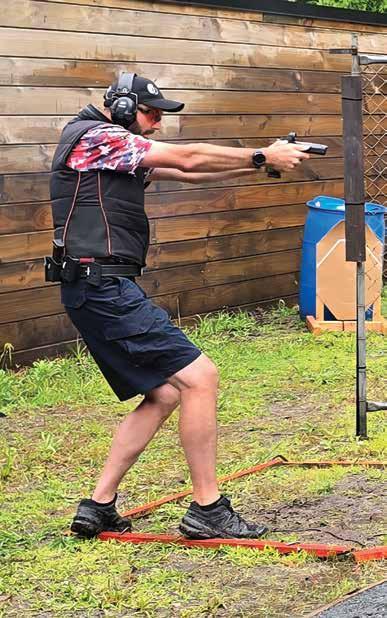
I’ve been missing my shots of late. I’d blame my rifle scope, but truth be told, the problem lies directly with me. As a shooter I go through phases - sometimes I’m Annie Oakley - sometimes I’m Aint Likely.
During the Aint Likely phase, I flinch and pull my shots – badly. Awareness is the first step towards self-improvement.
To this morning, and my first harvest opportunity is awkward. A standing shot, in terrible light. My target, a red hind, is aware I’m here and watches me, intrigued. Only when my bullet shatters a rock immediately to her right does she forgo her ticket and bolt out the back door – clown show over – for her and for me.
I continue, frustrated. Hoping against hope that another animal has not heard the wayward shot and that I might get another opportunity. It isn’t over till the fat lady sings, right?
Yeah, nah. Further on I feel a wind shift. That tiny tickle on the nape that deals a bitter blow.
Stubborn, and perhaps a bit stupid, I stalk on.
Several corners later there’s a back. A broad brown back, a hundred metres away and just o the track, so I crumple into the dust before rearranging myself and my kit.
Ready!
I peer through the scope, heart racing, certain that another backwash of breeze will alert the deer to my presence. Sure enough, it flings its head high and looks all about.
Me and Aint Likely begin a serious discussion – I tell her that she can feck right o – but she is tenacious, and with tentacles far-reaching. Satisfied that there’s nought to fear in his environment, the deer, a large red stag, resumes feeding. No urgency then. A welcome moment to compose my body and my thoughts - to regulate my breathing - to focus. And, when the opportunity presents itself, to shoot like Annie. Sending a teeny tiny
projectile to do its handiwork.
Aorta severed and heart deprived of blood, the stag bolts for the nearest cover, which happens to be the scrub-skirted creek. Here he tumbles over the bank and into the waterway, thrashing and splashing momentarily before coming to rest.
Kim Swan
retrieval options.
On my return the sun and the temperature had risen, and my brain was not alone in its buzzing. A swarm of blowflies, all of which had suicidal tendencies, buzz both me and Big Red. Once I behead him and open his gut cavity I’ll have
Like a limbo dancer Big Red has gone as low as he can go. To retrieve him now, the only way is up, up and away.
Shrug. Sigh. These things are sent to try us. ‘Us’ being me. Me being alone and significantly smaller than my expired prey laying in his watery resting place.
Buoyed by a squirt of adrenaline and a misguided sense of purpose, I decide that I will get Red outta there intact if I can - he must be removed from the waterway anyways so why not go whole hog. Why not indeed!
A thorough site inspection includes a re-introduction to another of my imaginary friends, Highly Unlikely. She’s Aint Likely’s big sister, and she’s got attitude. Undeterred, I walk back to my distant ute, my brain abuzz with
The Fishing Paper & Hunting News
Editor: editor@thefishingpaper.co.nz
Sub-Editor: Mike Brown
All Enquiries: Nicola Morris 0224 503 403
admin@thefishingpaper.co.nz
Printer: Inkwise
Advertising Enquiries:
Lynda Balfour North Island
Lynda@thefishingpaper.co.nz 027 710 1510
Phil Claude South Island
Phil@thefishingpaper.co.nz 021 242 4202
Of course it was never going to be that easy. The stag is big. The gutter is steep and narrow. Twine frays and pops. Straps snap. But, like the flies, I will not give up. I heave and wrestle and relocate Big Red in the gutter. I reapply, re-tie and re-hook. Then, not so gently, pull. Again, and again till we’re gaining metres and traction. The win, when it comes, is bittersweet, for the mission is only halfway done.
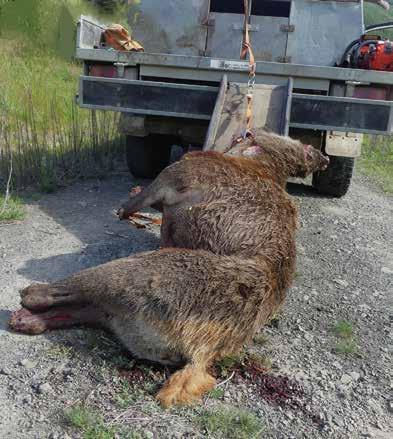
Stage two is the transition from dragging to lifting. The stag, a floppy deadweight of more than one hundred kilos and laying at ground level, will not be coming home till he’s on the back of my ute. The height di erential will entail more grunting, more wrestling and more cunning tricks before I succeed.
The trusty dog ramp, an aid in my shifting and lifting e orts, only holds for long enough to give me false hope. Bony forequarters are inbound before it buckles – ‘stag overboard!’ - and I lose the lot. Back to ground zero but now with less energy, less conviction and Highly Unlikely taunting and teasing.
to hurry, or they’ll be dropping eggs faster than I can keep them at bay.
With a halo of blowies and boots full of water, I tug the stag downstream centimetre by centimetre. My piggin’ string is tight about his oesophagus, his body trailing behind. Every slippery rock is an impediment, every pool a win. To a game animal crossing where generations of deer have worn a gutter deep into the bank and there’s minimal vegetation barring the exit.
Here, I set the stag up then reverse my ute as close as I dare. I lay out every piece of baling twine, every dog lead and strap –all knotted or hooked together. A straight pull from stag to tow ball –engage low gear, idle forward, gently does it.
I trade centimetres for millimetres. Tiny mini-wins, each of them in the right direction – upward.
Hindered by the tow ball, then the tailgate, I jump o the deck to clear the obstructions, then clamber back to heave and lift.
I’m smiling despite the skin o my hands, the sweat in my eyes and the halo of infuriating flies. Smiling because I am slowly, ever so slowly, winning.
Only my imaginary friends and I know the war I have waged. It has been brutal and demanding but, more importantly, I’ve put both Aint Likely and Highly Unlikely in their proper place – behind me.
I brace my shoulder under Big Red and give one final heave, job done, mission accomplished. Then it’s goodbye to a thousand flies, and, with the company of my ute radio, this fat lady may possibly sing.
If you shop with any of our advertisers PLEASE make sure you mention that you heard about them or saw their advert in The Fishing Paper and Hunting News either the hard copy or online version. We rely on advertising revenue to print and distribute the paper ; to pay the writers and proofreader / editor and to cover the online costs . We all know times are tight with business and advertising is always one of the first costs to be cut - so please support those who pay our bills and let them know why you are supporting them.
New Zealand's Arms Bill 2025
The firearm bill is out and needs our attention by 16 February 2026.
There are some good wins in it, not as many as we wanted, but that was always going to be the case.
We asked for a lot and Minister McKee and ACT understand where we are coming from and understand firearms and those who use them. The real problem is that National and NZ First do not, and to be honest, I am not convinced they even tried. In the end, it came down to negotiations, and from my point of view there were two known major issues.
First, getting the other two parties to actually listen and admit they were wrong to back the 2019 ban. We all know they are not very good at admitting mistakes.
Second, licence holders did not turn out in the numbers we should have during the last submission round. The number of people who took the time to submit was disappointing.
Politicians think in votes; that is all it is about and whether they want to get back into Parliament. We didn’t do our part to show how many of us there are or that we cared enough.
On top of that, there have been some poor comments and personal attacks from people who should have known better, like kids throwing tantrums because they didn’t get what they wanted. That helps no one.
There are positives in this bill. Removing the FSA from Police is a good move. Their mindset is
focused on crime and criminals, and they have consistently treated licence holders as if we are the same as their usual crowd. That is plainly wrong. This change should be better for everyone and will free Police up to do actual police work. The changes to dealer licensing and how businesses operate will also help. It will reduce wasted time and unnecessary annual relicensing. No other industry has been restricted in this way, and this will benefit both businesses and their customers.
I am not going to tell you what the pros and cons are, that is up to you to read and decide. But I do expect you to read the bill and make a submission, outlining your opinion, state what you want changed, your reasons for
New Zealand's Arms Bill 2025 Editor's Notes
Like a lot of New Zealand families, we grew up with firearms in the household. As kids we had it drummed into us about firearm safety, "guns not being toys" and so forth.
Dad's 303 was in a special cupboard and the bolt and ammunition were stored elsewhere. (Don't tell Dad but we knew where!).
Safety was paramount though! I have had friends die in firearms accidents and a good friend was one of the first responders at Port Arthur, Tasmania after the massacre. Being involved for most of my career in agriculture firearms are a necessary farm tool.
So I have my views on firearms, how we use them, how we store them and how we buy them.
So I will make a submission on the Arms Bill 2025, because it is important that I have the chance to state my views. Make sure you have your say!
Summary
New Zealand's Arms Bill 2025, introduced in late 2025, aims to replace the Arms Act 1983 with significant reforms, creating an independent Firearms Regulator, banning gang members from licensing, clarifying storage rules for renters, simplifying club regulations, and increasing penalties for o enses, focusing on public safety while easing burdens for responsible owners. Key changes include new o ences for 3D-printed firearms and straw purchasing, establishing a Firearms Licensing Review Committee, and giving dealers five-year business licenses.
Objectives
• Strengthen public safety and reduce firearms o ending.
this, make suggestions around how it could be improved and also acknowledge the good points that you like as this bill needs support.
This bill needs support. The antifirearms crowd will do everything they can to sink it and make things worse for us. If you choose not to help this bill and ACT by making a submission, then you are e ectively helping them. Please note if more than one submission from the same household, you need to use di erent email addresses as only one will count. Please do your part.
• Reduce regulatory burdens on legitimate firearms owners.
• Improve compliance and close legal loopholes.
Status
The bill was introduced to Parliament in late 2025, following extensive public consultation earlier in the year. For full details, you can visit the New Zealand Legislation website and the Ministry of Justice website.
Key Changes Introduced by the Bill Independent Regulator: Establishes a new Firearms Regulatory Agency, separate from the Police, with its own chief executive.
Gang Disqualification: Gang membership automatically disqualifies individuals from holding a firearms license.
Storage Flexibility:
Allows secure firearm storage at any approved location, not just primary residences, benefiting renters and students.
Simplified Club Rules: Creates di erent, simpler regulations for non-pistol shooting clubs and ranges.
New O ences: Introduces o ences for 3D-printed firearmrelated crimes and straw purchasing.
Enhanced Penalties: Increases penalties for over 60 existing firearms o enses.
Business Licenses: Renames dealer licenses to "business licenses" and extends their term to five years for compliant businesses.
Review Committee:
Establishes an independent Firearms Licensing Review Committee to handle license appeals.
New Caledonia, the land of Rusa deer
Lets put the bow in my travel case ready for my trip in a few days.
With Covid and the uprising they had in Noumea, no one was permitted to hunt or buy ammunition. It only became available two weeks prior to our arrival last August.
The deer numbers had increased massively compared to my last visit in 2019. Having more deer means more eyes when I’m trying to get close enough for a bow shot. With the contour of the land being quite hilly and right on the coast, the wind is swirly and unpredictable. I got busted so many times in the first four days, but every time was so exciting, I loved it.
I was sneaking along a grassy track wide enough for a vehicle to travel, with thick shrubs, paperbark gum trees and tall grass up to my shoulders on either side of me. This beautiful six point stag just casually stepped out of the trees about 50 metres in front of me. Our eyes locked onto each other at the same time, not sure who got the bigger surprise. He spun on his back feet and shot back into the trees. WOW that was close and exciting. So cool. I was looking to see where he went. Then he steps out again, broadside, staring straight at me like he had never seen a human before. His antlers were glowing orange in the last sun of the day from the trees he had been rubbing on. Expecting him to explode o again, I soaked a few seconds up just enjoying his presence. Then I thought, he’s still there! Maybe I can get a shot at him. Slowly lifting the rangefinder, 48 metres, click my release aid onto my string, draw the bow back, he’s still there. Twang, o goes the pointy stick. The stag drops to the ground while spinning his body and disappearing into the trees. Sailing over his shoulder my arrow lodged into the base of a young paperbark tree. Man these deer are as fast as a fallow, unbelievable. I was grinning from ear to ear after that experience. Out came the fold-up pruning saw to retrieve my arrow. The next day I borrowed a rifle so I could get some antlers to take home and some meat for my friends. By 10am I had a fantastic stag on the ground at 200yards from where I was sitting, stoked. On my last day I had the morning to hunt before we left the block. My New Caledonian friend wanted to come with me to experience a bow hunt.
Heavy rain had fallen through the night, so it was neat to see a cracker sunrise and clear sky for the start of the day. Stags were everywhere, roaring, chasing hinds, chasing each other. It was nuts! How to get close to a good stag, that’s the dilemma. We crept into a gap in some bushy trees growing in a wide drain. Some hinds had spotted our movement but didn’t
sound an alarm call, just stood there staring in our direction from about 70 metres. From the right, a huge stag with an extra tine (Rusa usually have six points) came walking to the hinds. He didn’t seem bothered by them standing on guard looking towards us. He started feeding beside the hinds. He was 67 metres away, broadside and no possible way for us to get
Kelby Stewart
closer. I clipped the release aid on and waited for him to step his front leg forward to expose his vitals better. Ten minutes later he finally shifted his leg. Twang, my eyes locked onto the flight of the arrow, yes, yes, yes it’s going to connect. Bugger, he swung his head and shoulders out of the way and the arrow flew past his chest into the tall grass never to be seen again. Still stags were going nuts all around us. We stalked towards the next closest stag about 100 metres away. I guessed we were about 30-40 metres away from where I last saw him, so I crawled out from under the bushy trees we were sneaking through. A hind barked about 25 metres away in the tall grass in front of me. All I could see were her ears. I had to look around the side a bushy tree to get a view of where the stag had been. After the bark I expected the stag to be gone. The hind was still there, watching me. On my knees I peered around the tree, yes the stag had ghosted away. But two young stags were standing in his place. That’ll do.
Range 32 metres.
Release on.
Lean out on my knees. Twang, and again the stag jumps. But not fast enough. The arrow goes into his side almost up to the fletch’s.
Yes! Finally got one. The tall grass swallowed him up within a couple of yards, so I had no idea where he had run. There were deer crashing in all directions. And still there were stags roaring in the cover 50 metres away.
My friend and I were overwhelmed with the achievement of getting an arrow into a stag. He said ‘I have never experienced being so close to so many deer in all my years of hunting here, thank you, thank you, I will never forget this hunt’. We walked back to the house and had a co ee. Then went to search for the stag. No blood! Too many footprints! We searched in circles with no luck.
Two days later my friend messaged me to say he had two tools his nose and a machete to look for my stag. He found it straight away, lying 60 metres away from where I shot him in the tall grass. We had walked right past him and didn’t see him.
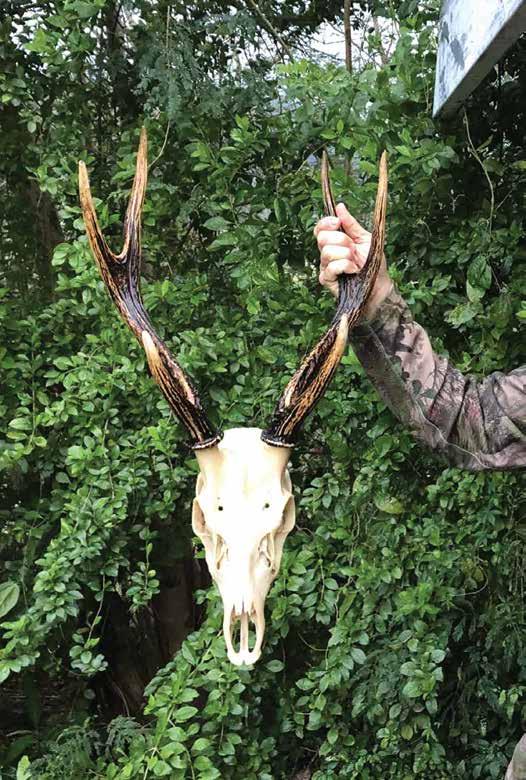
Super stoked to have the head brought back to NZ by another friend who went over a few weeks after me.
All I’ve ever done is fish.
Beginner's Luck Matt Nesbit
Two years ago, I left the states, seeking a future in New Zealand for my family. Now, we have found our place. Why is it our place? The people.
The Dawnbreakers Fishing Club is a shining example of wonderful people.
The snapper of the bay are one of the many reasons I moved here. I have basically dedicated the last decade of my life to fishing 4-6” softbaits. I thought that I would fish my dream New Zealand fishery the way I wanted, and this year I finally had a boat.
I found I had been extremely lucky in previous e orts in 2024 o a jet-ski with softbaits and jigs…
Early November found everybody catching fish and me still casting swim-baits 500x a trip. I broke. A berley pot and a trip to Aquafresh and I was ready to fish how everyone had been telling me for two years.
I set out to my favorite spot, where I had spent 30 hours not catching snapper in September / October dropped anchor, berley and bait. Wouldn’t you know it, the
and 20# trace…I’ve fought ‘coudas for 10min in the past. But you can’t compare with the fight from a BIG snapper. Diving over the rail to give line and weaving into and out of my other lines, I got my proverbial absolutely handed to me…this was why I moved here. After a lengthy battle the respectable snapper
I have never been in a place where people are so quick to help and so happy share yarns. Being a know-nothing rookie, a body of water as vast as Tasman Bay is overwhelming. Coming from a life of fishing spots the size of a ute and fishing softbaits at .5 meters a second, it is a big change to fish a flat and “deep” bay. The saving grace in my timid e orts is that Tasman Bay is by far the greatest fishery I have ever seen.
unfortunately 2025 proved to me that it was literally all luck. I spent a half dozen trips in September enjoying less than ideal weather, figuring out what changes needed to be made on the boat and catching exactly zero snapper. Plenty of gurnard, kahawai, ‘coudas and spiny dogs kept me reeling in fish but come 1 November, I still hadn’t felt the bulldog fight that a big snapper deals out, nor had I used berley.
fishing was amazing!! The Kahawai, spiny dogs, ‘coudas and red cod were in abundance. Catching fish is catching fish so I was happy to have the experience. Then it was prime time…slack tide at 10am and my berley gone. I dropped my trusty non fish catching jig in between my two ‘couda rods and WHACK!!!
The fight between a 1m ‘couda and a decent snapper isn’t all that di erent for me…7’ rod, 2500 reel
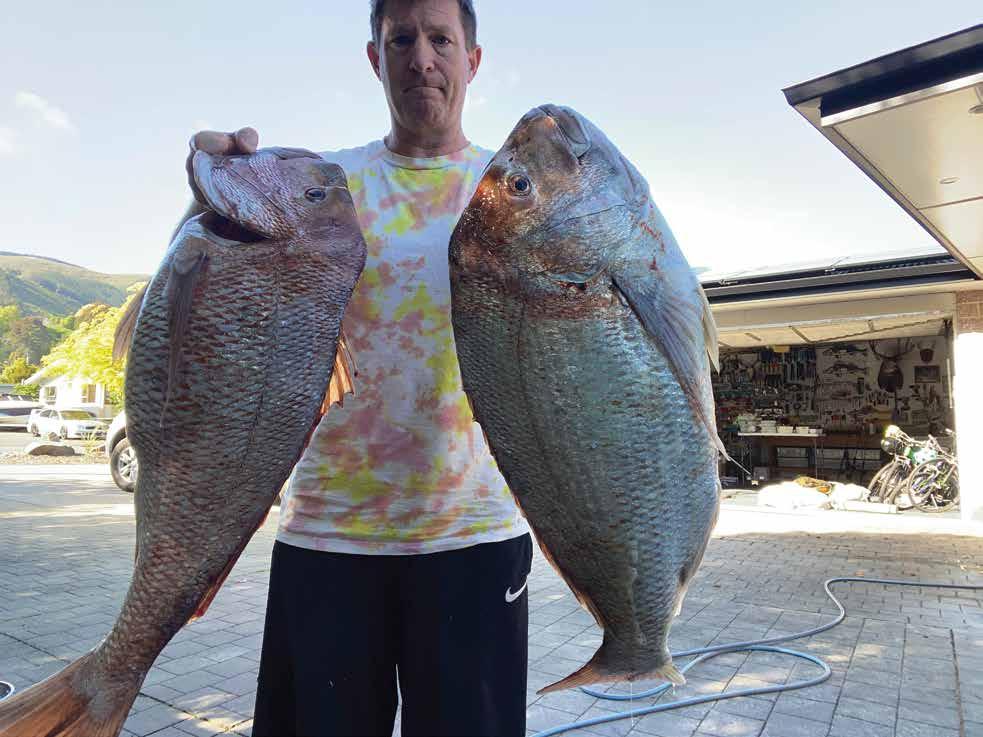
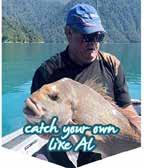
does what they should, surrenders at the surface. 23 pounds and in perfect nick. I Got lucky again. None of this would be possible without the help, encouragement and camaraderie of the Dawnbreakers. I plan on being here for another 40 years, give or take, and I plan to get to know more and more of you by name, see you on the water, help each other, laugh and be content. Cheers to you all.
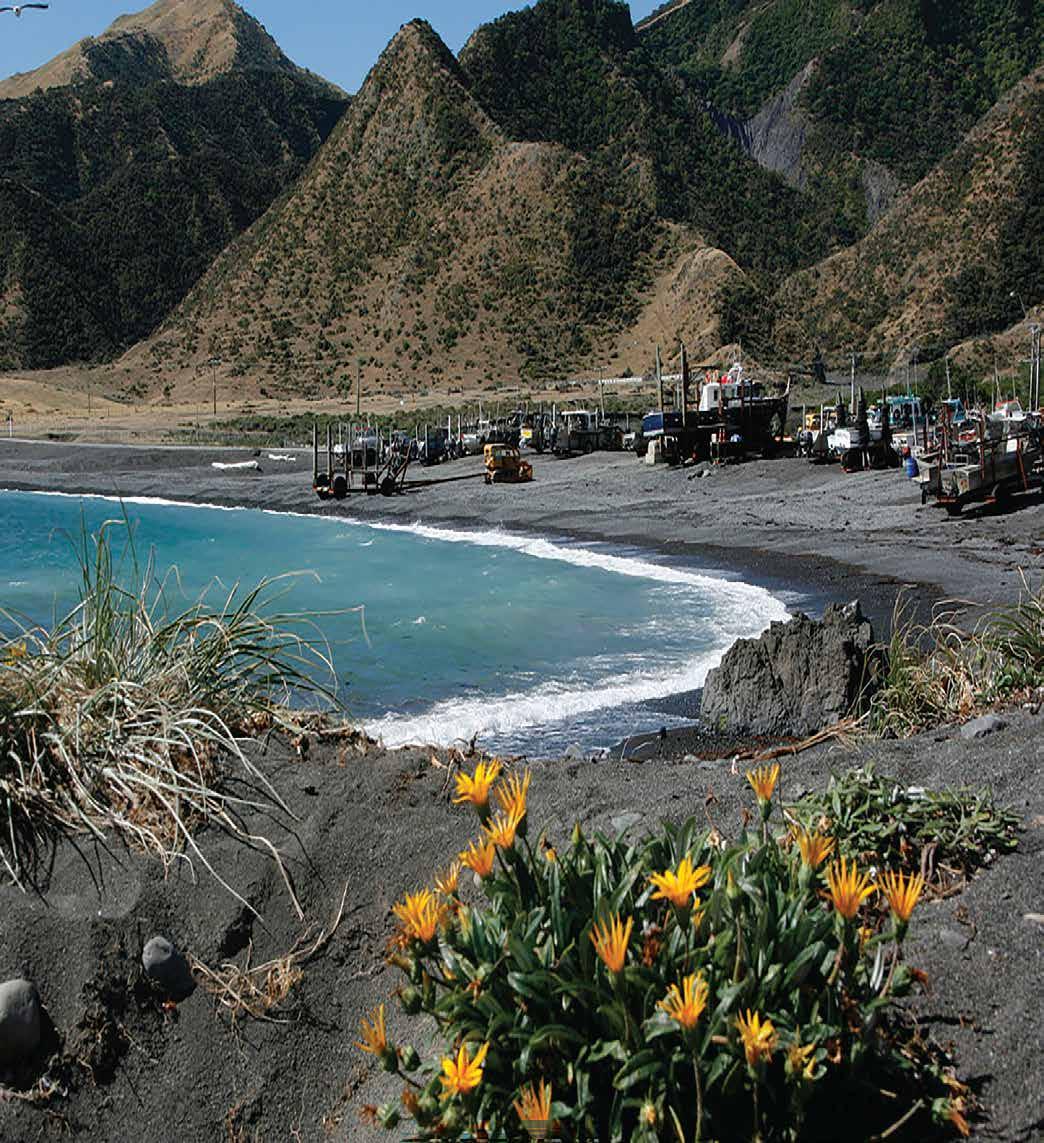
The Duty of Care - A Duty to Share
Industry commentator Daryl Sykes reflects on the underlying health and
Recent Government pronouncements about the future management of the Hauraki Gulf have drawn a sharp focus on the pressure and influence of fishing activities on the marine environment.
Coastal communities and commercial fishers share the same fundamental interest: a healthy, productive sea that can support abundant fish life, good jobs and thriving towns for generations to come.
employment rest.
• Local knowledge and long-term involvement in a fishery as strengths that can help detect changes early and guide practical responses.
• Protection and utilisation as partners: careful use of the sea can support both biodiversity and livelihoods when managed properly.
welfare of coastal communities
• Encouraging voluntary measures, such as catch-spreading or additional closed areas, where local fishers see benefits for stock health and community confidence.
local communities as low as possible.
For coastal communities, this means discussions about protection should start with clear objectives and shared evidence, not with a pre-determined map of where fishing must stop.
Avoiding unintended consequences of closures
The New Zealand Quota Management System (QMS) sits at the heart of that shared goal, giving fishers strong reasons to look after local fisheries and the wider marine environment rather than simply taking as much as possible in the short term. Why environmental care matters locally
For fishing communities, environmental management is not an abstract idea; it is about whether there will still be fish to catch, seafood to process, and export income flowing into local businesses in twenty or thirty years’ time and beyond. If stocks decline or habitats are damaged, the impact is felt first in small ports and coastal towns, through lost income, tied-up boats, and reduced career opportunities for young people. The industry sees:
• Healthy marine ecosystems as the base on which catches, quota values and community
This is why industry representatives state plainly that they support marine protection and view it as essential to their future, not just an obligation imposed from outside.
The industry points out that New Zealand also has extensive marine reserves and benthic protection areas, so when the QMS and these spatial protections are combined, large parts of the marine environment within the EEZ already have some level of safeguard.
Choosing the right tools for local problems
How the QMS supports healthy fisheries
Under the QMS, fishers hold long-term rights to catch a share of each managed stock, rather than racing each other to take as much as possible before someone else does. These rights only retain value if stocks remain abundant and habitats continue to support productive fisheries, so the system builds stewardship into the economics of fishing.
For coastal communities, the QMS contributes to environmental protection by:
• Setting strict total allowable catches and adjusting them if information shows a need to rebuild stocks or act cautiously.
• Allowing fine-scale area and method controls—for example, seasonal closures, gear limits or protection of sensitive seabed— to be used where local risks are identified.
From an industry viewpoint, e ective protection starts with understanding what needs protecting, what it needs protecting from, and what is the best way to do that without unnecessary harm to communities. Sometimes the main issue may be fishing pressure; sometimes it may be land-based runo , climate-driven changes, or multiple activities operating in the same space. The approach the industry advocates is:
• Risk-based: identify which habitats, species or areas are at risk, and from which activities.
• Multi-tool: consider all available options—Fisheries Act measures, spatial closures, gear changes, or other regulations— rather than assuming a marine protected area is always the answer.
• Least-cost: choose the tool that will fix the problem while keeping costs and disruption for
The industry is concerned that if new closed areas are created without careful planning, the result could be more pressure on nearby grounds and less overall benefit for biodiversity and communities. When catch is simply pushed out of one area into another, fishers may end up crowding into smaller spaces, which can heighten local environmental stress and increase conflict between users.
To prevent this, the industry argues that:
• Any new closures a ecting fisheries should be linked to reductions in total catch, so displaced fishing does not just shift, it actually reduces pressure on the stock.
• There should be clear checks to ensure new rules do not unreasonably undermine existing fishing rights that families and businesses have relied on for many years.
• Decisions should take into account cumulative impacts, so multiple small closures do not quietly add up to a large, unmanaged e ect on particular communities or stocks.
The Duty of Care - A Duty to Share
The message to coastal communities is that good design matters: well-planned measures can help both biodiversity and local economies, but poorly planned ones risk doing neither job well.
For local people, re-balancing would mean:
• Cutting catches across the wider fishery by the same amount as is lost inside the new closed area, so fish populations and the health
particular closure is worth it. Working together for long-term marine health
The industry emphasises that good outcomes for the marine environment come from cooperation, not confrontation.
cont
species.
• Use the QMS and other tools in a coordinated way, so that fisheries management and biodiversity protection reinforce each other.
Re-balancing and fairness for communities
The industry proposes a simple principle: if society decides that part of the sea should be closed to fishing to achieve a higher level of protection, then the overall fishing regime should be “rebalanced” so that both the fish stocks and the people who depend on them are not left worse o . This is presented as a fair and practical way to support stronger protection without tearing holes in the QMS or in community livelihoods.
of surrounding grounds are maintained or improved.
• Providing compensation to a ected quota owners where closures reduce the value of their rights, alongside work on how ACE-dependent fishers and crews can adjust their fishing patterns and businesses.
The industry sees this as a way to make environmental choices more honest: when the real costs of a proposal are recognised and addressed, everyone has a clearer basis for deciding whether a
Coastal communities, tangata whenua, recreational fishers, commercial operators and government agencies all depend, in di erent ways, on the same stretches of sea and share a common interest in seeing them flourish.
From the industry’s standpoint, the most promising way forward is to:
• Involve communities early in planning and risk assessment, drawing on both local knowledge and scientific information about habitats and
• Aim for solutions that conserve marine life while keeping coastal communities strong and viable, so that the benefits of the sea continue to flow locally as well as nationally. This perspective o ers a simple message to coastal communities: environmental protection and successful local fisheries can— and must—go hand in hand, and the QMS is designed to help make that possible when used thoughtfully and in partnership with those who live and work by the sea.
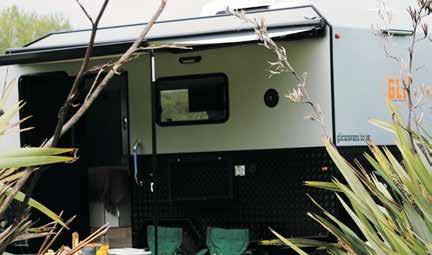
The world's your oyster when you venture out with GLI.
Their range of semi off-road and full off-road caravans and camper trailers means you can escape the maddening crowd and still live with all the creature comforts.
Designed to tackle New Zealand's most rugged environments,loaded with mod cons and backed by over 25 years experience.
Buy a lift top or hard top caravan or a camper trailer and on top of great prices you'll get a *$1000 Hunting and Fishing gift card!
18A Vulcan Place, Middleton,CHRISTCHURCH Open Wed-Sun 10-5
Call Grant on 0272240400 www.glicaravans.co.nz
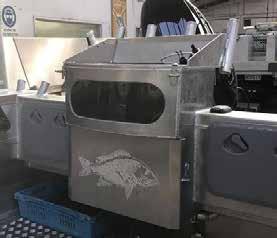
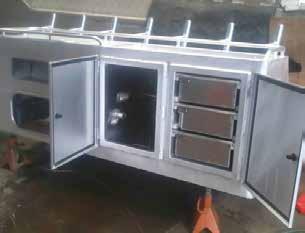
Exceptional Ute & Station Wagon Fit-outs
Whether you’re a skilled tradesperson, a DIY enthusiast, or just a fan of utes, our custom fit-outs are tailor-made to elevate your road transport experience. Our fit-outs not only meet but often exceed expectations in terms of quality and aesthetics.
We take pride in collaborating with you to design the perfect deck or canopy, whether it’s transforming your hand-drawn vision into reality or utilising our cutting-edge SolidWorks design system to bring your ideas to life.
Our fit-out solutions include toolboxes, fold-down sides,
hydraulic lifts, H-frames, slide out drawers and more to make the most of the space in your vehicle. We’re your one-stop solution for all your transportation needs.
Precise fit-outs, even before your Ute Arrives
If you haven’t taken delivery of your ute yet, we can still get to work. With just the make and model information, we can now digitally import the specifications and design the perfect canopy in consultation with you. Our advanced technology allows us to create a vivid image, o ering you a clear preview of the final result. We meticulously check
tolerances to ensure a seamless fit between the body and cab while optimising wheel travel. When your ute finally arrives, we can e ortlessly install the canopy, making your vehicle road-ready in no time.
Rely on Aluminium Excellence
Our fit-outs are crafted from premium aluminium, the ideal material for utes. We utilise heavygauge aluminium to withstand the toughest challenges and work life. Lightweight yet incredibly robust, our fit-outs are built to last and engineered for their intended purpose. Moreover, aluminium is corrosion-resistant, ensuring that your fit-out remains impervious to various loads.
Wagons
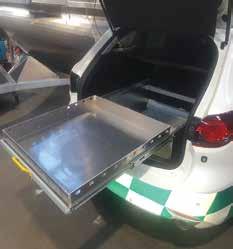
If a custom high quality sliding drawer for your wagon is what you’re after, we can do this for a side or back opening door. We use sturdy, customised parts so your drawer glides with ease, to make the most of hard to reach places. Game changer.
An example we’re very proud of is the drawers in a fleet of ambulance First-Responder utes to make access to key materials easier for paramedics.
Choose our fit-outs to enhance the functionality and durability of your ute. Contact us today to discuss your specific requirements and take your road transport to the next level.
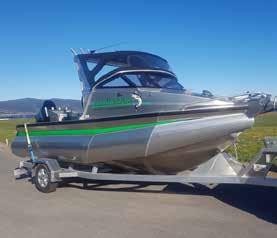
Over 30 years experience working with all types of metals, specialising
•New boat builds
•Custom designs
•Repairs
•Modifications
•Trailers
•Marine projects
Our reputation speaks for itself, and our work consistently exceeds our customers’ expectations visit our website to see more.
The One that didn't get away
After talking to the farmer the plan was set to head out the back and stay in the hut for a couple nights.
We arrived at the hut on Friday afternoon, unpacked and snuck out for an arvo walk.
After a while a wee mob of goats were spotted and the plan was set to sneak in and hopefully shoot one.
After a slow but successful stalk the first goat of the trip was down. We decided to get a bit of height to see what was moving around, as the light started to fade we made our way back to the hut for a feed and to make another gameplay for the morning.
The alarm was set for ‘early’ and o we went. We walked around all morning with a little success.
A goat here and there and late afternoon Libby put in a great stalk into a young spiker. It looked like everything was going to plan, until old mate decided to bed down and in doing so looked right under the matagouri she was using for cover.
After a brief stare down the spiker decided Libby was too
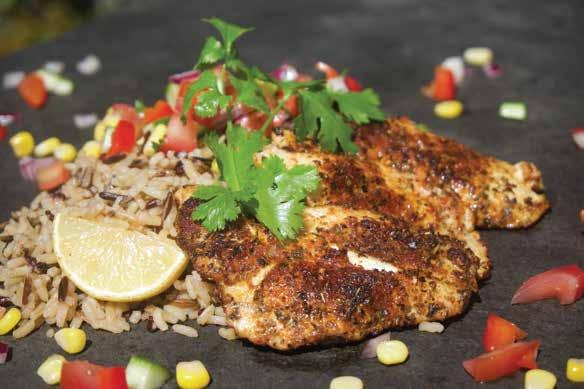
Wild food recipes with Marcus
Cajun Rig with wild rice and garden
salsa
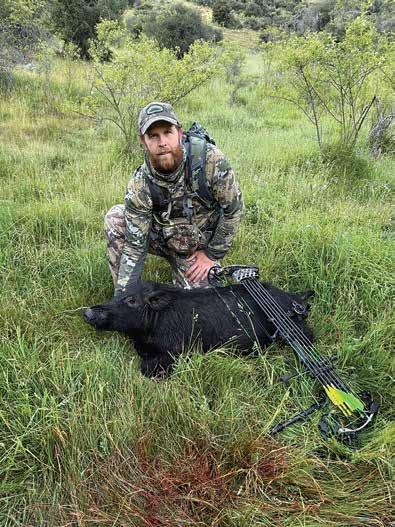
dangerous and took o , Bugger! After a huge day walking around with only a few goats down we were back to the hut for dinner and into our sleeping bags nice and early to prepare for one last hunt the next morning. We were up bright and early once again and hit the tops to see what we could find! Bingo a nice looking boar was out feeding on the grass, right out in the open. After a long stalk and setting my myself up hoping he would walk right into me it all came together and he walked o the flat and up into the wee gully I was sitting in. As he feed towards me I snuck in a bit closer, at no more than 20 metres I drew my bow back, settled the pin, and let the arrow fly. Smoked him! He spun around a few times and took o , and only to made it 40 yards. After a quick few photos we loaded the meat up and set o back to the hut, another successful trip done and dusted!
Cajun Spice Ingredients
2 ½ tsp paprika
2 tsp The Original Smoke and Spice SPG seasoning
2 tsp garlic powder
1 ¼ tsp dried oregano
1 ¼ tsp dried thyme
1 tsp ground black pepper
1 tsp onion powder
1 tsp cayenne pepper (fine tune to your palate)
Garden Salsa Ingredients
Chop and combine cucumber,red pepper,coriander,tomato,charred corn,red onion spike with The Original Smoke and Spice SPG seasoning and a lashing of lemon juice.
Wild Rice
Cook any combination of black and brown rice.
Method
Mix up the spices and dust finely cut fillets of rig and fry gently in oil.
Pile rice up on a plate with a half cup of Garden Salsa,pop your fillets on and with a splash of lemon juice you’ve got a delicious feed that all the whanau will love!
Undersize or too many taken
Big fines and community service for taking undersize and too much pāua and crayfish
Some fishers have been fined thousands for pāua o ences and others have been ordered to do community work.
“People who choose to ignore the fishing rules need to know there will be consequences. Our job is to protect fishing resources so that everyone can enjoy the opportunity to put fresh kaimoana on the dinner the table,” says Fisheries New Zealand’s Director of Fisheries Compliance, Steve Ham.
The following people were before the court towards the end of last year.
A 30-year-old Waikanae man was ordered to do 80 hours community work by the Wellington District Court for taking 40 pāua from the Red Rocks area of Wellington’s south coast. He was stopped by fishery o cers in April 2025 year. The daily legal limit per gatherer is five pāua with a minimum size of 125mm.
A 40-year-old Mahia man has been fined $7,980 in the Wairoa District Court for a range of fisheries o ences. They include being in possession of 85 pāua of which 84 were undersize in 2024 and in possession of undersize and excess pāua in 2025. The man was also prohibited from all fishing for three years. The daily limit per person for gathering pāua in this area is five with a minimum size of 125mm.
A 39-year-old Gisborne man was ordered to do 80 hours community work for being in possession of 15 crayfish. He was stopped by fishery o cers in 2025. The daily limit per person for taking crayfish in this area is three with a minimum tail size of 54mm for male or 60mm for female spiny red crayfish.
A 39-year-old Christchurch man was fined a total of $1500 in the Christchurch District Court for being in possession of 26 pāua – 25 of the shellfish were undersize. The daily limit per person for gathering pāua in this area is five with a minimum size of 125mm. The man had his catch inspected by Fishery Ocers in September 2025.
“If you’re unsure of the fishing rules in the area you plan to fish, get the most up-to-date fishing rules by downloading the free NZ Fishing Rules mobile app. It will also work if you’re fishing in an area with limited mobile coverage,” says Mr Ham. Fisheries New Zealand encourages people to report suspected illegal activity to the ministry’s 0800 4 POACHER number (0800 476 224).
Buller Bluewater Classic
South Island bluewater fishing steps up with launch of monthlong Buller Bluewater Classic Westport will host a new month-long big game fishing competition this February with the launch of the Buller Bluewater Classic, following an exceptional 2025 season that saw Blue & Striped Marlin, Bluefin and Yellowfin tuna as well as Mahi Mahi landed for the first time in the South Island. The event will run throughout February out of the Port of Westport and is designed to grow into a legacy bluewater fishing event for the South Island.
The Buller Bluewater Classic allows fishos to fish when conditions suit, enter once or multiple times, and take a measured approach. Tag and release is encouraged, with fish weighed and recorded through a local volunteer-run system and tracked on a live digital leaderboard.
“This isn’t about hype,” says working group member Jessie Creedmore. “It’s about backing what actually happened last summer and building something that lasts for the communities of the Buller district.”
For fishos from afar, the appeal is simple: Direct access to deep water, less pressure, and a fishery that’s clearly on the move.
“The biggest thing is how close the action is,” says James Cameron, of local fishing shop Coast Outdoors. “Commercial fisherman have been quietly talked of gamefish for years o Westport, and we knew it was only a matter of when not if the fishery hit the mainstream with recreational captures. The fever has well and truly hooked us all after what happened in 2025.”
Weekly Saturday afternoon tally sessions at Shortjaw Brewing provide a place for crews and brews, visitors and locals to swap yarns, check the leaderboard and make new mates.
Sponsor, working group member and Shortjaw Brewing owner Luke Robertson says that mix of tradition and opportunity is
deliberate.
“We wanted to keep the grassroots feel while opening the door to something new,” he says. “You’ve got locals and visiting crews rubbing shoulders, and hopefully a new annual event with a night market planned for
prizegiving.”
The final prizegiving and night market brings fishing, food, music and community together to close out February.
The organisers are upfront: this is year one. There’s no glossy history yet. But there is proof, momentum, and a clear intention to build a legacy bluewater event for the South Island.
“Someone had to back it,” Anderson says. “We figured, why not us, and why not now?”
For fishos looking for something di erent this summer, the invitation is clear: Head west, give it a crack, and be part of the start of something big brewing. The Buller Bluewater Classic runs throughout February, out of Westport.
Event and entry details will be available via Facebook (search Buller Bluewater Classic) or visit www.bullerbluewaterclassic.co.nz [note: website being set up as we write]
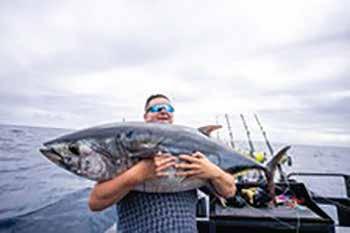
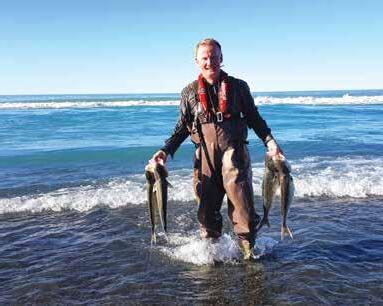
Ben Carson with the first Game fish of the trip, a Pacific Bluefin Tuna estimated to be 40-50kg. Caught o the coast of Westport.
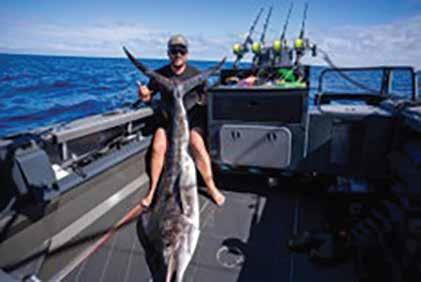
Jason Anderson with the first Marlin of the trip estimated at 80kg which was their very first South Island Marlin caught o the coast of Westport.
Locking up Coastlines is a Cop Out Retired Fisherman Norm Hawler
Apart from the hordes of sightseers, surfers, divers and shore scavengers the festive season has so far been nothing out of the ordinary down here in the Bay. Mind you, the weather has not been too flash which is a bonus for those of us who live here because it means there will be something left of our seafood supplies when the temporary residents finally scarper back to wherever they came from. Bad weather has brought choppy seas and muddy waters –great deterrents for the diving population. And only just in time given the stacks of empty shells scattered in rock pools and found poorly hidden under bushes.
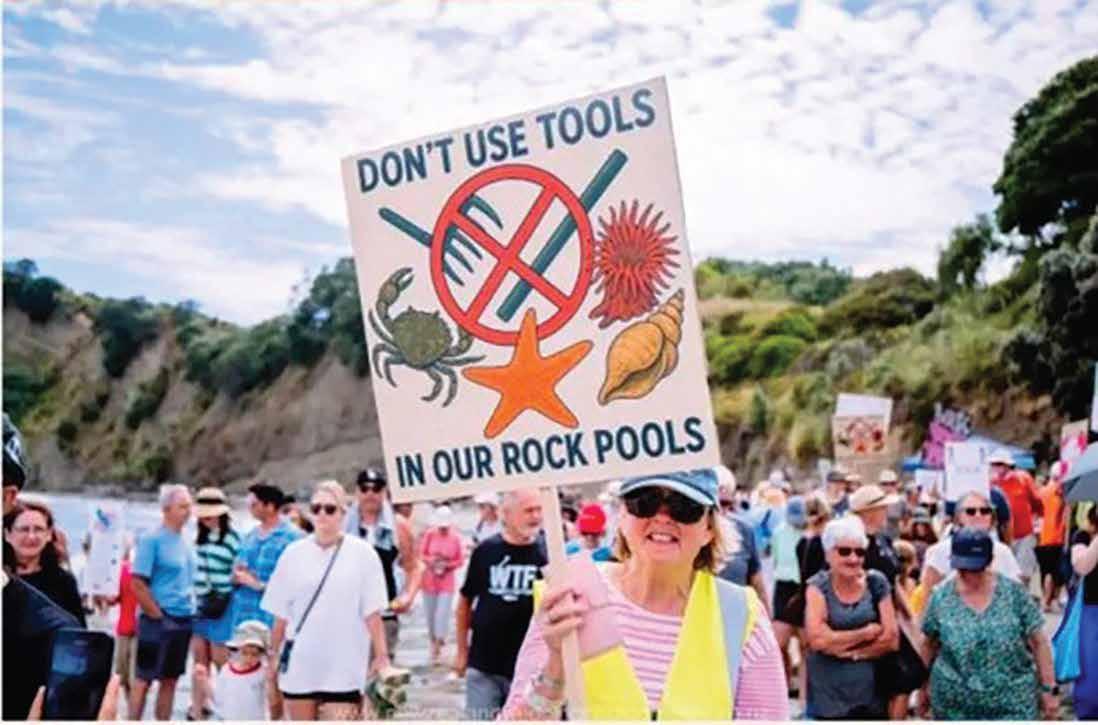
But it seems we might not be doing as badly in the Bay as other coastal areas in the North Island. There is current controversy in Auckland and points north about hordes of predominately Asian people descending on coastal areas and progressively stripping all marine life from the littoral zone.
The controversy centres on heavy shellfish and seaweed gathering at places like Whangaparāoa/ Army Bay and how some locals are racialising what is, in part, an over harvesting and regulation problem. Residents on Auckland’s Hibiscus Coast report rock pools being “stripped bare” of shellfish and other intertidal life, sometimes with chisels, piano wire and large bins, and say this has intensified over the last two years.
Media and blogs record some residents and commentators blaming “Chinese” or “Asian” groups specifically, using language such as “ethnic vacuum cleaners” and “Chinese/Asian people raping
it all,” which has inflamed racial tension and garnered media attention (of course).
invertebrates, backed by fines and confiscation.
Local Iwi say current levels
Trevally
Tuna
committees that report poaching and help interpret rules to local and migrant harvesters.
Fisheries o cials and some researchers instead highlight population growth and changing food preferences across a more diverse Auckland as drivers of pressure, stressing that many people from various backgrounds are gathering within legal limits. But in their current mood the local residents will not be satisfied until action is taken. In similar situations here and overseas the operational measures include: seasonal closures timed to spawning or recruitment, gear restrictions (e.g. bans on crowbars or chisels on rocky shores), and strict daily bag and size limits for intertidal
of gathering are ecologically unsustainable and have applied under section 186A of the Fisheries Act for a two year ban on taking shellfish and seaweed along parts of Auckland’s eastern coastline.
The Ministry for Fisheries will be backing that one because it’s an easy fix to keep the Whangaparāoa/ Army Bay locals quiet, even though they too lose access to what is essentially their ‘front-yard fishery’. However, proper enforcement of any closure will require use of targeted Fishery O cer patrols at predictable low-tide periods, probably supported by community rangers or co-management
To which I have to say, good luck with all of that because closing the area to the shore-based harvesters will do little else but to shift their e ort somewhere else along the coast. (On a Chinese social media platform there are people advertising bus tours to gather seafood.) I reckon that MPI, DoC and the local Council have a massive task ahead of them to influence significant changes to attitudes and behaviour across ethnic groups – including Europeans and Maori – when it comes to our coastal marine resources. Locking up coastline is a cop-out
PULSAR SYMBION MULTISPECTRAL BINOCULAR
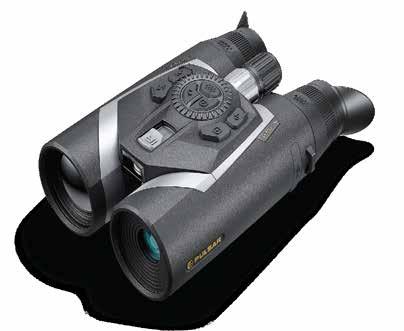
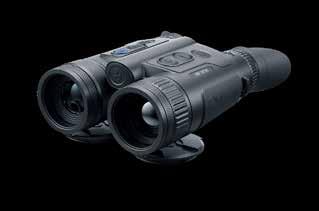
I write this article on the eve of Pulsar’s Shot Show launch of their new multispectral binocular, the Symbion LRF DXT50 and Symbion LRF DXR50.
We received a prototype of the Symbion LRF last October for evaluation and to provide feedback to the factory on its functionality, performance and features. The version that we received had the 1280x1024 thermal sensor and is designated Symbion LRF DXT50. According to Pulsar these new generation multispectral binoculars are designed for recreational and professionals who demand total situational awareness in any light and environment. Interesting, let’s take a deeper dive into these devices. I’ll start with features and then my own impressions.
Features:
The Symbion LRF is a multispectral binocular, which means that it’s sensitive to two discreet wavelengths: Thermal (LWIR) and the visible light spectrum. This provides the user with the functionality of a thermal imager and a daylight binocular. Other features include a 1500m laser rangefinder, image stabilisation and an integral IR illuminator with beam focusing for night vision imaging. The image is presented via two UHD high resolution AMOLED displays providing the user with an immersive and comfortable binocular experience.
An interesting feature is the manual On/O /Sleep lever that is very easy to use. A proximity sensor turns sleep function on and o when it senses that the user is looking through the device and can be disabled in the main menu. My first impressions
When I first held the Symbion LRF I was a little daunted by all the control buttons. Unlike the Pulsar Merger which has two rows on three buttons, the Symbion LRF has seven buttons, a control wheel, IR focuser and two focus dials at the rear. Our sample did not ship with a manual, however, switching the unit on and trying each button enabled me to understand the button layout and with a little practice I was soon up and running. I recommend new users to read the manual or watch an instructional video.
The Symbion LRF feels very solid, compact and is easy to hold and
The Symbion LRF is a European made, high performance multispectral binocular that combines high quality colour imaging with a high-end thermal capability.
use for both left and right-handed users. I wouldn’t expect anything less from a Pulsar device so this was no surprise. The Symbion LRF is also supplied with an Arca-Swiss mount for use on a tripod which is a very welcome addition.
Field testing
Taking a new piece of equipment out for testing is always exciting and the Symbion LRF did not disappoint. The thermal imaging is very much the same as the Pulsar Merger LRF XT50 so most of my testing revolved around the colour imaging and the control functionality. I conducted my first test an hour before sunset and observed my wife at three hundred metres for a period of one and a
half hours (thanks wifey!), enabling me to assess the device’s low light capability.
The colour sensor has a resolution of 3840x2160 which is ultra-high resolution. This provided excellent clarity and field-of-view at its base magnification of 6.5x and up to 13x . Increasing the magnification upwards to 26x pixelates the image, but it is still good enough to take a close look at distant objects. I used a rest for the higher magnifications, but the image stabilisation worked surprisingly well, making hand-held high magnification observation a viable option.
In low light, the Symbion LRF produced a colour image beyond
what a could see with my naked eye and would outperform traditional daylight binoculars in the same lighting. Once the sun had set, the colour image progressively deteriorated. Switching the device to night vision mode improved the image considerably allowing observation to around half an hour after sunset. I then turned-on the inbuilt IR illuminator which provided just enough IR to observe the wife at three hundred metres which surprised me. It is a very capable illuminator.
Switching over to thermal made the wife stand out like a black cat on snow, though this is no less than expected because I am familiar with using a Merger LRF XT50 which has the same 1280x1024 Lynred ATTO1280 12µm sensor and optics. The Laser rangefinder provides accurate distance measurements up to 1500m or more in ideal conditions. The Symbion LRF is a very good alternative to a daylight binocular while providing the advantages of thermal and night vision imaging. A lower priced version, the Symbion LRF DXR50 is also available, but at the time of writing, I haven’t had the pleasure of evaluating one. The Symbion LRF DXR50 is identical to its higher-end stablemate but features a new Generation 4 Lynred ATTO640D-04 12µm thermal sensor.
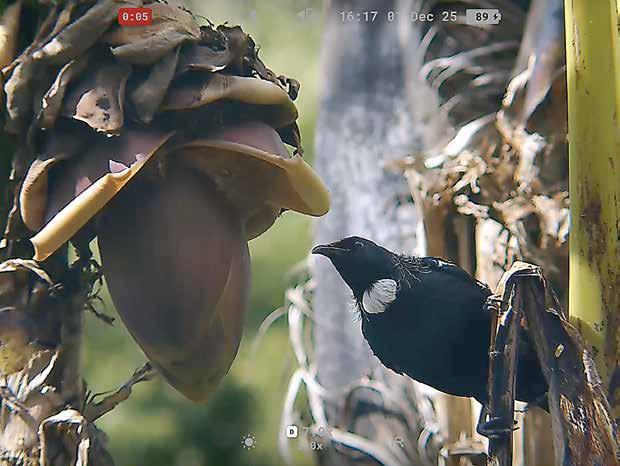
I took this image of a Tui with the Symbion LRF mounted on a tripod close to the tree while I was sitting inside my house remotely controlling it with my iPhone and Stream Vision 2.
Coastlines
Ivan Wilson
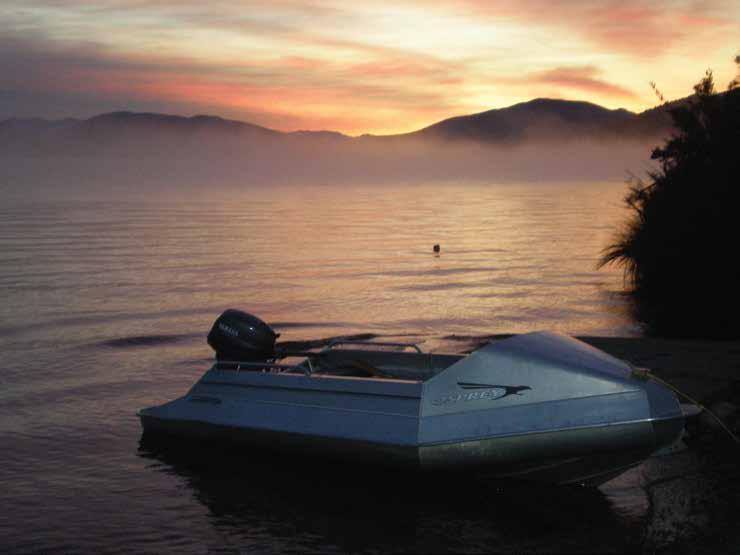
Following my disastrous start to the 25/26 season, I made a 2nd attempt at enjoying a day on the lake in the 4 metre Osprey, otherwise known as “Silver Frog.”
To refresh memories, October, November and December on The Coast provided few opportunities, but rather gave us some of the most inclement weather I can recall for Spring and the start of a season. A watch was kept on the forecasts, until finally a decent high was observed creeping over the Tasman from Australia, so once again preparations were made to get out there and do it! This included making sandwiches for lunch and as we were still chomping through the Christmas ham, that was the filling, along with whole grain mustard. I believe you have to have something nice for lunch, it’s part of the whole angling experience on the day. There’s nothing quite like sitting in a sunny nook, taking in the vista of lake, forest, mountain and watching the wildlife, which due to Murphy’s Law, while you are busy eating, will often be a trout.
So where to go was the next question? I knew Lake Brunner would be chokka with fizz boats, jet skis, paddle boards and kayaks, after all it is quite the aquatic playground. This would mean a bit of a tra c jam at the ramp, particularly when coming back after the day’s fishing. The ramp has been more recently improved and the ramp fee of 2 bucks has gone to a still reasonable $5.00 but some people still ignore the honesty box, having arrived in a large vehicle, towing a massive floaty thing, which denotes obvious wealth. Or maybe its all on tick, LOL. With all this activity it would also be fairly noisy, which somewhat detracts from the possibility of a peaceful time to enhance one’s wellbeing. There have been some unfortunate moments on the lake from time to time, such as people devoid of any angling etiquette, who cut into the beat you are drifting through. Others who race past, well beyond the 5 knots within a 100 metres of shore and these guys make it di cult to keep standing in the boat while casting. There has also been the odd guide (not local) who thinks they own the lake.
I thought that given it was the holiday season I should look
at some of the good alternative lakes that are a bit further afield, so I settled on Lake Alternative! Another check on the forecast showed a good day was in the o ng, so with all preparations
made, it was o to bed ready for an early start. It was getting light at around 5.30am so I thought if I got up at 4, grabbed a bit of breakfast and latched on the boat, I could be at the ramp as daylight
came up. Huh! It was raining the next morning and there is nothing attractive about sitting in a boat getting wet so I flagged it. Not going to trust the weather forecast from now on either.
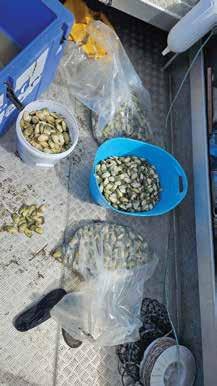
Hundreds of Green Lipped Mussels poached
Fisheries New Zealand is warning poachers that it will prosecute anyone stealing from our shared resources.
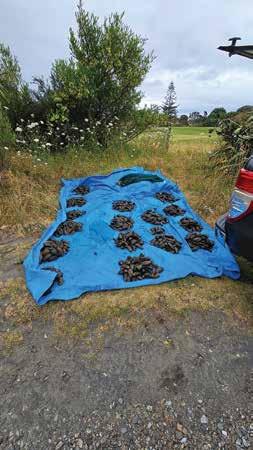
This follows action taken by Fishery O cers in the Eastern Bay of Plenty who have caught several people over summer with hundreds of green-lipped mussels, some of them taken from a closed area.
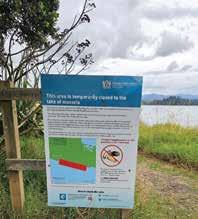
In November 2024, a 2-year closure was placed over an area of Ōhiwa Harbour to the harvest of mussels. Te Rūnanga o Ngāti Awa requested the closure, Te rāhui kuku ki tua o Kanawa, to provide support for their traditional rāhui and boost an area of the harbour where mussel beds have been reseeded.
Fisheries New Zealand District Manager Gisborne/Whakatane Jordan Cooper says it is disappointing to find people taking
green-lipped mussels from an area that was closed to rebuild mussel beds.
“People who disregard and break these rules are slowing this progress and we will continue to closely patrol the area and take action. Over the past month Fishery O cers in Whakatane stopped a person who had 779 green-lipped mussels – taken from the closed
part of Ōhiwa Harbour.
“Other people who had their catch inspected were found with 92 green-lipped mussels taken from the closed area and another person with 154 green-lipped mussels taken from an open area. It’s likely some of these people will be prosecuted.”
For green-lipped mussels in open areas, the daily limit per person is 50.
In addition to the green-lipped mussel o ending, another group of fishers who had their catch inspected were found with 2771 pipi they had taken from an open area of Ōhiwa Harbour. The daily limit for harvesting pipi is 150 per person.
“We seized their fishing vessel and prosecution is likely. When we find evidence of fishing rules being deliberately broken – we will take action,” Mr Cooper says.
Anyone planning to go recreational fishing should download the free NZ Fishing Rules mobile app. Once downloaded, it will work in areas without mobile coverage and provide the latest rules, including closures and gear restrictions for all areas.
We encourage people to report any suspected illegal activity through the Ministry for Primary Industries’ 0800 4 POACHER line (0800 476 224).
•
•
•
•
•
•
•
Email:
MADE IN EUROPE CHOSEN BY PROFESSIONALS
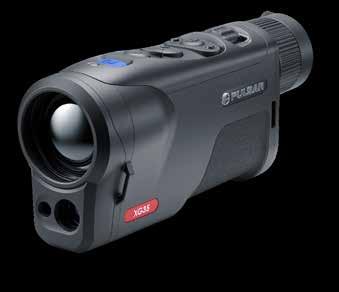
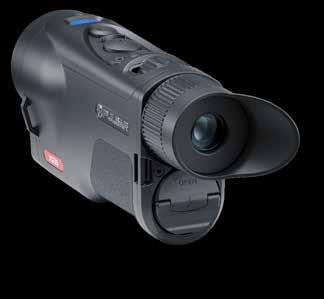
The Pulsar Oryx LRF XG35 sets a new standard in high performance, compact thermal imaging.