FREE
THE
FISHING ϻ HUNTING PAPER
January 2026 Issue 244
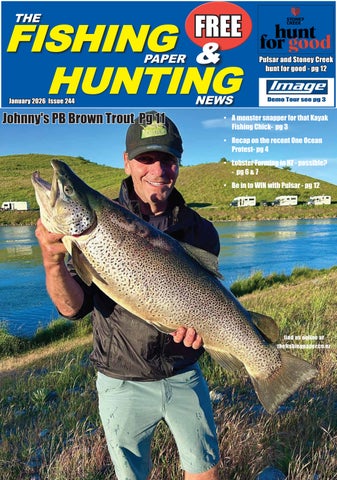
Johnny's PB Brown Trout Pg 11
NEWS
Pulsar and Stoney Creek hunt for good - pg 12
Demo Tour see pg 3
• A monster snapper for that Kayak Fishing Chick- pg 3 • Recap on the recent One Ocean Protest- pg 4 • Lobster Farming in NZ - possible? - pg 6 & 7 • Be in to WIN with Pulsar - pg 12
find us online at thefishingpaper.co.nz
2
THE FISHING PAPER & HUNTING NEWS - JANUARY 2026
Ground Hog Day - the same early November communication from the same high-country farmer, the same comments about newborn lambs and murdering pigs. Year upon year, the only variables are the site and the rate of mortality.
My response, as always, “I’ll be there early tomorrow”. The pressure to perform sits heavy. More so if the culprit is a killer not a scavenger. Scavengers are simply Nature’s clean-up team. Killers are costly. I spend a sleepless night envisioning a route. Tomorrow’s hunting success or failure, will all hinge on me and my ability to put my dogs in a position to find a freerange pig. Without doubt it will be a fit and intelligent porker which is familiar with every feature and feed area of its own immense back yard and who’s own route will change every night on a whim. The goal will be to get my route and the pig’s route to intersect. Ideally while its scent trail is still fresh. And, better still, while I’m down wind, so the elusive grunter doesn’t know we exist. I’m there or thereabouts before dawn the following day but the ewes and lambs are hunkered down peacefully – the pig has not been back, not to this paddock anyways. The route then – a big meandering loop which puts us nose-first into a westerly breeze - it takes us above vast matagouri terraces, through bracken fern basins, and along proven pig highways – it deviates through rocky outcrops which might make a pig’s day bed - it catches the first rays of sunlight and includes ‘had been’ spots, ie every spot where there ‘had been’ a pig in the past. Zero. Zip. Nada. No skerrick of fresh sign, nor sniff of oink. I can’t hunt smarter; I’ve done everything I can think of. But I can hunt harder. I can venture into the savage country. The places
It's All About the Route
with contour lines piggybacking one another and creeks that are sheer-sided gutters impossible to ford. Where the vegetation is impenetrable, toughened by weather extremes and adorned with thorns and spikes. Nugget heads away alone. A glance at the tracker tells me he’s slowly accruing distance and height. He will be aware that he has no back-up, but he pushes on. Seasoned dogs have an incredible sense of what is required to catch and keep an aggressive pig contained. They read a situation and body language better than we humans could ever do. So, when Nugget goes straight into hold and his quarry grunts deeply, I know I must turn on the afterburners and jet off rapidly. Little orange Pip’s reaction – thrusters engaged, turbo mode – she’s on her way. Old Chop, all senses dulled by age, cannot hear the kerfuffle. I take a moment to prep him like a wind-up toy - hold him still, wind the key till he’s primed, point him in the right direction and let him go – ‘Sssss, skitchem Chop!’. Dogs and pig have settled into their fight by the time I arrive. I didn’t realise immediately, but my golden halo has been replaced by a flashing neon overhead sign which reads BITE ME. The pig, a young boar, takes one look and does his best to oblige. He has eyes only for me, which would be flattering if his intentions weren’t so hateful.
The Fishing Paper & Hunting News Editor: editor@thefishingpaper.co.nz Sub-Editor: Mike Brown All Enquiries: Nicola Morris 0224 503 403 admin@thefishingpaper.co.nz Printer: Inkwise Advertising Enquiries: Lynda Balfour North Island Lynda@thefishingpaper.co.nz 027 710 1510 Phil Claude
South Island
Phil@thefishingpaper.co.nz 021 242 4202
The Fishing Paper & Hunting News is published by Four Winds Media Ltd. All editorial copy and photographs are subject to copyright and may not be reproduced without prior written permission of the publisher. Opinions or comments expressed within this publication are not necessarily those of the staff, management or directors of Four Winds Media Ltd. Unsolicited editorial, letters, photographs will only be returned if you include a stamped self addressed envelope.
https:// thefishingpaper. co.nz/
Kim Swan
Eventually I manage to attach myself to the boar’s blunt end but not for long. His cloven hooves and determination are better suited to the chore than dog’s claws or rubber boot soles. His low centre of gravity and powerful neck give him ample opportunity to teach us all a lesson. Unfortunately for him we have the numerical advantage and loyal bonds. There’s much splashing, panting and slippery sliding in the creek. Dogs getting battered and bashed against boulders as they hold tight. Me trying to keep a grip of the boar and hold him at bay as he does his best to bite any part of me that his mouth can reach. While the rest of the wrestlers are not aware of the waterfall looming ever closer, I most definitely am. For the life of me I cannot halt downstream progress, so, in desperation, I pile atop the melee and wrench and writhe till the boar is U-turned. Normally a flip’n’stick would be achieved without this much bother, but we’re slippery wet and slicked with slime. We each fall over the other, loosing our grip as we bump boulders, stumble into deep pools and stand on each other’s feet. We take turn about at being upside down and downside up, repeatedly winning then losing the upper hand. Finally, heart blood merges with flowing water, the river runs red and flurries of white froth dance away in swirling eddies.
Nugget’s initial assessment was on the mark, though he is by no means a monster this was one very tough pig living in an equally tough place. But is he the one? There has been absolutely nothing to link him to the scene of the crime, so, perhaps he is just an innocent bush-dweller in the back of beyond. More splashing and wrestling, more panting and sliding on boulders, for the deceased grunter must be hauled out of the creek bed so as not to foul the waterway – hunting etiquette 101 – ‘look after the land which feeds you’. That just leaves the autopsy then getting our bedraggled selves outta there. A stomach packed tight, a night’s worth of selective sampling, a multi-course degustation dinner and dessert. Bright green grass - finely chewed fern root - small pieces of foetid meat - strips of newborn lamb pelt - a sliver of tiny liver – all slathered in saliva. The stench indicates the boar was a scavenger, not a killer. We’ll never know for sure. The pressure which weighed so heavy lifts and leaves. I head for home assured that the sleepless night was not in vain, the route was slow but good.
If you shop with any of our advertisers PLEASE make sure you mention that you heard about them or saw their advert in The Fishing Paper and Hunting News either the hard copy or online version. We rely on advertising revenue to print and distribute the paper ; to pay the writers and proofreader / editor and to cover the online costs . We all know times are tight with business and advertising is always one of the first costs to be cut - so please support those who pay our bills and let them know why you are supporting them.
FIND US AT THEFISHINGPAPER.CO.NZ AND FOLLOW ON FACEBOOK
Second Time Lucky
Issue 244 3 Yolande Jeffares That Kayak Fishing Chick
After the first day watching the boys catch some stonkers and calling it early when Brucie turned up (Brucie is a bronzie, also referred to as “Oh that’s just Yolande’s pet shark” because he, or more likely she, likes to hang out under my kayak as I drift around – the largest and most stunning shark I have ever seen ). I made the questionable call to head out again the next morning. I hadn’t had a feed of fresh fish in a while.
So, up I got at stupid o’clock and downed the traditional yakkers breakfast (painkillers and coffee) and headed off to beat first light to the shore. It wasn’t a great day conditions wise, but luckily for me, it wasn’t too bad either. I headed off with Corey and Razel and set myself up for some lazy drifts while they continued up the bay a bit. Dawn came and went without so much as a nibble – boy it was quiet out there and after several hours (at a guess, I am not one to watch the clock on the water), I figured that I could well go two for two with nothing landed. There I sat in my yak, slow jigging
while a second Kaveman Tackle kabura bobbed near the bottom from the rod in the holder. I tried lemon, black and the trusty orange and nothing. For no particular reason, I felt my drift line was right, so I stuck with it, paddling back towards shore then drifting up again and again. I decided to try another colour – this time pink, which I usually don’t fish
and it was no time at all before I hooked up. I wasn’t too excited, it ran like a shark, towed me around a fair bit but no head nods or tail beats detected. That being the case, I was more than a little surprised when it hit mid water and a good snapper ‘floated’ to the surface with the assistance of my line. It didn’t look huge to me but then I was concentrating more on ensuring it
was quickly dispatched and securely in the rear rather than trying to figure out the size. I did another long lazy drift, then had another look. That was when I decided “actually that’s more than enough snapper for me”. Then I headed to the rocks to try for a blue cod. I paused for a sip on my electrolytes with two lines in the water and bugger me if they didn’t both go off at once in opposite directions. The stronger of the two was managing to pull me towards the reserve and both were clearly snapper so rather than trying to fish both lines, I decided to let one run while I tried to ensure that the other didn’t end up making me look like I was fishing in the reserve – that’s really not a good look. My second snap, while smaller would have been around 70cm so it was time to bring the lines up and go catch up with Corey and Razel. Corey was pretty sure that my snapper was likely 80cm or so – and he was right. Even though the tail had dried out, it still managed to come in at 80.5cm – a pin fish!
! E M I T E V I IT’S TEST DR Demo Tour Schedule 2025- DECEMBER 30 Kaikoura 31 Picton 2026- JANUARY 1 - 11 Picton 12 - 19 Nelson 20 - 23 Abel Tasman 24 - 25 West Coast
BOOK your time at the helm NOW!
Call Dean on 0274 368 055 dean@imageboats.co.nz
www.imageboats.co.nz
FIND US AT THEFISHINGPAPER.CO.NZ AND FOLLOW ON FACEBOOK
4
THE FISHING PAPER & HUNTING NEWS - JANUARY 2026
TAKING IT TO THE STREETS – ONE OCEAN PROTEST
The One Ocean Protest was organized primarily by recreational fishers and boaties concerned about fair access to marine resources in the Auckland region. The One Ocean Protest “movement” grew out of a post that Ben Chissell made in the NZ Fishing Community Facebook group, with him fronting interviews and speaking on behalf of the protest’s aims. Strong support came mainly from within the Auckland recreational fishing community as well as industry groups involved in boating, charter fishing, vessel and fishing tackle manufacturing, importing and sales.
The One Ocean Protest was coordinated with authorities to ensure safety and minimize disruptions. Organizers worked closely with NZ Police and transport agencies to ensure the protest was peaceful and safe. In spite of a last minute change of plan by the NZ Police, the Auckland convoy drew over five hundred vehicles, boats, and an estimated three to four thousand fishing people along the waterfront and across the Harbour Bridge, but passed with only minimal traffic disruption. This was initially a response to the Hauraki Gulf / Tīkapa Moana Marine Protection Act, which created twelve new High Protection Areas (HPAs) banning all recreational fishing but permitting customary fishing and in two zones, limited commercial ring-netting exemptions. However the scope of protest increased in response to two proposals from Fisheries New Zealand’s wider review of 19 regulation changes. • One would allow commercial fishers to keep and sell marlin that are dead when caught. Marlin have always been treated as a non-commercial species in New Zealand. • The second proposal would allow commercial landing of 19 reef species taken as bycatch by trawl, Danish seine, and bottom-long-line gear. The list includes red moki, red pigfish, and boarfish. These fish have been protected from commercial exploitation for many years because of their vulnerability to depletion and their high value to recreational fishers and coastal communities. Many are slowgrowing, site-attached, or important in local reef ecology. The protest mainly represented recreational fishers and boaties concerned about fair access and
Retired Fisherman Norm Hawler
marine biodiversity protection. They argued for no commercial fishing inside HPAs, open consultation in fisheries management, no new species added to the Quota Management System (QMS), opposition to the Government proposal to allow the landing of marlin by commercial operators, and prioritizing feeding Kiwis first.
livelihoods of a small number of ring-net fishers who provide food to South Auckland during winter. Both ministers acknowledged the exemption as a necessary “transition” for family businesses, with the exemption grandfathered so no new fishers can enter under the same conditions once current ones retire or leave the industry.
The protest was generally silent in regard to customary fishing exemptions allowed in HPAs but on social media some supporters encouraged that policy decision to also be confronted. The situation that spurred the protest indicates an ongoing conversation and tension between recreational fishers’ groups and with commercial fishing interests. Also regulatory authorities around how best to balance biodiversity protection with fishing rights in the Hauraki Gulf and elsewhere. On 6 October 2025, Parliament passed the Hauraki Gulf/Tīkapa Moana Marine Protection Bill, and Minister Potaka issued an official statement describing this as a “bold new era” of protection for the Gulf. The Minister faced immediate criticism for a last-minute amendment allowing ring-net fishing in two of the eleven High Protection Areas (HPAs) at Kawau Bay and Motutapu / Rangitoto. He stated that the exemption was based on the claim that ring-net fishing has limited environmental impact beyond target species removal. Fisheries Minister Shane Jones supported the exemption, emphasizing the protection of
Specific protest organising groups included recreational fishers’ associations and online community groups focused on fisheries managerial fairness and marine biodiversity protection. LegaSea, a vocal critic of the Quota Management System helped mobilize support for the protest which was coordinated to present a unified voice of recreational fishers and supporters seeking policy changes regarding commercial fishing rights inside marine protected areas. Organisers emphasised that the protest was not about dividing commercial and recreational fishers but about addressing policy fairness and ensuring that public fishing rights are respected. People were encouraged to join, support, or watch the protest as it highlighted growing public involvement in marine policy decisions in New Zealand. Media coverage and social media commentary described strong support from many recreational fishers, boating and tackle communities, and some coastal residents, who saw the protest as defending fairness in access and calling for consistent rules that
FIND US AT THEFISHINGPAPER.CO.NZ AND FOLLOW ON FACEBOOK
apply equally to commercial and recreational users. Protest organiser Ben Chissell told the NZ Herald that the Government should “take note” of the action. He said the turnout showed a desire for recreational anglers to be involved in decision-making related to fishing regulations. “We need it to be fair for everyone; we all have a say. These (protestors) are the people who vote for some of these people that make the decisions. Time to start listening because this was organised on very short notice, we can do much bigger.” At the same time, industry groups and some commentators stressed the importance of protecting smallscale fresh fish suppliers, disputed suggestions of broad commercial privileges, and urged a shift in focus toward wider stresses on the Gulf (such as sedimentation and pollution), illustrating a divided but highly engaged public conversation after the protest. While there was no direct official government statement expressly addressing the planned protest event, the Government’s position as reflected through commentary from fishing industry organisations was that the protections largely prohibit commercial fishing, except for limited transitional exemptions. Following the protest, organisers reported a constructive meeting with Minister Jones the next day, and press coverage noted that this meeting led to an “urgent” or fast-tracked public submission window canvassing issues such as marlin and reeffish protections, suggesting the protest helped push these topics back onto the political agenda. One Ocean Protest information was coordinated primarily through the movement’s social media, especially the One Ocean Protest Facebook and Instagram pages, which directed people to follow and stay informed. Coverage distinguishes between the One Ocean Protest group itself (centred on Chissell and volunteers coordinating the convoy) and advocacy organisations like LegaSea, which are described as independent but aligned views opposing specific marlin, reeffish, and Hauraki Gulf regulatory settings. Media articles and social media posts describe the 22 November event as the “first” One Ocean Protest and as being part of a growing movement, language that strongly implies further mobilisations are on the table if policy outcomes are unsatisfactory.
Issue 244 5
Dawnbreakers Fishing Club - Kayak Competition 2025
The 2025 annual Kayak Fishing competition was a resounding success with 43 competitors; it was by far the biggest yet. Along with a Stealth Fusion, we had some awesome Kaveman Tackle products, Roof Racks, Maintenance Buckets, Paddle Vests a PLB and a Smokai Smoker amongst the prizes.
Although the fishing was tough despite the time of year, the weather was good and there were some great fish entered with the average snapper coming in at 59.5cm. Importantly, there were no safety incidents – well done everyone. Commiserations to Razel Parsons who was winding in an absolute beast of a snapper when the taxman decided that she was overdue and added penalty interest – no one wants to be sharked like that. That paved the way for the other half of the deadly duo to take out longest snapper. Results. A huge congratulations to all our winners:
Longest Snapper 76.5cm Corey Parsons Longest Gurnard 40cm Darryl Thompson Longest Kahawai 51.5cm James Plunket Average Snapper 59.5cm Dan Cross (57cm) Average Kahawai 40cm Dennis Beukes Average Trifecta 154cm Ronan Pederson (71 Snap,47.5 Kaha,35.5 Gurn) PLB Draw Dereck Ludik Stealth Fusion Dennis Beukes A massive thanks to our generous sponsors – to Stealth Kayaks New Zealand for the fantastic prize of a Stealth Fusion and to Mainfreight for transporting the kayak to Nelson. Burnsco, Feelfree Kayaks, Harbourmaster Nelson & Maritime New Zealand, Kaveman Tackle, Smokai & Stoked to Smoke very kindly donated the rest of the main category and spot prizes. Its great to know that Coastguard (Nelson) is there ready to help if needed. A big thank you also to Speights Ale House who provided a
Ronan Pederson , Trifecta
great venue for measure in and prizegiving.
What a great day it was, we look forward to seeing you all again next year.
Darryl Thompson, Longest gurnard
Corey Parsons, Longest snapper
Premium Bait Premium Arrow Squid 100-200g Baby Arrow Squid >100g Barracouta Sides Broken Squid Trevally Sides Tuna Burley Bombs
Razel Parsons monster sharked snapper and the longest snapper of the competition
Heading out on the water? We’ve got your boating needs covered! t Fuel t 0VUCPBSE 0JM seafood@solander.com
t #BJU t Hooks
t Ice t Refreshments
P: (03) 541 8121 67 Whitby Road, WakeGield 7025
gourmetseafood.co.nz/premium-bait
FIND US AT THEFISHINGPAPER.CO.NZ AND FOLLOW ON FACEBOOK
6
THE FISHING PAPER & HUNTING NEWS - JANUARY 2026
Limits to Growth?the challenges of lobster farming in New Zealand Industry commentator Daryl Sykes gives a brief overview of the pursuit of farmed rock lobster in New Zealand
Despite the many setbacks experienced over many years, interest in marine farming of rock lobsters continues among researchers and aspiring marine farmers. It is an appealing concept given the market demand and prices for live rock lobsters, the natural limits to the productivity of wild stocks and an increasing demand worldwide for food safe, sustainable, high quality seafood.
There is growing contemporary discussion regarding market opportunities for farmed rock lobsters, including the potential to market smaller-sized lobsters as a premium or niche product,
Incubation of lobsters from fertilised egg clusters to a marketable size is difficult and remains economically unviable. It has been tried and failed in other countries. Dr. Jiro Kittaka, a prominent Japanese marine scientist, was internationally recognized for pioneering research on raising spiny rock lobsters from egg through their larval phases in captivity. His work laid much of the scientific foundation for modern lobster aquaculture, and is frequently referenced in both historical and technical literature. Kittaka was the first researcher to achieve the complete laboratory rearing of spiny lobsters through all planktonic (phyllosoma) stages to the post-
And so it has proven to be. Fast forward nearly forty years and several attempts have been made in New Zealand to shortcut the Kittaka “egg to juvenile” lobster aquaculture method by collecting juveniles from the wild fishery for ongrowing. Despite the technical feasibility of collecting and ongrowing, commercial aquaculture has to date not proven to be economically viable. To date the only significant established lobster aquaculture industry is that of Vietnam, based on the growout of wild caught juveniles. Its development was entirely market driven and dates back to the late 1970s and early 1980s, when demand for lobsters from China grew rapidly.
sale or aquaculture must be balanced with the need to sustain wild populations, therefore any commercial development if reliant on harvesting juveniles from the wild as seed stock, must operate within the Quota Management System (QMS) framework. This means: x Juvenile collection would need to be aligned with quota limits allocated to holders, as these quotas regulate total allowable commercial catches. x Quota holders have exclusive rights to harvest within their quotas, so access to juveniles for farming likely requires quota ownership or transfers of annual catching rights (ACE). Marine farming operations using wild juveniles will therefore
The Vietnamese lobster farm lifecycle
sometimes referred to as “cocktail lobsters”. However, farming rock lobsters is not easy and it is not cheap. Spiny lobsters have a uniquely extended oceanic planktonic larval phase (phyllosoma), which can last up to a year or more with numerous moulting stages. Each stage has specific and demanding requirements for food, water quality, and space; survival rates through all stages are low, even with the best systems. During the larval phases, lobsters require live prey and meticulously managed diets that are labour-intensive to produce at scale, leading to high operational costs. Even slight lapses in water quality, disease management, or nutrition can drastically reduce survival, making consistent production difficult.
larval puerulus stage. In 1988, he successfully reared Jasus lalandii (South African rock lobster) and later other species, demonstrating the technical feasibility of closing the larval cycle under controlled conditions. Kittaka’s work gave deep insights into lobster larval physiology, feeding requirements, susceptibility to disease, and ideal rearing conditions (including temperature, water quality, and diet). His work formed the backbone of nearly all subsequent lobster aquaculture science and hatchery attempts globally, making his contributions highly influential in the field. However, despite breakthroughs, Kittaka emphasized the persistent challenges of commercial larval culture, especially low survival rates and economic feasibility.
New Zealand’s Quota Management System (QMS) functions as a commercial property right mechanism critical to the sustainable management of rock lobster fisheries, and it underpins the legal framework for any commercial farming that involves harvesting juveniles from the wild. This quota system has and continues to be integral to industry discussions about developing viable lobster aquaculture alongside effective wild stock management. In response to increasing interest by Marlborough Sounds mussel farmers in the early 1990’s, the NZ Rock Lobster Industry Council (NZ RLIC) developed a set of protocols to enable the harvest and ongrowing of “undersized” lobsters. The NZ RLIC successfully argued that taking juveniles for commercial
FIND US AT THEFISHINGPAPER.CO.NZ AND FOLLOW ON FACEBOOK
require close coordination with quota management to ensure wild stocks are not compromised, and regulatory compliance is maintained. The NZ RLIC protocols resolved those important issues. In 1995 the then Minister of Fisheries, Hon Doug Kidd, endorsed the industry protocols and authorised by way of Special Permits the collection and retention of juvenile lobsters (puerulus or stage 1 and 2 juveniles) in the Bay of Plenty and Hawkes Bay. The opportunity was initially taken up by a small number of entrepreneurs. Their early endeavours very quickly confirmed that constraints such as limited availability of juveniles, high mortality immediately post-capture, and a range of economic factors would limit industry development beyond the first pilot projects.
Do you know the rules for Set Nets?
Fishery officers will be stepping up pressure on recreational fishers who break set net rules during summer.
Most recreational fishers follow the
Issue 244 7
netting in a prohibition area, no
them $4,500.
account who break these important
marked surface floats, using poles
Our job is to protect the
rules. One of the best things you
or stakes to attach it to the seafloor and using a set net that was too close to another set net. This cost
sustainability of our shared fisheries and help ensure protected species are not harmed by fishing activity. We take
rules and the overall compliance
this type of offending
rate throughout the country sits at 94%.
very seriously."
But set nets that don’t meet
"We’ve heard all the
regulations remain a problem,
excuses such as not
particularly in the Port Waikato,
knowing rules like
Kaipara Harbour, and Manukau
marking surface floats
harbour areas.
with your name and
Fisheries New Zealand regional
contact, or that staking
can do before going fishing is to download the free NZ Fishing Rules mobile app because it will provide you with the latest rules for the area you intend to fish – including closures and gear restrictions," says Andre Espinoza. "If you’re planning to go fishing with a set net and you’re not clear about what you can and can’t do – you’re risking a large fine or in some circumstances, you may find
nets onto the seafloor
yourself before the court.
is prohibited. There
"We want people to have an
are restrictions around
enjoyable fishing experience –
length and size of the
one to remember for all the right
know and understand this as part of
set net too and they
reasons," Mr Espinoza says.
their planning or face the cost of not
cannot be blocking a
doing so.
channel."
We encourage people to report any suspected illegal activity
"In October we successfully
"We often recover
through the Ministry for Primary
prosecuted 2 men who broke
illegal set nets, and
Industries’ 0800 4 POACHER line
every rule possible, including set
we will hold people to
(0800 476 224).
manager north, Andre Espinoza says there are areas around the country that are closed or have restrictions on set netting and fishers need to
Limits to Growth?the challenges of lobster farming in New Zealand CONT
The biggest obstacle to ongrowing seems to be the reliance on the collection of wild puerulus. The quantities that can be collected are limited by natural and very variable and unpredictable fluctuations in larval settlement in the wild fisheries. Even if that challenge can be resolved, the combination of natural mortality, slow growth, high infrastructure and labour costs, disease risk, and uncertain market access makes profitability extremely challenging. Rock lobsters are susceptible to diseases, including those carried by waterborne pathogens or introduced via equipment. These can spread quickly in dense farming situations and result in significant losses. Requirements for tanks or sea cages are specialized. Rock lobsters demand high water quality and stable optimal temperatures for best growth. This requires flowthrough or recirculating systems with precise management and potentially significant energy costs. To successfully ongrow juvenile lobsters, the ideal site selection must be near clean seawater, away from pollutants, but accessible and with protection from predators. Ocean farming using a raft system
has been trialled in Australia but faces unique environmental and biosecurity risks. The biosecurity issues relate to preventing the introduction and spread of disease. This requires sophisticated protocols, intense oversight, and can be very costly to establish and maintain. The ongoing focus of rock lobster fisheries management in New Zealand is to ensure the sustainability of wild populations.
Various management groups are involved in monitoring stock, assessing aquaculture potential, and setting harvest rules to protect juvenile lobsters. The QMS framework remains the foundation for any commercial development involving wild juvenile collection for farming, ensuring that juvenile harvest is accounted for within the quota system, protecting wild stocks while enabling commercial
access. Under the current NZ RLIC protocols the ownership of ACE (annual catch entitlements) thus determines the legal right to harvest juveniles, enabling ongrowing ventures to coordinate with quota holders and fisheries management. This system provides the economic incentives and legal certainty necessary to support innovation in lobster aquaculture while preserving sustainability.
FIND US AT THEFISHINGPAPER.CO.NZ AND FOLLOW ON FACEBOOK
8
THE FISHING PAPER & HUNTING NEWS - JANUARY 2026
Exceptional Ute & Station Wagon Fit-outs
Whether you’re a skilled tradesperson, a DIY enthusiast, or just a fan of utes, our custom fit-outs are tailor-made to elevate your road transport experience. Our fit-outs not only meet but often exceed expectations in terms of quality and aesthetics. We take pride in collaborating with you to design the perfect deck or canopy, whether it’s transforming your hand-drawn vision into reality or utilising our cutting-edge SolidWorks design system to bring your ideas to life. Our fit-out solutions include toolboxes, fold-down sides,
hydraulic lifts, H-frames, slide out drawers and more to make the most of the space in your vehicle. We’re your one-stop solution for all your transportation needs. Precise fit-outs, even before your Ute Arrives If you haven’t taken delivery of your ute yet, we can still get to work. With just the make and model information, we can now digitally import the specifications and design the perfect canopy in consultation with you. Our advanced technology allows us to create a vivid image, offering you a clear preview of the final result. We meticulously check
tolerances to ensure a seamless fit between the body and cab while optimising wheel travel. When your ute finally arrives, we can effortlessly install the canopy, making your vehicle road-ready in no time. Rely on Aluminium Excellence Our fit-outs are crafted from premium aluminium, the ideal material for utes. We utilise heavygauge aluminium to withstand the toughest challenges and work life. Lightweight yet incredibly robust, our fit-outs are built to last and engineered for their intended purpose. Moreover, aluminium is corrosion-resistant, ensuring that your fit-out remains impervious to various loads. Wagons
Choose our fit-outs to enhance the functionality and durability of your ute. Contact us today to discuss your specific requirements and take your road transport to the next level.
If a custom high quality sliding drawer for your wagon is what you’re after, we can do this for a side or back opening door. We use sturdy, customised parts so your drawer glides with ease, to make the most of hard to reach places. Game changer.
An example we’re very proud of is the drawers in a fleet of ambulance First-Responder utes to make access to key materials easier for paramedics.
Morris Metals are your trusted aluminium fabrication and repair experts Over 30 years experience working with all types of metals, specialising in aluminium. What we do • New boat builds • Custom designs • Repairs • Modifications • Trailers • Marine projects Our reputation speaks for itself, and our work consistently exceeds our customers’ expectations visit our website to see more.
morrismetals.co.nz When you choose us, you’re choosing the best in the business Get in touch with us today 103 Nelson Street, Petone, Lower Hutt 5012 P 04 5689181 - enquiries@morrismetals.co.nz FIND US AT THEFISHINGPAPER.CO.NZ AND FOLLOW ON FACEBOOK
Compound Bow Hunting - Science or Art ?
Issue 244 9 Kelby Stewart
It took quite a while for me to be consistently accurate with my compound bow.
I would have a couple of good shot’s and then half a dozen not so good through to absolutely terrible. To me, the process of shooting a bow (in my view) is like performing a martial art. Everything has to be just right to make a great shot. The more you practice, the better your body and brain work together to flow through the process without thinking of every little aspect. ‘Bow Fitness’ is a real thing. People tire very quickly when starting archery. Muscles for archery are not consistently stressed in our daily movements. It’s important to start with a few shots everyday to build Bow Fitness. This can be done at a short distance, with a target propped up so it’s pretty much level with the arrow on the bow. It’s all about repetitions, to gain consistency and confidence. Join a club or group of archer’s that get together for the sport and learn from them or get some coaching from an expert if available to you. After building my accuracy and consistency, I wandered off around our property to find a bunny. Two shots and two misses. What am I doing wrong??? Focusing too much on the rabbit. And not enough on the shot process. Basically, I was rushing the shot. Off again to sneak up on another bunny. Target animal spotted at 20 metres, sitting broadside, perfect, take your time, draw smoothly, settle the sight pin on the rabbit, release your grip in your front hand so not to torque the bow sideways, pressure on the release aid until it fires. Twang... SMOKED it, what a buzz, I actually got a bunny with a bow, never thought I could. Talk about a stunned mullet, I couldn’t believe what I had just done!! Smiling from ear to ear I walked back to the house to show off my first harvest with the bow, then happily butchered the bunny to feed the little Lion. That all started in 2019. Since then, I’ve shot hundreds of bunnies. Lost lots of arrows, lost lots of bunnies with my arrows through them. Lost lots of bunnies in the thick stuff or down their burrows after the arrow has passed through them. That adrenalin is a powerful drug. It’s amazing how far a rabbit can run after being shot and then collapse dead. Now it was time to start thinking about chasing the goats that live
close by in the neighbouring pines and scrub. That requires a different tip for the arrows. A broadhead with sharp cutting blades to cause as much damage as possible for a quick ethical death. Well didn’t that open up a new can of worms. Field tip or target arrows are guided by the fletches at the rear or back of the arrow, broadheads guide or steer the arrow from the front, or tip of the arrow. This can mean, the two different
tipped arrows may hit the target at different spots. Which is usually corrected by moving the rest that the arrow sits on minute amounts sideways or up and down until they group together. But this is a rabbit hole for another day. Walking from our house to our workshop, I get a view of the hills behind us about a kilometre away. It’s always the white goats I spot first. My first goat hunt had the goats at
the edge of the pine block at the back of the neighbours farm. Lots of pampas and privet grow along the edge of the pines against the farm fence. Great food and cover for the goats and for me to use to sneak up on them. It’s hard to count goats when they are feeding, they never stand still. It looked like 12-14 goats, half of them in the pampas and privet, the rest were on the paddock side grazing the grass. It’s amazing how a goat can slide through a seven wire fence without any noise. This group were in a good spot for me to stalk in on, as they were 70m from a bend in the fence line. So there’s my target spot, get to the corner post and wait as they were feeding down to the corner. Perfect cross wind as I snuck along the fence. A massive pampas bush spilled over the corner post and gave me plenty of cover as I peered through the edge of the leaves to spot the goats. There were a couple of goats at about 40m up the fence line, but I could hear quiet bleating and footsteps closer than that. Maybe I should move back from the corner a bit. Before I answered that in my head, a black and white nanny slipped out from under the back of the pampas and stood broadside at 3m with her head behind another pampas bush. WOW, no need to range this one. Twang, the arrow was gone. Through the heart and into the ground behind her. She jumped and bleated at the impact and quickly walked off. She fell over 6m away, dead. The undergrowth exploded as the other goats ran from the unseen danger. Not the shot I expected, but I’ll take it, and the lean organic meat. Nanny burgers for dinner.
FIND US AT THEFISHINGPAPER.CO.NZ AND FOLLOW ON FACEBOOK
10 THE FISHING PAPER & HUNTING NEWS - JANUARY 2026
.QRZ \RXU ÀVKLQJ UXOHV LQ )LRUGODQG WKLV VXPPHU
If you’re heading out to fish in Fiordland this summer, make sure you’re up-to-date with the fishing rules, whether you’re a seasoned local or a first-time visitor.
Fisheries New Zealand Compliance Regional Manager South, Garreth Jay says the unique environment of Fiordland means that different parts of the Fiords can sustainably support different amounts of fishing, and this is reflected in the rules for the area. “Within the Fiordland Marine Area there are different areas which have different daily limits for some species, and no-take areas for others. It’s important that all fishers make sure they check the rules for the area they will be fishing in advance as part of their preparation for their fishing trip,” says Garreth Jay. “The easiest way to check the rules is to download the NZ Fishing Rules App – it’s free and once downloaded it will work even if there’s no mobile phone coverage". “We want your fishing experience to be something to remember for all the right reasons so make the App part of your fishing tool kit. It has everything you need to know – daily bag limits, minimum legal sizes, and any closures or restrictions.”
The different areas of Fiordland and their rules The Fiordland Marine Area (Te Moana o Atawhenua) covers the waters from Awarua Point to Sandhill Point and has different fishing rules from the rest of the South Island. The main areas of the Fiordland Marine Area that have different rules are: Within the Fiords - this is all waters inshore of the line between
the headlands of each Fiord, apart from Milford Sound for which it is the waters east of a straight line between Saint Anne Point and Stripe Point. • There are reduced daily limits for many species within the Fiords. • Daily limits within the Fiords are included as part of the maximum daily species and combined finfish bag limit for the Fiordland Marine Area and are not additional. Internal Waters – these are defined waters within each Fiord. You can see maps showing the Internal Waters on the NZ Fishing Rules app or Fisheries New Zealand website: www.mpi.govt.nz/ fiordland-fishing-rules • All commercial fishing is banned in the Internal waters of the Fiords. • Blue cod pots are not allowed to be used in the internal waters, and no take of blue cod is allowed within the Milford Sound internal waters.
•
No groper/hapuku take is allowed in any of the internal waters There are ten marine reserves within the Fiordland Marine Area which are closed to all fishing. These are included in the maps on the NZ Fishing Rules app, and you can find more information about these on the Department of Conservation’s website: www.doc. govt.nz To find the maps in the NZ Fishing Rules app, from the home screen select More in the bottom right hand corner of the screen, then Closures and Restrictions, and then Fiordland Marine Area. In addition to the fishing rules, if you’re bringing a vessel from outside of the Fiordland Marine Area you will also need to get a Clean Vessel Pass to show your vessel and gear has been cleaned and checked to avoid bringing marine pests to Fiordland. Along with your pass, you’ll also be sent a copy of Fiordland by Sea, which is the Fiordland Marine Guardian’s comprehensive guide to the Fiordland Marine Area. “It takes everyone doing their bit to keep our fisheries sustainable so they can be enjoyed now and by future generations, and you can help by knowing and following the rules,” says Garreth Jay.
Supporting sustainability for Marlborough Sounds blue cod - Do Not Disturb Fisheries New Zealand is encouraging fishers in the Marlborough Sounds this summer to fish responsibly and minimise disturbance to blue cod.
“The fishery has been under an extended closure, which finishes on 10 January. This has given the fishery a chance to rest and recover. Fishers can help protect this important resource once fishing resumes by following best practice when returning blue cod to the water the best chance of survival". “This will support the sustainability of the fishery as we work on more research and engage with the local community about other sustainability measures.” The research includes a recently completed potting survey conducted by Earth Sciences NZ (formerly NIWA) to gather the latest information on blue cod abundance in the region. The results of this survey will provide the most upto-date picture of the fishery to measure recovery against. Fisheries New Zealand has also contracted research on blue cod
blue cod during closures, and responsible fishing tips, including how to handle and release blue cod to give them the best chance of survival,” Emma Taylor says. This educational material can be found at www.mpi.govt.nz/ marlborough-blue-cod. It includes best practice fishing guidelines and an article on tools and techniques local fishers are using to prevent predation from shags and other seabirds. It also shows how to avoid catching undersize fish, and handle and unhook unwanted blue cod without harming them.
Photo: Tony and Jenny Enderby
habitats in the Marlborough Sounds, which, alongside input from the local stakeholder advisory group, will be used to develop management options for parts of the Sounds thought to be particularly important for spawning and rebuilding the fishery. Fisheries New Zealand anticipates public consultation on proposals for
these additional management options in 2026. “We’ve also heard from public submissions that post release mortality of blue cod is a major issue in the Marlborough Sounds, so we are launching a new educational campaign this summer to make sure fishers know about the issues facing the fishery, how to avoid catching
FIND US AT THEFISHINGPAPER.CO.NZ AND FOLLOW ON FACEBOOK
“Support from Marlborough Sounds fishers through public consultation on the extended closed season has been fantastic and is central to developing further steps for the fishery. An advisory group, made up of local fishery experts, has also contributed a lot of time and expertise, and we want to thank them for their ongoing work.” To keep up-to-date with the latest rules, including closures and daily limits, download the free NZ Fishing Rules mobile app.
Monster Trout 20.1 lb Brown trout
After the first failed trip to the Ohau canals in Twizel a couple of years ago I put my efforts into more research and preparation.
Being based in Wellington and wanting to truly make the most of it, the plan was to take as much gear as possible and use multiple techniques. That meant a full suitcase of fishing related equipment! (only just squeezed in on air nz weight restrictions!) Arriving at Timaru airport on day one we set off to Twizel. Wasting no time on arrival at the canals we hit canal C! Tried egg rolling with no success! Evening came, tired and hungry it was time to turn in and recharge for day two! Back to canal C this time using an adjustable depth float system with wet flies , fake pellets , eggs, trout nuggets. Nothing! Even tried natural shrimps and pilchards. Nothing! Changed tactics to spinning with Zed spinners, Rapalas, soft baits , Veltecs, and many others. Finally some success on the spinner with a couple of small trout around 2-4lb. It was time to move spots. Canal B was on the radar. Fishing into the evening after a tough day it took everything to keep at it. Again changing up the tactics and lures regularly the moment finally came!
Issue 244 11 Johnny Tightlines Success! A PB 20.10lb Jack Brown trout! Campers and fishermen on the side shouting out congratulations and asking how big! Super stoked! This trophy fish will be mounted! The next day the next area we targeted was Ohau A where we managed a few smaller trout and salmon. Then bang! Another tank hit! Another PB! A beautiful big rainbow trout weighing in at 15.11lb! I was ecstatic! Two PBs on one trip! It doesn’t get any better than that for me! The lessons learned from fishing the canals is be prepared to catch nothing. Go long periods without looking like having a bite. Try everything, move around and be persistent. All fish caught of a mixture of hard bodied lures and one on a trout nugget and float set up. Nothing else worked. But on another day something else will work such as egg rolling or wet fly techniques. Throw everything at em! Be persistent and the rewards will finally come!
Wallop! Feeling at first I hooked a snag which then proceeded with a violent run up the canal making my reel scream like a baby, this fish was a unit with the power of a steam train! Struggling for 25 minutes up and down the canal I finally had a chance to land him.
-0:/ /<5; ,?7369,
*Conditions Apply
The world's your oyster when you venture out with GLI.
Their range of semi off-road and full off-road caravans and camper trailers means you can escape the maddening crowd and still live with all the creature comforts. Designed to tackle New Zealand's most rugged environments,loaded with mod cons and backed by over 25 years experience. Buy a lift top or hard top caravan or a camper trailer and on top of great prices you'll get a *$1000 Hunting and Fishing gift card! 18A Vulcan Place, Middleton,CHRISTCHURCH Open Wed-Sun 10-5 Call Grant on 0272240400 www.glicaravans.co.nz
FIND US AT THEFISHINGPAPER.CO.NZ AND FOLLOW ON FACEBOOK
12 THE FISHING PAPER & HUNTING NEWS - JANUARY 2026
Pulsar Sponsors Stoney Creek "Hunt for Good"
A practical partnership for Community and Conservation Pulsar is partnering with Stoney Creek Hunt for Good, a New Zealand charitable trust that combines pest control with community support by supplying wild venison to food banks and community groups throughout the Bay of Plenty, Hawkes Bay, Manawatu, Wanganui, and beyond. From Conservation to Community Stoney Creek Hunt for Good was founded by Tauranga-based business owner and hunter Jasper Osborne. He identified two linked issues: food banks often lack reliable access to high-quality protein, and many farms and bush areas struggle with the impact of growing feral deer and pig populations. The trust turns necessary pest management into a steady supply of nutritious wild venison. So far, the team has culled more than 1,200 feral deer—producing over 8 tonnes of venison mince and more than 25,000 servings for families in need. The trust is supported by board member Bill Osborne and a committed volunteer network.
shooting. Advanced Optics and Pulsar New Zealand were happy to support the mission by donating thermal and digital night vision equipment to make them more efficient through the use of better quality equipment. The gear is selected for its durability and ability to perform reliably in New Zealand’s varied and often challenging terrain, helping improve efficiency and maintain safety during low-light operations. Equipment supplied includes: •
•
2× Pulsar Telos LRF XQ35 Thermal Monoculars – for spotting and ranging. Thermal imaging helps locate animals in darkness, thick cover, or fog, with the integrated rangefinder supporting accurate distance assessment. 2× Pulsar Digex N450 Digital Night Vision Scopes – used for clear target identification. These scopes provide the detail needed for humane, accurate shot placement,
Advanced Optics/Pulsar director Christine Stewart-Corke and marketing support Annette Bormolini catch up with Jasper at last year’s Sika Show, and view the new trailer and chiller unit used for meat recovery.
especially when managing nocturnal animals such as feral pigs. •
1× Pulsar Digisight Ultra N455 LRF – a digital nightvision scope with a built-in rangefinder for safe, precise
Shared Purpose The partnership supports Stoney Creek Hunt for Good’s goal of carrying out ethical, well-managed pest control while delivering practical benefits to communities experiencing food insecurity. The “pests” are in fact a great resource for feeding families in need. Advanced Optics applauds Jasper and his team for the great work they are doing.
Support from Pulsar The Hunt for Good operation consists of three separate hunting crews hunting on dusk, twilight and night operations. They were relying on volunteers' personal equipment and spotlights for their night
For more information on Hunt For Good, visit huntforgood.co.nz.
Jasper from Stoney Creek using the Pulsar Telos LRF XQ35 to hunt deer.
A room full of protein
operation across dusk and night conditions.
Jasper from Stoney Creek using the Pulsar Digex to spot and manage pigs.
FIND US AT THEFISHINGPAPER.CO.NZ AND FOLLOW ON FACEBOOK
For details on Pulsar products, visit pulsarthermal.co.nz.
Be in to win a set of European made Yukon Solaris 10x50 binoculars. See Optically Speaking in the Dec 25 ssue for more information.
Issue 244 13
Whitebait Greed
Coastlines Ivan Wilson
Whitebaiting stories are legendary and many people have theories and suggestions around whitebait: the season, the well-being of the resource, should we have a licence and so on, but I won’t get into any of that at the moment.
This wee story comes from a mate who is a regular whitebaiter - so much so I think it might be in his DNA. He’s fished for years, yonks and even a bit longer, as he’s getting on a bit (aging disgracefully) but there’s an aspect of his piscatorial interest that is piscing him right off. It’s an aspect of the annual ritual that perhaps doesn’t get the attention it should. When some people get their nets out, they put away their decency and common sense, because there is nothing quite like whitebait to stir up all sorts of feelings in those of a certain mind set. For a regular, everyday person, there is a pleasant anticipation at the prospect of getting out riverside, the happiness of getting a good puddin’ in the net and the satisfaction of seeing nice clean bait in the bucket. Then there are those who become jealous, greedy monsters - perhaps you’ve met some of them? They’ve convinced themselves they own the river, with some even liberally spreading male bovine excreta about customary rights where they don’t exist. They think they have rights over and above those who have fished the same spot for years and who have arrived a bit earlier. Often they jump in ahead of another fisher already ensconced and when challenged become belligerent, in fact quite nasty. A very heated verbal exchange can follow, which can readily descend into physical altercation and there have been many a black eye or bleeding nose delivered in the name of local justice. On the up side, maybe they get off lightly with only being biffed in the drink. One story I heard recently, was of a guy who spent weeks cutting a path to the riverside, chopping back the scrub at his desired spot and had everything ready for the season. While he was doing all this work, another bloke would come down to watch him. On opening
was given some pointed, parting verbals as he slunk off and was never seen back at the spot. To avoid these “difficulties,” its important to know the longstanding local rules and traditions, but even when you think you’re abiding by them, there can still be a contretemp of some sort. My old school motto could come in handy at that point - Recte sic dirige cursum (thus direct thy path aright) No wonder it’s known up and down The Coast as Fightbaiting! All this is most unpleasant and largely unnecessary, so why does it seem to happen each year? Maybe the source of it all is greed. There are many who value their catch as a means of getting a feed and maybe supplying friends and family. But there are others who view their catch in dollar terms only and seem to have an imperative to gouge as much money as possible out of the season and for these dubious characters, the needs, rights and enjoyment of anyone else is of no importance at all.
morning, he arrived to find the interloper had used his prepared access and was already on his spot, with a nauseating leer on his face, so a robust discussion took place, then our man decided to take up a strategic spot right in front of the bloke. A short time elapsed,
then suddenly his long net handle mysteriously swung round and in a very “pole-ished” manouvre, hit the bloke, with no small force, squarely in the back. At this point people of a certain age can channel the Goon show of radio days “he’s fallen in the water.” Emerging sopping wet, he
Now if these barbed darts hit home and you feel offended, well and good, someone has to advise you of your shortcomings. Who knows, with a revised attitude you might enjoy time by the river (and your life) a lot more.
FIND US AT THEFISHINGPAPER.CO.NZ AND FOLLOW ON FACEBOOK
14 THE FISHING PAPER & HUNTING NEWS - JANUARY 2026
2IIHQFHV FRVW ÀVKHUV WKRXVDQGV RI GROODUV LQ ÀQHV
Taking cockles from a closed area, selling recreational pāua, taking undersize fish, raffling seafood, amongst offences costing fishers thousands of dollars in fines recently. Over the past few months, a number of recreational fishers have been before the courts and received fines of thousands of dollars for a range of fisheries offences. “People who choose to ignore the fishing rules need to know there will be consequences. Our job is to protect fishing resources so that everyone can enjoy the opportunity to put fresh kaimoana on the dinner the table,” says Fisheries New Zealand’s Director of Fisheries Compliance, Steve Ham. The following includes a range of cases that went before the courts throughout the country. • A 36-year-old Auckland man was fined $2000 in the Manukau District Court for taking 1348 cockles from the closed Eastern Beach. The area has been closed to taking cockles since 2001 and there are 24 warning signs erected along the beach. Fishery Officers stopped the man in May this year and inspected his catch. In areas of Auckland
•
•
•
where no shellfish closures are in place, the daily legal limit per person is 50 cockles. A 34-year-old Dunedin man was fined $1200 in the Dunedin District Court for taking 20 pāua from Aramoana which he sold at an outdoor market after processing it into creamed pāua. The man was caught by fishery officers in March this year. It is illegal to sell recreationally caught seafood. Three Auckland fishers, aged 40, 39 and 31 were each fined $1750 in the Manukau District Court for taking 80 snapper with 23 of the fish undersize. The group had their boat and catch inspected in June this year at the Half Moon Bay boat ramp by Fishery Officers. They were each charged with having more than three times the daily limit of snapper each. Two Taranaki fishers, aged 48 and 24 were each fined $650 in New Plymouth District Court for taking 50 pāua with 40 under size. Fishery Officers inspected their catch in August last year after they’d been gathering from the reef in Bell Block, New Plymouth. The daily legal limit per person for pāua
•
•
•
is five with a minimum size of 85mm. Two Waikato fishers aged 27 and 32, have been fined a total of $2125 for taking 270 flounder from Aotea Harbour at Kawhia. The men were stopped by Fishery Officers in September last year while towing their boat and had their catch inspected. The men were charged with having over six times the combined daily limit of 20 finfish per person each. A 48-year-old Taranaki man was fined $900 in the Taihape District Court for his part in taking 56 pāua. A group of three were stopped by Fishery Officers in March this year on the Wellington South Coast. The daily limit per person is 5 pāua with a minimum size of 125mm. One of the other pāua gatherers was also earlier fined $900 and the other person is still to appear before the court. A 22-year-old man and a 31-year-old man, both from Masterton were each fined $1700 for taking 120 pāua of which 91 were undersize. The men were stopped and had their catch bags inspected by Fishery Officers last December. The daily legal limit for pāua is
5 per person at a minimum of 125mm. • Four fishers aged 40, 25, 33 and 22, have been fined $1500 each for their part in possession of 65 undersize pāua and $800 each for being in possession of a total of 78 pāua they took from Mahia. They were stopped by a police officer and two fishery officers during a roadside check in September last year. The daily limit per person for taking pāua in this area is 5 at a minimum size of 125mm. “If you’re unsure of the fishing rules in the area you plan to fish, get the most up-to-date fishing rules by downloading the free NZ Fishing Rules mobile app. It will also work if you’re fishing in an area with limited mobile coverage,” says Mr Ham. Fisheries New Zealand encourages people to report suspected illegal activity to the ministry's 0800 4 POACHER number (0800 476 224).
For the latest local rules and all you need to know
IF YOU FISH. YOU NEED THIS APP.
Bag limits Closures and restrictions Marine biotoxin alerts
Make the free NZ Fishing Rules app your go-to guide — every time.
fisheries.govt.nz/NZfishing-app FIND US AT THEFISHINGPAPER.CO.NZ AND FOLLOW ON FACEBOOK
Issue 244 15
THE DIRECTORY
open day
DRONEFISH.CO.NZ
25.09.2016 3-5pm
Services
City Club / Maitai Bowling Club, 1 Kinzett Tce
• Rippon Shark x Drone • Aeroo Drone • Demos • Drone Tutorials • Surfcasting Tutorials • Guided Fishing Trips • Prices on application • South Island
swing by for a chat and find out what our club is all about...
Become a part of our family friendly activities fishing community big annual competition and
WE SPECIALISE IN HOSTING FISHING TOURS FOR GROUPS OF TWO TO SIX PEOPLE ALONG THE SPECTACULAR, RUGGED COASTLINE OF KAIKOURA, NEW ZEALAND
organised fishing trips
Join us aboard our purpose built 6.2m Osprey Boat, “First Light”. Your fully qualified skipper, Malcolm Halstead, has 35 years’ experience fishing in the waters of the South Island of New Zealand. It is Malcolm’s goal to make sure you have a memorable fishing experience while visiting Kaikoura. Also available
JOIN TODAY prize giving
• Family friendly activities monthly events, socialand meetings, • Big annual competition prizes and fishing updates prize giving • Organised fishing trips New seasonevents, starting social 1. October 2016 • Monthly meetings Signand up in September and be in to prizes fishing updates win a $100 BigBlue voucher!
Freediving trips - Take a kid fishing Ladies trips - Game fishing for Sharks CALL AND BOOK A TRIP TODAY
Contact us on 022 540 8187 waynegillard66@gmail.com Wayne and Tash
www.dawnbreakers.co.nz
THE ORIGINAL SMOKE & SPICE: EXPO DISPLAYS Purple Logo Recreation
Join Online
Mobile: +64 21 843 908 Email: info@topcatchcharters.co.nz
www.smokeandspice.co.nz
GARDENING
SUPPLIED VISUAL
DIFFERENT FONT OPTION REDRAWN LOGO IN VECTOR FORMAT FOR HIGH QUALITY RESULTS
PRESENTED BY SELWYN PRINTING CO.
PAGE 1
Let us fix your plumbing problem so you have more time for fishing.
Wild about Flavour !
We want your stories please - both hunting and fishing tales. You don’t need to be great with words, just send through the basic details and a couple of decent photos. Please send to editor@thefishingpaper. co.nz
GET NOTICED Promote your business or product to our readers Email me now to find out how! Nicola admin@thefishingpaper.co.nz
GET NOTICED Promote your business or product to our readers Email me now to find out how! Nicola admin@thefishingpaper.co.nz
Helping you make time for the good things in life...
59 Saxton Rd, Stoke, Nelson
Ph 03 547 4777 Fax 03 547 6208 www.stokegl.co.nz
OPEN 7 DAYS
Courtesy Trailers Available
FISHING-HUNTING-BIKING-CAMPING
GEAR FOR EVERYONE!
• Fishing tackle and rods • Bike and accessories • Hunting and tramping gear
WHEN YOU ARE ON THE COAST COME AND SEE US AND WE CAN GET YOU SORTED
knudsen sports & Toyworld 170 Palmerston St, westport - Ph 03 789 6293
FIND US AT THEFISHINGPAPER.CO.NZ AND FOLLOW ON FACEBOOK
16 THE FISHING PAPER & HUNTING NEWS - JANUARY 2026
World’s finest range of thermal optics MADE IN EUROPE CHOSEN BY PROFESSIONALS
INTRODUCING THE NEW PULSAR ORYX LRF XG35 The Pulsar Oryx LRF XG35 sets a new standard in high performance, compact thermal imaging. Outstanding features include: • Accurate 1500m laser rangefinder • Lynred ATTO640 sensor (MIL-STD 883/810) • Image stabilisation • Fast 35mm germanium objective lens • Precision focus wheel for single-handed use • Fully protected quick-change battery pack • Internal back-up battery
$4599.00
• Durable IP67 fully waterproof Mg-alloy body.
PULSAR AXION
Compact Thermal
PULSAR TELOS
Thermal Monocular
PULSAR MERGER
From $1899.00
From $2999.00
From $5799.00
PULSAR TALION 35
PULSAR THERMION 2
PULSAR KRYPTON 2
From $4599.00
From $5399.00
From $3999.00
Thermal Riflescope
Thermal Riflescope
Thermal Binocular
Thermal Clip-On
Phone 03 9700 570 - www.pulsarthermal.co.nz FIND US AT THEFISHINGPAPER.CO.NZ AND FOLLOW ON FACEBOOK