University of Wisconsin-Madison
University of Wisconsin-Madison
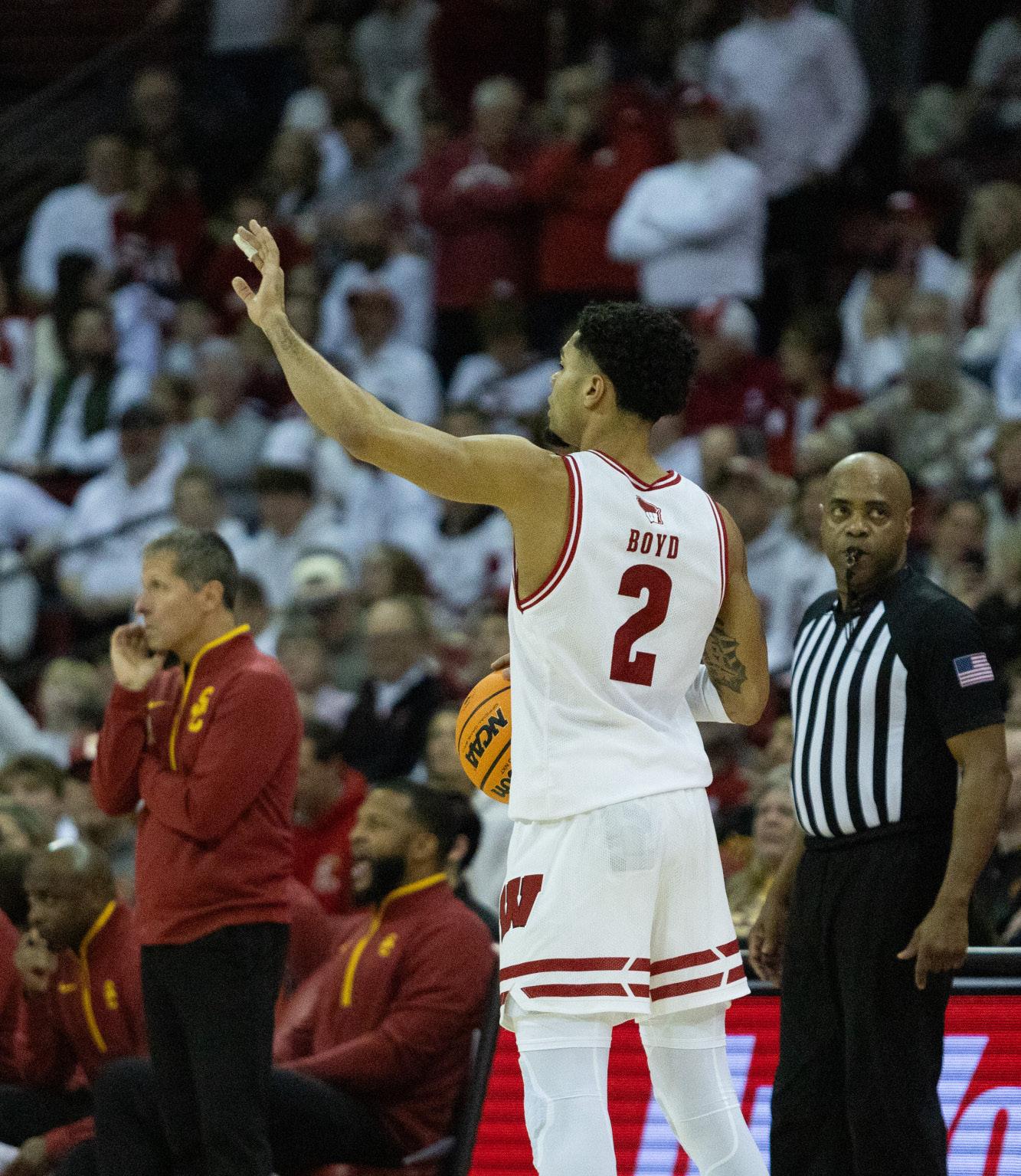
The transfer guard has been key this year, helping ease Tonje loss, lead Wisconsin’s backcourt
+ SPORTS, PAGE 8
Thursday, January 29, 2026 l
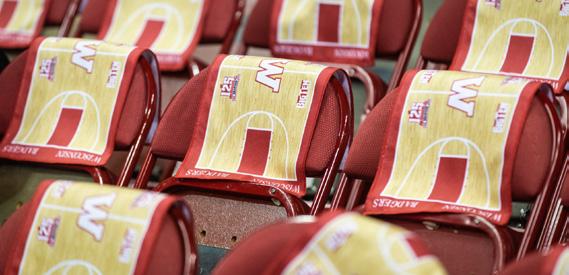

Hello luxury totes and purses. Why Badgers are ditching backpacks for a new kind of book bag.
+ LIFE & STYLE, PAGE 6
By Annika Bereny & Zoey Elwood
CAMPUS EDITOR & COLLEGE EDITOR
University of Wisconsin-Madison
Chancellor Jennifer Mnookin was chosen to be Columbia University’s next president, according to a Sunday New York Times article.
Mnookin first joined UW-Madison in 2022 after serving as dean of the University of California, Los Angeles Law School and will stay chancellor through spring commencement. Following Mnookin’s departure, UW System President Jay Rothman, along with other stakeholders, will appoint an interim chancellor while the Board of Regents searches for a permanent successor.
“As Chancellor Mnookin begins her next chapter, we thank her for her contributions and wish her every success. We look forward to ensuring that UW-Madison continues to
thrive and to carry forward the tradition of excellence it is known for worldwide,” Rothman said in a statement.
She struck a delicate balance during a tumultuous time in higher education at UW-Madison amid large-scale pro-Palestine protests, a funding deal to freeze and eliminate DEI positions in exchange for state funding and federal funding cuts from the Trump Administration. She advocated for UW-Madison to Wisconsin’s Republican Legislature, piloting initiatives focused on free speech and pluralism in response to criticisms that the university lacked ideological diversity. Mnookin also expanded the university’s federal lobbying efforts and focused federal funding grants on the Department of Defense grants and university research around Artificial Intelligence, allowing UW-Madison to rise in
research expenditure rankings.
“It has been a true honor to be a part of the Wisconsin family,” Mnookin said in a statement Sunday. “I am proud of what we have accomplished together, even in a challenging period for higher education, and I know great possibilities lie ahead for the UW–Madison campus community.”
As Columbia’s president, Mnookin is poised to enter a similarly uncertain environment, leading initiatives in growth and stability at a university whose handling of pro-Palestine student protests in 2023 and increasing hostility from the Trump Administration has thrust the campus into the national spotlight. Columbia’s campus has since encountered numerous, large-scale pro-Palestine demonstrations.
Mnookin will replace Nemat “Minouche”

By Elizabeth Baumberger STAFF WRITER
Amidst clanking pots, echoing laughter and piping hot food circling the restaurant, Himal Chuli owner Bishnu Pradhan — known more fondly as ‘mother’ or ‘grandmother’ — can be seen adding ‘a little of this and a little of that’ to each dish she cooks.
Bishnu and her husband Krishna Pradham opened Himal Chuli, the first Nepali restaurant in the U.S., in March 1986. For 40 years, customers and friends were synonymous as the cultural carveout occupied an important presence in downtown Madison, bringing a taste of the Himalayas to the Midwest. But this past December, the restaurant closed its doors for good, three years after Bishnu’s passing.
Bishnu’s cooking was widely loved by the Madison community. From her husband’s colleagues to hungry college students
at the University of Wisconsin-Madison, there wasn’t a demographic that didn’t cherish her Nepali cuisine.
Rajan Pradhan, restaurant owner and son of Bishnu and Krishna, told The Daily Cardinal simply, “she had the touch.”
Himal Chuli started as a small food cart on Library Mall in the early ‘80s with a limited menu before moving into their State Street location, where they remained for the duration of the restaurant’s existence.
The local community quickly embraced the restaurant.
“It was a very comfortable, tight space. The laughter carried. It was always full of joy and happiness, because mother’s cooking in there, so it can’t go wrong,” Rajan said.
When Bishnu was teaching Rajan to cook in the kitchen, he said it was often very difficult keeping up with his mother’s
tempo and habit of measuring with her heart.
“Oh it was tough, but that’s mother and son,” Rajan said. “We loved each other very much and she molded me into who I am now.”
Rajan, the oldest of his brother and two sisters, spent the first 10 years of his life in Nepal before immigrating to the United States. He grew up on a plateau in the clouds where trekkers and climbers from all over the world passed through on their way to scale mountains. But Rajan was more interested in scaling fish.
“Hiking up to my village is good enough for me,” he said. He’d rather be in the kitchen watching his grandmother or aunt cook.
+ Himal Chuli page 4
Shafik, Columbia’s last president who resigned in 2024 after intense national scrutiny surrounding the university’s approach to pro-Palestine protests.
A former Ivy League student herself, Mnookin holds a Bachelor’s degree from Harvard and a JD from Yale — as well as a doctorate from MIT.
“My time at UW–Madison has been lifechanging and so much of that is attributable to the talented and deeply committed faculty, students and staff who call our institution home, and who strive to bring the Wisconsin Idea to life,” Mnookin said. “I will continue to work hard each and every day prior to my departure and I look forward to partnering with President Rothman, the Board of Regents and others to ensure a smooth transition.”
‘ICE will kill more’: Over a thousand gather at Library Mall
Students, community members, activists protested recent ICE violence
By Ellie Huber & Alexa Cattouse STAFF WRITERS
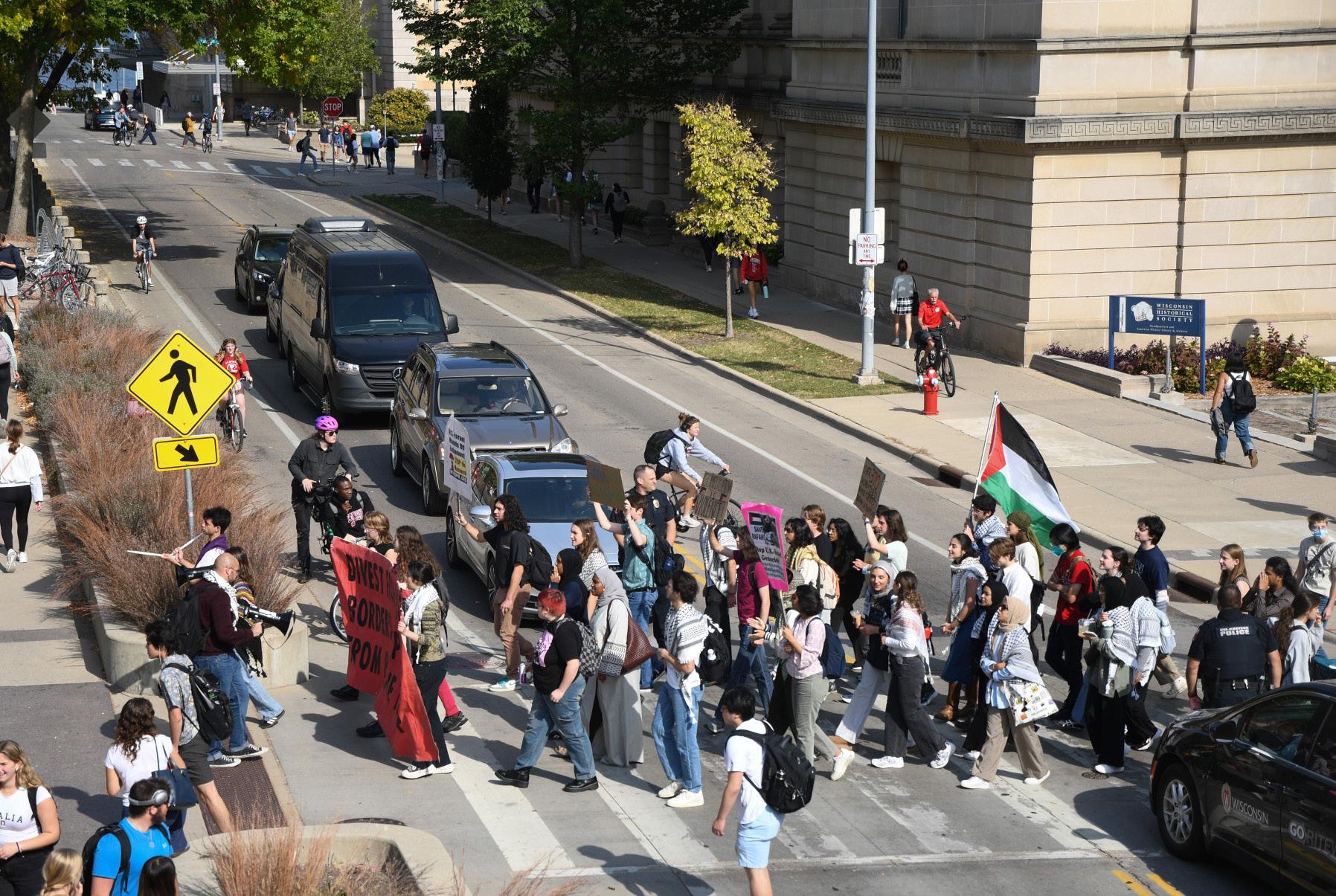
More than 1,000 students, community members and activists protested Immigration and Customs Enforcement’s presence in American cities, holding a solidarity vigil on a cold, snow-covered Library Mall Tuesday evening.
The “No I.C.E. on Campus” rally and solidarity vigil, hosted by Students for a Democratic Society (SDS), provided handwarmers, candles and flyers to attendees. Many activists held anti-ICE and pro-immigrant signs expressing messages of solidarity and opposition to racial profiling.
Speakers addressed the crowd from the foot of Memorial Library’s steps, denouncing ICE brutality in cities across the nation and what they described as illegal detentions and acts of racial profiling under the Trump administration.
“ICE will kill more. They will attack protestors more, drag people out of their homes, separate children from parents and rape women and children in custody,” SDS Co-chairman Luca Motivala said to the crowd. “They will escalate endlessly until we, as a people, stand up together in a unified resistance.”
Motivala later told The Daily Cardinal, “It’s illegal, unjust kidnappings, rape and murder of citizens and non-citizens of the United States. Everyone’s entitled to the protection of the Constitution, and [ICE] continually violates not only that, but local states’ rights.”
+ Protest page 2

Continued from page 1
University of WisconsinMadison alum Rob Koenig was alarmed by recent ICE activity, particularly the fatal January shootings of two Minneapolis residents — Alex Pretti and Renée Nicole Good. He returned to the UW-Madison campus to protest, carrying a sign comparing ICE to the Gestapo — Nazi Germany’s secret police.
“[The Gestapo] identified people, detained them
and sent them to prison and extermination camps,” Koenig told the Cardinal. “We’re not there yet, but I don’t think the comparison is unfair.”
Koenig and other activists reflected on the moments leading up to Good and Pretti’s deaths, with Koenig saying Good told an ICE agent she “wasn’t mad,” and Pretti attempting to help civilians before the former two were shot multiple times.
“[ICE agents] are killing our neighbors and protes-
tors,” SDS Co-chairman Bradley Keenan told the Cardinal. “Look around. You can’t ignore the fact that they’re using blind violence to suppress opposition and kill people extrajudicially.”
Elayna Torres and Gabriella Ramirez, two Latina freshmen at UW-Madison, said they were “heartbroken” by the increasing ICE violence but felt optimistic seeing the large crowd Tuesday.
“It shouldn’t happen to anybody, especially with what happened with that

By Jake Wesson, Drew Wesson, Peter Fishman STAFF WRITERS
Hundreds rallied outside the Wisconsin State Capitol Sunday to protest U.S. Immigration and Customs Enforcement’s escalation in Minneapolis, where an increase in federal immigration enforcement has led to high-profile shootings and fueled widespread outrage and activism.
Sunday’s demonstration was hosted in response to 37-yearold Alex Pretti’s death, the third civilian — and second fatal — shooting by a federal agent in Minneapolis. Renee Nicole Good, the first shooting victim, died Jan. 7.
The Madison protest reflects growing national frustration over aggressive actions by the Trump administration’s federal agencies responsible for immigration enforcement.
“We’re protesting against the brutality,” said Alix Olson, a protester at the rally. “The murders that [they have] been perpetrating in Minneapolis, [and] the illegality of what they’re doing.”
The killing of Pretti, who had a concealed carry permit, has sparked anti-ICE sentiment across the political spectrum, as Second Amendment supporters have criticized U.S. Customs and Border Protection for infringing on constitutional rights.
Local and state officials across the Midwest have issued statements condemning the violence since Saturday.
“American citizens are having their rights and freedoms vio-
little five-year-old boy, too. That’s crazy to see, but it does make me have faith in our country that there are a lot of protests going on and people are starting to step up and speak up for our people,” Torres told the Cardinal.
Ramirez also expressed fear for her and her loved ones being racially profiled, especially while attending a Predominantly White Institution.
“It’s a guilty feeling being on a campus that is PWI because you know you aren’t the standard, and you shine
out compared to the others,” Ramirez said.
Motivala said SDS plans to continue anti-ICE action, building a quick response network across Madison to provide ICE whereabouts alerts and safety protocols for students with visas.
The “No I.C.E. on Campus” rally and solidarity vigil is one of three anti-ICE rallies this week, with one occurring at the Wisconsin State Capitol this past Sunday and another one at noon on Friday at Library Mall.
By Clara Strecker STATE NEWS EDITOR
Local activist groups and faculty members are calling out the University of Wisconsin Police Department and technology company Flock Safety over eight security cameras they say bring privacy and security concerns to campus.
UWPD — who has access to the data through a contract with Flock Safety — said the cameras aid law enforcement in solving crimes and are not used for “surveillance” of the community like some suspect.
lated and are being put in unsafe and life-threatening situations in their own communities,” Wisconsin Governor Tony Evers said in a statement Monday. “It has to stop.”
Federal agencies defended their actions as lawful and justified. Border Patrol Commander Gregory Bovino claimed agents were attempting to disarm Pretti and acted in self-defense when Pretti resisted, but video evidence and witness reports run counter to this claim.
“More people need to be aware of what’s happening and the lies being told,” Nicole, a protester who asked that their last name be omitted, said.
“Alex could’ve been any one of us. Renee could’ve been any one of us,” said one protester, who asked to remain anonymous. “This administration, going all the way to the Supreme Court and the three branches, they’re coming after us. And I’m pissed. Everybody’s pissed. And we want to step up.”
City, state and civil rights leaders in Minneapolis have filed lawsuits against Operation Metro Surge. Several are actively moving through the court process, including one that argues the operation is “unconstitutional and unlawful.” Wisconsin has since added its support to a lawsuit requesting a federal judge to order ICE to back down in Minnesota.
“What’s happening in Minneapolis should not be happening, period,” Mason Hart, a protestor, said.
Flock Safety is a private law enforcement technology company who contracts with local police, providing them with automated license plate readers. The platereading cameras now have newer functions, like sharing information across agencies and using artificial intelligence to identify and search vehicles beyond just the license plate. Communities around the country have questioned Flock’s ethics, security, legality and regulation.
Flock cameras are prohibited in Madison Police Department’s jurisdiction because of a Common Council ordinance banning the use of face surveillance technology but near and on campus in UWPD’s jurisdiction and near the Capitol under Capitol Police jurisdiction, Flock cameras operate.
As local police turn toward license plate tracking to solve crimes, federal law enforcement like Immigration and Customs Enforcement is also using Flock Safety data.
UWPD policy says Flock data from campus-area cameras is only shared with in-state law enforcement, UWPD Communications Director Marc Lovicott told The Daily Cardinal in an email. However, Lovicott said he couldn’t speak to what state agencies do with their data.
“Access to the system is restricted to UWPD personnel only, and all access is logged and audited to ensure compliance. Data is shared only with Wisconsin law enforcement agencies — federal agencies do not have access to our Flock cameras,” Lovicott said. “We can’t speak to what other agencies in Wisconsin do with their Flock systems or who they share data with…
what I can tell you is that we currently only offer access to in-state law enforcement.”
Although Flock Safety does not directly share data with ICE, many departments in Wisconsin already partner with ICE with 13 counties in Wisconsin having agreements to help federal authorities identify and deport undocumented individuals, according to a report from the Wisconsin ACLU.
Members of the University of Wisconsin-Madison’s Faculty union, United Faculty and Academic Staff Union (UFAS), criticized the Flock Safety cameras, raising concerns about data protection.
“How is this sharing happening? Are they cutting a copy of the data and sending it to the state of Wisconsin, because at that point they no longer know what happens to that copy of the data. Somebody at the state level could be sending it to the feds, and we would not know,” UFAS member and UW-Madison Information School faculty Dorothea Salo told the Cardinal.
Eleven of the 13 county sheriffs’ offices who agreed to partner with ICE showed up in a Flock data audit — yet it is still unclear what information was used, according to an analysis by the Wisconsin Examiner.
Notably, the City of Madison ordinance does not allow such cameras, but Dane County does, and other departments like The Capitol Police — which operate four Flock Safety cameras around capitol square — and UWPD have separate jurisdictions.
Additionally, UFAS members expressed worries over transparency.
“I think one of the things that’s concerning is how little we know. UWPD didn’t make any announcements… There’s no transparency about how this is being done,” Co-President of UFAS Barret Elward told the Cardinal. “They’re not violating the legality of Madison general ordinance but they are violating the spirit by having these face surveillance technologies in the city of Madison.”
Continued from page 1
Despite UWPD saying they do not share data with federal agencies, Salo still believes the cameras should not be used.
“What this does is set up an antagonistic relationship between the campus community and the campus police, and I don’t think that is ever productive. I don’t think it’s good that we should have to worry about
campus police really overreaching their mandate to keep campus safe,”
Salo said.
Salo shared reported instances where the company reinstalled cameras following orders from city officials to remove them, with city officials turning to physically covering them with trashbags. Additionally, in December 2025, Flock left control panels for some of their cameras open to the internet where anyone was able to watch footage.
Across the country, citizens
have sued municipalities over the Flock system. In Virginia, residents argued Norfolk violated their Fourth Amendment rights, which protects against unreasonable searches and seizures requiring law enforcement to typically obtain a warrant to track a person’s movements.
Democratic lawmakers are urging the Federal Trade Commission to investigate Flock over cybersecurity and hacking concerns.
Lovicott said UWPD uses Flock cameras to keep the campus “safe,”
By Clara Strecker STATE NEWS EDITOR
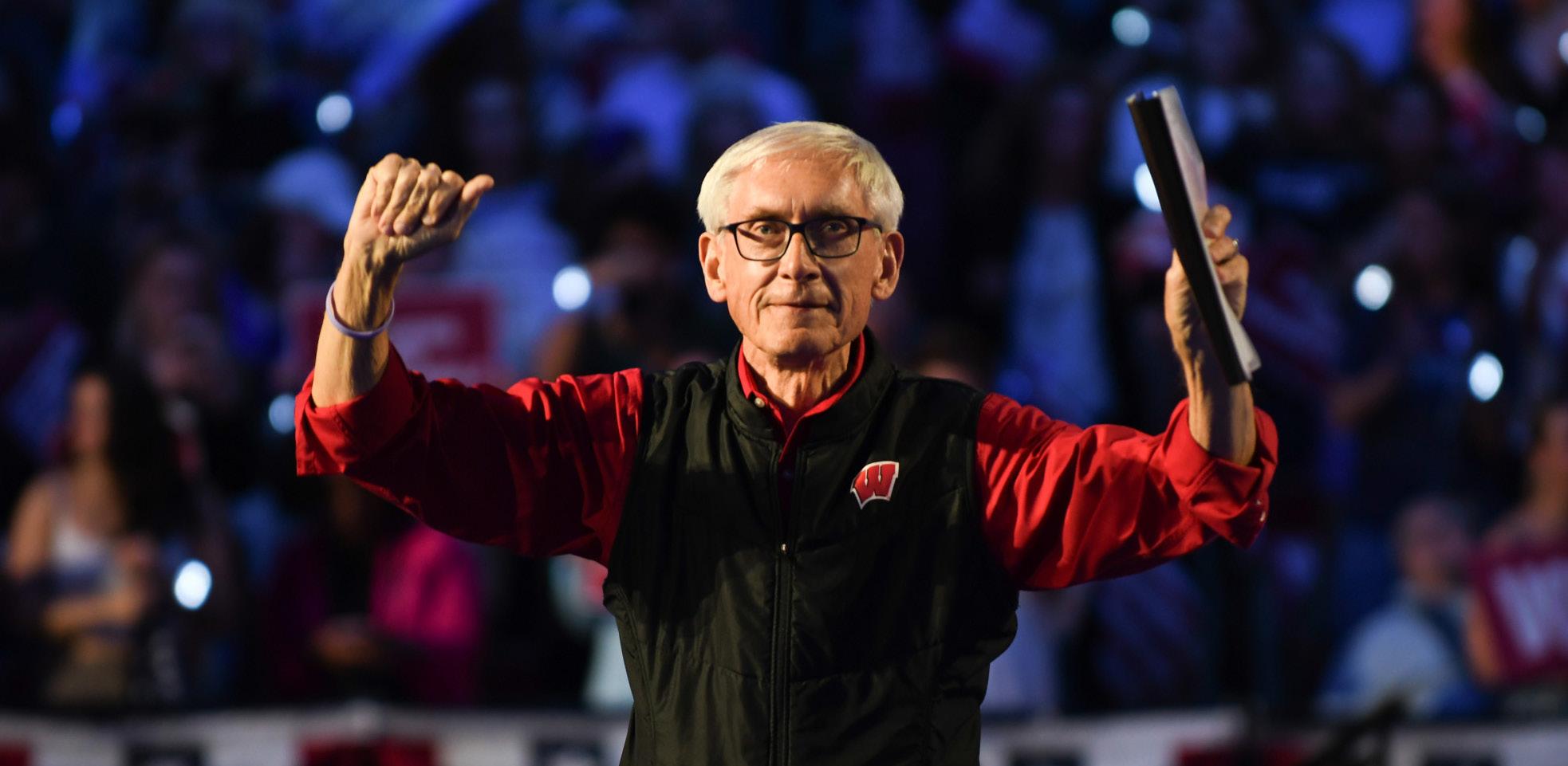
Gov. Tony Evers told The Daily Cardinal in an interview Wednesday he is in the process of negotiating with the Legislature what will be done with the state’s budget surplus, but does not have a specific answer whether the University of Wisconsin System will receive any additional funding.
The Legislative Fiscal Bureau recently projected Wisconsin to end in a $2.5 billion surplus at the end of 2025-27 biennium, almost $1.5 billion more than expected when Evers signed the budget in July.
Evers said he is “possibly” interested in increasing funding and will “certainly” look into it, but said his top priority was relieving residents of property tax increases.
Evers said as he negotiates these next few months with the Legislature, they will “look at all options,” but he is “not in a position to guarantee anything right now” until he sees what the Legislature does.
With this surplus, Evers said he hopes lawmakers will approve property tax relief, which he originally proposed in the 202527 budget but was cut through negotiations with Republicans, who argue his 400-year veto from the last budget cycle raising per pupil spending by $325 per kid caused the surge. Property taxes saw the largest increase this year since 2018.
Evers stressed that although the UW System received less than the Board of Regents requested — and what he originally proposed — they obtained the largest funding increase in about two decades, even after some lawmakers proposed massive cuts.
The UW System received a $256 million increase in the 2025-27 budget, a major turnaround after Republican lawmakers threatened to cut funding by $87 million two weeks prior. However, the increase was significantly less than the Board of Regents and Evers’ original proposal of $856 million.
When requesting the $856 million, UW System President Jay Rothman said in a February interview with WisEye he would not recommend raising tuition or closing any additional branch campuses if the system received the full funding.
Soon after the UW System received about $600 million short of what they
requested, tuition increased by 5% and the UW-Platteville Baraboo Sauk County branch campus closed in October.
As affordability remains a top issue, Republican lawmakers floated the idea of capping changes to in-state undergraduate tuition to the rate of inflation, introducing a bill that has yet to be passed by either chamber.
Evers, a former Board of Regents member, said he wants to ensure the board has a say in the idea and that he is “somewhat reluctant” to cap anything, but it still remains a “possibility.”
Evers emphasized his worries about capping tuition to the rate of inflation saying it makes things unsteady. He questioned if there ever was a sudden rapid increase in inflation due to the Trump Administration or tariffs, would the Legislature agree to a massive increase in tuition.
“It’s not that I’m interested in having people going broke because they’re sending their kids to college, nor am I thinking that capping is the answer,” Evers said, adding that the Board of Regents has the data needed to make a decision and that is where he thinks the starting point should be.
Also taken out of Evers’ original proposed budget was a $500 million response fund, meant to aid the state amid a possible loss of federal funding including if the Trump Administration implemented National Institutes of Health (NIH) cuts.
The Trump administration cut over $12 million in specific NIH research grants at UW-Madison in April, terminating federally-funded approved projects targeting research into coronavirus vaccine development and mental health disparities among transgender and nonbinary youth.
Without this response fund, Evers highlighted lawsuits Wisconsin joined challenging the Trump Administration’s attempt to cut funding, saying they have had some success in federal judges blocking the proposed cuts.
“Obviously, it’s important to have research money, and it impacts the entire country, especially research that happens here at the University of Wisconsin,” Evers said. “We’re on top of it. We’re going to continue fighting for that. We’ve had some success, but we need more successes.”
adding that the cameras aid them in recognizing vehicles connected to criminal investigations and help locate missing persons.
Lovicott also said UWPD does not store any of its data unless it is pulled for an investigation or a police report.
Lovicott said Flock stores the data from their cameras for 30 days before permanently deleting it.
Lovicott said the department is currently developing a website to provide more information about the system, including data specific to their
cameras, which will “hopefully” go live later this week.

By Mia Warren STAFF WRITER
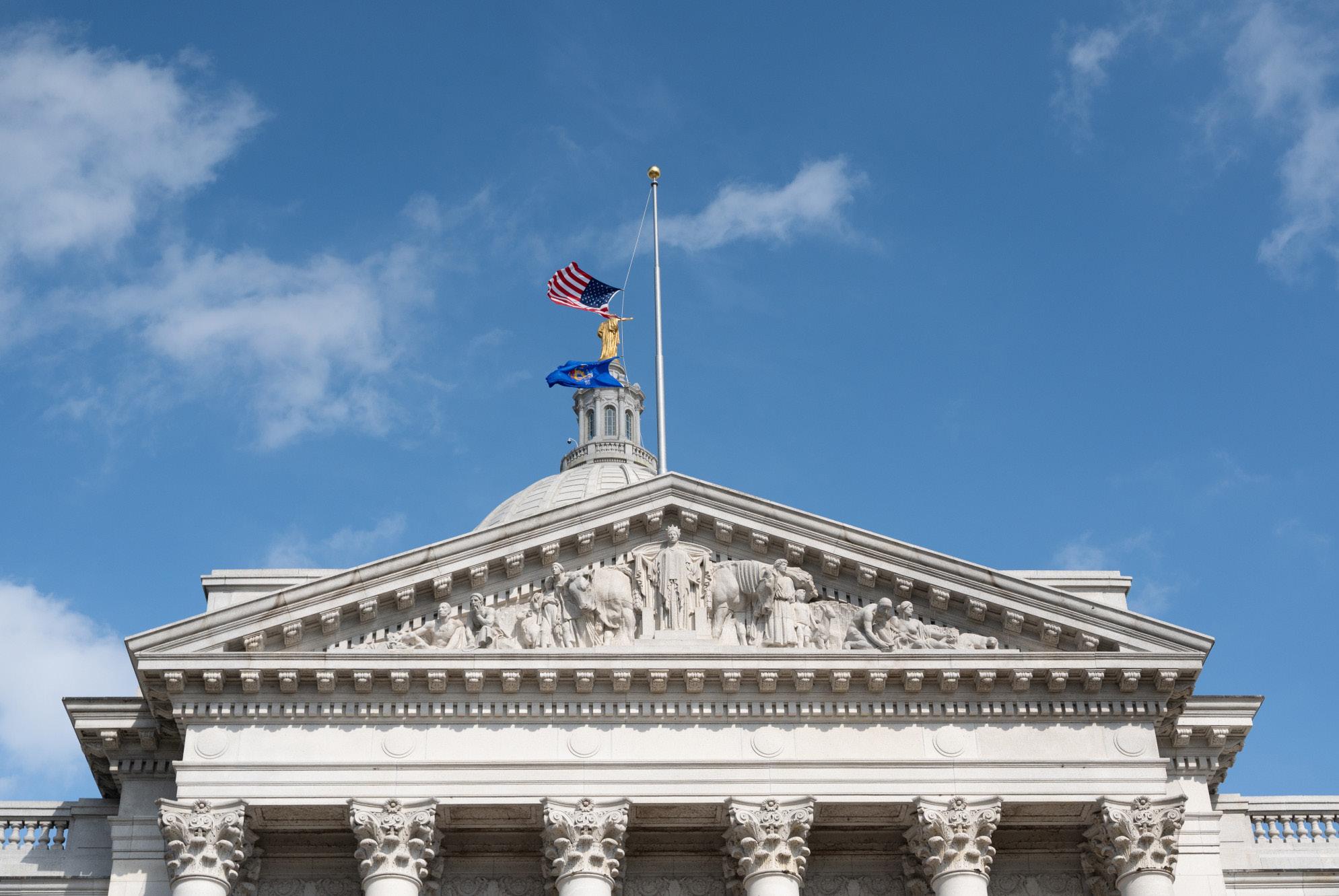
Wisconsin Republican lawmakers want to limit the University of Wisconsin System’s academic and research collaboration with six countries amid concerns over national security and foreign influence in education.
The bill, which passed the Assembly on Jan. 22, prohibits study abroad, dual degree programs and research collaborations with China, Russia, Iran, North Korea, Venezuela and Qatar. While there are currently no UW-Madison programs in four of the targeted countries, the university has three study abroad programs in China and one flagship program in Russia.
Study abroad opportunities in China range across majors and offer internships and language immersion. It remains unclear if these programs would be immediately terminated if the bill passes.
“It’s not really fair to our state to be paying for all the research partnering with an organization who may be based in China,” Rep. Alex Dallman, R-Mareson, said. “We’re not going to restrict the UW System from having any of these partnerships moving forward. We just need to have them get a risk assessment from the federal government.”
It also remains unclear what this means for research. As of 2019, UW-Madison participates in nine active research collaborations with Chinese universities. Additionally, UW-Madison participates in the Wisconsin Russia Project, which aims to build social science research.
In order for an academic program in an affected country to continue, the bill would require the Board of Regents to prove the program is “valuable to students” and submit an annual report detailing each program with these countries, including information on each of their national security risk assessment requests. The bill would also require the Board of Regents to receive a national security assessment from a federal law enforcement agency.
The university opposes the legislation, saying they believe the bill mirrors
already existing safeguards.
“The bill would introduce significant administrative burdens and delays… Requiring the Board of Regents approval and federal security assessments for nearly all partnerships could slow down responses to emerging research opportunities,” UW Office of Government Relations said in a testimony on Jan. 27. Under the bill, UW would be forced to pay twice the amount of the program’s determined value to the Joint Committee on Finance if the university does not comply. This legislation comes after UW-Madison already lost research funding as the Trump Administration cut $12 million last year.
Dallman’s testimony on Tuesday pointed to a report from the U.S. Select Committee on the Chinese Communist Party saying universities in Wisconsin worked with researchers linked to the CCP and Chinese military.
While the committee did find “close collaborative partnerships” between Chinese universities and several schools in their report from September 2025, no UW System school was mentioned.
Dallman and other Republican lawmakers defended the bill’s national security necessity, but representatives across the aisle have their doubts.
“Qatar was on the list of enemies for this bill, and if you look at the drafting notes, it was four days after President Trump got a plane [from them] that Qatar was taken off,” Rep. Angella Stroud, D-Ashland, said.
President Trump accepted a luxury Boeing 747-8 from Qatar last May, a gift from the ruling House of Thani, to use as the new Air Force One jet. This type of gift exchange is prohibited under this bill, which bars UW employees from accepting gifts or payments from foreign adversaries.
Dallman removed Qatar on Dec. 3 from the definition of foreign adversary with Amendment 1. Meaning that while UW schools are still prohibited from collaboration with Qatar, it is not technically a “foreign adversary” under this legislation.
4 Thursday, January 29, 2026
Continued from page 1
In the U.S., Rajan attended middle and high school — stopping by Himal Chuli during his lunch breaks — and studied Fine Arts before leaving school to help his mother more at the restaurant. But Rajan’s artistic inclinations are alive in his new restaurant, Ama.
Across from the stairs in Ama
hangs the first art piece ever hung in Himal Chuli, a depiction of porters in the Himalayan Mountains. Rajan has also decorated his restaurant with a variety of Buddhist paintings, sculptures and Hindu artwork, hoping to eventually put up a collage featuring his mother.
In short time, it was Rajan’s sons — in place of Rajan — that were stopping by the restaurant during their school lunch breaks.
Akash Pradhan, Rajan’s
second son, told the Cardinal that as children, he and his brothers would cause chaos for the kitchen and wait staff in the little restaurant.
“But [they weren’t] gonna say anything to the owners’ grandkids,” he laughed.
And so, he and his brother were allowed to run cheerfully amok about the tables.
Akash recalled gaining the confidence on a particularly slow day to walk up to tables as if he
By Elizabeth Baumberger SENIOR STAFF WRITER
Students for Justice in Palestine (SJP) will renew calls for university divestment from Israel, Immigration and Customs Enforcement and military operations in Venezuela while remaining civil with the university as the organization returns to campus Jan. 15 following a six-month suspension, a member told The Daily Cardinal.
The University of Wisconsin-Madison suspended SJP last July for violating five university policies at an April protest against former U.S. Ambassador Linda Thomas-Greenfield who vetoed four Gaza ceasefire resolutions during the Biden administration at the United Nations. The suspension came after the organization was put on disciplinary probation for the 12-day encampment on Library Mall in spring of 2024.
During the suspension, some UW-Madison students involved in SJP created a separate organization, the Palestine Solidarity Committee, to advocate for Palestine, while others contributed through organizations like Young Democratic Socialists of America and Students for a Democratic Society.
SJP member Adam Donahue told the Cardinal SJP will continue to research and publicize UW-Madison’s investments and argue for university disclosure and divestment not only from companies profiting off the war in Gaza but also those supporting ICE raids and assaults against Venezuela.
“There’s a lot of intersections where divestment is located, and that research and political intersectionality is something that we’ve been focusing on a lot and want to amplify in our divestment initiatives moving forward,” Donahue said.
As of May 2024, the UW System Trust Fund was most heavily invested in BlackRock’s ACWI Index, which held over $249 million at the time of a December 2023 report. Like most Exchange-Traded Funds — which are combined investments that can be composed of individual companies’ stocks or other ETFs — BlackRock’s ACWI Index is invested in companies that profit from the war in Gaza, support ICE
raids and are connected with the attacks on Venezuela. Companies in the fund include Lockheed Martin, Elbit Systems, Palantir, Boeing and Chevron.
Additionally, Donahue said the organization is focused on ensuring a democratic process for making university investment decisions once divestment and disclosure are achieved.
UW System investment decisions are currently made by the Board of Regents, which Donahue said is a process that “is neither transparent nor at all democratic with respect to the students, staff or faculty.”
UW-Madison’s large $4 billion endowment is managed by the University of Wisconsin Foundation and Alumni Associated, a non-profit associated with the university but not subject to open records or public disclosure.
SJP remains on probation until May 15, and until then, Donahue said they will “toe the line” to not raise the probation back into a suspension.
“We don’t want to have waited an entire semester to get off of suspension only to get on it again,” he said.
The organization plans to advance their goals through petitions, efforts to build support for a potential divestment resolution and, chiefly, working to increase public awareness around the argument for divestment.
“It’s an argument that is not difficult to understand, but it’s also not something that a lot of citizens are tuned in to,” Donahue said. “I think a lot of our work will be focused on making that message publicly accessible.”
Despite the need for caution to avoid further conflict with university administration, Donahue said SJP is not discouraged by the suspension.
“We know what the reason was [for it]. It’s because we support Palestine while the university supports Israel both materially and ideologically,” he said. “This is something that many SJPs have faced and come out on the better end of, so we are very excited for this semester and for the things that we are planning.”
was their server. “Yeah, I can take your order,” he told them, still visibly a child.
Akash said that when you walked into Himal Chuli, there was a table right before you entered the kitchen, “and that was grandma’s table.”
“That’s where my memory is surrounded — at that one little table where grandma could see outside,” Akash said.
From that table, Bishnu would watch customers walk
in, sit and chat with her family and reprimand her grandsons, Akash said.
Himal Chuli is set to reopen in the same place under a slightly different name, Himali Chulo, and new owner, Ashim Malla. Still, the original restaurant will remain a fond recollection to many and be remembered by family as a place brimming with motherly love.
“It’s always sunny in my memory,” Akash said. “And my grandmother is always there.”
By Alaina Walsh CITY NEWS EDITOR
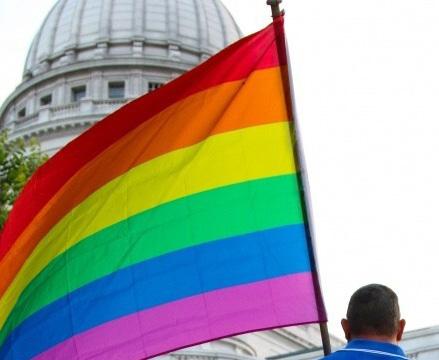
Transgender advocates, parents and patients are calling out UW Health and Children’s Wisconsin’s Jan. 13 decision to pause prescribing puberty blockers and hormone therapy for patients under the age of 18.
The pause follows recent federal actions and prompted advocacy group Indivisible Madison East to rally Jan. 16, arguing the move will cause both immediate and long-term harm to transgender patients already receiving care.
“This kind of health care is extremely personal to us,” Aria X. Trucios, an Indivisible Madison East organizer, told The Daily Cardinal. “Many of our members are parents of trans kids, and many of our members are also trans adults — people who were once trans kids.”
Trucios said the abrupt nature of the decision left families scrambling, particularly those whose children were already in the middle of treatment and suddenly had to navigate disrupted care without a clear path forward.
“It just happened,” they said. “What UW did was shut it down in their face without giving families time to find care elsewhere.”
In an email statement to the Cardinal, UW Health said despite recent federal actions they will continue to be committed to LGBTQ+ patients.
“We recognize the uncertainty faced by our impacted patients and families seeking this gender affirming care and will continue to support their health and well-being,” the statement said.
For minors, gender-affirming care is not a single decision or a quick medical intervention. It is a multi-year, stepby-step process that involves medical professionals, mental health providers, parents or guardians and often schools and insurers, according to the National Library of Medicine. Most care for minors is non-medical at first, and any
medical steps come much later — if at all.
“These aren’t people coming in off the street and getting prescriptions the same day,” Trucios said. “These are patients who have been in the process for years.”
Access to care requires a child to identify as transgender well before puberty, have parental support, undergo extensive documentation and therapy and consistently affirm the decision themselves.
“You have to positively assert, as the patient yourself, that this is what you want,” Trucios said. “The patient is the one driving the decision the entire time.”
Trucios said the immediate impact of pausing care is that some patients will be forced to undergo puberty that does not align with their gender identity — a process they described as both distressing and irreversible.
“These kids know the puberty they’re going through isn’t right for them,” they said. “Now they’re being forced to watch their bodies change in permanent ways.”
Puberty blockers, one form of genderaffirming care, are supported by major medical organizations and can prevent the need for future surgeries.
Beyond immediate patient impact, Trucios expressed concern that pausing care for minors could set a precedent for restricting access for adults.
“We’ve seen in states across the country that once care is paused or banned for kids, the next step is going after adults,” Trucios said. “This feels like one easy step from targeting children to targeting everyone.”
Indivisible Madison East is hopeful the proposed federal rule will stall during the public comment period or face legal challenges. In the meantime, they are calling on UW Health to allow patients already receiving care to continue treatment.
“I’m hopeful UW will see the humanity of the people they’re harming with this decision and do the right thing by patients,” Trucios said.
By Roman Fritz STAFF WRITER
Recently, I came across an article in the Madison Federalist critiquing Marxism. I engaged with it, hoping for an informed discussion on Marxist concepts, but I was met with disappointment. The author, Aiden Wirth, claimed they “became interested in Marxist thought through TikTok videos” and heavily relied on quotes from various Catholic Popes, without actually quoting Karl Marx or any Marxist work.
After I commented these thoughts at the end of the article in disbelief, Federalist Editor-in-Chief Benjamin Rothove (also Madison College Republicans President and YAF co-chair) invited me to submit a written response. I’m not interested in doing so because the Federalist is a newspaper whose editorial practices repeatedly harm marginalized students. So I’ll make my position clear in The Daily Cardinal, detailing the Federalist’s tremendous editorial neglect.
At nearly every paper, including the Cardinal, the editors ensure writing passes scrutiny. They check sources, theses, and statements, recommending any necessary changes. There’s an expectation for writers to use a variety of credible sources, particularly primary sources, to support their claims. What they initially submit is checked for accuracy before it’s published, and if a writer doesn’t have a source, it isn’t published. That’s the editorial process.
In that context, no competent editor would have given the Federalist’s Marxism critique a green light, regardless of political affiliation, because it refuses primary sourcing and relies entirely on the author’s own idea of what Marxism is. Marxism is not a vague internet trend; it’s an established set of scholarly concepts developed by Karl Marx and Friedrich Engels to analyze history, society, and political economy.
As a Marxist, I’d love to respond to the critiques in-depth. However, the Federalist offers little substance.
Wirth relies on anti-communist quotes from Pope Pius XI without engaging in Marxist theory itself. If he believes we should trust the Pope’s authority, then it becomes unclear why other papal statements, such as Pope Francis’s 2015 remark calling financial greed “the dung of the devil,” are excluded. Nonetheless, it’s intellectually indefensible to assume that papal authority automatically qualifies someone to critique Marxist theory.
Marx, Engels, and subsequent Marxist scholars have spent decades rigorously developing and defending these concepts. Yet in a single sentence, ignoring Marx’s written work, Wirth presents himself as an authority on Marx, saying, “‘dialectical materialism’ sounds complex and academic, but it really just means that economic conditions can affect history.”
Immediately, the critique falls flat. That isn’t a definition of dialectical materialism, but instead a shallow description of historical materialism. Dialectical materialism is
Marxism’s lens for understanding how contradictions in material reality, society, and thought drive change, not how economics shapes history: Engels explains dialectical materialism on page 132 of his 1878 Anti-Dühring as “the science of the general laws of motion and development of nature, human society and thought.” It’s not as simple as just economics or history. To reduce these well-researched ideas to vague impressions is unserious.
The rest of the article largely consists of papal quotations and cultural critique. Wirth never engages with Marx other than to use an image of him as a thumbnail, instead mentioning “social media” five times and making meandering claims about how Marxism “almost seems like it was created for social media” and is “a viral and accessible ideology.”
Alternatively, Wirth should have claimed a stronger “essential flaw in Marxism” than “to deny the owner of that property [that is their own] is to deny the owner of their ability to use their wages to better their position in
life.” Marx explicitly rejects this claim, writing in his Communist Manifesto, “[w]e by no means intend to abolish this personal appropriation of the products of labour,” making clear that Marxism does not deny the use of wages, but instead targets private ownership that allows the exploitative buying and selling of others’ labor.
I wouldn’t expect the Federalist to recognize the valid points Marxism makes, though, because it functions less as a reliable reporting outlet than as a tool spreading prejudiced, anti-education ideas on campus and within the national conservative media apparatus.
The Federalist has regularly tried to push minor campus activities into conservative culture war narratives, like when Fox News amplified Federalist reporting about a series of stickers on campus calling for the death of ICE agents, an agency with a well-documented record of deaths in custody and a pattern of extrajudicial killings.
continuereading@dailycardinal.com
Cardinal View: Mnookin couldn’t meet UW’s moment. She’ll need to overcome more to meet Columbia’s
By The Daily Cardinal Editorial Board
When Chancellor Jennifer Mnookin took over at the University of WisconsinMadison four years ago, she entered an unwinnable situation.
Republican legislators immediately criticized her as an out-of-touch coastal elite, and she was forced to handle many of the issues that would plague her term as chancellor — debates over anti-semitism and how campuses could support free speech while upholding an environment inclusive of all students.
She was thrust into a budget crisis as state funding continued to lag, the university faced the tail end of a decade-long tuition freeze and campus protests erupted over controversial conservative speakers.
None of those issues are any better today.
The university’s budget is in a more precarious position today. Wisconsin now ranks 44th in the nation in public higher education funding, continuing a long decline. The university has ordered academic departments and administrative units to make 5% and 7% cuts, respectively. Protests — and the university’s response to them — have grown more charged, and debates over “diversity of thought” and free speech remain far from settled.
In her first email to Columbia students, Mnookin wrote “moments like this demand, in my view, an urgent assertion of the role universities must play in civic life, a clear articulation of both our value and our values.”
In her time at UW, she was never that leader, but for the future of higher education, she’ll need to be.
When confronted with demands from Black students at a silent sit-in in May 2023, Mnookin seemed out of her depth. She appeared for just 20 minutes, delivering meandering remarks that failed to ease protesters’ concerns or earn their faith in her ability to respond with urgency and moral clarity to a jarring video of a student using a racial slur.
After a nearly nine-month national search, Columbia has decided Mnookin embodies the response it wants to unprecedented challenges. She is entering a fire-
storm — no university has been more central to pro-Palestine activism or more directly targeted by the Trump administration than Columbia.
If Mnookin represents the best leadership Columbia can imagine for this moment, that is concerning and suggests administrators fundamentally misunderstand the traits required to confront today’s political landscape.
Mnookin frequently deployed a cautious, pragmatic approach to issues. When given time to think, she proved adept in her ability to choose the better of two bad options. But when forced to act decisively in the moment and directly address students, press or the public, Mnookin was an indecisive and distant advocate for the value of higher education and the Wisconsin Idea.
After extensive negotiations with Assembly Speaker Robin Vos and Wisconsin’s Republican-led Legislature, Mnookin chose to compromise campus DEI efforts to secure state funding for a muchneeded engineering building on campus in December 2023.
The deal came to be a defining one for Mnookin’s tenure, drawing criticism from campus figures for establishing a precedent of caving to political pressure instead of remaining principled.
And she won’t have an easier time at Columbia.
Trump presents a unique challenge for Mnookin in a way Vos doesn’t. Where Vos has a stake in the success of UW — the state’s largest employer and a significant cultural export — Trump doesn’t have the same relationship with Columbia. If Columbia faltered, it would only embolden his base and further his goal of remaking American institutions in his image.
Trump canceled $400 million in federal funding to Columbia, plans to deport student activist Mahmoud Khalil — a permanent U.S. resident — and launched investigations into anti-semitism. Columbia settled, notably paying $200 million and adopting the International Holocaust Remembrance Alliance definition of anti-semitism.
That confrontation sets the context for why comparisons to UW only go so far.
Columbia was square one for the kind of protests UW-Madison students replicated weeks later. But the similarities end there.
Columbia’s pro-Palestine movement is militant, organized and effective. Columbia students barricaded academic buildings, organized walkouts and drew national speakers and activists to campus. UW-Madison’s protests turned into a large outdoor hangout, in no way a serious threat to campus safety.
With the hindsight to know police intervention only strengthened the resolve
of protesters at universities across the country who had earlier encampments, Mnookin still sent in campus police to raid the encampment. The police left two tents standing, and within hours, the encampment was built back larger. In fact, it was her colleague at the University of Wisconsin-Milwaukee, former chancellor Mark Mone, who successfully negotiated an end to his campus’ encampment without police intervention, not Mnookin.
When Mnookin later negotiated with protesters after the raid, she successfully convinced them to sign a deal that one negotiator admitted did not meet any of their demands. More principled and effective leaders, the likes of which led Columbia’s movement, would have never agreed to the deal UW’s protesters did.
And throughout the encampment, Mnookin stumbled in her public statements, evoking Martin Luther King Jr. and flawed interpretations of ‘civil disobedience’ while failing to dictate why exactly she authorized campus police to endanger the students and faculty they were established to protect.
The encampment revealed more than a single lapse in judgment.
Mnookin’s willingness to compromise with state Republicans came to define her approach to UW’s challenges more broadly. She launched a center focused on free speech and expression, a move that implicitly validated Republican claims that UW lacked ideological diversity.
The decision reflected a broader belief that compromise could preserve the university’s standing and protect it from political attack. Instead, it ingratiated Mnookin to a Republican agenda fundamentally at odds with the purpose of public higher education.
If the core mission of higher education — academic freedom, institutional independence and the pursuit of knowledge — is incompatible with Republican efforts to remake American universities, it raises a deeper question: whether there is any real “winning” to be had by caving to political demands at all, whether from Trump or Vos.
GM Banh Mi brings a cozy atmosphere to Madison, serving tasty banh mi sandwiches and comfort.
By Alexa Cattouse STAFF WRITER
Students for Justice in Palestine anZoe Nguyun starts her mornings early opening her restaurant, GM Banh Mi. She begins by preparing the banh mi sandwich bread, a process that can take up to three hours. Although there are faster alternatives, she surprisingly doesn’t mind the long process — in fact she prefers it. Nguyun enjoys taking her time with every individual bread because it reminds her of her brother — the restaurant’s namesake — and his generosity.
Nguyun opened GM Banh Mi on W Johnson Street in November, making it the first Vietnamese restaurant in downtown Madison. The new quick-eats spot plays soft piano music with little tables along the walls, potted plants and a huge banh mi prep table.
Banh mi is a Vietnamese sandwich — a crispy baguette filled with various meats — typically pork — and pickled vegetables, fresh herbs and mayonnaise. Their menu also consists of other authentic Vietnamese dishes like spring bowls, spring rolls and pho, a beef broth simmered for 24 hours with noodles, sliced beef and herbs.
Nguyen named GM Banh Mi in honor of her brother, Gia Minh. Growing up, Nguyun and Gia Minh had a close relationship, describing him as a

kind and caring person. The two talked everyday about his dream of owning a restaurant.
“He was always the one who was cooking. That was his favorite thing to do because that’s how he shows that he cares,” Nguyen said. “One time, I remember when my mom got sick, and he would just go to the kitchen and make porridge for her, and we enjoyed it.”
Gia Minh attended culinary school in Toronto and worked as a chef in a couple of Michelin restaurants while in
school. However, just a week after graduating in 2022, Gia Minh passed away from pancreatic cancer.
Nguyun was inspired by her brother’s work ethic and generosity and decided to honor his legacy by opening a Vietnamese restaurant to share their love for food with Madison.
Growing up in Vietnam
Nguyen and Gia Minh grew up in the south of Vietnam but moved to Madison when Nguyun was in high school.
Before moving to Madison, life in Vietnam was simple. Nyguyn said in Vietnamese culture, food is an expression of love and centers on family.
Despite their mother rushing to work in the mornings, she would always prepare food for the family. When she was too busy, banh mi sandwiches were a go-to breakfast item. She would either prepare the sandwiches or the siblings would order banh mi from a street vendor outside.
These Vietnamese street vendors served as added inspi-
ration behind GM Banh Mi. In Vietnam, Nguyen said street food is very popular, and it is difficult to choose the “best” banh mi vendor because each one has a signature recipe. Nguyen wanted to add to Madison’s food diversity with a unique Vietnamese flair.
“I feel that compared to other cities, our [Madison’s] food is kind of diverse,” Nguyen said. “But it’s not really a foodie city like Chicago.”
A restaurant to feel at home
Nguyen tries to make every customer feel comfortable and likes to treat them like family. She encourages her customers to customize their food to their liking. Nguyen said she puts care and love into every order, just like how her brother would. Nguyen hopes customers will feel comfort in her food. When designing the restaurant’s interior, others recommended her design to have more of a traditional Vietnamese feel or a “younger vibe,” but she wanted her customers to have a quiet space and to feel at home.
“Some people say they like food that awakens them or say ‘Wow, it’s so good!’ but I don’t expect that ‘wow,’” Nguyen said. “I expect ‘Oh, you don’t know what to eat or where to go? Come here, a place that you feel warm, a place where you feel comfort, that it’s like home.”
Bye bye backpacks: Why luxury tote bags are the new college student staple

By Isabella Barajas & Jackson Baker
LIFE & STYLE EDITORS
For decades, the backpack has reigned supreme as the student bag of choice with little-to-no competition. But recently, a new fashion trend has flown under the radar on the University of WisconsinMadison’s campus.
Say goodbye to JanSport and hello to
Longchamp totes. Instead of sporting stuffed backpacks, students are slinging stylish tote bags and purses over their shoulders.
“Half my friends all have totes, no more backpacks,” UW-Madison senior Megan Dickert said.
A backpack screams collegiate, while a tote bag or purse can have a lot more versatility. Purses, for instance, can be seen as casual,
professional or formal depending on the occasion. They eliminate the need to run back home after classes to swap out for a handbag before running to an internship interview or hitting the bars with friends.
“I think a lot of people just stopped using backpacks because it doesn’t fit their aesthetic anymore,” another UW-Madison senior, Grace Fragakis, said.
Wearing a bag around campus can help students feel more put together and polished, especially because college is such a vital time for self expression and coming of age. The choice to leave behind the bulky backpack in favor of a stylish cross-body or practical tote bag is a way for students to feel more chic, confident and mature.
“I think they look more adult,” Dickert said.
But when more and more designer bags are popping up on campus, it can start to look more like flaunting luxury consumerism than a practical personal choice. That creased, worn-down purse your friend has been sporting? It could have cost hundreds of dollars.
Fragakis uses a Longchamp tote bag and has observed their popularity on campus, especially among sorority girls. The cheapest Longchamp product available on their website, a small mesh bag, is just over a hundred dollars, while the most expensive, a large
leather tote bag, is over $1,300.
Thanks to the beat-up bags trend of the past year, looking totally effortless is the new extravagance. And this quiet luxury may just be (part of) the reason these purses and handbags are populating every lecture hall this spring.
These bags also provide easier access to your necessities on the go. Instead of slinging a backpack off of your shoulder and rifling through countless zipper pouches in the middle of the sidewalk, you can easily reach in a tote and grab what you need.
“I have more of my daily essentials,” Fragakis said.
Dickert opts to alternate between a tote and a backpack depending on her needs.
“On days where I have [a] lighter [load]… I’ll take my tote because I just need to fit my computer in it, versus on a day where I have to go to the gym, I’ll take my backpack because I can send more items in it,” Dickert said.
Stylish or not, backpacks are much more spacious and sturdy than a flimsy tote bag made from recycled linen. There’s a reason they’ve been a campus staple for decades. But when many students today are ditching heavy textbooks for a thin laptop or tablet, the allure of the backpack may be wearing thin.
“It’s just not necessary to have a full backpack now,” Fragakis said.
By Alaina Walsh CITY NEWS EDITOR
I’ve seen “Hamilton” six times now in six different cities — New York, London, Chicago, Denver, Salt Lake City and most recently, Madison (Jan. 6-18) — enough to know this musical is both remarkably consistent and wildly sensitive to the smallest variables: a theater’s acoustics, an audience’s energy and the chemistry of two scene partners on a given night.
That’s what makes Madison’s stop at Overture Center, a part of the show’s Angelica tour, such an interesting case. The production arrives with the polish you’d expect from a long-running touring machine, and the storytelling remains as propulsive as ever. The opening “Alexander Hamilton” still detonates like a firecracker, and the cabinet battles still feel like history class taught through sheer audacity.
Yet in a show built on precision from its rap cadence, layered harmonies and emotional pivots timed to the beat, Madison’s performances also revealed how a few underwhelming casting decisions and surprisingly muted “major moment” scenes can flatten a musical that usually lands like a tidal wave.
Across all six cities, the show is held together with a bulletproof structure — the score does half the directing for you. Even when individual performances vary, the musical’s engine keeps pulling the audience forward. That’s the miracle of Lin-Manuel Miranda’s writing. It doesn’t merely support performance. It demands it.
In New York, that demand often reads as inevitability. The Richard Roger Theatre carries an almost ritual confidence — lines snap into place, laughs arrive in the pockets they’ve always lived in and emotional turns happen with a controlled, practiced force. London brings a different texture — a slightly cooler
surface at first, then a deepening investment as the audience realizes how much this very American story is also about the universal mechanics of power, legacy and myth-making. Chicago, with its long history of big commercial runs, often plays like a hybrid: Broadway’s assuredness with a Midwestern warmness that rewards clarity and humor.
Tour stops like Denver and Salt Lake City, at their best, feel like the show being re-proved in real time, a company recommitting nightly to the idea that this story still has something urgent to say, even after the hype cycles and its ten-year run. This can make touring performances feel more alive than a “museumquality” sit-down production.
Madison sits toward the end of my short list. It had tour-level stamina and craftsmanship, just like the shows in New York or London where the show has residency. But there were a handful of key places where the story’s voltage dipped.
The Overture Center is an excellent venue for big national tours, but “Hamilton” is uniquely sensitive to sound. The show’s language is rhythm and internal rhyme. If you miss a consonant, you miss a joke, plot point or shift in status. On Broadway, the mix often feels like it’s engineered to serve text first. In Madison, there were moments where the blend — especially in ensemble-heavy sequences — washed out the crispness that makes the writing feel like fireworks.
The audience helped, though. Madison crowds are generous, and you could feel the room wanting to meet the show’s energy halfway. When laughter and applause come readily, performers often take bigger swings. And in Madison, the comedy benefited. King Georgestyle bits (whichever performance you caught) reliably received delighted, anticipatory laughter.
Every “Hamilton” lives or dies
on the authority of its anchors. In Madison, the most noticeable weaknesses didn’t come from the romantic core, but from three roles that traditionally stabilize the show’s tonal compass: Aaron Burr, George Washington and Marquis de Lafayette/Thomas Jefferson. When these performances don’t fully land, the musical’s ideological tension — between caution and ambition, legacy and rebellion — loses sharpness.
Aaron Burr is the most precarious role in the show. At his best, Burr is restraint weaponized — patient, watchful, quietly burning with envy and self-justification. In New York and London, I’ve seen Burrs who make stillness feel dangerous, who can command a scene without ever raising their voice. In Madison, Burr’s performance leaned more neutral than conflicted. Vocally strong and emotionally sincere, yes, but missing the internal friction that makes Burr’s arc feel tragic rather than simply unfortunate.
George Washington typically functions as the show’s moral gravity. He doesn’t need flash; he needs weight. The role works best when Washington feels inevitable — someone whose presence alone can silence a room and redirect history. In Madison, Washington’s portrayal gestured at authority without embodying it, which softened pivotal moments like “Right Hand Man” and “One Last Time.” Compared to performances I’ve seen in Chicago and Denver, where Washington’s speeches land with almost presidential finality, Madison’s version felt restrained, robbing the character of the mythic stature the show relies on.
Lafayette/Jefferson, meanwhile, is a role built on contrast and charisma. Lafayette should explode onto the stage with anarchic energy, then reemerge as Jefferson with a slippery, smug theatricality that jolts the audience awake. In Madison,
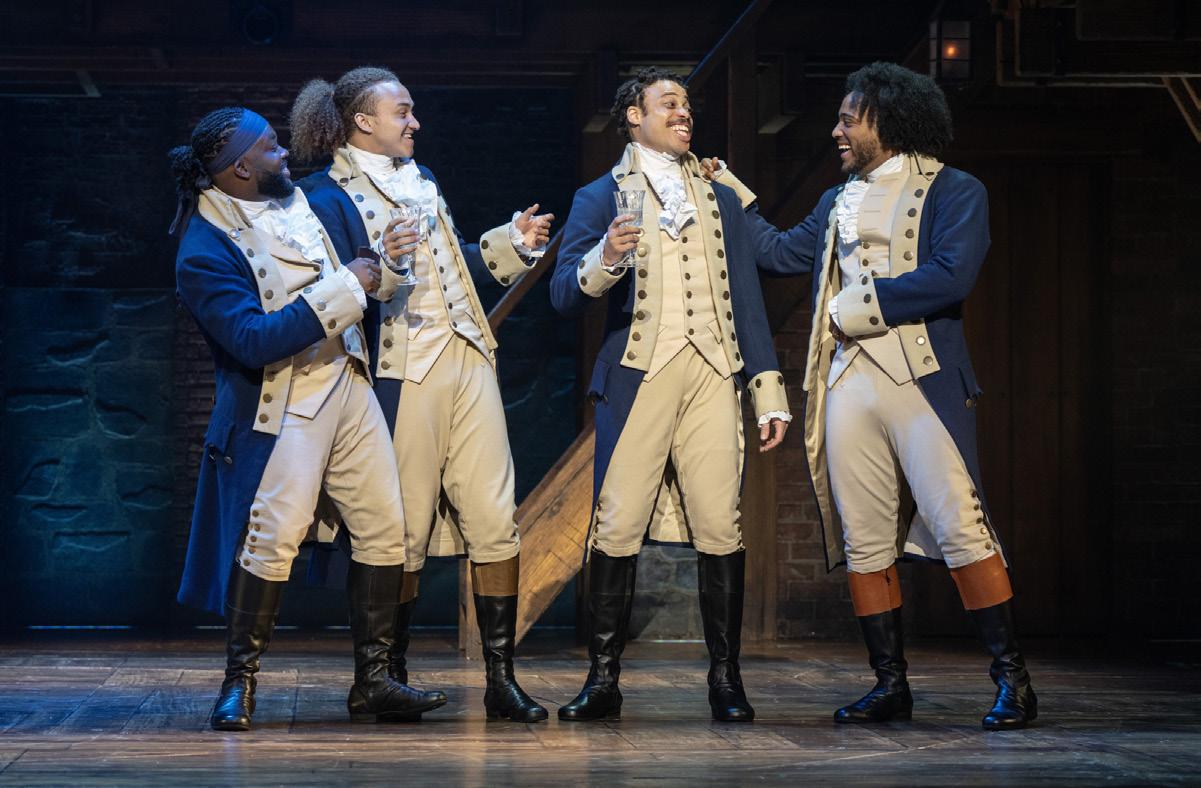
the technical precision was there — the accents, the speed, the physicality — but the performance lacked the spark that turns those choices into show-stealing moments.
The most surprising part of Madison wasn’t that some scenes played differently — that’s the point of live theater. It was that a few of the show’s biggest sequences felt smaller than they typically do, as if the production hit the notes but not the nerve endings.
“It’s Quiet Uptown” is where “Hamilton” earns its reputation for wrecking people. I’ve seen Denver and New York audiences go so silent you can hear the theater breathe. In Madison, the staging remained tasteful and the vocals controlled, but the grief didn’t fully flood the room. It was moving. It just didn’t feel inevitable.
Despite a clean and technically sound performance, similar gaps in tension and emotional weight could be felt throughout the numbers. When the major scenes don’t crest, the evening can feel strangely even — good, professional, impressive, but less transporting.
Madison also delivered strengths I haven’t seen elsewhere. Certain comedic beats, like King George’s maniacal loss of power, hit harder here than in more self-serious per-
formances I’ve seen, and you could physically feel the audience’s excitement, anticipation and warmth. And while I’ve spent a lot of ink on what didn’t ignite, the truth is that “Hamilton’s” floor is still very high. Even an “underwhelming” “Hamilton” production is often better than most musicals’ best nights. Seeing “Hamilton” in Madison reminded me why people keep going back: the show changes with the humans inside it. New York can feel like canon. London can feel like translation. Tour cities can feel like rediscovery. Madison felt like a competent, at times thrilling run that nevertheless exposed how much the musical relies on casting alchemy and scene ignition.
If this was your first “Hamilton,” Madison still offered a clear view of why the musical became a cultural phenomenon. If you’ve seen it before, then Madison may have felt like a slightly muted listening experience — the same brilliant composition, performed well, but missing the sharpest edges of its own blade.
And maybe that’s the final compliment, even wrapped in critique. Six cities later, “Hamilton” still teaches what “great” looks like by showing, night to night, how close “great” sits to merely “good.”
By Lydia Picotte ARTS EDITOR
There aren’t very many producers who’ve worked with a range of music as extensive as Cheryl Pawelski. From the Beach Boys, to Nina Simone and Fred Rogers, her catalogue of projects is as varied as it is vast.
This year, Pawelski, who was born and raised in Milwaukee, earned her eighth career Grammy nomination in the Best Historical Album category, which recognizes producers and engineers who work in audio restoration.
The nominated album is titled “You Can’t Hip a Square: The Doc Pomus Songwriting Demos” and features 160 songs written by rock and blues songwriter Doc Pomus. The tracks are sung mostly by his writing partner, Mort Shuman.
The record was released by Omnivore Recordings, the label Pawelski co-founded in 2010. The company’s focus is on historical records, and they’ve released multiple similar archival albums, box sets and reissues.
Among their other recent releases are a pair of Francois Hardy recordings.
The titles on “You Can’t Hip a Square” are a mix between demo versions of some of Pomus’ biggest hits and never before heard tracks. This includes early versions of iconic songs like “Viva Las Vegas” and “This Magic Moment.”
Pawelski told radio host Sandy Maxx she was initially drawn to the project after Pomus’ daughter reached out to her about producing it. The pair ultimately ended up co-producing the album alongside other team members.
Pawelski’s career in music began when she was a student at Milwaukee’s Pius XI High School and started working at a record store called Radio Doctors.
“When I first started working there, my first job was down in the warehouse picking and packing stuff up to send to other record stores in Wisconsin,” Pawelski said in an interview with The Vinyl District.
She later attended Marquette University, where she took classes that
influenced her work today, despite being in a different concentration.
“When I was in school, I was studying advertising through a journalism sequence. First I thought I was gonna be a teacher, then I thought I was gonna be an advertising person. But I quit all that and went to work at the record store because I felt like I needed to know more about important things like distribution,” Pawelski said. “But even the stuff I did in school kinda worked its way into all this stuff; really, it’s one discipline to make records, and it’s another one to sell them. So, one thing informs the other.”
After leaving Milwaukee, Pawelski worked at multiple other labels in Los Angeles before founding Omnivore Records.
The Grammy Awards ceremony will be held on Feb. 1 at Crypto.com Arena in Los Angeles. “You Can’t Hip a Square” will be competing against Joni Mitchell Archives - Volume 4: The Asylum Years — 1976-1980, “The Making Of Five Leaves Left,” “Roots

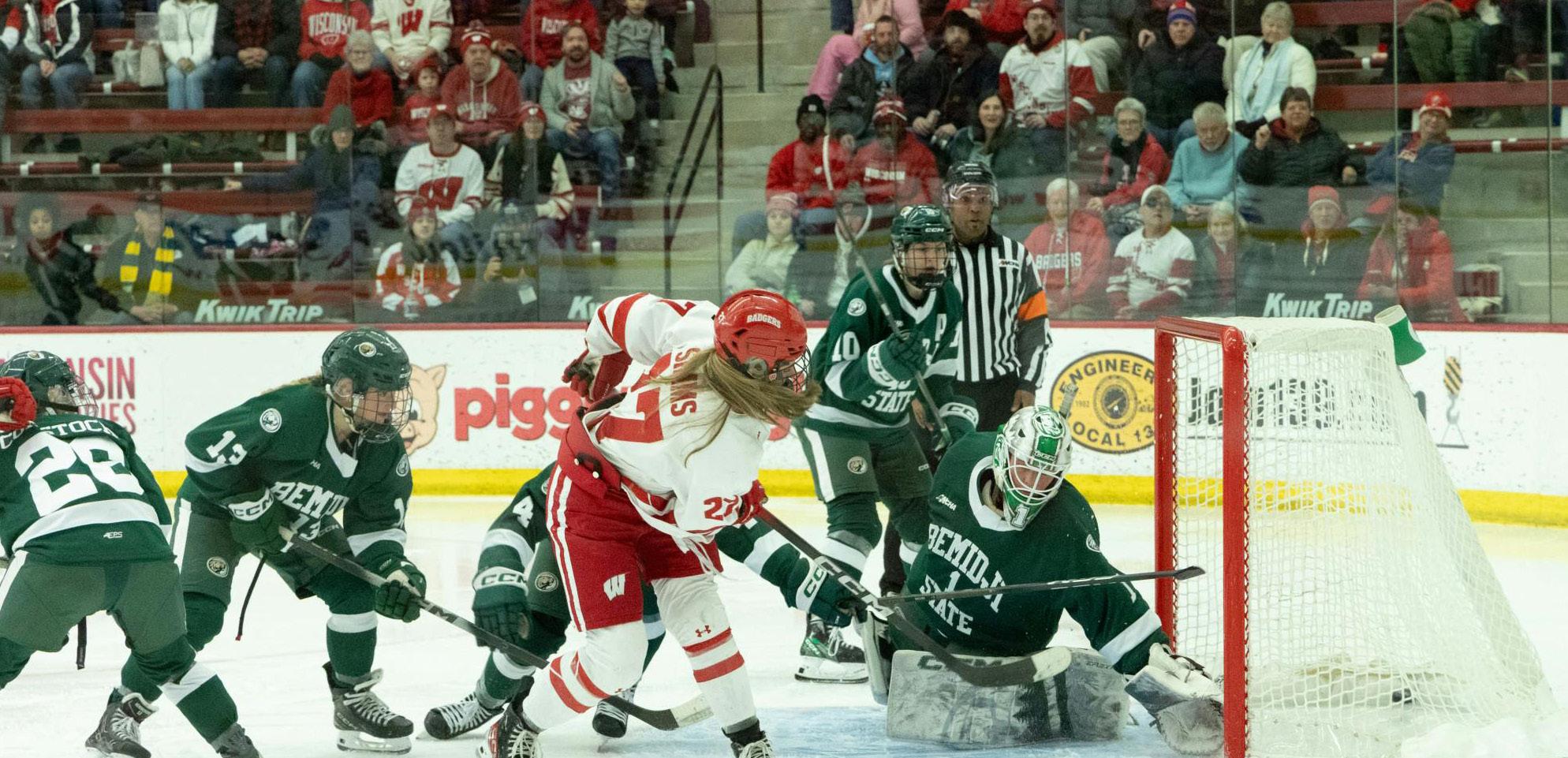
Caroline Harvey celebrated her first career hat trick during Wisconsin’s 10-3 victory over Bemidji State Saturday.
By Hannah Sarnoff STAFF WRITER
No. 1 Wisconsin Badgers women’s hockey swept the Bemidji State Beavers, winning 10-3 on Saturday and 6-1 on Sunday in their first series back at La Bahn Arena since the new year. During senior week, where Wisconsin honored nine seniors, including Olympians Kirsten Simms, Laila Edwards and Caroline Harvey, the Badgers dominated.
The first two minutes of play were spent in the Bemidji State zone, with Bemidji goalie Kaitlin Groess stopping an early threat from Wisconsin’s Laney Potter. Just seconds later, Bemidji State drew first blood, as Isa Goettl tipped the puck past Ava McNaughton. With the goal the Beavers, who lost 11-0 to Minnesota last week and were officially pushed to last seed for the NCHA playoffs, showed they were willing to fight against a frightening Badgers squad.
After Bemidji State’s early lead, Wisconsin began to struggle, turning La Bahn eerily silent.
However, the nervous energy didn’t last long, as Simms finished a controlled move at the crease to get the Badgers on the board. Minutes later, Harvey found her way to the net, centering a shot to give the Badgers the lead.
After a Bemidji State timeout, Hailey Armstrong came out with the puck on a one-on-none, beating McNaughton to tie-up the game 2-2.
Right after Kelly Gorbatenko was called for cross-checking, Bemidji State capitalized on the power play to take the lead. Morgan Smith buried the goal off a face-off, with McNaughton down on the left side of the net, Smith was able to find an empty right side.
With 12 seconds remaining in the period, Hannah Halverson drew a penalty to give the Badgers their own power play. As the clock rapidly wound down, Edwards ended the period with a clutch goal to tie the game 3-3.
While the first period wasn’t pretty, the Badgers made a 180 degree shift in the second period, dominating the rest of the game.
With Wisconsin still on the power play, Harvey worked her way over to the Beavers coverage and rippled a shot past Groess to quickly take a 4-3 lead.
Simms found Groess’ stick side
just two minutes later to notch her second goal of the game. Showing much more confidence, the Badgers were on a roll.
Wisconsin continued to set up opportunities throughout the second period. Although Groess had some incredible saves, the goalie could only do so much against an overpowering Badgers attack. Harvey eventually scored her third goal of the day to secure her firstever career hat trick, filling the ice with hats.
With under two minutes to go in the period, Bemidji State forced two penalties on the Badgers, creating a 5-on-3 advantage on the ice. However, even with a major personnel advantage, the Beavers could not secure a goal, with McNaughton using her whole body to deny a goal.
The third period had an electric start, as Simms recovered the puck from her own rebound and nudged it in to secure the second hat trick of the day. The Badgers first line showed incredible strength in the game, setting up shots for two hat tricks.
“I think my line was rolling,” Simms said. “We were moving the puck really well.”
Halfway through the period, Wisconsin’s staff made the decision to substitute McNaughton, who made 13 saves, for senior Chloe Baker, making her third appearance this season.
As the period creeped towards the end, McKayla Zilish, a former Beaver, received a long pass from Harvey and beat Groess 1-on-1 for her eighth goal of the season.
Lacey Eden continued the senior goal streak for the Badgers, as she drew up a perfect pass to score the ninth point of the day.
With one minute remaining, Claire Enright centered a shot to end the game 10-3, ending a remarkable game for the senior class.
Head coach Mark Johnson made a shift to the Badger starting lineup Sunday, as Cassie Hall, Edwards, and Gorbatenko took over for Adéla Šapovalivová, Simms and Eden. Meanwhile, Bemidji State switched goalies with Ava Hills in the net.
Sunday’s game started quickly, as Harvey broke away on a one-onone, and shuffled around Hills to put the Badgers on the board first.
Eden received a clean pass from Simms minutes later to center a shot. These two goals, paired with
Nick Boyd proving he’s right where he belongs
By Jordan Nadel STAFF WRITER
Coming off a 27-10 season that ended with a trip to the Big Ten title game and their second consecutive NCAA tournament appearance, Wisconsin entered the 2025-26 season with plenty of optimism — and a few unanswered questions.
The biggest question came with the departure of John Tonje to the NBA. A consensus Second Team AP All-American in 202425, Tonje averaged nearly 20 points per game and served as the focal point of the Badgers’ offense. With his scoring gone, the question became clear: who would — who could — replace that level of production?
averaging nearly 15 points per game in 30 minutes a night while continuing to make his impact felt on the defensive end. Boyd’s path hasn’t been conventional, but with perky athleticism and an endless motor, he has always possessed the tools for stardom.
Wisconsin’s recent success against quality opponents has been fed by Boyd’s ability to come through when it matters most.
Wisconsin holding the Beavers to only two shots in the first eight minutes of play, helped Wisconsin take control of the game early.
Wisconsin continued to generate scoring opportunities, as Halverson rang a shot off the post midway through the period, but the rebound kicked wide.
With 7:20 left in the period, the Badgers went on the power play but were unable to generate many shots on Hills. A few minutes later, Bemidji State had a powerplay opportunity of its own, but Wisconsin’s penalty kill stood strong in front of McNaughton.
The Beavers went on a power play for a second time, but Wisconsin’s power-play unit kept a stronghold in front of the goal and was able to clear the zone killing the penalty without giving the Beavers much of a chance.
Even with how much pressure Wisconsin put on Bemidji State, Hills came up huge for the Beavers, keeping the score tight for the first half of the period with an 88% save average.
Simms, however, was not burdened by Hills’ presence, as she scored from the high slot to extend the lead to 4-1.
After Smith tipped the puck past McNaughton on her stick side to make the score 4-2, the Badgers immediately responded with Gorbatenko scoring off a give-andgo with Harvey to score her first point of the weekend.
As the period dwindled down, Simms, through a clear lane, scored her second goal of the game to add to Wisconsin’s cushion.
Enright started the third period hot, jumping on a frozen puck in the crease to hit the top right of the net.
The middle portion of the period was played mostly unevenly, beginning with Bemidji State’s first power play. Just 15 seconds later, Harvey was sent to the box for cross-checking, giving the Beavers a 5-on-3 advantage. McNaughton came up with a key save on a shot from Bemidji State’s Armstrong to keep Wisconsin alive. Partway through the power play, Wisconsin caught a break when Armstrong was called for interference after knocking away McNaughton’s stick. Both penalties were ultimately killed, and neither team was able to convert.
With the 6-1 win, Wisconsin capped off another dominant weekend.
Enter Nick Boyd. Wisconsin brought Boyd in through the transfer portal to help ease star guard John Blackwell’s offensive load, and so far he’s done that and more. Boyd has been everything the Badgers could have hoped for. He’s taken a major leap forward this season, averaging nearly 20 points per game while playing 30 minutes a night. After a slow start to begin the season, Wisconsin has improved to a 14-6 record due to, in large part, Boyd’s ability to score at ease.
Boyd’s rise has been anything but typical. Now a fifthyear transfer with the Badgers, he spent his first three seasons at Florida Atlantic before playing at San Diego State last year.
As a freshman, Boyde came off the bench on a 13-10 Owls team. But each season brought steady growth. Over his next two years, Boyd became a dependable rotation piece, playing around 25 minutes a night during some of the most successful seasons in FAU history — including the program’s improbable Final Four run in 2023.
Boyd gained valuable experience in high-pressure moments and played a meaningful role in the Owls’ success, including 12 points in their Final Four game against San Diego State. He capped his pre-Madison journey at San Diego State, where he took another step forward,
In Wisconsin’s road upset over No. 2 Michigan, Boyd’s experience shined. Having played in Final Four games, conference championships and high-stakes road environments, he looks comfortable in moments that often rattle players. So in a hostile venue facing one of the best teams in the country, Boyd’s steady leadership was instrumental in keeping the Badgers calm and composed when every possession mattered. He finished the game with 22 points, helping lead the Badgers to one of their best wins in recent memory.
Boyd’s presence has given Wisconsin a secondary scorer alongside Blackwell. Whether he’s scoring on the perimeter, finding open teammates or making timely shots, the offense doesn’t live or die with one man, giving the Badgers spacing on the court that forces opponents into picking their poison. Pair that with his ability to lock up opponents on the defensive end, and it’s clear why Boyd has become an indispensable part of this Badgers squad.
As this season has trudged along, one thing has become increasingly apparent: Boyd exponentially expands Wisconsin’s ceiling. His scoring ability gives him the potential to take over games for Wisconsin, and with the experience of a college basketball veteran, his calm trickles down to the rest of the roster.
After years of steady growth, Boyd’s unconventional journey has led him towards a Wisconsin team that without him, would be severely limited. Now, with Wisconsin threatening to make noise in the Big Ten season and beyond, Boyd is at the center of it all.