

By Jane Dardik STAFF WRITER
Although campus activity slowed with many students home for winter break, news did not stop at the University of Wisconsin-Madison.
Between a conservative law firm filing a complaint on race-based scholarships at UW and a string of burglaries at the UW Law school, here’s what you may have missed while off-campus.
Conservative law firm alleges UW-Madison has illegal racebased scholarships
The Wisconsin Institute for Law and Liberty is alleging that UW-Madison is committing a Title IV violation and infringing on the 14th Amendment through scholarship programs that exclude white students, according to a complaint they filed with the U.S. Department of Education on behalf of the Young America’s Foundation club.
This complaint follows a March 2025 Trump Administration investigation into UW-Madison and 44 other universities’ ‘race-based practices’ like scholarships.
According to the Department of Education, educational institutions “must cease using race preferences and stereotypes” as a factor in admissions and scholarships after the 2023 Supreme Court decision found affirmative action illegal. The department has pulled federal funding from universities that do not comply with the administration’s investigations and demands.
On Feb. 14. 2025, the Department of Education’s Office for Civil Rights (OCR) sent out a “Dear Colleague Letter” to universities receiving federal funding. OCR has started investigations into these institutions who they said are not complying with Title VI of the Civil Rights Act (1964), which “prohibits discrimination on the basis of race, color, and national origin in education programs and activities receiving federal funding.”
WILL used this decree to bring forth a complaint against UW-Madison, arguing the university holds 22 race-based scholarships that violate the letter.
WILL Vice President Dan Lennington has told Wisconsin Public Radio WILL is “calling for a new and expanded investigation into all the discriminatory practices at UW-Madison.”
UW in national top 5 for research expenditures
UW-Madison reached the top 5 universities in the nation for research expenditures, spending a record high $1.93 billion on research activities. The last time the university was in the top 5 was 2014, more than a decade ago.
UW-Madison reached rankings as high as 6th and 8th in previous years, but in 2025 the university increased expenditures by 11.6%, and its federal expenditures specifically by 13.9%.
“This year’s results are made possible by the extraordinary work happening in labs and in the field by so many dedicated faculty members, researchers, postdocs and grad students,” Chancellor Jennifer Mnookin said. “They are embracing creativity, driving innovation and advancing knowledge for the public good.”
This year’s ranking only includes data from after June 2024, however. This means the ranking did not take 2025 funding cuts into consideration, a change that may impact UW-Madison’s standing in next year’s rankings.
Law School faces multiple burglaries
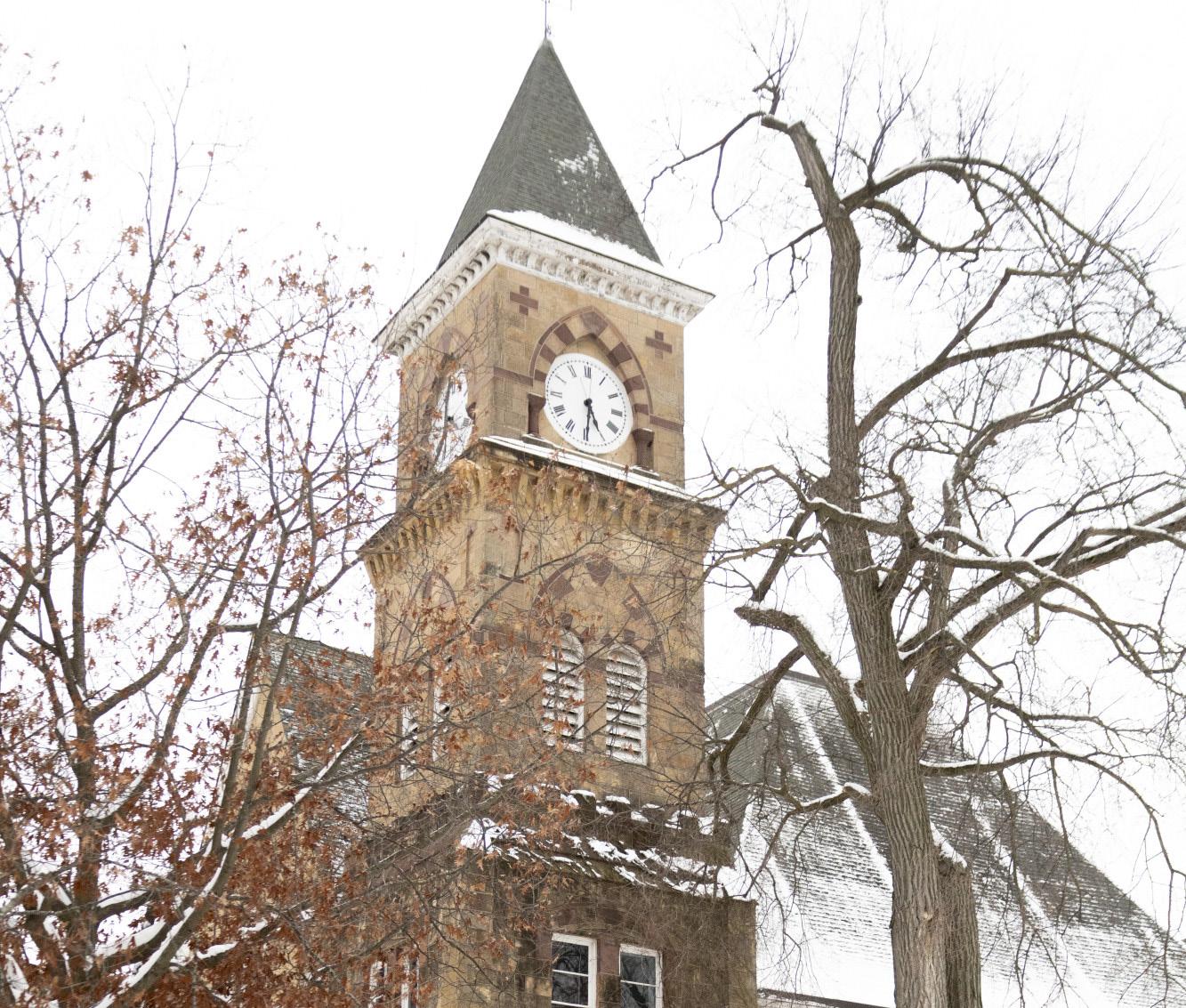
UW-Madison’s Law Building has been broken into four times in the past few months now, with the most recent break-in happening Jan. 4. All the burglaries happened after hours, with items being stolen from both locked and unlocked lockers.
The University of Wisconsin-
Madison Police Department is now urging students to take items home with them and keep an eye out for suspicious activity.
UW eyes finish line on new campus buildings
Three new structures are coming to the UW-Madison campus in 202627. Both Irving and Dorothy Levy Hall and The Kellner Family Athletic Center are expected to be open for the 2026 fall semester, and the Lakeshore Nature Preserve Frautschi Center is expected to open in late 2027.
Irving and Dorothy Levy Hall will be the new home for humanities, made up of 13 classrooms, a rooftop garden and a new home for eight different humanities departments. This comes after Wisconsin lawmakers allocated $5 billion to demolish the old humanities building and relocate its departments and programs.
The Kellner Family Athletic Center, located next to Camp Randall and the Field House, will contain a 120-yard turf field, strength and conditioning center, 305-meter training track, dining hall, sports medicine center, locker rooms, coaching offices,
team meeting rooms and well-being spaces for student-athletes.
Lastly, the Lakeshore Nature Preserve Frautschi Center, located at the entrance of Picnic Point, will be the first net-positive energy building on UW’s campus, meaning it will generate more power than it uses. It will also prioritize using recycled and upcycled materials as well as sustainable electrical systems.
Andrew Brunner, a spokesperson for the campus Division of Facilities Planning & Management, told the Cap Times, “The center will include interpretive exhibits, a multipurpose space for classes and community events, and consolidated offices and working spaces for the staff, researchers, classes and volunteers.”
Brunner said the preserve will also include cultural history honoring the Ho-Chunk Nation.
All of this construction will come with travel issues for students, warns UW Transportation Services. The department urges students to “use designated pedestrian and accessible detours, watch for construction vehicles and obey flagger signals, and do not walk in roadways or cross in the middle of the road.”
‘An organized free-for-fall’: SAE, UW negotiating security, safety measures for Lily’s Classic
By Zoey Elwood COLLEGE NEWS EDITOR
Sigma Alpha Epsilon (SAE) is proposing increased law enforcement presence, adjustments to fencing layout and stricter attendance policies this spring to Lily’s Classic, their annual hockey tournament and fundraiser, amid safety concerns. The changes currently await university approval.
The fraternity is now required to submit a detailed event plan for future iterations of Lily’s Classic outlining safety protocols, crowd control, adequate facilities, risk mitigation and adherence to UW-Madison’s code of conduct after UW officials raised safety concerns over last year’s event, university spokesperson John Lucas said in a statement to The Daily Cardinal.
SAE plans to double the depth of its fenced-off event area — previously about 50 feet long — which will reduce attendance outside the fence

while allowing for increased turnout within it. The fraternity will also use an opaque covering around the fence to prevent people outside from seeing in, discouraging them from gathering around the perimeter.
“The people on the outside have less of an incentive to come because then they can’t really see inside, and whatever they do outside would just be with the outside,” SAE Social and Co-Philanthropy Chair William
McNeely told the Cardinal. “We are showing that this is our event and the people that are involved are going to be involved, but we’re not really pushing for it to be anyone else.”
During a November meeting with Fraternity and Sorority Life (FSL) — an office representing the more than 60 sororities and fraternities on campus — they were informed of the university’s main concerns: overcrowding of campus resources, increased
liability in student housing and safety risks from individuals on the ice who were not connected to the event or its philanthropic purpose.
“Lily’s Classic, like other fraternity-sponsored events, is not organized, sponsored or supported by the University of WisconsinMadison or by the UW-Madison Office of Fraternity & Sorority Life,” Lucas said.
McNeely said the fraternity and FSL collaborated to develop solutions that would allow Lily’s Classic to continue.
Additionally, McNeely said SAE’s plan outlines an increased collaboration with the University of WisconsinMadison Police Department (UWPD). He said the fraternity will share all plans with UWPD — including protocols and hotspot areas they want patrolled, hoping to reduce liability for UWPD and the fraternity.
+ Lily’s page 4
Mark Cuban told the Cardinal in an interview the negative comments made about Snow Scholars are “ridiculous and slanderous.”
By Jane Dardik STAFF WRITER
Snow Scholars, a startup launched in 2022 by University of WisconsinMadison alum Jake Piekarski, aims to help students pay for college by employing them to shovel snow during the winter season.
“I saw through community forums and local groups that snow shoveling wasn’t just convenient — it was essential,” Piekarski told the Daily Cardinal in an email where he said he used “chat[GPT] for a write up.”
“That gap between what the community needed and what students needed, flexible work, really sparked the idea for Snow Scholars,” he said.
Piekarski said Snow Scholars
employs around 115 UW students and 650 total students across Michigan, Minnesota and Wisconsin. The company website states it currently serves 14 schools, but Piekarski told the Cardinal there are only 11 college towns they do service in—a discrepancy.
At first, the company struggled with software and being able to process routing, dispatching, communications and payments. Now that the company provides its services for over 800 households, Piekarski has switched from manually inputting everything to building new technology for his company.
Snow Scholars claims to be the highest paying campus job, but students have to provide their own
transportation and snow clearing materials. The company provides students with a $25 “equipment credit” after they’ve shoveled their 15th home, according to their website.
The young company has received some backlash online, notably on Reddit, with both alleged workers and customers of the company protesting prices and workloads.
Reddit user “future__fires” wrote in 2025 the hourly pay the company promises students is wrong, the workload is unfair and customers are sometimes charged without receiving service.
“They lie to you about how quickly you can do each house, and require you to do six every time you work,”
By Audrey Lopez-Stane & Clara Strecker SENIOR STAFF WRITER & STATE NEWS EDITOR
Gov. Tony Evers said he would veto a Republican-led bill on free speech and academic freedom on Wisconsin college campuses if it came to his desk in an interview with The Daily Cardinal Wednesday.
Evers said he was cautious about “taking away freedoms” because he doesn’t “see a problem on campuses around the issue of free speech.”
Republican lawmakers at the state and federal law have for years criticized free speech and ideological diversity on college campuses.
The bill, reintroduced in October, would require the University of Wisconsin System and technical colleges to provide annual instruction on the First Amendment and conduct a survey on academic freedom and political bias every two years for students and faculty.
The legislation also includes punishments for institutions who violate free speech laws, including two-year tuition freezes and requiring a disclaimer on admissions documents stating the free speech violation.
Republican lawmakers have pointed to a survey of 423 students from the Foundation for Individual Rights and Expressing indicating 35% of UW-Madison students would, in rare circumstances, find violence acceptable to stop a campus speaker.
Although the bill was introduced before Charlie Kirk’s murder on Sept. 10, Rep. Amanda Nedweski, R-Pleasant Prairie, said it was “more important than ever” to address free speech concerns on college campuses.
“When society begins to accept the very false premise that dissenting speech is equivalent
to violence, we create a culture where violence replaces discourse,” Nedweski, a co-sponsor of the bill, told the Cardinal in October.
Although Evers said he “possibly” has concerns about political dialogue on college campuses with the recent rise in political violence, he believes that students can deal with diverse ideas and differing opinions without additional legislation.
“That’s what makes America strong is having that diversity of opinions, whether it’s from the conservative middle of the road or liberal, it doesn’t make any difference,” Evers said.
Nedweski said the UW System continues to oppose the bill, but said she wants to work with UW System President Jay Rothman because she believes they share the goal of upholding free speech.
Crystal Potts and Mitch Goettl, directors of State Relations at UW-Madison, wrote a letter in October to the Senate Committee on Universities & Technical Colleges, highlighting UW-Madison programs already promoting free speech and open political discussion, such as BridgeMadison and Deliberation Dinners. They also pointed to Board of Regents discrimination policies the university is already required to follow.
“As currently drafted, Senate Bill 498 potentially undermines [UW-Madison’s] strong system built to safeguard free speech,” Potts and Goettl wrote.
University officials have similarly addressed free speech concerns on campus through the launch of the Wisconsin Exchange, a university-wide proposal to promote open dialogue, UW-Madison Chancellor Jennifer Mnookin announced in October.
Nedweski also expressed concern for conservative voices on college campuses,

they wrote. “They said shoveling and salting six houses by hand would take about three hours, which is absolutely not true. A bunch of people who own houses in the area commented and said the company just never showed up despite still billing them.”
Reddit users did not respond to a request for comment.
Shark Tank’s Mark Cuban invested $150,000 for 20% equity in the company in late 2024 and told the Cardinal in an email the negative comments made about Snow Scholars are “ridiculous and slanderous.”
“Like every company with contractors, mistakes happen,” Cuban said. “They are a young business and are doing their best.”
By Alexa Cattouse STAFF WRITER
Piekarski said providing work opportunities is a central part of Snow Scholar’s mission, and he believes a job should fit a student’s life with shorter shifts and higher pay.
“Some of our top earners choose to work as much as possible and make $5,000+ per month during heavy snow periods,” Piekarski said. “It’s meaningful income, on students’ terms, without sacrificing school.”
According to Piekarski, Snow Scholars has grown from 30 customers to 800 and counting. The company has now implemented a contractor bench to make up for the unpredictability that comes with hiring students.
CityEditorAlainaWalshcontributedtothisreport.
reports 9 hazing violations since 2021
The University of Wisconsin-Madison reported nine hazing violations connected to Greek life between 2021 to 2025 after a new federal law required universities and colleges to publicly report hazing incidents.
Under the Stop Campus Hazing Act, universities and colleges were required to begin documenting hazing violations starting July 1, 2025, implement anti-hazing policies and publish their first Campus Hazing Transparency Report by Dec. 23, 2025. UW-Madison went beyond the July requirement by including hazing reports from years prior.
“We appreciate the attention the federal act brings to hazing prevention. This helps us bring attention to important hazing prevention efforts,” Mark Gutheir, Associated Chancellor for Student Affairs, told The Daily Cardinal in a statement.
The law requires a “general description” of the student organization’s hazing incident in their transparency report — including any involvement of drugs or alcohol — additional findings from the institution and possible sanctions placed on the group. UW-Madison provided all aforementioned requirements in their transparency report, along with a list of Registered Student Organization Code of Conduct violations the student organization was responsible for.
Although UW-Madison complied with the legal requirements, national anti-hazing advocate S. Daniel Carter told The Milwaukee Journal Sentinel it would be beneficial for parents and students if the university went into greater detail on what occurred during the hazing incidents rather than just sharing the Code of Conduct violations.
Records obtained by The Daily Cardinal paint more light on two of the nine hazing violations reported.
A witness described seeing a group of men lined up, without jackets, being harshly yelled at by a member of a fraternity in freezing weather conditions near the Phi Gamma Delta house, in records obtained by the Cardinal. The witness said they heard a fraternity member yelling phrases like “you’re trash” and “you don’t belong here” at the men for not wearing the appropriate attire for their party, 2023 emails to the office representing the more than 60 sororities and fraternities on campus show.
In December of the same year, another email exchange described a student asking their professor for an extension on an assignment due to
his participation in a hazing ritual that demanded the student stay in a locked room for 72 hours — matching the dates of UW-Madison’s report of Alpha Sigma Phi - Kappa Chapter’s incident.
Jenny Bernhardt, communications director for the Vice Chancellor for Student Affairs, told the Cardinal “the university will continue to refine the content and format as needed,” in an email.
Bernhardt said UW-Madison created a new hazing policy in June to offer a clear definition of hazing at the university while also staying in line with the Stop Campus Hazing Act and the state of Wisconsin’s anti-hazing law.
In the new policy, the university defines hazing as “any intentional, knowing, or reckless act against an individual that endangers the physical, mental, emotional, or psychological health of that individual” in order to obtain membership or admission into an organization or group. If found violating any rules, penalties against the student organization can range from a written reprimand to a termination.
“We’re committed to educating students and other members of our community regarding the harm hazing brings, helping students and other group members be safe, encouraging reporting if a hazing incident occurs, and facilitating transparent reporting,” Bernhardt said.
The MJS found UW-Madison reported the most hazing violations in the state, with the University of Wisconsin-Whitewater reporting two and Carroll University and University of Wisconsin-Green Bay each reporting one. No other Wisconsin higher education institutions have reported hazing violations.
The UW-Madison Hazing Prevention Coalition, a group of university staff members that develop hazing prevention methods, offers students the ability to file hazing reports and learn more about hazing prevention on their website.
Continued from page 2
Because Lily’s Classic is held off campus, UWPD historically has never played a direct role in the event’s safety or law enforcement. Instead, the department’s downtown liaison officer has been in contact with SAE to offer safety guidance and connect organizers with local law enforcement, UWPD Executive Director
of Communications Marc Lovicott said in a statement.
“We’re super optimistic,”
McNeely said. “We think there’s no reason why it wouldn’t be allowed to happen with the new rules that we set.
We’ve worked with FSL, and they want this to happen just as much as we do, but they also don’t want to go against what the school is saying.”
McNeely added that attendance logistics are still being
discussed. As of now, it looks like fraternity members will personally invite guests and help coordinate both who attends and how many visitors they will each bring.
“It would kind of eliminate the totally irrelevant people that have absolutely no ties to SAE or the philanthropic side of things that we have no control over,” McNeely said. “We don’t know if they’re going to be a liability, and if they are,
By Clara Strecker& Michael Reilly STATE NEWS EDITOR & STAFF WRITER
Gov. Tony Evers said he would veto a bill that bars transgender college students in Wisconsin from participating in women’s sports, calling it a “nonstarter” for him, in an interview with The Daily Cardinal Wednesday.
“I historically stay on the side of transgender kids and people all across the state of Wisconsin, so it’s a nonstarter for me, the Legislature knows it’s a non-starter for me,” Evers said.
The Republican-backed bill, which passed the Assembly and is now awaiting a vote in the Senate, requires University of Wisconsin System institutions and technical colleges to designate athletic teams based on the sex of the participating students and prohibits students assigned male at birth from competing on teams designated for females.
The bill further prohibits male students from using locker rooms designated for females and applies to intramural and club teams — not just to varsity athletics.
UW-Madison Athletic Board Chair, Doug McLeod said the issue of transgender athletes in Badger athletics “isn’t something we’ve discussed in my seven year tenure on the athletic board as far as something that’s influencing athletics” and that he was unsure if a transgender athlete even has requested to participate on a women’s sports team.
The NCAA President Charlie Baker testified in December that there are fewer than 10 transgender athletes out of the more than 500,000 total athletes.
A similar bill that applies to K-12 schools across Wisconsin is also await-
ing a vote in the Senate. Both bills passed in the Assembly last March along party lines.
While supporters of the bill argue the changes would protect female athletes from a competitive disadvantage and injury, opponents say the bill sends a broader message of exclusion and targets marginalized residents in the state.
“It’s a little bit shocking that we need to pass legislation protecting girls’ sports and girls’ locker rooms. Those who demand that girls and women simply accept men into their athletic competitions and their private spaces are wrong,” Rep. Scott Krug, R-Rome, said in a March press release.
During a public hearing in March, Abigail Swetz, executive director of Fair Wisconsin, a statewide LGBTQ+ civil rights and political advocacy organization, testified that while the legislation would directly affect a small number of athletes, its broader impact would be felt across the transgender community and beyond.
“The message they send reverberates throughout the trans community, and our entire Wisconsin community,” Swetz said.“These bills are about more than just the makeup of a team — they are about excluding trans people from public life, and we cannot allow that.”
The NCAA updated its participation policy on Feb. 6, 2025 following an executive order from the Trump administration.
In the new policy, the men’s category remains open to all eligible studentathletes while the women’s category is restricted to student-athletes assigned female at birth.

then that’s on us when we didn’t have any part of them being there.”
The fraternity will continue charging $5 for wristbands, with all proceeds going toward Lily’s Fund for Epilepsy Research. McNeely emphasized the importance of Lily’s Classic as not only the most attended philanthropic event at UW-Madison, but also as a defining campus tradition.
“It’s just such a unique
thing that, while winters suck and nobody loves the freezing cold weather, we’re still able to maximize it and utilize the lake that is right there — that is so unique to UW-Madison that no other campus has,” McNeely said. “It boosts the talk about the school, like people applying, and it just boosts the whole school’s image. I would hate to lose that factor and that unique thing about the school.”
By Lauren Eno STAFF WRITER
Madison voters will decide on a slate of Common Council and Madison Metropolitan School District Board of Education races that will shape policy on housing, education, transportation, the environment and public safety on April 7.
Seven city council races are uncontested, with competitive races in campus-area District 8 and Districts 14 and 20. School board seats 6 and 7 are both held by incumbents, each of whom are facing a challenger this year.
Council
Bobby Gronert and Ellen Zhang, both sophomores at the University of WisconsinMadison, are running to fill the campus-area seat. The seat is currently held by Alder MGR Govindarajan, a graduate from UW who is not seeking re-election.
Gronert’s platform champions affordable housing, public safety, environmental health, protecting neighbors and fighting fascism, and democratizing Madison. He told the Cardinal he hopes to “entrench our city as a safe haven for all and especially for the most vulnerable and downtrodden.”
“A successful tenure for myself is one where Madison is authoring the first chapter of a socialist future,” Gronert told the Cardinal. “We can only do these things as a we, not a you or an I.”
Gronert said the lack of respect the university has for students hardened his determination to fight for himself and his peers. “The message is clear; the Board of Regents, Mnookin, MPD and UWPD aren’t our friends. If we want our due, we must take it from them,” Gronert said.
Zhang is a “student, artist and activist at heart,” according to her website. Her campaign focuses on tenant protections through Madison’s Tenant Bill of Rights, affordable housing, public safety and sustainable infrastructure.
“I am running because students are facing an affordability crisis and it’s critical that we address it urgently.” Zhang previously told the Cardinal. She also opposes bar raids and emphasizes a need for food security, mutual aid, reproductive justice and community sustainability.
In District 14, Noah Lieberman and Kate Blood are competing for the seat held by current alder Isadore Knox Jr, who is not seeking re-election.
Lieberman’s campaign prioritized affordable housing, transportation, racial equity and justice, environmental protections, economic enrichment, protecting city services and union jobs and defending against fascism.
“Every one of my policies will benefit this city — not just those with money or political influence,” his campaign website said. “I will pursue those policies with every fiber of my being.”
Blood told the Cardinal she decided to run after a proposal was brought to the Common Council that would demolish a Mexican and Colombian restaurant — a gathering spot for District 14’s 43% Latino community.
“I’d like to see a balance between wanting to maximize the use of vacant land and gathering sufficient input from established neighborhood residents,” Blood told the Cardinal in regards to proposed developments on Park Street, including rapid bus transit. She is also prioritizing responsiveness and transparency, affordable
housing and inclusive representation.
In District 20, Islam Khilji, also known as Sammy, is challenging incumbent Barbara Harrington-McKinney. Harrington-McKinney won the District 20 seat in 2023, while Khilj was eliminated in the primary.
Khilji told WORT FM he is running again because the city isn’t doing enough to engage southside residents. “I will do work with the people to have a community hall somewhere, where we can actually address all the subjects,” Kiliji said.
Harrington-McKinney is running on a platform of public safety, city services within a balanced budget, affordable housing and equity and access. She has served on the Common Council since 2015.
“District 20 allows me the opportunity to do restorative justice; it gives me the opportunity to do community engagement,” HarringtonMcKinney told WORT-FM. “I pledge to the residents of District 20 to really listen to the voices of those individuals who are less represented.”
Voters can use the City of Madison website to find their Alder district.
Madison Metropolitan School Board
Seats for the Madison school board are not geographically bound, so residents within the school district will see races for Seats 6 and 7 on ballots.
Dr. Daniella Molle is challenging incumbent Blair Mosner Feltham for Seat 6.
Molle, a researcher on equitable education, chose to run when she realized there was no advocate for multilingual learners on the school board. She told the Cardinal she hopes for progress on performance objectives related to academic achievement, sense of belonging and college credit.
“The district is in a serious financial predicament,” Molle said when asked about challenges for the school board. “The funding from the state is insufficient and in many areas stagnant, while the costs of running the district are increasing. An urgent issue facing the district is addressing salary compression, and ensuring that veteran teachers are compensated for all the years they’ve spent in MMSD.”
She hopes to address this through collaboration with board members, district leaders and the teachers’ union.
Molle hopes they can be “innovative, evidence-informed and student-centered in our decision-making process.”
Mosner Feltham is a school teacher and mother “running for re-election because experience still matters: in the work, in the fight and in our schools,” according to her campaign website.
Her focused issues are engaging, innovative and safe learning conditions for every student through progressive leadership. She also supports collective bargaining to advance learning and working conditions, and to make Madison schools incredible for teachers.
Dana Colussi-Lynde is challenging incumbent Nicki Vander Meulen for Seat 7.
Colussi-Lynde is an information technology development manager whose goals are to “include district-wide AI and cell phone policies, implementation of the new school boundaries… and increased partnerships with state legislators, local government and community members to strengthen our support of public-school children,” according to her campaign website.
Continuereading@dailycardinal.com
By Grace Carlson STAFF WRITER
Raging Granny member
Jade Dell distinctly remembers the day she and the Raging Grannies of Raleigh, North Carolina were arrested.
“They [police officers] ordered us out because we were singing, and we wouldn’t stop singing,” Dell said. “A whole bunch of us got arrested. I think there were 21 that got arrested that day.”
Who are these strongwilled women not afraid of getting arrested at age 80? Meet the Raging Grannies.
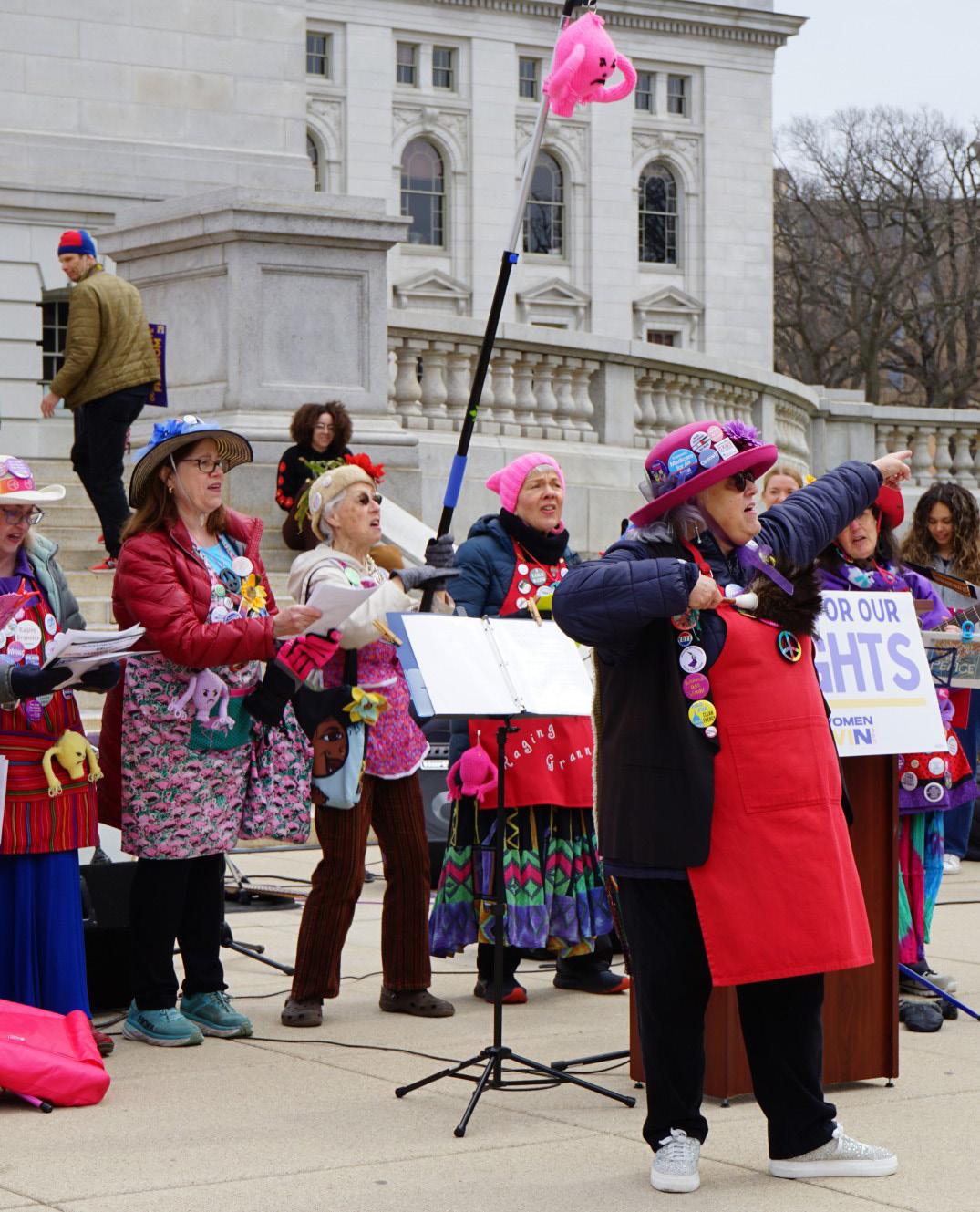
The Raging Grannies are a “dis-organization” of older women who are best known for performing songs with original lyrics about social and political issues at civil protests and community events. Since leadership isn’t centralized, each community chapter calls themselves a ‘gaggle.’ While the original gaggle was founded in Canada, Raging Grannies can be found across the globe.
The Raging Grannies are known for political performance or guerilla theater, which is spontaneous performance art meant to bring attention to an issue. They perform cover songs with rewritten, socially-conscious lyrics and dress in extravagant outfits with slogans on buttons, shawls and aprons about causes — also forms of guerilla theater. The Madison Raging Grannies even created their own mascot: a uterus named Ursula in response to the overturning of Roe v. Wade.
While Raging Grannies participate in street protests, they’re best known for their singing performances, drawing national attention for bringing eccentricity, humor and music to activism.
Dell is no stranger to the consequences of protest, having been arrested with the Raging Grannies multiple times. She said a grandmotherly image doesn’t protect them from police intervention as much as people may think. “I’ve been arrested five different times in four different states,” Dell said. “I’ve been an activist for my entire life.”
About half of Madison’s Grannies have been activists their entire lives, while others only began public activism as a Granny.
Madison Raging Granny Jeanne Nye was a schoolteacher for 44 years, but it wasn’t until after she retired that she became involved with the Grannies because she said her job discouraged activism. Other members faced pressures like family disapproval or gender stereotypes that discouraged female activism. Involvement later in life gives many of these women an opportunity to do what they may have always wanted to do.
The Raging Grannies say they are politically conscious,
not partisan. They focus on a range of issues, such as reproductive health, LGBTQ+ rights, voting access, climate change awareness, universal health care, Black Lives Matter movement and immigrant rights. They also attended No King’s Day protests all over the United States. Each gaggle also participates in community-specific issues, which differ based on the residents.
Nonviolence is an important pillar of the organization. “[The Raging Grannies] were never violent or abusive or said anything bad to people,” Dell said. “We just were firm in our beliefs that this was wrong.”
History of the Grannies
T he original Raging Grannies began in 1987 in Victoria, Canada protesting U.S. military ships docked in the harbor. A group of women were upset with the boats in the harbor, so they took matters into their own hands.
The women kayaked to the ships armed with a unique idea — dressing up like little old ladies and singing protest songs. Their performance caught media attention, and the women were so galvanized they decided to share the idea with others.
The Madison gaggle was founded in 2002 by the Women’s International League of Peace and Freedom. The women are a fixture at local protests, notably the Act 10 protests at the Wisconsin Capital in 2011. At the event, they sang five days a
week for five months, and several members were arrested.
Is protest effective?
While the Raging Grannies’ guerilla theater performances have inspired many, some question whether their activism translates into policy change.
Dr. Sarah Frank, a gender and politics professor at the University of WisconsinMadison, said research has shown that street protest, part of what the Raging Grannies do, isn’t very effective.
“I don’t believe that they shape legislation because public opinion generally does not anymore,” Frank said. “And, anyone can make public opinion look like anything because of the age of
mis- and dis- information.”
UW-Madison senior Michael Howe and founding member of the Student Nonviolent Action Coalition said groups like the Raging Grannies remind younger generations that pushing institutions to change is a long and ongoing struggle.
And for Dell, her advocacy has also been multigenerational, because it’s motivated by leaving the world in a better place.
“The state of the world is really terrible, and we want to tell students that we are really embarrassed and sorry to leave the world in such a mess,” Dell said. “We would really like you to know how much we care about you, and how much we are trying every day to make the world a better place.”
By Jackson Baker LIFE AND STYLE EDITOR
“Holy shit, it’s real,” Laila Edwards thought in the early afternoon of New Year’s Eve.
For months, the 21-year-old Wisconsin women’s hockey superstar flew back-and-forth from Madison to ice rinks across the country in a “try out” process for the U.S. Olympic team. The trips consisted of intense practices and exhibition matches with a tentative 30-player roster of Team USA that would be cut down to 23 by Dec. 31.
Though Edwards played for the national team for years, making the Olympic roster had been her dream and would set her to become the first Black woman to play hockey for the U.S.
That afternoon, Edwards waited eagerly in her team’s video room when the phone rang from Team USA’s General Manager, Katie Million, at exactly 1 p.m. It was the phone call that made history — Laila Edwards was now an Olympian.
When Edwards was just 13, she made the difficult decision to move away from home to pursue her hockey career. In fall 2017, she packed her bags into a black Honda CRV and drove to upstate New York with her mother Charone to attend Selects Hockey Academy on a partial scholarship. The choice was tough, but it was also a turning point in her career. It was in New York that Edwards began garnering top prospect attention from Badgers assistant coaches Dan Koch and Jackie Crun. It was also at the academy that she began playing with Caroline Harvey — her best friend, roommate and current teammate on the Badgers and Team USA.
Edwards grew up in the suburban sprawl of Cleveland Heights, Ohio with four siblings — including her older sister Chayla who was a talented hockey player in her own rite, playing for the Badgers from 2019-2024.
“We grew up pretty poor,” Edwards said, but despite hockey being a notoriously expensive sport, her family never hesitated to support her dream. “My family supported
me through a lot … I remember we had an outstanding balance here and there,” referencing her time at Selects Hockey Academy. With some additional financial support from anonymous donors, Edwards thrived for five years at the academy, committing to the University of WisconsinMadison on a full-ride scholarship as a high school freshman and boasting a 97-point season her senior year.
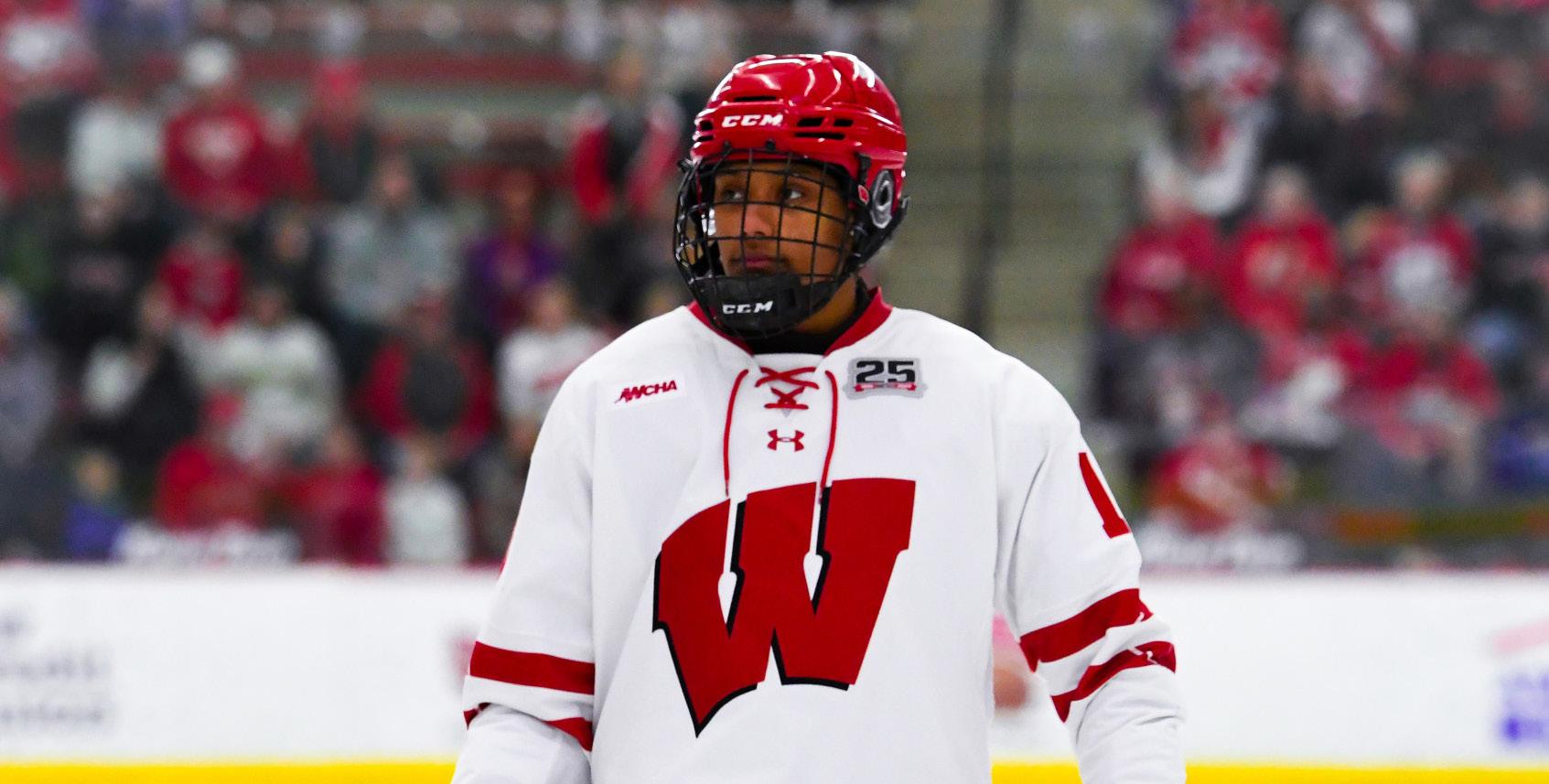
Since becoming a Badger, the defenseman has undoubtedly transformed into a hockey phenom. In 2023, as a 19-year-old sophomore, Laila etched her name into history as the first Black woman to play for the U.S. women’s national hockey team. In 2024 at the IIHF World Championship — the highest level hockey tournament aside from the Olympics — she scored six goals in seven games and was named MVP, becoming the youngest player ever to receive the award at just 20-years-old.
“I kind of barely made it,” she said laughing, “But then I was the MVP at [the tournament] — I think that was the moment it really took off.”
She won two World Championship medals with Team USA: silver in 2024 and gold in 2025. Around this time Edwards also became an official Red Bull athlete, joining the likes of Formula One driver Max Verstappen and X Games gold medalist Zeb Powell. With the Badgers, she helped win her second NCAA Championship and led the league in scoring last season.
Edwards was also named as an assistant captain at the beginning of the 2025-26 season.
Since the release of the finalized roster for the 2026 Winter Olympics in Milano Cortina — which includes three of her Badger teammates — Edwards is adding to her long list of accolades by once again making history as the first Black woman to play hockey at the Olympics for the U.S.
“It was — it still is surreal,” she reflected.
The days that followed the news of her historic position
on the Olympic roster were a wild string of press tours and travel. One laborious weekend involved a trip to New York City for an appearance on the Today Show followed by a photoshoot with Architectural Digest at her Madison apartment just two days later. She admitted the interviews can be overwhelming at times, but Edwards appears to handle the surging attention with a seasoned ease.
“Tomorrow I’ll have an interview with CNN and a photoshoot with ESPN right after,” she said casually. “I think it’s so cool. I’m very grateful that they’re taking the time to tell your story, learn about you, and put it out there when they don’t have to.”
But as “cool” as these highprofile interviews may be, Edwards believes they can serve a bigger purpose.
Ever since 2023, when Edwards first joined the U.S. women’s national team, she has been working to help minorities and underprivileged communities enjoy the sport she loves. “I think it’s very important for me to use my platform positively to help grow the game and continue to work throughout the community,” she said.
In partnering with USA Hockey, Edwards has visited youth teams around the country to share her story, and for the second year in a row, is working with the Wisconsin Amateur Hockey Association (WAHA) on a program that helps minorities and under -
privileged youth get into the sport by covering the cost of equipment and ice-time, as she said they can often cost a “shit-ton of money.”
Through her accomplishments, Edwards has found herself in the unique position of being the representation she felt she never saw at the highest level in the sport while growing up. “Even if you do have the money and all the equipment, you don’t see anyone that looks like you, which is another thing that’s tough,” she said, “And so, I think representation is super important. And I feel like I have the opportunity to be an example of that.”
Edwards is the embodiment of a top athlete whose ambition for greatness is equally rivaled by genuine humility. Her attitude toward success can be best defined by one word: gratitude.
“I’m super grateful. Only a very small percentage of people get to do what I do and so I try to approach every single thing with gratitude and pride,” she said.
And her humility doesn’t stop at the limits of La Bahn arena. On top of a hectic hockey calendar and full-time student schedule, Edwards astonishingly still finds time to work at a local coffee shop to help cover any extra expenses she may have — likely making her one of the only people to have barista and Olympian listed on the same resume.
“I’ve been really valuing doing things outside of hockey, which is maybe odd
considering it’s getting more serious,” she smiled, “Because right now hockey’s intense and it means a lot, but I don’t want it to control my life.”
A day in Edwards life begins how you might expect: a 30-minute on-ice warm up, followed by a team workout, another skate later in the day, and a dash of cardio in the gym to top it all off. “It’s always on my mind — how is this going to prepare me to be exceptional [at the Olympics] too? I don’t want to just go there, I want to be great there,” she said.
But her long days of training and Olympic preparation almost always end with friends — hanging out at a cafe, a teammate’s apartment or meeting up with her sister to plan their next summer adventure. Of all that she does, the athlete attests a significant amount of her on-ice success to a life of balance. “I want to be as balanced as I can because not everything is about hockey,” she said.
Edwards is not easy to define, and she doesn’t want to be. She will proudly admit that her motivation does not come from how many trophies she wins — though she wins a lot of them — nor from scoring goals and certainly not from media attention. Her motivation is instead found off the ice, by the countless kids who have told her, “I play hockey because of you.”
“I want to be a great player, but I want to be an even better role model and person,” she said.

By Safa Razvi OPINION EDITOR
Once upon a time, there was a collective belief in empathy in the United States. Compassion was a virtue and a widely accepted one at that. If someone was in danger, you helped them, or at least felt bad for them. Many people would have stepped in if they saw wrongdoing because harm demanded a response. That instinct — to intervene, protect and care — has always been treated as a social good, a marker of shared humanity.
Today, it has been framed as criminal behavior. This shift is not a coincidence; it is the product of an immigration enforcement strategy that weaponizes fear to suppress public empathy and resistance.
In recent years, empathy has come under suspicion. To step in, document, assist or ask questions can now be interpreted as obstruction. The act of witnessing state violence is no longer neutral, but seen as interference. Under the guise of law and order, the United States has begun punishing not just immigration status, but the actions of good samaritans.
The United States has often been celebrated as a nation founded by immigrants, but the way it has treated them in recent years tells a very different story. Now, America is being praised as a nation run by billionaires while simultaneously relying on immigrants to sustain it. From its very begin-
ning, its greatest strength has been diversity, not alienation. But under Donald Trump’s political vision, immigration has been redefined as a crisis to be controlled. The means of this policy include whatever means he deems necessary.
This shift has not only targeted immigrants, undocumented or legal, but even natural born people of color. This has reshaped how society understands morality. In Trump’s America, empathy is no longer neutral. It is grounds to suspect someone and seen as obstruction. To bear witness to a crime is to invite punishment to your doorstep.
Support for such aggression and harsh immigration enforcement has citizens arguing that citizens should sit back and let them “do their job.” When Rep. LaMonica McIver appeared in court, charged with obstruction following intervention with an ongoing arrest, her case sent a clear message: if an elected official can be criminalized for stepping in, ordinary citizens don’t stand a chance. Her fear of being reprimanded didn’t prevent her from stepping in. The goal is not order, it’s deterrence.
But from the beginning, Trump’s approach to immigration relied on this fear. Immigrants were cast as dangers to public safety, economic stability and cultural identity. This narrative did not emerge by accident, it was cultivated. Fear is a strategic political tool, and immi-
gration enforcement has become less about protection and instead a tool for dominance.
ICE agents recently arrested workers at a Mexican restaurant after first stopping to eat dinner there. Two weeks ago, Renee Nicole Good, a white woman and mom of three, was killed trying to help her neighbors. It has no longer become a question of color, but rather of belief. While a doctor attempted to help her and enter the scene, ICE agents screamed refusals while she bled
to death. These agents are relying on fear in all citizens so they never want to intervene again.
This radicalization of simple humanity is the reason for such destruction. With a facade of protection, communities have seen an uptick in violence. ICE’s power is most effective not when it acts visibly, but when harm is normalized, dispersed and made inevitable.
By alarming citizens into silence, through brutal force, quiet threats and intimidation, the very essence of our society
is being destroyed. The cultures and values that built our country are being tarnished.
ICE does not need to act to be dangerous. It just needs to instill enough fear to hold power over others. It’s dangerous precisely because it’s embedded into the way society functions now. This suppression of empathy is framed for public safety, even though it dismantles it. The collective refusal to stay silent and reject fear is the only way to keep empathy among us.

By Sungyun Jung
OPINION EDITOR
Scroll through Instagram or TikTok long enough and you’ll see it: grainy mirror selfies, Snapchat captions, awkward outfits and timestamps filled with 2016. Logically, the photos aren’t impressive. They’re blurry, poorly cropped and unapologetically casual. And yet, people keep reposting them, over and over again — not only because everyone else is doing it, but because of what it means.
At first, this trend looks like harmless nostalgia — a collective cringe-and-laugh at side parts, dog filters and questionable fashion choices. However, nostalgia alone doesn’t explain why this year — this phrase — took off. “2025 is the new 2015” didn’t trend. No one collectively romanticized previous years. Yet “2026 is the new 2016” is everywhere, and that difference matters.
Part of the reason is how sharply the past year has shifted our sense of stability. A year ago, the world felt tense but familiar. Now, uncertainty feels constant. Wars dominate headlines with no clear resolutions. Political polarization has intensified as another election cycle looms. Economic anxiety has deepened as inflation, layoffs and housing insecurity feel less temporary and more structural. The future no longer feels delayed; it feels fragile.

That change makes the present feel heavier than it did even twelve months ago. The exhaustion people feel now isn’t just abstract burnout; it’s tied to living through overlapping crises with no clear endpoint. When daily news cycles are defined by catastrophe and conflict, the desire to escape — even briefly — becomes understandable. In that context, 2016 is more than just nostalgia. It’s symbolic. It represents a time before global crises felt nonstop, before disaster became routine. People aren’t praising the politics or culture of that year. They’re remembering a moment when the world didn’t
seem to demand constant emotional processing.
Social media intensifies that contrast. In 2016, platforms hadn’t yet become something you had to actively manage. Instagram feeds were chronological. TikTok didn’t exist. Posting a photo didn’t feel like a performance measured by algorithms and engagement. Being online took up less mental space, which left more room to disengage when things felt overwhelming.
In 2026, disengagement feels almost impossible. Social media is constant, competitive and deeply intertwined with how we process current events. Every crisis arrives instantly, ampli-
fied and repeated. Even stepping away can feel like negligence.
The phrase “2026 is the new 2016” isn’t optimism. It’s wishful thinking. It’s an attempt to imagine relief in a moment when relief feels scarce.
For Gen Z, this shift is especially pronounced. Many of us entered adulthood during a pandemic and are now navigating a world defined by political instability, climate anxiety and economic precarity. A year ago, there was still a sense that things might stabilize soon. Now that hope feels thinner.
On a campus like the University of WisconsinMadison, that weight is easy
to recognize. Students are balancing academic pressure with fears about post-graduation prospects in an uncertain economy. Internships and entrylevel jobs feel harder to secure. The expectation to stay productive while processing global crises creates a quiet but constant strain.
What makes the 2016 photo trend striking is how intentionally unpolished it is. People aren’t reposting old photos to show off success or growth. They’re sharing bad lighting, awkward smiles and moments untouched by urgency. In an online culture driven by performance, choosing imperfection feels like a form of resistance.
There’s something unsettling about the phrase “2026 is the new 2016.” It suggests we want the comfort of the past without confronting why the present feels so overwhelming. We can’t recreate ease without addressing the conditions that have eroded it.
2016 wasn’t a golden age. It had its own tensions and problems. But it existed before exhaustion became the default. The reason “2026 is the new 2016” resonates, when “2025 is the new 2015” never did, isn’t because time selectively repeats itself. It’s because the world feels heavier now than it did a year ago, and people are searching for proof that it doesn’t have to stay that way.
By Noe Goldhaber & Maggie Spinney
As students filed out of the last Media and Politics lecture of the fall semester, one gray-haired student moved against the flow to the front of the classroom.
University of Wisconsin-Madison senior auditor Gary Achterberg always makes an effort to send a note or thank the professors for the courses he takes.
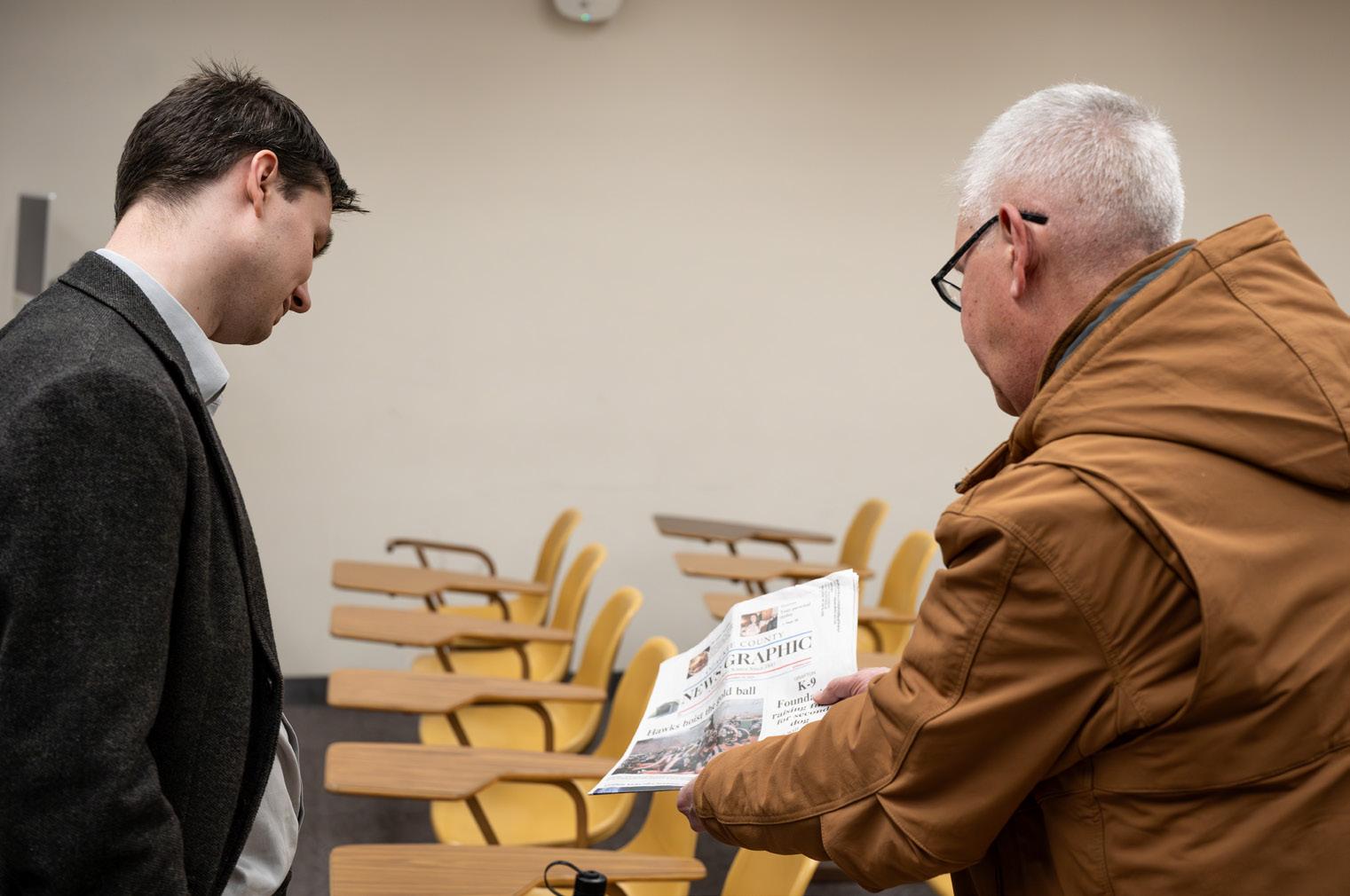
Today, he brought a special gift for professor Andrew Trexler. A relic, he jokes, from before he “left the Titanic” that is print journalism today. He handed Trexler a copy of the Ozaukee News Graphic, the last newspaper Achterberg worked for in his decades as a journalist and an increasingly rare example of local print news.
Trexler often remarks in class how quickly the media world is shifting — how the skills he teaches today might look different by the time students graduate. But the conversations about print, digital platforms and local news’ disappearance aren’t abstract for Achterberg. He’s lived through those changes, and he brings a different perspective to class as someone with years of experience as a journalist.
The former reporter and UW-Madison alum, who graduated in 1980, returned to campus after more than four decades. And he’s far from alone.
Through the Senior Guest Auditor Program, Wisconsin residents aged 60 and older take UW-Madison courses free of charge alongside students less than half their age. This fall, the program reached a record enrollment of more than 1,000 auditors, double the number enrolled a decade ago, according to program administrator Anne Niendorf. The program places older adults alongside traditional undergraduates in lecture halls across campus, creating multigenerational classrooms.
The Senior Auditor program was first enacted in 1973, before Achterberg was even an undergraduate. Just four seniors enrolled that spring, six the following summer and 10 in the fall, Niendorf said.
In the 1990s, the program was paused after a UW System Board of Regents report said it had been abusewd. It resumed later that decade with a per-credit fee, which remained in place until 2000 when the Regents adopted the current tuition-free version after former state Sen. Fred Risser, the longest-serving leg islator in America, worked in the legislature to codify senior audit rights for Wisconsin residents.
Madison historian, former elected official and local radio host Stu Levitan said the program offers Wisconsin seniors two invaluable benefits: “to gain knowledge through lectures by leading professors at a world-class university, and to gain awareness of today’s students by seeing them in action in class rooms, hallways and around campus.”
Motivations to learn
For many auditors, the program is something they look forward to for years.
Julie Foley, a former Dane County District Attorney’s Office employee, said she couldn’t wait for the day she turned 60. She heard about the auditors program through a friend and applied to the university prior to her retire ment last June. Just two months later, she was back in the classroom, nosedeep in her textbooks.
important than being up to date on everything that’s happening in this world?” Foley said.
Niendorf said one strong motivation for many senior auditors is a relentless curiosity and thirst for knowledge. Auditors will oftentimes enroll in courses they were unable to take in college or in subjects they’ve long been curious about. Through a wide variety of courses, auditors have the opportunity to see parts of the world they never could, whether that be immersing themselves in Indian culture, analyzing the history and designs of Frank Lloyd Wright, or debating political theory alongside students a fraction of their age.
Auditors are allowed to request classes and, given the professor’s permission, enroll in them. Some of the most popular topics include art history, history and political science, but any Wisconsin-related courses are a big hit, Niendorf said.
Some courses consistently attract large numbers of senior auditors. One of the most popular is Making the American Landscape, first taught by professor emeritus Bill Cronon. Levitan, a senior auditor since 2018, remembers a semester when “there were about a hundred of us in Humanities,” a number he believes signaled to students how special the class was. He recalls Cronon “criss-crossing the stage, delivering perfect lectures without ever looking at notes.”
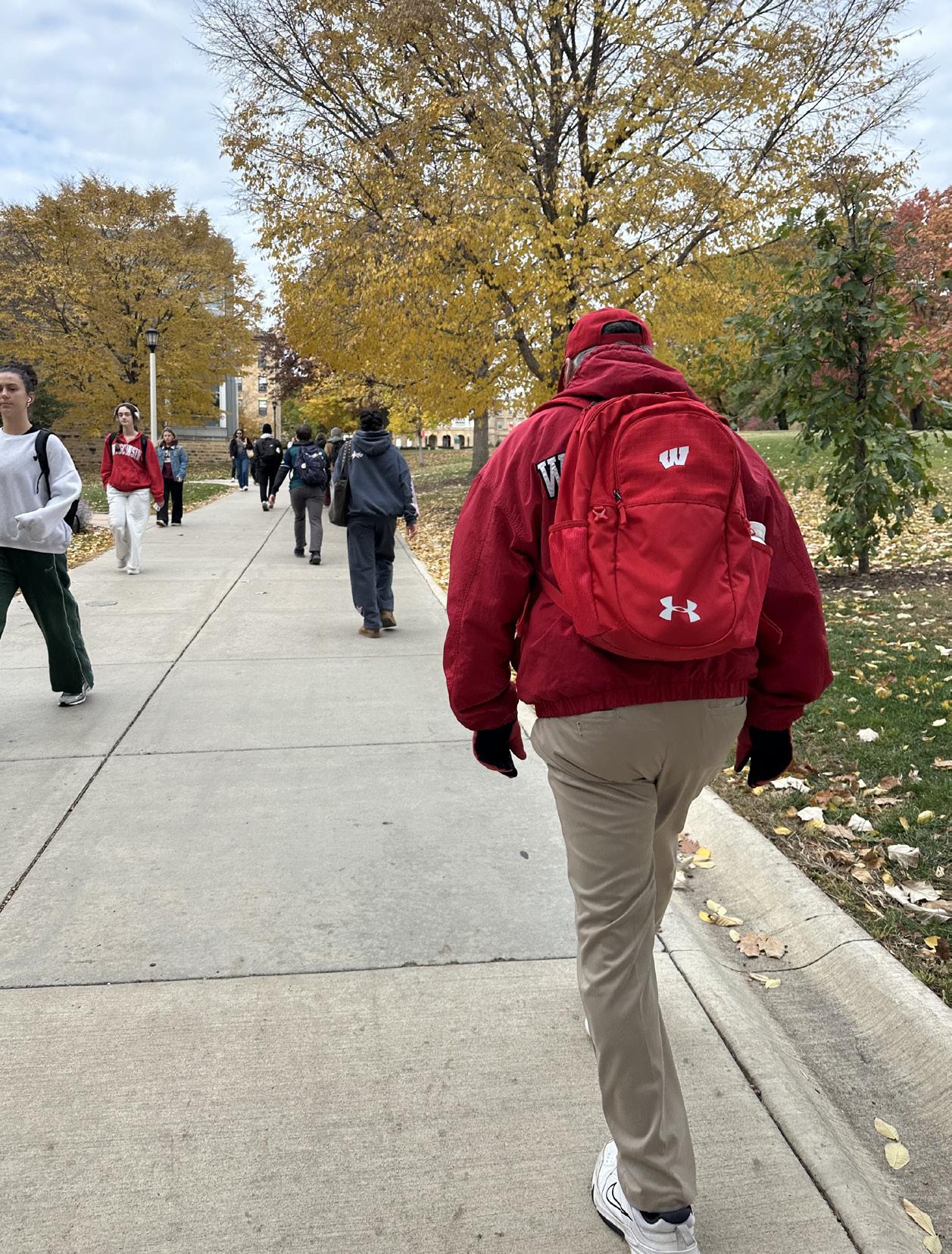
After Cronon’s retirement in 2020, professor Anna Andrzejewski took on the course. Levitan, who described Andrzejewski as his friend and neighbor, fondly recalled learning about Frank Lloyd Wright and European Art History in her courses.
Professor Alfred McCoy’s History of the Vietnam War was another standout for both Achterberg and Levitan. Achterberg called McCoy a “living legend.”
“There’s a lot of expertise in these rooms,” he said.
“I’m just in awe of the guy.”
Levitan took the course last spring, recalling a notable lecture on the 50th anniversary of the end of the Vietnam War.
“The university really treats you like you’re a real student,” Achterberg said.
They even have representation as “special students” in UW’s student government, a role Levitan held for several years giving him a unique opportunity to engage with the student body.
The cherry on top of it all? No exams, no stress.
Auditors aren’t required to complete any assignments or take any exams, a measure created to prevent distractions from paying students in the course. Without the pressure of keeping up with assignments, auditors can learn at their own pace.
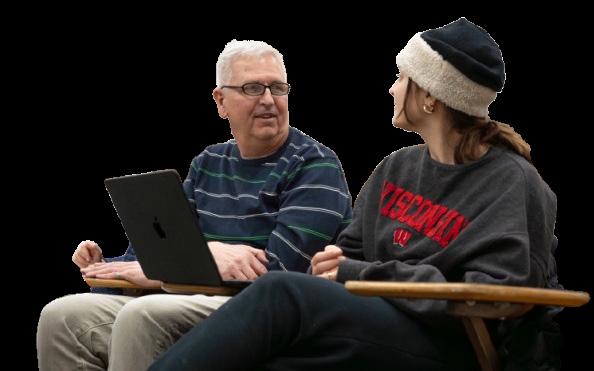
“What could be more
“I’ve got my foot in a lot of different things, but I can just come here and learn for the sake of learning,” Foley
Even without the extrinsic motivation to be engaged in class, auditors like Achterberg come prepared for class by doing all the assigned readings. He jokes that his attendance is better now in his 60s than when he was a young adult in college at UW-Madison. Niendorf said senior auditors with the “pure dedication of wanting to learn” have surprised her the most.
“I’ve had senior guests call and be like, ‘Oh, I’m gonna miss this one class. Do I have to let them know?,’ Niendorf said. “There are senior guest auditors who have audited for 30 years, and half the time I don’t know how they can even find new
And in an unexpected way, Achterberg’s efforts to be engaged have created new con nections beyond just coursework.
Every lecture, Achterberg sits next to UW-Madison junior Ella Stagnaro — now not just a classmate, but a friend. He gently
teases her for skipping the readings but she usually just shrugs and laughs. Even when she isn’t fully up to speed, he keeps her on track, occasionally adding his own experience to help explain a concept.
On the final day of Media and Politics, much of the class was devoted to reviewing key terms for the upcoming exam. Achterberg, knowing he wouldn’t be taking it, spent the period quizzing Stagnaro to make sure she understood the material.
He said one term stumped her: the “news beat.” As a journalist on and off for 40 years, Achterberg was probably the most qualified person in the room to answer it. He broke the idea down simply, offering his own experience covering politics and crime: “I know a lot of cops.” Minutes later, when Trexler asked the room if anyone could define “news beat,” Achterberg nudged Stagnaro, encouraging her to share her newly learned explanation. Stagnaro laughed, saying she’d remember Gary’s anecdote.
She also plans to stay in touch with Achterberg, made possible after Achterberg handed her a slip of paper with his name and email so they could keep in contact.
Even though auditors technically aren’t supposed to participate, Achterberg said Trexler regularly invites
in his garage and advises student journalists through his role on the board of The Daily Cardinal.
Like Foley and Achterberg, senior auditor and for mer teacher Sandy Lussier brought insight from her career back to the classroom when she took a course on the history of public education.
Lussier and her husband Mike have been audit ing courses at UW for 11 years, and they don’t see themselves slowing down anytime soon.
Each fall when freshmen move into the Southeast dorms they make a point to walk through the crowds.
“There’s so much energy and excitement there. You literally feel it,” Mike said.
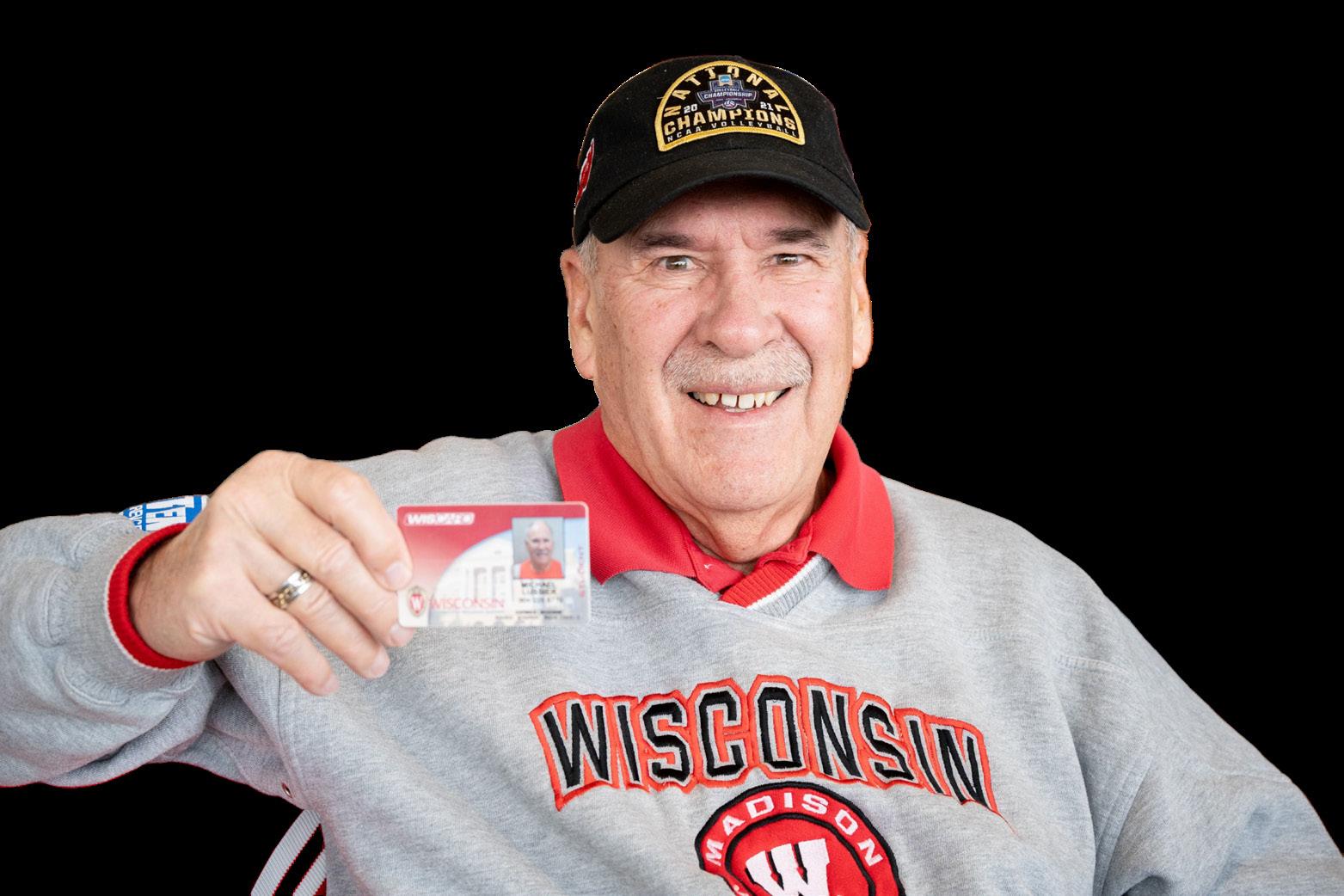
Mike said he used to interrupt campus tours “if I’m wearing my Wisconsin stuff, which I always do,” before Sandy stopped him.
“I tell
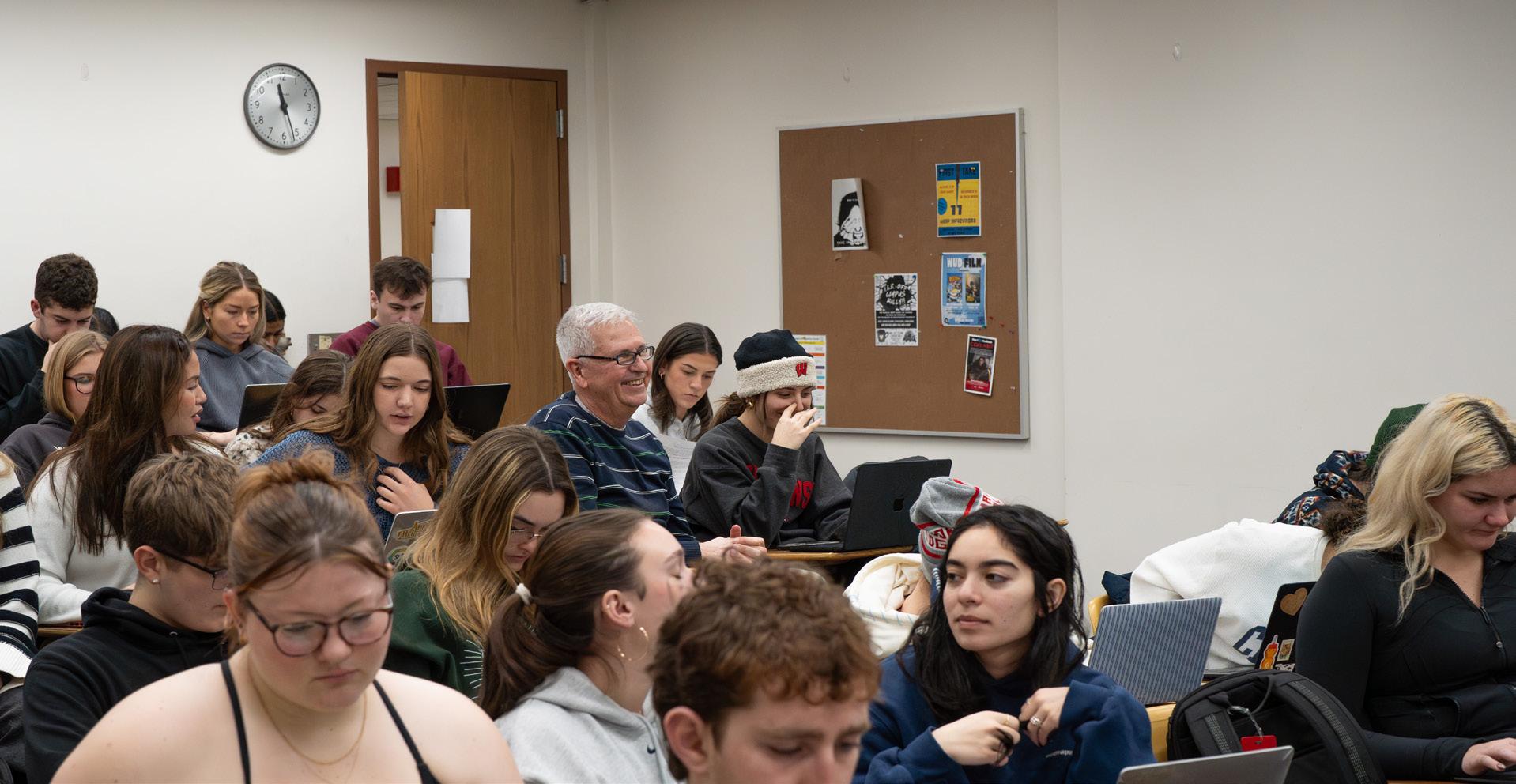
contributions from everyone — including him, drawing on decades in the newsroom.
“I love the way he teaches, even though we’re not supposed to participate,” Achterberg said. “The general rule of thumb is keep your hand down and your mouth shut, because the people who are supposed to be asking questions are the ones taking the class for a grade.”
For auditors, taking college courses is bigger than learning — it offers them a chance to engage and connect with classrooms and traditional students, leave the house and structure their days around learning.
On the first day of class, Foley was nervous whether she would fit into this environment or if traditional students would include her in group conversations.
“There’s kind of a little anxiety, thinking, do they want to be talking to this old person?” she said.
However, she said that anxiety was shortlived as her fellow classmates immediately invited her to join their small group conversation. Throughout the rest of the semester, Foley discussed and debated topics concerning media and politics while fostering connections in the classroom.
“To learn every day and to be among young people that are the future of our country and our world, that are so thoughtful and so smart... I just feel like everybody that I’ve met is just so engaging and so thoughtful,” Foley said.
A student who sat next to her told her about his aspirations of going to law school and becoming a lawyer. Foley used her past experiences as a 29-year employee at the Dane County DA to give guidance and advice to her classmate.
Achterberg has also immersed himself in campus life in ways he never could’ve imagined. He intentionally sits next to traditional students in class, stores belongings for a student studying abroad
They hold season tickets for both volleyball and football and attend every fall
Sandy also has photos with members of the 2014-15 men’s basketball team that reached the NCAA championship — players she met after auditing a course
The program’s growth has been fueled by intentional support from UW-Madison Adult Career & Special Student Services (ACSSS), which runs the Senior Guest Auditor Program.
While UW-Milwaukee enrolls about 250 senior auditors without a dedicated office, UW-Madison operates a fully staffed program that guides auditors through applications, NetID setup, course permissions and enrollment.
ents: don’t worry about the kids, they’ll be fine here. They’ll get a great education. I tell the kids: don’t be in a hurry to graduate. Keep going, stay as long as you can. This is the best environment you’ll ever have. You’ll never be in another like it,” he said.
The lifelong Badger fans moved to a condominium near the Kohl Center in retirement so they could stay close to the action. Their home is filled with memorabilia from decades of Badger games. The guest bedroom is even dubbed the “Stan Hinckley Suite,” named after former UW hockey national champion Stan Hinckley, thanks to a massive poster their children gifted them.
Throughout their more than 50 years of marriage, the couple has always had a “Badger bathroom,” and their walls are lined with photos of family members at UW events. One picture shows Bucky posing with the family at their son’s wedding — after Mike and Sandy surprised guests by bringing in the Badger Band and Bucky
Niendorf said the office works to make the program more accessible each year — simplifying forms, offering assistance for technology and Canvas and providing resources to anyone struggling to navigate university systems.
“We try to encourage people to come in and do the paperwork if they can’t do it at home,” Niendorf said.
“We have senior guests who have, whether it’s visual impairments or just can’t type or struggle with anything like that. We can help them with the process, so we try to make it as accessible as possible.”
Senior auditors also can qualify for accommodations from the McBurney Disability Resource Center, Niendorf said, receiving assistance from the center to navigate campus.
This level of institutional support is unusual. Many Big Ten universities allow older adults to audit courses, but UW-Madison stands out for having a dedicated office specifically supporting senior auditors.
Aging gracefully
For some auditors, returning to college carries benefits beyond intellectual stimulation.
Henry Stephenson, a PhD candidate in geriatrics and gerontology who studies Alzheimer’s disease, said research shows that education and social engagement can help protect cognitive health.
“Formal education is a protective factor in terms of your risk of developing Alzheimer’s disease,” he said, adding that those with a bachelor’s degree have a statistically lower risk of developing the disease than those who do not.
Social engagement matters too. “We know that social isolation is a risk factor for dementia,” he said. “If you’re a senior who spends a lot of time alone, that increases your risk.”
Learning helps keep the brain active. And simply “getting out of the house and being around people — especially younger people — can help lower dementia risk,” Stephenson said.
For Achterberg, Foley, Levitan and the Lus siers, the program is about much more than taking a class. It’s about community, purpose, and the joy of learning without restriction.
And for young UW-Madison students, learning alongside the auditors is another reminder of how lucky they are.
“Gary definitely provided me with a perspective I wouldn’t have gotten from the typical classmate,” Stagnaro said. “He never gave information away, rather provided a new point of view from his past experiences and showed me how much of an effect the rise of digital media has had in both politics and reporting.”
Editors note: Gary Achterberg joined the Daily Cardinal board in 2025.
By Ted Hyngstrom PODCAST DIRECTOR
The Cinematheque, the University of WisconsinMadison’s dedicated screening facility for international cinema history and fine films, returns this week for its 2026 slate — filling a niche since the 1990s by promoting movies audiences in Madison might otherwise miss.
Olivier Laxe’s 2025 film “Sirât,” starring Sergi López, Brúno Nuñez and Stefania Gadda, will open the set on Thursday, followed by a showing of Todd Hayes’ 1995 film “Safe” on Friday, Roman Polanski’s “An officer and a spy” on Saturday and Susan Seidelman’s “Desperately seeking Susan” on Sunday.
Jim Healy, Director of Programming at the Cinematheque, chooses the movies that end up on the big screen. Healy said the Cinematheque looks for movies from all throughout cinema history and all corners of the globe.
“Sometimes good movies are brought to us through a proposed partnership with another
campus department or community organization/concern,” Healy said. “Sometimes some movies are more relevant, like our screening of ‘Slap Shot’ last January in honor of Paul Newman’s centennial.”
Lea Jacobs and David Bordwell, both film professors in the Department of Communication Arts, started the Cinematheque in 1998.
Former Cinematheque production assistant James Kreul saidJacobs played an instrumental role in establishing the cinemahouse.
“[She] wrote grant proposals and secured the resources, not only to launch the UW Cinematheque, but also to fund a graduate project assistantship to coordinate its programming,” Kreul wrote on his personal website.
In the beginning, to delineate the Cinematheque from earlier campus film societies of the 1960s and ‘70s, Cinematheque programmers planned to regularly screen movies on the then-

standard exhibition format of commercial movie theater’s 35mm film.
“Those [older] societies mainly showed 16mm prints, and they charged admission a lot of the time,” Healy said. In comparison, the Cinematheque’s shows have always been free for anyone.
After Digital Film Package
(DCP) cameras — both 2D and later in 3D — became the standard format, upgrading to such equipment became a priority — as was expanding service.
“Programming has gone from twice a week to sometimes four days a week, with premieres on Thursday nights and frequent Sunday afternoon screenings at the Chazen
Museum of Art,” Healy said. When asked about what he hopes audiences come away with after visiting the Cinematheque, Healy indicated his desire for audiences to come away with a sense of artistic enjoyment.
“I hope our audiences realize they’ve seen a work of art,” Healy said. “I hope they see the value in experiencing art.”

By Elliot Schrag STAFF WRITER
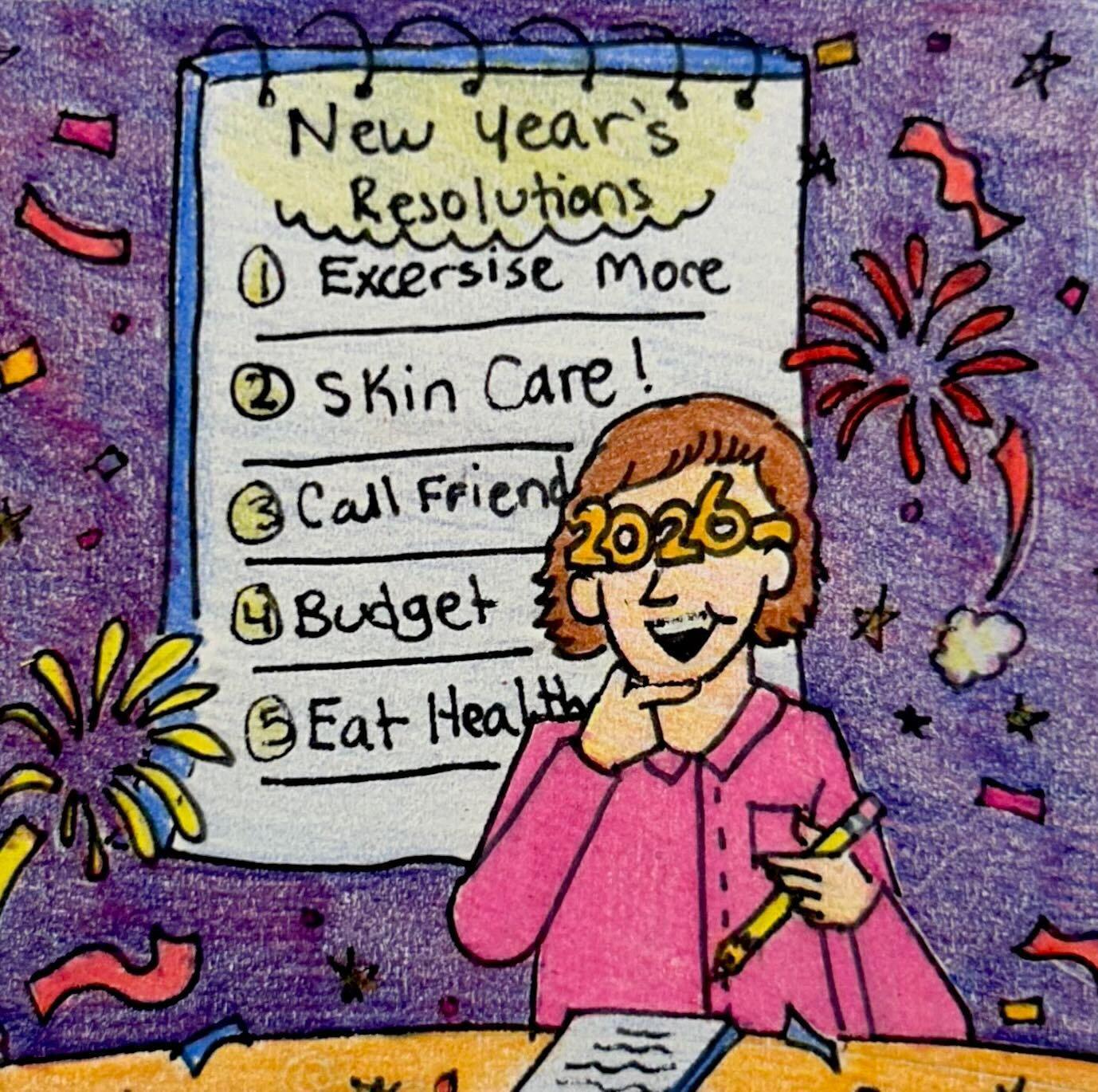
The new year rings in all kinds of hopes and dreams for students at the University of Wisconsin-Madison. But sticking to those lofty goals can prove to be a harder challenge, especially when temperatures drop below freezing. So what makes a goal stick or slip?
Some UW-Madison students are implementing unique strategies like scheduling and routine to turn their resolutions into habits that hold.
For freshman Nicole Appiah, journaling helps keep her on track with her goals. On Sundays, she reflects on her week and plans for the next writing down her tasks to combat procrastination. “I stick to Google Calendar,” she said.
In addition to Appiah’s goal to purge her procrastination, she holds a few personal resolutions. In 2026, Appiah aims “to be more intentional with how I present myself, pay attention to myself more and to be kind to my mind.”
While academic goals are at the front of the minds of UW-Madison
students, Mackenzie Sterud is seeking new experiences this year. She said “saying yes to everything, rather than staying in and closed out” will allow her to seize every opportunity thrown her way.
While some people prefer to keep their goals private, others seek out friends and family to keep them accountable.
UW-Madison student Jacob Woolery said his friends help him stick to his goals in the gym while he sets aside study time to achieve his academic endeavors.
Having people in your life to support you or even work towards goals alongside you can relieve some of the pressure. “It makes it a lot more fun,” Woolery said.
Appiah looks to her mom for inspiration. “She’s a very goal oriented person…I try to adopt the little things she does to keep organized,” Appiah said.
But 12 months is a long time to stick with something. It might feel easy to keep a resolution for a couple of weeks, but when school ramps up and life throws obstacles in your way,
the likelihood of dropping that goal from Jan. 1 skyrockets.
The novelty of resolutions can quickly wear off. UW-Madison student Ella Collinson, who aims to read more in the coming year, admits she often fails to keep her resolutions because they don’t form into habits.
However, Zachary Johnson, a UW-Madison student who is set on taking the Graduate Record Examination this year, proposes another strategy to keep your resolutions in the hefty span of a year. He suggests having deadlines throughout or “pieces within the goal, like stepping stones to try to keep part of a track or a path.”
This year, Johnson recorded his goals in the form of a bingo card, a social media trend his girlfriend saw online. He hopes this fun and manageable approach will keep him accountable toward reaching his goals.
Whether your goals stick or slip, making resolutions creates space for a fresh perspective and a chance to start the new year off on the right foot — but remember not to be too hard on your-
By Gabi Marmet STAFF WRITER
As the new year begins and the frigid Wisconsin weather continues, it is important for college students to avoid falling into seasonal depression. Although lounging with a fluffy, weighted blanket on your couch and watching “Heated Rivalry” may seem like one of the only ways to get through the winter, the University of Wisconsin-Madison campus offers plenty of fun activities — not only while the weather is warm, but even during the coldest winter months.
From university and student-led events to casual activities students can opt into at any time, winter campus traditions are fun ways for students to start their spring semester off right, all while surviving the cold.
For those who enjoy spending time in nature, appreciating the snowy scenery around campus and spending time outdoors makes for a great way to pass time. Walking down the lakeshore path provides a beautiful view and an opportunity to stay active during the sedentary winter months. While it can be difficult to find the motivation to go outside in the cold, it is beneficial for boosting mental health and reducing stress.
Another great way to immerse yourself in the outdoors this winter is by joining the Wisconsin Hoofers. The club has about 2,000 student members and aims to help students learn and enhance their technique in outdoor activities.
During the winter, Hoofer’s Ski & Snowboard Club is a popular choice. The club provides opportunities to take skiing and snowboarding lessons, as well as multiple trips to ski resorts and hills to take advantage of the winter weather.
Sledding down Bascom Hill is another fun way to enjoy the outdoors this winter, as well as being a long-standing tradition for students at UW-Madison. What better way to let loose and take a break from classwork than reminiscing on childhood memories, or even attempting this activity for the very first time?
While students may not have access to a proper sled, there are plenty of ways to replicate them, such as lunch trays or even garbage bags, but anything flimsy or with sharp
edges should be avoided.
And once the ice completely freezes on Lake Mendota, it can be a fun adventure to walk or ice skate over the frozen water. No ice skates? No problem. There are other options for students hoping to ice skate this winter. Students can rent ice skates at the Bakke for $4, take private or group lessons or attend Wisconsin Union skating events.
On Jan. 30, the Memorial Union is hosting the Jerseys & Jams Skate Night, where students can rent skates for $5 and enjoy classic jock jams in their favorite hockey jerseys.
The Edgewater Hotel also houses an ice skating rink just off of Langdon Street. Visiting the rink can be a great way to visit a new area on campus, ice skate on an even outdoor rink and warm up by a fire pit.
The most notable way to enjoy frozen Lake Mendota is the annual Winter Carnival, hosted by the Wisconsin Union over the weekend of Feb. 5-7. During the event, an inflatable Lady Liberty peeks out over the lake, and the Memorial Union provides outdoor activities to celebrate the Wisconsin winter.
Some of the activities throughout the weekend include learning to skate on Lake Mendota, viewing a performance from The Wisconsin Singers group, enjoying $1 cheese curds, meditating with hot chocolate, dancing at the Hoofer’s Snow Ball, riding in a horse-drawn carriage and cozy indoor crafting with Wheelhouse Studios.
If the great outdoors is not for you, UW-Madison’s sporting events are another great way to take a break from school and support your fellow Badgers. Basketball, hockey and wrestling are all active during the spring semester and host an energetic and encouraging student section.
Some exciting home games to look forward to include: Men’s Basketball vs. Minnesota on Jan. 28, Women’s Hockey vs. Ohio State on Feb. 7 and Wrestling vs. Michigan on Feb. 15. UW-Madison students can purchase tickets online or cautiously through other students.
While students can choose to spend their winter wishing away the weather indoors, the season can be a time to take advantage of all of the opportunities UW-Madison has to offer and enjoying the fun winter activities that only come once a year.
self if they
By Addison Dama STAFF WRITER
Trendsetters online have been welcoming in 2026 by looking back. Internet users are resurfacing old memories of 2016, as well as fashion and aesthetics.
In 2016, the world seemed less restrained. Trends felt unapologetically bold, defined by loud fashion, full-glam makeup and universally viral posts.
During the pandemic, we saw a burst of creativity and personal expression online, spurred by a need for an outlet amid isolation. However, once life returned to normal, that burst of creativity faded. For the past few years, culture has leaned toward toning it down, from the “clean girl era” to “quiet luxury”; the less is more movement has momentum.
As our social and political climate becomes increasingly turbulent, it makes sense to look toward a time that feels familiar, before the pandemic and other cultural shifts such as the 90s fashion revival. This may be why we are seeing people return to the loud yet simpler era of the 2010s.
For many young adults in 2026, 2016 was their first time venturing onto social media. Photos with doggy ears and floating hearts resurface in Snapchat memories, and scrolling far enough on an Instagram page often reveals a beach photo swathed in the Rio de Janeiro filter or an overexposed sunset.
As nostalgia for this era grows, the art of filtering may be making a comeback. Instead of perfectly curated feeds, a messier and carefree posting style seems to be gaining traction. Users are leaning into a posting style that is more spontaneous and personal, prioritizing authenticity.
Internet trends may follow a similar pattern, emphasizing creativity, humor and expression rather than perfection.
The music scene
We have already seen this shift in
music. Last summer’s “BRAT” phenomenon sparked a revival of dance and electronic music in the mainstream. This dance-pop was also a staple of the mid-2010s, where it dominated parties, clubs and radio charts. Its resurgence represents a shift to music that feels energetic and communal.
Even more recently, we have seen the comeback of several 2010s music icons. Zara Larsson, who rose to popularity with her 2015 hit “Lush Life,” has become a sensation once again after a period of quiet. Not only has “Lush Life” reemerged online, but her 2025 single “Midnight Sun” has been an overwhelming success.
This comeback marks the resurgence of dance-pop in the mainstream. Looking ahead to anticipated releases from artists such as Harry Styles and Bruno Mars, we can expect more electronic and dance elements to continue shaping 2026.
While this shift does not signal a full return to 2016 fashion — it is hard to believe that skinny jeans could return as a campus staple — it does encourage bolder self-expression. Buisier prints, brighter colors, louder makeup and more experimental styles could all move back into the mainstream.
Animal prints and eye-catching patterns are likely to appear on clothing racks, while accessories will take a larger role in completing an outfit. Makeup trends may also shift toward warmer and more matte looks and away from the ultra-glossy glow that has dominated recent years.
This return to 2016-inspired trends isn’t a regression, but rather a look back at a time many remember as more expressive and creative. This isn’t a new phenomenon; each decade seems to draw inspiration from the forgotten trends of decades past. As 2026 unfolds, nostalgia will serve as both a comfort and an inspiration for new trends and styles. In revisiting the previous decade, people will capture the joy and expressiveness that has felt increasingly rare.
By Madison Moris
LIFE & STYLE EDITOR EMERITUS
DEFOREST, Wis – A proposed data center in Dane County is facing waves of backlash from local residents after a local activist organization uncovered emails between leaders of QTS Data Center and the village president.
QTS first proposed a Dane County data center in the Town of Vienna, but moved it to DeForest after Vienna voted against an agreement with the company. But the development still faces widespread community opposition, with DeForest residents accusing local leadership of collusion with QTS after a local activist group uncovered emails through an open records request.
Emails released by the “No Data Centers in DeForest” group indicated QTS leadership and Deforest Village President Jane Cahill Wolfgram discussed QTS’ relocation plans from Vienna to DeForest before notifying the public. Dan Jansen, a DeForest resident and member of the group, presented the group’s findings at a public village board meeting Jan. 13. Jansen questioned if the village president remained neutral on the QTS development, citing emails obtained from the open records request to claim Wolfgram Cahill guided QTS leaders on phrasing to limit scrutiny. In an Oct. 31 email, Wolfgram Cahill wrote to QTS representatives that many DeForest residents are “college educated and smart and looking for ways to question” QTS’s water cooling system. The company described their cooling system both as closed-loop — using a small amount of water as a coolant — and water-free.
Wolfgram Cahill did not respond to The Daily Cardinal’s requests for comment.
“No Data Centers in DeForest” started a petition to change a village ordinance to prevent further QTS development. The petition called for a referendum in the next election for any new projects requiring an annexation of land greater than 30 square acres or a financial obligation of more than $10 million. QTS’s data center would be 1,600 acres, with a financial obligation of $12 billion. However, the Village Board voted to not take action on the referendum, which Jansen said “effectively killed it.”
Tricia Boehlke, part of “No Data Centers in DeForest,” is concerned the project will continue despite community opposition. She referenced the village’s decision to remove fluoride from local water supplies beginning last March, drawing public backlash.
“There’s been a history of the board doing things that the community doesn’t want, which is why this is really
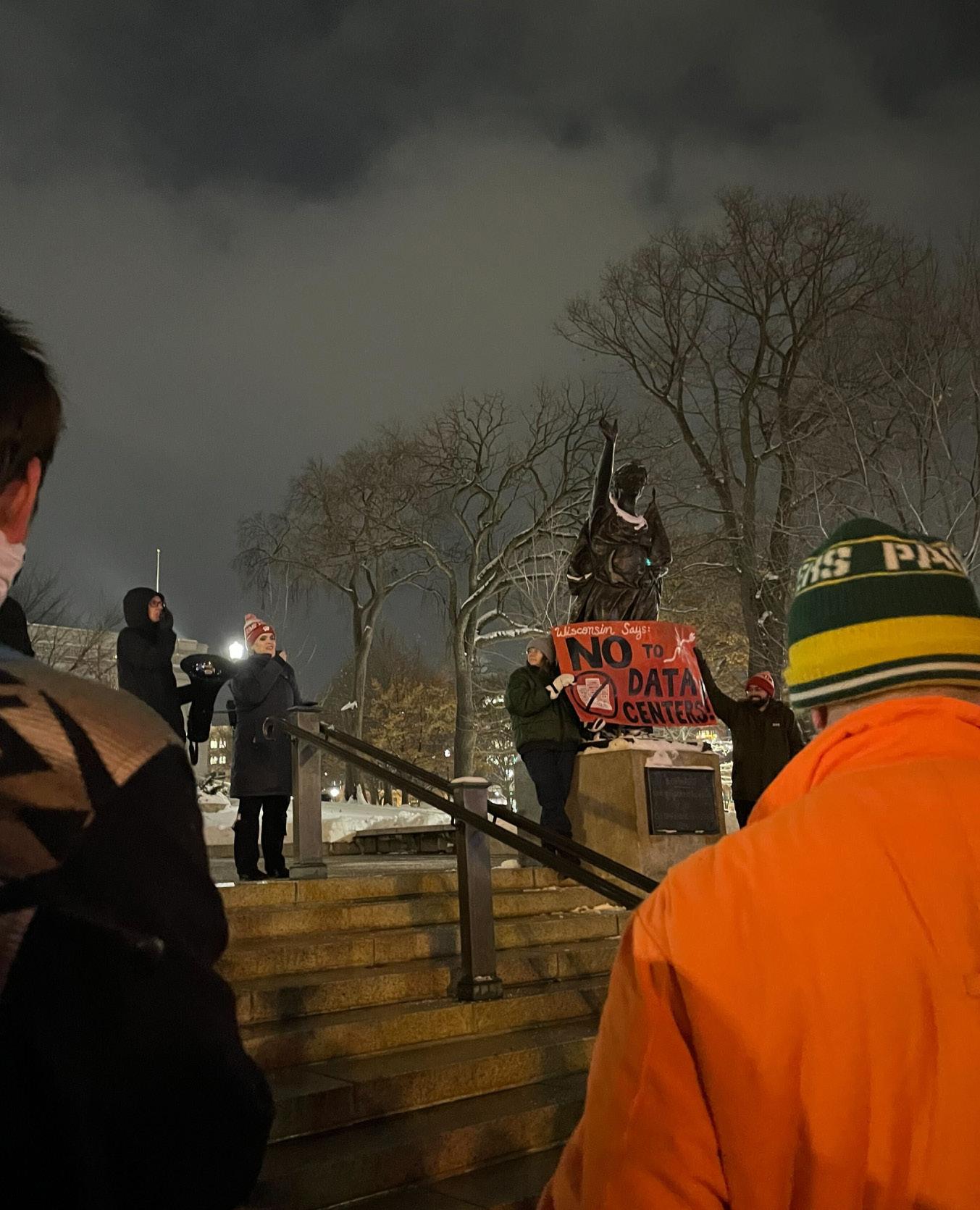
scary,” Boehlke said. “In my conversations with hundreds of people that signed [the petition]… the number one thing that stood out was [people] feel like the board has not listened to the community in the past.”
Boehlke, who serves as a job developer for people with disabilities, is also concerned about potential noise pollution. “People with disabilities have sensory issues, especially people with autism,” Boehlke said. “The sound the center would make would be really hard for people with [these] issues.”
QTS filed two petitions to annex land from Vienna from the project, but they were recently rejected by DeForest. In a memo to the board, Village Administrator Bill Chang said considering one annexation petition will prioritize a more comprehensive consideration of the proposal.
The Village anticipates QTS will file a new, consolidated annexation petition. The Wisconsin Department of Administration (DOA) must review and determine if annexation is in the public interest. DOA has 20 days from the date a valid petition is filed to make that determination.
What about QTS’s environmental impact?
Boehlke also mentioned potential environmental impacts in DeForest and the Yahara Watershed. “Anything that gets into the groundwater could affect our lakes and impact everybody in the Madison area,” she said. QTS has said their closed-loop water cooling system will not require water from the Yahara watershed.
Kathy Kuntz, Director of the Dane County Office of Energy & Climate Change, said environmental groups have reached out to the office about the project, but the county has no role in these decisions since the project is in the Village of DeForest.
Kuntz’s office is “nudging” QTS and DeForest to develop in a way that helps meet the county’s climate goals outlined in their Climate Action Plan, which aims to cut countywide emissions in half by 2030 and achieve carbon neutrality by 2050. “How do we help [QTS] do the things [they] want to do in a way that also contributes to the climate goals?” Kuntz said.
In October, when QTS plans were still in Vienna, estimates had the data center consuming two and a half times the energy consumption
data center moratorium. Satya Rhodes-Conway, Madison’s mayor, proposed the bill to regulate potential data center developments in the municipality.
Reactions to data center developments around the state
Eli Morey, a member of the Madison branch of the Party for Socialism and Liberation, said the DeForest local government and other local governments supporting data centers are not working in the interest of their constituents. “The most fundamental question here is the question of democracy,” Morey said. “We want people to be able to decide, do we want data centers or not?”
Morey and other PSL chapters coordinated a statewide day of action against data centers on Dec. 2, coinciding with a Milwaukee meeting of business leaders discussing the economic opportunities of data center development in Wisconsin. There are no active data center proposals in Madison, but Morey said PSL Madison is supporting communities around the state fighting against data centers.
Morey wants residents to have a chance in deciding what is best for their community. “We haven’t gotten a single opportunity to vote or participate in a democratic process around AI,” he said. “We’re being force-fed this new technology with zero say in how or where it’s used or [if] we want to use it at all.”
of Dane County. Kuntz said she has not seen an updated report on how much energy the DeForest data center would consume.
Residents also have concerns about rising energy costs. Recent data found wholesale electricity costs up as much as 267% more than it did in 2020 for those who live near high capacity facilities. Jeff Green, QTS’s Senior Manager of Economic Development, said the company is working with Alliant Energy to prevent increased energy prices. “QTS will partner with Alliant Energy to deliver 750 megawatts of new renewable generation in Wisconsin at QTS’s cost, lowering the cost for consumers across the state,” Green said.
Data centers are a complicated issue as UW-Madison, healthcare entities and businesses in the county rely on AI and cloud computing, said Kuntz, adding that it would not be appropriate to say data centers should go somewhere else. Instead, she said residents should focus on developing the best data centers that create the best outcomes for the community. “We’re Dane County, and we should be able to figure this out,” she said.
Madison’s city council unanimously passed a one-year
In November, QTS Data Centers announced a partnership with the Building Trades Council of South Central Wisconsin to build the data center. Andrew Disch, North Central States Regional Council of Carpenters representative, supports the development. “If your answer is ‘don’t build it’, then what’s your solution? Because as a society, we rely on the modern day conveniences that data centers are providing,” Disch said.
To involve residents in the development process, QTS hosted community feedback sessions allowing residents to ask QTS officials questions about the project. Residents have raised concerns about the actual number of jobs the center would create. QTS claimed the project will create 5,000 construction jobs and 700 permanent full-time positions once completed, but a recent analysis found the largest data centers employ fewer than 150 permanent workers.
Stephanie Robinson, co-director of 350 Wisconsin, a grassroots environmental organization, was also not convinced about data centers’ promises. “We know that these companies are justifying their choices by saying they’ll invest in green infrastructure and energy efficiency,” Robinson said. “That isn’t enough. Empty promises are not enough.”
In the midst of a do-or-die offseason for head coach Luke Fickell, the Badgers have been aggressive in revamping their roster
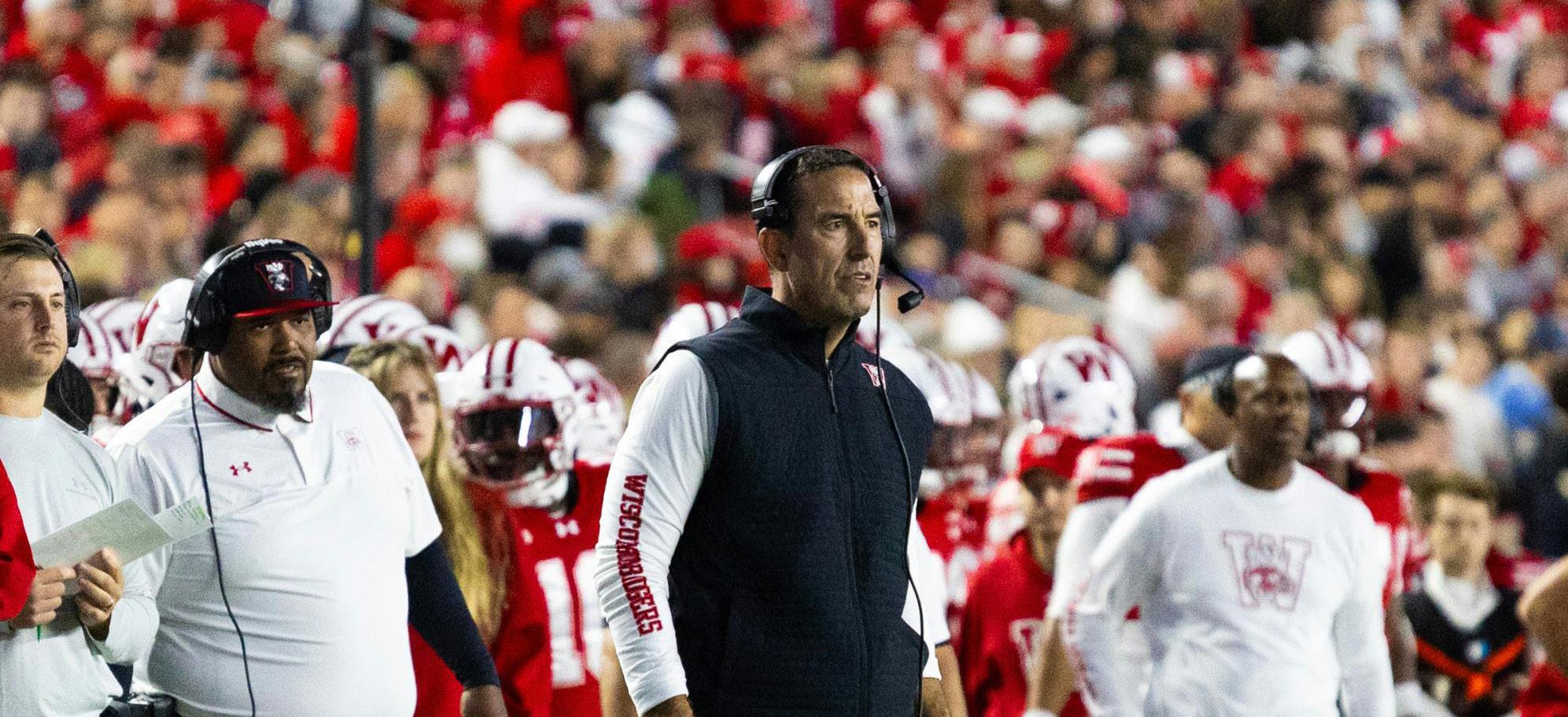
By Yadiel Chavez SPORTS EDITOR
Following Wisconsin’s disastrous 34-0 loss to Ohio State on Oct. 18, pessimistic discourse surrounding the team reached a fever pitch.
The offense was shut out in backto-back losses for the first time since 1968. “Fire Fickell” chants grew ever louder, even with head coach Luke Fickell’s contract buyout standing at roughly $25 million. This was a forkin-the-road moment for Wisconsin Athletics Director Chris McIntosh, tasked with pleasing a fanbase who became more adamant about their complaints after every defeat.
McIntosh broke his silence the following Monday in a public statement that addressed the state of the program. He reinforced Fickell’s position as head coach, acknowledged that expectations were not being met and committed to “more athletics-funded investments in infrastructure, staffing and, most importantly, student-athlete recruiting and retention.”
While McIntosh’s statement gave some clarity regarding the team’s future, the season was far from over. The Badgers would go 2-3 in its final five games, a mixed bag filled with two rejuvenating wins over then-ranked Washington and Illinois, followed by a demoralizing loss to rival Minnesota in the season finale. Wisconsin finished the year at 4-8, its worst record since 1995, signaling a new low for the program in the 21st century.
Regardless of the negativity surrounding the team, there was little time for the Badgers to dwell on their struggles. With no bowl game scheduled for the second straight year, Wisconsin now entered an offseason that could make or break Fickell’s time at the helm.
During Wisconsin’s National Signing Day Media Conference on Dec. 3, Fickell quietly dropped hints that Wisconsin would be changing its philosophy regarding roster construction in the coming offseason.
“The idea of saying ‘Hey, do you wanna bring in 22 high school kids?’
That’s kind of shifted.” Fickell said regarding Wisconsin’s current number of 14 commits in the 2026 recruiting class, down from 22 enrollees in the class of 2025.
A decreased number of high school recruits, alongside a pledge
from McIntosh to increase financial support, meant Wisconsin looked towards the NCAA transfer portal as their main source of roster improvement.
It’s this methodology that’s allowed programs like Indiana to jump from dead last in the Big Ten in 2023, to being one win away from becoming National Champions in 2026. Heisman winning quarterback Fernando Mendoza was the main addition from the Hoosiers’s 2025 portal class, which included 22 other players who’d help contribute to their meteoric rise. While head coach Curt Cignetti’s role in Indiana’s success can’t be overlooked, the transfer portal played a legitimate part in their current championship push.
“[The transfer portal] is obviously a little bit more of the way of the world,” Fickell said, acknowledging the importance of the portal in the modern landscape of college football.
When the transfer portal opened on Jan. 2, Wisconsin wasted no time pursuing additions to its roster. Through 12 days of portal activity, the Badgers have received commitments from 27 players, seventh-most in college football and surpassing their total signings in the 2023 and 2024 portal classes, at 15 and 16 respectively.
With the increase in portal acquisitions, each position group has seen its fair share of renovations.
Eager to finally get a full season of his first choice at quarterback, Fickell zeroed in on Old Dominion transfer Colton Joseph. A true dualthreat option at quarterback, Joseph threw for 21 touchdowns in 2025, adding 1,000 yards and 13 touchdowns on the ground. The ability to use his legs against defenses will be crucial for offensive coordinator Jeff Grimes. Grimes favored a run-pass option offensive scheme when true freshman Carter Smith started for the Badgers, a mobile quarterback in his own right.
Protecting the quarterback was one of many issues for the Badgers in 2025, surrendering 27 sacks, a 14-sack increase from 2024. With center Jake Renfro and guard Joe Brunner entering the transfer portal, the offensive line immediately became a priority this portal cycle.
Wisconsin signed four offen-
By Aeron Hanson STAFF WRITER
The Wisconsin Badgers won their third straight game on Tuesday night, beating the Minnesota Golden Gophers 78-75 off a last second 3-pointer from junior guard John Blackwell.
The game started out neck and neck, with each team trading buckets. Wisconsin guard Nick Boyd started off the scoring for the Badgers with a drive down the lane to a pull up floater. Boyd contributed 11 points on the night and helped the Badgers control the tempo when they were in a significant deficit early in the second half.
The Badgers, who trailed for most of the first half, led twice before halftime. The Gophers held Wisconsin scoreless for the last 5:11 seconds of the first half, and Minnesota went into the break with a 35-28 lead.
sive lineman through the portal so far: Austin
Cherry, Lucas Simmons and PJ Wilkins. Former Badger and NFL legend Joe Thomas was even seen on the recruiting trail, having dinner with Simmons before the 6-foot-8 freshman announced his commitment to Wisconsin.
On the defensive side of the ball, no group has seen more additions than the secondary. Six players, including four cornerbacks and two safeties, have joined the Badgers. Perhaps most notable is Ohio State transfer Bryce West, who was a four-star prospect out of high school in 2024.
Other positions that have seen multiple additions through the portal are running back, wide receiver and defensive line. One position group that’s been left largely untouched is linebacker. The mid-season breakouts of both Mason Posa and Cooper Catalano left Wisconsin prioritizing other areas, with the Badgers only adding one linebacker so far: Jon Jon Kamara from Kansas.
For all the buzz that Wisconsin is generating with their portal activity, 2026 will prove to be the most pivotal year in recent Badger memory.
Entering his fourth year as head coach, Fickell will be under a microscope all season. After leading Cincinnati to the College Football Playoff during the four-team format, expectations were lofty coming to Madison in 2023. But instead of raising the bar, Fickell has lowered it significantly. Snapping a 22-year bowl streak left a sour taste in Wisconsin fans mouths, but 2025 saw the program steer even further away from its former glory.
Despite an unsatisfactory 17-21 record in three seasons, McIntosh has stood firm alongside Fickell. Sustained calls for his firing haven’t deterred McIntosh from believing in his head coach’s long-term vision for the Badgers.
However, after giving him public support, increased portal resources and a 2026 schedule that is more favorable to Wisconsin than previous years, another year of Fickell failing to meet expectations could leave McIntosh no choice but to pull the plug on what has been a disastrous era for the Badgers.
able shots which they could not convert on. The Badgers missed three of their last four free throws, which allowed Minnesota to stay in the game.
With the Gophers trailing by three, Minnesota’s Cade Tyson drained a shot from beyond the arc to tie the game at 75. Blackwell then proceeded to receive the inbound and dribble up the left side of the court. With everyone still in awe of Tyson tying the game, Blackwell struck back ferociously, hitting the dagger right as the final buzzer sound.
“I was always taught to go get the ball and get a shot up… I went to my go-to move, [the] hesi three,” Blackwell said after the game.
Wisconsin’s lackadaisical defense allowed the Gophers to manipulate them and draw fouls. Wisconsin struggled immensely on the offense towards the end of the first half, whether it was a wide open look or a contested shot when the shot clock was winding down.
It was a different story for the Badgers coming out of the locker room after halftime. While Minnesota still led most of the second half, Blackwell and former Gopher Braedon Carrington paved the way for Wisconsin’s comeback.
The duo led the Badgers on a 14-0 run over a four minute stretch to give them a 66-57 lead late in the second half. The Gophers then made a push to regain the lead, eventually bringing the game within three in the final minute. The Gophers tightened up their defense and forced Wisconsin to take uncomfort-
Blackwell was the star of the show during Tuesday’s contest, tallying 27 points on 5-for-7 shooting from beyond the arc with Minnesota unable to stop him. He also showed off his inside game as well, weaving around multiple defenders and getting to the rim efficiently.
Carrington was also instrumental in the win. The Minnesota native received boos all night but chalked up a season high 21 points for himself on 7-for-12 shooting from beyond the arc.
Carrington has proved himself more and more each game on why he deserves to be in the Badgers rotation with his exceptional shooting ability and the way he sees the floor, always being able to find the right guy in transition. “I got a coaching staff that believes in me and knows what I can do,” Carrington said after the game.
The Badgers continue Big Ten play Saturday at 1 p.m. against the Rutgers Scarlet Knights 9-8 (2-4 Big Ten) at the Kohl Center.

By Dominic Violante BEET EDITOR
All articles featured in The Beet are creative, satirical and/or entirely fictionalpieces.Theyarefullyintended as such and should not be taken seriouslyasnews.
University of Wisconsin-Madison Chancellor Jennifer Mnookin unveiled an unconventional plan to combat the current student housing shortage — sending excess students, mainly freshmen, to several of Madison’s vibrant and historic homeless shelters — at a press conference yesterday afternoon.
“While many of our greatest students are able to find housing at this hallowed institution’s many dormitories, or perhaps get a $4,500 apartment at The Hub, or Theory Madison, some of our less fortunate students have been complaining non-stop about not being able to find ‘affordable housing.’ Well, after our team sifted and winnowed through many ideas, like cutting our football budget since the team, and more importantly the coach, sucks, or having one less movie theater or even having to cut funding to our student government I know all 1.5%
of you who voted in their last election care so much about, we landed on the homeless shelter plan.” Mnookin said at the press conference.
Over the course of the three hour conference, she flipped through a 478 slide Power Point presentation on the plan, going deeper into the details of it all.
“For all freshmen who don’t make the cut for staying in a university dorm their first year of schooling, they will be asked to rank their top three favorite homeless shelters in the city, being able to pick from over five exotic locations, then be assigned to one based on their preferences and more importantly a random lottery. They will also be given the generous option to pay an additional $5,000 fee for a recommissioned city bus to shuttle them to and from campus, which will be on a subscription based payment system,” Mnookin said while shining a laser pointer through the window of her office and into the eyes of a student protestor.
University professors and their children have praised the decision for its “adaptability” at combatting the “affordability crisis,” with quantitative weather
mathematics Professor Daniel Coastaleliteson being the most vocal with his support.
“What the Chancellor is doing is truly special. I mean, who else could think of sending all of those people to homeless shelters?” Coastaleliteson told The Daily Cardinal.
“I agree a lot with my dad. Housing is just such an issue for so many people, so it’s great to see that the chancellor finally found a place for them to live,” said Robert Coastaleliteson, Daniel Coastaleliteson’s son and UW-Madison sophomore cur rently staying in a four bedroom penthouse apartment at The Overprice, a new set of student apartments built last summer over the ruins of beloved historic city landmark and restaurant, The Nostalgian.
While some students have offered praise, others have condemned the decision. Popular student newspaper
The Madison Federalist released a statement from their editorial board calling Mnookin’s plan “abhorrent” since it would only make the homeless shelters, which they called “nonbinary woke machines built to destroy the poor’s incentive to work,” more popular among the youth.
By Dominic Violante
BEET EDITOR
All articles featured in The Beet are creative,satiricaland/orentirelyfictionalpieces. They are fully intended as such and should notbetakenseriouslyasnews.
Wisconsin Governor Tony Evers said the Wisconsin State Capitol will be replaced with a massive OpenAI data center, set for construction this July, at a press conference Tuesday afternoon.
“As Wisconsin becomes a hub for AI data centers, we thought our capitol should represent that. So, I’ve signed a $30 million deal to sell my capitol building to OpenAI. Holy mackerel folks, this former cheese factory worker is about to be a millionaire!” Evers said.
He went on to address concerns and frustrations the people of Wisconsin and Madison have expressed with his plan.
“Yes, I know several people are upset that even though I’m supposed to be an environmentalist, I’m supporting a data center which is terrible for the environment. Also, I understand that this data center will cause electrical bills for the people of Madison to increase by over 500%, but I’m retiring so go ******* your ****** and **** you **** too.” Evers said, ending his comments in a rant so profane my editors told me I had to censor it
with asterisks which is a Daily Cardinal first.
This plan has drawn bipartisan criticism from Wisconsin politicians. In a rare display of bipartisanship, State Senate Majority Leader Devin LeMahieu, R-Oostburg, and State Senate Minority Leader Dianne H. Hesselbein, D-Middleton, blasted Evers. They pointed out that he “probably doesn’t have the authority to sell the capitol building on his own” and if he did, he “should’ve cut us in on the deal.”
Despite extensive research, the Cardinal cannot say for certain if Evers has the power to sell the building himself, but we will update this article when we find out.
When a Cardinal reporter asked Evers a series of questions about his ownership of the building, the governors responded saying “Quiet piggy, you look like a burp!” and thrusting his middle finger into the reporter’s face. He has not apologized.
The Student Bathroom-Sticker Coalition, the UW student organization that’s been putting those anti-AI stickers in countless bathrooms across campus, have strongly condemned Ever’s plan with a clever yet smug sticker they’ve slapped to the mirror of the men’s restroom in the basement of Vilas Hall.
When word of the sticker got to Evers, he responded with a series of Bluesky posts claiming the sticker is “off the charts ******.”
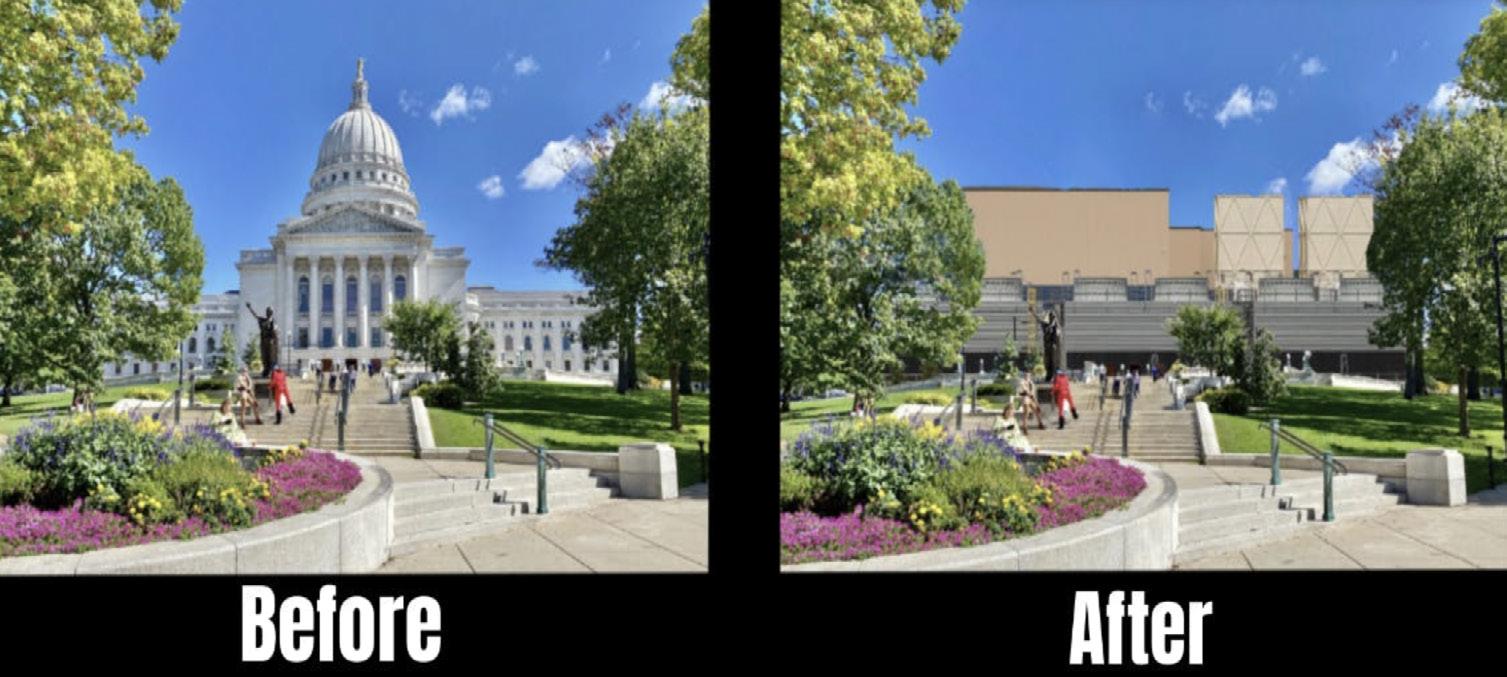
Their statement ended by calling university bus passes “DEI,” said that Bascom Hall should be renamed in honor of Dick Cheney, may he rest in peace, and included twelve different Ayn Rand quotes about the dangers of altruism.
Lesser known student newspaper
The Badger Herald also released a statement from their editorial board.
However, because of its broad misinformation, confusing prose, clear bias, obvious irrelevance and general journalistic malpractice, I won’t bore you with its details.
Mnookin’s housing plan is set to begin the fall semester of 2029, but students will need to enroll in the program spring semester of 2026 if they want to take part in it.
Trump blasts ‘Heated Rivalry’ despite past praise for its relatability

By Dominic Violante BEET EDITOR
All articles featured in The Beet are creative, satirical and/or entirely fictional pieces. They are fully intended as such and should not be taken seriously as news.
President Trump signed an executive order demanding the popular hockey-centric Canadian gay romance series “Heated Rivalry” based on a book from author Rachel Reid, include more full frontal nudity at a press conference earlier this afternoon.
This follows previous rants on Truth Social from the president where he praised the cast’s relatable performances of “famous men caught in forbidden love” whilst decrying the show for “catering to a woke audience” by not including enough nudity.
“What is going on with the hockey show? I mean, it’s a total disaster. Everyone’s been telling me this, all sorts of people, coming up and telling me ‘mister president, why have we not seen any full frontal on the show?’ I think, quite frankly, that it’s a great question.
I mean, the radical marxist democrat party is saying this is supposed to be the greatest queer representation on TV, how is it great queer representation if we aren’t seeing full frontal?”
President Trump said at a press conference in the Oval Office following his signing of the bill.
While some reporters attempted to ask him questions about U.S. involvement in Iran and Venezuela, Trump ignored them and continued with his thoughts on the show.
“We love full frontal, don’t we folks? I mean, wow, some of these guys in the show they’re just incredible, but the left doesn’t like
that, do they? I mean, it’s absolutely terrible what’s happening because we see these big beautiful men but the camera hasn’t panned down once, not once. I mean, where the hell is Shane’s schlong? Why haven’t we seen it? We all wanna see it! We all know it’s there!” Trump went on to say, gesturing to those around him.
The bill he signed demands future seasons of the show include “at least five schlong shots per episode”. FCC Chair Brendan Carr has reportedly been told to pull the show off HBO if the demands aren’t met.
These aggressive actions shouldn’t come as a surprise. Ever since the show first released in late 2025, Trump has voiced his various thoughts about the show on a weekly basis.
“Just FINISHED the cottage episode. PERFECT in it’s portrayal of TWO FAMOUS and ACCOMPLISHED MEN hiding their forbidden LOVE whilst pretending to be RIVALS. Why does CROOKED HILLARY ruin EVERYTHING! #bubba-belongs-to-me,” Trump wrote in a Truth Social post several weeks ago, appearing to confirm rumors sprouting from leaked Epstein File documents referencing a love affair between Trump and former President Bill “Bubba” Clinton.
Following that post, the official White House X (the app formerly known as Twitter) account tweeted fan art of Trump and Clinton as the show’s main characters. Within minutes it was retweeted by Senate Minority Leader Chuck Schumer with the caption “simply bipartisan beauty, moments like this are why I entered politics”. He has declined The Daily Cardinal’s requests for comment.