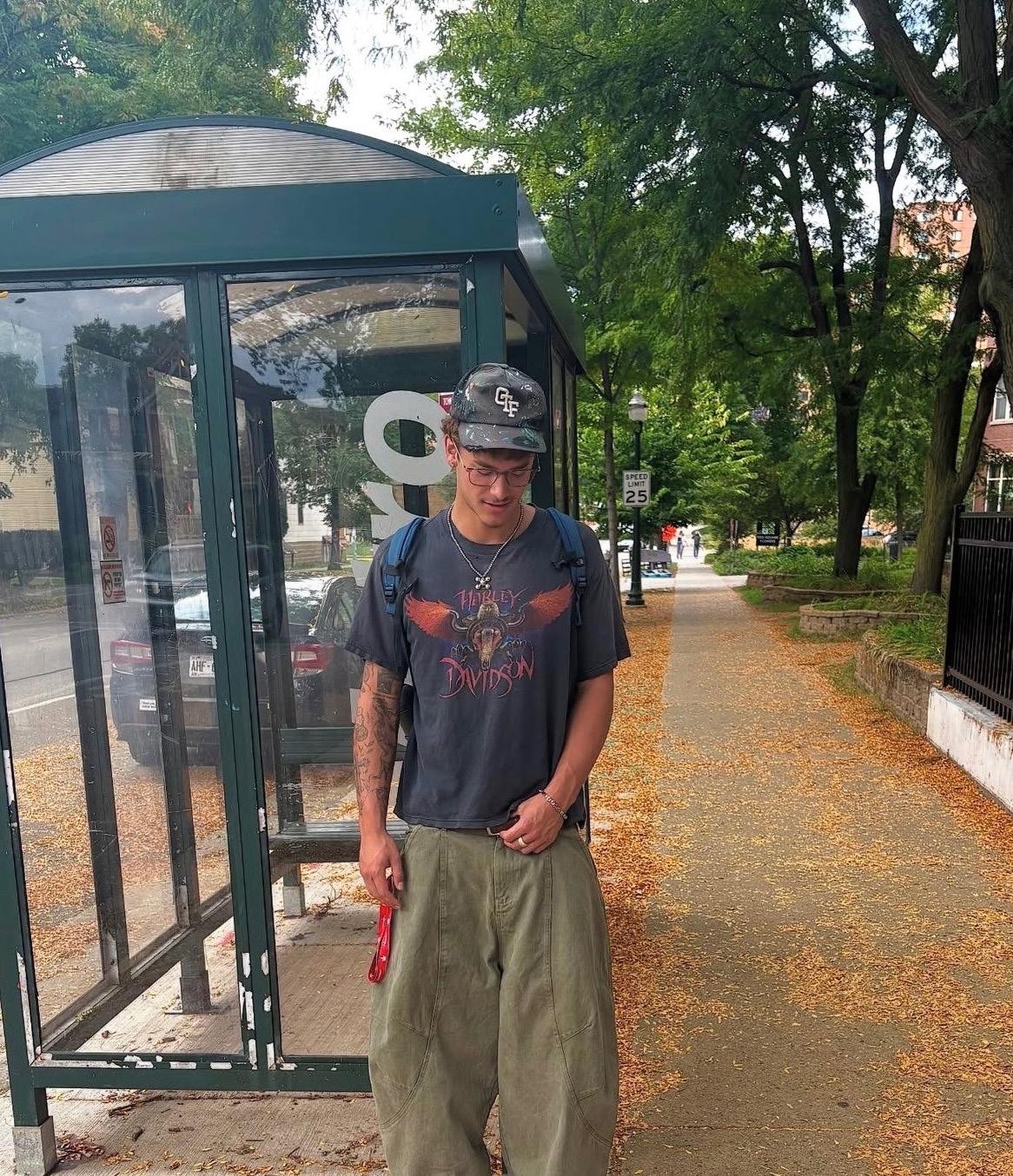
Sophomore Henry Mouw built a TikTok following by sharing bold, vintage-inspired outfits
Thursday, October 30, 2025
Wisconsin’s All-American setter reflected on family, gratitude and finding joy on and off the volleyball court
+ SPORTS, PAGE 8 + LIFE & STYLE, PAGE 6
UW Housing to limit, charge $100 for overnight guests during Halloweekend
By Zoey Jiang STAFF WRITER
The University of WisconsinMadison housing announced students who wish to have guests in dorms over the weekend will be required to register them and pay $100, a new Halloween weekend policy for guests.
Housing said the decision was motivat-
ed by safety issues around Halloweekend in past years. “Our goal is to maintain your safety and that of our community, and years of experience have indicated that Halloween weekend requires extra steps,” said Beth Miller, an assistant director of resident life in an email sent to all residents.
Residence halls will be locked at all times throughout the weekend, and all stu-
dents must present Wiscards at check-in stations in buildings. Students who are not residents of a certain hall — or otherwise registered as a guest — will be denied entry.
Miller said additional housing staff will be present at dorm entrances for mediation.
Guests — defined by housing as someone who is not enrolled at UW-Madison and has no other housing options in Dane County — need to be registered on the UW Housing Portal. Typically, two overnight guests are permitted in a residence hall.
Football losses hurt state economy, report finds
By Michael Reilly STAFF WRITER
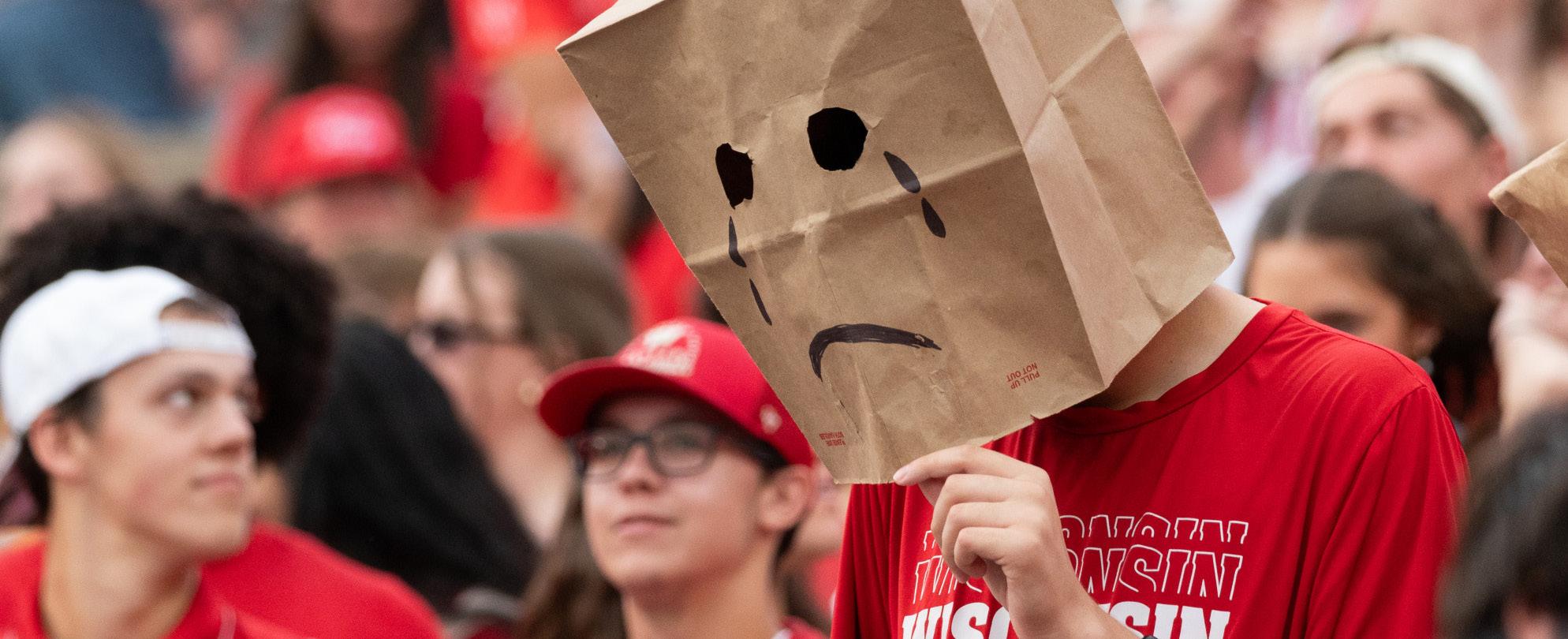
The 2025 Badgers are on track to have the program’s worst record since 1990 and risk finishing winless in Big Ten play — something they haven’t done in 35 years. While bad football is painful to Badger fans, it may also hurt the state economy, experts say.
According to a report published by the Center for Research on the Wisconsin Economy (CROWE), Badger football’s poor performance could diminish economic activity in Madison by $160 million and the state by $280 million annually. These potential losses are driven by lower attendance, reduced gameday spending and decreased tourism.
For Badger fans, the impact of poor football is both personal and financial. Ian, a season ticket holder from Madison, told The Daily Cardinal he decided not to renew season tickets after seeing a 37-0 homecoming loss to the Iowa Hawkeyes.
“We couldn’t justify spending $1,200+ per year to watch the Badgers get blown out by every Big Ten opponent,” Ian said.
Ian will join the growing number of fans not renewing their season tickets. The CROWE report found a significant drop in sales, from 42,197 in 2024 — when the Badgers missed their first bowl game in 23 years — to 38,082 in 2025. With a historically bad 2025 football campaign, that number is primed to drop even further.
While season ticket sales are just one revenue source for the athletic department, poor football drives fans away from Madison and the state as a whole, creating an economic ripple effect.
The CROWE report concluded that success in both football and in the economy requires strategic investments from the athletic department that “target physical capital (training facilities) and human capital (players, coaches and staff), including enhanced recruiting budgets and competitive NIL spending and compensation for players and coaches.”
After the Badgers’ 34-0 loss to Ohio State, Athletics Director Chris McIntosh promised more financial support for football in a public letter to fans, saying his department “must provide our coaches the tools necessary to succeed.”
McIntosh specifically highlighted “more Athletics-funded investments in infrastructure, staffing and most importantly, student-athlete recruiting and retention.”
He said a “new era of college athletics” makes these investments necessary, but warned fans the impacts may not be immediate.
For Doug McLeod, chair of the UW Athletic Board, those investments are easier said than done.
“NIL [name, image and likeness] has fundamentally changed how athletics operate,” McLeod told the Cardinal. “Every single school is grappling with the same kind of
issues right now.”
Still, Wisconsin remains behind its Big Ten competitors in NIL funding. According to the report, the Badgers reported $8.98 million in collective NIL funding last year — more than $10 million less than the conference’s top spender, Ohio State.
The importance of NIL spending is evident in the new era of college football. The conference’s top four spenders — Ohio State, Michigan, Penn State and Indiana — have all either won a national championship or earned a playoff spot in the last two seasons.
McLeod stressed that Wisconsin’s athletic funding operates differently than many of its competitors.
“The money you pay for tuition often goes to athletics at other schools,” he said. “We don’t do that here, and I think we should all be pretty proud of that.”
Unlike many of its peers in the Big Ten, UW does not directly allocate student tuition to the athletic department. Instead, the athletic department is mainly funded through self-generated revenue and segregated university fees — fees that students pay separate from tuition.
McLeod emphasized that the current situation has no easy answers.
“People have to be patient and understand how complicated the situation is. Programs take time to build,” he said.
In response to safety concerns on campus, UW-Madison works closely with the UW Madison Police and the Wisconsin Fire department to facilitate supervision on campus for Halloweekend.
Q&A: Health dept. guide to battling illness this winter
By Emma Kelly STAFF WRITER
Public Health Madison & Dane County (PHMDC), a county health department responsible for managing the public health of over 60 cities and more than 575,000 people, said the region is projected to reach peak hospitalizations as respiratory diseases pick up in the winter due to COVID19, influenza, and RSV.
When the Cardinal last spoke with PHMDC in 2023, they had recently launched their respiratory illness dashboard, which tracks the number of COVID, influenza and RSV infections across the county.
PHMDC Communications Director Morgan Finke discussed causes and solutions for respiratory illnesses in a conversation with the Cardinal on Oct. 23.
This interview has been edited for clarity and brevity.
What are PHMDC’s current recommendations for preventing respiratory illnesses in Dane County?
Our advice for any respiratory illness at this point is pretty much the same, whether it’s flu, COVID or anything else of that nature. These illnesses often spread in the same way and often have similar symptoms. Stay home if you have symptoms like fever, cough, runny nose and sore throat. When you start to feel better, it means those symptoms are improving, and when you’ve been free of fever for 24 hours, that’s when you know you can go without the help of medication and resume regular activities.
For the next five days, you may still be contagious to those around you. So wear a well-fitting mask when you’re close to others, maintain physical distance as much as possible and limit your interaction with folks who have an increased risk of getting seriously sick due to flu or COVID.
+ Q&A page 4
“…the great state University of Wisconsin should ever encourage that continual and fearless sifting and winnowing by which alone the truth can be found.”
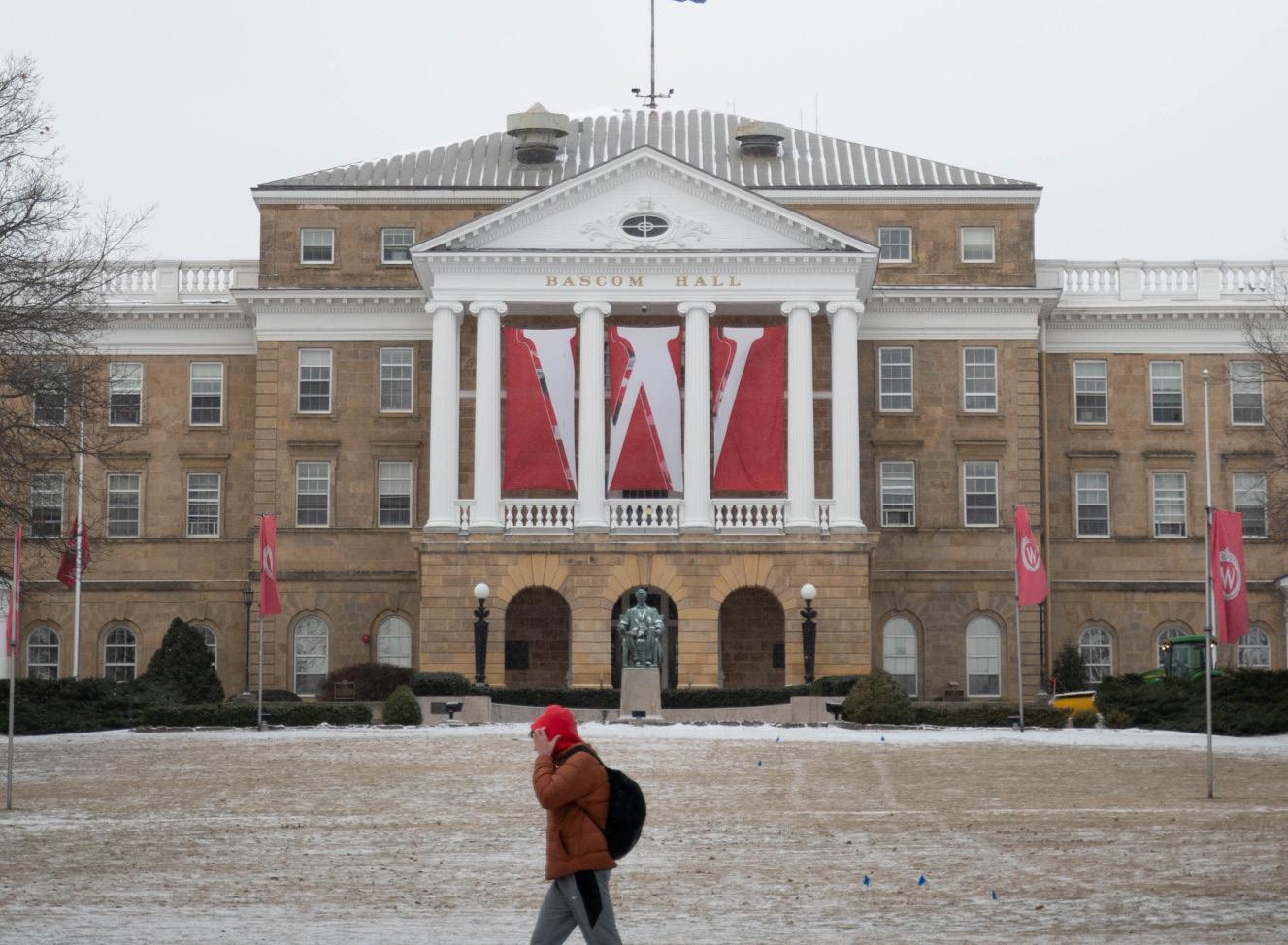
JAKE PIPER/THE DAILY CARDINAL
Planned Parenthood resumes abortion services in Wisconsin
By Clara Strecker STATE NEWS EDITOR
Planned Parenthood of Wisconsin (PPWI) announced
Monday they will resume abortion services in Wisconsin after a nearly month-long pause in services due to Medicaid cuts in the federal budget bill.
PPWI said they were able to begin scheduling patients for abortion services again because they are no longer defined as a “prohibited entity” — the classification that led to the organization losing Medicaid reimbursements under President Donald Trump’s ‘Big Beautiful Bill.’
The bill bars providers from billing Medicaid as insurance for reproductive health, classifying any nonprofit group providing abortions receiving more than $800,000 from Medicaid in the fiscal year 2023 as a “prohibited entity.”
PPWI was able to skirt this classification by giving up their status as an Essential Community Provider (ECP) — a federal status for providers primarily serving low-income individuals.
While PPWI paused abortion services, only two independent practices in Milwaukee provided the service in the state. University
of Wisconsin students lost local abortion access because the sole provider in the area is PPWI’s Madison’s East Health Center. PPWI continued to provide other services during the pause, like contraceptives, cancer screenings and tests for pregnancy and sexually transmitted diseases.
According to a court filing from Sept. 29, family planning organizations may continue billing Medicaid for services if they stop providing abortion services or give up their ECP or tax exempt status.
ECP’s offer services on a sliding fee scale based on the individual’s income and the status helps organizations like PPWI bill private health insurance innetwork. But 60% of PPWI’s patients are on Medicaid, and affiliates across the state rely on Medicaid funding to keep their doors open, a trade off PPWI was willing to make.
“At this point, in all of our research and analysis, we really shouldn’t see much impact [from ECP status] on patient access,” PPWI CEO Tanya Atkinson said. “If relinquishing this does ultimately impact our bottom line, we will have to understand what that path forward is.”
said the total effect dropping ECP status will have on PPWI’s financial situation is still unknown, but patients should not expect to see changes in costs. Abortions are only available at three of PPWI’s locations in Madison, Milwaukee and Sheboygan. The Sheboygan clinic only provides medication abortions while the other two perform
surgical abortions as well.
In July, Planned Parenthood sued the Trump Administration, leading a judge to temporarily block enforcement of Medicaid cuts under the bill, granting an injunction allowing abortion services to continue through the end of the summer and early fall. The injunction was lifted in September.
Protesters rally against Israel ceasefire violations
By Adelyn Benzinger STAFF WRITER
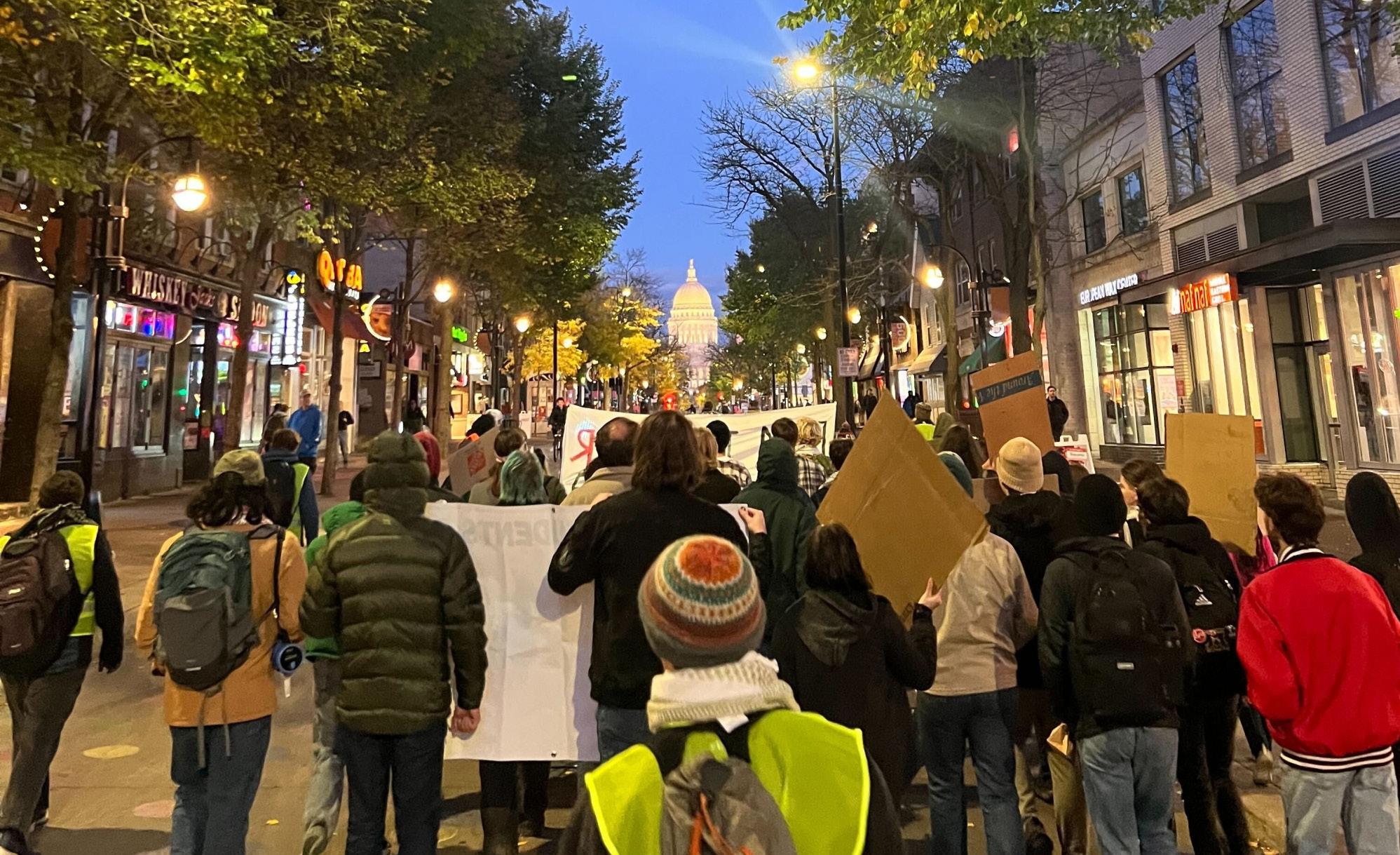
Nearly 150 students attended The University of Wisconsin-Madison Students for a Democratic Society (SDS) rally against Israel’s violation of their ceasefire in Gaza Thursday on Library Mall.
Students from the Palestine Solidarity Committee, Wisconsin Coalition for Justice in Palestine, Young Democratic Socialists of America and World Beyond War also attended the rally.
Leaders at the rally addressed the crowd, beginning chants like, “Disclose, divest, we will not stop we will not rest” and “Chancellor chancellor, you can’t hide, you’re supporting genocide.”
The Gaza ceasefire was approved by Israeli and Hamas officials on Oct. 8 and included the release of all living Israeli hostages held in Gaza in exchange for 2,000 Palestinian prisoners and Israel withdrawing forces to certain lines within Gaza.
“Israel agreed to retreat to a boundary running along the north, south and east of Gaza,” a BBC News article said. “But new videos and satellite images show that markers…have been positioned hundreds of metres deeper inside the strip than the expected withdrawal line.”
Israel has also violated the ceasefire by launching an airstrike that killed 26 Palestinians after a Hamas attack killed two of its soldiers, according to Reuters. The Israel military said the ceasefire was resumed after this attack.
Speakers at the rally directed their remarks to the trag-
edies in Gaza occurring during the ceasefire. “We want to say, as the students of UW-Madison, that we want to see that Gazan people are healthy and free and happy,” one speaker said. “But we cannot live in this situation when they are constantly being bombed and constantly being destroyed everyday.”
Others took aim at the university’s response to the spring 2024 pro-Palestine encampment.
“We will never forget what the university had done to us one Wednesday morning in 2024 during the protests that took place here at this very Mall,” another speaker said. “We remember the batons. We remember their shields, Mnookin bloodying their
own faculty and students.”
As the rally continued, the group marched toward the Capitol, continuing their calland-response chants.
“We are trying to show even in the face of blatant school repression, that we will never stop fighting for the people of Palestine,” the same speaker said. During the event, SDS emphasized that they will continue advocating.
Sabrina Ortiz, a UW-Madison sophomore and international student at the rally, agreed. “I believe also that there should be pressure on the university to speak out about this,” she said. “I want them to do something more about it with the so-called ceasefire going on.”
Last September, Chancellor Jennifer Mnookin announced the university would no longer take a side on certain controversial matters following multiple university statements that received backlash from the UW-Madison community. These statements included those at the Faculty Senate meeting after Mnookin shut down the Library Mall ProPalestine encampment.
Despite that, students are determined to keep speaking out for Palestine.
“We are trying to show even in the face of blatant school repression, that we will never stop fighting for the people of Palestine,” one student said.
Atkinson
TYLER KATZENBERGER/THE DAILY CARDINAL
ADELYN BENZINGER/THE DAILY CARDINAL
Democratic legislator talks environmental legislation, life before politics
By Madison Moris LIFE & STYLE EDITOR
Rep. Vincent Miresse’s desk might look like that of a typical legislator with a family photo, Wisconsin Blue Book and other assorted items. But Miresse’s drawer contains something different — Wisconsin conservationist Aldo Leopold’s “A Sand County Almanac.”
“I got [it] when I was in junior high school, and it literally has a duct tape cover on it and binding because I’ve read it so many times it’s falling apart,” Miresse said.
Leopold’s 1949 book, an instrumental piece of environmental literature, inspired some of Miresse’s early work. While attending the University of Wisconsin-Stevens Point, he worked at the Central Wisconsin Environmental Station (CWES), teaching environmental education as a head naturalist and site manager. Miresse continued this work after graduation.
“I never intended to get into politics,” Miresse told The Daily Cardinal.
“Politics got into me.”
Miresse was elected to Wisconsin Assembly District 71 in 2024 and has held a seat on the Portage County Board of Supervisors since 2017. Born in Fond Du Lac, Miresse spent time living on the west coast and internationally before settling back in Wisconsin.
“I lived internationally, and then boomerang back when [I] came back for a close friend’s wedding, and [I was] like, ‘Wow, this is where [my] community is,” he said. “My home is definitely in central Wisconsin and the Stevens Point area.”
Miresse got his initial start in local politics, filling a seat on the Portage County Board of Supervisors, attending meetings to understand the basic process.
“I was completely dumbfounded by how local and county government worked, or maybe in this case, wasn’t working for the greater community,” he said. “I knew at that point I had to throw my hat into the ring.”
It was a great way to learn the “nuts and bolts” of government, Miresse said. He used the fundamentals he learned through county government in his role with the statewide assembly today.
Miresse is one of 23 freshmen legislators who began their term in January 2025 and has been vocal about making a difference in the new assembly. The representative said he was frustrated Democratic bills receive few public hearings and often don’t make it out of committee.
Miresse focused legislation concerning conservation, combating climate change and rural livability. His upbringing in Central Wisconsin and time as an environmental educator fueled his desire to work on these issues.
“As an educator, educating children for a number of years now, I’m finding myself having to educate grown adults,” Miresse said. “I get to use all those tools for inspiration and meeting people where they’re at.”
In September, Miresse co-authored
UW-Madison secures $13.5 million boost for cancer research accelerator
By Zoey Jiang STAFF WRITER
The University of Wisconsin System Board of Regents approved a request from University of Wisconsin-Madison on Sept. 18 seeking an additional $13.5 million to make space for a cancer research project.
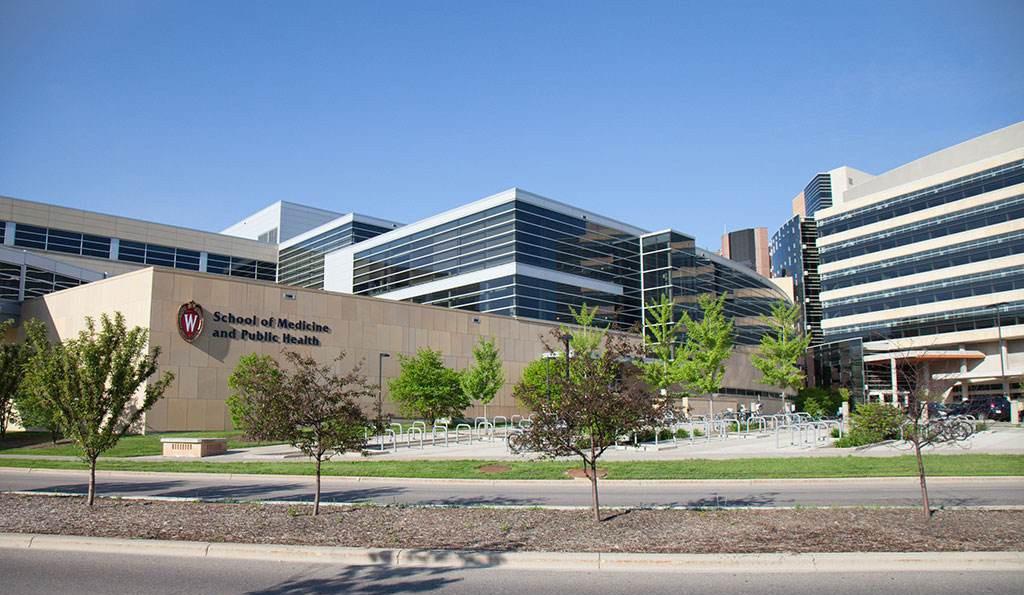
Originally budgeted at $48.5 million, researchers at the Wisconsin Institute for Medical Research found the new structure requires significantly more complex infrastructure, adding $13.5 million to construction costs. The building will support a cyclotron particle accelerator, [brief definition], and will be ready in 2027 according to UW-Madison’s request.
The Regents’ approval helps sustain the university’s research capacity at a time when federal research funding is facing cuts.
Jonathan Engle, an associate professor in the Medical Physics and Radiology department, said the space will help researchers manage diseases like cancer.
A cyclotron is a versatile tool to make starting materials for a wide variety of different purposes, Engle told the Cardinal. “One of the main purposes is to supply materials for medical imaging and therapy in nuclear medicine,” he said.
The cyclotron will help various health research departments, such as Radiology or
Human Oncology, and help connect the university’s international network of colleagues and collaborators. Engle said the project will also help influence public health and assist basic scientific investigations
“Ultimately, our goal is to be the preeminent site for preclinical and clinical theranostics research globally,” Anjon Audhya, senior associate dean in the School of Medicine and Public Health (SMPH), said in a statement. Theranostics are radiation treatments combining chemotherapy and radiation therapy.
According to SMPH, another goal of the cyclotron project is to produce several new isotopes needed for cutting edge medical diagnostic, therapeutic procedures and research.
“The [additional] floors have the potential to accelerate, diversify and expand the impact that we can have,” Engle said. “We need more capacity to use this machine to make these radioactive materials that can influence people’s health and also be very useful for basic science investigations.”
The project supports SMPH and UW Health’s shared mission to help patients with Alzheimer’s and Parkinson’s disease, cancer, chronic pain and other conditions. “The most fundamental reason is that we have a real opportunity to improve people’s quality of life,” Engle said.
Assembly Bill 435 to reauthorize the Warren Knowles-Gaylord Nelson Stewardship 2000 program, named after two famous Wisconsin conservation leaders.
“We have some of the great conservationists who have helped define the movement… and made sure that we preserved and conserved pieces of land,” he said.
This bill would increase funding to preserve natural areas, protect water quality and expand outdoor recreation opportunities. The current program funds the Department of Natural Resources land acquisition and recreational development as well local communities and non-profits.
“It is a really good piece of legislation, [and is] … emblematic of the representatives legislative priorities,” said Ben Pilson, a legislative aide currently working for Miresse. “[He is] ensuring our local communities have access to the resources they need.”
Miresse said environmental legislation needs to combat misconceptions and criticism. He explained
Wisconsin has historically proven conservation and land preservation are non-partisan issues. Given the number of people who go up north to recreate, Miresse said “it’s … in our DNA in Wisconsin.”
Miresse, his wife Gina and their two children emulate this Wisconsin DNA, often going on family outings to hike, paddle and hunt whenever they can. “We live a pretty simple life, and whenever we get an opportunity, we also love to travel,” he said.
The family loves growing their own food and attending local music festivals during the summer. Before politics, Miresse worked as a musician and called it “the more soul-soothing part” of his life. The representative played some gigs over the summer where he played the congas and the cajon, a box drum set.
“I just love to play music with people and at an elevated level. I really love playing with people who want to do this work seriously because it pushes the boundaries of what we think we’re capable of.”
UW primate lab names new director
RicardoCarrionJr.willleadtheWisconsin National Primate Research Center amid a periodofheightenedscrutiny.
By Alaina Walsh ASSOCIATE NEWS EDITOR
The Wisconsin National Primate Research Center (WNPRC) at the University of Wisconsin-Madison appointed Ricardo Carrion Jr. as its next director on Oct. 23. Carrion will begin the role Nov. 3, 2025.
Carrion brings more than two decades of biomedical-research experience to the position, including leadership of high-containment animal-model studies and large research teams. Prior to his appointment, he served as Director of Maximum Containment Contract Research and chaired the Institutional Animal Care and Use Committee at the Texas Biomedical Research Institute. He holds a Ph.D. in microbiology and immunology from the University of Texas Health Science Center at San Antonio.
Vice Chancellor for Research Dorota Brzezinska said Carrion’s “extensive experience in primate research and a proven track record of biomedical leadership” were decisive factors in the search.
Carrion said he was drawn to the role by the WNPRC’s reputation and the chance to grow a program “with such a talented and like-minded team.”
Among Carrion’s priorities are strengthening foundational operations and enhancing interdisciplinary collaborations to ensure readiness for emerging disease threats.
The appointment comes amid heightened scrutiny of the center. Earlier this year, the People for the Ethical Treatment of Animals (PETA) filed cruelty allegations against the lab, including claims of isolation, experimentation and breeding protocols involving rhesus macaques.
A subsequent UW-Madison investigation found compliance with federal and campus animal welfare standards, though campus researchers acknowledged the challenges of ethical oversight in primate research.
The university emphasized his “extensive experience in primate research and proven biomedical leadership” will help the center navigate both scientific ambitions and public concerns.
MARY BOSCH/
COURTESY OF THE UNIVERSITY OF WISCONSIN-MADISON
What is PHMDC’s current situation on providing COVID19 vaccines? According to your website, the Department does not have COVID-19 vaccines in stock at this time.
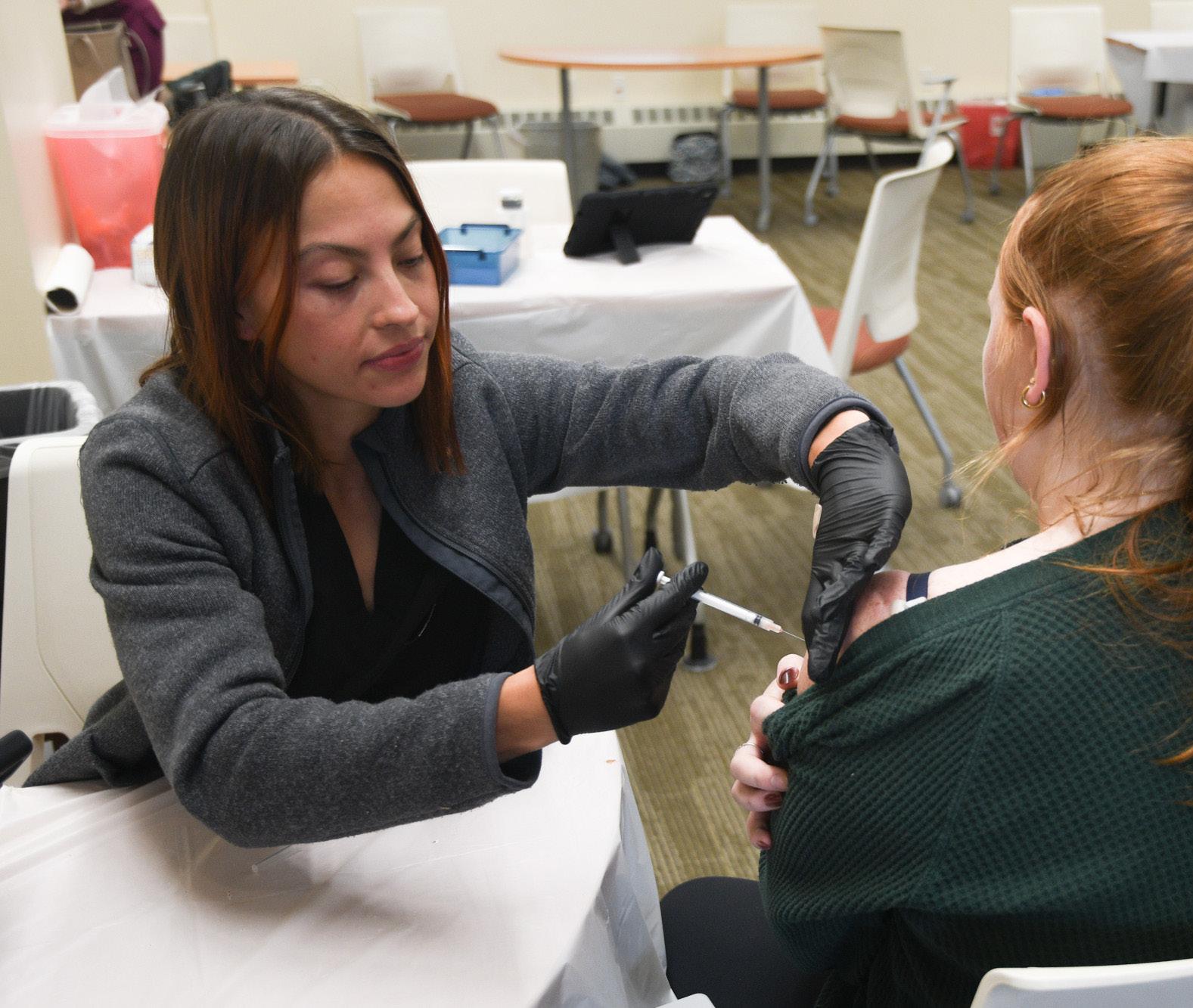
We absolutely recommend folks get up-to-date on their flu and COVID vaccines heading into the respiratory season. It’s still our best protection against severe illness. The recommended guidance is to make sure you get your flu shot by Halloween.
In terms of the COVID vaccine availability in our clinics, some of the federal uncertainty earlier this fall led to some
delays in ordering shipments.
But, as of this week, we do have the COVID vaccine and are currently working on opening up appointments and updating our website.
Does PHMDC offer any free or low-cost vaccination options for those whose insurance does not cover the COVID-19 vaccine or other immunizations?
Recently, shifting federal guidance has made seasonal COVID vaccination recommendations more complicated. However, Governor Tony Evers has issued a statewide standing medical order that allows anyone 6 months and older in Wisconsin to get the vaccine
without a prescription and at no cost. Anyone with questions about accessing fall vaccines should reach out to their doctor, pharmacist, or insurance provider to best understand the most up-to-date information.
How does the department recommend staying updated on changes in vaccines for COVID variants or respiratory illness threats?
I would recommend anyone who is interested to sign up for our blogs. You can also follow us on social media. We’ll be posting throughout the respiratory season, and we also update our Respiratory Virus Dashboard every Thursday.
Rutgers professor talks at UW Gender and Women’s Studies 50th Anniversary
Professor, author and orator Brittney Cooper discussed the need to reframe narratives surrounding attacks on justice and recognize individual power in reforming systems rooted in oppression at her keynote speech at the Monona Terrace Community and Convention Center Saturday for the University of WisconsinMadison Department of Gender and Women’s Studies 50th Anniversary Celebration.
The 2025 Golden Anniversary Celebration: “Forward Together!” took place over the course of two days from Oct. 24 to Oct. 25 and featured dancing, food and speeches by professors, graduate students and community members alike.
“This celebration that we’re having over the next two days provides a way to look back at the past and all the things that we’ve accomplished, and then chart a new path forward,” department chair Nicholas Syrett told The Daily Cardinal.
50 years ago, the Women’s Studies Program at the University of Wisconsin-Madison set out to change the way history is studied, switching from focusing largely on the contributions of white men to a history in which the contributions of all are taught and valued.
Over the two days, the department celebrated the past 50 years with a panel discussion on the enduring legacy of Gender and Women’s Studies 103, multiple workshops and the keynote address which was followed by dinner and dancing.
Cooper teaches courses ranging from Black Feminist Thought to Hip Hop as a professor of Women’s, Gender, and Sexuality Studies and Africana Studies at Rutgers University.
She has authored five books including the New York Times bestseller “Eloquent Rage: A Black Feminist Discovers Her Superpower” and “Beyond Respectability: The Intellectual Thought of Race Women.”
Cooper said in her address that part of an individual’s ability to “meet this moment” lies in the ability to be
honest about the histories that have brought us here.
“We are watching the fascists, the deniers of truth, the anti-intellectuals storm into places that we have built for vulnerable students, the descendants of the same vulnerable students who stormed the gates 50 years ago demanding and insisting upon something very simple, which is that we be allowed to study ourselves,” Cooper said.
UW-Madison’s Gender and Women’s Studies department was created in 1975 after students protested professor Joan Roberts being denied tenure by an all-male committee. The committee alleged that her work did not meet university standards, despite male colleagues being granted tenure for less. Roberts eventually sued the
university for gender discrimination, winning $30,000 and creating the catalyst for the department’s inception.
“Women are determined to continue to foment rebellion until they finally bring about equality for women, inside and outside the hallowed halls of academia,” Roberts said at the time.
Since then, the program has grown into a full academic department that offers over 100 courses, as well as a Women’s Studies Certificate, a LGBT Studies Certificate and a Gender and Women’s Studies Master’s Degree program.
During her keynote speech, Cooper asked the crowd “What if we are the storm?” — reframing the narrative that attackers on justice and equity hold the power by proposing the ener-
gy and momentum towards justice lies within every person.
“What if we are the storm in a system that cannot handle us?”
Cooper asks. “What if we are here to bring this crumbling, outdated, violent, unsustainable infrastructure to a crumbling halt?”
She urged the crowd to consider America’s national infrastructure was not set up to handle the power surge of unrelenting movements demanding justice and redress concerning white supremacy, patriarchy and justice for queer and trans people.
In this moment, and in every moment, Cooper said, Gender and Women’s Studies are the storm.
“We are the energy of these places,” she said, “the bringers
of light when folks are making terrible decisions for us all in backrooms, the thunderous voices of protest and proclamation when folks would assault us with the sonic whiteness of infinite irrationality.”
Cooper said that reactionaries can try to turn away from the pursuit of justice, equity, repair and democracy all they want but that they will simply be running on borrowed time.
“Over here while we are waiting on their battery to run out, we will be building, remembering ourselves again…gathering together, moving in silence, being still when we need to,” Cooper said. “Whatever the moment requires.”
COURTESY OF THE GENDER AND WOMEN’S STUDIES DEPARTMENT
MARY BOSCH/THE DAILY CARDINAL
Don’t forget slow burn relationships opinion
By Shreya Bhargava STAFF WRITER
We need to let things be. Not every person we meet is meant to set off fireworks from the start. Not everything needs to click instantly or rush into intensity. Somewhere along the way, we as a society started believing that real connection has to feel electric: fast, urgent and overwhelming. If it doesn’t, we think it’s wrong. We equate slow beginnings with failure, spiral when someone doesn’t reply fast enough and overanalyze when a new connection doesn’t escalate overnight. We chase sparks, and when the sparks fade, we blame the other person or ourselves.
However, most high-intensity relationships burn out just as quickly as they begin. They leave us exhausted and yearning for something steadier and more sustainable. It’s because we have wired ourselves to crave constant stimulation. We want quick answers, fast attachment and instant intimacy. However, genuine relationships are meant to be a slow, steady thing. They take time, space and quiet.
The slow burn matters. It’s in the quality time where you actually learn who someone truly is — not the version they present when everything’s new and
exciting, but the real one. You see how they change over time and how they treat others when no one is watching. It’s how they react when things aren’t easy that matters. You notice patterns, habits and quirks. It reveals how they grow and how you evolve alongside them.
If you really think about it, nobody would want something immediate. You want to be understood, not just claimed. You want to feel safe, not just pursued. And that kind of trust? It builds slowly.
Of course, there’s a flip side to this narrative. Some argue that the slow-burn ideal can go too far. For example, the newsletter “We Met At Acme” points out that while a slow burn can give time for growth, it can also lead to “wasting time with the wrong person,” confusing emotional uncertainty for depth or mistaking hesitation for emotional maturity. In other words, not every slow start turns into something meaningful.
These objections are valid. A slow pace is no guarantee of compatibility. If you’re dragging things out to avoid risk, or telling yourself “they’ll come around” when real attraction is missing, the slow burn can become a form of self-sabotage. As “Women’s
Health” reminds readers, a healthy slow burn still needs movement and curiosity: it’s not about stalling, but about building intentionally.
So how do we find that balance between wasting time and rushing in? It starts with intention. Ask yourself: are you moving slowly because you’re avoiding vulnerability, or because you’re giving space for something to authentically grow? Are you genuinely curious about who they are or just hoping the spark will eventually appear? Healthy slow burns still require openness and emotional risk, just at a pace that respects your boundaries.
This goes beyond romantic relationships — it’s about friendships, colleagues, classmates and more. A slow burn encourages self-awareness and emotional health. It teaches patience, empathy and the value of trust. You learn to manage your expectations and to invest in understanding rather than instant gratification. When you build this way, the bond lasts because it’s rooted in reality, not adrenaline.
The slow burn lets the roots grow deeper. It’s what holds everything steady. No spark can replace compatibility. No rush can replace time.
Cardinal View: Conservatives say they’re silenced at UW-Madison. What they really want is immunity from criticism
By The Daily Cardinal Editorial Board
SENIOR STAFF WRITER
For decades, conservatives on and off college campuses around the country have ridiculed “ideological diversity.” They sneer at “liberal snowflakes,” complain about self-censorship and use the lack of conservatives to support their federal research cuts.
The situation at the University of Wisconsin-Madison is no different. Conservative lawmakers and campus activists paint the university as a campus suffocated by “liberal bias” with a free-speech crisis. Conservative groups mimicked campus protesters, threatened cuts to the university system’s finances and disparaged the lack of conservative professors and students.
But the very free speech ideal they demand is already practiced daily by students and faculty. UW-Madison is a place where students freely engage in debate and open table discussions about their beliefs. It is not only protected, but encouraged by professors, administrators and students themselves. When campus administrators adopt conservative talking points, they risk appearing to endorse those views rather than remain neutral, inadvertently legitimizing a manufactured problem.
Conservative beliefs that may have once gone unchallenged now are. But challenging someone’s views in an academic environment is a part of open dialogue, not in opposition to it.
Former chair of the College Republicans Thomas Pyle told The Daily Cardinal in February 2024 that he and his conservative friends often suppress their political views in papers. When pushed on whether professors ever suppress or limit conver -
sation in classrooms Pyle said, “I wouldn’t say they’ve been stopped for their political views, but they’ve definitely been challenged.”
When universities or students call out controversial or offensive speech, it holds others accountable and is an essential element of free speech expression.
In fact, it’s often conservatives who embody the very practices and postures they are so quick to decry. Now that conservatives hold more social momentum, they themselves practice “cancel culture.”
After Charlie Kirk’s murder, conservatives were quick to call for the firing of those whose speech they disagreed with. Conservatives celebrated the deportation and discipline of pro-Palestine protestors by major universities — including UW-Madison — as well as the deportation of those same protesters by the Trump administration.
Turning Point USA, the nation’s preeminent conservative campus organization, runs a “Professor Watchlist” online database meant to “expose and document college professors who discriminate against conservative students and advance leftist propaganda in the classroom.” The site features hundreds of professors from across the country with searchable identifiers like “LGBTQ,” “Terror Supporter,” “Socialism” and “Racial Ideology.”
At the end of the day, calls for “ideological diversity” or free speech are nothing more than an attempt to use conservatism as an escape from accountability and frame the proponents of those views as victims. Conservative groups want the ability to control the kinds of dialogue present on campus, not a truly open one.
Assembly Speaker Robin Vos’ claim
Wisconsin campuses lack free speech dismisses an essential truth: speech is free, but not from consequence, especially when it endangers others. The call to protect “ideological diversity” masks efforts to privilege one perspective over others.
Wisconsin Young Americans for Freedom (YAF) hosted a panel on these topics with conservative professors and state Rep. Dave Murphy, R-Hortonville, on Oct. 15. Panelists argued conservative ideology and voices are suppressed on campus.
While conservatives can point to survey data showing conservative students self-censor not all surveys are so clear cut. A survey run by the UW System president revealed only 10% of students claimed they’ve faced social
consequences for engaging in political dialogue, with the actual implications of these consequences not being reported.
We here at The Daily Cardinal fully support free speech on our campus, but we also recognize when bad actors weaponize discussions around “ideological diversity” to suppress free and open dissent to their ideas.
Groups of all political stripes routinely hold campus events, invite speakers to campus and debate openly, all evidence that UW-Madison is a far cry from the ideological echo chamber it’s being framed as. That ongoing exchange of ideas, while it may feel uncomfortable, is the backbone of the Wisconsin Idea, to apply classroom teachings to enhance the lives of state residents and the world beyond Madison.
life & style
Student finds virality, confidence through TikTok fit checks
By Adalyn Reichenberger STAFF WRITER
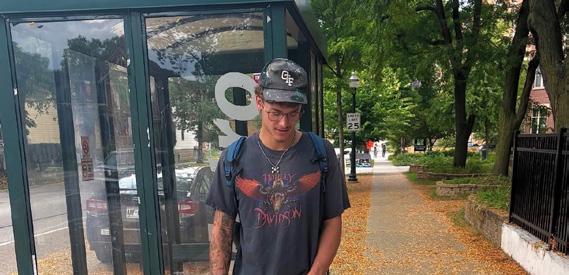
University of WisconsinMadison sophomore Henry Mouw caught a moment of TikTok virality earlier this year when a casual post gained unexpected traction. Since then, he’s transformed his platform into a space for fashion, confidence and authenticity.
Today, Mouw has more than 180,000 followers on TikTok, where his “fit checks” and outfit inspiration put his creativity and confidence on full display. On a campus filled with Badgers sporting red and white, he’s carved out a space for himself in the fashion world while staying rooted in Wisconsin.
Mouw’s style story begins in Waupaca, a small town two hours north of Madison.
“Growing up in that area, there wasn’t much style,” Mouw told The Daily Cardinal. “I had to really develop my confidence and learn how to dress on my own.”
Mouw said his fashion evolved most when he was in
high school. “I experimented a little and figured out what I felt best in,” Mouw said. Slowly garnering unique vintage pieces and charisma, Mouw started taking his style online.
“There is no such thing as a bad fit. Fashion is subjective,” Mouw said. His current look draws heavily on vintage and Y2K influences. His oversized jeans and bold accessories are inspired by icons like Lil Wayne and Pharrell.
“My goal is for people to be inspired by my outfits and me being expressive,” Mouw said. His clothes aren’t just a matter of style. They’re a reflection of who he is, and he hopes to encourage others to be authentically themselves.
That message also reflects a broader cultural shift.
“The male fashion scene is changing,” Mouw said. What used to be a stigma — men being interested in fashion — is now seen as confident and expressive. “The goal is to get every person to feel comfortable expressing themselves,”
Bookworms flock to book sale for bargains
By Jackson Baker STAFF WRITER
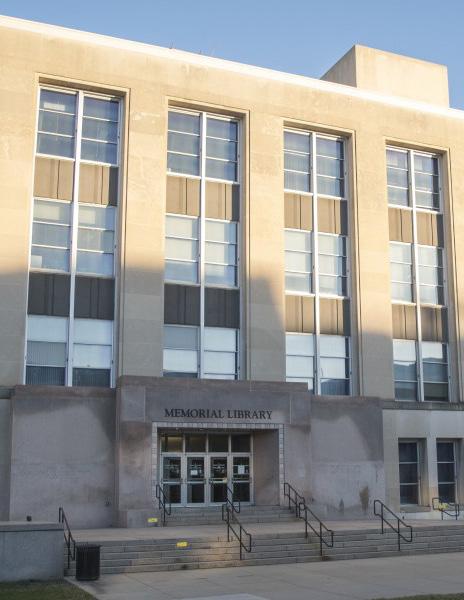
Hundreds of book enthusiasts scoured the shelves of Memorial Library last week Wednesday to Saturday in search of their next novel. Twice a year, The Friends of the University of WisconsinMadison Libraries host a book sale giving Madisonians the opportunity to browse a diverse selection of literature and materials donated by the library and community members.
All proceeds from the event help support UW-Madison libraries — funding their public events, Grants for Scholars program and the preservation of library materials.
On Oct. 22, enthusiasm was high as nearly 100 people queued inside Memorial Library awaiting the opening of this fall’s pre-sale. Boasting an impressive collection of nearly 10,000 books and other materials, the semi-annual book sale has become a highly anticipated event attracting avid readers and collectors from across the state. All books on sale were priced at a generous $3 per paperback and $5 per hardcover from Wednesday to Friday, before ending on Saturday with an unbelievable deal of $5 per grocery bag-full.
Maria, a second-timer at the sale, said she came in the spring and appreciates the event as a cheap resource to find new books on topics she’s interested in. “I actually work in the lab at the Waisman Center, so I’ve always been interested in books on the topics of social science and neuroscience as well,” she said. “It’s a nice opportunity to find new books for leisure reading too.”
he said.
Mouw’s time at UW-Madison has only added to his success. He said his marketing classes directly connect to his work online.
“In every class, I can apply it to my content,” Mouw said. “It motivates me to think bigger about where fashion and social media can take me.”
But behind the scenes, the pressures of social media are real.
“That number chasing mentality is really infectious,” Mouw said.
Some of his videos have blurred the line between fashion and attraction — attention that can bring both followers and misconceptions. “I know that’s not who I am, and I don’t want to represent myself in that way,” Mouw said.
What started as a simple way to share outfits has become a platform for far more.
“Every step of the way has coincided with me being more open and more myself on camera,” Mouw said. For him, that authenticity will always be the best fit.
The event is run by about 100 community volunteers that helped arrange and sift through the countless amounts of materials — including vinyl records, CDs and vintage posters. The Friends of UW-Madison Libraries, one of the nation’s oldest library support groups, formed in 1948. The group is composed of alumni, students, faculty and community members who work year round to aid UW-Madison’s academic libraries. In the face of university-wide budget cuts which several libraries responded to by cutting weekend and latenight hours, revenue from the Friends’ semi-annual book sale will prove even more essential.
“Volunteers are the foundation and backbone of this sale,” said Marianne Spoon, Associate Dean for Advancement and Communications at the UW-Madison Libraries.
Volunteers are active multiple times a week — at UW-Madison libraries and in the community — retrieving donated materials to be sorted and prepared for the bi-annual sales. “Volunteers are critical and they’re extraordinarily generous with their time. We really appreciate them,” she said.
The libraries are already preparing for their next book sale in spring 2026. The spring sale date will be available on their website in the coming months, but in the meantime, Spoon said the community can continue to give back by volunteering, giving gifts through the Libraries Impact Fund or simply spending time at their favorite campus library.
“These are ways that we continue to serve the community and the community continues to shape who we are and what we do,” Spoon said.
COURTESY OF HENRY MOUW
Journalist Amy Yee talks Tibetan culture at Wisconsin Book Festival arts
By Elizabeth Baumberger STAFF WRITER
Journalist and author Amy Yee discussed Tibetan culture and her book “Far From the Rooftop of the World” at the Wisconsin Book Festival on Oct. 26.
Her narrative nonfiction and travelogue book chronicles the lives of four Tibetan exiles over 14 years as they stay true to their Tibetan heritage while making new lives for themselves.
“There are lots of books about Tibet and lots about the Dalai Lama, but not about Tibetan peo-
ple living in exile and their lives,” Yee said.
Yee wrote the book without the help of interpreters, fixers or research assistants. Because she was living cheaply in Dharmasala in a Tibetan Buddhist nunnery, she said she was able to just write what she saw.
“I had no particular agenda at all,” she said.
Host Sonam Dolma, a resident physician at UW Health, opened the talk by outlining a number of Yee’s credentials and awards, including writing for the
New York Times and the Wall Street Journal and winning three awards from the United Nations Correspondents Association.
Yee’s poised demeanor softened, her face lighting up as she began speaking about some of the people she met while writing the book.
Norbu, a chef whom Yee got to know through regular lunches at his Japanese restaurant, left Tibet when he was just a teenager after being unjustly arrested for a protest in which he was a bystander.
Norbu left clandestinely for India, journeying over ice mountains for 17 days and leaving his family behind.
“Ultimately he did adapt, but it was not easy, and he was still always very homesick and desperately wanted to see his mother,” Yee said.
Dolma, a Tibetan born in Bir Tibetan Colony in Northern India, contributed to the conversation with her own personal experiences and the experiences of her father, who escaped Tibet at the age of 17.
Dolma recounted how her father and his brother would rub each other’s feet at night to not get hypothermia or frostbite when travelling through the Tibetan mountains.
Dolma then said how she came to understand the variety of ways in which Tibetans in the U.S. were keeping Tibetan culture alive.
“My parents always say it’s like a hand. You have five fingers, and they’re all different sizes, and they look different, but they work together to have the functionality of your hand,” she said. “So in my mind, I kind of saw that for Tibetans. You have Tibetans who are in very different sectors, but we all have the same goal of preserving the Tibetan culture, keeping this Tibetan movement alive in whatever way we can.”
Towards the end of the talk, Yee highlighted the beauty of seeing Tibetan culture alive and thriving throughout the world by recounting her experiences at celebrations in Melbourne, Amsterdam and Evanston.
She recounted being in the middle of a conversation with a man when he told her he had to go because he liked the song playing. He jumped into the dance circle, and Yee noted how everyone knew the dance. When she asked him how he knew the footwork, he responded that everyone in Tibetan school in India learned it.
“It was just moving to see that these threads of culture survive and thrive in all parts of the world,” Yee said.
Panic! At the Disco officially releases ‘Live in Denver’
By Lizzi McGann STAFF WRITER
Panic! At the Disco’s live set at the Filmore Auditorium in Denver is now available on streaming. The 2006 “Nothing Rhymes With Circus” tour put the Nevada band on the map, and fans’ demands for a live recording of the Denver show have been answered.
The Denver set has been lauded as the best Panic concert ever; the combination of the band’s most successful album, their first platinum song, the original members, an unmistakable energy exchange between the band and beloved covers have had fans talking about this concert for 20 years.
The set was from the band’s first headlining tour, with The Hush Sound and The Dresden Dolls opening. Aside from playing “A Fever You Can’t Sweat Out,” the band’s debut album, in full, Panic also covered “Karma Police” by Radiohead and “Tonight, Tonight” by The Smashing Pumpkins.
The release follows the performance of “A Fever You Can’t Sweat Out” in full at When We Were Young Fest in Las Vegas, the band’s home on Oct. 18 and Oct. 19. An Instagram post instructed fans to go to the corner of 4th and Fremont Street, an allusion to lyrics of the final song on the album, for a pop-up with free stickers and a photoop with a mural promoting the deluxe album they announced on Instagram after the festival.
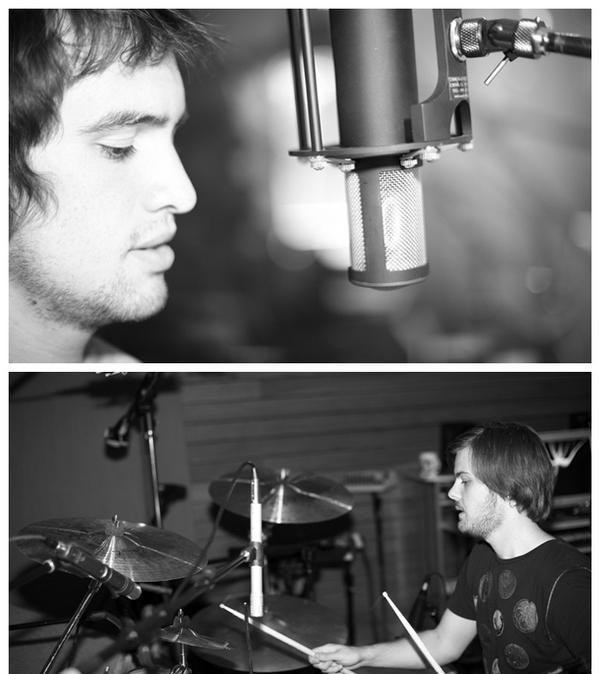
The concert video, now posted on the band’s official YouTube account, features burlesque dancers and a ringmaster in costume. A small intermission halfway through the show introduces the band members as people and as they throw drumsticks to “Panic’s biggest fans.”
The fans could easily be placed as emos of 2006, with their side-swept bangs and deep knowledge of early Panic lyrics.
The anticipation of this live album being legitimately released has been building for years, its release being a legendary moment in emo history. This show was their equivalent to Cheap Trick’s “At Budokan,”or The Who’s “Live at Leeds.” Bootlegs of the concert on YouTube and Spotify have been posted and reposted innumerably, so this official full album with deluxe materials after the band’s official breakup in 2023 lets fans relive peak Panic! At the Disco. However, with anniversary editions and rereleases, there is always a chance a group is simply trying to cash in on nostalgia. With bands like Panic! At the Disco, whose last album fell flat on its face and hasn’t had a large media presence in nearly a decade, a twentieth anniversary album allows fans and Brendon Urie’s wallet to relive the glory days. Regardless of whether or not this album is a cash grab wrapped in neverbefore-heard demos, the live album is available on streaming platforms and has nostalgic fans proving it was never just a phase.
COURTESY OF SHANNA WOLF
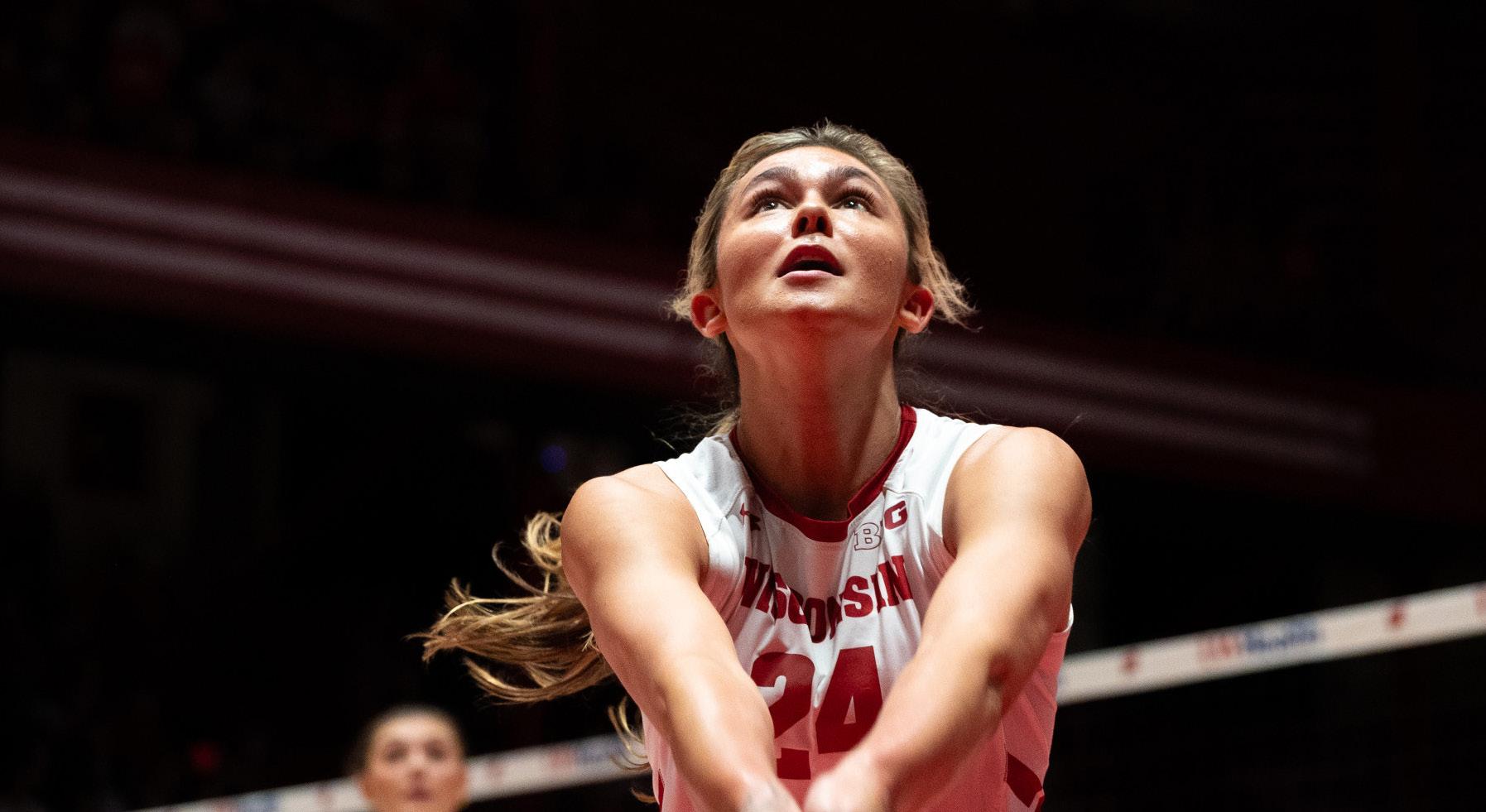
sports Keeping things light: Inside the mindset of Badger volleyball star Charlie Fuerbringer
By Josh Murphy STAFF WRITER
A large portion of Badger volley ball’s success over the past two years can be attributed to sophomore All-American setter Charlie Fuerbringer.
This season, the Wisconsin volleyball team has gotten off to a 15-3 start, including a 10-game winning streak where the Badgers won 30/31 sets. This comes after a great 2024, when Wisconsin finished 26-7 despite an 0-3 start to the season.
Fuerbringer turned heads nationwide last year with her outstanding freshman season. She was the AVCA All-Region Freshman of the Year and earned AVCA All-American ThirdTeam honors, in addition to being named to the All-Big Ten Freshman Team and All-Big Ten Second Team. She carried that momentum over to 2025, averaging a whopping 11.23 assists per set — second in the nation. The Badgers were hot and Fuerbringer had been a driver of their success.
The timing for a setback couldn’t have been worse.
Early in the first set of their matchup against Michigan on Oct. 5, Fuerbringer went up to the net for a joust — a routine play she’s done countless times this season — and immediately clutched her right shoulder in pain as she came down. She exited the game and did not return to action. She later came back to the bench with a sling and an ice pack. Head coach Kelly Sheffield did not have an optimistic prognosis for Fuerbringer.
“We still don’t know,” Sheffield said during his weekly press conference the day after the Michigan game. “Hopefully we’re talking weeks and not months, but we’ll see.”
On Oct. 20, Sheffield still didn’t have an exact timeline for when Fuerbringer could return to play for the Badgers. “She’s trying to get herself back, do everything she can to get back on the court this year. Hopefully, that can happen.” Sheffield said.
It’s the kind of injury that can be deflating for a student athlete, both physically and mentally. But for a player like Fuerbringer, it’s clear her confidence, perspective and drive extend far beyond the court.
“Leaning on my teammates, coaches and family has helped me throughout this injury,” Fuerbringer said. “It’s honestly been super super hard, but my close ones are always here for me which helps me out so much.”
This isn’t the first time Fuerbringer dealt with difficult situations in her life. She lost both her cousin and a friend from home, which she said “put life into perspective.” Still, she’s found ways to remind herself to stay positive through it all.
“This one, the feather, I got with my mom,” she said, pointing to a tattoo on her hand. “So I really struggled sophomore year of
high school. [It] was pretty bad, mentally and stuff. My mom [and I] got this tattoo as a reminder to keep things light.”
Family has always been central to Fuerbringer’s life. Fuerbringer said she plays for her grandparents who are “always there’ for her.
“My whole family’s my biggest supporters. They’re watching every game,” Fuerbringer said. “They don’t care if I do bad or good, they just wanna see me work hard. So that’s the mentality I go into every game.”
To say the Fuerbringers are a volleyball family would be an understatement. Her dad was a four-time All-American at Stanford, won a national championship in 1997 and represented the United States in the Association of Volleyball Professionals. Her mom was an All-American setter at Long Beach State University, won a national championship in 1993 and is now the head coach at her alma mater. Volleyball was more than a sport in the Fuerbringer household — it was a way of life.
“I was just constantly surrounded by volleyball and people who knew so much about the sport, and it’s not even like we talked about it a lot, but just always being around it,” Fuerbringer said.
That lifelong immersion in the game along with her outstanding talent made her decision to play at the college level seem inevitable. It was just a matter of where. When she was narrowing down schools, Wisconsin stood out amongst the rest.
“The year before I had committed or had been able to get recruited, Wisconsin had won the national championship, and I watched that game,” Fuerbringer said. “I wanna be a part of a program that’s not gonna let me off the hook, that’s gonna push me to do the things that I wanna do, and that’s gonna make me the best version of myself.”
Fuerbringer’s competitiveness
and drive for greatness is evident. Her relentless mentality shows up every time she steps on the court, and her teammates notice. Morgan Van-Wie, a fellow setter for the Badgers, recognizes the importance of her presence on the court and in the locker room.
“Charlie is extremely driven, and gives everything she can to our team,” Van-Wie said. “I think Charlie being a captain is a perfect example of how much our team recognizes how special she is and also exemplifies the amount of respect we have for the type of player and person she is.”
Van-Wie’s words reflect not only the respect her teammates have for her, but also the tight bond the group shares off the court.
“I think I have the best teammates in the world,” Fuerbringer said. “Everyone knows their role, and everyone has bought in on this team, which is what we need to be a championship team. So I’m super grateful that we have so many hardworking people… We’re all very, silly, funny girls who make each other laugh all the time.”
For Fuerbringer, that camaraderie extends far beyond the Wisconsin Field House. Being part of Wisconsin volleyball means representing a tradition that’s lasted for decades. When Fuerbringer and the rest of the team delivered tickets to season ticket holders last season, she was surprised to find some 35-year ticket holders.
“I just think that’s crazy that this program just has so much love. And it doesn’t just start with us. It just starts with all the people that have come before us. And recognizing and learning more about all of the alumni and past coaches, and how much our coaches now have put into this program just makes me super grateful for everything that we have,” Fuerbringer said.
Fuerbringer’s passion for this program runs deep, but her passion for her country runs deeper.
She hopes to one day represent the United States on the Olympic stage, and to play on a court with much larger stakes than the Field House. When asked what it would mean to play for Team USA, Fuerbringer didn’t hesitate.
“Everything,” she said. “I mean, I think it’s become more meaningful over time, for sure, too. But I think that would be the coolest thing in the whole world. That’s something I’ve always thought about, probably something I wrote in second grade on my, ‘what I wanna be when I grow up: an Olympian.”
That dream isn’t far-fetched for Fuerbringer. She’s already represented the United States on the international stage, playing in the U19 World Championships in 2023. She was one of 12 girls out of 20 to make the cut after training, and then went off with the team to Osijek, Croatia. Fuerbringer said expectations for the team weren’t the highest coming into the tournament.
“We are underdogs. Our coach is telling us we probably won’t make it out of pool,” she said. “And we have the youngest team because the older girls couldn’t make it because they’re in college, so we had a very young team compared to the rest of the world’s teams.”
And then something remarkable happened — they started competing and they kept winning. Despite not starting for most of this win streak, Fuerbringer cheered her teammates on from the bench, soaking in the moment. At long last, Team USA reached the finals, and it was on the biggest stage of the tournament where Fuerbringer finally got her shot.
“We reached the finals and we’re down 0-2 against Turkey,” she said. “And then I got a little Cinderella moment, got to come in and help our team come back and win the second women’s World Championships in history.”
For Fuerbringer, this was more than just a victory. It was a culmi-
nation of all her hard work and determination, even when she wasn’t on the court competing.
“That was a really special moment. Literally cried after, because that was the coolest thing ever for me. I was just really proud of myself for not complaining about not playing,” she said. “I think that gave me a little motivation for the rest of my career, that if I just keep putting in the work, everything works out.”
Now an All-American athlete for the Badgers, Fuerbringer has found a few ways to unwind away from volleyball.
“I’ve been DJing for a couple months now, so that’s been cool. I play the ukulele. And hot yoga is a big thing for me,” she said. “I feel like, more recently, I’ve been trying to pick up things that are outside of volleyball to try and keep my life going.”
Music has been one of those outlets.
“I like Mau P, that’s my fav,” she said with a big smile. “I’m making a mix for our pregame, like what they play in the Field House.”
Even when she’s sidelined due to injury, that mix of creativity and energy continues to define her. Her fun-loving, easygoing personality is one of her trademarks and is part of what makes her so universally loved among teammates, coaches and fans alike.
Don’t let the goofy personality fool you, though. Fuerbringer is a fierce competitor, and she is determined to be back in uniform again this season.
“I am so hungry and ready to be back out there,” she said. “I’m doing everything in my power to get my shoulder healthy and be back on the court.”
For now, she’ll keep doing what she’s always done — keeping things light, staying grateful and trusting that everything will work out.