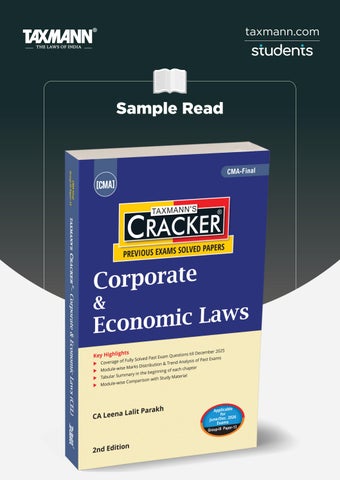

Sample Read

CHAPTER
CHAPTER

RAISING FINANCE FROM CAPITAL MARKETS - IPO
A QUICK REVIEW
REG - 7 General Conditions for Public & Right Issue
A public or right issue of equity shares & convertible securities cannot be made by an issuer under following conditions:
SEBI has debarred the issuer, any of its promoters, promoter group or directors or selling shareholders from accessing the capital market.
SEBI has debarred any other company whose promoters, directors are also director or promoter of the issuer, from accessing the capital market.
If any of its promoters/directors is fugitive (runaway) offender, the restriction (a)& (b) shall not apply to persons who were debarred in the past and the period is over on the date of filing of prospectus.
A public issue cannot be made if promoter/director is wilful defaulter.
Issue cannot be made unless an application for in principles approval of listing of equity shares & convertible securities is made to Recognized Stock Exchanges (RSE) & one of them is chosen as Designated Stock Exchange (DSE).
In case of IPO, application is to be made to at least 1 RSE having nation-wide terminals.
Unless an agreement is entered into with depositories for dematerialization of equity shares & convertible securities already issued or proposed to be issued.
Unless firm arrangements of finance through verifiable means for 75%of stated means of finance, excluding amount to be raised through proposed public or right issue or existing identifiable internal accruals.
Promoter’s holding before filling of offer document must be in dematerialized form.
The amount for general corporate purposes mentioned objects in draft offer document should not exceed 25% of amount raised.
Unless the existing partly paid up shares are either forfeited or are fully paid up.
Issue shall be open for at least 3 days & not more than 10 days.
Minimum subscription shall be 90% of issuer size. If not then, amount will be refunded within 15 days of closure of issue.
Appointment of merchant bankers & other intermediaries
The issuer will appoint one or more merchant bankers (MR) of whom at least 1 will be lead merchant banker (LMR).
The rights, obligations & responsibilities relating to disclosures, allotment, refund & underwriting should be pre-determined & disclosed in offer document, if more than 1 merchant banker is appointed.
The issuer should also appoint SEBI registered intermediaries, in consultation with LMR for carrying out the obligations relating to issue.
The issuer shall in case of BBP, appoint syndicate members & in other case appoint bankers to issue at various centers.
The issuer shall appoint Registrar to issue registered with SEBI having connectivity with all depositories.
The issuer shall appoint compliance officer who shall be responsible for monitoring the compliance of securities laws & for redressal of investors.
REG - 6 Conditions for Initial Public Offer (IPO)
A. All of the following conditions are to be fulfilled:
1. The issuer must have Net Tangible Assets (NTA) of at least ` 3 crores in each of the preceding 3 years (of 12 months each).
Out of which not more than 50% NTA must be held in monetary assets.
If more than 50% of NTA are held in monetary assets, then firm commitment to use the excess in business projects must be made.
The 50% will not apply in case of IPO entirely through offer for sales.
2. The issuer must have average pre-tax operating profit of ` 15 crores during 3 most profitable years out of preceding 5 years.
Unlisted issuer makes an offer for
3. The issuer must have Net Worth (NW) of at least ` 1 crore in each of preceding 3 full years.
4. If the issuer has changed its name within last 1 year, then at least 50% of revenue for preceding 1 year must be earned from activities conducted under changed name.
B. If any of the above conditions are not fulfilled then the issuer may make an IPO by fulfilling following conditions:
1. Issue is made through Book Building Process (BBP).
2. Issuer undertakes to allot at least 75% of net offer to public to Qualified Institutional Buyers (QIB).
3. Issuer must refund the entire subscription money, if it fails to make allotment to QIB.
C. The issuer must have at least 1000 prospective allottees.
D. An issuer can make IPO of convertible debt instruments without making a prior public issue of its equity shares & listing, provided company has not defaulted payment of interest/principal for a period of 6 months.
E. IPO can be made only if there are no outstanding convertible securities or any other rights entitling person an option to convert into equity after IPO.
F. If the issue size is more than ` 100 crore, a bank, PFI shall monitor on quarterly basis till 95% of utilization of funds.
G. The issuer may obtain grading for its IPO from 1 or more Credit Rating Agencies registered with SEBI.
REG – 28 Pricing
The issuer in consultation with LMR or through BBP may determine the prices of equity shares.
The issuer in consultation with LMR or through BBP may determine the coupon rate & conversion price in case of issue of convertible securities.
The issuer may mention a price or price band in offer document & floor price in red herring prospectus.
The issue price shall not be less than the face value.
REG – 29 Price & Price Band
The issuer may in case of
Fixed price issue - Price or price band in offer document
Book built issue - Floor price or price band in red herring prospectus
The floor price shall not be less than the face value.
The cap price should not be more than 20% of floor price.
Face value may be less than ` 10 but not less than ` 1 per share, if the issue price is `500 or more.
The face value shall be ` 10 per share, if the issue price is less than ` 500.
REG – 30 Differential Pricing
The issuer may offer its specified securities at different prices subject to following:
Differential Pricing
Retail individual investors or Retail individual shareholders or Employees
At price not lower than 10% of price at which net offer is made to other categories excluding anchor investors
Book Building Process to Anchor investors
Price shall not be lower than price offered to other applicants
REG – 14 Minimum Promoter Contributions
The promoter’s contribution varies case to case as follows:
Contribution
Book Building in terms of Part D of Schedule XIII to Employees (Alternate Method of BBP)
At price not lower than by more than 10% of floor price
At least 20% of post issue capital
At the most 20% of proposed issue size OR
At the most 20% of post-issue capital
At the most 20% of proposed issue size OR
At the most 20% of post-issue capital excluding right part.
REG – 16 Lock-In of Specified Securities held by Promoters
In case of public issue of IPO, the promoter’s contribution shall be locked
Lock-in period
Minimum contribution
3 years from date of commencement of commercial production OR date of allotment whichever is later.
Above minimum contribution
Period of 1 year in case of FPO, the excess contribution will not be locked.
Book Building Process (BBP) – SCH XI
A process undertaken to arise demand & assess price for determining the quantum or value of specified securities or IDR as per SEBI (ICDR) Regulations, 2018 is called book building process.
REG – 32 ALLOCATIONS IN NET OFFER
In an issue made through book building process, the allocation in net offer to public is made as follows:
In an issue made through the book building process, the issuer may allocate up to 60% of the portion available for allocation to QIB to an Anchor Investor in accordance with the conditions specified.
Any unsubscribed part of RII or NII may be allocated to applicants in any other category. Along with 5%, the mutual funds are also eligible for allocation under balance available for QIB.
In an issue made through book building process under REG 6(2), the allocation in net offer to public is made as follows:
In an issue made other than through book building process, the allocation in net offer to public is made as follows:
Any unsubscribed part in remaining section can be allocated to any other applicant.
If RII’s are entitled to more than 50% on proportionate basis, then they will be allocated that higher percentage.
Individual applicants other than RII
Other investors including corporate bodies or institutions irrespective of the number of equity shares and convertible securities applied for
PAST EXAMINATION QUESTIONS
OBJECTIVE QUESTIONS
FILL IN THE BLANK
Q.1 An arrangement provided by the issuer under which a person offers to purchase specified securities from the original resident retail individual allottees at the issue price is known as _____________
[June2017,1Mark]
Ans. Safety net arrangement
MULTIPLE CHOICE QUESTIONS
Q.1 SEBI has to be responsive to the needs of the 3 groups which constitute the Market. Which of the following does not constitute the Market?
(a) The issuers of securities
(b) The investors
(c) The brokers
(d) The market intermediaries
[Dec.2018,2Marks]
Ans. (c) The brokers
Q.2 Which of the following listing provides arbitrage opportunities to the investors, whereby they can
ANSWER IN ONE LINE
Q.1 Which type of listing provides arbitrage opportunities to the investor?
[Dec.2019,1Mark]
Ans. Multiple listing or Dual listing
make profit based on the difference in the prices prevailing in the said exchanges?
(a) Multiple listing
(b) Initial listing
(c) Listing for right issue
(d) Listing for public issue
[Dec.2018,2Marks]
Ans. (a) Multiple listing
Q.3 SEBI has three functions rolled into one body. Which of the following is not the function of SEBI?
(a) Quasi-legislative
(b) Quasi-judicial
(c) Quasi-executive
(d) Quasi-official
[June2019,2Marks; Dec.2024,2Marks]
Ans. (d) Quasi-official
Q.4 Which of the following export documents is known as the document of title?
(a) Mate’s receipt
(b) Bill of exchange
(c) Bill of lading
(d) Proforma invoice [Dec.2021,2Marks]
Ans. (c) Bill of lading
Q.5 Demat Account is opened in order to:
(a) Buy or sell stocks.
(b) Buy or sell commodity.
(c) Only to buy stocks.
(d) Only to sell commodity. [June2023,2Marks]
Ans. (a) Buy or sell stocks.
Q.6 SEBI can call for information by undertaking inspection, conducting enquiries and audit of Stock Exchanges and intermediaries. Identify the related functions of Securities and Exchange Board of India.
(a) Regulatory function
(b) Development function
(c) Protective function
(d) All of the above [June2023,2Marks]
Ans. (a) Regulatory function
Q.7 Any allotment of securities made on the basis of Prospectus should be void if permission of listing is not granted by the Stock Exchange before expiry of ______.
(a) 12 weeks from the closure of the issue
(b) 10 weeks from closure of the issue
(c) 8 weeks from the closure of the issue
(d) 30 days from the closure of the issue.
[Dec.2023,2Marks]
Ans. (b) 10 weeks from closure of the issue (c) is also correct as per section 40 of Companies Act, 2013, but as SEBI Regulations override Companies Act, 2013, answer (b) is correct).
Q.8 In which case the minimum contribution should not be less than 20% of the post issue capital?
(a) An initial public offer
(b) Further public offer
(c) A composite issue
(d) Fresh public offer
[Dec.2023,2Marks]
Ans. (a) An initial public offer
Q.9 In case of listed companies, minimum subscription, as per SEBI Regulations, is
(a) 80% of ticket size
(b) 90% of ticket size
(c) 90% of amount fixed by the company in its Prospectus
(d) 80% of amount fixed by the company in its Prospectus
[June2024,2Marks]
Ans. (c) 90% of amount fixed by the company in its Prospectus.
Q.10 SEBI has three functions rolled into one body. Which of the following is not the function of SEBI?
(a) Quasi-legislative
(b) Quasi-judicial
(c) Quasi-executive
(d) Quasi-official
[June2025,2Marks]
Ans. (d) Quasi-official
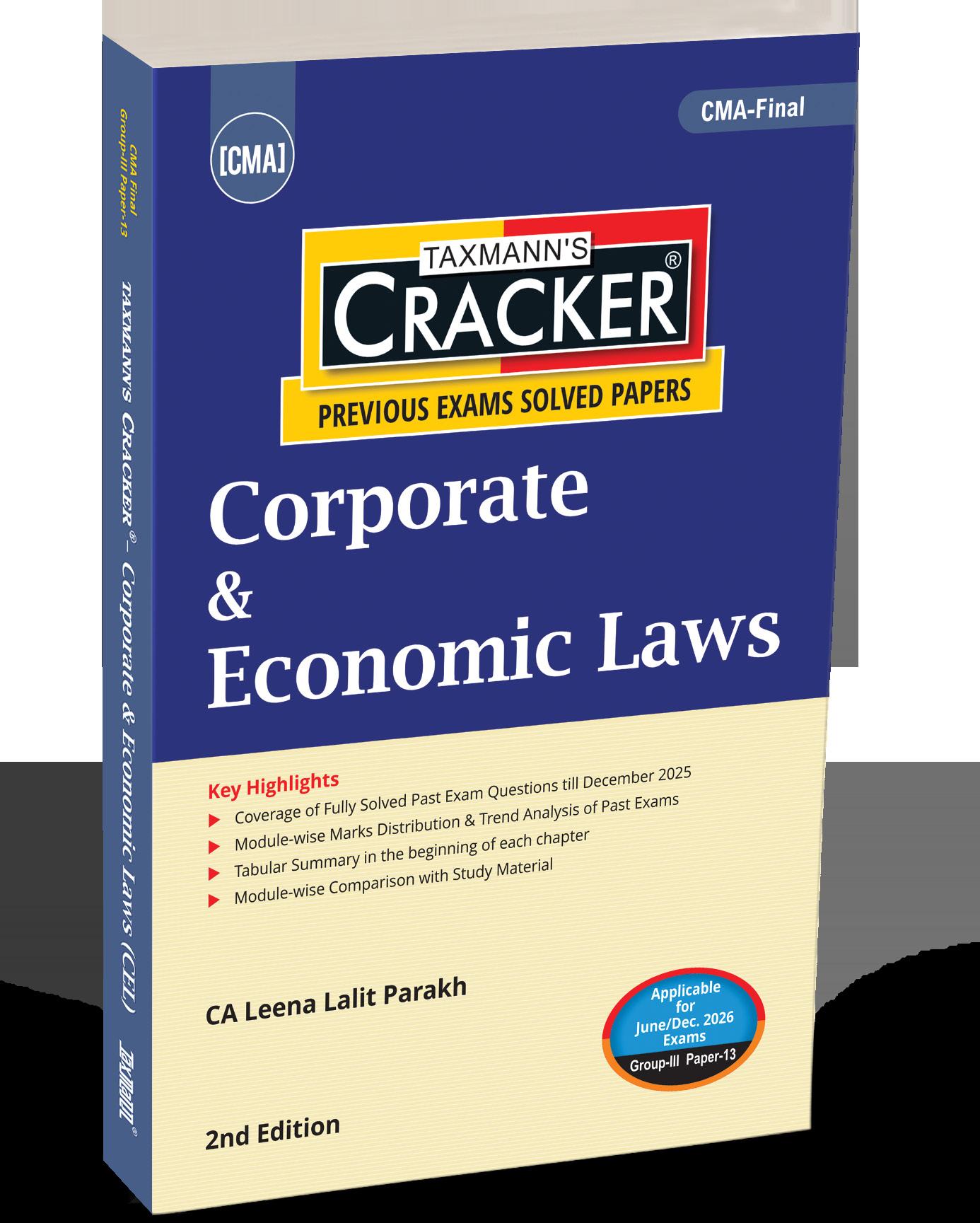
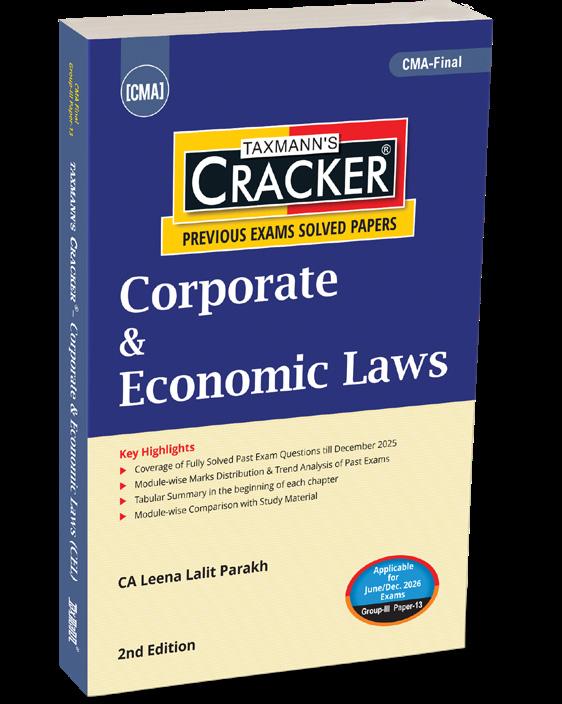
Corporate & Economic Laws (CEL) | CRACKER
AUTHOR : Leena Lalit Parakh
PUBLISHER : Taxmann
DATE OF PUBLICATION : December 2025
EDITION : 2nd Edition
ISBN NO : 9789375617877
No. of Pages : 544
BINDING TYPE : Paperback
Rs. 895
DESCRIPTION
Corporate & Economic Laws | CRACKER is a focused exam resource for CMA Final students (Group III – Paper 13), providing comprehensive, up-to-date coverage of the syllabus with fully solved past exam papers up to Dec. 2025. It emphasises exam strategy, conceptual clarity, and efficient revision through a structured, marks-driven approach.
The Present Publication is the 2nd Edition for the June/Dec. 2026 Exams. This book is authored by CA. Leena Lalit Parakh, with the following noteworthy features:
• [Solved Past Exam Papers] Covers all papers up to Dec. 2025, with clear, stepwise solutions
• [Module-wise Marks Distribution & Trend Analysis] Focus on high-weightage areas using exam trends
• [Tabular Summaries] Quick-reference tables at the start of each chapter
• [Study Material Mapping] Direct comparison with the CMA Study Material for thorough coverage
• [Latest Amendments] Includes all recent legal updates, case laws, and syllabus changes
• [Systematic Structure] Section-wise arrangement for easy navigation and revision
• [Self-study Friendly] Ideal for both guided and independent learners
• [Expert Authorship] Authored by CA. Leena Lalit Parakh, known for practical, exam-centric teaching