Expert sail design, the finest sail making materials and our commitment to customer service make Bacon Sails one of the world’s top sail brokers, trusted by cruisers and racers alike. Our marina store features a large selection of new and used competitively priced boat equipment and parts.
FIRST CHOOSE YOUR YACHT Then choose
CHOOSE YOUR YACHT, PURCHASE THROUGH US, AND ENJOY THE BENEFITS
THE BENEFITS OF BUYING WITH DREAM YACHT:
› The widest choice of sailing destinations to place your yacht
› 40+ yacht models from leading brands
› Interesting revenue opportunities
› Professional fleet management
› Unmatched global expertise
› Live the dream lifestyle in the most efficient way
› Potential tax benefits
We’re not just here to sell you a yacht. We’re here to make your yacht ownership smarter, easier, and more rewarding
Make an appointment to meet us at the Miami Boat Show to find out more about Dream Yacht owner benefits
Make an appointment to meet us in Miami
26 Congratulations, SpinSheet Century Club!
Drumroll please… announcing our official 2025
SpinSheet Century Club members who logged 100 days on the water last year.
presented by bacon sails and Marine supplies
32
See the Bay: Exploring the Potomac with Captain John Smith
An incredible 1608 journey led to surprisingly accurate maps that hold meaning for today’s Potomac explorers under sail.
By
John Page Williams
presented by osprey Marine restorations
37
Sign Up for Summer Fun: Kids’ Sailing and Camps
News from top kids’ sailing programs and camps, many of which open for registration this month.
43
Offshore Series Part 2: Choosing the Right Boat for Long Offshore Journeys
Sifting through criteria and analyzing their needs and desires from size to performance, a cruising couple chooses the right sailboat for a circumnavigation.
By Captain Cheryl Duvall
46
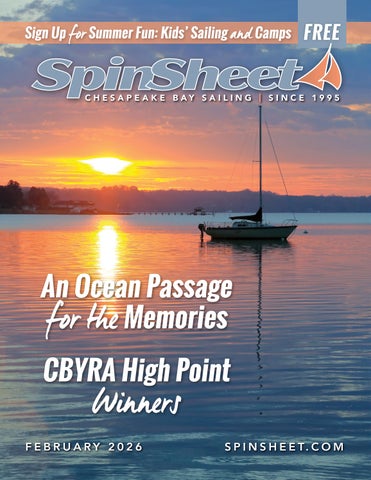
Bluewater Dreaming A Passage for the Memories: Cruising the Atlantic Aboard a Hylas 57
A celebration of seamanship, a capable yacht, and a joyful passage for three brothers.
By Ted Reshetiloff
presented by M yacht services
56
CBYRA High Point Standings 2025
High Point Standings for Cruising One Design and Junior fleets and other Chesapeake racing news.
Will Keyworth likes to capture the sunrise over Little Round Bay on the Severn River near St. Helena Island.
# Photo courtesy of Ted Reshetiloff
# Photo by Will Keyworth
# Photo courtesy of Andy Wescoat
612 Third Street, Suite 3C, Annapolis, MD 21403 (410) 216-9309 spinsheet.com
PUBLISHER
Mary Iliff Ewenson, mary@spinsheet.com
ASSOCIATE PUBLISHER
Chris Charbonneau, chris@spinsheet.com
EDITOR
Molly Winans, molly@spinsheet.com
SENIOR EDITORS
Beth Crabtree, beth@spinsheet.com
Kaylie Jasinski, kaylie@spinsheet.com
COPY EDITOR
Lucy Iliff, lucy@spinsheet.com
FOUNDING EDITOR
Dave Gendell
ADVERTISING SALES
Eric Richardson, eric@spinsheet.com
CUSTOMER SERVICE MANAGER
Brooke King, brooke@spinsheet.com
DISTRIBUTION / BROKERAGE / CLASSIFIEDS MANAGER
Beatrice M. Mackenzie, beatrice@spinsheet.com
ART DIRECTOR / PRODUCTION MANAGER
Zach Ditmars, zach@spinsheet.com
GRAPHIC DESIGNER / PRODUCTION ASSISTANT
Royal Snyder, royal@spinsheet.com
CONTRIBUTING WRITERS
Kim Couranz, Chelsea Co, Captain Cheryl Duvall, Tom Guay
John Herlig, Eva Hill, Pamela Tenner Kellett, Craig Ligibel, Gwen Mayes, Steven Toole, Cindy Wallach, Ed Weglein (Historian )
CONTRIBUTING PHOTOGRAPHERS
Walter Cooper, Ben Cushwa, Mark Hergan, Will Keyworth, Ted Morgan, Al Schreitmueller, Cindy Wallach
DISTRIBUTION
Martin and Betty Casey, Jennifer and Al Diederichs, Gregory and Dorothy Greenwell, Dave Harlock, Mark Schlichter
SpinSheet is a monthly magazine for and about Chesapeake Bay sailors. Reproduction of any part of this publication is strictly prohibited without prior consent of the officers of SpinSheet Publishing Company. SpinSheet Publishing Company accepts no responsibility for discrepancies in advertisements. SpinSheet is available by first class subscription for $45 per year, and back issues are
available for $4 each. Mail payment to SpinSheet Subscriptions, 612 Third Street, Suite 3C Annapolis, MD, 21403. SpinSheet is distributed free of charge at more than 800 establishments along the shores Chesapeake Bay. Businesses or organizations wishing to distribute SpinSheet should contact the SpinSheet office at (410) 216-9309 or beatrice@spinsheet.com.
Member Of:
VETUS and Maxwell systems make boating easy and carefree. We deliver a wide range of high-quality boat equipment backed by global expertise and support so you can spend more time focusing on what really matters.
Are you ready to embark on your next on-water adventure? Before you set sail, here are ve things to know about boat insurance.
1. Boat insurance isn’t just for accidents
With comprehensive coverage, you’ll also be protected nancially for theft, vandalism, and unexpected events like storms if you need repairs or replacements due to damage.
2. Accidents can happen to anyone
When accidents happen, boat insurance offers liability coverage for damages or injuries you cause while boating, up to speci ed limits. It can also cover lawsuit costs if you’re sued.
3. Boat insurance can cover medical payments
Boat insurance offers a range of optional medical payments coverage limits, helping to cover medical expenses if you’re in an accident or someone is hurt on your boat, regardless of fault.
4. Most lenders require boat insurance
If you nanced your boat, you’ll likely need boat insurance since most lenders require boat insurance to protect their investment. Additionally, some marinas or municipalities require proof of insurance for docking.
5. Progressive offers specialized boat coverages Ever worry about getting stuck on the water?
Progressive’s Sign & Glide® On-Water Towing coverage** can help. It’s an additional coverage that steps in if your boat is disabled or breaks down on the water, paying for on-water towing, jump starts, soft ungroundings, and fuel delivery. Fuel cost isn’t included.
Don’t let unforeseen circumstances disrupt your voyage. Cruise with con dence thanks to Progressive Boat insurance. Because when it comes to your boat, peace of mind is the ultimate luxury.
Progressive Casualty Ins. Co. and af liates. Product features are subject to policy terms and conditions and may not be available in all states or for all vehicles and coverage selections.
*No. 1 rating based on boat market share data from Rate lings.com.
Sign & Glide® is an optional coverage you can add to any Progressive Boat policy and costs $30/annually ($50/annually in Florida). Prices are subject to change.
Scan to get a quote in as little as 4 minutes.
Go to progressive.com to learn more.
Editor’s Note
The Story of the Fury
By Molly Winans
Having known my SpinSheet colleague Eric Richardson since we taught sailing together in the 1900s, I’ve seen him through some changes: marriage, child-rearing, career transitions, a couple of moves, and now a biggie: selling his sailboat!
“My wife and I started a new adventure,” says Eric. “We bought a farmette in Chestertown. We have chickens, ducks, and donkeys, so it’s time to do something new.”
Eric bought his 1985 Schock 35 Blinding Fury in 2014 for daysailing with his wife Jen and son Griffin and for racing with friends. For beer can racing, frostbiting, and some weekend racing he welcomed a few former Fury crew members who knew the boat from racing with former owner Fred Mertes (who died in 2016). Eric’s core crew members, whom Annapolis racers may identify by their signature team tie-dye tees, include: Dave Cyphers, Jay Porterfield, Rick Schmitt, Beth Crabtree, Travis Eagleson, Allan Cranska, Michelle Greenhalgh, Rob Ross, Craig Porterfield, and Diana Lambird.
The tie dye theme came about the first time they raised the all-white spinnaker. Eric thought to himself, “We could tie dye that for more color. Turns out it’s quite a process…” (see spinsheet.com/tie-dye-
kite). The groovy chute led to a team shirt theme and annual tie-dye party to kick off the season.The crew gathered for post-race fun, shared boat maintenance tasks, and a holiday party.
On the water, Dave (another Annapolis Sailing School alum), says, “There were times when everything went right, and we finished well against much faster boats. There were times when nothing went right, but I honestly don’t cling to memories about specific races. It’s the whole experience; with the right mix of people, racing creates a great group dynamic. It’s intense, exciting. You work closely together, yell a bit, and bond over the experience—and the love of sailing. So, I have lots of great memories with our special group of friends.”
Beth will hold on to her fond memories of racing and “the pure pleasure I felt one ‘fun sail’ trimming the spinnaker coming back from Bloody Point to Tolly Point; the sun got low in the sky and turned into a beautiful sunset as we came into the Severn River and Back Creek and Eric’s slip.”
She also recognized “the mental strengths of all the different crew members and how to tap into each when needed.” While sailing on the Fury, Beth made “interesting, smart, and compassionate friends I’d never have met otherwise.”
Rick (one of Fred’s former crew) will remember how “On the way to the start, Craig would come on deck with half glasses of some locally brewed beer he wanted us all to try. He would describe its tones, how it was made and where, tell us about the brewer, and ask if we could all taste and smell what he did. It was a tradition I looked forward to and will miss it as much as the time working the lines and chatting about everything with the many crew members that came and went over the years. I hope the future crews of the Blinding Fury enjoy it as much as we all did.”
What did Eric learn from his time as skipper? “That I loved taking people sailing, letting them run the boat. I also learned so much about boat maintenance, from plumbing, to engine work, to replacing and maintaining hardware.”
When the boat sells, Eric will look back at this era as “10 years with a great group of people who loved to go sailing, have fun, and do our best. It reinforced that showing up is 90 percent of most recurring activities. We did well in Eastport Yacht Club Beer Cans because we showed up and did as well as we could with what we had.”
To learn about the boat, turn to the classified ads on page 63.
# The Blinding Fury team at the AYC Spring Race to Oxford.
Photo by Ted Morgan
Thanks for SpinSheet
You know, one of the greatest joys I have is running through SpinSheet and PropTalk. (I’ve been) sailing for 60 years. I learn a ton from the many articles by fellow boaters. Thanks also for providing a great resource on local events! As a member of Chesapeake Boating Club for 20 years, it’s been easy to grab a few fun shots. Feel free to do with it what you will.
Andrew Perahia
Department of Corrections
• An anonymous and lovable reader pointed out this error: in our article “1899 Fresnel Lens Returns to Annapolis” (p. 13 January issue), we said that the original Thomas Point Shoal Lighthouse lens “measures 36 feet high.” Inches! It measures 36 inches high. Thank you for the correction, friend!
• The Back Creek Yacht Club January Cruising Club Note contained inaccurate information. The author, retired vet Ann Fiduccia, clarifies she is not advocating an electronic collar to correct a dog’s behavior but instead having a soft E-collar, which is more commonly referred to as the “cone of shame” to prevent self-trauma in case of injury. ~Anne Knab
Navigating the Slippery Season
Whether on land, a pier, or covering our waterways, icy surfaces are one of the challenges of the winter season. While not everyone chooses to be on the water in February, many of us sail year-round (we see you, frostbite sailors!), and others at least need to get out and check on their boats.
Slippery, icy, frost-covered, and snowcovered boat decks and piers can present underestimated hazards. Ice, and even frost, will reduce friction dramatically, turning routine movements into serious fall risks, while snow can conceal ice, uneven surfaces, cleats, lines, or hatches. On decks and piers alike, a single misstep can lead to injury, cold-water immersion, or damage to equipment.
Best practices begin with preparation. Sailors should wear footwear designed for
cold, wet conditions, ideally with non-slip soles or removable ice cleats when appropriate. Keeping decks and dock surfaces as clear as possible is critical; snow should be removed promptly, and ice can be treated with marine-safe de-icing products that won’t harm fiberglass, wood, or the surrounding water. Sand or non-toxic grit can improve traction without environmental impact.
Movement should be deliberate and cautious. Recall the adage, one hand for yourself, one hand for the boat? When possible, maintain three points of contact—two feet and one hand. Take advantage of handrails, lifelines, and dock posts when available. Rushing increases danger, especially when carrying gear or stepping between boat and pier. Finally, good lighting is essential during these
short winter days, as poor visibility compounds slippery conditions.
Those responsible for maintaining a pier or a boat in the water should be on the lookout for any prolonged period of subfreezing weather. While skim ice isn’t too concerning, as it thickens, the pressure on pilings and hulls can create big problems. Many boaters with a pier and slip choose to install a de-icer with a thermostat and timer. The combination may set you back in the range of $1300, but the set-up will last for years and protect your boat, pier, and peace of mind. That said, you’ve still got to check on your boat! It’s not a set it and forget it kind of thing.
Awareness, patience, and preparation are a sailor’s best strategies for navigating the slippery season… and remember, spring will officially arrive next month, on March 20!
# Photo by Jim Berry
African-American Watermen Tribute in the Works
By Carrie Gentile
They were sailmakers, seafood processing plant workers, oystermen, crabbers, and captains, and they settled heavily on Kent Island, MD. Beginning in the 1930s, there were at least 1000 Blacks employed at 18 shucking houses on the island and many more captains working out of Wells Cove on Kent Narrows. The contributions of these dedicated men and woman whose way of life was dictated by the Bay will be memorialized with an interactive monument to be erected at Wells Cove.
Many of these seafood packing houses on Kent Island provided small rustic homes called shanties to house Black workers. Today’s Wells Cove sits at the site of these shanties, making the new monument’s location even more significant.
Captain Tyrone Meredith operates his fishing charter business out of Wells Cove, just as his father and grandfather did. A fifth-generation waterman, Meredith started as a mate on his father’s boat at age six. His father, Eldridge Meredith, established the headboat fishing party business over 70 years ago in Wells Cove. These smaller boats offered people a more affordable fishing excursion than the larger charter boats.
Meredith has learned to pivot and diversify to thrive in this volatile business. When he’s not running fishing charters, he’s crabbing, fishing, or hand-tonging for oysters. He also piloted a work crew boat to Poplar Island for the US Army Corps of Engineers.
“When you’re out there catching fish or oysters, I think, ‘It doesn’t get any better than this,’” he said.
Meredith said there were at one time 150 Black boat captains at Wells Cove. Black watermen became
prominent in the Chesapeake in the mid 1800s, being issued Seamen’s Protection Certificates, and classified as citizens years before the Emancipation Proclamation. Their contribution as independent sailors was so valuable on the water that laws put in place to restrict their ability to work were mostly ignored. Meredith estimates he is one of 12 Black captains remaining at Wells Cove
“The job is not appealing to (today’s) generation,” he said, noting the pre-dawn starts and large initial investment of buying a boat as deterrents. He also blames the downturn of the crab and oyster populations for the decline in interest of working the Bay.
Nonetheless, Meredith still claims that Kent Island was and remains a hub for Black watermen and aims to ensure the legacy is memorialized.
A few years ago, he and now-deceased Vince Leggett, founder of the non-profit Blacks of the Chesapeake, met with then Senator Ben Cardin.
“We wanted a monument to remember Black watermen right here, where it started in Wells Cove,” he said.
The notion began to take shape when Tilghman Hemsley, a Queenstown artist and charter boat operator, reached out to Meredith. Captain Hemsley created the original Kent
Narrows watermen’s monument two decades ago and said he had been approached about the lack of Black representation in that project.
Captain Meredith said, “We can do that; there is no limit to ideas. Let’s do a Black watermen’s memorial.” He formed the nonprofit organization American Patriotic Monuments, Inc. together with executive director Linda Rohrbaugh and an advisory board including himself.
With Meredith’s input, Hemsley drew up a monument that features two life-size boats depicting a conversation between a bronzed head boat captain and an oyster boat worker. It will also detail other aspects of the industry, including a man working with clams, a woman picking crabs, another cleaning fish, as well as a boy with a fishing rod.
“It is meant to be interactive, so when you walk through it, you feel like you are part of the conversations,” Hemsley said. It will be installed between The Jetty and Bridges restaurants.
Captain Hemsley said the monument will cost about $475,000 and his organization is actively fundraising. For those interested in donating to the project, visit the American Patriotic Monuments, Inc’s website at apmiart.org.
# Artwork by Tilghman Hemsley IV, courtesy of American Patriotic Monuments, Inc.
Boatyard Bar & Grill Enters Partnership with Atlas
Earlier this month, Dick Franyo, owner of the Boatyard Bar and Grill in Annapolis, announced a partnership with Atlas Restaurant Group.
In a message to friends of the Boatyard, Dick shared that two years ago he began searching for a way to keep the Boatyard tradition alive, as he approached his 80th birthday and the 25th anniversary of the business.
He says, “In this process, I spoke with a number of individuals and restaurant groups, hoping to find that partner who understands what makes the Boatyard great and is willing and able to carry on the tradition as an integral part of the Annapolis community.”
The Boatyard has a long history of community involvement and philanthropy, dating back to its opening in 2001. “Since the day we opened our doors in 2001, we have run the Boatyard caring and obsessing deeply (we call it ‘agonizing’) about ev-
ery guest experience. We have generously and fairly compensated our staff, we unfailingly treat our service and product suppliers with respect, and we have invested in a long-term culture of actively and purposefully giving back to the community in many ways,” says Dick.
In his search, Dick says, “I became totally convinced that Atlas Restaurant Group was the best partner to keep the Boatyard ‘the Boatyard.’ Alex Smith and his team are fully committed to continuing
the Boatyard in the same spirit and tradition that we have worked so hard to build. I thoroughly trust Alex and his team. As a result, I am excited to announce that effective mid-February, Atlas will become our majority partner to carry the Boatyard into the foreseeable future.”
To help with the transition, Dick will remain a part of daily life at the restaurant as both a partner and active participant, alongside GM Kevin Schendel and Chef Scott.
Marinas That Meet Your Standards!
Anchorage Marina
Annapolis Landing Marina
Bowley’s Marina
Broad Creek Marina
Campbell’s Boatyards
Casa Rio Marina
Coles Point Marina
Crescent Marina
Cypress Marine
Dennis Point Marina and Campground
Ferry Point Marina Talbot
Flag Harbor Boatyard
Harbour Cove Marina
Hartge Yacht Harbor
Herrington Harbour North
Herrington Harbour South
Lankford Bay Marina
Lighthouse Point Marina
Maryland Marina
Nomad Norview Marina
Port Annapolis Marina
Rockhold Creek Marina
Sailing Associates Marina
Sassafras Harbor Marina
Selby Bay Yacht Club
Shipwright Harbor Marina
Skipjack Cove Yachting Resort
Spring Cove Marina
The Wharf at Handy’s Point
The Wharf Marina
Whitehall Marina
Yacht Haven of Annapolis
Maryland
Receives
$1.4 Million in Rural
Legacy Funding
The Maryland Board of Public Works approved almost $1.4 million in Rural Legacy funding from the Maryland Department of Natural Resources for three conservation easement acquisitions as well as expenses for a survey that is necessary for another easement acquisition. The conservation areas include:
Forested land on Wash Hance Road in Calvert County will be conserved by a 90-acre easement that will be acquired by the Southern Maryland Resource Conservation and Development Board in the Calvert Creeks Rural Legacy Area. In addition to protecting scenic viewsheds, the easement will protect approximately 1700 feet of forested stream buffers along tributaries of Parkers Creek, which flows directly into the Chesapeake Bay.
The Southern Maryland Resource Conservation and Development Board will also acquire an easement on 57 acres in the Mattapany Rural Legacy Area in St. Mary’s County. The easement will protect valuable forest and agricultural lands, as well as 2800 feet of buffers along the shoreline of McKay’s Cove, a tributary of the Potomac River.
The Eastern Shore Land Conservancy will acquire an easement on 62 acres in the Agricultural Security Corridor –Harvest Crescent Rural Legacy Area. This conservation easement in Kent County will protect grasslands, forests, and scenic views, including more than 2200 feet of forested buffer along a pond and tributary to Still Pond Creek, which empties directly into the Chesapeake Bay.
Wicomico County in partnership with the Lower Shore Land Trust is negotiating a Rural Legacy easement for a waterfront property that is approximately 700 acres and comprises multiple parcels in the Quantico Creek Rural Legacy Area. This property needs to be surveyed as part of the process.
The Board also approved a short-term lease for the Days Cove rubble fill in Baltimore County that operates on land owned by DNR. The new lease enables the rubble fill to continue operations for six months while Maryland Department
of the Environment finalizes a discharge permit for the facility and DNR works to address remaining community concerns. Once that work is complete, DNR plans to seek approval of a new lease with the rubble fill’s operator that will cap and close
the landfill and return the land to public use in eight years or less. DNR plans on re-submitting the updated lease for BPW’s approval sometime in the spring.
For more information, visit dnr.maryland.gov.
# Courtesy of MD DNR
New ShoreRivers Executive Director
“ShoreRivers’ governing board is thrilled with our selection of Scott Budden as the organization’s new executive director,” says Marian Fry, chair of the board. “Scott was chosen based upon his skills acquired from a diverse 18-year professional background, which include his performance as the deputy director of finance at ShoreRivers. His undeniable talent and deep familiarity with our organization and our communities are the perfect combination to lead ShoreRivers into its next chapter.”
Budden was raised in Chestertown, MD, on the banks of Langford Creek, and graduated from Bucknell University in 2007. After a 10-year stint in Washington, DC, as a corporate financial analyst, he founded an oyster farm on Maryland’s Eastern Shore in 2015. Within a decade, he helped scale Orchard Point Oyster Co. to a nationally distributed brand. With his passion for aquaculture and familiarity with both the business and nonprofit worlds, Budden is a natural fit for ShoreRivers.
“I am honored to have the opportunity to lead an organization that has meant so much to me both personally and professionally for years. To be at a helm that has been deftly steered by previous executive directors is a privilege,” says Budden. “Our rivers hold different meanings for each of us. For me, they represent our shared cultural history and, thanks to the continued work of ShoreRivers and our generous funders and partner organizations, their future is in good hands.”
ShoreRivers wishes the fondest of farewells to outgoing executive director Isabel Hardesty. During her tenure, the organization saw a significant growth in staff and revenue. Leading a culture of trust, transparency, and tenacity will be a lasting hallmark of her service.
“In addition to being knowledgeable and capable, Scott has an incredible combination of genuine kindness and determination. He knows our communities, he loves these rivers, and he will lead ShoreRivers with compassion, integrity, and focus,” said Hardesty. “After work-
ing closely with Scott for over a year, and knowing him personally for more than a decade, I’m confident that I’m leaving ShoreRivers in the right hands.” Learn more about the organization at shorerivers.org.
Let’s Get Weather Wise!
What if learning more about weather and forecasting would make your sailing (or powerboating, paddling, or fishing) life more enjoyable and safer? We at SpinSheet believe it can, so we hope you will join our weather expert, Mark Thornton of LakeErieWX, for a three-part webinar, “Understanding and Avoiding Thunderstorms.”
A lecture or discussion about any topic is so much more engaging when the presenter is passionate about the subject matter... and Thornton is passionate about weather forecasting! Better yet, he’s a sailor too. SpinSheet has hosted Thornton’s webinars for a few years now, and each time his enthusiasm is undeniable, even in the virtual setting. How did he become hooked on forecasting?
Thornton explains, “I had been sailing for many years when I saw an ad for a new online weather forecasting program offered by Penn State University. Like many boaters, I was surprised by how quickly
conditions changed on the water and was curious about the process of preparing a marine forecast. I called the lead instructor for more information, and his enthusiasm convinced me to enroll. The classes were both fascinating and enjoyable and I’ve been hooked on weather forecasting ever since.”
Thornton has been boating for more than 35 years and currently owns Osprey, a Mainship 34 Pilot. He is the president of LakeErieWX LLC, a company dedicated to providing marine weather education and forecasting resources for recreational boaters. Thornton publishes a marine weather blog and teaches basic forecasting seminars to recreational boaters during the off-season. He serves as the Race Meteorologist for the Bayview Mackinac Race and is an instructor at Annapolis Boat Shows’ Cruisers University. He is also employed as a Teaching Assistant in the Certificate of Achievement in Weather Forecasting Program at Penn State University.
The live webinar will combine classroom instruction, case studies, and exercises to create an engaging learning experience. It runs three consecutive Wednesdays, March 12, 19, and 26 from 7 to 8:30 p.m. Each session will be recorded and made available to all registered attendees until July 1. Cost for the complete series is $90. Reserve your spot now at spinsheet.com/weather-webinar
# Weather expert Mark Thornton.
through Feb 1
The 73rd Annual Mid-Atlantic Sports and Boat Show
At the Virginia Beach Convention Center. Boat dealers from all over the state will be under one roof with their inventory and ready to make a deal! Plenty of family fun, too. Tickets cost $10, children under 12 are free.
5
AMM Winter Lecture Series
7 p.m. at the Annapolis Maritime Museum. Available virtually and inperson. Pre-registration required, $10 per person. Topic: The American Revolution and the Fate of the World with Dr. Richard Bell: historian, professor, and author.
5-8 The 5th Annual Chesapeake Bay Boat Show
At the Maryland State Fairgrounds in Timonium, MD. Presented by the Marine Trades Association of Baltimore County, this annual event features over 300 boats and more than 100 marine exhibitors showcasing the latest in sport fishing boats, cruisers, performance boats, ski boats, cabin cruisers, and top marine gear.
February
12
AMM Winter Lecture Series
7 p.m. at the Annapolis Maritime Museum. Available virtually and in-person. Pre-registration required, $10 per person. Topic: Ben Ross’ Homeplace, Harriet Tubman Birthplace Archaeology with Julie B. Schablitsky: PhD, chief archaeologist and director of the Office of Cultural Resources.
13
CBMM Lecture
5:30 p.m. in the Van Lennep Auditorium (and available virtually) at the Chesapeake Bay Maritime Museum in St. Michaels, MD. Topic: Ecomyopia on the Chesapeake: Social and Cultural Barriers to Climate-Induced Managed Retreat. Suggested ticket price: $8 per person. Register online.
16-24 Small Diesel Familiarization and Maintenance
February 16-17 and 23-24 at the Chesapeake Bay Maritime Museum in St. Michaels, MD. This fourevening seminar will cover basic diesel engine operating theory and will take participants through basic maintenance tasks using a working diesel engine simulator. Pre-registration required.
19
AMM Winter Lecture Series
7 p.m. at the Annapolis Maritime Museum. Available virtually and in-person. Pre-registration required, $10 per person. Topic: Columbia Beach - “Gem of the Bay” with Mimi Giguère, principal investigator and historic architect Faye Belt, long-time Columbia Beach resident and former HOA president.
20 Mariners’ Museum Lecture
12 to 1 p.m. at The Mariner’s Museum and Park in Newport News, VA. In-person and virtual. Topic: Alabama Ironclads (USS Monitor Legacy Program). Free for museum members, $1 for guests. Free to watch online.
26
AMM Winter Lecture Series
7 p.m. at the Annapolis Maritime Museum. Available virtually and in-person. Pre-registration required, $10 per person. Topic: Ospreys on the Patuxent with Alex Pellegrini: Avian Ecologist.
28
Haven Harbour Seminar Series: Session 2
Haven Harbour Yacht Services will host monthly educational seminars from 9 a.m. to 12 noon at Haven Harbour South’s Ark & Dove Restaurant. Free and open to roughly 35 attendees per class. Coffee and pastries will be provided. Guest speaker: Vetus Company. Topic: Thruster maintenance, installation, best practices. Windlass equipment, installation, maintenance, and service. Solid state batteries and applications.
Crab Cakes • A Healthier Bay
Sailing Fast
Fishing with Friends
28
Sea Kayaking 101
9 a.m. to 3 p.m. at Cult Classic Brewery in Stevensville, MD. Presented by Chesapeake Paddlers Association. This popular event highlights kayaking safety as it guides participants through everything from the purchase of their first true sea kayak to opportunities for adventures throughout the Chesapeake Bay region and beyond. This is the perfect venue for a beginner to launch a voyage toward more advanced skills and equipment and a lifetime of enjoyment of the sport. Cost is $40; lunch, snacks, and beverages provided. Pre-registration is required as this event is always a sell-out.
February Racing
1 - Mar 15
AYC Frostbite Racing Series 2 Hosted by Annapolis YC.
March
8 SpinSheet Solomons Crew Party
4 to 6 p.m. at Southern Maryland Sailing Association in Solomons, MD. Free and open to all experience levels. SpinSheet’s Crew Parties are for anyone who’d like to connect with other Chesapeake Bay sailors and sail more often.
12-26 Understanding and Avoiding Thunderstorms on the Chesapeake WEBINAR
This 3-part live webinar series by Mark Thornton of LakeErieWX will examine the various types of thunderstorms and ingredients that lead to their formation, why thunderstorms often “pop-up” late on summer afternoons, and why some storms have short lifespans while others persist for several hours. Will introduce resources for forecasting and monitoring thunderstorms. March 12, 19, and 26 from 7 to 8:30 p.m. $90 for the series.
14-15 Rigging 101:
Uprigging a Skipjack
9 a.m. to 4 p.m. both days at the Chesapeake Bay Maritime Museum in St. Michaels, MD. When you arrive for the weekend course, the 1955 skipjack Rosie Parks will have no spars aboard, no push boat, no sails bent on. At the end of the day on Sunday, we will be ready to set sail on the Miles River.
21
Haven Harbour Seminar
Series: Session 3
Haven Harbour Yacht Services will host monthly educational seminars from 9 a.m. to 12 noon at Haven Harbour South’s Ark & Dove Restaurant. Free and open to roughly 35 attendees per class. Coffee and pastries will be provided. Guest speaker: Vetus Company. Topic: Spring commissioning, products, and services; est practices. Guest speakers to attend.
28-29 Safety at Sea
Presented by MTAM at the Maritime Institute of Technology & Graduate Studies (MITAGS), adjacent BWI Airport, near Baltimore, MD. This one-day course (choose which day) is the hands-on training portion for an International Offshore Safety at Sea certificate. Prior to the start you will need to: Complete an Offshore Safety at Sea course within the last year (such as MTAM’s one-day course at the Naval Academy on March 28, 2025) OR Complete the online Offshore Safety course (units 1-15) available through US Sailing. Questions: call (410) 269-0741 for more details, or email jstefancik@mtam.org.
28
SpinSheet Norfolk Crew Party
3 to 6 p.m. at Rebel Marine Outdoor Breezeway (1553 Bayville St.) in Norfolk, VA. Free and open to all experience levels. SpinSheet’s Crew Parties are for anyone who’d like to connect with other Chesapeake Bay sailors and sail more often
29
SpinSheet Hampton Crew Party
2 to 4 p.m. at Marker 20 in Hampton, VA. Free and open to all experience levels. SpinSheet’s Crew Parties are for anyone who’d like to connect with other Chesapeake Bay sailors and sail more often.
March Racing
through Mar 29
ILCA Frostbite Racing Hosted by Severn Sailing Association, Annapolis, MD.
through Mar 15
AYC Frostbite Racing Series 2 Hosted by Annapolis YC.
For more details and links to event websites, visit spinsheet.com/ calendar
# Never fear; the spring equinox is near! Expect sock burnings near you around March 20. Photo by Ken Tom
art
Inclusion and Education
At SpinSheet world headquarters we often ponder individually and among our team, how can we help grow the sport of sailing? Through our Start Sailing Now initiative, we aim to offer inspiration and encouragement to would-be adult sailors. Additional strategies that will bring more sailors into the fold include making sailing more inclusive and offering inexpensive, easily accessible educational opportunities for beginner and intermediate sailors.
Inclusion and education are at the heart of the Downtown Sailing Center’s (DSC) mission. Two club initiatives that exemplify that commitment are the club’s Women On the Water (WOW) and BIPOC (Black, Indigenous, and People of Color) Sailing Night programs. In 2025 alone, WOW had 219 attendees, while BIPOC welcomed 70 attendees over the course of the year.
BIPOC Sailing Nights are for anyone idenifying as a person of color. Each sail is designed to create a welcoming and affirming space, remove barriers to access, and increase representation in a sport that hasn’t always been inclusive. The sails are offered monthly and run from May through September. Whether you’re curious about sailing or just looking for a meaningful way to spend time outside, BIPOC participants can learn, connect, and enjoy being out on the water with other People of Color.
Karen Southern, a volunteer skipper and coordinator for the BIPOC program, says, “My father, who learned to fly and purchased his own plane in the early 1960s, gave me the confidence to seek new experiences in all spaces, including
spaces in which I was the only Black person.
“Sailing is an awesome, transformative sport, but some people may feel excluded because of the perception that sailing is for people who don’t look like them.
“The BIPOC sailing program creates a sense of belonging for underrepresented people and sends a strong message that sailing is for everyone. In my roles with the program I enjoy watching participants build confidence, learn new skills, and develop a love of sailing.”
The DSC’s Women On the Water (WOW) program is for female and non-binary sailors and was created because sailing has traditionally been male dominated. WOW aims to create a space for women, by women. Those new to sailing can build their confidence and skills by learning from the club’s expe-
rienced women sailors who volunteer their time to help other women grow their sailing skills, build confidence, and make new connections.
DSC member Jordan Hecht explains, “I was inspired to start Women On the Water in 2018 by the then-executive director Lynn Handy. We did a one-evening event in the summer, and it was so popular, I knew we had to bring it back in 2019, when we had one session per month in June, July, and August. Next we planned for more sessions in 2020. The pandemic put a stop to those plans, but in 2021 we really revved up, opening sessions to non-members and had huge amounts of participants. That’s continued since!
“It’s very rewarding to see women learning the sport that I love so much when there are so many barriers to
# Ursula Young, Karen Southern, and DSC board member Princess Hester.
elsewhere. My favorites are women who have tried to learn from others but found it was not fun or too stressful. I feel that we are a model for others who can help more women get involved and I hope to see our model spread!
“I’d also like to note that WOW could not function without the logistics done by the DSC staff with registration and overseeing the program.”
Laura Ladenheim, adult education manager at DSC, says, “We welcome non-members to attend the first WOW of each month and our monthly BIPOC sails. The cost for non-members is $35, and if they want to join afterwards, DSC will take $35 off their membership fee. Both events have led to us gaining new members, and they are both run as educational events.”
She continues, “Our first WOW for 2026 will be on Monday, April 20 at 5:30 p.m., and our first BIPOC will be on Saturday, May 30 at 1 p.m. Registration for both events opens two weeks in advance. We’re currently working on determining the best day of the week for our monthly BIPOC sails. Last year they
were on Monday evenings; however, we received feedback that a Saturday might be better, so we are experimenting. After the first event we will consult our volunteer organizers and frequent attendees to determine dates for the rest of the season.”
To learn more about DSC, become a member, find a volunteer opportunity, or purchase a ticket to the club’s
Find a Sailing School
New sailors or those returning to sailing may want to seek instruction or coaching at a sailing school or club. Many such organizations exist on the Chesapeake Bay and its tributaries. They offer certifications for beginners, returning sailors hoping to brush up on seamanship skills, cruisers seeking bareboat chartering or navigation experience, and racers wanting to hone their skills. The following is a sampling of schools and clubs that offer sailing instruction on the Chesapeake. For a more complete list of schools offering certifications outside this region, visit US Sailing or American Sailing.
Chesapeake Bay Sailing Schools
• Annapolis Sailing School annapolissailing.com
• Blue Water Sailing School bwss.com
• Captain In You Sailing Schools, Inc. captaininyou.com
February 21 Full Sail: A Rising Tide Lifts All Boats fundraiser at the Baltimore Museum of Industry (with food open bar, and live music), visit downtownsailing.org
Do you have a favorite organization that seeks to promote sailing to traditionally underrepresented people? Let us know by emailing beth@spinsheet.com.
• Chronic Sailing chronicsailing.com
• DC Sail dcsail.org
• Gratitude Sailing Institute gratitudesailing.com
• J World Annapolis jworldannapolis.com
• SailTime sailtime.com/annapolis
• Sail Solomons sailsi.com
• West River Sailing Club learn2sailwrsc.com
# Photo courtesy of Captain In You Sailing Schools
# Hecht (R) and other Women On the Water sailors.
Congratulations, SpinSheet Century Club 2025!
Since 2014, we have challenged our readers to log 100 days on the water within the calendar year to qualify for the SpinSheet Century Club. Over the years, our classes of Centurions have included anglers, paddlers, sailors, powerboaters, dogs, and water lovers of all ages, even babies! A select few have logged 100 days on the water every year since the club started; others just crossed the finish line for the first time.
Below you will find our 2025 Century Club class in alphabetical order by first name. Congratulations to David Sites, once again our top-scoring Centurion and Erewhon Award winner with 358 days!
All who qualified for the club will be invited to our Century Club and Racing
# James Ronayne (third from left, 123 days), Dave Nestel (middle in red, 266 days), top scoring female Centurion Dianne Sullivan (fourth from right, 230 days), top-scoring Century Club member and 2025 Erewhon winner David Sites (far right, 358 days), and friends on New Year’s Eve at Thomas Point Light. Drone photo by Tim Mangus
Team celebration later in the month for beer, cake, and awards. Forty-three club members have already logged days on the water in
2026. If you’d like to join our Century Club challenge, at any point during the calendar year, visit spinsheet.com/100days, sign up, and start logging days!
SpinSheet Century Club Class of 2025
AJ Batcheller
Alan Bomar
Americo Cottely
Andrew Catalan
Anne Stevens
Ashley Love
Aubrey Marino
Ben Clark
Bill Cabrall
Bill Carruth
Billy Hannigan
Bob Gallagher
Bob Ohler
Brendan Mack
Casey Firth
Charles Fort
Charlie Bates
Cheryl Duvall
Chip Bolyard
Christopher Perez
Dave Nestel
David Ohler
David Sites
David Stalfort
Dianne Sullivan
Donald Kohlhafer
Dorian Haldeman
Drew Mutch
Eric Packard
Eva Hill
Frank Sheeder
Gary Parr
Gerhard Straub
Glenn Robertson
Greg Brennan
Greg Flach
Gregory Urban
Hannah Garbee
Harald Mangold
Jack Regan
James Ronayne
James Townsend
Jayne Durden
Jere Glover
Jeremy Salkin
Joanne Mitchell
Jim Beaudry
Jonathan Nepini
Jordan Hecht
Julianne Fettus
Karen Southern
Karen Wood
Katie Marino
Keith Chapman
Kelly McMurray
Ken Vinson
Koralina McKenna
Lars Rathjen
LeAnn Myhre
Lisa-Marie Lane
Lorie Stout
Marco Ovando
Mario Santana
Mason Cook
Matthew Coyle
Maude Laurence
Melissa Trost
Michael Bevis
Michael Jewell
Michael McCauley
Michael Nepini
Michael-Anne Ashford
Mike Pitchford
Nancy Herman
Nancy Sheeder
Nick Simpson
Nikki Bruno
Pete Lesher
Raeyane Farrell
Rebekah Bromwell
Richard Turman
Robert Alusic
Robert Marino
Sage Leone
Sarah Ruscoe
Stefanie Brady
Steven Birchfield
Sunny Sturmer
Susan StGeorge
Suzanne Fryberger
Terry McCauley
Terry Slattery
Thomas Birchfield
Timothy Dull
Tom Dean
Vicki Saporta
Wade Moler
Walter Mitchell
Wayne Cassady
Will Libcke
William Wainger
Zach Ditmars
George Hernandez enjoyed a sail around Wiloughby Bay on a mild January day.
# Jack Regan (104 days) with Jack Jr., Mike, and Elena.
# Ashley Love (143 days) sporting a Century Club burgee skirt and Racing Team shirt on her 100th day.
# Karen Southern (110 days) on a chilly December 27.
Stories of the Century
Sage Leone—126 Days
Tell us about three favorite days on the water in 2025.
The return trip from an overnight race (and weekend) in Provincetown, Cape Cod, MA: The weather was gorgeous; snacks were elite. We spotted whales and spent a whole day cruising around with great friends and no rush to get back to real life.
Fun on the Chesapeake: Paid a visit to my parent’s home on the Elk River where we pull out every water toy possible when all of us children are home. This year, that meant failing at pump foiling off the dock, very sore arms from attempting to wing in low winds, and two failed attempts at a 360 on my wakeboard; a very exciting feat since I’ve been trying to work up the courage to attempt that for years.
The last day of my 2025 season, where I joined a new crew frostbiting J/24s: My goal at the beginning of this season was to become a sailor that could step on any racing boat and feel capable (not saying good at) any job that I could be assigned. I was trimming jib and spinnaker (my first time in a race on a big boat), survived with no major mishaps, and had an absolute blast. It was an awesome way to close out a season with proof of all the time and work I had put in throughout the year.
Did you have a scary or somehow challenging day on the water?
We had some absolutely wild, windy 420 race days at the start of the season (when the water is still chillier than makes for good swimming). At my sailing club, these races are usually a mixed-experience crew, and on this particular day, gusting over 30, each boat had one experienced and one inexperienced sailor. I may have nearly dumped my crew overboard, but only once! Lesson of the day? There is no shame (or maybe only a little shame) in chicken gybing down a course.
Did you learn anything new or gain any new seamanship skills?
This year, I took on the spinnaker. I’ve never been a very active participant in successful spinnaker runs, but this summer, I spent time on the bow of my bigger boats and learned the full process on my dinghies. Next year, I’m eyeing sail controls and shape.
How did you manage to carve out so much time to get on the water?
All my “land friends” know I tend to disappear in the summertime. It helps to have entertainment for the less windy days, which for me means hunting down a racecourse somewhere or spending more time in the water than not trying to roll a Laser.
What do you get out of the Century Club?
What I really ended up appreciating out of the Century Club was a record of my time on the water and a chance to
reflect on the accomplishments, fun, and connections that it gave me.
Advice for aspiring Century Club 2026 members?
I graduated college (where I sailed on the University of Maryland team) and moved to Boston (away from the family that owned boats and lived on the Chesapeake Bay) and never imagined that sailing would continue to be such a large part of my life. But, I talked incessantly about sailing, signed up for every crew list that I could find, and said yes to every opportunity, and now, I have landed myself with a host of new friends in a huge community with so many sailing opportunities that it truly wasn’t even a struggle to find 100 days. If you’re looking to hit 100 in 2026, put yourself out there! Invites, friends, and opportunities will pile up so fast that you won’t be able to not hit 100.
# Sage at the helm.
Dianne Sullivan—230 Days
I am proud of my 230 days. I set some personal goals and exceeded them! For fun and my own log, here are my personal stats:
• 100 days sailing (would have been a lot more, except no wind or ferocious winds in an interesting boating season meant cancelled sailboat races/classes I was teaching at the Annapolis Sailing School).
• 130 days powerboating.
• More than 100 consecutive days on the water at one point this year (119 days, from August 8 to December 13).
• I added more than 100 days to my personal best since starting this Century Club journey in 2023.
Given the fact that my boating season truly starts mid-May due to my location directly on the Chesapeake Bay, I have left very few days on the table overall in my boating timeframe, so to speak, and I have never used the 10 days of boat work allowed to get to my days logged, although I could certainly have done so.
My 230 days included all but 10 days on of the Chesapeake Bay, and boating on the Chesapeake Bay in December is an interesting challenge/feat in and of itself when winds can be ferocious, water levels drop so low (meaning I can’t get the boat off of the lift), and the temperatures are below 40 degrees (meaning super cold fingers and toes).
Thank you, SpinSheet, for a fun challenge. Getting out on the water offers so much fun and beauty. This challenge pushes me to get out more than I might otherwise have done, and I have enjoyed it immensely. And to the few who helped me put up days when days might not otherwise have been possible, many thanks
What’s your advice for a boater who’d like to join the Century Club in 2026?
Set the goal and enjoy the challenge. Do it with others if you can; the power of encouragement and camaraderie in the process is fun! There are days when you could say, “nope, not gonna boat
today,” but even if it’s grey, raining, chilly, or super hot, or you’re just not feeling motivated, believe me when I say that getting out there against some odds puts a smile on your face after you’re done, as it’s an achievement. You never know what you will see or experience while out for that ride. It’s generally rejuvenating, if not refreshing! And explore—there is so much to see and enjoy on the Chesapeake Bay!
# Photo by Dianne Sullivan
A Blueprint for Resilience at the Water’s Edge
Amajor transformation is taking place along the shores of the Hillsmere community in Annapolis, one that blends cutting-edge coastal engineering with grassroots community stewardship. The Hillsmere Shores Marina Shoreline Resilience project showcases how nonprofits such as the Arundel Rivers Federation can help communities adapt to increasing storm surges, protect their infrastructure, and revitalize long-lost shoreline habitat. What began as a necessary response to worsening storms has become an excellent example of forward-thinking restoration.
The project at Hillsmere Shores Marina has created more than 18,000 square feet of marsh complex, transforming the sand spit marina shoreline into a resilient, living system. At its core, it is a carefully engineered living shoreline that blends structural resilience with enhanced habitat. The shoreline’s protective system starts offshore with headland breakwaters: rock structures strategically placed to slow and redirect wave energy before it reaches the marina. At the shoreline, sand and cobblestone have been meticulously layered to support the newly planted marsh grasses, working to stabilize the shoreline, trap sediment, and filter stormwater before it reaches the river.
Below the waterline and just off the shore lie 258 new oyster reef balls, with dozens set with spat (also known as baby oysters) by the Chesapeake Bay Foundation. These oyster structures will promote oyster growth, improve water quality in Duvall Creek and the nearby South River
By Charlotte Graves of Arundel Rivers Federation
through filtration, and provide vital habitat for fish, crabs, and other Chesapeake Bay critters. The oyster reef balls also serve as an additional speed bump to break up wave energy before it reaches the shore. With over 100 miles of fetch (or distance the wind may travel unimpeded over water) angled directly at the marina, this energy dissipation is critical.
The combination of these features makes this project an exceptional demonstration of how multiple restoration techniques can function together to protect infrastructure while enhancing habitat.
While large-scale construction at Hillsmere Marina wrapped up in early 2025, restoration didn’t end there. Throughout the year, volunteers, students, and commu-
nity members helped complete extensive marsh plantings: hands-on work that connected the community to the project they helped bring to life.
The scale and success of the project was made possible through a remarkable coalition of partners. The project was managed by Arundel Rivers Federation, the nonprofit watershed organization for the South, West, and Rhode Rivers. Funding came from the Maryland Department of Natural Resources, the U.S. Environmental Protection Agency, Anne Arundel County’s Bureau of Watershed Protection and Restoration, the Chesapeake Bay Trust, the Hillsmere Community, and a Maryland State Bond secured by Delegate Dana Jones. Oysters were provided by
# BEFORE: Hillsmere Shores Marina in September, 2024, post-construction.
# AFTER: Hillsmere Shores Marina in September, 2025, post-construction.
the Chesapeake Bay Foundation. And the project was designed and constructed by regional engineering and construction firms, Environmental Systems Analysis and Resource Restoration Group.
Possibly the most integral partnership in this project has been the one built with the Hillsmere community. For over a decade, Arundel Rivers has been working with community members through programs to install rain gardens, monitor bacteria levels, and restore oyster populations. Community leadership was essential to expanding that partnership to the large-scale restoration of the marina’s shoreline. Hillsmere neighbors worked hand-in-hand with Arundel Rivers to engage the community, secure grant funding, and ensure the shared investment will protect the marina infrastructure for years to come.
Arundel Rivers has built trusted relationships with not only community members but also with the Key School, a private pre-K to 12 campus in the Hillsmere neighborhood. Thanks to community support, 60 Key School fourth graders now
tend to oyster gardens at the marina each year as a part of their scientific exploration into the Chesapeake. Inclass lessons with Arundel Rivers and marina-side spat counts create a strong foundation of knowledge for every year’s cohort, and these youthhood experiences on the river forge a lifelong love for our natural resources in these students. This resilience project will protect that experiential learning for decades to come by ensuring the infrastructure for it is stable and secure.
In an era of increasing coastal vulnerability, the Hillsmere Marina Shoreline Resilience Project offers a compelling blueprint for Bay communities seeking sustainable protection. The approach,
which mixes engineered defenses, living shoreline elements, and habitat building features, shows how restoration can be multifunctional, benefiting communities, wildlife, and water quality simultaneously. Most importantly, this project demonstrates the power of collaboration between nonprofits, communities, government agencies, and all who love the water. Visitors to the restored shoreline, be it fourth graders, migratory birds, or neighbors walking their dogs, will now always have a chance to glimpse the future blueprint of river restoration built by so many hands and built for all to enjoy.
For more information on this and other projects, visit arundelrivers.org or reach out to Arundel Rivers Federation at info@arundelrivers.org
Sign Up To Receive Our
Email Newsletters
# Volunteers celebrate after a morning of planting dune grasses and other native vegetation along the restored shoreline. Photos courtesy of Arundel Rivers Federation
Again!
Author
Exploring the Potomac with
Captain John Smith
By John Page Williams
After exploring north up the Chesapeake as far as what they called the Bolus flu (today’s Patapsco River) during the 1608 summer’s first voyage, Captain John Smith and his crew found themselves running low on provisions in mid-June. When multi-day storms kept them hove-to inside Sparrows Point, they decided to return to Jamestown and re-supply their Discovery Barge. The next day, however, they regained their courage and curiosity after a brisk sail down the Chesapeake. Thus they “fell with the River Patawomeck,” turning west around what would become Point Lookout. There followed a four-week odyssey that Smith described partially in his accounts and through surprising detail in his 1612 Map of Virginia. For 20 miles, the English saw no one along the north (Maryland) shore and crossed to the south (Virginia). At a creek mouth, several Indians beckoned them to come ashore. It was a trap, set by the chief of the creek’s Onawmanient town on orders from the region’s paramount chief, Powhatan, who was not amused to find his newest war captain (Smith) exploring the Chesapeake without seeking permission. English warning shots, however, ended the scuffle quickly. Following
normal practice, the two sides exchanged hostages, and the barge proceeded up the lovely creek we know today by the shortened name Nomini. The Onawmanient people feasted with the English, who also met Mosco, a black-bearded Wighcomico man from downriver (possibly sired by an earlier Spanish visitor) who had come to meet the largely bearded English.
Mosco enlisted other Indians to tow the Discovery Barge up the river, visiting several towns on the way to Patawomeck, a town on today’s Potomac Creek whose chief was loosely allied with and nearly as powerful as Powhatan. There, Mosco acted as an ambassador for them, enlisting guides to help the explorers proceed upriver, while he remained at the town.
The English and their guides visited multiple Indian communities on both sides of the river over the next two weeks. Smith did not record much about this part of the trip in his books, but he included amazingly accurate details of the river, its creeks, and the towns on his map. The expedition sailed and rowed the Discovery Barge to the head of navigation at Little Falls, from which Smith led a small party overland to Great Falls. They also met a canoe of Chesapeake Indians who fed them game of various species.
By the time they returned to Patawomeck, Mosco had persuaded the tribe’s
chief to provide Smith with guides who showed him a reputed silver mine along the upland headwaters of neighboring Quiough (Aquia) Creek on today’s Quantico Marine Base. Alas, the mine did not hold silver, so the English bid farewell to the Patawomeck and headed downriver with Mosco, visiting towns on the south bank on the way to his home, Wighcocomoco, in the upper reaches of today’s Little Wicomico River.
Finally, in mid-July, Capt. Smith turned the Discovery Barge south to return to Jamestown and prepare for the second voyage he would make to the upper Chesapeake and the Rappahannock that summer. In his book, “John Smith in the Chesapeake,” Ed Haile colorfully recreates the details of the Potomac exploration (and all of the others), using clues from Smith’s journals and his map.
Exploring the Potomac River Today
Publication of Captain John Smith’s map began to open up the Chesapeake and the Potomac, beginning in 1634 with establishment of the Maryland Colony at St. Mary’s City on the river of the same name. Twenty-one years later, upriver on the Virginia side, John Washington patented a plantation he
Making YOUR BOaT New Again!
named Wakefield, on the river shore beside a waterway he named Pope’s Creek. His great-grandson, George, would be born there 77 years later. (Today Wakefield is George Washington’s Birthplace National Monument, well worth a visit by paddlecraft.)
As the 17th century flowed into the 18th, a sophisticated plantation society developed on both sides, in what became Southern Maryland and the Northern Neck of Virginia. Families like the Brents and the Maddoxes in Maryland and the Lees and the Washingtons in Virginia put down deep roots along the river that still endure today. Although both sides of the river have seen an influx of summer cottages and permanent homes of retirees over the past century, the lower reaches of the Potomac still have a lovely pastoral quality, especially beside Virginia tributaries such as the Yeocomico River and Nomini Creek, opposite Maryland’s St. Mary’s and Wicomico Rivers.
Establishment of the Nation’s Capital, however, has driven much more development along both sides of the upper river, with commuter suburbs now extending south from the Washington area nearly to the Route 301 Bridge. Fortunately, land preservation efforts on both sides have preserved some large tracts of forested lands, such as Virginia’s Mason Neck National Wildlife Refuge and Piscataway Park on the Maryland side, opposite Mount Vernon. The juxtaposition of old-growth woods and the river has produced an excellent habitat for bald eagles, which frequently show off for boaters.
For many years, Washington, DC, and its suburbs sent excessive loads of sewage and stormwater pollution into the Potomac. The federal Clean Water Act of 1972 began a long restoration process that began to bear encouraging fruit in the 1980s, making the river safe again for water sports such as fishing and sailing. The Potomac has certainly rebounded and is well worth exploring by boat. However, it still has a ways to go, and the human pressure on it is brutal. With more than four million people living along its tidal reaches and many
more upstream in Virginia’s Shenandoah Valley and Western Maryland, we can never take its health for granted again.
Cruising Sailboats
Among the Chesapeake’s rivers, the Potomac is one of the few large enough to offer consistent winds and maneuvering room for cruising sailboats, as well as multiple secluded but deep, secure anchorages. In addition, below Alexandria, the only two bridges (Woodrow Wilson on the Capital Beltway and Nice/Middleton on Route 301) are high enough (70 and 135 feet, respectively) to allow most cruisers underneath.
This river is the next best part of the Chesapeake Bay system to explore under sail as Smith did (after the Bay itself, which is actually the tidal Susquehanna River). In a cruising boat, it offers lovely tributaries for discovering. Examples, starting at the river’s mouth and working upstream, include the St. Mary’s River (MD); the Little Wicomico, Coan, and Yeocomico Rivers (VA); Nomini Creek (VA); the Wicomico and Port Tobacco Rivers (MD); Potomac and Aquia Creeks (VA); and Mattawoman and Piscataway Creeks (MD).
Cruising the Potomac today will highlight for modern skippers the challenges that captains under sail faced down through the past four centuries. Consider other English vessel masters of the 17th century, the late 18th century master of George Washington’s schooner carrying flour and salted herring from Mount Vernon to the West Indies, and more recent captains of regional lumber schooners making deliveries between 1870 and 1940 to build and heat the Nation’s Capital. These skippers performed extraordinary feats of seamanship in navigating the river’s fluky winds, winding channels, and treacherous shoals simply because they had to.
Upstream of Colonial Beach (VA) and Cobb Island, (MD), the Potomac narrows considerably and turns through a tight east-west dogleg between Mathias Point and Potomac Creek, with more twists and turns between the mouth of the Occoquan River and Fort Washington. It’s a beautiful river, and plenty of boats sail it today, but it will make a modern skipper appreciate the skills of those who have sailed it before.
# The Potomac River, seen at sunrise, divides Maryland (left) near Point of Rocks and Loudoun County, VA. Photo by Will Parson/Chesapeake Bay Program with aerial support by Southwings
Making YOUR BOaT New Again!
Trip Itineraries
Nomini Creek, Currioman Landing, VA(two-way, six to eight miles)
Today, Nomini Creek is a lovely, pastoral waterway, with deep, protected coves for anchoring cruising boats and launching dinghies. This long watershed flows from the relatively high land on the spine of the Northern Neck. Nomini’s headwaters cradle those of Cat Point Creek, which flows to the Rappahannock opposite Tappahannock. Chesapeake Indian trails (and now winding county roads) kept the tribes and later the English in communication with one another. We recommend it highly as a scenic and historic anchorage. If you have paddlecraft or a seaworthy dinghy aboard, be sure to explore the creek’s Currioman Bay Water Trail.
Piscataway Creek, MD (two-way, two to four miles)
The Potomac’s shores are still relatively undeveloped here, where the river’s flow has carved a deep channel (70 feet!) swinging close to the Maryland shore opposite Mount Vernon. The hill above has been a strategic point for controlling river traffic for several thousand years; for the past 216 years, it has held Fort Washington.
Just down the hill, Fort Washington Marina is a good jumping-off point for paddlecraft, with transient slips for larger vessels, marine services, and a restaurant. The upper creek is heavily silted-in—the result of several centuries of intensive tobacco agriculture upstream, followed by suburban development. However, the shore opposite the marina has many stories
To learn more about the Captain John Smith Chesapeake National
Got a New Boat?
to tell. When Capt. Smith visited here, it was home to the King’s House of the Piscataway at Moyaons, and it is still the religious center of the Piscataway Conoy Tribe today.
The land is now part of Piscataway Park, managed by the Accokeek Foundation, which offers a dock for shallow draft boats, a wide variety of historical and livestock farming programs, and beautiful walking trails. It’s also the last view of a rural Potomac. Once cruisers pass Fort Washington, the Potomac turns north, the channel looks straight up to the Woodrow Wilson Bridge, with Washington, DC, and Alexandria looming beyond. The contrast is striking, but exploring beyond is a story for another issue of SpinSheet.
By Michelle Greenhalgh
Growing up in a sailing family in Rhode Island, I’ve always been comfortable on or in the water, while simultaneously maintaining a healthy respect for water and water safety. I’ve raced on Narragansett Bay and the Chesapeake for years with various boats and captains and appreciate when skippers take the time to go over safety features on the boat before we leave the dock.
Last year, in preparation for my first offshore regatta—the 2025 Annapolis to Newport Race (A2N) with Keith Cole’s J/124 Lucky Eights—Keith suggested that all crew take the two-day US Sailing Offshore Safety at Sea (SAS) seminar before the race. This was a welcome opportunity for me to refresh my knowledge of on-the-water safety while also learning more about the world of offshore racing. The course also gave me a lot to think about in the two months leading up to A2N.
The event took place in March, was sponsored by the Marine Trades Association of Maryland, and was held at the US Naval Academy. The first day was mostly lecture-hall instruction, and the second day was filled with practical hands-on activities.
It is impossible to put into words all the things I learned (especially learning things I didn’t know that I didn’t know!), but I will attempt to group the major items I learned into five categories.
1. Crew responsibilities and seamanship
As crew, we sailors often step aboard a boat assuming that the owner/ skipper knows everything needed to have a safe, successful trip.
At SAS, the instructors drilled into our heads that everyone aboard should know how to do almost everything on the boat, especially in an offshore situation. For example, all crew should know the general location of the boat and be able to read charts and use the navigation
equipment. Everyone should know where the safety equipment is, how to operate the radio and other communication devices, where the EPIRB is and how to activate it, and how to call the Coast Guard and know what information to share with them.
Although severe damage to a boat is unlikely, it was stressed that all onboard should understand damage control, how to jury-rig a boat repair until help arrives, and how to launch the vessel’s life raft. In other words, as the instructors reiterated, “You can’t buy safety.” Everyone aboard
#
needs to understand the communication systems and seamanship.
2. Real life stories and lessons learned
Early on the first day, Mary Martin and Eric Irwin, co-owners of the J/122 Alliance, detailed their experience of losing their boat due to catastrophic flooding after colliding with an unidentified object at about 3 a.m. while 260 miles offshore during the 2024 Newport to Bermuda Race. Thankfully, after a competitor boat rescued all crew from Alliance’s life raft, they arrived safely in Bermuda. However, their firsthand account was very impactful and set the stage for the rest of the seminar.
Martin and Irwin emphasized the importance of preparing for the unexpected, both in terms of the crew and the boat. They especially stressed the importance of clear and calm command communications both internally to the crew and externally to others (such as the Coast Guard and other boats in the vicinity). Their presentation encouraged all offshore sailors to continually learn, take courses, ask questions, do emergency training drills, and never become complacent.
The author and skipper Keith Cole at the helm of Lucky Eights.
3. Communications and a rescue demonstration
Throughout the two-day course, the importance of communication was continuously stressed. Instructors repeatedly referred to numerous types of communication devices that we might use while underway—EPIRB, VHF-DSC, PLB, AIS-MOB, HF, and others. We even learned how to ensure that at night we would be ‘night vision goggle visible’ to the Coast Guard, who would be wearing night vision goggles.
In addition to gaining familiarity with the various communication devices and how to use them, SAS gave me a better understanding of how to execute optimal information flow in an emergency. For example, calling someone on land for help is less efficient than calling the Coast Guard directly and calling for help before a situation becomes dire is more important when offshore.
Fortunately, the weather cooperated, and we were lucky to witness an impressive on-water MOB rescue demonstration on the Severn River. From the academy shoreline we watched as a US Naval Academy keelboat crewed by midshipmen was met by a US Coast Guard helicopter and rescue team. Watching the dramatic operation unfold in real time provided a better understanding of the timing, logistics, and process for air rescue at sea.
4. Hands-On activities
On the second day we rotated as a group through four sessions: communications, pyrotechnics/fire, damage control/jury rigging, and swimming pool life raft training. These rotations helped us apply much of what we learned in the previous day’s lectures to ‘real life’ scenarios. I found each rotation to be incredibly helpful as I prepared my lists of things to consider for my own A2N race.
The damage control and juryrigging session stressed problem solving strategies and the importance of backup strategies for any chosen solution. For example, in the event of water inflow, we learned not only how to plug holes with materials that we might find onboard, but the instructors
Safety At Sea
New Maryland location! March 28-29 at the Maritime Institute of Technology & Graduate Studies, adjacent to BWI airport: mtam.org/safety-at-sea
Maritime Museums
• Annapolis Maritime Museum Winter Lecture Series Thursday evenings through February 26: amaritime.org
• Chesapeake Bay Maritime Museum: Small Diesel Familiarization and Maintenance, February 16-17 and 23-24: cbmm.org
Online
• BoatUS Foundation microcourses: Aids to Navigation Basics and Nighttime Boating Basics: boatus.org/courses
• Understanding and Avoiding Thunderstorms on the Chesapeake Bay webinar, March 12, 19, and 26: spinsheet.com/weather-webinar
• Safety At Sea: ussailing.org/education
Sailing Schools
Many Chesapeake area sailing schools offer winter classroom, online, and on-water (in warm climes) education. Need help finding a school? Visit spinsheet.com/find-sailing-school
also emphasized strategizing on how to reinforce the plug in multiple ways to increase the likelihood of success.
Beyond our own safety, we were asked to consider what might happen if we were to give assistance to another boat. Most offshore sailors bring tools for repairs to their own vessel, but we were asked to consider what other tools might be needed for an emergency on someone else’s boat. Similarly, what would happen if we took on crew that were abandoning their boat? Would we have enough extra water and rations for everyone?
One of the most well-known sessions of SAS is the life raft in the pool rotation. Participants jump in a swimming pool wearing full foul weather gear and lifejackets. We practiced survival formations and strategies for getting into the life raft. One thing that stuck out to me was how important it is to get the strongest person into the life raft first, so that they can help sick, wounded, and other crew into the raft.
5. Connecting with the women who sail community
After years and years of sailing with mostly men, I was encouraged to see how many women attended the SAS course. The women I met were each taking the course for a different reason, but the common thread was that we all wanted to be more competent and confident when underway and carry our fair share of responsibility for overall self and crew safety.
During the hands-on activities, I noticed that the women in my group were incredibly supportive of each other and worked well in team dynamics. When it came to problem solving, we valued everyone’s input and allowed all to equally contribute to the solution. That’s not to say that some boats with men aren’t like this. They are. But to me, a majority female dynamic just feels more collaborative, encouraging, and supportive, and that was a really welcoming aspect of the SAS experience.
Editor's Note: Though Michelle's first offshore race didn't turn out as planned (Lucky Eights retired due to a mechanical failure), she is looking forward to applying SAS training and her experiences over the first few days of the 2025 A2N Race to another offshore regatta in 2026.
Sign Up Now for Summer Fun Kids' Sailing Programs and Camps
It seems too cold outside to be thinking about summertime on the water, yet many sailing camps and programs have already opened registration for youth sailors! In this section you’ll find many excellent schools and programs. Several of them shared what they’re excited about for the 2026 season:
Youth Sailing Virginia Streamlines Summer Camp Lineup with Age-Focused Program Names
Youth Sailing Virginia has refined its summer camp offerings for 2026 with a refreshed naming structure that makes it easier for families to find the right fit for their young sailors. The updated lineup now clearly delineates programs by age group and experience level, from the playful Sea Squirts and Crab Cruisers for eight- to 11-year-olds, to dedicated Middle School Learn-to-Sail and High School Learn-toSail programs for teens entering the sport. The progression pathway remains strong: beginners start with buddy sailing and fundamental rigging skills, advancing through Intermediate Sailing and ultimately to the Intro to Racing and High School
Racing Clinic programs for competitive sailors. With certified instructors, a comprehensive fleet, and early-bird discounts available through May 1, Youth Sailing
Virginia continues its mission of making sailing accessible to all young people in Hampton Roads. Registration is now open at youthsailingva.org.
Meet the Captains—Sharing the Helm of Schooner Camp
DC Sail’s Schooner Camp is open to youth ages 12 and up. Learn about the captains below and find details at dcsail.org/schooner-camp:
Captain Ned Cabot
Captain Ned Cabot, Schooner Camp director, has been sailing for as long as he can remember, and the one thing he has learned for certain is that sailing is the best thing there is. He loves Schooner Camp because it gives him a chance to share his love of sailing. Students will explore, play, make friends, and learn. But every once in a while, and this is what Ned loves best, students come to identify themselves as sailors—and then they’re hooked for life.
Ned created the current iteration of Schooner Camp and ran the program for the 2024 and 2025 seasons. He is also the head coach for the Catholic University sailing team. He is a sailing instructor, delivers private yachts, and coaches boat owners keen to build their own skills. He has sailed about 20,000 offshore miles with his family up and down the East Coast for close to 30 years. He has Coast Guard OUPV near coastal and 50-Ton Master Inland licenses, with sailing and towing endorsements. In those unlucky moments when he has not been sailing, Ned spent 35 years as a diplomat and global tech executive. He also teaches international business at George Mason University.
Captain Amelia Levine
“My name is Captain Amelia, and I have been sailing for 16 years! I started sailing dinghies in the Outer Banks of North Carolina when I was eight years old and moved on to schooners soon after. I have been teaching sailing for about eight years, whether it’s dinghies or keelboats. I received my International 200-ton Master of Yachts license after sailing across the Atlantic in 2022. In 2024, I received my USCG 100-Ton license with a sailing endorsement. I’m excited to share my knowledge and encourage others to learn traditional marlinspike techniques!” Amelia joined DC Sail in 2025 as an American Spirit captain and crew and served as Schooner Camp assistant director and first mate last summer.
Captain Myles Gallagher
I grew up sailing on the Potomac from an early age. As a teenager I joined the Sea Scouts, which deepened my love and respect for the water, adding an emphasis on safety and training with new fun and important nautical skills. I obtained my 100-Ton Masters License from the Coast Guard and currently work full-time for City Cruises out of Alexandria as a water taxi captain. I still volunteer with the Sea Scouts and work on the American Spirit whenever I can. Anything to get me back on water and under sail. I love being on the water and sharing that love with new sailors.
# Photo courtesy of Youth Sailing Virginia
# Photos courtesy of DC
Kids Sailing Programs and Camps
Learn To Race Lasers and Other Programs at KidShip
KidShip is gearing up for one of its biggest summers yet in 2026, with nine weeks of camp designed to give young sailors a safe, confidence-building, and fun experience on the water. Full-day programs are available starting at age six. Registration is open online, with several sessions already filled.
Michaela “KayKay” Turner will return for her fourth year as KidShip program director, marking more than 10 years with Annapolis Sailing School. This summer brings program growth, including a new Keelboat Sailing class and a new multi-week “learn-to-race” Laser Racing program for sailors ages 11-16. The Laser Racing program offers personalized coaching and the opportunity to participate in two locally hosted regattas. Updates to the waterfront include an earlier camp start time at 8:45 a.m.
to better support working families, new dock sections and improvements, and new boats and equipment to support expanding programs and safety on the water. We’re
Rock Hall Yacht Club Sailing School
looking forward to another great summer and can’t wait to welcome both returning and new KidShip sailors! Learn more at annapolissailing.com/youth-sailing
# Photo courtesy of KidShip
Our week-long day camp “Kids Set Sail” is a learn to sail program for ages 7-12. The award-winning “Schooner Camp” gives kids age 12+ a chance to learn how to sail Washington’s sole double masted schooner, American Spirit. No previous sailing experience required.
Visit our website www.dcsail.org for
June 15 - August 14
DC Sail offers Summer Camps for youth starting at age 7 thru 17!
American Spirit
Kids Sailing Programs and Camps
Learn To Sail and Fun on the Magothy River
The Magothy River Sailing Association (MRSA) and The Grachur Club will host a two-week-long junior sailing program on the Magothy River again this summer. They aim to teach lifelong sailing and water safety skills while instilling a love for the waters of the Chesapeake Bay region and the outdoors.
The program will be held on weekdays from July 13 to 24 for youth ages nine to 17 at the Grachur Club in Pasadena between the hours of 8:30 a.m. and 4 p.m. The program is a volunteer-supported program with members and junior training families helping to support the program (rigging, derigging, moving boats). Register early to save your place! Visit magothysailing.org/junior-training for more information.
AA Growing Program and Adventure on the Miles River
ccording to Tim Yost at the Miles River Yacht Club Junior Program, “Our program has really grown in size over the past few years. Last year we had over 245 sailors across the summer with an Opti/420 race team that was typically about 25 sailors. We have our race coaches returning again this year, led by head coach Ine Ballestrini, who is a race coach for the Argentina Optimist Association and part of the coaching staff for their national team.
“We also added an Adventure sailing program for those wanting to learn sailing but not necessarily racing. In addition to learning in basic Optis, they are also sailing Harbor 20s to learn how to sail in multi-handed boats.
“We are continuing to expand our fleet by adding new 420s to support the growing program as well as new coach RIBs.”
Learn more at milesriveryc.org/junior-sailing-program.
Summer Sailing Camp 2026
Fort Monroe,
For junior sailors of all levels, ages 9 -17 Hosted by the Magothy River Sailing Association & the Grachur Club in Pasadena, MD
Two week session: July 13 -17 | July 20 - 24, 8:30 - 4:00
For more information and to register, go to: https://magothysailing.org/junior-training/ or email us at juniortraining@magothysailing.org
# Photo courtesy of the Magothy River Sailiing Association
# Photo courtesy of MRYC
Transformative Experiences at Brendan Sailing
Brendan Sailing is excited to welcome campers back to the water this summer for another season of transformative sailing experiences for youth with learning differences. As a nonprofit organization with more than 40 years of experience, Brendan Sailing uses sailing as a powerful platform to build confidence, independence, and self-belief. Our campers don’t just learn how to sail—they discover what they’re capable of. Through patient instruction, small group learning, and a strengths-based approach, each child is met where they are and encouraged to grow at their own pace.
The impact of Brendan Sailing reaches far beyond the dock. Families consistently tell us they see lasting changes in their children’s confidence, communication, and willingness to try new challenges long after camp ends. As we look ahead to another meaningful summer, we are grateful for the community of supporters and sponsors who make this work possible. As a nonprofit, continued support allows us to expand access, offer scholarships, and ensure that more young people with learning differences experience the joy and empowerment of success on the water. Learn more at brendansailing.org
HSmiling Faces on the Water in Hampton
ampton Yacht Club (HYC) is excited to bring back another jam-packed summer full of smiling faces on the water from learn to sail to competitive race programs. From your first time on the water to Optis, ILCAs, or c420s, HYC is the place to be! Juan Manuel “Paton” Briones will lead the Opti RWB Championship Team, and HYC looks forward to bringing an active Laser program back to the CBYRA junior circuit this year! Learn more at hamptonyc.com.
Annapolis Explorers
# Photo by Will Keyworth
# Photo courtesy of Hampton YC
Kids Sailing Programs and Camps
Stepping Back in Time With Watermark
This summer, children are invited to step back in time, explore the Chesapeake Bay, and dive into all that Annapolis has to offer with Annapolis Explorers summer camp by Watermark. Campers entering first through fourth grade will experience hands-on learning with crafts, cruises, and field trips that will immerse them in the history, culture, and fun of our capital city.
Each day, campers will embark on educational adventures with local partner organizations including Historic Annapolis, the Severn River Association, U.S. Naval Academy, and Watermark’s own period-attired tour guides and Coast Guard-licensed captains and crew. Annapolis Explorers is the perfect blend of learning and adventure, sparking a lifelong love for history, science, and environmental stewardship in the next generation of explorers.
Campers will learn about colonial schooling, cooking, and daily life through immersive visits to Hogshead, a 17th-century tradesperson’s home and workshop, and the home of William Paca, signer of the Declaration of Independence. The camp’s STEM component comes alive through classroom science experiments as well as a partnership with the Severn River Association, offering campers a closer look at the Chesapeake Bay by cruising its waterways and engaging with the natural environment.
Watermark will offer four one-week sessions beginning July 6. This year’s camp will be full-day, with an extended day option. Save $50 off your registration when you book before April 1. Spots are limited, so enroll your camper today! For more information and registration, visit watermarkjourney.com/annapolis-explorers-summer-camp.
# Photo courtesy of Watermark
OFFSHORE SERIES PART 2:
Choosing the Right Boat for Long Offshore Journeys
By Captain Cheryl Duvall
Sailors often dream big, inspired by stories from those who have sailed around the world. These accounts can offer practical guidance as well as motivation for pursuing offshore adventures. In part two of our Offshore Series, I continued my conversation with Andy and Heej Wescoat to learn how they chose a boat to realize their circumnavigation dream.
Initial research
Once the Wescoats decided they wanted to join the World Atlantic Rally for Cruisers (ARC) to sail around the world, they began reviewing types of boats from previous rallies. They also attended boat
shows and looked at new yachts. Knowing they would primarily doublehand, Andy and Heej wanted a sailboat that they could confidently sail together.
After 10 years of offshore racing on their J/109, they wanted a fast boat. Their broker, who was very knowledgeable about bluewater boats, suggested heavier yachts for ocean crossings. Together, they narrowed their list to focus on Oyster, Hylas, Outbound, and Farr.
Preliminary criteria
The Wescoats shared the following search criteria with their broker:
Length: They targeted 45 to 50 feet, with the ability to comfortably sleep six. For the right boat and price, they were willing to go larger but did not want higher operating costs.
Performance: While they would mostly be tradewind sailing, they still preferred a boat that would also perform well going to weather. Andy was initially concerned about in-mast furling but admitted that his bias was not based on experience. They targeted a maximum draft of eight feet as recommended by the World Cruising Club. They assumed they would acquire new sails.
Offshore Series presented by
Z-Spar Masts, Booms, Beams, Rigging
Comfort: Sailing comfort and performance were more important than below-decks comfort. They wanted to avoid the downwind rock-and-roll motion that was typical of old International Offshore Rule (IOR) boats.
Ease: The boat must be relatively easy for two people to sail.
Galley: Andy said, “My biggest concern about extended cruising is what are we going to eat?” As offshore racers with a “long” race of 300 miles, they were accustomed to pre-cooked meals that were reheated while underway. They did not know what to expect for a galley and its associated systems for circumnavigation.
Head: Heej wanted, “Everything associated with the head(s) to be impeccable and functioning perfectly.”
Condition: They didn’t mind buying new sails or electronics, but wanted to avoid any real system issues, including engine, generator, watermaker, and plumbing.
Timing: They wanted to purchase a boat in early summer 2021, allowing them two seasons to prepare before the Salty Dawg Rally in November 2023.
Honing their criteria
Comparing boats, the Wescoats honed their criteria further:
Speed and comfort: After comparing a variety of designs, Andy reflected, “As a kid, I loved the book, “Dove,” by Robin Lee Graham. He sailed around the world in a 24-foot boat. I’m long past that! There is a lot to be said for comfort and speed. We wanted a boat that could achieve 200 nautical-mile days in a decent tradewind. That goal drove us toward longer waterline lengths.” They also wanted three cabins, with one assigned for storage.
Weight and draft: Both Andy and Heej are engineers and competitive racers, so they view weight and draft as a
balancing act. They created a spreadsheet with a series of key ratios: sail area to displacement, ballast to displacement, displacement to length, etc. There are rules of thumb for each ratio regarding performance and weight. The spreadsheet made it easy to compare designs and boats they had sailed previously. Online PHRF and ORC ratings assisted with performance insights, which were used to short-list several designs. As they narrowed in on the Farr, they reached out to Britt Ward at Farr Yacht Designs who sent polars and build certifications that helped finalize their decision-making.
Finding the right boat
With refined criteria in mind, the Wescoats connected with boat owners of targeted brands. Andy reached out on LinkedIn to John DiMatteo who had completed the World ARC in 2018 on his Farr 50 Madrigal. Within a few minutes Andy received an enthusiastic response, “You’re going to love doing the ARC,” along with recommendations for preferred vendors in Annapolis. The ARC community was already proving to be a valuable resource.
Shortly thereafter they found a 2001 Farr 50 Pilothouse in Mystic, CT. They
# Custom fuel storage for dinghy fabricated by M Yachts are secure and out of the way.
# M Yacht Services helped the couple add Cato davits and 800 watts of solar panels.
fell in love, made an offer, did a speedy and satisfying sea trial in 15 knots of wind, and began their earnest preparations for ARC.
Readying the boat
The Wescoats described buying the boat as “the easy phase.” “Readying Kaja for a 30,000-mile voyage is an equal task, comprised of budgeting, scheduling (especially long lead items), selecting gear, and much more.” Fortunately, they found many helpful resources, including World ARC and the network of Farr 50 owners.
They emphasized, “The most valuable resources are the teams you enlist to get the boat ready. Fortunately, Annapolis has many excellent vendors and contractors with great experience.”
Their survey was just a starting point for a work list. They prioritized replacing thru-hulls, 1000-hour engine service, new sails, new standing and running rigging, hydraulics overhaul, and a new rudder. They added dinghy davits, upgraded the hot water heater and freshwater pump, and fabricated custom storage for dinghy fuel and LPG tanks. They also swapped a water
tank for a fuel tank, since they had added a watermaker.
The Wescoats understood the importance of power management, both demand and production. They added solar panels and reconfigured their power so that they could connect to 50-Hz shorepower systems (used by most countries). They also upgraded the main battery charger/inverter and battery monitoring system.
Navigation and communication were additional investments. Despite functioning instrumentation, they did a complete replacement with new B&G instruments and installed an SSB radio and Iridium satcom system; though they eventually added Starlink when that technology became readily available.
Reflections after circumnavigation
As I wrapped up my interview, I asked about the outcomes of some of their boat selection decision-making.
Andy replied, “Kaja lived up to her speedy reputation, frequently hitting 200 nm days. Admittedly, we pressed hard. Initially, we only flew the kite in daylight
hours; it wasn’t long before we had it up all night. Our mindset: once we departed a port, we didn’t want to linger. It was all about getting to the next destination. And, yes, we are still competitive.”
He added that the ability to stay secure in the cockpit in a big sea was also important. “At first, I wasn’t thrilled with the idea of in-mast furling. Now, I am a big fan. It’s so easy to reef singlehanded. Throughout the night, we were able to make changes without waking one another.”
Below decks, the Wescoats found they really enjoyed having a pilothouse. “This was our home for 19 months. Having light and visibility, particularly in exotic anchorages, was wonderful.”
When describing how they feel about their chosen vessel, Andy and Heej shared a favorite quote by 19th-century poet Robert N. Rose: “Ships are the nearest things to dreams that hands have ever made, for somewhere deep in their oaken hearts the soul of a song is laid.” Indeed.
# Electric winches and hydraulic furling can all be controlled from the helm.
# A well-designed nav station was a high priority.
Offshore Rigging Specialists
A Passage for the Memories: Cruising the Atlantic Aboard a Hylas 57
By Ted Reshetiloff
Offshore sailing doesn’t always have to be about survival. Sometimes it’s about preparation, planning, and the joy of the miles between two distant shores. In June, I had the privilege of sailing a beautifully maintained 2024 Hylas 57 from the British Virgin Islands (BVI) to Annapolis with my two brothers as crew.
This wasn’t a tale of storm damage, last-minute rescues, or patching systems with limited supplies. Instead, it was a celebration of seamanship, a capable yacht, and the kind of joyful passage too often overlooked in favor of high-drama adventure stories.
Brothers at sea
Those who know me understand that I’m not a full-time delivery skipper. Offshore runs aren’t my livelihood, but I believe they’re essential for keeping my USCG license current and my skills sharp. Boat design and systems evolve constantly, and there’s no substitute for using them underway in bluewater conditions on a 24hour cycle. The Hylas 57 included a stateof-the-art lithium battery system along with generator, large inverter, watermaker, and hydraulic furling systems: power management and systems well designed and installed with an eye for service.
This passage north was the kind sailors dream about: a strong boat, a competent crew, and the steady rhythm of the Atlantic underfoot. Having my brothers aboard made it all the more special, as we don’t see each other often and rarely all three together.
Greg, who runs a network engineering firm, lives at 9000 feet in Black Hawk, CO. Rurik, the oldest, stayed closer to home—he recently retired after a long career with one of Annapolis’s premier yacht electrical companies. Both are seasoned sailors, but neither had been offshore in years. Reuniting at sea gave us eight uninterrupted days to share watches, swap stories, and reconnect. We even honored a daily ritual: at 5 p.m. sharp, we gathered for a cold beer, good music (Greg brought the library, Rurik supplied the bass-player’s taste), and conversation. For us, that was “engaging the trifecta.”
The passage
Conditions were largely benign, but not without moments of excitement. One afternoon the splice on the spinnaker halyard
failed with a bang, sending the kite diving for the sea. Recovering it took effort, but we managed with good humor and without damage. Once back on deck, we were able to secure it in its bag and stow it away in the large well-thought-out forward sail locker. From then on, we mostly sailed wing-and-wing, the big genoa held steady on its Selden carbon
# Bullcat under full sail.
pole. The main secured with a brilliant preventer system Selden had the foresight to build right into the boom with cockpit control.
Meal prep was a shared activity, and we enjoyed several dinners that had been prepped in advance and frozen. This technique serves well in times of poor weather as a single dish oven reheat. An electric kettle and French press made small batch fresh coffee easy at any time.
Midway through, the wind dropped, and we motored for three days straight. The Hylas 57 carries an impressive 286 gallons of fuel shared between two tanks. Her Volvo D3-150 diesel with common rail injection includes a fuel flow meter, so it’s easy to set your rpm to a precise gal/hr consumption without any guesswork. We found 1.8 gph led to seven knots in calm seas. Apart from that, the sailing was spectacular—steady breeze, manageable seas, and long, easy runs that reminded us why we go offshore in the first place.
The boat and the plan
What made the trip smooth was preparation. Bullcat, the Hylas 57 entrusted to us, was in superb condition thanks to a diligent owner and thoughtful maintenance schedule. This was my third time aboard her, so I knew her well. Paul, the owner, had sailed her south with the Salty Dog Rally the previous fall and cruised her extensively in the Caribbean that winter. Systems were reliable, sails
in excellent order, and the layout made everything easier—both the work and the living.
I’m a bit of a weather geek, though no professional. For a week before departure, I studied models and routing options with PredictWind, tweaking the Hylas 54 stock polars to better match my experience aboard the new 57. I also checked resources like Mike’s Weather Page (spaghettimodels.com), which I’ve found invaluable for real-time data while living in the Caribbean. But when it comes to crossing the Gulf Stream and long-range planning, I rely on experts.
As always, I turned to Chris Parker and his team. Their routing was spot on, with targeted entry and exit points for the Gulf Stream that saved us hours. Just as important, Chris kept us in the best of the available wind and guided us between two weather systems: conditions a Hylas 57 could have handled easily, but which made the trip far smoother and more enjoyable for the crew.
A full-circle moment
For me, this passage was more than a fine trip north—it felt like coming full circle. My Caribbean story began back in 2012, when my family sailed to the islands on our Wauquiez 43. We lived aboard, cruised widely, and raised our children afloat before eventually settling in the BVI. Those years instilled not just a love of the sea, but a deep respect for the systems that keep a vessel safe offshore.
We endured Hurricane Irma in Tortola, rebuilt from the devastation, and I threw myself into helping grow the marine industry in the BVI. Over more than a decade, I managed major marine companies: a Yamaha dealership, a boatyard during post-hurricane cleanup, a chandlery, and most recently a full-service yacht management firm. That work gave me a practical education in what truly matters in yacht ownership. I didn’t just read about boats in brochures—I saw them hauled, stripped, repaired, and relaunched. I learned which brands and builds stand up offshore, and which are better suited for weekends within sight of land. I learned which systems blend the best of simplicity and comfort for living aboard and off grid cruising.
Along the way, I expanded my own horizons. At one point I bought a Taswell 49 in Singapore and shipped her all the way to Miami: a journey that taught me as much about logistics and international yacht purchases as it did about sailing itself. We sold our beloved Wauquiez to a new owner who’s taken her deep into the South Pacific. We still living aboard the Taswell in the BVI. Today, I race a lightning-fast Diam 24 trimaran in St. Maarten, learning (at 53) the art of driving a multihull at over 20 knots.
Lessons for today
All of that history now informs my work as a yacht broker. My job isn’t just to match people with boats—it’s to help them find the right vessel for the life they want on the water. Because I’ve been on both sides of
# The three brothers delivered a 2024 Hylas 57 from the British Virgin Islands to Annapolis. The author is at right.
the equation—offshore sailor and yard hand turning wrenches—I know what makes a boat safe, reliable, and fun to own. Time spent in the Caribbean has taught me valuable lessons in ownership including insurance, storage, local laws and regulations, and hurricane prep.
I also know that not every sailor dreams of ocean crossings. I grew up gunkholing on the Chesapeake in boats under 35 feet, and racing dinghies well into my 30s and 40s. For some, the perfect boat is one that sneaks into shallow coves. For others, it’s a bluewater cruiser ready for a trade-wind crossing. My role is to help sailors find the right fit, with an honest eye on what truly matters for their plans. That might include a spacious well equipped powercat these days.
This passage aboard the Hylas 57 reinforced everything I believe about yacht ownership. When you invest in maintaining a quality vessel, the return
isn’t just financial—it’s experiential. The Bill Dixon–designed 57 proved its pedigree in every way, delivering performance, comfort, and reliability that turned a good passage into a memorable one.
Good boats make good passages. Great planning makes great ones. This trip was proof—and a reminder of why I love helping others find their way offshore.
About the Author:
Chesapeake native Ted Reshetiloff sailed with his family to the British Virgin Islands and made a new home there. He lives on the Taswell 49 Happiness and is a yacht broker with BVI Yacht Sales (ted@bviyachtsales.com).
Bristol
Bristol 47
Our rigging department Hood roller furling Schaefer Gamma boom on Bristol 47 that is currently cruising in the BVI’s. Our riggers also new rod rigging and upgraded all wiring and new light fixtures sail loft built a new full & code 0 as well furling genoa to fit the existing Our extensive experience cruising boats furling has provided our a integrated
Our sail loft built a new full batten main & code 0 as well as a furling genoa to fit the existing Harken furler. Our extensive experience with off shore cruising boats and furling booms has provided our customers with a greatintegrated system.
travis@macksails.com
Photo: Starboard Films
BVI Girls’ Trip!
In March of 2025 SpinSheet Century Club members and Captains Jayne Durden and Stefanie Brady chartered a Dufour 40.3 in the British Virgin Islands with crew members Izzy, Katie, and Shana. Below Jayne answers SpinSheet’s questions about their girls’ trip:
Describe your sailing and charter experience before the trip.
I’ve chartered here before (in 2019) and done charters in Australia. I was a designated second pair of hands for my friend Stefanie Brady who booked the charter as a girl’s trip. Stefanie and I are both USCG captains and have a lot of experience, but the others had either crew-only experience or had never sailed.
Could you summarize your itinerary?
Our plan was to go counter-clockwise around Tortola, starting at Jost Van Dyke, but the weather didn’t cooperate. We ended up going back up the Francis Drake Channel to Leverick Bay and working our way back down, stopping at Cooper Island and The Bight on Norman Island. Was there anything surprising about the trip?
It was amazing to see the rebuilding and regeneration; the last time I was there
was just after the hurricane. Things were pretty wiped out. It was also surprising to see the volume of cruise ships and excursion boats as well as the charter boats, making some places pretty packed and making booking mooring buoys for the night a bit of a speed sport.
Were there any rough days?
It’s pretty much always 20 to 25 knots and coming from the same direction. Did anything funny or particularly memorable happen. Great trip, plenty of memories, but I need you to imagine us screaming along, close hauled, when there is a yell from down below. The fridge on this boat was down the port side; it opened up towards the centerline and didn’t latch properly. So, as we heeled over, out came all our provisions, including two dozen eggs, flying across the main salon.
Charter Notes
How was the boat? Any challenges? Our boat was almost new, but wow, we had challenges. There had been an electrical short that caused some of the AC system and the battery charger to be out. The charter company didn’t see this, and we had to call the staff and get down and troubleshoot this ourselves. Later we had issues with the battery charging. We think this was because the charger was set up incorrectly. A further frustration (since the tanks were quite small) was that the watermaker didn’t work. It had never been properly plumbed! So yeah, new boat but definitely not perfect.
Would you recommend this charter destination to a friend? Absolutely—it’s so easy to cruise.
TCharter Directory
hese sailboat charter companies specialize in sailing destinations such as the Chesapeake Bay, Northeast United States, Northwest United States, Caribbean, Mediterranean, Southeast Asia, and South Pacific. Contact them and book your charter dream vacation today!
CRUISING CLUB NOTES
Attention, Sailing Clubs! Share your news and events in the SpinSheet’s Club Notes Section. Send a 350-word write-up and one or more clear photos of smiling faces or pretty boats to beth@spinsheet.com to let sailors around the Bay know about your club’s sailing adventures, social gatherings, and educational events.
A PSC Sailor, Skipper, and Adventurer
By Julie Day
Sue Neimeth grew up in Ithaca, NY, and sailed Sunfishes as a child on Lake Cayuga. When she moved to Washington, DC, in 2022, she needed “something new to do.” After investigating a few sailing schools, she found the Pentagon Sailing Club (PSC) and enrolled in ASA 101 in 2023. Sue pursued all the basic and advanced classes that PSC offered, both on the water and in the classroom. She joined the racing team and became a Potomac River skipper. Sue even ventured
abroad, sailing in Greece, Croatia, and the Bahamas. She also joined the USNA Command and Seamanship Training Squadron and became an offshore skipper in 2025.
During one of Sue’s first visits to a PSC social gathering, she asked how she might do some volunteer work for the club. She was told to “go over there and talk to those three women.” She did and became the fourth member of the group to start PSC Women on Water (WoW) in 2024. Sue dived in, helping to arrange
the sailing sessions, contacting sailors, and becoming a WoW skipper herself. According to Sue, “It’s all about the people; I’ve met so many interesting, talented, welcoming, and supportive people at PSC. I am so grateful to be part of the club.”
Sue also values the club’s yearround instruction. During the winter months there are a variety of courses on navigation, weather, first aid, Rules of the Road, engine maintenance, etc. Club volunteers practice those skills on the club’s 22-foot Catalina Capris in the summer, not only as sailors, but as maintenance crews. PSC also plans to expand the Bay sailing program, and Sue will become the Bay Coordinator in 2026.
Unlike many sailors, Sue has no plans to buy her own boat. She wants to “sail all over the world but doesn’t want to take the time sailing to the places she wants to see!” Sue is also an avid skier and backpacker and even plans to take up scuba diving. A true adventurer on land and sea! For further information about PSC, visit pentagonsailing.org and/or facebook.com/pentagonsailingclub
Outstanding Club Member: Ann Pollack
By Mary Ann Gordon
Ann Pollack, a member of The Sailing Club, Inc. (TSC), doesn’t do anything halfway. If interested in something, she throws herself into it 110 percent!
When Ann was in sixth grade, she was introduced to sailing a Sunfish. When the wind took that small boat across the lake, it took her heart as well. She bought her own Sunfish at age 15 using all her saved babysitting money. She had a yen to explore beyond the reaches of her small boat, so she sought out the American Sail Training Association (ASTA) and joined an ASTA training trip. She departed Woods Hole, MA, and sailed offshore for six days to Bermuda on a classic 68-foot Rhodes design yawl.
Ann’s enthusiasm and abilities were noticed, and a short time later she was approved as crew on that same sailboat for a Woods Hole whale research trip with
scientists using underwater microphones to capture whales communicating. That trip was in September in the stormy North Atlantic. Crew shifts were four hours on and four off, and still she loved it! The next venture was on the tall ship Regina Maris, learning to climb rigging and raise and lower sails, harking back to a much earlier era of sailing.
Ann likes to be busy. Currently she runs an online business, plays first clarinet in two community bands, visits family and friends, participates in a few TSC trips each year, does at least two long-distance bicycle trips annually, and is being reviewed as a club-certified First Mate. I am confident she will be approved and welcomed joyfully. However, Ann does not plan to pursue Skipper certification just yet, because, after a 40-year break she has restarted classical music performance, which takes time. Of course, playing in
# Morning Light, Troubadour, and Frigate Connie.
Carnegie Hall about two years ago gave her hope and a thrill.
Ann’s deep knowledge and understanding of sailing is in everything she does, from learning new things, to teaching others that which she knows, and jumping in to help wherever she can. She is truly an outstanding member. Learn more about TSC at thesailingclub.org
Dickerson Rendezvous, Father’s Day Weekend
The Dickerson Owner’s Association kicked off the New Year with its annual business and planning luncheon, held on January 10 at Pirate’s Cove Restaurant in Galesville, MD.
Among the highlights of the 2026 season will be the club’s Annual Rendezvous, which will unfold on Father’s Day Weekend, June 19-21. Festivities will include a Commodore’s Cookout, casual race, and awards dinner. A post-rendezvous raftup and cruise will follow. Last year, the participating boats sailed to Trappe Creek for the first night, next anchored in Plain Dealing Creek, made their way to Knapps Narrows Marina, and spent a final night in Bodkin Creek.
Although Dickerson Boatbuilders has been out of business for many years, the Dickerson hull is still sailed and respected by sailors spanning many generations. Learn more about the owners’ association at dickersonowners.org
Why I Sail
By Angela Rowland
Sailing. Some wonder why I sail. We have so many ways of traveling in this era. Why are we drawn to the water and continue to sail?
For me, sailing began on Marsh Creek Lake with my father. The rhythm of learning, adjusting sails, reading the wind—it grounded me early on. Those early days shaped a lifelong journey—one that now spans lakes, rivers, bays, and oceans. From navigating tranquil waters to sailing a windswept bay, I savor the Zen of catching the wind and discovering adventure in the next harbor.
But sailing is more than trimming sails and harnessing the wind. It connects us—through shared moments and shared purpose. It’s the shared laughter in a secluded cove after dropping anchor that connects us. Sailing adventures are the camaraderie of helping a new sailor rig and launch for the first time. Sailing transforms a group into a team, each with a specific role all working together to sail across the water; a unified team catching the wind. Sailing is the thrill of an afternoon sail with gusts at 18 knots and a crew moving as one.
Sailing teaches us the art of reading wind, water, and currents. It demands practice, intuition, and respect for nature’s rhythm. And in return, it offers wonder, accomplishment, and exhilaration.
I treasure the singlehanded sails, yes—but most of all, I cherish sailing with you, the members of Philadelphia Sailing Club and Nockamixon Sailing Club Whether alone or among crewmates, each sail tells its own story. Together, we turn wind, water, and teamwork into adventure.
If you’ve ever felt the pull of the water, I invite you to join me. Come sail with us. Let’s share the journey. philadelphiasailingclub.org; nockamixonsailclub.org
Winterizing Night Terrors!
By Mary Ann Campbell
Years ago, when I was in college at about this time of year, I used to have dreams—nightmares really—about my classes. A recurring theme, the class forgotten! I would come to the terrifying realization that there was one class I had somehow entirely forgotten to attend. Other regular dream topics included the missed final, the forgotten research paper, and showing up half dressed for an exam. I would wake up in a cold sweat, with rapid breathing and my thoughts racing. I would rush to check my calendar for test dates and look at my class schedule; had I attended all my classes?
Fast forward 20 or 30, okay, 35 or more years, and now I find myself waking again in cold sweats in December, but this time, my torment is boat winterization! Maybe I forgot to drain the freshwater tank, or worse, the waste tank. Or maybe I put the wrong type of antifreeze in my generator and engine or just failed to put any in at all! The difference is, in college, I always woke to realize all was well, but this year, while attending our Hunter Sailing Association Station 1 (HSA-1) Holiday Party, and talking to another member about winterizing I realized that I had neglected to drain the raw water from my dingy outboard. D’oh!! What an Ensign, FNG, greenhorn, boot, FUNGUS maneuver!
However, after grabbing a little more grog from the punch bowl, I felt I should give myself a break. There was no use in getting so worked up over a little outboard. I mean, it could have been worse; it could have been the Yanmar! And, after all, this was the perfect excuse to get that new Torqeedo I’ve been wanting!
If you have a Hunter or Marlow-Hunter in the mid-Chesapeake Bay, check out our club at hsa1.org or email commodore@hsa1.org to learn more about the benefits of membership, which include access to all club cruises and events and a direct connection to a network of Chesapeake Bay Hunter owners.
# The author’s husband, Andy, and daughter, Amelia.
Boating Education and Entertainment
By Carol Hanson
America’s Boating Club Wilmington (ABC Wilmington) continues to improve boaters’ skills through education and promotion of safe boating practices, while encouraging like-minded mariner strengths of camaraderie, teamwork and togetherness. Recently, the ABC Wilmington commander accepted a secondplace award from District 5, ABC Mid-Atlantic Region for showing the greatest percentage increase in completion of the elective courses taught during the previous year. Those courses include Weather, Sail, Engine Maintenance, Marine Electronics, Cruising and Cruise Planning, and Instructor Development. Currently boating club members are signed up for the virtual Offshore Navigation course.
Members enjoyed January’s Zoom Social which featured a presentation on the History of Log Canoes by John O’Reilly, executive director of America’s Boating Channel. For the past few years he has raced on the log canoe Mystery. During that time, he has met many fascinating people and learned a lot about the construction and history of this fleet of boats. Mystery took the honors for this year’s Chesapeake Bay Maritime Museum’s Bartlett Cup, winning the punchbowl for the first time since 1975!
Additionally entertaining, the February Zoom Social will feature Chris Hopkinson, founder of Chesapeake Bay Paddle. Chris will discuss his effort to stand and paddle 180 miles of the Chesapeake Bay, the largest estuary in the United States, and bring attention to the importance of its oyster population. It’s a fantastic and stunning adventure story.
To learn more about ABC Wilmington’s education and social opportunities, or if interested in attending the Zoom socials, visit us at abc-wilmington.com or contact us at wspsboaters@gmail.com.
Peninsula Sailors - A Member Story
Submitted by Richard Lee
This month we highlight one of our members. Evelyn is a new member to Peninsula Sailors this year, along with her husband Tom. Here is her story in her own words:
I’ve loved sailing ever since my first charter in the British Virgin Islands in the early 1980s. I loved it so much that my husband, Tom, and I chartered in the Windward Islands for our honeymoon. Sailing was pure joy—but loving to sail didn’t mean I wanted to learn how
to sail. That felt complicated, technical, and best left to people who grew up sailing, like Tom.
Fast forward more than 40 years. We’re retired, still love being on the water, and started talking about buying a sailboat. I decided it would be fun to take an ASA 101 class and chose an allwomen’s, liveaboard class with the Maryland School of Sailing. Tom and I knew we needed more hands-on experience before committing to boat ownership. We considered a fractional ownership model, but during class a fellow student suggested I look into Peninsula Sailors instead. I’m so glad I did! Not only is it far more affordable, but unlike fractional ownership, every sail includes seasoned skippers who actively help you learn. Now we’re
working towards getting our NauticEd or RYA certification, so we can charter anywhere around the world.
We’re enjoying the club so much that we’ve decided not to buy a sailboat anytime soon. Instead, we’ll sail locally with Peninsula Sailors and continue to charter to experience different boats and sailing destinations.
About the club: Peninsula Sailors is a membership club allowing members to enjoy as much sailing as they wish using the club’s sailboats for various membership sails and events throughout the year. We have an active social life, love to share sailing knowledge with new sailors, and are a great place to “Sail and Learn Together.” Why buy a sailboat when you can enjoy sailing for a very reasonable cost and have lots of like-minded folks to sail with? Check us out at sailbp.com.
# Chris Hopkinson will be February’s guest speaker.
Monthly Training Webinars for Cruisers
The Seven Seas Cruising Association (SSCA) has launched a new monthly Zoom Webinar training series supporting fundamentals and introducing members and guests to Hybrid Applied Layer (HAL), SSCA’s AI-assisted decision-support framework designed to help cruisers interpret conditions more clearly, recognize risk earlier, and make better operational decisions afloat. The series runs on the last Thursday of each month at 7 p.m. The first session was in January, but the series continues through June.
What is HAL? HAL is not an app or autopilot. It is an AI “buddy” framework that runs inside guided ChatGPT sessions, helping cruisers fuse authoritative data, vessel knowledge, and real-world observations into clearer situational understanding.
HAL is designed to support human judgment (not replace it), surface risks earlier, reduce common escalation traps, and improve interpretation of weather, systems, and location-specific information. Access to HAL tools is provided to SSCA members, though non-members are welcome to attend the training webinars.
Each monthly webinar focuses on a specific HAL training module: Weather Interpretation and Risk Awareness; Boat Equipment and Failure Pattern Recognition; Rigging and Structural Assessment (Visual Analysis); Port Guides and Cruising Location Intelligence; Integrated Cruising Scenarios.
Who should attend? Sail and power cruisers, new-to-you boat owners, offshore passagemakers, coastal cruisers planning longer legs, anyone interested in practical, non-hyped AI support tools. No technical background is required. There is no cost, but HAL tool access is reserved for SSCA members. Register at ssca.org.
SSCA is an international cruising organization supporting sailors and power cruisers through education, community, and real-world knowledge sharing. SSCA’s Seven Seas University (SSU) provides practical training designed by cruisers, for cruisers.
Sea Kayaking 101
Whether you are developing paddling skills for nature exploration with a friend or looking for a team to tackle an ocean adventure, make Sea Kayaking 101 your next step. The local kayaking community is ready to embrace, assist, and inspire you.
The all-volunteer Chesapeake Paddlers Association is bringing its annual SK-101 to Kent Island on Saturday, February 28 from 9 a.m. to 3 p.m. at Cult Classic Brewery. This popular event highlights kayaking safety as it guides participants through everything from the purchase of their first true sea kayak to opportunities for adventures throughout the Chesapeake Bay region and beyond. This is the perfect venue for a beginner to launch a voyage toward more advanced skills and equipment and a lifetime of enjoyment of the sport.
Learn how to get comfortable with a little more
distance and a little more bounce to open a world of new kayaking and social opportunities. Enthusiastic paddlers will share their experiences and expertise on a wide variety of topics. Workshop topics include: your first boat—styles, shapes, and sizes; picking the perfect paddle; where to paddle; history of kayaking; getting your boat to the water, car top, or trailer; staying safe on the water; the three Ps (pump, paddle float, and PFD); and a fashion show of paddling garb and gear!
The cost is $40, and lunch, snacks, and beverages will be provided. Preregistration is required as this event is always a sell-out. Registration and additional details are available at 2026sk101.eventbee.com.
CBYRA High Point Winners and Qualifiers
The Chesapeake Bay Yacht Racing Association (CBYRA) announced its High Point standings for 2025 to recognize excellence among its members racing on the Chesapeake. Here are the standings in Cruising One Design and Junior Awards as announced by CBYRA. If a class or region is missing, there were insufficient qualifiers for an award in 2025, or the class had not yet reported its tallies.
Congratulations to all 2025 CBYRA High Point qualifiers and winners! We look forward to following your on-the-water scores in 2026. Stay tuned to our March issue for PHRF class standings and special awards.
Sailors must be members of CBYRA in order to qualify for High Point standings. Besides providing awards for the best and most active sailors on the Chesapeake, CBYRA also organizes the racing calendar (Green Book) and offers educational opportunities and grants for competitive sailors and teams. Learn more at cbyra.org
# Alisa Finney’s Cal 25 Fahrvergnugen. Photo by Will Keyworth
# Doug Stryker’s J/105 Mayhem. Photo by Will Keyworth
# Ray Wulff’s J/105 Patriot team at the Hospice Cup. Photo by Ted Morgan
2025
Cruising One Design High Point Standings
Alberg 30
1. Carnival Lady, Barbara Vosbury
2. Windswept, Lanny Helms
3. Skybird, Michael Nikolich
Cal 25
1. Chicken Little, Patrick Seidel
2. Fahrvergnugen, Alisa Finney
3. Harlequin, Leo Surla
4. Alice, David Hoyt
Harbor 20
1. Sugar, Garth Hichens
2. Yellow Jacket, Jeff Scholz and Cornelius Sullivan
3. New Tricks, Timothy Bloomfield
4. Inconceivable, Bob Rutsch and Michael Costello
J/105 (15 qualifiers)
1. Warbride, Ben duPont
2. Patriot, Ray Wulff
3. Good Trade, Peter Bowe
4. Mayhem, Doug Stryker
5. Mirage, Cedric Lewis and Fredrik Salveson
# Barbara Vosbury’s Alberg 30 Carnival Lady. Photo by Will Keyworth
# Ben duPont’s wininng J/105 War Bride. Photo by Will Keyworth
2025 Junior High Point Standings
Opti Overall
1. Daniel Skutch Tyson, (Red), Annapolis Yacht Club (AYC)
2. Sam von Schwarz, (Blue), AYC
3. Trey Waters, (Red), AYC/Eastport Yacht Club (EYC)
4. Liam Donaldson, (Red), AYC
5. Brooks Crawford, (Red), AYC
6. Gene Williams, (Red), Tred Avon Yacht Club (TAYC)
7. Cyrus Garrett, (Blue), Fishing Bay Yacht Club (FBYC)
8. Oliver Butz, (White), Team Happy/Severn Sailing Association (SSA)
# Walter Daigle and Viana Johnson being awarded the Terry Hutchinson Trophy.
Corsica’s Comets
By Tom Mellies
With active fleets in Maryland, New Jersey, and Bermuda, the venerable Comet class enjoyed an active 2025 racing season. The high-performance Comet is a hard-chine, 16-foot, centerboard, two-person, slooprigged dinghy (no trapeze or spinnaker) that has the ability to plane in as little as 12 knots. The class has been racing since 1932, designed on Maryland’s Eastern Shore by C. Lowndes Johnson.
Imagine sailing a classic performance dinghy on a bucolic river, surrounded by farms, a far cry from the usual Western Shore waterway. After crossing the Bay Bridge and driving through Eastern Shore farmland passing the town of Centerville, one arrives at a friendly sailing club, the Corsica River Yacht Club (CRYC), the center of Maryland Comet racing.
The past season saw CRYC’s Comet fleet successfully participating in numer-
ous Comet Class Yacht Racing Association regattas such as the North American Championship and the International Championship. Locally, spirited Comet racing included Heritage Regattas, Spring and Fall Series, Thursday evening racing, and frostbites.
Comet racing on the Eastern Shore will resume with April’s spring breezes, the start of another full season at CRYC. In addition to various spring and fall series events, CRYC will host the Comet International Championship in August. The second annual Woodie Regatta, racing of
beautifully maintained and competitively sailed vintage Comets, will occur in June.
Corsica’s Comet fleet is committed to growing and promoting competitive racing; its loaner boat program enables qualified sailors to learn about racing a Comet. A laid-back yet competitive class with a relatively inexpensive, easily trailerable, lightweight boat, the Comet is definitely worth checking out. Find class information at cometclass.com or contact Tom Mellies at Thomas.Mellies@comcast.net. Find club information at cryc.org
A2B and U.S. Patriot Sailing Announce New Patriot Cup Perpetual Trophy
The Annapolis to Bermuda Ocean Race (A2B) sponsored by Mustang Survival announced a new partnership with U.S. Patriot Sailing to create a Patriot Cup perpetual trophy for A2B in 2026. The initiative is supported by Veterans Yacht Sales and The Ministry of Sailing. Eastport Yacht Club (EYC), host of the A2B Race, praised the partnership.
EYC Commodore Jennifer Creary Ellefson comments, “The skills needed to complete a high-caliber offshore race like A2B leverage the experiences cultivated within our veteran community. Their
participation brings that to the forefront. Since EYC is about connecting on the water, we could not be more grateful to support veterans through this challenge.”
The Patriot Cup supports the mission of finding pathways for active-duty military and veteran participation in the A2B. U.S. Patriot Sailing’s mission and the race’s dynamic challenges create a rich opportunity for skippers and crews to promote teamwork and complete the longest ocean race on the East Coast. The new Patriot Cup perpetual trophy acknowledges the strong community of
racing veterans and helps attract new participants. Newcomers to distance racing will gain ocean experience and increase their sailing abilities through mentorship by experienced veteran racers.
A2B event chair Bert Bossar said, “As a veteran, the A2B is a great opportunity to translate the intangible skills and experiences from military service towards a great ocean challenge. The A2B has it all: a long-distance coastal race down the Chesapeake Bay, a challenging Gulf Stream crossing, the open ocean sprint to Bermuda, and a technical finish.”
Peter Quinn, U.S. Patriot Sailing’s executive director, says, “I recall being invited to crew on my first ocean race in the 2008 A2B. The boat I raced on, Pursuit, took first place. That invitation inspired establishing the U.S. Patriot Sailing’s offshore program and the creation of an all-veteran international ocean racing team. We are thrilled to partner with A2B to welcome more veterans to such a great race!”
The perpetual trophy will be unveiled at the pre-race party in June at EYC and will be maintained by U.S. Patriot Sailing. The race starts June 5. Registration is open at bermudaoceanrace.com
# Sailing aboard the winning Patriot in the 2008 A2B inspired Peter Quinn to launch an all-veteran ocean racing team; he’s now partnering with A2B to bring in more veterans. Photo by Mark Talbott
# Comet racing on the Eastern Shore. Photo by CRYC
Sailfaster Podcast
Fearless and Fast: Sweta OffshoreShervegar’s Mindset
Fresh off a dominant win in the Figaro 3 Il Giro around Italy—racing from Venice to La Maddalena to Genoa—Charleston, SC-based Sweta Shervegar has become one of the most compelling offshore sailors on the international scene. Her sailing journey spans community coaching in India, an Asian Games silver medal, and a growing career in the United States as a racer and a national team coach. She explains to Pete Boland of the Sailfaster Podcast how she and a new co-skipper won one of Italy’s most challenging doublehanded races, why mental training is her secret weapon, and where she finds speed on the racecourse.
Sailfaster: You’d never sailed with your Figaro 3 co-skipper before Il Giro. How did you form a winning partnership so fast?
Sweta: It’s true—Cameron and I met only a day and a half before the start. We used that time to check the boat thoroughly, run through systems, and take one short training sail. But offshore racing forces you to trust quickly. I usually helm the starts and Cameron is very strong on the bow, so we divided our roles immediately and planned our watch systems. Once the race began, communication and consistency mattered more than knowing each other for years. We committed to the plan, stayed calm through everything from zero to 40 knots, and it worked—we took the win. Now we’re even talking about a campaign together for the mixed offshore discipline.
Sailfaster: You started sailing through a free community program in Mumbai and eventually reached the Asian Games podium. What fueled that rise?
Sweta: I wasn’t from a sailing family, so the Sea Cadets program changed my life. I started in an Opti and loved it so much that I refused to move classes even
when I grew too tall! Eventually I did a Laser camp, won the ILCA 6 Nationals, and soon raced my first international event in Thailand. I coached for years at the same program that taught me, because I wanted to give back to the next generation.
The Asian Games were an emotional milestone. My teammate Varsha and I secured silver in the 49erFX, and when we arrived home, there were crowds at the airport, fireworks, and—yes—a horse parade. It was especially meaningful because sailing is still growing in India, and a medal for the country meant a lot. But my goal isn’t finished; one day I still want to hear our national anthem playing while I’m on the podium.
Sailfaster: You’re known for your mental preparation. How do you train your mind for big regattas? Sweta: My philosophy is to train as you race, and race as you train. Mental preparation is part of every routine: visualization, breathing, and positive selftalk. Before the Asian Games, our boat was stuck in customs and we had no backup, so all I had was mental training. Every night I closed my eyes, pictured the racecourse, imagined shifts, felt the boat under me, and visualized mark roundings. Your mind is connected to your muscles—if your mind rehearses it, your body performs it.
As a coach, I use the same approach. Before regattas, I gather the team, have everyone close their eyes, breathe deeply, and mentally run through the entire course: start, shifts, roundings, communication, everything. When athletes do this consistently, their stress drops and their decisionmaking improves dramatically.
Sailfaster: You talk a lot about positive self-talk. What does that look like during a race?
Sweta: It’s confidence and control. At each stage of the race I talk myself through a checklist: Top mark in 20 lengths. Is the boat clean? What’s next? Are centerboard, vang, and rotations set? Where is the pressure? If I’m sailing doublehanded, I do that internally first and communicate it to my teammate. Clear self-talk prevents panic, reduces mistakes, and keeps you ahead of the boat, especially during crowded mark roundings where you can gain or lose a dozen lengths in seconds.
Sailfaster: Where do you make your biggest gains on the racecourse?
Sweta: Starts and the first top mark. Before every start I do several practice starts—accelerate, build speed, and go into height mode. Those first 15 to 20 boat lengths after the gun are the biggest opportunity to get clean and stretch. At the top mark, preparation is everything: a single smooth rounding can earn huge gains.
Offshore, it’s about trusting your homework. In Italy, we analyzed weather apps and pressure bands for days and chose an offshore route when others stayed near land. We were miles out—no one could even see us on radar—but staying on the edge of the pressure band paid off. If your preparation is solid, stick to it. Don’t abandon a winning idea just because the fleet isn’t following you.
To hear the full episode head over to Sailfaster Podcast, available on Apple Podcasts, YouTube, Spotify, and more.
# Photo courtesy of Instagram @sweta_shervegar
Small Boat Scene Crossing Borders, Building Bridges
By Kim Couranz
U.S. foreign policy, and the state of international relations around the world in general, are a rather stinky dumpster fire at the moment. It’s getting a little tough to keep tabs on where we last aimed military strikes. The list of countries that have barred U.S. citizens from entrance is growing. And the concept of visiting some nations as an American can range from awkward to inappropriate to highly sketchy. But just because things can be hard doesn’t mean we shouldn’t do them. Building bridges where we can, and how we can, is important. Sports serve as an international language, where people from very different cultures and perspectives can build shared memories and common ground. The Olympic values of excellence, respect, and friendship resonate with sailors who enjoy international competition (catch all the action this month in the 2026 Winter Games from Milan and Cortina d’Ampezzo, Italy!).
Whether it’s heading to a regatta abroad or competing in (or volunteering at) an international regatta hosted here in the United States, international sailing
is a way to become a better sailor, open up your personal perspectives, and contribute to making the world a better, more understanding place.
Doubtless, sailing at an international level raises your game. While it can seem daunting, you don’t have to qualify for a regatta, buy plane tickets to Europe, or charter a boat to get this experience. While many classes’ world championships are “closed” and only welcome those highly talented sailors who have qualified to compete, other international championships are “open,” welcoming a much broader group of sailors. And international experiences don’t have to be “championships”—one-design classes have plenty of fun regattas most weekends all around the world.
Considering international-level sailing? Jumping across an ocean is a pretty big first step. North American championships of course are often held in the United States, and traveling to a North Americans held outside the United States can be a nice first entry to an international “away” regatta. Both options up your game and introduce you to international sailors.
Top-level sailors invest heavily in international regattas, from flights to housing to charter boats. But you can be clever and frugal and still build a great experience. Have you made a friend in your class who lives abroad? Chat with them and suggest they come to your home club for a regatta, borrowing a boat and staying at your home—and you do the same at their club. (Isn’t everything more fun with a friend involved?) Your class association may know of sailors in other spots who are looking for a similar collaborative entry to international sailing.
To improve your sailing, you need to test your skills and learn from sailors and places outside your comfort zone. Experiencing a regatta at an international championship not only ups the challenge level but can also expose you to different boat setups and styles of sailing. Did you know that in South America, dinghy sailors set up for their final approach to the starting line 15 minutes before the gun? Well, not really, though it can seem like that. Different starting styles demand versatility and grow your skills.
# Friendships form with fellow sailors from around the world at international events. All the crews got together for this photo, celebrating competition and camaraderie.
Small Boat Scene
At the December 2025 Snipe Masters Worlds in Chile, I hopped in the charter boat and started identifying where all the control lines ran. But… no traveler! Turns out, that was a thing, and Snipes in South America generally just don’t have travelers. South American Snipe sailors focus on different control lines instead. Is that different? Heck, yes. Is it better? Maybe, maybe not; the jury’s still out, and I look forward to more testing.
Away regattas are opportunities for personal growth, too. Learning about another culture might not be top on your regatta to-do list, but if you need to source parts to make your charter boat work a little better, your trips to the local marine or hardware store can deliver some solid experiences you hadn’t anticipated. Going to an away regatta immerses you in daily life in a new location, so you gain an apprecia-
tion for what it’s like to wake up and go through your day almost as a local.
(One of my favorites: grocery shopping!) Increasing appreciation of different cultures is one of the best ways to better understand our complex world. Whether traveling to a regatta or hosting international competitors to
your home club, sailing events with friends from around the world are an avenue for citizen diplomacy. Every laugh shared and memory made with friends who might speak with a different accent contributes to a more understanding world. Don’t we all need that?
About the Author: Kim Couranz has earned several national and world titles in Laser Radials (ILCA 6), Snipes, and Lightnings. She has also raced J/22s, J/24s, and Ynglings on an international level.
# Sailors from 11 countries and three continents competed in the Snipe World Masters Championship in December: a mini United Nations! Photos by Rodrigo Daza
BROKERAGE & CLASSIFIED SECTIONS
Crusader Yacht Sales is a full-service sail and power brokerage located in Bert Jabin Yacht Yard. We proudly represent Tartan Yachts, Jeanneau Sailboats, and Excess Catamarans. Our experienced team of professional yacht brokers, along with our in-house closing, service, and parts departments, supports every step of your ownership journey. Visit us at 7350 Edgewood Road, Annapolis, MD 21403, call 410.269.0939, or visit us online at www.CrusaderYachts.com
Veteran Yacht Sales Headquartered in Annapolis, Veteran Yacht Sales serves clients throughout the East Coast and beyond, connecting discerning buyers with exceptional yachts. Our seasoned professionals, rooted in military and first-responder communities, ensure every transaction is transparent, trustworthy, and tailored to your needs. Whether buying or selling, rely on our comprehensive marketing program, drone photography, ongoing market analysis, and meticulous attention to detail. Experience Mission-Driven Yachting. Call today: 443.512.2960, info@veteranyachtsales.com , www.veteranyachtsales.com
To find more used boats, visit spinsheet.com
To advertise in the Brokerage and Classified sections, contact beatrice@spinsheet.com
S&J Yachts, Brokers for Fine Yachts Since 2004, S&J Yachts has provided expert support for buyers and sellers across the East Coast. Our experienced team offers proven marketing, trusted guidance, and personalized service to help you list with confidence or discover the perfect sail or power yacht. With five regional offices and a reputation for professionalism, we’re committed to delivering exceptional results. S&J Yachts 410.639.2777, info@sjyachts.com, www.sjyachts.com
YachtView.com wants to be your concierge Annapolis brokerage to sell your power or sailing yacht. We offer complimentary, secure dockage with electrical hookups for vessels ranging from 25’ to 80’ until sold. Our commission is 8% for direct sales or 10% co-brokered. We advertise on YachtView.com, YachtWorld.com, YachtTrader.com, and Yachtr.com for excellent MLS exposure. Located 15 minutes from BWI and downtown Annapolis for easy customer access. Visit YachtView.com or contact Capt. John Kaiser, Jr. for a detailed yacht appraisal today! Yacht View Brokerage, John Kaiser, Jr., Full-time yacht broker since 1988, call/text: 443.223.7864, John@YachtView.com, www.YachtView.com
BOAT SHARING
SAIL CLUB ANNAPOLIS 32’ Hunter
Vision Sloop, fully equipped. Annual dues $950/year. Daily rate $100/day. Contact: 434.808.3512 or garudabuss@gmail.com
1985 Sabre 28 Universal diesel, professionally maintained. Deck needs paint. New sailcover. Interior in good shape. Currently at Calvert Marina. PRICE REDUCED **$5,500** Call Mark for details and photos, 508.648.2950
1979 S2 9.2A, 30’ Sloop 2005 Volvo D-Engine. Sleeps 5 comfortably, has head, galley, shower. 5-foot draft. Located: Georgetown Yacht Haven, Maryland. Asking $9,900 – or best offer! Pls contact by email: bodo.wolters@outlook.com . More info/photos, visit: www.tinyurl.com/1979Sloop
(Blinding Fury) Schock 35 1985 If you’re looking for a boat to race in the Beer Can Series or day sail faster than most, this is the boat for you! Masthead rig, roller furling, and an easy-to-handle layout make her a smooth ride in the Bay’s summer light air. Moored in Back Creek, paid through April 30, 2026. Motor needs a little TLC. $7,000/ OBO Contact: eric@spinsheet.com or 2O2.247.8852. For more info/photos, visit: www.tinyurl.com/BlindingFury
35’ J Boats J/35 1986 J/35 Maggie is for sale. She’s well-known and fast, has won a lot on the Bay and is a great racer/ cruiser, with an extensive practice and club racing-ready sail inventory, a custom V-berth and other amenities for cruising and many extras. $19,900 negotiable. Email Jim at J35ForSale@proton.me or call 41O.9O3.78O1. More photos: www.tinyurl.com/J35Maggie
38’ Irwin CC MKII 1989 Well-kept, Records/receipts, Many new replacements – canvas, full enclosure, fuel tank, air head, H2O heater, GPS, etc. Many accessories – dingy davits, anchors, air conditioning, parts, etc. Survey 2023. $35,000 Contact: 443.223.9365
44 Cutter 1997 Belle Bateau is ready to cruise now! Classic lines, open interior, bow/stern thrusters, hydronic heating, 6 solar panels, new standing rigging, washer/dryer, much more! $290,000 Contact broker Hilary Howes: 202.701.8911 or hilary@integrityyachtsales.com For more info/photos, visit: www.tinyurl.com/BelleBateau
Island Packet 40 ‘95, ‘97 .....................3 from $135,000
Sabre 402 2003 $181,000
38’ Lagoon 380S 2005 NEW LISTING! S2 catamaran—owner’s layout, Yanmar diesels, generator, A/C, solar, watermaker, spacious salon and cabins. Safe, comfortable family cruiser. Ready for fun adventures! $215,000 S&J Yachts, 410.639.2777, www.sjyachts.com
38’ Sabre 386 2004 Elegant & capable — performance & quality in a timeless design. 3cabin/1 head layout w/ ample space & storage. Shoal draft, upgraded systems, & meticulous care make ‘Zia’ an ideal cruiser or club racer. $179,500 S&J Yachts, 410.639.2777, www.sjyachts.com
42’ 2023 Bavaria C42 BIG SAVINGS $109,000 – European Yacht of the Year Winner! Fully commissioned and ready for your enjoyment. Modern hull shape provides increased stability, performance & space below deck. 3 cabin/2 head w/ attractive mahogany interior. ICW rig, furling mainsail, B&G electronics, Autopilot, Bow thruster, A/C & more… $399,500 S&J Yachts, 410.639.2777, www.sjyachts.com
42’ Trintella 42 1984 Legendary Van de Stadt design. Built by the renowned Dutch Trintella Shipyard to very high standards w/ old world craftsmanship. Powerful world cruising yacht. Striking lines and beautiful interior. New Listing. $110,000 S&J Yachts, 410.639.2777, www.sjyachts.com
43’ Saga 43 1998 Fast, stable, wellbalanced performance cruiser. Solent rig for versatility, impressive upwind performance, & optimized handling –whether short-handed or fully crewed. New electrical system components & LED lighting. $169,000 S&J Yachts, 410.639.2777, www.sjyachts.com
44’ Catalina 445 2011 Super clean! Comfortable accommodations; 3 cabins, 2heads. A/C. Easy to sail; furling main & headsail, electric winches. ICW Friendly. Shoal draft. Low hrs: Eng. 723, Gen. 204. New barrier coat May. Ready to go!
Find all the latest listings online at spinsheet.com
48’ Island Packet 485 2005 Exceptional IP 485 — bluewater-ready, beautifully maintained, & extensively equipped for world cruising. Cutter rig, center cockpit comfort, & classic craftsmanship built for adventure. $398,000 S&J Yachts, 410.571.3605, www.sjyachts.com
2000 Island Packet 420 Well-equipped w/ davits and clean - no visible cracks in gelcoat and solid wood interior. ICW friendly w/ shoal draft and ready to sail offshore. Now $284,900 Contact Rick: 443.294.5161, rstcyr@veteranyachtsales.com , www.veteranyachtsales.com
43’ Slocum 43 1984 Just Listed! Trouvaille offers dependable systems, generator, solar, quality joinery, excellent storage, and proven cruising capability—an elegant, well-built Slocum 43 ready for serious passage making. $190,000 S&J Yachts, 410.639.2777, www.sjyachts.com Rates for Classified/Broker Ads $40 for 1-30 words | $75 for 31-60 words *Add a 1” photo to your boat listing for $25 Deadline is the 10th of the month Email beatrice@spinsheet.com, call 410.216.9309, or list your boat online at: spinsheet.com/spinsheet-buysell
2023 Catalina 425 Cruise-ready w/ extensive factory options and offshore safety upgrades. Features solar arch, watermaker, Starlink-ready, generator, A/C, and more. Now $425,000 Contact Shawn: 843.284.3373, swaggoner @veteranyachtsales.com , www.veteranyachtsales.com
MARKETPLACE & CLASSIFIED SECTIONS
ART
Seaside Treasures – Bring the Coast Home Shop charming nautical, beach décor and more for your lake cottage or seaside home! A family-run business since 2001. Use coupon “SPINSHEET10” for 10% off! Visit online at www.SeasideTreasures.com or email ContactUs@SeasideTreasures.com!
CREW
Offshore Passage Opportunities Your Offshore Sailing Network. Celebrating thirty years helping sailors sail offshore for free. Learn by doing. Gain Quality Sea Time! Call 800.4.PASSAGe (800.472.7724). Keep the Dream Alive for the Price of a Good Winch Handle! Since 1993. admin@sailopo.com www.sailopo.com
DELIVERIES
Endurance Yacht Delivery Local and long distance. Twenty-five years of experience with clean insurance approved resume. Power and sail. Please call Captain Simon Edwards 410.212.9579 or email stredwards@gmail.com www.enduranceyachtdelivery.com
HELP WANTED
Get Paid to Sail! Now Hiring Captain & Crew **RARE full-time captain position!** Live in Annapolis all year round, sail on two beautiful 74-ft schooners all season and keep them maintained in the wintertime. 50-ton, INLAND license. **Crew/Deckhands** Looking to staff up with 4 or 5 fantastic crew. Starting date can range from early March through late April. Working through October is preferred. (Winter work opportunities exist.) More info here: www.schoonerwoodwind.com/employment
Head instructor for Magothy River Sailing Association (MRSA) Junior Sailing Program, July 13-17 and July 20-24. Must have prior experience working with children and a US Sailing Small Boat Level 1 certification. Contact: 410.598.9815 or juniorsailing@magothysailing.org
Seasonal WATERFRONT Jobs – Dock Hands and Ticket Sales/Customer Service Full-Time & Part-Time positions available, April–October. Dock Hands earn hourly pay plus tips $$ tying up boats at a lively Annapolis dock bar. Office role handles ticket sales and provides customer service for Schooner Woodwind guests. Boating and customer service experience a plus. For more info or to apply, visit: www.schoonerwoodwind.com/employment
Seeking Executive Director – Annapolis Area Community Boating Executive Director for community youth boating program located in Eastport. Experience transitioning a well-established boating program to a standalone nonprofit. Marine and Maritime experience, strong partnership building, donor development and grant management. Power, sail, paddle, swimming, STEM/STEAM and environmental programs. Starting salary $50,000+ based on experience. For more information, call: 301.332.1864.
Seeking Part-Time Delivery Driver – Annapolis Area We’re looking for a part-time delivery driver for magazine distribution in the Annapolis area, three days per month. Compensation is based on the number of stops completed. Applicants must have a valid driver’s license in good standing, a reliable vehicle, and the ability to lift up to 25 lbs. For more information, please email info@spinsheet.com
Yacht Sales - Curtis Stokes and Associates, Inc. is hiring new salespeople for our Chesapeake area operation. Candidates must be honest, ethical and have boating experience. This is a commission only position. Contact Curtis Stokes at 410.919.4900 or curtis@curtisstokes.net www.curtisstokes.net
RENTALS
Waterview Office For Rent in Eastport –Annapolis, MD Studio office, ideal for one or two people. $650/month. The office is adjacent to SpinSheet World Headquarters in Eastport and within walking distance of Davis’ Pub, Leeward Market, Boatyard Bar & Grill, Forward Brewing, and more. Email for more info or to schedule a viewing: info@spinsheet.com
SLIPS & STORAGE
30’-50’ Deepwater Slips for Sale & Rent Flag Harbor Condo Marina on western shore of Chesapeake in St. Leonard, MD. Slip sales & rentals 410.586.0070/ fhca@flagharbor.com. Storage & Repairs 410.586.1915/ flagharborservices@gmail.com www.flagharbor.com
Boating
New President
Quantum Sails announced that Andrew Scott, Quantum Sails’ longtime chief operating officer, became the president of Quantum Sails, effective January 1. Ed Reynolds, the president since 2007, stepped down on December 31 and will move into semi-retirement. Reynolds (Traverse City, MI) has been associated with Quantum Sails since 1996. In addition to his sailmaking and corporate leadership abilities, Reynolds has been part of winning sailboat racing crews across the globe and is widely recognized as an innovative leader in the sailmaking industry and a leading figure on the sport of sailboat racing. He says, “I have worked closely with Andrew Scott for more than 16 years on a day-to-day basis the entire time. Andrew is an extraordinary combination of sailor, sailmaker, production expert, operations leader, and authentic innovator. Andrew’s expertise in each of these areas is incredible, and his enthusiasm and passion are obvious. He has a long-term track record of bringing meaningful technological innovation to all aspects of sailmaking but never loses sight of the customer experience and customer outcomes while sailing with Quantum Sails. Andrew is the perfect choice to lead Quantum Sails forward.”
Scott (Annapolis, MD), began working for his father’s sail loft as a boy. With deep experience in all aspects of the sailmaking trade and business, Scott also logged 10 years as a professional sailor competing in the 2003 America’s Cup trials with Team Stars & Stripes, finishing second in the 2008 U.S. Olympic Trials in the Star Class, and winning multiple championships as a sailing team member in the TP52 Super Series. “I am thrilled with this opportunity and to continue serving Quantum’s customers and partners around the world,” said Scott. “The Quantum brand has always stood for leadership in innovation and collaboration. This is a reputation we will continue to live up to.
Quantum has a great team in place, wellestablished design, production and support capabilities, and a pipeline of sailmaking innovations scheduled to be released in the coming months. Quantum is well-positioned going forward and look forward to serving our current customers and partners as we invest to grow the business.” quantum.com
Promotion
Riverside Marine, Inc. announces the promotion of Jason Baumgartner to president and chief executive officer. As a third-generation owner, Jason personifies the boating lifestyle with a passion for the marine industry. Launching his career at Riverside when he was 14, he learned the operations of a successful boat dealership and marina from the ground up. With nearly 25 years of experience, he developed skill sets concentrated on operational excellence, successful team building, and quality control. Family meant everything to the founders of Riverside Marine, Bob and Veenie, which holds true today. David Baumgartner, president and CEO for the past 35 years stated, “Our family-owned company proudly carries on its legacy spanning three generations. The third generation actively contributes to the growth and success of Riverside through their innovative approach and dedication. With Jay at the helm as we celebrate our 50th anniversary in 2026, I am proud the next generation will continue our legacy of family fun on the water.”
And that wasn’t the only bit of big news from Riverside Marine. The company was recognized with the 2025 Marina of the Year–Business Operations Category award by Marina Dock Age Magazine and the Docks Expo for all of the hard work they have put into the marina over the past few years. Scott Baker was also announced as the Top Salesman for Sportsman Boats for the third consecutive year. And to top it all off, the company is celebrating its 50th anniversary this year. Congratulations to the Riverside Marine! riversideboats.com
New Places To Pick Up SpinSheet
Let’s give a warm welcome to these new SpinSheet distribution stops!
• Shady Side Market in Shady Side, MD
• Larry’s Outdoor Store in Rock Hall, MD
Businesses or organizations wishing to distribute SpinSheet Magazine should contact the SpinSheet office, (410) 216-9309 or beatrice@spinsheet.com.
# Ed Reynolds
# Andrew Scott
Snowmaggeddon!
In the winter of 2009 to 2010, three blizzards hit the mid-Atlantic region, the first on December 19 and the next two back-toback in early February. Each storm brought a foot and a half to three feet of snow, depending on where you lived, making it the snowiest winter on record for the region. Traffic was crippled. Flights were canceled. Sailors dug out at the docks, Annapolis dwellers donned their cross-country skis for a trek down the street, and SpinSheet photographer friends had a field day.
# Post-snowmaggeddon on Dividing Creek off the Magothy River. Photo by Bob DeYoung
# The dock from Schooner the Dog's perspective. Photo by Bob DeYoung
# A liveaboard at Annapolis City Dock, Sarah shovels off her deck with a dust pan.
# A sentry on the dock at Horn Point. Photo by Julianne Fettus
# SpinSheet photographer Al Schreitmueller documenting the December storm at Jabin's.
INTRODUCING ELECTRA
FOR RACERS WHO DEMAND GREATER SPEED, SUPERIOR SHAPE & HIGHER DURABILITY.
A next-generation, tri-radial designed with iQ Technology® and backed by decades of Grand Prix performance data, Quantum’s Electra translates top-tier racing intelligence into a dualfiber tri-radial sail that performs like a membrane—purpose-built for buoy, inshore, and distance racers under 45 feet.
LIGHT. TOUGH. FAST. READY FOR THE START LINE. | QUANTUMSAILS.COM