
Picture perfect
Ann
Korologos Gallery
secures its future under new ownership
MIKE DE LA ROSA Arts Correspondent
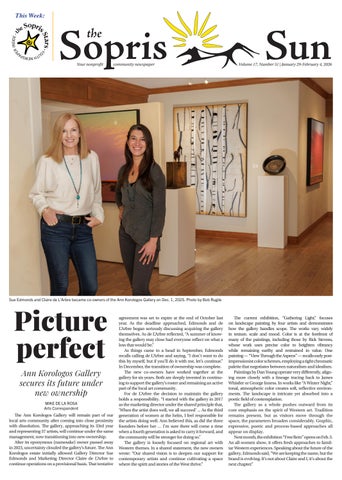
The Ann Korologos Gallery will remain part of our local arts community after coming into close proximity with dissolution. The gallery, approaching its 33rd year and representing 37 artists, will continue under the same management, now transitioning into new ownership. After its eponymous (namesake) owner passed away in 2023, uncertainty clouded the gallery’s future. The Ann Korologos estate initially allowed Gallery Director Sue Edmonds and Marketing Director Claire de L’Arbre to continue operations on a provisional basis. That tentative
agreement was set to expire at the end of October last year. As the deadline approached, Edmonds and de L’Arbre began seriously discussing acquiring the gallery themselves. As de L’Arbre reflected, “A summer of knowing the gallery may close had everyone reflect on what a loss that would be.”
As things came to a head in September, Edmonds recalls calling de L’Arbre and saying, “I don’t want to do this by myself, but if you’ll do it with me, let’s continue.” In December, the transition of ownership was complete.
The new co-owners have worked together at the gallery for six years. Both are deeply invested in continuing to support the gallery’s roster and remaining an active part of the local art community.
For de L’Arbre the decision to maintain the gallery holds a responsibility. “I started with the gallery in 2017 as the marketing director under the shared principle that, ‘When the artist does well, we all succeed’ ... As the third generation of women at the helm, I feel responsible for the artists doing well. Ann believed this, as did the three founders before her … I’m sure there will come a time when a fourth generation is asked to carry it forward, and the community will be stronger for doing so.”
The gallery is loosely focused on regional art with Western themes. In a shared statement, the new owners wrote: “Our shared vision is to deepen our support for contemporary artists and continue cultivating a space where the spirit and stories of the West thrive.”
The current exhibition, “Gathering Light,” focuses on landscape painting by four artists and demonstrates how the gallery handles scope. The works vary widely in texture, scale and mood. Color is at the forefront of many of the paintings, including those by Rick Stevens, whose work uses precise color to heighten vibrancy while remaining earthy and restrained in value. One painting — “View Through the Aspens” — recalls early postimpressionist color schemes, employing a tight chromatic palette that negotiates between naturalism and idealism.
Paintings by Dan Young operate very differently, aligning more closely with a lineage tracing back to James Whistler or George Inness. In works like “A Winter Night,” tonal, atmospheric color creates soft, reflective environments. The landscape is intricate yet absorbed into a poetic field of contemplation.
The gallery as a whole pushes outward from its core emphasis on the spirit of Western art. Tradition remains present, but as visitors move through the space, the parameters broaden considerably. Graphic, expressive, poetic and process-based approaches all appear on display.
Next month, the exhibition “Free Rein” opens on Feb. 3. An all-women show, it offers fresh approaches to familiar Western experiences. Speaking about the future of the gallery, Edmonds said, “We are keeping the name, but the brand is evolving. It’s not about Claire and I, it’s about the next chapter.”
Sue Edmonds and Claire de L’Arbre became co-owners of the Ann Korologos Gallery on Dec. 1, 2025. Photo by Bob Rugile
A big thanks to our community
Every Thursday, something small but meaningful happens across the Roaring Fork Valley.
Outside the Village Smithy… at a City Market… at a local library… someone pauses at a news box, pulls out a fresh copy of The Sopris Sun, and takes a moment to reconnect with what’s happening close to home.
It’s a simple act. But it represents something profound: A community choosing connection.
So today, I want to simply say, “thank you.”
Whether you donated this year, advertised, shared a news tip or simply picked up the paper from a box on a Thursday morning, thank you for being part of what makes this possible.
This year, The Sopris Sun took part in the statewide #newsCOneeds challenge, an effort to strengthen independent journalism across Colorado. Together, newsrooms and supporters raised more than $551,000 for local news.
Here at home, you helped The Sopris Sun raise just over $150,000 through donations and matching grants. We were honored to receive top recognition in our cohort for both dollars raised and the number of unique donors.
But the truth is, this isn’t really about awards.
each week. Because of you, we can keep doing this work with care, integrity and pride.
Over the past few years, this valley has helped The Sopris Sun innovate and grow, and we’re proud of what our community has built together.
OPINION
EXECUTIVE
NOTE
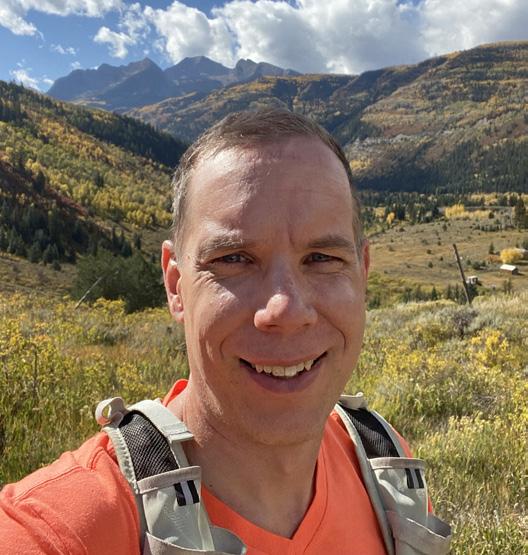
By Todd Chamberlin
It’s about what they represent: A valley that believes journalism is worth sustaining.
The Sopris Sun isn’t owned by distant corporations. We aren’t driven by outside agendas. We’re a community-owned nonprofit newspaper, built on a simple idea: That trustworthy, independent reporting matters right here, where we live.
Your support keeps stories in print and reporters in the field. It also means the world to our small staff and the freelance writers, photographers and contributors who bring this paper to life
LETTERS
It helps us cover government, schools, housing, water and the issues that shape daily life. These are the decisions that affect your kids, your neighborhood, your taxes and the future of this place we all share.
It helps sustain Sol del Valle, our Spanish-language newspaper, and Sopris Stars, our youth journalism program. This ensures more voices are heard, and more stories are told, across our region.
And The Sopris Sun isn’t just about informing our community. It’s about strengthening our community, too.
This year, our Annual Giving Guide helped raise more than $2 million for over 100 local nonprofits, connecting neighbors with causes and generating real support across the Valley.
That’s the kind of ripple effect a truly local newspaper can have. Across the country, local papers continue to disappear. When they do, communities lose connection, accountability and a shared source of truth. The fact that this valley continues to show up, week after week, is a powerful reminder of what community-powered journalism can be.
Whether you’ve supported us for years or are picking up the paper for the first time, we’re grateful to have you with us. And if you’ve never contributed before, we hope you’ll consider joining in, in whatever way you can.
Strong communities don’t just read the news, they sustain it.
ChatGPT assistance was used by the author to shorten this column.
CORRECTION: On the cover of last week’s paper, Sofia Webster and Matty O’Conner were mistakenly referred to as sisters, and Sofia’s last name was given to Matty.
Re: GarCo Report
This is Kristi Gill, born and raised in the Roaring Fork Valley. I worked at VVH and GRHD for 40 years.
I would like to clarify something that was reported by The Sopris Sun at the Garfield County Commissioners meeting Jan. 12, 2026.
Our Constitution of the United States of America must never be compromised, nor the Amendments! I am NOT against the right of people to keep and bear arms OR freedom of speech, free exercise of religion. I am NOT for rewriting the 1st or the 2nd Amendments.
In my presentation to the Commissioners I was not, (Sopris Sun quote) “referring to the Musket Second Amendment movement that claims the original Second Amendment only protects ownership of muzzle-loading, flintlock muskets.” These are Amy Marsh’s words.
I did use the words “update” and “musket.” My intention was only to compare the 18th century to the 21st century. During the 18th century our country was a Christian and moral society and to “keep and bear arms” referred to muskets.
In the 21st century, we have computers, AI, robots, digital communication and tools that can create 3D art out of computer images. Our right to “keep and bear arms” now might refer to lasers, EMP, drones, nuclear weapons.
In 1798 John Adams said, “Our Constitution was made only for a moral and religious people.” I guess instead of “updating” the Amendments what we need to “update” is our immoral society. Morality
can be defined as: “The principles of right and wrong behavior and the goodness or badness of human character.”
The graphic novels (a novel in comic strip format) “The Boys” written by Garth Ennis and illustrated by Darick Robertson may be violating the laws of the State of Colorado and Garfield County PUBLIC Library which are visited by children.
My “VAGUE” presentation included a list of 12 Colorado State bills/laws which I gave a copy of to the Commissioners. (I also gave the list to the GCPLD trustees on Jan. 8.)
The list included CRS 18-7-502. I quoted this bill to the commissioners at our meeting. It is a Colorado crime to provide sexually explicit MATERIAL that is “harmful” to anyone under the age of 18 in a commercial/public establishment frequented by children. This MATERIAL can be a representation of a person or portions of the human body that depicts: nudity, conduct, abuse. MATERIAL can be in the form of pictures, photos, DRAWING, CARTOONS, NOVELS, ART, printed material such as books.
PLEASE visit our public libraries and look at these novels. They have several from the series. Please look at #1 and #3. There is a Dewey Decimal classification system of “GRAPHIC SEX.”
Quotes from Billy Graham: “Christ can indeed cope with the social and political problems of the world … When people reject Christ’s rightful place as Lord in any nation, tyranny takes over.”
Revelation 22 ( last chapter): “The SPIRIT and the bride say, COME.”
Kristi Gill New Castle
Fear
The coin of the realm is fear. You can taste it.
Fear of deportation, fear of family separation, fear of El Salvadoran gangs, fear of
masked ICE thugs, fear of a gun in your face, a sharp report; a nagging suspicion that troops are in the street for good (so get used to it!), fear that the mid-terms might just get canceled (there could be a NATIONAL EMERGENCY!), fear that after 250 years, American democracy has run its course. Do you wake up in the wee hours?
Denied the Nobel Peace Prize by an ungrateful bunch of Norwegians, the President of the United States rages into the night on Truth Social. He’ll make them pay. He’ll make us all pay.
Truth Social — what an odd name! Take the truth and lay it down next to a lie. Can you tell the difference? Does it matter?
The President flips off a reporter. He throws a few f-bombs. So what?
Countries get invaded, drug lords jailed — or pardoned, tariffs imposed, removed, then put right back on again; political enemies investigated; hotel maids deported. Legal protections be damned! The President makes the rules. He has his own higher morality. He told us so. He golfs by day and rages into the night.
It’s enough to make you forget all about the Epstein files.
Ed Colby New Castle
Real impacts
Aspen is one of the wealthiest and most influential communities in the country, located within one of the richest counties in the United States. With that privilege comes a responsibility to speak up and act when the state we depend on is being directly harmed. Community does not stop at county lines, and neither should our sense of responsibility.
Recent actions by the Trump administration have had real and measurable impacts on Colorado. One hundred nine
Editor Raleigh Burleigh 970-510-3003 news@soprissun.com
Contributing Editor
James Steindler
Sol del Valle Editora Bianca Godina bianca@soldelvalle.org
Digital Editor Ingrid Celeste Zúniga ingrid@soldelvalle.org
Lead Editorial Designer Terri Ritchie
Partnerships & Engagement Manager Luise Nieslanik
Advertising Department adsales@soprissun.com
Sol del Valle Marketing and Development Manager
Margarita Alvarez margarita@soldelvalle.org
Advertising Designer Emily Blong
Delivery Frederic Kischbaum
Youth Journalism Instructor Skyler Stark-Ragsdale
Proofreaders
Lee Beck
Tracy Kallassy
Ken Pletcher
Hank van Berlo
Executive Director Todd Chamberlin 970-510-0246
todd@soprissun.com
Board Members / Mesa Directiva board@soprissun.com
Klaus Kocher • Kay Clarke • Eric Smith
Roger Berliner • Elizabeth Phillips
Anna Huntington • Loren Jenkins
Carlos Ramos • Gayle Wells
The Sopris Sun Board meets at 6pm on second Thursdays at the Third Street Center. The Sopris Sun, Inc. is a 501(c)(3) nonprofit corporation with a mission to inform, inspire and build community by fostering diverse and independent journalism. Donations are fully tax deductible.
Sincerest thanks to our Honorary Publishers for their annual commitment of $1,000+
Lee Beck & John Stickney Kay Brunnier
Frances Dudley
Michelle & Ed Buchman
Sue Edelstein & Bill Spence
Deborah & Shane Evans
Greg & Kathy Feinsinger
Michael & Nancy Kish
Gary & Jill Knaus
Eric Smith
Peter and Mike Gilbert
Patti & George Stranahan
Elizabeth Wysong
Alpine Bank
Emily & George Bohmfalk
Kathy & Carter Barger
Sandy & Paul Chamberlin
Karen & Roger Berliner
Donna & Ken Riley
Gayle & Dick Wells
Legacy Givers for including us in their final wishes. Mary Lilly
Donate by mail or online: P.O. Box 399
Carbondale, CO 81623
520 S. Third Street #26 970-510-3003
soprissun.com/Donate
The Sopris Sun, Inc. is a proud member of the Carbondale Creative District

SCUTTLEBUTT
Redstone deliveries
The Sopris Sun is seeking a regular Crystal commuter to shuttle newspapers from Carbondale to Redstone every Thursday. This is a volunteer position perfect for anyone making the drive anyway. Contact raleigh@soprissun.com for details.
Songwriting workshop




Olivia the Bard, in residency at Steve’s Guitars, is offering a songwriting workshop on Mondays from Feb. 9 to March 2 from 7 to 9pm. Participants will then have the option to debut their creation before a live audience on March 9. Poets as well as musicians are welcome! For details on the workshop and/or joining a February song-a-day club, contact oliviathebard@gmail.com
Basalt Library board
FirstBank Alpine Bank
Colorado Mountain College
Nordic Gardens
Hilary Porterfield
Basalt Library
NONPROFIT PARTNERS
Two Rivers
Unitarian Universalist
Carbondale Arts
Carbondale Rotary Club
Colorado Animal Rescue
Interested in becoming an Underwriter or Nonprofit Partner? Email Todd@soprissun.com or call 970-987-9866
The Basalt Regional Library District is seeking applicants for two board of trustee positions. Candidates must reside within the district boundaries in Eagle or Pitkin counties. Each three-year term has a formal application process, including interviews with county commissioners. Information sessions will be held on Feb. 2 at 6pm and Feb. 3 at 8:30am. Learn more at www.basaltlibrary.org/about/board
2Forks
Last Thursday, the 2Forks Club raised $175,550 in 0% interest loans awarded to eight local farmers: Karen Page with Dirt Fairy Farm in New Castle and Rifle; Raw Mountain Farm LLC in Basalt; Kirk Howlett with Berry Fungi Farm in Paonia; Harrison Land Patrick with Top of the World Cultivators; Teighlor Darnell with Blue Bee Farm in Montrose; Brandt Thibodeaux and Kade Gianinetti with Aquila Cellars in Eckert; Andrew Lloyd with Delectamenti Eats in Paonia; and Jeremiah Garcia with Fertile Edge Farm in Paonia.
Basalt Sunday Market
The Basalt Sunday Market is accepting vendor applications for the 2026 season, scheduled from June 14 to Sept. 27. Vendor applications are due by 5pm on Friday, March 13. Find details at www.basalt.net/ sundaymarket
Youthentity Career Expo
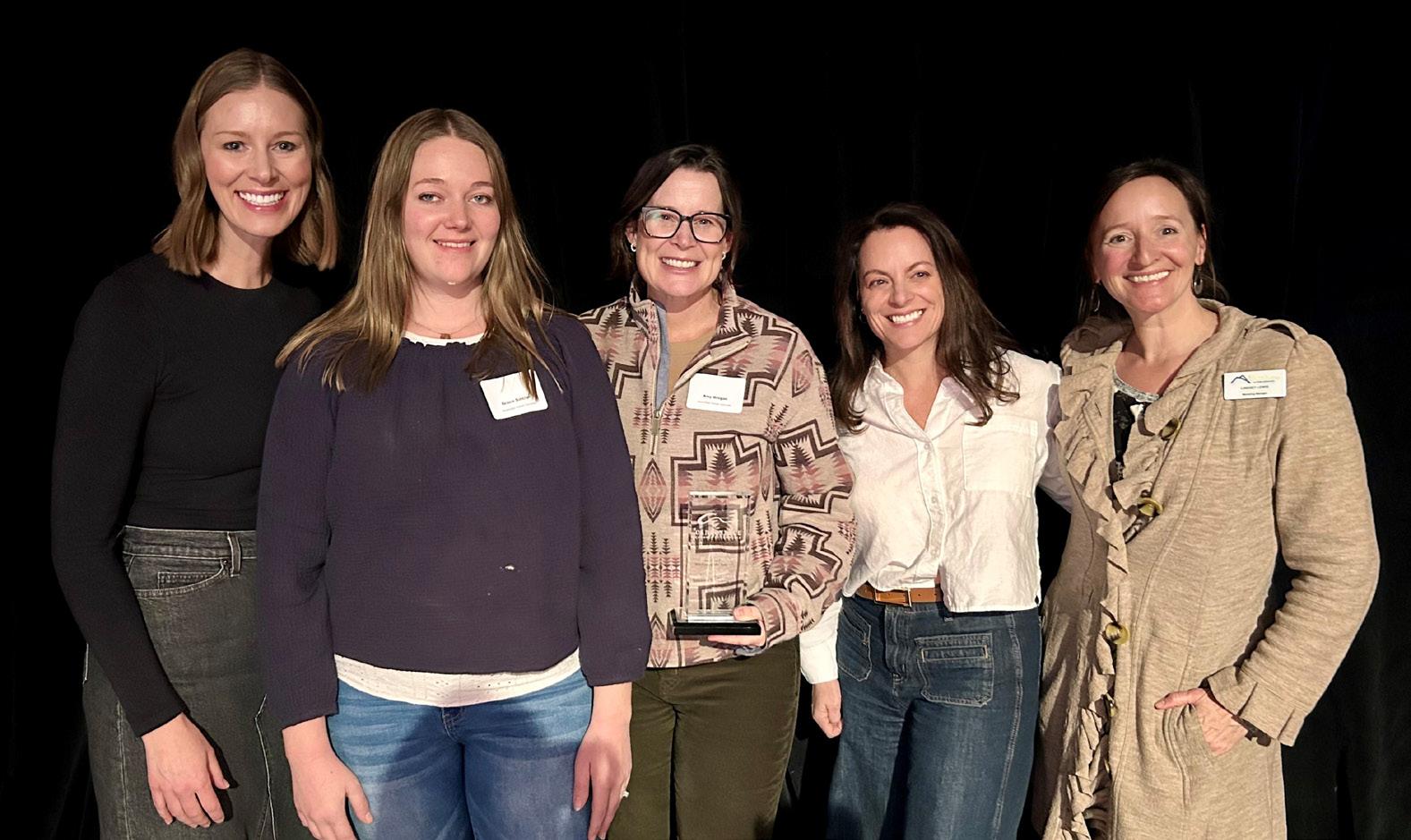
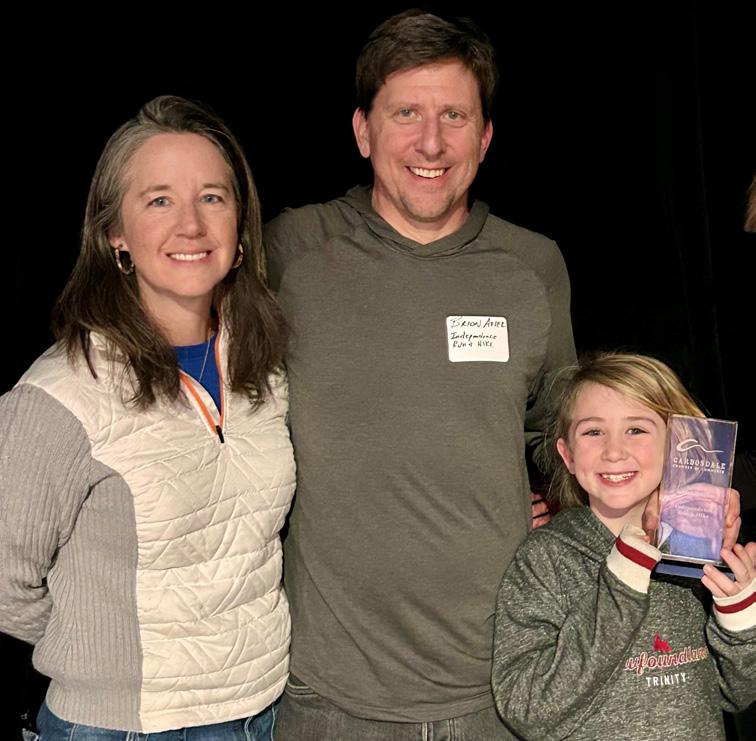
Congratulations to Ascendigo Autism Services and Independence Run & Hike, winners of the Carbondale Chamber of Commerce’s business and nonprofit of the year awards. Pictured top: Carbondale Chamber President and CEO Andrea Stewart; Ascendigo Events Manager Grace Sinclair; Ascendigo President & CEO Amy Grogan; Ascendigo Human Resources Director Christina Provenzano; Ascendigo Marketing Manager Lindsey Lewis. Pictured right: Independence Run & Hike owners Betsy, Brion and Arbaney After. Courtesy photos
GarCo humanitarians
The Garfield County Human Services Commission is accepting nominations for the 36th annual Garfield County Humanitarian Service Awards, honoring community volunteers and human services staff for selfless contributions that make Garfield County communities more vibrant, diverse, sustainable, supportive and safe. Nominations are due by Feb. 27. Find the nomination form at www.garfieldcountyco.gov/hsc/ humanitarian-awards
ICE funding
“In the wake of Alex Pretti’s death, Congress appears on track for a partial shutdown,” National Public Radio reported on Jan. 26. Senate Democrats are needed to approve a $1.3 trillion spending package which includes funding boosts for ICE: $400 million more for detention and $370 million more for enforcement compared to last year. That’s on top of $170 billion allocated by the Big Beautiful Bill Act, which made ICE the highest-funded federal law enforcement
Local businesses and organizations are invited to join Youthentity at Colorado Mountain College’s Spring Valley campus on March 17 for an annual career expo oriented toward inspiring future pathways for students across the region. To register for a table, visit www.youthentity.org/careerexpo-1 — nonprofits can participate for free.






entity in U.S. history, dolling out $50,000 sign-on bonuses for new recruits.
Oil and gas
The U.S. Department of Agriculture (USDA) finalized revisions to its regulation governing oil and gas on Forest Service lands. The revision “modernizes and streamlines the process for managing energy development across millions of acres,” a USDA press release stated. This move advances President Trump’s Declaring a National Energy Emergency and Unleashing American Energy executive orders.
They say it’s your birthday!
Folks celebrating another trip around the sun this week include: Molly DeMarr and Noah Scher (Jan. 29); Ami Maes and Luca Rio Phelan (Jan. 30); Joani Lubrant and Megan Passmore (Feb. 1); Marcos Guevara, Candy Holgate, Mal Lent, Nikki Macleod, Mountain Maes, Rex van Minnen and Silvia Rodriguez Gutierrez (Feb. 2); Bob Moore, Stacey Novak and Sarah Strassburger (Feb. 3); Sandra Gaddis, Sue Gray and Aly Sanguily (Feb. 4).




Owner wants new Carbondale restaurant Amara
to be ‘worth the drive’
RAY K. ERKU Sopris Sun Correspondent
Gushing in a provocative broth that would make gods salivate, Chef Barry Dobesh plunked a plated trifecta of oxtail, beef cheeks and short ribs onto the bar. Though light fixtures were dimmed for a perfect romantic evening, there were no customers. Instead, the earthy interior dining room was full of empty tables.
With a grand opening expected for Feb. 1, the antsy creators of what will become one of Carbondale’s newest restaurants, Amara Kitchen and Wine Bar, spent last Thursday forking into this feast of Moroccan stew. With each bite, they obsessively tried to taste for flavors both needed and not to capture the most satisfying chef’s kiss.
The anticipation could be cut with a butcher’s knife.
“You know how the Michelin say it’s worth the stop, it’s worth the drive?” said Amara owner Maria J. Cardenas, a veteran sommelier and former wine director at some of Aspen’s most popular eateries. “We want to be worth the drive.”
Amara is a Bonedalian take on seaside Mediterranean cuisine. If they fancy, diners can pair a Lebanese red plucked from Amara’s 150-square-foot wine cellar with grilled dates and caviar before splashing into a Greek-inspired swordfish souvlaki. Top that with a Turkish rice pudding for dessert, there’s no going wrong.
Carbondale’s ever-changing restaurant scene gave Cardenas the opportunity she needed to launch what she calls “my dream.” The building at 46 North Fourth Street formerly housed Argentine eatery Bodegón, which closed in 2025 after opening the year prior.
The vacant interior thus became the new proprietor’s “white canvas,” she said. She brought in tables made from wood reclaimed from the floors of semitrucks. Massive branches taken from her hikes in the Roaring Fork Valley are furnished in corners, giving a sort of calming wabisabi interior.
“We want this to be a casual, feel-athome place,” she said. “But in the best way possible.”
But achieving perfection also takes like-minded contemporaries. So Cardenas teamed up with her husband, Ricardo Leyvas, another Aspen restaurant scene veteran, in operations. The kicker came when she landed Chef Barry, CP Restaurant’s head chef and the same culinary mind that transformed Woody Creek Tavern’s menu when it changed hands in 2020.
“The community has been amazing, and I want people to understand that this is a project from Carbondale to Carbondale,” Cardenas said. “This is like a testament of our love to Carbondale, because we really think the community deserves this — a place to gather, a place to have fun and a place where they can be.”
NOW HIRING
Young Adult Program Coordinator Glenwood Springs
Stepping Stones is seeking an energetic, bilingual (Spanish/English) leader to launch and operate a new young adult drop-in center serving ages 15–24.
Full-Time Salaried Position
$55,000–$65,000 DOE
Cardenas is originally from Columbia, where she worked as a lawyer. Suddenly, however, she told her parents she wanted to follow her dream of owning a restaurant and skipped town to New York City. There, she studied wine at the Culinary Institute of America. Upon graduation, she moved to Aspen and started her journey at the Little Nell before becoming wine director at places like Monarch Steak House and French Alpine Bistro.
Now she’s preparing to open seven days a week in the heart of Carbondale,
Responsibilities include mentoring, youth programming, in-school support, case management, and community partnerships.
Excellent Benefits:
Health • Dental • Vision • Retirement Match • PTO • Sabbatical
Apply with cover letter, resume + 3 references
Contact: Jonathan Greener jonathan@steppingstonesrfv.org 773-450-7738




Pints & Perspectives

where she’ll offer 3 to 5pm wine-flight happy hours before full dinner service begins at 5pm. She has also scheduled a soft opening for Thursday, Jan. 29.
“I took a picture earlier of all the kitchen staff, and I just started bawling. That’s how excited I am,” Cardenas said. “I have so many ideas of what I want to do with this place. I’ve dreamt of this all my life.”
Interested in Amara? Visit its website at www.amaracarbondale.com or call them at 970-510-5363.

Wed, Feb. 4, 5:30-6:30PM at Mountain Heart Brewing








Pints and Perspectives is a monthly speaker series that brings the community together in a relaxed, welcoming setting. This month’s speaker will be Dhakiya Mitchell, giving a presentation on how Black American Culture has shaped pop culture today.


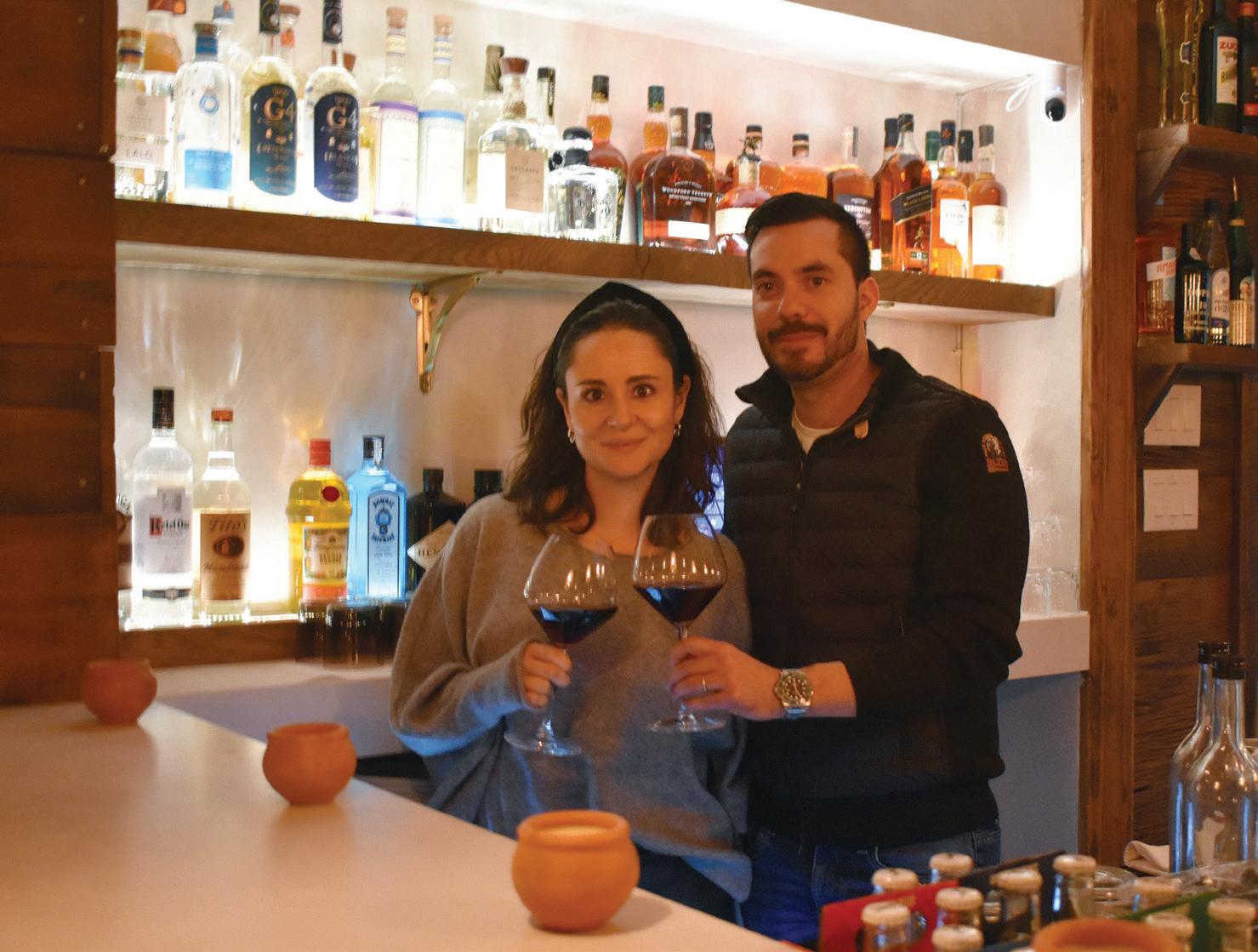
Amara co-owners, Maria J. Cardenas and Ricardo Leyvas, clink wine glasses inside Carbondale’s newest restaurant on Thursday, Jan. 22. Photo by Ray K. Erku
Revel Bikes is leaving Carbondale
BETSY WELCH
Sopris Sun Correspondent
When Adam Miller did the Grand Traverse in 2017, the most memorable part of the race wasn’t the 40-mile, middle-of-the-night ski traverse from Crested Butte to Aspen. It was the small town he passed through on the drive back to Crested Butte.
Miller had already been thinking about where he wanted to live and grow his fledgling bike business. In the months after the race, he returned many times, and by the fall, he had rented a small industrial space in Satank, living out of his van on Prince Creek Road. Soon after, he bought a house, hired his first employees and, in 2019, launched Revel Bikes in Carbondale.
Now, nearly eight years later, Revel has announced it is moving core operations to Golden, Colorado.
“It’s very bittersweet,” Miller said of the move. “But if Revel is going to be a long-term, sustainable business, this was the last piece of the puzzle.”
When Miller arrived in 2017, the cost of living in the Roaring Fork Valley was already high, but “not that much higher than somewhere like Denver or Salt Lake
City,” Miller said. He also believed the tradeoff was worth it.
“I really believe in sustainable businesses,” he said, “but more than that, I wanted a good, fun, healthy place to live and work. If we made a few percent less because it was more expensive, that felt fine.”
Then, Revel grew quickly — quicker than Miller anticipated. When it launched in 2019, the company had six employees. By 2020, it had doubled. When the pandemic-fueled bike boom hit, Revel — like much of the bike industry — found itself overwhelmed with demand.
“We were saying no to orders every day,” Miller said. “It was a perfect storm and a wonderful time to be in the bike industry.”
At the same time, Carbondale was undergoing its own COVIDera transformation. Remote work drove an influx of new residents to the Roaring Fork Valley, home prices surged and never came back down.
Revel’s growth brought pressure almost immediately. Bike brands are capital-intensive businesses that require large investments long before revenue arrives.
“You can be very profitable on paper and still always be out of

cash,” Miller said.
By 2021, Revel had grown to nearly 30 employees. Miller said he had exhausted his own resources, including personal loans and early investors, and decided to sell a majority stake in the company to a private equity firm.
“All of my own money was in it,” he said. “I had taken out two lines of credit on my house. None of that was going to be enough to keep funding the business.”
The sale brought immediate benefits for employees, including raises, bonuses and expanded benefits.
But Miller said it did not take long for his relationship with new ownership to sour. “It became very classic ‘run the business by numbers only,’” he said. “A lot of
the passion and soul was taken out of it.”
He ultimately stepped down as CEO in late 2023 and fully exited the company. What followed, he said, was painful to watch from the sidelines.
“On one hand, I had a level of financial freedom I never expected to have,” he said. “On the other hand, I was distraught to see what was happening.”
In early 2025, Revel was foreclosed on by its lender. Roughly 20 employees were laid off. Miller found out through the grapevine and immediately began to take steps to make an offer on the company he’d founded six years earlier. He did not want the company sold to another private equity firm.
In May, Miller purchased Revel Bikes and immediately began restructuring the business.
“They were over $8 million in debt, burning hundreds of thousands of dollars a month,” he said. “For me to buy it back and rebuild it required pretty drastic efforts.”
One thing Miller could not do was hire back all the employees who’d been laid off by the old ownership. The decision drew criticism, particularly from those who believed the 2021 sale had set the company’s collapse in motion.
Miller says he’s learned a lot in the five years since he sold and stepped away from Revel, and he stands by the choices he’s made since buying the company back eight months ago.
“Given how terrible a lot of the situation was, and how terribly the previous company leadership ran the company and treated people, I couldn’t solve for all of it,” he said. “But I believe I did the best job I could to hire some people back.”
Today, Revel employs 19 people worldwide, including staff in Taiwan and remote workers across the U.S. Miller is still based in the Roaring Fork Valley, and says that Revel’s marketing, IT and finance staff will stay, as well. But warehousing, assembly and sales will move to Golden to be fully operational by March 1. There are currently five Golden-based jobs posted on Revel’s website.
continued on page 15
“She listens carefully, and thoughtfully considers the many tools in her toolbox that will best support what I am needing.” client testimony
“No matter how I’m feeling going into a session, I am happy in Mishe’s presence and feel better when I leave.” client testimony



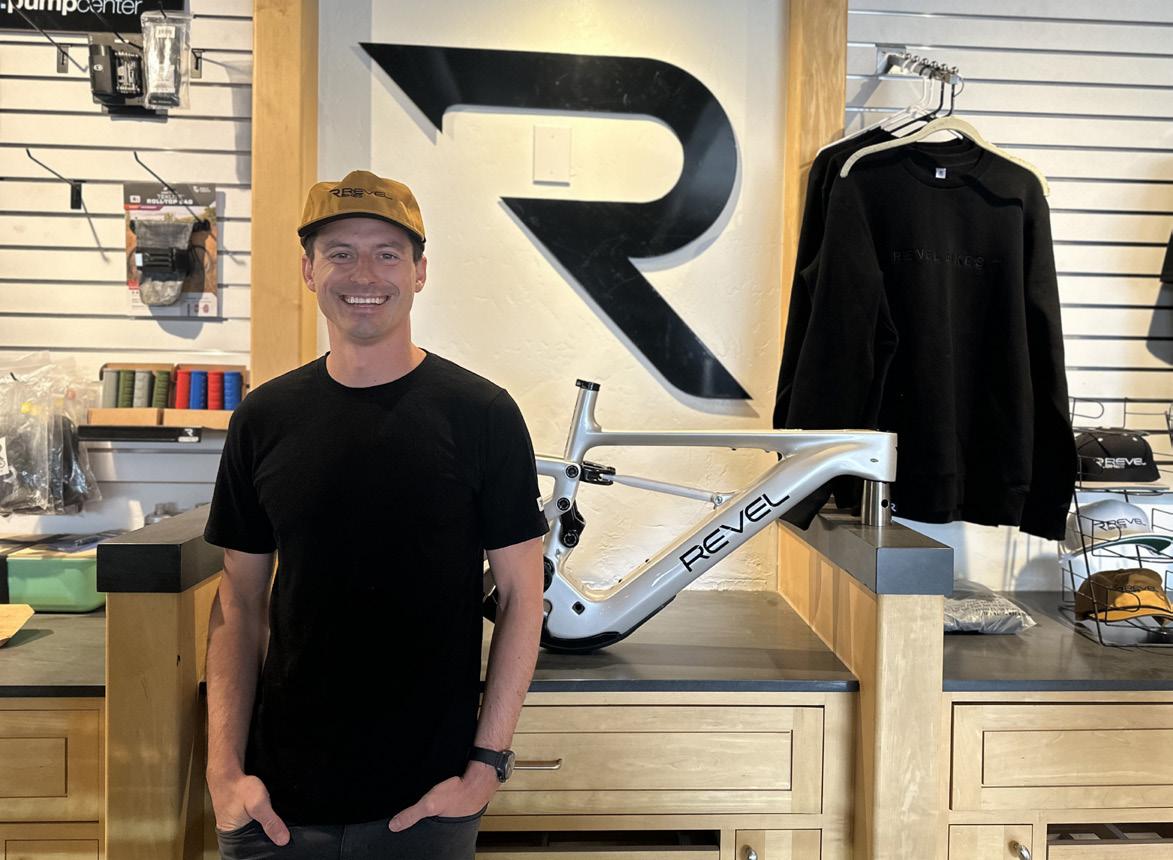
Adam Miller, founder and CEO of Revel Bikes. Photo by Betsy Welch















CABIN WINETASTINFEVERG















































































































Glenwood charter school seeks legal ruling on ability to bus students from neighboring district
JOHN STROUD
Sopris Sun Correspondent
A decision whether the charter Two Rivers Community School (TRCS) will be able to continue busing students from the neighboring Garfield Re-2 School District now rests with a judge.
Re-2 Superintendent Kirk Banghart in October 2025 sent a letter to Roaring Fork District Re-1 Superintendent Anna Cole requesting an end to TRCS’s practice of busing students from New Castle, Silt and Rifle to the Glenwood Springs-based school.
TRCS, which serves students kindergarten through eighth grade from both districts, was founded in 2014 as a charter school under the Colorado Charter School Institute, but in 2022 came under the umbrella of the Roaring Fork School District Re-1.
“Charter schools like TRCS are not required to provide transportation, but if they do, they are required to comply with any applicable state rules or regulations,” Banghart wrote in the Oct. 15 letter. The letter cites a state statute that requires a district to obtain consent from a neighboring district before a school can provide inter-district transportation.
Charter schools are not exempt from that rule, and such consent has not been given, Banghart wrote.
Because TRCS operates independently of Re-1, including its student transportation services, Cole deferred to TRCS Head of School Jamie Nims and the school’s board of directors.
After initial discussions between Nims and Banghart to try to reach an agreement — including proposals that TRCS pay a fee to the district and/or reduce its routes — were unsuccessful, TRCS and a group of parents filed a lawsuit on Nov. 18 in Garfield County District Court seeking a declaratory judgment.
The suit argues that charter schools are not bound by the same regulations as school districts when it comes to inter-district busing.
“In part to support its unique educational design, Two Rivers maintains its own school buses and employs its own qualified drivers for its buses,” the lawsuit states.
“From its inception, Two Rivers has used its own transportation capacity to support
access of students whose parents wish to enroll them in Two Rivers and wish or need to access daily bus transportation.”
Nims said the parents of students who ride the bus deserve to know sooner than later whether busing can continue, and the court filing was the quickest way to get there.
“We feel confident enough in our position that we weren’t going to be willing to pay a fee per student to transport our own students to school,” Nims said in a follow-up interview with The Sopris Sun. Since the district also threatened legal action if a resolution could not be reached, TRCS decided to go straight to the courts, Nims said.
“I think our families have a right to know whether or not they’re going to potentially lose busing, and we have a right to operate
without being harassed by a neighboring school district that’s repeatedly and publicly telling everybody that we’re violating the law, which we totally disagree with,” Nims said.
Re-2 has since filed for the case to be dismissed, saying TRCS does not have grounds to sue based on what the district views as a violation of the law. A ruling on that motion is pending, and in the meantime Re-2 is not commenting further on its legal position.
“Now that Two Rivers Community School has chosen to file a lawsuit rather than continue the negotiations initiated by Superintendent Banghart with Mr. Nims, our counsel will present our arguments to advocate for the district through court filings,” the district said in a written statement issued in response to several questions posed by The Sopris Sun.
TRCS serves 400 students per its charter agreement, about 40% of whom come from within the Re-2 boundaries and the rest primarily from the Glenwood Springs portion of Re-1. Around 125 students from the Re-2 area are registered to ride the bus, but actual daily ridership is about 75, Nims said.
Since Re-2 called attention to the issue, numerous TRCS parents who live within the district have commented at school board meetings about their decision to send their students to the charter school, and said student transportation is important.
Reasons for choosing TRCS range from its unique learning model and multi-age classrooms to regular Spanish-language
on page 15

THE LOVE SPREAD THE LOVE FEBRUARY 6 FEBRUARY 6 This evening features extended hours and special events at local shops, galleries, and restaurants; plus a bonfire, hot chocolate, food trucks, & activities by community booths.


Spread The Love: visit a Love Note Creation Station, write a signed or anonymous note to the world, nature, a crush, or a loved one, and post it in the red phone booth at 4th & Main. In The Heart of the Carbondale Creative District
Happy Hour & First Friday Drink Special: | Sprazzo | 4-9pm Strawberry Basil French 75
Grand Opening of Little Blue Preschool Little Blue Preschool, 5pm
Valentine Gift Giveaway & Love Note Creation Station | Mountain Tide Provisions Co., 5-8pm
Carbondale Clay Center Opening of “Chronometry” Main Street Gallery & The Framer, 6-8pm
Live painting by Marcel with music by Ted Frisbie Kahhak Gallery, 6pm
Guided Sip & Paint Night with Lauren Sterritt Rootz Salon, 6-8pm
Sign up to volunteer with us during First Fridays Events! Full details at carbondalearts.com


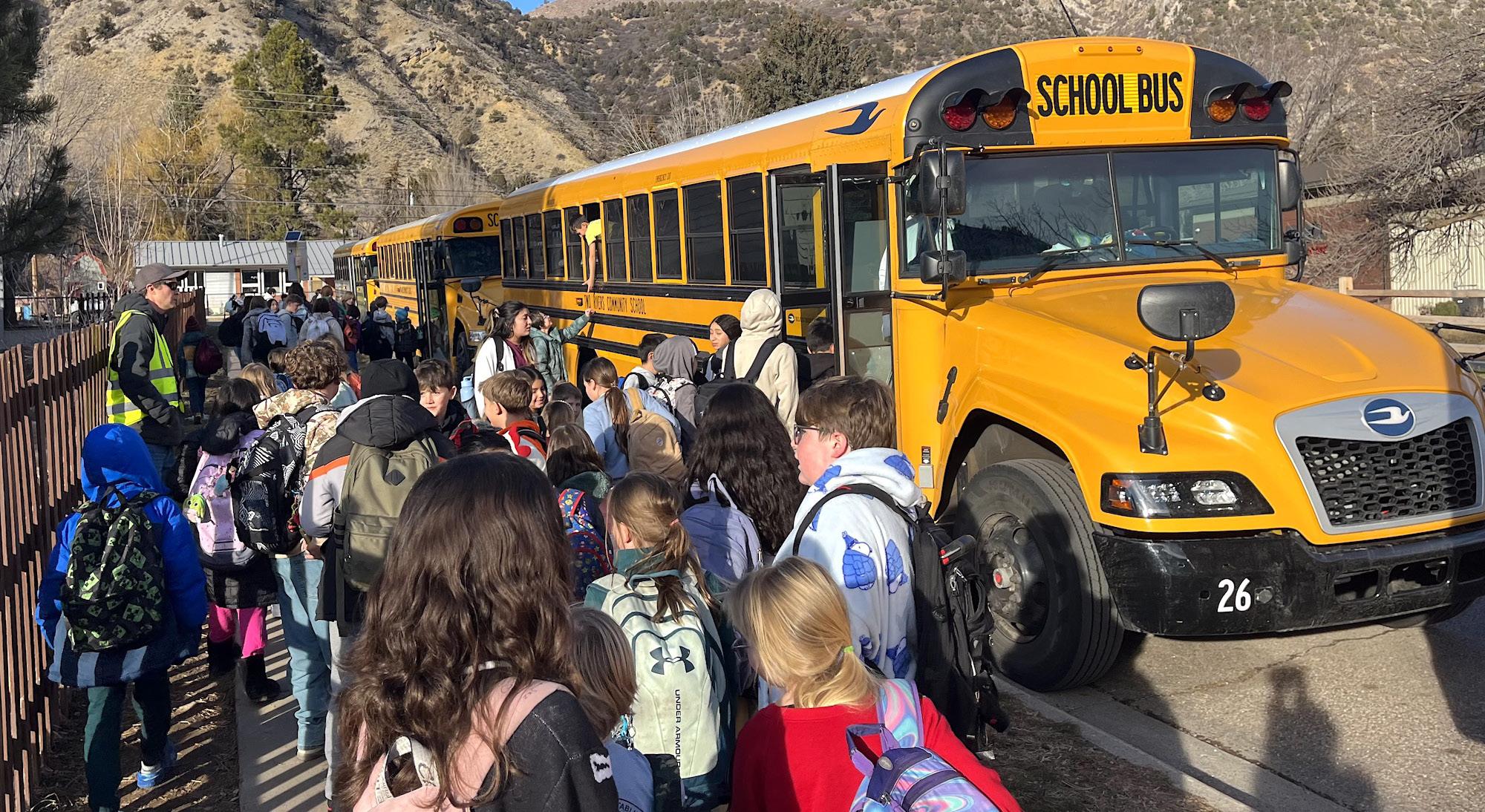
Students line up to board the bus at the end of a recent Two Rivers Community School day outside the school in West Glenwood. Photo by John Stroud continued
Winter nighttime temps surge above historical average
ANNALISE GRUETER
Sopris Sun Correspondent
As Roaring Fork Valley residents navigate this winter’s low precipitation, leaders at the Aspen Center for Environmental Studies (ACES) are warning that shifting average temperatures are also a significant concern. At the beginning of the month, Forest and Climate Director Adam McCurdy noted the asymmetric warming trend in ACES’ monthly “Wild Tracks” newsletter.
Asymmetric warming is a pattern observed by scientists in which average nighttime temperatures and average daytime temperatures change at different rates. In the early 1990s, a coalition of meteorological scientists analyzed data from over 2,000 weather stations around the world for patterns between 1951 and 1990. While the most significant finding was that average temperatures had increased over those four decades, they noted that maximum temperatures (or daytime highs) had risen by an average of 0.5 degrees Fahrenheit during that time. Minimum temperatures (nighttime lows) had warmed nearly three times as much for an average of 1.4 degrees.
Additional research has confirmed those patterns. In 2018, another study was published. It analyzed data between 1901 and 2014, concluding that the difference between daytime and nighttime temperatures (diurnal temperature range) has decreased over that time period as nighttime low temperatures rise quicker. The data pattern was more clear in certain regions, including North America. In the
Fourth U.S. National Climate Assessment, also released in 2018, average minimum and maximum temperatures in the nation were observed at 1.4 degrees and 1.1 degrees warmer, respectively, compared to data between 1900 and 1950.
McCurdy’s warning for the Roaring Fork Valley is a stark one. For the winter season thus far, he said that the region’s nighttime temperatures have been 8.8 degrees warmer than the long-term average. For an area where typical winter overnight lows had been in the single digits to low teens, a nearly nine degrees swing is abnormal. However, it does follow a trend local scientists had already observed. Six years ago, Aspen Journalism published a report showing that Pitkin County’s average nighttime winter lows had increased by about 3.5 degrees from 1950 to 2017 (from below 12 degrees to over 15 degrees).
This winter, that shift influenced Aspen SkiCo’s ability to make snow on the resort mountains. Nighttime temperatures did not drop low enough for man-made snow to last until weeks later than normal. Natural snow that has fallen this winter has been a challenge to preserve between increased overnight and daytime temperatures, particularly at lower elevations.
Snowmaking is a relatively new part of the ski industry. Aspen SkiCo started making snow following the winter of 1976-77, and originally based production on filling gaps during drier winters. But the early-season production and supplementation has become standard, both for
special events such as the X Games and to open in time for Thanksgiving.
Despite last week’s storm, the area remains largely in extreme or exceptional drought. As of Jan. 20, snow-water equivalent data from across Colorado shows the state’s snowpack has dropped below the measured historical minimum, dating back to 1987. As of Jan. 22, the Roaring Fork Conservancy reported that the Roaring Fork Watershed’s snowpack is at 56% of normal. Some of the lowest relative measurements are from higher elevation SNOTEL sites.
While precipitation has been low for the first four weeks of 2026, following 2025’s year-long drought, some of the low snowpack can be attributed to increased daytime and overnight temperatures. For Basalt, average January highs have historically been around 33 degrees, with nighttime lows of 4 degrees, according to U.S Climate Data. For much of the first half of the month, Basalt’s daytime highs were in the high 40s, or even low 50s, while overnight lows did not drop
below 20 degrees. That trend was true for the entire Valley, though specific temperatures varied by a few degrees.
Increased nighttime cloud coverage and geography-related temperature inversions can be contributing factors to the overnight lows warming faster. Overcast nights trap heat, which prevents deep cooling that helps preserve snowpack during sunny or warmer days. Mountain valleys can also experience temperature inversions even without nighttime cloud cover. When this occurs, typically during high-pressure systems, dense cold air sinks to lower elevations, while high elevations experience warmer temperatures. This can be exacerbated by air pollution. Particulates in the air can behave similarly to clouds and trap heat, especially overnight.
Colorado State University’s Colorado Climate Center tracks temperature and other climate data throughout Colorado. The school’s data shows that statewide average temperatures increased by 2.3 degrees from 1980 to 2022.



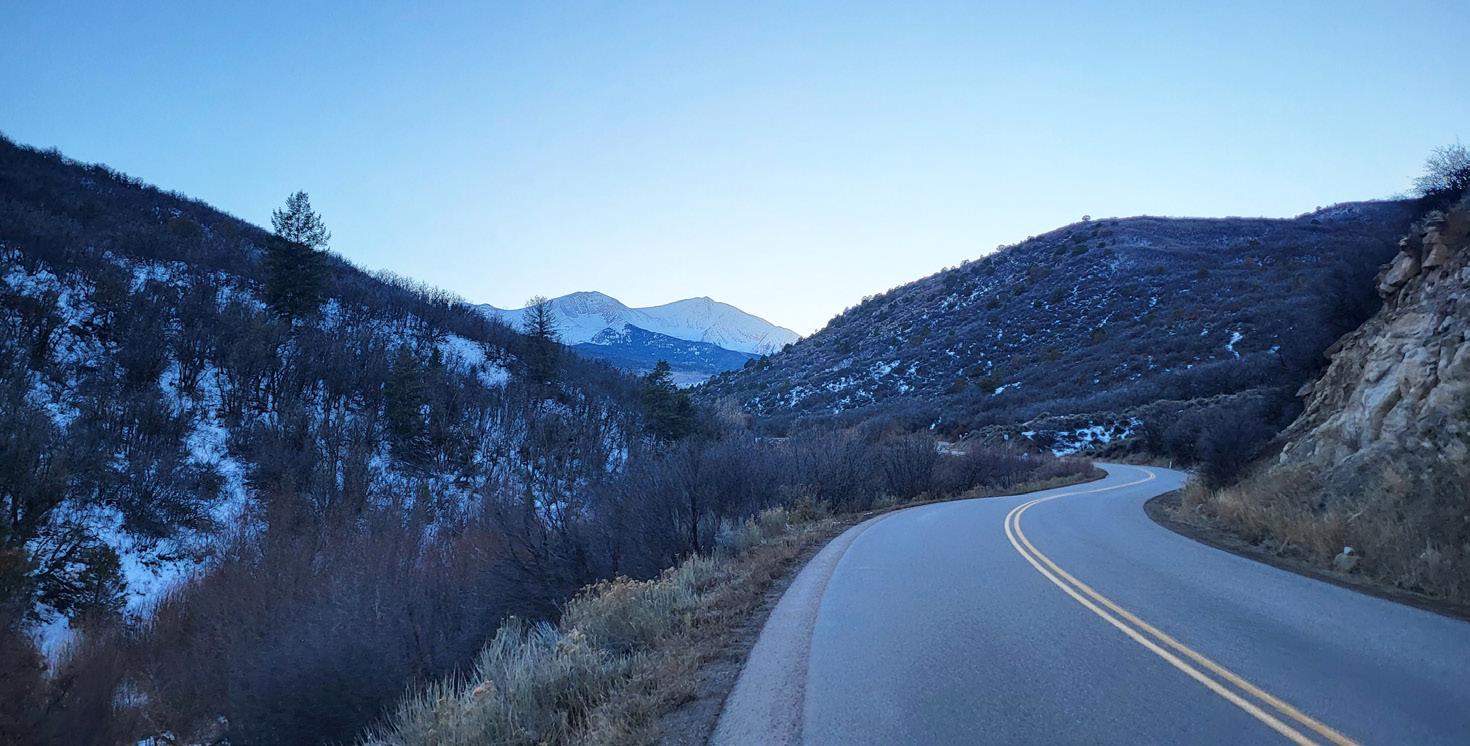
Before the Jan. 24 storm, many areas of the Valley were dry and free of snow, as seen in this image taken from West Sopris Creek on Jan. 17. Photo by Annalise Grueter
Roaring Fork basketball splits slate at Meeker in key league games
JOHN STROUD
Sopris Sun Correspondent
Roaring Fork High School’s boys basketball team secured its spot atop the 3A Western Slope League with a big win at Meeker on Jan. 24, while the girls suffered their first loss of the season but remain in the hunt for a league title.
The boys team opened a 29-17 halftime lead and never looked back in the 62-43 victory to move to 5-0 in the league and 10-2 overall — good enough to move up to the No. 11 spot in the 3A state rankings behind the usual contingent of Front Range teams.
The Rams were led in scoring by junior Quentin Galbraith with 17 points, while senior co-captains Lucas Carballeira and Kiko Pena combined for 16 and 12 points, respectively. Pena also pulled down 16 rebounds on the afternoon.
“Every single quarter, I feel like we played well,” Pena said, noting the team sometimes struggles to find its rhythm in the first half of play. “We have to be consistent every single quarter, and we can’t let teams come back on us. We have to win every single quarter.”
Meeker is always a tough contest, especially at their gym, coach Jason Kreiling said.
“So, for us to go in there and be ready to go and get that big win, that’s definitely helpful for us, especially as we’re about to start that second round of [league games],” he said. “I still feel like we’re on an upwards trajectory, and we’re not quite there yet. We’re starting to play well together, but it’s all about the little details that we really need to focus on.”
A string of games over the next week will be key for the Rams, both in terms of defending their WSL title and improving their state power rankings with a pair of Class 4A teams on the slate.
Roaring Fork travels to play
Aspen, the sixth-ranked team in 4A, on Thursday, then hosts 4-2 league foe North Fork on Saturday (4pm) and the 10th-ranked (4A) Coal Ridge Titans next Tuesday, Feb. 3 (7pm).
After that, they’ll play on the road Thursday, Feb. 5, at Olathe. The Pirates currently sit second in the league at 5-2 in league and 10-3 overall.
“We definitely need some of these non-league games coming up, because it’s always hard coming from the Western Slope to get into that top eight for 3A so you could host a regional,” Kreiling said.
Pena said he believes the Rams are up to the task.
“Aspen is definitely one of the better teams we’re going to play this season, so this is a really important game,” he said. “We need to come out strong and do our best. We can’t let down.”
Meanwhile, the Lady Rams lost their game at Meeker, 47-40, to fall into second place in the league at 5-1 (12-1 overall). Roaring Fork is now ranked ninth among 3A teams, while Meeker holds the seventh spot.
“The girls played very hard on Saturday afternoon, but Meeker was just a little bit better than us on this day,” head coach Mike Vidakovich said.
Roaring Fork was up 23-16 at halftime of the game, but let Meeker back into it, giving up 15 points in the third quarter and 16 in the fourth, to the Rams’ 17 total.
Junior scoring leader Riley Bevington again led the way with 17 points and had eight steals, while junior Hazel Jenkins had seven points. Senior post player Nikki Tardif, playing on a bad ankle, still pulled down 11 rebounds.

Meeker freshman Cienna Rogers had a barrage of 3-pointers to help secure the win. All 18 of her points were from behind the arc, while senior Rylee Sullivan had 15 points, and freshman Raegan Clatterbaugh had 19 rebounds.
“We’ll get another chance against them, and on our home court,” Vidakovich said of the second round of league games that will bring North Fork to Carbondale this Saturday (2:30pm), Meeker on Feb. 10 (5:30pm), and Cedaredge on Feb. 20 (5:30pm).









Roaring Fork senior Ryder Tezanos and freshman Levi Bumgarner go to battle under the basket during practice on Monday, as other team members look on. The Rams hold sole possession of first place in the 3A Western Slope League after a win at Meeker over the weekend.
Photo by Kate Ott, youth correspondent

Helping You Live the Extraordinary— Every Day
THURSDAY, JANUARY 29
SENIOR & FAMILY DISCOS
The Glenwood Springs Community Center hosts its disco themed Silver Prom, an elegant evening of dinner and dancing for older adults, from 5:30 to 8:30pm. All ages are invited to the Family Disco Ball on Jan. 31 — same place, same time. For tickets to either event, visit www.tinyurl.com/ Senior-FamilyDisco Questions? Call Tiff at 970-384-6301.
CHICKEN BUTCHERY 101
Rock Bottom Ranch hosts a hands-on chicken butchery and stock making workshop from 5:30 to 7:30pm. Register at www.aspennature.org
MUSIC AT THE LIBRARY
A Baroque ensemble, made up of Sarah Graf and friends, performs at the Basalt Library at 5:30pm.
WOMEN’S GROUP
The Common Roots Women’s Group explores “intentional living” at Headquarters in Basalt (23400 Two Rivers Rd #46) from 6 to 7:30pm. Details at www.headq.org
TRIVIA NIGHT
Trivia Night at Homestead and the Handlebar in River Valley Ranch returns tonight at 6pm.
BOARDS OF DIRECTORS
Alpine Legal Services fills folks in on what it’s like to serve on a nonprofit board of directors and how to be a successful member from 6 to 8pm at the Glenwood Springs Library. Dinner and childcare will be provided. RSVP at www.tinyurl.com/BoardofDirectors101
IN PROGRESS
Get a behind-the-curtain look of DanceAspen’s rehearsal process leading up to its upcoming show at the Wheeler, “Re:imagine,” at TACAW at 7pm. Tickets at www.tacaw.org
CRYSTAL THEATRE
Catch “Sentimental Value” at the Crystal Theatre tonight at 7pm. “Marty Supreme” screens tomorrow, Saturday and Monday at 7pm with a 5pm captioned show on Sunday. “Frozen” will show at 3pm on Jan. 31 and Feb. 4. “The Man Who Saves the World?” debuts on Feb. 1 at 7pm. “Pride and Prejudice,” the 2005 film, will return Feb. 7 and 11 at 3pm.
BINGO & TEQUILLA
El Dorado hosts Bingo Night every Thursday, along with “tequilla-fueled surprises” each week, at 7:30pm. Bring cash to participate.
FRIDAY, JANUARY 30
SPECIAL OLYMPICS CO
Special Olympics Colorado hosts the Western Region Winter Games beginning with alpine skiing and snowboarding events today and finishing up with nordic events tomorrow at Sunlight Mountain Resort. For a schedule of competitions, visit specialolympicsco. org/event/westernwintergames
TALKING BOOK LIBRARY
The Colorado Talking Book Library, which offers large print, audio and braille materials to those who can’t read standard print, fills folks in on its services at the Glenwood Springs Library at 10:30am. For details, call the library at 970-945-5958.
ROCK & ROLL ACADEMY
Middle, high school and adult bands rock out at TACAW starting at 6pm. This event is free and seats are first come, first served.
BE A BIG BUDDY
The Buddy Program invites folks interested in becoming a mentor to learn more about its Big Buddy program from 1 to 6pm at the Bluebird Cafe in Glenwood Springs.
SCULPTURE SHOW
The Art Base features a sculpture exhibit celebrating the legacy of arts pioneer Laura Thorne and featuring works by six high school students. A closing reception takes place today from 5 to 7pm.
DON WAS
Don Was and The Pan-Detroit Ensemble will perform The Grateful Dead’s “Blues for Allah” in its entirety at The Wheeler Opera House at 7:30pm. Tickets at www.aspenshowtix.com
BARDLIFE
Olivia Pevec, aka Olivia The Bard, performs a show at Steve’s Guitars at 8pm. Tickets at www.stevesguitars.net
SWEET JESSUP
Sweet Jessup and the Dirty Buckets perform at Rock Island Oyster Bar & Grill in Snowmass at 9pm.
SATURDAY, JANUARY 31
SKI SPREE
It’s Ski Spree at Sunlight, with a “dollar bill mountain treasure hunt,” ski ballet at 11am, fireworks and dancers at dusk and horse-drawn carriage rides and live music from 10:30am to 6pm.
‘IGNITE THE CLIMB’
Thunder River Theatre Company hosts “Ignite the Climb,” an evening featuring local ski legend Mike Marolt and a screening of his film, “Shishapangma: Ski from the Death Zone,” at 5pm. Tickets at www.thunderrivertheatre.com Proceeds benefit the theater’s upcoming production of “K2.”
STATE OF THE CITY
The City of Glenwood Springs hosts its first State of the City event bringing the community together to discuss some of the City’s most pressing projects from 5:30 to 7pm. Details and registration at www.cogs.us
COMEDY
Kevin Fitzgerald opens for Ryan Hamilton, a favorite in the New York stand-up comedy scene, at TACAW at 6pm. Tickets at www.tacaw.org
WHEELER FILM
The Wheeler Opera House screens “The Man Who Saves the World?” by director Gabe Polsky and Area 23a at 7:30pm. Tickets at www.aspenshowtix.com
SUNDAY, FEBRUARY 1
PARADIGM SHIFT
Astrologer Ruby Burkhalter reveals the planetary lineup for 2026 at A Spiritual Center (Room 31 of the Third Street Center) from 10 to 11:30am.
EMBODYING RESILIENCE
The Two Rivers Unitarian Universalist congregation welcomes Dede Osborn for a fellowship service on embodying resilience from 10am to noon.
CACAO RITUAL
Nicole Lindstrom guides a monthly cacao ritual “designed to open the heart, quiet the mind and restore connection to inner guidance” from noon to 3pm. Register at www.truenaturehealingarts.com
REMEMBERING CASEY
Friends of Casey Piscura are invited to gather in KDNK’s classroom for a potluck and jam in his memory from 3:30 to 6:30pm.
Chris Roseberry, MD
Alexandra Kovar, MD
theSopris Stars


Fresh beats with AZYEP
On Jan. 13, the Andy Zanca Youth Empowerment Program (AZYEP) hosted a concert at Steve’s Guitars in Carbondale featuring Rock and Roll Academy Aspen bands Unrestricted and The Halfcabs. The AZYEP show was the first of a series to be held monthly at the fun and funky small-town venue spotlighting local young artists. The next show is Feb. 10 at 7pm. Parents, tell your kids! Kids, ask your parents!
Confronting vaping across schools PAGE 5
6 Reticent but hopeful, A conversation with Venezuelans
Aperture of Hope makes teens feel seen


Photos by Hana Creyts
Big brother or the e-hall pass?
There is a new epidemic sweeping across local schools, and it isn’t the flu, a new variant of COVID or any type of sickness. It is the e-hall pass. As a senior at Basalt High School, I have a few thoughts on the matter.
The e-hall pass system was first introduced at Glenwood Spring High School two years ago, and was just implemented at Basalt and Roaring Fork high schools this semester. So far, it is not popular among the student body.
At Basalt, a student has to enter their student ID and submit a request to leave the room for any given reason through a tablet. After the teacher approves it, a timer is set. After the student returns to class, they stop the timer by entering in their student ID number again. Students are permitted three breaks a day. What’s interesting is the control over who is in the hallway when, so that friends don’t use the time to dawdle or misbehave during class time. The system can deny some students from leaving the room because of behavioral concerns associated with another particular student who may be in the hall at the same time. Plus, the school can take your phone if you disobey the e-hall pass. All of this supposedly promotes a better learning environment, but, so far, it seems to distract from class time and can be a point of contention between students and teachers.
TEEN OPINION
By Hana Creyts
enough to drive our friends around the country, go to college and live on our own, we should be able to have access to our phones (even if they have to be parked in the phone pockets where students have to put up their phones during class time).
How would you like it if your breaks were monitored throughout the day by a machine? Alas, that is the new reality for now. It doesn’t seem fair to me.
In fact, most students who I have heard talk about the e-hall pass detest it. There have even been students who have tried to bypass this new system and not use the hall pass, only to have a teacher shut them down.
Schools are supposed to be about fostering a positive learning environment for students, not about tracking where students are and are not supposed to be at that exact minute.
Why was the e-hall pass implemented in the Roaring Fork School District in the first place? I don't know the entire story, but I suspect it was because a small group of people made the same bad decisions, such as vaping in the bathroom.
We are all being controlled because of the bad decisions of only a few students. Sure, the students who have made those mistakes may be being punished, but now so is every single other student.
Every time a teacher has to grant permission for someone to leave the classroom, it disrupts class — which seems to happen almost every five minutes!
As seniors, most of us are already 18, so adults. If we are old enough to enlist in the military and register to vote, old
Fashion Alert
What makes a fur jacket any different from a leather one? the
BY GISELLE "GIGI" RASCON Sopris Stars Columnist
I keep coming back to the same question every winter.
What makes a fur jacket any different from a leather one?
Both are sourced from an animal's exterior, both have a place in our culture's history, and both are praised for their quality and visual appeal. Yet, why does one invite more backlash while the other quietly hangs in many of our closets — mine included?
Before fur was viewed as a controversial issue, within the early chapters of our civilization it was practicality, animal pelts were essential for warmth and survival, it was used for protection before it became a symbolic notion within our society. Aside from its essential use, animal use became cultural — it was spiritual and sacred. At what point did it become a sign of status?
As I began digging deeper into this loophole, I came across an opening line from one of Vogue's archived issues, “The Fur Story of 1929.”
“Go without jewels, pocket money or every-day clothes, Vogue advises, but never try to scrimp on fur. For the fur you wear will reveal to everyone the kind of woman you are
and the kind of life you lead,” the line reads.
My left eyebrow spiked up reading that, reminding me of our Valley's fashion output, specifically Aspen’s. Aspen’s culture is known for its frontier history and the wealth alongside it. Those who have strolled Aspen's retail spaces have no doubt spotted tourists in fur and Kemo Sabe hats with a strip of leather wrapping the circumference of the head piece, while shopping in high end luxury stores.
Wearing a fur coat in Aspen is like going to Disneyland with your Mickey ears. Fur coats went from mountain survival to symbols of status, like costumes for Aspen's social language. I attempted to contact a couple local sellers on their ethical outputs when it comes to their market. One politely declined to comment and the other didn’t respond by press deadline.
Earlier this year (three weeks ago) I boomeranged back to the question previously mentioned as I sat in a conference room in New York City with Vogue's operatives, listening to their say on sustainability in the fashion industry (pretty complex I must say).
Under the Geneva Convention, collective punishment is classified as a war crime. This goes against international law! Well, that got dark quickly … Joking aside, it seems to me that the old fashioned hall passes worked just fine holding things together. They were like the duct tape of the school.
Sopris Stars
Youth Editor Lou Gall lou@soprissun.com
Anna Sophia Brown anna@soprissun.com
Arthur Cherith arthur@soprissun.com
Hana Creyts hana@soprissun.com
Aurora Egan aurora@soprissun.com
Kate Ott katelynn@soprissun.com
Giselle “Gigi” Rascon giselle@soprissun.com
Vivienne Shapiro vivienne@soprissun.com
Youth Journalism Director
James Steindler james@soprissun.com
Youth Journalism Instructor Skyler Stark-Ragsdale
Graphic Designer
Terri Ritchie
The Sopris Sun, Inc. is a 501(c)(3) nonprofit corporation with a mission to inform, inspire and build community by fostering diverse and independent journalism. Donations are fully tax deductible. The Sopris Stars is made possible thanks to The Sopris Sun.
The Sopris Stars Youth News Bureau by making a donation at www.soprissun.com/donate
On my way to the financial district I came across a poster that quickly grasped my attention: “CFDA [Council of Fashion Designers of America] + NYFW [New york fashion week] = puppy killers. GO FUR FREE.”
As a fashion fanatic myself, I digitally dug into the regulations that come with the craftsmanship behind these goods, when I happened to see Kim Kardashian's recent paparazzi pictures in a W Magazine article highlighting a carousel of her looks during her stay in Aspen. The magazine describes her as “dressed to the nines, of course, in an outfit that looked straight out of the 2000s.”
“She layered a Roberto Cavalli fur coat from 2000 over the Italian brand’s lace-up leather trousers,” the magazine continues, depicting one of her multiple Aspen outfits. “A vintage Dolce & Gabbana corset held it all together and an extra-long fur scarf from Hermès completed the look.”
Last Christmas, she received backlash from People for the Ethical Treatment of Animals (PETA) for giving each of her children a puppy of their own. Her response? Cover her hourglass figure in

fur and leather goods, from head-to-toe.
Circling back to CFDA, the organization's new policy on fur use states, “Beginning with September 2026 New York Fashion Week, the CFDA will no longer permit animal fur in collections on the Official NYFW Schedule. This timeline gives designers space to adjust their materials and show plans. … An exemption applies only to animal fur obtained by Indigenous communities through traditional subsis-
tence hunting practices.” What stood out to me was what wasn't addressed: leather.
“Many people happily wear leather on the grounds that it's a byproduct of animal slaughter for meat and therefore a form of recycling,” a 2008 The Guardian column states. Is it though?
The column continues to describe that a lot of bovine leather (cow skin), specifically, is a byproduct coming from
A flyer criticizing fur in the fashion industry posted on a trashcan in New York City. Photo by Giselle “Gigi” Rascon
Reticent but hopeful
ANNA SOPHIA BROWN Sopris Stars Correspondent
A conversation with Venezuelans
EDITOR’S NOTE: The source living in Venezuela is referred to by alias initials (FA) to help ensure anonymity and safety.
“Its culture is incredible. I don’t think there is a culture that has more joy in life and incredible charisma," Mike De La Rosa, a Roaring Fork Valley resident originally from Venezuela said of his home country. "There is amazing warmth interpersonally."
On Jan. 3 at 2am, FA was awoken by the sound of his windows shaking in Caracas. At first, the confusion of calamity set in, but then: hope.
“For an hour or an hour and a half, just every once in a while, you’d hear boom boom boom. We didn’t know if it was the army, or if that was the start of a war,” FA told The Sopris Stars. “I was scared, but at the same time I was excited. Maybe things are finally going to start changing.”
The latter described a descent into authoritarianism after Chávez was elected as a socialist, initially popular among the working class. After his second term as president, the constitution was altered to make way for his third. Utilities provided to the people became contingent on their continued support and the opposition's presence in the media dwindled.
“WE HOPE THE U.S. CAN HELP BRING DEMOCRACY AND FREEDOM TO VENEZUELA, WITHOUT LOSING YOUR OWN DEMOCRACY AND FREEDOM IN THE PROCESS.”
- Venezuelan Citizen
While the United States’ arrest of Nicol�s Maduro on Jan. 3 is highly contested, it represented a crack in the wall of a longstanding regime in Venezuela.
Rosa cautioned against forming assumptions and opinions about Venezuela's sovereignty and political atmosphere. He said that Venezuela is being instrumentalized and people are trying to defend their own narratives, often without considering the country's current and historical contexts.
Rosa and FA, a resident in Caracas, have lived under the preceding Hugo Chávez and Maduro regimes.

“It became difficult to tell where Chávez ended and the government began,” FA said.
In 2006, Rosa’s father, a former consultant to Chávez challengers Claudio Fermín and Manuel Rosales and a political columnist, felt rising tensions and was pressured to stay silent or leave. After receiving a threatening email detailing his son’s school bus route, the family sold the house, gave up their assets and left for the United States. This became the story for many individuals. Rosa explained that qualified and experienced Venezuelans fled to countries where they were criminalized, leaving behind property, family and familiarity in an effort to survive.
“The Venezuelans coming into America are not the narco-trafficking warlords or whatever. These are invented narratives,” Rosa stated. “It’s easy to overreport Venezuelan crimes, even though they are not truly an outlier. These crimes probably arise from being a refugee in survival straits. These people are the victims of lifelong oppression.”
Once Venezuela’s economy crashed and inflation reached over 40,000%, both criminal activity and censorship were exacerbated. According to the Center for Strategic and International Studies, in 2018, 92% of the




population didn’t have access to clean water, targeted blackouts left cities incapacitated, 90% of Venezuelans fell into poverty and about a quarter of the population left in a mass exodus.
“I have two sisters; they both left the country [and] live abroad. Most of my friends have left the country, because there was no economic opportunity; or if you say anything, criticize the government, you’re at risk,” FA explained. “If you do anything to make your life better. If you say, ‘We should change policy to make the economy better’ or ‘We should free these innocent people,’ saying those kinds of things that are true and reasonable can get you in jail. So either you play their little corrupt game … or you keep quiet.”
“It was a setting incomprehensible for most Americans,” Rosa said. “It was a culture dominated by violence … Almost every Venezuelan has an experience where a friend, a cousin has been abducted, sequestered for money.”
FA explained that while crime worsened, “The government went against crime in the worst possible way: just killing people — extrajudicial killings.”
Rosa explained that Venezuelans actively protest. There were months of boycotts, frequent opposition and resistance, but because the government controlled the oil revenue its power prevailed.
continued on page 8






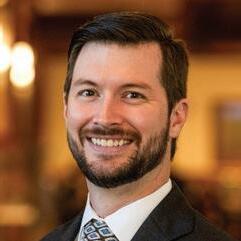
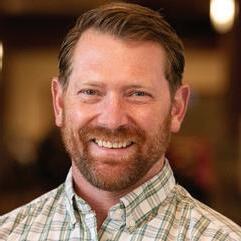








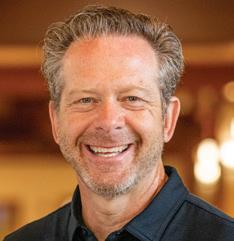



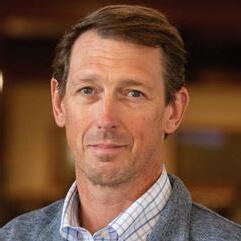
Graphic courtesy of Wikimedia Commons, LAlvarezArcia




Confronting vaping across schools
AURORA EGAN
Sopris Stars Correspondent
With the stress that modern life presents to the youth, it is no surprise that many have turned to controversial sources for relief. Throughout the Roaring Fork School District (RFSD), tobacco and vaping use in schools appear to be a large problem.
According to Joel Hathaway, executive director of schools at RFSD, there have been 24 recorded incidents of tobacco use or possession during the 2025-26 school year. These offenses include tobacco products such as vape pens that are used in school vehicles, during school activities or on school grounds across Roaring Fork schools.
Suzanne Fitzgerald, the principal at Bridges High School, an alternative high school in Carbondale, explains that vaping is quite a large problem at her school. She has both noticed the issue herself and had students self-report their use to her.
When asked about the main reason behind the influx of students vaping, Fitzgerald believes that students truly don’t understand the distress vapes are going to produce.
“It’s something that has been encouraged socially and encouraged among young, young people,” Fitzgerald said. “People truly don’t understand the long-term harm it’s causing.”
To confront this problem, Fitzgerald said that bathroom monitoring has increased, which has seemed to have reduced vaping in bathroom settings. However, Fitzgerald has heard from students that this may have pushed vaping to other areas where teachers are not present, such as in cars and in the parking lot.
After a student is caught vaping, the punishment for a first-time offense includes a notice to parents, the Second Chance educational resource and a conversation with a counselor. After a second offense, a student resource officer would be brought in.
Paul Freeman, principal of Glenwood Springs High School (GSHS), believes that nicotine use and vaping are not only a problem at GSHS, but a problem surrounding all schools. Issues in high school often parallel issues in society, Freeman said.
Throughout Freeman’s 47 years of teaching, he said that the issues of nicotine and tobacco use have neither increased nor decreased, and have only switched forms. When Freeman first started teaching, the main nicotine product students used was a cigarette. Compared to now, Freeman believes that though a minimal number of students continue to smoke, addiction has shifted towards vaping.
Concerning the reasons behind the large amounts of vaping among students, Freeman shares a similar belief to Fitzgerald that students lack the judgment to understand what they are risking when using nicotine products. Freeman also relays that many turn to these products as a way of coping with mental health problems, such as depression.
“I have no doubt that a vulnerable population of students are those who are susceptible to feeling depressed, or to feeling low,” Freeman said. “And those drugs that are available can make those feelings somewhat go away.”
Similar to Bridges, GSHS has also increased monitoring in areas where
The fact and fiction
Teenage caffeine related hospital visits are rare, but the number of visits have roughly doubled over the past six years.
That’s according to Indiana University’s Riley Children's Health hospital, which analyzed over 223 million hospital visits of patients ages 11 to 35, from 2017 to 2023.
According to a 2024 national poll by C.S. Motts Children’s Hospital, 43% of teens drink caffeinated beverages because it's their favorite product, 23% because their peers drink them, 18% to stay awake and 13% to help study and focus.
“There are guidelines for children ages 12 to 18 that suggest a limit of 100 milligrams of caffeine per day,” roughly equivalent to about two cans of soda a day, the hospital states on their website.
Maddie Hawkins, a Colorado Rocky Mountain School junior, said she drinks “about one Red Bull a day.”
Dr. Greg Feinsinger, a retired local physician in the Valley, gave a breakdown of ingredients in a 8.4oz Red Bull, and the recommended consumption limits for each. A Red Bull contains 105 milli-

vaping is common, specifically in bathrooms, making vaping extremely inconvenient for students. Freeman also encourages educating students on the dangers of nicotine and vaping use. Though it is not what GSHS reaches for first, if a student needs more of a shock to their system, Freeman said that the student may be referred to law enforcement for using substances illegal for minors.
Across Bridges High School, Glenwood Springs High School and the whole Roaring Fork School District, Policy ADC: Tobacco and Nicotine Free Schools is enforced. If a student is caught vaping in school, they will face consequences such as in-school suspension.
Apart from that, online educational programs like Second Chance and the
Truth Initiative are resources used to respond to vaping incidents and are utilized in schools such as Bridges and Glenwood Springs high schools. Through Mountain Family Health Clinics, students are also able to connect with a substance counselor. Other resources that RFSD offers include socio-emotional curricula such as the Second Step, Why Try and Comprehensive Health Skills. If students or staff desire to report an incident regarding vaping or other risky behaviors, Safe to Tell is an online resource that allows this reporting to be done anonymously. According to Hathaway, every report received is responded to. When appropriate, administrators collaborate with local law enforcement to ensure safety regarding the reports.
behind teen caffeine use
“IF SOMEONE DRINKS EVEN A CUP OF COFFEE IN THE MORNING, SOME OF THE CAFFEINE IS STILL IN THEIR BLOODSTREAM WHEN THEY ARE TRYING TO FALL ASLEEP.”
- Dr. Greg Feinsinger
grams of sodium, while the maximum amount recommended in 24 hours is 1,500 milligrams, according to Feinsinger. The energy drink contains 26 grams of sugar.
“That’s a lot of sugar, which for optimal health should be avoided,” Feinsinger wrote in an email to The Sopris Stars.
A can also contains 80 milligrams of caffeine, “which is equivalent to a cup of coffee,”
Feinsinger said.
“So, if you drink just one can of Red Bull it’s not terrible for you, but certainly it doesn’t enhance your health,” he said.
Coffee is commonly mentioned in conversations as a healthier alternative.
“Coffee has some health benefits, in that coffee beans have lots of antioxidants and other micronutrients,” Feinsinger said.
He added, however, that coffee can cause raised blood pressure, contribute to heartburn and create sleep problems in individuals of all ages.
“If someone drinks even a cup of coffee in the morning, some of the caffeine is still in their bloodstream when they are trying to fall asleep,” Feinsinger said.
A single energy drink does not necessarily have any more adverse health effects than coffee, though it doesn't carry some of the same benefits.
Hawkins said she drinks coffee occasionally.
“When I walk to Starbucks, yeah, but making it is complicated,” she said, adding that a Red Bull is easier and takes less time to prepare.
KATE OTT
Sopris Stars Correspondent
Art by Arthur Cherith
Aperture of Hope makes teens feel seen
LOU GALL
Sopris Stars Editor
Aperture of Hope, an organization operated by Cath Adams, focuses on community building and exploration for teenagers. Through the Glenwood Community Center, Adams runs teen-centered events and workshops intended to build hope for young people who may be struggling or just trying to figure life out.
The organization, an offshoot of Adams and her husband’s photography business, honors her late daughter, Emily Irene, who tragically passed away due to fentanyl poisoning in 2020. Every program offered through Aperture of Hope is a means to keep kids engaged, to make them feel important and to prevent such needless loss.
Adams works closely with the Roaring Fork School District, educating high school students about the fentanyl crisis and offering a plethora of opportunities.
Starting from humble beginnings, Adams’ first program, “If You Give a Kid a Camera,” was inspired by her own childhood, when she started looking at the outside world with intention for the first time.
“The whole world was just so big, and there was so much to explore,” she told The Sopris Stars.
She aimed to share the joys of her childhood by rekindling participants’ connections with nature, while also
highlighting the damaging effects of the digital age. Adams noticed a downward spiral when it came to teenagers and healthy coping skills, many often turning to substances or spending all their spare time online.
Her workshops serve to help kids stoke their passions. “I ask teens: What do you want to do? And how can we make that happen?” she explained.
She’s helped kids pull off events such as GlenwoodStock, an annual concert at the Glenwood Community Center with a strictly teen lineup, and the regular Teen Jam sessions.
“Teen Jam helped me connect with my peers musically,” said Iggy Richardson, a local teen and junior at Roaring Fork High School. “I think it is a fantastic outlet for musicians to connect, especially in such a small valley.”
This is reflective of Aperture of Hope’s overall goals to help inspire youth to create and take a step back from the digital world. “It's creating possibilities,” Adams said.
Adams tends to let young people inspire the direction of the programming. “I have allowed it to naturally unfold itself,” she shared. She keeps an open mind and focuses on helping as many young people as possible while also holding their interest.
Currently, Adams is working on multiple projects. She is particularly excited about “Digital Detox,” which requires youth to put their phone

down and find a creative outlet. That group comes together weekly to take photos and “reclaim” their brain.The act of photography forces the brain into active observation, which can help to rebuild the structures eroded by our digital age, according to Adams.
Aperture of Hope builds community and guides participants through the tunnel of adolescence to a brighter day.
“It’s basically a place of unity,” concluded Adams.
For more information, visit www.greggandcathphotographers.com/ community/aperture-of-hope













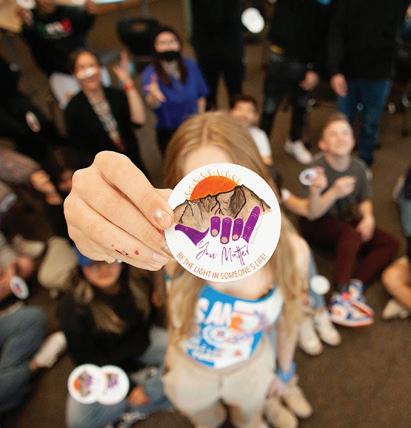
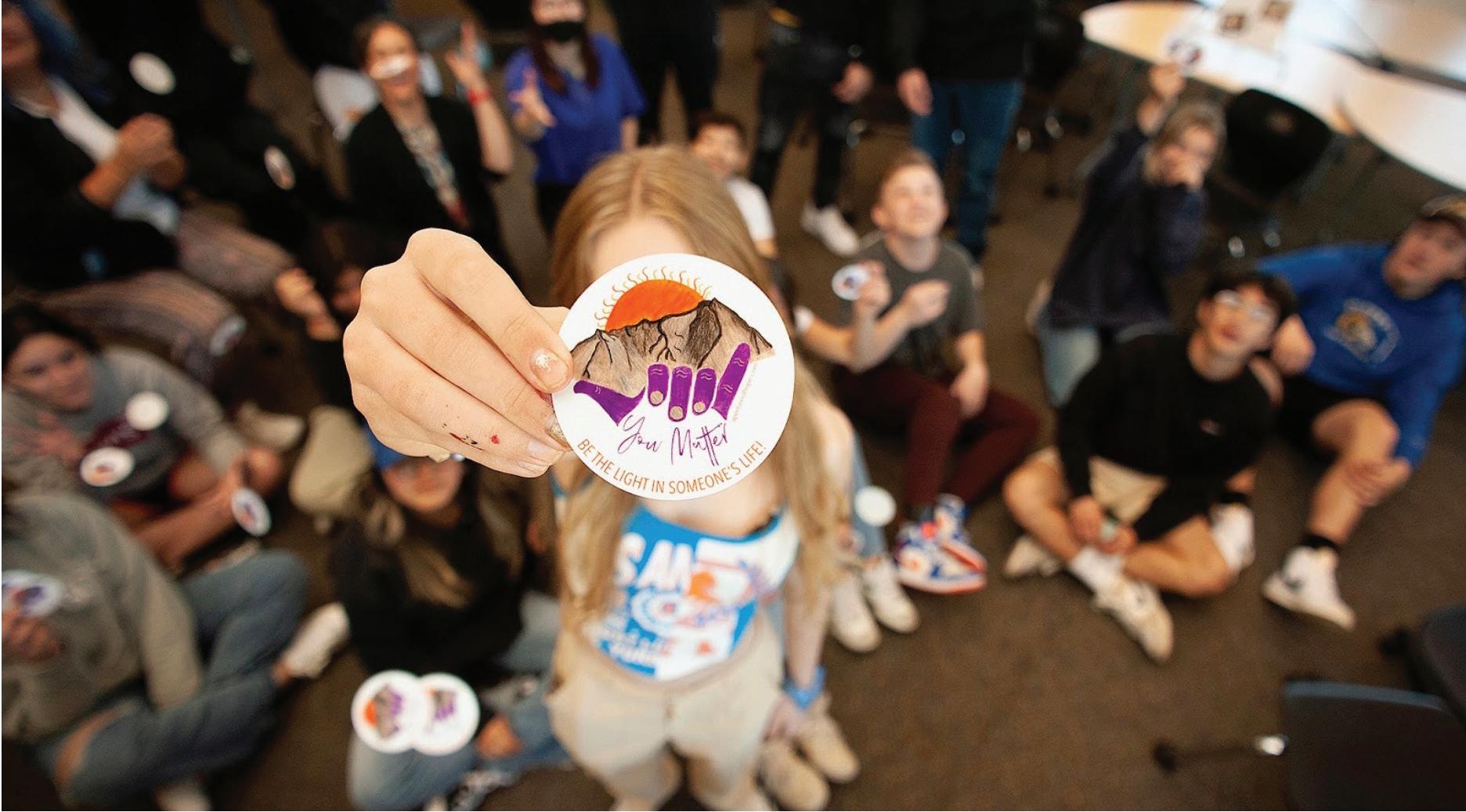
(Above) A student holds up an Aperture of Hope sticker reading "You Matter: Be the light in someone's life." (Right) Cath Adams' late daughter Emily's backpack filled with notes from young people expressing struggle but also hope. Courtesy photos
Megan Hiles, MD, MBA, FACP











X Games and back again
REFLECTION & PHOTOS BY ISAAC
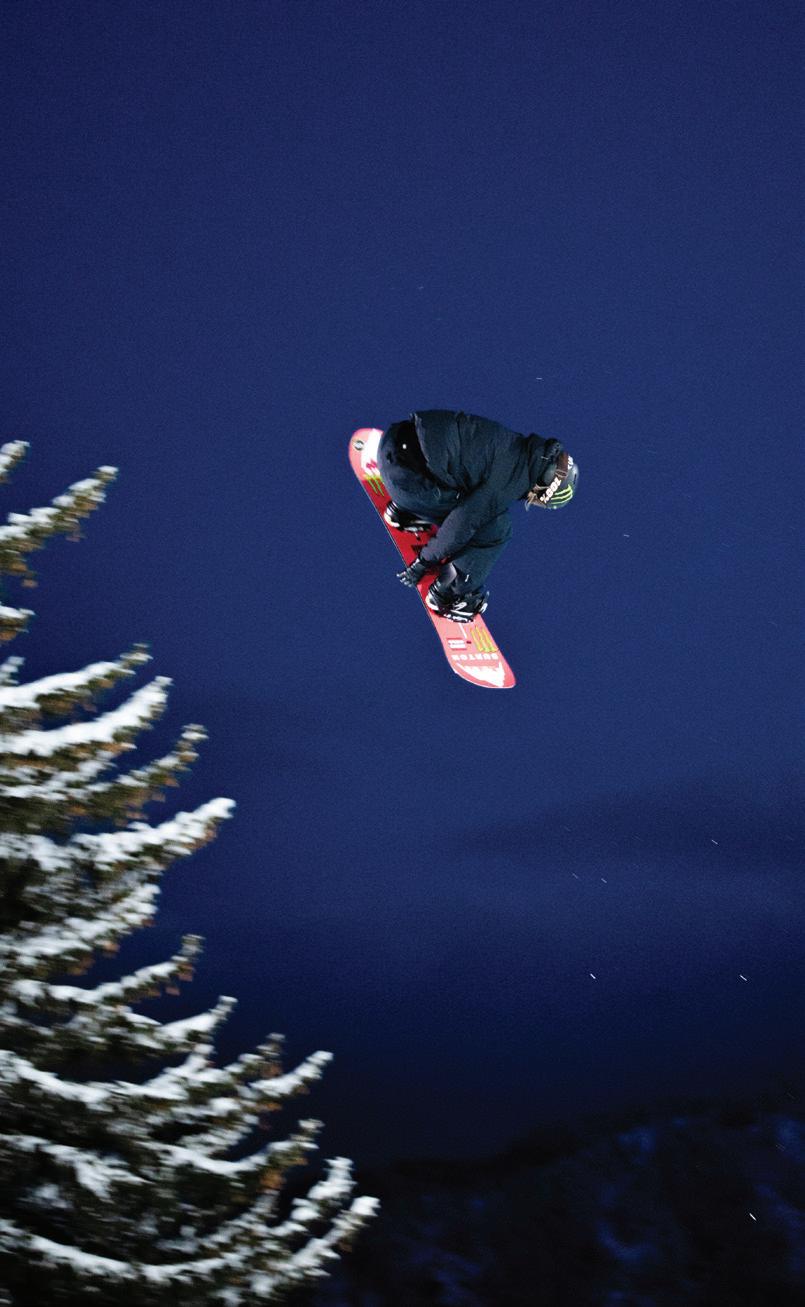
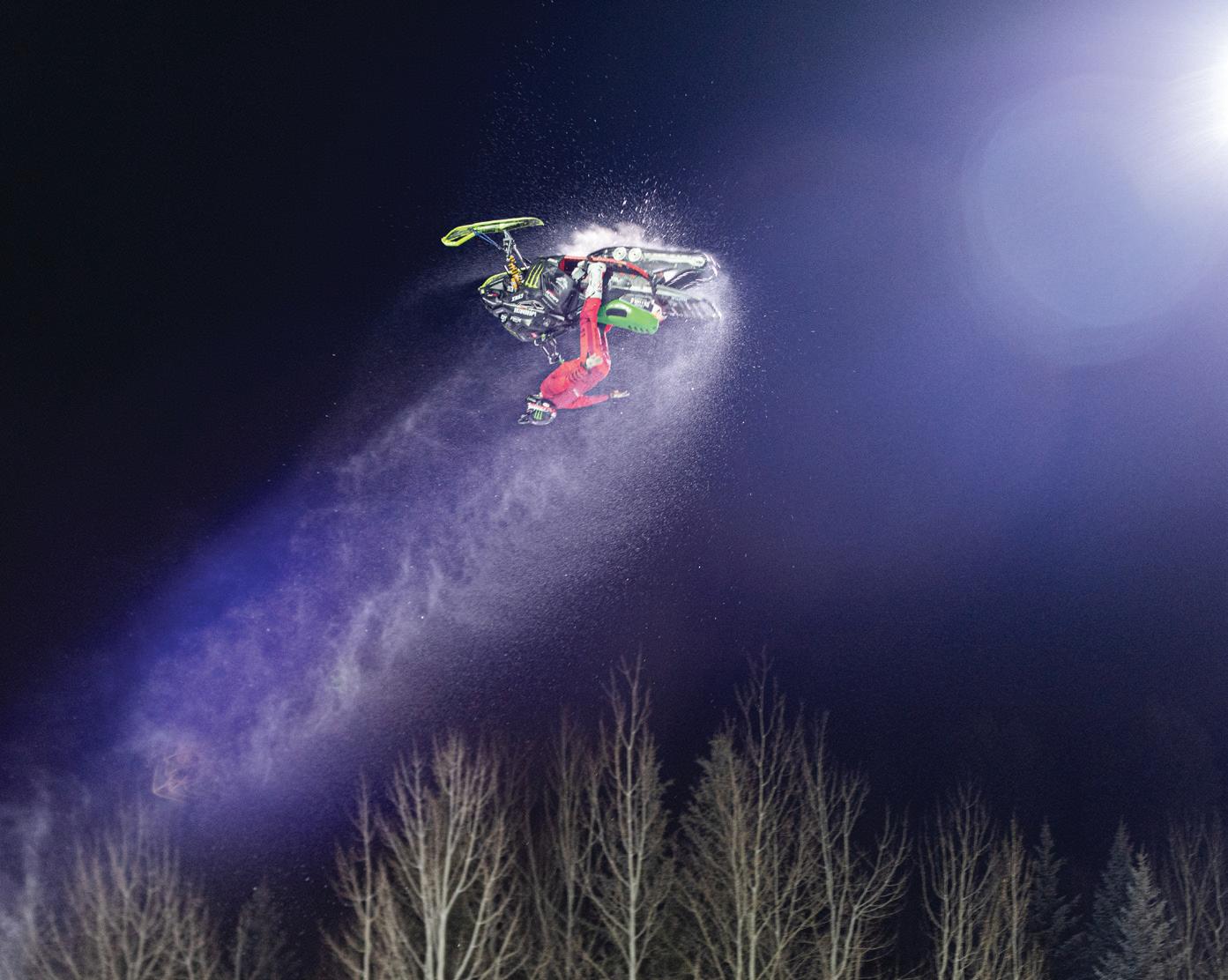
Twenty-five years of X Games Aspen, so many memories made, records broken and dreams coming true. The X Games would not be the event it is without the people coming out in all sorts of weather to support and watch these athletes throw down. This year, spectators got to see the return of Snowmobiling after a pause in 2020. The energy surrounding this particular event was palpable. The second I saw that first rider go off that jump and do a backflip on a sled, I instantly understood the hype. It was truly insane.
Last year, as an intern for The Sopris Stars Youth News Bureau, I had learned so much getting to cover the X Games
for the first time. This year, I was excited to incorporate those lessons learned and cover the event as a graduate of the program now studying journalism at the University of Colorado Boulder. I had the chance to reconnect with other photojournalists I’d met and network with new ones, and even shared a laugh with Aspen Daily News photographer Jason Charme about my slide down the half pipe last year.
I didn’t realize how impactful the X Games were for me, until it occurred to me that not only has it furthered my love for skiing but it’s also given me the opportunity to capture the memories for others through photography. I hope you enjoy this snapshot of last weekend’s X Games.
STERLING
Sopris Stars Alumnus
Zoi Sadowski-Synnott placed second in women's' snowboarding big air.
Marcus Ohlsson throws a no-handed backflip during practice. He injured his back during the snowmobile competition and did not place.
Sara Shimizu took the gold in women's snowboarding superPipe.
Zoe Atkin makes the crowd go wild before placing first in women's ski superpipe.
Nick Goepper secured the silver in men's skiing superpipe.
2025 BINGO WRAP
Designed by Lou Gall
What were you up to in 2025? Use this BINGO card to see how trendy you really were. If you get a blackout, you might be Gen-Z. Let The Sopris Stars know how many boxes you checked by emailing youthnews@soprissun.com
What were you up to in 2025? Use this BINGO card to see how trendy you really were. If you get a blackout, you might be Gen-Z. Let The Sopris Stars know how many boxes you checked by emailed youthnews@soprissun.com
BOUGHT LABUBU HAD GREAT JEANS LAUGHED AT 6-7
WATCHED “STRANGER THINGS” SEASON 5
HAD MOONBEAM ICECREAM WATCHED “MINECRAFT” MOVIE
DYED HAIR TAKEN A JET TO HOLIDAY RAISED YOUR YA YA YA
HAD A WABI SABI HAIRCUT LOCKED IN
BEEN THE YOUNGEST PERSON EVER FEATURED ON A JUMBOTRON
REACHED A FLOW STATE WITH FRIENDS
THIRSTED FOR JONATHAN BAILEY
HAD A SITUATIONSHIP SPOTTED A preformative MALE AURA FARMED GOT LIKE HELLA MONEY (zum zum zum) JOINED REDNOTE
ATE DUBAI CHOCOLATE “YOUR MAMA WAS HOME WHEN YOU LEFT” GOT RAGE BAITED
Letters to the Editor
Have something to shout about? Email letters to the editor for publication in The Sopris Stars to youthnews@soprissun.com
WATCHED “HUNGER GAMES (BUT BETTER)”
REFRAINED FROM BULLYING BBNO$
Congratulations to the Doherty Family, who during the holidays successfully completed last month's Gen-Z slang crossword puzzle together!
SOPRIS STARS TEAM

the meat industry. According to Leather Naturally, “99% of the leathers are made from livestock, (that is cattle, sheep, goats and pigs) and they are a by-product of the meat industry.”
What about the 1%? Especially with pattern-driven facades, how does that supply and demand aspect of the industry affect that percentage?
Snake print for instance increased its presence in various wardrobes in 2025. Production-wise, the Collective Fashion Justice summarizes the process: “Sold skins ripped from snakes are then tanned with largely the same carcinogenic chemicals used in the leather industry. These chemicals harm workers and communities surrounding tanneries, as well as the environment.”
Alongside that, a short video from PETA Asia further walks us through the barbarized process, describing how, “workers place rubber bands around their [the snakes’] mouths and anus,” and “slowly kill them by inflating them with an air compressor.”
“One worker alleged that these snakes were improperly stunned using a car battery — suggesting that they are alive and able to feel pain,” the video continues.
And that's just for clothes made from python. What about fashion made with ostriches, zebras?
Fashion doesn’t just operate on logical use — it partakes in storytelling, communicating our values, history and personal narratives. Did we take our anthropologic traditions too far?
Maybe the question isn’t whether these goods belong in fashion anymore — but why we’re still drawing moral lines that feel selective rather than resolved. Fashion, after all, is fluent in illusion. It teaches us what to look away from just as much as what to admire. And maybe that’s the real discomfort beneath all of this — not the pieces hanging in our closets, but the stories we tell ourselves to keep them there.
“I don’t think Trump has any altruism in him,” he said. “No one is against humanitarian aid, no one is against careful and calculated support, but the impulsivity is offensive. He’s stumbling into this in a very destructive way, but the potential that the regime is unstable, when before things were so set in stone, presents the possibility for actual … change.”
While many Americans dislike the idea of the United States acting as an imperial power, Rosa said Venezuela has not been truly sovereign for years. Russia, China and Iran have been influencing Venezuelan politics and exerting control over the economy.
“It's disgusting to be converted into a footnote in some larger ideological battle. Oppression doesn’t operate in Cold War logic,” he said.
A return to normalcy, although a certainly complicated and convoluted path, is what FA and Rosa both expressed a longing for. Neither saw an obvious path forward, but each highlighted the importance of finding a way to independent democracy.
“There are two levels of hope: Maybe the economy will get better; maybe we won’t get blackouts; maybe there will be investments and economic opportunity. Then, the bigger hope: There will be political change; voting will mean something; you won’t go to jail for criticizing something; your voice will count for [something]. So many people want to work to make this country better,” FA stated. “I studied economics and political policy to make things work. This is a transitional period. We all hope that the people in power won’t just become puppets of the U.S.”
“For decades, we have looked up to the U.S. as a symbol of democracy and freedom,” he continued. “We hope the U.S. can help bring democracy and freedom to Venezuela, without losing your own democracy and freedom in the process.”
Mac Forehand won the gold medal in men's ski big air at the 2026 Winter X Games. Photo by Isaac Sterling
TEEN OPEN STUDIO
Teens artists are invited to create in a zero-pressure environment at the Glenwood Springs Community Art Center (601 E 6th Street) every first Sunday from 5 to 7pm. Art supplies provided.
ECSTATIC DANCE
Alya’s Full Moon Ecstatic Dance series continues at the Thompson Barn in River Valley Ranch with DJ Dustin Eli from 5 to 7pm.
RANDOM CONVERSATIONS
Dive into a meaningful conversation with a stranger at the Carbondale Library every first Sunday from 6 to 7pm.
JEFFREY FOUCAULT
Steve’s Guitars presents Jeffrey Foucault performing at 8pm. Tickets at www.stevesguitars.net
MONDAY, FEBRUARY 2
CITIZENSHIP EXAM PREP
The Rifle Library hosts a bilingual citizenship exam preparation class from 6 to 8pm. Call the library at 970-625-1871 for details.
MUSHROOM MOSAICS
The Western Colorado Mycological Association hosts a family-friendly mushroom mosaic craft night at the Carbondale Community School from 6 to 8pm.
‘URBAN LINE DANCERCISE’
Queen brings the heat with Dance Initiatives’ new weekly “Urban Line Dancercise” class at the Third Street Center every Monday through May 18 from 6:30 to 7:30pm. Register at www.danceinitiative.org
TUESDAY, FEBRUARY 3
BIRDING AT HALLAM LAKE
Aspen Center for Environmental Studies hosts its monthly winter birding outing at Hallam Lake from 8 to 11am. Register at www.aspennature.org
PARKINSON’S SUPPORT GROUP
The Orchard Church in Carbondale hosts a Pakinson’s support group at 1pm.
YOUTH BREAKDANCING
Dance Initiative offers a weekly youth breakdance class at the Third Street Center every Tuesday through May 19 from 4 to 5pm. Register at www. danceinitiative.org
K-POP DANCE CLASS
Dance Initiative also is offering K-Pop dance class for kids and teens at the
Third Street Center every Tuesday through May 19 from 5 to 6pm. Register at www.danceinitiative.org
STORY CIRCLE
The VOICES Story Circles series with Mitzi Rapkin explores “Lanterns and Light: Storytelling as a form of tending a flame” at the Basalt Library from 5 to 7pm. Registration at www.bit.ly/VOICES-stories
‘THE AMERICAN SOUTHWEST’
Roaring Fork Conservancy partners with American Rivers to show the feature-length film “The American Southwest” at 6pm.
DRAWING CLUB
Roaring Fork Drawing Club gathers at
The Launchpad for a social sketch sesh among the Valley Visual Art Show on display in the gallery at 6pm.
WEDNESDAY, FEBRUARY 4
LIBRARY BOOK CLUB
The Basalt Library hosts a community book club highlighting new releases and books of interest from noon to 2pm.
PINTS AND PERSPECTIVES
Dhakiya Mitchell guides a conversation about how Black Americans shaped pop culture during this month’s Pints and Perspectives hosted by the Basalt Library at Mountain Heart Brewery (132 Midland Avenue) at 5:30pm.
NATURALIST NIGHTS
“Life After Dead Pool” author Zak Podmore presents on Lake Powell and the future of the Colorado River at the Third Street Center at 6pm. The presentation will repeat in Aspen tomorrow at Hallam Lake at 6pm.
AUTHOR TALK
Lily King discusses her latest novel, “Heart the Lover,” at Paepcke Auditorium in Aspen at 6pm. Book signing to follow!
NONPROFIT BOARD FAIR
Stop by the Glenwood Springs Library between 6 and 8pm to meet board members from local nonprofits and learn how to support these organizations by volunteering or becoming a board member yourself!
MOUNTAINFILM ON TOUR
Telluride’s Mountainfilm Festival brings a selection of “culturally rich, adventure packed” documentaries to the Wheeler Opera House at 6:30pm. Tickets at www.aspenshowtix.com
Community Ed In Carbondale
CHAI AND NATURAL MEDICINE
Thursday, 6-9pm, 1/29
INTRO TO SOUND HEALING Friday, 6-9pm, 1/30
SEWING - HAND MENDING Fridays, 2-4pm, 1/30-3/6
CHOCOLATE TASTING/MAKING Thursdays, 5-7pm, 2/5-2/12
DECORATE CUPCAKES FOR VALENTINES - ages 8-16 Wednesday, 3-4:30pm, 2/11
OPEN PAINTING STUDIO Tues, 1:30-4:30pm, 2/17-3/24
ADOBE PHOTOSHOP Tuesdays, 6-8:30pm, 3/3-3/24
BEGINNING SWING DANCE Wed, 6:30-8:30pm, 3/4-3/25

FRUIT TREES & SHRUBS
Pruning and Grafting Series Saturdays, 12-4pm 3/7, 4/4, and 5/2
PHILOSOPHY FOR MODERN LIVING with Bo Persiko Tuesdays, 6-7:30pm, 3/17-5/5
AIKIDO
Tue/Thur, 6-7:30pm, 3/17-5/7
PLEASANT DOGS Tue, 5:30-8:30pm, 3/17 ONLINE
*Credit Art Classes In Carbondale
ART OF THE POSTER - Jones Mon, 5:10-8:50pm, 2/9-3/9
INTRO TO PRINTMAKING - Bell Thurs, 9-11:50am, 2/12-4/2
*Senior tuition discount. Call for registration info.
Thursday, 7-8pm, 2/19 in Carbondale Beavers create ecological benefits and habitat, and make landscapes more resilient to drought and wildfires. Explore how we can co-exist with beavers in the Roaring Fork Watershed. Space is limited. Pre-register to save your seat. Scan for Community

Dr. Chris Dunn, a current Aspen Center for Environmental Studies (ACES) resident, will present “Arctic at a Crossroads: Wilderness, Energy and Global Change,” co-presented by ACES and Wild Rose Education, at the Third Street Center on Feb. 2 at 6:30pm. Courtesy photo
2026 Event Program


Ad Rates Per Program
(6.75” x 4.5”) 1/4 PAGE (3.3” x 4.5”) 1/8 PAGE (3.3 x 2.2”)

Trustees embrace fire risk mapping
RALEIGH BURLEIGH
Sopris Sun Editor
The most notable item on Tuesday’s agenda was a conversation with the Roaring Fork Valley Wildfire Collaborative to get the ball rolling on a wildfire risk modeling project.
But first, all trustees were present and received a new ball cap with the Town’s logo. A consent agenda was approved including meeting minutes, a resolution with opt-out fees for the Town’s advanced metering infrastructure program (as discussed on Jan. 14), a project bid award for X Field Services to restore to service a well on the Roaring Fork River for $334,167 and accounts payable.
Doc Philip, aka Doctor Dandelion, gave public comment urging trustees to reduce the speed limit to 10 mph downtown. Trustee Chris Hassig responded, “The Bike, Pedestrian, and Trails Commission shares your concern,” he said, explaining how signage delineating areas with heavy pedestrian and bicycle traffic would be cheaper than curb work to narrow the streets and reduce vehicle speeds.
Attorney Mark Hamilton announced that Town staff is beginning drought planning for the summer, which is “happening much earlier than it has before.” Town Manager Ryan Hyland stated that the new U.S. Forest Service building will soon open to the public with a ceremony in the works for First Friday, Feb. 6.
Town Clerk Patrick Thibault then revealed the candidates for April’s municipal
BASALT REPORT
election: Colin Laird, Chris Hassig, Joanne Teeple and Kade Gianinetti will compete for three trustee seats; Erica Sparhawk and Patricia Savoy are running for mayor.
The meeting proceeded with an update from the Carbondale Aquatics Center team. Tammy Tucker, representing Wember (the owner’s rep), told trustees, “The likelihood of spending all of the contingency is diminishing.” In other good news, Aquatics and Health & Wellness Coordinator Brian Froelich announced the project received a $25,000 grant from the El Pomar Foundation, bringing the fundraising total to over $2,114,000. AD Miller will soon begin plastering the pool surfaces under heated tents and landscaping will be installed this spring.
Trustees then heard a WE-cycle update from Executive Director Mirte Mallory and System Director Jack Dimmit. According to their data, Carbondale’s network has seen 6,732 trips since opening Aug. 1, 2023, with 99% under 30 minutes. There are 3,472 unique riders with around 750 active users per month, and Carbondale’s Park and Ride is the third busiest WE-cycle station in the Valley. WE-cycle looks to install a new station this year, likely near the Third Street Center. A consolidated base plate design could increase existing stations’ capacity by 50%. Carbondale will also debut a QR code system for unlocking bikes.
Next up, Emily Williams with Clean Energy Economy for the Region (CLEER) presented on 2025 successes and a work plan for 2026. CLEER is contracted to
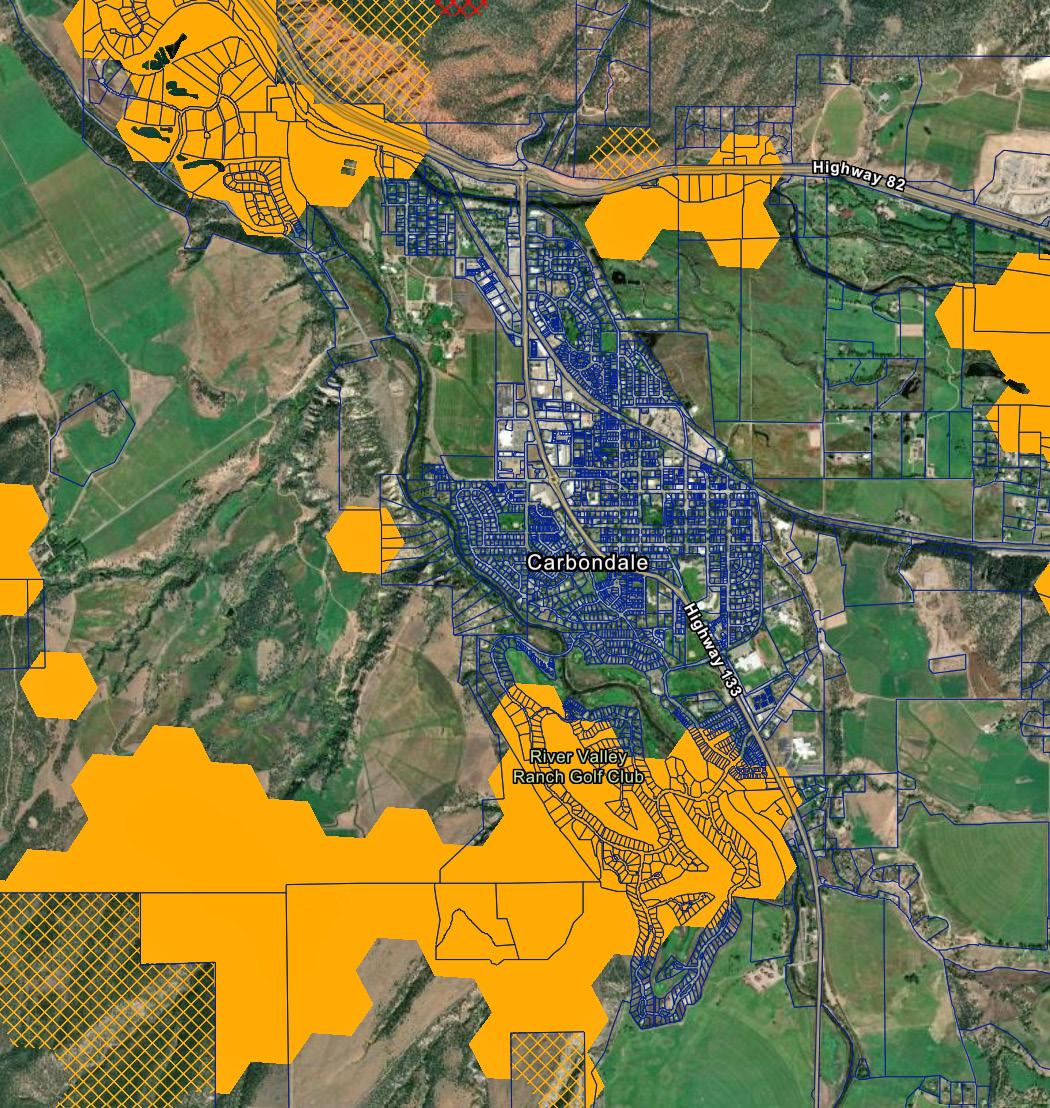
support the Town’s Path to Net Zero goals. CLEER is developing a rebate program making use of $94,000 in funds collected from builder fees associated with high energy demands. Among Williams’ announcements, a turf replacement program championed by Bee Friendly Carbondale and the Environmental Board will not return because most properties
applying were on ditch water and ineligible. Lastly, Roaring Fork Valley Wildfire Collaborative Executive Director Angie Davlin, data collector Nick Sparling and Fire Chief Rob Goodwin updated trustees on a wildfire risk modeling project for Carbondale. Dr. Hussam Mahmoud with Vanderbilt University has developed a
Town finds its place in tackling regional housing needs
WILL BUZZERD
Sopris Sun Correspondent
This week, the Basalt Town Council was provided with a decades-long look at housing needs across the Roaring Fork Valley and where Basalt stands among trending rises in home vacancy rates, median home prices and rental costs with an assessment that projects the Town may have to construct over 600 units in the next 10 years.
In 2022, the Town directed staff to pursue funding from Colorado’s Proposition 123 — the initiative that created the State Affordable Housing Fund to support statewide housing programs. However, in order to receive that funding, Basalt needed to conduct a housing needs assessment.
Municipal governments which have completed and filed housing needs assessments are prioritized to receive grant funding from any program associated with the Colorado Energy Office, Office of Economic Development and the departments of Transportation, Natural Resources, Public Health and Environment and Personnel and Administration.
In 2024, the Town contracted Economic and Planning Systems
(EPS) to complete a local housing needs assessment. However, state legislation requires that this housing needs assessment to be updated in order for Basalt to re-secure priority for grant funding. Instead of completing another entire local assessment, the Town held out for regional housing assessments to be completed for both Eagle County — which completed its own housing assessment last week — and the Roaring Fork Valley.
Pitkin County, Snowmass Village and the City of Aspen contracted with EPS in 2025 to fully cover the Roaring Fork Valley region. Liz Axberg, Aspen’s housing policy analyst, presented the assessment, which aims to provide the scaffolding for regional collaboration. While this assessment does not provide Basalt’s housing needs relative to the entirety of Eagle County, it does account for all of Basalt’s housing needs, including parts of town within Eagle County.
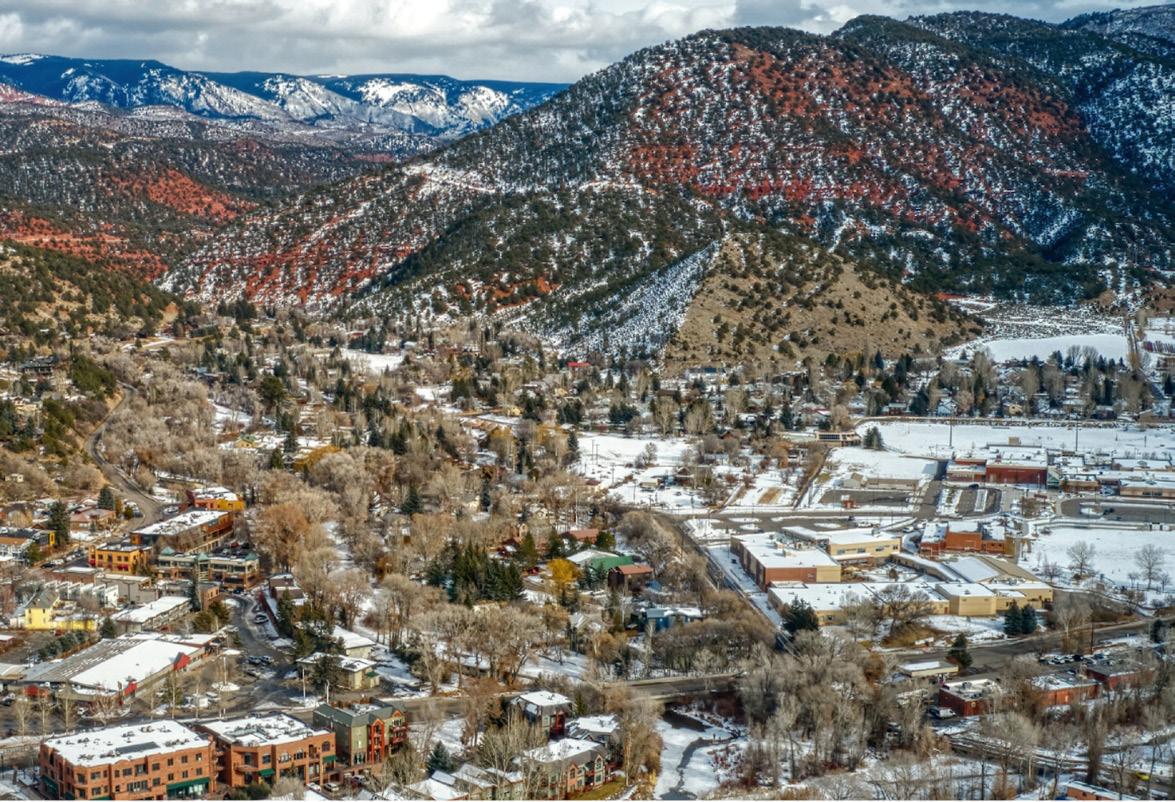
The regional housing needs assessment found that, between Aspen and Carbondale, there is no municipality where the median price of a single-family home is less than $1.5 million. The report combined Basalt and Carbondale’s home-sales statistics under the “mid-valley,”, and found that 47% of all sales were only affordable to households earning over 400% of the area median income (AMI).
The regional housing needs assessment found that, from 2015 to 2023, Basalt experienced a 2.6% increase in the amount of housing units — the fastest growth of all municipalities in the region. Conversely, Basalt’s vacancy rate increased from 16.7% to 18.1% between 2010 and 2023. In this region, a “vacant” home typically means a non-primary residence or vacation rental. While Basalt’s vacancy rate is much lower than the 2023 Pitkin County average of 41.4%, the rate continues to rise regionally.
Furthermore, while Basalt has the lowest percentage of affordable housing among Pitkin County municipalities at 18.3%, its ratio is still well above that of all other Garfield County municipalities;
Carbondale has the highest ratio of affordable housing thereof at 8.3%, with Glenwood Springs following behind at 2.4%.
Ninety-percent of the region’s affordable housing inventory is in Pitkin County. In fact, 65% of that inventory is in Aspen alone. Either way, the housing needs assessment projected a need of 2,853 new housing units in Pitkin County over the next 10 years. Roughly half of that need is concentrated into Category 2 (51% - 85% AMI) and Category 3 (86% - 130% AMI) housing. This 2,853-unit need is based on a 59% existing shortage and 41% projection of estimated regional growth.
In order to meet that regional need, the report projects that Basalt will have to construct 606 units within the next 10 years. Entitled units and units under construction in Basalt (such as at Basalt Center Circle and the Tree Farm, respectively) are excluded from that estimate. However, it is not a binding commitment for Basalt to build this amount of housing.
Councilor Ryan Slack thanked Axberg and her team on behalf of the Town of Basalt for going well beyond their own boundaries for the good of
region.
This map shows where the State of Colorado’s new Wildfire Resiliency Code will require compliance beginning July 1. Explore the map online at www.bit.ly/CO-fire-resiliency
Courtesy graphic
Spring transits placing you in community
Bringing astrology to the people of Carbondale and beyond is the passion of Crystal City Astrology, founded by Susanna Kitchen. Offerings include the Cosmic Chatter podcast (also periodically live on KDNK), planetary transit articles, birth chart readings and workshops. Join on Substack @crystalcityastrology or visit www.crystalcityastrology.com to learn more.
Throughout January, the Sun, Venus, Mars and Mercury assembled in Capricorn to examine the potential in our personal lives. I wonder what new ideas you’ve tried on? What values you’ve reflected on? With the Capricorn new moon on Jan. 18, our emotions and needs came to join the crew. What intentions did you set? Now that we’ve moved into Aquarius season, internal composting work can be applied to the common good.
OPINION
COSMIC CHATTER
By Susanna Kitchen
The full moon in Leo on Feb. 1 is the symbolic flowering of a plant that was seeded at the new moon. Intentions are seeds. At the new moon we plant them. As the moon waxes, we nourish them, their coiled bodies emerge from the surface of the soil. At the full moon, the young plant stretches for the sun, full of life and expression, and beginning to flower.
On this Leo full moon, we must play. Like the flower calls pollinators with its petals and sepals, we need to play with others. We must sing and dance together. We must fill the busker’s cup. When we express our creativity through play, we generate energy and share it with others. That’s the aim here.
This full moon is also the last before eclipse season, which happens every six months. Honoring the clear, reflective power of the moon before the blurs of eclipses is necessary. At this time, our play is about our survival. We learn to respond to unknown circumstances and challenges. We release expectations to outcome when we foster free expression.
On Lunar New Year, Feb. 17, the sun and moon meet for a solar eclipse in Aquarius. Ambiguity or confusion about our responsibility to the collective may come up, in what we’ve agreed to already and future possibilities. Eclipses obscure the luminaries, welcoming our awareness of the shadow. They are times to observe and take notes, and to notice incongruence within.
This solar eclipse may make us curious about the motivations for our solo performances. Do we share our creativity with others? It examines access and impact without attachment or judgement toward the show. Because it’s square Uranus, we may come upon an unexpected change of course or epiphany.
On Feb. 20, Neptune and Saturn meet at the first degree of Aries. They conjoin every 36 years, roughly, but haven’t met in Aries since 1703. Here we see early independence movements away from monarchies, early enlightenment thought and mechanical inventions that contributed to the Industrial Revolution. Saturn is a world builder and Neptune is unbound idealism. Together they collaborate in a rebirth of humanity, of heroism, perhaps dissolving the individual. As this dream becomes reality, we must remember that the one is supported by the many. In this way we call in Libra, the opposite of Aries, to balance out the individual with the other. Be wary of fierce impetus to change without consideration for impact, as Aries can be catalyzing without consideration of consequence.
Eclipses come in pairs. On March 3, the lunar eclipse signals the ending of eclipse season. With the sun in Pisces and the moon in Virgo, there are themes of service and healing shared between internal and external landscapes. This is the last Virgo eclipse of the series, which calls to a longer story that began in September of 2024. Virgo brings accountability to Pisces’ compassion because Virgo understands the limits of an energy exchange and that overcommitment ultimately harms the giver.
Use this time to reflect on the state of your mental and emotional health. We must be well in these areas in order to ride the waves of outer planet activity this year. If you need a break, please take it! Mercury goes retrograde from Feb. 25 to March 20 — another prompt to reflect on holes in our plans and anticipations. Spring comes on March 20 when the sun moves into Aries, and immediately the pace and intensity of life accelerates. Mars, the great initiator, embarks on a journey to conquer. April 9 to May 17 is an opportune time to begin a creative project or a workout routine. Aim for mindfulness of your limits in this time too, because excessive heat and energy from Mars can be harmful if not well tended. With help from Saturn, the steadfast authority in our lives, it may just stick!
At home in Aries, Mars meets Neptune on April 12 and then Saturn on the 19th. I expect this to be one of the busiest times of the year, and not free of pivots or snafus, as Neptune is known to scramble messages.
By anticipating the energies, we can put them to work as well as allow inconveniences to pass with grace. Expect to be beat up and burned out by May. This is why I reminded you to rest and reflect during eclipse season! Look to the end of May and early June for a rejuvenating time.
A few words about embezzlement
Malcolm McMichael lives in Carbondale and helps local small businesses and nonprofits with accounting management, CFO, strategic advisory and fundraising advisory services. Details about McMichael Management Services can be found at www.malcolmmcmichael.com
This is my first installment of The Green Eyeshade, a periodic column for the Sopris Sun, broadly covering issues of interest to small businesses and nonprofits. The name refers to the caricature of old-time bookkeepers who, according to the internet, wore cellophane visors to protect themselves from eye strain.
I’m an old-time accountant myself, having started out as an auditor and then an accounting manager. Now I provide consulting services to small businesses and nonprofits. I love the energy and mission zeal of entrepreneurs and nonprofit leaders.
OPINION
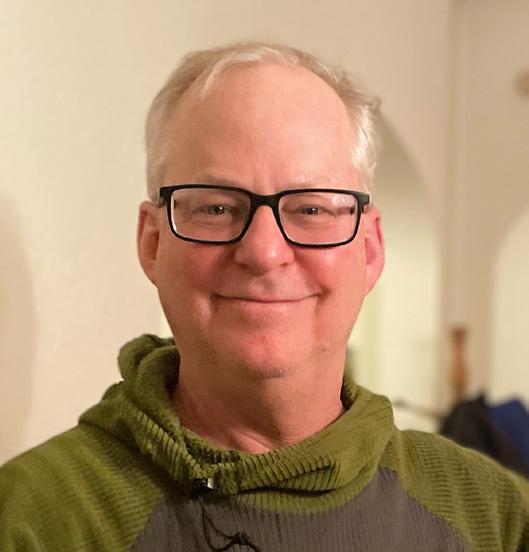
In my 40 years of doing this work, I’ve nearly seen it all. One thing I have seen far too often is incidents of embezzlement. I’ll not go into the gory details here; we’ve all seen the news stories. Many business owners know someone who was victimized, or were victims themselves. Occasionally, an incident is so large, it makes the newspapers. Yet, many more incidents never make it to the news. Because owners tend to prefer to move on, the cases are not publicized and the perpetrators are never prosecuted. In fact, some perpetrators move on to other companies and do it again. Embezzlement can happen in any setting and type of business, and often comes from trusted employees and even family friends.
and controlling all steps of the cash process without a second set of eyes checking in. This is the recipe you want to avoid. What can a busy business owner do? What you can do is reduce the opportunity. Think of it like locking your car doors in the city, there are some things you can do to improve your odds and trim the opportunities for theft.
THE GREEN EYESHADE
By Malcolm McMichael
Embezzlement means the stealing of money from an organization by a person in a position of trust. Embezzlement is often a crime of opportunity, whereby inattentive, distracted and trusting small business owners provide unmonitored access to the cash and credit of the company. Some employees have a moment of weakness or financial strain, and so they steal a little when no one is looking, telling themselves they will pay it back later. Or they impetuously seize an opportunity to increase their pay a bit, because they “deserve it.” Others are thieves to the bone. In any case, they often start with a small amount, and when no one notices, they take a little more, until they are in too deep to stop.
Small business owners and nonprofit directors are busy people. They have many obligations, and often little interest in accounting work. This is ironic, because the accounting is critical. In my experience, many small businesses significantly underinvest in their accounting. However, owners are insanely busy, so when they encounter a staff person who is willing and able to do the accounting, they feel lucky. This is the first step in the chain of embezzlement: not overseeing the accounting. Pretty soon, the accountant is opening all the bank statements, signing the checks
Control the cash, be the one to sign the checks. Or at least watch the cash. If you only do one thing: Watch the bank account and credit card statement. This can be as simple as logging in once a month and reviewing the activity. Look for unexpected activity, missing deposits or payments that don’t seem quite right. Do this every Monday, five minutes in the morning with your coffee. There, done — you have just reduced your risk immensely. Other measures include: check references for new employees; open the mail yourself occasionally; use a “generic” email address for your accounting that you can access (such as “accounting@yourcompany”); listen to your customers and vendors if they complain about unusual recordkeeping from your company; ask direct questions of your accountants about unexpected results; set clear boundaries on the level of authority (in writing). There are red flags to watch for. Not to go too deep into the profiling, but if your accountant is griping all the time about their low pay and their personal financial affairs are in a mess, you might want to consider a heightened state of awareness. Another red flag is bookkeepers who refuse to let others see into the books, or always have an elaborate excuse for why things don’t make any sense. These are nuanced concerns though — bookkeepers are control freaks by nature and necessity, and keeping up with the financial meanderings of small business owners can be a daunting challenge and difficult to explain.
Nonprofit boards have a role as well: Pay attention to the financial statements and the professionalism of your accounting function. If you do not have adequate financial expertise on the board, obtain it. Finally, if you suspect that you have been victimized, see an accounting professional to determine the extent of the damage, and to close off access to further damage. Consider contacting the police. I do not wish to overstate this risk, because the vast majority of accounting staff are hardworking, ethical people who want to help a company meet its goals. But it is important to think about, because a few modest preventative actions can reduce your risk and bring some peace of mind.

Palestinians’ sumud, a lesson Americans urgently need
ROBYN MCBURNEY Guest Opinion
EDITOR’S NOTE: Robyn McBurney is a Roaring Fork Valley local who recently visited Palestine. In October and November of 2025, she spent 40 days in the occupied West Bank with the International Solidarity Movement, witnessing and documenting the conditions Palestinians face. She holds a bachelor’s degree in Middle Eastern and North African studies and shared this reflection with The Sopris Sun.
The most important lesson I learned volunteering in Palestine wasn’t about politics. It wasn’t about history or diplomacy or “conflict resolution.” It was about a quality of resilience so profound it has its own word: sumud. Steadfastness.
I visited Palestine with a degree in Middle Eastern studies, fairly confident that I understood the situation. I knew the statistics, the history, the vocabulary of occupation. But nothing prepared me for the reality of living under a system designed not just to control territory, but to erode human dignity through calculated uncertainty.
My journey began with a three-hour interrogation and a strip-search at the Israeli border. My offense? Soldiers suspected I spoke Arabic. These days, a solo traveler without family receiving them in Israel is a red flag that you might, gasp, be there to volunteer in Palestine.
This calculated humiliation is not an anomaly; it is the architecture of daily life under military occupation. In Al-Khalil (Hebron), I saw a city carved in two. In the historic center, Palestinian families live under the boots of soldiers and the harassment of illegal settlers who occupy the apartments above their homes and shops. Nets and wire mesh stretch over market streets to catch the trash, wastewater and sometimes boiling liquid dumped on shopkeepers and passersby below. The goal is not subtle: Make life so unbearable that people leave.
Every Saturday, I witnessed what locals call “settler tours.” Armed soldiers would clear Palestinian families, journalists and even children playing soccer from their own streets. Then, groups of tourists — often Americans if the accents were anything to go by — would be escorted through, viewing shuttered Palestinian shops and homes as potential real estate. It was displacement as a spectator sport, a chilling performance of power meant to showcase who controls the narrative and the land.
Yet, amidst this grinding pressure, I witnessed a profound and transformative force: sumud. This Arabic word translates to “steadfastness,” but it means something deeper. It is the disciplined, daily choice to live with dignity when every system is designed to strip it away.
I saw sumud in the teachers who educate children in schools, now open only three days a week because tax revenues have been withheld for years. I saw it in the farmers who harvest their olives, knowing masked settlers might attack and that the army and police will only make
the situation worse if they’re called to intervene; in the shopkeepers who open their doors each morning under wire nets, often without seeing a single customer all day. I saw it in families who, after a meager harvest, offered us meals and endless coffee, expressing sincere gratitude for our mere presence.
This is where the lesson for America lies.
In the United States, we often confuse activism with aesthetics. We champion resistance that is dramatic, photo-worthy and finite. We show up for a protest, sign a petition and then log off. We expect progress to be linear and responsive to our effort. When it isn’t, we risk frustration, burnout or distraction.
Palestinians do not have that luxury. For them, politics is not abstract. It is a soldier at a checkpoint turning a 10-minute school run into a two-hour ordeal with lives at stake. It is a permit denied, a home demolished, a body withheld from a grieving family. Their resistance is not a moment; it is a continuum. It is the stubborn, unglamorous, and essential work of enduring — of going to school, tending the land and preserving community as the world looks away.
This steadfastness exposes our fragility. We are conditioned to believe that if a problem doesn’t yield to a quick fix, it is unsolvable. We often mistake discomfort for danger. Palestine teaches that freedom is not won in a single, heroic showdown. It is built through thousands of small, unyielding acts of refusal: Refusing to abandon a home, refusing to stop working, refusing to let joy be extinguished.
So, what can Americans do? We must move beyond symbolic solidarity. Palestinians do not need our hashtags as much as they need us to stop fueling the machinery that oppresses them. This means demanding our government reasonably condition military aid on human rights, challenging media narratives that obscure apartheid and holding corporations — especially those here in Colorado, like Palantir and Lockheed Martin — accountable for profiting from occupation.
Most importantly, we must learn from their discipline. This means staying engaged when the headlines fade. It means consistent political pressure, not just outraged reactions to crisis after crisis. It means rejecting false equivalences between occupying powers and occupied peoples. It means recognizing that our comfort here in the imperial core is built on the suffering of others — out of sight and out of mind — and that silence in the face of injustice that you’re funding is an endorsement.
I returned from Palestine changed. I saw a people practicing life as an act of defiance. They have shown that the most powerful force against a system designed to dehumanize is an unwavering commitment to one’s own humanity.
The least we can do, with all our privilege and safety, is to refuse to look away. We must match their steadfastness with our own sustained action. Palestinian resilience is a lesson for the world.
For Miller, the decision to move operations out of Carbondale was shaped by years of trying — and failing — to make the economics work in the Roaring Fork Valley.
“From the beginning, it was awesome to be here, but it was certainly always the biggest challenge,” he said. “We pay 20 to 50 percent more for the same jobs here than we would in Denver or Salt Lake and even then, it doesn’t make housing affordable for most people.”
Miller subsidized housing for employees and explored other creative solutions, but ultimately found none sustainable. Logistics were another challenge. Shipping to and from Carbondale adds two days to receiving and delivery times — along with additional risk.
“When Glenwood Canyon is closed and a shipment doesn’t arrive, we have angry customers who don’t have their bikes,” Miller said. “That’s not a long-term business plan.”
Golden, he said, offered a balance Carbondale couldn’t: proximity to industry partners and Denver International Airport, a larger workforce, faster shipping and more attainable housing — while still providing access to mountains and trails.
While operations are shifting, Miller emphasizes that Revel is not disappearing from Carbondale. The company plans to open a pop-up demo center in the Roaring Fork Valley in summer 2027, with the possibility of a longerterm satellite presence.
“There’s not a better place in the world to step out the door and demo a bike than here,” Miller said. “That’s something we’ll always miss.”
Revel hosted First Friday block parties, community events, and demo days that helped define the brand. The move to Golden represents both loss and opportunity.
Since purchasing Revel in May 2025, Miller says the company is on firmer footing. Year-to-date revenue is up more than 300% compared to the previous year, and the company is cash-flow positive. Several original team members have returned, but the move means leaving the place where the brand was built.
“In a perfect world, housing would be affordable here and we could make it work,” Miller said. “But that’s not the reality. This is about building something that lasts.”
BUSES
from page 7
and bilingual instruction, and the fact that TRCS has classes five days a week, compared to Re-2’s four-day school week.
“A huge part of our model is getting the kids out of this building to places throughout the Roaring Fork Valley and beyond for what we call field studies,” Nims said. “We try to get the kids connected to professionals in industries that are either directly or closely aligned with things that they study through the state standards.”
Having the ability to bus students also helps serve the school’s lower-income students, which is about 30% of the student population based on free and reduced lunch eligibility, Nims said. That point is also addressed in the lawsuit.
CARBONDALE
from page 13
tool for predicting wildfire behavior that has so far been implemented in Marble, Snowmass Village and parts of Glenwood Springs.
“Wildfire is no longer a forest problem, it’s a problem of our urban environment,” said Davlin. “We are less worried that wildfire is going to rip through the Forest Service area. We are very worried that fire is going to come through Carbondale and just start spreading home to home.”
With $100,000 already committed from the Town of Carbondale, as well as $50,000 from the Carbondale & Rural Fire Protection District (CRFPD), data will be collected about structures within Carbondale and the surrounding area, including Missouri Heights County Road 100 and Aspen Glen. This canvassing will help CRFPD with proactive resiliency planning, as well as the designation of evacuation routes given a variety of scenarios. Community outreach will begin in February. Goodwin also announced that CRFPD is standing up a wildland fire division this year.
A young child heads to school through Checkpoint 56 in occupied Al-Khali (Hebron).
Photo courtesy of the International Solidarity Movement
The Art Commons: A new communitycentered space for connection
FELIPE PEREZ Sol del Valle
With the goal of encouraging creativity and bringing art closer to the local community, The Art Base in Basalt recently announced the opening of a new space called the Art Commons.
Located in the front window of The Art Base’s main building and highly visible from Basalt’s main street, this space has been designed as a public, open-access area where a variety of artistic and cultural expressions can take place. Activities may include community art exchanges, interactive talks and small exhibitions.
In an interview with Annie Henninger, executive director at The Art Base, she explained the vision and benefits behind this new space.
What is the Art Commons?
It is an informal gathering space within The Art Base where everyone is welcome to express themselves, create art and connect with others. I see it as a low-pressure space, open for the community to use freely. Anyone can bring a group and work collaboratively with others in the community.
Who is invited to use it?
It is a free, public space. We believe art is for everyone. It’s an invitation to the community to come in, enjoy and be in a creative environment.
Is registration required to enter the space?
It is an open-access space. No registration is required. It has been open to the public since Jan. 16 of this year.
What else can people do in this space?
People can read, create art and participate in our art exchange. If someone creates a piece, they can trade it for another, bring a piece of art or take one home. We also have a station with art supplies so visitors can create on-site. We want the space to feel relaxed and casual.
Many people don’t fully understand what The Art Base
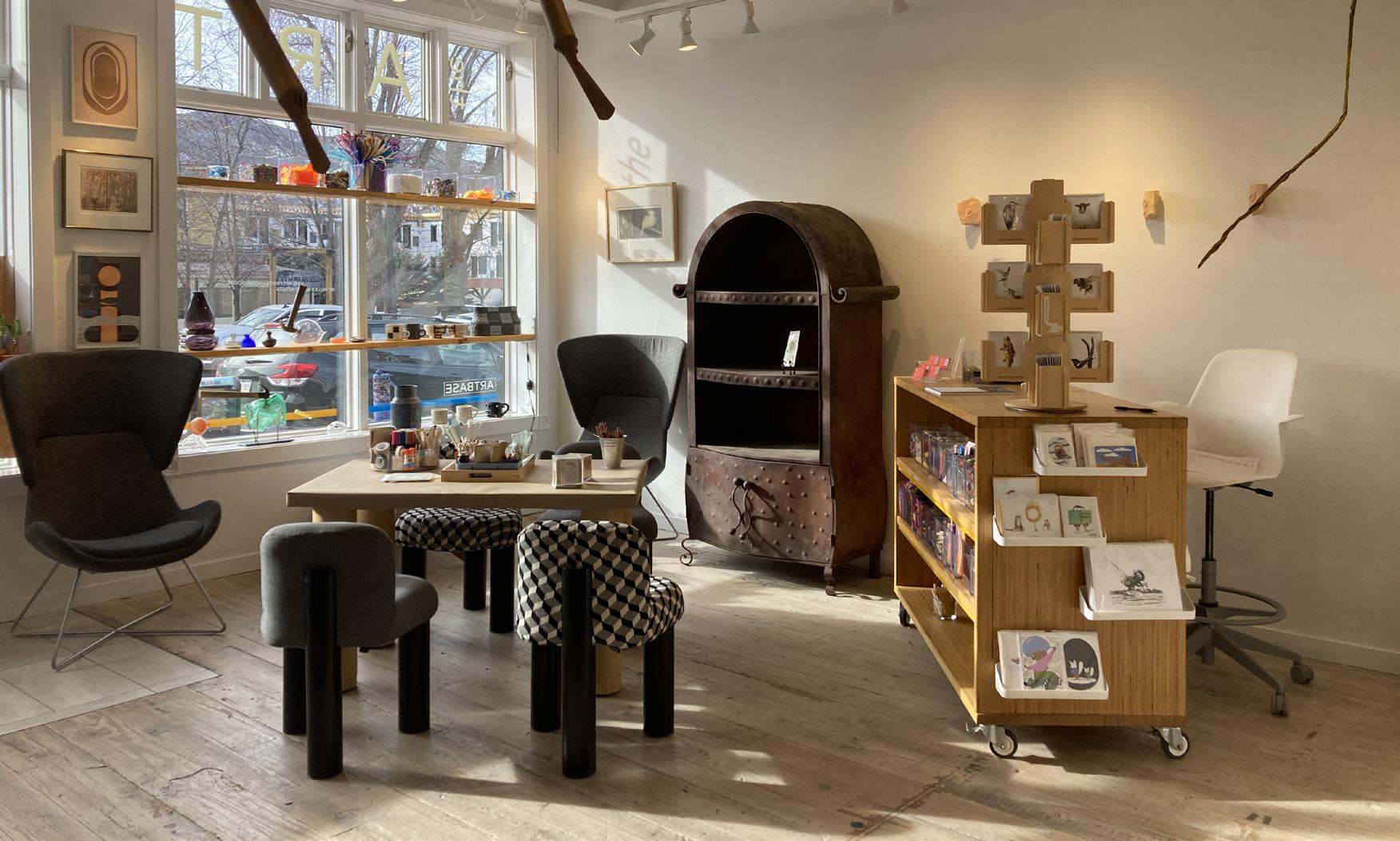
is, partly because it’s located on the second floor and isn’t always visible from the street. With the Art Commons, we want to better communicate that we are a community art center, that people are welcome, and that this is a space to learn and connect. What do you consider another strength of this space?
We are presenting everything in both English and Spanish. We’re excited to see the results and to remain flexible, adaptable and responsive to the community. This space is an experiment that will allow us to listen and evolve alongside the people we serve. We care deeply
about the community and want to embrace and support everyone who is part of it.
The Art Commons is designed to lower creative barriers. This means encouraging people to engage with art, discover their artistic and literary potential and feel comfortable developing their creativity.
The Art Base invites the entire community to visit this creative and symbolic space, as well as to come in and ask about the various programs they offer. No restrictions apply, scholarships are available and everyone is welcome.

The Art Base is open from Wednesday to Saturday from 11am to 5pm. To learn more about their programs, visit www.theartbase.org/calendar
The community is invited to the closing celebration for the Laura Thorne Sculpture Program on Friday, Jan. 30, from 5 to 7pm, with an artist talk beginning at 5:30 p.m.

The Art Commons provides a space and materials for artistic exploration. Courtesy photos


million dollars in transportation funding was canceled. Disaster declaration requests were denied after devastating wildfires and severe flooding. Federal leaders announced plans to dismantle the National Center for Atmospheric Research in Boulder, a cornerstone of climate and weather science. Infrastructure legislation meant to deliver clean drinking water to tens of thousands of
These are not abstract political arguments. They are decisions that affect roads, water systems, emergency response, scientific research and public safety statewide. While Aspen may feel insulated, we are not separate from Colorado. Our workforce, environment, water supply, transportation systems and economy are deeply connected to communities far beyond Pitkin County. Pitkin County is not lacking resources. Local property taxes exceed $219,000,000 annually. Combined local sales taxes exceed ten percent. The county also holds more than $167,000,000 in reserves, including funds set aside for stabilization and emergencies. These figures show capacity. We are positioned to lead when
Aspen often presents itself as a leader in climate action and civic engagement. That leadership should extend beyond our borders. Major institutions that benefit enormously from this community, including Aspen Skiing Company, have the ability to do meaningful good. Using their resources to support communities across Colorado would strengthen the state and build trust with workers, visitors, and residents who are facing
As one of the wealthiest counties in the nation, Pitkin County has a responsibility to reach outward. That means advocating at the state and federal level, supporting other counties, defending scientific research, and helping ensure all Coloradans have access to safe infrastructure
Speaking up on behalf of Colorado is not partisan. It is civic. Doing nothing may be easy, but leadership requires more.
Perrin Williams Snowmass Village
At least two American citizens — Renee Nicole Good and Alex Pretti — have now been murdered in broad daylight in Minneapolis by poorly trained ICE agents.
Or, if you prefer to take the Trump administration’s word for it, those people were dangerous domestic terrorists who deserved what they got.
How is it that Trump supporters unequivocally accept his word even when his wistful narrative of events goes against what countless people witnessed in plain sight and caught on video? Before there’s even a facade of due process? How is it that every shred of evidence that goes against Trump is dismissed as a lie, part of a broad conspiracy, but his word remains above question, even as his actions belie duplicity?
Trump rules by a double standard. He champions “small government” while ordering the National Guard into states that voted against him in the election.
Reason is dead. And it is likely that
more innocent people soon will be too. ICE operations have been active in Eagle County and no doubt they will be making their way into Garfield County soon enough.
On Jan. 4, the shooting range west of New Castle was popping all day long with semi-automatic gunfire. Giant Trump flags still fly high thereabouts, and our own Garfield County Sheriff and County Commissioners have expressed their support for Trump over the years, even recently at the Jan. 20 commissioner meeting, according to a report in the Jan. 22 Sopris Sun, which quoted Commissioner Mike Samson saying, “I support President Trump in many of the things he is doing….”
I doubt our local leaders and law enforcement will be inclined to invest much effort to protect peaceful protestors, and many of our fellow residents may be all too happy for the opportunity to bash some “liberals” in the face. But if we wish to stop this theft of our country, we must brace ourselves for the reality that is about to hit very hard, as we stand together peacefully against unleashed violence.
Eventually there will be too many nonviolent “terrorists” for anyone to deny who is really committing the atrocities.
Derek Franz Carbondale
Home Care & Hospice thanks
I would like to thank Peter Schoomaker, administrator of Homecare & Hospice of the Valley, and Melinda Egging, CEO of Sangre de Cristo Community Care, for their creativity and insight in working together to create an affiliation that will strengthen the patient care for hospice patients in the Roaring Fork, Aspen and Vail valleys!
As the only nonprofit hospice organization in this area, this affiliation will allow us to be focused on providing the best possible care for our patients and their families throughout our large rural service area, while spending less time and effort on the administrative tasks involved in running the organization.
I have been involved with Homecare & Hospice of the Valley for over 10 years as a volunteer and now as a board member, and I am fully aware of the wonderful services provided to our patients and families by local physicians, nurses, caregivers and volunteers who live and work in our communities. I am also aware of the difficulties of covering such a large service area.
This affiliation allows us to benefit from the knowledge and shared resources of an organization that is as fully committed to rural nonprofit healthcare as Homecare & Hospice of the Valley, while also providing the administrative staff and expertise needed to complement our work. Yet we will remain autonomous by keeping our own board of directors. Funds raised through donations and fundraising efforts such as the Trek for Hospice, remain in our local community.
I truly believe that this is a win-win situation for both organizations and most of all for keeping the focus on our shared mission, which is providing peace, care and support for our patients and families during their final days.
Jeanne Sheriff Glenwood Springs
PARTING
Restaurant shuffle
Text by Ray K. Erku
Bonedale has welcomed some exciting news about upcoming local restaurants lately, so The Sopris Sun recently caught up with Carbondale Chamber President and CEO Andrea Stewart to get the skinny on what we said goodbye to and what’s to come.
“I feel like this is the epitome of Carbondale,” Stewart said of the town’s dynamic food scene. “We are resilient.”
Sprazzo: This Italian-themed eatery recently opened at 689 Main Street. It’s under the same business umbrella as Main Line Social, currently under construction at 522 Highway 133.
Amara: Taking the spot of the old Bodegón location, Mediterranean-themed restaurant Amara is set to open Feb. 1.
The Pour House: This once-thriving Carbondale staple has been temporarily closed for, well, years now. Though not much “tea” was provided, Stewart did say something could be “in the works” for a potential reopening.
502 Diner: Honey Butter will forever be ingrained in many a Carbondalian foodie’s psyche as a go-to spot for hangover-curing fried chicken. But in spring of 2025, ownership changed hands, paving the way for 502 Diner. The diner legacy at the entrance of town lives on!
The Tavern Carbondale: Years ago it was Mi Casita but that closed in 2022. Then came La Raza,
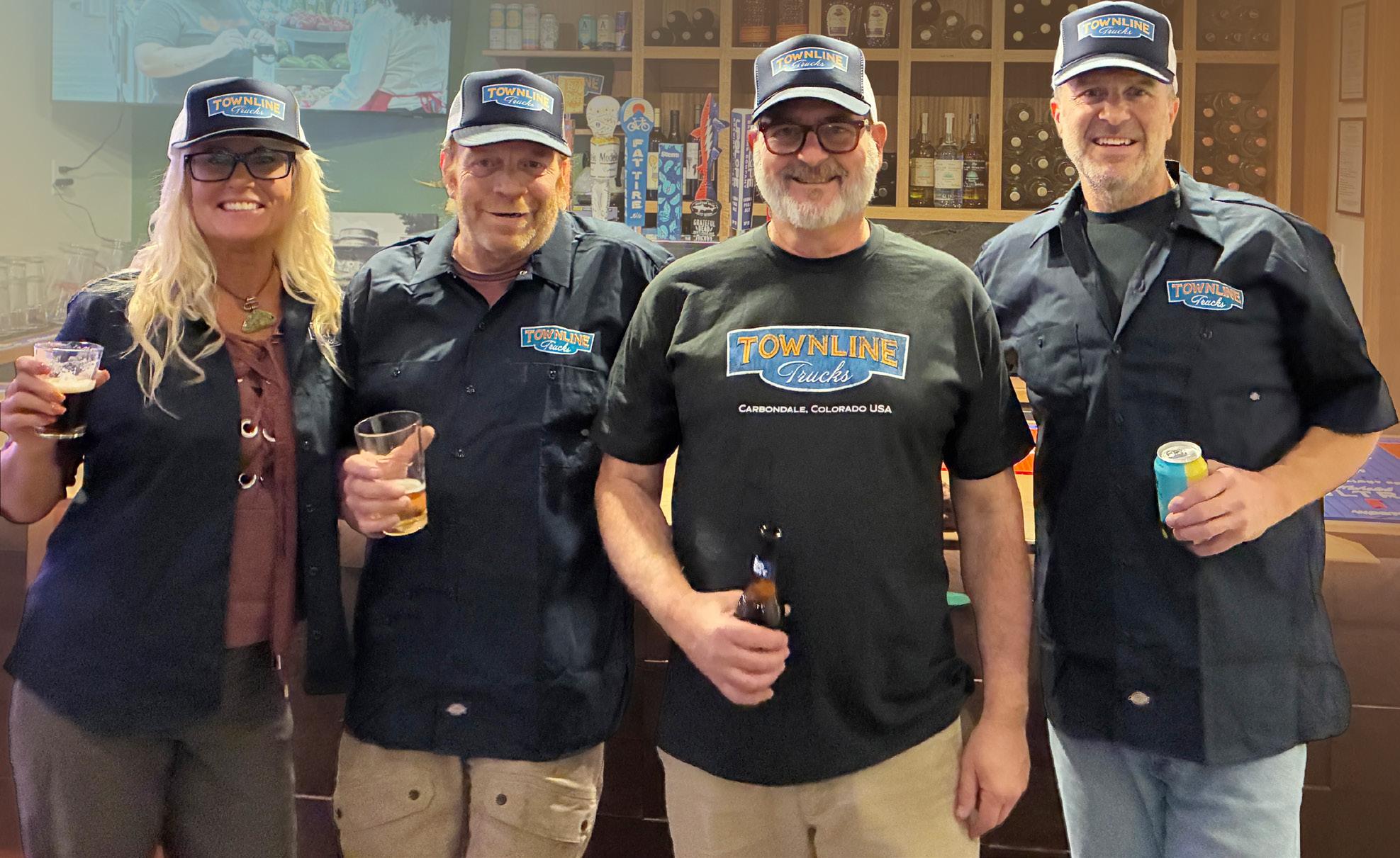
which opened in spring 2023. Now, The Tavern Kitchen and Bar is poised for a soft launch on Jan. 30 followed by a grand opening celebration on Feb. 6 with a band and DJ, starting at 5pm.
Qdoba: Move aside, Glenwood Springs. You’re not the only kid on the block with a Qdoba burrito joint. The Town of Carbondale welcomed this national casual fast food chain in 2025. It’s right off Highway 133 next to City Market.
Kedai: Another Glenwood staple is coming to Carbondale. Kedai Pho & Japanese Cuisine will take the place of Allegria, which vacated 335 Main Street at the end of August 2025.
Townline Trucks: Replacing an old mining cabin (and once a travel agency), a new food truck court and bar opened this past weekend at the east end of Carbondale.



- Becky Gordon, Executive Director
families
the Pitkin County Healthy Community Fund.
The Townline Trucks crew on opening day, Friday, Jan. 23. From left, Kimberly Coup, co-owners Terrance McGuire and Rich Camp, and Dave Nelson. Photo by Jackie Parker
Us, Your Health is Personal