
A flagship idea: 60 years of the Blue Peter badge
WAR CRY
And the winner is…
Richard Coles and Sally Phillips are up for religious broadcasting award


‘I want to open up conversations about fatherhood’

17 June 2023 50p
The Salvation Army is a Christian church and registered charity seeking to share the good news of Jesus and nurture committed followers of him. We also serve people without discrimination, care for creation and seek justice and reconciliation. We offer practical support and services in more than 700 centres throughout the UK. Go to salvationarmy.org.uk/find-a-church to find your nearest centre.
What is the War Cry?
The Salvation Army first published a newspaper called the War Cry in London in December 1879, and we have continued to appear every week since then. Our name refers to our battle for people’s hearts and souls as we promote the positive impact of the Christian faith and The Salvation Army’s fight for greater social justice.
WAR CRY
Issue
Editor: Andrew Stone, Major
Deputy Editor: Philip Halcrow
Production Editor: Ivan Radford
Assistant Editor: Sarah Olowofoyeku
Staff Writer: Emily Bright
Staff Writer: Claire Brine
Editorial Assistant: Linda McTurk
Graphic Designer: Rodney Kingston
Graphic Designer: Mark Knight
Email: warcry@salvationarmy.org.uk

The Salvation Army United Kingdom and Ireland Territory 101 Newington Causeway London SE1 6BN


Tel: 0845 634 0101


Subscriptions: 01933 445445 (option 1, option 1) or email: subscriptions@satcol.org
Founder: William Booth
General: Brian Peddle
Territorial Commander: Commissioner Anthony Cotterill
Editor-in-Chief: Major Julian Watchorn
WHEN viewers settled down on their sofas last week to watch The British Soap Awards, they discovered that BBC1’s EastEnders was clearly the people’s favourite, as it cleaned up by winning three of the four categories voted for by the public.
Not only did it win best soap, but Danielle Harold picked up the best leading performer award for her portrayal of Lola Pearce-Brown, while Aaron Thiara’s character of Ravi Gulati won villain of the year.
It’s unlikely that any villains will be celebrated next week at another broadcasting awards ceremony. On Wednesday (21 June) the Sandford St Martin Trust presents its annual awards which promote religious broadcasting. In this week’s War Cry, we speak with Radio Times editor Tom Loxley, who is one of the trustees of the charity. He explains why he thinks programmes on radio and television should help people understand faith.
‘It’s easy to lose sight of the importance of having some understanding of religion in a world as busy and as frantic as broadcasting,’ he says. ‘Faith can just slip into the “God slot”, as it has been called.
‘But you have to think of it as something that is woven into the lives of a significant proportion of the population.’
Faith is certainly woven into the life of Elliott Rae. As we discover this week, Elliott faced mental health challenges after the traumatic birth of his daughter.
‘I became anxious, quite emotional, having out-of-body experiences at work, just crying a lot and not being able to sleep,’ he tells us. ‘I was eventually diagnosed with PTSD.’
Like many other Christians who have faced difficult times, throughout his experiences, Elliott found that his Christian faith helped him to deal with the pressures he was under.
‘It gets to the point in life where you just don’t have anything left of yourself, when you can’t humanly deal with things,’ he says, before adding: ‘Having a faith, you lean on God to take it on for you.’
INFO INFO
No 7632
Published weekly by The Salvation Army © The Salvation Army United Kingdom and Ireland Territory
0043-0226 The Salvation Army Trust is a registered charity. The charity number in England, Wales and Northern Ireland is 214779, in Scotland SC009359 and in the Republic of Ireland CHY6399. Printed by CKN Print, Northampton, on sustainably sourced paper Your local Salvation Army centre 2 • WAR CRY • 17 June 2023 From the editor’s desk When you’ve read the War Cry, why not pass it on ➔ ➔ ➔
Army? 15 6 9 4 Front-page picture: ALAMY AND © SANDFORD ST MARTIN TRUST FEATURES 3 A note-worthy time Make Music Day brings people together 6 Tuning into faith Annual awards promote religious broadcasting 9 ‘When my daughter was born, she wasn’t crying’ How a father coped with a traumatic birth experience 13 One I made earlier Sixty years since the first Blue Peter badge REGULARS 4 Team Talk and War Cry World 12 How to… 14 Puzzles 15 War Cry Kitchen CONTENTS
ISSN
What is The Salvation
Music-makers unite to celebrate
SINGERS and instrumentalists have taken note – and next Wednesday (21 June) they will be putting on events in their communities to celebrate music-making.

Make Music Day is an annual festival that encourages people to take part in and experience live performances. The events lined up around the UK this year suggest some wide variations on the theme.
Manchester is among the cities hosting live performances by local artists; in Dundee, a digital orchestra that gives young disabled people the opportunity to make music using technology is staging a concert; while Working Men’s College in London is offering a ukulele class.
Elsewhere in the capital, in Walthamstow, Broadway vocal arranger and musical

All together now


supervisor Chapman Roberts is taking a series of masterclasses in gospel singing, leading up to a community concert commemorating the 75th anniversary of Windrush.

Organiser Frank Sweeney has been inviting singers ‘of all nations and backgrounds’ to join an African Diaspora Festival Choir for the event, O, Happy Day!!!, which, as well as the Edwin Hawkins favourite, will include Andraé Crouch’s ‘Soon and Very Soon’ and Richard Smallwood’s ‘Total Praise’.
‘It’s for anyone who loves to sing gospel,’ Frank says. ‘A performance piece will come out of it, so it’s a great opportunity to practise.’
Chapman tells the War Cry that the masterclass will offer participants the opportunity to explore the origins of gospel songs –some of which are in times of slavery in the US – ‘and their subliminal meanings’.

He says: ‘They will find out about how to properly phrase the songs we sing so that the context in which they were created is not lost. For instance, “Total Praise” is a prayer. It’s sung inside your head, but then you let what’s inside your head and your heart come out of your mouth.’
As is clear from many gospel songs, music, says Chapman, ‘sometimes comes with painful experiences. But music is able to transform those challenges into beauty.’ And ultimately gospel music has a particular power that is derived from ‘common faith’.
‘When you sing in a choir,’ he says, ‘it
becomes unifying. There is an emotional response to the music and lyrics by those who create it, which is then witnessed by the audience or congregation. Their common experience is the most powerful form of prayer and the coming together of mankind in a peaceful way.’
It sounds like the kind of experience portrayed by one gospel song that declares:
‘Isn’t it good to be as one,/ Living in perfect harmony/ Sharing the good things/ God has done.’ Which itself echoes the sentiment of a song in the book that gives gospel music its overriding message. ‘How good and how pleasant it is to live together as brothers in unity!’ says that biblical number, associating the harmonious experience with God’s ‘blessing, life for evermore’ (Psalm 133:1 and 3 Revised English Bible).
Gospel music and the book that inspires it acknowledge that life can be tough and that humanity is more than capable of selfishness, greed and prejudice. But they also express the truth that God provides us with the chance to live in harmony with him and with each other by offering us forgiveness – his amazing grace – and an eternal love that we can then show to others.
It’s a message that has always been music to the ears.
17 June 2023 • WAR CRY • 3
Feature by Philip Halcrow
When you sing in a choir, it becomes unifying
Chapman Roberts is leading a gospel masterclass seriesO, Happy Day!!! organiser Frank Sweeney
Fatherhood prompts age-old question
Claire Brine gives her take on a story catching the attention of War Cry reporters
DAYS after Robert De Niro announced that he’d become a father again at the age of 79, Al Pacino announced that he was also about to become a father for the fourth time, at the age of 83. In the run up to Father’s Day tomorrow (Sunday 18 June), I’ve been reflecting on the actors’ stories, reading about dads who had their kids in later life, and also scouring newspaper articles which address the question: How old is too old in parenthood?
An opinion piece by journalist Emma Flint, which I read on the Independent website, caught my attention.

‘Parenthood isn’t something you have to do in your 20s and early 30s,’ the 32-year-old said, pointing out that she ‘wouldn’t grimace at the idea’ of having children with her 65-year-old partner. She went on to talk about the importance of quality in fatherhood.
How old is too old in parenthood?
‘I don’t know if De Niro is a good father at 79 years old, or if Pacino will be a great one at 83,’ she said. ‘What I do know, though, is that as long as that child is wanted and loved, whatever amount of time it has with its father is immaterial.’

Having been bereaved of my 44-yearold dad when I was a teenager, I feel that Emma makes an important point. No father knows how long he will be around in his child’s life, so surely the focus has to be on becoming the best dad possible in the time available. In my mind, having a good, patient and kind dad for 5 years is better than having an uncaring one for 55.
I also find evidence of what makes a good father when I read my Bible, and consider the relationship that Jesus had with God. As a heavenly Father, God was trusted by Jesus as he faced the future. Constantly, he talked to him about what he was going through and confided his deepest feelings. In tough times, Jesus found comfort in God’s presence – and encouraged us to do the same.
Because of Jesus, I know that God is a Father who listens when I talk to him and cares about what happens to me – not just today, but in all the years to come.
nGENERAL Shaw Clifton, a former leader of The Salvation Army, has died.
After leading the church and charity’s work in New Zealand, Fiji and Tonga, Pakistan and the United Kingdom and Republic of Ireland, General Clifton served as the worldwide leader for five years from 2006, during which time he was given the freedom of the City of London in 2007.
Activists campaign to stop the world drowning in plastic
ACTIVISTS dressed as lifeguards held up a safety notice at the UN plastics treaty negotiations in Paris to highlight how poor urban communities are at risk from plastic pollution.
The protest outside the Unesco building followed research conducted on behalf of Christian charity Tearfund, which revealed that plastic pollution puts 218 million people at risk from more severe and frequent flooding. Environmental consultancy Resource Futures, which conducted the research, estimated that 41 million of these are infants, older people or those with disabilities who are at particularly high risk of severe health impacts.
Tearfund has suggested that as part of the UN plastics treaty, there should be legally binding targets to reduce plastic pollution and scale up reuse of plastics, universal access to waste collection and recycling, support for waste pickers and mechanisms to make sure that businesses and governments take action.
TheWarCryUK @TheWarCryUK warcry@salvationarmy.org.uk a Do you have a story to share? salvationarmy.org.uk/warcry B WAR talk talk Team talk Team
‘ ’
talk
TEA
j
M TALK
4 • WAR CRY • 17 June 2023
WnRLD
WAR CRY
Footballer says a little prayer
PETER CROUCH prays every night, the Premier Christian News website reports.

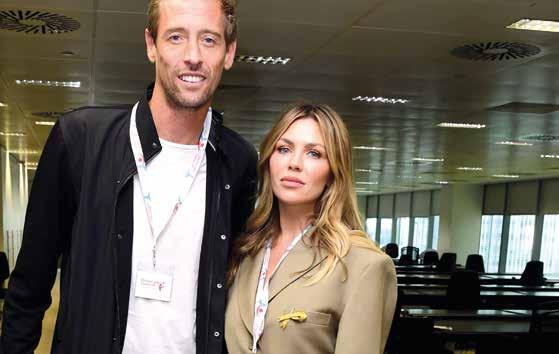
Speaking on podcast The Therapy Crouch, which he hosts with his wife, Abbey Clancy, the former England striker revealed that he used to pray to God as a child, asking to become a professional footballer. The ritual has continued into adulthood. Abbey said that she does not know what he prays, but guessed that he says, ‘Dear God … I just want to say thanks for my house, happiness and can you please look after my family and loved ones.’
Peter responded that Abbey’s guess was ‘not far off. I think it is nice to just appreciate what you’ve got.’
Kenyan schools receive food support

THOUSANDS of children in Kenya have benefited from The Salvation Army’s distribution of food to schools during a major drought in the country.
Five consecutive below-average rainy seasons have led to food shortages, and, as the price of food has risen, people have found themselves unable to pay their children’s school fees. To try to prevent students having to drop out of education, The Salvation Army has been running a Food for Fees project, in which it supplies schools with maize, beans, sugar, rice and cooking oil, enabling the schools to deduct the cost of food from the fees they charge.
More than 12,000 students have been assisted through the initiative, which ensures that each child can receive three nutritious main meals and two snacks each day for three months.
As well as running the Food for Fees scheme, the church and charity has provided food parcels to other schools, and in some of the worstaffected areas in the northwestern region of Turkana has delivered water to schools for cooking, drinking and washing.
FREE childcare schemes can boost the UK economy, according to research by PwC in association with The Salvation Army.
An analysis carried out by the accounting firm found that a 2017 scheme, which increased state-funded childcare for three and four-year olds in England from 15 to 30 hours, added an estimated £22.3 billion to the economy and 286,000 people to the workforce. PwC analysed population data from the Office for National Statistics to draw comparisons with Scotland, which had no such equivalent scheme until 2021.
The Salvation Army has recommended adequate funding for providers of childcare, more flexibility in the system to help parents working atypical hours, and greater help for families searching for affordable childcare during school holidays.
Chancellor Jeremy Hunt has already announced plans in this year’s budget to gradually expand support to 30 hours of free childcare for working parents who have a child over the age of nine months.
Lieut-Colonel Dean Pallant, secretary for communications at The Salvation Army, said: ‘Through The Salvation Army’s work as a provider of formal and informal childcare and Employment Plus services, we know that affordable and accessible childcare is economically and morally right, offering a route out of poverty for many families.
Food supplies arrive at a participating school
‘The government’s recent announcement to expand funded childcare was a move in the right direction, but more work needs to be done to make sure that parents on low incomes can get the same access to childcare as families who are better off.’
17 June 2023 • WAR CRY • 5
IMAGES/ALAMY
PA
Free childcare ‘morally right’
THINKING ON THE
BOX
Interview by Emily BrightCOMEDIAN Sir Lenny Henry, screenwriter Heidi Thomas and rapper Stormzy have at least one thing in common: they have all won at the Sandford St Martin awards, which celebrate the best of faith and ethics programming. This year’s ceremony takes place on Wednesday (21 June) at Whitworth Hall in Manchester.
About 10 years ago, in a move that may have surprised some, Radio Times decided to link up with the Sandford St Martin Trust, the charity behind the awards.
‘Whoever dreamt up that association in the first place had a great idea,’ says current Radio Times editor Tom Loxley, who is also a trustee of the charity. ‘It made sure that in the hurly-burly of producing a weekly magazine, we always found some room for a subject that matters to a lot of our readers: faith-based programming.’
Tom believes that it is important for programme-makers to feature faith in broadcasting to help viewers understand and engage with the world around them.

‘It’s easy to lose sight of the importance of having some understanding of religion in a world as busy and as frantic as broadcasting,’ he says. ‘Faith can just slip
Tom Loxleyinto the “God slot”, as it has been called.
‘But you have to think of it as something that is woven into the lives of a significant proportion of the population. To understand that – or at least to have some grasp of it –is a way to understand the world.’
Tom says that this perspective on covering faith and ethics in broadcasting has shaped the magazine he edits.
‘Radio Times is 100 years old this year, it’s almost as old as the BBC. And at the heart of our mission were the Reithian principles of “inform, educate and entertain”.
Every week, we try and hit off all three of those in some shape or form.
‘If you’re trying to cover broadcasting and the way it reflects the world we live in, you’re not really doing your job if you’re not informing and educating people about religion.’
The Sandford St Martin awards, which throw a spotlight on such programming, include categories honouring TV and video; radio and audio; and journalism. Winners of these categories are decided
The annual Sandford St Martin awards celebrate the best of faith and ethics broadcasting

by a panel of experts.
Titles shortlisted this year include the BBC News coverage of the Queen’s funeral, David Baddiel’s Channel 4 documentary on antisemitism, Jews Don’t Count, and ITV’s Children of Ukraine, which featured testimonies of children affected by the country’s conflict with Russia. There is also the Radio Times readers’ award, which is decided by a public vote. Among the nominees are the BBC’s My Life at Christmas with Sally Philips –where the comedian interviewed celebrities about their memories and traditions of the season – and the Channel 4 documentary Good Grief with Reverend Richard Coles, in which the broadcaster reflected on the experience of losing his partner in 2019 and tried out some unconventional
6 • WAR CRY • 17 June 2023
We always found room for faith-based programming
Radio Times editor TOM LOXLEY talks about the importance of putting faith in broadcasting and explains why he is a trustee of the charity the Sandford St Martin Trust, which promotes religious programming
T
activities to see if they could help him with his grief.
Tom elaborates on what both programmes bring to audiences.
‘Sally Philips’s programmes tend to be around the Christian festivals of Easter and Christmas. She’s a comedian, she’s got broad appeal. There’s something counterintuitive about a comedian tangling with some of this stuff, which intrigues people.

‘And the Rev Richard Coles is such a good broadcaster, with a way of communicating with people and introducing them to subjects that perhaps they’d be a little shy of otherwise. He has done amazing work on helping people understand an emotion as complex as grief, discussing it in an accessible way.’

This year’s awards are dominated by documentaries, which Tom attributes to the vast number of broadcasters and


streaming services providing ‘opportunity for factual programme-makers to get their shows shown’.
He continues: ‘As popular as that particular genre of TV is right now, I guess it’s no surprise to find that some of them deal with issues of faith or ethics. Disability and Abortion: The Hardest Choice, the Channel 4 show on the Radio Times
Turn to page 8 f
17 June 2023 • WAR CRY • 7
Lenny Henry won the trustees’ award in 2022
© SANDFORD ST MARTIN TRUST © SANDFORD ST MARTIN TRUST BOWLED OVER MEDIA
The Rev Richard Coles presents ‘Good Grief’
Lemn Sissay with Sally Phillips in ‘My Life at Christmas’
shortlist, is an example of that.’
In the documentary, the actress Ruth Madeley, who has spina bifida, and actor Reuben Reuter, who has Down’s Syndrome, explore the ethical implications of a law allowing foetuses diagnosed with severe disabilities to be terminated up until birth.
Tom believes that documentaries exploring faith and ethics not only help people grapple with important issues
understanding of how some other communities live.
‘One programme that did that was the BBC series A Believer’s Guide To..., which gave people an understanding of Sikhism, Islam, Hinduism, Judaism as well as Christianity. It was a way to help viewers understand the complexity of modern Britain.’
He says that the key to a successful documentary is ‘finding those intriguing, complicated, interesting stories, often with human stories at their heart that make them so appealing. You’re not going to be wanting for subjects to get your teeth into if you look at questions of religion and
disability and poverty.
‘I tip my hat to Call the Midwife and its writer Heidi Thomas,’ says Tom. ‘At first glance, we have a bunch of nuns from a Church of England order in the East End in the 1950s. But they’re tangling with some pretty relevant and pertinent issues.’
Jimmy McGovern is a master storyteller

But, as Tom explains, religion hasn’t traditionally just been the remit of
‘I used to find myself trying to explain to people why I thought you could find faith in the most popular and mainstream of dramas,’ he says. ‘As is the case with and in someone like Jimmy McGovern’s work. It’s there if you
Call the Midwife, which Tom describes as ‘an absolute Sunday night TV blockbuster’ and a ‘juggernaut’, Radio Times readers’ award. Throughout the programme’s 12 series, it has tackled issues such as racism, domestic abuse, abortion,
The Sandford St Martin Trust also presents a trustees’ award for ‘outstanding contributions to the public understanding of religion, ethics or spirituality’. This year’s winner is screenwriter Jimmy McGovern, who has previously won Sandford St Martin awards for two dramas: Broken – a six-part series about a Catholic priest presiding over a parish in northern England while battling his own demons – and Time, which followed a man in prison after accidentally killing someone.
‘He is a master storyteller,’ says Tom. ‘He finds stories with a Christian twist, although I’d say it’s more universal than that. Time was a remarkable piece of TV, dealing with complicated ideas, such as forgiveness, in the most gripping and accessible way.
‘Sean Bean dominated a story about a man tangling with the consequences of his actions and seeking some sort of forgiveness and redemption. Those are pretty universal Christian themes, done on the biggest stage and in the most impactful way.’

From page 7
8 • WAR CRY • 17 June 2023 COURTESY OF THE
AGENCY BBC STUDIOS
BBC drama ‘Time’, starring Sean Bean and written by Jimmy McGovern (left), won the ‘Radio Times’ readers’ award in 2022
‘It’s impor tant that dads seek help’
The traumatic bir th of his daughter led ELLIOTT RAE to experience mental health issues. Ahead of Father’s Day tomorrow (Sunday 18 June) he describes some of the challenges he faced on becoming a parent and how he and his wife coped
 Interview by Emily Bright
‘WHEN my daughter was born, she wasn’t crying,’ recalls Elliott Rae. ‘She was grey and they had to suck fluid out of her airways. My wife, Soneni, was also in a bad way, losing blood.’
The problems began earlier in Soneni’s pregnancy when she and Elliott received a ‘matter-of-fact’ medical letter telling them that Soneni had a bacterial infection called group B strep (GBS) which can be harmful if passed on to a baby. Anxious, the parents-to-be googled the term and read that 1 in 16 babies infected with the bacteria can die. It can also cause meningitis, and in half of all cases of GBS meningitis, babies can be left with a long-term disability such as cerebral palsy or deafness.
Soneni was given antibiotics during labour, but the infection still passed on to their daughter. After 10 days spent in the intensive care and special care units, the family were told that they could be discharged from hospital. But then doctors discovered a bump on the back of their daughter’s head.
‘The doctors were worried,’ says Elliott. ‘We prayed and cried a lot the night before the MRI scan. Specialists came in from different hospitals and carried out an MRI scan. I think
Turn to page 10 f

17 June 2023 • WAR CRY • 9
Elliott with his daughter and wife, Soneni
Elliott Rae
that was what really broke us, because they knew what to do about the infection, but they didn’t know what the bump was. Luckily it was bone structure.’
After their daughter’s traumatic birth, Soneni was diagnosed with postnatal anxiety. ‘She was struggling to leave the house sometimes, and both of us were paranoid,’ says Elliott. ‘We went to A&E every week for a couple of months for any cough or temperature.
‘I became anxious, quite emotional, having out-of-body experiences at work,
just crying a lot and not being able to sleep. I was eventually diagnosed with PTSD. The first 18 months were tough. It was a whirlwind. Then, just as we felt like we were getting somewhere, my daughter had a severe allergic reaction to wheat. It was scary. She was only seven months old.’
Those first months of parenthood were proving to be extremely challenging.
‘With all the stuff that we were processing and dealing with, it was just
about surviving,’ Elliott remembers. ‘One of the biggest things that helped me was that I was able to work flexibly, which was a lifesaver.’
Struggling to process what he and his family had been through, Elliott began blogging about his experiences of fatherhood. He also met a friend of a friend who had started a blog about maternal mental health.
‘She was probably the first person who’d asked me about the birth in a long time. Maybe ever,’ he says. ‘She was asking questions that I don’t think anyone else asked. When I was telling her, she could see that I was struggling to even relay what had gone on. She suggested that I speak to her friend who was a birth trauma specialist. Help and support came through that way. But even then, I don’t think I went through the full therapy and counselling I should have done.’
Elliott’s experiences of PTSD inspired him to set up his own charity – Music Football Fatherhood – to support dads with their mental health.
‘It’s important to encourage men to seek help earlier,’ he says. ‘I didn’t do that but needed to.
‘Our mission is to open up conversations around fatherhood,’ he explains. ‘We provide content on social media and in a blog. We also campaign on issues such as better paternity leave. And then there is the community event element.’
Elliott hosts an event called Extra Time, where the charity hosts a footballthemed conversation about fatherhood in connection with football teams such as Arsenal, QPR, Brentford and Watford.

‘We have held “dads do hair” sessions,’ he continues, ‘where we teach dads how to do their children’s hair, and have hosted
 A ‘dads do hair’ event organised by Music Football Fatherhood
10 • WAR CRY • 17 June 2023
From page 9
I became anxious and emotionalElliott hosts Extra Time, a footballthemed conversation about fatherhood, at Arsenal FC’s ground
online sessions where we talk about having a child with autism or being a black dad or postnatal depression. It is so important to provide spaces where men can talk, to support, encourage and hold people to account.’
Elliott has also compiled a book called Dad, which features stories about fatherhood spanning subjects including race, religion and sexuality.

‘That book was my proudest achievement, but it was a very emotional process,’ he says. ‘We were asking men to write things down that they hadn’t told anyone before, not even their partner. It was so raw, so honest.’
Writing the book was cathartic for Elliott himself, who contributed a chapter recalling the traumatic birth of his daughter.
In the book, he writes: ‘This is the first time I have written about my birth trauma in such detail and it has helped me to feel more at ease with my own vulnerability, but I must admit that it’s not easy.’ But he continues: ‘Through my experiences, I have learned that talking is the best thing to do. I have learned that I need to be OK with expressing myself and see it as a strength rather than a weakness. I have also learned that we shouldn’t be afraid to
seek professional help.’
Elliott believes that, in creating such a book, he has enabled other men from all walks of life to speak openly about their experience of biological and adoptive fatherhood. He is proud of how many different experiences the book encompasses.
‘The diversity of the stories was so important because family and fathers are so different now than before, regarding race and sexuality,’ he tells me. ‘There are lots of same-sex couple families in the UK, blended families where parents have had children before and remarried, and there are lots of interracial relationship couples.’
In one of the chapters, ‘Faith and Fatherhood’, contributor Cal-I Jonel describes how his Christian faith plays a central role in his life as a dad. Faith is something that Cal-I has in common with Elliott, who attends a church in Watford.

‘Church is a place where, as a family, we can go and connect with God and with other people,’ he explains. ‘And that’s through the worship and the sermons, which tell stories from the Bible and make it very practical to your life.’
He says that the church is also a network of practical support.
‘The church community is there in times of need. The night before my daughter’s MRI scan, we called our minister, who prayed for us. When our family all had Covid, the church helped us out. And when other people have had problems, we’ve tried to be there for them.
‘What is strong is my relationship with God, the belief in human purpose, the idea that we are here for a reason. That should inform how we think and behave.’
Elliott also finds that his faith helps him through his most difficult times.
‘It gets to the point in life where you just don’t have anything left of yourself, when you can’t humanly deal with things,’ he says. ‘Having a faith, you lean on God to take it on for you. Understanding that there’s someone looking out for you, and that your life is purposeful really helps.’
17 June 2023 • WAR CRY • 11
We shouldn’t be afraid to seek help
l Dad is published by Music Football Fatherhood
THE War Cry invites readers to send in requests for prayer, including the first names of individuals and details of their circumstances, for publication. Send your Prayerlink requests to warcry@salvationarmy.org.uk or to War Cry, 101 Newington Causeway, London SE1 6BN. Mark your correspondence ‘Confidential’.


Becoming a Christian


There is no set formula to becoming a Christian, but many people have found saying this prayer to be a helpful first step to a relationship with God
Lord Jesus Christ, I am truly sorry for the things I have done wrong in my life. Please forgive me. I now turn from everything that I know is wrong.
Thank you that you died on the cross for me so that I could be forgiven and set free.
Thank you that you offer me forgiveness and the gift of your Holy Spirit. Please come into my life by your Holy Spirit to be with me for ever.
Thank you, Lord Jesus.
Amen
How to…

help someone experiencing homelessness
NOBODY chooses to be homeless, circumstances make people homeless. Society automatically expects that somebody who is homeless is an alcoholic or a drug user. The misconception is that everybody who is homeless is there because they’ve done something wrong and that it’s their fault. In my case, I could easily have been one of those people in a shop doorway and that was due to circumstances beyond my control.
I was in a violent relationship and my neighbours reported my then partner to the police. He was renting the house off a friend, who said, “I’m renting the house to him, not you.” So I found myself without a home. I had to present myself as homeless with the local authority but I was lucky that within a day, I received a phone call that there was a room available for me.
Relationship breakdowns, family breakdowns, financial difficulties and drug and alcohol dependencies are some of the reasons that people can find themselves experiencing homelessness. People who listen to those in such situations and don’t judge are the people who really make a difference.
To volunteer, visit salvationarmy.org.uk/ volunteer
Sometimes it’s OK to stop and talk to people who are on the streets. Some are willing to speak and others just like to be left alone. You can help by asking if they need some food or if you can buy them a meal, and if it’s hot, making sure they have water or fluids.
People can help in the longer term by engaging with charities that help those experiencing homelessness. I would offer to volunteer and see what’s out there. I know there are outreach teams in many towns and cities.
12 • WAR CRY • 17 June 2023 "
Prayerlink
Looking for help? War Cry 101 Newington Causeway London SE1 6BN Or email your details and request to warcry@salvationarmy.org.uk
a To receive basic reading about Christianity and information about The Salvation Army, complete this coupon and send it to
j Address
Name
Extract from Why Jesus? by Nicky Gumbel published by Alpha International, 2011. Used by kind permission of Alpha International
Caroline was talking to Sarah Olowofoyeku
This week in our series of handy hints, CAROLINE AVERY from The Salvation Army’s homelessness services, who has known what it is to be without a home, offers advice on how to help people facing homelessness
QUICK QUIZ
1 2 3 4 5 6
Who plays the lead role in the new film Barbie?
In netball, how many players in a team can score goals?
In the periodic table, which chemical element is represented by the symbol Na?
Which author penned the Noughts and Crosses series of novels?
Who presents the Channel 4 quiz show Countdown?
What is the capital of Malaysia?
Birthday badge
Blue Peter honour hits 60
 Feature by Claire Brine
IT was Blue Peter’s flagship idea – and viewers were quick to jump on board. After its launch on 17 June 1963, the Blue Peter badge is celebrating its 60th anniversary.
Originally designed to keep young viewers connected to the BBC children’s programme (which is currently showing on CBBC), the Blue Peter badge was awarded to individuals who appeared on the show or in recognition of a particular achievement. Comprising the Blue Peter ship logo on a white shield, the badge grew in popularity – with kids and adults across the UK desperate to get their hands on one. ‘This is a big day,’ said actor Tom Hiddleston when, in 2018, he was awarded a badge by presenter Lindsey Russell.
Today there are eight types of badges available to Blue Peter fans – but trying to collect them all is no easy feat. The original badge continues to be earned by viewers who appear on the programme or send in an interesting letter, story, picture or poem. The green badge is awarded to individuals who show that they care about the environment, while sport and music badges are on offer to children who are learning a new sport or how to play an instrument.
Perhaps the hardest to gain is the gold badge, awarded only in exceptional circumstances for outstanding achievements, such as saving someone’s life. Understandably, each year only a few are given out, meaning the badge remains out of reach for the majority of viewers.
While the chances of attaining all eight Blue Peter badges may be slim, it’s worth remembering that not everything in life is earned by endeavour. God’s love, for example, is free, endlessly rewarding and available to everyone.
Regardless of our successes or failures, God offers us forgiveness for the times we mess up and the possibility of a fresh start. Whatever our age, he promises to help us with our struggles, because, as one Bible writer put it, ‘His love endures for ever’ (Psalm 136:1 New International Version).
God’s love for us remains vast as the ocean – and is something we can always pin our hope on.

BBC ANSWERS
1. Margot Robbie. 2. Two. 3. Sodium.
17 June 2023 • WAR CRY • 13
4. Malorie Blackman. 5. Colin Murray. 6. Kuala Lumpur.
The hardest to gain is the gold badge‘Blue Peter’ presenter Joel and Henry the dog
PUZZLES
1.
2.
3.
8. Meet (9)
11. Wanderer (5)
12. Precept (5)
13. Joyous (5)
14. Also (3)
16. Nought (3)


HONEYCOMB


Each solution starts on the coloured cell and reads clockwise round the number 1. 1986 football World Cup host country 2. Protective hat 3. Multiple of 10 4. Music genre (3-3) 5. Black-and-white bird 6. Become wider
Look up, down, forwards, backwards and diagonally on the grid to find these board games
BACKGAMMON BATTLESHIP BOGGLE CATAN CHAUPAR CHESS CRANIUM DRAUGHTS DUNGEONS AND DRAGONS LUDO MONOPOLY NOUGHTS AND CROSSES OWARE PICTIONARY REVERSI SCRABBLE SNAKES AND LADDERS TRIVIAL PURSUIT 3 7 5 6 1 2 8 9 4 1 8 2 4 9 5 6 7 3 4 6 9 7 8 3 5 1 2 8 5 4 3 2 7 9 6 1 9 3 6 1 4 8 7 2 5 2 1 7 9 5 6 4 3 8 6 9 8 5 3 1 2 4 7 5 4 3 2 7 9 1 8 6 7 2 1 8 6 4 3 5 9 4 7 9 1 8 3 P I H S E L T T A B G D X G E S P C G Q A Q P S W Q O D B F N Z N L W G D Z R G V E Z V H M U I N A R C S V S Q G D E S W H S Z I Q K D A G T V E R L Y Q S Z Y G K Y E V T O Z H S L Z K N V O H W R T S L A Q D W G L S N O G A R D D N A S N O E G N U D T Q O B E C H R N Q N M V P S D A K A O F M Z D N D Q O Z O C F O Z R U B Z O J M N L K Y F Q D I Z Q N D A T R I V I A L P U R S U I T U L O Q H E D Z D S G S Q A C Z C Q C R K M Q V E D Y T B K D Q R G H U V I Y F Z E E Z K H L E C H A U P A R V P N Q R Q T R G L N W A B N B Y E U K K S S E H C U Z L N Z B O G G L E R X Q I Z V Q O Q T Q J L X B Y Z J T F X Z D K J N D O D Z E R A W O Q T L
ACROSS 1. Downcast (4) 3. Douse (3) 5. Hunt (4) 7. Multiply by four (9) 9. Pull (4) 10. Leg joint (4) 11. Mythological young woman (5) 14. Body trunk (5)
Decorate (5)
Muddle (3-2)
Musical play (5) 19. Punitive (5)
Obscurely (5) 23. Overcast (4) 25. Touch (4) 27. Child (9) 28. Soft cheese (4) 29. Beam (3) 30. Stumble (4) DOWN
Quick CROSSWORD
15.
17.
18.
20.
Deep cut (4)
Handle roughly (4)
Uncertain (5)
4. Corpulent (5)
grumpy
5. Be
(4)
(4)
Every three months (9) QUICK CROSSWORD ACROSS: 1. Glum. 3. Dip. 5. Seek. 7. Quadruple. 9. Haul. 10. Knee. 11. Nymph. 14. Torso. 15. Adorn. 17. Mix-up. 18. Opera. 19. Penal. 20. Dimly. 23. Dull. 25. Feel. 27. Youngster. 28. Brie. 29. Ray. 30. Trip. DOWN: 1. Gash. 2. Maul. 3. Dodgy. 4. Plump. 5. Sulk. 6. Kale. 7. Quarterly. 8. Encounter. 11. Nomad. 12. Maxim. 13. Happy. 14. Too. 16. Nil. 21. Inner. 22. Lusty. 23. Daub. 24. Love. 25. Feat. 26. Lamp. HONEYCOMB 1. Mexico. 2. Helmet. 3. Thirty. 4. Hip-hop. 5.
6. Dilate.
14 • WAR CRY • 17 June 2023 21. Interior (5) 22. Vigorous (5) 23. Smear (4) 24. Adore (4) 25. Exploit (4) 26. Lantern (4)
6. Curly cabbage
7.
Magpie.
ANSWERS
W RDSEARCH 3 7 5 6 1 2 8 9 4 1 8 2 4 9 5 6 7 3 4 6 9 7 8 3 5 1 2 8 5 4 3 2 7 9 6 1 9 3 6 1 4 8 7 2 5 2 1 7 9 5 6 4 3 8 6 9 8 5 3 1 2 4 7 5 4 3 2 7 9 1 8 6 7 2 1 8 6 4 3 5 9 5 2 8 4 9 7 4 6 7 2 8 7 9 1 3 4 2 2 7 9 8 6 1 4 7 4 7 9 1 8 3 Fill the grid so that every column, every row and every 3x3 box contains the digits 1 to 9 SUDOKU
MAKES 16
Strawberry and ham crostinis

INGREDIENTS
8 strawberries

1tbsp balsamic vinegar
1tsp caster sugar
Freshly ground black pepper
16 crostini toasts
75g cream cheese
75g Parma ham Chives, to garnish
SERVES 4


METHOD
Wipe the strawberries, remove the hulls and cut into halves. Place them in a small bowl and sprinkle over the balsamic vinegar and sugar. Allow to marinate for 1 hour at room temperature, then season with black pepper.
Arrange the crostinis on a large serving plate. Top each with a little cream cheese and a slice of folded Parma ham. Place a marinated strawberry half on top and garnish with chives.
Super-powered salad
INGREDIENTS

350g butternut squash, peeled, deseeded and cubed
5tbsp extra virgin olive oil
1 small cauliflower, cut into florets
¼ tsp smoked paprika
¼ tsp turmeric
1tsp dried oregano

Salt flakes and coarsely ground black pepper
2tbsp sunflower seeds
2tbsp pumpkin seeds

2tbsp sesame seeds
3tsp runny honey
120g mixed salad leaves
40g rocket
250g cold cooked turkey, torn into shreds
100g blueberries
1 lemon, grated rind and juice
3tbsp fresh or frozen chopped parsley
METHOD
Preheat the oven to 200C/400F/ Gas Mark 6.
Place the butternut squash in a roasting tin, drizzle with 1tbsp oil and roast for 10 minutes. Turn the squash and add the cauliflower. Sprinkle with the paprika, turmeric, oregano and salt and pepper, then drizzle with 2tbsp oil. Roast for 10 minutes.

Meanwhile dry-fry the seeds for 2-3 minutes in a non-stick frying pan, until toasted. Drizzle with 1tsp honey and cook for 1 minute, until the honey is just beginning to caramelise, then take the pan off the heat and leave to cool.
Add the salad leaves, rocket, turkey and blueberries to a large salad bowl and chill in the fridge until the roasted vegetables are cooked.
Add the remaining oil, the lemon rind and juice, the parsley and the remaining honey to a screw-topped jam jar, cover and shake until well mixed. Drizzle over the salad, then top with the
17 June 2023 • WAR CRY • 15
Recipes reprinted, with permission, from the Love Fresh Berries website lovefreshberries.co.uk
PRAYER IS YOU BEING YOURSELF WITH GOD
 David Grant
WAR CRY